AB 2404: Oil Trust Fund.
- Session Year: 2017-2018
- House: Assembly
- Latest Version Date: 2018-02-14
Existing law establishes the Oil Trust Fund in the State Treasury and appropriates the money in the fund to the State Lands Commission commencing when specified requirements are met. Existing law requires the Controller to transfer certain oil-revenue-related moneys to the fund. Existing law requires the commission to expend the money in the fund to finance the costs of well abandonment, pipeline removal, facility removal, remediation, and other costs associated with removal of oil and gas facilities from the Long Beach tidelands. Existing law prohibits the total amount deposited in the fund from exceeding $300,000,000 and requires all interest earned on money in the fund after the balance in the fund totals $300,000,000 to be transferred to the General Fund.
This bill would delete the provisions relating to the limit on the total amount deposited in the fund. By increasing the amount of money that may be deposited into a continuously appropriated fund, this bill would make an appropriation.
(a)For purposes of this section, fund means the Oil Trust Fund established pursuant to subdivision (b).
(b)The Oil Trust Fund is hereby established in the State Treasury, and the moneys in the fund are hereby appropriated to the commission in accordance with this section.
(c)(1) On or before March 1, 2006, the City of Long Beach shall pay to the State Lands Commission all money, including both principal and interest, in the abandonment reserve fund that the city created in 1999 and that was the subject of the litigation in State of California ex rel. California State Lands Commission v. City of Long Beach (2005) 125 Cal.App.4th 767.
(2)The Controller shall deposit in the fund any funds paid to the commission pursuant to paragraph (1).
(3)Except as provided in paragraph (4), on On the last day of each month beginning July January 31, 2006, 2019, the Controller shall transfer to the fund the amount of two million dollars ($2,000,000) or 50 percent of remaining oil revenue, as described in subdivision (d) of Section 4 of Chapter 138 of the Statutes of 1964, First Extraordinary Session to the Oil Trust Fund, whichever is less.
(4)Beginning July 1, 2005, and ending December 31, 2005, any contributions to the fund shall be suspended, except those funds described in paragraphs (1) and (2). During that period the Controller shall transfer four million dollars ($4,000,000) monthly to the General Fund from oil revenues, as described in subdivision (d) of Section 4 of Chapter 138 of the Statutes of 1964, First Extraordinary Session.(5)Beginning January 1, 2006, and ending June 30, 2006, the amount contributed to the fund shall be the amount specified in paragraph (3). During that period the Controller shall also transfer two million dollars ($2,000,000) monthly to the General Fund from oil revenues, as described in subdivision (d) of Section 4 of Chapter 138 of the Statutes of 1964, First Extraordinary Session.(d)(1)The total amount deposited in the fund shall not exceed three hundred million dollars ($300,000,000). From the date the balance in the fund totals three hundred million dollars ($300,000,000), all interest earned thereafter shall be transferred to the General Fund.(2)(d)(1)All interest earned on the money in the abandonment reserve fund specified in paragraph (1) of subdivision (c) shall be transferred to the fund.
(3)(2)The commission shall expend the money from the fund solely to finance the costs of well abandonment, pipeline removal, facility removal, remediation, and other costs associated with removal of oil and gas facilities from the Long Beach tidelands that are not the responsibility of other parties.
(4)(3)All money remaining in the fund after completion of all activities described in subdivision (3) paragraph (2) shall be transferred to the General Fund.
(e)The moneys deposited in the fund are hereby appropriated to the commission commencing when all of the following conditions are met:
(1)The City of Long Beach adopts a resolution declaring that the oil revenue described in subdivision (d) of Section 4 of Chapter 138 of the Statutes of 1964, First Extraordinary Session, is insufficient to fund the costs of activities described in paragraph (3) (2) of subdivision (d) of this section.
(2)The City of Long Beach transmits to the commission a copy of the resolution and all necessary accompanying documentation, including a plan for expenditures for the activities described in paragraph (3) (2) of subdivision (d).
(3)The commission reviews the material provided in paragraph (2) and notifies the Controller within 60 calendar days of receiving the material specified in paragraph (2), that expenditure from the fund may be made so that activities described in paragraph (3) (2) of subdivision (d) can begin. The commission shall provide a schedule for expenditures for disbursement of moneys from the fund to the City of Long Beach. The commission shall submit a copy of the schedule to the Department of Finance and to the fiscal and appropriate policy committees of the Legislature.
|
Date
|
Status
|
|---|---|
| Aug 16, 2018 | In committee: Held under submission. |
| Aug 6, 2018 | In committee: Referred to APPR. suspense file. |
| Jun 26, 2018 | From committee: Do pass and re-refer to Com. on APPR. with recommendation: To Consent Calendar. (Ayes 9. Noes 0.) (June 26). Re-referred to Com. on APPR. |
| Jun 7, 2018 | Referred to Com. on N.R. & W. |
| May 30, 2018 | In Senate. Read first time. To Com. on RLS. for assignment. |
| May 29, 2018 | Read third time. Passed. Ordered to the Senate. |
| May 25, 2018 | From committee: Do pass. (Ayes 16. Noes 0.) (May 25). |
| Apr 18, 2018 | In committee: Set, first hearing. Referred to APPR. suspense file. |
| Apr 10, 2018 | From committee: Do pass and re-refer to Com. on APPR. (Ayes 9. Noes 0.) (April 9). Re-referred to Com. on APPR. |
| Mar 5, 2018 | Referred to Com. on NAT. RES. |
| Feb 15, 2018 | From printer. May be heard in committee March 17. |
| Feb 14, 2018 | Read first time. To print. |
|
Date
|
Description
|
Location
|
Votes
|
|
|---|---|---|---|---|
| Aug 6, 2018 | Placed on suspense file | Senate Standing Committee on Appropriations |
Passed |
|
| Jun 26, 2018 | Do pass, but first be re-referred to the Committee on [Appropriations] with the recommendation: To Consent Calendar | Senate Standing Committee on Natural Resources and Water |
Passed |
|
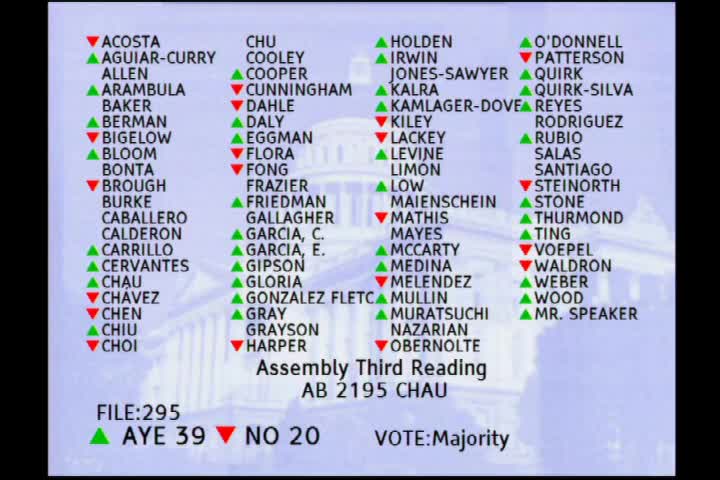
| May 29, 2018 | AB 2404 O'DONNELL Assembly Third Reading | Assembly Floor |
Passed |
|
| May 25, 2018 | Do pass. | Assembly Standing Committee on Appropriations |
Passed |
|
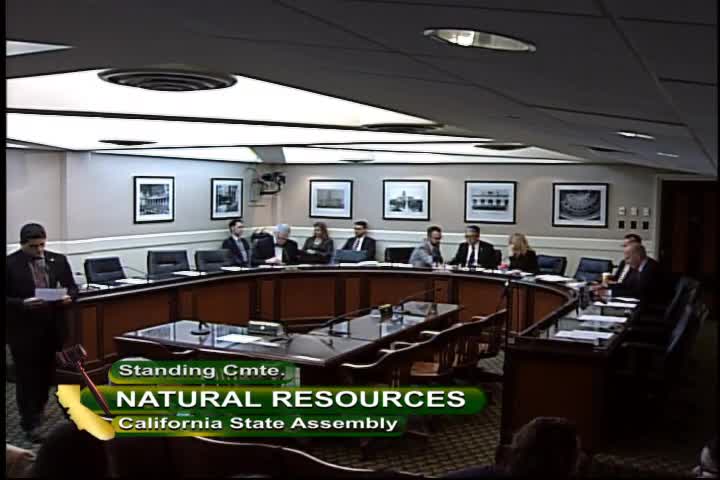
| Apr 9, 2018 | Do pass and be re-referred to the Committee on [Appropriations] | Assembly Standing Committee on Natural Resources |
Passed |
This list shows positions taken on this bill by organizations on the date displayed, which is linked to the original source.
Positions by individuals are not included.
|
Organization
|
Position
|
Date
|
|---|---|---|
| California State Lands Commission | ** Support | Jun 22, 2018 |
| City of Long Beach | ** Support | Jun 22, 2018 |
SENATE COMMITTEE ON APPROPRIATIONS
Senator Anthony Portantino, Chair
2017 - 2018 Regular Session
AB 2404 (O'Donnell) - Oil Trust Fund
Version: February 14, 2018 | Policy Vote: N.R. & W. 9 - 0 |
Urgency: No | Mandate: No |
Hearing Date: August 6, 2018 | Consultant: Ashley Ames |
This bill meets the criteria for referral to the Suspense File.
Bill Summary:
This bill would eliminate the existing $300 million cap on the Oil Trust Fund.
Fiscal Impact:
- Annual General Fund revenue losses of roughly $24 million.
Background:
SB 71 (Senate Committee on Budget and Fiscal Review), Chapter 81, Statutes of 2005, created the Oil Trust Fund to fund abandonment costs from the revenue generated from oil production on tidelands in the City of Long Beach.
The purpose of SB 71 was to create an abandonment fund for the Long Beach operations. The Controller is required to deposit $2 million or 50 percent of monthly revenue, whichever is less, from the state's share of tidelands oil revenues until the Oil Trust Fund reaches $300 million. This cap was reached in June 2014. The Division of Oil and Gas and Geothermal Resources also holds a $5 million bond for plugging and abandoning the wells that are on the city’s granted lands.
Proposed Law:
This bill would remove the cap on the total amount of money deposited in the fund. As the fund is continuously appropriated, this bill would make an appropriation.
Staff Comments:
This money comes from the state’s share of the Long Beach oil operations, which has been going to the General Fund since 2014, when the cap was reached.
By increasing the amount of money that may be deposited into a continuously appropriated fund, this bill would make an appropriation.
-- END --
SENATE COMMITTEE ON NATURAL RESOURCES AND WATER
Senator Robert Hertzberg, Chair
2017 - 2018 Regular
Bill No: AB 2404 Hearing Date: June 26, 2018
Author: | |||
Version: |
| ||
Urgency: | Fiscal: | ||
Consultant: | |||
Subject: Oil Trust Fund
BACKGROUND AND EXISTING LAW
- Existing law establishes the State Lands Commission (commission) to manage, among other things, the state’s public trust lands – including tidelands – and to provide oversight to local trustees who manage public trust lands granted by the Legislature.
- Public trust lands must be managed in accordance with the public trust doctrine. There are over 80 local trustees (grantees) of public trust lands.
- In 1911 the state granted in trust to the City of Long Beach (city) control over its tidelands – including mineral interests – subject to the terms of the grant and the public trust doctrine. In 1937, the Wilmington oil field was discovered and the city began oil development and extraction operations in the tidelands shortly thereafter. A large portion of the Wilmington oil field – one of the largest in the country – underlies the Long Beach tidelands. The city and the state fought over mineral rights development and revenues.
- The state receives a share of the net profits from the city’s oil and gas operations that would otherwise go to the city as grantee. The net profits are generally, with specified exception, deposited in the state’s General Fund.
- The state’s share of liability associated with the plugging and abandonment of oil and gas wells, the decommissioning and removal of related equipment and facilities, and any remediation is apportioned based on its net profit interest, among other factors. According to the commission, the state retains a large majority of the total abandonment liability at the end of oil and gas operations in the Long Beach tidelands. There are approximately 2,400 active or idle oil and gas wells, two man-made oil and gas production islands and associated equipment and facilities in the Long Beach tidelands.
- The city is the only municipal government in the state that manages oil and gas operations. The California Resources Corporation (CRC) is the contractor for the City for these oil operations. In addition to the Wilmington oil field, the city has interests in various smaller oil fields throughout the city.
- Existing law establishes the Oil Trust Fund (fund) in the State Treasury and appropriates the money in the fund to the commission commencing when specified requirements are met. The fund was established via the Resources budget trailer bill in 2005 (SB 71 (Senate Committee on Budget and Fiscal Review, Chapter 81, Statutes of 2005).
- Existing law requires the Controller to transfer certain oil-revenue-related moneys to the fund to finance the costs of well abandonment, pipeline removal, facility removal, remediation, and other costs associated with removal of oil and gas facilities from the Long Beach tidelands that are not the responsibility of other parties.
- In addition to certain moneys required to be deposited in 2005 and 2006, as specified, an amount of $2 million is transferred monthly to the fund until remaining oil revenues, as defined, fall to less than $4 million.
- Existing law prohibits the total amount deposited in the fund from exceeding $300 million, and requires all interest earned on money in the fund after the balance in the fund totals $300 million to be transferred to the General Fund.
- According to the commission, once oil operations cease and revenue is no longer generated, the fund will be the primary source to fund the substantial abandonment and decommissioning work.
- According to CRC, it is required to provide an abandonment cost estimate to the city on an annual basis for certain Long Beach oil and gas operations, including the tidelands. Total estimated costs have increased substantially due to several factors. The unfunded portion of the state’s liability is now on the order of $536 million based on the September 2017 CRC report to the city.
PROPOSED LAW
This bill would remove the cap on the total amount of money deposited in the fund. As the fund is continuously appropriated, this bill would make an appropriation.
ARGUMENTS IN SUPPORT
According to the author, “[t]he Oil Trust Fund was created by the Legislature in 2005 to save a portion of the profits from oil wells on the Long Beach tidelands to help cover the state’s share of clean-up costs when oil operations there cease. That fund is capped at $300 million, a cap that was reached in 2014. The State’s eventual share of these costs is now estimated to be nearly $836 million, leaving a $536 million short fall. AB 2404 simply removes the $300 million [cap], and allows us to save the money we will need to meet the State’s future obligations.”
ARGUMENTS IN OPPOSITION
None received
COMMENTS
Time to fund the estimated shortfall. The $536 million estimated shortfall will be met in just over 22 years at current transfer rates. This is roughly consistent with the projected end of Long Beach tideland oil operations around 2036. This calculation neglects possible potential investment gains and losses and any changes to decommissioning and removal costs.
Limited additional funds are set aside now. The Division of Oil, Gas, and Geothermal Resources – the state’s oil and gas regulator – holds a $5 million bond for the plugging and abandonment of wells that are on the city’s granted lands.
Planning ahead. In 2017, the bankruptcies of the companies operating and holding the leases for oil and gas operations at Platform Holly and Rincon Island resulted in the state becoming responsible/largely responsible for well plugging and abandonment, and facility and related-equipment decommissioning and removal. Required bonds or other financial surety and lease requirements have not been and will not be able to fully fund these activities. To date, the commission has obtained funding through the budget in excess of $100 million for the first phase of decommissioning and removal for these two facilities. While some of these costs have been and will be offset, total costs are likely to far exceed funds required to be set aside. Taking additional action to further pre-fund the state’s liabilities in the Long Beach tidelands appears to make sense.
Recent related legislation
SB 1147 (Hertzberg) would, among other things, establish a sinking fund for the decommissioning and removal of oil and gas operations in the state’s tidelands not covered by the Oil Trust Fund. (This bill is pending before the Assembly Natural Resources Committee.)
SUPPORT
California State Lands Commission (sponsor)
City of Long Beach
OPPOSITION
None Received
-- END --
ASSEMBLY THIRD READING
ATR Bill Id:AB 2404
Author:(O'Donnell)
As Introduced Ver:February 14, 2018
2/3 vote
Committee | Votes | Ayes | Noes |
Natural Resources | 9-0 | Muratsuchi, Acosta, Chau, Eggman, Flora, Limón, Melendez, Mark Stone, Bloom | |
Appropriations | 16-0 | Gonzalez Fletcher, Bigelow, Bloom, Bonta, Calderon, Carrillo, Chau, Eggman, Fong, Friedman, Gallagher, Eduardo Garcia, Nazarian, Obernolte, Quirk, Reyes |
|
SUMMARY: Eliminates the cap of $300 million on the Oil Trust Fund and specifies the amount of money to be deposited into the Oil Trust Fund each month beginning on January 31, 2019.
EXISTING LAW:
- Requires the State Lands Commission (SLC) to be the steward and manager of the state's public trust lands. SLC has direct administrative control over the state's public trust lands and oversight authority over public trust lands granted by the Legislature to local governments.
- Grants, in trust, public trust lands to over 80 local public agencies (local trustees) to be managed for the benefit of all the people of the state and pursuant to the Public Trust Doctrine and terms of the applicable granting statutes.
- Authorizes lands owned by the state and under the jurisdiction of SLC to be leased by SLC for grazing, commercial, industrial, and recreational purposes.
- Establishes the Oil Trust Fund in the State Treasury to fund the removal of oil and gas facilities, remediation, and plugging and abandonment of wells when the City of Long Beach (City) oil operations cease.
- Requires the City to pay SLC all money, including both principal and interest, in the abandonment reserve fund that the city created in 1999 and that was the subject of the litigation in SLC v. City of Long Beach (2005) 125 Cal. App. 4th 767.
- Specifies what portion of the money paid to SLC goes to the General Fund (GF) versus the Oil Trust Fund. Prohibits the Oil Trust Fund from exceeding $300 million.
FISCAL EFFECT: According to the Assembly Appropriations Committee:
- Annual GF revenue losses of $24 million.
- This money comes from the state's share of the Long Beach oil operations, which has been going to the GF since 2014, when the cap was reached.
COMMENTS: A large portion of the Wilmington Oil Field, one of the largest oil fields in the nation, is beneath the Long Beach tidelands. The Legislature granted these tide and submerged lands to the city in the early 1900s subject to the common law Public Trust Doctrine and the statutory trust grant. The grant included the mineral interests. The Wilmington Oil Field was discovered in 1937, and soon thereafter, the city began oil development and extraction operations in the tidelands. The oil operations include the Long Beach Unit and the West Wilmington Units established in the early and mid-1960s. The city is the unit operator and California Resources Corporation is the contractor responsible for day-to-day production and maintenance. Even though the minerals are granted to the city, the state receives a share of the net profits that would otherwise go to the city as grantee. The state's share of revenue is deposited into the GF.
SB 71 (Senate Committee on Budget and Fiscal Review), Chapter 81, Statutes of 2005, created the Oil Trust Fund to fund abandonment costs after unit operations have ceased, from oil revenue generated. The purpose of the legislation was to create an abandonment fund for the Long Beach operations. The Controller is required to do monthly deposits ($2 million or 50% of monthly revenue, whichever is less) from the state's share of tidelands oil revenues until the Oil Trust Fund reaches $300 million. However, the cap was reached in June 2014. The Division of Oil and Gas and Geothermal Resources also holds a $5 million bond for plugging and abandoning the wells that are on the city's granted lands. The state is currently facing other abandonment costs from quitclaimed leases for Platform Holly and Rincon Island that are being born by the GF. Platform Holly and Rincon Island abandonment costs are estimated to be $108.5 million over three years. The state does not have a fund for either oil facility and its bonds are insufficient to cover much of the costs of abandonment.
Analysis Prepared by: Michael Jarred / NAT. RES. / (916) 319-2092 FN: 0003060
Date of Hearing: April 18, 2018
ASSEMBLY COMMITTEE ON APPROPRIATIONS
Lorena Gonzalez Fletcher, Chair
ABPCA Bill Id:AB 2404
Author:(O'Donnell) – As Introduced Ver:February 14, 2018
Policy Committee: | Natural Resources | Vote: | 9 - 0 |
|
|
Urgency: No State Mandated Local Program: No Reimbursable: No
SUMMARY:
This bill eliminates the $300 million cap on the Oil Trust Fund.
FISCAL EFFECT:
Annual GF revenue losses of $24 million.
This money comes from the state’s share of the Long Beach oil operations, which has been going to the GF since 2014, when the cap was reached.
COMMENTS:
- Background. SB 71 (Senate Committee on Budget and Fiscal Review), Chapter 81, Statutes of 2005, created the Oil Trust Fund to fund abandonment costs from the revenue generated from oil production on tidelands in the City of Long Beach.
The purpose of SB 71 was to create an abandonment fund for the Long Beach operations. The Controller is required to deposit $2 million or 50% of monthly revenue, whichever is less, from the state's share of tidelands oil revenues until the Oil Trust Fund reaches $300 million. This cap was reached in June 2014. The Division of Oil and Gas and Geothermal Resources also holds a $5 million bond for plugging and abandoning the wells that are on the city’s granted lands.
The state is currently facing other abandonment costs from quitclaimed leases for Platform Holly and Rincon Island that are being born by the GF. Platform Holly and Rincon Island abandonment costs are estimated to be $108.5 million over three years. The state does not have a fund for either oil facility and its bonds are insufficient to cover much of the costs of abandonment. Money in the Oil Trust Fund may not fund the abandonment cost associated with either Platform Holly or Rincon Island.
- Purpose. According to the author, “The remaining unfunded liability for the Oil Trust Fund alone is estimated at $536 million.”
This bill will provide $24 million per year toward the State’s obligation for abandonment costs associated with oil production in Long Beach, including the removal of oil and gas facilities, plugging of wells, and environmental remediation.
Analysis Prepared by: Jennifer Galehouse / APPR. / (916) 319-2081
Date of Hearing: April 9, 2018
ASSEMBLY COMMITTEE ON NATURAL RESOURCES
Al Muratsuchi, Acting Chair
ABPCA Bill Id:AB 2404 (
Author:O'Donnell) – As Introduced Ver:February 14, 2018
SUBJECT: Oil Trust Fund
SUMMARY: Eliminates the cap of $300 million on the Oil Trust Fund and specifies the amount of money to be deposited into the Oil Trust Fund each month beginning on January 31, 2019.
EXISTING LAW:
- Requires the State Lands Commission (SLC) to be the steward and manager of the state's public trust lands. SLC has direct administrative control over the state's public trust lands and oversight authority over public trust lands granted by the Legislature to local governments.
- Grants, in trust, public trust lands to over 80 local public agencies (local trustees) to be managed for the benefit of all the people of the state and pursuant to the Public Trust Doctrine and terms of the applicable granting statutes.
- Authorizes lands owned by the state and under the jurisdiction of SLC to be leased by SLC for grazing, commercial, industrial, and recreational purposes.
- Establishes the Oil Trust Fund in the State Treasury to fund the removal of oil and gas facilities, remediation, and plugging and abandonment of wells when the City of Long Beach (City) oil operations cease.
- Requires the City to pay SLC all money, including both principal and interest, in the abandonment reserve fund that the city created in 1999 and that was the subject of the litigation in SLC v. City of Long Beach (2005) 125 Cal. App. 4th 767.
- Specifies what portion of the money paid to SLC goes to the General Fund versus the Oil Trust Fund. Prohibits the Oil Trust Fund from exceeding $300 million.
FISCAL EFFECT: Unknown
COMMENTS:
- Author’s statement:
The purpose of establishing the Oil Trust Fund was to create an account to fund the substantial abandonment and decommissioning work that will be required to remove oil and gas facilities related to Long Beach oil operations. The state is responsible for significant abandonment costs including, but not limited to, the removal of oil and gas facilities, remediation, plugging of wells, and environmental remediation.
While oil and gas wells are abandoned as a normal course of oil field operations, those costs are deducted as unit expenses and are paid prior to net profits being calculated. In recent years, the City of Long Beach has estimated the abandonment liability at several hundred million dollars more than previously thought. This assessment was derived by applying an escalation factor to the estimate from prior years.
To improve the accuracy of their assessment, the City of Long Beach Gas and Oil Department (LBGO) requested that the California Resources Corporation (CRC) provide an updated cost estimate for complete abandonment. The abandonment cost estimate includes removal of all CRC facilities, including all oil production wells, injection wells, pipelines, and support facilities, and removal of two islands plus soils remediation. The detailed analysis provided by CRC is consistent with LBGO estimates showing that end of field life abandonment and decommissioning will be more expensive than previously estimated. As of July 1, 2017, the remaining unfunded liability for the Oil Trust Fund alone is estimated at $536 million.
The unfunded liability is primarily due to both increased abandonment costs as outlined by the CRC analysis, but also due to the low oil production forecasts which continue to decline; very few new wells were drilled in the last fiscal year. According to LBGO, the decrease in drilling investment was made in an effort to maximize oil profits in a continuing low oil price environment.
- Background. A large portion of the Wilmington Oil Field, one of the largest oil fields in the nation, is beneath the Long Beach tidelands. The Legislature granted these tide and submerged lands to the city in the early 1900s subject to the common law Public Trust Doctrine and the statutory trust grant. The grant included the mineral interests. The Wilmington Oil Field was discovered in 1937, and soon thereafter, the city began oil development and extraction operations in the tidelands. The oil operations include the Long Beach Unit and the West Wilmington Units established in the early and mid-1960s. The city is the unit operator and California Resources Corporation is the contractor responsible for day-to-day production and maintenance. Even though the minerals are granted to the city, the state receives a share of the net profits that would otherwise go to the city as grantee. The state’s share of revenue is deposited into the General Fund.
SB 71 (Senate Committee on Budget and Fiscal Review), Chapter 81, Statutes of 2005, created the Oil Trust Fund to fund abandonment costs after unit operations have ceased, from oil revenue generated. The purpose of the legislation was to create an abandonment fund for the Long Beach operations. The Controller is required to do monthly deposits ($2 million or 50% of monthly revenue, whichever is less) from the state's share of tidelands oil revenues until the Oil Trust Fund reaches $300 million. However, the cap was reached in June 2014. The Division of Oil and Gas and Geothermal Resources also holds a $5 million bond for plugging and abandoning the wells that are on the city’s granted lands. The state is currently facing other abandonment costs from quitclaimed leases for Platform Holly and Rincon Island that are being born by the General Fund. Platform Holly and Rincon Island abandonment costs are estimated to be $108.5 million over three years. The state does not have a fund for either oil facility and its bonds are insufficient to cover much of the costs of abandonment.
REGISTERED SUPPORT / OPPOSITION:
Support
California State Lands Commission (sponsor)
City of Long Beach
Opposition
None on file
Analysis Prepared by: Michael Jarred / NAT. RES. /
Discussed in Hearing
 1H
Senate Standing Committee on Appropriations
 1MIN
Assembly Floor
 5MIN
Assembly Standing Committee on Natural Resources
Bill Author

Bill Co-Author(s):