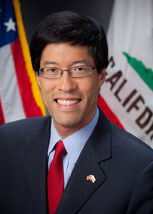
AJR 22: 76th anniversary of the repeal Chinese Exclusion Act.
- Session Year: 2019-2020
- House: Assembly
- Latest Version Date: 2019-07-08
|
Date
|
Status
|
|---|---|
| Sep 4, 2019 | In Senate. To Com. on RLS. |
| Sep 3, 2019 | Coauthors revised. |
| Aug 27, 2019 | From committee: Be adopted. Ordered to Third Reading. (Ayes 8. Noes 2.) (August 26). |
| Jul 11, 2019 | Referred to Com. on JUD. |
| Jul 9, 2019 | From printer. |
| Jul 8, 2019 | Introduced. To print. |
|
Date
|
Description
|
Location
|
Votes
|
|
|---|---|---|---|---|
| Sep 3, 2019 | AJR 22 Ting Assembly Third Reading | Assembly Floor |
Passed |
|
| Aug 26, 2019 | Be adopted. To third reading. | Assembly Standing Committee on Judiciary |
Passed |
This list shows positions taken on this bill by organizations on the date displayed, which is linked to the original source.
Positions by individuals are not included.
ASSEMBLY THIRD READING
ATR Bill Id:AJR 22
Author:(Ting)
As Introduced Ver:July 8, 2019
Majority vote
SUMMARY:
Commemorates the 76th anniversary of the repeal of the Chinese Exclusion Act, a discriminatory and racist federal law regarding immigration and naturalization that was in effect from 1882 until 1943.
Major Provisions
- Makes findings regarding the Chinese Exclusion Act, including the following:
- On May 6, 1882, President Chester A. Arthur signed the Chinese Exclusion Act, which was the nation's first law to prohibit immigration solely on the basis of ethnicity.
- The Chinese Exclusion Act was based on racial hostility against Chinese, who were characterized as "unassimilable, vile heathens" and were blamed for lowering wages, taking away jobs, draining the economy, and endangering the American way of life.
- The Chinese Exclusion Act was repealed on December 17, 1943, by way of the Magnuson Act, marking a turning point in societal reaction towards immigrants and their common struggles for fairness and equality.
- There is a direct link between the racial animus and religious intolerance exemplified by the Chinese Exclusion Act and President Trump's executive orders, which attempt to ban the issuance of travel visas for citizens of certain majority-Muslim nations based on unestablished security risks and the implication that all Muslims are terrorists.
- Makes a number of resolutions by the Assembly and the Senate of the State of California jointly, including the following:
- That the Legislature joins Asian and Pacific Islander communities throughout the state in marking December 17, 2019, as the 76th anniversary of the repeal of the Chinese Exclusion Act to honor the contributions of all immigrants and refugees in our communities.
- That the Legislature condemns the expansion of deportations being undertaken by the current presidential administration as well as its actions to exclude immigrants based on national origin and religion, which threaten to repeat the terrible injustices perpetrated by the Chinese Exclusion Act 137 years ago.
- That the Legislature declares its opposition to Executive Orders 13767, 13768, and 13780, and Presidential Proclamation 9645, and calls upon the President to revoke them.
COMMENTS:
This resolution observes that December 17, 2019 will be the 76th anniversary of the repeal of the Chinese Exclusion Act (Act), the first federal law that excluded all members of a specific ethnic or national group from immigrating or becoming naturalized, which was enacted in 1882 and remained in effect for almost 60 years. The resolution also honors the contributions of all immigrants and refugees in our communities, notes the parallels between the Act and recent actions taken by the current presidential administration to exclude immigrants based on national origin, and declares the Legislature's opposition to three controversial executive orders on immigration enforcement that were issued by the president since he assumed office.
The Chinese Exclusion Act of 1882. In 1882, Congress passed the Act, outlawing all Chinese immigration to the United States and denying citizenship to those Chinese already settled in the country. By outlawing all new immigration, the Act effectively prevented thousands of Chinese men living in the U.S. from ever reuniting with their wives and children who were left behind in China (unless they permanently returned to China); family members were prohibited from entering the country and men who left the U.S. to visit China would not be allowed to re-enter the U.S. The Act's ban on Chinese immigration was extended indefinitely in 1904, and only repealed when Congress passed the Magnuson Act on December 17, 1943, in the midst of World War II, largely because the U.S. and China were allied in their fight against the Japanese.
According to the Author:
The Chinese Exclusion Act was a painful part of Chinese American history in this country that we cannot forget. The harsh reality of today is that we have a presidential administration that does not understand our nation's history, and pursues senseless executive orders that discriminate against an individual based upon their national origin or religious beliefs. The effects of these targeted attacks reverberate beyond the communities they are aimed at. This resolution marks the 76th anniversary of the repeal of the Chinese Exclusion Act but also serves to declare California's opposition to these orders, and push every person to stay awake and act when injustices of the past are recycled by this administration.
Arguments in Support:
Asian Americans Advancing Justice - California, drawing a connection between the ideology behind the Chinese Exclusion Act and the recent executive orders, writes the following in support. For example, they state the following:
While the Chinese Exclusion Act was repealed in 1943, this stain on our nation's history serves as a painful reminder about the very real harmful effects of discrimination against an individual's ethnicity, race, or religious beliefs. Unfortunately, the current federal administration under President Trump is repeating the same mistakes from the past.
. . . There is a direct link between the racial and religious animosity driving these executive orders and the Chinese Exclusion Act. AJR 22 calls on the President to do the right thing and repeal his executive orders, and return America to a country that celebrates diversity and welcomes immigrants and refugees who are integral to California, and the United States. For these reasons, we are in support of AJR 22.
Arguments in Opposition:
None on file.
FISCAL COMMENTS:
None
VOTES:
ASM JUDICIARY: 8-2-2
YES: Mark Stone, Chau, Chiu, Holden, Kalra, Maienschein, Petrie-Norris, Reyes
NO: Gallagher, Obernolte
ABS, ABST OR NV: Gonzalez, Kiley
UPDATED:
VERSION: July 8, 2019
CONSULTANT: Alison Merrilees / JUD. / (916) 319-2334 FN: 0001492
Date of Hearing: August 26, 2019
ASSEMBLY COMMITTEE ON JUDICIARY
Mark Stone, Chair
ABPCA Bill Id:AJR 22
Author:(Ting) – As Introduced Ver:July 8, 2019
SUBJECT: 76TH ANNIVERSARY OF THE REPEAL OF THE CHINESE EXCLUSION ACT
KEY ISSUE: SHOULD THE LEGISLATURE RECOGNIZE THE 76TH ANNIVERSARY OF THE REPEAL OF THE CHINESE EXCLUSION ACT, A FEDERAL LAW ENACTED IN 1882 THAT EXCLUDED CHINESE IMMIGRANTS FROM ENTRY INTO THE UNITED STATES, PROHIBITED THEIR NATURALIZATION AS CITIZENS BASED SOLELY UPON THEIR NATIONALITY, AND REMAINED IN PLACE FOR NEARLY 60 YEARS?
SYNOPSIS
The Chinese Exclusion Act (Act) of 1882 was the first federal law that excluded all members of a specific ethnic or national group from immigrating to the United States or becoming naturalized U.S. citizens. It set an unfortunate precedent for racist foreign and national policies and public opinion, leading to broader exclusion laws, and fostering an environment of racism and discrimination in this country. In addition to banning all immigration by citizens of China to the United States, the Chinese Exclusion Act also denied citizenship and other rights to those Chinese immigrants who already lived in the country. Originally set to expire in 1892, the Act was extended by Congress for another ten years (in the form of the Geary Act) and then made permanent in 1904. This resolution observes that December 17, 2019 will be the 76th anniversary of the repeal of the Act, a discriminatory federal law enacted in 1882 that remained in effect for nearly 60 years and was not repealed until 1943, when the United States and China fought together as allies during World War II. The resolution also honors the contributions of all immigrants and refugees in our communities, notes the parallels between the Act and recent actions taken by the current presidential administration to exclude immigrants based on national origin, and declares the Legislature's opposition to a number of controversial executive orders on immigration enforcement that have been issued by the president since he assumed office that the author and sponsors compare to the Act in that they discriminate against immigrants based upon their national origin. The resolution is supported by Asian Americans Advancing Justice – California and has no opposition on file. It is similar to a number of past resolutions passed by the Legislature to condemn the Act and similar discriminatory state and federal laws, and affirm the Legislature’s commitment to preserve the civil rights and constitutional protections for all persons.
SUMMARY: Commemorates the 76th anniversary of the repeal of the Chinese Exclusion Act, a discriminatory and racist federal law regarding immigration and naturalization that was in effect from 1882 until 1943. Specifically, this resolution:
- Makes the following findings regarding the Chinese Exclusion Act:
- On May 6, 1882, President Chester A. Arthur signed the Chinese Exclusion Act, which was the nation’s first law to prohibit immigration solely on the basis of ethnicity.
- The Chinese Exclusion Act, which was renewed in 1892, amended in 1902, and made permanent in 1904, prevented Chinese laborers from entering the United States, and denied Chinese a pathway to citizenship for more than 60 years.
- Subsequent legislation, such as the 1892 Geary Act that required all Chinese to register for and carry on their persons Certificates of Residence or risk imprisonment and deportation, set a precedent for the Muslim registry being promoted by President Trump today.
- The Chinese Exclusion Act was based on racial hostility against Chinese, who were characterized as “unassimilable, vile heathens” and were blamed for lowering wages, taking away jobs, draining the economy, and endangering the American way of life.
- The Chinese Exclusion Act was repealed on December 17, 1943, by way of the Magnuson Act, marking a turning point in societal reaction towards immigrants and their common struggles for fairness and equality.
- There is a direct link between the racial animus and religious intolerance exemplified by the Chinese Exclusion Act and President Trump’s executive orders, which attempt to ban the issuance of travel visas for citizens of certain majority-Muslim nations based on unestablished security risks and the implication that all Muslims are terrorists.
- President Trump’s Executive Order 13780, titled “Protecting the Nation from Foreign Terrorist Entry into the United States” and issued March 6, 2017, seeks to suspend the entry of all refugees under the United States Refugee Assistance Program for 120 days, and seeks to limit the total number of refugees accepted to just 50,000 — half the number of refugees previously accepted under the Obama administration.
- President Trump’s Presidential Proclamation 9645, issued September 24, 2017, to replace Executive Order 13780, continues to suspend entry of immigrants and some classes of nonimmigrants from several majority-Muslim countries, and calls for many of the same restrictions as Executive Order 13780.
- President Trump’s Executive Order 13768, titled “Enhancing Public Safety in the Interior of the United States” and issued January 25, 2017, seeks to direct the Department of Homeland Security to hire 10,000 additional immigration enforcement officers, empower states and local law enforcement to perform functions of immigration officers, and to greatly expand the categories of people classified as priorities for removal, including those who are convicted of only minor crimes or who are simply charged with, but not convicted, of a crime.
- President Trump’s Executive Order 13767, titled “Border Security and Immigration Enforcement Improvements” and issued January 25, 2017, calls for the construction of a wall along the southern border with Mexico estimated to cost $20 billion, the construction and operation of new immigration detention facilities near the border, and the hiring of 5,000 additional Border Patrol agents.
- On December 22, 2018, President Trump shut down the federal government over Congress’s refusal to fund the $5.7 billion wall along the southern border with Mexico resulting in the longest federal government shutdown in United States history, leaving 800,000 federal employees working without their paychecks, 41,478 of whom live in California, and costing American taxpayers $11 billion.
- With the unanimous passage of Senate Resolution 201 by the United States Senate in 2011, and the unanimous passage of House Resolution 683 by the United States House of Representatives in 2012, both houses of Congress have condemned the Chinese Exclusion Act and affirmed Congress’ commitment to preserve the civil rights and constitutional protections for all people.
- Resolves by the Assembly and the Senate of the State of California jointly, as follows:
- That the Legislature joins Asian and Pacific Islander communities throughout the state in marking December 17, 2019, as the 76th anniversary of the repeal of the Chinese Exclusion Act to honor the contributions of all immigrants and refugees in our communities.
- That the Legislature condemns the expansion of deportations being undertaken by the current presidential administration as well as its actions to exclude immigrants based on national origin and religion, which threaten to repeat the terrible injustices perpetrated by the Chinese Exclusion Act 137 years ago.
- That the Legislature declares its opposition to Executive Orders 13767, 13768, and 13780, and Presidential Proclamation 9645, and calls upon the President to revoke them.
- That the Legislature stands in firm opposition to the President’s proposal for construction of a wall along the southern border with Mexico.
- That the Legislature reaffirms that the State of California is open and welcoming to immigrants and refugees who are integral to the life of our state.
- That the Chief Clerk of the Assembly transmit copies of this resolution to the author for appropriate distribution.
EXISTING LAW:
- Provides that Congress shall have the power to establish a uniform rule of naturalization. (U.S. Const., art. I, Sec. 8, par. (4). Art. I.)
- Pursuant to the federal Immigration and Nationality Act, provides that no person shall receive any preference or priority or be discriminated against in the issuance of an immigrant visa because of the person's race, sex, nationality, place of birth, or place of residence, except as specifically provided [citations omitted]. (8 U.S.C. Section 1152 (a).)
- Provides that all people are by nature free and independent and have inalienable rights, including enjoying and defending life and liberty, acquiring, possessing, and protecting property, and pursuing and obtaining safety, happiness, and privacy. (Cal. Const., art. 1. Section 1.)
- Pursuant to the Unruh Civil Rights Act, provides that all persons within the jurisdiction of this state are free and equal, and specifically prohibits discrimination based on sex, race, color, religion, ancestry, national origin, disability, medical condition, marital status, or sexual orientation with respect to accommodations, advantages, facilities, privileges, or services in all business establishments of every kind. (Civil Code Section 51.)
FISCAL EFFECT: As currently in print this resolution is keyed non-fiscal.
COMMENTS: This resolution observes that December 17, 2019 will be the 76th anniversary of the repeal of the Chinese Exclusion Act (Act), the first federal law that excluded all members of a specific ethnic or national group from immigrating or becoming naturalized, which was enacted in 1882 and remained in effect for almost 60 years. The resolution also honors the contributions of all immigrants and refugees in our communities, notes the parallels between the Act and recent actions taken by the current presidential administration to exclude immigrants based on national origin, and declares the Legislature's opposition to three controversial executive orders on immigration enforcement that were issued by the president since he assumed office.
The Chinese Exclusion Act of 1882. In 1882, Congress passed the Act, outlawing all Chinese immigration to the United States and denying citizenship to those Chinese already settled in the country. By outlawing all new immigration, the Act effectively prevented thousands of Chinese men living in the U.S. from ever reuniting with their wives and children who were left behind in China (unless they permanently returned to China); family members were prohibited from entering the country and men who left the U.S. to visit China would not be allowed to re-enter the U.S. That same year, Congress passed the nation’s first general immigration law: the Immigration Act of 1882. (Pub. L. No. 47-376, 22 Stat. 214 (1882). Among other things, the Immigration Act of 1882 prohibited entry at a U.S. port of any person who was “unable to take care of himself or herself without becoming a public charge.”
. . . [I]t shall be the duty of such State commission, board, or officers so designated to examine into the condition of passengers arriving at the ports within such State in any ship or vessel, and for that purpose all or any of such commissioners or officers, or such other person or persons as they shall appoint, shall be authorized to go on board of and through any such ship or vessel; and if on such examination there shall be found among such passengers any convict, lunatic, idiot, or any person unable to take care of himself or herself without becoming a public charge, they shall report the same in writing to the collector of such port, and such persons shall not be permitted to land.
While the “public charge” language has been a feature of federal immigration law ever since 1882, according to Professor Kunal Parker of the University of Miami School of Law, it historically involved only checking whether immigrants had cash in their possession at the time of arrival and whether they were so ill or disabled that they were unable to support themselves. (National Public Radio, The History of 'Public Charge' Requirements In U.S. Immigration Law (August 13, 2019), https://www.npr.org/2019/08/13/750897658/the-history-of-public-charge-requirements-in-u-s-immigration-law.) Until recent action by the Trump Administration (discussed in more detail below), the public charge rule was never interpreted to prohibit naturalization of those who end up relying on public benefits at some point after entering the country. In fact, the Immigration Act of 1882 included language that seemed to anticipate and endorse the idea of new arrivals needing and obtaining some forms of public assistance:
SEC. 2.-That the Secretary of the Treasury is hereby charged with the duty of executing the provisions of this act and with supervision mitt, duty of ex- over the business of immigration to the United States, and for that purpose he shall have power to enter into contracts with such State commission, board, or officers as may be designated for that purpose by the governor of any State to take charge of the local affairs of immigration in the ports within said State, and to provide for the support and relief of such immigrants therein landing as may fall into distress or need public aid, under the rules and regulations to be prescribed by said Secretary[.]
Regarding the Act itself, according to historian Andrew Gyory, it "reversed not only American policy, but also American tradition, changing forever the nation’s image of itself as a beacon of hope, a refuge for the poor and the oppressed the world over." In his view, the Chinese Exclusion Act not only "legitimize[d] racism as national policy" but also set a precedent for broader exclusion laws and "fostered an atmosphere of hostility towards foreigners that would endure for generations." (Andrew Gyory, Closing the Gate: Race Politics and the Chinese Exclusion Act. Chapel Hill: University of North Carolina Press, 1998.)
According to one scholar of the Chinese Exclusion Act, it marked the beginning of an era where, for political reasons, U.S. immigration policy became more exclusionary in nature. Quoting from a recent article by writer Kat Chow:
Beginning in 1882, the United States stopped being a nation of immigrants that welcomed foreigners without restrictions, borders or gates. Instead, it became a ... gatekeeping nation," Erika Lee, a professor at the University of Minnesota, wrote in her book At America's Gates: Chinese Immigration During The Exclusion Era, 1882-1943. "In the process, the very definition of what it meant to be an 'American' became even more exclusionary." (Erika Lee, At America's Gates: Chinese Immigration During The Exclusion Era, 1882-1943. Chapel Hill: University of North Carolina Press, 2003.)
The Chinese exclusion law was the very first time in American history that immigrants were barred because of their race and class. In 1882, when Congress passed the law, there were 39,600 men and women from China who arrived in the U.S. Just three years later, there were only 22, according to early records that Lee came across in her research.
The 1876 presidential race between Rutherford Hayes and Samuel Tilden was a major turning point in the country's stance on immigration. Leading up to the election, the race was so close and electoral votes were so coveted, it brought California's ongoing fight to push out Chinese immigrants to the national stage, Lee said. Many Californians worried that Chinese laborers would take their jobs, and that they were sexually lecherous threats to society. (Kat Chow, "As Chinese Exclusion Act Turns 135, Experts Point To Parallels Today." Accessed at: http://www.npr.org/sections/codeswitch /2017/05/05/527091890/the-135-year-bridge-between-the-chinese-exclusion-act-and-a-proposed-travel-ban.)
The Act’s ban on Chinese immigration was extended indefinitely in 1904, and only repealed when Congress passed the Magnuson Act on December 17, 1943, in the midst of World War II, largely because the U.S. and China were allied in their fight against the Japanese. Although the Magnuson Act made Chinese Americans eligible for naturalization as citizens, it retained several discriminatory provisions in federal law. For example, it limited the number of Chinese immigrants allowed into the country to only 105 immigrants per year. It also left in place restrictions on immigration to the U.S. from Asian countries other than China and continued the ban against ethnic Chinese ownership of property and businesses. Those discriminatory laws remained in place until the Magnuson Act itself was ultimately repealed in 1965.
California's unfortunate role in promoting the Act and its subsequent apology for that role. In 2014, the Legislature passed SCR 122 (De Leon), Res. Ch. 132, Stats. 2014, which acknowledged that California’s stance against the Chinese community in the late 1800s influenced the promotion and passage of the Act. SCR 122 found and declared that California enacted a number of discriminatory laws targeting Chinese in America and Chinese immigrants in order to discourage further immigration from China and sought to severely limit the success of the Chinese laborers in the state. The resolution acknowledged that, among other things, these discriminatory state laws denied Chinese the right to own land or property, the right to vote, and the right to marry a white person. State law also denied children of Chinese descent access to public schools; denied Chinese immigrants the right to bear arms; unfairly targeted women of Chinese descent by imposing special requirements for them to immigrate into the state; authorized the removal of Chinese immigrants from towns and cities to outside town and city limits; denied Chinese laborers employment in public works projects and through state agencies; prohibited the issuance of licenses to Chinese in California; denied Chinese in California the right to fish in California’s waters; and unduly taxed Chinese businesses and individuals who employed Chinese laborers.
SCR 122 also noted that “California lobbied Congress for years to strictly prohibit immigration from China, and in 1882, was successful in convincing Congress to enact the Chinese Exclusion Act, which set the precedent for future racist foreign and national policies that led to broader exclusion laws and fostered an environment of racism that quickly led to the Jim Crow laws of the 1880s.” The resolution also notes that three years before Congress passed the Act, California amended its state constitution to allow discrimination against Chinese persons. An excerpt of Article XIX of the California Constitution, titled "Legislature to Protect State From Certain Aliens,” was amended to read as follows:
The Legislature shall prescribe all necessary regulations for the protection of the
State . . . from the burdens and evils arising from the presence of aliens, who are, or may become vagrants, paupers, mendicants, criminals, or invalids afflicted with contagious or infectious diseases, and from aliens otherwise dangerous or detrimental to the well-being or peace of the State, and to impose conditions upon which such persons may reside in the State, and to provide the means and mode of their removal from the State.
Article XIX also declared that "foreigners unable to become citizens" (meaning Chinese, who with passage of the Chinese Exclusion Act of 1882, specifically were denied citizenship) were "dangerous or detrimental to the well-being of the State." Article XIX remained in effect for 73 years until it was repealed in 1952. SCR 122 provided the California Legislature's formal apology to the Chinese-American community for its role in the enactment of the Act and, among other things, the state constitutional provisions that legitimized discrimination against state residents of Chinese heritage.
Background on recent Executive Orders on immigration enforcement. On January 25, 2017, Executive Order (EO) 13767, titled “Border Security and Immigration Enforcement Improvements," which is perhaps best known for proclaiming U.S. policy to secure the southern border of the United States through the immediate construction of a physical wall on the southern border and directing the Secretary of the Department of Homeland Security (DHS) to "immediately" take steps to plan, design, and construct a physical wall, as well as to construct and operate detention facilities to detain aliens at or near the border with Mexico, was issued. Among other things, EO 13767 also directs the Secretary to: (1) allocate asylum officers and judges to detention facilities in order to conduct authorized removal proceedings; (2) ensure detention of aliens apprehended for violations of immigration law pending outcome of removal proceedings; and (3) hire 5,000 additional border patrol agents.
On the same date, January 25, 2017, Executive Order 13768, titled “Enhancing Public Safety in the Interior of the United States,” was issued, which, among other things, directs the Secretary of Homeland Security to: (1) hire 10,000 additional immigration officers and to empower state and local law enforcement to perform functions of immigration officers; and (2) prioritize certain persons for removal, especially any person charged with or convicted of a criminal offense, any person who has committed acts that constitute a criminal offense, or any person who has "abused" a public benefit program. EO 13768 also sought to designate as a "sanctuary jurisdiction" any jurisdiction that refuses to exchange information, as required by 8 U.S.C. § 1373, and would make such jurisdictions ineligible for federal grants, except as deemed necessary for law enforcement purposes. On November 21, 2017, the U.S. District Court for the Northern District of California ruled that this latter provision, making such jurisdictions ineligible for federal grants, was unconstitutional, and issued a permanent injunction blocking implementation of the order nationwide. On August 1, 2018, the Ninth Circuit Court of Appeals upheld the district court’s decision.
On January 27, 2017, Executive Order 13769, titled "Protecting the Nation from Foreign Terrorist Entry into the United States," but more commonly known as the purported "Muslim travel ban" was issued. On February 9, 2017, the United States Court of Appeals for the Ninth Circuit denied the government's emergency motion for a stay of the lower court's temporary injunction against EO 13769, effectively affirming the injunction against the travel ban. Rather than appeal the decision of the Ninth Circuit to the U.S. Supreme Court, the administration instead revoked EO 13769 and issued a revised version of the order, Executive Order 13780, on March 6, 2017.
EO 13780 seeks, among other things, to suspend entry into the U.S. of nationals of Iran, Libya, Somalia, Sudan, Syria, and Yemen (Iraq is excluded) for 90 days, subject to exceptions for (1) a person holding a valid visa or other document that permits travel in the U.S.; (2) a legal permanent resident (i.e. "Green Card" holder); (3) a foreign national granted asylum or a refugee already admitted into the U.S.; or (4) a person inside the U.S. at the time of this order. EO 13780 also seeks to suspend the entry of all refugees under the U.S. Refugee Assistance Program for 120 days, and seeks to limit the total number of refugees accepted into the U.S. to just 50,000—half the number of refugees previously accepted under the Obama administration.
On September 24, 2017, the President issued Presidential Proclamation 9645, which imposes restrictions on immigrants and visitors from eight countries, and effectively takes the place of Executive Order 13780, which had stalled while being challenged in the courts. The State of Hawaii subsequently filed suit to stop Proclamation 9645 from taking effect, arguing that this most recent version of the President's so-called "travel ban" unconstitutionally discriminates against Muslims and exceeds the President's powers over immigration. On June 26, 2018, the United States Supreme Court issued a decision regarding Presidential Proclamation 9645, ruling that the Proclamation was a lawful exercise of the President’s authority under the Immigration and Nationality Act, and denying Hawaii's challenge to Proclamation 9645. According to the U.S. Department of State Bureau of Consular Affairs, “Consistent with the Court’s decision, the Department will continue processing visa applications in accordance with the Presidential Proclamation for subject nationals of the seven affected countries. Since December 8, 2017, the Department has fully implemented Presidential Proclamation 9645.” (Travel.State.Gov, June 26 Supreme Court Decision on Presidential Proclamation 9645.)
Finally, on August 14, 2019, the Department of Homeland Security issued a final rule that, for the first time in the history of the nation, defines certain terms critical to the public charge determination, such as “public charge” and “public benefit,” and to explain the factors DHS will consider in the totality of the circumstances when making a public charge inadmissibility determination. (84 FR 41292.) The final rule also requires that immigrants seeking an extension of stay or change of status demonstrate that they have not, since obtaining the nonimmigrant status they seek to extend or change, received public benefits over the designated threshold, as defined by the rule.
This measure draws parallels between the Act and recent Executive Orders that appear to single out certain groups for discrimination and exclusion based on their ethnicity, national origin, or religion. According to the author, the occasion of the 76th anniversary of the repeal of the Chinese Exclusion Act gives us pause to look back at history and understand the danger of pursuing immigration policies that are based on discrimination against and exclusion of certain groups of immigrants based on their national origin, religion, or other protected factors. The author states:
The Chinese Exclusion Act was a painful part of Chinese American history in this country that we cannot forget. The harsh reality of today is that we have a presidential administration that does not understand our nation’s history, and pursues senseless executive orders that discriminate against an individual based upon their national origin or religious beliefs. The effects of these targeted attacks reverberate beyond the communities they are aimed at. This resolution marks the 76th anniversary of the repeal of the Chinese Exclusion Act but also serves to declare California’s opposition to these orders, and push every person to stay awake and act when injustices of the past are recycled by this administration.
There are a number of parallels between the Act and the executive actions on immigration enforcement issued in recent years. This measure observes the 76th anniversary of the repeal of the Chinese Exclusion Act and states that “[t]here is a direct link between the racial animus and religious intolerance exemplified by the Chinese Exclusion Act and President Trump’s executive orders." This measure "condemns the expansion of deportations planned by the current presidential administration as well as its actions to exclude immigrants based on national origin and religion, which threaten to repeat the terrible injustices perpetrated by the Chinese Exclusion Act 136 years ago" and, while declaring its opposition to them, calls upon the President to revoke Executive Orders 13767, 13768, and 13780.
Professor Erika Lee, according to Kat Chow in her article, above, points out the similarities between the Act and recent Trump Administration policies:
Lee said that anti-immigrant measures in the 1880s — and today — were driven by both working-class people and elites, as well as those who had a "vested economic interest in border walls and detention centers." The Chinese Exclusion Act set the groundwork for immigrant detention centers and the country's first large-scale deportation of a single immigrant group. Specifically, the exclusion era brought an expansion of the federal government in terms of hiring more immigrant inspectors, whose responsibilities included working as interpreters and at the detention facilities.
As for today's parallel? Lee points to companies that are vying to build a U.S.-Mexico border wall, and the question of whether there will be more privately-owned immigrant detention centers under President Trump. Lee says that today's equivalent is the proposed so-called "Muslim ban," because it “singles out specific groups of people for discrimination.” The fact that we don't explicitly name Muslims [in the executive order] is more of a reflection of how our racial sensibilities have changed over the past 135 years, in terms of being more polite in our racism." (Chow, supra.)
ARGUMENTS IN SUPPORT: Asian Americans Advancing Justice - California, drawing a connection between the ideology behind the Chinese Exclusion Act and the recent executive orders, writes the following in support. For example, they state the following:
While the Chinese Exclusion Act was repealed in 1943, this stain on our nation's history serves as a painful reminder about the very real harmful effects of discrimination against an individual's ethnicity, race, or religious beliefs. Unfortunately, the current federal administration under President Trump is repeating the same mistakes from the past.
The president has signed multiple executive orders that again put America on the wrong side of history. These executive orders are deeply alarming to communities of color across the country, as they suspend Muslim entry based on the implication that all Muslims are terrorists, and give broad powers to Immigrations and Customs Enforcement, advocating for workplace raids, immediate deportations, and sweeps of homes of undocumented individuals.
There is a direct link between the racial and religious animosity driving these executive orders and the Chinese Exclusion Act. AJR 22 calls on the President to do the right thing and repeal his executive orders, and return America to a country that celebrates diversity and welcomes immigrants and refugees who are integral to California, and the United States. For these reasons, we are in support of AJR 22.
Previous related legislation. ACR 42 (Fong and De Leon), Res. Ch. 79, Stats. 2009, expressed the Legislature’s regret for enactment of past discriminatory laws and constitutional provisions that resulted in the persecution of Chinese living in California, and affirmed its commitment to preserving the rights of all people and celebrated the contributions that all immigrants have made to California and the nation.
SJR 23 (Huff and De Leon), Res. Ch. 134, Stats. 2014, requested Congress to formally apologize to Chinese Americans for the enactment of the Chinese Exclusion Act of 1882 and other similar discriminatory federal laws of that period.
SCR 94 (Pan), Res. Ch. 77, Stats. 2016, found that the repeal of the Chinese Exclusion Act on December 17, 1943, marked the date on which the United States expressed a commitment to break down cultural barriers and further racial, religious, and cultural tolerance, and acknowledges December 17 each year as an annual “Day of Inclusion” in recognition of the contributions of all immigrants to California and the United States.
AJR 14 (Ting), Res. Ch. 120, Stats. 2017, observed the 135th anniversary of the Chinese Exclusion Act, and declared the Legislature's opposition to the President's controversial executive orders on immigration enforcement.
AJR 36 (Ting), Res. Ch. 134, Stats. 2018, observed the 136th anniversary of the Chinese Exclusion Act, and declared the Legislature's opposition to the President's controversial executive orders on immigration enforcement.
REGISTERED SUPPORT / OPPOSITION:
Support
Asian Americans Advancing Justice - California
Opposition
None on file
Analysis Prepared by: Alison Merrilees / JUD. / (916) 319-2334
Bill Author

Bill Co-Author(s):