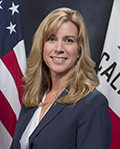
AJR 7: Green New Deal.
- Session Year: 2019-2020
- House: Assembly
- Latest Version Date: 2019-07-01
|
Date
|
Status
|
|---|---|
| Sep 4, 2019 | In Senate. To Com. on RLS. |
| Sep 3, 2019 | Coauthors revised. |
| Jul 9, 2019 | From committee: Be adopted. Ordered to Third Reading. (Ayes 7. Noes 3.) (July 8). |
| Jul 2, 2019 | Re-referred to Com. on NAT. RES. |
| Jul 1, 2019 | From committee chair, with author's amendments: Amend, and re-refer to Com. on NAT. RES. Amended. |
| Apr 29, 2019 | In committee: Hearing cancelled at the request of author. |
| Mar 12, 2019 | In committee: Hearing postponed by committee. |
| Feb 21, 2019 | Referred to Com. on NAT. RES. |
| Feb 12, 2019 | From printer. |
| Feb 11, 2019 | Introduced. To print. |
|
Date
|
Description
|
Location
|
Votes
|
|
|---|---|---|---|---|
| Sep 3, 2019 | AJR 7 Gloria Assembly Third Reading | Assembly Floor |
Passed |
|
| Jul 8, 2019 | Be adopted. To third reading. | Assembly Standing Committee on Natural Resources |
Passed |
This list shows positions taken on this bill by organizations on the date displayed, which is linked to the original source.
Positions by individuals are not included.
ASSEMBLY THIRD READING
ATR Bill Id:AJR 7
Author:(Gloria)
As Amended Ver:July 1, 2019
Majority vote
SUMMARY:
Declares that the United States (US) Congress should adopt climate policies, including those that might be adopted under the Green New Deal (GND), that build upon California's programs that have reduced greenhouse gas (GHG) emissions, create new green jobs, and improve disadvantaged communities.
Major Provisions
- Makes a number of findings, including:
- That the United Nations Intergovernmental Panel on Climate Change (IPCC) special report on the impacts of global warming found that a global average temperature rise of 2°C will have more significant public health, agricultural, and economic impacts as compared to 1.5°C;
- That preventing global warming is possible but will require a complete transformation of our economy and unprecedented global cooperation;
- That the impacts of climate change are being felt today, from the increased risk of wildfires in California to more devastating hurricanes in Puerto Rico and Texas;
- That the protection of public health and achievement of global climate justice requires the reversal of global warming;
- That low-income and disadvantaged communities, and communities of color face higher exposure to carbon emissions and other air pollution and are more vulnerable to the impacts of climate change, and therefore, must have a just and equitable transitioning to a zero-emissions future;
- That California has led the nation in climate action by enacting a number of climate initiatives including legislation, executive orders, and community led efforts;
- That California's climate actions not only reduce GHG emissions but also improve air quality; enhance communities; target the state's most vulnerable communities; empower residents; create secure, well-paying jobs; and improve and protect the economy; and
- That California's climate actions have been successful due to a focus on the impact of enacted policies on frontline communities and that this focus is at the heart of the discussion of the Green New Deal in the US Congress.
COMMENTS:
- IPCC special report on global warming of 1.5°. The IPCC created a special report in 2018 on the impacts of global warming of 1.5°C above pre-industrial levels and related global GHG emissions pathways, in the context of strengthening the global response to the threat of climate change, sustainable development, and efforts to eradicate poverty. The report projected climate change, potential impacts and associated risks of global warming of 1.5°C and compared the outcomes of global warming of 1.5°C to 2°C and stated that the outcomes of warming of 2°C are significantly worse than 1.5°C and include significantly higher risks to public-health; biodiversity and ecosystems; ocean temperatures and sea-level rise; food security and water supplies; and economic growth. The report also stated that:
The pathways that limit global warming to 1.5°C with no or limited overshoot of global average temperatures would require rapid and far-reaching transitions in energy, land, urban and infrastructure (including transport and buildings), and industrial systems. These systems transitions are unprecedented in terms of scale, but not necessarily in terms of speed, and imply deep emissions reductions in all sectors, a wide portfolio of mitigation options and a significant upscaling of investments in those options. The avoided climate change impacts on sustainable development, eradication of poverty and reducing inequalities would be greater if global warming were limited to 1.5°C rather than 2°C, if mitigation and adaptation synergies are maximized while trade-offs are minimized.
- GND. The GND, US House Resolution 109, introduced on February 7, 2019, was written by Representative Ocasio-Cortez from New York and Senator Markey from Massachusetts. The nonbinding resolution calls for the United States to eliminate additional emissions of carbon dioxide by 2030. According to the official fact sheet:
The Green New Deal resolution is a 10-year plan to mobilize every aspect of American society at a scale not seen since World War II to achieve net-zero greenhouse gas emissions and create economic prosperity for all.
The goals of the GND in the next 10 years include: achieve net-zero GHGs and a fair and just transition for all communities and works; create millions of high-wage jobs; invest in infrastructure sustainably; achieve clean air, water, and food, and a sustainable environment; and promote justice and equity, and repair historic oppression of frontline and vulnerable communities. The GND specifies certain broad infrastructure, energy-efficiency, and environmental management projects to achieve the 10-year goals.
- Existing Greenhouse Gas Reduction F funding and programs. The California cap-and-trade program was established to meet California's climate goals and the moneys from the auction or sale of cap-and-trade allowances are deposited into the GGRF and appropriated by the Legislature. The 2014-15 Budget Act allocated GGRF revenues for the 2014-15 fiscal year and established a long-term plan for the allocation of GGRF revenues beginning in fiscal year 2015-16. Thirty-five percent of GGRF is continuously appropriated for investments in transit, affordable housing, and sustainable communities. Twenty-five percent is continuously appropriated to continue the construction of the high-speed rail project. The remaining 40% is subject to annual appropriation by the Legislature for investments in programs that include low-carbon transportation, energy efficiency and renewable energy, and natural resources and waste diversion. According to the Governor's 2019-20 Budget Summary, "proceeds from the cap and trade program have facilitated approximately $9.3 billion in investments throughout California that further the state's climate goals." This year, the Administration has proposed a $1 billion cap on GGRF discretionary spending.
The Administration's 2018 annual report to the Legislature on cap and trade investments includes an analysis of funds spent within and benefiting disadvantaged communities, excluding high speed rail spending. According to the report, 31% of expenditures ($615 million) were for projects located within disadvantaged communities and 51% of the overall funding ($1 billion) benefited disadvantaged communities. (The Administration does not include high speed rail funding in this evaluation.)
- California's climate programs. California has a long history of being at the forefront of climate change legislation, regulations, and executive orders that seek to monitor and reduce GHGs from the state's energy supply and demand, economy, environment, agriculture, and water supplies.
This resolution encourages the US Congress to adopt climate policies that build upon California's long-standing programs that have reduced GHG emissions while improving disadvantaged communities and creating new green jobs in a growing economy.
According to the Author:
Communities across California and the world are already feeling the impacts of climate change, with frontline and low income communities of color, hit first and worst. California has been a climate leader and has set aggressive emission reduction targets but given the magnitude of the crisis, California cannot act on this alone. In February, Representative Ocasio-Cortez, introduced House Resolution 109, calling for a Green New Deal that will achieve net-zero greenhouse gas emissions through a just transition for all communities and workers. This is the first time since the failed 2009, Waxman-Markey climate bill that Congress is giving climate legislation the serious conversation and consideration it demands. This resolution calls on Congress to build on the momentum with the Green New Deal and take up legislation that will bring about the emissions reductions and just transition that our climate requires.
Arguments in Support:
According to Hillcrest Indivisible, who are in support of the bill, successful climate policy cannot leave the communities most impacted by pollution and warming temperatures behind. California's investments demonstrate how in California's version of the Green New Deal, climate action goes hand in hand with addressing inequity and improving outcomes for frontline communities. As representatives at the federal level continue their conversations and debates on the GND, it is important that they look to California's example.
Arguments in Opposition:
None received
FISCAL COMMENTS:
This bill is keyed non-fiscal by the Legislative Counsel.
VOTES:
ASM NATURAL RESOURCES: 7-3-1
YES: Friedman, Eggman, Cristina Garcia, Limón, McCarty, Muratsuchi, Mark Stone
NO: Flora, Mathis, Fong
ABS, ABST OR NV: Chau
UPDATED:
VERSION: July 1, 2019
CONSULTANT: Achintya Madduri / NAT. RES. / (916) 319-2092 FN: 0001252
Date of Hearing: July 8, 2019
ASSEMBLY COMMITTEE ON NATURAL RESOURCES
Laura Friedman, Chair
ABPCA Bill Id:AJR 7 (
Author:Gloria) – As Amended Ver:July 1, 2019
SUBJECT: Green New Deal
SUMMARY: Declares that the US Congress should adopt climate policies, including those that might be adopted under the Green New Deal (GND), that build upon California’s programs that have reduced greenhouse gas (GHG) emissions, create new green jobs, and improve disadvantaged communities. Specifically, this resolution:
- Makes a number of findings, including:
- That the United Nations Intergovernmental Panel on Climate Change (IPCC) special report on the impacts of global warming found that a global average temperature rise of 2°C will have more significant public health, agricultural, and economic impacts as compared to 1.5°C;
- That preventing global warming is possible but will require a complete transformation of our economy and unprecedented global cooperation;
- That the impacts of climate change are being felt today, from the increased risk of wildfires in California to more devastating hurricanes in Puerto Rico and Texas;
- That the protection of public health and achievement of global climate justice requires the reversal of global warming;
- That low-income and disadvantaged communities, and communities of color face higher exposure to carbon emissions and other air pollution and are more vulnerable to the impacts of climate change, and therefore, must have a just and equitable transitioning to a zero-emissions future;
- That California has led the nation in climate action by enacting a number of climate initiatives including legislation, executive orders, and community led efforts;
- That California’s climate actions not only reduce GHG emissions but also improve air quality; enhance communities; target the state’s most vulnerable communities; empower residents; create secure, well-paying jobs; and improve and protect the economy; and
- That California’s climate actions have been successful due to a focus on the impact of enacted policies on frontline communities and that this focus is at the heart of the discussion of the Green New Deal in the US Congress.
EXISTING LAW:
- Establishes a Renewable Portfolio Standard (RPS) target that requires retail sellers and publicly owned utilities (POUs) to procure 60% of their retail electricity sales from eligible renewable energy resources by 2030 and thereafter, including interim targets of 33% by 2020, 44% by 2024, and 52% by 2027.
- Establishes state policy that RPS-eligible and zero-carbon resources supply 100% of all retail sales of electricity to California end-use customers no later than December 31, 2045, and directs the Public Utilities Commission (PUC), California Energy Commission (CEC), and the Air Resources Board (ARB) to incorporate this policy into all relevant planning and programs.
- Requires the ARB, pursuant to California Global Warming Solutions Act of 2006 [AB 32 (Núñez), Chapter 488, Statutes of 2006], to adopt a statewide GHG emissions limit equivalent to 1990 levels by 2020 and adopt regulations to achieve maximum technologically feasible and cost-effective GHG emission reductions. AB 32 authorizes ARB to permit the use of market-based compliance mechanisms to comply with GHG reduction regulations once specified conditions are met. Requires ARB to approve a statewide GHG emissions limit equivalent to 40% below the 1990 level by 2030.
- Establishes the Greenhouse Gas Reduction Fund (GGRF) and requires all moneys, except for fines and penalties, collected by ARB from the auction or sale of allowances pursuant to a market-based compliance mechanism (i.e., the cap-and-trade program adopted by ARB under AB 32) to be deposited in the GGRF and available for appropriation by the Legislature.
- Establishes the GGRF Investment Plan and Communities Revitalization Act (Act) to set procedures for the investment of GHG allowance auction revenues. Authorizes a range of GHG reduction investments and establishes several policy objectives:
- Maximize economic, environmental, and public health benefits;
- Foster job creation;
- Complement efforts to improve air quality;
- Direct investment toward the most disadvantaged communities and households in the state;
- Provide opportunities for businesses, public agencies, nonprofits, and other community institutions to participate in and benefit from statewide efforts to reduce GHG emissions; and,
- Lessen the impacts and effects of climate change on the state's communities, economy, and environment.
- Specifies that moneys appropriated from the GGRF for investments may include funding to reduce GHG emissions through:
- Energy efficiency, clean and renewable energy generation, distributed renewable energy generation, transmission and storage, and other related actions;
- The development of state-of-the-art systems to move goods and freight, advanced technology vehicles and vehicle infrastructure, advanced biofuels, and low-carbon and efficient public transportation;
- Strategic planning and development of sustainable infrastructure projects;
- Investments in programs implemented by local and regional agencies, local and regional collaboratives, and nonprofit organizations coordinating with local governments; and,
- Funding research, development, and deployment of innovative technologies, measures, and practices related to programs and projects funded pursuant to the Act.
- Requires the investment plan to allocate a minimum of 25% of the available moneys in the GGRF to projects that provide benefits to identified disadvantaged communities, and additional minimum of 5% to projects that benefit low-income households or to projects located within and benefitting individuals living in low-income communities, and an additional minimum of 5% to projects that benefit low-income households that are outside of, but within a 1/2 mile of, disadvantaged communities, or to projects located within the boundaries of, and benefiting individuals living in, low-income communities that are outside of, but within a 1/2 mile of, disadvantaged communities.
- Directs ARB and agencies administering GGRF funding to maximize the co-benefits associated with funded projects.
- Requires the Strategic Growth Council (SCG) to administer the Transformative Climate Communities Program (TCCP), to award competitive grants for the development and implementation of neighborhood-level TCCP plans that include GHG emissions reduction projects that provide local economic, environmental, and health benefits to disadvantaged communities.
- Requires ARB to prepare, in consultation with specified entities, a statewide strategy to reduce emissions of toxic air contaminants and criteria air pollutants in communities affected by a high cumulative exposure burden. Requires the strategy to include criteria for the development of community emission reduction programs.
- Requires the PUC to provide financial incentives–up to $100 million annually, for qualified solar installations at multifamily affordable housing properties funded from investor-owned utilities greenhouse gas allowances.
FISCAL EFFECT: Non-fiscal
COMMENTS:
- Author’s statement:
Communities across California and the world are already feeling the impacts of climate change, with frontline and low income communities of color, hit first and worst. California has been a climate leader and has set aggressive emission reduction targets but given the magnitude of the crisis, California cannot act on this alone. In February, Representative Ocasio-Cortez, introduced House Resolution 109, calling for a Green New Deal that will achieve net-zero greenhouse gas emissions through a just transition for all communities and workers. This is the first time since the failed 2009, Waxman-Markey climate bill that Congress is giving climate legislation the serious conversation and consideration it demands. This resolution calls on Congress to build on the momentum with the Green New Deal and take up legislation that will bring about the emissions reductions and just transition that our climate requires
- IPCC special report on global warming of 1.5°. The IPCC created a special report in 2018 on the impacts of global warming of 1.5°C above pre-industrial levels and related global GHG emissions pathways, in the context of strengthening the global response to the threat of climate change, sustainable development, and efforts to eradicate poverty. The report projected climate change, potential impacts and associated risks of global warming of 1.5°C and compared the outcomes of global warming of 1.5°C to 2°C and stated that the outcomes of warming of 2°C are significantly worse than 1.5°C and include significantly higher risks to public-health; biodiversity and ecosystems; ocean temperatures and sea-level rise; food security and water supplies; and economic growth. The report also stated that:
The pathways that limit global warming to 1.5°C with no or limited overshoot of global average temperatures would require rapid and far-reaching transitions in energy, land, urban and infrastructure (including transport and buildings), and industrial systems. These systems transitions are unprecedented in terms of scale, but not necessarily in terms of speed, and imply deep emissions reductions in all sectors, a wide portfolio of mitigation options and a significant upscaling of investments in those options. The avoided climate change impacts on sustainable development, eradication of poverty and reducing inequalities would be greater if global warming were limited to 1.5°C rather than 2°C, if mitigation and adaptation synergies are maximized while trade-offs are minimized.
- GND. The GND, US House Resolution 109, introduced on February 7, 2019, was written by Representative Ocasio-Cortez from New York and Senator Markey from Massachusetts. The nonbinding resolution calls for the United States to eliminate additional emissions of carbon dioxide by 2030. According to the official fact sheet:
The Green New Deal resolution is a 10-year plan to mobilize every aspect of American society at a scale not seen since World War II to achieve net-zero greenhouse gas emissions and create economic prosperity for all.
The goals of the GND in the next 10 years include: achieve net-zero GHGs and a fair and just transition for all communities and works; create millions of high-wage jobs; invest in infrastructure sustainably; achieve clean air, water, and food, and a sustainable environment; and promote justice and equity, and repair historic oppression of frontline and vulnerable communities. The GND specifies certain broad infrastructure, energy-efficiency, and environmental management projects to achieve the 10-year goals.
- Existing GGRF funding and programs. The California cap-and-trade program was established to meet California’s climate goals and the moneys from the auction or sale of cap-and-trade allowances are deposited into the GGRF and appropriated by the Legislature. The 2014-15 Budget Act allocated GGRF revenues for the 2014-15 fiscal year and established a long-term plan for the allocation of GGRF revenues beginning in fiscal year 2015-16. Thirty-five percent of GGRF is continuously appropriated for investments in transit, affordable housing, and sustainable communities. Twenty-five percent is continuously appropriated to continue the construction of the high-speed rail project. The remaining 40% is subject to annual appropriation by the Legislature for investments in programs that include low-carbon transportation, energy efficiency and renewable energy, and natural resources and waste diversion. According to the Governor’s 2019-20 Budget Summary, “proceeds from the cap and trade program have facilitated approximately $9.3 billion in investments throughout California that further the state’s climate goals.” This year, the Administration has proposed a $1 billion cap on GGRF discretionary spending.
The Administration’s 2018 annual report to the Legislature on cap and trade investments includes an analysis of funds spent within and benefiting disadvantaged communities, excluding high speed rail spending. According to the report, 31% of expenditures ($615 million) were for projects located within disadvantaged communities and 51% of the overall funding ($1 billion) benefited disadvantaged communities. (The Administration does not include high speed rail funding in this evaluation.) - California’s climate programs. California has a long history of being at the forefront of climate change legislation, regulations, and executive orders that seek to monitor and reduce GHGs from the state’s energy supply and demand, economy, environment, agriculture, and water supplies.
This resolution, as proposed to be amended, encourages the US Congress to adopt climate policies that build upon California’s long-standing programs that have reduced GHG emissions while improving disadvantaged communities and creating new green jobs in a growing economy.
REGISTERED SUPPORT / OPPOSITION:
Support
350 Bay Area Action
California Association of Professional Scientists
California Food and Farming Network
Climate Action Campaign
Fossil Free California
San Diego Coastkeeper
SanDiego350
Opposition
None on file
Analysis Prepared by: Achintya Madduri / NAT. RES. /
Date of Hearing: April 29, 2019
ASSEMBLY COMMITTEE ON NATURAL RESOURCES
Laura Friedman, Chair
ABPCA Bill Id:AJR 7 (
Author:Gloria) – As Proposed to be Amended Ver:April 29, 2019
SUBJECT: Green New Deal
SUMMARY: Declares that the US Congress should adopt climate policies, including those that might be adopted under the Green New Deal (GND), that build upon California’s programs that have reduced greenhouse gas (GHG) emissions, create new green jobs, and improve disadvantaged communities. Specifically, this resolution:
- Makes a number of findings, including:
- That the United Nations Intergovernmental Panel on Climate Change (IPCC) special report on the impacts of global warming found that a global average temperature rise of 2°C will have more significant public health, agricultural, and economic impacts as compared to 1.5°C;
- That preventing global warming is possible but will require a complete transformation of our economy and unprecedented global cooperation;
- That the impacts of climate change are being felt today, from the increased risk of wildfires in California to more devastating hurricanes in Puerto Rico and Texas;
- That the protection of public health and achievement of global climate justice requires the reversal of global warming;
- That low-income and disadvantaged communities, and communities of color face higher exposure to carbon emissions and other air pollution and are more vulnerable to the impacts of climate change, and therefore, must have a just and equitable transitioning to a zero-emissions future;
- That California has led the nation in climate action by enacting a number of climate initiatives including legislation, executive orders, and community led efforts;
- That California’s climate actions not only reduce GHG emissions but also improve air quality; enhance communities; target the state’s most vulnerable communities; empower residents; create secure, well-paying jobs; and improve and protect the economy; and
- That California’s climate actions have been successful due to a focus on the impact of enacted policies on frontline communities and that this focus is at the heart of the discussion of the Green New Deal in the US Congress.
EXISTING LAW:
- Establishes a Renewable Portfolio Standard (RPS) target that requires retail sellers and publicly owned utilities (POUs) to procure 60% of their retail electricity sales from eligible renewable energy resources by 2030 and thereafter, including interim targets of 33% by 2020, 44% by 2024, and 52% by 2027.
- Establishes state policy that RPS-eligible and zero-carbon resources supply 100% of all retail sales of electricity to California end-use customers no later than December 31, 2045, and directs the Public Utilities Commission (PUC), California Energy Commission (CEC), and the Air Resources Board (ARB) to incorporate this policy into all relevant planning and programs.
- Requires the ARB, pursuant to California Global Warming Solutions Act of 2006 [AB 32 (Núñez), Chapter 488, Statutes of 2006], to adopt a statewide GHG emissions limit equivalent to 1990 levels by 2020 and adopt regulations to achieve maximum technologically feasible and cost-effective GHG emission reductions. AB 32 authorizes ARB to permit the use of market-based compliance mechanisms to comply with GHG reduction regulations once specified conditions are met. Requires ARB to approve a statewide GHG emissions limit equivalent to 40% below the 1990 level by 2030.
- Establishes the Greenhouse Gas Reduction Fund (GGRF) and requires all moneys, except for fines and penalties, collected by ARB from the auction or sale of allowances pursuant to a market-based compliance mechanism (i.e., the cap-and-trade program adopted by ARB under AB 32) to be deposited in the GGRF and available for appropriation by the Legislature.
- Establishes the GGRF Investment Plan and Communities Revitalization Act (Act) to set procedures for the investment of GHG allowance auction revenues. Authorizes a range of GHG reduction investments and establishes several policy objectives:
- Maximize economic, environmental, and public health benefits;
- Foster job creation;
- Complement efforts to improve air quality;
- Direct investment toward the most disadvantaged communities and households in the state;
- Provide opportunities for businesses, public agencies, nonprofits, and other community institutions to participate in and benefit from statewide efforts to reduce GHG emissions; and,
- Lessen the impacts and effects of climate change on the state's communities, economy, and environment.
- Specifies that moneys appropriated from the GGRF for investments may include funding to reduce GHG emissions through:
- Energy efficiency, clean and renewable energy generation, distributed renewable energy generation, transmission and storage, and other related actions;
- The development of state-of-the-art systems to move goods and freight, advanced technology vehicles and vehicle infrastructure, advanced biofuels, and low-carbon and efficient public transportation;
- Strategic planning and development of sustainable infrastructure projects;
- Investments in programs implemented by local and regional agencies, local and regional collaboratives, and nonprofit organizations coordinating with local governments; and,
- Funding research, development, and deployment of innovative technologies, measures, and practices related to programs and projects funded pursuant to the Act.
- Requires the investment plan to allocate a minimum of 25% of the available moneys in the GGRF to projects that provide benefits to identified disadvantaged communities, and additional minimum of 5% to projects that benefit low-income households or to projects located within and benefitting individuals living in low-income communities, and an additional minimum of 5% to projects that benefit low-income households that are outside of, but within a 1/2 mile of, disadvantaged communities, or to projects located within the boundaries of, and benefiting individuals living in, low-income communities that are outside of, but within a 1/2 mile of, disadvantaged communities.
- Directs ARB and agencies administering GGRF funding to maximize the co-benefits associated with funded projects.
- Requires the Strategic Growth Council (SCG) to administer the Transformative Climate Communities Program (TCCP), to award competitive grants for the development and implementation of neighborhood-level TCCP plans that include GHG emissions reduction projects that provide local economic, environmental, and health benefits to disadvantaged communities.
- Requires ARB to prepare, in consultation with specified entities, a statewide strategy to reduce emissions of toxic air contaminants and criteria air pollutants in communities affected by a high cumulative exposure burden. Requires the strategy to include criteria for the development of community emission reduction programs.
- Requires the PUC to provide financial incentives–up to $100 million annually, for qualified solar installations at multifamily affordable housing properties funded from investor-owned utilities greenhouse gas allowances.
FISCAL EFFECT: Non-fiscal
COMMENTS:
- Author’s statement:
Communities across California and the world are already feeling the impacts of climate change, with frontline and low income communities of color, hit first and worst. California has been a climate leader and has set aggressive emission reduction targets but given the magnitude of the crisis, California cannot act on this alone. In February, Representative Ocasio-Cortez, introduced House Resolution 109, calling for a Green New Deal that will achieve net-zero greenhouse gas emissions through a just transition for all communities and workers. This is the first time since the failed 2009, Waxman-Markey climate bill that Congress is giving climate legislation the serious conversation and consideration it demands. This resolution calls on Congress to build on the momentum with the Green New Deal and take up legislation that will bring about the emissions reductions and just transition that our climate requires
- IPCC special report on global warming of 1.5°. The IPCC created a special report in 2018 on the impacts of global warming of 1.5°C above pre-industrial levels and related global GHG emissions pathways, in the context of strengthening the global response to the threat of climate change, sustainable development, and efforts to eradicate poverty. The report projected climate change, potential impacts and associated risks of global warming of 1.5°C and compared the outcomes of global warming of 1.5°C to 2°C and stated that the outcomes of warming of 2°C are significantly worse than 1.5°C and include significantly higher risks to public-health; biodiversity and ecosystems; ocean temperatures and sea-level rise; food security and water supplies; and economic growth. The report also stated that:
The pathways that limit global warming to 1.5°C with no or limited overshoot of global average temperatures would require rapid and far-reaching transitions in energy, land, urban and infrastructure (including transport and buildings), and industrial systems. These systems transitions are unprecedented in terms of scale, but not necessarily in terms of speed, and imply deep emissions reductions in all sectors, a wide portfolio of mitigation options and a significant upscaling of investments in those options. The avoided climate change impacts on sustainable development, eradication of poverty and reducing inequalities would be greater if global warming were limited to 1.5°C rather than 2°C, if mitigation and adaptation synergies are maximized while trade-offs are minimized.
- GND. The GND, US House Resolution 109, introduced on February 7, 2019, was written by Representative Ocasio-Cortez from New York and Senator Markey from Massachusetts. The nonbinding resolution calls for the United States to eliminate additional emissions of carbon dioxide by 2030. According to the official fact sheet:
The Green New Deal resolution is a 10-year plan to mobilize every aspect of American society at a scale not seen since World War II to achieve net-zero greenhouse gas emissions and create economic prosperity for all.
The goals of the GND in the next 10 years include: achieve net-zero GHGs and a fair and just transition for all communities and works; create millions of high-wage jobs; invest in infrastructure sustainably; achieve clean air, water, and food, and a sustainable environment; and promote justice and equity, and repair historic oppression of frontline and vulnerable communities. The GND specifies certain broad infrastructure, energy-efficiency, and environmental management projects to achieve the 10-year goals.
- Existing GGRF funding and programs. The California cap-and-trade program was established to meet California’s climate goals and the moneys from the auction or sale of cap-and-trade allowances are deposited into the GGRF and appropriated by the Legislature. The 2014-15 Budget Act allocated GGRF revenues for the 2014-15 fiscal year and established a long-term plan for the allocation of GGRF revenues beginning in fiscal year 2015-16. Thirty-five percent of GGRF is continuously appropriated for investments in transit, affordable housing, and sustainable communities. Twenty-five percent is continuously appropriated to continue the construction of the high-speed rail project. The remaining 40% is subject to annual appropriation by the Legislature for investments in programs that include low-carbon transportation, energy efficiency and renewable energy, and natural resources and waste diversion. According to the Governor’s 2019-20 Budget Summary, “proceeds from the cap and trade program have facilitated approximately $9.3 billion in investments throughout California that further the state’s climate goals.” This year, the Administration has proposed a $1 billion cap on GGRF discretionary spending.
The Administration’s 2018 annual report to the Legislature on cap and trade investments includes an analysis of funds spent within and benefiting disadvantaged communities, excluding high speed rail spending. According to the report, 31% of expenditures ($615 million) were for projects located within disadvantaged communities and 51% of the overall funding ($1 billion) benefited disadvantaged communities. (The Administration does not include high speed rail funding in this evaluation.) - California’s climate programs. California has a long history of being at the forefront of climate change legislation, regulations, and executive orders that seek to monitor and reduce GHGs from the state’s energy supply and demand, economy, environment, agriculture, and water supplies.
This resolution, as proposed to be amended, encourages the US Congress to adopt climate policies that build upon California’s long-standing programs that have reduced GHG emissions while improving disadvantaged communities and creating new green jobs in a growing economy.
REGISTERED SUPPORT / OPPOSITION:
Support
350 Bay Area Action
California Association of Professional Scientists
Climate Action Campaign
Fossil Free California
San Diego Coastkeeper
SanDiego350
Opposition
None on file
Analysis Prepared by: Achintya Madduri / NAT. RES. /
Bill Author

Bill Co-Author(s):