SB 820: Cannabis: enforcement: seizure of property.
- Session Year: 2023-2024
- House: Senate
- Latest Version Date: 2023-05-01
Current Status:
Failed
(2024-08-15: August 15 hearing: Held in committee and under submission.)
Introduced
In Committee
First Chamber
In Committee
Second Chamber
Enacted
What does this bill do?
The bill lets the Department of Cannabis Control or local governments, after obtaining an inspection warrant, seize and forfeit (permanently take) cannabis, cash over $40,000, equipment, security systems, firearms, and vehicles worth more than $5,000 when those items are used in commercial cannabis activity without a required state license. It excludes seizing land and small operations limited to harvesting, drying, or processing fewer than 1,000 living plants, allows owners to challenge seizures in court, and directs most sale proceeds into the state Cannabis Control Fund to support the California Cannabis Equity Act.
The summary is provided by generative AI which can make mistakes. For original language, please view the details in the table below.
The Control, Regulate and Tax Adult Use of Marijuana Act (AUMA), an initiative measure approved as Proposition 64 at the November 8, 2016, statewide general election, authorizes a person who obtains a state license under AUMA to engage in commercial adult-use cannabis activity pursuant to that license and applicable local ordinances. Existing law, the Medicinal and Adult-Use Cannabis Regulation and Safety Act (MAUCRSA), among other things, consolidates the licensure and regulation of commercial medicinal and adult-use cannabis activities. MAUCRSA establishes the Department of Cannabis Control within the Business, Consumer Services, and Housing Agency to administer the act, and requires the department to be under the supervision and control of a director. MAUCRSA provides that a person engaging in commercial cannabis activity without a license is subject to civil penalties, as specified.
The bill would would, subject to specified exceptions, authorize the department or any a local jurisdiction jurisdiction, after obtaining an inspection warrant, to seize specified property in the place or building, or within any yard or enclosure, where commercial cannabis activity is conducted without a license required by MAUCRSA, and MAUCRSA. The bill would also authorize the department or a local jurisdiction to seize any a vehicle used to conceal, convey, carry, deliver, or transport cannabis or cannabis products by or for a person engaging in commercial cannabis activity without that license. license, except as specified. The bill would impose requirements for notice of seizure, forfeiture proceedings, and the sale and distribution of proceeds upon a judgment in favor of the forfeiture.
The Control, Regulate and Tax Adult Use of Marijuana Act (AUMA), an initiative measure approved as Proposition 64 at the November 8, 2016, statewide general election, authorizes a person who obtains a state license under AUMA to engage in commercial adult-use cannabis activity pursuant to that license and applicable local ordinances. Existing law, the Medicinal and Adult-Use Cannabis Regulation and Safety Act (MAUCRSA), among other things, consolidates the licensure and regulation of commercial medicinal and adult-use cannabis activities. MAUCRSA establishes the Department of Cannabis Control within the Business, Consumer Services, and Housing Agency to administer the act, and requires the department to be under the supervision and control of a director. MAUCRSA provides that a person engaging in commercial cannabis activity without a license is subject to civil penalties, as specified.
The bill would authorize the department or any local jurisdiction to seize specified property in the place or building, or within any yard or enclosure, where commercial cannabis activity is conducted without a license required by MAUCRSA, and to seize any vehicle used to conceal, convey, carry, deliver, or transport cannabis or cannabis products by or for a person engaging in commercial cannabis activity without that license. The bill would impose requirements for notice of seizure, forfeiture proceedings, and the sale and distribution of proceeds upon a judgment in favor of the forfeiture.
The Consumer Affairs Act requires the Director of the Department of Consumer Affairs to administer and enforce that act to protect and promote the interests of consumers regarding the purchase of goods or services. The director, upon receipt of a consumer complaint relating to specified violations, is required to transmit any valid complaint to the local, state, or federal agency whose authority provides the most effective means to secure the relief. The act requires the director to advise the consumer of the action taken on the complaint, as appropriate, and of any other means that may be available to the consumer to secure relief.This bill would make nonsubstantive changes to those consumer complaint provisions.The Consumer Affairs Act requires the Director of the Department of Consumer Affairs to administer and enforce that act to protect and promote the interests of consumers regarding the purchase of goods or services. The director, upon receipt of a consumer complaint relating to specified violations, is required to transmit any valid complaint to the local, state, or federal agency whose authority provides the most effective means to secure the relief. The act requires the director to advise the consumer of the action taken on the complaint, as appropriate, and of any other means that may be available to the consumer to secure relief.
This bill would make nonsubstantive changes to those consumer complaint provisions.
(a)(1)The Except as provided in subdivision (b), the department or any local jurisdiction may may, after obtaining an inspection warrant pursuant to Title 13 (commencing with Section 1822.50) of Part 3 of the Code of Civil Procedure, seize implements, instruments, vehicles, currency, or personal property any of the following in the place or building, or within any yard or enclosure, where commercial cannabis activity is conducted without a license required by this division. division:
(A)Cannabis or cannabis products.
(B)Processing equipment for trimming, drying, curing, sorting, weighing, or packaging cannabis or cannabis products.
(C)Implements of husbandry.
(D)Packaging materials.
(E)Hoop houses.
(F)Irrigation and water equipment.
(G)Generators.
(H)Lighting equipment.
(I)Heating, air, and ventilation equipment.
(J)Packaged soil and nutrients.
(K)Pesticides.
(L)Grading equipment.
(M)Manufacturing machinery and equipment.
(N)Security systems and equipment.
(O)Firearms.
(P)Fencing.
(Q)Shelving and storage equipment.
(R)Tools.
(S)Raised beds and planting pots.
(T)Computers and computer accessories related to the unlicensed commercial cannabis activity.
(U)Currency, negotiable instruments, or securities in excess of forty thousand dollars ($40,000).
(2)The Except as provided in subdivision (b), the department or any local jurisdiction may seize an automobile or other vehicle used to conceal, convey, carry, deliver, or transport cannabis or cannabis products valued at more than five thousand dollars ($5,000) by or for a person engaging in commercial cannabis activity without a license required by this division.
(b)(1)This section does not apply to commercial cannabis activity conducted without a license required by this division that is limited to harvesting, drying, or processing fewer than 1,000 living cannabis plants.
(2)Real property is not subject to seizure or forfeiture under this section.
(c)(1)Any person whose property has been seized for forfeiture under this section may, within 10 days after the seizure, petition the department or local jurisdiction, as applicable, to return the property upon the grounds that the property was illegally or erroneously seized.
(2)Any petition filed pursuant to this subdivision shall be considered by the department or local jurisdiction within 60 days after filing, and an oral hearing shall be granted to the petitioner if requested. The department or local jurisdiction shall serve notice of its decision upon the petitioner.
(3)If property is determined to be illegally or erroneously seized, the department or local jurisdiction shall order the property to be returned to the petitioner.
(b)(d)When property is seized pursuant to this section, the property shall be subjected to a forfeiture proceeding in the superior court as provided in this section, and these forfeitures are hereby declared to be statutory forfeitures.
(c)(e)Notice of the seizure and of the intended forfeiture proceeding shall be filed with the clerk of the court and shall be served on all persons, firms, or corporations having a right, title, or interest in the property seized. If the owner or owners are unknown or cannot be found, notice of the seizure and intended forfeiture proceedings shall be made upon those owners by publication pursuant to Section 6061 of the Government Code in the county where the seizure was made.
(d)(f)Within 20 days after service of the notice of seizure and intended forfeiture proceedings, or within 20 days after the date of publication, the owner or owners of the property seized may file a verified answer to the fact of the alleged use of the property as described in subdivision (a). subdivisions (a) and (b). The claimant of a right, title, or interest in the property seized may make a verified answer to establish the claimants claim as provided in paragraph (1) of subdivision (g). (i). An extension of time shall not be granted for the purpose of making the verified answer.
(e)(g)If, at the end of 20 days after the notice has been mailed or published, there is no verified answer on file, the court shall hear evidence upon the fact of use of the property as described in subdivision (a) subdivisions (a) and (b) and, upon proof thereof, shall order the property forfeited to the State of California.
(f)(h)(1)If a verified answer has been filed, the forfeiture proceeding may be set for hearing on a day within 30 days from the date of filing, and notice of this proceeding shall be given to the owner or owners filing verified answers.
(2)At the time set for the hearing, an owner who has verified answers on file may show by competent evidence that a preponderance of the evidence any of the following:
(A)That the property was did not in fact used in the manner meet the criteria described in subdivision (a). subdivisions (a) and (b).
(B)That the property was not used, or intended to be used, to facilitate unlicensed commercial cannabis activity.
(C)That the owner of the property seized did not own, manage, direct, or control any part of the unlicensed commercial cannabis activity, or have a financial interest in the commercial cannabis activity as defined by regulation of the department.
(D)That at the time of seizure, a complete application for a license under this division had been submitted by an authorized applicant for the commercial cannabis activity and had not been approved or denied by the department or abandoned or withdrawn by the applicant.
(3)If the fact is determined that property was not used as described in subdivision (a), court finds any of the facts described in paragraph (2), the court shall order the property released to the owner or owners of the property.
(g)(i)(1)At the time set for the hearing the claimant of a right, title, or interest in the property under a lien, mortgage, or conditional sales contract that is officially of record may prove that the lien, mortgage, or conditional sales contract is bona fide and was created after a reasonable investigation of the moral responsibility, character, and reputation of the lienholder, mortgagee, or vendor and without any knowledge that the property was being, or was to be, used in the manner set forth in subdivision (a). subdivisions (a) and (b).
(2)If the lienholder, mortgagee, or vendor proves the facts set forth in paragraph (1), the court shall order the property released to them if the amount due to them is equal to, or in excess of, the value of the property. If the amount due to them is less than the value of the property, the property shall be sold at public auction by the department or the local jurisdiction, and the remainder of the proceeds of the sale, after payment of the balance due on the purchase price, mortgage, or lien, shall be distributed pursuant to subdivision (h). (j).
(h)(j)Upon a judgment in favor of the forfeiture, the property shall be sold at public auction by the department or the local jurisdiction. The proceeds of that sale shall be distributed as follows:
(1)To the department or local jurisdiction for all expenditures made or incurred by it in connection with the seizure, forfeiture, and sale of the property, including expenditures for any necessary repairs, storage, or transportation of any property seized under this section.
(2)The remaining funds shall be distributed as follows:
(A)In the case of property seized by the department, the funds shall be paid to the Treasurer for deposit into the Cannabis Control Fund.
(B)In the case of property seized by a local jurisdiction, 15 percent of the funds shall be paid one-half to the local jurisdiction and one-half 85 percent of the funds shall be paid to the Treasurer for deposit into the Cannabis Control Fund.
(C)All revenue deposited in the Cannabis Control Fund as provided in this section shall be available, upon appropriation of the Legislature, exclusively to carry out the provisions of the California Cannabis Equity Act (Chapter 23 (commencing with Section 26240)).
(i)(k)The remedies or penalties provided by this section are cumulative to the remedies or penalties available under other law.
(a)(1)The department or any local jurisdiction may seize implements, instruments, vehicles, currency, or personal property in the place or building, or within any yard or enclosure, where commercial cannabis activity is conducted without a license required by this division.
(2)The department or any local jurisdiction may seize an automobile or other vehicle used to conceal, convey, carry, deliver, or transport cannabis or cannabis products by or for a person engaging in commercial cannabis activity without a license required by this division.
(b)When property is seized pursuant to this section, the property shall be subjected to a forfeiture proceeding in the superior court as provided in this section, and these forfeitures are hereby declared to be statutory forfeitures.
(c)Notice of the seizure and of the intended forfeiture proceeding shall be filed with the clerk of the court and shall be served on all persons, firms, or corporations having a right, title, or interest in the property seized. If the owner or owners are unknown or cannot be found, notice of the seizure and intended forfeiture proceedings shall be made upon those owners by publication pursuant to Section 6061 of the Government Code in the county where the seizure was made.
(d)Within 20 days after service of the notice of seizure and intended forfeiture proceedings, or within 20 days after the date of publication, the owner or owners of the property seized may file a verified answer to the fact of the alleged use of the property as described in subdivision (a). The claimant of a right, title, or interest in the property seized may make a verified answer to establish the claimants claim as provided in paragraph (1) of subdivision (g). An extension of time shall not be granted for the purpose of making the verified answer.
(e)If, at the end of 20 days after the notice has been mailed or published, there is no verified answer on file, the court shall hear evidence upon the fact of use of the property as described in subdivision (a) and, upon proof thereof, shall order the property forfeited to the State of California.
(f)(1)If a verified answer has been filed, the forfeiture proceeding may be set for hearing on a day within 30 days from the date of filing, and notice of this proceeding shall be given to the owner or owners filing verified answers.
(2)At the time set for the hearing, an owner who has verified answers on file may show by competent evidence that the property was not in fact used in the manner described in subdivision (a).
(3)If the fact is determined that property was not used as described in subdivision (a), the court shall order the property released to the owner or owners of the property.
(g)(1)At the time set for the hearing the claimant of a right, title, or interest in the property under a lien, mortgage, or conditional sales contract that is officially of record may prove that the lien, mortgage, or conditional sales contract is bona fide and was created after a reasonable investigation of the moral responsibility, character, and reputation of the lienor, mortgagor, or vendee lienholder, mortgagee, or vendor and without any knowledge that the property was being, or was to be, used in the manner set forth in subdivision (a).
(2)If the lienholder, mortgagee, or vendor proves the facts set forth in paragraph (1), the court shall order the property released to them if the amount due to them is equal to, or in excess of, the value of the property. If the amount due to them is less than the value of the property, the property shall be sold at public auction by the department or the local jurisdiction, and the remainder of the proceeds of the sale, after payment of the balance due on the purchase price, mortgage, or lien, shall be distributed pursuant to subdivision (h).
(h)Upon a judgment in favor of the forfeiture, the property shall be sold at public auction by the department or the local jurisdiction. The proceeds of that sale shall be distributed as follows:
(1)To the department or local jurisdiction for all expenditures made or incurred by it in connection with the seizure, forfeiture, and sale of the property, including expenditures for any necessary repairs, storage, or transportation of any property seized under this section.
(2)The remaining funds shall be distributed as follows:
(A)In the case of property seized by the department, the funds shall be shall be paid to the Treasurer for deposit into the General Cannabis Control Fund.
(B)In the case of property seized by a local jurisdiction, the funds shall be paid one-half to the local jurisdiction and one-half to the Treasurer for deposit into the General Cannabis Control Fund.
(C)All revenue deposited in the Cannabis Control Fund as provided in this section shall be available, upon appropriation of the Legislature, exclusively to carry out the provisions of the California Cannabis Equity Act (Chapter 23 (commencing with Section 26240)).
(i)The remedies or penalties provided by this section are cumulative to the remedies or penalties available under other law.
(a)(1)The department or any local jurisdiction may seize implements, instruments, vehicles, currency, or personal property in the place or building, or within any yard or enclosure, where commercial cannabis activity is conducted without a license required by this division.
(2)The department or any local jurisdiction may seize an automobile or other vehicle used to conceal, convey, carry, deliver, or transport cannabis or cannabis products by or for a person engaging in commercial cannabis activity without a license required by this division.
(b)When property is seized pursuant to this section, the property shall be subjected to a forfeiture proceeding in the superior court as provided in this section, and these forfeitures are hereby declared to be statutory forfeitures.
(c)Notice of the seizure and of the intended forfeiture proceeding shall be filed with the clerk of the court and shall be served on all persons, firms, or corporations having a right, title, or interest in the property seized. If the owner or owners are unknown or cannot be found, notice of the seizure and intended forfeiture proceedings shall be made upon those owners by publication pursuant to Section 6061 of the Government Code in the county where the seizure was made.
(d)Within 20 days after service of the notice of seizure and intended forfeiture proceedings, or within 20 days after the date of publication, the owner or owners of the property seized may file a verified answer to the fact of the alleged use of the property as described in subdivision (a). The claimant of a right, title, or interest in the property seized may make a verified answer to establish the claimants claim as provided in paragraph (1) of subdivision (g). An extension of time shall not be granted for the purpose of making the verified answer.
(e)If, at the end of 20 days after the notice has been mailed or published, there is no verified answer on file, the court shall hear evidence upon the fact of use of the property as described in subdivision (a) and, upon proof thereof, shall order the property forfeited to the State of California.
(f)(1)If a verified answer has been filed, the forfeiture proceeding may be set for hearing on a day within 30 days from the date of filing, and notice of this proceeding shall be given to the owner or owners filing verified answers.
(2)At the time set for the hearing, an owner who has verified answers on file may show by competent evidence that the property was not in fact used in the manner described in subdivision (a).
(3)If the fact is determined that property was not used as described in subdivision (a), the court shall order the property released to the owner or owners of the property.
(g)(1)At the time set for the hearing the claimant of a right, title, or interest in the property under a lien, mortgage, or conditional sales contract that is officially of record may prove that the lien, mortgage, or conditional sales contract is bona fide and was created after a reasonable investigation of the moral responsibility, character, and reputation of the lienor, mortgagor, or vendee and without any knowledge that the property was being, or was to be, used in the manner set forth in subdivision (a).
(2)If the lienholder, mortgagee, or vendor proves the facts set forth in paragraph (1), the court shall order the property released to them if the amount due to them is equal to, or in excess of, the value of the property. If the amount due to them is less than the value of the property, the property shall be sold at public auction by the department or the local jurisdiction, and the remainder of the proceeds of the sale, after payment of the balance due on the purchase price, mortgage, or lien, shall be distributed pursuant to subdivision (h).
(h)Upon a judgment in favor of the forfeiture, the property shall be sold at public auction by the department or the local jurisdiction. The proceeds of that sale shall be distributed as follows:
(1)To the department or local jurisdiction for all expenditures made or incurred by it in connection with the seizure, forfeiture, and sale of the property, including expenditures for any necessary repairs, storage, or transportation of any property seized under this section.
(2)The remaining funds shall be distributed as follows:
(A)In the case of property seized by the department, the funds shall be shall be paid to the Treasurer for deposit into the General Fund.
(B)In the case of property seized by a local jurisdiction, the funds shall be paid one-half to the local jurisdiction and one-half to the Treasurer for deposit into the General Fund.
(i)The remedies or penalties provided by this section are cumulative to the remedies or penalties available under other law.
SECTION 1.Section 326 of the Business and Professions Code is amended to read:326.(a)Upon receipt of a complaint pursuant to Section 325, the director may notify the person against whom the complaint is made of the nature of the complaint and may request appropriate relief for the consumer.(b)(1)The director shall also transmit any valid complaint to the local, state, or federal agency whose authority provides the most effective means to secure the relief.(2)The director shall, if appropriate, advise the consumer of the action taken on the complaint and of any other means that may be available to the consumer to secure relief.(c)If the director receives a complaint or receives information from any source indicating a probable violation of any law, rule, or order of any regulatory agency of the state, or if a pattern of complaints from consumers develops, the director shall transmit any complaint the director considers to be valid to any appropriate law enforcement or regulatory agency and any evidence or information the director may have concerning the probable violation or pattern of complaints or request the Attorney General to undertake appropriate legal action. It shall be the continuing duty of the director to discern patterns of complaints and to ascertain the nature and extent of action taken with respect to the probable violations or pattern of complaints.(a)Upon receipt of any a complaint pursuant to Section 325, the director may notify the person against whom the complaint is made of the nature of the complaint and may request appropriate relief for the consumer.
(b)(1)The director shall also transmit any valid complaint to the local, state state, or federal agency whose authority provides the most effective means to secure the relief.
The(2)The director shall, if appropriate, advise the consumer of the action taken on the complaint and of any other means which that may be available to the consumer to secure relief.
(c)If the director receives a complaint or receives information from any source indicating a probable violation of any law, rule, or order of any regulatory agency of the state, or if a pattern of complaints from consumers develops, the director shall transmit any complaint he or she the director considers to be valid to any appropriate law enforcement or regulatory agency and any evidence or information he or she the director may have concerning the probable violation or pattern of complaints or request the Attorney General to undertake appropriate legal action. It shall be the continuing duty of the director to discern patterns of complaints and to ascertain the nature and extent of action taken with respect to the probable violations or pattern of complaints.
|
Date
|
Status
|
|---|---|
| Aug 15, 2024 | August 15 hearing: Held in committee and under submission. |
| Aug 7, 2024 | August 7 set for first hearing. Placed on suspense file. |
| Jul 3, 2024 | From committee: Do pass and re-refer to Com. on APPR. (Ayes 6. Noes 0.) (July 2). Re-referred to Com. on APPR. |
| Jun 11, 2024 | From committee: Do pass and re-refer to Com. on PUB. S. (Ayes 17. Noes 0.) (June 11). Re-referred to Com. on PUB. S. |
| May 23, 2024 | June 4 hearing postponed by committee. |
| Apr 29, 2024 | Referred to Coms. on B. & P. and PUB. S. |
| Jan 29, 2024 | In Assembly. Read first time. Held at Desk. |
| Jan 29, 2024 | Read third time. Passed. (Ayes 36. Noes 0. Page 3052.) Ordered to the Assembly. |
| Jan 22, 2024 | Read second time. Ordered to third reading. |
| Jan 18, 2024 | From committee: Do pass. (Ayes 6. Noes 0. Page 3012.) (January 18). |
| Jan 12, 2024 | Set for hearing January 18. |
| May 18, 2023 | May 18 hearing: Held in committee and under submission. |
| May 16, 2023 | Set for hearing May 18. |
| May 15, 2023 | May 15 hearing: Placed on APPR suspense file. |
| May 5, 2023 | Set for hearing May 15. |
| May 1, 2023 | Read second time and amended. Re-referred to Com. on APPR. |
| Apr 27, 2023 | From committee: Do pass as amended and re-refer to Com. on APPR. (Ayes 5. Noes 0. Page 902.) (April 25). |
| Apr 17, 2023 | From committee: Do pass and re-refer to Com. on PUB S. (Ayes 11. Noes 0. Page 747.) (April 17). Re-referred to Com. on PUB S. |
| Apr 11, 2023 | Set for hearing April 25 in PUB S. pending receipt. |
| Apr 10, 2023 | From committee with author's amendments. Read second time and amended. Re-referred to Com. on B., P. & E. D. |
| Apr 3, 2023 | Set for hearing April 17. |
| Mar 29, 2023 | Re-referred to Coms. on B., P. & E. D. and PUB S. |
| Mar 21, 2023 | From committee with author's amendments. Read second time and amended. Re-referred to Com. on RLS. |
| Mar 1, 2023 | Referred to Com. on RLS. |
| Feb 21, 2023 | From printer. May be acted upon on or after March 20. |
| Feb 17, 2023 | Introduced. Read first time. To Com. on RLS. for assignment. To print. |
|
Date
|
Description
|
Location
|
Votes
|
|
|---|---|---|---|---|
| Jul 2, 2024 | Do pass and be re-referred to the Committee on [Appropriations] | Assembly Standing Committee on Public Safety |
Passed |
|
| Jun 11, 2024 | Do pass and be re-referred to the Committee on [Public Safety] | Assembly Standing Committee on Business and Professions |
Passed |
|
| Jan 29, 2024 | Senate 3rd Reading SB820 Alvarado-Gil | Senate Floor |
Passed |
|
| Jan 18, 2024 | Do pass | Senate Standing Committee on Appropriations |
Passed |
|
| May 15, 2023 | Placed on suspense file | Senate Standing Committee on Appropriations |
Passed |
|
| Apr 25, 2023 | Do pass as amended, but first amend, and re-refer to the Committee on [Appropriations] | Senate Standing Committee on Public Safety |
Passed |
|
| Apr 17, 2023 | Do pass, but first be re-referred to the Committee on [Public Safety] | Senate Standing Committee on Business, Professions and Economic Development |
Passed |
This list shows positions taken on this bill by organizations on the date displayed, which is linked to the original source.
Positions by individuals are not included.
|
Organization
|
Position
|
Date
|
|---|---|---|
| Aclu California Action | ** Against | |
| All of Us or None Los Angeles | ** Against | |
| California Cannabis Industry Association | ** Support | |
| California Coalition for Women Prisoners | ** Against | |
| California NORML | ** Against | |
| California Public Defenders Association | ** Against | |
| Californians United for a Responsible Budget | ** Against | |
| County of El Dorado | ** Support | |
| County of Mendocino | ** Support | |
| County of Monterey Board of Supervisors | * Support | Jul 2, 2024 |
| County of Siskiyou | ** Support | |
| Drug Policy Alliance | ** Against | |
| Ella Baker Center For Human Rights | ** Against | |
| Initiate Justice Action | ** Against | |
| Last Prisoner Project | ** Against | |
| League Of California Cities | ** Support | |
| Legal Services for Prisoners with Children | ** Against | |
| Peace Officers Research Association Of California | ** Support | |
| RCRC | ** Support | |
| Riverside Sheriffs Association | * Support | Jul 2, 2024 |
| Rural County Representatives of California | ** Support | |
| San Francisco Public Defender | ** Against | |
| Tuolumne County Board of Supervisors | * Support | Apr 25, 2023 |
Date of Hearing: August 7, 2024
ASSEMBLY COMMITTEE ON APPROPRIATIONS
Buffy Wicks, Chair
SBPCA Bill Id:SB 820
Author:(Alvarado-Gil) – As Amended Ver:May 1, 2023
Policy Committee: | Business and Professions | Vote: | 17 - 0 |
Public Safety | 6 - 0 | ||
|
|
Urgency: No State Mandated Local Program: No Reimbursable: No
SUMMARY:
This bill authorizes the Department of Cannabis Control (DCC) or a local jurisdiction, after obtaining an inspection warrant, to seize specified property in the place where unlicensed commercial cannabis activity is conducted without a required cannabis license, and any vehicle used to engage in unlicensed commercial cannabis activity. The bill also authorizes the forfeiture, sale, and distribution of such property, as specified.
Specifically, this bill:
- Authorizes DCC or any local jurisdiction, after obtaining an inspection warrant, to seize any of the following in the place or building, or within any yard or enclosure, where commercial cannabis activity involving the harvesting, drying, or processing of at least 1,000 living cannabis plants is conducted without the required license:
- Cannabis or cannabis products;
- Processing equipment; implements of husbandry; packaging materials; hoop houses; irrigation or water equipment; generators; lighting equipment; heating, air, and ventilation equipment; packaged soil, nutrients, and pesticides; grading equipment and manufacturing machinery equipment; security systems equipment; firearms; fencing, shelving and storage equipment; tools, raised beds and planting pots; computers and computer accessories related to unlicensed commercial cannabis activity; and currency, negotiable instruments, or securities in excess of $40,000.
- Cannabis or cannabis products;
- Authorizes DCC or any local jurisdiction to seize an automobile or other vehicle used by or for a person engaging in commercial cannabis activity without a required license to conceal, convey, carry, deliver, or transport cannabis or cannabis products valued at more than $5,000, unless the unlicensed commercial cannabis activity conducted is limited to harvesting, drying, or processing fewer than 1,000 living cannabis plants.
- Prohibits real property from being seized or forfeited pursuant to this bill.
- Authorizes a person whose property has been seized to petition DCC or a local jurisdiction within 10 days of the seizure for the return of the property on the grounds that the property was erroneously or illegally seized.
- Requires seized property be subject to specified proceedings.
- Requires, upon a judgement in favor of the forfeiture, the property be sold at public auction by the DCC or local jurisdiction and the sale proceeds be distributed as follows:
- To the DCC for all expenditures made or incurred by it in connection with the seizure, forfeiture, and sale of the property.
- Remaining funds:
- For property seized by DCC, into the Cannabis Control Fund (CCF).
- For property seized by a local jurisdiction, 15% to the local jurisdiction and 85% to the CCF.
- Provides that all revenue deposited into the CCF pursuant to this bill are to be available upon appropriation by the Legislature to carry out the provisions of the California Cannabis Equity Act.
- Provides that the remedies or penalties provided by this bill are cumulative to the remedies or penalties available under other law.
FISCAL EFFECT:
- DCC reports minor and absorbable costs.
- Costs of an unknown but potentially significant amount to trial courts (Trial Court Trust Fund, General Fund). As this bill significantly expands the circumstances under which a peace officer may seize property, it could increase the numbers of seizures and court proceedings. Actual court costs will depend on the number of violations, the number of enforcement actions, and the amount of court time and resources needed to adjudicate each case. It generally costs approximately $1,000 to operate a courtroom for one hour. Although courts are not funded on the basis of workload, increased pressure on the Trial Court Trust Fund may create a need for increased funding for courts from the General Fund. The fiscal year 2024-25 state budget provides $37.3 million ongoing General Fund to backfill declining revenue to the Trial Court Trust Fund.
- Potential increase in revenue of an unknown amount, to be deposited in the CCF and distributed to local jurisdictions as specified, from seized property sold at public auction. Funds from these sales may offset enforcement costs to the enforcing entity to some extent.
According to the Legislative Analyst’s Office, the General Fund faces a structural deficit in the tens of billions of dollars over the next several fiscal years.
COMMENTS:
- Purpose. This bill is sponsored by Rural County Representatives of California (RCRC). According to the author:
We are almost eight years post implementation of Prop 64 and still seeing the negative impacts of illegal cannabis cultivation on the legal market. Unlicensed cannabis farms put the law-abiding growers, those who pay required fees and taxes, at a great disadvantage. Additionally, the impact on the legal market has had a disproportionate effect on social equity retailers. SB 820 is a solution to ensure the integrity of the legal cannabis market, and to encourage licensed cultivation. The Cannabis Equity Act is a pivotal piece of legislation to prioritize the historic nature of communities negatively impacted by cannabis criminalization. The intent of SB 820 is to dis-incentivize illegal grows while protecting dedicated dollars for the Cannabis Control Fund - social equity funds to reinvest in the legal, regulated cannabis market.
- Background. Under existing law, a person engaging in commercial cannabis activity without a license is subject to civil penalties, and DCC is authorized to destroy cannabis seized as part of a violation of operating without a license, and to seek reimbursement for the cost of the enforcement process. A peace officer, including a peace officer with DCC, is authorized to seize cannabis and cannabis products if the product is subject to embargo or recall by DCC, the cannabis or cannabis product is subject to destruction under the provisions of the Medical and Adult Use Cannabis Regulation and Safety Act, or the cannabis or cannabis product is seized related to investigation for disciplinary process. This bill seeks to create another tool for DCC and local jurisdictions to help combat the illicit market, which undermines the legal market.
In an investigative series published last year, the Los Angeles Times described the illicit cannabis market challenge as immense. In 2021, the California Department of Fish and Wildlife eradicated 2.6 million illegal cannabis plants, destroyed 487,000 pounds of illegal cannabis flower, seized 794 firearms, removed over 32,000 pounds of trash from public lands, and removed 404 illegal water diversions. According to DCC’s 2023 report on enforcement data for 2021 and 2022, DCC-led search warrant operations increased from 62 in 2021 to 155 in 2022. DCC also seized over 41,726 pounds of illegal cannabis in 2021 and more than 144,254 pounds in 2022. Arrests more than tripled, with 17 in 2021 and 56 in 2022. DCC led operations that seized $77,772,936 seized worth of cannabis in 2021, and $243,017,836 in 2022. In fiscal year 2023-24, DCC conducted 233 search warrant operations involving cultivations, resulting in the eradication of 460,873 plants. - Concerns. The Assembly Public Safety Committee analysis of this bill raises numerous concerns, including racial disparities in civil asset forfeiture; low threshold to initiate property seizure (inspection warrant), broad scope of property to be seized, risk of unlawful seizures and burden on property owners to reclaim property, and the fact that numerous penalties are already available to address unlicensed cannabis operations.
- Prior Legislation. SB 443 (Mitchell), Chapter 831, Statutes of 2016, requires a conviction before California law enforcement agencies can share in the proceeds of drug asset forfeiture in joint federal-state task force cases, except for seizures of cash in excess of $40,000.
Analysis Prepared by: Allegra Kim / APPR. / (916) 319-2081
Date of Hearing: July 2, 2024
Counsel: Ilan Zur
ASSEMBLY COMMITTEE ON PUBLIC SAFETY
Kevin McCarty, Chair
SBPCA Bill Id:SB 820
Author:(Alvarado-Gil) – As Amended Ver:May 1, 2023
SUMMARY: Authorizes any local jurisdiction or the Department of Cannabis Control (“DCC”), upon obtaining an inspection warrant, to seize property in the place, building, yard, or enclosure where unlicensed commercial cannabis activity is conducted, and authorizes the forfeiture, sale, and distribution of such property, as specified. Specifically, this bill:
- Authorizes the DCC or any local jurisdiction, after obtaining an inspection warrant to seize any of the following in the place or building, or within any yard or enclosure, where there is unlicensed commercial cannabis activity involving the harvesting, drying, or processing of at least 1,000 living cannabis plants:
- Cannabis or cannabis products;
- Processing equipment for trimming, drying, curing, sorting, weighing, or packaging cannabis or cannabis products;
- Implements of husbandry;
- Packaging materials, hoop houses, irrigation or water equipment;
- Generators, lighting equipment, and heating, air, and ventilation equipment;
- Packaged soil, nutrients, and pesticides;
- Grading equipment and manufacturing machinery equipment;
- Security systems equipment;
- Firearms;
- Fencing, shelving and storage equipment;
- Tools, raised beds and planting pots;
- Computers and computer accessories related to unlicensed commercial cannabis activity; and
- Currency, negotiable instruments, or securities in excess of $40,000.
- Cannabis or cannabis products;
- Authorizes the DCC or any local jurisdiction to seize an automobile or other vehicle used to conceal, convey, carry, deliver, or transport cannabis or cannabis products valued at more than $5,000, by or for a person engaging in commercial cannabis activity without a required license, unless the unlicensed commercial cannabis activity conducted is limited to harvesting, drying, or processing fewer than 1,000 living cannabis plants.
- Prohibits real property from being seized or forfeited pursuant to this bill.
- Authorizes a person whose property has been seized to petition DCC or local jurisdiction within 10 days of the seizure for the return of the property on the grounds that the property was erroneously or illegally seized.
- Requires DCC or the local jurisdiction to consider a petition for the return of illegally seized property within 60 days after filing, to grant the petitioner an oral hearing if requested, and to serve the petitioner with notice of its decision.
- States that any property determined to be illegally or erroneously seized must be returned to the petitioner.
- Provides that seized property shall be subject to a forfeiture proceeding in the superior court, as specified, and these forfeitures are declared statutory forfeitures.
- Requires notice of the seizure and the intended forfeiture proceeding to be filed with the clerk of the court and to be served on all persons, firms, or corporations having a right, title, or interest in the property seized. If the owner or owners cannot be found, notice of the seizure and intended forfeiture proceedings are to be made upon those owners by publication in a newspaper of general circulation, as specified, in the county where the seizure was made.
- Authorizes the owners of the property seized or claimant of a right, title, or interest in the property seized, to file a verified answer to the fact of the alleged use of the property, as specified, within 20 days after service of the notice of seizure and intended forfeiture proceedings, or within 20 days after the date of publication. An extension of time to make the verified answer shall not be granted.
- Provides that if at the end of 20 days after the notice has been mailed or published, there is no verified answer on file, the court shall hear evidence upon the fact of use of the property, as specified, and upon proof thereof, shall order the property forfeited to the State of California.
- Provides that if a verified answer has been filed, the forfeiture proceeding may be set for hearing on a day within 30 days from the date of filing, and notice of this proceeding be given to the owners filing verified answers.
- Provides that at the time of the hearing, the court shall order the property released to an owners of the property who has a verified answer on file, if the owner shows by a preponderance of the evidence any of the following:
- That the property did not in fact meet the criteria for seizure;
- That the property was not used, or intended to be used, to facilitate unlicensed commercial cannabis activity.
- That the owner of the property seized did not own, manage, direct, or control any part of the unlicensed commercial cannabis activity, or have a financial interest in the commercial cannabis activity, as defined; or
- That at the time of seizure, a complete application for a license had been submitted by an authorized applicant for the commercial cannabis activity and had not been approved or denied by the department or abandoned or withdrawn by the applicant.
- Provides that at the time set for the hearing the claimant of a right, title, or interest in the property under a lien, mortgage, or conditional sales contract that is officially of record may prove that the lien, mortgage, or conditional sales contract is bona fide and was created after a reasonable investigation of the moral responsibility, character, and reputation of the lienholder, mortgagee, or vendor and without any knowledge that the property was being, or was to be, used in the manner related to unlicensed commercial cannabis activity.
- Provides that if the lienholder, mortgagee, or vendor proves the facts described in the above paragraph, the court must order the property released to them if the amount due to them is equal to, or in excess of, the value of the property. If the amount due to them is less than the value of the property, the property must be sold at public auction by the DCC or the local jurisdiction, and the remainder of the proceeds of the sale, after payment of the balance due on the purchase price, mortgage, or lien, shall be distributed as specified.
- Requires, upon a judgement in favor of the forfeiture, the property to be sold at public auction by DCC or the local jurisdiction and requires the proceeds of that sale to be distributed as follows:
- To the DCC for all expenditures made or incurred by it in connection with the seizure, forfeiture, and sale of the property, including expenditures for any necessary repairs, storage, or transportation of any property seized;
- The remaining funds are to be distributed as follows:
- In the case of property seized by DCC, the funds be paid to the Treasurer for deposit into the Cannabis Control Fund (CCF);
- In the case of property seized by a local jurisdiction, the funds be paid 15 percent to the local jurisdiction; and 85 percent to the Treasurer for deposit into the CCF; and,
- All revenue deposited into the CCF pursuant to this bill, are to be available, upon appropriation of the Legislature, exclusively to carry out the provisions of the California Cannabis Equity Act.
- In the case of property seized by DCC, the funds be paid to the Treasurer for deposit into the Cannabis Control Fund (CCF);
- Provides that the remedies or penalties provided by this bill are cumulative to the remedies or penalties available under other law.
EXISTING LAW:
Inspection Warrants:
- Authorizes judges to issue inspection warrants to conduct any inspection required or authorized by state or local law or regulation relating to building, fire, safety, plumbing, electrical, health, labor, or zoning, upon cause, that is supported by an affidavit, particularly describing the place, dwelling, structure, premises, or vehicle to be inspected and the purpose for which the inspection is made. (Code Civ. Proc., §§ 1822.50, 1822.51.)
- Provides that cause for an inspection warrant exists if either reasonable legislative or administrative standards for conducting a routine or area inspection are satisfied with respect to the particular place, dwelling, structure, premises, or vehicle, or there is reason to believe that a condition of nonconformity exists with respect to the particular place, dwelling, structure, premises, or vehicle. (Code Civ. Proc., § 1822.52.)
Unlicensed Cannabis Operations:
- Prohibits a person from engaging in commercial cannabis activity without a state license issued by the DCC, as specified. (Bus. & Prof. Code, § 26037.5)
- Authorizes DCC to issue a citation to a licensee or unlicensed person for violating the Medical and Adult Use Cannabis Regulation and Safety Act (“MAUCRSA”) or associated regulations, and allows DCC to assess an administrative fine of up to $5,000 per violation by a licensee and up to $30,000 per violation by an unlicensed person, where each day of violation constitutes a separate violation. (Bus. & Prof. Code, § 26031.5, subd. (a).)
- Authorizes the superior court for the county in which any person has engaged or is about to engage in any act which violates MAUCRSA, upon a petition filed by DCC to issue an injunction or other appropriate order restraining such conduct. (Bus. & Prof. Code, § 26031.2, subd. (a).)
- Provides that a person engaging in commercial cannabis activity without a state license shall be subject to civil penalties of up to three times the amount of the license fee for each violation, and each day of operation constitutes a separate violation. (Bus. & Prof. Code, § 26038, subd. (a) (1).)
- Provides that a person aiding and abetting unlicensed commercial cannabis shall be subject to civil penalties of up to three times the amount of the license fee for each violation and each day of operation constitutes a separate violation, although penalties shall not exceed $30,000 for each violation. (Bus. & Prof. Code, § 26038, subd. (a)(2).)
- Provides an owner, lessee, agent, employee, or mortgagee who has management or control of commercial property, who knowingly rents, leases, or makes available for use property for unlicensed cannabis activity shall be subject to civil penalties of up to $10,000 for each violation, and each day of violation shall constitute a separate violation of this section. (Bus. & Prof. Code, § 26038, subd. (a)(3).)
- Provides a peace officer, including a DCC peace officer, may seize cannabis and cannabis products subject to destruction, as specified (Bus. & Prof. Code, § 26039.4.)
- Provides that the penalty for any person 18 years of age or over who plants, cultivates, harvests, dries, or processes more than six living cannabis plants is imprisonment in a county jail for a period of not more than six months or by a fine of not more than $500, or both. (Health & Saf. Code, § 11358, subd. (c).)
- Provides that a person 18 years of age or over who plants, cultivates, harvests, dries, or processes more than six living cannabis plants, or any part thereof, may be punished by imprisonment in a county jail for 16 months, or 2 or 3 years, if any of the following conditions exist:
- The person has one or more prior convictions for specified felonies or for an offense requiring sex offender registration;
- The person has two or more prior convictions for planting, cultivating, harvesting, drying, or processing more than six living cannabis plants; or,
- The offense resulted in specified environmental harms including illegal diversion of water, pollution, or substantial environmental harm to public resources, as specified (Health & Saf. Code, § 11358, subd. (d).)
- The person has one or more prior convictions for specified felonies or for an offense requiring sex offender registration;
Existing Drug Forfeiture Framework:
- Establishes the Uniform Controlled Substances Act and lists cannabis as a Schedule 1 controlled substance. (Health & Saf. Code, §§ 11053, 11054, subd. (d)(13).)
- Establishes legislative guidelines for the seizure and forfeiture of property, which provide, among other things, that whenever appropriate prosecutors should seek criminal sanctions as to the underlying criminal acts that give rise to forfeiture, and law enforcement shall seek to protect the interests of innocent property owners, guarantee adequate notice and due process to property owners, and ensure that forfeiture serves the remedial purpose of the law. (Health & Saf. Code, § 11469, subd. (j).)
- Requires a criminal conviction for the unlawful manufacture or cultivation of any controlled substance or its precursors in order to recover law enforcement expenses related to the seizing or destroying of illegal drugs, except for seizures of cash in excess of $40,000. (Health & Saf. Code, §§ 11470.1, subd. (c), 11471.2.)
- Establishes asset forfeiture procedure for specified controlled substances (including cannabis), and describes the items and property that are subject to drug asset forfeiture. These include:
- The controlled substances.
- All raw materials, products, and equipment of any kind which are used, intended for use, in manufacturing, compounding processing, delivering, importing, or exporting the controlled substance.
- All property except real property or a boat, airplane, or any vehicle which is used, or intended for use, as a container for the above property.
- All books, records, and research products and materials, including formulas, microfilm, tapes, and data which are used, or intended for use, in violation of the prohibited controlled substance.
- The interest of any registered owner of any vehicle (other than an implement of husbandry) which has been used to facilitate the manufacture, possession, or sale of 10 pounds of dry weight cannabis, among other controlled substances.
- All money, instruments, securities, or other things of value furnished by any person in exchange for a controlled substance, as specified; and
- Specified real property interests. (Health & Saf. Code, § 11470, et seq.)
- Establishes detailed procedures for a drug forfeiture action, including the filing of a petition for forfeiture within one year of seizure, notice of seizure, publication of notice, the right to a jury trial, and a motion for return of property. (Health & Saf. Code, § 11488.4.)
FISCAL EFFECT: Unknown
COMMENTS:
- Author's Statement: According to the author, "[w]e are almost eight years post implementation of Prop 64 and still seeing the negative impacts of illegal cannabis cultivation on the legal market. Unlicensed cannabis farms put the law-abiding growers, those who pay required fees and taxes, at a great disadvantage. Additionally, the impact on the legal market has had a disproportionate effect on social equity retailers. SB 820 is a solution to ensure the integrity of the legal cannabis market, and to encourage licensed cultivation. The Cannabis Equity Act is a pivotal piece of legislation to prioritize the historic nature of communities negatively impacted by cannabis criminalization. The intent of SB 820 is to dis-incentivize illegal grows while protecting dedicated dollars for the Cannabis Control Fund - social equity funds to reinvest in the legal, regulated cannabis market.”
- Unlicensed Cannabis Activity: Despite the existence and regulation of a legal cannabis industry in California following the approval of Proposition 64, the illicit cannabis industry persists. One recent study estimated that the black market still accounts for roughly two-thirds of the state’s cannabis sales.[1] Further, in 2021, the California Department of Fish and Wildlife destroyed 2.6 million illegal cannabis plants and 487,270 illegal cannabis flowers, removed 404 illegal water diversions, and served 1,125 search warrants.[2] Moreover, the Unified Cannabis Enforcement Taskforce seized a combined total of $9.5 million in cash, and a retail value of over $1.3 billion in seized cannabis product in 2021 and 2022.[3]
In 2022 the Unified Cannabis Enforcement Task Force (“UCETF”) was established in DCC to increase cannabis enforcement coordination between state, local, and federal partners, for the purpose of improving enforcement against unlicensed cannabis operations. - Existing Forfeiture Frameworks: Forfeiture generally follows one of two legal routes: criminal or civil. While all forfeitures are technically triggered by illegal conduct, they are classified as civil or criminal based on the type of procedure which ends in confiscation of the subject property. The law typically uses the term “seizure” to refer to the taking and holding of evidence that may be associated with a crime in order to use those items as proof in a later criminal trial. Cash proceeds from a drug deal, for example, may be “seized” at the time of an arrest. Forfeiture, by contrast, is typically done after the trial has resulted in a conviction. Forfeiture refers to the process by which the cash proceeds are distributed to law enforcement and other entities within the jurisdiction.
In civil forfeitures, the guilt or innocence of the property owner is irrelevant – it is enough that the property was involved in the unlawful behavior to which forfeiture attaches. Civil asset forfeiture has allowed the government to seize and keep cash, cars, real estate, and any other property suspected of being connected to criminal activity even if the owner is never convicted of a crime. For this reason, statutes imposing forfeitures are not favored and are to be strictly construed in favor of the persons against whom they are sought to be imposed. This disfavor applies notwithstanding the strong governmental interest in stemming illegal drug transactions.[4]
California currently has two major statutory civil forfeiture processes relevant to this bill, one that relates to alcoholic beverages and one that relates to controlled substances.
Under the alcoholic beverage seizure statutes, the Department of Alcoholic Beverage Control (“ABC”) may seize an array of specified alcoholic beverages, as well as “any unlicensed still” and “any implements, instruments, vehicles and personal property in the place or building, or within any yard or enclosure, where any unlicensed still or parts thereof are found.”[5] Presumably, as illicit alcohol operations in the wake of prohibition have given way to a robust legal alcohol industry, the use of this forfeiture process has been sparse. In 2021, the ABC only received a total of roughly $860 in forfeited funds between two operations, suggesting relatively minimal alcohol-focused enforcement activities.[6]
The more commonly used forfeiture process in California law pertains to assets seized from illicit activities relating to controlled substances. The Legislature has set forth several statutory guidelines to ensure the proper utilization of laws permitting the seizure and forfeiture of property related to controlled substances, primarily proscribing the inappropriate use of forfeited assets and funds. Additionally, these provisions grant government officials broad authority to seize a wide array of property and assets, including the controlled substances themselves, all raw materials, products and equipment, written materials and records, money, specified real property, specified vehicles, and all other property that is not real property or a vehicle.[7]
In 2016, the Legislature passed Senate Bill 443 (Mitchell, Ch. 831, Stats. of 2016), which revised and curtailed California’s drug asset forfeiture laws in order to curb perceived abuses of the system by law enforcement.[8] That measure required a conviction prior to forfeiture in any case where the items seized are cash under $40,000 or other property such as homes regardless of value. Even with this reform, critics of civil asset forfeiture maintain that the system is still problematic, arguing that it disproportionately impacts the poor, violates various constitutional guarantees and the presumption of innocence, and incentivizes law enforcement overreach and unjust enrichment.
- Effect of this Bill: Under existing drug asset forfeiture statutes, law enforcement must pursue criminal cannabis-related charges in order to lawfully seize assets over $40,000, and must secure a conviction before seizing cash assets under $40,000.[9] This bill permits any local jurisdiction or the DCC, upon obtaining an inspection warrant, to seize specified property if the unlicensed activity involves at least 1,000 cannabis plants. It is not clear how a seizing authority could determine if the 1,000 plant threshold is met, without initially entering the home or building and seizing the property.
Once property has been seized, notice of the seizure and intended forfeiture proceedings must be provided to interested parties. In order for a person whose property has been seized to get their property back, they may petition DCC or the local jurisdiction, within 10 days of seizure, to return the property, and such a petition must be considered within 60 days of its filing. Alternatively, an owner whose property has been seized may file a verified answer within 20 days of notice of forfeiture. If no such answer has been filed, a court must hear evidence on the use of property, and upon proof that the property qualifies for seizure, shall order the property forfeited. If the verified answer has been filed a forfeiture proceeding may be set within 30 days of that filing and that person must prove by the preponderance of the evidence that their property was not subject to seizure. Property determined to be illegally or erroneously seized must be returned.
SB 820 provides that upon a judgement in favor of forfeiture, the proceeds of the sale shall be distributed to DCC for expenditures incurred in connection with the seizure, forfeiture, and sale. If the seizure was made by DCC, any remaining funds shall be distributed to the CCF. If the seizure was made by a local jurisdiction, 15% of the funds shall be paid to a local jurisdiction and 85% to the CCF. Revenue deposited in the CCF can only be used to carry out the provisions of the Cannabis Equity Act.
- Racial Disparities in Civil Asset Forfeiture and Unlicensed Cannabis Enforcement: Civil asset forfeiture, a tool heavily utilized in the War on Drugs, tends to be disproportionately utilized against communities of color and low income communities. Data suggests that half of DEA seizures from California impacted persons with Latino surnames, and the “vast majority (54%) of the proceeds of federal asset forfeiture in California goes to agencies that police communities that are majority people of color.”[10] Further, Department of Justice and US Census Bureau data indicates that of the California counties with the 10 highest per capita seizure rates, nine had median incomes below the statewide median.[11]
Further, contemporary enforcement efforts against unlicensed cannabis operations in California disproportionately impact people of color. According to the California Research Bureau, both Black and Hispanic people are overrepresented in felony and misdemeanor arrests compared to their representation in the population.[12] “Despite the legalization of cannabis in the state [] Black people continue to be overrepresented in felony and misdemeanor marijuana arrests by roughly three (felony) and two times (misdemeanor) their representation in the population. Moreover, marijuana arrest rates tend to be highest in marijuana-producing California counties such as Mendocino, where the arrest rate for Black people was nearly 10 times higher than the arrest rate for white people in 2016.”[13]
This trend appears to hold true for other enforcement efforts targeting water usage for unlawful cannabis cultivation, which have also been used to target minority communities.[14]
- Threshold to Initiative Property Seizure: SB 820 would authorize local jurisdictions and the DCC to seize assets and specified property from homes or buildings upon obtaining an inspection warrant. An inspection warrant is obtained from a judge upon a showing of cause that a condition of nonconformity exists with respect to the particular place, dwelling, structure, premises, or vehicle.[15] For example, an observation of a building code violation may provide cause for such a warrant. No evidence of any criminal activity, let alone a conviction, is needed. By permitting local jurisdictions and DCC to seizure property simply upon a showing of cause that a condition of nonconformity exists, this bill may significantly increase civil asset forfeiture by local governments and the DCC.
This lower threshold of an inspection warrant presents a notable contrast to the Legislature’s recent attempts to increase the standard associated with asset forfeiture. (See SB 443 (Mitchell), Ch. 831, Stats. 2016.). - Broad Scope of Property to be Seized: If DCC or a local jurisdiction obtains an inspection warrant, which subsequently reveals unlicensed commercial cannabis activity, the DCC or the local jurisdiction can seize a broad range of property found in the home or building. While some of the items to be seized must be related to cannabis activity (cannabis, specified cannabis equipment, computer accessories, and vehicles), SB 820 permits seizure of assets and equipment unrelated to cannabis activity, for example, agricultural equipment, security systems, firearms, infrastructure, and securities, even if those assets are unrelated to cannabis activity. This may result in seizures of property by family or friends sharing the same space as a person engaged in unlicensed cannabis activity.
Further, SB 820 permits the seizure of valuable assets such as computers, computer accessories (may include phones), and automobiles. Such property seizure may have significant consequences for employees and low wage workers in unlicensed cannabis operations. Specifically – this bill permits the seizure of computers and computer accessories “related to” unlicensed activity or automobiles used to carry, deliver, or transport cannabis valued at more than $5,000. Given that this bill does not identify how and when the connection between property and unlicensed cannabis activity must be shown, phones and automobiles found in the same facility as unlicensed cannabis activity may be presumed to be “related” or “used” as part of unlicensed activity. Taking the computers, phones, and vehicles of low wage workers in unlicensed cannabis operations may have significant implications for those workers economic security and access to housing.
- Risk of Unlawful Seizures and Burden on Property Owners to Reclaim Property: As previously discussed, SB 820 does not require criminal culpability to seize a person’s property. Rather than requiring DCC or a local government to prove that the seizure of property under this bill was lawful, SB 820 requires property owners to take several steps in order to recover their property, and to prove why their property should not be subject to forfeiture. For example, a person whose property has been seized has 10 days to petition DCC or a local jurisdiction to return the property and DCC must consider that petition within 60 days of filing that petition. As a result, a person may not be able to reclaim their property for 70 days, even if the seizure was unlawful. Alternatively, under resourced persons without access to legal guidance may not petition for the return of the property in the first place. Alternatively, a person has the option to file a verified answer within 20 days of receiving notice of seizure and forfeiture. If such an answer is filed the owner must show by the preponderance of the evidence that their property was unlawfully seized.
As noted earlier, case law has established that statutes imposing forfeitures are not favored and are to be strictly construed in favor of the persons against whom they are sought to be imposed. Should the California Legislature permit the seizure of critical personal property such as computers and cars and then place the burden on the property owner to prove why that seizure was unlawful?
- Numerous Penalties Available to Address the Conduct this Bill Seeks to Prohibit: There are several types of penalties that can be imposed on unlicensed cannabis operations.
First, in terms of criminal penalties, any person over 18 who plants, cultivates, dries or processes more than six cannabis plants can face up to six months in jail.[16] Further, felony charges can also be brought against repeat violators and where the unlicensed operations causes specified environmental harms. It is a felony for a person who plants, cultivates, harvest, dries, or processes more than six cannabis plants if the offense results specified environmental harm.[17]
Second, the Legislature has established a broad array of civil penalties can be imposed against unlicensed cannabis operations.[18]
Third, as noted earlier, assets seized from illicit activities relating to controlled substances (such as cannabis) can already be seized and subject to forfeiture where a criminal conviction is obtained.[19]
Given that seizures related to controlled substances generally require a conviction, does it make sense for California Legislature to create a lower threshold to seize assets associated with unlicensed cannabis than for other controlled substances such as heroin or fentanyl?
- Argument in Support: According to Rural County Representatives of California: “Existing law authorizes the seizure of property used in conjunction with the unlicensed manufacture of hard liquor (i.e., moonshining). Unlike drug forfeiture statutes, these laws are adapted to the fact that alcoholic beverages are not inherently unlawful. No criminal conviction is required, and anyone with an interest in the property is given an opportunity to prove in a civil proceeding that the property was not used unlawfully. Recent amendments provide additional protections against forfeiture for workers' property, for the property of cannabis businesses actively engaged in the state licensure process, and for any property otherwise not used or intended to be used to facilitate illegal commercial cannabis activity.
“SB 820 would bolster enforcement efforts against illicit cannabis operations by authorizing, through a civil enforcement process, the removal of the underlying infrastructure—such as specialized cultivation and manufacturing equipment—used for unlicensed cannabis activities. SB 820 provides law enforcement with an optional tool to disrupt the resources of unlicensed conspirators that allow illegal cannabis operations to thrive. In addition, this measure invests enforcement proceeds in the Cannabis Control Fund to support equity programs for legal operators that were negatively impacted by the war on drugs. It's vital to not only shut down bad actors but also support licensed cannabis businesses that enhance reliable access to regulated, tested cannabis in the legal market.
“This model is a needed tool to effectively curtail illicit cannabis operations that undercut a safe and legal marketplace. It is critical to ensure that the limited resources used to enforce against unlicensed cannabis operations are impactful. In addition to disrupting the operations themselves, civil forfeiture can also act as a deterrent to other illicit operators and promote entrance into the legal, regulated cannabis market.”
- Argument in Opposition: According to the California Public Defenders Association: “SB 820 authorizes the forfeiture of a family’s property (implements, instruments, vehicles, currency, the personal property in the place or building, or within any yard or enclosure, etc.) by “any local jurisdiction” where “commercial cannabis activity” occurs without a license. Forfeitures such as the type proposed by SB 820 hit our clients particularly hard. Many of our clients have limited personal property to begin with. Taking away a car, for example, may mean they will lose a job, not be able to pick up their children from school or day care, or not be able address medical issues. Many of our client live out of their cars. The devastating impact that the forfeitures proposed by SB 820 would have on the lives of our clients cannot be overstated.
“SB 820 seeks to revive and rely on a harsh drug war strategy, civil asset forfeiture. Civil forfeiture places the responsibility on owners to prove the innocence of their own property, which is nearly impossible to do. In addition, the bill does not follow established forfeiture law, codified in H&SC 11470 et seq. with rules of procedure at H&SC 11488.4. Instead, it puts new forfeiture language into the Business and Professions code, with the cryptic addition, “The remedies or penalties provided by this section are cumulative to the remedies or penalties available under other law.”
“Further, we continue to strongly oppose distributing the proceeds of enforcement actions to the same entities that initiated, investigated, prosecuted, and enforced the action. First, the bill would reimburse the entity for “all expenditures made or incurred by its connection with the seizure.” Then any additional proceeds (profits) would be split between the Treasurer, the Cannabis Control Fund, and the local entity. This type of policing-for-profit undermines just and unbiased enforcement. Any fines or proceeds from lawful seizure, pursuant to a conviction and cognizant of the rights of guiltless family members, should go to the state or county General Fund. Given the prior abuses of civil asset forfeiture and the national attention to the issue, we can predict that conservative and liberal protectors of civil rights and property will join in opposition to this bill.”
- Related Legislation:
- AB 1616 (Lackey) of the 2023-2024 Legislative Session, authorizes the Board of State and Community Corrections (BSCC) to award grants from the California Cannabis Tax Fund to local governments that were previously ineligible and requires BSCC to prioritize grants to local governments whose programs seek to combat the illicit cannabis market. AB 1616 is pending in Senate Public Safety Committee.
- AB 2850 (Rodriguez), of the 2023-2024 Legislative Session, would create a new felony for persons 18 to 20 years of age who plant, cultivate, harvest, dry, or process any cannabis plants. AB 2850 did not receive a hearing in the Assembly Public Safety Committee.
- Prior Legislation:
- AB 1448 (Wallis), Chapter 843, Statutes of 2023, redirects specified portions of civil penalties collected for unlicensed commercial cannabis activity from the General Fund to the treasurers of localities that brought the action for the penalties.
- AB 1684 (Maienschein), Chapter 477, Statutes of 2023, expanded existing law that allows local agencies to immediately impose administrative fines or penalties for specified violations that exist as a result of the unlicensed cultivation of cannabis to also include the unlicensed manufacturing, processing, distribution, or retail sale of cannabis.
- SB 753 (Caballero), Chapter 504, Statutes of 2023, makes it a felony for an adult who plants, cultivates, harvests, dries, or processes more than six living cannabis plants to intentionally or with gross negligence cause substantial environmental harm to surface or groundwater.
- AB 2728 (Smith), of the 2021-2022 Legislative Session, would have increased the maximum civil penalty for engaging in commercial cannabis activity without a license to up to four times the amount of the license fee for the violation, with each day of operations constituting a separate violation. AB 2728 did not receive a hearing in Senate Judiciary Committee.
- SB 1426 (Caballero), of the 2021-2022 Legislative Session, makes it an alternate felony/misdemeanor (a “wobbler”) to plant, cultivate, harvest, dry, or process more than 50 living cannabis plants when that activity involves unauthorized tapping into a water conveyance or storage infrastructure, or digging an unpermitted well. SB 1426 was held in suspense in the Senate Appropriations Committee.
- AB 2421 (Rubio), of the 2021-2022 Legislative Session, would have authorized a county counsel to file a civil action relating to unlawful water pollution and unauthorized water diversions due to unlicensed cannabis cultivation on behalf of the state. AB 2421 did not receive a hearing in the Senate Judiciary Committee.
- AB 195 (Committee on Budget and Fiscal Review), Chapter 56, Statutes of 2022, among other things, authorized, for a violation resulting from unlicensed cannabis cultivation, a civil action brought by a county counsel or city attorney, as specified.
- AB 1138 (B. Rubio), Chapter 530, Statutes of 2021, subjects any person who aids and abets unlicensed commercial cannabis activity to civil penalties of up to $30,000 per day.
- AB 2094 (Jones-Sawyer) of the 2019-2020 Legislative Session, would have imposed civil penalties of up to $30,000 on persons who rent, lease, or make property available for the purpose of unlawfully cultivating, manufacturing, selling, storing, or distributing illicit cannabis. AB 2094 did not receive a hearing in the Assembly Business and Professions Committee.
- SB 443 (Mitchell), Chapter 831, Statutes of 2016, required a conviction before California law enforcement agencies can share in the proceeds of drug asset forfeiture in joint federal-state task force cases, except for seizures of cash in excess of $40,000.
- AB 1448 (Wallis), Chapter 843, Statutes of 2023, redirects specified portions of civil penalties collected for unlicensed commercial cannabis activity from the General Fund to the treasurers of localities that brought the action for the penalties.
REGISTERED SUPPORT / OPPOSITION:
Support
California Cannabis Industry Association
County of El Dorado
County of Mendocino
County of Monterey
County of Siskiyou
League of California Cities
Peace Officers Research Association of California (PORAC)
Rcrc
Rural County Representatives of California (RCRC)
Opposition
ACLU California Action
All of Us or None Los Angeles
California Coalition for Women Prisoners
California Public Defenders Association
Californians United for A Responsible Budget
California Norml (UNREG)
Drug Policy Alliance
Ella Baker Center for Human Rights
Initiate Justice Action
Last Prisoner Project
Legal Services for Prisoners With Children
San Francisco Public Defender
Analysis Prepared by: Ilan Zur
“A New Report Explains How California Screwed Up Marijuana Legalization.” 5 May 2022. Reason Magazine. A New Report Explains How California Screwed Up Marijuana Legalization (reason.com) ↑
“California Department of Fish and Wildlife releases cannabis enforcement numbers for 2021.” https://cannabis.ca.gov/2022/02/cdfw-releases-cannabis-enforcement-numbers-for-2021/ ↑
“California Department of Cannabis Control releases cannabis enforcement operation statistics for 2021 and 2022, reports surge in efforts to dismantle illicit market.” https://cannabis.ca.gov/2023/03/enforcement-update/#:~:text=DCC-led%20search%20warrant%20operations,2021%20and%2056%20in%202022 ↑
People v. $10,153.38 in United States Currency (2009) 179 Cal.App.4th 1520, 1525-1526. ↑
Business and Professions Code §§ 23530, 23532. ↑
2021 DOJ Asset Forfeiture Annual Report. https://oag.ca.gov/system/files/media/2021-af.pdf ↑
Business and Professions Code §11470 ↑
For instance, see “The Injustice of Civil Asset Forfeiture.” 12 May 2015. The Atlantic. https://www.theatlantic.com/politics/archive/2015/05/the-glaring-injustice-of-civil-asset-forfeiture/392999/ ↑
Health and Safety Code §11470.1 ↑
Civil Asset Forfeiture, American Civil Liberties Union (May 2016), p. 3, available at: https://www.aclusocal.org/en/sb443-report/ ↑
Id. at p. 7. ↑
California Research Bureau, Criminalization of Cannabis Led to Inequities. Now State Revenue Seek to Address (May 2021). Available at: <https://www.library.ca.gov/wp-content/uploads/crb-reports/2021_05_Cannabis_Policy_Brief.pdf>[as of April 17, 2024].) ↑
Los Angeles Times, A California county cuts off water to Asian pot growers. Is it racism or crime crackdown? (Oct. 26, 2021) <https://www.latimes.com/california/story/2021-10-26/weaponizing-california-water-against-illegal-pot-growers> [June 20, 2023]; The Guardian, Water, weed and racism: why Asians feel targeted in this rural California county (April 8, 2022) <https://www.theguardian.com/us-news/2022/apr/08/california-asian-discrimination-water-rights-siskiyou> [June 20, 2023]; (See, e.g., “ro” Lo v. Cnty. of Siskiyou (E.D. Cal. 2021) 558 F.Supp.3d 850, 869.). ↑
Code Civ. Proc., § 1822.52. ↑
Health & Saf. Code, § 11358, subd. (c).) ↑
Health & Saf. Code, § 11358, subd. (d). ↑
See e.g., Bus. & Prof. Code, §§ 26038, subd. (a)(5), 26039.4, 26031.5, subd. (a). ↑
Health & Saf. Code, § 11470.1, subd. (c). ↑
Date of Hearing: June 11, 2024
ASSEMBLY COMMITTEE ON BUSINESS AND PROFESSIONS
Marc Berman, Chair
SBPCA Bill Id:SB 820
Author:(Alvarado-Gil) – As Amended Ver:May 1, 2023
NOTE: This bill is double referred and if passed by this Committee will be re-referred to the Assembly Public Safety Committee.
SENATE VOTE: 36-0
SUBJECT: Cannabis: enforcement: seizure of property
SUMMARY: Establishes a process for the Department of Cannabis Control (DCC) or a local jurisdiction to seize specified property where commercial cannabis activity is conducted without a license.
EXISTING LAW:
- Regulates the cultivation, distribution, transport, storage, manufacturing, processing, and sale of medicinal and adult-use cannabis under the Medicinal and Adult-Use Cannabis Regulation and Safety Act (MAUCRSA) and establishes the DCC to administer and enforce the act. (Business and Professions Code (BPC) §§ 26000-26260)
- Establishes 20 types of cannabis licenses, including subtypes, for cultivation, manufacturing, testing, retail, distribution, and microbusiness and requires each licensee except for testing laboratories to clearly designate whether their license is for adult-use or medicinal cannabis. (BPC § 26050)
- Authorizes the DCC to seek an injunction or other restraining order against unlicensed activity and authorizes the ordering court to also order restitution to injured parties or reimbursement to the DCC. (BPC § 26031.2)
- Establishes various civil penalties for unlicensed commercial cannabis activity, including civil penalties of up to three times the amount of the relevant license fee for each violation. (BPC § 26038(a)(1))
- Specifies that the civil penalties are in addition to criminal penalties that apply to an unlicensed person engaging in commercial cannabis activity (BPC § 26038(g))
- Clarifies that the civil penalties do not limit, preempt, or otherwise affect any other state or local law, rule, regulation, or ordinance applicable to the conduct relating to commercial cannabis activities. (BPC § 26038(h)(1))
- Specifies that the civil penalties imposed and collected are first used to reimburse the Attorney General, a county counsel, or a city attorney or prosecutor, whichever brought the action, and the remainder is deposited into the General Fund. (BPC § 26038(c),(e))
- Specifies that MAUCRSA does not supersede or limit the authority of a local jurisdiction to adopt and enforce local ordinances to regulate commercial cannabis licensees, including, but not limited to, local zoning and land use requirements, business license requirements, and requirements related to reducing exposure to secondhand smoke, or to completely prohibit the establishment or operation of one or more types of commercial cannabis licensees under within the local jurisdiction. (BPC § 26200(a)(1))
- Defines “local agency” as a county, city, whether general law or chartered, city and county, town, school district, municipal corporation, district, political subdivision, or any board, commission or agency thereof, or other local public agency. (Government Code § 54951)
- Authorizes the legislative body of a local agency, by ordinance, to make any violation of any ordinance enacted by the local agency subject to an administrative fine or penalty. (GOV § 53069.4)
- Makes a violation of a city or county ordinance a misdemeanor unless by ordinance it is made an infraction and specifies that the violation of an ordinance may be prosecuted by local authorities in the name of the people of the State of California, or redressed by civil action. (GOV §§ 25132(a), 36900(a))
- Authorizes a city or county to, by ordinance: (1) establish a procedure to collect abatement and related administrative costs by a nuisance abatement lien that has the priority of a judgment lien and (2) make the cost of the abatement a special assessment against the abated parcel that is collected at the same time and in the same manner as local taxes are collected and subject to the same penalties and the same procedure and sale in case of delinquency. (GOV §§ 25845, 38773.1, 38773.5)
- Establishes the procedures for asset seizure and forfeiture of controlled substances in criminal proceedings. (Health and Safety Code §§ 11469-11495)
- Regulates the manufacture, selling, and disposing of alcoholic beverages through licensure under the Alcoholic Beverage Control Act and establishes the Department of Alcoholic Beverage Control (ABC) to administer and enforce the act. (BPC §§ 23000-25762)
- Authorizes the ABC or its employees to (1) seize any unlicensed still, whether in actual operation or not and whether assembled for operation or dismantled, any parts of the stills, and any materials or supplies capable of being used for the manufacture of alcoholic beverages which are found around the premises where the unlicensed still or parts are found and (2) seize any implements, instruments, vehicles, and personal property in the place or building, or within any yard or enclosure, where any unlicensed still or parts are found. (BPC § 25352)
- Specifies that when alcoholic beverages or any other property are seized by the ABC, the alcoholic beverages or other property are forfeited to the State, and declares the forfeitures to be statutory forfeitures. (BPC § 25353)
- Authorizes any person whose alcoholic beverages or other property, except automobiles or other vehicles, have been seized for forfeiture by the ABC, to, within 10 days after the seizure, petition the ABC to return the alcoholic beverages or other property upon the grounds that the alcoholic beverages or other property were illegally or erroneously seized. (BPC § 25356)
THIS BILL:
- Authorizes the DCC or any local jurisdiction to, after obtaining an inspection warrant, seize any of the following in the place or building, or within any yard or enclosure, where commercial cannabis activity is conducted without the required license:
- Cannabis or cannabis products.
- Processing equipment for trimming, drying, curing, sorting, weighing, or packaging cannabis or cannabis products.
- Implements of husbandry.
- Packaging materials.
- Hoop houses.
- Irrigation and water equipment.
- Generators.
- Lighting equipment.
- Heating, air, and ventilation equipment.
- Packaged soil and nutrients.
- Pesticides.
- Grading equipment.
- Manufacturing machinery and equipment.
- Security systems and equipment.
- Firearms.
- Fencing.
- Shelving and storage equipment.
- Tools.
- Raised beds and planting pots.
- Computers and computer accessories related to the unlicensed commercial cannabis activity.
- Currency, negotiable instruments, or securities in excess of $40,000.
- Authorizes the DCC or any local jurisdiction to seize an automobile or other vehicle used to conceal, convey, carry, deliver, or transport cannabis or cannabis products valued at more than $5,000 by or for a person engaging in commercial cannabis activity without the required license.
- Exempts from seizure and forfeiture the following:
- Unlicensed commercial cannabis activity that is limited to harvesting, drying, or processing fewer than 1,000 living cannabis plants.
- Real property.
- Authorizes any person whose property has been seized for forfeiture under this bill to, within 10 days after the seizure, petition the DCC or local jurisdiction, as applicable, to return the property upon the grounds that the property was illegally or erroneously seized.
- Specifies that (1) the filed petition must be considered by the DCC or local jurisdiction within 60 days after filing, (2) an oral hearing must be granted to the petitioner if requested, and (3) requires the DCC or local jurisdiction to serve notice of its decision upon the petitioner.
- Requires the DCC or local jurisdiction to, if the property is determined to be illegally or erroneously seized, order the property to be returned to the petitioner.
- Specifies that the seized property is subject to a forfeiture proceeding in the superior court and deems the forfeitures to be statutory forfeitures.
- Requires (1) notice of the seizure and of the intended forfeiture proceeding to be filed with the clerk of the court and to be served on all persons, firms, or corporations having a right, title, or interest in the property seized and, (2) if the owner or owners are unknown or cannot be found, notice of the seizure and intended forfeiture proceedings to be made upon those owners by publication in the county where the seizure was made.
- Authorizes, within 20 days after service of the notice of seizure and intended forfeiture proceedings, or within 20 days after the date of publication, (1) the owner or owners of the property seized to file a verified answer to the fact of the alleged use of the property as described and (2) the claimant of a right, title, or interest in the property seized to make a verified answer to establish the claimant’s claim.
- Prohibits an extension of time for the purpose of making the verified answer.
- Requires the court to, if at the end of 20 days after the notice has been mailed or published there is no verified answer on file, hear evidence upon the fact of the use of the property and upon proof order the property forfeited to the State of California.
- Authorizes, if a verified answer has been filed, the forfeiture proceeding to be set for hearing on a day within 30 days from the date of filing, and requires notice of the proceeding to be given to the owner or owners filing verified answers.
- Authorizes, at the time set for the hearing, an owner who has verified answers on file to show by a preponderance of the evidence any of the following:
- That the property did not meet the criteria required for seizure and forfeiture.
- That the property was not used, or intended to be used, to facilitate unlicensed commercial cannabis activity.
- That the owner of the property seized did not own, manage, direct, or control any part of the unlicensed commercial cannabis activity, or have a financial interest in the commercial cannabis activity as defined by regulation of the DCC.
- That at the time of seizure, a complete application for a license had been submitted by an authorized applicant for the commercial cannabis activity and had not been approved or denied by the DCC or abandoned or withdrawn by the applicant.
- Requires the court, if it finds any of the specified facts shown in the verified answer, to order the property released to the owner or owners of the property.
- Authorizes the claimant of a right, title, or interest in the property under a lien, mortgage, or conditional sales contract that is officially of record, at the time set for the hearing, to prove that the lien, mortgage, or conditional sales contract is bona fide and was created after a reasonable investigation of the moral responsibility, character, and reputation of the lienholder, mortgagee, or vendor and without any knowledge that the property was being, or was to be, used in the manner qualifying for seizure or forfeiture.
- Requires the court, if the lienholder, mortgagee, or vendor proves the facts regarding reasonable investigation or lack of knowledge, to order the property released to them if the amount due to them is equal to, or in excess of, the value of the property but if the amount due to them is less than the value of the property, specifies that the property shall be sold at public auction by the DCC or the local jurisdiction, and the remainder of the proceeds of the sale, after payment of the balance due on the purchase price, mortgage, or lien, shall be distributed in the same manner as the remainder in any other judgment in favor of forfeiture.
- Requires, upon a judgment in favor of the forfeiture, the property to be sold at public auction by the DCC or the local jurisdiction and the proceeds of that sale to be distributed as follows:
- To the DCC for all expenditures made or incurred by it in connection with the seizure, forfeiture, and sale of the property, including expenditures for any necessary repairs, storage, or transportation of any property seized under this bill.
- The remaining funds shall be distributed as follows:
- In the case of property seized by the DCC, the funds shall be paid to the Treasurer for deposit into the Cannabis Control Fund.
- In the case of property seized by a local jurisdiction, 15 percent of the funds shall be paid to the local jurisdiction and 85 percent of the funds shall be paid to the Treasurer for deposit into the Cannabis Control Fund.
- All revenue deposited in the Cannabis Control Fund shall be available, upon appropriation of the Legislature, exclusively to carry out the provisions of the California Cannabis Equity Act.
- Specifies that the remedies or penalties provided by this bill are cumulative to the remedies or penalties available under other law.
FISCAL EFFECT: According to the Senate Appropriations Committee:
- Unknown court workload cost pressures to adjudicate additional forfeiture proceedings as established by this bill (Trial Court Trust Fund, General Fund).
- The DCC reports minor and absorbable costs, to the extent the department does not exercise this additional enforcement authority.
- Unknown potential increase in revenue, to be deposited in the Cannabis Control Fund and distributed to local jurisdictions as specified, from seized property sold at public auction. Funds from these sales may offset enforcement costs to the enforcing entity to some extent.
COMMENTS:
Purpose. This bill is sponsored by Rural County Representatives of California. According to the author, “We are almost eight years post implementation of Prop 64 and still seeing the negative impacts of illegal cannabis cultivation on the legal market. Unlicensed cannabis farms put the law-abiding growers, those who pay required fees and taxes, at a great disadvantage. Additionally, the impact on the legal market has had a disproportionate effect on social equity retailers. [This bill] is a solution to ensure the integrity of the legal cannabis market, and to encourage licensed cultivation. The Cannabis Equity Act is a pivotal piece of legislation to prioritize the historic nature of communities negatively impacted by cannabis criminalization. The intent of [this bill] is to dis-incentivize illegal grows while protecting dedicated dollars for the Cannabis Control Fund - social equity funds to reinvest in the legal, regulated cannabis market.”
Background. The Medicinal and Adult Use Cannabis Regulation and Safety Act (MAUCRSA), which incorporates prior cannabis laws, authorizes a person who obtains a state license under MAUCRSA to engage in commercial adult-use cannabis activity under that license and any applicable local ordinances. Forty-four percent of cities and counties allow at least one type of cannabis business, but each locality has a different set of rules and a different process these businesses must undergo to comply with regulatory requirements.
The Department of Cannabis Control (DCC) is the California state agency that licenses and regulates cannabis businesses. DCC regulates the:
- Growing of cannabis plants.
- Manufacture of cannabis products.
- Transportation and tracking of cannabis goods throughout the state.
- Sale of cannabis goods.
- Events where cannabis is sold or used.
- Labeling of goods sold at retail.
Unlicensed Market. Regulators and stakeholders continue to raise significant concerns over cannabis operations that do business outside of the regulatory scheme. They can avoid fees and taxes while competing with lawful businesses. They also create the potential for consumer and environmental harm, avoiding testing and agricultural requirements.
Normally, licensing agencies regulate problematic licensed and unlicensed activity by imposing administrative penalties against an existing license (the strongest of which is revocation of the license), or by withholding the issuance of a license until any problems or deficiencies are addressed. However, the difficulty in regulating unlicensed businesses that do not plan to obtain a license, including unlicensed cannabis businesses, is that there is no incentive to comply with the administrative penalties because the license is irrelevant to them.
As a result, MAUCRSA includes various civil penalties that are sought in court and are not tied to the licensing process, which can be brought by the DCC, the Attorney General, or local public attorneys. There are individual penalties of up to three times the amount of the required license fee (which vary based on gross annual revenue, up to $300,000 for a microbusiness with gross annual revenue of $80,000,000). There are also civil penalties of up to $30,000 per day of operation for aiding and abetting unlicensed cannabis activity, which means a person encouraged, aided, or facilitated, the activity (not just mere knowledge of the activity).
The DCC is also authorized to work with law enforcement and seize and destroy cannabis and seek reimbursement for the cost. On March 2, 2023, the DCC released its enforcement statistics from 2021 and 2022. DCC reported, “DCC-led search warrant operations increased from 62 in 2021 to 155 in 2022, a 150 percent increase. DCC also seized over 41,726 pounds of illegal cannabis in 2021 and more than 144,254 pounds in 2022, a 246 percent increase. Arrests more than tripled, with 17 in 2021 and 56 in 2022. And DCC led operations that seized $243,017,836 worth of cannabis last year, a 212 percent increase from the $77,772,936 seized in 2021.”
Unlicensed Infrastructure. Local jurisdictions also have the authority to adopt local ordinances related to unlicensed cannabis activity that is separate from MAUCRSA. However, according to the sponsor, unlicensed cannabis operations can quickly recover from enforcement actions due to “complicit landlords, exploitation of workers, and remaining specialty equipment used for the cultivation, manufacturing, and retail of illegal cannabis. State and local enforcement efforts have minimal impact without addressing the underlying infrastructure that enable these lucrative illegal operations to bounce back quickly.”
This bill seeks to provide local jurisdictions with the ability to seize equipment and other property used in connection with unlicensed commercial cannabis activity and weaken the organization’s infrastructure. The sponsor notes that, while law enforcement is already authorized to seize assets related to unlicensed commercial cannabis activity in criminal cases, there is no authority to do so in regulatory or civil cases where the goal is to stop the unlicensed activity where there is no criminal conviction.
Prior Related Legislation. AB 195 (Committee on Budget), Chapter 56, Statutes of 2022, established the civil penalty of up to $10,000 per violation against a person who has management or control of a commercial property or a commercial building, room, space, or enclosure and knowingly rents, leases, or makes it available for the unlicensed cultivation, manufacture, storage, sale, or distribution of cannabis, made each day the violation continues a separate violation, and required an action for the civil penalties to be brought exclusively by the Attorney General on behalf of the people, on behalf of the DCC, or on behalf of the participating agency, or by a city or county counsel or city prosecutor.
AB 2102 (Jones-Sawyer) of 2022, which died pending a hearing in the Senate Judiciary Committee, would have established a civil penalty of up to $30,000 per violation for knowingly renting, leasing, or making available a building, room, space, or enclosure for the purpose of unlawfully manufacturing, distributing, or selling cannabis, in addition to the criminal penalty, and authorized injunctive relief, as specified.
AB 2728 (Smith) of 2022, which died pending a hearing in the Senate Judiciary Committee, would have increase the penalty for unlicensed activity from three to four times the fee of the license required, as specified.
AB 1138 (Rubio), Chapter 530, Statutes of 2021, established the $30,000 penalties for a person who aids and abets unlicensed commercial cannabis activity and the associated conditions and mechanisms.
AB 2094 (Jones-Sawyer) of 2020, which died pending a hearing in this Committee, would have imposed a $30,000 civil penalty on a person who makes the property available for unlawful cannabis activity.
AB 2164 (Cooley), Chapter 316, Statutes of 2018, allowed local ordinances to provide for the immediate imposition of administrative fines or penalties for the violation of building, plumbing, electrical, or other similar structural, health and safety, or zoning requirements if the violation exists as a result of, or to facilitate, the illegal cultivation of cannabis, except as specified.
ARGUMENTS IN SUPPORT:
Rural County Representatives of California (sponsor) writes in support:
The implementation of the Medicinal and Adult-Use Cannabis Regulation and Safety Act (MAUCRSA), including the enforcement challenges surrounding the illicit cannabis market, have been ongoing challenges facing counties and cities for many years. California law currently does not have consequences strong enough to deter the widespread illegal commercial cannabis activities in many communities, including in jurisdictions with extension commercial cannabis activities.
In an investigative series published last year, the Los Angeles Times described the scale of the illicit market challenge as "immense" and highlighted the numerous consequences associated with illicit cannabis activity, including an increase in cannabis-related violence; worker exploitation; and environmental damage. In 2021, the California Department of Fish and Wildlife eradicated 2.6 million illegal cannabis plants, seized 794 firearms, removed over 32,000 lbs. of trash from public lands, and removed 404 illegal water diversions. Moreover, the Unified Cannabis Enforcement Taskforce seized a combined total of $9.5 million in cash, and a retail value of over $1.3 billion in seized cannabis product in 2021 and 2022.
The reality, unfortunately, is that many illicit cannabis operations are able to quickly recover following enforcement actions due to complicit landlords, exploitation of workers, and remaining specialty equipment used for the cultivation, manufacturing, and retail of illegal cannabis. Local jurisdictions often get calls within 24-48 hours after enforcement action that these bad actors are back in business. State and local enforcement efforts have minimal impact without addressing the underlining infrastructure that enable these lucrative illegal operations to bounce back quickly.
Existing law authorizes the seizure of property used in conjunction with the unlicensed manufacture of hard liquor (i.e., moonshining). Unlike drug forfeiture statutes, these laws are adapted to the fact that alcoholic beverages are not inherently unlawful. No criminal conviction is required, and anyone with an interest in the property is given an opportunity to prove in a civil proceeding that the property was not used unlawfully. This model is a needed tool to effectively curtail illicit cannabis operations that undercut a safe and legal marketplace.
[This bill] would bolster enforcement efforts against illicit cannabis operations by authorizing, through a civil enforcement process, the removal of the underlying infrastructure—such as specialized cultivation and manufacturing equipment—used for unlicensed cannabis activities. [This bill] provides law enforcement with an optional tool to disrupt the resources of unlicensed conspirators that allow illegal cannabis operations to thrive. In addition, this measure invests enforcement proceeds in the Cannabis Control Fund to support equity programs for legal operators that were negatively impacted by the war on drugs. It's vital to not only shut down bad actors but also support licensed cannabis businesses that enhance reliable access to regulated, tested cannabis in the legal market.
It is critical to ensure that the limited resources used to enforce against unlicensed cannabis operations be impactful. In addition to disrupting the operations themselves, civil asset forfeiture can also act as a deterrent to other illicit operators and promote entrance into the legal, regulated cannabis market.
ARGUMENTS IN OPPOSITION:
American Civil Liberties Union California Action writes in opposition:
[This bill] would circumvent California’s existing civil asset forfeiture laws and allow the state to permanently take personal property from California residents without first charging them with or convicting them of a crime. [This bill] undermines basic property rights, threatens fundamental notions of due process and fairness, and is also unnecessary given current law.
Less than a decade ago, the Legislature passed SB 443 (Mitchell-2016) – a landmark piece of civil asset forfeiture reform legislation designed to protect vulnerable Californians from government overreach. SB 443 received wide bipartisan support in the Legislature and was endorsed by a diverse coalition of community organizations, law professors, attorneys, bar associations, members of Congress, political associations, business associations, labor organizations, religious leaders, and civil rights organizations.
Central to SB 443 – and California civil asset forfeiture reforms before it – was the basic premise that before a person can have their property permanently taken by the government, that person must first be convicted of an underlying crime, the government must prove that the relevant property is connected with that crime, and the person must have a meaningful opportunity to challenge the seizure. Without such protections, civil forfeiture laws become ripe for abuse, leaving property owners with little recourse to defend their assets.
While civil asset forfeiture can affect all property owners, it is particularly devastating for people earning low incomes, communities of color, and immigrant communities. Across the country, investigations have consistently found that people of color are disproportionately at risk of having their property taken through civil asset forfeiture laws. Unfortunately, the same is true in California. A report by the ACLU here in California found that more than 85% of federal equitable sharing payments made to California law enforcement agencies went to agencies policing communities in which people of color make up more than half of the population. The same report found that of the ten California counties with the highest per capita property seizure rates in 2014, nine had a median income below the statewide median and six had a higher proportion of people living in poverty than the statewide figure.
Communities with a higher percentage of residents earning low incomes, and communities of color are particularly hard hit by civil asset forfeiture because they are more likely to carry cash. According to a 2016 report by the Center for American Progress, 17 million Americans, particularly from Black, Latino and households earning low incomes did not have a bank account. For these households, the loss of even a small amount of money can be the deciding factor as to whether a family will be able to pay rent and put food on the table. Unfortunately, however, the costs of hiring an attorney to fight for the return of property often far outweigh the actual amounts seized, and in the face of navigating a complicated legal system without counsel, families are often left with no meaningful choice but to walk away empty-handed.
[This bill] lacks the necessary protections to ensure that Californians, particularly people of color and those earning low incomes, do not unjustly have their property taken from them. Moreover, California already has a robust civil asset forfeiture system, addressing the same objectives as [this bill], but with many of the necessary protections in place. California likewise has a robust criminal legal system which allows law enforcement agents to seize property from people they suspect to have committed crimes and hold it in evidence pending criminal proceedings. [This bill] is therefore unnecessary, in addition to being insufficient.
POLICY ISSUES:
Asset Forfeiture. This bill would authorize the DCC and local jurisdictions to seize specified property of unlicensed cannabis operators with over 1,000 plants who have not applied for licensure if the property is related to the unlicensed activity. Opposition to this bill argues against the nature and breadth of the new authority, which falls within the jurisdiction of the Assembly Public Safety Committee. If this bill passes this committee, the author and sponsor may wish to continue those conversations in that committee.
IMPLEMENTATION ISSUES:
1,000 Plants. The authority under this bill is limited to unlicensed activity involving 1,000 or more living plants, which may exempt otherwise “large” unlicensed commercial cannabis operators.
REGISTERED SUPPORT:
Rural County Representatives of California (sponsor)
County of El Dorado
County of Mendocino
County of Monterey
County of Siskiyou
League of California Cities
Peace Officers Research Association of California
REGISTERED OPPOSITION:
ACLU California Action
California Norml (unless amended)
California Public Defenders Association (unless amended)
Drug Policy Alliance
Ella Baker Center for Human Rights
Last Prisoner Project
San Francisco Public Defender
Analysis Prepared by: Vincent Chee / B. & P. / (916) 319-3301
SENATE RULES COMMITTEE Office of Senate Floor Analyses (916) 651-1520 Fax: (916) 327-4478 | SB 820 |
THIRD READING
Bill No: SB 820
Author: Alvarado-Gil (D)
Amended: 5/1/23
Vote: 21
SENATE BUS., PROF. & ECON. DEV. COMMITTEE: 11-0, 4/17/23
AYES: Roth, Nguyen, Alvarado-Gil, Archuleta, Ashby, Becker, Dodd, Eggman, Glazer, Niello, Wilk
NO VOTE RECORDED: Smallwood-Cuevas, Wahab
SENATE PUBLIC SAFETY COMMITTEE: 5-0, 4/25/23
AYES: Wahab, Ochoa Bogh, Bradford, Skinner, Wiener
SENATE APPROPRIATIONS COMMITTEE: 6-0, 1/18/24
AYES: Portantino, Jones, Bradford, Seyarto, Wahab, Wiener
NO VOTE RECORDED: Ashby
SUBJECT: Cannabis: enforcement: seizure of property
SOURCE: Rural County Representatives of California
DIGEST:
This bill authorizes the Department of Cannabis Control (DCC) or any local jurisdiction to seize specified property, after obtaining an inspection warrant, in a location and impose requirements for notice of seizure, forfeiture proceedings, and the sale and distribution of proceeds upon a judgment in favor of the forfeiture, as specified
ANALYSIS:
Existing law:
- Establishes the Medicinal and Adult-Use Cannabis Regulation and Safety Act (MAUCRSA) to regulate the cultivation, distribution, transport, storage, manufacturing, processing, and sale of both medicinal cannabis and adult-use cannabis. (Business and Professions Code (BPC) § 26000)
- Establishes the DCC to administer and regulate provisions of MAUCRSA. (BPC § 26010)
- Prohibits a person from engaging in commercial cannabis activity without a state license issued by the DCC, as specified. (BPC § 26037.5)
- Requires the DCC to make and prescribe reasonable rules and regulations as may be necessary to implement, administer, and enforce its duties, which must be consistent with the purpose and intent of the Control, Regulate and Tax Adult Use of Marijuana Act. (BPC § 26013)
This bill:
- Authorizes the DCC or any local jurisdiction, after obtaining an inspection warrant as specified, to seize any of the following in the place or building, or within any yard or enclosure, where commercial cannabis activity is conducted without a require license required under existing law:
- Cannabis or cannabis products;
- Processing equipment for trimming, drying, curing, sorting, weighing, or packaging cannabis or cannabis products;
- Implements of husbandry;
- Packaging materials, hoop houses, irrigation or water equipment;
- Generators and lighting equipment, heating, air, and ventilation equipment;
- Packaged soil, nutrients, and pesticides;
- Grading equipment, manufacturing machinery, equipment;
- Security systems, equipment;
- Firearms, fencing, shelving and storage equipment;
- Tools, raised beds and planting pots;
- Computers and computer accessories related to unlicensed commercial cannabis activity;
- Currency, negotiable instruments, or securities in excess of $40,000.
- Prohibits real property from being seized pursuant to 1) above, as specified, and exempts commercial cannabis activity conducted without a license that is limited to harvesting, drying, or processing fewer than 1,000 living cannabis plants from 1) above.
- Authorizes the DCC or any local jurisdiction, unless the commercial cannabis activity conducted without a license is limited to harvesting, drying, or processing fewer than 1,000 living cannabis plants, to seize an automobile or other vehicle used to conceal, convey, carry, deliver, transport cannabis or cannabis products valued at more than $5,000, by or for a person engaging in commercial cannabis activity without a required license.
- Authorizes any person whose property has been seized within 10 days after seizure to petition the DCC or local jurisdiction, as applicable, to return the property upon the grounds that the property was erroneously or illegally seized; and, any petition must be considered by the DCC or local jurisdiction within 60 days after filing, and an oral hearing must be granted, as specified.
- States that any property determined to be illegally or erroneously seized be returned to the petitioner.
- Subjects seized property to forfeiture proceeding in the superior court, as specified, and these forfeitures are declared statutory forfeitures.
- Requires notice of the seizure and of the intended forfeiture proceeding be filed with the clerk of the court and be served on all persons, firms, corporations having a right, title, or interest in the property seized. If the owner or owners cannot be found, notice of the seizure and intended forfeiture proceedings are to be made upon those owners by publication in a newspaper, as specified, in the county where the seizure was made.
- States that within 20 days after service of the notice of seizure and intended forfeiture proceedings, or within 20 days after the date of publication, the owner or owners of the property seized may file a verified answer to the fact of the alleged use of the property, as specified.
- States that if at the end of 20 days after the notice has been mailed or published there is no verified answer on file, the court shall hear evidence upon the fact of use of the property, as specified, and order the property forfeited to the State of California.
- Requires if a verified answer has been filed, the forfeiture proceeding may be set for hearing on a day within 30 days from the date of filing, and notice of this proceeding be given to the owner or owners filing verified answers.
- Permits an owner who has verified answers on file, at the time set for the hearing, to show by preponderance of the evidence that the property did not in fact meet the criteria for seizure or exemption as specified, the property was not used or intended to be used for unlicensed commercial cannabis activity; the owner of the property seized did not own, manage, direct, or control any part of the unlicensed commercial cannabis activity, or have a financial interest in the commercial cannabis activity; at the time of seizure a complete application for licensure had been submitted to the DCC and not denied or abandoned, or withdrawn as specified.
- Requires the court to order the property released to the owner or owners of the property, if the fact is determined that property was not used for illegal commercial cannabis activity.
- States that at the time set for the hearing the claimant of a right, title, or interest in the property under a lien, mortgage, or conditional sales contract that is officially of record may prove that the lien, mortgage, or conditional sales contract is bona fide and was created after a reasonable investigation of the moral responsibility, character, and reputation of the lienholder, mortgagee, or vendor and without any knowledge that the property was being, or was to be, used in the manner related to commercial cannabis activity.
- States that if the lienholder, mortgagee, or vendor proves the facts set forth in 13) above, the court must order the property released to them if the amount due to them is equal to, or in excess of, the value of the property. If the amount due to them is less than the value of the property, the property must be sold at public auction by the DCC or the local jurisdiction, and the remainder of the proceeds of the sale, after payment of the balance due on the purchase price, mortgage, or lien, shall be distributed as specified.
- Requires upon a judgement in favor of the forfeiture, the property to be sold at public auction by the DCC or the local jurisdiction and requires the proceeds of that sale to be distributed as follows:
- To the DCC for all expenditures made or incurred by it in connection with the seizure, forfeiture, and sale of the property, including expenditures for any necessary repairs, storage, or transportation of any property seized;
- The remaining funds are to be distributed as follows:
- In the case of property seized by the DCC, the funds be paid to the Treasurer for deposit into the Cannabis Control Fund;
- In the case of property seized by a local jurisdiction, the funds be paid 15 percent to the local jurisdiction; and 85 percent to the Treasurer for deposit into the Cannabis Control Fund; and,
- All revenue deposited into the Cannabis Control Fund are to be available upon appropriation of the Legislature, exclusively to carry out the provisions of the California Cannabis Equity Act.
- In the case of property seized by the DCC, the funds be paid to the Treasurer for deposit into the Cannabis Control Fund;
- States that the remedies or penalties provided by this bill are cumulative to remedies or penalties available under other law.
Background
In November 2016, California voters passed Proposition 64, the “Control, Regulate and Tax Adult Use of Marijuana Act” (Prop 64), which decriminalized and legalized adult-use cannabis. Less than a year later in June 2017, the California State Legislature passed a budget trailer bill, SB 94 (Committee on Budget and Fiscal Review, Chapter 27, Statutes of 2017), that integrated MCRSA with Prop 64 to create the MAUCRSA, the current regulatory structure for both medicinal and adult-use cannabis. Beginning in 2018, Prop 64 permitted adults 21 years of age or older to legally grow, possess, and use cannabis for nonmedical purposes, with certain restrictions. Additionally, in 2018, because of Prop 64 and as codified in MAUCRSA, the state implemented a cannabis cultivation and excise tax, which imposes a weight-based tax on production of cannabis and a 15 percent tax on those who purchase cannabis or cannabis products that are sold in the state.
In 2021, DCC was established with licensing, regulatory and enforcement authority. DCC was designed to centralize and align critical licensing, compliance and enforcement responsibilities to help build a sustainable and successful legal cannabis market by creating a single point of contact for cannabis applicant, licensees and local governments. The goal was to ultimately simplify and centralize state regulatory efforts; improve coordination, including enforcement; reduce barriers to participation in the legal market; and incentivize greater local participation.
Licensure. The current licensing structure begins both at the local and state level, essentially creating a dual licensing process. Under current law, a separate license is required for every corner of the cannabis market, including growing cannabis, transporting cannabis, making cannabis products, testing cannabis products, selling cannabis, and holding an event where cannabis is sold. Each license type is distinct and be approved before operating. Products sold, cultivated, transported, manufactured, tested and developed by licensed cannabis persons comply with strict requirements for the lifecycle of the products. Cultivators meet certain pesticide requirements and environmental standards, retail products must abide by strict labeling standards, and retailers are limited in selling additional products on site including a strict prohibition on selling alcohol on the same premise as a retail site, there are restrictions on the location of sites, among numerous other requirements. This bill seeks to increase enforcement opportunities for the both local jurisdictions and the DCC in an effort to curb the illicit cannabis market.
As noted by the author, “In an investigative series published last year, the Los Angeles Times described the scale of the illicit market challenge as "immense" and highlighted the numerous consequences associated with illicit cannabis activity, including an increase in cannabis-related violence, worker exploitation, and environmental damage.”
The illicit cannabis market and those operating without local or state oversight do not abide by any of California’s current state licensing requirements and do not remit the proper payments into the Cannabis Tax Fund. Monies from the fund are dedicated to regulatory and administrative costs, reimbursing certain state agencies for reasonable costs associate with implementing, administering, and enforcing MAUCRSA. Monies additionally support academic research grants, including researching the efficacy of medicinal cannabis and the impacts of legalization. Monies are set aside for youth education, prevention, early intervention, and treatment; environmental protection; and public safety-related activities.
Business and Professions Code Section 26038 details the specific penalties for unlicensed commercial cannabis activity. A person engaging in commercial cannabis without a license is subject to civil penalties, permits the DCC to destroy cannabis seized as part of a violation of operating without a license, and to seek reimbursement for the cost of the enforcement process. It is currently illegal to grow, distribute, sell, deliver, transport, and make cannabis products etc., without obtaining the appropriate state or local license and authorization.
Under current law, a peace officer, including a peace officer with the DCC, is authorized to seize cannabis and cannabis products if the product is subject to embargo or recall by the DCC, the cannabis or cannabis product is subject to destruction under the provisions of the Act, or the cannabis or cannabis product is seized related to investigation for disciplinary process. This bill seeks to create another tool for the DCC and local jurisdictions to help combat the illicit market, which is undermines the legal market. This bill imposes requirements for a notice of seizure, the forfeiture proceedings, the sale of seized items, and distribution of proceeds upon a judgment in favor of the forfeiture specifically for items related to operations without a cannabis license. The DCC would be required to receive monies from the sale of forfeited items; however, it is unclear if this would be enough, especially as cannabis or cannabis products would likely not be sold as part of the approved forfeiture sale.
On March 2, 2023, the DCC released its enforcement statistics from 2021 and 2022. DCC reported, “DCC-led search warrant operations increased from 62 in 2021 to 155 in 2022, a 150 percent increase. DCC also seized over 41,726 pounds of illegal cannabis in 2021 and more than 144,254 pounds in 2022, a 246 percent increase. Arrests more than tripled, with 17 in 2021 and 56 in 2022. And DCC led operations that seized $243,017,836 worth of cannabis last year, a 212 percent increase from the $77,772,936 seized in 2021.”
FISCAL EFFECT: Appropriation: No Fiscal Com.: Yes Local: No
According to the Senate Appropriations Committee, this bill will result in unknown court workload cost pressures to adjudicate additional forfeiture proceedings; DCC reports minor and absorbable costs, to the extent the department does not exercise this additional enforcement authority and; unknown potential increase in revenue, to be deposited in the Cannabis Control Fund and distributed to local jurisdictions as specified, from seized property sold at public auction. Funds from these sales may offset enforcement costs to the enforcing entity to some extent.
SUPPORT: (Verified 1/18/24)
Rural County Representatives of California (source)
County of Monterey
County of Siskiyou
El Dorado County Board of Supervisors
Peace Officers Research Association of California
OPPOSITION: (Verified 1/18/24)
ACLU California Action
California Norml
California Public Defenders Association
Drug Policy Alliance
Ella Baker Center for Human Rights
Last Prisoner Project
San Francisco Public Defender
ARGUMENTS IN SUPPORT: Supporters argue that this bill will help address the illicit cannabis market.
ARGUMENTS IN OPPOSITION: Opponents argue that this bill may be duplicative of current forfeiture laws and lead to potential abuse.
Prepared by: Elissa Silva / B., P. & E.D. / 916-651-4104
1/22/24 15:22:48
**** END ****
SENATE COMMITTEE ON
Senator Anthony Portantino, Chair
2023 - 2024 Regular Session
SB 820 (Alvarado-Gil) - Cannabis: enforcement: seizure of property
Version: | Policy Vote: |
Urgency: | Mandate: |
Hearing Date: | Consultant: |
Bill Summary:
SB 820 authorizes the Department of Cannabis Control (DCC) or any local jurisdiction to seize specified property where unlicensed commercial cannabis activity is conducted and any vehicles used to conceal or transport cannabis products for a person engaging in unlicensed activities, establishes related notice requirements, and provides for forfeiture proceedings, as specified.
Fiscal Impact:
- Unknown court workload cost pressures to adjudicate additional forfeiture proceedings as established by this bill (Trial Court Trust Fund, General Fund).
- The DCC reports minor and absorbable costs, to the extent the department does not exercise this additional enforcement authority.
- Unknown potential increase in revenue, to be deposited in the Cannabis Control Fund and distributed to local jurisdictions as specified, from seized property sold at public auction. Funds from these sales may offset enforcement costs to the enforcing entity to some extent.
Background:
The current commercial cannabis licensing structure begins both at the local and state level, essentially creating a dual licensing process. Forty-four percent of cities and counties allow at least one type of cannabis business, but each locality has a different set of rules and a different process these businesses must undergo in order to comply with regulatory requirements.
Business and Professions Code (BPC) § 26038 details the specific penalties for unlicensed commercial cannabis activity. A person engaging in commercial cannabis without a license is subject to civil penalties, permits the DCC to destroy cannabis seized as part of a violation of operating without a license, and to seek reimbursement for the cost of the enforcement process. It is currently illegal to grow, distribute, sell, deliver, transport, and make cannabis products etc., without obtaining the appropriate state or local license and authorization.
Under current law, a peace officer, including a peace officer with the DCC, is authorized to seize cannabis and cannabis products if the product is subject to embargo or recall by the DCC, the cannabis or cannabis product is subject to destruction under the provisions of the Act, or the cannabis or cannabis product is seized related to investigation for disciplinary process. This bill seeks to create another tool for the DCC and local jurisdictions to help combat the illicit market, which undermines the legal market. This bill imposes requirements for a notice of seizure, the forfeiture proceedings, the sale of seized items, and distribution of proceeds upon a judgment in favor of the forfeiture specifically for items related to operations without a cannabis license. The DCC would be required to receive monies from the sale of forfeited items; however, it is unclear if this would be enough, especially as cannabis or cannabis products would likely not be sold as part of the approved forfeiture sale.
On March 2, 2023, the DCC released its enforcement statistics from 2021 and 2022. DCC reported, “DCC-led search warrant operations increased from 62 in 2021 to 155 in 2022, a 150 percent increase. DCC also seized over 41,726 pounds of illegal cannabis in 2021 and more than 144,254 pounds in 2022, a 246 percent increase. Arrests more than tripled, with 17 in 2021 and 56 in 2022. And DCC led operations that seized $243,017,836 worth of cannabis last year, a 212 percent increase from the $77,772,936 seized in 2021.”
In addition to efforts undertaken by local jurisdictions and the DCC to address the illicit cannabis market, the Attorney General’s office reported the establishment of a new program, the “Eradication and Prevention of Illicit Cannabis“, to which the program “focuses on the investigation and prosecution of civil and criminal cases relating to illicit cannabis cultivation with a focus on environmental and economic harms and labor exploitation. Beginning in 2022, EPIC transitioned DOJ’s 30-year seasonal eradication program into a year-round task force.”
Proposed Law:
- Authorizes the DCC or any local jurisdiction to, after obtaining an inspection warrant, seize any of the following in the place or building or within any yard or enclosure where unlicensed commercial cannabis activity is conducted:
- Cannabis or cannabis products.
- Processing equipment for trimming, drying, curing, sorting, weighting, or packaging cannabis or cannabis products.
- Implements of husbandry.
- Packaging materials.
- Hoop houses.
- Irrigation and water equipment.
- Generators.
- Lighting equipment.
- Heating, air, and ventilation equipment.
Packaged soil and nutrients.
- Pesticides.
- Grading equipment.
- Manufacturing machinery and equipment.
- Security systems and equipment.
- Firearms.
- Fencing.
- Shelving and storage equipment.
- Tools.
- Raised beds and planting pots.
- Computers and computer accessories related to the unlicensed commercial cannabis activity.
- Currency, negotiable instruments, or securities in excess of $40,000.
- Authorizes the DCC or local jurisdiction to seize an automobile or other vehicle used to conceal, convey, carry, deliver, or transport cannabis or cannabis products valued at more than $5,000 by or for a person engaging in unlicensed commercial cannabis activity.
- Provides the following exemptions:
- Commercial cannabis activity conducted without a license that is limited to harvesting, drying, or processing fewer than 1,000 cannabis plants.
- Real property.
- Authorizes a person whose property has been seized for forfeiture, within 10 days after the seizure, petition the DCC or local jurisdiction to return the property on the grounds the property was illegally or erroneously seized.
- Requires a petition to be considered by the DCC or local jurisdiction within 60 days after filing, requires an oral hearing to be granted to the petitioner if requested, and requires the DCC or local jurisdiction to serve notice of its decision upon the petitioner.
- If property is determined to be illegally or erroneously seized, requires the DCC or local jurisdiction to order the property be returned to the petitioner.
- Provides that property seized be subject to specified proceedings.
- Provides that, upon a judgement in favor of the forfeiture, the property be sold at public auction by the DCC or local jurisdiction and be distributed as follows:
- To the DCC for all expenditures made or incurred by it in connection with the seizure, forfeiture, and sale of the property.
- For remaining funds:
- Into the Cannabis Control Fund for property seized by the DCC.
- 15 percent to the local jurisdiction and 85 percent to the Cannabis Control Fund for property seized by a local jurisdiction.
Staff Comments:
It is unknown how many forfeiture proceedings will be brought as a result of this bill. However, it generally costs about $1,000 to operate a courtroom for one hour. Although courts are not funded on the basis of workload, increased staff time and resources may create a need for increased funding for courts from the General Fund (GF) to perform existing duties. Numerous trial court operations are funded through the imposition and collection of criminal fines and fees. However, the Legislature has reduced and eliminated criminal fines and fees over the past decade. As a result, the 2023-24 proposed budget anticipates an ongoing annual allocation of $109.3 million from the GF to backfill declining revenue to the Trial Court Trust Fund.
Staff notes that the bill is permissive, and does not require the DCC to utilize additional enforcement tools against unlicensed commercial cannabis activity. However to the extent that DCC would exercise this authority, there would be a significant fiscal impact to the department to establish forfeiture procedures and for facilities to store and secure seized property. Other costs would include additional administrative, enforcement, and legal resources to send notices, respond to petitions, participate in hearings, and manage or return seized property.
-- END --
SENATE COMMITTEE ON PUBLIC SAFETY
Senator Aisha Wahab, Chair
2023 - 2024 Regular
Bill No: SB 820 Hearing Date: April 25, 2023
Author: | Alvarado-Gil | ||
Version: | April 10, 2023 | ||
Urgency: | No | Fiscal: | Yes |
Consultant: | AB | ||
Subject: Cannabis: enforcement: seizure of property
HISTORY
Source: Rural County Representatives of California
Prior Legislation: AB 2728 (Smith, 2022), not heard in Senate Judiciary
AB 1138 (B. Rubio), Ch. 530, Stats. of 2021
AB 2122 (B. Rubio, 2020), not heard in Senate Judiciary
AB 2094 (Jones-Sawyer, 2020), not heard in Assembly B&P
AB 2866 (Cooper, 2018), not heard in Assembly Public Safety
SB 443 (Mitchell), Ch. 831, Stats. of 2016
Support: Peace Officers Research Association of California (PORAC); Rural County Representatives of California (RCRC)
Opposition: Drug Policy Alliance; Ella Baker Center for Human Rights; California NORML; San Francisco Public Defender
PURPOSE
The purpose of this bill is to authorize the Department of Cannabis Control or any local jurisdiction to seize specified property where unlicensed commercial cannabis activity is conducted and any vehicles used to conceal or transport cannabis products for a person engaging in that conduct. The bill also establishes related notice requirements and provides for forfeiture proceedings.
Existing law enacts the Medicinal and Adult-Use Cannabis Regulation and Safety Act (MAUCRSA) to provide for a comprehensive regulatory framework for the cultivation, distribution, transport, storage, manufacturing, processing, and sale of medicinal and adult-use cannabis. (Business and Professions Code (BPC) §§ 26000 et seq.)
Existing law Establishes the Department of Cannabis Control (DCC) within the Business, Consumer Services, and Housing Agency (previously established as the Bureau of Cannabis Control, the Bureau of Marijuana Control, the Bureau of Medical Cannabis Regulation, and the Bureau of Medical Marijuana Regulation), for purposes of administering and enforcing MAUCRSA. (BPC § 26010)
Existing law provides for twenty total types of cannabis licenses including subtypes for cultivation, manufacturing, testing, retail, distribution, and microbusiness; requires each licensee except for testing laboratories to clearly designate whether their license is for adult-use or medicinal cannabis. (BPC § 26050)
Existing law establishes grounds for disciplinary action against cannabis licensees, including failures to comply with MAUCRSA as well as local laws and ordinances, and provides that the DCC may suspend, revoke, place on probation, or otherwise discipline licensees. (BPC §§ 26030, 26031)
Existing law authorizes the DCC to issue a citation to a licensee or unlicensed person for violating MAUCRSA or regulations adopted pursuant to MAUCRSA, and allows the Department to assess an administrative fine of up to $5,000 per violation by a licensee and up to $30,000 per violation by an unlicensed person. (BPC § 26031.5)
Existing law provides that the actions of a licensee, its employees, and its agents are not unlawful under state law and shall not be an offense subject to arrest, prosecution, or other sanction under state law, or be subject to a civil fine or be a basis for seizure or forfeiture of assets under state law if they are all of the following:
- Permitted pursuant to a state license
- Permitted pursuant to a local authorization, license or permit issued by the local jurisdiction
- Conducted in accordance with specified requirements and regulations (BPC § 26032(a).)
Existing law provides that the actions of a person who, in good faith, allows his or her property to be used by a licensee, its employees, and its agents, as permitted pursuant to a state license and, if required by the applicable local ordinances, a local license or permit, are not unlawful under state law and shall not be an offense subject to arrest, prosecution, or other sanction under state law, or be subject to a civil fine or be a basis for seizure or forfeiture of assets under state law. (BPC § 26032(b).)
Existing law provides that a person engaging in commercial activity without a state license as required by existing law shall be subject to civil penalties of up to three times the amount of the license fee for each violation, as specified. (BPC § 26038.)
Existing law provides that a peace officer, including a peace officer with the DCC, may seize cannabis and cannabis products in specified circumstances. (BPC § 26039.4.)
Existing law generally provides for seizure and forfeiture of property related to alcoholic beverages. (BPC §25350 et. seq.)
Existing law specifies which alcoholic beverages and related instruments may be seized by the government, and provides that the Department of Alcoholic Beverage Control may seize any implements, instruments, vehicles, and personal property in the place or building, or within any yard or enclosure, where any unlicensed still or parts thereof are found. (BPC §§25350, 25352.)
Existing law establishes the Uniform Controlled Substances Act and lists cannabis as a Schedule 1 controlled substance. (Health and Safety Code (HSC) §§11053, 11054(d)(13).)
Existing law establishes an asset forfeiture procedure for drug-related cases, and describes the items and property that are subject to drug asset forfeiture. (HSC §11469-11495, generally, and §11470.)
Existing law specifies detailed procedures for a drug forfeiture action, including: the filing of a petition for forfeiture within one year of seizure, notice of seizure, publication of notice, the right to a jury trial, and a motion for return of property. (Health & Saf. Code, § 11488.4.)
This bill provides that the DCC or any local jurisdiction may seize implements, instruments, vehicles, currency, or personal property in the place or building, or within any yard or enclosure, where commercial cannabis activity is conducted without a license.
This bill provides that the DCC or any local jurisdiction may seize an automobile or other vehicle used to conceal, convey, carry, deliver or transport cannabis or cannabis products by or for a person engaging in commercial cannabis activity without a license.
This bill provides that when property is seized pursuant to its provisions, the property shall be subjected to a forfeiture proceeding in the superior court, as provided, and these forfeitures are hereby declared to be statutory forfeitures.
This bill provides that notice of the seizure and of the intended forfeiture proceeding shall be filed with the clerk of the court and shall be served on all persons, firms, or corporations having a right title, or interest in the property seized. If the owner or owners are unknown or cannot be found, notice of the seizure and intended forfeiture proceedings shall be made upon those owners by publication, as specified, in the county where the seizure was made.
This bill provides that within 20 days after service of the notice of seizure and intended forfeiture proceedings, or within 20 days after the date of publication, the owner or owners of the property seized may file a verified answer to the fact of the alleged use of the property. The claimant of a right, title, or interest in the property seized may make a verified answer to establish the claimant’s claim, as specified. An extension of time shall not be granted for the purpose of making the verified answer.
This bill provides that if, at the end of 20 days after the notice has been mailed or published there is no verified answer on file, the court shall hear evidence upon the fact of use of the property alleged to have been used in conjunction with unlicensed commercial cannabis activity, and upon proof thereof shall order the property forfeited to the State of California.
This bill provides that if a verified answer has been filed, the forfeiture proceeding may be set for hearing on a day within 30 days from the date of filing, and notice of this proceeding shall be given to the owner or owners filing verified answers.
This bill provides that at the time set for the hearing, an owner who has verified answers on file may show by competent evidence that the property was not in fact used in the manner alleged.
This bill provides that if the fact is determined that property was not used as alleged, the court shall order the property released to the owner or owners of the property.
This bill provides that at the time set for the hearing the claimant of a right, title or interest in the property under a lien, mortgage, or conditional sales contract that is officially of record may prove that the lien, mortgage, or conditional sales contract is bona fide and was created after a reasonable investigation of the moral responsibility, character, and reputation of the lienholder, mortgagee, or vendor and without any knowledge that the property was being, or was to be, used in the manner alleged.
This bill provides that if the lienholder, mortgagee, or vendor proves the required facts, the court shall order the property released to them if the amount due to them is equal to, or in excess of, the value of the property. If the amount due to them is less than the value of the property, the property shall be sold at public auction by the department or the local jurisdiction, and the remainder of the proceeds of the sale, after payment of the balance due on the purchase price, mortgage, or lien, shall be distributed as specified.
This bill provides that upon a judgement in favor of the forfeiture, the property shall be sold at public auction by the DCC or local jurisdiction. The proceeds of that sale shall be distributed as follows:
- To the DCC or local jurisdiction for all expenditures made or incurred by it in connection with the seizure, forfeiture, and sale of the property, including expenditures for any necessary repairs, storage, or transportation of any property seized.
- The remaining funds shall be distributed as follows:
- In the case of property seized by the DCC, the funds shall be paid to the Treasurer for deposit into the Cannabis Control Fund.
- In the case of property seized by a local jurisdiction, the funds shall be paid one-half to the local jurisdiction and one-half to the Treasurer for deposit into the Cannabis Control Fund.
- All revenue deposited in the Cannabis Control Fund pursuant to this bill shall be available, upon appropriation of the Legislature, exclusively to carry out the provisions of the California Cannabis Equity Act.
This bill provides that the remedies or penalties provided in its provisions are cumulative to the remedies or penalties available under other law.
COMMENTS
- Need for This Bill
According to the Author:
We are almost seven years post implementation of Prop 64 and still seeing the negative impacts of illegal cannabis cultivation on the legal market. Unlicensed cannabis farms put the law-abiding growers, those who pay required fees and taxes, at a great disadvantage. Additionally, the impact on the legal market has had a disproportionate effect on social equity retailers. SB 820 is a solution to ensure the integrity of the legal cannabis market, and to encourage licensed cultivation. The Cannabis Equity Act is a pivotal piece of legislation to prioritize the historic nature of communities negatively impacted by cannabis criminalization. The intent of SB 820 is to dis-incentivize illegal grows while protecting dedicated dollars for the Cannabis Control Fund - social equity funds to reinvest in the legal, regulated cannabis market.
- Cannabis Regulation in California
After several attempts to improve the state’s regulation of cannabis, the Legislature passed the Medical Cannabis Regulation and Safety Act (MCRSA) in 2015. MCRSA established, for the first time, a comprehensive statewide licensing and regulatory framework for the cultivation, manufacture, transportation, testing, distribution, and sale of medicinal cannabis to be administered by the newly established Bureau of Cannabis Control within Department of Consumer Affairs, the Department of Public Health, and the Department of Food and Agriculture, with implementation relying on each agency’s area of expertise. While entrusting state agencies to promulgate extensive regulations governing the implementation of the state’s cannabis laws, MCRSA fully preserved local control. Under MCRSA, local governments may establish their own ordinances to regulate medicinal cannabis activity. Local jurisdictions could also choose to ban cannabis establishments altogether.
Not long after the Legislature enacted MCRSA, California voters passed Proposition 64, the Adult Use of Marijuana Act (AUMA). The passage of the AUMA legalized cannabis for non-medicinal adult use in a private home or licensed business, allowed adults 21 and over to possess and give away up to approximately one ounce of cannabis and up to eight grams of concentrate, and permitted the personal cultivation of up to six plants. The law sustained prohibitions against smoking in or operating a vehicle while under the effects of cannabis, possessing cannabis at a school or other child oriented facility while kids are present, growing in an unlocked or public place, and providing cannabis to minors. In 2021, the State’s various cannabis authorities were consolidated into a single department vested with authority for all cannabis licensing, regulatory and enforcement activities.[1]
Despite the existence and regulation of a legal cannabis industry in California following the approval of Proposition 64, the illicit cannabis industry persists. One recent study estimated that the black market still accounts for roughly two-thirds of the state’s cannabis sales.[2] And according to materials provided by the Author:
In 2021, the California Department of Fish and Wildlife eradicated 2.6 million illegal cannabis plants, seized 794 firearms, removed over 32,000 pounds of trash from public lands, and removed 404 illegal water diversions. Moreover, the Unified Cannabis Enforcement Taskforce seized a combined total of $9.5 million in cash, and a retail value of over $1.3 billion in seized cannabis product in 2021 and 2022.[3]
Enforcement against unlicensed and other illicit cannabis activity has attracted significant legislative attention. A task force was recently established through the 2022-23 Budget process to promote communication between state and local entities engaged in the regulation of commercial cannabis activity and facilitate cooperation to enforce applicable state and local laws. Several pieces of legislation this year and in recent sessions have focused on increasing civil penalties on unlicensed operators, bolstering local enforcement efforts, and preventing illegal use of natural resources.[4]
- Existing Civil Forfeiture Frameworks
Forfeiture generally follows one of two legal routes: criminal or civil. While all forfeitures are technically triggered by illegal conduct, they are classified as civil or criminal based on the type of procedure which ends in confiscation of the subject property. The law typically uses the term “seizure” to refer to the taking and holding of evidence that may be associated with a crime in order to use those items as proof in a later criminal trial. Cash proceeds from a drug deal, for example, may be “seized” at the time of an arrest. Forfeiture, by contrast, is typically done after the trial has resulted in a conviction. Forfeiture refers to the process by which the cash proceeds are distributed to law enforcement and other entities within the jurisdiction.
In civil forfeitures, the guilt or innocence of the property owner is irrelevant – it is enough that the property was involved in the unlawful behavior to which forfeiture attaches. Civil asset forfeiture has allowed the government to seize and keep cash, cars, real estate, and any other property suspected of being connected to criminal activity even if the owner is never convicted of a crime. For this reason, statutes imposing forfeitures are not favored and are to be strictly construed in favor of the persons against whom they are sought to be imposed. This disfavor applies notwithstanding the strong governmental interest in stemming illegal drug transactions.[5] California currently has two major statutory civil forfeiture processes relevant to this bill, one that relates to alcoholic beverages and one that relates to controlled substances.
In 1955, an amendment to California’s state constitution created the Department of Alcoholic Beverage Control (ABC), vesting it with the power to regulate the manufacture and sale of alcoholic beverages, which had rested with the State Board of Equalization since the repeal of prohibition. Related changes to state law set forth a new framework for the regulation of alcoholic beverages in California code, among which was a process providing for the seizure and forfeiture of alcohol-related assets and property.[6] Under that law, ABC may seize an array of specified alcoholic beverages, as well as “any unlicensed still” and “any implements, instruments, vehicles and personal property in the place or building, or within any yard or enclosure, where any unlicensed still or parts thereof are found.”[7] Existing law states that any property seized pursuant to these provisions is forfeited to the state, unless a person petitions the department that specific property was illegally or erroneously seized, in which case a hearing is granted to that person.[8] The law requires that notice of the seizure and of the intended forfeiture proceeding be served on persons and entities with an interest in the property seized, and sets forth the rules and processes related to the forfeiture proceeding.[9] Presumably, as illicit alcohol operations in the wake of prohibition have given way to a robust legal alcohol industry, the use of this forfeiture process has been sparse. Evidence on alcohol-related forfeitures is scant, but in 2021, the ABC only received a total of roughly $860 in forfeited funds between two operations, suggesting relatively minimal alcohol-focused enforcement activities.[10]
The other major forfeiture process in California law, and the one that is far more commonly used, pertains to assets seized from illicit activities relating to controlled substances. The Legislature has set forth several statutory guidelines to ensure the proper utilization of laws permitting the seizure and forfeiture of property related to controlled substances, primarily proscribing the inappropriate use of forfeited assets and funds. Additionally, these provisions grant government officials broad authority to seize a wide array of property and assets, including the controlled substances themselves, all raw materials, products and equipment, written materials and records, money, specified real property, specified vehicles, and all other property that is not real property or a vehicle.[11] In 2016, the Legislature passed Senate Bill 443 (Mitchell, Ch. 831, Stats. of 2016), which revised and curtailed California’s drug asset forfeiture laws in order to curb perceived abuses of the system by law enforcement.[12] That measure required a conviction prior to forfeiture in any case where the items seized are cash under $40,000 or other property such as homes regardless of value. Even with this reform, critics of civil asset forfeiture maintain that the system is still problematic, arguing that it disproportionately impacts the poor, violates various constitutional guarantees and the presumption of innocence, and incentivizes law enforcement overreach and unjust enrichment.
This bill creates a new asset seizure and civil forfeiture framework for property related to unlicensed commercial cannabis activity that mirrors the language of the alcohol seizure and forfeiture framework. Although cannabis remains a Schedule I substance both federally and in California, this bill would create a process distinct from California drug asset forfeiture law, ostensibly because commercial cannabis activity is licensed and regulated in this state similar to alcohol. Additionally, the pursuit of criminal penalties for cannabis activity has largely been eschewed as civil and administrative actions against unlicensed operators have become the preferred method of enforcement.
- Effect of This Bill
As mentioned above, existing law does not provide a mechanism for the seizure and forfeiture of property and assets related to unlicensed cannabis activity. Under existing drug asset forfeiture statutes, law enforcement would have to pursue criminal cannabis-related charges in order to lawfully seize assets over $40,000, and would need to secure a conviction before seizing cash assets under $40,000.[13] This bill permits any local jurisdiction or the Department of Cannabis Control (DCC) to seize “implements, instruments, vehicles, currency, or personal property in the place or building, or within any yard or enclosure, where commercial cannabis activity is conducted without a license.” Additionally, the bill authorizes a local jurisdiction or the DCC to seize any vehicle used to conceal, convey, carry, deliver or transport cannabis or cannabis products by or for a person engaging in unlicensed commercial cannabis activity. The bill also establishes a forfeiture process modeled after the alcohol asset forfeiture provisions, which requires the government to serve notice on all persons or entities with an interest in the seized property, permits property owners to submit a “verified answer” to the allegations of unlicensed use, and provides for a hearing to determine that the use of the property was in fact unlicensed. The bill provides that upon a judgement in favor of forfeiture, funds forfeited to the state can only be used to carry out the provisions of the California Cannabis Equity Act.[14] In doing so, the bill curtails the incentive of state licensing entities to enforce for the sole purpose of self-funding. However, in the case of property seized by a local jurisdiction, the provides that only half of the funds forfeited go the state, and the other half goes to the local jurisdiction, which does not have restrictions in how the funds must be used.
Scope of Seizable Property
One of the major issues raised by the bill is the sheer scope of property that may be seized by enforcement officials. As mentioned above, the operative seizure provision would effectively allow enforcement officials to seize any property, regardless of quality or quantity, “in the place or building, or within any yard or enclosure” where unlicensed commercial cannabis activity is conducted. The nearly limitless scope of this provision, delineating seizable items only by their presence in a specified geographic area, would almost certainly lead to unintended consequences and the over-seizure of property. Under this provision, licensing authorities may lawfully seize the cash out of a worker’s wallet simply because the worker was in a place where unlicensed cannabis activity was occurring, and even if the worker had no knowledge that the cannabis activity was unlicensed. The Author and Committee should strongly consider narrowing the scope of seizable property in this provision to avoid these negative outcomes and other potential abuses of power.
The other seizure provision in the bill permits authorities to seize any “automobile or other vehicle used to conceal, convey, carry, delivery, or transport cannabis or cannabis products by or for a person engaging in” unlicensed commercial cannabis activity. This provision is also unreasonably broad and has the potential to ensnare individuals who are unknowingly or only peripherally related to the unlicensed conduct the bill seeks to prevent. That is, an individual engaging in unlicensed cannabis activity may ask an acquaintance – who may or may not know the individual is unlicensed – to transport any amount cannabis to another location. For that conduct alone, this bill permits authorities to lawfully seize the driver’s vehicle and subject it to forfeiture. Given the unique legal role of forfeiture, this process may occur without the driver being afforded significant constitutional protections. Not only does this possible scenario raise concerns about the bill’s disproportionate impact on poorer individuals, it raises significant civil rights concerns. The Author and Committee should strongly consider narrowing the scope of seizable property in this provision as well. Properly defining “unlicensed commercial cannabis activity” would also be one step toward putting reasonable parameters on the scope of seizure permitted by the bill.
Forfeiture Provision Issues
The existing forfeiture process related to unlicensed alcohol activity contains a provision wherein an individual who believes their property has been seized illegally or erroneously may petition the ABC to return that property. A related provision requires that petition to be considered within 60 days after filing, and that an oral hearing be granted to the petitioner upon request. If the property was erroneously or illegally seized, then it may be returned to the owner. This bill, by contrast, contains no such appeals process for individuals who believe their property was seized illegally or wrongfully. Rather, it requires all individuals to go through an identical forfeiture proceeding, which can be as long as 50 days from the date of the seizure, but given the practical timeframe for other forfeiture proceedings, would likely be much longer. No provision in the bill requires that the forfeiture proceeding be set for hearing within a specified timeframe, only that the proceeding “may be set for hearing on a day within 30 days” from the date that individuals file verified answers to the notice of seizure. The potential consequences of a protracted forfeiture process may be significant, especially for poorer individuals. As forfeiture proceedings are quite complex legally, someone such as a worker, like the one described in the wallet seizure scenario above, would undoubtedly have to retain counsel in order recover their property, adding immeasurable cost to an already costly experience. The Author and Committee should strongly consider adding provisions similar to those contained in the unlicensed alcohol asset forfeiture statute providing an expedited appeal process for individuals who believe their property was wrongly seized.
- Committee Amendments
The Author has agreed to take several amendments to address the issues identified above, including:
- Requiring that enforcement officials, prior to any seizure under the bill, obtain a warrant pursuant to Section 1822.50 of the Code of Civil Procedure.
- Adding specific types of property that may be seized, including the following:
- Cannabis or cannabis products.
- Processing equipment for trimming, drying, curing, sorting, weighing, or packaging cannabis.
- Implements of husbandry.
- Packaging materials.
- Hoop houses.
- Irrigation and water storage equipment.
- Generators.
- Lighting equipment
- Heating, air, and ventilation equipment.
- Packaged soil and nutrients.
- Pesticides.
- Grading equipment.
- Manufacturing machinery and equipment.
- Security systems and equipment.
- Firearms.
- Fencing.
- Shelving and storage equipment.
- Tools.
- Raised beds and planting pots.
- Computers and computer accessories related to the unlicensed activity.
- Currency, negotiable instruments, or securities in excess of $40,000.
- Defining the unlicensed activity to which the bill applies as “commercial cannabis activity consisting of cultivation, as defined in Section 26001, only if the commercial cannabis activity involves cultivation, harvesting, drying, or processing of more than 50 living cannabis plants.”
- Adding language providing individuals whose property has been seized to petition the DCC within 10 days to return the property on the grounds that it was illegally seized, and requiring consideration of the petition within 60 days of submission. The amendment also requires the department to provide an oral hearing to the petitioner if requested, and to return the property to the petitioner if it was found to be illegally or erroneously seized.
- Adding provisions that permit a property owner to show, by a preponderance of the evidence, one of three facts that would prevent the property from being forfeit:
- That the property did not in fact fall into the categories of property subject to seizure, described above.
- That the property was not used, or intended to be used, to facilitate unlicensed commercial cannabis activity.
- That the owner of the property seized did not own, manage, direct, or control any part of the unlicensed commercial cannabis activity, or have a financial interest in the commercial cannabis activity, as defined.
- Argument in Support
According to the bill’s sponsor, the Rural County Representatives of California:
The implementation of the Medicinal and Adult-Use Cannabis Regulation and Safety Act (MAUCRSA), including the enforcement challenges surrounding the illicit cannabis market, have been ongoing challenges facing counties and cities for many years. California law currently does not have consequences strong enough to deter the widespread illegal commercial cannabis activities in many communities, including in jurisdictions with extension commercial cannabis activities. […]
The reality, unfortunately, is that many illicit cannabis operations are able to quickly recover following enforcement actions due to complicit landlords, exploitation of workers, and remaining specialty equipment used for the cultivation, manufacturing, and retail of illegal cannabis. Local jurisdictions often get calls within 24-48 hours after enforcement action that these bad actors are back in business. State and local enforcement efforts have minimal impact without addressing the underlining infrastructure that enable these lucrative illegal operations to bounce back quickly.
Existing law authorizes the seizure of property used in conjunction with the unlicensed manufacture of hard liquor (i.e., moonshining). Unlike drug forfeiture statutes, these laws are adapted to the fact that alcoholic beverages are not inherently unlawful. No criminal conviction is required, and anyone with an interest in the property is given an opportunity to prove in a civil proceeding that the property was not used unlawfully. This model is a needed tool to effectively curtail illicit cannabis operations that undercut a safe and legal marketplace.
SB 820 would bolster enforcement efforts against illicit cannabis operations by authorizing, through a civil enforcement process, the removal of the underlying infrastructure—such as specialized cultivation and manufacturing equipment—used for unlicensed cannabis activities. SB 820 gives law enforcement a way to disrupt the financial resources of unlicensed conspirators that allow illegal cannabis operations to thrive. In addition, the author's amendments before the committee would invest enforcement proceeds in the Cannabis Control Fund to support equity programs for legal operators that were negatively impacted by the war on drugs. It's vital to not only shut down bad actors but also support licensed cannabis businesses that enhance reliable access to regulated, tested cannabis in the legal market.
- Argument in Opposition
According to the National Organization for the Reform of Marijuana Laws, California Chapter:
We have grave concerns about SB 820, which would authorize the DCC and local jurisdictions to seize assets around all manner of illicit marijuana operations.
Our organization and our allies in criminal justice reform worked for years to reform California’s forfeiture laws, which have many constitutional issues, and have historically been misapplied without due process of law, fairness, or reason, and even led to corruption, since law enforcement entities could keep all or part of the proceeds they seized. In addition, the bill does not follow established forfeiture law, H&SC 11480 et seq. Instead it puts new forfeiture language into the Business and Professions code, with the cryptic addition, “The remedies or penalties provided by this section are cumulative to the remedies or penalties available under other law.” Significantly, it shifts the burden of proof from the government to the defendant, and allows the forfeiture of property not necessarily related to any cannabis crime.
We do not see the need for a second California code allowing for forfeiture. Other than rewriting SB 820 to match existing law, which seems duplicative, we are currently at a loss to recommend how to fix it.
-- END –
AB 141 (Committee on Budget, Ch.70, Stats. of 2021.) ↑
“A New Report Explains How California Screwed Up Marijuana Legalization.” 5 May 2022. Reason Magazine. A New Report Explains How California Screwed Up Marijuana Legalization (reason.com) ↑
“California Department of Fish and Wildlife releases cannabis enforcement numbers for 2021.” https://cannabis.ca.gov/2022/02/cdfw-releases-cannabis-enforcement-numbers-for-2021/ ; “California Department of Cannabis Control releases cannabis enforcement operation statistics for 2021 and 2022, reports surge in efforts to dismantle illicit market.” https://cannabis.ca.gov/2023/03/enforcement-update/#:~:text=DCC-led%20search%20warrant%20operations,2021%20and%2056%20in%202022 ↑
See AB 1126 (Lackey, 2023); AB 1448 (Wallis, 2023); AB 1171 (B. Rubio, 2023); SB 753 (Caballero, 2023) ↑
People v. $10,153.38 in United States Currency (2009) 179 Cal.App.4th 1520, 1525-1526. ↑
Business and Professions Code § 25350 et. seq. ↑
Business and Professions Code §§ 23530, 23532. ↑
Business and Professions Code §§ 25353, 25356, 25357. ↑
Business and Professions Code §25361 et. seq. ↑
2021 DOJ Asset Forfeiture Annual Report. https://oag.ca.gov/system/files/media/2021-af.pdf ↑
Business and Professions Code §11470 ↑
For instance, see “The Injustice of Civil Asset Forfeiture.” 12 May 2015. The Atlantic. https://www.theatlantic.com/politics/archive/2015/05/the-glaring-injustice-of-civil-asset-forfeiture/392999/ ↑
Health and Safety Code §11470.1 ↑
BPC §26240 et. seq. ↑
SENATE COMMITTEE ON
BUSINESS, PROFESSIONS AND ECONOMIC DEVELOPMENT
Senator Richard Roth, Chair
2023 - 2024 Regular
Bill No: Hearing Date: April 17, 2023
Author: | |||
Version: | April 10, 2023 | ||
Urgency: | No | Fiscal: | Yes |
Consultant: | Elissa Silva | ||
Subject:
SUMMARY:
Authorizes the Department of Cannabis Control (DCC) or any local jurisdiction to seize specified property in a location where commercial cannabis activity is conducted without a required license and to seize any vehicle used to conceal, convey, carry, deliver, or transport cannabis or cannabis products by a person engaging in commercial cannabis activity without a license, and impose requirements for notice of seizure, forfeiture proceedings, and the sale and distribution of proceeds upon a judgment in favor of the forfeiture, as specified
NOTE:
The bill is double-referred to the Senate Committee on Public Safety, second.
Existing law:
- Establishes the Medicinal and Adult-Use Cannabis Regulation and Safety Act (MAUCRSA) to regulate the cultivation, distribution, transport, storage, manufacturing, processing, and sale of both medicinal cannabis and adult-use cannabis. (Business and Professions Code (BPC) § 26000)
- Establishes the Department of Cannabis Control (DCC) to administer and regulate provisions of MAUCRSA. (BPC § 26010)
- Prohibits a person from engaging in commercial cannabis activity without a state license issued by the DCC, as specified. (BPC § 26037.5)
- Requires the DCC to make and prescribe reasonable rules and regulations as may be necessary to implement, administer, and enforce its duties, which must be consistent with the purpose and intent of the Control, Regulate and Tax Adult Use of Marijuana Act. (BPC § 26013)
This bill:
- Authorizes the DCC or any local jurisdiction to seize implements, instruments, vehicles, currency, or person property in the place or building, or within any yard or enclosure, where commercial cannabis activity is conducted without a require license.
- Authorizes the DCC or any local jurisdiction to seize an automobile or other vehicle used to conceal, convey, carry, deliver, transport cannabis or cannabis products by or for a person engaging in commercial cannabis activity without a required license.
- Requires that when property is seized for purposes of 1) and 2) above, the property is subjected to forfeiture proceeding in the superior court, as specified, and these forfeitures are declared to be statutory forfeitures.
- Requires notice of the seizure and of the intended forfeiture proceeding to be filed with the clerk of the court and be served on all persons, firms, corporations having a right, title, or interest in the property seized. If the owner or owners cannot be found, notice of the seizure and intended forfeiture proceedings are to be made upon those owners by publication in a newspaper, as specified, in the county where the seizure was made.
- Within 20 days after service of the notice of seizure and intended forfeiture proceedings, or within 20 days after the date of publication, the owner or owners of the property seized may file a verified answer to the fact of the alleged use of the property, as specified.
- States that if at the end of 20 days after the notice has been mailed or published, there is no verified answer on file, the court shall hear evidence upon the fact of use of the property, shall order the property forfeited to the State of California.
- States that if a verified answer has been filed, the forfeiture proceeding may be set for hearing on a day within 30 days from the date of filing, and notice of this proceeding shall be given to the owner or owners filing verified answers.
- Permits an owner who has verified answers on file, at the time set for the hearing, to show by competent evidence that the property was not in fact used in the manner described in 1) or 2) above.
- Requires the court to order the property released to the owner or owners of the property, if the fact is determined that property was not used as described in 1) or 2) above.
- States that at the time set for the hearing the claimant of a right, title, or interest in the property under a lien, mortgage, or conditional sales contract that is officially of record may prove that the lien, mortgage, or conditional sales contract is bona fide and was created after a reasonable investigation of the moral responsibility, character, and reputation of the lienholder, mortgagee, or vendor and without any knowledge that the property was being, or was to be, used in the manner in 1) or 2) above.
- States that if the lienholder, mortgagee, or vendor proves the facts set forth in 10) above, the court must order the property released to them if the amount due to them is equal to, or in excess of, the value of the property. If the amount due to them is less than the value of the property, the property must be sold at public auction by the DCC or the local jurisdiction, and the remainder of the proceeds of the sale, after payment of the balance due on the purchase price, mortgage, or lien, shall be distributed as specified.
- Requires upon a judgement in favor of the forfeiture, the property to be sold at public auction by the DCC or the local jurisdiction and requires the proceeds of that sale to be distributed as follows:
- To the DCC or local jurisdiction for all expenditures made or incurred by it in connection with the seizure, forfeiture, and sale of the property, including expenditures for any necessary repairs, storage, or transportation of any property seized;
- The remaining funds are to be distributed as follows:
- In the case of property seized by the DCC, the funds be paid to the Treasurer for deposit into the Cannabis Control Fund;
- In the case of property seized by a local jurisdiction, the funds be paid one-half to the local jurisdiction; and one-half to the Treasurer for deposit into the Cannabis Control Fund; and,
- All revenue deposited into the Cannabis Control Fund are to be available upon appropriation of the Legislature, exclusively to carry out the provisions of the California Cannabis Equity Act.
- States that the remedies or penalties provided by this bill are cumulative to remedies or penalties available under other law.
FISCAL EFFECT:
Unknown. This bill is keyed fiscal by Legislative Counsel.
COMMENTS:
- Purpose. The Rural County Representatives of California is the sponsor of this bill. According to the author, “Illicit cannabis operations are able to quickly recover following enforcement actions due to complicit landlords, exploitation of workers, and remaining specialty equipment used for the cultivation, manufacturing, and retail of illegal cannabis. State and local enforcement efforts have minimal impact without addressing the underlining infrastructure that enable these lucrative illegal operations to bounce back quickly.
It is critical to ensure that the limited resources used to enforce against unlicensed cannabis operations be impactful. In addition to disrupting the operations themselves, asset forfeiture can also act as a deterrent to other illicit operators and promote entrance into the legal, regulated cannabis market.
In an investigative series published last year, the Los Angeles Times described the scale of the illicit market challenge as "immense" and highlighted the numerous consequences associated with illicit cannabis activity, including an increase in cannabis-related violence, worker exploitation, and environmental damage.”
- Background.
Cannabis Regulatory Background. In 1996, California first legalized medicinal cannabis via Proposition 215, also known as the Compassionate Use Act. Proposition 215 protected qualified patients and primary caregivers from prosecution related to the possession and cultivation of cannabis for medicinal purposes. In 2003, the Legislature authorized the formation of medical marijuana cooperatives—nonprofit organizations that cultivate and distribute marijuana for medical uses to their members through dispensaries.
In 2015, Governor Brown signed three bills into law that created a comprehensive state licensing and regulatory framework governing the commercial cultivation, manufacture, retail sale, transport, distribution, delivery, and testing of medical cannabis in California. AB 243 (Wood, Chapter 688, Statutes of 2015), AB 266 (Bonta, Chapter 689, Statutes of 2015), and SB 643 (McGuire, Chapter 719, Statutes of 2015) collectively established the Medical Marijuana Regulation and Safety Act (later renamed to the Medical Cannabis Regulation and Safety Act (MCRSA)), to be administered by a number of state agencies: a Bureau of Cannabis Control (BCC) within the Department of Consumer Affairs (DCA); the California Department of Public Health (CDPH); and the California Department of Food and Agriculture (CDFA).
Shortly following the passage of MCRSA, in November 2016, California voters passed Proposition 64, the “Control, Regulate and Tax Adult Use of Marijuana Act” (Prop 64), which decriminalized and legalized adult-use cannabis. Less than a year later in June 2017, the California State Legislature passed a budget trailer bill, SB 94 (Committee on Budget and Fiscal Review, Chapter 27, Statutes of 2017), that integrated MCRSA with Prop 64 to create the Medical and Adult-Use Cannabis Regulation and Safety Act (MAUCRSA), the current regulatory structure for both medicinal and adult-use cannabis.
Beginning in 2018, Prop 64 permitted adults 21 years of age or older to legally grow, possess, and use cannabis for nonmedical purposes, with certain restrictions. Additionally, in 2018, because of Prop 64 and as codified in MAUCRSA, the state implemented a cannabis cultivation and excise tax, which imposes a weight-based tax on production of cannabis and a 15% tax on those who purchase cannabis or cannabis products that are sold in the state.
In 2021, DCC was formally established with both licensing, regulatory and enforcement authority. DCC was designed to centralize and align critical licensing, compliance and enforcement responsibilities to help build a sustainable and successful legal cannabis market by creating a single point of contact for cannabis applicant, licensees and local governments. The goal was to ultimately simplify and centralize state regulatory efforts; improve coordination, including enforcement; reduce barriers to participation in the legal market; and incentivize greater local participation.
Licensure. The current licensing structure begins both at the local and state level, essentially creating a dual licensing process. Forty-four percent of cities and counties allow at least one type of cannabis business, but each locality has a different set of rules and a different process these businesses must undergo in order to comply with regulatory requirements.
Under current law, a separate license is required for every corner of the cannabis market, including growing cannabis, transporting cannabis, making cannabis products, testing cannabis products, selling cannabis, and holding an event where cannabis is sold. Each license type is distinct and must be approved before operating. Products sold, cultivated, transported, manufactured, tested and developed by licensed cannabis persons comply with strict requirements for the lifecycle of the products. Cultivators meet certain pesticide requirements and environmental standards, retail products must abide by strict labeling standards, and retailers are limited in selling additional products on site including a strict prohibition on selling alcohol on the same premise as a retail site, there are restrictions on the location of sites, among numerous other requirements. This bill seeks to increase enforcement opportunities for the both local jurisdictions and the DCC in an effort to curb the illicit cannabis market.
As noted by the author, “In an investigative series published last year, the Los Angeles Times described the scale of the illicit market challenge as "immense" and highlighted the numerous consequences associated with illicit cannabis activity, including an increase in cannabis-related violence, worker exploitation, and environmental damage.”
The illicit cannabis market and those operating without local or state oversight do not abide by any of California’s current state licensing requirements and do not remit the proper payments into the Cannabis Tax Fund, which is designated for the collection of state cannabis excise tax. Monies from the fund are dedicated to regulatory and administrative costs, reimbursing certain state agencies for reasonable costs associate with implementing, administering, and enforcing MAUCRSA. Monies additionally support academic research grants, including researching the efficacy of medicinal cannabis and the impacts of legalization. Monies are set aside for youth education, prevention, early intervention, and treatment; environmental protection; and public safety-related activities.
BPC § 26038 details the specific penalties for unlicensed commercial cannabis activity. A person engaging in commercial cannabis without a license is subject to civil penalties, permits the DCC to destroy cannabis seized as part of a violation of operating without a license, and to seek reimbursement for the cost of the enforcement process. It is currently illegal to grow, distribute, sell, deliver, transport, and make cannabis products etc., without obtaining the appropriate state or local license and authorization.
Under current law, a peace officer, including a peace officer with the DCC, is authorized to seize cannabis and cannabis products if the product is subject to embargo or recall by the DCC, the cannabis or cannabis product is subject to destruction under the provisions of the Act, or the cannabis or cannabis product is seized related to investigation for disciplinary process. This bill seeks to create another tool for the DCC and local jurisdictions to help combat the illicit market, which is undermines the legal market. This bill imposes requirements for a notice of seizure, the forfeiture proceedings, the sale of seized items, and distribution of proceeds upon a judgment in favor of the forfeiture specifically for items related to operations without a cannabis license. The DCC would be required to receive monies from the sale of forfeited items; however, it is unclear if this would be enough, especially as cannabis or cannabis products would likely not be sold as part of the approved forfeiture sale.
On March 2, 2023, the DCC released its enforcement statistics from 2021 and 2022. DCC reported, “DCC-led search warrant operations increased from 62 in 2021 to 155 in 2022, a 150 percent increase. DCC also seized over 41,726 pounds of illegal cannabis in 2021 and more than 144,254 pounds in 2022, a 246 percent increase. Arrests more than tripled, with 17 in 2021 and 56 in 2022. And DCC led operations that seized $243,017,836 worth of cannabis last year, a 212 percent increase from the $77,772,936 seized in 2021.”
In addition to efforts undertaken by local jurisdictions and the DCC to address the illicit cannabis market, the Attorney General’s office reported the establishment of a new program, the “Eradication and Prevention of Illicit Cannabis“, to which the program “focuses on the investigation and prosecution of civil and criminal cases relating to illicit cannabis cultivation with a focus on environmental and economic harms and labor exploitation. Beginning in 2022, EPIC transitioned DOJ’s 30-year seasonal eradication program into a year-round task force.”
- Related Legislation. AB 1684 (Maienschein) of 2023 would expand the authorization for an ordinance providing for the immediate imposition of administrative fines or penalties to include all unlicensed commercial cannabis activity, including cultivation, manufacturing, processing, distribution, or retail sale and would authorize the ordinance to declare unlicensed commercial cannabis activity a public nuisance. The bill would prohibit the ordinance from imposing an administrative fine or penalty exceeding $1,000 per violation or $10,000 per day. The bill would authorize the ordinance to impose the administrative fine or penalty on the property owner and each owner of the occupant business entity and to hold them jointly and severally liable. The bill would authorize a local agency that adopts an ordinance authorized by this provision to refer a case involving unlawful commercial cannabis activity to the Attorney General, as specified. (Status: This bill is pending in the Assembly Committee on Local Government)
AB 1616 (Lackey) of 2023 authorizes the Board of State and Community Corrections (BSCC) to award grants to local governments that were previously ineligible and requires BSCC to prioritize local governments whose programs seek to combat the illicit cannabis market. (Status: This bill is currently pending in Assembly Committee on Appropriations)
AB 1448 (Wallis) of 2023 would authorize a local jurisdiction to establish administrative penalties for violations of local law relating to commercial cannabis activity, including a special lien. The bill would also authorize a local jurisdiction that has established procedures for collecting those administrative penalties to additionally collect specified civil penalties as administrative penalties. In addition, the bill would redirect specified portions of civil penalties collected for unlicensed commercial cannabis activity from the General Fund to the treasurers of the localities that brought the action for the penalties. (Status: This bill is pending in Assembly Judiciary Committee)
- Arguments in Support. The Rural County Representatives of California writes in support and notes, “SB 820 would bolster enforcement efforts against illicit cannabis operations by authorizing, through a civil enforcement process, the removal of the underlying infrastructure—such as specialized cultivation and manufacturing equipment—used for unlicensed cannabis activities. SB 820 gives law enforcement a way to disrupt the financial resources of unlicensed conspirators that allow illegal cannabis operations to thrive. In addition, the author's amendments before the committee would invest enforcement proceeds in the Cannabis Control Fund to support equity programs for legal operators that were negatively impacted by the war on drugs. It's vital to not only shut down bad actors but also support licensed cannabis businesses that enhance reliable access to regulated, tested cannabis in the legal market. It is critical to ensure that the limited resources used to enforce against unlicensed cannabis operations be impactful. In addition to disrupting the operations themselves, civil asset forfeiture can also act as a deterrent to other illicit operators and promote entrance into the legal, regulated cannabis market.”
- Policy Question: Is the DCC’s enforcement program ready for of additional seizure authority? Although the DCC has a robust enforcement unit and is permitted to conduct seizures of cannabis products under specified conditions already, this bill would grant the DCC with additional authority to seize certain property and product from spaces and persons operating without a state license and would require the DCC to sell seized property as part of cost reimbursement. Does the DCC have the staff necessary to implement the provisions of this bill? Does the DCC have the appropriate funds to conduct such operations and will the recovery of funds from illicit operators be enough to cover the DCC’s costs associated with its new enforcement tool?
SUPPORT AND OPPOSITION:
Support:
Rural County Representatives of California
Opposition:
None received
-- END --
Discussed in Hearing
 46MIN
Assembly Standing Committee on Public Safety
 8MIN
Assembly Standing Committee on Business and Professions
 4MIN
Senate Floor
 23MIN
Senate Standing Committee on Public Safety
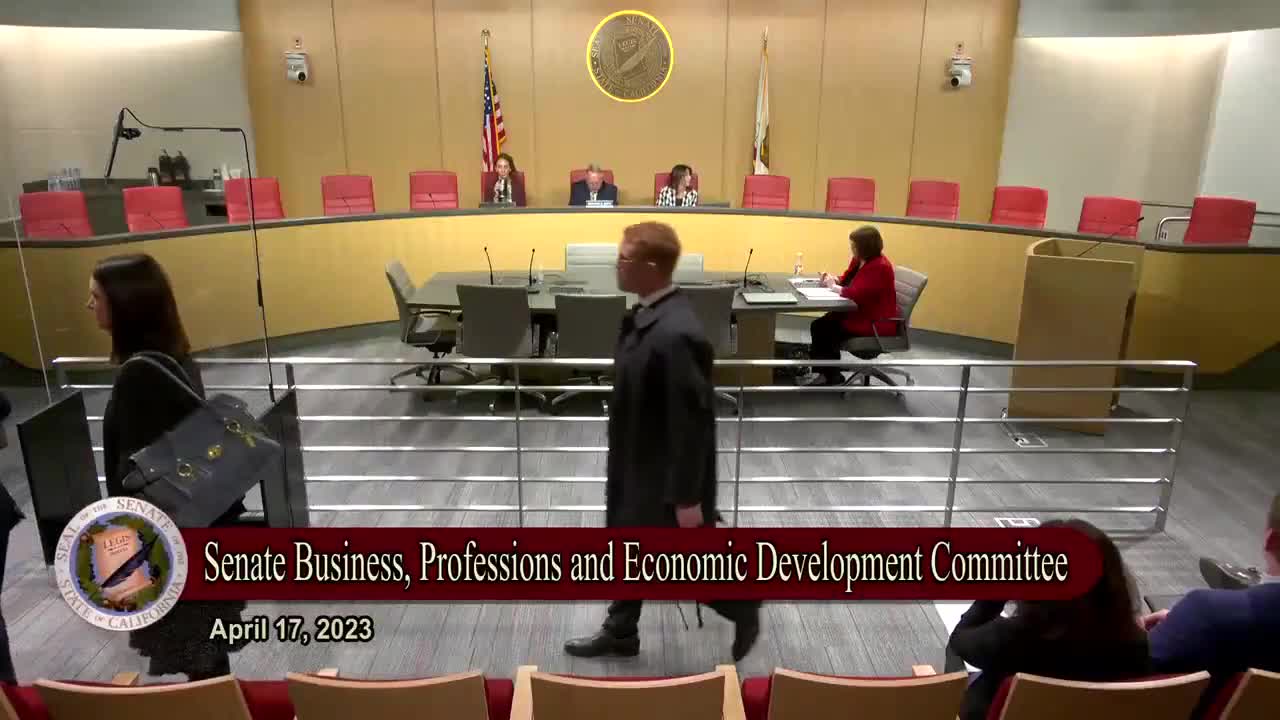 8MIN
Senate Standing Committee on Business, Professions and Economic Development
Bill Author

Bill Co-Author(s):