HR 110
- Session Year: 2023-2024
- House: Assembly
- Latest Version Date: 2024-06-20
Current Status:
Failed
(2024-08-15: Read. Adopted. (Page 6310.).)
Introduced
In Committee
First Chamber
In Committee
Second Chamber
Enacted
WHEREAS, The American Society of Civil Engineers (ASCE) issued a score of C- for the current status of infrastructure in the United States in its 2021 Report Card for Americas Infrastructure; and
WHEREAS, The ASCE reported in the 2021 Failure to Act: Economic Impacts of Status Quo Investment Across Infrastructure Systems that the total documented cumulative investment gap between projected needs and likely investment in critical major American infrastructure is more than $2,600,000,000,000 in 2029, and is projected to grow to more than $5,600,000,000,000 in 2039; and
WHEREAS, In the 2019 Report Card for Californias Infrastructure, the ASCE issued California infrastructure the following scores:
(1)For roads, a score of D;
(2)For bridges, a score of C-;
(3)For stormwater, a score of D+;
(4)For dams, a score of C-;
(5)For levees, a score of D; and
WHEREAS, It is estimated that: (1) driving on deficient roads costs Californians $61,000,000,000 annually due to congestion, delays, traffic collisions, and increased vehicle operating costs caused by poor road conditions; (2) the condition of Californias roads is among the worst in the nation and is ranked 49th in the nation; (3) southern California and the San Francisco Bay area are the second and third most congested urban regions in the nation, respectively; (4) approximately 50 percent of bridges in California have exceeded their design life; (5) California has the second largest percentage of functionally obsolete bridges, which contribute to congestion choke points; (6) over 7 percent of Californias bridges are structurally deficient and some of the largest bridges along interstate corridors, such as Interstate Highway Route 5 in San Diego, Highway 101 in Los Angeles, and Interstate Highway Route 80 in Sacramento, need major repair and rehabilitation; (7) over the next 20 years, the cost of achieving water quality objectives will be approximately $20,000,000,000 in the County of Los Angeles, and $5,000,000,000 in the County of San Diego; (8) over half of Californias 1,476 federally, state-, and locally owned dams are considered high hazard dams; (9) 70 percent of dams in California are greater than 50 years old, which is the average estimated life span of a dam; (10) a capital investment of $45,000,000,000 is needed to rehabilitate and improve Californias levees; and (11) California needs long-term guaranteed financing to pay for the states high-speed rail system, which is estimated to require an excess of $75,000,000,000; and
WHEREAS, The National Infrastructure Bank Act of 2023 H.R. 4052 118th Congress would establish a new National Infrastructure Bank authorized to invest $5,000,000,000,000 in infrastructure projects, would require no new federal spending or new tax, and would be capitalized by repurposing existing United States Treasury debt; and
WHEREAS, The National Infrastructure Bank is modeled on previous banks that helped build much of the nations infrastructure under Presidents George Washington, James Madison, Abraham Lincoln, and Franklin D. Roosevelt; and
WHEREAS, The last national infrastructure modeled-bank helped bring the United States out of the Great Depression and win World War II; and
WHEREAS, The National Infrastructure Bank would finance all the necessary infrastructure projects in California in partnership with state and local governments; and
WHEREAS, Infrastructure projects funded by the National Infrastructure Bank would create 25,000,000 new jobs, pay wages subject to the Davis-Bacon Act of 1931(Public Law 71-798) as amended, and include Buy American provisions; and
WHEREAS, The National Infrastructure Bank Act of 2023 would mandate large-scale minority hiring, and would prioritize the financing of infrastructure projects located in communities with long-term poverty, which would ensure that disadvantaged business enterprises would receive significant disbursements; and
WHEREAS, It is estimated that infrastructure projects financed by the National Infrastructure Bank would grow the economy by 5 percent, annually; and
WHEREAS, Numerous state legislatures have either introduced or passed resolutions supporting the creation of the National Infrastructure Bank, including the Nevada State Legislature, the Maine State Legislature, the Rhode Island General Assembly, and the New Jersey State Legislature; and
WHEREAS, Many county governments and city councils, including the city councils of Philadelphia, Toledo, Providence (Rhode Island), Chicago, Cleveland, as well as national organizations, including the Public Banking Institute, the National Congress of Black Women, the National Association of Counties, the US High Speed Rail Association, the National Latino Farmers and Ranchers, the American Sustainable Business Council, and the National Association of Minority Contractors have expressed support for the National Infrastructure Bank; now, therefore, be it
Resolved by the Assembly of the State of California, That the Assembly strongly encourages the Congress of the United States to pass H.R. 4052, to establish a National Infrastructure Bank to facilitate the financing of urgently needed infrastructure projects in the United States; and be it further
Resolved, That the Chief Clerk of the Assembly prepare and transmit copies of this resolution to the President and Vice President of the United States, to the Speaker of the House of Representatives, to the Majority Leader of the Senate, to each Senator and Representative of California in the Congress of the United States, and to the Governor of California.
|
Date
|
Status
|
|---|---|
| Aug 15, 2024 | Coauthors revised. |
| Aug 15, 2024 | Read. Adopted. (Page 6310.). |
| Jul 2, 2024 | From committee: Be adopted. Ordered to Third Reading. (Ayes 12. Noes 2.) (July 1). |
| Jun 24, 2024 | Referred to Com. on TRANS. |
| Jun 20, 2024 | Introduced. |
|
Date
|
Description
|
Location
|
Votes
|
|
|---|---|---|---|---|
| Jul 1, 2024 | Be adopted. To third reading. | Assembly Standing Committee on Transportation |
Passed |
This list shows positions taken on this bill by organizations on the date displayed, which is linked to the original source.
Positions by individuals are not included.
|
Organization
|
Position
|
Date
|
|---|---|---|
| Coalition of a National Infrastructure Bank | * Support | Jul 1, 2024 |
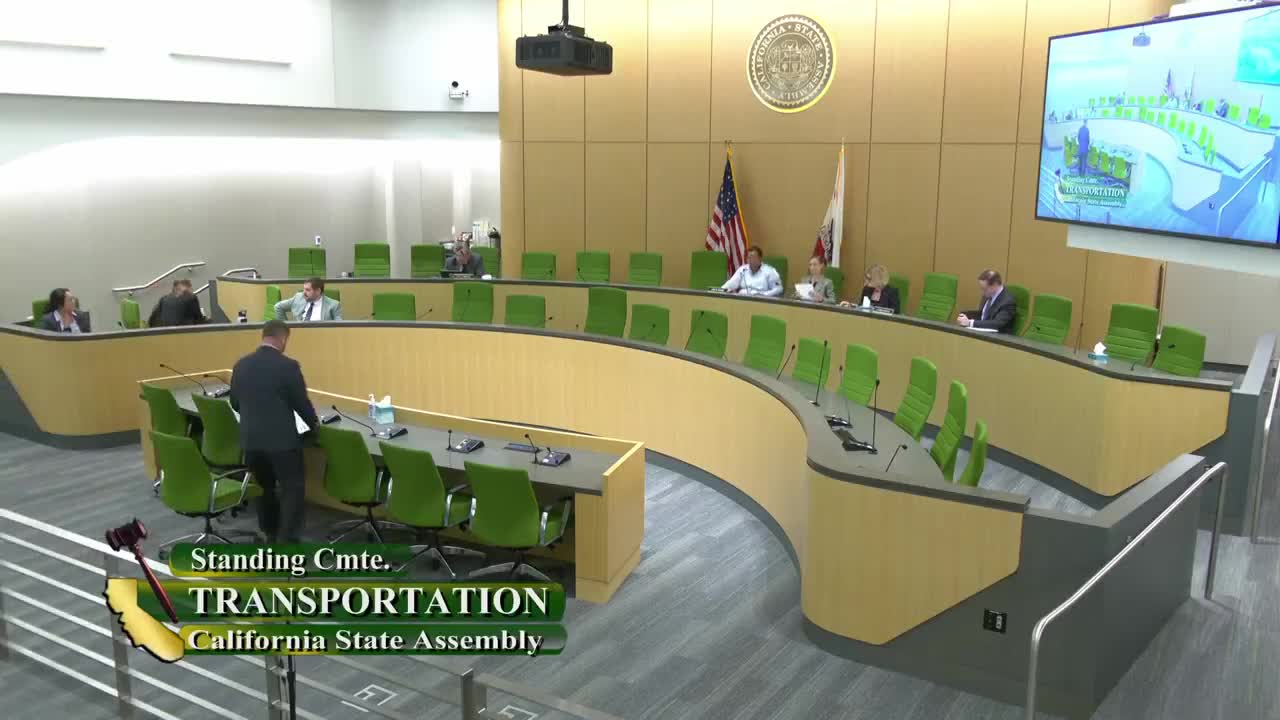
Date of Hearing: July 1, 2024
ASSEMBLY COMMITTEE ON TRANSPORTATION
Lori D. Wilson, Chair
ABPCA Bill Id:HR 110 (
Author:Arambula) – As Introduced Ver:June 20, 2024
SUBJECT: Infrastructure
SUMMARY: Strongly encourages the United States Congress and the President of the United States to pass the National Infrastructure Bank Act of 2023 to establish the National Infrastructure Bank and facilitate financing urgently needed infrastructure projects in the United States.
EXISTING FEDERAL LAW:
- Establishes the Infrastructure Investment and Jobs Act (IIJA), which allocates $550 billion in new infrastructure spending over five years for roads and bridges, rail, transit, ports, airports, the electric grid, water systems, and broadband, among other provisions. (Infrastructure Investment and Jobs Act, Public Law 117-58)
- Establishes the Fixing America’s Surface Transportation (FAST) Act, which authorizes $305 billion over fiscal years 2016 through 2020 for highway, highway and motor vehicle safety, public transportation, motor carrier safety, hazardous materials safety, rail, and research, technology, and statistics programs. (Fixing America’s Surface Transportation Act (FAST), Public Law 114-94)
- Creates a state infrastructure financing authority under the Water Infrastructure Finance and Innovation Act, as a new loan program exclusively for State infrastructure financing authority borrowers. (Water Infrastructure Finance and Innovation Act of 2014 (WIFIA), Public Law 116-94)
FISCAL EFFECT: Unknown
COMMENTS: H.R.4052 - National Infrastructure Bank Act of 2023 of the 118th Congress would establish the National Infrastructure Bank to facilitate the long-term financing of infrastructure projects. Specifically, the bank is authorized to invest $5 trillion in infrastructure projects and must provide loans to public and private entities for financing, developing, or operating eligible infrastructure projects. An eligible project must have a public sponsor as well as local, regional, or national significance. a not-for-profit government-sponsored enterprise that would marshal both public and private funds and direct them to infrastructure projects.
The bill treats the bank as a government corporation exempt from tax and treats contributions to the bank as charitable contributions, and also provides for criteria and preferences for deciding whether to provide a loan, such as whether a project promotes job creation or provides environmental benefits.
Projects that receive a loan must; 1) Pay all laborers and mechanics locally prevailing wages; and 2) Use only certain United States (U.S.).-produced construction materials unless a waiver is secured from the bank. The bill imposes requirements related to the bank's operation, such as minimum reserve requirements and requirements for handling loan losses. In addition, the bank must facilitate the organization of at least seven regional economic accelerator planning groups to, among other activities, identify infrastructure needs and priorities.
Infrastructure bank benefits. An Infrastructure Financing Authority (IFA) was initially included in the IIJA framework, but was removed from the final proposal. It is thought that infrastructure banks have myriad benefits including; a sustainable, renewable source of funding, flexible and affordable loans, assuming risk for local projects, promoting economic development, and incentivizing regional solutions. A federal infrastructure bank could ensure continued investment for years to come, not just for the coming few years.
It is estimated that infrastructure projects financed by the National Infrastructure Bank would grow the economy by 5%, annually. Numerous state legislatures have either introduced or passed resolutions supporting the creation of the National Infrastructure Bank, including the Nevada State Legislature, the Maine State Legislature, the Rhode Island General Assembly, and the New Jersey State Legislature. Many county governments and city councils, including the city councils of Philadelphia, Toledo, Providence (Rhode Island), Chicago, Cleveland, as well as national organizations, including the Public Banking Institute, the National Congress of Black Women, the National Association of Counties, the U.S. High Speed Rail Association, the National Latino Farmers and Ranchers, the American Sustainable Business Council, and the National Association of Minority Contractors have expressed support for the National Infrastructure Bank
Need for infrastructure in California. Every four years, the American Society of Civil Engineers (ASCE) issues a report card for the current status of infrastructure in the United States. In its 2021 Report Card for America’s Infrastructure is gave US infrastructure a score of a C-. In the 2019 “Report Card for California’s Infrastructure,” the ASCE did not issue California infrastructure above a C-.
It is estimated that the condition of California’s roads is among the worst in the nation and is ranked 49th in the nationwide, that approximately 50% of bridges in California have exceeded their design life, and that over 7% of California’s bridges are structurally deficient.
California is projected to receive approximately $40 billion over five years of IIJA funding.
California’s Declining Transportation Infrastructure Dollars. Declining gas tax revenue from increased electric vehicle sales is of significant concern. The Legislative Analyst’s Office projects notable revenue declines over the next decade from the state’s gasoline excise tax ($5 billion or 64%), diesel excise tax ($290 million or 20%), and diesel sales tax ($420 million or 20%). State funding sources—which historically have accounted for roughly one‑third of total transportation funding, including $14.2 billion in 2023‑24—consist of various fuel taxes and vehicle fees. On net, the LAO estimates that if the state undertakes the steps envisioned in the California Air Resources Board’s Scoping Plan to reduce greenhouse gas emissions, annual state transportation revenues will decline by $4.4 billion (31%) over the next decade as compared to current levels.
Attempted before, long term funding issues. H.R 8682 Federal Infrastructure Bank Act of 2022 of the 118th Congress was introduced in 2022, and H.R. 3339 National Infrastructure Bank Act of 2021 of the 117th Congress was introduced in 2021; both bills were referred to the Subcommittee on Water Resources and Environment, and never heard. While a national infrastructure bank has the potential to galvanize capital markets and generate funding on a long-term basis, the sustainable source of public funding required has not been realized. This bill has failed multiple times in the last three years.
According to the author, “infrastructure is essential to the economy. Roads, clean drinking water, and modern schools are essential to the quality of life of Californians. Nationwide, the National Infrastructure Bank will provide funding for infrastructure projects up to $5 trillion and will create 25 million new jobs. It will supercharge the economy to achieve long-term GDP growth of 5% per year.
HR 110 demonstrates California’s support for the federal effort to establish the National Infrastructure Bank. The Bank will leverage private and state and local capital to invest in projects that are critical to the economic progress of California and the nation. Financing public infrastructure and private development in California will promote a healthy climate for jobs, contribute to a strong economy, and improve the quality of life in California communities”.
Previous legislation. AJR 32 (Nazarian) of 2022 would have urged the United States Congress and the President of the United States to pass the National Infrastructure Bank Act of 2021 to establish the National Infrastructure Bank and facilitate the financing of urgently needed infrastructure projects in the United States.
REGISTERED SUPPORT / OPPOSITION:
Support
None on file
Opposition
None on file
Analysis Prepared by: Julia Kingsley / TRANS. / (916) 319-2093
Discussed in Hearing
View Older Hearings
Bill Author

Bill Co-Author(s):