AB 1013: Remote accessible vote by mail system.
- Session Year: 2017-2018
- House: Assembly
- Latest Version Date: 2018-09-29
Existing law permits a person, corporation, or public agency to apply to the Secretary of State for certification or conditional approval of a remote accessible vote by mail system. Existing law requires the Secretary of State to examine and certify remote accessible vote by mail systems, as specified.
Existing law permits a voter, including a voter with a disability or a military or overseas voter, to apply for and receive a vote by mail ballot from his or her county elections official. Existing law also authorizes specified counties to conduct an election as an all-mailed ballot election if specified requirements are satisfied, including requirements relating to accessibility by voters with disabilities.
This bill would require a county elections official to permit a voter with a disability, or a military or overseas voter, to cast his or her ballot using a certified remote accessible vote by mail system. This requirement would not apply to a county when conducting an all-mailed ballot election, as specified. These provisions would become operative on January 1, 2020, or one year after the date on which the Secretary of State certifies a remote accessible vote by mail system pursuant to existing provisions of law, whichever is later.
By imposing additional duties on local elections officials, this bill would impose a state-mandated local program.
The California Constitution requires the state to reimburse local agencies and school districts for certain costs mandated by the state. Statutory provisions establish procedures for making that reimbursement.
This bill would provide that, if the Commission on State Mandates determines that the bill contains costs mandated by the state, reimbursement for those costs shall be made pursuant to the statutory provisions noted above.
Existing law, the Chiropractic Act, enacted by initiative, provides for the licensure and regulation of chiropractors by the State Board of Chiropractic Examiners. Under the act, on and after January 1, 2019, each person practicing chiropractic, after a license has been issued, is annually required to pay the board a renewal fee of $250. Existing law authorizes the Legislature to fix these fees. Existing law directs the deposit of these funds into the State Board of Chiropractic Examiners Fund, a continuously appropriated fund.This bill, on and after January 1, 2019, would revise the annual renewal fee to be no more than $250, as determined by the board. The bill would also make additional nonsubstantive changes.Existing law, the Chiropractic Act, enacted by initiative, provides for the licensure and regulation of chiropractors by the State Board of Chiropractic Examiners. Under the act, on and after January 1, 2019, each person practicing chiropractic, after a license has been issued, is annually required to pay the board a renewal fee of $250. Existing law authorizes the Legislature to fix these fees. Existing law directs the deposit of these funds into the State Board of Chiropractic Examiners Fund, a continuously appropriated fund.
This bill, on and after January 1, 2019, would revise the annual renewal fee to be no more than $250, as determined by the board. The bill would also make additional nonsubstantive changes.
Existing law governing state employer-employee relations requires the Governor or his or her representative, as properly designated by law, to meet and confer in good faith regarding wages, hours, and other terms and conditions of employment with representatives of recognized employee organizations, and to consider fully any presentation that is made by an employee organization on behalf of its members prior to arriving at a determination of policy or course of action.This bill would make nonsubstantive changes to those provisions.Existing law governing state employer-employee relations requires the Governor or his or her representative, as properly designated by law, to meet and confer in good faith regarding wages, hours, and other terms and conditions of employment with representatives of recognized employee organizations, and to consider fully any presentation that is made by an employee organization on behalf of its members prior to arriving at a determination of policy or course of action.
This bill would make nonsubstantive changes to those provisions.
The Legislature recognizes that some individuals with disabilities are not able to vote privately and independently using vote by mail ballots. In order to ensure that more individuals with disabilities have the opportunity to vote by mail privately and independently, it is the intent of the Legislature that certified remote accessible vote by mail systems be available for use by individuals with disabilities in all counties that are not conducting an election pursuant to Section 4005 of the Elections Code. An election held pursuant to Section 4005 of the Elections Code is currently required to have an accessible vote by mail system that is available for use by individuals with disabilities. Ensuring access to voting for all citizens is a priority for the Legislature.
SEC. 2.Section 3016.5 is added to the Elections Code, to read:3016.5.(a)A county elections official shall permit a voter with a disability to cast his or her ballot using a certified remote accessible vote by mail system.
(b)This section does not apply to a county when conducting an all-mailed ballot election pursuant to Section 4005.
(c)This section shall become operative on January 1, 2020, or one year after the date on which the Secretary of State certifies a remote accessible vote by mail system pursuant to Chapter 3.5 (commencing with Section 19280) of Division 19, whichever is later.
SEC. 3.Section 3116.5 is added to the Elections Code, to read:3116.5.(a)A county elections official shall permit a military or overseas voter to cast his or her ballot using a certified remote accessible vote by mail system.
(b)This section does not apply to a county when conducting an all-mailed ballot election pursuant to Section 4005.
(c)This section shall become operative on January 1, 2020, or one year after the date on which the Secretary of State certifies a remote accessible vote by mail system pursuant to Chapter 3.5 (commencing with Section 19280) of Division 19, whichever is later.
SEC. 4.If the Commission on State Mandates determines that this act contains costs mandated by the state, reimbursement to local agencies and school districts for those costs shall be made pursuant to Part 7 (commencing with Section 17500) of Division 4 of Title 2 of the Government Code.
SECTION 1.Section 5 of the Chiropractic Act, as amended by Section 1 of Chapter 533 of the Statutes of 1983, is amended to read:Sec.5.(a)It shall be unlawful for any person to practice chiropractic in this state without a license so to do.(b)Any person wishing to practice chiropractic in this state shall make application to the board 45 days prior to any meeting thereof, upon such form and in such manner as may be provided by the board.(c)Proof of graduation from an approved chiropractic school or college, as defined in Section 4, must reach the board 15 days prior to any meeting thereof.(d)Each application must be accompanied by a licensee fee of not more than one hundred dollars ($100), as determined by the board.(e)Except in the cases herein otherwise prescribed, each applicant shall present to the board at the time of making such application a diploma from a high school and a transcript of 60 prechiropractic college credits satisfactory to the board, or proof, satisfactory to the board, of education equivalent in training power to such high school and college courses.(f)The schedule of minimum educational requirements to enable any person to practice chiropractic in this state is as follows, except as herein otherwise provided:Group 1Anatomy, including embryology and histology14%Group 2Physiology6%Group 3Biochemistry and clinical nutrition6%Group 4Pathology and bacteriology10%Group 5Public health, hygiene and sanitation3%Group 6Diagnosis, dermatology, syphilology and geriatrics, and radiological technology, safety, and interpretation18%Group 7Obstetrics and gynecology and pediatrics3%Group 8Principles and practice of chiropractic, physical therapy, psychiatry, and office procedure25%Total85%Electives15%(g)Any applicant who had matriculated at a chiropractic college prior to the effective date of the amendments to this section submitted to the electors by the 1977-1978 Regular Session of the Legislature shall meet all requirements that existed immediately prior to the effective date of those amendments but need not meet the change in requirements made by said amendments.SEC. 2.Section 12 of the Chiropractic Act, as amended by Section 78 of Chapter 429 of the Statutes of 2017, is amended to read:Sec. 12.(a)Licenses issued under the provisions of this section expire at 12 midnight on the last day of the month of birth of licentiates of the board.(b)The board shall establish regulations for the administration of a birth month renewal program.(c)A person practicing chiropractic within this state shall, on or before the last day of the persons month of birth of each year, after a license is issued to the person under this act, pay to the Board of Chiropractic Examiners the renewal fee specified under subdivision (d).(d)(1)Until January 1, 2019, the renewal fee shall be three hundred dollars ($300).(2)On and after January 1, 2019, the renewal fee shall be no more than two hundred fifty dollars ($250), as determined by the board in an amount not to exceed the reasonable regulatory cost.(e)The secretary shall mail to a licensed chiropractor in this state, on or before 60 days prior to the last day of the month of the licensees birth each year, a notice that the renewal fee will be due on or before the last day of the next month following the licensees birth. Nothing in this act shall be construed to require the receipts to be recorded in like manner as original licenses.(f)The failure, neglect or refusal of a person holding a license or certificate to practice under this act in the State of California to pay the annual fee during the time the license remains in force shall, after a period of 60 days from the last day of the month of the licensees birth, automatically work a forfeiture of the license or certificate, and it shall not be restored except upon the written application therefor and the payment to the board of a fee of twice the annual amount of the renewal fee in effect at the time the restoration application is filed except that a licensee who fails, refuses, or neglects to pay the annual tax within a period of 60 days after the last day of the month of the licensees birth of each year shall not be required to submit to an examination for the reissuance of the certificate.(a)It shall be unlawful for any person to practice chiropractic in this state without a license so to do. Any
(b)Any person wishing to practice chiropractic in this state shall make application to the board 45 days prior to any meeting thereof, upon such form and in such manner as may be provided by the board. Proof
(c)Proof of graduation from an approved chiropractic school or college, as defined in Section 4, must reach the board 15 days prior to any meeting thereof. Each
(d)Each application must be accompanied by a licensee fee of not more than one hundred dollars ($100), as determined by the board. Except
(e)Except in the cases herein otherwise prescribed, each applicant shall present to the board at the time of making such application a diploma from a high school and a transcript of 60 prechiropractic college credits satisfactory to the board, or proof, satisfactory to the board, of education equivalent in training power to such high school and college courses.
The(f)The schedule of minimum educational requirements to enable any person to practice chiropractic in this state is as follows, except as herein otherwise provided:
Group 1
Anatomy, including embryology and histology14%
Group 2
Physiology6%
Group 3
Biochemistry and clinical nutrition6%
Group 4
Pathology and bacteriology10%
Group 5
Public health, hygiene and sanitation3%
Group 6
Diagnosis, dermatology, syphilology and geriatrics, and radiological technology, safety, and interpretation18%
Group 7
Obstetrics and gynecology and pediatrics3%
Group 8
Principles and practice of chiropractic, physical therapy, psychiatry, and office procedure25%
Total85%
Electives15%
Any
(g)Any applicant who had matriculated at a chiropractic college prior to the effective date of the amendments to this section submitted to the electors by the 1977-1978 Regular Session of the Legislature shall meet all requirements that existed immediately prior to the effective date of those amendments but need not meet the change in requirements made by said amendments.
SEC. 2.Section 12 of the Chiropractic Act, as amended by Section 78 of Chapter 429 of the Statutes of 2017, is amended to read:Sec. 12.(a)Licenses issued under the provisions of this section expire at 12 midnight on the last day of the month of birth of licentiates of the board.
(b)The board shall establish regulations for the administration of a birth month renewal program.
(c)A person practicing chiropractic within this state shall, on or before the last day of the persons month of birth of each year, after a license is issued to the person under this act, pay to the Board of Chiropractic Examiners the renewal fee specified under subdivision (d).
(d)(1)Until January 1, 2019, the renewal fee shall be three hundred dollars ($300).
(2)On and after January 1, 2019, the renewal fee shall be no more than two hundred fifty dollars ($250). ($250), as determined by the board in an amount not to exceed the reasonable regulatory cost.
(e)The secretary shall mail to a licensed chiropractor in this state, on or before 60 days prior to the last day of the month of the licensees birth each year, a notice that the renewal fee will be due on or before the last day of the next month following the licensees birth. Nothing in this act shall be construed to require the receipts to be recorded in like manner as original licenses.
(f)The failure, neglect or refusal of a person holding a license or certificate to practice under this act in the State of California to pay the annual fee during the time the license remains in force shall, after a period of 60 days from the last day of the month of the licensees birth, automatically work a forfeiture of the license or certificate, and it shall not be restored except upon the written application therefor and the payment to the board of a fee of twice the annual amount of the renewal fee in effect at the time the restoration application is filed except that a licensee who fails, refuses, or neglects to pay the annual tax within a period of 60 days after the last day of the month of the licensees birth of each year shall not be required to submit to an examination for the reissuance of the certificate.
SECTION 1.Section 3517 of the Government Code is amended to read:3517.The Governor, or his or her representative, as may be properly designated by law, shall meet and confer in good faith regarding wages, hours, and other terms and conditions of employment with representatives of recognized employee organizations, and shall consider fully any presentation that is made by the employee organization on behalf of its members before arriving at a determination of policy or course of action.Meet and confer in good faith means that the Governor or his or her representative, and representatives of recognized employee organizations, shall have the mutual obligation personally to meet and confer promptly upon request by either party and continue for a reasonable period of time in order to exchange freely information, opinions, and proposals, and to endeavor to reach agreement on matters within the scope of representation before the adoption by the state of its final budget for the ensuing year. The process should include adequate time for the resolution of impasses.The Governor, or his representative or her representative, as may be properly designated by law, shall meet and confer in good faith regarding wages, hours, and other terms and conditions of employment with representatives of recognized employee organizations, and shall consider fully such presentations as are any presentation that is made by the employee organization on behalf of its members prior to before arriving at a determination of policy or course of action.
Meet and confer in good faith means that the Governor or such representatives as the Governor may designate, his or her representative, and representatives of recognized employee organizations, shall have the mutual obligation personally to meet and confer promptly upon request by either party and continue for a reasonable period of time in order to exchange freely information, opinions, and proposals, and to endeavor to reach agreement on matters within the scope of representation prior to before the adoption by the state of its final budget for the ensuing year. The process should include adequate time for the resolution of impasses.
|
Date
|
Status
|
|---|---|
| Sep 29, 2018 | Chaptered by Secretary of State - Chapter 906, Statutes of 2018. |
| Sep 29, 2018 | Approved by the Governor. |
| Sep 6, 2018 | Enrolled and presented to the Governor at 3 p.m. |
| Aug 29, 2018 | Senate amendments concurred in. To Engrossing and Enrolling. |
| Aug 27, 2018 | In Assembly. Concurrence in Senate amendments pending. May be considered on or after August 29 pursuant to Assembly Rule 77. |
| Aug 27, 2018 | Read third time. Passed. Ordered to the Assembly. |
| Aug 24, 2018 | Ordered to third reading. |
| Aug 21, 2018 | Ordered to special consent calendar. |
| Aug 17, 2018 | From committee: Do pass. (Ayes 7. Noes 0.) (August 16). |
| Jun 25, 2018 | In committee: Referred to APPR. suspense file. |
| May 15, 2018 | From committee: Do pass and re-refer to Com. on APPR. (Ayes 5. Noes 0.) (May 15). Re-referred to Com. on APPR. |
| May 3, 2018 | Re-referred to Com. on E. & C.A. |
| Apr 23, 2018 | Withdrawn from committee. |
| Apr 19, 2018 | Referred to Com. on B., P. & E.D. |
| Jan 29, 2018 | In Senate. Read first time. To Com. on RLS. for assignment. |
| Jan 29, 2018 | Read third time. Passed. Ordered to the Senate. |
| Jan 29, 2018 | Read third time. Passed. Ordered to the Senate. (Ayes 75. Noes 0. Page 3868.) |
| Jan 22, 2018 | Read second time. Ordered to Consent Calendar. |
| Jan 18, 2018 | From committee: Do pass. To Consent Calendar. (Ayes 17. Noes 0.) (January 18). |
| Jan 11, 2018 | From committee: Do pass and re-refer to Com. on APPR. (Ayes 15. Noes 0.) (January 9). Re-referred to Com. on APPR. |
| Jan 4, 2018 | Re-referred to Com. on B. & P. |
| Jan 3, 2018 | From committee chair, with author's amendments: Amend, and re-refer to Com. on B. & P. Read second time and amended. |
| Jan 3, 2018 | Referred to Com. on B. & P. |
| Feb 17, 2017 | From printer. May be heard in committee March 19. |
| Feb 16, 2017 | Read first time. To print. |
|
Date
|
Description
|
Location
|
Votes
|
|
|---|---|---|---|---|
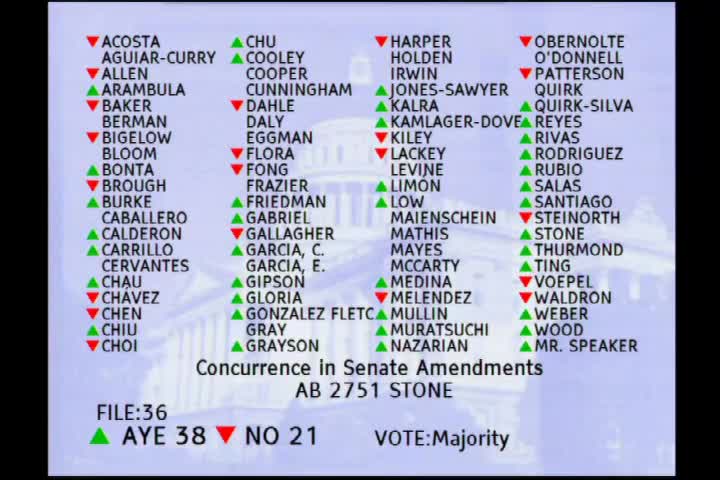
| Aug 29, 2018 | AB 1013 LOW Concurrence in Senate Amendments | Assembly Floor |
Passed |
|
| Aug 27, 2018 | Assembly 3rd Reading AB1013 Low By Chang | Senate Floor |
Passed |
|
| Aug 16, 2018 | Do pass | Senate Standing Committee on Appropriations |
Passed |
|
| Jun 25, 2018 | Placed on suspense file | Senate Standing Committee on Appropriations |
Passed |
|
| May 15, 2018 | Do pass, but first be re-referred to the Committee on [Appropriations] | Senate Standing Committee on Elections and Constitutional Amendments |
Passed |
|
| Jan 29, 2018 | AB 1013 LOW Consent Calendar Second Day Regular Session | Assembly Floor |
Passed |
|
| Jan 18, 2018 | Do pass. To Consent Calendar. | Assembly Standing Committee on Appropriations |
Passed |
|
| Jan 9, 2018 | Do pass and be re-referred to the Committee on [Appropriations] | Assembly Standing Committee on Business and Professions |
Passed |
This list shows positions taken on this bill by organizations on the date displayed, which is linked to the original source.
Positions by individuals are not included.
|
Organization
|
Position
|
Date
|
|---|---|---|
| Disability Rights California | ** Support | Aug 18, 2018 |
| Two individuals | ** Support | May 14, 2018 |
CONCURRENCE IN SENATE AMENDMENTS
CSA1 Bill Id:AB 1013
Author:(Low)
As Amended Ver:April 19, 2018
Majority vote
ASSEMBLY: |
| (January 29, 2018) | SENATE: | 39-0 | (August 27, 2018) |
(vote not relevant)
Original Committee Reference: B. & P.
SUMMARY: Requires a county elections official to permit a voter with a disability, or a military or overseas voter, to cast his or her ballot using a certified remote accessible vote by mail (VBM) system. Provides that these provisions do not apply to a county that conducts an election using vote centers, instead of polling places, pursuant to the California Voter's Choice Act. Provides for these provisions to become operative on January 1, 2020.
The Senate amendments delete the prior contents of the bill that would have made changes to the Chiropractic Act to allow the Board of Chiropractic Examiners to reduce a regulatory fee, as specified.
FISCAL EFFECT: According to the Senate Appropriations Committee, by requiring counties to procure and use remote accessible VBM systems, this bill would create a state-mandated local program. To the extent the Commission on State Mandates determines that the provisions of this bill create a new program or impose a higher level of service on local agencies, local agencies could claim reimbursement of those costs (General Fund). The amount is unknown, but at a minimum would be in the high hundreds of thousands of dollars, related to the purchase, lease and maintenance of those systems.
COMMENTS: In 2016, the Legislature passed and the Governor signed AB 2252 (Ting), Chapter 75, Statutes of 2016, which expanded and established the definition of a remote accessible VBM system. AB 2252 also prohibited a remote accessible VBM system from being connected to a voting system at any time. Finally, AB 2252 revised, updated, and established processes and procedures for the review and approval of a remote accessible VBM system, as specified. While AB 2252 established the requirements for remote accessible VBM systems and created procedures for the review and approval of such systems, it did not expressly require that elections officials make such a system available to voters in their jurisdiction.
Last year the Legislature passed, but the Governor vetoed AB 973 (Low) of 2017, which was substantially similar to this bill. AB 973 would have permitted a voter with a disability or a military or overseas voter to cast a ballot using a certified remote accessible VBM system, as specified. In his veto message, Governor Brown stated, "I am hesitant to mandate that counties use this technology at a time when certification of these systems is in its nascent stages. As these systems become certified, however, I encourage counties to review and adopt them as appropriate."
When the Legislature approved AB 973, there were no remote accessible VBM systems that were certified for use in the state. There are now three such systems that have been certified for use in California.
The Senate amendments remove provisions of the bill that would have made changes to the Chiropractic Act to allow the Board of Chiropractic Examiners to reduce a regulatory fee, as specified, and instead require a county elections official to permit a voter with a disability, or a military or overseas voter, to cast his or her ballot using a certified remote accessible VBM system, as specified. This bill, as amended in the Senate, is consistent with prior Assembly actions on AB 973 (Low) of 2017 during the current Legislative session.
Analysis Prepared by: Nichole Becker / E. & R. / (916) 319-2094 FN: 0004579
Office of Senate Floor Analyses (916) 651-1520 Fax: (916) 327-4478 | AB |
THIRD READING
Bill No: AB 1013
:
SENATE ELECTIONS & C.A. COMMITTEE: 5-0, 5/15/18
AYES: Stern, Anderson, Allen, Hertzberg, Leyva
SENATE APPROPRIATIONS COMMITTEE: 7-0, 8/16/18
AYES: Portantino, Bates, Beall, Bradford, Hill, Nielsen, Wiener
ASSEMBLY FLOOR: 75-0, 1/29/18 (Consent) - See last page for vote
DIGEST:
This bill permits voters with a disability, or a military or overseas voter, to cast a ballot using a certified remote accessible vote by mail (VBM) system, as specified.
Existing law:
- Permits any voter, including a voter with a disability or a military or overseas voter, to apply for and receive a VBM ballot from his or her elections official.
- Defines a remote accessible VBM system as a mechanical, electromechanical, or electronic system and its software that is used for the sole purpose of marking an electronic VBM ballot for a voter with disabilities or a military or overseas voter who shall print the paper cast vote record to be submitted to the elections official. Prohibits a remote accessible VBM system from being connected to a voting system at any time.
- Requires the Secretary of State (SOS) to certify remote accessible VBM systems for use in California.
- Requires counties that conduct an election pursuant to the California Voter’s Choice Act to provide a method for voters with disabilities to request and receive a blank VBM ballot that voters with disabilities can read and mark privately and independently.
- Defines a voting system to mean a mechanical, electromechanical, or electronic system and its software, or any combination of these used for casting a ballot, tabulating votes, or both. Provides that a voting system does not include a remote accessible VBM system.
- Defines a paper cast vote record to mean an auditable document that corresponds to the selection made on the voter’s ballot and lists the contests on the ballot and the voter’s selections for those contests. Provides that a paper cast vote record is not a ballot.
This bill:
- Requires a county elections official to permit a voter with a disability, or a military or overseas voter, to cast his or her ballot using a certified remote accessible VBM system.
- Provides that these provisions do not apply to a county that conducts an election pursuant to the California Voter’s Choice Act.
- Provides that these provisions become operative on January 1, 2020 or one year after the date on which the SOS certifies a remote accessible vote by mail system pursuant to existing provisions of law, whichever is later.
- Contains specified intent language.
Background
Remote accessible VBM systems. In 2013, the Legislature enacted AB 1929 (Gorell, Chapter 694, Statutes of 2012), which established processes and procedures for the review and approval of ballot marking systems, as defined, for use in California elections. The intent of AB 1929 was to make voting more accessible and convenient for military and overseas voters. Specifically, AB 1929 drastically sped up the amount of time it takes for a military or overseas voter to cast his or her ballot by allowing a military or overseas voter to electronically print, mark his or her ballot, and cast it via fax or mail. To ensure a military or overseas voter’s security and privacy, AB 1929 prohibited the ballot marking system, or part of the system, from having the capability, including the optional capability, to use a remote server to mark the voter’s selections transmitted to the server from the voter’s computer via the Internet, store any voter identifiable selections on any remote server, or tabulate votes.
Last session the Legislature passed and the Governor signed AB 2252 (Ting, Chapter 75, Statutes of 2016), which also allowed a voter with disabilities to electronically receive and mark his or her VBM ballot using a remote accessible VBM system. However, in order to expand the use of ballot marking systems to voters with disabilities and to better reflect the technology used to do so, AB 2252 deleted the term “ballot marking system” and replaced and updated it with the term “remote accessible VBM system.” AB 2252 defined a “remote accessible VBM system” to mean a mechanical, electromechanical, or electronic system and its software that is used for the sole purpose of marking an electronic VBM ballot for a voter with disabilities or a military or overseas voter who shall print the paper cast voter record, as defined, to be submitted to the elections official. AB 2252 further prohibited a remote accessible VBM system from being connected to a voting system at any time. Finally, AB 2252 revised, updated, and established processes and procedures for the review and approval of a remote accessible VBM system, as specified.
While AB 2252 established the requirements for remote accessible VBM systems and created procedures for the review and approval of such systems, it did not expressly require that elections officials make such a system available to voters in their jurisdiction. By requiring that voters with disabilities and military and overseas voters be permitted to cast their ballots using a remote accessible VBM system, this bill effectively requires all county elections officials to acquire a remote accessible VBM system for use by eligible voters.
Status of remote accessible VBM system certification. As mentioned above, this bill requires a county elections official to permit a voter with a disability, or a military or overseas voter, to cast his or her ballot using a certified remote accessible VBM system and requires those provisions to become operative one year after the date on which the SOS certifies a remote accessible VBM system. There are now three remote accessible VBM systems certified for use in California.
AB 973 (Low, 2017), which was vetoed by the Governor, was virtually identical to this bill. In his veto message, the Governor stated the following:
I am returning Assembly Bill 973 without my signature.
This bill requires a county elections official, by January 1, 2020, to allow voters with disabilities, and military and overseas voters, to cast a ballot using a certified remote accessible vote-by-mail system.
Just last year, I signed AB 2252 that created standards for the Secretary of State to review and approve remote accessible vote-by-mail ballot systems for use in California elections. Additionally, current law permits any voter, including a voter with a disability or a military or overseas voter, to electronically receive and cast a vote-by-mail ballot using a remote accessible vote-by-mail system, once available.
I am hesitant to mandate that counties use this technology at a time when certification of these systems is in its nascent stages. As these systems become certified, however, I encourage counties to review and adopt them as appropriate.
Now that there are three remote accessible VBM systems certified for use in California, as discussed above, the Governor’s stated objections to AB 973 have been at least partially addressed.
Comments
According to the author:
Voting in elections is vital to the success of our democracy. As Californians, we must ensure that voters do not face unnecessary barriers when casting their ballots. One-third of voters with disabilities report having difficulty voting, which can lead to lower turnout rates. AB 1013 will provide an alternative voting method to ensure all voters with disabilities are able to participate in the electoral process. Specifically, AB 1013 will allow voters with disabilities, and military and overseas voters, to cast a ballot using a certified remote accessible vote by mail system. Every vote represents a voice that deserves to be heard. As a Member of the Elections and Redistricting Committee, I am committed to working with my colleagues to increase voter turnout.
An estimated 35 million eligible voters in the United States have a disability. According to an NPR report, nearly one-third of voters with disabilities reported some sort of barrier when casting their ballots. These difficulties ranged from accessing their polling places to using the voting booths. Given the various barriers to voting for our disabled community, they frequently feel like their values are unimportant and that their votes do not matter.
In fact, according to a 2008, Government Accountability Office report, only 1 in 4 polling places in the United States was completely accessible for voters. In some areas, it can be challenging to find fully accessible sites that are willing to be polling locations.
In recognition of these barriers, the SOS established the Voting Accessibility Advisory Committee, which is tasked with making recommendations to the SOS’s office on how individuals with disabilities can vote independently and privately. In March 2016, the Committee released their recommendations for modifications to the Polling Place Accessibility Guidelines. These recommendations included technical changes to make polling places more accessible for individuals with disabilities, including parking, paths of travel, and ramps.
Voters with disabilities tend to vote at a lower rate, and it is believed that improvements in voting accessibility could have led to three million more voters in the 2012 election. In general, polling places throughout the country are improving accessibility. However, even in the most recent presidential election, individuals with disabilities anticipated barriers to voting. Simply having a wheelchair ramp does not mean that it is easily maneuverable for a wheelchair. Any barrier to voting can deter an individual from participating in the democratic process and these issues need to be addressed.
In 2016, the Legislature passed and the Governor signed AB 2252 (Ting, Chapter 75), which created standards for the SOS to review and approve remote accessible vote by mail ballot systems for use in California elections. While AB 2252 established the standards for the use of such systems, however, nothing in existing law explicitly requires that military and overseas voters, and individuals with disabilities, be provided access to a California-certified method for remotely submitting a vote by mail ballot.
Voting is a fundamental right and individuals casting their ballots should not face persistent barriers to voting access. AB 1013 will provide an alternative method for voting.
Beginning, January 1, 2020, AB 1013 requires county elections officials to permit military and overseas voters, and individuals with disabilities, to cast their ballots using a certified remote accessible vote by mail system.
Related/Prior Legislation
AB 973 (Low, 2017), which was vetoed by the Governor, was virtually identical to this bill (see the Background section above for further discussion).
AB 2252 (Ting, Chapter 75, Statutes of 2016) allowed a voter with disabilities to electronically receive and mark his or her VBM ballot using a remote accessible VBM system.
FISCAL EFFECT: Appropriation: Fiscal Com.: Local:
According to the Senate Appropriations Committee, by requiring counties to procure and use remote accessible VBM systems, this bill creates a state-mandated local program. To the extent the Commission on State Mandates determines that the provisions of this bill create a new program or impose a higher level of service on local agencies, local agencies could claim reimbursement of those costs (General Fund). The amount is unknown, but at a minimum would be in the high hundreds of thousands of dollars, related to the purchase, lease and maintenance of those systems.
Disability Rights California
10 individuals
OPPOSITION: (Verified 8/13/18)
None received
ASSEMBLY FLOOR: 75-0, 1/29/18
AYES: Acosta, Aguiar-Curry, Travis Allen, Arambula, Baker, Berman, Bigelow, Bloom, Bonta, Brough, Burke, Caballero, Calderon, Carrillo, Cervantes, Chau, Chávez, Chen, Chiu, Choi, Chu, Cooley, Cooper, Cunningham, Dahle, Daly, Eggman, Flora, Fong, Frazier, Friedman, Cristina Garcia, Eduardo Garcia, Gipson, Gloria, Gonzalez Fletcher, Gray, Grayson, Harper, Holden, Irwin, Jones-Sawyer, Kalra, Kiley, Lackey, Levine, Limón, Low, Maienschein, Mathis, Mayes, Medina, Melendez, Mullin, Muratsuchi, Nazarian, Obernolte, O'Donnell, Patterson, Quirk, Quirk-Silva, Reyes, Rodriguez, Rubio, Salas, Santiago, Steinorth, Mark Stone, Thurmond, Ting, Voepel, Waldron, Weber, Wood, Rendon
NO VOTE RECORDED: Gallagher, McCarty
8/18/18 13:20:26
**** END ****
SENATE COMMITTEE ON
Senator Anthony Portantino, Chair
2017 - 2018 Regular Session
AB 1013 (Low) - Remote accessible vote by mail system
Version: | Policy Vote: |
Urgency: | Mandate: |
Hearing Date: | Consultant: |
This bill meets the criteria for referral to the Suspense File.
Bill Summary:
AB 1013 would permit voters with a disability, or military or overseas voters, to cast a ballot using a certified remote accessible vote by mail (VBM) system, as specified.
Fiscal Impact:
By requiring counties to procure and use remote accessible VBM systems, this bill would create a state-mandated local program. To the extent the Commission on State Mandates determines that the provisions of this bill create a new program or impose a higher level of service on local agencies, local agencies could claim reimbursement of those costs (General Fund). The amount is unknown, but at a minimum would be in the high hundreds of thousands of dollars, related to the purchase, lease and maintenance of those systems.
Background:
AB 1929 (Gorell, Chapter 694, Statutes of 2012) established processes and procedures for the review and approval of ballot marking systems for use in California elections. The intent of the bill was to make voting more accessible and convenient for military and overseas voters. Specifically, the bill allowed a military or overseas voter to electronically print and mark his or her ballot and cast it via fax or mail. To ensure these voters’ security and privacy, AB 1929 prohibited the ballot marking system from having the capability to (1) use a remote server to mark voters’ selections transmitted to the server from their computer via the Internet, (2) store any voter identifiable selections on any remote server, or (3) tabulate votes.
AB 2252 (Ting, Chapter 75, Statutes of 2016) also allowed a voter with disabilities to electronically receive and mark his or her VBM ballot using a remote accessible VBM system. However, in order to expand the use of ballot marking systems to voters with disabilities and to better reflect the related technology, AB 2252 deleted the term “ballot marking system” and replaced and updated it with the term “remote accessible VBM system.” The bill defined a “remote accessible VBM system” to mean a mechanical, electromechanical, or electronic system and its software that is used for the sole purpose of marking an electronic VBM ballot for a voter with disabilities or a military or overseas voter who shall print the paper cast voter record, as defined, to be submitted to the elections official. AB 2252 further prohibits a remote accessible VBM system from being connected to a voting system at any time. Finally, AB 2252 revised, updated, and established processes and procedures for the review and approval of a remote accessible VBM system, as specified.
Both state and federal law requires certain conditions be met to ensure a voter with disabilities is provided with the opportunity to vote. Specifically, the federal Help America Vote Act of 2002 requires accessible, independent, and private voting for all eligible voters by ensuring equal access to polling places that are accessible to all and voting systems that allow for independent and private voting. Additionally, the federal Voting Accessibility for the Elderly and Handicapped Act requires polling place access for senior voters and voters with disabilities. State law requires elections officials, when designating polling places, to undertake necessary measures in the locating of polling places to ensure that polling places meet the guidelines promulgated by the Secretary of State (SOS) for accessibility by the physically disabled.
Proposed Law:
This bill would (1) require a county elections official to permit a voters with a disability, or a military or overseas voters, to cast ballots using a certified remote accessible VBM system, (2) provide that these provisions do not apply to a county that conducts an election pursuant to the California Voter’s Choice Act, and (3) provide that these provisions become operative on January 1, 2020, or one year after the date on which SOS certifies a remote accessible vote by mail system pursuant to existing provisions of law, whichever is later.
Related Legislation: AB 973 (Low) 2017 was virtually identical to this bill. It was vetoed by the Governor. The veto message included the following passage “…I am hesitant to mandate that counties use this technology at a time when certification of these systems is in its nascent stages. As these systems become certified, however, I encourage counties to review and adopt them as appropriate.” Since this bill was vetoed, three remote accessible VBM systems have been certified for use in the State.
Staff Comments:
While AB 2252 established the requirements for remote accessible VBM systems and created procedures for the review and approval of such systems, it did not expressly require that elections officials make such a system available to voters in their jurisdiction. By requiring that voters with disabilities and military and overseas voters be permitted to cast their ballots using a remote accessible VBM system, this bill effectively would require all county elections officials to purchase a remote accessible VBM system for use by eligible voters.
As noted above, SOS has tested and certified three remote accessible VBM systems. Any additional systems and/or modifications to those certified systems will be absorbable and within the planned workload.
-- END --
SENATE COMMITTEE ON
ELECTIONS AND CONSTITUTIONAL AMENDMENTS
Senator Henry Stern, Chair
2017 - 2018 Regular
Bill No: AB Hearing Date: 5/15/18
Author: | |||
Version: | 4/19/18 | ||
Urgency: | No | Fiscal: | Yes |
Consultant: | Darren Chesin | ||
Subject: Remote accessible vote by mail system
DIGEST
This bill permits voters with a disability, or a military or overseas voter, to cast a ballot using a certified remote accessible vote by mail (VBM) system, as specified.
ANALYSIS
Existing law:
- Permits any voter, including a voter with a disability or a military or overseas voter, to apply for and receive a VBM ballot from his or her elections official.
- Defines a remote accessible VBM system as a mechanical, electromechanical, or electronic system and its software that is used for the sole purpose of marking an electronic VBM ballot for a voter with disabilities or a military or overseas voter who shall print the paper cast vote record to be submitted to the elections official. Prohibits a remote accessible VBM system from being connected to a voting system at any time.
- Requires the Secretary of State (SOS) to certify remote accessible VBM systems for use in California.
- Requires counties that conduct an election pursuant to the California Voter’s Choice Act to provide a method for voters with disabilities to request and receive a blank VBM ballot that voters with disabilities can read and mark privately and independently.
- Defines a voting system to mean a mechanical, electromechanical, or electronic system and its software, or any combination of these used for casting a ballot, tabulating votes, or both. Provides that a voting system does not include a remote accessible VBM system.
- Defines a paper cast vote record to mean an auditable document that corresponds to the selection made on the voter’s ballot and lists the contests on the ballot and the voter’s selections for those contests. Provides that a paper cast vote record is not a ballot.
This bill:
- Requires a county elections official to permit a voter with a disability, or a military or overseas voter, to cast his or her ballot using a certified remote accessible VBM system.
- Provides that these provisions do not apply to a county that conducts an election pursuant to the California Voter’s Choice Act.
- Provides that these provisions become operative on January 1, 2020 or one year after the date on which the SOS certifies a remote accessible vote by mail system pursuant to existing provisions of law, whichever is later.
- Contains specified intent language.
BACKGROUND
Remote Accessible VBM Systems. In 2013, the Legislature enacted AB 1929 (Gorell), Chapter 694, Statutes of 2012, which established processes and procedures for the review and approval of ballot marking systems, as defined, for use in California elections. The intent of AB 1929 was to make voting more accessible and convenient for military and overseas voters. Specifically, AB 1929 drastically sped up the amount of time it takes for a military or overseas voter to cast his or her ballot by allowing a military or overseas voter to electronically print, mark his or her ballot, and cast it via fax or mail. To ensure a military or overseas voter’s security and privacy, AB 1929 prohibited the ballot marking system, or part of the system, from having the capability, including the optional capability, to use a remote server to mark the voter’s selections transmitted to the server from the voter’s computer via the Internet, store any voter identifiable selections on any remote server, or tabulate votes.
Last session the Legislature passed and the Governor signed AB 2252 (Ting), Chapter 75, Statutes of 2016, which also allowed a voter with disabilities to electronically receive and mark his or her VBM ballot using a remote accessible VBM system. However, in order to expand the use of ballot marking systems to voters with disabilities and to better reflect the technology used to do so, AB 2252 deleted the term “ballot marking system” and replaced and updated it with the term “remote accessible VBM system.” AB 2252 defined a “remote accessible VBM system” to mean a mechanical, electromechanical, or electronic system and its software that is used for the sole purpose of marking an electronic VBM ballot for a voter with disabilities or a military or overseas voter who shall print the paper cast voter record, as defined, to be submitted to the elections official. AB 2252 further prohibited a remote accessible VBM system from being connected to a voting system at any time. Finally, AB 2252 revised, updated, and established processes and procedures for the review and approval of a remote accessible VBM system, as specified.
While AB 2252 established the requirements for remote accessible VBM systems and created procedures for the review and approval of such systems, it did not expressly require that elections officials make such a system available to voters in their jurisdiction. By requiring that voters with disabilities and military and overseas voters be permitted to cast their ballots using a remote accessible VBM system, this bill effectively requires all county elections officials to acquire a remote accessible VBM system for use by eligible voters.
Status of Remote Accessible Vote by Mail System Certification. As mentioned above, this bill requires a county elections official to permit a voter with a disability, or a military or overseas voter, to cast his or her ballot using a certified remote accessible VBM system and requires those provisions to become operative one year after the date on which the SOS certifies a remote accessible VBM system. There are now three remote accessible VBM systems certified for use in California.
AB 973 (Low) of 2017, which was vetoed by the Governor, was virtually identical to this bill. In his veto message, the Governor stated the following:
I am returning Assembly Bill 973 without my signature.
This bill requires a county elections official, by January 1, 2020, to allow voters with disabilities, and military and overseas voters, to cast a ballot using a certified remote accessible vote-by-mail system.
Just last year, I signed AB 2252 that created standards for the Secretary of State to review and approve remote accessible vote-by-mail ballot systems for use in California elections. Additionally, current law permits any voter, including a voter with a disability or a military or overseas voter, to electronically receive and cast a vote-by-mail ballot using a remote accessible vote-by-mail system, once available.
I am hesitant to mandate that counties use this technology at a time when certification of these systems is in its nascent stages. As these systems become certified, however, I encourage counties to review and adopt them as appropriate.
Now that there are three remote accessible VBM systems certified for use in California, as discussed above, the Governor’s stated objections to AB 973 have been at least partially addressed.
COMMENTS
- According to the author: Voting in elections is vital to the success of our democracy. As Californians, we must ensure that voters do not face unnecessary barriers when casting their ballots. One-third of voters with disabilities report having difficulty voting, which can lead to lower turnout rates. AB 1013 will provide an alternative voting method to ensure all voters with disabilities are able to participate in the electoral process. Specifically, AB 1013 will allow voters with disabilities, and military and overseas voters, to cast a ballot using a certified remote accessible vote by mail system. Every vote represents a voice that deserves to be heard. As a Member of the Elections and Redistricting Committee, I am committed to working with my colleagues to increase voter turnout.
An estimated 35 million eligible voters in the United States have a disability. According to an NPR report, nearly one-third of voters with disabilities reported some sort of barrier when casting their ballots. These difficulties ranged from accessing their polling places to using the voting booths. Given the various barriers to voting for our disabled community, they frequently feel like their values are unimportant and that their votes do not matter.
In fact, according to a 2008, Government Accountability Office report, only 1 in 4 polling places in the United States was completely accessible for voters. In some areas, it can be challenging to find fully accessible sites that are willing to be polling locations.
In recognition of these barriers, the SOS established the Voting Accessibility Advisory Committee, which is tasked with making recommendations to the SOS’s office on how individuals with disabilities can vote independently and privately. In March 2016, the Committee released their recommendations for modifications to the Polling Place Accessibility Guidelines. These recommendations included technical changes to make polling places more accessible for individuals with disabilities, including parking, paths of travel, and ramps.
Voters with disabilities tend to vote at a lower rate, and it is believed that improvements in voting accessibility could have led to three million more voters in the 2012 election. In general, polling places throughout the country are improving accessibility. However, even in the most recent presidential election, individuals with disabilities anticipated barriers to voting. Simply having a wheelchair ramp does not mean that it is easily maneuverable for a wheelchair. Any barrier to voting can deter an individual from participating in the democratic process and these issues need to be addressed.
In 2016, the Legislature passed and the Governor signed AB 2252 (Ting), Chapter 75, which created standards for the SOS to review and approve remote accessible vote by mail ballot systems for use in California elections. While AB 2252 established the standards for the use of such systems, however, nothing in existing law explicitly requires that military and overseas voters, and individuals with disabilities, be provided access to a California-certified method for remotely submitting a vote by mail ballot.
Voting is a fundamental right and individuals casting their ballots should not face persistent barriers to voting access. AB 1013 will provide an alternative method for voting.
Beginning, January 1, 2020, AB 1013 requires county elections officials to permit military and overseas voters, and individuals with disabilities, to cast their ballots using a certified remote accessible vote by mail system.
RELATED/PRIOR LEGISLATION
AB 973 (Low) of 2017, which was vetoed by the Governor, was virtually identical to this bill (see the BACKGROUND section above for further discussion).
AB 2252 (Ting, Chapter 75, Statutes of 2016) allowed a voter with disabilities to electronically receive and mark his or her VBM ballot using a remote accessible VBM system.
PRIOR ACTION
Assembly Floor: | |
Assembly Appropriations Committee: | |
Assembly Business and Professions Committee: | |
NOTE: This bill was completely rewritten in the Senate therefore the Assembly votes do not reflect the current version of the bill.
POSITIONS
Sponsor: Author
Support: Two individuals
Oppose: None received
-- END --
Date of Hearing: January 18, 2018
ASSEMBLY COMMITTEE ON APPROPRIATIONS
Lorena Gonzalez Fletcher, Chair
ABPCA Bill Id:AB 1013
Author:(Low) – As Amended Ver:January 3, 2018
Policy Committee: | Business and Professions | Vote: | 15 - 0 |
|
|
Urgency: No State Mandated Local Program: No Reimbursable: No
SUMMARY:
This bill modifies the Chiropractic Act to allow the Board of Chiropractic Examiners (BCE) to reduce a regulatory fee and makes technical changes.
Specifically, effective January 1, 2019, this bill provides BCE with the authority to reduce licensure renewal fees, commensurate with reasonable regulatory costs but not to exceed the fee of $250 that would otherwise apply.
FISCAL EFFECT:
Likely negligible state fiscal effect. If a fee audit indicates renewal fees should be lowered, this bill would provide authority to lower fees, which could theoretically result in less revenue overall. However, this appears unlikely. Although this bill gives the board the authority to adjust this particular fee, BCE is unlikely to lower it unless as part of an overall restructuring that brings in more revenue, not less, to support the BCE's regulatory functions.
COMMENTS:
- Purpose. This bill is author-sponsored and intended to address the outcome of a fee audit being conducted to assess the BCE's regulatory fees.
- Background. Pursuant to a request by the BCE midway through 2017, during the sunset review process, SB 547 (Hill), Chapter 429, Statutes of 2017, temporarily increased the renewal fee for a chiropractor license from $250 to $300 in order to avoid a projected negative fund balance. However, because the BCE intends to restructure its fees entirely and potentially reduce or maintain its current renewal fee, SB 547 only extended the renewal until January 1, 2019. Existing law requires the BCE to submit a report to the Legislature by July 1, 2018, that contains the status of the BCE's fee audit and an update on the BCE's plans for restructuring its license fees.
Analysis Prepared by: Lisa Murawski / APPR. / (916) 319-2081
Date of Hearing:
ASSEMBLY COMMITTEE ON BUSINESS AND PROFESSIONS
Evan Low, Chair
ABPCA Bill Id:AB 1013
Author:(Low) – As Amended Ver:January 3, 2018
SUBJECT: Chiropractors.
SUMMARY: Reduces the annual renewal fee for a chiropractor license to its original $250 cost on January 1, 2019, authorizes the Board of Chiropractic Examiners (BCE) to lower the fee as necessary, and makes other technical, non-substantive changes.
EXISTING LAW:
- Establishes the BCE to license and regulate the practice of chiropractic. (The Chiropractic Initiative Act of California, an uncodified initiative act approved by electors November 7, 1922 (Chiropractic Initiative Act))
- Sets, until January 1, 2019, the annual renewal fee for a chiropractor license to $300. (Chiropractic Initiative Act § 12)
- Requires the BCE to submit a report to the appropriate policy and fiscal committees of the Legislature by July 1, 2018, that contains, at a minimum, the status of the BCE's fee audit and an update on the BCE's plans for restructuring its license fees. (Business and Professions Code § 1006)
FISCAL EFFECT: Unknown. This bill is keyed fiscal by the Legislative Counsel.
COMMENTS:
Purpose. This bill is sponsored by the author. This bill builds off of Senate Bill 547 (Hill), Chapter 429, Statutes of 2017, which temporarily increased the renewal fee for a chiropractor license from $250 to $300. Since then, the BCE performed a fee audit and is required to report to the Legislature by July 1, 2018. However, discussions between the Assembly Committee on Business and Professions, the Senate Committee on Business, Professions and Economic Development, and the BCE are still needed to determine the method, amount, and statutory location for the increases. Also, clean-up is needed in the event a new structure is not adopted.
Background. The fee increase in SB 547 was requested by the BCE midway through 2017 during the sunset review process. Based on updated budget projections at the time from the Department of Consumer Affairs (DCA), the BCE discovered that its fund would likely be negative by Fiscal Year 2018-19. However, because the BCE was looking to restructure its fees entirely and potentially reduce or maintain its current renewal fee, SB 547 only extended the renewal until January 1, 2019, and required the BCE to report back on its progress before the increase repeals. Until a new fee structure is determined, this bill returns the fee to $250 and contains the clean-up language for the temporary fee increase. Further, to allow the BCE to lower the renewal fee in the event it does restructure its fees, this bill authorizes the BCE to lower the fee as necessary, rather than limit the fee to $250.
Prior Related Legislation. SB 547 (Hill), Chapter 429, Statutes of 2017, among other technical changes requested by various DCA entities, extended the operation of the California Council for Interior design until January 1, 2022, and raised the fees for several DCA entities projecting budget deficits, including the BCE.
REGISTERED SUPPORT:
None on file.
REGISTERED OPPOSITION:
None on file.
Analysis Prepared by: Vincent Chee / B. & P. / (916) 319-3301
Discussed in Hearing
 38SEC
Assembly Floor
 2MIN
Senate Floor
 1H
Senate Standing Committee on Appropriations
 2MIN
Senate Standing Committee on Elections and Constitutional Amendments
 21MIN
Assembly Standing Committee on Appropriations
Bill Author

Bill Co-Author(s):