AB 108: Education: Child care: individualized county child care subsidy plans: the Every Kid Counts (EKC) Act.
- Session Year: 2017-2018
- House: Assembly
- Latest Version Date: 2018-03-13
(1)The Child Care and Development Services Act has a purpose of providing a comprehensive, coordinated, and cost-effective system of child care and development services for children from infancy to 13 years of age and their parents, including a full range of supervision, health, and support services through full- and part-time programs. Existing law requires the Superintendent of Public Instruction to develop standards for the implementation of quality child care programs. Existing law authorizes the Counties of Alameda, Contra Costa, Fresno, Marin, Monterey, San Benito, San Diego, Santa Clara, Santa Cruz, Solano, and Sonoma, as individual pilot projects, to develop an individualized county child care subsidy plan, as provided. Existing law repeals each of these pilot programs on specified dates.
This bill would repeal, recast, and revise the law relating to the above-specified counties individualized subsidy plans and make related conforming changes, as provided. The bill would extend the operative dates of the individualized pilot programs by 6 months.
(2)Existing law authorizes the City and County of San Francisco and the City of San Mateo to develop and implement individualized county child care subsidy plans that include specified elements. Existing law authorizes the plans to supersede state law concerning child care subsidy programs with regard to specified factors, including eligibility criteria, as provided.
This bill would, among other things, make changes to the eligibility criteria and would allow the plans to supersede state law on ratios of four-year-old children in state preschool programs.
(3)This bill would make legislative findings and declarations as to the necessity of a special statute for the Counties of Alameda, Contra Costa, Fresno, Marin, Monterey, San Benito, San Diego, Santa Clara, Santa Cruz, Solano, and Sonoma.
(4)Existing law establishes the Every Kid Counts (EKC) Act, which requires the Scholarshare Investment Board to implement and administer a college savings program that incentivizes families to participate in a qualified tuition program established under the Golden State Scholarshare Trust Act or other college savings programs. Before implementing the program, existing law requires the board to make specified considerations, including how best to incentivize low-income families to participate in these college savings programs and whether and how proposed actions allow for rigorous evaluation of the effects of the EKC Act. Existing law requires the board and the Franchise Tax Board to exchange prescribed information in order to verify financial eligibility under these college savings programs.
This bill would revise and recast the act to instead, among other things, require the Student Aid Commission to distribute grants to local governments and other entities that sponsor one or more comprehensive citywide or regional childrens savings account programs to help families establish and maintain college savings accounts. The bill would make the amount of each grant $100,000, at a minimum, and would require each participating entity to meet certain requirements in order to receive the grant.
(5)Existing law, the Budget Act of 2017, appropriates $3,000,000 for purposes of the Golden State Scholarshare Trust Program.
This bill would repeal that appropriation and would appropriate that amount to the Student Aid Commission for purposes of the EKC College Savings Program.
This bill would declare that it is to take effect immediately as a bill providing for appropriations related to the Budget Bill.
(1)Existing law regulating commercial fishing imposes, or authorizes the imposition of, various license, permit, and registration fees. Existing law requires specified persons to pay commercial fishing fees, referred to as a landing tax, calculated on the total weight of fish delivered, based on a rate-per-pound schedule applicable to specified aquatic species.This bill would rename the landing tax as a landing fee and would revise the rate schedule by increasing certain fees while decreasing other fees to specified amounts. The bill would make conforming and other related changes.(2)Existing law requires every operator of a subsurface installation, except the Department of Transportation, to become a member of, participate in, and share in the costs of, a regional notification center. Existing law requires an excavator planning to conduct an excavation to delineate the area to be excavated before notifying the appropriate regional notification center of the planned excavation, as provided. Existing law requires an operator, before the legal start date and time of the excavation, to locate and field mark, within the area delineated for excavation, its subsurface installations. Existing law defines the term delineate to include the physical identification of the area to be excavated using pink marking. Existing law would, commencing November 1, 2017, establish a process for an excavator to request and obtain a continual excavation ticket for an area of continual excavation that would be valid for one year from the date of issuance and eligible for renewal. Existing law would require this process to include onsite meetings to develop a mutually agreed-upon plan. Existing law defines an area of continual excavation to mean a location where excavation is part of the normal business activities of that location.This bill would delay the commencement date of the above-described process to July 1, 2020, would prescribe liability for failure to comply with this process, and would revise the definition of delineate to include the use of alternative marking methods and the definition of an area of continual excavation to limit it to a location where excavation is part of the normal business activities of agricultural operations and flood control activities.(3)Under existing law, the Public Utilities Commission (PUC) has regulatory authority over public utilities, including gas corporations, electrical corporations, water corporations, and pipeline corporations. Existing law requires the PUC and the Office of the State Fire Marshal to enforce the requirement to locate and field mark subsurface installations and lines against operators of gas corporations, electrical corporations, water corporations, and operators of hazardous liquid pipeline facilities, as specified. Existing law also authorizes a local governing board to enforce these provisions on local agencies under its jurisdiction.Existing law creates the California Underground Facilities Safe Excavation Board under, and assisted by the staff of, the Office of the State Fire Marshal and requires the board to enforce, as specified, these provisions as to persons not listed above as operators or a local agency. Existing law also authorizes the board to prescribe rules and regulations as may be necessary or proper to carry out the purposes of these provisions and to exercise the power and duties conferred upon it. Existing law, commencing July 1, 2018, requires the board to investigate possible violations of the provisions described above, and, if it finds a probable violation, to transmit the investigation results and any recommended penalty to the state or local agency with jurisdiction over the activity or business undertaken in the commission of the violation, as specified.This bill would delay until July 1, 2020, the operative date of the boards duty to investigate possible violations of the above-described provisions. This bill would require the board to adopt, on or before January 1, 2020, regulations to establish the minimum elements for the onsite meeting and plan requirements discussed in paragraph (2), above.(4)Existing law imposes a uniform oil spill response fee on specified persons, except specified independent crude oil producers, owning petroleum products and on pipeline operators transporting petroleum products into the state by means of a pipeline operating across, under, or through the marine waters of the state, during any period that the Oil Spill Response Trust Fund contains less than a designated amount. Existing law provides that if a loan or other transfer of money from the fund to the General Fund or special fund pursuant to the Budget Act reduces the balance of the fund to less than or equal to 95% of the designated amount, the administrator for oil spill response is not required to resume collection of the oil spill response fee if the annual Budget Act requires the transfer or loan to be repaid to the fund with interest calculated at a rate earned by the Pooled Money Investment Account and on or before June 30, 2019.This bill would postpone the requirement to repay such a transfer or loan until June 30, 2020.(5)The California Global Warming Solutions Act of 2006 designates the State Air Resources Board as the state agency charged with monitoring and regulating sources of emissions of greenhouse gases. The act authorizes the state board to include the use of market-based compliance mechanisms in its regulation of greenhouse gases. Existing law requires all moneys, except for fines and penalties, collected by the state board as part of a market-based compliance mechanism to be deposited in the Greenhouse Gas Reduction Fund and to be available upon appropriation. Existing law requires the Department of Finance, in consultation with the state board and any other relevant state agency, to develop, as specified, a 3-year investment plan for the moneys deposited in the Greenhouse Gas Reduction Fund.Existing law requires the state board, in consultation with the Department of Food and Agriculture, to adopt regulations to reduce methane emissions from livestock manure management operations and dairy manure management operations, as specified.Existing law requires the department, prior to awarding grant funds from moneys from the Greenhouse Gas Reduction Fund, to review the applicants analysis identifying potential adverse impacts of a proposed project. Existing law prohibits a project from receiving funding from the department unless the applicant has made certain demonstrations to the department. Existing law requires the department to prioritize projects based on the criteria pollutant emission benefits achieved by the project.This bill would limit the applicability of those restrictions on awarding grant funds from moneys from the fund to projects that reduce methane emissions from livestock manure management operations and dairy manure management operations using digester technology, as specified.The Administrative Procedure Act governs the procedure for the adoption, amendment, or repeal of regulations by state agencies and for the review of those regulatory actions by the Office of Administrative Law.This bill would exempt from the provisions of the Administrative Procedure Act guidelines governing the award, eligibility, and administration of funds from the Greenhouse Gas Reduction Fund appropriated by the Budget Act of 2016, developed by a state agency that receives an appropriation from the fund.(6)Existing law requires the State Air Resources Board to adopt and implement standards for the control of emissions from new motor vehicles that the state board finds to be necessary and technologically feasible. Existing law imposes specified civil penalties on manufacturers and distributors that violate specified motor vehicle emissions standards.This bill would require the state board and the state agency appointed by the Governor to implement a certain consent decree between the state board and certain motor vehicle manufacturers and distributors to take certain actions with respect to the investment and expenditure of funds received pursuant to that consent decree.(7)The Zberg-Nejedly Forest Practice Act of 1973 prohibits a person from conducting timber operations, as defined, unless a timber harvesting plan prepared by a registered professional forester has been submitted to the Department of Forestry and Fire Protection. The act authorizes the State Board of Forestry and Fire Protection to exempt from some or all of those provisions of the act a person engaging in specified forest management activities. Existing law authorizes a registered professional forester in an emergency to file, on behalf of a timber owner or operator, a specified emergency notice with the department that allows for the immediate commencement of timber operations. Existing law requires the department, on or before December 31, 2017, to review and submit a report to the Legislature on the trends in the use of, compliance with, and effectiveness of, these exemptions and emergency notice provisions. Existing law requires either the Senate Budget Subcommittee on Resources or the Senate Committee on Natural Resources to hold a hearing if the report is not submitted to the Legislature, as provided.This bill would instead require the report on or before December 21, 2018, and would require the report to contain additional information relating to the exemptions, including whether the exemptions are having the intended effect. The bill would also delete the requirement for a hearing if the report is not submitted.(8)Decisions of the PUC adopted the California Solar Initiative. Existing law requires the PUC to undertake certain steps in implementing the California Solar Initiative, including that the PUC ensure that not less than 10% of the funds for the California Solar Initiative are utilized for the installation of solar energy systems, as defined, on low-income residential housing, as defined. Pursuant to this requirement, the PUC adopted decisions that established the Multifamily Affordable Solar Housing Program, pursuant to which the electrical corporations provide monetary incentives for the installation of solar energy systems on multifamily low-income residential housing. Existing law, beginning with the fiscal year commencing July 1, 2016, and ending with the fiscal year ending June 30, 2020, requires the PUC to annually authorize allocation of the lesser of $100,000,000 or 10% of the available funds from certain revenues set aside for clean energy and energy efficiency projects for the Multifamily Affordable Solar Housing Program.This bill would require the PUC to annually authorize the allocation of the lesser of $100,000,000 or 66.67% of the available funds for those 4 years from those revenues for the Multifamily Affordable Solar Housing Program.(9)Existing law requires the Department of Fish and Wildlife to issue lifetime sportsmans licenses, and certain lifetime hunting privileges to holders of those licenses, upon the one-time payment of specified fees. Existing law requires the department to issue lifetime hunting licenses and lifetime sport fishing licenses, under specified conditions.This bill would repeal the authorization to issue lifetime sportsmans licenses and would make conforming changes. The bill would require the department to issue similar lifetime hunting privileges currently issued to holders of lifetime sportsmans licenses to holders of the lifetime hunting licenses, upon payment of specified one-time fees. This bill would specify that the lifetime hunting licenses and the lifetime sport fishing licenses are valid for a one-year period, as specified, and may be renewed at no cost to the licensees.Existing law allocates the fees collected from the lifetime sportsmans licenses and privileges, lifetime hunting licenses and privileges, and lifetime sport fishing licenses and privileges to the Fish and Game Preservation Fund and the Lifetime License Trust Account in the fund. For each lifetime license issued, existing law requires certain amounts of moneys in the account to be transferred to the fund and provides that the remaining principal balance of the account shall be used for investment purposes only.This bill would specifically allocate all of the fees collected from the lifetime sportsmans licenses and privileges, lifetime hunting licenses and privileges, and lifetime sport fishing licenses and privileges, and would repeal the account.(10)Existing law regulates the production, marketing, and sale of market milk by the Secretary of Food and Agriculture, and authorizes the secretary, among other things, to prescribe marketing areas and determine minimum prices to be paid to producers by handlers for market milk, as specified.This bill would provide that, if a federal milk marketing order is established in California, the secretary is authorized to establish a stand-alone quota program in accordance with specified procedural requirements. The bill would specify that the stand-alone quota program may be funded by an assessment on milk produced in the state and would authorize the secretary to require handlers to make reports necessary for the operation of the stand-alone quota program.(11)Existing law authorizes the Division of Boating and Waterways in the Department of Parks and Recreation, subject to the approval of the Legislature in accordance with specified provisions of law, to make loans to qualified cities, counties, or districts having power to acquire, construct, and operate small craft harbors, for the design, planning, acquisition, construction, improvement, maintenance, or operation of small craft harbors and facilities in connection with the harbors, and connecting waterways, if the division finds that the project is feasible. Existing law requires the division to submit any project for which it recommends any loan to be made to the Governor for inclusion in the Budget Bill.Existing law also authorizes the Division of Boating and Waterways, subject to the approval of the Legislature in accordance with specified provisions of law, to grant funds to a county, city, district, or other public agency for the construction and development of small craft launching facilities and to establish general policies for determining those projects for launching facilities that the division will recommend to the Legislature for grants of Harbors and Watercraft Revolving Fund moneys on the basis of which facilities will serve the public recreational boating needs. Existing law requires the division to submit any project for which it recommends any grant to be made to the Governor for inclusion in the Budget Bill.This bill would remove the requirement that the division submit any project for which it recommends any loan or grant be made to the Governor for inclusion in the Budget Bill.(12)Existing law provides that the money in the Harbors and Watercraft Revolving Fund is available, upon appropriation by the Legislature, for expenditure by the Department of Parks and Recreation for boating facilities development and other purposes. Existing law requires the department to submit to the Legislature, on or before January 1 of each year, a report describing the allocation and expenditure of funds made available to the department from the fund and from the Motor Vehicle Fuel Account in the Transportation Tax Fund attributable to taxes imposed on the distribution of motor vehicle fuel used or usable in propelling vessels during the previous fiscal year.This bill would require that the report described above required to be submitted to the Legislature instead describe those allocations and expenditures from the Harbors and Watercraft Revolving Fund and from that portion of the Motor Vehicle Fuel Account in the Transportation Tax Fund, transferred annually pursuant to a specified item in the Budget Act, attributable to taxes imposed on the distribution of motor vehicle fuel used or usable in propelling vessels during the previous fiscal year.(13)Existing law designates the State Air Resources Board as the state agency charged with coordinating efforts to attain and maintain ambient air quality standards, to conduct research into the causes of and solution to air pollution, and to systematically attack the serious problem caused by motor vehicles. Existing law requires the state board, when awarding contracts for air pollution research, to consider the capability of the University of California, as specified.This bill would additionally require the board, when awarding contracts for air pollution research, to consider the capability of the California State University, as specified.(14)Existing law states that any reference in law or regulation to the California Integrated Waste Management Board shall apply to the Department of Resources Recycling and Recovery. Existing law requires the department to implement a recycling plan to collect and sell waste materials generated by state and legislative employees. Existing law prohibits any individual, group of individuals, state office, agency, or its employees from establishing a similar collection program or entering into an agreement for a similar program unless approved by the department.This bill would make technical changes to update the references from the board to the department. The bill would eliminate the provision that prohibits an individual, group of individuals, state office, agency, or its employees from establishing a similar collection program or entering into an agreement for a similar program unless approved by the department.Existing law authorizes revenues received from this plan or any activity involving the collection or sale of recyclable materials in state and legislative offices to be expended by the department, upon appropriation by the Legislature, for the purposes of offsetting recycling program costs. Existing law continuously appropriates, upon approval of the department, revenues derived from the sale of recyclable materials by a state agency or institution that do not exceed $2,000 for expenditure by the state agencies and institutions for the purposes of offsetting recycling program costs, and requires that revenues over $2,000 be available for expenditure by those agencies and institutions when appropriated by the Legislature.This bill would repeal the provisions related to recycling program revenue appropriations and would, instead, require the proceeds received from this plan or any other activity involving the collection and sale of recyclable materials in state and legislative offices located in state-owned and state-leased buildings to be utilized to offset program recycling costs.(15)Under existing law, various bond acts have been approved by the voters to provide funds for projects, facilities, and programs. The Safe Drinking Water, Water Quality and Supply, Flood Control, River and Coastal Protection Bond Act of 2006, an initiative bond act approved by the voters as Proposition 84 at the November 7, 2006, statewide general election, authorizes the issuance of bonds in the amount of $5,388,000,000 for the purposes of financing a safe drinking water, water quality and supply, flood control, and resource protection program. The Water Quality, Supply, and Infrastructure Improvement Act of 2014, a bond act approved by the voters as Proposition 1 at the November 4, 2014, statewide general election, authorizes the issuance of general obligation bonds in the amount of $7,545,000,000 to finance a water quality, supply, and infrastructure improvement program.This bill would create the Natural Resources and Parks Preservation Fund in the State Treasury, to be administered by the Secretary of the Natural Resources Agency and to consist of moneys deposited in the fund pursuant to any law. The bill would authorize moneys in the fund to be used, upon appropriation by the Legislature, for programs to restore, preserve, protect, manage, or enhance Californias natural, historical, or cultural resources or the environmental quality of the state. The bill would provide that eligible programs include, but are not limited to, programs that would further the purposes of the Safe Drinking Water, Water Quality and Supply, Flood Control, River and Coastal Protection Bond Act of 2006 or the Water Quality, Supply, and Infrastructure Improvement Act of 2014.(16)Under existing law, there is in state government a Native American Heritage Commission. Under existing law, the commission is empowered to do certain things, including to identify and catalog places of special religious or social significance to Native Americans, and known graves and cemeteries of Native Americans on private lands. Existing law authorizes the commission to prepare an inventory of Native American sacred places that are located on public lands. Existing law defines California Native American Tribe as a tribe located in California and that is on a contact list maintained by the commission, as provided.This bill would authorize the commission to establish and assess a fee on a person or public or private entity that is reasonably related to the cost of conducting a search of catalogs, inventories, or contact lists, described above, for that person or entity.(17)Existing law establishes the Agricultural Protection Planning Grant Program within the Department of Conservation, to provide planning grants to improve the protection of agricultural lands and grazing lands, including oak woodlands and grasslands. Under existing law, the program authorizes a local government entity, nonprofit organization, authority, or joint powers authority to apply for a grant under the program, to be used for the protection of agricultural lands and grazing lands, and requires those applicants to demonstrate that the changes to the existing goals, objectives, policies, or programs of the city, county, or city and county that will logically result from the grant will improve protection of agricultural land, grazing land, or grasslands.This bill would state that the Agricultural Protection Planning Grant Program is instead established to provide planning grants for new specified purposes. The bill would authorize applicants for grants to instead demonstrate that the changes that will logically result from the grant will have a beneficial effect on climate change goals for agricultural land, grazing land, or grasslands.Existing law requires the department to develop and adopt guidelines and criteria for awarding grants under the program that achieve the greatest lasting preservation of agricultural land.This bill would instead only require the department to develop and adopt guidelines and criteria for awarding grants under the program.Existing law prohibits the department from awarding an Agricultural Protection Planning Grant in excess of $250,000 to any applicant and $500,000 if the department determines that the grant application is for collaborative planning activities proposed to include 2 or more adjacent counties, cities, or city and county.This bill would change these limits to $500,000 and $750,000, respectively.(18)Existing law establishes the Central Valley Flood Protection Board and authorizes the board to engage in various flood control activities along the Sacramento River, the San Joaquin River, their tributaries, and related areas. Existing law establishes the Flood Risk Management Fund in the State Treasury and requires all penalty funds received from administrative or civil enforcement actions to abate and remedy any interference or potential interference with facilities of the State Plan of Flood Control, designated floodways, or streams that are regulated by the board to be paid into the fund and to be available, upon appropriation by the Legislature, to the board to carry out certain enforcement actions.This bill would authorize the board, after holding at least one public hearing, to set and charge fees sufficient to cover the reasonable cost for the services it provides, as specified. The bill would require all funds received from these fees to be paid into the fund.(19)Existing law requires the Department of Water Resources to supervise the maintenance and operation of dams and reservoirs as necessary to safeguard life and property. Existing law prohibits the construction of any new dam or reservoir or the enlargement of any dam or reservoir from being commenced until the owner has applied for and obtained from the department written approval of plans and specifications.This bill would require any person who unlawfully constructs or operates a dam without approval from the department to pay a specified fine. The bill would authorize the department to impose reservoir restrictions and levy property liens on an owner of a dam who fails to comply with certain provisions relating to dam safety or any approval, order, rule, regulation, or requirement of the department. The bill would authorize the department to impose a civil penalty of up to $1,000 per day, in addition to any other penalty, upon any owner of a dam who fails to comply with these provisions relating to dam safety. The bill would require, if a dam is owned by one or more persons or entities, that the owners form or delegate legal and financial authority to a single entity that is required to be responsible for the operation and maintenance of the dam, as well as the payment of any fees or other costs associated with dam ownership.(20)Existing law, the California Emergency Services Act, requires the Director of Emergency Services to coordinate the emergency services of all state agencies in connection with a state or local emergency. The act requires local governmental organizations, utilities, or other public or private owners of a dam to submit an inundation map that delineates potential flood zones that could result in the event of dam failure when the reservoir is at specified capacities and requires the Office of Emergency Services to review the maps to determine whether the maps meet prescribed requirements.This bill would make an owner of a dam that is regulated by the state responsible for emergency preparedness with regard to the potential for loss of life and property resulting from the failure of a dam or its critical appurtenant structures, as defined. The bill would require the Department of Water Resources, not later than July 1, 2017, to classify the public safety risk of all state jurisdictional dams, as prescribed, and to revise the classification of a dam to reflect changes in downstream population, critical infrastructure, and land use. The bill would require the owner of a dam that is regulated by the state, except for a dam classified as low hazard, to prepare and submit to the department for approval an inundation map showing the area that would be subject to flooding under various failure scenarios unique to the dam and the critical appurtenant structures of the dam.The act requires the Office of Emergency Services to designate areas within which death or personal injury would, in its determination, result from the partial or total failure of a dam. The act authorizes the appropriate public safety agencies to adopt certain emergency procedures for the evacuation and control of these areas and requires the office to review and make recommendations concerning the procedures. Under the act, any person who violates any of the provisions of the act or who refuses or willfully neglects to obey any lawful order or regulation promulgated or issued as provided by the act is guilty of a misdemeanor.This bill would instead require the owner of a dam, on or before a date determined by the level of hazard classification of the dam, to develop and submit to the Department of Water Resources and the Office of Emergency Services an emergency action plan with certain components, based upon the inundation map or maps approved by the department. The bill would require the office to review and approve an emergency action plan, as prescribed, and to give priority in its review to dams with the highest hazard classification. The bill would require the owner of a dam to update this emergency action plan, including an inundation map, no less frequently than every 10 years, or sooner under prescribed conditions. The bill would require the owner of a dam who fails to comply with a department order to prepare an acceptable emergency action plan to pay the cost and expense incurred by the department to prepare the emergency action plan. The bill would require a dam owner to develop an emergency action plan in consultation with a local public safety agency that may be impacted by an incident involving the owners dam, to the extent the local public safety agency wishes to consult. The bill would require a dam owner to conduct an emergency action plan notification exercise at least once annually with a local public safety agency that wishes to participate. The bill would authorize a public safety agency that adopts emergency procedures to review and update these procedures, as specified. The bill would exempt an emergency action plan from disclosure under the California Public Records Act. Because a violation of provisions added to the act relating to an emergency action plan or the willful neglect to obey any order or regulation relating to an emergency action plan would be a crime, this bill would impose a state-mandated local program.(21)Existing law requires the Department of Water Resources to adopt, by regulation, a schedule of fees to cover the departments costs in carrying out the supervision of dam safety. Existing law requires the annual fee of $400 per dam, plus $110 per foot of height, adjusted as prescribed, to be paid on or before July 1.This bill would require the department to adopt, by emergency regulation, a schedule of fees based in part on the height of the dam to cover the departments reasonable regulatory costs in carrying out the supervision of dam safety, including, among other things, the costs of reviewing an inundation map, the amounts necessary to repay budgetary loans, and a prudent reserve.Existing law limits the total annual fee for a dam or reservoir located on a farm or ranch property or a privately owned dam with less than 100 acre-feet of storage capacity to $150 per dam and $16 per foot of height, adjusted as prescribed.This bill would limit the total annual fee for the above-described dams to no more than 20% of the fees assessed pursuant to the schedule of fees described above.(22)Existing law requires a fee, based on estimated cost, be paid by an applicant for approval to build a new dam or reservoir or to enlarge a dam or reservoir, as specified. Existing law requires the Department of Water Resources, in the event the actual cost exceeds the estimated cost by more than 15%, to require a further fee before final approval of a dam, calculated as prescribed.Existing law requires an owner who fails to pay any annual fee imposed by the department for the supervision of dam safety or any part of the annual fee within the time required to pay a penalty of 10% of the annual fee or part of the annual fee, plus interest at the rate of 1% per month, or fraction of a month, from the date on which the fee became due and payable to the state until the date of payment.This bill would apply this penalty to an owner who fails to pay a required further fee or any part of a required further fee based on exceeding the estimated cost of building a new dam, reservoir, or enlarging a dam or reservoir. (23)Existing law establishes the Delta Stewardship Council, which consists of 7 members and is responsible for developing, adopting, and implementing a comprehensive management plan for the Sacramento-San Joaquin Delta. Existing law requires members of the council to select a chairperson from among the members, who serves for not more than 4 years in that capacity.This bill would, until January 1, 2019, authorize the selected chairperson to serve not more than 6 years in that capacity.(24)This bill would appropriate $285,000 to the Sierra Nevada Conservancy from the Safe Drinking Water, Water Quality and Supply, Flood Control, River and Coastal Protection Fund of 2006 for watershed protection assistance grants.(25)The California Constitution requires the state to reimburse local agencies and school districts for certain costs mandated by the state. Statutory provisions establish procedures for making that reimbursement.This bill would provide that no reimbursement is required by this act for a specified reason.(26)Existing constitutional provisions require that a statute that limits the right of access to the meetings of public bodies or the writings of public officials and agencies be adopted with findings demonstrating the interest protected by the limitation and the need for protecting that interest.This bill would make legislative findings to that effect.(27)This bill would declare that it is to take effect immediately as a bill providing for appropriations related to the Budget Bill.(1)Existing law regulating commercial fishing imposes, or authorizes the imposition of, various license, permit, and registration fees. Existing law requires specified persons to pay commercial fishing fees, referred to as a landing tax, calculated on the total weight of fish delivered, based on a rate-per-pound schedule applicable to specified aquatic species.
This bill would rename the landing tax as a landing fee and would revise the rate schedule by increasing certain fees while decreasing other fees to specified amounts. The bill would make conforming and other related changes.
(2)Existing law requires every operator of a subsurface installation, except the Department of Transportation, to become a member of, participate in, and share in the costs of, a regional notification center. Existing law requires an excavator planning to conduct an excavation to delineate the area to be excavated before notifying the appropriate regional notification center of the planned excavation, as provided. Existing law requires an operator, before the legal start date and time of the excavation, to locate and field mark, within the area delineated for excavation, its subsurface installations. Existing law defines the term delineate to include the physical identification of the area to be excavated using pink marking. Existing law would, commencing November 1, 2017, establish a process for an excavator to request and obtain a continual excavation ticket for an area of continual excavation that would be valid for one year from the date of issuance and eligible for renewal. Existing law would require this process to include onsite meetings to develop a mutually agreed-upon plan. Existing law defines an area of continual excavation to mean a location where excavation is part of the normal business activities of that location.
This bill would delay the commencement date of the above-described process to July 1, 2020, would prescribe liability for failure to comply with this process, and would revise the definition of delineate to include the use of alternative marking methods and the definition of an area of continual excavation to limit it to a location where excavation is part of the normal business activities of agricultural operations and flood control activities.
(3)Under existing law, the Public Utilities Commission (PUC) has regulatory authority over public utilities, including gas corporations, electrical corporations, water corporations, and pipeline corporations. Existing law requires the PUC and the Office of the State Fire Marshal to enforce the requirement to locate and field mark subsurface installations and lines against operators of gas corporations, electrical corporations, water corporations, and operators of hazardous liquid pipeline facilities, as specified. Existing law also authorizes a local governing board to enforce these provisions on local agencies under its jurisdiction.
Existing law creates the California Underground Facilities Safe Excavation Board under, and assisted by the staff of, the Office of the State Fire Marshal and requires the board to enforce, as specified, these provisions as to persons not listed above as operators or a local agency. Existing law also authorizes the board to prescribe rules and regulations as may be necessary or proper to carry out the purposes of these provisions and to exercise the power and duties conferred upon it. Existing law, commencing July 1, 2018, requires the board to investigate possible violations of the provisions described above, and, if it finds a probable violation, to transmit the investigation results and any recommended penalty to the state or local agency with jurisdiction over the activity or business undertaken in the commission of the violation, as specified.
This bill would delay until July 1, 2020, the operative date of the boards duty to investigate possible violations of the above-described provisions. This bill would require the board to adopt, on or before January 1, 2020, regulations to establish the minimum elements for the onsite meeting and plan requirements discussed in paragraph (2), above.
(4)Existing law imposes a uniform oil spill response fee on specified persons, except specified independent crude oil producers, owning petroleum products and on pipeline operators transporting petroleum products into the state by means of a pipeline operating across, under, or through the marine waters of the state, during any period that the Oil Spill Response Trust Fund contains less than a designated amount. Existing law provides that if a loan or other transfer of money from the fund to the General Fund or special fund pursuant to the Budget Act reduces the balance of the fund to less than or equal to 95% of the designated amount, the administrator for oil spill response is not required to resume collection of the oil spill response fee if the annual Budget Act requires the transfer or loan to be repaid to the fund with interest calculated at a rate earned by the Pooled Money Investment Account and on or before June 30, 2019.
This bill would postpone the requirement to repay such a transfer or loan until June 30, 2020.
(5)The California Global Warming Solutions Act of 2006 designates the State Air Resources Board as the state agency charged with monitoring and regulating sources of emissions of greenhouse gases. The act authorizes the state board to include the use of market-based compliance mechanisms in its regulation of greenhouse gases. Existing law requires all moneys, except for fines and penalties, collected by the state board as part of a market-based compliance mechanism to be deposited in the Greenhouse Gas Reduction Fund and to be available upon appropriation. Existing law requires the Department of Finance, in consultation with the state board and any other relevant state agency, to develop, as specified, a 3-year investment plan for the moneys deposited in the Greenhouse Gas Reduction Fund.
Existing law requires the state board, in consultation with the Department of Food and Agriculture, to adopt regulations to reduce methane emissions from livestock manure management operations and dairy manure management operations, as specified.
Existing law requires the department, prior to awarding grant funds from moneys from the Greenhouse Gas Reduction Fund, to review the applicants analysis identifying potential adverse impacts of a proposed project. Existing law prohibits a project from receiving funding from the department unless the applicant has made certain demonstrations to the department. Existing law requires the department to prioritize projects based on the criteria pollutant emission benefits achieved by the project.
This bill would limit the applicability of those restrictions on awarding grant funds from moneys from the fund to projects that reduce methane emissions from livestock manure management operations and dairy manure management operations using digester technology, as specified.
The Administrative Procedure Act governs the procedure for the adoption, amendment, or repeal of regulations by state agencies and for the review of those regulatory actions by the Office of Administrative Law.
This bill would exempt from the provisions of the Administrative Procedure Act guidelines governing the award, eligibility, and administration of funds from the Greenhouse Gas Reduction Fund appropriated by the Budget Act of 2016, developed by a state agency that receives an appropriation from the fund.
(6)Existing law requires the State Air Resources Board to adopt and implement standards for the control of emissions from new motor vehicles that the state board finds to be necessary and technologically feasible. Existing law imposes specified civil penalties on manufacturers and distributors that violate specified motor vehicle emissions standards.
This bill would require the state board and the state agency appointed by the Governor to implement a certain consent decree between the state board and certain motor vehicle manufacturers and distributors to take certain actions with respect to the investment and expenditure of funds received pursuant to that consent decree.
(7)The Zberg-Nejedly Forest Practice Act of 1973 prohibits a person from conducting timber operations, as defined, unless a timber harvesting plan prepared by a registered professional forester has been submitted to the Department of Forestry and Fire Protection. The act authorizes the State Board of Forestry and Fire Protection to exempt from some or all of those provisions of the act a person engaging in specified forest management activities. Existing law authorizes a registered professional forester in an emergency to file, on behalf of a timber owner or operator, a specified emergency notice with the department that allows for the immediate commencement of timber operations. Existing law requires the department, on or before December 31, 2017, to review and submit a report to the Legislature on the trends in the use of, compliance with, and effectiveness of, these exemptions and emergency notice provisions. Existing law requires either the Senate Budget Subcommittee on Resources or the Senate Committee on Natural Resources to hold a hearing if the report is not submitted to the Legislature, as provided.
This bill would instead require the report on or before December 21, 2018, and would require the report to contain additional information relating to the exemptions, including whether the exemptions are having the intended effect. The bill would also delete the requirement for a hearing if the report is not submitted.
(8)Decisions of the PUC adopted the California Solar Initiative. Existing law requires the PUC to undertake certain steps in implementing the California Solar Initiative, including that the PUC ensure that not less than 10% of the funds for the California Solar Initiative are utilized for the installation of solar energy systems, as defined, on low-income residential housing, as defined. Pursuant to this requirement, the PUC adopted decisions that established the Multifamily Affordable Solar Housing Program, pursuant to which the electrical corporations provide monetary incentives for the installation of solar energy systems on multifamily low-income residential housing. Existing law, beginning with the fiscal year commencing July 1, 2016, and ending with the fiscal year ending June 30, 2020, requires the PUC to annually authorize allocation of the lesser of $100,000,000 or 10% of the available funds from certain revenues set aside for clean energy and energy efficiency projects for the Multifamily Affordable Solar Housing Program.
This bill would require the PUC to annually authorize the allocation of the lesser of $100,000,000 or 66.67% of the available funds for those 4 years from those revenues for the Multifamily Affordable Solar Housing Program.
(9)Existing law requires the Department of Fish and Wildlife to issue lifetime sportsmans licenses, and certain lifetime hunting privileges to holders of those licenses, upon the one-time payment of specified fees. Existing law requires the department to issue lifetime hunting licenses and lifetime sport fishing licenses, under specified conditions.
This bill would repeal the authorization to issue lifetime sportsmans licenses and would make conforming changes. The bill would require the department to issue similar lifetime hunting privileges currently issued to holders of lifetime sportsmans licenses to holders of the lifetime hunting licenses, upon payment of specified one-time fees. This bill would specify that the lifetime hunting licenses and the lifetime sport fishing licenses are valid for a one-year period, as specified, and may be renewed at no cost to the licensees.
Existing law allocates the fees collected from the lifetime sportsmans licenses and privileges, lifetime hunting licenses and privileges, and lifetime sport fishing licenses and privileges to the Fish and Game Preservation Fund and the Lifetime License Trust Account in the fund. For each lifetime license issued, existing law requires certain amounts of moneys in the account to be transferred to the fund and provides that the remaining principal balance of the account shall be used for investment purposes only.
This bill would specifically allocate all of the fees collected from the lifetime sportsmans licenses and privileges, lifetime hunting licenses and privileges, and lifetime sport fishing licenses and privileges, and would repeal the account.
(10)Existing law regulates the production, marketing, and sale of market milk by the Secretary of Food and Agriculture, and authorizes the secretary, among other things, to prescribe marketing areas and determine minimum prices to be paid to producers by handlers for market milk, as specified.
This bill would provide that, if a federal milk marketing order is established in California, the secretary is authorized to establish a stand-alone quota program in accordance with specified procedural requirements. The bill would specify that the stand-alone quota program may be funded by an assessment on milk produced in the state and would authorize the secretary to require handlers to make reports necessary for the operation of the stand-alone quota program.
(11)Existing law authorizes the Division of Boating and Waterways in the Department of Parks and Recreation, subject to the approval of the Legislature in accordance with specified provisions of law, to make loans to qualified cities, counties, or districts having power to acquire, construct, and operate small craft harbors, for the design, planning, acquisition, construction, improvement, maintenance, or operation of small craft harbors and facilities in connection with the harbors, and connecting waterways, if the division finds that the project is feasible. Existing law requires the division to submit any project for which it recommends any loan to be made to the Governor for inclusion in the Budget Bill.
Existing law also authorizes the Division of Boating and Waterways, subject to the approval of the Legislature in accordance with specified provisions of law, to grant funds to a county, city, district, or other public agency for the construction and development of small craft launching facilities and to establish general policies for determining those projects for launching facilities that the division will recommend to the Legislature for grants of Harbors and Watercraft Revolving Fund moneys on the basis of which facilities will serve the public recreational boating needs. Existing law requires the division to submit any project for which it recommends any grant to be made to the Governor for inclusion in the Budget Bill.
This bill would remove the requirement that the division submit any project for which it recommends any loan or grant be made to the Governor for inclusion in the Budget Bill.
(12)Existing law provides that the money in the Harbors and Watercraft Revolving Fund is available, upon appropriation by the Legislature, for expenditure by the Department of Parks and Recreation for boating facilities development and other purposes. Existing law requires the department to submit to the Legislature, on or before January 1 of each year, a report describing the allocation and expenditure of funds made available to the department from the fund and from the Motor Vehicle Fuel Account in the Transportation Tax Fund attributable to taxes imposed on the distribution of motor vehicle fuel used or usable in propelling vessels during the previous fiscal year.
This bill would require that the report described above required to be submitted to the Legislature instead describe those allocations and expenditures from the Harbors and Watercraft Revolving Fund and from that portion of the Motor Vehicle Fuel Account in the Transportation Tax Fund, transferred annually pursuant to a specified item in the Budget Act, attributable to taxes imposed on the distribution of motor vehicle fuel used or usable in propelling vessels during the previous fiscal year.
(13)Existing law designates the State Air Resources Board as the state agency charged with coordinating efforts to attain and maintain ambient air quality standards, to conduct research into the causes of and solution to air pollution, and to systematically attack the serious problem caused by motor vehicles. Existing law requires the state board, when awarding contracts for air pollution research, to consider the capability of the University of California, as specified.
This bill would additionally require the board, when awarding contracts for air pollution research, to consider the capability of the California State University, as specified.
(14)Existing law states that any reference in law or regulation to the California Integrated Waste Management Board shall apply to the Department of Resources Recycling and Recovery. Existing law requires the department to implement a recycling plan to collect and sell waste materials generated by state and legislative employees. Existing law prohibits any individual, group of individuals, state office, agency, or its employees from establishing a similar collection program or entering into an agreement for a similar program unless approved by the department.
This bill would make technical changes to update the references from the board to the department. The bill would eliminate the provision that prohibits an individual, group of individuals, state office, agency, or its employees from establishing a similar collection program or entering into an agreement for a similar program unless approved by the department.
Existing law authorizes revenues received from this plan or any activity involving the collection or sale of recyclable materials in state and legislative offices to be expended by the department, upon appropriation by the Legislature, for the purposes of offsetting recycling program costs. Existing law continuously appropriates, upon approval of the department, revenues derived from the sale of recyclable materials by a state agency or institution that do not exceed $2,000 for expenditure by the state agencies and institutions for the purposes of offsetting recycling program costs, and requires that revenues over $2,000 be available for expenditure by those agencies and institutions when appropriated by the Legislature.
This bill would repeal the provisions related to recycling program revenue appropriations and would, instead, require the proceeds received from this plan or any other activity involving the collection and sale of recyclable materials in state and legislative offices located in state-owned and state-leased buildings to be utilized to offset program recycling costs.
(15)Under existing law, various bond acts have been approved by the voters to provide funds for projects, facilities, and programs. The Safe Drinking Water, Water Quality and Supply, Flood Control, River and Coastal Protection Bond Act of 2006, an initiative bond act approved by the voters as Proposition 84 at the November 7, 2006, statewide general election, authorizes the issuance of bonds in the amount of $5,388,000,000 for the purposes of financing a safe drinking water, water quality and supply, flood control, and resource protection program. The Water Quality, Supply, and Infrastructure Improvement Act of 2014, a bond act approved by the voters as Proposition 1 at the November 4, 2014, statewide general election, authorizes the issuance of general obligation bonds in the amount of $7,545,000,000 to finance a water quality, supply, and infrastructure improvement program.
This bill would create the Natural Resources and Parks Preservation Fund in the State Treasury, to be administered by the Secretary of the Natural Resources Agency and to consist of moneys deposited in the fund pursuant to any law. The bill would authorize moneys in the fund to be used, upon appropriation by the Legislature, for programs to restore, preserve, protect, manage, or enhance Californias natural, historical, or cultural resources or the environmental quality of the state. The bill would provide that eligible programs include, but are not limited to, programs that would further the purposes of the Safe Drinking Water, Water Quality and Supply, Flood Control, River and Coastal Protection Bond Act of 2006 or the Water Quality, Supply, and Infrastructure Improvement Act of 2014.
(16)Under existing law, there is in state government a Native American Heritage Commission. Under existing law, the commission is empowered to do certain things, including to identify and catalog places of special religious or social significance to Native Americans, and known graves and cemeteries of Native Americans on private lands. Existing law authorizes the commission to prepare an inventory of Native American sacred places that are located on public lands. Existing law defines California Native American Tribe as a tribe located in California and that is on a contact list maintained by the commission, as provided.
This bill would authorize the commission to establish and assess a fee on a person or public or private entity that is reasonably related to the cost of conducting a search of catalogs, inventories, or contact lists, described above, for that person or entity.
(17)Existing law establishes the Agricultural Protection Planning Grant Program within the Department of Conservation, to provide planning grants to improve the protection of agricultural lands and grazing lands, including oak woodlands and grasslands. Under existing law, the program authorizes a local government entity, nonprofit organization, authority, or joint powers authority to apply for a grant under the program, to be used for the protection of agricultural lands and grazing lands, and requires those applicants to demonstrate that the changes to the existing goals, objectives, policies, or programs of the city, county, or city and county that will logically result from the grant will improve protection of agricultural land, grazing land, or grasslands.
This bill would state that the Agricultural Protection Planning Grant Program is instead established to provide planning grants for new specified purposes. The bill would authorize applicants for grants to instead demonstrate that the changes that will logically result from the grant will have a beneficial effect on climate change goals for agricultural land, grazing land, or grasslands.
Existing law requires the department to develop and adopt guidelines and criteria for awarding grants under the program that achieve the greatest lasting preservation of agricultural land.
This bill would instead only require the department to develop and adopt guidelines and criteria for awarding grants under the program.
Existing law prohibits the department from awarding an Agricultural Protection Planning Grant in excess of $250,000 to any applicant and $500,000 if the department determines that the grant application is for collaborative planning activities proposed to include 2 or more adjacent counties, cities, or city and county.
This bill would change these limits to $500,000 and $750,000, respectively.
(18)Existing law establishes the Central Valley Flood Protection Board and authorizes the board to engage in various flood control activities along the Sacramento River, the San Joaquin River, their tributaries, and related areas. Existing law establishes the Flood Risk Management Fund in the State Treasury and requires all penalty funds received from administrative or civil enforcement actions to abate and remedy any interference or potential interference with facilities of the State Plan of Flood Control, designated floodways, or streams that are regulated by the board to be paid into the fund and to be available, upon appropriation by the Legislature, to the board to carry out certain enforcement actions.
This bill would authorize the board, after holding at least one public hearing, to set and charge fees sufficient to cover the reasonable cost for the services it provides, as specified. The bill would require all funds received from these fees to be paid into the fund.
(19)Existing law requires the Department of Water Resources to supervise the maintenance and operation of dams and reservoirs as necessary to safeguard life and property. Existing law prohibits the construction of any new dam or reservoir or the enlargement of any dam or reservoir from being commenced until the owner has applied for and obtained from the department written approval of plans and specifications.
This bill would require any person who unlawfully constructs or operates a dam without approval from the department to pay a specified fine. The bill would authorize the department to impose reservoir restrictions and levy property liens on an owner of a dam who fails to comply with certain provisions relating to dam safety or any approval, order, rule, regulation, or requirement of the department. The bill would authorize the department to impose a civil penalty of up to $1,000 per day, in addition to any other penalty, upon any owner of a dam who fails to comply with these provisions relating to dam safety. The bill would require, if a dam is owned by one or more persons or entities, that the owners form or delegate legal and financial authority to a single entity that is required to be responsible for the operation and maintenance of the dam, as well as the payment of any fees or other costs associated with dam ownership.
(20)Existing law, the California Emergency Services Act, requires the Director of Emergency Services to coordinate the emergency services of all state agencies in connection with a state or local emergency. The act requires local governmental organizations, utilities, or other public or private owners of a dam to submit an inundation map that delineates potential flood zones that could result in the event of dam failure when the reservoir is at specified capacities and requires the Office of Emergency Services to review the maps to determine whether the maps meet prescribed requirements.
This bill would make an owner of a dam that is regulated by the state responsible for emergency preparedness with regard to the potential for loss of life and property resulting from the failure of a dam or its critical appurtenant structures, as defined. The bill would require the Department of Water Resources, not later than July 1, 2017, to classify the public safety risk of all state jurisdictional dams, as prescribed, and to revise the classification of a dam to reflect changes in downstream population, critical infrastructure, and land use. The bill would require the owner of a dam that is regulated by the state, except for a dam classified as low hazard, to prepare and submit to the department for approval an inundation map showing the area that would be subject to flooding under various failure scenarios unique to the dam and the critical appurtenant structures of the dam.
The act requires the Office of Emergency Services to designate areas within which death or personal injury would, in its determination, result from the partial or total failure of a dam. The act authorizes the appropriate public safety agencies to adopt certain emergency procedures for the evacuation and control of these areas and requires the office to review and make recommendations concerning the procedures. Under the act, any person who violates any of the provisions of the act or who refuses or willfully neglects to obey any lawful order or regulation promulgated or issued as provided by the act is guilty of a misdemeanor.
This bill would instead require the owner of a dam, on or before a date determined by the level of hazard classification of the dam, to develop and submit to the Department of Water Resources and the Office of Emergency Services an emergency action plan with certain components, based upon the inundation map or maps approved by the department. The bill would require the office to review and approve an emergency action plan, as prescribed, and to give priority in its review to dams with the highest hazard classification. The bill would require the owner of a dam to update this emergency action plan, including an inundation map, no less frequently than every 10 years, or sooner under prescribed conditions. The bill would require the owner of a dam who fails to comply with a department order to prepare an acceptable emergency action plan to pay the cost and expense incurred by the department to prepare the emergency action plan. The bill would require a dam owner to develop an emergency action plan in consultation with a local public safety agency that may be impacted by an incident involving the owners dam, to the extent the local public safety agency wishes to consult. The bill would require a dam owner to conduct an emergency action plan notification exercise at least once annually with a local public safety agency that wishes to participate. The bill would authorize a public safety agency that adopts emergency procedures to review and update these procedures, as specified. The bill would exempt an emergency action plan from disclosure under the California Public Records Act. Because a violation of provisions added to the act relating to an emergency action plan or the willful neglect to obey any order or regulation relating to an emergency action plan would be a crime, this bill would impose a state-mandated local program.
(21)Existing law requires the Department of Water Resources to adopt, by regulation, a schedule of fees to cover the departments costs in carrying out the supervision of dam safety. Existing law requires the annual fee of $400 per dam, plus $110 per foot of height, adjusted as prescribed, to be paid on or before July 1.
This bill would require the department to adopt, by emergency regulation, a schedule of fees based in part on the height of the dam to cover the departments reasonable regulatory costs in carrying out the supervision of dam safety, including, among other things, the costs of reviewing an inundation map, the amounts necessary to repay budgetary loans, and a prudent reserve.
Existing law limits the total annual fee for a dam or reservoir located on a farm or ranch property or a privately owned dam with less than 100 acre-feet of storage capacity to $150 per dam and $16 per foot of height, adjusted as prescribed.
This bill would limit the total annual fee for the above-described dams to no more than 20% of the fees assessed pursuant to the schedule of fees described above.
(22)Existing law requires a fee, based on estimated cost, be paid by an applicant for approval to build a new dam or reservoir or to enlarge a dam or reservoir, as specified. Existing law requires the Department of Water Resources, in the event the actual cost exceeds the estimated cost by more than 15%, to require a further fee before final approval of a dam, calculated as prescribed.
Existing law requires an owner who fails to pay any annual fee imposed by the department for the supervision of dam safety or any part of the annual fee within the time required to pay a penalty of 10% of the annual fee or part of the annual fee, plus interest at the rate of 1% per month, or fraction of a month, from the date on which the fee became due and payable to the state until the date of payment.
This bill would apply this penalty to an owner who fails to pay a required further fee or any part of a required further fee based on exceeding the estimated cost of building a new dam, reservoir, or enlarging a dam or reservoir.
(23)Existing law establishes the Delta Stewardship Council, which consists of 7 members and is responsible for developing, adopting, and implementing a comprehensive management plan for the Sacramento-San Joaquin Delta. Existing law requires members of the council to select a chairperson from among the members, who serves for not more than 4 years in that capacity.
This bill would, until January 1, 2019, authorize the selected chairperson to serve not more than 6 years in that capacity.
(24)This bill would appropriate $285,000 to the Sierra Nevada Conservancy from the Safe Drinking Water, Water Quality and Supply, Flood Control, River and Coastal Protection Fund of 2006 for watershed protection assistance grants.
(25)The California Constitution requires the state to reimburse local agencies and school districts for certain costs mandated by the state. Statutory provisions establish procedures for making that reimbursement.
This bill would provide that no reimbursement is required by this act for a specified reason.
(26)Existing constitutional provisions require that a statute that limits the right of access to the meetings of public bodies or the writings of public officials and agencies be adopted with findings demonstrating the interest protected by the limitation and the need for protecting that interest.
This bill would make legislative findings to that effect.
(27)This bill would declare that it is to take effect immediately as a bill providing for appropriations related to the Budget Bill.
This bill would express the intent of the Legislature to enact statutory changes relating to the Budget Act of 2017.This bill would express the intent of the Legislature to enact statutory changes relating to the Budget Act of 2017.
(a) For purposes of this article, child care resource and referral programs, established to serve a defined geographic area, shall provide the following services:
(1)(A)Identification of the full range of existing child care services through information provided by all relevant public and private agencies in the areas of service, and the development of a resource file of those services which shall be maintained and updated at least quarterly. These services shall include, but not be limited to, family day care homes, public and private day care programs, full-time and part-time programs, and infant, preschool, and extended care programs.
(B)The resource file shall include, but not be limited to, the following information:
(i)Type of program.
(ii)Hours of service.
(iii)Ages of children served.
(iv)Fees and eligibility for services.
(v)Significant program information.
(2)(A)(i)Establishment of a referral process which responds to parental need for information and which is provided with full recognition of the confidentiality rights of parents. Resource and referral programs shall make referrals to licensed child day care facilities. Referrals shall be made to unlicensed care facilities only if there is no requirement that the facility be licensed. The referral process shall afford parents maximum access to all referral information. This access shall include, but is not limited to, telephone referrals to be made available for at least 30 hours per week as part of a full week of operation. Every effort shall be made to reach all parents within the defined geographic area, including, but not limited to, any of the following:
(I)Toll-free telephone lines.
(II)Office space convenient to parents and providers.
(III)Referrals in languages which are spoken in the community.
(ii) Each child care resource and referral program shall publicize its services through all available media sources, agencies, and other appropriate methods.
(B)(i)Provision of information to any person who requests a child care referral of his or her right to view the licensing information of a licensed child day care facility required to be maintained at the facility pursuant to Section 1596.859 of the Health and Safety Code and to access any public files pertaining to the facility that are maintained by the State Department of Social Services Community Care Licensing Division.
(ii)A written or oral advisement in substantially the following form will comply with the requirements of clause (i):
State law requires licensed child day care facilities to make accessible to the public a copy of any licensing report pertaining to the facility that documents a facility visit or a substantiated complaint investigation. In addition, a more complete file regarding a child care licensee may be available at an office of the State Department of Social Services Community Care Licensing Division. You have the right to access any public information in these files.
(3)(A) Maintenance of ongoing documentation of requests for service tabulated through the internal referral process. The following documentation of requests for service shall be maintained by all child care resource and referral programs:
(i)Number of calls and contacts to the child care information and referral program or component.
(ii)Ages of children served.
(iii)Time category of child care request for each child.
(iv)Special time category, such as nights, weekends, and swing shift.
(v)Reason that the child care is needed.
(B)This information shall be maintained in a manner that is easily accessible for dissemination purposes and shall be accessible to local child care and development planning councils authorized pursuant to Section 8499.5 and any county implementing an individualized county child care subsidy plan.
(4)Provision of technical assistance to existing and potential providers of all types of child care services. This assistance shall include, but not be limited to:
(A)Information on all aspects of initiating new child care services including, but not limited to, licensing, zoning, program and budget development, and assistance in finding this information from other sources.
(B)Information and resources that help existing child care services providers to maximize their ability to serve the children and parents of their community.
(C)Dissemination of information on current public issues affecting the local and state delivery of child care services.
(D)Facilitation of communication between existing child care and child-related services providers in the community served.
(5)(A)(i)Provision of a child care navigator to support children in foster care, children previously in foster care upon return to their home of origin, and children of parents involved in the child welfare system, including the children of nonminor dependents. The navigator shall work with the childs family, as described in paragraph (2) of subdivision (d) of Section 11461.6 of the Welfare and Institutions Code, and the childs social worker and child and family team to assess child care opportunities appropriate to the childs age and needs, assist the family in identifying potential opportunities for an ongoing child care subsidy, assist the caregiver in completing appropriate child care program applications, and develop an overall, long-term child care plan for the child.
(ii)As a condition of receiving funds pursuant to this subparagraph, each resource and referral program shall develop and enter into a memorandum of understanding, contract, or other formal agreement with the county child welfare agency in order to facilitate interagency communication and, to the maximum extent possible, to leverage federal funding, including administrative funding, available pursuant to Title IVE of the federal Social Security Act, to enhance the navigation support authorized under this subparagraph, or the resource and referral program shall explain, in writing, annually, why entering into a memorandum of understanding, contract, or other formal agreement with the county child welfare agency is not practical or feasible. Navigator services provided pursuant to this subparagraph shall be made available to any child in foster care, any child previously in foster care who has returned to his or her home of origin, and any child of parents involved in the child welfare system, including any child who meets the eligibility criteria for the Emergency Child Care Bridge Program for Foster Children established pursuant to Section 11461.6 of the Welfare and Institutions Code. Eligibility for navigator services shall not be contingent on a childs receipt of a child care payment or voucher.
(B)(i)Provision of trauma-informed training and coaching to child care providers working with children, and children of parenting youth, in the foster care system. Training shall include, but not be limited to, infant and toddler development and research-based, trauma-informed best care practices. Child care providers shall be provided with coaching to assist them in applying training techniques and strategies for working with children, and children of parenting youth, in foster care.
(ii)As a condition of receiving funds pursuant to this subparagraph, each resource and referral program, in coordination with the California Child Care Resource and Referral Network, shall develop and enter into a memorandum of understanding, contract, or other formal agreement with the county child welfare agency in order to, to the maximum extent possible, leverage federal funding, including training funds, available pursuant to Title IVE of the federal Social Security Act, to enhance the training support authorized under this subparagraph, or the resource and referral agency shall explain, in writing, annually, why entering into a memorandum of understanding, contract, or other formal agreement with the county child welfare agency is not practical or feasible.
(b) Services prescribed by this section shall be provided in order to maximize parental choice in the selection of child care to facilitate the maintenance and development of child care services and resources.
(c)(1)A program operating pursuant to this article shall, within two business days of receiving notice, remove a licensed child day care facility with a revocation or a temporary suspension order, or that is on probation from the programs referral list.
(2)A program operating pursuant to this article shall, within two business days of receiving notice, notify all entities, operating a program under Article 3 (commencing with Section 8220) and Article 15.5 (commencing with Section 8350) in the programs jurisdiction, of a licensed child day care facility with a revocation or a temporary suspension order, or that is on probation.
SEC. 2.The heading of Article 15.1 (commencing with Section 8332) of Chapter 2 of Part 6 of Division 1 of Title 1 of the Education Code is amended to read:15.1.Individualized Counties of Alameda, Contra Costa, Fresno, Marin, Monterey, San Benito, San Diego, Santa Clara, Santa Cruz, Solano, and Sonoma Child Care Subsidy PlansSEC. 3.Section 8332 of the Education Code is amended to read:8332.The Counties of Alameda, Contra Costa, Fresno, Marin, Monterey, San Benito, San Diego, Santa Clara, Santa Cruz, Solano, and Sonoma may, individually as a pilot project, develop and implement individualized county child care subsidy plans. The plans shall ensure that child care subsidies received by the above-named counties are used to address local needs, conditions, and priorities of working families in their respective communities.
SEC. 4.Section 8332.1 of the Education Code is amended to read:8332.1.For purposes of this article, county means the Counties of Alameda, Contra Costa, Fresno, Marin, Monterey, San Benito, San Diego, Santa Clara, Santa Cruz, Solano, and Sonoma.
SEC. 5.Section 8332.2 of the Education Code is amended to read:8332.2.(a)For purposes of this article, plan means an individualized county child care subsidy plan developed and approved under the pilot project described in Section 8332, which includes all of the following:
(1)An assessment to identify the countys goals for its subsidized child care system. The assessment shall examine whether the current structure of subsidized child care funding adequately supports working families in the county and whether the countys child care goals coincide with the states requirements for funding, eligibility, priority, and reimbursement. The assessment shall also identify barriers in the states child care subsidy system that inhibit the county from meeting its child care goals. In conducting the assessment, the county shall consider all of the following:
(A) Needs assessment data collected pursuant to subdivision (b) of Section 8499.5.
(B) Data collected by resource and referral agencies pursuant to subparagraph (B) of paragraph (3) of subdivision (a) of Section 8212.
(C)The countys self-sufficiency income level.
(D)The cost of providing child care.
(2)(A)Development of a local policy to eliminate state-imposed regulatory barriers to the countys achievement of its desired outcomes for subsidized child care.
(B)The local policy shall do all of the following:
(i)Prioritize lowest income families first.
(ii)Follow the family fee schedule established pursuant to Section 8273 for those families who are income eligible, as defined by Section 8263.1, and provide the exemptions for family fees specified in Section 8273.1.
(iii)Meet local goals that are consistent with the states child care goals.
(iv)Identify existing policies that would be affected by the countys plan.
(v)(I)Authorize an agency that provides child care and development services in the county through a contract with the department to apply to the department to amend existing contracts in order to benefit from the local policy.
(II)The department shall approve an application to amend an existing contract if the plan or modification of the plan is approved pursuant to Section 8332.3.
(III)The contract of a department contractor who does not elect to request an amendment to its contract remains operative and enforceable.
(vi)Provide a family that qualifies for the second or third stage of child care services pursuant to Article 15.5 (commencing with Section 8350), for purposes of eligibility, fees, and reimbursements, the same or higher level of benefit as a family that qualifies for subsidized child care on another basis pursuant to the local policy, except as otherwise provided in Article 15.5 (commencing with Section 8350). Nothing in this section shall be interpreted to impact or reduce any element in the second or third stage of child care services pursuant to Article 15.5 (commencing with Section 8350) that provides a greater benefit to participating families than is provided for in the local policy.
(C)The local policy may supersede state law concerning child care subsidy programs with regard only to the following factors:
(i)Eligibility criteria, including, but not limited to, age, family size, time limits, income level, and special needs considerations.
(ii)Fees, including, but not limited to, family fees, sliding scale fees, and copayments for those families who are not income eligible, as defined by Section 8263.1.
(iii)Reimbursement rates, including adjustment factors identified in Section 8265.5.
(iv)Methods of maximizing the efficient use of subsidy funds, including, but not limited to, multiyear contracting with the department for center-based child care, and interagency agreements that allow for flexible and temporary transfer of funds among agencies.
(v)Families with children enrolled in part-day California state preschool program services, pursuant to Article 7 (commencing with Section 8235), may be eligible for up to two 180-day periods within a 24-month period without the family being certified as a new enrollment each year.
(vi)The ratio of four-year-old children in state preschool programs pursuant to subdivision (b) of Section 8236.
(3)Recognition that all funding sources utilized by contractors that provide child care and development services in the county are eligible to be included in the countys plan.
(4)Establishment of measurable outcomes to evaluate the success of the plan to achieve the countys child care goals, and to overcome any barriers identified in the states child care subsidy system.
(b)Nothing in this section shall be construed to permit the county to change the regional market rate survey results for the county.
(c)Nothing in this section shall allow a county to adopt as part of its pilot project an increase to the regional market reimbursement rate beyond the level provided in the annual Budget Act.
(d)A plan may include stage one child care services in addition to alternative payment and direct service child care programs. If the plan includes CalWORKs child care, pilot administrators shall consult with their county welfare department to identify opportunities for alignment, ensuring families experience no break in their child care services due to a transition between the three stages of child care services and policies implemented in the pilot project.
SEC. 6.Section 8332.25 is added to the Education Code, immediately following Section 8332.2, to read:8332.25.The department shall establish instructions and timelines for submittal or modifications of the plans, including, but not limited to, plan templates and timelines for plan submittal and requests for addition of participating contractors.
SEC. 7.Section 8332.3 of the Education Code is amended to read:8332.3.(a)(1)The plan shall be submitted to the local planning council, as defined in subdivision (g) of Section 8499, for approval. Upon approval of the plan by the local planning council, the board of supervisors of the county shall hold at least one public hearing on the plan. Following the hearing, if the board votes in favor of the plan, the plan shall be submitted to the department for review.
(2)Initial proposed rate changes not included in the plan shall be approved by the board of supervisors of the county prior to final approval of the plan by the department.
(b)Within 30 days of receiving the plan, the department shall review and either approve or disapprove the plan. If the plan includes stage one child care services, the plan shall also be submitted to the State Department of Social Services for review only.
(c)Plan modifications, including subsequent rate changes, shall be submitted to the local planning council, as defined in subdivision (g) of Section 8499, for approval prior to final approval of the plan by the department.
(d)Within 30 days of receiving a modification of the plan, the department shall review and either approve or disapprove that modification of the plan.
(e)The department may disapprove only those portions of a plan, or any modification of the plan, that are not in conformance with this article or that are in conflict with federal law.
SEC. 8.Section 8332.4 of the Education Code is amended to read:8332.4.(a) The County of Santa Clara shall, by the end of the first fiscal year of operation under the approved child care subsidy plan, demonstrate, in the report required pursuant to Section 8332.5, an increase in the total aggregate child days of enrollment in child care in the county as compared to the enrollment in the final quarter of the 201516 fiscal year.
(b)The County of Alameda shall, by the end of the first fiscal year of operation under the approved child care subsidy plan, demonstrate, in the report required pursuant to Section 8332.5, an increase in the total aggregate child days of enrollment in child care in the county as compared to the enrollment in the final quarter of the 201415 fiscal year.
(c)The Counties of Contra Costa, Fresno, Marin, Monterey, San Benito, San Diego, Santa Cruz, Solano, and Sonoma shall, by the end of the first fiscal year of operation under the approved child care subsidy plan, demonstrate, in the report required pursuant to Section 8332.5, an increase in the total aggregate child days of enrollment in child care in the county as compared to the enrollment in the final quarter of the 201617 fiscal year.
SEC. 9.Section 8332.5 of the Education Code is amended to read:8332.5.(a) Using a template developed by the department, the county shall prepare and submit to the Legislature, the State Department of Social Services, and the department a report that summarizes the success of the countys plan, and the countys ability to maximize the use of funds and to improve and stabilize child care in the county. The report shall be submitted as follows:
(1)At the end of year one of the plan, a report that describes the first year of implementation.
(2)At the end of year three of the plan, a report that describes years two and three of implementation.
(3)At the end of year five of the plan, a report that describes years four and five of implementation.
(b)The department shall review the reports submitted pursuant to subdivision (a), along with any applicable programmatic and fiscal compliance records submitted by the contracting agencies participating in the plan, and determine whether to allow the county to continue with the plan without change, or whether to require modifications to be made to the plan. If the plan includes CalWORKs child care, the State Department of Social Services may also review whether modifications to the plan are advised or necessary.
(c)The county shall, by the end of the first fiscal year of operation under the approved plan, demonstrate, in the report required pursuant to this section, that there was no reduction in the number of children served as compared to the number of children served before the implementation of the plan.
(d)A report to be submitted pursuant to subdivision (a) shall be submitted in compliance with Section 9795 of the Government Code.
SEC. 10.Section 8332.7 of the Education Code is amended to read:8332.7.(a) For the County of Santa Clara, this article shall remain in effect only until July 1, 2022, and as of that date is inoperative only as to the County of Santa Clara, unless a later enacted statute, that is enacted before July 1, 2022, deletes or extends that date.
(b)For the County of Alameda, this article shall remain in effect only until July 1, 2021, and as of that date is inoperative only as to the County of Alameda, unless a later enacted statute, that is enacted before July 1, 2021, deletes or extends that date.
(c)For the Counties of Contra Costa, Fresno, Marin, Monterey, San Benito, San Diego, Santa Cruz, Solano, and Sonoma, this article shall remain in effect only until July 1, 2023, and as of that date is inoperative, unless a later enacted statute that is enacted before July 1, 2023, deletes or extends that date.
SEC. 11.Section 8332.8 is added to the Education Code, to read:8332.8.Notwithstanding the rulemaking provisions of the Administrative Procedure Act (Chapter 3.5 (commencing with Section 11340) of Part 1 of Division 3 of Title 2 of the Government Code), the department and the State Department of Social Services may implement and administer this article through the issuance of guidance or other written directives, which may include, but is not limited to, establishing timelines for submittal of plans and any modifications, plan templates and processes for requesting additional participating contractors.
SEC. 12.Article 15.1.1 (commencing with Section 8333) of Chapter 2 of Part 6 of Division 1 of Title 1 of the Education Code, as added by Section 2 of Chapter 703 of the Statutes of 2017, is repealed.SEC. 13.Article 15.1.1 (commencing with Section 8334) of Chapter 2 of Part 6 of Division 1 of Title 1 of the Education Code, as added by Section 2 of Chapter 697 of the Statutes of 2017, is repealed.SEC. 14.Section 8335.1 of the Education Code is amended to read:8335.1.Before implementing the local subsidy plan, the City and County of San Francisco, in consultation with the department, shall develop an individualized county child care subsidy plan for the city and county that includes the following four elements:
(a)An assessment to identify the city and countys goal for its subsidized child care system. The assessment shall examine whether the current structure of subsidized child care funding adequately supports working families in the city and county and whether the city and countys child care goals coincide with the states requirements for funding, eligibility, priority, and reimbursement. The assessment shall also identify barriers in the states child care subsidy system that inhibit the city and county from meeting its child care goals. In conducting the assessment, the city and county shall consider all of the following:
(1)The general demographics of families who are in need of child care, including employment, income, language, ethnic, and family composition.
(2)The current supply of available subsidized child care.
(3)The level of need for various types of subsidized child care services including, but not limited to, infant care, after-hours care, and care for children with exceptional needs.
(4)The city and countys self-sufficiency income level.
(5)Income eligibility levels for subsidized child care.
(6)Family fees.
(7)The cost of providing child care.
(8)The regional market rates, as established by the department, for different types of child care.
(9)The standard reimbursement rate or state per diem for centers operating under contracts with the department.
(10)Trends in the countys unemployment rate and housing affordability index.
(b)Development of a local policy to eliminate state-imposed regulatory barriers to the city and countys achievement of its desired outcomes for subsidized child care.
(1)The local policy shall do all of the following:
(A)Prioritize lowest income families first.
(B)Follow the family fee schedule established pursuant to Section 8273 for those families that are income eligible, as defined by Section 8263.1.
(C)Meet local goals that are consistent with the states child care goals.
(D)Identify existing policies that would be affected by the city and countys child care subsidy plan.
(E)(i)Authorize any agency that provides child care and development services in the city and county through a contract with the department to apply to the department to amend existing contracts in order to benefit from the local policy once it is adopted.
(ii)The department shall approve an application to amend an existing contract if the child care subsidy plan is approved pursuant to subdivision (b) of Section 8335.3, or modified pursuant to subdivision (c) of Section 8335.3.
(iii)The contract of a department contractor who does not elect to request an amendment to its contract remains operative and enforceable.
(2)(A)The city and county shall, by the end of the first fiscal year of operation under the approved child care subsidy plan, demonstrate an increase in the aggregate child days of enrollment in the county as compared to the enrollment in the final quarter of the 200405 fiscal year.
(B)The amount of the increase shall be at least equal to the aggregate child days of enrollment in the final quarter of the 200405 fiscal year for all contracts amended as provided in subparagraph (E) of paragraph (1), under which the contractor receives an increase in its reimbursement rate, times 2 percent.
(C)The amount of the increase shall also be proportional to the total contract maximum reimbursable amount to reflect the changes in the budget allocation for each fiscal year of the plan.
(3)The local policy may supersede state law concerning child care subsidy programs with regard only to the following factors:
(A) Provide a family that qualifies for the second or third stage of child care services pursuant to Article 15.5 (commencing with Section 8350), for purposes of eligibility, fees, and reimbursements, the same or higher level of benefit as a family that qualifies for subsidized child care on another basis pursuant to the local policy, except as otherwise provided in Article 15.5 (commencing with Section 8350). Nothing in this section shall be interpreted to impact or reduce any element in the second or third stage of child care services pursuant to Article 15.5 (commencing with Section 8350) that provides a greater benefit to participating families than is provided for in the local policy.
(B)Fees including, but not limited to, family fees, sliding scale fees, and copayments for those families that are not income eligible, as defined by Section 8263.1.
(C)Reimbursement rates, including adjustment factors identified in Section 8265.5.
(D)The ratio of four-year-old children in state preschool programs pursuant to subdivision (b) of Section 8236.
(E)Methods of maximizing the efficient use of subsidy funds, including, but not limited to, multiyear contracting with the department for center-based child care, and interagency agreements that allow for flexible and temporary transfer of funds among agencies.
(F)Families with children enrolled in part-day California state preschool program services, pursuant to Article 7 (commencing with Section 8235), may be eligible for up to two 180-day periods within a 24-month period without the family being certified as a new enrollment each year.
(c)Recognition that all funding sources utilized by direct service contractors that provide child care and development services in the city and county are eligible to be included in the child care subsidy plan of the city and county.
(d)Establishment of measurable outcomes to evaluate the success of the plan to achieve the city and countys child care goals and to overcome any barriers identified in the states child care subsidy system. The State Department of Social Services shall have an opportunity to review and comment on the proposed measurable outcomes before they are submitted to the local child care and development planning council for approval pursuant to Section 8335.3.
(e)Nothing in this section shall be construed to permit the city and county to change the regional market rate survey results for the city and county.
(f)Nothing in this section shall allow the city and county to adopt as part of its plan an increase to the regional market reimbursement rate beyond the level provided in the Budget Act.
(g)The plan may include stage one child care services in addition to alternative payment and direct service child care programs. If the plan includes CalWORKs child care, the plan administrator shall consult with their county welfare department to identify opportunities for alignment, ensuring families experience no break in their child care services due to a transition between the three stages of child care services and policies implemented in the plan.
SEC. 15.Section 8335.2 of the Education Code is repealed.SEC. 16.Section 8335.3 of the Education Code is amended to read:8335.3.(a)The plan shall be submitted to the local planning council, as defined in subdivision (g) of Section 8499, for approval. Upon approval of the plan by the local planning council, the Board of Supervisors of the City and County of San Francisco shall hold at least one public hearing on the plan. Following the hearing, if the board of supervisors votes in favor of the plan, the plan shall be submitted to the department for review.
(b)Within 30 days of receiving the plan, the department shall review and either approve or disapprove the plan.
(c)Within 30 days of receiving any modification to the plan, the department shall review and either approve or disapprove that modification to the plan.
(d)The department may disapprove only those portions of the plan or modifications to the plan that are not in conformance with either this article or Article 15.1 (commencing with Section 8332) or that are in conflict with federal law.
SEC. 17.Section 8335.4 of the Education Code is amended to read:8335.4.(a) The City and County of San Francisco shall, at least once every three years, using the template developed by the department, prepare and submit to the Legislature, the State Department of Social Services, and the department a report that summarizes the success of the city and countys plan, and the city and countys ability to maximize the use of funds and to improve and stabilize child care in the city and county.
(b)A report to be submitted pursuant to subdivision (a) shall be submitted in compliance with Section 9795 of the Government Code.
SEC. 18.Section 8335.5 is added to the Education Code, to read:8335.5.Any modifications to the plan shall be submitted in conformance with the procedures established in Article 15.1 (commencing with Section 8332).
SEC. 19.Article 15.3 (commencing with Section 8340) of Chapter 2 of Part 6 of Division 1 of Title 1 of the Education Code is repealed.SEC. 20.Section 8347.2 of the Education Code is amended to read:8347.2.For purposes of this article, plan means an individualized county child care subsidy plan developed and approved as described in Section 8347, which includes all of the following:
(a)An assessment to identify the countys goal for its subsidized child care system. The assessment shall examine whether the current structure of subsidized child care funding adequately supports working families in the county and whether the countys child care goals coincide with the states requirements for funding, eligibility, priority, and reimbursement. The assessment shall also identify barriers in the states child care subsidy system that inhibit the county from meeting its child care goals. In conducting the assessment, the county shall consider all of the following:
(1)The general demographics of families who are in need of child care, including employment, income, language, ethnic, and family composition.
(2)The current supply of available subsidized child care.
(3)The level of need for various types of subsidized child care services, including, but not limited to, infant care, after-hours care, and care for children with exceptional needs.
(4)The countys self-sufficiency income level.
(5)Income eligibility levels for subsidized child care.
(6)Family fees.
(7)The cost of providing child care.
(8)The regional market rates, as established by the department, for different types of child care.
(9)The standard reimbursement rate or state per diem for centers operating under contracts with the department.
(10)Trends in the countys unemployment rate and housing affordability index.
(b)(1)Development of a local policy to eliminate state-imposed regulatory barriers to the countys achievement of its desired outcomes for subsidized child care.
(2)The local policy shall do all of the following:
(A)Prioritize lowest income families first.
(B)Follow the family fee schedule established pursuant to Section 8273 for those families that are income eligible, as defined by Section 8263.1.
(C)Meet local goals that are consistent with the states child care goals.
(D)Identify existing policies that would be affected by the countys plan.
(E)(i)Authorize any agency that provides child care and development services in the county through a contract with the department to apply to the department to amend existing contracts in order to benefit from the local policy.
(ii)The department shall approve an application to amend an existing contract if the plan is modified pursuant to Section 8347.3.
(iii)The contract of a department contractor who does not elect to request an amendment to its contract remains operative and enforceable.
(3)The local policy may supersede state law concerning child care subsidy programs with regard only to the following factors:
(A) Provide a family that qualifies for the second or third stage of child care services pursuant to Article 15.5 (commencing with Section 8350), for purposes of eligibility, fees, and reimbursements, the same or higher level of benefit as a family that qualifies for subsidized child care on another basis pursuant to the local policy, except as otherwise provided in Article 15.5 (commencing with Section 8350). Nothing in this section shall be interpreted to impact or reduce any element in the second or third stage of child care services pursuant to Article 15.5 (commencing with Section 8350) that provides a greater benefit to participating families than is provided for in the local policy.
(B)Fees, including, but not limited to, family fees, sliding scale fees, and copayments for those families that are not income eligible, as defined by Section 8263.1.
(C)Reimbursement rates, including adjustment factors identified in Section 8265.5.
(D)The ratio of four-year-old children in state preschool programs pursuant to subdivision (b) of Section 8236.
(E)Methods of maximizing the efficient use of subsidy funds, including, but not limited to, multiyear contracting with the department for center-based child care, and interagency agreements that allow for flexible and temporary transfer of funds among agencies.
(F)Families with children enrolled in part-day California state preschool program services, pursuant to Article 7 (commencing with Section 8235), may be eligible for up to two 180-day periods within a 24-month period without the family being certified as a new enrollment each year.
(c)Recognition that all funding sources utilized by direct service contractors that provide child care and development services in the county are eligible to be included in the countys plan.
(d)Establishment of measurable outcomes to evaluate the success of the plan to achieve the countys child care goals, and to overcome any barriers identified in the states child care subsidy system.
(e)Nothing in this section shall be construed to permit the county to change the regional market rate survey results for the county.
(f)Nothing in this section shall allow the county to adopt as part of its plan an increase to the regional market reimbursement rate beyond the level provided in the Budget Act.
(g)The plan may include stage one child care services in addition to alternative payment and direct service child care programs. If the plan includes CalWORKs child care, the plan administrator shall consult with their county welfare department to identify opportunities for alignment, ensuring families experience no break in their child care services due to a transition between the three stages of child care services and policies implemented in the plan.
SEC. 21.Section 8347.3 of the Education Code is amended to read:8347.3.(a)Except as provided in this section, any modifications to the plan shall be submitted in accordance with the modification procedures described in Article 15.1 (commencing with Section 8332).
(b)Within 30 days of receiving any modification to the plan, the department shall review and either approve or disapprove that modification to the plan.
(c)The department may disapprove only those portions of modifications to the plan that are not in conformance with either this article or Article 15.1 (commencing with Section 8332) or that are in conflict with federal law.
SEC. 22.Section 8347.4 of the Education Code is amended to read:8347.4.(a)The county shall at least once every three years, using the template developed by the department, prepare and submit to the Legislature, the State Department of Social Services, and the department a report that summarizes the success of the countys plan, and the countys ability to maximize the use of funds and to improve and stabilize child care in the county.
(b)A report to be submitted pursuant to subdivision (a) shall be submitted in compliance with Section 9795 of the Government Code.
SEC. 23.Article 15.4.1 (commencing with Section 8348) of Chapter 2 of Part 6 of Division 1 of Title 1 of the Education Code is repealed.SEC. 24.Article 15.4.2 (commencing with Section 8349) of Chapter 2 of Part 6 of Division 1 of Title 1 of the Education Code is repealed.SEC. 25.Section 8499.5 of the Education Code is amended to read:8499.5.(a)The department shall allocate child care funding pursuant to Chapter 2 (commencing with Section 8200) based on the amount of state and federal funding that is available.
(b)By May 30 of each year, upon approval by the county board of supervisors and the county superintendent of schools, a local planning council shall submit to the department the local priorities it has identified that reflect all child care needs in the county. To accomplish this, a local planning council shall do all of the following:
(1)Conduct an assessment of child care needs in the county no less frequently than once every five years. The department shall define and prescribe data elements to be included in the needs assessment and shall specify the format for the data reporting. The needs assessment shall also include all factors deemed appropriate by the local planning council in order to obtain an accurate picture of the comprehensive child care needs in the county. The factors include, but are not limited to, all of the following:
(A)The needs of families eligible for subsidized child care.
(B)The needs of families not eligible for subsidized child care.
(C)The waiting lists for programs funded by the department and the State Department of Social Services.
(D)The need for child care for children determined by the child protective services agency to be neglected, abused, or exploited, or at risk of being neglected, abused, or exploited.
(E)The number of children in families receiving public assistance, including CalFresh benefits, housing support, and Medi-Cal, and assistance from the Healthy Families Program and the Temporary Assistance for Needy Families (TANF) program.
(F)Family income among families with preschool or schoolage children.
(G)The number of children in migrant agricultural families who move from place to place for work or who are currently dependent for their income on agricultural employment in accordance with subdivision (a) of, and paragraphs (1) and (2) of subdivision (b) of, Section 8231.
(H)The number of children who have been determined by a regional center to require services pursuant to an individualized family service plan, or by a local educational agency to require services pursuant to an individualized education program or an individualized family service plan.
(I)The number of children in the county by primary language spoken pursuant to the departments language survey.
(J)Special needs based on geographic considerations, including rural areas.
(K)The number of children needing child care services by age cohort.
(2)Document information gathered during the needs assessment that shall include, but need not be limited to, data on supply, demand, cost, and market rates for each category of child care in the county.
(3)Encourage public input in the development of the priorities. Opportunities for public input shall include at least one public hearing during which members of the public can comment on the proposed priorities.
(4)Prepare a comprehensive countywide child care plan designed to mobilize public and private resources to address identified needs.
(5)Conduct a periodic review of child care programs funded by the department and the State Department of Social Services to determine if identified priorities are being met.
(6)Collaborate with subsidized and nonsubsidized child care providers, county welfare departments, human service agencies, regional centers, job training programs, employers, integrated child and family service councils, local and state children and families commissions, parent organizations, early start family resource centers, family empowerment centers on disability, local child care resource and referral programs, and other interested parties to foster partnerships designed to meet local child care needs.
(7)Design a system to consolidate local child care waiting lists, if a centralized eligibility list is not already in existence.
(8)Coordinate part-day programs, including state preschool and Head Start, with other child care and development services to provide full-day child care.
(9)Submit the results of the needs assessment and the local priorities identified by the local planning council to the board of supervisors and the county superintendent of schools for approval before submitting them to the department.
(10)Identify at least one, but not more than two, members to serve as part of the department team that reviews and scores proposals for the provision of services funded through contracts with the department. Local planning council representatives may not review and score proposals from the geographic area covered by their own local planning council. The department shall notify each local planning council whenever this opportunity is available.
(c)The needs assessment data shall be made available to counties implementing individualized county child care subsidy plans pursuant to Article 15.5 (commencing with Section 8332).
(d)The department shall, in conjunction with the State Department of Social Services and all appropriate statewide agencies and associations, develop guidelines for use by local planning councils to assist them in conducting needs assessments that are reliable and accurate. The guidelines shall include acceptable sources of demographic and child care data, and methodologies for assessing child care supply and demand.
(e)Except as otherwise required by subdivision (c) of Section 8236, the department shall allocate funding within each county in accordance with the priorities identified by the local planning council of that county and submitted to the department pursuant to this section, unless the priorities do not meet the requirements of state or federal law.
SEC. 26.Section 99101 of the Government Code is amended to read:99101.The Legislature finds and declares all of the following:
(a)Children who have even small savings accounts for college are three times more likely to attend, and four times more likely to graduate from, college.
(b)College enrollment among low-income students has risen but significantly lags behind the enrollment of middle- and high-income students. In 2012, about 51 percent of recent low-income high school graduates and equivalency holders were enrolled in college, while enrollment among middle- and high-income students had risen to nearly 65 percent and 81 percent, respectively.
(c)Recent pilot programs in California and throughout the nation have proven that low-income people can save if they have incentives and mechanisms encouraging them to do so.
SEC. 27.Section 99102 of the Government Code is amended to read:99102.(a)There is hereby established the Every Kid Counts (EKC) College Savings Program.
(b)The Student Aid Commission shall implement and administer a grant program that supports local governments and other entities that sponsor one or more comprehensive citywide or regional childrens savings account programs to help families, especially low-income families with young children, establish and maintain college savings accounts.
(c)The commission shall distribute grants to qualifying entities determined pursuant to subdivision (d) based on how many of these entities are eligible to receive grants pursuant to subdivision (d), the amount of available funding to award grants under the Every Kid Counts (EKC) College Savings Program, the number of students that each participating entity intends to serve under the program, and the percentage of low-income families residing in the community served by each participating entity. The amount of each grant award to a participating entity shall be, at minimum, one hundred thousand dollars ($100,000).
(d)A qualifying entity shall meet all of the following requirements in order to receive a grant under this title:
(1)Have a college savings program in operation or development that primarily targets pupils in kindergarten and grades 1 to 6, inclusive, on or before December 31, 2018.
(2)Have moneys, in addition to funding allocated pursuant to this title, to support its college savings program.
(3)Agree to enter into an evaluation consortium that allows for independent research and evaluation of activities and outcomes associated with its college savings program.
(e)Funding allocated to participating entities pursuant to this title may be used for any of the following purposes:
(1)To award seed, matching, or incentive grants for individual family college savings accounts.
(2)For outreach efforts to educate families about local college savings programs that are in operation or development.
(3)To support an established evaluation consortium that monitors, collects data on, and provides analysis on short-term and long-term college savings program trends and the development of best practices. Support under this paragraph may include any of the following:
(A)Data collection and evaluation of college savings account creation and activity.
(B)Data collection and evaluation of the postsecondary aspirations, enrollment, and degree completion for beneficiaries of college savings accounts.
(C)Efforts to help beneficiaries of college savings accounts receive high school diplomas, or the equivalent.
(4)To fund one-time administrative costs related to the Every Kid Counts (EKC) College Savings Program.
(f)The commission shall adopt, as necessary, application procedures, forms, administrative guidelines, and other requirements for purposes of implementing and administering the Every Kid Counts (EKC) College Savings Program.
SEC. 28.Section 99104 of the Government Code is repealed.SEC. 29.Section 99106 of the Government Code is amended to read:99106.(a)The commission shall adopt regulations as it deems necessary to implement and administer this title.
(b)The commission may adopt regulations to implement and administer this title as emergency regulations in accordance with the rulemaking provisions of the Administrative Procedure Act (Chapter 3.5 (commencing with Section 11340) of Part 1 of Division 3 of Title 2). The adoption of the regulations shall be deemed to be an emergency and necessary for the immediate preservation of the public peace, health and safety, or general welfare.
SEC. 30.Section 99108 of the Government Code is amended to read:99108.The commission may use up to 3 percent of any legislative appropriation for this part for administration of the program.
SEC. 31.Section 99109 of the Government Code is amended to read:99109.(a)The commission may, in implementing and administering this title, consider whether and how proposed actions allow for rigorous evaluation, such as through experimental or quasi-experimental methods, of the effects of a program established pursuant to this title, including whether the program causes each of the following:
(1)Families to open a college savings account.
(2)Families to make college savings account contributions.
(3)Children to attend college.
(4)Children to graduate from college.
(b)Consistent with other laws, the commission may make data available to allow for the rigorous evaluation described in subdivision (a).
SEC. 32.Item 0954-101-0001 of Section 2.00 of the Budget Act of 2017 is repealed.SEC. 33.Item 6980-102-0001 is added to Section 2.00 of the Budget Act of 2017, to read:6980-102-0001For local assistance, Student Aid Commission | 3,000,000 | ||||||
| Schedule: | |||||||
| (1) | Every Kid Counts (EKC) College Savings Program | 3,000,000 | |||||
| Provisions: | |||||||
| 1. | The funds appropriated in this item are for costs of the Every Kid Counts (EKC) College Savings Program, pursuant to Title 19 (commencing with Section 99100) of the Government Code. The funds appropriated in this item shall be available for encumbrance and expenditure until June 30, 2019, and available for liquidation until June 30, 2021. | ||||||
The Legislature finds and declares that a special statute is necessary and that a general statute cannot be made applicable within the meaning of Section 16 of Article IV of the California Constitution because of the unique circumstances in the Counties of Alameda, Contra Costa, Fresno, Marin, Monterey, San Benito, San Diego, Santa Clara, Santa Cruz, Solano, and Sonoma. Existing law does not reflect the fiscal reality of living in these counties, some of which are high-cost counties where the cost of living is well beyond the state median level resulting in reduced access to quality child care, and in some of the other counties, the cost of operating child care programming coupled with the minimum wage increase, means families are experiencing challenges in meeting eligibility criteria for state subsidized programs. In recognition of the unintended consequences of living in a high-cost county, this act is necessary to provide children and families in the Counties of Alameda, Contra Costa, Fresno, Marin, Monterey, San Benito, San Diego, Santa Clara, Santa Cruz, Solano, and Sonoma with proper access to child care through an individualized county child care subsidy plan.
SEC. 35.This act is a bill providing for appropriations related to the Budget Bill within the meaning of subdivision (e) of Section 12 of Article IV of the California Constitution, has been identified as related to the budget in the Budget Bill, and shall take effect immediately.
(a) For purposes of this article, child care resource and referral programs, established to serve a defined geographic area, shall provide the following services:
(1)(A)Identification of the full range of existing child care services through information provided by all relevant public and private agencies in the areas of service, and the development of a resource file of those services which shall be maintained and updated at least quarterly. These services shall include, but not be limited to, family day care homes, public and private day care programs, full-time and part-time programs, and infant, preschool, and extended care programs.
(B)The resource file shall include, but not be limited to, the following information:
(i)Type of program.
(ii)Hours of service.
(iii)Ages of children served.
(iv)Fees and eligibility for services.
(v)Significant program information.
(2)(A)(i)Establishment of a referral process which responds to parental need for information and which is provided with full recognition of the confidentiality rights of parents. Resource and referral programs shall make referrals to licensed child day care facilities. Referrals shall be made to unlicensed care facilities only if there is no requirement that the facility be licensed. The referral process shall afford parents maximum access to all referral information. This access shall include, but is not limited to, telephone referrals to be made available for at least 30 hours per week as part of a full week of operation. Every effort shall be made to reach all parents within the defined geographic area, including, but not limited to, any of the following:
(I)Toll-free telephone lines.
(II)Office space convenient to parents and providers.
(III)Referrals in languages which are spoken in the community.
(ii) Each child care resource and referral program shall publicize its services through all available media sources, agencies, and other appropriate methods.
(B)(i)Provision of information to any person who requests a child care referral of his or her right to view the licensing information of a licensed child day care facility required to be maintained at the facility pursuant to Section 1596.859 of the Health and Safety Code and to access any public files pertaining to the facility that are maintained by the State Department of Social Services Community Care Licensing Division.
(ii)A written or oral advisement in substantially the following form will comply with the requirements of clause (i):
State law requires licensed child day care facilities to make accessible to the public a copy of any licensing report pertaining to the facility that documents a facility visit or a substantiated complaint investigation. In addition, a more complete file regarding a child care licensee may be available at an office of the State Department of Social Services Community Care Licensing Division. You have the right to access any public information in these files.
(3)(A) Maintenance of ongoing documentation of requests for service tabulated through the internal referral process. The following documentation of requests for service shall be maintained by all child care resource and referral programs:
(i)Number of calls and contacts to the child care information and referral program or component.
(ii)Ages of children served.
(iii)Time category of child care request for each child.
(iv)Special time category, such as nights, weekends, and swing shift.
(v)Reason that the child care is needed.
(B)This information shall be maintained in a manner that is easily accessible for dissemination purposes and shall be accessible to local child care and development planning councils authorized pursuant to Section 8499.5 and any county implementing an individualized county child care subsidy plan.
(4)Provision of technical assistance to existing and potential providers of all types of child care services. This assistance shall include, but not be limited to:
(A)Information on all aspects of initiating new child care services including, but not limited to, licensing, zoning, program and budget development, and assistance in finding this information from other sources.
(B)Information and resources that help existing child care services providers to maximize their ability to serve the children and parents of their community.
(C)Dissemination of information on current public issues affecting the local and state delivery of child care services.
(D)Facilitation of communication between existing child care and child-related services providers in the community served.
(5)(A)(i)Provision of a child care navigator to support children in foster care, children previously in foster care upon return to their home of origin, and children of parents involved in the child welfare system, including the children of nonminor dependents. The navigator shall work with the childs family, as described in paragraph (2) of subdivision (d) of Section 11461.6 of the Welfare and Institutions Code, and the childs social worker and child and family team to assess child care opportunities appropriate to the childs age and needs, assist the family in identifying potential opportunities for an ongoing child care subsidy, assist the caregiver in completing appropriate child care program applications, and develop an overall, long-term child care plan for the child.
(ii)As a condition of receiving funds pursuant to this subparagraph, each resource and referral program shall develop and enter into a memorandum of understanding, contract, or other formal agreement with the county child welfare agency in order to facilitate interagency communication and, to the maximum extent possible, to leverage federal funding, including administrative funding, available pursuant to Title IVE of the federal Social Security Act, to enhance the navigation support authorized under this subparagraph, or the resource and referral program shall explain, in writing, annually, why entering into a memorandum of understanding, contract, or other formal agreement with the county child welfare agency is not practical or feasible. Navigator services provided pursuant to this subparagraph shall be made available to any child in foster care, any child previously in foster care who has returned to his or her home of origin, and any child of parents involved in the child welfare system, including any child who meets the eligibility criteria for the Emergency Child Care Bridge Program for Foster Children established pursuant to Section 11461.6 of the Welfare and Institutions Code. Eligibility for navigator services shall not be contingent on a childs receipt of a child care payment or voucher.
(B)(i)Provision of trauma-informed training and coaching to child care providers working with children, and children of parenting youth, in the foster care system. Training shall include, but not be limited to, infant and toddler development and research-based, trauma-informed best care practices. Child care providers shall be provided with coaching to assist them in applying training techniques and strategies for working with children, and children of parenting youth, in foster care.
(ii)As a condition of receiving funds pursuant to this subparagraph, each resource and referral program, in coordination with the California Child Care Resource and Referral Network, shall develop and enter into a memorandum of understanding, contract, or other formal agreement with the county child welfare agency in order to, to the maximum extent possible, leverage federal funding, including training funds, available pursuant to Title IVE of the federal Social Security Act, to enhance the training support authorized under this subparagraph, or the resource and referral agency shall explain, in writing, annually, why entering into a memorandum of understanding, contract, or other formal agreement with the county child welfare agency is not practical or feasible.
(b) Services prescribed by this section shall be provided in order to maximize parental choice in the selection of child care to facilitate the maintenance and development of child care services and resources.
(c)(1)A program operating pursuant to this article shall, within two business days of receiving notice, remove a licensed child day care facility with a revocation or a temporary suspension order, or that is on probation from the programs referral list.
(2)A program operating pursuant to this article shall, within two business days of receiving notice, notify all entities, operating a program under Article 3 (commencing with Section 8220) and Article 15.5 (commencing with Section 8350) in the programs jurisdiction, of a licensed child day care facility with a revocation or a temporary suspension order, or that is on probation.
SEC. 2.The heading of Article 15.1 (commencing with Section 8332) of Chapter 2 of Part 6 of Division 1 of Title 1 of the Education Code is amended to read:15.1.Individualized Counties of Alameda, Contra Costa, Fresno, Marin, Monterey, San Benito, San Diego, Santa Clara, Santa Cruz, Solano, and Sonoma Child Care Subsidy PlansSEC. 3.Section 8332 of the Education Code is amended to read:8332.The Counties of Alameda, Contra Costa, Fresno, Marin, Monterey, San Benito, San Diego, Santa Clara, Santa Cruz, Solano, and Sonoma may, individually as a pilot project, develop and implement individualized county child care subsidy plans. The plans shall ensure that child care subsidies received by the above-named counties are used to address local needs, conditions, and priorities of working families in their respective communities.
SEC. 4.Section 8332.1 of the Education Code is amended to read:8332.1.For purposes of this article, county means the Counties of Alameda, Contra Costa, Fresno, Marin, Monterey, San Benito, San Diego, Santa Clara, Santa Cruz, Solano, and Sonoma.
SEC. 5.Section 8332.2 of the Education Code is amended to read:8332.2.(a)For purposes of this article, plan means an individualized county child care subsidy plan developed and approved under the pilot project described in Section 8332, which includes all of the following:
(1)An assessment to identify the countys goals for its subsidized child care system. The assessment shall examine whether the current structure of subsidized child care funding adequately supports working families in the county and whether the countys child care goals coincide with the states requirements for funding, eligibility, priority, and reimbursement. The assessment shall also identify barriers in the states child care subsidy system that inhibit the county from meeting its child care goals. In conducting the assessment, the county shall consider all of the following:
(A) Needs assessment data collected pursuant to subdivision (b) of Section 8499.5.
(B) Data collected by resource and referral agencies pursuant to subparagraph (B) of paragraph (3) of subdivision (a) of Section 8212.
(C)The countys self-sufficiency income level.
(D)The cost of providing child care.
(2)(A)Development of a local policy to eliminate state-imposed regulatory barriers to the countys achievement of its desired outcomes for subsidized child care.
(B)The local policy shall do all of the following:
(i)Prioritize lowest income families first.
(ii)Follow the family fee schedule established pursuant to Section 8273 for those families who are income eligible, as defined by Section 8263.1, and provide the exemptions for family fees specified in Section 8273.1.
(iii)Meet local goals that are consistent with the states child care goals.
(iv)Identify existing policies that would be affected by the countys plan.
(v)(I)Authorize an agency that provides child care and development services in the county through a contract with the department to apply to the department to amend existing contracts in order to benefit from the local policy.
(II)The department shall approve an application to amend an existing contract if the plan or modification of the plan is approved pursuant to Section 8332.3.
(III)The contract of a department contractor who does not elect to request an amendment to its contract remains operative and enforceable.
(vi)Provide a family that qualifies for the second or third stage of child care services pursuant to Article 15.5 (commencing with Section 8350), for purposes of eligibility, fees, and reimbursements, the same or higher level of benefit as a family that qualifies for subsidized child care on another basis pursuant to the local policy, except as otherwise provided in Article 15.5 (commencing with Section 8350). Nothing in this section shall be interpreted to impact or reduce any element in the second or third stage of child care services pursuant to Article 15.5 (commencing with Section 8350) that provides a greater benefit to participating families than is provided for in the local policy.
(C)The local policy may supersede state law concerning child care subsidy programs with regard only to the following factors:
(i)Eligibility criteria, including, but not limited to, age, family size, time limits, income level, and special needs considerations.
(ii)Fees, including, but not limited to, family fees, sliding scale fees, and copayments for those families who are not income eligible, as defined by Section 8263.1.
(iii)Reimbursement rates, including adjustment factors identified in Section 8265.5.
(iv)Methods of maximizing the efficient use of subsidy funds, including, but not limited to, multiyear contracting with the department for center-based child care, and interagency agreements that allow for flexible and temporary transfer of funds among agencies.
(v)Families with children enrolled in part-day California state preschool program services, pursuant to Article 7 (commencing with Section 8235), may be eligible for up to two 180-day periods within a 24-month period without the family being certified as a new enrollment each year.
(vi)The ratio of four-year-old children in state preschool programs pursuant to subdivision (b) of Section 8236.
(3)Recognition that all funding sources utilized by contractors that provide child care and development services in the county are eligible to be included in the countys plan.
(4)Establishment of measurable outcomes to evaluate the success of the plan to achieve the countys child care goals, and to overcome any barriers identified in the states child care subsidy system.
(b)Nothing in this section shall be construed to permit the county to change the regional market rate survey results for the county.
(c)Nothing in this section shall allow a county to adopt as part of its pilot project an increase to the regional market reimbursement rate beyond the level provided in the annual Budget Act.
(d)A plan may include stage one child care services in addition to alternative payment and direct service child care programs. If the plan includes CalWORKs child care, pilot administrators shall consult with their county welfare department to identify opportunities for alignment, ensuring families experience no break in their child care services due to a transition between the three stages of child care services and policies implemented in the pilot project.
SEC. 6.Section 8332.25 is added to the Education Code, immediately following Section 8332.2, to read:8332.25.The department shall establish instructions and timelines for submittal or modifications of the plans, including, but not limited to, plan templates and timelines for plan submittal and requests for addition of participating contractors.
SEC. 7.Section 8332.3 of the Education Code is amended to read:8332.3.(a)(1)The plan, or modification of the plan, plan shall be submitted to the local planning council, as defined in subdivision (g) of Section 8499, for approval. Upon approval of the plan, or modification of the plan, plan by the local planning council, the board of supervisors of the county shall hold at least one public hearing on the plan or modification of the plan. plan. Following the hearing, if the board votes in favor of the plan or modification of the plan, the plan or modification of the plan shall be submitted to the department for review.
(2)Initial proposed rate changes not included in the plan shall be approved by the board of supervisors of the county prior to final approval of the plan by the department.
(b)Within 30 days of receiving the plan, the department shall review and either approve or disapprove the plan. If the plan includes stage one child care services, the plan shall also be submitted to the State Department of Social Services for review only.
(c)Plan modifications, including subsequent rate changes, shall be submitted to the local planning council, as defined in subdivision (g) of Section 8499, for approval prior to final approval of the plan by the department.
(c)(d)Within 30 days of receiving a modification of the plan, the department shall review and either approve or disapprove that modification of the plan.
(d)(e)The department may disapprove only those portions of a plan, or any modification of the plan, that are not in conformance with this article or that are in conflict with federal law.
SEC. 8.Section 8332.4 of the Education Code is amended to read:8332.4.(a) The County of Santa Clara shall, by the end of the first fiscal year of operation under the approved child care subsidy plan, demonstrate, in the report required pursuant to Section 8332.5, an increase in the total aggregate days a child is enrolled days of enrollment in child care in the county as compared to the enrollment in the final quarter of the 201516 fiscal year.
(b)The County of Alameda shall, by the end of the first fiscal year of operation under the approved child care subsidy plan, demonstrate, in the report required pursuant to Section 8332.5, an increase in the total aggregate days a child is enrolled days of enrollment in child care in the county as compared to the enrollment in the final quarter of the 201415 fiscal year.
(c)The Counties of Contra Costa, Fresno, Marin, Monterey, San Benito, San Diego, Santa Cruz, Solano, and Sonoma shall, by the end of the first fiscal year of operation under the approved child care subsidy plan, demonstrate, in the report required pursuant to Section 8332.5, an increase in the total aggregate days a child is enrolled days of enrollment in child care in the county as compared to the enrollment in the final quarter of the 201617 fiscal year.
SEC. 9.Section 8332.5 of the Education Code is amended to read:8332.5.(a) Using a template developed by the department, the county shall prepare and submit to the Legislature, the State Department of Social Services, and the department a report that summarizes the success of the countys plan, and the countys ability to maximize the use of funds and to improve and stabilize child care in the county. The report shall be submitted as follows:
(1)At the end of year one of the plan, a report that describes the first year of implementation.
(2)At the end of year three of the plan, a report that describes years two and three of implementation.
(3)At the end of year five of the plan, a report that describes years four and five of implementation.
(b)The department shall review the reports submitted pursuant to subdivision (a), along with any applicable programmatic and fiscal compliance records submitted by the contracting agencies participating in the plan, and determine whether to allow the county to continue with the plan without change, or whether to require modifications to be made to the plan. If the plan includes CalWORKs child care, the State Department of Social Services shall also determine whether to allow the county to continue with the plan without change, or whether to require modifications to be made to the plan. may also review whether modifications to the plan are advised or necessary.
(c)The county shall, by the end of the first fiscal year of operation under the approved plan, demonstrate, in the report required pursuant to this section, that there was no reduction in the number of children served as compared to the number of children served before the implementation of the plan.
(d)A report to be submitted pursuant to subdivision (a) shall be submitted in compliance with Section 9795 of the Government Code.
SEC. 10.Section 8332.7 of the Education Code is amended to read:8332.7.(a) For the County of Santa Clara, this article shall remain in effect only until July 1, 2022, and as of that date is inoperative only as to the County of Santa Clara, unless a later enacted statute, that is enacted before July 1, 2022, deletes or extends that date.
(b)For the County of Alameda, this article shall remain in effect only until July 1, 2021, and as of that date is inoperative only as to the County of Alameda, unless a later enacted statute, that is enacted before July 1, 2021, deletes or extends that date.
(c)For the Counties of Contra Costa, Fresno, Marin, Monterey, San Benito, San Diego, Santa Cruz, Solano, and Sonoma, this article shall remain in effect only until July 1, 2023, and as of that date is inoperative, unless a later enacted statute that is enacted before July 1, 2023, deletes or extends that date.
SEC. 11.Section 8332.8 is added to the Education Code, to read:8332.8.Notwithstanding the rulemaking provisions of the Administrative Procedure Act (Chapter 3.5 (commencing with Section 11340) of Part 1 of Division 3 of Title 2 of the Government Code), the department and the State Department of Social Services may implement and administer this article through the issuance of guidance or other written directives, which may include, but is not limited to, establishing timelines for submittal of plans and any modifications, plan templates and processes for requesting additional participating contractors.
SEC. 12.Article 15.1.1 (commencing with Section 8333) of Chapter 2 of Part 6 of Division 1 of Title 1 of the Education Code, as added by Section 2 of Chapter 703 of the Statutes of 2017, is repealed.SEC. 13.Article 15.1.1 (commencing with Section 8334) of Chapter 2 of Part 6 of Division 1 of Title 1 of the Education Code, as added by Section 2 of Chapter 697 of the Statutes of 2017, is repealed.SEC. 14.Section 8335.1 of the Education Code is amended to read:8335.1.Before implementing the local subsidy plan, the City and County of San Francisco, in consultation with the department, shall develop an individualized county child care subsidy plan for the city and county that includes the following four elements:
(a)An assessment to identify the city and countys goal for its subsidized child care system. The assessment shall examine whether the current structure of subsidized child care funding adequately supports working families in the city and county and whether the city and countys child care goals coincide with the states requirements for funding, eligibility, priority, and reimbursement. The assessment shall also identify barriers in the states child care subsidy system that inhibit the city and county from meeting its child care goals. In conducting the assessment, the city and county shall consider all of the following:
(1)The general demographics of families who are in need of child care, including employment, income, language, ethnic, and family composition.
(2)The current supply of available subsidized child care.
(3)The level of need for various types of subsidized child care services including, but not limited to, infant care, after-hours care, and care for children with exceptional needs.
(4)The city and countys self-sufficiency income level.
(5)Income eligibility levels for subsidized child care.
(6)Family fees.
(7)The cost of providing child care.
(8)The regional market rates, as established by the department, for different types of child care.
(9)The standard reimbursement rate or state per diem for centers operating under contracts with the department.
(10)Trends in the countys unemployment rate and housing affordability index.
(b)Development of a local policy to eliminate state-imposed regulatory barriers to the city and countys achievement of its desired outcomes for subsidized child care.
(1)The local policy shall do all of the following:
(A)Prioritize lowest income families first.
(B)Follow the family fee schedule established pursuant to Section 8273 for those families that are income eligible, as defined by Section 8263.1.
(C)Meet local goals that are consistent with the states child care goals.
(D)Identify existing policies that would be affected by the city and countys child care subsidy plan.
(E)(i)Authorize any agency that provides child care and development services in the city and county through a contract with the department to apply to the department to amend existing contracts in order to benefit from the local policy once it is adopted.
(ii)The department shall approve an application to amend an existing contract if the child care subsidy plan is approved pursuant to subdivision (b) of Section 8335.3, or modified pursuant to subdivision (c) of Section 8335.3.
(iii)The contract of a department contractor who does not elect to request an amendment to its contract remains operative and enforceable.
(F)Families with children enrolled in part-day California state preschool program services, pursuant to Article 7 (commencing with Section 8235), may be eligible for up to two 180-day periods within a 24-month period without the family being certified as a new enrollment each year.(2)(A)The city and county shall, by the end of the first fiscal year of operation under the approved child care subsidy plan, demonstrate an increase in the aggregate child days of enrollment in the county as compared to the enrollment in the final quarter of the 200405 fiscal year.
(B)The amount of the increase shall be at least equal to the aggregate child days of enrollment in the final quarter of the 200405 fiscal year for all contracts amended as provided in subparagraph (E) of paragraph (1), under which the contractor receives an increase in its reimbursement rate, times 2 percent.
(C)The amount of the increase shall also be proportional to the total contract maximum reimbursable amount to reflect the changes in the budget allocation for each fiscal year of the plan.
(3)The local policy may supersede state law concerning child care subsidy programs with regard only to the following factors:
(A) Provide a family that qualifies for the second or third stage of child care services pursuant to Article 15.5 (commencing with Section 8350), for purposes of eligibility, fees, and reimbursements, the same or higher level of benefit as a family that qualifies for subsidized child care on another basis pursuant to the local policy, except as otherwise provided in Article 15.5 (commencing with Section 8350). Nothing in this section shall be interpreted to impact or reduce any element in the second or third stage of child care services pursuant to Article 15.5 (commencing with Section 8350) that provides a greater benefit to participating families than is provided for in the local policy.
(B)Fees including, but not limited to, family fees, sliding scale fees, and copayments for those families that are not income eligible, as defined by Section 8263.1.
(C)Reimbursement rates, including adjustment factors identified in Section 8265.5.
(D)The ratio of four-year-old children in state preschool programs pursuant to subdivision (b) of Section 8236.
(E)Methods of maximizing the efficient use of subsidy funds, including, but not limited to, multiyear contracting with the department for center-based child care, and interagency agreements that allow for flexible and temporary transfer of funds among agencies.
(F)Families with children enrolled in part-day California state preschool program services, pursuant to Article 7 (commencing with Section 8235), may be eligible for up to two 180-day periods within a 24-month period without the family being certified as a new enrollment each year.
(c)Recognition that all funding sources utilized by direct service contractors that provide child care and development services in the city and county are eligible to be included in the child care subsidy plan of the city and county.
(d)Establishment of measurable outcomes to evaluate the success of the plan to achieve the city and countys child care goals and to overcome any barriers identified in the states child care subsidy system. The State Department of Social Services shall have an opportunity to review and comment on the proposed measurable outcomes before they are submitted to the local child care and development planning council for approval pursuant to Section 8335.3.
(e)Nothing in this section shall be construed to permit the city and county to change the regional market rate survey results for the city and county.
(f)Nothing in this section shall allow the city and county to adopt as part of its plan an increase to the regional market reimbursement rate beyond the level provided in the Budget Act.
(g)The plan may include stage one child care services in addition to alternative payment and direct service child care programs. If the plan includes CalWORKs child care, the plan administrator shall consult with their county welfare department to identify opportunities for alignment, ensuring families experience no break in their child care services due to a transition between the three stages of child care services and policies implemented in the plan.
SEC. 15.Section 8335.2 of the Education Code is repealed.SEC. 16.Section 8335.3 of the Education Code is amended to read:8335.3.(a)The plan shall be submitted to the local planning council council, as defined in subdivision (g) of Section 8499, for approval. Upon approval of the plan by the local planning council, the Board of Supervisors of the City and County of San Francisco shall hold at least one public hearing on the plan. Following the hearing, if the board of supervisors votes in favor of the plan, the plan shall be submitted to the department for review.
(b)Within 30 days of receiving the plan, the department shall review and either approve or disapprove the plan.
(c)Within 30 days of receiving any modification to the plan, the department shall review and either approve or disapprove that modification to the plan.
(d)The department may disapprove only those portions of the plan or modifications to the plan that are not in conformance with either this article or Article 15.1 (commencing with Section 8332) or that are in conflict with federal law.
SEC. 17.Section 8335.4 of the Education Code is amended to read:8335.4.(a) The City and County of San Francisco shall, at least once every three years, using the template developed by the department, prepare and submit to the Legislature, the State Department of Social Services, and the department a report that summarizes the success of the city and countys plan, and the city and countys ability to maximize the use of funds and to improve and stabilize child care in the city and county.
(b)A report to be submitted pursuant to subdivision (a) shall be submitted in compliance with Section 9795 of the Government Code.
SEC. 18.Section 8335.5 is added to the Education Code, to read:8335.5.Any modifications to the plan shall be submitted in conformance with the procedures established in Article 15.1 (commencing with Section 8332).
SEC. 19.Article 15.3 (commencing with Section 8340) of Chapter 2 of Part 6 of Division 1 of Title 1 of the Education Code is repealed.SEC. 20.Section 8347.2 of the Education Code is amended to read:8347.2.For purposes of this article, plan means an individualized county child care subsidy plan developed and approved as described in Section 8347, which includes all of the following:
(a)An assessment to identify the countys goal for its subsidized child care system. The assessment shall examine whether the current structure of subsidized child care funding adequately supports working families in the county and whether the countys child care goals coincide with the states requirements for funding, eligibility, priority, and reimbursement. The assessment shall also identify barriers in the states child care subsidy system that inhibit the county from meeting its child care goals. In conducting the assessment, the county shall consider all of the following:
(1)The general demographics of families who are in need of child care, including employment, income, language, ethnic, and family composition.
(2)The current supply of available subsidized child care.
(3)The level of need for various types of subsidized child care services, including, but not limited to, infant care, after-hours care, and care for children with exceptional needs.
(4)The countys self-sufficiency income level.
(5)Income eligibility levels for subsidized child care.
(6)Family fees.
(7)The cost of providing child care.
(8)The regional market rates, as established by the department, for different types of child care.
(9)The standard reimbursement rate or state per diem for centers operating under contracts with the department.
(10)Trends in the countys unemployment rate and housing affordability index.
(b)(1)Development of a local policy to eliminate state-imposed regulatory barriers to the countys achievement of its desired outcomes for subsidized child care.
(2)The local policy shall do all of the following:
(A)Prioritize lowest income families first.
(B)Follow the family fee schedule established pursuant to Section 8273 for those families that are income eligible, as defined by Section 8263.1.
(C)Meet local goals that are consistent with the states child care goals.
(D)Identify existing policies that would be affected by the countys plan.
(E)(i)Authorize any agency that provides child care and development services in the county through a contract with the department to apply to the department to amend existing contracts in order to benefit from the local policy.
(ii)The department shall approve an application to amend an existing contract if the plan is modified pursuant to Section 8347.3.
(iii)The contract of a department contractor who does not elect to request an amendment to its contract remains operative and enforceable.
(3)The local policy may supersede state law concerning child care subsidy programs with regard only to the following factors:
(A) Provide a family that qualifies for the second or third stage of child care services pursuant to Article 15.5 (commencing with Section 8350), for purposes of eligibility, fees, and reimbursements, the same or higher level of benefit as a family that qualifies for subsidized child care on another basis pursuant to the local policy, except as otherwise provided in Article 15.5 (commencing with Section 8350). Nothing in this section shall be interpreted to impact or reduce any element in the second or third stage of child care services pursuant to Article 15.5 (commencing with Section 8350) that provides a greater benefit to participating families than is provided for in the local policy.
(B)Fees, including, but not limited to, family fees, sliding scale fees, and copayments for those families that are not income eligible, as defined by Section 8263.1.
(C)Reimbursement rates, including adjustment factors identified in Section 8265.5.
(D)The ratio of four-year-old children in state preschool programs pursuant to subdivision (b) of Section 8236.
(E)Methods of maximizing the efficient use of subsidy funds, including, but not limited to, multiyear contracting with the department for center-based child care, and interagency agreements that allow for flexible and temporary transfer of funds among agencies.
(F)Families with children enrolled in part-day California state preschool program services, pursuant to Article 7 (commencing with Section 8235), may be eligible for up to two 180-day periods within a 24-month period without the family being certified as a new enrollment each year.
(c)Recognition that all funding sources utilized by direct service contractors that provide child care and development services in the county are eligible to be included in the countys plan.
(d)Establishment of measurable outcomes to evaluate the success of the plan to achieve the countys child care goals, and to overcome any barriers identified in the states child care subsidy system.
(e)Nothing in this section shall be construed to permit the county to change the regional market rate survey results for the county.
(f)Nothing in this section shall allow the county to adopt as part of its plan an increase to the regional market reimbursement rate beyond the level provided in the Budget Act.
(g)The plan may include stage one child care services in addition to alternative payment and direct service child care programs. If the plan includes CalWORKs child care, the plan administrator shall consult with their county welfare department to identify opportunities for alignment, ensuring families experience no break in their child care services due to a transition between the three stages of child care services and policies implemented in the plan.
SEC. 21.Section 8347.3 of the Education Code is amended to read:8347.3.(a)Except as provided in this section, any modifications to the plan shall be submitted in accordance with the modification procedures described in Article 15.1 (commencing with Section 8332).
(b)Within 30 days of receiving any modification to the plan, the department shall review and either approve or disapprove that modification to the plan.
(c)The department may disapprove only those portions of modifications to the plan that are not in conformance with either this article or Article 15.1 (commencing with Section 8332) or that are in conflict with federal law.
SEC. 22.Section 8347.4 of the Education Code is amended to read:8347.4.(a)The county shall at least once every three years, using the template developed by the department, prepare and submit to the Legislature, the State Department of Social Services, and the department a report that summarizes the success of the countys plan, and the countys ability to maximize the use of funds and to improve and stabilize child care in the county.
(b)A report to be submitted pursuant to subdivision (a) shall be submitted in compliance with Section 9795 of the Government Code.
SEC. 23.Article 15.4.1 (commencing with Section 8348) of Chapter 2 of Part 6 of Division 1 of Title 1 of the Education Code is repealed.SEC. 24.Article 15.4.2 (commencing with Section 8349) of Chapter 2 of Part 6 of Division 1 of Title 1 of the Education Code is repealed.SEC. 25.Section 8499.5 of the Education Code is amended to read:8499.5.(a)The department shall allocate child care funding pursuant to Chapter 2 (commencing with Section 8200) based on the amount of state and federal funding that is available.
(b)By May 30 of each year, upon approval by the county board of supervisors and the county superintendent of schools, a local planning council shall submit to the department the local priorities it has identified that reflect all child care needs in the county. To accomplish this, a local planning council shall do all of the following:
(1)Conduct an assessment of child care needs in the county no less frequently than once every five years. The department shall define and prescribe data elements to be included in the needs assessment and shall specify the format for the data reporting. The needs assessment shall also include all factors deemed appropriate by the local planning council in order to obtain an accurate picture of the comprehensive child care needs in the county. The factors include, but are not limited to, all of the following:
(A)The needs of families eligible for subsidized child care.
(B)The needs of families not eligible for subsidized child care.
(C)The waiting lists for programs funded by the department and the State Department of Social Services.
(D)The need for child care for children determined by the child protective services agency to be neglected, abused, or exploited, or at risk of being neglected, abused, or exploited.
(E)The number of children in families receiving public assistance, including CalFresh benefits, housing support, and Medi-Cal, and assistance from the Healthy Families Program and the Temporary Assistance for Needy Families (TANF) program.
(F)Family income among families with preschool or schoolage children.
(G)The number of children in migrant agricultural families who move from place to place for work or who are currently dependent for their income on agricultural employment in accordance with subdivision (a) of, and paragraphs (1) and (2) of subdivision (b) of, Section 8231.
(H)The number of children who have been determined by a regional center to require services pursuant to an individualized family service plan, or by a local educational agency to require services pursuant to an individualized education program or an individualized family service plan.
(I)The number of children in the county by primary language spoken pursuant to the departments language survey.
(J)Special needs based on geographic considerations, including rural areas.
(K)The number of children needing child care services by age cohort.
(2)Document information gathered during the needs assessment that shall include, but need not be limited to, data on supply, demand, cost, and market rates for each category of child care in the county.
(3)Encourage public input in the development of the priorities. Opportunities for public input shall include at least one public hearing during which members of the public can comment on the proposed priorities.
(4)Prepare a comprehensive countywide child care plan designed to mobilize public and private resources to address identified needs.
(5)Conduct a periodic review of child care programs funded by the department and the State Department of Social Services to determine if identified priorities are being met.
(6)Collaborate with subsidized and nonsubsidized child care providers, county welfare departments, human service agencies, regional centers, job training programs, employers, integrated child and family service councils, local and state children and families commissions, parent organizations, early start family resource centers, family empowerment centers on disability, local child care resource and referral programs, and other interested parties to foster partnerships designed to meet local child care needs.
(7)Design a system to consolidate local child care waiting lists, if a centralized eligibility list is not already in existence.
(8)Coordinate part-day programs, including state preschool and Head Start, with other child care and development services to provide full-day child care.
(9)Submit the results of the needs assessment and the local priorities identified by the local planning council to the board of supervisors and the county superintendent of schools for approval before submitting them to the department.
(10)Identify at least one, but not more than two, members to serve as part of the department team that reviews and scores proposals for the provision of services funded through contracts with the department. Local planning council representatives may not review and score proposals from the geographic area covered by their own local planning council. The department shall notify each local planning council whenever this opportunity is available.
(c)The needs assessment data shall be made available to counties implementing individualized county child care subsidy plans pursuant to Article 15.5 (commencing with Section 8332).
(d)The department shall, in conjunction with the State Department of Social Services and all appropriate statewide agencies and associations, develop guidelines for use by local planning councils to assist them in conducting needs assessments that are reliable and accurate. The guidelines shall include acceptable sources of demographic and child care data, and methodologies for assessing child care supply and demand.
(e)Except as otherwise required by subdivision (c) of Section 8236, the department shall allocate funding within each county in accordance with the priorities identified by the local planning council of that county and submitted to the department pursuant to this section, unless the priorities do not meet the requirements of state or federal law.
SEC. 26.Section 99101 of the Government Code is amended to read:99101.The Legislature finds and declares all of the following:
(a)Children who have even small savings accounts for college are three times more likely to attend, and four times more likely to graduate from, college.
(b)College enrollment among low-income students has risen but significantly lags behind the enrollment of middle- and high-income students. In 2012, about 51 percent of recent low-income high school graduates and equivalency holders were enrolled in college, while enrollment among middle- and high-income students had risen to nearly 65 percent and 81 percent, respectively.
(c)Recent pilot programs in California and throughout the nation have proven that low-income people can save if they have incentives and mechanisms encouraging them to do so.
SEC. 27.Section 99102 of the Government Code is amended to read:99102.(a)There is hereby established the Every Kid Counts (EKC) College Savings Program.
(b)The Student Aid Commission shall implement and administer a grant program that supports local governments and other entities that sponsor one or more comprehensive citywide or regional childrens savings account programs to help families, especially low-income families with young children, establish and maintain college savings accounts.
(c)The commission shall distribute grants to qualifying entities determined pursuant to subdivision (d) based on how many of these entities are eligible to receive grants pursuant to subdivision (d), the amount of available funding to award grants under the Every Kid Counts (EKC) College Savings Program, the number of students that each participating entity intends to serve under the program, and the percentage of low-income families residing in the community served by each participating entity. The amount of each grant award to a participating entity shall be, at minimum, one hundred thousand dollars ($100,000).
(d)A qualifying entity shall meet all of the following requirements in order to receive a grant under this title:
(1)Have a college savings program in operation or development that primarily targets pupils in kindergarten and grades 1 to 6, inclusive, on or before December 31, 2018.
(2)Have moneys, in addition to funding allocated pursuant to this title, to support its college savings program.
(3)Agree to enter into an evaluation consortium that allows for independent research and evaluation of activities and outcomes associated with its college savings program.
(e)Funding allocated to participating entities pursuant to this title may be used for any of the following purposes:
(1)To award seed, matching, or incentive grants for individual family college savings accounts.
(2)For outreach efforts to educate families about local college savings programs that are in operation or development.
(3)To support an established evaluation consortium that monitors, collects data on, and provides analysis on short-term and long-term college savings program trends and the development of best practices. Support under this paragraph may include any of the following:
(A)Data collection and evaluation of college savings account creation and activity.
(B)Data collection and evaluation of the postsecondary aspirations, enrollment, and degree completion for beneficiaries of college savings accounts.
(C)Efforts to help beneficiaries of college savings accounts receive high school diplomas, or the equivalent.
(4)To fund one-time administrative costs related to the Every Kid Counts (EKC) College Savings Program.
(f)The commission shall adopt, as necessary, application procedures, forms, administrative guidelines, and other requirements for purposes of implementing and administering the Every Kid Counts (EKC) College Savings Program.
SEC. 28.Section 99104 of the Government Code is repealed.SEC. 29.Section 99106 of the Government Code is amended to read:99106.(a)The commission shall adopt regulations as it deems necessary to implement and administer this title.
(b)The commission may adopt regulations to implement and administer this title as emergency regulations in accordance with the rulemaking provisions of the Administrative Procedure Act (Chapter 3.5 (commencing with Section 11340) of Part 1 of Division 3 of Title 2). The adoption of the regulations shall be deemed to be an emergency and necessary for the immediate preservation of the public peace, health and safety, or general welfare.
SEC. 30.Section 99108 of the Government Code is amended to read:99108.The commission may use up to 3 percent of any legislative appropriation for this part for administration of the program.
SEC. 31.Section 99109 of the Government Code is amended to read:99109.(a)The commission may, in implementing and administering this title, consider whether and how proposed actions allow for rigorous evaluation, such as through experimental or quasi-experimental methods, of the effects of a program established pursuant to this title, including whether the program causes each of the following:
(1)Families to open a college savings account.
(2)Families to make college savings account contributions.
(3)Children to attend college.
(4)Children to graduate from college.
(b)Consistent with other laws, the commission may make data available to allow for the rigorous evaluation described in subdivision (a).
SEC. 32.Item 0954-101-0001 of Section 2.00 of the Budget Act of 2017 is repealed.SEC. 33.Item 6980-102-0001 is added to Section 2.00 of the Budget Act of 2017, to read:6980-102-0001For local assistance, Student Aid Commission | 3,000,000 | ||||||
| Schedule: | |||||||
| (1) | Every Kid Counts (EKC) College Sav-ings Savings Program | 3,000,000 | |||||
| Provisions: | |||||||
| 1. | The funds appropriated in this item are for costs of the Every Kid Counts (EKC) College Savings Program, pursuant to Title 19 (commencing with Section 99100) of the Government Code. The funds appropriated in this item shall be available for encumbrance and expenditure until June 30, 2019, and available for liquidation until June 30, 2021. | ||||||
The Legislature finds and declares that a special statute is necessary and that a general statute cannot be made applicable within the meaning of Section 16 of Article IV of the California Constitution because of the unique circumstances in the Counties of Alameda, Contra Costa, Fresno, Marin, Monterey, San Benito, San Diego, Santa Clara, Santa Cruz, Solano, and Sonoma. Existing law does not reflect the fiscal reality of living in these counties, some of which are high-cost counties where the cost of living is well beyond the state median level resulting in reduced access to quality child care, and in some of the other counties, the cost of operating child care programming coupled with the minimum wage increase, means families are experiencing challenges in meeting eligibility criteria for state subsidized programs. In recognition of the unintended consequences of living in a high-cost county, this act is necessary to provide children and families in the Counties of Alameda, Contra Costa, Fresno, Marin, Monterey, San Benito, San Diego, Santa Clara, Santa Cruz, Solano, and Sonoma with proper access to child care through an individualized county child care subsidy plan.
SEC. 35.This act is a bill providing for appropriations related to the Budget Bill within the meaning of subdivision (e) of Section 12 of Article IV of the California Constitution, has been identified as related to the budget in the Budget Bill, and shall take effect immediately.
(a) For purposes of this article, child care resource and referral programs, established to serve a defined geographic area, shall provide the following services:
(1)(A)Identification of the full range of existing child care services through information provided by all relevant public and private agencies in the areas of service, and the development of a resource file of those services which shall be maintained and updated at least quarterly. These services shall include, but not be limited to, family day care homes, public and private day care programs, full-time and part-time programs, and infant, preschool, and extended care programs.
(B)The resource file shall include, but not be limited to, the following information:
(i)Type of program.
(ii)Hours of service.
(iii)Ages of children served.
(iv)Fees and eligibility for services.
(v)Significant program information.
(2)(A)(i)Establishment of a referral process which responds to parental need for information and which is provided with full recognition of the confidentiality rights of parents. Resource and referral programs shall make referrals to licensed child day care facilities. Referrals shall be made to unlicensed care facilities only if there is no requirement that the facility be licensed. The referral process shall afford parents maximum access to all referral information. This access shall include, but is not limited to, telephone referrals to be made available for at least 30 hours per week as part of a full week of operation. Every effort shall be made to reach all parents within the defined geographic area, including, but not limited to, any of the following:
(I)Toll-free telephone lines.
(II)Office space convenient to parents and providers.
(III)Referrals in languages which are spoken in the community.
(ii) Each child care resource and referral program shall publicize its services through all available media sources, agencies, and other appropriate methods.
(B)(i)Provision of information to any person who requests a child care referral of his or her right to view the licensing information of a licensed child day care facility required to be maintained at the facility pursuant to Section 1596.859 of the Health and Safety Code and to access any public files pertaining to the facility that are maintained by the State Department of Social Services Community Care Licensing Division.
(ii)A written or oral advisement in substantially the following form will comply with the requirements of clause (i):
State law requires licensed child day care facilities to make accessible to the public a copy of any licensing report pertaining to the facility that documents a facility visit or a substantiated complaint investigation. In addition, a more complete file regarding a child care licensee may be available at an office of the State Department of Social Services Community Care Licensing Division. You have the right to access any public information in these files.
(3)(A) Maintenance of ongoing documentation of requests for service tabulated through the internal referral process. The following documentation of requests for service shall be maintained by all child care resource and referral programs:
(i)Number of calls and contacts to the child care information and referral program or component.
(ii)Ages of children served.
(iii)Time category of child care request for each child.
(iv)Special time category, such as nights, weekends, and swing shift.
(v)Reason that the child care is needed.
(B)This information shall be maintained in a manner that is easily accessible for dissemination purposes. purposes and shall be accessible to local child care and development planning councils authorized pursuant to Section 8499.5 and any county implementing an individualized county child care subsidy plan.
(4)Provision of technical assistance to existing and potential providers of all types of child care services. This assistance shall include, but not be limited to:
(A)Information on all aspects of initiating new child care services including, but not limited to, licensing, zoning, program and budget development, and assistance in finding this information from other sources.
(B)Information and resources that help existing child care services providers to maximize their ability to serve the children and parents of their community.
(C)Dissemination of information on current public issues affecting the local and state delivery of child care services.
(D)Facilitation of communication between existing child care and child-related services providers in the community served.
(5)(A)(i)Provision of a child care navigator to support children in foster care, children previously in foster care upon return to their home of origin, and children of parents involved in the child welfare system, including the children of nonminor dependents. The navigator shall work with the childs family, as described in paragraph (2) of subdivision (d) of Section 11461.6 of the Welfare and Institutions Code, and the childs social worker and child and family team to assess child care opportunities appropriate to the childs age and needs, assist the family in identifying potential opportunities for an ongoing child care subsidy, assist the caregiver in completing appropriate child care program applications, and develop an overall, long-term child care plan for the child.
(ii)As a condition of receiving funds pursuant to this subparagraph, each resource and referral program shall develop and enter into a memorandum of understanding, contract, or other formal agreement with the county child welfare agency in order to facilitate interagency communication and, to the maximum extent possible, to leverage federal funding, including administrative funding, available pursuant to Title IVE of the federal Social Security Act, to enhance the navigation support authorized under this subparagraph, or the resource and referral program shall explain, in writing, annually, why entering into a memorandum of understanding, contract, or other formal agreement with the county child welfare agency is not practical or feasible. Navigator services provided pursuant to this subparagraph shall be made available to any child in foster care, any child previously in foster care who has returned to his or her home of origin, and any child of parents involved in the child welfare system, including any child who meets the eligibility criteria for the Emergency Child Care Bridge Program for Foster Children established pursuant to Section 11461.6 of the Welfare and Institutions Code. Eligibility for navigator services shall not be contingent on a childs receipt of a child care payment or voucher.
(B)(i)Provision of trauma-informed training and coaching to child care providers working with children, and children of parenting youth, in the foster care system. Training shall include, but not be limited to, infant and toddler development and research-based, trauma-informed best care practices. Child care providers shall be provided with coaching to assist them in applying training techniques and strategies for working with children, and children of parenting youth, in foster care.
(ii)As a condition of receiving funds pursuant to this subparagraph, each resource and referral program, in coordination with the California Child Care Resource and Referral Network, shall develop and enter into a memorandum of understanding, contract, or other formal agreement with the county child welfare agency in order to, to the maximum extent possible, leverage federal funding, including training funds, available pursuant to Title IVE of the federal Social Security Act, to enhance the training support authorized under this subparagraph, or the resource and referral agency shall explain, in writing, annually, why entering into a memorandum of understanding, contract, or other formal agreement with the county child welfare agency is not practical or feasible.
(b) Services prescribed by this section shall be provided in order to maximize parental choice in the selection of child care to facilitate the maintenance and development of child care services and resources.
(c)(1)A program operating pursuant to this article shall, within two business days of receiving notice, remove a licensed child day care facility with a revocation or a temporary suspension order, or that is on probation from the programs referral list.
(2)A program operating pursuant to this article shall, within two business days of receiving notice, notify all entities, operating a program under Article 3 (commencing with Section 8220) and Article 15.5 (commencing with Section 8350) in the programs jurisdiction, of a licensed child day care facility with a revocation or a temporary suspension order, or that is on probation.
SEC. 2.The heading of Article 15.1 (commencing with Section 8332) of Chapter 2 of Part 6 of Division 1 of Title 1 of the Education Code is amended to read:15.1.Individualized County Counties of Alameda, Contra Costa, Fresno, Marin, Monterey, San Benito, San Diego, Santa Clara Clara, Santa Cruz, Solano, and Sonoma Child Care Subsidy Plan PlansSEC. 3.Section 8332 of the Education Code is amended to read:8332.The County Counties of Alameda, Contra Costa, Fresno, Marin, Monterey, San Benito, San Diego, Santa Clara Clara, Santa Cruz, Solano, and Sonoma may, individually as a pilot project, develop and implement an individualized county child care subsidy plan. plans. The plan plans shall ensure that child care subsidies received by the County of Santa Clara above-named counties are used to address local needs, conditions, and priorities of working families in the community. their respective communities.
SEC. 4.Section 8332.1 of the Education Code is amended to read:8332.1.For purposes of this article, county means the County Counties of Alameda, Contra Costa, Fresno, Marin, Monterey, San Benito, San Diego, Santa Clara. Clara, Santa Cruz, Solano, and Sonoma.
SEC. 5.Section 8332.2 of the Education Code is amended to read:8332.2.(a)For purposes of this article, plan means an individualized county child care subsidy plan developed and approved under the pilot project described in Section 8332, which includes all of the following:
(1)An assessment to identify the countys goals for its subsidized child care system. The assessment shall examine whether the current structure of subsidized child care funding adequately supports working families in the county and whether the countys child care goals coincide with the states requirements for funding, eligibility, priority, and reimbursement. The assessment shall also identify barriers in the states child care subsidy system that inhibit the county from meeting its child care goals. In conducting the assessment, the county shall consider all of the following:
(A) The general demographics of families who are in need of child care, including employment, income, language, ethnic, and family composition. Needs assessment data collected pursuant to subdivision (b) of Section 8499.5.
(B) The current supply Data collected by resource and referral agencies pursuant to subparagraph (B) of available subsidized child care. paragraph (3) of subdivision (a) of Section 8212.
(C)The level of need for various types of subsidized child care services, including, but not limited to, infant care, after-hours care, and care for children with exceptional needs. (D)(C)The countys self-sufficiency income level.
(E)Income eligibility levels for subsidized child care. (F)Family fees. (G)(D)The cost of providing child care.
(H)The regional market rates, as established by the department, for different types of child care. (I)The standard reimbursement rate or state per diem for centers operating under contracts with the department. (J)Trends in the countys unemployment rate and housing affordability index.(2)(A)Development of a local policy to eliminate state-imposed regulatory barriers to the countys achievement of its desired outcomes for subsidized child care.
(B)The local policy shall do all of the following:
(i)Prioritize lowest income families first.
(ii)Follow the family fee schedule established pursuant to Section 8273 for those families who are income eligible, as defined by Section 8263.1, and provide the exemptions for family fees specified in Section 8273.1.
(iii)Meet local goals that are consistent with the states child care goals.
(iv)Identify existing policies that would be affected by the countys plan.
(v)(I)Authorize an agency that provides child care and development services in the county through a contract with the department to apply to the department to amend existing contracts in order to benefit from the local policy.
(II)The department shall approve an application to amend an existing contract if the plan or modification of the plan is modified approved pursuant to Section 8332.3.
(III)The contract of a department contractor who does not elect to request an amendment to its contract remains operative and enforceable.
(vi)Provide a family that qualifies for the second or third stage of child care services pursuant to Article 15.5 (commencing with Section 8350), for purposes of eligibility, fees, and reimbursements, the same or higher level of benefit as a family that qualifies for subsidized child care on another basis pursuant to the local policy, except as otherwise provided in Article 15.5 (commencing with Section 8350). Nothing in this section shall be interpreted to impact or reduce any element in the second or third stage of child care services pursuant to Article 15.5 (commencing with Section 8350) that provides a greater benefit to participating families than is provided for in the local policy.
(C)The local policy may supersede state law concerning child care subsidy programs with regard only to the following factors:
(i)Eligibility criteria, including, but not limited to, age, family size, time limits, income level, and special needs considerations.
(ii)Fees, including, but not limited to, family fees, sliding scale fees, and copayments for those families who are not income eligible, as defined by Section 8263.1.
(iii)Reimbursement rates. rates, including adjustment factors identified in Section 8265.5.
(iv)Methods of maximizing the efficient use of subsidy funds, including, but not limited to, multiyear contracting with the department for center-based child care, and interagency agreements that allow for flexible and temporary transfer of funds among agencies.
(v)Families with children enrolled in part-day California state preschool program services, pursuant to Article 7 (commencing with Section 8235), may be eligible for up to two 180-day periods within a 24-month period without the family being certified as a new enrollment each year.
(vi)The ratio of four-year-old children in state preschool programs pursuant to subdivision (b) of Section 8236.
(3)Recognition that all funding sources utilized by contractors that provide child care and development services in the county are eligible to be included in the countys plan.
(4)Establishment of measurable outcomes to evaluate the success of the plan to achieve the countys child care goals, and to overcome any barriers identified in the states child care subsidy system.
(b)Nothing in this section shall be construed to permit the county to change the regional market rate survey results for the county.
(c)Nothing in this section shall allow a county to adopt as part of its pilot project an increase to the regional market reimbursement rate beyond the level provided in the annual Budget Act.
(d)A plan may include stage one child care services in addition to alternative payment and direct service child care programs. If the plan includes CalWORKs child care, pilot administrators shall consult with their county welfare department to identify opportunities for alignment, ensuring families experience no break in their child care services due to a transition between the three stages of child care services and policies implemented in the pilot project.
SEC. 6.Section 8332.25 is added to the Education Code, immediately following Section 8332.2, to read:8332.25.The department shall establish instructions and timelines for submittal or modifications of the plans, including, but not limited to, plan templates and timelines for plan submittal and requests for addition of participating contractors.
SEC. 7.Section 8332.3 of the Education Code is amended to read:8332.3.(a)The plan plan, or modification of the plan, shall be submitted to the local planning council, as defined in subdivision (g) of Section 8499, for approval. Upon approval of the plan plan, or modification of the plan, by the local planning council, the Board board of Supervisors supervisors of the County of Santa Clara county shall hold at least one public hearing on the plan or modification of the plan. Following the hearing, if the board votes in favor of the plan or modification of the plan, the plan or modification of the plan shall be submitted to the Early Education and Support Division of the department for review.
(b)Within 30 days of receiving the plan, the Early Education and Support Division department shall review and either approve or disapprove the plan. If the plan includes stage one child care services, the plan shall also be submitted to the State Department of Social Services for review only.
(c)Within 30 days of receiving a modification to of the plan, the Early Education and Support Division department shall review and either approve or disapprove that modification to of the plan.
(d)The Early Education and Support Division department may disapprove only those portions of modifications to a plan, or any modification of the plan plan, that are not in conformance with this article or that are in conflict with federal law.
SEC. 8.Section 8332.4 of the Education Code is amended to read:8332.4.(a) The county County of Santa Clara shall, by the end of the first fiscal year of operation under the approved child care subsidy plan, demonstrate, in the report required pursuant to Section 8332.5, an increase in the aggregate days a child is enrolled in child care in the county as compared to the enrollment in the final quarter of the 201516 fiscal year.
(b)The County of Alameda shall, by the end of the first fiscal year of operation under the approved child care subsidy plan, demonstrate, in the report required pursuant to Section 8332.5, an increase in the aggregate days a child is enrolled in child care in the county as compared to the enrollment in the final quarter of the 201415 fiscal year.
(c)The Counties of Contra Costa, Fresno, Marin, Monterey, San Benito, San Diego, Santa Cruz, Solano, and Sonoma shall, by the end of the first fiscal year of operation under the approved child care subsidy plan, demonstrate, in the report required pursuant to Section 8332.5, an increase in the aggregate days a child is enrolled in child care in the county as compared to the enrollment in the final quarter of the 201617 fiscal year.
SEC. 9.Section 8332.5 of the Education Code is amended to read:8332.5.(a) The Using a template developed by the department, the county shall annually prepare and submit to the Legislature, the State Department of Social Services, and the department a report that summarizes the success of the countys plan, and the countys ability to maximize the use of funds and to improve and stabilize child care in the county. The report shall be submitted as follows:
(1)At the end of year one of the plan, a report that describes the first year of implementation.
(2)At the end of year three of the plan, a report that describes years two and three of implementation.
(3)At the end of year five of the plan, a report that describes years four and five of implementation.
(b)The department shall review the reports submitted pursuant to subdivision (a), along with any applicable programmatic and fiscal compliance records submitted by the contracting agencies participating in the plan, and determine whether to allow the county to continue with the plan without change, or whether to require modifications to be made to the plan. If the plan includes CalWORKs child care, the State Department of Social Services shall also determine whether to allow the county to continue with the plan without change, or whether to require modifications to be made to the plan.
(c)The county shall, by the end of the first fiscal year of operation under the approved plan, demonstrate, in the report required pursuant to this section, that there was no reduction in the number of children served as compared to the number of children served before the implementation of the plan.
(b)(d)A report to be submitted pursuant to subdivision (a) shall be submitted in compliance with Section 9795 of the Government Code.
SEC. 10.Section 8332.7 of the Education Code is amended to read:8332.7.This(a) For the County of Santa Clara, this article shall remain in effect only until January July 1, 2022, and as of that date is repealed, inoperative only as to the County of Santa Clara, unless a later enacted statute, that is enacted before January July 1, 2022, deletes or extends that date.
(b)For the County of Alameda, this article shall remain in effect only until July 1, 2021, and as of that date is inoperative only as to the County of Alameda, unless a later enacted statute, that is enacted before July 1, 2021, deletes or extends that date.
(c)For the Counties of Contra Costa, Fresno, Marin, Monterey, San Benito, San Diego, Santa Cruz, Solano, and Sonoma, this article shall remain in effect only until July 1, 2023, and as of that date is inoperative, unless a later enacted statute that is enacted before July 1, 2023, deletes or extends that date.
SEC. 11.Section 8332.8 is added to the Education Code, to read:8332.8.Notwithstanding the rulemaking provisions of the Administrative Procedure Act (Chapter 3.5 (commencing with Section 11340) of Part 1 of Division 3 of Title 2 of the Government Code), the department and the State Department of Social Services may implement and administer this article through the issuance of guidance or other written directives, which may include, but is not limited to, establishing timelines for submittal of plans and any modifications, plan templates and processes for requesting additional participating contractors.
SEC. 12.Article 15.1.1 (commencing with Section 8333) of Chapter 2 of Part 6 of Division 1 of Title 1 of the Education Code, as added by Section 2 of Chapter 703 of the Statutes of 2017, is repealed.SEC. 13.Article 15.1.1 (commencing with Section 8334) of Chapter 2 of Part 6 of Division 1 of Title 1 of the Education Code, as added by Section 2 of Chapter 697 of the Statutes of 2017, is repealed.SEC. 14.Section 8335.1 of the Education Code is amended to read:8335.1.Before implementing the local subsidy plan, the City and County of San Francisco, in consultation with the department, shall develop an individualized county child care subsidy plan for the city and county that includes the following four elements:
(a)An assessment to identify the city and countys goal for its subsidized child care system. The assessment shall examine whether the current structure of subsidized child care funding adequately supports working families in the city and county and whether the city and countys child care goals coincide with the states requirements for funding, eligibility, priority, and reimbursement. The assessment shall also identify barriers in the states child care subsidy system that inhibit the city and county from meeting its child care goals. In conducting the assessment, the city and county shall consider all of the following:
(1)The general demographics of families who are in need of child care, including employment, income, language, ethnic, and family composition.
(2)The current supply of available subsidized child care.
(3)The level of need for various types of subsidized child care services including, but not limited to, infant care, after-hours care, and care for children with exceptional needs.
(4)The city and countys self-sufficiency income level.
(5)Income eligibility levels for subsidized child care.
(6)Family fees.
(7)The cost of providing child care.
(8)The regional market rates, as established by the department, for different types of child care.
(9)The standard reimbursement rate or state per diem for centers operating under contracts with the department.
(10)Trends in the countys unemployment rate and housing affordability index.
(b)Development of a local policy to eliminate state-imposed regulatory barriers to the city and countys achievement of its desired outcomes for subsidized child care.
(1)The local policy shall do all of the following:
(A)Prioritize lowest income families first.
(B)Follow the family fee schedule established pursuant to Section 8273 for those families that are income eligible, as defined by Section 8263.1.
(C)Meet local goals that are consistent with the states child care goals.
(D)Identify existing policies that would be affected by the city and countys child care subsidy plan.
(E)(i)Authorize any agency that provides child care and development services in the city and county through a contract with the department to apply to the department to amend existing contracts in order to benefit from the local policy once it is adopted.
(ii)The department shall approve an application to amend an existing contract if the child care subsidy plan is approved pursuant to subdivision (b) of Section 8335.3, or modified pursuant to subdivision (c) of Section 8335.3.
(iii)The contract of a department contractor who does not elect to request an amendment to its contract remains operative and enforceable.
(F)Families with children enrolled in part-day California state preschool program services, pursuant to Article 7 (commencing with Section 8235), may be eligible for up to two 180-day periods within a 24-month period without the family being certified as a new enrollment each year.
(2)(A)The city and county shall, by the end of the first fiscal year of operation under the approved child care subsidy plan, demonstrate an increase in the aggregate child days of enrollment in the county as compared to the enrollment in the final quarter of the 200405 fiscal year.
(B)The amount of the increase shall be at least equal to the aggregate child days of enrollment in the final quarter of the 200405 fiscal year for all contracts amended as provided in subparagraph (E) of paragraph (1), under which the contractor receives an increase in its reimbursement rate, times 2 percent.
(C)The amount of the increase shall also be proportional to the total contract maximum reimbursable amount to reflect the changes in the budget allocation for each fiscal year of the plan.
(3)The local policy may supersede state law concerning child care subsidy programs with regard only to the following factors:
(A) Eligibility criteria including, but not limited to, age, family size, time limits, income level, inclusion of former and current CalWORKs participants, and special needs considerations, except that the local policy may not deny or reduce eligibility of Provide a family that qualifies for the second or third stage of child care services pursuant to Section 8353. Under the local policy, a family that qualifies for child care pursuant to Section 8354 shall be treated Article 15.5 (commencing with Section 8350), for purposes of eligibility eligibility, fees, and fees in reimbursements, the same manner or higher level of benefit as a family that qualifies for subsidized child care on another basis pursuant to the local policy, except as otherwise provided in Article 15.5 (commencing with Section 8350). Nothing in this section shall be interpreted to impact or reduce any element in the second or third stage of child care services pursuant to Article 15.5 (commencing with Section 8350) that provides a greater benefit to participating families than is provided for in the local policy.
(B)Fees including, but not limited to, family fees, sliding scale fees, and copayments for those families that are not income eligible, as defined by Section 8263.1.
(C)Reimbursement rates. rates, including adjustment factors identified in Section 8265.5.
(D)The ratio of four-year-old children in state preschool programs pursuant to subdivision (b) of Section 8236.
(D)(E)Methods of maximizing the efficient use of subsidy funds, including, but not limited to, multiyear contracting with the department for center-based child care, and interagency agreements that allow for flexible and temporary transfer of funds among agencies.
(c)Recognition that all funding sources utilized by direct service contractors that provide child care and development services in the city and county are eligible to be included in the child care subsidy plan of the city and county.
(d)Establishment of measurable outcomes to evaluate the success of the plan to achieve the city and countys child care goals and to overcome any barriers identified in the states child care subsidy system. The State Department of Social Services shall have an opportunity to review and comment on the proposed measurable outcomes before they are submitted to the local child care and development planning council for approval pursuant to Section 8335.3.
(e)Nothing in this section shall be construed to permit the city and county to change the regional market rate survey results for the city and county.
(f)Nothing in this section shall allow the city and county to adopt as part of its plan an increase to the regional market reimbursement rate beyond the level provided in the Budget Act.
(g)The plan may include stage one child care services in addition to alternative payment and direct service child care programs. If the plan includes CalWORKs child care, the plan administrator shall consult with their county welfare department to identify opportunities for alignment, ensuring families experience no break in their child care services due to a transition between the three stages of child care services and policies implemented in the plan.
SEC. 15.Section 8335.2 of the Education Code is repealed.8335.2.To ensure that the annual report required pursuant to Section 8335.4 provides useful comparative information, the Legislative Analyst and the Senate Office of Research shall review the evaluation design, the baseline data, and the data collection proposed in the child care subsidy plan of the City and County of San Francisco before the plan is submitted to the local planning council as defined in subdivision (g) of Section 8499, for approval pursuant to Section 8335.3.SEC. 16.Section 8335.3 of the Education Code is amended to read:8335.3.(a)The plan shall be submitted to the local planning council as defined in subdivision (g) of Section 8499, for approval. Upon approval of the plan by the local planning council, the Board of Supervisors of the City and County of San Francisco shall hold at least one public hearing on the plan. Following the hearing, if the board of supervisors votes in favor of the plan, the plan shall be submitted to the Child Development Division of the department for review.
(b)Within 30 days of receiving the plan, the Child Development Division department shall review and either approve or disapprove the plan.
(c)Within 30 days of receiving any modification to the plan, the Child Development Division department shall review and either approve or disapprove that modification to the plan.
(d)The Child Development Division department may disapprove only those portions of the plan or modifications to the plan that are not in conformance with either this article or Article 15.1 (commencing with Section 8332) or that are in conflict with federal law.
SEC. 17.Section 8335.4 of the Education Code is amended to read:8335.4.(a) Upon approval of the plan by the Child Development Division of the department, the City and County of San Francisco shall annually The City and County of San Francisco shall, at least once every three years, using the template developed by the department, prepare and submit to the Legislature, the State Department of Social Services, and the department a report that summarizes the success of the plan city and countys plan, and the city and countys ability to maximize the use of funds and to improve and stabilize child care in the city and county.
(b) The City and County of San Francisco shall submit a A report to the Legislature, the State Department of Social Services, and the department on or before December 31, 2014. The report be submitted pursuant to subdivision (a) shall summarize the impact be submitted in compliance with Section 9795 of the plan on the child care needs of working families in the city and county, evaluate the pilot projects operation between the 201112 and 201314 fiscal years, and provide a recommendation as to whether the pilot project should continue as a permanent program. Government Code.
SEC. 18.Section 8335.5 is added to the Education Code, to read:8335.5.Any modifications to the plan shall be submitted in conformance with the procedures established in Article 15.1 (commencing with Section 8332).
SEC. 19.Article 15.3 (commencing with Section 8340) of Chapter 2 of Part 6 of Division 1 of Title 1 of the Education Code is repealed.SEC. 20.Section 8347.2 of the Education Code is amended to read:8347.2.For purposes of this article, plan means an individualized county child care subsidy plan developed and approved as described in Section 8347, which includes all of the following:
(a)An assessment to identify the countys goal for its subsidized child care system. The assessment shall examine whether the current structure of subsidized child care funding adequately supports working families in the county and whether the countys child care goals coincide with the states requirements for funding, eligibility, priority, and reimbursement. The assessment shall also identify barriers in the states child care subsidy system that inhibit the county from meeting its child care goals. In conducting the assessment, the county shall consider all of the following:
(1)The general demographics of families who are in need of child care, including employment, income, language, ethnic, and family composition.
(2)The current supply of available subsidized child care.
(3)The level of need for various types of subsidized child care services, including, but not limited to, infant care, after-hours care, and care for children with exceptional needs.
(4)The countys self-sufficiency income level.
(5)Income eligibility levels for subsidized child care.
(6)Family fees.
(7)The cost of providing child care.
(8)The regional market rates, as established by the department, for different types of child care.
(9)The standard reimbursement rate or state per diem for centers operating under contracts with the department.
(10)Trends in the countys unemployment rate and housing affordability index.
(b)(1)Development of a local policy to eliminate state-imposed regulatory barriers to the countys achievement of its desired outcomes for subsidized child care.
(2)The local policy shall do all of the following:
(A)Prioritize lowest income families first.
(B)Follow the family fee schedule established pursuant to Section 8273 for those families that are income eligible, as defined by Section 8263.1.
(C)Meet local goals that are consistent with the states child care goals.
(D)Identify existing policies that would be affected by the countys plan.
(E)(i)Authorize any agency that provides child care and development services in the county through a contract with the department to apply to the department to amend existing contracts in order to benefit from the local policy.
(ii)The department shall approve an application to amend an existing contract if the plan is modified pursuant to Section 8347.3.
(iii)The contract of a department contractor who does not elect to request an amendment to its contract remains operative and enforceable.
(3)The local policy may supersede state law concerning child care subsidy programs with regard only to the following factors:
(A) Eligibility criteria, including, but not limited to, age, family size, time limits, income level, inclusion of former and current CalWORKs participants, and special needs considerations, except that the local policy shall not deny or reduce eligibility of Provide a family that qualifies for the second or third stage of child care services pursuant to Section 8353. Under the local policy, a family that qualifies for child care pursuant to Section 8354 shall be treated Article 15.5 (commencing with Section 8350), for purposes of eligibility eligibility, fees, and fees in reimbursements, the same manner or higher level of benefit as a family that qualifies for subsidized child care on another basis pursuant to the local policy, except as otherwise provided in Article 15.5 (commencing with Section 8350). Nothing in this section shall be interpreted to impact or reduce any element in the second or third stage of child care services pursuant to Article 15.5 (commencing with Section 8350) that provides a greater benefit to participating families than is provided for in the local policy.
(B)Fees, including, but not limited to, family fees, sliding scale fees, and copayments for those families that are not income eligible, as defined by Section 8263.1.
(C)Reimbursement rates. rates, including adjustment factors identified in Section 8265.5.
(D)The ratio of four-year-old children in state preschool programs pursuant to subdivision (b) of Section 8236.
(D)(E)Methods of maximizing the efficient use of subsidy funds, including, but not limited to, multiyear contracting with the department for center-based child care, and interagency agreements that allow for flexible and temporary transfer of funds among agencies.
(F)Families with children enrolled in part-day California state preschool program services, pursuant to Article 7 (commencing with Section 8235), may be eligible for up to two 180-day periods within a 24-month period without the family being certified as a new enrollment each year.
(c)Recognition that all funding sources utilized by direct service contractors that provide child care and development services in the county are eligible to be included in the countys plan.
(d)Establishment of measurable outcomes to evaluate the success of the plan to achieve the countys child care goals, and to overcome any barriers identified in the states child care subsidy system.
(e)Nothing in this section shall be construed to permit the county to change the regional market rate survey results for the county.
(f)Nothing in this section shall allow the county to adopt as part of its plan an increase to the regional market reimbursement rate beyond the level provided in the Budget Act.
(g)The plan may include stage one child care services in addition to alternative payment and direct service child care programs. If the plan includes CalWORKs child care, the plan administrator shall consult with their county welfare department to identify opportunities for alignment, ensuring families experience no break in their child care services due to a transition between the three stages of child care services and policies implemented in the plan.
SEC. 21.Section 8347.3 of the Education Code is amended to read:8347.3.(a)Except as provided in this section, any modifications to the plan shall be submitted in accordance with the modification procedures described in Article 15.1 (commencing with Section 8332).
(a)(b)Within 30 days of receiving any modification to the plan, the Child Development Division department shall review and either approve or disapprove that modification to the plan.
(b)(c)The Child Development Division department may disapprove only those portions of modifications to the plan that are not in conformance with either this article or Article 15.1 (commencing with Section 8332) or that are in conflict with federal law.
SEC. 22.Section 8347.4 of the Education Code is amended to read:8347.4.(a)The county shall annually at least once every three years, using the template developed by the department, prepare and submit to the Legislature, the State Department of Social Services, and the department a report that summarizes the success of the countys plan, and the countys ability to maximize the use of funds and to improve and stabilize child care in the county.
(b)A report to be submitted pursuant to subdivision (a) shall be submitted in compliance with Section 9795 of the Government Code.
SEC. 23.Article 15.4.1 (commencing with Section 8348) of Chapter 2 of Part 6 of Division 1 of Title 1 of the Education Code is repealed.SEC. 24.Article 15.4.2 (commencing with Section 8349) of Chapter 2 of Part 6 of Division 1 of Title 1 of the Education Code is repealed.SEC. 25.Section 8499.5 of the Education Code is amended to read:8499.5.(a)The department shall allocate child care funding pursuant to Chapter 2 (commencing with Section 8200) based on the amount of state and federal funding that is available.
(b)By May 30 of each year, upon approval by the county board of supervisors and the county superintendent of schools, a local planning council shall submit to the department the local priorities it has identified that reflect all child care needs in the county. To accomplish this, a local planning council shall do all of the following:
(1)Conduct an assessment of child care needs in the county no less frequently than once every five years. The department shall define and prescribe data elements to be included in the needs assessment and shall specify the format for the data reporting. The needs assessment shall also include all factors deemed appropriate by the local planning council in order to obtain an accurate picture of the comprehensive child care needs in the county. The factors include, but are not limited to, all of the following:
(A)The needs of families eligible for subsidized child care.
(B)The needs of families not eligible for subsidized child care.
(C)The waiting lists for programs funded by the department and the State Department of Social Services.
(D)The need for child care for children determined by the child protective services agency to be neglected, abused, or exploited, or at risk of being neglected, abused, or exploited.
(E)The number of children in families receiving public assistance, including CalFresh benefits, housing support, and Medi-Cal, and assistance from the Healthy Families Program and the Temporary Assistance for Needy Families (TANF) program.
(F)Family income among families with preschool or schoolage children.
(G)The number of children in migrant agricultural families who move from place to place for work or who are currently dependent for their income on agricultural employment in accordance with subdivision (a) of, and paragraphs (1) and (2) of subdivision (b) of, Section 8231.
(H)The number of children who have been determined by a regional center to require services pursuant to an individualized family service plan, or by a local educational agency to require services pursuant to an individualized education program or an individualized family service plan.
(I)The number of children in the county by primary language spoken pursuant to the departments language survey.
(J)Special needs based on geographic considerations, including rural areas.
(K)The number of children needing child care services by age cohort.
(2)Document information gathered during the needs assessment which that shall include, but need not be limited to, data on supply, demand, cost, and market rates for each category of child care in the county.
(3)Encourage public input in the development of the priorities. Opportunities for public input shall include at least one public hearing during which members of the public can comment on the proposed priorities.
(4)Prepare a comprehensive countywide child care plan designed to mobilize public and private resources to address identified needs.
(5)Conduct a periodic review of child care programs funded by the department and the State Department of Social Services to determine if identified priorities are being met.
(6)Collaborate with subsidized and nonsubsidized child care providers, county welfare departments, human service agencies, regional centers, job training programs, employers, integrated child and family service councils, local and state children and families commissions, parent organizations, early start family resource centers, family empowerment centers on disability, local child care resource and referral programs, and other interested parties to foster partnerships designed to meet local child care needs.
(7)Design a system to consolidate local child care waiting lists, if a centralized eligibility list is not already in existence.
(8)Coordinate part-day programs, including state preschool and Head Start, with other child care and development services to provide full-day child care.
(9)Submit the results of the needs assessment and the local priorities identified by the local planning council to the board of supervisors and the county superintendent of schools for approval before submitting them to the department.
(10)Identify at least one, but not more than two, members to serve as part of the department team that reviews and scores proposals for the provision of services funded through contracts with the department. Local planning council representatives may not review and score proposals from the geographic area covered by their own local planning council. The department shall notify each local planning council whenever this opportunity is available.
(c)The needs assessment data shall be made available to counties implementing individualized county child care subsidy plans pursuant to Article 15.5 (commencing with Section 8332).
(c)(d)The department shall, in conjunction with the State Department of Social Services and all appropriate statewide agencies and associations, develop guidelines for use by local planning councils to assist them in conducting needs assessments that are reliable and accurate. The guidelines shall include acceptable sources of demographic and child care data, and methodologies for assessing child care supply and demand.
(d)(e)Except as otherwise required by subdivision (c) of Section 8236, the department shall allocate funding within each county in accordance with the priorities identified by the local planning council of that county and submitted to the department pursuant to this section, unless the priorities do not meet the requirements of state or federal law.
SEC. 26.Section 99101 of the Government Code is amended to read:99101.The Legislature finds and declares all of the following:
(a)Children who have even small savings accounts for college are seven three times more likely to attend and graduate from attend, and four times more likely to graduate from, college.
(b)College enrollment among low-income students has risen but significantly lags behind the enrollment of middle- and high-income students. In 2012, about 51 percent of recent low-income high school graduates and equivalency holders were enrolled in college, while enrollment among middle- and high-income students had risen to nearly 65 percent and 81 percent, respectively.
(c)Recent pilot programs in California and throughout the nation have proven that low-income people can save if they have incentives and mechanisms encouraging them to do so.
SEC. 27.Section 99102 of the Government Code is amended to read:99102.(a)There is hereby established the Every Kid Counts (EKC) College Savings Program.
(b)Upon appropriation by the Legislature, the Scholarshare Investment Board The Student Aid Commission shall implement and administer a college savings grant program that incentivizes families to participate in a qualified tuition program established pursuant to Article 19 (commencing with Section 69980) of Chapter 2 of Part 42 of Division 5 of Title 3 of the Education Code or other supports local governments and other entities that sponsor one or more comprehensive citywide or regional childrens savings account programs to help families, especially low-income families with young children, establish and maintain college savings programs. accounts.
(c)The commission shall distribute grants to qualifying entities determined pursuant to subdivision (d) based on how many of these entities are eligible to receive grants pursuant to subdivision (d), the amount of available funding to award grants under the Every Kid Counts (EKC) College Savings Program, the number of students that each participating entity intends to serve under the program, and the percentage of low-income families residing in the community served by each participating entity. The amount of each grant award to a participating entity shall be, at minimum, one hundred thousand dollars ($100,000).
(d)A qualifying entity shall meet all of the following requirements in order to receive a grant under this title:
(1)Have a college savings program in operation or development that primarily targets pupils in kindergarten and grades 1 to 6, inclusive, on or before December 31, 2018.
(2)Have moneys, in addition to funding allocated pursuant to this title, to support its college savings program.
(3)Agree to enter into an evaluation consortium that allows for independent research and evaluation of activities and outcomes associated with its college savings program.
(e)Funding allocated to participating entities pursuant to this title may be used for any of the following purposes:
(1)To award seed, matching, or incentive grants for individual family college savings accounts.
(2)For outreach efforts to educate families about local college savings programs that are in operation or development.
(3)To support an established evaluation consortium that monitors, collects data on, and provides analysis on short-term and long-term college savings program trends and the development of best practices. Support under this paragraph may include any of the following:
(A)Data collection and evaluation of college savings account creation and activity.
(B)Data collection and evaluation of the postsecondary aspirations, enrollment, and degree completion for beneficiaries of college savings accounts.
(C)Efforts to help beneficiaries of college savings accounts receive high school diplomas, or the equivalent.
(4)To fund one-time administrative costs related to the Every Kid Counts (EKC) College Savings Program.
(f)The commission shall adopt, as necessary, application procedures, forms, administrative guidelines, and other requirements for purposes of implementing and administering the Every Kid Counts (EKC) College Savings Program.
SEC. 28.Section 99104 of the Government Code is repealed.99104.(a)Before implementing a new program pursuant to this title, the board shall consider all of the following:(1)How best to incentivize low-income families to participate in a qualified tuition program established pursuant to Article 19 (commencing with Section 69980) of Chapter 2 of Part 42 of Division 5 of Title 3 of the Education Code or other college savings programs.(2)How best to work with local governments, school districts, nonprofits, or other entities to develop programs that automatically enroll families into a qualified tuition program established pursuant to Article 19 (commencing with Section 69980) of Chapter 2 of Part 42 of Division 5 of Title 3 of the Education Code or other college savings programs.(3)Strategies to select a target population and enrollment strategy, to determine appropriate funding levels for seed money or matching funds, to plan for family and child engagement, and to determine other programming that could encourage financial literacy or college-going behavior.(b)The board shall consult with relevant committees in the Legislature and the Department of Finance before implementing a program pursuant to this title. The board shall report to the Director of Finance and the Joint Legislative Budget Committee, no later than 30 days before any encumbrances or expenditures of funds appropriated for purposes of this title, regarding its plan for the use of the funds.SEC. 29.Section 99106 of the Government Code is amended to read:99106.(a)The board commission shall adopt regulations as it deems necessary to implement and administer this title.
(b)The board commission may adopt regulations to implement and administer this title as emergency regulations in accordance with the rulemaking provisions of the Administrative Procedure Act (Chapter 3.5 (commencing with Section 11340) of Part 1 of Division 3 of Title 2). The adoption of the regulations shall be deemed to be an emergency and necessary for the immediate preservation of the public peace, health and safety, or general welfare.
SEC. 30.Section 99108 of the Government Code is amended to read:99108.The board commission may use up to three 3 percent of any legislative appropriation for this part for administration of the program.
SEC. 31.Section 99109 of the Government Code is amended to read:99109.(a)The board commission may, in implementing and administering this title, consider whether and how proposed actions allow for rigorous evaluation, such as through experimental or quasi-experimental methods, of the effects of a program established pursuant to this title, including whether the program causes each of the following:
(1)Families to open a Scholarshare college savings account.
(2)Families to make college savings account contributions.
(3)Children to attend college.
(4)Children to graduate from college.
(b)Consistent with other laws, the board commission may make data available to allow for the rigorous evaluation described in subdivision (a).
SEC. 32.Item 0954-101-0001 of Section 2.00 of the Budget Act of 2017 is repealed.0954-101-0001For local assistance, Scholarshare Investment Board3,000,000Schedule:(1)0780-Golden State Scholarshare Trust Program3,000,000SEC. 33.Item 6980-102-0001 is added to Section 2.00 of the Budget Act of 2017, to read:6980-102-0001For local assistance, Student Aid Commission | 3,000,000 | ||||||
| Schedule: | |||||||
| (1) | Every Kid Counts (EKC) College Savings Program | 3,000,000 | |||||
| Provisions: | |||||||
| 1. | The funds appropriated in this item are for costs of the Every Kid Counts (EKC) College Savings Program, pursuant to Title 19 (commencing with Section 99100) of the Government Code. | ||||||
The Legislature finds and declares that a special statute is necessary and that a general statute cannot be made applicable within the meaning of Section 16 of Article IV of the California Constitution because of the unique circumstances in the Counties of Alameda, Contra Costa, Fresno, Marin, Monterey, San Benito, San Diego, Santa Clara, Santa Cruz, Solano, and Sonoma. Existing law does not reflect the fiscal reality of living in these counties, some of which are high-cost counties where the cost of living is well beyond the state median level resulting in reduced access to quality child care, and in some of the other counties, the cost of operating child care programming coupled with the minimum wage increase, means families are experiencing challenges in meeting eligibility criteria for state subsidized programs. In recognition of the unintended consequences of living in a high-cost county, this act is necessary to provide children and families in the Counties of Alameda, Contra Costa, Fresno, Marin, Monterey, San Benito, San Diego, Santa Clara, Santa Cruz, Solano, and Sonoma with proper access to child care through an individualized county child care subsidy plan.
SEC. 35.This act is a bill providing for appropriations related to the Budget Bill within the meaning of subdivision (e) of Section 12 of Article IV of the California Constitution, has been identified as related to the budget in the Budget Bill, and shall take effect immediately.
All matter omitted in this version of the bill appears in the bill as amended in the Senate, June 12, 2017. (JR11)(a)Except as provided in Section 1103.1, this article applies to the transfer by sale, exchange, installment land sale contract, as defined in Section 2985, lease with an option to purchase, any other option to purchase, or ground lease coupled with improvements, of any real property described in subdivision (c), or residential stock cooperative, improved with or consisting of not less than one nor more than four dwelling units.
(b)Except as provided in Section 1103.1, this article shall apply to a resale transaction entered into on or after January 1, 2000, for a manufactured home, as defined in Section 18007 of the Health and Safety Code, that is classified as personal property intended for use as a residence, or a mobilehome, as defined in Section 18008 of the Health and Safety Code, that is classified as personal property intended for use as a residence, if the real property on which the manufactured home or mobilehome is located is real property described in subdivision (c).
(c)This article shall apply to the transactions described in subdivisions (a) and (b) only if the transferor or his or her agent is required by one or more of the following to disclose the propertys location within a hazard zone:
(1)A person who is acting as an agent for a transferor of real property that is located within a special flood hazard area (any type Zone A or V) designated by the Federal Emergency Management Agency, or the transferor if he or she is acting without an agent, shall disclose to any prospective transferee the fact that the property is located within a special flood hazard area if either:
(A)The transferor, or the transferors agent, has actual knowledge that the property is within a special flood hazard area.
(B)The local jurisdiction has compiled a list, by parcel, of properties that are within the special flood hazard area and a notice has been posted at the offices of the county recorder, county assessor, and county planning agency that identifies the location of the parcel list.
(2)A person who is acting as an agent for a transferor of real property that is located within an area of potential flooding designated shown on an inundation map prepared pursuant to Section 8589.5 of the Government 6161 of the Water Code, or the transferor if he or she is acting without an agent, shall disclose to any prospective transferee the fact that the property is located within an area of potential flooding if either:
(A)The transferor, or the transferors agent, has actual knowledge that the property is within an inundation area.
(B)The local jurisdiction has compiled a list, by parcel, of properties that are within the inundation area and a notice has been posted at the offices of the county recorder, county assessor, and county planning agency that identifies the location of the parcel list.
(3)A transferor of real property that is located within a very high fire hazard severity zone, designated pursuant to Section 51178 of the Government Code, shall disclose to any prospective transferee the fact that the property is located within a very high fire hazard severity zone and is subject to the requirements of Section 51182 of the Government Code if either:
(A)The transferor, or the transferors agent, has actual knowledge that the property is within a very high fire hazard severity zone.
(B)A map that includes the property has been provided to the local agency pursuant to Section 51178 of the Government Code and a notice has been posted at the offices of the county recorder, county assessor, and county planning agency that identifies the location of the map and any information regarding changes to the map received by the local agency.
(4)A person who is acting as an agent for a transferor of real property that is located within an earthquake fault zone, designated pursuant to Section 2622 of the Public Resources Code, or the transferor if he or she is acting without an agent, shall disclose to any prospective transferee the fact that the property is located within a delineated earthquake fault zone if either:
(A)The transferor, or the transferors agent, has actual knowledge that the property is within a delineated earthquake fault zone.
(B)A map that includes the property has been provided to the city or county pursuant to Section 2622 of the Public Resources Code and a notice has been posted at the offices of the county recorder, county assessor, and county planning agency that identifies the location of the map and any information regarding changes to the map received by the county.
(5)A person who is acting as an agent for a transferor of real property that is located within a seismic hazard zone, designated pursuant to Section 2696 of the Public Resources Code, or the transferor if he or she is acting without an agent, shall disclose to any prospective transferee the fact that the property is located within a seismic hazard zone if either:
(A)The transferor, or the transferors agent, has actual knowledge that the property is within a seismic hazard zone.
(B)A map that includes the property has been provided to the city or county pursuant to Section 2696 of the Public Resources Code and a notice has been posted at the offices of the county recorder, county assessor, and county planning agency that identifies the location of the map and any information regarding changes to the map received by the county.
(6)A transferor of real property that is located within a state responsibility area determined by the board, pursuant to Section 4125 of the Public Resources Code, shall disclose to any prospective transferee the fact that the property is located within a wildland area that may contain substantial forest fire risks and hazards and is subject to the requirements of Section 4291 if either:
(A)The transferor, or the transferors agent, has actual knowledge that the property is within a wildland fire zone.
(B)A map that includes the property has been provided to the city or county pursuant to Section 4125 of the Public Resources Code and a notice has been posted at the offices of the county recorder, county assessor, and county planning agency that identifies the location of the map and any information regarding changes to the map received by the county.
(d)Any waiver of the requirements of this article is void as against public policy.
SEC. 2.Section 710.5 of the Fish and Game Code is amended to read:710.5.(a)The Legislature finds and declares that the department continues to be inadequately funded to meet its mandates. While revenues have been declining, the departments responsibilities have increased in order to protect public trust resources in the face of increasing population and resource management demands. The departments revenues have been limited due to a failure to maximize user fees and inadequate non-fee-related funding. The limited department revenues have resulted in the inability of the department to effectively provide all of the programs and activities required under this code and to manage the wildlife resources held in trust by the department for the people of the state.
(b)The Legislature further finds and declares that the department has been largely supported by fees paid by those who utilize the resources held in trust by the department. It is the intent of the Legislature that, to the extent feasible, the department should continue to be funded by user fees. All fees collected by the department, including, but not limited to, recreational hunting and fishing licenses, landing taxes, fees, commercial licenses, permits and entitlements, and other fees for use of the resources regulated or managed by the department, are user fees. To the extent that these fees are appropriated through the Budget Act for the purposes for which they are collected to provide services to the people of the State of California, these user fees are not subject to Article XIIIB of the California Constitution.
(c)The Legislature further finds and declares that user fees are not sufficient to fund all of the departments mandates. To fulfill its mandates, the department must secure a significant increase in reliable funding, in addition to user fees.
SEC. 3.Section 711 of the Fish and Game Code is amended to read:711.(a)It is the intent of the Legislature to ensure adequate funding from appropriate sources for the department. To this end, the Legislature finds and declares that:
(1)The costs of nongame fish and wildlife programs shall be provided annually in the Budget Act by appropriating money from the General Fund, through nongame user fees, and sources other than the Fish and Game Preservation Fund to the department for these purposes.
(2)The costs of commercial fishing programs shall be provided out of revenues from commercial fishing taxes, landing fees, license fees, and other revenues, from reimbursements and federal funds received for commercial fishing programs, and other funds appropriated by the Legislature for this purpose.
(3)The costs of hunting and sportfishing programs shall be provided out of hunting and sportfishing revenues and reimbursements and federal funds received for hunting and sportfishing programs, and other funds appropriated by the Legislature for this purpose. These revenues, reimbursements, and federal funds shall not be used to support commercial fishing programs, free hunting and fishing license programs, or nongame fish and wildlife programs.
(4)The costs of managing lands managed by the department and the costs of wildlife management programs shall be supplemented out of revenues in the Native Species Conservation and Enhancement Account in the Fish and Game Preservation Fund.
(5)Hunting, sportfishing, and sport ocean fishing license fees shall be adjusted annually to an amount equal to that computed pursuant to Section 713. However, a substantial increase in the aggregate of hunting and sportfishing programs shall be reflected by appropriate amendments to the sections of this code that establish the base sport license fee levels. The inflationary index provided in Section 713 shall not be used to accommodate a substantial increase in the aggregate of hunting and sportfishing programs.
(6)The costs of a conservation and mitigation banking program, including, but not limited to, costs incurred by the department during its adoption of guidelines for, and the review, approval, establishment, monitoring, and oversight of, banks, shall be reimbursed from revenues of conservation and mitigation bank application fees imposed pursuant to Sections 1798.5, 1798.6, and 1799.
(b)The director and the Secretary of the Natural Resources Agency, with the departments annual budget submittal to the Legislature, shall submit a report on the fund condition, including the expenditures and revenue, for all accounts and subaccounts within the Fish and Game Preservation Fund. The department shall also update its cost allocation plan to reflect the costs of program activities.
(c)For purposes of this article, substantial increase means an increase in excess of 5 percent of the Fish and Game Preservation Fund portion of the departments current year support budget, excluding cost-of-living increases provided for salaries, staff benefits, and operating expenses.
SEC. 4.Section 714 of the Fish and Game Code is repealed.714.(a)In addition to Section 3031, 3031.2, 7149.05, or 7149.2 and notwithstanding Section 3037, the department shall issue lifetime sportsmans licenses pursuant to this section. A lifetime sportsmans license authorizes the taking of birds, mammals, fish, reptiles, or amphibia anywhere in this state in accordance with law for purposes other than profit for the life of the person to whom issued unless revoked for a violation of this code or regulations adopted pursuant to this code. A lifetime sportsmans license is not transferable. A lifetime sportsmans license does not include any special tags, stamps, or other entitlements.(b)A lifetime sportsmans license may be issued to residents, as follows:(1)To a person 62 years of age or over upon payment of a base fee of seven hundred thirty dollars ($730).(2)To a person 40 years of age or over and less than 62 years of age upon payment of a base fee of one thousand eighty dollars ($1,080).(3)To a person 10 years of age or over and less than 40 years of age upon payment of a base fee of one thousand two hundred dollars ($1,200).(4)To a person less than 10 years of age upon payment of a base fee of seven hundred thirty dollars ($730).(c)This section does not require a person less than 16 years of age to obtain a license to take fish, reptiles, or amphibia for purposes other than profit or to obtain a license to take birds or mammals, except as required by law.(d)This section does not exempt an applicant for a license from meeting other qualifications or requirements otherwise established by law for the privilege of sport hunting or sport fishing.(e)Upon payment of a base fee of four hundred forty-five dollars ($445), a person holding a lifetime hunting license or lifetime sportsmans license shall be issued annually one deer tag application pursuant to subdivision (a) of Section 4332 and five wild pig tags issued pursuant to Section 4654. Lifetime privileges issued pursuant to this subdivision are not transferable.(f)Upon payment of a base fee of two hundred ten dollars ($210), a person holding a lifetime hunting license or lifetime sportsmans license shall be entitled annually to the privileges afforded to a person holding a state duck stamp or validation issued pursuant to Section 3700.1 and an upland game bird stamp or validation issued pursuant to Section 3682.1. Lifetime privileges issued pursuant to this subdivision are not transferable.(g)The base fees specified in this section are applicable commencing January 1, 2004, and shall be adjusted annually thereafter pursuant to Section 713.(h)The commission shall adjust the amount of the fees specified in subdivision (g), as necessary, to fully recover, but not exceed, all reasonable administrative implementation costs of the department and the commission relating to those licenses.SEC. 5.Section 1055.1 of the Fish and Game Code is amended to read:1055.1.(a)Any person, except a commissioner, officer, or employee of the department, may submit an application to the department to be a license agent to issue licenses, permits, reservations, tags, or other entitlements.
(b)A person shall only be authorized to be a license agent to issue licenses, permits, reservations, tags, and other entitlements, upon the written approval of the department.
(c)The department may provide licenses, permits, reservations, tags, or other entitlements to authorized license agents and shall collect, prior to delivery, an amount equal to the fees for all licenses, permits, reservations, tags and other entitlements provided. Any license agent who pays the fees prior to delivery for licenses, permits, reservations, tags, or other entitlements is exempt from Sections 1056, 1057, and 1059. Any licenses, permits, reservations, tags, or other entitlements provided pursuant to this subdivision that remain unissued at the end of the license year may be returned to the department for refund or credit, or a combination thereof, within six months of the item expiration date. No credit may be allowed after six months following the last day of the license year.
(d)Authorized license agents shall add a handling charge to the fees prescribed in this code or in regulations adopted pursuant to this code for any license, permit, reservation, tag, and other entitlement issued by the license agent in an amount that is 5 percent of the face value of the item rounded to the nearest five cents ($0.05).
(e)The handling charge added pursuant to subdivision (d) shall be incorporated into the total amount collected for issuing the license, permit, reservation, tag, and other entitlement, but the handling charge shall not be included when determining license fees in accordance with Section 713. A license agent may issue any license, permit, reservation, tag, or other entitlement for any amount up to 10 percent less than the fee prescribed in this code or in regulations adopted pursuant to this code. The license agent shall remit to the department the full amount of the fees as prescribed in this code or in regulations adopted pursuant to this code for all licenses, permits, reservations, tags, and other entitlements issued.
(f)The handling charge required by subdivision (d) is the license agents only compensation for services. The license agent shall not be entitled to any other additional fee or charge for issuing any license, permit, reservation, tag, or other entitlement authorized pursuant to this section.
(g)The department may designate a nonprofit organization, organized pursuant to the laws of this state, or the California chapter of a nonprofit organization, organized pursuant to the laws of another state, as a license agent for the sale of lifetime licenses issued pursuant to Sections 714, 3031.2, 3031.2 and 7149.2. These licenses may be sold by auction or by other methods and are not subject to the fee limitations prescribed in this code. An agent authorized to issue lifetime sport fishing licenses, licenses and lifetime hunting licenses, and lifetime sportsmans licenses under this subdivision is exempt from subdivisions (d) and (f). The license agent shall remit to the department the fees from the sale of lifetime licenses as defined in Sections 714, 3031.2, 3031.2 and 7149.2.
(h)This section applies only to licenses, permits, reservations, tags, and other entitlements issued through the Automated License Data System.
SEC. 6.Section 1069 of the Fish and Game Code is amended to read:1069.The director may enter into an agreement with the Secretary of Food and Agriculture for the collection of an assessment on behalf of any marketing council or commission for fish or seafood organized under the Food and Agricultural Code. The agreement may authorize the department to collect the assessment in conjunction with the collection of landing taxes fees on those species for which the marketing council or commission is organized. The department shall remit the amount of the assessment collected to the Secretary of Food and Agriculture according to the agreement after making the collection. Prior to Before remitting the assessments, the department may deduct an administrative fee in an amount agreed to with the Secretary of Food and Agriculture to pay the costs of collection and remission of the assessments. The administrative fees shall be deposited in the Fish and Game Preservation Fund.
SEC. 7.Section 3031.2 of the Fish and Game Code is amended to read:3031.2.(a)In addition to Sections 714 and Section 3031, and notwithstanding Section 3037, the department shall issue lifetime hunting licenses under this section. A lifetime hunting license authorizes the taking of birds and mammals anywhere in this state in accordance with the law for purposes other than profit for the life of the person to whom issued unless revoked for a violation of this code or regulations adopted under this code. A lifetime hunting license is not transferable. A lifetime hunting license is valid for one year from July 1 through June 30 and may be renewed annually, regardless of any lapse of the license, at no additional cost to the licensee. A lifetime hunting license does not include any special tags, stamps, or fees.
(b)A lifetime hunting license may be issued to residents of this state, as follows:
(1)To a person 62 years of age or over, upon payment of a base fee of three hundred sixty-five dollars ($365).
(2)To a person 40 years of age or over, and less than 62 years of age, upon payment of a base fee of five hundred forty dollars ($540).
(3)To a person 10 years of age or over, and less than 40 years of age, upon payment of a base fee of six hundred dollars ($600).
(4)To a person less than 10 years of age, upon payment of a base fee of three hundred sixty-five dollars ($365).
(c)Upon payment of a base fee of four hundred forty-five dollars ($445), a person holding a lifetime hunting license shall be issued annually one deer tag application pursuant to subdivision (a) of Section 4332 and five wild pig tags pursuant to Section 4654. Lifetime privileges issued pursuant to this subdivision are not transferable.
(d)Upon payment of a base fee of two hundred ten dollars ($210), a person holding a lifetime hunting license shall be entitled annually to the privileges afforded to a person holding a state duck stamp or validation issued pursuant to Section 3700.1 and an upland game bird stamp or validation issued pursuant to Section 3682.1. Lifetime privileges issued pursuant to this subdivision are not transferable.
(c)(e)Nothing in this section requires a person less than 16 years of age to obtain a license to take birds or mammals except as required by law.
(d)(f)Nothing in this section exempts an applicant for a license from meeting other qualifications or requirements otherwise established by law for the privilege of sport hunting.
(e)(g)The base fees specified in this section are applicable commencing January 1, 2004, and shall be adjusted annually thereafter pursuant to Section 713.
(f)(h)The commission shall adjust the amount of the fees specified in subdivision (b), subdivisions (b), (c), and (d), as necessary, to fully recover, but not exceed, all reasonable administrative and implementation costs of the department and the commission relating to those licenses.
SEC. 8.Section 7120 of the Fish and Game Code is amended to read:7120.It is unlawful for any person to possess more than one daily bag limit of any fish taken under a license issued pursuant to Section 714 or Article 3 (commencing with Section 7145) unless authorized by regulations adopted by the commission.
SEC. 9.Section 7149.2 of the Fish and Game Code is amended to read:7149.2.(a)In addition to Sections 714 and Section 7149.05, the department shall issue a lifetime sport fishing license under this section. A lifetime sport fishing license authorizes the taking of fish, amphibians, or reptiles anywhere in this state in accordance with the law for purposes other than profit for the life of the person to whom issued unless revoked for a violation of this code or regulations adopted under this code. A lifetime sport fishing license is valid for a one-year period from January 1 through December 31 and may be renewed annually, regardless of any lapse of the license, at no additional cost to the licensee. A lifetime sport fishing license is not transferable. A lifetime sport fishing license does not include any special tags, stamps, or fees.
(b)A lifetime sport fishing license may be issued to residents of this state, as follows:
(1)To a person 62 years of age or over, upon payment of a base fee of three hundred sixty-five dollars ($365).
(2)To a person 40 years of age or over and less than 62 years of age, upon payment of a base fee of five hundred forty dollars ($540).
(3)To a person 10 years of age or over and less than 40 years of age upon payment of a base fee of six hundred dollars ($600).
(4)To a person less than 10 years of age upon payment of a base fee of three hundred sixty-five dollars ($365).
(c)Nothing in this section requires a person less than 16 years of age to obtain a license to take fish, amphibians, or reptiles for purposes other than profit.
(d)Nothing in this section exempts a license applicant from meeting other qualifications or requirements otherwise established by law for the privilege of sport fishing.
(e)Upon payment of a base fee of two hundred forty-five dollars ($245), a person holding a lifetime sport fishing license or lifetime sportsmans license shall be entitled annually to the privileges afforded to a person holding a second-rod stamp or validation issued pursuant to Section 7149.45, a sport fishing ocean enhancement stamp or validation issued pursuant to subdivision (a) of Section 6596.1, one steelhead trout report restoration card issued pursuant to Section 7380, and one salmon punchcard report card issued pursuant to regulations adopted by the commission. Lifetime privileges issued pursuant to this subdivision are not transferable.
(f)The base fees specified in this section are applicable commencing January 1, 2004, and shall be adjusted annually thereafter pursuant to Section 713.
SEC. 10.Section 8032.5 of the Fish and Game Code is amended to read:8032.5.Unless otherwise specified, all of the following conditions apply to each commercial fish business license, permit, or other entitlement pursuant to this article:
(a)An application for a commercial fish business license, permit, or other entitlement shall be made on a form containing information as required by the department. The commercial fish business license shall be signed by the holder before use.
(b)Any person who has had a commercial fish business license suspended or revoked shall not engage in that business activity, and shall not receive any other commercial fish business license, permit, or other entitlement that authorizes engaging in that business activity, while the suspension or revocation is in effect.
(c)The commission, after notice and opportunity for hearing, may suspend, revoke, or cancel commercial fish business privileges for a period of time to be determined by the commission for any of the following reasons:
(1)The person was not lawfully entitled to be issued the license, permit, or other entitlement.
(2)Any violation of this code, the regulations adopted pursuant thereto, to this code, or the terms of the permit or other entitlement by the licensee, permittee, person holding the entitlement, or his or her agent, servant, employee, or person acting under the licensees, permittees, or entitled persons direction or control.
(3)Any violation of any federal law relating to the fishery for which the license, permit, or other entitlement was issued by the licensee, permittee, person holding the entitlement, or his or her agent, servant, employee, or person acting under the licensees, permittees, or entitled persons direction or control.
(d)A commercial fish business license, permit, or other entitlement is not transferable unless otherwise expressly specified in this code.
(e)Any person who holds a commercial fish business license, permit, or other entitlement, who moves or acquires a new or additional plant, facility, or other place of business for profit involving fish, shall notify the department of the address within three months of commencing business activities at the address.
(f)Each plant, facility, or other place of business in which an activity occurs that is required to be licensed under this article shall have a copy of each required license on display and available for inspection at any time by the department.
(g)Any person licensed pursuant to this article shall provide the department, at the time of application, with the business name, business address, and business telephone number for all locations doing business under the authority of the persons commercial fish business license, permit, or entitlement.
(h)Any person licensed pursuant to this article who is subject to landing taxes fees, as defined in Section 8041, and who has failed to pay all landing taxes fees and penalties pursuant to Section 8053, shall not be allowed to renew their his or her commercial fish business license, permit, or entitlement until payment is made in full to the department.
(i)Any person licensed pursuant to this article who is subject to landing taxes fees, as defined in Section 8041, who fails to submit landing receipts pursuant to Section 8046, may be subject to suspension or revocation of their his or her commercial fish business license, permit, or entitlement.
SEC. 11.The heading of Article 7.5 (commencing with Section 8040) of Chapter 1 of Part 3 of Division 6 of the Fish and Game Code is amended to read:7.5.Landing Taxes FeesSEC. 12.Section 8040 of the Fish and Game Code is amended to read:8040.The following definitions govern the construction of this article.
(a)Commercial fisherman means a person who has a valid, unrevoked commercial fishing license issued pursuant to Section 7850.
(b)Landing tax means a privilege tax imposed pursuant to this article. fee means a fee imposed on a fish receiver or processor, as described in Section 8041.
SEC. 13.Section 8041 of the Fish and Game Code is amended to read:8041.(a)The following persons shall pay the landing tax fee determined pursuant to Section 8042:
(1)Any person who is required to be licensed as a fish receiver, and any person who is licensed before January 1, 1987, as a wholesaler or a processor pursuant to former Section 8040 and who receives fish from commercial fishermen.
(2)Any commercial fisherman who sells fish to any person who is not a licensed fish receiver.
(b)Notwithstanding subdivision (a), a person licensed pursuant to Section 8460 who only takes, transports, or sells live freshwater fish for bait or a commercial fisherman who sells live freshwater fish for bait to such a licensed person, and a person licensed pursuant to Section 8033.1 who takes, transports, or sells live aquaria fish as described in Section 8597 or a commercial fisherman who sells live aquaria fish, are exempt from the landing tax fee imposed under this article. It is the intent of the Legislature that the license fee for live aquaria fish described in Section 8033.1 shall be in lieu of a landing tax. fee imposed under this article.
(c)Notwithstanding subdivision (a), a person who purchases, sells, takes, or receives live marine fish for use as live bait as described in subdivision (g) of Section 8030 is exempt from the landing tax fee imposed under this article.
SEC. 14.Section 8042 of the Fish and Game Code is amended to read:8042.The amount of the landing tax fee under this article shall be determined by multiplying the tax fee rate for the type of fish delivered by a commercial fisherman in this state in accordance with the schedule in Section 8051 by the number of pounds, or fraction thereof, delivered. If the tax fee is imposed based upon weight in the round, and the fish is cleaned, gutted, beheaded, or otherwise not in the round at the time of delivery, the taxes fees shall be adjusted by a conversion factor as determined by the department by regulation.
SEC. 15.Section 8047 of the Fish and Game Code is amended to read:8047.(a)(1)A person licensed under Article 7 (commencing with Section 8030) who takes his or her own fish shall make a legible record in the form of the landing receipt as required by Sections 8043 and 8043.1 at the time the fish are brought ashore. The original signed copy of the landing receipt shall be delivered by the licensee to the department on or before the 16th day or the last day of the month in which the fish were landed, whichever date occurs first after landing. A copy of the landing receipt shall be retained by the licensee for a period of four years and shall be available for inspection at any time within that period by the department. A copy of the landing receipt shall be delivered to an agent authorized in writing by the majority of the persons who participated in the taking of the fish, excluding the commercial fisherman receiving the original copy.
(2)A person licensed under Section 8033.5 who sells his or her fish to a licensed receiver may use a transportation receipt to transport those fish only to that licensed receiver. The receiver shall complete a landing receipt for those fish. A person who sells his or her fish to the ultimate consumer shall complete a landing receipt pursuant to Sections 8043 and 8043.2. Transportation receipts shall be completed at the time the fish are transferred from the fishing vessel.
(b)Every commercial fisherman who sells fish taken from the waters of this state or brought into this state in fresh condition to persons not licensed to receive fish for commercial purposes pursuant to Article 7 (commencing with Section 8030) shall make a legible record in the form of the landing receipt required by Sections 8043 and 8043.1. Persons subject to Section 8043 shall remit the landing tax fee imposed by Section 8041. The person taking, purchasing, or receiving the fish, whether or not licensed under Article 7 (commencing with Section 8030), shall sign the landing receipt. The original signed copy of the landing receipt shall be delivered by the commercial fisherman to the department on or before the first and 16th day of each month. A copy of the landing receipt shall be retained by the commercial fisherman for a period of four years and shall be available for inspection at any time within that period by the department. A copy of the landing receipt shall be retained by the person taking, purchasing, or receiving the fish until they are prepared for consumption or otherwise disposed of. A copy of the landing receipt shall be delivered to an agent authorized in writing by the majority of the persons who participated in the taking of the fish, excluding the commercial fisherman receiving the original copy.
(c)(1)Every commercial fisherman or his or her designee, who transports, causes to be transported, or delivers to another person for transportation, any fish, except herring, taken from the waters of this state or brought into this state in fresh condition, shall fill out a transportation receipt according to the instructions and on forms provided by the department at the time the fish are brought ashore.
(2)The original signed copy of the transportation receipt shall be delivered by the commercial fisherman to the department on or before the 16th day or the last day of the month in which the fish were landed, whichever date occurs first after landing. A copy of the transportation receipt shall be retained by the commercial fisherman who filled it out for a period of four years and shall be available for inspection at any time within that period by the department. A copy of the transportation receipt shall be given to and retained by the person transporting the fish until the fish are sold fresh, processed, or otherwise disposed of.
(3)The transportation receipt is required only for transit purposes.
(4)A person transporting fish from the point of first landing under a transportation receipt is not required to be licensed to conduct the activities of a fish receiver as described in Section 8033.
(5)The transportation book receipt shall be issued to an individual fisherman and is not transferable.
(d)The transportation receipt shall contain all of the following information:
(1)The name of each species of fish, pursuant to Section 8045.
(2)The date and time of the receipt.
(3)The accurate weight of the species of fish being transported. Sablefish may be reported in dressed weight, and if so reported, shall have the round weights computed, for purposes of management quotas, by multiplying 1.6 times the reported dressed weight.
(4)The name and identification number of the fisherman. The signature of the fisherman authorizing transportation.
(5)The name of the person transporting the fish.
(6)The name of the fish business, the fish business identification number, and the corresponding landing receipt number issued by the fish business to the commercial fisherman.
(7)The department registration number of the vessel and the name of the vessel.
(8)The department origin block number where the fish were caught.
(9)The port of first landing.
(10)Any other information the department may prescribe.
(e)The numbered transportation receipt forms in each individual transportation receipt book shall be completed sequentially. A voided fish transportation receipt shall have the word VOID plainly and noticeably written on the face of the receipt. A voided fish transportation receipt shall be submitted to the department in the same manner as a completed fish transportation receipt is submitted to the department. A commercial fisherman who is no longer conducting business as a licensed fisherman shall forward all unused transportation receipts and transportation receipt books to the department immediately upon terminating his or her business activity.
SEC. 16.Section 8051 of the Fish and Game Code is amended to read:8051.(a)The landing tax fee imposed pursuant to Section 8041 shall be determined pursuant to Section 8042 by using the tax fee rates in the following schedule:
Rate perpound(1) All fish, except as otherwise specified in this section$0.0013(2) Mollusks and crustaceans, excluding squid and crab.0125 (3)Crab.0019 (4)Squid.0019 (5) Salmon, based only on the weight in the round.0500(6) Lobster .0125(7) Abalone .0125 (8)Anchovies.0013 (9)Sardines.0063 (10)Mackerel.0013 (11)Halibut.0125 (12) Angel shark, based only on the weight in the round.0113(13) Swordfish, based only on the weight in the round.0125(14) Thresher shark, based only on the weight in the round.0113(15) Bonito shark, based only on the weight in the round.0113(16) Herring .0125(17) Sea urchin .0013 (18)The following fish:BarracudaFlying fishFrogsGiant sea bassSaltwater wormsWhite sea bassYellowtail.0125 (b)This section shall become operative on January 1, 1994.Rate per | |
Lobster | $0.1333 |
Spot prawn and abalone | $0.1000 |
Salmon and swordfish, based only on the weight in the round | $0.0333 |
Halibut, sea cucumber, white seabass, sheephead, and Dungeness crab | $0.0333 |
Shortspine thornyhead, sablefish, lingcod, and prawns and shrimp (except spot prawn and pink shrimp) | $0.0133 |
Angel, thresher, and bonito sharks, based only on the weight in the round | $0.0097 |
All fish and invertebrates unless otherwise specified | $0.0067 |
Sea urchin, pink shrimp, smelts, soles, turbot, longspine thornyhead, night smelt, and sanddabs | $0.0047 |
Bonito, flounder, grenadiers, herring, and skates | $0.0027 |
Market squid | $0.0023 |
Anchovy, mackerel, sardines, and Pacific whiting | $0.0010 |
(a)The landing tax fee collected pursuant to former Section 8051.3 shall be deposited in the Fish and Game Preservation Fund and shall be used only for the Abalone Resources Restoration and Enhancement Program. The department shall maintain internal accounts necessary to ensure that the funds are disbursed for the purposes in this section. The department may use for administration no more of the landing tax fee collected pursuant to former Section 8051.3 than an amount equal to the regularly approved department indirect overhead rate. Any interest on the revenues from the landing tax fee collected pursuant to former Section 8051.3 shall be deposited in the fund and used for the purposes in this subdivision.
(b)This section shall become operative on January 1, 2012.
SEC. 18.Section 8052 of the Fish and Game Code is amended to read:8052.Landing taxes fees shall be used only for the administration of laws relating to the commercial fishing industry, except as follows:
(a)Not less than 90 percent of the landing tax fee on herring taken for roe shall be expended for research and management activities to maintain and enhance the herring resources within the waters of this state.
(b)Not less than 90 percent of the landing tax fee on thresher shark or bonito (mako) shark shall be expended for the study required by, and for the costs of administering, Article 16 (commencing with Section 8560) 8561) of Chapter 2.
SEC. 19.Section 8053 of the Fish and Game Code is amended to read:8053.(a)Landing taxes fees imposed by this article shall be paid quarterly to the department within 30 days after the close of each quarter.
If any(b)The department may adopt regulations specifying the procedures for collecting landing tax is fees not paid within 30 days after the close of the quarter for which it is due, the department shall collect amounts owing under the they are due. These procedures may include, but are not limited to, the procedures prescribed for sales and use taxes provided in Chapter 5 (commencing with Section 6451) and Chapter 6 (commencing with Section 6701) of Part 1 of Division 2 of the Revenue and Taxation Code, insofar as they may be applicable, and for those purposes, board means the department and the date on which the tax became due and payable means that date 30 days after the close of the quarter for which it is due. Code.
SEC. 20.Section 8055 of the Fish and Game Code is repealed.8055.All moneys received as a privilege tax from persons who receive salmon from fishermen under the provisions of this article shall be used only for the purpose of propagating salmon.SEC. 21.Section 8057 of the Fish and Game Code is amended to read:8057.If the department determines that any tax fee or penalty has been paid more than once or has been erroneously or illegally collected or computed, the department shall set forth that fact in the records of the department. The excess amount collected or paid shall be credited on any amounts then due and payable from the person under this part, and the balance shall be refunded to the person, or his or her successors, administrators, or executors.
SEC. 22.Section 8058 of the Fish and Game Code is amended to read:8058.In the event of overpayment of any of the taxes fees imposed by this article, the taxpayer feepayer may file a claim for refund or a claim for credit with the department. No refund or credit shall be approved by the department unless the claim therefor is filed with the department within six months after the close of the calendar year in which the overpayment was made.
SEC. 23.Section 8059 of the Fish and Game Code is amended to read:8059.Every claim for refund or credit for overpayment of a landing tax fee shall be in writing and shall state the specific grounds upon which the claim is founded.
SEC. 24.Section 8060 of the Fish and Game Code is amended to read:8060.Failure to file a claim for refund or credit within the time prescribed in this article constitutes a waiver of any demand against the state on account of overpayment of a landing tax or taxes. fee.
SEC. 25.Section 8061 of the Fish and Game Code is amended to read:8061.Within 30 days after disallowing any claim for refund or credit for overpayment of a landing tax fee in whole or in part, the department shall serve notice of its action on the claimant, either personally or by mail. If served by mail, service shall be made pursuant to Section 1013 of the Code of Civil Procedure and shall be addressed to the licensee at his or her address as it appears in the records of the department, but the service shall be deemed complete at the time of the deposit of the notice in the mail without extension of time for any reason.
SEC. 26.Section 8062 of the Fish and Game Code is amended to read:8062.Interest shall be paid upon any overpayment of a landing tax fee at the rate of one-half of 1 percent per month from the date of overpayment. The interest shall be paid to the date the claim for refund or credit is approved by the department.
SEC. 27.Section 8063 of the Fish and Game Code is amended to read:8063.If the department determines that any overpayment of a landing tax fee has been made intentionally or by reason of carelessness, it shall not allow any interest thereon.
SEC. 28.Section 8064 of the Fish and Game Code is amended to read:8064.No injunction or writ of mandate or other legal or equitable process shall issue in any suit, action, or proceeding in any court against this state or against any officer of the state to prevent or enjoin the collection under this article of any landing tax. fee.
SEC. 29.Section 8065 of the Fish and Game Code is amended to read:8065.No suit or proceeding shall be maintained in any court for the recovery of any amount of landing tax fee alleged to have been erroneously paid or erroneously or illegally determined or collected unless a claim for refund or credit has been duly filed pursuant to Sections 8058 and 8059.
SEC. 30.Section 8067 of the Fish and Game Code is amended to read:8067.If the department fails to mail notice of action on a claim for refund or credit for overpayment of a landing tax fee within six months after the claim is filed, the claimant may, prior to before the mailing of notice by the department of its action on the claim, consider the claim disallowed and bring an action against the department on the grounds set forth in the claim for the recovery of the whole or any part of the amount claimed as an overpayment.
SEC. 31.Section 8068 of the Fish and Game Code is amended to read:8068.If judgment is rendered for the plaintiff, the amount of the judgment shall first be credited on any landing tax fee due and payable from the plaintiff to the state under this article. The balance of the judgment shall be refunded to the plaintiff.
SEC. 32.Section 8558 of the Fish and Game Code is amended to read:8558.(a)There is established a herring research and management account within the Fish and Game Preservation Fund. The funds in the account shall be expended for the purpose of supporting, in consultation with the herring industry pursuant to Section 8555, department evaluations of, and research on, herring populations in San Francisco Bay and those evaluations and research that may be required for Tomales Bay, Humboldt Bay, and Crescent City and assisting in enforcement of herring regulations. The evaluations and research shall be for the purpose of (1) determining the annual herring spawning biomass, (2) determining the condition of the herring resource, which may include its habitat, and (3) assisting the commission and the department in the adoption of regulations to ensure a sustainable herring roe fishery. An amount, not to exceed 15 percent of the total funds in the account, may be used for educational purposes regarding herring, herring habitat, and the herring roe fishery.
(b)The funds in the account shall consist of the funds deposited pursuant to Sections 8558.1, 8558.2, and 8558.3, and the funds derived from herring landing taxes fees allocated pursuant to subdivision (a) of Section 8052.
(c)The department shall maintain internal accountability necessary to ensure that all restrictions on the expenditure of the funds in the account are met.
SEC. 33.Section 12002.2 of the Fish and Game Code is amended to read:12002.2.(a)Notwithstanding any other provision of law, a violation of Section 7145 or of a regulation requiring a license to be displayed is an infraction, punishable by a fine of not less than one hundred dollars ($100) or more than one thousand dollars ($1,000) for a first offense. If a person is convicted of a violation of Section 7145 or of a regulation requiring a license to be displayed within five years of a separate offense resulting in a conviction of a violation of Section 7145 or of a regulation requiring a license to be displayed, that person shall be punished by a fine of not less than two hundred fifty dollars ($250) or more than one thousand dollars ($1,000).
(b)If a person is convicted of a violation of Section 7145 or of a regulation requiring a license to be displayed and produces in court a license issued pursuant to Section 7145 and valid at the time of the persons arrest, and if the taking was otherwise lawful with respect to season, limit, time, and area, the court may reduce the fine imposed for the violation of Section 7145 or of the regulation requiring a license to be displayed to twenty-five dollars ($25).
(c)If a person is charged with a violation of Section 7145 or of a regulation requiring a license to be displayed, and produces in court a lifetime sport fishing license or lifetime sportsmans license issued in his or her name pursuant to Section 714, 7149.2, and if the taking was otherwise lawful, in terms of season, limit, time, and area, the court may dismiss the charge.
(d)A person shall not be charged or convicted for both a violation of Section 7145 and a regulation requiring a license to be displayed for the same act.
SEC. 34.Section 13005 of the Fish and Game Code is repealed.13005.(a)Notwithstanding Section 13001, the fees collected from lifetime sportsmans licenses and privileges issued pursuant to Section 714, lifetime hunting licenses and privileges issued pursuant to Section 3031.2, and lifetime sport fishing licenses and privileges issued pursuant to Section 7149.2 shall be deposited as follows:(1)Twenty dollars ($20) from the initial issuance of each lifetime license shall be deposited in the Fish and Game Preservation Fund for use in accordance with Section 711.(2)The balance of the fees collected shall be deposited in the Lifetime License Trust Account which is hereby created in the Fish and Game Preservation Fund. Except as provided in this section, that principal amount of the money in the account from the fee for a lifetime license shall not be used, except for investment.(b)The money in the Lifetime License Trust Account may be transferred and invested through the Surplus Money Investment Fund and all interest shall accrue to the account pursuant to subdivision (g) of Section 16475 of the Government Code.(c)Upon issuance of a lifetime license or lifetime privilege issued pursuant to Section 714, 3031.2, or 7149.2, the department shall transfer the following amounts from the Lifetime License Trust Account to the Fish and Game Preservation Fund:(1)Twenty-nine dollars and twenty-five cents ($29.25) for an annual resident hunting license or an annual resident sport fishing license.(2)Seven dollars and twenty-five cents ($7.25) for a junior hunting license.(3)Nine dollars and twenty-five cents ($9.25) for one second-rod stamp or validation issued pursuant to Section 7149.45.(4)Two dollars and fifty cents ($2.50) for one sport fishing ocean enhancement stamp or validation issued pursuant to subdivision (a) of Section 6596.1.(5)Three dollars and seventy-five cents ($3.75) for one steelhead trout catch report-restoration card issued pursuant to Section 7380.(6)One dollar ($1) for one salmon punchcard issued pursuant to regulations adopted by the commission.(7)Nineteen dollars and twenty-five cents ($19.25) for a deer tag application issued pursuant to subdivision (a) of Section 4332.(8)Eight dollars and seventy-five cents ($8.75) for five wild pig tags issued pursuant to Section 4654.(9)Ten dollars ($10) for one state duck stamp or validation issued pursuant to Section 3700.1.(10)Six dollars and twenty-five cents ($6.25) for one upland game bird stamp or validation issued pursuant to Section 3682.1.SEC. 35.Section 13005 is added to the Fish and Game Code, to read:13005.Notwithstanding Section 13001, the department shall deposit funds from the sale of lifetime hunting licenses and lifetime hunting privileges issued pursuant to Section 3031.2, and lifetime sport fishing licenses and lifetime privileges issued pursuant to Section 7149.2 as follows:
(a)For each lifetime fishing license issued pursuant to Section 7149.2, the collected fee shall be deposited as follows:
(1)Of those funds, 66.67 percent shall be deposited into the Fish and Game Preservation Fund.
(2)Of those funds, 33.33 percent shall be deposited into the Hatchery and Inland Fisheries Fund.
(b)For each lifetime hunting license issued pursuant to Section 3031.2, 100 percent of the collected fee shall be deposited into the Fish and Game Preservation Fund pursuant to Section 13001.
(c)For each lifetime sport fishing privilege package issued pursuant to subdivision (e) of Section 7149.2, the collected fee shall be deposited as follows:
(1)Of those funds, 48.37 percent shall be deposited into the Fish and Game Preservation Fund.
(2)Of those funds, 14.75 percent shall be deposited into the Hatchery and Inland Fisheries Fund.
(3)Of those funds, 21.31 percent shall be deposited into the Steelhead Trout account in the Fish and Game Preservation Fund.
(4)Of those funds, 15.57 percent shall be deposited into the California Ocean Resources Enhancement and Hatchery Program account in the Fish and Game Preservation Fund.
(d)The collected fee for each big game privilege package purchased pursuant to subdivision (c) of Section 3031.2 shall be deposited as follows:
(1)Of those funds, 91.92 percent shall be deposited into the Big Game Management Account in the Fish and Game Preservation Fund.
(2)Of those funds, 8.08 percent shall be deposited into the Fish and Game Preservation Fund.
(e)The collected fee for each lifetime bird hunting privilege package issued pursuant to subdivision (d) of Section 3031.2 shall be deposited as follows:
(1)Of those funds, 68.47 percent shall be deposited into the State Duck Stamp Account in the Fish and Game Preservation Fund.
(2)Of those funds, 31.53 percent shall be deposited into the Upland Game Bird Account in the Fish and Game Preservation Fund.
SEC. 36.Section 13007 of the Fish and Game Code is amended to read:13007.(a)Notwithstanding Section 13001 and paragraph (1) of subdivision (a) of Section 13005, commencing July 1, 2006, 13001, 331/3 percent of all sport fishing license fees collected pursuant to Article 3 (commencing with Section 7145) of Chapter 1 of Part 2 of Division 6, except license fees collected pursuant to Section 7149.8, shall be deposited into the Hatchery and Inland Fisheries Fund, which is hereby established in the State Treasury. Moneys in the fund may be expended, consistent with the Strategic Plan for Trout Management and Chapter 7.2 (commencing with Section 1725) of Division 2, and, upon appropriation by the Legislature, to support programs of the department related to management, maintenance, and capital improvement of Californias fish hatcheries, the Heritage and Wild Trout program, and enforcement activities related thereto, and to support other activities eligible to be funded from revenue generated by sport fishing license fees.
(b)The department shall use sport fishing license fees collected and subject to appropriation pursuant to subdivision (a) for the following purposes:
(1)For the departments attainment of a state hatchery production goal of 2.75 pounds of released trout per sport fishing license sold in the calendar year ending two and one-half years earlier, based on the sales of the following types of sport fishing licenses: resident; lifetime; nonresident year; nonresident, 10-day; 2-day; 1-day; and reduced fee. The predominant number of released fish shall be of catchable size or larger. The department shall attain this goal in compliance with Fish and Game Commission trout policies concerning catchable-sized trout stocking, the Strategic Plan for Trout Management, and Chapter 7.2 (commencing with Section 1725) of Division 2.
(2)To the Heritage and Wild Trout Program, at least two million dollars ($2,000,000), for the following purposes:
(A)At least seven new permanent positions for the Heritage and Wild Trout Program.
(B)Permanent positions and seasonal aides in each region of the state as necessary to contribute to the objectives of this section, the objectives of the Strategic Plan for Trout Management pursuant to Section 1728, and other activities necessary to the program.
(C)The development of trout management plans pursuant to Chapter 7.2 (commencing with Section 1725) of Division 2.
(D)The department may expend up to 25 percent of the funds made available to the Heritage and Wild Trout Program for watershed restoration projects, resource assessment, or scientific inquiry. The department may enter into contracts with qualified entities including local governments, special districts, tribes, and nonprofit organizations for the purposes of this subparagraph.
(3)For the development of the departments Strategic Plan for Trout Management pursuant to Section 1728.
(4)The department shall ensure that the numbers of native California trout, as defined in Section 7261, produced are sufficient to equal or exceed 25 percent of the numbers of trout produced by the state fish hatcheries to comply with paragraph (1). The native trout produced in accordance with this paragraph shall support department efforts to protect and restore cold water ecosystems, maintain biological diversity, and provide diverse angling opportunities. Coastal rainbow trout/steelhead produced for anadromous mitigation purposes shall be excluded from contributing to the native trout production goals required by this paragraph. Coastal rainbow trout/steelhead propagated for purposes other than anadromous mitigation and released into their source watersheds may be counted toward the 25 percent native trout production goal. Native trout produced shall be naturally indigenous stocks from their original source watersheds. The department may release native trout produced into watersheds other than their original source watershed only if the released trout will cause no harm to other native trout or other biota in their original watersheds.
(5)The department may hire additional staff for state fish hatcheries, in order to comply with this subdivision.
(c)The department may allocate any funds under this section, not necessary to maintain the minimums specified in paragraphs (1) and (4) of subdivision (b), and after the expenditure in paragraph (2) of subdivision (b), to the Fish and Game Preservation Fund.
(d)The department may utilize federal funds to meet the funding formula specified in subdivision (a) if those funds are otherwise legally available for this purpose.
(e)A portion of the moneys subject to appropriation pursuant to subdivision (a) may be used for the purpose of obtaining scientifically valid genetic determinations of California native trout stocks, consistent with the departments Strategic Plan for Trout Management.
(f)On an annual basis, the department shall invest in hatchery facility improvements and rehabilitation to ensure progress towards achievement of the hatchery fish production targets established pursuant to this section.
(g)Beginning January 1, 2015, the department may obtain hatchery-produced fish from any California-based hatchery if all of the following criteria are satisfied:
(1)The goal specified in subdivision (b) is unmet.
(2)The department, following an inspection, determines that the California hatchery is in compliance with operations, management, and monitoring standards that are as stringent as those in effect at state hatcheries, in order to minimize the risk of the spread of disease or invasive species into inland state waters and fisheries.
(3)The cost per fish or per pound of fish provided by the California hatchery shall not exceed the cost to the department of state hatchery fish calculated equivalently and including transportation costs.
SEC. 37.Section 15003 of the Fish and Game Code is amended to read:15003.(a)The department may assess a fee on persons growing aquaculture products on public lands and in public waters based on the price per pound of the products sold. The fees, if imposed, shall be set at amounts necessary to defray the costs of the commission and the department in administering this division. However, the fees fees, if any, may not exceed the tax rates as provided in Section 8051.
(b)The price per pound for these taxation purposes shall be based on the whole product weight or its equivalent as taken by the lessee.
(c)The privilege tax fee imposed by this section shall be paid monthly to the department within 30 days after the close of each month. If not paid within 60 days after the close of the month in which it is due, a 10 percent penalty shall be paid.
SEC. 38.Section 62757 is added to the Food and Agricultural Code, to read:62757.(a)If a federal milk marketing order is established in California, the secretary is authorized to establish a stand-alone quota program, the details of which shall be included in the pooling plan. The stand-alone quota program may be funded by an assessment on milk produced in the state.
(b)The secretary may require handlers, including cooperative associations acting as handlers, to make reports necessary for the operation of the stand-alone quota program.
(c)The stand-alone quota program shall be pursuant to a recommendation by the review board established pursuant to Section 62719 and approved by a statewide referendum of producers conducted pursuant to Sections 62716 and 62717.
SEC. 39.Section 76904 of the Food and Agricultural Code is amended to read:76904.Sections 8058 to 8070, inclusive, of the Fish and Game Code apply to claims for overpayment of fees to the secretary. For purposes of this section, department, as used in those sections, means the Department of Food and Agriculture, and landing tax fee means the fees imposed pursuant to this article.
SEC. 40.Section 76905 of the Food and Agricultural Code is amended to read:76905.After one year after the establishment of the council, and not before the commercial salmon season of 1990, the council may recommend to the secretary an increase over and above the two cents ($0.02) per pound fee required by Section 76902 for the council to carry out its duties under this chapter. The council shall consider the budget for the council, funding for activities conducted pursuant to Article 6 (commencing with Section 76800) and Article 7 (commencing with Section 76850), as well as the market price of salmon, landing taxes fees imposed by the Department of Fish and Wildlife, assessments charged by marketing associations, and any other relevant factor affecting the economics of the salmon fishery. The council shall, in making any determination to increase fees, consult with marketing associations and, if the recommended increase would exceed seven cents ($0.07) per pound of salmon sold, the council shall conduct a vote of persons on the secretarys lists established pursuant to Article 9 (commencing with Section 76950) and, if applicable, Article 9.5 (commencing with Section 76961). The secretary may not increase any fee without a majority approval of the voting members of the council.
SEC. 41.Section 78552 of the Food and Agricultural Code is amended to read:78552.The fees, whether from fishermen or receivers, or both, that are collected pursuant to this article shall be forwarded by the receivers, except as provided under Section 78552.5, directly to the council on behalf of the secretary. The administrative office of the council shall supply forms necessary for the remittance of the fees. The secretary may consult with the Director of Fish and Game Wildlife and enter into agreements with the Department of Fish and Game, Wildlife, when he or she deems it necessary and reasonable, to assist in the administration of this article and to ensure compliance with this article. The secretary and the Director of Fish and Game Wildlife may enter into an interagency agreement on behalf of the council to provide names and addresses of commercial fish businesses selected annually by the Department of Fish and Game Wildlife for fish landing tax fee examinations. The listing of names and addresses is a confidential document.
SEC. 42.Section 78556 of the Food and Agricultural Code is amended to read:78556.Sections 8058 to 8070, inclusive, of the Fish and Game Code apply to claims for overpayment of fees to the director. secretary. For purposes of this section, department, as used in those sections, means the Department of Food and Agriculture, and landing tax fee means the fees imposed pursuant to this article.
SEC. 43.Section 78557 of the Food and Agricultural Code is amended to read:78557.One year after the establishment of the council, the council may recommend to the director secretary an increase over and above four-tenths of 1 percent of the price per pound paid to the fisherman for each pound of fish or shellfish specified in subdivision (a) of Section 78407 for the council to carry out its duties under this chapter. The council shall consider the budget for the council, funding for activities conducted pursuant to Article 6 (commencing with Section 78525), as well as the market prices of seafood landed in California, landing taxes fees imposed by the Department of Fish and Game, Wildlife, and any other relevant factor affecting the economics of the fisheries. The council shall, in making any determination to increase fees, consult with fishermen and receivers and, if the recommended increase would exceed eight-tenths of 1 percent of the market price per pound paid to the fisherman for each pound of fish or shellfish sold, conduct a ballot poll of the fishermen and receivers on the directors secretarys list established pursuant to Article 8 (commencing with Section 78575). The director secretary may not increase any fee without the approval of two-thirds the voting members of the council.
SEC. 44.Section 79121 of the Food and Agricultural Code is amended to read:79121.(a)Every person or entity who handles sea urchin in any quantity shall keep a complete and accurate record of all transactions involving the purchase or sale of sea urchin. The records shall be in a simple form and contain such information as the commission shall prescribe. The records shall be preserved by the handler for a period of three years, and shall be offered and submitted for inspection at any reasonable time upon written demand of the commission or its duly authorized agent.
(b)The assessment imposed by this article shall be paid consistent with the applicable procedures required for the payment of landing taxes fees pursuant to Article 7.5 (commencing with Section 8040) of Chapter 1 of Part 3 of Division 6 of the Fish and Game Code. The fees imposed shall be paid quarterly pursuant to Section 8053 of the Fish and Game Code. If fees are not paid as required, the commission shall collect amounts owed under the procedures prescribed for sales and use taxes provided in Chapter 5 (commencing with Section 6451) of Part 1 of Division 2 of the Revenue and Taxation Code, insofar as they may be applicable, and for those purposes, board means the commission and the date on which the tax became due and payable means 30 days after the close of the quarter for which it is due.
(c)Sections 8058 to 8070, inclusive, of the Fish and Game Code, shall apply to claims for overpayment of assessments to the commission. For the purposes of this subdivision, department as used in those sections, means the commission, and landing tax fee means the assessment imposed under this article.
SEC. 45.Section 4216 of the Government Code is amended to read:4216.As used in this article, the following definitions apply:
(a)Active subsurface installation means a subsurface installation currently in use or currently carrying service.
(b)Board means the California Underground Facilities Safe Excavation Board.
(c)Area of continual excavation means a location where excavation is part of the normal business activities of that location, including, but not limited to, agricultural operations and flood control facilities.
(d)Delineate means to mark in white the location or path of the proposed excavation using the guidelines in Appendix B of the Guidelines for Excavation Delineation published in the most recent version of the Best Practices guide of the Common Ground Alliance. If there is a conflict between the marking practices in those guidelines and other provisions of this article, this article shall control. Delineation also includes physical identification of the area to be excavated using pink marking, alternative marking methods, including, but not limited to, flags, stakes, whiskers, or a combination of these methods, if an excavator makes a determination that standard delineation may be misleading to those persons using affected streets and highways, or be misinterpreted as a traffic or pedestrian control, and the excavator has contacted the regional notification center to advise the operators that the excavator will physically identify the area to be excavated using pink markings. alternative marking methods.
(e)Electronic positive response means an electronic response from an operator to the regional notification center providing the status of an operators statutorily required response to a ticket.
(f)(1)Emergency means a sudden, unexpected occurrence, involving a clear and imminent danger, demanding immediate action to prevent or mitigate loss of, or damage to, life, health, property, or essential public services.
(2)Unexpected occurrence includes, but is not limited to, a fire, flood, earthquake or other soil or geologic movement, riot, accident, damage to a subsurface installation requiring immediate repair, or sabotage.
(g)Excavation means any operation in which earth, rock, or other material in the ground is moved, removed, or otherwise displaced by means of tools, equipment, or explosives in any of the following ways: grading, trenching, digging, ditching, drilling, augering, tunneling, scraping, cable or pipe plowing and driving, or any other way.
(h)Except as provided in Section 4216.8, excavator means any person, firm, contractor or subcontractor, owner, operator, utility, association, corporation, partnership, business trust, public agency, or other entity that, with their, or his or her, own employees or equipment performs any excavation.
(i)Hand tool means a piece of equipment used for excavating that uses human power and is not powered by any motor, engine, hydraulic, or pneumatic device.
(j)High priority subsurface installation means high-pressure natural gas pipelines with normal operating pressures greater than 415kPA gauge (60psig), petroleum pipelines, pressurized sewage pipelines, high-voltage electric supply lines, conductors, or cables that have a potential to ground of greater than or equal to 60kv, or hazardous materials pipelines that are potentially hazardous to workers or the public if damaged.
(k)Inactive subsurface installation means either of the following:
(1)The portion of an underground subsurface installation that is not active but is still connected to the subsurface installation, or to any other subsurface installation, that is active or still carries service.
(2)A new underground subsurface installation that has not been connected to any portion of an existing subsurface installation.
(l)Legal excavation start date and time means two working days, not including the date of notification, unless the excavator specifies a later date and time, which shall not be more than 14 calendar days from the date of notification. For excavation in an area of continual excavation, legal excavation start date and time means two working days, not including the date of notification, unless the excavator specifies a later date and time, which shall not be more than six months from the date of notification.
(m)Local agency means a city, county, city and county, school district, or special district.
(n)(1)Locate and field mark means to indicate the existence of any owned or maintained subsurface installations by using the guidelines in Appendix B of the Guidelines for Operator Facility Field Delineation published in the most recent version of the Best Practices guide of the Common Ground Alliance and in conformance with the uniform color code of the American Public Works Association. If there is a conflict between the marking practices in the guidelines and this article, this article shall control.
(2)Locate and field mark does not require an indication of the depth.
(o)Operator means any person, corporation, partnership, business trust, public agency, or other entity that owns, operates, or maintains a subsurface installation. For purposes of Section 4216.1, an operator does not include an owner of real property where subsurface installations are exclusively located if they are used exclusively to furnish services on that property and the subsurface facilities are under the operation and control of that owner.
(p)Qualified person means a person who completes a training program in accordance with the requirements of Section 1509 of Title 8 of the California Code of Regulations Injury and Illness Prevention Program, that meets the minimum locators training guidelines and practices published in the most recent version of the Best Practices guide of the Common Ground Alliance.
(q)Regional notification center means a nonprofit association or other organization of operators of subsurface installations that provides advance warning of excavations or other work close to existing subsurface installations, for the purpose of protecting those installations from damage, removal, relocation, or repair.
(r)State agency means every state agency, department, division, bureau, board, or commission.
(s)Subsurface installation means any underground pipeline, conduit, duct, wire, or other structure, except nonpressurized sewerlines, nonpressurized storm drains, or other nonpressurized drain lines.
(t)Ticket means an excavation location request issued a number by the regional notification center.
(u)Tolerance zone means 24 inches on each side of the field marking placed by the operator in one of the following ways:
(1)Twenty-four inches from each side of a single marking, assumed to be the centerline of the subsurface installation.
(2)Twenty-four inches plus one-half the specified size on each side of a single marking with the size of installation specified.
(3)Twenty-four inches from each outside marking that graphically shows the width of the outside surface of the subsurface installation on a horizontal plane.
(v)Working day for the purposes of determining excavation start date and time means a weekday Monday through Friday, from 7:00 a.m. to 5:00 p.m., except for federal holidays and state holidays, as defined in Section 19853, or as otherwise posted on the Internet Web site of the regional notification center.
SEC. 46.Section 4216.2 of the Government Code is amended to read:4216.2.(a)Before notifying the appropriate regional notification center, an excavator planning to conduct an excavation shall delineate the area to be excavated. If the area is not delineated, an operator may, at the operators discretion, choose not to locate and field mark until the area to be excavated has been delineated.
(b)Except in an emergency, an excavator planning to conduct an excavation shall notify the appropriate regional notification center of the excavators intent to excavate at least two working days, and not more than 14 calendar days, before beginning that excavation. The date of the notification shall not count as part of the two-working-day notice. If an excavator gives less notice than the legal excavation start date and time and the excavation is not an emergency, the regional notification center will take the information and provide a ticket, but an operator has until the legal excavation start date and time to respond. However, an excavator and an operator may mutually agree to a different notice and start date. The contact information for operators notified shall be available to the excavator.
(c)When the excavation is proposed within 10 feet of a high priority subsurface installation, the operator of the high priority subsurface installation shall notify the excavator of the existence of the high priority subsurface installation to set up an onsite meeting prior to the legal excavation start date and time or at a mutually agreed upon time to determine actions or activities required to verify the location and prevent damage to the high priority subsurface installation. As part of the meeting, the excavator shall discuss with the operator the method and tools that will be used during the excavation and the information the operator will provide to assist in verifying the location of the subsurface installation. The excavator shall not begin excavating until after the completion of the onsite meeting.
(d)Except in an emergency, every excavator covered by Section 4216.8 planning to conduct an excavation on private property that does not require an excavation permit may contact the appropriate regional notification center if the private property is known, or reasonably should be known, to contain a subsurface installation other than the underground facility owned or operated by the excavator. Before notifying the appropriate regional notification center, an excavator shall delineate the area to be excavated. Any temporary marking placed at the planned excavation location shall be clearly seen, functional, and considerate to surface aesthetics and the local community. An excavator shall check if any local ordinances apply to the placement of temporary markings.
(e)The regional notification center shall provide a ticket to the person who contacts the center pursuant to this section and shall notify any member, if known, who has a subsurface installation in the area of the proposed excavation. A ticket shall be valid for 28 days from the date of issuance. If work continues beyond 28 days, the excavator shall renew the ticket either by accessing the centers Internet Web site or by calling 811 by the end of the 28th day.
(f)A record of all notifications by an excavator or operator to the regional notification center shall be maintained for a period of not less than three years. The record shall be available for inspection by the excavator and any member, or their representative, during normal working hours and according to guidelines for inspection as may be established by the regional notification centers.
(g)Unless an emergency exists, an excavator shall not begin excavation until the excavator receives a response from all known operators of subsurface installations within the delineated boundaries of the proposed area of excavation pursuant to subdivision (a) of Section 4216.3 and until the completion of any onsite meeting, if required by subdivision (c).
(h)If a site requires special access, an excavator shall request an operator to contact the excavator regarding that special access or give special instructions on the location request.
(i)If a ticket obtained by an excavator expires but work is ongoing, the excavator shall call into contact the regional notification center and get a new ticket and wait a minimum of two working days, not including the date of call in, the contact, before restarting excavation. All excavation shall cease during the waiting period.
SEC. 47.Section 4216.6 of the Government Code is amended to read:4216.6.(a)(1)Any operator or excavator who negligently violates this article is subject to a civil penalty in an amount not to exceed ten thousand dollars ($10,000).
(2)Any operator or excavator who knowingly and willfully violates any of the provisions of this article is subject to a civil penalty in an amount not to exceed fifty thousand dollars ($50,000).
(3)Except as otherwise specifically provided in this article, this section is not intended to affect any civil remedies otherwise provided by law for personal injury or for property damage, including any damage to subsurface installations, nor is this section intended to create any new civil remedies for those injuries or that damage.
(4)This article shall not be construed to limit any other provision of law granting governmental immunity to state or local agencies or to impose any liability or duty of care not otherwise imposed by law upon any state or local agency.
(b)An action may be brought by the Attorney General, the district attorney, or the local or state agency that issued the permit to excavate, for the enforcement of the civil penalty pursuant to this section in a civil action brought in the name of the people of the State of California. If penalties are collected as a result of a civil suit brought by a state or local agency for collection of those civil penalties, the penalties imposed shall be paid to the general fund of the agency. If more than one agency is involved in enforcement, the penalties imposed shall be apportioned among them by the court in a manner that will fairly offset the relative costs incurred by the state or local agencies, or both, in collecting these fees.
(c)The requirements of this article may also be enforced following a recommendation of the California Underground Facilities Safe Excavation Board by the following agencies, that shall act to accept, amend, or reject the recommendations of the board as follows:
(1)The Registrar of Contractors of the Contractors State License Board shall enforce the provisions of this article on contractors, as defined in Article 2 (commencing with Section 7025) of Chapter 9 of Division 3 of the Business and Professions Code, and telephone corporations, as defined in Section 234 of the Public Utilities Code, when acting as a contractor, as defined in Article 2 (commencing with Section 7025) of Chapter 9 of Division 3 of the Business and Professions Code. Nothing in this section affects the California Public Utilities Commissions existing authority over a public utility.
(2)The Public Utilities Commission shall enforce the provisions of this article on gas corporations, as defined in Section 222 of the Public Utilities Code, and electrical corporations, as defined in Section 218 of the Public Utilities Code, and water corporations, as defined in Section 241 of the Public Utilities Code.
(3)The Office of the State Fire Marshal shall enforce the provisions of this article on operators of hazardous liquid pipeline facilities, as defined in Section 60101 of Chapter 601 of Subtitle VIII of Title 49 of the United States Code.
(d)A local governing board may enforce the provisions of this article on local agencies under the governing boards jurisdiction.
(e)The Commencing July 1, 2020, the California Underground Facilities Safe Excavation Board shall enforce the provisions of this article on persons other than those listed in subdivisions (c) and (d).
(f)Moneys collected as a result of penalties imposed pursuant to subdivisions (c) and (e) shall be deposited into the Safe Energy Infrastructure and Excavation Fund.
(g)Statewide information provided by operators and excavators regarding incident events shall be compiled and made available in an annual report by regional notification centers and posted on the Internet Web sites of the regional notification centers.
(h)For purposes of subdivision (g), the following terms have the following meanings:
(1)Incident event means the occurrence of excavator downtime, damages, near misses, and violations.
(2)Statewide information means information submitted by operators and excavators using the California Regional Common Ground Alliances Virtual Private Damage Information Reporting Tool. Supplied data shall comply with the Damage Information Reporting Tools minimum essential information as listed in the most recent version of the Best Practices guide of the Common Ground Alliance.
SEC. 48.Section 4216.7 of the Government Code is amended to read:4216.7.(a)If a subsurface installation is damaged by an excavator as a result of failing to comply with Section 4216.2 or 4216.4, or subdivision (b) of Section 4216.3, or as a result of failing to comply with the operators requests to protect the subsurface installation as specified by the operator before the start of excavation, the excavator shall be liable to the operator of the subsurface installation for resulting damages, costs, and expenses to the extent the damages, costs, and expenses were proximately caused by the excavators failure to comply.
(b)If an operator has failed to become a member of, participate in, or share in the costs of, a regional notification center, that operator shall forfeit his or her claim for damages to his or her subsurface installation arising from an excavation against an excavator who has complied with this article to the extent damages were proximately caused by the operators failure to comply with this article.
(c)If an operator of a subsurface installation without a reasonable basis, as determined by a court of competent jurisdiction, has failed to comply with the provisions of Section 4216.3, including, but not limited to, the requirement to field mark the appropriate location of subsurface installations within two working days of notification, as defined by subdivision (v) of Section 4216 and subdivision (b) of Section 4216.2, has failed to comply with subdivision (c) of Section 4216.2, or has failed to comply with subdivision (b) of Section 4216.4, the operator shall be liable for damages to the excavator who has complied with Section 4216.2, subdivisions (b) and (d) of Section 4216.3, and Section 4216.4, including liquidated damages, liability, losses, costs, and expenses, actually incurred by the excavator, resulting from the operators failure to comply with these specified requirements to the extent the damages, costs, and expenses were proximately caused by the operators failure to comply.
(d)An excavator who damages a subsurface installation due to an inaccurate field mark by an operator, or by a third party under contract to perform field marking for the operator, shall not be liable for damages, replacement costs, or other expenses arising from damages to the subsurface installation if the excavator complied with Sections 4216.2 and 4216.4.
This section is not intended to create any presumption or to affect the burden of proof in any action for personal injuries or property damage, other than damage to the subsurface installation, nor is this section intended to affect, create, or eliminate any remedy for personal injury or property damage, other than damage to the subsurface installation.
(e)For the purposes of this section, inaccurate field mark means a mark, or set of markings, made pursuant to Section 4216.3, that did not correctly indicate the approximate location of a subsurface installation affected by an excavation and includes the actual physical location of a subsurface installation affected by an excavation that should have been marked pursuant to Section 4216.3 but was not.
(f)Nothing in this section shall be construed to do any of the following:
(1)Affect claims including, but not limited to, third-party claims brought against the excavator or operator by other parties for damages arising from the excavation.
(2)Exempt the excavator or operator from his or her duty to mitigate any damages as required by common or other applicable law.
(3)Exempt the excavator or operator from liability to each other or third parties based on equitable indemnity or comparative or contributory negligence.
(g)This section shall become inoperative on July 1, 2020, and shall be repealed on January 1, 2021.
SEC. 49.Section 4216.7 is added to the Government Code, to read:4216.7.(a)If a subsurface installation is damaged by an excavator as a result of failing to comply with Section 4216.2, 4216.4, or 4216.10 or subdivision (b) of Section 4216.3, or as a result of failing to comply with the operators requests to protect the subsurface installation as specified by the operator before the start of excavation, the excavator shall be liable to the operator of the subsurface installation for resulting damages, costs, and expenses to the extent the damages, costs, and expenses were proximately caused by the excavators failure to comply.
(b)If an operator has failed to become a member of, participate in, or share in the costs of, a regional notification center, that operator shall forfeit his or her claim for damages to his or her subsurface installation arising from an excavation against an excavator who has complied with this article to the extent damages were proximately caused by the operators failure to comply with this article.
(c)If an operator of a subsurface installation without a reasonable basis, as determined by a court of competent jurisdiction, has failed to comply with the provisions of Section 4216.3, including, but not limited to, the requirement to field mark the appropriate location of subsurface installations within two working days of notification, as defined by subdivision (v) of Section 4216 and subdivision (b) of Section 4216.2, has failed to comply with subdivision (c) of Section 4216.2, or has failed to comply with subdivision (b) of Section 4216.4, the operator shall be liable for damages to the excavator who has complied with Section 4216.2, subdivisions (b) and (d) of Section 4216.3, and Section 4216.4, including liquidated damages, liability, losses, costs, and expenses, actually incurred by the excavator, resulting from the operators failure to comply with these specified requirements to the extent the damages, costs, and expenses were proximately caused by the operators failure to comply.
(d)An excavator who damages a subsurface installation due to an inaccurate field mark by an operator, or by a third party under contract to perform field marking for the operator, shall not be liable for damages, replacement costs, or other expenses arising from damages to the subsurface installation if the excavator complied with Section 4216.10 or Sections 4216.2 and 4216.4.
This section is not intended to create any presumption or to affect the burden of proof in any action for personal injuries or property damage, other than damage to the subsurface installation, nor is this section intended to affect, create, or eliminate any remedy for personal injury or property damage, other than damage to the subsurface installation.
(e)For the purposes of this section, inaccurate field mark means a mark, or set of markings, made pursuant to Section 4216.3 or 4216.10, that did not correctly indicate the approximate location of a subsurface installation affected by an excavation and includes the actual physical location of a subsurface installation affected by an excavation that should have been marked pursuant to Section 4216.3 but was not.
(f)Nothing in this section shall be construed to do any of the following:
(1)Affect claims including, but not limited to, third-party claims brought against the excavator or operator by other parties for damages arising from the excavation.
(2)Exempt the excavator or operator from his or her duty to mitigate any damages as required by common or other applicable law.
(3)Exempt the excavator or operator from liability to each other or third parties based on equitable indemnity or comparative or contributory negligence.
(g)This section shall become operative on July 1, 2020.
SEC. 50.Section 4216.10 of the Government Code is amended to read:4216.10.(a)In lieu of the notification and locate and field mark requirements of Sections 4216.2 and 4216.3, an excavator may contact a regional notification center to request a continual excavation ticket for an area of continual excavation. The regional notification center shall provide a ticket to the person who contacts the center pursuant to this section and shall notify any member, if known, who has a subsurface installation in the area of continual excavation. The ticket provided to the excavator shall include the contact information for notified operators.
(b)An operator shall provide a response to the excavator pursuant to subdivision (a) of Section 4216.3.
(c)(1)When the area of continual excavation includes, or is within 10 feet of, a high priority subsurface installation, the operator of the high priority subsurface installation shall notify the excavator of the existence of the high priority subsurface installation to set up an onsite meeting prior to the legal excavation start date and time or at a mutually agreed upon time to determine actions or activities required to verify the location and to prevent damage to the high priority subsurface installation during the continual excavation time period. The onsite meeting shall be used to develop a mutually agreed upon plan for an area of continual excavation. excavation activities that may be conducted within 25 feet of each side of the subsurface installation. Additional onsite meetings should also be held following unexpected occurrences or prior to excavation activities that may create conflicts with subsurface installations. As part of the meeting, the excavator shall discuss with the operator the method and tools that will be used during the excavation and the information the operator will provide to assist in verifying the location of the subsurface installation. The excavator shall not begin excavating until after the completion of the onsite meeting and information has been provided describing the activities that can be safely conducted to prevent damage to the high priority subsurface installation.
(2)When the area of continual excavation includes a subsurface installation but does not include, or is not within 10 feet of, a high priority subsurface installation, the excavator or the operator may request an onsite meeting at a mutually agreed upon time to determine actions or activities required to verify the location and to prevent damage to the subsurface installation during the continual excavation time period. The onsite meeting may be used to develop a plan for an area of continual excavation. excavation activities that may be conducted within five feet of each side of the subsurface installation. The operator and excavator may mutually agree to conduct additional onsite meetings following unexpected occurrences or prior to excavation activities that may create conflicts with subsurface installations. As part of the meeting, the excavator may discuss with the operator the method and tools that will be used during the excavation and the information the operator will provide to assist in verifying the location of the subsurface installation. If an onsite meeting is requested prior to the legal excavation start date and time, the excavator shall not begin excavating until after the completion of the onsite meeting and information has been provided describing the activities that can be safely conducted to prevent damage to the subsurface installation.
(3)The excavator and operator shall maintain records regarding the plan of excavation, any locate and field mark and standby activities, and any other information deemed necessary by the excavator and operator. Excavation activities outside the scope of the plan shall be undertaken subsequent to notification pursuant to Section 4216.2.
(d)A ticket for an area of continual excavation shall be valid for one year from the date of issuance. The excavator may renew the ticket within two working days either by accessing the regional notification centers Internet Web site or by calling 811.
(e)The board shall, in consultation with the regional notification centers, develop through regulation a process by which the renewal requirement for a continual excavation ticket may be modified or eliminated for areas of continual excavation in which no subsurface installations are present.
(f)This section shall become operative on November 1, 2017. July 1, 2020.
SEC. 51.Section 4216.11 is added to the Government Code, to read:4216.11.On or before January 1, 2020, the board shall adopt regulations to establish minimum elements for the onsite meeting and minimum elements for the mutually agreed-upon plan described in paragraph (1) of subdivision (c) of Section 4616.10 for managing an area of continual excavation.
SEC. 52.Section 4216.12 of the Government Code is amended to read:4216.12.(a)The California Underground Facilities Safe Excavation Board is hereby created under, and shall be assisted by the staff of, the Office of the State Fire Marshal.
(b)The board shall perform the following tasks:
(1)Coordinate education and outreach activities that encourage safe excavation practices, as described in Section 4216.17.
(2)Develop standards, as described in Section 4216.18.
(3)Investigate possible violations of this article, as described in Section 4216.19.
(4)Enforce this article to the extent authorized by subdivision (e) of Section 4216.6.
(c)Notwithstanding any other law, on and after January 1, 2019, 2020, the board shall be subject to review by the appropriate policy committees of the Legislature.
SEC. 53.Section 4216.13 of the Government Code is amended to read:4216.13.(a)The board shall be composed of nine members, of which seven shall be appointed by the Governor, one shall be appointed by the Speaker of the Assembly, and one shall be appointed by the Senate Committee on Rules.
(b)The seven members appointed by the Governor shall be appointed, as follows:
(1)Three members shall have knowledge and expertise in the operation of subsurface installations. Of those three members, one shall have knowledge and expertise in the operation of the subsurface installations of a municipal utility. At least one of the three members shall have knowledge and experience in the operation of high priority subsurface installations.
(2)Three members shall have knowledge and experience in contract excavation for employers who are not operators of subsurface installations. Of the three members, one member shall be a general engineering contractor, one member shall be a general building contractor, and one member shall be a specialty contractor. For the purposes of this section, the terms general engineering contractor, general building contractor, and specialty contractor shall have the meanings given in Article 4 (commencing with Section 7055) of Chapter 9 of Division 3 of the Business and Professions Code.
(3)One member shall have knowledge and expertise in performing or managing agricultural operations in the vicinity of subsurface installations.
(c)The member appointed by the Speaker of the Assembly shall have knowledge and expertise in representing in safety matters the workers employed by contract excavators.
(d)The member appointed by the Senate Committee on Rules shall have knowledge and expertise in subsurface installation location and marking and shall not be under the direct employment of an operator.
(e)The board may invite two directors of operations or other appropriate representatives of regional notification centers to be nonvoting ex officio members of the board.
SEC. 54.Section 4216.18 of the Government Code is amended to read:4216.18.The board shall develop a standard or set of standards relevant to safety practices in excavating around subsurface installations and procedures and guidance in encouraging those practices. When possible, standards should be informed by publicly available data, including, but not limited to, that collected by state and federal agencies and by the regional notification centers pursuant to subdivision (g) of Section 4216.6, and the board should refrain from using data about facility events not provided either to a state or federal agency or as statewide information, as defined in paragraph (2) of subdivision (h) of Section 4216.6. The standard or set of standards are not intended to replace other relevant standards, including the Best Practices of the Common Ground Alliance, but are to inform areas currently without established standards. The standard or set of standards shall address all of the following:
(a)Evidence necessary for excavators and operators to demonstrate compliance with Sections 4216.2, 4216.3, and 4216.4. 4216.4, and 4216.10.
(b)What constitutes reasonable care, as required by paragraph (1) of subdivision (a) of Section 4216.4, in using hand tools around subsurface installations within the tolerance zone, considering the need to balance worker safety in trenches with the protection of subsurface installations. As part of determining reasonable care, the board shall consider the appropriate additional excavating depth an excavator should make if either of the following occur:
(1)The subsurface installation is delineated within the tolerance zone but it is not in conflict with the excavation.
(2)The location of a subsurface installation is determined, but additional subsurface installations may exist immediately below the located subsurface installation.
(c)What constitutes reasonable care, as required by paragraph (1) of subdivision (a) of Section 4216.4, in grading activities on road shoulders and dirt roads which may include standards for potholing.
SEC. 55.Section 4216.19 of the Government Code is amended to read:4216.19.(a)The board shall investigate possible violations of this article.
(b)The board may investigate reports of incident events, as defined in paragraph (1) of subdivision (h) of Section 4216.6 and complaints from affected parties and members of the public.
(c)In determining whether to pursue an investigation, the board shall consider whether the parties have settled the matter and whether further enforcement is necessary as a deterrent to maintain the integrity of subsurface installations and to protect the safety of excavators and the public.
(d)If the board, upon the completion of an investigation, finds a probable violation of the article, the board shall transmit the investigation results and any recommended penalty to the state or local agency pursuant to subdivision (c) or (d) of Section 4216.6.
(e)Sanctions shall be graduated and may include notification and information letters, direction to attend relevant education, and financial penalties. When considering the issuance of citations and assessment of penalties, the board shall consider all of the following:
(1)The type of violation and its gravity.
(2)The degree of culpability.
(3)The operators or excavators history of violations.
(4)The operators or excavators history of work conducted without violations.
(5)The efforts taken by the violator to prevent violation and, once the violation occurred, the efforts taken to mitigate the safety consequences of the violation.
(f)This section shall become operative on July 1, 2018. 2020.
SEC. 56.Section 4216.21 of the Government Code is amended to read:4216.21.(a)For an investigation that the board undertakes as a result of a complaint of a violation of Section 4216.2, 4216.3, or 4216.4, the complainant shall not file an action in court for damages based on those violations until the investigation is complete, or for 6 months after the investigation begins, whichever comes first, during which time, applicable statutes of limitation shall be tolled.
(b)If a complainant files an action in court against a person for damages based upon violations of Section 4216.2, 4216.3, or 4216.4, after the completion of a board investigation in which the person was found not to have violated the article, the complainant shall also notify the board when the action is filed.
(c)This section only applies to a claim for damages to a subsurface installation.
(d)This section shall become inoperative on July 1, 2020, and shall be repealed on January 1, 2021.
SEC. 57.Section 4216.21 is added to the Government Code, to read:4216.21.(a)For an investigation that the board undertakes as a result of a complaint of a violation of Section 4216.2, 4216.3, 4216.4, or 4216.10, the complainant shall not file an action in court for damages based on those violations until the investigation is complete, or for 6 months after the investigation begins, whichever comes first, during which time, applicable statutes of limitation shall be tolled.
(b)If a complainant files an action in court against a person for damages based upon violations of Section 4216.2, 4216.3, 4216.4, or 4216.10, after the completion of a board investigation in which the person was found not to have violated the article, the complainant shall also notify the board when the action is filed.
(c)This section only applies to a claim for damages to a subsurface installation.
(d)This section shall become operative on July 1, 2020.
SEC. 58.Section 7150.5 of the Government Code is amended to read:7150.5.Agency means:
(a)The Department of Fish and Game with respect to a state tax lien created under Section 8048 of the Fish and Game Code.(b)(a)The Director of Employment Development with respect to a state tax lien created under Section 1703 of the Unemployment Insurance Code.
(c)(b)The Franchise Tax Board with respect to a state tax lien created under Section 19221 of the Revenue and Taxation Code.
(d)(c)The State Board of Equalization with respect to a state tax lien created under Section 6757, 8996, 30322, 32363, or 38532 of the Revenue and Taxation Code.
(e)(d)The Controller with respect to a state tax lien created under Section 3423 or 3772 of the Public Resources Code or Section 7872 or 16063 of the Revenue and Taxation Code.
SEC. 59.Section 8589.4 of the Government Code is amended to read:8589.4.(a)A person who is acting as an agent for a transferor of real property that is located within an area of potential flooding shown on an inundation map designated pursuant to Section 8589.5, prepared pursuant to Section 6161 of the Water Code, or the transferor if he or she is acting without an agent, shall disclose to any prospective transferee the fact that the property is located within an area of potential flooding.
(b)Disclosure is required pursuant to this section only when one of the following conditions is met:
(1)The transferor, or the transferors agent, has actual knowledge that the property is within an inundation area.
(2)The local jurisdiction has compiled a list, by parcel, of properties that are within the inundation area and a notice has been posted at the offices of the county recorder, county assessor, and county planning agency that identifies the location of the parcel list.
(c)In all transactions that are subject to Section 1103 of the Civil Code, the disclosure required by subdivision (a) of this section shall be provided by either of the following means:
(1)The Local Option Real Estate Disclosure Statement as provided in Section 1102.6a of the Civil Code.
(2)The Natural Hazard Disclosure Statement as provided in Section 1103.2 of the Civil Code.
(d)For purposes of the disclosure required by this section, the following persons shall not be deemed agents of the transferor:
(1)Persons specified in Section 1103.11 of the Civil Code.
(2)Persons acting under a power of sale regulated by Section 2924 of the Civil Code.
(e)Section 1103.13 of the Civil Code shall apply to this section.
(f)The specification of items for disclosure in this section does not limit or abridge any obligation for disclosure created by any other provision of law or that may exist in order to avoid fraud, misrepresentation, or deceit in the transfer transaction.
SEC. 60.Section 8589.5 of the Government Code is repealed.8589.5.(a)Inundation maps showing the areas of potential flooding in the event of sudden or total failure of any dam, the partial or total failure of which the Office of Emergency Services determines, after consultation with the Department of Water Resources, would result in death or personal injury, shall be prepared and submitted as provided in this subdivision within six months after the effective date of this section, unless previously submitted or unless the time for submission of those maps is extended for reasonable cause by the Office of Emergency Services. The local governmental organization, utility, or other public or private owner of any dam so designated shall submit to the Office of Emergency Services one map that shall delineate potential flood zones that could result in the event of dam failure when the reservoir is at full capacity, or if the local governmental organization, utility, or other public or private owner of any dam shall determine it to be desirable, he or she shall submit three maps that shall delineate potential flood zones that could result in the event of dam failure when the reservoir is at full capacity, at median-storage level, and at normally low-storage level. After submission of copies of the map or maps, the Office of Emergency Services shall review the map or maps, and shall return any map or maps that do not meet the requirements of this subdivision, together with recommendations relative to conforming to the requirements. Maps rejected by the Office of Emergency Services shall be revised to conform to those recommendations and resubmitted. The Office of Emergency Services shall keep on file those maps that conform to the provisions of this subdivision. Maps approved pursuant to this subdivision shall also be kept on file with the Department of Water Resources. The owner of a dam shall submit final copies of those maps to the Office of Emergency Services that shall immediately submit identical copies to the appropriate public safety agency of any city, county, or city and county likely to be affected.(b)(1)Based upon a review of inundation maps submitted pursuant to subdivision (a) or based upon information gained by an onsite inspection and consultation with the affected local jurisdiction when the requirement for an inundation map is waived pursuant to subdivision (d), the Office of Emergency Services shall designate areas within which death or personal injury would, in its determination, result from the partial or total failure of a dam. The appropriate public safety agencies of any city, county, or city and county, the territory of which includes any of those areas, may adopt emergency procedures for the evacuation and control of populated areas below those dams. The Office of Emergency Services shall review the procedures to determine whether adequate public safety measures exist for the evacuation and control of populated areas below the dams, and shall make recommendations with regard to the adequacy of those procedures to the concerned public safety agency. In conducting the review, the Office of Emergency Services shall consult with appropriate state and local agencies.(2)Emergency procedures specified in this subdivision shall conform to local needs, and may be required to include any of the following elements or any other appropriate element, in the discretion of the Office of Emergency Services:(A)Delineation of the area to be evacuated.(B)Routes to be used.(C)Traffic control measures.(D)Shelters to be activated for the care of the evacuees.(E)Methods for the movement of people without their own transportation.(F)Identification of particular areas or facilities in the flood zones that will not require evacuation because of their location on high ground or similar circumstances.(G)Identification and development of special procedures for the evacuation and care of people from unique institutions.(H)Procedures for the perimeter and interior security of the area, including such things as passes, identification requirements, and antilooting patrols.(I)Procedures for the lifting of the evacuation and reentry of the area.(J)Details as to which organizations are responsible for the functions described in this paragraph and the material and personnel resources required.(3)It is the intent of the Legislature to encourage each agency that prepares emergency procedures to establish a procedure for their review every two years.(c)Dam, as used in this section, has the same meaning as specified in Sections 6002, 6003, and 6004 of the Water Code.(d)Where both of the following conditions exist, the Office of Emergency Services may waive the requirement for an inundation map:(1)Where the effects of potential inundation in terms of death or personal injury, as determined through onsite inspection by the Office of Emergency Services in consultation with the affected local jurisdictions, can be ascertained without an inundation map.(2)Where adequate evacuation procedures can be developed without benefit of an inundation map.(e)If development should occur in any exempted area after a waiver has been granted, the local jurisdiction shall notify the Office of Emergency Services of that development. All waivers shall be reevaluated every two years by the Office of Emergency Services.(f)A notice may be posted at the offices of the county recorder, county assessor, and county planning agency that identifies the location of the map, and of any information received by the county subsequent to the receipt of the map regarding changes to inundation areas within the county.SEC. 61.Section 8589.5 is added to the Government Code, to read:8589.5.(a)For the purposes of this section, emergency action plan means a written document that outlines actions to be undertaken during an emergency in order to minimize or eliminate the potential loss of life and property damage.
(b)An emergency action plan shall do all of the following:
(1)Be based upon an inundation map approved by the Department of Water Resources pursuant to Section 6161 of the Water Code.
(2)Be developed by the dams owner in consultation with any local public safety agency that may be impacted by an incident involving the dam, to the extent a local public safety agency wishes to consult.
(3)Adhere to Federal Emergency Management Agency guidelines, and include, at a minimum, all of the following:
(A)Notification flowcharts and contact information.
(B)The response process.
(C)The roles and responsibilities of the dam owner and impacted jurisdictions following an incident involving the dam.
(D)Preparedness activities and exercise schedules.
(E)Inundation maps approved by the Department of Water Resources pursuant to Section 6161 of the Water Code.
(F)Any additional information that may impact life or property.
(c)At least once annually, an owner of a dam shall conduct an emergency action plan notification exercise with local public safety agencies, to the extent that a local public safety agency wishes to participate. This annual exercise is to ensure that emergency communications plans and processes are current and implemented effectively.
(d)(1)The appropriate public safety agencies of any city, county, or city and county, the territory of which includes any of those areas identified in an inundation map and the emergency action plan, may adopt emergency procedures for the evacuation and control of the potentially affected areas. The Office of Emergency Services may provide guidance to these agencies on incorporating the emergency action plan into the local all-hazard emergency response plans and local hazard mitigation plans.
(2)Local public safety agencies may adopt emergency procedures that incorporate the information contained in an emergency action plan in a manner that conforms to local needs, and that includes all of the following elements:
(A)Methods and procedures for alerting and warning the public.
(B)Delineation of the area to be evacuated.
(C)Routes to be used.
(D)Traffic control measures.
(E)Shelters to be activated for the care of the evacuees.
(F)Methods for the movement of people without their own transportation.
(G)Identification of particular areas or facilities in the flood zones that will not require evacuation because of their location on high ground or similar circumstances.
(H)Identification and development of procedures for the evacuation and care of people with access and functional needs and for the evacuation of specific facilities, such as schools, hospitals, skilled nursing facilities, and other facilities as deemed necessary.
(I)Procedures for the perimeter and interior security of the evacuated area.
(J)Procedures for the lifting of the evacuation and reentry of the area.
(K)Details as to which organizations are responsible for the functions described in this paragraph and the material and personnel resources required.
(3)Each agency that prepares emergency procedures may review and update these procedures in accordance with its established schedules.
(e)Nothing in Chapter 3.5 (commencing with Section 6250) of Division 7 of Title 1 shall be construed to require disclosure of an emergency action plan.
(f)The Office of Emergency Services may promulgate emergency regulations, as necessary, for the purpose of this section in accordance with the rulemaking provisions of the Administrative Procedure Act (Chapter 3.5 (commencing with Section 11340) of Part 1 of Division 3). The adoption of these regulations shall be deemed to be an emergency and necessary for the immediate preservation of the public peace, health and safety, or general welfare.
SEC. 62.Section 8670.48.3 of the Government Code is amended to read:8670.48.3.(a)Notwithstanding subparagraph (A) of paragraph (1) of subdivision (f) of Section 8670.48, a loan or other transfer of money from the fund to the General Fund or a special fund pursuant to the Budget Act that reduces the balance of the Oil Spill Response Trust Fund to less than or equal to 95 percent of the designated amount specified in subdivision (a) of Section 46012 of the Revenue and Taxation Code shall not obligate the administrator to resume collection of the oil spill response fee otherwise required by this article, except that, for a General Fund loan or transfer, the administrators obligation is suspended only if both of the following conditions are met:
(1)The annual Budget Act requires a transfer or loan from the fund to the General Fund to be repaid to the fund with interest calculated at a rate earned by the Pooled Money Investment Account as if the money had remained in the fund.
(2)The annual Budget Act requires the General Fund transfers or loans to be repaid to the fund on or before June 30, 2019. 2020.
(b)A transfer or loan described in subdivision (a) shall be repaid as soon as possible if a spill occurs and the administrator determines that response funds are needed immediately.
(c)If there is a conflict between this section and any other law or enactment, this section shall control.
(d)This section shall become inoperative on July 1, 2019, 2020, and, as of January 1, 2020, 2021, is repealed, unless a later enacted statute, that becomes operative on or before January 1, 2020, 2021, deletes or extends the dates on which it becomes inoperative and is repealed.
SEC. 63.Section 16428.86 of the Government Code is amended to read:16428.86.(a)Prior to awarding grant funds from moneys made available from the Greenhouse Gas Reduction Fund, fund, the Department of Food and Agriculture shall review the applicants analysis identifying potential adverse impacts of the proposed project, including a net increase in criteria pollutants, toxic air contaminants, and hazardous air pollutants; groundwater and surface water impacts; and truck traffic and odor.
(b)A project shall not receive funding unless the applicant has demonstrated to the Department of Food and Agriculture that the applicant has done all of the following:
(1)Conducted outreach in areas that will potentially be adversely impacted by the project.
(2)Determined potential adverse impacts of the project.
(3)Committed to measures to mitigate impacts.
(c)In making awards, the Department of Food and Agriculture shall prioritize projects based on the criteria pollutant emission benefits achieved by the project.
(d)A project funded by the Department of Food and Agriculture that results in localized impacts in disadvantaged communities shall not be considered to provide a benefit to disadvantaged communities for the purposes of Section 39713 of the Health and Safety Code.
(e)This section shall apply only to grants awarded pursuant to Provision 1 of Item 8570-101-3228 of the Budget Act of 2016, as added by Section 13 of Chapter 370 of the Statutes of 2016, for projects that utilize digester technology as part of livestock manure management operations and dairy manure management operations.
SEC. 64.Section 65302 of the Government Code is amended to read:65302.The general plan shall consist of a statement of development policies and shall include a diagram or diagrams and text setting forth objectives, principles, standards, and plan proposals. The plan shall include the following elements:
(a)A land use element that designates the proposed general distribution and general location and extent of the uses of the land for housing, business, industry, open space, including agriculture, natural resources, recreation, and enjoyment of scenic beauty, education, public buildings and grounds, solid and liquid waste disposal facilities, greenways, as defined in Section 816.52 of the Civil Code, and other categories of public and private uses of land. The location and designation of the extent of the uses of the land for public and private uses shall consider the identification of land and natural resources pursuant to paragraph (3) of subdivision (d). The land use element shall include a statement of the standards of population density and building intensity recommended for the various districts and other territory covered by the plan. The land use element shall identify and annually review those areas covered by the plan that are subject to flooding identified by flood plain mapping prepared by the Federal Emergency Management Agency (FEMA) or the Department of Water Resources. The land use element shall also do both of the following:
(1)Designate in a land use category that provides for timber production those parcels of real property zoned for timberland production pursuant to the California Timberland Productivity Act of 1982 (Chapter 6.7 (commencing with Section 51100) of Part 1 of Division 1 of Title 5).
(2)Consider the impact of new growth on military readiness activities carried out on military bases, installations, and operating and training areas, when proposing zoning ordinances or designating land uses covered by the general plan for land, or other territory adjacent to military facilities, or underlying designated military aviation routes and airspace.
(A)In determining the impact of new growth on military readiness activities, information provided by military facilities shall be considered. Cities and counties shall address military impacts based on information from the military and other sources.
(B)The following definitions govern this paragraph:
(i)Military readiness activities mean all of the following:
(I)Training, support, and operations that prepare the men and women of the military for combat.
(II)Operation, maintenance, and security of any military installation.
(III)Testing of military equipment, vehicles, weapons, and sensors for proper operation or suitability for combat use.
(ii)Military installation means a base, camp, post, station, yard, center, homeport facility for any ship, or other activity under the jurisdiction of the United States Department of Defense as defined in paragraph (1) of subsection (g) of Section 2687 of Title 10 of the United States Code.
(b)(1)A circulation element consisting of the general location and extent of existing and proposed major thoroughfares, transportation routes, terminals, any military airports and ports, and other local public utilities and facilities, all correlated with the land use element of the plan.
(2)(A)Commencing January 1, 2011, upon any substantive revision of the circulation element, the legislative body shall modify the circulation element to plan for a balanced, multimodal transportation network that meets the needs of all users of streets, roads, and highways for safe and convenient travel in a manner that is suitable to the rural, suburban, or urban context of the general plan.
(B)For purposes of this paragraph, users of streets, roads, and highways mean bicyclists, children, persons with disabilities, motorists, movers of commercial goods, pedestrians, users of public transportation, and seniors.
(c)A housing element as provided in Article 10.6 (commencing with Section 65580).
(d)(1)A conservation element for the conservation, development, and utilization of natural resources including water and its hydraulic force, forests, soils, rivers and other waters, harbors, fisheries, wildlife, minerals, and other natural resources. The conservation element shall consider the effect of development within the jurisdiction, as described in the land use element, on natural resources located on public lands, including military installations. That portion of the conservation element including waters shall be developed in coordination with any countywide water agency and with all district and city agencies, including flood management, water conservation, or groundwater agencies that have developed, served, controlled, managed, or conserved water of any type for any purpose in the county or city for which the plan is prepared. Coordination shall include the discussion and evaluation of any water supply and demand information described in Section 65352.5, if that information has been submitted by the water agency to the city or county.
(2)The conservation element may also cover all of the following:
(A)The reclamation of land and waters.
(B)Prevention and control of the pollution of streams and other waters.
(C)Regulation of the use of land in stream channels and other areas required for the accomplishment of the conservation plan.
(D)Prevention, control, and correction of the erosion of soils, beaches, and shores.
(E)Protection of watersheds.
(F)The location, quantity, and quality of the rock, sand, and gravel resources.
(3)Upon the next revision of the housing element on or after January 1, 2009, the conservation element shall identify rivers, creeks, streams, flood corridors, riparian habitats, and land that may accommodate floodwater for purposes of groundwater recharge and stormwater management.
(e)An open-space element as provided in Article 10.5 (commencing with Section 65560).
(f)(1)A noise element that shall identify and appraise noise problems in the community. The noise element shall analyze and quantify, to the extent practicable, as determined by the legislative body, current and projected noise levels for all of the following sources:
(A)Highways and freeways.
(B)Primary arterials and major local streets.
(C)Passenger and freight online railroad operations and ground rapid transit systems.
(D)Commercial, general aviation, heliport, helistop, and military airport operations, aircraft overflights, jet engine test stands, and all other ground facilities and maintenance functions related to airport operation.
(E)Local industrial plants, including, but not limited to, railroad classification yards.
(F)Other ground stationary noise sources, including, but not limited to, military installations, identified by local agencies as contributing to the community noise environment.
(2)Noise contours shall be shown for all of these sources and stated in terms of community noise equivalent level (CNEL) or day-night average sound level (Ldn). The noise contours shall be prepared on the basis of noise monitoring or following generally accepted noise modeling techniques for the various sources identified in paragraphs (1) to (6), inclusive.
(3)The noise contours shall be used as a guide for establishing a pattern of land uses in the land use element that minimizes the exposure of community residents to excessive noise.
(4)The noise element shall include implementation measures and possible solutions that address existing and foreseeable noise problems, if any. The adopted noise element shall serve as a guideline for compliance with the states noise insulation standards.
(g)(1)A safety element for the protection of the community from any unreasonable risks associated with the effects of seismically induced surface rupture, ground shaking, ground failure, tsunami, seiche, and dam failure; slope instability leading to mudslides and landslides; subsidence; liquefaction; and other seismic hazards identified pursuant to Chapter 7.8 (commencing with Section 2690) of Division 2 of the Public Resources Code, and other geologic hazards known to the legislative body; flooding; and wildland and urban fires. The safety element shall include mapping of known seismic and other geologic hazards. It shall also address evacuation routes, military installations, peakload water supply requirements, and minimum road widths and clearances around structures, as those items relate to identified fire and geologic hazards.
(2)The safety element, upon the next revision of the housing element on or after January 1, 2009, shall also do the following:
(A)Identify information regarding flood hazards, including, but not limited to, the following:
(i)Flood hazard zones. As used in this subdivision, flood hazard zone means an area subject to flooding that is delineated as either a special hazard area or an area of moderate or minimal hazard on an official flood insurance rate map issued by the Federal Emergency Management Agency (FEMA). The identification of a flood hazard zone does not imply that areas outside the flood hazard zones or uses permitted within flood hazard zones will be free from flooding or flood damage.
(ii)National Flood Insurance Program maps published by FEMA.
(iii)Information about flood hazards that is available from the United States Army Corps of Engineers.
(iv)Designated floodway maps that are available from the Central Valley Flood Protection Board.
(v)Dam failure inundation maps prepared pursuant to Section 8589.5 6161 of the Water Code that are available from the Office of Emergency Services. Department of Water Resources.
(vi)Awareness Floodplain Mapping Program maps and 200-year flood plain maps that are or may be available from, or accepted by, the Department of Water Resources.
(vii)Maps of levee protection zones.
(viii)Areas subject to inundation in the event of the failure of project or nonproject levees or floodwalls.
(ix)Historical data on flooding, including locally prepared maps of areas that are subject to flooding, areas that are vulnerable to flooding after wildfires, and sites that have been repeatedly damaged by flooding.
(x)Existing and planned development in flood hazard zones, including structures, roads, utilities, and essential public facilities.
(xi)Local, state, and federal agencies with responsibility for flood protection, including special districts and local offices of emergency services.
(B)Establish a set of comprehensive goals, policies, and objectives based on the information identified pursuant to subparagraph (A), for the protection of the community from the unreasonable risks of flooding, including, but not limited to:
(i)Avoiding or minimizing the risks of flooding to new development.
(ii)Evaluating whether new development should be located in flood hazard zones, and identifying construction methods or other methods to minimize damage if new development is located in flood hazard zones.
(iii)Maintaining the structural and operational integrity of essential public facilities during flooding.
(iv)Locating, when feasible, new essential public facilities outside of flood hazard zones, including hospitals and health care facilities, emergency shelters, fire stations, emergency command centers, and emergency communications facilities or identifying construction methods or other methods to minimize damage if these facilities are located in flood hazard zones.
(v)Establishing cooperative working relationships among public agencies with responsibility for flood protection.
(C)Establish a set of feasible implementation measures designed to carry out the goals, policies, and objectives established pursuant to subparagraph (B).
(3)Upon the next revision of the housing element on or after January 1, 2014, the safety element shall be reviewed and updated as necessary to address the risk of fire for land classified as state responsibility areas, as defined in Section 4102 of the Public Resources Code, and land classified as very high fire hazard severity zones, as defined in Section 51177. This review shall consider the advice included in the Office of Planning and Researchs most recent publication of Fire Hazard Planning, General Plan Technical Advice Series and shall also include all of the following:
(A)Information regarding fire hazards, including, but not limited to, all of the following:
(i)Fire hazard severity zone maps available from the Department of Forestry and Fire Protection.
(ii)Any historical data on wildfires available from local agencies or a reference to where the data can be found.
(iii)Information about wildfire hazard areas that may be available from the United States Geological Survey.
(iv)General location and distribution of existing and planned uses of land in very high fire hazard severity zones and in state responsibility areas, including structures, roads, utilities, and essential public facilities. The location and distribution of planned uses of land shall not require defensible space compliance measures required by state law or local ordinance to occur on publicly owned lands or open space designations of homeowner associations.
(v)Local, state, and federal agencies with responsibility for fire protection, including special districts and local offices of emergency services.
(B)A set of goals, policies, and objectives based on the information identified pursuant to subparagraph (A) for the protection of the community from the unreasonable risk of wildfire.
(C)A set of feasible implementation measures designed to carry out the goals, policies, and objectives based on the information identified pursuant to subparagraph (B) including, but not limited to, all of the following:
(i)Avoiding or minimizing the wildfire hazards associated with new uses of land.
(ii)Locating, when feasible, new essential public facilities outside of high fire risk areas, including, but not limited to, hospitals and health care facilities, emergency shelters, emergency command centers, and emergency communications facilities, or identifying construction methods or other methods to minimize damage if these facilities are located in a state responsibility area or very high fire hazard severity zone.
(iii)Designing adequate infrastructure if a new development is located in a state responsibility area or in a very high fire hazard severity zone, including safe access for emergency response vehicles, visible street signs, and water supplies for structural fire suppression.
(iv)Working cooperatively with public agencies with responsibility for fire protection.
(D)If a city or county has adopted a fire safety plan or document separate from the general plan, an attachment of, or reference to, a city or countys adopted fire safety plan or document that fulfills commensurate goals and objectives and contains information required pursuant to this paragraph.
(4)Upon the next revision of a local hazard mitigation plan, adopted in accordance with the federal Disaster Mitigation Act of 2000 (Public Law 106-390), on or after January 1, 2017, or, if a local jurisdiction has not adopted a local hazard mitigation plan, beginning on or before January 1, 2022, the safety element shall be reviewed and updated as necessary to address climate adaptation and resiliency strategies applicable to the city or county. This review shall consider advice provided in the Office of Planning and Researchs General Plan Guidelines and shall include all of the following:
(A)(i)A vulnerability assessment that identifies the risks that climate change poses to the local jurisdiction and the geographic areas at risk from climate change impacts, including, but not limited to, an assessment of how climate change may affect the risks addressed pursuant to paragraphs (2) and (3).
(ii)Information that may be available from federal, state, regional, and local agencies that will assist in developing the vulnerability assessment and the adaptation policies and strategies required pursuant to subparagraph (B), including, but not limited to, all of the following:
(I)Information from the Internet-based Cal-Adapt tool.
(II)Information from the most recent version of the California Adaptation Planning Guide.
(III)Information from local agencies on the types of assets, resources, and populations that will be sensitive to various climate change exposures.
(IV)Information from local agencies on their current ability to deal with the impacts of climate change.
(V)Historical data on natural events and hazards, including locally prepared maps of areas subject to previous risk, areas that are vulnerable, and sites that have been repeatedly damaged.
(VI)Existing and planned development in identified at-risk areas, including structures, roads, utilities, and essential public facilities.
(VII)Federal, state, regional, and local agencies with responsibility for the protection of public health and safety and the environment, including special districts and local offices of emergency services.
(B)A set of adaptation and resilience goals, policies, and objectives based on the information specified in subparagraph (A) for the protection of the community.
(C)A set of feasible implementation measures designed to carry out the goals, policies, and objectives identified pursuant to subparagraph (B) including, but not limited to, all of the following:
(i)Feasible methods to avoid or minimize climate change impacts associated with new uses of land.
(ii)The location, when feasible, of new essential public facilities outside of at-risk areas, including, but not limited to, hospitals and health care facilities, emergency shelters, emergency command centers, and emergency communications facilities, or identifying construction methods or other methods to minimize damage if these facilities are located in at-risk areas.
(iii)The designation of adequate and feasible infrastructure located in an at-risk area.
(iv)Guidelines for working cooperatively with relevant local, regional, state, and federal agencies.
(v)The identification of natural infrastructure that may be used in adaptation projects, where feasible. Where feasible, the plan shall use existing natural features and ecosystem processes, or the restoration of natural features and ecosystem processes, when developing alternatives for consideration. For the purposes of this clause, natural infrastructure means the preservation or restoration of ecological systems, or utilization of engineered systems that use ecological processes, to increase resiliency to climate change, manage other environmental hazards, or both. This may include, but is not limited to, floodplain and wetlands restoration or preservation, combining levees with restored natural systems to reduce flood risk, and urban tree planting to mitigate high heat days.
(D)(i)If a city or county has adopted the local hazard mitigation plan, or other climate adaptation plan or document that fulfills commensurate goals and objectives and contains the information required pursuant to this paragraph, separate from the general plan, an attachment of, or reference to, the local hazard mitigation plan or other climate adaptation plan or document.
(ii)Cities or counties that have an adopted hazard mitigation plan, or other climate adaptation plan or document that substantially complies with this section, or have substantially equivalent provisions to this subdivision in their general plans, may use that information in the safety element to comply with this subdivision, and shall summarize and incorporate by reference into the safety element the other general plan provisions, climate adaptation plan or document, specifically showing how each requirement of this subdivision has been met.
(5)After the initial revision of the safety element pursuant to paragraphs (2) and (3) upon each revision of the housing element, the planning agency shall review and, if necessary, revise the safety element to identify new information relating to flood and fire hazards that was not available during the previous revision of the safety element.
(6)Cities and counties that have flood plain management ordinances that have been approved by FEMA that substantially comply with this section, or have substantially equivalent provisions to this subdivision in their general plans, may use that information in the safety element to comply with this subdivision, and shall summarize and incorporate by reference into the safety element the other general plan provisions or the flood plain ordinance, specifically showing how each requirement of this subdivision has been met.
(7)Prior to the periodic review of its general plan and prior to preparing or revising its safety element, each city and county shall consult the California Geological Survey of the Department of Conservation, the Central Valley Flood Protection Board, if the city or county is located within the boundaries of the Sacramento and San Joaquin Drainage District, as set forth in Section 8501 of the Water Code, and the Office of Emergency Services for the purpose of including information known by and available to the department, the agency, and the board required by this subdivision.
(8)To the extent that a countys safety element is sufficiently detailed and contains appropriate policies and programs for adoption by a city, a city may adopt that portion of the countys safety element that pertains to the citys planning area in satisfaction of the requirement imposed by this subdivision.
(h)(1)An environmental justice element, or related goals, policies, and objectives integrated in other elements, that identifies disadvantaged communities within the area covered by the general plan of the city, county, or city and county, if the city, county, or city and county has a disadvantaged community. The environmental justice element, or related environmental justice goals, policies, and objectives integrated in other elements, shall do all of the following:
(A)Identify objectives and policies to reduce the unique or compounded health risks in disadvantaged communities by means that include, but are not limited to, the reduction of pollution exposure, including the improvement of air quality, and the promotion of public facilities, food access, safe and sanitary homes, and physical activity.
(B)Identify objectives and policies to promote civil engagement in the public decisionmaking process.
(C)Identify objectives and policies that prioritize improvements and programs that address the needs of disadvantaged communities.
(2)A city, county, or city and county subject to this subdivision shall adopt or review the environmental justice element, or the environmental justice goals, policies, and objectives in other elements, upon the adoption or next revision of two or more elements concurrently on or after January 1, 2018.
(3)By adding this subdivision, the Legislature does not intend to require a city, county, or city and county to take any action prohibited by the United States Constitution or the California Constitution.
(4)For purposes of this subdivision, the following terms shall apply:
(A)Disadvantaged communities means an area identified by the California Environmental Protection Agency pursuant to Section 39711 of the Health and Safety Code or an area that is a low-income area that is disproportionately affected by environmental pollution and other hazards that can lead to negative health effects, exposure, or environmental degradation.
(B)Public facilities includes public improvements, public services, and community amenities, as defined in subdivision (d) of Section 66000.
(C)Low-income area means an area with household incomes at or below 80 percent of the statewide median income or with household incomes at or below the threshold designated as low income by the Department of Housing and Community Developments list of state income limits adopted pursuant to Section 50093. 50093 of the Health and Safety Code.
SEC. 65.Section 71.4 of the Harbors and Navigation Code is amended to read:71.4.(a)(1)The division, subject to the approval of the Legislature in accordance with Section 85.2, may make loans to qualified cities, counties, or districts having power to acquire, construct, and operate small craft harbors, for the design, planning, acquisition, construction, improvement, maintenance, or operation of small craft harbors and facilities in connection with the harbors, and connecting waterways, if the division finds that the project is feasible.
(2)The minimum annual rate of interest charged by the division for a loan shall be set annually by the division and shall be based on the Pooled Money Investment Account interest rate.
(b)The division shall establish, by rules and regulations, policies and standards to be followed in making loans pursuant to this section so as to further the proper development and maintenance of a statewide system of small craft harbors and connecting waterways. To the greatest extent possible, the division shall adhere to customary commercial practices to ensure that loans made pursuant to this section are adequately secured and that the loans are repaid consistent with the terms of the loan agreement. Any rules and regulations shall include policies and standards for restrooms, vessel pumpout facilities, oil recycling facilities, and receptacles for the purpose of separating, reusing, or recycling all solid waste materials.
(c)The division shall develop weighing and ranking criteria to qualify and prioritize the public loans.
(d)A loan under this section shall be repaid as provided in Section 70.
(e)Rates to be charged for the use of the boating facilities shall be established by the city, county, or district, subject to the approval of the division, in every loan contract. The division shall concern itself with the rates charged only as prescribed in Section 71.8. The rates set shall be based on a monthly berthing charge, and the division shall monitor these rates to ensure that the berthing charges are sufficient to ensure timely and complete repayment of the loan.
(f)The division shall submit any project for which it recommends any loan be made to the Governor for inclusion in the Budget Bill.(g)(f)The division may restate an existing loan under this article, upon written request by the borrower.
SEC. 66.Section 72.5 of the Harbors and Navigation Code is amended to read:72.5.The department, (a)The Division, subject to the approval of the Legislature in accordance with Section 85.2, may grant funds to a county, city, district, or other public agency for the construction and development of small craft launching facilities and shall establish general policies for determining those projects for launching facilities which the department that the division will recommend to the Legislature for grants of Harbors and Watercraft Revolving Fund moneys on the basis of which facilities will serve the public recreational boating needs.
This(b)This program is to build launching facilities in areas not normally considered by other state agencies as suitable to provide for conservation, propagation, and utilization of the fish and game resources of the state.
The department shall submit any project for which it recommends any grant be made to the Governor for inclusion in the Budget Bill.SEC. 67.Section 85.2 of the Harbors and Navigation Code is amended to read:85.2.(a)All moneys in the Harbors and Watercraft Revolving Fund are available, upon appropriation by the Legislature, for expenditure by the Department of Parks and Recreation for boating facilities development, boating safety, and boating regulation programs, and for the purposes of Section 656.4, including refunds, and for expenditure for construction of small craft harbor and boating facilities planned, designed, and constructed by the division, as specified in subdivision (c) of Section 50, at sites owned or under the control of the state.
(b)(1)The money in the fund is also available, upon appropriation by the Legislature, for the operation and maintenance of units of the state park system that have boating-related activities. Funds appropriated may also be used for boating safety and enforcement programs.
(2)The Department of Parks and Recreation shall submit to the Legislature, on or before January 1 of each year, a report describing the allocation and expenditure of funds made available to the Department of Parks and Recreation from the Harbors and Watercraft Revolving Fund and from that portion of the Motor Vehicle Fuel Account in the Transportation Tax Fund Fund, transferred annually pursuant to Item 3790-012-0061 of Section 2.00 of the Budget Act, attributable to taxes imposed on the distribution of motor vehicle fuel used or usable in propelling vessels during the previous fiscal year. The report shall list the special project or use, project location, amount of money allocated or expended, the source of funds allocated or expended, and the relation of the project or use to boating activities.
(c)The money in the fund shall also be available, upon appropriation by the Legislature, to the State Water Resources Control Board for boating-related water quality regulatory activities.
(d)The money in the fund is also available, upon appropriation by the Legislature, to the Department of Fish and Game Wildlife for activities addressing the boating-related spread of invasive species.
(e)The money in the fund is also available, upon appropriation by the Legislature, to the Department of Food and Agriculture for activities addressing the boating-related spread of invasive species.
SEC. 68.Section 39614 is added to the Health and Safety Code, to read:39614.(a)For purposes of this section, the following definitions apply:
(1)2.0L partial consent decree means the October 25, 2016, Amended Partial Consent Decree among the State Air Resources Board, Volkswagen AG et al., and the United States Department of Justice in the United States of America v. Volkswagen AG et al., Case No. 16-cv-295 (N.D. Cal.).
(2)Investment plans mean the plans required to be submitted to the state board for approval pursuant to Appendix C of the 2.0L partial consent decree.
(3)Lead agency means the state agency appointed by the Governor to implement Appendix D of the 2.0L partial consent decree.
(4)State board means the State Air Resources Board.
(5)Volkswagen means the defendants in the United States of America v. Volkswagen AG et al., Case No. 16-cv-295 (N.D. Cal.).
(b)(1)The state board shall strive to ensure that investments made pursuant to Appendix C of the 2.0L partial consent decree are aligned with the states priorities and provide for public transparency before approval.
(2)The lead agency shall strive to ensure that the expenditures made pursuant to Appendix D of the 2.0L partial consent decree are aligned with the states priorities and provide for public transparency before approval.
(c)(1)On and after the effective date of this section, the state board, in approving each of the investment plans proposed by Volkswagen, shall strive to ensure, to the maximum extent allowable under the 2.0L partial consent decree, both of the following:
(A)At least 35 percent of funds for the investment plan benefit low-income or disadvantaged communities disproportionately affected by air pollution.
(B)The periodic submission of progress reports to the state board on the implementation of the investment plan from Volkswagen or its subsidiary.
(2)The state board shall approve each investment plan at a public hearing.
(3)The state board shall post each proposed investment plan for public comment.
(4)Notwithstanding Section 10231.5 of the Government Code and pursuant to Section 9795 of the Government Code, the state board shall report annually to the Legislature on the progress of the implementation of the investment plan.
(d)(1)The lead agency shall strive to ensure, to the maximum extent allowable under the 2.0L partial consent decree, that 35 percent of the moneys received pursuant to Appendix D of the 2.0L partial consent decree benefit low-income or disadvantaged communities disproportionately affected by air pollution.
(2)Notwithstanding Section 10231.5 of the Government Code and pursuant to Section 9795 of the Government Code, the lead agency shall report annually to the Legislature on the proposed and actual expenditures of the moneys received pursuant to Appendix D of the 2.0L partial consent decree.
SEC. 69.Section 39704 of the Health and Safety Code is amended to read:39704.In awarding contracts for the conduct of air pollution research, the state board shall consider the capability of the University of California and the California State University to mount a comprehensive program of research to seek solutions to air pollution problems and the ability of the university, those universities through its several campuses, their respective campuses to mobilize a comprehensive research program for this purpose.
SEC. 70.Section 12164.5 of the Public Contract Code is amended to read:12164.5.(a)It is the intent of the Legislature that for the current state waste paper collection program, the California Integrated Waste Management Board Department of Resources Recycling and Recovery shall provide participating locations with public information awareness and training to state and legislative employees. Additionally, the California Integrated Waste Management Board Department of Resources Recycling and Recovery shall provide training for personnel, including but not limited to, state and buildings and grounds personnel, responsible for the collection of waste materials. This training shall include, but is not limited to, educating and training the personnel concerning the separation and collection of recyclable materials.
(b)It is also the intent of the Legislature that the California Integrated Waste Management Board Department of Resources Recycling and Recovery continue the current state waste paper collection program and use this program as a model to develop a plan for other waste materials generated by state and legislative employees.
(c)It is also the intent of the Legislature that the department, in consultation with the California Integrated Waste Management Board, Department of Resources Recycling and Recovery, shall submit a new recycling plan, which includes includes, but is not limited to, the collection and sale of waste materials generated by state and legislative employees. This plan shall be submitted to the appropriate legislative policy committees on or before August 31, 1990. The plan may be phased in utilizing those office facilities and collecting those waste materials most conducive to operation of a source separation program, but shall be fully implemented by June 1, 1991.
SEC. 71.Section 12165 of the Public Contract Code is amended to read:12165.(a)After implementing a recycling plan pursuant to subdivision (c) of Section 12164.5, the California Integrated Waste Management Board Department of Resources Recycling and Recovery shall establish, implement, and maintain a recycling plan for the Legislature, which may include all legislative offices and individual members district offices; all state offices whether in state-owned buildings or leased facilities in Sacramento, Los Angeles, and San Francisco Counties; and in any other areas that the board determines to be feasible. The plan shall include the provisions for the recycling of office paper, corrugated cardboard, newsprint, beverage containers (as defined in Section 14503 of the Public Resources Code), waste oil, and any other material at the discretion of the board. Department of Resources Recycling and Recovery.
(b)The collection program for each product and each location shall be reevaluated by the board Department of Resources Recycling and Recovery on or before January 1, 1994. Subsequently, the board, Department of Resources Recycling and Recovery, upon the determination that inclusion of any particular material type would result in a net revenue loss to the state, shall have the discretion to exclude that material from the program, and shall report its conclusions and recommendations to the Legislature. In determining the net revenue loss for the collection of a specified waste material, the board Department of Resources Recycling and Recovery shall include the avoided cost to dispose of the waste material. The plan shall provide either for the collection and sale of materials to private brokers, recycling plants, or nonprofit organizations, or the operation of these entities by the state, or a combination thereof. The plan shall be implemented at the earliest possible date.
(c)The board Department of Resources Recycling and Recovery shall provide participating locations with public awareness information and training to state and legislative employees, including, but not limited to, the proper separation and disposal of recyclable resources. Additionally, the board Department of Resources Recycling and Recovery shall provide training for personnel, including, but not limited to, state buildings and grounds personnel, responsible for the collection of waste materials. This training shall include, but is not limited to, educating and training the personnel concerning the separation and collection of recyclable materials.
(d)No individual, group of individuals, state office, agency, or its employees shall establish a similar collection program or enter into agreement for a similar program unless approved by the board.SEC. 72.Section 12166 of the Public Contract Code is amended to read:12166.The California Integrated Waste Management Board Department of Resources Recycling and Recovery may contract as necessary for the recycling of products which have been returned pursuant to Section 12165.
SEC. 73.Section 12167 of the Public Contract Code is repealed.12167.Revenues received from this plan or any other activity involving the collection and sale of recyclable materials in state and legislative offices located in state-owned and state-leased buildings, such as the sale of waste materials through recycling programs operated by the California Integrated Waste Management Board or in agreement with the board, shall be deposited in the Integrated Waste Management Account in the Integrated Waste Management Fund and are hereby continuously appropriated to the board, without regard to fiscal years, until June 30, 1994, for the purposes of offsetting recycling program costs. On and after July 1, 1994, the funds in the Integrated Waste Management Account may be expended by the board, only upon appropriation by the Legislature, for the purpose of offsetting recycling program costs.SEC. 74.Section 12167.1 of the Public Contract Code is repealed.12167.1.Notwithstanding Section 12167, upon approval by the California Integrated Waste Management Board, revenues derived from the sale of recyclable materials by state agencies and institutions that do not exceed two thousand dollars ($2,000) annually are hereby continuously appropriated, without regard to fiscal years, for expenditure by those state agencies and institutions for the purposes of offsetting recycling program costs. Revenues that exceed two thousand dollars ($2,000) annually shall be available for expenditure by those state agencies and institutions when appropriated by the Legislature. Information on the quantities of recyclable materials collected for recycling shall be provided to the board on an annual basis according to a schedule determined by the board and participating agencies.SEC. 75.Section 12167.1 is added to the Public Contract Code, to read:12167.1.Proceeds received from the implementation of the recycling plan established pursuant to Section 12165 or any other activity involving the collection and sale of recyclable materials in state and legislative offices located in state-owned and state-leased buildings, including, but not limited to, the sale of waste materials through recycling programs, shall be utilized to offset program recycling costs.
SEC. 76.Section 2692 of the Public Resources Code is amended to read:2692.(a)It is the intent of the Legislature to provide for a statewide seismic hazard mapping and technical advisory program to assist cities and counties in fulfilling their responsibilities for protecting the public health and safety from the effects of strong ground shaking, liquefaction, landslides, or other ground failure and other seismic hazards caused by earthquakes.
(b)It is further the intent of the Legislature that maps and accompanying information provided pursuant to this chapter be made available to local governments for planning and development purposes.
(c)It is further the intent of the Legislature that the California Geological Survey, in implementing this chapter, shall, to the extent possible, coordinate its activities with, and use existing information generated from, the earthquake fault zones mapping program pursuant to Chapter 7.5 (commencing with Section 2621), and the inundation maps prepared pursuant to Section 8589.5 of the Government Code. 6161 of the Water Code.
SEC. 77.Section 4589 of the Public Resources Code is amended to read:4589.(a)On or before December 31, 2017, 2018, the department and board shall review and submit a report to the Legislature on the trends in the use of, compliance with, and effectiveness of, the exemptions and emergency notice provisions described in Sections 4584 and 4592 of this code and Sections 1038 and 1052 of Title 14 of the California Code of Regulations. The report shall include an analysis of exemption use, whether the exemptions are having the intended effect, any barriers for small forest owners presented by the exemptions, and measures that might be taken to make exemptions more accessible to small forest owners. The report shall also include recommendations to improve the use of those exemptions and emergency notice provisions.
(b)The Department of Fish and Wildlife, regional water quality control boards, and the public shall be provided opportunities to participate in the review and the development of the report.
(c)The report shall be submitted pursuant to Section 9795 of the Government Code.
(d)If the report is not submitted to the Legislature on or before December 31, 2017, either the Senate Budget Subcommittee on Resources or the Senate Committee on Natural Resources shall hold a hearing in January 2018 to investigate why the report was not submitted.(e)This section shall remain in effect only until January 1, 2019, and as of that date is repealed, unless a later enacted statute, that is enacted before January 1, 2019, deletes or extends that date.(d)This section shall remain in effect only until January 1, 2019, and as of that date is repealed, unless a later enacted statute that is enacted before January 1, 2019, deletes or extends that date.
SEC. 78.Chapter 1.1.6 (commencing with Section 5079.80) is added to Division 5 of the Public Resources Code, to read:1.1.6.Natural Resources and Parks Preservation Fund5079.80.(a)The Natural Resources and Parks Preservation Fund is hereby created in the State Treasury, to be administered by the Secretary of the Natural Resources Agency.
(b)The fund shall consist of moneys deposited in the fund pursuant to any law.
(c)Moneys in the fund shall be available, upon appropriation by the Legislature, for programs to restore, preserve, protect, manage, or enhance Californias natural, historical, or cultural resources or the environmental quality of the state.
(d)Programs eligible for funding include, but are not limited to, programs that would further the purposes of the Safe Drinking Water, Water Quality and Supply, Flood Control, River and Coastal Protection Bond Act of 2006 (Division 43 (commencing with Section 75001)) or the Water Quality, Supply, and Infrastructure Improvement Act of 2014 (Division 26.7 (commencing with Section 79700) of the Water Code).
(e)(1)Chapter 3.5 (commencing with Section 11340) of Part 1 of Division 3 of Title 2 of the Government Code shall not apply to the development and adoption of program guidelines and selection criteria adopted to provide grants from the fund. This paragraph shall not be construed to exempt other uses of the fund from application of that chapter.
(2)Prior to adopting program guidelines and selection criteria for providing grants from the fund, the agency shall conduct public outreach at meetings and workshops offering all interested parties an opportunity to comment.
SEC. 79.Section 5097.94 of the Public Resources Code is amended to read:5097.94.The commission shall have the following powers and duties:
(a)To identify and catalog places of special religious or social significance to Native Americans, and known graves and cemeteries of Native Americans on private lands. The identification and cataloguing of known graves and cemeteries shall be completed on or before January 1, 1984. The commission shall notify landowners on whose property such the graves and cemeteries are determined to exist, and shall identify the Native American group most likely descended from those Native Americans who may be interred on the property.
(b)To make recommendations relative to Native American sacred places that are located on private lands, are inaccessible to Native Americans, and have cultural significance to Native Americans for acquisition by the state or other public agencies for the purpose of facilitating or assuring access thereto by Native Americans.
(c)To make recommendations to the Legislature relative to procedures that will voluntarily encourage private property owners to preserve and protect sacred places in a natural state and to allow appropriate access to Native American religionists for ceremonial or spiritual activities.
(d)To appoint necessary clerical staff.
(e)To accept grants or donations, real or in kind, to carry out the purposes of this chapter and the California Native American Graves Protection and Repatriation Act of 2001 (Chapter 5 (commencing with Section 8010) of Part 2 of Division 7 of the Health and Safety Code).
(f)To make recommendations to the Director of Parks and Recreation and the California Arts Council relative to the California State Indian Museum and other Indian matters touched upon by department programs.
(g)To bring an action to prevent severe and irreparable damage to, or assure appropriate access for Native Americans to, a Native American sanctified cemetery, place of worship, religious or ceremonial site, or sacred shrine located on public property, pursuant to Section 5097.97. If the court finds that severe and irreparable damage will occur or that appropriate access will be denied, and appropriate mitigation measures are not available, it shall issue an injunction, unless it finds, on clear and convincing evidence, that the public interest and necessity require otherwise. The Attorney General shall represent the commission and the state in litigation concerning affairs of the commission, unless the Attorney General has determined to represent the agency against whom the commissions action is directed, in which case the commission shall be authorized to employ other counsel. In an action to enforce this subdivision the commission shall introduce evidence showing that a cemetery, place, site, or shrine has been historically regarded as a sacred or sanctified place by Native American people and represents a place of unique historical and cultural significance to an Indian tribe or community.
(h)To request and utilize the advice and service of all federal, state, local, and regional agencies, including for purposes of carrying out the California Native American Graves Protection and Repatriation Act of 2001 (Chapter 5 (commencing with Section 8010) of Part 2 of Division 7 of the Health and Safety Code).
(i)To assist Native Americans in obtaining appropriate access to sacred places that are located on public lands for ceremonial or spiritual activities.
(j)To assist state agencies in any negotiations with agencies of the federal government for the protection of Native American sacred places that are located on federal lands.
(k)(1)To mediate, upon application of either of the parties, disputes arising between landowners and known descendants relating to the treatment and disposition of Native American human burials, skeletal remains, and items associated with Native American burials.
(2)The agreements shall provide protection to Native American human burials and skeletal remains from vandalism and inadvertent destruction and provide for sensitive treatment and disposition of Native American burials, skeletal remains, and associated grave goods consistent with the planned use of, or the approved project on, the land.
(l)To assist interested landowners in developing agreements with appropriate Native American groups for treating or disposing, with appropriate dignity, of the human remains and any items associated with Native American burials.
(m)To provide each California Native American tribe, as defined in Section 21073, on or before July 1, 2016, with a list of all public agencies that may be a lead agency pursuant to Division 13 (commencing with Section 21000) within the geographic area with which the tribe is traditionally and culturally affiliated, the contact information of those public agencies, and information on how the tribe may request the public agency to notify the tribe of projects within the jurisdiction of those public agencies for the purposes of requesting consultation pursuant to Section 21080.3.1.
(n)(1)To assume the powers and duties of the former Repatriation Oversight Commission and meet, when necessary and at least quarterly, to perform the following duties:
(A)Order the repatriation of human remains and cultural items in accordance with the act.
(B)Establish mediation procedures and, upon the application of the parties involved, mediate disputes among tribes and museums and agencies relating to the disposition of human remains and cultural items. The commission shall have the power of subpoena for purposes of discovery and may impose civil penalties against any agency or museum that intentionally or willfully fails to comply with the act. Members of the commission and commission staff shall receive training in mediation for purposes of this subparagraph. The commission may delegate its responsibility to mediate disputes to a certified mediator or commission staff.
(C)Establish and maintain an Internet Web site for communication among tribes and museums and agencies.
(D)Upon the request of tribes or museums and agencies, analyze and make decisions regarding providing financial assistance to aid in specific repatriation activities.
(E)Make recommendations to the Legislature to assist tribes in obtaining the dedication of appropriate state lands for the purposes of reinterment of human remains and cultural items.
(F)(i)Prepare and submit to the Legislature an annual report detailing commission activities, disbursement of funds, and dispute resolutions relating to the repatriation activities under the act.
(ii)A report submitted to the Legislature pursuant to this subparagraph shall be submitted in compliance with Section 9795 of the Government Code.
(G)Refer any known noncompliance with the federal Native American Graves Protection and Repatriation Act (25 U.S.C. Sec. 3001 et seq.) to the United States Attorney General and the Secretary of the Interior.
(H)Impose administrative civil penalties pursuant to Section 8029 of the Health and Safety Code against an agency or museum that is determined by the commission to have violated the act.
(I)Establish those rules and regulations the commission determines to be necessary for the administration of the act.
(2)For purposes of this subdivision, the following terms have the following meanings:
(A)Act means the California Native American Graves Protection and Repatriation Act (Chapter 5 (commencing with Section 8010) of Part 2 of Division 7 of the Health and Safety Code).
(B)Tribe means a California Indian tribe as that term is used in the act.
(o)(1)To establish and assess a fee on a person or public or private entity that is reasonably related to the cost of conducting a search of catalogs, described in subdivision (a), inventories, described in Section 5097.96, or lists, described in Section 21073, for that person or entity, which funds shall be available to the commission upon appropriation by the Legislature.
(2)The Legislature finds that, pursuant to subdivision (b) of Section 3 of Article XIIIA of the California Constitution, the fees established pursuant to paragraph (1) are not taxes. To the extent that these fees are appropriated through the Budget Act for the purposes for which they are collected to provide services to the people of the State of California, the Legislature finds that these fees are not subject to Article XIIIB of the California Constitution.
SEC. 80.Section 10280 of the Public Resources Code is amended to read:10280.The Agricultural Protection Planning Grant Program is hereby established within the Department of Conservation, to provide planning grants to improve the protection of agricultural lands and grazing lands, including oak woodlands and grasslands. do all of the following:
(a)Conserve Californias most productive farmlands and ecologically important rangelands.
(b)Advance Californias climate change goals through carbon sequestration and greenhouse gas emissions reductions resulting from the implementation of local plans.
(c)Maintain local food supplies and agricultural economies through the protection of agricultural lands.
SEC. 81.Section 10281.5 of the Public Resources Code is amended to read:10281.5.(a)In addition to the requirements established by the department, the applicant shall demonstrate that the changes to the existing goals, objectives, policies, or programs of the city, county, or city and county that will logically result from the grant will improve protection of of, or have a beneficial effect on climate change goals for, agricultural land, grazing land, or grasslands.
(b)The department shall develop and adopt guidelines and criteria for awarding grants that achieve the greatest lasting preservation of agricultural land. grants. The department shall develop these guidelines in consultation with farming and ranching groups, agricultural land conservation groups, the State Coastal Conservancy, and the Wildlife Conservation Board.
SEC. 82.Section 10282 of the Public Resources Code is amended to read:10282.(a)Under the grant program, a local government entity, nonprofit organization, authority, or joint powers authority may apply to the department for a planning grant to be used for the protection of agricultural lands and grazing lands, including oak woodlands and grasslands. In addition to any requirements established by the department, to be eligible for a grant under the grant program, an applicant shall do all of the following:
(1)Identify and map, utilizing the designations in the farmlands mapping and monitoring program of the Department of Conservation pursuant to Section 65570 of the Government Code, existing or potential agricultural lands in its jurisdiction.
(2)Specify its existing goals, objectives, policies, or programs that support the long-term protection of agricultural land.
(3)Specify the proposed changes to its existing goals, objectives, policies, or programs that support the long-term protection of agricultural land.
(4)Specify how the planning grant would be used to improve the long-term protection of agricultural land within its jurisdiction.
(b)A grant awarded by the department under the grant program shall not exceed two five hundred fifty thousand dollars ($250,000) ($500,000) to any applicant, or five hundred seven hundred fifty thousand dollars ($500,000) ($750,000) if the department determines that a grant application is for collaborative planning activities proposed to include two or more adjacent counties, cities, or city and county.
(c)In granting funds pursuant to this division, the department shall give priority to proposals that include matching funds from local sources.
(d)A grant proposal by a park or open-space district, resource conservation district, other special district, nonprofit organization, authority, or joint powers authority shall be approved by resolution of the city, county, or city and county, or multiple cities and counties, whose jurisdiction the proposal is intended to benefit. The city, county, or city and county shall provide evidence that it is willing to implement some of the planning process funded by the grant.
(e)The purposes for which a grant made pursuant to this division for agricultural protection may include, but need not be limited to, the following:
(1)To update the general plan of a city, county, or city and county to improve protection of agricultural land, or a zoning ordinance designed to improve protection of agricultural land.
(2)To develop multicounty strategies to protect agricultural land.
(3)To develop city-county agreements to protect agricultural land.
(4)To develop strategies to implement existing general plan provisions, city-county agreements, or multicounty agreements to protect agricultural land, including technical assistance.
(5)To develop public-private partnerships for the long-term protection and stewardship of agricultural lands.
SEC. 83.Section 2870 of the Public Utilities Code is amended to read:2870.(a)As used in this section, the following terms have the following meanings:
(1)CARE program means the California Alternate Rates for Energy program established pursuant to Section 739.1.
(2)Program means the Multifamily Affordable Housing Solar Roofs Program established pursuant to this chapter.
(3)Qualified multifamily affordable housing property means a multifamily residential building of at least five rental housing units that is operated to provide deed-restricted low-income residential housing, as defined in clause (i) of subparagraph (A) of paragraph (3) of subdivision (a) of Section 2852, and that meets one or more of the following requirements:
(A)The property is located in a disadvantaged community, as identified by the California Environmental Protection Agency pursuant to Section 39711 of the Health and Safety Code.
(B)At least 80 percent of the households have incomes at or below 60 percent of the area median income, as defined in subdivision (f) of Section 50052.5 of the Health and Safety Code.
(4)Solar energy system means a solar energy photovoltaic device that meets or exceeds the eligibility criteria established pursuant to Section 25782 of the Public Resources Code.
(b)(1)Adoption and implementation of the Multifamily Affordable Housing Solar Roofs Program may count toward the satisfaction of the commissions obligation to ensure that specific alternatives designed for growth among residential customers in disadvantaged communities are offered as part of the standard contract or tariff authorized pursuant to paragraph (1) of subdivision (b) of Section 2827.1.
(2)Nothing in this section shall preclude electrical corporations from offering and administering a distributed energy resource program, including solar energy systems, in disadvantaged communities offered under current or proposed programs using funds provided under subdivision (c) of Section 748.5 or programs proposed to comply with paragraph (1) of subdivision (b) as approved by the commission.
(c)The commission shall annually authorize the allocation of one hundred million dollars ($100,000,000) or 10 66.67 percent of available funds, whichever is less, from the revenues described in subdivision (c) of Section 748.5 for the Multifamily Affordable Housing Solar Roofs Program, beginning with the fiscal year commencing July 1, 2016, and ending with the fiscal year ending June 30, 2020. The commission shall continue authorizing the allocation of these funds through June 30, 2026, if the commission determines that revenues are available after 2020 and that there is adequate interest and participation in the program.
(d)The commission shall consider the most appropriate program administration structure, including administration by a qualified third-party administrator, selected by the commission through a competitive bidding process, or administration by an electrical corporation, in an existing or future proceeding.
(e)Not more than 10 percent of the funds allocated to the program shall be used for administration.
(f)(1)By June 30, 2017, the commission shall authorize the award of monetary incentives for qualifying solar energy systems that are installed on qualified multifamily affordable housing properties through December 31, 2030. The target of the program is to install a combined generating capacity of at least 300 megawatts on qualified properties.
(2)The commission shall require that the electricity generated by qualifying renewable energy systems installed pursuant to the program be primarily used to offset electricity usage by low-income tenants. These requirements may include required covenants and restrictions in deeds.
(3)The commission shall require that qualifying solar energy systems owned by third-party owners are subject to contractual restrictions to ensure that no additional costs for the system be passed on to low-income tenants at the properties receiving incentives pursuant to the program. The commission shall require third-party owners of solar energy systems to provide ongoing operations and maintenance of the system, monitor energy production, and, where necessary, take appropriate action to ensure that the kWh production levels projected for the system are achieved throughout the period of the third-party agreement. Such actions may include, but are not limited to, providing a performance guarantee of annual production levels or taking corrective actions to resolve underproduction problems.
(4)The commission shall ensure that incentive levels for photovoltaic installations receiving incentives through the program are aligned with the installation costs for solar energy systems in affordable housing markets and take account of federal investment tax credits and contributions from other sources to the extent feasible.
(5)The commission shall require that no individual installation receive incentives at a rate greater than 100 percent of the total system installation costs.
(6)The commission shall establish local hiring requirements for the program to provide economic development benefits to disadvantaged communities.
(7)The commission shall establish energy efficiency requirements that are equal to the energy efficiency requirements established for the program described in Section 2852, including participation in a federal, state, or utility-funded energy efficiency program or documentation of a recent energy efficiency retrofit.
(g)(1)Low-income tenants who participate in the program shall receive credits on utility bills from the program. The commission shall ensure that utility bill reductions are achieved through tariffs that allow for the allocation of credits, such as virtual net metering tariffs designed for Multifamily Affordable Solar Housing Program participants, or other tariffs that may be adopted by the commission pursuant to Section 2827.1.
(2)The commission shall ensure that electrical corporation tariff structures affecting the low-income tenants participating in the program continue to provide a direct economic benefit from the qualifying solar energy system.
(h)Nothing in this chapter is intended to supplant CARE program rates as the primary mechanism for achieving the goals of the CARE program.
(i)The commission shall determine the eligibility of qualified multifamily affordable housing property tenants that are customers of community choice aggregators.
(j)(1)Every three years, the commission shall evaluate the programs expenditures, commitments, uncommitted balances, future demands, performance, and outcomes and shall make any necessary adjustments to the program to ensure the goals of the program are being met. If, upon review, the commission finds there is insufficient participation in the program, the commission may credit uncommitted funds back to ratepayers pursuant to Section 748.5.
(2)As part of the annual workplan required pursuant to Section 910, the commission shall provide an annual update of the Multifamily Affordable Housing Solar Roofs Program that shall include, but not be limited to, the number of projects approved, number of projects completed, number of pending projects awaiting approval, and geographic distribution of the projects.
SEC. 84.Section 6002.5 is added to the Water Code, to read:6002.5.Critical appurtenant structure means a water surface barrier or hydraulic control structure that is 25 feet or more in height, that impounds 5,000 acre-feet of water or more, or that the department determines poses a significant downstream hazard potential.
SEC. 85.Section 6009 is added to the Water Code, to read:6009.State jurisdictional dam means a dam not wholly under the control of the federal government.
SEC. 86.Section 6025.6 of the Water Code is amended to read:6025.6.(a)An owner of a structure defined as a dam pursuant to Section 6002, but excluded from that definition pursuant to subdivision (d) of Section 6004 or otherwise exempted from the requirements of this chapter pursuant to Section 6025.5, shall comply with the requirements of Section 8589.5 of the Government Code 6161 and shall employ a civil engineer who is registered in the state to supervise the structure for the protection of life and property for the full operating life of the structure.
(b)(1)The civil engineer supervising a dam pursuant to subdivision (a) shall take into consideration, in determining whether or not a dam constitutes, or would constitute, a danger to life or property, the possibility that the dam might be endangered by seepage, earth movement, or other conditions that exist, or might occur, in any area in the vicinity of the dam.
(2)If the civil engineer determines that a dam under his or her supervision constitutes, or would constitute, a danger to life or property, the civil engineer shall notify the owner of the dam and recommend appropriate action.
(c)The owner shall submit to the department the name, business address, and telephone number of each supervising civil engineer.
(d)The department shall submit the information provided pursuant to subdivision (c) to the Office of Emergency Services on or before January 1, 1995, and on or before each January 1 thereafter. Any change in the information shall be submitted to the department on or before July 1 of each year.
SEC. 87.Section 6032 is added to the Water Code, to read:6032.If a dam is owned by one or more persons or entities, the owners shall form or delegate legal and financial authority to a single entity that is responsible for the operation and maintenance of the dam, as well as the payment of any fees or other costs associated with dam ownership.
SEC. 88.Article 6 (commencing with Section 6160) is added to Chapter 4 of Part 1 of Division 3 of the Water Code, to read:6.Inundation Maps and Emergency Planning6160.(a)An owner of a dam that is regulated by the state is responsible for emergency preparedness with regard to the potential for loss of life and property resulting from the failure of a dam, as defined in Section 6002, or a critical appurtenant structure, as defined in Section 6002.5.
(b)(1)Not later than July 1, 2017, the department shall classify the public safety risk of all state jurisdictional dams, based on downstream hazard potential and reviews of critical appurtenant structures, in accordance with, at a minimum, guidelines set forth by the Federal Emergency Management Agency. The department shall notify the owner of a dam of the hazard classification of the owners dam.
(2)The department may revise a dams classification to reflect changes in downstream population, critical infrastructure, and land use. The department shall notify the affected dam owner of any changes in the hazard classification of the owners dam.
(3)Notwithstanding Chapter 3.5 (commencing with Section 11340) of Part 1 of Division 3 of Title 2 of the Government Code, the classification of the public safety risk by the department on or before July 1, 2017, pursuant to this section is not subject to review or approval by the Office of Administrative Law.
(c)The owner of a dam that is regulated by the state, except a dam classified by the department pursuant to subdivision (b) as low hazard, shall prepare an emergency action plan pursuant to Section 8589.5 of the Government Code.
(d)An owner of a dam that is jointly regulated by the state and the Federal Energy Regulatory Commission shall prepare an emergency action plan in accordance with Federal Energy Regulatory Commission guidelines.
6161.(a)(1)An owner of a state jurisdictional dam, except an owner of a dam classified by the department pursuant to Section 6160 as a low hazard dam, shall submit electronically to the department an inundation map that shows the area that would be subject to flooding under various failure scenarios unique to the dam and the critical appurtenant structures of the dam.
(2)Before approval of an inundation map, the department shall review the map and may require the owner to make changes that the department deems necessary.
(3)Upon approval of the inundation map or maps by the department, the owner of the dam shall develop and submit to the department and the Office of Emergency Services based upon the approved inundation map or maps an emergency action plan that is based upon the approved inundation map or maps.
(4)If an owner of a dam has an existing emergency action plan as of March 1, 2017, the department shall review an inundation map contained in the plan. If the department determines the inundation map is sufficient, the department shall request the Office of Emergency Services to review the emergency action plan associated with that inundation map.
(b)(1)The Office of Emergency Services shall review and approve an emergency action plan no later than 60 days after receipt of the plan from the dam owner pursuant to Section 8589.5 of the Government Code. To the extent possible, the Office of Emergency Services shall give priority to a dam with the highest hazard classification as determined by the department pursuant to Section 6160.
(2)If the Office of Emergency Services determines a proposed emergency action plan does not meet the requirements of Section 8589.5 of the Government Code, the Office of Emergency Services shall inform the owner of the dam and require the owner of the dam to amend and resubmit the emergency action plan for approval. The Office of Emergency Services shall review and, if the emergency action plan meets the requirements of Section 8589.5 of the Government Code, approve a resubmitted emergency action plan within 30 days of receipt from the owner of the dam.
(3)Upon approval by the Office of Emergency Services of an emergency action plan, the Office of Emergency Services shall notify the department and the owner of the dam of the approval. The owner of the dam shall ensure that the approved emergency action plan is disseminated to appropriate public safety and emergency management agencies in potentially affected jurisdictions, to the extent these agencies wish to receive approved emergency action plans.
(c)(1)The department shall make an approved inundation map publicly available.
(2)Nothing in Chapter 3.5 (commencing with Section 6250) of Division 7 of Title 1 of the Government Code shall be construed to require disclosure of an emergency action plan.
(d)(1)Pursuant to the classification by the department under Section 6160, an owner of a dam shall complete and submit an emergency action plan as follows:
(A)On or before January 1, 2018, if the hazard classification of the dam is extremely high.
(B)On or before January 1, 2019, if the hazard classification of the dam is high.
(C)On or before January 1, 2021, if the hazard classification of the dam is significant.
(2)An owner of a dam who has an existing emergency action plan as of March 1, 2017, that the department determines has a sufficient inundation map and that the Office of Emergency Services determines has a sufficient emergency action plan pursuant to paragraph (4) of subdivision (a) is not subject to the timelines set forth in paragraph (1).
(e)An owner of a dam shall update an emergency action plan, including an inundation map, no less frequently than every 10 years, and sooner under conditions that include, but are not limited to, the following:
(1)A significant modification to the dam or a critical appurtenant structure, as determined by the department.
(2)A significant change to downstream development that involves people and property.
6162.Any regulation promulgated pursuant to this article shall be deemed to be an emergency and necessary for the immediate preservation of the public peace, health and safety, or general welfare.
SEC. 89.Section 6307 of the Water Code is amended to read:6307.(a)(1)The department shall adopt, by regulation, a schedule of fees to cover the departments reasonable regulatory costs in carrying out the supervision of dam safety. safety, which may include, but is not limited to, the costs of reviewing an inundation map, the amounts necessary to repay budgetary loans, and a prudent reserve.
(2)The revenue generated by the fees imposed under this section shall be adjusted periodically for cost-of-living increases. If the director determines that the revenue collected during the preceding fiscal year was greater or less than the cost to operate the program, the director shall adjust the fees to compensate for the overcollection or undercollection of revenue. The department shall provide a schedule of fees to the Legislature and to every dam owner that has a permit or has applied for a permit, when any adjustment is made to the fees under this section.
(3)The schedule of fees adopted pursuant to this subdivision shall be based, in part, on the height of the dam on a per foot basis.
(b)(1)An annual fee shall be paid on or before January 31, 2004, July 1, 2004, and on or before July 1 of each succeeding year, based upon a fixed rate and height of the dam, including all enlargements thereto, substantially completed by or in operation on June 30, 2003, and on June 30 of each succeeding year. The fees collected on December 31, 2003, will be credited toward the fees due January 31, 2004. The annual fee shall be four hundred dollars ($400) per dam, plus one hundred ten dollars ($110) per foot of height. This fee shall be periodically adjusted, as described in subdivision (a).(2)(b)A penalty plus interest, as set forth in Section 6428 of the Water Code, subdivision (b) of Section 6428, shall be imposed for fees received after July 1 in any year, except that for the year 2003, the penalty plus interest shall be imposed for any fees received after January 31, 2004. year. This penalty does not apply to any supplemental billing issued by the department.
(c)For the purposes of this section, height of the dam means the vertical distance, to the nearest foot, from the natural bed of the stream or watercourse at the downstream toe of the barrier, as determined by the department, or from the lowest elevation of the outside limit of the barrier, as determined by the department, if it is not across a stream channel or watercourse, to the maximum possible water storage elevation.
(d)Notwithstanding subdivision (b), (a), the department shall limit the total annual fee per dam to not more than seventy-five dollars ($75) if both of the following apply:
(1)The dam has a storage capacity of not more than 100 acre-feet.
(2)The governing body of a private school or the governing board of a public school certifies that the dam is used as a subject of study by its students.
(e)(1)Notwithstanding subdivision (b), (a), the department shall limit the total annual fee for dams or reservoirs located on farms or ranch properties to one hundred fifty dollars ($150) per dam, and sixteen dollars ($16) per foot of height. no more than 20 percent of the fees assessed pursuant to subdivision (a).
(2)For purposes of this subdivision, farm has the same meaning as defined in Section 52262 of the Food and Agricultural Code.
(f)(1)Privately owned dams with less than 100 acre-feet of storage capacity shall be assessed an annual fee in accordance with paragraph (1) of subdivision (e).
(2)As used in this subdivision, privately owned does not include dams owned by municipalities, water districts or companies, irrigation districts, private, investor owned or publicly owned utilities, or public agencies.
(g)Any regulation promulgated pursuant to this section shall be deemed to be an emergency and necessary for the immediate preservation of the public peace, health and safety, or general welfare.
SEC. 90.Section 6428 of the Water Code is amended to read:6428.(a)Any owner who fails to pay any annual further fee or any part of a further fee required to be paid pursuant to Section 6305 within the time required shall pay a penalty of 10 percent of the further fee or part of the further fee, plus interest at the rate of one-half of 1 percent per month, or fraction of a month, from the date on which the further fee or the part of the further fee became due and payable to the state until the date of payment.
(b)Any owner who fails to pay any annual fee or any part of any annual fee required to be paid pursuant to Section 6307 within the time required shall pay a penalty of 10 percent of the annual fee or part of the annual fee, in addition to the annual fee or part of the annual fee, plus interest at the rate of one-half of 1 percent per month, or fraction thereof, of a month, from the date on which the annual fee or the part of the annual fee became due and payable to the state until the date of payment.
SEC. 91.Section 6429 is added to the Water Code, to read:6429.The department may impose reservoir restrictions and levy property liens on any owner of a dam who fails to comply with any of the provisions of this part or any approval, order, rule, regulation, or requirement of the department.
SEC. 92.Section 6430 is added to the Water Code, to read:6430.Any person who unlawfully constructs or operates a dam without approval from the department shall pay a fine in the amount of the annual fees and the late penalties that would have been due for the period starting from the date the dam was completed to the date the violation was identified by the department.
SEC. 93.Section 6431 is added to the Water Code, to read:6431.An owner of a dam who fails to comply with a department order to prepare an acceptable emergency action plan shall pay the cost and expense incurred by the department to prepare the emergency action plan. The departments cost and expense shall be recoverable by the state from the owner.
SEC. 94.Section 6432 is added to the Water Code, to read:6432.In addition to any penalties imposed by any other law, the department may impose a civil penalty of up to one thousand dollars ($1,000) per day upon any owner of a dam who fails to comply with any provision of this part.
SEC. 95.Section 8535 is added to the Water Code, to read:8535.Consistent with Section 3 of Article XIII A of the California Constitution, the board, after holding at least one public hearing, may set and charge fees sufficient to cover the reasonable cost for the services it provides in carrying out its duties set forth in Sections 8502 and 8534, including, but not limited to, the issuance of and modifications to encroachment permits, inspections and enforcement of encroachments, and management and control of Sacramento and San Joaquin Drainage District property.
SEC. 96.Section 8705 of the Water Code is amended to read:8705.The Flood Risk Management Fund is hereby established in the State Treasury. All funds received from fees pursuant to Section 8535 and from penalties pursuant to this article shall be paid into the fund. Upon appropriation by the Legislature, the moneys in the fund shall be expended by the board to carry out enforcement pursuant to this part, including the costs of the modification, removal, abatement, or restoration of violations and related litigation.
SEC. 97.Section 85200 of the Water Code is amended to read:85200.(a)The Delta Stewardship Council is hereby established as an independent agency of the state.
(b)The council shall consist of seven voting members, of which four members shall be appointed by the Governor and confirmed by the Senate, one member shall be appointed by the Senate Committee on Rules, one member shall be appointed by the Speaker of the Assembly, and one member shall be the Chairperson of the Delta Protection Commission. Initial appointments to the council shall be made by July 1, 2010.
(c)(1)(A)The initial terms of two of the four members appointed by the Governor shall be four years.
(B)The initial terms of two of the four members appointed by the Governor shall be six years.
(C)The initial terms of the members appointed by the Senate Committee on Rules and the Speaker of the Assembly shall be four years.
(D)Upon the expiration of each term described in subparagraphs (A), (B), or (C), the term of each succeeding member shall be four years.
(2)The Chairperson of the Delta Protection Commission shall serve as a member of the council for the period during which he or she holds the position as commission chairperson.
(d)Any vacancy shall be filled by the appointing authority within 60 days. If the term of a council member expires, and no successor is appointed within the allotted timeframe, the existing member may serve up to 180 days beyond the expiration of his or her term.
(e)The council members shall select a chairperson from among their the members, who shall serve for not more than four six years in that capacity.
(f)The council shall meet once a month in a public forum. At least two meetings each year shall take place at a location within the Delta.
(g)This section shall remain in effect only until January 1, 2019, and as of that date is repealed.
SEC. 98.Section 85200 is added to the Water Code, to read:85200.(a)The Delta Stewardship Council is hereby established as an independent agency of the state.
(b)The council shall consist of seven voting members, of which four members shall be appointed by the Governor and confirmed by the Senate, one member shall be appointed by the Senate Committee on Rules, one member shall be appointed by the Speaker of the Assembly, and one member shall be the Chairperson of the Delta Protection Commission. Initial appointments to the council shall be made by July 1, 2010.
(c)(1)(A)The initial terms of two of the four members appointed by the Governor shall be four years.
(B)The initial terms of two of the four members appointed by the Governor shall be six years.
(C)The initial terms of the members appointed by the Senate Committee on Rules and the Speaker of the Assembly shall be four years.
(D)Upon the expiration of each term described in subparagraph (A), (B), or (C), the term of each succeeding member shall be four years.
(2)The Chairperson of the Delta Protection Commission shall serve as a member of the council for the period during which he or she holds the position as commission chairperson.
(d)Any vacancy shall be filled by the appointing authority within 60 days. If the term of a council member expires, and no successor is appointed within the allotted timeframe, the existing member may serve up to 180 days beyond the expiration of his or her term.
(e)The council members shall select a chairperson from among the members, who shall serve for not more than four years in that capacity.
(f)The council shall meet once a month in a public forum. At least two meetings each year shall take place at a location within the Delta.
(g)This section becomes operative on January 1, 2019.
SEC. 99.(a)An agency receiving moneys appropriated from the Greenhouse Gas Reduction Fund pursuant to the Budget Act of 2016 shall conduct public outreach at meetings and workshops offering all interested parties an opportunity to comment prior to adopting any guidelines governing the award, eligibility, and administration of the funding.
(b)The Administrative Procedure Act (Chapter 3.5 (commencing with Section 11340) of Part 1 of Division 3 of Title 2 of the Government Code) shall not apply to guidelines developed pursuant to subdivision (a) for the purposes of allocating moneys appropriated from the Greenhouse Gas Reduction Fund pursuant to the Budget Act of 2016. The Administrative Procedure Act shall apply to guidelines developed for the purposes of any subsequent allocations from the Greenhouse Gas Reduction Fund.
SEC. 100.The sum of two hundred eighty-five thousand dollars ($285,000) is hereby appropriated to the Sierra Nevada Conservancy from the Safe Drinking Water, Water Quality and Supply, Flood Control, River and Coastal Protection Fund of 2006, created by Section 75009 of the Public Resources Code, for watershed protection local assistance grants.
SEC. 101.No reimbursement is required by this act pursuant to Section 6 of Article XIIIB of the California Constitution because the only costs that may be incurred by a local agency or school district will be incurred because this act creates a new crime or infraction, eliminates a crime or infraction, or changes the penalty for a crime or infraction, within the meaning of Section 17556 of the Government Code, or changes the definition of a crime within the meaning of Section 6 of Article XIIIB of the California Constitution.
SEC. 102.The Legislature finds and declares that the sections of this act that add Section 8589.5 to the Government Code and add Article 6 (commencing with Section 6160) to Chapter 4 of Part 1 of Division 3 of the Water Code impose a limitation on the publics right of access to the meetings of public bodies or the writings of public officials and agencies within the meaning of Section 3 of Article I of the California Constitution. Pursuant to that constitutional provision, the Legislature makes the following findings to demonstrate the interest protected by this limitation and the need for protecting that interest:
In order to protect public safety, it is necessary to protect an emergency action plan submitted pursuant to this act as confidential. An emergency action plan contains a blueprint for emergency response following an incident involving a dam and details various failure scenarios of a dam and its related critical infrastructure. An emergency action plan also includes specific notification procedures and information about local emergency management officials, such as their personal identifying information. In order to keep this information from individuals with improper motivations who could use the information maliciously to expose a dams vulnerabilities and to disrupt a critical emergency response, it is in the states interest to limit public access to this information.
SEC. 103.This act is a bill providing for appropriations related to the Budget Bill within the meaning of subdivision (e) of Section 12 of Article IV of the California Constitution, has been identified as related to the budget in the Budget Bill, and shall take effect immediately.
SECTION 1.It is the intent of the Legislature to enact statutory changes relating to the Budget Act of 2017.It is the intent of the Legislature to enact statutory changes relating to the Budget Act of 2017.
|
Date
|
Status
|
|---|---|
| Mar 13, 2018 | Chaptered by Secretary of State - Chapter 7, Statutes of 2018. |
| Mar 13, 2018 | Approved by the Governor. |
| Mar 9, 2018 | Enrolled and presented to the Governor at 3 p.m. |
| Mar 8, 2018 | In Assembly. Concurrence in Senate amendments pending. May be considered on or after March 10 pursuant to Assembly Rule 77. |
| Mar 8, 2018 | Read third time. Passed. Ordered to the Assembly. |
| Mar 5, 2018 | Read second time. Ordered to third reading. |
| Mar 1, 2018 | From committee: Do pass. (Ayes 15. Noes 0.) (March 1). |
| Feb 27, 2018 | From committee chair, with author's amendments: Amend, and re-refer to committee. Read second time, amended, and re-referred to Com. on B. & F.R. |
| Feb 26, 2018 | From committee chair, with author's amendments: Amend, and re-refer to committee. Read second time, amended, and re-referred to Com. on B. & F.R. |
| Feb 15, 2018 | Re-referred to Com. on B. & F.R. |
| Jul 20, 2017 | Ordered to inactive file at the request of Senator Mitchell. |
| Jun 14, 2017 | Read second time. Ordered to third reading. |
| Jun 13, 2017 | From committee: Do pass. (Ayes 12. Noes 5.) (June 13). |
| Jun 12, 2017 | From committee chair, with author's amendments: Amend, and re-refer to committee. Read second time, amended, and re-referred to Com. on B. & F.R. |
| May 18, 2017 | In Senate. Read first time. To Com. on RLS. for assignment. |
| May 18, 2017 | Read third time. Passed. Ordered to the Senate. (Ayes 45. Noes 25. Page 1597.) |
| May 15, 2017 | Assembly Rule 96 suspended. (Ayes 52. Noes 25. Page 1511.) |
| Jan 19, 2017 | Referred to Com. on BUDGET. |
| Jan 11, 2017 | From printer. May be heard in committee February 10. |
| Jan 10, 2017 | Read first time. To print. |
|
Date
|
Description
|
Location
|
Votes
|
|
|---|---|---|---|---|
| Mar 8, 2018 | A - 147693, Second Reading | Assembly Floor |
Passed |
|
| Mar 8, 2018 | A - 565819, Second Reading | Senate Floor |
Passed |
|
| Mar 1, 2018 | Do pass | Senate Standing Committee on Budget and Fiscal Review |
Passed |
|
| Jun 13, 2017 | Do pass | Senate Standing Committee on Budget and Fiscal Review |
Passed |
|
| May 18, 2017 | AB 108 TING Assembly Third Reading | Assembly Floor |
Passed |
This list shows positions taken on this bill by organizations on the date displayed, which is linked to the original source.
Positions by individuals are not included.
|
Organization
|
Position
|
Date
|
|---|---|---|
| Charge Point | * Support | Jun 13, 2017 |
(Without Reference to File)
CONCURRENCE IN SENATE AMENDMENTS
CSA1 Bill Id:AB 108
Author:(Committee on Budget)
As Amended Ver:February 27, 2018
Majority vote. Budget Bill Appropriation Takes Effect Immediately
ASSEMBLY: | 45-25 | (May 18, 2017) | SENATE: | 36-0 | (March 8, 2018) |
Original Committee Reference: BUDGET
SUMMARY: Makes technical changes to education provisions related to the 2017-18 budget act. Specifically, this bill:
- Moves the "Every Kid Counts College Savings Program" from the State Treasurer's Office to the California Student Aid Commission, including $3 million in one-time General Fund to support the program.
- Directs the Commission to establish and administer a grant program to support local efforts to help families, especially low-income families with young children, to establish and maintain college savings accounts. Local programs can apply for funding to be used as matching or incentive grants for families that set up college savings accounts, for outreach efforts to educate families about the program, to evaluate program effectiveness, or for other one-time administrative costs.
- Consolidates statute authorizing child care pilot programs relating to the counties of Alameda, Contra Costa, Fresno, Marin, Monterey, San Benito, San Diego, Santa Clara, Santa Cruz, Solano, and Sonoma as enacted through AB 258 (Arambula), Chapter 697, Statutes of 2017, AB 300 (Caballero), Chapter 699, Statutes of 2017, AB 377 (Frazier), Chapter 701, Statutes of 2017, and AB 435 (Thurmond), Chapter 703, Statutes of 2017 within Education Code Article 15.1. This bill also makes the following changes to new and existing pilot programs:
- Streamlines and reduces duplication within the requirements for submittal and approval of pilot plans and clarifies allowable functions of the pilot programs in statute. Specifically, the bill would clarify that pilot counties are permitted to enroll families for 24 months without re-enrollment; pilot counties may create local policies related to the ratio of four-year olds in state preschool and sets parameters around the inclusion of CalWORKs child care in the pilots.
- Specifies that pilot counties may change both reimbursement rates and adjustment factors, but cannot increase regional market reimbursement rates beyond the levels provided in the annual budget act.
- Requires the Department of Education to develop a template for pilot programs to submit implementation reports at one, three, and five year increments.
FISCAL EFFECT: Funding for this bill is already included in the 2017-18 Budget Act.
COMMENTS: This bill makes technical clean up changes to education provisions related to the 2017-18 Budget Act. Specifically, this bill transfers funding and responsibility for the Every Kid Counts College Savings program funded in the budget act to better align the programs goals of the program and consolidates recently enacted child care pilot legislation into a single program to allow streamlined program administration and reporting.
Analysis Prepared by: Christian Griffith / BUDGET / (916) 319-2099 FN: 0002602
Office of Senate Floor Analyses (916) 651-1520 Fax: (916) 327-4478 | AB |
THIRD READING
Bill No: AB 108
:
PRIOR VOTES NOT RELEVANT
SENATE BUDGET & FISCAL REVIEW COMMITTEE: 15-0, 3/1/18
AYES: Mitchell, Nielsen, Anderson, Glazer, Jackson, McGuire, Monning, Moorlach, Pan, Portantino, Roth, Skinner, Stone, Wieckowski, Wilk
NO VOTE RECORDED: Beall
DIGEST:
This bill provides for statutory changes related of the Child Care and Early Education and Higher Education provisions of the Budget Act of 2017.
- Consolidates statute authorizing child care pilot programs relating to the counties of Alameda, Contra Costa, Fresno, Marin, Monterey, San Benito, San Diego, Santa Clara, Santa Cruz, Solano, and Sonoma as enacted through AB 258 (Arambula, Chapter 697, Statutes of 2017), AB 300 (Caballero, Chapter 699, Statutes of 2017), AB 377 (Frazier, Chapter 701, Statutes of 2017), and AB 435 (Thurmond, Chapter 703, Statutes of 2017) within Article 15.1 of the Education Code. This bill also makes the following changes to new and existing pilot programs:
- Streamlines and reduces duplication within the requirements for submittal and approval of pilot plans and clarifies allowable functions of the pilot programs in statute. Specifically, this bill clarifies that pilot counties are permitted to enroll families for 24 months without re-enrollment; pilot counties may create local policies related to the ratio of four-year olds in state preschool and sets parameters around the inclusion of CalWORKs child care in the pilots.
- Specifies that pilot counties may change both reimbursement rates and adjustment factors, but cannot increase regional market reimbursement rates beyond the levels provided in the annual budget act.
- Requires the Department of Education to develop a template for pilot programs to submit implementation reports at one, three, and five year increments.
- Transfers the administration of the Every Kid Counts College Savings program and associated funding of $3 million one-time General Fund from the Scholarshare Investment Board to the California Student Aid Commission. Additionally, this bill creates eligibility guidelines for local governments and other entities to participate in the grant program. Lastly, this bill establishes a funding distribution formula based on the number of entities eligible to receive grants, amount of available funding, the number of students that the applicant intends to serve, and the percentage of low-income families residing in the community served by each participating entity. Grants shall be at least $100,000.
FISCAL EFFECT: Appropriation: Fiscal Com.: Local:
According to the Senate Budget & Fiscal Review Committee, child care pilot programs already provide flexibility to make adjustments to utilize the county’s child care allocation; these pilot program-specific amendments would not impact the state’s funding allocation to each county, but could reduce potential state savings from recouping unused funds. Transfers $3 million one-time General Fund from the Scholarshare Investment Board to the California Student Aid Commission.
None received
None received
3/7/18 15:35:33
SENATE COMMITTEE ON
Senator Holly Mitchell, Chair
2017 - 2018 Regular
Bill No: Hearing Date: March 1, 2018
Author: | Committee on Budget | ||
Version: | As amended | ||
Urgency: | Fiscal: | ||
Consultant: | |||
Subject: Education Finance
Summary:
Provides for statutory changes related to the Child Care and Early Education and Higher Education provisions of the Budget Act of 2017.
Proposed Law:
Specifically, this bill:
- Consolidates statute authorizing child care pilot programs relating to the counties of Alameda, Contra Costa, Fresno, Marin, Monterey, San Benito, San Diego, Santa Clara, Santa Cruz, Solano, and Sonoma as enacted through AB 258 (Arambula), Chapter 697, Statutes of 2017, AB 300 (Caballero), Chapter 699, Statutes of 2017, AB 377 (Frazier), Chapter 701, Statutes of 2017, and AB 435 (Thurmond), Chapter 703, Statutes of 2017 within Article 15.1 of the Education Code. The bill also makes the following changes to new and existing pilot programs:
- Streamlines and reduces duplication within the requirements for submittal and approval of pilot plans and clarifies allowable functions of the pilot programs in statute. Specifically, the bill would clarify that pilot counties are permitted to enroll families for 24 months without re-enrollment; pilot counties may create local policies related to the ratio of four-year olds in state preschool and sets parameters around the inclusion of CalWORKs child care in the pilots.
- Specifies that pilot counties may change both reimbursement rates and adjustment factors, but cannot increase regional market reimbursement rates beyond the levels provided in the annual budget act.
- Requires the Department of Education to develop a template for pilot programs to submit implementation reports at one, three, and five year increments.
- Transfers the administration of the Every Kid Counts College Savings program and associated funding of $3 million one-time General Fund from the Scholarshare Investment Board to the California Student Aid Commission. Additionally, the bill creates eligibility guidelines for local governments and other entities to participate in the grant program. Lastly, the bill establishes a funding distribution formula based on the number of entities eligible to receive grants, amount of available funding, the number of students that the applicant intends to serve, and the percentage of low-income families residing in the community served by each participating entity. Grants shall be at least $100,000.
Fiscal Effect:
Child care pilot programs already provide flexibility to make adjustments to utilize the county’s child care allocation; these pilot program-specific amendments would not impact the state’s funding allocation to each county, but could reduce potential state savings from recouping unused funds. Transfers $3 million one-time General Fund from the Scholarshare Investment Board to the California Student Aid Commission.
Support:
None on file.
Opposed:
None on file.
-- END --
Office of Senate Floor Analyses (916) 651-1520 Fax: (916) 327-4478 | AB |
THIRD READING
Bill No: AB 108
Amended: in Senate
SENATE BUDGET & FISCAL REVIEW COMMITTEE: 12-5, 6/13/17
AYES: Mitchell, Beall, Glazer, Jackson, McGuire, Mendoza, Monning, Pan, Portantino, Roth, Skinner, Wieckowski
NOES: Nielsen, Anderson, Moorlach, Stone, Wilk
ASSEMBLY FLOOR: Not relevant
DIGEST:
This bill is the omnibus resources trailer bill for 2017-18, and contains necessary changes related to the Budget Act of 2017. This bill makes various statutory changes to implement the 2017-18 Budget Act.
- Life Time License Trust Account. Eliminates the Lifetime License Trust Account and transfers the funds, as specified.
- Agricultural Protection Planning Grant Program. Revises the purpose of the Agricultural Protection Planning Grant Program to incorporate climate change goals and increases the grant limits from $500,000 to $750,000.
- Central Valley Flood Protection Board - Fees. Authorizes the Central Valley Flood Protection Board, after holding at least one public hearing, to set and charge fees sufficient to cover the reasonable cost for the services it provides.
- Small Watercraft Facilities Loan and Grants Program. Removes the requirement that the Division of Boating and Waterways in the Department of Parks and Recreation must submit recommendations to the Governor for inclusion in the budget bill before it makes any loans or grants.
- Recycling Programs at State Agencies. Removes the requirement for state agencies to obtain approval from the Department of Resources Recycling and Recovery prior to contracting for recycling services and authorizes state agencies to retain revenues received.
- Sacred Lands File Research. Authorizes the Native American Heritage Commission to establish fees to recover the costs of providing Sacred Lands File searches.
- Parks Expenditures Reporting Requirement. Revises the annual report that the Department of Parks and Recreation must submit to the Legislature describing the allocation and expenditure of funds made available to the Department of Parks and Recreation from the Harbors and Watercraft Revolving Fund.
- Natural Resources Preservation Fund. Establishes the Natural Resources Preservation Fund.
- Dam Safety. Requires dams, except for low-risk dams, to have an emergency action plan that is updated every ten years, updated inundation maps every ten years, or sooner if specific circumstances change, and provides the Department of Water Resources with enforcement tools, including fines and operational restrictions for failure to comply.
- Dig Safe Act of 2016 Clean-up. Clarifies the intent and requirements for an “area of continual excavation,” extends the dates by which the California Underground Facilities Safe Excavation Board is required to complete their regulations and begin enforcement, from November 2017 to July 2020, and makes other technical changes.
- Commercial Landing Fees. Renames the “landing tax” as a “landing fee” and revises the rate schedule by increasing certain fees while decreasing other fees to specified amounts. The cumulative effect of the fee changes is a 97 percent increase.
- Greenhouse Gas Reduction Fund (GGRF) Clean-up. Clarifies that specific requirements regarding grants from the 2016 Budget Act, that are administered by the California Department of Food and Agriculture, only apply to dairy digester grants. Also, provides an Administrative Procedure Act exemption for GGRF programs included in the 2016 Budget Act.
- Public Utilities Commission Clean-up. Changes the amount of funding available for the Multifamily Affordable Housing Solar Roofs Program, as provided for in AB 693 (Eggman, Chapter 582, Statutes of 2015), from 10 percent of the 15 percent of Investor Owned Utilities (IOU) auction allowance revenue, to 10 percent of the total IOU consignment allowance auction revenue.
- Delta Stewardship Council Term Extension. Adopts an extension of the length of time a member of the Delta Stewardship Council is authorized to serve as chairperson from four to six years. This extension will revert back to four years in 2019.
- Milk Pooling. Authorizes the California Department of Food and Agriculture to establish a stand-alone milk quota program.
- Volkswagen (VW) Consent Decree. Establishes requirements in regards to investment plans proposed by VW, including, that VW strive to ensure at least 35 percent of the funds benefit low-income communities disproportionately affected by air pollution and that the Air Resources Board must approve each investment plan at a public hearing.
- Air Pollution Grants. Requires the Air Resources Board, to consider California State Universities, in addition to the University of California when awarding contracts for air pollution research.
- Timber Harvest Plan Report. Delays the report required by AB 1958 (Wood, Chapter 583, Statutes of 2016) by one year and specifies that the report shall include an analysis of exemption use, whether the exemptions are having the intended effect, any barriers for small forest owners, and measures that might be taken to make exemptions more accessible to small forest owners.
- Watershed Protection Funding. Appropriates $285,000 from the Safe Drinking Water, Water Quality and Supply, Flood Control, River and Coastal Protection Fund of 2006 (Proposition 84), to the Sierra Nevada Conservancy for watershed protection local assistance grants.
- Loan Repayment Extension. Extends from June 30, 2019, to June 30, 2020, the repayment date of the loan from the Oil Spill Response Trust Fund.
FISCAL EFFECT: Appropriation: Yes Fiscal Com.: Local: Yes
According to the Senate Budget and Fiscal Review Committee, this bill contains an appropriation of $285,000 to the Sierra Nevada Conservancy and provides for various fee adjustments consistent with budget actions.
None received
OPPOSITION: (Verified 6/14/17)
None received
6/14/17 17:33:19
**** END ****
SENATE COMMITTEE ON BUDGET AND FISCAL REVIEW
Senator Holly Mitchell, Chair
2017 - 2018 Regular
Bill No: AB 108 Hearing Date: June 13, 2017
Author: | Committee on Budget | ||
Version: | June 12, 2017 As amended | ||
Urgency: | No | Fiscal: | Yes |
Consultant: | Joe Stephenshaw | ||
Subject: Resources and Environment
Summary:
This is the omnibus resources trailer bill for 2017-18. It contains necessary changes related to the Budget Act of 2017. This bill makes various statutory changes to implement the 2017-18 budget act.
Proposed Law:
Specifically, this bill includes:
- Life Time License Trust Account. Eliminates the Lifetime License Trust Account and transfer the funds as specified.
- Agricultural Protection Planning Grant Program. Revises the purpose of the Agricultural Protection Planning Grant Program to incorporate climate change goals and increases the grant limits from $500,000 to $750,000.
- Central Valley Flood Protection Board - Fees. Authorizes the Central Valley Flood Protection Board, after holding at least one public hearing, to set and charge fees sufficient to cover the reasonable cost for the services it provides.
- Small Watercraft Facilities Loan and Grants Program. Removes the requirement that the Division of Boating and Waterways in the Department of Parks and Recreation must submit recommendations to the Governor for inclusion in the budget bill before it makes any loans or grants.
- Recycling Programs at State Agencies. Removes the requirement for state agencies to obtain approval from the Department of Resources Recycling and Recovery prior to contracting for recycling services and authorizes state agencies to retain revenues received.
- Sacred Lands File Research. Authorizes the Native American Heritage Commission to establish fees to recover the costs of providing Sacred Lands File searches.
- Parks Expenditures Reporting Requirement. Revises the annual report that the Department of Parks and Recreation must submit to the Legislature describing the allocation and expenditure of funds made available to the Department of Parks and Recreation from the Harbors and Watercraft Revolving Fund.
- Natural Resources Preservation Fund. Establishes the Natural Resources Preservation Fund.
- Dam Safety. Requires dams, except for low-risk dams, to have an emergency action plan that is updated every ten years, updated inundation maps every ten years, or sooner if specific circumstances change, and provides the Department of Water Resources with enforcement tools, including fines and operational restrictions for failure to comply.
- Dig Safe Act of 2016 Clean-up. Clarifies the intent and requirements for an “area of continual excavation,” extends the dates by which the California Underground Facilities Safe Excavation Board is required to complete their regulations and begin enforcement, from November 2017 to July 2020, and makes other technical changes.
- Commercial Landing Fees. Renames the “landing tax” as a “landing fee” and revises the rate schedule by increasing certain fees while decreasing other fees to specified amounts. The cumulative effect of the fee changes is a 97 percent increase.
- Greenhouse Gas Reduction Fund (GGRF) Clean-up. Clarifies that specific requirements regarding grants from the 2016 Budget Act, that are administered by the California Department of Food and Agriculture, only apply to dairy digester grants. Also, provides an Administrative Procedure Act exemption for GGRF programs included in the 2016 Budget Act.
- Public Utilities Commission Clean-up. Changes the amount of funding available for the Multifamily Affordable Housing Solar Roofs Program, as provided for in AB 693 (Eggman), Chapter 582, Statutes of 2015, from 10 percent of the 15 percent of Investor Owned Utilities (IOU) auction allowance revenue, to 10 percent of the total IOU consignment allowance auction revenue.
- Delta Stewardship Council Term Extension. Adopts an extension of the length of time a member of the Delta Stewardship Council is authorized to serve as chairperson from four to six years. This extension will revert back to four years in 2019.
- Milk Pooling. Authorizes the California Department of Food and Agriculture to establish a stand-alone milk quota program.
- Volkswagen (VW) Consent Decree. Establishes requirements in regards to investment plans proposed by VW, including, that VW strive to ensure at least 35 percent of the funds benefit low-income communities disproportionately affected by air pollution and that the Air Resources Board must approve each investment plan at a public hearing.
- Air Pollution Grants. Requires the Air Resources Board, to consider California State Universities, in addition to the University of California when awarding contracts for air pollution research.
- Timber Harvest Plan Report. Delays the report required by AB 1958 (Wood, Chapter 583, Statutes of 2016), by one year and specifies that the report shall include an analysis of exemption use, whether the exemptions are having the intended effect, any barriers for small forest owners, and measures that might be taken to make exemptions more accessible to small forest owners.
- Watershed Protection Funding. Appropriates $285,000 from the Safe Drinking Water, Water Quality and Supply, Flood Control, River and Coastal Protection Fund of 2006 (Proposition 84), to the Sierra Nevada Conservancy for watershed protection local assistance grants.
- Loan Repayment Extension. Extends from June 30, 2019 to June 30, 2020, the repayment date of the loan from the Oil Spill Response Trust Fund.
Fiscal Effect:
Contains an appropriation of $285,000 to the Sierra Nevada Conservancy and provides for various fee adjustments consistent with budget actions.
Support: None on file.
Opposed: None on file.
-- END --
ASSEMBLY THIRD READING
ATR Bill Id:AB 108
Author:(Ting)
As Introduced Ver:January 10, 2017
Majority vote
SUMMARY: This bill expresses the intent of the Legislature to enact statutory changes relating to the Budget Act of 2017.
Analysis Prepared by: Christian Griffith / BUDGET / (916) 319-2099 FN: 0000393
Discussed in Hearing
 2MIN
Senate Floor
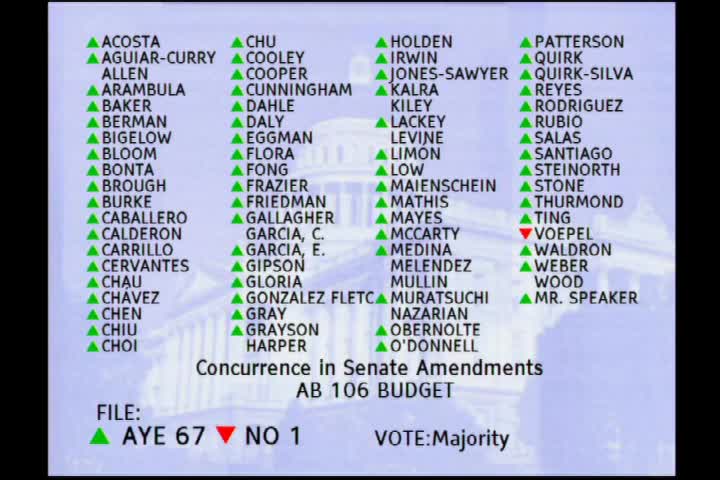 1MIN
Assembly Floor
 3MIN
Senate Standing Committee on Budget and Fiscal Review
 13MIN
Senate Standing Committee on Budget and Fiscal Review
Bill Author

Bill Co-Author(s):