AB 1122: Teachers: best practice guidance: dual-language and multilanguage educational programs.
- Session Year: 2017-2018
- House: Assembly
- Latest Version Date: 2017-09-01
Existing law requires professional preparation for teachers to be made available in the upper division course offerings at all California public institutions of higher learning, except for the California Maritime Academy and the Hastings College of the Law. Existing law also provides that the Commission on Teacher Credentialing shall encourage postsecondary institutions that offer programs of professional preparation to collaborate with school districts, county offices of education, and professional organizations in the design and delivery of local programs to function as part of the California beginning teacher support and assessment program. Existing law also provides that an integrated program of professional preparation enables candidates for teaching credentials to engage in professional preparation, concurrently with subject matter preparation, while completing baccalaureate degrees at regionally accredited postsecondary educational institutions.
This bill would require the commission to develop best practice guidance on the establishment of partnerships between local educational agencies and institutions of higher education to offer integrated teacher preparation programs to teach in dual-language and multilanguage educational programs, as specified. The bill would require the commission to make this guidance available on the commissions Internet Web site on or before September 1, 2019.
Existing law requires professional preparation for teachers to be made available in the upper division course offerings at all California public institutions of higher learning, except for the California Maritime Academy and the Hastings College of the Law. Existing law also provides that the Commission on Teacher Credentialing shall encourage postsecondary institutions that offer programs of professional preparation to collaborate with school districts, county offices of education, and professional organizations in the design and delivery of local programs to function as part of the California beginning teacher support and assessment program. Existing law also provides that an integrated program of professional preparation enables candidates for teaching credentials to engage in professional preparation, concurrently with subject matter preparation, while completing baccalaureate degrees at regionally accredited postsecondary educational institutions.
This bill would require the commission to establish and expand develop best practice guidance on the establishment of partnerships between local educational agencies and institutions of higher education to offer integrated teacher preparation programs to teach in dual-language and multilanguage educational programs, as specified, that prepare educators to teach in dual-language immersion programs through integrated programs offering professional preparation concurrently with the completion of a baccalaureate degree. specified. The bill would require the commission to make this guidance available on the commissions Internet Web site on or before September 1, 2019.
Existing law requires professional preparation for teachers to be made available in the upper division course offerings at all California public institutions of higher learning, except for the California Maritime Academy and the Hastings College of the Law. Existing law also provides that the Commission on Teacher Credentialing shall encourage postsecondary institutions that offer programs of professional preparation to collaborate with school districts, county offices of education, and professional organizations in the design and delivery of local programs to function as part of the California beginning teacher support and assessment program. Existing law also provides that an integrated program of professional preparation enables candidates for teaching credentials to engage in professional preparation, concurrently with subject matter preparation, while completing baccalaureate degrees at regionally accredited postsecondary educational institutions.
This bill would require the commission to encourage the establishment and expansion of establish and expand partnerships between local educational agencies and institutions of higher education to offer integrated teacher preparation programs, as specified, that prepare educators to teach in dual-language immersion programs through integrated programs offering professional preparation concurrently with the completion of a baccalaureate degree.
Existing law requires professional preparation for teachers to be made available in the upper division course offerings at all California public institutions of higher learning, except for the California Maritime Academy and the Hastings College of the Law. Existing law also provides that the Commission on Teacher Credentialing shall encourage postsecondary institutions that offer programs of professional preparation to collaborate with school districts, county offices of education, and professional organizations in the design and delivery of local programs to function as part of the California beginning teacher support and assessment program. Existing law also provides that an integrated program of professional preparation enables candidates for teaching credentials to engage in professional preparation, concurrently with subject matter preparation, while completing baccalaureate degrees at regionally accredited postsecondary educational institutions.
This bill would require the commission to encourage the establishment and expansion of partnerships between local educational agencies and institutions of higher education to offer integrated teacher preparation programs, as specified, that prepare educators to teach in dual-language immersion programs through integrated programs offering professional preparation concurrently with the completion of a baccalaureate degree.
Existing law states legislative findings and declarations regarding the need for affordable housing in connection with local authority to approve housing developments. This bill would express the intent of the Legislature to enact legislation relating to housing.Existing law states legislative findings and declarations regarding the need for affordable housing in connection with local authority to approve housing developments.
This bill would express the intent of the Legislature to enact legislation relating to housing.
(a)The commission shall develop best practice guidance on the establishment of partnerships between local educational agencies and institutions of higher education to offer integrated teacher preparation programs to teach in dual-language and multilanguage educational programs, pursuant to Section 44259.1.
(b)In developing best practices, the commission shall consider both of the following:
(1)Directly address, and be responsive to, the staffing needs of individual school districts with respect to the need for multilingual teachers.
(2)Establish or expand bilingual authorization programs in both of the following:
(A)Languages for which it is difficult to recruit bilingual teachers.
(B)Languages that are commonly spoken, but for which there is a shortage of bilingual authorizations.
(c)The commission shall make best practice guidance developed pursuant to this section available on the commissions Internet Web site on or before September 1, 2019.
(a)The commission shall establish and expand develop best practice guidance on the establishment of partnerships between local educational agencies and institutions of higher education to offer integrated teacher preparation programs to teach in dual-language and multilanguage educational programs, pursuant to Section 44259.1, that prepare educators to teach in dual-language immersion programs through integrated programs offering professional preparation concurrently with the completion of a baccalaureate degree. 44259.1.
(b)The partnerships established pursuant to this section may include either private or public institutions of higher education. These partnerships shall encourage the development of strategies to accomplish In developing best practices, the commission shall consider both of the following:
(1)Directly address, and be responsive to, the staffing needs of individual school districts with respect to the need for multilingual teachers.
(2)Establish or expand bilingual authorization programs in both of the following:
(A)Languages for which it is difficult to recruit bilingual teachers.
(B)Languages that are commonly spoken, but for which there is a shortage of bilingual authorizations.
(c)The commission shall make best practice guidance developed pursuant to this section available on the commissions Internet Web site on or before September 1, 2019.
(a)The commission shall encourage the establishment and expansion of establish and expand partnerships between local educational agencies and institutions of higher education to offer integrated teacher preparation programs, pursuant to Section 44259.1, that prepare educators to teach in dual-language immersion programs through integrated programs offering professional preparation concurrently with the completion of a baccalaureate degree.
(b)The partnerships established pursuant to this section may include either private or public institutions of higher education. These partnerships shall encourage the development of strategies to accomplish both of the following:
(1)Directly address, and be responsive to, the staffing needs of individual school districts with respect to the need for multilingual teachers.
(2)Establish or expand bilingual authorization programs in both of the following:
(A)Languages for which it is difficult to recruit bilingual teachers.
(B)Languages that are commonly spoken, but for which there is a shortage of bilingual authorizations.
(a)The commission shall encourage the establishment and expansion of partnerships between local educational agencies and institutions of higher education to offer integrated teacher preparation programs, as described in pursuant to Section 44259.1, that prepare educators to teach in dual-language immersion programs through integrated programs offering professional preparation concurrently with the completion of a baccalaureate degree.
(b)The partnerships established pursuant to this section may include either private or public institutions of higher education. These partnerships shall encourage the development of strategies to accomplish both of the following:
(1)Directly address, and be responsive to, the staffing needs of individual school districts with respect to the need for multilingual teachers.
(2)Establish or expand bilingual authorization programs in both of the following:
(A)Languages for which it is difficult to recruit bilingual teachers.
(B)Languages that are commonly spoken, but for which there is a shortage of bilingual authorizations.
The commission shall encourage the establishment and expansion of partnerships between local educational agencies and institutions of higher education to offer integrated teacher preparation programs, as described in Section 44259.1, that prepare educators to teach in dual-language immersion programs through integrated programs offering professional preparation concurrently with the completion of a baccalaureate degree.
SECTION 1.It is the intent of the Legislature to enact legislation relating to housing.It is the intent of the Legislature to enact legislation relating to housing.
|
Date
|
Status
|
|---|---|
| Jan 12, 2018 | Stricken from file. |
| Jan 3, 2018 | Consideration of Governor's veto pending. |
| Oct 9, 2017 | Vetoed by Governor. |
| Sep 7, 2017 | Enrolled and presented to the Governor at 3 p.m. |
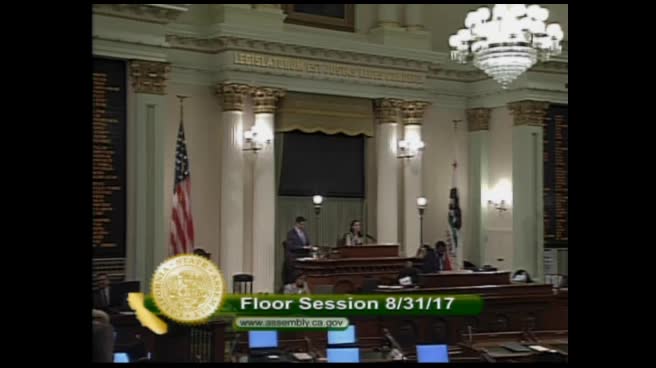
| Aug 31, 2017 | Senate amendments concurred in. To Engrossing and Enrolling. |
| Jul 20, 2017 | In Assembly. Concurrence in Senate amendments pending. May be considered on or after August 18 pursuant to Assembly Rule 77. |
| Jul 20, 2017 | Read third time. Passed. Ordered to the Assembly. |
| Jul 18, 2017 | Read second time. Ordered to Consent Calendar. |
| Jul 17, 2017 | From committee: Be placed on second reading file pursuant to Senate Rule 28.8 and ordered to consent calendar. |
| Jul 6, 2017 | Read second time and amended. Re-referred to Com. on APPR. |
| Jul 5, 2017 | From committee: Amend, and do pass as amended and re-refer to Com. on APPR. with recommendation: To Consent Calendar. (Ayes 6. Noes 0.) (July 5). |
| Jun 21, 2017 | Re-referred to Com. on ED. |
| Jun 13, 2017 | From committee chair, with author's amendments: Amend, and re-refer to committee. Read second time, amended, and re-referred to Com. on RLS. |
| Jun 8, 2017 | Referred to Com. on RLS. |
| May 26, 2017 | In Senate. Read first time. To Com. on RLS. for assignment. |
| May 26, 2017 | Read third time. Passed. Ordered to the Senate. |
| May 18, 2017 | Read second time. Ordered to Consent Calendar. |
| May 17, 2017 | From committee: Do pass. To Consent Calendar. (Ayes 17. Noes 0.) (May 17). |
| Apr 27, 2017 | From committee: Do pass and re-refer to Com. on APPR. with recommendation: To Consent Calendar. (Ayes 7. Noes 0.) (April 26). Re-referred to Com. on APPR. |
| Apr 19, 2017 | Re-referred to Com. on ED. |
| Apr 18, 2017 | From committee chair, with author's amendments: Amend, and re-refer to Com. on ED. Read second time and amended. |
| Mar 29, 2017 | Re-referred to Com. on ED. |
| Mar 28, 2017 | From committee chair, with author's amendments: Amend, and re-refer to Com. on ED. Read second time and amended. |
| Mar 27, 2017 | Referred to Com. on ED. |
| Feb 19, 2017 | From printer. May be heard in committee March 21. |
| Feb 17, 2017 | Read first time. To print. |
|
Date
|
Description
|
Location
|
Votes
|
|
|---|---|---|---|---|
| Aug 31, 2017 | AB 1122 LIMÓN Concurrence in Senate Amendments | Assembly Floor |
Passed |
|
| Jul 20, 2017 | Consent Calendar 2nd AB1122 | Senate Floor |
Passed |
|
| Jul 5, 2017 | Do pass as amended, but first amend, and re-refer to the Committee on [Appropriations] with the recommendation: To Consent Calendar | Senate Standing Committee on Education |
Passed |
|
| May 26, 2017 | AB 1122 LIMÓN Consent Calendar Second Day Regular Session | Assembly Floor |
Passed |
|
| May 17, 2017 | Do pass. To Consent Calendar. | Assembly Standing Committee on Appropriations |
Passed |
|
| Apr 26, 2017 | Do pass and be re-referred to the Committee on [Appropriations] with recommendation: To Consent Calendar | Assembly Standing Committee on Education |
Passed |
This list shows positions taken on this bill by organizations on the date displayed, which is linked to the original source.
Positions by individuals are not included.
|
Organization
|
Position
|
Date
|
|---|---|---|
| California Association For Bilingual Education | ** Support | Jul 19, 2017 |
| Californians Together | ** Support | Jul 19, 2017 |
| Edvoice | ** Support | Jul 19, 2017 |
| Los Angeles Unified School District | ** Support | Jul 19, 2017 |
GOVERNOR'S VETO
GV Bill Id:AB 1122
Author:(Limón)
As Enrolled Ver:September 1, 2017
2/3 vote
ASSEMBLY: | 76-0 | (May 26, 2017) | SENATE: | 38-0 | (July 20, 2017) |
ASSEMBLY: | 77-0 | (August 31, 2017) |
Original Committee Reference: ED.
SUMMARY: Requires the Commission on Teacher Credentialing (CTC) to develop best practice guidance on the establishment of partnerships between local educational agencies (LEAs) and institutions of higher education to establish integrated teacher preparation programs that prepare educators to teach in dual-language and multi-language programs.
The Senate amendments:
- Delete the requirement that the CTC encourage the establishment and expansion of partnerships between LEAs and institutions of higher education to offer integrated teacher preparation programs that prepare educators to teach in dual-language immersion programs, and instead require the CTC to develop best practice guidance on the establishment of these partnerships.
- Require the CTC, in developing this guidance, to consider the staffing needs of individual school districts, languages for which it is difficult to recruit bilingual teachers, and languages which are commonly spoken but for which there is a shortage of bilingual authorizations.
- Require the CTC to make this guidance available on its website on or before September 1, 2019.
EXISTING LAW:
- Requires the CTC to develop objective and verifiable standards for an authorization for bilingual-cross-cultural competence for holders of an appropriate credential, certificate, authorization, or permit who will be serving English learners (ELs).
- Requires that candidates for the bilingual authorization, by oral and written examination, or by completing an approved program that consists of coursework or a combination of coursework and examinations, demonstrate specified competencies.
- Through initiative statute (Proposition 58, approved by the voters at the November, 2016 general election), authorizes school districts to establish dual–language immersion programs for both native and non–native English speakers requires that public schools ensure students obtain English language proficiency.
- Authorizes integrated (also known as blended) programs of teacher preparation, which allow teachers to obtain teaching credentials while earning their baccalaureate degrees.
FISCAL EFFECT: According to the Senate Appropriations Committee, pursuant to Senate Rule 28.8, negligible state costs.
COMMENTS:
Need for the bill. The author's office states, "Proposition 227, which passed in 1998, severely limited the offering of bilingual education. Following the passage of Proposition 227, the number of English Learner (EL) students served by K-12 bilingual programs decreased from 30% in 1998 to 6% in 2007. Many universities eliminated bilingual teacher preparation programs.
Proposition 58 (2016) was overwhelmingly approved by California voters to, among other things, authorize school districts to establish dual–language immersion programs for both native and non–native English speakers. Specifically, Proposition 58 gave public schools flexibility to choose how to teach English learners, whether in English–only, bilingual, or other types of programs. Proposition 58 restores local control to school districts in choosing the most effective instructional methods for the benefit of their students.
The passage of Proposition 58 will increase demand for multilingual programs at all levels. Given this expected increase in demand, as well as the shrinking pipeline of qualified teachers to staff these programs, continued expansion of bilingual programs should be considered to increase the number of multilingual-authorized teachers in California.
AB 1122 furthers the intent of the voters to help students learn English as quickly as possible and expand opportunities for English speakers to master a second language. This bill ensures bilingual teacher candidates are prepared to teach in all bilingual program models; those serving students learning English, and models serving students developing proficiency in a second language."
This bill requires the Commission on Teacher Credentialing to provide guidance in establishing partnerships between school districts and higher education institutions on the subject of bilingual teacher preparation programs.
I believe this bill is unnecessary. California recently funded programs to recruit additional teachers, including bilingual education teachers. I want to assess the success of these efforts before spending additional money on new programs.
Analysis Prepared by: Tanya Lieberman / ED. / (916) 319-2087 FN: 0002444
CONCURRENCE IN SENATE AMENDMENTS
CSA1 Bill Id:AB 1122
Author:(Limón)
As Amended Ver:July 6, 2017
Majority vote
ASSEMBLY: | 76-0 | (May 26, 2017) | SENATE: | 38-0 | (July 20, 2017) |
Original Committee Reference: ED.
SUMMARY: Requires the Commission on Teacher Credentialing (CTC) to develop best practice guidance on the establishment of partnerships between local educational agencies (LEAs) and institutions of higher education to establish integrated teacher preparation programs that prepare educators to teach in dual-language and multi-language programs.
The Senate amendments:
- Delete the requirement that the CTC encourage the establishment and expansion of partnerships between LEAs and institutions of higher education to offer integrated teacher preparation programs that prepare educators to teach in dual-language immersion programs, and instead require the CTC to develop best practice guidance on the establishment of these partnerships.
- Require the CTC, in developing this guidance, to consider the staffing needs of individual school districts, languages for which it is difficult to recruit bilingual teachers, and languages which are commonly spoken but for which there is a shortage of bilingual authorizations.
- Require the CTC to make this guidance available on its website on or before September 1, 2019.
EXISTING LAW:
- Requires the CTC to develop objective and verifiable standards for an authorization for bilingual-cross-cultural competence for holders of an appropriate credential, certificate, authorization, or permit who will be serving English learners (ELs).
- Requires that candidates for the bilingual authorization, by oral and written examination, or by completing an approved program that consists of coursework or a combination of coursework and examinations, demonstrate specified competencies.
- Through initiative statute (Proposition 58, approved by the voters at the November, 2016 general election), authorizes school districts to establish dual–language immersion programs for both native and non–native English speakers requires that public schools ensure students obtain English language proficiency.
- Authorizes integrated (also known as blended) programs of teacher preparation, which allow teachers to obtain teaching credentials while earning their baccalaureate degrees.
FISCAL EFFECT: According to the Senate Appropriations Committee, pursuant to Senate Rule 28.8, negligible state costs.
COMMENTS:
Need for the bill. The author's office states, "Proposition 227, which passed in 1998, severely limited the offering of bilingual education. Following the passage of Proposition 227, the number of English Learner (EL) students served by K-12 bilingual programs decreased from 30% in 1998 to 6% in 2007. Many universities eliminated bilingual teacher preparation programs.
Proposition 58 (2016) was overwhelmingly approved by California voters to, among other things, authorize school districts to establish dual–language immersion programs for both native and non–native English speakers. Specifically, Proposition 58 gave public schools flexibility to choose how to teach English learners, whether in English–only, bilingual, or other types of programs. Proposition 58 restores local control to school districts in choosing the most effective instructional methods for the benefit of their students.
The passage of Proposition 58 will increase demand for multilingual programs at all levels. Given this expected increase in demand, as well as the shrinking pipeline of qualified teachers to staff these programs, continued expansion of bilingual programs should be considered to increase the number of multilingual-authorized teachers in California.
AB 1122 furthers the intent of the voters to help students learn English as quickly as possible and expand opportunities for English speakers to master a second language. This bill ensures bilingual teacher candidates are prepared to teach in all bilingual program models; those serving students learning English, and models serving students developing proficiency in a second language."
Analysis Prepared by: Tanya Lieberman / ED. / (916) 319-2087 FN: 0001199
Office of Senate Floor Analyses (916) 651-1520 Fax: (916) 327-4478 | AB |
CONSENT
Bill No: AB 1122
:
SENATE EDUCATION COMMITTEE: 6-0, 7/5/17
AYES: Allen, Wilk, Galgiani, Leyva, Pan, Vidak
NO VOTE RECORDED: Mendoza
SENATE APPROPRIATIONS COMMITTEE: Senate Rule 28.8
ASSEMBLY FLOOR: 76-0, 5/26/17 (Consent) - See last page for vote
SOURCE: Los Angeles Unified School District
DIGEST:
This bill requires the Commission on Teacher Credentialing (CTC) to develop best practice guidance on the establishment of partnerships between local educational agencies and institutions of higher education to offer integrated teacher preparation programs that prepare educators to teach in dual-language immersion programs.
Existing law:
- Requires the CTC to develop objective and verifiable standards for an authorization for bilingual-cross-cultural competence for holders of an appropriate credential, certificate, authorization, or permit who will be serving English learners.
- States that these authorizations may be issued to persons holding an appropriate credential or authorization issued by the CTC, including holders of special education credentials, clinical services credentials, school psychologist authorizations, and child development and preschool professionals.
- Requires that candidates for the bilingual authorization, by oral and written examination, or by completing an approved program that consists of coursework or a combination of coursework and examinations, demonstrate all of the following either at the same time as the initial preparation for the prerequisite credential or at a later date that he or she:
- Is competent in both the oral and written skills of a language other than English.
- Is competent in both the oral and written skills in the English language. States that a passing score on the reading and writing portions of the basic skills proficiency test satisfies the written skills portion of this requirement.
- Has both the knowledge and understanding of the cultural and historical heritage of the limited-English-proficient individuals to be served.
- Has the ability to perform the services the candidate is certified or authorized to perform in English and in a language other than English.
- Authorizes a teacher who possesses a credential or permit and is able to present a valid out-of-state credential or certificate that authorizes the instruction of English language learners or to teach in a bilingual setting in students’ primary language to qualify for the authorization by submitting an application and fee to the CTC.
- Establishes the Bilingual Teacher Training Assistance Program, administered by the California Department of Education in consultation with the CTC and representatives of bilingual educators, for teachers who are granted waivers and who are enrolled and participating in a program leading to a bilingual specialist credential or a certificate of competence for bilingual-crosscultural competence.
- Authorizes integrated programs of teacher preparation, which allow teachers to obtain teaching credentials while earning their baccalaureate degrees.
This bill:
- Requires the CTC to develop best practice guidance on the establishment of partnerships between local educational agencies and institutions of higher education to offer teacher preparation programs to teach in dual-language and multilanguage educational programs.
- Requires the CTC, in developing best practices, to consider both of the following:
- Directly address, and be responsive to, the staffing needs of individual school districts with respect to the need for multilingual teachers.
- Establish or expand bilingual authorization programs in both of the following:
- Languages for which it is difficult to recruit bilingual teachers.
- Languages that are commonly spoken, but for which there is a shortage of bilingual authorizations.
- Requires the CTC to make guidance available on its Internet Web site by September 1, 2019.
Comments
- Need for the bill. According to the author, “Proposition 58 (2016) was overwhelmingly approved by California voters to, among other things, authorize school districts to establish dual–language immersion programs for both native and non–native English speakers. Specifically, Proposition 58 gave public schools flexibility to choose how to teach English learners, whether in English–only, bilingual, or other types of programs. Proposition 58 restores local control to school districts in choosing the most effective instructional methods for the benefit of their students.
“The passage of Proposition 58 will increase demand for multilingual programs at all levels. Given this expected increase in demand, as well as the shrinking pipeline of qualified teachers to staff these programs, continued expansion of bilingual programs should be considered to increase the number of multilingual-authorized teachers in California.
“AB 1122 furthers the intent of the voters to help students learn English as quickly as possible and expand opportunities for English speakers to master a second language. This bill ensures bilingual teacher candidates are prepared to teach in all bilingual program models; those serving students learning English, and models serving students developing proficiency in a second language.
“The passage of Proposition 58 removes restrictions on bilingual education programs, allowing school districts to easily create or expand bilingual programs. However, California may be unprepared to meet the expected increase in demand for bilingual education teachers as schools develop and expand bilingual programs. At 700 new bilingual teachers in 2015–16, California authorizes fewer than half the number of new bilingual teachers it did when bilingual education was hiring at its peak in the mid-1990s.
“Further, very few institutions of higher education offer bilingual authorizations in the less-commonly-spoken languages of Arabic, Armenian, French, Korean, Mandarin, and Vietnamese. For example, only the California State University, Northridge offers bilingual authorizations in Armenian and none currently offer authorizations in French.”
- Learning Policy Institute (LPI) report. The LPI’s 2016 report, “Addressing California’s Emerging Teacher Shortage: An Analysis of Sources and Solutions” included the following summary: “After many years of teacher layoffs in California, school districts around the state are hiring again. With the influx of new K-12 funding, districts are looking to lower student-teacher ratios and reinstate classes and programs that were reduced or eliminated during the Great Recession. However, mounting evidence indicates that teacher supply has not kept pace with the increased demand.” The report included the following findings:
- Few teacher preparation institutions offer bilingual authorization training programs. After the passage of Proposition 227, bilingual teacher preparation programs were greatly reduced across the state. In 2009, the CTC approved a set of standards that would allow teachers to pursue bilingual authorization through multiple routes, with both coursework and examination options, likely contributing to a greater share of bilingual authorizations being issued to existing teaching credentials than to new teaching credentials. Currently, only 30 teacher preparation institutions offer bilingual authorization training programs, compared with over 80 that grant secondary and elementary teaching certifications.
- California authorizes fewer than half the number of new bilingual teachers than it did when bilingual education was at its peak in the mid-1990s. At its peak in 1994-95, California granted over 1,800 bilingual authorizations. After the passage of Proposition 227, California issued over 1,200 bilingual authorizations a year between 2003–04 and 2009–10. Since then, there has been a steady decline in new bilingual authorizations, with fewer than 700 teachers authorized in 2015–16.
- Despite the fact that bilingual education was seriously hampered in California for nearly two decades, districts already report shortages of bilingual education teachers. In a fall 2016 survey of more than 200 California school districts, 14 percent reported shortages of bilingual teachers. Now that Proposition 58 allows for the expansion of bilingual programs, LPI predicts that these shortages are likely to grow.
The LPI report offered several policy recommendations for consideration. These recommendations include the reinstatement of the California Center on Teaching Careers and the establishment of incentives to attract diverse, talented individuals to teach in high-need locations and fields. The report also recommends the creation of more innovative pipelines into teaching.
- Duplicative of a similar program funded in the 2016-17 Budget? To help address the state’s current teacher shortage, the 2016-17 Budget appropriates $10 million one-time for the Integrated Teacher Preparation Grant Program. The program provides $250,000 grants to post-secondary institutions for the creation or expansion of four-year integrated teacher preparation programs. The funding is designed to increase the number of students who receive their bachelor’s degree and teaching credential concurrently within a four-year program and become teachers in the areas of mathematics, science, or bilingual education. While this bill is intended to create and expand integrated dual-language immersion teacher preparation programs, the Committee may wish to consider whether the Integrated Teacher Preparation Grant Program is already doing this.
FISCAL EFFECT: Appropriation: Fiscal Com.: Local:
Los Angeles Unified School District (source)
California Association for Bilingual Education
Californians Together
EdVoice
OPPOSITION: (Verified 7/17/17)
None received
ASSEMBLY FLOOR: 76-0, 5/26/17
AYES: Acosta, Aguiar-Curry, Travis Allen, Arambula, Baker, Berman, Bigelow, Bloom, Bocanegra, Bonta, Brough, Burke, Caballero, Calderon, Cervantes, Chávez, Chen, Chiu, Choi, Chu, Cooley, Cooper, Cunningham, Dababneh, Dahle, Daly, Flora, Fong, Frazier, Friedman, Gallagher, Cristina Garcia, Eduardo Garcia, Gipson, Gloria, Gomez, Gonzalez Fletcher, Gray, Grayson, Harper, Holden, Irwin, Jones-Sawyer, Kalra, Kiley, Lackey, Levine, Limón, Low, Maienschein, Mathis, Mayes, McCarty, Medina, Melendez, Mullin, Muratsuchi, Nazarian, Obernolte, O'Donnell, Patterson, Quirk, Quirk-Silva, Reyes, Ridley-Thomas, Rodriguez, Rubio, Salas, Santiago, Mark Stone, Thurmond, Ting, Voepel, Weber, Wood, Rendon
NO VOTE RECORDED: Chau, Eggman, Steinorth, Waldron
7/19/17 15:33:48
**** END ****
SENATE COMMITTEE ON EDUCATION
Senator Benjamin Allen, Chair
2017 - 2018 Regular
Bill No: AB 1122 Hearing Date: July 5, 2017
Author: | |||
Version: | June 13, 2017 | ||
Urgency: | No | Fiscal: | Yes |
Consultant: | Ian Johnson | ||
Subject: Teachers: dual-language immersion programs
SUMMARY
This bill requires the Commission on Teacher Credentialing (CTC) to establish and expand partnerships between local educational agencies and institutions of higher education to offer integrated teacher preparation programs that prepare educators to teach in dual-language immersion programs.
BACKGROUND
Existing law:
- Requires the CTC to develop objective and verifiable standards for an authorization for bilingual-cross-cultural competence for holders of an appropriate credential, certificate, authorization, or permit who will be serving English learners.
- States that these authorizations may be issued to persons holding an appropriate credential or authorization issued by the CTC, including holders of special education credentials, clinical services credentials, school psychologist authorizations, and child development and preschool professionals.
- Requires that candidates for the bilingual authorization, by oral and written examination, or by completing an approved program that consists of coursework or a combination of coursework and examinations, demonstrate all of the following either at the same time as the initial preparation for the prerequisite credential or at a later date that he or she:
- Is competent in both the oral and written skills of a language other than English.
- Is competent in both the oral and written skills in the English language. States that a passing score on the reading and writing portions of the basic skills proficiency test satisfies the written skills portion of this requirement.
- Has both the knowledge and understanding of the cultural and historical heritage of the limited-English-proficient individuals to be served.
- Has the ability to perform the services the candidate is certified or authorized to perform in English and in a language other than English.
- Authorizes a teacher who possesses a credential or permit and is able to present a valid out-of-state credential or certificate that authorizes the instruction of English language learners or to teach in a bilingual setting in students’ primary language to qualify for the authorization by submitting an application and fee to the Commission on Teacher Credentialing (CTC).
- Establishes the Bilingual Teacher Training Assistance Program, administered by the California Department of Education (CDE) in consultation with the CTC and representatives of bilingual educators, for teachers who are granted waivers and who are enrolled and participating in a program leading to a bilingual specialist credential or a certificate of competence for bilingual-crosscultural competence.
- Authorizes integrated programs of teacher preparation, which allow teachers to obtain teaching credentials while earning their baccalaureate degrees.
ANALYSIS
This bill:
- Requires the CTC to establish and expand partnerships between local educational agencies and institutions of higher education to offer teacher preparation programs that prepare educators to teach in dual-language immersion programs through integrated programs offering professional preparation concurrently with the completion of a baccalaureate degree.
- States that the partnerships established pursuant to the act may include either private or public institutions of higher education.
- Requires these partnerships to encourage the development of strategies to accomplish both of the following:
- Directly address, and be responsive to, the staffing needs of individual school districts with respect to the need for multilingual teachers.
- Establish or expand bilingual authorization programs in both of the following:
- Languages for which it is difficult to recruit bilingual teachers.
- Languages that are commonly spoken, but for which there is a shortage of bilingual authorizations.
STAFF COMMENTS
- Need for the bill. According to the author, “Proposition 58 (2016) was overwhelmingly approved by California voters to, among other things, authorize school districts to establish dual–language immersion programs for both native and non–native English speakers. Specifically, Proposition 58 gave public schools flexibility to choose how to teach English learners, whether in English–only, bilingual, or other types of programs. Proposition 58 restores local control to school districts in choosing the most effective instructional methods for the benefit of their students.
The passage of Proposition 58 will increase demand for multilingual programs at all levels. Given this expected increase in demand, as well as the shrinking pipeline of qualified teachers to staff these programs, continued expansion of bilingual programs should be considered to increase the number of multilingual-authorized teachers in California.
AB 1122 furthers the intent of the voters to help students learn English as quickly as possible and expand opportunities for English speakers to master a second language. This bill ensures bilingual teacher candidates are prepared to teach in all bilingual program models; those serving students learning English, and models serving students developing proficiency in a second language.
The passage of Proposition 58 removes restrictions on bilingual education programs, allowing school districts to easily create or expand bilingual programs. However, California may be unprepared to meet the expected increase in demand for bilingual education teachers as schools develop and expand bilingual programs. At 700 new bilingual teachers in 2015–16, California authorizes fewer than half the number of new bilingual teachers it did when bilingual education was hiring at its peak in the mid-1990s.
Further, very few institutions of higher education offer bilingual authorizations in the less-commonly-spoken languages of Arabic, Armenian, French, Korean, Mandarin, and Vietnamese. For example, only the California State University, Northridge offers bilingual authorizations in Armenian and none currently offer authorizations in French.”
- Learning Policy Institute (LPI) report. The LPI’s 2016 report, “Addressing California’s Emerging Teacher Shortage: An Analysis of Sources and Solutions” included the following summary: “After many years of teacher layoffs in California, school districts around the state are hiring again. With the influx of new K-12 funding, districts are looking to lower student-teacher ratios and reinstate classes and programs that were reduced or eliminated during the Great Recession. However, mounting evidence indicates that teacher supply has not kept pace with the increased demand.” The report included the following findings:
- Few teacher preparation institutions offer bilingual authorization training programs. After the passage of Proposition 227, bilingual teacher preparation programs were greatly reduced across the state. In 2009, the Commission on Teacher Credentialing approved a set of standards that would allow teachers to pursue bilingual authorization through multiple routes, with both coursework and examination options, likely contributing to a greater share of bilingual authorizations being issued to existing teaching credentials than to new teaching credentials. Currently, only 30 teacher preparation institutions offer bilingual authorization training programs, compared with over 80 that grant secondary and elementary teaching certifications.
- California authorizes fewer than half the number of new bilingual teachers than it did when bilingual education was at its peak in the mid-1990s. At its peak in 1994-95, California granted over 1,800 bilingual authorizations. After the passage of Proposition 227, California issued over 1,200 bilingual authorizations a year between 2003–04 and 2009–10. Since then, there has been a steady decline in new bilingual authorizations, with fewer than 700 teachers authorized in 2015–16.
- Despite the fact that bilingual education was seriously hampered in California for nearly two decades, districts already report shortages of bilingual education teachers. In a fall 2016 survey of more than 200 California school districts, 14 percent reported shortages of bilingual teachers. Now that Proposition 58 allows for the expansion of bilingual programs, LPI predicts that these shortages are likely to grow.
The Learning Policy Institute (LPI) report offered several policy recommendations for consideration. These recommendations include the reinstatement of the California Center on Teaching Careers and the establishment of incentives to attract diverse, talented individuals to teach in high-need locations and fields. The report also recommends the creation of more innovative pipelines into teaching.
- Duplicative of a similar program funded in the 2016-17 Budget? To help address the state’s current teacher shortage, the 2016-17 Budget appropriates $10 million one-time for the Integrated Teacher Preparation Grant Program. The program provides $250,000 grants to post-secondary institutions for the creation or expansion of four-year integrated teacher preparation programs. The funding is designed to increase the number of students who receive their bachelor’s degree and teaching credential concurrently within a four-year program and become teachers in the areas of mathematics, science, or bilingual education. While this bill is intended to create and expand integrated dual-language immersion teacher preparation programs, the Committee may wish to consider whether the Integrated Teacher Preparation Grant Program is already doing this.
- Author amendments. Concerns have been raised over the bill’s requirement that the Commission on Teacher Credentialing (CTC) establish partnerships between local educational agencies and institutions of higher education. The CTC would not be given any new authority, and the bill would not provide grant funding or any other mechanism for the CTC to incentivize these partnerships. In response to these concerns, the author wishes to amend this bill as follows:
(a) The commission shall develop best practice guidance on the establishment of establish and expand partnerships between local educational agencies and institutions of higher education to offer integrated teacher preparation programs to teach in dual-language and multilanguage educational programs, pursuant to Section 44259.1, that prepare educators to teach in dual-language immersion programs through integrated programs offering professional preparation concurrently with the completion of a baccalaureate degree.
(b) In developing best practices, the commission shall considerThe partnerships established pursuant to this section may include either private or public institutions of higher education. These partnerships shall encourage the development of strategies to accomplish both of the following:
(1) Directly address, and be responsive to, the staffing needs of individual school districts with respect to the need for multilingual teachers.
(2) Establish or expand bilingual authorization programs in both of the following:
(A) Languages for which it is difficult to recruit bilingual teachers.
(B) Languages that are commonly spoken, but for which there is a shortage of bilingual authorizations.
(c) The commission shall make guidance available on the commission website by September 1, 2019
SUPPORT
Los Angeles Unified School District (sponsor)
California Association for Bilingual Education
Californians Together
EdVoice
OPPOSITION
None received
-- END --
Date of Hearing: May 17, 2017
ASSEMBLY COMMITTEE ON APPROPRIATIONS
Lorena Gonzalez Fletcher, Chair
ABPCA Bill Id:AB 1122
Author:(Limón) – As Amended Ver:April 18, 2017
Policy Committee: | Education | Vote: | 7 - 0 |
Urgency: No State Mandated Local Program: No Reimbursable: No
SUMMARY:
This bill requires the Commission on Teacher Credentialing (CTC) to encourage the establishment and expansion of partnerships between local educational agencies (LEAs) and institutions of higher education (IHEs) to offer integrated teacher preparation programs that prepare educators to teach in dual-language immersion programs. Specifically, this bill:
- States that the partnerships established pursuant to the act may include either private or public institutions of higher education.
- Requires these partnerships to encourage the development of strategies to accomplish both of the following: a) directly address and be responsive to the staffing needs of individual school districts with respect to the need for multilingual teachers; b) and establish or expand bilingual authorization programs.
FISCAL EFFECT:
No fiscal impact. The CTC believes this bill provides a solution to integrate the need for new bilingual programs into the current activities, which allows CTC to implement this bill within existing resources.
COMMENTS:
- Background. Existing law requires the CTC to develop objective and verifiable standards for an authorization for bilingual-cross-cultural competence for holders of an appropriate credential, certificate, authorization, or permit who will be serving English learners (ELs). Candidates for the bilingual authorization must pass an oral and written examination, or complete an approved program that consists of coursework or a combination of coursework and examinations. State law also authorizes integrated (also known as blended) programs of teacher preparation, which allow teachers to obtain teaching credentials while earning their baccalaureate degrees. Data collected in 2016 by the CDE shows that 30 institutions of higher education offer preparation programs leading to bilingual authorization.
Until 2013, when the program was rolled into the Local Control Funding Formula (LCFF), the state provided funding for the Bilingual Teacher Training Program (BTTP), which assisted K–12 teachers who already possessed a basic credential, to attain bilingual authorizations so they could provide primary language instructional services to English learners. The program prepared teachers for examinations leading to authorizations. Grants were awarded through an application process to 14 centers that provide specialized training to teachers who were assigned to English learners. The program was funded at $1.7 million in 2012-13 budget. The 2016-17 budget included $10 million to be awarded by the CTC to institutions of higher education for the development of integrated (sometimes called blended) teacher preparation programs. Integrated preparation programs allow teachers to earn their credential while earning their bachelor’s degree. The appropriation was targeted at particularly acute areas of shortage, including special education, math and science, and bilingual education.
- Purpose. The author’s office states, “Proposition 227, which passed in 1998, severely limited the offering of bilingual education. Following the passage of Proposition 227, the number of English Learner (EL) students served by K-12 bilingual programs decreased from 30% in 1998 to 6% in 2007. Many universities eliminated bilingual teacher preparation programs. Proposition 58 (2016) was overwhelmingly approved by California voters to, among other things, authorize school districts to establish dual–language immersion programs for both native and non–native English speakers. Specifically, Proposition 58 gave public schools flexibility to choose how to teach English learners, whether in English–only, bilingual, or other types of programs. Proposition 58 restored local control to school districts in choosing the most effective instructional methods for the benefit of their students. The passage of Proposition 58 will increase demand for multilingual programs at all levels. Given this expected increase in demand, as well as the shrinking pipeline of qualified teachers to staff these programs, continued expansion of bilingual programs should be considered to increase the number of multilingual-authorized teachers in California. AB 1122 furthers the intent of the voters to help students learn English as quickly as possible and expand opportunities for English speakers to master a second language. This bill ensures bilingual teacher candidates are prepared to teach in all bilingual program models; those serving students learning English, and models serving students developing proficiency in a second language.”
- Related Legislation. AB 952 (Reyes) establishes the Bilingual Teacher Professional Development Program, to provide professional development to teachers seeking to provide instruction in multilingual settings. The bill is in this Committee on Suspense.
AB 169 (O’Donnell) of this Session would establish the Golden State Teacher Grant Program to provide one-time grant funds of $20,000 to students in a professional preparation program leading to a preliminary teaching credential, if the students commits to working in a high-need field, including bilingual education, for four years after receiving a teaching credential. The bill is in this Committee on Suspense.
Analysis Prepared by: Daisy Gonzales / APPR. / (916) 319-2081
Date of Hearing: April 26, 2017
ASSEMBLY COMMITTEE ON EDUCATION
Patrick O'Donnell, Chair
ABPCA Bill Id:AB 1122 (
Author:Limón) – As Amended Ver:April 18, 2017
SUBJECT: Teachers: dual-language immersion programs
SUMMARY: Requires the Commission on Teacher Credentialing (CTC) to encourage the establishment and expansion of partnerships between local educational agencies (LEAs) and institutions of higher education (IHEs) to offer integrated teacher preparation programs that prepare educators to teach in dual-language immersion programs. Specifically, this bill:
- Requires the CTC to encourage the establishment and expansion of partnerships between LEAs and IHEs to offer teacher preparation programs that prepare educators to teach in dual-language immersion programs through integrated programs offering professional preparation concurrently with the completion of a baccalaureate degree.
- States that the partnerships established pursuant to the act may include either private or public institutions of higher education.
- Requires these partnerships to encourage the development of strategies to accomplish both of the following:
- directly address, and be responsive to, the staffing needs of individual school districts with respect to the need for multilingual teachers.
- establish or expand bilingual authorization programs in both of the following:
- languages for which it is difficult to recruit bilingual teachers
- languages that are commonly spoken, but for which there is a shortage of bilingual authorizations
EXISTING LAW:
- Requires the CTC to develop objective and verifiable standards for an authorization for bilingual-cross-cultural competence for holders of an appropriate credential, certificate, authorization, or permit who will be serving English learners (ELs).
- States that these authorizations may be issued to persons holding an appropriate credential or authorization issued by the CTC, including holders of special education credentials, clinical services credentials, school psychologist authorizations, and child development and preschool professionals.
- Requires that candidates for the bilingual authorization, by oral and written examination, or by completing an approved program that consists of coursework or a combination of coursework and examinations, demonstrate all of the following either at the same time as the initial preparation for the prerequisite credential or at a later date that he or she:
- is competent in both the oral and written skills of a language other than English
- is competent in both the oral and written skills in the English language. States that a passing score on the reading and writing portions of the basic skills proficiency test satisfies the written skills portion of this requirement.
- has both the knowledge and understanding of the cultural and historical heritage of the limited-English-proficient individuals to be served
- has the ability to perform the services the candidate is certified or authorized to perform in English and in a language other than English
- Authorizes a teacher who possesses a credential or permit and is able to present a valid out-of-state credential or certificate that authorizes the instruction of English language learners or to teach in a bilingual setting in students’ primary language to qualify for the authorization by submitting an application and fee to the CTC.
- Through initiative statute (Proposition 58, approved by the voters at the November, 2016 general election), authorizes school districts to establish dual–language immersion programs for both native and non–native English speakers requires that public schools ensure students obtain English language proficiency.
- Establishes the Bilingual Teacher Training Assistance Program (BTTP), administered by the CDE in consultation with the CTC and representatives of bilingual educators, for teachers who are granted waivers and who are enrolled and participating in a program leading to a bilingual specialist credential or a certificate of competence for bilingual-crosscultural competence. (EC 52181)
- Authorizes integrated (also known as blended) programs of teacher preparation, which allow teachers to obtain teaching credentials while earning their baccalaureate degrees.
FISCAL EFFECT: Unknown
COMMENTS:
Need for the bill. The author’s office states, “Proposition 227, which passed in 1998, severely limited the offering of bilingual education. Following the passage of Proposition 227, the number of English Learner (EL) students served by K-12 bilingual programs decreased from 30% in 1998 to 6% in 2007. Many universities eliminated bilingual teacher preparation programs.
Proposition 58 (2016) was overwhelmingly approved by California voters to, among other things, authorize school districts to establish dual–language immersion programs for both native and non–native English speakers. Specifically, Proposition 58 gave public schools flexibility to choose how to teach English learners, whether in English–only, bilingual, or other types of programs. Proposition 58 restores local control to school districts in choosing the most effective instructional methods for the benefit of their students.
The passage of Proposition 58 will increase demand for multilingual programs at all levels. Given this expected increase in demand, as well as the shrinking pipeline of qualified teachers to staff these programs, continued expansion of bilingual programs should be considered to increase the number of multilingual-authorized teachers in California.
AB 1122 furthers the intent of the voters to help students learn English as quickly as possible and expand opportunities for English speakers to master a second language. This bill ensures bilingual teacher candidates are prepared to teach in all bilingual program models; those serving students learning English, and models serving students developing proficiency in a second language.
The passage of Proposition 58 removes restrictions on bilingual education programs, allowing school districts to easily create or expand bilingual programs. However, California may be unprepared to meet the expected increase in demand for bilingual education teachers as schools develop and expand bilingual programs. At 700 new bilingual teachers in 2015–16, California authorizes fewer than half the number of new bilingual teachers it did when bilingual education was hiring at its peak in the mid-1990s.
Further, very few institutions of higher education offer bilingual authorizations in the less-commonly-spoken languages of Arabic, Armenian, French, Korean, Mandarin, and Vietnamese. For example, only the California State University, Northridge offers bilingual authorizations in Armenian and none currently offer authorizations in French.”
Dual immersion programs. According to the CDE, dual language immersion (also known as two-way language immersion and two-way bilingual immersion) programs have the following characteristics:
- Provides instruction for proficiency in both native language and English
- Includes students with an English background and students from one other language
- Instruction is in both languages, typically starting with smaller proportions of instruction in English and gradually moving to half in each language
- Students typically stay in the program throughout elementary school
According to the CDE, there are “50:50” and “90:10” dual immersion models, which refer to the amount of time students study in the target language and English. In a 90:10 model early instruction is nearly all in the target language, and decreases over time as English increases, until there is a 50:50 balance. A 50:50 model uses English and the target language for 50 percent of instructional time, throughout the duration of the program. The CDE notes that both models are effective but that the 90:10 model results in higher levels of bilingualism.
According to the CDE, two-way immersion programs are based on years of research from the language immersion models in Canada designed for English speakers learning French. This model, in which English-speaking students have been instructed in French for up to 100 percent of their day, shows that students perform as well as or better on tests of English than their English-speaking peers who have been instructed only in English.
The author cites research showing that while dual language immersion can provide significant benefits to both native and non-native speakers of target languages in both academic achievement and cultural inclusion, the lack of qualified teachers makes the implementation of immersion programs challenging.
Data on dual language immersion programs in California. The CDE estimates that there are about 200 dual language immersion programs in California, of which 184 are in Spanish, 8 are in Mandarin or Cantonese, 8 are in Korean, and 1 is in Japanese. An independent website which maintains a directory of language immersion schools finds 413 dual language immersion programs, including 372 in Spanish, 27 in Mandarin, 9 in Korean, 6 in Cantonese, 3 in French, 2 in Armenian, 2 in German, 1 in Italian, 1 in Hebrew, and 1 in Hmong.
Bilingual authorization programs at higher education institutions. According to survey data collected in 2016 by the CDE, 30 institutions of higher education offer preparation programs leading to bilingual authorization. All offer the authorization in Spanish, and 14 offer preparation in other languages, including Mandarin, Cantonese, Vietnamese, Hmong, Punjabi, Tagalog, American Sign Language, Korean, Japanese, Arabic, Khmer, Portuguese, and Armenian. The Asian Bilingual Authorization Consortium, made up of California State University (CSU) Northridge, CSU Los Angeles, CSU Long Beach, and CSU Pomona) provides Asian language bilingual preparation programs which allows students to take advantage of the different languages offered at the participating campuses through online instruction. Testimony at an informational hearing of this Committee this year indicated that there were 47 teachers enrolled in the Asian bilingual authorization programs offered by the member campuses.
School district/higher education partnerships. This bill seeks to promote partnerships between school districts and higher education institutions in order to increase the availability of integrated preparation programs which prepare bilingual teachers.
While incentive funding provided in last year’s budget is likely to result in an increase in integrated programs of preparation which include bilingual authorizations, the Committee may wish to consider that there are many credentialed teachers who speak the less common languages who could benefit from increased availability of bilingual authorization programs.
One program which addresses this need is run by the University of California, Los Angeles (UCLA), which offers an eight-week summer intensive program for credentialed teachers who are speakers of Spanish or Mandarin. The program includes a practicum at a school in the Los Angeles Unified School District.
Another project, funded by a five year federal grant, allowed the CSU Asian Bilingual Authorization Consortium (noted above) to provide support for teachers of Chinese (Cantonese/ Mandarin), Filipino (Tagalog), Hmong, Korean, and Vietnamese backgrounds who wished to obtain their bilingual authorizations in those languages. The grant funded the cost of tuition, books, and tests for students who were interested in obtaining Asian language bilingual authorizations. 80 teachers participated, and their credential program costs were paid up to $10,000.
Faculty in that partnership identified as barriers to the establishment of these programs: the lack of heritage language speakers who also have sufficient academic language proficiency, and the difficulty establishing a program when there is no clear demand for authorized teachers in smaller target languages. They noted, however, that there is strong demand for teachers with bilingual authorizations, and that this demand is expected to increase.
Bilingual teacher shortage. The serious shortage of credentialed teachers in California, particularly in math, science, and special education, is well established. But does California have a shortage of authorized bilingual teachers?
California annually reports shortage areas to the U.S. Department of Education for the purpose of federal loan and grant deferral or forgiveness for teachers. According to the U.S. Department of Education, California reported a shortage of bilingual teachers from 1990-1991 to 1999-2000, but has not done so since. However, there is growing evidence that the state is facing a shortage of bilingual teachers – one that is likely to grow.
According to the Learning Policy Institute (LPI), before the passage of Proposition 227 about 30% of ELs were served by bilingual programs. A decade later, the number of EL students served by bilingual programs decreased to just 5%. The Learning Policy Institute notes:
- “Few teacher preparation institutions offer bilingual authorization training programs. After the passage of Proposition 227, bilingual teacher preparation programs were greatly reduced across the state. In 2009, the Commission on Teacher Credentialing approved a set of standards that would allow teachers to pursue bilingual authorization through multiple routes, with both coursework and examination options, likely contributing to a greater share of bilingual authorizations being issued to existing teaching credentials than to new teaching credentials. Currently, only 30 teacher preparation institutions offer bilingual authorization training programs, compared with over 80 that grant secondary and elementary teaching certifications.
- California authorizes fewer than half the number of new bilingual teachers than it did when bilingual education was at its peak in the mid-1990s. At its peak in 1994-95, California granted over 1,800 bilingual authorizations. After the passage of Proposition 227, California issued over 1,200 bilingual authorizations a year between 2003–04 and 2009–10. Since then, there has been a steady decline in new bilingual authorizations, with fewer than 700 teachers authorized in 2015–16.
- Despite the fact that bilingual education was seriously hampered in California for nearly two decades, districts already report shortages of bilingual education teachers. In a fall 2016 survey of more than 200 California school districts, 14% reported shortages of bilingual teachers. Now that Proposition 58 allows for the expansion of bilingual programs, LPI predicts that these shortages are likely to grow.”
Bilingual authorizations a priority area in grant funding for integrated programs. The 2016-17 budget included $10 million to be awarded by the CTC to institutions of higher education for the development of integrated (sometimes called blended) teacher preparation programs. Integrated preparation programs allow teachers to earn their credential while earning their bachelor’s degree. The appropriation was targeted at particularly acute areas of shortage, including special education, math and science, and bilingual education
Bilingual Teacher Training Program rolled into LCFF in 2013. Until 2013, when the program was rolled into the Local Control Funding Formula (LCFF), the state provided funding for the Bilingual Teacher Training Program (BTTP), which assisted K–12 teachers who already possessed a basic credential, to attain bilingual authorizations so they could provide primary language instructional services to English learners. The program prepared teachers for examinations leading to authorizations. Grants were awarded through an application process to 14 centers that provide specialized training to teachers who were assigned to English learners. The program was funded at $1.7 million in 2012-13 budget.
Related and prior legislation. AB 952 (Reyes) of this Session would establish the Bilingual Teacher Professional Development Program, to provide professional development to teachers seeking to provide instruction in multilingual settings.
AB 169 (O’Donnell) of this Session would establish the Golden State Teacher Grant Program to provide one-time grant funds of $20,000 to students in a professional preparation program leading to a preliminary teaching credential, if the students commits to working in a high-need field, including bilingual education, for four years after receiving a teaching credential.
AB 463 (Salas) of this Session would require the CTC to issue 7,200 new warrants for the Assumption Program of Loans for Education program commencing with the 2017–18 fiscal year.
AB 234 (Steinorth) of this Session, an urgency statute, would require the CTC to issue 7,200 new warrants for the Assumption Program of Loans for Education program commencing with the 2017–18 fiscal year.
SB 436 (Allen) of this Session would establish the California STEM Professional Teaching Pathway to recruit, train, support, and retain qualified science, technology, engineering and mathematics (STEM) professionals, including military veterans, as mathematics and science teachers in California. The bill also includes an unspecified and ongoing appropriation, beginning in 2017-18, for allocation to the California Center on Teaching Careers (Cal-Teach).
AB 1217 (Bocanegra) of this Session would California Teacher Corps Act of 2017, under which the SPI would make grants to LEAs to assist these agencies in establishing, maintaining, or expanding teacher residency programs.
AB 2248 (Holden) Chapter 103, Statutes of 2016 authorizes a teacher who possesses a credential or permit and is able to present a valid out-of-state credential or certificate that authorizes the bilingual instruction to qualify for the authorization by submitting an application to the CTC.
AB 1756 (Bonilla) of the 2015-16 Session would have provided $10 million in grants for the development of integrated teacher preparation programs, including those producing bilingual authorizations. This bill was held on the Assembly Floor, but funding became part of the 2016-17 budget.
REGISTERED SUPPORT / OPPOSITION:
Support
Los Angeles Unified School District (sponsor)
EdVoice
Opposition
None on file
Analysis Prepared by: Tanya Lieberman / ED. / (916) 319-2087
Bill Author

Bill Co-Author(s):