AB 1159: Cannabis: legal services.
- Session Year: 2017-2018
- House: Assembly
- Latest Version Date: 2017-10-06
Existing law, the Control, Regulate and Tax Adult Use of Marijuana Act (AUMA), an initiative measure enacted by the approval of Proposition 64 at the November 8, 2016, statewide general election, authorizes the consumption of nonmedical marijuana, also known as adult-use cannabis, by persons over 21 years of age and establishes a system for the licensure and regulation of certain commercial nonmedical marijuana activities. Existing law, the Medicinal and Adult-Use Cannabis Regulation and Safety Act, expands and modifies this system to also include the licensure and regulation of certain commercial medicinal cannabis activities.
Existing law prescribes the manner in which contracts may be created and requires that a contract be for a lawful object. Under existing law a contract that is contrary to an express provision of law, contrary to the policy of express law, or that is otherwise contrary to good morals is not lawful.
This bill would provide that commercial activity relating to medicinal cannabis or adult-use cannabis conducted in compliance with state law and any applicable local standards and regulations is a lawful object of a contract, is not contrary to an express policy or provision of law or to good morals, and is not against public policy.
Existing law grants a lawyers client a privilege to refuse to disclose, and to prevent another from disclosing, a confidential communication between the client and lawyer, as defined, if the privilege is claimed by the holder of the privilege, a person who is authorized to claim the privilege by the holder, or the person who was the lawyer at the time of the confidential communication, as specified. Existing law excepts communications from the privilege if the services of the lawyer were sought or obtained to enable or aid anyone to commit, or plan to commit, a crime or fraud.
This bill would provide that the above exception does not apply to legal services rendered in compliance with state or local laws on medicinal cannabis or adult-use cannabis and that confidential communications provided for the purpose of rendering those services are confidential communications, as specified.
Existing law, the Medical Cannabis Regulation and Safety Act, establishes a program for the licensing and regulation of medical cannabis. Existing law authorizes a city, county, or city and county to adopt an ordinance that establishes additional standards, requirements, and regulations for local licenses and permits for commercial medical cannabis activity and provides that statewide standards, requirements, and regulations are the minimum standards for licensure. The Control, Regulate and Tax Adult Use of Marijuana Act (AUMA), an initiative measure enacted by the approval of Proposition 64 at the November 8, 2016, statewide general election, authorizes the consumption of nonmedical marijuana marijuana, also known as adult-use cannabis, by persons over 21 years of age and provides establishes a system for the licensure and regulation of certain commercial nonmedical marijuana activities. Existing law, the Medicinal and Adult-Use Cannabis Regulation and Safety Act, expands and modifies this system to also include the licensure and regulation of certain commercial medicinal cannabis activities.
Existing law prescribes the manner in which contracts may be created and requires that a contract be for a lawful object. Under existing law a contract that is contrary to an express provision of law, contrary to the policy of express law, or that is otherwise contrary to good morals is not lawful.
This bill would provide that medical commercial activity relating to medicinal cannabis or commercial marijuana adult-use cannabis activity conducted in compliance with state law and any applicable local standards and regulations is a lawful object of a contract, is not contrary to an express policy or provision of law or to good morals, and is not against public policy.
Existing law grants a lawyers client a privilege to refuse to disclose, and to prevent another from disclosing, a confidential communication between the client and lawyer, as defined, if the privilege is claimed by the holder of the privilege, a person who is authorized to claim the privilege by the holder, or the person who was the lawyer at the time of the confidential communication, as specified. Existing law excepts communications from the privilege if the services of the lawyer were sought or obtained to enable or aid anyone to commit, or plan to commit, a crime or fraud.
This bill would provide that the above exception does not apply to legal services rendered in compliance with state or local laws on medical medicinal cannabis or adult use of marijuana adult-use cannabis and that confidential communications provided for the purpose of rendering those services are confidential communications, as specified.
Existing law, the Medical Cannabis Regulation and Safety Act, establishes a program for the licensing and regulation of medical cannabis. Existing law authorizes a city, county, or city and county to adopt an ordinance that establishes additional standards, requirements, and regulations for local licenses and permits for commercial medical cannabis activity and provides that statewide standards, requirements, and regulations are the minimum standards for licensure. The Control, Regulate and Tax Adult Use of Marijuana Act (AUMA), an initiative measure enacted by the approval of Proposition 64 at the November 8, 2016, statewide general election, authorizes the consumption of nonmedical marijuana by persons over 21 years of age and provides for the licensure and regulation of certain commercial nonmedical marijuana activities.
Existing law prescribes the manner in which contracts may be created and requires that a contract be for a lawful object. Under existing law a contract that is contrary to an express provision of law, contrary to the policy of express law, or that is otherwise contrary to good morals is not lawful.
This bill would provide that medical cannabis or commercial marijuana activity conducted in compliance with state law and any applicable local standards and regulations is a lawful object of a contract, is not contrary to an express policy or provision of law or to good morals, and is not against public policy.
Existing law grants a lawyers client a privilege to refuse to disclose, and to prevent another from disclosing, a confidential communication between the client and lawyer, as defined, if the privilege is claimed by the holder of the privilege, a person who is authorized to claim the privilege by the holder, or the person who was the lawyer at the time of the confidential communication, as specified. Existing law excepts communications from the privilege if the services of the lawyer were sought or obtained to enable or aid anyone to commit, or plan to commit, a crime or fraud.
This bill would provide that the above exception does not apply to legal services rendered in compliance with state or local laws on medical cannabis or adult use of marijuana and that confidential communications provided for the purpose of rendering those services are confidential communications, as specified.
Except as specified, existing law prohibits a city, county, or city and county from prohibiting a healing arts professional licensee from engaging in any act or performing any procedure that falls within the professionally recognized scope of practice of that licensee.This bill would make a nonsubstantive change to that provision.Except as specified, existing law prohibits a city, county, or city and county from prohibiting a healing arts professional licensee from engaging in any act or performing any procedure that falls within the professionally recognized scope of practice of that licensee.
This bill would make a nonsubstantive change to that provision.
(a)The Legislature finds and declares all of the following:
(1)The Compassionate Use Act of 1996, an initiative measure enacted by the approval of Proposition 215 at the November 5, 1996, statewide general election, authorized the use of marijuana for medical purposes in this state.
(2)The Legislature passed the Medical Cannabis Regulation and Safety Act, formerly 3.5 (commencing with Section 19300) of Division 8 of the Business and Professions Code, to regulate and license medical cannabis in the state.
(3)The Control, Regulate and Tax Adult Use of Marijuana Act (AUMA), an initiative measure enacted by the approval of Proposition 64 at the November 8, 2016, statewide general election, authorized the consumption of nonmedical marijuana by persons over 21 years of age and provided for the licensure and regulation of certain commercial nonmedical marijuana activities in this state.
(4)The Legislature passed the Medicinal and Adult-Use Cannabis Regulation and Safety Act (Division 10 (commencing with Section 26000) of the Business and Professions Code) to consolidate the licensure and regulation of certain commercial activities with respect to medicinal cannabis and nonmedical marijuana, now known as adult-use cannabis.
(b)Notwithstanding any law, including, but not limited to, Sections 1550, 1667, and 1668 and federal law, commercial activity relating to medicinal cannabis or adult-use cannabis conducted in compliance with California law and any applicable local standards, requirements, and regulations shall be deemed to be all of the following:
(1)A lawful object of a contract.
(2)Not contrary to, an express provision of law, any policy of express law, or good morals.
(3)Not against public policy.
SEC. 2.Section 956 of the Evidence Code is amended to read:956.(a)There is no privilege under this article if the services of the lawyer were sought or obtained to enable or aid anyone to commit or plan to commit a crime or a fraud.
(b)This exception to the privilege granted by this article shall not apply to legal services rendered in compliance with state and local laws on medicinal cannabis or adult-use cannabis, and confidential communications provided for the purpose of rendering those services are confidential communications between client and lawyer, as defined in Section 952, provided the lawyer also advises the client on conflicts with respect to federal law.
(a)The Legislature finds and declares all of the following:
(1)The Compassionate Use Act of 1996, an initiative measure enacted by the approval of Proposition 215 at the November 5, 1996, statewide general election, authorized the use of marijuana for medical purposes in this state.
(2)The Legislature passed the Medical Cannabis Regulation and Safety Act (Chapter Act, formerly 3.5 (commencing with Section 19300) of Division 8 of the Business and Professions Code) Code, to regulate and license medical cannabis in the state.
(3)The Control, Regulate and Tax Adult Use of Marijuana Act (AUMA), an initiative measure enacted by the approval of Proposition 64 at the November 8, 2016, statewide general election, authorized the consumption of nonmedical marijuana by persons over 21 years of age and provided for the licensure and regulation of certain commercial nonmedical marijuana activities in this state.
(4)The Legislature passed the Medicinal and Adult-Use Cannabis Regulation and Safety Act (Division 10 (commencing with Section 26000) of the Business and Professions Code) to consolidate the licensure and regulation of certain commercial activities with respect to medicinal cannabis and nonmedical marijuana, now known as adult-use cannabis.
(b)Notwithstanding any law, including, but not limited to, Sections 1550, 1667, and 1668 and federal law, medical commercial activity relating to medicinal cannabis or commercial marijuana activity adult-use cannabis conducted in compliance with California law and any applicable local standards, requirements, and regulations shall be deemed to be all of the following:
(1)A lawful object of a contract.
(2)Not contrary to, an express provision of law, any policy of express law, or good morals.
(3)Not against public policy.
SEC. 2.Section 956 of the Evidence Code is amended to read:956.(a)There is no privilege under this article if the services of the lawyer were sought or obtained to enable or aid anyone to commit or plan to commit a crime or a fraud.
(b)This exception to the privilege granted by this article shall not apply to legal services rendered in compliance with state and local laws on medical medicinal cannabis or adult use of marijuana, adult-use cannabis, and confidential communications provided for the purpose of rendering those services are confidential communications between client and lawyer, as defined in Section 952, provided the lawyer also advises the client on conflicts with respect to federal law.
(a)The Legislature finds and declares all of the following:
(1)The Compassionate Use Act of 1996, an initiative measure enacted by the approval of Proposition 215 at the November 5, 1996, statewide general election, authorized the use of marijuana for medical purposes in this state.
(2)The Legislature passed the Medical Cannabis Regulation and Safety Act (Chapter 3.5 (commencing with Section 19300) of Division 8 of the Business and Professions Code) to regulate and license medical cannabis in the state.
(3)The Control, Regulate and Tax Adult Use of Marijuana Act (AUMA), an initiative measure enacted by the approval of Proposition 64 at the November 8, 2016, statewide general election, authorized the consumption of nonmedical marijuana by persons over 21 years of age and provided for the licensure and regulation of certain commercial nonmedical marijuana activities in this state.
(b)Notwithstanding any law, including, but not limited to, Sections 1550, 1667, and 1668 and federal law, medical cannabis or commercial marijuana activity conducted in compliance with California law and any applicable local standards, requirements, and regulations shall be deemed to be all of the following:
(1)A lawful object of a contract.
(2)Not contrary to, an express provision of law, any policy of express law, or good morals.
(3)Not against public policy.
SEC. 2.Section 956 of the Evidence Code is amended to read:956.(a)There is no privilege under this article if the services of the lawyer were sought or obtained to enable or aid anyone to commit or plan to commit a crime or a fraud.
(b)This exception to the privilege granted by this article shall not apply to legal services rendered in compliance with state and local laws on medical cannabis or adult use of marijuana, and confidential communications provided for the purpose of rendering those services are confidential communications between client and lawyer, as defined in Section 952, provided the lawyer also advises the client on conflicts with respect to federal law.
SECTION 1.Section 460 of the Business and Professions Code is amended to read:460.(a)No city, county, or city and county shall prohibit a person or group of persons, authorized by one of the agencies in the Department of Consumer Affairs or an entity established pursuant to this code by a license, certificate, or other means to engage in a particular business, from engaging in that business, occupation, or profession or any portion of that business, occupation, or profession.(b)(1)No city, county, or city and county shall prohibit a healing arts professional licensed with the state under Division 2 (commencing with Section 500) or licensed or certified by an entity established pursuant to this code from engaging in any act or performing any procedure that falls within the professionally recognized scope of practice of that licensee.(2)This subdivision shall not be construed to prohibit the enforcement of a local ordinance in effect prior to January 1, 2010, related to any act or procedure that falls within the professionally recognized scope of practice of a healing arts professional licensed pursuant to Division 2 (commencing with Section 500).(c)This section shall not be construed to prevent a city, county, or city and county from adopting or enforcing any local ordinance governing zoning, business licensing, or reasonable health and safety requirements for establishments or businesses of a healing arts professional licensed under Division 2 (commencing with Section 500) or licensed or certified by an entity established under this code or a person or group of persons described in subdivision (a).(d)Nothing in this section shall prohibit any city, county, or city and county from levying a business license tax solely for revenue purposes, nor any city or county from levying a license tax solely for the purpose of covering the cost of regulation.(a)No city, county, or city and county shall prohibit a person or group of persons, authorized by one of the agencies in the Department of Consumer Affairs or an entity established pursuant to this code by a license, certificate, or other means to engage in a particular business, from engaging in that business, occupation, or profession or any portion of that business, occupation, or profession.
(b)(1)No city, county, or city and county shall prohibit a healing arts professional licensed with the state under Division 2 (commencing with Section 500) or licensed or certified by an entity established pursuant to this code from engaging in any act or performing any procedure that falls within the professionally recognized scope of practice of that licensee.
(2)This subdivision shall not be construed to prohibit the enforcement of a local ordinance in effect prior to January 1, 2010, related to any act or procedure that falls within the professionally recognized scope of practice of a healing arts professional licensed under pursuant to Division 2 (commencing with Section 500).
(c)This section shall not be construed to prevent a city, county, or city and county from adopting or enforcing any local ordinance governing zoning, business licensing, or reasonable health and safety requirements for establishments or businesses of a healing arts professional licensed under Division 2 (commencing with Section 500) or licensed or certified by an entity established under this code or a person or group of persons described in subdivision (a).
(d)Nothing in this section shall prohibit any city, county, or city and county from levying a business license tax solely for revenue purposes, nor any city or county from levying a license tax solely for the purpose of covering the cost of regulation.
|
Date
|
Status
|
|---|---|
| Oct 6, 2017 | Chaptered by Secretary of State - Chapter 530, Statutes of 2017. |
| Oct 6, 2017 | Approved by the Governor. |
| Sep 12, 2017 | Enrolled and presented to the Governor at 2:30 p.m. |
| Sep 5, 2017 | Senate amendments concurred in. To Engrossing and Enrolling. (Ayes 55. Noes 22.). |
| Aug 31, 2017 | In Assembly. Concurrence in Senate amendments pending. May be considered on or after September 2 pursuant to Assembly Rule 77. |
| Aug 31, 2017 | Read third time. Passed. Ordered to the Assembly. |
| Jul 20, 2017 | Read second time. Ordered to third reading. |
| Jul 19, 2017 | Read third time and amended. Ordered to second reading. |
| Jun 22, 2017 | Read second time. Ordered to third reading. |
| Jun 21, 2017 | From committee: Do pass. (Ayes 6. Noes 1.) (June 20). |
| May 24, 2017 | Referred to Com. on JUD. |
| May 15, 2017 | In Senate. Read first time. To Com. on RLS. for assignment. |
| May 15, 2017 | Read third time. Passed. Ordered to the Senate. (Ayes 54. Noes 24. Page 1530.) |
| May 10, 2017 | Read second time. Ordered to third reading. |
| May 9, 2017 | From committee: Do pass. (Ayes 9. Noes 2.) (May 9). |
| Mar 29, 2017 | Re-referred to Com. on JUD. |
| Mar 28, 2017 | From committee chair, with author's amendments: Amend, and re-refer to Com. on JUD. Read second time and amended. |
| Mar 27, 2017 | Referred to Com. on JUD. |
| Feb 19, 2017 | From printer. May be heard in committee March 21. |
| Feb 17, 2017 | Read first time. To print. |
|
Date
|
Description
|
Location
|
Votes
|
|
|---|---|---|---|---|
| Sep 5, 2017 | AB 1159 CHIU Concurrence in Senate Amendments | Assembly Floor |
Passed |
|
| Aug 31, 2017 | Assembly 3rd Reading AB1159 Chiu By McGuire | Senate Floor |
Passed |
|
| Jun 20, 2017 | Do pass | Senate Standing Committee on Judiciary |
Passed |
|
| May 15, 2017 | AB 1159 CHIU Assembly Third Reading | Assembly Floor |
Passed |
|
| May 9, 2017 | Do pass. | Assembly Standing Committee on Judiciary |
Passed |
This list shows positions taken on this bill by organizations on the date displayed, which is linked to the original source.
Positions by individuals are not included.
|
Organization
|
Position
|
Date
|
|---|---|---|
| ballyhallinan properties | ** Support | Aug 17, 2017 |
| California NORML | ** Support | Aug 17, 2017 |
| California Norml; Ballyhallinan Properties; Goodrow Law Group | ** Support | Jun 19, 2017 |
| Coalition for Common Sense Regulation | ** Support | Aug 17, 2017 |
| goodrow law group | ** Support | Aug 17, 2017 |
| Hallinan & Hallinan P.C. | ** Support | May 4, 2017 |
| law offices of hallinan & hallinan | ** Support | Aug 17, 2017 |
CONCURRENCE IN SENATE AMENDMENTS
CSA1 Bill Id:AB 1159
Author:(Chiu)
As Amended Ver:July 19, 2017
Majority vote
ASSEMBLY: | 54-24 | (May 15,2017) | SENATE: | 31-8 | (August 31, 2017) |
Original Committee Reference: JUD.
SUMMARY: Proposes to modify current state law to clarify that an attorney may provide legal advice to a person who is engaged in marijuana business in conformity with state law, without violating ethical duties or compromising the attorney-client privilege, and allowing the formation of contracts. Specifically, this bill:
- Makes a number of legislative findings and declarations, including the following:
- The Compassionate Use Act of 1996, an initiative measure enacted by the approval of Proposition 215 at the November 5, 1996, statewide general election, authorized the use of marijuana for medical purposes in this state.
- The Legislature passed the Medical Cannabis Regulation and Safety Act to regulate and license medical cannabis in the state.
- The Control, Regulate and Tax Adult Use of Marijuana Act (AUMA), an initiative measure enacted by the approval of Proposition 64 at the November 8, 2016, statewide general election, authorized the consumption of nonmedical marijuana by persons over 21 years of age and provided for the licensure and regulation of certain commercial nonmedical marijuana activities in this state.
- The Legislature passed the Medicinal and Adult-Use Cannabis Regulation and Safety Act to consolidate the licensure and regulation of certain commercial activities with respect to medicinal cannabis and nonmedical marijuana, now known as adult-use cannabis.
- Provides that notwithstanding any law, including Civil Code Sections 1550, 1667, and 1668 and federal law, commercial activity relating to medicinal cannabis or adult-use cannabis conducted in compliance with California law and any applicable local standards, requirements, and regulations shall be deemed to be all of the following:
- A lawful object of a contract.
- Not contrary to, an express provision of law, any policy of express law, or good morals.
- Not against public policy.
- Provides that, despite the provision in current law (Evidence Code Section 956 ) which makes the attorney-client privilege inapplicable when the services of the lawyer are sought or obtained in order to enable or aid anyone to commit or plan to commit a crime or a fraud, the attorney-client privilege does apply to legal services rendered in compliance with state and local laws on medicinal cannabis or adult-use cannabis, and confidential communications provided for the purpose of rendering those services are confidential communications between client and lawyer, as defined in the Evidence Code Section 952, provided the lawyer also advises the client on conflicts with respect to federal law.
The Senate amendments add legislative intent and revise terms for medicinal cannabis and adult use of cannabis.
FISCAL EFFECT: None
COMMENTS: In 2015, all three measures that made up the Medical Marijuana Regulation and Safety Act— consisting of AB 266 (Bonta), Chapter 689, Statutes of 2015; AB 243 (Wood), Chapter 688, Statutes of 2015; and SB 643 (McGuire), Chapter 719, Statutes of 2015— were signed into law. Collectively, the Act created a new agency within the Department of Consumer Affairs "to license, tax, and regulate the industry" and delineated "the funding mechanisms for the agencies that oversee the operations." (Cilliber and Swan, Gov. Brown signs bills regulating medical marijuana industry, SFGATE (Oct. 9, 2015).) The laws will take effect in 2018.
Soon afterwards, in 2016, voters approved Proposition 64, legalizing the use, possession, sharing, and growing of marijuana for adults aged 21 years or older. (Steinmetz, What to Know About Marijuana Legalization in California, Time Magazine (Nov. 9, 2016).) As a result of Proposition 64, past offenders detained for violation of cannabis laws will have the opportunity to get their records expunged, and some will be released from jail early. (Ibid.) Proposition 64 did not authorize the sale or purchase of marijuana, however, as the new laws governing these operations do not take effect until 2018.
Marijuana possession, use, transportation, and sale remain illegal at the federal level. As a result, state law surrounding marijuana conflicts with federal law. Consequently, California attorneys are placed in a bind when clients seek their advice about whether and how they can legally engage in business in the marijuana industry. What's more, under current law, the lawful sale and purchase of marijuana cannot be the subject of a valid contract because the subject of the contract—marijuana—is illegal under the express provision of federal law.
Pending Changes to Ethical Rules for Attorneys. The State Bar of California recently approved a number of changes to ethics rules governing attorney conduct to account for the new state laws regarding marijuana. Proposed Rule 1.2.1 and Comment 5 specifically allow attorneys to advise their clients on compliance with California medical cannabis laws, provided the attorney also advises the client on the conflict between state and federal law. Rule 1.2.1 would add clarifying language to Rule 3-210 (Advising the Violation of Law) to provide that a lawyer may explain the legal consequences of a client's proposed course of conduct without violating the rules (State Bar of California, Proposed Rule of Professional Conduct 1.2.1 - Executive Summary (Oct. 31, 2016).) Comment 5 "addresses a lawyer's obligation to communicate his or her ethical limitations with a client who expects assistance not permitted by the rules." (Ibid.) Those rules are now before the Supreme Court for approval and adoption.
This Bill Seeks to Remedy Remaining Inconsistencies in the Law. This bill proposes to modify current state law to clarify that an attorney may provide legal advice to a person who is engaged in marijuana business in conformity with state law, without violating ethical duties or compromising the attorney-client privilege. Specifically, it would do the following: 1) clarify that cannabis-related activity compliant with California law is a lawful object of contract; 2) preserve the attorney-client privilege for clients engaging in the cannabis industry in compliance with California state and local law, provided that the attorney advises the client on conflicts with respect to federal law; and 3) make legislative findings and declarations regarding the legality of medicinal and recreational use of marijuana.
The author writes the following, explaining the need for the bill:
Though the cultivation and use of medical and recreational cannabis is legal in California, it remains illegal federally with no sign of resolution on the horizon. Unfortunately, this conflict has created a unique set of pitfalls for California attorneys and their clients when it comes to conducting legal business operations…For those individuals who wish to engage responsibly and lawfully in the business of cannabis, barriers to counsel can mean barriers to meaningful legal representation and an increased risk of operating outside California's statutory and regulatory framework. Resolving these issues will provide clarity to both attorneys and clients working in this field.
This bill would ease the burden on attorneys, who are forced to choose between advising their clients in accordance with the law, and violating a rule of professional conduct and thus foregoing the essential attorney-client privilege. It would also clarify longstanding inconsistencies in statute as they pertain to the sale and purchase of marijuana.
The Coalition for Common Sense Regulation supports this bill because: "Rather than waiting for courts to address these matters, we strongly believe that people of the State of California would be better served by eliminating these conflicts through clear legislation. Such an approach would further the intent of both the legislature as expressed in the Medical Cannabis Regulation and Safety Act of 2015 and the people of the State of California as expressed in Proposition 64."
Hallinan and Hallinan P.C. writes in support of the bill: "Attorney-client privilege and enforceable contracts are essential to any functional market. We can assure you that aggressive litigators are already taking advantages of these chinks in the legal protections of the California code, and will continue to do so. AB 1159 is a simple fix to an important problem."
Analysis Prepared by: Alison Merrilees / JUD. / (916) 319-2334 FN: 0001586
Office of Senate Floor Analyses (916) 651-1520 Fax: (916) 327-4478 | AB |
THIRD READING
Bill No: AB 1159
:
SENATE JUDICIARY COMMITTEE: 6-1, 6/20/17
AYES: Jackson, Moorlach, Hertzberg, Monning, Stern, Wieckowski
NOES: Anderson
ASSEMBLY FLOOR: 54-24, 5/15/17 - See last page for vote
SUBJECT: Cannabis: legal services
SOURCE: Coalition for Common Sense Regulation
Law Offices of Hallinan & Hallinan
DIGEST:
This bill provides that attorney-client privilege applies to legal services rendered in compliance with state and local laws on medicinal cannabis or adult-use cannabis, and confidential communications provided for the purpose of rendering those services are confidential communications between client and lawyer, provided the lawyer also advises the client on conflicts with respect to federal law. This bill makes a number of legislative findings and declarations, while also providing that medicinal cannabis or commercial marijuana activity conducted in compliance with California law and any applicable local standards, requirements, and regulations shall be deemed to be all of the following: (1) a lawful object of a contract; (2) not contrary to, an express provision of law, any policy of express law, or good morals; and (3) not against public policy.
Senate Floor Amendments of 7/19/17 correct the terms used in reference to medicinal and adult-use cannabis, so that these new provisions reflect the proper terminology.
Existing federal law:
- Provides that it is illegal to manufacture, distribute or dispense a controlled substance, including marijuana. (21 U.S.C. Sec. 841(a)(2).)
- Provides that it is illegal to attempt or conspire to manufacture, distribute or dispense a controlled substance, including marijuana. (21 U.S.C. Sec. 846.)
- Provides that it is illegal to possess marijuana, even for medical uses. (21 U.S.C. Secs. 812, 844(a).)
Existing state law:
- Provides for lawyer-client privilege, which provides the client, whether or not a party, has a privilege to refuse to disclose, and to prevent another from disclosing, a confidential communication between client and lawyer if the privilege is claimed by:
- The holder of the privilege;
- A person who is authorized to claim the privilege by the holder of the privilege; or
- The person who was the lawyer at the time of the confidential communication, but such person may not claim the privilege if there is no holder of the privilege in existence or if he is otherwise instructed by a person authorized to permit disclosure. (Evid. Code Sec. 954.)
- Provides that for the purposes of lawyer-client privilege, a “confidential communication between client and lawyer” means information transmitted between a client and his or her lawyer in the course of that relationship and in confidence by a means which, so far as the client is aware, discloses the information to no third persons other than those who are present to further the interest of the client in the consultation or those to whom disclosure is reasonably necessary for the transmission of the information or the accomplishment of the purpose for which the lawyer is consulted, and includes a legal opinion formed and the advice given by the lawyer in the course of that relationship. (Evid. Code Sec. 952.)
- Provides that it is the duty of an attorney to maintain the confidence and preserve the secrets of his or her client. However, this does not prevent the attorney from revealing confidential information relating to the representation of a client to the extent that the attorney reasonably believes the disclosure is necessary to prevent a criminal act that the attorney reasonably believes is likely to result in the death of, or substantial bodily harm to, an individual. (Bus. & Prof. Code Sec. 6068(e).)
- Provides that there is no lawyer-client privilege if the services of the lawyer were sought or obtained to enable or aid anyone to commit or plan to commit a crime or a fraud. (Evid. Code Sec. 956.)
- Provides that it is essential to the existence of a contract that there should be: parties capable of contracting; their consent; a lawful object; and a sufficient cause or consideration. (Civ. Code Sec. 1550.)
- Provides that a contract is not lawful if it is: contrary to an express provision of law; contrary to the policy of express law, though not expressly prohibited; or, otherwise contrary to good morals. (Civ. Code Sec. 1667.)
- Provides that all contracts which have for their object, directly or indirectly, to exempt anyone from responsibility for his own fraud, or willful injury to the person or property of another, or violation of law, whether willful or negligent, are against the policy of the law. (Civ. Code Sec. 1668.)
- Provides for the cultivation, possession, and use of marijuana for medical purposes. (Health & Saf. Code Sec. 11362.5.)
- Provides for a licensing and regulatory framework for the cultivation, manufacture, transportation, storage, distribution, and sale of medical Marijuana. (Bus. & Prof. Code Sec. 19302.1 et seq.)
- Establishes the Bureau of Medical Marijuana Regulation within the Department of Consumer Affairs. (Bus. & Prof. Code Sec. 19302.1.)
- Provides for the oversight and regulation of recommending medical cannabis by licensed medical professionals. (Bus. & Prof. Code Secs. 2525-2525.5.)
- Provides for the non-medical, adult use of marijuana, and provided for the licensure and oversight of cultivators, retailers, and distributors. (Bus. & Prof. Code Sec. 26000 et seq.)
This bill:
- Provides that notwithstanding any law, state or federal, medicinal cannabis or commercial cannabis activity conducted in compliance with California law and any applicable local standards, requirements, and regulations shall be deemed to be all of the following:
- A lawful object of a contract;
- Not contrary to, an express provision of law, any policy of express law, or good morals; and
- Not against public policy.
- Provides that legal services rendered in compliance with state and local laws on medicinal cannabis or the adult-use cannabis, and confidential communications provided for the purpose of rendering those services are confidential communications between client and lawyer, provided the lawyer also advices the client on conflicts with respect to federal law.
- Makes the following legislative findings and declarations:
- The Compassionate Use Act of 1996, an initiative measure enacted by the approval of Proposition 215 at the November 5, 1996, statewide general election, authorized the use of marijuana for medical purposes in this state;
- The Legislature passed the Medical Cannabis Regulation and Safety Act to regulate and license medicinal cannabis in the state;
- The Control Regulate and Tax Adult Use of Marijuana Act, an initiative measure enacted by the approval of Proposition 64 at the November 8, 2016, statewide general election, authorized the consumption of nonmedical marijuana by persons over 21 years of age and provided for the licensure and regulation of certain commercial nonmedical marijuana activities in this state; and
- The Legislature passed the Medicinal and Adult-Use Cannabis Regulation and Safety Act (Division 10 (commencing with Section 26000) of the Business and Professions Code) to consolidate the licensure and regulation of certain commercial activities with respect to medicinal cannabis and nonmedical marijuana, now known as adult-use cannabis.
Comments
Purpose of the bill. California voters approved medicinal use of marijuana 20 years ago. Last year, they approved recreational use. And, the cultivation and use of marijuana remains illegal under federal law. This long-standing conflict has created a unique set of pitfalls for California attorneys and their clients when it comes to conducting business operations. For example, state law strips attorney-client privilege from any legal services rendered in support of illegal conduct.
Rules like these are in place for good reason, but in consideration of business operations that are legal under California statute but illegal federally, they are confusing at best and unnecessarily restrictive at worst.
AB 1159 resolves several of these remaining issues by preserving attorney-client privilege for clients engaging in the cannabis industry in compliance with California state and local law; and clarifying that cannabis-related contracts compliant with California law are lawful, provided that the contract includes a disclaimer that cannabis remains illegal under federal law.
For those individuals who wish to engage responsibly and lawfully in the business of cannabis, barriers to counsel can mean barriers to meaningful legal representation and an increased risk of operating outside California’s statutory and regulatory framework. Resolving these issues will provide clarity to both attorneys and clients working in this field.
As amended in the Senate. The bill was amended by the author in the Senate to correct the terms used in reference to medicinal and adult-use cannabis, so that these new provisions reflect the proper terminology adopted through a budget trailer bill. The author sought these amendments because it was recently brought to his attention that these terms are no longer used in statutory references to medical marijuana or adult use of marijuana following the adoption of recent trailer bill language. The terminology now used is medicinal and adult-use cannabis. These amendments are to bring the terminology used in this bill in line with updated existing law.
Application of attorney-client privilege. The attorney-client privilege is a narrow evidentiary privilege that protects the confidentiality of communications between a client and his or her attorney. The attorney-client privilege was codified in the Evidence Code when it was first enacted in 1965. By assuring the client of the lawyer’s confidentiality, the privilege encourages the client to frankly disclose information to assist the lawyer in his/her representation. Existing law provides for lawyer-client privilege, which provides the client, whether or not a party, has a privilege to refuse to disclose, and to prevent another from disclosing, a confidential communication between client and lawyer if the privilege is claimed by:
- The holder of the privilege;
- A person who is authorized to claim the privilege by the holder of the privilege; or
- The person who was the lawyer at the time of the confidential communication, but such person may not claim the privilege if there is no holder of the privilege in existence or if he is otherwise instructed by a person authorized to permit disclosure. (Evid. Code Sec. 954.)
Furthermore, existing law provides that a “confidential communication between client and lawyer” means information transmitted between a client and his or her lawyer in the course of that relationship and in confidence by a means which, so far as the client is aware, discloses the information to no third persons other than those who are present to further the interest of the client in the consultation or those to whom disclosure is reasonably necessary for the transmission of the information or the accomplishment of the purpose for which the lawyer is consulted, and includes a legal opinion formed and the advice given by the lawyer in the course of that relationship. (Evid. Code Sec. 952.) Existing law provides no privilege if the services of the lawyer were sought or obtained to enable or aid anyone to commit or plan to commit a crime or a fraud.
By specifically stating the exception to privilege does not apply to legal services rendered in compliance with state and local laws on medicinal cannabis or adult- use cannbis, and confidential communications provided for the purpose of rendering those services are confidential communications between client and lawyer, this bill ensures lawyers have the ability to counsel their clients in regards to the medical and recreational cannabis industries.
Additionally, this bill is in keeping with a proposed amendment to the Rules of Professional Conduct of the State Bar of California that was approved by the State Bar on March 9th and is currently awaiting adoption by the California Supreme Court.
Legality of Contracts
Existing law provides that it is essential to the existence of a contract that there should be parties capable of contracting, the consent of those parties, a lawful object, and sufficient cause or consideration. (Civ. Code Sec. 1550.) Furthermore, existing law provides that a contract is not lawful if it is contrary to an express provision of law, contrary to the policy of express law, though not expressly prohibited, or otherwise contrary to good morals. (Civ. Code Sec. 1667.) All contracts which have for their object, directly or indirectly, to exempt anyone from responsibility for his or her own fraud, or willful injury to the person or property of another, or violation of law, whether willful or negligent, are against the policy of the law. (Civ. Code Sec. 1668.)
Federal law continues to criminalize the possession, manufacture, distribution or dispensing of marijuana, even for medical uses. (21 U.S.C. Secs. 812, 841(a)(2).) Thus, the subject of a contract related to the medicinal or adult-use cannabis industry in California may be found unlawful as it is contrary to an express provision of federal law. Supporters of this bill have reported litigation involving this issue in California state courts and federal courts, as well as clients who refuse to bring forward worthy claims because of fear their contracts will be invalidated. The Law Offices of Hallinan and Hallinan, a co-sponsor of this bill, writes:
The fact that cannabis is illegal under federal law – combined with the failure of current California law to distinguish between what is illegal under federal law in its statutory definition of an illegal contract – discourages clients from pursuing legitimate claims in court. We know this from experience. We have had clients refuse to litigate legitimate claims of fraud, breach of contract, and embezzlement for this very reason.
This bill seeks to address these concerns by providing that notwithstanding any law, including federal law, medicinal cannabis or commercial adult-use cannabis activity conducted in compliance with California law and any applicable local standards, requirements, and regulations is the lawful object of a contract. This provides individuals working within this industry in California and their attorneys with the security needed to challenge violations of existing contracts in court. Additionally, it provides a defense to litigation, should a contract be challenged for being invalid due to the subject being contrary to an express provision of federal law. The Coalition for Common Sense Regulation believes this change will make a great difference in both state and federal courts, since federal courts often have to utilize state law when it comes to the enforceability of contracts.
FISCAL EFFECT: Appropriation: Fiscal Com.: Local:
Coalition for Common Sense Regulation (co-source)
Law Offices of Hallinan & Hallinan (co-source)
Ballyhallinan Properties
California NORML
Goodrow Law Group
OPPOSITION: (Verified 6/23/17)
None received
ASSEMBLY FLOOR: 54-24, 5/15/17
AYES: Aguiar-Curry, Arambula, Berman, Bloom, Bocanegra, Bonta, Burke, Caballero, Calderon, Cervantes, Chau, Chiu, Chu, Cooley, Cooper, Cunningham, Dababneh, Daly, Frazier, Friedman, Cristina Garcia, Eduardo Garcia, Gipson, Gloria, Gomez, Gonzalez Fletcher, Gray, Grayson, Irwin, Jones-Sawyer, Kalra, Lackey, Levine, Limón, Low, McCarty, Medina, Mullin, Muratsuchi, Nazarian, O'Donnell, Quirk, Reyes, Ridley-Thomas, Rodriguez, Rubio, Salas, Santiago, Mark Stone, Thurmond, Ting, Weber, Wood, Rendon
NOES: Acosta, Travis Allen, Baker, Bigelow, Brough, Chávez, Chen, Choi, Dahle, Flora, Fong, Gallagher, Harper, Kiley, Maienschein, Mathis, Mayes, Melendez, Obernolte, Patterson, Quirk-Silva, Steinorth, Voepel, Waldron
NO VOTE RECORDED: Eggman, Holden
8/17/17 11:22:07
**** END ****
Office of Senate Floor Analyses (916) 651-1520 Fax: (916) 327-4478 | AB |
THIRD READING
Bill No: AB 1159
:
SENATE JUDICIARY COMMITTEE: 6-1, 6/20/17
AYES: Jackson, Moorlach, Hertzberg, Monning, Stern, Wieckowski
NOES: Anderson
ASSEMBLY FLOOR: 54-24, 5/15/17 - See last page for vote
SOURCE: Coalition for Common Sense Regulation
Law Offices of Hallinan & Hallinan
DIGEST:
This bill provides that attorney-client privilege applies to legal services rendered in compliance with state and local laws on medical cannabis or adult use of marijuana, and confidential communications provided for the purpose of rendering those services are confidential communications between client and lawyer, provided the lawyer also advises the client on conflicts with respect to federal law. This bill makes a number of legislative findings and declarations, while also providing that medical cannabis or commercial marijuana activity conducted in compliance with California law and any applicable local standards, requirements, and regulations shall be deemed to be all of the following: (1) a lawful object of a contract; (2) not contrary to, an express provision of law, any policy of express law, or good morals; and (3) not against public policy.
Existing law:
- Provides for lawyer-client privilege, which provides the client, whether or not a party, has a privilege to refuse to disclose, and to prevent another from disclosing, a confidential communication between client and lawyer if the privilege is claimed by:
- The holder of the privilege;
- A person who is authorized to claim the privilege by the holder of the privilege; or
- The person who was the lawyer at the time of the confidential communication, but such person may not claim the privilege if there is no holder of the privilege in existence or if he is otherwise instructed by a person authorized to permit disclosure. (Evid. Code Sec. 954.)
- Provides that for the purposes of lawyer-client privilege, a “confidential communication between client and lawyer” means information transmitted between a client and his or her lawyer in the course of that relationship and in confidence by a means which, so far as the client is aware, discloses the information to no third persons other than those who are present to further the interest of the client in the consultation or those to whom disclosure is reasonably necessary for the transmission of the information or the accomplishment of the purpose for which the lawyer is consulted, and includes a legal opinion formed and the advice given by the lawyer in the course of that relationship. (Evid. Code Sec. 952.)
- Provides that it is the duty of an attorney to maintain the confidence and preserve the secrets of his or her client. However, this does not prevent the attorney from revealing confidential information relating to the representation of a client to the extent that the attorney reasonably believes the disclosure is necessary to prevent a criminal act that the attorney reasonably believes is likely to result in the death of, or substantial bodily harm to, an individual. (Bus. & Prof. Code Sec. 6068(e).)
- Provides that there is no lawyer-client privilege if the services of the lawyer were sought or obtained to enable or aid anyone to commit or plan to commit a crime or a fraud. (Evid. Code Sec. 956.)
- Provides that it is essential to the existence of a contract that there should be: parties capable of contracting; their consent; a lawful object; and a sufficient cause or consideration. (Civ. Code Sec. 1550.)
- Provides that a contract is not lawful if it is: contrary to an express provision of law; contrary to the policy of express law, though not expressly prohibited; or, otherwise contrary to good morals. (Civ. Code Sec. 1667.)
- Provides that all contracts which have for their object, directly or indirectly, to exempt anyone from responsibility for his own fraud, or willful injury to the person or property of another, or violation of law, whether willful or negligent, are against the policy of the law. (Civ. Code Sec. 1668.)
- Provides, under federal law, that it is illegal to manufacture, distribute or dispense a controlled substance, including marijuana. (21 U.S.C. Sec. 841(a)(2).)
- Provides, under federal law, that it is illegal to attempt or conspire to manufacture, distribute or dispense a controlled substance, including marijuana. (21 U.S.C. Sec. 846.)
- Provides, under federal law, that it is illegal to possess marijuana, even for medical uses. (21 U.S.C. Secs. 812, 844(a).)
- Provides for the cultivation, possession, and use of marijuana for medical purposes. (Health & Saf. Code Sec. 11362.5.)
- Provides for a licensing and regulatory framework for the cultivation, manufacture, transportation, storage, distribution, and sale of medical marijuana. (Bus. & Prof. Code Sec. 19302.1 et seq.)
- Establishes the Bureau of Medical Marijuana Regulation within the Department of Consumer Affairs. (Bus. & Prof. Code Sec. 19302.1.)
- Provides for the oversight and regulation of recommending medical cannabis by licensed medical professionals. (Bus. & Prof. Code Secs. 2525-2525.5.)
- Provides for the non-medical, adult use of marijuana, and provided for the licensure and oversight of cultivators, retailers, and distributors. (Bus. & Prof. Code Sec. 26000 et seq.)
This bill:
- Provides that notwithstanding any law, state or federal, medical cannabis or commercial marijuana activity conducted in compliance with California law and any applicable local standards, requirements, and regulations shall be deemed to be all of the following:
- A lawful object of a contract;
- Not contrary to, an express provision of law, any policy of express law, or good morals; and
- Not against public policy.
- Provides that legal services rendered in compliance with state and local laws on medical cannabis or the adult use of marijuana, and confidential communications provided for the purpose of rendering those services are confidential communications between client and lawyer, provided the lawyer also advices the client on conflicts with respect to federal law.
- Makes the following legislative findings and declarations:
- The Compassionate Use Act of 1996, an initiative measure enacted by the approval of Proposition 215 at the November 5, 1996, statewide general election, authorized the use of marijuana for medical purposes in this state;
- The Legislature passed the Medical Cannabis Regulation and Safety Act to regulate and license medical cannabis in the state; and
- The Control Regulate and Tax Adult Use of Marijuana Act, an initiative measure enacted by the approval of Proposition 64 at the November 8, 2016, statewide general election, authorized the consumption of nonmedical marijuana by persons over 21 years of age and provided for the licensure and regulation of certain commercial nonmedical marijuana activities in this state.
Comments
Purpose of the bill. According to the author, “California voters approved medicinal use of marijuana twenty years ago. Last year, they approved recreational use. And, as we all know, the cultivation and use of marijuana remains illegal under federal law. This long-standing conflict has created a unique set of pitfalls for California attorneys and their clients when it comes to conducting business operations. For example, state law strips attorney-client privilege from any legal services rendered in support of illegal conduct.”
Rules like these are in place for good reason, but in consideration of business operations that are legal under California statute but illegal federally, they are confusing at best and unnecessarily restrictive at worst.
AB 1159 resolves several of these remaining issues by preserving attorney-client privilege for clients engaging in the cannabis industry in compliance with California state and local law; and clarifying that cannabis-related contracts compliant with California law are lawful, provided that the contract includes a disclaimer that cannabis remains illegal under federal law.
For those individuals who wish to engage responsibly and lawfully in the business of cannabis, barriers to counsel can mean barriers to meaningful legal representation and an increased risk of operating outside California’s statutory and regulatory framework. Resolving these issues will provide clarity to both attorneys and clients working in this field.
Application of attorney-client privilege. The attorney-client privilege is a narrow evidentiary privilege that protects the confidentiality of communications between a client and his or her attorney. The attorney-client privilege was codified in the Evidence Code when it was first enacted in 1965. By assuring the client of the lawyer’s confidentiality, the privilege encourages the client to frankly disclose information to assist the lawyer in his/her representation. Existing law provides for lawyer-client privilege, which provides the client, whether or not a party, has a privilege to refuse to disclose, and to prevent another from disclosing, a confidential communication between client and lawyer if the privilege is claimed by:
- The holder of the privilege;
- A person who is authorized to claim the privilege by the holder of the privilege; or
- The person who was the lawyer at the time of the confidential communication, but such person may not claim the privilege if there is no holder of the privilege in existence or if he is otherwise instructed by a person authorized to permit disclosure. (Evid. Code Sec. 954.)
Furthermore, existing law provides that a “confidential communication between client and lawyer” means information transmitted between a client and his or her lawyer in the course of that relationship and in confidence by a means which, so far as the client is aware, discloses the information to no third persons other than those who are present to further the interest of the client in the consultation or those to whom disclosure is reasonably necessary for the transmission of the information or the accomplishment of the purpose for which the lawyer is consulted, and includes a legal opinion formed and the advice given by the lawyer in the course of that relationship. (Evid. Code Sec. 952.) Existing law provides no privilege if the services of the lawyer were sought or obtained to enable or aid anyone to commit or plan to commit a crime or a fraud.
By specifically stating the exception to privilege does not apply to legal services rendered in compliance with state and local laws on medical cannabis or adult use of marijuana, and confidential communications provided for the purpose of rendering those services are confidential communications between client and lawyer, this bill ensures lawyers have the ability to counsel their clients in regards to the medical and recreational cannabis industries.
Additionally, this bill is in keeping with a proposed amendment to the Rules of Professional Conduct of the State Bar of California that was approved by the State Bar on March 9th and is currently awaiting adoption by the California Supreme Court.
Legality of contracts. Existing law provides that it is essential to the existence of a contract that there should be parties capable of contracting, the consent of those parties, a lawful object, and sufficient cause or consideration. (Civ. Code Sec. 1550.) Furthermore, existing law provides that a contract is not lawful if it is contrary to an express provision of law, contrary to the policy of express law, though not expressly prohibited, or otherwise contrary to good morals. (Civ. Code Sec. 1667.) All contracts which have for their object, directly or indirectly, to exempt anyone from responsibility for his or her own fraud, or willful injury to the person or property of another, or violation of law, whether willful or negligent, are against the policy of the law. (Civ. Code Sec. 1668.)
Federal law continues to criminalize the possession, manufacture, distribution or dispensing of marijuana, even for medical uses. (21 U.S.C. Secs. 812, 841(a)(2).) Thus, the subject of a contract related to the medical or recreation marijuana industry in California may be found unlawful as it is contrary to an express provision of federal law. Supporters of this bill have reported litigation involving this issue in California state courts and federal courts, as well as clients who refuse to bring forward worthy claims because of fear their contracts will be invalidated. The Law Offices of Hallinan and Hallinan, a co-sponsor of this bill, writes:
The fact that cannabis is illegal under federal law – combined with the failure of current California law to distinguish between what is illegal under federal law in its statutory definition of an illegal contract – discourages clients from pursuing legitimate claims in court. We know this from experience. We have had clients refuse to litigate legitimate claims of fraud, breach of contract, and embezzlement for this very reason.
This bill seeks to address these concerns by providing that notwithstanding any law, including federal law, medical cannabis or commercial marijuana activity conducted in compliance with California law and any applicable local standards, requirements, and regulations is the lawful object of a contract. This provides individuals working within this industry in California and their attorneys with the security needed to challenge violations of existing contracts in court. Additionally, it provides a defense to litigation, should a contract be challenged for being invalid due to the subject being contrary to an express provision of federal law. The Coalition for Common Sense Regulation believes this change will make a great difference in both state and federal courts, since federal courts often have to utilize state law when it comes to the enforceability of contracts.
FISCAL EFFECT: Appropriation: Fiscal Com.: Local:
Coalition for Common Sense Regulation (co-source)
Law Offices of Hallinan & Hallinan (co-source)
Ballyhallinan Properties
California NORML
Goodrow Law Group
OPPOSITION: (Verified 6/23/17)
None received
ASSEMBLY FLOOR: 54-24, 5/15/17
AYES: Aguiar-Curry, Arambula, Berman, Bloom, Bocanegra, Bonta, Burke, Caballero, Calderon, Cervantes, Chau, Chiu, Chu, Cooley, Cooper, Cunningham, Dababneh, Daly, Frazier, Friedman, Cristina Garcia, Eduardo Garcia, Gipson, Gloria, Gomez, Gonzalez Fletcher, Gray, Grayson, Irwin, Jones-Sawyer, Kalra, Lackey, Levine, Limón, Low, McCarty, Medina, Mullin, Muratsuchi, Nazarian, O'Donnell, Quirk, Reyes, Ridley-Thomas, Rodriguez, Rubio, Salas, Santiago, Mark Stone, Thurmond, Ting, Weber, Wood, Rendon
NOES: Acosta, Travis Allen, Baker, Bigelow, Brough, Chávez, Chen, Choi, Dahle, Flora, Fong, Gallagher, Harper, Kiley, Maienschein, Mathis, Mayes, Melendez, Obernolte, Patterson, Quirk-Silva, Steinorth, Voepel, Waldron
NO VOTE RECORDED: Eggman, Holden
6/23/17 10:27:47
**** END ****
Senator Hannah-Beth Jackson, Chair
2017-2018 Regular Session
Bill No: AB 1159 (Author:Chiu)
Version: March 28, 2017
Hearing Date: June 20, 2017
Fiscal: No
Urgency: No
Consultant: MS
SUBJECT
Marijuana: legal services
DESCRIPTION
This bill would provide that attorney client privilege applies to legal services rendered in compliance with state and local laws on medical cannabis or adult use of marijuana, and confidential communications provided for the purpose of rendering those services are confidential communications between client and lawyer, provided the lawyer also advises the client on conflicts with respect to federal law. This bill would make a number of legislative findings and declarations, while also providing that medical cannabis or commercial marijuana activity conducted in compliance with California law and any applicable local standards, requirements, and regulations shall be deemed to be all of the following:
- a lawful object of a contract;
- not contrary to, an express provision of law, any policy of express law, or good morals; and
- not against public policy.
BACKGROUND
In 1996, California’s voters passed Proposition 215, or the Compassionate Use Act, which authorized a patient’s right to obtain, possess, and use medical marijuana. Proposition 215 additionally aimed to ensure patients, and their primary caregivers, who utilized marijuana upon the recommendation of a physician were not subject to criminal prosecution or sanction, while encouraging the federal and state governments to implement law and regulation that provided for the safe and affordable distribution of medical marijuana. Proposition 215 resulted in lawsuits brought by doctors after the federal government threatened to revoke their Drug Enforcement Administration license, which allows a health care provider to write prescriptions for controlled substances, as well as actions brought by patients and caregivers to protect their access to medical marijuana. (“Medical marijuana in California: A History,” Los Angeles Times (Mar. 6, 2009) <http://www.latimes.com/health/la-oew-gutwillig-imler6-2009mar06-story.html> [as of June 8, 2017].) Despite these suits being decided in favor of physicians and patients rights’ to utilize medical marijuana, SB 420 (Vasconcellos, Ch. 875, Stats. 2003) was introduced in 2003 to address some implementation concerns stemming from Proposition 215. This included the creation of a medical marijuana ID card program to help law enforcement better enforce the protections granted by Proposition 215.
There continued to be questions regarding the implementation of Proposition 215 and regulation of medical marijuana. In 2007, the California Court of Appeals for the Fourth Appellate District found that state and local agencies are not preempted by federal law and may carry out state law by allowing medical marijuana dispensaries that qualify for immunities under state law. (Qualified Patients Ass’n v. City of Anaheim (2010) Cal.App.4th 734; City of Garden Grove v. Superior Court (2007) 157 Cal.App.4th 355; County of San Diego v. San Diego NORML (2008) 165 Cal.App.4th 798.) Legislation again sought to clarify the oversight and regulation of medical marijuana through SB 643 (McGuire, Ch. 719, Stats. 2015), AB 243 (Wood, Ch. 688, Stats. 2015), and AB 266 (Bonta, Ch. 689, Stats. 2015), or the Medical Cannabis Regulation and Safety Act, which established a comprehensive licensing and regulatory framework for the cultivation, manufacture, transportation, storage, distribution, and sale of medical marijuana. Additionally, the Medical Cannabis Regulation and Safety Act created the Bureau of Medical Marijuana Regulation within the Department of Consumer Affairs to oversee this comprehensive licensing and regulatory framework.
With the November 8, 2016, general election, voters expanded the responsibilities of the Bureau of Medical Marijuana Regulation when they voted to enact the Control Regulate and Tax Adult Use of Marijuana Act (AUMA), or Proposition 64, which authorized the consumption of nonmedical marijuana by persons over 21 years of age and provided for the licensure and regulation of certain commercial nonmedical marijuana activities in this state. AUMA is still in the process of implementation with the licensure of the first retailers not expected to occur until late 2017 or early 2018.
Despite California’s approval of both medical marijuana and adult use of nonmedical marijuana, as well as the Appellate Court’s decisions regarding the application of state law to state and local agencies ability to allow medical marijuana dispensaries, questions remain over the legality of the medical and recreational marijuana industry in California. This stems primarily from federal law continuing to criminalize the manufacture, distribution or dispensing of a controlled substance, including marijuana. (21 U.S.C. Sec. 841(a)(2).) Federal law additionally provides that it is illegal to possess marijuana, even for medical uses. (21 U.S.C. Secs. 812, 844(a).) Moreover, state law continues to find contracts contrary to an express provision of law, contrary to the policy of express law, though not expressly prohibited or otherwise contrary to good morals unenforceable. (Civ. Code Sec. 1667.) Furthermore, lawyers are often hesitant to advise clients as to their ability to enter into the marijuana industry for existing attorney-client privilege does not apply if the services of the lawyer were sought or obtained to enable or aid anyone to commit or plan to commit a crime or a fraud. (Evid. Code Sec. 956.)
This bill seeks to resolve some of these remaining questions surrounding the legality of the medical and nonmedical marijuana industry in California by clarifying a lawyer’s ability to advise clients on their efforts to comply with state and local laws on medical marijuana or adult use of marijuana. Specifically, this bill provides that medical marijuana or commercial marijuana activity conducted in compliance with California Law and any applicable local standards, requirements, and regulations shall be deemed a lawful object of a contract; not against public policy; and not contrary to, an express provision of law, any policy of express law, or good morals. This bill also provides that attorney client privilege shall apply to legal services rendered in compliance with state and local laws on medical cannabis or adult use of marijuana as long as the lawyer also advises the client on conflicts with respect to federal law.
CHANGES TO EXISTING LAW
Existing law provides for lawyer-client privilege, which provides the client, whether or not a party, has a privilege to refuse to disclose, and to prevent another from disclosing, a confidential communication between client and lawyer if the privilege is claimed by:
- the holder of the privilege;
- a person who is authorized to claim the privilege by the holder of the privilege; or
- the person who was the lawyer at the time of the confidential communication, but such person may not claim the privilege if there is no holder of the privilege in existence or if he is otherwise instructed by a person authorized to permit disclosure. (Evid. Code Sec. 954.)
Existing law provides that for the purposes of lawyer-client privilege, a “confidential communication between client and lawyer” means information transmitted between a client and his or her lawyer in the course of that relationship and in confidence by a means which, so far as the client is aware, discloses the information to no third persons other than those who are present to further the interest of the client in the consultation or those to whom disclosure is reasonably necessary for the transmission of the information or the accomplishment of the purpose for which the lawyer is consulted, and includes a legal opinion formed and the advice given by the lawyer in the course of that relationship. (Evid. Code Sec. 952.)
Existing law provides that it is the duty of an attorney to maintain the confidence and preserve the secrets of his or her client. However, this does not prevent the attorney from revealing confidential information relating to the representation of a client to the extent that the attorney reasonably believes the disclosure is necessary to prevent a criminal act that the attorney reasonably believes is likely to result in the death of, or substantial bodily harm to, an individual. (Bus. & Prof. Code Sec. 6068(e).)
Existing law provides that there is no lawyer-client privilege if the services of the lawyer were sought or obtained to enable or aid anyone to commit or plan to commit a crime or a fraud. (Evid. Code Sec. 956.)
Existing law provides that it is essential to the existence of a contract that there should be:
- parties capable of contracting;
- their consent;
- a lawful object; and
- a sufficient cause or consideration. (Civ. Code Sec. 1550.)
Existing law provides that a contract is not lawful if it is:
- contrary to an express provision of law;
- contrary to the policy of express law, though not expressly prohibited; or,
- otherwise contrary to good morals. (Civ. Code Sec. 1667.)
Existing law provides that all contracts which have for their object, directly or indirectly, to exempt anyone from responsibility for his own fraud, or willful injury to the person or property of another, or violation of law, whether willful or negligent, are against the policy of the law. (Civ. Code Sec. 1668.)
Existing federal law provides that it is illegal to manufacture, distribute or dispense a controlled substance, including marijuana. (21 U.S.C. Sec. 841(a)(2).)
Existing federal law provides that it is illegal to attempt or conspire to manufacture, distribute or dispense a controlled substance, including marijuana. (21 U.S.C. Sec. 846.)
Existing federal law provides that it is illegal to possess marijuana, even for medical uses. (21 U.S.C. Secs. 812, 844(a).)
Existing law, the Compassionate Use Act of 1996, provides for the cultivation, possession, and use of marijuana for medical purposes. (Health & Saf. Code Sec. 11362.5.)
Existing law, the Medical Cannabis Regulation and Safety Act, provides for a licensing and regulatory framework for the cultivation, manufacture, transportation, storage, distribution, and sale of medical Marijuana. (Bus. & Prof. Code Sec. 19302.1 et seq.)
Existing law, the Medical Cannabis Regulation and Safety Act, establishes the Bureau of Medical Marijuana Regulation within the Department of Consumer Affairs. (Bus. & Prof. Code Sec. 19302.1.)
Existing law, the Medical Cannabis Regulation and Safety Act, provides for the oversight and regulation of recommending medical cannabis by licensed medical professionals. (Bus. & Prof. Code Secs. 2525-2525.5.)
Existing law, the Control, Regulate, and Tax Adult Use of Marijuana Act (AUMA), provides for the non-medical, adult use of marijuana, and provided for the licensure and oversight of cultivators, retailers, and distributors. (Bus. & Prof. Code Sec. 26000 et seq.)
This bill would provide that notwithstanding any law, state or federal, medical cannabis or commercial marijuana activity conducted in compliance with California law and any applicable local standards, requirements, and regulations shall be deemed to be all of the following:
- a lawful object of a contract;
- not contrary to, an express provision of law, any policy of express law, or good morals; and
- not against public policy.
This bill would provide that legal services rendered in compliance with state and local laws on medical cannabis or the adult use of marijuana, and confidential communications provided for the purpose of rendering those services are confidential communications between client and lawyer, provided the lawyer also advices the client on conflicts with respect to federal law.
This bill would make the following legislative findings and declarations:
- the Compassionate Use Act of 1996, an initiative measure enacted by the approval of Proposition 215 at the November 5, 1996, statewide general election, authorized the use of marijuana for medical purposes in this state;
- the Legislature passed the Medical Cannabis Regulation and Safety Act to regulate and license medical cannabis in the state; and
- the Control Regulate and Tax Adult Use of Marijuana Act (AUMA), an initiative measure enacted by the approval of Proposition 64 at the November 8, 2016, statewide general election, authorized the consumption of nonmedical marijuana by persons over 21 years of age and provided for the licensure and regulation of certain commercial nonmedical marijuana activities in this state.
COMMENT
- Stated need for this bill
According to the Author:
California voters approved medicinal use of marijuana twenty years ago. Last year, they approved recreational use. And, as we all know, the cultivation and use of marijuana remains illegal under federal law. This long-standing conflict has created a unique set of pitfalls for California attorneys and their clients when it comes to conducting business operations. For example, state law strips attorney-client privilege from any legal services rendered in support of illegal conduct.
Rules like these are in place for good reason, but in consideration of business operations that are legal under California statute but illegal federally, they are confusing at best and unnecessarily restrictive at worst.
AB 1159 resolves several of these remaining issues by preserving attorney-client privilege for clients engaging in the cannabis industry in compliance with California state and local law; and clarifying that cannabis-related contracts compliant with California law are lawful, provided that the contract includes a disclaimer that cannabis remains illegal under federal law.
For those individuals who wish to engage responsibly and lawfully in the business of cannabis, barriers to counsel can mean barriers to meaningful legal representation and an increased risk of operating outside California’s statutory and regulatory framework. Resolving these issues will provide clarity to both attorneys and clients working in this field.
- Application of attorney-client privilege
The attorney-client privilege is a narrow evidentiary privilege that protects the confidentiality of communications between a client and his or her attorney. The attorney-client privilege was codified in the Evidence Code when it was first enacted in 1965. By assuring the client of the lawyer’s confidentiality, the privilege encourages the client to frankly disclose information to assist the lawyer in his/her representation. Existing law provides for lawyer-client privilege, which provides the client, whether or not a party, has a privilege to refuse to disclose, and to prevent another from disclosing, a confidential communication between client and lawyer if the privilege is claimed by:
- the holder of the privilege;
- a person who is authorized to claim the privilege by the holder of the privilege; or
- the person who was the lawyer at the time of the confidential communication, but such person may not claim the privilege if there is no holder of the privilege in existence or if he is otherwise instructed by a person authorized to permit disclosure. (Evid. Code Sec. 954.)
Furthermore, existing law provides that a “confidential communication between client and lawyer” means information transmitted between a client and his or her lawyer in the course of that relationship and in confidence by a means which, so far as the client is aware, discloses the information to no third persons other than those who are present to further the interest of the client in the consultation or those to whom disclosure is reasonably necessary for the transmission of the information or the accomplishment of the purpose for which the lawyer is consulted, and includes a legal opinion formed and the advice given by the lawyer in the course of that relationship. (Evid. Code Sec. 952.) Existing law provides no privilege if the services of the lawyer were sought or obtained to enable or aid anyone to commit or plan to commit a crime or a fraud.
The existing conflict between federal and state law on the legality of marijuana has left many lawyers feeling as though they are in a grey space in regards to whether they may advise clients as how best to operate within the burgeoning marijuana industry. On this subject, the Goodrow Law Group, P.C. writes the following in support:
The current conflict between federal and California law regarding the legality of cannabis creates problems both advising clients and facilitating business relationships in ways routine in every other industry.
The status quo does not provide protection for attorney-client privilege, which makes certain clients reticent to discuss their legal questions with our office. Aggressive litigators are already taking advantage of these chinks in the legal protections of the California code, and will continue to do so. AB 1159 is a simple fix to an important problem.
People of the State of California would be better served by eliminating these conflicts through clear legislation rather than waiting months/years for clarifying case law from the courts. The Legislature and the citizens of this great state have made it crystal clear that they want commercial cannabis to be treated like well-regulated industry rather than a black market sideshow.
By specifically stating the exception to privilege does not apply to legal services rendered in compliance with state and local laws on medical cannabis or adult use of marijuana, and confidential communications provided for the purpose of rendering those services are confidential communications between client and lawyer, this bill ensures lawyers have the ability to counsel their clients in regards to the medical and recreational cannabis industries.
- Proposed Change to State Bar of California Rules of Professional Conduct
Additionally, this bill is in keeping with a proposed amendment to the Rules of Professional Conduct of the State Bar of California that was approved by the State Bar on March 9th and is currently awaiting adoption by the California Supreme Court. This proposed changed to Rule 1.2.1 would state:
- A lawyer shall not counsel a client to engage, or assist a client in conduct that the lawyer knows is criminal, fraudulent, or a violation of any law, rule, or ruling of a tribunal.
- Notwithstanding paragraph (a), a lawyer may:
- discus the legal consequences of any proposed course of conduct with a client; and
- counsel or assist a client to make a good faith effort to determine the validity, scope, meaning, or application of a law, rule, or ruling of a tribunal.
The changes to this rule combine with proposed Comment 5, which states:
Paragraph (b) permits a lawyer to advise a client regarding the validity, scope, and meaning of California laws that might conflict with federal or tribal law, and, despite such a conflict, to assist a client in conduct that the lawyer reasonably believes is permitted by California statutes, regulations, orders, and other state or local provisions implementing those laws. If California law conflicts with federal or tribal law, the lawyer should also advise the client regarding related federal or tribal law and policy.
Together this proposed rule change and comment highlight California attorney’s ability to advise clients on compliance with California’s medical and recreational cannabis laws, regulations and ordinances, as long as the attorney also advises the client on the conflicts between state law and federal law. This bill provides similar guidance within the evidence code, while also requiring the lawyer advise the client on conflicts with respect to federal law.
- Legality of contracts
Existing law provides that it is essential to the existence of a contract that there should be parties capable of contracting, the consent of those parties, a lawful object, and sufficient cause or consideration. (Civ. Code Sec. 1550.) Furthermore, existing law provides that a contract is not lawful if it is contrary to an express provision of law, contrary to the policy of express law, though not expressly prohibited, or otherwise contrary to good morals. (Civ. Code Sec. 1667.) All contracts which have for their object, directly or indirectly, to exempt anyone from responsibility for his or her own fraud, or willful injury to the person or property of another, or violation of law, whether willful or negligent, are against the policy of the law. (Civ. Code Sec. 1668.)
Federal law continues to criminalize the possession, manufacture, distribution or dispensing of marijuana, even for medical uses. (21 U.S.C. Secs. 812, 841(a)(2).) Thus, the subject of a contract related to the medical or recreation marijuana industry in California may be found unlawful as it is contrary to an express provision of federal law. Supporters of this bill have reported litigation involving this issue in California state courts and federal courts, as well as clients who refuse to bring forward worthy claims because of fear their contracts will be invalidated. The Law Offices of Hallinan and Hallinan, a co-sponsor of this bill, writes:
The fact that cannabis is illegal under federal law – combined with the failure of current California law to distinguish between what is illegal under federal law in its statutory definition of an illegal contract – discourages clients from pursuing legitimate claims in court. We know this from experience. We have had clients refuse to litigate legitimate claims of fraud, breach of contract, and embezzlement for this very reason.
This bill seeks to address these concerns by providing that notwithstanding any law, including federal law, medical cannabis or commercial marijuana activity conducted in compliance with California law and any applicable local standards, requirements, and regulations is the lawful object of a contract. This provides individuals working within this industry in California and their attorneys with the security needed to challenge violations of existing contracts in court. Additionally, it provides a defense to litigation, should a contract be challenged for being invalid due to the subject being contrary to an express provision of federal law. The Coalition for Common Sense Regulation believes this change will make a great difference in both state and federal courts, since federal courts often have to utilize state law when it comes to the enforceability of contracts.
Support: California NORML; Ballyhallinan Properties; Goodrow Law Group
Opposition: None Known
HISTORY
Source: Coalition for Common Sense Regulation; Law Offices of Hallinan & Hallinan
Related Pending Legislation:
AB 1652 (Kalra, 2017) would require the Legislative Analyst’s Office (LAO) to evaluate the existing framework of medicinal cannabis and nonmedical marijuana. The bill would require the LAO, in consultation with stakeholders, to report to the Legislature by June 1, 2018, on whether additional changes are necessary to help alleviate the unlawful commercial distribution and transportation of medical cannabis and nonmedical marijuana. This bill is in the Assembly Business and Professions Committee.
AB 389 (Salas, 2017) would require the Bureau of Marijuana, within the Department of the Consumer Affairs, to establish and make available on its Internet Web site a consumer guide to educate the public on the regulation of medical and nonmedical marijuana by July 1, 2018. This bill is in the Senate Business, Professions and Economic Development Committee.
Prior Legislation:
SB 643 (McGuire, Ch. 719, Stats. 2015) See Background.
AB 266 (Bonta, Ch. 689, Stats. 2015) established a licensing and regulatory framework for medical marijuana under the Medical Marijuana Regulation and Safety Act (MMRS Act) and established the Bureau of Medical Marijuana Regulation (Bureau) within the Department of Consumer Affairs (DCA). Partner bill to SB 643 and AB 243.
AB 243 (Wood, Ch. 688, Stats. 2015) established a regulatory program for the cultivation of medical cannabis, as part of the Medical Marijuana Regulation and Safety Act (MMRSA). Partner bill to SB 643 and AB 266.
SB 420 (Vasconcellos, Ch. 875, Stats. 2003) See Background.
Prior Vote:
Assembly Floor (Ayes 54, Noes 24)
Assembly Judiciary Committee (Ayes 9, Noes 2)
**************
ASSEMBLY THIRD READING
ATR Bill Id:AB 1159
Author:(Chiu)
As Amended Ver:March 28, 2017
Majority vote
Committee | Votes | Ayes | Noes |
Judiciary | 9-2 | Mark Stone, Cunningham, Chau, Chiu, Cristina Garcia, Holden, Kalra, Reyes, Ting | Kiley, Maienschein |
SUMMARY: Proposes to modify current state law to clarify that an attorney may provide legal advice to a person who is engaged in marijuana business in conformity with state law, without violating ethical duties or compromising the attorney-client privilege, and allowing the formation of contracts. Specifically, this bill:
- Makes a number of legislative findings and declarations, including the following:
- The Compassionate Use Act of 1996, an initiative measure enacted by the approval of Proposition 215 at the November 5, 1996, statewide general election, authorized the use of marijuana for medical purposes in this state.
- The Legislature passed the Medical Cannabis Regulation and Safety Act (Business and Professions Code Chapter 3.5 of Division 8 Section 19300 et seq.) to regulate and license medical cannabis in the state.
- The Control, Regulate and Tax Adult Use of Marijuana Act (AUMA), an initiative measure enacted by the approval of Proposition 64 at the November 8, 2016, statewide general election, authorized the consumption of nonmedical marijuana by persons over 21 years of age and provided for the licensure and regulation of certain commercial nonmedical marijuana activities in this state.
- Provides that notwithstanding any law, including Civil Code Sections 1550, 1667, and 1668 and federal law, medical cannabis or commercial marijuana activity conducted in compliance with California law and any applicable local standards, requirements, and regulations shall be deemed to be all of the following:
- A lawful object of a contract.
- Not contrary to, an express provision of law, any policy of express law, or good morals.
- Not against public policy.
- Provides that, despite the provision in current law (Evidence Code Section 956 ) which makes the attorney-client privilege inapplicable when the services of the lawyer are sought or obtained in order to enable or aid anyone to commit or plan to commit a crime or a fraud, the attorney-client privilege does apply to legal services rendered in compliance with state and local laws on medical cannabis or adult use of marijuana, and confidential communications provided for the purpose of rendering those services are confidential communications between client and lawyer, as defined in the Evidence Code Section 952, provided the lawyer also advises the client on conflicts with respect to federal law.
FISCAL EFFECT: None
COMMENTS: In 2015, all three measures that made up the Medical Marijuana Regulation and Safety Act— consisting of AB 266 (Bonta), Chapter 689, Statutes of 2015; AB 243 (Wood), Chapter 688, Statutes of 2015; and SB 643 (McGuire), Chapter 719, Statutes of 2015— were signed into law. Collectively, the Act created a new agency within the Department of Consumer Affairs "to license, tax, and regulate the industry" and delineated "the funding mechanisms for the agencies that oversee the operations." (Cilliber and Swan, Gov. Brown signs bills regulating medical marijuana industry, SFGATE (Oct. 9, 2015).) The laws will take effect in 2018.
Soon afterwards, in 2016, voters approved Proposition 64, legalizing the use, possession, sharing, and growing of marijuana for adults aged 21 years or older. (Steinmetz, What to Know About Marijuana Legalization in California, Time Magazine (Nov. 9, 2016).) As a result of Proposition 64, past offenders detained for violation of cannabis laws will have the opportunity to get their records expunged, and some will be released from jail early. (Ibid.) Proposition 64 did not authorize the sale or purchase of marijuana, however, as the new laws governing these operations do not take effect until 2018.
Marijuana possession, use, transportation, and sale remain illegal at the federal level. As a result, state law surrounding marijuana conflicts with federal law. Consequently, California attorneys are placed in a bind when clients seek their advice about whether and how they can legally engage in business in the marijuana industry. What's more, under current law, the lawful sale and purchase of marijuana cannot be the subject of a valid contract because the subject of the contract—marijuana—is illegal under the express provision of federal law.
Pending Changes to Ethical Rules for Attorneys. The State Bar of California recently approved a number of changes to ethics rules governing attorney conduct to account for the new state laws regarding marijuana. Proposed Rule 1.2.1 and Comment 5 specifically allow attorneys to advise their clients on compliance with California medical cannabis laws, provided the attorney also advises the client on the conflict between state and federal law. Rule 1.2.1 would add clarifying language to Rule 3-210 (Advising the Violation of Law) to provide that a lawyer may explain the legal consequences of a client's proposed course of conduct without violating the rules (State Bar of California, Proposed Rule of Professional Conduct 1.2.1 - Executive Summary (Oct. 31, 2016).) Comment 5 "addresses a lawyer's obligation to communicate his or her ethical limitations with a client who expects assistance not permitted by the rules." (Ibid.) Those rules are now before the Supreme Court for approval and adoption.
This bill Seeks to Remedy Remaining Inconsistencies in the Law. This bill proposes to modify current state law to clarify that an attorney may provide legal advice to a person who is engaged in marijuana business in conformity with state law, without violating ethical duties or compromising the attorney-client privilege. Specifically, it would do the following: 1) clarify that cannabis-related activity compliant with California law is a lawful object of contract; 2) preserve the attorney-client privilege for clients engaging in the cannabis industry in compliance with California state and local law, provided that the attorney advises the client on conflicts with respect to federal law; and 3) make legislative findings and declarations regarding the legality of medicinal and recreational use of marijuana.
The author writes the following, explaining the need for the bill:
Though the cultivation and use of medical and recreational cannabis is legal in California, it remains illegal federally with no sign of resolution on the horizon. Unfortunately, this conflict has created a unique set of pitfalls for California attorneys and their clients when it comes to conducting legal business operations…For those individuals who wish to engage responsibly and lawfully in the business of cannabis, barriers to counsel can mean barriers to meaningful legal representation and an increased risk of operating outside California's statutory and regulatory framework. Resolving these issues will provide clarity to both attorneys and clients working in this field.
This bill would ease the burden on attorneys, who are forced to choose between advising their clients in accordance with the law, and violating a rule of professional conduct and thus foregoing the essential attorney-client privilege. It would also clarify longstanding inconsistencies in statute as they pertain to the sale and purchase of marijuana.
The Coalition for Common Sense Regulation supports this bill because: "Rather than waiting for courts to address these matters, we strongly believe that people of the State of California would be better served by eliminating these conflicts through clear legislation. Such an approach would further the intent of both the legislature as expressed in the Medical Cannabis Regulation and Safety Act of 2015 and the people of the State of California as expressed in Proposition 64."
Hallinan and Hallinan P.C. writes in support of the bill: "Attorney-client privilege and enforceable contracts are essential to any functional market. We can assure you that aggressive litigators are already taking advantages of these chinks in the legal protections of the California code, and will continue to do so. AB 1159 is a simple fix to an important problem."
Analysis Prepared by: Alison Merrilees / JUD. / (916) 319-2334 FN: 0000303
Date of Hearing: May 9, 2017
ASSEMBLY COMMITTEE ON JUDICIARY
Mark Stone, Chair
ABPCA Bill Id:AB 1159
Author:(Chiu) – As Amended Ver:March 28, 2017
SUBJECT: MARIJUANA: LEGAL SERVICES
KEY ISSUE: Should the California civil code and evidence code be updated in order to clarify that it is legal for California attorneys to represent and advise clients about conducting MArijuana business operations in compliance with state LAW, despIte the conflict with federal law?
SYNOPSIS
California became the first state to legalize the use of medical marijuana in 1996. Since then, many attempts have been made at legalizing recreational use of marijuana. The Medical Marijuana Regulation and Safety Act of 2015 created a new agency within the state to regulate the medical marijuana industry. That Act, however, will not go into effect until 2018. In the meantime, following the lead of several other states, California voters, in 2016, approved an initiative to decriminalize the recreational use, possession, sharing, and growing of marijuana for adults aged 21 years and older. But given that marijuana use remains illegal under federal law, many attorneys have been confronted with ethical and other hurdles in their attempt to advise clients on the potential effects of working within the industry. Namely, attorneys have been faced with advising clients about the consequences of doing business in the cannabis industry while putting themselves at risk of being found to be in violation California legal ethics guidelines, and also compromising the attorney-client privilege.
This bill, co-sponsored by the Coalition for Common Sense Regulation and Hallinan & Hallinan P.C., proposes to modify current state law to clarify that an attorney may provide legal advice to a person who is engaged in marijuana business in conformity with state law, without violating ethical duties or compromising the attorney-client privilege, and allowing the formation of contracts. Specifically, it does the following: (1) makes the lawful activity surrounding cannabis usage to be the object of a lawful contract, and (2) preserves and protects the attorney-client privilege for communications between attorneys and clients who seek advice about engaging in the cannabis industry in compliance with California state and local law. The bill is an integral step in the process toward ensuring the public is fully aware of their rights under state law as they pertain to the sale and purchase of cannabis. There is no reported opposition to the bill.
SUMMARY: Proposes to modify current state law to clarify that an attorney may provide legal advice to a person who is engaged in marijuana business in conformity with state law, without violating ethical duties or compromising the attorney-client privilege, and allowing the formation of contracts. Specifically, this bill:
- Makes a number of legislative findings and declarations, including the following:
- The Compassionate Use Act of 1996, an initiative measure enacted by the approval of Proposition 215 at the November 5, 1996, statewide general election, authorized the use of marijuana for medical purposes in this state.
- The Legislature passed the Medical Cannabis Regulation and Safety Act (Chapter 3.5 (commencing with Section 19300) of Division 8 of the Business and Professions Code) to regulate and license medical cannabis in the state.
- The Control, Regulate and Tax Adult Use of Marijuana Act (AUMA), an initiative measure enacted by the approval of Proposition 64 at the November 8, 2016, statewide general election, authorized the consumption of nonmedical marijuana by persons over 21 years of age and provided for the licensure and regulation of certain commercial nonmedical marijuana activities in this state.
- Provides that notwithstanding any law, including Civil Code Sections 1550, 1667, and 1668 and federal law, medical cannabis or commercial marijuana activity conducted in compliance with California law and any applicable local standards, requirements, and regulations shall be deemed to be all of the following:
- A lawful object of a contract.
- Not contrary to, an express provision of law, any policy of express law, or good morals.
- Not against public policy.
- Provides that, despite the provision in current law (Section 956 of the Evidence Code) which makes the attorney-client privilege inapplicable when the services of the lawyer are sought or obtained in order to enable or aid anyone to commit or plan to commit a crime or a fraud, the attorney-client privilege does apply to legal services rendered in compliance with state and local laws on medical cannabis or adult use of marijuana, and confidential communications provided for the purpose of rendering those services are confidential communications between client and lawyer, as defined in Section 952, provided the lawyer also advises the client on conflicts with respect to federal law.
EXISTING LAW:
- Requires that it is essential to the existence of a contract that there should be (1) parties capable of contracting; (2) their consent; (3) a lawful object; and, (4) A sufficient cause or consideration. (Civil Code Section 1550. All further statutory references are to this code, unless otherwise indicated.)
- Deems that contracts are unlawful if they are (1) contrary to an express provision of law; (2) contrary to the policy of express law, though not expressly prohibited, or; (3) otherwise contrary to good morals. (Section 1667.)
- Provides that all contracts which have for their object, directly or indirectly, to exempt anyone from responsibility for his own fraud, or willful injury to the person or property of another, or violation of law, whether willful or negligent, are against the policy of the law. (Section 1668.)
- Provides that “confidential communication between client and lawyer” means information transmitted between a client and his or her lawyer in the course of that relationship and in confidence by a means which, so far as the client is aware, does both of the following:
- Discloses the information to no third persons other than those who are present to further the interest of the client in the consultation or those to whom disclosure is reasonably necessary for the transmission of the information or the accomplishment of the purpose for which the lawyer is consulted.
- Includes a legal opinion formed and the advice given by the lawyer in the course of that relationship. (Evidence Code Section 952.)
- Provides that there is no privilege under this article if the services of the lawyer were sought or obtained to enable or aid anyone to commit or plan to commit a crime or a fraud. (Evidence Code Section 956.)
- Makes possession of marijuana a crime under federal law. (21 U.S.C. Section 812.)
- Provides that state and local agencies are not preempted by federal law and may carry out state law by allowing medical marijuana dispensaries that qualify for the immunities under state law. (Qualified Patients Ass'n v. City of Anaheim (2010) 187 Cal.App.4th 734.)
FISCAL EFFECT: As currently in print this bill is keyed non-fiscal.
COMMENTS: In 2015, all three measure that made up the Medical Marijuana Regulation and Safety Act— consisting of Assembly Bill 266, Assembly Bill 243, and Senate Bill 643— were signed into law. Collectively, the Act created a new agency within the Department of Consumer Affairs “to license, tax, and regulate the industry” and delineated “the funding mechanisms for the agencies that oversee the operations.” (Cilliber and Swan, Gov. Brown signs bills regulating medical marijuana industry, SFGATE (Oct. 9, 2015).) The laws will take effect in 2018.
Soon afterwards, in 2016, voters approved Proposition 64, legalizing the use, possession, sharing, and growing of marijuana for adults aged 21 years or older. (Steinmetz, What to Know About Marijuana Legalization in California, Time Magazine (Nov. 9, 2016).) As a result of Proposition 64, past offenders detained for violation of cannabis laws will have the opportunity to get their records expunged, and some will be released from jail early. (Ibid.) Proposition 64 did not authorize the sale or purchase of marijuana, however, as the new laws governing these operations do not take effect until 2018.
Marijuana possession, use, transportation, and sale remain illegal at the federal level. As a result, state law surrounding marijuana conflicts with federal law. Consequently, California attorneys are placed in a bind when clients seek their advice about whether and how they can legally engage in business in the marijuana industry. What’s more, under current law, the lawful sale and purchase of marijuana cannot be the subject of a valid contract because the subject of the contract—marijuana—is illegal under the express provision of federal law. (See Section 1667.)
Pending Changes to Ethical Rules for Attorneys. The State Bar of California recently approved a number of changes to ethics rules governing attorney conduct to account for the new state laws regarding marijuana. Proposed Rule 1.2.1 and Comment 5 specifically allow attorneys to advise their clients on compliance with California medical cannabis laws, provided the attorney also advises the client on the conflict between state and federal law. Rule 1.2.1 would add clarifying language to Rule 3-210 (Advising the Violation of Law) to provide that a lawyer may explain the legal consequences of a client’s proposed course of conduct without violating the rules (State Bar of California, Proposed Rule of Professional Conduct 1.2.1 - Executive Summary (Oct. 31, 2016).) Comment 5 “addresses a lawyer’s obligation to communicate his or her ethical limitations with a client who expects assistance not permitted by the rules.” (Ibid.) Those rules are now before the Supreme Court for approval and adoption.
AB 1159 Seeks to Remedy Remaining Inconsistencies in the Law. This bill proposes to modify current state law to clarify that an attorney may provide legal advice to a person who is engaged in marijuana business in conformity with state law, without violating ethical duties or compromising the attorney-client privilege. Specifically, it would do the following: (1) clarify that cannabis-related activity compliant with California law is a lawful object of contract; (2) preserve the attorney-client privilege for clients engaging in the cannabis industry in compliance with California state and local law, provided that the attorney advises the client on conflicts with respect to federal law; and (3) make legislative findings and declarations regarding the legality of medicinal and recreational use of marijuana.
The author writes the following, explaining the need for the bill:
Though the cultivation and use of medical and recreational cannabis is legal in California, it remains illegal federally with no sign of resolution on the horizon. Unfortunately, this conflict has created a unique set of pitfalls for California attorneys and their clients when it comes to conducting legal business operations…For those individuals who wish to engage responsibly and lawfully in the business of cannabis, barriers to counsel can mean barriers to meaningful legal representation and an increased risk of operating outside California’s statutory and regulatory framework. Resolving these issues will provide clarity to both attorneys and clients working in this field.
This bill would ease the burden on attorneys, who are forced to choose between advising their clients in accordance with the law, and violating a rule of professional conduct and thus foregoing the essential attorney-client privilege. It would also clarify longstanding inconsistencies in statute as they pertain to the sale and purchase of marijuana.
ARGUMENTS IN SUPPORT: The Coalition for Common Sense Regulation supports this bill because: “Rather than waiting for courts to address these matters, we strongly believe that people of the State of California would be better served by eliminating these conflicts through clear legislation. Such an approach would further the intent of both the legislature as expressed in the Medical Cannabis Regulation and Safety Act of 2015 and the people of the State of California as expressed in Proposition 64.”
Hallinan and Hallinan P.C. writes in support of the bill: “Attorney-client privilege and enforceable contracts are essential to any functional market. We can assure you that aggressive litigators are already taking advantages of these chinks in the legal protections of the California code, and will continue to do so. AB 1159 is a simple fix to an important problem.”
PAST RELATED LEGISLATION: AB 243 (Wood), Chapter 688, Statutes of 2015, established a regulatory program for the cultivation of medical cannabis, as part of the Medical Marijuana Regulation and Safety Act.
AB 266 (Bonta), Chapter 689, Statutes of 2015, established a comprehensive licensing and regulatory framework for the cultivation, manufacture, storage, distribution and sale of medical marijuana to be administered by the Department of Consumer Affairs (DCA), Department of Food and Agriculture (CDFA), and the Department of Public Health (CDPH).
SB 643 (McGuire), Chapter 719, Statutes of 2015, established a comprehensive licensing and regulatory framework for the cultivation, manufacture, transportation, storage, distribution, and sale of medical cannabis to be administered by the DCA, CDFA, and the CDPH.
PENDING RELATED LEGISLATION: AB 1096 (Bonta) would allow the Governor to enter into an agreement concerning medical and recreational marijuana with a federally recognized sovereign Indian tribe.
AB 1578 (Jones-Sawyer) would prohibit a state or local agency, as defined, from using agency resources to assist a federal agency to investigate, detain, detect, report, or arrest a person for marijuana activity that is authorized by law in the State of California and transferring an individual to federal law enforcement authorities for purposes of marijuana enforcement, unless directed to do so by a court order.
SB 148 (Wiener) would authorize the Board of Equalization and counties to collect cash payments from medical cannabis-related businesses for state agencies.
REGISTERED SUPPORT / OPPOSITION:
Support
Coalition for Common Sense Regulation (co-sponsor)
Hallinan & Hallinan P.C. (co-sponsor)
Opposition
None on file
Analysis Prepared by: Lusine Chinkezian and Alison Merrilees / JUD. / (916) 319-2334
Discussed in Hearing
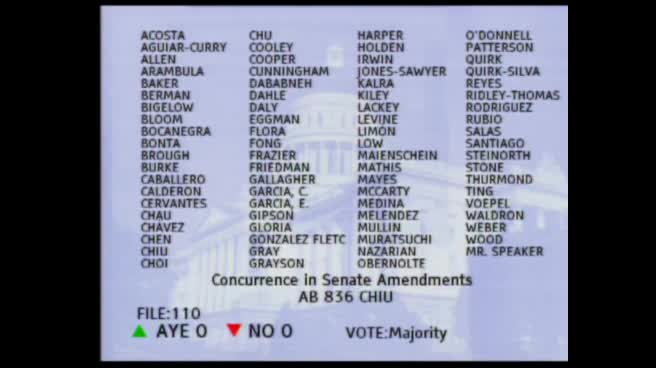 53SEC
Assembly Floor
 3MIN
Senate Floor
 2MIN
Assembly Floor
 9MIN
Assembly Standing Committee on Judiciary
Bill Author

Bill Co-Author(s):