AB 1190: Department of Consumer Affairs: BreEZe system.
- Session Year: 2017-2018
- House: Assembly
- Latest Version Date: 2017-09-13
Existing law authorizes the Department of Consumer Affairs to enter into a contract with a vendor for the licensing and enforcement of the BreEZe system, which is a specified integrated, enterprisewide enforcement case management and licensing system, no sooner than 30 days after written notification to certain committees of the Legislature. Existing law requires the amount of contract funds for the system to be consistent with costs approved by the Department of Technology, formerly known as the office of the State Chief Information Officer, based on information provided by the department in a specified manner.
This bill would require the Department of Consumer Affairs to publish, a minimum of once quarterly, prescribed information relating to BreEZe on its Internet Web site, including the estimated start and completion date of the Department of Technologys Project Approval Lifecycle (PAL) process for programs that were previously scheduled for the 3rd release of BreEZe, the status of programs that have started the process, and the results and recommendations made for each program that has completed the PAL process. The bill would also delete an obsolete provision relating to budget augmentation for BreEZe project costs.
Existing law authorizes the Department of Consumer Affairs to enter into a contract with a vendor for the licensing and enforcement of the BreEZe system, which is a specified integrated, enterprisewide enforcement case management and licensing system, no sooner than 30 days after written notification to certain committees of the Legislature. Existing law requires the amount of contract funds for the system to be consistent with costs approved by the Department of Technology, formerly known as the office of the State Chief Information Officer, based on information provided by the department in a specified manner.
This bill on and after July 1, 2018, would require the department to submit an annual report to the Legislature that includes, among other things, the departments plans for implementing the BreEZe system at specified regulatory entities included in the department'ss 3rd phase of the BreEZe implementation project, including, but not limited to, a timeline for the implementation.This bill would require the Department of Consumer Affairs to publish, a minimum of once quarterly, prescribed information relating to BreEZe on its Internet Web site, including the estimated start and completion date of the Department of Technologys Project Approval Lifecycle (PAL) process for programs that were previously scheduled for the 3rd release of BreEZe, the status of programs that have started the process, and the results and recommendations made for each program that has completed the PAL process.
Existing law authorizes the Department of Consumer Affairs to enter into a contract with a vendor for the licensing and enforcement of the BreEZe system, which is a specified integrated, enterprisewide enforcement case management and licensing system, no sooner than 30 days after written notification to certain committees of the Legislature. Existing law requires the amount of contract funds for the system to be consistent with costs approved by the Department of Technology, formerly known as the office of the State Chief Information Officer, based on information provided by the department in a specified manner.
This bill on and after July 1, 2018, would require the department to submit an annual report to the Legislature that includes, among other things, the departments plans for implementing the BreEZe system at specified regulatory entities included in the department'ss 3rd phase of the BreEZe implementation project, including, but not limited to, a timeline for the implementation.
(a)(1)The department may enter into a contract with a vendor for the BreEZe system, the integrated, enterprisewide enforcement case management and licensing system described in the departments strategic plan, no sooner than 30 days after notification in writing to the chairpersons of the Appropriations Committees of each house of the Legislature and the Chairperson of the Joint Legislative Budget Committee.
(2)The amount of BreEZe system vendor contract funds, authorized pursuant to this section, shall be consistent with the project costs approved by the office of the State Chief Information Officer based on its review and approval of the most recent BreEZe Special Project Report to be submitted by the department prior to contract award at the conclusion of procurement activities.
(3)Paragraph (2) shall apply to all Budget Act items for the department that have an appropriation for the BreEZe system.
(b)(1)If the department enters into a contract with a vendor for the BreEZe system pursuant to subdivision (a), the department shall, by December 31, 2014, submit to the Legislature, the Senate Committee on Business, Professions and Economic Development, the Assembly Committee on Business, Professions and Consumer Protection, and the budget committees of each house, a report analyzing the workload of licensing personnel employed by boards within the department participating in the BreEZe system.
(2)A report to the Legislature pursuant to this subdivision shall be submitted in compliance with Section 9795 of the Government Code.
(3)This subdivision shall become inoperative on December 1, 2018, pursuant to Section 10231.5 of the Government Code.
SEC. 2.Section 210.5 is added to the Business and Professions Code, to read:210.5.(a)In connection with the departments ongoing commitment to provide quarterly and monthly updates to the Legislature on the entities that were previously scheduled for the third release of BreEZe, the department shall publish on its Internet Web site the following:
(1)The estimated start and completion date of the Department of Technologys Project Approval Lifecycle process for the programs that were previously scheduled for the third release of BreEZe.
(2)The status of the programs that have started the project approval process, including the programs current stage in the process.
(3)The results and recommendations made for each program that has completed the Department of Technologys Project Approval Lifecycle process, including the results of the alternatives and cost-benefit analyses made during Stage 2 of the process.
(b)The department shall publish the information specified in subdivision (a) a minimum of once quarterly.
(a)(1)The department may enter into a contract with a vendor for the BreEZe system, the integrated, enterprisewide enforcement case management and licensing system described in the departments strategic plan, no sooner than 30 days after notification in writing to the chairpersons of the Appropriations Committees of each house of the Legislature and the Chairperson of the Joint Legislative Budget Committee.
(2)The amount of BreEZe system vendor contract funds, authorized pursuant to this section, shall be consistent with the project costs approved by the office of the State Chief Information Officer based on its review and approval of the most recent BreEZe Special Project Report to be submitted by the department prior to contract award at the conclusion of procurement activities.
(3)Paragraph (2) shall apply to all Budget Act items for the department that have an appropriation for the BreEZe system.
(b)(1)If the department enters into a contract with a vendor for the BreEZe system pursuant to subdivision (a), the department shall, by December 31, 2014, submit to the Legislature, the Senate Committee on Business, Professions and Economic Development, the Assembly Committee on Business, Professions and Consumer Protection, and the budget committees of each house, a report analyzing the workload of licensing personnel employed by boards within the department participating in the BreEZe system.
(2)A report to the Legislature pursuant to this subdivision shall be submitted in compliance with Section 9795 of the Government Code.
(3)This subdivision shall become inoperative on December 1, 2018, pursuant to Section 10231.5 of the Government Code.
(c)(1)Notwithstanding any other provision of law, upon the request of the Department of Consumer Affairs, the Department of Finance may augment the budgets of the boards, bureaus, commissions, committees, programs, and divisions that comprise the Department of Consumer Affairs, as defined in Section 101, for expenditure of non-General Fund moneys to pay BreEZe project costs. The augmentation may be made no sooner than 30 days after notification in writing to the chairpersons of the committees in each house of the Legislature that consider appropriations and the Chairperson of the Joint Legislative Budget Committee, or no sooner than whatever lesser time the chairperson of the joint committee may in each instance determine. The amount of funds augmented pursuant to the authority of this subdivision shall be consistent with project cost increases approved by the Secretary of California Technology based on the secretarys review and approval of the most recent BreEZe Special Project Report to be submitted at the conclusion of procurement activities. This subdivision shall apply to all Budget Act items for the boards, bureaus, commissions, committees, programs, and divisions that comprise the Department of Consumer Affairs, as defined in Section 101, that have an appropriation for the BreEZe system in the Budget Act of 2011.(2)This subdivision shall become inoperative upon enactment of the Budget Act of 2012.SECTION 1.SEC. 2.Section 210.5 is added to the Business and Professions Code, to read:210.5.(a)In connection with the departments ongoing commitment to provide quarterly and monthly updates to the Legislature on the entities that were previously scheduled for the third release of BreEZe, the department shall publish on its Internet Web site the following:
(1)The estimated start and completion date of the Department of Technologys Project Approval Lifecycle process for the programs that were previously scheduled for the third release of BreEZe.
(2)The status of the programs that have started the project approval process, including the programs current stage in the process.
(3)The results and recommendations made for each program that has completed the Department of Technologys Project Approval Lifecycle process, including the results of the alternatives and cost-benefit analyses made during Stage 2 of the process.
(b)The department shall publish the information specified in subdivision (a) a minimum of once quarterly.
(a)In connection with the departments ongoing commitment to provide quarterly and monthly updates to the Legislature on the entities that were previously scheduled for the third release of BreEZe, the department shall publish on its Internet Web site the following:
(1)The estimated start and completion date of the Department of Technologys Project Approval Lifecycle process for the programs that were previously scheduled for the third release of BreEZe.
(2)The status of the programs that have started the project approval process, including the programs current stage in the process.
(3)The results and recommendations made for each program that has completed the Department of Technologys Project Approval Lifecycle process, including the results of the alternatives and cost-benefit analyses made during Stage 2 of the process.
(b)The department shall publish the information specified in subdivision (a) a minimum of once quarterly.
SECTION 1.Section 210.5 is added to the Business and Professions Code, immediately following Section 210, to read:210.5.(a)On or before July 1 of each year, commencing July 1, 2018, the department shall submit an annual report to the Legislature that includes all of the following:(1)The departments plan for implementing the BreEZe system at the regulatory entities in the departments third phase of the implementation project, including, but not limited to, a timeline for implementation.(2)The total estimated costs of implementation of the BreEZe system at the regulatory entities in the departments third phase of the implementation project and the results of any cost-benefit analysis the department conducted for the third phase of the implementation project.(3)A description of whether and to what extent the BreEZe system will achieve any operational efficiencies resulting from implementation by the boards and regulatory entities within the departments jurisdiction.(b)The report described in subdivision (a) shall be submitted in compliance with Section 9795 of the Government Code.(c)For purposes of this section, the regulatory entities in the departments third phase of the implementation project includes all of the following:(1)Acupuncture Board.(2)Board for Professional Engineers, Land Surveyors, and Geologists.(3)Bureau of Automotive Repair.(4)Bureau of Electronic and Appliance Repair, Home Furnishings, and Thermal Insulation.(5)Bureau for Private Postsecondary Education.(6)California Architects Board.(7)California Board of Accountancy.(8)California State Board of Pharmacy.(9)Cemetery and Funeral Bureau.(10)Contractors State License Board.(11)Court Reporters Board of California.(12)Landscape Architects Technical Committee.(13)Professional Fiduciaries Bureau.(14)Speech-Language Pathology and Audiology and Hearing Aid Dispensers Board.(15)State Athletic Commission.(16)State Board of Chiropractic Examiners.(17)State Board of Guide Dogs for the Blind.(18)Structural Pest Control Board.(19)Telephone Medical Advice Services Bureau.(a)On or before July 1 of each year, commencing July 1, 2018, the department shall submit an annual report to the Legislature that includes all of the following:
(1)The departments plan for implementing the BreEZe system at the regulatory entities in the departments third phase of the implementation project, including, but not limited to, a timeline for implementation.
(2)The total estimated costs of implementation of the BreEZe system at the regulatory entities in the departments third phase of the implementation project and the results of any cost-benefit analysis the department conducted for the third phase of the implementation project.
(3)A description of whether and to what extent the BreEZe system will achieve any operational efficiencies resulting from implementation by the boards and regulatory entities within the departments jurisdiction.
(b)The report described in subdivision (a) shall be submitted in compliance with Section 9795 of the Government Code.
(c)For purposes of this section, the regulatory entities in the departments third phase of the implementation project includes all of the following:
(1)Acupuncture Board.
(2)Board for Professional Engineers, Land Surveyors, and Geologists.
(3)Bureau of Automotive Repair.
(4)Bureau of Electronic and Appliance Repair, Home Furnishings, and Thermal Insulation.
(5)Bureau for Private Postsecondary Education.
(6)California Architects Board.
(7)California Board of Accountancy.
(8)California State Board of Pharmacy.
(9)Cemetery and Funeral Bureau.
(10)Contractors State License Board.
(11)Court Reporters Board of California.
(12)Landscape Architects Technical Committee.
(13)Professional Fiduciaries Bureau.
(14)Speech-Language Pathology and Audiology and Hearing Aid Dispensers Board.
(15)State Athletic Commission.
(16)State Board of Chiropractic Examiners.
(17)State Board of Guide Dogs for the Blind.
(18)Structural Pest Control Board.
(19)Telephone Medical Advice Services Bureau.
|
Date
|
Status
|
|---|---|
| Jan 12, 2018 | Stricken from file. |
| Jan 3, 2018 | Consideration of Governor's veto pending. |
| Oct 7, 2017 | Vetoed by Governor. |
| Sep 19, 2017 | Enrolled and presented to the Governor at 3 p.m. |
| Sep 11, 2017 | Senate amendments concurred in. To Engrossing and Enrolling. |
| Sep 7, 2017 | In Assembly. Concurrence in Senate amendments pending. May be considered on or after September 9 pursuant to Assembly Rule 77. |
| Sep 7, 2017 | Read third time. Passed. Ordered to the Assembly. |
| Aug 22, 2017 | Read second time. Ordered to third reading. |
| Aug 21, 2017 | From committee: Be ordered to second reading pursuant to Senate Rule 28.8. |
| Jul 11, 2017 | From committee: Do pass and re-refer to Com. on APPR. (Ayes 9. Noes 0.) (July 10). Re-referred to Com. on APPR. |
| Jun 21, 2017 | Re-referred to Com. on B., P. & E.D. |
| Jun 13, 2017 | From committee chair, with author's amendments: Amend, and re-refer to committee. Read second time, amended, and re-referred to Com. on RLS. |
| Jun 8, 2017 | Referred to Com. on RLS. |
| May 30, 2017 | In Senate. Read first time. To Com. on RLS. for assignment. |
| May 30, 2017 | Read third time. Passed. Ordered to the Senate. (Ayes 77. Noes 0. Page 1780.) |
| May 26, 2017 | From committee: Do pass. (Ayes 17. Noes 0.) (May 26). |
| May 17, 2017 | In committee: Set, first hearing. Referred to APPR. suspense file. |
| May 3, 2017 | Re-referred to Com. on APPR. |
| May 2, 2017 | Read second time and amended. |
| May 1, 2017 | From committee: Amend, and do pass as amended and re-refer to Com. on APPR. (Ayes 16. Noes 0.) (April 25). |
| Mar 9, 2017 | Referred to Com. on B. & P. |
| Feb 19, 2017 | From printer. May be heard in committee March 21. |
| Feb 17, 2017 | Read first time. To print. |
|
Date
|
Description
|
Location
|
Votes
|
|
|---|---|---|---|---|
| Sep 11, 2017 | AB 1190 OBERNOLTE Concurrence in Senate Amendments | Assembly Floor |
Passed |
|
| Sep 7, 2017 | Assembly 3rd Reading AB1190 Obernolte By Dodd | Senate Floor |
Passed |
|
| Jul 10, 2017 | Do pass, but first be re-referred to the Committee on [Appropriations] | Senate Standing Committee on Business, Professions and Economic Development |
Passed |
|
| May 30, 2017 | AB 1190 OBERNOLTE Assembly Third Reading | Assembly Floor |
Passed |
|
| May 26, 2017 | Do pass. | Assembly Standing Committee on Appropriations |
Passed |
|
| Apr 25, 2017 | Do pass as amended and be re-referred to the Committee on [Appropriations] | Assembly Standing Committee on Business and Professions |
Passed |
This list shows positions taken on this bill by organizations on the date displayed, which is linked to the original source.
Positions by individuals are not included.
|
Organization
|
Position
|
Date
|
|---|---|---|
| California Board of Accountancy | ** Support | Aug 22, 2017 |
GOVERNOR'S VETO
GV Bill Id:AB 1190
Author:(Obernolte)
As Enrolled Ver:September 13, 2017
2/3 vote
ASSEMBLY: | 77-0 | (May 30, 2017) | SENATE: | 40-0 | (September 7, 2017) |
ASSEMBLY: | 78-0 | (September 11, 2017) |
Original Committee Reference: B. & P.
SUMMARY: This bill requires the Department of Consumer Affairs (DCA) to publish updates on the progress of the boards, bureaus and other entities previously scheduled for the third release of the BreEZe information technology (IT) project, on a quarterly basis, on its website.
The Senate amendments delete an obsolete provision relating to BreEZe project costs that became inoperative upon enactment of the Budget Act of 2012.
FISCAL EFFECT: According to the Senate Appropriations Committee, pursuant to Senate Rule 28.8, negligible state costs.
COMMENTS:
Purpose and Background. In 2009, the DCA proposed a new IT system called BreEZe. BreEZe was intended to be the answer to DCA boards' out-of-date, legacy IT systems. The project began in 2011, and was scheduled to be launched in three phases (releases). Release one occurred in 2013, implementing BreEZe for 10 of the scheduled entities. Release two occurred in 2016 for eight other entities. The planned Release three has been cancelled, and affected entities are reassessing their IT needs, which may include participation in BreEZe or a different IT solution. This bill requires the DCA to publish updates on its website, coinciding with its ongoing quarterly reporting related to Release three, including status, results, and recommendations related to the Project Approval Lifecycle process, including alternatives and cost-benefit analyses. For further information on the DCA's plan, please refer to the policy committee analysis.
This bill requires the Department of Consumer Affairs to post information on its homepage about the Project Approval Lifecycle as it relates to the BreEZe project.
Currently, the Department of Technology post updates on their website for all information technology projects, including BreEZe, in the "Project Approval Lifecycle IT Project Proposals Report." In addition, I signed SB 547 which requires the Department of Consumer Affairs to report to the Legislature the progress it is making in transitioning its licensing programs to a new information technology system.
Therefore, this bill is unnecessary and duplicative of those efforts.
Analysis Prepared by: Vincent Chee / B. & P. / (916) 319-3301 FN: 0002437
CONCURRENCE IN SENATE AMENDMENTS
CSA1 Bill Id:AB 1190
Author:(Obernolte)
As Amended Ver:June 13, 2017
Majority vote
ASSEMBLY: | 77-0 | (May 30, 2017) | SENATE: | 40-0 | (September 07, 2017) |
Original Committee Reference: B. & P.
SUMMARY: This bill requires the Department of Consumer Affairs (DCA) to publish updates on the progress of the boards, bureaus and other entities previously scheduled for the third release of the BreEZe information technology (IT) project, on a quarterly basis, on its website.
The Senate amendments delete an obsolete provision relating to BreEZe project costs that became inoperative upon enactment of the Budget Act of 2012.
FISCAL EFFECT: According to the Senate Appropriations Committee, pursuant to Senate Rule 28.8, negligible state costs.
COMMENTS:
Purpose and Background. In 2009, the DCA proposed a new IT system called BreEZe. BreEZe was intended to be the answer to DCA boards' out-of-date, legacy IT systems. The project began in 2011, and was scheduled to be launched in three phases (releases). Release one occurred in 2013, implementing BreEZe for 10 of the scheduled entities. Release two occurred in 2016 for eight other entities. The planned Release three has been cancelled, and affected entities are reassessing their IT needs, which may include participation in BreEZe or a different IT solution. This bill requires the DCA to publish updates on its website, coinciding with its ongoing quarterly reporting related to Release three, including status, results, and recommendations related to the Project Approval Lifecycle process, including alternatives and cost-benefit analyses. For further information on the DCA's plan, please refer to the policy committee analysis.
Analysis Prepared by: Vincent Chee / B. & P. / (916) 319-3301 FN: 0002112
Office of Senate Floor Analyses (916) 651-1520 Fax: (916) 327-4478 | AB |
THIRD READING
Bill No: AB 1190
:
SENATE BUS., PROF. & ECON. DEV. COMMITTEE: 9-0, 7/10/17
AYES: Hill, Fuller, Dodd, Galgiani, Glazer, Hernandez, Newman, Pan, Wilk
SENATE APPROPRIATIONS COMMITTEE: Senate Rule 28.8
ASSEMBLY FLOOR: 77-0, 5/30/17 - See last page for vote
DIGEST:
This bill requires the Department of Consumer Affairs (DCA) to publish a quarterly update on its Web site on the progress of implementing the BreEZe system for programs that were scheduled for the third phase of BreEZe implementation.
Existing law:
- Requires any entity that was previously scheduled for the third release of BreEZe to participate in business process reviews and organizational change management activities in preparation for transition to a new licensing technology platform, either through the relevant unit in the DCA, or through contracted services. (Government Code § 210.6)
- Authorizes, pursuant to the 2017-18 Budget, $1,327,000 for business process reviews and other associated activities directly related to Release 3 entities pursuing an information technology (IT) business modernization effort. Specifies that the funding shall be available no sooner than 30 days after the DCA provides a notification to the Joint Legislative Budget Committee and the relevant policy and fiscal committees of each house of the Legislature that specifies the DCA’s approach to addressing the business needs of each individual Release 3 entity, including a plan and proposed timeline for completing business process documentation and needs specification. Requires the notification to attest that Release 3 entities have committed to participate according to the proposed plan provided by the DCA.
- Requires, pursuant to the 2017-18 Budget, the Director of the DCA to report progress on Release 3 entities’ transition to a new licensing technology platform to the appropriate committees of the Legislature by December 31 of each year. Progress reports shall include updated plans and timelines for completing: (a) business process documentation; (b) cost benefit analyses of IT options; (c) IT system development and implementation; (d) any other relevant steps needed to meet the IT needs of the Release 3 entities; and (e) other information as the Legislature may request.
This bill requires the DCA, in connection with the DCA’s ongoing commitment to provide quarterly and monthly updates to the Legislature on the entities that were previously scheduled for the third release of BreEZe, to publish the following on its Web site a minimum of once quarterly:
- The estimated start and completion date of the Department of Technology’s (CDT) Project Approval Lifecycle (PAL) process for the programs that were previously scheduled for the third release of BreEZe.
- The status of the programs that have started the PAL process, including the programs’ current stage in the process.
- The results and recommendations made for each program that has completed the PAL process, including the results of the alternatives and cost-benefit analyses made during Stage 2 of the PAL process.
Background
BreEZe. The DCA has been working since 2009 on replacing multiple antiquated standalone IT systems with one fully integrated system. BreEZe is intended to provide applicant tracking, licensing, renewals, enforcement, monitoring, cashiering and data management capabilities. In addition, BreEZe is Web-enabled and designed to allow licensees to complete and submit applications, renewals, and the necessary fees through the internet. The goal of the system is for the public to be able to file complaints, access complaint status and check licensee information if/when the program is fully operational.
The total costs of the project are funded by the special funds of the regulatory entities within the DCA, contributions toward which are based on the total number of licensees a particular entity processes, in proportion to the total number of licensees that all regulatory entities process. The project plan called for BreEZe to be implemented in three releases. Special Project Report 3.1 of 2015 outlined the changing scope and cost of the BreEZe project (up from original estimates of $28 million to a new cost of $95.4 million). Release 1 went live in October 2014, Release 2 went live in January 2016 and Release 3 was removed from the project entirely in 2015.
The DCA indicated in 2017 that it will be utilizing the PAL process to determine what IT solution best meets the individual business needs of former Release 3 entities. According to the DCA, its expectation is that in some cases, the process will determine that BreEZe is the best solution and in other cases, a different platform may better meet the business needs. According to the DCA, the resources that each of these programs has already committed to this effort will still provide value regardless of which IT solution is ultimately implemented.
PAL Process. CDT is the central IT organization for the State of California; responsible for the approval and oversight of statewide IT projects, statewide IT professional development, and provides centralized IT services to state and local governments as well as non-governmental entities. The department promulgates statewide IT security policies and procedures, and has responsibility over telecommunication and IT procurements.
Under a previous project approval process, departments prepared and submitted feasibility study reports (FSRs) when proposing IT projects. The FSR identified the problem, evaluated alternatives, and identified a technical solution. Once a department completed an FSR, it would submit it to CDT for approval. Upon CDT’s approval of the project, the FSR and budget-related requests would be submitted to the Legislature for approval and funding. There were several challenges that arose out of this process, including unmet needs of system users, poor planning and unanticipated cost increases and schedule extension.
In response to the issues with the FSR approval process CDT implemented a new IT project approval process – the PAL. The process consists of four stages that each provide a decision point where CDT can approve or reject projects, or require departments to rethink and resubmit their proposals.
The PAL process attempts to address the challenges created with the previous approval process by requiring collaboration between CDT and departments during planning, emphasizing business analysis, and incorporating vendor knowledge. The PAL process will likely take longer upfront as the planning stages are more detailed and departments may leverage the expertise of contractors for specific planning-related activities. This may also lead to an increase in departments seeking budget augmentation for planning efforts.
FISCAL EFFECT: Appropriation: Fiscal Com.: Local:
California Board of Accountancy
OPPOSITION: (Verified 8/22/17)
None received
ASSEMBLY FLOOR: 77-0, 5/30/17
AYES: Acosta, Aguiar-Curry, Travis Allen, Arambula, Baker, Berman, Bigelow, Bloom, Bocanegra, Bonta, Brough, Burke, Caballero, Calderon, Cervantes, Chávez, Chen, Chiu, Chu, Cooley, Cooper, Cunningham, Dababneh, Dahle, Daly, Flora, Fong, Frazier, Friedman, Gallagher, Cristina Garcia, Eduardo Garcia, Gipson, Gloria, Gomez, Gonzalez Fletcher, Gray, Grayson, Harper, Holden, Irwin, Jones-Sawyer, Kalra, Kiley, Lackey, Levine, Limón, Low, Maienschein, Mathis, Mayes, McCarty, Medina, Melendez, Mullin, Muratsuchi, Nazarian, Obernolte, O'Donnell, Patterson, Quirk, Quirk-Silva, Reyes, Ridley-Thomas, Rodriguez, Rubio, Salas, Santiago, Steinorth, Mark Stone, Thurmond, Ting, Voepel, Waldron, Weber, Wood, Rendon
NO VOTE RECORDED: Chau, Choi, Eggman
8/22/17 16:14:22
**** END ****
SENATE COMMITTEE ON
BUSINESS, PROFESSIONS AND ECONOMIC DEVELOPMENT
Senator Jerry Hill, Chair
2017 - 2018 Regular
Bill No: AB 1190 Hearing Date: July 10, 2017
Author: | Obernolte | ||
Version: |
| ||
Urgency: | Fiscal: | ||
Consultant: | |||
Subject: Department of Consumer Affairs: BreEZe system
SUMMARY: Requires the Department of Consumer Affairs (DCA) to publish a quarterly update on its website on the progress of implementing the BreEZe system for programs that were scheduled for the third phase of BreEZe implementation.
Existing law:
- Until December 1, 2018, upon the request of the DCA, authorizes the Department of Finance (DOF) to augment the budgets of the boards, bureaus, commissions, committees, programs, and divisions within the DCA to use special fund monies to pay BreEZe project costs, consistent with project cost increases approved by the Secretary of California Technology based on the secretary’s review and approval of the most recent BreEZe Special Project Report to be submitted at the conclusion of procurement activities. States that this shall become inoperative upon enactment of the Budget Act of 2012. (Business and Professions Code (BPC) § 210)
- Requires any entity that was previously scheduled for the third release of BreEZe shall participate in business process reviews and organizational change management (OCM) activities in preparation for transition to a new licensing technology platform, either through the relevant unit in the DCA, or through contracted services. (Government Code § 210.6)
- The 2017-18 Budget authorizes $1,327,000 for business process reviews and other associated activities directly related to Release 3 entities pursuing an information technology (IT) business modernization effort. Specifies that the funding shall be available no sooner than 30 days after the DCA provides a notification to the Joint Legislative Budget Committee and the relevant policy and fiscal committees of each house of the Legislature that specifies the DCA’s approach to addressing the business needs of each individual Release 3 entity, including a plan and proposed timeline for completing business process documentation and needs specification. Requires the notification to attest that Release 3 entities have committed to participate according to the proposed plan provided by the DCA.
- The 2017-18 Budges also requires the Director of the DCA to report progress on Release 3 entities’ transition to a new licensing technology platform to the appropriate committees of the Legislature by December 31 of each year. Progress reports shall include updated plans and timelines for completing: (a) business process documentation; (b) cost benefit analyses of IT options; (c) IT system development and implementation; (d) any other relevant steps needed to meet the IT needs of the Release 3 entities; and (e) other information as the Legislature may request.
This bill:
- Deletes the language in 1) above from the BPC which became inoperative upon enactment of the Budget Act of 2012.
- Requires the DCA, in connection with the DCA’s ongoing commitment to provide quarterly and monthly updates to the Legislature on the entities that were previously scheduled for the third release of BreEZe, to publish the following on its website a minimum of once quarterly:
- The estimated start and completion date of the Department of Technology’s (CDT) Project Approval Lifecycle (PAL) process for the programs that were previously scheduled for the third release of BreEZe
- The status of the programs that have started the PAL process, including the programs’ current stage in the process.
- The results and recommendations made for each program that has completed the PAL process, including the results of the alternatives and cost-benefit analyses made during Stage 2 of the PAL process.
FISCAL EFFECT: This measure has been keyed fiscal by Legislative Counsel. According to the Assembly Committee on Appropriations analysis dated May 17, 2017, this bill will result in minor and absorbable costs for the DCA to post specified information.
COMMENTS:
- Purpose. The Author is the Sponsor of this bill. According to the Author, “BreEZe implementation has been a hot topic during the Joint Business and Professions Committee Sunset Review process. During the hearing, the DCA committed to performing individual cost-benefit analyses for the programs that have not yet transitioned to the BreEZe system in order to determine if BreEZe is still appropriate. The DCA also committed to providing ongoing status updates to the Legislature. AB 1190 would provide transparency in the implementation process by requiring the DCA to make those status updates available on their public website quarterly. These updates will use information the DCA will already be preparing and will allow for public insight into the status of the costly project.”
- BReEZe. The DCA has been working since 2009 on replacing multiple antiquated standalone IT systems with one fully integrated system. In September 2011, the DCA awarded Accenture LLC with a contract to develop and implement a commercial off-the- shelf customized IT system, which it calls BreEZe.
BreEZe is intended to provide applicant tracking, licensing, renewals, enforcement, monitoring, cashiering and data management capabilities. In addition, BreEZe is web-enabled and designed to allow licensees to complete and submit applications, renewals, and the necessary fees through the internet. The goal of the system is for the public to be able to file complaints, access complaint status and check licensee information if/when the program is fully operational.
When originally authorized, BreEZe was projected to cost approximately $28 million and scheduled to be fully operational by June 2014. The total costs of the project are funded by the special funds of the regulatory entities within the DCA, contributions toward which are based on the total number of licensees a particular entity processes, in proportion to the total number of licensees that all regulatory entities process. The project plan called for BreEZe to be implemented in three releases. Special Project Report 3.1 of 2015 outlined the changing scope and cost of the BreEZe project (up from original estimates of $28 million to a new cost of $95.4 million). Release 1 went live in October 2014, Release 2 went live in January 2016 and
Release 3 was removed from the project entirely in 2015 and included The Acupuncture Board, Board for Professional Engineers, Land Surveyors, and Geologists, Bureau of Automotive Repair, Bureau of Electronic and Appliance Repair, Home Furnishings, and Thermal Insulation, Bureau for Private Postsecondary Education, California Architects Board, California Board of Accountancy, California State Board of Pharmacy, Cemetery and Funeral Bureau, Contractors’ State License Board, Court Reporters Board of California, Landscape Architects Technical Committee, Professional Fiduciaries Bureau, Speech-Language Pathology and Audiology and Hearing Aid Dispensers Board, State Athletic Commission, State Board of Chiropractic Examiners, State Board of Guide Dogs for the Blind, Structural Pest Control Board.
To date, the DCA has not provided the Legislature with a formal plan to expand BreEZe to the entities originally included in Release 3. Instead, the DCA advised that it would first conduct a cost-benefit analysis for Release 3 boards (after Release 2 was completed in 2016) and then make a decision about whether programs previously slated for Release 3 of the project will come onto BreEZe and, if so, how that will be implemented. This issue of a lack of cost-benefit analysis at various junctures in the life of the BreEZe project was raised a number of times in a 2015 report by the California State Auditor. The DCA previously indicated that it will have to hire additional outside staff even to conduct this cost-benefit analysis to begin to determine next steps for IT improvements for these previously scheduled Release 3 entities. In response to questions from the Senate Committee on Business, Professions and Economic Development (Committee) during the Committee’s 2016 oversight review process, the DCA stated that in order to find the most appropriate and cost effective IT solution for the remaining boards and bureaus, it would partner with the CDT and use the PAL process, which includes a cost-benefit analysis, which will help the DCA determine whether BreEZe is a cost-effective solution that meets the business needs of the remaining boards and bureaus.
In April 2016, DCA also advised that it was “assessing what IT solutions, including BreEZe, may be suitable for issuing the Bureau’s licenses” in response to questions about the status of the Bureau of Medical Cannabis Regulation (Bureau). The DCA noted that “at this time it is still too early to say which IT solution may work best as the Department is in the process of identifying IT requirements and also conducting a cost analysis for the Release 3 boards.” The DCA stated that “Once regulations have been developed, the Department will be able to identify the business needs of a potential licensing system.” Despite advising that it was waiting for draft regulations for the various licensing structures the Bureau and partner agencies to get a sense of Bureau IT needs, the DCA entered into a contract to initiate use of the Accela platform for the Bureau. Accela is used in Colorado for entities for cannabis related licensing, various state and local entities in California and a number of cities throughout the U.S.
Despite the lack of a plan moving forward, Release 3 boards have already paid more than $4 million for BreEZe. These boards are projected to pay $11 million through Fiscal Year (FY) 2016–17. For example, the Contractors State License Board (CSLB) is projected to pay a total of $1.1 million from FY 15-16 through
FY 16-17 toward the implementation of BreEZe. The total projected cost of the project for CSLB is estimated to be about $3.3 million. It does not appear as though the DCA has formed a plan on how to calculate or facilitate refunds in the event the DCA determined BreEZe is unsuitable for any of the boards in Release 3. The DCA has also historically not reported a plan to the Legislature currently have an estimated timeline for BreEZe costs to end. The Director of the DCA reports that Release 3 boards are paying only for “hardware, software, and staffing and consulting costs.” However, it is unclear if the “staffing and consulting costs” are for BreEZe programming services and/or for maintenance costs for the legacy systems the Release 3 boards continue to use while waiting for BreEZe.
During the 2017 oversight review process for the DCA, the Committee noted that the DCA’s effective implementation of a dynamic IT system for all entities remains delayed and it is unclear what steps the DCA is taking to address the IT needs of a large number of its programs, including those with significant IT operational challenges. The Committees asked the DCA to respond to the following questions:
- What is the plan for Release 3 entities, some of which rely on insecure, inefficient options like Excel spreadsheets to track critical licensing data?
- What is the status of the cost-benefit analysis the DCA advised it was conducting in 2016 for Release 3 entities?
- Why are these entities still paying for BreEZe costs when they may never actually be a part of the BreEZe system?
Committee staff issued recommendations to the DCA, including that the DCA finally provide the Committees information about the steps the DCA is taking to upgrade IT systems for Release 3 entities, in many cases moving entities away from Excel spreadsheets used to backfill data collection system needs. The Committee asked how the Legislature can assist DCA in its efforts to implement technological efficiencies and whether DCA is planning to move forward with Accela for Release 3 entities. The DCA was asked to provide a response to the Committees as to what is actually happening today at the DCA to assess the needs of Release 3 entities, what is actually happening today to assess the cost of BreEZe for these entities and benefit of that system, versus another system, how the DCA suggests the Legislature respond to licensees of Release 3 entities who continue to voice concerns that staff is redirected from important regulatory functions to provide input on IT systems that appear to be a mirage – and what the DCA suggests the Legislature should tell licensees who are concerned about the impact of IT costs on funds that could lead to fee increases.
The DCA provided the Committee with responses to these questions and issues on March 29, 2017. The DCA noted that it will be utilizing the PAL process to determine what IT solution best meets the individual business needs of former Release 3 entities. According to the DCA, its expectation is that in some cases, the process will determine that BreEZe is the best solution and in other cases, a different platform may better meet the business needs. According to the DCA, the resources that each of these programs has already committed to this effort will still provide value regardless of which IT solution is ultimately implemented. The DCA noted that it is organizing the remaining 18 programs into groups based on their individual readiness to move through the PAL process and that currently five entities preparing to enter stage 1 of that process. The DCA advised that with regards to potential fee increases for any board or bureau, while BreEZe may be one factor in increasing license fees there are a number of other issues that impact a board or bureau’s fund condition.
- PAL Process. CDT is the central IT organization for the State of California; responsible for the approval and oversight of statewide IT projects, statewide IT professional development, and provides centralized IT services to state and local governments as well as non-governmental entities. The department promulgates statewide IT security policies and procedures, and has responsibility over telecommunication and IT procurements.
Currently, there are around 30 IT projects in various stages of development that are under the oversight of CDT. Under a previous project approval process, departments prepared and submitted feasibility study reports (FSRs) when proposing IT projects. The FSR identified the problem, evaluated alternatives, and identified a technical solution. Once a department completed an FSR, it would submit it to CDT for approval. Once CDT approved the project, the FSR and budget-related requests would be submitted to the Legislature for approval and funding. There were several challenges that arose out of this process, including unmet needs of system users, poor planning and unanticipated cost increases and schedule extension.
In response to the issues with the FSR approval process CDT implemented a new IT project approval process – the Project Approval Lifecycle (PAL). The process consists of four stages that each provide a decision point where CDT can approve or reject projects, or require departments to rethink and resubmit their proposals.
- Stage 1 (business analysis) requires departments to describe the issue to be solved. All departments are required to submit stage one planning documents whether the project will be subject to CDT oversight or not. Projects not subject to CDT with an approved stage one document are not required to submit to subsequent PAL stages.
- Stage 2 (alternatives analysis) requires departments to evaluate various alternatives for accomplishing the project objectives, develop a procurement strategy, and submit a financial analysis.
- Stage 3 (procurement analysis) requires departments to identify the detailed requirements for the project and develop a request for information from vendors.
- Stage four (bid analysis and finalization of project details) requires departments to release the solicitation developed in the previous stage and outline the final project details, including the project scope, schedule, cost, and resource needs.
The PAL process attempts to address the challenges created with the previous approval process by requiring collaboration between CDT and departments during planning, emphasizing business analysis, and incorporating vendor knowledge. All of these changes increase the likelihood that the final project will align with the original objectives and will save time and money. However, there are some tradeoffs associated with this new approval process. The PAL process will likely take longer upfront as the planning stages are more detailed and departments may leverage the expertise of contractors for specific planning-related activities. This may also lead to an increase in departments seeking budget augmentation for planning efforts.
According to information prepared for 2017 Senate Budget Subcommittee #4 hearings, it is uncertain how long it will take departments to move through the entire PAL process. It is possible that the stages of the PAL process will not align with the state’s traditional budget process. For example, a department may receive approval from CDT for Stage 4 midway through a state fiscal year. The sponsoring department may not want to delay the project start for several months until a budget request could be secured for the following fiscal year. If a department anticipates that development activities could occur in the same fiscal year that Stage 4 is anticipated to be complete, the department could request funding to support development activities before the Stage 4 analysis is approved by CDT. In this scenario, however, the Legislature could be asked to approve funding for project design, development, and implementation without the benefit of a complete project plan. This could compromise the Legislature’s effective budgetary oversight of the project.
- Recent Budget Activity Impacting BreEZe. DCA requested $1,327,000 in
FY 2017-18, and $1,207,000 in FY 2018-19 and ongoing to fund ten permanent positions associated with conducting periodic business process reviews of the 40 boards, bureaus, committees, programs, and commission under the DCA, the funding for which would come from the special funds that support the DCA’s 40 entities. According to the DCA in its Budget Change Proposal, the DCA’s Strategic Organization, Leadership, and Individual Development (SOLID) unit handles all training and strategic planning services for the boards, and is dedicated to the continual improvement and organizational development of the department and its Boards. Additionally, SOLID provides meeting facilitation, organizational change management (OCM) consultation services, and teambuilding workshops to assist board members and staff in dealing with unique issues facing a Board.
The DCA indicated that the 18 boards and bureaus that would have been a part of Release 3 for BreEZe will be assessed by the OCM unit within SOLID and that the assessments will help prepare these remaining boards and bureaus for movement to a new IT system.
The 2017-18 Budget (AB 97, Ting, Chapter 14, Statutes of 2017) authorized the $1,327,000 but only for business process reviews and other associated activities directly related to Release 3 entities pursuing an IT business modernization effort and only 30 days after the DCA notifies the Joint Legislative Budget Committee and the relevant policy and fiscal committees of each house of the Legislature of the DCA’s approach to addressing the business needs of each individual Release 3 entity, including a plan and proposed timeline for completing business process documentation and needs specification. The Budget also specified that this notification must attest that Release 3 entities have committed to participate according to the proposed plan the DCA provided.
Additionally, the Budget requires the Director of the DCA to report progress on Release 3 entities’ transition to a new licensing technology platform to the appropriate committees of the Legislature by December 31 of each year. The progress reports will include updated plans and timelines for completing business process documentation, cost benefit analyses of IT options, IT system development and implementation, any other relevant steps needed to meet the IT needs of Release 3 entities and any other information the Legislature may request.
The state government budget trailer bill (AB 111, Committee on Budget, Chapter 19, Statutes of 2017) also included language described above to require a
Release 3 entity to participate in business process reviews and OCM activities in preparation for transition to a new licensing technology platform, either through the relevant unit in the DCA, or through contracted services.
Currently, SB 547 (Hill, 2017) which is pending in the Assembly Committee on Privacy includes the same language related to progress reports provided by the Director of the DCA as contained in the Budget.
In its original form, this bill also would have required the DCA to submit an annual report to the Legislature including, among other things, the DCA’s plans for Release 3 implementation.
- Prior Related Legislation. AB 507 (Olsen) of 2015 would have required the DCA to submit a report to the Legislature and DOF each year, beginning on October 1, 2015, that details its plan for implementing BreEZe for Release 3 entities.
- Will the Public Benefit from Technical Information Posted on DCA’s Website? The DCA entities are semiautonomous regulatory bodies with the authority to set their own priorities and policies and each has its own website. While the DCA maintains a website with general information and links to centralized services the DCA may provide, it is unclear whether the DCA’s website is utilized by licensees and applicants of specific programs within the DCA. For example, the DCA’s consumer information center, which tracks calls from members of the public, has not received any calls from licensees about the progress of entities moving onto new IT systems or the status of BreEZe. It seems highly unlikely that a pharmacist, for example, who was curious as to when the Board of Pharmacy would utilize a new IT system, would ever visit the DCA’s website to obtain that information.
CDT is planning to post updates on the PAL process for projects that are in process. While it does not appear that legislation is necessary for the DCA entities, including the programs formerly slated for Release 3 of BreEZe implementation, to post a link on their websites to the PAL update for a particular project, the Author should consider that as an option to assist licensees and members of the public impacted by remaining IT needs for former Release 3 entities.
SUPPORT AND OPPOSITION:
Support:
None on file as of July 6, 2017.
Opposition:
None on file as of July 6, 2017.
-- END --
ASSEMBLY THIRD READING
ATR Bill Id:AB 1190
Author:(Obernolte)
As Amended Ver:May 2, 2017
Majority vote
Committee | Votes | Ayes | Noes |
Business & Professions | 16-0 | Low, Brough, Arambula, Baker, Bloom, Chiu, Cunningham, Dahle, Eggman, Gipson, Grayson, Holden, Irwin, Mullin, Steinorth, Ting | |
Appropriations | 17-0 | Gonzalez Fletcher, Bigelow, Bloom, Bocanegra, Bonta, Brough, Calderon, McCarty, Quirk, Fong, Friedman, Gallagher, Eduardo Garcia, Gray, Muratsuchi, Obernolte, Reyes |
|
SUMMARY: This bill requires the Department of Consumer Affairs (DCA) to publish updates on the progress of the boards, bureaus and other entities previously scheduled for the third release of the BreEZe information technology (IT) project, on a quarterly basis, on its Web site.
FISCAL EFFECT: According to the Assembly Appropriations Committee, minor and absorbable costs to post specified information.
COMMENTS:
Purpose and Background. In 2009, the DCA proposed a new IT system called BreEZe. BreEZe was intended to be the answer to DCA boards' out-of-date, legacy IT systems. The project began in 2011, and was scheduled to be launched in three phases (releases). Release 1 occurred in 2013, implementing BreEZe for 10 of the scheduled entities. Release 2 occurred in 2016 for 8 other entities. The planned Release 3 has been cancelled, and affected entities are reassessing their IT needs, which may include participation in BreEZe or a different IT solution. This bill requires the DCA to publish updates on its website, coinciding with its ongoing quarterly reporting related to Release 3, including status, results, and recommendations related to the Project Approval Lifecycle process, including alternatives and cost-benefit analyses. For further information on the DCA's plan, please refer to the policy committee analysis.
Analysis Prepared by: Vincent Chee / B. & P. / (916) 319-3301 FN: 0000663
Date of Hearing: May 17, 2017
ASSEMBLY COMMITTEE ON APPROPRIATIONS
Lorena Gonzalez Fletcher, Chair
ABPCA Bill Id:AB 1190
Author:(Obernolte) – As Amended Ver:May 2, 2017
Policy Committee: | Business and Professions | Vote: | 16 - 0 |
Urgency: No State Mandated Local Program: No Reimbursable: No
SUMMARY:
This bill requires the Department of Consumer Affairs (DCA) to publish specified information, on a quarterly basis, on its Internet Web site regarding the third release of the BreEZe information technology (IT) project.
FISCAL EFFECT:
Minor and absorbable costs to post specified information.
COMMENTS:
Purpose and Background. In 2009, the DCA proposed a new IT system called BreEZe. BreEZe was intended to be the answer to DCA boards' out-of-date, legacy IT systems. The project began in 2011, and was scheduled to be launched in three phases (releases). Release 1 occurred in 2013, implementing BreEZe for 10 of the scheduled entities. Release 2 occurred in 2016 for another 8 of the entities. The planned Release 3 has been cancelled, and affected boards are reassessing their IT needs, which may include participation in BreEZe or a different IT solution. This bill would require quarterly reporting related to Release 3, including status updates and results and recommendations related to the Project Approval Lifecycle process, including alternatives and cost-benefit analyses.
Analysis Prepared by: Lisa Murawski / APPR. / (916) 319-2081
Date of Hearing:
ASSEMBLY COMMITTEE ON BUSINESS AND PROFESSIONS
Evan Low, Chair
ABPCA Bill Id:AB 1190
Author:(Obernolte) – As Introduced Ver:February 17, 2017
SUBJECT: Department of Consumer Affairs: BreEZe system: annual report.
SUMMARY: Requires the Department of Consumer Affairs (DCA), on and after July 1, 2018, to submit an annual report to the Legislature that includes the DCA’s plan for implementing phase three of the BreEZe system and related analyses, as specified.
EXISTING LAW:
- Establishes the Department of Consumer Affairs (DCA) within the Business, Consumer Services, and Housing Agency. (Business and Professions Code (BPC) § 100)
- Provides for the licensure and regulation of various professions and vocations by boards, bureaus, and other entities within the DCA. (Business and Professions Code (BPC) §§ 22, 100-144.5)
- Specifies that the DCA is under the control of a civil executive officer who is known as the Director of Consumer Affairs and specifies the duties and authority of the director. (BPC §§ 150-166)
- Authorizes the DCA to levy a charge for estimated administrative expenses, not to exceed the available balance in any appropriation for any one fiscal year, in advance on a pro rata share basis against any of the boards, bureaus, commissions, divisions, and agencies, at the discretion of the director and with the approval of the Department of Finance. (BPC § 201)
- Specifies that, upon proper presentation of claims by the DCA to the State Controller, the State Controller shall draw his or her warrant against any of the funds of any one of the boards to cover its share of the estimated administrative expenses of the DCA, but prohibits the use of a board’s fund to pay the expenses of any other board. (BPC § 202(a))
- Establishes in the State Treasury the Professions and Vocations Fund and establishes the individual special funds for each DCA entities, as specified. (BPC § 205 (a))
- Authorizes the DCA to enter into a contract with a vendor for the BreEZe system, the integrated, enterprisewide enforcement case management and licensing system described in the DCA’s strategic plan, as specified, defines various budget and reporting requirements, and provides that the . (BPC § 210)
THIS BILL:
- Requires the DCA, on or before July 1 of each year, commencing July 1, 2018, to submit an annual report to the Legislature that includes all of the following:
- The DCA’s plan for implementing the BreEZe system at the regulatory entities in the department’s third phase of the implementation project, including, but not limited to, a timeline for implementation.
- The total estimated costs of implementation of the BreEZe system at the regulatory entities in the DCA’s third phase of the implementation project and the results of any cost-benefit analysis the department conducted for the third phase of the implementation project.
- A description of whether and to what extent the BreEZe system will achieve any operational efficiencies resulting from implementation by the boards and regulatory entities within the DCA’s jurisdiction.
- Requires the report to be submitted in compliance with Government Code § 9795, which specifies the procedures for submitting reports to the Legislature.
- Defines, for purposes of the report, “the regulatory entities in the department’s third phase of the implementation project” to include all of the following:
- Acupuncture Board.
- Board for Professional Engineers, Land Surveyors, and Geologists.
- Bureau of Automotive Repair.
- Bureau of Electronic and Appliance Repair, Home Furnishings, and Thermal Insulation.
- Bureau for Private Postsecondary Education.
- California Architects Board.
- California Board of Accountancy.
- California State Board of Pharmacy.
- Cemetery and Funeral Bureau.
- Contractors’ State License Board.
- Court Reporters Board of California.
- Landscape Architects Technical Committee.
- Professional Fiduciaries Bureau.
- Speech-Language Pathology and Audiology and Hearing Aid Dispensers Board.
- State Athletic Commission.
- State Board of Chiropractic Examiners.
- State Board of Guide Dogs for the Blind.
- Structural Pest Control Board.
- Telephone Medical Advice Services Bureau.
FISCAL EFFECT: Unknown. This bill is keyed fiscal by the Legislative Counsel.
COMMENTS:
Purpose. This bill is author sponsored. According to the author, “[s]ince its original implementation, the BreEZe system has been one problem after another, leaving the licensees paying the cost. [This bill] requires DCA to report annually to the legislature on the plan for implementation. It is finally time to implement the State Auditor’s recommendation and require these reports in order to finally fully implement the BreEZe system.”
Background. In California, many professions require a license to legally practice. Many of the professional licenses are administered by licensing boards, bureaus, and other entities within the DCA. The DCA supports and oversees the licensing entities. The mission of the DCA, as stated in its 2016 Annual Report, is “[t]o protect consumers through effective enforcement activities and oversight of California’s licensed professionals.”
DCA Licensing Entities. The individual licensing entities are established to protect the people of California through adequate regulation of businesses and professions that engage in activities that risk harm to the health, safety, and welfare of the public (BPC § 101.6). To that end, applicants seeking a license to practice are required to demonstrate minimum competency to the licensing entities through education, examination, and experience or other training.
Applicants are required to apply, pay fees, submit documentation, and undergo background checks. Active licensees are also usually required to renew their licenses annually or biennially, pay renewal fees, and sometimes complete continuing education or competence. The licensing entities are responsible for the administration and processing of the licenses but often rely on the DCA for central support services.
The licensing and renewal fees fund the entities’ licensing, administrative, and enforcement programs. As special fund agencies, the entities are fully funded by the fee revenues deposited into the respective entity's fund within the Professions and Vocations Fund. Therefore, they receive no funding from the General Fund or other special funds. Further, the use of revenues from an entity’s fund is restricted to the functions or activities of that entity.
As a result, each entity is required by law to pay for its share of any administrative support provided by other agencies in the form of statewide and DCA Pro Rata charges. For example, when central service agencies (such as the State Controller’s Office) provide statewide support services upfront, the entities (and other special fund agencies) owe statewide Pro Rata in the following fiscal year. Agencies like the State Controller's Office are funded by the General Fund; therefore statewide Pro Rata reimburses the General Fund for the services provided in the prior fiscal year, maintaining the entities' special fund status.
The DCA entities also pay Pro Rata for the admin support services specifically provided by the DCA. Since the DCA is almost fully funded by the entities it oversees, the DCA charges an estimated Pro Rata one fiscal year in advance of when it provides the services. Each entity must pay for its share so that no it receives no funds from the other entities. Among other things, the DCA Pro Rata funds the DCA's technology solutions for use by the entities.
BreEZe. In 2009, the DCA proposed a new information technology (IT) system called BreEZe. BreEZe was intended to be the answer to the DCA's out-of-date legacy systems, the Applicant Tracking System (ATS) and the Consumer Affairs System (CAS), and to provide updated applicant tracking licensing, renewal, enforcement monitoring, and cashiering support for 37 of the 40 licensing entities housed within the DCA at the time.
The project began in 2011 and scheduled to be launched in three phases (releases). Release 1 occurred in 2013, implementing BreEZe for 10 of the scheduled entities. Release 2 occurred in 2016 for another 8 of the entities. Release 3 has been cancelled. All 37 entities, including those that were scheduled for release 3, have paid BreEZe implementation costs through DCA Pro Rata. Release 3 boards have paid over $4 million for BreEZe and are projected to pay $11 million through fiscal year 2016–17. It is not clear if the boards scheduled for release 3 will be reimbursed or whether the funds will be used for BreEZe or another technology solution at a later date.
2015 State Auditor Report. During implementation of BreEZe releases 1 and 2, the DCA’s management of the BreEZe project came under public scrutiny from a variety of sources, including nursing students and graduates. The students and graduates were having difficulty getting their applications for licensure and examination processed by the Board of Registered Nursing—one of the licensing boards within the DCA.
In response to the concerns, in 2014 the Joint Legislative Audit Committee requested an audit by the California State Auditor concerning the DCA’s planning, development, and implementation of BreEZe. In February 2015, the State Auditor released the report, entitled California Department of Consumer Affairs' BreEZe System: Inadequate Planning and Oversight Led to Implementation at Far Fewer Regulatory Entities at a Significantly Higher Cost (Report 2014-116).
In the report’s public letter, the State Auditor concluded that BreEZe “has been plagued with performance problems, significant delays, and escalating costs, which based on a January 2015 estimate were $96 million—more than triple the original cost estimate—for implementation of a system at only half of the regulatory entities originally planned for BreEZe.” The State Auditor noted failures on the part of the DCA, the California Department of Technology (CalTech), and the Department of General Services (DGS).
To address concerns about the lack of oversight and transparency at the time, the State Auditor recommended enacting legislation that requires the DCA to submit a report annually, beginning on October 1, 2015, that includes the following:
- The DCA’s plan for implementing BreEZe for release 3 entities, including a timeline for the implementation.
- The estimated costs of implementing BreEZe for the remaining entities and the results of any cost‑benefit analysis the DCA conducted for release 3.
- A description of whether and to what extent BreEZe will achieve operational efficiencies for the entities.
In the DCA’s January 22, 2015 response, it stated, "The Department appreciates your office's review of the BreEZe system and agrees with its recommendations. The Audit findings reflect a number of areas of concern that the Department has been in the process of correcting, and in many cases, has already corrected."
2017 Audit Accountability Report. In January 2017, State Auditor released its annual report under the Omnibus Audit Accountability Act of 2006, entitled Recommendations Not Fully Implemented After One Year (Report 2016-041). Regarding BreEZe, the report noted the following:
17) To the extent that Consumer Affairs chooses to implement BreEZe at the phase 3 regulatory entities, it should first complete a formal cost-benefit analysis to ensure that BreEZe is a cost-effective solution to meet these regulatory entities' business needs. To make certain this analysis is complete, it should include an assessment of the potential changes these regulatory entities may require to be made of the BreEZe system and the associated costs. Consumer Affairs should complete the cost-benefit analysis before investing any more resources into the implementation of BreEZe at the phase 3 regulatory entities, and it should update this analysis periodically as significant assumptions change.
35) To ensure that future training for BreEZe system rollouts is timely and effective, Consumer Affairs should provide training on the BreEZe system as close to the rollout date as possible to ensure that staff retain the information for using the system as it is implemented.
36) To ensure that future training for BreEZe system rollouts is timely and effective, Consumer Affairs should work with the regulatory entities to develop training that is specific to each entity's business processes.
2017 Sunset Review Hearings. Annually, the Assembly Business and Professions Committee and the Senate Business, Professions and Economic Development Committee hold joint sunset review hearings to review the DCA and its licensing entities. During the February 27, 2017 sunset hearing, the committee staff background paper for the DCA raised BreEZe release 3 under Issue #2:
DCA’s effective implementation of a dynamic information technology (IT) for all entities remains delayed and it is unclear what steps the DCA is taking to address the IT needs of a large number of its programs, including those with significant IT operational challenges. What is the plan for Release 3 entities, some of which rely on insecure, inefficient options like Excel spreadsheets to track critical licensing data? What is the status of the cost benefit analysis DCA advised it was conducting in 2016 for Release 3 entities? Why are these entities still paying for BreEZe costs when they may never actually be a part of the BreEZe system?
Staff Recommendation: The DCA needs to finally provide the Committees information about the steps the DCA is taking to upgrade IT systems for Release 3 entities, in many cases moving entities away from Excel spreadsheets used to backfill data collection system needs. How can the Legislature assist DCA in its efforts to implement technological efficiencies? Is DCA planning to move forward with Accela for Release 3 entities? What is actually happening today at DCA to assess the needs of Release 3 entities? What is actually happening today to assess the cost of BreEZe for these entities and benefit of that system, versus another system? How does the DCA suggest the Legislature respond to licensees of Release 3 entities who continue to voice concerns that staff is redirected from important regulatory functions to provide input on IT systems that appear to be a mirage – and what does the DCA suggest the Legislature should tell licensees who are concerned about the impact of IT costs on funds that could lead to fee increases?
During the hearing, the DCA responded in its testimony that, while there is no official implementation plan for release 3, it plans to perform individual cost-benefit analyses for the remaining entities to determine whether BreEZe is or is not appropriate. In its 30-day response to the Committees, the DCA responded in greater detail as follows:
- The plan for release 3 entities:
The Department has learned many lessons from Release one (eight programs) and Release two (ten programs) of the BreEZe system. Going forward, programs that were previously scheduled for the third release of BreEZe will be utilizing the Department of Technology’s Project Approval Lifecycle process to determine what IT solution best meets their individual business needs.
The objective of the Department of Technology’s four-step process is to match an entity’s organizational readiness and business needs with the most appropriate IT solution. In the State Auditor’s report regarding BreEZe a recommendation was made that in order to ensure each of the remaining boards and bureaus receives an IT update that addresses their business needs, a cost benefit analysis should be completed. The Department has identified that the best approach to achieving this mandate is during the second stage of the Department of Technology process for each individual board.
The Department’s expectation is that in some cases, the process will determine that BreEZe is the best solution. In other cases, such as the Bureau of Medical Cannabis Regulation, a different platform may better meet the business needs. However, the resources that each of these programs has already committed to this effort will still provide value regardless of which IT solution is ultimately implemented. This includes staff training, documentation of business processes, and general expertise and knowledge of the process of transitioning into a new system. For example, the Department’s training division, SOLID, which actively worked with programs in earlier releases, will continue to provide support to boards as they transition into new IT systems. Ultimately, the lessons and experiences of the first two releases will benefit the remaining boards and bureaus and their licensees regardless of which IT solution is chosen.
- The status of the plan as of March 29, 2017:
The Department is organizing the remaining 18 programs into groups based on their individual readiness to move through the Department of Technology’s process. Currently there are five entities preparing to enter stage 1 of that process. They are actively mapping their business processes, creating their business documentation, and determining their business needs.
- Ongoing BCPs related to the plan:
The Department currently has two Budget Change Proposals (BCPs) related to IT efforts. The first BCP would allow the Department to hire additional staff to begin transitioning the ongoing maintenance of the BreEZe system away from the vendor, Accenture, and to the Department, reducing costs in the long-term.
The second BCP would allow the Department to respond to the State Auditor’s recommendation to implement effective organizational change management to ensure the success of future IT projects. Specifically, the BCP would allow the Department to hire ten additional staff to assist the remaining boards and bureaus with organizational change management and business process mapping. These positions are critical to ensuring that the remaining boards and bureaus are able to properly identify what requirements must be met by a new IT system. The Department is placing a great deal of emphasis on organizational change management as a direct response to lessons learned during Release one and two of the BreEZe system. During the first release, boards and bureaus did not adequately document how they performed basic functions such as licensing and enforcement. As a result, the system was not designed to meet the needs of each board and bureau, which required extensive system changes to address. During the second release the Department provided additional assistance to boards in documenting business processes. This documentation resulted in a better understanding of the requirements of each board and bureau and led to a better overall design of the system. With 18 boards and bureaus still awaiting an IT system upgrade, the Department requires additional staff to provide organizational change management services to these entities in order to ensure the specific needs of each board and bureau are addressed. The Department appreciates the Legislature’s consideration of these BCPs and looks forward to continued discussions throughout the legislative and budget processes.
- Ongoing status updates:
In addition, the Department is committed to working with the Legislature to address constituent concerns regarding the BreEZe system. Currently, the Department is unaware of staff being redirected to provide input on IT efforts; however, as previously stated, each of the remaining boards and bureaus will take part in the Department of Technology’s process. While the Department will provide assistance during this effort, each of the boards and bureaus will be required to map business processes and complete a cost benefit analysis. The Department will update legislative staff quarterly and often times monthly in collaboration with the Department of Technology as the remaining boards and bureaus move through the process.
- Potential fee increases:
Finally, regarding potential fee increases for any board or bureau, while BreEZe may be one factor in increasing license fees there are a number of other issues that impact a board or bureau’s fund condition. For example, some boards or bureaus have not raised fees for many years while the cost of doing business has continued to increase. The Department will continue to work with all boards and bureaus regularly to assess fund conditions, assist in fee audits, and determine when and why fee increases will be needed.
Prior Related Legislation. AB 507 (Olsen) of 2015 was substantially similar to this bill but would have required the annual report on and after October 1, 2015, and included an urgency clause. NOTE: this bill was held in the Senate Committee on Business, Professions, and Economic Development.
AMENDMENTS:
This bill is based on the State Auditor’s 2015 recommendations. However, given the amount of time that has passed and the DCA’s 30-day sunset response, the information noted by the State Auditor may be outdated. Therefore, the author should amend the bill as follows:
Strike the current contents and insert:
SECTION 1. Section 210.5 is added to the Business and Professions Code to read:
210.5. (a) In connection with the department's ongoing commitment to provide quarterly and monthly updates to the Legislature on the entities that were previously scheduled for the third release of BreEZe, the department shall publish on its Internet Web site the following:
(1) The estimated start and completion date of the Department of Technology's Project Approval Lifecycle process for the programs that were previously scheduled for the third release of BreEZe.
(2) The status of the programs that have started the project approval process, including the programs' current stage in the process.
(3) The results and recommendations made for each program that has completed the Department of Technology's Project Approval Lifecycle process, including the results of the Alternatives and Cost-Benefit analyses made during Stage 2 of the process.
(b) The department shall publish the information specified in subdivision (a) a minimum of once quarterly.
REGISTERED SUPPORT:
None on file.
REGISTERED OPPOSITION:
None on file.
Analysis Prepared by: Vincent Chee / B. & P. / 916-319-3301
Discussed in Hearing
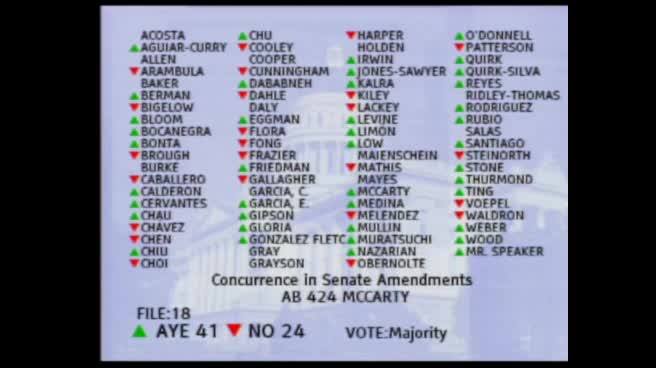 45SEC
Assembly Floor
 4MIN
Senate Floor
 2MIN
Senate Standing Committee on Business, Professions and Economic Development
 1MIN
Assembly Floor
 1H
Assembly Standing Committee on Appropriations
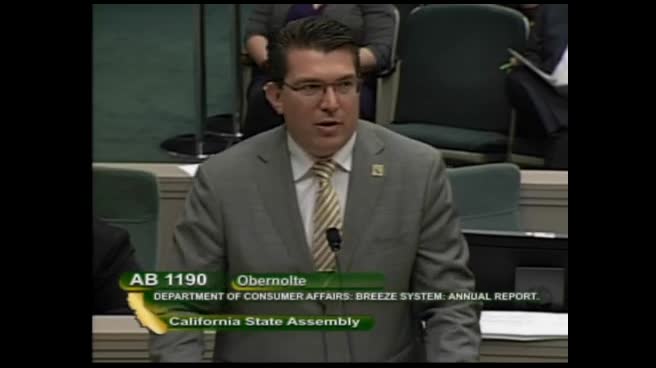 2MIN
Assembly Standing Committee on Business and Professions
Bill Author

Bill Co-Author(s):