AB 1197: Oil spill contingency plans: spill management teams.
- Session Year: 2017-2018
- House: Assembly
- Latest Version Date: 2017-10-08
The Lempert-Keene-Seastrand Oil Spill Prevention and Response Act generally requires the administrator for oil spill response, acting at the direction of the Governor, to implement activities relating to oil spill response, including drills and preparedness, and oil spill containment and cleanup, and to represent the state in any coordinated response efforts with the federal government. The act requires owners or operators of specified facilities and owners or operators of certain vessels to prepare and implement an oil spill contingency plan, containing specified provisions, that has been submitted to, and approved by, the administrator. Existing law provides for the rating of oil spill response organizations (OSROs) by the administrator pursuant to specified provisions and requires an oil spill contingency plan to identify at least one rated OSRO for each rating level established pursuant to those provisions.
This bill would no longer require an oil spill contingency plan to identify at least one rated OSRO for each rating level and would instead require the plan to identify at least one OSRO rated pursuant to those provisions, and would authorize an owner or operator to rely on its own response equipment and personnel, if they have been rated by the administrator, as specified.
This bill would authorize a spill management team (SMT), as defined, to apply to the administrator for a certification of that SMTs response capabilities. The bill would require the administrator to establish criteria for certifying an SMT based on the SMTs capacity to respond to spills and manage spills effectively, review applications for SMT certification, and certify SMTs, as specified. The bill would authorize the administrator to charge a reasonable administrative fee to process an application for, or renewal of, a certification. The bill would require the administrator to adopt regulations to implement these provisions as appropriate. The bill would require an oil spill contingency plan to identify at least one certified SMT, certified by the administrator pursuant to the provisions described above, and would authorize an owner or operator to rely on its own spill management team that has been certified by the administrator, as specified.
The Lempert-Keene-Seastrand Oil Spill Prevention and Response Act generally requires the administrator for oil spill response, acting at the direction of the Governor, to implement activities relating to oil spill response, including drills and preparedness, and oil spill containment and cleanup, and to represent the state in any coordinated response efforts with the federal government. The act requires owners or operators of specified facilities and owners or operators of certain vessels to prepare and implement an oil spill contingency plan, containing specified provisions, that has been submitted to, and approved by, the administrator. Existing law provides for the rating of oil spill response organizations (OSROs) by the administrator pursuant to specified provisions and requires an oil spill contingency plan to identify at least one rated OSRO for each rating level established pursuant to those provisions.
This bill would no longer require an oil spill contingency plan to identify at least one rated OSRO for each rating level and would instead require the plan to identify at least one OSRO rated pursuant to those provisions, and would authorize an owner or operator to rely on its own response equipment and personnel, if they have been rated by the administrator, as specified.
This bill would authorize a spill management team (SMT), as defined, to apply to the administrator for a certification of that SMTs response capabilities. The bill would require the administrator to establish criteria for certifying a SMT based on the SMTs capacity to respond to spills and manage spills effectively, review applications for SMT certification, and certify SMTs, as specified. The bill would authorize the administrator to charge a reasonable administrative fee to process an application for, or renewal of, a certification. The bill would require the administrator to adopt regulations to implement these provisions as appropriate. The bill would require an oil spill contingency plan to identify at least one certified SMT, certified by the administrator pursuant to the provisions described above, and would authorize an owner or operator to rely on its own spill management team that has been certified by the administrator, as specified.
The Lempert-Keene-Seastrand Oil Spill Prevention and Response Act generally requires the administrator for oil spill response, acting at the direction of the Governor, to implement activities relating to oil spill response, including drills and preparedness, and oil spill containment and cleanup, and to represent the state in any coordinated response efforts with the federal government. The act requires owners or operators of specified facilities and owners or operators of certain vessels to prepare and implement an oil spill contingency plan, containing specified provisions, that has been submitted to, and approved by, the administrator. Existing law provides for the rating of oil spill response organizations (OSROs) by the administrator pursuant to specified provisions and requires an oil spill contingency plan to identify at least one rated OSRO for each rating level established pursuant to those provisions.
This bill would no longer require an oil spill contingency plan to identify at least one rated OSRO for each rating level and would instead require the plan to identify at least one OSRO rated pursuant to those provisions, and would authorize an owner or operator to rely on its own response equipment and personnel, if they have been rated by the administrator, as specified.
This bill would authorize a spill management team (SMT), as defined, to apply to the administrator for a classification certification of that SMTs response capabilities. The bill would require the administrator to establish levels criteria for classifying certifying a SMT based on a the SMTs capacity to respond to spills and manage spills effectively, review applications for classifications, SMT certification, and classify the SMT, certify SMTs, as specified. The bill would authorize the administrator to charge a reasonable administrative fee to process an application for, or renewal of, a classification. certification. The bill would require the administrator to adopt regulations to implement these provisions as appropriate. The bill would require an oil spill contingency plan to identify at least one classified SMT for each classification level established certified SMT, certified by the administrator. administrator pursuant to the provisions described above, and would authorize an owner or operator to rely on its own spill management team that has been certified by the administrator, as specified.
The Lempert-Keene-Seastrand Oil Spill Prevention and Response Act generally requires the administrator for oil spill response, acting at the direction of the Governor, to implement activities relating to oil spill response, including drills and preparedness, and oil spill containment and cleanup, and to represent the state in any coordinated response efforts with the federal government. The act requires owners or operators of specified facilities and owners or operators of certain vessels to prepare and implement an oil spill contingency plan, containing specified provisions, that has been submitted to, and approved by, the administrator.
This bill would authorize a spill management team (SMT), as defined, to apply to the administrator for a classification of that SMTs response capabilities. The bill would require the administrator to establish levels for classifying a SMT based on a SMTs capacity to respond to spills and manage spills effectively, review applications for classifications, and classify the SMT, as specified. The bill would authorize the administrator to charge a reasonable administrative fee to process an application for, or renewal of, a classification. The bill would require the administrator to adopt regulations to implement these provisions as appropriate. The bill would require an oil spill contingency plan to identify at least one classified SMT for each classification level established by the administrator.
Unless the context requires otherwise, the following definitions shall govern the construction of this chapter:
(a)Administrator means the administrator for oil spill response appointed by the Governor pursuant to Section 8670.4.
(b)(1)Best achievable protection means the highest level of protection that can be achieved through both the use of the best achievable technology and those manpower levels, training procedures, and operational methods that provide the greatest degree of protection achievable. The administrators determination of which measures provide the best achievable protection shall be guided by the critical need to protect valuable natural resources and state waters, while also considering all of the following:
(A)The protection provided by the measure.
(B)The technological achievability of the measure.
(C)The cost of the measure.
(2)The administrator shall not use a cost-benefit or cost-effectiveness analysis or any particular method of analysis in determining which measures provide the best achievable protection. The administrator shall instead, when determining which measures provide best achievable protection, give reasonable consideration to the protection provided by the measures, the technological achievability of the measures, and the cost of the measures when establishing the requirements to provide the best achievable protection for the natural resources of the state.
(c)(1)Best achievable technology means that technology that provides the greatest degree of protection, taking into consideration both of the following:
(A)Processes that are being developed, or could feasibly be developed anywhere in the world, given overall reasonable expenditures on research and development.
(B)Processes that are currently in use anywhere in the world.
(2)In determining what is the best achievable technology pursuant to this chapter, the administrator shall consider the effectiveness and engineering feasibility of the technology.
(d)California oil spill contingency plan means the California oil spill contingency plan prepared pursuant to Article 3.5 (commencing with Section 8574.1) of Chapter 7.
(e)Dedicated response resources means equipment and personnel committed solely to oil spill response, containment, and cleanup that are not used for any other activity that would adversely affect the ability of that equipment and personnel to provide oil spill response services in the timeframes for which the equipment and personnel are rated.
(f)Environmentally sensitive area means an area defined pursuant to the applicable area contingency plans or geographic response plans, as created and revised by the Coast Guard, the United States Environmental Protection Agency, and the administrator.
(g)(1)Facility means any of the following located in state waters or located where an oil spill may impact state waters:
(A)A building, structure, installation, or equipment used in oil exploration, oil well drilling operations, oil production, oil refining, oil storage, oil gathering, oil processing, oil transfer, oil distribution, or oil transportation.
(B)A marine terminal.
(C)A pipeline that transports oil.
(D)A railroad that transports oil as cargo.
(E)A drill ship, semisubmersible drilling platform, jack-up type drilling rig, or any other floating or temporary drilling platform.
(2)Facility does not include any of the following:
(A)A vessel, except a vessel located and used for any purpose described in subparagraph (E) of paragraph (1).
(B)An owner or operator subject to Chapter 6.67 (commencing with Section 25270) or Chapter 6.75 (commencing with Section 25299.10) of Division 20 of the Health and Safety Code.
(C)Operations on a farm, nursery, logging site, or construction site that are either of the following:
(i)Do not exceed 20,000 gallons in a single storage tank.
(ii)Have a useable tank storage capacity not exceeding 75,000 gallons.
(D)A small craft refueling dock.
(h)Local government means a chartered or general law city, a chartered or general law county, or a city and county.
(i)(1)Marine terminal means any facility used for transferring oil to or from a tank ship or tank barge.
(2)Marine terminal includes, for purposes of this chapter, all piping not integrally connected to a tank facility, as defined in subdivision (n) of Section 25270.2 of the Health and Safety Code.
(j)Marine waters means those waters subject to tidal influence, and includes the waterways used for waterborne commercial vessel traffic to the Port of Sacramento and the Port of Stockton.
(k)Mobile transfer unit means a vehicle, truck, or trailer, including all connecting hoses and piping, used for the transferring of oil at a location where a discharge could impact waters of the state.
(l)Nondedicated response resources means those response resources identified by an Oil Spill Response Organization for oil spill response activities that are not dedicated response resources.
(m)Nonpersistent oil means a petroleum-based oil, such as gasoline or jet fuel, that evaporates relatively quickly and is an oil with hydrocarbon fractions, at least 50 percent of which, by volume, distills at a temperature of 645 degrees Fahrenheit, and at least 95 percent of which, by volume, distills at a temperature of 700 degrees Fahrenheit.
(n)Nontank vessel means a vessel of 300 gross tons or greater that carries oil, but does not carry that oil as cargo.
(o)Oil means any kind of petroleum, liquid hydrocarbons, or petroleum products or any fraction or residues therefrom, including, but not limited to, crude oil, bunker fuel, gasoline, diesel fuel, aviation fuel, oil sludge, oil refuse, oil mixed with waste, and liquid distillates from unprocessed natural gas.
(p)Oil spill cleanup agent means a chemical, or any other substance, used for removing, dispersing, or otherwise cleaning up oil or any residual products of petroleum in, or on, any of the waters of the state.
(q)Oil spill contingency plan or contingency plan means the oil spill contingency plan required pursuant to Article 5 (commencing with Section 8670.28).
(r)(1)Oil spill response organization or OSRO means an individual, organization, association, cooperative, or other entity that provides, or intends to provide, equipment, personnel, supplies, or other services directly related to oil spill containment, cleanup, or removal activities.
(2)OSRO does not include an owner or operator with an oil spill contingency plan approved by the administrator or an entity that only provides spill management services, or who provides services or equipment that are only ancillary to containment, cleanup, or removal activities.
(s)(1)Owner or operator means any of the following:
(A)In the case of a vessel, a person who owns, has an ownership interest in, operates, charters by demise, or leases the vessel.
(B)In the case of a facility, a person who owns, has an ownership interest in, or operates the facility.
(C)Except as provided in subparagraph (D), in the case of a vessel or facility, where title or control was conveyed due to bankruptcy, foreclosure, tax delinquency, abandonment, or similar means to an entity of state or local government, a person who owned, held an ownership interest in, operated, or otherwise controlled activities concerning the vessel or facility immediately beforehand.
(D)An entity of the state or local government that acquired ownership or control of a vessel or facility, when the entity of the state or local government has caused or contributed to a spill or discharge of oil into waters of the state.
(2)Owner or operator does not include a person who, without participating in the management of a vessel or facility, holds indicia of ownership primarily to protect the persons security interest in the vessel or facility.
(3)Operator does not include a person who owns the land underlying a facility or the facility itself if the person is not involved in the operations of the facility.
(t)Person means an individual, trust, firm, joint stock company, or corporation, including, but not limited to, a government corporation, partnership, and association. Person also includes a city, county, city and county, district, and the state or any department or agency thereof, and the federal government, or any department or agency thereof, to the extent permitted by law.
(u)Pipeline means a pipeline used at any time to transport oil.
(v)Railroad means a railroad, railway, rail car, rolling stock, or train.
(w)Rated OSRO means an OSRO that has received a satisfactory rating from the administrator pursuant to Section 8670.30.
(x)Response efforts means rendering care, assistance, or advice in accordance with the National Contingency Plan, the California oil spill contingency plan, or at the direction of the administrator, the United States Environmental Protection Agency, or the United States Coast Guard in response to a spill or a threatened spill into waters of the state.
(y)Responsible party or party responsible means any of the following:
(1)The owner or transporter of oil or a person or entity accepting responsibility for the oil.
(2)The owner, operator, or lessee of, or a person that charters by demise, a vessel or facility, or a person or entity accepting responsibility for the vessel or facility.
(z)Small craft means a vessel, other than a tank ship or tank barge, that is less than 20 meters in length.
(aa)Small craft refueling dock means a waterside operation that dispenses only nonpersistent oil in bulk and small amounts of persistent lubrication oil in containers primarily to small craft and meets both of the following criteria:
(1)Has tank storage capacity not exceeding 20,000 gallons in any single storage tank or tank compartment.
(2)Has total usable tank storage capacity not exceeding 75,000 gallons.
(ab)Small marine fueling facility means either of the following:
(1)A mobile transfer unit.
(2)A fixed facility that is not a marine terminal, that dispenses primarily nonpersistent oil, that may dispense small amounts of persistent oil, primarily to small craft, and that meets all of the following criteria:
(A)Has tank storage capacity greater than 20,000 gallons but not more than 40,000 gallons in any single storage tank or storage tank compartment.
(B)Has total usable tank storage capacity not exceeding 75,000 gallons.
(C)Had an annual throughput volume of over-the-water transfers of oil that did not exceed 3,000,000 gallons during the most recent preceding 12-month period.
(ac)Spill, discharge, or oil spill means a release of any amount of oil into waters of the state that is not authorized by a federal, state, or local government entity.
(ad)Spill management team means personnel and associated equipment that staff the organizational structure for managing some or all aspects of response, containment, and cleanup of a spill, utilizing an incident command or unified command structure.
(ae)Tank barge means a vessel that carries oil in commercial quantities as cargo but is not equipped with a means of self-propulsion.
(af)Tank ship means a self-propelled vessel that is constructed or adapted for the carriage of oil in bulk or in commercial quantities as cargo.
(ag)Tank vessel means a tank ship or tank barge.
(ah)Vessel means a watercraft or ship of any kind, including every structure adapted to be navigated from place to place for the transportation of merchandise or persons.
(ai)Vessel carrying oil as secondary cargo means a vessel that does not carry oil as a primary cargo, but does carry oil as cargo. The administrator may establish minimum oil volume amounts or other criteria by regulations.
(aj)Waters of the state or state waters means any surface water, including saline waters, marine waters, and freshwaters, within the boundaries of the state but does not include groundwater.
SEC. 2.Section 8670.29 of the Government Code is amended to read:8670.29.(a)In accordance with the rules, regulations, and policies established by the administrator pursuant to Section 8670.28, an owner or operator of a facility, small marine fueling facility, or mobile transfer unit, or an owner or operator of a tank vessel, nontank vessel, or vessel carrying oil as secondary cargo, while operating in the waters of the state or where a spill could impact waters of the state, shall have an oil spill contingency plan that has been submitted to, and approved by, the administrator pursuant to Section 8670.31. An oil spill contingency plan shall ensure the undertaking of prompt and adequate response and removal action in case of a spill, shall be consistent with the California oil spill contingency plan, and shall not conflict with the National Oil and Hazardous Substances Pollution Contingency Plan (NCP).
(b)An oil spill contingency plan shall, at a minimum, meet all of the following requirements:
(1)Be a written document, reviewed for feasibility and executability, and signed by the owner or operator, or his or her designee.
(2)Provide for the use of a recognized incident command system to be used during a spill.
(3)Provide procedures for reporting spills to local, state, and federal agencies, and include a list of contacts to call in the event of a drill, exercise, threatened spill, or spill.
(4)Describe the communication plans to be used during a spill, if different from those used by a recognized incident command system.
(5)Describe the strategies for the protection of environmentally sensitive areas.
(6)(A)Identify at least one rated OSRO, rated pursuant to Section 8670.30. Each identified rated OSRO shall be directly responsible by contract, agreement, or other approved means to provide oil spill response activities pursuant to the oil spill contingency plan. A rated OSRO may provide spill response activities individually, or in combination with another rated OSRO, for a particular owner or operator.
(B)For purposes of this paragraph, other approved means includes the owner or operator relying on its own response equipment and personnel if the response equipment and personnel have been rated by the administrator consistent with the requirements of Section 8670.30.
(7)Identify a qualified individual.
(8)(A)Identify at least one certified spill management team, certified pursuant to Section 8670.32, that is capable of managing a spill of the reasonable worst case spill volume identified in the plan. An owner or operator may demonstrate incident management capabilities with one or more spill management teams. Each identified certified spill management team shall be directly responsible by contract, agreement, or other approved means to provide spill response activities pursuant to the oil spill contingency plan.
(B)For purposes of this paragraph, other approved means includes the owner or operator relying on its own spill management team if that spill management team has been certified by the administrator consistent with the requirements of Section 8670.32.
(9)Provide the name, address, and telephone and facsimile numbers for an agent for service of process, located within the state and designated to receive legal documents on behalf of the owner or operator.
(10)Provide for training, drills, and exercises on elements of the plan at least annually, with all elements of the plan subject to a drill or exercise at least once every three years.
(c)An oil spill contingency plan for a vessel shall also include, but is not limited to, all of the following requirements:
(1)The plan shall be submitted to the administrator at least seven days prior to the vessel entering waters of the state.
(2)The plan shall provide evidence of compliance with the International Safety Management Code, established by the International Maritime Organization, as applicable.
(3)If the oil spill contingency plan is for a tank vessel, the plan shall include both of the following:
(A)The plan shall specify oil and petroleum cargo capacity.
(B)The plan shall specify the types of oil and petroleum cargo carried.
(4)If the oil spill contingency plan is for a nontank vessel, the plan shall include both of the following:
(A)The plan shall specify the type and total amount of fuel carried.
(B)The plan shall specify the capacity of the largest fuel tank.
(d)An oil spill contingency plan for a facility shall also include, but is not limited to, all of the following provisions, as appropriate:
(1)Provisions for site security and control.
(2)Provisions for emergency medical treatment and first aid.
(3)Provisions for safety training, as required by state and federal safety laws for all personnel likely to be engaged in oil spill response.
(4)Provisions detailing site layout and locations of environmentally sensitive areas requiring special protection.
(5)Provisions for vessels that are in the operational control of the facility for loading and unloading.
(e)Unless preempted by federal law or regulations, an oil spill contingency plan for a railroad also shall include, but is not limited to, all of the following:
(1)A list of the types of train cars that may make up the consist.
(2)A list of the types of oil and petroleum products that may be transported.
(3)A map of track routes and facilities.
(4)A list, description, and map of any prestaged spill response equipment and personnel for deployment of the equipment.
(f)The oil spill contingency plan shall be available to response personnel and to relevant state and federal agencies for inspection and review.
(g)The oil spill contingency plan shall be reviewed periodically and updated as necessary. All updates shall be submitted to the administrator pursuant to this article.
(h)In addition to the regulations adopted pursuant to Section 8670.28, the administrator shall adopt regulations and guidelines to implement this section. The regulations and guidelines shall provide for the best achievable protection of waters and natural resources of the state. The administrator may establish additional oil spill contingency plan requirements, including, but not limited to, requirements based on the different geographic regions of the state. All regulations and guidelines shall be developed in consultation with the Oil Spill Technical Advisory Committee.
(i)Notwithstanding subdivision (a) and paragraph (6) of subdivision (b), a vessel or facility operating where a spill could impact state waters that are not tidally influenced shall identify a rated OSRO in the contingency plan no later than January 1, 2016.
SEC. 3.Section 8670.32 is added to the Government Code, to read:8670.32.(a)A spill management team (SMT) may apply to the administrator for a certification of that SMTs response capabilities. The administrator shall establish criteria for certifying SMTs based on an SMTs capacity to respond to spills and manage spills effectively pursuant to this section.
(b)Upon receiving a completed application for certification, the administrator shall review the application and certify the SMT based on the SMTs satisfactory compliance with criteria established by the administrator.
(c)The administrator shall not issue a certification until the applicant SMTs performance has been observed during an actual spill or exercise in California. The administrator may call an exercise to test the resources and response capabilities of the SMT, prior to approval of the application.
(d)A certification issued pursuant to this section shall be valid for three years unless suspended or revoked. The administrator shall review the certification of each certified SMT at least once every three years. The administrator shall not renew a certification unless the SMT meets criteria established by the administrator.
(e)(1)After being certified the administrator shall periodically require a certified SMT to demonstrate that the SMT can meet the applicable provisions of an oil spill contingency plan in which the SMT is listed. These demonstrations may be achieved through inspections, announced and unannounced exercises, or by any other means. SMT exercises, to the extent practical, should be combined with other relevant exercises.
(2)The administrator may modify, suspend, or revoke an SMTs certification if the SMT does not satisfactorily complete an exercise or does not have a satisfactory performance at a spill.
(3)The administrator may determine that satisfactory performance at a spill during the three-year certification period may be substituted in lieu of an exercise.
(f)Each certified SMT shall provide reasonable notice to the administrator of each exercise in which the SMT intends to participate, and the administrator may attend the exercise.
(g)The costs incurred by an SMT to comply with this section and the regulations adopted pursuant to this section, including exercises called by the administrator, shall be the responsibility of the SMT. All local, state, and federal agency costs incurred in conjunction with participation in an exercise shall be borne by each respective agency.
(h)(1)A certification issued pursuant to this section pertains only to the SMT that applied for and receives that certification, and the certification is not transferable, assignable, or assumable. A certification does not constitute a possessory interest in real or personal property.
(2)If there is a change in ownership or control of the SMT, the certification of that SMT is null and void and the SMT shall file a new application for a certification pursuant to this section.
(3)For purposes of this subdivision, a change in ownership or control includes, but is not limited to, a change in corporate status, or a transfer of ownership that changes the majority control of voting within the entity.
(i)The administrator may charge a reasonable fee to process an application for, or renewal of, a certification.
(j)The administrator shall adopt regulations to implement this section as appropriate. At a minimum, the regulations shall address all of the following:
(1)Criteria for certification of SMTs, including, but not limited to, all of the following:
(A)The geographic regions of the state where the SMT intends to provide spill management services.
(B)The number of people and equipment that the SMT would provide to support managing the response to a spill.
(C)Timeframes for having personnel on scene.
(2)Criteria for successful completion of SMT objectives at an exercise.
(3)Training.
(4)The process for applying for a certification, and for suspension, revocation, appeal, or other modification of a certification.
Unless the context requires otherwise, the following definitions shall govern the construction of this chapter:
(a)Administrator means the administrator for oil spill response appointed by the Governor pursuant to Section 8670.4.
(b)(1)Best achievable protection means the highest level of protection that can be achieved through both the use of the best achievable technology and those manpower levels, training procedures, and operational methods that provide the greatest degree of protection achievable. The administrators determination of which measures provide the best achievable protection shall be guided by the critical need to protect valuable natural resources and state waters, while also considering all of the following:
(A)The protection provided by the measure.
(B)The technological achievability of the measure.
(C)The cost of the measure.
(2)The administrator shall not use a cost-benefit or cost-effectiveness analysis or any particular method of analysis in determining which measures provide the best achievable protection. The administrator shall instead, when determining which measures provide best achievable protection, give reasonable consideration to the protection provided by the measures, the technological achievability of the measures, and the cost of the measures when establishing the requirements to provide the best achievable protection for the natural resources of the state.
(c)(1)Best achievable technology means that technology that provides the greatest degree of protection, taking into consideration both of the following:
(A)Processes that are being developed, or could feasibly be developed anywhere in the world, given overall reasonable expenditures on research and development.
(B)Processes that are currently in use anywhere in the world.
(2)In determining what is the best achievable technology pursuant to this chapter, the administrator shall consider the effectiveness and engineering feasibility of the technology.
(d)California oil spill contingency plan means the California oil spill contingency plan prepared pursuant to Article 3.5 (commencing with Section 8574.1) of Chapter 7.
(e)Dedicated response resources means equipment and personnel committed solely to oil spill response, containment, and cleanup that are not used for any other activity that would adversely affect the ability of that equipment and personnel to provide oil spill response services in the timeframes for which the equipment and personnel are rated.
(f)Environmentally sensitive area means an area defined pursuant to the applicable area contingency plans or geographic response plans, as created and revised by the Coast Guard, the United States Environmental Protection Agency, and the administrator.
(g)(1)Facility means any of the following located in state waters or located where an oil spill may impact state waters:
(A)A building, structure, installation, or equipment used in oil exploration, oil well drilling operations, oil production, oil refining, oil storage, oil gathering, oil processing, oil transfer, oil distribution, or oil transportation.
(B)A marine terminal.
(C)A pipeline that transports oil.
(D)A railroad that transports oil as cargo.
(E)A drill ship, semisubmersible drilling platform, jack-up type drilling rig, or any other floating or temporary drilling platform.
(2)Facility does not include any of the following:
(A)A vessel, except a vessel located and used for any purpose described in subparagraph (E) of paragraph (1).
(B)An owner or operator subject to Chapter 6.67 (commencing with Section 25270) or Chapter 6.75 (commencing with Section 25299.10) of Division 20 of the Health and Safety Code.
(C)Operations on a farm, nursery, logging site, or construction site that are either of the following:
(i)Do not exceed 20,000 gallons in a single storage tank.
(ii)Have a useable tank storage capacity not exceeding 75,000 gallons.
(D)A small craft refueling dock.
(h)Local government means a chartered or general law city, a chartered or general law county, or a city and county.
(i)(1)Marine terminal means any facility used for transferring oil to or from a tank ship or tank barge.
(2)Marine terminal includes, for purposes of this chapter, all piping not integrally connected to a tank facility, as defined in subdivision (n) of Section 25270.2 of the Health and Safety Code.
(j)Marine waters means those waters subject to tidal influence, and includes the waterways used for waterborne commercial vessel traffic to the Port of Sacramento and the Port of Stockton.
(k)Mobile transfer unit means a vehicle, truck, or trailer, including all connecting hoses and piping, used for the transferring of oil at a location where a discharge could impact waters of the state.
(l)Nondedicated response resources means those response resources identified by an Oil Spill Response Organization for oil spill response activities that are not dedicated response resources.
(m)Nonpersistent oil means a petroleum-based oil, such as gasoline or jet fuel, that evaporates relatively quickly and is an oil with hydrocarbon fractions, at least 50 percent of which, by volume, distills at a temperature of 645 degrees Fahrenheit, and at least 95 percent of which, by volume, distills at a temperature of 700 degrees Fahrenheit.
(n)Nontank vessel means a vessel of 300 gross tons or greater that carries oil, but does not carry that oil as cargo.
(o)Oil means any kind of petroleum, liquid hydrocarbons, or petroleum products or any fraction or residues therefrom, including, but not limited to, crude oil, bunker fuel, gasoline, diesel fuel, aviation fuel, oil sludge, oil refuse, oil mixed with waste, and liquid distillates from unprocessed natural gas.
(p)Oil spill cleanup agent means a chemical, or any other substance, used for removing, dispersing, or otherwise cleaning up oil or any residual products of petroleum in, or on, any of the waters of the state.
(q)Oil spill contingency plan or contingency plan means the oil spill contingency plan required pursuant to Article 5 (commencing with Section 8670.28).
(r)(1)Oil spill response organization or OSRO means an individual, organization, association, cooperative, or other entity that provides, or intends to provide, equipment, personnel, supplies, or other services directly related to oil spill containment, cleanup, or removal activities.
(2)OSRO does not include an owner or operator with an oil spill contingency plan approved by the administrator or an entity that only provides spill management services, or who provides services or equipment that are only ancillary to containment, cleanup, or removal activities.
(s)(1)Owner or operator means any of the following:
(A)In the case of a vessel, a person who owns, has an ownership interest in, operates, charters by demise, or leases the vessel.
(B)In the case of a facility, a person who owns, has an ownership interest in, or operates the facility.
(C)Except as provided in subparagraph (D), in the case of a vessel or facility, where title or control was conveyed due to bankruptcy, foreclosure, tax delinquency, abandonment, or similar means to an entity of state or local government, a person who owned, held an ownership interest in, operated, or otherwise controlled activities concerning the vessel or facility immediately beforehand.
(D)An entity of the state or local government that acquired ownership or control of a vessel or facility, when the entity of the state or local government has caused or contributed to a spill or discharge of oil into waters of the state.
(2)Owner or operator does not include a person who, without participating in the management of a vessel or facility, holds indicia of ownership primarily to protect the persons security interest in the vessel or facility.
(3)Operator does not include a person who owns the land underlying a facility or the facility itself if the person is not involved in the operations of the facility.
(t)Person means an individual, trust, firm, joint stock company, or corporation, including, but not limited to, a government corporation, partnership, and association. Person also includes a city, county, city and county, district, and the state or any department or agency thereof, and the federal government, or any department or agency thereof, to the extent permitted by law.
(u)Pipeline means a pipeline used at any time to transport oil.
(v)Railroad means a railroad, railway, rail car, rolling stock, or train.
(w)Rated OSRO means an OSRO that has received a satisfactory rating from the administrator pursuant to Section 8670.30.
(x)Response efforts means rendering care, assistance, or advice in accordance with the National Contingency Plan, the California oil spill contingency plan, or at the direction of the administrator, the United States Environmental Protection Agency, or the United States Coast Guard in response to a spill or a threatened spill into waters of the state.
(y)Responsible party or party responsible means any of the following:
(1)The owner or transporter of oil or a person or entity accepting responsibility for the oil.
(2)The owner, operator, or lessee of, or a person that charters by demise, a vessel or facility, or a person or entity accepting responsibility for the vessel or facility.
(z)Small craft means a vessel, other than a tank ship or tank barge, that is less than 20 meters in length.
(aa)Small craft refueling dock means a waterside operation that dispenses only nonpersistent oil in bulk and small amounts of persistent lubrication oil in containers primarily to small craft and meets both of the following criteria:
(1)Has tank storage capacity not exceeding 20,000 gallons in any single storage tank or tank compartment.
(2)Has total usable tank storage capacity not exceeding 75,000 gallons.
(ab)Small marine fueling facility means either of the following:
(1)A mobile transfer unit.
(2)A fixed facility that is not a marine terminal, that dispenses primarily nonpersistent oil, that may dispense small amounts of persistent oil, primarily to small craft, and that meets all of the following criteria:
(A)Has tank storage capacity greater than 20,000 gallons but not more than 40,000 gallons in any single storage tank or storage tank compartment.
(B)Has total usable tank storage capacity not exceeding 75,000 gallons.
(C)Had an annual throughput volume of over-the-water transfers of oil that did not exceed 3,000,000 gallons during the most recent preceding 12-month period.
(ac)Spill, discharge, or oil spill means a release of any amount of oil into waters of the state that is not authorized by a federal, state, or local government entity.
(ad)Spill management team means personnel and associated equipment that staff the organizational structure for managing some or all aspects of response, containment, and cleanup of a spill, utilizing an incident command or unified command structure.
(ae)Tank barge means a vessel that carries oil in commercial quantities as cargo but is not equipped with a means of self-propulsion.
(af)Tank ship means a self-propelled vessel that is constructed or adapted for the carriage of oil in bulk or in commercial quantities as cargo.
(ag)Tank vessel means a tank ship or tank barge.
(ah)Vessel means a watercraft or ship of any kind, including every structure adapted to be navigated from place to place for the transportation of merchandise or persons.
(ai)Vessel carrying oil as secondary cargo means a vessel that does not carry oil as a primary cargo, but does carry oil as cargo. The administrator may establish minimum oil volume amounts or other criteria by regulations.
(aj)Waters of the state or state waters means any surface water, including saline waters, marine waters, and freshwaters, within the boundaries of the state but does not include groundwater.
SEC. 2.Section 8670.29 of the Government Code is amended to read:8670.29.(a)In accordance with the rules, regulations, and policies established by the administrator pursuant to Section 8670.28, an owner or operator of a facility, small marine fueling facility, or mobile transfer unit, or an owner or operator of a tank vessel, nontank vessel, or vessel carrying oil as secondary cargo, while operating in the waters of the state or where a spill could impact waters of the state, shall have an oil spill contingency plan that has been submitted to, and approved by, the administrator pursuant to Section 8670.31. An oil spill contingency plan shall ensure the undertaking of prompt and adequate response and removal action in case of a spill, shall be consistent with the California oil spill contingency plan, and shall not conflict with the National Oil and Hazardous Substances Pollution Contingency Plan (NCP).
(b)An oil spill contingency plan shall, at a minimum, meet all of the following requirements:
(1)Be a written document, reviewed for feasibility and executability, and signed by the owner or operator, or his or her designee.
(2)Provide for the use of a recognized incident command system to be used during a spill.
(3)Provide procedures for reporting spills to local, state, and federal agencies, and include a list of contacts to call in the event of a drill, exercise, threatened spill, or spill.
(4)Describe the communication plans to be used during a spill, if different from those used by a recognized incident command system.
(5)Describe the strategies for the protection of environmentally sensitive areas.
(6)(A)Identify at least one rated OSRO, rated pursuant to Section 8670.30. Each identified rated OSRO shall be directly responsible by contract, agreement, or other approved means to provide oil spill response activities pursuant to the oil spill contingency plan. A rated OSRO may provide spill response activities individually, or in combination with another rated OSRO, for a particular owner or operator.
(B)For purposes of this paragraph, other approved means includes the owner or operator relying on its own response equipment and personnel if the response equipment and personnel have been rated by the administrator consistent with the requirements of Section 8670.30.
(7)Identify a qualified individual.
(8)(A)Identify at least one certified spill management team, certified pursuant to Section 8670.32, that is capable of managing a spill of the reasonable worst-case-spill worst case spill volume identified in the plan. An owner or operator may demonstrate incident management capabilities with one or more spill management teams. Each identified certified spill management team shall be directly responsible by contract, agreement, or other approved means to provide spill response activities pursuant to the oil spill contingency plan.
(B)For purposes of this paragraph, other approved means includes the owner or operator relying on its own spill management team if that spill management team has been certified by the administrator consistent with the requirements of Section 8670.32.
(9)Provide the name, address, and telephone and facsimile numbers for an agent for service of process, located within the state and designated to receive legal documents on behalf of the owner or operator.
(10)Provide for training and drills training, drills, and exercises on elements of the plan at least annually, with all elements of the plan subject to a drill or exercise at least once every three years.
(c)An oil spill contingency plan for a vessel shall also include, but is not limited to, all of the following requirements:
(1)The plan shall be submitted to the administrator at least seven days prior to the vessel entering waters of the state.
(2)The plan shall provide evidence of compliance with the International Safety Management Code, established by the International Maritime Organization, as applicable.
(3)If the oil spill contingency plan is for a tank vessel, the plan shall include both of the following:
(A)The plan shall specify oil and petroleum cargo capacity.
(B)The plan shall specify the types of oil and petroleum cargo carried.
(4)If the oil spill contingency plan is for a nontank vessel, the plan shall include both of the following:
(A)The plan shall specify the type and total amount of fuel carried.
(B)The plan shall specify the capacity of the largest fuel tank.
(d)An oil spill contingency plan for a facility shall also include, but is not limited to, all of the following provisions, as appropriate:
(1)Provisions for site security and control.
(2)Provisions for emergency medical treatment and first aid.
(3)Provisions for safety training, as required by state and federal safety laws for all personnel likely to be engaged in oil spill response.
(4)Provisions detailing site layout and locations of environmentally sensitive areas requiring special protection.
(5)Provisions for vessels that are in the operational control of the facility for loading and unloading.
(e)Unless preempted by federal law or regulations, an oil spill contingency plan for a railroad also shall include, but is not limited to, all of the following:
(1)A list of the types of train cars that may make up the consist.
(2)A list of the types of oil and petroleum products that may be transported.
(3)A map of track routes and facilities.
(4)A list, description, and map of any prestaged spill response equipment and personnel for deployment of the equipment.
(f)The oil spill contingency plan shall be available to response personnel and to relevant state and federal agencies for inspection and review.
(g)The oil spill contingency plan shall be reviewed periodically and updated as necessary. All updates shall be submitted to the administrator pursuant to this article.
(h)In addition to the regulations adopted pursuant to Section 8670.28, the administrator shall adopt regulations and guidelines to implement this section. The regulations and guidelines shall provide for the best achievable protection of waters and natural resources of the state. The administrator may establish additional oil spill contingency plan requirements, including, but not limited to, requirements based on the different geographic regions of the state. All regulations and guidelines shall be developed in consultation with the Oil Spill Technical Advisory Committee.
(i)Notwithstanding subdivision (a) and paragraph (6) of subdivision (b), a vessel or facility operating where a spill could impact state waters that are not tidally influenced shall identify a rated OSRO in the contingency plan no later than January 1, 2016.
SEC. 3.Section 8670.32 is added to the Government Code, to read:8670.32.(a)A spill management team (SMT) may apply to the administrator for a certification of that SMTs response capabilities. The administrator shall establish criteria for certifying SMTs based on a an SMTs capacity to respond to spills and manage spills effectively pursuant to this section.
(b)Upon receiving a completed application for certification, the administrator shall review the application and certify the SMT based on the SMTs satisfactory compliance with criteria established by the administrator.
(c)The administrator shall not issue a certification until the applicant SMTs performance has been observed during an actual spill or drill exercise in California. The administrator may call a drill an exercise to test the resources and response capabilities of the SMT, prior to approval of the application.
(d)A certification issued pursuant to this section shall be valid for three years unless suspended or revoked. The administrator shall review the certification of each certified SMT at least once every three years. The administrator shall not renew a certification unless the SMT meets criteria established by the administrator.
(e)(1)After being certified the administrator shall periodically require a certified SMT to demonstrate that the SMT can meet the applicable provisions of an oil spill contingency plan in which the SMT is listed. These demonstrations may be achieved through inspections, announced and unannounced drills, exercises, or by any other means. SMT drills, exercises, to the extent practical, should be combined with other relevant drills. exercises.
(2)The administrator may modify, suspend, or revoke an SMTs certification if the SMT does not satisfactorily complete a drill an exercise or does not have a satisfactory performance at a spill.
(3)The administrator may determine that satisfactory performance at a spill during the three-year certification period may be substituted in lieu of a drill. an exercise.
(f)Each certified SMT shall provide reasonable notice to the administrator of each drill exercise in which the SMT intends to participate, and the administrator may attend the drill. exercise.
(g)The costs incurred by an SMT to comply with this section and the regulations adopted pursuant to this section, including drills exercises called by the administrator, shall be the responsibility of the SMT. All local, state, and federal agency costs incurred in conjunction with participation in a drill an exercise shall be borne by each respective agency.
(h)(1)A certification issued pursuant to this section pertains only to the SMT that applied for and receives that certification, and the certification is not transferable, assignable, or assumable. A certification does not constitute a possessory interest in real or personal property.
(2)If there is a change in ownership or control of the SMT, the certification of that SMT is null and void and the SMT shall file a new application for a certification pursuant to this section.
(3)For purposes of this subdivision, a change in ownership or control includes, but is not limited to, a change in corporate status, or a transfer of ownership that changes the majority control of voting within the entity.
(i)The administrator may charge a reasonable fee to process an application for, or renewal of, a certification.
(j)The administrator shall adopt regulations to implement this section as appropriate. At a minimum, the regulations shall address all of the following:
(1)Criteria for certification of SMTs, including, but not limited to, all of the following:
(A)The geographic regions of the state where the SMT intends to provide spill management services.
(B)The number of people and equipment that the SMT would provide to support managing the response to a spill.
(C)Timeframes for having personnel on scene.
(2)Criteria for successful completion of SMT objectives at a drill. an exercise.
(3)Training.
(4)The process for applying for a certification, and for suspension, revocation, appeal, or other modification of a certification.
Unless the context requires otherwise, the following definitions shall govern the construction of this chapter:
(a)Administrator means the administrator for oil spill response appointed by the Governor pursuant to Section 8670.4.
(b)(1)Best achievable protection means the highest level of protection that can be achieved through both the use of the best achievable technology and those manpower levels, training procedures, and operational methods that provide the greatest degree of protection achievable. The administrators determination of which measures provide the best achievable protection shall be guided by the critical need to protect valuable natural resources and state waters, while also considering all of the following:
(A)The protection provided by the measure.
(B)The technological achievability of the measure.
(C)The cost of the measure.
(2)The administrator shall not use a cost-benefit or cost-effectiveness analysis or any particular method of analysis in determining which measures provide the best achievable protection. The administrator shall instead, when determining which measures provide best achievable protection, give reasonable consideration to the protection provided by the measures, the technological achievability of the measures, and the cost of the measures when establishing the requirements to provide the best achievable protection for the natural resources of the state.
(c)(1)Best achievable technology means that technology that provides the greatest degree of protection, taking into consideration both of the following:
(A)Processes that are being developed, or could feasibly be developed anywhere in the world, given overall reasonable expenditures on research and development.
(B)Processes that are currently in use anywhere in the world.
(2)In determining what is the best achievable technology pursuant to this chapter, the administrator shall consider the effectiveness and engineering feasibility of the technology.
(d)California oil spill contingency plan means the California oil spill contingency plan prepared pursuant to Article 3.5 (commencing with Section 8574.1) of Chapter 7.
(e)Dedicated response resources means equipment and personnel committed solely to oil spill response, containment, and cleanup that are not used for any other activity that would adversely affect the ability of that equipment and personnel to provide oil spill response services in the timeframes for which the equipment and personnel are rated.
(f)Environmentally sensitive area means an area defined pursuant to the applicable area contingency plans or geographic response plans, as created and revised by the Coast Guard, the United States Environmental Protection Agency, and the administrator.
(g)(1)Facility means any of the following located in state waters or located where an oil spill may impact state waters:
(A)A building, structure, installation, or equipment used in oil exploration, oil well drilling operations, oil production, oil refining, oil storage, oil gathering, oil processing, oil transfer, oil distribution, or oil transportation.
(B)A marine terminal.
(C)A pipeline that transports oil.
(D)A railroad that transports oil as cargo.
(E)A drill ship, semisubmersible drilling platform, jack-up type drilling rig, or any other floating or temporary drilling platform.
(2)Facility does not include any of the following:
(A)A vessel, except a vessel located and used for any purpose described in subparagraph (E) of paragraph (1).
(B)An owner or operator subject to Chapter 6.67 (commencing with Section 25270) or Chapter 6.75 (commencing with Section 25299.10) of Division 20 of the Health and Safety Code.
(C)Operations on a farm, nursery, logging site, or construction site that are either of the following:
(i)Do not exceed 20,000 gallons in a single storage tank.
(ii)Have a useable tank storage capacity not exceeding 75,000 gallons.
(D)A small craft refueling dock.
(h)Local government means a chartered or general law city, a chartered or general law county, or a city and county.
(i)(1)Marine terminal means any facility used for transferring oil to or from a tank ship or tank barge.
(2)Marine terminal includes, for purposes of this chapter, all piping not integrally connected to a tank facility, as defined in subdivision (n) of Section 25270.2 of the Health and Safety Code.
(j)Marine waters means those waters subject to tidal influence, and includes the waterways used for waterborne commercial vessel traffic to the Port of Sacramento and the Port of Stockton.
(k)Mobile transfer unit means a vehicle, truck, or trailer, including all connecting hoses and piping, used for the transferring of oil at a location where a discharge could impact waters of the state.
(l)Nondedicated response resources means those response resources identified by an Oil Spill Response Organization for oil spill response activities that are not dedicated response resources.
(m)Nonpersistent oil means a petroleum-based oil, such as gasoline or jet fuel, that evaporates relatively quickly and is an oil with hydrocarbon fractions, at least 50 percent of which, by volume, distills at a temperature of 645 degrees Fahrenheit, and at least 95 percent of which, by volume, distills at a temperature of 700 degrees Fahrenheit.
(n)Nontank vessel means a vessel of 300 gross tons or greater that carries oil, but does not carry that oil as cargo.
(o)Oil means any kind of petroleum, liquid hydrocarbons, or petroleum products or any fraction or residues therefrom, including, but not limited to, crude oil, bunker fuel, gasoline, diesel fuel, aviation fuel, oil sludge, oil refuse, oil mixed with waste, and liquid distillates from unprocessed natural gas.
(p)Oil spill cleanup agent means a chemical, or any other substance, used for removing, dispersing, or otherwise cleaning up oil or any residual products of petroleum in, or on, any of the waters of the state.
(q)Oil spill contingency plan or contingency plan means the oil spill contingency plan required pursuant to Article 5 (commencing with Section 8670.28).
(r)(1)Oil spill response organization or OSRO means an individual, organization, association, cooperative, or other entity that provides, or intends to provide, equipment, personnel, supplies, or other services directly related to oil spill containment, cleanup, or removal activities.
(2)OSRO does not include an owner or operator with an oil spill contingency plan approved by the administrator or an entity that only provides spill management services, or who provides services or equipment that are only ancillary to containment, cleanup, or removal activities.
(s)(1)Owner or operator means any of the following:
(A)In the case of a vessel, a person who owns, has an ownership interest in, operates, charters by demise, or leases the vessel.
(B)In the case of a facility, a person who owns, has an ownership interest in, or operates the facility.
(C)Except as provided in subparagraph (D), in the case of a vessel or facility, where title or control was conveyed due to bankruptcy, foreclosure, tax delinquency, abandonment, or similar means to an entity of state or local government, a person who owned, held an ownership interest in, operated, or otherwise controlled activities concerning the vessel or facility immediately beforehand.
(D)An entity of the state or local government that acquired ownership or control of a vessel or facility, when the entity of the state or local government has caused or contributed to a spill or discharge of oil into waters of the state.
(2)Owner or operator does not include a person who, without participating in the management of a vessel or facility, holds indicia of ownership primarily to protect the persons security interest in the vessel or facility.
(3)Operator does not include a person who owns the land underlying a facility or the facility itself if the person is not involved in the operations of the facility.
(t)Person means an individual, trust, firm, joint stock company, or corporation, including, but not limited to, a government corporation, partnership, and association. Person also includes a city, county, city and county, district, and the state or any department or agency thereof, and the federal government, or any department or agency thereof, to the extent permitted by law.
(u)Pipeline means a pipeline used at any time to transport oil.
(v)Railroad means a railroad, railway, rail car, rolling stock, or train.
(w)Rated OSRO means an OSRO that has received a satisfactory rating from the administrator for a particular rating level established pursuant to Section 8670.30.
(x)Response efforts means rendering care, assistance, or advice in accordance with the National Contingency Plan, the California oil spill contingency plan, or at the direction of the administrator, the United States Environmental Protection Agency, or the United States Coast Guard in response to a spill or a threatened spill into waters of the state.
(y)Responsible party or party responsible means any of the following:
(1)The owner or transporter of oil or a person or entity accepting responsibility for the oil.
(2)The owner, operator, or lessee of, or a person that charters by demise, a vessel or facility, or a person or entity accepting responsibility for the vessel or facility.
(z)Small craft means a vessel, other than a tank ship or tank barge, that is less than 20 meters in length.
(aa)Small craft refueling dock means a waterside operation that dispenses only nonpersistent oil in bulk and small amounts of persistent lubrication oil in containers primarily to small craft and meets both of the following criteria:
(1)Has tank storage capacity not exceeding 20,000 gallons in any single storage tank or tank compartment.
(2)Has total usable tank storage capacity not exceeding 75,000 gallons.
(ab)Small marine fueling facility means either of the following:
(1)A mobile transfer unit.
(2)A fixed facility that is not a marine terminal, that dispenses primarily nonpersistent oil, that may dispense small amounts of persistent oil, primarily to small craft, and that meets all of the following criteria:
(A)Has tank storage capacity greater than 20,000 gallons but not more than 40,000 gallons in any single storage tank or storage tank compartment.
(B)Has total usable tank storage capacity not exceeding 75,000 gallons.
(C)Had an annual throughput volume of over-the-water transfers of oil that did not exceed 3,000,000 gallons during the most recent preceding 12-month period.
(ac)Spill, discharge, or oil spill means a release of any amount of oil into waters of the state that is not authorized by a federal, state, or local government entity.
(ad)Spill management team means personnel and associated equipment that staff the organizational structure for managing some or all aspects of response, containment, and cleanup of a spill, utilizing an incident command or unified command structure.
(ae)Tank barge means a vessel that carries oil in commercial quantities as cargo but is not equipped with a means of self-propulsion.
(af)Tank ship means a self-propelled vessel that is constructed or adapted for the carriage of oil in bulk or in commercial quantities as cargo.
(ag)Tank vessel means a tank ship or tank barge.
(ah)Vessel means a watercraft or ship of any kind, including every structure adapted to be navigated from place to place for the transportation of merchandise or persons.
(ai)Vessel carrying oil as secondary cargo means a vessel that does not carry oil as a primary cargo, but does carry oil as cargo. The administrator may establish minimum oil volume amounts or other criteria by regulations.
(aj)Waters of the state or state waters means any surface water, including saline waters, marine waters, and freshwaters, within the boundaries of the state but does not include groundwater.
SEC. 2.Section 8670.29 of the Government Code is amended to read:8670.29.(a)In accordance with the rules, regulations, and policies established by the administrator pursuant to Section 8670.28, an owner or operator of a facility, small marine fueling facility, or mobile transfer unit, or an owner or operator of a tank vessel, nontank vessel, or vessel carrying oil as secondary cargo, while operating in the waters of the state or where a spill could impact waters of the state, shall have an oil spill contingency plan that has been submitted to, and approved by, the administrator pursuant to Section 8670.31. An oil spill contingency plan shall ensure the undertaking of prompt and adequate response and removal action in case of a spill, shall be consistent with the California oil spill contingency plan, and shall not conflict with the National Oil and Hazardous Substances Pollution Contingency Plan (NCP).
(b)An oil spill contingency plan shall, at a minimum, meet all of the following requirements:
(1)Be a written document, reviewed for feasibility and executability, and signed by the owner or operator, or his or her designee.
(2)Provide for the use of a recognized incident command system to be used during a spill.
(3)Provide procedures for reporting spills to local, state, and federal agencies, and include a list of contacts to call in the event of a drill, threatened spill, or spill.
(4)Describe the communication plans to be used during a spill, if different from those used by a recognized incident command system.
(5)Describe the strategies for the protection of environmentally sensitive areas.
(6)(A)Identify at least one rated OSRO for each rating level established OSRO, rated pursuant to Section 8670.30. Each identified rated OSRO shall be directly responsible by contract, agreement, or other approved means to provide oil spill response activities pursuant to the oil spill contingency plan. A rated OSRO may provide spill response activities individually, or in combination with another rated OSRO, for a particular owner or operator.
(B)For purposes of this paragraph, other approved means includes the owner or operator relying on its own response equipment and personnel if the response equipment and personnel have been rated by the administrator consistent with the requirements of Section 8670.30.
(7)Identify a qualified individual.
(8)(A)Identify at least one classified certified spill management team for each classification level established team, certified pursuant to Section 8670.32. 8670.32, that is capable of managing a spill of the reasonable worst-case-spill volume identified in the plan. An owner or operator may demonstrate incident management capabilities with one or more spill management teams. Each identified classified certified spill management team shall be directly responsible by contract, agreement, or other approved means to provide spill response activities pursuant to the oil spill contingency plan. A classified spill management team may provide spill response activities individually, or in combination with another classified spill management team, for a particular owner or operator.
(B)For purposes of this paragraph, other approved means includes the owner or operator relying on its own spill management team if that spill management team has been certified by the administrator consistent with the requirements of Section 8670.32.
(9)Provide the name, address, and telephone and facsimile numbers for an agent for service of process, located within the state and designated to receive legal documents on behalf of the owner or operator.
(10)Provide for training and drills on elements of the plan at least annually, with all elements of the plan subject to a drill at least once every three years.
(c)An oil spill contingency plan for a vessel shall also include, but is not limited to, all of the following requirements:
(1)The plan shall be submitted to the administrator at least seven days prior to the vessel entering waters of the state.
(2)The plan shall provide evidence of compliance with the International Safety Management Code, established by the International Maritime Organization, as applicable.
(3)If the oil spill contingency plan is for a tank vessel, the plan shall include both of the following:
(A)The plan shall specify oil and petroleum cargo capacity.
(B)The plan shall specify the types of oil and petroleum cargo carried.
(4)If the oil spill contingency plan is for a nontank vessel, the plan shall include both of the following:
(A)The plan shall specify the type and total amount of fuel carried.
(B)The plan shall specify the capacity of the largest fuel tank.
(d)An oil spill contingency plan for a facility shall also include, but is not limited to, all of the following provisions, as appropriate:
(1)Provisions for site security and control.
(2)Provisions for emergency medical treatment and first aid.
(3)Provisions for safety training, as required by state and federal safety laws for all personnel likely to be engaged in oil spill response.
(4)Provisions detailing site layout and locations of environmentally sensitive areas requiring special protection.
(5)Provisions for vessels that are in the operational control of the facility for loading and unloading.
(e)Unless preempted by federal law or regulations, an oil spill contingency plan for a railroad also shall include, but is not limited to, all of the following:
(1)A list of the types of train cars that may make up the consist.
(2)A list of the types of oil and petroleum products that may be transported.
(3)A map of track routes and facilities.
(4)A list, description, and map of any prestaged spill response equipment and personnel for deployment of the equipment.
(f)The oil spill contingency plan shall be available to response personnel and to relevant state and federal agencies for inspection and review.
(g)The oil spill contingency plan shall be reviewed periodically and updated as necessary. All updates shall be submitted to the administrator pursuant to this article.
(h)In addition to the regulations adopted pursuant to Section 8670.28, the administrator shall adopt regulations and guidelines to implement this section. The regulations and guidelines shall provide for the best achievable protection of waters and natural resources of the state. The administrator may establish additional oil spill contingency plan requirements, including, but not limited to, requirements based on the different geographic regions of the state. All regulations and guidelines shall be developed in consultation with the Oil Spill Technical Advisory Committee.
(i)Notwithstanding subdivision (a) and paragraph (6) of subdivision (b), a vessel or facility operating where a spill could impact state waters that are not tidally influenced shall identify a rated OSRO in the contingency plan no later than January 1, 2016.
SEC. 3.Section 8670.32 is added to the Government Code, to read:8670.32.(a)A spill management team (SMT) may apply to the administrator for a classification certification of that SMTs response capabilities. The administrator shall establish levels criteria for classifying certifying SMTs based on a SMTs capacity to respond to spills and manage spills effectively pursuant to this section.
(b)Upon receiving a completed application for classification, certification, the administrator shall review the application and classify certify the SMT based on the SMTs satisfactory compliance with criteria established by the administrator.
(c)The administrator shall not issue a classification certification until the applicant SMTs performance has been observed during an actual spill or drill in California. The administrator may call a drill to test the resources and response capabilities of the SMT, prior to approval of the application.
(d)A classification certification issued pursuant to this section shall be valid for three years unless suspended or revoked. The administrator shall review the classification certification of each classified certified SMT at least once every three years. The administrator shall not renew a classification certification unless the SMT meets criteria established by the administrator.
(e)(1)After being classified, certified the administrator shall periodically require a classified certified SMT to demonstrate that the SMT can meet the applicable provisions of an oil spill contingency plan in which the SMT is listed. These demonstrations may be achieved through inspections, announced and unannounced drills, or by any other means. SMT drills, to the extent practical, should be combined with other relevant drills.
(2)The administrator may modify, suspend, or revoke an SMTs classification certification if the SMT does not satisfactorily complete a drill. drill or does not have a satisfactory performance at a spill.
(3)The administrator may determine that satisfactory performance at a spill during the three-year classification certification period may be substituted in lieu of a drill.
(f)Each classified certified SMT shall provide reasonable notice to the administrator of each drill in which the SMT intends to participate, and the administrator may attend the drill.
(g)The costs incurred by an SMT to comply with this section and the regulations adopted pursuant to this section, including drills called by the administrator, shall be the responsibility of the SMT. All local, state, and federal agency costs incurred in conjunction with participation in a drill shall be borne by each respective agency.
(h)(1)A classification certification issued pursuant to this section pertains only to the SMT that applied for and receives that classification, certification, and the classification certification is not transferable, assignable, or assumable. A classification certification does not constitute a possessory interest in real or personal property.
(2)If there is a change in ownership or control of the SMT, the classification certification of that SMT is null and void and the SMT shall file a new application for a classification certification pursuant to this section.
(3)For purposes of this subdivision, a change in ownership or control includes, but is not limited to, a change in corporate status, or a transfer of ownership that changes the majority control of voting within the entity.
(i)The administrator may charge a reasonable fee to process an application for, or renewal of, a classification. certification.
(j)The administrator shall adopt regulations to implement this section as appropriate. At a minimum, the regulations shall address all of the following:
(1)Criteria for certification of SMTs, including, but not limited to, all of the following:
(1)(A)The geographic regions of the state where the SMT intends to provide spill management services.
(2)(B)The number of people and equipment that the SMT would provide to support managing the response to a spill.
(3)(C)Timeframes for having personnel on scene.
(4)(2)Criteria for successful completion of SMT objectives at a drill.
(5)(3)Training.
(6)(4)The process for applying for a classification, certification, and for suspension, revocation, appeal, or other modification of a classification. certification.
Unless the context requires otherwise, the following definitions shall govern the construction of this chapter:
(a)Administrator means the administrator for oil spill response appointed by the Governor pursuant to Section 8670.4.
(b)(1)Best achievable protection means the highest level of protection that can be achieved through both the use of the best achievable technology and those manpower levels, training procedures, and operational methods that provide the greatest degree of protection achievable. The administrators determination of which measures provide the best achievable protection shall be guided by the critical need to protect valuable natural resources and state waters, while also considering all of the following:
(A)The protection provided by the measure.
(B)The technological achievability of the measure.
(C)The cost of the measure.
(2)The administrator shall not use a cost-benefit or cost-effectiveness analysis or any particular method of analysis in determining which measures provide the best achievable protection. The administrator shall instead, when determining which measures provide best achievable protection, give reasonable consideration to the protection provided by the measures, the technological achievability of the measures, and the cost of the measures when establishing the requirements to provide the best achievable protection for the natural resources of the state.
(c)(1)Best achievable technology means that technology that provides the greatest degree of protection, taking into consideration both of the following:
(A)Processes that are being developed, or could feasibly be developed anywhere in the world, given overall reasonable expenditures on research and development.
(B)Processes that are currently in use anywhere in the world.
(2)In determining what is the best achievable technology pursuant to this chapter, the administrator shall consider the effectiveness and engineering feasibility of the technology.
(d)California oil spill contingency plan means the California oil spill contingency plan prepared pursuant to Article 3.5 (commencing with Section 8574.1) of Chapter 7.
(e)Dedicated response resources means equipment and personnel committed solely to oil spill response, containment, and cleanup that are not used for any other activity that would adversely affect the ability of that equipment and personnel to provide oil spill response services in the timeframes for which the equipment and personnel are rated.
(f)Environmentally sensitive area means an area defined pursuant to the applicable area contingency plans or geographic response plans, as created and revised by the Coast Guard, the United States Environmental Protection Agency, and the administrator.
(g)(1)Facility means any of the following located in state waters or located where an oil spill may impact state waters:
(A)A building, structure, installation, or equipment used in oil exploration, oil well drilling operations, oil production, oil refining, oil storage, oil gathering, oil processing, oil transfer, oil distribution, or oil transportation.
(B)A marine terminal.
(C)A pipeline that transports oil.
(D)A railroad that transports oil as cargo.
(E)A drill ship, semisubmersible drilling platform, jack-up type drilling rig, or any other floating or temporary drilling platform.
(2)Facility does not include any of the following:
(A)A vessel, except a vessel located and used for any purpose described in subparagraph (E) of paragraph (1).
(B)An owner or operator subject to Chapter 6.67 (commencing with Section 25270) or Chapter 6.75 (commencing with Section 25299.10) of Division 20 of the Health and Safety Code.
(C)Operations on a farm, nursery, logging site, or construction site that are either of the following:
(i)Do not exceed 20,000 gallons in a single storage tank.
(ii)Have a useable tank storage capacity not exceeding 75,000 gallons.
(D)A small craft refueling dock.
(h)Local government means a chartered or general law city, a chartered or general law county, or a city and county.
(i)(1)Marine terminal means any facility used for transferring oil to or from a tank ship or tank barge.
(2)Marine terminal includes, for purposes of this chapter, all piping not integrally connected to a tank facility, as defined in subdivision (n) of Section 25270.2 of the Health and Safety Code.
(j)Marine waters means those waters subject to tidal influence, and includes the waterways used for waterborne commercial vessel traffic to the Port of Sacramento and the Port of Stockton.
(k)Mobile transfer unit means a vehicle, truck, or trailer, including all connecting hoses and piping, used for the transferring of oil at a location where a discharge could impact waters of the state.
(l)Nondedicated response resources means those response resources identified by an Oil Spill Response Organization for oil spill response activities that are not dedicated response resources.
(m)Nonpersistent oil means a petroleum-based oil, such as gasoline or jet fuel, that evaporates relatively quickly and is an oil with hydrocarbon fractions, at least 50 percent of which, by volume, distills at a temperature of 645 degrees Fahrenheit, and at least 95 percent of which, by volume, distills at a temperature of 700 degrees Fahrenheit.
(n)Nontank vessel means a vessel of 300 gross tons or greater that carries oil, but does not carry that oil as cargo.
(o)Oil means any kind of petroleum, liquid hydrocarbons, or petroleum products or any fraction or residues therefrom, including, but not limited to, crude oil, bunker fuel, gasoline, diesel fuel, aviation fuel, oil sludge, oil refuse, oil mixed with waste, and liquid distillates from unprocessed natural gas.
(p)Oil spill cleanup agent means a chemical, or any other substance, used for removing, dispersing, or otherwise cleaning up oil or any residual products of petroleum in, or on, any of the waters of the state.
(q)Oil spill contingency plan or contingency plan means the oil spill contingency plan required pursuant to Article 5 (commencing with Section 8670.28).
(r)(1)Oil spill response organization or OSRO means an individual, organization, association, cooperative, or other entity that provides, or intends to provide, equipment, personnel, supplies, or other services directly related to oil spill containment, cleanup, or removal activities.
(2)OSRO does not include an owner or operator with an oil spill contingency plan approved by the administrator or an entity that only provides spill management services, or who provides services or equipment that are only ancillary to containment, cleanup, or removal activities.
(s)(1)Owner or operator means any of the following:
(A)In the case of a vessel, a person who owns, has an ownership interest in, operates, charters by demise, or leases the vessel.
(B)In the case of a facility, a person who owns, has an ownership interest in, or operates the facility.
(C)Except as provided in subparagraph (D), in the case of a vessel or facility, where title or control was conveyed due to bankruptcy, foreclosure, tax delinquency, abandonment, or similar means to an entity of state or local government, a person who owned, held an ownership interest in, operated, or otherwise controlled activities concerning the vessel or facility immediately beforehand.
(D)An entity of the state or local government that acquired ownership or control of a vessel or facility, when the entity of the state or local government has caused or contributed to a spill or discharge of oil into waters of the state.
(2)Owner or operator does not include a person who, without participating in the management of a vessel or facility, holds indicia of ownership primarily to protect the persons security interest in the vessel or facility.
(3)Operator does not include a person who owns the land underlying a facility or the facility itself if the person is not involved in the operations of the facility.
(t)Person means an individual, trust, firm, joint stock company, or corporation, including, but not limited to, a government corporation, partnership, and association. Person also includes a city, county, city and county, district, and the state or any department or agency thereof, and the federal government, or any department or agency thereof, to the extent permitted by law.
(u)Pipeline means a pipeline used at any time to transport oil.
(v)Railroad means a railroad, railway, rail car, rolling stock, or train.
(w)Rated OSRO means an OSRO that has received a satisfactory rating from the administrator for a particular rating level established pursuant to Section 8670.30.
(x)Response efforts means rendering care, assistance, or advice in accordance with the National Contingency Plan, the California oil spill contingency plan, or at the direction of the administrator, the United States Environmental Protection Agency, or the United States Coast Guard in response to a spill or a threatened spill into waters of the state.
(y)Responsible party or party responsible means any of the following:
(1)The owner or transporter of oil or a person or entity accepting responsibility for the oil.
(2)The owner, operator, or lessee of, or a person that charters by demise, a vessel or facility, or a person or entity accepting responsibility for the vessel or facility.
(z)Small craft means a vessel, other than a tank ship or tank barge, that is less than 20 meters in length.
(aa)Small craft refueling dock means a waterside operation that dispenses only nonpersistent oil in bulk and small amounts of persistent lubrication oil in containers primarily to small craft and meets both of the following criteria:
(1)Has tank storage capacity not exceeding 20,000 gallons in any single storage tank or tank compartment.
(2)Has total usable tank storage capacity not exceeding 75,000 gallons.
(ab)Small marine fueling facility means either of the following:
(1)A mobile transfer unit.
(2)A fixed facility that is not a marine terminal, that dispenses primarily nonpersistent oil, that may dispense small amounts of persistent oil, primarily to small craft, and that meets all of the following criteria:
(A)Has tank storage capacity greater than 20,000 gallons but not more than 40,000 gallons in any single storage tank or storage tank compartment.
(B)Has total usable tank storage capacity not exceeding 75,000 gallons.
(C)Had an annual throughput volume of over-the-water transfers of oil that did not exceed 3,000,000 gallons during the most recent preceding 12-month period.
(ac)Spill, discharge, or oil spill means a release of any amount of oil into waters of the state that is not authorized by a federal, state, or local government entity.
(ad)Spill management team means personnel and associated equipment that staff the organizational structure for managing some or all aspects of response, containment, and cleanup of a spill, utilizing an incident command or unified command structure.
(ad)(ae)Tank barge means a vessel that carries oil in commercial quantities as cargo but is not equipped with a means of self-propulsion.
(ae)(af)Tank ship means a self-propelled vessel that is constructed or adapted for the carriage of oil in bulk or in commercial quantities as cargo.
(af)(ag)Tank vessel means a tank ship or tank barge.
(ag)(ah)Vessel means a watercraft or ship of any kind, including every structure adapted to be navigated from place to place for the transportation of merchandise or persons.
(ah)(ai)Vessel carrying oil as secondary cargo means a vessel that does not carry oil as a primary cargo, but does carry oil as cargo. The administrator may establish minimum oil volume amounts or other criteria by regulations.
(ai)(aj)Waters of the state or state waters means any surface water, including saline waters, marine waters, and freshwaters, within the boundaries of the state but does not include groundwater.
SEC. 2.Section 8670.29 of the Government Code is amended to read:8670.29.(a)In accordance with the rules, regulations, and policies established by the administrator pursuant to Section 8670.28, an owner or operator of a facility, small marine fueling facility, or mobile transfer unit, or an owner or operator of a tank vessel, nontank vessel, or vessel carrying oil as secondary cargo, while operating in the waters of the state or where a spill could impact waters of the state, shall have an oil spill contingency plan that has been submitted to, and approved by, the administrator pursuant to Section 8670.31. An oil spill contingency plan shall ensure the undertaking of prompt and adequate response and removal action in case of a spill, shall be consistent with the California oil spill contingency plan, and shall not conflict with the National Oil and Hazardous Substances Pollution Contingency Plan (NCP).
(b)An oil spill contingency plan shall, at a minimum, meet all of the following requirements:
(1)Be a written document, reviewed for feasibility and executability, and signed by the owner or operator, or his or her designee.
(2)Provide for the use of a recognized incident command system to be used during a spill.
(3)Provide procedures for reporting oil spills to local, state, and federal agencies, and include a list of contacts to call in the event of a drill, threatened spill, or spill.
(4)Describe the communication plans to be used during a spill, if different from those used by a recognized incident command system.
(5)Describe the strategies for the protection of environmentally sensitive areas.
(6)Identify at least one rated OSRO for each rating level established pursuant to Section 8670.30. Each identified rated OSRO shall be directly responsible by contract, agreement, or other approved means to provide oil spill response activities pursuant to the oil spill contingency plan. A rated OSRO may provide oil spill response activities individually, or in combination with another rated OSRO, for a particular owner or operator.
(7)Identify a qualified individual.
(8)Identify at least one classified spill management team for each classification level established pursuant to Section 8670.32. Each identified classified spill management team shall be directly responsible by contract, agreement, or other approved means to provide spill response activities pursuant to the oil spill contingency plan. A classified spill management team may provide spill response activities individually, or in combination with another classified spill management team, for a particular owner or operator.
(8)(9)Provide the name, address, and telephone and facsimile numbers for an agent for service of process, located within the state and designated to receive legal documents on behalf of the owner or operator.
(9)(10)Provide for training and drills on elements of the plan at least annually, with all elements of the plan subject to a drill at least once every three years.
(c)An oil spill contingency plan for a vessel shall also include, but is not limited to, all of the following requirements:
(1)The plan shall be submitted to the administrator at least seven days prior to the vessel entering waters of the state.
(2)The plan shall provide evidence of compliance with the International Safety Management Code, established by the International Maritime Organization, as applicable.
(3)If the oil spill contingency plan is for a tank vessel, the plan shall include both of the following:
(A)The plan shall specify oil and petroleum cargo capacity.
(B)The plan shall specify the types of oil and petroleum cargo carried.
(4)If the oil spill contingency plan is for a nontank vessel, the plan shall include both of the following:
(A)The plan shall specify the type and total amount of fuel carried.
(B)The plan shall specify the capacity of the largest fuel tank.
(d)An oil spill contingency plan for a facility shall also include, but is not limited to, all of the following provisions, as appropriate:
(1)Provisions for site security and control.
(2)Provisions for emergency medical treatment and first aid.
(3)Provisions for safety training, as required by state and federal safety laws for all personnel likely to be engaged in oil spill response.
(4)Provisions detailing site layout and locations of environmentally sensitive areas requiring special protection.
(5)Provisions for vessels that are in the operational control of the facility for loading and unloading.
(e)Unless preempted by federal law or regulations, an oil spill contingency plan for a railroad also shall include, but is not limited to, all of the following:
(1)A list of the types of train cars that may make up the consist.
(2)A list of the types of oil and petroleum products that may be transported.
(3)A map of track routes and facilities.
(4)A list, description, and map of any prestaged spill response equipment and personnel for deployment of the equipment.
(f)The oil spill contingency plan shall be available to response personnel and to relevant state and federal agencies for inspection and review.
(g)The oil spill contingency plan shall be reviewed periodically and updated as necessary. All updates shall be submitted to the administrator pursuant to this article.
(h)In addition to the regulations adopted pursuant to Section 8670.28, the administrator shall adopt regulations and guidelines to implement this section. The regulations and guidelines shall provide for the best achievable protection of waters and natural resources of the state. The administrator may establish additional oil spill contingency plan requirements, including, but not limited to, requirements based on the different geographic regions of the state. All regulations and guidelines shall be developed in consultation with the Oil Spill Technical Advisory Committee.
(i)Notwithstanding subdivision (a) and paragraph (6) of subdivision (b), a vessel or facility operating where a spill could impact state waters that are not tidally influenced shall identify a rated OSRO in the contingency plan no later than January 1, 2016.
SEC. 3.Section 8670.32 is added to the Government Code, to read:8670.32.(a)A spill management team (SMT) may apply to the administrator for a classification of that SMTs response capabilities. The administrator shall establish levels for classifying SMTs based on a SMTs capacity to respond to spills and manage spills effectively pursuant to this section.
(b)Upon receiving a completed application for classification, the administrator shall review the application and classify the SMT based on the SMTs satisfactory compliance with criteria established by the administrator.
(c)The administrator shall not issue a classification until the applicant SMTs performance has been observed during an actual spill or drill in California. The administrator may call a drill to test the resources and response capabilities of the SMT, prior to approval of the application.
(d)A classification issued pursuant to this section shall be valid for three years unless suspended or revoked. The administrator shall review the classification of each classified SMT at least once every three years. The administrator shall not renew a classification unless the SMT meets criteria established by the administrator.
(e)(1)After being classified, the administrator shall periodically require a classified SMT to demonstrate that the SMT can meet the applicable provisions of an oil spill contingency plan in which the SMT is listed. These demonstrations may be achieved through inspections, announced and unannounced drills, or by any other means. SMT drills, to the extent practical, should be combined with other relevant drills.
(2)The administrator may modify, suspend, or revoke an SMTs classification if the SMT does not satisfactorily complete a drill.
(3)The administrator may determine that satisfactory performance at a spill during the three-year classification period may be substituted in lieu of a drill.
(f)Each classified SMT shall provide reasonable notice to the administrator of each drill in which the SMT intends to participate, and the administrator may attend the drill.
(g)The costs incurred by an SMT to comply with this section and the regulations adopted pursuant to this section, including drills called by the administrator, shall be the responsibility of the SMT. All local, state, and federal agency costs incurred in conjunction with participation in a drill shall be borne by each respective agency.
(h)(1)A classification issued pursuant to this section pertains only to the SMT that applied for and receives that classification, and the classification is not transferable, assignable, or assumable. A classification does not constitute a possessory interest in real or personal property.
(2)If there is a change in ownership or control of the SMT, the classification of that SMT is null and void and the SMT shall file a new application for a classification pursuant to this section.
(3)For purposes of this subdivision, a change in ownership or control includes, but is not limited to, a change in corporate status, or a transfer of ownership that changes the majority control of voting within the entity.
(i)The administrator may charge a reasonable fee to process an application for, or renewal of, a classification.
(j)The administrator shall adopt regulations to implement this section as appropriate. At a minimum, the regulations shall address all of the following:
(1)The geographic regions of the state where the SMT intends to provide spill management services.
(2)The number of people and equipment that the SMT would provide to support managing the response to a spill.
(3)Timeframes for having personnel on scene.
(4)Criteria for successful completion of SMT objectives at a drill.
(5)Training.
(6)The process for applying for a classification, and for suspension, revocation, appeal, or other modification of a classification.
|
Date
|
Status
|
|---|---|
| Oct 8, 2017 | Chaptered by Secretary of State - Chapter 584, Statutes of 2017. |
| Oct 8, 2017 | Approved by the Governor. |
| Sep 19, 2017 | Enrolled and presented to the Governor at 3 p.m. |
| Sep 11, 2017 | Senate amendments concurred in. To Engrossing and Enrolling. |
| Sep 6, 2017 | In Assembly. Concurrence in Senate amendments pending. May be considered on or after September 8 pursuant to Assembly Rule 77. |
| Sep 6, 2017 | Read third time. Passed. Ordered to the Assembly. |
| Sep 5, 2017 | Read second time. Ordered to third reading. |
| Sep 1, 2017 | From committee: Do pass. (Ayes 6. Noes 0.) (September 1). |
| Aug 28, 2017 | In committee: Referred to APPR. suspense file. |
| Aug 21, 2017 | In committee: Hearing postponed by committee. |
| Aug 21, 2017 | From committee chair, with author's amendments: Amend, and re-refer to committee. Read second time, amended, and re-referred to Com. on APPR. |
| Jul 6, 2017 | From committee: Do pass and re-refer to Com. on APPR. (Ayes 6. Noes 0.) (July 5). Re-referred to Com. on APPR. |
| Jun 27, 2017 | From committee: Do pass and re-refer to Com. on EQ. (Ayes 7. Noes 1.) (June 27). Re-referred to Com. on EQ. |
| Jun 8, 2017 | Referred to Coms. on N.R. & W. and EQ. |
| May 30, 2017 | In Senate. Read first time. To Com. on RLS. for assignment. |
| May 30, 2017 | Read third time. Passed. Ordered to the Senate. (Ayes 74. Noes 3. Page 1836.) |
| May 26, 2017 | From committee: Do pass. (Ayes 17. Noes 0.) (May 26). |
| May 17, 2017 | In committee: Set, first hearing. Referred to APPR. suspense file. |
| Apr 18, 2017 | Re-referred to Com. on APPR. |
| Apr 17, 2017 | Read second time and amended. |
| Apr 6, 2017 | From committee: Amend, and do pass as amended and re-refer to Com. on APPR. (Ayes 9. Noes 1.) (April 3). |
| Mar 9, 2017 | Referred to Com. on NAT. RES. |
| Feb 19, 2017 | From printer. May be heard in committee March 21. |
| Feb 17, 2017 | Read first time. To print. |
|
Date
|
Description
|
Location
|
Votes
|
|
|---|---|---|---|---|
| Sep 11, 2017 | AB 1197 LIMÓN Concurrence in Senate Amendments | Assembly Floor |
Passed |
|
| Sep 6, 2017 | Assembly 3rd Reading AB1197 Limón By Wiener | Senate Floor |
Passed |
|
| Sep 1, 2017 | Do pass | Senate Standing Committee on Appropriations |
Passed |
|
| Aug 28, 2017 | Placed on suspense file | Senate Standing Committee on Appropriations |
Passed |
|
| Jul 5, 2017 | Do pass, but first be re-referred to the Committee on [Appropriations] | Senate Standing Committee on Environmental Quality |
Passed |
|
| Jun 27, 2017 | Do pass, but first be re-referred to the Committee on [Environmental Quality] | Senate Standing Committee on Natural Resources and Water |
Passed |
|
| May 30, 2017 | AB 1197 LIMÓN Assembly Third Reading | Assembly Floor |
Passed |
|
| May 26, 2017 | Do pass. | Assembly Standing Committee on Appropriations |
Passed |
|
| Apr 3, 2017 | Do pass as amended and be re-referred to the Committee on [Appropriations] | Assembly Standing Committee on Natural Resources |
Passed |
This list shows positions taken on this bill by organizations on the date displayed, which is linked to the original source.
Positions by individuals are not included.
|
Organization
|
Position
|
Date
|
|---|---|---|
| California Coastal Protection Network | ** Support | Sep 4, 2017 |
| Clean Water Action | ** Support | Sep 4, 2017 |
| Community Environmental Council | ** Support | Sep 4, 2017 |
| Defenders Of Wildlife | ** Support | Sep 4, 2017 |
| Environment California | * Support | Jun 27, 2017 |
| Environmental Defense Center | ** Support | Sep 4, 2017 |
| Natural Resources Defense Council | ** Support | Sep 4, 2017 |
| Pacific Merchant Shipping Association | ** Support | Sep 4, 2017 |
| Santa Barbara Channelkeeper | ** Support | Sep 4, 2017 |
| Sierra Club California | ** Support | Sep 4, 2017 |
| Surfrider Foundation | ** Support | Sep 4, 2017 |
CONCURRENCE IN SENATE AMENDMENTS
CSA1 Bill Id:AB 1197
Author:(Limón)
As Amended Ver:August 21, 2017
Majority vote
ASSEMBLY: | 74-3 | (May 30, 2017) | SENATE: | 39-1 | (September 6, 2017) |
Original Committee Reference: NAT. RES.
SUMMARY: Requires an operator's oil spill contingency plans (C-Plan) to identify at least one certified spill management teams (SMT). Requires the Administrator of the Office of Spill Prevention and Response (OSPR) to certify SMTs that meet specified requirements. Specifically, this bill:
- Defines SMT to mean personnel, and associated equipment, that staff the organizational structure for managing some or all aspects of response, containment, and cleanup of a spill, utilizing an incident command or unified command structure.
- Requires operators in their C-Plans to identify at least one certified SMT. Requires each identified SMT to be directly responsible to provide spill response activities pursuant to the C-Plan. Authorizes an owner or operator to rely on its own SMT if that team is certified.
- Authorizes a SMT to apply to OSPR for a certification of that SMT's response capabilities. Requires OSPR to establish criteria for certifying SMTs based on a SMT's capacity to respond to spills and manage spills effectively.
- Requires OSPR to certify the SMT based on the satisfactory compliance with criteria established by OSPR.
- Prohibits OSPR from issuing a certification until the SMT performance has been observed during an actual spill or exercise in California. Authorizes OSPR to call an exercise to test the resources and response capabilities of the SMT prior to approval of the application. Specifies that a certification is valid for three years. Requires OSPR to review the certification of each SMT at least once every three years.
- Requires OSPR to periodically to require an SMT to demonstrate that it can meet the provisions of a C-Plan. Specifies these demonstrations may be achieved through inspections, announced and unannounced exercise, or by any other means. Authorizes OSPR to modify, suspend, or revoke an SMT's certification if it does not satisfactory complete an exercise or does not have a satisfactory performance at a spill.
- Specifies that the SMT must cover its own costs to comply with its certification. Authorizes OSPR to charge a reasonable fee to process an application for, or renewal of, a certification.
- Requires OSPR to develop regulations for the certification of SMT. Specifies the regulations must address the following:
- Criteria for certification of SMTs including, but not limited to, all of the following:
- The geographic regions of the state where the SMT intends to provide spill management services;
- The number of people and equipment that the SMT would provide to support managing the response to a spill;
- Timeframes for having personnel on scene;
- Criteria for successful completion of SMT objectives at an exercise;
- Training; and,
- The process for applying for a certification, and for suspension, revocation, appeal, or other modification of a certification.
- Criteria for certification of SMTs including, but not limited to, all of the following:
The Senate amendments make technical non-substantive changes.
EXISTING LAW, pursuant to the Lempert-Keene-Seastrand Oil Spill Prevention and Response Act (Act):
- Requires OSPR, acting at the direction of the Governor, to implement activities relating to oil spill response, including emergency drills and preparedness, and oil spill containment and clean up.
- Imposes various requirements relating to oil spill contingency planning, prevention, response, containment, and cleanup, including the obligation that a vessel operator or marine facility prepare and implement a C-Plan.
- Requires operators of specified vessels and facilities to submit to OSPR a C-Plan. Requires OSPR to determine whether the plan meets applicable requirements.
- Requires OSPR to periodically evaluate the feasibility of requiring new technologies to aid prevention, response, containment, cleanup, and wildlife rehabilitation.
- Requires operators of specified vessels and facilities to submit to OSPR a C-Plan. Requires OSPR to determine whether the plan meets applicable requirements.
- Requires OSPR, taking into consideration the facility or vessel contingency plan requirements of the State Lands Commission, the Office of the State Fire Marshal, the Coastal Commission, and other state and federal agencies, to adopt regulations governing the adequacy of C-Plans. Requires regulations to be developed in consultation with the Oil Spill Technical Advisory Committee, and not in conflict with the National Contingency Plan. Requires regulations to provide for the best achievable protection of waters and natural resources of the state, including standards set for response, containment, and cleanup equipment, and that operations are maintained and regularly improved to protect the resources of the state.
- Defines an oil spill response organization (OSRO) as an individual, organization, association, cooperative, or other entity that provides, or intends to provide, equipment, personnel, supplies, or other services directly related to oil spill containment, cleanup, or removal activities.
- Requires operators in their C-Plans to identify at least one rated OSRO for each rating level. Requires each identified OSRO to be directly responsible by contract, agreement, or other approved means to provide oil spill response activities pursuant to C-Plans.
- Requires OSPR to establish rating levels to classify OSRO. Requires OSPR to review the application and rate OSRO based on the following elements:
- Geographic region or regions of the state where the OSRO intends to operate;
- Timeframes for having response resources on-scene and deployed;
- Type of equipment that the OSRO will use and the location of the stored equipment; and,
- Volume of oil that the OSRO is capable of recovering and containing.
- Prohibits OSPR from issuing a rating until it completes an unannounced drill. Prohibits OSPR from issuing a rating if the OSRO fails the drill.
- Requires OSPR to review the rating of each rated OSRO at least every three years. Requires the OSRO to complete at least one unannounced drill every three years after receiving its rating.
FISCAL EFFECT: According to the Senate Appropriations Committee, approximately $155,000 annually (Oil Spill Prevention Administrative Fund) to OSPR for one permanent Environmental Scientist to facilitate the development of regulations and provide technical assistance.
COMMENTS:
- The Act. The Act requires the owner or operator of a marine terminal, pipeline, or railroad that transports oil, or a vessel that is located where an oil spill may impact waters of the state to develop, submit, and implement a C-Plan. The C-Plan must ensure a prompt and adequate response and removal action in case of a spill. The Act requires C-Plans not to conflict with the federal National Contingency Plan. The Act also requires the party who causes oil to be discharged in or on the waters of the state to immediately report the spill to the California Office of Emergency Services and immediately contain, cleanup, and remove the oil in the most effective manner that minimizes environmental damage and in accordance with the applicable contingency plans, unless ordered otherwise by the Coast Guard or the Administrator.
- OSROs. OSROs provide equipment and personnel to respond to and clean up an oil spill for water, shoreline, and inland environments. Vessel and facilities plan holders doing business within California must contract with a rated OSRO to satisfy the plan holder's response equipment requirements or supplement the plan holder's own equipment. Equipment can include booms, skimmers, boats, sorbents, temporary storage, terrestrial land-moving equipment, etc. Currently OSPR regulations require not only the equipment, but a "system" of equipment and personnel to ensure proper and timely deployment. OSPR regulates OSROs directly through a rating program. This program has been very successful in ensuring that OSROs are prepared to meet C-Plan requirements, which has eliminated redundancy of calling multiple unannounced drills on the same OSROs for all of the C-Plans it is identified in.
- SMTs. SMTs provide staff and personnel to manage a spill for a specified period of time for a responsible party, using the incident command system (ICS). Some plan holders have contracted with consultants for these resources and some plan holders provide these resources "in-house." Most contracts state how quickly personnel can get "underway," and what ICS positions are covered by the contract. An example from the recent Grove Oil Spill in Ventura (Crimson Pipeline), Crimson contracted with an SMT to fill the following roles: Operations Section Chief, Documentation Unit, Logistics Section Chief, and On-Scene Coordinator. "Equipment" that SMTs might provide could include computers and any subcontracts they may, to help with ordering supplies for the spill, or by providing ICS software. They are in the business of providing personnel, managerial and structural support to a response. They are not in the business of actually responding to field operations or actually cleaning up oil. OSPR's regulations define what a SMT is, and require all C-Plans to identify an SMT. This bill would define SMT in statute and place the requirement that SMT's are identified in C-Plans into statute. In addition, it would require OSPR to certify, test, inspect, and drill an SMT to ensure that are able to perform their duties if a spill occurs.
On May 19, 2015, the Refugio Oil Spill occurred. Houston-based Plains All American Pipeline spilled approximately 140,000 gallons of heavy crude oil along the Gaviota coast in Santa Barbara County. The Refugio Oil Spill clean-up effort included more than 1,400 responders and 22 skimmer and support vessels on the water during the busiest phase of the clean-up. Major oil spills are still occurring in California and it is important that all elements outlined in a C-Plan are capable of responding as planned.
Analysis Prepared by: Michael Jarred / NAT. RES. / (916) 319-2092 FN: 0001957
Office of Senate Floor Analyses (916) 651-1520 Fax: (916) 327-4478 | AB |
THIRD READING
Bill No: AB 1197
:
SENATE NATURAL RES. & WATER COMMITTEE: 7-1, 6/27/17
AYES: Hertzberg, Allen, Atkins, Hueso, Jackson, Stern, Vidak
NOES: Stone
NO VOTE RECORDED: Monning
SENATE ENVIRONMENTAL QUALITY COMMITTEE: 6-0, 7/5/17
AYES: Wieckowski, Gaines, Hill, Lara, Skinner, Stern
NO VOTE RECORDED: Stone
SENATE APPROPRIATIONS COMMITTEE: 6-0, 9/1/17
AYES: Lara, Beall, Bradford, Hill, Nielsen, Wiener
NO VOTE RECORDED: Bates
ASSEMBLY FLOOR: 74-3, 5/30/17 - See last page for vote
DIGEST:
This bill provides a statutory framework for the use of spill management teams, as defined, in oil spill planning, prevention and response.
ANALYSIS: Existing federal law establishes, through the Oil Pollution Act of 1990, the Clean Water Act and other laws, a national framework for addressing oil (and other hazardous waste) spills within the United States and its waters, including oil spill contingency planning and response. Oil spill prevention and response require the coordinated activities of federal, state, and local public entities, as well as private organizations.
Existing state law establishes, through the Lempert-Keene-Seastrand Oil Spill Prevention and Response Act (act), the Office of Oil Spill Prevention and Response (OSPR) in the Department of Fish and Wildlife.
- The act generally requires the administrator for oil spill response (administrator), acting at the direction of the Governor, to implement activities relating to oil spill response, including drills and preparedness, and oil spill containment and cleanup, and to represent the state in any coordinated response efforts with the federal government.
- The act further requires owners or operators of specified facilities and owners or operators of certain vessels to prepare and implement an oil spill contingency plan, containing specified provisions, that has been submitted to, and approved by, the administrator.
- The act provides for the rating of oil spill response organizations (OSROs) by the administrator pursuant to specified provisions and requires an oil spill contingency plan to identify at least one rated OSRO for each rating level established pursuant to those provisions. OSROs provide equipment and personnel to respond to the spill.
Existing state regulation:
- Provides for the use of spill management teams – focused on management in spill response – in oil spill contingency planning as distinct entities from the OSROs who deploy spill management response equipment, among other things.
- Defines the spill management team to mean the personnel identified in an oil spill contingency plan to staff the organizational structure that will manage response implementation and is able to fully integrate into the spill response command structure, as required by national and state level contingency planning (Title 14 of the California Code of Regulations (14 CCR) §815.05(p)).
- Recognizes the use of spill management teams by responsible parties (for an oil spill) and incorporate spill management teams in response drills and exercises, including notifications (see 14 CCR §820.01(a)(1)(B), §820.02(b)(1 – 3), §820.02(c)(3), among others), and in contingency planning (e.g. 14 CCR §817.02(a)(4), §817.03(a)(4)).
This bill:
- Provides a statutory framework for the use of spill management teams, as defined, in oil spill planning, prevention and response.
- Defines “spill management team” to be personnel and associated equipment that staff the organizational structure for managing some or all aspects of response, containment, and cleanup of a spill, as specified.
- Authorizes an owner or operator of a facility or vessel, as specified, to comply with oil spill contingency plan requirements by using his or her own response equipment and personnel (if rated according to OSRO protocol) and require the identification of at least one certified spill management team that is capable of managing a spill, as specified. More than one team may be specified and any team must be directly responsible by contract, agreement, or other approved means to provide spill response activities per the oil spill contingency plan.
- Removes the requirement that an oil spill contingency plan identify at least one rated OSRO for each rating level and instead requires the plan to identify at least one OSRO rated pursuant to those provisions.
- Allows a spill management team to apply to the administrator for a certification of its response capabilities. The administrator must establish criteria to do so.
- The administrator shall review and approve the application if they comply with the established criteria.
- Certification criteria include, but are not limited to, geographic region for response, personnel and equipment, personnel deployment timeframes, criteria for successful completion of spill management team’s objectives at a practice exercise, training, and the process of applying for certification, among other things.
- Certification cannot be issued until the spill management team has been observed during an actual spill or exercise in the state, as specified.
- Certification is good for three years unless suspended or revoked, as specified, and the administrator must review a team’s certification at least once every three years.
- Once certified, the administrator shall periodically require a certified spill management team to demonstrate it can perform.
- Satisfactory performance at a spill may be substituted in lieu of an exercise during the three year time period.
- The spill management team must give notice to the administrator of a planned exercise, and the administrator may attend.
- Compliance costs, including participation in an exercise, are the responsibility of the spill management team. Public agencies are also responsible for their incurred costs, as specified.
- Spill management team certification is not transferable, assignable or assumable.
- A change in ownership, as specified, of the spill management team would trigger re-certification.
- The administrator may charge a reasonable fee to process or renew a certification application.
- The administrator shall review and approve the application if they comply with the established criteria.
- Makes additional technical and clarifying changes and require the administrator to adopt regulations to implement spill management team requirements.
Background
Oil spill prevention and response laws were substantially modified following the 1989 oil spill from the Exxon Valdez that fouled the waters of Prince William Sound in Alaska. Among the goals of this legislation and related rulemaking was to address shortcomings in planning, prevention and response to that spill and other spills of that time period. While oil spill prevention and response has improved since, significant oil spills, such as the 2015 Refugio beach spill or the 2016 Crimson pipeline spill in Ventura County, continue to occur in California, as well as elsewhere in the United States and its territorial waters (e.g. the 2011 Deepwater Horizon spill in the Gulf of Mexico, the 2010 Kalamazoo River spill in Michigan, and the 2013 oil train derailment in Aliceville, Alabama, among others).
Vessel and facility operators, in order to comply with oil spill prevention and response requirements, can form internal teams and/or contract with third parties to provide dedicated personnel and services in the event of an oil spill. OSROs, as noted above, provide equipment – such as booms and sorbents – and personnel to respond to an oil spill. Spill management teams provide additional personnel and capabilities to manage the spill response. For training and preparation purposes, spill management teams participate, for example, in tabletop exercises, but do not themselves deploy spill clean-up equipment. The state oil spill contingency plan notes that a responsible party should contact their spill management team within 30 minutes of learning of a spill.
While requirements for OSROs are established in state statute and regulation, requirements for spill management teams are in regulation only and are not as extensive. In particular, while OSROs are required to be rated in statute, there is no corresponding rating system for spill management teams. As a result, poor performers are not readily identifiable, and needed performance improvements may not occur.
According to the author, there are 80 – 90 spill management teams identified in oil spill contingency plans approved by OSPR. The majority of these teams are internal to a particular company, although there are some spill management teams who perform these functions on a contract basis.
Comments
Improves oil spill prevention and response. The change to the law and the addition of the rating system – which mirrors the existing OSRO rating system – helps to solidify the role of spill management teams in oil spill response as well as to provide clear guidance on the capabilities of the individual teams in order to facilitate and improve oil spill response.
Related/Prior Legislation
SB 709 (Wiener, 2017) would have directed OSPR to specifically address hazards associated with the spill of nonfloating and potentially nonfloating oils (The bill was held in the Senate Appropriations Committee on the suspense file).
FISCAL EFFECT: Appropriation: Fiscal Com.: Local:
According to the Senate Appropriations Committee, the fiscal impact is as follows: Approximately $155,000 annually (Oil Spill Prevention Administrative Fund) to the OSPR for one permanent Environmental Scientist to facilitate the development of regulations and provide technical assistance.
California Coastal Protection Network
Clean Water Action
Community Environmental Council
Defenders of Wildlife
Environmental Defense Center
Natural Resources Defense Council
Pacific Merchant Shipping Association
Santa Barbara Channelkeeper
Sierra Club California
Surfrider Foundation
None received
ARGUMENTS IN SUPPORT: According to the author, “Spill Management Teams are vital to protect California from oil spills. In the event on an oil spill, Spill Management Teams provide critical personnel, managerial and structural support to a response. AB 1197 ensures all potential response teams are adequately trained and prepared should an oil spill occur. Without objective criteria or qualifications to which Spill Management Teams are bound to, there is no way to ensure that the team is truly capable of spill management.”
According to the Pacific Merchant Shipping Association, “[t]he Spill Management Team (team) acts to represent the Responsible Party within the Incident Command System, which governs the administration of oil spill response in the event of a spill. The [team] is identified in the Responsible Party’s oil spill contingency plan on file with the state. As a rule, spill management teams are specialized and provide competent, professional service in response to an oil spill. AB 1197 will provide authority to the Office of Spill Prevention and Response to separately [exercise] and assess the performance of the [teams] to ensure this quality is maintained. California adopted a similar assessment program for oil spill response organizations (OSROs) over a decade ago, and that program has been successful in ensuring the efficacy of those organizations in responding to spills. PMSA supported that earlier effort, and we believe that AB 1197 will provide similar assurance of [team] performance.”
ASSEMBLY FLOOR: 74-3, 5/30/17
AYES: Acosta, Aguiar-Curry, Arambula, Baker, Berman, Bigelow, Bloom, Bocanegra, Bonta, Burke, Caballero, Calderon, Cervantes, Chávez, Chen, Chiu, Chu, Cooley, Cooper, Cunningham, Dababneh, Dahle, Daly, Flora, Fong, Frazier, Friedman, Gallagher, Cristina Garcia, Eduardo Garcia, Gipson, Gloria, Gomez, Gonzalez Fletcher, Gray, Grayson, Holden, Irwin, Jones-Sawyer, Kalra, Kiley, Lackey, Levine, Limón, Low, Maienschein, Mathis, Mayes, McCarty, Medina, Melendez, Mullin, Muratsuchi, Nazarian, Obernolte, O'Donnell, Patterson, Quirk, Quirk-Silva, Reyes, Ridley-Thomas, Rodriguez, Rubio, Salas, Santiago, Steinorth, Mark Stone, Thurmond, Ting, Voepel, Waldron, Weber, Wood, Rendon
NOES: Travis Allen, Brough, Harper
NO VOTE RECORDED: Chau, Choi, Eggman
9/4/17 12:19:25
**** END ****
SENATE COMMITTEE ON
Senator Ricardo Lara, Chair
2017 - 2018 Regular Session
AB 1197 (Limón) - Oil spill contingency plans: spill management teams
Version: | Policy Vote: |
Urgency: | Mandate: |
Hearing Date: | Consultant: |
This bill meets the criteria for referral to the Suspense File.
Summary: AB 1197 establishes requirements for oil spill contingency plans.
Fiscal Impact:
Approximately $155,000 annually (Oil Spill Prevention Administrative Fund) to the Department of Fish and Wildlife’s Office of Oil Spill Prevention and Response for one permanent Environmental Scientist to facilitate the development of regulations and provide technical assistance.
Background:
State and federal oil spill response framework. The federal Oil Pollution Act of 1990 (Act) establishes a comprehensive prevention, response, liability and compensation program. It assigns numerous duties related to oil spills to the U.S. Coast Guard (USCG), the U.S. Environmental Protection Agency and other federal entities, including the development of regional plans to plan and prepare for oil spills on a regional scale.
The Act establishes Regional Response Teams (Teams) representing different geographic regions to support emergency response. Team membership includes representatives of both federal and state entities with relevant expertise and the team provides regional planning and coordination of preparedness and response actions, including to oil spills.
The Lempert-Keene-Seastrand Oil Spill Prevention and Response Act (Lempert-Keene” creates the Office of Spill Prevention and Response (OSPR) in the Department of Fish and Wildlife and establishes an administrator, appointed by the Governor, to lead OSPR. OSPR’s mission is to provide the best achievable protection of California’s natural resources and the public health and safety by preventing, preparing for, and responding to spills of oil and other deleterious materials to all waters of the state, and to restore and enhance affected resources. In this capacity, OSPR develops the state’s oil spill contingency plan that complements the National Oil and Hazardous Substances Pollution Contingency Plan.
Lempert-Keene also establishes the Oil Spill Technical Advisory Committee (TAC) with specified membership to provide public input and independent judgment of the OSPR’s actions. OSPR is authorized to pursue both criminal and civil remedies in the event of an oil spill. The administrative civil penalty for an oil spill is based on the volume of oil spilled reduced by the amount of oil cleaned up.
Oil spill response leads to Oil Spill Prevention and Response. After two major oil spills within one year—Exxon Valdez in 1989 spilled more than 11 million gallons of oil into Prince William Sound and, in 1990, the American Trader spill released more than 400,000 gallons into Huntington Beach—the state Legislature enacted Lempert-Keene-Seastrand Oil Spill Prevention and Response Act which created OSPR in the Department of Fish and Wildlife (CDFW) and established an Administrator, appointed by the Governor, to lead OSPR.
OSPR implements activities related to oil spill response, including emergency exercises and preparedness, oil spill containment and cleanup, and to represent the state in any coordinated response efforts with the federal government. Among its charges is the development of a California oil spill contingency plan that complement the National Contingency Plan; and the regulation and approval of oil spill contingency plans required of and submitted by owners and operators of oil-related facilities and vessels.
Oil spill response organizations (OSROs). OSROs provide equipment and personnel to respond to and clean up an oil spill for water, shoreline, and inland environments. All vessel and facilities plan holders doing business within California must contract with a rated OSRO to satisfy the plan holder’s response equipment requirements or supplement the plan holder’s own equipment. This program has successfully ensured that OSROs are prepared to meet contingency plan requirements, which has eliminated redundancy of calling multiple unannounced exercises on the same OSROs for all of the contingency plans it is identified in.
Spill management teams (SMTs). SMTs provide the personnel and equipment needed to organize and manage a spill response through the incident command system (ICS). Some plan holders have contracted with consultants for these resources and some plan holders provide these resources “in-house.” Most contracts state how quickly personnel can get “underway,” and what ICS positions are covered by the contract. An example from the recent Grove Oil Spill in Ventura (Crimson Pipeline), Crimson contracted with an SMT to fill the following roles: Operations Section Chief, Documentation Unit, Logistics Section Chief, and On-Scene Coordinator. “Equipment” that SMTs might provide could include computers, ICS software or subcontracts to help with ordering supplies for the spill. SMTs provide personnel, managerial and structural support to a response, but do not actually perform field operations or clean up oil.
Proposed Law: This bill:
- Defines “spill management team (SMT)” to mean personnel, and associated equipment, that staff the organizational structure for managing some or all aspects of response, containment, and cleanup of a spill, utilizing an incident command or unified command structure.
- Requires operators in their contingency plans to identify at least one classified SMT for each classification level OSPR establishes. Requires each identified classified SMT to be directly responsible to provide spill response activities pursuant to the Contingency Plan.
- Authorizes an SMT to apply to OSPR for a classification of that SMT’s response capabilities. Requires OSPR to establish criteria for classifying SMTs based on an SMT’s capacity to respond to spills and manage spills effectively.
- Requires OSPR to classify the SMT based on the satisfactory compliance with criteria established by OSPR.
- Prohibits OSPR from issuing a classification until the SMT performance has been observed during an actual spill or exercise in California. Authorizes OSPR to call an exercise to test the resources and response capabilities of the SMT prior to approval of the application. Specifies that a classification is valid for three years. Requires OSPR to review the classification of each SMT at least once every three years.
- Requires OSPR to periodically require an SMT to demonstrate that it can meet the provisions of a contingency plan. Specifies these demonstrations may be achieved through inspections, announced and unannounced exercises, or by any other means. Authorizes OSPR to modify, suspend, or revoke an SMT’s classification if it does not satisfactory complete an exercise or does not have a satisfactory performance at a spill.
- Specifies that the SMT must cover its own costs to comply with its classification. Authorizes OSPR to charge a reasonable fee to process an application for, or renewal of, a classification.
- Requires OSPR to develop regulations for the classification of SMT, and specifies required components.
Related Legislation: SB 709 (Wiener, 2017) would have revised the state’s existing oil spill planning and response statutes to explicitly incorporate nonfloating and potentially nonfloating oils. Held in Senate Appropriations.
Staff Comments:
Purpose of Bill. Author states: “Spill Management teams are vital to protect California from oil spills. In the event of an oil spill, Spill Management Teams provide critical personnel, managerial and structural support to a response. AB 1197 ensures all potential response teams are adequately trained and prepared should an oil spill occur. Without objective criteria or qualifications to which Spill Management teams are bound to, there is no way to ensure that the team is truly capable of spill management.”
-- END --
SENATE COMMITTEE ON ENVIRONMENTAL QUALITY
Senator Wieckowski, Chair
2017 - 2018 Regular
Bill No: AB 1197
Author: | Limón | ||
Version: | 4/17/2017 | Hearing Date: | 7/5/2017 |
Urgency: | No | Fiscal: | Yes |
Consultant: | Anna Reade | ||
SUBJECT: Oil spill contingency plans: spill management teams.
ANALYSIS:
Existing federal law:
- The federal Oil Pollution Act of 1990 (Act) addresses oil spills in the navigable waters of the United States through the creation of a comprehensive prevention, response, liability and compensation program (33 U.S.C. §2701 et seq.).
- Assigns numerous duties related to oil spills to the U.S. Coast Guard (USCG), the U.S. Environmental Protection Agency and other federal entities, including the development of regional plans to plan and prepare for oil spills on a regional scale.
- Establishes Regional Response Teams representing different geographic regions to support emergency response.
- Team membership includes representatives of both federal and state entities with relevant expertise and the team provides regional planning and coordination of preparedness and response actions, including to oil spills.
- Assigns numerous duties related to oil spills to the U.S. Coast Guard (USCG), the U.S. Environmental Protection Agency and other federal entities, including the development of regional plans to plan and prepare for oil spills on a regional scale.
Existing state law:
- Establishes the Lempert-Keene-Seastrand Oil Spill Prevention and Response Act (Government Code §8670.1 et seq.).
- Creates the Office of Spill Prevention and Response (OSPR) in the Department of Fish and Wildlife and establishes an administrator, appointed by the Governor, to lead OSPR.
- Establishes OSPR’s mission to provide the best achievable protection of California’s natural resources and the public health and safety by preventing, preparing for, and responding to spills of oil and other deleterious materials to all waters of the state, and to restore and enhance affected resources.
- Directs OSPR to develop a California oil spill contingency plan that complements the National Oil and Hazardous Substances Pollution Contingency Plan and to represent the state in any coordinated response efforts with the federal government.
- Establishes the Oil Spill Technical Advisory Committee (TAC) with specified membership to provide public input and independent judgment of the actions of the OSPR.
- Provides for the possibility of both criminal and civil remedies in the event of an oil spill. The amount of an administrative civil penalty for an oil spill is based on the volume of oil spilled reduced by the amount of oil cleaned up.
- Creates the Office of Spill Prevention and Response (OSPR) in the Department of Fish and Wildlife and establishes an administrator, appointed by the Governor, to lead OSPR.
This bill:
- Defines “spill management team (SMT)” to mean personnel, and associated equipment, that staff the organizational structure for managing some or all aspects of response, containment, and cleanup of a spill, utilizing an incident command or unified command structure.
- Requires operators in their contingency plans to identify at least one classified SMT for each classification level OSPR establishes. Requires each identified classified SMT to be directly responsible to provide spill response activities pursuant to the Contingency Plan.
- Authorizes an SMT to apply to OSPR for a classification of that SMT’s response capabilities. Requires OSPR to establish criteria for classifying SMTs based on an SMT’s capacity to respond to spills and manage spills effectively.
- Requires OSPR to classify the SMT based on the satisfactory compliance with criteria established by OSPR.
- Prohibits OSPR from issuing a classification until the SMT performance has been observed during an actual spill or drill in California. Authorizes OSPR to call a drill to test the resources and response capabilities of the SMT prior to approval of the application. Specifies that a classification is valid for three years. Requires OSPR to review the classification of each SMT at least once every three years.
- Requires OSPR to periodically require an SMT to demonstrate that it can meet the provisions of a contingency plan. Specifies these demonstrations may be achieved through inspections, announced and unannounced drills, or by any other means. Authorizes OSPR to modify, suspend, or revoke an SMT’s classification if it does not satisfactory complete a drill or does not have a satisfactory performance at a spill.
- Specifies that the SMT must cover its own costs to comply with its classification. Authorizes OSPR to charge a reasonable fee to process an application for, or renewal of, a classification.
- Requires OSPR to develop regulations for the classification of SMT. Specifies the regulations must address the following:
- Criteria for certification of SMTs including, but not limited to, all of the following:
- The geographic regions of the state where the SMT intends to provide spill management services;
- The number of people and equipment that the SMT would provide to support managing the response to a spill;
- Timeframes for having personnel on scene;
- Criteria for successful completion of SMT objectives at a drill;
- Training; and,
- The process for applying for a certification, and for suspension, revocation, appeal, or other modification of a certification.
- Criteria for certification of SMTs including, but not limited to, all of the following:
Background
- Spill Prevention and Response Legislation. On March 24, 1989, the Exxon Valdez spilled over 11 million gallons of Alaskan crude oil into the water of Prince William Sound. In the aftermath of the oil spill it became apparent that the U.S. lacked adequate resources to respond to oil spills and the scope of damages compensable under federal law to those impacted by a spill was fairly narrow. In response to this environmental disaster, the Oil Pollution Act of 1990 was enacted to address the wide range of issues associated with preventing, responding to, and paying for oil pollution incidents in the navigable waters of the U.S.
The Oil Pollution Act greatly increased federal oversight of maritime oil transportation, while providing greater environmental safeguards by: setting new requirements for vessel construction and crew licensing and manning, mandating contingency planning, enhancing federal response capability, broadening enforcement authority, increasing penalties, creating new research and development programs, increasing potential liabilities, and significantly broadening financial responsibility requirements.
One year after the Exxon Valdez oil spill, the American Trader spilled over 400,000 gallons of crude oil off of Huntington Beach in Southern California. These events inspired the California Legislature to enact the Lempert-Keene-Seastrand Oil Spill Prevention and Response Act in 1990.
The Act addresses aspects of marine oil spill prevention and response specific to California. It created the Office of Spill Prevention and Response (OSPR) in the Department of Fish and Wildlife and established an Administrator, appointed by the Governor, to lead OSPR.
OSPR is required to implement activities related to oil spill response, including emergency drills and preparedness, oil spill containment and cleanup, and to represent the state in any coordinated response efforts with the federal government. OSPR is also required to develop a California oil spill contingency plan that complements the National Contingency Plan; and to regulate and approve of oil spill contingency plans required of and submitted by owners and operators of oil-related facilities and vessels.
- Oil spill response organizations (OSROs). OSROs provide equipment and personnel to respond to and clean up an oil spill for water, shoreline, and inland environments. Vessel and facilities plan holders doing business within California must contract with a rated OSRO to satisfy the plan holder’s response equipment requirements or supplement the plan holder’s own equipment. Equipment can include booms, skimmers, boats, sorbents, temporary storage, terrestrial land-moving equipment, etc. Currently OSPR regulations require not only the equipment, but a “system” of equipment and personnel to ensure proper and timely deployment. OSPR regulates OSROs directly through a rating program. This program has been very successful in ensuring that OSROs are prepared to meet contingency plan requirements, which has eliminated redundancy of calling multiple unannounced drills on the same OSROs for all of the contingency plans it is identified in.
- Spill management teams (SMTs). SMTs provide the personnel and equipment needed to organize and manage a spill response through the incident command system (ICS). Some plan holders have contracted with consultants for these resources and some plan holders provide these resources “in-house.” Most contracts state how quickly personnel can get “underway,” and what ICS positions are covered by the contract. An example from the recent Grove Oil Spill in Ventura (Crimson Pipeline), Crimson contracted with an SMT to fill the following roles: Operations Section Chief, Documentation Unit, Logistics Section Chief, and On-Scene Coordinator. “Equipment” that SMTs might provide could include computers, ICS software or subcontracts to help with ordering supplies for the spill. SMTs provide personnel, managerial and structural support to a response, but do not actually perform field operations or clean up oil.
Comments
- Purpose of Bill. Author states: “Spill Management teams are vital to protect California from oil spills. In the event of an oil spill, Spill Management Teams provide critical personnel, managerial and structural support to a response. AB 1197 ensures all potential response teams are adequately trained and prepared should an oil spill occur. Without objective criteria or qualifications to which Spill Management teams are bound to, there is no way to ensure that the team is truly capable of spill management.”
- Strengthening OSPR regulations. OSPR’s regulations already define what an SMT is, and require all contingency plans to identify an SMT if one is to be used during a spill response; however, an SMT is currently not required in a contingency plan. This bill would provide OSPR the authority to require an SMT in contingency plans and to establish a classification program, similar to the OSRO rating program, to ensure that SMTs are ready and capable to provide spill management on behalf of a responsible party in the event of an oil spill. A fast and coordinated spill response is essential for an effective oil spill response.
Related/Prior Legislation
- SB 709 (Wiener, 2017) would have revised the state’s existing oil spill planning and response statutes to explicitly incorporate nonfloating and potentially nonfloating oils. Held in Senate Appropriations.
DOUBLE REFERRAL:
This measure was heard in Senate Natural Resources and Water Committee on June 27, 2017, and passed out of committee with a vote of 7-1.
SOURCE:
Author
SUPPORT:
California Coastal Protection Network
Clean Water Action
Community Environmental Council
Defenders of Wildlife
Environmental Defense Center
Natural Resources Defense Council
Pacific Merchant Shipping Association
Santa Barbara Channelkeeper
Sierra Club California
Surfrider Foundation
OPPOSITION:
None received
-- END --
SENATE COMMITTEE ON NATURAL RESOURCES AND WATER
Senator Robert Hertzberg, Chair
2017 - 2018 Regular
Bill No: AB Hearing Date: June 27, 2017
Author: | Limón | ||
Version: | April 17, 2017 | ||
Urgency: | No | Fiscal: | Yes |
Consultant: | Katharine Moore | ||
Subject: Oil spill contingency plans: spill management teams
BACKGROUND AND EXISTING LAW
- In response to the significant 1989 oil spill from the Exxon Valdez that fouled the waters of Prince William Sound, a series of federal laws were established or amended including the Oil Pollution Act of 1990, the Clean Water Act and others. These laws established a national framework for addressing oil (and other hazardous waste) spills within the United States and its waters. State law was established shortly thereafter to provide the necessary state-level framework to fulfill the state’s responsibilities for oil spill prevention and response. Oil spill prevention and response require the coordinated activities of federal, state and local public entities as well as private organizations.
- The Lempert-Keene-Seastrand Oil Spill Prevention and Response Act (act) establishes the Office of Oil Spill Prevention and Response (OSPR) in the Department of Fish and Wildlife. The act generally requires the administrator for oil spill response (administrator), acting at the direction of the Governor, to implement activities relating to oil spill response, including drills and preparedness, and oil spill containment and cleanup, and to represent the state in any coordinated response efforts with the federal government.
- The act further requires owners or operators of specified facilities and owners or operators of certain vessels to prepare and implement an oil spill contingency plan, containing specified provisions, that has been submitted to, and approved by, the administrator.
- Existing law provides for the rating of oil spill response organizations (OSROs) by the administrator pursuant to specified provisions and requires an oil spill contingency plan to identify at least one rated OSRO for each rating level established pursuant to those provisions.
- As practices have evolved, there is an increasing use of spill management teams – focused on management in spill response – in oil spill contingency planning as distinct entities from the OSROs who deploy spill response equipment, among other things. State regulations define the spill management team to mean the personnel identified in an oil spill contingency plan to staff the organizational structure that will manage response implementation and is able to fully integrate into the spill response command structure, as required by national and state level contingency planning (Title 14 of the California Code of Regulations (14 CCR) §815.05(p)). While OSROs are required to be rated in statute, there is no corresponding rating system for spill management teams. As a result, poor performers are not readily identifiable, and needed performance improvements may not occur.
- According to the author, there are 80 – 90 spill management teams identified in oil spill contingency plans approved by OSPR. The majority of these teams are internal to a particular company, although there are some spill management teams who perform these functions on a contract basis.
- Existing regulations regarding oil spill contingency planning and response recognize the use of spill management teams by responsible parties (for an oil spill) and incorporate spill management teams in response drills and exercises, including notifications (see 14 CCR §820.01(a)(1)(B), §820.02(b)(1 – 3), §820.02(c)(3), among others), and in contingency planning (e.g. 14 CCR §817.02(a)(4), §817.03(a)(4)). The state oil spill contingency plan notes that a responsible party should contact their spill management team within 30 minutes of learning of a spill.
- Significant oil spills, such as the 2015 Refugio beach spill or the 2016 Crimson pipeline spill in Ventura County continue to occur in the state.
PROPOSED LAW
This bill would add spill management teams into the statutory framework for oil spill prevention and response. Specifically this bill would:
- Define “spill management team” to be personnel and associated equipment that staff the organizational structure for managing some or all aspects of response, containment, and cleanup of a spill, as specified.
- Authorize an owner or operator of a facility or vessel, as specified, to comply with oil spill contingency plan requirements by using his or her own response equipment and personnel (if rated according to OSRO protocol) and require the identification of at least one certified spill management team that is capable of managing a spill, as specified. More than one team may be specified and any team must be directly responsible by contract, agreement, or other approved means to provide spill response activities per the oil spill contingency plan.
- This bill would no longer require an oil spill contingency plan to identify at least one rated OSRO for each rating level and would instead require the plan to identify at least one OSRO rated pursuant to those provisions.
- Allow a spill management team to apply to the administrator for a certification of its response capabilities. The administrator must establish criteria to do so.
- The administrator shall review and approve the application if they comply with the established criteria.
- Certification criteria include but are not limited to – geographic region for response, personnel and equipment, personnel deployment timeframes, criteria for successful completion of spill management team’s objectives at a drill, training, and the process of applying for certification, among other things.
- Certification cannot be issued until the spill management team has been observed during an actual spill or drill in the state, as specified.
- Certification is good for 3 years unless suspended or revoked, as specified, and the administrator must review a team’s certification at least once every three years.
- Once certified, the administrator shall periodically require a certified spill management team to demonstrate it can perform.
- Satisfactory performance at a spill may be substituted in lieu of a drill during the three year time period.
- The spill management team must give notice to the administrator of a planned drill, and the administrator may attend.
- Compliance costs, including participation in drills, are the responsibility of the spill management team. Public agencies are also responsible for their incurred costs, as specified.
- Spill management team certification is not transferable, assignable or assumable.
- A change in ownership, as specified, of the spill management team would trigger re-certification.
- The administrator may charge a reasonable fee to process or renew a certification application.
- The administrator shall review and approve the application if they comply with the established criteria.
- Make additional technical and clarifying changes and require the administrator to adopt regulations to implement spill management team requirements.
ARGUMENTS IN SUPPORT
According to the author, “Spill Management Teams are vital to protect California from oil spills. In the event on an oil spill, Spill Management Teams provide critical personnel, managerial and structural support to a response. AB 1197 ensures all potential response teams are adequately trained and prepared should an oil spill occur. Without objective criteria or qualifications to which Spill Management Teams are bound to, there is no way to ensure that the team is truly capable of spill management.”
According to the Pacific Merchant Shipping Association, “[t]he Spill Management Team (team) acts to represent the Responsible Party within the Incident Command System, which governs the administration of oil spill response in the event of a spill. The [team] is identified in the Responsible Party’s oil spill contingency plan on file with the state. As a rule, spill management teams are specialized and provide competent, professional service in response to an oil spill. AB 1197 will provide authority to the Office of Spill Prevention and Response to separately drill and assess the performance of the [teams] to ensure this quality is maintained. California adopted a similar assessment program for oil spill response organizations (OSROs) over a decade ago, and that program has been successful in ensuring the efficacy of those organizations in responding to spills. PMSA supported that earlier effort, and we believe that AB 1197 will provide similar assurance of [team] performance.”
ARGUMENTS IN OPPOSITION
None received
COMMENTS
The proposed rating criteria mirror existing statutory requirements for OSRO ratings. The proposed criteria for rating the spill management teams are a lightly revised version of the exiting rating criteria for OSROs. The revisions reflect the differences in mission between the spill management teams and the OSROs.
The proposal incorporates applicable existing regulation into statute. The change to law and the addition of the rating helps to solidify the role of spill management teams in spill response as well as to provide clear guidance on the capabilities of the individual teams.
This bill is double-referred to the Senate Environmental Quality Committee. Elements of the bill subject to that Committee’s jurisdiction are included here for completeness only.
Recent related legislation
SB 709 (Wiener, 2017) would have directed OSPR to specifically address hazards associated with the spill of nonfloating and potentially nonfloating oils (held in the Senate Appropriations Committee on the suspense file).
SUPPORT
California Coastal Protection Network
Clean Water Action
Community Environmental Council
Defenders of Wildlife
Environmental Defense Center
Natural Resources Defense Council
Pacific Merchant Shipping Association
Santa Barbara Channelkeeper
Sierra Club California
Surfrider Foundation
OPPOSITION
None Received
-- END --
ASSEMBLY THIRD READING
ATR Bill Id:AB 1197
Author:(Limón)
As Amended Ver:April 17, 2017
Majority vote
Committee | Votes | Ayes | Noes |
Natural Resources | 9-1 | Cristina Garcia, Acosta, Chau, Eggman, Flora, Limón, McCarty, Muratsuchi, Mark Stone | Travis Allen |
Appropriations | 17-0 | Gonzalez Fletcher, Bigelow, Bloom, Bocanegra, Bonta, Brough, Calderon, McCarty, Quirk, Fong, Friedman, Gallagher, Eduardo Garcia, Gray, Muratsuchi, Obernolte, Reyes |
|
SUMMARY: Requires an operator's oil spill contingency plans (C-Plan) to identify at least one certified spill management teams (SMT). Requires the Administrator of the Office of Spill Prevention and Response (OSPR) to certify SMTs that meet specified requirements. Specifically, this bill:
- Defines SMT to mean personnel, and associated equipment, that staff the organizational structure for managing some or all aspects of response, containment, and cleanup of a spill, utilizing an incident command or unified command structure.
- Requires operators in their C-Plans to identify at least one certified SMT. Requires each identified SMT to be directly responsible to provide spill response activities pursuant to the C-Plan. Authorizes an owner or operator to rely on its own SMT if that team is certified.
- Authorizes a SMT to apply to OSPR for a certification of that SMT's response capabilities. Requires OSPR to establish criteria for certifying SMTs based on a SMT's capacity to respond to spills and manage spills effectively.
- Requires OSPR to certify the SMT based on the satisfactory compliance with criteria established by OSPR.
- Prohibits OSPR from issuing a certification until the SMT performance has been observed during an actual spill or drill in California. Authorizes OSPR to call a drill to test the resources and response capabilities of the SMT prior to approval of the application. Specifies that a certification is valid for three years. Requires OSPR to review the certification of each SMT at least once every three years.
- Requires OSPR to periodically to require an SMT to demonstrate that it can meet the provisions of a C-Plan. Specifies these demonstrations may be achieved through inspections, announced and unannounced drills, or by any other means. Authorizes OSPR to modify, suspend, or revoke an SMT's certification if it does not satisfactory complete a drill or does not have a satisfactory performance at a spill.
- Specifies that the SMT must cover its own costs to comply with its certification. Authorizes OSPR to charge a reasonable fee to process an application for, or renewal of, a certification.
- Requires OSPR to develop regulations for the certification of SMT. Specifies the regulations must address the following:
- Criteria for certification of SMTs including, but not limited to, all of the following:
- The geographic regions of the state where the SMT intends to provide spill management services;
- The number of people and equipment that the SMT would provide to support managing the response to a spill;
- Timeframes for having personnel on scene;
- Criteria for successful completion of SMT objectives at a drill;
- Training; and,
- The process for applying for a certification, and for suspension, revocation, appeal, or other modification of a certification.
- Criteria for certification of SMTs including, but not limited to, all of the following:
EXISTING LAW, pursuant to the Lempert-Keene-Seastrand Oil Spill Prevention and Response Act (Act):
- Requires OSPR, acting at the direction of the Governor, to implement activities relating to oil spill response, including emergency drills and preparedness, and oil spill containment and clean up.
- Imposes various requirements relating to oil spill contingency planning, prevention, response, containment, and cleanup, including the obligation that a vessel operator or marine facility prepare and implement a C-Plan.
- Requires operators of specified vessels and facilities to submit to OSPR a C-Plan. Requires OSPR to determine whether the plan meets applicable requirements.
- Requires OSPR to periodically evaluate the feasibility of requiring new technologies to aid prevention, response, containment, cleanup, and wildlife rehabilitation.
- Requires operators of specified vessels and facilities to submit to OSPR a C-Plan. Requires OSPR to determine whether the plan meets applicable requirements.
- Requires OSPR, taking into consideration the facility or vessel contingency plan requirements of the State Lands Commission, the Office of the State Fire Marshal, the Coastal Commission, and other state and federal agencies, to adopt regulations governing the adequacy of C-Plans. Requires regulations to be developed in consultation with the Oil Spill Technical Advisory Committee, and not in conflict with the National Contingency Plan. Requires regulations to provide for the best achievable protection of waters and natural resources of the state, including standards set for response, containment, and cleanup equipment, and that operations are maintained and regularly improved to protect the resources of the state.
- Defines an oil spill response organization (OSRO) as an individual, organization, association, cooperative, or other entity that provides, or intends to provide, equipment, personnel, supplies, or other services directly related to oil spill containment, cleanup, or removal activities.
- Requires operators in their C-Plans to identify at least one rated OSRO for each rating level. Requires each identified OSRO to be directly responsible by contract, agreement, or other approved means to provide oil spill response activities pursuant to C-Plans.
- Requires OSPR to establish rating levels to classify OSRO. Requires OSPR to review the application and rate OSRO based on the following elements:
- Geographic region or regions of the state where the OSRO intends to operate;
- Timeframes for having response resources on-scene and deployed;
- Type of equipment that the OSRO will use and the location of the stored equipment; and,
- Volume of oil that the OSRO is capable of recovering and containing.
- Prohibits OSPR from issuing a rating until it completes an unannounced drill. Prohibits OSPR from issuing a rating if the OSRO fails the drill.
- Requires OSPR to review the rating of each rated OSRO at least every three years. Requires the OSRO to complete at least one unannounced drill every three years after receiving its rating.
FISCAL EFFECT: According to the Assembly Appropriation Committee:
- Initial half-year Department of Fish and Wildlife costs of $80,000 for staffing and $8,000 for equipment and ongoing annual costs of $154,000 (new fee revenue).
- Unknown state costs incurred through participation in SMTs.
COMMENTS:
- The Act. The Act requires the owner or operator of a marine terminal, pipeline, or railroad that transports oil, or a vessel that is located where an oil spill may impact waters of the state to develop, submit, and implement a C-Plan. The C-Plan must ensure a prompt and adequate response and removal action in case of a spill. The Act requires C-Plans not to conflict with the federal National Contingency Plan. The Act also requires the party who causes oil to be discharged in or on the waters of the state to immediately report the spill to the California Office of Emergency Services and immediately contain, cleanup, and remove the oil in the most effective manner that minimizes environmental damage and in accordance with the applicable contingency plans, unless ordered otherwise by the Coast Guard or the Administrator.
- OSROs. OSROs provide equipment and personnel to respond to and clean up an oil spill for water, shoreline, and inland environments. Vessel and facilities plan holders doing business within California must contract with a rated OSRO to satisfy the plan holder's response equipment requirements or supplement the plan holder's own equipment. Equipment can include booms, skimmers, boats, sorbents, temporary storage, terrestrial land-moving equipment, etc. Currently OSPR regulations require not only the equipment, but a "system" of equipment and personnel to ensure proper and timely deployment. OSPR regulates OSROs directly through a rating program. This program has been very successful in ensuring that OSROs are prepared to meet C-Plan requirements, which has eliminated redundancy of calling multiple unannounced drills on the same OSROs for all of the C-Plans it is identified in.
- SMTs. SMTs provide staff and personnel to manage a spill for a specified period of time for a responsible party, using the incident command system (ICS). Some plan holders have contracted with consultants for these resources and some plan holders provide these resources "in-house." Most contracts state how quickly personnel can get "underway," and what ICS positions are covered by the contract. An example from the recent Grove Oil Spill in Ventura (Crimson Pipeline), Crimson contracted with an SMT to fill the following roles: Operations Section Chief, Documentation Unit, Logistics Section Chief, and On-Scene Coordinator. "Equipment" that SMTs might provide could include computers and any subcontracts they may, to help with ordering supplies for the spill, or by providing ICS software. They are in the business of providing personnel, managerial and structural support to a response. They are not in the business of actually responding to field operations or actually cleaning up oil. OSPR's regulations define what a SMT is, and require all C-Plans to identify an SMT. AB 1197 would define SMT in statute and place the requirement that SMT's are identified in C-Plans into statute. In addition, it would require OSPR to certify, test, inspect, and drill an SMT to ensure that are able to perform their duties if a spill occurs.
On May 19, 2015, the Refugio Oil Spill occurred. Houston-based Plains All American Pipeline spilled approximately 140,000 gallons of heavy crude oil along the Gaviota coast in Santa Barbara County. The Refugio Oil Spill clean-up effort included more than 1,400 responders and 22 skimmer and support vessels on the water during the busiest phase of the clean-up. Major oil spills are still occurring in California and it is important that all elements outlined in a C-Plan are capable of responding as planned.
Analysis Prepared by: Michael Jarred / NAT. RES. / (916) 319-2092 FN: 0000747
Date of Hearing: May 17, 2017
ASSEMBLY COMMITTEE ON APPROPRIATIONS
Lorena Gonzalez Fletcher, Chair
ABPCA Bill Id:AB 1197
Author:(Limón) – As Amended Ver:April 17, 2017
Policy Committee: | Natural Resources | Vote: | 9 - 1 |
|
| ||
|
|
Urgency: No State Mandated Local Program: No Reimbursable: No
SUMMARY:
This bill requires the Administrator of the Office of Spill Prevention and Response (OSPR) to establish criteria for certifying spill management teams (SMTs), as specified, and allows an SMT to apply to the Administrator for certification. Specifically, this bill:
- Defines SMT as personnel and associated equipment that staff the organizational structure for managing some or all aspects of response containment and cleanup of a spill, utilizing an incident command or unified command structure.
- Requires the Administrator to observe an applicant's performance during an actual California spill or drill before issuing a certification.
- Specifies a certification is valid for three years. Allows the Administrator to modify, suspend or revoke the certification, as specified.
- Specifies the costs incurred by the SMT, including drills are the responsibility of the SMT. All local, state and federal agency costs must be borne by each respective agency.
- Requires the Administrator to adopt regulations to implement the certification process, as specified, and allows the Administrator to charge a reasonable certification fee.
Additionally, rather than require an oil spill contingency plan to identify at least one rated oil spill response organization (OSRO) for each rating level, this bill requires the plan to identify one OSRO and authorizes an owner or operator of specified facilities and vessels to rely on its own response and equipment plan if they have been rated by the Administrator.
FISCAL EFFECT:
- Initial half-year Department of Fish and Wildlife (DFW) costs of $80,000 for staffing and $8,000 for equipment and ongoing annual costs of $154,000 (new fee revenue).
- Unknown state costs incurred through participation in SMTs.
COMMENTS:
- Purpose. According to the author, AB 1197 is seeking statutory authority to establish an SMT “certification” program, similar to the OSRO rating program, to evaluate and ensure the spill management capabilities of SMTs.
- Background. The Lempert-Keene-Seastrand Oil Spill Prevention and Response Act requires the owner or operator of a marine terminal, pipeline, or railroad that transports oil, or a vessel that is located where an oil spill may impact waters of the state to develop, submit, and implement an oil spill contingency plan (C-Plan). The C-Plan must ensure a prompt and adequate response and removal action in case of a spill. The Act also requires the party who causes oil to be discharged in or on the waters of the state to; a) immediately report the spill to the California Office of Emergency Services; and b) immediately contain, cleanup, and remove the oil in the most effective manner that minimizes environmental damage and in accordance with the applicable C-plans, unless ordered otherwise by the Coast Guard or the Administrator.
OSROs provide equipment and personnel to respond to and clean up an oil spill for water, shoreline, and inland environments. Vessel and facilities plan holders doing business within California must contract with a rated OSRO to satisfy the plan holder’s response equipment requirements or supplement the plan holder’s own equipment. Equipment can include booms, skimmers, boats, sorbents, temporary storage, terrestrial land-moving equipment, etc.
SMTs provide staff and personnel to manage a spill for a specified period of time for a responsible party, using the incident command system (ICS). Some plan holders have contracted with consultants for these resources and some plan holders provide these resources “in-house.” Most contracts state how quickly personnel can get “underway,” and what ICS positions are covered by the contract.
- Recent Major Oil Spill. On May 19, 2015, the Refugio Oil Spill occurred. Houston-based Plains All American Pipeline spilled approximately 140,000 gallons of heavy crude oil along the Gaviota coast in Santa Barbara County. The Refugio Oil Spill clean-up effort included more than 1,400 responders and 22 skimmer and support vessels on the water during the busiest phase of the clean-up. Major oil spills are still occurring in California and it is important that all elements outlined in a C-Plan are capable of responding as planned.
Analysis Prepared by: Jennifer Galehouse / APPR. / (916) 319-2081
Date of Hearing: April 3, 2017
ASSEMBLY COMMITTEE ON NATURAL RESOURCES
Cristina Garcia, Chair
ABPCA Bill Id:AB 1197 (
Author:Limón) – As Introduced Ver:February 17, 2017
SUBJECT: Oil spill contingency plans: spill management teams
SUMMARY: Requires an operator’s oil spill contingency plans (C-Plan) to identify at least one classified spill management teams (SMT). Requires the Administrator of the Office of Spill Prevention and Response (OSPR) to classify SMTs that meet specified requirements.
EXISTING LAW, pursuant to the Lempert-Keene-Seastrand Oil Spill Prevention and Response Act (Act):
- Requires OSPR, acting at the direction of the Governor, to implement activities relating to oil spill response, including emergency drills and preparedness, and oil spill containment and clean up.
- Imposes various requirements relating to oil spill contingency planning, prevention, response, containment, and cleanup, including the obligation that a vessel operator or marine facility prepare and implement a C-Plan.
- Requires operators of specified vessels and facilities to submit to OSPR a C-Plan. Requires OSPR to determine whether the plan meets applicable requirements.
- Requires OSPR to periodically evaluate the feasibility of requiring new technologies to aid prevention, response, containment, cleanup, and wildlife rehabilitation.
- Requires operators of specified vessels and facilities to submit to OSPR a C-Plan. Requires OSPR to determine whether the plan meets applicable requirements.
- Requires OSPR, taking into consideration the facility or vessel contingency plan requirements of the State Lands Commission, the Office of the State Fire Marshal, the Coastal Commission, and other state and federal agencies, to adopt regulations governing the adequacy of C-Plans. Requires regulations to be developed in consultation with the Oil Spill Technical Advisory Committee, and not in conflict with the National Contingency Plan. Requires regulations to provide for the best achievable protection of waters and natural resources of the state, including standards set for response, containment, and cleanup equipment, and that operations are maintained and regularly improved to protect the resources of the state.
- Defines an oil spill response organization (OSRO) as an individual, organization, association, cooperative, or other entity that provides, or intends to provide, equipment, personnel, supplies, or other services directly related to oil spill containment, cleanup, or removal activities.
- Requires operators in their C-Plans to identify at least one rated OSRO for each rating level. Requires each identified OSRO to be directly responsible by contract, agreement, or other approved means to provide oil spill response activities pursuant to C-Plans.
- Requires OSPR to establish rating levels to classify OSRO. Requires OSPR to review the application and rate OSRO based on the following elements:
- Geographic region or regions of the state where the OSRO intends to operate;
- Timeframes for having response resources on-scene and deployed;
- Type of equipment that the OSRO will use and the location of the stored equipment; and,
- Volume of oil that the OSRO is capable of recovering and containing.
- Geographic region or regions of the state where the OSRO intends to operate;
- Prohibits OSPR from issuing a rating until it completes an unannounced drill. Prohibits OSPR from issuing a rating if the OSRO fails the drill.
- Requires OSPR to review the rating of each rated OSRO at least every three years. Requires the OSRO to complete at least one unannounced drill every three years after receiving its rating.
THIS BILL:
- Defines SMT to mean personnel, and associated equipment, that staff the organizational structure for managing some or all aspects of response, containment, and cleanup of a spill, utilizing an incident command or unified command structure.
- Requires operators in their C-Plans to identify at least one classified SMT for each classification level OSPR establishes. Requires each identified classified SMT to be directly responsible to provide spill response activities pursuant to the C-Plan.
- Authorizes a SMT to apply to OSPR for a classification of that SMT’s response capabilities. Requires OSPR to establish levels for classifying SMTs based on a SMT’s capacity to respond to spills and manage spills effectively.
- Requires OSPR to classify the SMT based on the satisfactory compliance with criteria established by OSPR.
- Prohibits OSPR from issuing a classification until the SMT performance has been observed during an actual spill or drill in California. Authorizes OSPR to call a drill to test the resources and response capabilities of the SMT prior to approval of the application. Specifies that a classification is valid for three years. Requires OSPR to review the classification of each SMT at least once every three years.
- Requires OSPR to periodically to require an SMT to demonstrate that it can meet the provisions of a C-Plan. Specifies these demonstrations may be achieved through inspections, announced and unannounced drills, or by any other means. Authorizes OSPR to modify, suspend, or revoke an SMT’s classification if it does not satisfactory complete a drill.
- Specifies that the SMT must cover its own costs to comply with its classification. Authorizes OSPR to charge a reasonable fee to process an application for, or renewal of, a classification.
- Requires OSPR to develop regulations for the classification of SMT. Specifies the regulations must address the following:
- The geographic regions of the state where the SMT intends to provide spill management services;
- The number of people and equipment that the SMT would provide to support managing the response to a spill;
- Timeframes for having personnel on scene;
- Criteria for successful completion of SMT objectives at a drill;
- Training; and,
- The process for applying for a classification, and for suspension, revocation, appeal, or other modification of a classification.
- The geographic regions of the state where the SMT intends to provide spill management services;
FISCAL EFFECT: Unknown
COMMENTS:
- Author’s statement:
AB 1197 is seeking statutory authority to establish an SMT “certification” program, similar to the OSRO rating program, to evaluate and ensure the spill management capabilities of SMTs. Without objective criteria or qualifications to which these SMTs are bound, there is no way to ensure that the SMT representatives of the responsible party are truly capable of spill management.
For example, in May of 2016, OSPR and the United States Coast Guard conducted an unannounced drill on a marine facility and the C-Plan holder’s “in-house” SMT failed all six drill objectives. Staff listed in the C-Plan was incorrect, the “more highly trained in Incident Command System (ICS)” staff were on vacation, and the remaining staff were unsure of ICS forms and processes. Staff did not know the appropriate federal and state agencies to notify and within what timeframes.
This is not a lone example, as an unannounced drill conducted on a short line railroad company in February 2017 had identical issues. That plan holder also identified itself as having an “in-house” SMT, but this team could not demonstrate their ability to manage an initial oil spill response in a real event.
In 1990 and again in 2014, the Legislature declared its intent that California “improves its response and management of oil spills that occur in state waters.” OSPR is required to seek “best achievable protection” of state waters for oil spills. AB 1197 would work to fulfill this mandate.
- The Act. The Act requires the owner or operator of a marine terminal, pipeline, or railroad that transports oil, or a vessel that is located where an oil spill may impact waters of the state to develop, submit, and implement a C-Plan. The C-Plan must ensure a prompt and adequate response and removal action in case of a spill. The Act requires C-Plans not to conflict with the federal National Contingency Plan. The Act also requires the party who causes oil to be discharged in or on the waters of the state to immediately report the spill to the California Office of Emergency Services and immediately contain, cleanup, and remove the oil in the most effective manner that minimizes environmental damage and in accordance with the applicable contingency plans, unless ordered otherwise by the Coast Guard or the Administrator.
- OSROs. OSROs provide equipment and personnel to respond to and clean up an oil spill for water, shoreline, and inland environments. Vessel and facilities plan holders doing business within California must contract with a rated OSRO to satisfy the plan holder’s response equipment requirements or supplement the plan holder’s own equipment. Equipment can include booms, skimmers, boats, sorbents, temporary storage, terrestrial land-moving equipment, etc. Currently OSPR regulations require not only the equipment, but a “system” of equipment and personnel to ensure proper and timely deployment. OSPR regulates OSROs directly through a rating program. This program has been very successful in ensuring that OSROs are prepared to meet C-Plan requirements, which has eliminated redundancy of calling multiple unannounced drills on the same OSROs for all of the C-Plans it is identified in.
- SMTs. SMTs provide staff and personnel to manage a spill for a specified period of time for a responsible party, using the incident command system (ICS). Some plan holders have contracted with consultants for these resources and some plan holders provide these resources “in-house.” Most contracts state how quickly personnel can get “underway,” and what ICS positions are covered by the contract. An example from the recent Grove Oil Spill in Ventura (Crimson Pipeline), Crimson contracted with an SMT to fill the following roles: Operations Section Chief, Documentation Unit, Logistics Section Chief, and On-Scene Coordinator. “Equipment” that SMTs might provide could include computers and any subcontracts they may, to help with ordering supplies for the spill, or by providing ICS software. They are in the business of providing personnel, managerial and structural support to a response. They are not in the business of actually responding to field operations or actually cleaning up oil. OSPR’s regulations define what a SMT is, and require all C-Plans to identify an SMT. AB 1197 would define SMT in statute and place the requirement that SMT’s are identified in C-Plans into statute. In addition, it would require OSPR to classify, test, inspect, and drill an SMT to ensure that are able to perform their duties if a spill occurs.
On May 19, 2015, the Refugio Oil Spill occurred. Houston-based Plains All American Pipeline spilled approximately 140,000 gallons of heavy crude oil along the Gaviota coast in Santa Barbara County. The Refugio Oil Spill clean-up effort included more than 1,400 responders and 22 skimmer and support vessels on the water during the busiest phase of the clean-up. Major oil spills are still occurring in California and it is important that all elements outlined in a C-Plan are capable of responding as planned.
- Amendments. The author and committee may wish to consider the following clarifying amendments:
- The C-Plan does not need to identify an OSRO for each rating level;
- The owner or operator may rely on its own response equipment and personnel if they are rated by OSPR;
- The plan only needs to identify the number of SMTs that are needed, instead of one for each classification level;
- Authorize OSPR to modify, suspend, or revoke an SMT’s certification if it does not have satisfactory performance at a spill;
- OSPR should establish criteria for certifying SMTs instead of classifying them at different levels; and,
- Other technical and clarifying changes.
- Related/Prior legislation.
SB 709 (Wiener) would revise the state’s existing oil spill planning and response statutes to explicitly incorporate nonfloating and potentially nonfloating oils. This bill is awaiting hearing in the Senate Environmental Quality Committee.
AB 865 (Williams), Chapter 592, Statutes of 2015, required pipelines to have the best available technology to reduce the amount of oil released in an oil spill to protect state waters and wildlife.
SB 414 (Jackson), Chapter 609, Statutes of 2015, makes various changes to the Lempert-Keene-Seastrand Oil Spill Prevention and Response Act (Act) relating to enhanced oil spill response.
REGISTERED SUPPORT / OPPOSITION:
Support
Clean Water Action
Community Environmental Council
Defenders of Wildlife
Natural Resources Defense Council
Pacific Merchant Shipping Association
Santa Barbara Channelkeeper
Sierra Club California
Surfrider Foundation
Opposition
None on file
Analysis Prepared by: Michael Jarred / NAT. RES. /
Discussed in Hearing
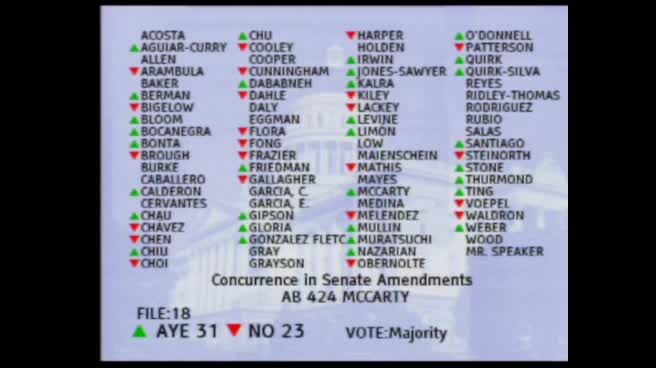 1MIN
Assembly Floor
 4MIN
Senate Floor
 1H
Senate Standing Committee on Appropriations
 2MIN
Senate Standing Committee on Environmental Quality
 3MIN
Senate Standing Committee on Natural Resources and Water
 1MIN
Assembly Floor
 1H
Assembly Standing Committee on Appropriations
 8MIN
Assembly Standing Committee on Natural Resources
Bill Author

Bill Co-Author(s):