AB 1286: Airports: alternative customer facility charges.
- Session Year: 2017-2018
- House: Assembly
- Latest Version Date: 2017-09-27
Existing law authorizes airports to require rental car companies to collect a customer facility charge or an alternative customer facility charge under specified circumstances for purposes that include financing, designing, and constructing airport vehicle rental facilities and common-use transportation systems. Existing law requires an airport to initiate the process for obtaining the authority to require or increase an alternative customer facility charge no later than January 1, 2018.
This bill would extend that date to January 1, 2025.
This bill would incorporate additional changes to Section 50474.3 of the Government Code proposed by AB 218 to be operative only if this bill and AB 218 are enacted and this bill is enacted last.
Existing law authorizes airports to require rental car companies to collect a customer facility charge or an alternative customer facility charge under specified circumstances for purposes that include financing, designing, and constructing airport vehicle rental facilities and common-use transportation systems. Existing law requires an airport to initiate the process for obtaining the authority to require or increase an alternative customer facility charge no later than January 1, 2018.
This bill would delete the requirement that airports begin the process to obtain authority for an alternative customer facility charge by January 1, 2018. extend that date to January 1, 2025.
Existing law authorizes airports to require rental car companies to collect a customer facility charge or an alternative customer facility charge under specified circumstances for purposes that include financing, designing, and constructing airport vehicle rental facilities and common-use transportation systems. Existing law requires an airport to initiate the process for obtaining the authority to require or increase an alternative customer facility charge no later than January 1, 2018.
This bill would delete the requirement that airports begin the process to obtain authority for an alternative customer facility charge by January 1, 2018.
(a)A customer facility charge may be collected by a rental company under the following circumstances:
(1)Collection of the fee by the rental company is required by an airport operated by a city, a county, a city and county, a joint powers authority, a special district, or the San Diego County Regional Airport Authority formed pursuant to Division 17 (commencing with Section 170000) of the Public Utilities Code.
(2)The fee is calculated on a per contract basis or as provided in subdivision (b).
(3)The fee is a user fee, not a tax imposed upon real property or an incident of property ownership under Article XIIID of the California Constitution.
(4)Except as otherwise provided in paragraph (5), the fee shall be ten dollars ($10) per contract or the amount provided in subdivision (b).
(5)The fee for a consolidated rental vehicle facility shall be collected only from customers of on-airport rental vehicle companies. If the fee imposed by the airport is for both a consolidated rental vehicle facility and a common-use transportation system, the fee collected from customers of on-airport rental vehicle companies shall be ten dollars ($10) or the amount provided in subdivision (b), but the fee imposed on customers of off-airport rental vehicle companies who are transported on the common-use transportation system is only that amount that is proportionate to the costs of the common-use transportation system. The fee is uniformly applied to each class of on-airport or off-airport customers, provided that the airport requires off-airport customers to use the common-use transportation system. For purposes of this paragraph, on-airport rental vehicle company means a rental company operating under an airport property lease or an airport concession or license agreement whose customers use or will use the consolidated rental vehicle facility and the fee as to those customers is a user fee described in paragraph (3).
(6)Revenues collected from the fee do not exceed the reasonable costs of financing, designing, and constructing the facility and financing, designing, constructing, and operating any common-use transportation system, or acquiring vehicles for use in that system, and are not used for any other purpose.
(7)The fee is separately identified on the rental agreement.
(8)This subdivision does not apply to fees which are governed by Section 50474.1 or Section 57.5 of the San Diego Unified Port District Act (Chapter 67 of the First Extraordinary Session of the Statutes of 1962).
(b)Any airport may require rental companies to collect an alternative customer facility charge, as defined in Section 50474.21, under the following conditions:
(1)The airport first conducts a publicly noticed hearing pursuant to the Ralph M. Brown Act (Chapter 9 (commencing with Section 54950) of Part 1 of Division 2) to review the costs of financing the design and construction of a consolidated rental vehicle facility and the design, construction, and operation of any common-use transportation system in which all of the following occur:
(A)The airport establishes the amount of revenue necessary to finance the reasonable costs of designing and constructing a consolidated rental vehicle facility and to design, construct, and operate any common-use transportation system, or acquire vehicles for use in that system, based on evidence presented during the hearing.
(B)The airport finds, based on evidence presented during the hearing, that the fee authorized in subdivision (a) will not generate sufficient revenue to finance the reasonable costs of designing and constructing a consolidated rental vehicle facility and of designing, constructing, and operating any common-use transportation system, or acquire vehicles for use in that system.
(C)The airport finds that the reasonable cost of the project requires the additional amount of revenue that would be generated by the proposed daily rate, including any rate increase, authorized pursuant to this paragraph.
(D)The airport outlines each of the following:
(i)Steps it has taken to limit costs.
(ii)Other potential alternatives for meeting its revenue needs other than the collection of the fee.
(iii)The extent to which rental companies or other businesses or individuals using the facility or common-use transportation system will pay for the costs associated with these facilities and systems apart from the fee collected from rental customers.
(2)The airport may not require the fee authorized in this subdivision to be collected at any time that the fee authorized in subdivision (a) is being collected.
(3)Pursuant to the procedure set forth in this subdivision, the fee may be collected at a rate charged on a per-day basis subject to the following conditions:
(A)Commencing January 1, 2011, the amount of the fee may not exceed six dollars ($6) per day.
(B)Commencing January 1, 2014, the amount of the fee may not exceed seven dollars and fifty cents ($7.50) per day.
(C)Commencing January 1, 2017, and thereafter, the amount of the fee may not exceed nine dollars ($9) per day.
(D)At no time shall the fee authorized in this paragraph be collected from any customer for more than five days for each individual rental vehicle contract.
(E)An airport subject to this paragraph shall initiate the process for obtaining the authority to require or increase the alternative fee no later than January 1, 2025. Any airport that obtains the authority to require or increase an alternative fee shall be authorized to continue collecting that fee until the fee authorization becomes inoperative pursuant to subdivision (c) of Section 50474.21.
(4)For any airport seeking to require rental companies to collect an alternative customer facility charge pursuant to this subdivision the following provisions apply:
(A)The airport shall provide reports on an annual basis to the Senate and Assembly Committees on Judiciary detailing all of the following:
(i)The total amount of the customer facility charge collected.
(ii)How the funds are being spent.
(iii)The amount of and reason for any changes in the airports budget or financial needs for the facility or common-use transportation system.
(B)(i)The airport shall complete an independent audit as required by subdivision (b) of Section 50474.21 prior to the initial collection of the customer facility charge. Copies of the audit shall be provided to the Assembly and Senate Committees on Judiciary, the Assembly Committee on Transportation, and the Senate Committee on Transportation and Housing and shall be posted on the airports Internet Web site.
(ii)Prior to any increase pursuant to subdivision (b), the airport shall update the information provided in the initial collection audit completed pursuant to clause (i). Copies of the updated audit shall be provided to the Assembly and Senate Committees on Judiciary, the Assembly Committee on Transportation, and the Senate Committee on Transportation and Housing, and shall be posted on the airports Internet Web site.
(iii)An audit shall be completed every three years after initial collection if the customer facility charge is collected for the purpose of operating a common-use transportation system or to acquire vehicles for use in the system pursuant to paragraph (2) of subdivision (a) of Section 50474.21. A regularly conducted audit of airport finances that includes the customer facility charge information, that satisfies the requirements of subdivision (b) of Section 50474.21, and is produced in accordance with the generally accepted accounting principles of the Government Accounting Standards Board, shall satisfy the requirements of this clause. This obligation shall continue until the fee authorization becomes inoperative pursuant to subdivision (c) of Section 50474.21. The information reported pursuant to this clause shall be compiled into one document, shall be provided to the Assembly and Senate Committees on Judiciary, the Assembly Committee on Transportation, and the Senate Committee on Transportation and Housing and shall be posted on the airports Internet Web site accessible to the public. The information reported shall be contained within one easily accessible page contained within the airports Internet Web site.
(iv)This section shall not be construed to require an airport to audit a common-use transportation system not financed by a customer facility charge and used for the purposes permitted pursuant to paragraph (2) of subdivision (a) of Section 50474.21.
(v)The airport shall post on the airports Internet Web site copies of the completed audits required by this subparagraph for a period of six years following the audits completion.
(C)Use of proceeds of any bonds backed by alternative customer facility charges shall be limited to construction and design of the consolidated rental vehicle facility, terminal modifications, and operating costs of the common-use transportation system, as specified in Section 50474.21.
(c)Notwithstanding any other provision of law, including, but not limited to, Part 1 (commencing with Section 6001) to Part 1.7 (commencing with Section 7280), inclusive, of Division 2 of the Revenue and Taxation Code, the fees collected pursuant to this section, or another law whereby a local agency operating an airport requires a rental car company to collect a facility financing fee from its customers, are not subject to sales, use, or transaction taxes.
SEC. 1.5.Section 50474.3 of the Government Code is amended to read:50474.3.(a)A customer facility charge may be collected by a rental company under the following circumstances:
(1)Collection of the fee by the rental company is required by an airport operated by a city, a county, a city and county, a joint powers authority, a special district, or the San Diego County Regional Airport Authority formed pursuant to Division 17 (commencing with Section 170000) of the Public Utilities Code.
(2)The fee is calculated on a per contract basis or as provided in subdivision (b).
(3)The fee is a user fee, not a tax imposed upon real property or an incident of property ownership under Article XIIID of the California Constitution.
(4)Except as otherwise provided in paragraph (5), the fee shall be in an amount not to exceed ten dollars ($10) per contract or the amount provided in subdivision (b).
(5)The fee for a consolidated rental vehicle facility shall be collected only from customers of on-airport rental vehicle companies. If the fee imposed by the airport is for both a consolidated rental vehicle facility and a common-use transportation system, the fee collected from customers of on-airport rental vehicle companies shall be in an amount not to exceed ten dollars ($10) or the amount provided in subdivision (b), but the fee imposed on customers of off-airport rental vehicle companies who are transported on the common-use transportation system is only that amount that is proportionate to the costs of the common-use transportation system. The fee is uniformly applied to each class of on-airport or off-airport customers, provided that the airport requires off-airport customers to use the common-use transportation system. For purposes of this paragraph, on-airport rental vehicle company means a rental company operating under an airport property lease or an airport concession or license agreement whose customers use or will use the consolidated rental vehicle facility and the fee as to those customers is a user fee described in paragraph (3).
(6)Revenues collected from the fee do not exceed the reasonable costs of financing, designing, and constructing the facility and financing, designing, constructing, and operating any common-use transportation system, or acquiring vehicles for use in that system, and are not used for any other purpose.
(7)The fee is separately identified on the rental agreement.
(8)An airport shall not require a rental company to collect a customer facility charge from a consumer pursuant to this article if that requirement would result in the rental company collecting more than one customer facility charge from that consumer in connection with a single rental.
(9)This subdivision does not apply to fees which are governed by Section 50474.1 or Section 57.5 of the San Diego Unified Port District Act (Chapter 67 of the First Extraordinary Session of the Statutes of 1962).
(b)Any airport may require rental companies to collect an alternative customer facility charge, as defined in Section 50474.21, under the following conditions:
(1)The airport first conducts a publicly noticed hearing pursuant to the Ralph M. Brown Act (Chapter 9 (commencing with Section 54950) of Part 1 of Division 2) to review the costs of financing the design and construction of a consolidated rental vehicle facility and the design, construction, and operation of any common-use transportation system in which all of the following occur:
(A)The airport establishes the amount of revenue necessary to finance the reasonable costs of designing and constructing a consolidated rental vehicle facility and to design, construct, and operate any common-use transportation system, or acquire vehicles for use in that system, based on evidence presented during the hearing.
(B)The airport finds, based on evidence presented during the hearing, that the fee authorized in subdivision (a) will not generate sufficient revenue to finance the reasonable costs of designing and constructing a consolidated rental vehicle facility and of designing, constructing, and operating any common-use transportation system, or acquire vehicles for use in that system.
(C)The airport finds that the reasonable cost of the project requires the additional amount of revenue that would be generated by the proposed daily rate, including any rate increase, authorized pursuant to this paragraph.
(D)The airport outlines each of the following:
(i)Steps it has taken to limit costs.
(ii)Other potential alternatives for meeting its revenue needs other than the collection of the fee.
(iii)The extent to which rental companies or other businesses or individuals using the facility or common-use transportation system will pay for the costs associated with these facilities and systems apart from the fee collected from rental customers.
(2)The airport may not require the fee authorized in this subdivision to be collected at any time that the fee authorized in subdivision (a) is being collected.
(3)Pursuant to the procedure set forth in this subdivision, the fee may be collected at a rate charged on a per-day basis subject to the following conditions:
(A)Commencing January 1, 2011, the amount of the fee may not exceed six dollars ($6) per day.
(B)Commencing January 1, 2014, the amount of the fee may not exceed seven dollars and fifty cents ($7.50) per day.
(C)Commencing January 1, 2017, and thereafter, the amount of the fee may not exceed nine dollars ($9) per day.
(D)At no time shall the fee authorized in this paragraph be collected from any customer for more than five days for each individual rental vehicle contract.
(E)An airport subject to this paragraph shall initiate the process for obtaining the authority to require or increase the alternative fee no later than January 1, 2025. Any airport that obtains the authority to require or increase an alternative fee shall be authorized to continue collecting that fee until the fee authorization becomes inoperative when the bonds used for financing are paid.
(4)For any airport seeking to require rental companies to collect an alternative customer facility charge pursuant to this subdivision the following provisions apply:
(A)The airport shall provide reports on an annual basis to the Senate and Assembly Committees on Judiciary detailing all of the following:
(i)The total amount of the customer facility charge collected.
(ii)How the funds are being spent.
(iii)The amount of and reason for any changes in the airports budget or financial needs for the facility or common-use transportation system.
(B)(i)The airport shall complete an independent audit as required by subdivision (b) of Section 50474.21 prior to the initial collection of the customer facility charge. Copies of the audit shall be provided to the Assembly and Senate Committees on Judiciary, the Assembly Committee on Transportation, and the Senate Committee on Transportation and Housing and shall be posted on the airports Internet Web site.
(ii)Prior to any increase pursuant to subdivision (b), the airport shall update the information provided in the initial collection audit completed pursuant to clause (i). Copies of the updated audit shall be provided to the Assembly and Senate Committees on Judiciary, the Assembly Committee on Transportation, and the Senate Committee on Transportation and Housing, and shall be posted on the airports Internet Web site.
(iii)An audit shall be completed every three years after initial collection if the customer facility charge is collected for the purpose of operating a common-use transportation system or to acquire vehicles for use in the system pursuant to paragraph (2) of subdivision (a) of Section 50474.21. A regularly conducted audit of airport finances that includes the customer facility charge information, that satisfies the requirements of subdivision (b) of Section 50474.21, and is produced in accordance with the generally accepted accounting principles of the Government Accounting Standards Board, shall satisfy the requirements of this clause. The information reported pursuant to this clause shall be compiled into one document, shall be provided to the Assembly and Senate Committees on Judiciary, the Assembly Committee on Transportation, and the Senate Committee on Transportation and Housing and shall be posted on the airports Internet Web site accessible to the public. The information reported shall be contained within one easily accessible page contained within the airports Internet Web site.
(iv)This section shall not be construed to require an airport to audit a common-use transportation system not financed by a customer facility charge and used for the purposes permitted pursuant to paragraph (2) of subdivision (a) of Section 50474.21.
(v)The airport shall post on the airports Internet Web site copies of the completed audits required by this subparagraph for a period of six years following the audits completion.
(C)Use of proceeds of any bonds backed by alternative customer facility charges shall be limited to construction and design of the consolidated rental vehicle facility, terminal modifications, and operating costs of the common-use transportation system, as specified in Section 50474.21.
(c)Notwithstanding any other provision of law, including, but not limited to, Part 1 (commencing with Section 6001) to Part 1.7 (commencing with Section 7280), inclusive, of Division 2 of the Revenue and Taxation Code, the fees collected pursuant to this section, or another law whereby a local agency operating an airport requires a rental car company to collect a facility financing fee from its customers, are not subject to sales, use, or transaction taxes.
(d)This section shall remain in effect only until January 1, 2023, and as of that date is repealed.
SEC. 1.7.Section 50474.3 is added to the Government Code, to read:50474.3.(a)A customer facility charge may be collected by a rental company under the following circumstances:
(1)Collection of the fee by the rental company is required by an airport operated by a city, a county, a city and county, a joint powers authority, a special district, or the San Diego County Regional Airport Authority formed pursuant to Division 17 (commencing with Section 170000) of the Public Utilities Code.
(2)The fee is calculated on a per contract basis or as provided in subdivision (b).
(3)The fee is a user fee, not a tax imposed upon real property or an incident of property ownership under Article XIII D of the California Constitution.
(4)Except as otherwise provided in paragraph (5), the fee shall be in an amount not to exceed ten dollars ($10) per contract or the amount provided in subdivision (b).
(5)The fee for a consolidated rental vehicle facility shall be collected only from customers of on-airport rental vehicle companies. If the fee imposed by the airport is for both a consolidated rental vehicle facility and a common-use transportation system, the fee collected from customers of on-airport rental vehicle companies shall be in an amount not to exceed ten dollars ($10) or the amount provided in subdivision (b), but the fee imposed on customers of off-airport rental vehicle companies who are transported on the common-use transportation system is only that amount that is proportionate to the costs of the common-use transportation system. The fee is uniformly applied to each class of on-airport or off-airport customers, provided that the airport requires off-airport customers to use the common-use transportation system. For purposes of this paragraph, on-airport rental vehicle company means a rental company operating under an airport property lease or an airport concession or license agreement whose customers use or will use the consolidated rental vehicle facility and the fee as to those customers is a user fee described in paragraph (3).
(6)Revenues collected from the fee do not exceed the reasonable costs of financing, designing, and constructing the facility and financing, designing, constructing, and operating any common-use transportation system, or acquiring vehicles for use in that system, and are not used for any other purpose.
(7)The fee is separately identified on the rental agreement.
(8)An airport shall not require a rental company to collect a customer facility charge from a consumer pursuant to this article if that requirement would result in the rental company collecting more than one customer facility charge from that consumer in connection with a single rental.
(9)This subdivision does not apply to fees which are governed by Section 50474.1 or Section 57.5 of the San Diego Unified Port District Act (Chapter 67 of the First Extraordinary Session of the Statutes of 1962).
(b)Any airport may require rental companies to collect an alternative customer facility charge, as defined in Section 50474.21, under the following conditions:
(1)The airport first conducts a publicly noticed hearing pursuant to the Ralph M. Brown Act (Chapter 9 (commencing with Section 54950) of Part 1 of Division 2) to review the costs of financing the design and construction of a consolidated rental vehicle facility and the design, construction, and operation of any common-use transportation system in which all of the following occur:
(A)The airport establishes the amount of revenue necessary to finance the reasonable costs of designing and constructing a consolidated rental vehicle facility and to design, construct, and operate any common-use transportation system, or acquire vehicles for use in that system, based on evidence presented during the hearing.
(B)The airport finds, based on evidence presented during the hearing, that the fee authorized in subdivision (a) will not generate sufficient revenue to finance the reasonable costs of designing and constructing a consolidated rental vehicle facility and of designing, constructing, and operating any common-use transportation system, or acquire vehicles for use in that system.
(C)The airport finds that the reasonable cost of the project requires the additional amount of revenue that would be generated by the proposed daily rate, including any rate increase, authorized pursuant to this paragraph.
(D)The airport outlines each of the following:
(i)Steps it has taken to limit costs.
(ii)Other potential alternatives for meeting its revenue needs other than the collection of the fee.
(iii)The extent to which rental companies or other businesses or individuals using the facility or common-use transportation system will pay for the costs associated with these facilities and systems apart from the fee collected from rental customers.
(2)The airport may not require the fee authorized in this subdivision to be collected at any time that the fee authorized in subdivision (a) is being collected.
(3)Pursuant to the procedure set forth in this subdivision, the fee may be collected at a rate charged on a per-day basis subject to the following conditions:
(A)Commencing January 1, 2011, the amount of the fee may not exceed six dollars ($6) per day.
(B)Commencing January 1, 2014, the amount of the fee may not exceed seven dollars and fifty cents ($7.50) per day.
(C)Commencing January 1, 2017, and thereafter, the amount of the fee may not exceed nine dollars ($9) per day.
(D)At no time shall the fee authorized in this paragraph be collected from any customer for more than five days for each individual rental vehicle contract.
(E)An airport subject to this paragraph shall initiate the process for obtaining the authority to require or increase the alternative fee no later than January 1, 2025. Any airport that obtains the authority to require or increase an alternative fee shall be authorized to continue collecting that fee until the fee authorization becomes inoperative pursuant to subdivision (c) of Section 50474.21.
(4)For any airport seeking to require rental companies to collect an alternative customer facility charge pursuant to this subdivision the following provisions apply:
(A)The airport shall provide reports on an annual basis to the Senate and Assembly Committees on Judiciary detailing all of the following:
(i)The total amount of the customer facility charge collected.
(ii)How the funds are being spent.
(iii)The amount of and reason for any changes in the airports budget or financial needs for the facility or common-use transportation system.
(B)(i)The airport shall complete an independent audit as required by subdivision (b) of Section 50474.21 prior to the initial collection of the customer facility charge. Copies of the audit shall be provided to the Assembly and Senate Committees on Judiciary, the Assembly Committee on Transportation, and the Senate Committee on Transportation and Housing and shall be posted on the airports Internet Web site.
(ii)Prior to any increase pursuant to this subdivision, the airport shall update the information provided in the initial collection audit completed pursuant to clause (i). Copies of the updated audit shall be provided to the Assembly and Senate Committees on Judiciary, the Assembly Committee on Transportation, and the Senate Committee on Transportation and Housing, and shall be posted on the airports Internet Web site.
(iii)An audit shall be completed every three years after initial collection if the customer facility charge is collected for the purpose of operating a common-use transportation system or to acquire vehicles for use in the system pursuant to paragraph (2) of subdivision (a) of Section 50474.21. A regularly conducted audit of airport finances that includes the customer facility charge information, that satisfies the requirements of subdivision (b) of Section 50474.21, and is produced in accordance with the generally accepted accounting principles of the Government Accounting Standards Board, shall satisfy the requirements of this clause. This obligation shall continue until the fee authorization becomes inoperative pursuant to subdivision (c) of Section 50474.21. The information reported pursuant to this clause shall be compiled into one document, shall be provided to the Assembly and Senate Committees on Judiciary, the Assembly Committee on Transportation, and the Senate Committee on Transportation and Housing and shall be posted on the airports Internet Web site accessible to the public. The information reported shall be contained within one easily accessible page contained within the airports Internet Web site.
(iv)This section shall not be construed to require an airport to audit a common-use transportation system not financed by a customer facility charge and used for the purposes permitted pursuant to paragraph (2) of subdivision (a) of Section 50474.21.
(v)The airport shall post on the airports Internet Web site copies of the completed audits required by this subparagraph for a period of six years following the audits completion.
(C)Use of proceeds of any bonds backed by alternative customer facility charges shall be limited to construction and design of the consolidated rental vehicle facility, terminal modifications, and operating costs of the common-use transportation system, as specified in Section 50474.21.
(c)Notwithstanding any other law, including, but not limited to, Part 1 (commencing with Section 6001) to Part 1.7 (commencing with Section 7280), inclusive, of Division 2 of the Revenue and Taxation Code, the fees collected pursuant to this section, or another law whereby a local agency operating an airport requires a rental car company to collect a facility financing fee from its customers, are not subject to sales, use, or transaction taxes.
(d)This section shall become operative on January 1, 2023.
SEC. 2.Sections 1.5 and 1.7 of this bill incorporate amendments to Section 50474.3 of the Government Code proposed by both this bill and Assembly Bill 218. These sections shall only become operative if (1) both bills are enacted and become effective on or before January 1, 2018, (2) each bill amends Section 50474.3 of the Government Code, and (3) this bill is enacted after Assembly Bill 218, in which case Section 1 of this bill shall not become operative.
(a)A customer facility charge may be collected by a rental company under the following circumstances:
(1)Collection of the fee by the rental company is required by an airport operated by a city, a county, a city and county, a joint powers authority, a special district, or the San Diego County Regional Airport Authority formed pursuant to Division 17 (commencing with Section 170000) of the Public Utilities Code.
(2)The fee is calculated on a per contract basis or as provided in subdivision (b).
(3)The fee is a user fee, not a tax imposed upon real property or an incident of property ownership under Article XIIID of the California Constitution.
(4)Except as otherwise provided in paragraph (5), the fee shall be ten dollars ($10) per contract or the amount provided in subdivision (b).
(5)The fee for a consolidated rental vehicle facility shall be collected only from customers of on-airport rental vehicle companies. If the fee imposed by the airport is for both a consolidated rental vehicle facility and a common-use transportation system, the fee collected from customers of on-airport rental vehicle companies shall be ten dollars ($10) or the amount provided in subdivision (b), but the fee imposed on customers of off-airport rental vehicle companies who are transported on the common-use transportation system is only that amount that is proportionate to the costs of the common-use transportation system. The fee is uniformly applied to each class of on-airport or off-airport customers, provided that the airport requires off-airport customers to use the common-use transportation system. For purposes of this paragraph, on-airport rental vehicle company means a rental company operating under an airport property lease or an airport concession or license agreement whose customers use or will use the consolidated rental vehicle facility and the fee as to those customers is a user fee described in paragraph (3).
(6)Revenues collected from the fee do not exceed the reasonable costs of financing, designing, and constructing the facility and financing, designing, constructing, and operating any common-use transportation system, or acquiring vehicles for use in that system, and are not used for any other purpose.
(7)The fee is separately identified on the rental agreement.
(8)This subdivision does not apply to fees which are governed by Section 50474.1 or Section 57.5 of the San Diego Unified Port District Act (Chapter 67 of the First Extraordinary Session of the Statutes of 1962).
(b)Any airport may require rental companies to collect an alternative customer facility charge, as defined in Section 50474.21, under the following conditions:
(1)The airport first conducts a publicly noticed hearing pursuant to the Ralph M. Brown Act (Chapter 9 (commencing with Section 54950) of Part 1 of Division 2) to review the costs of financing the design and construction of a consolidated rental vehicle facility and the design, construction, and operation of any common-use transportation system in which all of the following occur:
(A)The airport establishes the amount of revenue necessary to finance the reasonable costs of designing and constructing a consolidated rental vehicle facility and to design, construct, and operate any common-use transportation system, or acquire vehicles for use in that system, based on evidence presented during the hearing.
(B)The airport finds, based on evidence presented during the hearing, that the fee authorized in subdivision (a) will not generate sufficient revenue to finance the reasonable costs of designing and constructing a consolidated rental vehicle facility and of designing, constructing, and operating any common-use transportation system, or acquire vehicles for use in that system.
(C)The airport finds that the reasonable cost of the project requires the additional amount of revenue that would be generated by the proposed daily rate, including any rate increase, authorized pursuant to this paragraph.
(D)The airport outlines each of the following:
(i)Steps it has taken to limit costs.
(ii)Other potential alternatives for meeting its revenue needs other than the collection of the fee.
(iii)The extent to which rental companies or other businesses or individuals using the facility or common-use transportation system will pay for the costs associated with these facilities and systems apart from the fee collected from rental customers.
(2)The airport may not require the fee authorized in this subdivision to be collected at any time that the fee authorized in subdivision (a) is being collected.
(3)Pursuant to the procedure set forth in this subdivision, the fee may be collected at a rate charged on a per-day basis subject to the following conditions:
(A)Commencing January 1, 2011, the amount of the fee may not exceed six dollars ($6) per day.
(B)Commencing January 1, 2014, the amount of the fee may not exceed seven dollars and fifty cents ($7.50) per day.
(C)Commencing January 1, 2017, and thereafter, the amount of the fee may not exceed nine dollars ($9) per day.
(D)At no time shall the fee authorized in this paragraph be collected from any customer for more than five days for each individual rental vehicle contract.
(E)An airport subject to this paragraph shall initiate the process for obtaining the authority to require or increase the alternative fee no later than January 1, 2025. Any airport that obtains the authority to require or increase an alternative fee shall be authorized to continue collecting that fee until the fee authorization becomes inoperative pursuant to subdivision (c) of Section 50474.21.
(4)For any airport seeking to require rental companies to collect an alternative customer facility charge pursuant to this subdivision the following provisions apply:
(A)The airport shall provide reports on an annual basis to the Senate and Assembly Committees on Judiciary detailing all of the following:
(i)The total amount of the customer facility charge collected.
(ii)How the funds are being spent.
(iii)The amount of and reason for any changes in the airports budget or financial needs for the facility or common-use transportation system.
(B)(i)The airport shall complete an independent audit as required by subdivision (b) of Section 50474.21 prior to the initial collection of the customer facility charge. Copies of the audit shall be provided to the Assembly and Senate Committees on Judiciary, the Assembly Committee on Transportation, and the Senate Committee on Transportation and Housing and shall be posted on the airports Internet Web site.
(ii)Prior to any increase pursuant to subdivision (b), the airport shall update the information provided in the initial collection audit completed pursuant to clause (i). Copies of the updated audit shall be provided to the Assembly and Senate Committees on Judiciary, the Assembly Committee on Transportation, and the Senate Committee on Transportation and Housing, and shall be posted on the airports Internet Web site.
(iii)An audit shall be completed every three years after initial collection if the customer facility charge is collected for the purpose of operating a common-use transportation system or to acquire vehicles for use in the system pursuant to paragraph (2) of subdivision (a) of Section 50474.21. A regularly conducted audit of airport finances that includes the customer facility charge information, that satisfies the requirements of subdivision (b) of Section 50474.21, and is produced in accordance with the generally accepted accounting principles of the Government Accounting Standards Board, shall satisfy the requirements of this clause. This obligation shall continue until the fee authorization becomes inoperative pursuant to subdivision (c) of Section 50474.21. The information reported pursuant to this clause shall be compiled into one document, shall be provided to the Assembly and Senate Committees on Judiciary, the Assembly Committee on Transportation, and the Senate Committee on Transportation and Housing and shall be posted on the airports Internet Web site accessible to the public. The information reported shall be contained within one easily accessible page contained within the airports Internet Web site.
(iv)This section shall not be construed to require an airport to audit a common-use transportation system not financed by a customer facility charge and used for the purposes permitted pursuant to paragraph (2) of subdivision (a) of Section 50474.21.
(v)The airport shall post on the airports Internet Web site copies of the completed audits required by this subparagraph for a period of six years following the audits completion.
(C)Use of proceeds of any bonds backed by alternative customer facility charges shall be limited to construction and design of the consolidated rental vehicle facility, terminal modifications, and operating costs of the common-use transportation system, as specified in Section 50474.21.
(c)Notwithstanding any other provision of law, including, but not limited to, Part 1 (commencing with Section 6001) to Part 1.7 (commencing with Section 7280), inclusive, of Division 2 of the Revenue and Taxation Code, the fees collected pursuant to this section, or another law whereby a local agency operating an airport requires a rental car company to collect a facility financing fee from its customers, are not subject to sales, use, or transaction taxes.
SEC. 1.5.Section 50474.3 of the Government Code is amended to read:50474.3.(a)A customer facility charge may be collected by a rental company under the following circumstances:
(1)Collection of the fee by the rental company is required by an airport operated by a city, a county, a city and county, a joint powers authority, a special district, or the San Diego County Regional Airport Authority formed pursuant to Division 17 (commencing with Section 170000) of the Public Utilities Code.
(2)The fee is calculated on a per contract basis or as provided in subdivision (b).
(3)The fee is a user fee, not a tax imposed upon real property or an incident of property ownership under Article XIIID of the California Constitution.
(4)Except as otherwise provided in paragraph (5), the fee shall be in an amount not to exceed ten dollars ($10) per contract or the amount provided in subdivision (b).
(5)The fee for a consolidated rental vehicle facility shall be collected only from customers of on-airport rental vehicle companies. If the fee imposed by the airport is for both a consolidated rental vehicle facility and a common-use transportation system, the fee collected from customers of on-airport rental vehicle companies shall be in an amount not to exceed ten dollars ($10) or the amount provided in subdivision (b), but the fee imposed on customers of off-airport rental vehicle companies who are transported on the common-use transportation system is only that amount that is proportionate to the costs of the common-use transportation system. The fee is uniformly applied to each class of on-airport or off-airport customers, provided that the airport requires off-airport customers to use the common-use transportation system. For purposes of this paragraph, on-airport rental vehicle company means a rental company operating under an airport property lease or an airport concession or license agreement whose customers use or will use the consolidated rental vehicle facility and the fee as to those customers is a user fee described in paragraph (3).
(6)Revenues collected from the fee do not exceed the reasonable costs of financing, designing, and constructing the facility and financing, designing, constructing, and operating any common-use transportation system, or acquiring vehicles for use in that system, and are not used for any other purpose.
(7)The fee is separately identified on the rental agreement.
(8)An airport shall not require a rental company to collect a customer facility charge from a consumer pursuant to this article if that requirement would result in the rental company collecting more than one customer facility charge from that consumer in connection with a single rental.
(8)(9)This subdivision does not apply to fees which are governed by Section 50474.1 or Section 57.5 of the San Diego Unified Port District Act (Chapter 67 of the First Extraordinary Session of the Statutes of 1962).
(b)Any airport may require rental companies to collect an alternative customer facility charge, as defined in Section 50474.21, under the following conditions:
(1)The airport first conducts a publicly noticed hearing pursuant to the Ralph M. Brown Act (Chapter 9 (commencing with Section 54950) of Part 1 of Division 2) to review the costs of financing the design and construction of a consolidated rental vehicle facility and the design, construction, and operation of any common-use transportation system in which all of the following occur:
(A)The airport establishes the amount of revenue necessary to finance the reasonable costs of designing and constructing a consolidated rental vehicle facility and to design, construct, and operate any common-use transportation system, or acquire vehicles for use in that system, based on evidence presented during the hearing.
(B)The airport finds, based on evidence presented during the hearing, that the fee authorized in subdivision (a) will not generate sufficient revenue to finance the reasonable costs of designing and constructing a consolidated rental vehicle facility and of designing, constructing, and operating any common-use transportation system, or acquire vehicles for use in that system.
(C)The airport finds that the reasonable cost of the project requires the additional amount of revenue that would be generated by the proposed daily rate, including any rate increase, authorized pursuant to this paragraph.
(D)The airport outlines each of the following:
(i)Steps it has taken to limit costs.
(ii)Other potential alternatives for meeting its revenue needs other than the collection of the fee.
(iii)The extent to which rental companies or other businesses or individuals using the facility or common-use transportation system will pay for the costs associated with these facilities and systems apart from the fee collected from rental customers.
(2)The airport may not require the fee authorized in this subdivision to be collected at any time that the fee authorized in subdivision (a) is being collected.
(3)Pursuant to the procedure set forth in this subdivision, the fee may be collected at a rate charged on a per-day basis subject to the following conditions:
(A)Commencing January 1, 2011, the amount of the fee may not exceed six dollars ($6) per day.
(B)Commencing January 1, 2014, the amount of the fee may not exceed seven dollars and fifty cents ($7.50) per day.
(C)Commencing January 1, 2017, and thereafter, the amount of the fee may not exceed nine dollars ($9) per day.
(D)At no time shall the fee authorized in this paragraph be collected from any customer for more than five days for each individual rental vehicle contract.
(E)An airport subject to this paragraph shall initiate the process for obtaining the authority to require or increase the alternative fee no later than January 1, 2018. 2025. Any airport that obtains the authority to require or increase an alternative fee shall be authorized to continue collecting that fee until the fee authorization becomes inoperative pursuant to subdivision (c) of Section 50474.21. when the bonds used for financing are paid.
(4)For any airport seeking to require rental companies to collect an alternative customer facility charge pursuant to this subdivision the following provisions apply:
(A)The airport shall provide reports on an annual basis to the Senate and Assembly Committees on Judiciary detailing all of the following:
(i)The total amount of the customer facility charge collected.
(ii)How the funds are being spent.
(iii)The amount of and reason for any changes in the airports budget or financial needs for the facility or common-use transportation system.
(B)(i)The airport shall complete an independent audit as required by subdivision (b) of Section 50474.21 prior to the initial collection of the customer facility charge. Copies of the audit shall be provided to the Assembly and Senate Committees on Judiciary, the Assembly Committee on Transportation, and the Senate Committee on Transportation and Housing and shall be posted on the airports Internet Web site.
(ii)Prior to any increase pursuant to subdivision (b), the airport shall update the information provided in the initial collection audit completed pursuant to clause (i). Copies of the updated audit shall be provided to the Assembly and Senate Committees on Judiciary, the Assembly Committee on Transportation, and the Senate Committee on Transportation and Housing, and shall be posted on the airports Internet Web site.
(iii)An audit shall be completed every three years after initial collection if the customer facility charge is collected for the purpose of operating a common-use transportation system or to acquire vehicles for use in the system pursuant to paragraph (2) of subdivision (a) of Section 50474.21. A regularly conducted audit of airport finances that includes the customer facility charge information, that satisfies the requirements of subdivision (b) of Section 50474.21, and is produced in accordance with the generally accepted accounting principles of the Government Accounting Standards Board, shall satisfy the requirements of this clause. This obligation shall continue until the fee authorization becomes inoperative pursuant to subdivision (c) of Section 50474.21. The information reported pursuant to this clause shall be compiled into one document, shall be provided to the Assembly and Senate Committees on Judiciary, the Assembly Committee on Transportation, and the Senate Committee on Transportation and Housing and shall be posted on the airports Internet Web site accessible to the public. The information reported shall be contained within one easily accessible page contained within the airports Internet Web site.
(iv)This section shall not be construed to require an airport to audit a common-use transportation system not financed by a customer facility charge and used for the purposes permitted pursuant to paragraph (2) of subdivision (a) of Section 50474.21.
(v)The airport shall post on the airports Internet Web site copies of the completed audits required by this subparagraph for a period of six years following the audits completion.
(C)Use of proceeds of any bonds backed by alternative customer facility charges shall be limited to construction and design of the consolidated rental vehicle facility, terminal modifications, and operating costs of the common-use transportation system, as specified in Section 50474.21.
(c)Notwithstanding any other provision of law, including, but not limited to, Part 1 (commencing with Section 6001) to Part 1.7 (commencing with Section 7280), inclusive, of Division 2 of the Revenue and Taxation Code, the fees collected pursuant to this section, or another law whereby a local agency operating an airport requires a rental car company to collect a facility financing fee from its customers, are not subject to sales, use, or transaction taxes.
(d)This section shall remain in effect only until January 1, 2023, and as of that date is repealed.
SEC. 1.7.Section 50474.3 is added to the Government Code, to read:50474.3.(a)A customer facility charge may be collected by a rental company under the following circumstances:
(1)Collection of the fee by the rental company is required by an airport operated by a city, a county, a city and county, a joint powers authority, a special district, or the San Diego County Regional Airport Authority formed pursuant to Division 17 (commencing with Section 170000) of the Public Utilities Code.
(2)The fee is calculated on a per contract basis or as provided in subdivision (b).
(3)The fee is a user fee, not a tax imposed upon real property or an incident of property ownership under Article XIII D of the California Constitution.
(4)Except as otherwise provided in paragraph (5), the fee shall be in an amount not to exceed ten dollars ($10) per contract or the amount provided in subdivision (b).
(5)The fee for a consolidated rental vehicle facility shall be collected only from customers of on-airport rental vehicle companies. If the fee imposed by the airport is for both a consolidated rental vehicle facility and a common-use transportation system, the fee collected from customers of on-airport rental vehicle companies shall be in an amount not to exceed ten dollars ($10) or the amount provided in subdivision (b), but the fee imposed on customers of off-airport rental vehicle companies who are transported on the common-use transportation system is only that amount that is proportionate to the costs of the common-use transportation system. The fee is uniformly applied to each class of on-airport or off-airport customers, provided that the airport requires off-airport customers to use the common-use transportation system. For purposes of this paragraph, on-airport rental vehicle company means a rental company operating under an airport property lease or an airport concession or license agreement whose customers use or will use the consolidated rental vehicle facility and the fee as to those customers is a user fee described in paragraph (3).
(6)Revenues collected from the fee do not exceed the reasonable costs of financing, designing, and constructing the facility and financing, designing, constructing, and operating any common-use transportation system, or acquiring vehicles for use in that system, and are not used for any other purpose.
(7)The fee is separately identified on the rental agreement.
(8)An airport shall not require a rental company to collect a customer facility charge from a consumer pursuant to this article if that requirement would result in the rental company collecting more than one customer facility charge from that consumer in connection with a single rental.
(9)This subdivision does not apply to fees which are governed by Section 50474.1 or Section 57.5 of the San Diego Unified Port District Act (Chapter 67 of the First Extraordinary Session of the Statutes of 1962).
(b)Any airport may require rental companies to collect an alternative customer facility charge, as defined in Section 50474.21, under the following conditions:
(1)The airport first conducts a publicly noticed hearing pursuant to the Ralph M. Brown Act (Chapter 9 (commencing with Section 54950) of Part 1 of Division 2) to review the costs of financing the design and construction of a consolidated rental vehicle facility and the design, construction, and operation of any common-use transportation system in which all of the following occur:
(A)The airport establishes the amount of revenue necessary to finance the reasonable costs of designing and constructing a consolidated rental vehicle facility and to design, construct, and operate any common-use transportation system, or acquire vehicles for use in that system, based on evidence presented during the hearing.
(B)The airport finds, based on evidence presented during the hearing, that the fee authorized in subdivision (a) will not generate sufficient revenue to finance the reasonable costs of designing and constructing a consolidated rental vehicle facility and of designing, constructing, and operating any common-use transportation system, or acquire vehicles for use in that system.
(C)The airport finds that the reasonable cost of the project requires the additional amount of revenue that would be generated by the proposed daily rate, including any rate increase, authorized pursuant to this paragraph.
(D)The airport outlines each of the following:
(i)Steps it has taken to limit costs.
(ii)Other potential alternatives for meeting its revenue needs other than the collection of the fee.
(iii)The extent to which rental companies or other businesses or individuals using the facility or common-use transportation system will pay for the costs associated with these facilities and systems apart from the fee collected from rental customers.
(2)The airport may not require the fee authorized in this subdivision to be collected at any time that the fee authorized in subdivision (a) is being collected.
(3)Pursuant to the procedure set forth in this subdivision, the fee may be collected at a rate charged on a per-day basis subject to the following conditions:
(A)Commencing January 1, 2011, the amount of the fee may not exceed six dollars ($6) per day.
(B)Commencing January 1, 2014, the amount of the fee may not exceed seven dollars and fifty cents ($7.50) per day.
(C)Commencing January 1, 2017, and thereafter, the amount of the fee may not exceed nine dollars ($9) per day.
(D)At no time shall the fee authorized in this paragraph be collected from any customer for more than five days for each individual rental vehicle contract.
(E)An airport subject to this paragraph shall initiate the process for obtaining the authority to require or increase the alternative fee no later than January 1, 2025. Any airport that obtains the authority to require or increase an alternative fee shall be authorized to continue collecting that fee until the fee authorization becomes inoperative pursuant to subdivision (c) of Section 50474.21.
(4)For any airport seeking to require rental companies to collect an alternative customer facility charge pursuant to this subdivision the following provisions apply:
(A)The airport shall provide reports on an annual basis to the Senate and Assembly Committees on Judiciary detailing all of the following:
(i)The total amount of the customer facility charge collected.
(ii)How the funds are being spent.
(iii)The amount of and reason for any changes in the airports budget or financial needs for the facility or common-use transportation system.
(B)(i)The airport shall complete an independent audit as required by subdivision (b) of Section 50474.21 prior to the initial collection of the customer facility charge. Copies of the audit shall be provided to the Assembly and Senate Committees on Judiciary, the Assembly Committee on Transportation, and the Senate Committee on Transportation and Housing and shall be posted on the airports Internet Web site.
(ii)Prior to any increase pursuant to this subdivision, the airport shall update the information provided in the initial collection audit completed pursuant to clause (i). Copies of the updated audit shall be provided to the Assembly and Senate Committees on Judiciary, the Assembly Committee on Transportation, and the Senate Committee on Transportation and Housing, and shall be posted on the airports Internet Web site.
(iii)An audit shall be completed every three years after initial collection if the customer facility charge is collected for the purpose of operating a common-use transportation system or to acquire vehicles for use in the system pursuant to paragraph (2) of subdivision (a) of Section 50474.21. A regularly conducted audit of airport finances that includes the customer facility charge information, that satisfies the requirements of subdivision (b) of Section 50474.21, and is produced in accordance with the generally accepted accounting principles of the Government Accounting Standards Board, shall satisfy the requirements of this clause. This obligation shall continue until the fee authorization becomes inoperative pursuant to subdivision (c) of Section 50474.21. The information reported pursuant to this clause shall be compiled into one document, shall be provided to the Assembly and Senate Committees on Judiciary, the Assembly Committee on Transportation, and the Senate Committee on Transportation and Housing and shall be posted on the airports Internet Web site accessible to the public. The information reported shall be contained within one easily accessible page contained within the airports Internet Web site.
(iv)This section shall not be construed to require an airport to audit a common-use transportation system not financed by a customer facility charge and used for the purposes permitted pursuant to paragraph (2) of subdivision (a) of Section 50474.21.
(v)The airport shall post on the airports Internet Web site copies of the completed audits required by this subparagraph for a period of six years following the audits completion.
(C)Use of proceeds of any bonds backed by alternative customer facility charges shall be limited to construction and design of the consolidated rental vehicle facility, terminal modifications, and operating costs of the common-use transportation system, as specified in Section 50474.21.
(c)Notwithstanding any other law, including, but not limited to, Part 1 (commencing with Section 6001) to Part 1.7 (commencing with Section 7280), inclusive, of Division 2 of the Revenue and Taxation Code, the fees collected pursuant to this section, or another law whereby a local agency operating an airport requires a rental car company to collect a facility financing fee from its customers, are not subject to sales, use, or transaction taxes.
(d)This section shall become operative on January 1, 2023.
SEC. 2.Sections 1.5 and 1.7 of this bill incorporate amendments to Section 50474.3 of the Government Code proposed by both this bill and Assembly Bill 218. These sections shall only become operative if (1) both bills are enacted and become effective on or before January 1, 2018, (2) each bill amends Section 50474.3 of the Government Code, and (3) this bill is enacted after Assembly Bill 218, in which case Section 1 of this bill shall not become operative.
(a)A customer facility charge may be collected by a rental company under the following circumstances:
(1)Collection of the fee by the rental company is required by an airport operated by a city, a county, a city and county, a joint powers authority, a special district, or the San Diego County Regional Airport Authority formed pursuant to Division 17 (commencing with Section 170000) of the Public Utilities Code.
(2)The fee is calculated on a per contract basis or as provided in subdivision (b).
(3)The fee is a user fee, not a tax imposed upon real property or an incident of property ownership under Article XIIID of the California Constitution.
(4)Except as otherwise provided in paragraph (5), the fee shall be ten dollars ($10) per contract or the amount provided in subdivision (b).
(5)The fee for a consolidated rental vehicle facility shall be collected only from customers of on-airport rental vehicle companies. If the fee imposed by the airport is for both a consolidated rental vehicle facility and a common-use transportation system, the fee collected from customers of on-airport rental vehicle companies shall be ten dollars ($10) or the amount provided in subdivision (b), but the fee imposed on customers of off-airport rental vehicle companies who are transported on the common-use transportation system is only that amount that is proportionate to the costs of the common-use transportation system. The fee is uniformly applied to each class of on-airport or off-airport customers, provided that the airport requires off-airport customers to use the common-use transportation system. For purposes of this paragraph, on-airport rental vehicle company means a rental company operating under an airport property lease or an airport concession or license agreement whose customers use or will use the consolidated rental vehicle facility and the fee as to those customers is a user fee described in paragraph (3).
(6)Revenues collected from the fee do not exceed the reasonable costs of financing, designing, and constructing the facility and financing, designing, constructing, and operating any common-use transportation system, or acquiring vehicles for use in that system, and are not used for any other purpose.
(7)The fee is separately identified on the rental agreement.
(8)This subdivision does not apply to fees which are governed by Section 50474.1 or Section 57.5 of the San Diego Unified Port District Act (Chapter 67 of the First Extraordinary Session of the Statutes of 1962).
(b)Any airport may require rental companies to collect an alternative customer facility charge, as defined in Section 50474.21, under the following conditions:
(1)The airport first conducts a publicly noticed hearing pursuant to the Ralph M. Brown Act (Chapter 9 (commencing with Section 54950) of Part 1 of Division 2) to review the costs of financing the design and construction of a consolidated rental vehicle facility and the design, construction, and operation of any common-use transportation system in which all of the following occur:
(A)The airport establishes the amount of revenue necessary to finance the reasonable costs of designing and constructing a consolidated rental vehicle facility and to design, construct, and operate any common-use transportation system, or acquire vehicles for use in that system, based on evidence presented during the hearing.
(B)The airport finds, based on evidence presented during the hearing, that the fee authorized in subdivision (a) will not generate sufficient revenue to finance the reasonable costs of designing and constructing a consolidated rental vehicle facility and of designing, constructing, and operating any common-use transportation system, or acquire vehicles for use in that system.
(C)The airport finds that the reasonable cost of the project requires the additional amount of revenue that would be generated by the proposed daily rate, including any rate increase, authorized pursuant to this paragraph.
(D)The airport outlines each of the following:
(i)Steps it has taken to limit costs.
(ii)Other potential alternatives for meeting its revenue needs other than the collection of the fee.
(iii)The extent to which rental companies or other businesses or individuals using the facility or common-use transportation system will pay for the costs associated with these facilities and systems apart from the fee collected from rental customers.
(2)The airport may not require the fee authorized in this subdivision to be collected at any time that the fee authorized in subdivision (a) is being collected.
(3)Pursuant to the procedure set forth in this subdivision, the fee may be collected at a rate charged on a per-day basis subject to the following conditions:
(A)Commencing January 1, 2011, the amount of the fee may not exceed six dollars ($6) per day.
(B)Commencing January 1, 2014, the amount of the fee may not exceed seven dollars and fifty cents ($7.50) per day.
(C)Commencing January 1, 2017, and thereafter, the amount of the fee may not exceed nine dollars ($9) per day.
(D)At no time shall the fee authorized in this paragraph be collected from any customer for more than five days for each individual rental vehicle contract.
(E)(E)An airport subject to this paragraph shall initiate the process for obtaining the authority to require or increase the alternative fee no later than January 1, 2025. Any airport that obtains the authority to require or increase an alternative fee shall be authorized to continue collecting that fee until the fee authorization becomes inoperative pursuant to subdivision (c) of Section 50474.21.(4)For any airport seeking to require rental companies to collect an alternative customer facility charge pursuant to this subdivision the following provisions apply:
(A)The airport shall provide reports on an annual basis to the Senate and Assembly Committees on Judiciary detailing all of the following:
(i)The total amount of the customer facility charge collected.
(ii)How the funds are being spent.
(iii)The amount of and reason for any changes in the airports budget or financial needs for the facility or common-use transportation system.
(B)(i)The airport shall complete an independent audit as required by subdivision (b) of Section 50474.21 prior to the initial collection of the customer facility charge. Copies of the audit shall be provided to the Assembly and Senate Committees on Judiciary, the Assembly Committee on Transportation, and the Senate Committee on Transportation and Housing and shall be posted on the airports Internet Web site.
(ii)Prior to any increase pursuant to subdivision (b), the airport shall update the information provided in the initial collection audit completed pursuant to clause (i). Copies of the updated audit shall be provided to the Assembly and Senate Committees on Judiciary, the Assembly Committee on Transportation, and the Senate Committee on Transportation and Housing, and shall be posted on the airports Internet Web site.
(iii)An audit shall be completed every three years after initial collection if the customer facility charge is collected for the purpose of operating a common-use transportation system or to acquire vehicles for use in the system pursuant to paragraph (2) of subdivision (a) of Section 50474.21. A regularly conducted audit of airport finances that includes the customer facility charge information, that satisfies the requirements of subdivision (b) of Section 50474.21, and is produced in accordance with the generally accepted accounting principles of the Government Accounting Standards Board, shall satisfy the requirements of this clause. This obligation shall continue until the fee authorization becomes inoperative pursuant to subdivision (c) of Section 50474.21. The information reported pursuant to this clause shall be compiled into one document, shall be provided to the Assembly and Senate Committees on Judiciary, the Assembly Committee on Transportation, and the Senate Committee on Transportation and Housing and shall be posted on the airports Internet Web site accessible to the public. The information reported shall be contained within one easily accessible page contained within the airports Internet Web site.
(iv)This section shall not be construed to require an airport to audit a common-use transportation system not financed by a customer facility charge and used for the purposes permitted pursuant to paragraph (2) of subdivision (a) of Section 50474.21.
(v)The airport shall post on the airports Internet Web site copies of the completed audits required by this subparagraph for a period of six years following the audits completion.
(C)Use of proceeds of any bonds backed by alternative customer facility charges shall be limited to construction and design of the consolidated rental vehicle facility, terminal modifications, and operating costs of the common-use transportation system, as specified in Section 50474.21.
(c)Notwithstanding any other provision of law, including, but not limited to, Part 1 (commencing with Section 6001) to Part 1.7 (commencing with Section 7280), inclusive, of Division 2 of the Revenue and Taxation Code, the fees collected pursuant to this section, or another law whereby a local agency operating an airport requires a rental car company to collect a facility financing fee from its customers, are not subject to sales, use, or transaction taxes.
(a)A customer facility charge may be collected by a rental company under the following circumstances:
(1)Collection of the fee by the rental company is required by an airport operated by a city, a county, a city and county, a joint powers authority, a special district, or the San Diego County Regional Airport Authority formed pursuant to Division 17 (commencing with Section 170000) of the Public Utilities Code.
(2)The fee is calculated on a per contract basis or as provided in subdivision (b).
(3)The fee is a user fee, not a tax imposed upon real property or an incident of property ownership under Article XIIID of the California Constitution.
(4)Except as otherwise provided in paragraph (5), the fee shall be ten dollars ($10) per contract or the amount provided in subdivision (b).
(5)The fee for a consolidated rental vehicle facility shall be collected only from customers of on-airport rental vehicle companies. If the fee imposed by the airport is for both a consolidated rental vehicle facility and a common-use transportation system, the fee collected from customers of on-airport rental vehicle companies shall be ten dollars ($10) or the amount provided in subdivision (b), but the fee imposed on customers of off-airport rental vehicle companies who are transported on the common-use transportation system is only that amount that is proportionate to the costs of the common-use transportation system. The fee is uniformly applied to each class of on-airport or off-airport customers, provided that the airport requires off-airport customers to use the common-use transportation system. For purposes of this paragraph, on-airport rental vehicle company means a rental company operating under an airport property lease or an airport concession or license agreement whose customers use or will use the consolidated rental vehicle facility and the fee as to those customers is a user fee described in paragraph (3).
(6)Revenues collected from the fee do not exceed the reasonable costs of financing, designing, and constructing the facility and financing, designing, constructing, and operating any common-use transportation system, or acquiring vehicles for use in that system, and are not used for any other purpose.
(7)The fee is separately identified on the rental agreement.
(8)This subdivision does not apply to fees which are governed by Section 50474.1 or Section 57.5 of the San Diego Unified Port District Act (Chapter 67 of the First Extraordinary Session of the Statutes of 1962).
(b)Any airport may require rental companies to collect an alternative customer facility charge, as defined in Section 50474.21, under the following conditions:
(1)The airport first conducts a publicly noticed hearing pursuant to the Ralph M. Brown Act (Chapter 9 (commencing with Section 54950) of Part 1 of Division 2) to review the costs of financing the design and construction of a consolidated rental vehicle facility and the design, construction, and operation of any common-use transportation system in which all of the following occur:
(A)The airport establishes the amount of revenue necessary to finance the reasonable costs of designing and constructing a consolidated rental vehicle facility and to design, construct, and operate any common-use transportation system, or acquire vehicles for use in that system, based on evidence presented during the hearing.
(B)The airport finds, based on evidence presented during the hearing, that the fee authorized in subdivision (a) will not generate sufficient revenue to finance the reasonable costs of designing and constructing a consolidated rental vehicle facility and of designing, constructing, and operating any common-use transportation system, or acquire vehicles for use in that system.
(C)The airport finds that the reasonable cost of the project requires the additional amount of revenue that would be generated by the proposed daily rate, including any rate increase, authorized pursuant to this paragraph.
(D)The airport outlines each of the following:
(i)Steps it has taken to limit costs.
(ii)Other potential alternatives for meeting its revenue needs other than the collection of the fee.
(iii)The extent to which rental companies or other businesses or individuals using the facility or common-use transportation system will pay for the costs associated with these facilities and systems apart from the fee collected from rental customers.
(2)The airport may not require the fee authorized in this subdivision to be collected at any time that the fee authorized in subdivision (a) is being collected.
(3)Pursuant to the procedure set forth in this subdivision, the fee may be collected at a rate charged on a per-day basis subject to the following conditions:
(A)Commencing January 1, 2011, the amount of the fee may not exceed six dollars ($6) per day.
(B)Commencing January 1, 2014, the amount of the fee may not exceed seven dollars and fifty cents ($7.50) per day.
(C)Commencing January 1, 2017, and thereafter, the amount of the fee may not exceed nine dollars ($9) per day.
(D)At no time shall the fee authorized in this paragraph be collected from any customer for more than five days for each individual rental vehicle contract.
(E)An airport subject to this paragraph shall initiate the process for obtaining the authority to require or increase the alternative fee no later than January 1, 2018. Any airport that obtains the authority to require or increase an alternative fee shall be authorized to continue collecting that fee until the fee authorization becomes inoperative pursuant to subdivision (c) of Section 50474.21.
(4)For any airport seeking to require rental companies to collect an alternative customer facility charge pursuant to this subdivision the following provisions apply:
(A)The airport shall provide reports on an annual basis to the Senate and Assembly Committees on Judiciary detailing all of the following:
(i)The total amount of the customer facility charge collected.
(ii)How the funds are being spent.
(iii)The amount of and reason for any changes in the airports budget or financial needs for the facility or common-use transportation system.
(B)(i)The airport shall complete an independent audit as required by subdivision (b) of Section 50474.21 prior to the initial collection of the customer facility charge. Copies of the audit shall be provided to the Assembly and Senate Committees on Judiciary, the Assembly Committee on Transportation, and the Senate Committee on Transportation and Housing and shall be posted on the airports Internet Web site.
(ii)Prior to any increase pursuant to subdivision (b), the airport shall update the information provided in the initial collection audit completed pursuant to clause (i). Copies of the updated audit shall be provided to the Assembly and Senate Committees on Judiciary, the Assembly Committee on Transportation, and the Senate Committee on Transportation and Housing, and shall be posted on the airports Internet Web site.
(iii)An audit shall be completed every three years after initial collection if the customer facility charge is collected for the purpose of operating a common-use transportation system or to acquire vehicles for use in the system pursuant to paragraph (2) of subdivision (a) of Section 50474.21. A regularly conducted audit of airport finances that includes the customer facility charge information, that satisfies the requirements of subdivision (b) of Section 50474.21, and is produced in accordance with the generally accepted accounting principles of the Government Accounting Standards Board, shall satisfy the requirements of this clause. This obligation shall continue until the fee authorization becomes inoperative pursuant to subdivision (c) of Section 50474.21. The information reported pursuant to this clause shall be compiled into one document, shall be provided to the Assembly and Senate Committees on Judiciary, the Assembly Committee on Transportation, and the Senate Committee on Transportation and Housing and shall be posted on the airports Internet Web site accessible to the public. The information reported shall be contained within one easily accessible page contained within the airports Internet Web site.
(iv)This section shall not be construed to require an airport to audit a common-use transportation system not financed by a customer facility charge and used for the purposes permitted pursuant to paragraph (2) of subdivision (a) of Section 50474.21.
(v)The airport shall post on the airports Internet Web site copies of the completed audits required by this subparagraph for a period of six years following the audits completion.
(C)Use of proceeds of any bonds backed by alternative customer facility charges shall be limited to construction and design of the consolidated rental vehicle facility, terminal modifications, and operating costs of the common-use transportation system, as specified in Section 50474.21.
(c)Notwithstanding any other provision of law, including, but not limited to, Part 1 (commencing with Section 6001) to Part 1.7 (commencing with Section 7280), inclusive, of Division 2 of the Revenue and Taxation Code, the fees collected pursuant to this section, or another law whereby a local agency operating an airport requires a rental car company to collect a facility financing fee from its customers, are not subject to sales, use, or transaction taxes.
|
Date
|
Status
|
|---|---|
| Sep 27, 2017 | Chaptered by Secretary of State - Chapter 325, Statutes of 2017. |
| Sep 27, 2017 | Approved by the Governor. |
| Sep 12, 2017 | Enrolled and presented to the Governor at 2:30 p.m. |
| Sep 5, 2017 | Senate amendments concurred in. To Engrossing and Enrolling. (Ayes 75. Noes 1.). |
| Aug 31, 2017 | In Assembly. Concurrence in Senate amendments pending. May be considered on or after September 2 pursuant to Assembly Rule 77. |
| Aug 31, 2017 | Read third time. Passed. Ordered to the Assembly. |
| Jul 10, 2017 | Read second time. Ordered to third reading. |
| Jul 6, 2017 | Read third time and amended. Ordered to second reading. |
| Jun 26, 2017 | From Consent Calendar. |
| Jun 22, 2017 | Read second time. Ordered to Consent Calendar. |
| Jun 21, 2017 | From committee: Do pass. To Consent Calendar. (Ayes 7. Noes 0.) (June 20). |
| May 10, 2017 | Referred to Com. on JUD. |
| Apr 20, 2017 | In Senate. Read first time. To Com. on RLS. for assignment. |
| Apr 20, 2017 | Read third time. Passed. Ordered to the Senate. (Ayes 75. Noes 0. Page 1135.) |
| Apr 17, 2017 | Read second time. Ordered to third reading. |
| Apr 6, 2017 | Read second time and amended. Ordered returned to second reading. |
| Apr 5, 2017 | From committee: Amend, and do pass as amended. (Ayes 11. Noes 0.) (April 4). |
| Mar 13, 2017 | Referred to Com. on JUD. |
| Feb 19, 2017 | From printer. May be heard in committee March 21. |
| Feb 17, 2017 | Read first time. To print. |
|
Date
|
Description
|
Location
|
Votes
|
|
|---|---|---|---|---|
| Sep 5, 2017 | AB 1286 FRIEDMAN Concurrence in Senate Amendments | Assembly Floor |
Passed |
|
| Aug 31, 2017 | Assembly 3rd Reading AB1286 Friedman By Allen | Senate Floor |
Passed |
|
| Jun 20, 2017 | Do pass and be ordered to the Consent Calendar | Senate Standing Committee on Judiciary |
Passed |
|
| Apr 20, 2017 | Favorable With Committee Substitute (Health Care Appropriations Subcommittee) | Assembly Floor |
Passed |
|
| Apr 4, 2017 | Do pass as amended. | Assembly Standing Committee on Judiciary |
Passed |
This list shows positions taken on this bill by organizations on the date displayed, which is linked to the original source.
Positions by individuals are not included.
|
Organization
|
Position
|
Date
|
|---|---|---|
| burbank-glendale-pasadena airport authority | ** Support | Jul 10, 2017 |
| California Airports Council | * Support | Apr 4, 2017 |
| City and County of San Francisco | ** Support | Jul 10, 2017 |
| San Francisco International Airport | ** Support | Jul 10, 2017 |
CONCURRENCE IN SENATE AMENDMENTS
CSA1 Bill Id:AB 1286
Author:(Friedman)
As Amended Ver:July 6, 2017
Majority vote
ASSEMBLY: | 75-0 | (April 20,2017) | SENATE: | 36-4 | (August 31, 2017) |
Original Committee Reference: JUD.
SUMMARY: Reauthorizes airports, until 2025, to seek authority to charge the "alternative customer facility charge" to customers of car rental companies at California airports. Specifically, this bill allows an airport to initiate the statutory process for obtaining the authority to require or increase the alternative fee, as long as the airport does so before January 1, 2025.
The Senate amendments resolve a potential chaptering problem with AB 218 (Bonta) of the current legislative sesssion, also dealing with airport customer facility charges.
FISCAL EFFECT: None
COMMENTS: Existing law authorizes airports, until January 1, 2018, to initiate a certain process by which they may obtain authority to charge a so-called "alternative" Customer Facility Charge (CFC) to airport rental car customers. Both the standard CFC (charged at $10 per rental contract) and the alternative CFC (charged on a daily basis at up to $9 per day) are used to finance, design, and construct consolidated rental car facilities (known as ConRACs) at airports. An airport's authority to charge these fees is limited by statute in a number of ways, in order to protect consumers and ensure transparency in the way the fee is collected and used by airports. One such limitation is that airports that have not already started the process for obtaining authorization to charge the alternative CFC by January 1, 2018, will lose that ability under current law. This bill seeks to preserve that ability for airports for at least the next seven years, until January 1, 2025.
According to the California Airports Council (CAC), the sponsor of the bill, this legislation is needed to provide financing flexibility to large commercial airports interested in implementing CFCs for capital infrastructure work on airport consolidated rental car facilities. CAC states:
All airports have facility masterplans that are living documents that will be adjusted or modified over time based on a variety of local factors, including levels of air service, passenger volumes and regional economic considerations. With the recession in 2009, many airports saw a decrease in passenger levels which halted capital development projects. As the economy continues to recover and passenger levels increase, the California Airports Council would like to ensure that the alternative CFC is available to airports who wish to begin ConRAC projects. The alternative CFC is a useful financing tool for airports in California and across the nation and should be available to airports at the time in which their particular local circumstances result in the need to construct a ConRAC.
Background on customer facility charges as a means to help finance and construct consolidated rental car facilities at California airports. In the 1990s, airports in California were experiencing a period of growth and several of them began to take steps to relocate on-site rental car operations away from airport terminals in order to free up that valuable real estate for improvements and other uses. Instead, airports increasingly sought to build consolidated vehicle rental facilities that housed all the car rental companies in a single off-site location farther away from the terminals. To transport rental car customers between the airport and the consolidated vehicle rental facility, some airports also constructed and operated shuttle bus transportation systems.
In 1998, the Legislature enacted SB 1907 (Burton), Chapter 889, Statutes of 1998, which for the first time allowed rental car companies to impose a separate surcharge, not included in the base rate of renting the car, for use of the transportation system that moves passengers between the terminal and the airport rental car facilities, and for financing parking structures. In 1999, the Legislature enacted SB 1228 (Vasconcellos) Chapter 760, Statutes of 1999, which provided for several restrictions on the fee, including: 1) capping the amount at $10.15 per rental contract; 2) preventing its collection until the facility was constructed, occupied, and open for service; 3) limiting authority to collect the fee to 20 years; and d) capping the total amount of fees that could be collected.
In 2001, the Legislature enacted AB 491 (Frommer), Chapter 661, Statutes of 2001, which allowed airports to impose a $10 CFC to finance, design, construct, or operate a consolidated rental car facility, or both a consolidated rental car facility and a common-use transportation system. AB 491 also made authority for collecting the CFC inoperative when the bonds used for financing are paid, rather than previous rules that expired the authority after 20 years or capped the aggregate amount that could be collected. Under current law, CFC revenue continues to be used to pay back bonds issued for the construction of combined rental facilities, certain terminal modifications, and the construction and operation of common-use transportation systems.
Limitations on authority to charge higher "alternative CFCs." In 2010, the Legislature enacted SB 1192 (Oropeza), Chapter 642, Statutes of 2010, which revised the CFC fee structure in response to some airports reporting that the existing $10 per-contract fee was inadequate to fund various proposed consolidated rental car facilities. SB 1192 for the first time permitted airports to calculate and impose an alternative CFC, according to a fee structure prescribed by law that allowed stepwise increases in the maximum allowable fee effective in 2011, 2014, and 2017. As of January 1, 2017, airports authorized to charge the alternative CFC may charge up to $9 per day for a maximum of five days per rental contract — essentially a total of up to $45 over the length of a single contract.
Before an airport can impose the alternative CFC, it must also conduct a publicly noticed hearing, pursuant to the Brown Act, in which it can establish and justify the amount of revenue necessary to finance the improvements it wishes to make. SB 1192 also expanded the range of uses for which CFC revenue could be spent, including purchasing vehicles for a common-use transport system that would shuttle passengers between the consolidated rental facility and the airport terminals, and for terminal modifications undertaken to provide access to a common-use transport system. In order to protect customers and ensure that the CFC charged by an airport was appropriately and necessarily spent on consolidated rental facilities and associated common-use transport systems, SB 1192 also imposed an audit requirement, directing airports to complete independent audits of CFC funded projects prior to the initial charge of a CFC, prior to any increase in the CFC, and every three years after its initial collection or any increase.
Finally, SB 1192 also imposed a limitation on the timing of when an airport may seek authority to impose the alternative CFC. Specifically, SB 1192 requires an airport to initiate the process for obtaining the authority to require or increase the alternative CFC no later than January 1, 2018, thus providing a seven-year window of opportunity to take such action, beginning with the first day that SB 1192 became effective. As a result, current law effectively prevents an airport from obtaining authority to charge the alternative CFC in the future unless that airport has already initiated the process for doing so by January 1, 2018. According to the author, only four airports in California currently charge the alternative CFC (Mineta–San Jose Airport, Fresno Airport, Hollywood-Burbank Airport, and the San Diego International Airport), but at least two more (Los Angeles International Airport and San Francisco International Airport) are currently in the planning process to seek authority to charge the alternative CFC.
In order to preserve financing flexibility for airports who may wish to use the alternative CFC instrument in the future, but also to ensure continued Legislative oversight over the alternative CFC and the process by which it is authorized, the bill simply extends for another seven years the date that airports must initiate the process to obtain approval to charge the alternative CFC. Under this bill, airports may initiate the process until January 1, 2025, thus ensuring the Legislature gets to reconsider the issue of alternative CFCs at that time or sooner. Recent technical amendments to the bill add language to avoid a chaptering problem with AB 218 (Bonta).
Analysis Prepared by: Anthony Lew / JUD. / (916) 319-2334 FN: 0001134 FN:
Office of Senate Floor Analyses (916) 651-1520 Fax: (916) 327-4478 | AB |
THIRD READING
Bill No: AB 1286
:
SENATE JUDICIARY COMMITTEE: 7-0, 6/20/17
AYES: Jackson, Moorlach, Anderson, Hertzberg, Monning, Stern, Wieckowski
ASSEMBLY FLOOR: 75-0, 4/20/17 - See last page for vote
DIGEST:
This bill extends the date by which an airport must initiate the process for obtaining the authority to require or increase an alternative customer facility charge for authorized purposes from January 1, 2018, to January 1, 2025. This bill also contains language to avoid chaptering out issues in the event AB 218 (Bonta, 2017) is also enacted.
Senate Floor Amendments of 7/6/17 add language to avoid chaptering out issues arising from changes made to Section 50474.3 of the Government Code by both AB 218 and this bill.
Existing law:
- Defines “customer facility charge” (CFC) to mean any fee, including an alternative fee, required by an airport to be collected by a rental company from a renter for any of the following purposes:
- to finance, design, and construct consolidated airport vehicle rental facilities;
- to finance, design, construct, and operate common-use transportation systems that move passengers between airport terminals and those consolidated vehicle rental facilities, and acquire vehicles for use in that system;
- to finance, design, and construct terminal modifications solely to accommodate and provide customer access to common-use transportation systems. The fees designated as a customer facility charge shall not otherwise be used to pay for terminal expansion, gate expansion, runway expansion, changes in hours of operation, or changes in the number of flights arriving or departing from the airport. (Gov. Code Sec. 50474.21(a).)
- Permits a CFC to be collected by a rental company under the following circumstances:
- an authorized airport requires the rental company to collect the fee;
- the fee is calculated on a per contract basis or as an alternative-CFC, as specified;
- the fee is a user fee, not a tax;
- the fee shall be ten dollars ($10) per contract, with limited exception, including when charged as an alternative-CFC;
- the fee for a consolidated rental vehicle facility shall be collected only from customers of on-airport rental vehicle companies;
- revenues collected from the fee do not exceed the reasonable costs of financing, designing, and constructing the facility and financing, designing, constructing, and operating any common-use transportation system, or acquiring vehicles for use in that system, and are not used for any other purpose; and
- the fee is separately identified on the rental agreement. (Gov. Code Sec. 50474.3(a).)
- Provides that the aggregate amount to be collected through a CFC must not exceed the reasonable costs, as determined by an audit by an independent auditor paid for by the airport, to finance, design, and construct those facilities. The auditor shall independently examine and substantiate the necessity for, and the amount of, the CFC, including whether the airport’s actual or projected costs are supported and justified, any steps the airport may take to limit costs, potential alternatives for meeting the airport’s revenue needs other than the collection of the fee, and whether and to what extent rental companies or other businesses or individuals using the facility or common-use transportation system may pay for the costs associated with these facilities and systems apart from the fee from rental customers, or whether the airport did not comply with any provision of this section. Copies of the audit are required to be provided to the Assembly and Senate Committees on Judiciary, the Assembly Committee on Transportation, and the Senate Committee on Transportation and Housing, and to be posted on the airport’s Internet Web site. In the case of a CFC for a common-use transportation system, the audit shall also consider the reasonable costs of providing the transit system or busing network, as specified. Any audit required by this subdivision may be included as a part of an audit of an airport’s finances. (Gov. Code Sec. 50474.21(b).)
- Permits any airport to require rental companies to collect an alternative-CFC to finance projects, as specified above, under the following conditions:
- the airport first conducts a publicly noticed hearing pursuant to the Ralph M. Brown Act to review the costs of financing the projects in which the airport establishes, through evidence presented, the amount of revenue necessary to finance the reasonable costs of the project and that such revenue can only be generated by a daily rate through an alternative-CFC rather than a traditional CFC. The airport must also outline at the hearing the steps taken to limit costs, potential alternatives for meeting its revenue needs, the extent to which other entities or persons will pay for the costs, rental companies or other businesses or individuals using the facility or common-use transportation system will pay for the costs associated with these facilities and systems apart from the fee collected from rental customers.
- the alternative-CFC can be charged on a per-day basis for a maximum of five days per rental contract but must not exceed nine dollars ($9) per day (as of January 1, 2017) and cannot be required if a traditional-CFC is also required;
- the airport must initiate the process for obtaining the authority to require or increase the alternative fee no later than January 1, 2018. (Gov. Code Sec. 50474.3(b).)
- Requires an airport collecting an alternative-CFC to provide reports on an annual basis to the Senate and Assembly Committees on Judiciary detailing all of the following:
- the total amount of the alternative-CFC collected;
- how the funds are being spent; and
- the amount of and reason for any changes in the airport’s budget or financial needs for the facility or common-use transportation system. (Gov. Code Sec. 50474.3(b)(4)(A).)
- Requires an airport collecting an alternative-CFC, or seeking to increase such a fee, to complete an independent audit as required by subdivision (b) of Section 50474.21 prior to the initial collection of the alternative-CFC, to provide copies to the Assembly and Senate Committees on Judiciary, the Assembly Committee on Transportation, and the Senate Committee on Transportation and Housing, and to post it on its Internet Web site for six years. Audits shall be completed every three years after initial collection if the alternative-CFC is collected for the purpose of operating a common-use transportation system or to acquire vehicles for use in the system. A regularly conducted audit of airport finances that includes the customer facility charge information, that satisfies the requirements of subdivision (b) of Section 50474.21, and is produced in accordance with the generally accepted accounting principles of the Government Accounting Standards Board, shall satisfy the requirements of this clause. (Gov. Code Sec. 50474.3(b)(4)(B).)
- Limits the use of proceeds of any bonds backed by alternative-CFCs to construction and design of the consolidated rental vehicle facility, terminal modifications, and operating costs of the common-use transportation system, as specified. CFCs are not subject to sales, use, or transaction taxes. (Gov. Code Sec. 50474.3.)
- Provides that authorization for an airport to impose a CFC or an alternative-CFC becomes inoperative when the bonds used for financing are paid. (Gov. Code Secs. 50474.21(c), 50474.3(b)(3)(E).)
This bill extends the date by which an airport must initiate the process for obtaining the authority to require or increase an alternative-CFC for authorized purposes from January 1, 2018, to January 1, 2025. This bill contains alternative language that harmonizes the changes made to Government Code Section 50474.3 by both this bill and AB 218 (Bonta, 2017) that will take effect if both bills are passed.
Background
In recent years, many airports have adopted the practice of locating rental car services in consolidated facilities that house all car rental companies in one location. Common-use transportation systems, including shuttle bus systems and automated trains, are often used to transport rental car customers to and from terminals and the consolidated rental car facility. These facilities and their associated transport systems are financed largely via CFCs collected from rental car patrons who choose to rent a vehicle from a company housed in the consolidated rental facility.
The authority to collect CFC charges began with two bills, SB 1907 (Burton, Chapter 889, Statutes of 1998) and SB 1228 (Vasconcellos, Chapter 760, Statutes of 1999), which permitted San Diego, San Francisco, and San Jose airports to collect fees to finance consolidated rental facilities and associated transportation systems. The latter bill specifically authorized a CFC of $10.15 per rental contract to finance and construct a consolidated rental car facility.
In 2001, AB 491 (Frommer, Chapter 661, Statutes of 2001) authorized other public airports in California to collect a $10 fee per contract to finance, design, and construct consolidated rental car facilities. In 2007, SB 641 (Corbett, Chapter 44, Statutes of 2007) repealed the special authorization for San Jose International Airport and instead applied the more general provisions enacted by AB 491 to San Jose International Airport, thus permitting it to collect a $10 per contract CFC.
For approximately ten years, the allowable CFC fee was set at $10 per rental contract, regardless of the duration of the car rental. In 2010, the Legislature revised the CFC fee structure in response to feedback from the airports that the existing $10 per contract fee was inadequate to fund some proposed consolidated rental car facilities. SB 1192 (Oropeza, Chapter 642, Statutes of 2010) permitted airports to impose a CFC calculated on an alternative basis. The alternative-CFC fee structure allowed an airport to charge a daily fee for up to five days for each individual rental car contract. The maximum daily fee started at $6 per day and increased according to a statutory schedule. As of January 1, 2017, the amount of the daily fee that can be charged rose to $9 per day for a maximum of five days per rental contract for a maximum charge of $45 to apply thereafter.
SB 1192 also expanded the range of uses for which CFC revenue could be spent, including purchasing vehicles for a common-use transport system that would shuttle passengers between the consolidated rental facility and the airport terminals, and for terminal modifications undertaken to provide access to a common-use transport system. In order to protect customers and ensure that the CFC charged by an airport was appropriately and necessarily spent on consolidated rental facilities and associated common-use transport systems, SB 1192 also imposed an audit requirement, directing airports to complete independent audits of CFC-funded projects prior to the initial charge of a CFC, prior to any increase in the CFC, and every three years after its initial collection or any increase. SB 1192 initially required the State Controller’s Office to review these audits, but SB 1006 (Senate Budget and Fiscal Review Committee, Chapter 32, Statutes of 2012) eliminated this requirement. SB 1006, a budget trailer bill, also struck language in existing law that set out guidelines regarding the scope of a CFC audit and the standards for determining whether an airport’s chosen CFC rate was necessary and justified based on how the funds were being spent. The following year, AB 359 (Holden, Chapter 549, Statutes of 2013) re-inserted guidelines regarding the scope of CFC audits, and required audits to be posted on an airport’s Internet Web site.
Under existing law, CFC revenue is generally used to pay back bonds issued for the construction of combined rental facilities, certain terminal modifications, and the construction and operation of common-use transportation systems. Existing law states that upon repayment of these bonds, the authority to collect a CFC, including an alternative-CFC, is eliminated.
When SB 1192 created the alternative-CFC option for airports, it placed a deadline, January 1, 2018, for airports to initiate the process for obtaining the authority to require or increase the alternative-CFC. This bill extends the timeline by seven years to 2025.
Comments
The author writes:
AB 1286 proposes to extend the sunset date for airports to begin the process of imposition of the alternative daily CFC.
The airport CFC is used to finance, design, and construct consolidated rental car facilities (ConRAC) at airports. In addition to direct facility costs, CFCs can be used for terminal modifications necessary to provide passenger access to common-use transportation systems for transit to the ConRAC.
ConRACs are more convenient for airport rental car customers and reduce pollutant emissions as airport rental car shuttle bus fleets are reduced or eliminated.
Currently, four California airports impose the alternative daily CFC: Mineta San Jose, Fresno, Hollywood Burbank & San Diego.
Ensuring consumer protections. As the authority for airports to charge CFCs has been consistently expanded over the years, a consistent concern has been assurances that consumers are being protected. CFCs generate a great stream of income for airports at the expense of consumers. The authorizing statutes have been fortified with various consumer protections as a result.
For instance, CFCs can only be used for limited projects that at least ostensibly benefit rental car customers. Traditional CFCs are limited to $10 per rental contract, can only be collected for reasonable costs, and generally expire when the bonds financing the projects are paid off. (But see AB 218.) In addition, the use of alternative-CFCs requires a public hearing at which the use of these more costly charges is required to be justified. Information about these public hearings and what has been presented at them in practice has not been provided, however.
In addition, the statutory scheme requires audits be conducted initially and at certain intervals. These audits are to be submitted to several committees of the Legislature and to be posted on the airport’s Internet Web site for six years. The Senate Judiciary Committee has received audits for three of the four airports utilizing the alternative-CFC. They indicate that the airports are in material compliance with the requirements of the authorizing statute. However, Senate Judiciary Committee staff has been unable to locate audit data regarding the use of an alternative-CFC at Fresno airport, and no audit can be found on its Internet Web site despite the statutory requirements.
FISCAL EFFECT: Appropriation: Fiscal Com.: Local:
Burbank-Glendale-Pasadena Airport Authority
City and County of San Francisco
San Francisco International Airport
OPPOSITION: (Verified 6/21/17)
ASSEMBLY FLOOR: 75-0, 4/20/17
AYES: Acosta, Aguiar-Curry, Travis Allen, Arambula, Baker, Berman, Bigelow, Bloom, Bocanegra, Bonta, Burke, Caballero, Calderon, Cervantes, Chau, Chávez, Chen, Chiu, Choi, Chu, Cooley, Cooper, Cunningham, Dababneh, Dahle, Daly, Flora, Fong, Frazier, Friedman, Gallagher, Cristina Garcia, Eduardo Garcia, Gipson, Gloria, Gomez, Gonzalez Fletcher, Gray, Grayson, Harper, Holden, Irwin, Jones-Sawyer, Kalra, Kiley, Lackey, Levine, Limón, Low, Maienschein, Mayes, Medina, Melendez, Mullin, Muratsuchi, Nazarian, Obernolte, O'Donnell, Patterson, Quirk, Quirk-Silva, Reyes, Rodriguez, Rubio,
Salas, Santiago, Steinorth, Mark Stone, Thurmond, Ting, Voepel, Waldron, Weber, Wood, Rendon
NO VOTE RECORDED: Brough, Eggman, Mathis, McCarty, Ridley-Thomas
7/10/17 11:28:38
**** END ****
Office of Senate Floor Analyses (916) 651-1520 Fax: (916) 327-4478 | AB |
THIRD READING
Bill No: AB 1286
:
SENATE JUDICIARY COMMITTEE: 7-0, 6/20/17
AYES: Jackson, Moorlach, Anderson, Hertzberg, Monning, Stern, Wieckowski
ASSEMBLY FLOOR: 75-0, 4/20/17 - See last page for vote
DIGEST:
This bill extends the date by which an airport must initiate the process for obtaining the authority to require or increase an alternative customer facility charge for authorized purposes from January 1, 2018, to January 1, 2025.
Existing law:
- Defines “customer facility charge” (CFC) to mean any fee, including an alternative fee, required by an airport to be collected by a rental company from a renter for any of the following purposes:
- to finance, design, and construct consolidated airport vehicle rental facilities;
- to finance, design, construct, and operate common-use transportation systems that move passengers between airport terminals and those consolidated vehicle rental facilities, and acquire vehicles for use in that system;
- to finance, design, and construct terminal modifications solely to accommodate and provide customer access to common-use transportation systems. The fees designated as a customer facility charge shall not otherwise be used to pay for terminal expansion, gate expansion, runway expansion, changes in hours of operation, or changes in the number of flights arriving or departing from the airport. (Gov. Code Sec. 50474.21(a).)
- Permits a CFC to be collected by a rental company under the following circumstances:
- an authorized airport requires the rental company to collect the fee;
- the fee is calculated on a per contract basis or as an alternative-CFC, as specified;
- the fee is a user fee, not a tax;
- the fee shall be ten dollars ($10) per contract, with limited exception, including when charged as an alternative-CFC;
- the fee for a consolidated rental vehicle facility shall be collected only from customers of on-airport rental vehicle companies;
- revenues collected from the fee do not exceed the reasonable costs of financing, designing, and constructing the facility and financing, designing, constructing, and operating any common-use transportation system, or acquiring vehicles for use in that system, and are not used for any other purpose; and
- the fee is separately identified on the rental agreement. (Gov. Code Sec. 50474.3(a).)
- Provides that the aggregate amount to be collected through a CFC must not exceed the reasonable costs, as determined by an audit by an independent auditor paid for by the airport, to finance, design, and construct those facilities. The auditor shall independently examine and substantiate the necessity for, and the amount of, the CFC, including whether the airport’s actual or projected costs are supported and justified, any steps the airport may take to limit costs, potential alternatives for meeting the airport’s revenue needs other than the collection of the fee, and whether and to what extent rental companies or other businesses or individuals using the facility or common-use transportation system may pay for the costs associated with these facilities and systems apart from the fee from rental customers, or whether the airport did not comply with any provision of this section. Copies of the audit are required to be provided to the Assembly and Senate Committees on Judiciary, the Assembly Committee on Transportation, and the Senate Committee on Transportation and Housing, and to be posted on the airport’s Internet Web site. In the case of a CFC for a common-use transportation system, the audit shall also consider the reasonable costs of providing the transit system or busing network, as specified. Any audit required by this subdivision may be included as a part of an audit of an airport’s finances. (Gov. Code Sec. 50474.21(b).)
- Permits any airport to require rental companies to collect an alternative-CFC to finance projects, as specified above, under the following conditions:
- the airport first conducts a publicly noticed hearing pursuant to the Ralph M. Brown Act to review the costs of financing the projects in which the airport establishes, through evidence presented, the amount of revenue necessary to finance the reasonable costs of the project and that such revenue can only be generated by a daily rate through an alternative-CFC rather than a traditional CFC. The airport must also outline at the hearing the steps taken to limit costs, potential alternatives for meeting its revenue needs, the extent to which other entities or persons will pay for the costs, rental companies or other businesses or individuals using the facility or common-use transportation system will pay for the costs associated with these facilities and systems apart from the fee collected from rental customers.
- the alternative-CFC can be charged on a per-day basis for a maximum of five days per rental contract but must not exceed nine dollars ($9) per day (as of January 1, 2017) and cannot be required if a traditional-CFC is also required;
- the airport must initiate the process for obtaining the authority to require or increase the alternative fee no later than January 1, 2018. (Gov. Code Sec. 50474.3(b).)
- Requires an airport collecting an alternative-CFC to provide reports on an annual basis to the Senate and Assembly Committees on Judiciary detailing all of the following:
- the total amount of the alternative-CFC collected;
- how the funds are being spent; and
- the amount of and reason for any changes in the airport’s budget or financial needs for the facility or common-use transportation system. (Gov. Code Sec. 50474.3(b)(4)(A).)
- Requires an airport collecting an alternative-CFC, or seeking to increase such a fee, to complete an independent audit as required by subdivision (b) of Section 50474.21 prior to the initial collection of the alternative-CFC, to provide copies to the Assembly and Senate Committees on Judiciary, the Assembly Committee on Transportation, and the Senate Committee on Transportation and Housing, and to post it on its Internet Web site for six years. Audits shall be completed every three years after initial collection if the alternative-CFC is collected for the purpose of operating a common-use transportation system or to acquire vehicles for use in the system. A regularly conducted audit of airport finances that includes the customer facility charge information, that satisfies the requirements of subdivision (b) of Section 50474.21, and is produced in accordance with the generally accepted accounting principles of the Government Accounting Standards Board, shall satisfy the requirements of this clause. (Gov. Code Sec. 50474.3(b)(4)(B).)
- Limits the use of proceeds of any bonds backed by alternative-CFCs to construction and design of the consolidated rental vehicle facility, terminal modifications, and operating costs of the common-use transportation system, as specified. CFCs are not subject to sales, use, or transaction taxes. (Gov. Code Sec. 50474.3.)
- Provides that authorization for an airport to impose a CFC or an alternative-CFC becomes inoperative when the bonds used for financing are paid. (Gov. Code Secs. 50474.21(c), 50474.3(b)(3)(E).)
This bill extends the date by which an airport must initiate the process for obtaining the authority to require or increase an alternative-CFC for authorized purposes from January 1, 2018, to January 1, 2025.
Background
In recent years, many airports have adopted the practice of locating rental car services in consolidated facilities that house all car rental companies in one location. Common-use transportation systems, including shuttle bus systems and automated trains, are often used to transport rental car customers to and from terminals and the consolidated rental car facility. These facilities and their associated transport systems are financed largely via CFCs collected from rental car patrons who choose to rent a vehicle from a company housed in the consolidated rental facility.
The authority to collect CFC charges began in California in the late 1990s with two bills, SB 1907 (Burton, Chapter 889, Statutes of 1998) and SB 1228 (Vasconcellos, Chapter 760, Statutes of 1999), which permitted San Diego, San Francisco, and San Jose airports to collect fees to finance consolidated rental facilities and associated transportation systems. The latter bill specifically authorized a CFC of $10.15 per rental contract to finance and construct a consolidated rental car facility.
In 2001, AB 491 (Frommer, Chapter 661, Statutes of 2001) authorized other public airports in California to collect a $10 fee per contract to finance, design, and construct consolidated rental car facilities. In 2007, SB 641 (Corbett, Chapter 44, Statutes of 2007) repealed the special authorization for San Jose International Airport and instead applied the more general provisions enacted by AB 491 to San Jose International Airport, thus permitting it to collect a $10 per contract CFC.
For approximately ten years, the allowable CFC fee was set at $10 per rental contract, regardless of the duration of the car rental. In 2010, the Legislature revised the CFC fee structure in response to feedback from the airports that the existing $10 per contract fee was inadequate to fund some proposed consolidated rental car facilities. SB 1192 (Oropeza, Chapter 642, Statutes of 2010) permitted airports to impose a CFC calculated on an alternative basis. The alternative-CFC fee structure allowed an airport to charge a daily fee for up to five days for each individual rental car contract. The maximum daily fee started at $6 per day and increased according to a statutory schedule. As of January 1, 2017, the amount of the daily fee that can be charged rose to $9 per day for a maximum of five days per rental contract for a maximum charge of $45 to apply thereafter.
SB 1192 also expanded the range of uses for which CFC revenue could be spent, including purchasing vehicles for a common-use transport system that would shuttle passengers between the consolidated rental facility and the airport terminals, and for terminal modifications undertaken to provide access to a common-use transport system.
In order to protect customers and ensure that the CFC charged by an airport was appropriately and necessarily spent on consolidated rental facilities and associated common-use transport systems, SB 1192 also imposed an audit requirement, directing airports to complete independent audits of CFC-funded projects prior to the initial charge of a CFC, prior to any increase in the CFC, and every three years after its initial collection or any increase. SB 1192 initially required the State Controller’s Office to review these audits, but SB 1006 (Senate Budget and Fiscal Review Committee, Chapter 32, Statutes of 2012) eliminated this requirement. SB 1006, a budget trailer bill, also struck language in existing law that set out guidelines regarding the scope of a CFC audit and the standards for determining whether an airport’s chosen CFC rate was necessary and justified based on how the funds were being spent. The following year, AB 359 (Holden, Chapter 549, Statutes of 2013) re-inserted guidelines regarding the scope of CFC audits, and required audits to be posted on an airport’s Internet Web site.
Under existing law, CFC revenue is generally used to pay back bonds issued for the construction of combined rental facilities, certain terminal modifications, and the construction and operation of common-use transportation systems. Existing law states that upon repayment of these bonds, the authority to collect a CFC, including an alternative-CFC, is eliminated.
Last year AB 2280 (Ridley-Thomas, Chapter 414, Statutes of 2016) and AB 2051 (O’Donnell, Chapter 183, Statutes of 2016) made changes to these laws. AB 2280 expanded, for the Los Angeles International Airport, the types of debts that may be repaid with CFC revenue and increased the range of allowable uses to which CFC revenue could be directed. These changes were requested in anticipation of Los Angeles’ bid to host the Olympics. AB 2051 recast and reorganized the laws pertaining to contracts between rental car companies and their customers in connection with the rental of a passenger vehicle, and made technical and clarifying changes to those provisions.
When SB 1192 created the alternative-CFC option for airports, it placed a deadline, January 1, 2018, for airports to initiate the process for obtaining the authority to require or increase the alternative-CFC. This bill extends the timeline by seven years to 2025.
Comments
The author writes:
AB 1286 proposes to extend the sunset date for airports to begin the process of imposition of the alternative daily CFC.
The airport CFC is used to finance, design, and construct consolidated rental car facilities (ConRAC) at airports. In addition to direct facility costs, CFCs can be used for terminal modifications necessary to provide passenger access to common-use transportation systems for transit to the ConRAC.
ConRACs are more convenient for airport rental car customers and reduce pollutant emissions as airport rental car shuttle bus fleets are reduced or eliminated.
Currently, four California airports impose the alternative daily CFC: Mineta San Jose, Fresno, Hollywood Burbank & San Diego.
Ensuring consumer protections. As the authority for airports to charge CFCs has been consistently expanded over the years, a consistent concern has been assurances that consumers are being protected. CFCs generate a great stream of income for airports at the expense of consumers. The authorizing statutes have been fortified with various consumer protections as a result.
For instance, CFCs can only be used for limited projects that at least ostensibly benefit rental car customers. Traditional CFCs are limited to $10 per rental contract, can only be collected for reasonable costs, and generally expire when the bonds financing the projects are paid off. (But see AB 218.) In addition, the use of alternative-CFCs requires a public hearing at which the use of these more costly charges is required to be justified. Information about these public hearings and what has been presented at them in practice has not been provided, however.
In addition, the statutory scheme requires audits be conducted initially and at certain intervals. These audits are to be submitted to several committees of the Legislature and to be posted on the airport’s Internet Web site for six years. The Senate Judiciary Committee has received audits for three of the four airports utilizing the alternative-CFC. They indicate that the airports are in material compliance with the requirements of the authorizing statute. However, Committee staff have been unable to locate audit data regarding the use of an alternative-CFC at Fresno airport, and no audit can be found on its Internet Web site despite the statutory requirements.
FISCAL EFFECT: Appropriation: Fiscal Com.: Local:
Burbank-Glendale-Pasadena Airport Authority
City and County of San Francisco
San Francisco International Airport
OPPOSITION: (Verified 6/21/17)
None received
ASSEMBLY FLOOR: 75-0, 4/20/17
AYES: Acosta, Aguiar-Curry, Travis Allen, Arambula, Baker, Berman, Bigelow, Bloom, Bocanegra, Bonta, Burke, Caballero, Calderon, Cervantes, Chau, Chávez, Chen, Chiu, Choi, Chu, Cooley, Cooper, Cunningham, Dababneh, Dahle, Daly, Flora, Fong, Frazier, Friedman, Gallagher, Cristina Garcia, Eduardo Garcia, Gipson, Gloria, Gomez, Gonzalez Fletcher, Gray, Grayson, Harper, Holden, Irwin, Jones-Sawyer, Kalra, Kiley, Lackey, Levine, Limón, Low, Maienschein, Mayes, Medina, Melendez, Mullin, Muratsuchi, Nazarian, Obernolte, O'Donnell, Patterson, Quirk, Quirk-Silva, Reyes, Rodriguez, Rubio, Salas, Santiago, Steinorth, Mark Stone, Thurmond, Ting, Voepel, Waldron, Weber, Wood, Rendon
NO VOTE RECORDED: Brough, Eggman, Mathis, McCarty, Ridley-Thomas
6/27/17 10:42:41
**** END ****
Senator Hannah-Beth Jackson, Chair
2017-2018 Regular Session
Bill No: AB 1286 (Author:Friedman)
Version: April 6, 2017
Hearing Date: June 20, 2017
Fiscal: No
Urgency: No
Consultant: CK
SUBJECT
Airports: alternative customer facility charges
DESCRIPTION
This bill would extend the date by which an airport must initiate the process for obtaining the authority to require or increase an alternative customer facility charge for authorized purposes from January 1, 2018, to January 1, 2025.
BACKGROUND
In recent years, many airports have adopted the practice of locating rental car services in consolidated facilities that house all car rental companies in one location. Common-use transportation systems, including shuttle bus systems and automated trains, are often used to transport rental car customers to and from terminals and the consolidated rental car facility. These facilities and their associated transport systems are financed largely via customer facility charges (CFCs) collected from rental car patrons who choose to rent a vehicle from a company housed in the consolidated rental facility.
The authority to collect CFC charges began in California in the late 1990s when the Legislature passed and the governor signed two bills, SB 1907 (Burton, Ch. 889, Stats. 1998) and SB 1228 (Vasconcellos, Ch. 760, Stats. 1999), which permitted San Diego, San Francisco, and San Jose airports to collect fees to finance consolidated rental facilities and associated transportation systems. The latter bill specifically authorized a CFC of $10.15 per rental contract to finance and construct a consolidated rental car facility.
In 2001, AB 491 (Frommer, Ch. 661, Stats. 2001) authorized other public airports in California to collect a $10 fee per contract to finance, design, and construct consolidated rental car facilities. In 2007, SB 641 (Corbett, Ch. 44, Stats. 2007) repealed the special authorization for San Jose International Airport and instead applied the more general provisions enacted by AB 491 to San Jose International Airport, thus permitting it to collect a $10 per contract CFC.
For approximately ten years, the allowable CFC fee was set at $10 per rental contract, regardless of the duration of the car rental. In 2010, the Legislature revised the CFC fee structure in response to feedback from the airports that the existing $10 per contract fee was inadequate to fund some proposed consolidated rental car facilities. SB 1192 (Oropeza, Ch. 642, Stats. 2010) permitted airports to impose a CFC calculated on an alternative basis. The alternative-CFC fee structure allowed an airport to charge a daily fee for up to five days for each individual rental car contract. The maximum daily fee started at $6 per day and increased according to a statutory schedule. As of January 1, 2017, the amount of the daily fee that can be charged rose to $9 per day for a maximum of five days per rental contract for a maximum charge of $45 to apply thereafter.
SB 1192 also expanded the range of uses for which CFC revenue could be spent, including purchasing vehicles for a common-use transport system that would shuttle passengers between the consolidated rental facility and the airport terminals, and for terminal modifications undertaken to provide access to a common-use transport system.
In order to protect customers and ensure that the CFC charged by an airport was appropriately and necessarily spent on consolidated rental facilities and associated common-use transport systems, SB 1192 also imposed an audit requirement, directing airports to complete independent audits of CFC-funded projects prior to the initial charge of a CFC, prior to any increase in the CFC, and every three years after its initial collection or any increase. SB 1192 initially required the State Controller’s Office to review these audits, but SB 1006 (Senate Budget and Fiscal Review Committee, Ch. 32, Stats. 2012) eliminated this requirement. SB 1006, a budget trailer bill, also struck language in existing law that set out guidelines regarding the scope of a CFC audit and the standards for determining whether an airport’s chosen CFC rate was necessary and justified based on how the funds were being spent. The following year, AB 359 (Holden, Ch. 549, Stats. 2013) re-inserted guidelines regarding the scope of CFC audits, and required audits to be posted on an airport’s Internet Web site.
Under existing law, CFC revenue is generally used to pay back bonds issued for the construction of combined rental facilities, certain terminal modifications, and the construction and operation of common-use transportation systems. Existing law states that upon repayment of these bonds, the authority to collect a CFC, including an alternative-CFC, is eliminated.
Last year AB 2280 (Ridley-Thomas, Chapter 414, Statutes of 2016) and AB 2051 (O’Donnell, Chapter 183, Statutes of 2016) made changes to these laws. AB 2280 expanded, for the Los Angeles International Airport, the types of debts that may be repaid with CFC revenue and increased the range of allowable uses to which CFC revenue could be directed. These changes were requested in anticipation of Los Angeles’ bid to host the Olympics. AB 2051 recast and reorganized the laws pertaining to contracts between rental car companies and their customers in connection with the rental of a passenger vehicle, and made technical and clarifying changes to those provisions.
When SB 1192 created the alternative-CFC option for airports, it placed a deadline for airports to initiate the process for obtaining the authority to require or increase the alternative-CFC. Currently that deadline is set for January 1, 2018. As initially introduced, this bill would have eliminated this deadline entirely. However, with recent amendments, this bill would now extend the timeline by seven years to 2025.
CHANGES TO EXISTING LAW
Existing law defines “customer facility charge” (CFC) to mean any fee, including an alternative fee, required by an airport to be collected by a rental company from a renter for any of the following purposes:
- to finance, design, and construct consolidated airport vehicle rental facilities;
- to finance, design, construct, and operate common-use transportation systems that move passengers between airport terminals and those consolidated vehicle rental facilities, and acquire vehicles for use in that system;
- to finance, design, and construct terminal modifications solely to accommodate and provide customer access to common-use transportation systems. The fees designated as a customer facility charge shall not otherwise be used to pay for terminal expansion, gate expansion, runway expansion, changes in hours of operation, or changes in the number of flights arriving or departing from the airport. (Gov. Code Sec. 50474.21(a).)
Existing law permits a CFC to be collected by a rental company under the following circumstances:
- an authorized airport requires the rental company to collect the fee;
- the fee is calculated on a per contract basis or as an alternative-CFC, as specified;
- the fee is a user fee, not a tax;
- the fee shall be ten dollars ($10) per contract, with limited exception, including when charged as an alternative-CFC;
- the fee for a consolidated rental vehicle facility shall be collected only from customers of on-airport rental vehicle companies;
- revenues collected from the fee do not exceed the reasonable costs of financing, designing, and constructing the facility and financing, designing, constructing, and operating any common-use transportation system, or acquiring vehicles for use in that system, and are not used for any other purpose; and
- the fee is separately identified on the rental agreement. (Gov. Code Sec. 50474.3(a).)
Existing law provides that the aggregate amount to be collected through a CFC must not exceed the reasonable costs, as determined by an audit by an independent auditor paid for by the airport, to finance, design, and construct those facilities. The auditor shall independently examine and substantiate the necessity for, and the amount of, the CFC, including whether the airport’s actual or projected costs are supported and justified, any steps the airport may take to limit costs, potential alternatives for meeting the airport’s revenue needs other than the collection of the fee, and whether and to what extent rental companies or other businesses or individuals using the facility or common-use transportation system may pay for the costs associated with these facilities and systems apart from the fee from rental customers, or whether the airport did not comply with any provision of this section. Copies of the audit are required to be provided to the Assembly and Senate Committees on Judiciary, the Assembly Committee on Transportation, and the Senate Committee on Transportation and Housing, and to be posted on the airport’s Internet Web site. In the case of a CFC for a common-use transportation system, the audit shall also consider the reasonable costs of providing the transit system or busing network, as specified. Any audit required by this subdivision may be included as a part of an audit of an airport’s finances. (Gov. Code Sec. 50474.21(b).)
Existing law permits any airport to require rental companies to collect an alternative-CFC to finance projects, as specified above, under the following conditions:
- the airport first conducts a publicly noticed hearing pursuant to the Ralph M. Brown Act to review the costs of financing the projects in which the airport establishes, through evidence presented, the amount of revenue necessary to finance the reasonable costs of the project and that such revenue can only be generated by a daily rate through an alternative-CFC rather than a traditional CFC. The airport must also outline at the hearing the steps taken to limit costs, potential alternatives for meeting its revenue needs, the extent to which other entities or persons will pay for the costs, rental companies or other businesses or individuals using the facility or common-use transportation system will pay for the costs associated with these facilities and systems apart from the fee collected from rental customers.
- the alternative-CFC can be charged on a per-day basis for a maximum of five days per rental contract but must not exceed nine dollars ($9) per day (as of January 1, 2017) and cannot be required if a traditional-CFC is also required;
- the airport must initiate the process for obtaining the authority to require or increase the alternative fee no later than January 1, 2018. (Gov. Code Sec. 50474.3(b).)
Existing law requires an airport collecting an alternative-CFC to provide reports on an annual basis to the Senate and Assembly Committees on Judiciary detailing all of the following:
- the total amount of the alternative-CFC collected;
- how the funds are being spent;
- the amount of and reason for any changes in the airport’s budget or financial needs for the facility or common-use transportation system. (Gov. Code Sec. 50474.3(b)(4)(A).)
Existing law requires an airport collecting an alternative-CFC, or seeking to increase such a fee, to complete an independent audit as required by subdivision (b) of Section 50474.21 prior to the initial collection of the alternative-CFC, to provide copies to the Assembly and Senate Committees on Judiciary, the Assembly Committee on Transportation, and the Senate Committee on Transportation and Housing, and to post it on its Internet Web site for six years. Audits shall be completed every three years after initial collection if the alternative-CFC is collected for the purpose of operating a common-use transportation system or to acquire vehicles for use in the system. A regularly conducted audit of airport finances that includes the customer facility charge information, that satisfies the requirements of subdivision (b) of Section 50474.21, and is produced in accordance with the generally accepted accounting principles of the Government Accounting Standards Board, shall satisfy the requirements of this clause. (Gov. Code Sec. 50474.3(b)(4)(B).)
Existing law limits the use of proceeds of any bonds backed by alternative-CFCs to construction and design of the consolidated rental vehicle facility, terminal modifications, and operating costs of the common-use transportation system, as specified. CFCs are not subject to sales, use, or transaction taxes. (Gov. Code Sec. 50474.3.)
Existing law provides that authorization for an airport to impose a CFC or an alternative-CFC becomes inoperative when the bonds used for financing are paid. (Gov. Code Secs. 50474.21(c), 50474.3(b)(3)(E).)
This bill would extend the date by which an airport must initiate the process for obtaining the authority to require or increase an alternative-CFC for authorized purposes from January 1, 2018, to January 1, 2025.
COMMENT
1. Stated need for the bill
According to the author:
AB 1286 proposes to extend the sunset date for airports to begin the process of imposition of the alternative daily CFC.
The airport CFC is used to finance, design, and construct consolidated rental car facilities (ConRAC) at airports. In addition to direct facility costs, CFCs can be used for terminal modifications necessary to provide passenger access to common-use transportation systems for transit to the ConRAC.
ConRACs are more convenient for airport rental car customers and reduce pollutant emissions as airport rental car shuttle bus fleets are reduced or eliminated.
Currently, four California airports impose the alternative daily CFC: Mineta San Jose, Fresno, Hollywood Burbank & San Diego.
2. Extending the opportunity to finance projects through alternative-CFCs
According to the sponsor of this bill, the California Airports Council, there are only four airports that have taken advantage of the alternative-CFC option for financing projects. Extending the date by which airports must initiate the process for obtaining the authority to charge an alternative-CFC would afford more time for other airports to plan upgrades to their facilities through this unique mechanism. The extension would also allow the four existing authorizations to be increased over the next eight years, rather than requiring such an increase to be initiated by the start of 2018.
Writing in support, the City and County of San Francisco states: “As the economy continues to recover and passenger levels increase, the City and County of San Francisco would like to ensure that the alternative CFC is available to all airports who wish to begin [consolidated rental car facilities] projects.” The Burbank-Glendale-Pasadena Airport Authority writes in support that this bill “ensures that airports, especially those with just the minimum alternate fee in place, have the flexibility and opportunity to effectively plan and manage rental car facility capital programs within the parameters of local economic conditions and airport capital planning needs.”
3. Ensuring consumer protections
As the authority for airports to charge CFCs has been consistently expanded over the years, the consistent concern of this Committee has been assurances that consumers are being protected. CFCs generate a great stream of income for airports at the expense of consumers. The authorizing statutes have been fortified with various consumer protections as a result.
For instance, CFCs can only be used for limited projects that at least ostensibly benefit rental car customers. Traditional CFCs are limited to $10 per rental contract, can only be collected for reasonable costs, and generally expire when the bonds financing the projects are paid off. (But see AB 218.) In addition, the use of alternative-CFCs requires a public hearing at which the use of these more costly charges is required to be justified. Information about these public hearings and what has been presented at them in practice has not been provided, however.
In addition, the statutory scheme requires audits be conducted initially and at certain intervals. These audits are to be submitted to several committees of the Legislature and to be posted on the airport’s Internet Web site for six years. This Committee has received audits for three of the four airports utilizing the alternative-CFC. They indicate that the airports are in material compliance with the requirements of the authorizing statute. However, Committee staff have been unable to locate audit data regarding the use of an alternative-CFC at Fresno airport, and no audit can be found on its Internet Web site despite the statutory requirements.
Overall, there appears to be adequate consumer-protection mechanisms in place, and limiting the extension to seven years ensures that the Legislature will have the opportunity to revisit the issue.
Support: Burbank-Glendale-Pasadena Airport Authority; City and County of San Francisco; San Francisco International Airport
Opposition: None Known
HISTORY
Source: California Airports Council
Related Pending Legislation: AB 218 (Bonta, 2017) would remove the requirement that CFCs become inoperative when bonds used for financing underlying projects are paid off. This would allow a “pay-as-you-go” system and remove the financing requirement. This bill is currently in the Senate Judiciary Committee.
Prior Legislation:
AB 2280 (Ridley-Thomas, Chapter 414, Statutes of 2016) See Background.
AB 2051 (O’Donnell, Chapter 183, Statutes of 2016) See Background.
AB 359 (Holden, Ch. 549, Stats. 2013) See Background.
SB 1006 (Senate Budget and Fiscal Review Committee, Ch. 32, Stats. 2012) See Background.
SB 1192 (Oropeza, Ch. 642, Stats. 2010) See Background.
SB 641 (Corbett, Ch. 44, Stats. 2007) See Background.
AB 491 (Frommer, Ch. 661, Stats. 2001) See Background.
SB 1228 (Vasconcellos, Ch. 760, Stats. 1999) See Background.
SB 1907 (Burton, Ch. 889, Stats. 1998) See Background.
Prior Vote:
Assembly Floor (Ayes 75, Noes 0)
Assembly Judiciary Committee (Ayes 11, Noes 0)
**************
ASSEMBLY THIRD READING
ATR Bill Id:AB 1286
Author:(Friedman)
As Amended Ver:
Majority vote
Committee | Votes | Ayes | Noes |
Judiciary | 11-0 | Mark Stone, Cunningham, Chau, Chiu, Cristina Garcia, Holden, Kalra, Kiley, Maienschein, Reyes, Ting |
|
SUMMARY: Reauthorizes airports, until 2025, to seek authority to charge the "alternative customer facility charge" to customers of car rental companies at California airports. Specifically, this bill allows an airport to initiate the statutory process for obtaining the authority to require or increase the alternative fee, as long as the airport does so before January 1, 2025.
EXISTING LAW:
- Authorizes a company that rents passenger vehicles to the public to collect a customer facility charge (CFC), as required by an airport, under specified circumstances. (Government Code Section 50474.3 (a). All further references are to this code unless otherwise stated.)
- Authorizes the CFC to be collected for the following purposes:
- To finance, design, and construct consolidated airport vehicle rental facilities.
- To finance, design, construct, and operate common-use transportation systems that move passengers between airport terminals and those consolidated vehicle rental facilities, and acquire vehicles for use in that system.
- To finance, design, and construct terminal modifications solely to accommodate and provide customer access to common-use transportation systems, but not to pay for terminal expansion, gate expansion, runway expansion, or other specified changes. (Section 50474.21 (a).)
- Provides that the CFC may be assessed at $10 per vehicle rental contract, or, alternatively, may be charged on a per-day basis in an amount determined by a specified fee schedule. (Section 50474.3 (b).)
- Authorizes, beginning January 1, 2017, the fee to be charged on a per-day basis but not to exceed $9 per day. Further provides that the alternative fee may not be collected at any time simultaneously with the $10 per-contract fee, nor may be collected from any customer for more than five days for each individual rental contract. (Section 50474.3 (b), paragraphs (2) and (3).)
- Requires an airport to initiate the process for obtaining the authority to require or increase the alternative CFC no later than January 1, 2018. Further clarifies that any airport that obtains authority to charge the alternative CFC may do so only until the fee authorization becomes inoperative when the bonds used for financing are paid. (Section 50474.3 (b)(3)(E).)
FISCAL EFFECT: None
COMMENTS: Existing law authorizes airports, until January 1, 2018, to initiate a certain process by which they may obtain authority to charge a so-called "alternative" Customer Facility Charge (CFC) to airport rental car customers. Both the standard CFC (charged at $10 per rental contract) and the alternative CFC (charged on a daily basis at up to $9 per day) are used to finance, design, and construct consolidated rental car facilities (known as ConRACs) at airports. An airport's authority to charge these fees is limited by statute in a number of ways, in order to protect consumers and ensure transparency in the way the fee is collected and used by airports. One such limitation is that airports that have not already started the process for obtaining authorization to charge the alternative CFC by January 1, 2018, will lose that ability under current law. This bill seeks to preserve that ability for airports for at least the next seven years, until January 1, 2025.
According to the California Airports Council (CAC), the sponsor of the bill, this legislation is needed to provide financing flexibility to large commercial airports interested in implementing CFCs for capital infrastructure work on airport consolidated rental car facilities. CAC states:
All airports have facility masterplans that are living documents that will be adjusted or modified over time based on a variety of local factors, including levels of air service, passenger volumes and regional economic considerations. With the recession in 2009, many airports saw a decrease in passenger levels which halted capital development projects. As the economy continues to recover and passenger levels increase, the California Airports Council would like to ensure that the alternative CFC is available to airports who wish to begin ConRAC projects. The alternative CFC is a useful financing tool for airports in California and across the nation and should be available to airports at the time in which their particular local circumstances result in the need to construct a ConRAC.
Background on customer facility charges as a means to help finance and construct consolidated rental car facilities at California airports. In the 1990s, airports in California were experiencing a period of growth and several of them began to take steps to relocate on-site rental car operations away from airport terminals in order to free up that valuable real estate for improvements and other uses. Instead, airports increasingly sought to build consolidated vehicle rental facilities that housed all the car rental companies in a single off-site location farther away from the terminals. To transport rental car customers between the airport and the consolidated vehicle rental facility, some airports also constructed and operated shuttle bus transportation systems.
In 1998, the Legislature enacted SB 1907 (Burton), Chapter 889, Statutes of 1998, which for the first time allowed rental car companies to impose a separate surcharge, not included in the base rate of renting the car, for use of the transportation system that moves passengers between the terminal and the airport rental car facilities, and for financing parking structures. In 1999, the Legislature enacted SB 1228 (Vasconcellos) Chapter 760, Statutes of 1999, which provided for several restrictions on the fee, including: a) capping the amount at $10.15 per rental contract; b) preventing its collection until the facility was constructed, occupied, and open for service; c) limiting authority to collect the fee to 20 years; and d) capping the total amount of fees that could be collected.
In 2001, the Legislature enacted AB 491 (Frommer), Chapter 661, Statutes of 2001, which allowed airports to impose a $10 CFC to finance, design, construct, or operate a consolidated rental car facility, or both a consolidated rental car facility and a common-use transportation system. AB 491 also made authority for collecting the CFC inoperative when the bonds used for financing are paid, rather than previous rules that expired the authority after 20 years or capped the aggregate amount that could be collected. Under current law, CFC revenue continues to be used to pay back bonds issued for the construction of combined rental facilities, certain terminal modifications, and the construction and operation of common-use transportation systems.
Limitations on authority to charge higher "alternative CFCs." In 2010, the Legislature enacted SB 1192 (Oropeza), Chapter 642, Statutes of 2010, which revised the CFC fee structure in response to some airports reporting that the existing $10 per-contract fee was inadequate to fund various proposed consolidated rental car facilities. SB 1192 for the first time permitted airports to calculate and impose an alternative CFC, according to a fee structure prescribed by law that allowed stepwise increases in the maximum allowable fee effective in 2011, 2014, and 2017. As of January 1, 2017, airports authorized to charge the alternative CFC may charge up to $9 per day for a maximum of five days per rental contract—essentially a total of up to $45 over the length of a single contract.
Before an airport can impose the alternative CFC, it must also conduct a publicly noticed hearing, pursuant to the Brown Act, in which it can establish and justify the amount of revenue necessary to finance the improvements it wishes to make. SB 1192 also expanded the range of uses for which CFC revenue could be spent, including purchasing vehicles for a common-use transport system that would shuttle passengers between the consolidated rental facility and the airport terminals, and for terminal modifications undertaken to provide access to a common-use transport system. In order to protect customers and ensure that the CFC charged by an airport was appropriately and necessarily spent on consolidated rental facilities and associated common-use transport systems, SB 1192 also imposed an audit requirement, directing airports to complete independent audits of CFC funded projects prior to the initial charge of a CFC, prior to any increase in the CFC, and every three years after its initial collection or any increase.
Finally, SB 1192 also imposed a limitation on the timing of when an airport may seek authority to impose the alternative CFC. Specifically, SB 1192 requires an airport to initiate the process for obtaining the authority to require or increase the alternative CFC no later than January 1, 2018, thus providing a seven-year window of opportunity to take such action, beginning with the first day that SB 1192 became effective. As a result, current law effectively prevents an airport from obtaining authority to charge the alternative CFC in the future unless that airport has already initiated the process for doing so by January 1, 2018. According to the author, only four airports in California currently charge the alternative CFC (Mineta–San Jose Airport, Fresno Airport, Hollywood-Burbank Airport, and the San Diego International Airport), but at least two more (Los Angeles International Airport and San Francisco International Airport) are currently in the planning process to seek authority to charge the alternative CFC.
In order to preserve financing flexibility for airports who may wish to use the alternative CFC instrument in the future, but also to ensure continued Legislative oversight over the alternative CFC and the process by which it is authorized, the bill simply extends for another seven years the date that airports must initiate the process to obtain approval to charge the alternative CFC. Under this bill, airports may initiate the process until January 1, 2025, thus ensuring the Legislature gets to reconsider the issue of alternative CFCs at that time or sooner.
Analysis Prepared by: Anthony Lew / JUD. / (916) 319-2334 FN: 0000100
Date of Hearing: April 4, 2017
ASSEMBLY COMMITTEE ON JUDICIARY
Mark Stone, Chair
ABPCA Bill Id:AB 1286
Author:(Friedman) – As Introduced Ver:February 17, 2017
As Proposed to be Amended
SUBJECT: AIRPORTS: ALTERNATIVE CUSTOMER FACILITY CHARGES
KEY ISSUE: IN ORDER TO ENABLE FLEXIBLE FINANCING FOR AIRPORTS BUT ALSO ENSURE CONTINUED LEGISLATIVE OVERSIGHT, SHOULD airports be reauthorized, UNTIL JANUARY 1, 2025, to initiate the statutory process for obtaining AUTHORITY to charge the SO-CALLED "alternative customer facility charge" to AIRPORT RENTAL CAR customers?
SYNOPSIS
Existing law authorizes airports, until January 1, 2018, to initiate a certain process by which they may obtain authority to charge a so-called "alternative" Customer Facility Charge (CFC) to airport rental car customers. Both the standard CFC (charged at $10 per rental contract) and the alternative CFC (charged on a daily basis at up to $9 per day) are used to finance, design, and construct consolidated rental car facilities (known as ConRACs) at airports. An airport's authority to charge these fees is limited by statute in a number of ways, in order to protect consumers and ensure transparency in the way the fee is collected and used by airports. One such limitation is that airports that have not already started the process for obtaining authorization to charge the alternative CFC by January 1, 2018 will lose that ability under current law.
This bill, sponsored by the California Airports Council (CAC), seeks to ensure that the alternative CFC continues to be available to airports who wish to begin ConRAC projects. CAC contends that the alternative CFC is a useful financing tool for airports in California and should be available to airports at the time in which their particular local circumstances result in the need to construct a consolidated rental car facility. According to the author, only four airports in California currently charge the alternative CFC (Mineta–San Jose Airport, Fresno Airport, Hollywood-Burbank Airport, and the San Diego International Airport), but at least two more (Los Angeles International Airport and San Francisco International Airport) are currently in the planning process to seek authority to charge the alternative CFC. In order to preserve financing flexibility for these airports, as well as to ensure continued Legislative oversight over the alternative CFC, the author proposes amendments to extend the effective sunset date of the ability to seek an alternative CFC by seven years, rather than by allowing it to disappear altogether. As proposed to be amended, the bill would allow an airport until January 1, 2025, to initiate the statutory process for obtaining the authority to charge the alternative CFC. With the proposed restoration of a sunset date to the alternative CFC statute, car rental companies maintain a neutral position on the bill, and there is no other known opposition to the bill.
SUMMARY: Reauthorizes airports, until 2025, to seek authority to charge the “alternative customer facility charge” to customers of car rental companies at California airports. Specifically, this bill allows an airport to initiate the statutory process for obtaining the authority to require or increase the alternative fee, as long as the airport does so before January 1, 2025.
EXISTING LAW:
- Authorizes a company that rents passenger vehicles to the public to collect a customer facility charge (CFC), as required by an airport, under specified circumstances. (Government Code Section 50474.3 (a). All further references are to this code unless otherwise stated.)
- Authorizes the CFC to be collected for the following purposes:
- To finance, design, and construct consolidated airport vehicle rental facilities.
- To finance, design, construct, and operate common-use transportation systems that move passengers between airport terminals and those consolidated vehicle rental facilities, and acquire vehicles for use in that system.
- To finance, design, and construct terminal modifications solely to accommodate and provide customer access to common-use transportation systems, but not to pay for terminal expansion, gate expansion, runway expansion, or other specified changes. (Section 50474.21 (a).)
- Provides that the CFC may be assessed at ten dollars ($10) per vehicle rental contract, or, alternatively, may be charged on a per-day basis in an amount determined by a specified fee schedule. (Section 50474.3 (b).)
- Authorizes, beginning January 1, 2017, the fee to be charged on a per-day basis but not to exceed nine dollars ($9) per day. Further provides that the alternative fee may not be collected at any time simultaneously with the $10 per-contract fee, nor may be collected from any customer for more than five days for each individual rental contract. (Section 50474.3 (b), paragraphs (2) and (3).)
- Specifies a public hearing process that the airport must conduct in order to gain authorization to charge the alternative CFC. The hearing must be publicly noticed pursuant to the Ralph M. Brown Act and the airport must do all of the following:
- Establish the amount of revenue necessary to finance the reasonable costs of designing and constructing a consolidated rental vehicle facility and to design, construct, and operate any common-use transportation system, or acquire vehicles for use in that system, based on evidence presented during the hearing.
- Find, based on evidence presented during the hearing, that the per-contract fee of $10 will not generate sufficient revenue to finance the reasonable costs of the project, as specified.
- Find that the reasonable cost of the project requires the additional amount of revenue that would be generated by the proposed daily rate, including any rate increase to be authorized.
- Outline the steps it has taken to limit costs; other potential alternatives for meeting its revenue needs other than the collection of the fee; and the extent to which rental companies or other businesses or individuals using the facility or common-use transportation system will pay for the costs associated with these facilities and systems apart from the fee collected from rental customers. (Section 50474.3 (b)(1).)
- Requires an airport to initiate the process for obtaining the authority to require or increase the alternative CFC no later than January 1, 2018. Further clarifies that any airport that obtains authority to charge the alternative CFC may do so only until the fee authorization becomes inoperative when the bonds used for financing are paid. (Section 50474.3 (b)(3)(E).)
- Requires an independent audit to be conducted, in the case of the per-contract CFC or the per-day alternative CFC, and the results to be provided to the Legislature, as specified, and posted on the airport's public web site. (Section 50474.21 (b); Section 50474.3 (b)(4).)
FISCAL EFFECT: As currently in print this bill is keyed non-fiscal.
COMMENTS: Existing law authorizes airports, until January 1, 2018, to initiate a certain process by which they may obtain authority to charge a so-called "alternative" Customer Facility Charge (CFC) to airport rental car customers. Both the standard CFC (charged at $10 per rental contract) and the alternative CFC (charged on a daily basis at up to $9 per day) are used to finance, design, and construct consolidated rental car facilities (known as ConRACs) at airports. An airport's authority to charge these fees is limited by statute in a number of ways, in order to protect consumers and ensure transparency in the way the fee is collected and used by airports. One such limitation is that airports that have not already started the process for obtaining authorization to charge the alternative CFC by January 1, 2018, will lose that ability under current law. As proposed to be amended, this bill seeks to preserve that ability for airports for at least the next seven years, until January 1, 2025.
Need for the bill. According to the California Airports Council (CAC), the sponsor of the bill, this legislation is needed to provide financing flexibility to large commercial airports interested in implementing CFCs for capital infrastructure work on airport consolidated rental car facilities. CAC states:
All airports have facility masterplans that are living documents that will be adjusted or modified over time based on a variety of local factors, including levels of air service, passenger volumes and regional economic considerations. With the recession in 2009, many airports saw a decrease in passenger levels which halted capital development projects. As the economy continues to recover and passenger levels increase, the California Airports Council would like to ensure that the alternative CFC is available to airports who wish to begin ConRAC projects. The alternative CFC is a useful financing tool for airports in California and across the nation and should be available to airports at the time in which their particular local circumstances result in the need to construct a ConRAC.
Background on customer facility charges as a means to help finance and construct consolidated rental car facilities at California airports. In the 1990s, airports in California were experiencing a period of growth and several of them began to take steps to relocate on-site rental car operations away from airport terminals in order to free up that valuable real estate for improvements and other uses. Instead, airports increasingly sought to build consolidated vehicle rental facilities that housed all the car rental companies in a single off-site location farther away from the terminals. To transport rental car customers between the airport and the consolidated vehicle rental facility, some airports also constructed and operated shuttle bus transportation systems.
In 1998, the Legislature enacted SB 1907, Ch. 889, Stats. 1998, which for the first time allowed rental car companies to impose a separate surcharge, not included in the base rate of renting the car, for use of the transportation system that moves passengers between the terminal and the airport rental car facilities, and for financing parking structures. The authority was limited to the San Francisco and San Diego airports, however. The following year, the San Jose International Airport became the third airport in the state to be authorized to collect customer facility charges to finance and construct consolidated rental car facilities and common-use transportation systems with enactment of SB 1228, Ch. 760, Stats.1999. SB 1228 provided for several restrictions on the fee, including (a) capping the amount at $10.15 per rental contract; (b) preventing its collection until the facility was constructed, occupied, and open for service; (c) limiting authority to collect the fee to 20 years; and (d) capping the total amount of fees that could be collected.
In 2001, the Legislature enacted a more general authorizing statute, allowing other airports to impose a $10 CFC to finance, design, construct, or operate a consolidated rental car facility, or both a consolidated rental car facility and a common-use transportation system. That legislation, AB 491, Ch. 661, Stats. 2001, took a different approach to controlling the fee, and instead made the fee collection authority inoperative when the bonds used for financing are paid, rather than expiring the authority after 20 years or capping the aggregate amount that could be collected. Under existing law, CFC revenue continues to be used to pay back bonds issued for the construction of combined rental facilities, certain terminal modifications, and the construction and operation of common-use transportation systems.
Limitations on authority to charge higher "alternative CFCs." In 2010, the Legislature enacted SB 1192, Ch. 642, Stats. 2010, which revised the CFC fee structure in response to some airports reporting that the existing $10 per-contract fee was inadequate to fund various proposed consolidated rental car facilities. SB 1192 for the first time permitted airports to calculate and impose an alternative CFC, according to a fee structure prescribed by law that allowed stepwise increases in the maximum allowable fee effective in 2011, 2014, and 2017. As of January 1, 2017, airports authorized to charge the alternative CFC may charge up to $9 per day for a maximum of five days per rental contract—essentially a total of up to $45 over the length of a single contract.
Before an airport can impose the alternative CFC, it must also conduct a publicly noticed hearing, pursuant to the Brown Act, in which it can establish and justify the amount of revenue necessary to finance the improvements it wishes to make. SB 1192 also expanded the range of uses for which CFC revenue could be spent, including purchasing vehicles for a common-use transport system that would shuttle passengers between the consolidated rental facility and the airport terminals, and for terminal modifications undertaken to provide access to a common-use transport system. In order to protect customers and ensure that the CFC charged by an airport was appropriately and necessarily spent on consolidated rental facilities and associated common-use transport systems, SB 1192 also imposed an audit requirement, directing airports to complete independent audits of CFC funded projects prior to the initial charge of a CFC, prior to any increase in the CFC, and every three years after its initial collection or any increase.
Finally, SB 1192 also imposed a limitation on the timing of when an airport may seek authority to impose the alternative CFC. Specifically, SB 1192 requires an airport to initiate the process for obtaining the authority to require or increase the alternative CFC no later than January 1, 2018, thus providing a seven-year window of opportunity to take such action, beginning with the first day that SB 1192 became effective. As a result, current law effectively prevents an airport from obtaining authority to charge the alternative CFC in the future unless that airport has already initiated the process for doing so by January 1, 2018. According to the author, only four airports in California currently charge the alternative CFC (Mineta–San Jose Airport, Fresno Airport, Hollywood-Burbank Airport, and the San Diego International Airport), but at least two more (Los Angeles International Airport and San Francisco International Airport) are currently in the planning process to seek authority to charge the alternative CFC. Accordingly, this bill seeks to preserve the ability of other airports, after January 1, 2018, to initiate the process to obtain approval to charge the alternative CFC.
Proposed author's amendment to renew ability to seek alternative CFCs until 2025. As currently in print, the bill would authorize airports in perpetuity to initiate the process to obtain authority to charge the alternative CFC. Rather than reestablishing a future date by which airports must begin the process, as was envisioned by SB 1192, the bill would remove any time limitation, and with it, the mechanism that ensures date-certain reconsideration by the Legislature of the workings of the alternative CFC process. The legislative history of the alternative CFC indicates that because it potentially amounts to so much more that the standard $10 per-contract CFC, the Legislature established additional conditions and procedural safeguards to limit the alternative CFC unless there was greater justification shown for its need. One of these conditions was to impose an effective sunset date of January 1, 2018 to start the process to obtain authority for it—which had the effect of ensuring the Legislature gets to reconsider the issue of alternative CFCs when the sunset date arrived.
In order to preserve financing flexibility for airports who may wish to use the alternative CFC instrument in the future, but also to ensure continued Legislative oversight over the alternative CFC and the process by which it is authorized, the author proposes the following amendment:
On page 4, line 13, after "(E)" insert:
"An airport subject to this paragraph shall initiate the process for obtaining the authority to require or increase the alternative fee no later than January 1, 2025."
Related pending legislation. AB 218 (Bonta) authorizes airports, until January 1, 2023, to collect customer facility charges from car rental customers to finance capital infrastructure work on airport consolidated rental car facilities without using bonds or incurring other forms of indebtedness. This bill was approved by this Committee and recently passed the Assembly Floor.
REGISTERED SUPPORT / OPPOSITION:
Support
California Airports Council (sponsor)
Opposition
None on file
Analysis Prepared by: Anthony Lew / JUD. / (916) 319-2334
Discussed in Hearing
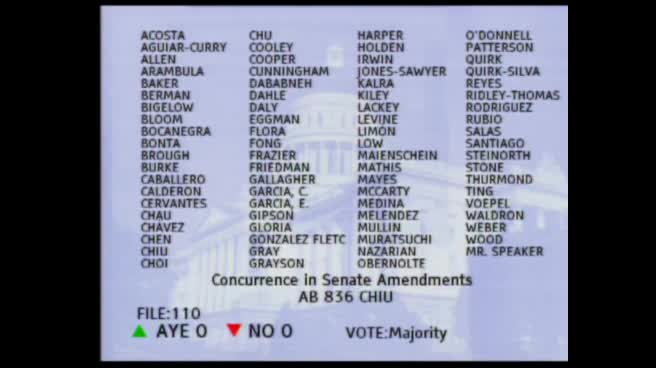 51SEC
Assembly Floor
 2MIN
Senate Floor
 1MIN
Assembly Floor
 3MIN
Assembly Standing Committee on Judiciary
Bill Author

Bill Co-Author(s):