AB 1354: Pupil instruction: repeal of programs.
- Session Year: 2017-2018
- House: Assembly
- Latest Version Date: 2017-07-24
Existing law requires the Superintendent of Public Instruction to authorize the development of the Bill Bradley Human Relations Pilot Project for teaching a course on human relations and to take specified actions in that regard.
Under existing law, the California International Studies Program is established for purposes of achieving specified goals relating to international studies skills and provides specified funding for program participants.
Under existing law, the Reading First Plan is established to provide grants to eligible local educational agencies to provide reading instruction to pupils in kindergarten and grades 1 to 3, inclusive, and to special education pupils in kindergarten and grades 1 to 12, inclusive.
Under existing law, the Early Warning Program is established for the purpose of allocating grants to local educational agencies to implement specified requirements of the federal No Child Left Behind Act of 2001.
Under existing law, the No Child Left Behind Liaison Team is established to advise the Superintendent and the State Board of Education on matters relating to the implementation of the federal No Child Left Behind Act of 2001.
Under existing law, the Education Technology Grant Act of 2002 is established to provide grants to eligible school districts, county offices of education, and charter schools for purposes of implementing and supporting a system that uses technology to improve pupil academic achievement consistent with specified provisions of the federal No Child Left Behind Act of 2002.
Under existing law, the Educational Improvement Act of 1969 is established to provide entitlements calculated by the Superintendent to eligible school districts for specified educational purposes.
Under existing law, the School Improvement Act of 1970 provides for the establishment of program improvement schools, as defined, throughout the state.
Under existing law, the Education Improvement Incentive Program is established to encourage improvement in public school performance by providing fiscal incentives to motivate teachers and schoolsite administrators to work to increase school performance.
Under existing law, the Demonstration of Restructuring in Public Education is established to provide demonstration grants to applicant school districts to develop and implement policies and procedures that support specified educational objectives.
Under existing law, the State Instructional Materials Fund is established in the State Treasury to annually fund the acquisition of instructional materials.
This bill would repeal all of the above-specified provisions. The bill would also repeal provisions relating to the sunsetting of obsolete programs.
Existing law establishes the Conservation Education Service in the State Department of Education, authorizes the governing board of a school district and specified other entities to apply to the Conservation Education Service for planning and implementation grants for conservation education in accordance with specified requirements, and authorizes the Superintendent to make grants pursuant to those provisions.
This bill would repeal the provisions authorizing grants to be made pursuant to those provisions.
Existing requires the Superintendent of Public Instruction to authorize the development of the Bill Bradley Human Relations Pilot Project for teaching a course on human relations and to take specified actions in that regard.
Under existing law, the California International Studies Program is established for purposes of achieving specified goals relating to international studies skills and provides specified funding for program participants.
Under existing law, the Reading First Plan is established to provide grants to eligible local educational agencies to provide reading instruction to pupils in kindergarten and grades 1 to 3, inclusive, and to special education pupils in kindergarten and grades 1 to 12, inclusive.
Under existing law, the Early Warning Program is established for the purpose of allocating grants to local educational agencies to implement specified requirements of the federal No Child Left Behind Act of 2001.
Under existing law, the No Child Left Behind Liaison Team is established to advise the Superintendent and the State Board of Education on matters relating to the implementation of the federal No Child Left Behind Act of 2001.
Under existing law, the Education Technology Grant Act of 2002 is established to provide grants to eligible school districts, county offices of education, and charter schools for purposes of implementing and supporting a system that uses technology to improve pupil academic achievement consistent with specified provisions of the federal No Child Left Behind Act of 2002.
Under existing law, the Educational Improvement Act of 1969 is established to provide entitlements calculated by the Superintendent to eligible school districts for specified educational purposes.
Under existing law, the School Improvement Act of 1970 provides for the establishment of program improvement schools, as defined, throughout the state.
Under existing law, the Education Improvement Incentive Program is established to encourage improvement in public school performance by providing fiscal incentives to motivate teachers and schoolsite administrators to work to increase school performance.
Under existing law, the Demonstration of Restructuring in Public Education is established to provide demonstration grants to applicant school districts to develop and implement policies and procedures that support specified educational objectives.
Under existing law, the State Instructional Materials Fund is established in the State Treasury to annually fund the acquisition of instructional materials.
This bill would repeal all of the above-specified provisions. The bill would also repeal provisions relating to the sunsetting of obsolete programs.
Existing law establishes the Conservation Education Service in the State Department of Education, authorizes the governing board of a school district and specified other entities to apply to the Conservation Education Service for planning and implementation grants for conservation education in accordance with specified requirements, and authorizes the Superintendent to make grants pursuant to those provisions.
This bill would repeal the provisions authorizing grants to be made pursuant to those provisions.
Existing requires the Superintendent of Public Instruction to authorize the development of the Bill Bradley Human Relations Pilot Project for teaching a course on human relations and to take specified actions in that regard, including recommending a human relations course curriculum to the State Board of Education. regard.
Under existing law, the California International Studies Program is established for purposes of achieving specified goals relating to international studies skills and provides specified funding for program participants.
Under existing law, the Reading First Plan is established to provide grants to eligible local educational agencies to provide reading instruction to pupils in kindergarten and grades 1 to 3, inclusive, and to special education pupils in kindergarten and grades 1 to 12, inclusive.
Under existing law, the Early Warning Program is established for the purpose of allocating grants to local educational agencies to implement specified requirements of the federal No Child Left Behind Act of 2001.
Under existing law, the No Child Left Behind Liaison Team is established to advise the Superintendent and the State Board of Education on matters relating to the implementation of the federal No Child Left Behind Act of 2001.
Under existing law, the Education Technology Grant Act of 2002 is established to provide grants to eligible school districts, county offices of education, and charter schools for purposes of implementing and supporting a system that uses technology to improve pupil academic achievement consistent with specified provisions of the federal No Child Left Behind Act of 2002.
Under existing law, the Educational Improvement Act of 1969 is established to provide entitlements calculated by the Superintendent to eligible school districts for specified educational purposes.
Under existing law, the School Improvement Act of 1970 provides for the establishment of program improvement schools, as defined, throughout the state.
Under existing law, the Education Improvement Incentive Program is established to encourage improvement in public school performance by providing fiscal incentives to motivate teachers and schoolsite administrators to work to increase school performance.
Under existing law, the Demonstration of Restructuring in Public Education is established to provide demonstration grants to applicant school districts to develop and implement policies and procedures that support specified educational objectives.
Under existing law, the State Instructional Materials Fund is established in the State Treasury to annually fund the acquisition of instructional materials.
This bill would repeal those all of the above-specified provisions. The bill would also repeal provisions relating to the sunsetting of obsolete programs.
Existing law establishes the Conservation Education Service in the State Department of Education, authorizes the governing board of a school district and specified other entities to apply to the Conservation Education Service for planning and implementation grants for conservation education in accordance with specified requirements, and authorizes the Superintendent to make grants pursuant to those provisions.
This bill would repeal the provisions authorizing grants to be made pursuant to those provisions.
Existing requires the Superintendent of Public Instruction to authorize the development of the Bill Bradley Human Relations Pilot Project for teaching a course on human relations and to take specified actions in that regard, including recommending a human relations course curriculum to the State Board of Education.
This bill would repeal those provisions.
Existing law establishes the Conservation Education Service in the State Department of Education, authorizes the governing board of a school district and specified other entities to apply to the Conservation Education Service for planning and implementation grants for conservation education in accordance with specified requirements, and authorizes the Superintendent to make grants pursuant to those provisions.
This bill would repeal the provisions authorizing grants to be made pursuant to those provisions.
|
Date
|
Status
|
|---|---|
| Jul 24, 2017 | Chaptered by Secretary of State - Chapter 130, Statutes of 2017. |
| Jul 24, 2017 | Approved by the Governor. |
| Jul 13, 2017 | Enrolled and presented to the Governor at 3 p.m. |
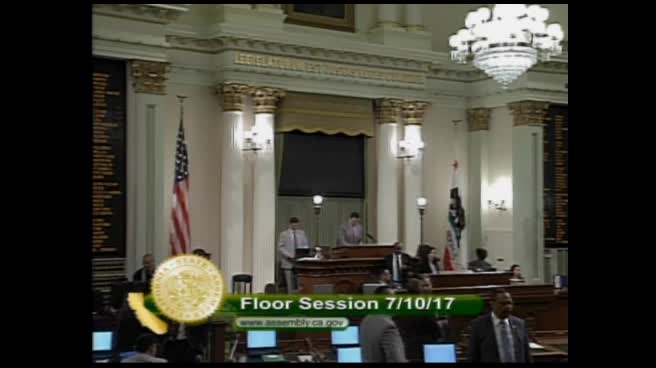
| Jul 10, 2017 | Senate amendments concurred in. To Engrossing and Enrolling. (Ayes 77. Noes 0. Page 2496.). |
| Jul 3, 2017 | In Assembly. Concurrence in Senate amendments pending. May be considered on or after July 5 pursuant to Assembly Rule 77. |
| Jul 3, 2017 | Read third time. Passed. Ordered to the Assembly. |
| Jun 27, 2017 | Read second time. Ordered to Consent Calendar. |
| Jun 26, 2017 | From committee: Be placed on second reading file pursuant to Senate Rule 28.8 and ordered to consent calendar. |
| Jun 14, 2017 | Read second time and amended. Re-referred to Com. on APPR. |
| Jun 13, 2017 | From committee: Amend, and do pass as amended and re-refer to Com. on APPR. with recommendation: To Consent Calendar. (Ayes 7. Noes 0.) (June 7). |
| May 25, 2017 | From committee chair, with author's amendments: Amend, and re-refer to committee. Read second time, amended, and re-referred to Com. on ED. |
| May 10, 2017 | Referred to Com. on ED. |
| Apr 20, 2017 | In Senate. Read first time. To Com. on RLS. for assignment. |
| Apr 20, 2017 | Read third time. Passed. Ordered to the Senate. (Ayes 74. Noes 0. Page 1145.) |
| Apr 6, 2017 | Read second time. Ordered to Consent Calendar. |
| Apr 5, 2017 | From committee: Do pass. To Consent Calendar. (Ayes 17. Noes 0.) (April 5). |
| Mar 23, 2017 | From committee: Do pass and re-refer to Com. on APPR. with recommendation: To Consent Calendar. (Ayes 7. Noes 0.) (March 22). Re-referred to Com. on APPR. |
| Mar 13, 2017 | Referred to Com. on ED. |
| Feb 19, 2017 | From printer. May be heard in committee March 21. |
| Feb 17, 2017 | Read first time. To print. |
|
Date
|
Description
|
Location
|
Votes
|
|
|---|---|---|---|---|
| Jul 10, 2017 | AB 1354 KILEY Concurrence in Senate Amendments | Assembly Floor |
Passed |
|
| Jul 3, 2017 | Consent Calendar 2nd AB1354 | Senate Floor |
Passed |
|
| Jun 7, 2017 | Do pass as amended, but first amend, and re-refer to the Committee on [Appropriations] with the recommendation: To Consent Calendar | Senate Standing Committee on Education |
Passed |
|
| Apr 20, 2017 | Quorum, Second Reading | Assembly Floor |
Passed |
|
| Apr 5, 2017 | Do pass. To Consent Calendar. | Assembly Standing Committee on Appropriations |
Passed |
|
| Mar 22, 2017 | Do pass and be re-referred to the Committee on [Appropriations] with recommendation: To Consent Calendar | Assembly Standing Committee on Education |
Passed |
This list shows positions taken on this bill by organizations on the date displayed, which is linked to the original source.
Positions by individuals are not included.
|
Organization
|
Position
|
Date
|
|---|---|---|
| California School Boards Association | ** Support | Jun 27, 2017 |
CONCURRENCE IN SENATE AMENDMENTS
CSA1 Bill Id:AB 1354
Author:(Kiley)
As Amended Ver:June 14, 2017
Majority vote
ASSEMBLY: | 74-0 | (April 20, 2017) | SENATE: | 33-0 | (July 3, 2017) |
Original Committee Reference: ED.
SUMMARY: Deletes provisions of the Education Code that have been rendered inoperative or obsolete by the adoption of the Local Control Funding Formula (LCFF).
The Senate amendments repeal statutory provisions related to the following programs:
- The California International Studies Program
- The Reading First Plan
- The Early Warning Program
- The No Child Left Behind Liaison Team
- The Education Technology Grant Act of 2002
- The Educational Improvement Act of 1969
- The School Improvement Act of 1970
- The Education Incentive Improvement Program
- The Demonstration of Restructuring in Public Education
- The State Instructional Materials Fund
- The Evaluation and Sunsetting of Programs
FISCAL EFFECT: According to the Assembly Appropriations Committee, this bill has no fiscal effect
COMMENTS: The enactment of the LCFF resulted in the elimination of nearly all K-12 categorical programs. The purpose of this bill is to "clean up" the Education Code by repealing provisions related to extinct programs.
Analysis Prepared by: Rick Pratt / ED. / (916) 319-2087 FN: 0001080
Office of Senate Floor Analyses (916) 651-1520 Fax: (916) 327-4478 | AB |
CONSENT
Bill No: AB 1354
:
SENATE EDUCATION COMMITTEE: 7-0, 6/7/17
AYES: Allen, Wilk, Galgiani, Leyva, Mendoza, Pan, Vidak
SENATE APPROPRIATIONS COMMITTEE: Senate Rule 28.8
ASSEMBLY FLOOR: 74-0, 4/20/17 (Consent) - See last page for vote
SOURCE: California School Boards Association
DIGEST:
This bill repeals sections of the Education Code that establish programs that are no longer funded and are obsolete.
ANALYSIS: Existing law continues implementation of the Local Control Funding Formula (LCFF), which was enacted as part of the 2013-14 Budget Act. The LCFF was a significant reform to the state’s system of financing K-12 public schools. It replaces the prior system of revenue limits and restricted funding for a multitude of categorical programs with a new funding formula that provides targeted base funding levels tied to four grade spans for the core educational needs of all students and supplemental funding for the additional educational needs of low-income students, English learners, and foster youth. Because the LCFF funds have limited spending restrictions, local education agencies (LEAs) have considerable flexibility to direct LCFF resources to best meet their students’ needs. (Education Code § 42238 et seq.)
This bill repeals sections of the Education Code that establish programs that are no longer funded and are obsolete. Specifically, this bill repeals provisions that:
- Require the Superintendent of Public Instruction (SPI) to authorize the development of the Bill Bradley Human Relations Pilot Project for teaching a course on human relations. (EC § 280 et seq.)
- Establish the Conservation Education Service in the California Department of Education (CDE), authorize the governing board of a school district and specified other entities to apply to the Conservation Education Service for planning and implementation grants for conservation education in accordance with specified requirements, and authorize the Superintendent to make grants pursuant to those provisions. (EC § 8750 et seq.)
- Establish the California International Studies Program for purposes of achieving specified goals relating to international studies skills and provides specified funding for program participants. (EC § 44780 et seq.)
- Establish the Reading First Plan to provide grants to eligible LEAs to provide reading instruction to pupils in kindergarten and grades 1 to 3, inclusive, and to special education pupils in kindergarten and grades 1 to 12, inclusive. (EC § 51700 et seq.)
- Establish the Early Warning Program for the purpose of allocating grants to LEAs to implement specified requirements of the federal No Child Left Behind Act of 2001. (EC § 52055.57 et seq.)
- Establish the No Child Left Behind Liaison Team to advise the SPI and the State Board of Education (SBE) on matters relating to the implementation of the federal No Child Left Behind Act of 2001. (EC § 52058.1 et seq.)
- Establish the Education Technology Grant Act of 2002 to provide grants to eligible school districts, county offices of education, and charter schools for purposes of implementing and supporting a system that uses technology to improve pupil academic achievement consistent with specified provisions of the federal No Child Left Behind Act of 2001. (EC § 52295.10 et seq.)
- Establish the Educational Improvement Act of 1969 to provide entitlements calculated by the SPI to eligible school districts for specified educational purposes. (EC § 54600 et seq.)
- Establish the Educational Improvement Act of 1969 to provide entitlements calculated by the SPI to eligible school districts for specified educational purposes. (EC § 54630 et seq.)
- Establish the Education Improvement Incentive Program to encourage improvement in public school performance by providing fiscal incentives to motivate teachers and schoolsite administrators to work to increase school performance. (EC § 54650 et seq.)
- Establish the Demonstration of Restructuring in Public Education to provide demonstration grants to applicant school districts to develop and implement policies and procedures that support specified educational objectives. (EC § 58900 et seq.)
- Specifies that local staff development and teacher education and computer center programs shall sunset on January 1, 1990. (EC §§ 62000.1 and 62000.2)
- Establish the State Instructional Materials Fund in the State Treasury to annually fund the acquisition of instructional materials. (EC § 60240 et seq.)
Comments
- Need for the bill. According to the author, “Under LCFF, school districts receive the bulk of their funding based on average daily attendance. In the past, districts were funded using a combination of revenue limit funding and categorical grants. Categorical fund expenditures at the local level were typically governed by strict statutory requirements.
The LCFF eliminated most categorical programs, rendering associated statutory provisions inoperative. Instead, decision making authority was placed into the hands of local officials, who are best suited to target education funds to where they are needed most in the communities they represent.
AB 1354 removes many of the code sections that were rendered obsolete by the enactment of LCFF. This removal cleans up and clarifies the Education Code, making its interpretation and understanding easier for school districts and citizens. As policymakers, it is our responsibility not just to enact law, but to ensure it is accessible and understandable to our constituents. This bill helps us carry out this responsibility.”
- Additional Background of the LCFF. Although local educational agencies have considerably more flexibility in how they spend their resources under LCFF compared to the previous funding system, the law requires a school district, county office of education, or charter school:
“...to increase or improve services for unduplicated pupils [low-
income students, English learners, and foster youth] in proportion to
the increase in funds apportioned on the basis of the number and
concentration of unduplicated pupils in the school district, county
office of education, or charter school.” (EC § 42238.07)
Under the old system, revenue limits provided LEAs with discretionary (unrestricted) funding for general education purposes, and categorical program (restricted) funding was provided for specialized purposes, with each program having unique allocation and spending requirements. Revenue limits made up about two-thirds of state funding for schools, while categorical program funding made up the remaining one-third portion. For some time, that system was criticized as being too state-driven, bureaucratic, complex, inequitable, and based on outdated allocation methods that did not reflect current student needs.
To ensure accountability for LCFF entitlements, the state also mandated that each LEA develop a local control and accountability plan (LCAP) that identifies locally determined goals, actions, services, and expenditures of LCFF funds for each school year in support of the state educational priorities that are specified in statute, as well as any additional local priorities. School district LCAPs are subject to review and approval by county offices of education. Statute established a process for districts to receive technical assistance related to their LCAP. The Superintendent of Public Instruction (SPI) is authorized to intervene in a struggling school district under certain conditions.
Related/Prior Legislation
SB 587 (Emmerson, 2013) was the genesis for a related piece of clean-up legislation, SB 971 (Huff, Chapter 923, Statutes of 2014). SB 587 was amended at the end of session in 2013 to incorporate changes to the Education Code in light of the passage of LCFF. According to Senator Emmerson’s office at the time, SB 587 was to begin the discussion amongst all parties, to achieve consensus, about sections of the Education Code that could possibly be repealed or modified. In the fall of 2013, the Department of Finance, CDE, and Senate legislative staff met multiple times to discuss elements that could be part of SB 587 through a consensus approach. The discussions were intended to ascertain (1) whether the actions proposed were consistent with LCFF, (2) the bill does not impede pending legislation or legislative discussions, (3) the bill did not impact past or pending judicial actions, and (4) determine whether any of the proposed changes could lead to any unintended consequences at either a programmatic, budget or auditing level. SB 587 was never heard by a policy committee.
SB 971 (Huff, Chapter 923, Statutes of 2014) included many of the provisions from SB 587. While the process for determining what sections should remain in law in light of LCFF will likely take multiple pieces of legislation over a period of time, SB 971 was a solid first step in this regard and was chaptered into law.
SB 416 (Huff, Chapter 538, Statutes of 2015) continued this effort and repealed additional provisions of law rendered obsolete by the enactment of LCFF.
SB 1211 (Huff, Chapter 172, Statutes of 2016) continued this effort and repealed additional provisions of law rendered obsolete by the enactment of LCFF.
FISCAL EFFECT: Appropriation: Fiscal Com.: Local:
California School Boards Association (source)
OPPOSITION: (Verified 6/27/17)
None received
ASSEMBLY FLOOR: 74-0, 4/20/17
AYES: Acosta, Aguiar-Curry, Travis Allen, Arambula, Baker, Berman, Bigelow, Bloom, Bocanegra, Bonta, Burke, Caballero, Calderon, Cervantes, Chau, Chávez, Chen, Chiu, Chu, Cooley, Cooper, Cunningham, Dababneh, Dahle, Daly, Eggman, Flora, Fong, Frazier, Friedman, Cristina Garcia, Eduardo Garcia, Gipson, Gloria, Gomez, Gonzalez Fletcher, Gray, Grayson, Harper, Holden, Irwin, Jones-Sawyer, Kalra, Kiley, Lackey, Levine, Limón, Low, Maienschein, Mayes, McCarty, Medina, Melendez, Mullin, Muratsuchi, Nazarian, Obernolte, O'Donnell, Quirk, Quirk-Silva, Reyes, Rodriguez, Rubio, Salas, Santiago, Steinorth, Mark Stone, Thurmond, Ting, Voepel, Waldron, Weber, Wood, Rendon
NO VOTE RECORDED: Brough, Choi, Gallagher, Mathis, Patterson, Ridley-Thomas
6/27/17 17:00:07
**** END ****
SENATE COMMITTEE ON EDUCATION
Senator Benjamin Allen, Chair
2017 - 2018 Regular
Bill No: AB 1354 Hearing Date: June 7, 2017
Author: | |||
Version: | May 25, 2017 | ||
Urgency: | No | Fiscal: | Yes |
Consultant: | Brandon Darnell | ||
Subject: Pupil instruction: repeal of programs.
SUMMARY
This bill repeals sections of the Education Code that establish programs that are no longer funded and are obsolete.
BACKGROUND
Existing law continues implementation of the Local Control Funding Formula (LCFF), which was enacted as part of the 2013-14 Budget Act. The LCFF was a significant reform to the state’s system of financing K-12 public schools. It replaces the prior system of revenue limits and restricted funding for a multitude of categorical programs with a new funding formula that provides targeted base funding levels tied to four grade spans for the core educational needs of all students and supplemental funding for the additional educational needs of low-income students, English learners, and foster youth. Because the LCFF funds have limited spending restrictions, local education agencies (LEAs) have considerable flexibility to direct LCFF resources to best meet their students’ needs. (Education Code § 42238 et seq.)
ANALYSIS
This bill repeals sections of the Education Code that establish programs that are no longer funded and are obsolete. Specifically, this bill repeals provisions that:
1) Require the Superintendent of Public Instruction (SPI) to authorize the development of the Bill Bradley Human Relations Pilot Project for teaching a course on human relations. (EC § 280 et seq.)
2) Establish the Conservation Education Service in the California Department of Education (CDE), authorize the governing board of a school district and specified other entities to apply to the Conservation Education Service for planning and implementation grants for conservation education in accordance with specified requirements, and authorize the Superintendent to make grants pursuant to those provisions. (EC § 8750 et seq.)
3) Establish the California International Studies Program for purposes of achieving specified goals relating to international studies skills and provides specified funding for program participants. (EC § 44780 et seq.)
4) Establish the Reading First Plan to provide grants to eligible local educational agencies (LEAs) to provide reading instruction to pupils in kindergarten and grades 1 to 3, inclusive, and to special education pupils in kindergarten and grades 1 to 12, inclusive. (EC § 51700 et seq.)
5) Establish the Early Warning Program for the purpose of allocating grants to LEAs to implement specified requirements of the federal No Child Left Behind Act of 2001. (EC § 52055.57 et seq.)
6) Establish the No Child Left Behind Liaison Team to advise the Superintendent of Public Instruction (SPI) and the State Board of Education (SBE) on matters relating to the implementation of the federal No Child Left Behind Act of 2001. (EC § 52058.1 et seq.)
7) Establish the Education Technology Grant Act of 2002 to provide grants to eligible school districts, county offices of education, and charter schools for purposes of implementing and supporting a system that uses technology to improve pupil academic achievement consistent with specified provisions of the federal No Child Left Behind Act of 2001. (EC § 52295.10 et seq.)
8) Establish the Educational Improvement Act of 1969 to provide entitlements calculated by the SPI to eligible school districts for specified educational purposes. (EC § 54600 et seq.)
9) Establish the Educational Improvement Act of 1969 to provide entitlements calculated by the SPI to eligible school districts for specified educational purposes. (EC § 54630 et seq.)
10) Establish the Education Improvement Incentive Program to encourage improvement in public school performance by providing fiscal incentives to motivate teachers and schoolsite administrators to work to increase school performance. (EC § 54650 et seq.)
11) Establish the Demonstration of Restructuring in Public Education to provide demonstration grants to applicant school districts to develop and implement policies and procedures that support specified educational objectives.
(EC § 58900 et seq.)
12) Specify that the Miller-Unruh Basic Reading Act of 1965, the school improvement program, and bilingual education shall sunset on June 30, 1987, and that local staff development and teacher education and computer center programs shall sunset on January 1, 1990. (EC §§ 62000.1 and 62000.2)
13) Establish the State Instructional Materials Fund in the State Treasury to annually fund the acquisition of instructional materials. (EC § 60240 et seq.)
STAFF COMMENTS
- Need for the bill. According to the author, “Under LCFF, school districts receive the bulk of their funding based on average daily attendance. In the past, districts were funded using a combination of revenue limit funding and categorical grants. Categorical fund expenditures at the local level were typically governed by strict statutory requirements.
The Local Control Funding Formula (LCFF) eliminated most categorical programs, rendering associated statutory provisions inoperative. Instead, decision making authority was placed into the hands of local officials, who are best suited to target education funds to where they are needed most in the communities they represent.
AB 1354 removes many of the code sections that were rendered obsolete by the enactment of LCFF. This removal cleans up and clarifies the Education Code, making its interpretation and understanding easier for school districts and citizens. As policymakers, it is our responsibility not just to enact law, but to ensure it is accessible and understandable to our constituents. This bill helps us carry out this responsibility.
2) Author’s amendment. The author would like to amend the bill to remove Section 14 (the repeal of Section 62000.2 of the Education Code) from the bill. Staff recommends that the bill should be amended to reflect the author’s proposed amendment.
3) Additional Background of the LCFF. Although local educational agencies have considerably more flexibility in how they spend their resources under LCFF compared to the previous funding system, the law requires a school district, county office of education, or charter school:
“...to increase or improve services for unduplicated pupils [low-
income students, English learners, and foster youth] in proportion to
the increase in funds apportioned on the basis of the number and
concentration of unduplicated pupils in the school district, county
office of education, or charter school.” (EC § 42238.07)
Under the old system, revenue limits provided local educational agencies (LEAs) with discretionary (unrestricted) funding for general education purposes, and categorical program (restricted) funding was provided for specialized purposes, with each program having unique allocation and spending requirements. Revenue limits made up about two-thirds of state funding for schools, while categorical program funding made up the remaining one-third portion. For some time, that system was criticized as being too state-driven, bureaucratic, complex, inequitable, and based on outdated allocation methods that did not reflect current student needs.
To ensure accountability for Local Control Funding Formula (LCFF) entitlements, the state also mandated that each LEA develop a local control and accountability plan (LCAP) that identifies locally determined goals, actions, services, and expenditures of LCFF funds for each school year in support of the state educational priorities that are specified in statute, as well as any additional local priorities. School district LCAPs are subject to review and approval by county offices of education. Statute established a process for districts to receive technical assistance related to their local control and accountability plan (LCAP). The Superintendent of Public Instruction (SPI) is authorized to intervene in a struggling school district under certain conditions.
4) Previous LCFF clean-up legislation. SB 587 (Emmerson, 2013) was the genesis for a related piece of clean-up legislation, SB 971 (Huff, Chapter 923, Statutes of 2014). SB 587 was amended at the end of session in 2013 to incorporate changes to the Education Code in light of the passage of LCFF. According to Senator Emmerson’s office at the time, SB 587 was to begin the discussion amongst all parties, to achieve consensus, about sections of the Education Code that could possibly be repealed or modified. The elements of SB 587 were originally drafted by the Department of Finance (DOF) in an attempt to “clean up” the Education Code; however, these provisions were viewed through the prism of DOF’s perspective on the implementation of LCFF (from DOF’s perspective almost everything was discretionary), and not on the merits of each statute and the underlying intent.
In the Fall of 2013; the Department of Finance, California Department of Education, and Senate legislative staff met multiple times to discuss elements that could be part of SB 587 through a consensus approach. The discussions were intended to ascertain (1) whether the actions proposed were consistent with LCFF, (2) the bill does not impede pending legislation or legislative discussions, (3) the bill did not impact past or pending judicial actions, and (4) determine whether any of the proposed changes could lead to any unintended consequences at either a programmatic, budget or auditing level. SB 587 was never heard by this Committee.
SB 971 was originally introduced by Senator Cannella in 2014 and subsequently authored by Senator Huff. The measure included many of the provisions from SB 587. While the process for determining what sections should remain in law in light of LCFF will likely take multiple pieces of legislation over a period of time, SB 971 was a solid first step in this regard and was chaptered into law.
SB 416 (Huff, Chapter 538, Statutes of 2015) and SB 1211 (Huff, Chapter 172, Statutes of 2016) continued this effort and repealed additional provisions of law rendered obsolete by the enactment of LCFF.
SUPPORT
California School Boards Association
OPPOSITION
None received
-- END --
Date of Hearing: April 5, 2017
ASSEMBLY COMMITTEE ON APPROPRIATIONS
Lorena Gonzalez Fletcher, Chair
ABPCA Bill Id:AB 1354
Author:(Kiley) – As Introduced Ver:February 17, 2017
Policy Committee: | Education | Vote: | 7 - 0 |
Urgency: No State Mandated Local Program: No Reimbursable: No
SUMMARY:
This bill repeals sections of the Education Code that have become obsolete. Specifically, this bill:
- Repeals the Bill Bradley Human Relations Pilot Project.
- Repeals the Grants for Conservation Education Program.
FISCAL EFFECT:
No fiscal effect.
COMMENTS:
- Background. The Bill Bradley Human Relations Pilot and the Grants for Conservation Program were established in 1976. The programs are no longer funded. The Bill Bradley Human Relations Pilot Project authorized the Superintendent of Public Instruction (SPI) to develop and recommend to the State Board of Education (SBE) a curriculum for a course on human relations and to select three districts in which to pilot test the curriculum. Funding is no longer provided for these activities and the social science curriculum frameworks have been updated several times since the project was established to incorporate the same objective of promoting positive interaction among pupils from different racial, religious, and ethnic groups. The Grants for Conservation provided grants to school districts, public colleges and universities, and other local government agencies to fund conservation education, pre- and in-service training in conservation education for teachers and cooperative conservation education programs between schools and cities and counties. The enactment of the Local Control Funding Formula (LCFF) resulted in the need to repeal Education Code provisions that related to education programs that the LCFF eliminated.
Analysis Prepared by: Daisy Gonzales / APPR. / (916) 319-2081
Date of Hearing: March 22, 2017
ASSEMBLY COMMITTEE ON EDUCATION
Patrick O'Donnell, Chair
ABPCA Bill Id:AB 1354 (
Author:Kiley) – As Introduced Ver:February 17, 2017
SUBJECT: Pupil instruction: human relations: conservation education
SUMMARY: Repeals sections of the Education Code that have become obsolete. Specifically, this bill:
- Repeals the Bill Bradley Human Relations Pilot Project.
- Repeals the Grants for Conservation Education program.
FISCAL EFFECT: Unknown
COMMENTS: This bill repeals two sections of the Education Code that establish programs that are no longer funded and are obsolete. The Bill Bradley Human Relations Pilot Project was established in 1976 and authorizes the Superintendent of Public Instruction (SPI) to develop and recommend to the State Board of Education (SBE) a curriculum for a course on human relations and to select three districts in which to pilot test the curriculum. Funding is no longer provided for these activities and the social science curriculum frameworks have been updated several times since the project was established to incorporate the same objective of promoting positive interaction among pupils from different racial, religious, and ethnic groups.
The Grants for Conservation program, which was established in 1976, provided grants to school districts, public colleges and universities, and other local government agencies to fund conservation education, pre- and in-service training in conservation education for teachers, and cooperative conservation education programs between schools and cities and counties. This program is no longer funded.
Related legislation. The enactment of the Local Control Funding Formula (LCFF) resulted in the need to repeal Education Code provisions that related to education programs that the LCFF eliminated. Prior legislation includes SB 971 (Huff), Chapter 923, Statutes of 2014, SB 416 (Huff), Chapter 538, Statutes of 2015, and SB 1211 (Huff), Chapter 172, Statutes of 2016.
REGISTERED SUPPORT / OPPOSITION:
Support
None received
Opposition
None received
Analysis Prepared by: Rick Pratt / ED. / (916) 319-2087
Bill Author

Bill Co-Author(s):