AB 1378: Tribal gaming: compact ratification.
- Session Year: 2017-2018
- House: Assembly
- Latest Version Date: 2017-10-03
Existing federal law, the Indian Gaming Regulatory Act of 1988, provides for the negotiation and execution of tribal-state gaming compacts for the purpose of authorizing certain types of gaming on Indian lands within a state. The California Constitution authorizes the Governor to negotiate and conclude tribal-state gaming compacts, subject to ratification by the Legislature. Existing law expressly ratifies a number of tribal-state gaming compacts, and amendments of tribal-state gaming compacts, between the State of California and specified Indian tribes.
The California Environmental Quality Act (CEQA) requires a lead agency to prepare, or cause to be prepared, and certify the completion of, an environmental impact report on a project, as defined, that it proposes to carry out or approve that may have a significant effect on the environment, as defined, or to adopt a negative declaration if it finds that the project will not have that effect.
This bill would ratify the amendment to the tribal-state gaming compact entered into between the State of California and the San Manuel Band of Mission Indians executed on August 18, 2017. The bill would provide that, in deference to tribal sovereignty, certain actions related to that amended compact are not projects for purposes of CEQA.
This bill would declare that it is to take effect immediately as an urgency statute.
The Gambling Control Act provides for the licensure and regulation of various legalized gambling activities and establishments by the California Gambling Control Commission and the investigation and enforcement of those activities and establishments by the Department of Justice. Existing law authorizes the commission, for any cause deemed reasonable by the commission, to deny any application for a license, permit, or approval, to limit, condition, or restrict any license, permit, or approval, or to impose any fine upon any person licensed or approved. For purposes of the act, existing law defines applicant as any person who has applied for, or is about to apply for, a state gambling license, or other licenses, permits, or approvals, as specified.This bill would revise the definition of applicant to no longer include a person who is about to apply for a state gambling license, or other licenses, permits, or approvals, as specified.The Gambling Control Act provides for the licensure and regulation of various legalized gambling activities and establishments by the California Gambling Control Commission and the investigation and enforcement of those activities and establishments by the Department of Justice. Existing law authorizes the commission, for any cause deemed reasonable by the commission, to deny any application for a license, permit, or approval, to limit, condition, or restrict any license, permit, or approval, or to impose any fine upon any person licensed or approved. For purposes of the act, existing law defines applicant as any person who has applied for, or is about to apply for, a state gambling license, or other licenses, permits, or approvals, as specified.
This bill would revise the definition of applicant to no longer include a person who is about to apply for a state gambling license, or other licenses, permits, or approvals, as specified.
(a)The amendment to the tribal-state gaming compact entered into in accordance with the federal Indian Gaming Regulatory Act of 1988 (18 U.S.C. Secs. 1166 to 1168, inclusive, and 25 U.S.C. Sec. 2701 et seq.) between the State of California and the San Manuel Band of Mission Indians, executed on August 18, 2017, is hereby ratified.
(b)(1)In deference to tribal sovereignty, none of the following shall be deemed a project for purposes of the California Environmental Quality Act (Division 13 (commencing with Section 21000) of the Public Resources Code):
(A)The execution of an amendment to the tribal-state gaming compact ratified by this section.
(B)The execution of the amended tribal-state gaming compact ratified by this section.
(C)The execution of an intergovernmental agreement between a tribe and a county or city government negotiated pursuant to the express authority of, or as expressly referenced in, the amended tribal-state gaming compact ratified by this section.
(D)The execution of an intergovernmental agreement between a tribe and the Department of Transportation, or other state agency, negotiated pursuant to the express authority of, or as expressly referenced in, the amended tribal-state gaming compact ratified by this section.
(E)The on-reservation impacts of compliance with the terms of the amended tribal-state gaming compact ratified by this section.
(2)Except as expressly provided in this section, this subdivision does not exempt a city, county, or city and county, or the Department of Transportation, or any state agency or local jurisdiction, from the requirements of the California Environmental Quality Act.
SEC. 2.This act is an urgency statute necessary for the immediate preservation of the public peace, health, or safety within the meaning of Article IV of the California Constitution and shall go into immediate effect. The facts constituting the necessity are:
In order to enhance the economic development, stability, and self-sufficiency of the San Manuel Band of Mission Indians, and to protect the interests of the tribe and its members, the surrounding community, and the California public at the earliest possible time, it is necessary that this act take effect immediately.
All matter omitted in this version of the bill appears in the bill as introduced in the Assembly, February 17, 2017. (JR11)As used in this chapter, the following definitions shall apply:
(a)Affiliate means a person who, directly or indirectly through one or more intermediaries, controls, is controlled by, or is under common control with, a specified person.
(b)Applicant means any person who has applied for, or is about to apply for, for a state gambling license, a key employee license, a registration, a finding of suitability, a work permit, a manufacturers or distributors license, or an approval of any act or transaction for which the approval or authorization of the commission or department is required or permitted under this chapter.
(c)Banking game or banked game does not include a controlled game if the published rules of the game feature a player-dealer position and provide that this position must be continuously and systematically rotated amongst each of the participants during the play of the game, ensure that the player-dealer is able to win or lose only a fixed and limited wager during the play of the game, and preclude the house, another entity, a player, or an observer from maintaining or operating as a bank during the course of the game. For purposes of this section, it is not the intent of the Legislature to mandate acceptance of the deal by every player if the department finds that the rules of the game render the maintenance of or operation of a bank impossible by other means. The house shall not occupy the player-dealer position.
(d)Chief means the head of the entity within the department that is responsible for fulfilling the obligations imposed upon the department by this chapter.
(e)Commission means the California Gambling Control Commission.
(f)Controlled gambling means to deal, operate, carry on, conduct, maintain, or expose for play any controlled game.
(g)Controlled game means any controlled game, as defined by subdivision (e) of Section 337j of the Penal Code.
(h)Department means the Department of Justice.
(i)Director means any director of a corporation or any person performing similar functions with respect to any organization.
(j)Finding of suitability means a finding that a person meets the qualification criteria described in subdivisions (a) and (b) of Section 19857, and that the person would not be disqualified from holding a state gambling license on any of the grounds specified in Section 19859.
(k)Game and gambling game means any controlled game.
(l)Gambling means to deal, operate, carry on, conduct, maintain, or expose for play any controlled game.
(m)Gambling enterprise means a natural person or an entity, whether individual, corporate, or otherwise, that conducts a gambling operation and that by virtue thereof is required to hold a state gambling license under this chapter.
(n)Gambling enterprise employee means any natural person employed in the operation of a gambling enterprise, including, without limitation, dealers, floor personnel, security employees, countroom personnel, cage personnel, collection personnel, surveillance personnel, data-processing personnel, appropriate maintenance personnel, waiters and waitresses, and secretaries, or any other natural person whose employment duties require or authorize access to restricted gambling establishment areas.
(o)Gambling establishment, establishment, or licensed premises, except as otherwise defined in Section 19812, means one or more rooms where any controlled gambling or activity directly related thereto occurs.
(p)Gambling license or state gambling license means any license issued by the state that authorizes the person named therein to conduct a gambling operation.
(q)Gambling operation means exposing for play one or more controlled games that are dealt, operated, carried on, conducted, or maintained for commercial gain.
(r)Gross revenue means the total of all compensation received for conducting any controlled game, and includes interest received in payment for credit extended by an owner licensee to a patron for purposes of gambling, except as provided by regulation.
(s)Hours of operation means the period during which a gambling establishment is open to conduct the play of controlled games within a 24-hour period. In determining whether there has been expansion of gambling relating to hours of operation, the department shall consider the hours in the day when the local ordinance permitted the gambling establishment to be open for business on January 1, 1996, and compare the current ordinance and the hours during which the gambling establishment may be open for business. The fact that the ordinance was amended to permit gambling on a day, when gambling was not permitted on January 1, 1996, shall not be considered in determining whether there has been gambling in excess of that permitted by Section 19961.
(t)House means the gambling enterprise, and any owner, shareholder, partner, key employee, or landlord thereof.
(u)Independent agent, except as provided by regulation, means any person who does either of the following:
(1)Collects debt evidenced by a credit instrument.
(2)Contracts with an owner licensee, or an affiliate thereof, to provide services consisting of arranging transportation or lodging for guests at a gambling establishment.
(v)Initial license means the license first issued to a person authorizing that person to commence the activities authorized by that license.
(w)Institutional investor means any retirement fund administered by a public agency for the exclusive benefit of federal, state, or local public employees, any investment company registered under the Investment Company Act of 1940 (15 U.S.C. Sec. 80a-1 et seq.), any collective investment trust organized by banks under Part Nine of the Rules of the Comptroller of the Currency, any closed-end investment trust, any chartered or licensed life insurance company or property and casualty insurance company, any banking and other chartered or licensed lending institution, any investment advisor adviser registered under the Investment Advisors Advisers Act of 1940 (15 U.S.C. Sec. 80b-1 et seq.) acting in that capacity, and other persons as the commission may determine for reasons consistent with the policies of this chapter.
(x)Key employee means any natural person employed in the operation of a gambling enterprise in a supervisory capacity or empowered to make discretionary decisions that regulate gambling operations, including, without limitation, pit bosses, shift bosses, credit executives, cashier operations supervisors, gambling operation managers and assistant managers, managers or supervisors of security employees, or any other natural person designated as a key employee by the department for reasons consistent with the policies of this chapter.
(y)Key employee license means a state license authorizing the holder to be employed as a key employee.
(z)License means a gambling license, key employee license, or any other license issued by the commission pursuant to this chapter or regulations adopted pursuant to this chapter.
(aa)Licensed gambling establishment means the gambling premises encompassed by a state gambling license.
(ab)Limited partnership means a partnership formed by two or more persons having as members one or more general partners and one or more limited partners.
(ac)Limited partnership interest means the right of a general or limited partner to any of the following:
(1)To receive from a limited partnership any of the following:
(A)A share of the revenue.
(B)Any other compensation by way of income.
(C)A return of any or all of his or her contribution to capital of the limited partnership.
(2)To exercise any of the rights provided under state law.
(ad)Owner licensee means an owner of a gambling enterprise who holds a state gambling license.
(ae)Person, unless otherwise indicated, includes a natural person, corporation, partnership, limited partnership, trust, joint venture, association, or any other business organization.
(af)Player means a patron of a gambling establishment who participates in a controlled game.
(ag)Player-dealer and controlled game featuring a player-dealer position refer to a position in a controlled game, as defined by the approved rules for that game, in which seated player participants are afforded the temporary opportunity to wager against multiple players at the same table, provided that this position is rotated amongst the other seated players in the game.
(ah)Publicly traded racing association means a corporation licensed to conduct horse racing and simulcast wagering pursuant to Chapter 4 (commencing with Section 19400) whose stock is publicly traded.
(ai)Qualified racing association means a corporation licensed to conduct horse racing and simulcast wagering pursuant to Chapter 4 (commencing with Section 19400) that is a wholly owned subsidiary of a corporation whose stock is publicly traded.
(aj)Renewal license means the license issued to the holder of an initial license that authorizes the license to continue beyond the expiration date of the initial license.
(ak)Work permit means any card, certificate, or permit issued by the commission, or by a county, city, or city and county, whether denominated as a work permit, registration card, or otherwise, authorizing the holder to be employed as a gambling enterprise employee or to serve as an independent agent. A document issued by any governmental authority for any employment other than gambling is not a valid work permit for the purposes of this chapter.
|
Date
|
Status
|
|---|---|
| Oct 3, 2017 | Chaptered by Secretary of State - Chapter 450, Statutes of 2017. |
| Oct 3, 2017 | Approved by the Governor. |
| Sep 13, 2017 | Enrolled and presented to the Governor at 4 p.m. |
| Sep 8, 2017 | Senate amendments concurred in. To Engrossing and Enrolling. |
| Sep 8, 2017 | Urgency clause adopted. Senate amendments concurred in. To Engrossing and Enrolling. (Ayes 79. Noes 0. Page 3068.). |
| Sep 6, 2017 | In Assembly. Concurrence in Senate amendments pending. May be considered on or after September 8 pursuant to Assembly Rule 77. |
| Sep 6, 2017 | Read third time. Urgency clause adopted. Passed. Ordered to the Assembly. |
| Sep 6, 2017 | Read third time. Urgency clause adopted. Passed. Ordered to the Assembly. (Ayes 40. Noes 0. Page 2499.). |
| Sep 5, 2017 | Read second time. Ordered to third reading. |
| Aug 31, 2017 | From committee chair, with author's amendments: Amend, and re-refer to committee. Read second time, amended, and re-referred to Com. on RLS. |
| Sep 1, 2017 | Withdrawn from committee. |
| Aug 31, 2017 | Re-referred to Com. on RLS. |
| Jun 15, 2017 | From Consent Calendar. |
| Jun 14, 2017 | Read second time. Ordered to Consent Calendar. |
| Jun 13, 2017 | From committee: Do pass. To Consent Calendar. (Ayes 12. Noes 0.) (June 13). |
| May 24, 2017 | Referred to Com. on G.O. |
| May 11, 2017 | In Senate. Read first time. To Com. on RLS. for assignment. |
| May 11, 2017 | Read third time. Passed. Ordered to the Senate. (Ayes 77. Noes 0. Page 1491.) |
| May 8, 2017 | Read second time. Ordered to Consent Calendar. |
| May 4, 2017 | From committee: Do pass. To Consent Calendar. (Ayes 20. Noes 0.) (May 3). |
| Mar 16, 2017 | Referred to Com. on G.O. |
| Feb 19, 2017 | From printer. May be heard in committee March 21. |
| Feb 17, 2017 | Read first time. To print. |
|
Date
|
Description
|
Location
|
Votes
|
|
|---|---|---|---|---|
| Sep 8, 2017 | AB 1378 GRAY Concurrence - Urgency Added | Assembly Floor |
Passed |
|
| Sep 6, 2017 | Assembly 3rd Reading AB1378 Gray By Lara Urgency Clause | Senate Floor |
Passed |
|
| Jun 13, 2017 | Do pass and be ordered to the Consent Calendar | Senate Standing Committee on Governmental Organization |
Passed |
|
| May 11, 2017 | AB 1378 GRAY Consent Calendar Second Day Regular Session | Assembly Floor |
Passed |
|
| May 3, 2017 | Do pass. To Consent Calendar. | Assembly Standing Committee on Governmental Organization |
Passed |
This list shows positions taken on this bill by organizations on the date displayed, which is linked to the original source.
Positions by individuals are not included.
CONCURRENCE IN SENATE AMENDMENTS
CSA1 Bill Id:AB 1378
Author:(Gray)
As Amended Ver:August 31, 2017
2/3 vote. Urgency
ASSEMBLY: | 77-0 | (May 11, 2017) | SENATE: | 40-0 | (September 6, 2017) |
Original Committee Reference: G.O.
SUMMARY: Ratifies an amendment to the tribal-state gaming compact entered into between the State of California (State) and the San Manuel Band of Mission Indians (Tribe), executed on August 18, 2017. Additionally, this bill provides that, in deference to tribal sovereignty, certain actions are not deemed projects for purposes of the California Environmental Quality Act (CEQA); and, stipulates, except as expressly provided, that none of the provisions shall be construed to exempt a city, county, or city and county, or the Department of Transportation from CEQA requirements.
The Senate amendments delete the Assembly version of this bill, and instead:
- Ratify an amendment to the tribal-state gaming compact (Compact amendment), executed on August 18, 2017, between the State of California and the San Manuel Band of Mission Indians pursuant to the federal Indian Gaming Regulatory Act of 1988 (IGRA) and section 15.1 of the Tribal-State Compact between the State and the Tribe (2016 Compact).
- Resolve ambiguity with regard to the use of certain existing tribal trust land under the provisions of the 2016 Compact between the State and the Tribe. The amendment modifies one section of the existing 2016 Compact dealing with a parcel of land immediately adjacent to the San Manuel Casino currently used as a parking lot. Generally, the compact definition of "Gaming Facility" is intended to include areas and facilities, like parking lots and potentially hotels, that are intended to support the gaming operation. The purpose of this amendment is to clarify the status of this parcel to allow for its continued use as a parking lot or any use other than actual gaming activities.
- All other provisions of the Tribe's existing 2016 Compact remain intact for 25 years (2041) following its effective date.
- Provide that, in deference to tribal sovereignty, certain actions are not deemed projects for purposes of the CEQA; and, stipulate, except as expressly provided, that none of the provisions shall be construed to exempt a city, county, or city and county, or the Department of Transportation from CEQA requirements.
- Make minor technical and conforming changes.
- Contain an urgency clause, allowing this bill to take effect immediately upon enactment.
EXISTING LAW:
- Provides, under the Indian Gaming Regulatory Act (IGRA), for the negotiation and conclusion of compacts between federally recognized Indian tribes and the State for the purpose of conducting Class III gaming activities on Indian lands within a State as a means of promoting tribal economic development, self-sufficiency, and strong tribal governments.
- Authorizes expressly a number of tribal-state gaming compacts between the State of California and specified Indian tribes.
- Authorizes the conduct of Class III gaming activities to the extent such activities are permitted by state law, a gaming compact has been concluded by a federally recognized tribe and the State, and the compact has been approved by the Secretary of the Interior.
- Limits the operation of Class III gaming activities to Indian lands acquired on or before October 17, 1988. Provides exceptions to conduct gaming activities on Indian lands acquired after October 17, 1988.
- Defines Indian lands to mean all lands within the limits of any Indian reservation, and any lands title to which is either held in trust by the United States (U.S.) for the benefit of any Indian tribe, or individual, or held by any Indian tribe or individual subject to restriction by the U.S. against alienation and over which an Indian tribe exercises governmental power.
- Requires the State to negotiate to conclude a compact in good faith with an Indian tribe having jurisdiction over the Indian lands upon which the Class III gaming activity is to be conducted. Provides the U.S. district courts with jurisdiction over any cause of action initiated by a tribal government alleging that the State failed to negotiate in good faith to conclude a compact. Prescribes the remedy, mediation supervised by the courts, if it is found that the State failed to negotiate in good faith to conclude a compact.
- Authorizes the Governor, under the California Constitution, to negotiate and conclude compacts, subject to ratification by the Legislature.
FISCAL EFFECT: Unknown
COMMENTS: On August 31, 2017, the Assembly Governmental Organization Committee held an informational hearing on the Compact amendment entered into between the State of California and the San Manuel Band of Mission Indians.
Brief History and Background: The San Manuel Band of Mission Indians is a federally recognized American Indian tribe located near the city of Highland, California. San Manuel is one of several clans of Serrano Indians, who are the indigenous people of the San Bernardino highlands, passes, valleys and mountains who share a common language and culture. The San Manuel reservation was established in 1891 and recognized as a sovereign nation with the right of self-government. The reservation is named after Santos Manuel, a former tribal leader, and consists of just over 900 acres of mostly mountainous land. There are more than 200 tribal members enrolled in the Tribe.
This will be the fourth compact between the Tribe and the State. In 1999, the Tribe and the State entered into a compact to enable the Tribe to achieve economic self-reliance, provide essential services to its citizens, and build a strong tribal government; to initiate a new era of tribal-state cooperation in areas of mutual concern. On August 28, 2006, Governor Schwarzenegger executed amendments to the 1999 gaming compact between the State and the Tribe. The 2006 amended Compact increased the number of gaming devices the Tribe could operate from 2,000 to 7,500. The Tribe's 2006 amended Compact authorized no more than 7,500 gaming devices; required an annual flat payment of $45 million to the State's general fund, plus an annual payment of 15% of the net win generated from the operation of between 2,000-5,000 gaming devices, plus an annual payment of 25% of the net win generated from the operation of between 5,001-7,500 gaming devices; and, provided for an annual $2 million payment into the RSTF. There was no change to the Tribe's 1999 Tribal Labor Relations Ordinance that provides for secret ballot elections. The 2006 Amended Compact was valid until 2030.
In 2016, the Tribe and the State entered into negotiations to amend the 2006 Amended Compact (SB 941 (Padilla), Chapter 226, Statutes of 2007), which resulted in the 2016 Compact (AB 466 (Brown), Chapter 285, Statutes of 2016). The provisions of the 2016 Compact established or amended existing revenue sharing obligations of the Tribe. Currently, the Tribe pays $29 million to a local community benefit fund, $19 million to the Revenue Sharing Trust Fund/Tribal Nation Grant Fund, as well as its pro rata share plus an additional amount up to $3 million to cover the State's regulatory and problem gambling programs.
The Tribe may establish and operate not more than two gaming facilities and engage in Class III gaming within the Tribe's existing Indian lands. If the Tribe chooses to operate a second gaming facility, it may operate no more than 1,000 gaming devices at that second facility. In addition, the 2016 Compact contained a provision that the terms and conditions may be amended at any time by the mutual and written agreement of both parties (Tribe/State), provided that each party voluntarily consents to such negotiations in writing. Any amendments to the 2016 Compact shall be deemed to supersede, supplant and extinguish all previous understandings and agreements on the subject.
The San Manuel Indian Bingo & Casino, with more than 400,000 square-feet of overall space, includes more than 280,000 square-feet of gaming, which includes a Bingo Hall with more than 1,400 seats; nearly 4,000 gaming devices; more than 80 Table Games; upwards of 40 Poker Tables; and a High Limit Room. The Tribe states that it dedicates significant resources from gaming to various philanthropic causes through its charitable donations to others in the community. Additionally, the Tribe pays millions of dollars to local governments to improve roads, support local municipalities, and fund emergency services. Revenue from the San Manuel Indian Bingo and Casino is used to maintain governmental operations, provide for the general welfare of the Tribe and healthcare needs, supply infrastructure needs such as roads, and to support continued economic development. The Tribe is one of the largest employers in the Inland Empire area with over 3,000 employees.
The Tribe states, "That it works diligently to ensure a solid economic foundation for future generations by investing in diverse and strategic economic ventures, both on and off the reservation. Economic diversification creates ways for the tribe to build a strong economy and contribute to job growth, our surrounding communities, and the long-term self-reliance of our members." For instance, the Tribe owns a commercial real estate investment project near the reservation that includes a hotel and conference center, restaurants, retail space, and offices.
According to the Governor's office, "This 2017 Compact amendment resolves ambiguity with regard to the use of certain existing tribal trust land under the provisions of the 2016 Compact." The 2016 Compact is somewhat ambiguous (status of land) about the land immediately adjacent to the existing casino and whether anything can be built on it, which is physically connected to the gaming facility. To clarify any confusion, the Tribe and Governor negotiated and executed an amendment to the 2016 Compact.
The Compact amendment preamble states, "since 1999, in furtherance of its stated objectives of achieving economic self-reliance, providing essential services to its citizens, building a strong tribal government, improving the environment, educational attainment, and the health, safety, and general welfare of its members and the surrounding communities, and in reliance on the terms and conditions set forth in the 1999 Compact, 2006 Amended Compact, and 2016 Compact, the Tribe has made substantial investments on its trust lands related to the development of its gaming facility and gaming-related infrastructure and amenities, all of which inure to the benefit of the tribal government, its citizens, and the surrounding communities."
The Compact amendment preamble declares, "the State and the Tribe agree that all terms of this amendment to the 2016 Compact (collectively, 2017 Amended Compact) are intended to be binding and enforceable."
Key Components of the Compact Amendment:
Authorized Gaming Facility: The Tribe's gaming facilities may be located only on the Tribe's Indian lands on which Class III gaming may lawfully be conducted under IGRA as those Indian lands exist on the effective date of this Compact. Notwithstanding anything to the contrary in this Compact, including Section 4.2 (Authorized Gaming Facility), subdivision (a) herein, all rooms, buildings, and areas, including hotels, parking lots, and walkways, a principal purpose of which is to serve the activities of the gaming operation and gaming facility rather than providing them with an incidental benefit, and in which no gaming is conducted, may be located on lands held in trust for the Tribe as of the effective date of this 2017 amended Compact which are contiguous to the aforesaid Indian lands.
To ensure that a new gaming facility is on Indian lands that reflect the Tribe's and the State's agreement regarding the Tribe's land that is eligible for that purpose, for those parcels of land taken into trust for the Tribe after October 17, 1988 the Tribe shall, no later than 90 days prior to the commencement of a Project to construct the gaming facility, provide written notice to the State, along with documentation adequate to support the Tribe's determination that the gaming facility will be located on property that is Indian lands eligible for Class III gaming within the meaning of IGRA and this Section 4.2.
The parties shall meet within 30 calendar days of the State's receipt of the Tribe's notice and documentation to confirm that the parcel or parcels were Indian lands eligible for gaming as of the effective date of this Compact. If the State determines that the parcel or parcels do not meet the necessary criteria, or that it has not received documentation adequate for purposes of making that determination, then it may institute the dispute resolution process set forth in Section 13.0 to resolve whether the parcel or parcels meet the requirements of this section.
If the State fails to respond to the Tribe's notice and documentation within 30 days of receipt, refuses to meet, or fails within 15 days after the meeting to initiate the dispute resolution process, then the Tribe may institute the dispute resolution process set forth in Section 13.0 to resolve whether the parcel or parcels meet the requirements of this section before a gaming facility may be constructed thereon.
Representations: The Tribe expressly represents that as of the date of the undersigned's execution of this 2017 amended Compact, the undersigned has the authority to execute this 2017 amended Compact on behalf of the Tribe, including any waiver of sovereign immunity and the right to assert sovereign immunity therein, and will provide written proof of such authority and of the ratification of this 2017 amended Compact by the tribal governing body to the Governor no later than 30 days after the execution of this 2017 amended Compact by the undersigned.
Effective Date: This 2017 Compact amendment does not change the effective date of the 2016 Compact, which is valid for 25 years (2041).
Additional Background Information:
Indian Gaming Regulatory Act (IGRA): In 1988, Congress enacted the Indian Gaming Regulatory Act (IGRA) to provide a statutory basis for the operation and regulation of gaming on Indian lands. IGRA provides that an Indian tribe may conduct gaming activity on Indian lands if the activity "is not specifically prohibited by federal law and is conducted within a State which does not prohibit such gaming activity."
IGRA distinguishes between three classes of gaming (Class I, Class II, and Class III) and provides for different forms of regulation for each class. Class I gaming includes "social games" for minor prizes or "traditional forms of Indian gaming." Class II gaming is defined to include bingo and card games that are explicitly authorized by the laws of the state, or that are not explicitly prohibited by the laws of the state and are played at any location in the State, so long as the card games are played in conformity with those laws and regulations. Class III gaming includes such things as slot machines, casino games and banked card games such as black jack and baccarat. Class III gaming may only be conducted under terms of a compact negotiated between an Indian tribe and a State.
IGRA was enacted against a legal background in which Indian tribes and individuals generally are exempt from state taxation within their own territory. IGRA provides that with the exception of assessments permitted under the statute, to defray the State's costs of regulating gaming activity, IGRA shall not be interpreted as conferring upon a State authority to impose any tax, fee, charge, or other assessment upon an Indian tribe to engage in Class III activity. Nor may a State refuse to enter into negotiations based on the lack of authority to impose such a tax, fee, charge, or other assessment.
When a tribe requests negotiations for a Class III compact, IGRA requires the State to negotiate with the Indian tribe in good faith. IGRA provides a comprehensive process to prevent an impasse in compact negotiations, which is triggered when a tribe files suit alleging that the State has refused to negotiate or has failed to negotiate in good faith.
Before 2000, the California Constitution prohibited Class III gaming. In 2000, California voters approved Proposition 1A which had been proposed by the Governor and passed by the Legislature. Proposition 1A amended the California Constitution to permit the State to negotiate compacts with federally recognized Indian tribes for certain Class III gaming activities. Because non-Indian parties were still forbidden from operating gaming facilities, Proposition 1A granted Indian tribes a "constitutionally protected monopoly on most types of Class III games in California."
Prior legislation: SB 404 (De León), Chapter 229, Statutes of 2016, ratified the tribal-state gaming compact entered into between the State of California and the Viejas Band of Kumeyaay Indians, executed on June 22, 2016.
SB 187 (Hall), Chapter 306, Statutes of 2016, ratified the tribal-state gaming compact entered into between the State of California and the Jamul Indian Village, executed August 4, 2016.
SB 1313 (Hall), Chapter 310, Statutes of 2016, ratified the tribal-state gaming compact entered into between the State of California and the Yocha Dehe Wintun Nation, executed on August 4, 2016.
AB 2915 (Garcia), Chapter 240, Statutes of 2016, ratified an amendment to the 2006 tribal state gaming compact entered into between the State of California and the Agua Caliente Band of Cahuilla Indians, executed on August 4, 2016.
AB 2358 (Gonzalez), Chapter 298, Statutes 2016, ratified the tribal-state gaming compact entered into between the State of California and the Pechanga Band of Luiseno Indians, executed August 4, 2016.
AB 1977 (Wood), Chapter 296, Statutes of 2016, ratified the first amendment to the 2006 tribal-state gaming compact entered into between the State of California and the Yurok Tribe, executed August 4, 2016.
AB 1767 (Bigelow), Chapter 291, Statutes 2016, ratified first amendment to the 2015 tribal-state gaming compact entered into between the State of California and the Jackson Rancheria Band of Miwuk Indians, executed on June 22, 2016.
AB 1282 (Gray), Chapter 287, Statutes 2016, ratified the tribal-state gaming compact entered into between the State of California and the Buena Vista Rancheria of Me-Wuk Indians, executed on June 28, 2016.
AB 629 (Gonzalez), Chapter 160, Statutes 2016, ratified the tribal-state gaming compact entered into between the State of California and the Pala Band of Mission Indians, executed on May 6, 2016.
AB 466 (Brown), Chapter 285, Statutes of 2016, ratified an amendment to the 2006 tribal-state gaming compact entered into between the State of California and the San Manuel Band of Mission Indians, executed on August 16, 2016.
AB 291 (Atkins), Chapter 284, Statutes of 2016, ratified the tribal-state gaming compact entered into between the State of California and the Barona Band of Mission Indians, executed on June 22, 2016.
AB 795 (Atkins), Chapter 520, Statutes of 2015, ratified the tribal-state gaming compact entered into between the State of California and the Sycuan Band of Kumeyaay Nation, executed on September 2, 2015.
AB 1540 (Gray), Chapter 531, Statutes of 2015, ratified the tribal-state gaming compact entered into between the State of California and the Santa Ynez Band of Chumash Indians, executed on August 26, 2015.
AB 315 (Bigelow), Chapter 512, Statutes of 2015, ratified the amended and restated tribal-state gaming compact entered into between the State of California and the United Auburn Indian Community, executed on August 14, 2015.
AB 475 (Bigelow), Chapter 8, Statutes of 2015, ratified the tribal-state gaming compact entered into between the State of California and Jackson Rancheria Band of Miwuk Indians, executed on February 1, 2015.
SB 1356 (De León), Chapter 314, Statutes of 2014, ratified the amendment to the tribal-state gaming compact entered into between the State of California and the Viejas Band of Kumeyaay Indians, executed on August 12, 2014.
SB 1224 (Correa), Chapter 300, Statutes of 2014, ratified the tribal-state gaming compact entered into between the State of California and the Karuk Tribe, executed on December 4, 2013.
AB 1245 (V. Manuel Perez), Chapter 462, Statutes of 2013, ratified the tribal-state gaming compact entered into between the State of California and the Ramona Band of Cahuilla Indians located in Riverside County, executed on June 10, 2013.
AB 277 (Hall), Chapter 51, Statutes of 2013, ratified two new compacts entered into between the State of California and the following tribes: North Fork Rancheria, executed on August 31, 2012 and the Wiyot Tribe, executed on March 20, 2013.
AB 1267 (Hall), Chapter 6, Statutes of 2013, ratified the amended tribal-state gaming compact entered into between the State of California and the Shingle Springs Band of Miwok Indians, executed on November 15, 2012.
SB 668 (Fuller), Chapter 67, Statutes of 2013, ratified the tribal-state gaming compact entered into between the State of California and the Fort Independence Indian Community of Paiute Indians, executed on February 28, 2013.
AB 517 (Hall), Chapter 12, Statutes of 2012, ratified the tribal-state gaming compact entered into between the State of California and the Federated Indians of Graton Rancheria of Sonoma County, executed on March 27, 2012.
AB 787 (Chesbro), Chapter 340, Statutes of 2012, ratified the amendment to the tribal-state gaming compact entered into between the State of California and the Coyote Valley Band of Pomo Indians, executed on July 25, 2012.
AB 1418 (Hall), Chapter 412, Statutes of 2011, repealed those provisions ratifying the tribal-state gaming compact entered into between the State of California and Pinoleville Pomo Nation, executed on March 9, 2009 and instead ratified the tribal-state gaming compact entered into between the State of California and the Pinoleville Pomo Nation, executed on August 8, 2011. Ratification of this revised compact authorized the Tribe to operate up to 900 slot machines with up to 15% of the casino's net win from the slots designated for local communities, gambling mitigation and regulation, instead of requiring revenue contributions be made to the General Fund as provided by the 2009 compact.
AB 1020 (Chesbro), Chapter 27, Statutes of 2011, repealed the ratification of the tribal-state gaming compact entered into between the State of California and the Habematolel Pomo of Upper Lake, executed on September 2, 2009, and instead ratified a new tribal-state gaming compact entered into between the State of California and the Habematolel Pomo of Upper Lake, executed on March 17, 2011.b Ratification of this revised compact authorized the Tribe to operate up to 750 slot machines with up to 15% of the net-win from those gaming devices being paid to the SDF and the RSTF, instead of requiring revenue contributions be made to the General Fund as provided by the 2009 compact.
SB 89 (Budget Committee), Chapter 1, Statutes of 2010, ratified the tribal-state gaming compact entered into between the State of California and the Habematolel Pomo of Upper Lake, executed on September 2, 2009.
AB 122 (Coto), Chapter 3, Statutes of 2009, ratified the tribal-state gaming compact entered into between the State of California and the Pinoleville Pomo Nation, executed on March 10, 2009.
AB 3072 (Price), Chapter 334, Statutes of 2008, ratified the first amendment to a tribal-state gaming compact entered into between the State of California and the Shingle Springs Band of Miwok Indians, executed on June 30, 2008.
SB 106 (Wiggins), Chapter 37, Statutes of 2007, ratified a new compact between the State of California and the Yurok Tribe of the Yurok Reservation (Yurok).
SB 174 (Ducheny), Chapter 39, Statutes of 2007, ratified the first compact amendment to the compact between the State of California and Sycuan.
SB 175 (Ducheny), Chapter 38, Statutes of 2007, ratified the first compact amendment to the compact between the State of California and Morongo.
SB 903 (Padilla), Chapter 40, Statutes of 2007, ratified the first compact amendment to the compact between the State of California and Pechanga.
SB 941 (Padilla), Chapter 226, Statutes of 2007, ratified the first compact amendment to the compact between the State of California and San Manuel.
SB 957 (Torlakson), Chapter 41, Statutes of 2007, ratified the first compact amendment to the compact between the State of California and Agua Caliente.
SB 470 (Ducheny), Chapter 527, Statutes of 2006, ratified the first amendment to the compact between the State and the Quechan Tribe of the Fort Yuma Reservation (Quechan).
SB 1117 (Burton), Chapter 856, Statutes of 2004, ratified two new and two amended compacts entered into between the State and the following tribes: Coyote Valley Band of Pomo Indians (new compact); Fort Mojave Indian Tribe (new compact); Buena Vista Rancheria of Me-Wuk Indians (amended compact); and, Ewiiaapaayp Band of Kumeyaay Indians (amended compact).
AB 687 (Nuñez), Chapter 91, Statutes of 2004, ratified amendments to five compacts entered into between the State and the following tribes: Pala Band of Mission Indians; Pauma Band of Luiseno Mission Indians of the Pauma and Yuima Reservation; Rumsey Band of Wintun Indians; United Auburn Indian Communities; and, Viejas Group of Kumeyaay Indians. Also, provided for the issuance of bonds in an amount not to exceed $1.5 billion by the California Infrastructure and Economic Development Bank and required the net proceeds of the sale of the compact assets to be deposited in the Traffic Congestion Relief Fund and the Transportation Deferred Investment Fund.
SB 930 (Burton), Chapter 802, Statutes of 2003, ratified a compact between the State of California and the Torres-Martinez Desert Cahuilla Indians.
SB 411 (Ducheny), Chapter 790, Statutes of 2003, ratified compacts between the State of California and the La Posta Band of Diegueno Mission Indians and the Santa Ysabel Band of Diegueno Mission Indians in San Diego County.
Proposition 1A (Adopted by the People of California on March 7, 2000) modified the prohibition against casinos and lotteries in the California Constitution to authorize the Governor to negotiate compacts, subject to legislative ratification, for the operation of slot machines, lottery games, and banking and percentage card games by federally recognized Indian tribes on Indian lands in California, in accordance with federal law. Authorized slot machines, lottery games, and banking and percentage card games to be conducted and operated on Indian lands subject to the compacts.
AB 1385 (Battin), Chapter 874, Statutes of 1999, designated the Governor as the state officer responsible for negotiating and executing compacts between the state and federally recognized Indian tribes located in the state. Also, ratified 57 compacts and created two special funds in the State Treasury (SDF and RSTF), as specified.
Proposition 5 (Adopted by the People of California on November 3, 1998) specified the terms and conditions of mandatory compacts between the State and tribal governments for class III gambling on Indian lands; amended California law to allow slot machines and banked card games at tribal casinos; provided for contributions to trust funds benefiting non-gaming tribes, statewide emergency medical care programs, and programs benefiting communities near tribes; and, allowed tribes to retain a monopoly on authorized gambling. Proposition 5 was found to be unconstitutional because it amended a provision of the Government Code and did not amend the Constitution. The proposition was invalidated in its entirety, save the final sentence of Government Code Section 98005, containing the state's consent to federal suits brought by California tribes pursuant to IGRA.
SB 287 (Burton), Chapter 409, Statutes of 1998, ratified 11 compacts negotiated between the State of California and Indian tribes that permitted class III video gaming devices on tribal lands and established a process for ratifying other compacts.
Analysis Prepared by: Eric Johnson / G.O. / (916) 319-2531 FN: 0001831
Office of Senate Floor Analyses (916) 651-1520 Fax: (916) 327-4478 | AB |
THIRD READING
Bill No: AB 1378
:
PRIOR VOTES NOT RELEVANT
NOTE: On August 31, 2017, the Senate Governmental Organization Committee held an informational hearing on the amended tribal-state gaming compact between the State of California and the San Manuel Band of Mission Indians.
DIGEST:
This bill ratifies the amended tribal-state gaming compact (Compact) entered into between the State of California and the San Manuel Band of Mission Indians.
Existing law:
- Provides, under the Indian Gaming Regulatory Act (IGRA), for the negotiation and conclusion of compacts between federally recognized Indian tribes and the State for the purpose of conducting Class III gaming activities on Indian lands within a State as a means of promoting tribal economic development, self-sufficiency, and strong tribal governments.
- Authorizes expressly a number of tribal-state gaming compacts between the State of California and specified Indian tribes.
- Authorizes the conduct of Class III gaming activities to the extent such activities are permitted by state law, a gaming compact has been concluded by a federally recognized tribe and the State, and the compact has been approved by the Secretary of the Interior.
- Limits the operation of Class III gaming activities to Indian lands acquired on or before October 17, 1988. Provides for certain exceptions to conduct gaming activities on Indian lands acquired after October 17, 1988.
- Defines “Indian lands” to mean all lands within the limits of any Indian reservation, and any lands title to which is either held in trust by the United States for the benefit of any Indian tribe, or individual, or held by any Indian tribe or individual subject to restriction by the U.S. against alienation and over which an Indian tribe exercises governmental power.
- Requires the State to negotiate to conclude a compact in good faith with an Indian tribe having jurisdiction over the Indian lands upon which the Class III gaming activity is to be conducted. Provides the U.S. district courts with jurisdiction over any cause of action initiated by a tribal government alleging that the State failed to negotiate in good faith to conclude a compact. Prescribes the remedy, mediation supervised by the courts, if it is found that the State failed to negotiate in good faith to conclude a compact.
- Authorizes the Governor, under the California Constitution, to negotiate and conclude compacts, subject to ratification by the Legislature.
This bill:
- Ratifies the Compact between the State of California and the Tribe executed on August 18, 2017.
- Provides that in deference to tribal sovereignty, certain actions are not deemed projects for purposes of the California Environmental Quality Act (CEQA).
- Stipulates, except as expressly provided, that none of the provisions shall be construed to exempt a city, county, or city, and county, or the Department of Transportation, or any state agency or local jurisdictions, from CEQA requirements.
- Contains an urgency clause.
Background
The Amendment to the Tribal-State Gaming Compact (hereafter “Amended Compact”) between the State of California and the San Manuel Band of Mission Indians (hereafter “Tribe”) was executed on August 18, 2017. The Amended Compact clarifies that all rooms, buildings, and areas, including hotels parking lots, and walkways, and in which no gaming is conducted, may be located on lands held in trust for the Tribe. In addition, the Amended Compact would add a provision that clarifies that the Tribe has the authority to enter into the Amended Compact.
In 2016, the Tribe entered into a new tribal-state compact [ratified by AB 466 (Brown, Chapter 285, Statutes of 2016)]. The 2016 Compact authorized the Tribe to operate a maximum of 7,500 slot machines at no more than two gaming facilities located on the Tribe’s Indian lands as those lands exist on the effective date of the 2016 Compact. If the Tribe chooses to operate a second facility, it may operate no more than 1,000 slot machines at that second facility.
The Tribe agreed to pay into the Special Distribution Fund (SDF) its pro rata share of costs the State incurs for the performance of its duties under the Compact, plus additional amounts of $500,000, up to a total of $3 million, to cover a portion of the share of regulatory costs for smaller gaming tribes. The Tribe has also agreed to pay $19 million annually into the Revenue Sharing Trust Fund (RSTF) or the Tribal Nation Grant Fund (TNGF), to be shared with tribes that are non-gaming or that otherwise are not substantially benefiting from gaming.
Additionally, the 2016 Compact established the San Manuel Community Credit Fund (SMCCF). The purpose of the SMCCF is to provide services for residents of San Bernardino County. These services include fire, law enforcement, public transit, education, tourism, and other services including investments in renewable energy projects, water treatment or conservation projects and payments to support capital improvements and operating expenses for facilities within California that provide health care services to tribal members, Indians, and non-Indians. The Tribe agreed to make quarterly payments into the SMCCF totaling $29 million per year – no less than $3 million of the $29 million annual payment shall be applied to enhancement of Native American education in the State of California. The 2016 compact is set to expire in 2041.
Brief History of the San Manuel Band of Mission Indians. The San Manuel Band of Mission Indians is a federally recognized Indian tribe located near the City of Highland, California. The Tribe is one of several clans of Serrano Indians, who are the indigenous people of the San Bernardino highlands, passes, valleys, mountains and high deserts which share a common language and culture.
The San Manuel Indian Reservation, named after its leader, Santos Manuel, and situated on a rugged hillside with little flat land for development, was established by Executive Order in 1891 and recognized as a sovereign nation with the right of self-government. The Reservation is home to the Yuhaaviatam Clan of the Serrano Indians and consists of just over 900 acres. There are more than 200 tribal members enrolled with the Tribe.
In a determined effort to turn around its economic position, the Tribe opened a bingo hall in 1986. Approximately 20 years later the Tribe opened the San Manuel Indian Bingo & Casino that today includes nearly 4,000 slot machines, more than 120 tables, a 1,400 seat Bingo Hall, four restaurants, a food court and multiple food kiosks as well as other amenities. The Tribe is among the top employers in the County of San Bernardino, employing more than 4,000 people, 75% of whom live in the county. In addition to the San Manuel Indian Bingo & Casino, the Tribe’s economic development efforts include businesses and investments in the local region as well as state-wide, and in other states.
According to the Tribe, the Tribe has continued to maintain its unique form of governance. Like other governments, it seeks to provide a better quality of life for its citizens by building infrastructure, maintaining civil services and promoting social, economic and cultural development. Today, the San Manuel tribal government oversees many governmental units including the departments of fire, public safety, education, and environment. The Tribe has made progress toward becoming a self-sufficient tribal government with an established economic and social outlook.
The Tribe is active in supporting projects in neighboring communities via government-to-government agreements for law enforcement and public safety services. The Tribe has also generously contributed to non-profit groups and community organizations in the San Bernardino region in support of cultural, social, and economic projects that benefit local jurisdictions. Since 2007, it has contributed some $122 million to charities, including more than half of that amount (approximately $70 million) to charitable groups in San Bernardino where economic challenges remain among the greatest in the state.
The San Manuel Indian Reservation, like other tribal lands in the United States, is a sovereign territory with a tribal nation and its own system of government. The tribal government consists of two governing bodies: a General Council comprised of adult members 21 years and older, and a seven-member Business Committee elected by the General Council. The Business Committee has a Chairperson, Vice-Chairperson, Secretary, Treasurer, and three at-large Business Committee members elected to two-year terms. As elected officials, the Business Committee is responsible for enforcing by-laws, establishing policies, protecting business interests and preserving the sovereignty of the Tribe.
DETAILS OF THE AMENDED COMPACT:
The Amended Compact clarifies that all rooms, buildings, and areas, including hotels parking lots, and walkways, and in which no gaming is conducted, may be located on lands held in trust for the Tribe. In addition, the Amended Compact would add a provision that clarifies that the Tribe has the authority to enter into the Amended Compact.
ADDITIONAL BACKGROUND INFORMATION:
Indian Gaming Regulatory Act. In 1988, Congress enacted IGRA to provide a statutory basis for the operation and regulation of gaming on Indian lands. IGRA provides that an Indian tribe may conduct gaming activity on Indian lands if the activity “is not specifically prohibited by federal law and is conducted within a State which does not prohibit such gaming activity.”
IGRA distinguishes between three classes of gaming (Class I, Class II, and Class III) and provides for different forms of regulation for each class. Class I gaming includes “social games” for minor prizes or “traditional forms of Indian gaming.” Class II gaming is defined to include bingo and card games that are explicitly authorized by the laws of the state, or that are not explicitly prohibited by the laws of the state and are played at any location in the State, so long as the card games are played in conformity with those laws and regulations. Class III gaming includes such things as slot machines, casino games, and banked card games such as black jack and baccarat. Class III gaming may only be conducted under terms of a compact negotiated between an Indian tribe and a State.
IGRA was enacted against a legal background in which Indian tribes and individuals generally are exempt from state taxation within their own territory. IGRA provides that with the exception of assessments permitted under the statute, to defray the State’s costs of regulating gaming activity, IGRA shall not be interpreted as conferring upon a State authority to impose any tax, fee, charge, or other assessment upon an Indian tribe to engage in Class III activity. Nor may a State refuse to enter into negotiations based on the lack of authority to impose such a tax, fee, charge, or other assessment.
When a tribe requests negotiations for a Class III compact, IGRA requires the State to negotiate with the Indian tribe in good faith. IGRA provides a comprehensive process to prevent an impasse in compact negotiations, which is triggered when a tribe files suit alleging that the State has refused to negotiate or has failed to negotiate in good faith.
Before 2000, the California Constitution prohibited Class III gaming. In 2000, California voters approved Proposition 1A, which had been proposed by the Governor and passed by the Legislature. Proposition 1A amended the California Constitution to permit the State to negotiate compacts with federally recognized Indian tribes for certain Class III gaming activities. Because non-Indian parties were still forbidden from operating gaming facilities, Proposition 1A granted Indian tribes a “constitutionally protected monopoly on most types of Class III games in California.”
Rincon Decision. The U.S. Supreme Court in July 2011 refused to consider the decision of the Ninth Circuit Court of Appeals rejecting a Class III Tribal-State Gaming Compact negotiated by then Governor Schwarzenegger with the Rincon Band of Luiseno Mission Indians. The issue of this case's impact on Indian gaming throughout the country has been a topic of great debate.
As noted, IGRA authorizes states to receive compensation for costs related to tribal gaming such as regulation and gaming addiction and to offset the effects of casinos on surrounding communities. However, states are prohibited from assessing taxes on tribal casino revenues, so unjustified payments to a state's General Fund are no longer permissible unless the tribes are getting something in return for the required payments, such as those authorized by IGRA.
Any payments to the State, above those needed to mitigate impacts of gaming, must be in exchange for a benefit deemed "exclusive" to the tribe.
The Rincon Band challenged the legality of California's "second generation" compacts pursuant to which the signatory tribes would be entitled to increase their slot machine count in return for paying percentages of the new slot machine revenue to the state's General Fund. The Ninth Circuit had affirmed a lower court decision that the new financial concessions were nothing more than a state tax on tribal casino revenues which is prohibited by IGRA.
The Rincon Band refused to sign the amended compact which had already been executed by several other tribes choosing instead to demand that it be given the expanded gaming opportunity without making the new financial concessions. The Ninth Circuit Court of Appeals concluded that a “non-negotiable, mandatory payment of 10% of net win into the State treasury for unrestricted use yields public revenue, and is [therefore] a tax, and that the court was therefore required to consider the State’s demand as evidence of bad faith under IGRA’s statutes.”
The court noted that “the State could rebut the presumption of bad faith by demonstrating that the revenue demanded was to be used for the public interest, public safety, criminality, financial integrity, and adverse economic impacts on existing activities, but the State’s need for general tax revenue was insufficient to demonstrate good faith.”
Special Distribution Fund. Existing law creates the SDF in the State Treasury for the receipt of revenue contributions made by tribal governments pursuant to the terms of the 1999 model Tribal-State Gaming Compacts and authorizes the Legislature to appropriate money from the SDF for the following purposes: grants for programs designed to address gambling addiction; grants for the support of state and local government agencies impacted by tribal government gaming; compensation for regulatory costs incurred by the California Gambling Control Commission (CGCC) and Department of Justice in connection with the implementation and administration of compacts; (d) payment of shortfalls that may occur in the RSTF; disbursements for the purpose of implementing the terms of tribal labor relations ordinances promulgated in accordance with the terms of the 1999 compacts; and, any other purpose specified by law. (Pursuant to compact renegotiations that took place with several of the larger gaming tribes during the Schwarzenegger administration, revenue from those tribes is directed into the State General Fund, instead of the SDF.)
Current law establishes a method of calculating the distribution of appropriations from the SDF for grants to local government agencies impacted by tribal gaming. This method includes a requirement that the State Controller, in consultation with the CGCC, deposit funds into County Tribal Casino Accounts and Individual Tribal Casino Accounts based upon a process that takes into consideration whether the county has tribes that pay, or do not pay, into the SDF.
Revenue Sharing Trust Fund. Existing law creates in the State Treasury the RSTF for the receipt and deposit of moneys derived from gaming device license fees that are paid into the RSTF pursuant to the terms of specified tribal-state gaming compacts for the purpose of making distributions to non-compacted California tribes (e.g., federally-recognized non-gaming tribes and tribes that operate casinos with fewer than 350 slot machines).
Revenue in the RSTF is available to CGCC, upon appropriation by the Legislature, for making distributions of $1.1 million annually to non-compact tribes. The RSTF was created as part of the 1999 compacts, which, in conjunction with the passage of Proposition 1A, created gaming compacts with approximately 60 California tribes. Non-compact tribes are considered third-party beneficiaries of the 1999 compacts.
Tribal Nation Grant Fund. This particular fund (referenced in recent compacts) was created to complement the RSTF and provides for the distribution of funds to non-gaming tribes, upon application of such tribes for purposes related to effective self-governance, self-determined community, and economic development. Payments from this fund are intended to be made to non-gaming tribes on a “need” basis, upon application. Payments from the TNGF are expected to begin in 2018.
Related/Prior Legislation
SB 626 (Dodd, 2017) ratified the amendment to the tribal-state gaming compact entered into between the State of California and the Federated Indians of Graton Rancheria, executed on August 18, 2017. (Pending on the Assembly Floor)
AB 174 (Bigelow) ratified the tribal-state gaming compact entered into between the State of California and the United Auburn Indian Community, executed on August 18, 2017. (Pending on the Senate Floor)
AB 253 (Bigelow) ratified the tribal-state gaming compact entered into between the State of California and the Tuolumne Band of Me-Wuk Indians, executed on August 18, 2017. (Pending on the Senate Floor)
AB 1606 (Cooper) ratified the tribal-state gaming compact entered into between the State of California and the Wilton Rancheria, executed on July 19, 2017. (Pending on the Governor’s Desk)
SB 187 (Hall, Chapter 306, Statutes of 2016) ratified the tribal-state gaming compact entered into between the State of California and the Jamul Indian Village, executed August 4, 2016.
SB 404 (De León, Chapter 229, Statutes of 2016) ratified the tribal-state gaming compact entered into between the State of California and the Viejas Band of Kumeyaay Indians, executed on June 22, 2016.
SB 1313 (Hall, Chapter 310, Statutes of 2016) ratified the tribal-state gaming compact entered into between the State of California and the Yocha Dehe Wintun Nation, executed on August 4, 2016.
AB 2915 (Garcia, Chapter 240, Statutes of 216) ratified an amendment to the 2006 tribal state gaming compact entered into between the State of California and the Agua Caliente Band of Cahuilla Indians, executed on August 4, 2016.
AB 2358 (Gonzalez, Chapter 298, Statutes 2016) ratified the tribal-state gaming compact entered into between the State of California and the Pechanga Band of Luiseno Indians, executed August 4, 2016.
AB 1977 (Wood, Chapter 296, Statutes of 2016) ratified the first amendment to the 2006 tribal-state gaming compact entered into between the State of California and the Yurok Tribe, executed August 4, 2016.
AB 1767 (Bigelow, Chapter 291, Statutes 2016) ratified the first amendment to the 2015 tribal-state gaming compact entered into between the State of California and the Jackson Rancheria Band of Miwuk Indians, executed on June 22, 2016.
AB 1282 (Gray, Chapter 287, Statutes 2016) ratified the tribal-state gaming compact entered into between the State of California and the Buena Vista Rancheria of Me-Wuk Indians, executed on June 28, 2016.
AB 629 (Gonzalez, Chapter 160, Statutes 2016) ratified the tribal-state gaming compact entered into between the State of California and the Pala Band of Mission Indians, executed on May 6, 2016.
AB 466 (Brown, Chapter 285, Statutes of 2016) ratified an amendment to the 2006 tribal-state gaming compact entered into between the State of California and the San Manuel Band of Mission Indians, executed on August 16, 2016.
AB 291 (Atkins, Chapter 284, Statutes of 2016) ratified the tribal-state gaming compact entered into between the State of California and the Barona Band of Mission Indians, executed on June 22, 2016.
FISCAL EFFECT: Appropriation: Fiscal Com.: Local:
None received
None received
9/5/17 17:40:53
**** END ****
Office of Senate Floor Analyses (916) 651-1520 Fax: (916) 327-4478 | AB |
THIRD READING
Bill No: AB 1378
:
SENATE GOVERNMENTAL ORG. COMMITTEE: 12-0, 6/13/17
AYES: Dodd, Bradford, Cannella, Gaines, Galgiani, Glazer, Hill, Hueso, Lara, Mendoza, Portantino, Vidak
NO VOTE RECORDED: Berryhill
ASSEMBLY FLOOR: 77-0, 5/11/17 (Consent) - See last page for vote
DIGEST: This bill revises the definition of “applicant” to no longer include a person who is about to apply for a state gambling license, or other licenses, permits, or approvals.
ANALYSIS:
Existing law:
- Provides, under the Gambling Control Act (Act), for the licensure of certain individuals and establishments involved in various gambling activities, and for the regulation of those activities, by the California Gambling Control Commission (CGCC) and enforcement of those gambling activities by the Bureau of Gambling Control (Bureau), within the Department of Justice (DOJ).
- Defines “applicant” as any person who has applied for, or is about to apply for, a state gambling license, a key employee license, a registration, a finding of suitability, a work permit, a manufacturer’s or distributor’s license, or an approval of any act or transaction for which the approval or authorization of CGCC or Bureau is required or permitted under this chapter.
- Requires the Bureau to investigate the qualifications of applicants before any license or other approval is issued and, if necessary, recommends the denial or the limitation, conditioning, or restriction of any license or other approval.
- Requires the Bureau to monitor the conduct of all licensees and other persons having a material involvement, directly or indirectly, with a gambling operation or its holding company, for the purpose of ensuring that licenses are not issued or held by, and that there is no direct or indirect material involvement with, a gambling operation or holding company by ineligible, unqualified, disqualified, or unsuitable persons, or persons whose operations are conducted in a manner that is adverse to the public health, safety, or welfare.
- Provides that the Bureau may investigate suspected violations of the Act and relevant provisions to investigate complaints that are lodged against licensees or other persons associated with a gambling operation, by members of the public, and to initiate, where appropriate, disciplinary actions, as provided.
This bill revises the definition of “applicant” to no longer include a person who is about to apply for a gambling license, or other licenses, permits, or approvals,
Background
Gambling Control Act. Prior to 1998, California's gambling industry was essentially unregulated. In 1984, the Legislature enacted the Gaming Registration Act, which required the Attorney General's office to provide uniform, minimum regulation of California card rooms. However, the scope of the Attorney General's authority was extremely limited and funding was inadequate. Recognizing the need for broader oversight of California's gambling industry, the Legislature enacted the Gambling Control Act in 1997.
The Act provides CGCC with jurisdiction over the operation of gambling establishments in California. The Act requires every owner, lessee, or employee of a gambling establishment to obtain and maintain a valid state gambling license and assigns CGCC the responsibility of assuring that gambling licenses are not issued to, or held by, unqualified or disqualified persons, or by persons whose operations are conducted in a manner that is harmful to the public health, safety, or welfare.
The Act directs CGCC to issue licenses only to those persons of good character, honesty and integrity, whose prior activities, criminal record, reputation, habits and associations do not pose a threat to the public interest of this state. The Bureau, within DOJ, conducts background and field investigations, and enforces the provisions of the Act in this regard.
Comments
Purpose of the bill. According to the author’s office, “AB 1378 makes a common sense definitional change to the Act. Current law defines applicant as both a person who has submitted an application and who is about to submit one. The latter does not make sense as the CGCC and the Bureau have no idea who is about to submit an application for licensure. This bill clarifies that an applicant is only a person who has already submitted an application.”
Related/Prior Legislation
AB 2526 (Hall, 2012) would have revised the definition of “key employee” to any person employed in the operation of a gambling enterprise in a supervisory capacity, or empowered to make discretionary decisions with regard to the gambling operations. (Senate Inactive File)
SB 730 (Florez, Chapter 438, Statutes of 2007) made various changes to the licensing and regulatory processes related to key employees for gambling establishments under the Act.
AB 1753 (Committee on Governmental Organization, Chapter 546, Statutes of 2005) deleted the residency requirement for key employees of California card rooms and revised the penalties for violations of California's gambling related laws.
SB 8 (Lockyer, Chapter 867, Statutes of 1997) repealed the Gaming Regulation Act, and instead enacted the Act, which provided for DOJ to investigate and enforce controlled gambling in the state. It also established the CGCC to regulate gambling in this state to issue, suspend, or revoke gambling licenses.
FISCAL EFFECT: Appropriation: Fiscal Com.: Local:
None received
OPPOSITION: (Verified 6/13/17)
None received
ASSEMBLY FLOOR: 77-0, 5/11/17
AYES: Acosta, Aguiar-Curry, Travis Allen, Arambula, Baker, Berman, Bigelow, Bloom, Bocanegra, Bonta, Brough, Burke, Caballero, Calderon, Cervantes, Chau, Chávez, Chen, Chiu, Choi, Chu, Cooley, Cooper, Cunningham, Dababneh, Daly, Eggman, Flora, Fong, Frazier, Friedman, Gallagher, Cristina Garcia, Eduardo Garcia, Gipson, Gloria, Gomez, Gonzalez Fletcher, Gray, Grayson, Harper, Holden, Irwin, Jones-Sawyer, Kalra, Kiley, Lackey, Levine, Limón, Low, Maienschein, Mathis, Mayes, McCarty, Medina, Melendez, Mullin, Muratsuchi, Nazarian, Obernolte, Quirk, Quirk-Silva, Reyes, Ridley-Thomas, Rodriguez, Rubio, Salas, Santiago, Steinorth, Mark Stone, Thurmond, Ting, Voepel, Waldron, Weber, Wood, Rendon
NO VOTE RECORDED: Dahle, O'Donnell, Patterson
6/16/17 10:06:39
**** END ****
SENATE COMMITTEE ON GOVERNMENTAL ORGANIZATION
Senator Bill Dodd
Chair
2017 - 2018 Regular
Bill No: 1378 Hearing Date: 6/13/2017
Author: | |||
Version: | 2/17/2017 Introduced | ||
Urgency: | No | Fiscal: | No |
Consultant: | Felipe Lopez | ||
SUBJECT: Gambling: Gambling Control Act
DIGEST: This bill revises the definition of “applicant” to no longer include a person who is about to apply for a state gambling license, or other licenses, permits, or approvals.
ANALYSIS:
Existing law:
- Provides, under the Gambling Control Act (Act), for the licensure of certain individuals and establishments involved in various gambling activities, and for the regulation of those activities, by the California Gambling Control Commission (CGCC) and enforcement of those gambling activities by the Bureau of Gambling Control (Bureau), within the Department of Justice (DOJ).
- Defines “applicant” as any person who has applied for, or is about to apply for, a state gambling license, a key employee license, a registration, a finding of suitability, a work permit, a manufacturer’s or distributor’s license, or an approval of any act or transaction for which the approval or authorization of CGCC or Bureau is required or permitted under this chapter.
- Requires the Bureau to investigate the qualifications of applicants before any license or other approval is issued and, if necessary, recommends the denial or the limitation, conditioning, or restriction of any license or other approval.
- Requires the Bureau to monitor the conduct of all licensees and other persons having a material involvement, directly or indirectly, with a gambling operation or its holding company, for the purpose of ensuring that licenses are not issued or held by, and that there is no direct or indirect material involvement with, a gambling operation or holding company by ineligible, unqualified, disqualified, or unsuitable persons, or persons whose operations are conducted in a manner that is adverse to the public health, safety, or welfare.
- Provides that the Bureau may investigate suspected violations of the Act and relevant provisions to investigate complaints that are lodged against licensees or other persons associated with a gambling operation, by members of the public, and to initiate, where appropriate, disciplinary actions, as provided.
This bill revises the definition of “applicant” to no longer include a person who is about to apply for a gambling license, or other licenses, permits, or approvals,
Background
Purpose of the bill. According to the author’s office, “AB 1378 makes a common sense definitional change to the Act. Current law defines applicant as both a person who has submitted an application and who is about to submit one. The latter does not make sense as the CGCC and the Bureau have no idea who is about to submit an application for licensure. This bill clarifies that an applicant is only a person who has already submitted an application.”
Gambling Control Act. Prior to 1998, California's gambling industry was essentially unregulated. In 1984, the Legislature enacted the Gaming Registration Act, which required the Attorney General's office to provide uniform, minimum regulation of California card rooms. However, the scope of the Attorney General's authority was extremely limited and funding was inadequate. Recognizing the need for broader oversight of California's gambling industry, the Legislature enacted the Gambling Control Act in 1997.
The Act provides CGCC with jurisdiction over the operation of gambling establishments in California. The Act requires every owner, lessee, or employee of a gambling establishment to obtain and maintain a valid state gambling license and assigns CGCC the responsibility of assuring that gambling licenses are not issued to, or held by, unqualified or disqualified persons, or by persons whose operations are conducted in a manner that is harmful to the public health, safety, or welfare.
The Act directs CGCC to issue licenses only to those persons of good character, honesty and integrity, whose prior activities, criminal record, reputation, habits and associations do not pose a threat to the public interest of this state. The Bureau, within DOJ, conducts background and field investigations, and enforces the provisions of the Act in this regard.
Prior/Related Legislation
AB 2526 (Hall, 2012) would have revised the definition of “key employee” to any person employed in the operation of a gambling enterprise in a supervisory capacity, or empowered to make discretionary decisions with regard to the gambling operations. (Senate Inactive File)
SB 730 (Florez, Chapter 438, Statutes of 2007) made various changes to the licensing and regulatory processes related to key employees for gambling establishments under Act.
AB 1753 (Governmental Organization Committee, Chapter 546, Statutes of 2005) deleted the residency requirement for key employees of California card rooms and revised the penalties for violations of California's gambling related laws.
SB 8 (Lockyer, Chapter 867, Statutes of 1997) repealed the Gaming Regulation Act, and instead enacted the Act, which provided for DOJ to investigate and enforce controlled gambling in the state. It also established the CGCC to regulate gambling in this state to issue, suspend, or revoke gambling licenses.
FISCAL EFFECT: Appropriation: Fiscal Com.: Local:
SUPPORT:
None received
OPPOSITION:
None received
Date of Hearing: May 3, 2017
ASSEMBLY COMMITTEE ON GOVERNMENTAL ORGANIZATION
Adam Gray, Chair
ABPCA Bill Id:AB 1378 (
Author:Gray) – As Introduced Ver:February 17, 2017
SUBJECT: Gambling: Gambling Control Act
SUMMARY: Would revise the definition of “applicant” to only include a person who has already applied for a state gambling license.
EXISTING LAW:
1) Existing law, the Gambling Control Act (Act), provides for the licensure of certain individuals and establishments involved in various gambling activities, and for the regulation of those activities, by the California Gambling Control Commission (CGCC).
2) Provides for the enforcement of those gambling activities by the Bureau of Gambling Control (Bureau), within the Department of Justice (DOJ).
3) Requires the Bureau to investigate the qualifications of applicants before any license or other approval is issued and, if necessary, recommends the denial or the limitation, conditioning, or restriction of any license or other approval. The Bureau is also required to monitor the conduct of all licensees and other persons having a material involvement, directly or indirectly, with a gambling operation or its holding company, for the purpose of ensuring that licenses are not issued or held by, and that there is no direct or indirect material involvement with, a gambling operation or holding company by ineligible, unqualified, disqualified, or unsuitable persons, or persons whose operations are conducted in a manner that is adverse to the public health, safety, or welfare.
4) Provides the Bureau may investigate suspected violations of the Act and relevant provisions of the Penal Code to investigate complaints that are lodged against licensees, or other persons associated with a gambling operation, by members of the public, and to initiate, where appropriate, disciplinary actions, as provided.
5) Defines “applicant” as any person who has applied for, or is about to apply for, a state gambling license, a key employee license, a registration, a finding of suitability, a work permit, a manufacturer’s or distributor’s license, or an approval of any act or transaction for which the approval or authorization of CGCC or Bureau is required or permitted under this chapter.
FISCAL EFFECT: Keyed non-fiscal by Legislative Counsel
COMMENTS:
Purpose of the bill: According to the author, “AB 1378 makes a common sense definitional change to the Act. Current law defines “applicant” as both a person who has submitted an application and who is “about to” submit one. The later does make sense as the CGCC and the Bureau have no idea who is about to submit an application for licensure. This bill clarifies that an applicant is only a person who has already submitted an application.”
Background: Prior to 1998, California's gambling industry was essentially unregulated. In 1984, the Legislature enacted the "Gaming Registration Act," which required the Attorney General's office to provide uniform, minimum regulation of California card rooms. However, the scope of the Attorney General's authority was extremely limited and funding was inadequate. Recognizing the need for broader oversight of California's gambling industry, the Legislature enacted the "Gambling Control Act” in 1997.
The Act provides CGCC with jurisdiction over the operation of gambling establishments in California. The Act requires every owner, lessee, or employee of a gambling establishment to obtain and maintain a valid state gambling license and assigns CGCC the responsibility of assuring that gambling licenses are not issued to, or held by, unqualified or disqualified persons, or by persons whose operations are conducted in a manner that is harmful to the public health, safety, or welfare. The Act directs CGCC to issue licenses only to those persons of good character, honesty and integrity, whose prior activities, criminal record, if any; reputation, habits and associations do not pose a threat to the public interest of this state. The Bureau, within DOJ, conducts background and field investigations and enforces the provisions of the Act in this regard.
Prior/Related legislation: AB 293 (Mendoza), Chapter 233, Statutes of 2009. This bill, among other things, allows limited liability companies (LLCs) and its officers, managers, members, or owners to be eligible for a state gambling license; imposes on all partnerships and LLCs the same licensing requirements that are applicable to limited partnerships and provides that a partnership, instead of being formed under the laws of the state to be eligible for a gambling license must be registered in the state and provide specific supplemental information; and requires CGCC to develop procedures to allow for the continuous operation of licensed gambling establishments in cases including the death or incapacity of a licensee.
SB 1678 (Florez) of the 2007-2008 Legislative Session. Would have added to the definition of "license" any other license issued by the CGCC pursuant to the Gambling Control Act or by a regulation adopted pursuant to that Act. Gutted and amended in the Assembly. Held in Assembly Rules Committee.
SB 730 (Florez), Chapter 438, Statutes of 2007. Makes various changes to the licensing and regulatory processes related to key employees for gambling establishments under the Gambling Control Act (Act).
AB 1753 (Governmental Organization Committee), Chapter 546, Statutes of 2005. Deletes the residency requirement for key employees of California card rooms. Revises the penalties for violations of California's gambling related laws.
SB 8 (Lockyer), Chapter 867, Statutes of 1997. Repealed the Gaming Regulation Act, and instead enacted the Gambling Control Act, which provided for DOJ to investigate and enforce controlled gambling in the state. It also establishes CGCC to regulate gambling in this state to issue, suspend, or revoke gambling licenses.
REGISTERED SUPPORT / OPPOSITION:
Support
None on file
Opposition
None on file
Analysis Prepared by: Kenton Stanhope / G.O. / (916) 319-2531
Discussed in Hearing
View Older Hearings
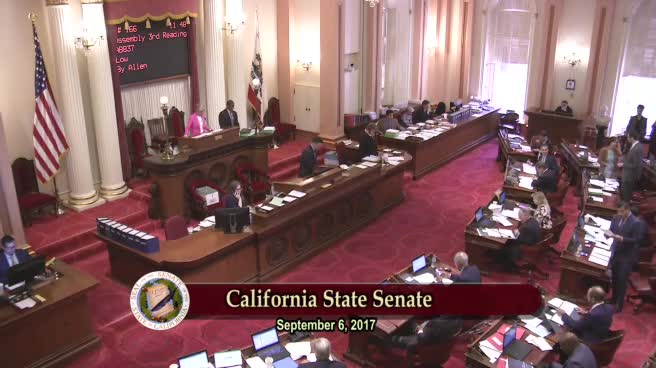
Bill Author

Bill Co-Author(s):