AB 1521: Land use: notice of proposed change: assisted housing developments.
- Session Year: 2017-2018
- House: Assembly
- Latest Version Date: 2017-09-29
(1)The Planning and Zoning Law requires an owner of an assisted housing development proposing the termination of a subsidy contract or prepayment of governmental assistance, or the owner of an assisted housing development for which there will be the expiration of rental restrictions, to provide a notice of the proposed change to each affected tenant household residing in the assisted housing development, as specified, and provide a copy of any notices issued to any prospective tenant at the time he or she is interviewed for eligibility. That law provides injunctive relief for persons aggrieved by a violation of these provisions, as specified.
This bill would require the owner of an assisted housing development that is within 3 years of a scheduled expiration of rental restrictions to also provide notice of the scheduled expiration of rental restrictions to any prospective tenant at the time he or she is interviewed for eligibility, and to existing tenants by posting the notice, as specified. The bill would additionally specify that injunctive relief may include, but is not limited to, the reimposition of prior restrictions, as specified, and restitution of rent increases that were collected improperly. The bill would additionally authorize the court to award attorneys fees and costs to a prevailing plaintiff bringing an action for injunctive relief pursuant to these provisions.
(2)The Planning and Zoning Law prohibits an owner of an assisted housing development, as defined, from terminating a subsidy contract or prepaying the mortgage, as specified, unless the owner or its agent has first provided specified entities an offer to purchase the development. That law requires an owner of an assisted housing development in which there will be the expiration of rental restrictions to also provide specified entities an opportunity to submit an offer to purchase the development. That law also requires an owner of an assisted housing development to provide specified entities with notice, as provided, of an opportunity to submit an offer to purchase under specified circumstances. Existing law requires an opportunity to purchase the development to be provided to entities that include, among others, regional or national nonprofit organizations, regional or national public agencies, and profit-motivated organizations.
This bill would limit the opportunity to purchase the development to those agencies and organizations described above that own and operate at least 3 comparable rent- and income-restricted affordable rental properties governed under a regulatory agreement with a department or agency of the State of California or the United States, either directly or by serving as the managing general partner of limited partnerships or managing member of limited liability corporations.
Existing law requires, to qualify as a purchaser of an assisted housing development, specified entities to, among other things, be capable of managing the housing and related facilities for its remaining useful life, as specified.
This bill would revise that requirement by instead requiring specified entities to be certified by the Department of Housing and Community Development, based on demonstrated relevant prior experience in California and current capacity, as capable of operating the housing and related facilities, as specified. The bill would require the department to establish a process for certifying these entities and to maintain a list of entities that are certified, as specified.
Existing law, if a qualified entity elects to purchase an assisted housing development, requires the qualified entity to make a bona fide offer to purchase the development, as specified. Existing law authorizes the owner or the qualified entity to request the fair market value of the property be determined by an independent appraiser. Existing law, during the first 180 days from the date of an owners bona fide notice of the opportunity to submit an offer to purchase, requires an owner to accept a bona fide offer to purchase only from a qualified entity and requires a purchase agreement to be executed when a bona fide offer to purchase has been made to an owner and the offer is accepted.
This bill would revise the offer and acceptance process described above by requiring the bona fide offer to purchase made by the qualified entity to be at the market value determined by negotiation and agreement between the parties, and if the parties fail to reach an agreement regarding market value, by an appraisal process initiated by the owners receipt of the bona fide offer, as specified. The bill would prohibit the owner, if the owner has received a bona fide offer to purchase made within 180 days of the owners notice of the opportunity to submit an offer, from accepting offers from any other entity, and would require the owner to either accept this bona fide offer to purchase or declare to the Department of Housing and Community Development under penalty of perjury that the owner will not sell the property for at least 5 years from the date of the declaration. By expanding the definition of the crime of perjury, this bill would impose a state-mandated local program. This bill would require an owner who wishes to sell, and who has received a bona fide offer that meets these requirements, to accept the offer and execute a purchase agreement within 90 days of receipt of the offer. The bill would require the owner to take all steps reasonably required to renew any expiring housing assistance contract, or extend any available subsidies or use restrictions, as provided, once a bona fide offer is made.
Existing law requires an independent appraiser determining the fair market value of the property as described above to possess qualifications equivalent to those required by the members of the Appraisers Institute.
This bill would additionally require appraisers to be certified by the Department of Housing and Community Development as having sufficient experience in appraising comparable rental properties in California.
Existing law requires the Department of Housing and Community Development to undertake specified responsibilities and duties with respect to the provisions described above.
This bill would additionally require the department to refer violations of these provisions to the Attorney General, as specified, and monitor compliance with specified provisions by owners of assisted housing developments and to provide a report to the Legislature, as provided.
Existing law authorizes the requirements described above to be enforced either in law or in equity by specified entities.
This bill would additionally authorize a tenant association at the property or any affected public entity to enforce these requirements either in law or in equity. The bill would authorize the court to waive any bond requirement and award attorneys fees and costs to a prevailing plaintiff under these provisions.
(3)The California Constitution requires the state to reimburse local agencies and school districts for certain costs mandated by the state. Statutory provisions establish procedures for making that reimbursement.
This bill would provide that no reimbursement is required by this act for a specified reason.
(1)The Planning and Zoning Law requires an owner of an assisted housing development proposing the termination of a subsidy contract or prepayment of governmental assistance or of an assisted housing development in which there will be the expiration of rental restrictions to provide a notice of the proposed change to each affected tenant household residing in the assisted housing development, as specified, and provide a copy of any notices issued to any prospective tenant at the time he or she is interviewed for eligibility. That law provides injunctive relief for persons aggrieved by a violation of these provisions, as specified.
This bill would require the owner of an assisted housing development that is within 3 years of a scheduled expiration of rental restrictions to also provide notice of the scheduled expiration of rental restrictions to any prospective tenant at the time he or she is interviewed for eligibility, and to existing tenants by posting the notice, as specified. The bill would additionally specify that injunctive relief may include, but is not limited to, the reimposition of prior restrictions, as specified, and restitution of rent increases that were collected improperly. The bill would additionally authorize the court to award attorneys fees and costs to a prevailing plaintiff bringing an action for injunctive relief pursuant to these provisions.
(2)The Planning and Zoning Law prohibits an owner of an assisted housing development, as defined, from terminating a subsidy contract or prepaying the mortgage, as specified, unless the owner or its agent has first provided specified entities an offer to purchase the development. That law requires an owner of an assisted housing development in which there will be the expiration of rental restrictions to also provide specified entities an opportunity to submit an offer to purchase the development. That law also requires an owner of an assisted housing development to provide specified entities with notice, as provided, of an opportunity to submit an offer to purchase under specified circumstances. Existing law requires an opportunity to purchase the development to be provided to entities that include, among others, regional or national nonprofit organizations, regional or national public agencies, and profit-motivated organizations.
This bill would limit the opportunity to purchase the development to those agencies and organizations described above that own and operate at least 3 comparable rent- and income-restricted affordable rental properties governed under a regulatory agreement with a department or agency of the State of California or the United States, either directly or by serving as the managing general partner of limited partnerships or managing member of limited liability corporations.
Existing law requires, to qualify as a purchaser of an assisted housing development, specified entities to, among other things, be capable of managing the housing and related facilities for its remaining useful life, as specified.
This bill would revise that requirement by instead requiring specified entities to be certified by the Department of Housing and Community Development, based on demonstrated relevant prior experience in California and current capacity, as capable of operating the housing and related facilities, as specified. The bill would require the department to establish a process for certifying these entities and to maintain a list of entities that are certified, as specified.
Existing law, if a qualified entity elects to purchase an assisted housing development, requires the qualified entity to make a bona fide offer to purchase the development, as specified. Existing law authorizes the owner or the qualified entity to request the fair market value of the property be determined by an independent appraiser. Existing law, during the first 180 days from the date of an owners bona fide notice of the opportunity to submit an offer to purchase, requires an owner to accept a bona offer to purchase only from a qualified entity and requires a purchase agreement to be executed when a bona fide offer to purchase has been made to an owner and the offer is accepted.
This bill would revise the offer an acceptance process described above by requiring the bona fide offer to purchase made by the qualified entity to be at the market value determined by negotiation and agreement between the parties, and if the parties fail to reach an agreement regarding market value, by an appraisal process initiated by the owners receipt of the bona fide offer, as specified. The bill would prohibit the owner, if the owner has received a bona fide offer to purchase made within 180 days of the owners notice of the opportunity to submit an offer, from accepting offers from any other entity, and would require the owner to either accept this bona fide offer to purchase or declare to the Department of Housing and Community Development under penalty of perjury that the owner will not sell the property for at least 5 years from the date of the declaration. By expanding the definition of the crime of perjury, this bill would impose a state-mandated local program. This bill would require an owner who wishes to sell, and who has received a bonafide offer that meets these requirements, to accept the offer and execute a purchase agreement within 90 days of receipt of the offer. The bill would require the owner to take all steps reasonably required to renew any expiring housing assistance contract, or extend any available subsidies or use restrictions, as provided, once a bona fide offer is made.
Existing law requires an independent appraiser determining the fair market value of the property as described above to possess qualifications equivalent to those required by the members of the Appraisers Institute.
This bill would additionally require appraisers to be certified by the Department of Housing and Community Development as having sufficient experience in appraising comparable rental properties in California.
Existing law requires the Department of Housing and Community Development to undertake specified responsibilities and duties with respect to the provisions described above.
This bill would additionally require the department to refer violations of these provisions to the Attorney General, as specified, and monitor compliance with specified provisions by owners of assisted housing developments and to provide a report to the Legislature, as provided.
Existing law authorizes the requirements described above to be enforced either in law or in equity by specified entities.
This bill would additionally authorize a tenant association at the property or any affected public entity to enforce these requirements either in law or in equity. The bill would authorize the court to waive any bond requirement and award attorneys fees and costs to a prevailing plaintiff under these provisions.
(3)The California Constitution requires the state to reimburse local agencies and school districts for certain costs mandated by the state. Statutory provisions establish procedures for making that reimbursement.
This bill would provide that no reimbursement is required by this act for a specified reason.
(1)The Planning and Zoning Law requires an owner of an assisted housing development proposing the termination of a subsidy contract or prepayment of governmental assistance or of an assisted housing development in which there will be the expiration of rental restrictions to provide a notice of the proposed change to each affected tenant household residing in the assisted housing development, as specified, and provide a copy of any notices issued to any prospective tenant at the time he or she is interviewed for eligibility. That law provides injunctive relief for persons aggrieved by a violation of these provisions, as specified.
This bill would require the owner of an assisted housing development that is within 3 years of a scheduled expiration of rental restrictions to also provide notice of the scheduled expiration of rental restrictions to any prospective tenant at the time he or she is interviewed for eligibility, and to existing tenants by posting the notice, as specified. The bill would additionally specify that injunctive relief may include, but is not limited to, the reimposition of prior restrictions, as specified, and restitution of rent increases that were collected improperly. The bill would additionally authorize the court to award attorneys fees and costs to a prevailing plaintiff bringing an action for injunctive relief pursuant to these provisions.
The(2)The Planning and Zoning Law prohibits an owner of an assisted housing development, as defined, from terminating a subsidy contract or prepaying the mortgage, as specified, unless the owner or its agent has first provided specified entities an offer to purchase the development. That law requires an owner of an assisted housing development in which there will be the expiration of rental restrictions to also provide specified entities an opportunity to submit an offer to purchase the development. That law also requires an owner of an assisted housing development to provide specified entities with notice, as provided, of an opportunity to submit an offer to purchase under specified circumstances. Existing law requires an opportunity to purchase the development to be provided to entities that include, among others, regional or national nonprofit organizations, regional or national public agencies, and profit-motivated organizations.
This bill would limit the opportunity to purchase the development to those agencies and organizations described above with their headquarters in California. that own and operate at least 3 comparable rent- and income-restricted affordable rental properties governed under a regulatory agreement with a department or agency of the State of California or the United States, either directly or by serving as the managing general partner of limited partnerships or managing member of limited liability corporations.
Existing law requires, to qualify as a purchaser of an assisted housing development, specified entities to, among other things, be capable of managing the housing and related facilities for its remaining useful life, as specified.
This bill would revise that requirement by instead requiring specified entities to be certified by the Department of Housing and Community Development, based on demonstrated relevant prior experience in California and current capacity, as capable of operating the housing and related facilities, as specified. The bill would require the department to establish a process for certifying these entities and to maintain a list of entities that are certified, as specified.
Existing law, if a qualified entity elects to purchase an assisted housing development, requires the qualified entity to make a bona fide offer to purchase the development, as specified. Existing law authorizes the owner or the qualified entity to request the fair market value of the property be determined by an independent appraiser. Existing law, during the first 180 days from the date of an owners bona fide notice of the opportunity to submit an offer to purchase, requires an owner to accept a bona offer to purchase only from a qualified entity and requires a purchase agreement to be executed when a bona fide offer to purchase has been made to an owner and the offer is accepted.
This bill would revise the offer an acceptance process described above by requiring the bona fide offer to purchase made by the qualified entity to be at the market value determined by negotiation and agreement between the parties, and if the parties fail to reach an agreement regarding market value, by an appraisal process initiated by the owners receipt of the bona fide offer, as specified. The bill would require the prohibit the owner, if the owner has received a bona fide offer to purchase to be made within 180 days of the owners notice of the opportunity to submit an offer, as specified, from accepting offers from any other entity, and would require the owner to either accept this bona fide offer to purchase and to execute a purchase agreement within 90 days of receipt of the offer. or declare to the Department of Housing and Community Development under penalty of perjury that the owner will not sell the property for at least 5 years from the date of the declaration. By expanding the definition of the crime of perjury, this bill would impose a state-mandated local program. This bill would require an owner who wishes to sell, and who has received a bonafide offer that meets these requirements, to accept the offer and execute a purchase agreement within 90 days of receipt of the offer. The bill would require the owner to take all steps reasonably required to renew any expiring housing assistance contract, or extend any available subsidies or use restrictions, as provided, once a bona fide offer is made.
Existing law requires an independent appraiser determining the fair market value of the property as described above to possess qualifications equivalent to those required by the members of the Appraisers Institute.
This bill would additionally require appraisers to be certified by the Department of Housing and Community Development as having sufficient experience in appraising comparable rental properties in California.
Existing law requires the Department of Housing and Community Development to undertake specified responsibilities and duties with respect to the provisions described above.
This bill would additionally require the department to refer violations of these provisions to the Attorney General, as specified, and monitor compliance with specified provisions by owners of assisted housing developments and to provide a report to the Legislature, as provided.
Existing law authorizes the requirements described above to be enforced either in law or in equity by specified entities.
This bill would additionally authorize a tenant association at the property or any affected public entity to enforce these requirements either in law or in equity. The bill would authorize the court to waive any bond requirement and award attorneys fees and costs to a prevailing plaintiff under these provisions.
(3)The California Constitution requires the state to reimburse local agencies and school districts for certain costs mandated by the state. Statutory provisions establish procedures for making that reimbursement.
This bill would provide that no reimbursement is required by this act for a specified reason.
The Planning and Zoning Law prohibits an owner of an assisted housing development, as defined, from terminating a subsidy contract or prepaying the mortgage, as specified, unless the owner or its agent has first provided specified entities an offer to purchase the development. That law requires an owner of an assisted housing development in which there will be the expiration of rental restrictions to also provide specified entities an opportunity to submit an offer to purchase the development. That law also requires an owner of an assisted housing development to provide specified entities with notice, as provided, of an opportunity to submit an offer to purchase under specified circumstances. Existing law requires an opportunity to purchase the development to be provided to entities that include, among others, regional or national nonprofit organizations, regional or national public agencies, and profit-motivated organizations.
This bill would limit the opportunity to purchase the development to those agencies and organizations described above with their headquarters in California.
Existing law requires, to qualify as a purchaser of an assisted housing development, specified entities to, among other things, be capable of managing the housing and related facilities for its remaining useful life, as specified.
This bill would revise that requirement by instead requiring specified entities to be certified by the Department of Housing and Community Development, based on demonstrated relevant prior experience in California and current capacity, as capable of operating the housing and related facilities, as specified. The bill would require the department to establish a process for certifying these entities and to maintain a list of entities that are certified, as specified.
Existing law, if a qualified entity elects to purchase an assisted housing development, requires the qualified entity to make a bona fide offer to purchase the development, as specified. Existing law authorizes the owner or the qualified entity to request the fair market value of the property be determined by an independent appraiser. Existing law, during the first 180 days from the date of an owners bona fide notice of the opportunity to submit an offer to purchase, requires an owner to accept a bona offer to purchase only from a qualified entity and requires a purchase agreement to be executed when a bona fide offer to purchase has been made to an owner and the offer is accepted.
This bill would revise the offer an acceptance process described above by requiring the bona fide offer to purchase made by the qualified entity to be at the market value determined by negotiation and agreement between the parties, and if the parties fail to reach an agreement regarding market value, by an appraisal process initiated by the owners receipt of the bona fide offer, as specified. The bill would require the bona fide offer to purchase to be made within 180 days of the owners notice of the opportunity to submit an offer, as specified, and would require the owner to accept this bona fide offer to purchase and to execute a purchase agreement within 90 days of receipt of the offer. The bill would require the owner to take all steps reasonably required to renew any expiring housing assistance contract, or extend any available subsidies or use restrictions, as provided, once a bona fide offer is made.
Existing law requires an independent appraiser determining the fair market value of the property as described above to possess qualifications equivalent to those required by the members of the Appraisers Institute.
This bill would additionally require appraisers to be certified by the Department of Housing and Community Development as having sufficient experience in appraising comparable rental properties in California.
Existing law requires the Department of Housing and Community Development to undertake specified responsibilities and duties with respect to the provisions described above.
This bill would additionally require the department to monitor compliance with specified provisions by owners of assisted housing developments and to provide a report to the Legislature, as provided.
Existing law authorizes the requirements described above to be enforced either in law or in equity by specified entities.
This bill would additionally authorize a tenant association at the property to enforce these requirements either in law or in equity.
(a)As used in this section, the following terms have the following meanings:
(1)Affected public entities means the mayor of the city in which the assisted housing development is located, or, if located in an unincorporated area, the chair of the board of supervisors of the county; the appropriate local public housing authority, if any; and the Department of Housing and Community Development.
(2)Affected tenant means a tenant household residing in an assisted housing development, as defined in paragraph (3), at the time notice is required to be provided pursuant to this section, that benefits from the government assistance.
(3)Assisted housing development means a multifamily rental housing development that receives governmental assistance under any of the following programs:
(A)New construction, substantial rehabilitation, moderate rehabilitation, property disposition, and loan management set-aside programs, or any other program providing project-based assistance, under Section 8 of the United States Housing Act of 1937, as amended (42 U.S.C. Sec. 1437f).
(B)The following federal programs:
(i)The Below-Market-Interest-Rate Program under Section 221(d)(3) of the National Housing Act (12 U.S.C. Sec. 1715 l(d)(3) and (5)).
(ii)Section 236 of the National Housing Act (12 U.S.C. Sec. 1715z-1).
(iii)Section 202 of the Housing Act of 1959 (12 U.S.C. Sec. 1701q).
(C)Programs for rent supplement assistance under Section 101 of the Housing and Urban Development Act of 1965, as amended (12 U.S.C. Sec. 1701s).
(D)Programs under Sections 514, 515, 516, 533, and 538 of the Housing Act of 1949, as amended (42 U.S.C. Sec. 1485).
(E)Section 42 of the Internal Revenue Code.
(F)Section 142(d) of the Internal Revenue Code or its predecessors (tax-exempt private activity mortgage revenue bonds).
(G)Section 147 of the Internal Revenue Code (Section 501(c)(3) bonds).
(H)Title I of the Housing and Community Development Act of 1974, as amended (Community Development Block Grant Program).
(I)Title II of the Cranston-Gonzalez National Affordable Housing Act of 1990, as amended (HOME Investment Partnership Program).
(J)Titles IV and V of the McKinney-Vento Homeless Assistance Act of 1987, as amended, including the Department of Housing and Urban Developments Supportive Housing Program, Shelter Plus Care Program, and surplus federal property disposition program.
(K)Grants and loans made by the Department of Housing and Community Development, including the Rental Housing Construction Program, CHRP-R, and other rental housing finance programs.
(L)Chapter 1138 of the Statutes of 1987.
(M)The following assistance provided by counties or cities in exchange for restrictions on the maximum rents that may be charged for units within a multifamily rental housing development and on the maximum tenant income as a condition of eligibility for occupancy of the unit subject to the rent restriction, as reflected by a recorded agreement with a county or city:
(i)Loans or grants provided using tax increment financing pursuant to the Community Redevelopment Law (Part 1 (commencing with Section 33000) of Division 24 of the Health and Safety Code).
(ii)Local housing trust funds, as referred to in paragraph (3) of subdivision (a) of Section 50843 of the Health and Safety Code.
(iii)The sale or lease of public property at or below market rates.
(iv)The granting of density bonuses, or concessions or incentives, including fee waivers, parking variances, or amendments to general plans, zoning, or redevelopment project area plans, pursuant to Chapter 4.3 (commencing with Section 65915).
Assistance pursuant to this subparagraph shall not include the use of tenant-based Housing Choice Vouchers (Section 8(o) of the United States Housing Act of 1937, 42 U.S.C. Sec. 1437f(o), excluding subparagraph (13) relating to project-based assistance). Restrictions shall not include any rent control or rent stabilization ordinance imposed by a county, city, or city and county.
(4)City means a general law city, a charter city, or a city and county.
(5)Expiration of rental restrictions means the expiration of rental restrictions for an assisted housing development described in paragraph (3) unless the development has other recorded agreements restricting the rent to the same or lesser levels for at least 50 percent of the units.
(6)Low or moderate income means having an income as defined in Section 50093 of the Health and Safety Code.
(7)Prepayment means the payment in full or refinancing of the federally insured or federally held mortgage indebtedness prior to its original maturity date, or the voluntary cancellation of mortgage insurance, on an assisted housing development described in paragraph (3) that would have the effect of removing the current rent or occupancy or rent and occupancy restrictions contained in the applicable laws and the regulatory agreement.
(8)Termination means an owners decision not to extend or renew its participation in a federal, state, or local government subsidy program or private, nongovernmental subsidy program for an assisted housing development described in paragraph (3), either at or prior to the scheduled date of the expiration of the contract, that may result in an increase in tenant rents or a change in the form of the subsidy from project-based to tenant-based.
(9)Very low income means having an income as defined in Section 50052.5 of the Health and Safety Code.
(b)(1)At least 12 months prior to the anticipated date of the termination of a subsidy contract, the expiration of rental restrictions, or prepayment on an assisted housing development, the owner proposing the termination or prepayment of governmental assistance or the owner of an assisted housing development in which there will be the expiration of rental restrictions shall provide a notice of the proposed change to each affected tenant household residing in the assisted housing development at the time the notice is provided and to the affected public entities. An owner who meets the requirements of Section 65863.13 shall be exempt from providing that notice. The notice shall contain all of the following:
(A)In the event of termination, a statement that the owner intends to terminate the subsidy contract or rental restrictions upon its expiration date, or the expiration date of any contract extension thereto.
(B)In the event of the expiration of rental restrictions, a statement that the restrictions will expire, and in the event of prepayment, termination, or the expiration of rental restrictions whether the owner intends to increase rents during the 12 months following prepayment, termination, or the expiration of rental restrictions to a level greater than permitted under Section 42 of the Internal Revenue Code.
(C)In the event of prepayment, a statement that the owner intends to pay in full or refinance the federally insured or federally held mortgage indebtedness prior to its original maturity date, or voluntarily cancel the mortgage insurance.
(D)The anticipated date of the termination, prepayment of the federal or other program or expiration of rental restrictions, and the identity of the federal or other program described in subdivision (a).
(E)A statement that the proposed change would have the effect of removing the current low-income affordability restrictions in the applicable contract or regulatory agreement.
(F)A statement of the possibility that the housing may remain in the federal or other program after the proposed date of termination of the subsidy contract or prepayment if the owner elects to do so under the terms of the federal governments or other program operators offer.
(G)A statement whether other governmental assistance will be provided to tenants residing in the development at the time of the termination of the subsidy contract or prepayment.
(H)A statement that a subsequent notice of the proposed change, including anticipated changes in rents, if any, for the development, will be provided at least six months prior to the anticipated date of termination of the subsidy contract, or expiration of rental restrictions, or prepayment.
(I)A statement of notice of opportunity to submit an offer to purchase, as required in Section 65863.11.
(2)Notwithstanding paragraph (1), if an owner provides a copy of a federally required notice of termination of a subsidy contract or prepayment at least 12 months prior to the proposed change to each affected tenant household residing in the assisted housing development at the time the notice is provided and to the affected public entities, the owner shall be deemed in compliance with this subdivision, if the notice is in compliance with all federal laws. However, the federally required notice does not satisfy the requirements of Section 65863.11.
(c)(1)At least six months prior to the anticipated date of termination of a subsidy contract, expiration of rental restrictions or prepayment on an assisted housing development, the owner proposing the termination or prepayment of governmental assistance or the owner of an assisted housing development in which there will be the expiration of rental restrictions shall provide a notice of the proposed change to each affected tenant household residing in the assisted housing development at the time the notice is provided and to the affected public entities. An owner who meets the requirements of Section 65863.13 shall be exempt from providing that notice.
(2)The notice to the tenants shall contain all of the following:
(A)The anticipated date of the termination or prepayment of the federal or other program, or the expiration of rental restrictions, and the identity of the federal or other program, as described in subdivision (a).
(B)The current rent and rent anticipated for the unit during the 12 months immediately following the date of the prepayment or termination of the federal or other program, or expiration of rental restrictions.
(C)A statement that a copy of the notice will be sent to the city, county, or city and county, where the assisted housing development is located, to the appropriate local public housing authority, if any, and to the Department of Housing and Community Development.
(D)A statement of the possibility that the housing may remain in the federal or other program after the proposed date of subsidy termination or prepayment if the owner elects to do so under the terms of the federal governments or other program administrators offer or that a rent increase may not take place due to the expiration of rental restrictions.
(E)A statement of the owners intention to participate in any current replacement subsidy program made available to the affected tenants.
(F)The name and telephone number of the city, county, or city and county, the appropriate local public housing authority, if any, the Department of Housing and Community Development, and a legal services organization, that can be contacted to request additional written information about an owners responsibilities and the rights and options of an affected tenant.
(3)In addition to the information provided in the notice to the affected tenant, the notice to the affected public entities shall contain information regarding the number of affected tenants in the project, the number of units that are government assisted and the type of assistance, the number of the units that are not government assisted, the number of bedrooms in each unit that is government assisted, and the ages and income of the affected tenants. The notice shall briefly describe the owners plans for the project, including any timetables or deadlines for actions to be taken and specific governmental approvals that are required to be obtained, the reason the owner seeks to terminate the subsidy contract or prepay the mortgage, and any contacts the owner has made or is making with other governmental agencies or other interested parties in connection with the notice. The owner shall also attach a copy of any federally required notice of the termination of the subsidy contract or prepayment that was provided at least six months prior to the proposed change. The information contained in the notice shall be based on data that is reasonably available from existing written tenant and project records.
(d)The owner proposing the termination or prepayment of governmental assistance or the owner of an assisted housing development in which there will be the expiration of rental restrictions shall provide additional notice of any significant changes to the notice required by subdivision (c) within seven business days to each affected tenant household residing in the assisted housing development at the time the notice is provided and to the affected public entities. Significant changes shall include, but not be limited to, any changes to the date of termination or prepayment, or expiration of rental restrictions or the anticipated new rent.
(e)(1)An owner who is subject to the requirements of this section shall also provide a copy of any notices issued to existing tenants pursuant to subdivision (b), (c), or (d) to any prospective tenant at the time he or she is interviewed for eligibility.
(2)The owner of an assisted housing development that is within three years of a scheduled expiration of rental restrictions shall also provide notice of the scheduled expiration of rental restrictions to any prospective tenant at the time he or she is interviewed for eligibility, and to existing tenants by posting the notice in an accessible location of the property. This notice shall also be provided to affected public entities. This paragraph is applicable only to owners of assisted housing developments where the rental restrictions are scheduled to expire after January 1, 2021.
(f)This section shall not require the owner to obtain or acquire additional information that is not contained in the existing tenant and project records, or to update any information in his or her records. The owner shall not be held liable for any inaccuracies contained in these records or from other sources, nor shall the owner be liable to any party for providing this information.
(g)(1)For purposes of this section, service of the notice to the affected tenants shall be made by first-class mail postage prepaid.
(2)For purposes of this section, service of notice to the city, county, city and county, appropriate local public housing authority, if any, and the Department of Housing and Community Development shall be made by either first-class mail postage prepaid or electronically to any public entity that has provided an email address for that purpose.
(h)Nothing in this section shall enlarge or diminish the authority, if any, that a city, county, city and county, affected tenant, or owner may have, independent of this section.
(i)If, prior to January 1, 2001, the owner has already accepted a bona fide offer from a qualified entity, as defined in subdivision (c) of Section 65863.11, and has complied with this section as it existed prior to January 1, 2001, at the time the owner decides to sell or otherwise dispose of the development, the owner shall be deemed in compliance with this section.
(j)Injunctive relief shall be available to any party identified in paragraph (1) or (2) of subdivision (a) who is aggrieved by a violation of this section. Injunctive relief pursuant to this subdivision may include, but is not limited to, reimposition of the prior restrictions until any required notice is provided and the required period has elapsed, and restitution of any rent increases collected without compliance with this section. In a judicial action brought pursuant to this subdivision, the court may award attorneys fees and costs to a prevailing plaintiff.
(k)The Director of Housing and Community Development shall approve forms to be used by owners to comply with subdivisions (b) and (c). Once the director has approved the forms, an owner shall use the approved forms to comply with subdivisions (b) and (c).
SEC. 2.Section 65863.11 of the Government Code is amended to read:65863.11.(a)Terms used in this section shall be defined as follows:
(1)Assisted housing development and development mean a multifamily rental housing development of five or more units as defined in paragraph (3) of subdivision (a) of Section 65863.10.
(2)Owner means an individual, corporation, association, partnership, joint venture, or business entity that holds title to an assisted housing development.
(3)Tenant means a tenant, subtenant, lessee, sublessee, or other person legally in possession or occupying the assisted housing development.
(4)Tenant association means a group of tenants who have formed a nonprofit corporation, cooperative corporation, or other entity or organization, or a local nonprofit, regional, or national organization whose purpose includes the acquisition of an assisted housing development and that represents the interest of at least a majority of the tenants in the assisted housing development.
(5)Low or moderate income means having an income as defined in Section 50093 of the Health and Safety Code.
(6)Very low income means having an income as defined in Section 50105 of the Health and Safety Code.
(7)Local nonprofit organizations means not-for-profit corporations organized pursuant to Division 2 (commencing with Section 5000) of Title 1 of the Corporations Code that have as their principal purpose the ownership, development, or management of housing or community development projects for persons and families of low or moderate income and very low income, and which have a broadly representative board, a majority of whose members are community based and have a proven track record of local community service.
(8)Local public agencies means housing authorities, redevelopment agencies, or any other agency of a city, county, or city and county, whether general law or chartered, which are authorized to own, develop, or manage housing or community development projects for persons and families of low or moderate income and very low income.
(9)Regional or national organizations means not-for-profit, charitable corporations organized on a multicounty, state, or multistate basis that have as their principal purpose the ownership, development, or management of housing or community development projects for persons and families of low or moderate income and very low income and own and operate at least three comparable rent- and income-restricted affordable rental properties governed under a regulatory agreement with a department or agency of the State of California or the United States, either directly or by serving as the managing general partner of limited partnerships or managing member of limited liability corporations.
(10)Regional or national public agencies means multicounty, state, or multistate agencies that are authorized to own, develop, or manage housing or community development projects for persons and families of low or moderate income and very low income and own and operate at least three comparable rent- and income-restricted affordable rental properties governed under a regulatory agreement with a department or agency of the State of California or the United States, either directly or by serving as the managing general partner of limited partnerships or managing member of limited liability corporations.
(11)Use restriction means any federal, state, or local statute, regulation, ordinance, or contract that, as a condition of receipt of any housing assistance, including a rental subsidy, mortgage subsidy, or mortgage insurance, to an assisted housing development, establishes maximum limitations on tenant income as a condition of eligibility for occupancy of the units within a development, imposes any restrictions on the maximum rents that could be charged for any of the units within a development; or requires that rents for any of the units within a development be reviewed by any governmental body or agency before the rents are implemented.
(12)Profit-motivated housing organizations and individuals means individuals or two or more persons organized pursuant to Division 1 (commencing with Section 100) of Title 1 of, Division 3 (commencing with Section 1200) of Title 1 of, or Chapter 5 (commencing with Section 16100) of Title 2 of, the Corporations Code, that carry on as a business for profit and own and operate at least three comparable rent- and income-restricted affordable rental properties governed under a regulatory agreement with a department or agency of the State of California or the United States, either directly or by serving as the managing general partner of limited partnerships or managing member of limited liability corporations.
(13)Department means the Department of Housing and Community Development.
(14)Offer to purchase means an offer from a qualified or nonqualified entity that is nonbinding on the owner.
(15)Expiration of rental restrictions has the meaning given in paragraph (5) of subdivision (a) of Section 65863.10.
(b)An owner of an assisted housing development shall not terminate a subsidy contract or prepay the mortgage pursuant to Section 65863.10, unless the owner or its agent shall first have provided each of the entities listed in subdivision (d) an opportunity to submit an offer to purchase the development, in compliance with subdivisions (g) and (h). An owner of an assisted housing development in which there will be the expiration of rental restrictions shall also provide each of the entities listed in subdivision (d) an opportunity to submit an offer to purchase the development, in compliance with subdivisions (g) and (h). An owner who meets the requirements of Section 65863.13 shall be exempt from this requirement.
(c)An owner of an assisted housing development shall not sell, or otherwise dispose of, the development at any time within the five years prior to the expiration of rental restrictions or at any time if the owner is eligible for prepayment or termination within five years unless the owner or its agent shall first have provided each of the entities listed in subdivision (d) an opportunity to submit an offer to purchase the development, in compliance with this section. An owner who meets the requirements of Section 65863.13 shall be exempt from this requirement.
(d)The entities to whom an opportunity to purchase shall be provided include only the following:
(1)The tenant association of the development.
(2)Local nonprofit organizations and public agencies.
(3)Regional or national nonprofit organizations and regional or national public agencies.
(4)Profit-motivated housing organizations or individuals.
(e)For the purposes of this section, to qualify as a purchaser of an assisted housing development, an entity listed in subdivision (d) shall do all of the following:
(1)Be certified by the department, based on demonstrated relevant prior experience in California and current capacity, as capable of operating the housing and related facilities for its remaining useful life, either by itself or through a management agent. The department shall establish a process for certifying qualified entities and maintain a list of entities that are certified, which list shall be updated at least annually.
(2)Agree to obligate itself and any successors in interest to maintain the affordability of the assisted housing development for households of very low, low, or moderate income for either a 30-year period from the date that the purchaser took legal possession of the housing or the remaining term of the existing federal government assistance specified in subdivision (a) of Section 65863.10, whichever is greater. The development shall be continuously occupied in the approximate percentages that those households who have occupied that development on the date the owner gave notice of intent or the approximate percentages specified in existing use restrictions, whichever is higher. This obligation shall be recorded prior to the close of escrow in the office of the county recorder of the county in which the development is located and shall contain a legal description of the property, indexed to the name of the owner as grantor. An owner that obligates itself to an enforceable regulatory agreement that will ensure for a period of not less than 30 years that rents for units occupied by low- and very low income households or that are vacant at the time of executing a purchase agreement will conform with restrictions imposed by Section 42(f) of the Internal Revenue Code shall be deemed in compliance with this paragraph. In addition, the regulatory agreement shall contain provisions requiring the renewal of rental subsidies, should they be available, provided that assistance is at a level to maintain the projects fiscal viability.
(3)Local nonprofit organizations and public agencies shall have no member among their officers or directorate with a financial interest in assisted housing developments that have terminated a subsidy contract or prepaid a mortgage on the development without continuing the low-income restrictions.
(f)If an assisted housing development is not economically feasible, as determined by all entities with regulatory agreements and deed-restrictions on the development, a purchaser shall be entitled to remove one or more units from the rent and occupancy requirements as is necessary for the development to become economically feasible, provided that once the development is again economically feasible, the purchaser shall designate the next available units as low-income units up to the original number of those units.
(g)If an owner decides to terminate a subsidy contract, or prepay the mortgage pursuant to Section 65863.10, or sell or otherwise dispose of the assisted housing development pursuant to subdivision (b) or (c), or if the owner has an assisted housing development in which there will be the expiration of rental restrictions, the owner shall first give notice of the opportunity to offer to purchase to each qualified entity on the list provided to the owner by the department, in accordance with subdivision (o), as well as to those qualified entities that directly contact the owner. The notice of the opportunity to offer to purchase must be given prior to or concurrently with the notice required pursuant to Section 65863.10 for a period of at least 12 months. The owner shall contact the department to obtain the list of qualified entities. The notice shall conform to the requirements of subdivision (h) and shall be sent to the entities by registered or certified mail, return receipt requested. The owner shall also post a copy of the notice in a conspicuous place in the common area of the development.
(h)The initial notice of a bona fide opportunity to submit an offer to purchase shall contain all of the following:
(1)A statement addressing all of the following:
(A)Whether the owner intends to maintain the current number of affordable units and level of affordability.
(B)Whether the owner has an interest in selling the property.
(C)Whether the owner has executed a contract or agreement of at least five years duration with a public entity to continue or replace subsidies to the property and to maintain an equal or greater number of units at an equal or deeper level of affordability and, if so, the length of the contract or agreement.
(2)A statement that each of the type of entities listed in subdivision (d), or any combination of them, has the right to purchase the development under this section.
(3)(A)Except as provided in subparagraph (B), a statement that the owner will make available to each of the types of entities listed in subdivision (d), within 15 business days of receiving a request therefor, that includes all of the following:
(i)Itemized lists of monthly operating expenses for the property.
(ii)Capital improvements, as determined by the owner, made within each of the two preceding calendar years at the property.
(iii)The amount of project property reserves.
(iv)Copies of the two most recent financial and physical inspection reports on the property, if any, filed with a federal, state, or local agency.
(v)The most recent rent roll for the property listing the rent paid for each unit and the subsidy, if any, paid by a governmental agency as of the date the notice of intent was made pursuant to Section 65863.10.
(vi)A statement of the vacancy rate at the property for each of the two preceding calendar years.
(vii)The terms of assumable financing, if any, the terms of the subsidy contract, if any, and proposed improvements to the property to be made by the owner in connection with the sale, if any.
(B)Subparagraph (A) shall not apply if 25 percent or less of the units on the property are subject to affordability restrictions or a rent or mortgage subsidy contract.
(C)A corporation authorized pursuant to Section 52550 of the Health and Safety Code or a public entity may share information obtained pursuant to subparagraph (A) with other prospective purchasers, and shall not be required to sign a confidentiality agreement as a condition of receiving or sharing this information, provided that the information is used for the purpose of attempting to preserve the affordability of the property.
(4)A statement that the owner has satisfied all notice requirements pursuant to subdivision (b) of Section 65863.10, unless the notice of opportunity to submit an offer to purchase is delivered more than 12 months prior to the anticipated date of termination, prepayment, or expiration of rental restrictions.
(i)If a qualified entity elects to purchase an assisted housing development, it shall make a bona fide offer to purchase the development at the market value determined pursuant to subdivision (k), subject to the requirements of this subdivision. A qualified entitys bona fide offer to purchase shall be submitted within 180 days of the owners notice of the opportunity to submit an offer pursuant to subdivision (g), identify whether it is a tenant association, nonprofit organization, public agency, or profit-motivated organizations or individuals, and certify, under penalty of perjury, that it is qualified pursuant to subdivision (e). If an owner has received a bona fide offer from a qualified entity within the first 180 days from the date of an owners bona fide notice of the opportunity to submit an offer to purchase, the owner shall not accept offers from any other entity and shall either accept the bona fide offer to purchase or declare under penalty of perjury in writing to the qualified entity and the department on a form approved by the department that it will not sell the property for at least five years from the date of the declaration. Once a bona fide offer is made, the owner shall take all steps reasonably required to renew any expiring housing assistance contract, or extend any available subsidies or use restrictions, if feasible, prior to the effective date of any expiration or termination. In the event that the owner declines to sell the property to the qualified entity, the owner shall record the declaration with the county in which the property is located. Once the owner has recorded the declaration, the owner shall be deemed to have fulfilled all obligations under this section.
(j)When a bona fide offer to purchase has been made that meets the requirements of this section and the owner wishes to sell, the owner shall accept the offer and execute a purchase agreement within 90 days of receipt of the offer.
(k)The market value of the property shall be determined by negotiation and agreement between the parties. If the parties fail to reach an agreement regarding the market value, the market value shall be determined by an appraisal process initiated by the owners receipt of the bona fide offer, which shall specifically reference the appraisal process provided by this subdivision as the means for determining the final purchase price. Either the owner or the qualified entity, or both, may request that the fair market value of the propertys highest and best use, based on current zoning, be determined by an independent appraiser qualified to perform multifamily housing appraisals, who shall be selected and paid by the requesting party. All appraisers shall possess qualifications equivalent to those required by the members of the Appraisers Institute and shall be certified by the department as having sufficient experience in appraising comparable rental properties in California. If the appraisals differ by less than 5 percent, the market value and sales price shall be set at the higher appraised value. If the appraisals differ by more than 5 percent, the parties may elect to have the appraisers negotiate a mutually agreeable market value and sales price, or to jointly select a third appraiser, whose determination of market value and the sales price shall be binding.
(l)During the 180-day period following the initial 180-day period required pursuant to subdivision (i), an owner may accept an offer from a person or an entity that does not qualify under subdivision (e). This acceptance shall be made subject to the owners providing each qualified entity that made a bona fide offer to purchase the first opportunity to purchase the development at the same terms and conditions as the pending offer to purchase, unless these terms and conditions are modified by mutual consent. The owner shall notify in writing those qualified entities of the terms and conditions of the pending offer to purchase, sent by registered or certified mail, return receipt requested. The qualified entity shall have 30 days from the date the notice is mailed to submit a bona fide offer to purchase and that offer shall be accepted by the owner. The owner shall not be required to comply with the provisions of this subdivision if the person or the entity making the offer during this time period agrees to maintain the development for persons and families of very low, low, and moderate income in accordance with paragraph (2) of subdivision (e). The owner shall notify the department regarding how the buyer is meeting the requirements of paragraph (2) of subdivision (e).
(m)This section shall not apply to any of the following: a government taking by eminent domain or negotiated purchase; a forced sale pursuant to a foreclosure; a transfer by gift, devise, or operation of law; a sale to a person who would be included within the table of descent and distribution if there were to be a death intestate of an owner; or an owner who certifies, under penalty of perjury, the existence of a financial emergency during the period covered by the first right of refusal requiring immediate access to the proceeds of the sale of the development. The certification shall be made pursuant to subdivision (p).
(n)Prior to the close of escrow, an owner selling, leasing, or otherwise disposing of a development to a purchaser who does not qualify under subdivision (e) shall certify under penalty of perjury that the owner has complied with all provisions of this section and Section 65863.10. This certification shall be recorded and shall contain a legal description of the property, shall be indexed to the name of the owner as grantor, and may be relied upon by good faith purchasers and encumbrances for value and without notice of a failure to comply with the provisions of this section.
Any person or entity acting solely in the capacity of an escrow agent for the transfer of real property subject to this section shall not be liable for any failure to comply with this section unless the escrow agent either had actual knowledge of the requirements of this section or acted contrary to written escrow instructions concerning the provisions of this section.
(o)The department shall undertake the following responsibilities and duties:
(1)Maintain a form containing a summary of rights and obligations under this section and make that information available to owners of assisted housing developments as well as to tenant associations, local nonprofit organizations, regional or national nonprofit organizations, public agencies, and other entities with an interest in preserving the states subsidized housing.
(2)Compile, maintain, and update a list of entities in subdivision (d) that have either contacted the department with an expressed interest in purchasing a development in the subject area or have been identified by the department as potentially having an interest in participating in a right-of-first-refusal program. The department shall publicize the existence of the list statewide. Upon receipt of a notice of intent under Section 65863.10, the department shall make the list available to the owner proposing the termination, prepayment, or removal of government assistance or to the owner of an assisted housing development in which there will be the expiration of rental restrictions. If the department does not make the list available at any time, the owner shall only be required to send a written copy of the opportunity to submit an offer to purchase notice to the qualified entities which directly contact the owner and to post a copy of the notice in the common area pursuant to subdivision (g).
(3)(A)Monitor compliance with this section and Sections 65863.10 and 65863.13 by owners of assisted housing developments and, notwithstanding Section 10231.5, provide a report to the Legislature, on or before March 31, 2019, and on or before March 31 each year thereafter, containing information for the previous year that includes, but is not limited to, the following:
(i)The number of properties and rental units subject to this section and Sections 65863.10 and 65863.13.
(ii)The number of properties and units that did any of the following:
(I)Complied with the requirements of this section and Sections 65863.10 and 65863.13.
(II)Failed to comply with the requirements of this section and Sections 65863.10 and 65863.13.
(III)Were offered for sale and therefore subject to the purchase right provisions of this section.
(IV)Were offered for sale and complied with the purchase right provisions of this section and the outcomes of the purchase right actions, including whether the property changed hands, to whom, and with what impact on affordability protections.
(V)Were offered for sale and failed to comply with the purchase right provisions of this section, the reason for their failure to comply, and the impact of their failure to comply on the affordability protections and the tenants who were residing in the property at the time of the failure.
(VI)Claimed exemptions from the obligations of this section pursuant to Section 65863.13 by category of reason for exemption.
(VII)Claimed exemptions from the obligations of this section and lost affordability protections and the impact on the tenants of the loss of the affordability protections.
(VIII)Were not offered for sale and complied with the requirement to properly execute and record a declaration.
(IX)Were not for sale and failed to comply with the requirement to properly execute and record a declaration.
(B)To facilitate the departments compliance monitoring owners of assisted housing developments in which at least 25 percent of the units on the property are subject to affordability restrictions or a rent or mortgage subsidy contract shall certify compliance with this section and Sections 65863.10 and 65863.13 to the department annually, under penalty of perjury, in a form as required by the department.
(C)The report required to be submitted pursuant to this paragraph shall be submitted in compliance with Section 9795.
(4)Refer violations of this section and Sections 65863.10 and 65863.13 to the Attorney General for appropriate enforcement action.
(p)(1)The provisions of this section may be enforced either in law or in equity by any qualified entity entitled to exercise the opportunity to purchase and right of first refusal under this section or any tenant association at the property or any affected public entity that has been adversely affected by an owners failure to comply with this section. In any judicial action brought pursuant to this subdivision, the court may waive any bond requirement and may award attorneys fees and costs to a prevailing plaintiff.
(2)An owner may rely on the statements, claims, or representations of any person or entity that the person or entity is a qualified entity as specified in subdivision (d), unless the owner has actual knowledge that the purchaser is not a qualified entity.
(3)If the person or entity is not an entity as specified in subdivision (d), that fact, in the absence of actual knowledge as described in paragraph (2), shall not give rise to any claim against the owner for a violation of this section.
(q)It is the intent of the Legislature that the provisions of this section are in addition to, but not preemptive of, applicable federal laws governing the sale or other disposition of a development that would result in either (1) a discontinuance of its use as an assisted housing development or (2) the termination or expiration of any low-income use restrictions that apply to the development.
(r)This section shall not apply to either of the following:
(1)An assisted housing development as described in clause (iv) of subparagraph (M) of paragraph (3) of subdivision (a) of Section 65863.10 in which 25 percent or less of the units are subject to affordability restrictions.
(2)An assisted housing development in which 25 percent or less of the units are subject to affordability restrictions that was developed in compliance with a local ordinance, charter amendment, specific plan, resolution, or other land use policy or regulation requiring that a housing development contain a fixed percentage of units affordable to extremely low-, very low-, low-, or moderate-income households.
(s)The department shall comply with any obligations under this section through the use of standards, forms, and definitions adopted by the department. The department may review, adopt, amend, and repeal the standards, forms, or definitions to implement this section. Any standards, forms, or definitions adopted to implement this section shall not be subject to Chapter 3.5 (commencing with Section 11340) of Part 1 of Division 3 of Title 2.
SEC. 3.No reimbursement is required by this act pursuant to Section 6 of Article XIIIB of the California Constitution because the only costs that may be incurred by a local agency or school district will be incurred because this act creates a new crime or infraction, eliminates a crime or infraction, or changes the penalty for a crime or infraction, within the meaning of Section 17556 of the Government Code, or changes the definition of a crime within the meaning of Section 6 of Article XIIIB of the California Constitution.
(a)As used in this section, the following terms have the following meanings:
(1)Affected public entities means the mayor of the city in which the assisted housing development is located, or, if located in an unincorporated area, the chair of the board of supervisors of the county; the appropriate local public housing authority, if any; and the Department of Housing and Community Development.
(2)Affected tenant means a tenant household residing in an assisted housing development, as defined in paragraph (3), at the time notice is required to be provided pursuant to this section, that benefits from the government assistance.
(3)Assisted housing development means a multifamily rental housing development that receives governmental assistance under any of the following programs:
(A)New construction, substantial rehabilitation, moderate rehabilitation, property disposition, and loan management set-aside programs, or any other program providing project-based assistance, under Section 8 of the United States Housing Act of 1937, as amended (42 U.S.C. Sec. 1437f).
(B)The following federal programs:
(i)The Below-Market-Interest-Rate Program under Section 221(d)(3) of the National Housing Act (12 U.S.C. Sec. 1715 l(d)(3) and (5)).
(ii)Section 236 of the National Housing Act (12 U.S.C. Sec. 1715z-1).
(iii)Section 202 of the Housing Act of 1959 (12 U.S.C. Sec. 1701q).
(C)Programs for rent supplement assistance under Section 101 of the Housing and Urban Development Act of 1965, as amended (12 U.S.C. Sec. 1701s).
(D)Programs under Sections 514, 515, 516, 533, and 538 of the Housing Act of 1949, as amended (42 U.S.C. Sec. 1485).
(E)Section 42 of the Internal Revenue Code.
(F)Section 142(d) of the Internal Revenue Code or its predecessors (tax-exempt private activity mortgage revenue bonds).
(G)Section 147 of the Internal Revenue Code (Section 501(c)(3) bonds).
(H)Title I of the Housing and Community Development Act of 1974, as amended (Community Development Block Grant Program).
(I)Title II of the Cranston-Gonzalez National Affordable Housing Act of 1990, as amended (HOME Investment Partnership Program).
(J)Titles IV and V of the McKinney-Vento Homeless Assistance Act of 1987, as amended, including the Department of Housing and Urban Developments Supportive Housing Program, Shelter Plus Care Program, and surplus federal property disposition program.
(K)Grants and loans made by the Department of Housing and Community Development, including the Rental Housing Construction Program, CHRP-R, and other rental housing finance programs.
(L)Chapter 1138 of the Statutes of 1987.
(M)The following assistance provided by counties or cities in exchange for restrictions on the maximum rents that may be charged for units within a multifamily rental housing development and on the maximum tenant income as a condition of eligibility for occupancy of the unit subject to the rent restriction, as reflected by a recorded agreement with a county or city:
(i)Loans or grants provided using tax increment financing pursuant to the Community Redevelopment Law (Part 1 (commencing with Section 33000) of Division 24 of the Health and Safety Code).
(ii)Local housing trust funds, as referred to in paragraph (3) of subdivision (a) of Section 50843 of the Health and Safety Code.
(iii)The sale or lease of public property at or below market rates.
(iv)The granting of density bonuses, or concessions or incentives, including fee waivers, parking variances, or amendments to general plans, zoning, or redevelopment project area plans, pursuant to Chapter 4.3 (commencing with Section 65915).
Assistance pursuant to this subparagraph shall not include the use of tenant-based Housing Choice Vouchers (Section 8(o) of the United States Housing Act of 1937, 42 U.S.C. Sec. 1437f(o), excluding subparagraph (13) relating to project-based assistance). Restrictions shall not include any rent control or rent stabilization ordinance imposed by a county, city, or city and county.
(4)City means a general law city, a charter city, or a city and county.
(5)Expiration of rental restrictions means the expiration of rental restrictions for an assisted housing development described in paragraph (3) unless the development has other recorded agreements restricting the rent to the same or lesser levels for at least 50 percent of the units.
(6)Low or moderate income means having an income as defined in Section 50093 of the Health and Safety Code.
(7)Prepayment means the payment in full or refinancing of the federally insured or federally held mortgage indebtedness prior to its original maturity date, or the voluntary cancellation of mortgage insurance, on an assisted housing development described in paragraph (3) that would have the effect of removing the current rent or occupancy or rent and occupancy restrictions contained in the applicable laws and the regulatory agreement.
(8)Termination means an owners decision not to extend or renew its participation in a federal, state, or local government subsidy program or private, nongovernmental subsidy program for an assisted housing development described in paragraph (3), either at or prior to the scheduled date of the expiration of the contract, that may result in an increase in tenant rents or a change in the form of the subsidy from project-based to tenant-based.
(9)Very low income means having an income as defined in Section 50052.5 of the Health and Safety Code.
(b)(1)At least 12 months prior to the anticipated date of the termination of a subsidy contract, the expiration of rental restrictions, or prepayment on an assisted housing development, the owner proposing the termination or prepayment of governmental assistance or the owner of an assisted housing development in which there will be the expiration of rental restrictions shall provide a notice of the proposed change to each affected tenant household residing in the assisted housing development at the time the notice is provided and to the affected public entities. An owner who meets the requirements of Section 65863.13 shall be exempt from providing that notice. The notice shall contain all of the following:
(A)In the event of termination, a statement that the owner intends to terminate the subsidy contract or rental restrictions upon its expiration date, or the expiration date of any contract extension thereto.
(B)In the event of the expiration of rental restrictions, a statement that the restrictions will expire, and in the event of prepayment, termination, or the expiration of rental restrictions whether the owner intends to increase rents during the 12 months following prepayment, termination, or the expiration of rental restrictions to a level greater than permitted under Section 42 of the Internal Revenue Code.
(C)In the event of prepayment, a statement that the owner intends to pay in full or refinance the federally insured or federally held mortgage indebtedness prior to its original maturity date, or voluntarily cancel the mortgage insurance.
(D)The anticipated date of the termination, prepayment of the federal or other program or expiration of rental restrictions, and the identity of the federal or other program described in subdivision (a).
(E)A statement that the proposed change would have the effect of removing the current low-income affordability restrictions in the applicable contract or regulatory agreement.
(F)A statement of the possibility that the housing may remain in the federal or other program after the proposed date of termination of the subsidy contract or prepayment if the owner elects to do so under the terms of the federal governments or other program operators offer.
(G)A statement whether other governmental assistance will be provided to tenants residing in the development at the time of the termination of the subsidy contract or prepayment.
(H)A statement that a subsequent notice of the proposed change, including anticipated changes in rents, if any, for the development, will be provided at least six months prior to the anticipated date of termination of the subsidy contract, or expiration of rental restrictions, or prepayment.
(I)A statement of notice of opportunity to submit an offer to purchase, as required in Section 65863.11.
(2)Notwithstanding paragraph (1), if an owner provides a copy of a federally required notice of termination of a subsidy contract or prepayment at least 12 months prior to the proposed change to each affected tenant household residing in the assisted housing development at the time the notice is provided and to the affected public entities, the owner shall be deemed in compliance with this subdivision, if the notice is in compliance with all federal laws. However, the federally required notice does not satisfy the requirements of Section 65863.11.
(c)(1)At least six months prior to the anticipated date of termination of a subsidy contract, expiration of rental restrictions or prepayment on an assisted housing development, the owner proposing the termination or prepayment of governmental assistance or the owner of an assisted housing development in which there will be the expiration of rental restrictions shall provide a notice of the proposed change to each affected tenant household residing in the assisted housing development at the time the notice is provided and to the affected public entities. An owner who meets the requirements of Section 65863.13 shall be exempt from providing that notice.
(2)The notice to the tenants shall contain all of the following:
(A)The anticipated date of the termination or prepayment of the federal or other program, or the expiration of rental restrictions, and the identity of the federal or other program, as described in subdivision (a).
(B)The current rent and rent anticipated for the unit during the 12 months immediately following the date of the prepayment or termination of the federal or other program, or expiration of rental restrictions.
(C)A statement that a copy of the notice will be sent to the city, county, or city and county, where the assisted housing development is located, to the appropriate local public housing authority, if any, and to the Department of Housing and Community Development.
(D)A statement of the possibility that the housing may remain in the federal or other program after the proposed date of subsidy termination or prepayment if the owner elects to do so under the terms of the federal governments or other program administrators offer or that a rent increase may not take place due to the expiration of rental restrictions.
(E)A statement of the owners intention to participate in any current replacement subsidy program made available to the affected tenants.
(F)The name and telephone number of the city, county, or city and county, the appropriate local public housing authority, if any, the Department of Housing and Community Development, and a legal services organization, that can be contacted to request additional written information about an owners responsibilities and the rights and options of an affected tenant.
(3)In addition to the information provided in the notice to the affected tenant, the notice to the affected public entities shall contain information regarding the number of affected tenants in the project, the number of units that are government assisted and the type of assistance, the number of the units that are not government assisted, the number of bedrooms in each unit that is government assisted, and the ages and income of the affected tenants. The notice shall briefly describe the owners plans for the project, including any timetables or deadlines for actions to be taken and specific governmental approvals that are required to be obtained, the reason the owner seeks to terminate the subsidy contract or prepay the mortgage, and any contacts the owner has made or is making with other governmental agencies or other interested parties in connection with the notice. The owner shall also attach a copy of any federally required notice of the termination of the subsidy contract or prepayment that was provided at least six months prior to the proposed change. The information contained in the notice shall be based on data that is reasonably available from existing written tenant and project records.
(d)The owner proposing the termination or prepayment of governmental assistance or the owner of an assisted housing development in which there will be the expiration of rental restrictions shall provide additional notice of any significant changes to the notice required by subdivision (c) within seven business days to each affected tenant household residing in the assisted housing development at the time the notice is provided and to the affected public entities. Significant changes shall include, but not be limited to, any changes to the date of termination or prepayment, or expiration of rental restrictions or the anticipated new rent.
(e)(1)An owner who is subject to the requirements of this section shall also provide a copy of any notices issued to existing tenants pursuant to subdivision (b), (c), or (d) to any prospective tenant at the time he or she is interviewed for eligibility.
(2)The owner of an assisted housing development that is within three years of a scheduled expiration of rental restrictions shall also provide notice of the scheduled expiration of rental restrictions to any prospective tenant at the time he or she is interviewed for eligibility, and to existing tenants by posting the notice in an accessible location of the property. This notice shall also be provided to affected public entities. This paragraph is applicable only to owners of assisted housing developments where the rental restrictions are scheduled to expire after January 1, 2021.
(f)This section shall not require the owner to obtain or acquire additional information that is not contained in the existing tenant and project records, or to update any information in his or her records. The owner shall not be held liable for any inaccuracies contained in these records or from other sources, nor shall the owner be liable to any party for providing this information.
(g)(1)For purposes of this section, service of the notice to the affected tenants, the city, county, or city and county, the appropriate local public housing authority, if any, and the Department of Housing and Community Development by the owner pursuant to subdivisions (b) to (e), inclusive, tenants shall be made by first-class mail postage prepaid.
(2)For purposes of this section, service of notice to the city, county, city and county, appropriate local public housing authority, if any, and the Department of Housing and Community Development shall be made by either first-class mail postage prepaid or electronically to any public entity that has provided an email address for that purpose.
(h)Nothing in this section shall enlarge or diminish the authority, if any, that a city, county, city and county, affected tenant, or owner may have, independent of this section.
(i)If, prior to January 1, 2001, the owner has already accepted a bona fide offer from a qualified entity, as defined in subdivision (c) of Section 65863.11, and has complied with this section as it existed prior to January 1, 2001, at the time the owner decides to sell or otherwise dispose of the development, the owner shall be deemed in compliance with this section.
(j)Injunctive relief shall be available to any party identified in paragraph (1) or (2) of subdivision (a) who is aggrieved by a violation of this section. Injunctive relief pursuant to this subdivision may include, but is not limited to, reimposition of the prior restrictions until any required notice is provided and the required period has elapsed, and restitution of any rent increases collected without compliance with this section. In a judicial action brought pursuant to this subdivision, the court may award attorneys fees and costs to a prevailing plaintiff.
(k)The Director of Housing and Community Development shall approve forms to be used by owners to comply with subdivisions (b) and (c). Once the director has approved the forms, an owner shall use the approved forms to comply with subdivisions (b) and (c).
SEC. 2.Section 65863.11 of the Government Code is amended to read:65863.11.(a)Terms used in this section shall be defined as follows:
(1)Assisted housing development and development mean a multifamily rental housing development of five or more units as defined in paragraph (3) of subdivision (a) of Section 65863.10.
(2)Owner means an individual, corporation, association, partnership, joint venture, or business entity that holds title to an assisted housing development.
(3)Tenant means a tenant, subtenant, lessee, sublessee, or other person legally in possession or occupying the assisted housing development.
(4)Tenant association means a group of tenants who have formed a nonprofit corporation, cooperative corporation, or other entity or organization, or a local nonprofit, regional, or national organization whose purpose includes the acquisition of an assisted housing development and that represents the interest of at least a majority of the tenants in the assisted housing development.
(5)Low or moderate income means having an income as defined in Section 50093 of the Health and Safety Code.
(6)Very low income means having an income as defined in Section 50105 of the Health and Safety Code.
(7)Local nonprofit organizations means not-for-profit corporations organized pursuant to Division 2 (commencing with Section 5000) of Title 1 of the Corporations Code that have as their principal purpose the ownership, development, or management of housing or community development projects for persons and families of low or moderate income and very low income, and which have a broadly representative board, a majority of whose members are community based and have a proven track record of local community service.
(8)Local public agencies means housing authorities, redevelopment agencies, or any other agency of a city, county, or city and county, whether general law or chartered, which are authorized to own, develop, or manage housing or community development projects for persons and families of low or moderate income and very low income.
(9)Regional or national organizations means not-for-profit, charitable corporations organized on a multicounty, state, or multistate basis that have as their principal purpose the ownership, development, or management of housing or community development projects for persons and families of low or moderate income and very low income and own and operate at least three comparable rent- and income-restricted affordable rental properties governed under a regulatory agreement with a department or agency of the State of California or the United States, either directly or by serving as the managing general partner of limited partnerships or managing member of limited liability corporations.
(10)Regional or national public agencies means multicounty, state, or multistate agencies that are authorized to own, develop, or manage housing or community development projects for persons and families of low or moderate income and very low income and own and operate at least three comparable rent- and income-restricted affordable rental properties governed under a regulatory agreement with a department or agency of the State of California or the United States, either directly or by serving as the managing general partner of limited partnerships or managing member of limited liability corporations.
(11)Use restriction means any federal, state, or local statute, regulation, ordinance, or contract that, as a condition of receipt of any housing assistance, including a rental subsidy, mortgage subsidy, or mortgage insurance, to an assisted housing development, establishes maximum limitations on tenant income as a condition of eligibility for occupancy of the units within a development, imposes any restrictions on the maximum rents that could be charged for any of the units within a development; or requires that rents for any of the units within a development be reviewed by any governmental body or agency before the rents are implemented.
(12)Profit-motivated housing organizations and individuals means individuals or two or more persons organized pursuant to Division 1 (commencing with Section 100) of Title 1 of, Division 3 (commencing with Section 1200) of Title 1 of, or Chapter 5 (commencing with Section 16100) of Title 2 of, the Corporations Code, that carry on as a business for profit and own and operate at least three comparable rent- and income-restricted affordable rental properties governed under a regulatory agreement with a department or agency of the State of California or the United States, either directly or by serving as the managing general partner of limited partnerships or managing member of limited liability corporations.
(13)Department means the Department of Housing and Community Development.
(14)Offer to purchase means an offer from a qualified or nonqualified entity that is nonbinding on the owner.
(15)Expiration of rental restrictions has the meaning given in paragraph (5) of subdivision (a) of Section 65863.10.
(b)An owner of an assisted housing development shall not terminate a subsidy contract or prepay the mortgage pursuant to Section 65863.10, unless the owner or its agent shall first have provided each of the entities listed in subdivision (d) an opportunity to submit an offer to purchase the development, in compliance with subdivisions (g) and (h). An owner of an assisted housing development in which there will be the expiration of rental restrictions shall also provide each of the entities listed in subdivision (d) an opportunity to submit an offer to purchase the development, in compliance with subdivisions (g) and (h). An owner who meets the requirements of Section 65863.13 shall be exempt from this requirement.
(c)An owner of an assisted housing development shall not sell, or otherwise dispose of, the development at any time within the five years prior to the expiration of rental restrictions or at any time if the owner is eligible for prepayment or termination within five years unless the owner or its agent shall first have provided each of the entities listed in subdivision (d) an opportunity to submit an offer to purchase the development, in compliance with this section. An owner who meets the requirements of Section 65863.13 shall be exempt from this requirement.
(d)The entities to whom an opportunity to purchase shall be provided include only the following:
(1)The tenant association of the development.
(2)Local nonprofit organizations and public agencies.
(3)Regional or national nonprofit organizations and regional or national public agencies.
(4)Profit-motivated housing organizations or individuals.
(e)For the purposes of this section, to qualify as a purchaser of an assisted housing development, an entity listed in subdivision (d) shall do all of the following:
(1)Be certified by the department, based on demonstrated relevant prior experience in California and current capacity, as capable of operating the housing and related facilities for its remaining useful life, either by itself or through a management agent. The department shall establish a process for certifying qualified entities and maintain a list of entities that are certified, which list shall be updated at least annually.
(2)Agree to obligate itself and any successors in interest to maintain the affordability of the assisted housing development for households of very low, low, or moderate income for either a 30-year period from the date that the purchaser took legal possession of the housing or the remaining term of the existing federal government assistance specified in subdivision (a) of Section 65863.10, whichever is greater. The development shall be continuously occupied in the approximate percentages that those households who have occupied that development on the date the owner gave notice of intent or the approximate percentages specified in existing use restrictions, whichever is higher. This obligation shall be recorded prior to the close of escrow in the office of the county recorder of the county in which the development is located and shall contain a legal description of the property, indexed to the name of the owner as grantor. An owner that obligates itself to an enforceable regulatory agreement that will ensure for a period of not less than 30 years that rents for units occupied by low- and very low income households or that are vacant at the time of executing a purchase agreement will conform with restrictions imposed by Section 42(f) of the Internal Revenue Code shall be deemed in compliance with this paragraph. In addition, the regulatory agreement shall contain provisions requiring the renewal of rental subsidies, should they be available, provided that assistance is at a level to maintain the projects fiscal viability.
(3)Local nonprofit organizations and public agencies shall have no member among their officers or directorate with a financial interest in assisted housing developments that have terminated a subsidy contract or prepaid a mortgage on the development without continuing the low-income restrictions.
(f)If an assisted housing development is not economically feasible, as defined in paragraph (3) of subdivision (h) of Section 17058 of the Revenue and Taxation Code, as determined by all entities with regulatory agreements and deed-restrictions on the development, a purchaser shall be entitled to remove one or more units from the rent and occupancy requirements as is necessary for the development to become economically feasible, provided that once the development is again economically feasible, the purchaser shall designate the next available units as low-income units up to the original number of those units.
(g)If an owner decides to terminate a subsidy contract, or prepay the mortgage pursuant to Section 65863.10, or sell or otherwise dispose of the assisted housing development pursuant to subdivision (b) or (c), or if the owner has an assisted housing development in which there will be the expiration of rental restrictions, the owner shall first give notice of the opportunity to offer to purchase to each qualified entity on the list provided to the owner by the department, in accordance with subdivision (o), as well as to those qualified entities that directly contact the owner. The notice of the opportunity to offer to purchase must be given prior to or concurrently with the notice required pursuant to Section 65863.10 for a period of at least 12 months. The owner shall contact the department to obtain the list of qualified entities. The notice shall conform to the requirements of subdivision (h) and shall be sent to the entities by registered or certified mail, return receipt requested. The owner shall also post a copy of the notice in a conspicuous place in the common area of the development.
(h)The initial notice of a bona fide opportunity to submit an offer to purchase shall contain all of the following:
(1)A statement addressing all of the following:
(A)Whether the owner intends to maintain the current number of affordable units and level of affordability.
(B)Whether the owner has an interest in selling the property.
(C)Whether the owner has executed a contract or agreement of at least five years duration with a public entity to continue or replace subsidies to the property and to maintain an equal or greater number of units at an equal or deeper level of affordability and, if so, the length of the contract or agreement.
(2)A statement that each of the type of entities listed in subdivision (d), or any combination of them, has the right to purchase the development under this section.
(3)(A)Except as provided in subparagraph (B), a statement that the owner will make available to each of the types of entities listed in subdivision (d), within 15 business days of receiving a request therefor, that includes all of the following:
(i)Itemized lists of monthly operating expenses for the property.
(ii)Capital improvements, as determined by the owner, made within each of the two preceding calendar years at the property.
(iii)The amount of project property reserves.
(iv)Copies of the two most recent financial and physical inspection reports on the property, if any, filed with a federal, state, or local agency.
(v)The most recent rent roll for the property listing the rent paid for each unit and the subsidy, if any, paid by a governmental agency as of the date the notice of intent was made pursuant to Section 65863.10.
(vi)A statement of the vacancy rate at the property for each of the two preceding calendar years.
(vii)The terms of assumable financing, if any, the terms of the subsidy contract, if any, and proposed improvements to the property to be made by the owner in connection with the sale, if any.
(B)Subparagraph (A) shall not apply if 25 percent or less of the units on the property are subject to affordability restrictions or a rent or mortgage subsidy contract.
(C)A corporation authorized pursuant to Section 52550 of the Health and Safety Code or a public entity may share information obtained pursuant to subparagraph (A) with other prospective purchasers, and shall not be required to sign a confidentiality agreement as a condition of receiving or sharing this information, provided that the information is used for the purpose of attempting to preserve the affordability of the property.
(4)A statement that the owner has satisfied all notice requirements pursuant to subdivision (b) of Section 65863.10, unless the notice of opportunity to submit an offer to purchase is delivered more than 12 months prior to the anticipated date of termination, prepayment, or expiration of rental restrictions.
(i)If a qualified entity elects to purchase an assisted housing development, it shall make a bona fide offer to purchase the development at the market value determined pursuant to subdivision (k), subject to the requirements of this subdivision. A qualified entitys bona fide offer to purchase shall be submitted within 180 days of the owners notice of the opportunity to submit an offer pursuant to subdivision (g), identify whether it is a tenant association, nonprofit organization, public agency, or profit-motivated organizations or individuals, and certify, under penalty of perjury, that it is qualified pursuant to subdivision (e). If an owner has received a bona fide offer from a qualified entity within the first 180 days from the date of an owners bona fide notice of the opportunity to submit an offer to purchase, the owner shall not accept offers from any other entity and shall either accept the bona fide offer to purchase or declare under penalty of perjury in writing to the qualified entity and the department on a form approved by the department that it will not sell the property for at least five years from the date of the declaration. Once a bona fide offer is made, the owner shall take all steps reasonably required to renew any expiring housing assistance contract, or extend any available subsidies or use restrictions, if feasible, prior to the effective date of any expiration or termination. In the event that the owner declines to sell the property to the qualified entity, the owner shall record the declaration with the county in which the property is located. Once the owner has recorded the declaration, the owner shall be deemed to have fulfilled all obligations under this section.
(j)When a bona fide offer to purchase has been made that meets the requirements of this section and the owner wishes to sell, the owner shall accept the offer and execute a purchase agreement within 90 days of receipt of the offer.
(k)The market value of the property shall be determined by negotiation and agreement between the parties. If the parties fail to reach an agreement regarding the market value, the market value shall be determined by an appraisal process initiated by the owners receipt of the bona fide offer, which shall specifically reference the appraisal process provided by this subdivision as the means for determining the final purchase price. Either the owner or the qualified entity, or both, may request that the fair market value of the propertys highest and best use, based on current zoning, be determined by an independent appraiser qualified to perform multifamily housing appraisals, who shall be selected and paid by the requesting party. All appraisers shall possess qualifications equivalent to those required by the members of the Appraisers Institute and shall be certified by the department as having sufficient experience in appraising comparable rental properties in California. If the appraisals differ by less than 5 percent, the market value and sales price shall be set at the higher appraised value. If the appraisals differ by more than 5 percent, the parties may elect to have the appraisers negotiate a mutually agreeable market value and sales price, or to jointly select a third appraiser, whose determination of market value and the sales price shall be binding.
(l)During the 180-day period following the initial 180-day period required pursuant to subdivision (i), an owner may accept an offer from a person or an entity that does not qualify under subdivision (e). This acceptance shall be made subject to the owners providing each qualified entity that made a bona fide offer to purchase the first opportunity to purchase the development at the same terms and conditions as the pending offer to purchase, unless these terms and conditions are modified by mutual consent. The owner shall notify in writing those qualified entities of the terms and conditions of the pending offer to purchase, sent by registered or certified mail, return receipt requested. The qualified entity shall have 30 days from the date the notice is mailed to submit a bona fide offer to purchase and that offer shall be accepted by the owner. The owner shall not be required to comply with the provisions of this subdivision if the person or the entity making the offer during this time period agrees to maintain the development for persons and families of very low, low, and moderate income in accordance with paragraph (2) of subdivision (e). The owner shall notify the department regarding how the buyer is meeting the requirements of paragraph (2) of subdivision (e).
(m)This section shall not apply to any of the following: a government taking by eminent domain or negotiated purchase; a forced sale pursuant to a foreclosure; a transfer by gift, devise, or operation of law; a sale to a person who would be included within the table of descent and distribution if there were to be a death intestate of an owner; or an owner who certifies, under penalty of perjury, the existence of a financial emergency during the period covered by the first right of refusal requiring immediate access to the proceeds of the sale of the development. The certification shall be made pursuant to subdivision (p).
(n)Prior to the close of escrow, an owner selling, leasing, or otherwise disposing of a development to a purchaser who does not qualify under subdivision (e) shall certify under penalty of perjury that the owner has complied with all provisions of this section and Section 65863.10. This certification shall be recorded and shall contain a legal description of the property, shall be indexed to the name of the owner as grantor, and may be relied upon by good faith purchasers and encumbrances for value and without notice of a failure to comply with the provisions of this section.
Any person or entity acting solely in the capacity of an escrow agent for the transfer of real property subject to this section shall not be liable for any failure to comply with this section unless the escrow agent either had actual knowledge of the requirements of this section or acted contrary to written escrow instructions concerning the provisions of this section.
(o)The department shall undertake the following responsibilities and duties:
(1)Maintain a form containing a summary of rights and obligations under this section and make that information available to owners of assisted housing developments as well as to tenant associations, local nonprofit organizations, regional or national nonprofit organizations, public agencies, and other entities with an interest in preserving the states subsidized housing.
(2)Compile, maintain, and update a list of entities in subdivision (d) that have either contacted the department with an expressed interest in purchasing a development in the subject area or have been identified by the department as potentially having an interest in participating in a right-of-first-refusal program. The department shall publicize the existence of the list statewide. Upon receipt of a notice of intent under Section 65863.10, the department shall make the list available to the owner proposing the termination, prepayment, or removal of government assistance or to the owner of an assisted housing development in which there will be the expiration of rental restrictions. If the department does not make the list available at any time, the owner shall only be required to send a written copy of the opportunity to submit an offer to purchase notice to the qualified entities which directly contact the owner and to post a copy of the notice in the common area pursuant to subdivision (g).
(3)(A)Monitor compliance with this section and Sections 65863.10 and 65863.13 by owners of assisted housing developments and, notwithstanding Section 10231.5, provide a report to the Legislature, on or before March 31, 2019, and on or before March 31 each year thereafter, containing information for the previous year that includes, but is not limited to, the following:
(i)The number of properties and rental units subject to this section and Sections 65863.10 and 65863.13.
(ii)The number of properties and units that did any of the following:
(I)Complied with the requirements of this section and Sections 65863.10 and 65863.13.
(II)Failed to comply with the requirements of this section and Sections 65863.10 and 65863.13.
(III)Were offered for sale and therefore subject to the purchase right provisions of this section.
(IV)Were offered for sale and complied with the purchase right provisions of this section and the outcomes of the purchase right actions, including whether the property changed hands, to whom, and with what impact on affordability protections.
(V)Were offered for sale and failed to comply with the purchase right provisions of this section, the reason for their failure to comply, and the impact of their failure to comply on the affordability protections and the tenants who were residing in the property at the time of the failure.
(VI)Claimed exemptions from the obligations of this section pursuant to Section 65863.13 by category of reason for exemption.
(VII)Claimed exemptions from the obligations of this section and lost affordability protections and the impact on the tenants of the loss of the affordability protections.
(VIII)Were not offered for sale and complied with the requirement to properly execute and record a declaration.
(IX)Were not for sale and failed to comply with the requirement to properly execute and record a declaration.
(B)To facilitate the departments compliance monitoring owners of assisted housing developments in which at least 25 percent of the units on the property are subject to affordability restrictions or a rent or mortgage subsidy contract shall certify compliance with this section and Section Sections 65863.10 and 65863.13 to the department annually, under penalty of perjury, in a form as required by the department.
(C)The report required to be submitted pursuant to this paragraph shall be submitted in compliance with Section 9795.
(4)Refer violations of this section and Section Sections 65863.10 and 65863.13 to the Attorney General for appropriate enforcement action.
(p)(1)The provisions of this section may be enforced either in law or in equity by any qualified entity entitled to exercise the opportunity to purchase and right of first refusal under this section or any tenant association at the property or any affected public entity that has been adversely affected by an owners failure to comply with this section. In any judicial action brought pursuant to this subdivision, the court may waive any bond requirement and may award attorneys fees and costs to a prevailing plaintiff.
(2)An owner may rely on the statements, claims, or representations of any person or entity that the person or entity is a qualified entity as specified in subdivision (d), unless the owner has actual knowledge that the purchaser is not a qualified entity.
(3)If the person or entity is not an entity as specified in subdivision (d), that fact, in the absence of actual knowledge as described in paragraph (2), shall not give rise to any claim against the owner for a violation of this section.
(q)It is the intent of the Legislature that the provisions of this section are in addition to, but not preemptive of, applicable federal laws governing the sale or other disposition of a development that would result in either (1) a discontinuance of its use as an assisted housing development or (2) the termination or expiration of any low-income use restrictions that apply to the development.
(r)This section shall not apply to either of the following:
(1)An assisted housing development as described in clause (iv) of subparagraph (M) of paragraph (3) of subdivision (a) of Section 65863.10 in which 25 percent or less of the units are subject to affordability restrictions.
(2)An assisted housing development in which 25 percent or less of the units are subject to affordability restrictions that was developed in compliance with a local ordinance, charter amendment, specific plan, resolution, or other land use policy or regulation requiring that a housing development contain a fixed percentage of units affordable to extremely low-, very low-, low-, or moderate-income households.
(s)The department shall comply with any obligations under this section through the use of standards, forms, and definitions adopted by the department. The department may review, adopt, amend, and repeal the standards, forms, or definitions to implement this section. Any standards, forms, or definitions adopted to implement this section shall not be subject to Chapter 3.5 (commencing with Section 11340) of Part 1 of Division 3 of Title 2.
SEC. 3.No reimbursement is required by this act pursuant to Section 6 of Article XIIIB of the California Constitution because the only costs that may be incurred by a local agency or school district will be incurred because this act creates a new crime or infraction, eliminates a crime or infraction, or changes the penalty for a crime or infraction, within the meaning of Section 17556 of the Government Code, or changes the definition of a crime within the meaning of Section 6 of Article XIIIB of the California Constitution.
(a)As used in this section, the following terms have the following meanings:
(1)Affected public entities means the mayor of the city in which the assisted housing development is located, or, if located in an unincorporated area, the chair of the board of supervisors of the county; the appropriate local public housing authority, if any; and the Department of Housing and Community Development.
(2)Affected tenant means a tenant household residing in an assisted housing development, as defined in paragraph (3), at the time notice is required to be provided pursuant to this section, that benefits from the government assistance.
(3)Assisted housing development means a multifamily rental housing development that receives governmental assistance under any of the following programs:
(A)New construction, substantial rehabilitation, moderate rehabilitation, property disposition, and loan management set-aside programs, or any other program providing project-based assistance, under Section 8 of the United States Housing Act of 1937, as amended (42 U.S.C. Sec. 1437f).
(B)The following federal programs:
(i)The Below-Market-Interest-Rate Program under Section 221(d)(3) of the National Housing Act (12 U.S.C. Sec. 1715 l(d)(3) and (5)).
(ii)Section 236 of the National Housing Act (12 U.S.C. Sec. 1715z-1).
(iii)Section 202 of the Housing Act of 1959 (12 U.S.C. Sec. 1701q).
(C)Programs for rent supplement assistance under Section 101 of the Housing and Urban Development Act of 1965, as amended (12 U.S.C. Sec. 1701s).
(D)Programs under Sections 514, 515, 516, 533, and 538 of the Housing Act of 1949, as amended (42 U.S.C. Sec. 1485).
(E)Section 42 of the Internal Revenue Code.
(F)Section 142(d) of the Internal Revenue Code or its predecessors (tax-exempt private activity mortgage revenue bonds).
(G)Section 147 of the Internal Revenue Code (Section 501(c)(3) bonds).
(H)Title I of the Housing and Community Development Act of 1974, as amended (Community Development Block Grant Program).
(I)Title II of the Cranston-Gonzalez National Affordable Housing Act of 1990, as amended (HOME Investment Partnership Program).
(J)Titles IV and V of the McKinney-Vento Homeless Assistance Act of 1987, as amended, including the Department of Housing and Urban Developments Supportive Housing Program, Shelter Plus Care Program, and surplus federal property disposition program.
(K)Grants and loans made by the Department of Housing and Community Development, including the Rental Housing Construction Program, CHRP-R, and other rental housing finance programs.
(L)Chapter 1138 of the Statutes of 1987.
(M)The following assistance provided by counties or cities in exchange for restrictions on the maximum rents that may be charged for units within a multifamily rental housing development and on the maximum tenant income as a condition of eligibility for occupancy of the unit subject to the rent restriction, as reflected by a recorded agreement with a county or city:
(i)Loans or grants provided using tax increment financing pursuant to the Community Redevelopment Law (Part 1 (commencing with Section 33000) of Division 24 of the Health and Safety Code).
(ii)Local housing trust funds, as referred to in paragraph (3) of subdivision (a) of Section 50843 of the Health and Safety Code.
(iii)The sale or lease of public property at or below market rates.
(iv)The granting of density bonuses, or concessions or incentives, including fee waivers, parking variances, or amendments to general plans, zoning, or redevelopment project area plans, pursuant to Chapter 4.3 (commencing with Section 65915).
Assistance pursuant to this subparagraph shall not include the use of tenant-based Housing Choice Vouchers (Section 8(o) of the United States Housing Act of 1937, 42 U.S.C. Sec. 1437f(o), excluding subparagraph (13) relating to project-based assistance). Restrictions shall not include any rent control or rent stabilization ordinance imposed by a county, city, or city and county.
(4)City means a general law city, a charter city, or a city and county.
(5)Expiration of rental restrictions means the expiration of rental restrictions for an assisted housing development described in paragraph (3) unless the development has other recorded agreements restricting the rent to the same or lesser levels for at least 50 percent of the units.
(6)Low or moderate income means having an income as defined in Section 50093 of the Health and Safety Code.
(7)Prepayment means the payment in full or refinancing of the federally insured or federally held mortgage indebtedness prior to its original maturity date, or the voluntary cancellation of mortgage insurance, on an assisted housing development described in paragraph (3) that would have the effect of removing the current rent or occupancy or rent and occupancy restrictions contained in the applicable laws and the regulatory agreement.
(8)Termination means an owners decision not to extend or renew its participation in a federal, state, or local government subsidy program or private, nongovernmental subsidy program for an assisted housing development described in paragraph (3), either at or prior to the scheduled date of the expiration of the contract, that may result in an increase in tenant rents or a change in the form of the subsidy from project-based to tenant-based.
(9)Very low income means having an income as defined in Section 50052.5 of the Health and Safety Code.
(b)(1)At least 12 months prior to the anticipated date of the termination of a subsidy contract, the expiration of rental restrictions, or prepayment on an assisted housing development, the owner proposing the termination or prepayment of governmental assistance or the owner of an assisted housing development in which there will be the expiration of rental restrictions shall provide a notice of the proposed change to each affected tenant household residing in the assisted housing development at the time the notice is provided and to the affected public entities. An owner who meets the requirements of Section 65863.13 shall be exempt from providing that notice. The notice shall contain all of the following:
(A)In the event of termination, a statement that the owner intends to terminate the subsidy contract or rental restrictions upon its expiration date, or the expiration date of any contract extension thereto.
(B)In the event of the expiration of rental restrictions, a statement that the restrictions will expire, and in the event of prepayment, termination, or the expiration of rental restrictions whether the owner intends to increase rents during the 12 months following prepayment, termination, or the expiration of rental restrictions to a level greater than permitted under Section 42 of the Internal Revenue Code.
(C)In the event of prepayment, a statement that the owner intends to pay in full or refinance the federally insured or federally held mortgage indebtedness prior to its original maturity date, or voluntarily cancel the mortgage insurance.
(D)The anticipated date of the termination, prepayment of the federal or other program or expiration of rental restrictions, and the identity of the federal or other program described in subdivision (a).
(E)A statement that the proposed change would have the effect of removing the current low-income affordability restrictions in the applicable contract or regulatory agreement.
(F)A statement of the possibility that the housing may remain in the federal or other program after the proposed date of termination of the subsidy contract or prepayment if the owner elects to do so under the terms of the federal governments or other program operators offer.
(G)A statement whether other governmental assistance will be provided to tenants residing in the development at the time of the termination of the subsidy contract or prepayment.
(H)A statement that a subsequent notice of the proposed change, including anticipated changes in rents, if any, for the development, will be provided at least six months prior to the anticipated date of termination of the subsidy contract, or expiration of rental restrictions, or prepayment.
(I)A statement of notice of opportunity to submit an offer to purchase, as required in Section 65863.11.
(2)Notwithstanding paragraph (1), if an owner provides a copy of a federally required notice of termination of a subsidy contract or prepayment at least 12 months prior to the proposed change to each affected tenant household residing in the assisted housing development at the time the notice is provided and to the affected public entities, the owner shall be deemed in compliance with this subdivision, if the notice is in compliance with all federal laws. However, the federally required notice does not satisfy the requirements of Section 65863.11.
(c)(1)At least six months prior to the anticipated date of termination of a subsidy contract, expiration of rental restrictions or prepayment on an assisted housing development, the owner proposing the termination or prepayment of governmental assistance or the owner of an assisted housing development in which there will be the expiration of rental restrictions shall provide a notice of the proposed change to each affected tenant household residing in the assisted housing development at the time the notice is provided and to the affected public entities. An owner who meets the requirements of Section 65863.13 shall be exempt from providing that notice.
(2)The notice to the tenants shall contain all of the following:
(A)The anticipated date of the termination or prepayment of the federal or other program, or the expiration of rental restrictions, and the identity of the federal or other program, as described in subdivision (a).
(B)The current rent and rent anticipated for the unit during the 12 months immediately following the date of the prepayment or termination of the federal or other program, or expiration of rental restrictions.
(C)A statement that a copy of the notice will be sent to the city, county, or city and county, where the assisted housing development is located, to the appropriate local public housing authority, if any, and to the Department of Housing and Community Development.
(D)A statement of the possibility that the housing may remain in the federal or other program after the proposed date of subsidy termination or prepayment if the owner elects to do so under the terms of the federal governments or other program administrators offer or that a rent increase may not take place due to the expiration of rental restrictions.
(E)A statement of the owners intention to participate in any current replacement subsidy program made available to the affected tenants.
(F)The name and telephone number of the city, county, or city and county, the appropriate local public housing authority, if any, the Department of Housing and Community Development, and a legal services organization, that can be contacted to request additional written information about an owners responsibilities and the rights and options of an affected tenant.
(3)In addition to the information provided in the notice to the affected tenant, the notice to the affected public entities shall contain information regarding the number of affected tenants in the project, the number of units that are government assisted and the type of assistance, the number of the units that are not government assisted, the number of bedrooms in each unit that is government assisted, and the ages and income of the affected tenants. The notice shall briefly describe the owners plans for the project, including any timetables or deadlines for actions to be taken and specific governmental approvals that are required to be obtained, the reason the owner seeks to terminate the subsidy contract or prepay the mortgage, and any contacts the owner has made or is making with other governmental agencies or other interested parties in connection with the notice. The owner shall also attach a copy of any federally required notice of the termination of the subsidy contract or prepayment that was provided at least six months prior to the proposed change. The information contained in the notice shall be based on data that is reasonably available from existing written tenant and project records.
(d)The owner proposing the termination or prepayment of governmental assistance or the owner of an assisted housing development in which there will be the expiration of rental restrictions shall provide additional notice of any significant changes to the notice required by subdivision (c) within seven business days to each affected tenant household residing in the assisted housing development at the time the notice is provided and to the affected public entities. Significant changes shall include, but not be limited to, any changes to the date of termination or prepayment, or expiration of rental restrictions or the anticipated new rent.
(e)(1)An owner who is subject to the requirements of this section shall also provide a copy of any notices issued to existing tenants pursuant to subdivision (b), (c), or (d) to any prospective tenant at the time he or she is interviewed for eligibility.
(2)The owner of an assisted housing development that is within three years of a scheduled expiration of rental restrictions shall also provide notice of the scheduled expiration of rental restrictions to any prospective tenant at the time he or she is interviewed for eligibility, and to existing tenants by posting the notice in an accessible location of the property. This paragraph is applicable only to owners of assisted housing developments where the rental restrictions are scheduled to expire after January 1, 2021.
(f)This section shall not require the owner to obtain or acquire additional information that is not contained in the existing tenant and project records, or to update any information in his or her records. The owner shall not be held liable for any inaccuracies contained in these records or from other sources, nor shall the owner be liable to any party for providing this information.
(g)For purposes of this section, service of the notice to the affected tenants, the city, county, or city and county, the appropriate local public housing authority, if any, and the Department of Housing and Community Development by the owner pursuant to subdivisions (b) to (e), inclusive, shall be made by first-class mail postage prepaid.
(h)Nothing in this section shall enlarge or diminish the authority, if any, that a city, county, city and county, affected tenant, or owner may have, independent of this section.
(i)If, prior to January 1, 2001, the owner has already accepted a bona fide offer from a qualified entity, as defined in subdivision (c) of Section 65863.11, and has complied with this section as it existed prior to January 1, 2001, at the time the owner decides to sell or otherwise dispose of the development, the owner shall be deemed in compliance with this section.
(j)Injunctive relief shall be available to any party identified in paragraph (1) or (2) of subdivision (a) who is aggrieved by a violation of this section. Injunctive relief pursuant to this subdivision may include, but is not limited to, reimposition of the prior restrictions until any required notice is provided and the required period has elapsed, and restitution of any rent increases collected without compliance with this section. In a judicial action brought pursuant to this subdivision, the court may award attorneys fees and costs to a prevailing plaintiff.
(k)The Director of Housing and Community Development shall approve forms to be used by owners to comply with subdivisions (b) and (c). Once the director has approved the forms, an owner shall use the approved forms to comply with subdivisions (b) and (c).
SEC. 2.Section 65863.11 of the Government Code is amended to read:65863.11.(a)Terms used in this section shall be defined as follows:
(1)Assisted housing development and development mean a multifamily rental housing development as defined in paragraph (3) of subdivision (a) of Section 65863.10.
(2)Owner means an individual, corporation, association, partnership, joint venture, or business entity that holds title to an assisted housing development.
(3)Tenant means a tenant, subtenant, lessee, sublessee, or other person legally in possession or occupying the assisted housing development.
(4)Tenant association means a group of tenants who have formed a nonprofit corporation, cooperative corporation, or other entity or organization, or a local nonprofit, regional, or national organization whose purpose includes the acquisition of an assisted housing development and that represents the interest of at least a majority of the tenants in the assisted housing development.
(5)Low or moderate income means having an income as defined in Section 50093 of the Health and Safety Code.
(6)Very low income means having an income as defined in Section 50105 of the Health and Safety Code.
(7)Local nonprofit organizations means not-for-profit corporations organized pursuant to Division 2 (commencing with Section 5000) of Title 1 of the Corporations Code that have as their principal purpose the ownership, development, or management of housing or community development projects for persons and families of low or moderate income and very low income, and which have a broadly representative board, a majority of whose members are community based and have a proven track record of local community service.
(8)Local public agencies means housing authorities, redevelopment agencies, or any other agency of a city, county, or city and county, whether general law or chartered, which are authorized to own, develop, or manage housing or community development projects for persons and families of low or moderate income and very low income.
(9)Regional or national organizations means not-for-profit, charitable corporations organized on a multicounty, state, or multistate basis that have as their principal purpose the ownership, development, or management of housing or community development projects for persons and families of low or moderate income and very low income and own and operate at least three comparable rent- and income-restricted affordable rental properties governed under a regulatory agreement with a department or agency of the State of California or the United States, either directly or by serving as the managing general partner of limited partnerships or managing member of limited liability corporations.
(10)Regional or national public agencies means multicounty, state, or multistate agencies that are authorized to own, develop, or manage housing or community development projects for persons and families of low or moderate income and very low income and own and operate at least three comparable rent- and income-restricted affordable rental properties governed under a regulatory agreement with a department or agency of the State of California or the United States, either directly or by serving as the managing general partner of limited partnerships or managing member of limited liability corporations.
(11)Use restriction means any federal, state, or local statute, regulation, ordinance, or contract that, as a condition of receipt of any housing assistance, including a rental subsidy, mortgage subsidy, or mortgage insurance, to an assisted housing development, establishes maximum limitations on tenant income as a condition of eligibility for occupancy of the units within a development, imposes any restrictions on the maximum rents that could be charged for any of the units within a development; or requires that rents for any of the units within a development be reviewed by any governmental body or agency before the rents are implemented.
(12)Profit-motivated housing organizations and individuals means individuals or two or more persons organized pursuant to Division 1 (commencing with Section 100) of Title 1 of, Division 3 (commencing with Section 1200) of Title 1 of, or Chapter 5 (commencing with Section 16100) of Title 2 of, the Corporations Code, that carry on as a business for profit and own and operate at least three comparable rent- and income-restricted affordable rental properties governed under a regulatory agreement with a department or agency of the State of California or the United States, either directly or by serving as the managing general partner of limited partnerships or managing member of limited liability corporations.
(13)Department means the Department of Housing and Community Development.
(14)Offer to purchase means an offer from a qualified or nonqualified entity that is nonbinding on the owner.
(15)Expiration of rental restrictions has the meaning given in paragraph (5) of subdivision (a) of Section 65863.10.
(b)An owner of an assisted housing development shall not terminate a subsidy contract or prepay the mortgage pursuant to Section 65863.10, unless the owner or its agent shall first have provided each of the entities listed in subdivision (d) an opportunity to submit an offer to purchase the development, in compliance with subdivisions (g) and (h). An owner of an assisted housing development in which there will be the expiration of rental restrictions shall also provide each of the entities listed in subdivision (d) an opportunity to submit an offer to purchase the development, in compliance with subdivisions (g) and (h). An owner who meets the requirements of Section 65863.13 shall be exempt from this requirement.
(c)An owner of an assisted housing development shall not sell, or otherwise dispose of, the development at any time within the five years prior to the expiration of rental restrictions or at any time if the owner is eligible for prepayment or termination within five years unless the owner or its agent shall first have provided each of the entities listed in subdivision (d) an opportunity to submit an offer to purchase the development, in compliance with this section. An owner who meets the requirements of Section 65863.13 shall be exempt from this requirement.
(d)The entities to whom an opportunity to purchase shall be provided include only the following:
(1)The tenant association of the development.
(2)Local nonprofit organizations and public agencies.
(3)Regional or national nonprofit organizations and regional or national public agencies.
(4)Profit-motivated housing organizations or individuals.
(e)For the purposes of this section, to qualify as a purchaser of an assisted housing development, an entity listed in subdivision (d) shall do all of the following:
(1)Be certified by the department, based on demonstrated relevant prior experience in California and current capacity, as capable of operating the housing and related facilities for its remaining useful life, either by itself or through a management agent. The department shall establish a process for certifying qualified entities and maintain a list of entities that are certified, which list shall be updated at least annually.
(2)Agree to obligate itself and any successors in interest to maintain the affordability of the assisted housing development for households of very low, low, or moderate income for either a 30-year period from the date that the purchaser took legal possession of the housing or the remaining term of the existing federal government assistance specified in subdivision (a) of Section 65863.10, whichever is greater. The development shall be continuously occupied in the approximate percentages that those households who have occupied that development on the date the owner gave notice of intent or the approximate percentages specified in existing use restrictions, whichever is higher. This obligation shall be recorded prior to the close of escrow in the office of the county recorder of the county in which the development is located and shall contain a legal description of the property, indexed to the name of the owner as grantor. An owner that obligates itself to an enforceable regulatory agreement that will ensure for a period of not less than 30 years that rents for units occupied by low- and very low income households or that are vacant at the time of executing a purchase agreement will conform with restrictions imposed by Section 42(f) of the Internal Revenue Code shall be deemed in compliance with this paragraph. In addition, the regulatory agreement shall contain provisions requiring the renewal of rental subsidies, should they be available, provided that assistance is at a level to maintain the projects fiscal viability.
(3)Local nonprofit organizations and public agencies shall have no member among their officers or directorate with a financial interest in assisted housing developments that have terminated a subsidy contract or prepaid a mortgage on the development without continuing the low-income restrictions.
(f)If an assisted housing development is not economically feasible, as defined in paragraph (3) of subdivision (h) of Section 17058 of the Revenue and Taxation Code, a purchaser shall be entitled to remove one or more units from the rent and occupancy requirements as is necessary for the development to become economically feasible, provided that once the development is again economically feasible, the purchaser shall designate the next available units as low-income units up to the original number of those units.
(g)If an owner decides to terminate a subsidy contract, or prepay the mortgage pursuant to Section 65863.10, or sell or otherwise dispose of the assisted housing development pursuant to subdivision (b) or (c), or if the owner has an assisted housing development in which there will be the expiration of rental restrictions, the owner shall first give notice of the opportunity to offer to purchase to each qualified entity on the list provided to the owner by the department, in accordance with subdivision (o), as well as to those qualified entities that directly contact the owner. The notice of the opportunity to offer to purchase must be given prior to or concurrently with the notice required pursuant to Section 65863.10 for a period of at least 12 months. The owner shall contact the department to obtain the list of qualified entities. The notice shall conform to the requirements of subdivision (h) and shall be sent to the entities by registered or certified mail, return receipt requested. The owner shall also post a copy of the notice in a conspicuous place in the common area of the development.
(h)The initial notice of a bona fide opportunity to submit an offer to purchase shall contain all of the following:
(1)A statement addressing all of the following:
(A)Whether the owner intends to maintain the current number of affordable units and level of affordability.
(B)Whether the owner has an interest in selling the property.
(C)Whether the owner has executed a contract or agreement of at least five years duration with a public entity to continue or replace subsidies to the property and to maintain an equal or greater number of units at an equal or deeper level of affordability and, if so, the length of the contract or agreement.
(2)A statement that each of the type of entities listed in subdivision (d), or any combination of them, has the right to purchase the development under this section.
(3)(A)Except as provided in subparagraph (B), a statement that the owner will make available to each of the types of entities listed in subdivision (d), within 15 business days of receiving a request therefor, that includes all of the following:
(i)Itemized lists of monthly operating expenses for the property.
(ii)Capital improvements, as determined by the owner, made within each of the two preceding calendar years at the property.
(iii)The amount of project property reserves.
(iv)Copies of the two most recent financial and physical inspection reports on the property, if any, filed with a federal, state, or local agency.
(v)The most recent rent roll for the property listing the rent paid for each unit and the subsidy, if any, paid by a governmental agency as of the date the notice of intent was made pursuant to Section 65863.10.
(vi)A statement of the vacancy rate at the property for each of the two preceding calendar years.
(vii)The terms of assumable financing, if any, the terms of the subsidy contract, if any, and proposed improvements to the property to be made by the owner in connection with the sale, if any.
(B)Subparagraph (A) shall not apply if 25 percent or less of the units on the property are subject to affordability restrictions or a rent or mortgage subsidy contract.
(C)A corporation authorized pursuant to Section 52550 of the Health and Safety Code or a public entity may share information obtained pursuant to subparagraph (A) with other prospective purchasers, and shall not be required to sign a confidentiality agreement as a condition of receiving or sharing this information, provided that the information is used for the purpose of attempting to preserve the affordability of the property.
(4)A statement that the owner has satisfied all notice requirements pursuant to subdivision (b) of Section 65863.10, unless the notice of opportunity to submit an offer to purchase is delivered more than 12 months prior to the anticipated date of termination, prepayment, or expiration of rental restrictions.
(i)If a qualified entity elects to purchase an assisted housing development, it shall make a bona fide offer to purchase the development at the market value determined pursuant to subdivision (k), subject to the requirements of this subdivision. A qualified entitys bona fide offer to purchase shall be submitted within 180 days of the owners notice of the opportunity to submit an offer pursuant to subdivision (g), identify whether it is a tenant association, nonprofit organization, public agency, or profit-motivated organizations or individuals, and certify, under penalty of perjury, that it is qualified pursuant to subdivision (e). If an owner has received a bona fide offer from a qualified entity within the first 180 days from the date of an owners bona fide notice of the opportunity to submit an offer to purchase, the owner shall not accept offers from any other entity and shall either accept the bona fide offer to purchase or declare under penalty of perjury in writing to the qualified entity and the department on a form approved by the department that it will not sell the property for at least five years from the date of the declaration. Once a bona fide offer is made, the owner shall take all steps reasonably required to renew any expiring housing assistance contract, or extend any available subsidies or use restrictions, if feasible, prior to the effective date of any expiration or termination. In the event that the owner declines to sell the property to the qualified entity, the owner shall record the declaration with the county in which the property is located. Once the owner has recorded the declaration, the owner shall be deemed to have fulfilled all obligations under this section.
(j)When a bona fide offer to purchase has been made that meets the requirements of this section and the owner wishes to sell, the owner shall accept the offer and execute a purchase agreement within 90 days of receipt of the offer.
(k)The market value of the property shall be determined by negotiation and agreement between the parties. If the parties fail to reach an agreement regarding the market value, the market value shall be determined by an appraisal process initiated by the owners receipt of the bona fide offer, which shall specifically reference the appraisal process provided by this subdivision as the means for determining the final purchase price. Either the owner or the qualified entity, or both, may request that the fair market value of the propertys highest and best use, based on current zoning, be determined by an independent appraiser qualified to perform multifamily housing appraisals, who shall be selected and paid by the requesting party. All appraisers shall possess qualifications equivalent to those required by the members of the Appraisers Institute and shall be certified by the department as having sufficient experience in appraising comparable rental properties in California. If the appraisals differ by less than 5 percent, the market value and sales price shall be set at the higher appraised value. If the appraisals differ by more than 5 percent, the parties may elect to have the appraisers negotiate a mutually agreeable market value and sales price, or to jointly select a third appraiser, whose determination of market value and the sales price shall be binding.
(l)During the 180-day period following the initial 180-day period required pursuant to subdivision (i), an owner may accept an offer from a person or an entity that does not qualify under subdivision (e). This acceptance shall be made subject to the owners providing each qualified entity that made a bona fide offer to purchase the first opportunity to purchase the development at the same terms and conditions as the pending offer to purchase, unless these terms and conditions are modified by mutual consent. The owner shall notify in writing those qualified entities of the terms and conditions of the pending offer to purchase, sent by registered or certified mail, return receipt requested. The qualified entity shall have 30 days from the date the notice is mailed to submit a bona fide offer to purchase and that offer shall be accepted by the owner. The owner shall not be required to comply with the provisions of this subdivision if the person or the entity making the offer during this time period agrees to maintain the development for persons and families of very low, low, and moderate income in accordance with paragraph (2) of subdivision (e). The owner shall notify the department regarding how the buyer is meeting the requirements of paragraph (2) of subdivision (e).
(m)This section shall not apply to any of the following: a government taking by eminent domain or negotiated purchase; a forced sale pursuant to a foreclosure; a transfer by gift, devise, or operation of law; a sale to a person who would be included within the table of descent and distribution if there were to be a death intestate of an owner; or an owner who certifies, under penalty of perjury, the existence of a financial emergency during the period covered by the first right of refusal requiring immediate access to the proceeds of the sale of the development. The certification shall be made pursuant to subdivision (p).
(n)Prior to the close of escrow, an owner selling, leasing, or otherwise disposing of a development to a purchaser who does not qualify under subdivision (e) shall certify under penalty of perjury that the owner has complied with all provisions of this section and Section 65863.10. This certification shall be recorded and shall contain a legal description of the property, shall be indexed to the name of the owner as grantor, and may be relied upon by good faith purchasers and encumbrances for value and without notice of a failure to comply with the provisions of this section.
Any person or entity acting solely in the capacity of an escrow agent for the transfer of real property subject to this section shall not be liable for any failure to comply with this section unless the escrow agent either had actual knowledge of the requirements of this section or acted contrary to written escrow instructions concerning the provisions of this section.
(o)The department shall undertake the following responsibilities and duties:
(1)Maintain a form containing a summary of rights and obligations under this section and make that information available to owners of assisted housing developments as well as to tenant associations, local nonprofit organizations, regional or national nonprofit organizations, public agencies, and other entities with an interest in preserving the states subsidized housing.
(2)Compile, maintain, and update a list of entities in subdivision (d) that have either contacted the department with an expressed interest in purchasing a development in the subject area or have been identified by the department as potentially having an interest in participating in a right-of-first-refusal program. The department shall publicize the existence of the list statewide. Upon receipt of a notice of intent under Section 65863.10, the department shall make the list available to the owner proposing the termination, prepayment, or removal of government assistance or to the owner of an assisted housing development in which there will be the expiration of rental restrictions. If the department does not make the list available at any time, the owner shall only be required to send a written copy of the opportunity to submit an offer to purchase notice to the qualified entities which directly contact the owner and to post a copy of the notice in the common area pursuant to subdivision (g).
(3)(A)Monitor compliance with this section and Sections 65863.10 and 65863.13 by owners of assisted housing developments and, notwithstanding Section 10231.5, provide a report to the Legislature, on or before March 31, 2019, and on or before March 31 each year thereafter, containing information for the previous year that includes, but is not limited to, the following:
(i)The number of properties and rental units subject to this section and Sections 65863.10 and 65863.13.
(ii)The number of properties and units that did any of the following:
(I)Complied with the requirements of this section and Sections 65863.10 and 65863.13.
(II)Failed to comply with the requirements of this section and Sections 65863.10 and 65863.13.
(III)Were offered for sale and therefore subject to the purchase right provisions of this section.
(IV)Were offered for sale and complied with the purchase right provisions of this section and the outcomes of the purchase right actions, including whether the property changed hands, to whom, and with what impact on affordability protections.
(V)Were offered for sale and failed to comply with the purchase right provisions of this section, the reason for their failure to comply, and the impact of their failure to comply on the affordability protections and the tenants who were residing in the property at the time of the failure.
(VI)Claimed exemptions from the obligations of this section pursuant to Section 65863.13 by category of reason for exemption.
(VII)Claimed exemptions from the obligations of this section and lost affordability protections and the impact on the tenants of the loss of the affordability protections.
(VIII)Were not offered for sale and complied with the requirement to properly execute and record a declaration.
(IX)Were not for sale and failed to comply with the requirement to properly execute and record a declaration.
(B)To facilitate the departments compliance monitoring owners of assisted housing developments in which at least 25 percent of the units on the property are subject to affordability restrictions or a rent or mortgage subsidy contract shall certify compliance with this section and Section 65863.10 to the department annually, under penalty of perjury, in a form as required by the department.
(C)The report required to be submitted pursuant to this paragraph shall be submitted in compliance with Section 9795.
(4)Refer violations of this section and Section 65862.10 65863.10 to the Attorney General for appropriate enforcement action.
(p)(1)The provisions of this section may be enforced either in law or in equity by any qualified entity entitled to exercise the opportunity to purchase and right of first refusal under this section or any tenant association at the property or any affected public entity that has been adversely affected by an owners failure to comply with this section. In any judicial action brought pursuant to this subdivision, the court may waive any bond requirement and may award attorneys fees and costs to a prevailing plaintiff.
(2)An owner may rely on the statements, claims, or representations of any person or entity that the person or entity is a qualified entity as specified in subdivision (d), unless the owner has actual knowledge that the purchaser is not a qualified entity.
(3)If the person or entity is not an entity as specified in subdivision (d), that fact, in the absence of actual knowledge as described in paragraph (2), shall not give rise to any claim against the owner for a violation of this section.
(q)It is the intent of the Legislature that the provisions of this section are in addition to, but not preemptive of, applicable federal laws governing the sale or other disposition of a development that would result in either (1) a discontinuance of its use as an assisted housing development or (2) the termination or expiration of any low-income use restrictions that apply to the development.
(r)This section shall not apply to either of the following:
(1)An assisted housing development as described in clause (iv) of subparagraph (M) of paragraph (3) of subdivision (a) of Section 65863.10 in which 25 percent or less of the units are subject to affordability restrictions.
(2)An assisted housing development in which 25 percent or less of the units are subject to affordability restrictions that was developed in compliance with a local ordinance, charter amendment, specific plan, resolution, or other land use policy or regulation requiring that a housing development contain a fixed percentage of units affordable to extremely low-, very low-, low-, or moderate-income households.
SEC. 3.No reimbursement is required by this act pursuant to Section 6 of Article XIIIB of the California Constitution because the only costs that may be incurred by a local agency or school district will be incurred because this act creates a new crime or infraction, eliminates a crime or infraction, or changes the penalty for a crime or infraction, within the meaning of Section 17556 of the Government Code, or changes the definition of a crime within the meaning of Section 6 of Article XIIIB of the California Constitution.
(a)As used in this section, the following terms have the following meanings:
(1)Affected public entities means the mayor of the city in which the assisted housing development is located, or, if located in an unincorporated area, the chair of the board of supervisors of the county; the appropriate local public housing authority, if any; and the Department of Housing and Community Development.
(2)Affected tenant means a tenant household residing in an assisted housing development, as defined in paragraph (3), at the time notice is required to be provided pursuant to this section, that benefits from the government assistance.
(3)Assisted housing development means a multifamily rental housing development that receives governmental assistance under any of the following programs:
(A)New construction, substantial rehabilitation, moderate rehabilitation, property disposition, and loan management set-aside programs, or any other program providing project-based assistance, under Section 8 of the United States Housing Act of 1937, as amended (42 U.S.C. Sec. 1437f).
(B)The following federal programs:
(i)The Below-Market-Interest-Rate Program under Section 221(d)(3) of the National Housing Act (12 U.S.C. Sec. 1715 l(d)(3) and (5)).
(ii)Section 236 of the National Housing Act (12 U.S.C. Sec. 1715z-1).
(iii)Section 202 of the Housing Act of 1959 (12 U.S.C. Sec. 1701q).
(C)Programs for rent supplement assistance under Section 101 of the Housing and Urban Development Act of 1965, as amended (12 U.S.C. Sec. 1701s).
(D)Programs under Sections 514, 515, 516, 533, and 538 of the Housing Act of 1949, as amended (42 U.S.C. Sec. 1485).
(E)Section 42 of the Internal Revenue Code.
(F)Section 142(d) of the Internal Revenue Code or its predecessors (tax-exempt private activity mortgage revenue bonds).
(G)Section 147 of the Internal Revenue Code (Section 501(c)(3) bonds).
(H)Title I of the Housing and Community Development Act of 1974, as amended (Community Development Block Grant Program).
(I)Title II of the Cranston-Gonzalez National Affordable Housing Act of 1990, as amended (HOME Investment Partnership Program).
(J)Titles IV and V of the McKinney-Vento Homeless Assistance Act of 1987, as amended, including the Department of Housing and Urban Developments Supportive Housing Program, Shelter Plus Care Program, and surplus federal property disposition program.
(K)Grants and loans made by the Department of Housing and Community Development, including the Rental Housing Construction Program, CHRP-R, and other rental housing finance programs.
(L)Chapter 1138 of the Statutes of 1987.
(M)The following assistance provided by counties or cities in exchange for restrictions on the maximum rents that may be charged for units within a multifamily rental housing development and on the maximum tenant income as a condition of eligibility for occupancy of the unit subject to the rent restriction, as reflected by a recorded agreement with a county or city:
(i)Loans or grants provided using tax increment financing pursuant to the Community Redevelopment Law (Part 1 (commencing with Section 33000) of Division 24 of the Health and Safety Code).
(ii)Local housing trust funds, as referred to in paragraph (3) of subdivision (a) of Section 50843 of the Health and Safety Code.
(iii)The sale or lease of public property at or below market rates.
(iv)The granting of density bonuses, or concessions or incentives, including fee waivers, parking variances, or amendments to general plans, zoning, or redevelopment project area plans, pursuant to Chapter 4.3 (commencing with Section 65915).
Assistance pursuant to this subparagraph shall not include the use of tenant-based Housing Choice Vouchers (Section 8(o) of the United States Housing Act of 1937, 42 U.S.C. Sec. 1437f(o), excluding subparagraph (13) relating to project-based assistance). Restrictions shall not include any rent control or rent stabilization ordinance imposed by a county, city, or city and county.
(4)City means a general law city, a charter city, or a city and county.
(5)Expiration of rental restrictions means the expiration of rental restrictions for an assisted housing development described in paragraph (3) unless the development has other recorded agreements restricting the rent to the same or lesser levels for at least 50 percent of the units.
(6)Low or moderate income means having an income as defined in Section 50093 of the Health and Safety Code.
(7)Prepayment means the payment in full or refinancing of the federally insured or federally held mortgage indebtedness prior to its original maturity date, or the voluntary cancellation of mortgage insurance, on an assisted housing development described in paragraph (3) that would have the effect of removing the current rent or occupancy or rent and occupancy restrictions contained in the applicable laws and the regulatory agreement.
(8)Termination means an owners decision not to extend or renew its participation in a federal, state, or local government subsidy program or private, nongovernmental subsidy program for an assisted housing development described in paragraph (3), either at or prior to the scheduled date of the expiration of the contract, that may result in an increase in tenant rents or a change in the form of the subsidy from project-based to tenant-based.
(9)Very low income means having an income as defined in Section 50052.5 of the Health and Safety Code.
(b)(1)At least 12 months prior to the anticipated date of the termination of a subsidy contract, the expiration of rental restrictions, or prepayment on an assisted housing development, the owner proposing the termination or prepayment of governmental assistance or the owner of an assisted housing development in which there will be the expiration of rental restrictions shall provide a notice of the proposed change to each affected tenant household residing in the assisted housing development at the time the notice is provided and to the affected public entities. An owner who meets the requirements of Section 65863.13 shall be exempt from providing that notice. The notice shall contain all of the following:
(A)In the event of termination, a statement that the owner intends to terminate the subsidy contract or rental restrictions upon its expiration date, or the expiration date of any contract extension thereto.
(B)In the event of the expiration of rental restrictions, a statement that the restrictions will expire, and in the event of prepayment, termination, or the expiration of rental restrictions whether the owner intends to increase rents during the 12 months following prepayment, termination, or the expiration of rental restrictions to a level greater than permitted under Section 42 of the Internal Revenue Code.
(C)In the event of prepayment, a statement that the owner intends to pay in full or refinance the federally insured or federally held mortgage indebtedness prior to its original maturity date, or voluntarily cancel the mortgage insurance.
(D)The anticipated date of the termination, prepayment of the federal or other program or expiration of rental restrictions, and the identity of the federal or other program described in subdivision (a).
(E)A statement that the proposed change would have the effect of removing the current low-income affordability restrictions in the applicable contract or regulatory agreement.
(F)A statement of the possibility that the housing may remain in the federal or other program after the proposed date of termination of the subsidy contract or prepayment if the owner elects to do so under the terms of the federal governments or other program operators offer.
(G)A statement whether other governmental assistance will be provided to tenants residing in the development at the time of the termination of the subsidy contract or prepayment.
(H)A statement that a subsequent notice of the proposed change, including anticipated changes in rents, if any, for the development, will be provided at least six months prior to the anticipated date of termination of the subsidy contract, or expiration of rental restrictions, or prepayment.
(I)A statement of notice of opportunity to submit an offer to purchase, as required in Section 65863.11.
(2)Notwithstanding paragraph (1), if an owner provides a copy of a federally required notice of termination of a subsidy contract or prepayment at least 12 months prior to the proposed change to each affected tenant household residing in the assisted housing development at the time the notice is provided and to the affected public entities, the owner shall be deemed in compliance with this subdivision, if the notice is in compliance with all federal laws. However, the federally required notice does not satisfy the requirements of Section 65863.11.
(c)(1)At least six months prior to the anticipated date of termination of a subsidy contract, expiration of rental restrictions or prepayment on an assisted housing development, the owner proposing the termination or prepayment of governmental assistance or the owner of an assisted housing development in which there will be the expiration of rental restrictions shall provide a notice of the proposed change to each affected tenant household residing in the assisted housing development at the time the notice is provided and to the affected public entities. An owner who meets the requirements of Section 65863.13 shall be exempt from providing that notice.
(2)The notice to the tenants shall contain all of the following:
(A)The anticipated date of the termination or prepayment of the federal or other program, or the expiration of rental restrictions, and the identity of the federal or other program, as described in subdivision (a).
(B)The current rent and rent anticipated for the unit during the 12 months immediately following the date of the prepayment or termination of the federal or other program, or expiration of rental restrictions.
(C)A statement that a copy of the notice will be sent to the city, county, or city and county, where the assisted housing development is located, to the appropriate local public housing authority, if any, and to the Department of Housing and Community Development.
(D)A statement of the possibility that the housing may remain in the federal or other program after the proposed date of subsidy termination or prepayment if the owner elects to do so under the terms of the federal governments or other program administrators offer or that a rent increase may not take place due to the expiration of rental restrictions.
(E)A statement of the owners intention to participate in any current replacement subsidy program made available to the affected tenants.
(F)The name and telephone number of the city, county, or city and county, the appropriate local public housing authority, if any, the Department of Housing and Community Development, and a legal services organization, that can be contacted to request additional written information about an owners responsibilities and the rights and options of an affected tenant.
(3)In addition to the information provided in the notice to the affected tenant, the notice to the affected public entities shall contain information regarding the number of affected tenants in the project, the number of units that are government assisted and the type of assistance, the number of the units that are not government assisted, the number of bedrooms in each unit that is government assisted, and the ages and income of the affected tenants. The notice shall briefly describe the owners plans for the project, including any timetables or deadlines for actions to be taken and specific governmental approvals that are required to be obtained, the reason the owner seeks to terminate the subsidy contract or prepay the mortgage, and any contacts the owner has made or is making with other governmental agencies or other interested parties in connection with the notice. The owner shall also attach a copy of any federally required notice of the termination of the subsidy contract or prepayment that was provided at least six months prior to the proposed change. The information contained in the notice shall be based on data that is reasonably available from existing written tenant and project records.
(d)The owner proposing the termination or prepayment of governmental assistance or the owner of an assisted housing development in which there will be the expiration of rental restrictions shall provide additional notice of any significant changes to the notice required by subdivision (c) within seven business days to each affected tenant household residing in the assisted housing development at the time the notice is provided and to the affected public entities. Significant changes shall include, but not be limited to, any changes to the date of termination or prepayment, or expiration of rental restrictions or the anticipated new rent.
(e)(1)An owner who is subject to the requirements of this section shall also provide a copy of any notices issued to existing tenants pursuant to subdivision (b), (c), or (d) to any prospective tenant at the time he or she is interviewed for eligibility.
(2)The owner of an assisted housing development that is within three years of a scheduled expiration of rental restrictions shall also provide notice of the scheduled expiration of rental restrictions to any prospective tenant at the time he or she is interviewed for eligibility, and to existing tenants by posting the notice in an accessible location of the property. This paragraph is applicable only to owners of assisted housing developments where the rental restrictions are scheduled to expire after January 1, 2021.
(f)This section shall not require the owner to obtain or acquire additional information that is not contained in the existing tenant and project records, or to update any information in his or her records. The owner shall not be held liable for any inaccuracies contained in these records or from other sources, nor shall the owner be liable to any party for providing this information.
(g)For purposes of this section, service of the notice to the affected tenants, the city, county, or city and county, the appropriate local public housing authority, if any, and the Department of Housing and Community Development by the owner pursuant to subdivisions (b) to (e), inclusive, shall be made by first-class mail postage prepaid.
(h)Nothing in this section shall enlarge or diminish the authority, if any, that a city, county, city and county, affected tenant, or owner may have, independent of this section.
(i)If, prior to January 1, 2001, the owner has already accepted a bona fide offer from a qualified entity, as defined in subdivision (c) of Section 65863.11, and has complied with this section as it existed prior to January 1, 2001, at the time the owner decides to sell or otherwise dispose of the development, the owner shall be deemed in compliance with this section.
(j)Injunctive relief shall be available to any party identified in paragraph (1) or (2) of subdivision (a) who is aggrieved by a violation of this section. Injunctive relief pursuant to this subdivision may include, but is not limited to, reimposition of the prior restrictions until any required notice is provided and the required period has elapsed, and restitution of any rent increases collected without compliance with this section. In a judicial action brought pursuant to this subdivision, the court may award attorneys fees and costs to a prevailing plaintiff.
(k)The Director of Housing and Community Development shall approve forms to be used by owners to comply with subdivisions (b) and (c). Once the director has approved the forms, an owner shall use the approved forms to comply with subdivisions (b) and (c).
SECTION 1.SEC. 2.Section 65863.11 of the Government Code is amended to read:65863.11.(a)Terms used in this section shall be defined as follows:
(1)Assisted housing development and development mean a multifamily rental housing development as defined in paragraph (3) of subdivision (a) of Section 65863.10.
(2)Owner means an individual, corporation, association, partnership, joint venture, or business entity that holds title to an assisted housing development.
(3)Tenant means a tenant, subtenant, lessee, sublessee, or other person legally in possession or occupying the assisted housing development.
(4)Tenant association means a group of tenants who have formed a nonprofit corporation, cooperative corporation, or other entity or organization, or a local nonprofit, regional, or national organization whose purpose includes the acquisition of an assisted housing development and that represents the interest of at least a majority of the tenants in the assisted housing development.
(5)Low or moderate income means having an income as defined in Section 50093 of the Health and Safety Code.
(6)Very low income means having an income as defined in Section 50105 of the Health and Safety Code.
(7)Local nonprofit organizations means not-for-profit corporations organized pursuant to Division 2 (commencing with Section 5000) of Title 1 of the Corporations Code that have as their principal purpose the ownership, development, or management of housing or community development projects for persons and families of low or moderate income and very low income, and which have a broadly representative board, a majority of whose members are community based and have a proven track record of local community service.
(8)Local public agencies means housing authorities, redevelopment agencies, or any other agency of a city, county, or city and county, whether general law or chartered, which are authorized to own, develop, or manage housing or community development projects for persons and families of low or moderate income and very low income.
(9)Regional or national organizations means not-for-profit, charitable corporations organized on a multicounty, state, or multistate basis with their headquarters in California that have as their principal purpose the ownership, development, or management of housing or community development projects for persons and families of low or moderate income and very low income. income and own and operate at least three comparable rent- and income-restricted affordable rental properties governed under a regulatory agreement with a department or agency of the State of California or the United States, either directly or by serving as the managing general partner of limited partnerships or managing member of limited liability corporations.
(10)Regional or national public agencies means multicounty, state, or multistate agencies with their headquarters in California that are authorized to own, develop, or manage housing or community development projects for persons and families of low or moderate income and very low income. income and own and operate at least three comparable rent- and income-restricted affordable rental properties governed under a regulatory agreement with a department or agency of the State of California or the United States, either directly or by serving as the managing general partner of limited partnerships or managing member of limited liability corporations.
(11)Use restriction means any federal, state, or local statute, regulation, ordinance, or contract that, as a condition of receipt of any housing assistance, including a rental subsidy, mortgage subsidy, or mortgage insurance, to an assisted housing development, establishes maximum limitations on tenant income as a condition of eligibility for occupancy of the units within a development, imposes any restrictions on the maximum rents that could be charged for any of the units within a development; or requires that rents for any of the units within a development be reviewed by any governmental body or agency before the rents are implemented.
(12)Profit-motivated housing organizations and individuals means individuals or two or more persons organized pursuant to Division 1 (commencing with Section 100) of Title 1 of, Division 3 (commencing with Section 1200) of Title 1 of, or Chapter 5 (commencing with Section 16100) of Title 2 of, the Corporations Code, that carry on as a business with their headquarters in California for profit. profit and own and operate at least three comparable rent- and income-restricted affordable rental properties governed under a regulatory agreement with a department or agency of the State of California or the United States, either directly or by serving as the managing general partner of limited partnerships or managing member of limited liability corporations.
(13)Department means the Department of Housing and Community Development.
(14)Offer to purchase means an offer from a qualified or nonqualified entity that is nonbinding on the owner.
(15)Expiration of rental restrictions has the meaning given in paragraph (5) of subdivision (a) of Section 65863.10.
(b)An owner of an assisted housing development shall not terminate a subsidy contract or prepay the mortgage pursuant to Section 65863.10, unless the owner or its agent shall first have provided each of the entities listed in subdivision (d) an opportunity to submit an offer to purchase the development, in compliance with subdivisions (g) and (h). An owner of an assisted housing development in which there will be the expiration of rental restrictions shall also provide each of the entities listed in subdivision (d) an opportunity to submit an offer to purchase the development, in compliance with subdivisions (g) and (h). An owner who meets the requirements of Section 65863.13 shall be exempt from this requirement.
(c)An owner of an assisted housing development shall not sell, or otherwise dispose of, the development at any time within the five years prior to the expiration of rental restrictions or at any time if the owner is eligible for prepayment or termination within five years unless the owner or its agent shall first have provided each of the entities listed in subdivision (d) an opportunity to submit an offer to purchase the development, in compliance with this section. An owner who meets the requirements of Section 65863.13 shall be exempt from this requirement.
(d)The entities to whom an opportunity to purchase shall be provided include only the following:
(1)The tenant association of the development.
(2)Local nonprofit organizations and public agencies.
(3)Regional or national nonprofit organizations and regional or national public agencies.
(4)Profit-motivated housing organizations or individuals.
(e)For the purposes of this section, to qualify as a purchaser of an assisted housing development, an entity listed in subdivision (d) shall do all of the following:
(1)Be certified by the department, based on demonstrated relevant prior experience in California and current capacity, as capable of operating the housing and related facilities for its remaining useful life, either by itself or through a management agent. The department shall establish a process for certifying qualified entities and maintain a list of entities that are certified, which list shall be updated at least annually.
(2)Agree to obligate itself and any successors in interest to maintain the affordability of the assisted housing development for households of very low, low, or moderate income for either a 30-year period from the date that the purchaser took legal possession of the housing or the remaining term of the existing federal government assistance specified in subdivision (a) of Section 65863.10, whichever is greater. The development shall be continuously occupied in the approximate percentages that those households who have occupied that development on the date the owner gave notice of intent or the approximate percentages specified in existing use restrictions, whichever is higher. This obligation shall be recorded prior to the close of escrow in the office of the county recorder of the county in which the development is located and shall contain a legal description of the property, indexed to the name of the owner as grantor. An owner that obligates itself to an enforceable regulatory agreement that will ensure for a period of not less than 30 years that rents for units occupied by low- and very low income households or that are vacant at the time of executing a purchase agreement will conform with restrictions imposed by Section 42(f) of the Internal Revenue Code shall be deemed in compliance with this paragraph. In addition, the regulatory agreement shall contain provisions requiring the renewal of rental subsidies, should they be available, provided that assistance is at a level to maintain the projects fiscal viability.
(3)Local nonprofit organizations and public agencies shall have no member among their officers or directorate with a financial interest in assisted housing developments that have terminated a subsidy contract or prepaid a mortgage on the development without continuing the low-income restrictions.
(f)If an assisted housing development is not economically feasible, as defined in paragraph (3) of subdivision (h) of Section 17058 of the Revenue and Taxation Code, a purchaser shall be entitled to remove one or more units from the rent and occupancy requirements as is necessary for the development to become economically feasible, provided that once the development is again economically feasible, the purchaser shall designate the next available units as low-income units up to the original number of those units.
(g)If an owner decides to terminate a subsidy contract, or prepay the mortgage pursuant to Section 65863.10, or sell or otherwise dispose of the assisted housing development pursuant to subdivision (b) or (c), or if the owner has an assisted housing development in which there will be the expiration of rental restrictions, the owner shall first give notice of the opportunity to offer to purchase to each qualified entity on the list provided to the owner by the department, in accordance with subdivision (o), as well as to those qualified entities that directly contact the owner. The notice of the opportunity to offer to purchase must be given prior to or concurrently with the notice required pursuant to Section 65863.10 for a period of at least 12 months. The owner shall contact the department to obtain the list of qualified entities. The notice shall conform to the requirements of subdivision (h) and shall be sent to the entities by registered or certified mail, return receipt requested. The owner shall also post a copy of the notice in a conspicuous place in the common area of the development.
(h)The initial notice of a bona fide opportunity to submit an offer to purchase shall contain all of the following:
(1)A statement addressing all of the following:
(A)Whether the owner intends to maintain the current number of affordable units and level of affordability.
(B)Whether the owner has an interest in selling the property.
(C)Whether the owner has executed a contract or agreement of at least five years duration with a public entity to continue or replace subsidies to the property and to maintain an equal or greater number of units at an equal or deeper level of affordability and, if so, the length of the contract or agreement.
(2)A statement that each of the type of entities listed in subdivision (d), or any combination of them, has the right to purchase the development under this section.
(3)(A)Except as provided in subparagraph (B), a statement that the owner will make available to each of the types of entities listed in subdivision (d), within 15 business days of receiving a request therefor, that includes all of the following:
(i)Itemized lists of monthly operating expenses for the property.
(ii)Capital improvements, as determined by the owner, made within each of the two preceding calendar years at the property.
(iii)The amount of project property reserves.
(iv)Copies of the two most recent financial and physical inspection reports on the property, if any, filed with a federal, state, or local agency.
(v)The most recent rent roll for the property listing the rent paid for each unit and the subsidy, if any, paid by a governmental agency as of the date the notice of intent was made pursuant to Section 65863.10.
(vi)A statement of the vacancy rate at the property for each of the two preceding calendar years.
(vii)The terms of assumable financing, if any, the terms of the subsidy contract, if any, and proposed improvements to the property to be made by the owner in connection with the sale, if any.
(B)Subparagraph (A) shall not apply if 25 percent or less of the units on the property are subject to affordability restrictions or a rent or mortgage subsidy contract.
(C)A corporation authorized pursuant to Section 52550 of the Health and Safety Code or a public entity may share information obtained pursuant to subparagraph (A) with other prospective purchasers, and shall not be required to sign a confidentiality agreement as a condition of receiving or sharing this information, provided that the information is used for the purpose of attempting to preserve the affordability of the property.
(4)A statement that the owner has satisfied all notice requirements pursuant to subdivision (b) of Section 65863.10, unless the notice of opportunity to submit an offer to purchase is delivered more than 12 months prior to the anticipated date of termination, prepayment, or expiration of rental restrictions.
(i)If a qualified entity elects to purchase an assisted housing development, it shall make a bona fide offer to purchase the development at the market value determined pursuant to subdivision (k), subject to the requirements of this subdivision. A qualified entitys bona fide offer to purchase shall be submitted within 180 days of the owners notice of the opportunity to submit an offer pursuant to subdivision (g), identify whether it is a tenant association, nonprofit organization, public agency, or profit-motivated organizations or individuals, and certify, under penalty of perjury, that it is qualified pursuant to subdivision (e). If an owner has received a bona fide offer from a qualified entity within the first 180 days from the date of an owners bona fide notice of the opportunity to submit an offer to purchase, the owner shall not accept offers from any other entity and shall either accept the bona fide offer to purchase. During this 180-day period, the owner shall not accept offers from any other entity. purchase or declare under penalty of perjury in writing to the qualified entity and the department on a form approved by the department that it will not sell the property for at least five years from the date of the declaration. Once a bona fide offer is made, the owner shall take all steps reasonably required to renew any expiring housing assistance contract, or extend any available subsidies or use restrictions, if feasible, prior to the effective date of any expiration or termination. In the event that the owner declines to sell the property to the qualified entity, the owner shall record the declaration with the county in which the property is located. Once the owner has recorded the declaration, the owner shall be deemed to have fulfilled all obligations under this section.
(j)When a bona fide offer to purchase has been made that meets the requirements of this section, section and the owner wishes to sell, the owner shall accept the offer and execute a purchase agreement within 90 days of receipt of the offer.
(k)The market value of the property shall be determined by negotiation and agreement between the parties. If the parties fail to reach an agreement regarding the market value, the market value shall be determined by an appraisal process initiated by the owners receipt of the bona fide offer, which shall specifically reference the appraisal process provided by this subdivision as the means for determining the final purchase price. Either the owner or the qualified entity, or both, may request that the fair market value of the property, as a rental housing development, propertys highest and best use, based on current zoning, be determined by an independent appraiser qualified to perform multifamily housing appraisals, who shall be selected and paid by the requesting party. All appraisers shall possess qualifications equivalent to those required by the members of the Appraisers Institute and shall be certified by the department as having sufficient experience in appraising comparable rental properties in California. If the appraisals differ by less than 5 percent, the market value and sales price shall be set at the higher appraised value. If the appraisals differ by more than 5 percent, the parties may elect to have the appraisers negotiate a mutually agreeable market value and sales price, or to jointly select a third appraiser, whose determination of market value and the sales price shall be binding.
(l)During the 180-day period following the initial 180-day period required pursuant to subdivision (i), an owner may accept an offer from a person or an entity that does not qualify under subdivision (e). This acceptance shall be made subject to the owners providing each qualified entity that made a bona fide offer to purchase the first opportunity to purchase the development at the same terms and conditions as the pending offer to purchase, unless these terms and conditions are modified by mutual consent. The owner shall notify in writing those qualified entities of the terms and conditions of the pending offer to purchase, sent by registered or certified mail, return receipt requested. The qualified entity shall have 30 days from the date the notice is mailed to submit a bona fide offer to purchase and that offer shall be accepted by the owner. The owner shall not be required to comply with the provisions of this subdivision if the person or the entity making the offer during this time period agrees to maintain the development for persons and families of very low, low, and moderate income in accordance with paragraph (2) of subdivision (e). The owner shall notify the department regarding how the buyer is meeting the requirements of paragraph (2) of subdivision (e).
(m)This section shall not apply to any of the following: a government taking by eminent domain or negotiated purchase; a forced sale pursuant to a foreclosure; a transfer by gift, devise, or operation of law; a sale to a person who would be included within the table of descent and distribution if there were to be a death intestate of an owner; or an owner who certifies, under penalty of perjury, the existence of a financial emergency during the period covered by the first right of refusal requiring immediate access to the proceeds of the sale of the development. The certification shall be made pursuant to subdivision (p).
(n)Prior to the close of escrow, an owner selling, leasing, or otherwise disposing of a development to a purchaser who does not qualify under subdivision (e) shall certify under penalty of perjury that the owner has complied with all provisions of this section and Section 65863.10. This certification shall be recorded and shall contain a legal description of the property, shall be indexed to the name of the owner as grantor, and may be relied upon by good faith purchasers and encumbrances for value and without notice of a failure to comply with the provisions of this section.
Any person or entity acting solely in the capacity of an escrow agent for the transfer of real property subject to this section shall not be liable for any failure to comply with this section unless the escrow agent either had actual knowledge of the requirements of this section or acted contrary to written escrow instructions concerning the provisions of this section.
(o)The department shall undertake the following responsibilities and duties:
(1)Maintain a form containing a summary of rights and obligations under this section and make that information available to owners of assisted housing developments as well as to tenant associations, local nonprofit organizations, regional or national nonprofit organizations, public agencies, and other entities with an interest in preserving the states subsidized housing.
(2)Compile, maintain, and update a list of entities in subdivision (d) that have either contacted the department with an expressed interest in purchasing a development in the subject area or have been identified by the department as potentially having an interest in participating in a right-of-first-refusal program. The department shall publicize the existence of the list statewide. Upon receipt of a notice of intent under Section 65863.10, the department shall make the list available to the owner proposing the termination, prepayment, or removal of government assistance or to the owner of an assisted housing development in which there will be the expiration of rental restrictions. If the department does not make the list available at any time, the owner shall only be required to send a written copy of the opportunity to submit an offer to purchase notice to the qualified entities which directly contact the owner and to post a copy of the notice in the common area pursuant to subdivision (g).
(3)(A)Monitor compliance with this section and Sections 65863.10 and 65863.13 by owners of assisted housing developments and, notwithstanding Section 10231.5, provide a report to the Legislature, on or before January 1, March 31, 2019, and on or before January 1 March 31 each year thereafter, containing information for the previous year that includes, but is not limited to, the following:
(i)The number of properties and rental units subject to this section and Sections 65863.10 and 65863.13.
(ii)The number of properties and units that did any of the following:
(I)Complied with the requirements of this section and Sections 65863.10 and 65863.13.
(II)Failed to comply with the requirements of this section and Sections 65863.10 and 65863.13.
(III)Were offered for sale and therefore subject to the purchase right provisions of this section.
(IV)Complied Were offered for sale and complied with the purchase right provisions of this section and the outcomes of the purchase right actions, including whether the property changed hands, to whom, and with what impact on affordability protections.
(V)Failed Were offered for sale and failed to comply with the purchase right provisions of this section, the reason for their failure to comply, and the impact of their failure to comply on the affordability protections and the tenants who were residing in the property at the time of the failure.
(VI)Claimed exemptions from the obligations of this section pursuant to Section 65863.13 by category of reason for exemption.
(VII)Claimed exemptions from the obligations of this section and lost affordability protections and the impact on the tenants of the loss of the affordability protections.
(VIII)Were not offered for sale and complied with the requirement to properly execute and record a declaration.
(IX)Were not for sale and failed to comply with the requirement to properly execute and record a declaration.
(B)To facilitate the departments compliance monitoring owners of assisted housing developments in which at least 25 percent of the units on the property are subject to affordability restrictions or a rent or mortgage subsidy contract shall certify compliance with this section and Section 65863.10 to the department annually, under penalty of perjury, in a form as required by the department.
(B)(C)The report required to be submitted pursuant to this paragraph shall be submitted in compliance with Section 9795.
(4)Refer violations of this section and Section 65862.10 to the Attorney General for appropriate enforcement action.
(p)(1)The provisions of this section may be enforced either in law or in equity by any qualified entity entitled to exercise the opportunity to purchase and right of first refusal under this section or any tenant association at the property or any affected public entity that has been adversely affected by an owners failure to comply with this section. In any judicial action brought pursuant to this subdivision, the court may waive any bond requirement and may award attorneys fees and costs to a prevailing plaintiff.
(2)An owner may rely on the statements, claims, or representations of any person or entity that the person or entity is a qualified entity as specified in subdivision (d), unless the owner has actual knowledge that the purchaser is not a qualified entity.
(3)If the person or entity is not an entity as specified in subdivision (d), that fact, in the absence of actual knowledge as described in paragraph (2), shall not give rise to any claim against the owner for a violation of this section.
(q)It is the intent of the Legislature that the provisions of this section are in addition to, but not preemptive of, applicable federal laws governing the sale or other disposition of a development that would result in either (1) a discontinuance of its use as an assisted housing development or (2) the termination or expiration of any low-income use restrictions that apply to the development.
SEC. 3.No reimbursement is required by this act pursuant to Section 6 of Article XIIIB of the California Constitution because the only costs that may be incurred by a local agency or school district will be incurred because this act creates a new crime or infraction, eliminates a crime or infraction, or changes the penalty for a crime or infraction, within the meaning of Section 17556 of the Government Code, or changes the definition of a crime within the meaning of Section 6 of Article XIIIB of the California Constitution.
(a)Terms used in this section shall be defined as follows:
(1)Assisted housing development and development mean a multifamily rental housing development as defined in paragraph (3) of subdivision (a) of Section 65863.10.
(2)Owner means an individual, corporation, association, partnership, joint venture, or business entity that holds title to an assisted housing development.
(3)Tenant means a tenant, subtenant, lessee, sublessee, or other person legally in possession or occupying the assisted housing development.
(4)Tenant association means a group of tenants who have formed a nonprofit corporation, cooperative corporation, or other entity or organization, or a local nonprofit, regional, or national organization whose purpose includes the acquisition of an assisted housing development and that represents the interest of at least a majority of the tenants in the assisted housing development.
(5)Low or moderate income means having an income as defined in Section 50093 of the Health and Safety Code.
(6)Very low income means having an income as defined in Section 50105 of the Health and Safety Code.
(7)Local nonprofit organizations means not-for-profit corporations organized pursuant to Division 2 (commencing with Section 5000) of Title 1 of the Corporations Code that have as their principal purpose the ownership, development, or management of housing or community development projects for persons and families of low or moderate income and very low income, and which have a broadly representative board, a majority of whose members are community based and have a proven track record of local community service.
(8)Local public agencies means housing authorities, redevelopment agencies, or any other agency of a city, county, or city and county, whether general law or chartered, which are authorized to own, develop, or manage housing or community development projects for persons and families of low or moderate income and very low income.
(9)Regional or national organizations means not-for-profit, charitable corporations organized on a multicounty, state, or multistate basis with their headquarters in California that have as their principal purpose the ownership, development, or management of housing or community development projects for persons and families of low or moderate income and very low income.
(10)Regional or national public agencies means multicounty, state, or multistate agencies with their headquarters in California that are authorized to own, develop, or manage housing or community development projects for persons and families of low or moderate income and very low income.
(11)Use restriction means any federal, state, or local statute, regulation, ordinance, or contract that, as a condition of receipt of any housing assistance, including a rental subsidy, mortgage subsidy, or mortgage insurance, to an assisted housing development, establishes maximum limitations on tenant income as a condition of eligibility for occupancy of the units within a development, imposes any restrictions on the maximum rents that could be charged for any of the units within a development; or requires that rents for any of the units within a development be reviewed by any governmental body or agency before the rents are implemented.
(12)Profit-motivated housing organizations and individuals means individuals or two or more persons organized pursuant to Division 1 (commencing with Section 100) of Title 1 of, Division 3 (commencing with Section 1200) of Title 1 of, or Chapter 5 (commencing with Section 16100) of Title 2 of, the Corporations Code, that carry on as a business with their headquarters in California for profit.
(13)Department means the Department of Housing and Community Development.
(14)Offer to purchase means an offer from a qualified or nonqualified entity that is nonbinding on the owner.
(15)Expiration of rental restrictions has the meaning given in paragraph (5) of subdivision (a) of Section 65863.10.
(b)An owner of an assisted housing development shall not terminate a subsidy contract or prepay the mortgage pursuant to Section 65863.10, unless the owner or its agent shall first have provided each of the entities listed in subdivision (d) an opportunity to submit an offer to purchase the development, in compliance with subdivisions (g) and (h). An owner of an assisted housing development in which there will be the expiration of rental restrictions shall also provide each of the entities listed in subdivision (d) an opportunity to submit an offer to purchase the development, in compliance with subdivisions (g) and (h). An owner who meets the requirements of Section 65863.13 shall be exempt from this requirement.
(c)An owner of an assisted housing development shall not sell, or otherwise dispose of, the development at any time within the five years prior to the expiration of rental restrictions or at any time if the owner is eligible for prepayment or termination within five years unless the owner or its agent shall first have provided each of the entities listed in subdivision (d) an opportunity to submit an offer to purchase the development, in compliance with this section. An owner who meets the requirements of Section 65863.13 shall be exempt from this requirement.
(d)The entities to whom an opportunity to purchase shall be provided include only the following:
(1)The tenant association of the development.
(2)Local nonprofit organizations and public agencies.
(3)Regional or national nonprofit organizations and regional or national public agencies.
(4)Profit-motivated housing organizations or individuals.
(e)For the purposes of this section, to qualify as a purchaser of an assisted housing development, an entity listed in subdivision (d) shall do all of the following:
(1)Be capable of managing certified by the department, based on demonstrated relevant prior experience in California and current capacity, as capable of operating the housing and related facilities for its remaining useful life, either by itself or through a management agent. The department shall establish a process for certifying qualified entities and maintain a list of entities that are certified, which list shall be updated at least annually.
(2)Agree to obligate itself and any successors in interest to maintain the affordability of the assisted housing development for households of very low, low, or moderate income for either a 30-year period from the date that the purchaser took legal possession of the housing or the remaining term of the existing federal government assistance specified in subdivision (a) of Section 65863.10, whichever is greater. The development shall be continuously occupied in the approximate percentages that those households who have occupied that development on the date the owner gave notice of intent or the approximate percentages specified in existing use restrictions, whichever is higher. This obligation shall be recorded prior to the close of escrow in the office of the county recorder of the county in which the development is located and shall contain a legal description of the property, indexed to the name of the owner as grantor. An owner that obligates itself to an enforceable regulatory agreement that will ensure for a period of not less than 30 years that rents for units occupied by low- and very low income households or that are vacant at the time of executing a purchase agreement will conform with restrictions imposed by Section 42(f) of the Internal Revenue Code shall be deemed in compliance with this paragraph. In addition, the regulatory agreement shall contain provisions requiring the renewal of rental subsidies, should they be available, provided that assistance is at a level to maintain the projects fiscal viability.
(3)Local nonprofit organizations and public agencies shall have no member among their officers or directorate with a financial interest in assisted housing developments that have terminated a subsidy contract or prepaid a mortgage on the development without continuing the low-income restrictions.
(f)If an assisted housing development is not economically feasible, as defined in paragraph (3) of subdivision (h) of Section 17058 of the Revenue and Taxation Code, a purchaser shall be entitled to remove one or more units from the rent and occupancy requirements as is necessary for the development to become economically feasible, provided that once the development is again economically feasible, the purchaser shall designate the next available units as low-income units up to the original number of those units.
(g)(1)If(g)If an owner decides to terminate a subsidy contract, or prepay the mortgage pursuant to Section 65863.10, or sell or otherwise dispose of the assisted housing development pursuant to subdivision (b) or (c), or if the owner has an assisted housing development in which there will be the expiration of rental restrictions, the owner shall first give notice of the opportunity to offer to purchase to each qualified entity on the list provided to the owner by the department, in accordance with subdivision (o), as well as to those qualified entities that directly contact the owner. The notice of the opportunity to offer to purchase must be given prior to or concurrently with the notice required pursuant to Section 65863.10 for a period of at least 12 months. The owner shall contact the department to obtain the list of qualified entities. The notice shall conform to the requirements of subdivision (h) and shall be sent to the entities by registered or certified mail, return receipt requested. The owner shall also post a copy of the notice in a conspicuous place in the common area of the development.
(2)If the owner already has a bona fide offer to purchase from an entity prior to January 1, 2001, at the time the owner decides to sell or otherwise dispose of the development, the owner shall not be required to comply with this subdivision. However, the owner shall notify the department of this exemption and provide the department a copy of the offer.(h)The initial notice of a bona fide opportunity to submit an offer to purchase shall contain all of the following:
(1)A statement addressing all of the following:
(A)Whether the owner intends to maintain the current number of affordable units and level of affordability.
(B)Whether the owner has an interest in selling the property.
(C)Whether the owner has executed a contract or agreement of at least five years duration with a public entity to continue or replace subsidies to the property and to maintain an equal or greater number of units at an equal or deeper level of affordability and, if so, the length of the contract or agreement.
(2)A statement that each of the type of entities listed in subdivision (d) (d), or any combination of them, has the right to purchase the development under this section.
(3)(A)Except as provided in subparagraph (B), a statement that the owner will make available to each of the types of entities listed in subdivision (d), within 15 business days of receiving a request therefor, that includes all of the following:
(i)Itemized lists of monthly operating expenses for the property.
(ii)Capital improvements, as determined by the owner, made within each of the two preceding calendar years at the property.
(iii)The amount of project property reserves.
(iv)Copies of the two most recent financial and physical inspection reports on the property, if any, filed with a federal, state, or local agency.
(v)The most recent rent roll for the property listing the rent paid for each unit and the subsidy, if any, paid by a governmental agency as of the date the notice of intent was made pursuant to Section 65863.10.
(vi)A statement of the vacancy rate at the property for each of the two preceding calendar years.
(vii)The terms of assumable financing, if any, the terms of the subsidy contract, if any, and proposed improvements to the property to be made by the owner in connection with the sale, if any.
(B)Subparagraph (A) shall not apply if 25 percent or less of the units on the property are subject to affordability restrictions or a rent or mortgage subsidy contract.
(C)A corporation authorized pursuant to Section 52550 of the Health and Safety Code or a public entity may share information obtained pursuant to subparagraph (A) with other prospective purchasers, and shall not be required to sign a confidentiality agreement as a condition of receiving or sharing this information, provided that the information is used for the purpose of attempting to preserve the affordability of the property.
(4)A statement that the owner has satisfied all notice requirements pursuant to subdivision (b) of Section 65863.10, unless the notice of opportunity to submit an offer to purchase is delivered more than 12 months prior to the anticipated date of termination, prepayment, or expiration of rental restrictions.
(i)If a qualified entity elects to purchase an assisted housing development, it shall make a bona fide offer to purchase the development. development at the market value determined pursuant to subdivision (k), subject to the requirements of this subdivision. A qualified entitys bona fide offer to purchase shall be submitted within 180 days of the owners notice of the opportunity to submit an offer pursuant to subdivision (g), identify whether it is a tenant association, nonprofit organization, public agency, or profit-motivated organizations or individuals individuals, and shall certify, under penalty of perjury, that it is qualified pursuant to subdivision (e). During If an owner has received a bona fide offer from a qualified entity within the first 180 days from the date of an owners bona fide notice of the opportunity to submit an offer to purchase, an the owner shall accept a the bona fide offer to purchase only from a qualified entity. purchase. During this 180-day period, the owner shall not accept offers from any other entity. Once a bona fide offer is made, the owner shall take all steps reasonably required to renew any expiring housing assistance contract, or extend any available subsidies or use restrictions, if feasible, prior to the effective date of any expiration or termination.
(j)When a bona fide offer to purchase has been made to an owner, and the offer is accepted, a purchase agreement shall be executed. that meets the requirements of this section, the owner shall accept the offer and execute a purchase agreement within 90 days of receipt of the offer.
(k)The market value of the property shall be determined by negotiation and agreement between the parties. If the parties fail to reach an agreement regarding the market value, the market value shall be determined by an appraisal process initiated by the owners receipt of the bona fide offer, which shall specifically reference the appraisal process provided by this subdivision as the means for determining the final purchase price. Either the owner or the qualified entity, or both, may request that the fair market value of the property, as a rental housing development, be determined by an independent appraiser qualified to perform multifamily housing appraisals, who shall be selected and paid by the requesting party. All appraisers shall possess qualifications equivalent to those required by the members of the Appraisers Institute. This appraisal shall be nonbinding on either party with respect to the sales price of the development offered in the bona fide offer to purchase, or the acceptance or rejection of the offer. Institute and shall be certified by the department as having sufficient experience in appraising comparable rental properties in California. If the appraisals differ by less than 5 percent, the market value and sales price shall be set at the higher appraised value. If the appraisals differ by more than 5 percent, the parties may elect to have the appraisers negotiate a mutually agreeable market value and sales price, or to jointly select a third appraiser, whose determination of market value and the sales price shall be binding.
(l)During the 180-day period following the initial 180-day period required pursuant to subdivision (i), an owner may accept an offer from a person or an entity that does not qualify under subdivision (e). This acceptance shall be made subject to the owners providing each qualified entity that made a bona fide offer to purchase the first opportunity to purchase the development at the same terms and conditions as the pending offer to purchase, unless these terms and conditions are modified by mutual consent. The owner shall notify in writing those qualified entities of the terms and conditions of the pending offer to purchase, sent by registered or certified mail, return receipt requested. The qualified entity shall have 30 days from the date the notice is mailed to submit a bona fide offer to purchase and that offer shall be accepted by the owner. The owner shall not be required to comply with the provisions of this subdivision if the person or the entity making the offer during this time period agrees to maintain the development for persons and families of very low, low, and moderate income in accordance with paragraph (2) of subdivision (e). The owner shall notify the department regarding how the buyer is meeting the requirements of paragraph (2) of subdivision (e).
(m)This section shall not apply to any of the following: a government taking by eminent domain or negotiated purchase; a forced sale pursuant to a foreclosure; a transfer by gift, devise, or operation of law; a sale to a person who would be included within the table of descent and distribution if there were to be a death intestate of an owner; or an owner who certifies, under penalty of perjury, the existence of a financial emergency during the period covered by the first right of refusal requiring immediate access to the proceeds of the sale of the development. The certification shall be made pursuant to subdivision (p).
(n)Prior to the close of escrow, an owner selling, leasing, or otherwise disposing of a development to a purchaser who does not qualify under subdivision (e) shall certify under penalty of perjury that the owner has complied with all provisions of this section and Section 65863.10. This certification shall be recorded and shall contain a legal description of the property, shall be indexed to the name of the owner as grantor, and may be relied upon by good faith purchasers and encumbrances for value and without notice of a failure to comply with the provisions of this section.
Any person or entity acting solely in the capacity of an escrow agent for the transfer of real property subject to this section shall not be liable for any failure to comply with this section unless the escrow agent either had actual knowledge of the requirements of this section or acted contrary to written escrow instructions concerning the provisions of this section.
(o)The department shall undertake the following responsibilities and duties:
(1)Maintain a form containing a summary of rights and obligations under this section and make that information available to owners of assisted housing developments as well as to tenant associations, local nonprofit organizations, regional or national nonprofit organizations, public agencies, and other entities with an interest in preserving the states subsidized housing.
(2)Compile, maintain, and update a list of entities in subdivision (d) that have either contacted the department with an expressed interest in purchasing a development in the subject area or have been identified by the department as potentially having an interest in participating in a right-of-first-refusal program. The department shall publicize the existence of the list statewide. Upon receipt of a notice of intent under Section 65863.10, the department shall make the list available to the owner proposing the termination, prepayment, or removal of government assistance or to the owner of an assisted housing development in which there will be the expiration of rental restrictions. If the department does not make the list available at any time, the owner shall only be required to send a written copy of the opportunity to submit an offer to purchase notice to the qualified entities which directly contact the owner and to post a copy of the notice in the common area pursuant to subdivision (g).
(3)(A)Monitor compliance with this section and Sections 65863.10 and 65863.13 by owners of assisted housing developments and, notwithstanding Section 10231.5, provide a report to the Legislature, on or before January 1, 2019, and on or before January 1 each year thereafter, containing information for the previous year that includes, but is not limited to, the following:
(i)The number of properties and rental units subject to this section and Sections 65863.10 and 65863.13.
(ii)The number of properties and units that did any of the following:
(I)Complied with the requirements of this section and Sections 65863.10 and 65863.13.
(II)Failed to comply with the requirements of this section and Sections 65863.10 and 65863.13.
(III)Were subject to the purchase right provisions of this section.
(IV)Complied with the purchase right provisions of this section and the outcomes of the purchase right actions, including whether the property changed hands, to whom, and with what impact on affordability protections.
(V)Failed to comply with the purchase right provisions of this section, the reason for their failure to comply, and the impact of their failure to comply on the affordability protections and the tenants who were residing in the property at the time of the failure.
(VI)Claimed exemptions from the obligations of this section pursuant to Section 65863.13 by category of reason for exemption.
(VII)Claimed exemptions from the obligations of this section and lost affordability protections and the impact on the tenants of the loss of the affordability protections.
(B)The report required to be submitted pursuant to this paragraph shall be submitted in compliance with Section 9795.
(p)(1)The provisions of this section may be enforced either in law or in equity by any qualified entity entitled to exercise the opportunity to purchase and right of first refusal under this section or any tenant association at the property that has been adversely affected by an owners failure to comply with this section.
(2)An owner may rely on the statements, claims, or representations of any person or entity that the person or entity is a qualified entity as specified in subdivision (d), unless the owner has actual knowledge that the purchaser is not a qualified entity.
(3)If the person or entity is not an entity as specified in subdivision (d), that fact, in the absence of actual knowledge as described in paragraph (2), shall not give rise to any claim against the owner for a violation of this section.
(q)It is the intent of the Legislature that the provisions of this section are in addition to, but not preemptive of, applicable federal laws governing the sale or other disposition of a development that would result in either (1) a discontinuance of its use as an assisted housing development or (2) the termination or expiration of any low-income use restrictions that apply to the development.
|
Date
|
Status
|
|---|---|
| Sep 29, 2017 | Chaptered by Secretary of State - Chapter 377, Statutes of 2017. |
| Sep 29, 2017 | Approved by the Governor. |
| Sep 26, 2017 | Enrolled and presented to the Governor at 3 p.m. |
| Sep 15, 2017 | Senate amendments concurred in. To Engrossing and Enrolling. |
| Sep 15, 2017 | Read third time. Passed. Ordered to the Assembly. |
| Jul 18, 2017 | Read second time. Ordered to third reading. |
| Jul 17, 2017 | From committee: Do pass. (Ayes 5. Noes 0.) (July 17). |
| Jul 13, 2017 | From committee chair, with author's amendments: Amend, and re-refer to committee. Read second time, amended, and re-referred to Com. on APPR. |
| Jul 12, 2017 | From committee: Do pass and re-refer to Com. on APPR. (Ayes 9. Noes 4.) (July 11). Re-referred to Com. on APPR. |
| Jul 3, 2017 | From committee chair, with author's amendments: Amend, and re-refer to committee. Read second time, amended, and re-referred to Com. on T. & H. |
| Jun 14, 2017 | Referred to Com. on T. & H. |
| Jun 5, 2017 | In Senate. Read first time. To Com. on RLS. for assignment. |
| Jun 1, 2017 | Read third time. Passed. Ordered to the Senate. (Ayes 50. Noes 24. Page 2059.) |
| May 31, 2017 | Assembly Rule 69(d) suspended. (Page 1990.) |
| May 30, 2017 | Read second time. Ordered to third reading. |
| May 26, 2017 | From committee: Do pass. (Ayes 12. Noes 5.) (May 26). |
| May 17, 2017 | In committee: Set, first hearing. Referred to APPR. suspense file. |
| Apr 27, 2017 | From committee: Do pass and re-refer to Com. on APPR. (Ayes 5. Noes 2.) (April 26). Re-referred to Com. on APPR. |
| Mar 16, 2017 | Referred to Com. on H. & C.D. |
| Feb 19, 2017 | From printer. May be heard in committee March 21. |
| Feb 17, 2017 | Read first time. To print. |
|
Date
|
Description
|
Location
|
Votes
|
|
|---|---|---|---|---|
| Sep 15, 2017 | AB 1521 BLOOM Concurrence in Senate Amendments | Assembly Floor |
Passed |
|
| Sep 15, 2017 | Assembly 3rd Reading AB1521 Bloom et al. By Wiener | Senate Floor |
Passed |
|
| Jul 17, 2017 | Do pass | Senate Standing Committee on Appropriations |
Passed |
|
| Jul 11, 2017 | Do pass, but first be re-referred to the Committee on [Appropriations] | Senate Standing Committee on Transportation and Housing |
Passed |
|
| Jun 1, 2017 | AB 1521 BLOOM Assembly Third Reading | Assembly Floor |
Passed |
|
| May 30, 2017 | AB 1521 BLOOM Assembly Second Reading Amendment Set #1 | Assembly Floor |
Passed |
|
| May 26, 2017 | Do pass. | Assembly Standing Committee on Appropriations |
Passed |
|
| Apr 26, 2017 | Do pass and be re-referred to the Committee on [Appropriations] | Assembly Standing Committee on Housing and Community Development |
Passed |
This list shows positions taken on this bill by organizations on the date displayed, which is linked to the original source.
Positions by individuals are not included.
|
Organization
|
Position
|
Date
|
|---|---|---|
| Alameda County Board of Supervisors | ** Support | Jul 19, 2017 |
| BRIDGE Housing | ** Support | Jul 19, 2017 |
| California Apartment Association | * Against Unless Amend | Apr 26, 2017 |
| California Coalition For Rural Housing | ** Support | Jul 19, 2017 |
| California Housing Consortium | ** Support | Jul 19, 2017 |
| California Housing Partnership Corporation | ** Support | Jul 19, 2017 |
| California Institute for Rural Studies | ** Support | Jul 19, 2017 |
| California Partnership | * Support | Apr 26, 2017 |
| California Rural Legal Assistance Foundation | ** Support | Jul 19, 2017 |
| Coalition for Economic Survival | ** Support | Jul 19, 2017 |
| Corporation For Supportive Housing | * Support | Apr 26, 2017 |
| Greenbelt Alliance | ** Support | Jul 19, 2017 |
| Housing California | * Support | Jul 11, 2017 |
| LeadingAge California | ** Support | Jul 19, 2017 |
| MidPen Housing | ** Support | Jul 19, 2017 |
| National Allance of Good Tenants | * Support | Apr 26, 2017 |
| Non-Profit Housing Association of Northern California | ** Support | Jul 19, 2017 |
| Public Advocates | ** Support | Jul 19, 2017 |
| Public Counsel | ** Support | Jul 19, 2017 |
| San Diego Housing Federation | ** Support | Jul 19, 2017 |
| Sierra Business Council | ** Support | Jul 19, 2017 |
| Southern California Association of Non-Profit Housing | ** Support | Jul 19, 2017 |
| western center on law and poverty | ** Support | Jul 19, 2017 |
(Without Reference to File)
CONCURRENCE IN SENATE AMENDMENTS
CSA1 Bill Id:AB 1521
Author:(Bloom and Chiu)
As Amended Ver:July 13, 2017
Majority vote
ASSEMBLY: | 50-24 | (June 1, 2017) | SENATE: | 26-11 | (September 15, 2017) |
Original Committee Reference: H. & C.D.
SUMMARY: Strengthens the Preservation Notice Law regarding the preservation of assisted housing developments by requiring an owner of an assisted housing development to accept a bona fide offer to purchase from a qualified purchaser, if specified requirements are met, and by giving the Department of Housing and Community Development (HCD) additional enforcement authority. Specifically, this bill:
- Requires entities that are eligible to qualify to purchase an assisted housing development to be certified by HCD to have capacity to operate the housing based on demonstrated relevant prior experience in California and current capacity.
- Requires HCD to establish a process for certifying qualified entities and maintain a list of certified entities that it updates annually.
- Requires an owner to accept an offer and execute a purchase agreement within 90 days of receiving a bona fide offer from a qualified entity.
- Requires an owner to take all reasonable steps to renew any expiring housing assistance contract or extend any available subsidies or use restrictions if feasible before they expire or are terminated once a bona fide offer is made.
- Requires an owner of an assisted housing development for which rental restrictions will expire within three years, to notify current and prospective tenants of the scheduled expiration of rental restrictions, including posting the noticed on an accessible location on the property. Applies to rental restrictions scheduled to expire after January 1, 2011.
- Revises the definition of a "regional or national organizations" and "regional or national public agencies" to required that it be headquartered in California and is limited to agencies and organizations that own and operate at least three comparable rent- and income-restricted affordable rental properties governed under a regulatory agreement with a federal or state entity, as specified.
- Establishes the following appraisal process for determining the fair market value of a property:
- Provides that fair market value will be determined by negotiation and agreement between the selling and purchasing parties. Provides that if the parties fail to reach agreement on the fair market value, the fair market value shall be determined by an appraisal process initiated by the owner's receipt of the bona fide offer which shall specifically reference the appraisal process as the means of determining the final purchase price;
- Requires appraisers to be certified by HCD as having sufficient experience in appraising comparable rental properties in California;
- Provides that if the owner and the purchaser both get an appraisal and the two appraisals differ by less than 5% the market value and sales price will be set at the higher appraised value; and
- Provides that if the appraisals differ by more than 5% the parties may choose to have the appraisers negotiate a mutually agreeable market value and sales price or to jointly select a third appraiser whose final determination of the market value will be binding on the parties.
- Requires an owner that receives a bona fide offer from a qualified entity within the first 180 days of notice to accept the offer or declare under penalty of perjury in writing to the qualified entity and HCD that it will not sell the property for at least five years from the date of the declaration.
- Provides in the event that the owner declines to sell the property to the qualified entity the owner shall record a declaration with the county in which the property is located.
- Requires HCD to monitor compliance with the following:
- The requirement that owners of assisted housing development who intend not to extend or renew participation in a subsidy program to provide an opportunity to submit an offer to purchase the development to various qualified entities and accept the offer if it complies with specified provisions;
- The requirement that owners of assisted housing development who intend not to extend or renew participation in a subsidy program to notify every affected tenant currently residing in the development and any affected public entities of the proposed change at least 12 months prior, and again six months prior, to the termination of the subsidy contract or expiration of rental restrictions; and
- The existing exemptions from the state's notice requirements and sale restrictions on assisted housing developments.
- Require the Department of Housing and Community Development to refer violations of these provisions to the Attorney General, as specified.
- Requires HCD to submit a report to the Legislature on or before January 1, 2019 and every January 1 thereafter containing the following information:
- The number of assisted housing developments properties and rental units that were subject to the requirement to notify tenants if they intend not to expand or renew participation in a subsidy agreement or that are required to offer to sell an assisted housing development to a qualified entity;
- The number of properties and units that did any of the following:
- Complied with or failed to comply with the requirement to notify tenants if they intend not to expand or renew participation in a subsidy agreement or that are required to offer to sell an assisted housing development to a qualified entity;
- Were subject to the requirement to notify tenants if they intend not to expand or renew participation in a subsidy agreement or that are required to offer to sell an assisted housing development to a qualified entity;
- That complied with the requirements to offer to sell an assisted housing development to a qualified entity, the outcomes of the purchase right actions including whether the property changed hands, to whom and with what impact on affordability protections;
- That failed to comply with the requirements to offer to sell an assisted housing development to a qualified entity, the impact of their failure to comply on the affordability protections of the tenants who resided in the property at the time of sale;
- That claimed exemptions from the requirement to notify tenants if they intend not to expand or renew participation in a subsidy agreement or that are required to offer to sell an assisted housing development to a qualified entity; and
- The impact of the failed exemptions on the affordability protections and the impact on the tenants of the loss of the affordability protections.
- Adds to those entities that can enforce the right of first refusal any tenant association on the property or any affected public entity.
- Provides that injunctive relief to enforce the notice requirements for the expiration of affordability requirements may include but is not limited to re-imposition of the affordability restrictions on the property until any required notice is provided and the required period has elapsed and restitution of any rent increases collected without compliance.
- Provides that in a judicial action brought to enforce the notice requirements, the court may award attorney's fees and costs to a prevailing plaintiff.
- Authorize a court to waive any bond requirement and award attorney's fees and costs to a prevailing plaintiff.
- Provide that no reimbursement is required under this Act.
The Senate amendments:
- Revise the definition of "assisted housing development" to multifamily rental housing developments of five or more units.
- Exempt from the Preservation Notice Law the following types of assisted housing developments:
- Assisted housing developments that received a density bonus in which 25% or less of the units are subject to affordability restrictions; or
- An assisted housing development in which 25% or less of the units are subject to affordability restrictions developed in compliance with a local inclusionary ordinance, charter amendment, specific plan, resolution, or other land use policy or regulation requiring that a housing development contain a fixed percentage of units affordable to extremely low-, very low-, low-, or moderate-income households.
- Allow HCD to adopt forms, standards, and definitions to implement the Preservation Notice Law that are not subject to review or approval by the Office of Administrative Law.
FISCAL EFFECT: Ongoing costs to HCD of approximately $200,000 (GF) to meet ongoing monitoring and reporting requirements.
COMMENTS: Purpose of this bill: This bill would strengthen the existing Preservation Notice Law by requiring owners of expiring affordable rental properties to accept any market-rate purchase offer from a qualified preservation entity that intends to maintain the property's affordability restrictions. The bill would also require that HCD monitor compliance with the law and allows affected tenants the right to enforce the law.
Background: The California Housing Partnership Corporation (CHPC) annually assesses the loss and the risk of loss of affordable rental properties that receive financing from the U.S. Department of Housing and Urban Development (HUD), the Low-Income Housing Tax Credit Program, and the U.S. Departments of Agriculture. As of March of this year, CHPC determined that California has already lost 25,152 affordable homes, of which 14,559 had HUD Section 8 subsides. Another 31,988 affordable rental homes are now at risk in the next five years. CHPC reports that California still has 118,144 affordable rental homes that are supported by Section 8, however these are also at risk of conversion to market rate. The loss of Section 8- assisted housing has the potential to significantly impact low-income residents because 83% of Section 8-assissted properties house extremely low-income renters.
Since the 1960s, developers have constructed at least 425,000 units of affordable rental housing in California with the assistance of federal, state, and local subsidies that require owners to maintain rents at affordable levels for specified periods of time. Examples of such subsidy programs include project-based Section 8, Federal Housing Administration (FHA) mortgages, low-income housing tax credits, the state's Multifamily Housing and Farmworker Housing Grant programs, and city and county redevelopment funds. The affordability restrictions on assisted units typically last 30 to 55 years, depending on the program. Once affordability obligations expire, owners may preserve the affordability of the units by renewing assistance or by refinancing with new public subsidies, or they may convert the development to market rate. Under some federal programs, owners can also terminate affordability restrictions early by prepaying the underlying mortgage or opting out of the rental assistance contract.
Existing law requires that a property owner cannot convert an affordable property to market rate without first providing notice to tenants, local and state governments, and potential preservation purchasers (i.e., those who may wish to purchase the development in order to preserve the affordability restrictions). The owner must provide a first notice at least 12 months prior to conversion informing recipients of the possibility that the development will convert, that affordability restrictions may be lost, whether other governmental assistance will be available to tenants at the time of conversion, and that the owner will provide more detailed information at least six months prior to conversion. An owner may satisfy this 12-month notice requirement by providing recipients with a federally-required notice.
At least six months prior to conversion, the owner must then provide these same recipients with a second, more detailed notice that includes:
- The anticipated date of conversion.
- The current rent and the anticipated rental rate for the first year after conversion.
- A statement of the owner's intention to participate in any replacement subsidy program.
- Contact information for the local government, the state Department of Housing and Community Development (HCD), and legal services organizations for tenants to obtain more information about their rights.
In addition, the owner must provide HCD and the local government with information on the number of affected units, bedrooms, and tenants and on the ages and incomes of these tenants.
During this one-year notice period, current law also provides preservation purchasers with limited priority to purchase the property if the owner is inclined to sell. Prior to or concurrent with the delivery of the 12-month notice described above, the owner must notify prospective preservation purchasers who have contacted the owner directly or who are on a list maintained by HCD of the opportunity to submit a purchase offer. The owner is not required to accept any offer but may only accept offers from preservation purchasers for 180 days after the purchase offer notice. If the owner rejects a purchase offer during this time, the owner must give the preservation purchaser who made the offer an opportunity to match and preempt any offer from a non-preservation purchaser accepted during the second 180 days after the purchase offer notice. These requirements and priorities also apply if an owner seeks to sell or otherwise dispose of a property that is eligible for conversion in the next five years. In general, an owner is exempt from both the notice requirements and priority purchase provisions if he or she or a successor owner agrees to retain existing tenants and extend the affordability of the units for at least 30 years.
This bill would create a right of first refusal for housing organizations that have experience and the capacity to purchase affordable housing developments and keep the units affordable. To insure that the seller is able to recoup the fair market value of the development, the bill requires that the value be determined through an appraisal process that allows both parties to acquire a separate appraisal and if the appraisal are more than 5% off in value to get a third appraisal. In addition, the requires a purchaser to be certified by HCD, existing law only requires HCD to maintain a list of qualified buyers.
Analysis Prepared by: Lisa Engel / H. & C.D. / (916) 319-2085 FN: 0001275
Office of Senate Floor Analyses (916) 651-1520 Fax: (916) 327-4478 | AB |
THIRD READING
Bill No: AB 1521
:
SENATE TRANS. & HOUSING COMMITTEE: 9-4, 7/11/17
AYES: Beall, Allen, Atkins, McGuire, Mendoza, Roth, Skinner, Wieckowski, Wiener
NOES: Cannella, Gaines, Morrell, Vidak
SENATE APPROPRIATIONS COMMITTEE: 5-0, 7/17/17
AYES: Lara, Beall, Bradford, Hill, Wiener
NO VOTE RECORDED: Bates, Nielsen
ASSEMBLY FLOOR: 50-24, 6/1/17 - See last page for vote
SOURCE: California Coalition for Rural Housing
California Housing Partnership Corporation
California Rural Legal Assistance Foundation
Western Center on Law and Poverty
DIGEST:
This bill strengthens the law regarding the preservation of assisted housing developments by requiring an owner of an assisted housing development to accept a bona fide offer to purchase from a qualified purchaser, if specified requirements are met, and by giving the Department of Housing and Community Development (HCD) additional enforcement authority.
Existing law:
- Requires, at least 12 months prior to the anticipated date of the termination of a subsidy contract, the expiration of rental restrictions, or prepayment on an assisted housing development, the owner proposing the termination or repayment of governmental assistance or the owner of an assisted housing development in which there will be the expiration of rental restrictions to provide a notice of the proposed change to each affected tenant household residing in the assisted housing development at the time the notice is provided to the affected public entities.
- Prohibits the owner of an assisted housing development from terminating a subsidy contract or repaying the mortgage unless the owner has first provided tenant associations, local public entities, local, regional or national nonprofit organizations, and profit-motivated housing organization or individuals with an opportunity to submit an offer to purchase the development.
- Defines “local nonprofit organizations” means non-profits that have as their principal purpose the ownership, development, or management of housing or community development projects for persons and families of low- or moderate-income and very low-income, and which have a broadly representative board, a majority of whose members are community-based and have a proven track record of local community service.
- Defines “local public agencies” as housing authorities, redevelopment agencies, or any other agency of a city, county, or city and county, whether general law or chartered, which are authorized to own, develop, or manage housing or community development projects for persons and families of low- or moderate-income and very low income.
- Defines “regional or national organizations” as nonprofit, charitable corporations organized on a multicounty, state, or multistate basis that have as their principal purpose the ownership, development, or management of housing or community development projects for persons and families of low- or moderate-income and very low income.
- Defines “regional or national public agencies” as multicounty, state, or multistate agencies that are authorized to own, develop, or manage housing or community development projects for persons and families of low- or moderate-income and very low-income.
- Defines “profit-motivated organizations and individuals” means individuals or two or more persons that carry on as a business for profit.
- Requires the initial notice of a bona fide opportunity to submit an offer to purchase shall contain all of the following:
- A statement addressing: whether the owner intends to maintain the current number of affordable units and level of affordability; whether the owner has an interest in selling the property; whether the owner has executed a contract or agreement of at least five years’ duration with a public entity to continue or replace subsidies to the property and to maintain an equal or greater number of units at an equal or deeper level of affordability and, if so, the length of the contract or agreement.
- A statement that each of qualified entities has the right to purchase the development under this section.
- A statement that the owner has satisfied all notice requirements
This bill:
- Requires an owner of an assisted housing development that is within three years of a scheduled expiration of rental restrictions to also provide notice of the scheduled expiration of rental restrictions to any prospective tenant at the time he or she is interviewed for eligibility, and to existing tenants by posting the notice in an accessible location of the property. The owner shall also provide notice to affected public entities.
- Permits an affected tenant who does not receive adequate notice to be entitled to injunctive relief that may include, but is not limited to, re-imposition of the prior restrictions until any required notice is provided and the required notice period has elapsed and restitution of any rent increases collected without compliance. The court may award attorney’s fees and costs to a prevailing plaintiff.
- Revises the definition of a "regional or national organizations" and "regional or national public agencies" to required that it be headquartered in California and is limited to agencies and organizations that own and operate at least three comparable rent- and income-restricted affordable rental properties governed under a regulatory agreement with a federal or state entity, as specified.
- Revises the definition of “profit-motivating housing organizations and individuals” as individuals or two or more persons that carry on as a business for profit and operate at least three comparable rent- and income-restricted affordable rental properties.
- Requires that, to qualify as a purchaser of an assisted housing development, an entity shall be certified by HCD, based on demonstrated relevant prior experience in California and current capacity, as capable of operating the housing facilities for its remaining life. HCD shall establish a process for certifying qualified entities and maintaining a list of entities that are certified. That list shall be updated at least annually.
- Requires a qualified entity, if it elects to purchase an assisted housing development, to make a bona fide offer to purchase the development at the market value. The bona fide offer to purchase shall: (a) be submitted within 180 days of the owner’s notice of the opportunity to submit an offer; (b) identify whether it is a qualifying entity; and (c) certify under penalty of perjury that is certified by the HCD as capable of operating the housing facilities and will obligate itself to maintain the affordability of the assisted housing development for very low-, low-, and moderate-income for a specified period of time.
- Requires, if an owner receives an offer from a qualified entity within the first 180 days, the owners shall not accept offers from any other entity and shall accept the bona fide offer to purchase or declare under penalty of perjury that it will not sell the property for at least five years from the date of the declaration. Once a bona fide offer is made, the owner shall take all steps reasonably required to renew any expiring housing assistance contract, or extend any available subsidies or use restrictions, if feasible, prior to the effective date of any expiration or termination. In the event that the owner declines to sell the property to the qualified entity, the owner shall record the declaration with the county in which the property is located. Once the owner has recorded the declaration, the owner shall be deemed to have fulfilled all obligations under this bill.
- Requires the market value of the property to be determined by negotiation and agreement between the parties. If the parties fail to reach an agreement regarding the market value, the market value shall be determined by an appraisal process initiated by the owner’s receipt of the bona fide offer, which shall specifically reference the appraisal process provided by this subdivision as the means for determining the final purchase price. Either the owner or the qualified entity, or both, may request that the fair market value of the property’s highest and best use, based on current zoning, be determined by an independent appraiser qualified to perform multifamily housing appraisals, who shall be selected and paid by the requesting party.
- Requires HCD to monitor compliance with required notice provisions and report to the Legislature on or before March 31, 2019, and on or before March 31st each year thereafter.
- Provides that provisions related to the purchase offer shall not apply to housing developments built using density bonus law or pursuant to a local inclusionary ordinance, and in which 25% or fewer of the units are subject to affordability restrictions.
Comments
- Purpose of the bill. According to the author, “The housing crisis is hitting Californians at all income levels, but it is being felt the hardest by lower-income households, many of whom are being displaced as real estate speculators purchase apartment buildings, in some cases converting properties to market rate that were previously reserved as affordable rentals. AB 1521 strengthens the state’s existing preservation notice law, which ensures that tenants in deed-restricted affordable units have notice that those units may soon convert to market rate. The existing law also provides an opportunity for affordable housing organizations to step in and preserve our existing affordable housing stock. This bill enhances the notice provisions of the law and requires owners of affordable rental properties who intend to sell upon the expiration of deed restrictions to accept any market-rate purchase offer from an entity that intends to maintain the property’s affordability.”
- Preservation Notice Law. The California Housing Partnership Corporation (CHPC) annually assesses the loss and the risk of loss of affordable rental properties that receive financing from the U.S. Department of Housing and Urban Development (HUD), the Low-Income Housing Tax Credit Program, and the U.S. Departments of Agriculture. As of March of this year, CHPC determined that California has already lost 25,152 affordable homes; of which 14,559 had HUD Section 8 subsides. Another 31,988 affordable rental homes are now at risk in the next five years. CHPC reports that California still has 118,144 affordable rental homes that are supported by Section 8, however these are also at risk of conversion to market rate. The loss of Section 8-assisted housing has the potential to significantly impact low-income residents because 83% of Section 8-assisted properties house extremely low-income renters.
Since the 1960s, developers have constructed at least 425,000 units of affordable rental housing in California with the assistance of federal, state, and local subsidies that require owners to maintain rents at affordable levels for specified periods of time. Examples of such subsidy programs include project-based Section 8, Federal Housing Administration (FHA) mortgages, low-income housing tax credits, the state’s Multifamily Housing and Farmworker Housing Grant programs, and city and county redevelopment funds. The affordability restrictions on assisted units typically last 30 to 55 years, depending on the program. Once affordability obligations expire, owners may preserve the affordability of the units by renewing assistance or by refinancing with new public subsidies, or they may convert the development to market rate. Under some federal programs, owners can also terminate affordability restrictions early by prepaying the underlying mortgage or opting out of the rental assistance contract.
Existing law requires that a property owner cannot convert an affordable property to market rate without first providing notice to tenants, local and state governments, and potential preservation purchasers (i.e., those who may wish to purchase the development in order to preserve the affordability restrictions). The owner must provide a first notice at least 12 months prior to conversion informing recipients of the possibility that the development will convert, that affordability restrictions may be lost, whether other governmental assistance will be available to tenants at the time of conversion, and that the owner will provide more detailed information at least six months prior to conversion. An owner may satisfy this 12-month notice requirement by providing recipients with a federally-required notice.
At least six months prior to conversion, the owner must then provide these same recipients with a second, more detailed notice that includes:
- The anticipated date of conversion.
- The current rent and the anticipated rental rate for the first year after conversion.
- A statement of the owner’s intention to participate in any replacement subsidy program.
- Contact information for the local government, HCD, and legal services organizations for tenants to obtain more information about their rights.
In addition, the owner must provide HCD and the locality with information on the number of affected units, bedrooms, and tenants and on the ages and incomes of these tenants.
During this one-year notice period, current law also provides preservation purchasers with limited priority to purchase the property if the owner is inclined to sell. Prior to or concurrent with the delivery of the 12-month notice described above, the owner must notify prospective preservation purchasers who have contacted the owner directly or who are on a list maintained by HCD of the opportunity to submit a purchase offer. The owner is not required to accept any offer but may only accept offers from preservation purchasers for 180 days after the purchase offer notice. If the owner rejects a purchase offer during this time, the owner must give the preservation purchaser who made the offer an opportunity to match and preempt any offer from a non-preservation purchaser accepted during the second 180 days after the purchase offer notice. These requirements and priorities also apply if an owner seeks to sell or otherwise dispose of a property that is eligible for conversion in the next five years. In general, an owner is exempt from both the notice requirements and priority purchase provisions if he or she or a successor owner agrees to retain existing tenants and extend the affordability of the units for at least 30 years.
- Strengthening Preservation Notice Law. This bill amends Preservation Notice Law to require owners of expiring affordable rental properties to accept any market-rate purchase offer from a qualified preservation entity that intends to maintain the property’s affordability restrictions. Owners who receive a market-rate purchase offer from a qualified preservation entity who choose not to sell must extend affordability restrictions for an additional five years, at which point they are free to convert all units to market rate. This bill additionally requires HCD to monitor compliance with the law, allows affected tenants and local governments the right to enforce the law, and requires notice to affected tenants three years before expiration, in addition to the one-year and six-month notices already required by law. These changes can increase the chances that thousands of affordable homes at risk of conversion will be preserved, reduce the displacement of existing low-income residents, and prevent the state’s already large shortage of affordable rental homes from growing. According to the author, similar provisions are incorporated in preservation and anti-displacement laws in other places in various forms, including Illinois. They are considered to be best practices to prevent loss of affordability and displacement.
FISCAL EFFECT: Appropriation: Fiscal Com.: Local:
According to the Senate Appropriations Committee:
- HCD would incur ongoing costs of approximately $200,000 annually for ongoing monitoring the ensure owners of assisted housing developments are in compliance, certifying appraisers and entities qualified to purchase developments, and to report specified information on assisted developments to the Legislature. (General Fund)
- HCD costs of up to $88,000 annually for two years to adopt guidelines to develop a form for owners to submit as part of ongoing monitoring requirements, and to establish criteria for certifying appraisers and entities qualified to purchase assisted housing developments. (General Fund)
- Potentially significant HCD costs to reimburse the Attorney General for enforcement actions related to violations of the affordable housing preservation law. The magnitude of costs would depend on the number of owners of assisted housing developments that HCD finds are out of compliance. (General Fund)
California Coalition for Rural Housing (co-source)
California Housing Partnership Corporation (co-source)
California Rural Legal Assistance Foundation (co-source)
Western Center on Law and Poverty (co-source)
Alameda County Board of Supervisors
Bridge Housing
California Housing Consortium
California Institute for Rural Studies
Coalition for Economic Survival
Greenbelt Alliance
LeadingAge California
MidPen Housing
Non-Profit Housing Association of Northern California
Public Advocates
Public Counsel
San Diego Housing Federation
Sierra Business Council
Southern California Association of Non-Profit Housing
OPPOSITION: (Verified 7/15/17)
None received
ASSEMBLY FLOOR: 50-24, 6/1/17
AYES: Arambula, Berman, Bloom, Bocanegra, Bonta, Burke, Caballero, Calderon, Cervantes, Chau, Chiu, Chu, Cooley, Dababneh, Daly, Frazier, Friedman, Cristina Garcia, Eduardo Garcia, Gipson, Gloria, Gomez, Gonzalez Fletcher, Gray, Grayson, Holden, Irwin, Jones-Sawyer, Kalra, Levine, Limón, Low, McCarty, Medina, Mullin, Muratsuchi, Nazarian, O'Donnell, Quirk-Silva, Reyes, Ridley-Thomas, Rubio, Salas, Santiago, Mark Stone, Thurmond, Ting, Weber, Wood, Rendon
NOES: Acosta, Travis Allen, Baker, Bigelow, Brough, Chávez, Chen, Cunningham, Dahle, Flora, Fong, Gallagher, Harper, Kiley, Lackey, Maienschein, Mathis, Mayes, Melendez, Obernolte, Patterson, Steinorth, Voepel, Waldron
NO VOTE RECORDED: Aguiar-Curry, Choi, Cooper, Eggman, Quirk, Rodriguez
7/19/17 16:26:51
**** END ****
SENATE COMMITTEE ON
Senator Ricardo Lara, Chair
2017 - 2018 Regular Session
AB 1521 (Bloom) - Land use: notice of proposed change: assisted housing developments
Version: | Policy Vote: |
Urgency: | Mandate: |
Hearing Date: | Consultant: |
This bill meets the criteria for referral to the Suspense File.
Bill Summary:
AB 1521 would revise requirements related to the sale of assisted housing developments to preserve affordability and enhance the oversight and enforcement role of the Department of Housing and Community Development (HCD), as specified.
Fiscal Impact:
- HCD would incur ongoing costs of approximately $200,000 annually for ongoing monitoring the ensure owners of assisted housing developments are in compliance, certifying appraisers and entities qualified to purchase developments, and to report specified information on assisted developments to the Legislature. (General Fund)
- HCD costs of up to $88,000 annually for two years to adopt guidelines to develop a form for owners to submit as part of ongoing monitoring requirements, and to establish criteria for certifying appraisers and entities qualified to purchase assisted housing developments. (General Fund)
- Potentially significant HCD costs to reimburse the Attorney General for enforcement actions related to violations of the affordable housing preservation law. The magnitude of costs would depend on the number of owners of assisted housing developments that HCD finds are out of compliance. (General Fund)
Background:
Housing developers typically construct affordable rental housing in California with the assistance of federal, state, and local subsidies that require owners to maintain rents at affordable levels for a specified period of time. Examples of such subsidies include project-based Section 8, Federal Housing Administration (FHA) mortgages, low-income housing tax credits, and state loans and grants. The affordability restrictions on assisted units typically last up to 55 years, depending on the program.
Existing law requires the owner of an assisted housing development proposing to terminate a subsidy contract or prepay government assistance that would result in the expiration of rental restrictions to notify affected tenants and any affected public entities, including HCD, at least 12 months in advance of the proposed change. At least six months prior to conversion, the owner must send a more detailed notice to the same recipients, and provide HCD and the local jurisdiction with information on the number of affected units, bedrooms, and tenants, including their ages and incomes.
During this one-year notice period, current law also provides preservation purchasers with limited priority to purchase the property if the owner is inclined to sell. Prior to or concurrent with the delivery of the 12-month notice described above, the owner must notify prospective preservation purchasers who have contacted the owner directly or who are on a list maintained by HCD of the opportunity to submit a purchase offer. The owner is not required to accept any offer but may only accept offers from preservation purchasers for 180 days after the purchase offer notice. If the owner rejects a purchase offer during this time, the owner must give the preservation purchaser who made the offer an opportunity to match and preempt any offer from a non-preservation purchaser accepted during the second 180 days after the purchase offer notice. These requirements and priorities also apply if an owner seeks to sell or otherwise dispose of a property that is eligible for conversion in the next five years. In general, an owner is exempt from both the notice requirements and priority purchase provisions if he or she or a successor owner agrees to retain existing tenants and extend the affordability of the units for at least 30 years.
Proposed Law:
AB 1521 would revise the requirements associated with the sale of assisted housing developments. Specifically, this bill would:
- Require the owner of an assisted housing development to provide notice of the scheduled expiration of rental restrictions to existing tenants (by posting a notice on the property) and to prospective tenants (in the interview for eligibility) within three years of the scheduled expiration of rental restrictions, if those restrictions are scheduled to expire after January 1, 2021.
- Authorize specified notices sent to HCD and local public entities to be sent electronically, as specified.
- Specify that available injunctive relief may include re-imposition of the prior restrictions until any required notice is provided and the required notice period has elapsed, and restitution of any rent increases collected without compliance. The court may award attorney’s fees and costs to a prevailing plaintiff.
- Revise the definitions of specified entities to whom an opportunity to purchase an assisted housing development must be provided to be limited to entities that own and operate at least three comparable rent- and income- restricted affordable rental properties governed by a state or federal regulatory agreement, as specified.
- Require qualified purchasers of assisted housing developments to be certified by HCD, based on demonstrated relevant prior experience in California and current capacity, as capable of operating the housing facilities for its remaining life. HCD shall establish a process for certifying qualified entities and maintaining a list of certified purchasers that is updated at least annually.
- Require a qualified purchaser to make a bona fide purchase offer at market value and submit the offer within 180 days of the owner’s notice of the opportunity to submit an offer. Upon receipt of an offer from a qualified purchaser, the owner may not accept other offers and may either accept the offer or declare under penalty of perjury in writing to the qualified entity and HCD that it will not sell the property for five years, and record the declaration with the county.
- Require the owner, once a bona fide offer is made, to take reasonable steps to renew expiring housing assistance contracts, or extend any subsidies or use restrictions, if feasible, prior to the effective date of an expiration or termination.
- Require the owner to accept a bona fide offer and execute a purchase agreement within 90 days of the offer, if the owner wishes to sell.
- Require the market value to be determined by a negotiation and agreement between the properties, and specify an appraisal process for determining market value of the property’s highest and best use, based on current zoning, if the parties fail to reach an agreement.
- Require all appraisers to be certified by HCD as having sufficient experience in appraising comparable rental properties in California.
- Require HCD to monitor compliance with specified provisions, including notice requirements, and require owners of developments in which at least 25% of the units are subject to affordability restrictions or subsidy contract to annually self-certify compliance with these provisions, under penalty of perjury, on an HCD form.
- Require HCD to provide a report to the Legislature by March 31, 2019, and annually thereafter, containing specified information regarding assisted housing properties and compliance with these provisions, among other things.
- Require HCD to refer violations of these provisions and specified notice requirements to the Attorney General for appropriate enforcement action.
- Provide that this section of law would not apply to housing developments built using density bonus law or pursuant to a local inclusionary ordinance, and in which 25% or fewer of the units are subject to affordability restrictions.
- Provide HCD with an exemption from the Administrative Procedures Act for any standards, forms, or definitions adopted to implement the provisions of this section.
Related Legislation:
AB 1216 (Fuentes), which was vetoed by the Governor in 2011, would have required the owner of an assisted housing development to provide affordable housing developers and others the right to make an offer to purchase a development in order to preserve its affordability when the owner does not intend to extend or renew participation in a subsidy program. The veto message stated the following:
“This bill would give affected tenants and public entities the right to sue owners of assisted housing developments who are ending their participation in a subsidy program. I strongly support preserving assisted housing units. Unfortunately, the bill fails to specify clearly the remedies available. This could lead to unnecessary litigation and delays.”
-- END --
SENATE COMMITTEE ON TRANSPORTATION AND HOUSING
Senator Jim Beall, Chair
2017 - 2018 Regular
Bill No: AB 1521 Hearing Date: 7/11/2017
Author: | Bloom | ||
Version: | 7/3/17 Amended | ||
Urgency: | No | Fiscal: | Yes |
Consultant: | Alison Hughes | ||
SUBJECT: Land use: notice of proposed change: assisted housing developments
DIGEST: This bill strengthens the law regarding the preservation of assisted housing developments by requiring an owner of an assisted housing development to accept a bona fide offer to purchase from a qualified purchaser, if specified requirements are met, and by giving the Department of Housing and Community Development (HCD) additional enforcement authority.
ANALYSIS:
Existing law:
- Requires, at least 12 months prior to the anticipated date of the termination of a subsidy contract, the expiration of rental restrictions, or prepayment on an assisted housing development, the owner proposing the termination or repayment of governmental assistance or the owner of an assisted housing development in which there will be the expiration of rental restrictions to provide a notice of the proposed change to each affected tenant household residing in the assisted housing development at the time the notice is provided to the affected public entities.
- Prohibits the owner of an assisted housing development from terminating a subsidy contract or repaying the mortgage unless the owner has first provided tenant associations, local public entities, local, regional or national nonprofit organizations, and profit-motivated housing organization or individuals with an opportunity to submit an offer to purchase the development.
- Defines “local nonprofit organizations” means non-profits that have as their principal purpose the ownership, development, or management of housing or community development projects for persons and families of low- or moderate-income and very low-income, and which have a broadly representative board, a majority of whose members are community-based and have a proven track record of local community service.
- Defines “local public agencies” as housing authorities, redevelopment agencies, or any other agency of a city, county, or city and county, whether general law or chartered, which are authorized to own, develop, or manage housing or community development projects for persons and families of low- or moderate-income and very low income.
- Defines “regional or national organizations” as nonprofit, charitable corporations organized on a multicounty, state, or multistate basis that have as their principal purpose the ownership, development, or management of housing or community development projects for persons and families of low- or moderate-income and very low income.
- Defines “regional or national public agencies” as multicounty, state, or multistate agencies that are authorized to own, develop, or manage housing or community development projects for persons and families of low- or moderate-income and very low-income.
- Defines “profit-motivated organizations and individuals” means individuals or two or more persons that carry on as a business for profit.
3) Requires the initial notice of a bona fide opportunity to submit an offer to purchase shall contain all of the following:
a) A statement addressing: whether the owner intends to maintain the current number of affordable units and level of affordability; whether the owner has an interest in selling the property; whether the owner has executed a contract or agreement of at least five years’ duration with a public entity to continue or replace subsidies to the property and to maintain an equal or greater number of units at an equal or deeper level of affordability and, if so, the length of the contract or agreement.
b) A statement that each of qualified entities has the right to purchase the development under this section.
c) A statement that the owner has satisfied all notice requirements
This bill:
- Requires an owner of an assisted housing development that is within three years of a scheduled expiration of rental restrictions to also provide notice of the scheduled expiration of rental restrictions to any prospective tenant at the time he or she is interviewed for eligibility, and to existing tenants by posting the notice in an accessible location of the property. This paragraph is applicable to only owners of assisted housing developments where the rental restrictions are scheduled to expire after January 1, 2021.
- Permits an affected tenant who does not receive adequate notice to be entitled to injunctive relief that may include, but is not limited to, re-imposition of the prior restrictions until any required notice is provided and the required notice period has elapsed and restitution of any rent increases collected without compliance. The court may award attorney’s fees and costs to a prevailing plaintiff.
- Revises the definition of a "regional or national organizations" and "regional or national public agencies" to required that it be headquartered in California and is limited to agencies and organizations that own and operate at least three comparable rent- and income-restricted affordable rental properties governed under a regulatory agreement with a federal or state entity, as specified.
- Revises the definition of “profit-motivating housing organizations and individuals” as individuals or two or more persons that carry on as a business for profit and operate at least three comparable rent- and income-restricted affordable rental properties.
- Requires that, to qualify as a purchaser of an assisted housing development, an entity shall be certified by HCD, based on demonstrated relevant prior experience in California and current capacity, as capable of operating the housing facilities for its remaining life. HCD shall establish a process for certifying qualified entities and maintaining a list of entities that are certified. That list shall be updated at least annually.
- Requires a qualified entity, if it elects to purchase an assisted housing development, to make a bona fide offer to purchase the development at the market value. The bona fide offer to purchase shall: (a) be submitted within 180 days of the owner’s notice of the opportunity to submit an offer; (b) identify whether it is a qualifying entity; and (c) certify under penalty of perjury that is certified by the HCD as capable of operating the housing facilities and will obligate itself to maintain the affordability of the assisted housing development for very low-, low-, and moderate-income for a specified period of time.
- Requires, if an owner receives an offer from a qualified entity within the first 180 days, the owners shall not accept offers from any other entity and shall accept the bona fide offer to purchase or declare under penalty of perjury that it will not sell the property for at least five years from the date of the declaration. Once a bona fide offer is made, the owner shall take all steps reasonably required to renew any expiring housing assistance contract, or extend any available subsidies or use restrictions, if feasible, prior to the effective date of any expiration or termination. In the event that the owner declines to sell the property to the qualified entity, the owner shall record the declaration with the county in which the property is located. Once the owner has recorded the declaration, the owner shall be deemed to have fulfilled all obligations under this section.
- Requires the owner, when a bona fide offer to purchase has been made that meets the requirements of this section and the owner wishes to sell, to accept the offer and execute a purchase agreement within 90 days of receipt of the offer.
- Requires the market value of the property to be determined by negotiation and agreement between the parties. If the parties fail to reach an agreement regarding the market value, the market value shall be determined by an appraisal process initiated by the owner’s receipt of the bona fide offer, which shall specifically reference the appraisal process provided by this subdivision as the means for determining the final purchase price. Either the owner or the qualified entity, or both, may request that the fair market value of the property’s highest and best use, based on current zoning, be determined by an independent appraiser qualified to perform multifamily housing appraisals, who shall be selected and paid by the requesting party.
- Requires HCD to monitor compliance with required notice provisions and report to the Legislature on or before March 31, 2019, and on or before March 31st each year thereafter.
- Provides that provisions related to the purchase offer shall not apply to housing developments built using density bonus law or pursuant to a local inclusionary ordinance, and in which 25% or fewer of the units are subject to affordability restrictions.
COMMENTS:
- Purpose of the bill. According to the author, “The housing crisis is hitting Californians at all income levels, but it is being felt the hardest by lower-income households, many of whom are being displaced as real estate speculators purchase apartment buildings, in some cases converting properties to market rate that were previously reserved as affordable rentals. AB 1521 strengthens the state’s existing preservation notice law, which ensures that tenants in deed-restricted affordable units have notice that those units may soon convert to market rate. The existing law also provides an opportunity for affordable housing organizations to step in and preserve our existing affordable housing stock. This bill enhances the notice provisions of the law and requires owners of affordable rental properties who intend to sell upon the expiration of deed restrictions to accept any market-rate purchase offer from an entity that intends to maintain the property’s affordability.
- Preservation Notice Law. The California Housing Partnership Corporation (CHPC) annually assesses the loss and the risk of loss of affordable rental properties that receive financing from the U.S. Department of Housing and Urban Development (HUD), the Low-Income Housing Tax Credit Program, and the U.S. Departments of Agriculture. As of March of this year, CHPC determined that California has already lost 25,152 affordable homes, of which 14,559 had HUD Section 8 subsides. Another 31,988 affordable rental homes are now at risk in the next five years. CHPC reports that California still has 118,144 affordable rental homes that are supported by Section 8, however these are also at risk of conversion to market rate. The loss of Section 8-assisted housing has the potential to significantly impact low-income residents because 83% of Section 8-assisted properties house extremely low-income renters.
Since the 1960s, developers have constructed at least 425,000 units of affordable rental housing in California with the assistance of federal, state, and local subsidies that require owners to maintain rents at affordable levels for specified periods of time. Examples of such subsidy programs include project-based Section 8, Federal Housing Administration (FHA) mortgages, low-income housing tax credits, the state’s Multifamily Housing and Farmworker Housing Grant programs, and city and county redevelopment funds. The affordability restrictions on assisted units typically last 30 to 55 years, depending on the program. Once affordability obligations expire, owners may preserve the affordability of the units by renewing assistance or by refinancing with new public subsidies, or they may convert the development to market rate. Under some federal programs, owners can also terminate affordability restrictions early by prepaying the underlying mortgage or opting out of the rental assistance contract.
Existing law requires that a property owner cannot convert an affordable property to market rate without first providing notice to tenants, local and state governments, and potential preservation purchasers (i.e., those who may wish to purchase the development in order to preserve the affordability restrictions). The owner must provide a first notice at least 12 months prior to conversion informing recipients of the possibility that the development will convert, that affordability restrictions may be lost, whether other governmental assistance will be available to tenants at the time of conversion, and that the owner will provide more detailed information at least six months prior to conversion. An owner may satisfy this 12-month notice requirement by providing recipients with a federally-required notice.
At least six months prior to conversion, the owner must then provide these same recipients with a second, more detailed notice that includes:
- The anticipated date of conversion.
- The current rent and the anticipated rental rate for the first year after conversion.
- A statement of the owner’s intention to participate in any replacement subsidy program.
- Contact information for the local government, HCD, and legal services organizations for tenants to obtain more information about their rights.
In addition, the owner must provide HCD and the locality with information on the number of affected units, bedrooms, and tenants and on the ages and incomes of these tenants.
During this one-year notice period, current law also provides preservation purchasers with limited priority to purchase the property if the owner is inclined to sell. Prior to or concurrent with the delivery of the 12-month notice described above, the owner must notify prospective preservation purchasers who have contacted the owner directly or who are on a list maintained by HCD of the opportunity to submit a purchase offer. The owner is not required to accept any offer but may only accept offers from preservation purchasers for 180 days after the purchase offer notice. If the owner rejects a purchase offer during this time, the owner must give the preservation purchaser who made the offer an opportunity to match and preempt any offer from a non-preservation purchaser accepted during the second 180 days after the purchase offer notice. These requirements and priorities also apply if an owner seeks to sell or otherwise dispose of a property that is eligible for conversion in the next five years. In general, an owner is exempt from both the notice requirements and priority purchase provisions if he or she or a successor owner agrees to retain existing tenants and extend the affordability of the units for at least 30 years.
- Strengthening Preservation Notice Law. This bill amends Preservation Notice Law to require owners of expiring affordable rental properties to accept any market-rate purchase offer from a qualified preservation entity that intends to maintain the property’s affordability restrictions. Owners who receive a market-rate purchase offer from a qualified preservation entity who choose not to sell must extend affordability restrictions for an additional five years, at which point they are free to convert all units to market rate. The bill additionally requires HCD to monitor compliance with the law, allows affected tenants and local governments the right to enforce the law, and requires notice to affected tenants three years before expiration, in addition to the one-year and six-month notices already required by law. These changes can increase the chances that thousands of affordable homes at risk of conversion will be preserved, reduce the displacement of existing low-income residents, and prevent the state’s already large shortage of affordable rental homes from growing. According to the author, similar provisions are incorporated in preservation and anti-displacement laws in other places in various forms, including Illinois. They are considered to be best practices to prevent loss of affordability and displacement.
RECENT LEGISLATION:
AB 1216 (Fuentes, 2011) — would have given tenants and affected public entities the ability to enforce the provisions of law requiring owners of assisted housing developments to give affordable housing developers and others the right to make an offer to purchase the development in order to preserve its affordability when the owner does not intend to extend or renew participation in a subsidy program. This bill was vetoed by the Governor. The veto message stated:
“This bill would give affected tenants and public entities the right to sue owners of assisted housing developments who are ending their participation in a subsidy program. I strongly support preserving assisted housing units. Unfortunately, the bill fails to specify clearly the remedies available. This could lead to unnecessary litigation and delays.”
Assembly Votes
Floor: 50-24
Appr: 12-5
H&CD: 5-2
FISCAL EFFECT: Appropriation: Fiscal Com.: Local:
POSITIONS: (Communicated to the committee before noon on Wednesday,
July 5, 2017.)
SUPPORT:
California Coalition for Rural Housing (co-sponsor)
California Housing Partnership Corporation (co-sponsor)
California Rural Legal Assistance Foundation (co-sponsor)
Western Center on Law and Poverty (co-sponsor)
CA Institute for Rural Studies
Coalition for Economic Survival
Greenbelt Alliance
LeadingAge CA
MidPen Housing
Non-Profit Housing Association of Northern CA
Public Advocates
Public Counsel
San Diego Housing Federation
Sierra Business Council
Southern California Association of Non-Profit Housing
OPPOSITION:
None received.
-- END --
ASSEMBLY THIRD READING
ATR Bill Id:AB 1521
Author:(Bloom and Chiu)
As Amended Ver:May 30, 2017
Majority vote
Committee | Votes | Ayes | Noes |
Housing | 5-2 | Chiu, Bocanegra, Chau, Kalra, Limón | Steinorth, Choi |
Appropriations | 12-5 | Gonzalez Fletcher, Bloom, Bocanegra, Bonta, Calderon, McCarty, Quirk, Friedman, Eduardo Garcia, Gray, Muratsuchi, Reyes | Bigelow, Brough, Fong, Gallagher, Obernolte |
SUMMARY: Strengthens the law regarding the preservation of assisted housing developments by requiring an owner of an assisted housing development to accept a bona fide offer to purchase from a qualified purchaser, if specified requirements are met, and by giving the Department of Housing and Community Development (HCD) additional enforcement authority. Specifically, this bill:
- Requires entities that are eligible to qualify to purchase an assisted housing development to be certified by HCD to have capacity to operate the housing based on demonstrated relevant prior experience in California and current capacity.
- Requires HCD to establish a process for certifying qualified entities and maintain a list of certified entities that it updates annually.
- Requires an owner to accept an offer and execute a purchase agreement within 90 days of receiving a bona fide offer from a qualified entity.
- Requires an owner to take all reasonable steps to renew any expiring housing assistance contract or extend any available subsidies or use restrictions if feasible before they expire or are terminated once a bona fide offer is made.
- Requires an owner of an assisted housing development for which rental restrictions will expire within three years, to notify current and prospective tenants of the scheduled expiration of rental restrictions, including posting the noticed on an accessible location on the property. Applies to rental restrictions scheduled to expire after January 1, 2011.
- Revises the definition of a "regional or national organizations" and "regional or national public agencies" to required that it be headquartered in California and is limited to agencies and organizations that own and operate at least three comparable rent- and income-restricted affordable rental properties governed under a regulatory agreement with a federal or state entity, as specified.
- Establishes the following appraisal process for determining the fair market value of a property:
- Provides that fair market value will be determined by negotiation and agreement between the selling and purchasing parties. Provides that if the parties fail to reach agreement on the fair market value, the fair market value shall be determined by an appraisal process initiated by the owner's receipt of the bona fide offer which shall specifically reference the appraisal process as the means of determining the final purchase price;
- Requires appraisers to be certified by HCD as having sufficient experience in appraising comparable rental properties in California;
- Provides that if the owner and the purchaser both get an appraisal and the two appraisals differ by less than 5% the market value and sales price will be set at the higher appraised value; and
- Provides that if the appraisals differ by more than 5% the parties may choose to have the appraisers negotiate a mutually agreeable market value and sales price or to jointly select a third appraiser whose final determination of the market value will be binding on the parties.
- Requires an owner that receives a bona fide offer from a qualified entity within the first 180 days of notice to accept the offer or declare under penalty of perjury in writing to the qualified entity and HCD that it will not sell the property for at least five years from the date of the declaration.
- Provides in the event that the owner declines to sell the property to the qualified entity the owner shall record a declaration with the county in which the property is located.
- Requires HCD to monitor compliance with the following:
- The requirement that owners of assisted housing development who intend not to extend or renew participation in a subsidy program to provide an opportunity to submit an offer to purchase the development to various qualified entities and accept the offer if it complies with specified provisions;
- The requirement that owners of assisted housing development who intend not to extend or renew participation in a subsidy program to notify every affected tenant currently residing in the development and any affected public entities of the proposed change at least 12 months prior, and again six months prior, to the termination of the subsidy contract or expiration of rental restrictions; and
- The existing exemptions from the state's notice requirements and sale restrictions on assisted housing developments.
- Require the Department of Housing and Community Development to refer violations of these provisions to the Attorney General, as specified.
- Requires HCD to submit a report to the Legislature on or before January 1, 2019 and every January 1 thereafter containing the following information:
- The number of assisted housing developments properties and rental units that were subject to the requirement to notify tenants if they intend not to expand or renew participation in a subsidy agreement or that are required to offer to sell an assisted housing development to a qualified entity;
- The number of properties and units that did any of the following:
- Complied with or failed to comply with the requirement to notify tenants if they intend not to expand or renew participation in a subsidy agreement or that are required to offer to sell an assisted housing development to a qualified entity;
- Were subject to the requirement to notify tenants if they intend not to expand or renew participation in a subsidy agreement or that are required to offer to sell an assisted housing development to a qualified entity;
- That complied with the requirements to offer to sell an assisted housing development to a qualified entity, the outcomes of the purchase right actions including whether the property changed hands, to whom and with what impact on affordability protections;
- That failed to comply with the requirements to offer to sell an assisted housing development to a qualified entity, the impact of their failure to comply on the affordability protections of the tenants who resided in the property at the time of sale;
- That claimed exemptions from the requirement to notify tenants if they intend not to expand or renew participation in a subsidy agreement or that are required to offer to sell an assisted housing development to a qualified entity; and
- The impact of the failed exemptions on the affordability protections and the impact on the tenants of the loss of the affordability protections.
- Adds to those entities that can enforce the right of first refusal any tenant association on the property or any affected public entity.
- Provides that injunctive relief to enforce the notice requirements for the expiration of affordability requirements may include but is not limited to re-imposition of the affordability restrictions on the property until any required notice is provided and the required period has elapsed and restitution of any rent increases collected without compliance.
- Provides that in a judicial action brought to enforce the notice requirements, the court may award attorney's fees and costs to a prevailing plaintiff.
- Authorize a court to waive any bond requirement and award attorney's fees and costs to a prevailing plaintiff.
- Provide that no reimbursement is required under this Act.
FISCAL EFFECT: Ongoing costs to HCD of approximately $200,000 (GF) to meet ongoing monitoring and reporting requirements.
COMMENTS:
Purpose of this bill: This bill would strengthen the existing Preservation Notice Law by requiring owners of expiring affordable rental properties to accept any market-rate purchase offer from a qualified preservation entity that intends to maintain the property's affordability restrictions. The bill would also require that HCD monitor compliance with the law and allows affected tenants the right to enforce the law.
Background: The California Housing Partnership Corporation (CHPC) annually assesses the loss and the risk of loss of affordable rental properties that receive financing from the U.S. Department of Housing and Urban Development (HUD), the Low-Income Housing Tax Credit Program, and the U.S. Departments of Agriculture. As of March of this year, CHPC determined that California has already lost 25,152 affordable homes, of which 14,559 had HUD Section 8 subsides. Another 31,988 affordable rental homes are now at risk in the next five years. CHPC reports that California still has 118,144 affordable rental homes that are supported by Section 8, however these are also at risk of conversion to market rate. The loss of Section 8- assisted housing has the potential to significantly impact low-income residents because 83% of Section 8-assissted properties house extremely low-income renters.
Since the 1960s, developers have constructed at least 425,000 units of affordable rental housing in California with the assistance of federal, state, and local subsidies that require owners to maintain rents at affordable levels for specified periods of time. Examples of such subsidy programs include project-based Section 8, Federal Housing Administration (FHA) mortgages, low-income housing tax credits, the state’s Multifamily Housing and Farmworker Housing Grant programs, and city and county redevelopment funds. The affordability restrictions on assisted units typically last 30 to 55 years, depending on the program. Once affordability obligations expire, owners may preserve the affordability of the units by renewing assistance or by refinancing with new public subsidies, or they may convert the development to market rate. Under some federal programs, owners can also terminate affordability restrictions early by prepaying the underlying mortgage or opting out of the rental assistance contract.
Existing law requires that a property owner cannot convert an affordable property to market rate without first providing notice to tenants, local and state governments, and potential preservation purchasers (i.e., those who may wish to purchase the development in order to preserve the affordability restrictions). The owner must provide a first notice at least 12 months prior to conversion informing recipients of the possibility that the development will convert, that affordability restrictions may be lost, whether other governmental assistance will be available to tenants at the time of conversion, and that the owner will provide more detailed information at least six months prior to conversion. An owner may satisfy this 12-month notice requirement by providing recipients with a federally-required notice.
At least six months prior to conversion, the owner must then provide these same recipients with a second, more detailed notice that includes:
- The anticipated date of conversion.
- The current rent and the anticipated rental rate for the first year after conversion.
- A statement of the owner’s intention to participate in any replacement subsidy program.
- Contact information for the local government, the state Department of Housing and Community Development (HCD), and legal services organizations for tenants to obtain more information about their rights.
In addition, the owner must provide HCD and the local government with information on the number of affected units, bedrooms, and tenants and on the ages and incomes of these tenants.
During this one-year notice period, current law also provides preservation purchasers with limited priority to purchase the property if the owner is inclined to sell. Prior to or concurrent with the delivery of the 12-month notice described above, the owner must notify prospective preservation purchasers who have contacted the owner directly or who are on a list maintained by HCD of the opportunity to submit a purchase offer. The owner is not required to accept any offer but may only accept offers from preservation purchasers for 180 days after the purchase offer notice. If the owner rejects a purchase offer during this time, the owner must give the preservation purchaser who made the offer an opportunity to match and preempt any offer from a non-preservation purchaser accepted during the second 180 days after the purchase offer notice. These requirements and priorities also apply if an owner seeks to sell or otherwise dispose of a property that is eligible for conversion in the next five years. In general, an owner is exempt from both the notice requirements and priority purchase provisions if he or she or a successor owner agrees to retain existing tenants and extend the affordability of the units for at least 30 years.
This bill would create a right of first refusal for housing organizations that have experience and the capacity to purchase affordable housing developments and keep the units affordable. To insure that the seller is able to recoup the fair market value of the development, the bill requires that the value be determined through an appraisal process that allows both parties to acquire a separate appraisal and if the appraisal are more than 5% off in value to get a third appraisal. In addition, the requires a purchaser to be certified by HCD, existing law only requires HCD to maintain a list of qualified buyers.
Analysis Prepared by: Lisa Engel / H. & C.D. / (916) 319-2085 FN: 0000915
Date of Hearing: May 17, 2017
ASSEMBLY COMMITTEE ON APPROPRIATIONS
Lorena Gonzalez Fletcher, Chair
ABPCA Bill Id:AB 1521
Author:(Bloom) – As Introduced Ver:February 17, 2017
Policy Committee: | Housing and Community Development | Vote: | 5 - 2 |
|
| ||
|
|
Urgency: No State Mandated Local Program: No Reimbursable: No
SUMMARY:
This bill strengthens affordable housing preservation law by requiring an owner of an assisted housing development to accept a bona fide offer to purchase from a qualified purchaser, if specified requirements are met, and giving the Department of Housing and Community Development (HCD) additional enforcement authority. Specifically, this bill:
- Requires entities that are eligible to qualify to purchase an assisted housing development to be certified by HCD to have capacity to operate the housing based on demonstrated relevant prior experience in California and current capacity.
- Requires HCD to establish a process for certifying qualified entities and maintain a list of certified entities that it updates annually.
- Requires an owner to accept an offer and execute a purchase agreement within 90 days of receiving a bona fide offer from a qualified entity.
- Requires an owner to take all reasonable steps to renew any expiring housing assistance contract or extend any available subsidies or use restrictions if feasible before they expire or are terminated once a bona fide offer is made.
FISCAL EFFECT:
Ongoing costs to HCD of approximately $200,000 (GF) to meet ongoing monitoring and reporting requirements.
COMMENTS:
- Purpose. This bill would strengthen the existing Preservation Notice Law by requiring owners of expiring affordable rental properties to accept any market-rate purchase offer from a qualified preservation entity that intends to maintain the property's affordability restrictions. The bill also requires HCD to monitor compliance with the law, and allows affected tenants the right to enforce the law.
- Background. The California Housing Partnership Corporation (CHPC) annually assesses the loss and the risk of loss of affordable rental properties that receive financing from the U.S. Department of Housing and Urban Development (HUD), the Low-Income Housing Tax Credit Program, and the U.S. Departments of Agriculture. As of March 2017, CHPC determined that California has lost 25,152 affordable homes, of which 14,559 had HUD Section 8 subsides. Another 31,988 affordable rental homes are at risk in the next five years. CHPC reports that California has 118,144 affordable rental homes that are supported by Section 8, but these are at risk of conversion to market rate. The loss of Section 8- assisted housing has the potential to significantly impact low-income residents because 83% of Section 8-assissted properties house extremely low-income renters.
Existing law prohibits a property owner from converting an affordable property to market rate without first providing notice to tenants, local and state governments, and potential preservation purchasers. The owner must provide a first notice at least 12 months prior to conversion informing recipients of the possibility that the development will convert, that affordability restrictions may be lost, whether other governmental assistance will be available to tenants at the time of conversion, and that the owner will provide more detailed information at least six months prior to conversion. At least six months prior to conversion, the owner must then provide these same recipients with a second, more detailed notice.
In addition, the owner must provide HCD and the local government with information on the number of affected units, bedrooms, and tenants and on the ages and incomes of these tenants.
Prior to or concurrent with the delivery of the 12-month notice described above, the owner must notify prospective preservation purchasers who have contacted the owner directly or who are on a list maintained by HCD of the opportunity to submit a purchase offer. The owner is not required to accept any offer but may only accept offers from preservation purchasers for 180 days after the purchase offer notice. If the owner rejects a purchase offer during this time, the owner must give the preservation purchaser an opportunity to match and preempt any offer from a non-preservation purchaser accepted during the second 180 days after the purchase offer notice.
In general, an owner is exempt from both the notice requirements and priority purchase provisions if he or she, or a successor owner, agrees to retain existing tenants and extend the affordability of the units for at least 30 years.
AB 1521 creates a right of first refusal for housing organizations that have experience and the capacity to purchase affordable housing developments and keep the units affordable. To insure that the seller is able to recoup the fair market value of the development, the bill requires that the value be determined through an appraisal process that allows both parties to acquire separate appraisals and to get a third appraisal if the appraisals differ by more than 5%. In addition, the bill requires a purchaser to be certified by HCD.
Analysis Prepared by: Jennifer Swenson / APPR. / (916) 319-2081
Date of Hearing: April 26, 2017
ASSEMBLY COMMITTEE ON HOUSING AND COMMUNITY DEVELOPMENT
David Chiu, Chair
ABPCA Bill Id:AB 1521 (
Author:Bloom) – As Introduced Ver:February 17, 2017
SUBJECT: Land use: notice of proposed change: assisted housing developments
SUMMARY: Strengthens the law regarding the preservation of assisted housing developments by requiring an owner of an assisted housing development to accept a bona fide offer to purchase from a qualified purchaser, if specified requirements are met, and by giving the Department of Housing and Community Development (HCD) additional enforcement authority. Specifically, this bill:
- Requires entities that are eligible to qualify to purchase an assisted housing development to be certified by HCD to have capacity to operate the housing based on demonstrated relevant prior experience in California and current capacity.
- Requires HCD to establish a process for certifying qualified entities and maintain a list of certified entities that it updates annually.
- Requires an owner to accept an offer and execute a purchase agreement within 90 days of receiving a bona fide offer from a qualified entity.
- Requires an owner to take all reasonable steps to renew any expiring housing assistance contract or extend any available subsidies or use restrictions if feasible before they expire or are terminated once a bona fide offer is made.
- Revises the definition of a "regional or national organizations" and "regional or national public agencies" to required that it be headquartered in California.
- Establishes the following appraisal process for determining the fair market value of a property:
- Provides that fair market value will be determined by negotiation and agreement between the selling and purchasing parties. Provides that if the parties fail to reach agreement on the fair market value, the fair market value shall be determined by an appraisal process initiated by the owner's receipt of the bona fide offer which shall specifically reference the appraisal process as the means of determining the final purchase price;
- Requires appraisers to be certified by HCD as having sufficient experience in appraising comparable rental properties in California;
- Provides that if the owner and the purchaser both get an appraisal and the two appraisals differ by less than 5% the market value and sales price will be set at the higher appraised value; and
- Provides that if the appraisals differ by more than 5% the parties may choose to have the appraisers negotiate a mutually agreeable market value and sales price or to jointly select a third appraiser whose final determination of the market value will be binding on the parties.
- Requires HCD to monitor compliance with the following:
- The requirement that owners of assisted housing development who intend not to extend or renew participation in a subsidy program to provide an opportunity to submit an offer to purchase the development to various qualified entities and accept the offer if it complies with specified provisions;
- The requirement that owners of assisted housing development who intend not to extend or renew participation in a subsidy program to notify every affected tenant currently residing in the development and any affected public entities of the proposed change at least 12 months prior, and again six months prior, to the termination of the subsidy contract or expiration of rental restrictions; and
- The existing exemptions from the state's notice requirements and sale restrictions on assisted housing developments.
- Requires HCD to submit a report to the Legislature on or before January 1, 2019 and every January 1 thereafter containing the following information:
- The number of assisted housing developments properties and rental units that were subject to the requirement to notify tenants if they intend not to expand or renew participation in a subsidy agreement or that are required to offer to sell an assisted housing development to a qualified entity;
- The number of properties and units that did any of the following:
- Complied with or failed to comply with the requirement to notify tenants if they intend not to expand or renew participation in a subsidy agreement or that are required to offer to sell an assisted housing development to a qualified entity;
- Were subject to the requirement to notify tenants if they intend not to expand or renew participation in a subsidy agreement or that are required to offer to sell an assisted housing development to a qualified entity;
- That complied with the requirements to offer to sell an assisted housing development to a qualified entity, the outcomes of the purchase right actions including whether the property changed hands, to whom and with what impact on affordability protections;
- That failed to comply with the requirements to offer to sell an assisted housing development to a qualified entity, the impact of their failure to comply on the affordability protections of the tenants who resided in the property at the time of sale;
- That claimed exemptions from the requirement to notify tenants if they intend not to expand or renew participation in a subsidy agreement or that are required to offer to sell an assisted housing development to a qualified entity; and
- The impact of the failed exemptions on the affordability protections and the impact on the tenants of the loss of the affordability protections.
- Adds to those entities that can enforce the right of first refusal any tenant association on the property.
EXISTING LAW:
- Requires owners of assisted housing development who intend not to extend or renew participation in a subsidy program to notify every affected tenant currently residing in the development and any affected public entities of the proposed change at least 12 months prior, and again six months prior, to the termination of the subsidy contract or expiration of rental restrictions (Government Code Section 65863.10).
- Requires owners of assisted housing development who intend not to extend or renew participation in a subsidy program to provide an opportunity to submit an offer to purchase the development to various entities, including the tenant association of the development and affordable housing developers and operators (Government Code Section 65863.11).
- Requires that the notice of opportunity to offer to purchase be provided prior to or concurrent with the required notice to tenants and affected public agencies (Government Code Section 65863.11).
- Specifies that during the first 180 days from the date the owner files the notice of opportunity to submit an offer to purchase, the owner can only accept offers from qualified entities (Government Code Section 65863.11).
- Defines a qualified entity as one that agrees to maintain the affordability of the development for 30 years or for the remaining term of the existing federal assistance, whichever is longer, and that is capable of managing the housing and related facilities for its remaining useful life, either by itself or through a management agent (Government Code Section 65863.11).
- Allows the owner, after the initial 180-day period, to accept offers from any person or entity for the next 180 days, so long as the owner first gives any qualified entity that submitted an offer to purchase an opportunity to match the pending offer at the same terms and conditions (Government Code Section 65863.11).
FISCAL EFFECT: Unknown.
COMMENTS:
Purpose of this bill: AB 1521 would strengthen the existing Preservation Notice Law by requiring owners of expiring affordable rental properties to accept any market-rate purchase offer from a qualified preservation entity that intends to maintain the property's affordability restrictions. The bill would also require that HCD monitor compliance with the law and allows affected tenants the right to enforce the law.
Background: The California Housing Partnership Corporation (CHPC) annually assesses the loss and the risk of loss of affordable rental properties that receive financing from the U.S. Department of Housing and Urban Development (HUD), the Low-Income Housing Tax Credit Program, and the U.S. Departments of Agriculture. As of March of this year, CHPC determined that California has already lost 25,152 affordable homes, of which 14,559 had HUD Section 8 subsides. Another 31,988 affordable rental homes are now at risk in the next five years. CHPC reports that California still has 118,144 affordable rental homes that are supported by Section 8, however these are also at risk of conversion to market rate. The loss of Section 8- assisted housing has the potential to significantly impact low-income residents because 83% of Section 8-assissted properties house extremely low-income renters.
Since the 1960s, developers have constructed at least 425,000 units of affordable rental housing in California with the assistance of federal, state, and local subsidies that require owners to maintain rents at affordable levels for specified periods of time. Examples of such subsidy programs include project-based Section 8, Federal Housing Administration (FHA) mortgages, low-income housing tax credits, the state’s Multifamily Housing and Farmworker Housing Grant programs, and city and county redevelopment funds. The affordability restrictions on assisted units typically last 30 to 55 years, depending on the program. Once affordability obligations expire, owners may preserve the affordability of the units by renewing assistance or by refinancing with new public subsidies, or they may convert the development to market rate. Under some federal programs, owners can also terminate affordability restrictions early by prepaying the underlying mortgage or opting out of the rental assistance contract.
Existing law requires that a property owner cannot convert an affordable property to market rate without first providing notice to tenants, local and state governments, and potential preservation purchasers (i.e., those who may wish to purchase the development in order to preserve the affordability restrictions). The owner must provide a first notice at least 12 months prior to conversion informing recipients of the possibility that the development will convert, that affordability restrictions may be lost, whether other governmental assistance will be available to tenants at the time of conversion, and that the owner will provide more detailed information at least six months prior to conversion. An owner may satisfy this 12-month notice requirement by providing recipients with a federally-required notice.
At least six months prior to conversion, the owner must then provide these same recipients with a second, more detailed notice that includes:
- The anticipated date of conversion.
- The current rent and the anticipated rental rate for the first year after conversion.
- A statement of the owner’s intention to participate in any replacement subsidy program.
- Contact information for the local government, the state Department of Housing and Community Development (HCD), and legal services organizations for tenants to obtain more information about their rights.
In addition, the owner must provide HCD and the local government with information on the number of affected units, bedrooms, and tenants and on the ages and incomes of these tenants.
During this one-year notice period, current law also provides preservation purchasers with limited priority to purchase the property if the owner is inclined to sell. Prior to or concurrent with the delivery of the 12-month notice described above, the owner must notify prospective preservation purchasers who have contacted the owner directly or who are on a list maintained by HCD of the opportunity to submit a purchase offer. The owner is not required to accept any offer but may only accept offers from preservation purchasers for 180 days after the purchase offer notice. If the owner rejects a purchase offer during this time, the owner must give the preservation purchaser who made the offer an opportunity to match and preempt any offer from a non-preservation purchaser accepted during the second 180 days after the purchase offer notice. These requirements and priorities also apply if an owner seeks to sell or otherwise dispose of a property that is eligible for conversion in the next five years. In general, an owner is exempt from both the notice requirements and priority purchase provisions if he or she or a successor owner agrees to retain existing tenants and extend the affordability of the units for at least 30 years.
AB 1521 would create a right of first refusal for housing organizations that have experience and the capacity to purchase affordable housing developments and keep the units affordable. To insure that the seller is able to recoup the fair market value of the development, the bill requires that the value be determined through an appraisal process that allows both parties to acquire a separate appraisal and if the appraisal are more than 5% off in value to get a third appraisal. In addition, the requires a purchaser to be certified by HCD, existing law only requires HCD to maintain a list of qualified buyers.
Staff comments: The committee may wish to consider whether the requirement that qualified purchasers have their headquarters in California is too limiting and could exclude qualified buyers. The committee may also wish to work with the author to revise the reporting requirements under the bill to make them clearer.
REGISTERED SUPPORT / OPPOSITION:
Support
CA Coalition for Rural Housing (sponsor)
CA Housing Partnership (sponsor)
Western Center on Law and Poverty (sponsor)
Coalition for Economic Survival
Non-Profit Housing Association of Northern CA
Public Advocates
Public Counsel
San Diego Housing Federation
Sierra Business Council
Southern California Association of Non-Profit Housing
Opposition
None on file
Analysis Prepared by: Lisa Engel / H. & C.D. / (916) 319-2085
Discussed in Hearing
 2MIN
Assembly Floor
 3MIN
Senate Floor
 5MIN
Senate Standing Committee on Appropriations
 5MIN
Senate Standing Committee on Transportation and Housing
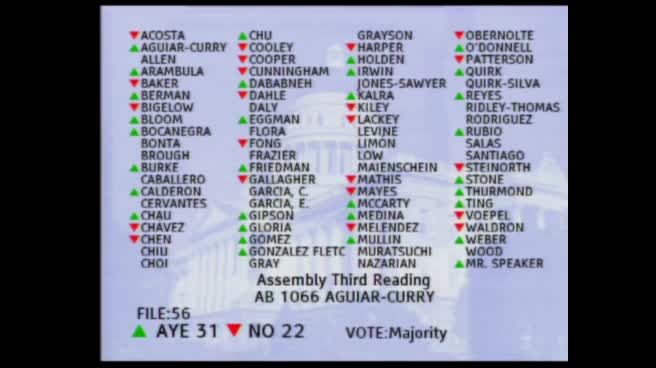 5MIN
Assembly Floor
 1MIN
Assembly Floor
 1H
Assembly Standing Committee on Appropriations
 18MIN
Assembly Standing Committee on Housing and Community Development


Bill Co-Author(s):
