AB 1617: Juvenile case files: inspection.
- Session Year: 2017-2018
- House: Assembly
- Latest Version Date: 2018-09-30
Existing law generally provides for the confidentiality of information regarding a minor in proceedings in the juvenile court and related court proceedings and limits access to juvenile case files. Existing law authorizes only certain individuals to inspect a juvenile case file, including, among others, the minor, his or her parents or guardian, and the attorneys for the parties, judges, referees, other hearing officers, probation officers, and law enforcement officers who are actively participating in criminal or juvenile proceedings involving the minor. Existing law also authorizes some of those individuals to receive copies of the case file. Existing law requires a person who is seeking access to a juvenile case file that is privileged or confidential pursuant to any other state or federal law and who is not entitled to access the record to petition the juvenile court for access.
This bill would authorize an individual who is not generally authorized pursuant to specified provisions to inspect juvenile case files but received authorization from the juvenile court pursuant to a specified petition process, and who files a notice of appeal or petition for writ challenging a juvenile court order or who is a respondent in that appeal or real party in interest in that writ proceeding, for purposes of that appeal or writ proceeding, to inspect and copy any records in a juvenile case file to which the individual was previously granted access by the juvenile court. The bill would require the Judicial Council to adopt rules to implement these provisions.
Existing law generally provides for the confidentiality of information regarding a minor in proceedings in the juvenile court and related court proceedings and limits access to juvenile case files. Existing law authorizes only certain individuals to inspect a juvenile case file, including, among others, the minor, his or her parents or guardian, and the attorneys for the parties, judges, referees, other hearing officers, probation officers, and law enforcement officers who are actively participating in criminal or juvenile proceedings involving the minor. Existing law also authorizes some of those individuals to receive copies of the case file. Existing law requires a person who is seeking access to a juvenile case file that is privileged or confidential pursuant to any other state or federal law and who is not entitled to access the record to petition the juvenile court for access.
This bill would authorize an individual who is not generally authorized pursuant to specified provisions to inspect juvenile case files but received authorization from the juvenile court pursuant to a specified petition process, and who files a notice of appeal or writ of petition for writ challenging a juvenile court order or who is a respondent in that appeal or real party in interest in that writ proceeding, for purposes of that appeal or writ proceeding, to inspect and copy any records in a juvenile case file to which the individual was previously granted access by the juvenile court. The bill would require the Judicial Council to adopt rules to implement these provisions.
Existing law generally provides for the confidentiality of information regarding a minor in proceedings in the juvenile court and related court proceedings and limits access to juvenile case files. Existing law authorizes only certain individuals to inspect a juvenile case file, including, among others, the minor, his or her parents or guardian, and the attorneys for the parties, judges, referees, other hearing officers, probation officers, and law enforcement officers who are actively participating in criminal or juvenile proceedings involving the minor. Existing law also authorizes some of those individuals to receive copies of the case file. Existing law requires a person who is seeking access to a juvenile case file that is privileged or confidential pursuant to any other state or federal law and who is not entitled to access the record to petition the juvenile court for access.
This bill would authorize an individual who is not generally authorized pursuant to specified provisions to inspect juvenile case files but received authorization from the juvenile court pursuant to a specified petition process, and who files a notice of appeal or writ of petition challenging a juvenile court order or who is a respondent in that appeal or writ proceeding, for purposes of that appeal or writ proceeding, to inspect and copy any records in a juvenile case file to which the individual was previously granted access by the juvenile court. The bill would additionally authorize a person who is not generally authorized, as described above, and who is seeking access to a juvenile case file that is privileged or confidential pursuant to any other state or federal law and who is not entitled to access the record to petition the courts of appeal for access. The bill would require the Judicial Council to adopt rules to implement these provisions.
Existing law generally provides for the confidentiality of information regarding a minor in proceedings in the juvenile court and related court proceedings and limits access to juvenile case files. Existing law authorizes only certain individuals to inspect a juvenile case file, including, among others, the minor, his or her parents or guardian, and the attorneys for the parties, judges, referees, other hearing officers, probation officers, and law enforcement officers who are actively participating in criminal or juvenile proceedings involving the minor. Existing law also authorizes some of those individuals to receive copies of the case file. Existing law requires a person who is seeking access to a juvenile case file that is privileged or confidential pursuant to any other state or federal law and who is not entitled to access the record to petition the juvenile court for access.
This bill would authorize an individual who is not generally authorized pursuant to specified provisions to inspect juvenile case files but received authorization from the juvenile court pursuant to a specified petition process, and who files a notice of appeal or writ of petition challenging a juvenile court order or who is a respondent in that appeal or writ proceeding, for purposes of that appeal or writ proceeding, to inspect and copy any records in a juvenile case file to which the individual was previously granted access by the juvenile court. The bill would additionally authorize a person who is not generally authorized, as described above, and who is seeking access to a juvenile case file that is privileged or confidential pursuant to any other state or federal law and who is not entitled to access the record to petition the court of appeals courts of appeal for access. The bill would require the Judicial Council to adopt rules to implement these provisions.
Existing law generally provides for the confidentiality of information regarding a minor in proceedings in the juvenile court and related court proceedings and limits access to juvenile case files. Existing law authorizes only certain individuals to inspect a juvenile case file, including, among others, the minor, his or her parents or guardian, and the attorneys for the parties, judges, referees, other hearing officers, probation officers, and law enforcement officers who are actively participating in criminal or juvenile proceedings involving the minor. Existing law also authorizes some of those individuals to receive copies of the case file. Existing law requires a person who is seeking access to a juvenile case file that is privileged or confidential pursuant to any other state or federal law and who is not entitled to access the record to petition the juvenile court for access.
This bill would authorize an individual who is not generally authorized pursuant to specified provisions to inspect juvenile case files but received authorization from the juvenile court pursuant to a specified petition process, and who files a notice of appeal or writ of petition challenging a juvenile court order or who is a respondent in that appeal or writ proceeding, for purposes of that appeal or writ proceeding, to inspect and copy any records in a juvenile case file to which the individual was previously granted access by the juvenile court. The bill would additionally authorize a person who is not generally authorized, as described above, and who is seeking access to a juvenile case file that is privileged or confidential pursuant to any other state or federal law and who is not entitled to access the record to petition the court of appeals for access. The bill would require the Judicial Council to adopt rules to implement these provisions.
Existing law makes legislative findings that the Department of Fish and Wildlife continues to be inadequately funded to meet its mandates and that the department must secure a significant increase in reliable funding, in addition to user fees. Existing law declares the intent of the Legislature that the department cooperate with the Legislature, recreational users, conservation organizations, the commercial fishing industry, and other interested parties to identify and propose new alternative sources of revenue to fund the departments necessary marine conservation, restoration, and resources management and protection responsibilities.Existing law requires the Secretary of the Natural Resources Agency to convene a committee to develop and submit to the Governor and Legislature, before July 1, 2012, a strategic vision for the Department of Fish and Wildlife and the Fish and Game Commission that addresses specified matters relating to state fish and wildlife resource management. Existing law requires the Governor or the committee to appoint a blue ribbon citizen commission or task force, a stakeholder advisory group, and any other group that the Governor or the committee deems necessary or desirable to assist in developing the strategic vision.This bill would require the department, in cooperation with the above-mentioned parties and additional specified parties, to identify and propose new sources of revenue to fund the departments necessary wildlife, land, and marine conservation, restoration, and resources management and protection responsibilities. The bill would require the Secretary of the Natural Resources Agency to appoint a stakeholder advisory group to report to the Governor and Legislature, before July 1, 2018, on the progress made toward the implementation of the strategic vision. The bill would require the Secretary of the Natural Resources Agency to direct the department to evaluate and implement program efficiencies as part of its strategic planning effort and to establish a high-level task force that reviews and makes recommendations regarding Fish and Game Commission and department mandates, efficiencies, and funding, as described in specified recommendations contained in the strategic vision.Existing law makes legislative findings that the Department of Fish and Wildlife continues to be inadequately funded to meet its mandates and that the department must secure a significant increase in reliable funding, in addition to user fees. Existing law declares the intent of the Legislature that the department cooperate with the Legislature, recreational users, conservation organizations, the commercial fishing industry, and other interested parties to identify and propose new alternative sources of revenue to fund the departments necessary marine conservation, restoration, and resources management and protection responsibilities. Existing law declares the intent of the Legislature to identify new funding sources and to secure those sources to adequately fund the departments activities directed at protecting and managing wildlife for the people of the state.
Existing law requires the Secretary of the Natural Resources Agency to convene a committee to develop and submit to the Governor and Legislature, before July 1, 2012, a strategic vision for the Department of Fish and Wildlife and the Fish and Game Commission that addresses specified matters relating to state fish and wildlife resource management. Existing law requires the Governor or the committee to appoint a blue ribbon citizen commission or task force, a stakeholder advisory group, and any other group that the Governor or the committee deems necessary or desirable to assist in developing the strategic vision.
This bill would require the department, in cooperation with the above-mentioned parties and additional specified parties, to identify and propose new sources of revenue to fund the departments necessary wildlife, land, and marine conservation, restoration, and resources management and protection responsibilities. The bill would require the department, by an unspecified date, to identify and propose new funding sources to adequately fund its activities directed at protecting and managing wildlife for the people of the state. Secretary of the Natural Resources Agency to appoint a stakeholder advisory group to report to the Governor and Legislature, before July 1, 2018, on the progress made toward the implementation of the strategic vision. The bill would require the Secretary of the Natural Resources Agency to direct the department to evaluate and implement program efficiencies as part of its strategic planning effort and to establish a high-level task force that reviews and makes recommendations regarding Fish and Game Commission and department mandates, efficiencies, and funding, as described in specified recommendations contained in the strategic vision.
Existing law makes legislative findings that the Department of Fish and Wildlife continues to be inadequately funded to meet its mandates and that the department must secure a significant increase in reliable funding, in addition to user fees. Existing law declares the intent of the Legislature that the department cooperate with the Legislature, recreational users, conservation organizations, the commercial fishing industry, and other interested parties to identify and propose new alternative sources of revenue to fund the departments necessary marine conservation, restoration, and resources management and protection responsibilities. Existing law declares the intent of the Legislature to identify new funding sources and to secure those sources to adequately fund the departments activities directed at protecting and managing wildlife for the people of the state.
This bill would declare the intent of the Legislature that require the department, in cooperation with those the above-mentioned parties and the hunting community, additional specified parties, to identify and propose new and alternative sources of revenue to fund the departments necessary wildlife and land wildlife, land, and marine conservation, restoration, and resources management and protection responsibilities. The bill would require the department, by an unspecified date, to identify and propose new funding sources to adequately fund its activities directed at protecting and managing wildlife for the people of the state.
Existing law makes legislative findings that the Department of Fish and Wildlife continues to be inadequately funded to meet its mandates and that the department must secure a significant increase in reliable funding, in addition to user fees. Existing law declares the intent of the Legislature that the department cooperate with the Legislature, recreational users, conservation organizations, the commercial fishing industry, and other interested parties to identify and propose new alternative sources of revenue to fund the departments necessary marine conservation, restoration, and resources management and protection responsibilities.
This bill would declare the intent of the Legislature that the department, in cooperation with those parties and the hunting community, identify and propose new and alternative sources of revenue to fund the departments necessary wildlife and land conservation, restoration, and resources management and protection responsibilities.
(a)(1)Except as provided in Section 828, a case file may be inspected only by the following:
(A)Court personnel.
(B)The district attorney, a city attorney, or city prosecutor authorized to prosecute criminal or juvenile cases under state law.
(C)The minor who is the subject of the proceeding.
(D)The minors parent or guardian.
(E)The attorneys for the parties, judges, referees, other hearing officers, probation officers, and law enforcement officers who are actively participating in criminal or juvenile proceedings involving the minor.
(F)The county counsel, city attorney, or any other attorney representing the petitioning agency in a dependency action.
(G)The superintendent or designee of the school district where the minor is enrolled or attending school.
(H)Members of the child protective agencies as described in Section 11165.9 of the Penal Code.
(I)The State Department of Social Services, to carry out its duties pursuant to Division 9 (commencing with Section 10000) of this code and Part 5 (commencing with Section 7900) of Division 12 of the Family Code to oversee and monitor county child welfare agencies, children in foster care or receiving foster care assistance, and out-of-state placements, Section 10850.4, and paragraph (2).
(J)(i)Authorized staff who are employed by, or authorized staff of entities who are licensed by, the State Department of Social Services, as necessary to the performance of their duties related to resource family approval, and authorized staff who are employed by the State Department of Social Services as necessary to inspect, approve, or license, and monitor or investigate community care facilities or resource families, and to ensure that the standards of care and services provided in those facilities are adequate and appropriate, and to ascertain compliance with the rules and regulations to which the facilities are subject.
(ii)The confidential information shall remain confidential except for purposes of inspection, approval or licensing, or monitoring or investigation pursuant to Chapter 3 (commencing with Section 1500) and Chapter 3.4 (commencing with Section 1596.70) of Division 2 of the Health and Safety Code and Article 2 (commencing with Section 16519.5) of Chapter 5 of Part 4 of Division 9. The confidential information may also be used by the State Department of Social Services in a criminal, civil, or administrative proceeding. The confidential information shall be available only to the judge or hearing officer and to the parties to the case. Names that are confidential shall be listed in attachments separate to the general pleadings. The confidential information shall be sealed after the conclusion of the criminal, civil, or administrative hearings, and may not subsequently be released except in accordance with this subdivision. If the confidential information does not result in a criminal, civil, or administrative proceeding, it shall be sealed after the State Department of Social Services determines that no further action will be taken in the matter. Except as otherwise provided in this subdivision, confidential information shall not contain the name of the minor.
(K)Members of childrens multidisciplinary teams, persons, or agencies providing treatment or supervision of the minor.
(L)A judge, commissioner, or other hearing officer assigned to a family law case with issues concerning custody or visitation, or both, involving the minor, and the following persons, if actively participating in the family law case: a family court mediator assigned to a case involving the minor pursuant to Article 1 (commencing with Section 3160) of Chapter 11 of Part 2 of Division 8 of the Family Code, a court-appointed evaluator or a person conducting a court-connected child custody evaluation, investigation, or assessment pursuant to Section 3111 or 3118 of the Family Code, and counsel appointed for the minor in the family law case pursuant to Section 3150 of the Family Code. Prior to allowing counsel appointed for the minor in the family law case to inspect the file, the court clerk may require counsel to provide a certified copy of the court order appointing him or her as the minors counsel.
(M)When acting within the scope of investigative duties of an active case, a statutorily authorized or court-appointed investigator who is conducting an investigation pursuant to Section 7663, 7851, or 9001 of the Family Code, or who is actively participating in a guardianship case involving a minor pursuant to Part 2 (commencing with Section 1500) of Division 4 of the Probate Code and acting within the scope of his or her duties in that case.
(N)A local child support agency for the purpose of establishing paternity and establishing and enforcing child support orders.
(O)Juvenile justice commissions as established under Section 225. The confidentiality provisions of Section 10850 shall apply to a juvenile justice commission and its members.
(P)The Department of Justice, to carry out its duties pursuant to Sections 290.008 and 290.08 of the Penal Code as the repository for sex offender registration and notification in California.
(Q)Any other person who may be designated by court order of the judge of the juvenile court upon filing a petition.
(R)A probation officer who is preparing a report pursuant to Section 1178 on behalf of a person who was in the custody of the Department of Corrections and Rehabilitation, Division of Juvenile Justice and who has petitioned the Board of Juvenile Hearings for an honorable discharge.
(2)(A)Notwithstanding any other law and subject to subparagraph (A) of paragraph (3), juvenile case files, except those relating to matters within the jurisdiction of the court pursuant to Section 601 or 602, that pertain to a deceased child who was within the jurisdiction of the juvenile court pursuant to Section 300, shall be released to the public pursuant to an order by the juvenile court after a petition has been filed and interested parties have been afforded an opportunity to file an objection. Any information relating to another child or which could identify another child, except for information about the deceased, shall be redacted from the juvenile case file prior to release, unless a specific order is made by the juvenile court to the contrary. Except as provided in this paragraph, the presiding judge of the juvenile court may issue an order prohibiting or limiting access to the juvenile case file, or any portion thereof, of a deceased child only upon a showing by a preponderance of evidence that release of the juvenile case file or any portion thereof is detrimental to the safety, protection, or physical or emotional well-being of another child who is directly or indirectly connected to the juvenile case that is the subject of the petition.
(B)This paragraph represents a presumption in favor of the release of documents when a child is deceased unless the statutory reasons for confidentiality are shown to exist.
(C)If a child whose records are sought has died, and documents are sought pursuant to this paragraph, no weighing or balancing of the interests of those other than a child is permitted.
(D)A petition filed under this paragraph shall be served on interested parties by the petitioner, if the petitioner is in possession of their identity and address, and on the custodian of records. Upon receiving a petition, the custodian of records shall serve a copy of the request upon all interested parties that have not been served by the petitioner or on the interested parties served by the petitioner if the custodian of records possesses information, such as a more recent address, indicating that the service by the petitioner may have been ineffective.
(E)The custodian of records shall serve the petition within 10 calendar days of receipt. If any interested party, including the custodian of records, objects to the petition, the party shall file and serve the objection on the petitioning party no later than 15 calendar days after service of the petition.
(F)The petitioning party shall have 10 calendar days to file any reply. The juvenile court shall set the matter for hearing no more than 60 calendar days from the date the petition is served on the custodian of records. The court shall render its decision within 30 days of the hearing. The matter shall be decided solely upon the basis of the petition and supporting exhibits and declarations, if any, the objection and any supporting exhibits or declarations, if any, and the reply and any supporting declarations or exhibits thereto, and argument at hearing. The court may solely upon its own motion order the appearance of witnesses. If no objection is filed to the petition, the court shall review the petition and issue its decision within 10 calendar days of the final day for filing the objection. Any order of the court shall be immediately reviewable by petition to the appellate court for the issuance of an extraordinary writ.
(3)Access to juvenile case files pertaining to matters within the jurisdiction of the juvenile court pursuant to Section 300 shall be limited as follows:
(A)If a juvenile case file, or any portion thereof, is privileged or confidential pursuant to any other state law or federal law or regulation, the requirements of that state law or federal law or regulation prohibiting or limiting release of the juvenile case file or any portions thereof shall prevail. Unless a person is listed in subparagraphs (A) to (P), inclusive, of paragraph (1) and is entitled to access under the other state law or federal law or regulation without a court order, all those seeking access, pursuant to other authorization, to portions of, or information relating to the contents of, juvenile case files protected under another state law or federal law or regulation, shall petition the juvenile court. The juvenile court may only release the portion of, or information relating to the contents of, juvenile case files protected by another state law or federal law or regulation if disclosure is not detrimental to the safety, protection, or physical or emotional well-being of a child who is directly or indirectly connected to the juvenile case that is the subject of the petition. This paragraph does not limit the ability of the juvenile court to carry out its duties in conducting juvenile court proceedings.
(B)Prior to the release of the juvenile case file or any portion thereof, the court shall afford due process, including a notice of and an opportunity to file an objection to the release of the record or report to all interested parties.
(4)A juvenile case file, any portion thereof, and information relating to the content of the juvenile case file, may not be disseminated by the receiving agencies to any persons or agencies, other than those persons or agencies authorized to receive documents pursuant to this section. Further, a juvenile case file, any portion thereof, and information relating to the content of the juvenile case file, may not be made as an attachment to any other documents without the prior approval of the presiding judge of the juvenile court, unless it is used in connection with and in the course of a criminal investigation or a proceeding brought to declare a person a dependent child or ward of the juvenile court.
(5)Individuals listed in subparagraphs (A), (B), (C), (D), (E), (F), (H), (I), and (J) of paragraph (1) may also receive copies of the case file. For authorized staff of entities who are licensed by the State Department of Social Services, the confidential information shall be obtained through a child protective agency, as defined in subparagraph (H) of paragraph (1). In these circumstances, the requirements of paragraph (4) shall continue to apply to the information received.
(6)An individual other than a person described in subparagraphs (A) to (P), inclusive, of paragraph (1) who files a notice of appeal or petition for writ challenging a juvenile court order, or who is a respondent in that appeal or real party in interest in that writ proceeding, may, for purposes of that appeal or writ proceeding, inspect and copy any records in a juvenile case file to which the individual was previously granted access by the juvenile court pursuant to subparagraph (Q) of paragraph (1), including any records or portions thereof that are made a part of the appellate record. The requirements of paragraph (3) shall continue to apply to any other record, or a portion thereof, in the juvenile case file or made a part of the appellate record. The requirements of paragraph (4) shall continue to apply to files received pursuant to this paragraph. The Judicial Council shall adopt rules to implement this paragraph.
(b)(1)While the Legislature reaffirms its belief that juvenile court records, in general, should be confidential, it is the intent of the Legislature in enacting this subdivision to provide for a limited exception to juvenile court record confidentiality to promote more effective communication among juvenile courts, family courts, law enforcement agencies, and schools to ensure the rehabilitation of juvenile criminal offenders as well as to lessen the potential for drug use, violence, other forms of delinquency, and child abuse.
(2)(A)Notwithstanding subdivision (a), written notice that a minor enrolled in a public school, kindergarten to grade 12, inclusive, has been found by a court of competent jurisdiction to have committed any felony or any misdemeanor involving curfew, gambling, alcohol, drugs, tobacco products, carrying of weapons, a sex offense listed in Section 290 of the Penal Code, assault or battery, larceny, vandalism, or graffiti shall be provided by the court, within seven days, to the superintendent of the school district of attendance. Written notice shall include only the offense found to have been committed by the minor and the disposition of the minors case. This notice shall be expeditiously transmitted by the district superintendent to the principal at the school of attendance. The principal shall expeditiously disseminate the information to those counselors directly supervising or reporting on the behavior or progress of the minor. In addition, the principal shall disseminate the information to any teacher or administrator directly supervising or reporting on the behavior or progress of the minor whom the principal believes needs the information to work with the pupil in an appropriate fashion, to avoid being needlessly vulnerable or to protect other persons from needless vulnerability.
(B)Any information received by a teacher, counselor, or administrator under this subdivision shall be received in confidence for the limited purpose of rehabilitating the minor and protecting students and staff, and shall not be further disseminated by the teacher, counselor, or administrator, except insofar as communication with the juvenile, his or her parents or guardians, law enforcement personnel, and the juveniles probation officer is necessary to effectuate the juveniles rehabilitation or to protect students and staff.
(C)An intentional violation of the confidentiality provisions of this paragraph is a misdemeanor punishable by a fine not to exceed five hundred dollars ($500).
(3)If a minor is removed from public school as a result of the courts finding described in subdivision (b), the superintendent shall maintain the information in a confidential file and shall defer transmittal of the information received from the court until the minor is returned to public school. If the minor is returned to a school district other than the one from which the minor came, the parole or probation officer having jurisdiction over the minor shall so notify the superintendent of the last district of attendance, who shall transmit the notice received from the court to the superintendent of the new district of attendance.
(c)Each probation report filed with the court concerning a minor whose record is subject to dissemination pursuant to subdivision (b) shall include on the face sheet the school at which the minor is currently enrolled. The county superintendent shall provide the court with a listing of all of the schools within each school district, within the county, along with the name and mailing address of each district superintendent.
(d)(1)Each notice sent by the court pursuant to subdivision (b) shall be stamped with the instruction: Unlawful Dissemination Of This Information Is A Misdemeanor. Any information received from the court shall be kept in a separate confidential file at the school of attendance and shall be transferred to the minors subsequent schools of attendance and maintained until the minor graduates from high school, is released from juvenile court jurisdiction, or reaches 18 years of age, whichever occurs first. After that time the confidential record shall be destroyed. At any time after the date by which a record required to be destroyed by this section should have been destroyed, the minor or his or her parent or guardian shall have the right to make a written request to the principal of the school that the minors school records be reviewed to ensure that the record has been destroyed. Upon completion of any requested review and no later than 30 days after the request for the review was received, the principal or his or her designee shall respond in writing to the written request and either shall confirm that the record has been destroyed or, if the record has not been destroyed, shall explain why destruction has not yet occurred.
(2)Except as provided in paragraph (2) of subdivision (b), no liability shall attach to any person who transmits or fails to transmit any notice or information required under subdivision (b).
(e)For purposes of this section, a juvenile case file means a petition filed in any juvenile court proceeding, reports of the probation officer, and all other documents filed in that case or made available to the probation officer in making his or her report, or to the judge, referee, or other hearing officer, and thereafter retained by the probation officer, judge, referee, or other hearing officer.
(f)The persons described in subparagraphs (A), (E), (F), (H), (K), (L), (M), and (N) of paragraph (1) of subdivision (a) include persons serving in a similar capacity for an Indian tribe, reservation, or tribal court when the case file involves a child who is a member of, or who is eligible for membership in, that tribe.
(g)A case file that is covered by, or included in, an order of the court sealing a record pursuant to Section 781 or 786 may not be inspected, except as specified by Section 781 or 786.
(a)(1)Except as provided in Section 828, a case file may be inspected only by the following:
(A)Court personnel.
(B)The district attorney, a city attorney, or city prosecutor authorized to prosecute criminal or juvenile cases under state law.
(C)The minor who is the subject of the proceeding.
(D)The minors parent or guardian.
(E)The attorneys for the parties, judges, referees, other hearing officers, probation officers, and law enforcement officers who are actively participating in criminal or juvenile proceedings involving the minor.
(F)The county counsel, city attorney, or any other attorney representing the petitioning agency in a dependency action.
(G)The superintendent or designee of the school district where the minor is enrolled or attending school.
(H)Members of the child protective agencies as described in Section 11165.9 of the Penal Code.
(I)The State Department of Social Services, to carry out its duties pursuant to Division 9 (commencing with Section 10000) of this code and Part 5 (commencing with Section 7900) of Division 12 of the Family Code to oversee and monitor county child welfare agencies, children in foster care or receiving foster care assistance, and out-of-state placements, Section 10850.4, and paragraph (2).
(J)(i)Authorized staff who are employed by, or authorized staff of entities who are licensed by, the State Department of Social Services, as necessary to the performance of their duties related to resource family approval, and authorized staff who are employed by the State Department of Social Services as necessary to inspect, approve, or license, and monitor or investigate community care facilities or resource families, and to ensure that the standards of care and services provided in those facilities are adequate and appropriate, and to ascertain compliance with the rules and regulations to which the facilities are subject.
(ii)The confidential information shall remain confidential except for purposes of inspection, approval or licensing, or monitoring or investigation pursuant to Chapter 3 (commencing with Section 1500) and Chapter 3.4 (commencing with Section 1596.70) of Division 2 of the Health and Safety Code and Article 2 (commencing with Section 16519.5) of Chapter 5 of Part 4 of Division 9. The confidential information may also be used by the State Department of Social Services in a criminal, civil, or administrative proceeding. The confidential information shall be available only to the judge or hearing officer and to the parties to the case. Names that are confidential shall be listed in attachments separate to the general pleadings. The confidential information shall be sealed after the conclusion of the criminal, civil, or administrative hearings, and may not subsequently be released except in accordance with this subdivision. If the confidential information does not result in a criminal, civil, or administrative proceeding, it shall be sealed after the State Department of Social Services determines that no further action will be taken in the matter. Except as otherwise provided in this subdivision, confidential information shall not contain the name of the minor.
(K)Members of childrens multidisciplinary teams, persons, or agencies providing treatment or supervision of the minor.
(L)A judge, commissioner, or other hearing officer assigned to a family law case with issues concerning custody or visitation, or both, involving the minor, and the following persons, if actively participating in the family law case: a family court mediator assigned to a case involving the minor pursuant to Article 1 (commencing with Section 3160) of Chapter 11 of Part 2 of Division 8 of the Family Code, a court-appointed evaluator or a person conducting a court-connected child custody evaluation, investigation, or assessment pursuant to Section 3111 or 3118 of the Family Code, and counsel appointed for the minor in the family law case pursuant to Section 3150 of the Family Code. Prior to allowing counsel appointed for the minor in the family law case to inspect the file, the court clerk may require counsel to provide a certified copy of the court order appointing him or her as the minors counsel.
(M)When acting within the scope of investigative duties of an active case, a statutorily authorized or court-appointed investigator who is conducting an investigation pursuant to Section 7663, 7851, or 9001 of the Family Code, or who is actively participating in a guardianship case involving a minor pursuant to Part 2 (commencing with Section 1500) of Division 4 of the Probate Code and acting within the scope of his or her duties in that case.
(N)A local child support agency for the purpose of establishing paternity and establishing and enforcing child support orders.
(O)Juvenile justice commissions as established under Section 225. The confidentiality provisions of Section 10850 shall apply to a juvenile justice commission and its members.
(P)The Department of Justice, to carry out its duties pursuant to Sections 290.008 and 290.08 of the Penal Code as the repository for sex offender registration and notification in California.
(Q)Any other person who may be designated by court order of the judge of the juvenile court upon filing a petition.
(R)A probation officer who is preparing a report pursuant to Section 1178 on behalf of a person who was in the custody of the Department of Corrections and Rehabilitation, Division of Juvenile Justice and who has petitioned the Board of Juvenile Hearings for an honorable discharge.
(2)(A)Notwithstanding any other law and subject to subparagraph (A) of paragraph (3), juvenile case files, except those relating to matters within the jurisdiction of the court pursuant to Section 601 or 602, that pertain to a deceased child who was within the jurisdiction of the juvenile court pursuant to Section 300, shall be released to the public pursuant to an order by the juvenile court after a petition has been filed and interested parties have been afforded an opportunity to file an objection. Any information relating to another child or which could identify another child, except for information about the deceased, shall be redacted from the juvenile case file prior to release, unless a specific order is made by the juvenile court to the contrary. Except as provided in this paragraph, the presiding judge of the juvenile court may issue an order prohibiting or limiting access to the juvenile case file, or any portion thereof, of a deceased child only upon a showing by a preponderance of evidence that release of the juvenile case file or any portion thereof is detrimental to the safety, protection, or physical or emotional well-being of another child who is directly or indirectly connected to the juvenile case that is the subject of the petition.
(B)This paragraph represents a presumption in favor of the release of documents when a child is deceased unless the statutory reasons for confidentiality are shown to exist.
(C)If a child whose records are sought has died, and documents are sought pursuant to this paragraph, no weighing or balancing of the interests of those other than a child is permitted.
(D)A petition filed under this paragraph shall be served on interested parties by the petitioner, if the petitioner is in possession of their identity and address, and on the custodian of records. Upon receiving a petition, the custodian of records shall serve a copy of the request upon all interested parties that have not been served by the petitioner or on the interested parties served by the petitioner if the custodian of records possesses information, such as a more recent address, indicating that the service by the petitioner may have been ineffective.
(E)The custodian of records shall serve the petition within 10 calendar days of receipt. If any interested party, including the custodian of records, objects to the petition, the party shall file and serve the objection on the petitioning party no later than 15 calendar days after service of the petition.
(F)The petitioning party shall have 10 calendar days to file any reply. The juvenile court shall set the matter for hearing no more than 60 calendar days from the date the petition is served on the custodian of records. The court shall render its decision within 30 days of the hearing. The matter shall be decided solely upon the basis of the petition and supporting exhibits and declarations, if any, the objection and any supporting exhibits or declarations, if any, and the reply and any supporting declarations or exhibits thereto, and argument at hearing. The court may solely upon its own motion order the appearance of witnesses. If no objection is filed to the petition, the court shall review the petition and issue its decision within 10 calendar days of the final day for filing the objection. Any order of the court shall be immediately reviewable by petition to the appellate court for the issuance of an extraordinary writ.
(3)Access to juvenile case files pertaining to matters within the jurisdiction of the juvenile court pursuant to Section 300 shall be limited as follows:
(A)If a juvenile case file, or any portion thereof, is privileged or confidential pursuant to any other state law or federal law or regulation, the requirements of that state law or federal law or regulation prohibiting or limiting release of the juvenile case file or any portions thereof shall prevail. Unless a person is listed in subparagraphs (A) to (P), inclusive, of paragraph (1) and is entitled to access under the other state law or federal law or regulation without a court order, all those seeking access, pursuant to other authorization, to portions of, or information relating to the contents of, juvenile case files protected under another state law or federal law or regulation, shall petition the juvenile court. The juvenile court may only release the portion of, or information relating to the contents of, juvenile case files protected by another state law or federal law or regulation if disclosure is not detrimental to the safety, protection, or physical or emotional well-being of a child who is directly or indirectly connected to the juvenile case that is the subject of the petition. This paragraph does not limit the ability of the juvenile court to carry out its duties in conducting juvenile court proceedings.
(B)Prior to the release of the juvenile case file or any portion thereof, the court shall afford due process, including a notice of and an opportunity to file an objection to the release of the record or report to all interested parties.
(4)A juvenile case file, any portion thereof, and information relating to the content of the juvenile case file, may not be disseminated by the receiving agencies to any persons or agencies, other than those persons or agencies authorized to receive documents pursuant to this section. Further, a juvenile case file, any portion thereof, and information relating to the content of the juvenile case file, may not be made as an attachment to any other documents without the prior approval of the presiding judge of the juvenile court, unless it is used in connection with and in the course of a criminal investigation or a proceeding brought to declare a person a dependent child or ward of the juvenile court.
(5)Individuals listed in subparagraphs (A), (B), (C), (D), (E), (F), (H), (I), and (J) of paragraph (1) may also receive copies of the case file. For authorized staff of entities who are licensed by the State Department of Social Services, the confidential information shall be obtained through a child protective agency, as defined in subparagraph (H) of paragraph (1). In these circumstances, the requirements of paragraph (4) shall continue to apply to the information received.
(6)An individual other than a person described in subparagraphs (A) to (P), inclusive, of paragraph (1) who files a notice of appeal or writ of petition for writ challenging a juvenile court order, or who is a respondent in that appeal or real party in interest in that writ proceeding, may, for purposes of that appeal or writ proceeding, inspect and copy any records in a juvenile case file to which the individual was previously granted access by the juvenile court pursuant to subparagraph (Q) of paragraph (1), including any records or portions thereof that are made a part of the appellate record. The requirements of paragraph (3) shall continue to apply to any other record, or a portion thereof, in the juvenile case file or made a part of the appellate record. The requirements of paragraph (4) shall continue to apply to files received pursuant to this paragraph. The Judicial Council shall adopt rules to implement this paragraph.
(b)(1)While the Legislature reaffirms its belief that juvenile court records, in general, should be confidential, it is the intent of the Legislature in enacting this subdivision to provide for a limited exception to juvenile court record confidentiality to promote more effective communication among juvenile courts, family courts, law enforcement agencies, and schools to ensure the rehabilitation of juvenile criminal offenders as well as to lessen the potential for drug use, violence, other forms of delinquency, and child abuse.
(2)(A)Notwithstanding subdivision (a), written notice that a minor enrolled in a public school, kindergarten to grade 12, inclusive, has been found by a court of competent jurisdiction to have committed any felony or any misdemeanor involving curfew, gambling, alcohol, drugs, tobacco products, carrying of weapons, a sex offense listed in Section 290 of the Penal Code, assault or battery, larceny, vandalism, or graffiti shall be provided by the court, within seven days, to the superintendent of the school district of attendance. Written notice shall include only the offense found to have been committed by the minor and the disposition of the minors case. This notice shall be expeditiously transmitted by the district superintendent to the principal at the school of attendance. The principal shall expeditiously disseminate the information to those counselors directly supervising or reporting on the behavior or progress of the minor. In addition, the principal shall disseminate the information to any teacher or administrator directly supervising or reporting on the behavior or progress of the minor whom the principal believes needs the information to work with the pupil in an appropriate fashion, to avoid being needlessly vulnerable or to protect other persons from needless vulnerability.
(B)Any information received by a teacher, counselor, or administrator under this subdivision shall be received in confidence for the limited purpose of rehabilitating the minor and protecting students and staff, and shall not be further disseminated by the teacher, counselor, or administrator, except insofar as communication with the juvenile, his or her parents or guardians, law enforcement personnel, and the juveniles probation officer is necessary to effectuate the juveniles rehabilitation or to protect students and staff.
(C)An intentional violation of the confidentiality provisions of this paragraph is a misdemeanor punishable by a fine not to exceed five hundred dollars ($500).
(3)If a minor is removed from public school as a result of the courts finding described in subdivision (b), the superintendent shall maintain the information in a confidential file and shall defer transmittal of the information received from the court until the minor is returned to public school. If the minor is returned to a school district other than the one from which the minor came, the parole or probation officer having jurisdiction over the minor shall so notify the superintendent of the last district of attendance, who shall transmit the notice received from the court to the superintendent of the new district of attendance.
(c)Each probation report filed with the court concerning a minor whose record is subject to dissemination pursuant to subdivision (b) shall include on the face sheet the school at which the minor is currently enrolled. The county superintendent shall provide the court with a listing of all of the schools within each school district, within the county, along with the name and mailing address of each district superintendent.
(d)(1)Each notice sent by the court pursuant to subdivision (b) shall be stamped with the instruction: Unlawful Dissemination Of This Information Is A Misdemeanor. Any information received from the court shall be kept in a separate confidential file at the school of attendance and shall be transferred to the minors subsequent schools of attendance and maintained until the minor graduates from high school, is released from juvenile court jurisdiction, or reaches 18 years of age, whichever occurs first. After that time the confidential record shall be destroyed. At any time after the date by which a record required to be destroyed by this section should have been destroyed, the minor or his or her parent or guardian shall have the right to make a written request to the principal of the school that the minors school records be reviewed to ensure that the record has been destroyed. Upon completion of any requested review and no later than 30 days after the request for the review was received, the principal or his or her designee shall respond in writing to the written request and either shall confirm that the record has been destroyed or, if the record has not been destroyed, shall explain why destruction has not yet occurred.
(2)Except as provided in paragraph (2) of subdivision (b), no liability shall attach to any person who transmits or fails to transmit any notice or information required under subdivision (b).
(e)For purposes of this section, a juvenile case file means a petition filed in any juvenile court proceeding, reports of the probation officer, and all other documents filed in that case or made available to the probation officer in making his or her report, or to the judge, referee, or other hearing officer, and thereafter retained by the probation officer, judge, referee, or other hearing officer.
(f)The persons described in subparagraphs (A), (E), (F), (H), (K), (L), (M), and (N) of paragraph (1) of subdivision (a) include persons serving in a similar capacity for an Indian tribe, reservation, or tribal court when the case file involves a child who is a member of, or who is eligible for membership in, that tribe.
(g)A case file that is covered by, or included in, an order of the court sealing a record pursuant to Section 781 or 786 may not be inspected, except as specified by Section 781 or 786.
(a)(1)Except as provided in Section 828, a case file may be inspected only by the following:
(A)Court personnel.
(B)The district attorney, a city attorney, or city prosecutor authorized to prosecute criminal or juvenile cases under state law.
(C)The minor who is the subject of the proceeding.
(D)The minors parent or guardian.
(E)The attorneys for the parties, judges, referees, other hearing officers, probation officers, and law enforcement officers who are actively participating in criminal or juvenile proceedings involving the minor.
(F)The county counsel, city attorney, or any other attorney representing the petitioning agency in a dependency action.
(G)The superintendent or designee of the school district where the minor is enrolled or attending school.
(H)Members of the child protective agencies as described in Section 11165.9 of the Penal Code.
(I)The State Department of Social Services, to carry out its duties pursuant to Division 9 (commencing with Section 10000) of this code and Part 5 (commencing with Section 7900) of Division 12 of the Family Code to oversee and monitor county child welfare agencies, children in foster care or receiving foster care assistance, and out-of-state placements, Section 10850.4, and paragraph (2).
(J)(i)Authorized staff who are employed by, or authorized staff of entities who are licensed by, the State Department of Social Services, as necessary to the performance of their duties related to resource family approval, and authorized staff who are employed by the State Department of Social Services as necessary to inspect, approve, or license, and monitor or investigate community care facilities or resource families, and to ensure that the standards of care and services provided in those facilities are adequate and appropriate, and to ascertain compliance with the rules and regulations to which the facilities are subject.
(ii)The confidential information shall remain confidential except for purposes of inspection, approval or licensing, or monitoring or investigation pursuant to Chapter 3 (commencing with Section 1500) and Chapter 3.4 (commencing with Section 1596.70) of Division 2 of the Health and Safety Code and Article 2 (commencing with Section 16519.5) of Chapter 5 of Part 4 of Division 9. The confidential information may also be used by the State Department of Social Services in a criminal, civil, or administrative proceeding. The confidential information shall be available only to the judge or hearing officer and to the parties to the case. Names that are confidential shall be listed in attachments separate to the general pleadings. The confidential information shall be sealed after the conclusion of the criminal, civil, or administrative hearings, and may not subsequently be released except in accordance with this subdivision. If the confidential information does not result in a criminal, civil, or administrative proceeding, it shall be sealed after the State Department of Social Services determines that no further action will be taken in the matter. Except as otherwise provided in this subdivision, confidential information shall not contain the name of the minor.
(K)Members of childrens multidisciplinary teams, persons, or agencies providing treatment or supervision of the minor.
(L)A judge, commissioner, or other hearing officer assigned to a family law case with issues concerning custody or visitation, or both, involving the minor, and the following persons, if actively participating in the family law case: a family court mediator assigned to a case involving the minor pursuant to Article 1 (commencing with Section 3160) of Chapter 11 of Part 2 of Division 8 of the Family Code, a court-appointed evaluator or a person conducting a court-connected child custody evaluation, investigation, or assessment pursuant to Section 3111 or 3118 of the Family Code, and counsel appointed for the minor in the family law case pursuant to Section 3150 of the Family Code. Prior to allowing counsel appointed for the minor in the family law case to inspect the file, the court clerk may require counsel to provide a certified copy of the court order appointing him or her as the minors counsel.
(M)When acting within the scope of investigative duties of an active case, a statutorily authorized or court-appointed investigator who is conducting an investigation pursuant to Section 7663, 7851, or 9001 of the Family Code, or who is actively participating in a guardianship case involving a minor pursuant to Part 2 (commencing with Section 1500) of Division 4 of the Probate Code and acting within the scope of his or her duties in that case.
(N)A local child support agency for the purpose of establishing paternity and establishing and enforcing child support orders.
(O)Juvenile justice commissions as established under Section 225. The confidentiality provisions of Section 10850 shall apply to a juvenile justice commission and its members.
(P)The Department of Justice, to carry out its duties pursuant to Sections 290.008 and 290.08 of the Penal Code as the repository for sex offender registration and notification in California.
(Q)Any other person who may be designated by court order of the judge of the juvenile court upon filing a petition.
(R)A probation officer who is preparing a report pursuant to Section 1178 on behalf of a person who was in the custody of the Department of Corrections and Rehabilitation, Division of Juvenile Justice and who has petitioned the Board of Juvenile Hearings for an honorable discharge.
(2)(A)Notwithstanding any other law and subject to subparagraph (A) of paragraph (3), juvenile case files, except those relating to matters within the jurisdiction of the court pursuant to Section 601 or 602, that pertain to a deceased child who was within the jurisdiction of the juvenile court pursuant to Section 300, shall be released to the public pursuant to an order by the juvenile court after a petition has been filed and interested parties have been afforded an opportunity to file an objection. Any information relating to another child or which could identify another child, except for information about the deceased, shall be redacted from the juvenile case file prior to release, unless a specific order is made by the juvenile court to the contrary. Except as provided in this paragraph, the presiding judge of the juvenile court may issue an order prohibiting or limiting access to the juvenile case file, or any portion thereof, of a deceased child only upon a showing by a preponderance of evidence that release of the juvenile case file or any portion thereof is detrimental to the safety, protection, or physical or emotional well-being of another child who is directly or indirectly connected to the juvenile case that is the subject of the petition.
(B)This paragraph represents a presumption in favor of the release of documents when a child is deceased unless the statutory reasons for confidentiality are shown to exist.
(C)If a child whose records are sought has died, and documents are sought pursuant to this paragraph, no weighing or balancing of the interests of those other than a child is permitted.
(D)A petition filed under this paragraph shall be served on interested parties by the petitioner, if the petitioner is in possession of their identity and address, and on the custodian of records. Upon receiving a petition, the custodian of records shall serve a copy of the request upon all interested parties that have not been served by the petitioner or on the interested parties served by the petitioner if the custodian of records possesses information, such as a more recent address, indicating that the service by the petitioner may have been ineffective.
(E)The custodian of records shall serve the petition within 10 calendar days of receipt. If any interested party, including the custodian of records, objects to the petition, the party shall file and serve the objection on the petitioning party no later than 15 calendar days after service of the petition.
(F)The petitioning party shall have 10 calendar days to file any reply. The juvenile court shall set the matter for hearing no more than 60 calendar days from the date the petition is served on the custodian of records. The court shall render its decision within 30 days of the hearing. The matter shall be decided solely upon the basis of the petition and supporting exhibits and declarations, if any, the objection and any supporting exhibits or declarations, if any, and the reply and any supporting declarations or exhibits thereto, and argument at hearing. The court may solely upon its own motion order the appearance of witnesses. If no objection is filed to the petition, the court shall review the petition and issue its decision within 10 calendar days of the final day for filing the objection. Any order of the court shall be immediately reviewable by petition to the appellate court for the issuance of an extraordinary writ.
(3)Access to juvenile case files pertaining to matters within the jurisdiction of the juvenile court pursuant to Section 300 shall be limited as follows:
(A)If a juvenile case file, or any portion thereof, is privileged or confidential pursuant to any other state law or federal law or regulation, the requirements of that state law or federal law or regulation prohibiting or limiting release of the juvenile case file or any portions thereof shall prevail. Unless a person is listed in subparagraphs (A) to (P), inclusive, of paragraph (1) and is entitled to access under the other state law or federal law or regulation without a court order, all those seeking access, pursuant to other authorization, to portions of, or information relating to the contents of, juvenile case files protected under another state law or federal law or regulation, shall petition the juvenile court, or, if paragraph (6) applies, either the juvenile court or the court of appeal. court. The juvenile court or, if applicable, the court of appeal, may only release the portion of, or information relating to the contents of, juvenile case files protected by another state law or federal law or regulation if disclosure is not detrimental to the safety, protection, or physical or emotional well-being of a child who is directly or indirectly connected to the juvenile case that is the subject of the petition. This paragraph does not limit the ability of the juvenile court to carry out its duties in conducting juvenile court proceedings.
(B)Prior to the release of the juvenile case file or any portion thereof, the court shall afford due process, including a notice of and an opportunity to file an objection to the release of the record or report to all interested parties.
(4)A juvenile case file, any portion thereof, and information relating to the content of the juvenile case file, may not be disseminated by the receiving agencies to any persons or agencies, other than those persons or agencies authorized to receive documents pursuant to this section. Further, a juvenile case file, any portion thereof, and information relating to the content of the juvenile case file, may not be made as an attachment to any other documents without the prior approval of the presiding judge of the juvenile court, unless it is used in connection with and in the course of a criminal investigation or a proceeding brought to declare a person a dependent child or ward of the juvenile court.
(5)Individuals listed in subparagraphs (A), (B), (C), (D), (E), (F), (H), (I), and (J) of paragraph (1) may also receive copies of the case file. For authorized staff of entities who are licensed by the State Department of Social Services, the confidential information shall be obtained through a child protective agency, as defined in subparagraph (H) of paragraph (1). In these circumstances, the requirements of paragraph (4) shall continue to apply to the information received.
(6)(A)An individual other than a person described in subparagraphs (A) to (P), inclusive, of paragraph (1) who files a notice of appeal or writ of petition challenging a juvenile court order, or who is a respondent in that appeal or writ proceeding, may, for purposes of that appeal or writ proceeding, inspect and copy any records in a juvenile case file to which the individual was previously granted access by the juvenile court pursuant to subparagraph (Q) of paragraph (1). (1), including any records or portions thereof that are made a part of the appellate record. The requirements of paragraph (3) shall continue to apply to any other record, or a portion thereof, in the juvenile case file or made a part of the appellate record. The requirements of paragraph (4) shall continue to apply to files received pursuant to this paragraph. The Judicial Council shall adopt rules to implement this paragraph.
(B) The requirements of paragraph (3) shall continue to apply to any other record, or a portion thereof, that is in the juvenile case file or made a part of the appellate record, except that an individual who is seeking the release of records to which the juvenile court has previously granted that individual access may file a petition in either the juvenile court or a court of appeal for, and either court may order, the release of those records subject to the requirements of subparagraph (A). The requirements of paragraph (4) shall continue to apply to files received pursuant to this paragraph. The Judicial Council shall adopt rules to implement this paragraph.(C)This paragraph does not authorize a court of appeal to release any record that a juvenile court did not previously authorize to be released.(b)(1)While the Legislature reaffirms its belief that juvenile court records, in general, should be confidential, it is the intent of the Legislature in enacting this subdivision to provide for a limited exception to juvenile court record confidentiality to promote more effective communication among juvenile courts, family courts, law enforcement agencies, and schools to ensure the rehabilitation of juvenile criminal offenders as well as to lessen the potential for drug use, violence, other forms of delinquency, and child abuse.
(2)(A)Notwithstanding subdivision (a), written notice that a minor enrolled in a public school, kindergarten to grade 12, inclusive, has been found by a court of competent jurisdiction to have committed any felony or any misdemeanor involving curfew, gambling, alcohol, drugs, tobacco products, carrying of weapons, a sex offense listed in Section 290 of the Penal Code, assault or battery, larceny, vandalism, or graffiti shall be provided by the court, within seven days, to the superintendent of the school district of attendance. Written notice shall include only the offense found to have been committed by the minor and the disposition of the minors case. This notice shall be expeditiously transmitted by the district superintendent to the principal at the school of attendance. The principal shall expeditiously disseminate the information to those counselors directly supervising or reporting on the behavior or progress of the minor. In addition, the principal shall disseminate the information to any teacher or administrator directly supervising or reporting on the behavior or progress of the minor whom the principal believes needs the information to work with the pupil in an appropriate fashion, to avoid being needlessly vulnerable or to protect other persons from needless vulnerability.
(B)Any information received by a teacher, counselor, or administrator under this subdivision shall be received in confidence for the limited purpose of rehabilitating the minor and protecting students and staff, and shall not be further disseminated by the teacher, counselor, or administrator, except insofar as communication with the juvenile, his or her parents or guardians, law enforcement personnel, and the juveniles probation officer is necessary to effectuate the juveniles rehabilitation or to protect students and staff.
(C)An intentional violation of the confidentiality provisions of this paragraph is a misdemeanor punishable by a fine not to exceed five hundred dollars ($500).
(3)If a minor is removed from public school as a result of the courts finding described in subdivision (b), the superintendent shall maintain the information in a confidential file and shall defer transmittal of the information received from the court until the minor is returned to public school. If the minor is returned to a school district other than the one from which the minor came, the parole or probation officer having jurisdiction over the minor shall so notify the superintendent of the last district of attendance, who shall transmit the notice received from the court to the superintendent of the new district of attendance.
(c)Each probation report filed with the court concerning a minor whose record is subject to dissemination pursuant to subdivision (b) shall include on the face sheet the school at which the minor is currently enrolled. The county superintendent shall provide the court with a listing of all of the schools within each school district, within the county, along with the name and mailing address of each district superintendent.
(d)(1)Each notice sent by the court pursuant to subdivision (b) shall be stamped with the instruction: Unlawful Dissemination Of This Information Is A Misdemeanor. Any information received from the court shall be kept in a separate confidential file at the school of attendance and shall be transferred to the minors subsequent schools of attendance and maintained until the minor graduates from high school, is released from juvenile court jurisdiction, or reaches 18 years of age, whichever occurs first. After that time the confidential record shall be destroyed. At any time after the date by which a record required to be destroyed by this section should have been destroyed, the minor or his or her parent or guardian shall have the right to make a written request to the principal of the school that the minors school records be reviewed to ensure that the record has been destroyed. Upon completion of any requested review and no later than 30 days after the request for the review was received, the principal or his or her designee shall respond in writing to the written request and either shall confirm that the record has been destroyed or, if the record has not been destroyed, shall explain why destruction has not yet occurred.
(2)Except as provided in paragraph (2) of subdivision (b), no liability shall attach to any person who transmits or fails to transmit any notice or information required under subdivision (b).
(e)For purposes of this section, a juvenile case file means a petition filed in any juvenile court proceeding, reports of the probation officer, and all other documents filed in that case or made available to the probation officer in making his or her report, or to the judge, referee, or other hearing officer, and thereafter retained by the probation officer, judge, referee, or other hearing officer.
(f)The persons described in subparagraphs (A), (E), (F), (H), (K), (L), (M), and (N) of paragraph (1) of subdivision (a) include persons serving in a similar capacity for an Indian tribe, reservation, or tribal court when the case file involves a child who is a member of, or who is eligible for membership in, that tribe.
(g)A case file that is covered by, or included in, an order of the court sealing a record pursuant to Section 781 or 786 may not be inspected, except as specified by Section 781 or 786.
(a)(1)Except as provided in Section 828, a case file may be inspected only by the following:
(A)Court personnel.
(B)The district attorney, a city attorney, or city prosecutor authorized to prosecute criminal or juvenile cases under state law.
(C)The minor who is the subject of the proceeding.
(D)The minors parent or guardian.
(E)The attorneys for the parties, judges, referees, other hearing officers, probation officers, and law enforcement officers who are actively participating in criminal or juvenile proceedings involving the minor.
(F)The county counsel, city attorney, or any other attorney representing the petitioning agency in a dependency action.
(G)The superintendent or designee of the school district where the minor is enrolled or attending school.
(H)Members of the child protective agencies as defined described in Section 270.5 11165.9 of the Penal Code.
(I)The State Department of Social Services, to carry out its duties pursuant to Division 9 (commencing with Section 10000) of this code and Part 5 (commencing with Section 7900) of Division 12 of the Family Code to oversee and monitor county child welfare agencies, children in foster care or receiving foster care assistance, and out-of-state placements, Section 10850.4, and paragraph (2).
(J)(i)Authorized staff who are employed by, or authorized staff of entities who are licensed by, the State Department of Social Services, as necessary to the performance of their duties related to resource family approval, and authorized staff who are employed by the State Department of Social Services as necessary to inspect, approve, or license, and monitor or investigate community care facilities or resource families, and to ensure that the standards of care and services provided in those facilities are adequate and appropriate, and to ascertain compliance with the rules and regulations to which the facilities are subject.
(ii)The confidential information shall remain confidential except for purposes of inspection, approval or licensing, or monitoring or investigation pursuant to Chapter 3 (commencing with Section 1500) and Chapter 3.4 (commencing with Section 1596.70) of Division 2 of the Health and Safety Code and Article 2 (commencing with Section 16519.5) of Chapter 5 of Part 4 of Division 9. The confidential information may also be used by the State Department of Social Services in a criminal, civil, or administrative proceeding. The confidential information shall be available only to the judge or hearing officer and to the parties to the case. Names that are confidential shall be listed in attachments separate to the general pleadings. The confidential information shall be sealed after the conclusion of the criminal, civil, or administrative hearings, and may not subsequently be released except in accordance with this subdivision. If the confidential information does not result in a criminal, civil, or administrative proceeding, it shall be sealed after the State Department of Social Services determines that no further action will be taken in the matter. Except as otherwise provided in this subdivision, confidential information shall not contain the name of the minor.
(K)Members of childrens multidisciplinary teams, persons, or agencies providing treatment or supervision of the minor.
(L)A judge, commissioner, or other hearing officer assigned to a family law case with issues concerning custody or visitation, or both, involving the minor, and the following persons, if actively participating in the family law case: a family court mediator assigned to a case involving the minor pursuant to Article 1 (commencing with Section 3160) of Chapter 11 of Part 2 of Division 8 of the Family Code, a court-appointed evaluator or a person conducting a court-connected child custody evaluation, investigation, or assessment pursuant to Section 3111 or 3118 of the Family Code, and counsel appointed for the minor in the family law case pursuant to Section 3150 of the Family Code. Prior to allowing counsel appointed for the minor in the family law case to inspect the file, the court clerk may require counsel to provide a certified copy of the court order appointing him or her as the minors counsel.
(M)When acting within the scope of investigative duties of an active case, a statutorily authorized or court-appointed investigator who is conducting an investigation pursuant to Section 7663, 7851, or 9001 of the Family Code, or who is actively participating in a guardianship case involving a minor pursuant to Part 2 (commencing with Section 1500) of Division 4 of the Probate Code and acting within the scope of his or her duties in that case.
(N)A local child support agency for the purpose of establishing paternity and establishing and enforcing child support orders.
(O)Juvenile justice commissions as established under Section 225. The confidentiality provisions of Section 10850 shall apply to a juvenile justice commission and its members.
(P)The Department of Justice, to carry out its duties pursuant to Sections 290.008 and 290.08 of the Penal Code as the repository for sex offender registration and notification in California.
(Q)Any other person who may be designated by court order of the judge of the juvenile court upon filing a petition.
(R)A probation officer who is preparing a report pursuant to Section 1178 on behalf of a person who was in the custody of the Department of Corrections and Rehabilitation, Division of Juvenile Justice and who has petitioned the Board of Juvenile Hearings for an honorable discharge.
(2)(A)Notwithstanding any other law and subject to subparagraph (A) of paragraph (3), juvenile case files, except those relating to matters within the jurisdiction of the court pursuant to Section 601 or 602, that pertain to a deceased child who was within the jurisdiction of the juvenile court pursuant to Section 300, shall be released to the public pursuant to an order by the juvenile court after a petition has been filed and interested parties have been afforded an opportunity to file an objection. Any information relating to another child or which could identify another child, except for information about the deceased, shall be redacted from the juvenile case file prior to release, unless a specific order is made by the juvenile court to the contrary. Except as provided in this paragraph, the presiding judge of the juvenile court may issue an order prohibiting or limiting access to the juvenile case file, or any portion thereof, of a deceased child only upon a showing by a preponderance of evidence that release of the juvenile case file or any portion thereof is detrimental to the safety, protection, or physical or emotional well-being of another child who is directly or indirectly connected to the juvenile case that is the subject of the petition.
(B)This paragraph represents a presumption in favor of the release of documents when a child is deceased unless the statutory reasons for confidentiality are shown to exist.
(C)If a child whose records are sought has died, and documents are sought pursuant to this paragraph, no weighing or balancing of the interests of those other than a child is permitted.
(D)A petition filed under this paragraph shall be served on interested parties by the petitioner, if the petitioner is in possession of their identity and address, and on the custodian of records. Upon receiving a petition, the custodian of records shall serve a copy of the request upon all interested parties that have not been served by the petitioner or on the interested parties served by the petitioner if the custodian of records possesses information, such as a more recent address, indicating that the service by the petitioner may have been ineffective.
(E)The custodian of records shall serve the petition within 10 calendar days of receipt. If any interested party, including the custodian of records, objects to the petition, the party shall file and serve the objection on the petitioning party no later than 15 calendar days after service of the petition.
(F)The petitioning party shall have 10 calendar days to file any reply. The juvenile court shall set the matter for hearing no more than 60 calendar days from the date the petition is served on the custodian of records. The court shall render its decision within 30 days of the hearing. The matter shall be decided solely upon the basis of the petition and supporting exhibits and declarations, if any, the objection and any supporting exhibits or declarations, if any, and the reply and any supporting declarations or exhibits thereto, and argument at hearing. The court may solely upon its own motion order the appearance of witnesses. If no objection is filed to the petition, the court shall review the petition and issue its decision within 10 calendar days of the final day for filing the objection. Any order of the court shall be immediately reviewable by petition to the appellate court for the issuance of an extraordinary writ.
(3)Access to juvenile case files pertaining to matters within the jurisdiction of the juvenile court pursuant to Section 300 shall be limited as follows:
(A)If a juvenile case file, or any portion thereof, is privileged or confidential pursuant to any other state law or federal law or regulation, the requirements of that state law or federal law or regulation prohibiting or limiting release of the juvenile case file or any portions thereof shall prevail. Unless a person is listed in subparagraphs (A) to (P), inclusive, of paragraph (1) and is entitled to access under the other state law or federal law or regulation without a court order, all those seeking access, pursuant to other authorization, to portions of, or information relating to the contents of, juvenile case files protected under another state law or federal law or regulation, shall petition the juvenile court, or, if paragraph (6) applies, either the juvenile court or the court of appeals. appeal. The juvenile court or, if applicable, the court of appeals, appeal, may only release the portion of, or information relating to the contents of, juvenile case files protected by another state law or federal law or regulation if disclosure is not detrimental to the safety, protection, or physical or emotional well-being of a child who is directly or indirectly connected to the juvenile case that is the subject of the petition. This paragraph does not limit the ability of the juvenile court to carry out its duties in conducting juvenile court proceedings.
(B)Prior to the release of the juvenile case file or any portion thereof, the court shall afford due process, including a notice of and an opportunity to file an objection to the release of the record or report to all interested parties.
(4)A juvenile case file, any portion thereof, and information relating to the content of the juvenile case file, may not be disseminated by the receiving agencies to any persons or agencies, other than those persons or agencies authorized to receive documents pursuant to this section. Further, a juvenile case file, any portion thereof, and information relating to the content of the juvenile case file, may not be made as an attachment to any other documents without the prior approval of the presiding judge of the juvenile court, unless it is used in connection with and in the course of a criminal investigation or a proceeding brought to declare a person a dependent child or ward of the juvenile court.
(5)Individuals listed in subparagraphs (A), (B), (C), (D), (E), (F), (H), (I), and (J) of paragraph (1) may also receive copies of the case file. For authorized staff of entities who are licensed by the State Department of Social Services, the confidential information shall be obtained through a child protective agency, as defined in subparagraph (H) of paragraph (1). In these circumstances, the requirements of paragraph (4) shall continue to apply to the information received.
(6)(A)An individual other than a person described in subparagraphs (A) to (P), inclusive, of paragraph (1) who files a notice of appeal or writ of petition challenging a juvenile court order, or who is a respondent in that appeal or writ proceeding, may, for purposes of that appeal or writ proceeding, inspect and copy any records in a juvenile case file to which the individual was previously granted access by the juvenile court pursuant to subparagraph (Q) of paragraph (1), including any records or portions thereof that are made a part of the appellate record. The (1).
(B) The requirements of paragraph (3) shall continue to apply to any other record, or a portion thereof, that is in the juvenile case file or made a part of the appellate record, except that a petition seeking release may be filed in, and release of records ordered by, either the juvenile court or the court of appeals. an individual who is seeking the release of records to which the juvenile court has previously granted that individual access may file a petition in either the juvenile court or a court of appeal for, and either court may order, the release of those records subject to the requirements of subparagraph (A). The requirements of paragraph (4) shall continue to apply to files received pursuant to this paragraph. The Judicial Council shall adopt rules to implement this paragraph.
(C)This paragraph does not authorize a court of appeal to release any record that a juvenile court did not previously authorize to be released.
(b)(1)While the Legislature reaffirms its belief that juvenile court records, in general, should be confidential, it is the intent of the Legislature in enacting this subdivision to provide for a limited exception to juvenile court record confidentiality to promote more effective communication among juvenile courts, family courts, law enforcement agencies, and schools to ensure the rehabilitation of juvenile criminal offenders as well as to lessen the potential for drug use, violence, other forms of delinquency, and child abuse.
(2)(A)Notwithstanding subdivision (a), written notice that a minor enrolled in a public school, kindergarten to grade 12, inclusive, has been found by a court of competent jurisdiction to have committed any felony or any misdemeanor involving curfew, gambling, alcohol, drugs, tobacco products, carrying of weapons, a sex offense listed in Section 290 of the Penal Code, assault or battery, larceny, vandalism, or graffiti shall be provided by the court, within seven days, to the superintendent of the school district of attendance. Written notice shall include only the offense found to have been committed by the minor and the disposition of the minors case. This notice shall be expeditiously transmitted by the district superintendent to the principal at the school of attendance. The principal shall expeditiously disseminate the information to those counselors directly supervising or reporting on the behavior or progress of the minor. In addition, the principal shall disseminate the information to any teacher or administrator directly supervising or reporting on the behavior or progress of the minor whom the principal believes needs the information to work with the pupil in an appropriate fashion, to avoid being needlessly vulnerable or to protect other persons from needless vulnerability.
(B)Any information received by a teacher, counselor, or administrator under this subdivision shall be received in confidence for the limited purpose of rehabilitating the minor and protecting students and staff, and shall not be further disseminated by the teacher, counselor, or administrator, except insofar as communication with the juvenile, his or her parents or guardians, law enforcement personnel, and the juveniles probation officer is necessary to effectuate the juveniles rehabilitation or to protect students and staff.
(C)An intentional violation of the confidentiality provisions of this paragraph is a misdemeanor punishable by a fine not to exceed five hundred dollars ($500).
(3)If a minor is removed from public school as a result of the courts finding described in subdivision (b), the superintendent shall maintain the information in a confidential file and shall defer transmittal of the information received from the court until the minor is returned to public school. If the minor is returned to a school district other than the one from which the minor came, the parole or probation officer having jurisdiction over the minor shall so notify the superintendent of the last district of attendance, who shall transmit the notice received from the court to the superintendent of the new district of attendance.
(c)Each probation report filed with the court concerning a minor whose record is subject to dissemination pursuant to subdivision (b) shall include on the face sheet the school at which the minor is currently enrolled. The county superintendent shall provide the court with a listing of all of the schools within each school district, within the county, along with the name and mailing address of each district superintendent.
(d)(1)Each notice sent by the court pursuant to subdivision (b) shall be stamped with the instruction: Unlawful Dissemination Of This Information Is A Misdemeanor. Any information received from the court shall be kept in a separate confidential file at the school of attendance and shall be transferred to the minors subsequent schools of attendance and maintained until the minor graduates from high school, is released from juvenile court jurisdiction, or reaches 18 years of age, whichever occurs first. After that time the confidential record shall be destroyed. At any time after the date by which a record required to be destroyed by this section should have been destroyed, the minor or his or her parent or guardian shall have the right to make a written request to the principal of the school that the minors school records be reviewed to ensure that the record has been destroyed. Upon completion of any requested review and no later than 30 days after the request for the review was received, the principal or his or her designee shall respond in writing to the written request and either shall confirm that the record has been destroyed or, if the record has not been destroyed, shall explain why destruction has not yet occurred.
(2)Except as provided in paragraph (2) of subdivision (b), no liability shall attach to any person who transmits or fails to transmit any notice or information required under subdivision (b).
(e)For purposes of this section, a juvenile case file means a petition filed in any juvenile court proceeding, reports of the probation officer, and all other documents filed in that case or made available to the probation officer in making his or her report, or to the judge, referee, or other hearing officer, and thereafter retained by the probation officer, judge, referee, or other hearing officer.
(f)The persons described in subparagraphs (A), (E), (F), (H), (K), (L), (M), and (N) of paragraph (1) of subdivision (a) include persons serving in a similar capacity for an Indian tribe, reservation, or tribal court when the case file involves a child who is a member of, or who is eligible for membership in, that tribe.
(g)A case file that is covered by, or included in, an order of the court sealing a record pursuant to Section 781 or 786 may not be inspected, except as specified by Section 781 or 786.
(a)(1)Except as provided in Section 828, a case file may be inspected only by the following:
(A)Court personnel.
(B)The district attorney, a city attorney, or city prosecutor authorized to prosecute criminal or juvenile cases under state law.
(C)The minor who is the subject of the proceeding.
(D)The minors parent or guardian.
(E)The attorneys for the parties, judges, referees, other hearing officers, probation officers, and law enforcement officers who are actively participating in criminal or juvenile proceedings involving the minor.
(F)The county counsel, city attorney, or any other attorney representing the petitioning agency in a dependency action.
(G)The superintendent or designee of the school district where the minor is enrolled or attending school.
(H)Members of the child protective agencies as defined in Section 11165.9 270.5 of the Penal Code.
(I)The State Department of Social Services, to carry out its duties pursuant to Division 9 (commencing with Section 10000), 10000) of this code and Part 5 (commencing with Section 7900) of Division 12, 12 of the Family Code to oversee and monitor county child welfare agencies, children in foster care or receiving foster care assistance, and out-of-state placements, Section 10850.4, and paragraph (2).
(J)(i)Authorized staff who are employed by, or authorized staff of entities who are licensed by, the State Department of Social Services, as necessary to the performance of their duties related to resource family approval, and authorized staff who are employed by the State Department of Social Services as necessary to inspect, approve, or license, and monitor or investigate community care facilities or resource families, and to ensure that the standards of care and services provided in those facilities are adequate and appropriate, and to ascertain compliance with the rules and regulations to which the facilities are subject.
(ii)The confidential information shall remain confidential except for purposes of inspection, approval or licensing, or monitoring or investigation pursuant to Chapter 3 (commencing with Section 1500) and Chapter 3.4 (commencing with Section 1596.70) of Division 2 of the Health and Safety Code and Article 2 (commencing with Section 16519.5) of Chapter 5 of Part 4 of Division 9. The confidential information may also be used by the State Department of Social Services in a criminal, civil, or administrative proceeding. The confidential information shall be available only to the judge or hearing officer and to the parties to the case. Names that are confidential shall be listed in attachments separate to the general pleadings. The confidential information shall be sealed after the conclusion of the criminal, civil, or administrative hearings, and may not subsequently be released except in accordance with this subdivision. If the confidential information does not result in a criminal, civil, or administrative proceeding, it shall be sealed after the State Department of Social Services determines that no further action will be taken in the matter. Except as otherwise provided in this subdivision, confidential information shall not contain the name of the minor.
(K)Members of childrens multidisciplinary teams, persons, or agencies providing treatment or supervision of the minor.
(L)A judge, commissioner, or other hearing officer assigned to a family law case with issues concerning custody or visitation, or both, involving the minor, and the following persons, if actively participating in the family law case: a family court mediator assigned to a case involving the minor pursuant to Article 1 (commencing with Section 3160) of Chapter 11 of Part 2 of Division 8 of the Family Code, a court-appointed evaluator or a person conducting a court-connected child custody evaluation, investigation, or assessment pursuant to Section 3111 or 3118 of the Family Code, and counsel appointed for the minor in the family law case pursuant to Section 3150 of the Family Code. Prior to allowing counsel appointed for the minor in the family law case to inspect the file, the court clerk may require counsel to provide a certified copy of the court order appointing him or her as the minors counsel.
(M)When acting within the scope of investigative duties of an active case, a statutorily authorized or court-appointed investigator who is conducting an investigation pursuant to Section 7663, 7851, or 9001 of the Family Code, or who is actively participating in a guardianship case involving a minor pursuant to Part 2 (commencing with Section 1500) of Division 4 of the Probate Code and acting within the scope of his or her duties in that case.
(N)A local child support agency for the purpose of establishing paternity and establishing and enforcing child support orders.
(O)Juvenile justice commissions as established under Section 225. The confidentiality provisions of Section 10850 shall apply to a juvenile justice commission and its members.
(P)The Department of Justice, to carry out its duties pursuant to Sections 290.008 and 290.08 of the Penal Code as the repository for sex offender registration and notification in California.
(Q)Any other person who may be designated by court order of the judge of the juvenile court upon filing a petition.
(R)A probation officer who is preparing a report pursuant to Section 1178 on behalf of a person who was in the custody of the Department of Corrections and Rehabilitation, Division of Juvenile Facilities Justice and who has petitioned the Board of Juvenile Hearings for an honorable discharge.
(2)(A)Notwithstanding any other law and subject to subparagraph (A) of paragraph (3), juvenile case files, except those relating to matters within the jurisdiction of the court pursuant to Section 601 or 602, that pertain to a deceased child who was within the jurisdiction of the juvenile court pursuant to Section 300, shall be released to the public pursuant to an order by the juvenile court after a petition has been filed and interested parties have been afforded an opportunity to file an objection. Any information relating to another child or which could identify another child, except for information about the deceased, shall be redacted from the juvenile case file prior to release, unless a specific order is made by the juvenile court to the contrary. Except as provided in this paragraph, the presiding judge of the juvenile court may issue an order prohibiting or limiting access to the juvenile case file, or any portion thereof, of a deceased child only upon a showing by a preponderance of evidence that release of the juvenile case file or any portion thereof is detrimental to the safety, protection, or physical or emotional well-being of another child who is directly or indirectly connected to the juvenile case that is the subject of the petition.
(B)This paragraph represents a presumption in favor of the release of documents when a child is deceased unless the statutory reasons for confidentiality are shown to exist.
(C)If a child whose records are sought has died, and documents are sought pursuant to this paragraph, no weighing or balancing of the interests of those other than a child is permitted.
(D)A petition filed under this paragraph shall be served on interested parties by the petitioner, if the petitioner is in possession of their identity and address, and on the custodian of records. Upon receiving a petition, the custodian of records shall serve a copy of the request upon all interested parties that have not been served by the petitioner or on the interested parties served by the petitioner if the custodian of records possesses information, such as a more recent address, indicating that the service by the petitioner may have been ineffective.
(E)The custodian of records shall serve the petition within 10 calendar days of receipt. If any interested party, including the custodian of records, objects to the petition, the party shall file and serve the objection on the petitioning party no later than 15 calendar days after service of the petition.
(F)The petitioning party shall have 10 calendar days to file any reply. The juvenile court shall set the matter for hearing no more than 60 calendar days from the date the petition is served on the custodian of records. The court shall render its decision within 30 days of the hearing. The matter shall be decided solely upon the basis of the petition and supporting exhibits and declarations, if any, the objection and any supporting exhibits or declarations, if any, and the reply and any supporting declarations or exhibits thereto, and argument at hearing. The court may solely upon its own motion order the appearance of witnesses. If no objection is filed to the petition, the court shall review the petition and issue its decision within 10 calendar days of the final day for filing the objection. Any order of the court shall be immediately reviewable by petition to the appellate court for the issuance of an extraordinary writ.
(3)Access to juvenile case files pertaining to matters within the jurisdiction of the juvenile court pursuant to Section 300 shall be limited as follows:
(A)If a juvenile case file, or any portion thereof, is privileged or confidential pursuant to any other state law or federal law or regulation, the requirements of that state law or federal law or regulation prohibiting or limiting release of the juvenile case file or any portions thereof shall prevail. Unless a person is listed in subparagraphs (A) to (P), inclusive, of paragraph (1) and is entitled to access under the other state law or federal law or regulation without a court order, all those seeking access, pursuant to other authorization, to portions of, or information relating to the contents of, juvenile case files protected under another state law or federal law or regulation, shall petition the juvenile court. court, or, if paragraph (6) applies, either the juvenile court or the court of appeals. The juvenile court or, if applicable, the court of appeals, may only release the portion of, or information relating to the contents of, juvenile case files protected by another state law or federal law or regulation if disclosure is not detrimental to the safety, protection, or physical or emotional well-being of a child who is directly or indirectly connected to the juvenile case that is the subject of the petition. This paragraph shall not be construed to does not limit the ability of the juvenile court to carry out its duties in conducting juvenile court proceedings.
(B)Prior to the release of the juvenile case file or any portion thereof, the court shall afford due process, including a notice of and an opportunity to file an objection to the release of the record or report to all interested parties.
(4)A juvenile case file, any portion thereof, and information relating to the content of the juvenile case file, may not be disseminated by the receiving agencies to any persons or agencies, other than those persons or agencies authorized to receive documents pursuant to this section. Further, a juvenile case file, any portion thereof, and information relating to the content of the juvenile case file, may not be made as an attachment to any other documents without the prior approval of the presiding judge of the juvenile court, unless it is used in connection with and in the course of a criminal investigation or a proceeding brought to declare a person a dependent child or ward of the juvenile court.
(5)Individuals listed in subparagraphs (A), (B), (C), (D), (E), (F), (H), (I), and (J) of paragraph (1) may also receive copies of the case file. For authorized staff of entities who are licensed by the State Department of Social Services, the confidential information shall be obtained through a child protective agency, as defined in subparagraph (H) of paragraph (1). In these circumstances, the requirements of paragraph (4) shall continue to apply to the information received.
(6)An individual other than a person described in subparagraphs (A) to (P), inclusive, of paragraph (1) who files a notice of appeal or writ of petition challenging a juvenile court order, or who is a respondent in that appeal or writ proceeding, may, for purposes of that appeal or writ proceeding, inspect and copy any records in a juvenile case file to which the individual was previously granted access by the juvenile court pursuant to subparagraph (Q) of paragraph (1), including any records or portions thereof that are made a part of the appellate record. The requirements of paragraph (3) shall continue to apply to any other record, or a portion thereof, in the juvenile case file or made a part of the appellate record, except that a petition seeking release may be filed in, and release of records ordered by, either the juvenile court or the court of appeals. The requirements of paragraph (4) shall continue to apply to files received pursuant to this paragraph. The Judicial Council shall adopt rules to implement this paragraph.
(b)(1)While the Legislature reaffirms its belief that juvenile court records, in general, should be confidential, it is the intent of the Legislature in enacting this subdivision to provide for a limited exception to juvenile court record confidentiality to promote more effective communication among juvenile courts, family courts, law enforcement agencies, and schools to ensure the rehabilitation of juvenile criminal offenders as well as to lessen the potential for drug use, violence, other forms of delinquency, and child abuse.
(2)(A)Notwithstanding subdivision (a), written notice that a minor enrolled in a public school, kindergarten to grade 12, inclusive, has been found by a court of competent jurisdiction to have committed any felony or any misdemeanor involving curfew, gambling, alcohol, drugs, tobacco products, carrying of weapons, a sex offense listed in Section 290 of the Penal Code, assault or battery, larceny, vandalism, or graffiti shall be provided by the court, within seven days, to the superintendent of the school district of attendance. Written notice shall include only the offense found to have been committed by the minor and the disposition of the minors case. This notice shall be expeditiously transmitted by the district superintendent to the principal at the school of attendance. The principal shall expeditiously disseminate the information to those counselors directly supervising or reporting on the behavior or progress of the minor. In addition, the principal shall disseminate the information to any teacher or administrator directly supervising or reporting on the behavior or progress of the minor whom the principal believes needs the information to work with the pupil in an appropriate fashion, to avoid being needlessly vulnerable or to protect other persons from needless vulnerability.
(B)Any information received by a teacher, counselor, or administrator under this subdivision shall be received in confidence for the limited purpose of rehabilitating the minor and protecting students and staff, and shall not be further disseminated by the teacher, counselor, or administrator, except insofar as communication with the juvenile, his or her parents or guardians, law enforcement personnel, and the juveniles probation officer is necessary to effectuate the juveniles rehabilitation or to protect students and staff.
(C)An intentional violation of the confidentiality provisions of this paragraph is a misdemeanor punishable by a fine not to exceed five hundred dollars ($500).
(3)If a minor is removed from public school as a result of the courts finding described in subdivision (b), the superintendent shall maintain the information in a confidential file and shall defer transmittal of the information received from the court until the minor is returned to public school. If the minor is returned to a school district other than the one from which the minor came, the parole or probation officer having jurisdiction over the minor shall so notify the superintendent of the last district of attendance, who shall transmit the notice received from the court to the superintendent of the new district of attendance.
(c)Each probation report filed with the court concerning a minor whose record is subject to dissemination pursuant to subdivision (b) shall include on the face sheet the school at which the minor is currently enrolled. The county superintendent shall provide the court with a listing of all of the schools within each school district, within the county, along with the name and mailing address of each district superintendent.
(d)(1)Each notice sent by the court pursuant to subdivision (b) shall be stamped with the instruction: Unlawful Dissemination Of This Information Is A Misdemeanor. Any information received from the court shall be kept in a separate confidential file at the school of attendance and shall be transferred to the minors subsequent schools of attendance and maintained until the minor graduates from high school, is released from juvenile court jurisdiction, or reaches 18 years of age, whichever occurs first. After that time the confidential record shall be destroyed. At any time after the date by which a record required to be destroyed by this section should have been destroyed, the minor or his or her parent or guardian shall have the right to make a written request to the principal of the school that the minors school records be reviewed to ensure that the record has been destroyed. Upon completion of any requested review and no later than 30 days after the request for the review was received, the principal or his or her designee shall respond in writing to the written request and either shall confirm that the record has been destroyed or, if the record has not been destroyed, shall explain why destruction has not yet occurred.
(2)Except as provided in paragraph (2) of subdivision (b), no liability shall attach to any person who transmits or fails to transmit any notice or information required under subdivision (b).
(e)For purposes of this section, a juvenile case file means a petition filed in any juvenile court proceeding, reports of the probation officer, and all other documents filed in that case or made available to the probation officer in making his or her report, or to the judge, referee, or other hearing officer, and thereafter retained by the probation officer, judge, referee, or other hearing officer.
(f)The persons described in subparagraphs (A), (E), (F), (H), (K), (L), (M), and (N) of paragraph (1) of subdivision (a) include persons serving in a similar capacity for an Indian tribe, reservation, or tribal court when the case file involves a child who is a member of, or who is eligible for membership in, that tribe.
(g)A case file that is covered by, or included in, an order of the court sealing a record pursuant to Section 781 or 786 may not be inspected inspected, except as specified by Section 781 or 786.
SECTION 1.Section 710.7 of the Fish and Game Code is amended to read:710.7.(a)The Legislature finds and declares all of the following:(1)The department continues to face serious funding instability due to revenue declines from traditional user fees and taxes and the addition of new and expanded program responsibilities.(2)Historically, the hunting and sport fishing communities, the commercial fishing industry, and the General Fund have provided substantial funding for much of the departments fishery and wildlife management activities.(3)As the states population grows and development changes historic land uses, fish and wildlife continue to be depleted, necessitating a significant portion of the departments activities to be directed toward protecting fish and wildlife for the benefit of the people of the state.(4)The California Fish and Wildlife Strategic Vision released in April 2012 determined that [s]uccessful natural resource stewardship depends upon stable, adequate funding.(b)The department shall, in cooperation with the Legislature, the hunting and sport fishing communities, the commercial fishing industry, conservation and wildlife protection organizations, and other interested parties, identify and propose new sources of revenue to fund the departments necessary wildlife, land, and marine conservation, restoration, and resources management and protection responsibilities.(c)The Secretary of the Natural Resources Agency shall direct the department to do both of the following:(1)Evaluate and implement program efficiencies as part of its strategic planning effort, as described in recommendation number two of the Mandates, Funding and Efficiencies Recommendations portion of the strategic vision report submitted to the Governor and Legislature pursuant to Section 12805.3 of the Government Code.(2)Establish a high-level task force that reviews and makes recommendations regarding commission and department mandates, efficiencies, and funding, as described in recommendations number three and number four of the Mandates, Funding and Efficiencies Recommendations portion of the strategic vision report submitted to the Governor and Legislature pursuant to Section 12805.3 of the Government Code.SEC. 2.Section 12805.3 of the Government Code is amended to read:12805.3.(a)The Secretary of the Natural Resources Agency shall convene a committee to develop and submit to the Governor and the Legislature, before July 1, 2012, a strategic vision for the Department of Fish and Wildlife and the Fish and Game Commission.(b)The committee members shall include all of the following:(1)The Secretary of the Natural Resources Agency.(2)The Director of Fish and Wildlife.(3)The president of the Fish and Game Commission.(4)The chair of the State Energy Resources Conservation and Development Commission.(5)A representative of the University of California.(6)Representatives of the United States Fish and Wildlife Service and the National Marine Fisheries Service, if they choose to participate.(c)The strategic vision shall address all of the following matters:(1)Improving and enhancing capacity of the department and the commission to fulfill their public trust responsibilities to protect and manage the states fish and wildlife for their ecological values and for the use and benefit of the people of the state.(2)Comprehensive biodiversity management, including conservation planning and monitoring.(3)Sustainable ecosystem functions, including terrestrial, freshwater, and marine habitat.(4)Opportunities for sustainable recreational and commercial harvest of fish and wildlife.(5)Permitting, regulatory, and enforcement functions.(6)Science capacity and academic relationships, including strategies to protect and enhance the independence and integrity of the science that forms the basis for department and commission policies and decisions.(7)Education, communication, and relations with the public, landowners, nonprofit entities, and land management agencies.(8)Reforms necessary to take on the challenges of the 21st century, including, but not necessarily limited to:(A)Climate change and adaptation.(B)Meeting Californias future renewable energy needs while protecting sensitive habitat.(C)The restoration of the states native fish species.(D)Implementing and updating the states Wildlife Action Plan.(9)The development and deployment of technology to meet the departments mission, including data modeling, collection, and online reporting.(10)Budget and fiscal development, accounting, and management.(11)Coordination among state agencies.(12)Recommendations for institutional or governance changes, including clarification of the roles of the commission and the department.(13)Strategies for identifying stable funding options to fulfill the mission of the department while reducing dependency on the General Fund.(14)Other recommendations deemed desirable by the committee.(d)The committee shall seek input from elected officials, governmental agencies, and interested parties, and shall review existing reports and studies on the functioning of the department and other state models for fish and wildlife governance.(e)For purposes of carrying out this section, the committee may also seek input from other policy and resource leaders.(f)(1)The committee, its members, and state agencies represented on the committee may contract for consultants to assist in the preparation of the strategic vision.(2)Contracts entered into pursuant to paragraph (1) shall terminate no later than December 31, 2011.(3)Contracts entered into pursuant to paragraph (1) shall be exempt from Part 2 (commencing with Section 10100) of Division 2 of the Public Contract Code.(g)The Governor or the committee shall appoint a blue ribbon citizen commission or task force, a stakeholder advisory group, and any other group that the Governor or the committee deems necessary or desirable to assist in carrying out this section. A stakeholder advisory group appointed pursuant to this section shall be broadly constructed to represent a diverse range of interests affected by state policies that govern fish and wildlife, including, but not necessarily limited to, persons representing fishing and hunting interests, nonprofit conservation organizations, nonconsumptive recreational users, landowners, scientific and educational interests, and other interests or entities dedicated to habitat conservation and protection of public trust resources. The committee convened pursuant to subdivision (a), in developing the strategic vision, shall take into account the recommendations of any group appointed pursuant to this subdivision.(h)(1)The requirement for submitting the strategic vision imposed under subdivision (a) is inoperative on January 1, 2015, pursuant to Section 10231.5 of the Government Code, or on the date that the strategic vision is submitted, whichever date is later.(2)The strategic vision shall be submitted in compliance with Section 9795 of the Government Code.(i)The Secretary of the Natural Resources Agency shall appoint a stakeholder advisory group, consistent with the appointment requirements for the stakeholder advisory group described in subdivision (g), to report to the Governor and the Legislature before July 1, 2018, on the progress made toward implementation of the strategic vision. The report required pursuant to this subdivision shall be submitted to the Legislature in compliance with Section 9795 of the Government Code.(a)The Legislature finds and declares all of the following:
(1)The department continues to face serious funding instability due to revenue declines from traditional user fees and taxes and the addition of new and expanded program responsibilities.
(2)Historically, the hunting and sport fishing communities, the commercial fishing industry, and the General Fund have provided substantial funding for much of the departments fishery and wildlife management activities.
(3)As the states population grows and development changes historic land uses, fish and wildlife continue to be depleted, necessitating a significant portion of the departments activities to be directed toward protecting fish and wildlife for the benefit of the people of the state.
(4)The California Fish and Wildlife Strategic Vision released in April 2012 determined that [s]uccessful natural resource stewardship depends upon stable, adequate funding.
(b)The department shall, in cooperation with the Legislature, the hunting and sport fishing communities, the commercial fishing industry, conservation and wildlife protection organizations, and other interested parties, identify and propose new sources of revenue to fund the departments necessary wildlife, land, and marine conservation, restoration, and resources management and protection responsibilities.
(c)The department shall identify and propose new funding sources to adequately fund its activities directed at protecting and managing wildlife for the people of the state by ____.(c)The Secretary of the Natural Resources Agency shall direct the department to do both of the following:
(1)Evaluate and implement program efficiencies as part of its strategic planning effort, as described in recommendation number two of the Mandates, Funding and Efficiencies Recommendations portion of the strategic vision report submitted to the Governor and Legislature pursuant to Section 12805.3 of the Government Code.
(2)Establish a high-level task force that reviews and makes recommendations regarding commission and department mandates, efficiencies, and funding, as described in recommendations number three and number four of the Mandates, Funding and Efficiencies Recommendations portion of the strategic vision report submitted to the Governor and Legislature pursuant to Section 12805.3 of the Government Code.
SEC. 2.Section 12805.3 of the Government Code is amended to read:12805.3.(a)The Secretary of the Natural Resources Agency shall convene a committee to develop and submit to the Governor and the Legislature, before July 1, 2012, a strategic vision for the Department of Fish and Game Wildlife and the Fish and Game Commission.
(b)The committee members shall include all of the following:
(1)The Secretary of the Natural Resources Agency.
(2)The Director of Fish and Game. Wildlife.
(3)The president of the Fish and Game Commission.
(4)The chair of the State Energy Resources Conservation and Development Commission.
(5)A representative of the University of California.
(6)Representatives of the United States Fish and Wildlife Service and the National Marine Fisheries Service, if they choose to participate.
(c)The strategic vision shall address all of the following matters:
(1)Improving and enhancing capacity of the department and the commission to fulfill their public trust responsibilities to protect and manage the states fish and wildlife for their ecological values and for the use and benefit of the people of the state.
(2)Comprehensive biodiversity management, including conservation planning and monitoring.
(3)Sustainable ecosystem functions, including terrestrial, freshwater, and marine habitat.
(4)Opportunities for sustainable recreational and commercial harvest of fish and wildlife.
(5)Permitting, regulatory, and enforcement functions.
(6)Science capacity and academic relationships, including strategies to protect and enhance the independence and integrity of the science that forms the basis for department and commission policies and decisions.
(7)Education, communication, and relations with the public, landowners, nonprofit entities, and land management agencies.
(8)Reforms necessary to take on the challenges of the 21st century, including, but not necessarily limited to:
(A)Climate change and adaptation.
(B)Meeting Californias future renewable energy needs while protecting sensitive habitat.
(C)The restoration of the states native fish species.
(D)Implementing and updating the states Wildlife Action Plan.
(9)The development and deployment of technology to meet the departments mission, including data modeling, collection, and online reporting.
(10)Budget and fiscal development, accounting, and management.
(11)Coordination among state agencies.
(12)Recommendations for institutional or governance changes, including clarification of the roles of the commission and the department.
(13)Strategies for identifying stable funding options to fulfill the mission of the department while reducing dependency on the General Fund.
(14)Other recommendations deemed desirable by the committee.
(d)The committee shall seek input from elected officials, governmental agencies, and interested parties, and shall review existing reports and studies on the functioning of the department and other state models for fish and wildlife governance.
(e)For the purposes of carrying out this section, the committee may also seek input from other policy and resource leaders.
(f)(1)The committee, its members, and state agencies represented on the committee may contract for consultants to assist in the preparation of the strategic vision.
(2)Contracts entered into pursuant to paragraph (1) shall terminate no later than December 31, 2011.
(3)Contracts entered into pursuant to paragraph (1) shall be exempt from Part 2 (commencing with Section 10100) of Division 2 of the Public Contract Code.
(g)The Governor or the committee shall appoint a blue ribbon citizen commission or task force, a stakeholder advisory group, and any other group that the Governor or the committee deems necessary or desirable to assist in carrying out this section. A stakeholder advisory group appointed pursuant to this section shall be broadly constructed to represent a diverse range of interests affected by state policies that govern fish and wildlife, including, but not necessarily limited to, persons representing fishing and hunting interests, nonprofit conservation organizations, nonconsumptive recreational users, landowners, scientific and educational interests, and other interests or entities dedicated to habitat conservation and protection of public trust resources. The committee convened pursuant to subdivision (a), in developing the strategic vision, shall take into account the recommendations of any group appointed pursuant to this subdivision.
(h)(1)The requirement for submitting the strategic vision imposed under subdivision (a) is inoperative on January 1, 2015, pursuant to Section 10231.5 of the Government Code, or on the date that the strategic vision is submitted, whichever date is later.
(2)The strategic vision shall be submitted in compliance with Section 9795 of the Government Code.
(i)The Secretary of the Natural Resources Agency shall appoint a stakeholder advisory group, consistent with the appointment requirements for the stakeholder advisory group described in subdivision (g), to report to the Governor and the Legislature before July 1, 2018, on the progress made toward implementation of the strategic vision. The report required pursuant to this subdivision shall be submitted to the Legislature in compliance with Section 9795 of the Government Code.
(a)The Legislature finds and declares all of the following:
(1)The department continues to face serious funding instability due to revenue declines from traditional user fees and taxes and the addition of new and expanded program responsibilities.
(2)Historically, the recreational and hunting and sport fishing communities, the commercial fishing industry and hunting community has funded industry, and the General Fund have provided substantial funding for much of the departments marine fisheries and hunting fishery and wildlife management activities.
(3)As the states population grows and development changes historic land uses, fish and wildlife continue to be depleted, necessitating a significant portion of the departments activities to be directed toward protecting fish and wildlife for the benefit of the people of the state.
(b)It is the intent of the Legislature to extend the current user-based funding system by allocating a portion of the marine resource protection costs to those who use and benefit from recreational and commercial use of the marine resources.(c)It is the Legislatures intent that, notwithstanding Section 711, the(b)The department shall cooperate shall, in cooperation with the Legislature, recreational users, conservation organizations, the hunting and sport fishing communities, the commercial fishing industry, the hunting community, conservation and wildlife protection organizations, and other interested parties to parties, identify and propose new alternative sources of revenue to fund the departments necessary wildlife, land, and marine conservation, restoration, and resources management and protection responsibilities.
(d)It is further the intent of the Legislature to(c)The department shall identify and propose new funding sources and to secure those sources to adequately fund the departments its activities directed at protecting and managing wildlife for the people of the state. state by ____.
(a)The Legislature finds and declares all of the following:
(1)The department continues to face serious funding instability due to revenue declines from traditional user fees and taxes and the addition of new and expanded program responsibilities.
(2)Historically, the recreational and commercial fishing industry and hunting community has funded much of the departments marine fisheries and hunting activities.
(3)As the states population grows and development changes historic land uses, fish and wildlife continue to be depleted, necessitating a significant portion of the departments activities to be directed toward protecting fish and wildlife for the benefit of the people of the state.
(b)It is the intent of the Legislature to extend the current user-based funding system by allocating a portion of the marine resource protection costs to those who use and benefit from recreational and commercial use of the marine resources.
(c)It is the Legislatures intent that, notwithstanding Section 711, the department shall cooperate with the Legislature, recreational users, conservation organizations, the commercial fishing industry, the hunting community, and other interested parties to identify and propose new alternative sources of revenue to fund the departments necessary wildlife, land, and marine conservation, restoration, and resources management, management and protection responsibilities.
(d)It is further the intent of the Legislature to identify new funding sources and to secure those sources to adequately fund the departments activities directed at protecting and managing wildlife for the people of the state.
|
Date
|
Status
|
|---|---|
| Sep 30, 2018 | Chaptered by Secretary of State - Chapter 992, Statutes of 2018. |
| Sep 30, 2018 | Approved by the Governor. |
| Sep 4, 2018 | Enrolled and presented to the Governor at 3 p.m. |
| Aug 27, 2018 | Senate amendments concurred in. To Engrossing and Enrolling. |
| Aug 23, 2018 | From committee: That the Senate amendments be concurred in. (Ayes 9. Noes 0.) (August 23). |
| Aug 16, 2018 | Re-referred to Com. on JUD. pursuant to Assembly Rule 77.2. |
| Aug 14, 2018 | In Assembly. Concurrence in Senate amendments pending. May be considered on or after August 16 pursuant to Assembly Rule 77. |
| Aug 13, 2018 | Read third time. Passed. Ordered to the Assembly. |
| Aug 7, 2018 | Read second time and amended. Ordered to consent calendar. |
| Aug 6, 2018 | From committee: Be ordered to second reading file pursuant to Senate Rule 28.8, be amended, and ordered to Consent Calendar. |
| Jun 27, 2018 | Read second time and amended. Re-referred to Com. on APPR. |
| Jun 26, 2018 | From committee: Amend, and do pass as amended and re-refer to Com. on APPR. with recommendation: To Consent Calendar. (Ayes 7. Noes 0.) (June 26). |
| Jun 20, 2018 | From committee: Do pass and re-refer to Com. on PUB. S. with recommendation: To Consent Calendar. (Ayes 7. Noes 0.) (June 19). Re-referred to Com. on PUB. S. |
| Jun 11, 2018 | From committee chair, with author's amendments: Amend, and re-refer to committee. Read second time, amended, and re-referred to Com. on JUD. |
| Jun 7, 2018 | In committee: Set, first hearing. Hearing canceled at the request of author. |
| May 17, 2018 | Re-referred to Coms. on JUD. and PUB. S. |
| May 10, 2018 | Withdrawn from committee. |
| May 9, 2018 | From committee chair, with author's amendments: Amend, and re-refer to committee. Read second time, amended, and re-referred to Com. on N.R. & W. |
| Jul 3, 2017 | In committee: Set, first hearing. Hearing canceled at the request of author. |
| Jun 14, 2017 | Referred to Com. on N.R. & W. |
| Jun 1, 2017 | In Senate. Read first time. To Com. on RLS. for assignment. |
| May 31, 2017 | Read third time. Passed. Ordered to the Senate. (Ayes 56. Noes 20. Page 1921.) |
| May 30, 2017 | Read second time. Ordered to third reading. |
| May 26, 2017 | From committee: Do pass. (Ayes 13. Noes 4.) (May 26). |
| May 24, 2017 | Joint Rule 62(a), file notice suspended. |
| May 17, 2017 | In committee: Hearing postponed by committee. |
| May 16, 2017 | Re-referred to Com. on APPR. |
| May 15, 2017 | From committee chair, with author's amendments: Amend, and re-refer to Com. on APPR. Read second time and amended. |
| Apr 4, 2017 | From committee: Do pass and re-refer to Com. on APPR. (Ayes 10. Noes 4.) (April 4). Re-referred to Com. on APPR. |
| Mar 29, 2017 | Re-referred to Com. on W.,P., & W. |
| Mar 28, 2017 | From committee chair, with author's amendments: Amend, and re-refer to Com. on W.,P., & W. Read second time and amended. |
| Mar 27, 2017 | Referred to Com. on W.,P., & W. |
| Feb 19, 2017 | From printer. May be heard in committee March 21. |
| Feb 17, 2017 | Read first time. To print. |
|
Date
|
Description
|
Location
|
Votes
|
|
|---|---|---|---|---|
| Aug 27, 2018 | AB 1617 BLOOM Concurrence in Senate Amendments | Assembly Floor |
Passed |
|
| Aug 23, 2018 | With recommendation: That Senate amendments be concurred in. | Assembly Standing Committee on Judiciary |
Passed |
|
| Aug 13, 2018 | Consent Calendar AB1617 | Senate Floor |
Passed |
|
| Jun 26, 2018 | Do pass as amended, but first amend, and re-refer to the Committee on [Appropriations] with the recommendation: To Consent Calendar | Senate Standing Committee on Public Safety |
Passed |
|
| Jun 19, 2018 | Do pass, but first be re-referred to the Committee on [Public Safety] with the recommendation: To Consent Calendar | Senate Standing Committee on Judiciary |
Passed |
|
| May 31, 2017 | AB 1617 BLOOM Assembly Third Reading | Assembly Floor |
Passed |
|
| May 26, 2017 | Do pass. | Assembly Standing Committee on Appropriations |
Passed |
|
| Apr 4, 2017 | Do pass and be re-referred to the Committee on [Appropriations] | Assembly Standing Committee on Water, Parks, and Wildlife |
Passed |
This list shows positions taken on this bill by organizations on the date displayed, which is linked to the original source.
Positions by individuals are not included.
|
Organization
|
Position
|
Date
|
|---|---|---|
| Audubon Caifornia | * Support | Apr 4, 2017 |
| California Waterfowl Association | * Support | Apr 4, 2017 |
| California Waterfowl Association | * Support | Apr 4, 2017 |
| Defenders Of Wildlife | * Support | Apr 4, 2017 |
| Defenders Of Wildlife | * Support | Apr 4, 2017 |
| Environmental Defense Fund | * Support | Apr 4, 2017 |
| Environmental Defense Fund | * Support | Apr 4, 2017 |
| Humane Society Of The United States, The | * Support | Apr 4, 2017 |
| Humane Society Of The United States, The | * Support | Apr 4, 2017 |
| Judicial Council of California | * Support | Aug 23, 2018 |
| Nature Conservancy | * Support | Apr 4, 2017 |
| Nature Conservancy | * Support | Apr 4, 2017 |
| Ocean Conservancy | ** Support | Mar 30, 2017 |
| Oceana | ** Support | Mar 30, 2017 |
| ONE Conservation Network | ** Support | Mar 30, 2017 |
| Outdoor Industry Association | * Neutral | Apr 4, 2017 |
| Outdoor Industry Association | * Neutral | Apr 4, 2017 |
| Pheasants Forever Quail Forever | * Support | Apr 4, 2017 |
| Pheasants Forever Quail Forever | * Support | Apr 4, 2017 |
| Sierra Club | * Support | Apr 4, 2017 |
CONCURRENCE IN SENATE AMENDMENTS
CSA2 Bill Id:AB 1617
Author:(Bloom)
As Amended Ver:August 7, 2018
Majority vote
ASSEMBLY: |
| (May 31, 2017) | SENATE: | 37-0 | (August 13, 2018) |
(vote not relevant)
COMMITTEE VOTE: | 9-0 | (August 23, 2018) | RECOMMENDATION: | concur |
(Jud.)
Original Committee Reference: W.,P.,&W.
SUMMARY: Allows certain parties involved in appeals of juvenile court orders, who had access to the juvenile case file pursuant to a court order, to access the case file for the appeal. Specifically, this bill authorizes certain parties who are not generally authorized to inspect juvenile case files but received authorization from the juvenile court, and who file a notice of appeal or petition for writ challenging a juvenile court order or who are respondents in that appeal or real parties in interest in that writ proceeding, for purposes of that appeal or writ proceeding, to inspect and copy any records in a juvenile case file to which the party was previously granted access by the juvenile court, subject to the existing limitations on dissemination of records.
The Senate amendments delete the Assembly version of this bill and add the current language regarding access to juvenile court case files.
EXISTING LAW:
- Defines a "juvenile case file" as a petition filed in any juvenile court proceeding, reports of the probation officer, and all other documents filed in that case or made available to the probation officer in making his or her report, or to the judge, referee, or other hearing officer, and thereafter retained by the probation officer, judge, referee, or other hearing officer. (Welfare and Institutions Code Section 827(e). All further references are to this code unless otherwise noted.)
- Provides that a juvenile case file may be inspected by, among others, court personnel; a district attorney, a city attorney prosecutor authorized to prosecute criminal or juvenile cases; the minor and the minor's parent or guardian; the attorneys for the parties, judges, referees, other hearing officers, probation officers, and law enforcement officers who are actively participating in criminal or juvenile proceedings involving the minor; the county counsel, city attorney, or any other attorney representing the petitioning agency in a dependency action; the superintendent or designee of the school district where the minor is enrolled; child protective services; Department of Social Services; local child support agencies; members of children's multidisciplinary teams; a judge, family court mediator, evaluator, or minor's counsel assigned to a family law case with issues concerning custody or visitation, or both, involving the minor; and any other person who may be designated by court order of the judge of the juvenile court upon filing a petition. (Section 827(a)(1).)
- Provides that unless a person is authorized to inspect a juvenile case file without a court order, the person seeking access to a juvenile case file must petition the juvenile court for the information. Prohibits the juvenile court from releasing information protected by state law or federal law and prohibits disclosure if it is detrimental to the safety, protection, or physical or emotional well-being of a child who is directly or indirectly connected to the juvenile case that is the subject of the petition. Requires the court, before the release of a juvenile case file, to afford due process to all interested parties, including a notice and opportunity to file an objection. (Section 827(a)(3).)
- Provides that a juvenile case file and information relating to the content of the juvenile case file may not be disseminated by the receiving agencies to any persons or agencies, other than those authorized to receive the information and may not be attached to any other document without the prior approval of the presiding judge of the juvenile court, unless it is used in connection with and in the course of a criminal investigation or a proceeding brought to declare a person a dependent child or ward of the juvenile court. (Section 827(a)(4).)
FISCAL EFFECT: According to the Senate Appropriations Committee, pursuant to Senate Rule 28.8, negligible state costs.
COMMENTS: Existing law recognizes the importance of maintaining the confidentiality of juvenile case files in order to protect the privacy rights of the child. Under Section 827, the juvenile court has "exclusive authority to determine whether and to what extent to grant access to confidential juvenile records" to unauthorized persons. (In re Elijah S. (2005) 125 Cal.App.4th 1532, 1541.) Consequently, as a general matter, a person who wishes to inspect a juvenile case file, who is not otherwise authorized, must petition the juvenile court for authorization by showing good cause for the release of the information. This statutory scheme reflects the strong public policy of confidentiality of juvenile records and the legislative determination that the juvenile court has both the "sensitivity and expertise" to make decisions about access to juvenile records. (J.E. v. Superior Court (2014) 223 Cal.App.4th 1329, 1337.)
However, the Legislature has authorized certain broad categories of persons to inspect juvenile case files without a court order, including judges and court personnel; law enforcement officers; investigators; agencies that provide services to the child, the child and the child's parents; and certain individuals designated by the court. An authorized person may not disclose information from the juvenile file to an unauthorized person without a court order.
This bill would authorize an additional category of people to access juvenile case files without a court order: people who are entitled to seek review of certain orders in juvenile court proceedings or who are respondents in such appellate proceedings when, for purposes of those appellate proceedings, they seek access and copy those records to which they were previously given access by the juvenile court. The intent of this bill is to streamline access to juveniles case files by a narrow subset of parties – those the juvenile court previously designated as eligible to access the files – in order to hasten the resolution of the appeal of juvenile court decisions.
Analysis Prepared by: Leora Gershenzon / JUD. / (916) 319-2334 FN: 0004637 FN:
Date of Hearing: August 23, 2018
ASSEMBLY COMMITTEE ON JUDICIARY
Mark Stone, Chair
ABPCA Bill Id:AB 1617
Author:(Bloom) – As Amended Ver:August 7, 2018
FOR CONCURRENCE
SUBJECT: Juvenile case files: inspection
KEY ISSUE: iF A COURT HAS already GRANTED ACCESS TO a JUVENILE COURT CASE file TO CERTAIN LITIGANTS, should those individuals BE PERMITTED TO ACCESS THE SAME FILE FOR PURPOSE OF APPEAL OR WRIT, subject to existing confidentiality LIMITATIONS?
SYNOPSIS
While juvenile court case files are confidential, the Legislature has authorized certain broad categories of individuals to inspect those files without a court order, including judges and court personnel; law enforcement officers; investigators; agencies that provide services to the child; and the child and the child's parents. All those who are not otherwise authorized to access juvenile case files, but who nonetheless wish to inspect a juvenile case file, must petition the juvenile court for authorization to do so by showing good cause for the release of the information. This statutory scheme reflects the strong public policy to protect the confidentiality of juvenile records.
This bill, sponsored by the Judicial Council, authorizes an additional category of individuals to access juvenile case files without having to petition the court: those individuals who previously received court authorization to access a juvenile case file and who file an appeal or writ challenging a court order in that case or who are respondents in the appeal or real parties in interest in the writ. Under the bill, such individuals are automatically allowed to inspect and copy any records in a juvenile case file to which they were previously granted access by the juvenile court for purposes of pursuing an appeal or writ proceeding. The intent of the bill is to streamline access to juvenile court case files by a narrow subset of parties—those who the juvenile court previously designated as eligible to access the files—in order to hasten the resolution of the appeal of juvenile court decisions. There is no opposition to this bill.
SUMMARY: Allows certain parties involved in appeals of juvenile court orders, who previously had been granted access to the juvenile case file pursuant to a court order, to access the case file for the appeals. Specifically, this bill:
- Authorizes individuals, other than those already otherwise authorized to inspect juvenile court case files, as provided, who file a notice of appeal or petition for writ challenging a juvenile court order or who are respondents in that appeal or real parties in interest in that writ proceeding, for purposes of that appeal or writ proceeding, to inspect and copy any records in a juvenile case file to which they were previously granted access by the juvenile court.
- Requires that existing limitations on release and dissemination of records apply to records received under 1).
- Requires Judicial Council to adopt rules to implement all of the above provisions.
EXISTING LAW:
- Defines a “juvenile case file” as a petition filed in any juvenile court proceeding, reports of the probation officer, and all other documents filed in that case or made available to the probation officer in making their report, or to the judge, referee, or other hearing officer, and thereafter retained by the probation officer, judge, referee, or other hearing officer. (Welfare & Institutions Code Section 827 (e). All further references are to this code unless otherwise noted.)
- Provides that a juvenile case file may be inspected by, among others, court personnel; district attorneys and city attorney prosecutors authorized to prosecute criminal or juvenile cases; the minor and the minor’s parent or guardian; attorneys for the parties, judges, referees, other hearing officers, probation officers, and law enforcement officers who are actively participating in criminal or juvenile proceedings involving the minor; county counsel, city attorneys, or any attorneys representing the petitioning agency in a dependency action; the superintendent or designee of the school district where the minor is enrolled; child protective services; Department of Social Services; local child support agencies; members of the child’s multidisciplinary team; a judge, family court mediator, evaluator, or minor's counsel assigned to a family law case with issues concerning custody or visitation involving the minor; any other person who may be designated by court order of a judge of the juvenile court upon filing a petition; and probation officers, as provided. (Section 827 (a)(1).)
- Provides that unless a person is authorized to inspect a juvenile case file without a court order, a person seeking access to a juvenile case file must petition the juvenile court for access to the information. Prohibits the juvenile court from releasing information protected by state law or federal law and prohibits disclosure if it is detrimental to the safety, protection, or physical or emotional well-being of a child who is directly or indirectly connected to the juvenile case that is the subject of the petition. Requires the court, before the release of a juvenile case file, to afford due process to all interested parties, including a notice and opportunity to file an objection. (Section 827 (a)(3).)
- Provides that a juvenile case file and information relating to the content of the juvenile case file may not be disseminated by the receiving agencies to any persons or agencies, other than those authorized to receive the information and may not be attached to any other document without the prior approval of the presiding judge of the juvenile court, unless it is used in connection with and in the course of a criminal investigation or a proceeding brought to declare a person a dependent child or ward of the juvenile court. (Section 827 (a)(4).)
FISCAL EFFECT: As currently in print this bill is keyed fiscal.
COMMENTS: In order to protect the privacy rights of children, existing law recognizes the importance of maintaining the confidentiality of juvenile case files. The Legislature has authorized certain broad categories of individuals to inspect juvenile case files without a court order, including judges and court personnel; law enforcement officers; investigators; agencies that provide services to the child; and the child and the child's parents. (Section 827 (a)(1).) An authorized person may not disclose information from the juvenile file to an unauthorized person without a court order.
All those who are not otherwise authorized to access juvenile case files, but who nonetheless wish to inspect a juvenile case file, must petition the juvenile court for authorization by showing good cause for the release of the information. (Section 827 (1)(Q).) Under Section 827, the juvenile court has “exclusive authority to determine whether and to what extent to grant access to confidential juvenile records” to unauthorized persons. (In re Elijah S. (2005) 125 Cal.App.4th 1532, 1541.) Consequently, a person who wishes to inspect a juvenile case file, but who is not otherwise authorized to do so, must petition the juvenile court for authorization by showing good cause for the release of the information. This statutory scheme reflects the strong public policy of protecting the confidentiality of juvenile records and the legislative determination that the juvenile court has both the “sensitivity and expertise” to make decisions about access to juvenile records. (J.E. v. Superior Court (2014) 223 Cal.App.4th 1329, 1337.)
This bill authorizes an additional category of individuals to access juvenile case files without having to petition the court: those individuals who previously received court authorization to access a juvenile case file and who have filed an appeal or writ challenging a court order in that case, or who are respondents in the appeal or real parties in interest in the writ. Under the bill, such individuals are automatically allowed to inspect and copy any records in a juvenile case file to which they were previously granted access by the juvenile court for purposes of that appeal or writ proceeding. The intent of the bill is to streamline access to juveniles case files by a narrow subset of parties—those the juvenile court previously designated as eligible to access the files—in order to hasten the resolution of the appeal of juvenile court decisions.
In support of the bill, the author writes:
By eliminating the necessity for special procedures to authorize the individuals’ access to these records, the proposal would increase efficiency and access to justice while reducing costs and delays for the parties and the courts. The amendment would also clarify the procedure for providing the individuals with access to any additional records from the juvenile case file in these circumstances.
AB 1617 would permit individuals (who have previously [been] granted access by the juvenile court) to inspect and receive copies of case files for the purposes of participating in an appeal.
Existing process for unauthorized individuals to get access to juvenile case files. There are currently 16 categories of individuals who have access to juvenile court case files. These include judges and court personnel; law enforcement officers; investigators; agencies that provide services to the child; and the child and the child's parents. (Section 827 (a)(1)(A)-(P), (R).) Additionally, under Section 827 (a)(1)(Q), other individuals can petition the court to access juvenile court records. The court may only provide access to the file if disclosure is "not detrimental to the safety, protection, or physical or emotional well-being of a child who is directly or indirectly connected to the juvenile case that is the subject of the petition." (Section 827 (a)(3)(A).) The court must, before releasing a juvenile case file, afford due process to all interested parties, including a notice and opportunity to file an objection to release of the file.
California Rule of Court, Rule 5.552 (d) provides more direction to the petition process. Under that rule, the court must review the petition and deny it if the petitioner does not show good cause. If petitioner shows good cause, the court may set a hearing. In determining whether to grant access to the juvenile case file, the court is required to balance the interests of the child and other parties to the juvenile court proceedings, the interests of the petitioner, and the interests of the public. The court may only grant the petition if it finds that "the need for discovery outweighs the policy considerations favoring confidentiality of juvenile case files." The court may, if necessary, issue protective orders to accompany any disclosure, discovery, or access permitted by the court. If a court grants access to a juvenile case file, the file may not be disseminated to anyone not authorized to receive the information. (Section 827 (a)(4).)
This bill proposes a new category of authorized individuals: those previously granted access to a file, for purposes of an appeal. This bill creates an additional category of individuals who may access juvenile case files without a court order: people who were previously given access to the case file by the juvenile court and are now participating in an appeal of that case. According to the Judicial Council:
[S]ome individuals who have been authorized to participate in juvenile proceedings and have the right to seek review of certain orders in those proceedings or who have a right to respond to an appeal or petition seeking such review, are not entitled to inspect or copy any records in a juvenile case file under section 827. This situation may occur, for example, when the appellant is a family member or other person who filed a petition seeking de facto parent status and is appealing the denial of that petition, or who filed a petition under Welfare and Institutions Code section 388 to change, modify, or set aside a juvenile court order on grounds of change of circumstance or new evidence and is appealing the denial of that petition. In these cases, the juvenile courts and Courts of Appeal decide, on a case-by-case basis, what records the parties to the appellate proceeding may receive. Doing so takes time and resources for the parties in the appellate proceedings, for the juvenile court, and for the Court of Appeal. It also results in delays and, particularly when the appellant and/or petitioner is self-represented, procedural dismissals of these appeals without consideration of their merit. (Judicial Council of California, Judicial Council-Sponsored Legislation: Access to Juvenile Case File for Purposes of Appellate Proceedings, p. 3 (2017).)
This bill provides that either the juvenile court or the Court of Appeal may release the records when an individual who was previously granted access to the records petitions either court for the re-release of the records. This petition would be a ministerial request for a previously identified set of records, and thus would not require any additional exercise of discretion on the part of the court ordering the re-release of the records, as the juvenile court would have previously made that decision. This assures that juvenile courts continue to use their sensitivity and expertise in determining which records may be released, but also enables the Courts of Appeal to directly re-release those records.
The intent of the bill is to streamline but also limit access of juveniles case files by a narrow subset of parties—those the juvenile court previously designated as eligible to access the files—in order to hasten the resolution of the appeal of juvenile court decisions. The prohibition on the dissemination of the records by receiving parties that is applicable in the juvenile court setting would continue to apply to the records released in this context. Thus, the bill presents minimal risk of eroding confidentiality protections, while offering the benefit of enabling individuals in appellate proceedings to forgo special procedures to obtain records to which they were already privy.
In support of the bill, the Judicial Council writes: "By addressing the importance of making sure parties to appeals have access to appropriate juvenile case files, litigation will be more streamlined and further writs and appeals can be kept to a minimum. The bill would ensure that the people who have a right to appeal the case have the right information to help their appeal."
REGISTERED SUPPORT / OPPOSITION:
Support
Judicial Council (sponsor)
Opposition
None on file
Analysis Prepared by: Leora Gershenzon / JUD. / (916) 319-2334
CONCURRENCE IN SENATE AMENDMENTS
CSA1 Bill Id:AB 1617
Author:(Bloom)
As Amended Ver:August 7, 2018
Majority vote
ASSEMBLY: |
| (May 31, 2017) | SENATE: | 37-0 | (August 13, 2018) |
(vote not relevant)
Original Committee Reference: W.,P.,&W.
SUMMARY: Allows certain parties involved in appeals of juvenile court orders, who had access to the juvenile case file pursuant to a court order, to access the case file for the appeal. Specifically, this bill authorizes certain parties who are not generally authorized to inspect juvenile case files but received authorization from the juvenile court, and who file a notice of appeal or petition for writ challenging a juvenile court order or who are respondents in that appeal or real parties in interest in that writ proceeding, for purposes of that appeal or writ proceeding, to inspect and copy any records in a juvenile case file to which the party was previously granted access by the juvenile court, subject to the existing limitations on dissemination of records.
The Senate amendments delete the Assembly version of this bill and add the current language regarding access to juvenile court case files.
EXISTING LAW:
- Defines a "juvenile case file" as a petition filed in any juvenile court proceeding, reports of the probation officer, and all other documents filed in that case or made available to the probation officer in making his or her report, or to the judge, referee, or other hearing officer, and thereafter retained by the probation officer, judge, referee, or other hearing officer. (Welfare and Institutions Code Section 827(e). All further references are to this code unless otherwise noted.)
- Provides that a juvenile case file may be inspected by, among others, court personnel; a district attorney, a city attorney prosecutor authorized to prosecute criminal or juvenile cases; the minor and the minor's parent or guardian; the attorneys for the parties, judges, referees, other hearing officers, probation officers, and law enforcement officers who are actively participating in criminal or juvenile proceedings involving the minor; the county counsel, city attorney, or any other attorney representing the petitioning agency in a dependency action; the superintendent or designee of the school district where the minor is enrolled; child protective services; Department of Social Services; local child support agencies; members of children's multidisciplinary teams; a judge, family court mediator, evaluator, or minor's counsel assigned to a family law case with issues concerning custody or visitation, or both, involving the minor; and any other person who may be designated by court order of the judge of the juvenile court upon filing a petition. (Section 827(a)(1).)
- Provides that unless a person is authorized to inspect a juvenile case file without a court order, the person seeking access to a juvenile case file must petition the juvenile court for the information. Prohibits the juvenile court from releasing information protected by state law or federal law and prohibits disclosure if it is detrimental to the safety, protection, or physical or emotional well-being of a child who is directly or indirectly connected to the juvenile case that is the subject of the petition. Requires the court, before the release of a juvenile case file, to afford due process to all interested parties, including a notice and opportunity to file an objection. (Section 827(a)(3).)
- Provides that a juvenile case file and information relating to the content of the juvenile case file may not be disseminated by the receiving agencies to any persons or agencies, other than those authorized to receive the information and may not be attached to any other document without the prior approval of the presiding judge of the juvenile court, unless it is used in connection with and in the course of a criminal investigation or a proceeding brought to declare a person a dependent child or ward of the juvenile court. (Section 827(a)(4).)
FISCAL EFFECT: According to the Senate Appropriations Committee, pursuant to Senate Rule 28.8, negligible state costs.
COMMENTS: Existing law recognizes the importance of maintaining the confidentiality of juvenile case files in order to protect the privacy rights of the child. Under Section 827, the juvenile court has "exclusive authority to determine whether and to what extent to grant access to confidential juvenile records" to unauthorized persons. (In re Elijah S. (2005) 125 Cal.App.4th 1532, 1541.) Consequently, as a general matter, a person who wishes to inspect a juvenile case file, who is not otherwise authorized, must petition the juvenile court for authorization by showing good cause for the release of the information. This statutory scheme reflects the strong public policy of confidentiality of juvenile records and the legislative determination that the juvenile court has both the "sensitivity and expertise" to make decisions about access to juvenile records. (J.E. v. Superior Court (2014) 223 Cal.App.4th 1329, 1337.)
However, the Legislature has authorized certain broad categories of persons to inspect juvenile case files without a court order, including judges and court personnel; law enforcement officers; investigators; agencies that provide services to the child, the child and the child's parents; and certain individuals designated by the court. An authorized person may not disclose information from the juvenile file to an unauthorized person without a court order.
This bill would authorize an additional category of people to access juvenile case files without a court order: people who are entitled to seek review of certain orders in juvenile court proceedings or who are respondents in such appellate proceedings when, for purposes of those appellate proceedings, they seek access and copy those records to which they were previously given access by the juvenile court. The intent of this bill is to streamline access to juveniles case files by a narrow subset of parties – those the juvenile court previously designated as eligible to access the files – in order to hasten the resolution of the appeal of juvenile court decisions.
Analysis Prepared by: Leora Gershenzon / JUD. / (916) 319-2334 FN: 0003961
Office of Senate Floor Analyses (916) 651-1520 Fax: (916) 327-4478 | AB |
CONSENT
Bill No: AB 1617
: 8/7/18
SENATE JUDICIARY COMMITTEE: 7-0, 6/19/18
AYES: Jackson, Moorlach, Anderson, Hertzberg, Monning, Stern, Wieckowski
SENATE PUBLIC SAFETY COMMITTEE: 7-0, 6/26/18
AYES: Skinner, Anderson, Bradford, Jackson, Mitchell, Stone, Wiener
SENATE APPROPRIATIONS COMMITTEE: Senate Rule 28.8
ASSEMBLY FLOOR: Not relevant
SOURCE: Judicial Council of California
DIGEST:
This bill enables certain parties in appellate proceedings challenging a juvenile court order to access the confidential juvenile case files that the juvenile court previously authorized them to access.
Existing law:
- Requires that the Superior Court’s order and findings in juvenile cases be entered in the form of written record and known as the “juvenile court record.” (Welf. & Inst. Code, Sec. 825.)
- Provides that a juvenile case file may be inspected by the following persons and agencies without a court order:
- Court personnel;
- A district attorney, a city attorney, or city prosecutor authorized to prosecute criminal or juvenile cases under state law;
- The minor who is the subject of the proceeding;
- The minor’s parent or guardian;
- The attorneys for the parties, judges, referees, other hearing officers, probation officers, and law enforcement officers who are actively participating in criminal or juvenile proceedings involving the minor;
- The county counsel, city attorney, or any other attorney representing the petitioning agency in a dependency action;
- The superintendent or designee of the school district where the minor is enrolled or attending school;
- Members of specified child protective agencies;
- The State Department of Social Services;
- Members of children’s multidisciplinary teams, persons, or agencies providing treatment or supervision of the minor;
- A judge, commissioner, or other hearing officer assigned to a family law case with issues concerning custody or visitation, or both, involving the minor;
- A family court mediator assigned to a family law case involving the minor;
- A court-appointed evaluator or a person conducting a court-connected child custody evaluation, investigation, or assessment;
- Counsel appointed for the minor in a family law case;
- A statutorily authorized or court-appointed investigator who is actively participating in a guardianship case involving a minor;
- A local child support agency for the purpose of establishing paternity and establishing and enforcing child support orders;
- Juvenile justice commissions;
- The Department of Justice, to carry out its duties relating to the repository for sex offender registration;
- Any other person who may be designated by court order of the judge of the juvenile court upon filing a petition; and
- A probation officer who is preparing a report on behalf of a person who was in the custody of the Department of Corrections and Rehabilitation, Division of Juvenile Facilities and who has petitioned the Board of Juvenile Hearings for an honorable discharge. (Welf. & Inst. Code, Sec. 827(a)(1).)
- Defines “case file” as a petition filed in any juvenile court proceeding, reports of the probation officer, and all other documents filed in that case or made available to the probation officer in making his or her report, or to the judge, referee, or other hearing officer, and thereafter retained by the probation officer, judge, referee, or other hearing officer. (Welf. & Inst. Code, Sec. 827(e).)
- Provides that if a juvenile case file, or any portion of the file, is privileged or confidential pursuant to state or federal law, then the requirements of that state or federal law prevail. (Welf. & Inst. Code, Sec. 827(a)(3)(A).)
- Provides that unless a person is authorized to inspect a juvenile case file without a court order, the person seeking access to a juvenile case file must petition the juvenile court for the information. (Welf. & Inst. Code, Sec. 827(a)(3)(A).)
- Prohibits the juvenile court from releasing information protected by state law or federal law and prohibits disclosure if it is detrimental to the safety, protection, or physical or emotional well-being of a child who is directly or indirectly connected to the juvenile case that is the subject of the petition. (Welf. & Inst. Code, Sec. 827(a)(3)(A).)
- Requires, before the release of a juvenile case file, the court to afford due process to all interested parties, including a notice and opportunity to file an objection. (Welf. & Inst. Code, Sec. 827(a)(3)(B).)
- Provides that a juvenile case file and information relating to the content of the juvenile case file may not be disseminated by the receiving agencies to any persons or agencies, other than those authorized to receive the information and may not be attached to any other document without the prior approval of the presiding judge of the juvenile court, unless it is used in connection with and in the course of a criminal investigation or a proceeding brought to declare a person a dependent child or ward of the juvenile court. (Welf. & Inst. Code, Sec. 827(a)(4).)
This bill:
- Provides that an individual, other than the above-described specified persons authorized to inspect a juvenile case file, who files a notice of appeal or petition for writ challenging a juvenile court order, or who is a respondent in that appeal or real party in interest in that writ proceeding, may, for purposes of that appeal or writ proceeding, inspect and copy any records in a juvenile case file to which the individual was previously granted access by the juvenile court.
- Provides that, with regard to an individual who, for purposes of an appeal or writ proceeding, seeks to inspect and copy records in a juvenile case file to which the individual was previously granted access by the juvenile court, as described above, both of the following apply:
- The requirements in Welfare and Institutions Code Section 827(a)(3) imposing additional restrictions on inspections of juvenile case records, except that a petition seeking release may be filed in, and release of records ordered by, either the juvenile court or the court of appeals; and
- The requirements in Welfare and Institutions Code Section 827(a)(4) prohibiting the dissemination of juvenile case file records.
- Requires the Judicial Council to adopt rules to implement this bill’s provisions.
Background
Juvenile case files are confidential and may be accessed only by specified classes of people and entities, unless a juvenile court finds good cause to release the files. Traditionally, only the parties to a juvenile dependency hearing, which includes the attorneys and parents, could access the case file without a court order. Over the years, the Legislature has expanded this group to generally include: court personnel; prosecutors and various other attorneys; judges, referees, and other hearing officers; mediators; probation officers; law enforcement officers; investigators; the superintendent of the minor’s school district; agencies that provide services to the minor or the minor’s family; and certain individuals designated by the court. (Welf. & Inst. Code Sec. 827(a)(1).) These entities need not petition the court or make a showing of good cause because they are presumptively allowed to access the juvenile’s files. Additionally, the courts are permitted to authorize inspection by any other person designated by court order.
This bill expands the group of entities that may access juvenile court records without a court order by providing that persons not otherwise entitled to access the juvenile case file under Section 827 who file a notice of appeal or petition for writ challenging a juvenile court order, or who are a respondent or real party in interest in such an appellate proceeding, may, for purposes of the appellate proceeding, inspect and copy those records to which they were previously granted access by the juvenile court.
FISCAL EFFECT: Appropriation: Fiscal Com.: Local:
Judicial Council of California (source)
None received
ARGUMENTS IN SUPPORT: The author writes:
By eliminating the necessity for special procedures to authorize the individuals’ access to these records, the proposal would increase efficiency and access to justice while reducing costs and delays for the parties and the courts. The amendment would also clarify the procedure for providing the individuals with access to any additional records from the juvenile case file in these circumstances.
AB 1617 would permit individuals (who have previously [been] granted access by the juvenile court) to inspect and receive copies of case files for the purposes of participating in an appeal.
The sponsor of this bill, the Judicial Council of California, writes that this bill would:
clarify that people who are entitled to seek review of certain orders in juvenile proceedings or who are respondents in such appellate proceedings may, for purposes of those appellate proceedings, access and copy those records to which they were previously given access by the juvenile court. The bill would also clarify that either the juvenile court or the Court of Appeal may permit such individuals to access and copy additional records in the juvenile case file.
By addressing the importance of making sure parties to appeals have access to appropriate juvenile case files, litigation will be more streamlined and further writs and appeals can be kept to a minimum. The bill would ensure that the people who have a right to appeal the case have the right information to help their appeal.
8/7/18 17:11:35
**** END ****
SENATE COMMITTEE ON PUBLIC SAFETY
Senator Nancy Skinner, Chair
2017 - 2018 Regular
Bill No: AB 1617 Hearing Date: June 26, 2018
Author: | Bloom | ||
Version: | June 11, 2018 | ||
Urgency: | No | Fiscal: | Yes |
Consultant: | SJ | ||
Subject: Juvenile Case Files: Inspection
HISTORY
Source: Judicial Council of California
Prior Legislation: AB 462 (Atkins), Ch. 462, Stats. 2017
SB 312 (Skinner), Ch. 679, Stats. 2017
AB 1945 (Stone), Ch. 858, Stats. 2016
Support: Unknown
Opposition: None known
Assembly Floor Vote: Not relevant
PURPOSE
The purpose of this bill is to enable certain parties in appellate proceedings challenging a juvenile court order to access the confidential juvenile case files that the juvenile court previously authorized them to access.
Existing law requires that the superior court’s order and findings in juvenile cases be entered in the form of written record and known as the “juvenile court record.” (Welf. & Inst. Code, § 825.)
Existing law provides that a juvenile case file may be inspected by the following persons and agencies:
- court personnel;
- a district attorney, a city attorney, or city prosecutor authorized to prosecute criminal or juvenile cases under state law;
- the minor who is the subject of the proceeding;
- the minor’s parent or guardian;
- the attorneys for the parties, judges, referees, other hearing officers, probation officers, and law enforcement officers who are actively participating in criminal or juvenile proceedings involving the minor;
- the county counsel, city attorney, or any other attorney representing the petitioning agency in a dependency action;
- the superintendent or designee of the school district where the minor is enrolled or attending school;
- members of specified child protective agencies;
- the State Department of Social Services;
- members of children’s multidisciplinary teams, persons, or agencies providing treatment or supervision of the minor;
- a judge, commissioner, or other hearing officer assigned to a family law case with issues concerning custody or visitation, or both, involving the minor;
- a family court mediator assigned to a family law case involving the minor;
- a court-appointed evaluator or a person conducting a court-connected child custody evaluation, investigation, or assessment;
- counsel appointed for the minor in a family law case;
- a statutorily authorized or court-appointed investigator who is actively participating in a guardianship case involving a minor;
- a local child support agency for the purpose of establishing paternity and establishing and enforcing child support orders;
- juvenile justice commissions;
- the Department of Justice, to carry out its duties relating to the repository for sex offender registration;
- any other person who may be designated by court order of the judge of the juvenile court upon filing a petition; and
- a probation officer who is preparing a report on behalf of a person who was in the custody of the Department of Corrections and Rehabilitation, Division of Juvenile Facilities and who has petitioned the Board of Juvenile Hearings for an honorable discharge. (Welf. & Inst. Code, § 827, subd. (a)(1).)
Existing law defines “case file” as a petition filed in any juvenile court proceeding, reports of the probation officer, and all other documents filed in that case or made available to the probation officer in making his or her report, or to the judge, referee, or other hearing officer, and thereafter retained by the probation officer, judge, referee, or other hearing officer. (Welf. & Inst. Code, § 827, subd. (e).)
Existing law provides that if a juvenile case file, or any portion of the file, is privileged or confidential pursuant to state or federal law, then the requirements of that state or federal law prevail. (Welf. & Inst. Code, § 827, subd. (a)(3)(A).)
Existing law provides that unless a person is authorized to inspect a juvenile case file without a court order, the person seeking access to a juvenile case file must petition the juvenile court for the information. (Welf. & Inst. Code, § 827, subd. (a)(3)(A).)
Existing law prohibits the juvenile court from releasing information protected by state law or federal law and prohibits disclosure if it is detrimental to the safety, protection, or physical or emotional well-being of a child who is directly or indirectly connected to the juvenile case that is the subject of the petition. (Welf. & Inst. Code, § 827, subd. (a)(3)(A).)
Existing law requires the court, before the release of a juvenile case file, to afford due process to all interested parties, including a notice and opportunity to file an objection. (Welf. & Inst. Code, § 827, subd. (a)(3)(B).)
Existing law provides that a juvenile case file and information relating to the content of the juvenile case file may not be disseminated by the receiving agencies to any persons or agencies, other than those authorized to receive the information and may not be attached to any other document without the prior approval of the presiding judge of the juvenile court, unless it is used in connection with and in the course of a criminal investigation or a proceeding brought to declare a person a dependent child or ward of the juvenile court. (Welf. & Inst. Code, § 827, subd. (a)(4).)
This bill provides that an individual, other than the above-described specified persons authorized to inspect a juvenile case file, who files a notice of appeal or writ of petition challenging a juvenile court order, or who is a respondent in that appeal or writ proceeding, may, for purposes of that appeal or writ proceeding, inspect and copy any records in a juvenile case file to which the individual was previously granted access by the juvenile court.
This bill provides that, with regard to an individual who, for purposes of an appeal or writ proceeding, seeks to inspect and copy records in a juvenile case file to which the individual was previously granted access by the juvenile court, as described above, both of the following apply:
- The requirements in Welfare and Institutions Code Section 827(a)(3) imposing additional restrictions on inspections of juvenile case records, except that a petition seeking release may be filed in, and release of records ordered by, either the juvenile court or the court of appeals; and
- The requirements in Welfare and Institutions Code Section 827(a)(4) prohibiting the dissemination of juvenile case file records.
This bill specifies that a court of appeal is not authorized to release any record that a juvenile court did not previously authorize to be released
COMMENTS
- Need for This Bill
According to the author:
By eliminating the necessity for special procedures to authorize the individuals’ access to these records, the proposal would increase efficiency and access to justice while reducing costs and delays for the parties and the courts. The amendment would also clarify the procedure for providing the individuals with access to any additional records from the juvenile case file in these circumstances.
AB 1617 would permit individuals (who have previously [been] granted access by the juvenile court) to inspect and receive copies of case files for the purposes of participating in an appeal.
- Persons Authorized to Inspect Juvenile Case Records
Existing law recognizes the importance of maintaining the confidentiality of juvenile case files in order to protect the privacy rights of the child. Under section 827, the juvenile court has “exclusive authority to determine whether and to what extent to grant access to confidential juvenile records” to unauthorized persons. (In re Elijah S. (2005) 125 Cal.App.4th 1532, 1541.) Consequently, as a general matter, a person who wishes to inspect a juvenile case file must petition the juvenile court for authorization by showing good cause for the release of the information. California Rule of Court 5.552(d) provides for this process as follows:
- the court must review the petition and, if petitioner does not show good cause, deny it summarily;
- if petitioner shows good cause, the court may set a hearing and the clerk must notice the hearing to certain persons and entities;
- whether or not the court holds a hearing, if the court determines that there may be information or documents in the records sought to which the petitioner may be entitled, the juvenile court judicial officer must conduct an in camera review of the juvenile case file and any objections and assume that all legal claims of privilege are asserted;
- in determining whether to authorize inspection or release of juvenile case files, in whole or in part, the court must balance the interests of the child and other parties to the juvenile court proceedings, the interests of the petitioner, and the interests of the public;
- if the court grants the petition, the court must find that the need for discovery outweighs the policy considerations favoring confidentiality of juvenile case files;
- the court may permit disclosure of juvenile case files only insofar as is necessary, and only if petitioner shows by a preponderance of the evidence that the records requested are necessary and have substantial relevance to the legitimate need of the petitioner;
- if, after in-camera review and review of any objections, the court determines that all or a portion of the juvenile case file may be disclosed, the court must make appropriate orders, specifying the information to be disclosed and the procedure for providing access to it; and
- the court may issue protective orders to accompany authorized disclosure, discovery, or access.
This statutory scheme reflects the strong public policy of confidentiality of juvenile records and the legislative determination that the juvenile court has both the “sensitivity and expertise” to make decisions about access to juvenile records. (J.E. v. Superior Court (2014) 223 Cal.App.4th 1329, 1337, nested quotation marks and citations omitted.)
However, the Legislature has authorized certain categories of persons to inspect juvenile case files without a court order. Existing law provides that a juvenile’s case file may only be inspected by specified entities, including: court personnel; prosecutors and various other attorneys; judges, referees, and other hearing officers; mediators; probation officers; law enforcement officers; investigators; the Superintendent of the minor’s school district; agencies that provide services to the minor or the minor’s family; and certain individuals designated by the court. (Welf. & Inst. Code § 827, subd. (a)(1).) An authorized person may not disclose information from the juvenile file to an unauthorized person without a court order. (Welf. & Inst. Code § 827, subd. (a)(4) & (5); J.E. v. Superior Court (2014) 223 Cal.App.4th 1329, 1337.)
- Parties to Whom This Bill Would Apply
This bill would authorize an additional category of people to access juvenile case files without a court order: people who are entitled to seek review of certain orders in juvenile court proceedings or who are respondents in such appellate proceedings when, for purposes of those appellate proceedings, they seek access and copy those records to which they were previously given access by the juvenile court. According to the Judicial Council:
[S]ome individuals who have been authorized to participate in juvenile proceedings and have the right to seek review of certain orders in those proceedings or who have a right to respond to an appeal or petition seeking such review, are not entitled to inspect or copy any records in a juvenile case file under section 827. This situation may occur, for example, when the appellant is a family member or other person who filed a petition seeking de facto parent status and is appealing the denial of that petition, or who filed a petition under Welfare and Institutions Code section 388 to change, modify, or set aside a juvenile court order on grounds of change of circumstance or new evidence and is appealing the denial of that petition. In these cases, the juvenile courts and Courts of Appeal decide, on a case-by-case basis, what records the parties to the appellate proceeding may receive. Doing so takes time and resources for the parties in the appellate proceedings, for the juvenile court, and for the Court of Appeal. It also results in delays and, particularly when the appellant and/or petitioner is self-represented, procedural dismissals of these appeals without consideration of their merit. (Judicial Council of California, Judicial Council-Sponsored Legislation: Access to Juvenile Case File for Purposes of Appellate Proceedings (2017) at p. 3.)
This bill would provide that either the juvenile court or the Court of Appeal may release the records when the individual who was previously granted access to the records petitions either court for the re-release of the records. This petition would be a ministerial request for a previously identified set of records, and thus would not require any additional exercise of discretion on the part of the court ordering the re-release of the records, as the juvenile court would have previously made that decision. This assures that juvenile courts continue to use their sensitivity and expertise in determining which records may be released, but also enables the Courts of Appeal to directly re-release those records.
The intent of the bill is to streamline access the juveniles case files by a narrow subset of parties—those the juvenile court previously designated as eligible to access the files—in order to hasten the resolution of the appeal of juvenile court decisions. The prohibition on the dissemination of the records by receiving parties that is applicable in the juvenile court setting would continue to apply to the records released in this context. Thus, the bill seems to present minimal risk of eroding confidentiality protections, while offering the benefit of enabling individuals in appellate proceedings to forgo special procedures to obtain records to which they were already privy.
- Amendments
Based on ongoing discussions between the author’s office, the sponsor, and stakeholder groups expressing concerns, the author has proposed to amend the bill. Before this bill was amended to its current form, some parties expressed concerns regarding the appropriateness of enabling the Courts of Appeal to release juvenile case files. Child Welfare Directors Association (CWDA), which initially took an “oppose unless amend” position, wrote:
[…] The appellate court is not the court of original jurisdiction and does not have the expertise nor the manpower to sift through what could be thousands of pages of case documents to figure out what is appropriate to provide access to. The appellate court could—potentially due to lack of time, personnel or expertise—grant access to individual documents or the entire case file that are inappropriate to release and ultimately do harm to the child. […]
Although the most recent amendments to the bill caused CWDA to remove its opposition, the sponsor asserts that the current version of the bill effectively does not change the law. The sponsor and author have instead opted for amendments that had previously been proposed by CWDA.
The proposed amendments strike all references to the “court of appeal” in Welfare and Institutions Code section 827(a)(3)(A) in the current version of the bill. The proposed amendments also strike the entirety of Welfare and Institutions Code section 827(a)(6)(B) and 827(a)(6)(C) of the current version of the bill. Instead, the following italicized language is added to Welfare and Institutions Code section 827(a)(6)(A):
An individual other than a person described in subparagraphs (A) to (P), inclusive, of paragraph (1) who files a notice of appeal or writ of petition challenging a juvenile court order, or who is a respondent in that appeal or writ proceeding, may, for purposes of that appeal or writ proceeding, inspect and copy any records in a juvenile case file to which the individual was previously granted access by the juvenile court pursuant to subparagraph (Q) of paragraph (1), including any records or portions thereof that are made a part of the appellate record. The requirements of paragraph (3) shall continue to apply to any other record, or portion thereof, in the juvenile case file or made a part of the appellate record. The requirements of paragraph (4) shall continue to apply to files received pursuant to this paragraph. The Judicial Council shall adopt rules to implement this paragraph.
- Argument in Support
According to the Judicial Council of California, the bill’s sponsor:
AB 1617. . .would clarify that people who are entitled to seek review of certain orders in juvenile proceedings or who are respondents in such appellate proceedings may, for purposes of those appellate proceedings, access and copy those records to which they were previously given access by the juvenile court.
By addressing the importance of making sure parties to appeals have access to appropriate juvenile case files, litigation will be more streamlined and further writs and appeals can be kept to a minimum. The bill would ensure that the people who have a right to appeal the case have the right information to help their appeal.
-- END --
Senator Hannah-Beth Jackson, Chair
2017-2018 Regular Session
Bill No: AB 1617 (Author:Bloom)
Version: June 11, 2018
Hearing Date: June 19, 2018
Fiscal: Yes
Urgency: No
Consultant: JDT
SUBJECT
Juvenile case files: inspection
DESCRIPTION
This bill would enable certain parties in appellate proceedings challenging a juvenile court order to access the confidential juvenile case files that the juvenile court previously authorized them to access.
BACKGROUND
Juvenile case files are confidential and may be accessed only by specified classes of people and entities, unless a juvenile court finds good cause to release the files. Traditionally, only the parties to a juvenile dependency hearing, which includes the attorneys and parents, could access the case file without a court order. Over the years, the Legislature has expanded this group to generally include: court personnel; prosecutors and various other attorneys; judges, referees, and other hearing officers; mediators; probation officers; law enforcement officers; investigators; the Superintendent of the minor’s school district; agencies that provide services to the minor or the minor’s family; and certain individuals designated by the court. (Welf. & Inst. Code Sec. 827(a)(1).) These entities need not petition the court or make a showing of good cause because they are presumptively allowed to access the juvenile’s files. Additionally, the courts are permitted to authorize inspection by any other person designated by court order.
This bill would expand the group of entities that may access juvenile court records without a court order by providing that persons not otherwise entitled to access the juvenile case file under Section 827 who file a notice of appeal or petition challenging a juvenile court order, or who are a respondent in such an appellate proceeding, may, for purposes of the appellate proceeding, inspect and copy those records to which they were previously granted access by the juvenile court. The bill would also provide that either the juvenile court or the Court of Appeal may release the records to such individuals.
CHANGES TO EXISTING LAW
Existing law requires that the Superior Court’s order and findings in juvenile cases be entered in the form of written record and known as the “juvenile court record.” (Welf. & Inst. Code, Sec. 825.)
Existing law provides that a juvenile case file may be inspected by the following persons and agencies without a court order:
- court personnel;
- a district attorney, a city attorney, or city prosecutor authorized to prosecute criminal or juvenile cases under state law;
- the minor who is the subject of the proceeding;
- the minor’s parent or guardian;
- the attorneys for the parties, judges, referees, other hearing officers, probation officers, and law enforcement officers who are actively participating in criminal or juvenile proceedings involving the minor;
- the county counsel, city attorney, or any other attorney representing the petitioning agency in a dependency action;
- the superintendent or designee of the school district where the minor is enrolled or attending school;
- members of specified child protective agencies;
- the State Department of Social Services;
- members of children’s multidisciplinary teams, persons, or agencies providing treatment or supervision of the minor;
- a judge, commissioner, or other hearing officer assigned to a family law case with issues concerning custody or visitation, or both, involving the minor;
- a family court mediator assigned to a family law case involving the minor;
- a court-appointed evaluator or a person conducting a court-connected child custody evaluation, investigation, or assessment;
- counsel appointed for the minor in a family law case;
- a statutorily authorized or court-appointed investigator who is actively participating in a guardianship case involving a minor;
- a local child support agency for the purpose of establishing paternity and establishing and enforcing child support orders;
- juvenile justice commissions;
- the Department of Justice, to carry out its duties relating to the repository for sex offender registration;
- any other person who may be designated by court order of the judge of the juvenile court upon filing a petition; and
- a probation officer who is preparing a report on behalf of a person who was in the custody of the Department of Corrections and Rehabilitation, Division of Juvenile Facilities and who has petitioned the Board of Juvenile Hearings for an honorable discharge. (Welf. & Inst. Code, Sec. 827(a)(1).)
Existing law defines “case file” as a petition filed in any juvenile court proceeding, reports of the probation officer, and all other documents filed in that case or made available to the probation officer in making his or her report, or to the judge, referee, or other hearing officer, and thereafter retained by the probation officer, judge, referee, or other hearing officer. (Welf. & Inst. Code, Sec. 827(e).)
Existing law provides that if a juvenile case file, or any portion of the file, is privileged or confidential pursuant to state or federal law, then the requirements of that state or federal law prevail. (Welf. & Inst. Code, Sec. 827(a)(3)(A).)
Existing law provides that unless a person is authorized to inspect a juvenile case file without a court order, the person seeking access to a juvenile case file must petition the juvenile court for the information. (Welf. & Inst. Code, Sec. 827(a)(3)(A).)
Existing law prohibits the juvenile court from releasing information protected by state law or federal law and prohibits disclosure if it is detrimental to the safety, protection, or physical or emotional well-being of a child who is directly or indirectly connected to the juvenile case that is the subject of the petition. (Welf. & Inst. Code, Sec. 827(a)(3)(A).)
Existing law requires, before the release of a juvenile case file, the court to afford due process to all interested parties, including a notice and opportunity to file an objection. (Welf. & Inst. Code, Sec. 827(a)(3)(B).)
Existing law provides that a juvenile case file and information relating to the content of the juvenile case file may not be disseminated by the receiving agencies to any persons or agencies, other than those authorized to receive the information and may not be attached to any other document without the prior approval of the presiding judge of the juvenile court, unless it is used in connection with and in the course of a criminal investigation or a proceeding brought to declare a person a dependent child or ward of the juvenile court. (Welf. & Inst. Code, Sec. 827(a)(4).)
This bill would provide that an individual, other than the above-described specified persons authorized to inspect a juvenile case file, who files a notice of appeal or writ of petition challenging a juvenile court order, or who is a respondent in that appeal or writ proceeding, may, for purposes of that appeal or writ proceeding, inspect and copy any records in a juvenile case file to which the individual was previously granted access by the juvenile court.
This bill would provide that, with regard to an individual who, for purposes of an appeal or writ proceeding, seeks to inspect and copy records in a juvenile case file to which the individual was previously granted access by the juvenile court, as described above, both of the following apply:
- the requirements in Welfare and Institutions Code Section 827(a)(3) imposing additional restrictions on inspections of juvenile case records, except that a petition seeking release may be filed in, and release of records ordered by, either the juvenile court or the court of appeals; and
- the requirements in Welfare and Institutions Code Section 827(a)(4) prohibiting the dissemination of juvenile case file records.
COMMENT
1. Stated need for the bill
The author writes:
By eliminating the necessity for special procedures to authorize the individuals’ access to these records, the proposal would increase efficiency and access to justice while reducing costs and delays for the parties and the courts. The amendment would also clarify the procedure for providing the individuals with access to any additional records from the juvenile case file in these circumstances.
AB 1617 would permit individuals (who have previously [been] granted access by the juvenile court) to inspect and receive copies of case files for the purposes of participating in an appeal.
The sponsor of the bill, the Judicial Council of California, writes that the bill would:
clarify that people who are entitled to seek review of certain orders in juvenile proceedings or who are respondents in such appellate proceedings may, for purposes of those appellate proceedings, access and copy those records to which they were previously given access by the juvenile court. The bill would also clarify that either the juvenile court or the Court of Appeal may permit such individuals to access and copy additional records in the juvenile case file.
By addressing the importance of making sure parties to appeals have access to appropriate juvenile case files, litigation will be more streamlined and further writs and appeals can be kept to a minimum. The bill would ensure that the people who have a right to appeal the case have the right information to help their appeal.
2. Persons authorized to inspect juvenile case records
Existing law recognizes the importance of maintaining the confidentiality of juvenile case files in order to protect the privacy rights of the child. Under section 827, the juvenile court has “exclusive authority to determine whether and to what extent to grant access to confidential juvenile records” to unauthorized persons. (In re Elijah S. (2005) 125 Cal.App.4th 1532, 1541.) Consequently, as a general matter, a person who wishes to inspect a juvenile case file must petition the juvenile court for authorization by showing good cause for the release of the information. California Rule of Court 5.552(d) provides for this process as follows:
- the court must review the petition and, if petitioner does not show good cause, deny it summarily;
- if petitioner shows good cause, the court may set a hearing and the clerk must notice the hearing to certain persons and entities;
- whether or not the court holds a hearing, if the court determines that there may be information or documents in the records sought to which the petitioner may be entitled, the juvenile court judicial officer must conduct an in camera review of the juvenile case file and any objections and assume that all legal claims of privilege are asserted;
- in determining whether to authorize inspection or release of juvenile case files, in whole or in part, the court must balance the interests of the child and other parties to the juvenile court proceedings, the interests of the petitioner, and the interests of the public;
- if the court grants the petition, the court must find that the need for discovery outweighs the policy considerations favoring confidentiality of juvenile case files;
- the court may permit disclosure of juvenile case files only insofar as is necessary, and only if petitioner shows by a preponderance of the evidence that the records requested are necessary and have substantial relevance to the legitimate need of the petitioner;
- if, after in-camera review and review of any objections, the court determines that all or a portion of the juvenile case file may be disclosed, the court must make appropriate orders, specifying the information to be disclosed and the procedure for providing access to it; and
- the court may issue protective orders to accompany authorized disclosure, discovery, or access.
This statutory scheme reflects the strong public policy of confidentiality of juvenile records and the legislative determination that the juvenile court has both the “sensitivity and expertise” to make decisions about access to juvenile records. (J.E. v. Superior Court (2014) 223 Cal.App.4th 1329, 1337, nested quotation marks and citations omitted.)
However, the Legislature has authorized certain categories of persons to inspect juvenile case files without a court order. Existing law provides that a juvenile’s case file may only be inspected by specified entities, including: court personnel; prosecutors and various other attorneys; judges, referees, and other hearing officers; mediators; probation officers; law enforcement officers; investigators; the Superintendent of the minor’s school district; agencies that provide services to the minor or the minor’s family; and certain individuals designated by the court. (Welf. & Inst. Code Sec. 827(a)(1).) An authorized person may not disclose information from the juvenile file to an unauthorized person without a court order. (Id., subd. (a)(4) & (5); J.E. v. Superior Court (2014) 223 Cal.App.4th 1329, 1337.)
3. Parties who would benefit from this bill
This bill would authorize an additional category of people to access juvenile case files without a court order: people who are entitled to seek review of certain orders in juvenile proceedings or who are respondents in such appellate proceedings when, for purposes of those appellate proceedings, they seek access and copy those records to which they were previously given access by the juvenile court. According to Judicial Council:
some individuals who have been authorized to participate in juvenile proceedings and have the right to seek review of certain orders in those proceedings or who have a right to respond to an appeal or petition seeking such review, are not entitled to inspect or copy any records in a juvenile case file under section 827. This situation may occur, for example, when the appellant is a family member or other person who filed a petition seeking de facto parent status and is appealing the denial of that petition, or who filed a petition under Welfare and Institutions Code section 388 to change, modify, or set aside a juvenile court order on grounds of change of circumstance or new evidence and is appealing the denial of that petition. In these cases, the juvenile courts and Courts of Appeal decide, on a case-by-case basis, what records the parties to the appellate proceeding may receive. Doing so takes time and resources for the parties in the appellate proceedings, for the juvenile court, and for the Court of Appeal. It also results in delays and, particularly when the appellant and/or petitioner is self-represented, procedural dismissals of these appeals without consideration of their merit. (Judicial Council of California, Judicial Council-Sponsored Legislation: Access to Juvenile Case File for Purposes of Appellate Proceedings (2017) at p. 3.)
The bill would provide that either the juvenile court or the Court of Appeal may release the records when the individual who was previously granted access to the records petitions either court for the re-release of the records. This petition would be a ministerial request for a previously identified set of records, and thus would not require any additional exercise of discretion on the part of the court ordering the re-release of the records, as the juvenile court would have previously made that decision. This assures that juvenile courts continue to use their sensitivity and expertise in determining which records may be released, but also enables the Courts of Appeal to directly re-release those records.
Thus, this bill would, for purposes of appeals of juvenile court decisions, streamline access the juveniles case files by a narrow subset of parties—those the juvenile court previously designated as eligible to access the files—in order to hasten the resolution of the appeal. The prohibition on the dissemination of the records by receiving parties that is applicable in the juvenile court setting would continue to apply to the records released in this context. Thus, the bill seems to present minimal risk of eroding confidentiality protections, while offering the benefit of enabling individuals in appellate proceedings to forgo special procedures to obtain records to which they were already privy.
4. Author’s amendments
Based on ongoing discussions between the author’s office, the sponsor, and parties expressing concerns, the author has proposed to amend the bill. Before this bill was amended to its current form, some parties expressed concerns regarding the appropriateness of enabling the Courts of Appeal to release juvenile case files. Child Welfare Directors Association (CWDA), which initially took an “oppose unless amend” position, wrote:
[…] The appellate court is not the court of original jurisdiction and does not have the expertise nor the manpower to sift through what could be thousands of pages of case documents to figure out what is appropriate to provide access to. The appellate court could—potentially due to lack of time, personnel or expertise—grant access to individual documents or the entire case file that are inappropriate to release and ultimately do harm to the child. […]
Although the most recent amendments to the bill caused CWDA to remove its opposition, the sponsor asserts that the current version of the bill effectively does not change the law. Thus, the sponsor and author have instead opted for amendments that had previously been proposed by CWDA. Those amendments would be made as follows:
Amendment 1
On page 6, in line 23, strike out “court, or, if paragraph,” strike out line 24 and insert:
court
Amendment 2
On page 6, in line 25, strike out “or, if applicable, the court of appeal,”
Amendment 3
On page 7, in line 17, strike out (A)
Amendment 4
On page 7, strike out line 26 and insert:
(1), including any records or portions thereof that are made a part of the appellate record. The requirements of paragraph (3) shall continue to apply to any other record, or a portion thereof, in the juvenile case file or made a part of the appellate record. The requirements of paragraph (4) shall continue to apply to files received pursuant to the paragraph. The Judicial Council shall adopt rules to implement this paragraph.
Amendment 5
On page 7, strike out lines 27-38, inclusive, and on page 8, strike out lines 1 to 3, inclusive
This bill will next be heard in the Senate Committee on Public Safety. Due to timing issues, these amendments will be taken in that committee.
Support: None Known
Opposition: None Known
HISTORY
Source: Judicial Council
Related Pending Legislation: AB 2659 (Cooley) would authorize a prosecutor or criminal defense attorney to petition the criminal court to release information in juvenile child dependency case files, if such information is material to a criminal prosecution.
Prior Legislation:
AB 1945 (Stone, Ch. 858, Stats. 2016) authorized a child welfare agency to access sealed juvenile records for limited purposes.
SB 312 (Skinner, Ch. 679, Stats. 2017) authorized the court to order the sealing of records for certain serious or violent offenses committed when a juvenile was 14 years of age or older, as specified.
Prior Vote:
Assembly Floor (Ayes 56, Noes 20)
Assembly Appropriations Committee (Ayes 13, Noes 4)
Assembly Water, Parks and Wildlife Committee (Ayes 10, Noes 4)
**************
ASSEMBLY THIRD READING
ATR Bill Id:AB 1617
Author:(Bloom)
As Amended Ver:May 15, 2017
Majority vote
Committee | Votes | Ayes | Noes |
Water | 10-4 | Eduardo Garcia, Gallagher, Chu, Friedman, Gloria, Levine, Rubio, Salas, Thurmond, Wood | Bigelow, Choi, Harper, Mathis |
Appropriations | 13-4 | Gonzalez Fletcher, Bloom, Bocanegra, Bonta, Calderon, McCarty, Quirk, Friedman, Gallagher, Eduardo Garcia, Gray, Muratsuchi, Reyes | Bigelow, Brough, Fong, Obernolte |
SUMMARY: Requires the Secretary of the Natural Resources Agency to appoint a stakeholder advisory group to report on the progress made toward implementation of the Strategic Vision for the Department of Fish and Wildlife (DFW), as specified.
EXISTING LAW:
- Establishes the DFW to manage and protect the state's fish, wildlife, plant and native habitats.
- States it is the intent of the Legislature that the DFW shall cooperate with the Legislature, recreational users, conservation organizations, the commercial fishing industry, and other interested parties to identify and propose new alternative sources of revenue to fund the DFW’s necessary responsibilities.
- States it is the intent of the Legislature to identify new funding sources and to secure those sources to adequately fund the department’s activities directed at protecting and managing wildlife for the people of the state.
FISCAL EFFECT: According to the Assembly Appropriations Committee, one-time minor costs to the Natural Resources Agency of $50,000.
COMMENTS: The DFW has an annual operating shortfall of $20 million in its Fish and Game Preservation Fund (FGPF) non-dedicated account. In the January budget, the Governor proposed to address the annual operating shortfall primarily through increased commercial fishing landing fees, and from a one-time shift of funds from a trust account funded by lifetime hunting and sport fishing licenses. The likelihood of the Governor's proposal or some other approach moving forward is not known at this time. The proposal would not solve all of the operating shortfall long term, and the Administration acknowledges in their proposal that further permanent solutions will be necessary.
The Legislative Analyst Office (LAO) has voiced concerns over the Governor's budget proposal and has recommended, among other things, that the Legislature begin the process of identifying and considering options to address the shortfall on an ongoing basis.
In 2010, AB 2376 (Huffman), Chapter 424, Statutes of 2010, required the California Natural Resources Agency to develop a strategic vision for the DFW and the California Fish and Game Commission. The vision was completed in 2012 and a component of the plan focused on stewardship being dependent upon stable, adequate funding. Specifically, the vision stated that there is widespread agreement that issues related to funding are the most in need of change and reform, and recommended that a future process be established that can focus on this issue.
This bill requires a task force to provide an update on the strategic vision, and in particular, the status of department's unfunded mandates.
Analysis Prepared by: Ryan Ojakian / W., P., & W. / (916) 319-2096 FN: 0000554
Date of Hearing: May 24, 2017
ASSEMBLY COMMITTEE ON APPROPRIATIONS
Lorena Gonzalez Fletcher, Chair
ABPCA Bill Id:AB 1617
Author:(Bloom) – As Amended Ver:May 15, 2017
Policy Committee: | Water, Parks and Wildlife | Vote: | 10 - 4 |
|
| ||
|
|
Urgency: No State Mandated Local Program: No Reimbursable: No
SUMMARY:
This bill requires the Secretary of the Natural Resources Agency to appoint a stakeholder advisory group to report on the progress made toward implementation of the Strategic Vision for the Department of Fish and Wildlife (DFW), as specified.
FISCAL EFFECT:
One-time minor costs to the Natural Resources Agency of $50,000.
COMMENTS:
Purpose and Background: DFW has an annual operating shortfall of $20 million in its Fish and Game Preservation Fund (FGPF) non-dedicated account. In the January budget, the Governor proposed to address the annual operating shortfall primarily through increased commercial fishing landing fees, and from a one-time shift of funds from a trust account funded by lifetime hunting and sport fishing licenses. The likelihood of the Governor’s proposal or some other approach moving forward is not known at this time. The proposal would not solve all of the operating shortfall long term, and the Administration acknowledges in their proposal that further permanent solutions will be necessary.
The Legislative Analysist Office (LAO) has voiced concerns over the Governor’s budget proposal and has recommended, among other things, that the Legislature begin the process of identifying and considering options to address the shortfall on an ongoing basis.
In 2010 AB 2376 (Huffman), Chapter 424, Statues of 2010, required the California Natural Resources Agency to develop a strategic vision for the DFW and the California Fish and Game Commission (Commission). The vision was completed in 2012 and a component of the plan focused on stewardship being dependent upon stable, adequate funding. Specifically, the vision stated that there is widespread agreement that issues related to funding are in the most need of change and reform, and recommended that a future process be established that can focus on this issue.
This bill requires a task force to provide an update on the strategic vision, and in particular, the status of department’s unfunded mandates.
Analysis Prepared by: Jennifer Galehouse / APPR. / (916) 319-2081
Date of Hearing: April 4, 2017
ASSEMBLY COMMITTEE ON WATER, PARKS, AND WILDLIFE
Eduardo Garcia, Chair
ABPCA Bill Id:AB 1617 (
Author:Bloom) – As Amended Ver:March 28, 2017
SUBJECT: Department of Fish and Wildlife: funding
SUMMARY: Requires the Department of Fish and Wildlife (DFW) to, in cooperation with stakeholders, as specified, identify and propose new sources of revenue to fund the DFW’s conservation, restoration, and resource management and protection responsibilities. Specifically, this bill:
- Identifies the Legislature, hunting and sport fishing communities, commercial fishing industry, conservation and wildlife protection organizations, and other interested parties as stakeholders.
- Requires the DFW to identify and propose new funding sources to adequately fund its activities directed at protecting and managing wildlife by an unspecified date.
- Makes findings and declarations on DFW funding instability, historical sources of revenue, and changing required duties of the DFW.
EXISTING LAW:
- Establishes the DFW to manage and protect the state's fish, wildlife, plant and native habitats.
- States it is the intent of the Legislature that the DFW shall cooperate with the Legislature, recreational users, conservation organizations, the commercial fishing industry, and other interested parties to identify and propose new alternative sources of revenue to fund the DFW’s necessary responsibilities.
- States it is the intent of the Legislature to identify new funding sources and to secure those sources to adequately fund the departments activities directed at protecting and managing wildlife for the people of the state.
FISCAL EFFECT: Unknown.
COMMENTS:
Author’s Statement: Given the level of uncertainty at the federal level, coupled with climate change and mounting resources needs, I fear there is a structural imbalance of the fish and game preservation fund that is far greater than what the Governor’s current budget has suggested. In my role as the sub 3 chair, I am working with the department to do a detailed assessment of their regulatory duties and the amount of resources needed to adequately accomplish their mission. This bill directs the department to explore alternative options to address the structural imbalance of this fund. We are still working with the department on what is a reasonable time line is. I am asking the committee to let us keep working through the stakeholders, committee, department and administration.
Background: The DFW has an annual operating shortfall of $20 million in its Fish and Game Preservation Fund (FGPF) non-dedicated account. In the January budget, the Governor proposed to address the annual operating shortfall primarily through increased commercial fishing landing fees, and from a one-time shift of funds from a trust account funded by lifetime hunting and sport fishing licenses. The likelihood of the Governor’s proposal or some other approach moving forward is not known at this time. The proposal would not solve all of the operating shortfall long term, and the Administration acknowledges in their proposal that further permanent solutions will be necessary.
The Legislative Analysist Office (LAO) has voiced concerns over the Governor’s budget proposal and has recommended, among other things, that the Legislature begin the process of identifying and considering options to address the shortfall on an ongoing basis.
The Governor’s proposal was heard in Assembly Budget Subcommittee No. 3 on March 22, 2017, where the chair of that committee and author of this bill voiced concerns with the Governor’s proposal to meet the DFWs funding needs long term. The chair asked the DFW in the hearing to do a detailed assessment of their regulatory duties and the amount of resources the DFW needs to accomplish its responsibilities. He specifically asked that the assessment provide a scope of the budget shortfall, and stated the DFW should continue to explore alternative options to address the structural imbalance of the FGPF non-dedicated account. The item was held open at that hearing.
In 2010, AB 2376 (Huffman), Chapter 424, Statues of 2010, required the California Natural Resources Agency to develop a strategic vision for the DFW and the California Fish and Game Commission (Commission). The vision was completed in 2012 and a component of the plan focused on stewardship being dependent upon stable, adequate funding. Specifically, the vision stated that there is widespread agreement that issues related to funding are in the most need of change and reform, and recommended that a future process be established that can focus on this issue.
Prior and Related Legislation:
- AB 2376 (Huffman), Chapter 424, Statues of 2010, required the California Natural Resources Agency to develop a strategic vision for the DFW and the California Fish and Game Commission.
- SB 1535 (Kuehl), Chapter 667, Statues of 2006, among other things, made legislative findings regarding the inadequacy of past and current funding for the DFW, states the intent of the Legislature to secure adequate funding for fish and wildlife management.
Supporting Arguments:
The DFW has been given an enormous responsibility for California’s fish, wildlife, and plants and the habitats upon which they depend. Historically, state and Federal funding for conservation and wildlife management has relied heavily on user fees. Over the years revenue from these sources has steadily declined and as a result, we have underfunded conservation and management of wildlife resource for at least the past three decades. Chronic underfunding has left thousands of species poorly managed and in some cases, vulnerable to extinction. We can no longer expect user fees to fund the lion’s share of California’s natural resource management. Year in and year out we put off discussions started decades ago about the need to find a more equitable, broader based sustainable funding model that taps into the enormous base of California’s who appreciate wildlife, understand the need for conservation, and participate in outdoor activities. By failing to secure additional stable funding sources for wildlife, we are also failing to do much-needed planning, science, enforcement, monitoring and managing.
REGISTERED SUPPORT / OPPOSITION:
Support
Audubon California
California Habitat Conservation Planning Coalition
California Waterfowl Association
Defenders of Wildlife
Environmental Defense Fund
Humane Society of the United States, The
Ocean Conservancy
Oceana
ONE Conservation Network
Nature Conservancy, The
Opposition
None on file.
Analysis Prepared by: Ryan Ojakian / W., P., & W. /
Discussed in Hearing
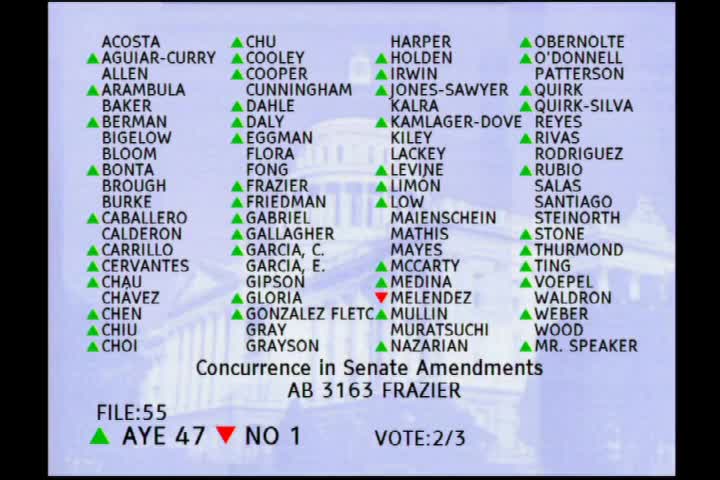 1MIN
Assembly Floor
 5MIN
Assembly Standing Committee on Judiciary
 1MIN
Assembly Floor
 1H
Assembly Standing Committee on Appropriations
 16MIN
Assembly Standing Committee on Water, Parks, and Wildlife
 16MIN
Assembly Standing Committee on Water, Parks, and Wildlife
Bill Author

Bill Co-Author(s):
