AB 1698: Driver records: points: distracted driving.
- Session Year: 2017-2018
- House: Assembly
- Latest Version Date: 2018-06-21
Existing law prohibits a person from driving a motor vehicle while using a wireless telephone unless that telephone is specifically designed and configured to allow hands-free listening and talking, and is used in that manner while driving. Existing law also prohibits a person from driving while holding and operating a handheld wireless telephone or an electronic wireless communications device unless the telephone or device is specifically designed and configured to allow voice-operated and hands-free operation, and is used in that manner while driving. A person who is 18 years of age or younger is prohibited from driving while using a wireless telephone or an electronic wireless communications device, even if equipped with a hands-free device.
Existing law establishes that specified convictions and violations under the Vehicle Code and traffic-related incidents count as points against a drivers record for purposes of suspension or revocation of the privilege to drive and that certain other violations do not result in a violation point. Existing law also generally provides that traffic convictions involving the safe operation of a motor vehicle result in a violation point. Existing law provides an exemption for the electronic device violations described above from being counted as points against a drivers record for purposes of suspension or revocation of the privilege to drive.
This bill would, commencing January 1, 2020, abolish that exemption and expressly make those electronic device violations subject to a violation point against the drivers record.
Existing law prohibits a person from driving a schoolbus or transit vehicle, as defined, while using a wireless telephone.
This bill would, commencing January 1, 2020, clarify that a violation of that prohibition is subject to a violation point against the drivers record.
Existing law prohibits a person from driving a motor vehicle while using a wireless telephone unless that telephone is specifically designed and configured to allow hands-free listening and talking, and is used in that manner while driving. Existing law also prohibits a person from driving while holding and operating a handheld wireless telephone or an electronic wireless communications device unless the telephone or device is specifically designed and configured to allow voice-operated and hands-free operation, and is used in that manner while driving. Under existing law, a person who is 18 years of age or younger is prohibited from driving while using a wireless telephone or an electronic wireless communications device, even if equipped with a hands-free device.Existing law counts specified convictions and violations under the Vehicle Code and traffic-related incidents as points against a drivers record for purposes of suspension or revocation of the privilege to drive, but exempts certain other violations from resulting in a violation point. Existing law exempts an electronic device violation described above from being counted as a point against a drivers record for purposes of suspension or revocation of the privilege to drive.This bill would abolish that exemption, thereby making those violations subject to a violation point against the drivers record.Existing law prohibits a person from driving a motor vehicle while using a wireless telephone unless that telephone is specifically designed and configured to allow hands-free listening and talking, and is used in that manner while driving. Existing law also prohibits a person from driving while holding and operating a handheld wireless telephone or an electronic wireless communications device unless the telephone or device is specifically designed and configured to allow voice-operated and hands-free operation, and is used in that manner while driving. Under existing law, a person who is 18 years of age or younger is prohibited from driving while using a wireless telephone or an electronic wireless communications device, even if equipped with a hands-free device.
Existing law counts specified convictions and violations under the Vehicle Code and traffic-related incidents as points against a drivers record for purposes of suspension or revocation of the privilege to drive, but exempts certain other violations from resulting in a violation point. Existing law exempts an electronic device violation described above from being counted as a point against a drivers record for purposes of suspension or revocation of the privilege to drive.
This bill would abolish that exemption, thereby making those violations subject to a violation point against the drivers record.
Existing law establishes within the California Automobile Assigned Risk Plan (CAARP) a low-cost automobile insurance program for all counties in California, until January 1, 2020, in order to provide a means for eligible consumers to buy automobile insurance, as specified. The parameters of the program include, but are not limited to, a surcharge for specified high-risk drivers, eligibility, sales commissions rates, cancellation restrictions, and reporting requirements. Existing law also requires the CAARP Advisory Committee to submit reports to the Insurance Commissioner on specified proposals, including, among others, allowing a consumer to reinstate, in lieu of canceling, all policies that have been canceled for nonpayment of premium and allowing program access to applicants who are 16 to 18 years of age, economically independent, and who meet other eligibility guidelines. Existing law required these reports to have been submitted by January 1, 2016, or July 1, 2016, as specified.This bill would delete the reporting requirements described above and other obsolete provisions.Existing law establishes within the California Automobile Assigned Risk Plan (CAARP) a low-cost automobile insurance program for all counties in California, until January 1, 2020, in order to provide a means for eligible consumers to buy automobile insurance, as specified. The parameters of the program include, but are not limited to, a surcharge for specified high-risk drivers, eligibility, sales commissions rates, cancellation restrictions, and reporting requirements. Existing law also requires the CAARP Advisory Committee to submit reports to the Insurance Commissioner on specified proposals, including, among others, allowing a consumer to reinstate, in lieu of canceling, all policies that have been canceled for nonpayment of premium and allowing program access to applicants who are 16 to 18 years of age, economically independent, and who meet other eligibility guidelines. Existing law required these reports to have been submitted by January 1, 2016, or July 1, 2016, as specified.
This bill would delete the reporting requirements described above and other obsolete provisions.
In determining the violation point count, the following shall apply:
(a)A conviction of failure to stop in the event of an accident in violation of Section 20001 or 20002 shall be given a value of two points.
(b)A conviction of a violation of Section 23152 or 23153 shall be given a value of two points.
(c)A conviction of reckless driving shall be given a value of two points.
(d)(1)A conviction of a violation of subdivision (b) of Section 191.5 or subdivision (c) of Section 192 of the Penal Code, or of Section 2800.2 or 2800.3, subdivision (b) of Section 21651, subdivision (b) of Section 22348, subdivision (a) or (c) of Section 23109, Section 23109.1, or Section 31602 of this code, shall be given a value of two points.
(2)A conviction of a violation of subdivision (a) or (b) of Section 23140 shall be given a value of two points.
(3)Commencing January 1, 2020, a conviction of a violation of Section 23123, 23123.5, 23124, or 23125 shall be given a value of one point.
(e)A conviction of a violation of Section 14601, 14601.1, 14601.2, 14601.3, or 14601.5 shall be given a value of two points.
(f)Except as provided in subdivision (i), any other traffic conviction involving the safe operation of a motor vehicle upon the highway shall be given a value of one point.
(g)A traffic accident in which the operator is deemed by the department to be responsible shall be given a value of one point.
(h) A conviction of a violation of Section 27360 or 27360.5 shall be given a value of one point.
(i) (1)A violation of paragraph (1), (2), (3), or (5) of subdivision (b) of Section 40001 shall not result in a violation point count being given to the driver if the driver is not the owner of the vehicle.
(2)A conviction of a violation of paragraph (1) or (2) of subdivision (b) of Section 12814.6, subdivision (a) of Section 21116, Section 21207.5, 21708, 21710, 21716, 23120, 24800, or 26707 shall not be given a violation point count.
(3)A violation of subdivision (d) of Section 21712 shall not result in a violation point count.
(4)A violation of Section 23136 shall not result in a violation point count.
(5)A violation of Section 38301, 38301.3, 38301.5, 38304.1, or 38504.1 shall not result in a violation point count.
(j) A conviction for only one violation arising from one occasion of arrest or citation shall be counted in determining the violation point count for the purposes of this section.
SEC. 2.Section 12810.3 of the Vehicle Code is amended to read:12810.3.(a)Notwithstanding subdivision (f) of Section 12810, a violation point shall not be given for a conviction of a violation of subdivision (a) of Section 23123, subdivision (a) of Section 23123.5, or subdivision (b) of Section 23124.
(b)This section shall remain in effect only until January 1, 2020, and as of that date is repealed.
SECTION 1.Section 12810.3 of the Vehicle Code is repealed.(a)A low-cost automobile insurance policy issued pursuant to the program shall be canceled only for the following reasons:
(1)Nonpayment of premium.
(2)Fraud or material misrepresentation affecting the policy or the insured.
(3)The purchase of additional automobile liability insurance coverage in violation of subdivision (a) of Section 11629.78.
(4)The purchase or maintenance of automobile liability insurance coverage other than a low-cost policy for any additional vehicles in the insureds household, in violation of subdivision (b) of Section 11629.78.
(b)A policy shall be nonrenewed only for the following reasons:
(1)A substantial increase in the hazard insured against.
(2)The insured no longer meets the applicable eligibility requirements. In this regard, the eligibility of an insured shall be recertified by the California Automobile Assigned Risk Plan after the first year of eligibility, and annually thereafter by the insurer that issued the policy.
(c)By January 1, 2016, the CAARP Advisory Committee shall report to the commissioner on a proposal, subject to approval by the commissioner, to allow a consumer to reinstate, in lieu of canceling, all policies that have been canceled for nonpayment of premium, and on a proposal, subject to approval by the commissioner, to allow consumers to make installment payments by debit card or credit card. The CAARP Advisory Committee shall also report, by July 1, 2016, on a proposal, subject to approval by the commissioner, to allow access to the program for applicants 16 to 18 years of age who are economically independent and meet other eligibility guidelines, and also for families who have an adult driver covered under the program and a driver 16 to 18 years of age in the household.SEC. 2.Section 11629.79 of the Insurance Code is repealed.11629.79.(a)The program for the County of Los Angeles and the City and County of San Francisco is authorized to commence operations on January 1, 2000, but shall be fully operational no later than July 1, 2000.(b)To this end, the commissioner, in consultation with the California Automobile Assigned Risk Plan, shall adopt regulations to implement the provisions of this article within 60 days of its effective date.(c)The program for the Counties of Alameda, Fresno, Orange, Riverside, San Bernardino, and San Diego shall commence operations on April 1, 2006, and shall be made operational in all other counties of California according to the discretion of the commissioner. The commissioner, in consultation with the California Automobile Assigned Risk Plan, shall adopt regulations to implement the expansion of the program to these counties.SEC. 3.Section 11629.79 is added to the Insurance Code, to read:11629.79.The low-cost automobile insurance program shall be made operational in all counties according to the discretion of the commissioner. The commissioner, in consultation with the California Automobile Assigned Risk Plan, shall adopt regulations to implement the program.
SEC. 4.Section 11629.83 of the Insurance Code is repealed.11629.83.An action challenging the constitutionality of the establishment of the pilot program by this article shall be commenced in a court of competent jurisdiction no later than February 1, 2000.|
Date
|
Status
|
|---|---|
| Aug 9, 2018 | Re-referred to Com. on TRANS. pursuant to Assembly Rule 77.2. |
| Aug 7, 2018 | In Assembly. Concurrence in Senate amendments pending. May be considered on or after August 9 pursuant to Assembly Rule 77. |
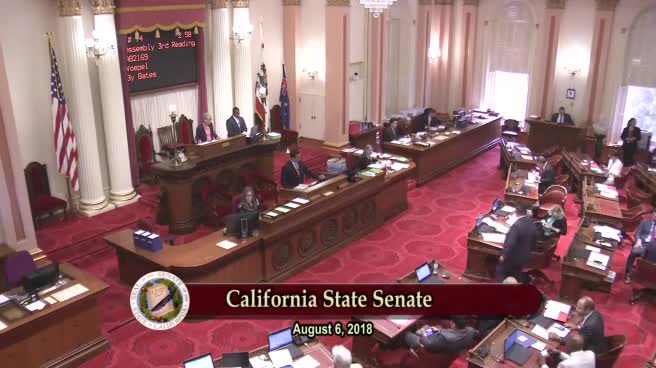
| Aug 6, 2018 | Read third time. Passed. Ordered to the Assembly. |
| Jul 3, 2018 | Read second time. Ordered to third reading. |
| Jul 2, 2018 | From committee: Do pass. (Ayes 7. Noes 0.) (July 2). |
| Jun 21, 2018 | From committee chair, with author's amendments: Amend, and re-refer to committee. Read second time, amended, and re-referred to Com. on APPR. |
| Jun 14, 2018 | Read second time. Ordered to third reading. |
| Jun 13, 2018 | From inactive file. |
| Sep 16, 2017 | Ordered to inactive file at the request of Senator McGuire. |
| Jul 20, 2017 | From Consent Calendar. |
| Jul 17, 2017 | Read second time. Ordered to Consent Calendar. |
| Jul 13, 2017 | From committee: Do pass. To Consent Calendar. (Ayes 10. Noes 0.) (July 12). |
| Jun 6, 2017 | In committee: Hearing postponed by committee. |
| May 24, 2017 | Referred to Com. on I., B. & F.I. |
| May 11, 2017 | In Senate. Read first time. To Com. on RLS. for assignment. |
| May 11, 2017 | Read third time. Passed. Ordered to the Senate. (Ayes 77. Noes 0. Page 1483.) |
| May 4, 2017 | Read second time. Ordered to Consent Calendar. |
| May 3, 2017 | From committee: Do pass. To Consent Calendar. (Ayes 13. Noes 0.) (May 3). |
| Apr 18, 2017 | Joint Rule 62(a), file notice suspended. (Page 1059.) |
| Apr 17, 2017 | Re-referred to Com. on INS. pursuant to Assembly Rule 97. |
| Apr 6, 2017 | Action rescinded whereby the bill was read third time, passed, and to Senate. |
| Apr 6, 2017 | Read third time. Passed. Ordered to the Senate. |
| Mar 30, 2017 | Read second time. Ordered to Consent Calendar. |
| Mar 29, 2017 | From committee: Do pass. To Consent Calendar. (Ayes 12. Noes 0.) (March 29). |
| Mar 16, 2017 | Referred to Com. on INS. |
| Feb 28, 2017 | From printer. May be heard in committee March 30. |
| Feb 27, 2017 | Read first time. To print. |
|
Date
|
Description
|
Location
|
Votes
|
|
|---|---|---|---|---|
| Aug 6, 2018 | Assembly 3rd Reading AB1698 Daly By Glazer | Senate Floor |
Passed |
|
| Jul 2, 2018 | Do pass | Senate Standing Committee on Appropriations |
Passed |
|
| Jul 12, 2017 | Do pass and be ordered to the Consent Calendar | Senate Standing Committee on Insurance, Banking and Financial Institutions |
Passed |
|
| May 11, 2017 | AB 1698 INS. Consent Calendar Second Day Regular Session | Assembly Floor |
Passed |
|
| May 3, 2017 | Do pass. To Consent Calendar. | Assembly Standing Committee on Insurance |
Passed |
|
| Mar 29, 2017 | Do pass. To Consent Calendar. | Assembly Standing Committee on Insurance |
Passed |
This list shows positions taken on this bill by organizations on the date displayed, which is linked to the original source.
Positions by individuals are not included.
|
Organization
|
Position
|
Date
|
|---|---|---|
| aaa northern california | ** Support | Jul 3, 2018 |
| American Insurance Association | ** Support | Jul 3, 2018 |
| Auto Club of Southern California | ** Support | Jul 3, 2018 |
| National Association of Mutual Insurance Companies | ** Support | Jul 3, 2018 |
| Pacific Association Of Domestic Insurance Companies | ** Support | Jul 3, 2018 |
| Personal Insurance Federation Of California | ** Support | Jul 3, 2018 |
| Property Casualty Insurers Association of America | ** Support | Jul 3, 2018 |
CONCURRENCE IN SENATE AMENDMENTS
CSA1 Bill Id:AB 1698
Author:(Daly)
As Amended Ver:June 21, 2018
Majority vote
ASSEMBLY: | 77-0 | (May 11, 2017) | SENATE: | 37-0 | (August 6, 2018) |
Original Committee Reference: INS.
SUMMARY: Removes the prohibition on the Department of Motor Vehicles (DMV) on assessing a point on a driver's license if they are convicted of a violation of operating a handheld wireless or communication device while driving and requires DMV to assess a point starting on January 1, 2020.
The Senate amendments delete the Assembly version of the bill and instead:
- Remove the prohibition on DMV from assessing a negligent operator point on a driver's license if they are convicted of a violation of operating a handheld wireless or communication device.
- Require DMV, starting on January 1, 2020, to assess a negligent operator point for a violation of operating a handheld wireless or communication device while operating a vehicle, as specified.
AS PASSED BY THE ASSEMBLY, this bill made technical changes to the statutes governing the low-cost automobile insurance program.
FISCAL EFFECT: According to the Senate Appropriations Committee, moderate one-time DMV programming costs, likely under $75,000, related to the imposition of a violation point for convictions of specified distracted driving violations. (Motor Vehicle Account)
COMMENTS:
Author’s statement: The author states that distracted driving, in particular texting while driving, is one of the most dangerous activities motorists can do. It makes little sense to charge a violation point for speeding or red light violations, yet treat distracted driving as a lesser risk infraction. This bill aims not only to curb this dangerous behavior but also to cut down on the number of deadly car crashes caused by distracted driving.
Background: According to the California Office of Traffic Safety, a 2016 survey revealed that more than 56% of California drivers said they had been hit or nearly hit by a driver who was talking or texting on a cell phone. Forty percent of drivers admitted to making a mistake while talking on a cell phone. Driving while texting can be deadly. Even looking away from the road for five seconds to text while traveling 55 miles per hour is enough time to cover the length of a football field blindfolded.
While not limited to cell phone use, distracted driving has resulted in the death of 3,477 people and an additional 391,000 injured in 2015 alone. This accounts for 10% of fatal crashes. The largest proportion of drivers who were distracted at the time of a fatal crash were between the ages of 15 and 19.
California's Cell Phone Law: AB 1785 (Quirk) Chapter 660, Statutes of 2016, updated California's law on the use of cell phones while driving. AB 1785 made it an infraction to drive a motor vehicle while holding and operating a handheld wireless telephone or communications device unless the device was designed and configured to allow voice-operated and hands-free operation. The law requires a person to either mount the cell phone on a vehicle's windshield or center console. The driver is allowed to activate or deactivate a feature or function with a single swipe or tap of the driver's finger.
If the driver is under the age of 18 or is driving a school bus or transit vehicle, they are not allowed to drive while using a cell phone in any capacity, even hands free.
The change in law gave more flexibility for law enforcement to crack down on driving while using a cell phone. Between 2012 and 2016, the California Highway Patrol (CHP) issued more than 62,800 citations for driving while texting. In the last year and a half, after the change in the law, CHP issued over 72,289 tickets.
Crime and Punishment: The punishment for using a cell phone has less discretion than most violations of the vehicle code. While courts are often given the ability to set a fine up to $100 for a first offense, driving while holding a cell phone carries a base fine of $20 for the first offense and $50 for each subsequent offense ($162 accounting for all the fees based on the 2018 Uniform Bail and Penalty Schedule).
In addition to traffic fines, another form of punishment used for violations of the vehicle code include assessing negligent operator points on a driver's license. The point system is used by DMV to determine if a driver should be considered a negligent operator. DMV may revoke, suspend or place a person's driving privilege on probation for being a negligent operator.
Many of the point assessments are specified in code. However, most are captured in a catch-all provision of the vehicle code that allows DMV to assess a point if a driver is convicted of a traffic violation involving the safe operation of a motor vehicle.
DMV can assess points for a variety of driving violations, including illegal U-turns, interfering with a driver's control of a vehicle, failing to yield the right-of-way to a horseback rider, driving too slow, driving too fast, failing to signal while turning, crossing a double line, or driving more than 10 consecutive hours for compensation.
Points do not stack up per arrest, and whatever violation has the highest amount of points will be the number of points assessed. For example, if a driver were pulled over for both speeding and texting, the driver would only get one point if convicted of both violations, not one point for each violation.
Finally, an insurance provider is only made aware of a traffic violation if a point is assessed.
Analysis Prepared by: David Sforza / TRANS. / (916) 319-2093 FN: 0003831
Office of Senate Floor Analyses (916) 651-1520 Fax: (916) 327-4478 | AB |
THIRD READING
Bill No: AB 1698
:
PRIOR VOTES NOT RELEVANT
SENATE APPROPRIATIONS COMMITTEE: 7-0, 7/2/18
AYES: Portantino, Bates, Beall, Bradford, Hill, Nielsen, Wiener
DIGEST:
This bill makes driving while operating a wireless communications device punishable by a violation point.
Senate Floor Amendments of 6/13/18 delete the current contents of the bill, change the author to Assemblymember Daly, and insert the contents of SB 1030 (Newman), which passed off the Senate Floor on a 36-0 vote on April 30, 2018.
Existing law:
- Prohibits driving a vehicle while holding and operating a handheld wireless telephone or an electronic wireless communications device, unless the device is designed to allow voice operated, hands-free operation and is used in that manner.
- Allows a driver to activate or deactivate a feature on the device with a single swipe or tap of the driver’s finger if the device is mounted, as specified.
- Exempts manufacturer-installed systems that are embedded in the vehicle.
- Exempts emergency services professionals operating an emergency vehicle.
- Treats violations as an infraction punishable by a base fine of $20 for a first offense and $50 for subsequent offenses.
This bill, effective on January 1, 2020, provides that driving a vehicle while holding and operating a handheld wireless telephone or an electronic wireless communications device is punishable by a violation point.
Background
Under the Negligent Operator Treatment System program, the Department of Motor Vehicles (DMV) assigns “points” to an individual’s driving record for certain traffic offenses to identify a driver as a negligent operator. DMV assigns points upon receipt of conviction notices from courts and collision reports from law enforcement indicating that the driver contributed, was at fault, or was responsible to any degree for the collision. Each occurrence remains on the driver’s record for at least 36 months, depending on the type of conviction. The driver may present credible evidence at an administrative hearing to refute such reports.
Violation points vary with the gravity of the offense; for example, a “fix-it” ticket does not count for any violation points, a speeding ticket counts for one violation point, and driving while under the influence of alcohol or drugs counts for two violation points. DMV issues warning letters to negligent operators for each offense. DMV may suspend an individual’s driver’s license for six months if he or she receives four points in one year, six points in two years, or eight points in three years. In severe cases, DMV may revoke the license. For hardship cases, DMV may issue a restricted license rather than suspending or revoking a license.
Comments
- Purpose. The author states that distracted driving, in particular texting while driving, is one of the most dangerous activities motorists can do. It makes little sense to charge a violation point for speeding or red light violations, yet treat distracted driving as a lesser risk infraction. This bill aims not only to curb this dangerous behavior but also to cut down on the number of deadly car crashes caused by distracted driving.
- Most other traffic safety violations carry a point. Existing state law specifies traffic offenses for which a violation point may be assessed. These include running a red light, driving on a sidewalk, tailgating, exceeding the speed limit, drinking while driving, unsafe passing, and carrying an overweight load, among others. Violations for which two points may be assessed include offenses such as evading a peace officer, driving on the wrong side of the road, and driving with a blood alcohol level exceeding the legal limit. Statute requires DMV to assess one point to any conviction “involving the safe operation of a motor vehicle upon the highway.” However, statute explicitly exempts use of a phone while driving from violation points.
- Potential insurance consequences. Safety infractions can impact a driver’s automobile insurance. When an insurance company issues or renews a policy, it obtains the individual’s driving record from DMV. When a driver is cited for a single violation point offense, the judge may allow him or her to attend a traffic violator school. In that case, the conviction is “masked” on the driving record and insurance companies cannot see it. Otherwise, the insurance company can see any violation points and may adjust the driver’s premium accordingly or potentially even refuse coverage.
- Base fine vs. actual cost. Existing law provides that operating a handheld wireless telephone or an electronic wireless communications device while driving is an infraction punishable by a base fine of $20 for a first offense and $50 for subsequent offenses. The state Judicial Council annually adopts a uniform traffic penalty schedule for all non-parking infractions outlined in the Vehicle Code that calculates additional surcharges, penalties, and assessments. According to the uniform traffic penalty schedule, a $20 base fine is equivalent to a total of more than $200 and a $50 base fine is equivalent to a total of more than $500. The author notes that in 2017, the California Highway Patrol issued more than 47,000 citations for persons holding a wireless device while driving, raising the question of whether an infraction is a sufficient deterrent.
- Do violation points work? The negligent operator program includes four intervention levels: a warning letter (Level I); a notice of DMV’s intent to suspend the individual’s driver’s license if the driver is convicted of one more infraction (Level II); an administrative hearing regarding a possible license suspension (Level III); and additional suspension time or possible revocation (Level IV). DMV has conducted multiple evaluations of the program, all of which have deemed the program successful. The most recent report, in 2009, found the program “to be effective in reducing subsequent total crashes and citations of treated drivers.” A 2004 report found that “slightly fewer than 32% of the approximately 484,700 drivers who qualified for a NOTS intervention between June 1, 2000, and December 31, 2001, persisted in their negligent driving behaviors and became eligible for higher-level interventions” beyond Level 1.
- Prior attempts to assess a violation point have been unsuccessful. The first bill to ban the use of a cell phone while driving, SB 1613 (Simitian, Chapter 290, Statutes of 2006), was amended late in the process to explicitly prohibit the assignment of a violation point for the offense. This prohibition was held intact in several subsequent related bills, with two exceptions that were both vetoed.
- SB 1310 (Simitian, 2012) would have assessed a violation point for a second offense related to using a cell phone while driving. Governor Brown’s veto message stated that “Upping the fines may satisfy the punitive instincts of some, but I severely doubt that it will reduce further violations.”
- AB 1646 (Frazier, 2014) would have imposed a violation point for an offense related to the use of a cell phone while driving. Governor Brown’s veto message stated that the bill was unnecessary and pointed to a pending DMV review and analysis of distracted driving data. A study published by DMV shortly afterward found that although cell phone-related injury crashes dropped off after 2008, when the first California law banning hands-on cell phone use while driving took effect, other variables such as the declining economy could have also been factors.
- Déjà vu. This bill was gutted and amended on June 13th and is now virtually identical to SB 1030 (Newman), which passed off the Senate Floor on a 36-0 vote on April 30th with no opposition. SB 1030 died in the Assembly Transportation Committee.
Related/Prior Legislation
AB 1222 (Quirk, Chapter 297, Statutes of 2017) removed “specialized mobile radio device” and “two way messaging device” as examples of an “electronic communications device” that is prohibited from being used while driving.
AB 1785 (Quirk, Chapter 660, Statutes of 2016) replaced the existing prohibition on texting while driving with a broader prohibition on operating a cell phone or electronic wireless communications device while driving, unless the device is mounted in a manner that does not hinder the driver’s view of the road and can be operated using a single tap or swipe.
SB 194 (Galgiani, Chapter 754, Statutes of 2013) prohibited individuals under 18 years of age from operating an electronic wireless communications device while driving, even if it is equipped with a hands-free device.
AB 313 (Frazier, 2013) would have repealed the provisions of AB 1536 (see below). The bill failed in the Assembly Appropriations Committee.
AB 1536 (Miller, Chapter 92, Statutes of 2012) allowed drivers to dictate, send, or listen to text-based communications, as long as they do so using technology specifically designed and configured to allow voice-operated and hands-free operation.
SB 33 (Simitian, Chapter 214, Statutes of 2007) prohibited an individual under 18 years of age from using a wireless telephone or other electronic device equipped with a hands-free device while driving a motor vehicle.
SB 28 (Simitian, Chapter 270, Statutes of 2007) prohibited an individual from writing, sending, or reading text-based communications while operating a motor vehicle, even if the device is equipped with a hands-free device.
FISCAL EFFECT: Appropriation: Fiscal Com.: Local:
According to the Senate Appropriations Committee, moderate one-time DMV programming costs, likely under $75,000, related to the imposition of a violation point for convictions of specified distracted driving violations. (Motor Vehicle Account)
AAA Northern California
American Insurance Association
Auto Club of Southern California
National Association of Mutual Insurance Companies
Pacific Association of Domestic Insurance Companies
Personal Insurance Federation of California
Property Casualty Insurers Association of America
None received
ARGUMENTS IN SUPPORT: The Auto Club of Southern California and AAA Northern California state that this bill recognizes that the existing penalty for distracted driving is insufficient to deter this practice. The most effective deterrent for safety violations is giving demerit points that potentially carry longer-term consequences impacting driving privileges. Points are means by which DMV takes action against the driving privilege and multiple studies have confirmed that the DMV’s negligent operator system is effective in making drivers better.
7/3/18 15:32:08
**** END ****
SENATE COMMITTEE ON
Senator Anthony Portantino, Chair
2017 - 2018 Regular Session
AB 1698 (Daly) - Driver records: points: distracted driving
Version: | Policy Vote: |
Urgency: | Mandate: |
Hearing Date: | Consultant: |
This measure does not meet the criteria for referral to the Suspense File.
Bill Summary:
AB 1698 would impose a violation point on a driver’s record for convictions related to the use of a handheld cellular phone or wireless communication device while driving, beginning on January 1, 2020.
Fiscal Impact:
- Moderate one-time Department of Motor Vehicles (DMV) programming costs, likely under $75,000, related to the imposition of a violation point for convictions of specified distracted driving violations. (Motor Vehicle Account)
Background:
Existing law generally prohibits a person from operating a motor vehicle while using a handheld wireless telephone or an electronic wireless communications device, unless the device is designed to allow for voice-operated, hands-free operation and is used in that manner, as specified. A driver who is under the age of 18 is prohibited from using a cell phone to talk or text, even if the device is hands-free. The base fine for a violation of these prohibitions is $20 for an initial offense and $50 for each subsequent offense. Current law prohibits the imposition of a violation point for a conviction of these offenses.
DMV assigns violation points against a driver’s license for certain traffic offenses to identify an individual as a negligent operator. Violation points vary with the gravity of the offense; for example, a “fix-it” ticket does not count for any violation points, a speeding ticket counts for one violation point, and driving while under the influence of alcohol or drugs counts for two violation points. Generally, traffic convictions involving the safe operation of a motor vehicle result in a violation point. DMV may suspend a driver’s license for six months if a person receives four points in one year, six points in two years, or eight points in three years.
Proposed Law:
Commencing on January 1, 2020, AB 1698 would explicitly provide for the imposition of a violation point for a conviction of specified distracted driving violations.
Related Legislation:
SB 1030 (Newman), which is currently pending in the Assembly Transportation Committee, is substantially similar to this bill.
SB 1613 (Simitian), Chapter 290/2006, which imposed the original ban on the use of a cell phone while driving, was amended late in the process to explicitly prohibit the assignment of a violation point for the offense.
SB 1310 (Simitian), which was vetoed by Governor Brown in 2012, would have increased the base fines for violations related to using a cell phone while driving and assessed a violation point for a second offense. The veto message stated, in part, that “Upping the fines may satisfy the punitive instincts of some, but I severely doubt that it will reduce further violations.”
AB 1646 (Frazier), which was vetoed by Governor Brown in 2014, would have imposed a violation point for an offense related to the use of a cell phone while driving. The veto message stated that the bill was unnecessary and pointed to a pending DMV review and analysis of distracted driving data. A subsequent study published by DMV found that although cell phone-related injury crashes dropped off after 2008, when the first California law banning hands-on cell phone use while driving took effect, other variables such as the declining economy could have also been factors.
Staff Comments:
DMV would incur one-time costs to make programming changes that enable the assignment of a violation point to driver’s license records for convictions of the specified violations related to distracted driving.
Staff notes that this bill was recently amended to delete contents of the bill and insert the current provisions. The previous version was an Assembly Insurance Committee bill that made technical changes to the statutes governing the California Low-cost Automobile Insurance Program (CLCA).
-- END --
Office of Senate Floor Analyses (916) 651-1520 Fax: (916) 327-4478 | AB |
THIRD READING
Bill No: AB 1698
:
SENATE INS., BANK. & FIN. COMMITTEE: 10-0, 7/12/17
AYES: Mendoza, Gaines, Galgiani, Glazer, Hernandez, Lara, Mitchell, Morrell, Newman, Roth
NO VOTE RECORDED: Berryhill, Hueso, Portantino
ASSEMBLY FLOOR: 77-0, 5/11/17 (Consent) - See last page for vote
DIGEST:
This bill makes technical changes to the statutes governing the California Low-cost Automobile Insurance Program (CLCA).
Existing law:
- Establishes the CLCA to provide low-cost auto liability policies to all counties in California.
- Provides for the CLCA to operate in the County of Los Angeles and City and County of San Francisco (originally as a pilot program) by July 1, 2000; provides for it to be operational in additional specified counties by April 1, 2006; and grants the Insurance Commissioner the authority to implement the program in any other California county.
- Requires an advisory committee to submit a report to the Commissioner by January 1, 2016, on the feasibility of specified proposals designed to increase participation.
- Limits constitutional challenges to the establishment of the pilot program to those commenced on February 1, 2000, or before.
This bill:
- Replaces obsolete provisions related to the county-by-county expansion of the program with provisions requiring the Commissioner to make the program operational in all California counties.
- Eliminates the requirements that the advisory committee submit the 2016 reports.
- Eliminates the restriction against constitutional challenges to the pilot program.
Background
In 2000, pilot programs were established in Los Angeles and San Francisco Counties to provide low-cost auto insurance to qualifying drivers. The programs have since been consolidated into CLCA which is now available throughout the state. Costs are kept down by reserving the risk pool to low-risk drivers and authorizing participants to carry less coverage than otherwise required under state law. Because of the way the CLCA program has evolved, the governing code sections of the CLCA program contain several outdated and confusing provisions. This bill replaces vestigial language added as the program was incrementally expanded in various counties.
Since CLCA is no longer a pilot program, this bill also strikes language restricting constitutional challenges to “the establishment of the pilot program.” The statute of limitations restricting legal challenges still applies.
Comments
According to the Assembly Committee on Insurance, this bill cleans up the Insurance Code provisions related to the CLCA program. As the program has evolved many of the provisions enacted to allow its startup have become obsolete and should be updated.
FISCAL EFFECT: Appropriation: Fiscal Com.: Local:
None received
OPPOSITION: (Verified 7/17/17)
None received
ASSEMBLY FLOOR: 77-0, 5/11/17
AYES: Acosta, Aguiar-Curry, Travis Allen, Arambula, Baker, Berman, Bigelow, Bloom, Bocanegra, Bonta, Brough, Burke, Caballero, Calderon, Cervantes, Chau, Chávez, Chen, Chiu, Choi, Chu, Cooley, Cooper, Cunningham, Dababneh, Daly, Eggman, Flora, Fong, Frazier, Friedman, Gallagher, Cristina Garcia, Eduardo Garcia, Gipson, Gloria, Gomez, Gonzalez Fletcher, Gray, Grayson, Harper, Holden, Irwin, Jones-Sawyer, Kalra, Kiley, Lackey, Levine, Limón, Low, Maienschein, Mathis, Mayes, McCarty, Medina, Melendez, Mullin, Muratsuchi, Nazarian, Obernolte, Quirk, Quirk-Silva, Reyes, Ridley-Thomas, Rodriguez, Rubio, Salas, Santiago, Steinorth, Mark Stone, Thurmond, Ting, Voepel, Waldron, Weber, Wood, Rendon
NO VOTE RECORDED: Dahle, O'Donnell, Patterson
7/20/17 11:50:37
**** END ****
SENATE COMMITTEE ON INSURANCE, BANKING AND FINANCIAL INSTITUTIONS
Senator Tony Mendoza, Chair
2017 - 2018 Regular
Bill No: AB 1698 Hearing Date: July 12, 2017
Author: | Committee on Insurance | ||
Version: | February 27, 2017 Introduced | ||
Urgency: | No | Fiscal: | No |
Consultant: | Hugh Slayden | ||
Subject: Low-cost automobile insurance program
SUMMARY
This bill makes technical changes to the statutes governing the California Low-cost Automobile Insurance Program (CLCA).
DIGEST
Existing law
- Establishes the CLCA within the California Automobile Assigned Risk Program (CAARP) to provide low-cost auto liability policies to all counties in California.
- Provides for the CLCA to operate in the County of Los Angeles and City and County of San Francisco (originally as a pilot program) by July 1, 2000, and requires the Insurance Commissioner to adopt implementing regulations; provides for it to be operational in additional specified counties by April 1, 2006; and grants the commissioner the authority to implement the program in any other California county through the adoption of regulations.
- Requires the CAARP Advisory Committee to submit a report to the commissioner by January 1, 2016, on the feasibility of reinstating CLCA policies and allowing installment payments and credit card payments, and requires the committee to submit a report by July 1, 2016, on a proposal to expand CLCA eligibility to specified individuals 16 to 18 years of age.
- Limits constitutional challenges to the establishment of the pilot program to those commenced on February 1, 2000, or before.
This bill
- Replaces obsolete provisions related to the county-by-county expansion of the program with a provision requiring the commissioner to make the program operational in all California counties and requires the commissioner to adopt regulations accordingly.
- Eliminates the requirements that the CAARP Advisory Committee submit the 2016 reports.
- Eliminates the restriction against constitutional challenges to the pilot program.
COMMENTS
- Purpose of the bill According to the Assembly Committee on Insurance, this bill cleans up the Insurance Code provisions related to the CLCA program. As the program has evolved many of the provisions enacted to allow its startup have become obsolete and should be updated.
- Background California law requires vehicle owners to carry liability coverage for bodily injury or death of at least $15,000 per person for each accident up to $30,000, as well as coverage for property damage of least $5,000 per accident.
CAARP was originally created in 1947 to provide insurance to those who could not otherwise acquire it due to a poor driving record. Applicants for CAARP coverage are assigned randomly to auto insurers based on each insurer's portion of the voluntary market. Its primary impact has evolved over the years, eventually becoming a primary source of low-cost insurance.
In 2000, two CLCA pilot programs were established within CAARP in Los Angeles and San Francisco Counties, but the programs have since been consolidated and expanded to the entire state. Only qualified drivers that meet income limits and have a clean driving record may purchase CLCA policies. Costs are kept down by reserving the risk pool to low-risk drivers (with some exceptions subject to an additional assessment) and authorizing participants to carry less coverage than otherwise required under state law. A CLCA policy provides coverage for bodily injury or death of $10,000 per person for each accident up to $20,000 and $3,000 for property damage per accident, but does not provide coverage against damage to the insured vehicle (although it may be purchased as option). Annual CLCA rates in 2017 for liability coverage only range from $252 to $470. A 25% surcharges applies to single males 19-24 years old and a 30% surcharge for drivers with less than 3 years of verifiable driving history. At the end of 2016, there were 14,388 CLCA policies in force.
Because of the way the CLCA program has evolved, the governing code sections of the CLCA program contain several outdated and confusing provisions. This bill replaces vestigial language added as the program was incrementally expanded in various counties. It also strikes language restricting constitutional challenges to “the establishment of the pilot program” to actions commenced by February 1, 2000. Since the CLCA is no longer a pilot program restricted to two counties, but an ongoing state-wide program, this provision does not apply under a strict reading of the language. If given a broad reading, it may be used in a manner unintended by the original drafters. This bill strikes this provision, but leaves any legal action subject to the applicable statute of limitations. (See Code of Civil Procedure Section 338.)
Last year, the commissioner and CAARP began implementing recommendations by the CAARP Advisory Committee, including the establishment of procedures to reinstate policies and expand eligibility to include applicants and operators 16 to 18 years of age that meet specified criteria. This bill eliminates the obsolete requirement that the CAARP Advisory Committee submit a report on those subjects in 2016.
- Prior and Related Legislation
Chapter 794, Statutes of 1999 (SB 171, Escutia) established the Low-Cost Automobile Insurance Pilot Program in the County of Los Angeles until January 1, 2004.
Chapter 807, Statutes of 1999 (SB 527, Speier) established Low-Cost Automobile Insurance Pilot Program in the County of San Francisco until January 1, 2004.
Chapter 742, Statutes of 2002 (SB 1427, Escutia) extended the sunset date of the pilot programs to 2007; reduced the premium; changed the gross annual household income limit from 150 percent to 250 percent of the federal poverty level; and made other changes to provide more access to eligible consumers.
Chapter 435, Statutes of 2005 (SB 20, Escutia) extended the sunset date to January 1, 2011; removed references to “pilot program”; and expanded it to the Alameda, Fresno, Orange, Riverside, San Bernardino, and San Diego County with further expansion subject to the discretion of the commissioner.
AB 725 (Jones, 2009) would have extended the sunset date and made other changes. Vetoed by Governor Schwarzenegger.
Chapter 234, Statutes of 2010 (AB 1597, Jones) extended the sunset date to 2016 and made various statutory changes to conform its operations to standard California administrative practices.
Chapter 401, Statutes of 2011 (AB 1024, Hueso) authorizes producers to sell CLCA policies through an Internet website, required CAARP to create a website for referring consumers to certified agents or brokers, and required the DMV to update the CLCA insert included in registration renewals.
Chapter 321, Statutes of 2013 (AB 1391, Assembly Insurance) authorized the commissioner to approve changes to the plan of operations without having to comply with the full rulemaking provisions of the Administrative Procedure Act under certain conditions.
Chapter 347, Statutes of 2013 (SB 476, Steinberg) requires a special purpose assessment of $0.25 until January 1, 2016, on each vehicle insured under an insurance policy issued in this state and authorized the CDI to use up to $0.05 of the $0.25 assessment to notify insurers and other members of the public about the existence of any low-cost automobile insurance program.
Chapter 487, Statutes of 2014 (SB 1273, Lara) extended the sunset date to January 1, 2020; expanded eligibility criteria to include drivers with less than three years of continuous driving experience and assess a surcharge on those drivers; and made other changes designed to increase program participation.
POSITIONS
Support
None received
Oppose
None received
-- END --
Date of Hearing: May 3, 2017
ASSEMBLY COMMITTEE ON INSURANCE
Tom Daly, Chair
ABPCA Bill Id:AB 1698 (
Author:Committee on Insurance) – As Introduced Ver:February 27, 2017
SUBJECT: Low-cost automobile insurance program
SUMMARY: Makes technical changes to the statutes governing the low-cost automobile insurance program (LCAP). Specifically, this bill:
- Repeals the requirement that the California Automobile Assigned Risk Program (CAARP) Advisory Committee report to the Insurance Commissioner (commissioner) on the feasibility of the following:
- allowing LCAP policies to be reinstated,
- allowing LCAP premium payments to be made on an installment basis,
- allowing credit card payments for LCAP premiums, and
- expanding LCAP eligibility to include emancipated minors.
- Repeals statutes establishing the LCAP as a pilot program and replaces it with language establishing the LCAP as a statewide program.
- Repeals the statute specifying that constitutional challenges to the LCAP must be filed by February 1, 2000.
EXISTING LAW:
- Requires the owner/operator of an automobile to demonstrate financial responsibility. This requirement is most commonly fulfilled by purchasing automobile insurance.
- Specifies that automobile insurance must provide liability coverage with at least the following coverage limits (minimum limits policy):
- $15,000 for injury to a single person
- $30,000 for injury to two or more people in the same accident
- $5,000 for property damage
- Establishes within the CAARP the LCAP to provide low income drivers with a more affordable insurance policy to satisfy the financial responsibility requirement.
- Requires LCAP policies provide the following coverages:
- $10,000 for injury to a single person
- $20,000 for injury to two or more people in the same accident
- $3,000 for property damage
- Permits, generally, individuals with good driving records and income below 250% of the poverty level to purchase insurance through the LCAP.
- Sunsets the LCAP effective January 1, 2020.
FISCAL EFFECT: Undetermined
COMMENTS:
- Purpose. This bill cleans up the Insurance Code provisions related to the LCAP program. As the program has evolved many of the provisions enacted to allow its startup have become obsolete and should be updated.
- Financial Responsibility. California law requires anyone owning or operating an automobile to demonstrate "financial responsibility." While there are a number of options available to satisfy this requirement, virtually all drivers purchase a private passenger automobile insurance policy to do so. Despite this requirement, the Department of Insurance estimates that between 3 and 4 million vehicles in California are operated without insurance.
- CAARP/LCAP. The LCAP was established to partially address the problem of uninsured drivers by making cheaper insurance policies available to low-income drivers with good driving records. LCAP policies were made cheaper by creating a policy with lower coverage limits that satisfies the financial responsibility law. Relatively few drivers buy LCAP policies (approximately 11,000 at present) because they are frequently able to buy a policy from a private insurer with higher limits at only a slightly higher price.
REGISTERED SUPPORT / OPPOSITION:
Support
None received
Opposition
None received
Analysis Prepared by: Paul Riches / INS. /
ASSEMBLY THIRD READING
ATR Bill Id:AB 1698
Author:(Committee on Insurance)
As Introduced Ver:February 27, 2017
Majority vote
Committee | Votes | Ayes | Noes |
Insurance | 12-0 | Daly, Melendez, Bigelow, Caballero, Calderon, Chu, Cooper, Dababneh, Dahle, Frazier, Gipson, Voepel |
SUMMARY: Makes technical changes to the statutes governing the low-cost automobile insurance program (LCAP). Specifically, this bill:
- Repeals the requirement that the California Automobile Assigned Risk Program (CAARP) Advisory Committee report to the Insurance Commissioner (commissioner) on the feasibility of the following:
- allowing LCAP policies to be reinstated,
- allowing LCAP premium payments to be made on an installment basis,
- allowing credit card payments for LCAP premiums, and
- expanding LCAP eligibility to include emancipated minors.
- Repeals statutes establishing the LCAP as a pilot program and replaces it with language establishing the LCAP as a statewide program.
- Repeals the statute specifying that constitutional challenges to the LCAP must be filed by February 1, 2000.
EXISTING LAW:
- Requires the owner/operator of an automobile to demonstrate financial responsibility. This requirement is most commonly fulfilled by purchasing automobile insurance.
- Specifies that automobile insurance must provide liability coverage with at least the following coverage limits (minimum limits policy):
- $15,000 for injury to a single person
- $30,000 for injury to two or more people in the same accident
- $5,000 for property damage
- Establishes within the CAARP the LCAP to provide low income drivers with a more affordable insurance policy to satisfy the financial responsibility requirement.
- Requires LCAP policies provide the following coverages:
- $10,000 for injury to a single person
- $20,000 for injury to two or more people in the same accident
- $3,000 for property damage
- Permits, generally, individuals with good driving records and income below 250% of the poverty level to purchase insurance through the LCAP.
- Sunsets the LCAP effective January 1, 2020.
FISCAL EFFECT: Unknown. This bill is keyed non-fiscal by the Legislative Counsel.
COMMENTS:
- Purpose. This bill cleans up the Insurance Code provisions related to the LCAP program. As the program has evolved many of the provisions enacted to allow its startup have become obsolete and should be updated.
- Financial Responsibility. California law requires anyone owning or operating an automobile to demonstrate "financial responsibility." While there are a number of options available to satisfy this requirement, virtually all drivers purchase a private passenger automobile insurance policy to do so. Despite this requirement, the Department of Insurance estimates that between 3 and 4 million vehicles in California are operated without insurance.
- CAARP/LCAP. The LCAP was established to partially address the problem of uninsured drivers by making cheaper insurance policies available to low-income drivers with good driving records. LCAP policies were made cheaper by creating a policy with lower coverage limits that satisfies the financial responsibility law. Relatively few drivers buy LCAP policies (approximately 11,000 at present) because they are frequently able to buy a policy from a private insurer with higher limits at only a slightly higher price.
Analysis Prepared by: Paul Riches / INS. / (916) 319-2086 FN: 0000127
Date of Hearing: March 29, 2017
ASSEMBLY COMMITTEE ON INSURANCE
Tom Daly, Chair
ABPCA Bill Id:AB 1698 (
Author:Committee on Insurance) – As Introduced Ver:February 27, 2017
SUBJECT: Low-cost automobile insurance program
SUMMARY: Makes technical changes to the statutes governing the low-cost automobile insurance program (LCAP). Specifically, this bill:
- Repeals the requirement that the California Automobile Assigned Risk Program (CAARP) Advisory Committee report to the Insurance Commissioner (commissioner) on the feasibility of the following:
- allowing LCAP policies to be reinstated,
- allowing LCAP premium payments to be made on an installment basis,
- allowing credit card payments for LCAP premiums, and
- expanding LCAP eligibility to include emancipated minors.
- Repeals statutes establishing the LCAP as a pilot program and replaces it with language establishing the LCAP as a statewide program.
- Repeals the statute specifying that constitutional challenges to the LCAP must be filed by February 1, 2000.
EXISTING LAW:
- Requires the owner/operator of an automobile to demonstrate financial responsibility. This requirement is most commonly fulfilled by purchasing automobile insurance.
- Specifies that automobile insurance must provide liability coverage with at least the following coverage limits (minimum limits policy):
- $15,000 for injury to a single person
- $30,000 for injury to two or more people in the same accident
- $5,000 for property damage
- Establishes within the CAARP the LCAP to provide low income drivers with a more affordable insurance policy to satisfy the financial responsibility requirement.
- Requires LCAP policies provide the following coverages:
- $10,000 for injury to a single person
- $20,000 for injury to two or more people in the same accident
- $3,000 for property damage
- Permits, generally, individuals with good driving records and income below 250% of the poverty level to purchase insurance through the LCAP.
- Sunsets the LCAP effective January 1, 2020.
FISCAL EFFECT: Undetermined
COMMENTS:
- Purpose. This bill cleans up the Insurance Code provisions related to the LCAP program. As the program has evolved many of the provisions enacted to allow its startup have become obsolete and should be updated.
- Financial Responsibility. California law requires anyone owning or operating an automobile to demonstrate "financial responsibility." While there are a number of options available to satisfy this requirement, virtually all drivers purchase a private passenger automobile insurance policy to do so. Despite this requirement, the Department of Insurance estimates that between 3 and 4 million vehicles in California are operated without insurance.
- CAARP/LCAP. The LCAP was established to partially address the problem of uninsured drivers by making cheaper insurance policies available to low-income drivers with good driving records. LCAP policies were made cheaper by creating a policy with lower coverage limits that satisfies the financial responsibility law. Relatively few drivers buy LCAP policies (approximately 11,000 at present) because they are frequently able to buy a policy from a private insurer with higher limits at only a slightly higher price.
REGISTERED SUPPORT / OPPOSITION:
Support
None received
Opposition
None received
Analysis Prepared by: Paul Riches / INS. /
Bill Author

Bill Co-Author(s):