AB 1705: State Board of Guide Dogs for the Blind: guide dog instructors.
- Session Year: 2017-2018
- House: Assembly
- Latest Version Date: 2017-10-11
Existing law, until January 1, 2018, establishes within the Department of Consumer Affairs a State Board of Guide Dogs for the Blind, which consists of 7 members appointed by the Governor. Existing law authorizes the board to issue licenses for the instruction of persons who are blind or visually impaired in the use of guide dogs and for the training of guide dogs for use by persons who are blind or visually impaired. Under existing law, the board also has exclusive authority in this state to issue licenses to operate schools for the training of guide dogs and the instruction of persons who are blind or visually impaired in the use of guide dogs. Existing law makes it unlawful for any person to sell, offer for sale, give, hire, or furnish under any other arrangement, any guide dog or to engage in the business or occupation of training a guide dog unless he or she holds a valid and unimpaired license issued pursuant to the provisions governing guide dogs. A violation of those provisions is a crime.
This bill would repeal those provisions. The bill would make any person who uses in any sign, business card, or letterhead, or in any advertisement, the words guide dog instructor, certified guide dog instructor, or any other terms or letters indicating or implying that he or she is an instructor trained in the utilization or training of guide dogs for the blind, or who represents or holds himself or herself out as a guide dog instructor without having knowledge of the special problems of persons who are blind or visually impaired and being able to teach them, being able to demonstrate the ability to train guide dogs with which persons who are blind or visually impaired would be safe under various traffic conditions, or being employed by a guide dog school certified by the International Guide Dog Federation or a successor entity, subject to a fine or civil penalty. The bill would also require a guide dog school to submit to the Department of Consumer Affairs, on or before September 1 of each year, a list of all trainers or guide dog instructors employed or contracted by the school.
The bill would make other conforming changes.
This bill would incorporate additional changes to Section 205 of the Business and Professions Code, as amended by Section 1 of Chapter 800 of the Statutes of 2016, proposed by SB 19 to be operative only if this bill and SB 19 are enacted and this bill is enacted last.
Existing law, until January 1, 2018, establishes within the Department of Consumer Affairs a State Board of Guide Dogs for the Blind, which consists of 7 members appointed by the Governor. Existing law authorizes the board to issue licenses for the instruction of persons who are blind or visually impaired in the use of guide dogs and for the training of guide dogs for use by persons who are blind or visually impaired. Under existing law, the board also has exclusive authority in this state to issue licenses to operate schools for the training of guide dogs and the instruction of persons who are blind or visually impaired in the use of guide dogs. Existing law makes it unlawful for any person to sell, offer for sale, give, hire, or furnish under any other arrangement, any guide dog or to engage in the business or occupation of training a guide dog unless he or she holds a valid and unimpaired license issued pursuant to the provisions governing guide dogs. A violation of those provisions is a crime.
This bill would repeal those provisions. The bill would make it a misdemeanor for any person to use who uses in any sign, business card, or letterhead, or in any advertisement, the words guide dog instructor, certified guide dog instructor, or any other terms or letters indicating or implying that he or she is an instructor trained in the utilization or training of guide dogs for the blind, or to represent or hold who represents or holds himself or herself out as a guide dog instructor without having knowledge of the special problems of persons who are blind or visually impaired and being able to teach them, being able to demonstrate the ability to train guide dogs with which persons who are blind or visually impaired would be safe under various traffic conditions, or being employed by a guide dog school certified by the International Guide Dog Federation or a successor entity. Because this bill would create a new crime, the bill would impose a state-mandated local program. entity, subject to a fine or civil penalty. The bill would also require a guide dog school to submit to the Department of Consumer Affairs, on or before September 1 of each year, a list of all trainers or guide dog instructors employed or contracted by the school.
The bill would make other conforming changes.
The California Constitution requires the state to reimburse local agencies and school districts for certain costs mandated by the state. Statutory provisions establish procedures for making that reimbursement.This bill would provide that no reimbursement is required by this act for a specified reason.Existing law, until January 1, 2018, establishes within the Department of Consumer Affairs a State Board of Guide Dogs for the Blind, which consists of 7 members appointed by the Governor. Existing law authorizes the board to issue licenses for the instruction of persons who are blind or visually impaired in the use of guide dogs and for the training of guide dogs for use by persons who are blind or visually impaired. Under existing law, the board also has exclusive authority in this state to issue licenses to operate schools for the training of guide dogs and the instruction of persons who are blind or visually impaired in the use of guide dogs. Existing law makes it unlawful for any person to sell, offer for sale, give, hire, or furnish under any other arrangement, any guide dog or to engage in the business or occupation of training a guide dog unless he or she holds a valid and unimpaired license issued pursuant to the provisions governing guide dogs. A violation of those provisions is a crime.
This bill would repeal those provisions. The bill would make it a misdemeanor for any person to use in any sign, business card, or letterhead, or in any advertisement, the words guide dog instructor, certified guide dog instructor, or any other terms or letters indicating or implying that he or she is an instructor trained in the utilization or training of guide dogs for the blind, or to represent or hold himself or herself out as a guide dog instructor without being employed by a guide dog school certified by the International Guide Dog Federation or a successor entity. Because this bill would create a new crime, the bill would impose a state-mandated local program. The bill would also require a guide dog school to submit to the Department of Consumer Affairs, on or before September 1 of each year, a list of all trainers or guide dog instructors employed or contracted by the school.
The California Constitution requires the state to reimburse local agencies and school districts for certain costs mandated by the state. Statutory provisions establish procedures for making that reimbursement.
This bill would provide that no reimbursement is required by this act for a specified reason.
This bill would extend the term of the board to January 1, 2019. The bill would establish, until May 1, 2019, an advisory task force under the jurisdiction of the board. Not later than May 1, 2018, the bill would require the Director of Consumer Affairs to appoint the task force members. The bill would require the task force to prepare a specified written report with recommendations regarding, among other things, the role of the board. Not later than May 1, 2019, the bill would require the written report to be delivered to the Governor and certain legislative leaders and committees.Existing law requires the board to organize and elect from its membership a president, vice president, and secretary who shall hold office for one year or until the election and qualification of a successor.This bill would eliminate the secretary position.Existing law, until January 1, 2018, establishes a pilot project to provide an arbitration procedure for the purpose of resolving disputes between a guide dog user and a licensed guide dog school, as specified.This bill would extend the operation of that pilot project to January 1, 2019.Existing law, until January 1, 2018, requires the board to prepare a factsheet regarding various functions of the board, to post that factsheet on its Internet Web site, and to provide copies to each of the licensed guide dog schools. Existing law, until January 1, 2018, also requires a licensed guide dog school to provide copies of the factsheet to every student receiving training from that school.This bill would extend the operation of these factsheet provisions indefinitely.Existing law, until January 1, 2018, establishes within the Department of Consumer Affairs a State Board of Guide Dogs for the Blind, which consists of 7 members appointed by the Governor.
This bill would extend the term of the board to January 1, 2020. 2019. The bill would establish establish, until May 1, 2019, an advisory task force under the jurisdiction of the board. Not later than May 1, 2018, the bill would require the Director of Consumer Affairs to appoint the task force members. The bill would require the task force to prepare a specified written report with recommendations regarding, among other things, the role of the board. Not later than May 1, 2019, the bill would require the written report to be delivered to the Governor and certain legislative leaders and committees.
Existing law requires the board to organize and elect from its membership a president, vice president, and secretary who shall hold office for one year or until the election and qualification of a successor.
This bill would eliminate the secretary position.
Existing law, until January 1, 2018, establishes a pilot project to provide an arbitration procedure for the purpose of resolving disputes between a guide dog user and a licensed guide dog school, as specified.
This bill would extend the operation of that pilot project to January 1, 2020. 2019.
Existing law, until January 1, 2018, requires the board to prepare a factsheet regarding various functions of the board, to post that factsheet on its Internet Web site, and to provide copies to each of the licensed guide dog schools. Existing law, until January 1, 2018, also requires a licensed guide dog school to provide copies of the factsheet to every student receiving training from that school.
This bill would extend the operation of these factsheet provisions indefinitely.
Existing law, until January 1, 2018, establishes within the Department of Consumer Affairs a State Board of Guide Dogs for the Blind, which consists of 7 members appointed by the Governor.
This bill would extend the term of the board to January 1, 2022. 2020. The bill would establish an advisory task force under the jurisdiction of the board. Not later than May 1, 2018, the bill would require the Director of Consumer Affairs to appoint the task force members. The bill would require the task force to prepare a specified written report with recommendations regarding, among other things, the role of the board. Not later than May 1, 2019, the bill would require the written report to be delivered to the Governor and certain legislative leaders and committees.
Existing law requires the board to organize and elect from its membership a president, vice president, and secretary who shall hold office for one year or until the election and qualification of a successor.
This bill would eliminate the secretary position.
Existing law, until January 1, 2018, establishes a pilot project to provide an arbitration procedure for the purpose of resolving disputes between a guide dog user and a licensed guide dog school, as specified.
This bill would extend the operation of that pilot project to January 1, 2022. 2020.
Existing law, until January 1, 2018, requires the board to prepare a factsheet regarding various functions of the board, to post that factsheet on its Internet Web site, and to provide copies to each of the licensed guide dog schools. Existing law, until January 1, 2018, also requires a licensed guide dog school to provide copies of the factsheet to every student receiving training from that school.
This bill would extend the operation of these factsheet provisions indefinitely.
Existing law, until January 1, 2018, establishes within the Department of Consumer Affairs a State Board of Guide Dogs for the Blind, which consists of 7 members appointed by the Governor.
This bill would extend the term of the board to January 1, 2022.
Existing law requires the board to organize and elect from its membership a president, vice president, and secretary who shall hold office for one year or until the election and qualification of a successor.
This bill would eliminate the secretary position.
Existing law, until January 1, 2018, establishes a pilot project to provide an arbitration procedure for the purpose of resolving disputes between a guide dog user and a licensed guide dog school, as specified.
This bill would extend the operation of that pilot project to January 1, 2022.
Existing law, until January 1, 2018, requires the board to prepare a factsheet regarding various functions of the board, to post that factsheet on its Internet Web site, and to provide copies to each of the licensed guide dog schools. Existing law, until January 1, 2018, also requires a licensed guide dog school to provide copies of the factsheet to every student receiving training from that school.
This bill would extend the operation of these factsheet provisions indefinitely.
(a)There is in the State Treasury the Professions and Vocations Fund. The fund shall consist of the following special funds:
(1)Accountancy Fund.
(2)California Architects Board Fund.
(3)Athletic Commission Fund.
(4)Barbering and Cosmetology Contingent Fund.
(5)Cemetery and Funeral Fund.
(6)Contractors License Fund.
(7)State Dentistry Fund.
(8)Home Furnishings and Thermal Insulation Fund.
(9)California Architects Board-Landscape Architects Fund.
(10)Contingent Fund of the Medical Board of California.
(11)Optometry Fund.
(12)Pharmacy Board Contingent Fund.
(13)Physical Therapy Fund.
(14)Private Investigator Fund.
(15)Private Security Services Fund.
(16)Professional Engineers, Land Surveyors, and Geologists Fund.
(17)Consumer Affairs Fund.
(18)Behavioral Sciences Fund.
(19)Licensed Midwifery Fund.
(20)Court Reporters Fund.
(21)Veterinary Medical Board Contingent Fund.
(22)Vocational Nursing and Psychiatric Technicians Fund.
(23)Electronic and Appliance Repair Fund.
(24)Dispensing Opticians Fund.
(25)Acupuncture Fund.
(26)Physician Assistant Fund.
(27)Board of Podiatric Medicine Fund.
(28)Psychology Fund.
(29)Respiratory Care Fund.
(30)Speech-Language Pathology and Audiology and Hearing Aid Dispensers Fund.
(31)Board of Registered Nursing Fund.
(32)Animal Health Technician Examining Committee Fund.
(33)State Dental Hygiene Fund.
(34)State Dental Assistant Fund.
(35)Structural Pest Control Fund.
(36)Structural Pest Control Eradication and Enforcement Fund.
(37)Structural Pest Control Research Fund.
(b)For accounting and recordkeeping purposes, the Professions and Vocations Fund shall be deemed to be a single special fund, and each of the several special funds therein shall constitute and be deemed to be a separate account in the Professions and Vocations Fund. Each account or fund shall be available for expenditure only for the purposes as are now or may hereafter be provided by law.
(c)This section shall become operative on July 1, 2016.
SEC. 3.3.Section 205 of the Business and Professions Code, as amended by Section 1 of Chapter 800 of the Statutes of 2016, is amended to read:205.(a)There is in the State Treasury the Professions and Vocations Fund. The fund shall consist of the following special funds:
(1)Accountancy Fund.
(2)California Architects Board Fund.
(3)Athletic Commission Fund.
(4)Barbering and Cosmetology Contingent Fund.
(5)Cemetery and Funeral Fund.
(6)Contractors License Fund.
(7)State Dentistry Fund.
(8)Home Furnishings and Thermal Insulation Fund.
(9)California Architects Board-Landscape Architects Fund.
(10)Contingent Fund of the Medical Board of California.
(11)Optometry Fund.
(12)Pharmacy Board Contingent Fund.
(13)Physical Therapy Fund.
(14)Private Investigator Fund.
(15)Private Security Services Fund.
(16)Professional Engineers, Land Surveyors, and Geologists Fund.
(17)Consumer Affairs Fund.
(18)Behavioral Sciences Fund.
(19)Licensed Midwifery Fund.
(20)Court Reporters Fund.
(21)Veterinary Medical Board Contingent Fund.
(22)Vocational Nursing and Psychiatric Technicians Fund.
(23)Electronic and Appliance Repair Fund.
(24)Dispensing Opticians Fund.
(25)Acupuncture Fund.
(26)Physician Assistant Fund.
(27)Board of Podiatric Medicine Fund.
(28)Psychology Fund.
(29)Respiratory Care Fund.
(30)Speech-Language Pathology and Audiology and Hearing Aid Dispensers Fund.
(31)Board of Registered Nursing Fund.
(32)Animal Health Technician Examining Committee Fund.
(33)State Dental Hygiene Fund.
(34)State Dental Assistant Fund.
(35)Structural Pest Control Fund.
(36)Structural Pest Control Eradication and Enforcement Fund.
(37)Structural Pest Control Research Fund.
(b)For accounting and recordkeeping purposes, the Professions and Vocations Fund shall be deemed to be a single special fund, and each of the several special funds therein shall constitute and be deemed to be a separate account in the Professions and Vocations Fund. Each account or fund shall be available for expenditure only for the purposes as are now or may hereafter be provided by law.
(c)This section shall become inoperative on July 1, 2018.
SEC. 3.5.Section 205 of the Business and Professions Code, as amended by Section 1 of Chapter 800 of the Statutes of 2016, is amended to read:205.(a)There is in the State Treasury the Professions and Vocations Fund. The fund shall consist of the following special funds:
(1)Accountancy Fund.
(2)California Architects Board Fund.
(3)Athletic Commission Fund.
(4)Barbering and Cosmetology Contingent Fund.
(5)Cemetery and Funeral Fund.
(6)Contractors License Fund.
(7)State Dentistry Fund.
(8)Home Furnishings and Thermal Insulation Fund.
(9)California Architects Board-Landscape Architects Fund.
(10)Contingent Fund of the Medical Board of California.
(11)Optometry Fund.
(12)Pharmacy Board Contingent Fund.
(13)Physical Therapy Fund.
(14)Private Investigator Fund.
(15)Private Security Services Fund.
(16)Professional Engineers, Land Surveyors, and Geologists Fund.
(17)Consumer Affairs Fund.
(18)Behavioral Sciences Fund.
(19)Licensed Midwifery Fund.
(20)Court Reporters Fund.
(21)Veterinary Medical Board Contingent Fund.
(22)Vocational Nursing and Psychiatric Technicians Fund.
(23)Electronic and Appliance Repair Fund.
(24)Dispensing Opticians Fund.
(25)Acupuncture Fund.
(26)Physician Assistant Fund.
(27)Board of Podiatric Medicine Fund.
(28)Psychology Fund.
(29)Respiratory Care Fund.
(30)Speech-Language Pathology and Audiology and Hearing Aid Dispensers Fund.
(31)Board of Registered Nursing Fund.
(32)Animal Health Technician Examining Committee Fund.
(33)State Dental Hygiene Fund.
(34)State Dental Assistant Fund.
(35)Structural Pest Control Fund.
(36)Structural Pest Control Eradication and Enforcement Fund.
(37)Structural Pest Control Research Fund.
(38)Household Movers Fund.
(b)For accounting and recordkeeping purposes, the Professions and Vocations Fund shall be deemed to be a single special fund, and each of the several special funds therein shall constitute and be deemed to be a separate account in the Professions and Vocations Fund. Each account or fund shall be available for expenditure only for the purposes as are now or may hereafter be provided by law.
(c)This section shall become operative on July 1, 2018.
SEC. 4.Chapter 9.5 (commencing with Section 7200) of Division 3 of the Business and Professions Code is repealed.SEC. 5.Chapter 9.5 (commencing with Section 7200) is added to Division 3 of the Business and Professions Code, to read:9.5.Guide Dogs for the Blind7200.Any person who uses in any sign, business card, or letterhead, or in any advertisement, the words guide dog instructor, certified guide dog instructor, or any other terms or letters indicating or implying that he or she is an instructor trained in the utilization or training of guide dogs for the blind, or who represents or holds himself or herself out as a guide dog instructor, without having knowledge of the special problems of persons who are blind or visually impaired and being able to teach them, being able to demonstrate the ability to train guide dogs with which persons who are blind or visually impaired would be safe under various traffic conditions, or being employed by a guide dog school certified by the International Guide Dog Federation, or a successor entity, is subject to a fine or civil penalty.
7201.For purposes of this chapter:
(a)Guide dog instructor means a person who instructs or trains persons who are blind or visually impaired in the use of guide dogs or who engages in the business of training, selling, hiring, or supplying guide dogs for persons who are blind or visually impaired.
(b)Guide dog means a dog that has been trained or is being trained to assist blind or visually impaired individuals. For purposes of this chapter, guide dog is used to describe a service dog.
7202.A guide dog school shall submit to the Department of Consumer Affairs on or before September 1 of each year a list of all trainers or guide dog instructors employed or contracted by the school. The department shall not charge a fee for the collection of this data.
SEC. 6.Sections 3.3 and 3.5 of this bill incorporate amendments to Section 205 of the Business and Professions Code, as amended by Section 1 of Chapter 800 of the Statutes of 2016, proposed by this bill and Senate Bill 19. Those sections shall only become operative if (1) both bills are enacted and become effective on or before January 1, 2018, (2) each bill amends Section 205 of the Business and Professions Code, as amended by Section 1 of Chapter 800 of the Statutes of 2016, and (3) this bill is enacted after Senate Bill 19, in which case Sections 3.3 and 3.5 of this bill shall become operative as provided therein and Section 3 of this bill shall not become operative.
(a)There is in the State Treasury the Professions and Vocations Fund. The fund shall consist of the following special funds:
(1)Accountancy Fund.
(2)California Architects Board Fund.
(3)Athletic Commission Fund.
(4)Barbering and Cosmetology Contingent Fund.
(5)Cemetery and Funeral Fund.
(6)Contractors License Fund.
(7)State Dentistry Fund.
(8)Home Furnishings and Thermal Insulation Fund.
(9)California Architects Board-Landscape Architects Fund.
(10)Contingent Fund of the Medical Board of California.
(11)Optometry Fund.
(12)Pharmacy Board Contingent Fund.
(13)Physical Therapy Fund.
(14)Private Investigator Fund.
(15)Private Security Services Fund.
(16)Professional Engineers, Land Surveyors, and Geologists Fund.
(17)Consumer Affairs Fund.
(18)Behavioral Sciences Fund.
(19)Licensed Midwifery Fund.
(20)Court Reporters Fund.
(21)Veterinary Medical Board Contingent Fund.
(22)Vocational Nursing and Psychiatric Technicians Fund.
(23)Electronic and Appliance Repair Fund.
(24)Dispensing Opticians Fund.
(25)Acupuncture Fund.
(26)Physician Assistant Fund.
(27)Board of Podiatric Medicine Fund.
(28)Psychology Fund.
(29)Respiratory Care Fund.
(30)Speech-Language Pathology and Audiology and Hearing Aid Dispensers Fund.
(31)Board of Registered Nursing Fund.
(32)Animal Health Technician Examining Committee Fund.
(33)State Dental Hygiene Fund.
(34)State Dental Assistant Fund.
(35)Structural Pest Control Fund.
(36)Structural Pest Control Eradication and Enforcement Fund.
(37)Structural Pest Control Research Fund.
(b)For accounting and recordkeeping purposes, the Professions and Vocations Fund shall be deemed to be a single special fund, and each of the several special funds therein shall constitute and be deemed to be a separate account in the Professions and Vocations Fund. Each account or fund shall be available for expenditure only for the purposes as are now or may hereafter be provided by law.
(c)This section shall become operative on July 1, 2016.
SEC. 3.3.Section 205 of the Business and Professions Code, as amended by Section 1 of Chapter 800 of the Statutes of 2016, is amended to read:205.(a)There is in the State Treasury the Professions and Vocations Fund. The fund shall consist of the following special funds:
(1)Accountancy Fund.
(2)California Architects Board Fund.
(3)Athletic Commission Fund.
(4)Barbering and Cosmetology Contingent Fund.
(5)Cemetery and Funeral Fund.
(6)Contractors License Fund.
(7)State Dentistry Fund.
(8)Guide Dogs for the Blind Fund.(9)(8)Home Furnishings and Thermal Insulation Fund.
(10)(9)California Architects Board-Landscape Architects Fund.
(11)(10)Contingent Fund of the Medical Board of California.
(12)(11)Optometry Fund.
(13)(12)Pharmacy Board Contingent Fund.
(14)(13)Physical Therapy Fund.
(15)(14)Private Investigator Fund.
(16)(15)Private Security Services Fund.
(17)(16)Professional Engineers, Land Surveyors, and Geologists Fund.
(18)(17)Consumer Affairs Fund.
(19)(18)Behavioral Sciences Fund.
(20)(19)Licensed Midwifery Fund.
(21)(20)Court Reporters Fund.
(22)(21)Veterinary Medical Board Contingent Fund.
(23)(22)Vocational Nursing and Psychiatric Technicians Fund.
(24)(23)Electronic and Appliance Repair Fund.
(25)(24)Dispensing Opticians Fund.
(26)(25)Acupuncture Fund.
(27)(26)Physician Assistant Fund.
(28)(27)Board of Podiatric Medicine Fund.
(29)(28)Psychology Fund.
(30)(29)Respiratory Care Fund.
(31)(30)Speech-Language Pathology and Audiology and Hearing Aid Dispensers Fund.
(32)(31)Board of Registered Nursing Fund.
(33)(32)Animal Health Technician Examining Committee Fund.
(34)(33)State Dental Hygiene Fund.
(35)(34)State Dental Assistant Fund.
(36)(35)Structural Pest Control Fund.
(37)(36)Structural Pest Control Eradication and Enforcement Fund.
(38)(37)Structural Pest Control Research Fund.
(b)For accounting and recordkeeping purposes, the Professions and Vocations Fund shall be deemed to be a single special fund, and each of the several special funds therein shall constitute and be deemed to be a separate account in the Professions and Vocations Fund. Each account or fund shall be available for expenditure only for the purposes as are now or may hereafter be provided by law.
(c)This section shall become operative on July 1, 2016. inoperative on July 1, 2018.
SEC. 3.5.Section 205 of the Business and Professions Code, as amended by Section 1 of Chapter 800 of the Statutes of 2016, is amended to read:205.(a)There is in the State Treasury the Professions and Vocations Fund. The fund shall consist of the following special funds:
(1)Accountancy Fund.
(2)California Architects Board Fund.
(3)Athletic Commission Fund.
(4)Barbering and Cosmetology Contingent Fund.
(5)Cemetery and Funeral Fund.
(6)Contractors License Fund.
(7)State Dentistry Fund.
(8)Guide Dogs for the Blind Fund.(9)(8)Home Furnishings and Thermal Insulation Fund.
(10)(9)California Architects Board-Landscape Architects Fund.
(11)(10)Contingent Fund of the Medical Board of California.
(12)(11)Optometry Fund.
(13)(12)Pharmacy Board Contingent Fund.
(14)(13)Physical Therapy Fund.
(15)(14)Private Investigator Fund.
(16)(15)Private Security Services Fund.
(17)(16)Professional Engineers, Land Surveyors, and Geologists Fund.
(18)(17)Consumer Affairs Fund.
(19)(18)Behavioral Sciences Fund.
(20)(19)Licensed Midwifery Fund.
(21)(20)Court Reporters Fund.
(22)(21)Veterinary Medical Board Contingent Fund.
(23)(22)Vocational Nursing and Psychiatric Technicians Fund.
(24)(23)Electronic and Appliance Repair Fund.
(25)(24)Dispensing Opticians Fund.
(26)(25)Acupuncture Fund.
(27)(26)Physician Assistant Fund.
(28)(27)Board of Podiatric Medicine Fund.
(29)(28)Psychology Fund.
(30)(29)Respiratory Care Fund.
(31)(30)Speech-Language Pathology and Audiology and Hearing Aid Dispensers Fund.
(32)(31)Board of Registered Nursing Fund.
(33)(32)Animal Health Technician Examining Committee Fund.
(34)(33)State Dental Hygiene Fund.
(35)(34)State Dental Assistant Fund.
(36)(35)Structural Pest Control Fund.
(37)(36)Structural Pest Control Eradication and Enforcement Fund.
(38)(37)Structural Pest Control Research Fund.
(38)Household Movers Fund.
(b)For accounting and recordkeeping purposes, the Professions and Vocations Fund shall be deemed to be a single special fund, and each of the several special funds therein shall constitute and be deemed to be a separate account in the Professions and Vocations Fund. Each account or fund shall be available for expenditure only for the purposes as are now or may hereafter be provided by law.
(c)This section shall become operative on July 1, 2016. 2018.
SEC. 4.Chapter 9.5 (commencing with Section 7200) of Division 3 of the Business and Professions Code is repealed.SEC. 5.Chapter 9.5 (commencing with Section 7200) is added to Division 3 of the Business and Professions Code, to read:9.5.Guide Dogs for the Blind7200.Any person who uses in any sign, business card, or letterhead, or in any advertisement, the words guide dog instructor, certified guide dog instructor, or any other terms or letters indicating or implying that he or she is an instructor trained in the utilization or training of guide dogs for the blind, or who represents or holds himself or herself out as a guide dog instructor, without having knowledge of the special problems of persons who are blind or visually impaired and being able to teach them, being able to demonstrate the ability to train guide dogs with which persons who are blind or visually impaired would be safe under various traffic conditions, or being employed by a guide dog school certified by the International Guide Dog Federation, or a successor entity, is subject to a fine or civil penalty.
7201.For purposes of this chapter:
(a)Guide dog instructor means a person who instructs or trains persons who are blind or visually impaired in the use of guide dogs or who engages in the business of training, selling, hiring, or supplying guide dogs for persons who are blind or visually impaired.
(b)Guide dog means a dog that has been trained or is being trained to assist blind or visually impaired individuals. For purposes of this chapter, guide dog is used to describe a service dog.
7202.A guide dog school shall submit to the Department of Consumer Affairs on or before September 1 of each year a list of all trainers or guide dog instructors employed or contracted by the school. The department shall not charge a fee for the collection of this data.
SEC. 6.Sections 3.3 and 3.5 of this bill incorporate amendments to Section 205 of the Business and Professions Code, as amended by Section 1 of Chapter 800 of the Statutes of 2016, proposed by this bill and Senate Bill 19. Those sections shall only become operative if (1) both bills are enacted and become effective on or before January 1, 2018, (2) each bill amends Section 205 of the Business and Professions Code, as amended by Section 1 of Chapter 800 of the Statutes of 2016, and (3) this bill is enacted after Senate Bill 19, in which case Sections 3.3 and 3.5 of this bill shall become operative as provided therein and Section 3 of this bill shall not become operative.
(a)There is in the State Treasury the Professions and Vocations Fund. The fund shall consist of the following special funds:
(1)Accountancy Fund.
(2)California Architects Board Fund.
(3)Athletic Commission Fund.
(4)Barbering and Cosmetology Contingent Fund.
(5)Cemetery and Funeral Fund.
(6)Contractors License Fund.
(7)State Dentistry Fund.
(8)Guide Dogs for the Blind Fund.(9)(8)Home Furnishings and Thermal Insulation Fund.
(10)(9)California Architects Board-Landscape Architects Fund.
(11)(10)Contingent Fund of the Medical Board of California.
(12)(11)Optometry Fund.
(13)(12)Pharmacy Board Contingent Fund.
(14)(13)Physical Therapy Fund.
(15)(14)Private Investigator Fund.
(16)(15)Private Security Services Fund.
(17)(16)Professional Engineers, Land Surveyors, and Geologists Fund.
(18)(17)Consumer Affairs Fund.
(19)(18)Behavioral Sciences Fund.
(20)(19)Licensed Midwifery Fund.
(21)(20)Court Reporters Fund.
(22)(21)Veterinary Medical Board Contingent Fund.
(23)(22)Vocational Nursing and Psychiatric Technicians Fund.
(24)(23)Electronic and Appliance Repair Fund.
(25)(24)Dispensing Opticians Fund.
(26)(25)Acupuncture Fund.
(27)(26)Physician Assistant Fund.
(28)(27)Board of Podiatric Medicine Fund.
(29)(28)Psychology Fund.
(30)(29)Respiratory Care Fund.
(31)(30)Speech-Language Pathology and Audiology and Hearing Aid Dispensers Fund.
(32)(31)Board of Registered Nursing Fund.
(33)(32)Animal Health Technician Examining Committee Fund.
(34)(33)State Dental Hygiene Fund.
(35)(34)State Dental Assistant Fund.
(36)(35)Structural Pest Control Fund.
(37)(36)Structural Pest Control Eradication and Enforcement Fund.
(38)(37)Structural Pest Control Research Fund.
(b)For accounting and recordkeeping purposes, the Professions and Vocations Fund shall be deemed to be a single special fund, and each of the several special funds therein shall constitute and be deemed to be a separate account in the Professions and Vocations Fund. Each account or fund shall be available for expenditure only for the purposes as are now or may hereafter be provided by law.
(c)This section shall become operative on July 1, 2016.
SECTION 1.SEC. 4.Chapter 9.5 (commencing with Section 7200) of Division 3 of the Business and Professions Code is repealed.SEC. 2.SEC. 5.Chapter 9.5 (commencing with Section 7200) is added to Division 3 of the Business and Professions Code, to read:9.5.Guide Dogs for the Blind7200.Any person who uses in any sign, business card, or letterhead, or in any advertisement, the words guide dog instructor, certified guide dog instructor, or any other terms or letters indicating or implying that he or she is an instructor trained in the utilization or training of guide dogs for the blind, or who represents or holds himself or herself out as a guide dog instructor, without having knowledge of the special problems of persons who are blind or visually impaired and being able to teach them, being able to demonstrate the ability to train guide dogs with which persons who are blind or visually impaired would be safe under various traffic conditions, or being employed by a guide dog school certified by the International Guide Dog Federation, or a successor entity, is guilty of a misdemeanor. subject to a fine or civil penalty.
7201.For purposes of this chapter:
(a)Guide dog instructor means a person who instructs or trains persons who are blind or visually impaired in the use of guide dogs or who engages in the business of training, selling, hiring, or supplying guide dogs for persons who are blind or visually impaired.
(b)Guide dog means a dog that has been trained or is being trained to assist blind or visually impaired individuals. For purposes of this chapter, guide dog is used to describe a service dog.
7202.A guide dog school shall submit to the Department of Consumer Affairs on or before September 1 of each year a list of all trainers or guide dog instructors employed or contracted by the school. The department shall not charge a fee for the collection of this data.
SEC. 3.No reimbursement is required by this act pursuant to Section 6 of Article XIIIB of the California Constitution because the only costs that may be incurred by a local agency or school district will be incurred because this act creates a new crime or infraction, eliminates a crime or infraction, or changes the penalty for a crime or infraction, within the meaning of Section 17556 of the Government Code, or changes the definition of a crime within the meaning of Section 6 of Article XIIIB of the California Constitution.Any person who uses in any sign, business card, or letterhead, or in any advertisement, the words guide dog instructor, certified guide dog instructor, or any other terms or letters indicating or implying that he or she is an instructor trained in the utilization or training of guide dogs for the blind, or who represents or holds himself or herself out as a guide dog instructor, without being employed by a guide dog school certified by the International Guide Dog Federation, or a successor entity, is guilty of a misdemeanor.
7201.For purposes of this chapter:
(a)Guide dog instructor means a person who instructs or trains persons who are blind or visually impaired in the use of guide dogs or who engages in the business of training, selling, hiring, or supplying guide dogs for persons who are blind or visually impaired.
(b)Guide dog means a dog that has been trained or is being trained to assist blind or visually impaired individuals. For purposes of this chapter, guide dog is used to describe a service dog.
7202.A guide dog school shall submit to the Department of Consumer Affairs on or before September 1 of each year a list of all trainers or guide dog instructors employed or contracted by the school. The department shall not charge a fee for the collection of this data.
SEC. 3.No reimbursement is required by this act pursuant to Section 6 of Article XIIIB of the California Constitution because the only costs that may be incurred by a local agency or school district will be incurred because this act creates a new crime or infraction, eliminates a crime or infraction, or changes the penalty for a crime or infraction, within the meaning of Section 17556 of the Government Code, or changes the definition of a crime within the meaning of Section 6 of Article XIIIB of the California Constitution.
SECTION 1.Section 7200 of the Business and Professions Code is amended to read:7200.(a)There is in the Department of Consumer Affairs a State Board of Guide Dogs for the Blind in whom enforcement of this chapter is vested. The board shall consist of seven members appointed by the Governor. One member shall be the Director of Rehabilitation or his or her designated representative. The remaining members shall be persons who have shown a particular interest in dealing with the problems of persons who are blind or visually impaired and at least three of them shall be persons who are blind or visually impaired who use guide dogs.(b)This section shall remain in effect only until January 1, 2019, and as of that date is repealed. Notwithstanding any other law, the repeal of this section renders the board subject to review by the appropriate policy committees of the Legislature.SEC. 2.Section 7203 of the Business and Professions Code is amended to read:7203.The board shall organize and elect from its membership a president and vice president who shall hold office for one year or until the election and qualification of a successor.SEC. 3.Section 7215.6 of the Business and Professions Code is amended to read:7215.6.(a)In order to provide a procedure for the resolution of disputes between guide dog users and guide dog schools relating to the continued physical custody and use of a guide dog, in all cases except those in which the dog user is the unconditional legal owner of the dog, the following arbitration procedure shall be established as a pilot project.(b)This procedure establishes an arbitration panel for the settlement of disputes between a guide dog user and a licensed guide dog school regarding the continued use of a guide dog by the user in all cases except those in which the dog user is the unconditional legal owner of the dog. The disputes that may be subject to this procedure concern differences between the user and school over whether or not a guide dog should continue to be used, differences between the user and school regarding the treatment of a dog by the user, and differences over whether or not a user should continue to have custody of a dog pending investigation of charges of abuse. It specifically does not address issues such as admissions to schools, training practices, or other issues relating to school standards. The board and its representative are not parties to any dispute described in this section.(c)The licensed guide dog schools in California and the board shall provide to guide dog users graduating from guide dog programs in these schools a new avenue for the resolution of disputes that involve continued use of a guide dog, or the actual physical custody of a guide dog. Guide dog users who are dissatisfied with decisions of schools regarding continued use of guide dogs may appeal to the board to convene an arbitration panel composed of all of the following:(1)One person designated by the guide dog user.(2)One person designated by the licensed guide dog school.(3)A representative of the board who shall coordinate the activities of the panel and serve as chair.(d)If the guide dog user or guide dog school wishes to utilize the arbitration panel, this must be stated in writing to the board. The findings and decision of the arbitration panel shall be final and binding. By voluntarily agreeing to having a dispute resolved by the arbitration panel and subject to its procedures, each party to the dispute shall waive any right for subsequent judicial review.(e)(1)A licensed guide dog school that fails to comply with any provision of this section shall automatically be subject to a penalty of two hundred fifty dollars ($250) per day for each day in which a violation occurs. The penalty shall be paid to the board. The license of a guide dog school shall not be renewed until all penalties have been paid.(2)The penalty shall be assessed without advance hearing, but the licensee may apply to the board for a hearing on the issue of whether the penalty should be modified or set aside. This application shall be in writing and shall be received by the board within 30 days after service of notice of the penalty. Upon receipt of this written request, the board shall set the matter for hearing within 60 days.(f)As a general rule, custody of the guide dog shall remain with the guide dog user pending a resolution by the arbitration panel. In circumstances where the immediate health and safety of the guide dog user or guide dog is threatened, the licensed school may take custody of the dog at once. However, if the dog is removed from the users custody without the users concurrence, the school shall provide to the board the evidence that caused this action to be taken at once and without fail; and within five calendar days a special committee of two members of the board shall make a determination regarding custody of the dog pending hearing by the arbitration panel.(g)(1)The arbitration panel shall decide the best means to determine final resolution in each case. This shall include, but is not limited to, a hearing of the matter before the arbitration panel at the request of either party to the dispute, an opportunity for each party in the dispute to make presentations before the arbitration panel, examination of the written record, or any other inquiry as will best reveal the facts of the disputes. In any case, the panel shall make its findings and complete its examination within 45 calendar days of the date of filing the request for arbitration, and a decision shall be rendered within 10 calendar days of the examination.(2)All arbitration hearings shall be held at sites convenient to the parties and with a view to minimizing costs. Each party to the arbitration shall bear its own costs, except that the arbitration panel, by unanimous agreement, may modify this arrangement.(h)The board may study the effectiveness of the arbitration panel pilot project in expediting resolution and reducing conflict in disputes between guide dog users and guide dog schools and may share its findings with the Legislature upon request.(i)This section shall remain in effect only until January 1, 2019, and as of that date is repealed.SEC. 4.Section 7215.7 of the Business and Professions Code is amended to read:7215.7.(a)The board shall prepare a factsheet that shall contain all of the following:(1)A description of the purposes served by the board.(2)A description of the boards role in assisting guide dog users who are victims of alleged guide dog discrimination.(3)A description of the boards arbitration procedure under Section 7215.6.(b)The board shall post the factsheet on its Internet Web site and provide copies to each guide dog school licensed pursuant to this chapter. A school licensed under this chapter shall provide a copy of the factsheet to every student receiving training from that school.SEC. 5.Section 7218 is added to the Business and Professions Code, to read:7218.(a)An advisory task force is hereby established under the jurisdiction of the board. Not later than May 1, 2018, the Director of Consumer Affairs shall appoint the members of the task force.(b)The task force shall prepare a written report with recommendations on the role and the mission of the board and if there is a continued need for the regulation of guide dog schools, guide dog trainers, and fundraising programs.(c)(1)Not later than May 1, 2019, the written report shall be delivered to the Governor, the Senate Committee on Rules, the Speaker of the Assembly, the Assembly Committee on Business and Professions, and the Senate Committee on Business, Professions and Economic Development.(2)The report shall be submitted in compliance with Section 9795 of the Government Code.(d)This section shall remain in effect only until May 1, 2019, and as of that date is repealed.(a)There is in the Department of Consumer Affairs a State Board of Guide Dogs for the Blind in whom enforcement of this chapter is vested. The board shall consist of seven members appointed by the Governor. One member shall be the Director of Rehabilitation or his or her designated representative. The remaining members shall be persons who have shown a particular interest in dealing with the problems of persons who are blind or visually impaired and at least three of them shall be persons who are blind or visually impaired who use guide dogs.
(b)This section shall remain in effect only until January 1, 2020, 2019, and as of that date is repealed. Notwithstanding any other law, the repeal of this section renders the board subject to review by the appropriate policy committees of the Legislature.
SEC. 2.Section 7203 of the Business and Professions Code is amended to read:7203.The board shall organize and elect from its membership a president and vice president who shall hold office for one year or until the election and qualification of a successor.
SEC. 3.Section 7215.6 of the Business and Professions Code is amended to read:7215.6.(a)In order to provide a procedure for the resolution of disputes between guide dog users and guide dog schools relating to the continued physical custody and use of a guide dog, in all cases except those in which the dog user is the unconditional legal owner of the dog, the following arbitration procedure shall be established as a pilot project.
(b)This procedure establishes an arbitration panel for the settlement of disputes between a guide dog user and a licensed guide dog school regarding the continued use of a guide dog by the user in all cases except those in which the dog user is the unconditional legal owner of the dog. The disputes that may be subject to this procedure concern differences between the user and school over whether or not a guide dog should continue to be used, differences between the user and school regarding the treatment of a dog by the user, and differences over whether or not a user should continue to have custody of a dog pending investigation of charges of abuse. It specifically does not address issues such as admissions to schools, training practices, or other issues relating to school standards. The board and its representative are not parties to any dispute described in this section.
(c)The licensed guide dog schools in California and the board shall provide to guide dog users graduating from guide dog programs in these schools a new avenue for the resolution of disputes that involve continued use of a guide dog, or the actual physical custody of a guide dog. Guide dog users who are dissatisfied with decisions of schools regarding continued use of guide dogs may appeal to the board to convene an arbitration panel composed of all of the following:
(1)One person designated by the guide dog user.
(2)One person designated by the licensed guide dog school.
(3)A representative of the board who shall coordinate the activities of the panel and serve as chair.
(d)If the guide dog user or guide dog school wishes to utilize the arbitration panel, this must be stated in writing to the board. The findings and decision of the arbitration panel shall be final and binding. By voluntarily agreeing to having a dispute resolved by the arbitration panel and subject to its procedures, each party to the dispute shall waive any right for subsequent judicial review.
(e)(1)A licensed guide dog school that fails to comply with any provision of this section shall automatically be subject to a penalty of two hundred fifty dollars ($250) per day for each day in which a violation occurs. The penalty shall be paid to the board. The license of a guide dog school shall not be renewed until all penalties have been paid.
(2)The penalty shall be assessed without advance hearing, but the licensee may apply to the board for a hearing on the issue of whether the penalty should be modified or set aside. This application shall be in writing and shall be received by the board within 30 days after service of notice of the penalty. Upon receipt of this written request, the board shall set the matter for hearing within 60 days.
(f)As a general rule, custody of the guide dog shall remain with the guide dog user pending a resolution by the arbitration panel. In circumstances where the immediate health and safety of the guide dog user or guide dog is threatened, the licensed school may take custody of the dog at once. However, if the dog is removed from the users custody without the users concurrence, the school shall provide to the board the evidence that caused this action to be taken at once and without fail; and within five calendar days a special committee of two members of the board shall make a determination regarding custody of the dog pending hearing by the arbitration panel.
(g)(1)The arbitration panel shall decide the best means to determine final resolution in each case. This shall include, but is not limited to, a hearing of the matter before the arbitration panel at the request of either party to the dispute, an opportunity for each party in the dispute to make presentations before the arbitration panel, examination of the written record, or any other inquiry as will best reveal the facts of the disputes. In any case, the panel shall make its findings and complete its examination within 45 calendar days of the date of filing the request for arbitration, and a decision shall be rendered within 10 calendar days of the examination.
(2)All arbitration hearings shall be held at sites convenient to the parties and with a view to minimizing costs. Each party to the arbitration shall bear its own costs, except that the arbitration panel, by unanimous agreement, may modify this arrangement.
(h)The board may study the effectiveness of the arbitration panel pilot project in expediting resolution and reducing conflict in disputes between guide dog users and guide dog schools and may share its findings with the Legislature upon request.
(i)This section shall remain in effect only until January 1, 2020, 2019, and as of that date is repealed.
SEC. 4.Section 7215.7 of the Business and Professions Code is amended to read:7215.7.(a)The board shall prepare a factsheet that shall contain all of the following:
(1)A description of the purposes served by the board.
(2)A description of the boards role in assisting guide dog users who are victims of alleged guide dog discrimination.
(3)A description of the boards arbitration procedure under Section 7215.6.
(b)The board shall post the factsheet on its Internet Web site and provide copies to each guide dog school licensed pursuant to this chapter. A school licensed under this chapter shall provide a copy of the factsheet to every student receiving training from that school.
SEC. 5.Section 7218 is added to the Business and Professions Code, to read:7218.(a)An advisory task force is hereby established under the jurisdiction of the board. Not later than May 1, 2018, the Director of Consumer Affairs shall appoint the members of the task force.
(b)The task force shall prepare a written report with recommendations on the role and the mission of the board and if there is a continued need for the regulation of guide dog schools, guide dog trainers, and fundraising programs.
(c)(1)Not later than May 1, 2019, the written report shall be delivered to the Governor, the Senate Committee on Rules, the Speaker of the Assembly, the Assembly Committee on Business and Professions, and the Senate Committee on Business, Professions and Economic Development.
(2)The report shall be submitted in compliance with Section 9795 of the Government Code.
(d)This section shall remain in effect only until May 1, 2019, and as of that date is repealed.
(a)There is in the Department of Consumer Affairs a State Board of Guide Dogs for the Blind in whom enforcement of this chapter is vested. The board shall consist of seven members appointed by the Governor. One member shall be the Director of Rehabilitation or his or her designated representative. The remaining members shall be persons who have shown a particular interest in dealing with the problems of persons who are blind or visually impaired and at least three of them shall be persons who are blind or visually impaired who use guide dogs.
(b)This section shall remain in effect only until January 1, 2022, 2020, and as of that date is repealed. Notwithstanding any other law, the repeal of this section renders the board subject to review by the appropriate policy committees of the Legislature.
SEC. 2.Section 7203 of the Business and Professions Code is amended to read:7203.The board shall organize and elect from its membership a president and vice president who shall hold office for one year or until the election and qualification of a successor.
SEC. 3.Section 7215.6 of the Business and Professions Code is amended to read:7215.6.(a)In order to provide a procedure for the resolution of disputes between guide dog users and guide dog schools relating to the continued physical custody and use of a guide dog, in all cases except those in which the dog user is the unconditional legal owner of the dog, the following arbitration procedure shall be established as a pilot project.
(b)This procedure establishes an arbitration panel for the settlement of disputes between a guide dog user and a licensed guide dog school regarding the continued use of a guide dog by the user in all cases except those in which the dog user is the unconditional legal owner of the dog. The disputes that may be subject to this procedure concern differences between the user and school over whether or not a guide dog should continue to be used, differences between the user and school regarding the treatment of a dog by the user, and differences over whether or not a user should continue to have custody of a dog pending investigation of charges of abuse. It specifically does not address issues such as admissions to schools, training practices, or other issues relating to school standards. The board and its representative are not parties to any dispute described in this section.
(c)The licensed guide dog schools in California and the board shall provide to guide dog users graduating from guide dog programs in these schools a new avenue for the resolution of disputes that involve continued use of a guide dog, or the actual physical custody of a guide dog. Guide dog users who are dissatisfied with decisions of schools regarding continued use of guide dogs may appeal to the board to convene an arbitration panel composed of all of the following:
(1)One person designated by the guide dog user.
(2)One person designated by the licensed guide dog school.
(3)A representative of the board who shall coordinate the activities of the panel and serve as chair.
(d)If the guide dog user or guide dog school wishes to utilize the arbitration panel, this must be stated in writing to the board. The findings and decision of the arbitration panel shall be final and binding. By voluntarily agreeing to having a dispute resolved by the arbitration panel and subject to its procedures, each party to the dispute shall waive any right for subsequent judicial review.
(e)(1)A licensed guide dog school that fails to comply with any provision of this section shall automatically be subject to a penalty of two hundred fifty dollars ($250) per day for each day in which a violation occurs. The penalty shall be paid to the board. The license of a guide dog school shall not be renewed until all penalties have been paid.
(2)The penalty shall be assessed without advance hearing, but the licensee may apply to the board for a hearing on the issue of whether the penalty should be modified or set aside. This application shall be in writing and shall be received by the board within 30 days after service of notice of the penalty. Upon receipt of this written request, the board shall set the matter for hearing within 60 days.
(f)As a general rule, custody of the guide dog shall remain with the guide dog user pending a resolution by the arbitration panel. In circumstances where the immediate health and safety of the guide dog user or guide dog is threatened, the licensed school may take custody of the dog at once. However, if the dog is removed from the users custody without the users concurrence, the school shall provide to the board the evidence that caused this action to be taken at once and without fail; and within five calendar days a special committee of two members of the board shall make a determination regarding custody of the dog pending hearing by the arbitration panel.
(g)(1)The arbitration panel shall decide the best means to determine final resolution in each case. This shall include, but is not limited to, a hearing of the matter before the arbitration panel at the request of either party to the dispute, an opportunity for each party in the dispute to make presentations before the arbitration panel, examination of the written record, or any other inquiry as will best reveal the facts of the disputes. In any case, the panel shall make its findings and complete its examination within 45 calendar days of the date of filing the request for arbitration, and a decision shall be rendered within 10 calendar days of the examination.
(2)All arbitration hearings shall be held at sites convenient to the parties and with a view to minimizing costs. Each party to the arbitration shall bear its own costs, except that the arbitration panel, by unanimous agreement, may modify this arrangement.
(h)The board may study the effectiveness of the arbitration panel pilot project in expediting resolution and reducing conflict in disputes between guide dog users and guide dog schools and may share its findings with the Legislature upon request.
(i)This section shall remain in effect only until January 1, 2022, 2020, and as of that date is repealed.
SEC. 4.Section 7215.7 of the Business and Professions Code is amended to read:7215.7.(a)The board shall prepare a factsheet that shall contain all of the following:
(1)A description of the purposes served by the board.
(2)A description of the boards role in assisting guide dog users who are victims of alleged guide dog discrimination.
(3)A description of the boards arbitration procedure under Section 7215.6.
(b)The board shall post the factsheet on its Internet Web site and provide copies to each guide dog school licensed pursuant to this chapter. A school licensed under this chapter shall provide a copy of the factsheet to every student receiving training from that school.
SEC. 5.Section 7218 is added to the Business and Professions Code, to read:7218.(a)An advisory task force is hereby established under the jurisdiction of the board. Not later than May 1, 2018, the Director of Consumer Affairs shall appoint the members of the task force.
(b)The task force shall prepare a written report with recommendations on the role and the mission of the board and if there is a continued need for the regulation of guide dog schools, guide dog trainers, and fundraising programs.
(c)(1)Not later than May 1, 2019, the written report shall be delivered to the Governor, the Senate Committee on Rules, the Speaker of the Assembly, the Assembly Committee on Business and Professions, and the Senate Committee on Business, Professions and Economic Development.
(2)The report shall be submitted in compliance with Section 9795 of the Government Code.
(d)This section shall remain in effect only until May 1, 2019, and as of that date is repealed.
(a)There is in the Department of Consumer Affairs a State Board of Guide Dogs for the Blind in whom enforcement of this chapter is vested. The board shall consist of seven members appointed by the Governor. One member shall be the Director of Rehabilitation or his or her designated representative. The remaining members shall be persons who have shown a particular interest in dealing with the problems of persons who are blind or visually impaired and at least three of them shall be persons who are blind or visually impaired who use guide dogs.
(b)This section shall remain in effect only until January 1, 2018, 2022, and as of that date is repealed, unless a later enacted statute, that is enacted before January 1, 2018, deletes or extends that date. repealed. Notwithstanding any other law, the repeal of this section renders the board subject to review by the appropriate policy committees of the Legislature.
SEC. 2.Section 7203 of the Business and Professions Code is amended to read:7203.The board shall organize and elect from its membership a president and vice president and secretary who shall hold office for one year or until the election and qualification of a successor.
SEC. 3.Section 7215.6 of the Business and Professions Code is amended to read:7215.6.(a)In order to provide a procedure for the resolution of disputes between guide dog users and guide dog schools relating to the continued physical custody and use of a guide dog, in all cases except those in which the dog user is the unconditional legal owner of the dog, the following arbitration procedure shall be established as a pilot project.
(b)This procedure establishes an arbitration panel for the settlement of disputes between a guide dog user and a licensed guide dog school regarding the continued use of a guide dog by the user in all cases except those in which the dog user is the unconditional legal owner of the dog. The disputes that may be subject to this procedure concern differences between the user and school over whether or not a guide dog should continue to be used, differences between the user and school regarding the treatment of a dog by the user, and differences over whether or not a user should continue to have custody of a dog pending investigation of charges of abuse. It specifically does not address issues such as admissions to schools, training practices, or other issues relating to school standards. The board and its representative are not parties to any dispute described in this section.
(c)The licensed guide dog schools in California and the board shall provide to guide dog users graduating from guide dog programs in these schools a new avenue for the resolution of disputes that involve continued use of a guide dog, or the actual physical custody of a guide dog. Guide dog users who are dissatisfied with decisions of schools regarding continued use of guide dogs may appeal to the board to convene an arbitration panel composed of all of the following:
(1)One person designated by the guide dog user.
(2)One person designated by the licensed guide dog school.
(3)A representative of the board who shall coordinate the activities of the panel and serve as chair.
(d)If the guide dog user or guide dog school wishes to utilize the arbitration panel, this must be stated in writing to the board. The findings and decision of the arbitration panel shall be final and binding. By voluntarily agreeing to having a dispute resolved by the arbitration panel and subject to its procedures, each party to the dispute shall waive any right for subsequent judicial review.
(e)(1)A licensed guide dog school that fails to comply with any provision of this section shall automatically be subject to a penalty of two hundred fifty dollars ($250) per day for each day in which a violation occurs. The penalty shall be paid to the board. The license of a guide dog school shall not be renewed until all penalties have been paid.
(2)The penalty shall be assessed without advance hearing, but the licensee may apply to the board for a hearing on the issue of whether the penalty should be modified or set aside. This application shall be in writing and shall be received by the board within 30 days after service of notice of the penalty. Upon receipt of this written request, the board shall set the matter for hearing within 60 days.
(f)As a general rule, custody of the guide dog shall remain with the guide dog user pending a resolution by the arbitration panel. In circumstances where the immediate health and safety of the guide dog user or guide dog is threatened, the licensed school may take custody of the dog at once. However, if the dog is removed from the users custody without the users concurrence, the school shall provide to the board the evidence that caused this action to be taken at once and without fail; and within five calendar days a special committee of two members of the board shall make a determination regarding custody of the dog pending hearing by the arbitration panel.
(g)(1)The arbitration panel shall decide the best means to determine final resolution in each case. This shall include, but is not limited to, a hearing of the matter before the arbitration panel at the request of either party to the dispute, an opportunity for each party in the dispute to make presentations before the arbitration panel, examination of the written record, or any other inquiry as will best reveal the facts of the disputes. In any case, the panel shall make its findings and complete its examination within 45 calendar days of the date of filing the request for arbitration, and a decision shall be rendered within 10 calendar days of the examination.
(2)All arbitration hearings shall be held at sites convenient to the parties and with a view to minimizing costs. Each party to the arbitration shall bear its own costs, except that the arbitration panel, by unanimous agreement, may modify this arrangement.
(h)The board may study the effectiveness of the arbitration panel pilot project in expediting resolution and reducing conflict in disputes between guide dog users and guide dog schools and may share its findings with the Legislature upon request.
(i)This section shall remain in effect only until January 1, 2018, 2022, and as of that date is repealed, unless a later enacted statute, that is enacted before January 1, 2018, deletes or extends that date. repealed.
SEC. 4.Section 7215.7 of the Business and Professions Code is amended to read:7215.7.(a)The board shall prepare a factsheet that shall contain all of the following:
(1)A description of the purposes served by the board.
(2)A description of the boards role in assisting guide dog users who are victims of alleged guide dog discrimination.
(3)A description of the boards arbitration procedure under Section 7215.6.
(b)The board shall post the factsheet on its Internet Web site and provide copies to each guide dog school licensed pursuant to this chapter. A school licensed under this chapter shall provide a copy of the factsheet to every student receiving training from that school.
(c)This section shall remain in effect only until January 1, 2018, and as of that date is repealed, unless a later enacted statute, that is enacted before January 1, 2018, deletes or extends that date.|
Date
|
Status
|
|---|---|
| Oct 11, 2017 | Chaptered by Secretary of State - Chapter 669, Statutes of 2017. |
| Oct 11, 2017 | Approved by the Governor. |
| Sep 26, 2017 | Enrolled and presented to the Governor at 3 p.m. |
| Sep 15, 2017 | From committee: That the Senate amendments be concurred in. (Ayes 15. Noes 0.) (September 14). |
| Sep 14, 2017 | Joint Rule 62(a) suspended. |
| Sep 14, 2017 | In Assembly. Concurrence in Senate amendments pending. |
| Sep 13, 2017 | Read third time. Passed. Ordered to the Assembly. |
| Sep 11, 2017 | Read second time. Ordered to third reading. |
| Sep 8, 2017 | Read third time and amended. Ordered to second reading. |
| Aug 31, 2017 | Read second time. Ordered to third reading. |
| Aug 30, 2017 | Read third time and amended. Ordered to second reading. |
| Aug 22, 2017 | Read second time. Ordered to third reading. |
| Aug 21, 2017 | From committee: Be ordered to second reading pursuant to Senate Rule 28.8. |
| Jul 17, 2017 | Read second time and amended. Re-referred to Com. on APPR. |
| Jul 13, 2017 | From committee: Amend, and do pass as amended and re-refer to Com. on APPR. (Ayes 9. Noes 0.) (July 10). |
| Jun 14, 2017 | Referred to Com. on B., P. & E.D. |
| Jun 5, 2017 | In Senate. Read first time. To Com. on RLS. for assignment. |
| Jun 1, 2017 | Read third time. Passed. Ordered to the Senate. (Ayes 77. Noes 1. Page 2075.) |
| May 30, 2017 | Read second time and amended. Ordered returned to second reading. |
| May 26, 2017 | From committee: Amend, and do pass as amended. (Ayes 13. Noes 0.) (May 26). |
| May 17, 2017 | In committee: Set, first hearing. Referred to APPR. suspense file. |
| May 3, 2017 | Re-referred to Com. on APPR. |
| May 2, 2017 | Read second time and amended. |
| May 1, 2017 | From committee: Amend, and do pass as amended and re-refer to Com. on APPR. (Ayes 14. Noes 0.) (April 25). |
| Mar 16, 2017 | Referred to Com. on B. & P. |
| Mar 3, 2017 | From printer. May be heard in committee April 2. |
| Mar 2, 2017 | Read first time. To print. |
|
Date
|
Description
|
Location
|
Votes
|
|
|---|---|---|---|---|
| Sep 15, 2017 | AB 1705 Low Concurrence in Senate Amendments | Assembly Floor |
Passed |
|
| Sep 14, 2017 | Do pass. | Assembly Standing Committee on Business and Professions |
Passed |
|
| Sep 14, 2017 | With recommendation: That Senate amendments be concurred in. | Assembly Standing Committee on Business and Professions |
Passed |
|
| Sep 13, 2017 | Assembly 3rd Reading AB1705 Low By Hill | Senate Floor |
Passed |
|
| Jul 10, 2017 | Do pass as amended, but first amend, and re-refer to the Committee on [Appropriations] | Senate Standing Committee on Business, Professions and Economic Development |
Passed |
|
| Jun 1, 2017 | AB 1705 B. & P. Assembly Third Reading By LOW | Assembly Floor |
Passed |
|
| May 26, 2017 | Do pass as amended. | Assembly Standing Committee on Appropriations |
Passed |
|
| Apr 25, 2017 | Do pass as amended and be re-referred to the Committee on [Appropriations] | Assembly Standing Committee on Business and Professions |
Passed |
This list shows positions taken on this bill by organizations on the date displayed, which is linked to the original source.
Positions by individuals are not included.
|
Organization
|
Position
|
Date
|
|---|---|---|
| California Association Of Guide Dog Users | ** Support | Sep 11, 2017 |
| California Council Of The Blind | ** Support | Sep 11, 2017 |
| Guide Dogs for the Blind | ** Against | Jul 7, 2017 |
| lighthouse for the blind and visually impaired | ** Against | Jul 7, 2017 |
| National Federation of the Blind | * Support | Jul 10, 2017 |
| National Federation Of The Blind Of California | ** Support | Sep 11, 2017 |
| the california association of guide dog users | ** Against | Jul 7, 2017 |
| the california council of the blind | ** Against | Jul 7, 2017 |
| the national federation of the blind of california | ** Against | Jul 7, 2017 |
CONCURRENCE IN SENATE AMENDMENTS
CSA2 Bill Id:AB 1705
Author:(Low)
As Amended Ver:September 8, 2017
Majority vote
ASSEMBLY: | 77-1 | (June 01, 2017) | SENATE: | 40-0 | (September 13, 2017) |
COMMITTEE VOTE: | 15-0 | (September 14, 2017) | RECOMMENDATION: | concur |
B. & P.
Original Committee Reference: B. & P.
SUMMARY: Sunsets the State Board of Guide Dogs effective January 1, 2018 and establishes consumer protections.
The Senate amendments substantively amend the bill from extending the sunset date of the Board to its elimination effective January 1, 2018.
FISCAL EFFECT: According to Senate Committee on Appropriations, pursuant to Senate Rule 28.8, negligible state costs.
COMMENTS: Unless legislation is carried this year to extend the sunset date for the Board, it will be repealed on January 1, 2018. After consultation with stakeholders, amendments were accepted in the Senate that will result in the Board being sunset in 2018. These amendments include title protections to ensure continued consumer protection and other technical changes.
Background. State Guide Dogs for the Blind. The Board was established in 1948 to ensure that blind or visually impaired individuals receive well-trained guide dogs. The Board also confirms that blind or visually impaired individuals are thoroughly trained to be effective and safe guide dog users. Furthermore, the Board was also designed to assure donors of guide dog charities their donations are used for their intended charitable purpose. The Board licenses and regulates: 1) guide dog instructors; 2) guide dog schools; and, 3) fundraising programs that open new schools as specified in BPC sections 7200.5-7210.6. Currently, the Board oversees 103 guide dog instructors, including 47 out of state instructors and three guide dog schools. The Board annually inspects all schools, requires new active guide dog instructors to take written, practical, and oral examinations, and requires instructors to submit proof of eight hours of continuing education (CE) each year to remain licensed. California is the only State that has such a regulatory program.
Joint Oversight Hearings and Sunset Review of DCA Licensing Boards. In February and March of 2017, the Assembly Committee on Business and Professions and the Senate Committee on Business, Professions and Economic Development (Committees) conducted multiple joint oversight hearings to review 12 regulatory boards within the DCA and one regulatory entity outside of the DCA. The sunset bills are intended to implement legislative changes recommended in the respective background reports drafted by the Committees for the agencies reviewed this year. During the sunset review hearings, the Committees take public testimony and evaluate the eligible agency prior to the date the agency is scheduled to be repealed. An eligible agency is allowed to sunset unless the Legislature enacts a law to extend, consolidate, or reorganize the eligible agency.
The Sunset Review Process. The sunset review process provides a formal mechanism for the DCA, the Legislature, the regulatory boards, bureaus and committees, interested parties, and stakeholders to make recommendations for improvements to the authority of consumer protection boards and bureaus. This is performed on a standard four-year cycle and was mandated by SB 2036 (McCorquodale), Chapter 908, Statutes of 1994. Each eligible agency is required to submit to the Committees a report covering the entire period since last reviewed that includes, among other things, the purpose and necessity of the agency and any recommendations of the agency for changes or reorganization in order to better fulfill its purpose. During the sunset review hearings, the Committees take public testimony and evaluate the eligible agency prior to the date the agency is scheduled to be repealed. An eligible agency is allowed to sunset unless the Legislature enacts a law to extend, consolidate, or reorganize the eligible agency. This bill simply extends the Board by one year, until January 1, 2019, and requires a task force be convened under the jurisdiction of the Board to assess whether or not there is a need for the continued regulation of guide dogs instructors and guide dog schools. In addition, this bill makes other technical and non-controversial changes to provisions of the act.
Analysis Prepared by: Jimmy Fremgen / B. & P. / (916) 319-3301 FN: 0002410
Date of Hearing:
ASSEMBLY COMMITTEE ON BUSINESS AND PROFESSIONS
Evan Low, Chair
ABPCA Bill Id:AB 1705
Author:(Low) – As Amended Ver:September 8, 2017
SUBJECT: State Board of Guide Dogs for the Blind: guide dog instructors.
SUMMARY: Sunsets the State Board of Guide Dogs effective January 1, 2018 and establishes consumer protections.
EXISTING LAW:
- Establishes the Board within in the Department of Consumer Affairs (DCA) for the licensing and enforcement of licensees who operate schools for the training of guide dogs and the instruction of persons who are blind and visually impaired in the use of guide dogs. (Business and Professions Code (BPC) Section 7200, et seq.)
- Requires the Board to consist of seven members appointed by the Governor, of which one member is the Director of Rehabilitation or his or her designated representative; the remaining members are persons who have shown a particular interest in dealing with the problems of persons who are blind or visually impaired and at least three of them are persons who are blind or visually impaired who use guide dogs. (BPC Section 7200(a))
- Provides the Board with exclusive authority to issue licenses for the instruction of persons who are blind or visually impaired in the use of guide dogs and for the training of guide dogs for use by persons who are blind and visually impaired, and also provides the Board with exclusive authority to issue licenses to operate schools for the training of guide dogs and the instruction of persons who are blind or visually impaired. (BPC Section 7200.5(a))
- Establishes an arbitration procedure pilot project in order to provide a procedure for the resolution of disputes between guide dog users and guide dog schools relating to the continued physical custody and use of a guide dog, as specified. (BPC Section 7215.6(a))
- Requires, until January 1, 2018, the Board to prepare a fact sheet which contains the following: (BPC Section 7217.7(a)(c))
- A description of the purpose of the Board;
- A description of the Board's role in assisting guide dog users who are victims of alleged guide dog discrimination; and,
- A description of the Board's arbitration procedure.
- Requires, until January 1, 2018, the Board to post the factsheet on its website and provide copies to each licensed guide dog school. BPC Section 7215(b)(c))
THIS BILL:
- Repeals the Chapter authorizing the State Board of Guide Dogs (Board), eliminating the Board, effective January 1, 2018.
- Establishes title protections for the term "guide dog instructor" and "certified guide dog instructor."
- Requires guide dog schools to annually submit a list of its instructors to the Department of Consumer Affairs
- Makes other technical and conforming changes
- Incorporates chaptering provisions
FISCAL EFFECT: According to Senate Committee on Appropriations, pursuant to Senate Rule 28.8, negligible state costs.
COMMENTS:
Purpose. Unless legislation is carried this year to extend the sunset date for the Board, it will be repealed on January 1, 2018. After consultation with stakeholders, amendments were accepted in the Senate that will result in the Board being sunset in 2018. These amendments include title protections to ensure continued consumer protection and other technical changes.
Background. State Guide Dogs for the Blind. The Board was established in 1948 to ensure that blind or visually impaired individuals receive well-trained guide dogs. The Board also confirms that blind or visually impaired individuals are thoroughly trained to be effective and safe guide dog users. Furthermore, the Board was also designed to assure donors of guide dog charities their donations are used for their intended charitable purpose. The Board licenses and regulates: 1) guide dog instructors; 2) guide dog schools; and, 3) fundraising programs that open new schools as specified in BPC sections 7200.5-7210.6. Currently, the Board oversees 103 guide dog instructors, including 47 out of state instructors and three guide dog schools. The Board annually inspects all schools, requires new active guide dog instructors to take written, practical, and oral examinations, and requires instructors to submit proof of eight hours of continuing education (CE) each year to remain licensed. California is the only State that has such a regulatory program.
Joint Oversight Hearings and Sunset Review of DCA Licensing Boards. In February and March of 2017, the Assembly Committee on Business and Professions and the Senate Committee on Business, Professions and Economic Development (Committees) conducted multiple joint oversight hearings to review 12 regulatory boards within the DCA and one regulatory entity outside of the DCA. The sunset bills are intended to implement legislative changes recommended in the respective background reports drafted by the Committees for the agencies reviewed this year. During the sunset review hearings, the Committees take public testimony and evaluate the eligible agency prior to the date the agency is scheduled to be repealed. An eligible agency is allowed to sunset unless the Legislature enacts a law to extend, consolidate, or reorganize the eligible agency.
The Sunset Review Process. The sunset review process provides a formal mechanism for the DCA, the Legislature, the regulatory boards, bureaus and committees, interested parties, and stakeholders to make recommendations for improvements to the authority of consumer protection boards and bureaus. This is performed on a standard four-year cycle and was mandated by SB 2036 (McCorquodale), Chapter 908, Statutes of 1994. Each eligible agency is required to submit to the Committees a report covering the entire period since last reviewed that includes, among other things, the purpose and necessity of the agency and any recommendations of the agency for changes or reorganization in order to better fulfill its purpose. During the sunset review hearings, the Committees take public testimony and evaluate the eligible agency prior to the date the agency is scheduled to be repealed. An eligible agency is allowed to sunset unless the Legislature enacts a law to extend, consolidate, or reorganize the eligible agency. This bill simply extends the Board by one year, until January 1, 2019, and requires a task force be convened under the jurisdiction of the Board to assess whether or not there is a need for the continued regulation of guide dogs instructors and guide dog schools. In addition, this bill makes other technical and non-controversial changes to provisions of the act.
Sunset of the Board. According to a previous sunset review of the Board in early 2000, in the mid 1990's the Joint Legislative Sunset Review Committee recommended, at that time, that the Board sunset on July 1, 1997 based on the following findings: 1) the Board licenses few instructors and has not licensed any new schools or fundraising organizations since the licensing requirements were first enacted; and 2) there appeared to be little problem with unlicensed activity, in part due to the close community related to the activities of the Board's licensees. Upon its sunset, all of the duties and responsibilities of the Board would have been passed to the department under the bureau structure. However, contrary to the recommendation of the JLSRC, AB 1546, Chapter 475, Statutes of 1997, sponsored by the DCA, extended the Board for five years.
During the Business and Professions Committee Joint Oversight hearing held on February 27, 2017, the Committees heard testimony in support of eliminating the Board by a number of constituent groups and guide dog users. Guide dog users in California have argued that the Board does not act in accordance with the needs of the blind community and that its existence creates regulatory barriers to obtaining guide dogs for those that need them.
In accordance with the constituent feedback of the blind community, including numerous guide dog users, AB 1705 sunsets the Board while maintaining a number of consumer protections. Specifically, this bill would impose a fine or civil penalty for any person that uses the words “guide dog instructor” in a sign, business card, or advertisement without being employed by a school certified by the International Guide Dog Federation or who cannot demonstrate that they are familiar with the needs and training of guide dogs and their users. These provisions will protect consumers from unscrupulous individuals that might seek to sell inappropriately trained or untrained dogs to guide dog users. Additionally, the bill requires guide dog schools to annually submit to the Department of Consumer Affairs a list of all instructors employed by the school. The disciplinary caseload of the Board is minimal and the sector does not demonstrate a need for regulation that would justify the continued existence of the Board.
Prior Related Legislation. SB 1331 (Pavley) Chapter, 595, Statutes of 2016, allowed out-of-state personnel to provide follow-up services in California without a license, under specified conditions; revised the composition of the Board to include three, instead of two, representatives of the legally blind or visually impaired community; and, required the Board to create a factsheet that provides specified information about the Board which must be made available to each licensed school to provide to every student receiving training from that school.
SB 308 (Lieu) Chapter 333, Statutes of 2013, extended until January 1, 2018 the provisions of the Interior Design Law and the Board, and extended until January 1, 2016 the provisions of the Board of Barbering and Cosmetology and the term of its executive officer, and makes various other technical changes and improvements to those provisions.
SB 822 (Committee on Business and Professions and Economic Development) Chapter 319, Statutes of 2017, made several technical changes to provisions within the BPC related to the regulation of various professions, including those overseen by the California Board of Accountancy, the Contractors’ State License Board, the Board, and the Board for Professional Engineers, Land Surveyors and Geologists.
ARGUMENTS IN SUPPORT:
The National Federation of the Blind of California, Inc. writes, “The two consumer organizations in California composed of blind people- the National Federation of the Blind of California (NFBCA) and the California Council of the Blind (CCB)-as well as the largest guide dog school in California, other service providers which serve blind and low vision consumers, and guide dog handlers throughout California, support AB 1705. Elimination of the Board will save taxpayer money used by the Board and for oversight by the Department of Consumer Affairs. It will also save guide dog school resources used both to support the Board and to complete the redundant paperwork that the Board requires.”
The California Association of Guide Dog Users writes, “in summary, AB 1705 will bring about a win-win situation, both for those who use guide dogs and for the industry itself. We appreciate the work that the Assembly Business and Professions Committee and Assemblymember Low have done on this bill. We ask you to support AB 1705 as amended and to abolish the Board.”
Guide Dogs for the Blind writes, “GDB enthusiastically supports AB 1705. This bill confirms the sunsetting of the California State Guide Dog Board as of Jan. 1, 2018 by repealing provisions relating to the board, and adopting protections to ensure proficiency of competence of persons who provide instruction and training to individuals who use guide dogs.”
ARGUMENTS IN OPPOSITION:
The California State Board of Guide Dogs for the Blind writes, “This bill not only sunsets the Board, but also dismantles 70 years of law and regulation designed to protect consumers from the substandard guide dog instruction that left many blind individuals and veterans dead on the streets. Guide dogs are considered the most elite service animals, due primarily to their level of highly specified instruction; removing regulation of the guide dog industry will result in degradation of this status. The mere reporting of information to the Department does not satisfy any form of consumer protection whatsoever.”
REGISTERED SUPPORT:
National Federation of the Blind of California
California Association of Guide Dog Users
Guide Dogs for the Blind
14 Individuals
REGISTERED OPPOSITION:
The California State Board of Guide Dogs for the Blind
1 Individual
Analysis Prepared by: Jimmy Fremgen / B. & P. / (916) 319-3301
CONCURRENCE IN SENATE AMENDMENTS
CSA1 Bill Id:AB 1705
Author:(Low)
As Amended Ver:September 8, 2017
Majority vote
ASSEMBLY: | 77-1 | (June 1, 2017) | SENATE: | 40-0 | (September 13, 2017) |
Original Committee Reference: B. & P.
SUMMARY: Sunsets the State Board of Guide Dogs effective January 1, 2018 and establishes consumer protections. Specifically, this bill:
- Repeals the Chapter authorizing the State Board of Guide Dogs (Board), eliminating the Board, effective January 1, 2018.
- Establishes title protections for the term "guide dog instructor" and "certified guide dog instructor."
- Requires guide dog schools to annually submit a list of its instructors to the Department of Consumer Affairs
- Makes other technical and conforming changes
- Incorporates chaptering provisions.
The Senate amendments substantively amend the bill from extending the sunset date of the Board to its elimination effective January 1, 2018.
- EXISTING LAW: Establishes the Board within in the Department of Consumer Affairs (DCA) for the licensing and enforcement of licensees who operate schools for the training of guide dogs and the instruction of persons who are blind and visually impaired in the use of guide dogs. (Business and Professions Code (BPC) Section 7200, et seq.)
- Requires the Board to consist of seven members appointed by the Governor, of which one member is the Director of Rehabilitation or his or her designated representative; the remaining members are persons who have shown a particular interest in dealing with the problems of persons who are blind or visually impaired and at least three of them are persons who are blind or visually impaired who use guide dogs. (BPC Section 7200(a))
- Provides the Board with exclusive authority to issue licenses for the instruction of persons who are blind or visually impaired in the use of guide dogs and for the training of guide dogs for use by persons who are blind and visually impaired, and also provides the Board with exclusive authority to issue licenses to operate schools for the training of guide dogs and the instruction of persons who are blind or visually impaired. (BPC Section 7200.5(a))
FISCAL EFFECT: According to Senate Committee on Appropriations, pursuant to Senate Rule 28.8, negligible state costs.
COMMENTS: Unless legislation is carried this year to extend the sunset date for the Board, it will be repealed on January 1, 2018. After consultation with stakeholders, amendments were accepted in the Senate that will result in the Board being sunset in 2018. These amendments include title protections to ensure continued consumer protection and other technical changes.
Background. State Guide Dogs for the Blind. The Board was established in 1948 to ensure that blind or visually impaired individuals receive well-trained guide dogs. The Board also confirms that blind or visually impaired individuals are thoroughly trained to be effective and safe guide dog users. Furthermore, the Board was also designed to assure donors of guide dog charities their donations are used for their intended charitable purpose. The Board licenses and regulates: 1) guide dog instructors; 2) guide dog schools; and, 3) fundraising programs that open new schools as specified in BPC sections 7200.5-7210.6. Currently, the Board oversees 103 guide dog instructors, including 47 out of state instructors and three guide dog schools. The Board annually inspects all schools, requires new active guide dog instructors to take written, practical, and oral examinations, and requires instructors to submit proof of eight hours of continuing education (CE) each year to remain licensed. California is the only State that has such a regulatory program.
Joint Oversight Hearings and Sunset Review of DCA Licensing Boards. In February and March of 2017, the Assembly Committee on Business and Professions and the Senate Committee on Business, Professions and Economic Development (Committees) conducted multiple joint oversight hearings to review 12 regulatory boards within the DCA and one regulatory entity outside of the DCA. The sunset bills are intended to implement legislative changes recommended in the respective background reports drafted by the Committees for the agencies reviewed this year. During the sunset review hearings, the Committees take public testimony and evaluate the eligible agency prior to the date the agency is scheduled to be repealed. An eligible agency is allowed to sunset unless the Legislature enacts a law to extend, consolidate, or reorganize the eligible agency.
The Sunset Review Process. The sunset review process provides a formal mechanism for the DCA, the Legislature, the regulatory boards, bureaus and committees, interested parties, and stakeholders to make recommendations for improvements to the authority of consumer protection boards and bureaus. This is performed on a standard four-year cycle and was mandated by SB 2036 (McCorquodale), Chapter 908, Statutes of 1994. Each eligible agency is required to submit to the Committees a report covering the entire period since last reviewed that includes, among other things, the purpose and necessity of the agency and any recommendations of the agency for changes or reorganization in order to better fulfill its purpose. During the sunset review hearings, the Committees take public testimony and evaluate the eligible agency prior to the date the agency is scheduled to be repealed. An eligible agency is allowed to sunset unless the Legislature enacts a law to extend, consolidate, or reorganize the eligible agency. This bill simply extends the Board by one year, until January 1, 2019, and requires a task force be convened under the jurisdiction of the Board to assess whether or not there is a need for the continued regulation of guide dogs instructors and guide dog schools. In addition, this bill makes other technical and non-controversial changes to provisions of the act.
Analysis Prepared by: Jimmy Fremgen / B. & P. / (916) 319-3301 FN: 0002197
Office of Senate Floor Analyses (916) 651-1520 Fax: (916) 327-4478 | AB |
THIRD READING
Bill No: AB 1705
Amended: 9/8/17 in Senate
SENATE BUS., PROF. & ECON. DEV. COMMITTEE: 9-0, 7/10/17
AYES: Hill, Fuller, Dodd, Galgiani, Glazer, Hernandez, Newman, Pan, Wilk
SENATE APPROPRIATIONS COMMITTEE: Senate Rule 28.8
ASSEMBLY FLOOR: 77-1, 6/1/17 - See last page for vote
DIGEST:
This bill establishes a title protection for guide dog instructors upon the sunset of the State Board of Guide Dogs for the Blind (Board) on January 1, 2018, as specified.
Senate Floor Amendments of 9/8/17 add language to avoid chaptering out issues with SB 19 (Hill).
Senate Floor Amendments of 8/30/17 delete a reference to the Guide Dog Board Fund, once the State Board of Guide Dogs for the Blind sunsets on January 1, 2018; replaces a misdemeanor provision with a penalty; and clarifies the requirements for a person to use the title “guide dog instructor.”
ANALYSIS:
Existing law:
- Establishes the Board within in the Department of Consumer Affairs (DCA) for the licensing and enforcement of licensees who operate schools for the training of guide dogs and the instruction of persons who are blind and visually impaired in the use of guide dogs. (Business and Professions Code (BPC) § 7200, et seq.)
- Requires the Board to consist of seven members appointed by the Governor, of which one member is the Director of Rehabilitation or his or her designated representative; the remaining members are persons who have shown a particular interest in dealing with the problems of persons who are blind or visually impaired and at least three of them are persons who are blind or visually impaired who use guide dogs. (BPC § 7200(a))
- Provides the Board with exclusive authority to issue licenses for the instruction of persons who are blind or visually impaired in the use of guide dogs and for the training of guide dogs for use by persons who are blind and visually impaired, and also provides the Board with exclusive authority to issue licenses to operate schools for the training of guide dogs and the instruction of persons who are blind or visually impaired. (BPC § 7200.5(a))
- Establishes an arbitration procedure pilot project in order to provide a procedure for the resolution of disputes between guide dog users and guide dog schools relating to the continued physical custody and use of a guide dog, as specified.
(BPC § 7215.6(a)) - Requires, until January 1, 2018, the Board to prepare a fact sheet which contains the following: (BPC § 7217.7(a)(c))
- A description of the purpose of the Board;
- A description of the Board's role in assisting guide dog users who are victims of alleged guide dog discrimination; and,
- A description of the Board's arbitration procedure.
- Requires, until January 1, 2018, the Board to post the factsheet on its website and provide copies to each licensed guide dog school. (BPC § 7215(b)(c))
This bill:
- States that any person who uses in any sign, business card, or letterhead, or in any advertisement, the words “guide dog instructor” “certified guide dog instructor” or any other terms or letters indicating or implying that her or she is an instructor trained in the utilization or training of guide dogs for the blind, or who represents or holds himself or herself out as a guide dog instructor without having knowledge of the special problems of persons who are blind or visually impaired and being able to teach them , being able to demonstrate the ability to train guide dogs with which persons who are blind or visually impaired would be safe under various traffic conditions; or, being employed by a guide dog school certified by the International Guide Dog Federation, or a successor agency is guilty of a fine or civil penalty.
- Defines “guide dog instructor” to mean a person who instructs or trains persons who are blind or visually impaired in the use of guide dogs or who engages in the business of training, selling, hiring, or supplying guide dogs for persons who are blind or visually impaired.
- Defines “guide dog” to mean a dog that has been trained or is being trained to assist blind or visually impaired individuals, as specified.
- Requires a guide dog school to annually submit to the DCA on or before September 1, a list of all trainers or guide dog instructors employed or contracted by the school and prohibits the DCA from charging a fee for collecting the data.
- Deletes a reference to the Guide Dogs for the Blind Fund.
- Adds language to avoid chaptering out issues.
Background
Purpose. The legislative changes reflected in this bill are solutions to issues raised about the Board in the Assembly Committee on Business and Professions' staff Background Paper and during its sunset review hearing on February 27, 2017.
Board of Guide Dogs for the Blind. The Board was established in 1948 to ensure that blind or visually impaired individuals received well-trained guide dogs. The Board also confirms that blind or visually impaired individuals are thoroughly trained to be effective and safe guide dog users. Furthermore, the Board was also designed to assure donors of guide dog charities their donations are used for their intended charitable purpose. The Board licenses and regulates: 1) guide dog instructors; 2) guide dog schools; and, 3) fundraising programs that open new schools as specified in BPC §§ 7200.5-7210.6. Currently, the Board oversees 103 guide dog instructors, including 47 out of state instructors and three guide dog schools. The Board annually inspects all schools, requires new active guide dog instructors to take written, practical, and oral examinations, and requires instructors to submit proof of eight hours of continuing education (CE) each year to remain licensed. California is the only State that has such a regulatory program. This bill prohibits, upon the sunset of the Board in January 2018, any person from using in any sign, business card, letterhead, or advertisement, the words “guide dog instructor” “certified guide dog instructor” or any other terms implying that he or she is an trained instructor in the utilization or training of guide dogs, without having knowledge of the special problems of persons who are blind or visually impaired and being able to teach them; being able to demonstrate the ability to train guide dogs with which persons who are blind or visually impaired would be safe under traffic conditions; or, be employed by a guide dog school certified by the International Guide Dog Federation, in an effort to ensure that only qualified individuals may instruct in the utilization or training of guide dogs.
Joint Oversight Hearings and Sunset Review of DCA Licensing Boards. In February and March of 2017, the Assembly Committee on Business and Professions and the Senate Committee on Business, Professions and Economic Development (Committees) conducted multiple joint oversight hearings to review 12 regulatory boards within the DCA and one regulatory entity outside of the DCA. The sunset bills are intended to implement legislative changes recommended in the respective background reports drafted by the Committees for the agencies reviewed this year. During the sunset review hearings, the Committees take public testimony and evaluate the eligible agency prior to the date the agency is scheduled to be repealed. An eligible agency is allowed to sunset unless the Legislature enacts a law to extend, consolidate, or reorganize the eligible agency.
The Sunset Review Process. The sunset review process provides a formal mechanism for the DCA, the Legislature, the regulatory boards, bureaus and committees, interested parties, and stakeholders to make recommendations for improvements to the authority of consumer protection boards and bureaus. This is performed on a standard four-year cycle and was mandated by SB 2036 (McCorquodale, Chapter 908, Statutes of 1994). Each eligible agency is required to submit to the Committees a report covering the entire period since last reviewed that includes, among other things, the purpose and necessity of the agency and any recommendations of the agency for changes or reorganization in order to better fulfill its purpose. During the sunset review hearings, the Committees take public testimony and evaluate the eligible agency prior to the date the agency is scheduled to be repealed.
Related/Prior Legislation. SB 1331 (Pavley Chapter, 595, Statutes of 2016), allowed out-of-state personnel to provide follow-up services in California without a license, under specified conditions; revised the composition of the Board to include three, instead of two, representatives of the legally blind or visually impaired community; and, required the Board to create a factsheet that provides specified information about the Board which must be made available to each licensed school to provide to every student receiving training from that school.
FISCAL EFFECT: Appropriation: Fiscal Com.: Local: No
SUPPORT: (Verified 8/28/17)
California Association of Guide Dog Users
California Council of the Blind
National Federation of the Blind of California
OPPOSITION: (Verified 8/28/17)
California State Board of Guide Dogs for the Blind
ARGUMENTS IN SUPPORT: The California Council of the Blind writes in support, “[This bill] will bring about a win-win situation, both for those who use guide dogs and the industry itself.”
The National Federation of the Blind of California and the California Association of Guide Dog Users writes in support, “Elimination of the Board will save taxpayer money used by the Board and for oversight by the Department of Consumer Affairs. It will also save guide dog school resources used both to support the Board and to complete the redundant paperwork that the Board requires.”
ARGUMENTS IN OPPOSITION: The California State Board of Guide Dogs for the Blind writes in opposition, “we believe that the sunset of the Board, particularity at this time, on the heels of the implementation of SB 1331 (Chapter 595 - Statutes of 2016) does not provide sufficient time to properly assess the impact of an unregulated industry in the hands of a privately held out-of-state organization on California public safety and consumer protection.”
ASSEMBLY FLOOR: 77-1, 6/1/17
AYES: Acosta, Travis Allen, Arambula, Baker, Berman, Bigelow, Bloom, Bocanegra, Bonta, Brough, Burke, Caballero, Calderon, Cervantes, Chau, Chávez, Chen, Chiu, Chu, Cooley, Cooper, Cunningham, Dababneh, Dahle, Daly, Eggman, Flora, Fong, Frazier, Friedman, Gallagher, Cristina Garcia, Eduardo Garcia, Gipson, Gloria, Gomez, Gonzalez Fletcher, Grayson, Harper, Holden, Irwin, Jones-Sawyer, Kalra, Kiley, Lackey, Levine, Limón, Low, Maienschein, Mathis, Mayes, McCarty, Medina, Melendez, Mullin, Muratsuchi, Nazarian, Obernolte, O'Donnell, Patterson, Quirk, Quirk-Silva, Reyes, Ridley-Thomas, Rodriguez, Rubio, Salas, Santiago, Steinorth, Mark Stone, Thurmond, Ting, Voepel, Waldron, Weber, Wood, Rendon
NOES: Gray
NO VOTE RECORDED: Aguiar-Curry, Choi
9/11/17 11:50:30
**** END ****
Office of Senate Floor Analyses (916) 651-1520 Fax: (916) 327-4478 | AB |
THIRD READING
Bill No: AB 1705
Amended: 8/30/17 in Senate
SENATE BUS., PROF. & ECON. DEV. COMMITTEE: 9-0, 7/10/17
AYES: Hill, Fuller, Dodd, Galgiani, Glazer, Hernandez, Newman, Pan, Wilk
SENATE APPROPRIATIONS COMMITTEE: Senate Rule 28.8
ASSEMBLY FLOOR: 77-1, 6/1/17 - See last page for vote
DIGEST:
This bill establishes a title protection for guide dog instructors upon the sunset of the State Board of Guide Dogs for the Blind (Board) on January 1, 2018, as specified.
Senate Floor Amendments of 8/30/17 delete a reference to the Guide Dog Board Fund, once the State Board of Guide Dogs for the Blind sunsets on January 1, 2018; replace a misdemeanor provision with a penalty; and clarify who the requirements for a person to use the title “guide dog instructor.”
ANALYSIS:
Existing law:
- Establishes the Board within in the Department of Consumer Affairs (DCA) for the licensing and enforcement of licensees who operate schools for the training of guide dogs and the instruction of persons who are blind and visually impaired in the use of guide dogs. (Business and Professions Code (BPC) § 7200, et seq.)
- Requires the Board to consist of seven members appointed by the Governor, of which one member is the Director of Rehabilitation or his or her designated representative; the remaining members are persons who have shown a particular interest in dealing with the problems of persons who are blind or visually impaired and at least three of them are persons who are blind or visually impaired who use guide dogs. (BPC § 7200(a))
- Provides the Board with exclusive authority to issue licenses for the instruction of persons who are blind or visually impaired in the use of guide dogs and for the training of guide dogs for use by persons who are blind and visually impaired, and also provides the Board with exclusive authority to issue licenses to operate schools for the training of guide dogs and the instruction of persons who are blind or visually impaired. (BPC § 7200.5(a))
- Establishes an arbitration procedure pilot project in order to provide a procedure for the resolution of disputes between guide dog users and guide dog schools relating to the continued physical custody and use of a guide dog, as specified.
(BPC § 7215.6(a)) - Requires, until January 1, 2018, the Board to prepare a fact sheet which contains the following: (BPC § 7217.7(a)(c))
- A description of the purpose of the Board;
- A description of the Board's role in assisting guide dog users who are victims of alleged guide dog discrimination; and,
- A description of the Board's arbitration procedure.
- Requires, until January 1, 2018, the Board to post the factsheet on its website and provide copies to each licensed guide dog school. (BPC § 7215(b)(c))
This bill:
- States that any person who uses in any sign, business card, or letterhead, or in any advertisement, the words “guide dog instructor” “certified guide dog instructor” or any other terms or letters indicating or implying that her or she is an instructor trained in the utilization or training of guide dogs for the blind, or who represents or holds himself or herself out as a guide dog instructor without having knowledge of the special problems of persons who are blind or visually impaired and being able to teach them , being able to demonstrate the ability to train guide dogs with which persons who are blind or visually impaired would be safe under various traffic conditions; or, being employed by a guide dog school certified by the International Guide Dog Federation, or a successor agency is guilty of a fine or civil penalty.
- Defines “guide dog instructor” to mean a person who instructs or trains persons who are blind or visually impaired in the use of guide dogs or who engages in the business of training, selling, hiring, or supplying guide dogs for persons who are blind or visually impaired.
- Defines “guide dog” to mean a dog that has been trained or is being trained to assist blind or visually impaired individuals, as specified.
- Requires a guide dog school to annually submit to the DCA on or before September 1, a list of all trainers or guide dog instructors employed or contracted by the school and prohibits the DCA from charging a fee for collecting the data.
- Deletes a reference to the Guide Dogs for the Blind Fund.
Background
Purpose. The legislative changes reflected in this bill are solutions to issues raised about the Board in the Assembly Committee on Business and Professions' staff Background Paper and during its sunset review hearing on February 27, 2017.
Board of Guide Dogs for the Blind. The Board was established in 1948 to ensure that blind or visually impaired individuals received well-trained guide dogs. The Board also confirms that blind or visually impaired individuals are thoroughly trained to be effective and safe guide dog users. Furthermore, the Board was also designed to assure donors of guide dog charities their donations are used for their intended charitable purpose. The Board licenses and regulates: 1) guide dog instructors; 2) guide dog schools; and, 3) fundraising programs that open new schools as specified in BPC §§ 7200.5-7210.6. Currently, the Board oversees 103 guide dog instructors, including 47 out of state instructors and three guide dog schools. The Board annually inspects all schools, requires new active guide dog instructors to take written, practical, and oral examinations, and requires instructors to submit proof of eight hours of continuing education (CE) each year to remain licensed. California is the only State that has such a regulatory program. This bill prohibits, upon the sunset of the Board in January 2018, any person from using in any sign, business card, letterhead, or advertisement, the words “guide dog instructor” “certified guide dog instructor” or any other terms implying that he or she is an trained instructor in the utilization or training of guide dogs, without having knowledge of the special problems of persons who are blind or visually impaired and being able to teach them; being able to demonstrate the ability to train guide dogs with which persons who are blind or visually impaired would be safe under traffic conditions; or, be employed by a guide dog school certified by the International Guide Dog Federation, in an effort to ensure that only qualified individuals may instruct in the utilization or training of guide dogs.
Joint Oversight Hearings and Sunset Review of DCA Licensing Boards. In February and March of 2017, the Assembly Committee on Business and Professions and the Senate Committee on Business, Professions and Economic Development (Committees) conducted multiple joint oversight hearings to review 12 regulatory boards within the DCA and one regulatory entity outside of the DCA. The sunset bills are intended to implement legislative changes recommended in the respective background reports drafted by the Committees for the agencies reviewed this year. During the sunset review hearings, the Committees take public testimony and evaluate the eligible agency prior to the date the agency is scheduled to be repealed. An eligible agency is allowed to sunset unless the Legislature enacts a law to extend, consolidate, or reorganize the eligible agency.
The Sunset Review Process. The sunset review process provides a formal mechanism for the DCA, the Legislature, the regulatory boards, bureaus and committees, interested parties, and stakeholders to make recommendations for improvements to the authority of consumer protection boards and bureaus. This is performed on a standard four-year cycle and was mandated by SB 2036 (McCorquodale, Chapter 908, Statutes of 1994). Each eligible agency is required to submit to the Committees a report covering the entire period since last reviewed that includes, among other things, the purpose and necessity of the agency and any recommendations of the agency for changes or reorganization in order to better fulfill its purpose. During the sunset review hearings, the Committees take public testimony and evaluate the eligible agency prior to the date the agency is scheduled to be repealed.
Related/Prior Legislation
SB 1331 (Pavley Chapter, 595, Statutes of 2016), allowed out-of-state personnel to provide follow-up services in California without a license, under specified conditions; revised the composition of the Board to include three, instead of two, representatives of the legally blind or visually impaired community; and, required the Board to create a factsheet that provides specified information about the Board which must be made available to each licensed school to provide to every student receiving training from that school.
FISCAL EFFECT: Appropriation: Fiscal Com.: Local: No
SUPPORT: (Verified 8/28/17)
California Association of Guide Dog Users
California Council of the Blind
National Federation of the Blind of California
OPPOSITION: (Verified 8/28/17)
California State Board of Guide Dogs for the Blind
ARGUMENTS IN SUPPORT: The California Council of the Blind writes in support, “[This bill] will bring about a win-win situation, both for those who use guide dogs and the industry itself.”
The National Federation of the Blind of California and the California Association of Guide Dog Users writes in support, “Elimination of the Board will save taxpayer money used by the Board and for oversight by the Department of Consumer Affairs. It will also save guide dog school resources used both to support the Board and to complete the redundant paperwork that the Board requires.”
ARGUMENTS IN OPPOSITION: The California State Board of Guide Dogs for the Blind writes in opposition, “we believe that the sunset of the Board, particularity at this time, on the heels of the implementation of SB 1331 (Chapter 595 - Statutes of 2016) does not provide sufficient time to properly assess the impact of an unregulated industry in the hands of a privately held out-of-state organization on California public safety and consumer protection.”
ASSEMBLY FLOOR: 77-1, 6/1/17
AYES: Acosta, Travis Allen, Arambula, Baker, Berman, Bigelow, Bloom, Bocanegra, Bonta, Brough, Burke, Caballero, Calderon, Cervantes, Chau, Chávez, Chen, Chiu, Chu, Cooley, Cooper, Cunningham, Dababneh, Dahle, Daly, Eggman, Flora, Fong, Frazier, Friedman, Gallagher, Cristina Garcia, Eduardo Garcia, Gipson, Gloria, Gomez, Gonzalez Fletcher, Grayson, Harper, Holden, Irwin, Jones-Sawyer, Kalra, Kiley, Lackey, Levine, Limón, Low, Maienschein, Mathis, Mayes, McCarty, Medina, Melendez, Mullin, Muratsuchi, Nazarian, Obernolte, O'Donnell, Patterson, Quirk, Quirk-Silva, Reyes, Ridley-Thomas, Rodriguez, Rubio, Salas, Santiago, Steinorth, Mark Stone, Thurmond, Ting, Voepel, Waldron, Weber, Wood, Rendon
NOES: Gray
NO VOTE RECORDED: Aguiar-Curry, Choi
8/31/17 18:59:14
**** END ****
Office of Senate Floor Analyses (916) 651-1520 Fax: (916) 327-4478 | AB |
THIRD READING
Bill No: AB 1705
:
SENATE BUS., PROF. & ECON. DEV. COMMITTEE: 9-0, 7/10/17
AYES: Hill, Fuller, Dodd, Galgiani, Glazer, Hernandez, Newman, Pan, Wilk
SENATE APPROPRIATIONS COMMITTEE: Senate Rule 28.8
ASSEMBLY FLOOR: 77-1, 6/1/17 - See last page for vote
DIGEST:
This bill establishes a title protection for guide dog instructors upon the sunset of the State Board of Guide Dogs for the Blind (Board) on January 1, 2018, as specified.
Existing law:
- Establishes the Board within in the Department of Consumer Affairs (DCA) for the licensing and enforcement of licensees who operate schools for the training of guide dogs and the instruction of persons who are blind and visually impaired in the use of guide dogs. (Business and Professions Code (BPC) § 7200, et seq.)
- Requires the Board to consist of seven members appointed by the Governor, of which one member is the Director of Rehabilitation or his or her designated representative; the remaining members are persons who have shown a particular interest in dealing with the problems of persons who are blind or visually impaired and at least three of them are persons who are blind or visually impaired who use guide dogs. (BPC § 7200(a))
- Provides the Board with exclusive authority to issue licenses for the instruction of persons who are blind or visually impaired in the use of guide dogs and for the training of guide dogs for use by persons who are blind and visually impaired, and also provides the Board with exclusive authority to issue licenses to operate schools for the training of guide dogs and the instruction of persons who are blind or visually impaired. (BPC § 7200.5(a))
- Establishes an arbitration procedure pilot project in order to provide a procedure for the resolution of disputes between guide dog users and guide dog schools relating to the continued physical custody and use of a guide dog, as specified.
(BPC § 7215.6(a)) - Requires, until January 1, 2018, the Board to prepare a fact sheet which contains the following: (BPC § 7217.7(a)(c))
- A description of the purpose of the Board;
- A description of the Board's role in assisting guide dog users who are victims of alleged guide dog discrimination; and,
- A description of the Board's arbitration procedure.
- Requires, until January 1, 2018, the Board to post the factsheet on its website and provide copies to each licensed guide dog school. (BPC § 7215(b)(c))
This bill:
- States that any person who uses in any sign, business card, or letterhead, or in any advertisement, the words “guide dog instructor” “certified guide dog instructor: or any other terms or letters indicating or implying that her or she is an instructor trained in the utilization or training of guide dogs for the blind, or who represents or holds himself or herself out as a guide dog instructor without being employed by a guide dog school certified by the International Guide Dog Federation, or a successor agency is guilty of a misdemeanor.
- Defines “guide dog instructor” to mean a person who instructs or trains persons who are blind or visually impaired in the use of guide dogs or who engages in the business of training, selling, hiring, or supplying guide dogs for persons who are blind or visually impaired.
- Defines “guide dog” to mean a dog that has been trained or is being trained to assist blind or visually impaired individuals, as specified.
- Requires a guide dog school to annually submit to the DCA on or before September 1, a list of all trainers or guide dog instructors employed or contracted by the school and prohibits the DCA from charging a fee for collecting the data.
Background
Purpose. The legislative changes reflected in this bill are solutions to issues raised about the Board in the Assembly Committee on Business and Professions' staff Background Paper and during its sunset review hearing on February 27, 2017.
Board of Guide Dogs for the Blind. The Board was established in 1948 to ensure that blind or visually impaired individuals received well-trained guide dogs. The Board also confirms that blind or visually impaired individuals are thoroughly trained to be effective and safe guide dog users. Furthermore, the Board was also designed to assure donors of guide dog charities their donations are used for their intended charitable purpose. The Board licenses and regulates: 1) guide dog instructors; 2) guide dog schools; and, 3) fundraising programs that open new schools as specified in BPC §§ 7200.5-7210.6. Currently, the Board oversees 103 guide dog instructors, including 47 out of state instructors and three guide dog schools. The Board annually inspects all schools, requires new active guide dog instructors to take written, practical, and oral examinations, and requires instructors to submit proof of eight hours of continuing education (CE) each year to remain licensed. California is the only State that has such a regulatory program. This bill prohibits, upon the sunset of the Board in January 2018, any person from using in any sign, business card, letterhead, or advertisement, the words “guide dog instructor” “certified guide dog instructor” or any other terms or letters implying that her or she is an instructor trained in the utilization of or training of guide dogs, without being employed by a guide dog school certified by the International Guide Dog Federation in an effort to ensure that only qualified individuals may instruct in the utilization or training of guide dogs.
Joint Oversight Hearings and Sunset Review of DCA Licensing Boards. In February and March of 2017, the Assembly Committee on Business and Professions and the Senate Committee on Business, Professions and Economic Development (Committees) conducted multiple joint oversight hearings to review 12 regulatory boards within the DCA and one regulatory entity outside of the DCA. The sunset bills are intended to implement legislative changes recommended in the respective background reports drafted by the Committees for the agencies reviewed this year. During the sunset review hearings, the Committees take public testimony and evaluate the eligible agency prior to the date the agency is scheduled to be repealed. An eligible agency is allowed to sunset unless the Legislature enacts a law to extend, consolidate, or reorganize the eligible agency.
The Sunset Review Process. The sunset review process provides a formal mechanism for the DCA, the Legislature, the regulatory boards, bureaus and committees, interested parties, and stakeholders to make recommendations for improvements to the authority of consumer protection boards and bureaus. This is performed on a standard four-year cycle and was mandated by SB 2036 (McCorquodale, Chapter 908, Statutes of 1994). Each eligible agency is required to submit to the Committees a report covering the entire period since last reviewed that includes, among other things, the purpose and necessity of the agency and any recommendations of the agency for changes or reorganization in order to better fulfill its purpose. During the sunset review hearings, the Committees take public testimony and evaluate the eligible agency prior to the date the agency is scheduled to be repealed.
Related/Prior Legislation
SB 1331 (Pavley Chapter, 595, Statutes of 2016), allowed out-of-state personnel to provide follow-up services in California without a license, under specified conditions; revised the composition of the Board to include three, instead of two, representatives of the legally blind or visually impaired community; and, required the Board to create a factsheet that provides specified information about the Board which must be made available to each licensed school to provide to every student receiving training from that school.
FISCAL EFFECT: Appropriation: Fiscal Com.: Local:
California Council of the Blind
OPPOSITION: (Verified 8/23/17)
California State Board of Guide Dogs for the Blind
ARGUMENTS IN SUPPORT: The California Council of the Blind writes in support, “[This bill] will bring about a win-win situation, both for those who use guide dogs and the industry itself.”
ARGUMENTS IN OPPOSITION: The California State Board of Guide Dogs for the Blind writes in opposition, “we believe that the sunset of the Board, particularity at this time, on the heels of the implementation of SB 1331 (Chapter 595 - Statutes of 2016) does not provide sufficient time to properly assess the impact of an unregulated industry in the hands of a privately held out-of-state organization on California public safety and consumer protection.”
ASSEMBLY FLOOR: 77-1, 6/1/17
AYES: Acosta, Travis Allen, Arambula, Baker, Berman, Bigelow, Bloom, Bocanegra, Bonta, Brough, Burke, Caballero, Calderon, Cervantes, Chau, Chávez, Chen, Chiu, Chu, Cooley, Cooper, Cunningham, Dababneh, Dahle, Daly, Eggman, Flora, Fong, Frazier, Friedman, Gallagher, Cristina Garcia, Eduardo Garcia, Gipson, Gloria, Gomez, Gonzalez Fletcher, Grayson, Harper, Holden, Irwin, Jones-Sawyer, Kalra, Kiley, Lackey, Levine, Limón, Low, Maienschein, Mathis, Mayes, McCarty, Medina, Melendez, Mullin, Muratsuchi, Nazarian, Obernolte, O'Donnell, Patterson, Quirk, Quirk-Silva, Reyes, Ridley-Thomas, Rodriguez, Rubio, Salas, Santiago, Steinorth, Mark Stone, Thurmond, Ting, Voepel, Waldron, Weber, Wood, Rendon
NOES: Gray
NO VOTE RECORDED: Aguiar-Curry, Choi
8/24/17 13:59:26
**** END ****
SENATE COMMITTEE ON
BUSINESS, PROFESSIONS AND ECONOMIC DEVELOPMENT
Senator Jerry Hill, Chair
2017 - 2018 Regular
Bill No: AB 1705 Hearing Date: July 10, 2017
Author: | Committee on Business and Professions | ||
Version: |
| ||
Urgency: | Fiscal: | ||
Consultant: | |||
Subject: State Board of Guide Dogs for the Blind
SUMMARY:
Extends the operation of the State Board of Guide Dogs for the Blind by one year, until January 1, 2019, and establishes a task force under the jurisdiction of the Board to determine if there is a continued need for the regulation of guide dog trainers, guide dog schools and fundraising programs, as specified.
Existing law:
- Establishes the Board within in the Department of Consumer Affairs (DCA) for the licensing and enforcement of licensees who operate schools for the training of guide dogs and the instruction of persons who are blind and visually impaired in the use of guide dogs. (Business and Professions Code (BPC) § 7200, et seq.)
- Requires the Board to consist of seven members appointed by the Governor, of which one member is the Director of Rehabilitation or his or her designated representative; the remaining members are persons who have shown a particular interest in dealing with the problems of persons who are blind or visually impaired and at least three of them are persons who are blind or visually impaired who use guide dogs. (BPC § 7200(a))
- Provides the Board with exclusive authority to issue licenses for the instruction of persons who are blind or visually impaired in the use of guide dogs and for the training of guide dogs for use by persons who are blind and visually impaired, and also provides the Board with exclusive authority to issue licenses to operate schools for the training of guide dogs and the instruction of persons who are blind or visually impaired. (BPC § 7200.5(a))
- Establishes an arbitration procedure pilot project in order to provide a procedure for the resolution of disputes between guide dog users and guide dog schools relating to the continued physical custody and use of a guide dog, as specified.
(BPC § 7215.6(a)) - Requires, until January 1, 2018, the Board to prepare a fact sheet which contains the following: (BPC § 7217.7(a)(c))
- A description of the purpose of the Board;
- A description of the Board's role in assisting guide dog users who are victims of alleged guide dog discrimination; and,
- A description of the Board's arbitration procedure.
- Requires, until January 1, 2018, the Board to post the factsheet on its website and provide copies to each licensed guide dog school. (BPC § 7215(b)(c))
This bill:
- Extends the sunset date of the Board, by one year, until January 1, 2019.
- Deletes the sunset date on the requirement that the Board create a fact sheet about the Board and its purposes, as specified.
- Establishes a task force under the jurisdiction of the Board to examine the role and the mission of the board and if there is a continued need for the regulation of guide dog schools, guide dog trainers, and fundraising programs, and requires the Director of the DCA to appoint the members.
- Makes one other technical and clarifying change.
FISCAL EFFECT:
According to the Assembly Appropriations Committee analysis
dated May 17, 2017:
- Approximately $214,000 is proposed in the Governor's 2017-18 budget to continue operation of the Board. Annual costs would continue to be incurred in this range for an additional two years (State Board of Guide Dogs for the Blind Fund).
- Minor costs to DCA to convene a task force (Consumer Affairs Fund).
COMMENTS:
- Purpose. This is a Committee Bill authored by the Assembly Committee on Business and Professions. According to the Author, “unless legislation is carried this year, to extend the sunset date for the Board, it will be repealed on January 1, 2018. The legislative changes reflected in this bill are solutions to issues raised about the Board in the Assembly Committee on Business and Professions' staff Background Paper and during its sunset review hearing on February 27, 2017.”
- Board of Guide Dogs for the Blind. The Board was established in 1948 to ensure that blind or visually impaired individuals receive well-trained guide dogs. The Board also confirms that blind or visually impaired individuals are thoroughly trained to be effective and safe guide dog users. Furthermore, the Board was also designed to assure donors of guide dog charities their donations are used for their intended charitable purpose. The Board licenses and regulates: 1) guide dog instructors;
2) guide dog schools; and, 3) fundraising programs that open new schools as specified in BPC §§ 7200.5-7210.6. Currently, the Board oversees 103 guide dog instructors, including 47 out of state instructors and three guide dog schools. The Board annually inspects all schools, requires new active guide dog instructors to take written, practical, and oral examinations, and requires instructors to submit proof of eight hours of continuing education (CE) each year to remain licensed. California is the only State that has such a regulatory program. - Joint Oversight Hearings and Sunset Review of DCA Licensing Boards. In February and March of 2017, the Assembly Committee on Business and Professions and the Senate Committee on Business, Professions and Economic Development (Committees) conducted multiple joint oversight hearings to review 12 regulatory boards within the DCA and one regulatory entity outside of the DCA. The sunset bills are intended to implement legislative changes recommended in the respective background reports drafted by the Committees for the agencies reviewed this year. During the sunset review hearings, the Committees take public testimony and evaluate the eligible agency prior to the date the agency is scheduled to be repealed. An eligible agency is allowed to sunset unless the Legislature enacts a law to extend, consolidate, or reorganize the eligible agency.
- The Sunset Review Process. The sunset review process provides a formal mechanism for the DCA, the Legislature, the regulatory boards, bureaus and committees, interested parties, and stakeholders to make recommendations for improvements to the authority of consumer protection boards and bureaus. This is performed on a standard four-year cycle and was mandated by SB 2036 (McCorquodale, Chapter 908, Statutes of 1994). Each eligible agency is required to submit to the Committees a report covering the entire period since last reviewed that includes, among other things, the purpose and necessity of the agency and any recommendations of the agency for changes or reorganization in order to better fulfill its purpose. During the sunset review hearings, the Committees take public testimony and evaluate the eligible agency prior to the date the agency is scheduled to be repealed. As currently drafted, this bill proposes to extend the operations of the Board by one year, until January 1, 2019, and require the Board to convene a task force to review the role and function of the Board and report back to the Legislature.
- Related Legislation This Session. SB 796 (Hill, 2016) extends the sunset date for the Naturopathic Medicine Committee and Respiratory Care Board of California to January 1, 2022 and makes statutory changes to improve the effectiveness of these regulatory entities. (Status: This bill is currently pending the Assembly Committee on Business and Professions.).)
SB 797 (Hill, 2016) does not extend the operation of the BVNPT and would allow the BVNPT, the Executive Officer, the VN Act and PT Law to be repealed as of January 1, 2018. (Status: This bill was amended in the Assembly with different subject matter and no longer deals with the BVNPT.)
SB 798 (Hill, 2016) extends the operation of the Medical Board of California (MBC) and Medical Practice Act (MBC Act) until 2022 and subjects the Osteopathic Medical Board of California (OMBC) and Osteopathic Act (OMBC Act) to review by the appropriate policy committees of the Legislature to be performed as if the OMBC Act were scheduled to be repealed as of 2022 and makes various changes to the MBC Act and OMBC Act intended to improve oversight of physicians and surgeons and osteopathic physicians and surgeons. (Status: This bill is currently pending the Assembly Committee on Business and Professions.)
SB 799 (Hill, 2016) extends the sunset date on the Board of Registered Nursing (BRN) and makes statutory changes to improve the effectiveness of these regulatory entities. (Status: This bill is currently pending the Assembly Committee on Business and Professions.)
AB 1229 (Low, 2016) clarifies that repeal of the provisions establishing the Board of Vocational Nursing and Psychiatric Technicians (BVNPT or Board) and the BVNPT's authority to appoint an executive officer render the BVNPT's successor entity subject to review by the appropriate policy committees of the Legislature.
(Status: This bill is currently set to be heard in front of this policy committee on July 10, 2017.)
AB 1706 (Assembly Business and Professions Committee, 2016) changes the date for review of the Board of Chiropractic Examiners (BCE) to January 1, 2022, extends the Speech-Language Pathology and Audiology and Hearing Aid Dispensers Board (SLPAHAD) and its authority to appoint and Executive Officer (EO) by four years, until January 1, 2022, and extends the sunset dates for the California Board of Occupational Therapy (CBOT) and the Physical Therapy Board of California (PTBC), and the CBOT’s and PTBC's authority to appoint an executive officer until January 1, 2022. (Status: This bill is currently set to be heard in front of this policy committee on July 10, 2017.)
AB 1708 (Low of the current legislative session) extends the operation of the State Board of Optometry (Board) and the authority to appoint an executive officer (EO), to January 1, 2022; clarifies the Board’s inspection authority; permits the Board to query the National Practitioner Data Bank (NPDB) and collect a fee for that purpose; revises the Board’s review for out-of-state applicants; and, deletes the Board’s requirement to issue a Letter of Sponsorship, as specified. (Status: This bill is currently set to be heard in front of this policy committee on July 10, 2017.)
- Prior Related Legislation. SB 1331 (Pavley Chapter, 595, Statutes of 2016), allowed out-of-state personnel to provide follow-up services in California without a license, under specified conditions; revised the composition of the Board to include three, instead of two, representatives of the legally blind or visually impaired community; and, required the Board to create a factsheet that provides specified information about the Board which must be made available to each licensed school to provide to every student receiving training from that school.
- Arguments in Support. The California Board of Guide Dogs for the Blind writes in support based on the introduced version of the bill, “The Board appreciates the Committee’s efforts in the oversight process and is working diligently to address issues identified in the sunset report. Primarily the Board is in the process of working with stakeholders to draft amendments to existing ownership and arbitration laws that enhance consumer protection and we look forward to providing that language as soon as possible.”
- Arguments in Opposition. The California Council of the Blind writes in opposition to the current version of the bill, “It was the council that initially favored a State Board of Guide Dogs for the blind and supported its existence for many years. Now the board has become not only unnecessary, but a hindrance to many guide dog handlers. Thus, it should be abolished, and in that regard, AB 1705, which would extend the life of the board for one year, should be defeated.”
The California Association of Guide Dog Users writes in opposition, “Currently, in the United States and internationally, guide dog schools subscribe to standards set by the International Federation of Guide Dogs. Fourteen United States-based guide dog schools—including the three guide dog schools in California—and eighty five international schools subscribe to the standards and practices of the IGDF. Accreditation by the IGDF of any guide dog program is accepted globally as representing the highest standard any guide dog program can attain.”
Guide Dogs for the Blind writes in opposition, “Guide dog schools within California are required to pay substantial fees to the Board, as a requirement of operation within the State. However, SB 1331 has exempted schools outside the state that are IGDF certified from paying fees or having to qualify in order to operate within the State. We believe that this is an undue burden on California schools and penalizes us relative to our out-of-state counterparts.”
The National Federation of the Blind of California writes in opposition, “California is the only with a guide dog board, which created an additional set of parallel standards with which guide dog schools must comply. The standards set by the Board are modeled after the IGDF standards. They are duplicative and add nothing to existing IGDF standards.”
Lighthouse for the Blind and Visually Impaired writes in opposition, “Even though no other state government operates a regulatory body analogous to the Guide Dog Board, there is no evidence that the overall quality of service, or the prevalence of fraudulent programs differs between California and other states.”
In addition, numerous individuals have submitted letters of concern to the Committees, many whom are consumers of guide dog services. Issues raised by these individuals include concerns that the regulatory regime of the board has become redundant, because all three schools are subject to oversight by the International Guide Dog Federation; unwillingness by the Board to work with consumers; the Board has outlived its usefulness; and, California is the only state with a guide dog board, which created an additional set of parallel standards with which guide dog schools must comply, among others.
- Former Attempt to Sunset the Board and Whether the Board is Still Necessary. As noted in the Committee Staff’s background paper, according to a previous sunset review of the Board in early 2000, in the mid 1990's the Joint Legislative Sunset Review Committee recommended, at that time, that the Board sunset on July 1, 1997 based on the following findings: 1) the Board licenses few instructors and has not licensed any new schools or fundraising organizations since the licensing requirements were first enacted; and 2) there appeared to be little problem with unlicensed activity, in part due to the close community related to the activities of the Board's licensees. Upon its sunset, all of the duties and responsibilities of the Board would have been passed to the DCA under the bureau structure. However,
contrary to the recommendation of the JLSRC, the Board was extended for an additional five years and the issue had not been raised since.
Recently, the Committees have become aware of concerns from consumers of guide dog services about the continuation of the Board. According to historical information provided by the Board, at the time of inception, the guide dog field suffered from many of the same problems the service dog industry is experiencing today. Besides considerable public confusion as to the role and function of guide dogs in public places, a long list of scandalous activities historically characterized the field. Providing dogs with no training; raising funds with no plans to produce trained dogs; selling dogs; accepting people for training and not providing any; and selling unauthorized certification papers were significant features of many of the "guide dogs schools" operating in California to prevent fraudulent charities from establishing guide dog schools.
According to numerous stakeholders who have reached out to the Committees, including a California-licensed school, consumer organizations serving blind or visually impaired persons, and numerous individuals, they note that the original intent of the regulatory board which was established in the late 1940s may no longer be necessary. Stakeholders note that today, the operating guide dog schools across the country are certified through the International Guide Dog Federation and additional regulation in California may be considered duplicative and burdensome.
According to the Board’s 2016 Sunset Review Report provided to the Committees, the Board has not received a substantial number of complaints within the last three Fiscal Years (FYs). The Board received one complaint in FY 2013/14, two complaints in FY 2014/15, and four complaints in FY 2015/16 and has not taken disciplinary action against any licensees in that same time frame. - Author’s Proposed Amendments. As a result of concerns raised by consumers and advocates for the Blind community about the sunset of this Board, and the low disciplinary levels and other reasons for no longer needing a Board to regulate guide dog schools and their instructors, the Author has requested to amend the bill to delete the extension of the Board’s operations and instead establish “title protection” for guide dog trainers and instructors by requiring that only persons who are employed by a school that is certified by the International Guide Dog Federation or its successor entity can call themselves a guide dog instructor or guide dog trainer. In addition, the Author proposes to require schools to annually notify the DCA of instructors or trainers. The Author has requested the following amendments:
Strike Section BPC 7200 et seq. and insert:
Any person who uses in any sign, business card, or letterhead, or, in an
advertisement, the words “guide dog instructor,” “certified guide dog instructor,” or any other terms or letters indicating or implying that he or she is an instructor trained in the utilization or training of guide dogs for the blind under the terms of this or any other law or who represents or holds himself or herself out as a guide dog instructor under the terms of this or any other law, without being employed by a guide dog school certified by the International Guide Dog Federation, or a successor entity, is guilty of a misdemeanor.
Definitions:
a) As used in this chapter the term “guide dog instructor” means a person who instructs or trains persons who are blind or visually impaired in the use of guide dogs or who engages in the business of training, selling, hiring, or supplying guide dogs for persons who are blind or visually impaired.
b) As used in this chapter the term “guide dog” means a dog that has been trained or is being trained to assist blind or visually impaired individuals. For the purposes of this chapter “guide dog” is used to describe a “service dog.”
Submission of guide dog instructors to the Department of Consumer Affairs:
Annually, no later than September 1, guide dog schools operating within the State of California must submit to the Department of Consumer Affairs a list of all trainers or guide dog instructors employed or contracted by the school to provide training to the blind or visually impaired. The Department may not charge a fee for this collection of data.
In addition, Assemblymember Low has requested that this bill be changed from an Assembly Business and Professions Committee measure to an Author sponsored measure with Assemblymember Low as the Author.
SUPPORT AND OPPOSITION:
Support:
The California Board of Guide Dogs for the Blind (Introduced Version)
Opposition:
Guide Dogs for the Blind
Lighthouse for the Blind and Visually Impaired
The California association of Guide Dog Users
The California Council of the Blind
The National Federation of the Blind of California
Numerous Individuals
-- END --
ASSEMBLY THIRD READING
ATR Bill Id:
Author:(Committee on Business and Professions)
As Amended Ver:May 30, 2017
Majority vote
Committee | Votes | Ayes | Noes |
Business & Professions | 14-0 | Low, Brough, Arambula, Bloom, Chiu, Cunningham, Dahle, Gipson, Grayson, Holden, Irwin, Mullin, Steinorth, Ting | |
Appropriations | 13-0 | Gonzalez Fletcher, Bigelow, Bloom, Bocanegra, Bonta, Brough, Calderon, McCarty, Quirk, Friedman, Eduardo Garcia, Muratsuchi, Reyes |
|
SUMMARY: Extends the sunset date for the State Board of Guide Dogs for the Blind (Board) by one-year until January 1, 2019, and establishes a task force under the jurisdiction of the Board to determine if there is a continued need for the regulation of guide dog trainers, guide dog schools and fundraising programs, as specified. Specifically, this bill:
- Extends the sunset date of the Board, by one year, until January 1, 2019.
- Deletes the sunset date on the requirement that the Board create a fact sheet about the Board and its purposes, as its specified.
- Establishes a task force under the jurisdiction of the Board to examine the role and the mission of the board and if there is a continued need for the regulation of guide dog schools, guide dog trainers, and fundraising programs and requires the Director of the DCA to appoint the members.
- Makes one other technical and clarifying change.
EXISTING LAW:
- Establishes the Board within in the Department of Consumer Affairs (DCA) for the licensing and enforcement of licensees who operate schools for the training of guide dogs and the instruction of persons who are blind and visually impaired in the use of guide dogs. (Business and Professions Code (BPC) Section 7200, et seq.)
- Requires the Board to consist of seven members appointed by the Governor, of which one member is the Director of Rehabilitation or his or her designated representative; the remaining members are persons who have shown a particular interest in dealing with the problems of persons who are blind or visually impaired and at least three of them are persons who are blind or visually impaired who use guide dogs. (BPC Section 7200(a))
- Provides the Board with exclusive authority to issue licenses for the instruction of persons who are blind or visually impaired in the use of guide dogs and for the training of guide dogs for use by persons who are blind and visually impaired, and also provides the Board with exclusive authority to issue licenses to operate schools for the training of guide dogs and the instruction of persons who are blind or visually impaired. (BPC Section 7200.5(a))
- Establishes an arbitration procedure pilot project in order to provide a procedure for the resolution of disputes between guide dog users and guide dog schools relating to the continued physical custody and use of a guide dog, as specified. (BPC Section 7215.6(a))
- Requires, until January 1, 2018, the Board to prepare a fact sheet which contains the following: (BPC Section 7217.7(a)(c))
- A description of the purpose of the Board;
- A description of the Board's role in assisting guide dog users who are victims of alleged guide dog discrimination; and,
- A description of the Board's arbitration procedure.
FISCAL EFFECT: According to the Assembly Appropriations Committee:
1) Approximately $214,000 is proposed in the Governor's 2017-18 budget to continue operation of the Board. Annual costs would continue to be incurred in this range for an additional year (State Board of Guide Dogs for the Blind Fund).
2) Minor costs to DCA to convene a task force (Consumer Affairs Fund).
COMMENTS:
Purpose. Unless legislation is carried this year to extend the sunset date for the Board, it will be repealed on January 1, 2018. The legislative changes reflected in this bill are solutions to issues raised about the Board in the Assembly Committee on Business and Professions' staff Background Paper and during its sunset review hearing on February 27, 2017.
Background. State Guide Dogs for the Blind. The Board was established in 1948 to ensure that blind or visually impaired individuals receive well-trained guide dogs. The Board also confirms that blind or visually impaired individuals are thoroughly trained to be effective and safe guide dog users. Furthermore, the Board was also designed to assure donors of guide dog charities their donations are used for their intended charitable purpose. The Board licenses and regulates: 1) guide dog instructors; 2) guide dog schools; and, 3) fundraising programs that open new schools as specified in BPC sections 7200.5-7210.6. Currently, the Board oversees 103 guide dog instructors, including 47 out of state instructors and three guide dog schools. The Board annually inspects all schools, requires new active guide dog instructors to take written, practical, and oral examinations, and requires instructors to submit proof of eight hours of continuing education (CE) each year to remain licensed. California is the only State that has such a regulatory program.
Joint Oversight Hearings and Sunset Review of DCA Licensing Boards. In February and March of 2017, the Assembly Committee on Business and Professions and the Senate Committee on Business, Professions and Economic Development (Committees) conducted multiple joint oversight hearings to review 12 regulatory boards within the DCA and one regulatory entity outside of the DCA. The sunset bills are intended to implement legislative changes recommended in the respective background reports drafted by the Committees for the agencies reviewed this year. During the sunset review hearings, the Committees take public testimony and evaluate the eligible agency prior to the date the agency is scheduled to be repealed. An eligible agency is allowed to sunset unless the Legislature enacts a law to extend, consolidate, or reorganize the eligible agency.
The Sunset Review Process. The sunset review process provides a formal mechanism for the DCA, the Legislature, the regulatory boards, bureaus and committees, interested parties, and stakeholders to make recommendations for improvements to the authority of consumer protection boards and bureaus. This is performed on a standard four-year cycle and was mandated by SB 2036 (McCorquodale), Chapter 908, Statutes of 1994. Each eligible agency is required to submit to the Committees a report covering the entire period since last reviewed that includes, among other things, the purpose and necessity of the agency and any recommendations of the agency for changes or reorganization in order to better fulfill its purpose. During the sunset review hearings, the Committees take public testimony and evaluate the eligible agency prior to the date the agency is scheduled to be repealed. An eligible agency is allowed to sunset unless the Legislature enacts a law to extend, consolidate, or reorganize the eligible agency. This bill simply extends the Board by one year, until January 1, 2019, and requires a task force be convened under the jurisdiction of the Board to assess whether or not there is a need for the continued regulation of guide dogs instructors and guide dog schools. In addition, this bill makes other technical and non-controversial changes to provisions of the act.
Analysis Prepared by: Elissa Silva / B. & P. / (916) 319-3301 FN: 0000847
Date of Hearing: April 25, 2017
ASSEMBLY COMMITTEE ON BUSINESS AND PROFESSIONS
Evan Low, Chair
ABPCA Bill Id:AB 1705
Author:(Committee on Business and Professions) – As Introduced Ver:March 2, 2017
SUBJECT: State Board of Guide Dogs for the Blind.
SUMMARY: Extends the sunset date for the State Board of Guide Dogs for the Blind (Board) by four-years until January 1, 2022.
EXISTING LAW:
- Establishes the Board within in the Department of Consumer Affairs (DCA) for the licensing and enforcement of licensees who operate schools for the training of guide dogs and the instruction of persons who are blind and visually impaired in the use of guide dogs. (Business and Professions Code (BPC) Section 7200, et seq.)
- Requires the Board to consist of seven members appointed by the Governor, of which one member is the Director of Rehabilitation or his or her designated representative; the remaining members are persons who have shown a particular interest in dealing with the problems of persons who are blind or visually impaired and at least three of them are persons who are blind or visually impaired who use guide dogs. (BPC Section 7200(a))
- Provides the Board with exclusive authority to issue licenses for the instruction of persons who are blind or visually impaired in the use of guide dogs and for the training of guide dogs for use by persons who are blind and visually impaired, and also provides the Board with exclusive authority to issue licenses to operate schools for the training of guide dogs and the instruction of persons who are blind or visually impaired. (BPC Section 7200.5(a))
- Establishes an arbitration procedure pilot project in order to provide a procedure for the resolution of disputes between guide dog users and guide dog schools relating to the continued physical custody and use of a guide dog, as specified. (BPC Section 7215.6(a))
- Requires, until January 1, 2018, the Board to prepare a fact sheet which contains the following: (BPC Section 7217.7(a)(c))
- A description of the purpose of the Board;
- A description of the Board's role in assisting guide dog users who are victims of alleged guide dog discrimination; and,
- A description of the Board's arbitration procedure.
- Requires, until January 1, 2018, the Board to post the factsheet on its website and provide copies to each licensed guide dog school. BPC Section 7215(b)(c))
THIS BILL:
- Extends the sunset date of the Board, by four years, until January 1, 2022.
- Deletes the sunset date on the requirement that the Board create a fact sheet about the Board and its purposes, as its specified.
- Makes one other technical and clarifying change.
FISCAL EFFECT: Unknown. This bill is keyed fiscal by the Legislative Counsel.
COMMENTS:
Purpose. Unless legislation is carried this year to extend the sunset date for the Board, it will be repealed on January 1, 2018. The legislative changes reflected in this bill are solutions to issues raised about the Board in the Assembly Committee on Business and Professions' staff Background Paper and during its sunset review hearing on February 27, 2017.
Background. State Guide Dogs for the Blind. The Board was established in 1948 to ensure that blind or visually impaired individuals receive well-trained guide dogs. The Board also confirms that blind or visually impaired individuals are thoroughly trained to be effective and safe guide dog users. Furthermore, the Board was also designed to assure donors of guide dog charities their donations are used for their intended charitable purpose. The Board licenses and regulates: 1) guide dog instructors; 2) guide dog schools; and, 3) fundraising programs that open new schools as specified in BPC sections 7200.5-7210.6. Currently, the Board oversees 103 guide dog instructors, including 47 out of state instructors and three guide dog schools. The Board annually inspects all schools, requires new active guide dog instructors to take written, practical, and oral examinations, and requires instructors to submit proof of eight hours of continuing education (CE) each year to remain licensed. California is the only State that has such a regulatory program.
Joint Oversight Hearings and Sunset Review of DCA Licensing Boards. In February and March of 2017, the Assembly Committee on Business and Professions and the Senate Committee on Business, Professions and Economic Development (Committees) conducted multiple joint oversight hearings to review 12 regulatory boards within the DCA and one regulatory entity outside of the DCA. The sunset bills are intended to implement legislative changes recommended in the respective background reports drafted by the Committees for the agencies reviewed this year. During the sunset review hearings, the Committees take public testimony and evaluate the eligible agency prior to the date the agency is scheduled to be repealed. An eligible agency is allowed to sunset unless the Legislature enacts a law to extend, consolidate, or reorganize the eligible agency.
The Sunset Review Process. The sunset review process provides a formal mechanism for the DCA, the Legislature, the regulatory boards, bureaus and committees, interested parties, and stakeholders to make recommendations for improvements to the authority of consumer protection boards and bureaus. This is performed on a standard four-year cycle and was mandated by SB 2036 (McCorquodale), Chapter 908, Statutes of 1994. Each eligible agency is required to submit to the Committees a report covering the entire period since last reviewed that includes, among other things, the purpose and necessity of the agency and any recommendations of the agency for changes or reorganization in order to better fulfill its purpose. During the sunset review hearings, the Committees take public testimony and evaluate the eligible agency prior to the date the agency is scheduled to be repealed. An eligible agency is allowed to sunset unless the Legislature enacts a law to extend, consolidate, or reorganize the eligible agency. This bill simply extends the Board by four years, until January 1, 2022, and makes other technical and non-controversial changes to provisions of the act.
Prior Related Legislation. SB 1331 (Pavley) Chapter, 595, Statutes of 2016, allowed out-of-state personnel to provide follow-up services in California without a license, under specified conditions; revised the composition of the Board to include three, instead of two, representatives of the legally blind or visually impaired community; and, required the Board to create a factsheet that provides specified information about the Board which must be made available to each licensed school to provide to every student receiving training from that school.
SB 308 (Lieu) Chapter 333, Statutes of 2013, extended until January 1, 2018 the provisions of the Interior Design Law and the Board, and extended until January 1, 2016 the provisions of the Board of Barbering and Cosmetology and the term of its executive officer, and makes various other technical changes and improvements to those provisions.
SB 822 (Committee on Business and Professions and Economic Development) Chapter 319, Statutes of 2017, made several technical changes to provisions within the BPC related to the regulation of various professions, including those overseen by the California Board of Accountancy, the Contractors’ State License Board, the Board, and the Board for Professional Engineers, Land Surveyors and Geologists.
POLICY ISSUES FOR CONSIDERATION:
According to a previous sunset review of the Board in early 2000, in the mid 1990's the Joint Legislative Sunset Review Committee recommended, at that time, that the Board sunset on July 1, 1997 based on the following findings: 1) the Board licenses few instructors and has not licensed any new schools or fundraising organizations since the licensing requirements were first enacted; and 2) there appeared to be little problem with unlicensed activity, in part due to the close community related to the activities of the Board's licensees. Upon its sunset, all of the duties and responsibilities of the Board would have been passed to the department under the bureau structure. However, contrary to the recommendation of the JLSRC, AB 1546, Chapter 475, Statutes of 1997, sponsored by the DCA, extended the Board for five years. This issue has not been raised since.
In order to reassess the role and functions of the Board to ensure it continues to provide services necessary for protection of consumers of the guide dog industry, the Committee may wish to consider amending this bill to provide a two-year sunset extension of the Board and further require a task force be established to provide the Board, licensees and stakeholders an opportunity to address the mission of the Board. The members of the task force should be appointed by the Director of the DCA by May 1, 2018. The taskforce shall submit a report with recommendations on the role and the mission of the Board and if there is a continued need for regulation on guide dog schools, guide dog trainers and fundraising programs. The report shall be delivered to the Governor, the President pro Tempore of the Senate, the Speaker of the Assembly, the Assembly Committee on Business and Professions, and the Senate Committee on Business, Professions and Economic Development, by May 1, 2019, on which date the task force shall cease to exist.
AMENDMENTS:
In order to address the policy issues raised above, this bill should be amended as follows:
On page 2, in line 13, strike 2022, and insert 2020
On page 4, in line 37, strike 2022, and insert 2020
On page 5, after line 17, insert There shall be a task force established under the jurisdiction of the Board. The members of the task force should be appointed by the Director of the Department of Consumer Affairs by May 1, 2018. The taskforce shall submit a report with recommendations on the role and the mission of the Board and if there is a continued need for regulation on guide dog schools, guide dog trainers and fundraising programs. The report shall be delivered to the Governor, the President pro Tempore of the Senate, the Speaker of the Assembly, the Assembly Committee on Business and Professions, and the Senate Committee on Business, Professions and Economic Development, by May 1, 2019, on which date the task force shall cease to exist.
ARGUMENTS IN SUPPORT:
The California State Board of Guide Dogs for the Blind writes in support, "The Board appreciates the Committees efforts in the oversight process and is working diligently to address issues identified in the sunset report. Primarily, the Board is in the process of working with stakeholders to draft amendments to existing ownership and arbitration laws that enhance consumer protection and we look forward to providing that language as soon as possible."
ARGUMENTS IN OPPOSITION:
None on file.
REGISTERED SUPPORT:
California State Board of Guide Dogs for the Blind
REGISTERED OPPOSITION:
Numerous individuals.
Analysis Prepared by: Elissa Silva / B. & P. / 916-319-3301
Date of Hearing: May 17, 2017
ASSEMBLY COMMITTEE ON APPROPRIATIONS
Lorena Gonzalez Fletcher, Chair
ABPCA Bill Id:AB 1705
Author:(Committee on Business and Professions) – As Amended Ver:May 2, 2017
Policy Committee: | Business and Professions | Vote: | 14 - 0 |
Urgency: No State Mandated Local Program: No Reimbursable: No
SUMMARY:
This bill extends the sunset date for the State Board of Guide Dogs for the Blind (Board) for an additional two years, until January 1, 2020.
It also requires Department of Consumer Affairs (DCA) to appoint the members of a task force under the jurisdiction of the board to examine the role and the mission of the board and if there is a continued need for the regulation of guide dog schools, guide dog trainers, and fundraising programs.
FISCAL EFFECT:
- Approximately $214,000 is proposed in the Governor's 2017-18 budget to continue operation of the Board. Annual costs would continue to be incurred in this range for an additional two years (State Board of Guide Dogs for the Blind Fund).
- Minor costs to DCA to convene a task force (Consumer Affairs Fund).
COMMENTS:
- Purpose. This bill extends the sunset for the Board for an additional two years. In early 2017, the Senate Business, Professions, and Economic Development Committee and the Assembly Business and Professions Committee conducted joint oversight hearings to review 12 regulatory entities. Sunset review bills such as this one are intended to implement any changes identified as a result of the hearings and extend regulatory authority for entities reviewed at the hearings.
- Background. The Board's primary objectives are to; a) protect the safety of blind guide dog users by ensuring that instructors and schools possess minimum qualifications and are licensed; and b) to enforce licensing standards for performance and conduct. Currently, the Board oversees 103 guide dog instructors, including 47 out-of-state instructors and 3 guide dog schools. The Board annually inspects all schools, requires new active guide dog instructors to take written, practical, and oral examinations, and requires instructors to submit proof of eight hours of continuing education (CE) each year to remain licensed. California is the only State that has such a regulatory program. The sunset review raised several issues, including issues related to an underused arbitration program for guide dog users and guide dog schools, as well as concerns about service dogs, financing, and general operations, among others.
- Support. The Board writes in support that it is "working diligently to address issues identified in the sunset report. Primarily, the Board is in the process of working with stakeholders to draft amendments to existing ownership and arbitration laws that enhance consumer protection and we look forward to providing that language as soon as possible."
- Opposition. Numerous guide dog users, as well as the National Federation of the Blind California, write in vociferous opposition to the extension of the Board's sunset. They argue the Board does more harm than good, unnecessarily restricts services available to guide dog users, and is a waste of money. They indicate international accreditation standards already provide quality control.
Analysis Prepared by: Lisa Murawski / APPR. / (916) 319-2081
Discussed in Hearing
 1MIN
Assembly Floor
 2MIN
Assembly Standing Committee on Business and Professions
 1MIN
Senate Floor
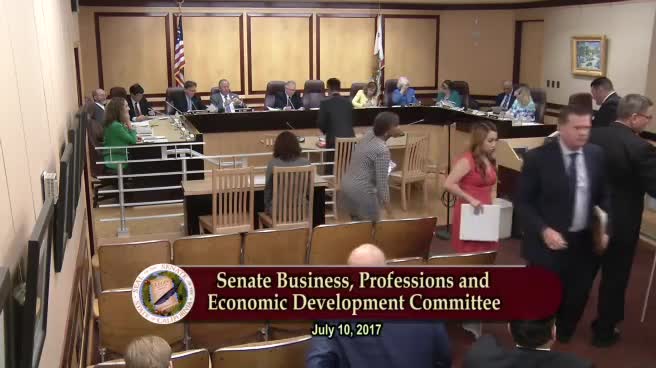 5MIN
Senate Standing Committee on Business, Professions and Economic Development
 1MIN
Assembly Floor
 1H
Assembly Standing Committee on Appropriations
 17MIN
Assembly Standing Committee on Business and Professions
Bill Author

Bill Co-Author(s):