AB 1708: State Board of Optometry: practice of optometry: licensure.
- Session Year: 2017-2018
- House: Assembly
- Latest Version Date: 2017-10-07
Existing law, the Optometry Practice Act, until January 1, 2018, establishes the State Board of Optometry. Under existing law, the State Board of Optometry is responsible for the licensure and regulation of the practice of optometry, registered dispensing opticians, spectacle lens dispensers, and contact lens dispensers. Existing law, until January 1, 2018, authorizes the State Board of Optometry to appoint an executive officer to perform duties delegated by the board. Existing law establishes the Optometry Fund and provides that all fee money collected under the act is paid into that fund and continuously appropriated. Existing law makes a violation of that act punishable as a crime.
This bill would extend the operation of the board and the authority to appoint an executive officer to January 1, 2022. The bill would make all money collected under the act available only upon appropriation of the Legislature to carry out the purposes of the act.
Existing law provides that registrations for spectacle lens dispensers and contact lens dispensers expire at 12 midnight on the last day of the birth month of the licensee during the 2nd year of a 2-year term if not renewed and that registrations for dispensing opticians expire at midnight on the last day of the month in which the license was issued during the 2nd year of a 2-year term if not renewed.
This bill would instead provide that registrations for dispensing opticians, spectacle lens dispensers, and contact lens dispensers expire at midnight on the last day of the month in which the license was issued during the 2nd year of a 2-year term if not renewed.
Existing law defines the term advertise for purposes of the Optometry Practice Act. Existing law makes it unlawful to advertise or hold himself or herself out as an optometrist without having first obtained a license and prohibits an optometrist from advertising or otherwise holding himself or herself out to be a specialist in eye disease and treatment.
This bill would redefine the term advertise to also include the use of the Internet. By changing the definition of an existing crime, the bill would impose a state-mandated local program.
Existing law authorizes the board to, at any time, inspect the premises in which optometry is being practiced or in which spectacle or contact lenses are fitted or dispensed and provides that this authority does not extend to premises that are not registered with the board.
This bill would instead authorize the board or its designated agent, at any time, to inspect both any premise in which optometric services, as defined, are provided or reasonably suspected of being provided and any premise in which the services of dispensing, adjusting, or fitting of contact lenses or spectacle lenses are provided or reasonably suspected of being provided.
Existing law authorizes the board to issue a license to practice optometry to a person who meets certain requirements, including that an applicant for licensure has never had his or her license to practice optometry revoked or suspended in any state where he or she holds a license.
This bill would make this requirement inoperative on July 1, 2018.
Existing law requires the board to permit a graduate of a foreign university who meets certain requirements to take the examinations for an optometrist license.
This bill would repeal that provision.
This bill would require the board to develop an interface with the National Practitioner Data Bank for the purpose of conducting inquiries on applicants for licensure, applicants for renewal of licensure, and current licensees, as specified. The bill, on and after July 1, 2018, would require the board, in addition to any other fees, to charge an applicant for licensure $2 and an applicant for renewal of licensure $4 for this purpose.
This bill would incorporate additional changes to Section 3057 of the Business and Professions Code proposed by AB 443 to be operative only if this bill and AB 443 are enacted and this bill is enacted last.
The California Constitution requires the state to reimburse local agencies and school districts for certain costs mandated by the state. Statutory provisions establish procedures for making that reimbursement.
This bill would provide that no reimbursement is required by this act for a specified reason.
Existing law, the Optometry Practice Act, until January 1, 2018, establishes the State Board of Optometry. Under existing law, the State Board of Optometry is responsible for the licensure and regulation of the practice of optometry, registered dispensing opticians, spectacle lens dispensers, and contact lens dispensers. Existing law, until January 1, 2018, authorizes the State Board of Optometry to appoint an executive officer to perform duties delegated by the board. Existing law establishes the Optometry Fund, which is a continuously appropriated fund, Fund and provides that all fee money collected under the act is paid into that fund. fund and continuously appropriated. Existing law makes a violation of that act punishable as a crime.
This bill would extend the operation of the board and the authority to appoint an executive officer to January 1, 2022. The bill would make all money collected under the act available only upon appropriation of the Legislature to carry out the purposes of the act.
Existing law provides that registrations for spectacle lens dispensers and contact lens dispensers expire at 12 midnight on the last day of the birth month of the licensee during the 2nd year of a 2-year term if not renewed and that registrations for dispensing opticians expire at midnight on the last day of the month in which the license was issued during the 2nd year of a 2-year term if not renewed.
This bill would instead provide that registrations for dispensing opticians, spectacle lens dispensers, and contact lens dispensers expire at midnight on the last day of the month in which the license was issued during the 2nd year of a 2-year term if not renewed.
Existing law defines the term advertise for purposes of the Optometry Practice Act. Existing law makes it unlawful to advertise or hold himself or herself out as an optometrist without having first obtained a license and prohibits an optometrist from advertising or otherwise holding himself or herself out to be a specialist in eye disease and treatment.
This bill would redefine the term advertise to also include the use of the Internet. By changing the definition of an existing crime, the bill would impose a state-mandated local program.
Existing law authorizes the board to, at any time, inspect the premises in which optometry is being practiced or in which spectacle or contact lenses are fitted or dispensed and provides that this authority does not extend to premises that are not registered with the board.
This bill would instead authorize the board or its designated agent, at any time, to inspect both any premise in which optometric services, as defined, are provided or reasonably suspected of being provided and any premise in which the services of dispensing, adjusting, or fitting of contact lenses or spectacle lenses are provided or reasonably suspected of being provided.
Existing law makes it unlawful for a person to engage in the practice of optometry or to display a sign or in any other way to advertise or hold himself or herself out as an optometrist without having first obtained an optometrist license from the board.This bill would instead make it unlawful for a person to advertise, offer, or provide specified services that are included under the practice of optometry unless the person meets specified criteria. By changing the definition of an existing crime, this bill would impose a state-mandated local program.Existing law authorizes the board to issue a license to practice optometry to a person who meets certain requirements, including that an applicant for licensure has never had his or her license to practice optometry revoked or suspended in any state where he or she holds a license.
This bill would make this requirement inoperative on July 1, 2018.
Existing law requires the board to permit a graduate of a foreign university who meets certain requirements to take the examinations for an optometrist license.
This bill would repeal that provision.
This bill would require the board to develop an interface with the National Practitioner Data Bank for the purpose of conducting inquiries on applicants for licensure, applicants for renewal of licensure, and current licensees, as specified. The bill, on and after July 1, 2018, would require the board, in addition to any other fees, to charge an applicant for licensure $2 and an applicant for renewal of licensure $4 for this purpose. By requiring applicants to pay a fee that is deposited into a continuously appropriated fund, this bill would make an appropriation.
The California Constitution requires the state to reimburse local agencies and school districts for certain costs mandated by the state. Statutory provisions establish procedures for making that reimbursement.
This bill would provide that no reimbursement is required by this act for a specified reason.
Existing law, the Optometry Practice Act, until January 1, 2018, establishes the State Board of Optometry. Under existing law, the State Board of Optometry is responsible for the licensure and regulation of the practice of optometry, registered dispensing opticians, spectacle lens dispensers, and contact lens dispensers. Existing law, until January 1, 2018, authorizes the State Board of Optometry to appoint an executive officer to perform duties delegated by the board. Existing law establishes the Optometry Fund, which is a continuously appropriated fund, and provides that all fee money collected under the act is paid into that fund. Existing law makes a violation of that act punishable as a crime.
This bill would extend the operation of the board and the authority to appoint an executive officer to January 1, 2022.
Existing law defines the term advertise for purposes of the Optometry Practice Act. Existing law makes it unlawful to advertise or hold himself or herself out as an optometrist without having first obtained a license and prohibits an optometrist from advertising or otherwise holding himself or herself out to be a specialist in eye disease and treatment.
This bill would redefine the term advertise to also include the use of the Internet. By changing the definition of an existing crime, the bill would impose a state-mandated local program.
Existing law authorizes the board to, at any time, inspect the premises in which optometry is being practiced or in which spectacle or contact lenses are fitted or dispensed and provides that this authority does not extend to premises that are not registered with the board.
This bill would instead authorize the board or its designated agent, at any time, to inspect both any premise in which optometric services, as defined, are provided or reasonably suspected of being provided and any premise in which the services of dispensing, adjusting, or fitting of contact lenses or spectacle lenses are provided or reasonably suspected of being provided.
Existing law makes it unlawful for a person to engage in the practice of optometry or to display a sign or in any other way to advertise or hold himself or herself out as an optometrist without having first obtained an optometrist license from the board.
This bill would instead make it unlawful for a person to advertise, offer, or provide specified services that are included under the practice of optometry without a valid, unrevoked California optometrist license. unless the person meets specified criteria. By changing the definition of an existing crime, this bill would impose a state-mandated local program.
Existing law authorizes the board to issue a license to practice optometry to a person who meets certain requirements, including that an applicant for licensure has never had his or her license to practice optometry revoked or suspended in any state where he or she holds a license.
This bill would make this requirement inoperative on July 1, 2018.
Existing law requires the board to permit a graduate of a foreign university who meets certain requirements to take the examinations for an optometrist license.
This bill would repeal that provision.
This bill would require the board to develop an interface with the National Practitioner Data Bank for the purpose of conducting inquiries on applicants for licensure, applicants for renewal of licensure, and current licensees, as specified. The bill, on and after July 1, 2018, would require the board, in addition to any other fees, to charge an applicant for licensure $2 and an applicant for renewal of licensure $4 for this purpose. By requiring applicants to pay a fee that is deposited into a continuously appropriated fund, this bill would make an appropriation.
The California Constitution requires the state to reimburse local agencies and school districts for certain costs mandated by the state. Statutory provisions establish procedures for making that reimbursement.
This bill would provide that no reimbursement is required by this act for a specified reason.
Existing law, the Optometry Practice Act, until January 1, 2018, establishes the State Board of Optometry. Under existing law, the State Board of Optometry is responsible for the licensure and regulation of the practice of optometry, registered dispensing opticians, spectacle lens dispensers, and contact lens dispensers. Existing law, until January 1, 2018, authorizes the State Board of Optometry to appoint an executive officer to perform duties delegated by the board. Existing law establishes the Optometry Fund, which is a continuously appropriated fund, and provides that all fee money collected under the act is paid into that fund. Existing law makes a violation of that act punishable as a crime.
This bill would extend the operation of the board and the authority to appoint an executive officer to January 1, 2022.
Existing law defines the term advertise for purposes of the Optometry Practice Act. Existing law, among other things, law makes it unlawful to advertise or hold himself or herself out as an optometrist without having first obtained a license and prohibits an optometrist from advertising or otherwise holding himself or herself out to be a specialist in eye disease and treatment. A violation of the Optometry Practice Act is a crime.
This bill would redefine the term advertise to also include the use of the Internet. By changing the definition of a an existing crime, the bill would impose a state-mandated local program.
Existing law authorizes the board to, at any time, inspect the premises in which optometry is being practiced or in which spectacle or contact lenses are fitted or dispensed and provides that this authority does not extend to premises that are not registered with the board.
This bill would instead authorize the board or its designated agent, at any time, to inspect both any premise in which optometric services, as defined, are provided or reasonably suspected of being provided and any premise in which the services of dispensing, adjusting, or fitting of contact lenses or spectacle lenses are provided or reasonably suspected of being provided.
Existing law makes it unlawful for a person to engage in the practice of optometry or to display a sign or in any other way to advertise or hold himself or herself out as an optometrist without having first obtained an optometrist license from the board.
This bill would instead make it unlawful for a person to advertise, offer, or provide specified services that are included under the practice of optometry without a valid, unrevoked California optometrist license. By changing the definition of an existing crime, this bill would impose a state-mandated local program.
Existing law authorizes the board to issue a license to practice optometry to a person who meets certain requirements, including that an applicant for licensure has never had his or her license to practice optometry revoked or suspended in any state where he or she holds a license.
This bill would make this requirement inoperative on July 1, 2018.
Existing law requires the board to permit a graduate of a foreign university who meets certain requirements to take the examinations for an optometrist license.
This bill would repeal that provision.
This bill would require the board to develop an interface with the National Practitioner Data Bank for the purpose of conducting inquiries on applicants for licensure, applicants for renewal of licensure, and current licensees, as specified. The bill, on and after July 1, 2018, would require the board, in addition to any other fees, to charge an applicant for licensure $2 and an applicant for renewal of licensure $4 for this purpose. By requiring applicants to pay a fee that is deposited into a continuously appropriated fund, this bill would make an appropriation.
The California Constitution requires the state to reimburse local agencies and school districts for certain costs mandated by the state. Statutory provisions establish procedures for making that reimbursement.
This bill would provide that no reimbursement is required by this act for a specified reason.
Existing law, the Optometry Practice Act, until January 1, 2018, establishes the State Board of Optometry. Under existing law, the State Board of Optometry is responsible for the licensure and regulation of the practice of optometry, registered dispensing opticians, spectacle lens dispensers, and contact lens dispensers. Existing law, until January 1, 2018, authorizes the State Board of Optometry to appoint an executive officer to perform duties delegated by the board.
This bill would extend the operation of the board and the authority to appoint an executive officer to January 1, 2022.
Existing law defines the term advertise for purposes of the Optometry Practice Act. Existing law, among other things, makes it unlawful to advertise or hold himself or herself out as an optometrist without having first obtained a license and prohibits an optometrist from advertising or otherwise holding himself or herself out to be a specialist in eye disease and treatment. A violation of the Optometry Practice Act is a crime.
This bill would redefine the term advertise to also include the use of the Internet. By changing the definition of a crime, the bill would impose a state-mandated local program.
The California Constitution requires the state to reimburse local agencies and school districts for certain costs mandated by the state. Statutory provisions establish procedures for making that reimbursement.
This bill would provide that no reimbursement is required by this act for a specified reason.
Registrations of dispensing opticians, spectacle lens dispensers, and contact lens dispensers shall expire at midnight on the last day of the month in which the license was issued during the second year of a two-year term if not renewed.
SEC. 2.Section 3006 of the Business and Professions Code is amended to read:3006.As used in this chapter, the term advertise and any of its variants include the use of a newspaper, magazine, the Internet, or other publication, book, notice, circular, pamphlet, letter, handbill, poster, bill, sign, placard, card, label, tag, window display, store sign, radio announcement, or any other means or methods now or hereafter employed to bring to the attention of the public the practice of optometry or the prescribing, fitting, or sale, in connection therewith, of lenses, frames, or other accessories or appurtenances.
SEC. 3.Section 3010.5 of the Business and Professions Code is amended to read:3010.5.(a)There is in the Department of Consumer Affairs a State Board of Optometry in which the enforcement of this chapter is vested. The board consists of 11 members, five of whom shall be public members and one of the nonpublic members shall be an individual registered as a dispensing optician, spectacle lens dispenser, or contact lens dispenser. The registered dispensing member shall be registered pursuant to Chapter 5.5 (commencing with Section 2550) and in good standing with the board.
Six members of the board shall constitute a quorum.
(b)The board shall, with respect to conducting investigations, inquiries, and disciplinary actions and proceedings, have the authority previously vested in the board as created pursuant to former Section 3010. The board may enforce any disciplinary actions undertaken by that board.
(c)This section shall remain in effect only until January 1, 2022, and as of that date is repealed. Notwithstanding any other law, the repeal of this section renders the board subject to review by the appropriate policy committees of the Legislature.
(d)The amendments to this section by the act adding this subdivision shall apply to appointments made on or after January 1, 2016.
SEC. 4.Section 3014.6 of the Business and Professions Code is amended to read:3014.6.(a)The board may appoint a person exempt from civil service who shall be designated as an executive officer and who shall exercise the powers and perform the duties delegated by the board and vested in him or her by this chapter.
(b)This section shall remain in effect only until January 1, 2022, and as of that date is repealed.
SEC. 5.Section 3030 of the Business and Professions Code is amended to read:3030.(a)The board, or its designated agent, may at any time inspect either of the following:
(1)Any premise in which optometric services, as defined in Section 3041, are provided or reasonably suspected of being provided.
(2)Any premise in which the services of dispensing, adjusting, or fitting of contact lenses or spectacle lenses are provided or reasonably suspected of being provided.
(b)Nothing in this section shall be construed to grant the board jurisdiction over the practice of medicine.
SEC. 6.Section 3047 is added to the Business and Professions Code, to read:3047.(a)The board shall develop an interface with the National Practitioner Data Bank for the purpose of conducting inquiries on applicants for licensure, applicants for renewal of licensure, and current licensees.
(b)The board shall limit its inquiries to both of the following:
(1)Whether an applicant or current licensee has been subject to discipline.
(2)Whether an applicant or current licensee has been the subject of an action required to be reported to the National Practitioner Data Bank by federal law.
(c)On and after July 1, 2018, the board shall charge, in addition to the fees in Section 3152, an applicant for licensure two dollars ($2) and an applicant for renewal of licensure four dollars ($4) for the purposes of this section.
SEC. 7.Section 3057 of the Business and Professions Code is amended to read:3057.(a)The board may issue a license to practice optometry to a person who meets all of the following requirements:
(1)Has a degree as a doctor of optometry issued by an accredited school or college of optometry.
(2)Has successfully passed the licensing examination for an optometric license in another state.
(3)Submits proof that he or she is licensed in good standing as of the date of application in every state where he or she holds a license, including compliance with continuing education requirements.
(4)Is not subject to disciplinary action as set forth in subdivision (h) of Section 3110. If the person has been subject to disciplinary action, the board shall review that action to determine if it presents sufficient evidence of a violation of this chapter to warrant the submission of additional information from the person or the denial of the application for licensure.
(5)Has furnished a signed release allowing the disclosure of information from the National Practitioner Data Bank and, if applicable, the verification of registration status with the federal Drug Enforcement Administration. The board shall review this information to determine if it presents sufficient evidence of a violation of this chapter to warrant the submission of additional information from the person or the denial of the application for licensure.
(6)Has never had his or her license to practice optometry revoked or suspended in any state where the person holds a license. This paragraph shall become inoperative on July 1, 2018.
(7)(A)Is not subject to denial of an application for licensure based on any of the grounds listed in Section 480.
(B)Is not currently required to register as a sex offender pursuant to Section 290 of the Penal Code.
(8)Has met the minimum continuing education requirements set forth in Section 3059 for the current and preceding year.
(9)Has met the certification requirements of Section 3041.3 to use therapeutic pharmaceutical agents under subdivision (e) of Section 3041.
(10)Submits any other information as specified by the board to the extent it is required for licensure by examination under this chapter.
(11)Files an application on a form prescribed by the board, with an acknowledgment by the person executed under penalty of perjury and automatic forfeiture of license, of the following:
(A)That the information provided by the person to the board is true and correct, to the best of his or her knowledge and belief.
(B)That the person has not been convicted of an offense involving conduct that would violate Section 810.
(12)Pays an application fee in an amount equal to the application fee prescribed pursuant to subdivision (a) of Section 3152.
(13)Has successfully passed the boards jurisprudence examination.
(b)If the board finds that the competency of a candidate for licensure pursuant to this section is in question, the board may require the passage of a written, practical, or clinical examination or completion of additional continuing education or coursework.
(c)In cases where the person establishes, to the boards satisfaction, that he or she has been displaced by a federally declared emergency and cannot relocate to his or her state of practice within a reasonable time without economic hardship, the board may reduce or waive the fees required by paragraph (12) of subdivision (a).
(d)Any license issued pursuant to this section shall expire as provided in Section 3146, and may be renewed as provided in this chapter, subject to the same conditions as other licenses issued under this chapter.
(e)The term in good standing, as used in this section, means that a person under this section:
(1)Is not currently under investigation nor has been charged with an offense for any act substantially related to the practice of optometry by any public agency, nor entered into any consent agreement or subject to an administrative decision that contains conditions placed by an agency upon a persons professional conduct or practice, including any voluntary surrender of license, nor been the subject of an adverse judgment resulting from the practice of optometry that the board determines constitutes evidence of a pattern of incompetence or negligence.
(2)Has no physical or mental impairment related to drugs or alcohol, and has not been found mentally incompetent by a licensed psychologist or licensed psychiatrist so that the person is unable to undertake the practice of optometry in a manner consistent with the safety of a patient or the public.
SEC. 7.5.Section 3057 of the Business and Professions Code is amended to read:3057.(a)The board may issue a license to practice optometry to a person who meets all of the following requirements:
(1)Has a degree as a doctor of optometry issued by an accredited school or college of optometry.
(2)Has successfully passed the licensing examination for an optometric license in another state.
(3)Submits proof that he or she is licensed in good standing as of the date of application in every state where he or she holds a license, including compliance with continuing education requirements.
(4)Is not subject to disciplinary action as set forth in subdivision (h) of Section 3110. If the person has been subject to disciplinary action, the board shall review that action to determine if it presents sufficient evidence of a violation of this chapter to warrant the submission of additional information from the person or the denial of the application for licensure.
(5)Has furnished a signed release allowing the disclosure of information from the National Practitioner Data Bank and, if applicable, the verification of registration status with the federal Drug Enforcement Administration. The board shall review this information to determine if it presents sufficient evidence of a violation of this chapter to warrant the submission of additional information from the person or the denial of the application for licensure.
(6)Has never had his or her license to practice optometry revoked or suspended in any state where the person holds a license. This paragraph shall become inoperative on July 1, 2018.
(7)(A)Is not subject to denial of an application for licensure based on any of the grounds listed in Section 480.
(B)Is not currently required to register as a sex offender pursuant to Section 290 of the Penal Code.
(8)Has met the minimum continuing education requirements set forth in Section 3059 for the current and preceding year.
(9)Has met the certification requirements of Section 3041.3 to use therapeutic pharmaceutical agents under subdivision (d) of Section 3041.
(10)Submits any other information as specified by the board to the extent it is required for licensure by examination under this chapter.
(11)Files an application on a form prescribed by the board, with an acknowledgment by the person executed under penalty of perjury and automatic forfeiture of license, of the following:
(A)That the information provided by the person to the board is true and correct, to the best of his or her knowledge and belief.
(B)That the person has not been convicted of an offense involving conduct that would violate Section 810.
(12)Pays an application fee in an amount equal to the application fee prescribed pursuant to subdivision (a) of Section 3152.
(13)Has successfully passed the boards jurisprudence examination.
(b)If the board finds that the competency of a candidate for licensure pursuant to this section is in question, the board may require the passage of a written, practical, or clinical examination or completion of additional continuing education or coursework.
(c)In cases where the person establishes, to the boards satisfaction, that he or she has been displaced by a federally declared emergency and cannot relocate to his or her state of practice within a reasonable time without economic hardship, the board may reduce or waive the fees required by paragraph (12) of subdivision (a).
(d)Any license issued pursuant to this section shall expire as provided in Section 3146, and may be renewed as provided in this chapter, subject to the same conditions as other licenses issued under this chapter.
(e)The term in good standing, as used in this section, means that a person under this section:
(1)Is not currently under investigation nor has been charged with an offense for any act substantially related to the practice of optometry by any public agency, nor entered into any consent agreement or subject to an administrative decision that contains conditions placed by an agency upon a persons professional conduct or practice, including any voluntary surrender of license, nor been the subject of an adverse judgment resulting from the practice of optometry that the board determines constitutes evidence of a pattern of incompetence or negligence.
(2)Has no physical or mental impairment related to drugs or alcohol, and has not been found mentally incompetent by a licensed psychologist or licensed psychiatrist so that the person is unable to undertake the practice of optometry in a manner consistent with the safety of a patient or the public.
SEC. 8.Section 3057.5 of the Business and Professions Code is repealed.SEC. 9.Section 3145 of the Business and Professions Code is amended to read:3145.There is the Optometry Fund in the State Treasury. Unless otherwise provided, all money collected under the authority of this chapter shall be paid into this fund, and shall be available, upon appropriation of the Legislature, to carry out the purposes of this chapter. The board shall not maintain a reserve balance in the fund that is greater than six months of the appropriated operating expenses of the board in any fiscal year.
SEC. 10.Section 7.5 of this bill incorporates amendments to Section 3057 of the Business and Professions Code proposed by both this bill and Assembly Bill 443. That section of this bill shall only become operative if (1) both bills are enacted and become effective on or before January 1, 2018, (2) each bill amends Section 3057 of the Business and Professions Code, and (3) this bill is enacted after Assembly Bill 443, in which case Section 7 of this bill shall not become operative.
SEC. 11.No reimbursement is required by this act pursuant to Section 6 of Article XIIIB of the California Constitution because the only costs that may be incurred by a local agency or school district will be incurred because this act creates a new crime or infraction, eliminates a crime or infraction, or changes the penalty for a crime or infraction, within the meaning of Section 17556 of the Government Code, or changes the definition of a crime within the meaning of Section 6 of Article XIIIB of the California Constitution.
Registrations of dispensing opticians, spectacle lens dispensers, and contact lens dispensers shall expire at midnight on the last day of the month in which the license was issued during the second year of a two-year term if not renewed.
SEC. 3.SEC. 2.Section 3006 of the Business and Professions Code is amended to read:3006.As used in this chapter, the term advertise and any of its variants include the use of a newspaper, magazine, the Internet, or other publication, book, notice, circular, pamphlet, letter, handbill, poster, bill, sign, placard, card, label, tag, window display, store sign, radio announcement, or any other means or methods now or hereafter employed to bring to the attention of the public the practice of optometry or the prescribing, fitting, or sale, in connection therewith, of lenses, frames, or other accessories or appurtenances.
SEC. 4.SEC. 3.Section 3010.5 of the Business and Professions Code is amended to read:3010.5.(a)There is in the Department of Consumer Affairs a State Board of Optometry in which the enforcement of this chapter is vested. The board consists of 11 members, five of whom shall be public members and one of the nonpublic members shall be an individual registered as a dispensing optician, spectacle lens dispenser, or contact lens dispenser. The registered dispensing member shall be registered pursuant to Chapter 5.5 (commencing with Section 2550) and in good standing with the board.
Six members of the board shall constitute a quorum.
(b)The board shall, with respect to conducting investigations, inquiries, and disciplinary actions and proceedings, have the authority previously vested in the board as created pursuant to former Section 3010. The board may enforce any disciplinary actions undertaken by that board.
(c)This section shall remain in effect only until January 1, 2022, and as of that date is repealed. Notwithstanding any other law, the repeal of this section renders the board subject to review by the appropriate policy committees of the Legislature.
(d)The amendments to this section by the act adding this subdivision shall apply to appointments made on or after January 1, 2016.
SEC. 5.SEC. 4.Section 3014.6 of the Business and Professions Code is amended to read:3014.6.(a)The board may appoint a person exempt from civil service who shall be designated as an executive officer and who shall exercise the powers and perform the duties delegated by the board and vested in him or her by this chapter.
(b)This section shall remain in effect only until January 1, 2022, and as of that date is repealed.
SEC. 6.SEC. 5.Section 3030 of the Business and Professions Code is amended to read:3030.(a)The board, or its designated agent, may at any time inspect either of the following:
(1)Any premise in which optometric services, as defined in Section 3041, are provided or reasonably suspected of being provided.
(2)Any premise in which the services of dispensing, adjusting, or fitting of contact lenses or spectacle lenses are provided or reasonably suspected of being provided.
(b)Nothing in this section shall be construed to grant the board jurisdiction over the practice of medicine.
SEC. 7.SEC. 6.Section 3047 is added to the Business and Professions Code, to read:3047.(a)The board shall develop an interface with the National Practitioner Data Bank for the purpose of conducting inquiries on applicants for licensure, applicants for renewal of licensure, and current licensees.
(b)The board shall limit its inquiries to both of the following:
(1)Whether an applicant or current licensee has been subject to discipline.
(2)Whether an applicant or current licensee has been the subject of an action required to be reported to the National Practitioner Data Bank by federal law.
(c)On and after July 1, 2018, the board shall charge, in addition to the fees in Section 3152, an applicant for licensure two dollars ($2) and an applicant for renewal of licensure four dollars ($4) for the purposes of this section.
SEC. 8.SEC. 7.Section 3057 of the Business and Professions Code is amended to read:3057.(a)The board may issue a license to practice optometry to a person who meets all of the following requirements:
(1)Has a degree as a doctor of optometry issued by an accredited school or college of optometry.
(2)Has successfully passed the licensing examination for an optometric license in another state.
(3)Submits proof that he or she is licensed in good standing as of the date of application in every state where he or she holds a license, including compliance with continuing education requirements.
(4)Is not subject to disciplinary action as set forth in subdivision (h) of Section 3110. If the person has been subject to disciplinary action, the board shall review that action to determine if it presents sufficient evidence of a violation of this chapter to warrant the submission of additional information from the person or the denial of the application for licensure.
(5)Has furnished a signed release allowing the disclosure of information from the National Practitioner Data Bank and, if applicable, the verification of registration status with the federal Drug Enforcement Administration. The board shall review this information to determine if it presents sufficient evidence of a violation of this chapter to warrant the submission of additional information from the person or the denial of the application for licensure.
(6)Has never had his or her license to practice optometry revoked or suspended in any state where the person holds a license. This paragraph shall become inoperative on July 1, 2018.
(7)(A)Is not subject to denial of an application for licensure based on any of the grounds listed in Section 480.
(B)Is not currently required to register as a sex offender pursuant to Section 290 of the Penal Code.
(8)Has met the minimum continuing education requirements set forth in Section 3059 for the current and preceding year.
(9)Has met the certification requirements of Section 3041.3 to use therapeutic pharmaceutical agents under subdivision (e) of Section 3041.
(10)Submits any other information as specified by the board to the extent it is required for licensure by examination under this chapter.
(11)Files an application on a form prescribed by the board, with an acknowledgment by the person executed under penalty of perjury and automatic forfeiture of license, of the following:
(A)That the information provided by the person to the board is true and correct, to the best of his or her knowledge and belief.
(B)That the person has not been convicted of an offense involving conduct that would violate Section 810.
(12)Pays an application fee in an amount equal to the application fee prescribed pursuant to subdivision (a) of Section 3152.
(13)Has successfully passed the boards jurisprudence examination.
(b)If the board finds that the competency of a candidate for licensure pursuant to this section is in question, the board may require the passage of a written, practical, or clinical examination or completion of additional continuing education or coursework.
(c)In cases where the person establishes, to the boards satisfaction, that he or she has been displaced by a federally declared emergency and cannot relocate to his or her state of practice within a reasonable time without economic hardship, the board may reduce or waive the fees required by paragraph (12) of subdivision (a).
(d)Any license issued pursuant to this section shall expire as provided in Section 3146, and may be renewed as provided in this chapter, subject to the same conditions as other licenses issued under this chapter.
(e)The term in good standing, as used in this section, means that a person under this section:
(1)Is not currently under investigation nor has been charged with an offense for any act substantially related to the practice of optometry by any public agency, nor entered into any consent agreement or subject to an administrative decision that contains conditions placed by an agency upon a persons professional conduct or practice, including any voluntary surrender of license, nor been the subject of an adverse judgment resulting from the practice of optometry that the board determines constitutes evidence of a pattern of incompetence or negligence.
(2)Has no physical or mental impairment related to drugs or alcohol, and has not been found mentally incompetent by a licensed psychologist or licensed psychiatrist so that the person is unable to undertake the practice of optometry in a manner consistent with the safety of a patient or the public.
SEC. 7.5.Section 3057 of the Business and Professions Code is amended to read:3057.(a)The board may issue a license to practice optometry to a person who meets all of the following requirements:
(1)Has a degree as a doctor of optometry issued by an accredited school or college of optometry.
(2)Has successfully passed the licensing examination for an optometric license in another state.
(3)Submits proof that he or she is licensed in good standing as of the date of application in every state where he or she holds a license, including compliance with continuing education requirements.
(4)Is not subject to disciplinary action as set forth in subdivision (h) of Section 3110. If the person has been subject to disciplinary action, the board shall review that action to determine if it presents sufficient evidence of a violation of this chapter to warrant the submission of additional information from the person or the denial of the application for licensure.
(5)Has furnished a signed release allowing the disclosure of information from the National Practitioner Database Data Bank and, if applicable, the verification of registration status with the federal Drug Enforcement Administration. The board shall review this information to determine if it presents sufficient evidence of a violation of this chapter to warrant the submission of additional information from the person or the denial of the application for licensure.
(6)Has never had his or her license to practice optometry revoked or suspended in any state where the person holds a license. This paragraph shall become inoperative on July 1, 2018.
(7)(A)Is not subject to denial of an application for licensure based on any of the grounds listed in Section 480.
(B)Is not currently required to register as a sex offender pursuant to Section 290 of the Penal Code.
(8)Has met the minimum continuing education requirements set forth in Section 3059 for the current and preceding year.
(9)Has met the certification requirements of Section 3041.3 to use therapeutic pharmaceutical agents under subdivision (e) (d) of Section 3041.
(10)Submits any other information as specified by the board to the extent it is required for licensure by examination under this chapter.
(11)Files an application on a form prescribed by the board, with an acknowledgment by the person executed under penalty of perjury and automatic forfeiture of license, of the following:
(A)That the information provided by the person to the board is true and correct, to the best of his or her knowledge and belief.
(B)That the person has not been convicted of an offense involving conduct that would violate Section 810.
(12)Pays an application fee in an amount equal to the application fee prescribed pursuant to subdivision (a) of Section 3152.
(13)Has successfully passed the boards jurisprudence examination.
(b)If the board finds that the competency of a candidate for licensure pursuant to this section is in question, the board may require the passage of a written, practical, or clinical examination or completion of additional continuing education or coursework.
(c)In cases where the person establishes, to the boards satisfaction, that he or she has been displaced by a federally declared emergency and cannot relocate to his or her state of practice within a reasonable time without economic hardship, the board may reduce or waive the fees required by paragraph (12) of subdivision (a).
(d)Any license issued pursuant to this section shall expire as provided in Section 3146, and may be renewed as provided in this chapter, subject to the same conditions as other licenses issued under this chapter.
(e)The term in good standing, as used in this section, means that a person under this section:
(1)Is not currently under investigation nor has been charged with an offense for any act substantially related to the practice of optometry by any public agency, nor entered into any consent agreement or subject to an administrative decision that contains conditions placed by an agency upon a persons professional conduct or practice, including any voluntary surrender of license, nor been the subject of an adverse judgment resulting from the practice of optometry that the board determines constitutes evidence of a pattern of incompetence or negligence.
(2)Has no physical or mental impairment related to drugs or alcohol, and has not been found mentally incompetent by a licensed psychologist or licensed psychiatrist so that the person is unable to undertake the practice of optometry in a manner consistent with the safety of a patient or the public.
SEC. 9.SEC. 8.Section 3057.5 of the Business and Professions Code is repealed.SEC. 10.SEC. 9.Section 3145 of the Business and Professions Code is amended to read:3145.There is the Optometry Fund in the State Treasury. Unless otherwise provided, all money collected under the authority of this chapter shall be paid into this fund, and shall be available, upon appropriation of the Legislature, to carry out the purposes of this chapter. The board shall not maintain a reserve balance in the fund that is greater than six months of the appropriated operating expenses of the board in any fiscal year.
SEC. 10.Section 7.5 of this bill incorporates amendments to Section 3057 of the Business and Professions Code proposed by both this bill and Assembly Bill 443. That section of this bill shall only become operative if (1) both bills are enacted and become effective on or before January 1, 2018, (2) each bill amends Section 3057 of the Business and Professions Code, and (3) this bill is enacted after Assembly Bill 443, in which case Section 7 of this bill shall not become operative.
SEC. 11.No reimbursement is required by this act pursuant to Section 6 of Article XIIIB of the California Constitution because the only costs that may be incurred by a local agency or school district will be incurred because this act creates a new crime or infraction, eliminates a crime or infraction, or changes the penalty for a crime or infraction, within the meaning of Section 17556 of the Government Code, or changes the definition of a crime within the meaning of Section 6 of Article XIIIB of the California Constitution.
(a)Notwithstanding Section 2422:
(1)All 2422, all physician and surgeons certificates, certificates to practice podiatric medicine, registrations of spectacle lens dispensers and contact lens dispensers, and certificates to practice midwifery shall expire at 12 midnight on the last day of the birth month of the licensee during the second year of a two-year term if not renewed.
(2)Registrations of dispensing opticians will expire at midnight on the last day of the month in which the license was issued during the second year of a two-year term if not renewed.(b)The Division of Licensing shall establish by regulation procedures for the administration of a birth date renewal program, including, but not limited to, the establishment of a system of staggered license expiration dates such that a relatively equal number of licenses expire monthly.
(c)To renew an unexpired license, the licensee shall, on or before the dates on which it would otherwise expire, apply for renewal on a form prescribed by the licensing authority and pay the prescribed renewal fee.
SEC. 2.Section 2553.7 is added to the Business and Professions Code, to read:2553.7.Registrations of dispensing opticians, spectacle lens dispensers, and contact lens dispensers shall expire at midnight on the last day of the month in which the license was issued during the second year of a two-year term if not renewed.
SECTION 1.SEC. 3.Section 3006 of the Business and Professions Code is amended to read:3006.As used in this chapter, the term advertise and any of its variants include the use of a newspaper, magazine, the Internet, or other publication, book, notice, circular, pamphlet, letter, handbill, poster, bill, sign, placard, card, label, tag, window display, store sign, radio announcement, or any other means or methods now or hereafter employed to bring to the attention of the public the practice of optometry or the prescribing, fitting, or sale, in connection therewith, of lenses, frames, or other accessories or appurtenances.
SEC. 2.SEC. 4.Section 3010.5 of the Business and Professions Code is amended to read:3010.5.(a)There is in the Department of Consumer Affairs a State Board of Optometry in which the enforcement of this chapter is vested. The board consists of 11 members, five of whom shall be public members and one of the nonpublic members shall be an individual registered as a dispensing optician, spectacle lens dispenser, or contact lens dispenser. The registered dispensing member shall be registered pursuant to Chapter 5.5 (commencing with Section 2550) and in good standing with the board.
Six members of the board shall constitute a quorum.
(b)The board shall, with respect to conducting investigations, inquiries, and disciplinary actions and proceedings, have the authority previously vested in the board as created pursuant to former Section 3010. The board may enforce any disciplinary actions undertaken by that board.
(c)This section shall remain in effect only until January 1, 2022, and as of that date is repealed. Notwithstanding any other law, the repeal of this section renders the board subject to review by the appropriate policy committees of the Legislature.
(d)The amendments to this section by the act adding this subdivision shall apply to appointments made on or after January 1, 2016.
SEC. 3.SEC. 5.Section 3014.6 of the Business and Professions Code is amended to read:3014.6.(a)The board may appoint a person exempt from civil service who shall be designated as an executive officer and who shall exercise the powers and perform the duties delegated by the board and vested in him or her by this chapter.
(b)This section shall remain in effect only until January 1, 2022, and as of that date is repealed.
SEC. 4.SEC. 6.Section 3030 of the Business and Professions Code is amended to read:3030.(a)The board, or its designated agent, may at any time inspect either of the following:
(1)Any premise in which optometric services, as defined in Section 3041, are provided or reasonably suspected of being provided.
(2)Any premise in which the services of dispensing, adjusting, or fitting of contact lenses or spectacle lenses are provided or reasonably suspected of being provided.
(b)Nothing in this section shall be construed to grant the board jurisdiction over the practice of medicine.
SEC. 5.Section 3040 of the Business and Professions Code is amended to read:3040.(a)It is unlawful for a person to advertise, offer, or provide any service set forth in Section 3041 unless the person meets one of the following:(1)Possesses a license issued under this chapter.(2)Is authorized to do so under Section 655.(3)Is authorized to do so by a license issued under this division.(b)In any prosecution for a violation of this section, the use of test cards, test lenses, or of trial frames is prima facie evidence of the practice of optometry.SEC. 6.SEC. 7.Section 3047 is added to the Business and Professions Code, to read:3047.(a)The board shall develop an interface with the National Practitioner Data Bank for the purpose of conducting inquiries on applicants for licensure, applicants for renewal of licensure, and current licensees.
(b)The board shall limit its inquiries to both of the following:
(1)Whether an applicant or current licensee has been subject to discipline.
(2)Whether an applicant or current licensee has been the subject of an action required to be reported to the National Practitioner Data Bank by federal law.
(c)On and after July 1, 2018, the board shall charge, in addition to the fees in Section 3152, an applicant for licensure two dollars ($2) and an applicant for renewal of licensure four dollars ($4) for the purposes of this section.
SEC. 7.SEC. 8.Section 3057 of the Business and Professions Code is amended to read:3057.(a)The board may issue a license to practice optometry to a person who meets all of the following requirements:
(1)Has a degree as a doctor of optometry issued by an accredited school or college of optometry.
(2)Has successfully passed the licensing examination for an optometric license in another state.
(3)Submits proof that he or she is licensed in good standing as of the date of application in every state where he or she holds a license, including compliance with continuing education requirements.
(4)Is not subject to disciplinary action as set forth in subdivision (h) of Section 3110. If the person has been subject to disciplinary action, the board shall review that action to determine if it presents sufficient evidence of a violation of this chapter to warrant the submission of additional information from the person or the denial of the application for licensure.
(5)Has furnished a signed release allowing the disclosure of information from the National Practitioner Data Bank and, if applicable, the verification of registration status with the federal Drug Enforcement Administration. The board shall review this information to determine if it presents sufficient evidence of a violation of this chapter to warrant the submission of additional information from the person or the denial of the application for licensure.
(6)Has never had his or her license to practice optometry revoked or suspended in any state where the person holds a license. This paragraph shall become inoperative on July 1, 2018.
(7)(A)Is not subject to denial of an application for licensure based on any of the grounds listed in Section 480.
(B)Is not currently required to register as a sex offender pursuant to Section 290 of the Penal Code.
(8)Has met the minimum continuing education requirements set forth in Section 3059 for the current and preceding year.
(9)Has met the certification requirements of Section 3041.3 to use therapeutic pharmaceutical agents under subdivision (e) of Section 3041.
(10)Submits any other information as specified by the board to the extent it is required for licensure by examination under this chapter.
(11)Files an application on a form prescribed by the board, with an acknowledgment by the person executed under penalty of perjury and automatic forfeiture of license, of the following:
(A)That the information provided by the person to the board is true and correct, to the best of his or her knowledge and belief.
(B)That the person has not been convicted of an offense involving conduct that would violate Section 810.
(12)Pays an application fee in an amount equal to the application fee prescribed pursuant to subdivision (a) of Section 3152.
(13)Has successfully passed the boards jurisprudence examination.
(b)If the board finds that the competency of a candidate for licensure pursuant to this section is in question, the board may require the passage of a written, practical, or clinical examination or completion of additional continuing education or coursework.
(c)In cases where the person establishes, to the boards satisfaction, that he or she has been displaced by a federally declared emergency and cannot relocate to his or her state of practice within a reasonable time without economic hardship, the board may reduce or waive the fees required by paragraph (12) of subdivision (a).
(d)Any license issued pursuant to this section shall expire as provided in Section 3146, and may be renewed as provided in this chapter, subject to the same conditions as other licenses issued under this chapter.
(e)The term in good standing, as used in this section, means that a person under this section:
(1)Is not currently under investigation nor has been charged with an offense for any act substantially related to the practice of optometry by any public agency, nor entered into any consent agreement or subject to an administrative decision that contains conditions placed by an agency upon a persons professional conduct or practice, including any voluntary surrender of license, nor been the subject of an adverse judgment resulting from the practice of optometry that the board determines constitutes evidence of a pattern of incompetence or negligence.
(2)Has no physical or mental impairment related to drugs or alcohol, and has not been found mentally incompetent by a licensed psychologist or licensed psychiatrist so that the person is unable to undertake the practice of optometry in a manner consistent with the safety of a patient or the public.
SEC. 8.SEC. 9.Section 3057.5 of the Business and Professions Code is repealed.SEC. 10.Section 3145 of the Business and Professions Code is amended to read:3145.There is the Optometry Fund in the State Treasury. Unless otherwise provided, all money collected under the authority of this chapter shall be paid into this fund. fund, and shall be available, upon appropriation of the Legislature, to carry out the purposes of this chapter. The board shall not maintain a reserve balance in the fund that is greater than six months of the appropriated operating expenses of the board in any fiscal year.
SEC. 9.SEC. 11.No reimbursement is required by this act pursuant to Section 6 of Article XIIIB of the California Constitution because the only costs that may be incurred by a local agency or school district will be incurred because this act creates a new crime or infraction, eliminates a crime or infraction, or changes the penalty for a crime or infraction, within the meaning of Section 17556 of the Government Code, or changes the definition of a crime within the meaning of Section 6 of Article XIIIB of the California Constitution.
As used in this chapter, the term advertise and any of its variants include the use of a newspaper, magazine, the Internet, or other publication, book, notice, circular, pamphlet, letter, handbill, poster, bill, sign, placard, card, label, tag, window display, store sign, radio announcement, or any other means or methods now or hereafter employed to bring to the attention of the public the practice of optometry or the prescribing, fitting, or sale, in connection therewith, of lenses, frames, or other accessories or appurtenances.
SEC. 2.Section 3010.5 of the Business and Professions Code is amended to read:3010.5.(a)There is in the Department of Consumer Affairs a State Board of Optometry in which the enforcement of this chapter is vested. The board consists of 11 members, five of whom shall be public members and one of the nonpublic members shall be an individual registered as a dispensing optician, spectacle lens dispenser, or contact lens dispenser. The registered dispensing member shall be registered pursuant to Chapter 5.5 (commencing with Section 2550) and in good standing with the board.
Six members of the board shall constitute a quorum.
(b)The board shall, with respect to conducting investigations, inquiries, and disciplinary actions and proceedings, have the authority previously vested in the board as created pursuant to former Section 3010. The board may enforce any disciplinary actions undertaken by that board.
(c)This section shall remain in effect only until January 1, 2022, and as of that date is repealed. Notwithstanding any other law, the repeal of this section renders the board subject to review by the appropriate policy committees of the Legislature.
(d)The amendments to this section by the act adding this subdivision shall apply to appointments made on or after January 1, 2016.
SEC. 3.Section 3014.6 of the Business and Professions Code is amended to read:3014.6.(a)The board may appoint a person exempt from civil service who shall be designated as an executive officer and who shall exercise the powers and perform the duties delegated by the board and vested in him or her by this chapter.
(b)This section shall remain in effect only until January 1, 2022, and as of that date is repealed.
SEC. 4.Section 3030 of the Business and Professions Code is amended to read:3030.(a)The board, or its designated agent, may at any time inspect either of the following:
(a)(1)Any premise in which optometric services, as defined in Section 3041, are provided or reasonably suspected of being provided.
(b)(2)Any premise in which the services of dispensing, adjusting, or fitting of contact lenses or spectacle lenses are provided or reasonably suspected of being provided.
(b)Nothing in this section shall be construed to grant the board jurisdiction over the practice of medicine.
SEC. 5.Section 3040 of the Business and Professions Code is amended to read:3040.(a)It is unlawful for a person to advertise, offer, or provide any service set forth in Section 3041 without possessing a valid, unrevoked California optometrist license. unless the person meets one of the following:
(1)Possesses a license issued under this chapter.
(2)Is authorized to do so under Section 655.
(3)Is authorized to do so by a license issued under this division.
(b)In any prosecution for a violation of this section, the use of test cards, test lenses, or of trial frames is prima facie evidence of the practice of optometry.
SEC. 6.Section 3047 is added to the Business and Professions Code, to read:3047.(a)The board shall develop an interface with the National Practitioner Data Bank for the purpose of conducting inquiries on applicants for licensure, applicants for renewal of licensure, and current licensees.
(b)The board shall limit its inquiries to both of the following:
(1)Whether an applicant or current licensee has been subject to discipline.
(2)Whether an applicant or current licensee has been the subject of an action required to be reported to the National Practitioner Data Bank by federal law.
(c)On and after July 1, 2018, the board shall charge, in addition to the fees in Section 3152, an applicant for licensure two dollars ($2) and an applicant for renewal of licensure four dollars ($4) for the purposes of this section.
SEC. 7.Section 3057 of the Business and Professions Code is amended to read:3057.(a)The board may issue a license to practice optometry to a person who meets all of the following requirements:
(1)Has a degree as a doctor of optometry issued by an accredited school or college of optometry.
(2)Has successfully passed the licensing examination for an optometric license in another state.
(3)Submits proof that he or she is licensed in good standing as of the date of application in every state where he or she holds a license, including compliance with continuing education requirements.
(4)Is not subject to disciplinary action as set forth in subdivision (h) of Section 3110. If the person has been subject to disciplinary action, the board shall review that action to determine if it presents sufficient evidence of a violation of this chapter to warrant the submission of additional information from the person or the denial of the application for licensure.
(5)Has furnished a signed release allowing the disclosure of information from the National Practitioner Database Data Bank and, if applicable, the verification of registration status with the federal Drug Enforcement Administration. The board shall review this information to determine if it presents sufficient evidence of a violation of this chapter to warrant the submission of additional information from the person or the denial of the application for licensure.
(6)Has never had his or her license to practice optometry revoked or suspended in any state where the person holds a license. This paragraph shall become inoperative on July 1, 2018.
(7)(A)Is not subject to denial of an application for licensure based on any of the grounds listed in Section 480.
(B)Is not currently required to register as a sex offender pursuant to Section 290 of the Penal Code.
(8)Has met the minimum continuing education requirements set forth in Section 3059 for the current and preceding year.
(9)Has met the certification requirements of Section 3041.3 to use therapeutic pharmaceutical agents under subdivision (e) of Section 3041.
(10)Submits any other information as specified by the board to the extent it is required for licensure by examination under this chapter.
(11)Files an application on a form prescribed by the board, with an acknowledgment by the person executed under penalty of perjury and automatic forfeiture of license, of the following:
(A)That the information provided by the person to the board is true and correct, to the best of his or her knowledge and belief.
(B)That the person has not been convicted of an offense involving conduct that would violate Section 810.
(12)Pays an application fee in an amount equal to the application fee prescribed pursuant to subdivision (a) of Section 3152.
(13)Has successfully passed the boards jurisprudence examination.
(b)If the board finds that the competency of a candidate for licensure pursuant to this section is in question, the board may require the passage of a written, practical, or clinical examination or completion of additional continuing education or coursework.
(c)In cases where the person establishes, to the boards satisfaction, that he or she has been displaced by a federally declared emergency and cannot relocate to his or her state of practice within a reasonable time without economic hardship, the board may reduce or waive the fees required by paragraph (12) of subdivision (a).
(d)Any license issued pursuant to this section shall expire as provided in Section 3146, and may be renewed as provided in this chapter, subject to the same conditions as other licenses issued under this chapter.
(e)The term in good standing, as used in this section, means that a person under this section:
(1)Is not currently under investigation nor has been charged with an offense for any act substantially related to the practice of optometry by any public agency, nor entered into any consent agreement or subject to an administrative decision that contains conditions placed by an agency upon a persons professional conduct or practice, including any voluntary surrender of license, nor been the subject of an adverse judgment resulting from the practice of optometry that the board determines constitutes evidence of a pattern of incompetence or negligence.
(2)Has no physical or mental impairment related to drugs or alcohol, and has not been found mentally incompetent by a licensed psychologist or licensed psychiatrist so that the person is unable to undertake the practice of optometry in a manner consistent with the safety of a patient or the public.
SEC. 8.Section 3057.5 of the Business and Professions Code is repealed.SEC. 9.No reimbursement is required by this act pursuant to Section 6 of Article XIIIB of the California Constitution because the only costs that may be incurred by a local agency or school district will be incurred because this act creates a new crime or infraction, eliminates a crime or infraction, or changes the penalty for a crime or infraction, within the meaning of Section 17556 of the Government Code, or changes the definition of a crime within the meaning of Section 6 of Article XIIIB of the California Constitution.
As used in this chapter, the term advertise and any of its variants include the use of a newspaper, magazine, the Internet, or other publication, book, notice, circular, pamphlet, letter, handbill, poster, bill, sign, placard, card, label, tag, window display, store sign, radio announcement, or any other means or methods now or hereafter employed to bring to the attention of the public the practice of optometry or the prescribing, fitting, or sale, in connection therewith, of lenses, frames, or other accessories or appurtenances.
SEC. 2.Section 3010.5 of the Business and Professions Code is amended to read:3010.5.(a)There is in the Department of Consumer Affairs a State Board of Optometry in which the enforcement of this chapter is vested. The board consists of 11 members, five of whom shall be public members and one of the nonpublic members shall be an individual registered as a dispensing optician, spectacle lens dispenser, or contact lens dispenser. The registered dispensing member shall be registered pursuant to Chapter 5.5 (commencing with Section 2550) and in good standing with the board.
Six members of the board shall constitute a quorum.
(b)The board shall, with respect to conducting investigations, inquiries, and disciplinary actions and proceedings, have the authority previously vested in the board as created pursuant to former Section 3010. The board may enforce any disciplinary actions undertaken by that board.
(c)This section shall remain in effect only until January 1, 2022, and as of that date is repealed. Notwithstanding any other law, the repeal of this section renders the board subject to review by the appropriate policy committees of the Legislature.
(d)The amendments to this section by the act adding this subdivision shall apply to appointments made on or after January 1, 2016.
SEC. 3.Section 3014.6 of the Business and Professions Code is amended to read:3014.6.(a)The board may appoint a person exempt from civil service who shall be designated as an executive officer and who shall exercise the powers and perform the duties delegated by the board and vested in him or her by this chapter.
(b)This section shall remain in effect only until January 1, 2022, and as of that date is repealed.
SEC. 4.Section 3030 of the Business and Professions Code is amended to read:3030.The board may board, or its designated agent, may at any time inspect the premises either of the following:
(a)Any premise in which optometry is being practiced or in which spectacle or contact lenses are fitted or dispensed. The boards inspection authority does not extend to premises that are not registered with the board. Nothing in this section shall be construed to affect the boards ability to investigate alleged unlicensed activity or to inspect premises for which registration has lapsed or is delinquent. optometric services, as defined in Section 3041, are provided or reasonably suspected of being provided.
(b)Any premise in which the services of dispensing, adjusting, or fitting of contact lenses or spectacle lenses are provided or reasonably suspected of being provided.
SEC. 5.Section 3040 of the Business and Professions Code is amended to read:3040.(a)It is unlawful for a person to engage in the practice of optometry or to display a sign or in any other way to advertise or hold himself or herself out as an optometrist advertise, offer, or provide any service set forth in Section 3041 without having first obtained an optometrist license from the board under the provisions of this chapter or under the provisions of any former act relating to the practice of optometry. The practice of optometry includes the performing or controlling of any acts set forth in Section 3041. possessing a valid, unrevoked California optometrist license.
In(b)In any prosecution for a violation of this section, the use of test cards, test lenses, or of trial frames is prima facie evidence of the practice of optometry.
SEC. 6.Section 3047 is added to the Business and Professions Code, to read:3047.(a)The board shall develop an interface with the National Practitioner Data Bank for the purpose of conducting inquiries on applicants for licensure, applicants for renewal of licensure, and current licensees.
(b)The board shall limit its inquiries to both of the following:
(1)Whether an applicant or current licensee has been subject to discipline.
(2)Whether an applicant or current licensee has been the subject of an action required to be reported to the National Practitioner Data Bank by federal law.
(c)On and after July 1, 2018, the board shall charge, in addition to the fees in Section 3152, an applicant for licensure two dollars ($2) and an applicant for renewal of licensure four dollars ($4) for the purposes of this section.
SEC. 7.Section 3057 of the Business and Professions Code is amended to read:3057.(a)The board may issue a license to practice optometry to a person who meets all of the following requirements:
(1)Has a degree as a doctor of optometry issued by an accredited school or college of optometry.
(2)Has successfully passed the licensing examination for an optometric license in another state.
(3)Submits proof that he or she is licensed in good standing as of the date of application in every state where he or she holds a license, including compliance with continuing education requirements.
(4)Is not subject to disciplinary action as set forth in subdivision (h) of Section 3110. If the person has been subject to disciplinary action, the board shall review that action to determine if it presents sufficient evidence of a violation of this chapter to warrant the submission of additional information from the person or the denial of the application for licensure.
(5)Has furnished a signed release allowing the disclosure of information from the National Practitioner Database and, if applicable, the verification of registration status with the federal Drug Enforcement Administration. The board shall review this information to determine if it presents sufficient evidence of a violation of this chapter to warrant the submission of additional information from the person or the denial of the application for licensure.
(6)Has never had his or her license to practice optometry revoked or suspended in any state where the person holds a license. This paragraph shall become inoperative on July 1, 2018.
(7)(A)Is not subject to denial of an application for licensure based on any of the grounds listed in Section 480.
(B)Is not currently required to register as a sex offender pursuant to Section 290 of the Penal Code.
(8)Has met the minimum continuing education requirements set forth in Section 3059 for the current and preceding year.
(9)Has met the certification requirements of Section 3041.3 to use therapeutic pharmaceutical agents under subdivision (e) of Section 3041.
(10)Submits any other information as specified by the board to the extent it is required for licensure by examination under this chapter.
(11)Files an application on a form prescribed by the board, with an acknowledgment by the person executed under penalty of perjury and automatic forfeiture of license, of the following:
(A)That the information provided by the person to the board is true and correct, to the best of his or her knowledge and belief.
(B)That the person has not been convicted of an offense involving conduct that would violate Section 810.
(12)Pays an application fee in an amount equal to the application fee prescribed pursuant to subdivision (a) of Section 3152.
(13)Has successfully passed the boards jurisprudence examination.
(b)If the board finds that the competency of a candidate for licensure pursuant to this section is in question, the board may require the passage of a written, practical, or clinical examination or completion of additional continuing education or coursework.
(c)In cases where the person establishes, to the boards satisfaction, that he or she has been displaced by a federally declared emergency and cannot relocate to his or her state of practice within a reasonable time without economic hardship, the board may reduce or waive the fees required by paragraph (12) of subdivision (a).
(d)Any license issued pursuant to this section shall expire as provided in Section 3146, and may be renewed as provided in this chapter, subject to the same conditions as other licenses issued under this chapter.
(e)The term in good standing, as used in this section, means that a person under this section:
(1)Is not currently under investigation nor has been charged with an offense for any act substantially related to the practice of optometry by any public agency, nor entered into any consent agreement or subject to an administrative decision that contains conditions placed by an agency upon a persons professional conduct or practice, including any voluntary surrender of license, nor been the subject of an adverse judgment resulting from the practice of optometry that the board determines constitutes evidence of a pattern of incompetence or negligence.
(2)Has no physical or mental impairment related to drugs or alcohol, and has not been found mentally incompetent by a licensed psychologist or licensed psychiatrist so that the person is unable to undertake the practice of optometry in a manner consistent with the safety of a patient or the public.
SEC. 8.Section 3057.5 of the Business and Professions Code is repealed.3057.5.Notwithstanding any other provision of this chapter, the board shall permit a graduate of a foreign university who meets all of the following requirements to take the examinations for an optometrist license:(a)Is over 18 years of age.(b)Is not subject to denial of a license under Section 480.(c)Has a degree as a doctor of optometry issued by a university located outside of the United States.SEC. 4.SEC. 9.No reimbursement is required by this act pursuant to Section 6 of Article XIIIB of the California Constitution because the only costs that may be incurred by a local agency or school district will be incurred because this act creates a new crime or infraction, eliminates a crime or infraction, or changes the penalty for a crime or infraction, within the meaning of Section 17556 of the Government Code, or changes the definition of a crime within the meaning of Section 6 of Article XIIIB of the California Constitution.
As used in this chapter, the term advertise and any of its variants include the use of a newspaper, magazine, the Internet, or other publication, book, notice, circular, pamphlet, letter, handbill, poster, bill, sign, placard, card, label, tag, window display, store sign, radio announcement, or any other means or methods now or hereafter employed to bring to the attention of the public the practice of optometry or the prescribing, fitting, or sale, in connection therewith, of lenses, frames, or other accessories or appurtenances.
SEC. 2.Section 3010.5 of the Business and Professions Code is amended to read:3010.5.(a)There is in the Department of Consumer Affairs a State Board of Optometry in which the enforcement of this chapter is vested. The board consists of 11 members, five of whom shall be public members and one of the nonpublic members shall be an individual registered as a dispensing optician, spectacle lens dispenser, or contact lens dispenser. The registered dispensing member shall be registered pursuant to Chapter 5.5 (commencing with Section 2550) and in good standing with the board.
Six members of the board shall constitute a quorum.
(b)The board shall, with respect to conducting investigations, inquiries, and disciplinary actions and proceedings, have the authority previously vested in the board as created pursuant to former Section 3010. The board may enforce any disciplinary actions undertaken by that board.
(c)This section shall remain in effect only until January 1, 2018, 2022, and as of that date is repealed, unless a later enacted statute, that is enacted before January 1, 2018, deletes or extends that date. repealed. Notwithstanding any other law, the repeal of this section renders the board subject to review by the appropriate policy committees of the Legislature.
(d)The amendments to this section by the act adding this subdivision shall apply to appointments made on or after January 1, 2016.
SEC. 3.Section 3014.6 of the Business and Professions Code is amended to read:3014.6.(a)The board may appoint a person exempt from civil service who shall be designated as an executive officer and who shall exercise the powers and perform the duties delegated by the board and vested in him or her by this chapter.
(b)This section shall remain in effect only until January 1, 2018, 2022, and as of that date is repealed, unless a later enacted statute, that is enacted before January 1, 2018, deletes or extends that date. repealed.
SEC. 4.No reimbursement is required by this act pursuant to Section 6 of Article XIIIB of the California Constitution because the only costs that may be incurred by a local agency or school district will be incurred because this act creates a new crime or infraction, eliminates a crime or infraction, or changes the penalty for a crime or infraction, within the meaning of Section 17556 of the Government Code, or changes the definition of a crime within the meaning of Section 6 of Article XIIIB of the California Constitution.
CORRECTIONS: HeadingLine 3.|
Date
|
Status
|
|---|---|
| Oct 7, 2017 | Chaptered by Secretary of State - Chapter 564, Statutes of 2017. |
| Oct 7, 2017 | Approved by the Governor. |
| Sep 26, 2017 | Enrolled and presented to the Governor at 3 p.m. |
| Sep 15, 2017 | From committee: That the Senate amendments be concurred in. (Ayes 15. Noes 0.) (September 14). |
| Sep 14, 2017 | Joint Rule 62(a) suspended. |
| Sep 14, 2017 | In Assembly. Concurrence in Senate amendments pending. |
| Sep 13, 2017 | Read third time. Passed. Ordered to the Assembly. |
| Sep 11, 2017 | Read second time. Ordered to third reading. |
| Sep 8, 2017 | Read third time and amended. Ordered to second reading. |
| Sep 5, 2017 | Read second time. Ordered to third reading. |
| Sep 1, 2017 | From committee: Amend, and do pass as amended. (Ayes 7. Noes 0.) (September 1). |
| Aug 21, 2017 | In committee: Referred to APPR. suspense file. |
| Jul 11, 2017 | From committee: Do pass and re-refer to Com. on APPR. (Ayes 9. Noes 0.) (July 10). Re-referred to Com. on APPR. |
| Jul 5, 2017 | From committee chair, with author's amendments: Amend, and re-refer to committee. Read second time, amended, and re-referred to Com. on B., P. & E.D. |
| Jun 13, 2017 | From committee chair, with author's amendments: Amend, and re-refer to committee. Read second time, amended, and re-referred to Com. on B., P. & E.D. |
| Jun 8, 2017 | Referred to Com. on B., P. & E.D. |
| May 31, 2017 | Introduced measure version corrected. |
| May 30, 2017 | In Senate. Read first time. To Com. on RLS. for assignment. |
| May 30, 2017 | Read third time. Passed. Ordered to the Senate. (Ayes 77. Noes 0. Page 1850.) |
| May 26, 2017 | Read second time. Ordered to third reading. |
| May 3, 2017 | In committee: Set, first hearing. Referred to APPR. suspense file. |
| Apr 26, 2017 | From committee: Do pass and re-refer to Com. on APPR. with recommendation: To Consent Calendar. (Ayes 15. Noes 0.) (April 25). Re-referred to Com. on APPR. |
| Mar 16, 2017 | Referred to Com. on B. & P. |
| Mar 3, 2017 | From printer. May be heard in committee April 2. |
| Mar 2, 2017 | Read first time. To print. |
|
Date
|
Description
|
Location
|
Votes
|
|
|---|---|---|---|---|
| Sep 15, 2017 | AB 1708 Low Concurrence in Senate Amendments | Assembly Floor |
Passed |
|
| Sep 14, 2017 | Do pass. | Assembly Standing Committee on Business and Professions |
Passed |
|
| Sep 14, 2017 | With recommendation: That Senate amendments be concurred in. | Assembly Standing Committee on Business and Professions |
Passed |
|
| Sep 13, 2017 | Assembly 3rd Reading AB1708 Low By Hill | Senate Floor |
Passed |
|
| Sep 1, 2017 | Do pass as amended | Senate Standing Committee on Appropriations |
Passed |
|
| Aug 21, 2017 | Placed on suspense file | Senate Standing Committee on Appropriations |
Passed |
|
| Jul 10, 2017 | Do pass, but first be re-referred to the Committee on [Appropriations] | Senate Standing Committee on Business, Professions and Economic Development |
Passed |
|
| May 30, 2017 | AB 1708 B. & P. Assembly Third Reading By LOW | Assembly Floor |
Passed |
|
| May 26, 2017 | Do pass. | Assembly Standing Committee on Appropriations |
Passed |
|
| Apr 25, 2017 | Do pass and be re-referred to the Committee on [Appropriations] with recommendation: To Consent Calendar | Assembly Standing Committee on Business and Professions |
Passed |
This list shows positions taken on this bill by organizations on the date displayed, which is linked to the original source.
Positions by individuals are not included.
CONCURRENCE IN SENATE AMENDMENTS
CSA2 Bill Id:AB 1708
Author:(Low)
As Amended Ver:September 8, 2017
Majority vote
ASSEMBLY: | 77-0 | (May 30, 2017) | SENATE: | 38-2 | (September 13, 2017) |
COMMITTEE VOTE: | 15-0 | (September 14, 2017) | RECOMMENDATION: | concur |
B. & P.
Original Committee Reference: B. & P.
SUMMARY: Extends the sunsets for the California Board of Optometry (Board) and its authority to appoint an executive officer from January 1, 2018 to January 1, 2022; redefines the term "advertise" to include the Internet for purposes of the Optometry Practice Act; and makes various changes to statute to improve the state's oversight of the optometry profession and related eye health professions.
The Senate amendments:
- Allow for the Board to query the National Practitioner Data Bank (NPDB) to verify whether an in-state license applicant has any out-of-state practice violations, and to charge a fee to the applicant for this query.
- Clarify the Board's discretion to approve or deny an applicant with prior disciplinary issues by deleting contradicting language in current law.
- Provide express inspection authority for registrants under the Registered Dispensing Opticians program.
- Delete the Board's authority to award Letters of Sponsorship for individuals who may be ineligible to obtain licensure in California.
- Provide express authority for the Board to take action against unlicensed individuals or entities who advertise or offer licensed professional services.
- Relocate provisions relating to registration renewal cycles for spectacle lens dispensers and contact lens dispensers to a new code section within the Optometry Practice Act and sets expiration for these registrations at midnight on the last day of the month in which the license was issued during the second year of a two-year term.
- Clarify that money deposited in the Optometry Fund are available to the Board only upon appropriation of the Legislature. According to the Senate Committee on Appropriations, new one-time costs of $45,000 for information technology changes to allow the Board systems to interface with the NPDB and ongoing costs of about $15,000 per year for the Board to query the data bank, which would be offset by the additional fees authorized in the bill.
COMMENTS:
Purpose. In order to ensure that California's myriad professional boards and bureaus are meeting the state's public protection priorities, authorizing statutes for these regulatory bodies are subject to statutory dates of repeal, at which point the entity "sunsets" unless the date is extended by the Legislature. The sunset process provides a regular forum for discussion around the successes and challenges of various programs and the consideration of proposed changes to laws governing the regulation of professionals. The provisions in this bill are a result of the issues raised during the Board's sunset review hearing and those issues addressed in this Committee's staff background paper.
The Board of Optometry is responsible for the licensure and regulation of numerous professionals involved in the optical healthcare industry. The Board regulates nearly 7,000 licensed optometrists, as well as contact lens dispensers, spectacle lens dispensers, and certified agents. The Board is also responsible for issuing optometry certifications for Diagnostic Pharmaceutical Agents, Therapeutic Pharmaceutical Agents, Lacrimal Irrigation and Dilation, and Glaucoma. In addition, the Board is also responsible for issuing optometry certifications for Diagnostic Pharmaceutical Agents, Therapeutic Pharmaceutical Agents, Lacrimal Irrigation and Dilation, and Glaucoma. As a result of AB 684 (Alejo), Chapter 405, Statutes of 2015, the regulation of registered dispensing opticians (RDOs) was transferred from the jurisdiction of the Medical Board of California to the Board. This transition increased the regulatory and oversight responsibilities of the Board. The Board was last reviewed in 2013 and was granted a four-year sunset extension at that time.
One issue raised in the Board's sunset background paper related to the process by which license applicants are vetted prior to the issuance or renewal of a license to practice. Currently, the Board does not query the National Practitioner Databank (NPDB) to check whether an applicant residing in California has any outstanding practice violations under a healing arts regulatory entity in another state, nor does it have the licensing fee revenue resources to make such an inquiry. This bill would enable the Board to look a licensing applicant up in the NPDB prior to issuing a license.
The Board's authority to award Letters of Sponsorship to "foreign graduates" from educational institutions outside the United States has also proven problematic, because many sponsored foreign graduates are unable to actually obtain licensure by the Board because they have not met minimum educational requirements. This bill would delete the authority to award these letters.
Another identified issue relates to an ambiguity regarding the Board's discretion to approve applicants from other states who have prior disciplinary issues. This bill would expressly state that the Board has discretion to approve or deny an applicant with prior disciplinary issues.
The Board's background paper also identified limitations related to the Board's authority to inspect premises RDOs are now allowed to operate with limited colocation between retail sellers and practicing optometrists. This bill would provide the Board with express inspection authority.
Finally, the renewal cycle provisions for registrations of individuals and entities regulated by the Board are currently contained in the Medical Board of California's practice act; this bill would relocate those provisions to a new section in the Optometry Practice Act.
Analysis Prepared by: Robert Sumner / B. & P. / (916) 319-3301 FN: 0002407
Date of Hearing: September 14, 2017
ASSEMBLY COMMITTEE ON BUSINESS AND PROFESSIONS
Evan Low, Chair
ABPCA Bill Id:AB 1708 (
Author:Low) – As Amended Ver:September 8, 2017
SUBJECT: State Board of Optometry: practice of optometry: licensure.
SUMMARY: Extends the sunsets for the California Board of Optometry (Board) and its authority to appoint an executive officer from January 1, 2018 to January 1, 2022; redefines the term “advertise” to include the Internet for purposes of the Optometry Practice Act; and makes various changes to statute to improve the state’s oversight of the optometry profession and related eye health professions.
EXISTING LAW:
- Establishes the Board under the jurisdiction of the Department of Consumer Affairs (DCA) for the licensure and regulation of optometrists, registered dispensing opticians, contact lens dispensers, spectacle lens dispensers, and nonresident contact lens dispensers. (Business and Professions Code (BPC) Sections 3000 et seq. and 2550 et seq.)
- Subjects the Board to review by the appropriate policy committees of the Legislature and sunsets the Board on January 1, 2018. (BPC Section 3010.5)
- Requires the Board to consist of eleven members, five of whom are public members, and one member is a registered dispensing optician. (BPC Section 3010.5(a))
- States that protection of the public is the highest priority of the Board in exercising its licensing, regulatory, and disciplinary functions. (BPC Section 3010.1)
- Establishes under the Board, a dispensing optician committee to advise and make recommendations to the Board regarding the regulation of dispensing opticians, spectacle lens dispensers, and contact lens dispensers; requires the Committee to consist of five members, of which one must be a registered dispensing optician; one of whom shall be a spectacle lens dispenser or contact lens dispenser; two of whom shall be public members, and one of whom shall be a member of the board and, requires the Board to make the initial appointments, as specified. (BPC Section 3020)
- Defines advertising as including the use of a newspaper, magazine, or other publication, book, notice, circular, pamphlet, letter, handbill, poster, bill, sign, placard, card, label, tag, window display, store sign, radio announcement, or any other means or methods employed to bring to the attention of the public the practice of optometry or the prescribing, fitting, or sale in connection with lenses, frames, or other accessories or appurtenances. (BPC Section 3006)
THIS BILL:
- Extends the sunset date of the Board by four years, until January 1, 2022.
- Extends the Board's authority to appoint an executive office by four years, until January 1, 2022.
- Includes "internet" in reference to advertising.
- Allow for the Board to query the National Practitioner Data Bank (NPDB) to verify whether an in-state license applicant has any out-of-state practice violations, and to charge a fee to the applicant for this query.
- Clarify the Board’s discretion to approve or deny an applicant with prior disciplinary issues by deleting contradicting language in current law.
- Provide express inspection authority for registrants under the Registered Dispensing Opticians program.
- Delete the Board’s authority to award Letters of Sponsorship for individuals who may be ineligible to obtain licensure in California.
- Provide express authority for the Board to take action against unlicensed individuals or entities who advertise or offer licensed professional services.
- Relocate provisions relating to registration renewal cycles for spectacle lens dispensers and contact lens dispensers to a new code section within the Optometry Practice Act and sets expiration for these registrations at midnight on the last day of the month in which the license was issued during the second year of a two-year term.
- Clarify that money deposited in the Optometry Fund are available to the Board only upon appropriation of the Legislature.
FISCAL EFFECT: According to the Senate Committee on Appropriations, new one-time costs of $45,000 for information technology changes to allow the Board systems to interface with the NPDB and ongoing costs of about $15,000 per year for the Board to query the data bank, which would be offset by the additional fees authorized in the bill.
COMMENTS:
Purpose. In order to ensure that California’s myriad professional boards and bureaus are meeting the state’s public protection priorities, authorizing statutes for these regulatory bodies are subject to statutory dates of repeal, at which point the entity “sunsets” unless the date is extended by the Legislature. The sunset process provides a regular forum for discussion around the successes and challenges of various programs and the consideration of proposed changes to laws governing the regulation of professionals. The provisions in this bill are a result of the issues raised during the Board’s sunset review hearing and those issues addressed in this Committee’s staff background paper.
Background. The Board of Optometry is responsible for the licensure and regulation of numerous professionals involved in the optical healthcare industry. The Board regulates nearly 7,000 licensed optometrists, as well as contact lens dispensers, spectacle lens dispensers, and certified agents. The Board is also responsible for issuing optometry certifications for Diagnostic Pharmaceutical Agents, Therapeutic Pharmaceutical Agents, Lacrimal Irrigation and Dilation, and Glaucoma. In addition, the Board is also responsible for issuing optometry certifications for Diagnostic Pharmaceutical Agents, Therapeutic Pharmaceutical Agents, Lacrimal Irrigation and Dilation, and Glaucoma. As a result of AB 684 (Alejo and Bonilla), Chapter 405, Statutes of 2015, the regulation of registered dispensing opticians (RDOs) was transferred from the jurisdiction of the Medical Board of California to the Board. This transition increased the regulatory and oversight responsibilities of the Board. The Board was last reviewed in 2013 and was granted a four-year sunset extension at that time.
One issue raised in the Board’s sunset background paper related to the process by which license applicants are vetted prior to the issuance or renewal of a license to practice. Currently, the Board does not query the National Practitioner Databank (NPDB) to check whether an applicant residing in California has any outstanding practice violations under a healing arts regulatory entity in another state. This bill would enable the Board to look a licensing applicant up in the NPDB prior to issuing a license.
The Board’s authority to award Letters of Sponsorship to “foreign graduates” from educational institutions outside the United States has also proven problematic, because many sponsored foreign graduates are unable to actually obtain licensure by the Board because they have not met minimum educational requirements. This bill would delete the authority to award these letters.
Another identified issue relates to an ambiguity regarding the Board’s discretion to approve applicants from other states who have prior disciplinary issues. This bill would expressly state that the Board has discretion to approve or deny an applicant with prior disciplinary issues.
The Board’s background paper also identified limitations related to the Board’s authority to inspect premises RDOs are now allowed to operate with limited colocation between retail sellers and practicing optometrists. This bill would provide the Board with express inspection authority.
Finally, the renewal cycle provisions for registrations of individuals and entities regulated by the Board are currently contained in the Medical Board of California’s practice act; this bill would relocate those provisions to a new section in the Optometry Practice Act.
Current Related Legislation. AB 443 (Salas) of the current legislative session would expand the scope of practice for optometrists to address access to care deficiencies. STATUS: This bill is currently pending on the Senate Floor.
Prior Related Legislation. SB 1478 (Committee on Business, Professions and Economic Development) Chapter 489, Statutes of 2016, made numerous minor, technical, or non-substantive changes to various provisions pertaining to the health-related regulatory boards of the Department of Consumer Affairs (DCA).
AB 684 (Alejo and Bonilla) Chapter 405, Statutes of 2015, authorized the establishment of landlord-tenant relationships between a registered dispensing optician (RDO), optometrist and an optical company as specified; transfers the regulation of RDOs from the Medical Board of California (MBC) to the California State Board of Optometry (CBO); replaced an optometrist with a RDO on the CBO; establishes a RDO advisory committee; and establishes a three-year period for the transition of direct employment of optometrists to leasing arrangements.
SB 821 (Committee on Business, Professions and Economic Development) Chapter 473, Statutes of 2013 made several technical and noncontroversial changes to provisions within the BPC related to the regulation of the Dental Board of California, the Board, Board of Behavioral Sciences, and Board of Pharmacy, as well as dental hygienists regulated under the Welfare and Institutions Code, as specified.
SB 305 (Lieu), Chapter 516,Statutes of 2013, extended until January 1, 2018, the sunset dates for the provisions establishing the Naturopathic Medicine Committee, the Speech-Language Pathology and Audiology and Hearing Aid Dispensers Board, The Board of Occupational Therapy, the Physical Therapy Board of California, the Board, and the Respiratory Care Board of California, extended the term of specified executive officers; provided that certain acts of sexual abuse or misconduct may result in denial or revocation of licensure, or may be deemed unprofessional conduct by the Board; and specified that any board, committee or bureau regulated by DCA is authorized to receive specified criminal records needed to complete an application for licensure, as specified.
REGISTERED SUPPORT:
California State Board of Optometry
FirstSight Vision Services, Inc.
National Vision, Inc.
REGISTERED OPPOSITION:
None on file.
Analysis Prepared by: Robert Sumner / B. & P. / (916) 319-3301
CONCURRENCE IN SENATE AMENDMENTS
CSA1 Bill Id:AB 1708
Author:(Low)
As Amended Ver:September 8, 2017
Majority vote
ASSEMBLY: | 77-0 | (May 30, 2017) | SENATE: | 38-2 | (September 13, 2017) |
Original Committee Reference: B. & P.
SUMMARY: Extends the sunsets for the California Board of Optometry (Board) and its authority to appoint an executive officer from January 1, 2018 to January 1, 2022; redefines the term "advertise" to include the Internet for purposes of the Optometry Practice Act; and makes various changes to statute to improve the state's oversight of the optometry profession and related eye health professions.
The Senate amendments:
- Allow for the Board to query the National Practitioner Data Bank (NPDB) to verify whether an in-state license applicant has any out-of-state practice violations, and to charge a fee to the applicant for this query.
- Clarify the Board's discretion to approve or deny an applicant with prior disciplinary issues by deleting contradicting language in current law.
- Provide express inspection authority for registrants under the Registered Dispensing Opticians program.
- Delete the Board's authority to award Letters of Sponsorship for individuals who may be ineligible to obtain licensure in California.
- Provide express authority for the Board to take action against unlicensed individuals or entities who advertise or offer licensed professional services.
- Relocate provisions relating to registration renewal cycles for spectacle lens dispensers and contact lens dispensers to a new code section within the Optometry Practice Act and sets expiration for these registrations at midnight on the last day of the month in which the license was issued during the second year of a two-year term.
- Clarify that money deposited in the Optometry Fund are available to the Board only upon appropriation of the Legislature.
- Add language to prevent potential chaptering conflicts.
FISCAL EFFECT: According to the Senate Committee on Appropriations, new one-time costs of $45,000 for information technology changes to allow the Board systems to interface with the NPDB and ongoing costs of about $15,000 per year for the Board to query the data bank, which would be offset by the additional fees authorized in the bill.
COMMENTS:
Purpose. In order to ensure that California's myriad professional boards and bureaus are meeting the state's public protection priorities, authorizing statutes for these regulatory bodies are subject to statutory dates of repeal, at which point the entity "sunsets" unless the date is extended by the Legislature. The sunset process provides a regular forum for discussion around the successes and challenges of various programs and the consideration of proposed changes to laws governing the regulation of professionals. The provisions in this bill are a result of the issues raised during the Board's sunset review hearing and those issues addressed in this Committee's staff background paper.
The Board of Optometry is responsible for the licensure and regulation of numerous professionals involved in the optical healthcare industry. The Board regulates nearly 7,000 licensed optometrists, as well as contact lens dispensers, spectacle lens dispensers, and certified agents. The Board is also responsible for issuing optometry certifications for Diagnostic Pharmaceutical Agents, Therapeutic Pharmaceutical Agents, Lacrimal Irrigation and Dilation, and Glaucoma. In addition, the Board is also responsible for issuing optometry certifications for Diagnostic Pharmaceutical Agents, Therapeutic Pharmaceutical Agents, Lacrimal Irrigation and Dilation, and Glaucoma. As a result of AB 684 (Alejo), Chapter 405, Statutes of 2015, the regulation of registered dispensing opticians (RDOs) was transferred from the jurisdiction of the Medical Board of California to the Board. This transition increased the regulatory and oversight responsibilities of the Board. The Board was last reviewed in 2013 and was granted a four-year sunset extension at that time.
One issue raised in the Board's sunset background paper related to the process by which license applicants are vetted prior to the issuance or renewal of a license to practice. Currently, the Board does not query the National Practitioner Databank (NPDB) to check whether an applicant residing in California has any outstanding practice violations under a healing arts regulatory entity in another state, nor does it have the licensing fee revenue resources to make such an inquiry. This bill would enable the Board to look a licensing applicant up in the NPDB prior to issuing a license.
The Board's authority to award Letters of Sponsorship to "foreign graduates" from educational institutions outside the United States has also proven problematic, because many sponsored foreign graduates are unable to actually obtain licensure by the Board because they have not met minimum educational requirements. This bill would delete the authority to award these letters.
Another identified issue relates to an ambiguity regarding the Board's discretion to approve applicants from other states who have prior disciplinary issues. This bill would expressly state that the Board has discretion to approve or deny an applicant with prior disciplinary issues.
The Board's background paper also identified limitations related to the Board's authority to inspect premises RDOs are now allowed to operate with limited colocation between retail sellers and practicing optometrists. This bill would provide the Board with express inspection authority.
Finally, the renewal cycle provisions for registrations of individuals and entities regulated by the Board are currently contained in the Medical Board of California's practice act; this bill would relocate those provisions to a new section in the Optometry Practice Act.
Analysis Prepared by: Robert Sumner / B. & P. / (916) 319-3301 FN: 0002240
Office of Senate Floor Analyses (916) 651-1520 Fax: (916) 327-4478 | AB |
THIRD READING
Bill No: AB 1708
:
SENATE BUS., PROF. & ECON. DEV. COMMITTEE: 9-0, 7/10/17
AYES: Hill, Fuller, Dodd, Galgiani, Glazer, Hernandez, Newman, Pan, Wilk
SENATE APPROPRIATIONS COMMITTEE: 7-0, 9/1/17
AYES: Lara, Bates, Beall, Bradford, Hill, Nielsen, Wiener
ASSEMBLY FLOOR: 77-0, 5/30/17 - See last page for vote
DIGEST:
This bill extends the operation of the State Board of Optometry (Board) and the authority to appoint an executive officer (EO), to January 1, 2022; clarifies the Board’s inspection authority; permits the Board to query the National Practitioner Data Bank (NPDB) and collect a fee for that purpose; revises the Board’s review for out-of-state applicants; subjects the Optometry Fund to appropriation by the Legislature; and, deletes the Board’s requirement to issue a Letter of Sponsorship, as specified.
Senate Floor Amendments of 9/8/17 add language to avoid chaptering out issues with AB 443 (Salas) and strike provisions related to licensure renewal under the Medical Practice Act.
Existing law:
- Extends the operation of the Board, and its authority to appoint a person exempt from civil service to be designated as an executive officer and who exercises the powers and performs the duties delegated by the Board and vested in him or her by this chapter, to January 1, 2022. (Business and Professions Code (BPC) §§ 3014.6(a); 3010.5(c))
- Renders the Board subject to review by the appropriate policy committees of the Legislature. (BPC § 3010.5(c))
- Establishes under the Board, a dispensing optician committee to advise and make recommendations to the Board regarding the regulation of dispensing opticians, spectacle lens dispensers, and contact lens dispensers.
(BPC § 3020(a)) - Defines “advertise” and any of its variants to include the use of a newspaper, magazine, or other publication, book, notice, circular, pamphlet, letter, handbill, poster, bill, sign, placard, card, label, tag, window display, store sign, radio announcement, or any other means or methods now or hereafter employed to bring to the attention of the public the practice of optometry or the prescribing, fitting, or sale, in connection therewith, of lenses, frames, or other accessories or appurtenances. (BPC § 3006)
- Authorizes the Board to at any time inspect the premises in which optometry is being practiced or in which spectacle or contact lenses are fitted or dispensed. Declares that the Board’s inspection authority does not extend to premises that are not registered with the Board. Clarifies that nothing in this section is to be construed to affect the Board’s ability to investigate alleged unlicensed activity or to inspect premises for which registration has lapsed or is delinquent.
(BPC § 3030) - Prohibits a person from engaging in the practice of optometry, or to display a sign or in any other way to advertise or hold himself or herself out as an optometrist without having first obtained an optometrist license from the Board under the provisions of this chapter or under the provisions of any former act relating to the practice of optometry. The practice of optometry includes the performing or controlling of any acts set forth in Section 3041 of the Business and professions Code. (BPC § 3040)
- Authorizes the Board to issue a license to practice optometry to a person who meets all of the specified requirements. (BPC § 3057(a))
This bill:
- Extends the Board and its authority to appoint an EO until January 1, 2022.
- Redefines the term “advertise” to include “the Internet” in the list of ways that one brings to the attention of the public the practice of optometry or the prescribing, fitting, or sale, in connection therewith, of lenses, frames, or other accessories or appurtenances in a fashion that constitutes advertisement.
- Authorizes the Board, or its designated agent, to at any time inspect either of the following:
- Any premise in which optometric services are provided or reasonably suspected of being provided.
- Any premise in which the services of dispensing, adjusting, or fitting of contact lenses or spectacle lenses are provided or reasonably suspected of being provided.
- States that the Board’s authority to inspect premises, as specified, does not grant the Board jurisdiction over the practice of medicine.
- Requires the Board to develop an interface with the NPDB for the purpose of conducting inquiries on applicants for licensure, applicants for renewal of licensure, and current licensees.
- Requires the Board to limit its inquiries to both of the following:
- Whether an applicant or current licensee has been subject to discipline.
- Whether an applicant or current licensee has been the subject of an action required to be reported to the NPDB by federal law.
- Requires the Board, on and after July 1, 2018, to charge an applicant for licensure $2 and an applicant for renewal of licensure $4 for the purposes of querying the NPDB for applicants for licensure, applicants for renewal of licensure, and current licensees.
- Makes the following requirement for licensure for out-of-state applicants inoperative on and after January 1, 2018: the applicant never had his or her license to practice optometry revoked or suspended in any state where the person holds a license.
- Repeals the requirement that the Board must permit a graduate of a foreign university, who meets specified requirements, to take the specified national examination for an optometrist license.
- Subjects the Optometry Fund to annual appropriation by the Legislature.
- Adds language to address chaptering out issues.
- Makes other substantive and technical amendments.
Background
According to the author, “Legislation is needed this year to extend the sunset date for the board set to be repealed on January 1, 2018. The legislative changes that will be reflected in this bill are solutions to issues raised in the boards' sunset review reports, committee staff background papers, and during the boards' sunset review hearings on February 27, 2017 and March 6, 2017.”
Board of Optometry. Today, the Board is responsible for the licensure and regulation of much of the optometry profession in California including the recent addition of Registered Dispensing Opticians (RDO). As of the end of FY 2016, the Board's regulatory population included over 13,000 active licensees throughout the state including: 1) 6,936 optometrists; 2) 1,011 statement of licensures; 3) 353 branch offices; 4) 1,449 fictitious name permits; 5) 1,017 RDOs; 6) 970 contact lenses dispensers; 7) 2,261 spectacle lens dispensers; and 8) eight non-resident contact lens dispensers. Each licensing category has its own entry-level requirements. In addition, the Board is also responsible for issuing optometry certifications for Diagnostic Pharmaceutical Agents, Therapeutic Pharmaceutical Agents, Lacrimal Irrigation and Dilation, and Glaucoma. As a result of AB 684 (Alejo and Bonilla, Chapter 405, Statutes of 2015), the regulation of RDOs was transferred from the jurisdiction of the Medical Board of California to the Board. This transition increased the regulatory and oversight responsibilities of the Board. The Board was last reviewed in 2013 and was granted a four-year sunset extension at that time.
Joint oversight hearings and sunset review of the Department of Consumer Affairs (DCA) licensing boards. In February and March of 2017, the Senate Business, Professions and Economic Development Committee and the Assembly Business and Professions Committee (Committees) conducted multiple joint oversight hearings to review 12 regulatory boards within the DCA and one regulatory entity outside of the DCA. The sunset bills are intended to implement legislative changes recommended in the respective background reports drafted by the Committees for the agencies reviewed that year. During the sunset review hearings, the Committees take public testimony and evaluate the eligible agency prior to the date the agency is scheduled to be repealed. An eligible agency is allowed to sunset unless the Legislature enacts a law to extend, consolidate, or reorganize the eligible agency.
The sunset review process. The sunset review process provides a formal mechanism for the DCA, the Legislature, the regulatory boards, bureaus and committees, interested parties, and stakeholders to make recommendations for improvements to the authority of consumer protection boards and bureaus. This is performed on a standard four-year cycle and was mandated by SB 2036 (McCorquodale, Chapter 908, Statutes of 1994). Each eligible agency is required to submit to the Committees a report covering the entire period since last reviewed that includes, among other things, the purpose and necessity of the agency and any recommendations of the agency for changes or reorganization in order to better fulfill its purpose. During the sunset review hearings, the Committees take public testimony and evaluate the eligible agency prior to the date the agency is scheduled to be repealed. An eligible agency is allowed to sunset unless the Legislature enacts a law to extend, consolidate, or reorganize the eligible agency.
The 2017 sunset review of the Board. The legislation pertaining to this bill is a result of the issues raised during the sunset review hearing and those issues addressed in the Committee's staff background paper on the Board. Those changes are as follows:
- Inspection authority. The Board is currently in the process of establishing an inspection program and is currently researching inspection programs within the DCA to determine the best way to implement a program given the Board’s resources. At the Board's January 2017 meeting, the issue of the Board's inspection authority was discussed by the Board as one of the recent bills, SB 1039 (Hill) specifically permitted the Board to: “at any time inspect the premises in which optometry is being practiced or in which spectacle or contact lenses are fitted or dispensed and; the Board’s inspection authority does not extend to premises that are not registered with the Board; and, shall be construed to affect the Board’s ability to investigate alleged unlicensed activity or to inspect premises for which registration has lapsed or is delinquent.”
As noted by the Board, the intent of the language was to give the Board inspection authority for all locations optometry is being practiced and where dispensing is taking place. However, the Board noted that "the current language appears to unintentionally limit the inspection authority and, at least, causes confusion as to what exactly the Board’s authority is." As a result, Board staff recommended amending the language to clarify the Board’s inspection authority. This would potentially be helpful in establishing the Board’s inspection program. In order to address the Board’s concerns, the technical change to BPC Section 3030 provides clarity to the Board.
- National Practitioner Data Bank. Information contained in the NPDB is provided by state regulatory agencies and other entities that are required to report disciplinary information about specified professionals. The Board reports that it began querying the NPDB in June 2016 for all out-of-state applicants only. Currently, the Board does not require individuals residing in California or optometrists renewing their license to query the NPBD to check for any outstanding practice violations which may have occurred in other states. There is a cost to query the NPBD of $2. Currently, the Board is not collecting the fee from out-of-state applicants, but is instead absorbing the cost. Since initial optometrist license fees are at the statutory maximum, the Board need’s statutory authority to collect the additional fees necessary to query the NPDB. This bill provides the Board with that authority.
- Licensure barrier. Currently, subdivision (h) of Section 3110, provides the Board with the discretion to suspend or deny a license if the person has been subject to disciplinary action, whereby the Board is required review that action to determine if it presents sufficient evidence of a violation of the practice act to warrant the submission of additional information from the person or the denial of the application for licensure. In addition, BPC Section 3057(h)(5) per a signed release, allows the Board to review information with the NPDB, and the Drug Enforcement Administration to determine if there is evidence to warrant the submission of additional information from the person or the denial of the application for licensure. The two above mentioned sections provide the Board with the authority to review any disciplinary activity of an out-of-state licensee to determine if the action would warrant a licensure denial in California; however, BPC Section 3057(a)(6) challenges the Board’s authority to review out-of-state applicant’s disciplinary actions and instead strictly prohibits anyone who has ever had his or her license to practice optometry revoked or suspended in any state. Therefore, any disciplinary action taken outside of California is grounds for automatic denial according to that subparagraph, while the subparagraph above provides the Board with discretion to review disciplinary actions to determine if they would warrant licensure denial. This bill will delete the strict prohibition on the Board reviewing applicants from out-of-state with disciplinary issues beginning July 1, 2018, and will instead provide the Board with authority to review out-of-state applications for licensure with disciplinary issues to obtain a license.
- Examination sponsorships. Pursuant to BPC Section 3057.5 and 16 CCR Section 1530.1, the Board is authorized to sponsor "foreign graduates" or individuals who obtained their education from institutions outside of the United States to sit for the National Board of Examiners in Optometry (NBEO) examination. As noted by the Board, these individuals request the Board to issue a Letter of Sponsorship (LOS) to allow the foreign graduate to take the NBEO. In order for the Board to issue a LOS, Board staff must determine if the applicant’s education obtained through the foreign university is equivalent to the education earned at a U.S. school of optometry. As noted by the Board in its Sunset Review Report 2016, one of the challenges of this program is that foreign graduates may be issued a sponsorship to take the NBEO, but they cannot obtain licensure in California, as they do not meet the educational requirements specified in California law. While the Board expends staff resources on verifying qualifications to sit for the NBEO, the Board is not compensated, as many of these graduates cannot obtain licensure in California because there is no current pathway other than acquiring new education. This bill will delete the Board’s authority to provide an LOS.
FISCAL EFFECT: Appropriation: No Fiscal Com.: Local:
According to the Senate Appropriations Committee:
- Ongoing costs of $2.6 million per year for the continued operation of the Board (State Optometry Fund).
- One-time costs of $45,000 for information technology changes to allow the Board’s systems to interface with the NPDB (State Optometry Fund).
- Ongoing costs of about $15,000 per year for the Board to query the NPDB to check for disciplinary actions against license applicants in other states (State Optometry Fund). This cost would be offset by the additional fees authorized in the bill.
SUPPORT: (Verified 9/8/17)
None received
OPPOSITION: (Verified 9/8/17)
ASSEMBLY FLOOR: 77-0, 5/30/17
AYES: Acosta, Aguiar-Curry, Travis Allen, Arambula, Baker, Berman, Bigelow, Bloom, Bocanegra, Bonta, Brough, Burke, Caballero, Calderon, Cervantes, Chávez, Chen, Chiu, Chu, Cooley, Cooper, Cunningham, Dababneh, Dahle, Daly, Flora, Fong, Frazier, Friedman, Gallagher, Cristina Garcia, Eduardo Garcia, Gipson, Gloria, Gomez, Gonzalez Fletcher, Gray, Grayson, Harper, Holden, Irwin, Jones-Sawyer, Kalra, Kiley, Lackey, Levine, Limón, Low, Maienschein, Mathis, Mayes, McCarty, Medina, Melendez, Mullin, Muratsuchi, Nazarian, Obernolte, O'Donnell, Patterson, Quirk, Quirk-Silva, Reyes, Ridley-Thomas, Rodriguez, Rubio, Salas, Santiago, Steinorth, Mark Stone, Thurmond, Ting, Voepel, Waldron, Weber, Wood, Rendon
NO VOTE RECORDED: Chau, Choi, Eggman
9/12/17 9:28:14
**** END ****
Office of Senate Floor Analyses (916) 651-1520 Fax: (916) 327-4478 | AB |
THIRD READING
Bill No: AB 1708
:
SENATE BUS., PROF. & ECON. DEV. COMMITTEE: 9-0, 7/10/17
AYES: Hill, Fuller, Dodd, Galgiani, Glazer, Hernandez, Newman, Pan, Wilk
SENATE APPROPRIATIONS COMMITTEE: 7-0, 9/1/17
AYES: Lara, Bates, Beall, Bradford, Hill, Nielsen, Wiener
ASSEMBLY FLOOR: 77-0, 5/30/17 - See last page for vote
DIGEST:
This bill extends the operation of the State Board of Optometry (Board) and the authority to appoint an executive officer (EO), to January 1, 2022; clarifies the Board’s inspection authority; permits the Board to query the National Practitioner Data Bank (NPDB) and collect a fee for that purpose; revises the Board’s review for out-of-state applicants; subjects the Optometry Fund to appropriation by the Legislature; and, deletes the Board’s requirement to issue a Letter of Sponsorship, as specified.
Existing law:
- Extends the operation of the Board, and its authority to appoint a person exempt from civil service to be designated as an executive officer and who exercises the powers and performs the duties delegated by the board and vested in him or her by this chapter, to January 1, 2022. (Business and Professions Code (BPC) §§ 3014.6(a); 3010.5(c))
- Renders the Board subject to review by the appropriate policy committees of the Legislature. (BPC § 3010.5(c))
- Establishes under the Board, a dispensing optician committee to advise and make recommendations to the Board regarding the regulation of dispensing opticians, spectacle lens dispensers, and contact lens dispensers.
(BPC § 3020(a)) - Defines “advertise” and any of its variants to include the use of a newspaper, magazine, or other publication, book, notice, circular, pamphlet, letter, handbill, poster, bill, sign, placard, card, label, tag, window display, store sign, radio announcement, or any other means or methods now or hereafter employed to bring to the attention of the public the practice of optometry or the prescribing, fitting, or sale, in connection therewith, of lenses, frames, or other accessories or appurtenances. (BPC § 3006)
- Authorizes the Board to at any time inspect the premises in which optometry is being practiced or in which spectacle or contact lenses are fitted or dispensed. Declares that the Board’s inspection authority does not extend to premises that are not registered with the Board. Clarifies that nothing in this section is to be construed to affect the Board’s ability to investigate alleged unlicensed activity or to inspect premises for which registration has lapsed or is delinquent.
(BPC § 3030) - Prohibits a person from engaging in the practice of optometry, or to display a sign or in any other way to advertise or hold himself or herself out as an optometrist without having first obtained an optometrist license from the board under the provisions of this chapter or under the provisions of any former act relating to the practice of optometry. The practice of optometry includes the performing or controlling of any acts set forth in Section 3041 of the Business and professions Code. (BPC § 3040)
- Authorizes the Board to issue a license to practice optometry to a person who meets all of the specified requirements. (BPC § 3057(a))
This bill:
- Extends the Board and its authority to appoint an EO until January 1, 2022.
- Redefines the term “advertise” to include “the Internet” in the list of ways that one brings to the attention of the public the practice of optometry or the prescribing, fitting, or sale, in connection therewith, of lenses, frames, or other accessories or appurtenances in a fashion that constitutes advertisement.
- Authorizes the Board, or its designated agent, to at any time inspect either of the following:
- Any premise in which optometric services are provided or reasonably suspected of being provided.
- Any premise in which the services of dispensing, adjusting, or fitting of contact lenses or spectacle lenses are provided or reasonably suspected of being provided.
- States that the Board’s authority to inspect premises, as specified, does not grant the Board jurisdiction over the practice of medicine.
- Requires the Board to develop an interface with the NPDB for the purpose of conducting inquiries on applicants for licensure, applicants for renewal of licensure, and current licensees.
- Requires the Board to limit its inquiries to both of the following:
- Whether an applicant or current licensee has been subject to discipline.
- Whether an applicant or current licensee has been the subject of an action required to be reported to the NPDB by federal law.
- Requires the Board, on and after July 1, 2018, to charge an applicant for licensure $2 and an applicant for renewal of licensure $4 for the purposes of querying the NPDB for applicants for licensure, applicants for renewal of licensure, and current licensees.
- Makes the following requirement for licensure for out-of-state applicants inoperative on and after January 1, 2018: the applicant never had his or her license to practice optometry revoked or suspended in any state where the person holds a license.
- Repeals the requirement that the Board must permit a graduate of a foreign university, who meets specified requirements, to take the specified national examination for an optometrist license.
- Subjects the Optometry Fund to annual appropriation by the Legislature.
- Makes other substantive and technical amendments.
Background
According to the author, “Legislation is needed this year to extend the sunset date for the board set to be repealed on January 1, 2018. The legislative changes that will be reflected in this bill are solutions to issues raised in the boards' sunset review reports, committee staff background papers, and during the boards' sunset review hearings on February 27, 2017 and March 6, 2017.”
Board of Optometry. Today, the Board is responsible for the licensure and regulation of much of the optometry profession in California including the recent addition of Registered Dispensing Opticians (RDO). As of the end of FY 2016, the Board's regulatory population included over 13,000 active licensees throughout the state including: 1) 6,936 optometrists; 2) 1,011 statement of licensures; 3) 353 branch offices; 4) 1,449 fictitious name permits; 5) 1,017 RDOs; 6) 970 contact lenses dispensers; 7) 2,261 spectacle lens dispensers; and 8) eight non-resident contact lens dispensers. Each licensing category has its own entry-level requirements. In addition, the Board is also responsible for issuing optometry certifications for Diagnostic Pharmaceutical Agents, Therapeutic Pharmaceutical Agents, Lacrimal Irrigation and Dilation, and Glaucoma. As a result of AB 684 (Alejo and Bonilla, Chapter 405, Statutes of 2015), the regulation of RDOs was transferred from the jurisdiction of the Medical Board of California to the Board. This transition increased the regulatory and oversight responsibilities of the Board. The Board was last reviewed in 2013 and was granted a four-year sunset extension at that time.
Joint oversight hearings and sunset review of the Department of Consumer Affairs (DCA) Licensing Boards. In February and March of 2017, the Senate Business, Professions and Economic Development and the Committee Assembly Business and Professions Committee (Committees) conducted multiple joint oversight hearings to review 12 regulatory boards within the DCA and one regulatory entity outside of the DCA. The sunset bills are intended to implement legislative changes recommended in the respective background reports drafted by the Committees for the agencies reviewed that year. During the sunset review hearings, the Committees take public testimony and evaluate the eligible agency prior to the date the agency is scheduled to be repealed. An eligible agency is allowed to sunset unless the Legislature enacts a law to extend, consolidate, or reorganize the eligible agency.
The sunset review process. The sunset review process provides a formal mechanism for the DCA, the Legislature, the regulatory boards, bureaus and committees, interested parties, and stakeholders to make recommendations for improvements to the authority of consumer protection boards and bureaus. This is performed on a standard four-year cycle and was mandated by SB 2036 (McCorquodale, Chapter 908, Statutes of 1994). Each eligible agency is required to submit to the Committees a report covering the entire period since last reviewed that includes, among other things, the purpose and necessity of the agency and any recommendations of the agency for changes or reorganization in order to better fulfill its purpose. During the sunset review hearings, the Committees take public testimony and evaluate the eligible agency prior to the date the agency is scheduled to be repealed. An eligible agency is allowed to sunset unless the Legislature enacts a law to extend, consolidate, or reorganize the eligible agency.
The 2017 sunset review of the Board. The legislation pertaining to this bill is a result of the issues raised during the sunset review hearing and those issues addressed in the Committee's staff background paper on the Board. Those changes are as follows:
- Inspection authority. The Board is currently in the process of establishing an inspection program and is currently researching inspection programs within the DCA to determine the best way to implement a program given the Board’s resources. At the Board's January 2017 meeting, the issue of the Board's inspection authority was discussed by the Board as one of the recent bills, SB 1039 (Hill) specifically permitted the Board to: “at any time inspect the premises in which optometry is being practiced or in which spectacle or contact lenses are fitted or dispensed and; the Board’s inspection authority does not extend to premises that are not registered with the Board; and, shall be construed to affect the Board’s ability to investigate alleged unlicensed activity or to inspect premises for which registration has lapsed or is delinquent.”
As noted by the Board, the intent of the language was to give the Board inspection authority for all locations optometry is being practiced and where dispensing is taking place. However, the Board noted that "the current language appears to unintentionally limit the inspection authority and, at least, causes confusion as to what exactly the Board’s authority is." As a result, Board staff recommended amending the language to clarify the Board’s inspection authority. This would potentially be helpful in establishing the Board’s inspection program. In order to address the Board’s concerns, the technical change to BPC Section 3030 provides clarity to the Board.
- National Practitioner Data Bank. Information contained in the NPDB is provided by state regulatory agencies and other entities that are required to report disciplinary information about specified professionals. The Board reports that it began querying the NPDB in June 2016 for all out-of-state applicants only. Currently, the Board does not require individuals residing in California or optometrists renewing their license to query the NPBD to check for any outstanding practice violations which may have occurred in other states. There is a cost to query the NPBD of $2. Currently, the Board is not collecting the fee from out-of-state applicants, but is instead absorbing the cost. Since initial optometrist license fees are at the statutory maximum, the Board need’s statutory authority to collect the additional fees necessary to query the NPDB. This bill provides the Board with that authority.
- Licensure barrier. Currently, subdivision (h) of Section 3110, provides the Board with the discretion to suspend or deny a license if the person has been subject to disciplinary action, whereby the Board is required review that action to determine if it presents sufficient evidence of a violation of the practice act to warrant the submission of additional information from the person or the denial of the application for licensure. In addition, BPC Section 3057(h)(5) per a signed release, allows the Board to review information with the NPDB, and the Drug Enforcement Administration to determine if there is evidence to warrant the submission of additional information from the person or the denial of the application for licensure. The two above mentioned sections provide the Board with the authority to review any disciplinary activity of an out-of-state licensee to determine if the action would warrant a licensure denial in California; however, BPC Section 3057(a)(6) challenges the Board’s authority to review out-of-state applicant’s disciplinary actions and instead strictly prohibits anyone who has ever had his or her license to practice optometry revoked or suspended in any state. Therefore, any disciplinary action taken outside of California is grounds for automatic denial according to that subparagraph, while the subparagraph above provides the Board with discretion to review disciplinary actions to determine if they would warrant licensure denial. This bill will delete the strict prohibition on the Board reviewing applicants from out-of-state with disciplinary issues beginning July 1, 2018, and will instead provide the Board with authority to review out-of-state applications for licensure with disciplinary issues to obtain a license.
- Examination sponsorships. Pursuant to BPC Section 3057.5 and 16 CCR Section 1530.1, the Board is authorized to sponsor "foreign graduates" or individuals who obtained their education from institutions outside of the United States to sit for the National Board of Examiners in Optometry (NBEO) examination. As noted by the Board, these individuals request the Board to issue a Letter of Sponsorship (LOS) to allow the foreign graduate to take the NBEO. In order for the Board to issue a LOS, Board staff must determine if the applicant’s education obtained through the foreign university is equivalent to the education earned at a U.S. school of optometry. As noted by the Board in its Sunset Review Report 2016, one of the challenges of this program is that foreign graduates may be issued a sponsorship to take the NBEO, but they cannot obtain licensure in California, as they do not meet the educational requirements specified in California law. While the Board expends staff resources on verifying qualifications to sit for the NBEO, the Board is not compensated, as many of these graduates cannot obtain licensure in California because there is no current pathway other than acquiring new education. This bill will delete the Board’s authority to provide an LOS.
FISCAL EFFECT: Appropriation: No Fiscal Com.: Local:
According to the Senate Appropriations Committee:
- Ongoing costs of $2.6 million per year for the continued operation of the State Board (State Optometry Fund).
- One-time costs of $45,000 for information technology changes to allow the Board’s systems to interface with the NPDB (State Optometry Fund).
- Ongoing costs of about $15,000 per year for the Board to query the NPDB to check for disciplinary actions against license applicants in other states (State Optometry Fund). This cost would be offset by the additional fees authorized in the bill.
None received
None received
ASSEMBLY FLOOR: 77-0, 5/30/17
AYES: Acosta, Aguiar-Curry, Travis Allen, Arambula, Baker, Berman, Bigelow, Bloom, Bocanegra, Bonta, Brough, Burke, Caballero, Calderon, Cervantes, Chávez, Chen, Chiu, Chu, Cooley, Cooper, Cunningham, Dababneh, Dahle, Daly, Flora, Fong, Frazier, Friedman, Gallagher, Cristina Garcia, Eduardo Garcia, Gipson, Gloria, Gomez, Gonzalez Fletcher, Gray, Grayson, Harper, Holden, Irwin, Jones-Sawyer, Kalra, Kiley, Lackey, Levine, Limón, Low, Maienschein, Mathis, Mayes, McCarty, Medina, Melendez, Mullin, Muratsuchi, Nazarian, Obernolte, O'Donnell, Patterson, Quirk, Quirk-Silva, Reyes, Ridley-Thomas, Rodriguez, Rubio, Salas, Santiago, Steinorth, Mark Stone, Thurmond, Ting, Voepel, Waldron, Weber, Wood, Rendon
NO VOTE RECORDED: Chau, Choi, Eggman
9/5/17 9:41:47
**** END ****
SENATE COMMITTEE ON
Senator Ricardo Lara, Chair
2017 - 2018 Regular Session
AB 1708 (Low) - State Board of Optometry: practice of optometry: licensure
Version: | Policy Vote: |
Urgency: | Mandate: |
Hearing Date: | Consultant: |
Bill Summary:
AB 1708 would extend the operation of the State Board of Optometry until January 1, 2022 and make several changes to the operation of the Board.
*********** ANALYSIS ADDENDUM – SUSPENSE FILE ***********
The following information is revised to reflect amendments
adopted by the committee on September 1, 2017
Fiscal Impact:
- Ongoing costs of $2.6 million per year for the continued operation of the State Board of Optometry (State Optometry Fund).
- One-time costs of $45,000 for information technology changes to allow the Board’s systems to interface with the National Practitioner Databank (State Optometry Fund).
- Ongoing costs of about $15,000 per year for the Board to query the National Practitioner Databank to check for disciplinary actions against license applicants in other states (State Optometry Fund). This cost would be offset by the additional fees authorized in the bill.
Author Amendments:
Would require that registrations for spectacle lens dispensers and contact lens dispenser expire on the last day of the month in which the license was issued in the second year of the 2-year term. The amendments would delete provisions of the bill relating to advertising.
Committee Amendments:
Require the Optometry Fund to be subject to legislative appropriation.
-- END --
SENATE COMMITTEE ON
Senator Ricardo Lara, Chair
2017 - 2018 Regular Session
AB 1708 (Low) - State Board of Optometry: practice of optometry: licensure
Version: | Policy Vote: |
Urgency: | Mandate: |
Hearing Date: | Consultant: |
This bill meets the criteria for referral to the Suspense File.
Bill Summary:
AB 1708 would extend the operation of the State Board of Optometry until January 1, 2022 and make several changes to the operation of the Board.
Fiscal Impact:
- Ongoing costs of $2.6 million per year for the continued operation of the State Board of Optometry (State Optometry Fund).
- One-time costs of $45,000 for information technology changes to allow the Board’s systems to interface with the National Practitioner Databank (State Optometry Fund).
- Ongoing costs of about $15,000 per year for the Board to query the National Practitioner Databank to check for disciplinary actions against license applicants in other states (State Optometry Fund). This cost would be offset by the additional fees authorized in the bill.
Background:
The State Board of Optometry is responsible for the licensure and regulation of optometry in California, as well as Registered Dispensing Opticians. The Board licenses and regulates more than 13,000 licensees, about 7,000 of which are optometrists, and also issues specialty certifications for optometrists. The Board was last reviewed in 2013, and at that time received a four-year sunset extension.
The National Practitioner Databank contains information on disciplinary actions reported from state licensing agencies. The Board currently queries the National Practitioner Databank only for out-of-state applicants for licensure.
Proposed Law:
AB 1708 would extend the operation of the State Board of Optometry until January 1, 2022 and make several changes to the operation of the Board.
In addition to extending the operation of the Board, the bill would:
- Authorize the Board or its agent to inspect premises in which optometric services or dispensing contact lenses is occurring;
- Require the Board to develop an interface with the National Practitioner Databank for conducting inquiries on license applicants;
- Require the Board to charge an applicant for licensure $2 and an applicant for license renewal $4 to pay for the costs to query the National Practitioner Databank;
- Make other changes to the operation of the Board.
Related Legislation:
This bill is one of several sunset extension bills authored by the chairs of the Senate and Assembly Business and Professions Committees to review and extend the operation of licensing boards and bureaus within the Department of Consumer Affairs.
Staff Comments:
The only costs that may be incurred by a local agency relate to crimes and infractions. Under the California Constitution, such costs are not reimbursable by the state.
-- END --
SENATE COMMITTEE ON
BUSINESS, PROFESSIONS AND ECONOMIC DEVELOPMENT
Senator Jerry Hill, Chair
2017 - 2018 Regular
Bill No: AB 1708 Hearing Date: July 10, 2017
Author: | Low | ||
Version: |
| ||
Urgency: | Fiscal: | ||
Consultant: | |||
Subject: State Board of Optometry: practice of optometry: licensure
SUMMARY:
Extends the operation of the State Board of Optometry (Board) and the authority to appoint an executive officer (EO), to January 1, 2022; clarifies the Board’s inspection authority; permits the Board to query the National Practitioner Data Bank (NPDB) and collect a fee for that purpose; revises the Board’s review for out-of-state applicants; and, deletes the Board’s requirement to issue a Letter of Sponsorship, as specified.
Existing law:
- Extends the operation of the Board, and its authority to appoint a person exempt from civil service to be designated as an executive officer and who exercises the powers and performs the duties delegated by the board and vested in him or her by this chapter, to January 1, 2022. (Business and Professions Code (BPC) §§ 3014.6(a); 3010.5(c))
- Renders the board subject to review by the appropriate policy committees of the Legislature. (BPC § 3010.5(c))
- Establishes under the Board, a dispensing optician committee to advise and make recommendations to the board regarding the regulation of dispensing opticians, spectacle lens dispensers, and contact lens dispensers. (BPC § 3020(a))
- Defines “advertise” and any of its variants to include the use of a newspaper, magazine, or other publication, book, notice, circular, pamphlet, letter, handbill, poster, bill, sign, placard, card, label, tag, window display, store sign, radio announcement, or any other means or methods now or hereafter employed to bring to the attention of the public the practice of optometry or the prescribing, fitting, or sale, in connection therewith, of lenses, frames, or other accessories or appurtenances. (BPC § 3006)
- Authorizes the Board to at any time inspect the premises in which optometry is being practiced or in which spectacle or contact lenses are fitted or dispensed. Declares that the Board’s inspection authority does not extend to premises that are not registered with the board. Clarifies that nothing in this section is to be construed to affect the board’s ability to investigate alleged unlicensed activity or to inspect premises for which registration has lapsed or is delinquent. (BPC § 3030)
- Prohibits a person from engaging in the practice of optometry, or to display a sign or in any other way to advertise or hold himself or herself out as an optometrist without having first obtained an optometrist license from the board under the provisions of this chapter or under the provisions of any former act relating to the practice of optometry. The practice of optometry includes the performing or controlling of any acts set forth in Section 3041 of the Business and professions Code. (BPC § 3040)
- Authorizes the board to issue a license to practice optometry to a person who meets all of the specified requirements. (BPC § 3057(a))
- Requires the board, notwithstanding any other applicable law, to permit a graduate of a foreign university, who meets all of the following requirements, to take the examinations for an optometrist license: (BPC § 3057.5)
- Is over 18 years of age;
- Is not subject to denial of a license; and,
- Has a degree as a doctor of optometry issued by a university located outside of the United States.
This bill:
- Extends the Board, and its authority to appoint an EO until January 1, 2022.
- Redefines the term “advertise” to include “the Internet” in the list of ways that one brings to the attention of the public the practice of optometry or the prescribing, fitting, or sale, in connection therewith, of lenses, frames, or other accessories or appurtenances in a fashion that constitutes advertisement.
- Authorizes the Board, or its designated agent, to at any time inspect either of the following:
- Any premise in which optometric services are provided or reasonably suspected of being provided.
- Any premise in which the services of dispensing, adjusting, or fitting of contact lenses or spectacle lenses are provided or reasonably suspected of being provided.
- Clarifies that it is unlawful for a person to advertise, offer, or provide any optometric services, as specified, unless the person possesses an optometric license, is authorized to do so under BPC § 655, or is authorized to do so by a license under Division 2 of the BPC §.
- States that the Board’s authority to inspect premises, as specified, does not grant the Board jurisdiction over the practice of medicine.
- Requires the Board to develop an interface with the NPDB for the purpose of conducting inquiries on applicants for licensure, applicants for renewal of licensure, and current licensees.
- Requires the Board to limit its inquiries to both of the following:
- Whether an applicant or current licensee has been subject to discipline.
- Whether an applicant or current licensee has been the subject of an action required to be reported to the National Practitioner Data Bank by federal law.
- Requires the Board, on and after July 1, 2018, to charge an applicant for licensure $2 and an applicant for renewal of licensure $4 for the purposes of querying the NPDB for applicants for licensure, applicants for renewal of licensure, and current licensees.
- Makes the following requirement for licensure for out-of-state applicants inoperative on and after January 1, 2018: the applicant never had his or her license to practice optometry revoked or suspended in any state where the person holds a license.
- Repeals the requirement that the Board must permit a graduate of a foreign university, who meets specified requirements, to take the specified national examination for an optometrist license.
FISCAL EFFECT:
This measure has been keyed fiscal by Legislative Counsel. According to the Assembly Committee on Appropriations Analysis dated May 3, 2017, “Cost of approximately $2.5 million per year, for four additional years, to continue the operation of the Board beyond the current January 1, 2018, sunset (State Optometry Fund/ Dispensing Opticians Fund). “
COMMENTS:
- Purpose. This bill is sponsored by the Author. “Legislation is needed this year to extend the sunset date for the board set to be repealed on January 1, 2018. The legislative changes that will be reflected in this bill are solutions to issues raised in the boards' sunset review reports, committee staff background papers, and during the boards' sunset review hearings on February 27, 2017 and March 6, 2017.”
- Board of Optometry. Today, the Board is responsible for the licensure and regulation of much of the optometry profession in California including the recent addition of Registered Dispensing Opticians (RDO). As of the end of FY 2016, the Board's regulatory population included over 13,000 active licensees throughout the state including: 1) 6,936 optometrists; 2) 1,011 statement of licensures; 3) 353 branch offices; 4) 1,449 fictitious name permits; 5) 1,017 RDOs; 6) 970 contact lenses dispensers; 7) 2,261 spectacle lens dispensers; and 8) eight non-resident contact lens dispensers. Each licensing category has its own entry-level requirements. In addition, the Board is also responsible for issuing optometry certifications for Diagnostic Pharmaceutical Agents, Therapeutic Pharmaceutical Agents, Lacrimal Irrigation and Dilation, and Glaucoma. As a result of AB 684 (Alejo and Bonilla, Chapter 405, Statutes of 2015), the regulation of RDOs was transferred from the jurisdiction of the Medical Board of California to the Board. This transition increased the regulatory and oversight responsibilities of the Board. The Board was last reviewed in 2013 and was granted a four-year sunset extension at that time.
- Joint Oversight Hearings and Sunset Review of DCA Licensing Boards. In February and March of 2017, the Senate Business, Professions and Economic Development and the Committee Assembly Business and Professions Committee (Committees) conducted multiple joint oversight hearings to review 12 regulatory boards within the DCA and one regulatory entity outside of the DCA. The sunset bills are intended to implement legislative changes recommended in the respective background reports drafted by the Committees for the agencies reviewed that year. During the sunset review hearings, the Committees take public testimony and evaluate the eligible agency prior to the date the agency is scheduled to be repealed. An eligible agency is allowed to sunset unless the Legislature enacts a law to extend, consolidate, or reorganize the eligible agency.
- The Sunset Review Process. The sunset review process provides a formal mechanism for the DCA, the Legislature, the regulatory boards, bureaus and committees, interested parties, and stakeholders to make recommendations for improvements to the authority of consumer protection boards and bureaus. This is performed on a standard four-year cycle and was mandated by SB 2036 (McCorquodale, Chapter 908, Statutes of 1994). Each eligible agency is required to submit to the Committees a report covering the entire period since last reviewed that includes, among other things, the purpose and necessity of the agency and any recommendations of the agency for changes or reorganization in order to better fulfill its purpose. During the sunset review hearings, the Committees take public testimony and evaluate the eligible agency prior to the date the agency is scheduled to be repealed. An eligible agency is allowed to sunset unless the Legislature enacts a law to extend, consolidate, or reorganize the eligible agency.
- The 2017 Sunset Review of the Board. The legislation pertaining to this bill is a result of the issues raised during the sunset review hearing and those issues addressed in the Committee's staff background paper on the Board. Those changes are as follows:
- Inspection Authority. One of the issues raised in the staff background paper on the Board was the status of the Board’s inspection program. During the Board’s previous sunset review, the issue of establishing an inspection program was raised; however, at that time budget and other constraints were problematic in establishing a formal program. As a result of AB 684 (Alejo and Bonilla Chapter 405, Statutes of 2015), and SB 1039 (Hill, Chapter 799, Statutes of 2016), constructed the Board’s authority and mandate to inspect an optometric practice. The Board is currently in the process of establishing an inspection program and is currently researching inspection programs within the DCA to determine the best way to implement a program given the Board’s resources. At the Board's January 2017 meeting, the issue of the Board's inspection authority was discussed by the Board as one of the recent bills, SB 1039 (Hill) specifically permitted the Board to:
“at any time inspect the premises in which optometry is being practiced or in which spectacle or contact lenses are fitted or dispensed and; the Board’s inspection authority does not extend to premises that are not registered with the Board; and, shall be construed to affect the Board’s ability to investigate alleged unlicensed activity or to inspect premises for which registration has lapsed or is delinquent.”
As noted by the Board, the intent of the language was to give the Board inspection authority for all locations optometry is being practiced and where dispensing is taking place. However, the Board noted that "the current language appears to unintentionally limit the inspection authority and, at least, causes confusion as to what exactly the Board’s authority is." As a result, Board staff recommended amending the language to clarify the Board’s inspection authority. This would potentially be helpful in establishing the Board’s inspection program. In order to address the Board’s concerns, the technical change to BPC § 3030 provides clarity to the Board. - National Practitioner Databank (NPDB). Under current law (BPC § 144), all applicants for licensure are required to submit fingerprints, a criminal background check, and to disclose prior convictions, pending convictions, and disciplinary actions taken by any healing arts licensing authority (in or outside of California) on the application for licensure. The Board also requires license verification from all Boards that issued a license or certificate to the applicant as one of the verification requirements to identify prior disciplinary actions. Information contained in the NPDB is provided by state regulatory agencies and other entities that are required to report disciplinary information about specified professionals. The Board reports that it began querying the NPDB in June 2016 for all out-of-state applicants only. Currently, the Board does not require individuals residing in California or optometrists renewing their license to query the NPBD to check for any outstanding practice violations which may have occurred in other states. There is a cost to query the NPBD of $2. Currently, the Board is not collecting the fee from out-of-state applicants, but is instead absorbing the cost. Since initial optometrist license fees are at the statutory maximum, the Board need’s statutory authority to collect the additional fees necessary to query the NPDB. This bill provides the Board with that authority.
- Licensure Barrier. Currently, subdivision (h) of section 3110, provides the Board with the discretion to suspend or deny a license if the person has been subject to disciplinary action, whereby the Board is required review that action to determine if it presents sufficient evidence of a violation of the practice act to warrant the submission of additional information from the person or the denial of the application for licensure. In addition, BPC section 3057(h)(5) per a signed release, allows the Board to review information with the NPDB, and the Drug Enforcement Administration to determine if there is evidence to warrant the submission of additional information from the person or the denial of the application for licensure. The two above mentioned sections provide the Board with the authority to review any disciplinary activity of an out-of-state licensee to determine if the action would warrant a licensure denial in California; however, BPC Section 3057(a)(6) challenges the Board’s authority to review out-of-state applicant’s disciplinary actions and instead strictly prohibits anyone who has ever had his or her license to practice optometry revoked or suspended in any state. Therefore, any disciplinary action taken outside of California is grounds for automatic denial according to that subparagraph, while the subparagraph above provides the Board with discretion to review disciplinary actions to determine if they would warrant licensure denial. This bill will delete the strict prohibition on the Board reviewing applicants from out-of-state with disciplinary issues beginning July 1, 2018 and will instead provide the Board with authority to review out-of-state applications for licensure with disciplinary issues to obtain a license.
- Examination Sponsorships. Pursuant to BPC Section 3057.5 and 16 CCR Section 1530.1, the Board is authorized to sponsor "foreign graduates" or individuals who obtained their education from institutions outside of the United States to sit for the National Board of Examiners in Optometry (NBEO) examination. As noted by the Board, these individuals request the Board to issue a Letter of Sponsorship (LOS) to allow the foreign graduate to take the NBEO. In order for the Board to issue a LOS, Board staff must determine if the applicant’s education obtained through the foreign university is equivalent to the education earned at a U.S. school of optometry. This is done by requesting the applicant have his or her transcripts evaluated by an evaluation service. If the education is deemed equivalent, Board staff will issue the LOS. If the education does not meet the equivalency, the Board provides the applicant with a list of the U.S. schools of optometry that provide courses to obtain the education needed to qualify for the examination. While California offers a means for foreign graduates to sit for the NBEO, there is no real pathway for a license to practice as they have not met the educational requirements as specified in BPC Section 3046. Currently there is no fee charged by the Board to foreign applicants seeking an LOS. As noted by the Board in its Sunset Review Report 2016, one of the challenges of this program is that foreign graduates may be issued a sponsorship to take the NBEO, but they cannot obtain licensure in California, as they do not meet the educational requirements specified in California law. While the Board expends staff resources on verifying qualifications to sit for the NBEO, the Board is not compensated, as many of these graduates cannot obtain licensure in California because there is no current pathway other than acquiring new education. This bill will delete the Board’s authority to provide an LOS.
- Unlicensed Activity. The Board voted at its January 2017 meeting to clarify the Board’s authority to take action against unlicensed individuals who advertise or offer services as unlicensed individuals. This bill attempts to clarify the Board’s authority with respect to unlicensed activity to ensure offering of services or advertising are considered unlicensed activity.
- Inspection Authority. One of the issues raised in the staff background paper on the Board was the status of the Board’s inspection program. During the Board’s previous sunset review, the issue of establishing an inspection program was raised; however, at that time budget and other constraints were problematic in establishing a formal program. As a result of AB 684 (Alejo and Bonilla Chapter 405, Statutes of 2015), and SB 1039 (Hill, Chapter 799, Statutes of 2016), constructed the Board’s authority and mandate to inspect an optometric practice. The Board is currently in the process of establishing an inspection program and is currently researching inspection programs within the DCA to determine the best way to implement a program given the Board’s resources. At the Board's January 2017 meeting, the issue of the Board's inspection authority was discussed by the Board as one of the recent bills, SB 1039 (Hill) specifically permitted the Board to:
- Related Legislation This Session. SB 796 (Hill) extends the sunset date for the Naturopathic Medicine Committee and Respiratory Care Board of California to January 1, 2022 and makes statutory changes to improve the effectiveness of these regulatory entities. (Status: This bill is currently pending the Assembly Committee on Business and Professions.)
SB 798 (Hill, 2016) extends the operation of the Medical Board of California (MBC) and Medical Practice Act (MBC Act) until 2022 and subjects the Osteopathic Medical Board of California (OMBC) and Osteopathic Act (OMBC Act) to review by the appropriate policy committees of the Legislature to be performed as if the OMBC Act were scheduled to be repealed as of 2022 and makes various changes to the MBC Act and OMBC Act intended to improve oversight of physicians and surgeons and osteopathic physicians and surgeons. (Status: This bill is currently pending the Assembly Committee on Business and Professions.)
SB 799 (Hill, 2016) extends the sunset date on the Board of Registered Nursing (BRN) and makes statutory changes to improve the effectiveness of these regulatory entities. (Status: This bill is currently pending the Assembly Committee on Business and Professions.)
AB 1229 (Low, 2016) clarifies that repeal of the provisions establishing the Board of Vocational Nursing and Psychiatric Technicians (BVNPT or Board) and the BVNPT's authority to appoint an executive officer render the BVNPT's successor entity subject to review by the appropriate policy committees of the Legislature.
(Status: This bill is currently set to be heard in front of this policy committee on July 10, 2017.)
AB 1705 (Committee on Business and Professions, of the current legislative session) extends the sunset date for the State Board of Guide Dogs for the Blind (Board) by one-year until January 1, 2019, and establishes a task force under the jurisdiction of the Board to determine if there is a continued need for the regulation of guide dog trainers, guide dog schools and fundraising programs, as specified. . (Status: This bill is currently set to be heard in front of this policy committee on July 10, 2017.)
AB 1706 (Assembly Business and Professions Committee, 2016) changes the date for review of the Board of Chiropractic Examiners (BCE) to January 1, 2022, extends the Speech-Language Pathology and Audiology and Hearing Aid Dispensers Board (SLPAHAD) and its authority to appoint and Executive Officer (EO) by four years, until January 1, 2022, and extends the sunset dates for the California Board of Occupational Therapy (CBOT) and the Physical Therapy Board of California (PTBC), and the CBOT’s and PTBC's authority to appoint an executive officer until January 1, 2022. (Status: This bill is currently set to be heard in front of this policy committee on July 10, 2017.)
- Prior Related Legislation. SB 1478 (Committee on Business, Professions and Economic Development Chapter 489, Statutes of 2016), made numerous minor, technical, or non-substantive changes to various provisions pertaining to the health-related regulatory boards of the DCA.
AB 684 (Alejo and Bonilla, Chapter 405, Statutes of 2015), authorized the establishment of landlord-tenant relationships between a registered dispensing optician (RDO), optometrist and an optical company as specified; transfers the regulation of RDOs from the Medical Board of California (MBC) to the California State Board of Optometry (CBO); replaced an optometrist with a RDO on the CBO; establishes a RDO advisory committee; and establishes a three-year period for the transition of direct employment of optometrists to leasing arrangements.
SUPPORT AND OPPOSITION:
Support:
None filed as of July 5, 2017.
Opposition:
None filed as of July 5, 2017.
-- END --
ASSEMBLY THIRD READING
ATR Bill Id:AB 1708
Author:(Committee on Business and Professions)
As Introduced Ver:March 2, 2017
Majority vote
Committee | Votes | Ayes | Noes |
Business & Professions | 15-0 | Low, Brough, Arambula, Baker, Bloom, Chiu, Cunningham, Dahle, Eggman, Grayson, Holden, Irwin, Mullin, Steinorth, Ting | |
Appropriations | 17-0 | Gonzalez Fletcher, Bigelow, Bloom, Bocanegra, Bonta, Brough, Calderon, McCarty, Quirk, Fong, Friedman, Gallagher, Eduardo Garcia, Gray, Muratsuchi, Obernolte, Reyes |
|
SUMMARY: Extends the sunset date of the Board of Optometry (Board) and its authority to appoint an executive officer by four years, until January 1, 2022.
- Extends the Board and it's authority to appoint an Executive Officer (EO) by four years, until January 1, 2022.
- Includes "internet" in reference to advertising.
FISCAL EFFECT: According to the Assembly Appropriations Committee, cost of approximately $2.5 million per year, for four additional years, to continue the operation of the Board beyond the current January 1, 2018, sunset (State Optometry Fund/ Dispensing Opticians Fund).
COMMENTS:
Purpose. Unless legislation is carried this year to extend the sunset date for the Board, it will be repealed on January 1, 2018. The legislative changes reflected in this bill are solutions to issues raised concerning the Board in the Assembly Committee on Business and Professions' staff Background Paper and during its sunset review hearing on February 27, 2017.
Background. Board of Optometry. In 1913, a new Optometry Practice Act was enacted creating the current Board, defining its duties and powers, and prescribing a penalty for a violation of the practice act. Today, the Board is responsible for the licensure and regulation of much of the optometry profession in California including the recent addition of Registered Dispensing Opticians. As of the end of Fiscal Year 2016, the Board's regulatory population included over 13,000 active licensees throughout the state including: 1) 6,936 optometrists; 2) 1,011 statement of licensures; 3) 353 branch offices; 4) 1,449 fictitious name permits; 5) 1,017 registered dispensing opticians; 6) 970 contact lenses dispensers; 7) 2,261 spectacle lens dispensers; and 8) eight non-resident contact lens dispensers. Each licensing category has its own entry-level requirements. In addition, the Board is also responsible for issuing optometry certifications for Diagnostic Pharmaceutical Agents, Therapeutic Pharmaceutical Agents, Lacrimal Irrigation and Dilation, and Glaucoma. As a result of AB 684 (Alejo and Bonilla), Chapter 405, Statutes of 2015, the regulation of registered dispensing opticians was transferred from the jurisdiction of the Medical Board of California to the Board. This transition increased the regulatory and oversight responsibilities of the Board. The Board was last reviewed in 2013 and was granted a four-year sunset extension at that time.
Joint Oversight Hearings and Sunset Review of DCA Licensing Boards. In February and March of 2017, the Assembly Business and Professions Committee and the Senate Business, Professions and Economic Development Committee (Committees) conducted multiple joint oversight hearings to review 12 regulatory boards within the DCA and one regulatory entity outside of the DCA. The sunset bills are intended to implement legislative changes recommended in the respective background reports drafted by the Committees for the agencies reviewed that year. During the sunset review hearings, the Committees take public testimony and evaluate the eligible agency prior to the date the agency is scheduled to be repealed. An eligible agency is allowed to sunset unless the Legislature enacts a law to extend, consolidate, or reorganize the eligible agency.
The Sunset Review Process. The sunset review process provides a formal mechanism for the DCA, the Legislature, the regulatory boards, bureaus and committees, interested parties, and stakeholders to make recommendations for improvements to the authority of consumer protection boards and bureaus. This is performed on a standard four-year cycle and was mandated by SB 2036 (McCorquodale), Chapter 908, Statutes of 1994. Each eligible agency is required to submit to the Committees a report covering the entire period since last reviewed that includes, among other things, the purpose and necessity of the agency and any recommendations of the agency for changes or reorganization in order to better fulfill its purpose. During the sunset review hearings, the Committees take public testimony and evaluate the eligible agency prior to the date the agency is scheduled to be repealed. An eligible agency is allowed to sunset unless the Legislature enacts a law to extend, consolidate, or reorganize the eligible agency.
The legislation pertaining to this bill is a result of the issues raised during the sunset review hearing and those issues addressed in the Committee's staff background paper on the Board. This bill will simply extend the Board by four years, until January 1, 2022 and its authority to appoint an EO, and includes "internet" in references relative to advertising.
Analysis Prepared by: Elissa Silva / B. & P. / (916) 319-3301 FN: 0000627
Date of Hearing: May 3, 2017
ASSEMBLY COMMITTEE ON APPROPRIATIONS
Lorena Gonzalez Fletcher, Chair
ABPCA Bill Id:AB 1708
Author:(Committee on Business and Professions) – As Introduced Ver:March 2, 2017
Policy Committee: | Business and Professions | Vote: | 15 - 0 |
|
|
Urgency: No State Mandated Local Program: Yes Reimbursable: No
SUMMARY:
This bill sunset date of the Board of Optometry (Board) and its authority to appoint an executive officer by four years, until January 1, 2022.
FISCAL EFFECT:
Cost of approximately $2.5 million per year, for four additional years, to continue the operation of the Board beyond the current January 1, 2018, sunset (State Optometry Fund/ Dispensing Opticians Fund).
COMMENTS:
- Purpose. This bill extends the sunset for the Board for four years. In early 2017, the Senate Business, Professions, and Economic Development Committee and the Assembly Business and Professions Committee conducted joint oversight hearings to review 12 regulatory entities. Sunset review bills such as this one are intended to implement any changes identified as a result of the hearings and extend regulatory authority for entities reviewed at the hearings.
- Background. The Board is responsible for the licensure and regulation of optometry in California, as well as Registered Dispensing Opticians. The Board licenses and regulates more than 13,000 licensees, about 7,000 of which are optometrists, and also issues specialty certifications for optometrists. The Board was last reviewed in 2013, and at that time received a four-year sunset extension. No major issues have been raised with Board operations.
- Prior Legislation. AB 684 (Alejo and Bonilla), Chapter 405, Statutes of 2015, transferred the regulation of registered dispensing opticians from the jurisdiction of the Medical Board of California to the Board of Optometry.
Analysis Prepared by: Lisa Murawski / APPR. / (916) 319-2081
Date of Hearing:
ASSEMBLY COMMITTEE ON BUSINESS AND PROFESSIONS
Evan Low, Chair
ABPCA Bill Id:AB 1708
Author:(Committee on Business and Professions) – As Introduced Ver:March 2, 2017
SUBJECT: State Board of Optometry.
SUMMARY: Extends the sunset date of the Board of Optometry (Board) and its authority to appoint an executive officer by four years, until January 1, 2022.
EXISTING LAW:
- Establishes the Board under the jurisdiction of the Department of Consumer Affairs (DCA) for the licensure and regulation of optometrists, registered dispensing opticians, contact lens dispensers, spectacle lens dispensers, and nonresident contact lens dispensers. (Business and Professions Code (BPC) Sections 3000 et seq. and 2550 et seq.)
- Subjects the Board to review by the appropriate policy committees of the Legislature and sunsets the Board on January 1, 2018. (BPC Section 3010.5)
- Requires the Board to consist of eleven members, five of whom are public members, and one member is a registered dispensing optician. (BPC Section 3010.5(a))
- States that protection of the public is the highest priority of the Board in exercising its licensing, regulatory, and disciplinary functions. (BPC Section 3010.1)
- Establishes under the Board, a dispensing optician committee to advise and make recommendations to the Board regarding the regulation of dispensing opticians, spectacle lens dispensers, and contact lens dispensers; requires the Committee to consist of five members, of which one must be a registered dispensing optician; one of whom shall be a spectacle lens dispenser or contact lens dispenser; two of whom shall be public members, and one of whom shall be a member of the board and, requires the Board to make the initial appointments, as specified. (BPC Section 3020)
- Defines advertising as including the use of a newspaper, magazine, or other publication, book, notice, circular, pamphlet, letter, handbill, poster, bill, sign, placard, card, label, tag, window display, store sign, radio announcement, or any other means or methods employed to bring to the attention of the public the practice of optometry or the prescribing, fitting, or sale in connection with lenses, frames, or other accessories or appurtenances. (BPC Section 3006)
THIS BILL:
- Extends the sunset date of the Board by four years, until January 1, 2022.
- Extends the Board's authority to appoint an executive office by four years, until January 1, 2022.
- Includes "internet" in reference to advertising.
FISCAL EFFECT: Unknown. This bill is keyed fiscal by the Legislative Counsel.
COMMENTS:
Purpose. Unless legislation is carried this year to extend the sunset date for the Board, it will be repealed on January 1, 2018. The legislative changes reflected in this bill are solutions to issues raised concerning the Board in the Assembly Committee on Business and Professions' staff Background Paper and during its sunset review hearing on February 27, 2017.
Background. Board of Optometry. In 1913, a new Optometry Practice Act was enacted creating the current Board, defining its duties and powers, and prescribing a penalty for a violation of the practice act. Today, the Board is responsible for the licensure and regulation of much of the optometry profession in California including the recent addition of Registered Dispensing Opticians. As of the end of FY 2016, the Board's regulatory population included over 13,000 active licensees throughout the state including: 1) 6,936 optometrists; 2) 1,011 statement of licensures; 3) 353 branch offices; 4) 1,449 fictitious name permits; 5) 1,017 registered dispensing opticians; 6) 970 contact lenses dispensers; 7) 2,261 spectacle lens dispensers; and 8) eight non-resident contact lens dispensers. Each licensing category has its own entry-level requirements. In addition, the Board is also responsible for issuing optometry certifications for Diagnostic Pharmaceutical Agents, Therapeutic Pharmaceutical Agents, Lacrimal Irrigation and Dilation, and Glaucoma. As a result of AB 684 (Alejo and Bonilla), Chapter 405, Statutes of 2015, the regulation of registered dispensing opticians was transferred from the jurisdiction of the Medical Board of California to the Board. This transition increased the regulatory and oversight responsibilities of the Board. The Board was last reviewed in 2013 and was granted a four-year sunset extension at that time.
Joint Oversight Hearings and Sunset Review of DCA Licensing Boards. In February and March of 2017, the Assembly Business and Professions Committee and the Senate Business, Professions and Economic Development Committee (Committees) conducted multiple joint oversight hearings to review 12 regulatory boards within the DCA and one regulatory entity outside of the DCA. The sunset bills are intended to implement legislative changes recommended in the respective background reports drafted by the Committees for the agencies reviewed that year. During the sunset review hearings, the Committees take public testimony and evaluate the eligible agency prior to the date the agency is scheduled to be repealed. An eligible agency is allowed to sunset unless the Legislature enacts a law to extend, consolidate, or reorganize the eligible agency.
The Sunset Review Process. The sunset review process provides a formal mechanism for the DCA, the Legislature, the regulatory boards, bureaus and committees, interested parties, and stakeholders to make recommendations for improvements to the authority of consumer protection boards and bureaus. This is performed on a standard four-year cycle and was mandated by SB 2036 (McCorquodale), Chapter 908, Statutes of 1994. Each eligible agency is required to submit to the Committees a report covering the entire period since last reviewed that includes, among other things, the purpose and necessity of the agency and any recommendations of the agency for changes or reorganization in order to better fulfill its purpose. During the sunset review hearings, the Committees take public testimony and evaluate the eligible agency prior to the date the agency is scheduled to be repealed. An eligible agency is allowed to sunset unless the Legislature enacts a law to extend, consolidate, or reorganize the eligible agency.
The legislation pertaining to this bill is a result of the issues raised during the sunset review hearing and those issues addressed in the Committee's staff background paper on the Board. This bill will simply extend the Board by four years, until January 1, 2022 and its authority to appoint an executive officer, and includes "internet" in references relative to advertising.
Current Related Legislation. AB 443 (Salas) of the current legislative session, requires the Board to provide a notification to individuals who are required to retake the initial licensing examination in order to have their license reinstated after a suspension or revocation in an effort to ensure these individuals who have lawfully served their sentence and are deemed fit to practice. STATUS: This bill is currently pending in the Assembly Committee on Business and Professions.
Prior Related Legislation. SB 1478 (Committee on Business, Professions and Economic Development) Chapter 489, Statutes of 2016, made numerous minor, technical, or non-substantive changes to various provisions pertaining to the health-related regulatory boards of the Department of Consumer Affairs (DCA).
AB 684 (Alejo and Bonilla) Chapter 405, Statutes of 2015, authorized the establishment of landlord-tenant relationships between a registered dispensing optician (RDO), optometrist and an optical company as specified; transfers the regulation of RDOs from the Medical Board of California (MBC) to the California State Board of Optometry (CBO); replaced an optometrist with a RDO on the CBO; establishes a RDO advisory committee; and establishes a three-year period for the transition of direct employment of optometrists to leasing arrangements.
SB 821 (Committee on Business, Professions and Economic Development) Chapter 473, Statutes of 2013 made several technical and noncontroversial changes to provisions within the BPC related to the regulation of the Dental Board of California, the Board, Board of Behavioral Sciences, and Board of Pharmacy, as well as dental hygienists regulated under the Welfare and Institutions Code, as specified.
SB 305 (Lieu), Chapter 516,Statutes of 2013, extended until January 1, 2018, the sunset dates for the provisions establishing the Naturopathic Medicine Committee, the Speech-Language Pathology and Audiology and Hearing Aid Dispensers Board, The Board of Occupational Therapy, the Physical Therapy Board of California, the Board, and the Respiratory Care Board of California, extended the term of specified executive officers; provided that certain acts of sexual abuse or misconduct may result in denial or revocation of licensure, or may be deemed unprofessional conduct by the Board; and specified that any board, committee or bureau regulated by DCA is authorized to receive specified criminal records needed to complete an application for licensure, as specified.
ARGUMENTS IN SUPPORT:
None on file.
ARGUMENTS IN OPPOSITION:
None on file.
REGISTERED SUPPORT:
None on file.
REGISTERED OPPOSITION:
None on file.
Analysis Prepared by: Elissa Silva / B. & P. / 916-319-3301
Discussed in Hearing
 2MIN
Assembly Floor
 2MIN
Assembly Standing Committee on Business and Professions
 1MIN
Senate Floor
 1H
Senate Standing Committee on Appropriations
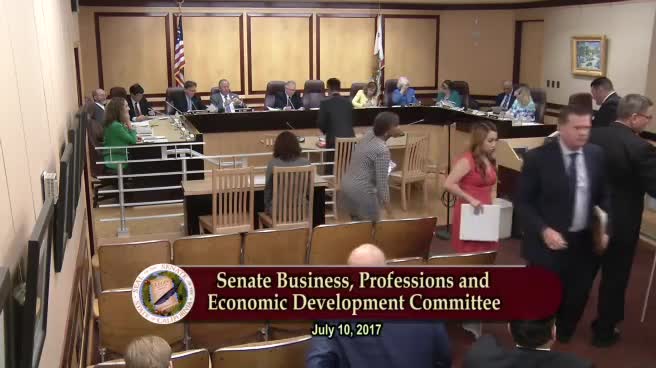 1MIN
Senate Standing Committee on Business, Professions and Economic Development
 40SEC
Assembly Floor
 1H
Assembly Standing Committee on Appropriations
Bill Author

Bill Co-Author(s):