AB 1709: Armories: sales: local agencies.
- Session Year: 2017-2018
- House: Assembly
- Latest Version Date: 2017-09-26
Existing law authorizes the Director of General Services, with the approval of the Adjutant General, to lease and sell real property held for armory purposes, subject to legislative approval. Existing law establishes the Armory Fund and requires that all proceeds from the sale or lease of armories be deposited into the fund, for use, upon appropriation by the Legislature, for specified purposes related to armories.
This bill would require that an armory be offered for sale to a local agency, as defined, prior to being offered for sale to private entities or individuals, as provided. The bill would also require the Department of General Services to maintain a list of armories authorized for sale in a conspicuous place on its Internet Web site and to provide local agencies and, upon request, members of the public, with electronic notification of updates to the list of properties.
Existing law authorizes the Director of General Services, with the approval of the Adjutant General, to lease and sell real property held for armory purposes, subject to legislative approval. Existing law establishes the Armory Fund and requires that all proceeds from the sale or lease of armories be deposited into the fund, for use, upon appropriation by the Legislature, for specified purposes related to armories.
This bill would require that an armory be offered for sale to a local agency, as defined, prior to being offered for sale to private entities or individuals, as provided. The bill would also require the Department of General Services to maintain a list of excess armories authorized for sale in a conspicuous place on its Internet Web site and to provide local agencies and, upon request, members of the public, with electronic notification of updates to the list of properties.
Existing law authorizes the Director of General Services, with the approval of the Adjutant General, to lease and sell real property held for armory purposes, subject to legislative approval. Existing law establishes the Armory Fund and requires that all proceeds from the sale or lease of armories be deposited into the fund, for use, upon appropriation by the Legislature, for specified purposes related to armories.
This bill would require that an armory be offered for sale to a local agency, as defined, prior to being offered for sale to private entities or individuals, as provided. The bill would also require the Department of General Services to maintain a list of excess armories in a conspicuous place on its Internet Web site and to provide local agencies and, upon request, members of the public, with electronic notification of updates to the list of properties.
(a)The Director of General Services, with the approval of the Adjutant General, may lease for not more than 99 years or sell for fair market value upon terms and conditions and subject to any reservations and exceptions as may be determined to be in the best interests of the state any real property held for armory purposes. Real property shall not be sold or leased pursuant to this subdivision unless the Legislature, by statute, approves the sale or lease of the property.
(b)(1)An armory shall be offered for sale to any local agency, as defined in subdivision (a) of Section 54221 of the Government Code, prior to being offered for sale to private entities or individuals.
(2)For purposes of paragraph (1), fair market value shall be determined by an appraisal undertaken and approved by the Director of General Services.
(3)The Department of General Services, subject to this subdivision, shall maintain a list of armories authorized for sale in a conspicuous place on its Internet Web site. The Department of General Services shall provide local agencies and, upon request, members of the public, with electronic notification of updates to the list of properties.
(4)To be considered as a potential priority buyer of the armory, a local agency shall notify the Department of General Services of its interest in the armory within 90 days of the Department of General Services posting on its Internet Web site the notice of the availability of the armory property. When more than one local agency expresses an interest in the armory, the Department of General Services shall transfer the armory to the local agency offering the highest amount of money above fair market value.
(5)If no local agency is interested, or an agreement, as provided above, is not reached, then the disposal of the armory to private entities or individuals shall be pursuant to a public bidding process designed to obtain the highest most certain return for the state from a responsible bidder, and any transaction based on that bidding process shall be deemed to be the fair market value.
(c)As to an armory sold pursuant to this section, the Director of General Services shall except and reserve to the state all mineral deposits, as described in Section 6407 of the Public Resources Code, together with the right to prospect for, mine, and remove the deposits. If, however, the Director of General Services determines that there is little or no potential for mineral deposits, the reservation may be without surface right of entry above a depth of 500 feet, or the rights to prospect for, mine, and remove the deposits shall be limited to those areas of the armory conveyed that the director determines to be reasonably necessary for the removal of the deposits.
(d)There is in the State Treasury the Armory Fund. All net proceeds from the sale or lease of an armory shall be deposited in the fund. The money in the fund is available, upon appropriation by the Legislature, for the maintenance of existing armories, and for the acquisition or construction of new or replacement armories, including, but not limited to, the cost of design. The disposition of armory properties is not subject to subdivision (g) of Section 11011 of the Government Code.
(e)For the purposes of this section, net proceeds are the gross proceeds less:
(1)Outstanding reimbursements due to the Property Acquisition Law Money Account for costs incurred by the Department of General Services in selling an armory property.
(2)All costs directly related to the disposition of an armory, including, but not limited to, all costs and expenses incurred by the Department of General Services, as specified in subdivision (f).
(f)Notwithstanding subdivision (d), the Department of General Services shall, upon appropriation by the Legislature, use funds from the Property Acquisition Law Money Account for the purposes of selling armory properties. The Director of Finance may approve loans from the General Fund to the Property Acquisition Law Money Account.
(g)The sale of an armory shall be made on an as is basis and is exempt from Chapter 3 (commencing with Section 21100) of Division 13 of the Public Resources Code. Upon vesting title of the armory to the purchaser or transferee of the armory, the purchaser or transferee shall be subject to any local governmental land use entitlement requirements and to Chapter 3 (commencing with Section 21100) of Division 13 of the Public Resources Code.
(a)The Director of General Services, with the approval of the Adjutant General, may lease for not more than 99 years or sell for fair market value upon terms and conditions and subject to any reservations and exceptions as may be determined to be in the best interests of the state any real property held for armory purposes. Real property shall not be sold or leased pursuant to this subdivision unless the Legislature, by statute, approves the sale or lease of the property.
(b)(1)An armory shall be offered for sale to any local agency, as defined in subdivision (a) of Section 54221 of the Government Code, prior to being offered for sale to private entities or individuals.
(2)For purposes of paragraph (1), fair market value shall be determined by an appraisal undertaken and approved by the Director of General Services.
(3)The Department of General Services, subject to this subdivision, shall maintain a list of excess armories armories authorized for sale in a conspicuous place on its Internet Web site. The Department of General Services shall provide local agencies and, upon request, members of the public, with electronic notification of updates to the list of properties.
(4)To be considered as a potential priority buyer of the armory, a local agency shall notify the Department of General Services of its interest in the armory within 90 days of the Department of General Services posting on its Internet Web site the notice of the availability of the armory property. When more than one local agency expresses an interest in the armory, the Department of General Services shall transfer the armory to the local agency offering the highest amount of money above fair market value.
(5)If no local agency is interested, or an agreement, as provided above, is not reached, then the disposal of the armory to private entities or individuals shall be pursuant to a public bidding process designed to obtain the highest most certain return for the state from a responsible bidder, and any transaction based on that bidding process shall be deemed to be the fair market value.
(c)As to an armory sold pursuant to this section, the Director of General Services shall except and reserve to the state all mineral deposits, as described in Section 6407 of the Public Resources Code, together with the right to prospect for, mine, and remove the deposits. If, however, the Director of General Services determines that there is little or no potential for mineral deposits, the reservation may be without surface right of entry above a depth of 500 feet, or the rights to prospect for, mine, and remove the deposits shall be limited to those areas of the armory conveyed that the director determines to be reasonably necessary for the removal of the deposits.
(d)There is in the State Treasury the Armory Fund. All net proceeds from the sale or lease of an armory shall be deposited in the fund. The money in the fund is available, upon appropriation by the Legislature, for the maintenance of existing armories, and for the acquisition or construction of new or replacement armories, including, but not limited to, the cost of design. The disposition of armory properties is not subject to subdivision (g) of Section 11011 of the Government Code.
(e)For the purposes of this section, net proceeds are the gross proceeds less:
(1)Outstanding reimbursements due to the Property Acquisition Law Money Account for costs incurred by the Department of General Services in selling an armory property.
(2)All costs directly related to the disposition of an armory, including, but not limited to, all costs and expenses incurred by the Department of General Services, as specified in subdivision (f).
(f)Notwithstanding subdivision (d), the Department of General Services shall, upon appropriation by the Legislature, use funds from the Property Acquisition Law Money Account for the purposes of selling armory properties. The Director of Finance may approve loans from the General Fund to the Property Acquisition Law Money Account.
(g)The sale of an armory shall be made on an as is basis and is exempt from Chapter 3 (commencing with Section 21100) of Division 13 of the Public Resources Code. Upon vesting title of the armory to the purchaser or transferee of the armory, the purchaser or transferee shall be subject to any local governmental land use entitlement requirements and to Chapter 3 (commencing with Section 21100) of Division 13 of the Public Resources Code.
(a)The Director of General Services, with the approval of the Adjutant General, may lease for not more than 99 years or sell for fair market value upon terms and conditions and subject to any reservations and exceptions as may be determined to be in the best interests of the state any real property held for armory purposes. Real property shall not be sold or leased pursuant to this subdivision unless the Legislature, by statute, approves the sale or lease of the property.
(b)(1)An armory shall be offered for sale to any local agency, as defined in subdivision (a) of Section 54221 of the Government Code, prior to being offered for sale to private entities or individuals.
(2)For purposes of paragraph (1), fair market value shall be determined by an appraisal undertaken and approved by the Director of General Services.
(3)The Department of General Services, subject to this subdivision, shall maintain a list of excess armories in a conspicuous place on its Internet Web site. The Department of General Services shall provide local agencies and, upon request, members of the public, with electronic notification of updates to the list of properties.
(4)To be considered as a potential priority buyer of the armory, a local agency shall notify the Department of General Services of its interest in the armory within 90 days of the Department of General Services posting on its Internet Web site the notice of the availability of the armory property. When more than one local agency expresses an interest in the armory, the Department of General Services shall transfer the armory to the local agency offering the highest amount of money above fair market value.
(5)If no local agency is interested, or an agreement, as provided above, is not reached, then the disposal of the armory to private entities or individuals shall be pursuant to a public bidding process designed to obtain the highest most certain return for the state from a responsible bidder, and any transaction based on that bidding process shall be deemed to be the fair market value.
(c)As to an armory sold pursuant to this section, the Director of General Services shall except and reserve to the state all mineral deposits, as described in Section 6407 of the Public Resources Code, together with the right to prospect for, mine, and remove the deposits. If, however, the Director of General Services determines that there is little or no potential for mineral deposits, the reservation may be without surface right of entry above a depth of 500 feet, or the rights to prospect for, mine, and remove the deposits shall be limited to those areas of the armory conveyed that the director determines to be reasonably necessary for the removal of the deposits.
(b)(d)There is in the State Treasury the Armory Fund. All net proceeds from the sale or lease of an armory shall be deposited in the fund. The money in the fund is available, upon appropriation by the Legislature, for the maintenance of existing armories, and for the acquisition or construction of new or replacement armories, including, but not limited to, the cost of design. The disposition of armory properties is not subject to subdivision (g) of Section 11011 of the Government Code.
(c)(e)For the purposes of this section, net proceeds are the gross proceeds less:
(1)Outstanding reimbursements due to the Property Acquisition Law Money Account for costs incurred by the Department of General Services in selling an armory property.
(2)All costs directly related to the disposition of an armory, including, but not limited to, all costs and expenses incurred by the Department of General Services, as specified in subdivision (d). (f).
(d)(f)Notwithstanding subdivision (b), (d), the Department of General Services shall, upon appropriation by the Legislature, use funds from the Property Acquisition Law Money Account for the purposes of selling armory properties. The Director of Finance may approve loans from the General Fund to the Property Acquisition Law Money Account.
(e)(g)The sale of an armory shall be made on an as is basis and is exempt from Division 13 Chapter 3 (commencing with Section 21100) of Division 13 of the Public Resources Code. Upon vesting title of the armory to the purchaser or transferee of the armory, the purchaser or transferee shall be subject to any local governmental land use entitlement requirements and to Division 13 Chapter 3 (commencing with Section 21100) of Division 13 of the Public Resources Code.
|
Date
|
Status
|
|---|---|
| Sep 26, 2017 | Chaptered by Secretary of State - Chapter 304, Statutes of 2017. |
| Sep 26, 2017 | Approved by the Governor. |
| Sep 13, 2017 | Enrolled and presented to the Governor at 4 p.m. |
| Sep 6, 2017 | In Assembly. Ordered to Engrossing and Enrolling. |
| Sep 6, 2017 | Read third time. Passed. Ordered to the Assembly. |
| Aug 22, 2017 | Read second time. Ordered to third reading. |
| Aug 21, 2017 | From committee: Be ordered to second reading pursuant to Senate Rule 28.8. |
| Jul 12, 2017 | From committee: Do pass and re-refer to Com. on APPR. (Ayes 6. Noes 0.) (July 11). Re-referred to Com. on APPR. |
| Jun 27, 2017 | From committee: Do pass and re-refer to Com. on V.A. with recommendation: To Consent Calendar. (Ayes 13. Noes 0.) (June 27). Re-referred to Com. on V.A. |
| Jun 8, 2017 | Referred to Coms. on G.O. and V.A. |
| May 30, 2017 | In Senate. Read first time. To Com. on RLS. for assignment. |
| May 30, 2017 | Read third time. Passed. Ordered to the Senate. (Ayes 77. Noes 0. Page 1859.) |
| May 25, 2017 | Read second time. Ordered to Consent Calendar. |
| May 24, 2017 | From committee: Do pass. To Consent Calendar. (Ayes 17. Noes 0.) (May 24). |
| May 9, 2017 | Re-referred to Com. on APPR. |
| May 8, 2017 | From committee chair, with author's amendments: Amend, and re-refer to Com. on APPR. Read second time and amended. |
| Apr 26, 2017 | From committee: Do pass and re-refer to Com. on APPR. (Ayes 9. Noes 0.) (April 25). Re-referred to Com. on APPR. |
| Mar 16, 2017 | Referred to Coms. on V.A. and A. & A.R. |
| Mar 7, 2017 | From printer. May be heard in committee April 6. |
| Mar 6, 2017 | Read first time. To print. |
|
Date
|
Description
|
Location
|
Votes
|
|
|---|---|---|---|---|
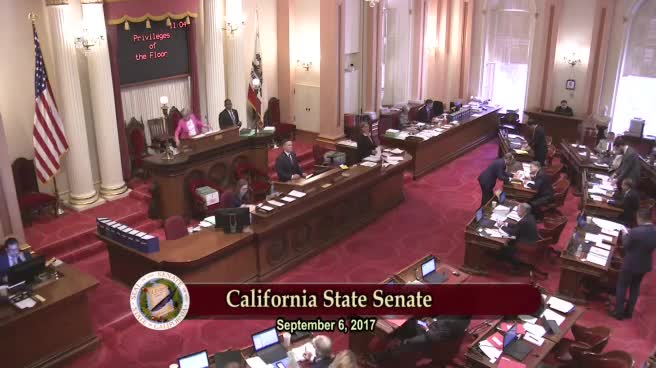
| Sep 6, 2017 | Assembly 3rd Reading AB1709 V.A. (Irwin) By Newman | Senate Floor |
Passed |
|
| Jul 11, 2017 | Do pass as amended, but first amend, and re-refer to the Committee on [Appropriations] with the recommendation: To Consent Calendar | Senate Standing Committee on Veterans Affairs |
Passed |
|
| Jul 11, 2017 | Do pass, but first be re-referred to the Committee on [Appropriations] | Senate Standing Committee on Veterans Affairs |
Passed |
|
| Jun 27, 2017 | Do pass, but first be re-referred to the Committee on [Veterans Affairs] with the recommendation: To Consent Calendar | Senate Standing Committee on Governmental Organization |
Passed |
|
| May 30, 2017 | AB 1709 V. A. Consent Calendar Second Day Regular Session | Assembly Floor |
Passed |
|
| May 24, 2017 | Do pass. To Consent Calendar. | Assembly Standing Committee on Appropriations |
Passed |
|
| Apr 25, 2017 | Do pass and be re-referred to the Committee on [Appropriations] | Assembly Standing Committee on Veterans Affairs |
Passed |
This list shows positions taken on this bill by organizations on the date displayed, which is linked to the original source.
Positions by individuals are not included.
|
Organization
|
Position
|
Date
|
|---|---|---|
| City of Santa Monica | ** Support | Apr 24, 2017 |
| National Guard Association Of California | ** Support | Aug 22, 2017 |
Office of Senate Floor Analyses (916) 651-1520 Fax: (916) 327-4478 | AB |
THIRD READING
Bill No: AB 1709
:
SENATE GOVERNMENTAL ORG. COMMITTEE: 13-0, 6/27/17
AYES: Dodd, Berryhill, Bradford, Cannella, Gaines, Galgiani, Glazer, Hill, Hueso, Lara, Mendoza, Portantino, Vidak
SENATE VETERANS AFFAIRS COMMITTEE: 6-0, 7/11/17
AYES: Newman, Dodd, Hueso, Nguyen, Roth, Wilk
NO VOTE RECORDED: Nielsen
SENATE APPROPRIATIONS COMMITTEE: Senate Rule 28.8
ASSEMBLY FLOOR: 77-0, 5/30/17 (Consent) - See last page for vote
DIGEST: This bill amends the current armory sale process to require that an armory be offered for sale to a local agency, as defined, prior to being offered for sale to private entities or individuals.
ANALYSIS:
Existing law:
- Authorizes, the Director of the Department of General Services (DGS), with the approval of the Adjutant General, to lease and sell real property, for fair market value, held for armory purposes, subject to legislative approval.
- Establishes the Armory Fund and requires that all net proceeds from the sale or lease of an armory to be deposited in the Fund. The money in the Fund is available, upon appropriation by the Legislature, for the maintenance of existing armories, and for the acquisition or construction of new or replacement armories.
- Authorizes DGS, subject to legislative approval, to sell, lease, exchange, or transfer various specified properties for current market value, or upon such other terms and conditions that DGS determines what is in the best interest of the state.
- Authorizes DGS to sell surplus real property to a local agency or to a nonprofit affordable housing sponsor for affordable housing projects at a sales price less than fair market value if DGS determines that such a discount will enable housing for persons and families of low or moderate income. It should be noted that armory sales do not fall under the purview of this provision as they are by legal definition not “surplus.”
This bill:
- Requires that an armory shall be offered for sale to any local agency prior to being offered for sale to private entities or individuals.
- Defines “local agency” to mean every city, whether organized under general law or by charter, county, city and county, and district, including school districts of any kind or class, empowered to acquire and hold real property.
- Requires that fair market value shall be determined by an appraisal undertaken and approved by the Director of DGS.
- Requires that DGS maintain a list of armories authorized for sale in a conspicuous place on its Internet Web site and provide local agencies and, upon request, members of the public, with electronic notification of updates to the list of properties.
- Specifies that to be considered as a potential priority buyer of the armory, a local agency shall notify DGS of its interest in the armory within 90 days of DGS posting on its Internet Web site the notice of the availability of the armory property.
- Provides that when more than one local agency expresses an interest in the armory, DGS shall transfer the armory to the local agency offering the highest amount of money above fair market value.
- Provides that if no local agency is interested, or an agreement is not reached, then the disposal of the armory to private entities or individuals shall be pursuant to a public bidding process designed to obtain the highest most certain return to the state from a responsible bidder, and any transaction based on that bidding process shall be deemed to be the fair market value.
- Provides that the Director of DGS shall except and reserve to the state all mineral deposits, as specified, together with the right to prospect for, mine, and remove the deposits.
Comments
Purpose of the bill. According to the author’s office, “amending the standard process to give interested local agencies priority buyer status will establish a shorter, uniform process for selling armories and will eliminate the need for special legislation on this issue. This proposal does not modify the existing requirements that armories be sold at fair market value and the net proceeds be deposited into the Armory Fund for the maintenance of existing armories, and for the acquisition or construction of new or replacement armories, including, but not limited to, the cost of design.”
Changes to current process. Under existing law, armories must be specifically authorized for sale by legislation. Armories are required to be sold at fair market value and the net proceeds must be deposited into the Armory Fund. This fund is used for the maintenance of existing armories and for the acquisition or construction of new or replacement armories, including, but not limited to, the cost of design. Expenditure of funds from the Armory Fund requires appropriation through the budget process, retaining legislative oversight.
However, many times these bills authorizing the sale of armories provide a specific local entity with the first right of refusal, also known as priority buyer status. This can become problematic as various local entities might be interested in the armory and the current process is unclear as to how to deal with those situations. This bill provides such a process.
Under the provisions of this bill, DGS will be required to give the first right of refusal on the sale of armories to local entities, similar to the current law relating to state surplus property. By requiring DGS to maintain a list of armories on their Internet Web site, the hope is that local entities will have the opportunity to express interest in the property. This bill also sets forth a process in those situations where more than one local agency might be interested in the property by specifying that DGS will transfer the armory to the local agency offering the highest amount of money above fair market value.
The author’s office argues that, “amending the standard process to give interested local agencies priority buyer status will establish a shorter, uniform process for selling armories and will eliminate the need for special legislation on this issue.”
Related/Prior Legislation
SB 814 (Governmental Organization, 2017) authorizes DGS to dispose of a specified parcel of state property, consisting of approximately 65 acres, known as a a portion of the Department of Corrections and Rehabilitation’s Preston Youth Correctional Facility in Amador County. (Pending on the Assembly Floor)
AB 1057 (Weber, Chapter 147, Statutes of 2017) requires the Director of DGS, with the approval of the Adjutant General, to offer an option to purchase a portion of the California Military Department’s San Diego Armory, as specified, to the San Diego Center for Children, a nonprofit organization.
AB 2247 (Williams, Chapter 382, Statutes of 2016) required the Director of DGS, with the approval of the Adjutant General of the California Military Department (CMD), to grant specified cities and school districts an option to purchase the Santa Barbara Armory, Brawley Armory, Indio Armory, Lynwood Armory, and Ponoma Armory, as defined.
SB 273 (Hueso, Chapter 233, Statutes of 2015) authorized DGS to dispose of two surplus state properties, a Department of Conservation field office in Fresno County and a Department of Forestry conservation camp in Shasta County.
SB 536 (Roth, Chapter 355, Statutes of 2015) authorized DGS, with the approval of the Adjutant General, to sell seven specified state armory properties that are no longer considered needed by the CMD.
AB 2174 (Committee on Accountability and Administrative Review, Chapter 337, Statutes of 2014) authorized DGS to dispose of certain state surplus property, subject to specified conditions.
FISCAL EFFECT: Appropriation: Fiscal Com.: Local:
National Guard Association of California
OPPOSITION: (Verified 8/21/17)
None received
ARGUMENTS IN SUPPORT: According to the National Guard Association of California, “amending the standard process to give interested local agencies priority buyer status will establish a shorter, uniform process for selling armories and will eliminate the need for special legislation for this issue.”
ASSEMBLY FLOOR: 77-0, 5/30/17
AYES: Acosta, Aguiar-Curry, Travis Allen, Arambula, Baker, Berman, Bigelow, Bloom, Bocanegra, Bonta, Brough, Burke, Caballero, Calderon, Cervantes, Chávez, Chen, Chiu, Chu, Cooley, Cooper, Cunningham, Dababneh, Dahle, Daly, Flora, Fong, Frazier, Friedman, Gallagher, Cristina Garcia, Eduardo Garcia, Gipson, Gloria, Gomez, Gonzalez Fletcher, Gray, Grayson, Harper, Holden, Irwin, Jones-Sawyer, Kalra, Kiley, Lackey, Levine, Limón, Low, Maienschein, Mathis, Mayes, McCarty, Medina, Melendez, Mullin, Muratsuchi, Nazarian, Obernolte, O'Donnell, Patterson, Quirk, Quirk-Silva, Reyes, Ridley-Thomas, Rodriguez, Rubio, Salas, Santiago, Steinorth, Mark Stone, Thurmond, Ting, Voepel, Waldron, Weber, Wood, Rendon
NO VOTE RECORDED: Chau, Choi, Eggman
8/22/17 16:31:55
**** END ****
SENATE COMMITTEE ON
Senator Josh Newman, Chair
2017 - 2018 Regular
Bill No: Hearing Date: 7/11/17
Author: | Committee on Veterans Affairs | ||
Version: | Amended | ||
Urgency: | Fiscal: | ||
Consultant: | |||
Subject:
DESCRIPTION
Summary:
This bill requires that a state armory authorized for sale be offered for sale to a local agency, as defined, prior to being offered for sale to private entities or individuals.
Existing law:
- Authorizes the Director of the Department of General Services (DGS), with the approval of The Adjutant General (TAG), to lease and sell state armories, subject to legislative approval.
- Establishes the Property Acquisition Law Money Account (PAL Account) to provide funding for the maintenance, improvement, and care of property acquired under the Property Acquisition Act, while under the control of DGS.
- Establishes the Armory Fund and requires that all proceeds from the sale or lease of armories be deposited into the fund, for use, upon appropriation by the Legislature, for specified purposes related to armories.
- Requires that the sale of an armory be made on an “as is” basis.
- Requires the purchaser or transferee, upon vesting title of the armory, to be subject to any local land use entitlement requirements, as specified.
- Authorizes DGS, subject to Legislative approval, to sell, lease, exchange, or transfer various specified properties for current market value, or upon such other terms and conditions that DGS determines what is in the best interest of the state.
- Authorizes DGS to sell surplus real property to a local agency or to a nonprofit affordable housing sponsor for affordable housing projects at a sales price less than fair market value if DGS determines that such a discount will enable housing for persons and families of low or moderate income.
This bill:
- Requires that an armory to be offered for sale to any local agency prior to being offered for sale to private entities or individuals.
- Defines “local agency” to mean every city, whether organized under general law or by charter, county, city and county, and district, including school districts of any kind or class, empowered to acquire and hold real property.
- Requires that fair market value be determined by an appraisal undertaken and approved by the DGS Director.
- Requires that DGS maintain a list of armories authorized for sale in a conspicuous place on its Internet Web site and provide local agencies and, upon request, members of the public, with electronic notification of updates to the list of properties.
- Specifies that to be considered as a potential priority buyer of the armory, a local agency shall notify DGS of its interest in the armory within 90 days of DGS posting on its Internet Web site the notice of the availability of the armory property.
- Provides that when more than one local agency expresses an interest in the armory, DGS shall transfer the armory to the local agency offering the highest amount of money above fair market value.
- Provides that if no local agency is interested, or an agreement is not reached, then the disposal of the armory to private entities or individuals shall be pursuant to a public bidding process designed to obtain the highest most certain return to the state from a responsible bidder, and any transaction based on that bidding process shall be deemed to represent the fair market value.
- Provides that the Director of DGS shall except and reserve to the state all mineral deposits, as specified, together with the right to prospect for, mine, and remove the deposits.
BACKGROUND
The California Military Department (CMD) comprises several organizations, the largest being the approximately 22,000-member California National Guard (CNG), which includes official components of the U.S. Army and U.S. Air Force. The TAG is “dual-hatted” and has separate, parallel authorities and responsibilities from the federal and state governments; therefore, the TAG serves both as commander of the federally trained and paid CNG and also as “state director” of the CMD.
Armories. The CMD operates approximately 99 active armory sites throughout the state. Armories (or “readiness centers”) are the primary sites for unit training and are integral to the readiness and responsiveness of CNG personnel for both federal and state missions and non-CNG personnel for state purposes.
Armories are routinely used to mobilize and house troops when the CNG responds to wildfires, while also serving as emergency operations centers for other first-responder agencies. Armories also are used to shelter displaced civilians, who have been evacuated from their homes due to fires, floods or other state emergencies. Several armories throughout the state serve as homeless shelters in the winter months.
Under the traditional model, the federal government (through U.S. National Guard Bureau) pays for 75 percent of an armory’s construction costs; the state pays the remaining 25 percent and contributes the land. After construction, the state manages the armory and pays for all operational and maintenance repair costs. After 25 years, the federal government fully transfers all ownership rights to the state.
In relatively rare cases, where an armory is located on federal owned land, title to the armory building may be shared between the federal and state governments or even be held solely by the federal government. In such cases, the state has no unilateral authority to sell the armory.
Sale of Unused Armories. Military and Veterans Code (MVC) §435(a) allows for the sale of any real property used for armory purposes, when such a sale is "determined to be in the best interest of the state." Because California’s armories are critical to the mission success of CNG troops, the state created the Armory Fund to assist in “recycling” the value of sold armories. MVC §435(b) provides that all net proceeds from the sale, lease, or exchange of armories are to be deposited into the Armory Fund. These deposits are available, upon appropriation by the Legislature, for the acquisition and construction of replacement armories and renovation of operational armories.
Every state agency is required to review annually all proprietary state lands under its jurisdiction to determine if any are in excess of the agency’s foreseeable needs, and to report such properties to DGS. The state employs DGS as its real estate agent, authorizing DGS to sell, lease or exchange surplus properties in the best interests of the state.
In general, when selling surplus state property, DGS uses the Property Acquisition Law (PAL) account to pay the upfront costs (appraisals, advertising, title searches, etc.) required to sell the property. Once a property is sold, the PAL Account is reimbursed from the proceeds.
Existing law treats the CMD differently from other state agencies, granting it separate authority to manage, sell and lease its property. Legally and functionally, an unused armory is not a surplus property and should not be considered surplus. The facility has been deemed not surplus, but unusable, perhaps even unsafe, and, therefore, inadequate to meet its purpose.
Nevertheless, the CMD employs DGS as its real estate agent, which sells the unused armories using the same general process used to sell surplus state properties.
COMMENT
Committee Comments:
In recent years local jurisdictions have expressed increasing interest in purchasing armories not used by the state. Amending the standard process to give interested local agencies “priority buyer” status will establish a shorter, uniform process for selling armories and will eliminate the need for special legislation for this issue.
Prior/Related Legislation:
AB 2247 (Williams, Chapter 382, Statutes of 2016) requires DGS to grant the City of Santa Barbara or the Santa Barbara Unified School District an option to purchase the Santa Barbara Armory, as specified.
SB 536 (Roth, Chapter 355, Statutes of 2015) clarifies that DGS is authorized to draw on funds in the PAL Account in order to pay for ongoing costs associated with the marketing and sales of unused National CNG armories. Also, authorizes the sale of seven specific armories.
SB 1580 (Committee on Governmental Organization, Ch. 798, Stats. 2012), with regard to the sale of armories, requires the proceeds from the sale be deposited in the Armory Fund.
SB 1481 (Committee on Governmental Organization, Ch. 528, Stats. 2010) stipulates that proceeds from the sale or lease of state armories be deposited in the Armory Fund, regardless of existing Government Code provisions that require such proceeds be applied to pay the principal and interest on the Economic Recovery Bond Act (Proposition 57, approved in March 2004).
AB 600 (Hall, vetoed, 2009) would have authorized DGS, with the approval of the TAG, to complete a lease to the City of Compton at fair market value of specified state-owned property known as the Compton Armory for an initial term of five years, and authorizes renewal of the lease or other lease agreements of the Compton Armory for a total term not to exceed 25 additional years.
POSITIONS
Sponsor: Author
Support: National Guard Association of California
Oppose: None received
-- END --
SENATE COMMITTEE ON GOVERNMENTAL ORGANIZATION
Senator Bill Dodd
Chair
2017 - 2018 Regular
Bill No: AB Hearing Date: 6/27/2017
Author: | Committee on Veterans Affairs | ||
Version: | Amended | ||
Urgency: | Fiscal: | ||
Consultant: | |||
SUBJECT:
DIGEST: This bill amends the current armory sale process to require that an armory be offered for sale to a local agency, as defined, prior to being offered for sale to private entities or individuals.
ANALYSIS:
Existing law:
- Authorizes, the Director of the Department of General Services (DGS), with the approval of the Adjutant General, to lease and sell real property, for fair market value, held for armory purposes, subject to Legislative approval.
- Establishes the Armory Fund and requires that all net proceeds from the sale or lease of an armory to be deposited in the fund. The money in the fund is available, upon appropriation by the Legislature, for the maintenance of existing armories, and for the acquisition or construction of new or replacement armories.
- Specifies that the sale of an armory shall be made on an “as is” basis.
- Requires the purchaser or transferee, upon vesting title of the armory, to be subject to any local land use entitlement requirements, as specified.
- Authorizes DGS, subject to Legislative approval, to sell, lease, exchange, or transfer various specified properties for current market value, or upon such other terms and conditions that DGS determines what is in the best interest of the state.
- Authorizes DGS to sell surplus real property to a local agency or to a nonprofit affordable housing sponsor for affordable housing projects at a sales price less than fair market value if DGS determines that such a discount will enable housing for persons and families of low or moderate income. It should be noted that Armory sales do not fall under the purview of this provision as they are by legal definition not “surplus.”
This bill:
- Requires that an armory shall be offered for sale to any local agency prior to being offered for sale to private entities or individuals.
- Defines “local agency” to mean every city, whether organized under general law or by charter, county, city and county, and district, including school districts of any kind or class, empowered to acquire and hold real property.
- Requires that fair market value shall be determined by an appraisal undertaken and approved by the Director of DGS.
- Requires that DGS maintain a list of armories authorized for sale in a conspicuous place on its Internet Web site and provide local agencies and, upon request, members of the public, with electronic notification of updates to the list of properties.
- Specifies that to be considered as a potential priority buyer of the armory, a local agency shall notify DGS of its interest in the armory within 90 days of DGS posting on its Internet Web site the notice of the availability of the armory property.
- Provides that when more than one local agency expresses an interest in the armory, DGS shall transfer the armory to the local agency offering the highest amount of money above fair market value.
- Provides that if no local agency is interested, or an agreement is not reached, then the disposal of the armory to private entities or individuals shall be pursuant to a public bidding process designed to obtain the highest most certain return to the state from a responsible bidder, and any transaction based on that bidding process shall be deemed to be the fair market value.
- Provides that the Director of DGS shall except and reserve to the state all mineral deposits, as specified, together with the right to prospect for, mine, and remove the deposits.
Background
Purpose of the bill. According to the author’s office, “amending the standard process to give interested local agencies priority buyer status will establish a shorter, uniform process for selling armories and will eliminate the need for special legislation on this issue. This proposal does not modify the existing requirements that armories be sold at fair market value and the net proceeds be deposited into the Armory Fund for the maintenance of existing armories, and for the acquisition or construction of new or replacement armories, including, but not limited to, the cost of design.”
Changes to current process. Under existing law, armories must be specifically authorized for sale by legislation. Armories are required to be sold at fair market value and the net proceeds must be deposited into the Armory Fund. This fund is used for the maintenance of existing armories and for the acquisition or construction of new or replacement armories, including, but not limited to, the cost of design. Expenditure of funds from the Armory Fund requires appropriation through the budget process, retaining legislative oversight.
However, many times these bills authorizing the sale of armories provide a specific local entity with the first right of refusal, also known as priority buyer status. This can become problematic as various local entities might be interested in the armory and the current process is unclear as to how to deal with those situations. This bill provides such a process.
Under the provisions of this bill, DGS would be required to give the first right of refusal on the sale of armories to local entities, similar to the current law relating to state surplus property. By requiring DGS to maintain a list of armories on their Internet Web site, the hope is that local entities will have the opportunity to express interest in the property. The bill also sets forth a process in those situations where more than one local agency might be interested in the property by specifying that DGS will transfer the armory to the local agency offering the highest amount of money above fair market value.
The author’s office argues that, “amending the standard process to give interested local agencies priority buyer status will establish a shorter, uniform process for selling armories and will eliminate the need for special legislation on this issue.”
California’s armories. According to the California Military Department (CMD), California has approximately 100 active armory sites throughout the state. Armories are the primary place for unit training and are integral to the readiness and responsiveness of National Guard personnel.
The use of armories for emergency operations is common. Armories are routinely used to mobilize and house soldiers when the National Guard responds to wildfires, while also serving as emergency operations centers for other first-responder agencies. Armories are also commonly used as shelters for displaced civilians who have been evacuated from their homes due to fires, floods, or other state emergencies. Several armories throughout the state routinely serve as homeless shelters during the winter months.
Under the traditional model, the Federal Government (through the U.S. National Guard Bureau) pays for 75% of an armory’s construction costs and the state pays the remaining 25% and contributes the land. After construction, the state manages the armory and pays for all operational and maintenance repairs. After 25 years, the Federal Government fully transfers all ownership rights to the state.
Prior/Related Legislation
SB 814 (Governmental Organization, 2017) would authorize DGS to dispose of a specified parcel of state property, consisting of approximately 65 acres, known as a a portion of the Department of Corrections and Rehabilitation’s Preston Youth Correctional Facility in Amador County. (Pending in Assembly Committee on Accountability and Administrative Review)
SB 1057 (Weber, 2017) would require the Director of DGS, with the approval of the Adjutant General, to offer an option to purchase a portion of the California Military Department’s San Diego Armory, as specified, to the San Diego Center for Children, a nonprofit organization. (Pending in Senate Veterans Affairs Committee)
AB 2247 (Williams, Chapter 382, Statutes of 2016) required the Director of DGS, with the approval of the Adjutant General of the CMD, to grant specified cities and school districts an option to purchase the Santa Barbara Armory, Brawley Armory, Indio Armory, Lynwood Armory, and Ponoma Armory, as defined.
SB 273 (Hueso, Chapter 233, Statutes of 2015) authorized DGS to dispose of two surplus state properties, a Department of Conservation field office in Fresno County and a Department of Forestry conservation camp in Shasta County.
SB 536 (Roth, Chapter 355, Statutes of 2015) authorized DGS, with the approval of the Adjutant General, to sell seven specified state armory properties that are no longer considered needed by the California Military Department.
AB 2174 (Committee on Accountability and Administrative Review, Chapter 337, Statutes of 2014) authorized DGS to dispose of certain state surplus property, subject to specified conditions.
SB 1167 (Cogdill, Chapter 324, Statutes of 2010) authorized DGS to dispose of all or any portion of two specified properties.
SB 1481 (Governmental Organization, Chapter 528, Statutes of 2010) required that the proceeds from the sale of armories must be deposited in the Armory Fund and are not required to be used to retire bond debt resulting from the 2004 Economic Recovery Bond Act.
SB 136 (Huff, Chapter 166, Statutes of 2009) authorized DGS to dispose of all or any portion of three parcels of real property.
AB 600 (Hall, 2009) would have authorized DGS to lease the Compton Armory to the City of Compton at fair market value for a period not to exceed five years, with an option to extend the lease to 25 years. (Vetoed by Governor Schwarzenegger)
SB 901 (Governmental Organization, Chapter 610, Statues of 2001) added various parcels, including approximately five acres of the San Diego Armory, to the list of surplus properties included for sale, exchange, or lease by the Director of DGS, as specified.
FISCAL EFFECT: Appropriation: No Fiscal Com.: Yes Local: No
SUPPORT:
National Guard Association of California
OPPOSITION:
None received
ARGUMENTS IN OPPOSITION: According to the National Guard Association of California, “amending the standard process to give interested local agencies priority buyer status will establish a shorter, uniform process for selling armories and will eliminate the need for special legislation for this issue.”
DUAL REFERRAL: Veterans Affairs Committee
Date of Hearing: May 24, 2017
ASSEMBLY COMMITTEE ON APPROPRIATIONS
Lorena Gonzalez Fletcher, Chair
ABPCA Bill Id:AB 1709
Author:(Committee on Veterans Affairs) – As Amended Ver:May 8, 2017
Policy Committee: | Veterans Affairs | Vote: | 9 - 0 |
|
| ||
|
|
Urgency: No State Mandated Local Program: No Reimbursable: No
SUMMARY:
This bill revises the armory sale process to provide priority buyer status to local agencies. Specifically, this bill:
- Requires the Department of General Services (DGS) to give a first right of refusal on state armories to any local agency (including cities, counties, districts, and school districts) before DGS may offer armories for sale to private entities or individuals.
- Requires that fair market value be determined by an appraisal undertaken and approved by the Director of DGS.
- Requires DGS to maintain a list of armories authorized for sale in a conspicuous place on its Internet Web site and provide electronic updates to the list, as specified.
- As a precondition for priority buyer status, requires a local agency to notify DGS of its interest in an armory within 90 days of the DGS posting on its Internet Web site the notice of the availability of the armory property.
- Requires DGS, when more than one local agency expresses an interest in the armory, to transfer the armory to the local agency offering the highest amount above fair market value.
- Requires that if no local agency is interested, or an agreement is not reached, then the disposal of the armory to private entities or individuals must use a public bidding process designed to obtain the highest most certain return for the state from a responsible bidder.
FISCAL EFFECT:
- Negligible fiscal impact to DGS. Any costs are covered by the armory sale proceeds.
- Fiscally neutral for the California Military Department because the bill continues the requirement that armories be sold at fair market value.
COMMENTS:
- Purpose. This bill seeks to standardize the process for state armory sales in order to give interested local agencies notice and an opportunity to seek priority buyer status. The bill is intended to establish a shorter, uniform, and more transparent sales process.
- Background. Under existing law, armories must be specifically authorized for sale by the Legislature. Historically, legislation is run as the occasion arises and is not uniform. In several recent armory sales, the authorization bills provided specific local governmental entities with first rights of refusal. However, the conditions were inconsistent and the process for the decisions was unclear.
Local agencies are understandably interested in the use and disposition of armory properties in their jurisdictions. Local agencies may have owned the property in the past, leased the property or facilities from the Military Department, and/or already own property nearby. In some cases, during the Cold War era, local agencies/municipalities donated or sold armory property to the state for a nominal amount, and the armories were developed for civil defense purposes. The armories, while belonging to the State, are part of the fabric of the communities in which they are located.
This bill brings consistency and transparency to the armory sale process for local agency priority buyers. It retains the requirements that property be sold at fair market value, that the funds be deposited into the existing Armory Fund to be used for existing or future armories upon appropriation through the budget process.
- Related Legislation:
AB 1057 (Weber) requires the Director of DGS, with the approval of the Adjutant General, to provide the option to the San Diego Center for Children (SDCC), a nonprofit organization, to purchase a portion of the Military Department’s San Diego Armory. This bill is in the Senate awaiting assignment.
Analysis Prepared by: Jennifer Swenson / APPR. / (916) 319-2081
Date of Hearing: April 25, 2017
ASSEMBLY COMMITTEE ON VETERANS AFFAIRS
Jacqui Irwin, Chair
ABPCA Bill Id:AB 1709 (
Author:Committee on Veterans Affairs) – As Introduced Ver:March 6, 2017
SUBJECT: Armories: sales: local agency
SUMMARY: Amends the current armory sale process to provide priority buyer status to local agencies, as specified and sets conditions on the existing authority for the department to sell armories for fair market value once authorized for sale by the Legislature. Specifically, this bill:
- Requires the department to give a first right of refusal on such armories to any local agency, as defined in subdivision (a) of Section 54221 of the Government Code, before the department may offer armories for sale to private entities or individuals.
- Requires that fair market value shall be determined by an appraisal undertaken and approved by the Director of General Services.
- Mandates the Department of General Services, to maintain a list of armories authorized for sale in a conspicuous place on its Internet Web site and provide electronic updates to the list, as specified.
- As a precondition for priority buyer status, requires a local agency to notify the Department of General Services of its interest in an armory within 90 days of the Department of General Services posting on its Internet Web site the notice of the availability of the armory property.
- Mandates that when more than one local agency expresses an interest in the armory, the Department of General Services shall transfer the armory to the local agency offering the highest amount of money above fair market value.
- Clarifies that if no local agency is interested, or an agreement, as provided above, is not reached, then the disposal of the armory to private entities or individuals shall be pursuant to a public bidding process designed to obtain the highest most certain return for the state from a responsible bidder, and any transaction based on that bidding process shall be deemed to be the fair market value.
- Mandates that the Director of General Services shall except and reserve to the state all mineral deposits, as described in Section 6407 of the Public Resources Code, together with the right to prospect for, mine, and remove the deposits. If, however, the Director of General Services determines that there is little or no potential for mineral deposits, the reservation may be without surface right of entry above a depth of 500 feet, or the rights to prospect for, mine, and remove the deposits shall be limited to those areas of the armory conveyed that the director determines to be reasonably necessary for the removal of the deposits.
EXISTING LAW:
- Authorizes the Director of General Services, with the approval of the Adjutant General, to lease and sell real property, for fair market value, held for armory purposes, subject to legislative approval.
- Establishes the Armory Fund and requires that all proceeds from the sale or lease of armories be deposited into the fund, for use, upon appropriation by the Legislature, for specified purposes related to armories.
FISCAL EFFECT: Unknown at this time.
COMMENTS:
Under existing provisions of law, in order to be sold, armories must be specifically authorized for sale by the Legislature. In several recent armory sales, the authorization bills provided specific local governmental entities with first rights of refusal, sometimes known as priority buyer status. However, the entities which received priority buyer status were inconsistent and the process for the decisions was unclear.
Creating a standard process to give interested local agencies notice and an opportunity to seek priority buyer status will establish a shorter, uniform, and more transparent process for selling armories.
Local agencies are understandably interested in the use and disposition of armory properties in their jurisdictions. Local agencies may have owned the property in the past, leased the property or facilities from the Military Department, and/or already own property nearby. In some cases, during the Cold War era, local agencies/municipalities donated or sold armory property to the state for a nominal amount, and the armories were developed for civil defense purposes. The armories, while belonging to the State, are part of the fabric of the communities in which they are located.
This bill promotes fairness, uniformity and transparency as follows:
- By referencing section 54221 of the Government Code, the bill ensures that the department will give notice to those local agencies which the Legislature has deemed essential so the community will have an opportunity to express interest in the opportunity to purchase the armory.
- It sets a fixed deadline after which expressions of interest are no longer timely, giving the department the ability to obtain closure, move a bill through the Legislature or otherwise, and to proceed.
- The bill sets uniform rules for local agency “tie-breaking” and for private sales to the highest bidder
This proposal does not modify the existing requirements that:
- Armories must be sold for fair market value and the net proceeds be deposited into the Armory Fund
- Armory Funds must be used for the maintenance of existing armories, and for the acquisition or construction of new or replacement armories, including, but not limited to, the cost of design.
- Expenditure of Armory Funds requires appropriation through the budget process, retaining Legislative oversight.
REGISTERED SUPPORT / OPPOSITION:
Support
City of Santa Monica
National Guard Association of California
Opposition
None on File.
Analysis Prepared by: John Spangler / V.A. / (916) 319-3550
Bill Author
Bill Co-Author(s):