AB 1725: Local agency formation.
- Session Year: 2017-2018
- House: Assembly
- Latest Version Date: 2017-09-28
(1)The Cortese-Knox-Hertzberg Local Government Reorganization Act of 2000 provides the exclusive authority and procedure for the initiation, conduct, and completion of changes of organization and reorganization for cities and districts, as specified. The act defines various terms for these purposes, including the term contiguous, which the act defines as territory adjacent to territory within the local agency.
This bill would instead define contiguous as territory that abuts or shares a common boundary with territory within a local agency.
(2)The act, upon filing of an application for, or initiation by a local agency formation commission of, specified changes in organization or reorganization of a local health care district formed pursuant to specified law, including formation, annexation, consolidation, or dissolution, requires the local agency formation commission to notify all state agencies that have oversight or regulatory responsibility over, or a contractual relationship with, that local health care district of its receipt of the application or the initiation by the local agency formation commission of the proposed change of organization or reorganization and the proposal.
This bill would additionally require the local agency formation commission to notify these state agencies of the receipt of an application for, or the initiation by the local agency formation commission of, a proposed change of organization or reorganization that includes a detachment from a local health care district.
By requiring a local agency formation commission to provide specified notification to certain state agencies about detachments from a local health care district, this bill would impose a state-mandated local program.
(3)The act authorizes a local agency formation commission to establish a schedule of fees and a schedule of service charges for proceedings taken pursuant to the act, as specified.
This bill would revise that provision to authorize a local agency formation commission to establish a schedule of fees and a schedule of service charges pursuant to the act.
(4)The act requires a petitioner or a legislative body desiring to initiate proceedings to submit an application to the executive officer of the principal county. Immediately after receiving an application and before issuing a certificate of filing, the act requires the executive officer to give mailed notice that the application has been received to specified entities, including each affected agency.
This bill would instead require that the mailed notice be given to, among other entities, each affected local agency.
(5)The California Constitution requires the state to reimburse local agencies and school districts for certain costs mandated by the state. Statutory provisions establish procedures for making that reimbursement.
This bill would provide that no reimbursement is required by this act for a specified reason.
(1)The Cortese-Knox-Hertzberg Local Government Reorganization Act of 2000 provides the exclusive authority and procedure for the initiation, conduct, and completion of changes of organization and reorganization for cities and districts, as specified. The act defines various terms for these purposes, including the term contiguous, which the act defines as territory adjacent to territory within the local agency.
This bill would instead define contiguous as territory that abuts or shares a common boundary with territory within a local agency.
(2)The act, upon filing of an application for, or initiation by a local agency formation commission of, specified changes in organization or reorganization of a local health care district formed pursuant to specified law, including formation, annexation, consolidation, or dissolution, requires the local agency formation commission to notify all state agencies that have oversight or regulatory responsibility over, or a contractual relationship with, that local health care district of its receipt of the application or the initiation by the local agency formation commission of the proposed change of organization or reorganization and the proposal.
This bill would additionally require the local agency formation commission to notify these state agencies of the receipt of an application for, or the initiation by the local agency formation commission of, a proposed change of organization or reorganization that includes a detachment from a local health care district.
By requiring a local agency formation commission to provide specified notification to certain state agencies about detachments from a local health care district, this bill would impose a state-mandated local program.
(3)The act authorizes a local agency formation commission to establish a schedule of fees and a schedule of service charges for proceedings taken pursuant to the act, as specified.
This bill would revise that provision to authorize a local agency formation commission to establish a schedule of fees and a schedule of service charges pursuant to the act.
(4)The act requires a petitioner or a legislative body desiring to initiate proceedings to submit an application to the executive officer of the principal county. Immediately after receiving an application and before issuing a certificate of filing, the act requires the executive officer to give mailed notice that the application has been received to specified entities. entities, including each affected agency.
This bill would make a technical correction to the notice requirement. instead require that the mailed notice be given to, among other entities, each affected local agency.
(5)Upon receipt by the commission of a proposed change of organization or reorganization that includes the annexation of territory to any district, if the proposal is not filed by the district to which annexation of territory is proposed, the act requires the executive officer to place the proposal on the agenda for the next commission meeting for information purposes only and to transmit a copy of the proposal to any district to which an annexation of territory is requested. The act authorizes any district to which annexation of territory is proposed pursuant to this provision to adopt and transmit to the commission a resolution requesting termination of the proceedings not later than 60 days after the date the proposal is placed on the commissions meeting agenda, as provided.This bill would recast these provisions to instead refer to an application for a proposed change of organization or reorganization that includes the annexation of territory to any district, if the application is not submitted by the district.(6)This bill would incorporate additional changes to Section 56857 of the Government Code proposed by AB 464 to be operative only if this bill and AB 464 are enacted and this bill is enacted last.(7)(5)The California Constitution requires the state to reimburse local agencies and school districts for certain costs mandated by the state. Statutory provisions establish procedures for making that reimbursement.
This bill would provide that no reimbursement is required by this act for a specified reason.
(1)The Cortese-Knox-Hertzberg Local Government Reorganization Act of 2000 provides the exclusive authority and procedure for the initiation, conduct, and completion of changes of organization and reorganization for cities and districts, as specified. The act defines various terms for these purposes, including the term contiguous, which the act defines as territory adjacent to territory within the local agency.
This bill would instead define contiguous as territory that abuts or shares a common boundary with territory within a local agency.
(2)The act, upon filing of an application for, or initiation by a local agency formation commission of, specified changes in organization or reorganization of a local health care district formed pursuant to specified law, including formation, annexation, consolidation, or dissolution, requires the local agency formation commission to notify all state agencies that have oversight or regulatory responsibility over, or a contractual relationship with, that local health care district of its receipt of the application or the initiation by the local agency formation commission of the proposed change of organization or reorganization and the proposal.
This bill would additionally require the local agency formation commission to notify these state agencies of the receipt of an application for, or the initiation by the local agency formation commission of, a proposed change of organization or reorganization that includes a detachment from a local health care district.
By requiring a local agency formation commission to provide specified notification to certain state agencies about detachments from a local health care district, this bill would impose a state-mandated local program.
(3)The act authorizes a local agency formation commission to establish a schedule of fees and a schedule of service charges for proceedings taken pursuant to the act, as specified.
This bill would revise that provision to authorize a local agency formation commission to establish a schedule of fees and a schedule of service charges pursuant to the act.
(4)The act requires a petitioner or a legislative body desiring to initiate proceedings to submit an application to the executive officer of the principal county. Immediately after receiving an application and before issuing a certificate of filing, the act requires the executive officer to give mailed notice that the application has been received to specified entities.
This bill would make a technical correction to the notice requirement.
(5)Upon receipt by the commission of a proposed change of organization or reorganization that includes the annexation of territory to any district, if the proposal is not filed by the district to which annexation of territory is proposed, the act requires the executive officer to place the proposal on the agenda for the next commission meeting for information purposes only and to transmit a copy of the proposal to any district to which an annexation of territory is requested. The act authorizes any district to which annexation of territory is proposed pursuant to this provision to adopt and transmit to the commission a resolution requesting termination of the proceedings not later than 60 days after the date the proposal is placed on the commissions meeting agenda, as provided.
This bill would recast these provisions to instead refer to an application for a proposed change of organization or reorganization that includes the annexation of territory to any district, if the application is not submitted by the district.
(6)This bill would incorporate additional changes to Section 56857 of the Government Code proposed by AB 464 to be operative only if this bill and AB 464 are enacted and this bill is enacted last.
(6)(7)The California Constitution requires the state to reimburse local agencies and school districts for certain costs mandated by the state. Statutory provisions establish procedures for making that reimbursement.
This bill would provide that no reimbursement is required by this act for a specified reason.
(1)The Cortese-Knox-Hertzberg Local Government Reorganization Act of 2000 provides the exclusive authority and procedure for the initiation, conduct, and completion of changes of organization and reorganization for cities and districts, as specified. The act defines various terms for these purposes, including the term contiguous, which the act defines as territory adjacent to territory within the local agency.
This bill would instead define contiguous as territory that abuts or shares a common boundary with territory within a local agency.
(2)The act, upon filing of an application for, or initiation by a local agency formation commission of, specified changes in organization or reorganization of a local health care district formed pursuant to specified law, including formation, annexation, consolidation, or dissolution, requires the local agency formation commission to notify all state agencies that have oversight or regulatory responsibility over, or a contractual relationship with, that local health care district of its receipt of the application or the initiation by the local agency formation commission of the proposed change of organization or reorganization and the proposal.
This bill would additionally require the local agency formation commission to notify these state agencies of the receipt of an application for, or the initiation by the local agency formation commission of, a proposed change of organization or reorganization that includes a detachment from a local health care district.
By requiring a local agency formation commission to provide specified notification to certain state agencies about detachments from a local health care district, this bill would impose a state-mandated local program.
The(3)The act authorizes a local agency formation commission to establish a schedule of fees and a schedule of service charges for proceedings taken pursuant to the act, as specified.
This bill would revise that provision to authorize a local agency formation commission to establish a schedule of fees and a schedule of service charges pursuant to the act.
(2)(4)The act requires a petitioner or a legislative body desiring to initiate proceedings to submit an application to the executive officer of the principal county. Immediately after receiving an application and before issuing a certificate of filing, the act requires the executive officer to give mailed notice that the application has been received to specified entities.
This bill would make a technical correction to the notice requirement.
(5)Upon receipt by the commission of a proposed change of organization or reorganization that includes the annexation of territory to any district, if the proposal is not filed by the district to which annexation of territory is proposed, the act requires the executive officer to place the proposal on the agenda for the next commission meeting for information purposes only and to transmit a copy of the proposal to any district to which an annexation of territory is requested. The act authorizes any district to which annexation of territory is proposed pursuant to this provision to adopt and transmit to the commission a resolution requesting termination of the proceedings not later than 60 days after the date the proposal is placed on the commissions meeting agenda, as provided.
This bill would recast these provisions to instead refer to an application for a proposed change of organization or reorganization that includes the annexation of territory to any district, if the application is not submitted by the district.
(6)The California Constitution requires the state to reimburse local agencies and school districts for certain costs mandated by the state. Statutory provisions establish procedures for making that reimbursement.
This bill would provide that no reimbursement is required by this act for a specified reason.
(1)The Cortese-Knox-Hertzberg Local Government Reorganization Act of 2000, among other things, 2000 provides the exclusive authority and procedure for the initiation, conduct, and completion of changes of organization and reorganization for cities and districts, as specified.
The act authorizes a local agency formation commission to establish a schedule of fees and a schedule of service charges for proceedings taken pursuant to the act, as specified.
This bill would revise that provision to authorize a local agency formation commission to establish a schedule of fees and a schedule of service charges pursuant to the act.
(2)The act requires a petitioner or a legislative body desiring to initiate proceedings to submit an application to the executive officer of the principal county. Immediately after receiving an application and before issuing a certificate of filing, the act requires the executive officer to give mailed notice that the application has been received to specified entities.
This bill would make a technical correction to the notice requirement.
The Cortese-Knox-Hertzberg Local Government Reorganization Act of 2000, among other things, authorizes a local agency formation commission to establish a schedule of fees and a schedule of service charges for proceedings taken pursuant to the act, as specified.
This bill would revise that provision to authorize a local agency formation commission to establish a schedule of fees and a schedule of service charges pursuant to the act.
(a)Contiguous means territory that abuts or shares a common boundary with territory within a local agency.
(b)Territory is not contiguous if the only contiguity is based upon a strip of land more than 300 feet long and less than 200 feet wide at its narrowest width, that width to be exclusive of highways.
SEC. 2.Section 56131.5 of the Government Code is amended to read:56131.5.(a)Upon the filing of an application for the formation of, annexation to, detachment from, consolidation of, or dissolution of a local health care district created pursuant to Division 23 (commencing with Section 32000) of the Health and Safety Code or of an application for a reorganization including any of those changes of organization or the initiation by the commission of any of those changes of organization or any reorganization including any of those changes of organization, the commission shall notify all state agencies that have oversight or regulatory responsibility over, or a contractual relationship with, the local health care district that is the subject of the proposed change of organization or reorganization, of its receipt of the application or the initiation by the commission of the proposed change of organization or reorganization and the proposal, including, but not limited to, the following:
(1)The State Department of Health Care Services, including, but not limited to, the Medi-Cal Division.
(2)The Office of Statewide Health Planning and Development, including, but not limited to, the Cal-Mortgage Loan Insurance Division.
(3)The California Health Facilities Financing Authority.
(4)The State Department of Public Health, including, but not limited to, the Licensing and Certification Division.
(b)A state agency shall have 60 days from the date of receipt of notification by the commission to comment on the proposal. The commission shall consider all comments received from any state agency in making its decision.
SEC. 3.Section 56383 of the Government Code is amended to read:56383.(a)The commission may establish a schedule of fees and a schedule of service charges pursuant to this division, including, but not limited to, all of the following:
(1)Filing and processing applications filed with the commission.
(2)Proceedings undertaken by the commission and any reorganization committee.
(3)Amending or updating a sphere of influence.
(4)Reconsidering a resolution making determinations.
(b)The fees shall not exceed the estimated reasonable cost of providing the service for which the fee is charged and shall be imposed pursuant to Section 66016. The service charges shall not exceed the cost of providing the service for which the service charge is charged and shall be imposed pursuant to Section 66016.
(c)The commission may require that an applicant deposit some or all of the required amount that will be owed with the executive officer before any further action is taken. The deposit shall be made within the time period specified by the commission. No application shall be deemed filed until the applicant deposits the required amount with the executive officer. The executive officer shall provide the applicant with an accounting of all costs charged against the deposited amount. If the costs are less than the deposited amount, the executive officer shall refund the balance to the applicant after the executive officer verifies the completion of all proceedings. If the costs exceed the deposited amount, the applicant shall pay the difference prior to the completion of all proceedings.
(d)The commission may reduce or waive a fee, service charge, or deposit if it finds that payment would be detrimental to the public interest. The reduction or waiver of any fee, service charge, or deposit is limited to the costs incurred by the commission in the proceedings of an application.
(e)Any mandatory time limits for commission action may be deferred until the applicant pays the required fee, service charge, or deposit.
(f)The signatures on a petition submitted to the commission by registered voters shall be verified by the elections official of the county and the costs of verification shall be provided for in the same manner and by the same agencies which bear the costs of verifying signatures for an initiative petition in the same county.
(g)For incorporation proceedings that have been initiated by the filing of a sufficient number of voter signatures on petitions that have been verified by the county registrar of voters, the commission may, upon the receipt of a certification by the proponents that they are unable to raise sufficient funds to reimburse fees, service charges, or deposits for the proceedings, take no action on the proposal and request a loan from the General Fund of an amount sufficient to cover those expenses subject to availability of an appropriation for those purposes and in accordance with any provisions of the appropriation. Repayment of the loan shall be made a condition of approval of the incorporation, if successful, and shall become an obligation of the newly formed city. Repayment shall be made within two years of the effective date of incorporation. If the proposal is denied by the commission or defeated at an election, the loan shall be forgiven.
SEC. 4.Section 56658 of the Government Code is amended to read:56658.(a)Any petitioner or legislative body desiring to initiate proceedings shall submit an application to the executive officer of the principal county.
(b)(1)Immediately after receiving an application and before issuing a certificate of filing, the executive officer shall give mailed notice that the application has been received to each affected local agency, the county committee on school district organization, and each school superintendent whose school district overlies the affected territory. The notice shall generally describe the proposal and the affected territory. The executive officer shall not be required to give notice pursuant to this subdivision if a local agency has already given notice pursuant to subdivision (c) of Section 56654.
(2)It is the intent of the Legislature that a proposal for incorporation or disincorporation shall be processed in a timely manner. With regard to an application that includes an incorporation or disincorporation, the executive officer shall immediately notify all affected local agencies and any applicable state agencies by mail and request the affected agencies to submit the required data to the commission within a reasonable timeframe established by the executive officer. Each affected agency shall respond to the executive officer within 15 days acknowledging receipt of the request. Each affected local agency and the officers and departments thereof shall submit the required data to the executive officer within the timelines established by the executive officer. Each affected state agency and the officers and departments thereof shall submit the required data to the executive officer within the timelines agreed upon by the executive officer and the affected state departments.
(3)If a special district is, or as a result of a proposal will be, located in more than one county, the executive officer of the principal county shall immediately give the executive officer of each other affected county mailed notice that the application has been received. The notice shall generally describe the proposal and the affected territory.
(c)Except when a commission is the lead agency pursuant to Section 21067 of the Public Resources Code, the executive officer shall determine within 30 days of receiving an application whether the application is complete and acceptable for filing or whether the application is incomplete.
(d)The executive officer shall not accept an application for filing and issue a certificate of filing for at least 20 days after giving the mailed notice required by subdivision (b). The executive officer shall not be required to comply with this subdivision in the case of an application which meets the requirements of Section 56662 or in the case of an application for which a local agency has already given notice pursuant to subdivision (c) of Section 56654.
(e)If the appropriate fees have been paid, an application shall be deemed accepted for filing if no determination has been made by the executive officer within the 30-day period. An executive officer shall accept for filing, and file, any application submitted in the form prescribed by the commission and containing all of the information and data required pursuant to Section 56652.
(f)When an application is accepted for filing, the executive officer shall immediately issue a certificate of filing to the applicant. A certificate of filing shall be in the form prescribed by the executive officer and shall specify the date upon which the proposal shall be heard by the commission. From the date of issuance of a certificate of filing, or the date upon which an application is deemed to have been accepted, whichever is earlier, an application shall be deemed filed pursuant to this division.
(g)If an application is determined not to be complete, the executive officer shall immediately transmit that determination to the applicant specifying those parts of the application which are incomplete and the manner in which they can be made complete.
(h)Following the issuance of the certificate of filing, the executive officer shall proceed to set the proposal for hearing and give published notice thereof as provided in this part. The date of the hearing shall be not more than 90 days after issuance of the certificate of filing or after the application is deemed to have been accepted, whichever is earlier. Notwithstanding Section 56106, the date for conducting the hearing, as determined pursuant to this subdivision, is mandatory.
SEC. 5.No reimbursement is required by this act pursuant to Section 6 of Article XIIIB of the California Constitution because a local agency or school district has the authority to levy service charges, fees, or assessments sufficient to pay for the program or level of service mandated by this act, within the meaning of Section 17556 of the Government Code.
(a)Contiguous means territory that abuts or shares a common boundary with territory within a local agency.
(b)Territory is not contiguous if the only contiguity is based upon a strip of land more than 300 feet long and less than 200 feet wide at its narrowest width, that width to be exclusive of highways.
SEC. 2.Section 56131.5 of the Government Code is amended to read:56131.5.(a)Upon the filing of an application for the formation of, annexation to, detachment from, consolidation of, or dissolution of a local health care district created pursuant to Division 23 (commencing with Section 32000) of the Health and Safety Code or of an application for a reorganization including any of those changes of organization or the initiation by the commission of any of those changes of organization or any reorganization including any of those changes of organization, the commission shall notify all state agencies that have oversight or regulatory responsibility over, or a contractual relationship with, the local health care district that is the subject of the proposed change of organization or reorganization, of its receipt of the application or the initiation by the commission of the proposed change of organization or reorganization and the proposal, including, but not limited to, the following:
(1)The State Department of Health Care Services, including, but not limited to, the Medi-Cal Division.
(2)The Office of Statewide Health Planning and Development, including, but not limited to, the Cal-Mortgage Loan Insurance Division.
(3)The California Health Facilities Financing Authority.
(4)The State Department of Public Health, including, but not limited to, the Licensing and Certification Division.
(b)A state agency shall have 60 days from the date of receipt of notification by the commission to comment on the proposal. The commission shall consider all comments received from any state agency in making its decision.
SEC. 3.Section 56383 of the Government Code is amended to read:56383.(a)The commission may establish a schedule of fees and a schedule of service charges pursuant to this division, including, but not limited to, all of the following:
(1)Filing and processing applications filed with the commission.
(2)Proceedings undertaken by the commission and any reorganization committee.
(3)Amending or updating a sphere of influence.
(4)Reconsidering a resolution making determinations.
(b)The fees shall not exceed the estimated reasonable cost of providing the service for which the fee is charged and shall be imposed pursuant to Section 66016. The service charges shall not exceed the cost of providing the service for which the service charge is charged and shall be imposed pursuant to Section 66016.
(c)The commission may require that an applicant deposit some or all of the required amount that will be owed with the executive officer before any further action is taken. The deposit shall be made within the time period specified by the commission. No application shall be deemed filed until the applicant deposits the required amount with the executive officer. The executive officer shall provide the applicant with an accounting of all costs charged against the deposited amount. If the costs are less than the deposited amount, the executive officer shall refund the balance to the applicant after the executive officer verifies the completion of all proceedings. If the costs exceed the deposited amount, the applicant shall pay the difference prior to the completion of all proceedings.
(d)The commission may reduce or waive a fee, service charge, or deposit if it finds that payment would be detrimental to the public interest. The reduction or waiver of any fee, service charge, or deposit is limited to the costs incurred by the commission in the proceedings of an application.
(e)Any mandatory time limits for commission action may be deferred until the applicant pays the required fee, service charge, or deposit.
(f)The signatures on a petition submitted to the commission by registered voters shall be verified by the elections official of the county and the costs of verification shall be provided for in the same manner and by the same agencies which bear the costs of verifying signatures for an initiative petition in the same county.
(g)For incorporation proceedings that have been initiated by the filing of a sufficient number of voter signatures on petitions that have been verified by the county registrar of voters, the commission may, upon the receipt of a certification by the proponents that they are unable to raise sufficient funds to reimburse fees, service charges, or deposits for the proceedings, take no action on the proposal and request a loan from the General Fund of an amount sufficient to cover those expenses subject to availability of an appropriation for those purposes and in accordance with any provisions of the appropriation. Repayment of the loan shall be made a condition of approval of the incorporation, if successful, and shall become an obligation of the newly formed city. Repayment shall be made within two years of the effective date of incorporation. If the proposal is denied by the commission or defeated at an election, the loan shall be forgiven.
SEC. 4.Section 56658 of the Government Code is amended to read:56658.(a)Any petitioner or legislative body desiring to initiate proceedings shall submit an application to the executive officer of the principal county.
(b)(1)Immediately after receiving an application and before issuing a certificate of filing, the executive officer shall give mailed notice that the application has been received to each affected local agency, the county committee on school district organization, and each school superintendent whose school district overlies the affected territory. The notice shall generally describe the proposal and the affected territory. The executive officer shall not be required to give notice pursuant to this subdivision if a local agency has already given notice pursuant to subdivision (c) of Section 56654.
(2)It is the intent of the Legislature that a proposal for incorporation or disincorporation shall be processed in a timely manner. With regard to an application that includes an incorporation or disincorporation, the executive officer shall immediately notify all affected local agencies and any applicable state agencies by mail and request the affected agencies to submit the required data to the commission within a reasonable timeframe established by the executive officer. Each affected agency shall respond to the executive officer within 15 days acknowledging receipt of the request. Each affected local agency and the officers and departments thereof shall submit the required data to the executive officer within the timelines established by the executive officer. Each affected state agency and the officers and departments thereof shall submit the required data to the executive officer within the timelines agreed upon by the executive officer and the affected state departments.
(3)If a special district is, or as a result of a proposal will be, located in more than one county, the executive officer of the principal county shall immediately give the executive officer of each other affected county mailed notice that the application has been received. The notice shall generally describe the proposal and the affected territory.
(c)Except when a commission is the lead agency pursuant to Section 21067 of the Public Resources Code, the executive officer shall determine within 30 days of receiving an application whether the application is complete and acceptable for filing or whether the application is incomplete.
(d)The executive officer shall not accept an application for filing and issue a certificate of filing for at least 20 days after giving the mailed notice required by subdivision (b). The executive officer shall not be required to comply with this subdivision in the case of an application which meets the requirements of Section 56662 or in the case of an application for which a local agency has already given notice pursuant to subdivision (c) of Section 56654.
(e)If the appropriate fees have been paid, an application shall be deemed accepted for filing if no determination has been made by the executive officer within the 30-day period. An executive officer shall accept for filing, and file, any application submitted in the form prescribed by the commission and containing all of the information and data required pursuant to Section 56652.
(f)When an application is accepted for filing, the executive officer shall immediately issue a certificate of filing to the applicant. A certificate of filing shall be in the form prescribed by the executive officer and shall specify the date upon which the proposal shall be heard by the commission. From the date of issuance of a certificate of filing, or the date upon which an application is deemed to have been accepted, whichever is earlier, an application shall be deemed filed pursuant to this division.
(g)If an application is determined not to be complete, the executive officer shall immediately transmit that determination to the applicant specifying those parts of the application which are incomplete and the manner in which they can be made complete.
(h)Following the issuance of the certificate of filing, the executive officer shall proceed to set the proposal for hearing and give published notice thereof as provided in this part. The date of the hearing shall be not more than 90 days after issuance of the certificate of filing or after the application is deemed to have been accepted, whichever is earlier. Notwithstanding Section 56106, the date for conducting the hearing, as determined pursuant to this subdivision, is mandatory.
SEC. 5.Section 56857 of the Government Code is amended to read:56857.(a)Upon receipt by the commission of an application for a proposed change of organization or reorganization that includes the annexation of territory to any district, if the application is not submitted by the district to which annexation of territory is proposed, the executive officer shall place the application on the agenda for the next commission meeting for information purposes only and shall transmit a copy of the application to any district to which an annexation of territory is requested.(b)No later than 60 days after the date that the application is on the commissions meeting agenda in accordance with subdivision (a), any district to which annexation of territory is proposed may adopt and transmit to the commission a resolution requesting termination of the proceedings. The resolution requesting termination of the proceedings shall be based upon written findings supported by substantial evidence in the record that the request is justified by a financial or service related concern. Prior to the commissions termination of proceedings pursuant to subdivision (c), the resolution is subject to judicial review.(c)If any district to which annexation of territory is proposed has adopted and transmitted to the commission a resolution requesting termination of proceedings within the time period prescribed by, and in accordance with, subdivision (b), and if the commission has not been served with notice that judicial review of that resolution is being sought pursuant to subdivision (b), then the commission shall terminate the proceedings no sooner than 30 days from receipt of the resolution from the district.(d)For purposes of an annexation to a district pursuant to this section or Section 56668.3:(1)Financial concerns means that the proposed uses within the territory proposed to be annexed do not have the capacity to provide sufficient taxes, fees, and charges, including connection fees, if any, to pay for the full cost of providing services, including capital costs. Cost allocation shall be based on generally accepted accounting principles and shall be subject to all constitutional and statutory limitations on the amount of the tax, fee, or charge.(2)Service concerns means that a district will not have the ability to provide the services that are the subject of the application to the territory proposed to be annexed without imposing level of service reductions on existing and planned future uses in the districts current service area. Service concerns does not include a situation when a district has the ability to provide the services or the services will be available prior to the time that services will be required.(3)A district may make findings regarding financial or service concerns based on information provided in the application and any additional information provided to the district by the commission or the applicant that is relevant to determining the adequacy of existing and planned future services to meet the probable future needs of the territory. Findings related to service or financial concerns may be based on an urban water management plan, capital improvement plan, financial statement, comprehensive annual financial report, integrated resource management plan, or other information related to the ability of a district to provide services.(4)Nothing in this section shall be construed to create a right or entitlement to water service or any specific level of water service.(5)Nothing in this section is intended to change existing law concerning a districts obligation to provide water service to its existing customers or to any potential future customers.(e)This section shall not apply if all districts to which annexation of territory is proposed have adopted and transmitted to the commission a resolution supporting the proposed change of organization or reorganization.SEC. 5.5.Section 56857 of the Government Code is amended to read:56857.(a)Upon receipt by the commission of an application for a proposed change of organization or reorganization that includes the annexation of territory to any district, if the application is not submitted by the district to which annexation of territory is proposed, the executive officer shall place the application on the agenda for the next commission meeting for information purposes only and shall transmit a copy of the application to any district to which an annexation of territory is requested.(b)No later than 60 days after the date that the application is on the commissions meeting agenda in accordance with subdivision (a), any district to which annexation of territory is proposed may adopt and transmit to the commission a resolution requesting termination of the proceedings. The resolution requesting termination of the proceedings shall be based upon written findings supported by substantial evidence in the record that the request is justified by a financial or service related concern or because the territory is already receiving electrical service under a service area agreement approved by the Public Utilities Commission pursuant to Section 9608 of the Public Utilities Code. Prior to the commissions termination of proceedings pursuant to subdivision (c), the resolution is subject to judicial review.(c)If any district to which annexation of territory is proposed has adopted and transmitted to the commission a resolution requesting termination of proceedings within the time period prescribed by, and in accordance with, subdivision (b), and if the commission has not been served with notice that judicial review of that resolution is being sought pursuant to subdivision (b), then the commission shall terminate the proceedings no sooner than 30 days from receipt of the resolution from the district.(d)For purposes of an annexation to a district pursuant to this section or Section 56668.3:(1)Financial concerns means that the proposed uses within the territory proposed to be annexed do not have the capacity to provide sufficient taxes, fees, and charges, including connection fees, if any, to pay for the full cost of providing services, including capital costs. Cost allocation shall be based on generally accepted accounting principles and shall be subject to all constitutional and statutory limitations on the amount of the tax, fee, or charge.(2)Service concerns means that a district will not have the ability to provide the services that are the subject of the application to the territory proposed to be annexed without imposing level of service reductions on existing and planned future uses in the districts current service area. Service concerns does not include a situation when a district has the ability to provide the services or the services will be available prior to the time that services will be required.(3)Territory already receiving electrical service under a service area agreement approved by the Public Utilities Commission pursuant to Section 9608 of the Public Utilities Code means territory that is outside the boundaries of an irrigation district but is currently receiving electrical services from the irrigation district pursuant to a service area agreement between the district and a public utility approved by the Public Utilities Commission as authorized by Sections 8101 to 8108, inclusive, and 9608 of the Public Utilities Code.(4)A district may make findings regarding financial or service concerns based on information provided in the application and any additional information provided to the district by the commission or the applicant that is relevant to determining the adequacy of existing and planned future services to meet the probable future needs of the territory. Findings related to service or financial concerns may be based on an urban water management plan, capital improvement plan, financial statement, comprehensive annual financial report, integrated resource management plan, or other information related to the ability of a district to provide services. Findings related to existing provisions of electrical service by an irrigation district pursuant to a service area agreement approved under Section 9608 of the Public Utilities Code shall be based on the records of the district and the Public Utilities Commission evidencing approval of such a service area agreement by the Public Utilities Commission.(5)Nothing in this section shall be construed to create a right or entitlement to water service or any specific level of water service.(6)Nothing in this section is intended to change existing law concerning a districts obligation to provide water service to its existing customers or to any potential future customers.(e)This section shall not apply if all districts to which annexation of territory is proposed have adopted and transmitted to the commission a resolution supporting the proposed change of organization or reorganization.SEC. 6.Section 5.5 of this bill incorporates amendments to Section 56857 of the Government Code proposed by both this bill and Assembly Bill 464. That section shall only become operative if (1) both bills are enacted and become effective on or before January 1, 2018, (2) each bill amends Section 56857 of the Government Code, and (3) this bill is enacted after Assembly Bill 464, in which case Section 5 of this bill shall not become operative.SEC. 7.SEC. 5.No reimbursement is required by this act pursuant to Section 6 of Article XIIIB of the California Constitution because a local agency or school district has the authority to levy service charges, fees, or assessments sufficient to pay for the program or level of service mandated by this act, within the meaning of Section 17556 of the Government Code.
(a)Contiguous means territory that abuts or shares a common boundary with territory within a local agency.
(b)Territory is not contiguous if the only contiguity is based upon a strip of land more than 300 feet long and less than 200 feet wide at its narrowest width, that width to be exclusive of highways.
SEC. 2.Section 56131.5 of the Government Code is amended to read:56131.5.(a)Upon the filing of an application for the formation of, annexation to, detachment from, consolidation of, or dissolution of a local health care district created pursuant to Division 23 (commencing with Section 32000) of the Health and Safety Code or of an application for a reorganization including any of those changes of organization or the initiation by the commission of any of those changes of organization or any reorganization including any of those changes of organization, the commission shall notify all state agencies that have oversight or regulatory responsibility over, or a contractual relationship with, the local health care district that is the subject of the proposed change of organization or reorganization, of its receipt of the application or the initiation by the commission of the proposed change of organization or reorganization and the proposal, including, but not limited to, the following:
(1)The State Department of Health Care Services, including, but not limited to, the Medi-Cal Division.
(2)The Office of Statewide Health Planning and Development, including, but not limited to, the Cal-Mortgage Loan Insurance Division.
(3)The California Health Facilities Financing Authority.
(4)The State Department of Public Health, including, but not limited to, the Licensing and Certification Division.
(b)A state agency shall have 60 days from the date of receipt of notification by the commission to comment on the proposal. The commission shall consider all comments received from any state agency in making its decision.
SEC. 3.Section 56383 of the Government Code is amended to read:56383.(a)The commission may establish a schedule of fees and a schedule of service charges pursuant to this division, including, but not limited to, all of the following:
(1)Filing and processing applications filed with the commission.
(2)Proceedings undertaken by the commission and any reorganization committee.
(3)Amending or updating a sphere of influence.
(4)Reconsidering a resolution making determinations.
(b)The fees shall not exceed the estimated reasonable cost of providing the service for which the fee is charged and shall be imposed pursuant to Section 66016. The service charges shall not exceed the cost of providing the service for which the service charge is charged and shall be imposed pursuant to Section 66016.
(c)The commission may require that an applicant deposit some or all of the required amount that will be owed with the executive officer before any further action is taken. The deposit shall be made within the time period specified by the commission. No application shall be deemed filed until the applicant deposits the required amount with the executive officer. The executive officer shall provide the applicant with an accounting of all costs charged against the deposited amount. If the costs are less than the deposited amount, the executive officer shall refund the balance to the applicant after the executive officer verifies the completion of all proceedings. If the costs exceed the deposited amount, the applicant shall pay the difference prior to the completion of all proceedings.
(d)The commission may reduce or waive a fee, service charge, or deposit if it finds that payment would be detrimental to the public interest. The reduction or waiver of any fee, service charge, or deposit is limited to the costs incurred by the commission in the proceedings of an application.
(e)Any mandatory time limits for commission action may be deferred until the applicant pays the required fee, service charge, or deposit.
(f)The signatures on a petition submitted to the commission by registered voters shall be verified by the elections official of the county and the costs of verification shall be provided for in the same manner and by the same agencies which bear the costs of verifying signatures for an initiative petition in the same county.
(g)For incorporation proceedings that have been initiated by the filing of a sufficient number of voter signatures on petitions that have been verified by the county registrar of voters, the commission may, upon the receipt of a certification by the proponents that they are unable to raise sufficient funds to reimburse fees, service charges, or deposits for the proceedings, take no action on the proposal and request a loan from the General Fund of an amount sufficient to cover those expenses subject to availability of an appropriation for those purposes and in accordance with any provisions of the appropriation. Repayment of the loan shall be made a condition of approval of the incorporation, if successful, and shall become an obligation of the newly formed city. Repayment shall be made within two years of the effective date of incorporation. If the proposal is denied by the commission or defeated at an election, the loan shall be forgiven.
SEC. 4.Section 56658 of the Government Code is amended to read:56658.(a)Any petitioner or legislative body desiring to initiate proceedings shall submit an application to the executive officer of the principal county.
(b)(1)Immediately after receiving an application and before issuing a certificate of filing, the executive officer shall give mailed notice that the application has been received to each affected local agency, the county committee on school district organization, and each school superintendent whose school district overlies the affected territory. The notice shall generally describe the proposal and the affected territory. The executive officer shall not be required to give notice pursuant to this subdivision if a local agency has already given notice pursuant to subdivision (c) of Section 56654.
(2)It is the intent of the Legislature that a proposal for incorporation or disincorporation shall be processed in a timely manner. With regard to an application that includes an incorporation or disincorporation, the executive officer shall immediately notify all affected local agencies and any applicable state agencies by mail and request the affected agencies to submit the required data to the commission within a reasonable timeframe established by the executive officer. Each affected agency shall respond to the executive officer within 15 days acknowledging receipt of the request. Each affected local agency and the officers and departments thereof shall submit the required data to the executive officer within the timelines established by the executive officer. Each affected state agency and the officers and departments thereof shall submit the required data to the executive officer within the timelines agreed upon by the executive officer and the affected state departments.
(3)If a special district is, or as a result of a proposal will be, located in more than one county, the executive officer of the principal county shall immediately give the executive officer of each other affected county mailed notice that the application has been received. The notice shall generally describe the proposal and the affected territory.
(c)Except when a commission is the lead agency pursuant to Section 21067 of the Public Resources Code, the executive officer shall determine within 30 days of receiving an application whether the application is complete and acceptable for filing or whether the application is incomplete.
(d)The executive officer shall not accept an application for filing and issue a certificate of filing for at least 20 days after giving the mailed notice required by subdivision (b). The executive officer shall not be required to comply with this subdivision in the case of an application which meets the requirements of Section 56662 or in the case of an application for which a local agency has already given notice pursuant to subdivision (c) of Section 56654.
(e)If the appropriate fees have been paid, an application shall be deemed accepted for filing if no determination has been made by the executive officer within the 30-day period. An executive officer shall accept for filing, and file, any application submitted in the form prescribed by the commission and containing all of the information and data required pursuant to Section 56652.
(f)When an application is accepted for filing, the executive officer shall immediately issue a certificate of filing to the applicant. A certificate of filing shall be in the form prescribed by the executive officer and shall specify the date upon which the proposal shall be heard by the commission. From the date of issuance of a certificate of filing, or the date upon which an application is deemed to have been accepted, whichever is earlier, an application shall be deemed filed pursuant to this division.
(g)If an application is determined not to be complete, the executive officer shall immediately transmit that determination to the applicant specifying those parts of the application which are incomplete and the manner in which they can be made complete.
(h)Following the issuance of the certificate of filing, the executive officer shall proceed to set the proposal for hearing and give published notice thereof as provided in this part. The date of the hearing shall be not more than 90 days after issuance of the certificate of filing or after the application is deemed to have been accepted, whichever is earlier. Notwithstanding Section 56106, the date for conducting the hearing, as determined pursuant to this subdivision, is mandatory.
SEC. 5.Section 56857 of the Government Code is amended to read:56857.(a)Upon receipt by the commission of an application for a proposed change of organization or reorganization that includes the annexation of territory to any district, if the application is not submitted by the district to which annexation of territory is proposed, the executive officer shall place the application on the agenda for the next commission meeting for information purposes only and shall transmit a copy of the application to any district to which an annexation of territory is requested.
(b)No later than 60 days after the date that the application is on the commissions meeting agenda in accordance with subdivision (a), any district to which annexation of territory is proposed may adopt and transmit to the commission a resolution requesting termination of the proceedings. The resolution requesting termination of the proceedings shall be based upon written findings supported by substantial evidence in the record that the request is justified by a financial or service related concern. Prior to the commissions termination of proceedings pursuant to subdivision (c), the resolution is subject to judicial review.
(c)If any district to which annexation of territory is proposed has adopted and transmitted to the commission a resolution requesting termination of proceedings within the time period prescribed by, and in accordance with, subdivision (b), and if the commission has not been served with notice that judicial review of that resolution is being sought pursuant to subdivision (b), then the commission shall terminate the proceedings no sooner than 30 days from receipt of the resolution from the district.
(d)For purposes of an annexation to a district pursuant to this section or Section 56668.3:
(1)Financial concerns means that the proposed uses within the territory proposed to be annexed do not have the capacity to provide sufficient taxes, fees, and charges, including connection fees, if any, to pay for the full cost of providing services, including capital costs. Cost allocation shall be based on generally accepted accounting principles and shall be subject to all constitutional and statutory limitations on the amount of the tax, fee, or charge.
(2)Service concerns means that a district will not have the ability to provide the services that are the subject of the application to the territory proposed to be annexed without imposing level of service reductions on existing and planned future uses in the districts current service area. Service concerns does not include a situation when a district has the ability to provide the services or the services will be available prior to the time that services will be required.
(3)A district may make findings regarding financial or service concerns based on information provided in the application and any additional information provided to the district by the commission or the applicant that is relevant to determining the adequacy of existing and planned future services to meet the probable future needs of the territory. Findings related to service or financial concerns may be based on an urban water management plan, capital improvement plan, financial statement, comprehensive annual financial report, integrated resource management plan, or other information related to the ability of a district to provide services.
(4)Nothing in this section shall be construed to create a right or entitlement to water service or any specific level of water service.
(5)Nothing in this section is intended to change existing law concerning a districts obligation to provide water service to its existing customers or to any potential future customers.
(e)This section shall not apply if all districts to which annexation of territory is proposed have adopted and transmitted to the commission a resolution supporting the proposed change of organization or reorganization.
SEC. 5.5.Section 56857 of the Government Code is amended to read:56857.(a)Upon receipt by the commission of an application for a proposed change of organization or reorganization that includes the annexation of territory to any district, if the proposal application is not filed submitted by the district to which annexation of territory is proposed, the executive officer shall place the proposal application on the agenda for the next commission meeting for information purposes only and shall transmit a copy of the proposal application to any district to which an annexation of territory is requested.
(b)No later than 60 days after the date that the proposal application is on the commissions meeting agenda in accordance with subdivision (a), any district to which annexation of territory is proposed may adopt and transmit to the commission a resolution requesting termination of the proceedings. The resolution requesting termination of the proceedings shall be based upon written findings supported by substantial evidence in the record that the request is justified by a financial or service related concern. concern or because the territory is already receiving electrical service under a service area agreement approved by the Public Utilities Commission pursuant to Section 9608 of the Public Utilities Code. Prior to the commissions termination of proceedings pursuant to subdivision (c), the resolution is subject to judicial review.
(c)If any district to which annexation of territory is proposed has adopted and transmitted to the commission a resolution requesting termination of proceedings within the time period prescribed by, and in accordance with, subdivision (b), and if the commission has not been served with notice that judicial review of that resolution is being sought pursuant to subdivision (b), then the commission shall terminate the proceedings no sooner than 30 days from receipt of the resolution from the district.
(d)For purposes of an annexation to a district pursuant to this section or Section 56668.3:
(1)Financial concerns means that the proposed uses within the territory proposed to be annexed do not have the capacity to provide sufficient taxes, fees, and charges, including connection fees, if any, to pay for the full cost of providing services, including capital costs. Cost allocation shall be based on generally accepted accounting principles and shall be subject to all constitutional and statutory limitations on the amount of the tax, fee, or charge.
(2)Service concerns means that a district will not have the ability to provide the services that are the subject of the application to the territory proposed to be annexed without imposing level of service reductions on existing and planned future uses in the districts current service area. Service concerns does not include a situation when a district has the ability to provide the services or the services will be available prior to the time that services will be required.
(3)Territory already receiving electrical service under a service area agreement approved by the Public Utilities Commission pursuant to Section 9608 of the Public Utilities Code means territory that is outside the boundaries of an irrigation district but is currently receiving electrical services from the irrigation district pursuant to a service area agreement between the district and a public utility approved by the Public Utilities Commission as authorized by Sections 8101 to 8108, inclusive, and 9608 of the Public Utilities Code.
(3)(4)A district may make findings regarding financial or service concerns based on information provided in the application and any additional information provided to the district by the commission or the applicant that is relevant to determining the adequacy of existing and planned future services to meet the probable future needs of the territory. Findings related to service or financial concerns may be based on an urban water management plan, capital improvement plan, financial statement, comprehensive annual financial report, integrated resource management plan, or other information related to the ability of a district to provide services. Findings related to existing provisions of electrical service by an irrigation district pursuant to a service area agreement approved under Section 9608 of the Public Utilities Code shall be based on the records of the district and the Public Utilities Commission evidencing approval of such a service area agreement by the Public Utilities Commission.
(4)(5)Nothing in this section shall be construed to create a right or entitlement to water service or any specific level of water service.
(5)(6)Nothing in this section is intended to change existing law concerning a districts obligation to provide water service to its existing customers or to any potential future customers.
(e)This section shall not apply if all districts to which annexation of territory is proposed have adopted and transmitted to the commission a resolution supporting the proposed change of organization or reorganization.
SEC. 6.Section 5.5 of this bill incorporates amendments to Section 56857 of the Government Code proposed by both this bill and Assembly Bill 464. That section shall only become operative if (1) both bills are enacted and become effective on or before January 1, 2018, (2) each bill amends Section 56857 of the Government Code, and (3) this bill is enacted after Assembly Bill 464, in which case Section 5 of this bill shall not become operative.
SEC. 6.SEC. 7.No reimbursement is required by this act pursuant to Section 6 of Article XIIIB of the California Constitution because a local agency or school district has the authority to levy service charges, fees, or assessments sufficient to pay for the program or level of service mandated by this act, within the meaning of Section 17556 of the Government Code.
(a)Contiguous means territory adjacent to that abuts or shares a common boundary with territory within the a local agency.
(b)Territory is not contiguous if the only contiguity is based upon a strip of land more than 300 feet long and less than 200 feet wide at its narrowest width, that width to be exclusive of highways.
SEC. 2.Section 56131.5 of the Government Code is amended to read:56131.5.(a)Upon the filing of an application for the formation of, annexation to, detachment from, consolidation of, or dissolution of a local health care district created pursuant to Division 23 (commencing with Section 32000) of the Health and Safety Code or of an application for a reorganization including any of those changes of organization or the initiation by the commission of any of those changes of organization or any reorganization including any of those changes of organization, the commission shall notify all state agencies that have oversight or regulatory responsibility over, or a contractual relationship with, the local health care district that is the subject of the proposed change of organization or reorganization, of its receipt of the application or the initiation by the commission of the proposed change of organization or reorganization and the proposal, including, but not limited to, the following:
(1)The State Department of Health Care Services, including, but not limited to, the Medi-Cal Division.
(2)The Office of Statewide Health Planning and Development, including, but not limited to, the Cal-Mortgage Loan Insurance Division.
(3)The California Health Facilities Financing Authority.
(4)The State Department of Public Health, including, but not limited to, the Licensing and Certification Division.
(b)A state agency shall have 60 days from the date of receipt of notification by the commission to comment on the proposal. The commission shall consider all comments received from any state agency in making its decision.
SECTION 1.SEC. 3.Section 56383 of the Government Code is amended to read:56383.(a)The commission may establish a schedule of fees and a schedule of service charges pursuant to this division, including, but not limited to, all of the following:
(1)Filing and processing applications filed with the commission.
(2)Proceedings undertaken by the commission and any reorganization committee.
(3)Amending or updating a sphere of influence.
(4)Reconsidering a resolution making determinations.
(b)The fees shall not exceed the estimated reasonable cost of providing the service for which the fee is charged and shall be imposed pursuant to Section 66016. The service charges shall not exceed the cost of providing the service for which the service charge is charged and shall be imposed pursuant to Section 66016.
(c)The commission may require that an applicant deposit some or all of the required amount that will be owed with the executive officer before any further action is taken. The deposit shall be made within the time period specified by the commission. No application shall be deemed filed until the applicant deposits the required amount with the executive officer. The executive officer shall provide the applicant with an accounting of all costs charged against the deposited amount. If the costs are less than the deposited amount, the executive officer shall refund the balance to the applicant after the executive officer verifies the completion of all proceedings. If the costs exceed the deposited amount, the applicant shall pay the difference prior to the completion of all proceedings.
(d)The commission may reduce or waive a fee, service charge, or deposit if it finds that payment would be detrimental to the public interest. The reduction or waiver of any fee, service charge, or deposit is limited to the costs incurred by the commission in the proceedings of an application.
(e)Any mandatory time limits for commission action may be deferred until the applicant pays the required fee, service charge, or deposit.
(f)The signatures on a petition submitted to the commission by registered voters shall be verified by the elections official of the county and the costs of verification shall be provided for in the same manner and by the same agencies which bear the costs of verifying signatures for an initiative petition in the same county.
(g)For incorporation proceedings that have been initiated by the filing of a sufficient number of voter signatures on petitions that have been verified by the county registrar of voters, the commission may, upon the receipt of a certification by the proponents that they are unable to raise sufficient funds to reimburse fees, service charges, or deposits for the proceedings, take no action on the proposal and request a loan from the General Fund of an amount sufficient to cover those expenses subject to availability of an appropriation for those purposes and in accordance with any provisions of the appropriation. Repayment of the loan shall be made a condition of approval of the incorporation, if successful, and shall become an obligation of the newly formed city. Repayment shall be made within two years of the effective date of incorporation. If the proposal is denied by the commission or defeated at an election, the loan shall be forgiven.
SEC. 2.SEC. 4.Section 56658 of the Government Code is amended to read:56658.(a)Any petitioner or legislative body desiring to initiate proceedings shall submit an application to the executive officer of the principal county.
(b)(1)Immediately after receiving an application and before issuing a certificate of filing, the executive officer shall give mailed notice that the application has been received to each affected local agency, the county committee on school district organization, and each school superintendent whose school district overlies the affected territory. The notice shall generally describe the proposal and the affected territory. The executive officer shall not be required to give notice pursuant to this subdivision if a local agency has already given notice pursuant to subdivision (c) of Section 56654.
(2)It is the intent of the Legislature that a proposal for incorporation or disincorporation shall be processed in a timely manner. With regard to an application that includes an incorporation or disincorporation, the executive officer shall immediately notify all affected local agencies and any applicable state agencies by mail and request the affected agencies to submit the required data to the commission within a reasonable timeframe established by the executive officer. Each affected agency shall respond to the executive officer within 15 days acknowledging receipt of the request. Each affected local agency and the officers and departments thereof shall submit the required data to the executive officer within the timelines established by the executive officer. Each affected state agency and the officers and departments thereof shall submit the required data to the executive officer within the timelines agreed upon by the executive officer and the affected state departments.
(3)If a special district is, or as a result of a proposal will be, located in more than one county, the executive officer of the principal county shall immediately give the executive officer of each other affected county mailed notice that the application has been received. The notice shall generally describe the proposal and the affected territory.
(c)Except when a commission is the lead agency pursuant to Section 21067 of the Public Resources Code, the executive officer shall determine within 30 days of receiving an application whether the application is complete and acceptable for filing or whether the application is incomplete.
(d)The executive officer shall not accept an application for filing and issue a certificate of filing for at least 20 days after giving the mailed notice required by subdivision (b). The executive officer shall not be required to comply with this subdivision in the case of an application which meets the requirements of Section 56662 or in the case of an application for which a local agency has already given notice pursuant to subdivision (c) of Section 56654.
(e)If the appropriate fees have been paid, an application shall be deemed accepted for filing if no determination has been made by the executive officer within the 30-day period. An executive officer shall accept for filing, and file, any application submitted in the form prescribed by the commission and containing all of the information and data required pursuant to Section 56652.
(f)When an application is accepted for filing, the executive officer shall immediately issue a certificate of filing to the applicant. A certificate of filing shall be in the form prescribed by the executive officer and shall specify the date upon which the proposal shall be heard by the commission. From the date of issuance of a certificate of filing, or the date upon which an application is deemed to have been accepted, whichever is earlier, an application shall be deemed filed pursuant to this division.
(g)If an application is determined not to be complete, the executive officer shall immediately transmit that determination to the applicant specifying those parts of the application which are incomplete and the manner in which they can be made complete.
(h)Following the issuance of the certificate of filing, the executive officer shall proceed to set the proposal for hearing and give published notice thereof as provided in this part. The date of the hearing shall be not more than 90 days after issuance of the certificate of filing or after the application is deemed to have been accepted, whichever is earlier. Notwithstanding Section 56106, the date for conducting the hearing, as determined pursuant to this subdivision, is mandatory.
SEC. 5.Section 56857 of the Government Code is amended to read:56857.(a)Upon receipt by the commission of an application for a proposed change of organization or reorganization that includes the annexation of territory to any district, if the proposal application is not filed submitted by the district to which annexation of territory is proposed, the executive officer shall place the proposal application on the agenda for the next commission meeting for information purposes only and shall transmit a copy of the proposal application to any district to which an annexation of territory is requested.
(b)No later than 60 days after the date that the proposal application is on the commissions meeting agenda in accordance with subdivision (a), any district to which annexation of territory is proposed may adopt and transmit to the commission a resolution requesting termination of the proceedings. The resolution requesting termination of the proceedings shall be based upon written findings supported by substantial evidence in the record that the request is justified by a financial or service related concern. Prior to the commissions termination of proceedings pursuant to subdivision (c), the resolution is subject to judicial review.
(c)If any district to which annexation of territory is proposed has adopted and transmitted to the commission a resolution requesting termination of proceedings within the time period prescribed by, and in accordance with, subdivision (b), and if the commission has not been served with notice that judicial review of that resolution is being sought pursuant to subdivision (b), then the commission shall terminate the proceedings no sooner than 30 days from receipt of the resolution from the district.
(d)For purposes of an annexation to a district pursuant to this section or Section 56668.3:
(1)Financial concerns means that the proposed uses within the territory proposed to be annexed do not have the capacity to provide sufficient taxes, fees, and charges, including connection fees, if any, to pay for the full cost of providing services, including capital costs. Cost allocation shall be based on generally accepted accounting principles and shall be subject to all constitutional and statutory limitations on the amount of the tax, fee, or charge.
(2)Service concerns means that a district will not have the ability to provide the services that are the subject of the application to the territory proposed to be annexed without imposing level of service reductions on existing and planned future uses in the districts current service area. Service concerns does not include a situation when a district has the ability to provide the services or the services will be available prior to the time that services will be required.
(3)A district may make findings regarding financial or service concerns based on information provided in the application and any additional information provided to the district by the commission or the applicant that is relevant to determining the adequacy of existing and planned future services to meet the probable future needs of the territory. Findings related to service or financial concerns may be based on an urban water management plan, capital improvement plan, financial statement, comprehensive annual financial report, integrated resource management plan, or other information related to the ability of a district to provide services.
(4)Nothing in this section shall be construed to create a right or entitlement to water service or any specific level of water service.
(5)Nothing in this section is intended to change existing law concerning a districts obligation to provide water service to its existing customers or to any potential future customers.
(e)This section shall not apply if all districts to which annexation of territory is proposed have adopted and transmitted to the commission a resolution supporting the proposed change of organization or reorganization.
SEC. 6.No reimbursement is required by this act pursuant to Section 6 of Article XIIIB of the California Constitution because a local agency or school district has the authority to levy service charges, fees, or assessments sufficient to pay for the program or level of service mandated by this act, within the meaning of Section 17556 of the Government Code.
(a)The commission may establish a schedule of fees and a schedule of service charges pursuant to this division, including, but not limited to, all of the following:
(1)Filing and processing applications filed with the commission.
(2)Proceedings undertaken by the commission and any reorganization committee.
(3)Amending or updating a sphere of influence.
(4)Reconsidering a resolution making determinations.
(b)The fees shall not exceed the estimated reasonable cost of providing the service for which the fee is charged and shall be imposed pursuant to Section 66016. The service charges shall not exceed the cost of providing the service for which the service charge is charged and shall be imposed pursuant to Section 66016.
(c)The commission may require that an applicant deposit some or all of the required amount that will be owed with the executive officer before any further action is taken. The deposit shall be made within the time period specified by the commission. No application shall be deemed filed until the applicant deposits the required amount with the executive officer. The executive officer shall provide the applicant with an accounting of all costs charged against the deposited amount. If the costs are less than the deposited amount, the executive officer shall refund the balance to the applicant after the executive officer verifies the completion of all proceedings. If the costs exceed the deposited amount, the applicant shall pay the difference prior to the completion of all proceedings.
(d)The commission may reduce or waive a fee, service charge, or deposit if it finds that payment would be detrimental to the public interest. The reduction or waiver of any fee, service charge, or deposit is limited to the costs incurred by the commission in the proceedings of an application.
(e)Any mandatory time limits for commission action may be deferred until the applicant pays the required fee, service charge, or deposit.
(f)The signatures on a petition submitted to the commission by registered voters shall be verified by the elections official of the county and the costs of verification shall be provided for in the same manner and by the same agencies which bear the costs of verifying signatures for an initiative petition in the same county.
(g)For incorporation proceedings that have been initiated by the filing of a sufficient number of voter signatures on petitions that have been verified by the county registrar of voters, the commission may, upon the receipt of a certification by the proponents that they are unable to raise sufficient funds to reimburse fees, service charges, or deposits for the proceedings, take no action on the proposal and request a loan from the General Fund of an amount sufficient to cover those expenses subject to availability of an appropriation for those purposes and in accordance with any provisions of the appropriation. Repayment of the loan shall be made a condition of approval of the incorporation, if successful, and shall become an obligation of the newly formed city. Repayment shall be made within two years of the effective date of incorporation. If the proposal is denied by the commission or defeated at an election, the loan shall be forgiven.
SEC. 2.Section 56658 of the Government Code is amended to read:56658.(a)Any petitioner or legislative body desiring to initiate proceedings shall submit an application to the executive officer of the principal county.
(b)(1)Immediately after receiving an application and before issuing a certificate of filing, the executive officer shall give mailed notice that the application has been received to each affected local agency, the county committee on school district organization, and each school superintendent whose school district overlies the affected territory. The notice shall generally describe the proposal and the affected territory. The executive officer shall not be required to give notice pursuant to this subdivision if a local agency has already given notice pursuant to subdivision (c) of Section 56654.
(2)It is the intent of the Legislature that a proposal for incorporation or disincorporation shall be processed in a timely manner. With regard to an application that includes an incorporation or disincorporation, the executive officer shall immediately notify all affected local agencies and any applicable state agencies by mail and request the affected agencies to submit the required data to the commission within a reasonable timeframe established by the executive officer. Each affected agency shall respond to the executive officer within 15 days acknowledging receipt of the request. Each affected local agency and the officers and departments thereof shall submit the required data to the executive officer within the timelines established by the executive officer. Each affected state agency and the officers and departments thereof shall submit the required data to the executive officer within the timelines agreed upon by the executive officer and the affected state departments.
(3)If a special district is, or as a result of a proposal will be, located in more than one county, the executive officer of the principal county shall immediately give the executive officer of each other affected county mailed notice that the application has been received. The notice shall generally describe the proposal and the affected territory.
(c)Except when a commission is the lead agency pursuant to Section 21067 of the Public Resources Code, the executive officer shall determine within 30 days of receiving an application whether the application is complete and acceptable for filing or whether the application is incomplete.
(d)The executive officer shall not accept an application for filing and issue a certificate of filing for at least 20 days after giving the mailed notice required by subdivision (b). The executive officer shall not be required to comply with this subdivision in the case of an application which meets the requirements of Section 56662 or in the case of an application for which a local agency has already given notice pursuant to subdivision (c) of Section 56654.
(e)If the appropriate fees have been paid, an application shall be deemed accepted for filing if no determination has been made by the executive officer within the 30-day period. An executive officer shall accept for filing, and file, any application submitted in the form prescribed by the commission and containing all of the information and data required pursuant to Section 56652.
(f)When an application is accepted for filing, the executive officer shall immediately issue a certificate of filing to the applicant. A certificate of filing shall be in the form prescribed by the executive officer and shall specify the date upon which the proposal shall be heard by the commission. From the date of issuance of a certificate of filing, or the date upon which an application is deemed to have been accepted, whichever is earlier, an application shall be deemed filed pursuant to this division.
(g)If an application is determined not to be complete, the executive officer shall immediately transmit that determination to the applicant specifying those parts of the application which are incomplete and the manner in which they can be made complete.
(h)Following the issuance of the certificate of filing, the executive officer shall proceed to set the proposal for hearing and give published notice thereof as provided in this part. The date of the hearing shall be not more than 90 days after issuance of the certificate of filing or after the application is deemed to have been accepted, whichever is earlier. Notwithstanding Section 56106, the date for conducting the hearing, as determined pursuant to this subdivision, is mandatory.
(a)The commission may establish a schedule of fees and a schedule of service charges for the proceedings taken pursuant to this division, including, but not limited to, all of the following:
(1)Filing and processing applications filed with the commission.
(2)Proceedings undertaken by the commission and any reorganization committee.
(3)Amending or updating a sphere of influence.
(4)Reconsidering a resolution making determinations.
(b)The fees shall not exceed the estimated reasonable cost of providing the service for which the fee is charged and shall be imposed pursuant to Section 66016. The service charges shall not exceed the cost of providing the service for which the service charge is charged and shall be imposed pursuant to Section 66016.
(c)The commission may require that an applicant deposit some or all of the required amount that will be owed with the executive officer before any further action is taken. The deposit shall be made within the time period specified by the commission. No application shall be deemed filed until the applicant deposits the required amount with the executive officer. The executive officer shall provide the applicant with an accounting of all costs charged against the deposited amount. If the costs are less than the deposited amount, the executive officer shall refund the balance to the applicant after the executive officer verifies the completion of all proceedings. If the costs exceed the deposited amount, the applicant shall pay the difference prior to the completion of all proceedings.
(d)The commission may reduce or waive a fee, service charge, or deposit if it finds that payment would be detrimental to the public interest. The reduction or waiver of any fee, service charge, or deposit is limited to the costs incurred by the commission in the proceedings of an application.
(e)Any mandatory time limits for commission action may be deferred until the applicant pays the required fee, service charge, or deposit.
(f)The signatures on a petition submitted to the commission by registered voters shall be verified by the elections official of the county and the costs of verification shall be provided for in the same manner and by the same agencies which bear the costs of verifying signatures for an initiative petition in the same county.
(g)For incorporation proceedings that have been initiated by the filing of a sufficient number of voter signatures on petitions that have been verified by the county registrar of voters, the commission may, upon the receipt of a certification by the proponents that they are unable to raise sufficient funds to reimburse fees, service charges, or deposits for the proceedings, take no action on the proposal and request a loan from the General Fund of an amount sufficient to cover those expenses subject to availability of an appropriation for those purposes and in accordance with any provisions of the appropriation. Repayment of the loan shall be made a condition of approval of the incorporation, if successful, and shall become an obligation of the newly formed city. Repayment shall be made within two years of the effective date of incorporation. If the proposal is denied by the commission or defeated at an election, the loan shall be forgiven.
|
Date
|
Status
|
|---|---|
| Sep 28, 2017 | Chaptered by Secretary of State - Chapter 353, Statutes of 2017. |
| Sep 28, 2017 | Approved by the Governor. |
| Sep 12, 2017 | Enrolled and presented to the Governor at 2:30 p.m. |
| Sep 5, 2017 | Senate amendments concurred in. To Engrossing and Enrolling. (Ayes 77. Noes 0.). |
| Aug 31, 2017 | In Assembly. Concurrence in Senate amendments pending. May be considered on or after September 2 pursuant to Assembly Rule 77. |
| Aug 31, 2017 | Read third time. Passed. Ordered to the Assembly. |
| Aug 21, 2017 | Read second time. Ordered to third reading. |
| Jul 20, 2017 | Read third time and amended. Ordered to second reading. |
| Jul 13, 2017 | From Consent Calendar. |
| Jul 11, 2017 | Read second time. Ordered to Consent Calendar. |
| Jul 10, 2017 | From committee: Be placed on second reading file pursuant to Senate Rule 28.8 and ordered to consent calendar. |
| Jul 3, 2017 | From committee chair, with author's amendments: Amend, and re-refer to committee. Read second time, amended, and re-referred to Com. on APPR. |
| Jun 28, 2017 | From committee: Do pass and re-refer to Com. on APPR. with recommendation: To Consent Calendar. (Ayes 7. Noes 0.) (June 28). Re-referred to Com. on APPR. |
| Jun 21, 2017 | From committee chair, with author's amendments: Amend, and re-refer to committee. Read second time, amended, and re-referred to Com. on GOV. & F. |
| Jun 1, 2017 | Referred to Com. on GOV. & F. |
| May 18, 2017 | In Senate. Read first time. To Com. on RLS. for assignment. |
| May 18, 2017 | Read third time. Passed. Ordered to the Senate. (Ayes 69. Noes 0. Page 1620.) |
| May 15, 2017 | Read second time. Ordered to Consent Calendar. |
| May 11, 2017 | From committee: Do pass. To Consent Calendar. (Ayes 8. Noes 0.) (May 10). |
| May 3, 2017 | Re-referred to Com. on L. GOV. |
| May 2, 2017 | From committee chair, with author's amendments: Amend, and re-refer to Com. on L. GOV. Read second time and amended. |
| Mar 30, 2017 | Referred to Com. on L. GOV. |
| Mar 21, 2017 | From printer. May be heard in committee April 20. |
| Mar 20, 2017 | Read first time. To print. |
|
Date
|
Description
|
Location
|
Votes
|
|
|---|---|---|---|---|
| Sep 5, 2017 | AB 1725 L. GOV. Concurrence in Senate Amendments By AGUIAR-CURRY | Assembly Floor |
Passed |
|
| Aug 31, 2017 | Assembly 3rd Reading AB1725 L. GOV. (Aguiar-Curry) By McGuire | Senate Floor |
Passed |
|
| Jun 28, 2017 | Do pass, but first be re-referred to the Committee on [Appropriations] with the recommendation: To Consent Calendar | Senate Standing Committee on Governance and Finance |
Passed |
|
| May 18, 2017 | AB 1725 L. GOV. Consent Calendar Second Day Regular Session | Assembly Floor |
Passed |
|
| May 10, 2017 | Do pass. To Consent Calendar. | Assembly Standing Committee on Local Government |
Passed |
This list shows positions taken on this bill by organizations on the date displayed, which is linked to the original source.
Positions by individuals are not included.
|
Organization
|
Position
|
Date
|
|---|---|---|
| Association Of California Water Agencies | ** Support | Aug 22, 2017 |
| California Association of Local Agency Formation Commissions | ** Support | Aug 22, 2017 |
| Unknown. | ** Against | Jun 23, 2017 |
CONCURRENCE IN SENATE AMENDMENTS
CSA1 Bill Id:AB 1725
Author:(Committee on Local Government)
As Amended Ver:July 20, 2017
Majority vote
ASSEMBLY: | 69-0 | May 18, 2017 | SENATE: | 38-0 | (August 31, 2017) |
Original Committee Reference: L. GOV.
SUMMARY: Makes several non-controversial changes to the local agency formation commission (LAFCO) statutes which govern local government organization and reorganization.
The Senate amendments make technical changes to LAFCO law.
EXISTING LAW establishes the procedures for the organization and reorganization of cities, counties, and special districts under the Cortese-Knox-Hertzberg Local Reorganization Act of 2000 (Act).
AS PASSED BY THE ASSEMBLY, this bill made several non-controversial changes to the local agency formation commission (LAFCO) statutes which govern local government organization and reorganization.
FISCAL EFFECT: According to the Senate Appropriations Committee, pursuant to Senate Rule 28.8, negligible state costs.
COMMENTS:
- LAFCOs. LAFCOs are responsible for coordinating logical and timely changes in local governmental boundaries, conducting special studies that review ways to reorganize, simplify, and streamline governmental structures, and preparing a sphere of influence for each city and special district within each county. The courts refer to LAFCOs as the Legislature's "watchdog" over local boundary changes. The Act establishes procedures for local government changes of organization, including city incorporations, disincorporations, city and special district consolidations, and annexations to a city or special district. LAFCOs regulate boundary changes through the approval or denial of proposals by other public agencies or individuals for these procedures.
- Background and Prior Legislation. As statutes go into effect, local officials and others often discover problems or inconsistencies in the language of the law and approach the Legislature to correct them. These minor problems do not warrant separate bills, so this Committee has found that it is expeditious and relatively inexpensive to respond to multiple minor, non-controversial requests on related issues by combining them into an annual "omnibus bill." Since the major rewrite of the Act governing local agency organization and reorganization (AB 2838 (Hertzberg), Chapter 761, Statutes of 2000), the Committee has focused its omnibus bill efforts on LAFCO-related issues.
This bill reflects the concerns of LAFCOs and other stakeholders who have brought proposals and issues to the Committee. All proposals are vetted by a large number of stakeholders. Any proposal that provokes any controversy or opposition is rejected for inclusion.
- Bill Summary. This bill makes several non-controversial changes to the Act. Senate amendments added the following provisions to the bill:
- Healthcare District Detachment. Existing law requires LAFCOs to notify all state agencies that have oversight or regulatory responsibility over, or a contractual relationship with a healthcare district upon the filing of an application for the formation of, annexation to, consolidation of, or a dissolution. Current law does not include instances when an application is filed for detachment from a healthcare district. Most recently, Sonoma LAFCO approved a detachment of territory from the Palm Drive Healthcare District. A detachment of territory might impact activities at any of the agencies listed in existing law. This bill includes the detachment of a healthcare district along with the other changes of organization which must be reported by a LAFCO to specified state agencies.
- Contiguous Versus Adjacent. Existing law defines "contiguous" as "territory adjacent to territory within the local agency." Defining "contiguous" as "adjacent" is contradictory, as contiguous means abutting and adjacent can mean nearby. The frequent use of "contiguous" throughout the Act means "abutting" in every context. If "contiguous" was interpreted as nearby, it could lead to a number of unintended consequences. For example, existing law prohibits territory from being annexed to a city unless it is contiguous to that city. It would be an unintended consequence if the interpretation of "contiguous" was used to justify a city's ability to annex territory that is nearby or close to, but not abutting that city. This bill provides a more concise and accurate definition for the term "contiguous."
- Arguments in Support. The California Association of Local Agency Formation Commissions states, "This annual bill includes technical changes to the Act which governs the work of local agency formation commissions. These changes are necessary as commissions implement the Act and small inconsistencies are found or clarifications are needed to make the law as unambiguous as possible. This legislation helps insure the Cortese-Knox-Hertzberg Act remains a vital and practical law that is consistently applied around the state."
- Arguments in Opposition. None on file.
Analysis Prepared by: Misa Lennox / L. GOV. / (916) 319-3958 FN: 0001293
Office of Senate Floor Analyses (916) 651-1520 Fax: (916) 327-4478 | AB |
THIRD READING
Bill No: AB 1725
:
SENATE GOVERNANCE & FIN. COMMITTEE: 7-0, 6/28/17
AYES: McGuire, Nguyen, Beall, Hernandez, Hertzberg, Lara, Moorlach
SENATE APPROPRIATIONS COMMITTEE: Senate Rule 28.8
ASSEMBLY FLOOR: 69-0, 5/18/17 - See last page for vote
SOURCE: California Association of Local Agency Formation Commissions
DIGEST:
This bill makes several non-controversial changes to the local agency formation commission (LAFCO) statutes, which govern local government organization and reorganization.
Senate Floor Amendments of 7/20/17 delete multiple sections of the bill related to uses of the terms “proposal” and “application” in LAFCO law, including language that was added to avoid a chaptering conflict.
ANALYSIS: This bill makes the following changes to state laws affecting LAFCOs:
Contiguous versus adjacent
Existing law defines “contiguous” as “territory adjacent to territory within the local agency”. Defining “contiguous” as “adjacent” is contradictory, as contiguous means abutting and adjacent can mean nearby. The frequent use of “contiguous” throughout the Cortese-Knox-Hertzberg Local Government Reorganization Act (Cortese-Knox-Hertzberg Act) is intended to mean “abutting” in every context. If “contiguous” was interpreted as nearby, it could lead to a number of unintended consequences. For example, existing law prohibits territory from being annexed to a city unless it is contiguous to that city. It would be an unintended consequence if the interpretation of “contiguous” was used to justify a city’s ability to annex territory that is nearby or close to, but not abutting that city.
This bill provides a more concise and accurate definition.
Healthcare district detachment
Existing law requires LAFCOs to notify all state agencies that have oversight or regulatory responsibility over, or a contractual relationship with a healthcare district upon the filing of an application for the formation of, annexation to, consolidation of, or a dissolution. This section does not include instances when an application is filed for detachment from a healthcare district. Most recently, Sonoma LAFCO approved such a proposal, a detachment of territory from the Palm Drive Healthcare District.
This bill includes detachment along with the other changes of organization, to the extent that detachment of territory might impact activities at any of the agencies listed in existing law, such that they would want or need to know about the action.
Fee schedule
Existing law authorizes LAFCOs to establish a schedule of fees and a schedule of service charges for "proceedings" which by definition are changes of organization.
This bill removes the word "proceedings" to more accurately reflect the actions listed in existing law. For example, amending or updating a sphere of influence, as listed in existing law, are not changes of organization. This bill does not expand a LAFCO's ability to charge fees, but more accurately reflects the actions by which a LAFCO may charge a fee, pursuant to existing law.
Affected agency notification
Existing law requires a LAFCO executive officer (EO) to provide notice of the receipt of applications for a change of organization to each “affected agency.” However, the Cortese-Knox-Hertzberg Act does not define “affected agency.” The Cortese-Knox-Hertzberg Act defines “affected local agency” to mean any local agency that contains, or would contain, or whose sphere of influence contains or would contain, any territory for which a change of organization is proposed or ordered, either singularly or as part of a reorganization or for which a study is to be reviewed by LAFCO. Therefore, existing law may require notice to not only affected local agencies, but also to state or federal agencies that contain territory for which a change of organization is proposed, even if the jurisdiction of those state and federal agencies is limited and unrelated to the application submitted to LAFCO. Requiring EOs to notify not only local, but also state and federal agencies would be unduly burdensome and lead to increased costs for notice.
This bill resolves this problem by changing “affected agency” to “affected local agency” to ensure consistency in the Cortese-Knox-Hertzberg Act and clarify the scope of notice required to inform stakeholders of LAFCO’s receipt of an application for a change or organization or reorganization.
Background
The Cortese-Knox-Hertzberg Act delegates the Legislature’s power to control the boundaries of cities and special districts to LAFCOs. The courts call LAFCOs the Legislature’s watchdog over local boundary changes.
As practitioners find problems with the Cortese-Knox-Hertzberg Act, they ask for statutory improvements. These minor problems do not warrant separate (and expensive) bills. According to the Legislative Analyst, in 2001-02 the cost of producing a bill was $17,890.
Legislators respond by combining several of these minor amendments into an annual “omnibus bill.” In 2015, for example, the LAFCO omnibus bill was AB 1532 (Assembly Local Government Committee, Chapter 114, Statutes of 2015) which contained several noncontroversial statutory changes to LAFCO law, avoiding significant legislative costs.
Comments
Purpose of the bill. Even the best written statutes contain minor flaws. When statutory problems appear in the state law affecting LAFCOs, the Assembly Local Government Committee avoids legislative costs by combining several changes to the state laws into a single, consensus bill. AB 1725 compiles, into a single bill, noncontroversial statutory changes to eight parts of LAFCO law. Moving a bill through the legislative process costs around $18,000. By avoiding seven other bills, the Committee’s measure avoids more than $126,000 in legislative costs. Although the practice may violate a strict interpretation of the single-subject and germaneness rules, the Committee insists on a very public review of each item. By carefully reviewing each item with the affected parties, the Committee also avoids controversy. Should any item in AB 1725 attract opposition, the Committee will delete it. In this transparent process, there is no hidden agenda. If it’s not consensus, it’s not omnibus.
Mandate. The California Constitution generally requires the state to reimburse local agencies for their costs when the state imposes new programs or additional duties on them. According to the Legislative Counsel’s Office, AB 1725 creates a new state-mandated local program. But this bill disclaims the state's responsibility for reimbursing local agencies by including findings and declarations that local agencies may levy fees to cover the costs of the program.
FISCAL EFFECT: Appropriation: Fiscal Com.: Local:
California Association of Local Agency Formation Commissions (source)
Association of California Water Agencies
Local Agency Formation Commissions: Contra Costa, El Dorado, Fresno, Imperial, Los Angeles, Mendocino, Merced, Nevada, Riverside, San Bernardino, Santa Clara, Solano, Sonoma, Stanislaus, and Yolo
OPPOSITION: (Verified 8/21/17)
None received
ASSEMBLY FLOOR: 69-0, 5/18/17
AYES: Acosta, Travis Allen, Arambula, Baker, Berman, Bigelow, Bloom, Bocanegra, Bonta, Brough, Burke, Caballero, Cervantes, Chávez, Chen, Chiu, Choi, Chu, Cooley, Cooper, Cunningham, Dababneh, Dahle, Daly, Eggman, Flora, Fong, Gallagher, Cristina Garcia, Eduardo Garcia, Gomez, Gonzalez Fletcher, Gray, Grayson, Harper, Irwin, Jones-Sawyer, Kalra, Kiley, Lackey, Levine, Limón, Low, Maienschein, Mathis, Mayes, McCarty, Medina, Melendez, Muratsuchi, Nazarian, Obernolte, O'Donnell, Patterson, Quirk, Quirk-Silva, Reyes, Ridley-Thomas, Rodriguez, Rubio, Salas, Steinorth, Mark Stone, Thurmond, Ting, Voepel, Waldron, Weber, Wood
NO VOTE RECORDED: Aguiar-Curry, Calderon, Chau, Frazier, Friedman, Gipson, Gloria, Holden, Mullin, Santiago, Rendon
8/22/17 16:36:50
**** END ****
Office of Senate Floor Analyses (916) 651-1520 Fax: (916) 327-4478 | AB |
THIRD READING
Bill No: AB 1725
:
SENATE GOVERNANCE & FIN. COMMITTEE: 7-0, 6/28/17
AYES: McGuire, Nguyen, Beall, Hernandez, Hertzberg, Lara, Moorlach
SENATE APPROPRIATIONS COMMITTEE: Senate Rule 28.8
ASSEMBLY FLOOR: 69-0, 5/18/17 (Consent) - See last page for vote
SOURCE: California Association of Local Agency Formation Commissions
DIGEST:
This bill makes several non-controversial changes to the local agency formation commission (LAFCO) statutes, which govern local government organization and reorganization.
ANALYSIS: This bill makes the following changes to state laws affecting LAFCOs:
Contiguous versus adjacent
Existing law defines “contiguous” as “territory adjacent to territory within the local agency”. Defining “contiguous” as “adjacent” is contradictory, as contiguous means abutting and adjacent can mean nearby. The frequent use of “contiguous” throughout the Cortese-Knox-Hertzberg Local Government Reorganization Act (Cortese-Knox-Hertzberg Act) is intended to mean “abutting” in every context. If “contiguous” was interpreted as nearby, it could lead to a number of unintended consequences. For example, existing law prohibits territory from being annexed to a city unless it is contiguous to that city. It would be an unintended consequence if the interpretation of “contiguous” was used to justify a city’s ability to annex territory that is nearby or close to, but not abutting that city.
This bill provides a more concise and accurate definition.
Healthcare district detachment
Existing law requires LAFCOs to notify all state agencies that have oversight or regulatory responsibility over, or a contractual relationship with a healthcare district upon the filing of an application for the formation of, annexation to, consolidation of, or a dissolution. This section does not include instances when an application is filed for detachment from a healthcare district. Most recently, Sonoma LAFCO approved such a proposal, a detachment of territory from the Palm Drive Healthcare District.
This bill includes detachment along with the other changes of organization, to the extent that detachment of territory might impact activities at any of the agencies listed in existing law, such that they would want or need to know about the action.
Fee schedule
Existing law authorizes LAFCOs to establish a schedule of fees and a schedule of service charges for "proceedings" which by definition are changes of organization.
This bill removes the word "proceedings" to more accurately reflect the actions listed in existing law. For example, amending or updating a sphere of influence, as listed in existing law, are not changes of organization. This bill does not expand a LAFCO's ability to charge fees, but more accurately reflects the actions by which a LAFCO may charge a fee, pursuant to existing law.
Affected agency notification
Existing law requires a LAFCO executive officer (EO) to provide notice of the receipt of applications for a change of organization to each “affected agency.” However, the Cortese-Knox-Hertzberg Act does not define “affected agency.” The Cortese-Knox-Hertzberg Act defines “affected local agency” to mean any local agency that contains, or would contain, or whose sphere of influence contains or would contain, any territory for which a change of organization is proposed or ordered, either singularly or as part of a reorganization or for which a study is to be reviewed by LAFCO. Therefore, existing law may require notice to not only affected local agencies, but also to state or federal agencies that contain territory for which a change of organization is proposed, even if the jurisdiction of those state and federal agencies is limited and unrelated to the application submitted to LAFCO. Requiring EOs to notify not only local, but also state and federal agencies would be unduly burdensome and lead to increased costs for notice.
This bill resolves this problem by changing “affected agency” to “affected local agency” to ensure consistency in the Cortese-Knox-Hertzberg Act and clarify the scope of notice required to inform stakeholders of LAFCO’s receipt of an application for a change or organization or reorganization.
Applications versus proposals
Existing law defines a “proposal” to mean “a desired change of organization or reorganization initiated by a petition or by resolution of application of a legislative body or school district for which a certificate of filing has been issued.” The current definition for “application” includes “a resolution of application or petition initiating a change of organization or reorganization with supporting documentation as required by the commission or executive officer.” One of the differences between these terms is that a “proposal” specifies when a certificate of filing has been issued. According to the California Association of Local Agency Formation Commissions, it is common practice for a LAFCO EO to place these informational items on the agenda before deeming the application complete and issuing a certificate of filing, which in many cases can take months.
This bill reflects actual practices and provides the appropriate references to “application” rather than to “proposal”.
Background
The Cortese-Knox-Hertzberg Act delegates the Legislature’s power to control the boundaries of cities and special districts to LAFCOs. The courts call LAFCOs the Legislature’s watchdog over local boundary changes.
As practitioners find problems with the Cortese-Knox-Hertzberg Act, they ask for statutory improvements. These minor problems do not warrant separate (and expensive) bills. According to the Legislative Analyst, in 2001-02 the cost of producing a bill was $17,890.
Legislators respond by combining several of these minor amendments into an annual “omnibus bill.” In 2015, for example, the LAFCO omnibus bill was AB 1532 (Assembly Local Government Committee, Chapter 114, Statutes of 2015) which contained several noncontroversial statutory changes to LAFCO law, avoiding significant legislative costs.
Comments
Purpose of the bill. Even the best written statutes contain minor flaws. When statutory problems appear in the state law affecting LAFCOs, the Assembly Local Government Committee avoids legislative costs by combining several changes to the state laws into a single, consensus bill. AB 1725 compiles, into a single bill, noncontroversial statutory changes to eight parts of LAFCO law. Moving a bill through the legislative process costs around $18,000. By avoiding seven other bills, the Committee’s measure avoids more than $126,000 in legislative costs. Although the practice may violate a strict interpretation of the single-subject and germaneness rules, the Committee insists on a very public review of each item. By carefully reviewing each item with the affected parties, the Committee also avoids controversy. Should any item in AB 1725 attract opposition, the Committee will delete it. In this transparent process, there is no hidden agenda. If it’s not consensus, it’s not omnibus.
Mandate. The California Constitution generally requires the state to reimburse local agencies for their costs when the state imposes new programs or additional duties on them. According to the Legislative Counsel’s Office, AB 1725 creates a new state-mandated local program. But this bill disclaims the state's responsibility for reimbursing local agencies by including findings and declarations that local agencies may levy fees to cover the costs of the program.
FISCAL EFFECT: Appropriation: Fiscal Com.: Local:
California Association of Local Agency Formation Commissions (source)
Association of California Water Agencies
Local Agency Formation Commissions: Contra Costa, El Dorado, Fresno, Imperial, Los Angeles, Mendocino, Merced, Nevada, Riverside, San Bernardino, Santa Clara, Solano, Sonoma, Stanislaus, Yolo
OPPOSITION: (Verified 7/11/17)
None received
ASSEMBLY FLOOR: 69-0, 5/18/17
AYES: Acosta, Travis Allen, Arambula, Baker, Berman, Bigelow, Bloom, Bocanegra, Bonta, Brough, Burke, Caballero, Cervantes, Chávez, Chen, Chiu, Choi, Chu, Cooley, Cooper, Cunningham, Dababneh, Dahle, Daly, Eggman, Flora, Fong, Gallagher, Cristina Garcia, Eduardo Garcia, Gomez, Gonzalez Fletcher, Gray, Grayson, Harper, Irwin, Jones-Sawyer, Kalra, Kiley, Lackey, Levine, Limón, Low, Maienschein, Mathis, Mayes, McCarty, Medina, Melendez, Muratsuchi, Nazarian, Obernolte, O'Donnell, Patterson, Quirk, Quirk-Silva, Reyes, Ridley-Thomas, Rodriguez, Rubio, Salas, Steinorth, Mark Stone, Thurmond, Ting, Voepel, Waldron, Weber, Wood
NO VOTE RECORDED: Aguiar-Curry, Calderon, Chau, Frazier, Friedman, Gipson, Gloria, Holden, Mullin, Santiago, Rendon
7/13/17 11:02:00
**** END ****
Office of Senate Floor Analyses (916) 651-1520 Fax: (916) 327-4478 | AB |
CONSENT
Bill No: AB 1725
:
SENATE GOVERNANCE & FIN. COMMITTEE: 7-0, 6/28/17
AYES: McGuire, Nguyen, Beall, Hernandez, Hertzberg, Lara, Moorlach
SENATE APPROPRIATIONS COMMITTEE: Senate Rule 28.8
ASSEMBLY FLOOR: 69-0, 5/18/17 (Consent) - See last page for vote
SOURCE: California Association of Local Agency Formation Commissions
DIGEST:
This bill makes several non-controversial changes to the local agency formation commission (LAFCO) statutes, which govern local government organization and reorganization.
ANALYSIS: This bill makes the following changes to state laws affecting LAFCOs:
Contiguous versus adjacent
Existing law defines “contiguous” as “territory adjacent to territory within the local agency”. Defining “contiguous” as “adjacent” is contradictory, as contiguous means abutting and adjacent can mean nearby. The frequent use of “contiguous” throughout the Cortese-Knox-Hertzberg Local Government Reorganization Act (Cortese-Knox-Hertzberg Act) is intended to mean “abutting” in every context. If “contiguous” was interpreted as nearby, it could lead to a number of unintended consequences. For example, existing law prohibits territory from being annexed to a city unless it is contiguous to that city. It would be an unintended consequence if the interpretation of “contiguous” was used to justify a city’s ability to annex territory that is nearby or close to, but not abutting that city.
This bill provides a more concise and accurate definition.
Healthcare district detachment.
Existing law requires LAFCOs to notify all state agencies that have oversight or regulatory responsibility over, or a contractual relationship with a healthcare district upon the filing of an application for the formation of, annexation to, consolidation of, or a dissolution. This section does not include instances when an application is filed for detachment from a healthcare district. Most recently, Sonoma LAFCO approved such a proposal, a detachment of territory from the Palm Drive Healthcare District.
This bill includes detachment along with the other changes of organization, to the extent that detachment of territory might impact activities at any of the agencies listed in existing law, such that they would want or need to know about the action.
Fee schedule.
Existing law authorizes LAFCOs to establish a schedule of fees and a schedule of service charges for "proceedings" which by definition are changes of organization.
This bill removes the word "proceedings" to more accurately reflect the actions listed in existing law. For example, amending or updating a sphere of influence, as listed in existing law, are not changes of organization. This bill does not expand a LAFCO's ability to charge fees, but more accurately reflects the actions by which a LAFCO may charge a fee, pursuant to existing law.
Affected agency notification.
Existing law requires a LAFCO executive officer (EO) to provide notice of the receipt of applications for a change of organization to each “affected agency.” However, the Cortese-Knox-Hertzberg Act does not define “affected agency.” The Cortese-Knox-Hertzberg Act defines “affected local agency” to mean any local agency that contains, or would contain, or whose sphere of influence contains or would contain, any territory for which a change of organization is proposed or ordered, either singularly or as part of a reorganization or for which a study is to be reviewed by LAFCO. Therefore, existing law may require notice to not only affected local agencies, but also to state or federal agencies that contain territory for which a change of organization is proposed, even if the jurisdiction of those state and federal agencies is limited and unrelated to the application submitted to LAFCO. Requiring EOs to notify not only local, but also state and federal agencies would be unduly burdensome and lead to increased costs for notice.
This bill resolves this problem by changing “affected agency” to “affected local agency” to ensure consistency in the Cortese-Knox-Hertzberg Act and clarify the scope of notice required to inform stakeholders of LAFCO’s receipt of an application for a change or organization or reorganization.
Applications versus proposals.
Existing law defines a “proposal” to mean “a desired change of organization or reorganization initiated by a petition or by resolution of application of a legislative body or school district for which a certificate of filing has been issued.” The current definition for “application” includes “a resolution of application or petition initiating a change of organization or reorganization with supporting documentation as required by the commission or executive officer.” One of the differences between these terms is that a “proposal” specifies when a certificate of filing has been issued. According to the California Association of Local Agency Formation Commissions, it is common practice for a LAFCO EO to place these informational items on the agenda before deeming the application complete and issuing a certificate of filing, which in many cases can take months.
This bill reflects actual practices and provides the appropriate references to “application” rather than to “proposal”.
Background
The Cortese-Knox-Hertzberg Act delegates the Legislature’s power to control the boundaries of cities and special districts to LAFCOs. The courts call LAFCOs the Legislature’s watchdog over local boundary changes.
As practitioners find problems with the Cortese-Knox-Hertzberg Act, they ask for statutory improvements. These minor problems do not warrant separate (and expensive) bills. According to the Legislative Analyst, in 2001-02 the cost of producing a bill was $17,890.
Legislators respond by combining several of these minor amendments into an annual “omnibus bill.” In 2015, for example, the LAFCO omnibus bill was AB 1532 (Assembly Local Government Committee, Chapter 114, Statutes of 2015) which contained several noncontroversial statutory changes to LAFCO law, avoiding significant legislative costs.
Comments
Purpose of the bill. Even the best written statutes contain minor flaws. When statutory problems appear in the state law affecting LAFCOs, the Assembly Local Government Committee avoids legislative costs by combining several changes to the state laws into a single, consensus bill. AB 1725 compiles, into a single bill, noncontroversial statutory changes to eight parts of LAFCO law. Moving a bill through the legislative process costs around $18,000. By avoiding seven other bills, the Committee’s measure avoids more than $126,000 in legislative costs. Although the practice may violate a strict interpretation of the single-subject and germaneness rules, the Committee insists on a very public review of each item. By carefully reviewing each item with the affected parties, the Committee also avoids controversy. Should any item in AB 1725 attract opposition, the Committee will delete it. In this transparent process, there is no hidden agenda. If it’s not consensus, it’s not omnibus.
Mandate. The California Constitution generally requires the state to reimburse local agencies for their costs when the state imposes new programs or additional duties on them. According to the Legislative Counsel’s Office, AB 1725 creates a new state-mandated local program. But this bill disclaims the state's responsibility for reimbursing local agencies by including findings and declarations that local agencies may levy fees to cover the costs of the program.
FISCAL EFFECT: Appropriation: Fiscal Com.: Local:
California Association of Local Agency Formation Commissions (source)
Association of California Water Agencies
Local Agency Formation Commissions: Contra Costa, El Dorado, Fresno, Imperial, Los Angeles, Mendocino, Merced, Nevada, Riverside, San Bernardino, Santa Clara, Solano, Sonoma, Stanislaus, Yolo
OPPOSITION: (Verified 7/11/17)
None received
ASSEMBLY FLOOR: 69-0, 5/18/17
AYES: Acosta, Travis Allen, Arambula, Baker, Berman, Bigelow, Bloom, Bocanegra, Bonta, Brough, Burke, Caballero, Cervantes, Chávez, Chen, Chiu, Choi, Chu, Cooley, Cooper, Cunningham, Dababneh, Dahle, Daly, Eggman, Flora, Fong, Gallagher, Cristina Garcia, Eduardo Garcia, Gomez, Gonzalez Fletcher, Gray, Grayson, Harper, Irwin, Jones-Sawyer, Kalra, Kiley, Lackey, Levine, Limón, Low, Maienschein, Mathis, Mayes, McCarty, Medina, Melendez, Muratsuchi, Nazarian, Obernolte, O'Donnell, Patterson, Quirk, Quirk-Silva, Reyes, Ridley-Thomas, Rodriguez, Rubio, Salas, Steinorth, Mark Stone, Thurmond, Ting, Voepel, Waldron, Weber, Wood
NO VOTE RECORDED: Aguiar-Curry, Calderon, Chau, Frazier, Friedman, Gipson, Gloria, Holden, Mullin, Santiago, Rendon
7/12/17 9:07:08
**** END ****
SENATE COMMITTEE ON GOVERNANCE AND FINANCE
Senator Mike McGuire, Chair
2017 - 2018 Regular
Bill No: | AB 1725 | Hearing Date: | 6/28/17 |
Author: | Committee on Local Government | Tax Levy: | No |
Version: | 6/21/17 | Fiscal: | Yes |
Consultant: | MacDonald | ||
Local agency formation
Makes several non-controversial changes to the local agency formation commission (LAFCO) statutes, which govern local government organization and reorganization.
Background
The Cortese-Knox-Hertzberg Local Government Reorganization Act delegates the Legislature’s power to control the boundaries of cities and special districts to local agency formation commissions (LAFCOs). The courts call LAFCOs the Legislature’s watchdog over local boundary changes.
As practitioners find problems with the Cortese-Knox-Hertzberg Act, they ask for statutory improvements. These minor problems do not warrant separate (and expensive) bills. According to the Legislative Analyst, in 2001-02 the cost of producing a bill was $17,890.
Legislators respond by combining several of these minor amendments into an annual “omnibus bill.” In 2016, for example, the LAFCO omnibus bill was AB 1532 (Assembly Local Government Committee, 2016) which contained several noncontroversial statutory changes to LAFCO law, avoiding significant legislative costs.
Proposed Law
Assembly Bill 1725 makes the following changes to state laws affecting LAFCOs:
Contiguous versus adjacent. Existing law defines “contiguous” as “territory adjacent to territory within the local agency”. Defining “contiguous” as “adjacent” is contradictory, as contiguous means abutting and adjacent can mean nearby. The frequent use of “contiguous” throughout CKH is intended to mean “abutting” in every context. If “contiguous” was interpreted as nearby, it could lead to a number of unintended consequences. For example, existing law prohibits territory from being annexed to a city unless it is contiguous to that city. It would be an unintended consequence if the interpretation of “contiguous” was used to justify a city’s ability to annex territory that is nearby or close to, but not abutting that city. Assembly Bill 1725 provides a more concise and accurate definition.
Healthcare district detachment. Existing law requires LAFCOs to notify all state agencies that have oversight or regulatory responsibility over, or a contractual relationship with a healthcare district upon the filing of an application for the formation of, annexation to, consolidation of, or a dissolution. This section does not include instances when an application is filed for detachment from a healthcare district. Most recently, Sonoma LAFCO approved such a proposal, a detachment of territory from the Palm Drive Healthcare District. To the extent that detachment of territory might impact activities at any of the agencies listed in existing law, such that they would want or need to know about the action, Assembly Bill 1725 includes detachment along with the other changes of organization.
Fee schedule. Current law authorizes LAFCOs to establish a schedule of fees and a schedule of service charges for "proceedings" which by definition are changes of organization. This bill removes the word "proceedings" to more accurately reflect the actions listed in existing law. For example, amending or updating a sphere of influence, as listed in existing law, are not changes of organization. Assembly Bill 1725 does not expand a LAFCO's ability to charge fees, but more accurately reflects the actions by which a LAFCO may charge a fee, pursuant to existing law.
Affected agency notification. Existing law requires a LAFCO executive officer (EO) to provide notice of the receipt of applications for a change of organization to each “affected agency.” However, the Act does not define “affected agency.” The Act defines “affected local agency” to mean any local agency that contains, or would contain, or whose sphere of influence contains or would contain, any territory for which a change of organization is proposed or ordered, either singularly or as part of a reorganization or for which a study is to be reviewed by LAFCO. Therefore, existing law may require notice to not only affected local agencies, but also to state or federal agencies that contain territory for which a change of organization is proposed, even if the jurisdiction of those state and federal agencies is limited and unrelated to the application submitted to LAFCO. Requiring EOs to notify not only local, but also state and federal agencies would be unduly burdensome and lead to increased costs for notice. Assembly Bill 1725 resolves this problem by changing “affected agency” to “affected local agency” to ensure consistency in the Act and clarify the scope of notice required to inform stakeholders of LAFCO’s receipt of an application for a change or organization or reorganization.
Applications versus proposals. Existing law defines a “proposal” to mean “a desired change of organization or reorganization initiated by a petition or by resolution of application of a legislative body or school district for which a certificate of filing has been issued.” The current definition for “application” includes “a resolution of application or petition initiating a change of organization or reorganization with supporting documentation as required by the commission or executive officer.” One of the differences between these terms is that a “proposal” specifies when a certificate of filing has been issued. According to CALAFCO, it is common practice for a LAFCO Executive Officer to place these informational items on the agenda before deeming the application complete and issuing a certificate of filing, which in many cases can take months. Assembly Bill 1725 reflects actual practices and provides the appropriate references to “application” rather than to “proposal”.
State Revenue Impact
No estimate.
Comments
- Purpose of the bill. Even the best written statutes contain minor flaws. When statutory problems appear in the state law affecting LAFCOs, the Assembly Local Government Committee avoids legislative costs by combining several changes to the state laws into a single, consensus bill. AB 1725 compiles, into a single bill, noncontroversial statutory changes to eight parts of LAFCO law. Moving a bill through the legislative process costs around $18,000. By avoiding seven other bills, the Committee’s measure avoids more than $126,000 in legislative costs. Although the practice may violate a strict interpretation of the single-subject and germaneness rules, the Committee insists on a very public review of each item. By carefully reviewing each item with the affected parties, the Committee also avoids controversy. Should any item in AB 1725 attract opposition, the Committee will delete it. In this transparent process, there is no hidden agenda. If it’s not consensus, it’s not omnibus.
- Mandate. The California Constitution generally requires the state to reimburse local agencies for their costs when the state imposes new programs or additional duties on them. According to the Legislative Counsel’s Office, AB 1725 creates a new state-mandated local program. But this bill disclaims the state's responsibility for reimbursing local agencies by including findings and declarations that local agencies may levy fees to cover the costs of the program.
Assembly Actions
Assembly Local Government 9-0
Assembly Floor 79-0
Support and Opposition
(6/23/17)
Support: California Association of Local Agency Formation Commissions (Sponsor)
Association of California Water Agencies; Local Agency Formation Commissions: Contra Costa, El Dorado, Fresno, Imperial, Los Angeles, Mendocino, Merced, Nevada, Riverside, San Bernardino, Santa Clara, Solano, Sonoma, Stanislaus, Yolo.
Opposition: Unknown.
-- END --
Date of Hearing: May 10, 2017
ASSEMBLY COMMITTEE ON LOCAL GOVERNMENT
Cecilia Aguiar-Curry, Chair
ABPCA Bill Id:AB 1725 (
Author:Committee on Local Government) – As Amended Ver:May 2, 2017
SUBJECT: Local agency formation.
SUMMARY: Makes several non-controversial changes to the local agency formation commission (LAFCO) statutes which govern local government organization and reorganization.
EXISTING LAW establishes the procedures for the organization and reorganization of cities, counties, and special districts under the Cortese-Knox-Hertzberg Local Reorganization Act of 2000 (Act).
FISCAL EFFECT: None
COMMENTS:
- LAFCOs. LAFCOs are responsible for coordinating logical and timely changes in local governmental boundaries, conducting special studies that review ways to reorganize, simplify, and streamline governmental structures, and preparing a sphere of influence for each city and special district within each county. The courts refer to LAFCOs as the Legislature's "watchdog" over local boundary changes. The Act establishes procedures for local government changes of organization, including city incorporations, disincorporations, city and special district consolidations, and annexations to a city or special district. LAFCOs regulate boundary changes through the approval or denial of proposals by other public agencies or individuals for these procedures.
- Background and Prior Legislation. As statutes go into effect, local officials and others often discover problems or inconsistencies in the language of the law and approach the Legislature to correct them. These minor problems do not warrant separate bills, so this Committee has found that it is expeditious and relatively inexpensive to respond to multiple minor, non-controversial requests on related issues by combining them into an annual "omnibus bill." Since the major rewrite of the Act governing local agency organization and reorganization [AB 2838 (Hertzberg), Chapter 761, Statutes of 2000], the Committee has focused its omnibus bill efforts on LAFCO-related issues.
Prior bills authored by the Committee include: AB 2795, Chapter 47, Statutes of 2010;
AB 1430, Chapter 300, Statutes of 2011; AB 2698, Chapter 62, Statutes of 2012; AB 1427, Chapter 87, Statutes of 2013; AB 2762, Chapter 112, Statutes of 2014; AB 1532, Chapter 114, Statutes of 2015; and, AB 2910, Chapter 165, Statutes of 2016.
This bill reflects the concerns of LAFCOs and other stakeholders who have brought proposals and issues to the Committee. All proposals are vetted by a large number of stakeholders. Any proposal that provokes any controversy or opposition is rejected for inclusion.
- Bill Summary. This bill makes several non-controversial changes to the Act.
Current law authorizes LAFCOs to establish a schedule of fees and a schedule of service charges for "proceedings" which by definition are changes of organization. This bill removes the word "proceedings" to more accurately reflect the actions listed in existing law. For example, amending or updating a sphere of influence, as listed in existing law, are not changes of organization. This bill does not expand a LAFCO's ability to charge fees, but more accurately reflects the actions by which a LAFCO may charge a fee, pursuant to existing law.
Existing law requires a LAFCO executive officer (EO) to provide notice of the receipt of applications for a change of organization to each “affected agency.” However, the Act does not define “affected agency.” The Act defines “affected local agency,” to mean [A]ny local agency that contains, or would contain, or whose sphere of influence contains or would contain, any territory for which a change of organization is proposed or ordered, either singularly or as part of a reorganization or for which a study is to be reviewed by LAFCO. Therefore, existing law may require notice to not only affected local agencies, but also to state or federal agencies that contain territory for which a change of organization is proposed, even if the jurisdiction of those state and federal agencies is limited and unrelated to the application submitted to LAFCO. Requiring EOs to notify not only local, but also state and federal agencies would be unduly burdensome and lead to increased costs for notice. This bill resolves this problem by changing “affected agency” to “affected local agency” to ensure consistency in the Act and clarify the scope of notice required to inform stakeholders of LAFCO’s receipt of an application for a change or organization or reorganization.
- Arguments in Support. The California Association of Local Agency Formation Commissions states, "This annual bill includes technical changes to the Act which governs the work of local agency formation commissions. These changes are necessary as commissions implement the Act and small inconsistencies are found or clarifications are needed to make the law as unambiguous as possible. This legislation helps insure the Cortese-Knox-Hertzberg Act remains a vital and practical law that is consistently applied around the state."
- Arguments in Opposition. None on file.
REGISTERED SUPPORT / OPPOSITION:
Support
California Association of Local Agency Formation Commissions (CALAFCO)
Local Agency Formation Commissions: Contra Costa, Fresno, Imperial, Los Angeles, Merced,
Nevada, Riverside, San Bernardino, Santa Clara, Solano, Sonoma, Stanislaus, Yolo
Opposition
None on file
Analysis Prepared by: Misa Lennox / L. GOV. / (916) 319-3958
Discussed in Hearing
View Older Hearings
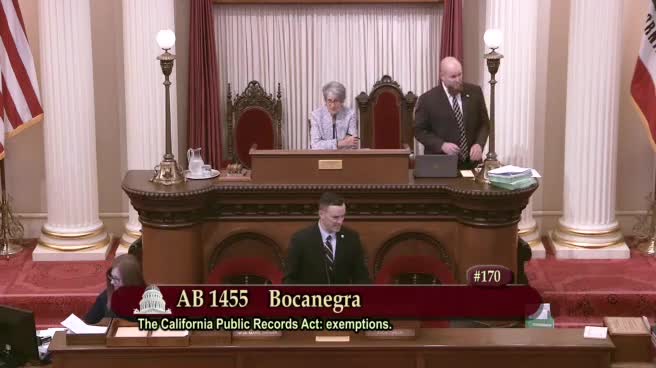
Bill Author
Bill Co-Author(s):