AB 183: Bill of Rights for State Excluded Employees.
- Session Year: 2017-2018
- House: Assembly
- Latest Version Date: 2018-08-22
The existing Bill of Rights for State Excluded Employees (bill of rights) prescribes various rights and terms and conditions of employment for excluded employees, defined as certain supervisory, managerial, and confidential state employees, among other specified employees.
This bill would amend the bill of rights to require the management of each state entity, as specified, on or before January 1, 2019, to develop policies for their supervisory employees regarding shift assignments, vacations, and overtime, and to meet with the supervisory employee organizations that represent the excluded employees. The bill would not apply to the Department of the California Highway Patrol.
The existing Bill of Rights for State Excluded Employees (bill of rights) prescribes various rights and terms and conditions of employment for excluded employees, defined as certain supervisory, managerial, and confidential state employees, among other specified employees.
This bill would amend the bill of rights to require the management of each state entity, as specified, by on or before January 1, 2019, to develop policies for their supervisory employees regarding shift assignments, vacations, and overtime, and to meet with the supervisory employee organizations that represent the excluded employees. The bill would not apply to the Department of the California Highway Patrol.
The existing Bill of Rights for State Excluded Employees (bill of rights) prescribes various rights and terms and conditions of employment for excluded employees, defined as certain supervisory, managerial, and confidential state employees, among other specified employees.
This bill would amend the bill of rights to require the management of each state entity, as specified, by January 1, 2019, to develop policies for their supervisory employees regarding shift assignments, vacations, and overtime, and to meet with the supervisory employee organizations that represent the excluded employees.
(a)Not later than January 1, 2019, each state entity that employs excluded employees who are supervisory employees and who are required to work shifts at a workplace that operates with two or more shifts per day shall develop policies for supervisory employees as they pertain to shift assignments, vacations, and overtime. The management of the state entity shall develop and maintain these policies and shall meet with the supervisory employee organizations that represent the excluded employees.
(b)This section shall not apply to the Department of the California Highway Patrol.
Not later than January 1, 2019, each state entity that employs excluded employees who are supervisory employees and who are required to work shifts at a workplace that operates with two or more shifts per day shall develop policies for supervisory employees as they pertain to shift assignments, vacations, and overtime. The management of the state entity shall develop and maintain these policies and shall meet with the supervisory employee organizations that represent the excluded employees.
|
Date
|
Status
|
|---|---|
| Sep 6, 2018 | Vetoed by Governor. |
| Aug 24, 2018 | Enrolled and presented to the Governor at 4:30 p.m. |
| Aug 20, 2018 | Senate amendments concurred in. To Engrossing and Enrolling. |
| Aug 13, 2018 | From inactive file. |
| Sep 7, 2017 | Ordered to inactive file at the request of Assembly Member Lackey. |
| Sep 5, 2017 | Ordered to the unfinished business file. |
| Jul 13, 2017 | Ordered to inactive file at the request of Assembly Member Lackey. |
| Jul 3, 2017 | In Assembly. Concurrence in Senate amendments pending. May be considered on or after July 5 pursuant to Assembly Rule 77. |
| Jul 3, 2017 | Read third time. Passed. Ordered to the Assembly. |
| Jun 27, 2017 | Read second time. Ordered to Consent Calendar. |
| Jun 26, 2017 | From committee: Be placed on second reading file pursuant to Senate Rule 28.8 and ordered to consent calendar. |
| Jun 13, 2017 | From committee: Do pass and re-refer to Com. on APPR. with recommendation: To Consent Calendar. (Ayes 5. Noes 0.) (June 12). Re-referred to Com. on APPR. |
| May 25, 2017 | From committee chair, with author's amendments: Amend, and re-refer to committee. Read second time, amended, and re-referred to Com. on P.E. & R. |
| May 24, 2017 | Referred to Com. on P.E. & R. |
| May 11, 2017 | In Senate. Read first time. To Com. on RLS. for assignment. |
| May 11, 2017 | Read third time. Passed. Ordered to the Senate. (Ayes 77. Noes 0. Page 1486.) |
| May 4, 2017 | Read second time. Ordered to Consent Calendar. |
| May 3, 2017 | From committee: Do pass. To Consent Calendar. (Ayes 16. Noes 0.) (May 3). |
| Apr 20, 2017 | From committee: Do pass and re-refer to Com. on APPR. with recommendation: To Consent Calendar. (Ayes 7. Noes 0.) (April 19). Re-referred to Com. on APPR. |
| Mar 27, 2017 | In committee: Set, first hearing. Hearing canceled at the request of author. |
| Jan 30, 2017 | Referred to Com. on P.E., R., & S.S. |
| Jan 20, 2017 | From printer. May be heard in committee February 19. |
| Jan 19, 2017 | Read first time. To print. |
|
Date
|
Description
|
Location
|
Votes
|
|
|---|---|---|---|---|
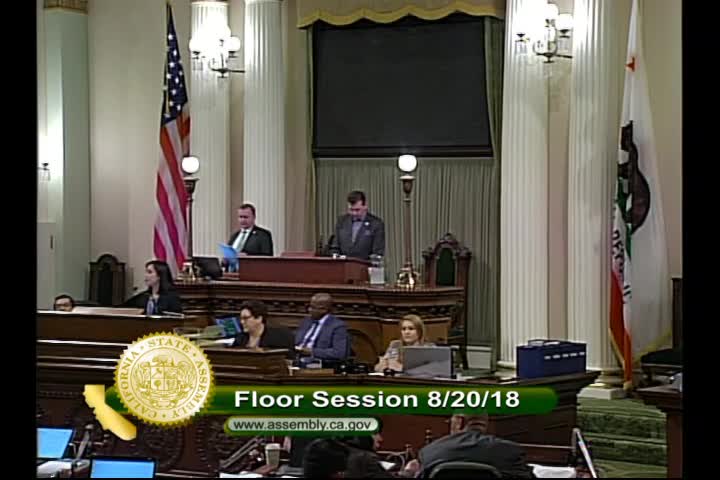
| Aug 20, 2018 | AB 183 LACKEY Concurrence in Senate Amendments | Assembly Floor |
Passed |
|
| Jul 3, 2017 | Consent Calendar 2nd AB183 | Senate Floor |
Passed |
|
| Jun 12, 2017 | Do pass, but first be re-referred to the Committee on [Appropriations] with the recommendation: To Consent Calendar | Senate Standing Committee on Public Employment and Retirement |
Passed |
|
| May 11, 2017 | AB 183 LACKEY Consent Calendar Second Day Regular Session | Assembly Floor |
Passed |
|
| May 3, 2017 | Do pass. To Consent Calendar. | Assembly Standing Committee on Appropriations |
Passed |
|
| Apr 19, 2017 | Do pass and be re-referred to the Committee on [Appropriations] with recommendation: To Consent Calendar | Assembly Standing Committee on Public Employees, Retirement, and Social Security |
Passed |
This list shows positions taken on this bill by organizations on the date displayed, which is linked to the original source.
Positions by individuals are not included.
|
Organization
|
Position
|
Date
|
|---|---|---|
| Association For Los Angeles Deputy Sheriffs | ** Support | Jun 28, 2017 |
| Association Of California State Supervisors | ** Support | Jun 28, 2017 |
| California Association Of Code Enforcement Officers | ** Support | Jun 28, 2017 |
| California Association Of Professional Scientists | ** Support | Jun 28, 2017 |
| California College And University Police Chiefs Association | ** Support | Jun 28, 2017 |
| California Correctional Supervisors Organization | ** Support | Jun 28, 2017 |
| California Narcotic Officers Association | ** Support | Jun 28, 2017 |
| Los Angeles County Professional Peace Officers Association | ** Support | Jun 28, 2017 |
| Los Angeles Police Protective League | ** Support | Jun 28, 2017 |
| Professional Engineers In California Government | ** Support | Jun 28, 2017 |
| Riverside Sheriffs Association | ** Support | Apr 18, 2017 |
| Riverside Sheriffs' Association | ** Support | Apr 18, 2017 |
GOVERNOR'S VETO
GV Bill Id:AB 183
Author:(Lackey)
As Enrolled Ver:August 22, 2018
2/3 vote
ASSEMBLY: | 77-0 | (May 11, 2017) | SENATE: | 33-0 | (July 3, 2017) |
ASSEMBLY: | 80-0 | (August 20, 2018) |
Original Committee Reference: P.E.,R., & S.S.
SUMMARY: Requires each state agency that employs excluded supervisory employees, and that operate two or more shifts per day, to develop policies regarding shift assignments, vacations and overtime, by January 1, 2019. Management must maintain these policies and meet with supervisory employee organizations.
The Senate amendments specify that the provisions of the bill do not apply to the Department of California Highway Patrol.
EXISTING LAW:
- Establishes the Bill of Rights for State Excluded Employees (BRSEE) requiring the state to meet and confer upon request with verified employee organizations that represent state employees excluded from collective bargaining. These employees include supervisory employees, managers, confidential employees, and employees otherwise exempted from coverage under the Ralph C. Dills Act.
- For purposes of the BRSEE, defines "meet and confer" to mean that the state must consider, as fully as deemed reasonable by the employer, excluded employee organizations' presentations prior to reaching a decision on policies or course of actions directly impacting supervisory employees.
- Allows represented state employees the right to obtain their preferred work shifts based on their seniority if preferential shift selection rights are part of their bargaining contracts.
FISCAL EFFECT: According to the Senate Appropriations Committee, pursuant to Senate Rule 28.8, this bill would result in negligible state cost.
COMMENTS: Excluded state employees are civil service managerial, supervisory, and confidential employees, civil service employees at the California Department of Human Resources, certain employees of the Department of Finance, State Controller's Office, Legislative Counsel Bureau, Bureau of State Audits, Public Employment Relations Board, Chief Information Officer, State Athletics Commission, and conciliators employed by the State Mediation and Conciliation Service.
Current law requires the state to meet and confer, upon request, with verified supervisory employee organizations on all matters relating to employment conditions for supervisory employees, including wages, hours, and other terms and conditions of employment. However, excluded employees have few or no rights as to how the employer assigns shift work, unlike their represented rank-and-file colleagues. As such, these employees are subject to changing work-shift schedules and overtime assignments.
This bill seeks to provide a remedy by affording excluded employees certain rights and control related to their work schedules.
This bill, however well-intentioned, would require a policy that is unduly rigid and not reflective of the different circumstances in various state offices and departments. In essence, it would limit the sound discretion of management to make necessary personnel assignments.
Analysis Prepared by: Michael Bolden / P.E.,R., & S.S. / (916) 319-3957 FN: 0005231
CONCURRENCE IN SENATE AMENDMENTS
CSA1 Bill Id:AB 183
Author:(Lackey)
As Amended Ver:May 25, 2017
Majority vote
ASSEMBLY: | 77-0 | (May 11, 2017) | SENATE: | 33 | (July 3, 2017) |
Original Committee Reference: P.E.,R., & S.S.
SUMMARY: Requires each state agency that employs excluded supervisory employees, and that operate two or more shifts per day, to develop policies regarding shift assignments, vacations and overtime, by January 1, 2019. Management must maintain these policies and meet with supervisory employee organizations.
The Senate amendments specify that the provisions of the bill do not apply to the Department of California Highway Patrol.
EXISTING LAW:
- Establishes the Bill of Rights for State Excluded Employees (BRSEE) requiring the state to meet and confer upon request with verified employee organizations that represent state employees excluded from collective bargaining. These employees include supervisory employees, managers, confidential employees, and employees otherwise exempted from coverage under the Ralph C. Dills Act.
- For purposes of the BRSEE, defines "meet and confer" to mean that the state must consider, as fully as deemed reasonable by the employer, excluded employee organizations' presentations prior to reaching a decision on policies or course of actions directly impacting supervisory employees.
- Allows represented state employees the right to obtain their preferred work shifts based on their seniority if preferential shift selection rights are part of their bargaining contracts.
FISCAL EFFECT: According to the Senate Appropriations Committee, pursuant to Senate Rule 28.8, this bill would result in negligible state cost.
COMMENTS: Excluded state employees are civil service managerial, supervisory, and confidential employees, civil service employees at the California Department of Human Resources, certain employees of the Department of Finance, State Controller's Office, Legislative Counsel Bureau, Bureau of State Audits, Public Employment Relations Board, Chief Information Officer, State Athletics Commission, and conciliators employed by the State Mediation and Conciliation Service.
Current law requires the state to meet and confer, upon request, with verified supervisory employee organizations on all matters relating to employment conditions for supervisory employees, including wages, hours, and other terms and conditions of employment. However, excluded employees have few or no rights as to how the employer assigns shift work, unlike their represented rank-and-file colleagues. As such, these employees are subject to changing work-shift schedules and overtime assignments.
This bill seeks to provide a remedy by affording excluded employees certain rights and control related to their work schedules.
Analysis Prepared by: Michael Bolden / P.E.,R., & S.S. / (916) 319-3957 FN: 0001071
Office of Senate Floor Analyses (916) 651-1520 Fax: (916) 327-4478 | AB |
CONSENT
Bill No: AB 183
:
SENATE PUBLIC EMP. & RET. COMMITTEE: 5-0, 6/12/17
AYES: Pan, Morrell, Leyva, Moorlach, Portantino
SENATE APPROPRIATIONS COMMITTEE: Senate Rule 28.8
ASSEMBLY FLOOR: 77-0, 5/11/17 (Consent) - See last page for vote
SOURCE: California Correctional Supervisors Organization
DIGEST:
This bill requires state agencies that operate two or more shifts per day to develop, by January 1, 2019, policies for supervisory employees around shift assignments, vacations, and overtime. Management must maintain these policies and meet with supervisory employee organizations.
ANALYSIS:
Existing law:
- Establishes the Bill of Rights for State Excluded Employees (BRSEE) requiring the state to meet and confer upon request with verified employee organizations that represent state employees excluded from collective bargaining. These employees include: supervisory employees, managers, confidential employees, and employees otherwise exempted from coverage under the Ralph C. Dills Act (Dills Act).
- Defines “meet and confer” for purposes of BRSEE to mean that the state must consider, as fully as deemed reasonable by the employer, excluded employee organizations’ presentations prior to reaching a decision on policies or courses of actions directly impacting supervisory employees.
- Allows represented state employees the right to obtain their preferred work shifts based on their seniority if preferential shift selection rights are part of their bargaining contracts.
This bill:
- Requires, by January 1, 2019, for all state agencies that operate two or more shifts per day to develop policies for excluded supervisory employees as they pertain to shift assignments, vacations, and overtime.
- Requires management of these agencies to develop and maintain these policies by meeting with supervisory employee organizations.
- Specifies that the provisions of the bill shall not apply to the Department of the California Highway Patrol.
Background
Current law requires the state to meet and confer, upon request, with verified supervisory employee organizations on all matters relating to employment conditions for supervisory employees, including wages, hours, and other terms and conditions of employment. However, excluded employees have few or no rights to how the employer assigns shift work, unlike their represented rank and file colleagues.
Excluded employees are thus subject to unequal treatment and disruptive, random, and demoralizing shift, work, and overtime assignments. Such disparate treatment can create disincentives to promote into the supervisorial ranks.
Related/Prior Legislation
AB 1983 (Lackey, 2016), held on suspense in the Assembly Appropriations Committee, would have required specified state agencies that operate two or more shifts per day to develop policies for excluded supervisory employees as they pertain to shift assignments, vacations, and overtime.
SB 1071 (Beall, 2014) would have provided state excluded supervisory employees operating two or more work shifts per day the right to obtain work shifts based on seniority, as specified. SB 1071 was vetoed by Governor Brown because, “several departments that operate multiple shifts and who have deemed it to be in the best interest of the department to provide seniority shift bidding have done so…this bill would circumvent that discretion.”
FISCAL EFFECT: Appropriation: Fiscal Com.: Local:
California Correctional Supervisors Organization (source)
Association for Los Angeles Deputy Sheriffs
Association of California State Supervisors
California Association of Code Enforcement Officers
California Association of Professional Scientists
California College and University Police Chiefs Association
California Narcotic Officers Association
Los Angeles County Professional Peace Officers Association
Los Angeles Police Protective League
Professional Engineers in California Government
OPPOSITION: (Verified 6/27/17)
None received
ARGUMENTS IN SUPPORT: According to the author’s office, “Not all state agencies operate two or more shifts a day; those that do rely on the bargaining unit contract to staff each shift. This gives the employee and their families some control as to direct their family activities. Excluded employees have no memorandum of understanding nor do they have any seniority rights to the shifts, vacation openings, or overtime they work.”
The California Correctional Supervisors Organization states, “There are no requirements that departments even have any policy at all with respect to [shifts, vacation openings, or overtime] as they related to excluded employees. This lack of any requirement for rational policies result in many civil service excluded employees being arbitrarily assigned to one shift or another without any rational basis…[which] opens the door to unequal treatment of excluded employees.”
ASSEMBLY FLOOR: 77-0, 5/11/17
AYES: Acosta, Aguiar-Curry, Travis Allen, Arambula, Baker, Berman, Bigelow, Bloom, Bocanegra, Bonta, Brough, Burke, Caballero, Calderon, Cervantes, Chau, Chávez, Chen, Chiu, Choi, Chu, Cooley, Cooper, Cunningham, Dababneh, Daly, Eggman, Flora, Fong, Frazier, Friedman, Gallagher, Cristina Garcia, Eduardo Garcia, Gipson, Gloria, Gomez, Gonzalez Fletcher, Gray, Grayson, Harper, Holden, Irwin, Jones-Sawyer, Kalra, Kiley, Lackey, Levine, Limón, Low, Maienschein, Mathis, Mayes, McCarty, Medina, Melendez, Mullin, Muratsuchi, Nazarian, Obernolte, Quirk, Quirk-Silva, Reyes, Ridley-Thomas, Rodriguez, Rubio, Salas, Santiago, Steinorth, Mark Stone, Thurmond, Ting, Voepel, Waldron, Weber, Wood, Rendon
NO VOTE RECORDED: Dahle, O'Donnell, Patterson
6/28/17 14:51:03
**** END ****
SENATE COMMITTEE ON
PUBLIC EMPLOYMENT AND RETIREMENT
Dr. Richard Pan, Chair
2017 - 2018 Regular
Bill No: AB 183 Hearing Date: 6/12/17
Author: | Lackey | ||
Version: | 5/25/17 As amended | ||
Urgency: | No | Fiscal: | Yes |
Consultant: | Korinne Sugasawara | ||
Subject: Bill of Rights for State Excluded Employees
SOURCE: California Correctional Supervisors Organization
ASSEMBLY VOTES:
Assembly Floor: | 77 - 0 |
Assembly Appropriations Committee: | 16 - 0 |
Assembly Public Employees, Retirement/Soc Sec Committee: | 7 - 0 |
DIGEST: This bill requires state agencies that operate two or more shifts per day to develop, by January 1, 2019, policies for supervisory employees around shift assignments, vacations, and overtime. Management must maintain these policies and meet with supervisory employee organizations.
ANALYSIS:
Existing law:
- Establishes the Bill of Rights for State Excluded Employees (BRSEE) requiring the state to meet and confer upon request with verified employee organizations that represent state employees excluded from collective bargaining. These employees include: supervisory employees, managers, confidential employees, and employees otherwise exempted from coverage under the Ralph C. Dills Act (Dills Act).
- Defines “meet and confer” for purposes of BRSEE to mean that the state must consider, as fully as deemed reasonable by the employer, excluded employee organizations’ presentations prior to reaching a decision on policies or courses of actions directly impacting supervisory employees.
- Allows represented state employees the right to obtain their preferred work shifts based on their seniority if preferential shift selection rights are part of their bargaining contracts.
This bill:
- Requires, by January 1, 2019, for all state agencies that operate two or more shifts per day to develop policies for excluded supervisory employees as they pertain to shift assignments, vacations, and overtime.
- Requires management of these agencies to develop and maintain these policies by meeting with supervisory employee organizations.
- Specifies that the provisions of the bill shall not apply to the Department of the California Highway Patrol.
Background
Current law requires the state to meet and confer, upon request, with verified supervisory employee organizations on all matters relating to employment conditions for supervisory employees, including wages, hours, and other terms and conditions of employment. However, excluded employees have few or no rights to how the employer assigns shift work, unlike their represented rank and file colleagues.
Excluded employees are thus subject to unequal treatment and disruptive, random, and demoralizing shift, work, and overtime assignments. Such disparate treatment can create disincentives to promote into the supervisorial ranks.
Related/Prior Legislation
AB 1983 (Lackey, 2016), held on suspense in the Assembly Appropriations Committee, would have required specified state agencies that operate two or more shifts per day to develop policies for excluded supervisory employees as they pertain to shift assignments, vacations, and overtime.
SB 1071 (Beall, 2014) would have provided state excluded supervisory employees operating two or more work shifts per day the right to obtain work shifts based on seniority, as specified. SB 1071 was vetoed by Governor Brown because, “several departments that operate multiple shifts and who have deemed it to be in the best interest of the department to provide seniority shift bidding have done so…this bill would circumvent that discretion.”
FISCAL EFFECT: Appropriation: No Fiscal Com.: Yes Local: No
According to the Assembly Appropriations Committee, “this bill will result in minor administrative costs for affected state agencies.”
SUPPORT:
California Correctional Supervisors Organization (source)
Association for Los Angeles Deputy Sheriffs
Association of California State Supervisors
California Association of Code Enforcement Officers
California Association of Professional Scientists
California College and University Police Chiefs Association
California Narcotic Officers Association
Los Angeles County Professional Peace Officers Association
Los Angeles Police Protective League
Professional Engineers in California Government
OPPOSITION:
None received.
ARGUMENTS IN SUPPORT:
According to the author’s office, “Not all state agencies operate two or more shifts a day; those that do rely on the bargaining unit contract to staff each shift. This gives the employee and their families some control as to direct their family activities. Excluded employees have no memorandum of understanding nor do they have any seniority rights to the shifts, vacation openings, or overtime they work.”
The California Correctional Supervisors Organization states, “There are no requirements that departments even have any policy at all with respect to [shifts, vacation openings, or overtime] as they related to excluded employees. This lack of any requirement for rational policies result in many civil service excluded employees being arbitrarily assigned to one shift or another without any rational basis…[which] opens the door to unequal treatment of excluded employees.”
Date of Hearing: May 3, 2017
ASSEMBLY COMMITTEE ON APPROPRIATIONS
Lorena Gonzalez Fletcher, Chair
ABPCA Bill Id:AB 183
Author:(Lackey) – As Introduced Ver:January 19, 2017
Policy Committee: | Public Employees, Retirement/Soc Sec | Vote: | 7 - 0 |
|
| ||
|
|
Urgency: No State Mandated Local Program: No Reimbursable: No
SUMMARY:
This bill requires agencies that operate two or more shifts per day to develop, by January 1, 2019, policies for supervisory employees around shift assignments, vacations, and overtime. State agency management must maintain these policies and meet with supervisory employee organizations.
FISCAL EFFECT:
This bill will result in minor administrative costs for affected state agencies to develop the policies, as required by this bill. Most affected state agencies already have these policies in place, and this bill does not require a change in an agency’s current practice.
COMMENTS:
- Purpose and Background. Excluded employees, unlike represented state employees, do not have the right to obtain their preferred work shifts based on their seniority. According to the author, this can add significant stress to the worker and his or her families. AB 183 is intended to ensure that all state agencies that operate two or more shifts develop a statewide policy for excluded employees for certain agencies so that these workers can have more control over their schedules.
- Prior legislation. AB 1983 (Lackey), of the 2015-16 Legislative Session, which would have required certain agencies to develop policies that provided shift preferences based on seniority, was held in this committee’s Suspense File. Compared to that bill, AB 183 imposes fewer costs on affected state agencies because they are not required to change current policies around shift assignment. SB 1071 (Beall), of the 2013-14 Legislative Session, which would have provided certain state excluded supervisory employees the right to obtain work shifts based on seniority, was vetoed by the Governor. The veto message stated, in part:
"This bill is unnecessary. Several departments that operate multiple shifts and who have deemed it to be in the best interest of the department to provide seniority shift bidding have done so, including one department that applies this practice to supervisory employees. Unfortunately, this bill would circumvent that discretion. I encourage those departments without post and bid in place for excluded employees to meet with supervisors for further discussion."
Analysis Prepared by: Luke Reidenbach / APPR. / (916) 319-2081
Bill Author

Bill Co-Author(s):