AB 1857: Building codes: earthquake safety: immediate occupancy standard.
- Session Year: 2017-2018
- House: Assembly
- Latest Version Date: 2018-08-29
The California Building Standards Law provides for the adoption of building standards by state agencies by requiring all state agencies that adopt or propose adoption of any building standard to submit the building standard to the California Building Standards Commission (commission) for approval and adoption.
This bill would require the commission to assemble a functional recovery working group comprised of certain state entities and members of the construction and insurance industries, as specified. The bill would require the working group, by July 1, 2022, to consider whether a functional recovery standard is warranted for all or some building occupancy classifications and to investigate the practical means of implementing that standard, as specified. The bill would require the working group to advise the appropriate state agencies to propose the building standards, as specified. The bill would authorize the commission to adopt regulations based upon the recommendations from the working group for nonresidential occupancies. The bill would define functional recovery for purposes of these provisions, as specified.
The California Building Standards Law provides for the adoption of building standards by state agencies by requiring all state agencies that adopt or propose adoption of any building standard to submit the building standard to the California Building Standards Commission (commission) for approval and adoption.
This bill would require the commission to assemble a functional recovery working group comprised of certain state entities and members of the construction and insurance industries, as specified. The bill would require the working group, by July 1, 2022, to consider whether a functional recovery standard is warranted for all or some building occupancy classifications and to investigate the practical means of implementing that standard, as specified. The bill would require the working group to advise the appropriate state agencies to propose the building standards, as specified. If it is determined that a functional recovery standard is not warranted, the bill would require the working group to assist with development of a document providing guidance to, among others, building owners and local jurisdictions regarding function recovery after a seismic event, as specified. The bill would authorize the commission to issue adopt regulations based upon the recommendations from the working group. group for nonresidential occupancies. The bill would define functional recovery for purposes of these provisions. as specified.
The California Building Standards Law provides for the adoption of building standards by state agencies by requiring all state agencies that adopt or propose adoption of any building standard to submit the building standard to the California Building Standards Commission (commission) for approval and adoption.
This bill would require the commission to assemble a functional recovery working group comprised of certain state entities and members of the construction and insurance industries, as specified. The bill would require the working group, by July 1, 2020, 2022, to investigate and determine criteria for consider whether a functional recovery standard following a seismic event, is warranted for all or some building occupancy classifications and to direct the commission investigate the practical means of implementing that standard, as specified. The bill would require the working group to advise the appropriate state agencies to propose the appropriate building standards, as specified. The If it is determined that a functional recovery standard is not warranted, the bill would require the commission to produce working group to assist with development of a document providing guidance to, among others, building owners and local jurisdictions regarding function recovery after a seismic event, in the event that new building standards are not in place by January 1, 2023, as specified. The bill would authorize the commission to issue regulations based upon the recommendations from the working group. The bill would define functional recovery for purposes of these provisions. as specified.
The California Building Standards Law provides for the adoption of building standards by state agencies by requiring all state agencies that adopt or propose adoption of any building standard to submit the building standard to the California Building Standards Commission (commission) for approval and adoption.
This bill would require the commission to assemble a functional recovery working group comprised of certain state entities and members of the construction and insurance industries, as specified. The bill would require the group, by July 1, 2020, to investigate and determine criteria for a functional recovery standard following a seismic event, for all or some building occupancy classifications and to direct the Department of Housing and Community Development (department) commission to propose the appropriate building standards for consideration by the commission, standards, as specified. The bill would require the commission and the department to produce a document providing guidance to, among others, building owners and local jurisdictions regarding function recovery after a seismic event, in the event that new building standards are not in place by January 1, 2023, as specified. The bill would authorize the commission and the department to issue regulations based upon the recommendations from the group. The bill would define functional recovery for purposes of these provisions.
The California Building Standards Law provides for the adoption of building standards by state agencies by requiring all state agencies that adopt or propose adoption of any building standard to submit the building standard to the California Building Standards Commission (commission) for approval and adoption.
This bill would require the commission to adopt earthquake standards for engineered buildings meeting immediate occupancy standards, as defined, to be included in the next triennial edition of the California Building Code, as specified. Until the immediate occupancy standard is adopted, the bill would require the commission to adopt a strength and stiffness standard, as defined, for engineered buildings that is 1.5 times the level of the current standard. assemble a functional recovery working group comprised of certain state entities and members of the construction and insurance industries, as specified. The bill would require the group, by July 1, 2020, to investigate and determine criteria for a functional recovery standard following a seismic event, for all or some building occupancy classifications and to direct the Department of Housing and Community Development (department) to propose the appropriate building standards for consideration by the commission, as specified. The bill would require the commission and the department to produce a document providing guidance to, among others, building owners and local jurisdictions regarding function recovery after a seismic event, in the event that new building standards are not in place by January 1, 2023, as specified. The bill would authorize the commission and the department to issue regulations based upon the recommendations from the group. The bill would define functional recovery for purposes of these provisions.
The California Building Standards Law provides for the adoption of building standards by state agencies by requiring all state agencies that adopt or propose adoption of any building standard to submit the building standard to the California Building Standards Commission (commission) for approval and adoption.
This bill would require the commission to adopt earthquake standards for engineered buildings meeting immediate occupancy standards, as defined, to be included in the next triennial edition of the California Building Code, as specified. Until the immediate occupancy standard is adopted, the bill would require the commission to adopt a strength and stiffness standard, as defined, for engineered buildings that is 1.5 times the level of the current standard.
(a)The Building Standards Commission shall assemble a functional recovery working group comprised of appropriate public and private sector entities, including, but not limited to:
(1)The Department of Housing and Community Development.
(2)The Division of the State Architect.
(3)The Office of the State Fire Marshal.
(4)The Structural Engineers Association of California.
(5)California building officials.
(6)The insurance industry.
(7)The Building Owners and Managers Association.
(8) Members of the construction industry.
(9)The Earthquake Engineering Research Institute.
(10)The California Council of the American Institute of Architects.
(11)The Association of Bay Area Governments.
(12)The Southern California Association of Governments.
(13)The American Society of Civil Engineers.
(14)The Los Angeles Economic Development Council or an economic development organization representing a metropolitan region in the state.
(15)The Alfred E. Alquist Seismic Safety Commission.
(16)The California Geological Survey.
(17)The International Code Council.
(b)Not later than July 1, 2022, the functional recovery working group shall do all of the following:
(1)Consider if a functional recovery standard is warranted for all or some building occupancy classifications, and investigate the practical means of implementing that standard either as a mandate or as a voluntary measure. If the working group suggests the development of a voluntary or mandatory standard is warranted, the working group shall assist in the preparation of an estimated cost of compliance for use by the appropriate state agencies in meeting the requirements of clause (i) of subparagraph (B) of paragraph (5) of subdivision (b) of Section 11346.2 of the Government Code.
(2)Provide advice to the appropriate state agencies regarding whether the work product of paragraph (1) should apply only to certain specified seismic design categories or to the entire state.
(3)Subsequent to development of the building code provisions pursuant to paragraph (1), the working group shall advise the appropriate state agencies to propose building standards for consideration by the commission during the next regularly scheduled Triennial Adoption Cycle.
(c)The commission may adopt regulations based upon the recommendations resulting from the working group for nonresidential occupancies. These regulations shall comply with the requirements of the rulemaking provisions of the Administrative Procedure Act, Chapter 3.5 (commencing with Section 11340) of Part 1 of Division 2 of Title 2 of the Government Code.
(d)For purposes of this section, functional recovery standard means a set of enforceable building code provisions and regulations that provide specific design and construction requirements intended to result in a building for which postearthquake structural and nonstructural capacity are maintained or can be restored to support the basic intended functions of the buildings preearthquake use and occupancy within a maximum acceptable time, where the maximum acceptable time might differ for various uses or occupancies.
(a)The Building Standards Commission shall assemble a functional recovery working group comprised of appropriate public and private sector entities, including, but not limited to:
(1)The Department of Housing and Community Development.
(2)The Division of the State Architect.
(3)The Office of the State Fire Marshal.
(4)The Structural Engineers Association of California.
(5)California building officials.
(6)The insurance industry.
(7)The Building Owners and Managers Association.
(8) Members of the construction industry.
(9)The Earthquake Engineering Research Institute.
(10)The California Council of the American Institute of Architects.
(11)The Association of Bay Area Governments.
(12)The Southern California Association of Governments.
(13)The American Society of Civil Engineers.
(14)The Los Angeles Economic Development Council or an economic development organization representing a metropolitan region in the state.
(15)The Alfred E. Alquist Seismic Safety Commission.
(16)The California Geological Survey.
(17)The International Code Council.
(b)Not later than July 1, 2022, the functional recovery working group shall do all of the following:
(1)Consider if a functional recovery standard is warranted for all or some building occupancy classifications, and investigate the practical means of implementing that standard either as a mandate or as a voluntary measure. If the working group suggests the development of a voluntary or mandatory standard is warranted, the working group shall assist in the preparation of an estimated cost of compliance for use by the appropriate state agencies in meeting the requirements of clause (i) of subparagraph (B) of paragraph (5) of subdivision (b) of Section 11346.2 of the Government Code.
(2)Provide advice to the appropriate state agencies regarding whether the work product of paragraph (1) should apply only to certain specified seismic design categories or to the entire state.
(3)Subsequent to development of the building code provisions pursuant to paragraph (1), the working group shall advise the appropriate state agencies to propose building standards for consideration by the commission during the next regularly scheduled Triennial Adoption Cycle.
(c)If it is determined that a functional recovery standard is not warranted, the group shall assist with the development of the guidance document for use by architects, building owners, engineers, insurance companies, and local jurisdictions that would provide a higher level of structural strength in new construction with the goal of enabling functional recovery after a significant seismic event. The commission is authorized to take the steps necessary to produce and distribute this document to interested parties via its Internet Web site and other venues. (d)(c)The commission is authorized to may adopt regulations based upon the recommendations resulting from the working group for nonresidential occupancies. These regulations shall comply with the requirements of the rulemaking provisions of the Administrative Procedures Procedure Act, Chapter 3.5 (commencing with Section 11340) of Part 1 of Division 2 of Title 2 of the Government Code.
(e)(d)For purposes of this section, functional recovery standard means a set of enforceable building code provisions and regulations that provide specific design and construction requirements intended to result in a building for which postearthquake structural and nonstructural capacity are maintained or can be restored to support the basic intended functions of the buildings preearthquake use and occupancy within a maximum acceptable time, where the maximum acceptable time might differ for various uses or occupancies.
(a)The Building Standards Commission shall assemble a functional recovery working group comprised of appropriate public and private sector entities, including, but not limited to:
(1)The Department of Housing and Community Development.
(2)The Division of the State Architect.
(3)The Office of the State Fire Marshal.
(4)The Structural Engineers Association of California.
(5)California building officials.
(6)The insurance industry.
(7)The Building Owners and Managers Association.
(8) Members of the construction industry.
(9)The Earthquake Engineering Research Institute.
(10)The California Council of the American Institute of Architects.
(11)The Association of Bay Area Governments.
(12)The Southern California Association of Governments.
(13)The American Society of Civil Engineers.
(14)The Los Angeles Economic Development Council or an economic development organization representing a metropolitan region in the state.
(15)The Alfred E. Alquist Seismic Safety Commission.
(16)The California Geological Survey.
(17)The International Code Council.
(b)Not later than July 1, 2020, 2022, the functional recovery working group shall do both all of the following:
(1)Investigate and determine criteria for a functional recovery standard for all or some building occupancy classifications, and investigate and determine practical means of implementing that standard, as mandatory building code provisions. This shall be done for each of the seismic design categories applicable to the state.(1)Consider if a functional recovery standard is warranted for all or some building occupancy classifications, and investigate the practical means of implementing that standard either as a mandate or as a voluntary measure. If the working group suggests the development of a voluntary or mandatory standard is warranted, the working group shall assist in the preparation of an estimated cost of compliance for use by the appropriate state agencies in meeting the requirements of clause (i) of subparagraph (B) of paragraph (5) of subdivision (b) of Section 11346.2 Government Code.
(2)Provide advice to the appropriate state agencies regarding whether the work product of paragraph (1) should apply only to certain specified seismic design categories or to the entire state.
(2)(3)Subsequent to development of the building code provisions pursuant to paragraph (1), the working group shall direct the commission advise the appropriate state agencies to propose the appropriate building standards for consideration by the commission during the next regularly scheduled Triennial Adoption Cycle occurring after January 1, 2020. Cycle.
(c)If the mandatory building code provisions under subdivision (b) are not completed in time for inclusion with the California Building Standards Code, effective January 1, 2023, the commission shall produce a guidance document it is determined that a functional recovery standard is not warranted, the group shall assist with the development of the guidance document for use by architects, building owners, engineers, insurance companies, and local jurisdictions that would provide a higher level of structural strength in new construction with the goal of enabling functional recovery after a significant seismic event. The commission is authorized to take the steps necessary to produce and distribute this document to interested parties via its Internet Web site and other venues.
(d)The commission is authorized to adopt regulations based upon the recommendations resulting from the working group for nonresidential occupancies. These regulations shall comply with the requirements of the Administrative Procedures Act, Chapter 3.5 (commencing with Section 11340) of Part 1 of Division 2 of Title 2 of the Government Code.
(e)For purposes of this section, functional recovery standard means a set of enforceable building code provisions and regulations that provide specific design and construction requirements intended to result in a building for which postearthquake structural and nonstructural capacity are maintained or can be restored to support the basic intended functions of the buildings preearthquake use and occupancy within a maximum acceptable time, where the maximum acceptable time might differ for various uses or occupancies.
(a)The Building Standards Commission shall assemble a functional recovery working group comprised of appropriate public and private sector entities, including, but not limited to:
(1)The Department of Housing and Community Development.
(2)The Structural Safety Department of the Division of the State Architect.
(3)The International Code Council. Office of the State Fire Marshal.
(4)The Structural Engineers Association of California.
(5)California building officials.
(6)The insurance industry.
(7)The Building Owners and Managers Association.
(8) Members of the construction industry.
(9)The Earthquake Engineering Research Institute.
(10)The California Council of the American Institute of Architects.
(11)The Association of Bay Area Governments.
(12)The Southern California Association of Governments.
(13)The American Society of Civil Engineers.
(14)The Los Angeles Economic Development Council or an economic development organization representing a metropolitan region in the state.
(15)The Alfred E. Alquist Seismic Safety Commission.
(b)Not later than July 1, 2020, the functional recovery working group shall do both of the following:
(1)Investigate and determine criteria for a functional recovery standard for all or some building occupancy classifications, and investigate and determine practical means of implementing that standard, as mandatory building code provisions. This shall be done for each of the seismic design categories applicable to the state.
(2)Subsequent to development of the building code provisions pursuant to paragraph (1), the working group shall direct the commission and the Department of Housing and Community Development to propose the appropriate building standards for consideration by the commission during the next regularly scheduled Triennial Adoption Cycle occurring after January 1, 2020.
(c)If the mandatory building code provisions under subdivision (b) are not completed in time for inclusion with the California Building Standards Code, effective January 1, 2023, the commission and department shall produce a guidance document for use by architects, building owners, engineers, insurance companies, and local jurisdictions that would provide a higher level of structural strength in new construction with the goal of enabling functional recovery after a significant seismic event. The commission is authorized to take the steps necessary to produce and distribute this document to interested parties via its Internet Web site and other venues.
(d)The commission and the department are is authorized to adopt regulations based upon the recommendations resulting from the working group for nonresidential occupancies. These regulations shall comply with the requirements of the Administrative Procedures Act, Chapter 3.5 (commencing with Section 11340) of Part 1 of Division 2 of Title 2 of the Government Code.
(e)For purposes of this section, functional recovery standard means a set of enforceable building code provisions and regulations that provide specific design and construction requirements intended to result in a building for which postearthquake structural and nonstructural capacity are maintained or can be restored to support the basic intended functions of the buildings preearthquake use and occupancy within a maximum acceptable time, where the maximum acceptable time might differ for various uses or occupancies.
(a)The Building Standards Commission shall assemble a functional recovery working group comprised of appropriate public and private sector entities, including, but not limited to:
(1)The Department of Housing and Community Development.
(2)The Structural Safety Department of the Division of the State Architect.
(3)The International Code Council.
(4)The Structural Engineers Association of California.
(5)California building officials.
(6)The insurance industry.
(7)The Building Owners and Managers Association.
(8) Members of the construction industry.
(9)The Earthquake Engineering Research Institute.
(10)The California Council of the American Institute of Architects.
(11)The Association of Bay Area Governments.
(12)The Southern California Association of Governments.
(13)The American Society of Civil Engineers.
(14)The Los Angeles Economic Development Council or an economic development organization representing a metropolitan region in the state.
(b)Not later than July 1, 2020, the functional recovery working group shall do both of the following:
(1)Investigate and determine criteria for a functional recovery standard for all or some building occupancy classifications, and investigate and determine practical means of implementing that standard, as mandatory building code provisions. This shall be done for each of the seismic design categories applicable to the state.
(2)Subsequent to development of the building code provisions pursuant to paragraph (1), the working group shall direct the commission and the Department of Housing and Community Development to propose the appropriate building standards for consideration by the commission during the next regularly scheduled Triennial Adoption Cycle occurring after January 1, 2020.
(c)If the mandatory building code provisions under subdivision (b) are not completed in time for inclusion with the California Building Standards Code, effective January 1, 2023, the commission and department shall produce a guidance document for use by architects, building owners, insurance companies, and local jurisdictions that would provide a higher level of structural strength in new construction with the goal of enabling functional recovery after a significant seismic event. The commission is authorized to take the steps necessary to produce and distribute this document to interested parties via its Internet Web site and other venues.
(d)The commission and the department are authorized to adopt regulations based upon the recommendations resulting from the working group for nonresidential occupancies. These regulations shall comply with the requirements of the Administrative Procedures Act, Chapter 3.5 (commencing with Section 11340) of Part 1 of Division 2 of Title 2 of the Government Code.
(e)For purposes of this section, functional recovery standard means a set of enforceable building code provisions and regulations that provide specific design and construction requirements intended to result in a building for which postearthquake structural and nonstructural capacity are maintained or can be restored to support the basic intended functions of the buildings preearthquake use and occupancy within a maximum acceptable time, where the maximum acceptable time might differ for various uses or occupancies.
SECTION 1.Section 18941.11 is added to the Health and Safety Code, to read:18941.11.(a)The commission shall, commencing with the next triennial edition of the California Building Standards Code (Title 24 of the California Code of Regulations) adopted after January 1, 2019, adopt, approve, codify, and publish mandatory building standards that require engineered buildings to be built to an immediate occupancy standard regarding seismic safety. Until an immediate occupancy standard is adopted, the commission shall adopt, by supplement to the triennial building code, a strength and stiffness standard for engineered buildings that is one and one-half times the level of the current standard.(b)In proposing and adopting the standards referenced in subdivision (a), the commission shall actively consult with interested parties, including, local building officials, contractors, developers, and engineers.(c)The standards referenced in subdivision (a) shall apply to new construction of engineered buildings.(d)The standards adopted under this section shall not apply to hospitals, schools, or public buildings unless the adopted standard exceeds the existing standard for these types of buildings.(e)For purposes of this section, the following terms have the following meanings:(1)Engineered building means a building designed by an engineer to satisfy certain load and resistance requirements in design standards adopted by the jurisdiction. Engineered buildings do not include one-, two-, and three-story single family homes and buildings consisting of three or more townhouse units.(2)Immediate occupancy means a postearthquake damage state in which only very limited structural damage has occurred. The basic vertical- and lateral-force-resisting systems of the building retain almost all of their preearthquake strength and stiffness. The risk of life-threatening injury as a result of structural damage is very low, and although some minor structural repairs might be appropriate, these repairs would generally not be required before reoccupancy. Continued use of the building is not limited by its structural condition but might be limited by damage or disruption to nonstructural elements of the building, furnishings, or equipment and availability of external utility services.(3)Strength and stiffness requirement means the design of an ordinary building would be at least 50 percent stronger and stiffer than otherwise required.(a)The commission shall, commencing with the next triennial edition of the California Building Standards Code (Title 24 of the California Code of Regulations) adopted after January 1, 2019, adopt, approve, codify, and publish mandatory building standards that require engineered buildings to be built to an immediate occupancy standard regarding seismic safety. Until an immediate occupancy standard is adopted, the commission shall adopt, by supplement to the triennial building code, a strength and stiffness standard for engineered buildings that is one and one-half times the level of the current standard.
(b)In proposing and adopting the standards referenced in subdivision (a), the commission shall actively consult with interested parties, including, local building officials, contractors, developers, and engineers.
(c)The standards referenced in subdivision (a) shall apply to new construction of engineered buildings.
(d)The standards adopted under this section shall not apply to hospitals, schools, or public buildings unless the adopted standard exceeds the existing standard for these types of buildings.
(e)For purposes of this section, the following terms have the following meanings:
(1)Engineered building means a building designed by an engineer to satisfy certain load and resistance requirements in design standards adopted by the jurisdiction. Engineered buildings do not include one-, two-, and three-story single family homes and buildings consisting of three or more townhouse units.
(2)Immediate occupancy means a postearthquake damage state in which only very limited structural damage has occurred. The basic vertical- and lateral-force-resisting systems of the building retain almost all of their preearthquake strength and stiffness. The risk of life-threatening injury as a result of structural damage is very low, and although some minor structural repairs might be appropriate, these repairs would generally not be required before reoccupancy. Continued use of the building is not limited by its structural condition but might be limited by damage or disruption to nonstructural elements of the building, furnishings, or equipment and availability of external utility services.
(3)Strength and stiffness requirement means the design of an ordinary building would be at least 50 percent stronger and stiffer than otherwise required.
|
Date
|
Status
|
|---|---|
| Sep 30, 2018 | Vetoed by Governor. |
| Sep 4, 2018 | Enrolled and presented to the Governor at 3 p.m. |
| Aug 27, 2018 | Senate amendments concurred in. To Engrossing and Enrolling. |
| Aug 22, 2018 | In Assembly. Concurrence in Senate amendments pending. May be considered on or after August 24 pursuant to Assembly Rule 77. |
| Aug 21, 2018 | Read third time. Passed. Ordered to the Assembly. |
| Aug 20, 2018 | Read second time. Ordered to third reading. |
| Aug 17, 2018 | From committee: Amend, and do pass as amended. (Ayes 7. Noes 0.) (August 16). |
| Aug 6, 2018 | In committee: Referred to APPR. suspense file. |
| Jun 27, 2018 | From committee: Do pass and re-refer to Com. on APPR. (Ayes 12. Noes 0.) (June 26). Re-referred to Com. on APPR. |
| Jun 18, 2018 | From committee chair, with author's amendments: Amend, and re-refer to committee. Read second time, amended, and re-referred to Com. on T. & H. |
| Jun 7, 2018 | Referred to Com. on T. & H. |
| May 30, 2018 | In Senate. Read first time. To Com. on RLS. for assignment. |
| May 29, 2018 | Read third time. Passed. Ordered to the Senate. |
| May 25, 2018 | From committee: Do pass. (Ayes 12. Noes 4.) (May 25). |
| Apr 25, 2018 | In committee: Set, first hearing. Referred to APPR. suspense file. |
| Apr 16, 2018 | Re-referred to Com. on APPR. |
| Apr 12, 2018 | Read second time and amended. |
| Apr 11, 2018 | From committee: Amend, and do pass as amended and re-refer to Com. on APPR. (Ayes 5. Noes 2.) (April 11). |
| Apr 4, 2018 | Re-referred to Com. on H. & C.D. |
| Apr 3, 2018 | From committee chair, with author's amendments: Amend, and re-refer to Com. on H. & C.D. Read second time and amended. |
| Jan 29, 2018 | Referred to Com. on H. & C.D. |
| Jan 11, 2018 | From printer. May be heard in committee February 10. |
| Jan 10, 2018 | Read first time. To print. |
|
Date
|
Description
|
Location
|
Votes
|
|
|---|---|---|---|---|
| Aug 27, 2018 | AB 1857 NAZARIAN Concurrence in Senate Amendments | Assembly Floor |
Passed |
|
| Aug 21, 2018 | Assembly 3rd Reading AB1857 Nazarian et al. By Dodd | Senate Floor |
Passed |
|
| Aug 16, 2018 | Do pass as amended | Senate Standing Committee on Appropriations |
Passed |
|
| Aug 6, 2018 | Placed on suspense file | Senate Standing Committee on Appropriations |
Passed |
|
| Jun 26, 2018 | Do pass, but first be re-referred to the Committee on [Appropriations] | Senate Standing Committee on Transportation and Housing |
Passed |
|
| May 29, 2018 | AB 1857 NAZARIAN Assembly Third Reading | Assembly Floor |
Passed |
|
| May 25, 2018 | Do pass. | Assembly Standing Committee on Appropriations |
Passed |
|
| Apr 11, 2018 | Do pass as amended and be re-referred to the Committee on [Appropriations] | Assembly Standing Committee on Housing and Community Development |
Passed |
This list shows positions taken on this bill by organizations on the date displayed, which is linked to the original source.
Positions by individuals are not included.
|
Organization
|
Position
|
Date
|
|---|---|---|
| AIA California Council | ** Support | Aug 19, 2018 |
| AIA California Council | * Against Unless Amend | Apr 11, 2018 |
| American Institute of Architects California Council | ** Support | Jun 21, 2018 |
| Building Owners and Managers Association | ** Support | Aug 19, 2018 |
| California Apartment Association | ** Support | Aug 19, 2018 |
| California Building Industry Assocation | ** Support | Aug 19, 2018 |
| California Business Properties Association | ** Support | Aug 19, 2018 |
| Dr. Lucy Jones Center for Science and Society | * Support | Apr 11, 2018 |
| Earthquake Engineering Research Institute | * Support | Apr 11, 2018 |
| Earthquake Engineering Research Institute | * Support | Jun 26, 2018 |
| International Council of Shopping Centers | ** Support | Aug 19, 2018 |
| NAIOP of California | ** Support | Aug 19, 2018 |
| Structural Engineers Association of California | ** Support | Aug 19, 2018 |
GOVERNOR'S VETO
GV Bill Id:AB 1857
Author:(Nazarian)
As Enrolled Ver:September 4, 2018
2/3 vote
ASSEMBLY: | 41-29 | (May 29, 2018) | SENATE: | 38-0 | (August 21, 2018) |
ASSEMBLY: | 77-0 | (August 27, 2018) |
Original Committee Reference: H. & C.D.
SUMMARY: Requires the California Building Standards Commission (CBSC) to assemble a working group to investigate and, by July 1, 2022, determine criteria for a "functional recovery" voluntary or mandatory standards following a seismic event for all or some building occupancy classifications. Specifically, this bill:
- Requires the CBSC to assemble a functional recovery working group comprised of appropriate public and private sector entities, including, but not limited to:
- Department of Housing and Community Development (HCD);
- The Division of the State Architect;
- The Office of State Marshal;
- The Structural Engineers Association of California;
- California building officials;
- The insurance industry;
- The Building Owners and Managers Association;
- Members of the construction industry;
- The Earthquake Engineering Research Institute;
- The California Council of the American Institute of Architects;
- The Association of Bay Area Governments;
- The Southern California Association of Governments;
- The American Society of Civil Engineers;
- The Los Angeles Economic Development Council or an economic development organization representing a metropolitan region in the state;
- California Geological Survey;
- The International Code Council; and
- The Alfred E. Alquist Seismic Safety Commission.
- Provides that not later than July 1, 2022, the functional recovery working group shall do both of the following:
- Consider if a "functional recovery" standard is warranted for all or some building occupancy classifications, and investigate the practical means of implementing the standard as either voluntary or mandatory;
- Requires the working group to develop an estimated cost of compliance for use by the appropriate state agencies if it determines that a mandatory standard is warranted;
- Provide advice to the appropriate state agencies regarding whether a functional recovery standard should only apply certain specified seismic design categories or the entire state; and,
- Subsequent to development of the above-referenced building code provisions, the working group shall advise the appropriate state agencies to propose building standards to the CBSC during the next regularly scheduled Triennial Adoption Cycle.
- Provides that the CBSC may adopt regulations based upon the recommendations resulting from the working group for nonresidential occupancies. These regulations shall comply with the requirements of the Administrative Procedures Act.
- Defines "functional recovery standard" as a set of enforceable building code provisions and regulations that provide specific design and construction requirements intended to result in a building for which post-earthquake structural and nonstructural capacity are maintained or can be restored to support the basic intended functions of the building’s pre-earthquake use and occupancy within a maximum acceptable time, where the maximum acceptable time might differ for various uses or occupancies.
The Senate amendments delete the requirement that CBSC adopt building standards developed by the working group but rather take them under advisement.
FISCAL EFFECT: According to the Senate Appropriations Committee:
- One-time BSC structural engineering contracting costs of approximately $370,000 over two years in 2019-20 and 2020-21 to facilitate the activities of the working group and make recommendations regarding functional recovery standards. (Service Revolving Fund - 0666)
- The following impacts would only be incurred if the working group determined that the development of functional recovery standards are warranted:
- Ongoing BSC costs of approximately $243,000 annually for one permanent structural engineer position to develop and maintain the building standards for nonresidential structures. (Service Revolving Fund).
- One-time BSC costs of either $450,000 or $700,000 for analysis of environmental impacts under the California Environmental Protection Act (CEQA). The lower amount would apply if the CEQA study results in the preparation of a mitigated negative declaration, and the higher amount would apply if the CEQA study requires the completion of an environmental impact report. (Service Revolving Fund).
- One-time Division of State Architect (DSA) costs of approximately $729,000 from 2019-20 through 2021-22 for 1 full-time limited-term structural engineer PY to make complete code changes to adopt functional recovery standards and provide necessary training, and examine and determine the fiscal and economic effect of the amendments to the building codes. (Public School Planning, Design and Construction Review Fund – PSPDCR Fund, 0328).
- One-time Department of Housing and Community Development (HCD) costs of approximately $350,000 over two years to develop and adopt functional recovery building standards for residential structures. (General Fund)
COMMENTS:
Background: The California Building Standards Law establishes the CBSC and the process for adopting state building standards. Statewide building standards are intended to provide uniformity in building across the state. State law specifies which departments are responsible for developing and proposing building standards. When there is no designated department then the CBSC is responsible. HCD is responsible for single family and multi-family dwellings.
There are a few exemptions, which allow a local governing body, city, or county to modify state building standards. A local governing body, city, or county can adopt an ordinance or a resolution in a public meeting that finds that a local building standard must be modified from the state building standard because of local climatic, geological or topographical conditions and file that ordinance with the CBSC. The CBSC reviews the findings of the ordinance to determine if the local governing body followed the correct procedure.
Need for the bill: According to the author, "[w]ith the exception of Essential Facilities, our current building code is designed to protect against loss of life, but the code says nothing about whether or when a building will be usable after a major earthquake. Even new buildings are expected to have significant repair costs and downtime after a major California earthquake. Essential facilities, such as hospitals and schools, are currently designed to remain usable. Analyses of large earthquakes anticipated in Southern California and the Bay Area predict that a significant number of structures built to the current code will suffer enough damage to be flagged as dangerous by local building departments. Together with expected damage to existing, older buildings, this represents more than $100 billion in damage, displacement of people from their homes, and a significant disruption to the regional economy.
"The current approach to new buildings in California results in safe, but impaired – and in some cases, even disposable – buildings. Given the extreme housing crisis the state is facing, this is an approach we cannot afford. Ensuring that building codes require new buildings meet a functional recovery standard would mean people could enter buildings and resume normal activities soon after a large seismic event, instead of having buildings closed for months or years at a time. The advantages of higher standards include substantially smaller repair costs, substantial reduction in loss of use of buildings and the streets and buildings around them, and substantially quicker recovery for owners, tenants, neighborhoods, and whole cities. The National Institute of Building Sciences Natural Hazard Mitigation Saves: 2017 Interim Report states that new construction that exceeds current code would save approximately $4 in avoided future losses for every $1 spent on additional, up-front construction cost."
This bill would require the CBSC to convene a functional recovery working group to propose building standards for consideration by the CBSC during the next regularly scheduled Triennial Adoption Cycle. Specifically, the CBSC would be required to assemble a working group comprised of various state entities and members of the construction, engineering, and insurance industries to investigate and determine criteria for a "functional recovery" standard, as defined, following a seismic event, for all or some building occupancy classifications. The working group would make a recommendation to state agencies whether to propose voluntary or mandatory building standards to the CBSC.
This bill requires the California Building Standards Commission to convene a working group to evaluate the creation of a new standard to minimize structural building damage from earthquakes.
The National Institute of Standards and Technology is in the initial stages of developing an immediate occupancy standard for buildings following a natural disaster. This federal agency is consulting engineers, scientist, and other experts to understand the changes needed to ensure that a building can be used immediately after a natural disaster.
Instead of duplicating this federal process at the state level, it would be wise to allow the Institute to finish its work.
Analysis Prepared by: Lisa Engel / H. & C.D. / (916) 319-2085 FN: 0005371
CONCURRENCE IN SENATE AMENDMENTS
CSA1 Bill Id:AB 1857
Author:(Nazarian)
As Amended Ver:August 17, 2018
Majority vote
ASSEMBLY: | 41-29 | (May 29, 2018) | SENATE: | 38-0 | (August 21, 2018) |
Original Committee Reference: H. & C.D.
SUMMARY: Requires the California Building Standards Commission (CBSC) to assemble a working group to investigate and, by July 1, 2022, determine criteria for a "functional recovery" voluntary or mandatory standards following a seismic event for all or some building occupancy classifications. Specifically, this bill:
- Requires the CBSC to assemble a functional recovery working group comprised of appropriate public and private sector entities, including, but not limited to:
- Department of Housing and Community Development (HCD);
- The Division of the State Architect;
- The Office of State Marshal;
- The Structural Engineers Association of California;
- California building officials;
- The insurance industry;
- The Building Owners and Managers Association;
- Members of the construction industry;
- The Earthquake Engineering Research Institute;
- The California Council of the American Institute of Architects;
- The Association of Bay Area Governments;
- The Southern California Association of Governments;
- The American Society of Civil Engineers;
- The Los Angeles Economic Development Council or an economic development organization representing a metropolitan region in the state;
- California Geological Survey;
- The International Code Council; and
- The Alfred E. Alquist Seismic Safety Commission.
- Provides that not later than July 1, 2022, the functional recovery working group shall do both of the following:
- Consider if a "functional recovery" standard is warranted for all or some building occupancy classifications, and investigate the practical means of implementing the standard as either voluntary or mandatory;
- Requires the working group to develop an estimated cost of compliance for use by the appropriate state agencies if it determines that a mandatory standard is warranted;
- Provide advice to the appropriate state agencies regarding whether a functional recovery standard should only apply certain specified seismic design categories or the entire state; and,
- Subsequent to development of the above-referenced building code provisions, the working group shall advise the appropriate state agencies to propose building standards to the CBSC during the next regularly scheduled Triennial Adoption Cycle.
- Provides that the CBSC may adopt regulations based upon the recommendations resulting from the working group for nonresidential occupancies. These regulations shall comply with the requirements of the Administrative Procedures Act.
- Defines "functional recovery standard" as a set of enforceable building code provisions and regulations that provide specific design and construction requirements intended to result in a building for which post-earthquake structural and nonstructural capacity are maintained or can be restored to support the basic intended functions of the building’s pre-earthquake use and occupancy within a maximum acceptable time, where the maximum acceptable time might differ for various uses or occupancies.
The Senate amendments delete the requirement that CBSC adopt building standards developed by the working group but rather take them under advisement.
FISCAL EFFECT: According to the Senate Appropriations Committee:
- One-time BSC structural engineering contracting costs of approximately $370,000 over two years in 2019-20 and 2020-21 to facilitate the activities of the working group and make recommendations regarding functional recovery standards. (Service Revolving Fund - 0666)
- The following impacts would only be incurred if the working group determined that the development of functional recovery standards are warranted:
- Ongoing BSC costs of approximately $243,000 annually for one permanent structural engineer position to develop and maintain the building standards for nonresidential structures. (Service Revolving Fund).
- One-time BSC costs of either $450,000 or $700,000 for analysis of environmental impacts under the California Environmental Protection Act (CEQA). The lower amount would apply if the CEQA study results in the preparation of a mitigated negative declaration, and the higher amount would apply if the CEQA study requires the completion of an environmental impact report. (Service Revolving Fund).
- One-time Division of State Architect (DSA) costs of approximately $729,000 from 2019-20 through 2021-22 for 1 full-time limited-term structural engineer PY to make complete code changes to adopt functional recovery standards and provide necessary training, and examine and determine the fiscal and economic effect of the amendments to the building codes. (Public School Planning, Design and Construction Review Fund – PSPDCR Fund, 0328).
- One-time Department of Housing and Community Development (HCD) costs of approximately $350,000 over two years to develop and adopt functional recovery building standards for residential structures. (General Fund)
COMMENTS:
Background: The California Building Standards Law establishes the CBSC and the process for adopting state building standards. Statewide building standards are intended to provide uniformity in building across the state. State law specifies which departments are responsible for developing and proposing building standards. When there is no designated department then the CBSC is responsible. HCD is responsible for single family and multi-family dwellings.
There are a few exemptions, which allow a local governing body, city, or county to modify state building standards. A local governing body, city, or county can adopt an ordinance or a resolution in a public meeting that finds that a local building standard must be modified from the state building standard because of local climatic, geological or topographical conditions and file that ordinance with the CBSC. The CBSC reviews the findings of the ordinance to determine if the local governing body followed the correct procedure.
Need for the bill: According to the author, "[w]ith the exception of Essential Facilities, our current building code is designed to protect against loss of life, but the code says nothing about whether or when a building will be usable after a major earthquake. Even new buildings are expected to have significant repair costs and downtime after a major California earthquake. Essential facilities, such as hospitals and schools, are currently designed to remain usable. Analyses of large earthquakes anticipated in Southern California and the Bay Area predict that a significant number of structures built to the current code will suffer enough damage to be flagged as dangerous by local building departments. Together with expected damage to existing, older buildings, this represents more than $100 billion in damage, displacement of people from their homes, and a significant disruption to the regional economy.
"The current approach to new buildings in California results in safe, but impaired – and in some cases, even disposable – buildings. Given the extreme housing crisis the state is facing, this is an approach we cannot afford. Ensuring that building codes require new buildings meet a functional recovery standard would mean people could enter buildings and resume normal activities soon after a large seismic event, instead of having buildings closed for months or years at a time. The advantages of higher standards include substantially smaller repair costs, substantial reduction in loss of use of buildings and the streets and buildings around them, and substantially quicker recovery for owners, tenants, neighborhoods, and whole cities. The National Institute of Building Sciences Natural Hazard Mitigation Saves: 2017 Interim Report states that new construction that exceeds current code would save approximately $4 in avoided future losses for every $1 spent on additional, up-front construction cost."
This bill would require the CBSC to convene a functional recovery working group to propose building standards for consideration by the CBSC during the next regularly scheduled Triennial Adoption Cycle. Specifically, the CBSC would be required to assemble a working group comprised of various state entities and members of the construction, engineering, and insurance industries to investigate and determine criteria for a "functional recovery" standard, as defined, following a seismic event, for all or some building occupancy classifications. The working group would make a recommendation to state agencies whether to propose voluntary or mandatory building standards to the CBSC.
Analysis Prepared by: Lisa Engel / H. & C.D. / (916) 319-2085 FN: 0004536
Office of Senate Floor Analyses (916) 651-1520 Fax: (916) 327-4478 | AB |
THIRD READING
Bill No: AB 1857
:
SENATE TRANS. & HOUSING COMMITTEE: 12-0, 6/26/18
AYES: Beall, Cannella, Allen, Dodd, Gaines, Galgiani, McGuire, Morrell, Roth, Skinner, Vidak, Wiener
NO VOTE RECORDED: Wieckowski
SENATE APPROPRIATIONS COMMITTEE: 7-0, 8/16/18
AYES: Portantino, Bates, Beall, Bradford, Hill, Nielsen, Wiener
ASSEMBLY FLOOR: 41-29, 5/29/18 - See last page for vote
DIGEST:
This bill requires the California Building Standards Commission (CSBC) to establish a working group to consider whether California’s building codes should reflect a “functional recovery standard”.
ANALYSIS: Existing law authorizes the CBSC to approve and adopt building standards. Every three years a building standards rulemaking is undertaken to revise and update the California Building Standards Code.
This bill:
- Defines “functional recovery standard” as building code provisions designed to result in a building which can withstand an earthquake and be restored to support its intended function within a maximum acceptable time.
- Requires the CBSC to create a working group comprised of 17 specified public and private organizations related to buildings and seismic safety. By July 1, 2022, this group shall consider if a functional recovery standard is warranted for some or all building occupancy classifications in some or all parts of the state, and make recommendations on adoption of building standards as appropriate.
- Authorizes the CBSC to adopt regulations based on the working group recommendations for nonresidential occupancies.
Comments
- Author’s Statement. “With the exception of essential facilities, our current building code is designed to protect against loss of life, but the code says nothing about whether or when a building will be usable after a major earthquake. Analyses of large earthquakes anticipated in Southern California and the Bay Area predict that a significant number of structures built to the current code will suffer enough damage to be flagged as dangerous by local building departments. Together with expected damage to existing, older buildings, this represents more than $100 billion in damage, displacement of people from their homes, and a significant disruption to the regional economy. AB 1857 is a critical step toward investigating and implementing new standards to ensure California can get back to business as usual after a major earthquake.”
- Time for an Upgrade? California’s building codes have been continually improved to reflect current knowledge of seismic risk and building technology. But the codes are designed to allow occupants to safely escape a building after an earthquake. This bill asks whether that design standard should instead provide for the building to be returned to its original use within a short period of time. This is a much more stringent standard. To understand the implications, consider a car. Modern cars are built so that the passengers can walk away from a crash. If the functional recovery standard in this bill were applied to cars, the car would have to withstand the crash and then drive away with no loss in functionality. It can be done. Whether it should be done requires a balancing of the added costs to build such a resilient car against the public safety gain and the savings to the car owner from not having to buy a replacement car. The working group established by this bill represents a broad cross-section of public, professional and industry interests who can think this through in the context of buildings.
- Residential is different. The working group established in this bill will make recommendations on whether a functional recovery standard should be adopted for different building occupancies. The CSBC is then free to adopt standards based on those recommendations for every occupancy except residential. The Department of Housing and Community Development (HCD), which is a member of the working group, has separate authority to consider whether a functional recovery standard should be adopted. If HCD believes it should, it can make a recommendation to CSBC who can then adopt one. In the absence of an HCD recommendation, a functional recovery standard cannot be adopted.
FISCAL EFFECT: Appropriation: Fiscal Com.: Local:
According to the Senate Appropriations Committee:
- One-time BSC structural engineering contracting costs of approximately $370,000 over two years in 2019-20 and 2020-21 to facilitate the activities of the working group and make recommendations regarding functional recovery standards. (Service Revolving Fund - 0666)
- The following impacts would only be incurred if the working group determined that the development of functional recovery standards are warranted:
- Ongoing BSC costs of approximately $243,000 annually for one permanent structural engineer position to develop and maintain the building standards for nonresidential structures. (Service Revolving Fund)
- One-time BSC costs of either $450,000 or $700,000 for analysis of environmental impacts under the California Environmental Protection Act (CEQA). The lower amount would apply if the CEQA study results in the preparation of a mitigated negative declaration, and the higher amount would apply if the CEQA study requires the completion of an environmental impact report. (Service Revolving Fund)
- One-time Division of State Architect (DSA) costs of approximately $729,000 from 2019-20 through 2021-22 for 1 full-time limited-term structural engineer PY to make complete code changes to adopt functional recovery standards and provide necessary training, and examine and determine the fiscal and economic effect of the amendments to the building codes. (Public School Planning, Design and Construction Review Fund – PSPDCR Fund, 0328)
- One-time Department of Housing and Community Development (HCD) costs of approximately $350,000 over two years to develop and adopt functional recovery building standards for residential structures. (General Fund)
AIA California Council
Building Owners and Managers Association
California Apartment Association
California Building Industry Assocation
California Business Properties Association
International Council of Shopping Centers
NAIOP of California
Structural Engineers Association of California
OPPOSITION: (Verified 8/17/18)
None received
ASSEMBLY FLOOR: 41-29, 5/29/18
AYES: Aguiar-Curry, Arambula, Berman, Bloom, Bonta, Calderon, Carrillo, Cervantes, Chau, Chiu, Chu, Cooley, Eggman, Friedman, Cristina Garcia, Eduardo Garcia, Gipson, Gloria, Gonzalez Fletcher, Holden, Irwin, Jones-Sawyer, Kalra, Levine, Limón, Low, McCarty, Medina, Mullin, Muratsuchi, Nazarian, Quirk, Reyes, Rodriguez, Santiago, Mark Stone, Thurmond, Ting, Weber, Wood, Rendon
NOES: Acosta, Travis Allen, Baker, Bigelow, Brough, Burke, Chávez, Chen, Choi, Cunningham, Dahle, Flora, Fong, Gallagher, Harper, Kamlager-Dove, Kiley, Lackey, Maienschein, Mathis, Mayes, Melendez, Obernolte, Patterson, Quirk-Silva, Salas, Steinorth, Voepel, Waldron
NO VOTE RECORDED: Caballero, Cooper, Daly, Frazier, Gray, Grayson, O'Donnell, Rubio
8/19/18 13:55:47
**** END ****
SENATE COMMITTEE ON APPROPRIATIONS
Senator Anthony Portantino, Chair
2017 - 2018 Regular Session
AB 1857 (Nazarian) - Building codes: earthquake safety: immediate occupancy standard
Version: June 18, 2018 | Policy Vote: T. & H. 12 - 0 |
Urgency: No | Mandate: No |
Hearing Date: August 16, 2018 | Consultant: Mark McKenzie |
Bill Summary:
AB 1857 would require the Building Standards Commission (BSC) to convene a working group comprised of at least 18 specified public and private entities, and require the working group to consider whether “functional recovery” building standards should apply to some or all building occupancy classifications, in some seismic design categories or the entire state, and as mandatory or voluntary standards, as specified.
*********** ANALYSIS ADDENDUM – SUSPENSE FILE ***********
The following information is revised to reflect amendments
adopted by the committee on August 16, 2018
Fiscal Impact:
- One-time BSC structural engineering contracting costs of approximately $370,000 over two years in 2019-20 and 2020-21 to facilitate the activities of the working group and make recommendations regarding functional recovery standards. (Service Revolving Fund - 0666)
- The following impacts would only be incurred if the working group determined that the development of functional recovery standards are warranted:
- Ongoing BSC costs of approximately $243,000 annually for one permanent structural engineer position to develop and maintain the building standards for nonresidential structures. (Service Revolving Fund)
- One-time BSC costs of either $450,000 or $700,000 for analysis of environmental impacts under the California Environmental Protection Act (CEQA). The lower amount would apply if the CEQA study results in the preparation of a mitigated negative declaration, and the higher amount would apply if the CEQA study requires the completion of an environmental impact report. (Service Revolving Fund)
- One-time Division of State Architect (DSA) costs of approximately $729,000 from 2019-20 through 2021-22 for 1 full-time limited-term structural engineer PY to make complete code changes to adopt functional recovery standards and provide necessary training, and examine and determine the fiscal and economic effect of the amendments to the building codes. (Public School Planning, Design and Construction Review Fund – PSPDCR Fund, 0328)
- One-time Department of Housing and Community Development (HCD) costs of approximately $350,000 over two years to develop and adopt functional recovery building standards for residential structures. (General Fund)
Committee Amendments:
Delete the requirement for the functional recovery working group to develop a guidance document, if it is determined that a functional recovery standard is not warranted.
-- END --
SENATE COMMITTEE ON
Senator Anthony Portantino, Chair
2017 - 2018 Regular Session
AB 1857 (Nazarian) - Building codes: earthquake safety: immediate occupancy standard
Version: | Policy Vote: |
Urgency: | Mandate: |
Hearing Date: | Consultant: |
This bill meets the criteria for referral to the Suspense File.
Bill Summary:
AB 1857 would require the Building Standards Commission (BSC) to convene a working group comprised of at least 18 specified public and private entities, and require the working group to consider whether “functional recovery” building standards should apply to some or all building occupancy classifications, in some seismic design categories or the entire state, and as mandatory or voluntary standards, as specified.
Fiscal Impact:
- One-time BSC structural engineering contracting costs of approximately $370,000 over two years in 2019-20 and 2020-21 to facilitate the activities of the working group and make recommendations regarding functional recovery standards. (Service Revolving Fund - 0666)
- The following impacts would only be incurred if the working group determined that the development of functional recovery standards are warranted:
- Ongoing BSC costs of approximately $243,000 annually for one permanent structural engineer position to develop and maintain the building standards for nonresidential structures. (Service Revolving Fund)
- One-time BSC costs of either $450,000 or $700,000 for analysis of environmental impacts under the California Environmental Protection Act (CEQA). The lower amount would apply if the CEQA study results in the preparation of a mitigated negative declaration, and the higher amount would apply if the CEQA study requires the completion of an environmental impact report. (Service Revolving Fund)
- One-time Division of State Architect (DSA) costs of approximately $729,000 from 2019-20 through 2021-22 for 1 full-time limited-term structural engineer PY to make complete code changes to adopt functional recovery standards and provide necessary training, and examine and determine the fiscal and economic effect of the amendments to the building codes. (Public School Planning, Design and Construction Review Fund – PSPDCR Fund, 0328)
- One-time Department of Housing and Community Development (HCD) costs of approximately $350,000 over two years to develop and adopt functional recovery building standards for residential structures. (General Fund)
- If the working group determined that the development of functional recovery standards are not warranted, the DSA would incur one-time costs of approximately $325,000 to develop the specified alternative guidance document. (PSPDCR Fund)
Background:
Existing law, the California Building Standards Law, authorizes the BSC to approve and adopt building standards through a triennial rulemaking process to revise and update the California Building Standards Code. There are approximately twenty state agencies that develop building standards for submittal to the BSC for review, approval, and adoption. In the absence of a designated state agency, the BSC is required to adopt specific building standards, as prescribed. The most recent update to the Building Standards Code went into effect on January 1, 2017.
Proposed Law:
AB 1857 would require the BSC to convene a specified working group comprised of at least 18 specified public and private entities, and require the working group, by January 1, 2022, to consider whether a “functional recovery standard” is warranted for inclusion in some or all building occupancy classifications, and in some seismic design categories or the entire state, as a mandatory or voluntary standard.
If the working group suggests that development of a mandatory or voluntary standard is warranted, it must advise certain state agencies to propose building standards for consideration in the adoption of the next Triennial Adoption Cycle and assist in the preparation of an estimated cost of compliance for use by state agencies proposing building standards. If a functional recovery standard is not warranted, the working group would assist in developing a guidance document that would provide a higher level of structural strength in new construction and with the goal of enabling functional recovery after a significant seismic event. The BSC would be authorized to adopt regulations for nonresidential occupancies, based on the recommendations of the working group.
The bill defines “functional recovery standard” as a set of enforceable building code provisions and regulations that provide specific design and construction requirements that result in the maintenance or restoration of post-earthquake structural and nonstructural capacity to a building’s basic pre-earthquake use and occupancy within a maximum acceptable time.
Related Legislation:
AB 2681 (Nazarian), which is pending in this Committee, would require local governments to develop an inventory of buildings that are potentially vulnerable to seismic events, and require the California Office of Emergency Services to maintain a statewide inventory of potentially vulnerable buildings and identify funding sources that could be used to offset local costs to compile the building inventories.
Staff Comments:
California’s building codes are reflective of seismic risk and building technology so that buildings are designed and constructed to protect public health and safety. Building codes generally set standards set to prevent deadly collapse, not to eliminate damage or make sure buildings are usable soon after a seismic event. This bill requires the BSC to convene a working group to consider whether the California Building Code should be updated to include design and construction requirements that ensure buildings are safely returned to their pre-earthquake use and occupancy within an acceptable time following a seismic event.
The BSC would incur one-time contracting costs of approximately $370,000 to convene and facilitate the activities of the working group. State agencies that are members of the working group, such as HCD, the DSA, and the State Fire Marshal, are likely to incur minor to moderate costs related to the activities of the working group. As noted above, the DSA and HCD would each incur one-time costs, and the BSC would incur one-time and ongoing costs, if the working group determines that a functional recovery standard is warranted. If the working group determines that such a standard is not warranted, the DSA would incur one-time costs to develop a guidance document for use by architects, building owners, engineers, insurance companies, and local jurisdictions that would provide a higher level of structural strength in new construction with the goal of enabling functional recovery after a significant seismic event. To the extent revisions to the California Building Code are required as a result of this bill, the BSC would incur absorbable costs associated with the adoption of any new building standards as part of the next Triennial Adoption Cycle.
-- END --
SENATE COMMITTEE ON TRANSPORTATION AND HOUSING
Senator Jim Beall, Chair
2017 - 2018 Regular
Bill No: AB 1857 Hearing Date: 6/26/2018
Author: | Nazarian | ||
Version: | 6/18/2018 Amended | ||
Urgency: | No | Fiscal: | Yes |
Consultant: | Randy Chinn | ||
SUBJECT: Building codes: earthquake safety: immediate occupancy standard
DIGEST: This bill requires the California Building Standards Commission (CSBC) to establish a working group to consider whether California’s building codes should reflect a “functional recovery standard”.
ANALYSIS:
Existing law:
Authorizes the CBSC to approve and adopt building standards. Every three years a building standards rulemaking is undertaken to revise and update the California Building Standards Code.
This bill:
- Defines “functional recovery standard” as building code provisions designed to result in a building which can withstand an earthquake and be restored to support its intended function within a maximum acceptable time.
- Requires the CBSC to create a working group comprised of 17 specified public and private organizations related to buildings and seismic safety. By July 1, 2022, this group shall consider if a functional recovery standard is warranted for some or all building occupancy classifications in some or all parts of the state, and make recommendations on adoption of building standards as appropriate. If a functional recovery standard is not warranted, the working group shall assist in the development of a guidance document to provide a higher level of structural strength in new construction with a goal of enabling functional recovery.
- The CBSC is authorized to adopt regulations based on the working group recommendations for nonresidential occupancies.
COMMENTS
- Author’s Statement. With the exception of essential facilities, our current building code is designed to protect against loss of life, but the code says nothing about whether or when a building will be usable after a major earthquake. Analyses of large earthquakes anticipated in Southern California and the Bay
Area predict that a significant number of structures built to the current code will suffer enough damage to be flagged as dangerous by local building departments. Together with expected damage to existing, older buildings, this represents more than $100 billion in damage, displacement of people from their homes, and a significant disruption to the regional economy. AB 1857 is a critical step toward investigating and implementing new standards to ensure California can get back to business as usual after a major earthquake. - Time for an Upgrade? California’s building codes have been continually improved to reflect current knowledge of seismic risk and building technology. But the codes are designed to allow occupants to safely escape a building after an earthquake. This bill asks whether that design standard should instead provide for the building to be returned to its original use within a short period of time. This is a much more stringent standard. To understand the implications, consider a car. Modern cars are built so that the passengers can walk away from a crash. If the functional recovery standard in this bill were applied to cars, the car would have to withstand the crash and then drive away. It can be done. Whether it should be done requires a balancing of the added costs to build such a resilient car against the public safety gain and the savings to the car owner from not having to buy a replacement car. The working group established by this bill represents a broad cross-section of public, professional and industry interests who can think this through in the context of buildings.
- Residential is Different. The working group established in this bill will make recommendations on whether a functional recovery standard should be adopted for different building occupancies. The CSBC is then free to adopt standards based on those recommendations for every occupancy except residential. The Department of Housing and Community Development (HCD), which is a member of the working group, has separate authority to consider whether a functional recovery standard should be adopted. If HCD believes it should, it can make a recommendation to CSBC who can then adopt one. In the absence of an HCD recommendation, a functional recovery standard cannot be adopted.
Related Legislation:
AB 2681 (Nazerian, 2018) — requires local governments to develop an inventory of buildings that are potentially vulnerable to seismic events. This bill is pending in the Senate Governmental Organization Committee.
FISCAL EFFECT: Appropriation: Fiscal Com.: Local:
Assembly Votes:
Housing: 5-2
Appropriations: 12-4
Floor: 41-29
POSITIONS: (Communicated to the committee before noon on Wednesday,
June 20, 2018.)
SUPPORT:
American Institute of Architects California Council
BOMA of California
California Apartment Association
California Building Industry Association
California Business Properties Association
International Council of Shopping Centers
NAIOP of California
Structural Engineers Association of California
OPPOSITION:
None received.
-- END --
ASSEMBLY THIRD READING
ATR Bill Id:AB 1857
Author:(Nazarian)
As Amended Ver:April 12, 2018
Majority vote
Committee | Votes | Ayes | Noes |
Housing | 5-2 | Chiu, Chau, Gloria, Limón, Wood | Maienschein, Choi |
Appropriations | 12-4 | Gonzalez Fletcher, Bloom, Bonta, Calderon, Carrillo, Chau, Eggman, Friedman, Eduardo Garcia, Nazarian, Quirk, Reyes | Bigelow, Fong, Gallagher, Obernolte |
SUMMARY: Requires the California Building Standards Commission (CBSC) to assemble a working group to investigate and, by July 1, 2020, determine criteria for a "functional recovery" standard following a seismic event for all or some building occupancy classifications. The working group shall direct the CBSC and the Department of Housing and Community Development (HCD) to propose the appropriate building standards for consideration by the CBSC during the next regularly scheduled Triennial Adoption Cycle occurring after January 1, 2020. Specifically, this bill:
- Requires the CBSC to assemble a functional recovery working group comprised of appropriate public and private sector entities, including, but not limited to:
- HCD;
- The Division of the State Architect;
- The Office of State Marshal;
- The Structural Engineers Association of California;
- California building officials;
- The insurance industry;
- The Building Owners and Managers Association;
- Members of the construction industry;
- The Earthquake Engineering Research Institute;
- The California Council of the American Institute of Architects;
- The Association of Bay Area Governments;
- The Southern California Association of Governments;
- The American Society of Civil Engineers;
- The Los Angeles Economic Development Council or an economic development organization representing a metropolitan region in the state; and
- The Alfred E. Alquist Seismic Safety Commission.
- Provides that not later than July 1, 2020, the functional recovery working group shall do both of the following:
- Investigate and determine criteria for a "functional recovery" standard for all or some building occupancy classifications, and investigate and determine practical means of implementing that standard, as mandatory building code provisions. This shall be done for each of the seismic design categories applicable to the state.
- Subsequent to development of the above-referenced building code provisions, the working group shall direct the CBSC to propose the appropriate building standards for consideration by the CBSC during the next regularly scheduled Triennial Adoption Cycle occurring after January 1, 2020.
- Specifies that if the above-referenced mandatory building code provisions are not completed in time for inclusion with the California Building Standards Code, effective January 1, 2023, the CBSC and HCD shall produce a guidance document for use by architects, building owners, engineers, insurance companies, and local jurisdictions that would provide a higher level of structural strength in new construction with the goal of enabling functional recovery after a significant seismic event. Authorizes the CBSC to take the steps necessary to produce and distribute this document to interested parties via its Internet Web site and other venues.
- Authorizes the CBSC to adopt regulations based upon the recommendations resulting from the working group for nonresidential occupancies. These regulations shall comply with the requirements of the Administrative Procedures Act.
- Defines "functional recovery standard" as a set of enforceable building code provisions and regulations that provide specific design and construction requirements intended to result in a building for which post-earthquake structural and nonstructural capacity are maintained or can be restored to support the basic intended functions of the building's pre-earthquake use and occupancy within a maximum acceptable time, where the maximum acceptable time might differ for various uses or occupancies.
FISCAL EFFECT: According to the Assembly Committee on Appropriations:
- Ongoing annual costs to the CBSC of $243,000 (general fund (GF)) for one permanent staff to develop and maintain the functional recovery building standards for most nonresidential buildings.
- Onetime costs to the CBSC as follows:
- $450,000 to $700,000 (GF) for CEQA costs depending on whether a negative declaration or an environmental impact report is required. This bill does not exempt from CEQA the development of functional recovery standards.
- $50,000 (GF) for office configuration to accommodate the additional staff.
- $370,000 (GF) over two years for a structural engineering consultant. (The standards to be developed are beyond the current scope of CBSC's authority and expertise.)
- Onetime costs to the Division of the State Architect as follows:
- $930,000 (GF) over two years for participating in the workgroup, promulgating the building standards code changes, and developing and submitting a fiscal impact statement relating to the proposed code changes.
- $325,000 (GF) to develop "guidance documents" if the building standards are not complete in time for inclusion in the 2023 edition of the California Building Standards Code.
COMMENTS:
Background: The California Building Standards Law establishes the CBSC and the process for adopting state building standards. Statewide building standards are intended to provide uniformity in building across the state. State law specifies which departments are responsible for developing and proposing building standards. When there is no designated department then the CBSC is responsible. HCD is responsible for single family and multi-family dwellings.
There are a few exemptions, which allow a local governing body, city, or county to modify state building standards. A local governing body, city, or county can adopt an ordinance or a resolution in a public meeting that finds that a local building standard must be modified from the state building standard because of local climatic, geological or topographical conditions and file that ordinance with the CBSC. The CBSC reviews the findings of the ordinance to determine if the local governing body followed the correct procedure.
Need for the bill: According to the author, "[w]ith the exception of Essential Facilities, our current building code is designed to protect against loss of life, but the code says nothing about whether or when a building will be usable after a major earthquake. Even new buildings are expected to have significant repair costs and downtime after a major California earthquake. Essential facilities, such as hospitals and schools, are currently designed to remain usable. Analyses of large earthquakes anticipated in Southern California and the Bay Area predict that a significant number of structures built to the current code will suffer enough damage to be flagged as dangerous by local building departments. Together with expected damage to existing, older buildings, this represents more than $100,000,000,000 in damage, displacement of people from their homes, and a significant disruption to the regional economy.
"The current approach to new buildings in California results in safe, but impaired—and in some cases, even disposable—buildings. Given the extreme housing crisis the state is facing, this is an approach we cannot afford. Ensuring that building codes require new buildings meet a functional recovery standard would mean people could enter buildings and resume normal activities soon after a large seismic event, instead of having buildings closed for months or years at a time. The advantages of higher standards include substantially smaller repair costs, substantial reduction in loss of use of buildings and the streets and buildings around them, and substantially quicker recovery for owners, tenants, neighborhoods, and whole cities. The National Institute of Building Sciences Natural Hazard Mitigation Saves: 2017 Interim Report states that new construction that exceeds current code would save approximately $4 in avoided future losses for every $1 spent on additional, up-front construction cost."
This bill would require the CBSC to convene a functional recovery working group to propose building standards for consideration by the CBSC during the next regularly scheduled Triennial Adoption Cycle occurring after January 1, 2020. Specifically, the CBSC would be required to assemble a working group comprised of various state entities and members of the construction, engineering, and insurance industries to investigate and determine criteria for a "functional recovery" standard, as defined, following a seismic event, for all or some building occupancy classifications. The working group would direct the CBSC to propose the appropriate building standards for consideration by the CBSC.
If new building standards are not in place by January 1, 2023, then CBSC are required to produce a document providing guidance to building owners and local jurisdictions regarding functional recovery after a seismic event. The bill would authorize the CBSC to issue regulations based on the recommendations from the group for nonresidential occupancies.
Analysis Prepared by: Lisa Engel / H. & C.D. / (916) 319-2085 FN: 0003077
Date of Hearing: April 25, 2018
ASSEMBLY COMMITTEE ON APPROPRIATIONS
Lorena Gonzalez Fletcher, Chair
ABPCA Bill Id:AB 1857
Author:(Nazarian) – As Amended Ver:April 12, 2018
Policy Committee: | Housing and Community Development | Vote: | 5 - 2 |
|
| ||
|
|
Urgency: No State Mandated Local Program: No Reimbursable: No
SUMMARY:
This bill requires the California Building Standards Commission (CBSC) to assemble a functional recovery working group to investigate and determine criteria for a “functional recovery” standard following a seismic event for all or some building occupancy classifications. Specifically, this bill:
- Requires the CBSC to assemble a working group of various state entities and members of the construction, engineering, and insurance industries to investigate and determine criteria for a “functional recovery” standard for all or some building occupancy classifications following a seismic event. The working group is to direct the CBSC to propose appropriate building standards for consideration during the next Triennial Adoption Cycle occurring after January 1, 2020.
- If new building standards are not in place by January 1, 2023, requires CBSC to provide a guidance document to building owners, engineers, local jurisdictions, and others regarding functional recovery after a seismic event.
- Authorizes the CBSC to adopt regulations based on the recommendations of the working group for nonresidential occupancies.
FISCAL EFFECT:
- Ongoing annual costs to the CBSC of $243,000 (GF) for one permanent staff to develop and maintain the functional recovery building standards for most nonresidential buildings.
- Onetime costs to the CBSC as follows:
- $450,000 to $700,000 (GF) for CEQA costs depending on whether a negative declaration or an environmental impact report is required. This bill does not exempt from CEQA the development of functional recovery standards.
- $50,000 (GF) for office configuration to accommodate the additional staff.
- $370,000 (GF) over two years for a structural engineering consultant. (The standards to be developed are beyond the current scope of CBSC’s authority and expertise.)
- Onetime costs to the Division of the State Architect as follows:
- $930,000 (GF) over two years for participating in the workgroup, promulgating the building standards code changes, and developing and submitting a fiscal impact statement relating to the proposed code changes.
- $325,000 (GF) to develop “guidance documents” if the building standards are not complete in time for inclusion in the 2023 edition of the California Building Standards Code.
COMMENTS:
- Purpose. This bill seeks to reduce repair costs, structural loss, and recovery time following a seismic event by requiring new buildings to meet a functional recovery standard. According to the author:
The current approach to new buildings in California results in safe, but impaired—and in some cases, even disposable—buildings. Given the extreme housing crisis the state is facing, this is an approach we cannot afford. Ensuring that building codes require new buildings meet a functional recovery standard would mean people could enter buildings and resume normal activities soon after a large seismic event, instead of having buildings closed for months or years at a time.
- Background. Statewide building standards are intended to provide uniformity in buildings across the state. The California Building Standards Law establishes the CBSC and the process for adopting state building standards. State law also specifies which departments are responsible for developing and proposing building standards. When there is no designated department then the CBSC is responsible. HCD is responsible for single-family and multi-family dwellings.
There are a few exemptions that allow a local entity to modify state building standards. A local governing body, city, or county can adopt an ordinance or a resolution in a public meeting that finds a local building standard must be modified from the state building standard because of local climatic, geological or topographical conditions and file the ordinance with the CBSC. The CBSC reviews the findings of the ordinance to determine if the local governing body followed correct procedure.
- Arguments in support. Supporters, including science and engineering groups, view this bill as an opportunity to evolve the California Building Code from a safety-based approach to a “functional recovery” approach, where safety is considered alongside the need for communities to recover in relatively short order. Supporters contend these enforceable building code provisions and regulations are an important step to improved seismic safety in California and that providing these specific design and construction requirements will support California's broader disaster resilience and mitigation goals in the future.
- Arguments in opposition. Opponents, including a coalition of building industry developers, owners, and architects, question the necessity of implementing higher structural standards statewide, requiring the working group to make the determination that mandatory building standards will be required, and requiring the CBSC follow the specific direction of the working group.
Analysis Prepared by: Jennifer Swenson / APPR. / (916) 319-2081
Date of Hearing: April 11, 2017
ASSEMBLY COMMITTEE ON HOUSING AND COMMUNITY DEVELOPMENT
David Chiu, Chair
ABPCA Bill Id:AB 1857 (
Author:Nazarian) – As Amended Ver:April 3, 2018
SUBJECT: Building codes: earthquake safety: immediate occupancy standard
SUMMARY: Requires the California Building Standards Commission (CBSC) to assemble a working group to investigate and, by July 1, 2020, determine criteria for a “functional recovery” standard following a seismic event for all or some building occupancy classifications. The working group shall direct the CBSC and the Department of Housing and Community Development (HCD) to propose the appropriate building standards for consideration by the CBSC during the next regularly scheduled Triennial Adoption Cycle occurring after January 1, 2020. Specifically, this bill:
- Requires the CBSC to assemble a functional recovery working group comprised of appropriate public and private sector entities, including, but not limited to:
- HCD;
- The Structural Safety Department of the Division of the State Architect;
- The International Code Council;
- The Structural Engineers Association of California;
- California building officials;
- The insurance industry;
- The Building Owners and Managers Association;
- Members of the construction industry;
- The Earthquake Engineering Research Institute;
- The California Council of the American Institute of Architects;
- The Association of Bay Area Governments;
- The Southern California Association of Governments;
- The American Society of Civil Engineers; and
- The Los Angeles Economic Development Council or an economic development organization representing a metropolitan region in the state.
- Provides that not later than July 1, 2020, the functional recovery working group shall do both of the following:
- Investigate and determine criteria for a “functional recovery” standard for all or some building occupancy classifications, and investigate and determine practical means of implementing that standard, as mandatory building code provisions. This shall be done for each of the seismic design categories applicable to the state.
- Subsequent to development of the above-referenced building code provisions, the working group shall direct the CBSC and HCD to propose the appropriate building standards for consideration by the CBSC during the next regularly scheduled Triennial Adoption Cycle occurring after January 1, 2020.
- Specifies that if the above-referenced mandatory building code provisions are not completed in time for inclusion with the California Building Standards Code, effective January 1, 2023, the CBSC and HCD shall produce a guidance document for use by architects, building owners, insurance companies, and local jurisdictions that would provide a higher level of structural strength in new construction with the goal of enabling functional recovery after a significant seismic event. Authorizes the CBSC to take the steps necessary to produce and distribute this document to interested parties via its Internet Web site and other venues.
- Authorizes the CBSC and HCD to adopt regulations based upon the recommendations resulting from the working group for nonresidential occupancies. These regulations shall comply with the requirements of the Administrative Procedures Act.
- Defines “functional recovery standard” as a set of enforceable building code provisions and regulations that provide specific design and construction requirements intended to result in a building for which postearthquake structural and nonstructural capacity are maintained or can be restored to support the basic intended functions of the building’s preearthquake use and occupancy within a maximum acceptable time, where the maximum acceptable time might differ for various uses or occupancies.
EXISTING LAW:
- Authorizes the CBSC to approve and adopt building standards. Every three years building standards rulemaking is undertaken to revise and update the California Building Standards Code (BSC). (Title 24 of the California Code of Regulations)
- Directs HCD to propose the adoption, amendment, or repeal of building standards to the CBSC for all hotels, motels, lodging houses, apartment houses, and dwellings. (Health & Safety Code Section 17921)
- Allows a governing body, city or county to make modifications to the BSC if they make express findings that such a modification or change is necessary because of local climatic, geological, or topographical conditions. (Health & Safety Code Section 17958.7)
FISCAL EFFECT: Unknown.
COMMENTS:
Background: The California Building Standards Law establishes the CBSC and the process for adopting state building standards. Statewide building standards are intended to provide uniformity in building across the state. State law specifies which departments are responsible for developing and proposing building standards. When there is no designated department then the CBSC is responsible. HCD is responsible for single family and multi-family dwellings.
There are a few exemptions, which allow a local governing body, city, or county to modify state building standards. A local governing body, city, or county can adopt an ordinance or a resolution in a public meeting that finds that a local building standard must be modified from the state building standard because of local climatic, geological or topographical conditions and file that ordinance with the CBSC. The CBSC reviews the findings of the ordinance to determine if the local governing body followed the correct procedure.
Need for the bill: According to the author, "[w]ith the exception of Essential Facilities, our current building code is designed to protect against loss of life, but the code says nothing about whether or when a building will be usable after a major earthquake. Even new buildings are expected to have significant repair costs and downtime after a major California earthquake. Essential facilities, such as hospitals and schools, are currently designed to remain usable. Analyses of large earthquakes anticipated in Southern California and the Bay Area predict that a significant number of structures built to the current code will suffer enough damage to be flagged as dangerous by local building departments. Together with expected damage to existing, older buildings, this represents more than $100,000,000,000 in damage, displacement of people from their homes, and a significant disruption to the regional economy.
"The current approach to new buildings in California results in safe, but impaired—and in some cases, even disposable—buildings. Given the extreme housing crisis the state is facing, this is an approach we cannot afford. Ensuring that building codes require new buildings meet a functional recovery standard would mean people could enter buildings and resume normal activities soon after a large seismic event, instead of having buildings closed for months or years at a time. The advantages of higher standards include substantially smaller repair costs, substantial reduction in loss of use of buildings and the streets and buildings around them, and substantially quicker recovery for owners, tenants, neighborhoods, and whole cities. The National Institute of Building Sciences Natural Hazard Mitigation Saves: 2017 Interim Report states that new construction that exceeds current code would save approximately $4 in avoided future losses for every $1 spent on additional, up-front construction cost."
This bill would require the CBSC to convene a functional recovery working group to propose building standards for consideration by the CBSC during the next regularly scheduled Triennial Adoption Cycle occurring after January 1, 2020. Specifically, the CBSC would be required to assemble a working group comprised of various state entities and members of the construction, engineering, and insurance industries to investigate and determine criteria for a “functional recovery” standard, as defined, following a seismic event, for all or some building occupancy classifications. The working group would direct the CBSC and HCD to propose the appropriate building standards for consideration by the CBSC.
If new building standards are not in place by January 1, 2023, then CBSC and HCD are required to produce a document providing guidance to building owners and local jurisdictions regarding functional recovery after a seismic event. The bill would authorize the CBSC and HCD to issue regulations based on the recommendations from the group for nonresidential occupancies.
The Committee may wish to consider amending the bill to authorize the working group to direct the CBSC, rather than both the CBSC and HCD, to propose the appropriate building standards for consideration during the next regularly scheduled Triennial Adoption Cycle occurring after January 1, 2020. As the CBSC, not HCD, has the authority to formally adopt building standards for new construction, and HCD does not have authority over nonresidential buildings, the Committee may wish to consider amending the bill to authorize only the CBSC to issue regulations based on recommendations from the group. Additionally, the Committee may wish to consider adding representatives from the Office of the State Fire Marshal and the Seismic Safety Commission to the working group, and deleting the International Code Council.
Arguments in support: Supporters view AB 1857 as an opportunity to evolve the California Building Code from a safety-based approach to a “functional recovery” approach, where safety is considered alongside the need for communities to recover in relatively short order. This broader objective would take into account the time needed before reoccupying a building, the cost and time of repairs, and cost and time to regain full building function. Supporters contend these enforceable building code provisions and regulations are an important step to improved seismic safety in California, and that providing these specific design and construction requirements will support California's broader disaster resilience and mitigation goals in the future.
Arguments in opposition: Opponents, including a coalition of building industry developers, owners, and architects, take issue with many of the provisions in the introduced version of this bill. Opponents note that recent amendments address many of these concerns, but a few policy issues remain. These include, in opponents' view, the questionable necessity of implementing higher structural standards statewide, requiring the working group to make the determination that mandatory building standards will be required, and requiring HCD and the CBSC follow the specific direction of the working group.
Committee amendments:
To better reflect the author's intent, the Committee may wish to consider the below amendments, which make the following changes:
1. Authorize the working group to direct the CBSC, rather than both the CBSC and HCD, to propose the appropriate building standards for consideration during the next regularly scheduled Triennial Adoption Cycle occurring after January 1, 2020.
2. Authorize only the CBSC to issue regulations based on recommendations from the group for nonresidential occupancies.
3. Add representatives from the Office of the State Fire Marshal and the Seismic Safety Commission to the working group, and delete the International Code Council.
The proposed committee amendments are as follows:
1. On page 2, in line 8, delete "The Structural Safety Department of the"
2. On page 2, in line 10, delete "The International Code Council" and replace it with:
Office of the State Fire Marshal
3. On page 2, in line 25, insert:
(15) Seismic Safety Commission
4. On page 3, starting in line 11, delete "and the Department of Housing and Community Development"
5. On page 3, in line 20, after "building owners," insert:
engineers,
6. On page 3, in line 27, delete "and the department are" and insert:
is
REGISTERED SUPPORT / OPPOSITION:
Support
Dr. Lucy Jones Center for Science and Society
Earthquake Engineering Research Institute
Structural Engineers Association of California
Opposition
American Institute of Architects, California Council
Building Owners and Managers Association
California Apartment Association
California Building Industry Association
California Business Properties Association
International Council of Shopping Centers
NAIOP of California, the Commercial Real Estate Development Association
Analysis Prepared by: Rebecca Rabovsky / H. & C.D. / (916) 319-2085
Discussed in Hearing
 1MIN
Assembly Floor
 3MIN
Senate Floor
 1H
Senate Standing Committee on Appropriations
 2MIN
Senate Standing Committee on Transportation and Housing
 3MIN
Assembly Floor
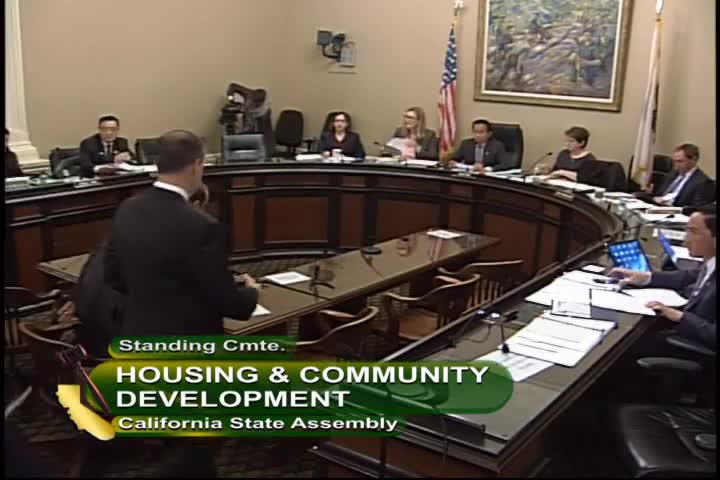 16MIN
Assembly Standing Committee on Housing and Community Development
Bill Author

Bill Co-Author(s):
