AB 1882: Sex crimes: communication with a minor.
- Session Year: 2017-2018
- House: Assembly
- Latest Version Date: 2018-08-31
Existing law, as added by Proposition 83 of the November 7, 2006, statewide general election, makes it a crime for a person to contact or communicate with a minor, or attempt to contact or communicate with a minor, who knows or reasonably should know that the person is a minor, with intent to commit a specified offense involving the minor, including, among other offenses, kidnapping and rape.
This bill would additionally make it a crime to contact or communicate with a minor, or attempt to contact or communicate with a minor, as specified, with the intent to commit human trafficking of the minor. By expanding the definition of a crime, the bill would impose a state-mandated local program.
The California Constitution requires the state to reimburse local agencies and school districts for certain costs mandated by the state. Statutory provisions establish procedures for making that reimbursement.
This bill would provide that no reimbursement is required by this act for a specified reason.
(a)Every person who contacts or communicates with a minor, or attempts to contact or communicate with a minor, who knows or reasonably should know that the person is a minor, with intent to commit an offense specified in subdivision (c) of Section 236.1 or Section 207, 209, 261, 264.1, 273a, 286, 288, 288a, 288.2, 289, 311.1, 311.2, 311.4 or 311.11 involving the minor shall be punished by imprisonment in the state prison for the term prescribed for an attempt to commit the intended offense.
(b)As used in this section, contacts or communicates with includes direct and indirect contact or communication that may be achieved personally or by use of an agent or agency, any print medium, any postal service, a common carrier or communication common carrier, any electronic communications system, or any telecommunications, wire, computer, or radio communications device or system.
(c)A person convicted of a violation of subdivision (a) who has previously been convicted of a violation of subdivision (a) shall be punished by an additional and consecutive term of imprisonment in the state prison for five years.
SEC. 2.No reimbursement is required by this act pursuant to Section 6 of Article XIIIB of the California Constitution because the only costs that may be incurred by a local agency or school district will be incurred because this act creates a new crime or infraction, eliminates a crime or infraction, or changes the penalty for a crime or infraction, within the meaning of Section 17556 of the Government Code, or changes the definition of a crime within the meaning of Section 6 of Article XIIIB of the California Constitution.
(a)Every person who contacts or communicates with a minor, or attempts to contact or communicate with a minor, who knows or reasonably should know that the person is a minor, with intent to commit an offense specified in subdivision (c) of Section 236.1 or Section 207, 209, 261, 264.1, 273a, 286, 288, 288a, 288.2, 289, 311.1, 311.2, 311.4 or 311.11 involving the minor shall be punished by imprisonment in the state prison for the term prescribed for an attempt to commit the intended offense.
(b)As used in this section, contacts or communicates with shall include includes direct and indirect contact or communication that may be achieved personally or by use of an agent or agency, any print medium, any postal service, a common carrier or communication common carrier, any electronic communications system, or any telecommunications, wire, computer, or radio communications device or system.
(c)A person convicted of a violation of subdivision (a) who has previously been convicted of a violation of subdivision (a) shall be punished by an additional and consecutive term of imprisonment in the state prison for five years.
SEC. 2.No reimbursement is required by this act pursuant to Section 6 of Article XIIIB of the California Constitution because the only costs that may be incurred by a local agency or school district will be incurred because this act creates a new crime or infraction, eliminates a crime or infraction, or changes the penalty for a crime or infraction, within the meaning of Section 17556 of the Government Code, or changes the definition of a crime within the meaning of Section 6 of Article XIIIB of the California Constitution.
(a)Every person who contacts or communicates with a minor, or attempts to contact or communicate with a minor, who knows or reasonably should know that the person is a minor, with intent to commit an offense specified in subdivision (c) of Section 236.1 or Section 207, 209, 261, 264.1, 273a, 286, 288, 288a, 288.2, 289, 311.1, 311.2, 311.4 or 311.11 involving the minor shall be punished by imprisonment in the state prison for the term prescribed for an attempt to commit the intended offense.
(b)As used in this section, contacts or communicates with shall include direct and indirect contact or communication that may be achieved personally or by use of an agent or agency, any print medium, any postal service, a common carrier or communication common carrier, any electronic communications system, or any telecommunications, wire, computer, or radio communications device or system.
(c)A person convicted of a violation of subdivision (a) who has previously been convicted of a violation of subdivision (a) shall be punished by an additional and consecutive term of imprisonment in the state prison for five years.
SEC. 2.No reimbursement is required by this act pursuant to Section 6 of Article XIIIB of the California Constitution because the only costs that may be incurred by a local agency or school district will be incurred because this act creates a new crime or infraction, eliminates a crime or infraction, or changes the penalty for a crime or infraction, within the meaning of Section 17556 of the Government Code, or changes the definition of a crime within the meaning of Section 6 of Article XIIIB of the California Constitution.
REVISIONS: HeadingLines 1 and 2.|
Date
|
Status
|
|---|---|
| Sep 27, 2018 | Vetoed by Governor. |
| Sep 6, 2018 | Enrolled and presented to the Governor at 3 p.m. |
| Aug 29, 2018 | Senate amendments concurred in. To Engrossing and Enrolling. |
| Aug 24, 2018 | In Assembly. Concurrence in Senate amendments pending. May be considered on or after August 26 pursuant to Assembly Rule 77. |
| Aug 24, 2018 | Read third time. Passed. Ordered to the Assembly. |
| Aug 21, 2018 | Ordered to special consent calendar. |
| Aug 17, 2018 | From committee: Do pass. (Ayes 7. Noes 0.) (August 16). |
| Jul 2, 2018 | In committee: Referred to APPR. suspense file. |
| Jun 20, 2018 | From committee: Do pass and re-refer to Com. on APPR. (Ayes 7. Noes 0.) (June 19). Re-referred to Com. on APPR. |
| Jun 12, 2018 | From committee chair, with author's amendments: Amend, and re-refer to committee. Read second time, amended, and re-referred to Com. on PUB. S. |
| Jun 7, 2018 | Referred to Com. on PUB. S. |
| May 30, 2018 | In Senate. Read first time. To Com. on RLS. for assignment. |
| May 29, 2018 | Read third time. Passed. Ordered to the Senate. |
| May 25, 2018 | From committee: Do pass. (Ayes 16. Noes 0.) (May 25). |
| Apr 4, 2018 | In committee: Set, first hearing. Referred to suspense file. |
| Mar 6, 2018 | From committee: Do pass and re-refer to Com. on APPR. (Ayes 6. Noes 0.) (March 6). Re-referred to Com. on APPR. |
| Jan 29, 2018 | Referred to Com. on PUB. S. |
| Jan 18, 2018 | From printer. May be heard in committee February 17. |
| Jan 17, 2018 | Read first time. To print. |
|
Date
|
Description
|
Location
|
Votes
|
|
|---|---|---|---|---|
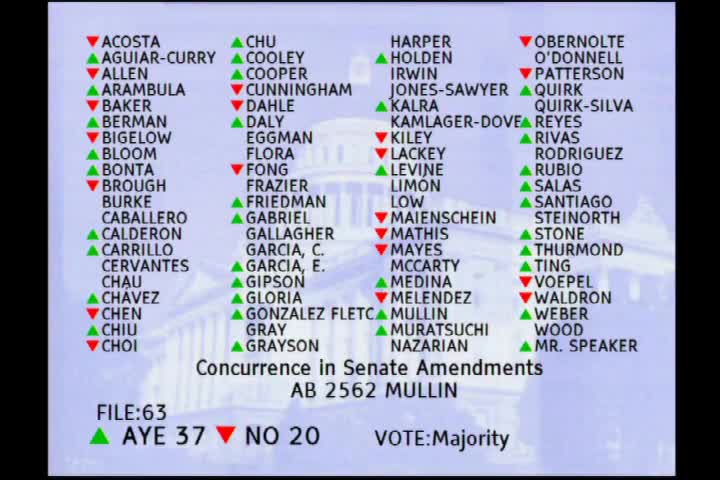
| Aug 29, 2018 | AB 1882 CERVANTES Concurrence in Senate Amendments | Assembly Floor |
Passed |
|
| Aug 24, 2018 | Special Consent AB1882 | Senate Floor |
Passed |
|
| Aug 16, 2018 | Do pass | Senate Standing Committee on Appropriations |
Passed |
|
| Jul 2, 2018 | Placed on suspense file | Senate Standing Committee on Appropriations |
Passed |
|
| Jun 19, 2018 | Do pass, but first be re-referred to the Committee on [Appropriations] | Senate Standing Committee on Public Safety |
Passed |
|
| May 29, 2018 | AB 1882 CERVANTES Assembly Third Reading | Assembly Floor |
Passed |
|
| May 25, 2018 | Do pass. | Assembly Standing Committee on Appropriations |
Passed |
|
| Mar 6, 2018 | Do pass and be re-referred to the Committee on [Appropriations] | Assembly Standing Committee on Public Safety |
Passed |
This list shows positions taken on this bill by organizations on the date displayed, which is linked to the original source.
Positions by individuals are not included.
|
Organization
|
Position
|
Date
|
|---|---|---|
| Alameda County | * Support | Mar 6, 2018 |
| Alameda County District Attorney | ** Support | Aug 18, 2018 |
| American Civil Liberties Union of California | ** Against | Aug 18, 2018 |
| Assembly Floor Vote: 76 - 0 | ** Against | Jun 18, 2018 |
| Association of Deputy District Attorneys | * Support | Jun 19, 2018 |
| California College And University Police Chiefs Association | * Support | Jun 19, 2018 |
| California District Attorneys Association | ** Support | Aug 18, 2018 |
| California Narcotic Officers Association | * Support | Jun 19, 2018 |
| California Police Chiefs Association | ** Support | Aug 18, 2018 |
| California State Sheriffs' Association | ** Support | Aug 18, 2018 |
| California Statewide Law Enforcement Association | ** Support | Aug 18, 2018 |
| Citizens for Law & Order | * Support | Jun 19, 2018 |
| Crime Victims Action Alliance | * Support | Jun 19, 2018 |
| Crime Victims United Of California | ** Support | Aug 18, 2018 |
| Gfwc California Federation Of Women'S Clubs | ** Support | Aug 18, 2018 |
| Jewish Public Affairs Committee Of California | ** Support | Aug 18, 2018 |
| Junior Leagues of California | ** Support | Aug 18, 2018 |
| Los Angeles County District Attorney'S Office | ** Support | Aug 18, 2018 |
| Los Angeles County Professional Peace Officers Association | ** Support | Aug 18, 2018 |
| Peace Officers Research Association Of California | ** Support | Aug 18, 2018 |
| PURPOSE | ** Against | Jun 18, 2018 |
| Riverside Sheriffs' Association | ** Support | Aug 18, 2018 |
GOVERNOR'S VETO
GV Bill Id:AB 1882
Author:(Cervantes and Cooley)
As Enrolled Ver:September 6, 2018
2/3 vote
ASSEMBLY: | 76-0 | (May 29, 2018) | SENATE: | 39-0 | (August 24, 2018) |
ASSEMBLY: | 79-0 | (August 29, 2018) |
|
|
Original Committee Reference: PUB. S.
SUMMARY: Adds human trafficking to the list of offenses for which it is a crime to contact or communicate with a minor for the purposes of committing a crime involving the minor.
The Senate amendment makes a non-substantive change.
EXISTING LAW:
- States that a person is guilty of human trafficking if they cause, induce, or persuade a minor, or attempt to cause, induce, or persuade a minor, to engage in a commercial sex act, with the intent to violate specified commercial sex offenses. A person convicted of a violation of this statute shall be punished by imprisonment in the state prison for five, eight, or 12 years and a fine not more than $500,000. If the offense involves force, fear, fraud, deceit, coercion, violence, duress, menace, or threat of unlawful injury to the victim or to another person, punishment shall be imprisonment in the state prison for 15 years to life and a fine not more than $500,000.
- States that every person who contacts or communicates with a minor, or attempts to contact or communicate with a minor, with intent to commit a specified offense involving the minor, shall be punished by imprisonment in the state prison for the term prescribed for an attempt to commit the intended offense. A person convicted of a violation of this statute who has previously been convicted of a violation of this statute shall be punished by an additional and consecutive term of imprisonment in the state prison for five years.
- Defines "contacts or communicates with" as direct and indirect contact or communication personally or by use of an agent or agency, print medium, postal service, common carrier or communication common carrier, electronic communications system, telecommunications, wire, computer, or radio communications device or system.
- States that a person who arranges a meeting with a minor, for the purpose of engaging in lewd or lascivious behavior, shall be punished by a fine not exceeding $5,000, imprisonment in a county jail not exceeding one year, or both.
- Provides that punishment for an attempt is for half the term of imprisonment prescribed for the offense attempted and a fine not exceeding half the largest fine which may be imposed for the offense attempted.
AS PASSED BY THE ASSEMBLY this bill added human trafficking to the list of offenses for which it is a crime to contact or communicate with a minor for the purposes of committing a crime involving the minor.
FISCAL EFFECT: According to the Senate Appropriations Committee:
- State prison: Unknown, potential increase in state costs for new or longer commitments to state prison for persons found guilty of the crime expanded upon by this bill. The proposed 2018-19 per capita cost to house a person in a state prison is $80,729 annually, with an annual marginal rate per inmate of between $10,000 and $12,000. The average contract-prison rate cost per inmate is over $30,000 annually. The actual costs would depend on how many defendants are sentenced to prison for this expanded crime. (General Fund)
- Court: Unknown, potentially-significant workload cost pressures to the court to adjudicate charges brought against defendants who contact or communicate with a minor as proscribed by this measure. While the courts are not funded on a workload basis, an increase in workload could result in delayed court services and would put pressure on the General Fund to fund additional staff and resources. (General Fund*)
*Trial Court Trust Fund
COMMENTS: According to the author, ''Unfortunately, California is one of the most frequent sites of human trafficking in the United States. In 2016, California had over 1,300 incidences of human trafficking, which is more than double what any other state experienced. That is especially concerning given that so many cases of human trafficking go unreported. In addition, Los Angeles, San Francisco, San Diego, and Sacramento are often cited as being amongst the biggest human trafficking hubs in the Nation.
''In late January of this year, a regional human trafficking task force based out of Los Angeles arrested more than 500 human trafficking suspects in a sting operation. As part of the operation, law enforcement officials set up decoy accounts soliciting human trafficking on Facebook and other online platforms, and were taken aback by the amount of traffic these accounts generated. Indeed, ongoing integration of the internet and social media into daily life has made platforms such as Facebook and Instagram a more frequent tool for human traffickers to make contact with potential victims.
''AB 1882 would close this loophole by making it a felony to contact a minor with the intent to engage in human trafficking. This will help law enforcement combat the growing use of the internet by human traffickers.''
This bill adds human trafficking to the list of offenses for which it is a crime to contact or communicate with a minor for the purposes of committing a crime involving the minor.
While well intentioned, this bill is not necessary. A myriad of statutes provide punishment for commercial sex acts, as well as using, paying or employing minors to commit commercial sex acts. Additionally, anyone who contacts or communicates-or attempts to contact or communicate-with a minor with the intent to commit a sex offense, including human trafficking, is liable to be prosecuted with an attempt to commit any number of felonies.
Analysis Prepared by: Liah Burnley / PUB. S. / (916) 319-3744 FN: 0005296
CONCURRENCE IN SENATE AMENDMENTS
CSA1 Bill Id:AB 1882
Author:(Cervantes and Cooley)
As Amended Ver:June 12, 2018
Majority vote
ASSEMBLY: | 76-0 | (May 29, 2018) | SENATE: | 39-0 | (August 24, 2018) |
Original Committee Reference: PUB. S.
SUMMARY: Adds human trafficking to the list of offenses for which it is a crime to contact or communicate with a minor for the purposes of committing a crime involving the minor.
The Senate amendment makes a non-substantive change.
EXISTING LAW:
- States that a person is guilty of human trafficking if they cause, induce, or persuade a minor, or attempt to cause, induce, or persuade a minor, to engage in a commercial sex act, with the intent to violate specified commercial sex offenses. A person convicted of a violation of this statute shall be punished by imprisonment in the state prison for five, eight, or 12 years and a fine not more than $500,000. If the offense involves force, fear, fraud, deceit, coercion, violence, duress, menace, or threat of unlawful injury to the victim or to another person, punishment shall be imprisonment in the state prison for 15 years to life and a fine not more than $500,000.
- States that every person who contacts or communicates with a minor, or attempts to contact or communicate with a minor, with intent to commit a specified offense involving the minor, shall be punished by imprisonment in the state prison for the term prescribed for an attempt to commit the intended offense. A person convicted of a violation of this statute who has previously been convicted of a violation of this statute shall be punished by an additional and consecutive term of imprisonment in the state prison for five years.
- Defines "contacts or communicates with" as direct and indirect contact or communication personally or by use of an agent or agency, print medium, postal service, common carrier or communication common carrier, electronic communications system, telecommunications, wire, computer, or radio communications device or system.
- States that a person who arranges a meeting with a minor, for the purpose of engaging in lewd or lascivious behavior, shall be punished by a fine not exceeding $5,000, imprisonment in a county jail not exceeding one year, or both.
- Provides that punishment for an attempt is for half the term of imprisonment prescribed for the offense attempted and a fine not exceeding half the largest fine which may be imposed for the offense attempted.
AS PASSED BY THE ASSEMBLY: this bill added human trafficking to the list of offenses for which it is a crime to contact or communicate with a minor for the purposes of committing a crime involving the minor.
FISCAL EFFECT: According to the Senate Appropriations Committee:
- State prison: Unknown, potential increase in state costs for new or longer commitments to state prison for persons found guilty of the crime expanded upon by this bill. The proposed 2018-19 per capita cost to house a person in a state prison is $80,729 annually, with an annual marginal rate per inmate of between $10,000 and $12,000. The average contract-prison rate cost per inmate is over $30,000 annually. The actual costs would depend on how many defendants are sentenced to prison for this expanded crime. (General Fund)
- Court: Unknown, potentially-significant workload cost pressures to the court to adjudicate charges brought against defendants who contact or communicate with a minor as proscribed by this measure. While the courts are not funded on a workload basis, an increase in workload could result in delayed court services and would put pressure on the General Fund to fund additional staff and resources. (General Fund*)
*Trial Court Trust Fund
COMMENTS: According to the author, ''Unfortunately, California is one of the most frequent sites of human trafficking in the United States. In 2016, California had over 1,300 incidences of human trafficking, which is more than double what any other state experienced. That is especially concerning given that so many cases of human trafficking go unreported. In addition, Los Angeles, San Francisco, San Diego, and Sacramento are often cited as being amongst the biggest human trafficking hubs in the Nation.
''In late January of this year, a regional human trafficking task force based out of Los Angeles arrested more than 500 human trafficking suspects in a sting operation. As part of the operation, law enforcement officials set up decoy accounts soliciting human trafficking on Facebook and other online platforms, and were taken aback by the amount of traffic these accounts generated. Indeed, ongoing integration of the internet and social media into daily life has made platforms such as Facebook and Instagram a more frequent tool for human traffickers to make contact with potential victims.
''AB 1882 would close this loophole by making it a felony to contact a minor with the intent to engage in human trafficking. This will help law enforcement combat the growing use of the internet by human traffickers.''
Analysis Prepared by: Liah Burnley / PUB. S. / (916) 319-3744 FN: 0004345
Office of Senate Floor Analyses (916) 651-1520 Fax: (916) 327-4478 | AB |
THIRD READING
Bill No: AB 1882
:
SENATE PUBLIC SAFETY COMMITTEE: 7-0, 6/19/18
AYES: Skinner, Anderson, Bradford, Jackson, Mitchell, Stone, Wiener
SENATE APPROPRIATIONS COMMITTEE: 7-0, 8/16/18
AYES: Portantino, Bates, Beall, Bradford, Hill, Nielsen, Wiener
ASSEMBLY FLOOR: 76-0, 5/29/18 - See last page for vote
DIGEST:
This bill adds human trafficking to the list of offenses for which it is a crime to contact or communicate with a minor for the purposes of committing a crime involving the minor.
Existing law:
- States that a person is guilty of human trafficking if they cause, induce, or persuade a minor, or attempt to cause, induce, or persuade a minor, to engage in a commercial sex act, with the intent to violate specified commercial sex offenses. A person convicted of a violation of this statute shall be punished by imprisonment in the state prison for five, eight, or 12 years and a fine not more than $500,000. If the offense involves force, fear, fraud, deceit, coercion, violence, duress, menace, or threat of unlawful injury to the victim or to another person, punishment shall be imprisonment in the state prison for 15 years to life and a fine not more than $500,000. (Pen. Code, § 236.1 subd. (c).)
- Specifies that every person who contacts or communicates with a minor, or attempts to contact or communicate with a minor, who knows or reasonably should know that the person is a minor, with intent to commit any of the following offenses involving the minor shall be punished by imprisonment in the state prison for the term prescribed for an attempt to commit the intended offense. The offenses included in this section are listed as follows: (Pen. Code, §, 288.3, subd. (a).)
- Kidnapping;
- Kidnapping for ransom, reward, extortion, robbery, or rape;
- Rape;
- Rape by a foreign object;
- Willful harm or injury to a child;
- Sodomy;
- Lewd and lascivious acts with a minor;
- Oral copulation;
- Harmful matter sent to minor;
- Forcible sexual penetration; and
- Child pornography.
- Kidnapping;
- Defines “contacts or communicates with” as direct and indirect contact or communication personally or by use of an agent or agency, print medium, postal service, common carrier or communication common carrier, electronic communications system, telecommunications, wire, computer, or radio communications device or system. (Pen. Code, § 288.3 subd. (b).)
- States that a person who arranges a meeting with a minor, for the purpose of engaging in lewd or lascivious behavior, shall be punished by a fine not exceeding $5,000, imprisonment in a county jail not exceeding one year, or both. (Pen. Code, § 288.4.)
- Provides that punishment for an attempt is for half the term of imprisonment prescribed for the offense attempted and a fine not exceeding half the largest fine which may be imposed for the offense attempted. (Pen. Code, § 664.)
This bill adds human trafficking to the list of offenses for which it is a crime to contact or communicate with a minor for the purposes of committing a crime involving the minor.
Background
Human trafficking involves the recruitment, transportation or sale of people for forced labor. Through violence, threats and coercion, victims are forced to work in, among other things, the sex trade, domestic labor, factories, hotels and agriculture. According to the January 2005 United States Department of State's Human Smuggling and Trafficking Center report, "Fact Sheet: Distinctions Between Human Smuggling and Human Trafficking", there is an estimated 600,000 to 800,000 men, women and children trafficked across international borders each year. Of these, approximately 80% are women and girls and up to 50% are minors. A recent report by the Human Rights Center at the University of California, Berkeley cited 57 cases of forced labor in California between 1998 and 2003, with over 500 victims. The report, "Freedom Denied", notes most of the victims in California were from Thailand, Mexico, and Russia and had been forced to work as prostitutes, domestic slaves, farm laborers or sweatshop employees. (University of California, Berkeley Human Rights Center, "Freedom Denied: Forced Labor in California" (February, 2005).) According to the author:
“While the clandestine nature of human trafficking makes it enormously difficult to accurately track how many people are affected, the United States government estimates that about 17,000 to 20,000 women, men and children are trafficked into the United States each year, meaning there may be as many as 100,000 to 200,000 people in the United States working as modern slaves in homes, sweatshops, brothels, agricultural fields, construction projects and restaurants.”
In 2012, Proposition 35 modified many provisions of California's human trafficking laws. The proposition increased criminal penalties for human trafficking, including prison sentences up to 15-years-to-life and fines up to $1,500,000. Additionally, the proposition specified that the fines collected are to be used for victim services and law enforcement. Proposition 35 requires persons convicted of trafficking to register as sex offenders. Proposition 35 prohibits evidence from being used against a victim in court proceedings if that victim engaged in sexual conduct. Additionally, the proposition lowered the evidential requirements for showing of force in cases of minors.
In October 2000, the Trafficking Victims Protection Act of 2000 (TVPA) was enacted and is comprehensive, addressing the various ways of combating trafficking, including prevention, protection and prosecution. The prevention measures include the authorization of educational and public awareness programs. Protection and assistance for victims of trafficking include making housing, educational, health-care, job training and other federally funded social service programs available to assist victims in rebuilding their lives. Finally, the TVPA provides law enforcement with tools to strengthen the prosecution and punishment of traffickers, making human trafficking a federal crime.
In 2012, Californians voted to pass Proposition 35, which modified many provisions of California's already tough human trafficking laws. Specifically, Proposition 35 increased criminal penalties for human trafficking offenses, including prison sentences up to 15-years-to-life and fines up to $1.5 million. The proposition specified that the fines collected are to be used for victim services and law enforcement. In criminal trials, the proposition prohibits the use of evidence that a person was involved in criminal sexual conduct (such as prostitution) to prosecute that person for that crime if the conduct was a result of being a victim of human trafficking, and makes evidence of sexual conduct by a victim of human trafficking inadmissible for the purposes of attacking the victim’s credibility or character in court. The proposition lowered the evidentiary requirements for showing of force in cases of minors.
Proposition 35 also requires persons convicted of human trafficking to register as sex offenders and expanded registration requirements by requiring registered sex offenders to provide the names of their internet providers and identifiers, such as e-mail addresses, user names, and screen names, to local police or sheriff’s departments. Immediately following the passage of Proposition 35, a District Court granted an order enjoining the implementation of the parts of the proposition that requires registered sex offenders to provide identifying information about their online accounts to local law enforcement agencies. On November 18, 2014, the Ninth Circuit Court affirmed the District Court’s order granting the preliminary injunction, concluding that "Appellees are likely to succeed on the merits of their First Amendment challenge." (See Doe v. Harris, 2014 U.S. App. LEXIS 21808 (9th Cir. Nov. 18, 2014).)
Due to litigation, the provisions in Proposition 35 related to Internet identifiers have never gone into effect. Currently, these provisions are pending a permanent injunction because the court has declared them to violate the First Amendment of the United States Constitution and therefore cannot be enforced. (See Order Staying Case of April 7, 2015 and Scheduling Order of October 26, 2015, 12-cv-05713-THE, Doe v. Harris.)
In response to Doe, the SB 448 (Hueso), Chapter 772, Statutes of 2016, requires a person convicted of a felony on or after January 1, 2017, for which the person must register as a sex offender, to register his or her Internet identifiers, as defined, to law enforcement if the person used the Internet to identify a victim, or to commit human trafficking or child pornography offenses; and authorizes law enforcement to use the information to investigate a sex crime, kidnapping or human trafficking, as specified.
Various statutes proved punishment for commercial sex acts, including: kidnapping, kidnapping for ransom, reward, or extortion, or to commit robbery or rape, rape, unlawful sexual intercourse with a minor, rape by foreign object , acting in concert by force or violence, pimping, pandering, and prostitution, willful harm or injury to a child, sodomy, lewd or lascivious acts, oral copulation, sending obscene matter to a child, contact of a minor with intent to commit sexual offense, forcible acts of sexual penetration, distributing obscene matter depicting a minor, sexual exploitation of a child, and employing or using a minor to perform obscene acts.
Under existing law a person who fails to complete a crime may be convicted of an attempt. An attempt requires intent to commit a specific crime and a direct but ineffectual act taken towards the commission of the crime. (Pen. Code, § 21 subd., (a).) Attempt is punishable by half of the term of imprisonment prescribed for the offense attempted. (Pen. Code, § 664.) A person who contacts or communicates, or attempts to contact or communicate, with a minor with the intent to commit a sex offense, including human trafficking, could be prosecuted with an attempt to commit the underlying offense.
FISCAL EFFECT: Appropriation: Fiscal Com.: Local:
According to the Senate Appropriations Committee:
- State prison: Unknown, potential increase in state costs for new or longer commitments to state prison for persons found guilty of the crime expanded upon by this bill. The proposed 2018-19 per capita cost to house a person in a state prison is $80,729 annually, with an annual marginal rate per inmate of between $10,000 and $12,000. The average contract-prison rate cost per inmate is over $30,000 annually. The actual costs would depend on how many defendants are sentenced to prison for this expanded crime. (General Fund)
- Court: Unknown, potentially-significant workload cost pressures to the court to adjudicate charges brought against defendants who contact or communicate with a minor as proscribed by this measure. While the courts are not funded on a workload basis, an increase in workload could result in delayed court services and would put pressure on the General Fund to fund additional staff and resources. (General Fund*)
*Trial Court Trust Fund
Alameda County District Attorney
California District Attorneys Association
California Police Chiefs Association
California State Sheriffs’ Association
California Statewide Law Enforcement Association
Crime Victims United of California
GFWC California Federation of Women’s Clubs
Jewish Public Affairs Committee of California
Junior Leagues of California
Los Angeles County District Attorney’s Office
Los Angeles County Professional Peace Officers Association
Peace Officers Research Association of California
Riverside Sheriffs’ Association
OPPOSITION: (Verified 8/16/18)
American Civil Liberties Union of California
ASSEMBLY FLOOR: 76-0, 5/29/18
AYES: Acosta, Aguiar-Curry, Travis Allen, Arambula, Baker, Berman, Bigelow, Bloom, Bonta, Brough, Burke, Caballero, Calderon, Carrillo, Cervantes, Chau, Chávez, Chen, Chiu, Choi, Chu, Cooley, Cooper, Cunningham, Dahle, Daly, Eggman, Flora, Fong, Frazier, Friedman, Gallagher, Cristina Garcia, Eduardo Garcia, Gipson, Gloria, Gonzalez Fletcher, Gray, Grayson, Harper, Holden, Irwin, Jones-Sawyer, Kalra, Kiley, Lackey, Levine, Limón, Low, Maienschein, Mathis, Mayes, McCarty, Medina, Melendez, Mullin, Muratsuchi, Nazarian, Obernolte, O'Donnell, Patterson, Quirk-Silva, Reyes, Rodriguez, Rubio, Salas, Santiago, Steinorth, Mark Stone, Thurmond, Ting, Voepel, Waldron, Weber, Wood, Rendon
NO VOTE RECORDED: Kamlager-Dove, Quirk
8/18/18 14:14:28
**** END ****
SENATE COMMITTEE ON
Senator Anthony Portantino, Chair
2017 - 2018 Regular Session
AB 1882 (Cervantes) - Sex crimes: communication with a minor
Version: | Policy Vote: |
Urgency: | Mandate: |
Hearing Date: | Consultant: |
This bill meets the criteria for referral to the Suspense File.
Bill Summary:
AB 1882 would expand the crime of contacting or communicating with a minor, with the intent to commit a specified sex offense involving the minor, to include contacting or communicating with a minor with the intent to commit human trafficking, as specified.
Fiscal Impact:
- State prison: Unknown, potential increase in state costs for new or longer commitments to state prison for persons found guilty of the crime expanded upon by this bill. The proposed 2018-19 per capita cost to house a person in a state prison is $80,729 annually, with an annual marginal rate per inmate of between $10,000 and $12,000. The average contract-prison rate cost per inmate is over $30,000 annually. The actual costs would depend on how many defendants are sentenced to prison for this expanded crime. (General Fund)
- Court: Unknown, potentially-significant workload cost pressures to the court to adjudicate charges brought against defendants who contact or communicate with a minor as proscribed by this measure. While the courts are not funded on a workload basis, an increase in workload could result in delayed court services and would put pressure on the General Fund to fund additional staff and resources. (General Fund*)
*Trial Court Trust Fund
Background:
A person who contacts or communicates with a minor, or attempts to contact or communicate with a minor, who knows or reasonably should know that the person is a minor, with intent to commit any of the following offenses involving the minor is required to be punished by imprisonment in the state prison for the term prescribed for an attempt to commit the intended offense:
- Kidnapping;
- Kidnapping for ransom, reward, extortion, robbery, or rape;
- Rape;
- Sexual penetration other than rape or sodomy;
- Willful harm or injury to a child;
- Sodomy;
- Lewd and lascivious acts with a minor;
- Oral copulation;
- Harmful matter sent to minor;
- Forcible sexual penetration; and
- Child pornography.
Additionally, a person with a prior conviction of contacting or communicating with a minor with the intent to commit a specified sex crime is subject to a five-year consecutive term of imprisonment in state prison for any subsequent violation of this offense.
A person is guilty of the crime of human trafficking a minor for sex when he or she causes, induces, or persuades, or attempts to cause, induce, or persuade, a minor to engage in a commercial sex act, with specified intent. The punishment for this crime is five, eight, or twelve years imprisonment in the state prison and a base fine of up to $500,000. If the conduct involved force, fear, fraud, deceit, coercion, violence, duress, menace, or threat of unlawful injury, the term of imprisonment is increased to fifteen years to life.
Generally, the punishment for attempt of a crime is one half the sentence of the completed offense. The punishment for attempted human trafficking, however, is the same punishment as the completed crime.
Proposed Law:
This bill would add human trafficking of a minor for sex to the list of target crimes subject to the offense of contacting or communicating with a minor with the intent to commit an offense involving the minor.
Related Legislation:
AB 371 (Cooley, 2017) and AB 2327 (Cooley, 2016) were substantively the same as this bill. AB 371 and AB 2327 were held on the Suspense File of this Committee.
Staff Comments:
Data from the Department of Justice indicates about 250 arrests annually under the specified offense of communicating with a minor with the intent to commit a specified crime, with an average of 82 annual arrests (33 percent) leading to convictions.
The fiscal impact of this bill cannot be known with certainty, as the actual impact will be dependent on numerous factors, including, but not limited to, judicial and prosecutorial discretion, the criminal history of the defendant, and the factors unique to each case. To the extent even one additional defendant is committed to state prison as a result of this bill, state incarceration costs would surpass the Suspense File threshold. Additionally, as the crime created by this bill is punishable with the potential for incarceration, certain rights to the defendants are attached to the proceedings, including the right to a jury trial and the right to counsel (at public expense if the defendants are unable to afford the costs of representation) which could lead to lengthier court proceedings. Consequently, to the extent that the court adjudicates more than three of these new felony offenses, on average, that otherwise would not have been filed or resulted in a criminal action but for the alleged violation of contacting or communicating with a minor with intent to traffic, costs to the court resulting from this bill would be significant.
California is subject to a federal court order to reduce its in-state adult institution population to 137.5 percent of design capacity. The state has undertaken efforts to implement a durable remedy to reduce and avoid prison overcrowding. On June 6, 2018, 114,881 inmates were housed in the state’s thirty-five adult institutions, 6,336 were housed in in-state contract beds, and 3,014 inmates were housed in out-of-state facilities. The prison population changes daily as new inmates are admitted and others are released, but, on that date, the state’s prison population was approximately 135.0 percent of design capacity. By increasing the length of incarceration, this bill could result in an increase of the inmate population in in-state institutions and exacerbate overcrowding.
-- END --
SENATE COMMITTEE ON PUBLIC SAFETY
Senator Nancy Skinner, Chair
2017 - 2018 Regular
Bill No: AB 1882 Hearing Date: June 19, 2018
Author: | Cervantes | ||
Version: | June 12, 2018 | ||
Urgency: | No | Fiscal: | Yes |
Consultant: | GC | ||
Subject: Sex Crimes: Communication With a Minor
HISTORY
Source: Alameda County District Attorney
Prior Legislation: AB 371 (Cooley), 2017, held in the Senate Appropriations
AB 2327 (Cooley), 2016, held in the Senate Appropriations
Support: California District Attorneys Association; California Police Chiefs Association; California State Sheriffs’ Association; California Statewide Law Enforcement Association; Crime Victims United of California; GFWC California Federation of Women’s Clubs; Jewish Public Affairs Committee of California; Junior Leagues of California; Los Angeles County Professional Peace Officers Association; Riverside Sheriffs’ Association
Opposition: American Civil Liberties Union of California
Assembly Floor Vote: 76 - 0
PURPOSE
The purpose of this bill is to add human trafficking to the list of offenses for which it is a crime to contact or communicate with a minor for the purposes of committing a crime involving the minor.
Existing law states that a person is guilty of human trafficking if they cause, induce, or persuade a minor, or attempt to cause, induce, or persuade a minor, to engage in a commercial sex act, with the intent to violate specified commercial sex offenses. A person convicted of a violation of this statute shall be punished by imprisonment in the state prison for five, eight, or 12 years and a fine not more than $500,000. If the offense involves force, fear, fraud, deceit, coercion, violence, duress, menace, or threat of unlawful injury to the victim or to another person, punishment shall be imprisonment in the state prison for 15 years to life and a fine not more than $500,000. (Pen. Code, § 236.1 subd. (c).)
Existing law specifies that every person who contacts or communicates with a minor, or attempts to contact or communicate with a minor, who knows or reasonably should know that the person is a minor, with intent to commit any of the following offenses involving the minor shall be punished by imprisonment in the state prison for the term prescribed for an attempt to commit the intended offense. The offenses included in this section are listed as follows: (Pen. Code, §, 288.3, subd. (a).)
- Kidnapping;
- Kidnapping for ransom, reward, extortion, robbery, or rape;
- Rape;
- Rape by a foreign object;
- Willful harm or injury to a child;
- Sodomy;
- Lewd and lascivious acts with a minor;
- Oral copulation;
- Harmful matter sent to minor;
- Forcible sexual penetration; and
- Child pornography.
- Kidnapping;
Existing law defines “contacts or communicates with” as direct and indirect contact or communication personally or by use of an agent or agency, print medium, postal service, common carrier or communication common carrier, electronic communications system, telecommunications, wire, computer, or radio communications device or system. (Pen. Code, § 288.3 subd. (b).)
Existing law states that a person who arranges a meeting with a minor, for the purpose of engaging in lewd or lascivious behavior, shall be punished by a fine not exceeding $5,000, imprisonment in a county jail not exceeding one year, or both. (Pen. Code, § 288.4.)
Existing law provides that punishment for an attempt is for half the term of imprisonment prescribed for the offense attempted and a fine not exceeding half the largest fine which may be imposed for the offense attempted. (Pen. Code, § 664.)
This bill adds human trafficking to the list of offenses for which it is a crime to contact or communicate with a minor for the purposes of committing a crime involving the minor.
COMMENTS
- Need for This Bill
According to the author:
Unfortunately, California is one of the most frequent sites of human trafficking in the United States. In 2016, California had over 1,300 incidences of human trafficking, which is more than double what any other state experienced. That is especially concerning given that so many cases of human trafficking go unreported. In addition, Los Angeles, San Francisco, San Diego, and Sacramento are often cited as being amongst the biggest human trafficking hubs in the Nation.
In late January of this year, a regional human trafficking task force based out of Los Angeles arrested more than 500 human trafficking suspects in a sting operation. As part of the operation, law enforcement officials set up decoy accounts soliciting human trafficking on Facebook and other online platforms, and were taken aback by the amount of traffic these accounts generated. Indeed, ongoing integration of the internet and social media into daily life has made platforms such as Facebook and Instagram a more frequent tool for human traffickers to make contact with potential victims.
AB 1882 would close this loophole by making it a felony to contact a minor with the intent to engage in human trafficking. This will help law enforcement combat the growing use of the internet by human traffickers.
- Human Trafficking Generally
Human trafficking involves the recruitment, transportation or sale of people for forced labor. Through violence, threats and coercion, victims are forced to work in, among other things, the sex trade, domestic labor, factories, hotels and agriculture. According to the January 2005 United States Department of State's Human Smuggling and Trafficking Center report, "Fact Sheet: Distinctions Between Human Smuggling and Human Trafficking", there is an estimated 600,000 to 800,000 men, women and children trafficked across international borders each year. Of these, approximately 80% are women and girls and up to 50% are minors. A recent report by the Human Rights Center at the University of California, Berkeley cited 57 cases of forced labor in California between 1998 and 2003, with over 500 victims. The report, "Freedom Denied", notes most of the victims in California were from Thailand, Mexico, and Russia and had been forced to work as prostitutes, domestic slaves, farm laborers or sweatshop employees. (University of California, Berkeley Human Rights Center, "Freedom Denied: Forced Labor in California" (February, 2005).) According to the author:
While the clandestine nature of human trafficking makes it enormously difficult to accurately track how many people are affected, the United States government estimates that about 17,000 to 20,000 women, men and children are trafficked into the United States each year, meaning there may be as many as 100,000 to 200,000 people in the United States working as modern slaves in homes, sweatshops, brothels, agricultural fields, construction projects and restaurants.
In 2012, Proposition 35 modified many provisions of California's human trafficking laws. The proposition increased criminal penalties for human trafficking, including prison sentences up to 15-years-to-life and fines up to $1,500,000. Additionally, the proposition specified that the fines collected are to be used for victim services and law enforcement. Proposition 35 requires persons convicted of trafficking to register as sex offenders. Proposition 35 prohibits evidence from being used against a victim in court proceedings if that victim engaged in sexual conduct. Additionally, the proposition lowered the evidential requirements for showing of force in cases of minors.
- Trafficking Victims Protection Act of 2000 (22 USC Sections 7101 et seq.).
In October 2000, the Trafficking Victims Protection Act of 2000 (TVPA) was enacted and is comprehensive, addressing the various ways of combating trafficking, including prevention, protection and prosecution. The prevention measures include the authorization of educational and public awareness programs. Protection and assistance for victims of trafficking include making housing, educational, health-care, job training and other federally funded social service programs available to assist victims in rebuilding their lives. Finally, the TVPA provides law enforcement with tools to strengthen the prosecution and punishment of traffickers, making human trafficking a federal crime.
- Recent Update to California's Human Trafficking Laws.
In 2012, Californians voted to pass Proposition 35, which modified many provisions of California's already tough human trafficking laws. Specifically, Proposition 35 increased criminal penalties for human trafficking offenses, including prison sentences up to 15-years-to-life and fines up to $1.5 million. The proposition specified that the fines collected are to be used for victim services and law enforcement. In criminal trials, the proposition prohibits the use of evidence that a person was involved in criminal sexual conduct (such as prostitution) to prosecute that person for that crime if the conduct was a result of being a victim of human trafficking, and makes evidence of sexual conduct by a victim of human trafficking inadmissible for the purposes of attacking the victim’s credibility or character in court. The proposition lowered the evidentiary requirements for showing of force in cases of minors.
Proposition 35 also requires persons convicted of human trafficking to register as sex offenders and expanded registration requirements by requiring registered sex offenders to provide the names of their internet providers and identifiers, such as e-mail addresses, user names, and screen names, to local police or sheriff’s departments. Immediately following the passage of Proposition 35, a District Court granted an order enjoining the implementation of the parts of the proposition that requires registered sex offenders to provide identifying information about their online accounts to local law enforcement agencies. On November 18, 2014, the Ninth Circuit Court affirmed the District Court’s order granting the preliminary injunction, concluding that "Appellees are likely to succeed on the merits of their First Amendment challenge." (See Doe v. Harris, 2014 U.S. App. LEXIS 21808 (9th Cir. Nov. 18, 2014).)
Due to litigation, the provisions in Proposition 35 related to Internet identifiers have never gone into effect. Currently, these provisions are pending a permanent injunction because the court has declared them to violate the First Amendment of the United States Constitution and therefore cannot be enforced. (See Order Staying Case of April 7, 2015 and Scheduling Order of October 26, 2015, 12-cv-05713-THE, Doe v. Harris.)
In response to Doe, the SB 448 (Hueso), Chapter 772, Statutes of 2016, requires a person convicted of a felony on or after January 1, 2017, for which the person must register as a sex offender, to register his or her Internet identifiers, as defined, to law enforcement if the person used the Internet to identify a victim, or to commit human trafficking or child pornography offenses; and authorizes law enforcement to use the information to investigate a sex crime, kidnapping or human trafficking, as specified.
- Attempted Sex Offenses Involving a Minor
Various statutes proved punishment for commercial sex acts, including: kidnapping, kidnapping for ransom, reward, or extortion, or to commit robbery or rape, rape, unlawful sexual intercourse with a minor, rape by foreign object , acting in concert by force or violence, pimping, pandering, and prostitution, willful harm or injury to a child, sodomy, lewd or lascivious acts, oral copulation, sending obscene matter to a child, contact of a minor with intent to commit sexual offense, forcible acts of sexual penetration, distributing obscene matter depicting a minor, sexual exploitation of a child, and employing or using a minor to perform obscene acts.
Under existing law a person who fails to complete a crime may be convicted of an attempt. An attempt requires intent to commit a specific crime and a direct but ineffectual act taken towards the commission of the crime. (Pen. Code, § 21 subd., (a).) Attempt is punishable by half of the term of imprisonment prescribed for the offense attempted. (Pen. Code, § 664.) A person who contacts or communicates, or attempts to contact or communicate, with a minor with the intent to commit a sex offense, including human trafficking, could be prosecuted with an attempt to commit the underlying offense.
-- END –
ASSEMBLY THIRD READING
ATR Bill Id:AB 1882
Author:(Cervantes and Cooley)
As Introduced Ver:January 17, 2018
Majority vote
Committee | Votes | Ayes | Noes |
Public Safety | 6-0 | Jones-Sawyer, Lackey, Carrillo, Gonzalez Fletcher, Kiley, Santiago | |
Appropriations | 16-0 | Gonzalez Fletcher, Bigelow, Bloom, Bonta, Calderon, Carrillo, Chau, Eggman, Fong, Friedman, Gallagher, Eduardo Garcia, Nazarian, Obernolte, Quirk, Reyes |
|
SUMMARY: Adds human trafficking to the list of offenses for which it is a crime to contact or communicate with a minor for the purposes of committing a crime involving the minor.
EXISTING LAW:
- States that a person is guilty of human trafficking if they cause, induce, or persuade a minor, or attempt to cause, induce, or persuade a minor, to engage in a commercial sex act, with the intent to violate specified commercial sex offenses. A person convicted of a violation of this statute shall be punished by imprisonment in the state prison for five, eight, or 12 years and a fine not more than $500,000. If the offense involves force, fear, fraud, deceit, coercion, violence, duress, menace, or threat of unlawful injury to the victim or to another person, punishment shall be imprisonment in the state prison for 15 years to life and a fine not more than $500,000.
- States that every person who contacts or communicates with a minor, or attempts to contact or communicate with a minor, with intent to commit a specified offense involving the minor, shall be punished by imprisonment in the state prison for the term prescribed for an attempt to commit the intended offense. A person convicted of a violation of this statute who has previously been convicted of a violation of this statute shall be punished by an additional and consecutive term of imprisonment in the state prison for five years.
- Defines "contacts or communicates with" as direct and indirect contact or communication personally or by use of an agent or agency, print medium, postal service, common carrier or communication common carrier, electronic communications system, telecommunications, wire, computer, or radio communications device or system.
- States that a person who arranges a meeting with a minor, for the purpose of engaging in lewd or lascivious behavior, shall be punished by a fine not exceeding $5,000, imprisonment in a county jail not exceeding one year, or both.
- Provides that punishment for an attempt is for half the term of imprisonment prescribed for the offense attempted and a fine not exceeding half the largest fine which may be imposed for the offense attempted.
FISCAL EFFECT: According to the Assembly Appropriations Committee:
- Unknown, likely significant General Fund (GF) costs for the California Department of Corrections and Rehabilitation (CDCR) to the extent additional individuals are convicted and sentenced to state prison. The prison sentence established in statute for this crime is five, eight, or 12 years, or 15 years to life for offenses that involve fear, fraud, deceit, coercion, or threat of injury. Repeat offenses carry an additional five-year sentence enhancement. Assuming two additional offenders are admitted to CDCR annually with eight-year sentence, annual costs for CDCR will be $60,000 in the first year and growing each year until reaching $480,000 in the eighth year and ongoing. Actual costs will depend on the number of additional offenders convicted as a result of this bill, the sentence they receive, and how many offenders commit repeat offenses resulting in a sentence enhancement.
- Minor GF costs, in the thousands of dollars annually, for the Department of Justice related to fingerprinting for individuals arrested for communicating with a minor with the intent to commit human trafficking.
COMMENTS: According to the author, ''Unfortunately, California is one of the most frequent sites of human trafficking in the United States. In 2016, California had over 1,300 incidences of human trafficking, which is more than double what any other state experienced. That is especially concerning given that so many cases of human trafficking go unreported. In addition, Los Angeles, San Francisco, San Diego, and Sacramento are often cited as being amongst the biggest human trafficking hubs in the Nation.
''In late January of this year, a regional human trafficking task force based out of Los Angeles arrested more than 500 human trafficking suspects in a sting operation. As part of the operation, law enforcement officials set up decoy accounts soliciting human trafficking on Facebook and other online platforms, and were taken aback by the amount of traffic these accounts generated. Indeed, ongoing integration of the internet and social media into daily life has made platforms such as Facebook and Instagram a more frequent tool for human traffickers to make contact with potential victims.
''AB 1882 would close this loophole by making it a felony to contact a minor with the intent to engage in human trafficking. This will help law enforcement combat the growing use of the internet by human traffickers.''
Analysis Prepared by: Liah Burnley / PUB. S. / (916) 319-3744 FN: 0003083
Date of Hearing: April 4, 2018
ASSEMBLY COMMITTEE ON APPROPRIATIONS
Lorena Gonzalez Fletcher, Chair
ABPCA Bill Id:AB 1882
Author:(Cervantes) – As Introduced Ver:January 17, 2018
Policy Committee: | Public Safety | Vote: | 6 - 0 |
Urgency: No State Mandated Local Program: Yes Reimbursable: No
SUMMARY:
This bill adds human trafficking to the list of offenses for which it is a crime to contact or communicate with a minor for the purposes of committing a crime involving the minor.
FISCAL EFFECT:
- Unknown, likely significant GF costs for the California Department of Corrections and Rehabilitation (CDCR) to the extent additional individuals are convicted and sentenced to state prison. The prison sentence established in statute for this crime is five, eight, or 12 years, or 15 years to life for offenses that involve fear, fraud, deceit, coercion, or threat of injury. Repeat offenses carry an additional five-year sentence enhancement. Assuming two additional offenders are admitted to CDCR annually with eight-year sentence, annual costs for CDCR will be $60,000 in the first year and growing each year until reaching $480,000 in the eighth year and ongoing. Actual costs will depend on the number of additional offenders convicted as a result of this bill, the sentence they receive, and how many offenders commit repeat offenses resulting in a sentence enhancement.
- Minor GF costs, in the thousands of dollars annually, for the Department of Justice related to fingerprinting for individuals arrested for communicating with a minor with the intent to commit human trafficking.
COMMENTS:
- Background. Existing law states that offenders who contact or communicate with a minor, or attempt to contact or communicate with a minor, with the intent to commit certain offenses involving the minor, must be punished by imprisonment in state prison. The sentence for such a crime is the same as the sentence for an attempt to commit the intended offense. An offender convicted of a repeated violation of this statute receives an additional and consecutive five-year sentence in the state prison.
- Purpose. This bill will add human trafficking to the list of specified offenses for which it is a crime to contact or communicate with a minor. According to the author:
Unfortunately, California is one of the most frequent sites of human trafficking in the United States. In 2016, California had over 1,300 incidences of human trafficking, which is more than double what any other state experienced. That is especially concerning given that so many cases of human trafficking go unreported. In addition, Los Angeles, San Francisco, San Diego, and Sacramento are often cited as being amongst the biggest human trafficking hubs in the Nation.
In late January of this year, a regional human trafficking task force based out of Los Angeles arrested more than 500 human trafficking suspects in a sting operation. As part of the operation, law enforcement officials set up decoy accounts soliciting human trafficking on Facebook and other online platforms, and were taken aback by the amount of traffic these accounts generated. Indeed, ongoing integration of the internet and social media into daily life has made platforms such as Facebook and Instagram a more frequent tool for human traffickers to make contact with potential victims.
AB 1882 would close this loophole by making it a felony to contact a minor with the intent to engage in human trafficking. This will help law enforcement combat the growing use of the internet by human traffickers.
- Prior Legislation.
AB 371 (Cooley), of the current legislative session, was identical to this bill and would have expanded the crime of communicating with a minor with the intent to commit specified sexual offenses with a minor to include attempting to contact or communicating with a minor with the intent to commit human trafficking. AB 371 was held in the Senate Appropriations Committee’s Suspense File.
AB 2327 (Cooley), of the 2015-2016 Legislative Session, was identical to this bill and would have expanded the crime of communicating with a minor with the intent to commit specified sexual offenses with a minor to include attempting to contact or communicating with a minor with the intent to commit human trafficking. AB 2327 was held in the Senate Appropriations Committee’s Suspense File.
Analysis Prepared by: Jessica Peters / APPR. / (916) 319-2081
Date of Hearing:
Counsel: Liah Burnley
ASSEMBLY COMMITTEE ON PUBLIC SAFETY
Reginald Byron Jones-Sawyer, Sr., Chair
ABPCA Bill Id:AB 1882
Author:(Cervantes) – As Introduced Ver:January 17, 2018
SUMMARY:
Adds human trafficking to the list of offenses for which it is a crime to contact or communicate with a minor for the purposes of committing a crime involving the minor.
EXISTING LAW:
- States that a person is guilty of human trafficking if they cause, induce, or persuade a minor, or attempt to cause, induce, or persuade a minor, to engage in a commercial sex act, with the intent to violate specified commercial sex offenses. A person convicted of a violation of this statute shall be punished by imprisonment in the state prison for five, eight, or 12 years and a fine not more than $500,000. If the offense involves force, fear, fraud, deceit, coercion, violence, duress, menace, or threat of unlawful injury to the victim or to another person, punishment shall be imprisonment in the state prison for 15 years to life and a fine not more than $500,000. (Pen. Code, § 236.1 subd. (c).)
- States that every person who contacts or communicates with a minor, or attempts to contact or communicate with a minor, with intent to commit a specified offense involving the minor, shall be punished by imprisonment in the state prison for the term prescribed for an attempt to commit the intended offense. A person convicted of a violation of this statute who has previously been convicted of a violation of this statute shall be punished by an additional and consecutive term of imprisonment in the state prison for five years. (Pen. Code, § 288.3)
- Defines “contacts or communicates with” as direct and indirect contact or communication personally or by use of an agent or agency, print medium, postal service, common carrier or communication common carrier, electronic communications system, telecommunications, wire, computer, or radio communications device or system. (Pen. Code, § 288.3 subd. (b).)
- States that a person who arranges a meeting with a minor, for the purpose of engaging in lewd or lascivious behavior, shall be punished by a fine not exceeding $5,000, imprisonment in a county jail not exceeding one year, or both. (Pen. Code, § 288.4.)
- Provides that punishment for an attempt is for half the term of imprisonment prescribed for the offense attempted and a fine not exceeding half the largest fine which may be imposed for the offense attempted. (Pen. Code, § 664.)
FISCAL EFFECT:
Unknown
COMMENTS:
- Author's Statement: According to the author, “Unfortunately, California is one of the most frequent sites of human trafficking in the United States. In 2016, California had over 1,300 incidences of human trafficking, which is more than double what any other state experienced. That is especially concerning given that so many cases of human trafficking go unreported. In addition, Los Angeles, San Francisco, San Diego, and Sacramento are often cited as being amongst the biggest human trafficking hubs in the Nation.
“In late January of this year, a regional human trafficking task force based out of Los Angeles arrested more than 500 human trafficking suspects in a sting operation. As part of the operation, law enforcement officials set up decoy accounts soliciting human trafficking on Facebook and other online platforms, and were taken aback by the amount of traffic these accounts generated. Indeed, ongoing integration of the internet and social media into daily life has made platforms such as Facebook and Instagram a more frequent tool for human traffickers to make contact with potential victims.
“AB 1882 would close this loophole by making it a felony to contact a minor with the intent to engage in human trafficking. This will help law enforcement combat the growing use of the internet by human traffickers.”
- Need for the Bill: Arguably, this bill could prescribe conduct already prohibited under existing law. Specifically, a person who contacts or attempts to contact a minor with the intent to commit human trafficking could be prosecuted under California’s human trafficking law, or for an attempt to commit a one of the various sex offense statutes:
- California’s Human Trafficking Law: Under California’s human trafficking law, a person is guilty of human trafficking if they cause, induce, or persuade, or attempt to cause, induce, or persuade, a minor to engage in a commercial sex act with the intent to commit specified sex offenses including prostitution. (Pen. Code, § 236.1 subd. (c), emphasis added.) To be convicted of human trafficking, a person does not need to successfully complete the specified offense. “The mere intent to commit the prohibited act is enough…it is not necessary to commit the prohibited act offense to commit the trafficking offense.” (People v. Hicks, 17 Cal. App. 5th 496, 508.) Human trafficking is punishable imprisonment in the state prison for five, eight, or 12 years, or 15 year to life, and a fine not exceeding $500,000. (Ibid.)
- Attempted Sex Offenses Involving a Minor: Various statutes proved punishment for commercial sex acts, including: kidnapping, kidnapping for ransom, reward, or extortion, or to commit robbery or rape, rape, unlawful sexual intercourse with a minor, rape by foreign object , acting in concert by force or violence, pimping, pandering, and prostitution, willful harm or injury to a child, sodomy, lewd or lascivious acts, oral copulation, sending obscene matter to a child, contact of a minor with intent to commit sexual offense, forcible acts of sexual penetration, distributing obscene matter depicting a minor, sexual exploitation of a child, and employing or using a minor to perform obscene acts.
- California’s Human Trafficking Law: Under California’s human trafficking law, a person is guilty of human trafficking if they cause, induce, or persuade, or attempt to cause, induce, or persuade, a minor to engage in a commercial sex act with the intent to commit specified sex offenses including prostitution. (Pen. Code, § 236.1 subd. (c), emphasis added.) To be convicted of human trafficking, a person does not need to successfully complete the specified offense. “The mere intent to commit the prohibited act is enough…it is not necessary to commit the prohibited act offense to commit the trafficking offense.” (People v. Hicks, 17 Cal. App. 5th 496, 508.) Human trafficking is punishable imprisonment in the state prison for five, eight, or 12 years, or 15 year to life, and a fine not exceeding $500,000. (Ibid.)
Under existing law a person who fails to complete a crime may be convicted of an attempt. An attempt requires intent to commit a specific crime and a direct but ineffectual act taken towards the commission of the crime. (Pen. Code, § 21 subd., (a).) Attempt is punishable by half of the term of imprisonment prescribed for the offense attempted. (Pen. Code, § 664.) A person who contacts or communicates, or attempts to contact or communicate, with a minor with the intent to commit a sex offense, including human trafficking, could be prosecuted with an attempt to commit the underlying offense.
- Governor’s Message on Particularization of Crimes: In 2015, Governor Brown vetoed nearly a dozen bills which redefined conduct that was already criminal. In his veto messages for SB 110 and SB 456, the Governor stated:
“While I'm sympathetic and utterly committed to ensuring maximum safety for California's school children, the offensive conduct covered by this bill is already illegal. In recent decades, California has created an unprecedented number of new and detailed criminal laws. Before we keep enacting more, I think we should pause and reflect on the fact that our bulging criminal code now contains in excess of 5,000 separate provisions, covering almost every conceivable form of human misbehavior.”
Similarly, in his veto message for AB 144, AB 849, SB 168, SB 170, SB 271, SB 333, SB 347, SB 716, and SB 722, the Governor said:
“Each of these bills creates a new crime - usually by finding a novel way to characterize and criminalize conduct that is already proscribed. This multiplication and particularization of criminal behavior creates increasing complexity without commensurate benefit.”
- Governor’s Message on Particularization of Crimes: In 2015, Governor Brown vetoed nearly a dozen bills which redefined conduct that was already criminal. In his veto messages for SB 110 and SB 456, the Governor stated:
- Arguments in Support:
- According the Alameda County District Attorney, the sponsor of the bill, “This bill protects children from those who lure children and buy the child for the perpetrators own sexual gratification.”
- According to California Statewide Law Enforcement Association, this bill is “Another step the law enforcement community, including prosecutors and the courts, can take to ensure perpetrators can be prosecuted for attempting to communicate with a minor. This legislation will allow for law enforcement to potentially stop human trafficking before minors become victims.”
- According the Alameda County District Attorney, the sponsor of the bill, “This bill protects children from those who lure children and buy the child for the perpetrators own sexual gratification.”
- Argument in Opposition: According to the American Civil Liberties Union of California, AB 1882 “seeks to create an unnecessary new crime. Given that a person can already be convicted and punished for engaging in the conduct contemplated by the bill […].
“Contacting or communicating with a minor, a direct act done towards the commission of the crime, with the intent to commit human trafficking would already be punishable as attempted human trafficking in most cases under existing law.”
- Prior Legislation:
- AB 371 (Cooley), of the 2017-2018 Legislative Session, which is identical to this bill, would expand the crime of communicating with a minor with the intent to commit specified sexual offenses with the minor to include attempting to contact or communicating with a minor with the intent to commit human trafficking. AB 371 was held in the Senate Appropriations Committee.
- AB 2327 (Cooley), of the 2015-2016 Legislative Session, was identical to this bill, and would have expanded the crime of communicating with a minor with the intent to commit specified sexual offenses with the minor to include attempting to contact or communicating with a minor with the intent to commit human trafficking. AB 2327 failed passage in the Senate Appropriations Committee.
- AB 371 (Cooley), of the 2017-2018 Legislative Session, which is identical to this bill, would expand the crime of communicating with a minor with the intent to commit specified sexual offenses with the minor to include attempting to contact or communicating with a minor with the intent to commit human trafficking. AB 371 was held in the Senate Appropriations Committee.
REGISTERED SUPPORT / OPPOSITION:
Support
Alameda County District Attorney (Sponsor)
California State Sheriff’s Association
California Statewide Law Enforcement Association
Riverside Sheriff’s Association
Opposition
American Civil Liberties Union of California
Analysis Prepared by:
Liah Burnley / PUB. S. / (916) 319-3744