AB 1965: Tribal gaming: compact ratification.
- Session Year: 2017-2018
- House: Assembly
- Latest Version Date: 2018-09-27
Existing federal law, the Indian Gaming Regulatory Act of 1988, provides for the negotiation and execution of tribal-state gaming compacts for the purpose of authorizing certain types of gaming on Indian lands within a state. The California Constitution authorizes the Governor to negotiate and conclude those compacts, subject to ratification by the Legislature. Existing law expressly ratifies a number of tribal-state gaming compacts, and amendments to tribal-state gaming compacts, between the State of California and specified Indian tribes.
The California Environmental Quality Act (CEQA) requires a lead agency to prepare, or cause to be prepared, and certify the completion of, an environmental impact report on a project, as defined, that it proposes to carry out or approve that may have a significant effect on the environment, as defined, or to adopt a negative declaration if it finds that the project will not have that effect.
This bill would ratify the tribal-state gaming compact entered into between the State of California and the Big Valley Band of Pomo Indians of the Big Valley Rancheria, California, executed on August 16, 2018. The bill would provide that, in deference to tribal sovereignty, certain actions are not projects for the purposes of CEQA.
This bill would declare that it is to take effect immediately as an urgency statute.
The Gambling Control Act generally provides for the licensure and regulation of various legalized gambling activities and establishments by the California Gambling Control Commission and the investigation and enforcement of those activities and establishments by the Department of Justice. The act requires a gambling enterprise employee to be issued a valid work permit by the commission or by a county, city, or city and county in order to be employed by a gambling enterprise, except as specified. The act defines a gambling enterprise employee as any natural person employed in the operation of a gambling enterprise, and the definition includes waiters, waitresses, and secretaries as examples of gambling enterprise employees.This bill would specifically exclude waiters, waitresses, and secretaries from the definition of a gambling enterprise employee.The Gambling Control Act generally provides for the licensure and regulation of various legalized gambling activities and establishments by the California Gambling Control Commission and the investigation and enforcement of those activities and establishments by the Department of Justice. The act requires a gambling enterprise employee to be issued a valid work permit by the commission or by a county, city, or city and county in order to be employed by a gambling enterprise, except as specified. The act defines a gambling enterprise employee as any natural person employed in the operation of a gambling enterprise, and the definition includes waiters, waitresses, and secretaries as examples of gambling enterprise employees.
This bill would specifically exclude waiters, waitresses, and secretaries from the definition of a gambling enterprise employee.
Existing law, the Gambling Control Act, provides for the licensure and regulation of various legalized gambling activities and establishments by the California Gambling Control Commission and the investigation and enforcement of those activities and establishments by the Department of Justice. The act requires an application for a license or a determination of suitability to be accompanied by a deposit of a sum of money that will be adequate to pay the anticipated costs and charges incurred in the investigation and processing of the application. Existing law requires the designated chief at the department to adopt a schedule of costs and charges of investigation for use as guidelines in fixing the amount of the required deposit.This bill would require the department and the commission to establish an enhanced fee schedule for applicants who wish to have their applications processed and background investigations conducted in an expedited manner. The bill would require the amount of the fee to be set to reflect the reasonable costs to the department and the commission of providing the expedited review.Existing law, the Gambling Control Act, provides for the licensure and regulation of various legalized gambling activities and establishments by the California Gambling Control Commission and the investigation and enforcement of those activities and establishments by the Department of Justice. The act requires an application for a license or a determination of suitability to be accompanied by a deposit of a sum of money that will be adequate to pay the anticipated costs and charges incurred in the investigation and processing of the application. Existing law requires the designated chief at the department to adopt a schedule of costs and charges of investigation for use as guidelines in fixing the amount of the required deposit.
This bill would require the department and the commission to establish an enhanced fee schedule for applicants who wish to have their applications processed and background investigations conducted in an expedited manner. The bill would require the amount of the fee to be set to reflect the reasonable costs to the department and the commission of providing the expedited review.
Existing law, the Gambling Control Act, provides for the licensure and regulation of various legalized gambling activities and establishments by the California Gambling Control Commission and the investigation and enforcement of those activities and establishments by the Department of Justice. Existing law requires a person who is required to hold a state license to obtain the license before engaging in the activity or occupying the position with respect to which the license is required, except as specified. Existing law also requires every person who, by order of the commission, is required to apply for a gambling license or a finding of suitability to file an application within 45 calendar days after receipt of the order. Except as otherwise specified, a willful violation of the Gambling Control Act is punishable as a misdemeanor.This bill would require the application described above to be filed within 60 calendar days after receipt of an order of the commission.Existing law, the Gambling Control Act, provides for the licensure and regulation of various legalized gambling activities and establishments by the California Gambling Control Commission and the investigation and enforcement of those activities and establishments by the Department of Justice. Existing law requires a person who is required to hold a state license to obtain the license before engaging in the activity or occupying the position with respect to which the license is required, except as specified. Existing law also requires every person who, by order of the commission, is required to apply for a gambling license or a finding of suitability to file an application within 45 calendar days after receipt of the order. Except as otherwise specified, a willful violation of the Gambling Control Act is punishable as a misdemeanor.
This bill would require the application described above to be filed within 60 calendar days after receipt of an order of the commission.
(a)The tribal-state gaming compact entered into in accordance with the federal Indian Gaming Regulatory Act of 1988 (18 U.S.C. Secs. 1166 to 1168, inclusive, and 25 U.S.C. Sec. 2701 et seq.) between the State of California and the Big Valley Band of Pomo Indians of the Big Valley Rancheria, California, executed on August 16, 2018, is hereby ratified.
(b)(1)In deference to tribal sovereignty, none of the following shall be deemed a project for purposes of the California Environmental Quality Act (Division 13 (commencing with Section 21000) of the Public Resources Code):
(A)The execution of an amendment to the tribal-state gaming compact ratified by this section.
(B)The execution of the tribal-state gaming compact ratified by this section.
(C)The execution of an intergovernmental agreement between a tribe and a county or city government negotiated pursuant to the express authority of, or as expressly referenced in, the tribal-state gaming compact ratified by this section.
(D)The execution of an intergovernmental agreement between a tribe and the Department of Transportation negotiated pursuant to the express authority of, or as expressly referenced in, the tribal-state gaming compact ratified by this section.
(E)The on-reservation impacts of compliance with the terms of the tribal-state gaming compact ratified by this section.
(2)Except as expressly provided in this section, this subdivision does not exempt a city, county, or city and county, or the Department of Transportation, from the requirements of the California Environmental Quality Act.
SEC. 2.This act is an urgency statute necessary for the immediate preservation of the public peace, health, or safety within the meaning of Article IV of the California Constitution and shall go into immediate effect. The facts constituting the necessity are:
In order to enhance the economic development, stability, and self-sufficiency of the Big Valley Band of Pomo Indians of the Big Valley Rancheria, California, and to protect the interests of the tribe and its members, the surrounding community, and the California public at the earliest possible time, it is necessary that this act take effect immediately.
SECTION 1.Section 19805 of the Business and Professions Code is amended to read:19805.As used in this chapter, the following definitions shall apply:(a)Affiliate means a person who, directly or indirectly through one or more intermediaries, controls, is controlled by, or is under common control with, a specified person.(b)Applicant means any person who has applied for, or is about to apply for, a state gambling license, a key employee license, a registration, a finding of suitability, a work permit, a manufacturers or distributors license, or an approval of any act or transaction for which the approval or authorization of the commission or department is required or permitted under this chapter.(c)Banking game or banked game does not include a controlled game if the published rules of the game feature a player-dealer position and provide that this position must be continuously and systematically rotated amongst each of the participants during the play of the game, ensure that the player-dealer is able to win or lose only a fixed and limited wager during the play of the game, and preclude the house, another entity, a player, or an observer from maintaining or operating as a bank during the course of the game. For purposes of this section, it is not the intent of the Legislature to mandate acceptance of the deal by every player if the department finds that the rules of the game render the maintenance of or operation of a bank impossible by other means. The house shall not occupy the player-dealer position.(d)Chief means the head of the entity within the department that is responsible for fulfilling the obligations imposed upon the department by this chapter.(e)Commission means the California Gambling Control Commission.(f)Controlled gambling means to deal, operate, carry on, conduct, maintain, or expose for play any controlled game.(g)Controlled game means any controlled game, as defined by subdivision (e) of Section 337j of the Penal Code.(h)Department means the Department of Justice.(i)Director means any director of a corporation or any person performing similar functions with respect to any organization.(j)Finding of suitability means a finding that a person meets the qualification criteria described in subdivisions (a) and (b) of Section 19857, and that the person would not be disqualified from holding a state gambling license on any of the grounds specified in Section 19859.(k)Game and gambling game means any controlled game.(l)Gambling means to deal, operate, carry on, conduct, maintain, or expose for play any controlled game.(m)Gambling enterprise means a natural person or an entity, whether individual, corporate, or otherwise, that conducts a gambling operation and that by virtue thereof is required to hold a state gambling license under this chapter.(n)(1)Gambling enterprise employee means any natural person employed in the operation of a gambling enterprise, including, without limitation, dealers, floor personnel, security employees, countroom personnel, cage personnel, collection personnel, surveillance personnel, data-processing personnel, appropriate maintenance personnel, or any other natural person whose employment duties require or authorize access to restricted gambling establishment areas.(2)Gambling enterprise employee shall not include waiters, waitresses, or secretaries.(o)Gambling establishment, establishment, or licensed premises, except as otherwise defined in Section 19812, means one or more rooms where any controlled gambling or activity directly related thereto occurs.(p)Gambling license or state gambling license means any license issued by the state that authorizes the person named therein to conduct a gambling operation.(q)Gambling operation means exposing for play one or more controlled games that are dealt, operated, carried on, conducted, or maintained for commercial gain.(r)Gross revenue means the total of all compensation received for conducting any controlled game, and includes interest received in payment for credit extended by an owner licensee to a patron for purposes of gambling, except as provided by regulation.(s)Hours of operation means the period during which a gambling establishment is open to conduct the play of controlled games within a 24-hour period. In determining whether there has been expansion of gambling relating to hours of operation, the department shall consider the hours in the day when the local ordinance permitted the gambling establishment to be open for business on January 1, 1996, and compare the current ordinance and the hours during which the gambling establishment may be open for business. The fact that the ordinance was amended to permit gambling on a day, when gambling was not permitted on January 1, 1996, shall not be considered in determining whether there has been gambling in excess of that permitted by Section 19961.(t)House means the gambling enterprise, and any owner, shareholder, partner, key employee, or landlord thereof.(u)Independent agent, except as provided by regulation, means any person who does either of the following:(1)Collects debt evidenced by a credit instrument.(2)Contracts with an owner licensee, or an affiliate thereof, to provide services consisting of arranging transportation or lodging for guests at a gambling establishment.(v)Initial license means the license first issued to a person authorizing that person to commence the activities authorized by that license.(w)Institutional investor means any retirement fund administered by a public agency for the exclusive benefit of federal, state, or local public employees, any investment company registered under the Investment Company Act of 1940 (15 U.S.C. Sec. 80a-1 et seq.), any collective investment trust organized by banks under Part Nine of the Rules of the Comptroller of the Currency, any closed-end investment trust, any chartered or licensed life insurance company or property and casualty insurance company, any banking and other chartered or licensed lending institution, any investment advisor registered under the Investment Advisors Act of 1940 (15 U.S.C. Sec. 80b-1 et seq.) acting in that capacity, and other persons as the commission may determine for reasons consistent with the policies of this chapter.(x)Key employee means any natural person employed in the operation of a gambling enterprise in a supervisory capacity or empowered to make discretionary decisions that regulate gambling operations, including, without limitation, pit bosses, shift bosses, credit executives, cashier operations supervisors, gambling operation managers and assistant managers, managers or supervisors of security employees, or any other natural person designated as a key employee by the department for reasons consistent with the policies of this chapter.(y)Key employee license means a state license authorizing the holder to be employed as a key employee.(z)License means a gambling license, key employee license, or any other license issued by the commission pursuant to this chapter or regulations adopted pursuant to this chapter.(aa)Licensed gambling establishment means the gambling premises encompassed by a state gambling license.(ab)Limited partnership means a partnership formed by two or more persons having as members one or more general partners and one or more limited partners.(ac)Limited partnership interest means the right of a general or limited partner to any of the following:(1)To receive from a limited partnership any of the following:(A)A share of the revenue.(B)Any other compensation by way of income.(C)A return of any or all of his or her contribution to capital of the limited partnership.(2)To exercise any of the rights provided under state law.(ad)Owner licensee means an owner of a gambling enterprise who holds a state gambling license.(ae)Person, unless otherwise indicated, includes a natural person, corporation, partnership, limited partnership, trust, joint venture, association, or any other business organization.(af)Player means a patron of a gambling establishment who participates in a controlled game.(ag)Player-dealer and controlled game featuring a player-dealer position refer to a position in a controlled game, as defined by the approved rules for that game, in which seated player participants are afforded the temporary opportunity to wager against multiple players at the same table, provided that this position is rotated amongst the other seated players in the game.(ah)Publicly traded racing association means a corporation licensed to conduct horse racing and simulcast wagering pursuant to Chapter 4 (commencing with Section 19400) whose stock is publicly traded.(ai)Qualified racing association means a corporation licensed to conduct horse racing and simulcast wagering pursuant to Chapter 4 (commencing with Section 19400) that is a wholly owned subsidiary of a corporation whose stock is publicly traded.(aj)Renewal license means the license issued to the holder of an initial license that authorizes the license to continue beyond the expiration date of the initial license.(ak)Work permit means any card, certificate, or permit issued by the commission, or by a county, city, or city and county, whether denominated as a work permit, registration card, or otherwise, authorizing the holder to be employed as a gambling enterprise employee or to serve as an independent agent. A document issued by any governmental authority for any employment other than gambling is not a valid work permit for the purposes of this chapter.As used in this chapter, the following definitions shall apply:
(a)Affiliate means a person who, directly or indirectly through one or more intermediaries, controls, is controlled by, or is under common control with, a specified person.
(b)Applicant means any person who has applied for, or is about to apply for, a state gambling license, a key employee license, a registration, a finding of suitability, a work permit, a manufacturers or distributors license, or an approval of any act or transaction for which the approval or authorization of the commission or department is required or permitted under this chapter.
(c)Banking game or banked game does not include a controlled game if the published rules of the game feature a player-dealer position and provide that this position must be continuously and systematically rotated amongst each of the participants during the play of the game, ensure that the player-dealer is able to win or lose only a fixed and limited wager during the play of the game, and preclude the house, another entity, a player, or an observer from maintaining or operating as a bank during the course of the game. For purposes of this section, it is not the intent of the Legislature to mandate acceptance of the deal by every player if the department finds that the rules of the game render the maintenance of or operation of a bank impossible by other means. The house shall not occupy the player-dealer position.
(d)Chief means the head of the entity within the department that is responsible for fulfilling the obligations imposed upon the department by this chapter.
(e)Commission means the California Gambling Control Commission.
(f)Controlled gambling means to deal, operate, carry on, conduct, maintain, or expose for play any controlled game.
(g)Controlled game means any controlled game, as defined by subdivision (e) of Section 337j of the Penal Code.
(h)Department means the Department of Justice.
(i)Director means any director of a corporation or any person performing similar functions with respect to any organization.
(j)Finding of suitability means a finding that a person meets the qualification criteria described in subdivisions (a) and (b) of Section 19857, and that the person would not be disqualified from holding a state gambling license on any of the grounds specified in Section 19859.
(k)Game and gambling game means any controlled game.
(l)Gambling means to deal, operate, carry on, conduct, maintain, or expose for play any controlled game.
(m)Gambling enterprise means a natural person or an entity, whether individual, corporate, or otherwise, that conducts a gambling operation and that by virtue thereof is required to hold a state gambling license under this chapter.
(n)(1)Gambling enterprise employee means any natural person employed in the operation of a gambling enterprise, including, without limitation, dealers, floor personnel, security employees, countroom personnel, cage personnel, collection personnel, surveillance personnel, data-processing personnel, appropriate maintenance personnel, waiters and waitresses, and secretaries, or any other natural person whose employment duties require or authorize access to restricted gambling establishment areas.
(2)Gambling enterprise employee shall not include waiters, waitresses, or secretaries.
(o)Gambling establishment, establishment, or licensed premises, except as otherwise defined in Section 19812, means one or more rooms where any controlled gambling or activity directly related thereto occurs.
(p)Gambling license or state gambling license means any license issued by the state that authorizes the person named therein to conduct a gambling operation.
(q)Gambling operation means exposing for play one or more controlled games that are dealt, operated, carried on, conducted, or maintained for commercial gain.
(r)Gross revenue means the total of all compensation received for conducting any controlled game, and includes interest received in payment for credit extended by an owner licensee to a patron for purposes of gambling, except as provided by regulation.
(s)Hours of operation means the period during which a gambling establishment is open to conduct the play of controlled games within a 24-hour period. In determining whether there has been expansion of gambling relating to hours of operation, the department shall consider the hours in the day when the local ordinance permitted the gambling establishment to be open for business on January 1, 1996, and compare the current ordinance and the hours during which the gambling establishment may be open for business. The fact that the ordinance was amended to permit gambling on a day, when gambling was not permitted on January 1, 1996, shall not be considered in determining whether there has been gambling in excess of that permitted by Section 19961.
(t)House means the gambling enterprise, and any owner, shareholder, partner, key employee, or landlord thereof.
(u)Independent agent, except as provided by regulation, means any person who does either of the following:
(1)Collects debt evidenced by a credit instrument.
(2)Contracts with an owner licensee, or an affiliate thereof, to provide services consisting of arranging transportation or lodging for guests at a gambling establishment.
(v)Initial license means the license first issued to a person authorizing that person to commence the activities authorized by that license.
(w)Institutional investor means any retirement fund administered by a public agency for the exclusive benefit of federal, state, or local public employees, any investment company registered under the Investment Company Act of 1940 (15 U.S.C. Sec. 80a-1 et seq.), any collective investment trust organized by banks under Part Nine of the Rules of the Comptroller of the Currency, any closed-end investment trust, any chartered or licensed life insurance company or property and casualty insurance company, any banking and other chartered or licensed lending institution, any investment advisor registered under the Investment Advisors Act of 1940 (15 U.S.C. Sec. 80b-1 et seq.) acting in that capacity, and other persons as the commission may determine for reasons consistent with the policies of this chapter.
(x)Key employee means any natural person employed in the operation of a gambling enterprise in a supervisory capacity or empowered to make discretionary decisions that regulate gambling operations, including, without limitation, pit bosses, shift bosses, credit executives, cashier operations supervisors, gambling operation managers and assistant managers, managers or supervisors of security employees, or any other natural person designated as a key employee by the department for reasons consistent with the policies of this chapter.
(y)Key employee license means a state license authorizing the holder to be employed as a key employee.
(z)License means a gambling license, key employee license, or any other license issued by the commission pursuant to this chapter or regulations adopted pursuant to this chapter.
(aa)Licensed gambling establishment means the gambling premises encompassed by a state gambling license.
(ab)Limited partnership means a partnership formed by two or more persons having as members one or more general partners and one or more limited partners.
(ac)Limited partnership interest means the right of a general or limited partner to any of the following:
(1)To receive from a limited partnership any of the following:
(A)A share of the revenue.
(B)Any other compensation by way of income.
(C)A return of any or all of his or her contribution to capital of the limited partnership.
(2)To exercise any of the rights provided under state law.
(ad)Owner licensee means an owner of a gambling enterprise who holds a state gambling license.
(ae)Person, unless otherwise indicated, includes a natural person, corporation, partnership, limited partnership, trust, joint venture, association, or any other business organization.
(af)Player means a patron of a gambling establishment who participates in a controlled game.
(ag)Player-dealer and controlled game featuring a player-dealer position refer to a position in a controlled game, as defined by the approved rules for that game, in which seated player participants are afforded the temporary opportunity to wager against multiple players at the same table, provided that this position is rotated amongst the other seated players in the game.
(ah)Publicly traded racing association means a corporation licensed to conduct horse racing and simulcast wagering pursuant to Chapter 4 (commencing with Section 19400) whose stock is publicly traded.
(ai)Qualified racing association means a corporation licensed to conduct horse racing and simulcast wagering pursuant to Chapter 4 (commencing with Section 19400) that is a wholly owned subsidiary of a corporation whose stock is publicly traded.
(aj)Renewal license means the license issued to the holder of an initial license that authorizes the license to continue beyond the expiration date of the initial license.
(ak)Work permit means any card, certificate, or permit issued by the commission, or by a county, city, or city and county, whether denominated as a work permit, registration card, or otherwise, authorizing the holder to be employed as a gambling enterprise employee or to serve as an independent agent. A document issued by any governmental authority for any employment other than gambling is not a valid work permit for the purposes of this chapter.
SECTION 1.Section 19867 of the Business and Professions Code is amended to read:19867.(a)An application for a license or a determination of suitability shall be accompanied by the deposit of a sum of money that, in the judgment of the chief, will be adequate to pay the anticipated costs and charges incurred in the investigation and processing of the application. The chief shall adopt a schedule of costs and charges of investigation for use as guidelines in fixing the amount of any required deposit under this section. The schedule shall distinguish between initial and renewal licenses with respect to costs and charges.(b)During an investigation, the chief may require an applicant to deposit any additional sums as are required by the department to pay final costs and charges of the investigation.(c)Any money received from an applicant in excess of the costs and charges incurred in the investigation or the processing of the application shall be refunded pursuant to regulations adopted by the department. At the conclusion of the investigation, the chief shall provide the applicant a written, itemized accounting of the costs and charges thereby incurred.(d)The department and the commission shall establish an enhanced fee schedule for applicants who wish to have their applications processed and background investigations conducted in an expedited manner. The payment of those enhanced fees shall entitle the applicants to have their applications processed in a shorter period of time than normally would be the case. The amount of the fee shall be set to reflect the reasonable costs to the department and the commission of providing the expedited review.(a)An application for a license or a determination of suitability shall be accompanied by the deposit of a sum of money that, in the judgment of the chief, will be adequate to pay the anticipated costs and charges incurred in the investigation and processing of the application. The chief shall adopt a schedule of costs and charges of investigation for use as guidelines in fixing the amount of any required deposit under this section. The schedule shall distinguish between initial and renewal licenses with respect to costs and charges.
(b)During an investigation, the chief may require an applicant to deposit any additional sums as are required by the department to pay final costs and charges of the investigation.
(c)Any money received from an applicant in excess of the costs and charges incurred in the investigation or the processing of the application shall be refunded pursuant to regulations adopted by the department. At the conclusion of the investigation, the chief shall provide the applicant a written, itemized accounting of the costs and charges thereby incurred.
(d)The department and the commission shall establish an enhanced fee schedule for applicants who wish to have their applications processed and background investigations conducted in an expedited manner. The payment of those enhanced fees shall entitle the applicants to have their applications processed in a shorter period of time than normally would be the case. The amount of the fee shall be set to reflect the reasonable costs to the department and the commission of providing the expedited review.
SECTION 1.Section 19855 of the Business and Professions Code is amended to read:19855.Except as otherwise provided by statute or regulation, a person who, by statute or regulation, is required to hold a state license shall obtain the license before engaging in the activity or occupying the position with respect to which the license is required. A person who, by order of the commission, is required to apply for a gambling license or a finding of suitability shall file the application within 60 calendar days after receipt of the order.Except as otherwise provided by statute or regulation, every a person who, by statute or regulation, is required to hold a state license shall obtain the license prior to before engaging in the activity or occupying the position with respect to which the license is required. Every A person who, by order of the commission, is required to apply for a gambling license or a finding of suitability shall file the application within 45 60 calendar days after receipt of the order.
|
Date
|
Status
|
|---|---|
| Sep 27, 2018 | Chaptered by Secretary of State - Chapter 809, Statutes of 2018. |
| Sep 27, 2018 | Approved by the Governor. |
| Sep 11, 2018 | Enrolled and presented to the Governor at 4:30 p.m. |
| Aug 31, 2018 | Urgency clause adopted. Senate amendments concurred in. To Engrossing and Enrolling. |
| Aug 31, 2018 | In Assembly. Concurrence in Senate amendments pending. |
| Aug 31, 2018 | Read third time. Urgency clause adopted. Passed. Ordered to the Assembly. |
| Aug 29, 2018 | Read third time. Urgency clause refused adoption. |
| Aug 27, 2018 | Read second time. Ordered to third reading. |
| Aug 24, 2018 | Read third time and amended. Ordered to second reading. |
| Aug 7, 2018 | Read second time. Ordered to third reading. |
| Aug 6, 2018 | From committee: Be ordered to second reading pursuant to Senate Rule 28.8. |
| Jun 26, 2018 | From committee: Do pass and re-refer to Com. on APPR. (Ayes 13. Noes 0.) (June 26). Re-referred to Com. on APPR. |
| Jun 7, 2018 | Referred to Com. on G.O. |
| May 30, 2018 | In Senate. Read first time. To Com. on RLS. for assignment. |
| May 29, 2018 | Read third time. Passed. Ordered to the Senate. |
| May 24, 2018 | Read second time. Ordered to Consent Calendar. |
| May 23, 2018 | From committee: Do pass. To Consent Calendar. (Ayes 16. Noes 0.) (May 23). |
| Apr 19, 2018 | From committee: Do pass and re-refer to Com. on APPR. (Ayes 21. Noes 0.) (April 18). Re-referred to Com. on APPR. |
| Apr 5, 2018 | Re-referred to Com. on G.O. |
| Apr 4, 2018 | From committee chair, with author's amendments: Amend, and re-refer to Com. on G.O. Read second time and amended. |
| Mar 21, 2018 | Re-referred to Com. on G.O. |
| Mar 20, 2018 | From committee chair, with author's amendments: Amend, and re-refer to Com. on G.O. Read second time and amended. |
| Mar 19, 2018 | Referred to Com. on G.O. |
| Feb 1, 2018 | From printer. May be heard in committee March 3. |
| Jan 31, 2018 | Read first time. To print. |
|
Date
|
Description
|
Location
|
Votes
|
|
|---|---|---|---|---|
| Aug 31, 2018 | AB 1965 Aguiar-Curry Concurrence - Urgency Added | Assembly Floor |
Passed |
|
| Aug 31, 2018 | Assembly 3rd Reading AB1965 Aguiar-Curry et al. By McGuire Urgency Clause | Senate Floor |
Passed |
|
| Aug 29, 2018 | Assembly 3rd Reading AB1965 Aguiar-Curry et al. By McGuire Reconsider | Senate Floor |
Passed |
|
| Aug 29, 2018 | Assembly 3rd Reading AB1965 Aguiar-Curry et al. By McGuire Urgency Clause | Senate Floor |
Passed |
|
| Jun 26, 2018 | Do pass, but first be re-referred to the Committee on [Appropriations] | Senate Standing Committee on Governmental Organization |
Passed |
|
| May 29, 2018 | AB 1965 AGUIAR-CURRY Consent Calendar Second Day Regular Session | Assembly Floor |
Passed |
|
| May 23, 2018 | Do pass. To Consent Calendar. | Assembly Standing Committee on Appropriations |
Passed |
|
| Apr 18, 2018 | Do pass and be re-referred to the Committee on [Appropriations] | Assembly Standing Committee on Governmental Organization |
Passed |
This list shows positions taken on this bill by organizations on the date displayed, which is linked to the original source.
Positions by individuals are not included.
|
Organization
|
Position
|
Date
|
|---|---|---|
| California Nations Indian Gaming Association | ** Support | Aug 30, 2018 |
CONCURRENCE IN SENATE AMENDMENTS
CSA1 Bill Id:AB 1965
Author:(Aguiar-Curry)
As Amended Ver:August 24, 2018
2/3 vote. Urgency
ASSEMBLY: | 78-0 | (May 29, 2018) | SENATE: | 38-0 | (August 31, 2018) |
Original Committee Reference: G.O.
SUMMARY: This bill would ratify the tribal-state gaming compact (Compact) entered into between the State of California and the Big Valley Band of Pomo Indians of the Big Valley Rancheria, California (Tribe), executed on August 16, 2018. Additionally, this bill provides that, in deference to tribal sovereignty, certain actions are not deemed projects for purposes of the California Environmental Quality Act (CEQA); and, stipulates, except as expressly provided, that none of the provisions shall be construed to exempt a city, county, or city and county, or the Department of Transportation from CEQA requirements.
The Senate amendments delete the Assembly version of this bill, and instead:
- Ratify a Compact between the State of California and the Big Valley Band of Pomo Indians of the Big Valley Rancheria, California, executed on August 16, 2018.
- Provide that in deference to tribal sovereignty, certain actions are not deemed projects for purposes of the California Environmental Quality Act (CEQA), as specified.
- Stipulate, except as expressly provided, that none of the provisions shall be construed to exempt a city, county, or city, and county, or the Department of Transportation, or any state agency or local jurisdictions, from CEQA requirements.
- Contain an urgency clause, allowing this bill to take effect immediately upon enactment.
GENERAL OVERVIEW:
On August 16, 2018, the Tribe, a federally recognized Indian tribe, and the State of California entered into a tribal-state Class III gaming compact pursuant to the Indian Gaming Regulatory Act of 1988 (IGRA).
The Compact allows the Tribe to establish and operate not more than two gaming facilities and authorizes the operation of up to 1,200 gaming devices (slot machines), banking or percentage card games, and any devices or games that are authorized under state law to the California State Lottery, provided that the Tribe will not offer such games through use of the Internet unless others in the state not affiliated with or licensed by the California State Lottery are permitted to do so under state and federal law. The Tribe shall not engage in Class III gaming that is not expressly authorized in the Compact.
The Tribe has agreed to pay the State its pro rata share of costs the State incurs for the performance of its duties under the Compact.
The Compact does not require payments into either the Revenue Sharing Trust Fund (RSTF) or the Tribal Nation Grant Fund (TNGF). This provision is consistent with recent compacts, which also did not require payments into the RSTF/TNGF, if a Tribe operated 1,200 slot machines or less. It should be noted that if the Tribe operates 350 or more slot machines, the Tribe would no longer be a limited gaming tribe and thus not eligible for the $1.1 million distribution from the RSTF.
According to the Governor's Office, certain terms of the Compact related to licensing, compliance enforcement, mitigation of off-reservation gaming impacts and protections for patrons and employees are consistent with recent compacts.
Furthermore, the Compact: 1) provides a regulatory framework that respects the role of the tribal gaming agency as the primary regulator while also ensuring that state gaming regulators fulfill their responsibilities; 2) requires the Tribe to conduct its gaming activities pursuant to an internal control system that implements minimum internal controls that are no less stringent than those in federal regulations; 3) requires the Tribe to adopt a Tribal Labor Relations Ordinance, as specified; and, 4) contains provisions to protect the health and safety of patrons, guests, and employees.
The Compact's preamble states that the Tribe and the State share an interest in mitigating the off-reservation impacts of the gaming facility, affording meaningful consumer and employee protections in connection with the operations of the gaming facility, fairly regulating the gaming activities conducted at the gaming facility, and fostering a good-neighbor relationship.
Once effective (legislative ratification and federal approval required), this Compact will be in full force and effect for 25 years following the effective date.
EXISTING LAW:
- Provides, under the Indian Gaming Regulatory Act (IGRA), for the negotiation and conclusion of compacts between federally recognized Indian tribes and the State for the purpose of conducting Class III gaming activities on Indian lands within a State as a means of promoting tribal economic development, self-sufficiency, and strong tribal governments.
- Authorizes expressly a number of tribal-state gaming compacts between the State of California and specified Indian tribes.
- Authorizes the conduct of Class III gaming activities to the extent such activities are permitted by state law, a gaming compact has been concluded by a federally recognized tribe and the State, and the compact has been approved by the Secretary of the Interior.
- Limits the operation of Class III gaming activities to Indian lands acquired on or before October 17, 1988. Provides exceptions to conduct gaming activities on Indian lands acquired after October 17, 1988.
- Defines Indian lands to mean all lands within the limits of any Indian reservation, and any lands title to which is either held in trust by the United States (U.S.) for the benefit of any Indian tribe, or individual, or held by any Indian tribe or individual subject to restriction by the U.S. against alienation and over which an Indian tribe exercises governmental power.
- Requires the State to negotiate to conclude a compact in good faith with an Indian tribe having jurisdiction over the Indian lands upon which the Class III gaming activity is to be conducted. Provides the U.S. district courts with jurisdiction over any cause of action initiated by a tribal government alleging that the State failed to negotiate in good faith to conclude a compact. Prescribes the remedy, mediation supervised by the courts, if it is found that the State failed to negotiate in good faith to conclude a compact.
- Authorizes the Governor, under the California Constitution, to negotiate and conclude compacts, subject to ratification by the Legislature.
FISCAL EFFECT: Unknown
COMMENTS: On August 22, 2018, the Assembly Governmental Organization Committee held informational hearings on the signed tribal-state gaming compacts between the State of California and the Big Valley Band of Pomo Indians of the Big Valley Rancheria, California.
Brief History and Background:
The Big Valley Band of Pomo Indians is a federally recognized Indian Tribe located in Lake County, in Northern California. Big Valley Tribal members are descendants of the Xa-Ben-Na-Po Band of Pomo Indians that historically have inhabited the Clear Lake area for nearly 12,000 years. In 1963, the Tribe's Rancheria was terminated under the California Rancheria Act of 1959, ending the federal status and rights of the Tribe. The Tribe's federal recognition was restored in 1983 after decades of unlawful termination, and the Tribe has since worked determinedly towards economic self-sufficiency and independence.
The Rancheria is approximately 153 acres and includes land along the Clear Lake shoreline near Lakeport, California. The Tribe's general membership is comprised of approximately 1,100 enrolled members.
A tribal council comprised of a chairperson, vice-chairperson, treasurer, and secretary governs the Tribe. Government services include housing, education, public works, and tribal transportation. Each summer the Tribe hosts an annual Tule Boat Festival, which features boat building, environmental programs and races among the participating tribes. The festival began in 2001, and has developed into a three-day festival of sharing traditional foods, hosting educational booths from local organizations including the Lake County museum, artisan and food vendors.
The Tribe operates the Konocti Vista Casino Resort, Marina & RV Park just east of Highway 29. The resort includes 325 slot machines, 6 table games, a full service restaurant and snack bar, 80 lakefront hotel rooms. The casino is one of the largest employers in the area, employing approximately 150 individuals from the Lakeport area, the majority of which are not tribal members.
Revenue derived from the Tribe's casino is critical to developing strong tribal governmental programs and services offered to tribal members. Casino revenue goes a long way in fostering strong tribal families and tribal youth. For example, the Tribe's Boys and Girls Club features a robust Tribal Youth Program offering sports tournaments, field trips, and native arts and crafts. The Tribe's Member Services Department provides financial assistance for higher education, including college scholarships. The Tribe is also committed to providing safe, decent, and sanitary housing to its members and their families through its Housing Authority Department.
The Tribe reports much in common with their neighboring non-Indian citizens. The Tribe states that they share an ancestry committed to the stewardship of the land, they share the common waters of Clear Lake, cherish their land and private property rights, and believe in free enterprise. According to their Internet Web site, in many ways their little Rancheria is a microcosm of Lake County, a self-governed community with all of its strengths and weaknesses magnified by its mere 153-acre size.
Key Provisions of the Compact:
Scope of Class III Gaming Authorized: The Tribe is authorized to operate up to 1,200 gaming machines (slot machines), banking or percentage card games, and any devices or games that are authorized under state law to the California State Lottery, provided that the Tribe will not offer such games through use of the Internet unless others in the state not affiliated with or licensed by the California State Lottery are permitted to do so under state and federal law. The Tribe shall not engage in Class III gaming that is not expressly authorized in the Compact.
Authorized Gaming Facility: The Tribe may establish and operate not more than two gaming facilities and engage in Class III gaming only on eligible Indian lands held in trust for the Tribe, that are located within the boundaries of the Tribe's reservation and certain trust lands as those boundaries exist and on which Class III gaming may lawfully be conducted under IGRA as of the execution date of this Compact, as legally described in, and represented on the map at Appendix A hereto. The Tribe may combine and operate in its gaming facilities any forms and kinds of gaming permitted under law, except to the extent limited under IGRA, this Compact, or the Tribe's Gaming Ordinance.
Payments to the Special Distribution Fund (SDF): The Tribe shall pay to the State, on a pro rata basis, the costs the State incurs for the performance of all its duties under this Compact, as established by the monies appropriated in the annual Budget Act for the performance of their duties under the Class III gaming compacts.
Exclusivity: In the event the exclusive right of Indian tribes to operate Class III gaming devices in California is abrogated by the enactment, amendment, or repeal of a state statute or constitutional provision, or the conclusive and dispositive judicial construction of a statute or the State Constitution by a California appellate court after the effective date of this Compact, that gaming devices may lawfully be operated by another person, organization, or entity (other than an Indian tribe operating pursuant to a Class III gaming compact or Secretarial Procedures) within California, the Tribe shall have the right to renegotiate or terminate this Compact, as specified.
Tribal Ownership, Management, and Control of Gaming Operation: The gaming operation authorized under this Compact shall be owned solely by the Tribe.
Payments to the RSTF or the TNGF: The Compact does not require payments into either the RSTF or TNGF. This is consistent with recent compacts, which also do not require payments into the RSTF/TNGF, if the Tribe operates 1,200 slot machines or less. It should be noted that if the Tribe operates 350 or more slot machines, the Tribe would no longer be a limited gaming tribe and thus not eligible for the $1.1 million distribution from the RSTF.
Additional Compact Components:
Gaming Ordinance and Regulations: All gaming activities conducted under this Compact shall, at a minimum, comply with a gaming ordinance duly adopted by the Tribe and approved in accordance with IGRA and all applicable rules, regulations, procedures, specifications, and standards duly adopted by the National Indian Gaming Commission (NIGC), the Tribal Gaming Agency, and the State Gaming Agency, and with the provisions of this Compact, as specified.
Prohibitions Regarding Minors: The Tribe shall prohibit persons under the age of 18 years from being present in any room or area in which gaming activities are being conducted unless the person is en-route to a non-gaming area of the gaming facility. If the Tribe permits the consumption of alcoholic beverages in the gaming facility, the Tribe shall prohibit persons under the age of 21 years from purchasing, consuming, or possessing alcoholic beverages. The Tribe shall also prohibit persons under the of 21 years from being present in any room or area in which alcoholic beverages may be consumed, except to the extent permitted by the State Department of Alcoholic Beverage Control (ABC).
Licensing Requirements and Procedures: All persons in any way connected with the gaming operation or gaming facility who are required to be licensed or to submit to a background investigation under IGRA, and any others required to be licensed under this Compact, including, without limitation, all gaming employees, gaming resource suppliers, financial sources, and any other person having a significant influence over the gaming operation, must be licensed by the Tribal Gaming Agency. In addition, every gaming employee must obtain, and thereafter maintain current, a valid tribal gaming license, as specified.
Inspection and Testing of Gaming Devices: Gaming devices will have to be tested, approved and certified by an independent gaming test laboratory or state governmental gaming test laboratory to ensure they are being operated according to specified technical standards. Also, requires the Tribal Gaming Agency to maintain adequate records that demonstrate compliance with software and hardware specifications. The State Gaming Agency would be authorized to annually conduct up to four random inspections of gaming devices in operation to confirm that the devices are operating in conformance with these standards.
Minimum Internal Control Standards (MICS): The Tribe must conduct its gaming activities pursuant to an internal control system that implements MICS that are no less stringent than those contained in the MICS of the federal NIGC standards, as specified. It requires gaming to operate pursuant to a written internal control system that reasonably assures that assets are safeguarded and accountability over assets is maintained; liabilities are properly recorded and contingent liabilities are properly disclosed; financial records are accurate and reliable; transactions are performed in accordance with the Tribal Gaming Agency's authorization; access to assets is permitted only in accordance with the Tribal Gaming Agency's approved procedures; recorded accountability for assets is compared with actual assets; and, functions, duties and responsibilities are appropriately segregated and performed by qualified personnel. The Tribe is required to provide the CGCC, upon written request, a copy of the independent certified public accountant agreed-upon procedures report conducted annually for submission to the NIGC pursuant to federal law. This report verifies that the gaming operation is in compliance with the NIGC's MICS.
Problem Gambling: The gaming operation must establish a program, approved by the Tribal Gaming Agency, to mitigate pathological and problem gaming by implementing specified measures.
Patron Disputes: The Tribal Gaming Agency must promulgate regulations governing patron disputes over the play or operation of any game; including any refusal to pay to a patron any alleged winnings from any gaming activities that include specified minimum standards.
Environmental Protections: The Tribe is required to prepare a comprehensive and adequate tribal environmental impact report (TEIR), analyzing the potentially significant off-reservation environmental impacts of the project. The TEIR is required to provide detailed information about the significant effects on the environment that the project is likely to have and shall include a detailed statement of specified information. The Compact provides procedures regarding the 1) Notice of Preparation of Draft TEIR, 2) Notice of Completion of Draft TEIR, and 3) Issuance of Final TEIR. Before the commencement of the project, and no later than the issuance of the final TEIR to the County and the city, the Tribe shall offer to commence government-to-government negotiations with the County and the City, and upon the County's and the City's acceptance of the Tribe's offer, shall negotiate with the County and the City on a government-to-government basis and shall enter into enforceable written agreements on specified matter.
Public and Workplace Liability: The Tribe is required to obtain and maintain a commercial general liability insurance policy which provides coverage of no less than $10 million and adopt a Tort Liability Ordinance stipulating that California tort law governs claims.
Compliance Enforcement: It is the responsibility of the Tribal Gaming Agency to conduct on-site gaming regulation and control in order to enforce the terms of this Compact, IGRA, NIGC gaming regulations, state gaming agency regulations, and the gaming ordinance, to protect the integrity of gaming activities and the gaming operation for honesty and fairness, and to maintain the confidence of patrons that tribal governmental gaming in California meets the highest standards of fairness and internal controls. To meet those responsibilities, the tribal gaming agency shall promulgate rules and regulations for these purposes.
Alcohol Provisions: Makes it explicit that the purchase, sale, and service of alcoholic beverages shall be subject to state law – the Alcoholic Beverage Control Act.
Tobacco Provisions: The Tribe agrees to provide a non-smoking area in the gaming facility and to utilize a ventilation system throughout the gaming facility that exhausts tobacco smoke to the extent reasonably feasible under state-of-the-art technology existing as of the date of the construction or significant renovation of the gaming facility. The Tribe shall not permit the sale of tobacco products to anyone under the age of 21 years in the gaming facility.
Labor Provisions: Provides that the gaming activities authorized by this Compact may only commence after the Tribe has adopted an ordinance identical to the Tribal Labor Relations Ordinance (TRLO), referenced as Appendix C of the Compact, and the gaming activities may only continue as long as the Tribe maintains the ordinance. If the Tribe employs 250 or more persons in a tribal casino facility, then the provisions of the TLRO become effective. The TLRO provides for a secret ballot election and union neutrality. After the certification that 30% of the eligible employees in a bargaining unit have expressed an interest in the union, a notice of election shall be issued and the election shall be concluded within 30 calendar days thereafter. Employees may mail in ballots provided they are received by Election Day. Union representation requires an affirmative vote of 50% plus one of all votes cast.
Workers' Compensation: The Tribe agrees to participate in the State's workers' compensation program with respect to employees at the casino. All disputes arising from the workers' compensation laws shall be heard by the State Workers' Compensation Appeals Board pursuant to the California Labor Code. The Tribe acknowledges the jurisdiction of the Board in such manners. In lieu of participation in the State's system, the Tribe may create and maintain a system through self-insurance, which includes specified provisions, including hearings before an independent tribunal. Furthermore, the Tribe agrees that it will participate in the State's unemployment compensation program for providing benefits and unemployment compensation disability benefits to employees at the casino. The Tribe shall withhold all taxes due to the State, except for Tribal members living on the Tribe's reservation, and forward such amounts to the State.
Health and Safety Standards: The Tribe has agreed to adopt and comply with tribal health standards for food and beverage handling that is consistent with the State's public health standards. In addition, the Tribe has agreed to comply with federal water quality and safe drinking water standards applicable in California. The Tribe must also adopt and comply with federal and state laws forbidding harassment, including sexual harassment, discrimination and retaliation. Furthermore, the Tribe must maintain a $3 million insurance policy for these purposes and adopt an ordinance that includes a dispute resolution process.
Building Codes and Fire Safety: In order to assure the protection of the health and safety of all gaming facility patrons, guests, and employees, the Tribe shall adopt and shall maintain throughout the term of this Compact, an ordinance that requires any covered gaming facility construction to meet or exceed the applicable codes. Gaming facility construction, expansion, improvement, modification or renovation must also comply with the federal Americans with Disabilities Act.
Emergency Services Accessibility and Possession of Firearms: The Tribe must make reasonable provisions for adequate emergency fire, medical, and related relief and disaster services for patrons and employees. Also, the Compact prohibits the possession of firearms by any person in the gaming facility at all times except for federal, state, or local law enforcement personnel, or tribal law enforcement or security personnel, as authorized.
Effective Date: This Compact shall not be effective unless and until all of the following have occurred: the Compact is ratified by statute in accordance with state law and notice of approval or constructive approval is published in the Federal Register. Once effective, this Compact shall be in full force and effect for 25 years following the effective date.
Amendment by Agreement: The terms and conditions of this Compact may be amended at any time by the mutual and written agreement of both parties, provided that each party voluntarily consents to such negotiations in writing. Any amendments to this Compact shall be deemed to supersede, supplant and extinguish all previous understandings and agreements on the subject.
Additional Background Information:
Compact Ratification: The State Constitution, as amended by Proposition 1A of March 2000, permits Indian tribes to conduct and operate slot machines, lottery games, and banked and percentage card games on Indian land. These gambling activities shall only occur if:
- The Governor and an Indian tribe reach agreement on a compact;
- The Legislature approves the compact, and
- The federal government approves the compact.
The Governor is the designated State officer responsible for negotiating and executing, on behalf of the State, Tribal-State gaming compacts with federally recognized Indian tribes located within the State of California. Following completion of negotiations, the Governor shall submit a copy of any executed Tribal-State compact to both houses of the Legislature for ratification and shall submit a copy of the executed compact to the Secretary of State. This Compact provides that it shall not be presented to the Legislature for a ratification vote until the Tribe has provided the written proof and will provide written proof to the Governor the tribal governing body has ratified it.
The Federal Indian Gaming Regulatory Act (IGRA) of 1988: Established the jurisdictional framework that presently governs Indian gaming. Under IGRA, before a tribe may lawfully conduct class III gaming (games commonly played at casinos, such as slot machines and black jack), the following conditions must be met: 1) The particular form of class III gaming must be permitted in the state; 2) The tribe and the state must have negotiated a compact that has been approved by the Secretary of the Interior; and 3) The tribe must have adopted a tribal gaming ordinance that has been approved by the chairman of the National Indian Gaming Commission.
Rincon Decision: In 2004, the Rincon Band of Mission Indians sued the State in federal court after negotiations for a new gambling agreement with then-Governor Schwarzenegger came to a standstill. The Tribe believed the Governor was violating federal law by insisting that tribes pay money into the state's General Fund in exchange for more slot machines.
In July 2011, the United States Supreme Court declined to review a Ninth Circuit Court's decision that ruled the state could not require the Rincon Band tribe to pay a percentage of slot machine revenue into California's General Fund for more gaming devices. The Ninth Circuit had affirmed a lower court decision that the new financial concessions were nothing more than a state tax on tribal casino revenues, which is prohibited by IGRA. The court concluded that a "non-negotiable, mandatory payment of 10% of net win into the State treasury for unrestricted use yields public revenue and is [therefore] a tax and that the court was therefore required to consider the State's demand as evidence of bad faith under IGRA's statutes."
The Rincon decision has changed the dynamics of tribal-state compact negotiations in California.
Special Distribution Fund: Existing law creates the SDF in the State Treasury for the receipt of revenue contributions made by tribal governments pursuant to the terms of the 1999 model Tribal-State Gaming compacts and authorizes the Legislature to appropriate money from the SDF for the following purposes: 1) grants for programs designed to address gambling addiction; 2) grants for the support of state and local government agencies impacted by tribal government gaming; 3) compensation for regulatory costs incurred by CGCC and the Department of Justice (DOJ) in connection with the implementation and administration of compacts; 4) payment of shortfalls that may occur in the Indian Gaming RSTF; 5) disbursements for the purpose of implementing the terms of tribal labor relations ordinances promulgated in accordance with the terms of the 1999 compacts; and, 6) any other purpose specified by law. The distribution formula "sunsets" on January 1, 2021.
Revenue Sharing Trust Fund: Existing law also creates in the State Treasury the RSTF for the receipt and deposit of moneys derived from gaming device license fees that are paid into the RSTF pursuant to the terms of specified tribal-state gaming compacts for the purpose of making distributions to non-compacted tribes (e.g., federally-recognized non-gaming and tribes that operate casinos with fewer than 350 slot machines). Revenue in the RSTF is available to CGCC, upon appropriation by the Legislature, for making distributions of $1.1 million annually to non-compact tribes. The RSTF was created as part of the 1999 compacts, which, in conjunction with the passage of Proposition 1A (2000), created gaming compacts with approximately 60 California tribes. Non-compact tribes are considered third-party beneficiaries of the 1999 compacts.
Tribal Nation Grant Fund: The TNGF was created in the Graton Rancheria compact (AB 517 (Hall), Chapter 12, Statutes of 2012), as a new destination for gaming revenue for distribution of funds to non-gaming and limited-gaming tribes, upon application of such tribes for purposes related to effective self-governance, self-determined community, and economic development. The fund is designed to be fluid and payments are intended to be made to non-gaming tribes on a "need" basis, upon application by non-gaming tribes. The TNGF currently does not receive funding.
Related legislation: AB 1966 (Aguiar-Curry) of the current legislative session. Would ratify amendments to the current tribal-state gaming compact between the State of California and the Habematolel Pomo of Upper Lake, executed on August 16, 2018. (Pending on the Senate Floor)
AB 3262 (Gray) of the current legislative session. Would ratify amendments to the current tribal-state gaming compact between the State of California and the Santa Ynez Band of Chumash Mission Indians, executed on August 1, 2018. (Pending on the Senate Floor)
SB1051 (Dodd) of the current legislative session. Would ratify separate tribal-state gaming compacts between the State of California and the La Jolla Band of Luiseño Indians, executed on August 1, 2018; the Mechoopda Indian Tribe of Chico Rancheria, executed on August 8, 2018; the San Pasqual Band of Mission Indians, executed on August 8, 2018; the Torres Martinez Band of Desert Cahuilla Indians, executed on August 16, 2018; the Twenty-Nine Palms Band of Mission Indians, executed on August 8, 2018; as well as amendments to current tribal-state gaming compacts with the Dry Creek Rancheria Band of Pomo Indians, executed on August 1, 2018 and the Karuk Tribe, executed on August 1, 2018. (Pending on the Assembly Floor)
Prior legislation: AB 1433 (Wood), Chapter 11, Statutes of 2018. Ratified the tribal state compact entered into between the State of California and the Elk Valley Rancheria, California, executed on August 31, 2017.
SB 6 (Hueso), Chapter 455, Statutes of 2017. Ratified the amendment to the tribal-state gaming compact entered into between the State of California and the Quechan Tribe of the Fort Yuma Indian Reservation, executed on August 31, 2017.
SB 626 (Dodd), Chapter 465, Statutes of 2017. Ratified the amendment to the tribal-state gaming compact entered into between the State of California and the Federated Indians of Graton Rancheria, executed on August 18, 2017.
SB 585 (Mendoza and McGuire), Chapter 464, Statutes of 2017. Ratified the amendment to the tribal-state gaming compact entered into between the State of California and the Dry Creek Rancheria Band of Pomo Indians, executed on August 18, 2017.
AB 174 (Bigelow), Chapter 435, Statutes of 2017. Ratified the tribal-state gaming compact entered into between the State of California and the United Auburn Indian Community, executed on August 18, 2017.
AB 253 (Bigelow), Chapter 437, Statutes of 2017. Ratified the tribal-state gaming compact entered into between the State of California and the Tuolumne Band of Me-Wuk Indians, executed on August 18, 2017.
AB 394 (Mathis), Chapter 440, Statutes of 2017. Ratified a tribal-State gaming compact entered into between the State of California and the Tule River Indian Tribe of California, executed on August 31, 2017.
AB 891 (Mayes), Chapter 447, Statutes of 2017. Ratified the tribal-state gaming compact entered into between the State of California and the Morongo Band of Mission Indians, executed on September 6, 2017.
AB 1606 (Cooper), Chapter 453, Statutes of 2017. Ratified the tribal-state gaming compact entered into between the State of California and the Wilton Rancheria, executed on July 19, 2017.
AB 1378 (Gray), Chapter 450, Statutes of 2017. Ratified an amendment to the tribal-state gaming compact entered into between the State of California and the San Manuel Band of Mission Indians, executed on August 18, 2017.
Proposition 1A (Adopted by the People of California on March 7, 2000) modified the prohibition against casinos and lotteries in the California Constitution to authorize the Governor to negotiate compacts, subject to legislative ratification, for the operation of slot machines, lottery games, and banking and percentage card games by federally recognized Indian tribes on Indian lands in California, in accordance with federal law. Authorized slot machines, lottery games, and banking and percentage card games to be conducted and operated on Indian lands subject to the compacts.
AB 1385 (Battin), Chapter 874, Statutes of 1999. Designated the Governor as the state officer responsible for negotiating and executing compacts between the state and federally recognized Indian tribes located in the state. Also, ratified 57 compacts (Tule River Indian Tribe of California) and created two special funds in the State Treasury (SDF and RSTF), as specified.
Proposition 5 (Adopted by the People of California on November 3, 1998) specified the terms and conditions of mandatory compacts between the State and tribal governments for class III gambling on Indian lands; amended California law to allow slot machines and banked card games at tribal casinos; provided for contributions to trust funds benefiting non-gaming tribes, statewide emergency medical care programs, and programs benefiting communities near tribes; and, allowed tribes to retain a monopoly on authorized gambling. Proposition 5 was found to be unconstitutional because it amended a provision of the Government Code and did not amend the Constitution. The proposition was invalidated in its entirety, save the final sentence of Government Code Section 98005, containing the state's consent to federal suits brought by California tribes pursuant to IGRA.
SB 287 (Burton), Chapter 409, Statutes of 1998. Ratified 11 compacts negotiated between the State of California and Indian tribes that permitted class III video gaming devices on tribal lands and established a process for ratifying other compacts.
Analysis Prepared by: Eric Johnson / G.O. / (916) 319-2531 FN: 0004919
Office of Senate Floor Analyses (916) 651-1520 Fax: (916) 327-4478 | AB |
THIRD READING
Bill No: AB 1965
Amended: 8/24/18 in Senate
PRIOR VOTES NOT RELEVANT
SENATE FLOOR: 26-0, 8/29/18 (FAIL)
AYES: Allen, Atkins, Beall, Bradford, De León, Delgado, Dodd, Galgiani, Glazer, Hernandez, Hertzberg, Hill, Hueso, Jackson, Lara, Leyva, McGuire, Mitchell, Monning, Pan, Portantino, Roth, Skinner, Stern, Wieckowski, Wiener
NO VOTE RECORDED: Anderson, Bates, Berryhill, Cannella, Chang, Fuller, Gaines, Moorlach, Morrell, Nguyen, Nielsen, Stone, Vidak, Wilk
[NOTE: On August 22, 2018, the Senate Governmental Organization Committee held an informational hearing on the tribal-state gaming compact between the State of California and the Big Valley Band of Pomo Indians of the Big Valley Rancheria, executed on August 16, 2018.]
SUBJECT: Tribal gaming: compact ratification
DIGEST:
This bill ratifies the tribal state compact (Compact) entered into between the State of California and the Big Valley Band of Pomo Indians of the Big Valley Rancheria (hereafter “Tribe) executed on August 16, 2018.
Senate Floor Amendments of 8/24/18 delete the prior version of the bill and instead add language ratifying the Compact entered into between the State of California and the Tribe executed on August 16, 2018. The amendments also add Senator McGuire as Principal coauthor and add an urgency clause.
Existing law:
- Provides, under the Indian Gaming Regulatory Act (IGRA), for the negotiation and conclusion of compacts between federally recognized Indian tribes and the State for the purpose of conducting Class III gaming activities on Indian lands within a State as a means of promoting tribal economic development, self-sufficiency, and strong tribal governments.
- Authorizes expressly a number of tribal-state gaming compacts between the State of California and specified Indian tribes.
- Authorizes the conduct of Class III gaming activities to the extent such activities are permitted by state law, a gaming compact has been concluded by a federally recognized tribe and the State, and the compact has been approved by the Secretary of the Interior.
- Limits the operation of Class III gaming activities to Indian lands acquired on or before October 17, 1988. Provides, for certain exceptions to conduct gaming activities on Indian lands acquired after October 17, 1988.
- Defines “Indian lands” to mean all lands within the limits of any Indian reservation, and any lands title to which is either held in trust by the United States for the benefit of any Indian tribe, or individual, or held by any Indian tribe or individual subject to restriction by the U.S. against alienation and over which an Indian tribe exercises governmental power.
- Requires the State to negotiate to conclude a compact in good faith with an Indian tribe having jurisdiction over the Indian lands upon which the Class III gaming activity is to be conducted. Provides the U.S. district courts with jurisdiction over any cause of action initiated by a tribal government alleging that the State failed to negotiate in good faith to conclude a compact. Prescribes the remedy, mediation supervised by the courts, if it is found that the State failed to negotiate in good faith to conclude a compact.
- Authorizes the Governor, under the California Constitution, to negotiate and conclude compacts, subject to ratification by the Legislature.
This bill:
- Ratifies the Compact between the State of California and the Tribe executed on August 16, 2018.
- Provides that in deference to tribal sovereignty, certain actions are not deemed projects for purposes of the California Environmental Quality Act (CEQA).
- Stipulates, except as expressly provided, that none of the provisions shall be construed to exempt a city, county, or city, and county, or the Department of Transportation, or any state agency or local jurisdictions, from CEQA requirements.
- Contains an urgency clause.
Background
The Tribal-State Gaming Compact between the State of California and the Tribe was executed on August 16, 2018. The Compact authorizes the Tribe to operate a maximum of 1,200 slot machines at no more than two gaming facilities.
The Tribe has agreed to pay the State its pro rata share of costs the State incurs for the performance of its duties under the Compact. The Compact does not require payments into either the Revenue Sharing Trust Fund (RSTF) or the Tribal Nation Grant Fund (TNGF). This is consistent with some current compacts which don’t require payments into the RSTF/TNGF if the Tribe operates 1,200 slot machines or less. It should be noted that if the Tribe operates 350 or more slot machines, the Tribe would no longer be a limited gaming tribe and thus not eligible for the $1.1 million distribution from the RSTF.
Furthermore, the Compact: (1) provides a regulatory framework that respects the role of the tribal gaming agency as the primary regulator while also ensuring that state gaming regulators fulfill their responsibilities; (2) requires the Tribe to conduct its gaming activities pursuant to an internal control system that implements minimum internal controls that are no less stringent than those in federal regulations; (3) requires the Tribe to adopt a Tribal Labor Relations Ordinance, as specified; and, (4) contains provisions to protect the health and safety of patrons, guests, and employees.
According to the Governor’s Office, certain terms of the Compact related to licensing, compliance enforcement, mitigation of off-reservation gaming impacts and protections for patrons and employees are consistent with recent compacts.
The Compact’s preamble states that the Tribe and the State share an interest in mitigating the off-reservation impacts of the gaming facility, affording meaningful consumer and employee protections in connection with the operations of the gaming facility, fairly regulating the gaming activities conducted at the gaming facility, and fostering a good-neighbor relationship.
The Tribe currently operates the Konocti Vista Casino Resort, Marina & RV Park just east of Highway 29. The resort includes 325 slot machines, six table games, a full service restaurant and snack bar, 80 lake-front hotel rooms, a 90 slip marina, convenience store, and a full-service 74 space RV park. Additionally, the Tribe operates the Big Valley Rancheria Gift Shop and Smoke Shop located across the street from the resort. The gift shop boasts a wide variety of beautiful and unique Native American designed gifts.
Once effective (legislative ratification and federal approval required), this Compact will be in full force and effect for 25 years following the effective date.
Brief History of the Tribe. The Big Valley Band of Pomo Indians is a federally recognized Indian Tribe located in Lake County, in Northern California. Big Valley Tribal members are descendants of the Xa-Ben-Na-Po Band of Pomo Indians that historically have inhabited the Clear Lake area for nearly 12,000 years. The Rancheria is approximately 153 acres and includes land along the Clear Lake shoreline near Lakeport, California. The Tribe has approximately 696 members with about 225 of those currently living on Reservation lands.
The Tribe is governed by a tribal council comprised of a chairperson, vice-chairperson, treasurer, and secretary. Government services include housing, education, public works, and tribal transportation. Each summer the Tribe hosts an annual Tule Boat Festival which offers Pomo tribal members of all ages to take to the waters of Clear Lake and show off their tule boat racing skills. The festival began in 2001, and has developed into a three-day festival of sharing traditional foods, hosting educational booths from local organizations including the Lake County museum, artisan and food vendors, and, of course, the boat building and racing.
The Tribe operates the Konocti Vista Casino Resort, Marina & RV Park just east of Highway 29. The resort includes 325 slot machines, six table games, a full service restaurant and snack bar, 80 lake-front hotel rooms, a 90 slip marina, convenience store, and a full-service 74 space RV park. Additionally, the Tribe operates the Big Valley Rancheria Gift Shop and Smoke Shop located across the street from the resort. The gift shop boasts a wide variety of beautiful and unique Native American designed gifts.
The Tribe reports much in common with their neighboring non-Indian citizens. The Tribe states that they share an ancestry committed to the stewardship of the land, they share the common waters of Clear Lake, cherish their land and private property rights, and believe in free enterprise. According to their Internet Web site, in many ways their little Rancheria is a microcosm of Lake County, a self-governed community with all of its strengths and weaknesses magnified by its mere 153-acre size.
KEY PROVISIONS OF THE COMPACT
Scope of Class III Gaming Authorized. The Compact authorizes the Tribe to operate up to 1,200 slot machines, banking or percentage card games, and any devices or games that are authorized under state law to the California State Lottery, provided that the Tribe will not offer such games through use of the Internet unless others in the state not affiliated with or licensed by the California State Lottery are permitted to do so under state and federal law. The Tribe shall not engage in Class III Gaming that is not expressly authorized in the Compact.
Authorized Gaming Facility. The Tribe may establish and operate no more than two gaming facilities and engage in Class III gaming only on eligible Indian lands held in trust for the Tribe, located within the boundaries of the Tribe’s reservation.
Payments to the Special Distribution Fund (SDF. The Tribe shall pay to the State, on a pro rata basis, the costs the State incurs for the performance of all its duties under this Compact, as established by the monies appropriated in the annual Budget Act for the performance of their duties under the Class III Gaming Compacts.
Payments to the RSTF or the TNGF. The Compact does not require payments into either the RSTF or TNGF. This is consistent with some current compacts which don’t require payments into the RSTF/TNGF if the Tribe operates 1,200 slot machines or less. It should be noted that if the Tribe operates 350 or more slot machines, the Tribe would no longer be a limited gaming tribe and thus not eligible for the $1.1 million distribution from the RSTF.
ADDITIONAL COMPACT COMPONENTS
Prohibitions Regarding Minors. The Tribe shall prohibit persons under the age 18 years from being present in any room or area in which gaming activities are being conducted unless the person is en route to a non-gaming area of the gaming facility, or is employed at the gaming facility in a capacity other than as a gaming employee. If the Tribe permits the consumption of alcoholic beverages in the Gaming Facility, the Tribe shall prohibit persons under the age of 21 from purchasing, consuming, or possessing alcoholic beverages. The Tribe shall also prohibit persons under the age of 21 from being present in any room or area, in which alcoholic beverages may be consumed.
Environmental Protections. The Tribe is required to prepare a comprehensive and adequate tribal environmental impact report (TEIR), analyzing the potentially significant off-reservation environmental impacts of the project. The TEIR is required to provide detailed information about the significant effects on the environment that the project is likely to have and shall include a detailed statement of specified information. The Compact provides procedures regarding the (1) Notice of Preparation of Draft TEIR, (2) Notice of Completion of Draft TEIR, and (3) Issuance of final TEIR. Before the commencement of the project, and no later than the issuance of the final TEIR to the County and the city, the Tribe shall offer to commence government-to-government negotiations with the County and the City, and upon the County’s and the City’s acceptance of the Tribe’s offer, shall negotiate with the County and the City on a government-to-government basis and shall enter into enforceable written agreements on specified matter.
Tobacco Provisions. The Tribe agrees to provide a non-smoking area in the gaming facility and to utilize a ventilation system throughout the gaming facility that exhausts tobacco smoke to the extent reasonably feasible under state-of-the-art technology existing as of the date of the construction or significant renovation of the gaming facility. The Tribe agrees to follow state law relating to the sale of tobacco.
Alcohol Provisions. Makes it explicit that the purchase, sale, and service of alcoholic beverages shall be subject to state law – the Alcoholic Beverage Control Act.
Labor Provisions. Provides that the gaming activities authorized by this Compact may only commence after the Tribe has adopted an ordinance identical to the Tribal Labor Relations Ordinance (TRLO), referenced as Appendix B of the Compact, and the gaming activities may only continue as long as the Tribe maintains the ordinance. If the Tribe employs 250 or more persons in a tribal casino facility, then the provisions of the TLRO become effective. The TLRO provides for a secret ballot election and union neutrality. After the certification that 30% of the eligible employees in a bargaining unit have expressed an interest in the union, a notice of election shall be issued and the election shall be concluded within 30 calendar days thereafter. Employees may mail in ballots provided they are received by Election Day. Union representation requires an affirmative vote of 50% plus one of all votes cast.
ADDITIONAL BACKGROUND INFORMATION
Indian Gaming Regulatory Act. In 1988, Congress enacted IGRA to provide a statutory basis for the operation and regulation of gaming on Indian lands. IGRA provides that an Indian tribe may conduct gaming activity on Indian lands if the activity “is not specifically prohibited by federal law and is conducted within a State which does not prohibit such gaming activity.”
IGRA distinguishes between three classes of gaming (Class I, Class II, and Class III) and provides for different forms of regulation for each class. Class I gaming includes “social games” for minor prizes or “traditional forms of Indian gaming.” Class II gaming is defined to include bingo and card games that are explicitly authorized by the laws of the state, or that are not explicitly prohibited by the laws of the state and are played at any location in the State, so long as the card games are played in conformity with those laws and regulations. Class III gaming includes such things as slot machines, casino games, and banked card games such as black jack and baccarat. Class III gaming may only be conducted under terms of a compact negotiated between an Indian tribe and a State.
IGRA was enacted against a legal background in which Indian tribes and individuals generally are exempt from state taxation within their own territory. IGRA provides that with the exception of assessments permitted under the statute, to defray the State’s costs of regulating gaming activity, IGRA shall not be interpreted as conferring upon a State authority to impose any tax, fee, charge, or other assessment upon an Indian tribe to engage in Class III activity. Nor may a State refuse to enter into negotiations based on the lack of authority to impose such a tax, fee, charge, or other assessment.
When a tribe requests negotiations for a Class III compact, IGRA requires the State to negotiate with the Indian tribe in good faith. IGRA provides a comprehensive process to prevent an impasse in compact negotiations, which is triggered when a tribe files suit alleging that the State has refused to negotiate or has failed to negotiate in good faith.
Before 2000, the California Constitution prohibited Class III gaming. In 2000, California voters approved Proposition 1A, which had been proposed by the Governor and passed by the Legislature. Proposition 1A amended the California Constitution to permit the State to negotiate compacts with federally recognized Indian tribes for certain Class III gaming activities. Because non-Indian parties were still forbidden from operating gaming facilities, Proposition 1A granted Indian tribes a “constitutionally protected monopoly on most types of Class III games in California.”
Revenue Sharing Trust Fund. Existing law creates in the State Treasury the RSTF for the receipt and deposit of moneys derived from gaming device license fees that are paid into the RSTF pursuant to the terms of specified tribal-state gaming compacts for the purpose of making distributions to non-compacted California tribes (e.g., federally-recognized non-gaming tribes and tribes that operate casinos with fewer than 350 slot machines). Revenue in the RSTF is available to CGCC, upon appropriation by the Legislature, for making distributions of $1.1 million annually to non-compact tribes. The RSTF was created as part of the 1999 compacts, which, in conjunction with the passage of Proposition 1A, created gaming compacts with approximately 60 California tribes. Non-compact tribes are considered third-party beneficiaries of the 1999 compacts.
Tribal Nation Grant Fund. This particular fund (referenced in recent compacts) was created to complement the RSTF and provides for the distribution of funds to non-gaming tribes, upon application of such tribes for purposes related to effective self-governance, self-determined community, and economic development. Payments from this fund are intended to be made to non-gaming tribes on a “need” basis, upon application.
Related/Prior Legislation
SB 531 (Dodd, 2018) ratifies the tribal-state gaming compacts entered into between the State of California and the La Jolla Band of Luiseño Indians, the Mechoopda Indian Tribe of Chico Rancheria, the San Pasqual Band of Mission Indians, the Torres-Martinez Desert Cahuilla Indians, and the Twenty-Nine Palms, band of Mission Indians. The bill also ratifies the amendment to the tribal-state gaming compact entered into between the State of California and both the Dry Creek Rancheria Band of Pomo Indians, and the Karuk Tribe. (Pending on the Assembly Floor)
AB 1966 (Aguiar-Curry, 2018) ratifies the amendment to the tribal-state gaming compact entered into between the State of California and the Habematolel Pomo of Upper Lake, executed on August 16, 2018. (Pending on the Senate Floor)
AB 3262 (Gray, 2018) ratifies the amendment to the tribal-state gaming compact entered into between the State of California and the Santa Ynez Band of Mission Indians, executed on August 1, 2018. (Pending on the Senate Floor)
AB 1433 (Wood, Chapter 11, Statutes of 2018) ratified the tribal-state gaming compact entered into between the State of California and the Elk Valley, Rancheria, executed on August 31, 2017.
FISCAL EFFECT: Appropriation: Fiscal Com.: Local:
California Nations Indian Gaming Association
OPPOSITION: (Verified 8/23/18)
8/30/18 10:26:01
**** END ****
Office of Senate Floor Analyses (916) 651-1520 Fax: (916) 327-4478 | AB |
THIRD READING
Bill No: AB 1965
:
SENATE GOVERNMENTAL ORG. COMMITTEE: 13-0, 6/26/18
AYES: Dodd, Wilk, Bradford, Cannella, Gaines, Galgiani, Glazer, Hill, Hueso, Lara, Portantino, Vidak, Wiener
SENATE APPROPRIATIONS COMMITTEE: Senate Rule 28.8
ASSEMBLY FLOOR: 78-0, 5/29/18 (Consent) - See last page for vote
DIGEST: This bill excludes waiters, waitresses, and secretaries from the definition of “gambling enterprise employee” for purposes of the Gambling Control Act (Act).
ANALYSIS:
Existing law:
- Provides, under the Act, for the licensure and regulation of various legalized gambling activities and establishments by the California Gambling Control Commission (Commission) and the investigation and enforcement of those activities and establishments by the Bureau of Gambling Control (Bureau), under the Department of Justice (DOJ).
- Requires a gambling enterprise employee to be issued a valid work permit by the Commission or by a county, city, or city and county in order to be employed by a gambling enterprise, except as specified.
- Defines a “gambling enterprise employee” as any natural person employed in the operation of a gambling enterprise. This definition includes waiters, waitresses, and secretaries as examples of gambling enterprise employees.
This bill excludes waiters, waitresses, and secretaries from the definition of “gambling enterprise employee” for purposes of the Act.
Comments
Purpose of the bill. According to the author’s office, “AB 1965 will make it easier for waiters, waitresses, and secretaries to secure employment in gambling establishments by removing the requirement that those employees acquire a state gambling license [and] reduces obstacles to employment in gambling establishments for waiters, waitresses, and secretaries.”
Licensing backlog. A significant backlog has existed within the licensing division of the Bureau, reaching nearly 3,000 gaming license applications that need to be investigated by the Bureau and ultimately approved or denied by the Commission. The backlog is due to a combination of additional responsibilities being assumed by the Bureau through the Governor’s 2013 Reorganization Plan, a more complex investigation process, and an increase in the number of applicants.
In an attempt to begin reducing the backlog, the 2015-2016 State Budget included 20 full-time positions to the Bureau’s licensing division. The Bureau has since filled 19 of 20 positions. As of March 31, 2018, the Bureau has completed 2,762 cases so far this fiscal year. However, they have received 2,323 new applications from July 1, 2017 through March 31, 2018. The current “backlog” is 1,535 applications as of March 31, 2018.
Gambling Control Act. The Act provides the Commission with jurisdiction over the operation of gambling establishments in California. The Act requires every owner, lessee, or employee of a gambling establishment to obtain and maintain a valid state gambling license. The Act assigns the Commission the responsibility of assuring that gambling licenses are not issued to, or held by, unqualified or disqualified persons, or by persons whose operations are conducted in a manner that is harmful to the public health, safety, or welfare.
The Act directs the Commission to issue licenses only to those persons of good character, honesty and integrity, whose prior activities, criminal record, if any; reputation, habits and associations do not pose a threat to the public interest of this State. The Bureau conducts background and field investigations and enforces the provisions of the Act in this regard.
The current definition of “gambling enterprise employee” includes waiters, waitresses, and secretaries. This bill excludes those specific job classifications from the definition of a “gambling enterprise employee” for purposes of the Act.
Related/Prior Legislation
AB 2838 (Low, 2018) requires the Bureau to review and comment on any submitted ordinance within 60 days of receiving the ordinance. (Pending on the Senate Floor)
AB 2218 (Burke, 2016) would have extended a licensing exemption for the owners of the cardroom located at the old Hollywood Park Racetrack. Additionally, extended from 45 to 60 days the time after receipt of an order by the Commission within which a person must apply for a gambling license or a finding of suitability. (Vetoed by Governor Brown)
FISCAL EFFECT: Appropriation: Fiscal Com.: Local:
None received
None received
ASSEMBLY FLOOR: 78-0, 5/29/18
AYES: Acosta, Aguiar-Curry, Travis Allen, Arambula, Baker, Berman, Bigelow, Bloom, Bonta, Brough, Burke, Caballero, Calderon, Carrillo, Cervantes, Chau, Chávez, Chen, Chiu, Choi, Chu, Cooley, Cooper, Cunningham, Dahle, Daly, Eggman, Flora, Fong, Frazier, Friedman, Gallagher, Cristina Garcia, Eduardo Garcia, Gipson, Gloria, Gonzalez Fletcher, Gray, Grayson, Harper, Holden, Irwin, Jones-Sawyer, Kalra, Kamlager-Dove, Kiley, Lackey, Levine, Limón, Low, Maienschein, Mathis, Mayes, McCarty, Medina, Melendez, Mullin, Muratsuchi, Nazarian, Obernolte, O'Donnell, Patterson, Quirk, Quirk-Silva, Reyes, Rodriguez, Rubio, Salas, Santiago, Steinorth, Mark Stone, Thurmond, Ting, Voepel, Waldron, Weber, Wood, Rendon
8/7/18 17:18:41
**** END ****
SENATE COMMITTEE ON GOVERNMENTAL ORGANIZATION
Senator Bill Dodd
Chair
2017 - 2018 Regular
Bill No: 1965 Hearing Date: 6/26/2018
Author: | |||
Version: | 4/4/2018 Amended | ||
Urgency: | No | Fiscal: | Yes |
Consultant: | Felipe Lopez | ||
SUBJECT: Gambling: gambling enterprise employee
DIGEST: This bill excludes waiters, waitresses, and secretaries from the definition of “gambling enterprise employee” for purposes of the Gambling Control Act (Act).
ANALYSIS:
Existing law:
- Provides, under the Act, for the licensure and regulation of various legalized gambling activities and establishments by the California Gambling Control Commission (Commission) and the investigation and enforcement of those activities and establishments by the Bureau of Gambling Control (Bureau), under the Department of Justice (DOJ).
- Requires a gambling enterprise employee to be issued a valid work permit by the Commission or by a county, city, or city and county in order to be employed by a gambling enterprise, except as specified.
- Defines a “gambling enterprise employee” as any natural person employed in the operation of a gambling enterprise. This definition includes waiters, waitresses, and secretaries as examples of gambling enterprise employees.
This bill excludes waiters, waitresses, and secretaries from the definition of “gambling enterprise employee” for purposes of the Act.
Background
Purpose of the bill. According to the author’s office, “AB 1965 will make it easier for waiters, waitresses, and secretaries to secure employment in gambling establishments by removing the requirement that those employees acquire a state gambling license [and] reduces obstacles to employment in gambling establishments for waiters, waitresses, and secretaries.”
Licensing Backlog. A significant backlog has existed within the licensing division of the Bureau, reaching nearly 3,000 gaming license applications that need to be investigated by the Bureau and ultimately approved or denied by the Commission. The backlog is due to a combination of additional responsibilities being assumed by the Bureau through the Governor’s 2013 Reorganization Plan, a more complex investigation process, and an increase in the number of applicants.
In an attempt to begin reducing the backlog, the 2015-2016 State Budget included twenty full-time positions to the Bureau’s licensing division. The Bureau has since filled 19 of 20 positions. As of March 31, 2018, the Bureau has completed 2,762 cases so far this fiscal year. However, they have received 2,323 new applications from July 1, 2017 through March 31, 2018. The current backlog is 1,535 applications as of March 31, 2018.
Gambling Control Act. The Act provides the Commission with jurisdiction over the operation of gambling establishments in California. The Act requires every owner, lessee, or employee of a gambling establishment to obtain and maintain a valid state gambling license. The Act assigns the Commission the responsibility of assuring that gambling licenses are not issued to, or held by, unqualified or disqualified persons, or by persons whose operations are conducted in a manner that is harmful to the public health, safety, or welfare.
The Act directs the Commission to issue licenses only to those persons of good character, honesty and integrity, whose prior activities, criminal record, if any; reputation, habits and associations do not pose a threat to the public interest of this State. The Bureau conducts background and field investigations and enforces the provisions of the Act in this regard.
The current definition of “gambling enterprise employee” includes waiters, waitresses, and secretaries. This bill would exclude those specific job classifications from the definition of a “gambling enterprise employee” for purposes of the Act.
Prior/Related Legislation
AB 2838 (Low, 2018) requires the Bureau to review and comment on any submitted ordinance within 60 days of receiving the ordinance. (Pending in the Senate Governmental Organization Committee)
AB 2218 (Burke, 2016) would have extended a licensing exemption for the owners of the cardroom located at the old Hollywood Park Racetrack. Additionally, extended from 45 to 60 days the time after receipt of an order by the Commission within which a person must apply for a gambling license or a finding of suitability. (Vetoed by Governor Brown)
FISCAL EFFECT: Appropriation: Fiscal Com.: Local:
SUPPORT:
None received
OPPOSITION:
None received
Date of Hearing: May 23, 2018
ASSEMBLY COMMITTEE ON APPROPRIATIONS
Lorena Gonzalez Fletcher, Chair
ABPCA Bill Id:AB 1965
Author:(Aguiar-Curry) – As Amended Ver:April 4, 2018
Policy Committee: | Governmental Organization | Vote: | 21 - 0 |
|
| ||
|
|
Urgency: No State Mandated Local Program: No Reimbursable: No
SUMMARY:
This bill excludes waiters, waitresses, and secretaries from the definition of “gambling enterprise employee” within the Gambling Control Act.
FISCAL EFFECT:
No new state costs.
COMMENTS:
- Background. The Gambling Control Act requires all individuals employed as gambling enterprise employees to hold a valid work permit. The process to obtain a work permit varies depending on the city or county in which the application is submitted. In the event the work permit must be obtained from the state, the process entails a fingerprint scan and an ordinary criminal history background check performed by the Department of Justice’s Bureau of Gambling Control (Bureau). The work permit application process is streamlined and less stringent than the process to obtain a key employee license or any other state gambling license, which requires a deeper background investigation by the Bureau.
- Purpose. According to the author, AB 1965 will update the Act to result in a stronger and more efficient regulation of the industry.
Analysis Prepared by: Luke Reidenbach / APPR. / (916) 319-2081
Date of Hearing: April 18, 2018
ASSEMBLY COMMITTEE ON GOVERNMENTAL ORGANIZATION
Adam Gray, Chair
ABPCA Bill Id:AB 1965 (
Author:Aguiar-Curry) – As Amended Ver:April 4, 2018
SUBJECT: Gambling: gambling enterprise employee
SUMMARY: Excludes waiters, waitresses, and secretaries from the definition of “gambling enterprise employee” within the Gambling Control Act (Act).
EXISTING LAW:
- Existing law, the Act, provides for the licensure of certain individuals and gambling establishments involved in various gambling activities, and for the regulation of those activities, by the CGCC.
- Provides for the enforcement of those gambling activities by Department of Justice (DOJ).
- Prohibits the commission from issuing a gambling license unless it is satisfied that the applicant, among other things, is a person of good character, honesty, and integrity.
- Defines “gambling enterprise employee” as any natural person employed in the operation of a gambling enterprise, including, without limitation, dealers, floor personnel, security employees, countroom personnel, cage personnel, collection personnel, surveillance personnel, data-processing personnel, appropriate maintenance personnel, waiters and waitresses, and secretaries, or any other natural person whose employment duties require or authorize access to restricted gambling establishment areas.
- Requires a gambling enterprise employee –prior to employment –to obtain a valid work permit issued by the county, city, or city and county. Should the county, city, or city and county not have a work permit process in place, or where a locally issued work permit is not required, an application for a work permit shall be made to the CGCC.
- Defines “Key employee” as any natural person employed in the operation of a gambling enterprise in a supervisory capacity or empowered to make discretionary decisions that regulate gambling operations, including, without limitation, pit bosses, shift bosses, credit executives, cashier operations supervisors, gambling operation managers and assistant managers, managers or supervisors of security employees, or any other natural person designated as a key employee by the department.
- Requires every key employee to apply for and obtain a key employee license from the CGCC.
FISCAL EFFECT: Unknown
COMMENTS:
Purpose of the bill: According to the author: “The Gambling Control Act regulating card clubs in the state has been in effect for nearly twenty years. During that period of time both regulators and the industry have learned a variety of things which could be improved to result in stronger and more efficient regulation of the industry. It is important that provisions of the Act be updated, based on experience, to provide regulators with additional expertise and resources to improve field enforcement of the Act, while also addressing the significant backlog of license applications experienced under the current Act.”
Background: Prior to 1998, California's gambling industry was essentially unregulated. In 1984, the Legislature enacted the "Gaming Registration Act," which required the Attorney General's office to provide uniform, minimum regulation of California card rooms. However, the scope of the Attorney General's authority was extremely limited and funding was inadequate. Recognizing the need for broader oversight of California's gambling industry, the Legislature enacted the "Gambling Control Act” in 1997.
The Act provides CGCC with jurisdiction over the operation of gambling establishments in California. The Act requires every owner, lessee, or employee of a gambling establishment to obtain and maintain a valid state gambling license and assigns CGCC the responsibility of assuring that gambling licenses are not issued to, or held by, unqualified or disqualified persons, or by persons whose operations are conducted in a manner that is harmful to the public health, safety, or welfare. The Act directs CGCC to issue licenses only to those persons of good character, honesty and integrity, whose prior activities, criminal record, if any; reputation, habits and associations do not pose a threat to the public interest of this state. The Bureau of Gambling Control (Bureau), within the Department of Justice (DOJ), conducts background and field investigations and enforces the provisions of the Act in this regard.
Work Permits: The Act requires that all individuals employed as gambling enterprise employees hold a valid work permit. The work permit is issued by the local jurisdiction. Should the city or county not have a work permit process in place, or where a locally issued work permit is not required, an application for a work permit shall be made to the CGCC.
The process to obtain a work permit varies depending on the city or county in which the application is submitted. In the event the work permit must be obtained from the state, the process entails a fingerprint scan and an ordinary criminal history background check performed by the Bureau. The work permit application process is streamlined and less stringent than the process to obtain a key employee license or any other state gambling license, which requires a deeper background investigation by the Bureau. By changing the definition of “gambling enterprise employee”, this bill would remove the work permit requirement specifically for a waiters and waitresses, and secretaries.
Licensing Backlog: A significant backlog has existed within the licensing division of the Bureau – reaching nearly 3,000 gaming license applications that need to be investigated by the Bureau and ultimately approved or denied by the CGCC. The backlog is due to a combination of additional responsibilities being assumed by the Bureau through the Governor’s 2013 Reorganization Plan, a more complex investigation process, and an increase in the number of applicants.
In an attempt to begin reducing the backlog, the 2015-2016 State Budget included twenty full-time positions to the Bureau’s licensing division. The Bureau has since filled 19 of 20 positions. As of March 31, 2018, the Bureau has completed 2,762 cases so far this fiscal year. However, they have received 2,323 new applications from July 1, 2017 through March 31, 2018. The current backlog is 1,535 applications as of March 31, 2018.
Prior/Related Legislation: AB 779 (Burke), 2017/2018 Legislative Session. Makes changes to the definition of “gambling enterprise employee” within the Act, specifivally, excludes waiters, waitresses, and secretaries from the definition of “gambling enterprise employee” Act. (Senate inactive file)
AB 1188 (Gipson), 2015/2016 Session. Would have revised the definition of “key employee” to mean any natural person employed in the operation of a gambling enterprise in a supervisory capacity or empowered to make discretionary decisions with regard to gambling operations. (Gut and amended on Senate Floor)
AB 2218 (Burke), 2015/2016 Legislative Session. Would have extended a licensing exemption for the owners of the card room located at the old Hollywood Park Racetrack. Additionally, extends the time after receipt of an order by the Gambling Control Commission (CGCC) within which a person must apply for a gambling license or a finding of suitability. (Vetoed by Governor)
AB 903 (Garcia), 2015/2016 Legislative Session. Would have permitted a person between 18 and 21 years of age to work in a gambling establishment in a classification that entails providing services on and off the gaming floor that are not involved in play of any controlled game. (Died on Senate inactive file)
AB 2526 (Hall), 2011/2012 Legislative Session. Would have revised the definition of a "key employee" to any person employed in the operation of a gambling enterprise in a supervisory capacity or empowered to make discretionary decisions with regard to the gambling operations. (Died on Senate inactive file)
SB 1678 (Florez), 2007/2008 Legislative Session. Would have added to the definition of "license" any other license issued by the CGCC pursuant to the Gambling Control Act or by a regulation adopted pursuant to that Act. Gutted and amended in the Assembly. Held in Assembly Rules Committee.
SB 730 (Florez), Chapter 438, Statutes of 2007. Makes various changes to the licensing and regulatory processes related to key employees for gambling establishments under the Gambling Control Act (Act).
AB 1753 (Governmental Organization Committee), Chapter 546, Statutes of 2005. Deletes the residency requirement for key employees of California card rooms. Revises the penalties for violations of California's gambling related laws.
SB 8 (Lockyer), Chapter 867, Statutes of 1997. Repealed the Gaming Regulation Act, and instead enacted the Gambling Control Act, which provided for DOJ to investigate and enforce controlled gambling in the state. It also establishes CGCC to regulate gambling in this state to issue, suspend, or revoke gambling licenses.
REGISTERED SUPPORT / OPPOSITION:
Support
None on file.
Opposition
None on file.
Analysis Prepared by: Kenton Stanhope / G.O. / (916) 319-2531
Discussed in Hearing
 1MIN
Senate Floor
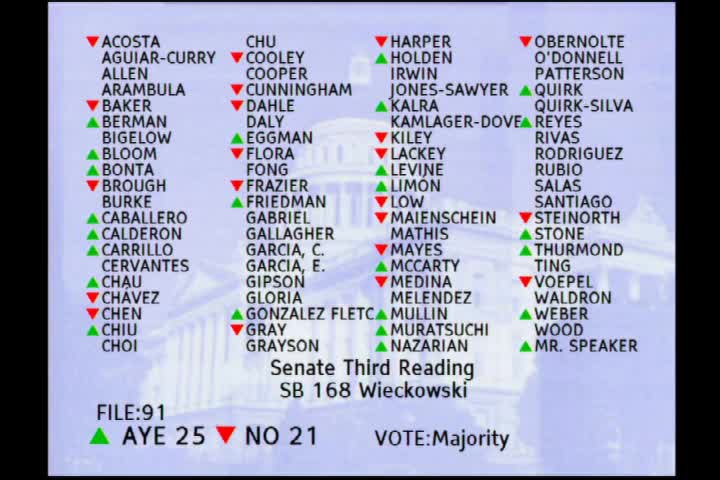 1MIN
Assembly Floor
 2MIN
Senate Floor
 1MIN
Assembly Standing Committee on Governmental Organization
Bill Author

Bill Co-Author(s):
