AB 2034: Human trafficking: notice.
- Session Year: 2017-2018
- House: Assembly
- Latest Version Date: 2018-09-27
Existing law requires specified businesses and other establishments, including, among others, airports, intercity passenger rail or light rail stations, bus stations, and truck stops, to post a notice, as developed by the Department of Justice, that contains information relating to slavery and human trafficking, including information regarding specified nonprofit organizations that a person can call for services or support in the elimination of slavery and human trafficking. Existing law makes a business or establishment that fails to comply with the requirements of these provisions liable for a civil penalty of $500 for a first offense, and $1,000 for each subsequent offense.
This bill would require, on or before January 1, 2021, specified businesses or other establishments that operate an intercity passenger rail, light rail, or bus station to provide training to new and existing employees who may interact with, or come into contact with, a victim of human trafficking or who are likely to receive, in the course of their employment, a report from another employee about suspected human trafficking, in recognizing the signs of human trafficking and how to report those signs to the appropriate law enforcement agency, as specified. Because the bill would require local government agencies to perform additional duties, it would impose a state-mandated local program.
The California Constitution requires the state to reimburse local agencies and school districts for certain costs mandated by the state. Statutory provisions establish procedures for making that reimbursement.
This bill would provide that, if the Commission on State Mandates determines that the bill contains costs mandated by the state, reimbursement for those costs shall be made pursuant to the statutory provisions noted above.
Existing law requires specified businesses and other establishments, including, among others, airports, intercity passenger rail or light rail stations, bus stations, and truck stops, to post a notice, as developed by the Department of Justice, that contains information relating to slavery and human trafficking, including information regarding specified nonprofit organizations that a person can call for services or support in the elimination of slavery and human trafficking. Existing law makes a business or establishment that fails to comply with the requirements of these provisions liable for a civil penalty of $500 for a first offense, and $1,000 for each subsequent offense.
This bill would require specified businesses or other establishments that operate an intercity passenger rail, light rail, or bus station, on or before January 1, 2021, to train provide training to new and existing employees who may interact with, or come into contact with, a victim of human trafficking or who are likely to receive, in the course of their employment, a report from another employee about suspected human trafficking, in recognizing the signs of human trafficking and how to report those signs to the appropriate law enforcement agency, as specified. Because the bill would require local government agencies to perform additional duties, it would impose a state-mandated local program. The bill would require the Department of Justice, on or before July 1, 2020, in consultation with community-based anti-human trafficking organizations, mass transit employee representatives, and representatives of mass transit system organizations, to develop guidelines to assist employers in providing the employee training. The bill would also require the department to make the guidelines publicly available on its Internet Web site and to distribute copies of the guidelines to the employers described above upon request.
The California Constitution requires the state to reimburse local agencies and school districts for certain costs mandated by the state. Statutory provisions establish procedures for making that reimbursement.
This bill would provide that, if the Commission on State Mandates determines that the bill contains costs mandated by the state, reimbursement for those costs shall be made pursuant to the statutory provisions noted above.
Existing law requires specified businesses and other establishments, including, among others, airports, intercity passenger rail or light rail stations, bus stations, and truck stops, to post a notice, as developed by the Department of Justice, that contains information relating to slavery and human trafficking, including information regarding specified nonprofit organizations that a person can call for services or support in the elimination of slavery and human trafficking. Existing law makes a business or establishment that fails to comply with the requirements of these provisions liable for a civil penalty of $500 for a first offense, and $1,000 for each subsequent offense.
This bill would require a business or other establishment that operates specified businesses or other establishments that operate an intercity passenger rail, light rail, or bus station, on or before January 1, 2020, 2021, to train its new and existing employees who are likely to may interact with, or to come into contact with, a victim of human trafficking or who are likely to receive receive, in the course of their employment, a report from another employee about suspected human trafficking, in recognizing the signs of human trafficking and how to report those signs to the appropriate law enforcement agency, as specified. Because the bill would require local government agencies to perform additional duties, it would impose a state-mandated local program. The bill would require the Department of Justice, on or before July 1, 2019, 2020, in consultation with community-based anti-human trafficking organizations, mass transit employee representatives, and representatives of mass transit system organizations, to develop guidelines to assist employers in providing the employee training. The bill would also require the department to make the guidelines publicly available on its Internet Web site and to distribute copies of the guidelines to the employers described above upon request.
The California Constitution requires the state to reimburse local agencies and school districts for certain costs mandated by the state. Statutory provisions establish procedures for making that reimbursement.
This bill would provide that, if the Commission on State Mandates determines that the bill contains costs mandated by the state, reimbursement for those costs shall be made pursuant to the statutory provisions noted above.
Existing law requires specified businesses and other establishments, including, among others, airports, intercity passenger rail or light rail stations, bus stations, and truck stops, to post a notice, as developed by the Department of Justice, that contains information relating to slavery and human trafficking, including information regarding specified nonprofit organizations that a person can call for services or support in the elimination of slavery and human trafficking. Existing law makes a business or establishment that fails to comply with the requirements of these provisions liable for a civil penalty of $500 for a first offense, and $1,000 for each subsequent offense.
This bill would require a business or other establishment that operates an intercity passenger rail, light rail, or bus station, on or before January 1, 2020, to train its new and existing employees who are likely to interact with, or to come into contact with, a victim of human trafficking or who are likely to receive a report from another employee about suspected human trafficking, in recognizing the signs of human trafficking and how to report those signs to the appropriate law enforcement agency, as specified. The bill would require the Department of Justice, on or before July 1, 2019, in consultation with community-based anti-human trafficking organizations, to develop guidelines to assist employers in providing the employee training. The bill would also require the department to make the guidelines publicly available on its Internet Web site and to distribute copies of the guidelines to the employers described above upon request.
(a)Each of the following businesses and other establishments shall, upon the availability of the model notice described in subdivision (d), post a notice that complies with the requirements of this section in a conspicuous place near the public entrance of the establishment or in another conspicuous location in clear view of the public and employees where similar notices are customarily posted:
(1)On-sale general public premises licensees under the Alcoholic Beverage Control Act (Division 9 (commencing with Section 23000) of the Business and Professions Code).
(2)Adult or sexually oriented businesses, as defined in subdivision (a) of Section 318.5 of the Penal Code.
(3)Primary airports, as defined in Section 47102(16) of Title 49 of the United States Code.
(4)Intercity passenger rail or light rail stations.
(5)Bus stations.
(6)Truck stops. For purposes of this section, truck stop means a privately owned and operated facility that provides food, fuel, shower or other sanitary facilities, and lawful overnight truck parking.
(7)Emergency rooms within general acute care hospitals.
(8)Urgent care centers.
(9)Farm labor contractors, as defined in subdivision (b) of Section 1682 of the Labor Code.
(10)Privately operated job recruitment centers.
(11)Roadside rest areas.
(12)Businesses or establishments that offer massage or bodywork services for compensation and are not described in paragraph (1) of subdivision (b) of Section 4612 of the Business and Professions Code.
(13)Hotels, motels, and bed and breakfast inns, as defined in subdivision (b) of Section 24045.12 of the Business and Professions Code, not including personal residences.
(b)The notice to be posted pursuant to subdivision (a) shall be at least 81/2 inches by 11 inches in size, written in a 16-point font, and shall state the following:
If you or someone you know is being forced to engage in any activity and cannot leavewhether it is commercial sex, housework, farm work, construction, factory, retail, or restaurant work, or any other activitytext 233-733 (Be Free) or call the National Human Trafficking Hotline at 1-888-373-7888 or the California Coalition to Abolish Slavery and Trafficking (CAST) at 1-888-KEY-2-FRE(EDOM) or 1-888-539-2373 to access help and services. | ||
Victims of slavery and human trafficking are protected under United States and California law. | ||
| ||
Available 24 hours a day, 7 days a week. | ||
Toll-free. | ||
Operated by nonprofit, nongovernmental organizations. | ||
Anonymous and confidential. | ||
Accessible in more than 160 languages. | ||
Able to provide help, referral to services, training, and general information. | ||
(c)The notice to be posted pursuant to subdivision (a) shall be printed in English, Spanish, and in one other language that is the most widely spoken language in the county where the establishment is located and for which translation is mandated by the federal Voting Rights Act (42 U.S.C. Sec. 1973 et seq.), as applicable. This section does not require a business or other establishment in a county where a language other than English or Spanish is the most widely spoken language to print the notice in more than one language in addition to English and Spanish.
(d)(1)On or before April 1, 2013, the Department of Justice shall develop a model notice that complies with the requirements of this section and make the model notice available for download on the departments Internet Web site.
(2)On or before January 1, 2019, the Department of Justice shall revise and update the model notice to comply with the requirements of this section and make the updated model notice available for download on the departments Internet Web site. A business or establishment required to post the model notice shall not be required to post the updated model notice until on and after January 1, 2019.
(e)On or before January 1, 2021, a business or other establishment that operates a facility described in paragraph (4) or (5) of subdivision (a) shall provide at least 20 minutes of training to its new and existing employees who may interact with, or come into contact with, a victim of human trafficking or who are likely to receive, in the course of their employment, a report from another employee about suspected human trafficking, in recognizing the signs of human trafficking and how to report those signs to the appropriate law enforcement agency.
(f)The employee training pursuant to subdivision (e) shall include, but not be limited to, all of the following:
(1)The definition of human trafficking, including sex trafficking and labor trafficking.
(2)Myths and misconceptions about human trafficking.
(3)Physical and mental signs to be aware of that may indicate that human trafficking is occurring.
(4)Guidance on how to identify individuals who are most at risk for human trafficking.
(5)Guidance on how to report human trafficking, including, but not limited to, national hotlines (1-888-373-7888 and text line 233733) and contact information for local law enforcement agencies that an employee may use to make a confidential report.
(6)Protocols for reporting human trafficking when on the job.
(g)(1)The human trafficking employee training pursuant to subdivision (e) may include, but shall not be limited to, information and material utilized in training Santa Clara County Valley Transit Authority employees, private nonprofit organizations that represent the interests of human trafficking victims, and the Department of Justice.
(2)The failure to report human trafficking by an employee shall not, by itself, result in the liability of the business or other establishment that operates a facility described in paragraph (4) or (5) of subdivision (a) or of any other person or entity.
(h)A business or establishment that fails to comply with the requirements of this section is liable for a civil penalty of five hundred dollars ($500) for a first offense and one thousand dollars ($1,000) for each subsequent offense. A government entity identified in Section 17204 of the Business and Professions Code may bring an action to impose a civil penalty pursuant to this subdivision against a business or establishment if a local or state agency with authority to regulate that business or establishment has satisfied both of the following:
(1)Provided the business or establishment with reasonable notice of noncompliance, which informs the business or establishment that it is subject to a civil penalty if it does not correct the violation within 30 days from the date the notice is sent to the business or establishment.
(2)Verified that the violation was not corrected within the 30-day period described in paragraph (1).
SEC. 2.If the Commission on State Mandates determines that this act contains costs mandated by the state, reimbursement to local agencies and school districts for those costs shall be made pursuant to Part 7 (commencing with Section 17500) of Division 4 of Title 2 of the Government Code.
(a)Each of the following businesses and other establishments shall, upon the availability of the model notice described in subdivision (d), post a notice that complies with the requirements of this section in a conspicuous place near the public entrance of the establishment or in another conspicuous location in clear view of the public and employees where similar notices are customarily posted:
(1)On-sale general public premises licensees under the Alcoholic Beverage Control Act (Division 9 (commencing with Section 23000) of the Business and Professions Code).
(2)Adult or sexually oriented businesses, as defined in subdivision (a) of Section 318.5 of the Penal Code.
(3)Primary airports, as defined in Section 47102(16) of Title 49 of the United States Code.
(4)Intercity passenger rail or light rail stations.
(5)Bus stations.
(6)Truck stops. For purposes of this section, truck stop means a privately owned and operated facility that provides food, fuel, shower or other sanitary facilities, and lawful overnight truck parking.
(7)Emergency rooms within general acute care hospitals.
(8)Urgent care centers.
(9)Farm labor contractors, as defined in subdivision (b) of Section 1682 of the Labor Code.
(10)Privately operated job recruitment centers.
(11)Roadside rest areas.
(12)Businesses or establishments that offer massage or bodywork services for compensation and are not described in paragraph (1) of subdivision (b) of Section 4612 of the Business and Professions Code.
(13)Hotels, motels, and bed and breakfast inns, as defined in subdivision (b) of Section 24045.12 of the Business and Professions Code, not including personal residences.
(b)The notice to be posted pursuant to subdivision (a) shall be at least 81/2 inches by 11 inches in size, written in a 16-point font, and shall state the following:
If you or someone you know is being forced to engage in any activity and cannot leavewhether it is commercial sex, housework, farm work, construction, factory, retail, or restaurant work, or any other activitytext 233-733 (Be Free) or call the National Human Trafficking Hotline at 1-888-373-7888 or the California Coalition to Abolish Slavery and Trafficking (CAST) at 1-888-KEY-2-FRE(EDOM) or 1-888-539-2373 to access help and services. | ||
Victims of slavery and human trafficking are protected under United States and California law. | ||
| ||
Available 24 hours a day, 7 days a week. | ||
Toll-free. | ||
Operated by nonprofit, nongovernmental organizations. | ||
Anonymous and confidential. | ||
Accessible in more than 160 languages. | ||
Able to provide help, referral to services, training, and general information. | ||
(c)The notice to be posted pursuant to subdivision (a) shall be printed in English, Spanish, and in one other language that is the most widely spoken language in the county where the establishment is located and for which translation is mandated by the federal Voting Rights Act (42 U.S.C. Sec. 1973 et seq.), as applicable. This section does not require a business or other establishment in a county where a language other than English or Spanish is the most widely spoken language to print the notice in more than one language in addition to English and Spanish.
(d)(1)On or before April 1, 2013, the Department of Justice shall develop a model notice that complies with the requirements of this section and make the model notice available for download on the departments Internet Web site.
(2)On or before January 1, 2019, the Department of Justice shall revise and update the model notice to comply with the requirements of this section and make the updated model notice available for download on the departments Internet Web site. A business or establishment required to post the model notice shall not be required to post the updated model notice until on and after January 1, 2019.
(e)(1)On or before January 1, 2021, a business or other establishment that operates a facility described in paragraph (4) or (5) of subdivision (a) shall train provide at least 20 minutes of training to its new and existing employees who may interact with, or come into contact with, a victim of human trafficking or who are likely to receive, in the course of their employment, a report from another employee about suspected human trafficking, in recognizing the signs of human trafficking and how to report those signs to the appropriate law enforcement agency. The training shall be consistent with the guidelines established by the Department of Justice pursuant to subdivision (f) and may be provided by a community-based anti-human trafficking organization.
(2)This subdivision does not apply to a public agency that operates a facility described in paragraph (4) or (5) of subdivision (a) that instituted a human trafficking awareness program on or before January 1, 2019.(f)(1)On or before July 1, 2020, the Department of Justice, in consultation with community-based anti-human trafficking organizations that provide training for mass transit employees, mass transit employee representatives, and representatives of mass transit system organizations, shall develop guidelines to assist employers in providing employee training pursuant to subdivision (e) that The employee training pursuant to subdivision (e) shall include, but not be limited to, all of the following:
(A)(1)The definition of human trafficking, including sex trafficking and labor trafficking.
(B)(2)Myths and misconceptions about human trafficking.
(C)(3)Physical and mental signs to be aware of, of that may indicate that human trafficking is occurring.
(4)Guidance on how to identify individuals who are most at risk for human trafficking.
(D)(5)Guidance on how to report human trafficking, including, but not limited to, national hotlines (1-888-373-7888 and text line 233733) and contact information for local law enforcement agencies that an employee may use to make a confidential report.
(2)The Department of Justice shall make the guidelines publicly available on its Internet Web site and distribute copies of the guidelines to an employer specified in subdivision (e) upon request.(6)Protocols for reporting human trafficking when on the job.
(g)(1)The human trafficking employee training pursuant to subdivision (e) may include, but shall not be limited to, information and material utilized in training Santa Clara County Valley Transit Authority employees, private nonprofit organizations that represent the interests of human trafficking victims, and the Department of Justice.
(2)The failure to report human trafficking by an employee shall not, by itself, result in the liability of the business or other establishment that operates a facility described in paragraph (4) or (5) of subdivision (a) or of any other person or entity.
(g)(h)A business or establishment that fails to comply with the requirements of this section is liable for a civil penalty of five hundred dollars ($500) for a first offense and one thousand dollars ($1,000) for each subsequent offense. A government entity identified in Section 17204 of the Business and Professions Code may bring an action to impose a civil penalty pursuant to this subdivision against a business or establishment if a local or state agency with authority to regulate that business or establishment has satisfied both of the following:
(1)Provided the business or establishment with reasonable notice of noncompliance, which informs the business or establishment that it is subject to a civil penalty if it does not correct the violation within 30 days from the date the notice is sent to the business or establishment.
(2)Verified that the violation was not corrected within the 30-day period described in paragraph (1).
SEC. 2.If the Commission on State Mandates determines that this act contains costs mandated by the state, reimbursement to local agencies and school districts for those costs shall be made pursuant to Part 7 (commencing with Section 17500) of Division 4 of Title 2 of the Government Code.
(a)Each of the following businesses and other establishments shall, upon the availability of the model notice described in subdivision (d), post a notice that complies with the requirements of this section in a conspicuous place near the public entrance of the establishment or in another conspicuous location in clear view of the public and employees where similar notices are customarily posted:
(1)On-sale general public premises licensees under the Alcoholic Beverage Control Act (Division 9 (commencing with Section 23000) of the Business and Professions Code).
(2)Adult or sexually oriented businesses, as defined in subdivision (a) of Section 318.5 of the Penal Code.
(3)Primary airports, as defined in Section 47102(16) of Title 49 of the United States Code.
(4)Intercity passenger rail or light rail stations.
(5)Bus stations.
(6)Truck stops. For purposes of this section, truck stop means a privately owned and operated facility that provides food, fuel, shower or other sanitary facilities, and lawful overnight truck parking.
(7)Emergency rooms within general acute care hospitals.
(8)Urgent care centers.
(9)Farm labor contractors, as defined in subdivision (b) of Section 1682 of the Labor Code.
(10)Privately operated job recruitment centers.
(11)Roadside rest areas.
(12)Businesses or establishments that offer massage or bodywork services for compensation and are not described in paragraph (1) of subdivision (b) of Section 4612 of the Business and Professions Code.
(13)Hotels, motels, and bed and breakfast inns, as defined in subdivision (b) of Section 24045.12 of the Business and Professions Code, not including personal residences.
(b)The notice to be posted pursuant to subdivision (a) shall be at least 81/2 inches by 11 inches in size, written in a 16-point font, and shall state the following:
If you or someone you know is being forced to engage in any activity and cannot leavewhether it is commercial sex, housework, farm work, construction, factory, retail, or restaurant work, or any other activitytext 233-733 (Be Free) or call the National Human Trafficking Hotline at 1-888-373-7888 or the California Coalition to Abolish Slavery and Trafficking (CAST) at 1-888-KEY-2-FRE(EDOM) or 1-888-539-2373 to access help and services. | ||
Victims of slavery and human trafficking are protected under United States and California law. | ||
| ||
Available 24 hours a day, 7 days a week. | ||
Toll-free. | ||
Operated by nonprofit, nongovernmental organizations. | ||
Anonymous and confidential. | ||
Accessible in more than 160 languages. | ||
Able to provide help, referral to services, training, and general information. | ||
(c)The notice to be posted pursuant to subdivision (a) shall be printed in English, Spanish, and in one other language that is the most widely spoken language in the county where the establishment is located and for which translation is mandated by the federal Voting Rights Act (42 U.S.C. Sec. 1973 et seq.), as applicable. This section does not require a business or other establishment in a county where a language other than English or Spanish is the most widely spoken language to print the notice in more than one language in addition to English and Spanish.
(d)(1)On or before April 1, 2013, the Department of Justice shall develop a model notice that complies with the requirements of this section and make the model notice available for download on the departments Internet Web site.
(2)On or before January 1, 2019, the Department of Justice shall revise and update the model notice to comply with the requirements of this section and make the updated model notice available for download on the departments Internet Web site. A business or establishment required to post the model notice shall not be required to post the updated model notice until on and after January 1, 2019.
(e)(1)On or before January 1, 2020, 2021, a business or other establishment that operates a facility described in paragraph (4) or (5) of subdivision (a) shall train its new and existing employees who are likely to may interact with, or to come into contact with, a victim of human trafficking or who are likely to receive receive, in the course of their employment, a report from another employee about suspected human trafficking, in recognizing the signs of human trafficking and how to report those signs to the appropriate law enforcement agency. The training shall be consistent with the guidelines established by the Department of Justice pursuant to subdivision (f) and may be provided by a community-based anti-human trafficking organization.
(2)This subdivision does not apply to a public agency that operates a facility described in paragraph (4) or (5) of subdivision (a) that instituted a human trafficking awareness program on or before January 1, 2019.
(f)(1)On or before July 1, 2019, 2020, the Department of Justice, in consultation with community-based anti-human trafficking organizations that provide training for mass transit employees, employees, mass transit employee representatives, and representatives of mass transit system organizations, shall develop guidelines to assist employers in providing employee training pursuant to subdivision (e) that shall include, but not be limited to, all of the following:
(A)The definition of human trafficking, including sex trafficking and labor trafficking.
(B)Myths and misconceptions about human trafficking.
(C)Physical and mental signs to be aware of, that may indicate that human trafficking is occurring.
(D)Guidance on how to report human trafficking, including, but not limited to, national hotlines that an employee may use to make a confidential report.
(2)The Department of Justice shall make the guidelines publicly available on its Internet Web site and distribute copies of the guidelines to an employer specified in subdivision (e) upon request.
(g)A business or establishment that fails to comply with the requirements of this section is liable for a civil penalty of five hundred dollars ($500) for a first offense and one thousand dollars ($1,000) for each subsequent offense. A government entity identified in Section 17204 of the Business and Professions Code may bring an action to impose a civil penalty pursuant to this subdivision against a business or establishment if a local or state agency with authority to regulate that business or establishment has satisfied both of the following:
(1)Provided the business or establishment with reasonable notice of noncompliance, which informs the business or establishment that it is subject to a civil penalty if it does not correct the violation within 30 days from the date the notice is sent to the business or establishment.
(2)Verified that the violation was not corrected within the 30-day period described in paragraph (1).
SEC. 2.If the Commission on State Mandates determines that this act contains costs mandated by the state, reimbursement to local agencies and school districts for those costs shall be made pursuant to Part 7 (commencing with Section 17500) of Division 4 of Title 2 of the Government Code.
(a)Each of the following businesses and other establishments shall, upon the availability of the model notice described in subdivision (d), post a notice that complies with the requirements of this section in a conspicuous place near the public entrance of the establishment or in another conspicuous location in clear view of the public and employees where similar notices are customarily posted:
(1)On-sale general public premises licensees under the Alcoholic Beverage Control Act (Division 9 (commencing with Section 23000) of the Business and Professions Code).
(2)Adult or sexually oriented businesses, as defined in subdivision (a) of Section 318.5 of the Penal Code.
(3)Primary airports, as defined in Section 47102(16) of Title 49 of the United States Code.
(4)Intercity passenger rail or light rail stations.
(5)Bus stations.
(6)Truck stops. For purposes of this section, truck stop means a privately owned and operated facility that provides food, fuel, shower or other sanitary facilities, and lawful overnight truck parking.
(7)Emergency rooms within general acute care hospitals.
(8)Urgent care centers.
(9)Farm labor contractors, as defined in subdivision (b) of Section 1682 of the Labor Code.
(10)Privately operated job recruitment centers.
(11)Roadside rest areas.
(12)Businesses or establishments that offer massage or bodywork services for compensation and are not described in paragraph (1) of subdivision (b) of Section 4612 of the Business and Professions Code.
(13)Hotels, motels, and bed and breakfast inns, as defined in subdivision (b) of Section 24045.12 of the Business and Professions Code, not including personal residences.
(b)The notice to be posted pursuant to subdivision (a) shall be at least 81/2 inches by 11 inches in size, written in a 16-point font, and shall state the following:
If you or someone you know is being forced to engage in any activity and cannot leavewhether it is commercial sex, housework, farm work, construction, factory, retail, or restaurant work, or any other activitytext 233-733 (Be Free) or call the National Human Trafficking Hotline at 1-888-373-7888 or the California Coalition to Abolish Slavery and Trafficking (CAST) at 1-888-KEY-2-FRE(EDOM) or 1-888-539-2373 to access help and services. | ||
Victims of slavery and human trafficking are protected under United States and California law. | ||
| ||
Available 24 hours a day, 7 days a week. | ||
Toll-free. | ||
Operated by nonprofit, nongovernmental organizations. | ||
Anonymous and confidential. | ||
Accessible in more than 160 languages. | ||
Able to provide help, referral to services, training, and general information. | ||
(c)The notice to be posted pursuant to subdivision (a) shall be printed in English, Spanish, and in one other language that is the most widely spoken language in the county where the establishment is located and for which translation is mandated by the federal Voting Rights Act (42 U.S.C. Sec. 1973 et seq.), as applicable. This section does not require a business or other establishment in a county where a language other than English or Spanish is the most widely spoken language to print the notice in more than one language in addition to English and Spanish.
(d)(1)On or before April 1, 2013, the Department of Justice shall develop a model notice that complies with the requirements of this section and make the model notice available for download on the departments Internet Web site.
(2)On or before January 1, 2019, the Department of Justice shall revise and update the model notice to comply with the requirements of this section and make the updated model notice available for download on the departments Internet Web site. A business or establishment required to post the model notice shall not be required to post the updated model notice until on and after January 1, 2019.
(e)On or before January 1, 2020, a business or other establishment that operates a facility described in paragraph (4) or (5) of subdivision (a) shall train its new and existing employees who are likely to interact with, or to come into contact with, a victim of human trafficking or who are likely to receive a report from another employee about suspected human trafficking, in recognizing the signs of human trafficking and how to report those signs to the appropriate law enforcement agency. The training shall be consistent with the guidelines established by the Department of Justice pursuant to subdivision (f) and may be provided by a community-based anti-human trafficking organization.
(f)(1)On or before July 1, 2019, the Department of Justice, in consultation with community-based anti-human trafficking organizations that provide training for mass transit employees, shall develop guidelines to assist employers in providing employee training pursuant to subdivision (e) that shall include, but not be limited to, all of the following:
(A)The definition of human trafficking, including sex trafficking and labor trafficking.
(B)Myths and misconceptions about human trafficking.
(C)Physical and mental signs to be aware of, that may indicate that human trafficking is occurring.
(D)Guidance on how to report human trafficking, including, but not limited to, national hotlines that an employee may use to make a confidential report.
(2)The Department of Justice shall make the guidelines publicly available on its Internet Web site and distribute copies of the guidelines to an employer specified in subdivision (e) upon request.
(e)(g)A business or establishment that fails to comply with the requirements of this section is liable for a civil penalty of five hundred dollars ($500) for a first offense and one thousand dollars ($1,000) for each subsequent offense. A government entity identified in Section 17204 of the Business and Professions Code may bring an action to impose a civil penalty pursuant to this subdivision against a business or establishment if a local or state agency with authority to regulate that business or establishment has satisfied both of the following:
(1)Provided the business or establishment with reasonable notice of noncompliance, which informs the business or establishment that it is subject to a civil penalty if it does not correct the violation within 30 days from the date the notice is sent to the business or establishment.
(2)Verified that the violation was not corrected within the 30-day period described in paragraph (1).
|
Date
|
Status
|
|---|---|
| Sep 27, 2018 | Chaptered by Secretary of State - Chapter 812, Statutes of 2018. |
| Sep 27, 2018 | Approved by the Governor. |
| Sep 4, 2018 | Enrolled and presented to the Governor at 3 p.m. |
| Aug 27, 2018 | Senate amendments concurred in. To Engrossing and Enrolling. |
| Aug 22, 2018 | In Assembly. Concurrence in Senate amendments pending. May be considered on or after August 24 pursuant to Assembly Rule 77. |
| Aug 22, 2018 | Read third time. Passed. Ordered to the Assembly. |
| Aug 20, 2018 | Read second time. Ordered to third reading. |
| Aug 17, 2018 | From committee: Amend, and do pass as amended. (Ayes 7. Noes 0.) (August 16). |
| Aug 6, 2018 | In committee: Referred to APPR. suspense file. |
| Jun 20, 2018 | From committee: Do pass and re-refer to Com. on APPR. with recommendation: To Consent Calendar. (Ayes 7. Noes 0.) (June 19). Re-referred to Com. on APPR. |
| Jun 7, 2018 | Referred to Com. on JUD. |
| May 31, 2018 | In Senate. Read first time. To Com. on RLS. for assignment. |
| May 30, 2018 | Read third time. Passed. Ordered to the Senate. |
| May 29, 2018 | Read second time. Ordered to third reading. |
| May 25, 2018 | From committee: Amend, and do pass as amended. (Ayes 12. Noes 0.) (May 25). |
| Apr 4, 2018 | In committee: Set, first hearing. Referred to suspense file. |
| Mar 20, 2018 | From committee: Do pass and re-refer to Com. on APPR. with recommendation: To Consent Calendar. (Ayes 10. Noes 0.) (March 20). Re-referred to Com. on APPR. |
| Feb 16, 2018 | Referred to Com. on JUD. |
| Feb 7, 2018 | From printer. May be heard in committee March 9. |
| Feb 6, 2018 | Read first time. To print. |
|
Date
|
Description
|
Location
|
Votes
|
|
|---|---|---|---|---|
| Aug 27, 2018 | AB 2034 KALRA Concurrence in Senate Amendments | Assembly Floor |
Passed |
|
| Aug 22, 2018 | Assembly 3rd Reading AB2034 Kalra By Beall | Senate Floor |
Passed |
|
| Aug 16, 2018 | Do pass as amended | Senate Standing Committee on Appropriations |
Passed |
|
| Aug 6, 2018 | Placed on suspense file | Senate Standing Committee on Appropriations |
Passed |
|
| Jun 19, 2018 | Do pass, but first be re-referred to the Committee on [Appropriations] with the recommendation: To Consent Calendar | Senate Standing Committee on Judiciary |
Passed |
|
| May 30, 2018 | AB 2034 KALRA Assembly Third Reading | Assembly Floor |
Passed |
|
| May 25, 2018 | Do pass as amended. | Assembly Standing Committee on Appropriations |
Passed |
|
| Mar 20, 2018 | Do pass and be re-referred to the Committee on [Appropriations] with recommendation: To Consent Calendar | Assembly Standing Committee on Judiciary |
Passed |
This list shows positions taken on this bill by organizations on the date displayed, which is linked to the original source.
Positions by individuals are not included.
|
Organization
|
Position
|
Date
|
|---|---|---|
| 1 individual | ** Support | Mar 16, 2018 |
| American Academy of Pediatrics | ** Support | Aug 20, 2018 |
| Asian Americans for Community Involvement | ** Support | Aug 20, 2018 |
| Bay Area Anti Trafficking Coalition | ** Support | Aug 20, 2018 |
| California Catholic Conference | ** Support | Aug 20, 2018 |
| California Transit Association | ** Support | Aug 20, 2018 |
| Capitol Corridor Joint Powers Authority | ** Support | Aug 20, 2018 |
| Day Worker Center of Mountain View | ** Support | Aug 20, 2018 |
| Department Of Finance | ** Against | Aug 20, 2018 |
| Episcopal Chaplaincy At San Jose State University | ** Support | Aug 20, 2018 |
| Justice At Work Law Group | ** Support | Aug 20, 2018 |
| Justice At Work Law Group, Llp | ** Support | Mar 16, 2018 |
| Justice In Motion | ** Support | Aug 20, 2018 |
| Los Angeles County Professional Peace Officers Association | ** Support | Aug 20, 2018 |
| Pennisula Corridor Joint Powers Board | ** Support | Aug 20, 2018 |
| rail passenger association of california and nevada | ** Support | Aug 20, 2018 |
| Religious Sisters of Charity | ** Support | Aug 20, 2018 |
| San Mateo County Transit District | ** Support | Aug 20, 2018 |
| Santa Clara County Wage Theft Coalition | ** Support | Aug 20, 2018 |
| Santa Clara Valley Transit Authority | ** Support | Mar 16, 2018 |
| Santa Clara Valley Transportation Authority | ** Support | Aug 20, 2018 |
| Step Forward Foundation | ** Support | Aug 20, 2018 |
| tahirih justice center | ** Support | Aug 20, 2018 |
| The Episcopal Chaplaincy At San Jose State University | ** Support | Mar 16, 2018 |
| Worksafe | ** Support | Aug 20, 2018 |
CONCURRENCE IN SENATE AMENDMENTS
CSA1 Bill Id:AB 2034
Author:(Kalra)
As Amended Ver:August 17, 2018
Majority vote
ASSEMBLY: | 78-0 | (May 30, 2018) | SENATE: | 39-0 | (August 22, 2018) |
Original Committee Reference: JUD.
SUMMARY: Requires businesses and establishments that operate in transportation or handle high volumes of traffic to train their employees in recognizing the signs of human trafficking and reporting suspected human trafficking. Specifically, this bill requires that all operators of mass transit intercity passenger rail systems, light rail systems, and bus stations provide at least 20 minutes of training to their new and existing employees who may interact with, or come into contact with, a victim of human trafficking or who are likely to receive, in the course of their employment, a report from another employee about suspected human trafficking, on recognizing the signs of human trafficking and how to report suspected human trafficking to the appropriate law enforcement agency by January 1, 2021.
The Senate amendments:
- Delete the requirement for the Department of Justice to develop guidelines for the above training system by July 1, 2020 to assist mass transit employers in training their employees.
- Delete an exemption for a public agency that operates an intercity passenger rail or light rail station, or bus station, if the agency instituted a human trafficking awareness program on or before January 1, 2019.
- Add a requirement that the 20 minutes of training must include the following: "Guidance on how to identify individuals who are most at risk for human trafficking."
FISCAL EFFECT: According to the Senate Appropriations Committee:
- Unknown, potentially-significant one-time and ongoing costs to the Department of Transportation to reimburse Amtrak for the costs of revising its training related to human trafficking and the costs related to the human trafficking training. (Special fund)
- Unknown costs to public mass transit agencies to train employees in compliance with this measure. It is not likely that the state would be required to reimburse these costs, as the local agencies have the ability to recover costs associated with this mandate through the ability to charge fees. (Local funds)
COMMENTS: This bill seeks to require a minimum amount of training of employees of mass transit agencies recognizing the signs of human trafficking and how to report them to the appropriate organization. This requirement is in furtherance of the state's ongoing efforts to combat the problem of human trafficking, which is particularly acute in California. Mass transit employers would be required to provide at least 20 minutes of training by January 1, 2021 to all employees who are likely to interact with, or come into contact with, a victim of human trafficking or who, in the course of their employment, may receive a report of human trafficking. The mass transit systems affected by this bill are intercity rail, light rail, and bus stations. The author states, regarding the purpose and necessity of the bill, the following:
California has the highest number of reported human trafficking cases in the country, and many human trafficking victims are hidden in plain sight along our state's transportation routes. Given the reality that law enforcement cannot be everywhere at once to identify and intervene in human trafficking situations, they often rely upon tips and voluntary reporting from everyday people on the ground. In an effort to assist law enforcement identify and prevent situations of human trafficking, AB 2034 equips those transit operators and employees on the front-line of defense with the proper training on the signs of human trafficking. By doing so, suspected acts of human trafficking can be properly reported and, if needed, acted upon by law enforcement to prevent further harm to the victim. This has been proven very effective for the Santa Clara County Valley Transportation Authority (VTA) when in 2015 it initiated its own human trafficking employee training program.
California's Human Trafficking Crisis: Human trafficking is an issue that is especially relevant in California. The National Human Trafficking Hotline (NHTH) and POLARIS are organizations that work towards ending modern slavery and human trafficking. The organizations receive funding by the Department of Health and Human Services for that purpose. They report that in 2016, the human trafficking cases reported in California represented 15 percent of all such reported cases in the nation. (National Human Trafficking Hotline, Statistics: California (12/31/2017).)
California is particularly vulnerable to trafficking in persons involving migrant labor, because of its proximity to international borders, its seaports and airports, its significant immigrant population, and its large economy that includes industries that are vulnerable to exploitation. . . Human trafficking is found throughout California, with most activity centered around Los Angeles, Sacramento, San Diego, and San Francisco. The FBI has identified San Francisco as one of the worst areas in the country for the commercial sexual exploitation of children. (Maria Tourtchaninova & Minouche Kandel, Human Trafficking in San Francisco Report, San Francisco Dept. of the Status of Women, (November 8, 2016).)
According to a study reported by the Bay Area Anti-Trafficking Coalition (BAATC), the number of reports on human trafficking in California have increased in recent years. Between 2010 and 2012 there were 2,552 cases of human trafficking investigated [average of 850 per year], resulting in 1,798 arrests. (Bay Area Anti-Trafficking Coalition, Bay Area and California Statistics (2015).) In 2015 alone, 979 cases were investigated, and 3,609 "calls, emails and web reports" were made to the National Human Trafficking Resources Hotline Center. (Ibid.) BAATC noted this as the highest number of reports of human trafficking made in any state in the nation in that year. (Ibid.)
Mass Transit as a Solution: Existing California law requires specified businesses and other establishments to post a model notice that contains information related to slavery and human trafficking, including contact information for specified nonprofit organizations that provide services in support of the elimination of slavery and human trafficking. Intercity rail, light rail, and bus stations are among the businesses and establishments that are specifically required to post such notices.
In the San Francisco Bay Area 77% of commuters using public transit use heavy rail (28.1%), light rail (10.1%), or buses (38.8 % for their daily commute (California Energy Commission, Public Transit in California, (2013)). In Los Angeles the percentage of public transit commuters using these particular forms of transportation are even higher at 94.5%, with buses representing 77.9% and the rail systems collectively representing 16.6%. (Ibid.)
While 13,897 calls were made to the National Human Trafficking Hotline in California last year, according to the hotline, only 2,415 were made by victims and survivors themselves and 4,290 were made by "community members." (NHTH, Statistics: California, (12/31/2017).) Such community members could be concerned family members, friends, or bystanders who interact with the victim. Transit employees are some of the best situated bystanders to detect and report signs of human trafficking, given that both victims and perpetrators may use public transit. By increasing awareness and availability of information of the signs of human trafficking by the groups that are most likely to interact with victims, this bill would likely continue the progress that California has made in combatting the problem of human trafficking.
The author cites the success of the Santa Clara Valley Transit Authority (VTA) in implementing an effective training system for their employees as support for this bill, and evidence of the likely effectiveness of the bill's requirements. The VTA reports that they trained 1006 staff in 2015 and 194 staff in 2016. The VTA partnered with the South Bay Coalition to End Human Trafficking in the development of their training system. VTA reports that the efficacy of their training program is demonstrated by the increased number of reports since the training was implemented. In fact, in one noteworthy case, a VTA operator cited the training as being helpful to confidentially alert law enforcement to a suspected kidnapper and his three-year old victim who were riding on his bus. As a result, the toddler was safely returned to his family and the suspect was arrested without incident. (Ian Bauer, Bus Driver, Law Enforcement Honored for Rescuing Abducted Milpitas Toddler, The Mercury News (June 17, 2015), found at: https://www.mercurynews.com/2015/06/17/bus-driver-law-enforcement-honored-for-rescuing-abducted-milpitas-toddler/.)
Analysis Prepared by: Alison Merrilees / JUD. / (916) 319-2334 FN: 0004445
Office of Senate Floor Analyses (916) 651-1520 Fax: (916) 327-4478 | AB |
THIRD READING
Bill No: AB 2034
:
SENATE JUDICIARY COMMITTEE: 7-0, 6/19/18
AYES: Jackson, Moorlach, Anderson, Hertzberg, Monning, Stern, Wieckowski
SENATE APPROPRIATIONS COMMITTEE: 7-0, 8/16/18
AYES: Portantino, Bates, Beall, Bradford, Hill, Nielsen, Wiener
ASSEMBLY FLOOR: 78-0, 5/30/18 - See last page for vote
SOURCE: Katharine & George Alexander Community Law Center at Santa Clara University School of Law
Step Forward Foundation
DIGEST:
This bill requires a business or other establishment that operates intercity passenger rail or light rail stations, or bus stations to train specified employees in recognizing the signs of human trafficking and how to report those signs; and requires the Department of Justice (DOJ) to develop guidelines with which such trainings would have to be consistent.
Existing law:
- Provides that any person who deprives or violates the personal liberty of another with the intent to obtain forced labor or services is guilty of the crime of human trafficking. (Pen. Code Sec. 236.1.)
- Requires specified businesses and establishments to post notices in a conspicuous place near the public entrance of the establishment or in another conspicuous location in clear view of the public and employees where similar notices are customarily posted. Included among these specified establishments are intercity passenger rail or light rail stations and bus stations. (Civ. Code Sec. 52.6.)
- Requires the notices to include specific language regarding a textline or various hotlines to contact if one is aware of or is a victim of human trafficking. DOJ is required to create a model notice that can be used by businesses and establishments to meet the posting requirement. It is required to produce an updated notice on or before January 1, 2019. (Civ. Code Sec. 52.6.)
This bill:
- Provides that, on or before January 1, 2021, a business or other establishment that operates intercity passenger rail or light rail stations, or bus stations shall provide at least 20 minutes of training to its new and existing employees who may interact with, or come into contact with, a victim of human trafficking or who are likely to receive, in the course of their employment, a report from another employee about suspected human trafficking, in recognizing the signs of human trafficking and how to report those signs to the appropriate law enforcement agency.
- Requires the above training to include, but not be limited to, all of the following:
- the definition of human trafficking, including sex trafficking and labor trafficking;
- myths and misconceptions about human trafficking;
- physical and mental signs to be aware of that may indicate that human trafficking is occurring;
- guidance on how to identify individuals who are most at risk for human trafficking;
- guidance on how to report human trafficking, including, but not limited to, national hotlines and contact information for local law enforcement agencies that an employee may use to make a confidential report; and
- protocols for reporting human trafficking when on the job.
- Provides that this training may include information and material utilized in training Santa Clara County Valley Transit Authority employees, private nonprofit organizations that represent the interests of human trafficking victims, and DOJ.
- Provides that the failure to report human trafficking by an employee shall not, by itself, result in the liability of the business or other establishment that operates a facility, as specified, or of any other person or entity.
Background
Human trafficking is the world’s fastest growing criminal enterprise, bringing in annual profits in the tens of billions of dollars. Human trafficking is generally defined as the use of force, coercion, or fraud to obtain coerced labor or personal services. Existing law provides that any person who deprives or violates the personal liberty of another with the intent to obtain forced labor or services is guilty of the crime of human trafficking.
A recent report by the National Institute of Justice found that approximately 20 million people are victims of some form of human trafficking worldwide. The U.S. State Department estimates that 14,500 - 17,500 people are trafficked into the United States annually. However, estimates indicate that there are hundreds of thousands of victims in the United States. Over 80 percent of reported trafficking cases are sex trafficking, rather than labor or other forms. The data shows that sex trafficking can and does take place in every community, no matter the cultural makeup, the affluence, or the location of a community.
According to the National Human Trafficking Hotline (previously the National Human Trafficking Resource Center), over 1,300 human trafficking cases were reported in California in 2016 alone, vastly more than any other state. Since 2007, the hotline has received 19,000 calls from California with over 5,000 cases reported. The reported cases nationwide overwhelmingly involved female victims with nearly a third of victims being minors. Traffickers look for people who are susceptible for a variety of reasons, including psychological or emotional vulnerability, economic hardship, lack of a social safety net, natural disasters, or political instability. Human trafficking is a hidden crime as victims rarely come forward to seek help because of language barriers, fear of the traffickers, and/or fear of law enforcement.
To increase awareness of human trafficking and provide support to victims, Section 52.6 of the Civil Code currently requires certain businesses and establishments, including truck stops, health facilities, massage parlors, and transit centers, to post notices encouraging victims of human trafficking and those who suspect human trafficking to contact a textline or one of several hotlines to access help and services.
This bill amends Section 52.6 to require a business or other establishment that operates intercity passenger rail or light rail stations, or bus stations to train certain employees in recognizing the signs of human trafficking and how to report those signs.
Comments
The author writes:
California has the highest number of reported human trafficking cases in the country, and many human trafficking victims are hidden in plain sight along our state's transportation routes. Given the reality that law enforcement cannot be everywhere at once to identify and intervene in human trafficking situations, they often rely upon tips and voluntary reporting from everyday people on the ground. In an effort to assist law enforcement identify and prevent situations of human trafficking, AB 2034 equips those transit operators and employees on the front-line of defense with the proper training on the signs of human trafficking. By doing so, suspected acts of human trafficking can be properly reported and, if needed, acted upon by law enforcement to prevent further harm to the victim. This has been proven very effective for the Santa Clara County Valley Transportation Authority (VTA) when in 2015 it initiated its own human trafficking employee training program.
Training employees to increase the identification and reporting of human trafficking
Training and education has been identified as a key component in increased detection and reporting of human trafficking. This is evidenced by the growing number of programs that require training for employees who are likely to come into contact with the human trafficking industry. These programs are being implemented on the federal, state, and local levels. For instance, federal law requires that each air carrier provide flight attendants with initial and annual training regarding recognizing and responding to potential human trafficking victims.
On a local level, Baltimore has targeted hotels in its efforts to combat human trafficking. The city enacted two companion bills that required hotels to train employees on how to spot human trafficking and protected hotel employees from retaliation for reporting suspected human trafficking.
One of the strongest programs on this front is found in Connecticut, where the state has enacted legislation that requires each hotel, motel, inn, or similar lodging to train each of its employees at the time of hire on (1) the recognition of potential victims of human trafficking, and (2) the activities commonly associated with human trafficking. In addition, these businesses must conduct ongoing awareness campaigns for employees on the activities commonly associated with human trafficking.
SB 970 (Atkins, 2018) is currently moving through the Assembly. It requires hotel, motel, and bed and breakfast inn employers to provide at least 20 minutes of training and education regarding human trafficking awareness to their employees who are likely to interact or come into contact with victims of human trafficking, as defined.
This bill expands these training requirements to employees who may come into contact with victims of human trafficking at specified transit locations. To ensure these trainings are effective, the bill specifies topics that must be covered within these trainings. Given the vast amount of people that travel through these locations on a regular basis, this bill will increase the likelihood that human trafficking is identified and reported.
FISCAL EFFECT: Appropriation: Fiscal Com.: Local:
According to the Senate Appropriations Committee:
- Unknown, potentially-significant one-time and ongoing costs to the Department of Transportation to reimburse Amtrak for the costs of revising its training related to human trafficking and the costs related to the human trafficking training. (Special fund)
- Unknown costs to public mass transit agencies to train employees in compliance with this bill. It is not likely that the state would be required to reimburse these costs, as the local agencies have the ability to recover costs associated with this mandate through the ability to charge fees. (Local funds)
Katharine & George Alexander Community Law Center at Santa Clara University School of Law (co-source)
Step Forward Foundation (co-source)
American Academy of Pediatrics
Asian Americans for Community Involvement
Bay Area Anti Trafficking Coalition
Beth Am Women of Congregation Beth Am in Los Altos
California Catholic Conference
California Transit Association
Capitol Corridor Joint Powers Authority
City and County of San Francisco, Department on the Status of Women
Day Worker Center of Mountain View
Episcopal Chaplaincy at San Jose State University
Justice at Work Law Group
Justice in Motion
Los Angeles County Professional Peace Officers Association
Pennisula Corridor Joint Powers Board
Rail Passenger Association of California and Nevada
Religious Sisters of Charity
San Mateo County Transit District
Santa Clara County Wage Theft Coalition
Santa Clara Valley Transportation Authority
Tahirih Justice Center
Worksafe
One individual
OPPOSITION: (Verified 8/17/18)
Department of Finance
ARGUMENTS IN SUPPORT: The California Catholic Conference writes in support: “Every day, thousands of people are forced by fear, fraud or coercion to work in commercial sex and labor markets with little hope of escape. AB 2034 equips transit operators and employees on the front-line of defense with the training to identify the signs of human trafficking.”
ARGUMENTS IN OPPOSITION: The Department of Finance writes that it is opposed to this bill because it creates a potentially significant state-reimbursable mandate by requiring local agencies to train its new and existing employees.
ASSEMBLY FLOOR: 78-0, 5/30/18
AYES: Acosta, Aguiar-Curry, Travis Allen, Arambula, Baker, Berman, Bigelow, Bloom, Bonta, Brough, Burke, Caballero, Calderon, Carrillo, Cervantes, Chau, Chávez, Chen, Chiu, Choi, Chu, Cooley, Cooper, Cunningham, Dahle, Daly, Eggman, Flora, Fong, Frazier, Friedman, Gallagher, Cristina Garcia, Eduardo Garcia, Gipson, Gloria, Gonzalez Fletcher, Gray, Grayson, Harper, Holden, Irwin, Jones-Sawyer, Kalra, Kamlager-Dove, Kiley, Lackey, Levine, Limón, Low, Maienschein, Mathis, Mayes, McCarty, Medina, Melendez, Mullin, Muratsuchi, Nazarian, Obernolte, O'Donnell, Patterson, Quirk, Quirk-Silva, Reyes, Rodriguez, Rubio, Salas, Santiago, Steinorth, Mark Stone, Thurmond, Ting, Voepel, Waldron, Weber, Wood, Rendon
Prepared by: Christian Kurpiewski / JUD. / (916) 651-4113
8/20/18 10:01:12
**** END ****
SENATE COMMITTEE ON APPROPRIATIONS
Senator Anthony Portantino, Chair
2017 - 2018 Regular Session
AB 2034 (Kalra) - Human trafficking: notice
Version: May 25, 2018 | Policy Vote: JUD. 7 - 0 |
Urgency: No | Mandate: Yes |
Hearing Date: August 16, 2018 | Consultant: Shaun Naidu |
Bill Summary:
:
AB 2034 would require an operator of a mass transit facility to train its employees in recognizing and reporting human trafficking.
*********** ANALYSIS ADDENDUM – SUSPENSE FILE ***********
The following information is revised to reflect amendments
adopted by the committee on August 16, 2018
Fiscal Impact:
- Unknown, potentially-significant one-time and ongoing costs to the Department of Transportation to reimburse Amtrak for the costs of revising its training related to human trafficking and the costs related to the human trafficking training. (Special fund)
- Unknown costs to public mass transit agencies to train employees in compliance with this measure. It is not likely that the state would be required to reimburse these costs, as the local agencies have the ability to recover costs associated with this mandate through the ability to charge fees. (Local funds)
Author Amendments:
Replace the requirement that the Department of Justice (DOJ) develop guidelines with the option that the training include information and material used in training Santa Clara County Valley Transit Authority employees, private nonprofit organizations that represent the interests of human trafficking victims, and DOJ. Require that the training be at least twenty minutes.
-- END --
SENATE COMMITTEE ON
Senator Anthony Portantino, Chair
2017 - 2018 Regular Session
AB 2034 (Kalra) - Human trafficking: notice
Version: | Policy Vote: |
Urgency: | Mandate: |
Hearing Date: | Consultant: |
This bill meets the criteria for referral to the Suspense File.
Bill Summary:
AB 2034 would require an operator of a mass transit facility to train its employees in recognizing and reporting human trafficking.
Fiscal Impact:
- The Department of Justice (DOJ) reports costs of $484,000 in the 2018-19 fiscal year (FY), $868,000 in the 2019-20 FY, and $259,000 in the 2020-21 FY in personnel, equipment, and operating costs. (General Fund)
- Unknown, potentially-significant one-time and ongoing costs to the Department of Transportation to reimburse Amtrak for the costs of revising its training related to human trafficking and the costs related to the human trafficking training. (Special fund)
- Unknown costs to public mass transit agencies to train employees in compliance with this measure. It is not likely that the state would be required to reimburse these costs, as the local agencies have the ability to recover costs associated with this mandate through the ability to charge fees. (Local funds)
Background:
Existing law requires certain businesses to post a notice regarding human trafficking. The notice, developed by DOJ, is required to be posted in a conspicuous place in clear view of the public and employees where similar notices are customarily posted. Businesses that do not comply with the posting requirement, after a 30-day period to remedy the noncompliance, are liable for a civil penalty of $500 for a first offense and $1,000 for each subsequent offense. The civil penalty may be prosecuted by the Attorney General, a district attorney, a county counsel in certain circumstances, or a city attorney in certain circumstances.
Proposed Law:
This bill would:
- Require a business or other establishment that operates an intercity passenger rail station, a light rail station, or bus stations, by January 1, 2021, to train its new and existing employees who may interact with, or come into contact with, a human trafficking victim or who are likely to receive, in the course of their employment, a report from another employee about suspected human trafficking, in recognizing the signs of human trafficking and how to report those signs to the appropriate law enforcement agency.
- Require the training to be consistent with DOJ guidelines.
- Allow the training to be provided by a community-based anti-human trafficking organization.
- Provide that the training requirement described above does not apply to facility operators that institute a human trafficking awareness program by January 1, 2019.
- Require DOJ, by July 1, 2020, to develop guidelines to assist employers in providing employee training. Require DOJ to consult with community-based anti-human trafficking organizations that provide training for mass transit employees, mass transit employee representatives, and representatives of mass transit system organizations in developing the training.
- Require the DOJ guidelines to contain the following components:
- The definition of human trafficking, including sex trafficking and labor trafficking.
- Myths and misconceptions about human trafficking.
- Physical and mental signs to be aware of that may indicate the occurrence of trafficking.
- Guidance on how to report human trafficking.
- Require DOJ to post the guidelines on its website and distribute copies to an employer upon request.
Related Legislation:
AB 1861 (Rodriguez, 2018) would amend the human trafficking education program in schools to include information on how social media and mobile device applications are used for human trafficking. AB 1861 is pending on the Senate floor.
AB 2992 (Daly, 2018) would require the Commission on Peace Officer Standards and Training to develop a course on commercially sexually exploited children and victims of human trafficking. AB 2992 is pending in this Committee.
SB 970 (Atkins, 2018) would require hotel, motel, and bed and breakfast inn employers to provide training and education regarding human trafficking awareness to their employees who are likely to interact or come into contact with victims of human trafficking. SB 970 is pending in the Assembly Committee on Appropriations.
SB 1104 (Roth, 2018) would require school districts to identify the most appropriate methods of informing parents and guardians of pupils of human trafficking prevention resources. SB 1104 is pending in the Assembly Committee on Appropriations.
Staff Comments:
The Department of Justice anticipates that it will need 1.0 limited-term Deputy Attorney General (DAG) from January 1, 2019 to June 30, 2020 and 1.0 limited-term DAG, 1.0 limited-term Associate Governmental Program Analyst, and 1.0 limited-term Legal Secretary from January 1, 2019 through December 31, 2020 to establish the working group, develop and approve the guidelines, develop a training program, and answer questions from employers who would be required to implement the training pursuant to the guidelines.
-- END --
Senator Hannah-Beth Jackson, Chair
2017-2018 Regular Session
Bill No: AB 2034 (Author:Kalra)
Version: May 25, 2018
Hearing Date: June 19, 2018
Fiscal: Yes
Urgency: No
Consultant: CK
SUBJECT
Human trafficking: notice
DESCRIPTION
This bill would require a business or other establishment that operates intercity passenger rail or light rail stations, or bus stations to train specified employees in recognizing the signs of human trafficking and how to report those signs. The Department of Justice would be required to develop guidelines with which such trainings would have to be consistent.
BACKGROUND
Human trafficking is the world’s fastest growing criminal enterprise, bringing in annual profits in the tens of billions of dollars. Human trafficking is generally defined as the use of force, coercion, or fraud to obtain coerced labor or personal services. Existing law provides that any person who deprives or violates the personal liberty of another with the intent to obtain forced labor or services is guilty of the crime of human trafficking.
A recent report by the National Institute of Justice found that approximately 20 million people are victims of some form of human trafficking worldwide. The U.S. State Department estimates that 14,500 - 17,500 people are trafficked into the United States annually. However, estimates indicate that there are hundreds of thousands of victims in the United States. Over 80 percent of reported trafficking cases are sex trafficking, rather than labor or other forms. The data shows that sex trafficking can and does take place in every community, no matter the cultural makeup, the affluence, or the location of a community.
According to the National Human Trafficking Hotline (NHTH) (previously the National Human Trafficking Resource Center), over 1,300 human trafficking cases were reported in California in 2016 alone, vastly more than any other state. Since 2007, the hotline has received 19,000 calls from California with over 5,000 cases reported. The reported cases nationwide overwhelmingly involved female victims with nearly a third of victims being minors. Traffickers look for people who are susceptible for a variety of reasons, including psychological or emotional vulnerability, economic hardship, lack of a social safety net, natural disasters, or political instability. Human trafficking is a hidden crime as victims rarely come forward to seek help because of language barriers, fear of the traffickers, and/or fear of law enforcement.
To increase awareness of human trafficking and provide support to victims, Section 52.6 of the Civil Code currently requires certain businesses and establishments, including truck stops, health facilities, massage parlors, and transit centers, to post notices encouraging victims of human trafficking and those who suspect human trafficking to contact a textline or one of several hotlines to access help and services.
This bill would amend Section 52.6 to require a business or other establishment that operates intercity passenger rail or light rail stations, or bus stations to train certain employees in recognizing the signs of human trafficking and how to report those signs.
CHANGES TO EXISTING LAW
Existing law provides that any person who deprives or violates the personal liberty of another with the intent to obtain forced labor or services is guilty of the crime of human trafficking. (Pen. Code Sec. 236.1.)
Existing law requires specified businesses and establishments to post notices in a conspicuous place near the public entrance of the establishment or in another conspicuous location in clear view of the public and employees where similar notices are customarily posted. Included among these specified establishments are intercity passenger rail or light rail stations and bus stations. (Civ. Code Sec. 52.6.)
Existing law requires the notices to include specific language regarding a textline or various hotlines to contact if one is aware of or is a victim of human trafficking. The Department of Justice is required to create a model notice that can be used by businesses and establishments to meet the posting requirement. It is required to produce an updated notice on or before January 1, 2019. (Civ. Code Sec. 52.6.)
This bill would provide that, on or before January 1, 2021, a business or other establishment that operates intercity passenger rail or light rail stations, or bus stations shall train its new and existing employees who may interact with, or come into contact with, a victim of human trafficking or who are likely to receive, in the course of their employment, a report from another employee about suspected human trafficking, in recognizing the signs of human trafficking and how to report those signs to the appropriate law enforcement agency. A public agency that operates such facilities would not be covered by this provision if it has instituted a human trafficking awareness program on or before January 1, 2019.
This bill would require the Department of Justice, on or before July 1, 2020, in consultation with community-based anti-human trafficking organizations that provide training for mass transit employees, mass transit employee representatives, and representatives of mass transit system organizations, to develop guidelines to assist employers in providing employee training as required by this bill that shall include, but not be limited to, all of the following:
- the definition of human trafficking, including sex trafficking and labor trafficking;
- myths and misconceptions about human trafficking;
- physical and mental signs to be aware of, that may indicate that human trafficking is occurring; and
- guidance on how to report human trafficking, including, but not limited to, national hotlines that an employee may use to make a confidential report.
This bill would require the Department of Justice to make the guidelines publicly available on its Internet Web site and distribute copies of the guidelines to an employer, as specified, upon request. The training required by this bill would need to be consistent with the guidelines established by the Department of Justice and could be provided by a community-based anti-human trafficking organization.
COMMENT
1. Stated need for the bill
According to the author:
California has the highest number of reported human trafficking cases in the country, and many human trafficking victims are hidden in plain sight along our state's transportation routes. Given the reality that law enforcement cannot be everywhere at once to identify and intervene in human trafficking situations, they often rely upon tips and voluntary reporting from everyday people on the ground. In an effort to assist law enforcement identify and prevent situations of human trafficking, AB 2034 equips those transit operators and employees on the front-line of defense with the proper training on the signs of human trafficking. By doing so, suspected acts of human trafficking can be properly reported and, if needed, acted upon by law enforcement to prevent further harm to the victim. This has been proven very effective for the Santa Clara County Valley Transportation Authority (VTA) when in 2015 it initiated its own human trafficking employee training program.
2. Training employees to increase the identification and reporting of human trafficking
Training and education has been identified as a key component in increased detection and reporting of human trafficking. This is evidenced by the growing number of programs that require training for employees who are likely to come into contact with the human trafficking industry. These programs are being implemented on the federal, state, and local levels. For instance, federal law requires that each air carrier provide flight attendants with initial and annual training regarding recognizing and responding to potential human trafficking victims.
On a local level, Baltimore has targeted hotels in its efforts to combat human trafficking. The city enacted two companion bills that required hotels to train employees on how to spot human trafficking and protected hotel employees from retaliation for reporting suspected human trafficking.
One of the strongest programs on this front is found in Connecticut, where the state has enacted legislation that requires each hotel, motel, inn, or similar lodging to train each of its employees at the time of hire on (1) the recognition of potential victims of human trafficking, and (2) the activities commonly associated with human trafficking. In addition, these businesses must conduct ongoing awareness campaigns for employees on the activities commonly associated with human trafficking.
SB 970 (Atkins, 2018) is currently moving through the Assembly. It would require hotel, motel, and bed and breakfast inn employers to provide at least 20 minutes of training and education regarding human trafficking awareness to their employees who are likely to interact or come into contact with victims of human trafficking, as defined.
This bill would expand these training requirements to employees who may come into contact with victims of human trafficking at specified transit locations. To ensure these trainings are effective, the Department of Justice would be required to develop certain guidelines with the assistance of community-based anti-human trafficking groups. The employers required to train their employees would need to provide such training consistent with those guidelines.
Given the vast amount of people that travel through these locations on a regular basis, this bill would increase the likelihood that human trafficking is identified and reported.
Support: American Academy of Pediatrics; Asian Americans for Community Involvement; Bay Area Anti Trafficking Coalition; Beth Am Women of Congregation Beth Am in Los Altos; California Catholic Conference; California Transit Association; Capitol Corridor Joint Powers Authority; City and County of San Francisco, Department on the Status of Women; Day Worker Center of Mountain View; The Episcopal Chaplaincy at San Jose State University; Justice at Work Law Group; Justice in Motion; Los Angeles County Professional Peace Officers Association; Rail Passenger Association of California and Nevada; Religious Sisters of Charity; Santa Clara County Wage Theft Coalition; Santa Clara Valley Transportation Authority; Tahirih Justice Center; Worksafe; 1 individual
Opposition: None Known
HISTORY
Source: Author; Katharine & George Alexander Community Law Center at Santa Clara University School of Law; Step Forward Foundation
Related Pending Legislation:
SB 970 (Atkins, 2018) See Comment #2. This bill is currently in the Assembly Labor and Employment Committee.
SB 1104 (Roth, 2018) would require school districts to identify the most appropriate methods of informing parents and guardians of pupils of human trafficking prevention resources. This bill is currently in the Assembly Education Committee.
AB 1861 (Rodriguez, 2018) would amend the human trafficking education program in schools to include information on how social media and mobile device applications are used for human trafficking. This bill is currently in the Senate Appropriations Committee.
AB 2732 (Gonzalez Fletcher, 2018) would make it unlawful for an employer to knowingly destroy, conceal, remove, confiscate, or possess any actual or purported passport or other immigration document, or any other actual or purported government identification document of another person in the course of committing, or with the intent to commit, various crimes, including human trafficking. This bill is currently in the Senate Labor and Industrial Relations Committee.
AB 2992 (Daly, 2018) would require the Commission on Peace Officer Standards and Training to develop a course on commercially sexually exploited children and victims of human trafficking. This bill is currently in the Senate Public Safety Committee.
Prior Legislation:
SB 225 (Stern, Ch. 565, Stats. 2017) updated language that is required to be included in notices certain businesses must post. It included a special textline that can be texted for services and support.
SB 597 (Leyva, Ch. 570, Stats. 2017) allowed victims of human trafficking to participate in the Secretary of State’s Safe at Home program.
AB 260 (Santiago, Ch. 547, Stats. 2017) included hotels, motels, and other lodging establishments among the businesses that must post signage regarding reporting human trafficking.
AB 1227 (Bonta, Ch. 558, Stats. 2017) required human trafficking prevention education in schools.
SB 270 (Atkins, 2017) would have required a hotel or motel that provides lodging services in the state to train its employees who are likely to interact or come into contact with victims of human trafficking in recognizing the signs of human trafficking and how to report those signs to the appropriate law enforcement agency. It died in the Senate Appropriations Committee.
AB 1942 (Garcia, 2016) would have required hotels and motels in the state to train their employees in recognizing the signs of human trafficking and how to report those signs. It would also have required the Department of Justice to develop guidelines for such trainings. The bill died in the Assembly Appropriations Committee.
AB 1595 (Campos, 2016) would have required businesses that provide mass transportation services, such as buses, trains, and light rail, to train their employees in recognizing the signs of human trafficking and how to report those signs to the appropriate law enforcement agency. The bill died in the Assembly Appropriations Committee.
SB 1193 (Steinberg, Ch. 515, Stats. 2012) added Section 52.6 to the Civil Code.
Prior Vote:
Assembly Floor (Ayes 78, Noes 0)
Assembly Appropriations Committee (Ayes 12, Noes 0)
Assembly Judiciary Committee (Ayes 10, Noes 0)
**************
ASSEMBLY THIRD READING
ATR Bill Id:AB 2034
Author:(Kalra)
As Amended Ver:May 25, 2018
Majority vote
Committee | Votes | Ayes | Noes |
Judiciary | 10-0 | Mark Stone, Calderon, Berman, Obernolte, Gonzalez Fletcher, Holden, Kalra, Kiley, Maienschein, Reyes | |
Appropriations | 12-0 | Gonzalez Fletcher, Bloom, Bonta, Calderon, Carrillo, Chau, Eggman, Friedman, Eduardo Garcia, Nazarian, Quirk, Reyes |
|
SUMMARY: Requires businesses and establishments that operate in transportation or handle high volumes of traffic to train their employees in recognizing the signs of human trafficking and reporting suspected human trafficking. Specifically, this bill:
- Requires that all mass transit intercity passenger rail, light rail, and bus stations implement a training system on recognizing the signs of human trafficking and how to report suspected human trafficking to the appropriate law enforcement agency by January 1, 2021.
- Requires that the Department of Justice develop guidelines for the above training system by July 1, 2020 to assist mass transit employers in training their employees.
- Exempts from its requirements a public agency that operates an intercity passenger rail or light rail station, or bus station, if the agency instituted a human trafficking awareness program on or before January 1, 2019.
FISCAL EFFECT: According to the Assembly Appropriations Committee:
- One-time General Fund costs of $185,000 across the 2018-19 and 2019-20 fiscal years for the DOJ to develop and publicize guidelines.
- Potential one-time special costs of an unknown amount, possibly in the tens of thousands of dollars, to the Department of Transportation (Caltrans) to reimburse Amtrak for the cost to revise its existing training on human trafficking.
- Potential ongoing special fund costs of an unknown amount, possibly in the tens of thousands of dollars, for Caltrans to reimburse Amtrak for the costs of training on human trafficking.
COMMENTS: This bill seeks to require training of employees of mass transit agencies recognizing the signs of human trafficking and how to report them to the appropriate organization. This requirement is in furtherance of the state's ongoing efforts to combat the problem of human trafficking, which is particularly acute in California. The bill sets a deadline of July 1, 2020 for the Department of Justice to create guidelines for mass transit agencies to use in training their employees on the recognition and reporting of human trafficking victims. Mass transit employers would be required to implement that training by January 1, 2021 for all employees who are likely to interact with, or come into contact with, a victim of human trafficking or who, in the course of their employment, may receive a report of human trafficking. The mass transit systems affected by this bill are intercity rail, light rail, and bus stations. The author states, regarding the purpose and necessity of the bill, the following:
California has the highest number of reported human trafficking cases in the country, and many human trafficking victims are hidden in plain sight along our state's transportation routes. Given the reality that law enforcement cannot be everywhere at once to identify and intervene in human trafficking situations, they often rely upon tips and voluntary reporting from everyday people on the ground. In an effort to assist law enforcement identify and prevent situations of human trafficking, AB 2034 equips those transit operators and employees on the front-line of defense with the proper training on the signs of human trafficking. By doing so, suspected acts of human trafficking can be properly reported and, if needed, acted upon by law enforcement to prevent further harm to the victim. This has been proven very effective for the Santa Clara County Valley Transportation Authority (VTA) when in 2015 it initiated its own human trafficking employee training program.
California's Human Trafficking Crisis: Human trafficking is an issue that is especially relevant in California. The National Human Trafficking Hotline (NHTH) and POLARIS are organizations that work towards ending modern slavery and human trafficking. The organizations receive funding by the Department of Health and Human Services for that purpose. They report that in 2016, the human trafficking cases reported in California represented 15 percent of all such reported cases in the nation. (National Human Trafficking Hotline, Statistics: California (12/31/2017).)
California is particularly vulnerable to trafficking in persons involving migrant labor, because of its proximity to international borders, its seaports and airports, its significant immigrant population, and its large economy that includes industries that are vulnerable to exploitation. . . Human trafficking is found throughout California, with most activity centered around Los Angeles, Sacramento, San Diego, and San Francisco. The FBI has identified San Francisco as one of the worst areas in the country for the commercial sexual exploitation of children. (Maria Tourtchaninova & Minouche Kandel, Human Trafficking in San Francisco Report, San Francisco Dept. of the Status of Women, (November 8, 2016).)
According to a study reported by the Bay Area Anti-Trafficking Coalition (BAATC), the number of reports on human trafficking in California have increased in recent years. Between 2010 and 2012 there were 2,552 cases of human trafficking investigated [average of 850 per year], resulting in 1,798 arrests. (Bay Area Anti-Trafficking Coalition, Bay Area and California Statistics (2015).) In 2015 alone, 979 cases were investigated, and 3,609 "calls, emails and web reports" were made to the National Human Trafficking Resources Hotline Center. (Ibid.) BAATC noted this as the highest number of reports of human trafficking made in any state in the nation in that year. (Ibid.)
Mass Transit as a Solution: Existing California law requires specified businesses and other establishments to post a model notice that contains information related to slavery and human trafficking, including contact information for specified nonprofit organizations that provide services in support of the elimination of slavery and human trafficking. Intercity rail, light rail, and bus stations are among the businesses and establishments that are specifically required to post such notices.
In the San Francisco Bay Area 77% of commuters using public transit use heavy rail (28.1%), light rail (10.1%), or buses (38.8 % for their daily commute (California Energy Commission, Public Transit in California, (2013)). In Los Angeles the percentage of public transit commuters using these particular forms of transportation are even higher at 94.5%, with buses representing 77.9% and the rail systems collectively representing 16.6%. (Ibid.)
While 13,897 calls were made to the National Human Trafficking Hotline in California last year, according to the hotline, only 2,415 were made by victims and survivors themselves and 4,290 were made by "community members." (NHTH, Statistics: California, (12/31/2017).) Such community members could be concerned family members, friends, or bystanders who interact with the victim. Transit employees are some of the best situated bystanders to detect and report signs of human trafficking, given that both victims and perpetrators may use public transit. By increasing awareness and availability of information of the signs of human trafficking by the groups that are most likely to interact with victims, this bill would likely continue the progress that California has made in combatting the problem of human trafficking.
The author cites the success of the Santa Clara Valley Transit Authority (VTA) in implementing an effective training system for their employees as support for this bill, and evidence of the likely effectiveness of the bill's requirements. The VTA reports that they trained 1006 staff in 2015 and 194 staff in 2016. The VTA partnered with the South Bay Coalition to End Human Trafficking in the development of their training system. VTA reports that the efficacy of their training program is demonstrated by the increased number of reports since the training was implemented. In fact, in one noteworthy case, a VTA operator cited the training as being helpful to confidentially alert law enforcement to a suspected kidnapper and his three-year old victim who were riding on his bus. As a result, the toddler was safely returned to his family and the suspect was arrested without incident. (Ian Bauer, Bus Driver, Law Enforcement Honored for Rescuing Abducted Milpitas Toddler, The Mercury News (June 17, 2015), found at: https://www.mercurynews.com/2015/06/17/bus-driver-law-enforcement-honored-for-rescuing-abducted-milpitas-toddler/.)
Analysis Prepared by: Alison Merrilees / JUD. / (916) 319-2334 FN: 0003308
Date of Hearing: April 4, 2018
ASSEMBLY COMMITTEE ON APPROPRIATIONS
Lorena Gonzalez Fletcher, Chair
ABPCA Bill Id:AB 2034
Author:(Kalra) – As Introduced Ver:February 6, 2018
Policy Committee: | Judiciary | Vote: | 10 - 0 |
Urgency: No State Mandated Local Program: No Reimbursable: No
SUMMARY:
This bill requires an operator of a mass transit facility to train its employees in recognizing and reporting human trafficking. Specifically, this bill:
- Requires an operator of an intercity passenger rail station, a light rail station, or a bus station, to train certain employees in recognizing the signs of human trafficking and how to report those signs to law enforcement. The operator is to provide the training on or before January 1, 2020, and the training is to be consistent with guidelines developed by Department of Justice (DOJ), described below.
- Requires the DOJ, in consultation with community-based anti-human trafficking organizations that provide training for mass transit employees, to develop and publicize guidelines to assist employers in providing the mandatory training on human trafficking. The DOJ is to develop the guidelines on or before January 1, 2019.
FISCAL EFFECT:
- One-time GF costs of $185,000 in the 2018-19 fiscal year for the DOJ to develop and publicize guidelines.
- Potential one-time special costs of an unknown amount, possibly in the tens of thousands of dollars, to the Department of Transportation (Caltrans) to reimburse Amtrak for the cost to revise its existing training on human trafficking.
- Potential ongoing special fund costs of an unknown amount, possibly in the tens of thousands of dollars, Caltrans to reimburse Amtrak for the costs of training on human trafficking.
COMMENTS:
- Purpose. California has a human trafficking problem. The National Human Trafficking Hotline reports that of the 8,524 human trafficking cases reported nationwide in 2017, approximately 15% were in the Golden State. Several sources, including the Hotline, report an increase in the number of human trafficking cases in California.
The author describes transit operators and employees as “on the front-line” of defense against human trafficking. The author intends this bill to provide those operators and employees with training to allow proper identification and reporting of human trafficking.
- Reimbursable state mandate? The California Constitution generally requires the state to reimburse local government for the costs of new programs or increased levels of service mandated by the state. However, there are several exemptions to this requirement, including if the new program or service:
- Is not focused on government programs or is not unique to government.
- Affects private and public sectors equally.
- Can be paid for by through fees, designated state funds, or offsetting savings.
Nonetheless, it is not always easy to determine whether a new program or service is a reimbursable state mandate. The determination is made by the Commission on State Mandates, a quasi-judicial state agency that hears and decides test claims alleging that the Legislature or a state agency imposed a reimbursable state-mandated program on local agencies, school districts, or community college districts.
This bill is generally applicable. That is, its requirements apply to any “business or other establishment” that operates intercity rail or light rail stations or bus stations. Public and private entities operate bus stations. Therefore, it seems clear this bill is not a reimbursable state mandate as it concerns bus stations. Intercity rail and light rail stations, however, are operated in California uniquely by public agencies.
It could be argued that, in the case of rail stations, the bill is applicable only to public agencies and, therefore, is a reimbursable state mandate. However, rail agencies arguably have the ability to recoup through fees the costs of the program created by this bill, thereby potentially relieving the state of its obligation to reimburse locals for their costs.
- Caltrans Pays for Amtrak’s California Costs. Amtrak, a federal entity, operates several rail lines and rail stations in California. Caltrans and Amtrak have an agreement by which Amtrak bills Caltrans for the costs of operating the rail lines and stations.
According to Caltrans, Amtrak provides training on human trafficking to its employees and does so at no cost to Caltrans. However, it is unknown whether Amtrak’s existing training is consistent with the guidelines this bill requires the DOJ to develop. To the extent Amtrak needs to revise its training to achieve consistency with the DOJ guidelines, there is the potential for Amtrak to bill Caltrans for the costs of such revisions. Similarly, Amtrak might bill Caltrans to reimburse the costs of training its employees on human trafficking that this bill requires.
Analysis Prepared by: Jay Dickenson / APPR. / (916) 319-2081
Date of Hearing: March 20, 2018
ASSEMBLY COMMITTEE ON JUDICIARY
Mark Stone, Chair
ABPCA Bill Id:AB 2034
Author:(Kalra) – As Introduced Ver:February 6, 2018
PROPOSED CONSENT
SUBJECT: HUMAN TRAFFICKING: TRAINING
KEY ISSUE: Should CALIFORNIA LAW MANDATE training for interCity rail, light rail, and bus employees on how to recognize and report possible victims of human trafficking?
SYNOPSIS
Existing California law, Civil Code Section 52.6, requires specified businesses and other establishments to post a model notice that contains information related to slavery and human trafficking, including contact information for specified nonprofit organizations that provide services in support of the elimination of slavery and human trafficking. This bill seeks to require mass transit agencies to train their employees on recognizing the signs of human trafficking and reporting to the appropriate organization. The bill sets a deadline of July 1, 2019 for the Department of Justice to create guidelines for mass transit employees to use in training their employees on the recognition and reporting of human trafficking victims. Mass transit employers would be required to implement that training by January 1, 2020 for all new and current employees. The mass transit systems affected by this bill are intercity rail, light rail, and bus stations. Intercity rail, light rail, and bus stations are already among the businesses and establishments that are specifically required to post human trafficking awareness notices. Transit employees are uniquely situated to intercede in the human trafficking crisis. The bill is sponsored by the Katharine & George Alexander Community Law Center at Santa Clara University School of Law. It is supported by the Santa Clara Valley Transit Authority and others, and has no opposition on file.
SUMMARY: Requires businesses and establishments that operate in transportation or handle high volumes of traffic to train their employees in recognizing the signs of human trafficking and reporting suspected human trafficking. Specifically, this bill:
- Requires that all mass transit intercity passenger rail, light rail, and bus stations implement a training system on recognizing the signs of human trafficking and how to report suspected human trafficking to the appropriate law enforcement agency by January 1, 2020.
- Requires that the Department of Justice develop guidelines for the above training system by July 1, 2019 to assist mass transit employers in training their employees.
EXISTING LAW:
- Establishes, under federal law, the crimes of kidnapping in interstate or foreign commerce, peonage, slavery and trafficking in persons, and provides for criminal and civil penalties. (18 U.S.C. Secs. 1201, 1581-1595.)
- Provides, under the federal Victims of Trafficking and Violence Protection Act of 2000, the crime of human trafficking, and delineates various federal actions to combat trafficking, punish perpetrators, and provide services to victims of trafficking. (22 U.S.C. Section 7100 et seq.)
- Provides, under state law, that any person who deprives or violates the personal liberty of another with the intent to effect or maintain prostitution, child pornography, extortion, or to obtain forced labor or services is guilty of human trafficking. (Penal Code Section 236.1.)
- Provides, under state law, for mandatory restitution and allows trafficking victims to bring a civil action against his or her trafficker. (Civil Code Section 52.5. All further statutory references are to the California Civil Code, unless otherwise indicated.)
- Provides, under state law, that any provision of a contract that purports to allow a deduction from a person’s wages for the cost of emigrating and transporting that person to the United States would be void as against public policy. (Section 1670.7.)
- Mandates, under state law, that all retailers and manufacturers doing business in the state and who generate in excess of one hundred million dollars in “gross receipts” to publicly “disclose its efforts to eradicate slavery and human trafficking from their direct supply chains for tangible goods offered for sale.” (Section 1714.43.)
- Allows, under state law, for the seizure of any real property that is used to facilitate human trafficking. (Penal Code Sec. 236.3.)
- Requires the operators of bars, adult or sexually oriented businesses, massage businesses that are not licensed by a central massage licensing authority, airports, rail stations, bus stations, highway truck stops, emergency rooms, urgent care centers, farm labor contractors, privately operated job recruitment centers, and roadside rest stops to post a conspicuous notice publicizing human trafficking resources. (Section 52.6 (a).)
- Requires the Department of Justice to develop a model notice that complies with 8), above, and to make a model notice available on the Department of Justice’s website. (Section 52.6 (d).)
- Provides that a business or establishment that fails to comply with the above posting requirements is liable for a civil penalty of five hundred dollars ($500) for a first offense and one thousand dollars ($1,000) for each subsequent offense. (Section 52.6 (e).)
- Authorizes a government entity to bring an action to impose a civil penalty pursuant to Section 52.6 (e) against a business or establishment if a local or state agency with authority to regulate that business or establishment has satisfied both of the following:
- Provided the business or establishment with reasonable notice of noncompliance, which informs the business or establishment that it is subject to a civil penalty if it does not correct the violation within 30 days from the date the notice is sent to the business or establishment.
- Verified that the violation was not corrected within the 30-day period. (Section 52.6 (e).)
FISCAL EFFECT: As currently in print this bill is keyed fiscal.
COMMENTS: This bill seeks to require training of employees of mass transit agencies recognizing the signs of human trafficking and how to report them to the appropriate organization. This requirement is in furtherance of the state’s ongoing efforts to combat the problem of human trafficking, which is particularly acute in California. The bill sets a deadline of July 1, 2019 for the Department of Justice to create guidelines for mass transit agencies to use in training their employees on the recognition and reporting of human trafficking victims. Mass transit employers would be required to implement that training by January 1, 2020 for all employees. The mass transit systems affected by this bill are intercity rail, light rail, and bus stations. The author states, regarding the purpose and necessity of the bill, the following:
California has the highest number of reported human trafficking cases in the country, and many human trafficking victims are hidden in plain sight along our state's transportation routes. Given the reality that law enforcement cannot be everywhere at once to identify and intervene in human trafficking situations, they often rely upon tips and voluntary reporting from everyday people on the ground. In an effort to assist law enforcement identify and prevent situations of human trafficking, AB 2034 equips those transit operators and employees on the front-line of defense with the proper training on the signs of human trafficking. By doing so, suspected acts of human trafficking can be properly reported and, if needed, acted upon by law enforcement to prevent further harm to the victim. This has been proven very effective for the Santa Clara County Valley Transportation Authority (VTA) when in 2015 it initiated its own human trafficking employee training program.
California’s Human Trafficking Crisis: Human trafficking is an issue that is especially relevant in California. The National Human Trafficking Hotline (NHTH) and POLARIS are organizations that work towards ending modern slavery and human trafficking. The organizations receive funding by the Department of Health and Human Services for that purpose. They report that in 2016, the human trafficking cases reported in California represented 15 percent of all such reported cases in the nation. (National Human Trafficking Hotline, Statistics: California, (12/31/2017).)
California is particularly vulnerable to trafficking in persons involving migrant labor, because of its proximity to international borders, its seaports and airports, its significant immigrant population, and its large economy that includes industries that are vulnerable to exploitation. . . Human trafficking is found throughout California, with most activity centered around Los Angeles, Sacramento, San Diego, and San Francisco. The FBI has identified San Francisco as one of the worst areas in the country for the commercial sexual exploitation of children. (Maria Tourtchaninova & Minouche Kandel, Human Trafficking in San Francisco Report, San Francisco Dept. of the Status of Women, (Nov. 8, 2016).)
According to a study reported by the Bay Area Anti-Trafficking Coalition (BAATC), the number of reports on human trafficking in California have increased in recent years. Between 2010 and 2012 there were 2,552 cases of human trafficking investigated [average of 850 per year], resulting in 1,798 arrests. (Bay Area Anti-Trafficking Coalition, Bay Area and California Statistics (2015).) In 2015 alone, 979 cases were investigated, and 3,609 “calls, emails and web reports” were made to the National Human Trafficking Resources Hotline Center. (Ibid.) BAATC noted this as the highest number of reports of human trafficking made in any state in the nation in that year. (Ibid.)
Mass Transit as a Solution: Existing California law (Section 52.6) requires specified businesses and other establishments to post a model notice that contains information related to slavery and human trafficking, including contact information for specified nonprofit organizations that provide services in support of the elimination of slavery and human trafficking. Intercity rail, light rail, and bus stations are among the businesses and establishments that are specifically required to post such notices. (Section 52.6 (a)(4) and (a)(5).)
In the San Francisco Bay Area 77 percent of commuters using public transit use heavy rail (28.1 percent), light rail (10.1 percent), or buses (38.8 percent) for their daily commute (California Energy Commission, Public Transit in California, (2013)). In Los Angeles the percentage of public transit commuters using these particular forms of transportation are even higher at 94.5 percent, with buses representing 77.9 percent and the rail systems collectively representing 16.6 percent. (Ibid.)
In regard to the particular utility of training mass transit employees, the author states:
[This] equips those transit operators and employees on the front-line of defense with the training to identify the signs of human trafficking. By doing so, suspected acts of human trafficking can be properly reported and, if needed, acted upon by law enforcement to prevent further harm to the victim.
While 13,897 calls were made to the National Human Trafficking Hotline in California last year, according to the hotline, only 2,415 were made by victims and survivors themselves and 4,290 were made by “community members.” (NHTH, Statistics: California, (12/31/2017).) Such community members could be concerned family members, friends, or bystanders who interact with the victim. Transit employees are some of the best situated bystanders to detect and report signs of human trafficking, given that both victims and perpetrators may use public transit. By increasing awareness and availability of information of the signs of human trafficking by the groups that are most likely to interact with victims, this bill would likely continue the progress that California has made in combatting the problem of human trafficking.
The author cites the success of the Santa Clara Valley Transit Authority (VTA) in implementing an effective training system for their employees as support for this bill, and evidence of the likely effectiveness of the bill’s requirements. The VTA reports that they trained 1006 staff in 2015 and 194 staff in 2016. The VTA partnered with the South Bay Coalition to End Human Trafficking in the development of their training system. VTA reports that the efficacy of their training program is demonstrated by the increased number of reports since the training was implemented. In fact, in one noteworthy case, a VTA operator cited the training as being helpful to confidentially alert law enforcement to a suspected kidnapper and his three-year old victim who were riding on his bus. As a result, the toddler was safely returned to his family and the suspect was arrested without incident. (Ian Bauer, Bus Driver, Law Enforcement Honored for Rescuing Abducted Milpitas Toddler, The Mercury News (June 17, 2015), found at: https://www.mercurynews.com/2015/06/17/bus-driver-law-enforcement-honored-for-rescuing-abducted-milpitas-toddler/.)
RECENT SIMILAR LEGISLATION: AB 260 (Santiago, Chapter 547, Statutes of 2017) added hotels, motels, and bed and breakfast inns to the businesses and establishments included under Section 52.6 that are required to post model notices regarding human trafficking signs and non-profit organizations to contact.
AB 1595 (Campos, 2016) would have required training for private and public employers that provide mass transportation services in recognizing the signs of human trafficking and how to report those signs to the appropriate law enforcement agency. This bill was nearly identical in substance to the current bill. AB 1595 died in the Assembly Appropriations Committee after being referred to the suspense file.
AB 22 (Lieber, Chapter 240, Statutes of 2005) enacted the California Trafficking Victims Protection Act, which established civil and criminal penalties for human trafficking and allowed for forfeiture of assets derived from human trafficking.
AB 1942 (C. Garcia, 2016) would have required hotel and motel employees who are likely to come into contact with victims of human trafficking in recognizing the signs of human trafficking and how to report those signs to the appropriate law enforcement agency. AB 1942 died in the Assembly Appropriations Committee after being referred to the suspense file.
SB 180 (Kuehl, Chapter 239, Statutes of 2005) established the California Alliance to Combat Trafficking and Slavery (California ACTS) Task Force.
SB 225 (Stern, Chapter 565, Statutes of 2017) required the model notice regarding human trafficking to specify that a person can also text a specified number for services and support; revised the names of the nonprofit organizations listed in the notice; imposed deadlines for the notice to be revised by the Department of Justice and for businesses and establishments to post the model notice.
SB 657 (Steinberg, Chapter 556, Statutes of 2012), the California Transparency in Supply Chains Act, encouraged large businesses to voluntarily take steps to use their substantial economic leverage to deter forced labor from being used in their supply chains.
SB 1230 (DeSaulnier, 2010) would have required public postings regarding human trafficking for specified businesses. This bill passed the Legislature in 2010, but was vetoed.
REGISTERED SUPPORT / OPPOSITION:
Support
Katharine & George Alexander Community Law Center at Santa Clara University School of Law (sponsor)
American Academy of Pediatrics, California
Asian Americans for Community Involvement
Bay Area Anti Trafficking Coalition
Beth Am Women of Congregation Beth Am in Los Altos
California Catholic Conference, Inc.
Day Worker Center of Mountain View
The Episcopal Chaplaincy at San Jose State University
Justice at Work Law Group, LLP
Justice in Motion
Santa Clara County Wage Theft Coalition
Santa Clara Valley Transit Authority
Tahirih Justice Center
1 individual
Opposition
None on file
Analysis Prepared by: Allison Adey and Alison Merrilees / JUD. / (916) 319-2334
Discussed in Hearing
 1MIN
Assembly Floor
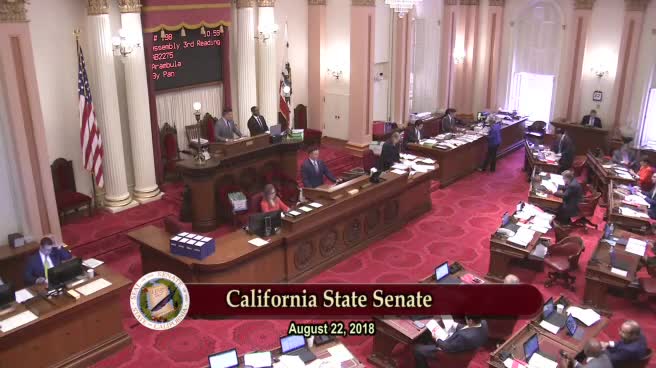 1MIN
Senate Floor
 1H
Senate Standing Committee on Appropriations
 1MIN
Assembly Floor
Bill Author

Bill Co-Author(s):