AB 2058: Vehicles: driving under the influence: cannabis.
- Session Year: 2017-2018
- House: Assembly
- Latest Version Date: 2018-08-29
Existing law prohibits a person who is under the influence of alcohol, drugs, or the combined influence of alcohol or drugs from driving a vehicle. Existing law also prohibits a person from driving under the influence and proximately causing bodily harm to another person, as specified. Existing law defines a drug, for purposes of these provisions, as any substance or combination of substances other than alcohol that can affect the nervous system, brain, or muscles of a person in a manner that impairs the ability to safely drive a vehicle.
This bill would recast these provisions to make driving under the influence of cannabis, or driving under the combined influence of cannabis and another drug, each a separate offense, but with no changes to the penalty.
This bill would make these new provisions operative on July 1, 2020.
Existing law prohibits a person who is under the influence of alcohol, drugs, or the combined influence of alcohol or drugs from driving a vehicle. Existing law also prohibits a person from driving under the influence and proximately causing bodily harm to another person, as specified. Existing law defines a drug, for purposes of these provisions, as any substance or combination of substances other than alcohol that can affect the nervous system, brain, or muscles of a person in a manner that impairs the ability to safely drive a vehicle.
This bill would recast these provisions to make driving under the influence of cannabis, or driving under the combined influence of alcohol and cannabis, cannabis and another drug, each a separate offense offense, but with no changes to the penalty.
Existing law prohibits a person who is under the influence of alcohol, drugs, or the combined influence of alcohol or drugs from driving a vehicle. Existing law also prohibits a person from driving under the influence and proximately causing bodily harm to another person, as specified. Existing law defines a drug, for purposes of these provisions, as any substance or combination of substances other than alcohol that can affect the nervous system, brain, or muscles of a person in a manner that impairs the ability to safely drive a vehicle.
This bill would recast these provisions to make driving under the influence of cannabis, or driving under the combined influence of alcohol and cannabis, each a separate offense but with no changes to the penalty.
Existing law requires the Department of Motor Vehicles to establish and maintain a data and monitoring system, as specified, to evaluate the efficacy of intervention programs for persons convicted of those violations relating to alcohol and drugs, and to report thereon annually to the Legislature.This bill would require any law enforcement agency, as specified, to report monthly to the Department of Justice the number of arrests made for driving under the influence and the number of those arrests in which cannabis was suspected to be the substance, or one of the substances, of which the person was under the influence.This bill would require the Department of Justice to annually report the data to the Department of Motor Vehicles.This bill would require the Department of Motor Vehicles to include that data in its annual report to the Legislature.Because this bill would make new reporting requirements for local law enforcement agencies, it would impose a state-mandated local program.The California Constitution requires the state to reimburse local agencies and school districts for certain costs mandated by the state. Statutory provisions establish procedures for making that reimbursement.This bill would provide that, if the Commission on State Mandates determines that the bill contains costs mandated by the state, reimbursement for those costs shall be made pursuant to the statutory provisions noted above.Existing law requires the Department of Motor Vehicles to establish and maintain a data and monitoring system, as specified, to evaluate the efficacy of intervention programs for persons convicted of those violations relating to alcohol and drugs, and to report thereon annually to the Legislature.
This bill would require any law enforcement agency, as specified, to annually report report monthly to the Department of Motor Vehicles Justice the number of arrests made for driving under the influence and the number of those arrests in which cannabis was suspected to be the substance, or one of the substances, of which the person was under the influence.
This bill would require the Department of Justice to annually report the data to the Department of Motor Vehicles.
This bill would require the Department of Motor Vehicles to include that data in its annual report to the Legislature.
Because this bill would make new reporting requirements for local law enforcement agencies, it would impose a state-mandated local program.
The California Constitution requires the state to reimburse local agencies and school districts for certain costs mandated by the state. Statutory provisions establish procedures for making that reimbursement.
This bill would provide that, if the Commission on State Mandates determines that the bill contains costs mandated by the state, reimbursement for those costs shall be made pursuant to the statutory provisions noted above.
Existing law requires the Department of Motor Vehicles to establish and maintain a data and monitoring system, as specified, to evaluate the efficacy of intervention programs for persons convicted of those violations relating to alcohol and drugs, and to report thereon annually to the Legislature.
This bill would require any law enforcement agency, as specified, to annually report to the Department of Motor Vehicles the number of arrests made for driving under the influence and the number of those arrests in which cannabis was suspected to be the substance, or one of the substances, of which the person was under the influence.
This bill would require the Department of Motor Vehicles to include that data in its annual report to the Legislature.
Because this bill would make new reporting requirements for local law enforcement agencies, it would impose a state-mandated local program.
The California Constitution requires the state to reimburse local agencies and school districts for certain costs mandated by the state. Statutory provisions establish procedures for making that reimbursement.
This bill would provide that, if the Commission on State Mandates determines that the bill contains costs mandated by the state, reimbursement for those costs shall be made pursuant to the statutory provisions noted above.
The Legislature finds and declares that the purpose of this act is to distinguish the offense of driving under the influence of cannabis from other driving under the influence offenses for statistical purposes only.
SEC. 2.Section 23152 of the Vehicle Code is amended to read:23152.(a)It is unlawful for a person who is under the influence of any alcoholic beverage to drive a vehicle.
(b)It is unlawful for a person who has 0.08 percent or more, by weight, of alcohol in his or her blood to drive a vehicle.
For purposes of this article and Section 34501.16, percent, by weight, of alcohol in a persons blood is based upon grams of alcohol per 100 milliliters of blood or grams of alcohol per 210 liters of breath.
In any prosecution under this subdivision, it is a rebuttable presumption that the person had 0.08 percent or more, by weight, of alcohol in his or her blood at the time of driving the vehicle if the person had 0.08 percent or more, by weight, of alcohol in his or her blood at the time of the performance of a chemical test within three hours after the driving.
(c)It is unlawful for a person who is addicted to the use of any drug to drive a vehicle. This subdivision shall not apply to a person who is participating in a narcotic treatment program approved pursuant to Article 3 (commencing with Section 11875) of Chapter 1 of Part 3 of Division 10.5 of the Health and Safety Code.
(d)It is unlawful for a person who has 0.04 percent or more, by weight, of alcohol in his or her blood to drive a commercial motor vehicle, as defined in Section 15210. In a prosecution under this subdivision, it is a rebuttable presumption that the person had 0.04 percent or more, by weight, of alcohol in his or her blood at the time of driving the vehicle if the person had 0.04 percent or more, by weight, of alcohol in his or her blood at the time of the performance of a chemical test within three hours after the driving.
(e)Commencing July 1, 2018, it shall be unlawful for a person who has 0.04 percent or more, by weight, of alcohol in his or her blood to drive a motor vehicle when a passenger for hire is a passenger in the vehicle at the time of the offense. For purposes of this subdivision, passenger for hire means a passenger for whom consideration is contributed or expected as a condition of carriage in the vehicle, whether directly or indirectly flowing to the owner, operator, agent, or any other person having an interest in the vehicle. In a prosecution under this subdivision, it is a rebuttable presumption that the person had 0.04 percent or more, by weight, of alcohol in his or her blood at the time of driving the vehicle if the person had 0.04 percent or more, by weight, of alcohol in his or her blood at the time of the performance of a chemical test within three hours after the driving.
(f)It is unlawful for a person who is under the influence of any drug to drive a vehicle.
(g)It is unlawful for a person who is under the combined influence of any alcoholic beverage and drug to drive a vehicle.
(h)This section shall remain in effect only until July 1, 2020, and as of that date is repealed.
SEC. 3.Section 23152 is added to the Vehicle Code, to read:23152.(a)It is unlawful for a person who is under the influence of any alcoholic beverage to drive a vehicle.
(b)It is unlawful for a person who has 0.08 percent or more, by weight, of alcohol in his or her blood to drive a vehicle.
For purposes of this article and Section 34501.16, percent, by weight, of alcohol in a persons blood is based upon grams of alcohol per 100 milliliters of blood or grams of alcohol per 210 liters of breath.
In any prosecution under this subdivision, it is a rebuttable presumption that the person had 0.08 percent or more, by weight, of alcohol in his or her blood at the time of driving the vehicle if the person had 0.08 percent or more, by weight, of alcohol in his or her blood at the time of the performance of a chemical test within three hours after the driving.
(c)It is unlawful for a person who is addicted to the use of any drug to drive a vehicle. This subdivision shall not apply to a person who is participating in a narcotic treatment program approved pursuant to Article 3 (commencing with Section 11875) of Chapter 1 of Part 3 of Division 10.5 of the Health and Safety Code.
(d)It is unlawful for a person who has 0.04 percent or more, by weight, of alcohol in his or her blood to drive a commercial motor vehicle, as defined in Section 15210. In a prosecution under this subdivision, it is a rebuttable presumption that the person had 0.04 percent or more, by weight, of alcohol in his or her blood at the time of driving the vehicle if the person had 0.04 percent or more, by weight, of alcohol in his or her blood at the time of the performance of a chemical test within three hours after the driving.
(e)Commencing July 1, 2018, it shall be unlawful for a person who has 0.04 percent or more, by weight, of alcohol in his or her blood to drive a motor vehicle when a passenger for hire is a passenger in the vehicle at the time of the offense. For purposes of this subdivision, passenger for hire means a passenger for whom consideration is contributed or expected as a condition of carriage in the vehicle, whether directly or indirectly flowing to the owner, operator, agent, or any other person having an interest in the vehicle. In a prosecution under this subdivision, it is a rebuttable presumption that the person had 0.04 percent or more, by weight, of alcohol in his or her blood at the time of driving the vehicle if the person had 0.04 percent or more, by weight, of alcohol in his or her blood at the time of the performance of a chemical test within three hours after the driving.
(f)It is unlawful for a person who is under the influence of any drug other than cannabis, to drive a vehicle.
(g)It is unlawful for a person who is under the combined influence of any alcoholic beverage and drug, including cannabis, to drive a vehicle.
(h)It is unlawful for a person who is under the influence of cannabis or any cannabis product or derivative to drive a vehicle.
(i)It is unlawful for a person who is under the combined influence of cannabis and any other drug to drive a vehicle.
(j)This section shall become operative on July 1, 2020.
SEC. 4.Section 23153 of the Vehicle Code is amended to read:23153.(a)It is unlawful for a person, while under the influence of any alcoholic beverage, to drive a vehicle and concurrently do any act forbidden by law, or neglect any duty imposed by law in driving the vehicle, which act or neglect proximately causes bodily injury to any person other than the driver.
(b)It is unlawful for a person, while having 0.08 percent or more, by weight, of alcohol in his or her blood to drive a vehicle and concurrently do any act forbidden by law, or neglect any duty imposed by law in driving the vehicle, which act or neglect proximately causes bodily injury to any person other than the driver.
In any prosecution under this subdivision, it is a rebuttable presumption that the person had 0.08 percent or more, by weight, of alcohol in his or her blood at the time of driving the vehicle if the person had 0.08 percent or more, by weight, of alcohol in his or her blood at the time of the performance of a chemical test within three hours after driving.
(c)In proving the person neglected any duty imposed by law in driving the vehicle, it is not necessary to prove that any specific section of this code was violated.
(d)It is unlawful for a person, while having 0.04 percent or more, by weight, of alcohol in his or her blood to drive a commercial motor vehicle, as defined in Section 15210 and concurrently to do any act forbidden by law or neglect any duty imposed by law in driving the vehicle, which act or neglect proximately causes bodily injury to any person other than the driver. In a prosecution under this subdivision, it is a rebuttable presumption that the person had 0.04 percent or more, by weight, of alcohol in his or her blood at the time of driving the vehicle if the person had 0.04 percent or more, by weight, of alcohol in his or her blood at the time of performance of a chemical test within three hours after driving.
(e)Commencing July 1, 2018, it shall be unlawful for a person, while having 0.04 percent or more, by weight, of alcohol in his or her blood to drive a motor vehicle when a passenger for hire is a passenger in the vehicle at the time of the offense, and concurrently to do any act forbidden by law or neglect any duty imposed by law in driving the vehicle, which act or neglect proximately causes bodily injury to any person other than the driver. For purposes of this subdivision, passenger for hire means a passenger for whom consideration is contributed or expected as a condition of carriage in the vehicle, whether directly or indirectly flowing to the owner, operator, agent, or any other person having an interest in the vehicle. In a prosecution under this subdivision, it is a rebuttable presumption that the person had 0.04 percent or more, by weight, of alcohol in his or her blood at the time of driving the vehicle if the person had 0.04 percent or more, by weight, of alcohol in his or her blood at the time of performance of a chemical test within three hours after driving.
(f)It is unlawful for a person, while under the influence of any drug, to drive a vehicle and concurrently do any act forbidden by law, or neglect any duty imposed by law in driving the vehicle, which act or neglect proximately causes bodily injury to any person other than the driver.
(g)It is unlawful for a person, while under the combined influence of any alcoholic beverage and drug, to drive a vehicle and concurrently do any act forbidden by law, or neglect any duty imposed by law in driving the vehicle, which act or neglect proximately causes bodily injury to any person other than the driver.
(h)This section shall remain in effect only until July 1, 2020, and as of that date is repealed.
SEC. 5.Section 23153 is added to the Vehicle Code, to read:23153.(a)It is unlawful for a person, while under the influence of any alcoholic beverage, to drive a vehicle and concurrently do any act forbidden by law, or neglect any duty imposed by law in driving the vehicle, which act or neglect proximately causes bodily injury to any person other than the driver.
(b)It is unlawful for a person, while having 0.08 percent or more, by weight, of alcohol in his or her blood to drive a vehicle and concurrently do any act forbidden by law, or neglect any duty imposed by law in driving the vehicle, which act or neglect proximately causes bodily injury to any person other than the driver.
In any prosecution under this subdivision, it is a rebuttable presumption that the person had 0.08 percent or more, by weight, of alcohol in his or her blood at the time of driving the vehicle if the person had 0.08 percent or more, by weight, of alcohol in his or her blood at the time of the performance of a chemical test within three hours after driving.
(c)In proving the person neglected any duty imposed by law in driving the vehicle, it is not necessary to prove that any specific section of this code was violated.
(d)It is unlawful for a person, while having 0.04 percent or more, by weight, of alcohol in his or her blood to drive a commercial motor vehicle, as defined in Section 15210 and concurrently to do any act forbidden by law or neglect any duty imposed by law in driving the vehicle, which act or neglect proximately causes bodily injury to any person other than the driver. In a prosecution under this subdivision, it is a rebuttable presumption that the person had 0.04 percent or more, by weight, of alcohol in his or her blood at the time of driving the vehicle if the person had 0.04 percent or more, by weight, of alcohol in his or her blood at the time of performance of a chemical test within three hours after driving.
(e)Commencing July 1, 2018, it shall be unlawful for a person, while having 0.04 percent or more, by weight, of alcohol in his or her blood to drive a motor vehicle when a passenger for hire is a passenger in the vehicle at the time of the offense, and concurrently to do any act forbidden by law or neglect any duty imposed by law in driving the vehicle, which act or neglect proximately causes bodily injury to any person other than the driver. For purposes of this subdivision, passenger for hire means a passenger for whom consideration is contributed or expected as a condition of carriage in the vehicle, whether directly or indirectly flowing to the owner, operator, agent, or any other person having an interest in the vehicle. In a prosecution under this subdivision, it is a rebuttable presumption that the person had 0.04 percent or more, by weight, of alcohol in his or her blood at the time of driving the vehicle if the person had 0.04 percent or more, by weight, of alcohol in his or her blood at the time of performance of a chemical test within three hours after driving.
(f)It is unlawful for a person, while under the influence of any drug, other than cannabis, to drive a vehicle and concurrently do any act forbidden by law, or neglect any duty imposed by law in driving the vehicle, which act or neglect proximately causes bodily injury to any person other than the driver.
(g)It is unlawful for a person, while under the combined influence of any alcoholic beverage and drug, including cannabis, to drive a vehicle and concurrently do any act forbidden by law, or neglect any duty imposed by law in driving the vehicle, which act or neglect proximately causes bodily injury to any person other than the driver.
(h)It is unlawful for a person, while under the influence of cannabis or any cannabis product or derivative, to drive a vehicle and concurrently do any act forbidden by law, or neglect any duty imposed by law in driving the vehicle, which act or neglect proximately causes bodily injury to any person other than the driver.
(i)It is unlawful for a person, while under the combined influence of cannabis and any other drug, to drive a vehicle and concurrently do any act forbidden by law, or neglect any duty imposed by law in driving the vehicle, which act or neglect proximately causes bodily injury to any person other than the driver.
(j)This section shall become operative on July 1, 2020.
The Legislature finds and declares that the purpose of this act is to separate distinguish the offense of driving under the influence of cannabis from other driving under the influence offenses for statistical purposes only.
SEC. 2.Section 23152 of the Vehicle Code is amended to read:23152.(a)It is unlawful for a person who is under the influence of any alcoholic beverage to drive a vehicle.(b)It is unlawful for a person who has 0.08 percent or more, by weight, of alcohol in his or her blood to drive a vehicle.For purposes of this article and Section 34501.16, percent, by weight, of alcohol in a persons blood is based upon grams of alcohol per 100 milliliters of blood or grams of alcohol per 210 liters of breath.In any prosecution under this subdivision, it is a rebuttable presumption that the person had 0.08 percent or more, by weight, of alcohol in his or her blood at the time of driving the vehicle if the person had 0.08 percent or more, by weight, of alcohol in his or her blood at the time of the performance of a chemical test within three hours after the driving.(c)It is unlawful for a person who is addicted to the use of any drug to drive a vehicle. This subdivision shall not apply to a person who is participating in a narcotic treatment program approved pursuant to Article 3 (commencing with Section 11875) of Chapter 1 of Part 3 of Division 10.5 of the Health and Safety Code.(d)It is unlawful for a person who has 0.04 percent or more, by weight, of alcohol in his or her blood to drive a commercial motor vehicle, as defined in Section 15210. In a prosecution under this subdivision, it is a rebuttable presumption that the person had 0.04 percent or more, by weight, of alcohol in his or her blood at the time of driving the vehicle if the person had 0.04 percent or more, by weight, of alcohol in his or her blood at the time of the performance of a chemical test within three hours after the driving.(e)Commencing July 1, 2018, it shall be unlawful for a person who has 0.04 percent or more, by weight, of alcohol in his or her blood to drive a motor vehicle when a passenger for hire is a passenger in the vehicle at the time of the offense. For purposes of this subdivision, passenger for hire means a passenger for whom consideration is contributed or expected as a condition of carriage in the vehicle, whether directly or indirectly flowing to the owner, operator, agent, or any other person having an interest in the vehicle. In a prosecution under this subdivision, it is a rebuttable presumption that the person had 0.04 percent or more, by weight, of alcohol in his or her blood at the time of driving the vehicle if the person had 0.04 percent or more, by weight, of alcohol in his or her blood at the time of the performance of a chemical test within three hours after the driving.(f)It is unlawful for a person who is under the influence of any drug other than cannabis, to drive a vehicle.(g)It is unlawful for a person who is under the combined influence of any alcoholic beverage and drug, including cannabis, to drive a vehicle.(h)It is unlawful for a person who is under the influence of cannabis or any cannabis product or derivative to drive a vehicle.(i)It is unlawful for a person who is under the combined influence of cannabis and any other drug to drive a vehicle.SEC. 3.Section 23153 of the Vehicle Code is amended to read:23153.(a)It is unlawful for a person, while under the influence of any alcoholic beverage, to drive a vehicle and concurrently do any act forbidden by law, or neglect any duty imposed by law in driving the vehicle, which act or neglect proximately causes bodily injury to any person other than the driver.(b)It is unlawful for a person, while having 0.08 percent or more, by weight, of alcohol in his or her blood to drive a vehicle and concurrently do any act forbidden by law, or neglect any duty imposed by law in driving the vehicle, which act or neglect proximately causes bodily injury to any person other than the driver.In any prosecution under this subdivision, it is a rebuttable presumption that the person had 0.08 percent or more, by weight, of alcohol in his or her blood at the time of driving the vehicle if the person had 0.08 percent or more, by weight, of alcohol in his or her blood at the time of the performance of a chemical test within three hours after driving.(c)In proving the person neglected any duty imposed by law in driving the vehicle, it is not necessary to prove that any specific section of this code was violated.(d)It is unlawful for a person, while having 0.04 percent or more, by weight, of alcohol in his or her blood to drive a commercial motor vehicle, as defined in Section 15210 and concurrently to do any act forbidden by law or neglect any duty imposed by law in driving the vehicle, which act or neglect proximately causes bodily injury to any person other than the driver. In a prosecution under this subdivision, it is a rebuttable presumption that the person had 0.04 percent or more, by weight, of alcohol in his or her blood at the time of driving the vehicle if the person had 0.04 percent or more, by weight, of alcohol in his or her blood at the time of performance of a chemical test within three hours after driving.(e)Commencing July 1, 2018, it shall be unlawful for a person, while having 0.04 percent or more, by weight, of alcohol in his or her blood to drive a motor vehicle when a passenger for hire is a passenger in the vehicle at the time of the offense, and concurrently to do any act forbidden by law or neglect any duty imposed by law in driving the vehicle, which act or neglect proximately causes bodily injury to any person other than the driver. For purposes of this subdivision, passenger for hire means a passenger for whom consideration is contributed or expected as a condition of carriage in the vehicle, whether directly or indirectly flowing to the owner, operator, agent, or any other person having an interest in the vehicle. In a prosecution under this subdivision, it is a rebuttable presumption that the person had 0.04 percent or more, by weight, of alcohol in his or her blood at the time of driving the vehicle if the person had 0.04 percent or more, by weight, of alcohol in his or her blood at the time of performance of a chemical test within three hours after driving.(f)It is unlawful for a person, while under the influence of any drug, other than cannabis, to drive a vehicle and concurrently do any act forbidden by law, or neglect any duty imposed by law in driving the vehicle, which act or neglect proximately causes bodily injury to any person other than the driver.(g)It is unlawful for a person, while under the combined influence of any alcoholic beverage and drug, including cannabis, to drive a vehicle and concurrently do any act forbidden by law, or neglect any duty imposed by law in driving the vehicle, which act or neglect proximately causes bodily injury to any person other than the driver.(h)It is unlawful for a person, while under the influence of cannabis or any cannabis product or derivative, to drive a vehicle and concurrently do any act forbidden by law, or neglect any duty imposed by law in driving the vehicle, which act or neglect proximately causes bodily injury to any person other than the driver.(i)It is unlawful for a person, while under the combined influence of cannabis and any other drug, to drive a vehicle and concurrently do any act forbidden by law, or neglect any duty imposed by law in driving the vehicle, which act or neglect proximately causes bodily injury to any person other than the driver.SEC. 2.Section 23152 of the Vehicle Code is amended to read:23152.(a)It is unlawful for a person who is under the influence of any alcoholic beverage to drive a vehicle.
(b)It is unlawful for a person who has 0.08 percent or more, by weight, of alcohol in his or her blood to drive a vehicle.
For purposes of this article and Section 34501.16, percent, by weight, of alcohol in a persons blood is based upon grams of alcohol per 100 milliliters of blood or grams of alcohol per 210 liters of breath.
In any prosecution under this subdivision, it is a rebuttable presumption that the person had 0.08 percent or more, by weight, of alcohol in his or her blood at the time of driving the vehicle if the person had 0.08 percent or more, by weight, of alcohol in his or her blood at the time of the performance of a chemical test within three hours after the driving.
(c)It is unlawful for a person who is addicted to the use of any drug to drive a vehicle. This subdivision shall not apply to a person who is participating in a narcotic treatment program approved pursuant to Article 3 (commencing with Section 11875) of Chapter 1 of Part 3 of Division 10.5 of the Health and Safety Code.
(d)It is unlawful for a person who has 0.04 percent or more, by weight, of alcohol in his or her blood to drive a commercial motor vehicle, as defined in Section 15210. In a prosecution under this subdivision, it is a rebuttable presumption that the person had 0.04 percent or more, by weight, of alcohol in his or her blood at the time of driving the vehicle if the person had 0.04 percent or more, by weight, of alcohol in his or her blood at the time of the performance of a chemical test within three hours after the driving.
(e)Commencing July 1, 2018, it shall be unlawful for a person who has 0.04 percent or more, by weight, of alcohol in his or her blood to drive a motor vehicle when a passenger for hire is a passenger in the vehicle at the time of the offense. For purposes of this subdivision, passenger for hire means a passenger for whom consideration is contributed or expected as a condition of carriage in the vehicle, whether directly or indirectly flowing to the owner, operator, agent, or any other person having an interest in the vehicle. In a prosecution under this subdivision, it is a rebuttable presumption that the person had 0.04 percent or more, by weight, of alcohol in his or her blood at the time of driving the vehicle if the person had 0.04 percent or more, by weight, of alcohol in his or her blood at the time of the performance of a chemical test within three hours after the driving.
(f)It is unlawful for a person who is under the influence of any drug to drive a vehicle.
(g)It is unlawful for a person who is under the combined influence of any alcoholic beverage and drug to drive a vehicle.
(h)This section shall remain in effect only until July 1, 2020, and as of that date is repealed.
SEC. 3.Section 23152 is added to the Vehicle Code, to read:23152.(a)It is unlawful for a person who is under the influence of any alcoholic beverage to drive a vehicle.
(b)It is unlawful for a person who has 0.08 percent or more, by weight, of alcohol in his or her blood to drive a vehicle.
For purposes of this article and Section 34501.16, percent, by weight, of alcohol in a persons blood is based upon grams of alcohol per 100 milliliters of blood or grams of alcohol per 210 liters of breath.
In any prosecution under this subdivision, it is a rebuttable presumption that the person had 0.08 percent or more, by weight, of alcohol in his or her blood at the time of driving the vehicle if the person had 0.08 percent or more, by weight, of alcohol in his or her blood at the time of the performance of a chemical test within three hours after the driving.
(c)It is unlawful for a person who is addicted to the use of any drug to drive a vehicle. This subdivision shall not apply to a person who is participating in a narcotic treatment program approved pursuant to Article 3 (commencing with Section 11875) of Chapter 1 of Part 3 of Division 10.5 of the Health and Safety Code.
(d)It is unlawful for a person who has 0.04 percent or more, by weight, of alcohol in his or her blood to drive a commercial motor vehicle, as defined in Section 15210. In a prosecution under this subdivision, it is a rebuttable presumption that the person had 0.04 percent or more, by weight, of alcohol in his or her blood at the time of driving the vehicle if the person had 0.04 percent or more, by weight, of alcohol in his or her blood at the time of the performance of a chemical test within three hours after the driving.
(e)Commencing July 1, 2018, it shall be unlawful for a person who has 0.04 percent or more, by weight, of alcohol in his or her blood to drive a motor vehicle when a passenger for hire is a passenger in the vehicle at the time of the offense. For purposes of this subdivision, passenger for hire means a passenger for whom consideration is contributed or expected as a condition of carriage in the vehicle, whether directly or indirectly flowing to the owner, operator, agent, or any other person having an interest in the vehicle. In a prosecution under this subdivision, it is a rebuttable presumption that the person had 0.04 percent or more, by weight, of alcohol in his or her blood at the time of driving the vehicle if the person had 0.04 percent or more, by weight, of alcohol in his or her blood at the time of the performance of a chemical test within three hours after the driving.
(f)It is unlawful for a person who is under the influence of any drug other than cannabis, to drive a vehicle.
(g)It is unlawful for a person who is under the combined influence of any alcoholic beverage and drug, including cannabis, to drive a vehicle.
(h)It is unlawful for a person who is under the influence of cannabis or any cannabis product or derivative to drive a vehicle.
(i)It is unlawful for a person who is under the combined influence of cannabis and any other drug to drive a vehicle.
(j)This section shall become operative on July 1, 2020.
SEC. 4.Section 23153 of the Vehicle Code is amended to read:23153.(a)It is unlawful for a person, while under the influence of any alcoholic beverage, to drive a vehicle and concurrently do any act forbidden by law, or neglect any duty imposed by law in driving the vehicle, which act or neglect proximately causes bodily injury to any person other than the driver.
(b)It is unlawful for a person, while having 0.08 percent or more, by weight, of alcohol in his or her blood to drive a vehicle and concurrently do any act forbidden by law, or neglect any duty imposed by law in driving the vehicle, which act or neglect proximately causes bodily injury to any person other than the driver.
In any prosecution under this subdivision, it is a rebuttable presumption that the person had 0.08 percent or more, by weight, of alcohol in his or her blood at the time of driving the vehicle if the person had 0.08 percent or more, by weight, of alcohol in his or her blood at the time of the performance of a chemical test within three hours after driving.
(c)In proving the person neglected any duty imposed by law in driving the vehicle, it is not necessary to prove that any specific section of this code was violated.
(d)It is unlawful for a person, while having 0.04 percent or more, by weight, of alcohol in his or her blood to drive a commercial motor vehicle, as defined in Section 15210 and concurrently to do any act forbidden by law or neglect any duty imposed by law in driving the vehicle, which act or neglect proximately causes bodily injury to any person other than the driver. In a prosecution under this subdivision, it is a rebuttable presumption that the person had 0.04 percent or more, by weight, of alcohol in his or her blood at the time of driving the vehicle if the person had 0.04 percent or more, by weight, of alcohol in his or her blood at the time of performance of a chemical test within three hours after driving.
(e)Commencing July 1, 2018, it shall be unlawful for a person, while having 0.04 percent or more, by weight, of alcohol in his or her blood to drive a motor vehicle when a passenger for hire is a passenger in the vehicle at the time of the offense, and concurrently to do any act forbidden by law or neglect any duty imposed by law in driving the vehicle, which act or neglect proximately causes bodily injury to any person other than the driver. For purposes of this subdivision, passenger for hire means a passenger for whom consideration is contributed or expected as a condition of carriage in the vehicle, whether directly or indirectly flowing to the owner, operator, agent, or any other person having an interest in the vehicle. In a prosecution under this subdivision, it is a rebuttable presumption that the person had 0.04 percent or more, by weight, of alcohol in his or her blood at the time of driving the vehicle if the person had 0.04 percent or more, by weight, of alcohol in his or her blood at the time of performance of a chemical test within three hours after driving.
(f)It is unlawful for a person, while under the influence of any drug, to drive a vehicle and concurrently do any act forbidden by law, or neglect any duty imposed by law in driving the vehicle, which act or neglect proximately causes bodily injury to any person other than the driver.
(g)It is unlawful for a person, while under the combined influence of any alcoholic beverage and drug, to drive a vehicle and concurrently do any act forbidden by law, or neglect any duty imposed by law in driving the vehicle, which act or neglect proximately causes bodily injury to any person other than the driver.
(h)This section shall remain in effect only until July 1, 2020, and as of that date is repealed.
SEC. 5.Section 23153 is added to the Vehicle Code, to read:23153.(a)It is unlawful for a person, while under the influence of any alcoholic beverage, to drive a vehicle and concurrently do any act forbidden by law, or neglect any duty imposed by law in driving the vehicle, which act or neglect proximately causes bodily injury to any person other than the driver.
(b)It is unlawful for a person, while having 0.08 percent or more, by weight, of alcohol in his or her blood to drive a vehicle and concurrently do any act forbidden by law, or neglect any duty imposed by law in driving the vehicle, which act or neglect proximately causes bodily injury to any person other than the driver.
In any prosecution under this subdivision, it is a rebuttable presumption that the person had 0.08 percent or more, by weight, of alcohol in his or her blood at the time of driving the vehicle if the person had 0.08 percent or more, by weight, of alcohol in his or her blood at the time of the performance of a chemical test within three hours after driving.
(c)In proving the person neglected any duty imposed by law in driving the vehicle, it is not necessary to prove that any specific section of this code was violated.
(d)It is unlawful for a person, while having 0.04 percent or more, by weight, of alcohol in his or her blood to drive a commercial motor vehicle, as defined in Section 15210 and concurrently to do any act forbidden by law or neglect any duty imposed by law in driving the vehicle, which act or neglect proximately causes bodily injury to any person other than the driver. In a prosecution under this subdivision, it is a rebuttable presumption that the person had 0.04 percent or more, by weight, of alcohol in his or her blood at the time of driving the vehicle if the person had 0.04 percent or more, by weight, of alcohol in his or her blood at the time of performance of a chemical test within three hours after driving.
(e)Commencing July 1, 2018, it shall be unlawful for a person, while having 0.04 percent or more, by weight, of alcohol in his or her blood to drive a motor vehicle when a passenger for hire is a passenger in the vehicle at the time of the offense, and concurrently to do any act forbidden by law or neglect any duty imposed by law in driving the vehicle, which act or neglect proximately causes bodily injury to any person other than the driver. For purposes of this subdivision, passenger for hire means a passenger for whom consideration is contributed or expected as a condition of carriage in the vehicle, whether directly or indirectly flowing to the owner, operator, agent, or any other person having an interest in the vehicle. In a prosecution under this subdivision, it is a rebuttable presumption that the person had 0.04 percent or more, by weight, of alcohol in his or her blood at the time of driving the vehicle if the person had 0.04 percent or more, by weight, of alcohol in his or her blood at the time of performance of a chemical test within three hours after driving.
(f)It is unlawful for a person, while under the influence of any drug, other than cannabis, to drive a vehicle and concurrently do any act forbidden by law, or neglect any duty imposed by law in driving the vehicle, which act or neglect proximately causes bodily injury to any person other than the driver.
(g)It is unlawful for a person, while under the combined influence of any alcoholic beverage and drug, including cannabis, to drive a vehicle and concurrently do any act forbidden by law, or neglect any duty imposed by law in driving the vehicle, which act or neglect proximately causes bodily injury to any person other than the driver.
(h)It is unlawful for a person, while under the influence of cannabis or any cannabis product or derivative, to drive a vehicle and concurrently do any act forbidden by law, or neglect any duty imposed by law in driving the vehicle, which act or neglect proximately causes bodily injury to any person other than the driver.
(i)It is unlawful for a person, while under the combined influence of cannabis and any other drug, to drive a vehicle and concurrently do any act forbidden by law, or neglect any duty imposed by law in driving the vehicle, which act or neglect proximately causes bodily injury to any person other than the driver.
(j)This section shall become operative on July 1, 2020.
The Legislature finds and declares that the purpose of this act is to separate the offense of driving under the influence of cannabis from other driving under the influence offenses for statistical purposes only.
SECTION 1.SEC. 2.Section 23152 of the Vehicle Code is amended to read:23152.(a)It is unlawful for a person who is under the influence of any alcoholic beverage to drive a vehicle.
(b)It is unlawful for a person who has 0.08 percent or more, by weight, of alcohol in his or her blood to drive a vehicle.
For purposes of this article and Section 34501.16, percent, by weight, of alcohol in a persons blood is based upon grams of alcohol per 100 milliliters of blood or grams of alcohol per 210 liters of breath.
In any prosecution under this subdivision, it is a rebuttable presumption that the person had 0.08 percent or more, by weight, of alcohol in his or her blood at the time of driving the vehicle if the person had 0.08 percent or more, by weight, of alcohol in his or her blood at the time of the performance of a chemical test within three hours after the driving.
(c)It is unlawful for a person who is addicted to the use of any drug to drive a vehicle. This subdivision shall not apply to a person who is participating in a narcotic treatment program approved pursuant to Article 3 (commencing with Section 11875) of Chapter 1 of Part 3 of Division 10.5 of the Health and Safety Code.
(d)It is unlawful for a person who has 0.04 percent or more, by weight, of alcohol in his or her blood to drive a commercial motor vehicle, as defined in Section 15210. In a prosecution under this subdivision, it is a rebuttable presumption that the person had 0.04 percent or more, by weight, of alcohol in his or her blood at the time of driving the vehicle if the person had 0.04 percent or more, by weight, of alcohol in his or her blood at the time of the performance of a chemical test within three hours after the driving.
(e)Commencing July 1, 2018, it shall be unlawful for a person who has 0.04 percent or more, by weight, of alcohol in his or her blood to drive a motor vehicle when a passenger for hire is a passenger in the vehicle at the time of the offense. For purposes of this subdivision, passenger for hire means a passenger for whom consideration is contributed or expected as a condition of carriage in the vehicle, whether directly or indirectly flowing to the owner, operator, agent, or any other person having an interest in the vehicle. In a prosecution under this subdivision, it is a rebuttable presumption that the person had 0.04 percent or more, by weight, of alcohol in his or her blood at the time of driving the vehicle if the person had 0.04 percent or more, by weight, of alcohol in his or her blood at the time of the performance of a chemical test within three hours after the driving.
(f)It is unlawful for a person who is under the influence of any drug other than cannabis, to drive a vehicle.
(g)It is unlawful for a person who is under the combined influence of any alcoholic beverage and drug other than cannabis, drug, including cannabis, to drive a vehicle.
(h)It is unlawful for a person who is under the influence of cannabis or any cannabis product or derivative to drive a vehicle.
(i)It is unlawful for a person who is under the combined influence of any alcoholic beverage and cannabis or any cannabis product or derivative cannabis and any other drug to drive a vehicle.
SEC. 2.SEC. 3.Section 23153 of the Vehicle Code is amended to read:23153.(a)It is unlawful for a person, while under the influence of any alcoholic beverage, to drive a vehicle and concurrently do any act forbidden by law, or neglect any duty imposed by law in driving the vehicle, which act or neglect proximately causes bodily injury to any person other than the driver.
(b)It is unlawful for a person, while having 0.08 percent or more, by weight, of alcohol in his or her blood to drive a vehicle and concurrently do any act forbidden by law, or neglect any duty imposed by law in driving the vehicle, which act or neglect proximately causes bodily injury to any person other than the driver.
In any prosecution under this subdivision, it is a rebuttable presumption that the person had 0.08 percent or more, by weight, of alcohol in his or her blood at the time of driving the vehicle if the person had 0.08 percent or more, by weight, of alcohol in his or her blood at the time of the performance of a chemical test within three hours after driving.
(c)In proving the person neglected any duty imposed by law in driving the vehicle, it is not necessary to prove that any specific section of this code was violated.
(d)It is unlawful for a person, while having 0.04 percent or more, by weight, of alcohol in his or her blood to drive a commercial motor vehicle, as defined in Section 15210 and concurrently to do any act forbidden by law or neglect any duty imposed by law in driving the vehicle, which act or neglect proximately causes bodily injury to any person other than the driver. In a prosecution under this subdivision, it is a rebuttable presumption that the person had 0.04 percent or more, by weight, of alcohol in his or her blood at the time of driving the vehicle if the person had 0.04 percent or more, by weight, of alcohol in his or her blood at the time of performance of a chemical test within three hours after driving.
(e)Commencing July 1, 2018, it shall be unlawful for a person, while having 0.04 percent or more, by weight, of alcohol in his or her blood to drive a motor vehicle when a passenger for hire is a passenger in the vehicle at the time of the offense, and concurrently to do any act forbidden by law or neglect any duty imposed by law in driving the vehicle, which act or neglect proximately causes bodily injury to any person other than the driver. For purposes of this subdivision, passenger for hire means a passenger for whom consideration is contributed or expected as a condition of carriage in the vehicle, whether directly or indirectly flowing to the owner, operator, agent, or any other person having an interest in the vehicle. In a prosecution under this subdivision, it is a rebuttable presumption that the person had 0.04 percent or more, by weight, of alcohol in his or her blood at the time of driving the vehicle if the person had 0.04 percent or more, by weight, of alcohol in his or her blood at the time of performance of a chemical test within three hours after driving.
(f)It is unlawful for a person, while under the influence of any drug, other than cannabis, to drive a vehicle and concurrently do any act forbidden by law, or neglect any duty imposed by law in driving the vehicle, which act or neglect proximately causes bodily injury to any person other than the driver.
(g)It is unlawful for a person, while under the combined influence of any alcoholic beverage and drug, other than including cannabis, to drive a vehicle and concurrently do any act forbidden by law, or neglect any duty imposed by law in driving the vehicle, which act or neglect proximately causes bodily injury to any person other than the driver.
(h)It is unlawful for a person, while under the influence of cannabis or any cannabis product or derivative, to drive a vehicle and concurrently do any act forbidden by law, or neglect any duty imposed by law in driving the vehicle, which act or neglect proximately causes bodily injury to any person other than the driver.
(i)It is unlawful for a person, while under the combined influence of any alcoholic beverage and cannabis or any cannabis product or derivative, cannabis and any other drug, to drive a vehicle and concurrently do any act forbidden by law, or neglect any duty imposed by law in driving the vehicle, which act or neglect proximately causes bodily injury to any person other than the driver.
(a)It is unlawful for a person who is under the influence of any alcoholic beverage to drive a vehicle.
(b)It is unlawful for a person who has 0.08 percent or more, by weight, of alcohol in his or her blood to drive a vehicle.
For purposes of this article and Section 34501.16, percent, by weight, of alcohol in a persons blood is based upon grams of alcohol per 100 milliliters of blood or grams of alcohol per 210 liters of breath.
In any prosecution under this subdivision, it is a rebuttable presumption that the person had 0.08 percent or more, by weight, of alcohol in his or her blood at the time of driving the vehicle if the person had 0.08 percent or more, by weight, of alcohol in his or her blood at the time of the performance of a chemical test within three hours after the driving.
(c)It is unlawful for a person who is addicted to the use of any drug to drive a vehicle. This subdivision shall not apply to a person who is participating in a narcotic treatment program approved pursuant to Article 3 (commencing with Section 11875) of Chapter 1 of Part 3 of Division 10.5 of the Health and Safety Code.
(d)It is unlawful for a person who has 0.04 percent or more, by weight, of alcohol in his or her blood to drive a commercial motor vehicle, as defined in Section 15210. In a prosecution under this subdivision, it is a rebuttable presumption that the person had 0.04 percent or more, by weight, of alcohol in his or her blood at the time of driving the vehicle if the person had 0.04 percent or more, by weight, of alcohol in his or her blood at the time of the performance of a chemical test within three hours after the driving.
(e)Commencing July 1, 2018, it shall be unlawful for a person who has 0.04 percent or more, by weight, of alcohol in his or her blood to drive a motor vehicle when a passenger for hire is a passenger in the vehicle at the time of the offense. For purposes of this subdivision, passenger for hire means a passenger for whom consideration is contributed or expected as a condition of carriage in the vehicle, whether directly or indirectly flowing to the owner, operator, agent, or any other person having an interest in the vehicle. In a prosecution under this subdivision, it is a rebuttable presumption that the person had 0.04 percent or more, by weight, of alcohol in his or her blood at the time of driving the vehicle if the person had 0.04 percent or more, by weight, of alcohol in his or her blood at the time of the performance of a chemical test within three hours after the driving.
(f)It is unlawful for a person who is under the influence of any drug other than cannabis, to drive a vehicle.
(g)It is unlawful for a person who is under the combined influence of any alcoholic beverage and drug other than cannabis, to drive a vehicle.
(h)It is unlawful for a person who is under the influence of cannabis or any cannabis product or derivative to drive a vehicle.
(i)It is unlawful for a person who is under the combined influence of any alcoholic beverage and cannabis or any cannabis product or derivative to drive a vehicle.
SEC. 2.Section 23153 of the Vehicle Code is amended to read:23153.(a)It is unlawful for a person, while under the influence of any alcoholic beverage, to drive a vehicle and concurrently do any act forbidden by law, or neglect any duty imposed by law in driving the vehicle, which act or neglect proximately causes bodily injury to any person other than the driver.
(b)It is unlawful for a person, while having 0.08 percent or more, by weight, of alcohol in his or her blood to drive a vehicle and concurrently do any act forbidden by law, or neglect any duty imposed by law in driving the vehicle, which act or neglect proximately causes bodily injury to any person other than the driver.
In any prosecution under this subdivision, it is a rebuttable presumption that the person had 0.08 percent or more, by weight, of alcohol in his or her blood at the time of driving the vehicle if the person had 0.08 percent or more, by weight, of alcohol in his or her blood at the time of the performance of a chemical test within three hours after driving.
(c)In proving the person neglected any duty imposed by law in driving the vehicle, it is not necessary to prove that any specific section of this code was violated.
(d)It is unlawful for a person, while having 0.04 percent or more, by weight, of alcohol in his or her blood to drive a commercial motor vehicle, as defined in Section 15210 and concurrently to do any act forbidden by law or neglect any duty imposed by law in driving the vehicle, which act or neglect proximately causes bodily injury to any person other than the driver. In a prosecution under this subdivision, it is a rebuttable presumption that the person had 0.04 percent or more, by weight, of alcohol in his or her blood at the time of driving the vehicle if the person had 0.04 percent or more, by weight, of alcohol in his or her blood at the time of performance of a chemical test within three hours after driving.
(e)Commencing July 1, 2018, it shall be unlawful for a person, while having 0.04 percent or more, by weight, of alcohol in his or her blood to drive a motor vehicle when a passenger for hire is a passenger in the vehicle at the time of the offense, and concurrently to do any act forbidden by law or neglect any duty imposed by law in driving the vehicle, which act or neglect proximately causes bodily injury to any person other than the driver. For purposes of this subdivision, passenger for hire means a passenger for whom consideration is contributed or expected as a condition of carriage in the vehicle, whether directly or indirectly flowing to the owner, operator, agent, or any other person having an interest in the vehicle. In a prosecution under this subdivision, it is a rebuttable presumption that the person had 0.04 percent or more, by weight, of alcohol in his or her blood at the time of driving the vehicle if the person had 0.04 percent or more, by weight, of alcohol in his or her blood at the time of performance of a chemical test within three hours after driving.
(f)It is unlawful for a person, while under the influence of any drug, other than cannabis, to drive a vehicle and concurrently do any act forbidden by law, or neglect any duty imposed by law in driving the vehicle, which act or neglect proximately causes bodily injury to any person other than the driver.
(g)It is unlawful for a person, while under the combined influence of any alcoholic beverage and drug, other than cannabis, to drive a vehicle and concurrently do any act forbidden by law, or neglect any duty imposed by law in driving the vehicle, which act or neglect proximately causes bodily injury to any person other than the driver.
(h)It is unlawful for a person, while under the influence of cannabis or any cannabis product or derivative, to drive a vehicle and concurrently do any act forbidden by law, or neglect any duty imposed by law in driving the vehicle, which act or neglect proximately causes bodily injury to any person other than the driver.
(i)It is unlawful for a person, while under the combined influence of any alcoholic beverage and cannabis or any cannabis product or derivative, to drive a vehicle and concurrently do any act forbidden by law, or neglect any duty imposed by law in driving the vehicle, which act or neglect proximately causes bodily injury to any person other than the driver.
SECTION 1.Section 1821 of the Vehicle Code is amended to read:1821.(a)The department shall establish and maintain a data and monitoring system to evaluate the efficacy of intervention programs for persons convicted of violations of Section 23152 or 23153.(b)The system may include a recidivism tracking system. The recidivism tracking system may include, but not be limited to, jail sentencing, license restriction, license suspension, level I (first offender) and II (multiple offender) alcohol and drug education and treatment program assignment, alcohol and drug education treatment program readmission and dropout rates, adjudicating court, length of jail term, actual jail or alternative sentence served, type of treatment program assigned, actual program compliance status, subsequent accidents related to driving under the influence of alcohol or drugs, and subsequent convictions of violations of Section 23152 or 23153.(c)The systems described in subdivisions (a) and (b) shall include an evaluation of the efficacy of the increased level of intervention resulting from the act that added this subdivision.(d)The department shall submit an annual report of its evaluations to the Legislature. The evaluations shall include a ranking of the relative efficacy of criminal penalties, other sanctions, and intervention programs and the various combinations thereof, including, but not limited to, those described in subdivision (c).(e)Commencing with the first report submitted on or after January 1, 2024, the report described in subdivision (d) shall include statistical data on the number of arrests for driving under the influence, in which the driver was suspected of being under the influence of cannabis or a combination of cannabis and alcohol or another drug as reported to the department pursuant to Section 23155.SEC. 2.Section 23155 is added to the Vehicle Code, to read:23155.(a)On July 15, 2022, and monthly thereafter, each law enforcement agency having traffic law enforcement responsibility within their respective jurisdiction, including, without limitation, each city police department, county sheriffs department, and the Department of the California Highway Patrol shall, on a form developed by, or in a format prescribed by, the Department of Justice, submit to the Department of Justice the number of arrests made during the preceding calendar month for any violation of subdivision (f) or (g) of Section 23152 or subdivision (f) or (g) of Section 23153 that involved cannabis as the drug, or one of the drugs, of which the arrestee was suspected of being under the influence, as well as the total number of arrests for violations of Sections 23152 and 23153.(b)On or before April 1, 2022, the Department of Justice shall develop a form, or prescribe a format for the reporting of the data required to be submitted pursuant to subdivision (a).(c)On or before July 1, 2023, and no less than once annually thereafter, the Department of Justice shall forward a summary of the arrest data obtained pursuant to subdivision (a) to the Department of Motor Vehicles in a format and at a frequency agreed upon by the departments to best effectuate the requirements of Section 1821.SEC. 3.If the Commission on State Mandates determines that this act contains costs mandated by the state, reimbursement to local agencies and school districts for those costs shall be made pursuant to Part 7 (commencing with Section 17500) of Division 4 of Title 2 of the Government Code.(a)The department shall establish and maintain a data and monitoring system to evaluate the efficacy of intervention programs for persons convicted of violations of Section 23152 or 23153.
(b)The system may include a recidivism tracking system. The recidivism tracking system may include, but not be limited to, jail sentencing, license restriction, license suspension, level I (first offender) and II (multiple offender) alcohol and drug education and treatment program assignment, alcohol and drug education treatment program readmission and dropout rates, adjudicating court, length of jail term, actual jail or alternative sentence served, type of treatment program assigned, actual program compliance status, subsequent accidents related to driving under the influence of alcohol or drugs, and subsequent convictions of violations of Section 23152 or 23153.
(c)The systems described in subdivisions (a) and (b) shall include an evaluation of the efficacy of the increased level of intervention resulting from the act that added this subdivision.
(d)The department shall submit an annual report of its evaluations to the Legislature. The evaluations shall include a ranking of the relative efficacy of criminal penalties, other sanctions, and intervention programs and the various combinations thereof, including, but not limited to, those described in subdivision (c).
(e)The Commencing with the first report submitted on or after January 1, 2024, the report described in subdivision (d) shall include statistical data on the number of arrests for driving under the influence arrests influence, in which the driver was suspected of being under the influence of cannabis or a combination of cannabis and alcohol or another drug as reported to the department pursuant to Section 23155.
SEC. 2.Section 23155 is added to the Vehicle Code, to read:23155.(a)On or before February 1, 2021, July 15, 2022, and annually monthly thereafter, each law enforcement agency having traffic law enforcement responsibility within their respective jurisdiction, including, without limitation, each city police department, county sheriffs department, and the Department of the California Highway Patrol shall annually, shall, on a form developed by, or in a format prescribed by, the Department of Motor Vehicles, Justice, submit to the Department of Motor Vehicles Justice the number of arrests made during the preceeding calendar year preceding calendar month for any violation of subdivision (f) or (g) of Section 23152 or subdivision (f) or (g) of Section 23153 that involved cannabis as the drug, or one of the drugs, of which the arrestee was suspected of being under the influence, as well as the total number of arrests for violations of Sections 23152 and 23153.
(b)On or before January 1, 2020, April 1, 2022, the Department of Motor Vehicles Justice shall develop a form, or prescribe a format for the reporting of the data required to be submitted pursuant to subdivision (a).
(c)On or before July 1, 2023, and no less than once annually thereafter, the Department of Justice shall forward a summary of the arrest data obtained pursuant to subdivision (a) to the Department of Motor Vehicles in a format and at a frequency agreed upon by the departments to best effectuate the requirements of Section 1821.
SEC. 3.If the Commission on State Mandates determines that this act contains costs mandated by the state, reimbursement to local agencies and school districts for those costs shall be made pursuant to Part 7 (commencing with Section 17500) of Division 4 of Title 2 of the Government Code.
(a)The department shall establish and maintain a data and monitoring system to evaluate the efficacy of intervention programs for persons convicted of violations of Section 23152 or 23153.
(b)The system may include a recidivism tracking system. The recidivism tracking system may include, but not be limited to, jail sentencing, license restriction, license suspension, level I (first offender) and II (multiple offender) alcohol and drug education and treatment program assignment, alcohol and drug education treatment program readmission and dropout rates, adjudicating court, length of jail term, actual jail or alternative sentence served, type of treatment program assigned, actual program compliance status, subsequent accidents related to driving under the influence of alcohol or drugs, and subsequent convictions of violations of Section 23152 or 23153.
(c)The systems described in subdivisions (a) and (b) shall include an evaluation of the efficacy of the increased level of intervention resulting from the act that added this subdivision.
(d)The department shall submit an annual report of its evaluations to the Legislature. The evaluations shall include a ranking of the relative efficacy of criminal penalties, other sanctions, and intervention programs and the various combinations thereof, including, but not limited to, those described in subdivision (c).
(e)The report described in subdivision (d) shall include statistical data on the number of driving under the influence arrests in which the driver was suspected of being under the influence of cannabis or a combination of cannabis and alcohol or another drug as reported to the department pursuant to Section 23155.
SEC. 2.Section 23155 is added to the Vehicle Code, to read:23155.(a)On or before February 1, 2021, and annually thereafter, each law enforcement agency having traffic law enforcement responsibility within their respective jurisdiction, including, without limitation, each city police department, county sheriffs department, and the Department of the California Highway Patrol shall annually, on a form developed by, or in a format prescribed by, the Department of Motor Vehicles, submit to the Department of Motor Vehicles the number of arrests made during the preceeding calendar year for any violation of subdivision (f) or (g) of Section 23152 or subdivision (f) or (g) of Section 23153 that involved cannabis as the drug, or one of the drugs, of which the arrestee was suspected of being under the influence, as well as the total number of arrests for violations of Sections 23152 and 23153.
(b)On or before January 1, 2020, the Department of Motor Vehicles shall develop a form, or prescribe a format for the reporting of the data required to be submitted pursuant to subdivision (a).
SEC. 3.If the Commission on State Mandates determines that this act contains costs mandated by the state, reimbursement to local agencies and school districts for those costs shall be made pursuant to Part 7 (commencing with Section 17500) of Division 4 of Title 2 of the Government Code.
|
Date
|
Status
|
|---|---|
| Sep 21, 2018 | Vetoed by Governor. |
| Sep 5, 2018 | Enrolled and presented to the Governor at 3 p.m. |
| Aug 27, 2018 | Senate amendments concurred in. To Engrossing and Enrolling. |
| Aug 23, 2018 | In Assembly. Concurrence in Senate amendments pending. May be considered on or after August 25 pursuant to Assembly Rule 77. |
| Aug 23, 2018 | Read third time. Passed. Ordered to the Assembly. |
| Aug 21, 2018 | Read second time. Ordered to third reading. |
| Aug 20, 2018 | Read third time and amended. Ordered to second reading. |
| Aug 6, 2018 | Ordered to third reading. |
| Aug 1, 2018 | Ordered to special consent calendar. |
| Jul 2, 2018 | Read second time and amended. Ordered to third reading. |
| Jun 28, 2018 | From committee: Amend, and do pass as amended. (Ayes 6. Noes 0.) (June 26). |
| Jun 13, 2018 | Referred to Com. on PUB. S. |
| Jun 4, 2018 | In Senate. Read first time. To Com. on RLS. for assignment. |
| May 31, 2018 | Read third time. Passed. Ordered to the Senate. |
| May 29, 2018 | Read second time. Ordered to third reading. |
| May 25, 2018 | From committee: Amend, and do pass as amended. (Ayes 16. Noes 0.) (May 25). |
| Apr 25, 2018 | In committee: Set, first hearing. Referred to APPR. suspense file. |
| Apr 10, 2018 | From committee: Do pass and re-refer to Com. on APPR. (Ayes 12. Noes 0.) (April 9). Re-referred to Com. on APPR. |
| Apr 3, 2018 | Re-referred to Com. on TRANS. |
| Apr 2, 2018 | From committee chair, with author's amendments: Amend, and re-refer to Com. on TRANS. Read second time and amended. |
| Feb 16, 2018 | Referred to Com. on TRANS. |
| Feb 7, 2018 | From printer. May be heard in committee March 9. |
| Feb 6, 2018 | Read first time. To print. |
|
Date
|
Description
|
Location
|
Votes
|
|
|---|---|---|---|---|
| Aug 27, 2018 | AB 2058 CHAU Concurrence in Senate Amendments | Assembly Floor |
Passed |
|
| Aug 23, 2018 | Assembly 3rd Reading AB2058 Chau By Hill | Senate Floor |
Passed |
|
| Jun 26, 2018 | Do pass as amended | Senate Standing Committee on Public Safety |
Passed |
|
| May 31, 2018 | AB 2058 CHAU Assembly Third Reading | Assembly Floor |
Passed |
|
| May 25, 2018 | Do pass as amended. | Assembly Standing Committee on Appropriations |
Passed |
|
| Apr 9, 2018 | Do pass and be re-referred to the Committee on [Appropriations] | Assembly Standing Committee on Transportation |
Passed |
This list shows positions taken on this bill by organizations on the date displayed, which is linked to the original source.
Positions by individuals are not included.
|
Organization
|
Position
|
Date
|
|---|---|---|
| Aaa Clubs | ** Support | Aug 21, 2018 |
| Assembly Floor Vote: 64 - 4 | ** Against | Jun 25, 2018 |
| Assembly Floor: 64-4, 5 | ** Against | Aug 21, 2018 |
| Auto Club of Southern California | ** Support | Aug 21, 2018 |
| Automobile Club of Southern California | * Support | Apr 9, 2018 |
| California District Attorneys Association | ** Support | Aug 21, 2018 |
| California Police Chiefs Association | ** Support | Aug 21, 2018 |
| California Public Defenders Association | ** Against | Aug 21, 2018 |
| Los Angeles County District Attorney'S Office | ** Support | Aug 21, 2018 |
| Noes: Travis Allen, Brough, Chavez, Harper | ** Against | Aug 21, 2018 |
GOVERNOR'S VETO
GV Bill Id:AB 2058
Author:(Chau)
As Enrolled Ver:September 5, 2018
2/3 vote
ASSEMBLY: | 64-4 | (May 31, 2018) | SENATE: | 38-1 | (August 23, 2018) |
ASSEMBLY: | 77-1 | (August 27, 2018) |
|
|
Original Committee Reference: TRANS.
SUMMARY: Specifies that it is unlawful for a person who is under the influence of cannabis or any cannabis product or derivative to drive a vehicle.
The Senate amendments:
- Clarify that it is unlawful for an individual to drive under the influence of cannabis and a combination of other drugs or alcohol.
- Delay implementation until July 1, 2020.
FISCAL EFFECT: None. This bill is keyed non-fiscal by the Legislative Counsel.
COMMENTS: Why Specify Cannabis From Other Drugs? Existing law already prohibits being under the influence of any drug, including cannabis, while driving. However, because the code section is not specific to any drug, it is difficult to determine, from a statistical standpoint, how many arrests are made as a result of any particular drug. By recasting cannabis as a separate code section, this bill will allow for better tracking of how many arrests for driving under the influence (DUI) are cannabis related.
The Difficulty in Getting an Accurate Number For Cannabis Related DUI Arrests: Unlike alcohol, driving under the influence of cannabis is not a separate offense under the states DUI laws. As a result, it is not readily apparent for statistical purposes how many DUI arrests are cannabis related. This bill attempts to remedy that problem by requiring law enforcement agencies to report to the Department of Justice (DOJ) the number of cannabis related DUI arrests made in the calendar month. The DOJ will then, beginning in 2023, submit that data to the Department of Motor Vehicles, which will then begin publishing the data in 2024 in an existing annual report to the legislature.
Has Legalized Cannabis Increased Traffic Accidents? As of January 1, 2018, cannabis has become legal to sell for recreational purposes in California. This has multiple concerns from law enforcement regarding the use of cannabis while driving. Recent studies have had conflicting reports about the effect of legalization and an increase of accidents on the road. The author cites an article from the Denver Post that found that the number of drivers involved in fatal crashes who tested positive for cannabis in Colorado jumped from 47 in 2013 to 115 in 2016, a 145% increase. Recreational cannabis became legal in Colorado in 2014. Similarly, according to the Washington State Patrol, the number of drivers involved in fatal crashes who tested positive for cannabis in Washington rose from 64 in 2013 to 116 in 2017. Recreational cannabis became legal in Washington in December of 2012.
A study published in the American Journal for Public Health entitled Crash Fatality Rates After Recreational Marijuana Legalization in Washington and Colorado looked at traffic fatalities in both states and concluded that "three years after recreational legalization, changes in motor vehicle crash fatality rates for Washington and Colorado were not statistically different from those in similar states without recreational marijuana legalization."
Studies on cannabis's effect on driving have been difficult because of the federal government's classification of the drug as a Schedule I narcotic, which limits the ability for controlled tests. A more recent study from the National Institute on Drug Abuse, the National Highway Traffic Safety Administration (NHTSA) and the Office of National Drug Control Policy used the National Advanced Driving Simulator at the University of Iowa to test the effects of cannabis, alcohol and both cannabis and alcohol. Cannabis was found to cause an increase in the variability of the driver's lane position. However, only alcohol increased lane departures. Cannabis drivers were found to have reduced mean speeds, increased time driving below the speed limit and increased following distance during a car following task. Alcohol, however, resulted in greater variability in speed and a greater percent of time driving above the speed limit. In fact, combining the drugs resulted in mitigating some of the effects found with alcohol by reducing the time spent above the speed limit.
Please see the policy committee analysis for full discussion of this bill.
I am returning the following bills without my signature:
AB 1873
AB 2058
AB 2135
SB 987
SB 1455
Each of these bills requires significant information technology programming at the Department of Motor Vehicles.
Reducing wait times in field offices and addressing the urgent needs of customers is the top priority. The programming required to implement these bills will delay the department's ability to fully modernize its aging information technology systems. While these bills may have merit, it would be prudent for the Legislature to pause on additional mandates while the department works to complete programming for prior legislative mandates and system upgrades designed to reduce transaction times and improve customer service.
Analysis Prepared by: David Sforza / TRANS. / (916) 319-2093 FN: 0005261
CONCURRENCE IN SENATE AMENDMENTS
CSA1 Bill Id:AB 2058
Author:(Chau)
As Amended Ver:August 20, 2018
Majority vote
ASSEMBLY: | 64-4 | (May 31, 2018) | SENATE: | 38-1 | (August 23, 2018) |
Original Committee Reference: TRANS.
SUMMARY: Specifies that it is unlawful for a person who is under the influence of cannabis or any cannabis product or derivative to drive a vehicle.
The Senate amendments:
- Clarify that it is unlawful for an individual to drive under the influence of cannabis and a combination of other drugs or alcohol.
- Delay implementation until July 1, 2020.
FISCAL EFFECT: None, this bill is keyed non-fiscal by the Legislative Counsel.
COMMENTS: Why Specify Cannabis From Other Drugs? Existing law already prohibits being under the influence of any drug, including cannabis, while driving. However, because the code section is not specific to any drug, it is difficult to determine, from a statistical standpoint, how many arrests are made as a result of any particular drug. By recasting cannabis as a separate code section, this bill will allow for better tracking of how many arrests for driving under the influence (DUI) are cannabis related.
The Difficulty in Getting an Accurate Number For Cannabis Related DUI Arrests: Unlike alcohol, driving under the influence of cannabis is not a separate offense under the states DUI laws. As a result, it is not readily apparent for statistical purposes how many DUI arrests are cannabis related. This bill attempts to remedy that problem by requiring law enforcement agencies to report to the Department of Justice (DOJ) the number of cannabis related DUI arrests made in the calendar month. The DOJ will then, beginning in 2023, submit that data to the Department of Motor Vehicles, which will then begin publishing the data in 2024 in an existing annual report to the legislature.
Has Legalized Cannabis Increased Traffic Accidents? As of January 1, 2018, cannabis has become legal to sell for recreational purposes in California. This has multiple concerns from law enforcement regarding the use of cannabis while driving. Recent studies have had conflicting reports about the effect of legalization and an increase of accidents on the road. The author cites an article from the Denver Post that found that the number of drivers involved in fatal crashes who tested positive for cannabis in Colorado jumped from 47 in 2013 to 115 in 2016, a 145% increase. Recreational cannabis became legal in Colorado in 2014. Similarly, according to the Washington State Patrol, the number of drivers involved in fatal crashes who tested positive for cannabis in Washington rose from 64 in 2013 to 116 in 2017. Recreational cannabis became legal in Washington in December of 2012.
A study published in the American Journal for Public Health entitled Crash Fatality Rates After Recreational Marijuana Legalization in Washington and Colorado looked at traffic fatalities in both states and concluded that "three years after recreational legalization, changes in motor vehicle crash fatality rates for Washington and Colorado were not statistically different from those in similar states without recreational marijuana legalization."
Studies on cannabis's effect on driving have been difficult because of the federal government's classification of the drug as a Schedule I narcotic, which limits the ability for controlled tests. A more recent study from the National Institute on Drug Abuse, the National Highway Traffic Safety Administration (NHTSA) and the Office of National Drug Control Policy used the National Advanced Driving Simulator at the University of Iowa to test the effects of cannabis, alcohol and both cannabis and alcohol. Cannabis was found to cause an increase in the variability of the driver's lane position. However, only alcohol increased lane departures. Cannabis drivers were found to have reduced mean speeds, increased time driving below the speed limit and increased following distance during a car following task. Alcohol, however, resulted in greater variability in speed and a greater percent of time driving above the speed limit. In fact, combining the drugs resulted in mitigating some of the effects found with alcohol by reducing the time spent above the speed limit.
Please see the policy committee analysis for full discussion of this bill.
Analysis Prepared by: David Sforza / TRANS. / (916) 319-2093 FN: 0004540
Office of Senate Floor Analyses (916) 651-1520 Fax: (916) 327-4478 | AB |
THIRD READING
Bill No: AB 2058
: 8/20/18
SENATE PUBLIC SAFETY COMMITTEE: 6-0, 6/26/18
AYES: Skinner, Anderson, Jackson, Mitchell, Stone, Wiener
NO VOTE RECORDED: Bradford
ASSEMBLY FLOOR: 64-4, 5/31/18 - See last page for vote
DIGEST:
This bill separates out a driving under the influence (DUI) with cannabis from other types of DUI.
Senate Floor Amendments of 8/20/18 delay the implementation of this bill to July 1, 2020.
Existing law:
- Provides that it is unlawful for any person who is under the influence of any alcoholic beverage or drug, or under the combined influence of any alcoholic beverage and drug, to drive a vehicle. (Vehicle Code § 23152(a).)
- Provides it is unlawful for any person who has 0.08 percent or more, by weight, of alcohol in his or her blood to drive a vehicle. For purposes of this article and Section 34501.16, percent, by weight, of alcohol in a person’s blood is based upon grams of alcohol per 100 milliliters of blood or grams of alcohol per 210 liters of breath. In any prosecution under this subdivision, it is a rebuttable presumption that the person had 0.08 percent or more, by weight, of alcohol in his or her blood at the time of driving the vehicle if the person had 0.08 percent or more, by weight, of alcohol in his or her blood at the time of the performance of a chemical test within three hours after the driving. (Vehicle Code § 23152(b).)
- Provides that it is unlawful for any person who is addicted to the use of any drug to drive a vehicle. This subdivision shall not apply to a person who is participating in a narcotic treatment program approved pursuant to Article 3 (commencing with Section 11875) of Chapter 1 of Part 3 of Division 10.5 of the Health and Safety Code. (Vehicle Code§ 23152(c).)
- Provides that it is unlawful for any person who has 0.04 percent or more, by weight, of alcohol in his or her blood to drive a commercial motor vehicle, as defined in Section 15210. In any prosecution under this subdivision, it is a rebuttable presumption that the person had 0.04 percent or more, by weight, of alcohol in his or her blood at the time of driving the vehicle if the person had 0.04 percent or more, by weight, of alcohol in his or her blood at the time of the performance of a chemical test within three hours after the driving. (Vehicle Code § 23152(d).)
- Provides that it is unlawful for any person who is under the influence of any drug to drive a vehicle. (Vehicle Code§ 23152(f).)
- Provides that it is unlawful for any person who is under the combined influence of any alcoholic beverage and drug to drive a vehicle. (Vehicle Code § 23152(g).)
This bill:
- Separates out cannabis from other drugs providing that it is unlawful for a person who is under the influence of cannabis or any cannabis product to drive a vehicle or drive a vehicle and cause an accident.
- Includes legislative intent language which provides that the purpose of this bill is to separate the offense of DUI with cannabis from other DUI offenses for statistical purposes only.
Background
Unlike alcohol, there is no scientific level of Tetrahydrocannabinol (THC) that shows impairment in most people. Furthermore, THC can be found in a person’s blood for up to 30 days. (See for example: https://www.npr.org/sections/health-shots/2017/07/30/523004450/scientists-still-seek-a-reliable-dui-test-for-marijuana)
In order to get more information on how many people are DUI while on cannabis, this bill separates out a DUI when a person only has cannabis in his or her system from other drugs and alcohol.
FISCAL EFFECT: Appropriation: Fiscal Com.: Local:
AAA Clubs
Auto Club of Southern California
California Chapter of the American College of Emergency Physicians
California District Attorneys Association
California Police Chiefs Association
Los Angeles County District Attorney’s Office
OPPOSITION: (Verified 8/20/18)
California Public Defenders Association
ASSEMBLY FLOOR: 64-4, 5/31/18
AYES: Acosta, Aguiar-Curry, Arambula, Baker, Berman, Bloom, Bonta, Burke, Caballero, Calderon, Carrillo, Cervantes, Chau, Chiu, Chu, Cooley, Cooper, Cunningham, Dahle, Daly, Eggman, Frazier, Friedman, Cristina Garcia, Eduardo Garcia, Gipson, Gloria, Gonzalez Fletcher, Gray, Grayson, Holden, Irwin, Jones-Sawyer, Kalra, Kamlager-Dove, Lackey, Levine, Limón, Low, Maienschein, Mayes, McCarty, Medina, Melendez, Mullin, Muratsuchi, Nazarian, Obernolte, O'Donnell, Quirk, Quirk-Silva, Reyes, Rodriguez, Rubio, Salas, Santiago, Mark Stone, Thurmond, Ting, Voepel, Waldron, Weber, Wood, Rendon
NOES: Travis Allen, Brough, Chávez, Harper
NO VOTE RECORDED: Bigelow, Chen, Choi, Flora, Fong, Gallagher, Kiley, Mathis, Patterson, Steinorth
Prepared by: Mary Kennedy / PUB. S. /
8/21/18 18:57:49
**** END ****
Office of Senate Floor Analyses (916) 651-1520 Fax: (916) 327-4478 | AB |
THIRD READING
Bill No: AB 2058
: 7/2/18
SENATE PUBLIC SAFETY COMMITTEE: 6-0, 6/26/18
AYES: Skinner, Anderson, Jackson, Mitchell, Stone, Wiener
NO VOTE RECORDED: Bradford
ASSEMBLY FLOOR: 64-4, 5/31/18 - See last page for vote
DIGEST:
This bill separates out a driving under the influence (DUI) with cannabis from other types of DUI.
Existing law:
- Provides that it is unlawful for any person who is under the influence of any alcoholic beverage or drug, or under the combined influence of any alcoholic beverage and drug, to drive a vehicle. (Vehicle Code § 23152(a).)
- Provides it is unlawful for any person who has 0.08 percent or more, by weight, of alcohol in his or her blood to drive a vehicle. For purposes of this article and Section 34501.16, percent, by weight, of alcohol in a person’s blood is based upon grams of alcohol per 100 milliliters of blood or grams of alcohol per 210 liters of breath. In any prosecution under this subdivision, it is a rebuttable presumption that the person had 0.08 percent or more, by weight, of alcohol in his or her blood at the time of driving the vehicle if the person had 0.08 percent or more, by weight, of alcohol in his or her blood at the time of the performance of a chemical test within three hours after the driving. (Vehicle Code § 23152(b).)
- Provides that it is unlawful for any person who is addicted to the use of any drug to drive a vehicle. This subdivision shall not apply to a person who is participating in a narcotic treatment program approved pursuant to Article 3 (commencing with Section 11875) of Chapter 1 of Part 3 of Division 10.5 of the Health and Safety Code. (Vehicle Code§ 23152(c).)
- Provides that it is unlawful for any person who has 0.04 percent or more, by weight, of alcohol in his or her blood to drive a commercial motor vehicle, as defined in Section 15210. In any prosecution under this subdivision, it is a rebuttable presumption that the person had 0.04 percent or more, by weight, of alcohol in his or her blood at the time of driving the vehicle if the person had 0.04 percent or more, by weight, of alcohol in his or her blood at the time of the performance of a chemical test within three hours after the driving. (Vehicle Code § 23152(d).)
- Provides that it is unlawful for any person who is under the influence of any drug to drive a vehicle. (Vehicle Code§ 23152(f).)
- Provides that it is unlawful for any person who is under the combined influence of any alcoholic beverage and drug to drive a vehicle. (Vehicle Code § 23152(g).)
This bill:
- Separates out cannabis from other drugs providing that it is unlawful for a person who is under the influence of cannabis or any cannabis product to drive a vehicle or drive a vehicle and cause an accident.
- Includes legislative intent language which provides that the purpose of this bill is to separate the offense of DUI with cannabis from other DUI offenses for statistical purposes only.
Background
Unlike alcohol, there is no scientific level of Tetrahydrocannabinol (THC) that shows impairment in most people. Furthermore, THC can be found in a person’s blood for up to 30 days. (See for example: https://www.npr.org/sections/health-shots/2017/07/30/523004450/scientists-still-seek-a-reliable-dui-test-for-marijuana)
In order to get more information on how many people are DUI while on cannabis, this bill separates out a DUI when a person only has cannabis in his or her system from other drugs and alcohol.
FISCAL EFFECT: Appropriation: Fiscal Com.: Local:
AAA Clubs
Auto Club of Southern California
California Chapter of the American College of Emergency Physicians
California District Attorneys Association
California Police Chiefs Association
Los Angeles County District Attorney’s Office
OPPOSITION: (Verified 6/29/18)
California Public Defenders Association
ASSEMBLY FLOOR: 64-4, 5/31/18
AYES: Acosta, Aguiar-Curry, Arambula, Baker, Berman, Bloom, Bonta, Burke, Caballero, Calderon, Carrillo, Cervantes, Chau, Chiu, Chu, Cooley, Cooper, Cunningham, Dahle, Daly, Eggman, Frazier, Friedman, Cristina Garcia, Eduardo Garcia, Gipson, Gloria, Gonzalez Fletcher, Gray, Grayson, Holden, Irwin, Jones-Sawyer, Kalra, Kamlager-Dove, Lackey, Levine, Limón, Low, Maienschein, Mayes, McCarty, Medina, Melendez, Mullin, Muratsuchi, Nazarian, Obernolte, O'Donnell, Quirk, Quirk-Silva, Reyes, Rodriguez, Rubio, Salas, Santiago, Mark Stone, Thurmond, Ting, Voepel, Waldron, Weber, Wood, Rendon
NOES: Travis Allen, Brough, Chávez, Harper
NO VOTE RECORDED: Bigelow, Chen, Choi, Flora, Fong, Gallagher, Kiley, Mathis, Patterson, Steinorth
7/3/18 15:56:07
**** END ****
SENATE COMMITTEE ON PUBLIC SAFETY
Senator Nancy Skinner, Chair
2017 - 2018 Regular
Bill No: AB 2058 Hearing Date: June 26, 2018
Author: | Chau | ||
Version: | May 25, 2018 | ||
Urgency: | No | Fiscal: | No |
Consultant: | MK | ||
Subject: Vehicles: Driving Under the Influence: Cannabis
HISTORY
Source: Author
Prior Legislation: AB 2552(Torres) Chapter 753, Stats. 2012
Support: AAA Clubs; Auto Club of Southern California; California Chapter of the American College of Emergency Physicians; California District Attorneys Association; California Police Chiefs Association
Opposition: California Public Defenders Association
Assembly Floor Vote: 64 - 4
PURPOSE
The purpose of this bill is to separate out a DUI with cannabis or alcohol and cannabis from other types of DUI.
Existing law provides that it is unlawful for any person who is under the influence of any alcoholic beverage or drug, or under the combined influence of any alcoholic beverage and drug, to drive a vehicle. (Vehicle Code § 23152(a).)
Existing law provides it is unlawful for any person who has 0.08 percent or more, by weight, of alcohol in his or her blood to drive a vehicle. For purposes of this article and Section 34501.16, percent, by weight, of alcohol in a person’s blood is based upon grams of alcohol per 100 milliliters of blood or grams of alcohol per 210 liters of breath. In any prosecution under this subdivision, it is a rebuttable presumption that the person had 0.08 percent or more, by weight, of alcohol in his or her blood at the time of driving the vehicle if the person had 0.08 percent or more, by weight, of alcohol in his or her blood at the time of the performance of a chemical test within three hours after the driving. (Vehicle Code § 23152(b).)
Existing law provides that it is unlawful for any person who is addicted to the use of any drug to drive a vehicle. This subdivision shall not apply to a person who is participating in a narcotic treatment program approved pursuant to Article 3 (commencing with Section 11875) of Chapter 1 of Part 3 of Division 10.5 of the Health and Safety Code. (Vehicle Code
§ 23152(c).)
Existing law provides that it is unlawful for any person who has 0.04 percent or more, by weight, of alcohol in his or her blood to drive a commercial motor vehicle, as defined in Section 15210. In any prosecution under this subdivision, it is a rebuttable presumption that the person had 0.04 percent or more, by weight, of alcohol in his or her blood at the time of driving the vehicle if the person had 0.04 percent or more, by weight, of alcohol in his or her blood at the time of the performance of a chemical test within three hours after the driving. (Vehicle Code
§ 23152(d).)
Existing law provides that it is unlawful for any person who is under the influence of any drug to drive a vehicle. (Vehicle Code
§ 23152(f).)
Existing law provides that it is unlawful for any person who is under the combined influence of any alcoholic beverage and drug to drive a vehicle. (Vehicle Code
§ 23152(g).)
This bill provides that it is unlawful for any person who is under the combined influence of any alcoholic beverage and drug other than cannabis to drive a vehicle.
This bill provides that it is unlawful for a person while under the influence of cannabis or any cannabis product to drive a vehicle.
This bill provides that it is unlawful for person who is under the combined influence of any alcoholic beverage and cannabis or any cannabis product or derivative to drive a vehicle.
Existing law makes it unlawful for any person to cause an injury while driving under the influence. (Vehicle Code § 23153 (a))
Existing law provides it is unlawful for any person who has 0.08 percent or more, by weight, of alcohol in his or her blood to cause an accident while driving a vehicle. (Vehicle Code § 23153 (b))
Existing law provides it is unlawful for any person driving a commercial vehicle who has 0.04 percent or more, by weight, of alcohol in his or her blood to cause an accident while driving a vehicle. (Vehicle Code § 23153 (b))
Existing law provides that it is unlawful for any person who is under the influence of any drug to drive a vehicle and cause an injury. (Vehicle Code § 23153(f).)
Existing law provides that it is unlawful for any person who is under the combined influence of any alcoholic beverage and drug to drive a vehicle and cause an injury. (Vehicle Code
§ 23153(g).)
This bill provides that it is unlawful for any person who is under the combined influence of any alcoholic beverage and drug other than cannabis to drive a vehicle and cause an injury.
This bill provides that it is unlawful for a person while under the influence of cannabis or any cannabis product to drive a vehicle and cause an injury.
This bill provides that it is unlawful for person who is under the combined influence of any alcoholic beverage and cannabis or any cannabis product or derivative to drive a vehicle and cause an injury.
COMMENTS
1. Need for This Bill
According to the author:
Currently, as the state transitions in to the legalized cannabis market, there is no way to determine how many cannabis DUI’s occur annually. This is because existing DUI code only allows for someone to be charged with driving under the influence of “drugs”, without specifying which drug the induvial is being charged for.
With the legalization of cannabis rolling out in our state recently, it is reasonable to assume that more individuals will be using cannabis, and operating a car while impaired, however, there is currently no way for the state to gauge how serious of a problem cannabis drugged driving is.
In 2012, Colorado and Washington became the first states in the nation to fully legalize cannabis for recreational purposes. Since that time, these two states have shared a very similar experience as it pertains to drugged driving involving cannabis. According to the Denver Post, the number of drivers involved in fatal crashes who tested positive for cannabis in Colorado jumped from 47 in 2013 to 115 in 2016- a 145% increase. Similarly, according to the Washington State Patrol, the number of drivers involved in fatal crashes who tested for cannabis in Washington rose from 64 in 2013 to 116 in 2017.
While the rise in the number of drivers involved in fatal accidents who tested positive for cannabis is certainly shocking, our state currently has no way to estimate the total number of drivers who have been cited for cannabis drugged driving overall, leaving a very important statistical gap as we debate cannabis drugged driving, and the policies we enact around it.
Additionally, the National Highway Traffic Safety Administration noted in their July 2017 report to congress on cannabis impaired driving that “there is little State level data about the prevalence of use of marijuana by drivers being collected. As States continue to change their laws regarding marijuana use in general and as it relates to driving, this lack of State level data prevents evaluation of the effect of policy changes on driver behavior, including willingness to drive while under the influence of marijuana, as well as the effect of marijuana on crashes, deaths and injuries”.
By establishing cannabis as its own charging subsection within DUI code we will be taking a thoughtful and statistics driven approach to analyze and enact policies around the issue of cannabis drugged driving.
2. Separate Charge for Cannabis
Under existing law a person charge with a DUI or DUI with injury can be charged with a DUI, a DUI with .08% on drugs as a DUI or a DUI with combined drugs and alcohol.
This bill would recast the drug and alcohol and drug provisions to be:
- DUI with drug not cannabis;
- DUI with drug not cannabis and alcohol;
- DUI with cannabis;
- DUI with cannabis and alcohol.
3. Separating out Cannabis
Unlike alcohol, there is no scientific level of THC that shows impairment in most people. Furthermore, THC can be found in a person’s blood for up to 30 days. (see for example: https://www.npr.org/sections/health-shots/2017/07/30/523004450/scientists-still-seek-a-reliable-dui-test-for-marijuana)
In order to get more information on how many people are DUI while on cannabis, this bill separates out cannabis and cannabis and alcohol combination from other drugs or other drugs and alcohol.
If we start separating out types of drugs will others follow cannabis? What will this mean for DMV and the programing changes they need to make when we change this section.
It may make sense to separate a person who is convicted of DUI and the only thing in his or her system is cannabis because that can tell us how many people are impaired on cannabis, but it is not clear what helpful information will be garnered when a person is convicted of an alcohol DUI and they have cannabis in their system, since the cannabis could be weeks old and not contributed to the actual impaired driving.
The Committee may wish to consider amending this bill so that the combined alcohol and drug section is not changed and the cannabis only section is the only one added so we can have valid data on cannabis intoxication.
4. Other Sections Impacted
The addition of these sections in this bill will impact other sections relating to DUI’s and the author should make appropriate cross reference changes to the sections. Vehicle Code Section 15300 and 15302 which deal with commercial driving privilege disqualification and Vehicle Code § 23575.3 on ignition interlock to make sure it applies to the new combined alcohol and cannabis sections.
-- END –
ASSEMBLY THIRD READING
ATR Bill Id:AB 2058
Author:(Chau)
As Amended Ver:May 25, 2018
Majority vote
Committee | Votes | Ayes | Noes |
Transportation | 12-0 | Frazier, Fong, Aguiar-Curry, Baker, Berman, Daly, Gipson, Harper, Mathis, Medina, Nazarian, O'Donnell | |
Appropriations | 16-0 | Gonzalez Fletcher, Bigelow, Bloom, Bonta, Calderon, Carrillo, Chau, Eggman, Fong, Friedman, Gallagher, Eduardo Garcia, Nazarian, Obernolte, Quirk, Reyes |
SUMMARY: Specifies that it is unlawful for a person who is under the influence of cannabis or any cannabis product or derivative to drive a vehicle.
FISCAL EFFECT: According to the Assembly Appropriations Committee, while this bill is keyed non-fiscal, the Department of Motor Vehicles (DMV) will likely have onetime information technology programming costs likely in the hundreds of thousands of dollars.
COMMENTS:
Why Specify Cannabis From Other Drugs? Existing law already prohibits being under the influence of any drug, including cannabis, while driving. However, because the code section is not specific to any drug, it is difficult to determine, from a statistical standpoint, how many arrests are made as a result of any particular drug. By recasting cannabis as a separate code section, this bill will allow for better tracking of how many arrests for driving under the influence (DUI) are cannabis related.
The Difficulty in Getting an Accurate Number For Cannabis Related DUI Arrests: Unlike alcohol, driving under the influence of cannabis is not a separate offense under the states DUI laws. As a result, it is not readily apparent for statistical purposes how many DUI arrests are cannabis related. This bill attempts to remedy that problem by requiring law enforcement agencies to report to the DOJ the number of cannabis related DUI arrests made in the calendar month. The DOJ will then, beginning in 2023, submit that data to DMV, which will then begin publishing the data in 2024 in an existing annual report to the legislature.
Has Legalized Cannabis Increased Traffic Accidents? As of January 1, 2018, cannabis has become legal to sell for recreational purposes in California. This has multiple concerns from law enforcement regarding the use of cannabis while driving. Recent studies have had conflicting reports about the effect of legalization and an increase of accidents on the road. The author cites an article from the Denver Post that found that the number of drivers involved in fatal crashes who tested positive for cannabis in Colorado jumped from 47 in 2013 to 115 in 2016, a 145% increase. Recreational cannabis became legal in Colorado in 2014. Similarly, according to the Washington State Patrol, the number of drivers involved in fatal crashes who tested positive for cannabis in Washington rose from 64 in 2013 to 116 in 2017. Recreational cannabis became legal in Washington in December of 2012.
A study published in the American Journal for Public Health entitled Crash Fatality Rates After Recreational Marijuana Legalization in Washington and Colorado looked at traffic fatalities in both states and concluded that "three years after recreational legalization, changes in motor vehicle crash fatality rates for Washington and Colorado were not statistically different from those in similar states without recreational marijuana legalization."
Studies on cannabis's effect on driving have been difficult because of the federal government’s classification of the drug as a Schedule I narcotic, which limits the ability for controlled tests. A more recent study from the National Institute on Drug Abuse, the National Highway Traffic Safety Administration (NHTSA) and the Office of National Drug Control Policy used the National Advanced Driving Simulator at the University of Iowa to test the effects of cannabis, alcohol and both cannabis and alcohol. Cannabis was found to cause an increase in the variability of the driver’s lane position. However, only alcohol increased lane departures. Cannabis drivers were found to have reduced mean speeds, increased time driving below the speed limit and increased following distance during a car following task. Alcohol, however, resulted in greater variability in speed and a greater percent of time driving above the speed limit. In fact, combining the drugs resulted in mitigating some of the effects found with alcohol by reducing the time spent above the speed limit.
Please see the policy committee analysis for full discussion of this bill.
Analysis Prepared by: David Sforza / TRANS. / (916) 319-2093 FN: 0003379
Date of Hearing: April 25, 2018
ASSEMBLY COMMITTEE ON APPROPRIATIONS
Lorena Gonzalez Fletcher, Chair
ABPCA Bill Id:AB 2058
Author:(Chau) – As Amended Ver:April 2, 2018
Policy Committee: | Transportation | Vote: | 12 - 0 |
|
| ||
|
|
Urgency: No State Mandated Local Program: Yes Reimbursable: Yes
SUMMARY:
This bill establishes a tracking and reporting requirement on the number of arrests made involving driving under the influence (DUI) of cannabis. Specifically, this bill:
- Requires each law enforcement agency having traffic law enforcement responsibility to report to the Department of Justice (DOJ) the number of arrests made during the preceding calendar month for a violation of DUI of cannabis, beginning on July 15, 2022.
- Requires DOJ to develop a form to give law enforcement to report the above information.
- Requires DOJ, beginning on or before July 1, 2023, to transmit a summary of the arrest data to DMV in a format and a frequency agreed upon by the departments.
- Requires DMV, beginning on or after January 1, 2024, to include in a report to the Legislature a summary of the arrest data for DUI of cannabis or a combination of cannabis and alcohol or another drug.
FISCAL EFFECT:
- Unknown, potentially significant ongoing reimbursable state mandate costs to local law enforcement agencies by requiring tracking and reporting of cannabis-related DUIs. There are over 800 local law enforcement agencies. If half of these agencies were to submit a claim for $2,000 for the first year, the first-year implementation costs would be $800,000.
- Unknown, potentially significant costs (Motor Vehicle Account), likely in the hundreds of thousands of dollars, ongoing for the California Highway Patrol to develop and implement a cannabis DUI tracking and reporting system.
- Unknown, potentially significant GF costs, likely in hundreds of thousands of dollars, for DOJ to develop the required forms, develop a system to receive information reported from law enforcement agencies, compile this information, and transfer information to the DMV.
COMMENTS:
- Background and purpose. Unlike driving under the influence of alcohol, driving under the influence of cannabis is not a separate offense under the state’s DUI laws. As a result, it is not readily apparent how many DUI arrests are cannabis related. This bill attempts to remedy this problem by requiring law enforcement agencies to report to the DOJ the number of cannabis related DUI arrests made in the calendar month. The DOJ will then, beginning in 2023, submit that data to DMV, which will publish the data in an existing annual report to the Legislature beginning in 2024. According to the author:
Currently, law enforcement entities from across the state track and store their data related to cannabis DUIs differently, making it virtually impossible to be able to pinpoint the exact number of drivers who have been arrested and cited for driving under the influence of cannabis. With the legalization of cannabis rolling out in our state recently, it is reasonable to assume that more individuals will be using cannabis, and operating a car while impaired, however, there is currently no way for the state to gauge how serious of a problem cannabis drugged driving is.
- Related legislation. SB 1273 (Hill) makes DUIs related to cannabis and other drugs a separate offense and requires the suspension of a driver’s license for anyone under the age of 21 who had any trace of cannabis in their system. SB 1273 is pending hearing in the Senate Appropriations Committee.
Analysis Prepared by: Jessica Peters / APPR. / (916) 319-2081
Date of Hearing: April 9, 2018
ASSEMBLY COMMITTEE ON TRANSPORTATION
Jim Frazier, Chair
ABPCA Bill Id:AB 2058 (
Author:Chau) – As Amended Ver:April 2, 2018
SUBJECT: Vehicles: driving under the influence: statistics
SUMMARY: Requires the Department of Motor Vehicles (DMV) to include in a yearly report to the legislature the number of arrests made involving driving under the influence of cannabis. Specifically, this bill:
- Requires each law enforcement agency having traffic law enforcement responsibility to report to the Department of Justice (DOJ) the number of arrests made during the preceding calendar month for a violation of driving under the influence (DUI) of cannabis, beginning on July 15, 2022.
- Requires DOJ to develop a form to give to law enforcement to report the above information.
- Requires DOJ, beginning on or before July 1, 2023, to transmit a summary of the arrest data to DMV in a format and a frequency agreed upon by the departments.
- Requires DMV, beginning on or after January 1, 2024, to include in a report to the legislature the summary of the arrest data for DUI of cannabis or a combination of cannabis and alcohol or another drug.
EXISTING LAW:
- Requires DMV to maintain a data and monitoring system to evaluate the efficacy of intervention programs for persons convicted of DUI.
- Specifies that the system may include jail sentencing, license restriction, license suspension, alcohol and drug education and treatment program assignment or treatment program dropout rates from the treatment program.
- Requires DMV to submit an annual report of its evaluations to the Legislature, including a ranking of the relative efficacy of criminal penalties, other sanctions and intervention programs.
- Makes it unlawful to drive under the influence of drugs, including cannabis.
FISCAL EFFECT: Unknown
COMMENTS:
Purpose: According to the author: “Currently, law enforcement entities from across the state track and store their data related to cannabis DUIs differently, making it virtually impossible to be able to pinpoint the exact number of drivers who have been arrested and cited for driving under the influence of cannabis. With the legalization of cannabis rolling out in our state recently, it is reasonable to assume that more individuals will be using cannabis, and operating a car while impaired, however, there is currently no way for the state to gauge how serious of a problem cannabis drugged driving is.”
The Difficulty in Getting an Accurate Number For Cannabis Related DUI Arrests: Unlike alcohol, driving under the influence of cannabis is not a separate offense under the states DUI laws. As a result, it is not readily apparent for statistical purposes how many DUI arrests are cannabis related. This bill attempts to remedy that problem by requiring law enforcement agencies to report to the DOJ the number of cannabis related DUI arrests made in the calendar month. The DOJ will then, beginning in 2023, submit that data to DMV, which will then begin publishing the data in 2024 in an existing annual report to the legislature.
Has Legalized Cannabis Increased Traffic Accidents? As of January 1, 2018, cannabis has become legal to sell for recreational purposes in California. This has multiple concerns from law enforcement regarding the use of cannabis while driving. Recent studies have had conflicting reports about the effect of legalization and an increase of accidents on the road. The author cites an article from the Denver Post that found that the number of drivers involved in fatal crashes who tested positive for cannabis in Colorado jumped from 47 in 2013 to 115 in 2016, a 145% increase. Recreational cannabis became legal in Colorado in 2014. Similarly, according to the Washington State Patrol, the number of drivers involved in fatal crashes who tested positive for cannabis in Washington rose from 64 in 2013 to 116 in 2017. Recreational cannabis became legal in Washington in December of 2012.
The California Police Chiefs Association, writing in support of the bill, state that the total number of drivers who were found to be intoxicated with cannabis and involved in a fatal traffic accident increased 88% from 2013 to 2015. They believe collecting this arrest data will allow them to work collectively with local governments and major stakeholders to reduce the number of cannabis related DUIs.
However, other studies have contradicted these numbers. A study published in the American Journal for Public Health entitled Crash Fatality Rates After Recreational Marijuana Legalization in Washington and Colorado looked at traffic fatalities in both states and concluded that “three years after recreational legalization, changes in motor vehicle crash fatality rates for Washington and Colorado were not statistically different from those in similar states without recreational marijuana legalization.”
Studies on cannabis’s effect on driving have been difficult because of the federal government’s classification of the drug as a Schedule I narcotic, which limits the ability for controlled tests. A more recent study from the National Institute on Drug Abuse, the National Highway Traffic Safety Administration (NHTSA) and the Office of National Drug Control Policy used the National Advanced Driving Simulator at the University of Iowa to test the effects of cannabis, alcohol and both cannabis and alcohol. Cannabis was found to cause an increase in the variability of the driver’s lane position. However, only alcohol increased lane departures. Cannabis drivers were found to have reduced mean speeds, increased time driving below the speed limit and increased following distance during a car following task. Alcohol, however, resulted in greater variability in speed and a greater percent of time driving above the speed limit. In fact, combining the drugs resulted in mitigating some of the effects found with alcohol by reducing the time spent above the speed limit.
The lack of relative data on the subject suggests it is prudent to collect more data to determine the extent of the problem of cannabis-related DUIs.
Are You High? Another difficulty in accurately accounting for cannabis impairment while driving is the inability to accurately test if a person is under the influence of cannabis. As noted in a 2017 report to Congress from NHTSA, while alcohol is readably soluble in water, and hence blood, the active ingredient in cannabis that causes psychoactive affects (elta-9- Tetrahydrocannabinal, or THC) is fat soluble. This means that once ingested, THC is stored in fatty tissues and can be released back into the blood sometimes long after ingestion. NHTSA noted that some studies have detected THC in the blood at 30 days post ingestion, much longer than the psychoactive effects of cannabis lasts. This is one of the reasons why NHTSA found that it is difficult, though not impossible, to obtain a conviction for drug-impaired driving without evidence of drug use by the suspect.
Related legislation: SB 1273 (Hill) makes cannabis-related DUIs and other drugs a separate offense and requires the suspension of a driver’s license for anyone under the age of 21 who had any trace of cannabis in their system. SB 1273 is set to be heard by the Senate Public Safety Committee on April 10, 2018.
REGISTERED SUPPORT / OPPOSITION:
Support
AAA Northern California, Nevada and Utah
Automobile Club of Southern California
California Police Chiefs Association
Opposition
None on file
Analysis Prepared by: David Sforza / TRANS. / (916) 319-2093
Discussed in Hearing
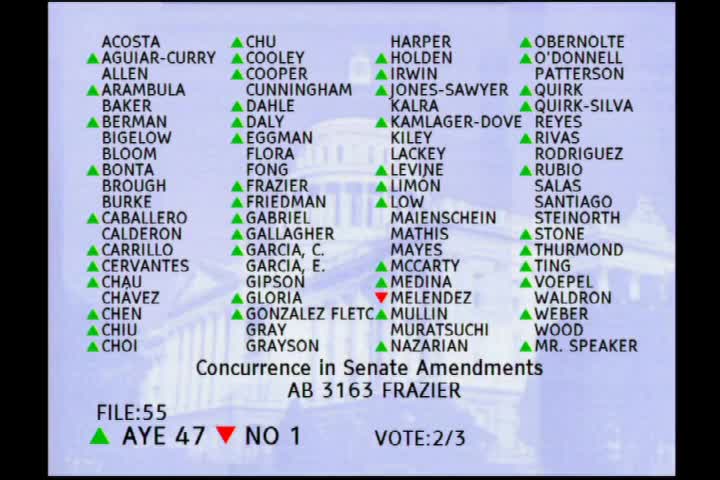 1MIN
Assembly Floor
 3MIN
Senate Floor
 3MIN
Assembly Floor
 4MIN
Assembly Standing Committee on Transportation
Bill Author

Bill Co-Author(s):