AB 2112: Federal 21st Century Cures Act: community-based crisis response plan: grant.
- Session Year: 2017-2018
- House: Assembly
- Latest Version Date: 2018-09-10
Existing law establishes the State Department of Health Care Services within the California Health and Human Services Agency and sets forth the powers and duties of the department with regard to the administration and state oversight of mental health and substance use disorder functions and programs in this state, and the Medi-Cal program. Existing law authorizes the department to enter into exclusive or nonexclusive contracts, or to amend existing contracts, on a bid or negotiated basis for the purpose of administering or implementing any federal grant awarded pursuant to the federal 21st Century Cures Act.
Existing federal law, the 21st Century Cures Act, authorizes the United States Secretary of Health and Human Services to award competitive grants to state and local governments and Indian tribes and tribal organizations to enhance community-based crisis response systems that, among other things, promote integration and coordination between local public and private entities engaged in crisis response, such as first responders, health care providers, and behavioral health providers, and addresses gaps in community resources for crisis intervention and prevention.
This bill would require the department to develop and submit an application to solicit a grant under the federal authority described above to develop a community-based crisis response plan and would require the grant application to include, at a minimum, and consistent with federal grant application requirements, a plan for specified objectives. The bill would require the department to confer with specified stakeholders in developing its grant proposal and application. The bill would require the department, if awarded a grant, to submit to the United States Secretary of Health and Human Services, at the time and in the manner, and containing the information, as the secretary may reasonably require, a report, including an evaluation of the effect of that grant on, among other things, local crisis response services and measures for individuals receiving crisis planning and early intervention supports. The bill would also require the department to submit a copy of this report to the Legislature. The bill would only become operative if Congress appropriates funds for purposes of the competitive grants.
Existing law establishes the State Department of Health Care Services within the California Health and Human Services Agency and sets forth the powers and duties of the department with regard to the administration and state oversight of mental health and substance use disorder functions and programs in this state, and the Medi-Cal program. Existing law authorizes the State Department of Health Care Services department to enter into exclusive or nonexclusive contracts, or to amend existing contracts, on a bid or negotiated basis for the purpose of administering or implementing any federal grant awarded pursuant to the federal 21st Century Cures Act.
Existing federal law, the 21st Century Cures Act, authorizes the United States Secretary of Health and Human Services to award competitive grants to state and local governments and Indian tribes and tribal organizations to enhance community-based crisis response systems that, among other things, promote integration and coordination between local public and private entities engaged in crisis response, such as first responders, health care providers, and behavioral health providers, and addresses gaps in community resources for crisis intervention and prevention.
This bill would require the State Department of Health Care Services department to develop and submit an application to solicit a grant under the federal authority described above to develop a community-based crisis response plan and would require the grant application to include, at a minimum, and consistent with federal grant application requirements, a plan for specified objectives. The bill would require the department to confer with specified stakeholders in developing its grant proposal and application. The bill would require the department, if awarded a grant, to submit to the United States Secretary of Health and Human Services, at the time and in the manner, and containing the information, as the Secretary secretary may reasonably require, a report, including an evaluation of the effect of that grant on, among other things, local crisis response services and measures for individuals receiving crisis planning and early intervention supports. The bill would also require the department to submit a copy of this report to the Legislature.
Existing law establishes the State Department of Health Care Services within the California Health and Human Services Agency and sets forth the powers and duties of the department with regard to the administration and state oversight of mental health and substance use disorder functions and programs in this state, and the Medi-Cal program. Existing law authorizes the State Department of Health Care Services to enter into exclusive or nonexclusive contracts, or to amend existing contracts, on a bid or negotiated basis for the purpose of administering or implementing any federal grant awarded pursuant to the federal 21st Century Cures Act.
Existing federal law, the 21st Century Cures Act, authorizes the United States Secretary of Health and Human Services to award competitive grants to state and local governments and Indian tribes and tribal organizations to enhance community-based crisis response systems that, among other things, promote integration and coordination between local public and private entities engaged in crisis response, such as first responders, health care providers, and behavioral health providers, and addresses gaps in community resources for crisis intervention and prevention.
This bill would require the State Department of Health Care Services to develop and submit an application to solicit a grant under the federal authority described above to develop a community-based crisis response plan and would require the grant application to include, at a minimum, a plan for specified objectives. The bill would require the department to confer with specified stakeholders in developing its grant proposal and application. The bill would require the department, if awarded a grant, to submit to the United States Secretary of Health and Human Services, at the time and in the manner, and containing the information, as the Secretary may reasonably require, a report, including an evaluation of the effect of that grant on, among other things, local crisis response services and measures for individuals receiving crisis planning and early intervention supports. The bill would also require the department to submit a copy of this report to the Legislature.
(a)The department shall develop and submit an application to solicit a grant authorized under Section 9007 of the federal 21st Century Cures Act (42 U.S.C. Sec. 290bb-37) to develop a community-based crisis response plan. To the extent consistent with federal grant application requirements, the grant application shall include, at a minimum, a plan for all of the following:
(1)Promoting integration and coordination between local public and private entities engaged in crisis response, including first responders, emergency health care providers, primary care providers, law enforcement, court systems, health care payers, social service providers, and behavioral health providers.
(2)Developing memoranda of understanding with public and private entities to implement crisis response services.
(3)Addressing gaps in community resources for crisis intervention and prevention.
(4)Developing models for minimizing hospital emergency department utilization and readmissions, including through appropriate discharge planning.
(b)The department shall confer with stakeholders during the development of the grant application. Stakeholders shall include, but not be limited to, representatives from organizations that have experience responding to crisis care, including hospitals, first responders, emergency health care providers, primary care providers, law enforcement, court systems, health care payers, social service providers, behavioral health providers, and organizations representing consumers of behavioral health services and their significant support persons.
(c)If the department receives a grant under Section 9007 of the federal 21st Century Cures Act (42 U.S.C. Sec. 290bb-37), the department shall submit to the United States Secretary of Health and Human Services, at the time and in the manner, and containing the information, as the secretary may reasonably require, a report, including an evaluation of the effect of the grant on all of the following:
(1)Local crisis response services and measures for individuals receiving crisis planning and early intervention supports.
(2)Individuals reporting improved functional outcomes.
(3)Individuals receiving regular followup care following a crisis.
(d)The department shall submit a copy of the report described in subdivision (c) to the Legislature. A report submitted pursuant to this subdivision shall be submitted in compliance with Section 9795 of the Government Code.
(e)This section shall become operative only if Congress appropriates funds for purposes of Section 9007 of the federal 21st Century Cures Act (42 U.S.C. Sec. 290bb-37).
(a)The department shall develop and submit an application to solicit a grant authorized under Section 9007 of the federal 21st Century Cures Act (42 U.S.C. Sec. 290bb-37) to develop a community-based crisis response plan. The To the extent consistent with federal grant application requirements, the grant application shall include, at a minimum, a plan for all of the following:
(1)Promoting integration and coordination between local public and private entities engaged in crisis response, including first responders, emergency health care providers, primary care providers, law enforcement, court systems, health care payers, social service providers, and behavioral health providers.
(2)Developing memoranda of understanding with public and private entities to implement crisis response services.
(3)Addressing gaps in community resources for crisis intervention and prevention.
(4)Developing models for minimizing hospital emergency department utilization and readmissions, including through appropriate discharge planning.
(b)The department shall confer with stakeholders to inform during the development of the grant application. Stakeholders shall include, but not be limited to, representatives from organizations that have experience responding to crisis care, including hospitals, first responders, emergency health care providers, primary care providers, law enforcement, court systems, health care payers, social service providers, behavioral health providers, and organizations representing consumers of behavioral health services and their significant support persons.
(c)If the department receives a grant under Section 9007 of the federal 21st Century Cures Act (42 U.S.C. Sec. 290bb-37), the department shall submit to the United States Secretary of Health and Human Services, at the time and in the manner, and containing the information, as the secretary may reasonably require, a report, including an evaluation of the effect of the grant on all of the following:
(1)Local crisis response services and measures for individuals receiving crisis planning and early intervention supports.
(2)Individuals reporting improved functional outcomes.
(3)Individuals receiving regular followup care following a crisis.
(d)The department shall submit a copy of the report described in subdivision (c) to the Legislature. A report submitted pursuant to this subdivision shall be submitted in compliance with Section 9795 of the Government Code.
(a)The department shall develop and submit an application to solicit a grant authorized under Section 9007 of the federal 21st Century Cures Act (42 U.S.C. Sec. 290bb-37) to develop a community-based crisis response plan. The grant application shall include, at a minimum, a plan for all of the following:
(1)Promoting integration and coordination between local public and private entities engaged in crisis response, including first responders, emergency health care providers, primary care providers, law enforcement, court systems, health care payers, social service providers, and behavioral health providers.
(2)Developing memoranda of understanding with public and private entities to implement crisis response services.
(3)Addressing gaps in community resources for crisis intervention and prevention.
(4)Developing models for minimizing hospital emergency department utilization and readmissions, including through appropriate discharge planning.
(b)The department shall confer with stakeholders to inform during the development of the grant application. Stakeholders shall include, but not be limited to, representatives from organizations that have experience responding to crisis care, including hospitals, first responders, emergency health care providers, primary care providers, law enforcement, court systems, health care payers, social service providers, behavioral health providers, and organizations representing consumers of behavioral health services and their significant support persons.
(c)If the department receives a grant under Section 9007 of the federal 21st Century Cures Act (42 U.S.C. Sec. 290bb-37), the department shall submit to the United States Secretary of Health and Human Services, at the time and in the manner, and containing the information, as the secretary may reasonably require, a report, including an evaluation of the effect of the grant on all of the following:
(1)Local crisis response services and measures for individuals receiving crisis planning and early intervention supports.
(2)Individuals reporting improved functional outcomes.
(3)Individuals receiving regular followup care following a crisis.
(d)The department shall submit a copy of the report described in subdivision (c) to the Legislature. A report submitted pursuant to this subdivision shall be submitted in compliance with Section 9795 of the Government Code.
|
Date
|
Status
|
|---|---|
| Sep 10, 2018 | Chaptered by Secretary of State - Chapter 315, Statutes of 2018. |
| Sep 10, 2018 | Approved by the Governor. |
| Sep 6, 2018 | Enrolled and presented to the Governor at 3 p.m. |
| Aug 29, 2018 | Senate amendments concurred in. To Engrossing and Enrolling. |
| Aug 27, 2018 | In Assembly. Concurrence in Senate amendments pending. May be considered on or after August 29 pursuant to Assembly Rule 77. |
| Aug 27, 2018 | Read third time. Passed. Ordered to the Assembly. |
| Aug 24, 2018 | Ordered to third reading. |
| Aug 21, 2018 | Ordered to special consent calendar. |
| Aug 17, 2018 | From committee: Do pass. (Ayes 7. Noes 0.) (August 16). |
| Aug 6, 2018 | In committee: Referred to APPR. suspense file. |
| Jul 3, 2018 | Read second time and amended. Re-referred to Com. on APPR. |
| Jul 2, 2018 | From committee: Amend, and do pass as amended and re-refer to Com. on APPR. with recommendation: To Consent Calendar. (Ayes 9. Noes 0.) (June 27). |
| Jun 13, 2018 | Referred to Com. on HEALTH. |
| Jun 4, 2018 | In Senate. Read first time. To Com. on RLS. for assignment. |
| May 31, 2018 | Read third time. Passed. Ordered to the Senate. |
| May 29, 2018 | Read second time. Ordered to third reading. |
| May 25, 2018 | From committee: Amend, and do pass as amended. (Ayes 16. Noes 0.) (May 25). |
| Apr 25, 2018 | In committee: Set, first hearing. Referred to APPR. suspense file. |
| Apr 4, 2018 | From committee: Do pass and re-refer to Com. on APPR. with recommendation: To Consent Calendar. (Ayes 15. Noes 0.) (April 3). Re-referred to Com. on APPR. |
| Feb 22, 2018 | Referred to Com. on HEALTH. |
| Feb 9, 2018 | From printer. May be heard in committee March 11. |
| Feb 8, 2018 | Read first time. To print. |
|
Date
|
Description
|
Location
|
Votes
|
|
|---|---|---|---|---|
| Aug 29, 2018 | AB 2112 SANTIAGO Concurrence in Senate Amendments | Assembly Floor |
Passed |
|
| Aug 27, 2018 | Assembly 3rd Reading AB2112 Santiago By Beall | Senate Floor |
Passed |
|
| Aug 16, 2018 | Do pass | Senate Standing Committee on Appropriations |
Passed |
|
| Aug 6, 2018 | Placed on suspense file | Senate Standing Committee on Appropriations |
Passed |
|
| Jun 27, 2018 | Do pass as amended, but first amend, and re-refer to the Committee on [Appropriations] with the recommendation: To Consent Calendar | Senate Standing Committee on Health |
Passed |
|
| May 31, 2018 | AB 2112 SANTIAGO Assembly Third Reading | Assembly Floor |
Passed |
|
| May 25, 2018 | Do pass as amended. | Assembly Standing Committee on Appropriations |
Passed |
|
| Apr 3, 2018 | Do pass and be re-referred to the Committee on [Appropriations] with recommendation: To Consent Calendar | Assembly Standing Committee on Health |
Passed |
This list shows positions taken on this bill by organizations on the date displayed, which is linked to the original source.
Positions by individuals are not included.
|
Organization
|
Position
|
Date
|
|---|---|---|
| Alliance Of Catholic Health Care | ** Support | Aug 18, 2018 |
| Association Of Regional Center Agencies California | ** Support | Aug 18, 2018 |
| California Access Coalition | ** Support | Aug 18, 2018 |
| California Behavioral Health Planning Council | ** Support | Aug 18, 2018 |
| California Hospital Association | ** Support | Aug 18, 2018 |
| County Behavioral Health Directors Association of California | ** Support | Aug 18, 2018 |
| Department Of Finance | ** Against | Aug 18, 2018 |
| Department of Health Care Services | ** Against | Aug 18, 2018 |
| Depression And Bipolar Support Alliance | ** Support | Aug 18, 2018 |
| National Alliance on Mental Illness - California | ** Support | Aug 18, 2018 |
| Private Essential Access Community Hospitals | ** Support | Aug 18, 2018 |
CONCURRENCE IN SENATE AMENDMENTS
CSA1 Bill Id:AB 2112
Author:(Santiago)
As Amended Ver:July 3, 2018
Majority vote
ASSEMBLY: | 77-0 | (May 31, 2018) | SENATE: | 38-0 | (August 27, 2018) |
Original Committee Reference: HEALTH
SUMMARY: Requires the Department of Health Care Services (DHCS) to develop and submit an application to solicit a grant authorized under the federal 21st Century Cures Act (Cures Act) to develop a community-based crisis response plan. Specifically, this bill:
- Requires the grant application to include, at a minimum, and consistent with federal grant application requirements, a plan for all of the following:
- Promoting integration and coordination between local public and private entities engaged in crisis response, including first responders, emergency health care providers, primary care providers, law enforcement, court systems, health care payers, social service providers, and behavioral health providers;
- Developing memoranda of understanding with public and private entities to implement crisis response services;
- Addressing gaps in community resources for crisis intervention and prevention; and,
- Developing models for minimizing hospital emergency department utilization and readmissions, including through appropriate discharge planning.
- Requires DHCS to confer with stakeholders during the development of the grant application, including, but not limited to, representatives from organizations that have experience responding to crisis care, including hospitals, first responders, emergency health care providers, primary care providers, law enforcement, court systems, health care payers, social service providers, behavioral health providers, and organizations representing consumers of behavioral health services and their significant support persons.
- Requires DHCS, if awarded a grant, to submit to the United States Secretary of Health and Human Services (Secretary), at the time and in the manner required by the Secretary, a report, including an evaluation of the effect of the grant on all of the following:
- Local crisis response services and measures for individuals receiving crisis planning and early intervention supports;
- Individuals reporting improved functional outcomes; and,
- Individuals receiving regular follow-up care following a crisis.
- Requires DHCS to submit a copy of the report described in 3), above, to the Legislature.
The Senate amendments make enactment of this bill contingent upon congressional appropriation of funds for purposes of the competitive grants.
FISCAL EFFECT: According to the Senate Appropriations Committee, DHCS anticipates:
- First year costs of $276,000 (General Fund (GF)) and $258,000 (GF) annually thereafter, for staff to develop a submit a federal grant application to develop a community-based crisis response plan to promote integration and coordination between local public and private entities and for program monitoring and compliance with the Uniform Administrative Requirements, Cost Principles, and Audit Requirements for Health and Human Services awards.
- One permanent, full-time health program specialist I for the grant application, management, and implementation of $142,000 (GF) in the first year, and $133,000 (GF) ongoing annually thereafter.
- One permanent, full-time associate governmental program analyst for long-term crisis plan implementation and management for $134,000 (GF) in the first year and $125,000 (GF) ongoing annually thereafter.
The Assembly Appropriations Committee notes DHCS would need an increase in federal expenditure authority for grant funding and the two additional positions.
COMMENTS: According to the author, in 2010 alone, 2.2 million hospitalizations and 5.3 million emergency department (ED) visits involved a diagnosis related to a mental health condition. Moreover, in any given year, approximately one fourth of American adults will have a mental disorder and about 5% of children aged four to 17 years have serious emotional distress. The author notes that public behavioral health services in California are delivered primarily through historically underfunded county systems that operate separately from other publicly and commercially funded healthcare plans, emergency management services and the criminal justice/law enforcement (juvenile, jail, and prison) systems. This patch work has led to several different types of emergency/crisis services being developed in California. The author states that there is a great need to improve the state’s coordinated crisis-responses services; having comprehensive crisis services can improve outcomes for consumers, reduce ED and inpatient hospital stays and costs, and facilitate access to other necessary behavioral health services and supports. In many communities, crisis response services also perform important public health, public safety, and community well-being functions. The author concludes that this bill is a first step towards having a comprehensive emergency crisis-response plan to help individuals who are suffering from mental illness and homelessness.
- Community mental health services. The Substance Abuse & Mental Health Services Administration (SAMHSA), Center for Mental Health Services (CMHS) provides grant funds to establish or expand an organized community-based system of care for providing non-Title XIX mental health services to children with serious emotional disturbances (SED) and adults with serious mental illness (SMI). States are required to submit an application for each fiscal year the State is seeking funds. These funds are used to: a) carry out the State plan contained in the application; b) evaluate programs and services, and; c) conduct planning, administration, and educational activities related to the provision of services.
The CMHS requires that States develop a comprehensive public mental health system that has as one of its goals to move care for adults with SMI and children with SED from costly and restrictive inpatient hospital care to the community. Although the block grant is a small percentage of California’s mental health budget, it is viewed as providing an important and flexible funding source to support a broad range of activities specific to the needs of each county.
- Existing state funding from the Cures Act. The Cures Act, signed December 13, 2016, by President Obama, promotes and funds the acceleration of research into preventing and curing serious illnesses; accelerates drug and medical device development; attempts to address the opioid abuse crisis; and tries to improve mental health service delivery. DHCS submitted a Mental Health Block Grant (MHBG) State Plan on September 1, 2015, for fiscal years 2016-17 and 2017-18. It was approved by SAMHSA, and DHCS is currently receiving MHBG funding for fiscal year 2017-18. DHCS also submitted a MHBG State Plan to SAMHSA on September 1, 2017, for fiscal years 2018-19 and 2019-20. SAMHSA approved DHCS’ plan, and DHCS will begin receiving funding for fiscal year 2018-19 beginning on July 1, 2018. DHCS also receives Cures Act funding for the State Targeted Response to the Opioid Crisis Grant.
While the Cures Act authorized an appropriation of $12.5 million annually, it did not appropriate $12.5 million annually from 2018 through 2022 for the grants outlined in Section 9007 of the Cures Act (the community-based crisis response or the beds database plan). DHCS contacted SAMHSA regarding funding for Section 9007 and learned that Congress has not yet appropriated funding for it. Without funding, SAMHSA is not able to release a notice of grant award and, absent the grant announcement, DHCS is not able to assess whether or not it will benefit California’s mental health service delivery system.
There is currently no community-based crisis response plan approved by DHCS Mental Health Services Division. Counties may develop their own crisis response plans.
The California Hospital Association (CHA) supports this bill stating that significant studies of California's behavioral health system have concluded that it is fragmented, unresponsive to consumer needs, does not always emphasize recover, and serves only a fraction of those in need. CHA explains that like emergency services, crisis services are intended to be available to the entire community, including not only individuals with a history of severe and persistent mental illness or substance use disorder, but also those who have never used behavioral health services. CHA concludes that comprehensive crisis services can improve patient outcomes, reduce ED and inpatient hospital stays and costs, and facilitate access to other necessary behavioral health services and supports.
California Access Coalition supports this bill stating that California's system of crisis response needs improvement, and obtaining these grants will help to better help those in need, as the grant application requires a plan for specified objectives.
Analysis Prepared by: Lara Flynn / HEALTH / (916) 319-2097 FN: 0004219
Office of Senate Floor Analyses (916) 651-1520 Fax: (916) 327-4478 | AB |
THIRD READING
Bill No: AB 2112
:
SENATE HEALTH COMMITTEE: 9-0, 6/27/18
AYES: Pan, Nguyen, Beall, Hernandez, Leyva, Mitchell, Monning, Nielsen, Roth
SENATE APPROPRIATIONS COMMITTEE: 7-0, 8/16/18
AYES: Portantino, Bates, Beall, Bradford, Hill, Nielsen, Wiener
ASSEMBLY FLOOR: 77-0, 5/31/18 - See last page for vote
SOURCE: California Hospital Association
National Alliance on Mental Illness – California
DIGEST:
This bill requires the Department of Health Care Services (DHCS) to develop and submit an application to solicit a grant authorized under the federal 21st Century Cures Act to develop a community-based crisis response plan, requires the grant application to include a plan with specified elements, and requires DHCS to submit a report that includes an evaluation of the effect of the grant. Makes this bill operative only if Congress appropriates funds for purposes of Section 9007 of the federal 21st Century Cures Act.
Existing law:
- Requires, under Section 9007 of the 21st Century Cures Act (Public Law 114-255 [Cures Act]), the U.S. Secretary of Health and Human Services (HHS) to award competitive grants to:
- State and local governments and Indian tribes and tribal organizations to enhance community-based crisis response systems that, among other things, promote integration and coordination between local public and private entities engaged in crisis response, such as first responders, health care providers, and behavioral health providers, and addresses gaps in community resources for crisis intervention and prevention; or,
- States to develop, maintain, or enhance a database of beds at inpatient psychiatric facilities, crisis stabilization units, and residential community mental health and resident substance use disorder (SUD) treatment facilities, for adults with a serious mental illness, children with a serious emotional disturbance, or individuals with an SUD. [42 U.S.C. §290bb-37]
- Authorizes an appropriation of $12.5 billion for fiscal years 2018 through 2022 for the competitive grant program in 1) above. [42 U.S.C. §290bb-37]
- Permits the DHCS to enter into exclusive or nonexclusive contracts, or amend existing contracts, on a bid or negotiated basis for purpose of administering or implementing any federal grant awarded pursuant to the Cures Act, any subsequent amendments to that federal act, or any associated federal regulation or policy guidance. [WIC §14124.13]
This bill:
- Requires DHCS to develop and submit an application to solicit a grant authorized under Section 9007 of the Cures Act to develop a community-based crisis response plan.
- Requires, to the extent consistent with federal grant application requirements, the grant application to include, at a minimum, a plan for all of the following:
- Promoting integration and coordination between local public and private entities engaged in crisis response, including first responders, emergency health care providers, primary care providers, law enforcement, court systems, health care payers, social service providers, and behavioral health providers;
- Developing memoranda of understanding with public and private entities to implement crisis response services;
- Addressing gaps in community resources for crisis intervention and prevention; and,
- Developing models for minimizing hospital emergency department utilization and readmissions, including through appropriate discharge planning.
- Requires DHCS to confer with stakeholders during the development of the grant application. Requires stakeholders to include, but not be limited to, representatives from organizations that have experience responding to crisis care, including hospitals, first responders, emergency health care providers, primary care providers, law enforcement, court systems, health care payers, social service providers, behavioral health providers, and organizations representing consumers of behavioral health services and their significant support persons.
- Requires DHCS, if it receives a competitive grant under Section 9007, to submit to the U.S. Secretary of HHS, at the time and in the manner, and containing the information, as the Secretary may reasonably require, a report, including an evaluation of the effect of the grant on all of the following:
- Local crisis response services and measures for individuals receiving crisis planning and early intervention supports;
- Individuals reporting improved functional outcomes;
- Individuals receiving regular follow-up care following a crisis; and,
- Requires DHCS to submit a copy of the report described above to the Legislature.
Makes this bill operative only if Congress appropriates funds for purposes of Section 9007 of the federal 21st Century Cures Act.
Comments
- Author’s statement. According to the author, in 2010 alone, 2.2 million hospitalizations and 5.3 million emergency department visits involved a diagnosis related to a mental health condition. Moreover, in any given year, approximately one-fourth of American adults will have a mental disorder and about 5% of children aged four to 17 years have serious emotional distress. Public behavioral health services in California are delivered primarily through historically underfunded county systems that operate separately from other publicly and commercially funded healthcare plans, emergency medical services (EMS) and the criminal justice/law enforcement (juvenile, jail and prison) systems. This patchwork has led to several different types of emergency/crisis services being developed in California. There is a great need to improve the state’s coordinated crisis-responses services. Having comprehensive crisis services can improve outcomes for consumers, reduce emergency department and inpatient hospital stays and costs, and facilitate access to other necessary behavioral health services and supports. In many communities, crisis response services also perform important public health, public safety, and community well-being functions. This bill is a first step towards having a comprehensive emergency crisis-response plan to help individuals who are suffering from mental illness and homelessness.
- 21st Century Cures Act. On December 13, 2016, President Obama signed the 21st Century Cures Act into law to promote and fund the acceleration of research into preventing and curing serious illnesses, to accelerate drug and medical device development, to attempt to address the opioid abuse crisis and to improve mental health service delivery. DHCS submitted a Mental Health Block Grant (MHBG) State Plan on September 1, 2015, for fiscal years 2016-17 and 2017-18. It was approved by the Substance Abuse and Mental Health Services Administration (SAMHSA), and DHCS is currently receiving MHBG funding for fiscal year 2017-18. DHCS also submitted a MHBG State Plan on September 1, 2017, for fiscal years 2018-19 and 2019-20. SAMHSA approved the plan, and DHCS will begin receiving funding for fiscal year 2018-19 beginning on July 1, 2018. DHCS also receives Cures Act funding for the State Targeted Response to the Opioid Crisis Grant.
Section 9007 of the Cures Act authorizes a federal appropriation of $12.5 million per year, for federal fiscal years 2018 through 2022, to make competitive grants to governmental entities and Indian tribes to enhance community-based crisis response systems and to states to develop, maintain, or enhance databases of inpatient psychiatric beds. Unlike some other programs authorized in the Cures Act, however, a community-based mental health crisis response program has not been funded through a federal appropriations bill. Therefore, there is currently no Section 9007 federal grant program to which the state can apply.
FISCAL EFFECT: Appropriation: Fiscal Com.: Local:
According to the Senate Appropriations Committee:
- According to DHCS, first year costs of $276,000 (General Fund) and $258,000 (General Fund) annually thereafter, for staff to develop a submit a federal grant application to develop a community-based crisis response plan to promote integration and coordination between local public and private entities and for program monitoring and compliance with the Uniform Administrative Requirements, Cost Principles, and Audit Requirements for HHS awards.
- 1.0 permanent, full-time health program specialist I for the grant application, management, and implementation of $142,000 (General Fund) in the first year, and $133,000 (General Fund) ongoing annually thereafter.
- 1.0 permanent, full-time associate governmental program analyst for long-term crisis plan implementation and management for $134,000 (General Fund) in the first year, and $125,000 (General Fund) ongoing annually thereafter.
Senate Appropriations Committee staff notes DHCS would need an increase in federal expenditure authority for grant funding and the two additional positions.
California Hospital Association (co-source)
National Alliance on Mental Illness – California (co-source)
Alliance of Catholic Health Care
Association of Regional Center Agencies California
California Access Coalition
California Behavioral Health Planning Council
California Chapter of the American College of Emergency Physicians
County Behavioral Health Directors Association of California
Depression and Bipolar Support Alliance
Private Essential Access Community Hospitals
OPPOSITION: (Verified 8/16/18)
Department of Finance
Department of Health Care Services
ARGUMENTS IN SUPPORT: This bill is co-sponsored by the National Alliance on Mentally Ill – California (NAMI), which writes that significant studies of California’s behavioral health system have concluded that it is fragmented, unresponsive to consumer needs, does not always emphasize recovery, and serves only a fraction of those in need. Awareness of and access to these services are often dependent upon where an individual lives, what type of health care coverage they have, and how, where, and at what time they experience a crisis. Like EMS, crisis services are intended to be available to the entire community. Those receiving services may include individuals with a history of severe and persistent mental illness or a SUD, or those who have never used behavioral health services. They may be children, adults, or the elderly. In any given year, approximately one-fourth of American adults will have a mental disorder and about 5% of children aged four to 17 years have serious emotional distress (National Center for Health Statistics, National Health Interview Survey, 2009). This bill requires DHCS to solicit a grant to develop a community-based crisis response plan. This bill requires DHCS to confer with stakeholders to inform the development of the proposal and to submit an evaluation to the federal HHS and to the California Legislature. NAMI writes there is a considerable body of evidence suggesting that comprehensive crisis services can improve outcomes for consumers, reduce emergency department and inpatient hospital stays and costs, and facilitate access to other necessary behavioral health services and supports. In many communities, crisis response services also perform important public health, public safety, and community well-being.
ARGUMENTS IN OPPOSITION: The Department of Finance writes in opposition that applying for appropriate federal funding opportunities is in the normal course of business for DHCS, and it is not clear what the conditions surrounding the potential grant are. DHCS writes in opposition that it does not need statutory authority to apply for a federal grant, this bill is premature because Congress has not yet appropriated federal funding for the proposed grant application, and with no appropriation, a notice of grant award detailing the scope of the grant has also not been released, so DHCS cannot determine the applicability of the grant to the state’s crisis response systems.
ASSEMBLY FLOOR: 77-0, 5/31/18
AYES: Acosta, Aguiar-Curry, Travis Allen, Arambula, Baker, Berman, Bigelow, Bloom, Bonta, Brough, Burke, Caballero, Calderon, Carrillo, Cervantes, Chau, Chávez, Chen, Chiu, Choi, Chu, Cooley, Cooper, Cunningham, Dahle, Daly, Eggman, Flora, Fong, Friedman, Gallagher, Cristina Garcia, Eduardo Garcia, Gipson, Gloria, Gonzalez Fletcher, Gray, Grayson, Harper, Holden, Irwin, Jones-Sawyer, Kalra, Kamlager-Dove, Kiley, Lackey, Levine, Limón, Low, Maienschein, Mathis, Mayes, McCarty, Medina, Melendez, Mullin, Muratsuchi, Nazarian, Obernolte, O'Donnell, Patterson, Quirk, Quirk-Silva, Reyes, Rodriguez, Rubio, Salas, Santiago, Steinorth, Mark Stone, Thurmond, Ting, Voepel, Waldron, Weber, Wood, Rendon
NO VOTE RECORDED: Frazier
8/18/18 13:52:19
SENATE COMMITTEE ON APPROPRIATIONS
Senator Anthony Portantino, Chair
2017 - 2018 Regular Session
AB 2112 (Santiago) - Federal 21st Century Cures Act: community-based crisis response plan: grant
Version: July 3, 2018 | Policy Vote: HEALTH 9 - 0 |
Urgency: No | Mandate: No |
Hearing Date: August 6, 2018 | Consultant: Samantha Lui |
This bill meets the criteria for referral to the Suspense File.
Bill Summary:
Requires the Department of Health Care Services (DHCS) to develop and submit an application to solicit a grant authorized under federal 21st Century Cures Act to develop a community-based crisis response plan, requires the grant application to include a plan with specified elements, and requires DHCS to submit a report that includes an evaluation of the effect of the grant.
Fiscal Impact:
According to the Department of Health Care Services, first year costs of $276,000 (General Fund) and $258,000 (General Fund) annually thereafter, for staff to develop a submit a federal grant application to develop a community-based crisis response plan to promote integration and coordination between local public and private entities and for program monitoring and compliance with the Uniform Administrative Requirements, Cost Principles, and Audit Requirements for Health and Human Services awards.
- 1.0 permanent, full-time health program specialist I (HPS I) for the grant application, management, and implementation of $142,000 (General Fund) in the first year, and $133,000 (General Fund) ongoing annually thereafter.
- 1.0 permanent, full-time associate governmental program analyst (AGPA) for long-term crisis plan implementation and management for $134,000 (General Fund) in the first year, and $125,000 (General Fund) ongoing annually thereafter.
Staff notes the department would need an increase in federal expenditure authority for grant funding and the two additional positions.
Background:
On December 13, 2016, President Obama signed the Cures Act into law to promote and fund the acceleration of research into preventing and curing serious illnesses, to accelerate drug and medical device development, to attempt to address the opioid abuse crisis and to improve mental health service delivery. DHCS submitted a Mental Health Block Grant (MHBG) State Plan on September 1, 2015, for fiscal years 2016-17 and 2017- 18. It was approved by the Substance Abuse and Mental Health Services Administration (SAMHSA), and DHCS is currently receiving MHBG funding for fiscal year 2017-18. DHCS also submitted a MHBG State Plan on September 1, 2017, for fiscal years 2018-19 and 2019-20. SAMHSA approved the plan, and DHCS will begin receiving funding for fiscal year 2018-19 beginning on July 1, 2018. DHCS also receives Cures Act funding for the State Targeted Response to the Opioid Crisis Grant. Section 9007 of the Cures Act authorizes a federal appropriation of $12.5 million per year, for federal fiscal years 2018 through 2022, to make competitive grants to governmental entities and Indian tribes to enhance community-based crisis response systems and to states to develop, maintain, or enhance databases of inpatient psychiatric beds. Unlike some other programs authorized in the Cures Act, however, a community-based mental health crisis response program has not been funded through a federal appropriations bill. Therefore, there is currently no Section 9007 federal grant program to which the state can apply.
Proposed Law:
Assembly Bill 2112 includes the following provisions, among others:
- Requires DHCS to develop and submit an application to solicit a grant authorized under Section 9007 of the federal 21st Century Cures Act (42 U.S.C. Sec. 290bb-37) to develop a community-based crisis response plan. To the extent consistent with federal grant application requirements, the grant application must include, at a minimum, a plan for all of the following:
- Promoting integration and coordination between local public and private entities engaged in crisis response, including first responders, emergency health care providers, primary care providers, law enforcement, court systems, health care payers, social service providers, and behavioral health providers.
- Developing memoranda of understanding with public and private entities to implement crisis response services.
- Addressing gaps in community resources for crisis intervention and prevention.
- Developing models for minimizing hospital emergency department utilization and readmissions, including through appropriate discharge planning.
- Requires DHCS to confer with specified stakeholders during the development of the grant application.
- Provides that if the department receives a grant under Section 9007 of the federal 21st Century Cures Act (42 U.S.C. Sec. 290bb-37), DHCS must submit a report containing specified information to the United States Secretary of Health and Human Services and a copy of the report to the Legislature.
Related Legislation: SB 97 (Committee on Budget and Fiscal Review, Chapter 52, Statutes of 2017) allowed DHCS to enter into exclusive or nonexclusive contracts, or amend existing contracts, on a bid or negotiated basis for purpose of administering or implementing any federal grant awarded pursuant to the Cures Act.
Staff Comments:
Section 9007 of the Cures Act has not currently been funded and recent clarifying amendments taken in Senate Health Committee clarify that the the bill become operative only if Congress appropriates funds for purposes of Section 9007 of the federal 21st Century Cures Act (42 U.S.C. Sec. 290bb-37).
-- END --
SENATE COMMITTEE ON HEALTH
Senator Dr. Richard Pan, Chair
BILL NO: AB 2112
AUTHOR: | Santiago | ||
VERSION: | May 25, 2018 | ||
HEARING DATE: | June 27, 2018 | ||
CONSULTANT: | Scott Bain | ||
SUBJECT: Federal 21st Century Cures Act: community-based crisis response plan: grant
SUMMARY:
Requires the Department of Health Care Services (DHCS) to develop and submit an application to solicit a grant authorized under federal 21st Century Cures Act to develop a community-based crisis response plan, requires the grant application to include a plan with specified elements, and requires DHCS to submit a report that includes an evaluation of the effect of the grant.
Existing law:
- Requires, under the Section 9007 of the 21st Century Cures Act (Public Law 114-255 [Cures Act]), the U.S. Secretary of Health and Human Services to award competitive grants to:
- State and local governments and Indian tribes and tribal organizations to enhance community-based crisis response systems that, among other things, promote integration and coordination between local public and private entities engaged in crisis response, such as first responders, health care providers, and behavioral health providers, and addresses gaps in community resources for crisis intervention and prevention; or,
- States to develop, maintain, or enhance a database of beds at inpatient psychiatric facilities, crisis stabilization units, and residential community mental health and resident substance use disorder (SUD) treatment facilities, for adults with a serious mental illness, children with a serious emotional disturbance, or individuals with an SUD. [42 U.S.C. §290bb-37]
- Authorizes an appropriation of $12.5 billion for fiscal years 2018 through 2022 for the competitive grant program in 1) above. [42 U.S.C. §290bb-37]
- Permits the Department of Health Care Services (DHCS) to enter into exclusive or nonexclusive contracts, or amend existing contracts, on a bid or negotiated basis for purpose of administering or implementing any federal grant awarded pursuant to the Cures Act, any subsequent amendments to that federal act, or any associated federal regulation or policy guidance. [WIC §14124.13]
This bill:
- Requires DHCS to develop and submit an application to solicit a grant authorized under Section 9007 of the Cures Act to develop a community-based crisis response plan.
- Requires, to the extent consistent with federal grant application requirements, the grant application to include, at a minimum, a plan for all of the following:
- Promoting integration and coordination between local public and private entities engaged in crisis response, including first responders, emergency health care providers, primary care providers, law enforcement, court systems, health care payers, social service providers, and behavioral health providers;
- Developing memoranda of understanding with public and private entities to implement crisis response services;
- Addressing gaps in community resources for crisis intervention and prevention; and,
- Developing models for minimizing hospital emergency department utilization and readmissions, including through appropriate discharge planning.
- Requires DHCS to confer with stakeholders during the development of the grant application. Requires stakeholders to include, but not be limited to, representatives from organizations that have experience responding to crisis care, including hospitals, first responders, emergency health care providers, primary care providers, law enforcement, court systems, health care payers, social service providers, behavioral health providers, and organizations representing consumers of behavioral health services and their significant support persons.
- Requires DHCS, if it receives a competitive grant under Section 9007, to submit to the U.S. Secretary of Health and Human Services, at the time and in the manner, and containing the information, as the secretary may reasonably require, a report, including an evaluation of the effect of the grant on all of the following:
- Local crisis response services and measures for individuals receiving crisis planning and early intervention supports;
- Individuals reporting improved functional outcomes;
- Individuals receiving regular follow-up care following a crisis; and,
- Requires DHCS to submit a copy of the report described above to the Legislature.
FISCAL EFFECT:
According to the Assembly Appropriations Committee, administrative costs to DHCS, likely to exceed $200,000 General Fund, to prepare the grant application and manage implementation of a community-based mental health crisis response plan.
PRIOR VOTES:
Assembly Floor: | 77 - 0 |
Assembly Appropriations Committee: | 16 - 0 |
Assembly Health Committee: | 15 - 0 |
COMMENTS:
- Author’s statement. According to the author, in 2010 alone, 2.2 million hospitalizations and 5.3 million emergency department visits involved a diagnosis related to a mental health condition. Moreover, in any given year, approximately one-fourth of American adults will have a mental disorder and about 5% of children aged four to 17 years have serious emotional distress. Public behavioral health services in California are delivered primarily through historically underfunded county systems that operate separately from other publicly and commercially funded healthcare plans, emergency medical services (EMS) and the criminal justice/law enforcement (juvenile, jail and prison) systems. This patchwork has led to several different types of emergency/crisis services being developed in California. There is a great need to improve the state’s coordinated crisis-responses services. Having comprehensive crisis services can improve outcomes for consumers, reduce emergency department and inpatient hospital stays and costs, and facilitate access to other necessary behavioral health services and supports. In many communities, crisis response services also perform important public health, public safety, and community well-being functions. This bill is a first step towards having a comprehensive emergency crisis-response plan to help individuals who are suffering from mental illness and homelessness.
- 21st Century Cures Act. On December 13, 2016, President Obama signed the Cures Act into law to promote and fund the acceleration of research into preventing and curing serious illnesses, to accelerate drug and medical device development, to attempt to address the opioid abuse crisis and to improve mental health service delivery. DHCS submitted a Mental Health Block Grant (MHBG) State Plan on September 1, 2015, for fiscal years 2016-17 and 2017-18. It was approved by the Substance Abuse and Mental Health Services Administration (SAMHSA), and DHCS is currently receiving MHBG funding for fiscal year 2017-18. DHCS also submitted a MHBG State Plan on September 1, 2017, for fiscal years 2018-19 and 2019-20. SAMHSA approved the plan, and DHCS will begin receiving funding for fiscal year 2018-19 beginning on July 1, 2018. DHCS also receives Cures Act funding for the State Targeted Response to the Opioid Crisis Grant.
Section 9007 of the Cures Act authorizes a federal appropriation of $12.5 million per year, for federal fiscal years 2018 through 2022, to make competitive grants to governmental entities and Indian tribes to enhance community-based crisis response systems and to states to develop, maintain, or enhance databases of inpatient psychiatric beds. Unlike some other programs authorized in the Cures Act, however, a community-based mental health crisis response program has not been funded through a federal appropriations bill. Therefore, there is currently no Section 9007 federal grant program to which the state can apply. - Prior legislation. SB 97 (Committee on Budget and Fiscal Review, Chapter 52, Statutes of 2017) allowed DHCS to enter into exclusive or nonexclusive contracts, or amend existing contracts, on a bid or negotiated basis for purpose of administering or implementing any federal grant awarded pursuant to the Cures Act.
- Support. This bill is co-sponsored by the National Alliance for the Mentally Ill – California, which writes that significant studies of California’s behavioral health system have concluded that it is fragmented, unresponsive to consumer needs, does not always emphasize recovery, and serves only a fraction of those in need. Awareness of and access to these services are often dependent upon where an individual lives, what type of health care coverage they have, and how, where, and at what time they experience a crisis. Like EMS, crisis services are intended to be available to the entire community. Those receiving services may include individuals with a history of severe and persistent mental illness or a SUD, or those who have never used behavioral health services. They may be children, adults, or the elderly. In any given year, approximately one-fourth of American adults will have a mental disorder and about 5% of children aged four to 17 years have serious emotional distress (National Center for Health Statistics, National Health Interview Survey, 2009). This bill would require DHCS to solicit a grant to develop a community-based crisis response plan. The bill would require DHCS to confer with stakeholders to inform the development of the proposal and to submit an evaluation to the federal HHS and to the California Legislature. NAMI writes there is a considerable body of evidence suggesting that comprehensive crisis services can improve outcomes for consumers, reduce emergency department and inpatient hospital stays and costs, and facilitate access to other necessary behavioral health services and supports. In many communities, crisis response services also perform important public health, public safety, and community well-being.
- Clarifying amendment. Because Section 9007 of the Cures Act has not currently been funded, staff recommends a clarifying amendment to require DHCS to develop and solicit a grant only if an appropriation is made to fund the provisions of Section 9007, as follows:
(e) This section shall become operative only if Congress appropriates funds for purposes of Section 9007 of the federal 21st Century Cures Act (42 U.S.C. Sec. 290bb-37).
SUPPORT AND OPPOSITION:
Support: National Alliance on Mental Illness – California (co-sponsor)
California Hospital Association (co-sponsor)
Alliance of Catholic Health Care
Association of Regional Center Agencies California
California Access Coalition
California Behavioral Health Planning Council
California Chapter of the American College of Emergency Physicians
County Behavioral Health Directors Association of California
Depression and Bipolar Support Alliance
Private Essential Access Community Hospitals
Oppose: None received
-- END --
ASSEMBLY THIRD READING
ATR Bill Id:AB 2112
Author:(Santiago)
As Introduced Ver:May 25, 2018
Majority vote
Committee | Votes | Ayes | Noes |
Health | 15-0 | Wood, Maienschein, Aguiar-Curry, Bonta, Burke, Carrillo, Flora, Limón, McCarty, Nazarian, Rodriguez, Santiago, Steinorth, Thurmond, Waldron | |
Appropriations | 16-0 | Gonzalez Fletcher, Bigelow, Bloom, Bonta, Calderon, Carrillo, Chau, Eggman, Fong, Friedman, Gallagher, Eduardo Garcia, Nazarian, Obernolte, Quirk, Reyes |
|
SUMMARY: Requires the Department of Health Care Services (DHCS) to develop and submit an application to solicit a grant authorized under the federal 21st Century Cures Act (Cures Act) to develop a community-based crisis response plan. Specifically, this bill:
- Requires the grant application to include, at a minimum, and consistent with federal grant application requirements, a plan for all of the following:
- Promoting integration and coordination between local public and private entities engaged in crisis response, including first responders, emergency health care providers, primary care providers, law enforcement, court systems, health care payers, social service providers, and behavioral health providers;
- Developing memoranda of understanding with public and private entities to implement crisis response services;
- Addressing gaps in community resources for crisis intervention and prevention; and,
- Developing models for minimizing hospital emergency department utilization and readmissions, including through appropriate discharge planning.
- Requires DHCS to confer with stakeholders during the development of the grant application, including, but not limited to, representatives from organizations that have experience responding to crisis care, including hospitals, first responders, emergency health care providers, primary care providers, law enforcement, court systems, health care payers, social service providers, behavioral health providers, and organizations representing consumers of behavioral health services and their significant support persons.
- Requires DHCS, if awarded a grant, to submit to the United States Secretary of Health and Human Services (Secretary), at the time and in the manner required by the Secretary, a report, including an evaluation of the effect of the grant on all of the following:
- Local crisis response services and measures for individuals receiving crisis planning and early intervention supports;
- Individuals reporting improved functional outcomes; and,
- Individuals receiving regular follow-up care following a crisis.
- Requires DHCS to submit a copy of the report described in 3) above to the Legislature.
FISCAL EFFECT: According to the Assembly Appropriations Committee, administrative costs to DHCS, likely to exceed $200,000 General Fund, to prepare the grant application and manage implementation of a community-based mental health crisis response plan.
COMMENTS: According to the author, in 2010 alone, 2.2 million hospitalizations and 5.3 million emergency department visits involved a diagnosis related to a mental health condition. Moreover, in any given year, approximately one fourth of American adults will have a mental disorder and about 5% of children aged four to 17 years have serious emotional distress. The author notes that public behavioral health services in California are delivered primarily through historically underfunded county systems that operate separately from other publicly and commercially funded healthcare plans, emergency management services and the criminal justice/law enforcement (juvenile, jail, and prison) systems. This patch work has led to several different types of emergency/crisis services being developed in California. The author states that there is a great need to improve the state’s coordinated crisis-responses services; having comprehensive crisis services can improve outcomes for consumers, reduce emergency department and inpatient hospital stays and costs, and facilitate access to other necessary behavioral health services and supports. In many communities, crisis response services also perform important public health, public safety, and community well-being functions. The author concludes that this bill is a first step towards having a comprehensive emergency crisis-response plan to help individuals who are suffering from mental illness and homelessness.
- Community mental health services. The Substance Abuse & Mental Health Services Administration (SAMHSA), Center for Mental Health Services (CMHS) provides grant funds to establish or expand an organized community-based system of care for providing non-Title XIX mental health services to children with serious emotional disturbances (SED) and adults with serious mental illness (SMI). States are required to submit an application for each fiscal year the State is seeking funds. These funds are used to: i) carry out the State plan contained in the application; ii) evaluate programs and services, and; iii) conduct planning, administration, and educational activities related to the provision of services.
The CMHS requires that States develop a comprehensive public mental health system that has as one of its goals to move care for adults with SMI and children with SED from costly and restrictive inpatient hospital care to the community. Although the block grant is a small percentage of California’s mental health budget, it is viewed as providing an important and flexible funding source to support a broad range of activities specific to the needs of each county.
- Existing state funding from the Cures Act. The Cures Act, signed December 13, 2016, by President Obama, promotes and funds the acceleration of research into preventing and curing serious illnesses; accelerates drug and medical device development; attempts to address the opioid abuse crisis; and tries to improve mental health service delivery.
DHCS submitted a Mental Health Block Grant (MHBG) State Plan on September 1, 2015, for fiscal years 2016-17 and 2017-18. It was approved by SAMHSA, and DHCS is currently receiving MHBG funding for fiscal year 2017-18. DHCS also submitted a MHBG State Plan to SAMHSA on September 1, 2017, for fiscal years 2018-19 and 2019-20. SAMHSA approved DHCS’ plan, and DHCS will begin receiving funding for fiscal year 2018-19 beginning on July 1, 2018. DHCS also receives Cures Act funding for the State Targeted Response to the Opioid Crisis Grant.
While the Cures Act authorized an appropriation of $12.5 million annually, it did not appropriate $12.5 million annually from 2018 through 2022 for the grants outlined in Section 9007 of the Cures Act (the community-based crisis response or the beds database plan). DHCS contacted SAMHSA regarding funding for Section 9007 and learned that Congress has not yet appropriated funding for it. Without funding, SAMHSA is not able to release a notice of grant award and, absent the grant announcement, DHCS is not able to assess whether or not it will benefit California’s mental health service delivery system.
There is currently no community-based crisis response plan approved by DHCS Mental Health Services Division. Counties may develop their own crisis response plans.
The California Hospital Association (CHA) supports this bill stating that significant studies of California's behavioral health system have concluded that it is fragmented, unresponsive to consumer needs, does not always emphasize recover, and serves only a fraction of those in need. CHA explains that like emergency services, crisis services are intended to be available to the entire community, including not only individuals with a history of severe and persistent mental illness or substance use disorder, but also those who have never used behavioral health services. CHA concludes that comprehensive crisis services can improve patient outcomes, reduce emergency department and inpatient hospital stays and costs, and facilitate access to other necessary behavioral health services and supports.
California Access Coalition supports this bill stating that California's system of crisis response needs improvement, and obtaining these grants will help to better help those in need, as the grant application requires a plan for specified objectives.
Analysis Prepared by: Lara Flynn / HEALTH / (916) 319-2097 FN: 0003340
Date of Hearing: April 25, 2018
ASSEMBLY COMMITTEE ON APPROPRIATIONS
Lorena Gonzalez Fletcher, Chair
ABPCA Bill Id:AB 2112
Author:(Santiago) – As Introduced Ver:February 8, 2018
Policy Committee: | Health | Vote: | 15 - 0 |
Urgency: No State Mandated Local Program: No Reimbursable: No
SUMMARY:
This bill requires the Department of Health Care Services (DHCS) to apply for a federal grant that would provide funding to develop a community-based mental health crisis response plan and specifies required grant application and evaluation components.
FISCAL EFFECT:
Administrative costs to DHCS, likely to exceed $200,000 GF, to prepare the grant application and manage implementation of a community-based mental health crisis response plan.
COMMENTS:
- Purpose. The author indicates this author-sponsored bill is a first step to making necessary improvements to the state’s coordination of crisis response services.
- Background. According to the federal Substance Abuse and Mental Health Services Administration, crisis services these are designed to stabilize individuals in psychological distress and engage them in the most appropriate course of treatment. In contrast to inpatient care, these services are designed to reach people in their communities. Services may include telephone hotlines, peer crisis services, mobile crisis services, and short-term residential services, among others. Some such services do exist in California, but there is not a geographically or programmatically comprehensive system.
Section 9007 of the federal CURES Act (Public Law 114-255) authorizes a federal appropriation of $12.5 million per year, for federal fiscal years 2018 through 2022, to make competitive grants to governmental entities and Indian tribes to enhance community-based crisis response systems and to states to develop, maintain, or enhance databases of inpatient psychiatric beds. Unlike some other programs authorized in the CURES Act, however, a community-based mental health crisis response program has not been funded through a recent federal appropriations bill. Therefore, there is currently no Section 9007 federal grant program to which the state can apply.
- Staff Comments. This bill requires a grant application to include specific components. These would be state-mandated requirements for a federal grant application. A state application for a federal grant should ideally comport with federal grant application requirements. State-mandated requirements may limit state flexibility to respond appropriately to a federal funding opportunity. In addition, as this federal program is authorized but unfunded, this bill may be premature.
Analysis Prepared by: Lisa Murawski / APPR. / (916) 319-2081
Date of Hearing: April 3, 2018
ASSEMBLY COMMITTEE ON HEALTH
Jim Wood, Chair
ABPCA Bill Id:AB 2112
Author:(Santiago) – As Introduced Ver:February 8, 2018
SUBJECT: Federal 21st Century Cures Act: community-based crisis response plan: grant.
SUMMARY: Requires the Department of Health Care Services (DHCS) to develop and submit an application to solicit a grant authorized under the federal 21st Century Cures Act (Cures Act) to develop a community-based crisis response plan. Specifically, this bill:
- Requires the grant application to include, at a minimum, a plan for all of the following:
- Promoting integration and coordination between local public and private entities engaged in crisis response, including first responders, emergency health care providers, primary care providers, law enforcement, court systems, health care payers, social service providers, and behavioral health providers;
- Developing memoranda of understanding with public and private entities to implement crisis response services;
- Addressing gaps in community resources for crisis intervention and prevention; and,
- Developing models for minimizing hospital emergency department utilization and readmissions, including through appropriate discharge planning.
- Requires DHCS to confer with stakeholders during the development of the grant application, including, but not limited to, representatives from organizations that have experience responding to crisis care, including hospitals, first responders, emergency health care providers, primary care providers, law enforcement, court systems, health care payers, social service providers, behavioral health providers, and organizations representing consumers of behavioral health services and their significant support persons.
- Requires DHCS, if awarded a grant, to submit to the United States Secretary of Health and Human Services (Secretary), at the time and in the manner required by the Secretary, a report, including an evaluation of the effect of the grant on all of the following:
- Local crisis response services and measures for individuals receiving crisis planning and early intervention supports;
- Individuals reporting improved functional outcomes; and,
- Individuals receiving regular follow-up care following a crisis.
- Requires DHCS to submit a copy of the report described in 3) above to the Legislature.
EXISTING LAW:
- Establishes the Medi-Cal Program, administered by DHCS, which provides comprehensive health benefits to low-income and undocumented children, their parents or caretaker relatives, pregnant women, elderly, blind or disabled persons, nursing home residents, and refugees who meet specified eligibility criteria.
- Establishes, under the terms of a federal Medicaid waiver, a managed care program providing Medi-Cal specialty mental health services for eligible low-income persons administered through local county mental health plans (MHPs) under contract with the state.
- Authorizes DHCS to enter into contracts for administrative activities by DHCS' Mental Health and Substance Use Disorder Services Division.
- Authorizes DHCS to enter into exclusive or nonexclusive contracts to administer or implement any federal grant awarded pursuant to the Cures Act.
- Establishes the federal Patient Protection and Affordable Care Act to increase access to health care through a number of measures, including expanding Medicaid eligibility, subsidizing insurance premiums, and setting aside funds for health promotion and disease prevention, among others.
- Establishes the federal law Protecting Access to Medicare Act (H.R. 4302) to establish an eight-state demonstration project that creates criteria for “Certified Community Behavioral Health Clinics,” entities designed to serve individuals with serious mental illnesses and substance use disorders, and provides $25 million that will be available to states as planning grants to develop applications to participate in the two year pilot.
FISCAL EFFECT: This bill has not yet been analyzed by a fiscal committee.
COMMENTS:
- PURPOSE OF THIS BILL. According to the author, in 2010 alone, 2.2 million hospitalizations and 5.3 million emergency department visits involved a diagnosis related to a mental health condition. Moreover, in any given year, approximately one fourth of American adults will have a mental disorder and about 5% of children aged four to 17 years have serious emotional distress. The author notes that public behavioral health services in California are delivered primarily through historically underfunded county systems that operate separately from other publicly and commercially funded healthcare plans, emergency management services and the criminal justice/law enforcement (juvenile, jail, and prison) systems. This patch work has led to several different types of emergency/crisis services being developed in California. The author states that there is a great need to improve the state’s coordinated crisis-responses services; having comprehensive crisis services can improve outcomes for consumers, reduce emergency department and inpatient hospital stays and costs, and facilitate access to other necessary behavioral health services and supports. In many communities, crisis response services also perform important public health, public safety, and community well-being functions. The author concludes that this bill is a first step towards having a comprehensive emergency crisis-response plan to help individuals who are suffering from mental illness and homelessness.
- BACKGROUND. California's community-based mental health system dates back to 1957, when it was established by the Short-Doyle Act. This act encouraged local governments to deliver community-based mental health services by providing matching state funds for these programs. Although the relationship between the state and counties in providing mental health services has shifted over the subsequent 60 years, counties have retained the primary responsibility for delivering services while the state remains primarily responsible for oversight.
- Community mental health services. The Substance Abuse & Mental Health Services Administration (SAMHSA), Center for Mental Health Services (CMHS) provides grant funds to establish or expand an organized community-based system of care for providing non-Title XIX mental health services to children with serious emotional disturbances (SED) and adults with serious mental illness (SMI). States are required to submit an application for each fiscal year the State is seeking funds. These funds are used to: i) carry out the State plan contained in the application; ii) evaluate programs and services, and; iii) conduct planning, administration, and educational activities related to the provision of services.
The CMHS requires that States develop a comprehensive public mental health system that has as one of its goals to move care for adults with SMI and children with SED from costly and restrictive inpatient hospital care to the community. Although the block grant is a small percentage of California’s mental health budget, it is viewed as providing an important and flexible funding source to support a broad range of activities specific to the needs of each county.
- Existing state funding from the Cures Act. The Cures Act, signed December 13, 2016, by President Obama, promotes and funds the acceleration of research into preventing and curing serious illnesses; accelerates drug and medical device development; attempts to address the opioid abuse crisis; and tries to improve mental health service delivery.
DHCS submitted a Mental Health Block Grant (MHBG) State Plan on September 1, 2015, for fiscal years 2016-17 and 2017-18. It was approved by SAMHSA, and DHCS is currently receiving MHBG funding for fiscal year 2017-18. DHCS also submitted a MHBG State Plan to SAMHSA on September 1, 2017, for fiscal years 2018-19 and 2019-20. SAMHSA approved DHCS’ plan, and DHCS will begin receiving funding for fiscal year 2018-19 beginning on July 1, 2018. DHCS also receives Cures Act funding for the State Targeted Response to the Opioid Crisis Grant.
While the Cures Act authorized an appropriation of $12.5 million annually, it did not appropriate $12.5 million annually from 2018 through 2022 for the grants outlined in Section 9007 of the Cures Act (the community-based crisis response or the beds database plan). DHCS contacted SAMHSA regarding funding for Section 9007 and learned that Congress has not yet appropriated funding for it. Without funding, SAMHSA is not able to release a notice of grant award and, absent the grant announcement, DHCS is not able to assess whether or not it will benefit California’s mental health service delivery system.
- Existing state funding from the Cures Act. The Cures Act, signed December 13, 2016, by President Obama, promotes and funds the acceleration of research into preventing and curing serious illnesses; accelerates drug and medical device development; attempts to address the opioid abuse crisis; and tries to improve mental health service delivery.
There is currently no community-based crisis response plan approved by DHCS Mental Health Services Division. Counties may develop their own crisis response plans.
- SUPPORT. The California Hospital Association (CHA) supports this bill stating that significant studies of California's behavioral health system have concluded that it is fragmented, unresponsive to consumer needs, does not always emphasize recover, and serves only a fraction of those in need. CHA explains that like emergency services, crisis services are intended to be available to the entire community, including not only individuals with a history of severe and persistent mental illness or substance use disorder, but also those who have never used behavioral health services. CHA concludes that comprehensive crisis services can improve patient outcomes, reduce emergency department and inpatient hospital stays and costs, and facilitate access to other necessary behavioral health services and supports.
California Access Coalition supports this bill stating that California's system of crisis response needs improvement, and obtaining these grants will help to better help those in need, as the grant application requires a plan for specified objectives. - RELATED LEGISLATION.
- AB 2018 (Maienschein) adds psychiatric trainees who have committed to working in county MHPs or county MHP contracted services to the list of healthcare providers eligible to participate in the Steven M. Thompson Physician Corps Loan Repayment Program. AB 2018 is currently pending a hearing in the Assembly Health Committee.
- AB 2193 (Maienschein) requires health care service plans and health insurers to develop, by July 1, 2019, a case management program that is available for enrollees and insureds and their treating providers when the provider determines that an enrollee or insured may have a maternal mental health condition, as specified. AB 2193 is currently pending a hearing in the Assembly Health Committee.
- AB 2018 (Maienschein) adds psychiatric trainees who have committed to working in county MHPs or county MHP contracted services to the list of healthcare providers eligible to participate in the Steven M. Thompson Physician Corps Loan Repayment Program. AB 2018 is currently pending a hearing in the Assembly Health Committee.
- PREVIOUS LEGISLATION. AB 1315 (Mullin) Chapter 414, Statutes of 2017, establishes the Early Psychosis Intervention Competitive Selection Process Plus Program and an advisory committee to the Mental Health Services Oversight and Accountability Commission to encompass early psychosis and mood disorder detection and intervention. Provides that the implementation of the grant program and adoption of regulations be contingent upon the deposit into the Early Psychosis Detection and Intervention Fund of at least $500,000 in non-state funds for the purpose of funding grants.
- POLICY COMMENT. As noted in the background above, specific funding under Section 9007 (community-based crisis response) of the 21st Century Cures Act has not been released. The Committee may wish to consider whether or not this bill is premature.
REGISTERED SUPPORT / OPPOSITION:
Support
Association of Regional Center Agencies
California Access Coalition
California Hospital Association
National Alliance on Mental Illness-California
Opposition
None on file.
Analysis Prepared by: Lara Flynn / HEALTH / (916) 319-2097
Discussed in Hearing
 39SEC
Assembly Floor
 1MIN
Senate Floor
 1H
Senate Standing Committee on Appropriations
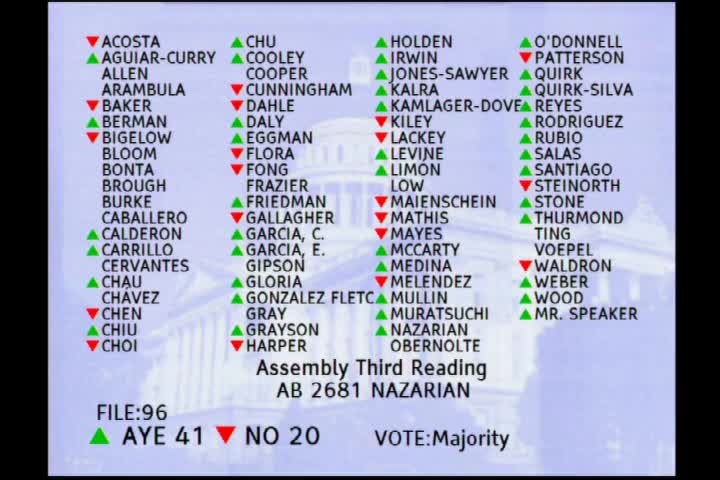 51SEC
Assembly Floor
Bill Author

Bill Co-Author(s):