AB 2122: Medi-Cal: blood lead screening tests.
- Session Year: 2017-2018
- House: Assembly
- Latest Version Date: 2018-09-04
Existing law provides for the Medi-Cal program, which is administered by the State Department of Health Care Services, under which qualified low-income individuals receive health care services. The Medi-Cal program is, in part, governed and funded by federal Medicaid program provisions. Existing law authorizes the department to enter contracts with managed care plans to provide Medi-Cal services. Under existing law, Medi-Cal covers early and periodic screening, diagnosis, and treatment for individuals under 21 years of age, consistent with federal law. Existing law requires the State Department of Public Health to adopt regulations establishing a standard of care under which a child is evaluated for risk of lead poisoning by health care providers during the childs periodic health assessment.
This bill would require the State Department of Health Care Services to ensure that a child enrolled in Medi-Cal receives blood lead screening tests at 12 and 24 months of age, or at any time at which the child is identified as having a high risk of lead exposure, as described by the State Department of Public Health, and that a child 2 to 6 years of age, inclusive, receives a blood lead screening test if there is no record of a previous test for that child. The bill would require the department to report its progress toward blood lead screening tests for all enrolled children, as specified, in its annual External Accountability Set as part of the annual external quality review organization review, and annually on its Internet Web site, to ensure Medi-Cal managed care plans make certain each enrolled child receives required blood lead screening tests, and to ensure Medi-Cal managed care plans require health care providers to test enrolled children, as specified. The bill would further require the department to ensure a Medi-Cal managed care plan notifies a childs parent, parents, guardian, or other person charged with his or her support and maintenance, and the childs health care provider, with specified information, including when a child has missed a required blood lead screening test, as specified. The bill would require a contract between the department and a Medi-Cal managed care plan to ensure the plan and its contractors meet the standard of care for early and periodic screening when providing lead testing.
This bill would require the State Department of Public Health to prepare provider training guidelines, curriculum, and resources to educate providers about childhood lead poisoning prevention, exposure risks, exposure health effects, and sources of exposure. The bill would require the State Department of Health Care Services to ensure a Medi-Cal managed care plan notifies and educates a contracted health care provider that, for 2 consecutive 12-month periods, fails to blood lead test at least 80% of the enrolled children, as specified, and to ensure that education reflects the training guidelines, curriculum, and resources developed by the State Department of Public Health. The bill would provide that it is the goal of the state that all children at risk of lead exposure receive blood lead screening tests. The bill would also make findings and declarations.
Existing law provides for the Medi-Cal program, which is administered by the State Department of Health Care Services, under which qualified low-income individuals receive health care services. The Medi-Cal program is, in part, governed and funded by federal Medicaid program provisions. Existing law authorizes the department to enter contracts with managed care plans to provide Medi-Cal services. Under existing law, Medi-Cal covers early and periodic screening, diagnosis, and treatment for individuals under 21 years of age, consistent with federal law. Existing law requires the State Department of Public Health to adopt regulations establishing a standard of care under which a child is evaluated for risk of lead poisoning by health care providers during the childs periodic health assessment.
This bill would require the State Department of Health Care Services to ensure that a child enrolled in Medi-Cal receives blood lead screening tests at 12 and 24 months of age, or at any time at which the child is identified as having a high risk of lead exposure, as described by the State Department of Public Health, and that a child 2 to 6 years of age, inclusive, receives a blood lead screening test if there is no record of a previous test for that child. The bill would require the department to report its progress toward blood lead screening tests for all enrolled children, as specified, in its annual External Accountability Set as part of the annual external quality review organization review, and annually on its Internet Web site, ensure Medi-Cal managed care plans make certain each enrolled child receives required blood lead screening tests, and ensure Medi-Cal managed care plans require health care providers to test enrolled children, as specified. The bill would further require the department to ensure a Medi-Cal managed care plan notifies a childs parent, parents, guardian, or other person charged with his or her support and maintenance, and the childs health care provider, with specified information, including when a child has missed a required blood lead screening test, as specified. The bill would require a contract between the department and a Medi-Cal managed care plan to ensure the plan and its contractors meet the standard of care for early and periodic screening when providing lead testing.
This bill would require the State Department of Public Health to prepare provider training guidelines, curriculum, and resources to educate providers about childhood lead poisoning prevention, exposure risks, exposure health effects, and sources of exposure. The bill would require the State Department of Health Care Services to ensure a Medi-Cal managed care plan notifies and educates a contracted health care provider that, for 2 consecutive 12-month periods, fails to blood lead test at least 80% of the enrolled children, as specified, and to ensure that education reflects the training guidelines, curriculum, and resources developed by the State Department of Public Health. The bill would provide that it is the goal of the state that all children at risk of lead exposure receive blood lead screening tests. The bill would also make findings and declarations.
Existing law provides for the Medi-Cal program, which is administered by the State Department of Health Care Services, under which qualified low-income individuals receive health care services. The Medi-Cal program is, in part, governed and funded by federal Medicaid Program program provisions. Existing law authorizes the department to enter contracts with managed care plans to provide Medi-Cal services. Under existing law, Medi-Cal covers early and periodic screening, diagnosis, and treatment for individuals under 21 years of age, consistent with federal law. Existing law requires the State Department of Public Health to adopt regulations establishing a standard of care under which a child is evaluated for risk of lead poisoning by health care providers during the childs periodic health assessment.
This bill would require the State Department of Health Care Services to ensure that a child enrolled in Medi-Cal receives blood lead screening tests at 12 and 24 months of age, or at any time at which they are the child is identified as having a high risk of lead exposure, and that a child 2 to 6 years of age, inclusive, receives a blood lead screening test if there is no record of a previous test for that child. The bill would require the department to report its progress toward blood lead screening tests for all enrolled children, as specified, in its annual External Accountability Set and annually on its Internet Web site, ensure Medi-Cal managed care plans make certain each enrolled child receives required blood lead screening tests, and ensure Medi-Cal managed care plans require health care providers to test enrolled children, as specified. The bill would further require the department to ensure a Medi-Cal managed care plan notifies a childs parent, parents, guardian, or other person charged with his or her support and maintenance, and the childs health care provider, with specified information, including when a child has missed a required blood lead screening test, as specified. The bill would require a contract between the department and a Medi-Cal managed care plan to ensure the plan and its contractors meet specified standards of care for the standard of care for early and periodic screening when providing lead testing.
This bill would require the State Department of Public Health to create prepare provider training guidelines, curriculum, and resources to educate providers about childhood lead poisoning prevention, exposure risks, exposure health effects, and sources of exposure. The bill would require the State Department of Health Care Services to ensure a Medi-Cal managed care plan notifies and educates a contracted health care provider that that, for 2 consecutive 12-month periods, fails to blood lead test at least 80% of the enrolled children examined in the preceding 12 months, children, as specified, and to ensure that notification and education reflects the training guidelines, curriculum, and resources developed by the State Department of Public Health. The bill would provide that it is the goal of the state that all children at risk of lead exposure receive blood lead screening tests. The bill would also make findings and declarations.
Existing law provides for the Medi-Cal program, which is administered by the State Department of Health Care Services, under which qualified low-income individuals receive health care services. The Medi-Cal program is, in part, governed and funded by federal Medicaid Program provisions. Existing law authorizes the department to enter contracts with managed care plans to provide Medi-Cal services. Under existing law, Medi-Cal covers early and periodic screening, diagnosis, and treatment for individuals under 21 years of age, consistent with federal law. Existing law requires the State Department of Public Health to adopt regulations establishing a standard of care under which a child is evaluated for risk of lead poisoning by health care providers during the childs periodic health assessment.
This bill would require the Department of Health Care Services to ensure that a child enrolled in Medi-Cal receives blood lead screening tests at 12 and 24 months of age, or at any time at which they are identified as having a high risk of lead exposure, and that a child 2 to 6 years of age, inclusive, receives a blood lead screening test if there is no record of a previous test for that child. The bill would require the department to report its progress toward blood lead screening tests for all enrolled children, as specified, in its annual External Accountability Set and annually on its Internet Web site, ensure Medi-Cal managed care plans make certain each enrolled child receives required blood lead screening tests, and ensure Medi-Cal managed care plans require health care providers to test enrolled children, as specified. The bill would further require the department to ensure a Medi-Cal managed care plan notifies a childs parent, parents, guardian, or other person charged with his or her support and maintenance, and the childs health care provider, with specified information, including when a child has missed a required blood lead screening test, as specified. The bill would require a contract between the department and a Medi-Cal managed care plan to ensure the plan and its contractors meet specified standards of care for lead testing. The
This bill would require the State Department of Public Health to create provider training guidelines, curriculum, and resources to educate providers about childhood lead poisoning prevention, exposure risks, exposure health effects, and sources of exposure. The bill would require the Department of Health Care Services to ensure a Medi-Cal managed care plan notifies and educates a contracted health care provider that fails to blood lead test at least 80% of the enrolled children examined in the preceding 12 months, as specified, and to ensure that notification and education reflects guidelines, curriculum, and resources developed by the State Department of Public Health. The bill would provide that it is the goal of the state that all children at risk of lead exposure receive blood lead screening tests. The bill would also make findings and declarations.
Existing law provides for the Medi-Cal program, which is administered by the State Department of Health Care Services, under which qualified low-income individuals receive health care services. The Medi-Cal program is, in part, governed and funded by federal Medicaid Program provisions. Existing law authorizes the department to enter contracts with managed care plans to provide Medi-Cal services. Under existing law, Medi-Cal covers early and periodic screening, diagnosis, and treatment for individuals under 21 years of age, consistent with federal law.
This bill would require the Department of Health Care Services to ensure that a child enrolled in Medi-Cal receives blood lead screening tests at 12 and 24 months of age, or at any time at which they are identified as having a high risk of lead exposure, and that a child 2 to 6 years of age, inclusive, receives a blood lead screening test if there is no record of a previous test for that child. The bill would require the department to report its progress toward blood lead screening tests for all enrolled children, as specified, in its annual External Accountability Set and annually on its Internet Web site, establish a case management monitoring system, ensure Medi-Cal managed care plans make certain each enrolled child receives required blood lead screening tests, and ensure Medi-Cal managed care plans require health care providers to test enrolled children, as specified. The bill would further require the department to notify ensure a Medi-Cal managed care plan notifies a childs parent, parents, guardian, or other person charged with his or her support and maintenance, and the childs health care provider, with specified information, including when a child has missed a required blood lead screening test, as specified. The bill would require a contract between the department and a Medi-Cal managed care plan to ensure the plan and its contractors meet specified standards of care for lead testing. The bill would provide that it is the goal of the state that all children at risk of lead exposure receive blood lead screening tests. The bill would also make findings and declarations.
Existing law provides for the Medi-Cal program, which is administered by the State Department of Health Care Services, under which qualified low-income individuals receive health care services. The Medi-Cal program is, in part, governed and funded by federal Medicaid Program provisions. Existing law authorizes the department to enter contracts with managed care plans to provide Medi-Cal services. Under existing law, Medi-Cal covers early and periodic screening, diagnosis, and treatment for individuals under 21 years of age, consistent with federal law.
This bill would require the Department of Health Care Services to ensure that a child enrolled in Medi-Cal receives blood lead screening tests at 12 and 24 months of age, and that a child 2 to 6 years of age, inclusive, receives a blood lead screening test if there is no record of a previous test for that child. The bill would require the department to report its progress toward blood lead screening tests for all enrolled children, as specified, annually on its Internet Web site, establish a case management monitoring system, and require health care providers to test enrolled children, as specified. The bill would further require the department to notify a childs parent, parents, guardian, or other person charged with his or her support and maintenance, and the childs health care provider, with specified information, including when a child has missed a required blood lead screening test, as specified. The bill would require a contract between the department and a Medi-Cal managed care plan to ensure the plan meets a and its contractors meet specified standard standards of care for lead testing. The bill would provide that it is the goal of the state that all children at risk of lead exposure receive blood lead screening tests.
Existing law provides for the Medi-Cal program, which is administered by the State Department of Health Care Services, under which qualified low-income individuals receive health care services. The Medi-Cal program is, in part, governed and funded by federal Medicaid Program provisions. Existing law authorizes the department to enter contracts with managed care plans to provide Medi-Cal services. Under existing law, Medi-Cal covers early and periodic screening, diagnosis, and treatment for individuals under 21 years of age, consistent with federal law.
This bill would require the Department of Health Care Services to ensure that a child enrolled in Medi-Cal receives blood lead screening tests at 12 and 24 months of age, and that a child 2 to 6 years of age, inclusive, receives a blood lead screening test if there is no record of a previous test for that child. The bill would require the department to report its progress toward blood lead screening tests for all enrolled children, as specified, annually on its Internet Web site, establish a case management monitoring system, and require health care providers to test enrolled children, as specified. The bill would further require the department to notify a childs parent, parents, guardian, or other person charged with his or her support and maintenance, and the childs health care provider, with specified information, including when a child has missed a required blood lead screening test, as specified. The bill would require a contract between the department and a Medi-Cal managed care plan to ensure the plan meets a specified standard of care for lead testing. The bill would provide that it is the goal of the state that all children at risk of lead exposure receive blood lead screening tests.
Existing law provides for the Medi-Cal program, which is administered by the State Department of Health Care Services, under which qualified low-income individuals receive health care services. The Medi-Cal program is, in part, governed and funded by federal Medicaid Program provisions. Under existing law, Medi-Cal covers early and periodic screening, diagnosis, and treatment for individuals under 21 years of age, consistent with federal law.
This bill would require the Department of Health Care Services to ensure that a child enrolled in Medi-Cal receives blood lead screening tests at 12 and 24 months of age, and that a child 2 to 6 years of age, inclusive, receives a blood lead screening test if there is no record of a previous test for that child. The bill would require the department to report its progress toward blood lead screening tests for all enrolled children, as specified, annually on its Internet Web site, establish a case management monitoring system, and require health care providers to test enrolled children, as specified. The bill would further require the department to notify a childs parent, parents, guardian, or other person charged with his or her support and maintenance, and the childs health care provider, with specified information, including when a child has missed a required blood lead screening test, as specified.
The Legislature finds and declares the following:
(a)Federal law and regulations require a state Medicaid plan, which in California is known as Medi-Cal, to provide Early and Periodic Screening, Diagnosis, and Treatment (EPSDT) program services to a person under 21 years of age who is eligible to receive assistance under the plan.
(b)Federal law and regulations require EPSDT services to include blood lead risk assessments and blood lead tests as appropriate for age and risk factors.
(c)Federal and state regulations require all Medi-Cal recipient children to be blood lead tested at 12 and 24 months of age. If a Medi-Cal recipient child is not blood lead tested by 24 months of age, the child is to be blood lead tested before six years of age.
(d)Recent data provided to the Legislature by the State Department of Health Care Services indicate that the department can only verify that 28 percent of Medi-Cal recipient children are blood lead tested at 12 and 24 months of age.
(e)According to the State Department of Public Health, 88 percent of children identified by the department as being lead poisoned are enrolled in Medi-Cal.
(f)Multiple agencies, including the State Department of Public Health, the State Department of Health Care Services, local environmental health and public health departments, and other state agencies, share responsibilities related to ensuring that children are blood lead screened as required, and that they are treated for, and protected from, lead exposure.
(g)Therefore, it is the intent of the Legislature to restate and reaffirm the responsibilities of these agencies to ensure that Medi-Cal recipient children, specifically children 12 months to six years of age, inclusive, receive required blood lead testing, as well as all necessary health care, diagnostic services, treatment, and other measures to correct or ameliorate defects and physical and mental illnesses and conditions discovered by the screening services.
(h)It is also the intent of the Legislature to direct the State Department of Health Care Services to utilize all legally mandated financial resources to pay the costs associated with Medi-Cal recipient blood lead screening, treatment, and services, pursuant to the federal and state matching agreements outlined in the state Medicaid plan.
SEC. 2.Section 105287 is added to the Health and Safety Code, to read:105287.The department shall prepare provider training guidelines, curriculum, and resources that shall be used to educate providers about childhood lead poisoning prevention, childhood lead exposure risks, childhood lead exposure health effects, and sources of childhood lead exposure at the state, regional, and local levels. The departments training guidelines, curriculum, and resources shall also explain and inform providers about the federal and state laws, regulations, and guidelines regarding childhood lead exposure screening and testing.
SEC. 3.Section 14087.42 is added to the Welfare and Institutions Code, to read:14087.42.A contract between the department and a Medi-Cal managed care plan shall ensure that the Medi-Cal managed care plan and its contractors meet the standard of care for early and periodic screening when providing lead testing.
SEC. 4.Section 14132.015 is added to the Welfare and Institutions Code, to read:14132.015.(a)(1)It is the goal of the state that all children at risk of lead exposure receive blood lead screening tests.
(2)It is the goal of the state that all children eligible for Medi-Cal receive blood lead screening tests at 12 and 24 months of age.
(3)It is the goal of the state that a child eligible for Medi-Cal between two and six years of age, inclusive, for whom there is no record of a previous blood lead screening test, receive at least one blood lead screening test.
(b)The department shall ensure that a child enrolled in Medi-Cal receives blood lead screening tests at 12 and 24 months of age, or at any time at which the child is identified as having a high risk of lead exposure.
(c)The department shall ensure that a child enrolled in Medi-Cal between two and six years of age, inclusive, for whom there is no record of a previous blood lead screening test, receives at least one blood lead screening test. The department shall also ensure that children are screened at any time at which they are identified as having a high risk of lead exposure.
(d)To comply with the requirements of subdivisions (b) and (c), the department shall ensure contracted Medi-Cal managed care plans do all of the following:
(1)Ensure each enrolled child receives required blood lead screening tests pursuant to state and federal law, regulations, and guidelines.
(2)Require health care providers to test enrolled children pursuant to state and federal law, regulations, and guidelines.
(3)At the time of a childs enrollment, and annually thereafter until a child receives all required tests or reaches six years of age, whichever occurs first, inform the childs parent, parents, guardian, or other person charged with his or her support and maintenance about all of the following:
(A)The risks and effects of lead exposure.
(B)The requirement for an enrolled child to receive blood lead screening tests.
(C)The recommendation that a child receive a blood lead screening test if he or she is at risk of lead exposure.
(D)The most common sources of lead exposure.
(4)Provide coordination of care for each enrolled child, consistent with Medi-Cal managed care plans existing obligations under the Early and Periodic Screening, Diagnosis, and Treatment program. This coordination of care shall ensure each enrolled child receives required blood lead screening tests and appropriate followup services, as set forth in the State Department of Public Healths standard of care policies, promulgated regulations, and published guidelines established in accordance with Section 105285 of the Health and Safety Code.
(5)Ensure each enrolled child with an elevated blood lead level is connected to appropriate followup services, as set forth in the State Department of Public Healths standard of care policies, promulgated regulations, and published guidelines established in accordance with Section 105285 of the Health and Safety Code. Appropriate followup services include, but are not limited to, all of the following:
(A)Appropriate environmental assessments and investigations, including onsite investigations of a childs home or primary residence, to determine the source or sources of lead.
(B)Available remediation resources.
(C)Assessments for iron deficiency and nutrition.
(D)Any other health and behavioral health interventions to address the effects of blood lead poisoning, if appropriate.
(E)Long-term monitoring for the effects of lead exposure.
(F)Education and resources for the childs family members and caretakers.
(G)Any additional testing and treatment as appropriate.
(6)Notify a childs parent, parents, guardian, or other person charged with his or her support and maintenance, and the childs health care provider, when the child misses a required blood lead screening test. This notification shall be sent within 30 days of the missed test.
(7)(A)Notify and educate a contracted health care provider that, for two consecutive 12-month periods, fails to blood lead test at least 80 percent of enrolled children pursuant to state and federal law, regulations, and guidelines. The Medi-Cal managed care plan shall only include in its calculation children with whom the provider had at least one encounter during the preceding 12 months.
(B)To ensure compliance with this paragraph, the department shall ensure a Medi-Cal managed care plan notifies a noncompliant provider within 30 days of the end of the second 12-month period and educate noncompliant providers within three months of the second 12-month period. The department shall ensure the education of noncompliant providers reflects the training guidelines, curriculum, and resources developed by the State Department of Public Health pursuant to Section 105287 of the Health and Safety Code.
(e)The department shall include blood lead screening tests as a performance measure in its annual external quality review organization (EQRO) review pursuant to Section 438.364 of Title 42 of the Code of Federal Regulations and Section 14197.05. This performance measure shall be reflected in the External Accountability Set (EAS), effective for contract periods commencing on or after July 1, 2022. The EQRO entity shall annually review, survey, and report to the department the data and information required for the EAS and as identified in this subdivision. The department shall annually create a report detailing the departments progress toward the goals specified in subdivision (a) for children who were continuously enrolled for a three-month period and for children who were continuously enrolled for a 12-month period. The report shall be posted on the departments Internet Web site in a location that can be readily accessed by the general public. The report shall include all of the following:
(1)The number of enrolled children in each county, divided by age, who have and have not received blood lead screening tests.
(2)Screening results divided by blood-lead-level ranges.
(3)The number of children referred to coordination of care services who received the following:
(A)Followup health care.
(B)Environmental assessment.
(C)Educational screenings, nutrition education, and other resources.
(4)The number of children identified as having lead poisoning and who received treatment for that lead poisoning.
(5)Information about why a child identified with lead exposure or lead poisoning, who was connected to coordination of care services, did not receive one or more of the following:
(A)Followup health care.
(B)Environmental assessment.
(C)Educational activities.
(6)Information about the type and scope of educational activities provided.
(f)As used in this section, elevated blood lead level shall have the same meaning as the State Department of Public Healths standard of care policies, promulgated regulations, and published guidelines established in accordance with Section 105285 of the Health and Safety Code.
SEC. 5.Section 14197.05 of the Welfare and Institutions Code is amended to read:14197.05.(a)As part of the federally required external quality review organization (EQRO) review of Medi-Cal managed care plans in the annual detailed technical report required by Section 438.364 of Title 42 of the Code of Federal Regulations, effective for contract periods commencing on or after July 1, 2018, the EQRO entity designated by the department shall compile the data described in subdivision (b) by plan and by county for the purpose of informing the status of implementation of the requirements of Section 14197.
(b)(1)The information compiled by the EQRO entity shall include all of the following:
(A)Number of requests for alternative access standards in the plan service area for time and distance, categorized by all provider types, including specialists, and by adult and pediatric.
(B)Number of allowable exceptions for the appointment time standard, if known, categorized by all provider types, including specialists, and by adult and pediatric.
(C)Distance and driving time between the nearest network provider and ZIP Code of the beneficiary furthest from that provider for requests for alternative access standards.
(D)Approximate number of beneficiaries impacted by alternative access standards or allowable exceptions.
(E)Percentage of providers in the plan service area by provider and specialty type that are under a contract with a Medi-Cal managed care plan.
(F)The number of requests for alternative access standards approved or denied by ZIP Code and provider and specialty type, and the reasons for the approval or denial of the request for alternative access standards.
(G)The process of ensuring out-of-network access.
(H)Descriptions of contracting efforts and explanation for why a contract was not executed.
(I)Timeframe for approval or denial of a request for alternative access standards by the department.
(J)Consumer complaints, if any.
(2)The information described in paragraph (1) shall be presented in a chart format to enable comparison among counties, provider types, and plans.
(c)The EQRO entity shall develop a methodology to assess information that will help inform the experience of individuals placed in a skilled nursing facility or intermediate care facility and the distance that they are placed from their place of residence. The EQRO entity shall report the results from the use of this methodology in the EQRO annual Medi-Cal managed care plan technical report.
(d)Effective for contract periods commencing on or after July 1, 2022, the EQRO entity designated by the department shall review, survey, and report to the department the data and information relating to blood lead screening tests and performance measures as described in subdivision (e) of Section 14132.015.
(e)The department shall comply with the requirements of subsection (c) of Section 438.364 of Title 42 of the Code of Federal Regulations in making the information described in this section publicly available.
The Legislature finds and declares the following:
(a)Federal law and regulations require a state Medicaid plan, which in California is known as Medi-Cal, to provide Early and Periodic Screening, Diagnosis, and Treatment (EPSDT) program services to a person under 21 years of age who is eligible to receive assistance under the plan.
(b)Federal law and regulations require EPSDT services to include blood lead risk assessments and blood lead tests as appropriate for age and risk factors.
(c)Federal and state regulations require all Medi-Cal recipient children to be blood lead tested at 12 and 24 months of age. If a Medi-Cal recipient child is not blood lead tested by 24 months of age, the child is to be blood lead tested before six years of age.
(d)Recent data provided to the Legislature by the State Department of Health Care Services indicate that the department can only verify that 28 percent of Medi-Cal recipient children are blood lead tested at 12 and 24 months of age.
(e)According to the State Department of Public Health, 88 percent of children identified by the department as being lead poisoned are enrolled in Medi-Cal.
(f)Multiple agencies, including the State Department of Public Health, the State Department of Health Care Services, local environmental health and public health departments, and other state agencies, share responsibilities related to ensuring that children are blood lead screened as required, and that they are treated for, and protected from, lead exposure.
(g)Therefore, it is the intent of the Legislature to restate and reaffirm the responsibilities of these agencies to ensure that Medi-Cal recipient children, specifically children 12 months to six years of age, inclusive, receive required blood lead testing, as well as all necessary health care, diagnostic services, treatment, and other measures to correct or ameliorate defects and physical and mental illnesses and conditions discovered by the screening services.
(h)It is also the intent of the Legislature to direct the State Department of Health Care Services to utilize all legally mandated financial resources to pay the costs associated with Medi-Cal recipient blood lead screening, treatment, and services, pursuant to the federal and state matching agreements outlined in the state Medicaid plan.
SEC. 2.Section 105287 is added to the Health and Safety Code, to read:105287.The department shall prepare provider training guidelines, curriculum, and resources that shall be used to educate providers about childhood lead poisoning prevention, childhood lead exposure risks, childhood lead exposure health effects, and sources of childhood lead exposure at the state, regional, and local levels. The departments training guidelines, curriculum, and resources shall also explain and inform providers about the federal and state laws, regulations, and guidelines regarding childhood lead exposure screening and testing.
SEC. 3.Section 14087.42 is added to the Welfare and Institutions Code, to read:14087.42.A contract between the department and a Medi-Cal managed care plan shall ensure that the Medi-Cal managed care plan and its contractors meet the standard of care for early and periodic screening when providing lead testing.
SEC. 4.Section 14132.015 is added to the Welfare and Institutions Code, to read:14132.015.(a)(1)It is the goal of the state that all children at risk of lead exposure receive blood lead screening tests.
(2)It is the goal of the state that all children eligible for Medi-Cal receive blood lead screening tests at 12 and 24 months of age.
(3)It is the goal of the state that a child eligible for Medi-Cal between two and six years of age, inclusive, for whom there is no record of a previous blood lead screening test, receive at least one blood lead screening test.
(b)The department shall ensure that a child enrolled in Medi-Cal receives blood lead screening tests at 12 and 24 months of age, or at any time at which the child is identified as having a high risk of lead exposure.
(c)The department shall ensure that a child enrolled in Medi-Cal between two and six years of age, inclusive, for whom there is no record of a previous blood lead screening test, receives at least one blood lead screening test. The department shall also ensure that children are screened at any time at which they are identified as having a high risk of lead exposure.
(d)To comply with the requirements of subdivisions (b) and (c), the department shall ensure contracted Medi-Cal managed care plans do all of the following:
(1)Ensure each enrolled child receives required blood lead screening tests pursuant to state and federal law, regulations, and guidelines.
(2)Require health care providers to test enrolled children pursuant to state and federal law, regulations, and guidelines.
(3)At the time of a childs enrollment, and annually thereafter until a child receives all required tests or reaches six years of age, whichever occurs first, inform the childs parent, parents, guardian, or other person charged with his or her support and maintenance about all of the following:
(A)The risks and effects of lead exposure.
(B)The requirement for an enrolled child to receive blood lead screening tests.
(C)The recommendation that a child receive a blood lead screening test if he or she is at risk of lead exposure.
(D)The most common sources of lead exposure.
(4)Provide coordination of care for each enrolled child, consistent with Medi-Cal managed care plans existing obligations under the Early and Periodic Screening, Diagnosis, and Treatment program, which program. This coordination of care shall ensure each enrolled child receives required blood lead screening tests and appropriate followup services if a childs blood test indicates an elevated blood lead level. services, as set forth in the State Department of Public Healths standard of care policies, promulgated regulations, and published guidelines established in accordance with Section 105285 of the Health and Safety Code.
(5)Ensure each enrolled child with an elevated blood lead level is connected to appropriate followup services, including, but not as set forth in the State Department of Public Healths standard of care policies, promulgated regulations, and published guidelines established in accordance with Section 105285 of the Health and Safety Code. Appropriate followup services include, but are not limited to, all of the following:
(A)Environmental Appropriate environmental assessments and investigations, including onsite investigations of a childs home or primary residence, to determine the source or sources of lead.
(B)Available remediation resources.
(C)Assessments for iron deficiency and nutrition.
(D)Any other health and behavioral health interventions to address the effects of blood lead poisoning, if appropriate.
(E)Long-term monitoring for the effects of lead exposure.
(F)Education and resources for the childs family members and caretakers.
(G)Any additional testing and treatment as appropriate.
(6)Notify a childs parent, parents, guardian, or other person charged with his or her support and maintenance, and the childs health care provider, when the child misses a required blood lead screening test. This notification shall be sent within 30 days of the missed test.
(7)(A)Notify and educate a contracted health care provider that, for two consecutive 12-month periods, fails to blood lead test at least 80 percent of enrolled children pursuant to state and federal law, regulations, and guidelines. The Medi-Cal managed care plan shall only include in its calculation children with whom the provider had at least one encounter during the preceding 12 months.
(B)To ensure compliance with this paragraph, the department shall ensure a Medi-Cal managed care plan notifies a noncompliant provider within 30 days of the end of the second 12-month period and educate noncompliant providers within three months of the second 12-month period. The department shall ensure the education of noncompliant providers reflects the training guidelines, curriculum, and resources developed by the State Department of Public Health pursuant to Section 105287 of the Health and Safety Code.
(e)The department shall include blood lead screening tests as a performance measure in its annual external quality review organization (EQRO) review pursuant to Section 438.364 of Title 42 of the Code of Federal Regulations and Section 14197.05. This performance measure shall be reflected in the External Accountability Set. Set (EAS), effective for contract periods commencing on or after July 1, 2022. The EQRO entity shall annually review, survey, and report to the department the data and information required for the EAS and as identified in this subdivision. The department shall annually create a report detailing the departments progress toward the goals specified in subdivision (a) for children who were continuously enrolled for a three-month period and for children who were continuously enrolled for a 12-month period. The report shall be posted on the departments Internet Web site in a location that can be readily accessed by the general public. The report shall include all of the following:
(1)The number of enrolled children in each county, divided by age, who have and have not received blood lead screening tests.
(2)Screening results divided by blood-lead-level ranges.
(3)The number of children referred to coordination of care services who received the following:
(A)Followup health care.
(B)Environmental assessment.
(C)Educational screenings, nutrition education, and other resources.
(4)The number of children identified as having lead poisoning and who received treatment for that lead poisoning.
(5)Information about why a child identified with lead exposure or lead poisoning, who was connected to coordination of care services, did not receive one or more of the following:
(A)Followup health care.
(B)Environmental assessment.
(C)Educational activities.
(6)Information about the type and scope of educational activities provided.
(f)As used in this section, elevated blood lead level shall be defined by the department in a way that is at least as stringent as the most recent federal Centers for Disease Control and Prevention screening guidelines. have the same meaning as the State Department of Public Healths standard of care policies, promulgated regulations, and published guidelines established in accordance with Section 105285 of the Health and Safety Code.
SEC. 5.Section 14197.05 of the Welfare and Institutions Code is amended to read:14197.05.(a)As part of the federally required external quality review organization (EQRO) review of Medi-Cal managed care plans in the annual detailed technical report required by Section 438.364 of Title 42 of the Code of Federal Regulations, effective for contract periods commencing on or after July 1, 2018, the EQRO entity designated by the department shall compile the data described in subdivision (b) by plan and by county for the purpose of informing the status of implementation of the requirements of Section 14197.
(b)(1)The information compiled by the EQRO entity shall include all of the following:
(A)Number of requests for alternative access standards in the plan service area for time and distance, categorized by all provider types, including specialists, and by adult and pediatric.
(B)Number of allowable exceptions for the appointment time standard, if known, categorized by all provider types, including specialists, and by adult and pediatric.
(C)Distance and driving time between the nearest network provider and ZIP Code of the beneficiary furthest from that provider for requests for alternative access standards.
(D)Approximate number of beneficiaries impacted by alternative access standards or allowable exceptions.
(E)Percentage of providers in the plan service area by provider and specialty type that are under a contract with a Medi-Cal managed care plan.
(F)The number of requests for alternative access standards approved or denied by ZIP Code and provider and specialty type, and the reasons for the approval or denial of the request for alternative access standards.
(G)The process of ensuring out-of-network access.
(H)Descriptions of contracting efforts and explanation for why a contract was not executed.
(I)Timeframe for approval or denial of a request for alternative access standards by the department.
(J)Consumer complaints, if any.
(2)The information described in paragraph (1) shall be presented in a chart format to enable comparison among counties, provider types, and plans.
(c)The EQRO entity shall develop a methodology to assess information that will help inform the experience of individuals placed in a skilled nursing facility or intermediate care facility and the distance that they are placed from their place of residence. The EQRO entity shall report the results from the use of this methodology in the EQRO annual Medi-Cal managed care plan technical report.
(d)Effective for contract periods commencing on or after July 1, 2022, the EQRO entity designated by the department shall review, survey, and report to the department the data and information relating to blood lead screening tests and performance measures as described in subdivision (e) of Section 14132.015.
(d)(e)The department shall comply with the requirements of subsection (c) of Section 438.364 of Title 42 of the Code of Federal Regulations in making the information described in this section publicly available.
The Legislature finds and declares the following:
(a)Federal law and regulations require a state Medicaid plan, which in California is known as Medi-Cal, to provide Early and Periodic Screening, Diagnosis, and Treatment (EPSDT) program services to a person under 21 years of age who is eligible to receive assistance under the plan.
(b)Federal law and regulations require EPSDT services to include blood lead risk assessments and blood lead tests as appropriate for age and risk factors.
(c)Federal and state regulations require all Medi-Cal recipient children to be blood lead tested at 12 and 24 months of age. If a Medi-Cal recipient child is not blood lead tested by 24 months of age, the child is to be blood lead tested before six years of age.
(d)Recent data provided to the Legislature by the State Department of Health Care Services indicates indicate that the department can only verify that 28 percent of Medi-Cal recipient children are blood lead tested at 12 and 24 months of age.
(e)According to the State Department of Public Health, 88 percent of children identified by the department as being lead poisoned are enrolled in Medi-Cal.
(f)Multiple agencies, including the State Department of Public Health, the State Department of Health Care Services, local environmental health and public health departments, and other state agencies, share responsibilities related to ensuring that children are blood lead screened as required, and that they are treated for, and protected from, lead exposure.
(g)Therefore, it is the intent of the Legislature to restate and reaffirm the responsibilities of these agencies to ensure that Medi-Cal recipient children, specifically children 12 months to six years of age, inclusive, receive required blood lead testing, as well as all necessary health care, diagnostic services, treatment, and other measures to correct or ameliorate defects and physical and mental illnesses and conditions discovered by the screening services.
(h)It is also the intent of the Legislature to direct the State Department of Health Care Services, the Department of Managed Health Care, and the State Department of Public Health Services to utilize all legally mandated financial resources to pay the costs associated with Medi-Cal recipient blood lead screening, treatment, and services, pursuant to the federal and state matching agreements outlined in the state Medicaid plan.
SEC. 2.Section 105287 is added to the Health and Safety Code, to read:105287.The department shall prepare provider training guidelines, curriculum, and resources that shall be used to educate providers about childhood lead poisoning prevention, childhood lead exposure risks, childhood lead exposure health effects, and sources of childhood lead exposure at the state, regional, and local levels. The departments training guidelines, curriculum, and resources shall also explain and inform providers about the federal and state laws, regulations, and guidelines regarding childhood lead exposure screening and testing.
SEC. 3.Section 14087.42 is added to the Welfare and Institutions Code, to read:14087.42.A contract between the department and a Medi-Cal managed care plan shall ensure that the Medi-Cal managed care plan and its contractors meet the standard of care for early and periodic screening pursuant to Section 1396a(a)(43) of Title 42 of the United States Code when providing lead testing and meet the standard of care for lead testing pursuant to subdivision (v) of Section 14132. when providing lead testing.
SEC. 4.Section 14132.015 is added to the Welfare and Institutions Code, to read:14132.015.(a)(1)It is the goal of the state that all children at risk of lead exposure receive blood lead screening tests.
(2)It is the goal of the state that all children eligible for Medi-Cal receive blood lead screening tests at 12 and 24 months of age.
(3)It is the goal of the state that a child eligible for Medi-Cal between two and six years of age, inclusive, for whom there is no record of a previous blood lead screening test, receive at least one blood lead screening test.
(b)The department shall ensure that a child enrolled in Medi-Cal receives blood lead screening tests at 12 and 24 months of age, or at any time at which the child is identified as having a high risk of lead exposure.
(c)The department shall ensure that a child enrolled in Medi-Cal between two and six years of age, inclusive, for whom there is no record of a previous blood lead screening test, receives at least one blood lead screening test. The department shall also ensure that children are screened at any time at which they are identified as having a high risk of lead exposure.
(d)To comply with the requirements of subdivisions (b) and (c), the department shall ensure contracted Medi-Cal managed care plans do all of the following:
(1)Ensure each enrolled child receives required blood lead screening tests pursuant to state and federal law, regulations, and guidelines.
(2)Require health care providers to test enrolled children pursuant to state and federal law, regulations, and guidelines.
(3)At the time of a childs enrollment, and annually thereafter until a child receives all required tests or reaches six years of age, whichever occurs first, inform the childs parent, parents, guardian, or other person charged with his or her support and maintenance about all of the following:
(A)The risks and effects of lead exposure.
(B)The requirement for an enrolled child to receive blood lead screening tests.
(C)The recommendation that a child receive a blood lead screening test if he or she is at risk of lead exposure.
(D)The most common sources of lead exposure.
(4)Provide coordination of care for each enrolled child, consistent with Medi-Cal managed care plans existing obligations under the Early and Periodic Screening, Diagnosis, and Treatment program, which shall ensure each enrolled child receives required blood lead screening tests and followup services if a childs blood test indicates an elevated blood lead level.
(5)Ensure each enrolled child with an elevated blood lead level is connected to appropriate followup services, including, but not limited to, all of the following:
(A)Environmental assessments and investigations, including onsite investigations of a childs home or primary residence, to determine the source or sources of lead.
(B)Available remediation resources.
(C)Assessments for iron deficiency and nutrition.
(D)Any other health and behavioral health interventions to address the effects of blood lead poisoning, if appropriate.
(E)Long-term monitoring for the effects of lead exposure.
(F)Education and resources for the childs family members and caretakers.
(G)Any additional testing and treatment as appropriate.
(6)Notify a childs parent, parents, guardian, or other person charged with his or her support and maintenance, and the childs health care provider, when the child misses a required blood lead screening test. This notification shall be sent within 30 days of the missed test.
(7)(A)Notify and educate a contracted health care provider that, for two consecutive 12-month periods, fails to blood lead test at least 80 percent of enrolled children pursuant to state and federal law, regulations, and guidelines. The Medi-Cal managed care plan shall only include in its calculation children with whom the provider had at least one encounter during the preceding 12 months.
(B)To ensure compliance with this paragraph, the department shall ensure a Medi-Cal managed care plan notifies a noncompliant provider within 30 days of the end of the second 12-month period and educate noncompliant providers within three months of the second 12-month period. The department shall ensure the education of noncompliant providers reflects the training guidelines, curriculum, and resources developed by the State Department of Public Health pursuant to Section 105287 of the Health and Safety Code.
(e)The department shall include blood lead screening tests as a performance measure in its annual External Accountability Set. The department shall annually create a report detailing the departments progress toward the goals specified in subdivision (a) for children who were continuously enrolled for a three-month period and for children who were continuously enrolled for a 12-month period. The report shall be posted on the departments Internet Web site in a location that can be readily accessed by the general public. The report shall include all of the following:
(1)The number of enrolled children in each county, divided by age, who have and have not received blood lead screening tests.
(2)Screening results divided by blood-lead-level ranges.
(3)The number of children referred to coordination of care services who received the following:
(A)Followup health care.
(B)Environmental assessment.
(C)Educational screenings, nutrition education, and other resources.
(4)The number of children identified as having lead poisoning and who received treatment for that lead poisoning.
(5)Information about why a child identified with lead exposure or lead poisoning, who was connected to coordination of care services, did not receive one or more of the following:
(A)Followup health care.
(B)Environmental assessment.
(C)Educational activities.
(6)Information about the type and scope of educational activities provided.
(f)As used in this section, elevated blood lead level shall be defined by the department in a way that is at least as stringent as the most recent federal Centers for Disease Control and Prevention screening guidelines.
The Legislature finds and declares the following:
(a)Federal law and regulations require a state Medicaid plan, which in California is known as Medi-Cal, to provide Early and Periodic Screening, Diagnostic, Diagnosis, and Treatment (EPSDT) program services to a person under 21 years of age who is eligible to receive assistance under the plan.
(b)Federal law and regulations require EPSDT services to include blood lead risk assessments and blood lead tests as appropriate for age and risk factors.
(c)Federal and state regulations require all Medi-Cal recipient children to be blood lead tested at 12 and 24 months of age. If a Medi-Cal recipient child is not blood lead tested by 24 months of age, the child is to be blood lead tested before six years of age.
(d)Recent data provided to the Legislature by the State Department of Health Care Services indicates that the department can only verify that 28 percent of Medi-Cal recipient children are blood lead tested at 12 and 24 months of age.
(e)According to the State Department of Public Health, 88 percent of children identified by the department as being lead poisoned are enrolled in Medi-Cal.
(f)Multiple agencies, including the State Department of Public Health, the State Department of Health Care Services, local environmental health and public health departments, and other state agencies, share responsibilities related to ensuring that children are blood lead screened as required, and that they are treated for, and protected from, lead exposure.
(g)Therefore, it is the intent of the Legislature to restate and reaffirm the responsibilities of these agencies to ensure that Medi-Cal recipient children, specifically children 12 months to six years of age, inclusive, receive required blood lead testing, as well as all necessary health care, diagnostic services, treatment, and other measures to correct or ameliorate defects and physical and mental illnesses and conditions discovered by the screening services.
(h)It is also the intent of the Legislature to direct the State Department of Health Care Services, the Department of Managed Health Care, and the State Department of Public Health to utilize all legally mandated financial resources to pay the costs associated with Medi-Cal recipient blood lead screening, treatment, and services, pursuant to the federal and state matching agreements outlined in the state Medicaid plan.
SEC. 2.Section 105287 is added to the Health and Safety Code, to read:105287.The department shall prepare provider training guidelines, curriculum, and resources that shall be used to educate providers about childhood lead poisoning prevention, childhood lead exposure risks, childhood lead exposure health effects, and sources of childhood lead exposure at the state, regional, and local levels. The departments training guidelines, curriculum, and resources shall also explain and inform providers about the federal and state laws, regulations, and guidelines regarding childhood lead exposure screening and testing.
SEC. 2.SEC. 3.Section 14087.42 is added to the Welfare and Institutions Code, to read:14087.42.A contract between the department and a Medi-Cal managed care plan shall ensure that the Medi-Cal managed care plan and its contractors meet the standard of care for early and periodic screening pursuant to Section 1396a(a)(43) of Title 42 of the United States Code when providing lead testing and meet the standard of care for lead testing pursuant to subdivision (v) of Section 14132.
SEC. 3.SEC. 4.Section 14132.015 is added to the Welfare and Institutions Code, to read:14132.015.(a)(1)It is the goal of the state that all children at risk of lead exposure receive blood lead screening tests.
(2)It is the goal of the state that all children eligible for Medi-Cal receive blood lead screening tests at 12 and 24 months of age.
(3)It is the goal of the state that a child eligible for Medi-Cal between two and six years of age, inclusive, for whom there is no record of a previous blood lead screening test, receive at least one blood lead screening test.
(b)The department shall ensure that a child enrolled in Medi-Cal receives blood lead screening tests at 12 and 24 months of age, or at any time at which the child is identified as having a high risk of lead exposure.
(c)The department shall ensure that a child enrolled in Medi-Cal between two and six years of age, inclusive, for whom there is no record of a previous blood lead screening test, receives at least one blood lead screening test. The department shall also ensure that children are screened at any time at which they are identified as having a high risk of lead exposure.
(d)To comply with the requirements of subdivisions (b) and (c), the department shall ensure contracted Medi-Cal managed care plans do all of the following:
(1)Ensure each enrolled child receives required blood lead screening tests pursuant to state and federal law, regulations, and guidelines.
(2)Require health care providers to test enrolled children pursuant to state and federal law, regulations, and guidelines.
(3)At the time of a childs enrollment, and annually thereafter until a child receives all required tests or reaches six years of age, whichever occurs first, inform the childs parent, parents, guardian, or other person charged with his or her support and maintenance about all of the following:
(A)The risks and effects of lead exposure.
(B)The requirement for an enrolled child to receive blood lead screening tests.
(C)The recommendation that a child receive a blood lead screening test if he or she is at risk of lead exposure.
(D)The most common sources of lead exposure.
(4)Provide coordination of care for each enrolled child, consistent with Medi-Cal managed care plans existing obligations under the Early and Periodic Screening, Diagnosis, and Treatment program, which shall ensure each enrolled child receives required blood lead screening tests and followup services if a childs blood test indicates an elevated blood lead level.
(5)Ensure each enrolled child with an elevated blood lead level is connected to appropriate followup services, including, but not limited to, all of the following:
(A)Environmental assessments and investigations, including onsite investigations of a childs home or primary residence, to determine the source or sources of lead.
(B)Available remediation resources.
(C)Assessments for iron deficiency and nutrition.
(D)Any other health and behavioral health interventions to address the effects of blood lead poisoning, if appropriate.
(E)Long-term monitoring for the effects of lead exposure.
(F)Education and resources for the childs family members and caretakers.
(G)Any additional testing and treatment as appropriate.
(4)(6)Notify a childs parent, parents, guardian, or other person charged with his or her support and maintenance, and the childs health care provider, when the child misses a required blood lead screening test. This notification shall be sent within 30 days of the missed test.
(7)(A)Notify and educate a contracted health care provider that, for two consecutive 12-month periods, fails to blood lead test at least 80 percent of enrolled children pursuant to state and federal law, regulations, and guidelines. The Medi-Cal managed care plan shall only include in its calculation children with whom the provider had at least one encounter during the preceding 12 months.
(B)To ensure compliance with this paragraph, the department shall ensure a Medi-Cal managed care plan notifies a noncompliant provider within 30 days of the end of the second 12-month period and educate noncompliant providers within three months of the second 12-month period. The department shall ensure the education of noncompliant providers reflects the training guidelines, curriculum, and resources developed by the State Department of Public Health pursuant to Section 105287 of the Health and Safety Code.
(e)The department shall include blood lead screening tests as a performance measure in its annual External Accountability Set. The department shall annually create a report detailing the departments progress toward the goals specified in subdivision (a), which (a) for children who were continuously enrolled for a three-month period and for children who were continuously enrolled for a 12-month period. The report shall be posted on the departments Internet Web site in a location that can be readily accessed by the general public. The report shall include the all of the following:
(1)The number of enrolled children in each county, divided by age, who have and have not received blood lead screening tests.
(2)Screening results divided by blood-lead-level ranges.
(3)The number of children referred to coordination of care services who received the following:
(A)Followup health care.
(B)Environmental assessment.
(C)Educational screenings, nutrition education, and other resources.
(4)The number of children identified as having lead poisoning and who received treatment for that lead poisoning.
(5)Information about why a child identified with lead exposure or lead poisoning, who was connected to coordination of care services, did not receive one or more of the following:
(A)Followup health care.
(B)Environmental assessment.
(C)Educational activities.
(6)Information about the type and scope of educational activities provided.
(f)As used in this section, elevated blood lead level shall be defined by the department in a way that is at least as stringent as the most recent federal Centers for Disease Control and Prevention screening guidelines.
The Legislature finds and declares the following:
(a)Federal law and regulations require a state Medicaid plan, which in California is known as Medi-Cal, to provide Early and Periodic Screening, Diagnostic, and Treatment (EPSDT) program services to a person under 21 years of age who is eligible to receive assistance under the plan.
(b)Federal law and regulations require EPSDT services to include blood lead risk assessments and blood lead tests as appropriate for age and risk factors.
(c)Federal and state regulations require all Medi-Cal recipient children to be blood lead tested at 12 and 24 months of age. If a Medi-Cal recipient child is not blood lead tested by 24 months of age, the child is to be blood lead tested before six years of age.
(d)Recent data provided to the Legislature by the State Department of Health Care Services indicates that the department can only verify that 28 percent of Medi-Cal recipient children are blood lead tested at 12 and 24 months of age.
(e)According to the State Department of Public Health, 88 percent of children identified by the department as being lead poisoned are enrolled in Medi-Cal.
(f)Multiple agencies, including the State Department of Public Health, the State Department of Health Care Services, local environmental health and public health departments, and other state agencies, share responsibilities related to ensuring that children are blood lead screened as required, and that they are treated for, and protected from, lead exposure.
(g)Therefore, it is the intent of the Legislature to restate and reaffirm the responsibilities of these agencies to ensure that Medi-Cal recipient children, specifically children 12 months to six years of age, inclusive, receive required blood lead testing, as well as all necessary health care, diagnostic services, treatment, and other measures to correct or ameliorate defects and physical and mental illnesses and conditions discovered by the screening services.
(h)It is also the intent of the Legislature to direct the State Department of Health Care Services, the Department of Managed Health Care, and the State Department of Public Health to utilize all legally mandated financial resources to pay the costs associated with Medi-Cal recipient blood lead screening, treatment, and services, pursuant to the federal and state matching agreements outlined in the state Medicaid plan.
SECTION 1.SEC. 2.Section 14087.42 is added to the Welfare and Institutions Code, to read:14087.42.A contract between the department and a Medi-Cal managed care plan shall ensure that the Medi-Cal managed care plan and its contractors meet the standard of care for early and periodic screening pursuant to Section 1396a(a)(43) of Title 42 of the United States Code when providing lead testing and meet the standard of care for lead testing pursuant to subdivision (v) of Section 14132.
SEC. 2.Section 14132 of the Welfare and Institutions Code is amended to read:14132.The following is the schedule of benefits under this chapter:(a)Outpatient services are covered as follows:Physician, hospital or clinic outpatient, surgical center, respiratory care, optometric, chiropractic, psychology, podiatric, occupational therapy, physical therapy, speech therapy, audiology, acupuncture to the extent federal matching funds are provided for acupuncture, and services of persons rendering treatment by prayer or healing by spiritual means in the practice of any church or religious denomination insofar as these can be encompassed by federal participation under an approved plan, subject to utilization controls.(b)(1)Inpatient hospital services, including, but not limited to, physician and podiatric services, physical therapy, and occupational therapy, are covered subject to utilization controls.(2)For Medi-Cal fee-for-service beneficiaries, emergency services and care that are necessary for the treatment of an emergency medical condition and medical care directly related to the emergency medical condition. This paragraph shall not be construed to change the obligation of Medi-Cal managed care plans to provide emergency services and care. For the purposes of this paragraph, emergency services and care and emergency medical condition shall have the same meanings as those terms are defined in Section 1317.1 of the Health and Safety Code.(c)Nursing facility services, subacute care services, and services provided by any category of intermediate care facility for the developmentally disabled, including podiatry, physician, nurse practitioner services, and prescribed drugs, as described in subdivision (d), are covered subject to utilization controls. Respiratory care, physical therapy, occupational therapy, speech therapy, and audiology services for patients in nursing facilities and any category of intermediate care facility for the developmentally disabled are covered subject to utilization controls.(d)(1)Purchase of prescribed drugs is covered subject to the Medi-Cal List of Contract Drugs and utilization controls.(2)Purchase of drugs used to treat erectile dysfunction or any off-label uses of those drugs are covered only to the extent that federal financial participation is available.(3)(A)To the extent required by federal law, the purchase of outpatient prescribed drugs, for which the prescription is executed by a prescriber in written, nonelectronic form on or after April 1, 2008, is covered only when executed on a tamper resistant prescription form. The implementation of this paragraph shall conform to the guidance issued by the federal Centers for Medicare and Medicaid Services but shall not conflict with state statutes on the characteristics of tamper resistant prescriptions for controlled substances, including Section 11162.1 of the Health and Safety Code. The department shall provide providers and beneficiaries with as much flexibility in implementing these rules as allowed by the federal government. The department shall notify and consult with appropriate stakeholders in implementing, interpreting, or making specific this paragraph.(B)Notwithstanding Chapter 3.5 (commencing with Section 11340) of Part 1 of Division 3 of Title 2 of the Government Code, the department may take the actions specified in subparagraph (A) by means of a provider bulletin or notice, policy letter, or other similar instructions without taking regulatory action.(4)(A)(i)For the purposes of this paragraph, nonlegend has the same meaning as defined in subdivision (a) of Section 14105.45.(ii)Nonlegend acetaminophen-containing products, with the exception of childrens acetaminophen-containing products, selected by the department are not covered benefits.(iii)Nonlegend cough and cold products selected by the department are not covered benefits. This clause shall be implemented on the first day of the first calendar month following 90 days after the effective date of the act that added this clause, or on the first day of the first calendar month following 60 days after the date the department secures all necessary federal approvals to implement this section, whichever is later.(iv)Beneficiaries under the Early and Periodic Screening, Diagnosis, and Treatment Program shall be exempt from clauses (ii) and (iii).(B)Notwithstanding Chapter 3.5 (commencing with Section 11340) of Part 1 of Division 3 of Title 2 of the Government Code, the department may take the actions specified in subparagraph (A) by means of a provider bulletin or notice, policy letter, or other similar instruction without taking regulatory action.(e)Outpatient dialysis services and home hemodialysis services, including physician services, medical supplies, drugs, and equipment required for dialysis, are covered, subject to utilization controls.(f)Anesthesiologist services when provided as part of an outpatient medical procedure, nurse anesthetist services when rendered in an inpatient or outpatient setting under conditions set forth by the director, outpatient laboratory services, and X-ray services are covered, subject to utilization controls. Nothing in this subdivision shall be construed to require prior authorization for anesthesiologist services provided as part of an outpatient medical procedure or for portable X-ray services in a nursing facility or any category of intermediate care facility for the developmentally disabled.(g)Blood and blood derivatives are covered.(h)(1)Emergency and essential diagnostic and restorative dental services, except for orthodontic, fixed bridgework, and partial dentures that are not necessary for balance of a complete artificial denture, are covered, subject to utilization controls. The utilization controls shall allow emergency and essential diagnostic and restorative dental services and prostheses that are necessary to prevent a significant disability or to replace previously furnished prostheses that are lost or destroyed due to circumstances beyond the beneficiarys control. Notwithstanding the foregoing, the director may by regulation provide for certain fixed artificial dentures necessary for obtaining employment or for medical conditions that preclude the use of removable dental prostheses, and for orthodontic services in cleft palate deformities administered by the departments California Children Services Program.(2)For persons 21 years of age or older, the services specified in paragraph (1) shall be provided subject to the following conditions:(A)Periodontal treatment is not a benefit.(B)Endodontic therapy is not a benefit except for vital pulpotomy.(C)Laboratory processed crowns are not a benefit.(D)Removable prosthetics shall be a benefit only for patients as a requirement for employment.(E)The director may, by regulation, provide for the provision of fixed artificial dentures that are necessary for medical conditions that preclude the use of removable dental prostheses.(F)Notwithstanding the conditions specified in subparagraphs (A) to (E), inclusive, the department may approve services for persons with special medical disorders subject to utilization review.(3)Paragraph (2) shall become inoperative July 1, 1995.(i)Medical transportation is covered, subject to utilization controls.(j)Home health care services are covered, subject to utilization controls.(k)Prosthetic and orthotic devices and eyeglasses are covered, subject to utilization controls. Utilization controls shall allow replacement of prosthetic and orthotic devices and eyeglasses necessary because of loss or destruction due to circumstances beyond the beneficiarys control. Frame styles for eyeglasses replaced pursuant to this subdivision shall not change more than once every two years, unless the department so directs.Orthopedic and conventional shoes are covered when provided by a prosthetic and orthotic supplier on the prescription of a physician and when at least one of the shoes will be attached to a prosthesis or brace, subject to utilization controls. Modification of stock conventional or orthopedic shoes, when medically indicated, is covered subject to utilization controls. When there is a clearly established medical need that cannot be satisfied by the modification of stock conventional or orthopedic shoes, custom-made orthopedic shoes are covered, subject to utilization controls.Therapeutic shoes and inserts are covered when provided to beneficiaries with a diagnosis of diabetes, subject to utilization controls, to the extent that federal financial participation is available.(l)Hearing aids are covered, subject to utilization controls. Utilization controls shall allow replacement of hearing aids necessary because of loss or destruction due to circumstances beyond the beneficiarys control.(m)Durable medical equipment and medical supplies are covered, subject to utilization controls. The utilization controls shall allow the replacement of durable medical equipment and medical supplies when necessary because of loss or destruction due to circumstances beyond the beneficiarys control. The utilization controls shall allow authorization of durable medical equipment needed to assist a disabled beneficiary in caring for a child for whom the disabled beneficiary is a parent, stepparent, foster parent, or legal guardian, subject to the availability of federal financial participation. The department shall adopt emergency regulations to define and establish criteria for assistive durable medical equipment in accordance with the rulemaking provisions of the Administrative Procedure Act (Chapter 3.5 (commencing with Section 11340) of Part 1 of Division 3 of Title 2 of the Government Code).(n)Family planning services are covered, subject to utilization controls. However, for Medi-Cal managed care plans, any utilization controls shall be subject to Section 1367.25 of the Health and Safety Code.(o)Inpatient intensive rehabilitation hospital services, including respiratory rehabilitation services, in a general acute care hospital are covered, subject to utilization controls, when either of the following criteria are met:(1)A patient with a permanent disability or severe impairment requires an inpatient intensive rehabilitation hospital program as described in Section 14064 to develop function beyond the limited amount that would occur in the normal course of recovery.(2)A patient with a chronic or progressive disease requires an inpatient intensive rehabilitation hospital program as described in Section 14064 to maintain the patients present functional level as long as possible.(p)(1)Adult day health care is covered in accordance with Chapter 8.7 (commencing with Section 14520).(2)Commencing 30 days after the effective date of the act that added this paragraph, and notwithstanding the number of days previously approved through a treatment authorization request, adult day health care is covered for a maximum of three days per week.(3)As provided in accordance with paragraph (4), adult day health care is covered for a maximum of five days per week.(4)As of the date that the director makes the declaration described in subdivision (g) of Section 14525.1, paragraph (2) shall become inoperative and paragraph (3) shall become operative.(q)(1)Application of fluoride, or other appropriate fluoride treatment as defined by the department, and other prophylaxis treatment for children 17 years of age and under are covered.(2)All dental hygiene services provided by a registered dental hygienist, registered dental hygienist in extended functions, and registered dental hygienist in alternative practice licensed pursuant to Sections 1753, 1917, 1918, and 1922 of the Business and Professions Code may be covered as long as they are within the scope of Denti-Cal benefits and they are necessary services provided by a registered dental hygienist, registered dental hygienist in extended functions, or registered dental hygienist in alternative practice.(r)(1)Paramedic services performed by a city, county, or special district, or pursuant to a contract with a city, county, or special district, and pursuant to a program established under former Article 3 (commencing with Section 1480) of Chapter 2.5 of Division 2 of the Health and Safety Code by a paramedic certified pursuant to that article, and consisting of defibrillation and those services specified in subdivision (3) of former Section 1482 of the article.(2)All providers enrolled under this subdivision shall satisfy all applicable statutory and regulatory requirements for becoming a Medi-Cal provider.(3)This subdivision shall be implemented only to the extent funding is available under Section 14106.6.(s)In-home medical care services are covered when medically appropriate and subject to utilization controls, for beneficiaries who would otherwise require care for an extended period of time in an acute care hospital at a cost higher than in-home medical care services. The director shall have the authority under this section to contract with organizations qualified to provide in-home medical care services to those persons. These services may be provided to patients placed in shared or congregate living arrangements, if a home setting is not medically appropriate or available to the beneficiary. As used in this section, in-home medical care service includes utility bills directly attributable to continuous, 24-hour operation of life-sustaining medical equipment, to the extent that federal financial participation is available.As used in this subdivision, in-home medical care services include, but are not limited to:(1)Level-of-care and cost-of-care evaluations.(2)Expenses, directly attributable to home care activities, for materials.(3)Physician fees for home visits.(4)Expenses directly attributable to home care activities for shelter and modification to shelter.(5)Expenses directly attributable to additional costs of special diets, including tube feeding.(6)Medically related personal services.(7)Home nursing education.(8)Emergency maintenance repair.(9)Home health agency personnel benefits that permit coverage of care during periods when regular personnel are on vacation or using sick leave.(10)All services needed to maintain antiseptic conditions at stoma or shunt sites on the body.(11)Emergency and nonemergency medical transportation.(12)Medical supplies.(13)Medical equipment, including, but not limited to, scales, gurneys, and equipment racks suitable for paralyzed patients.(14)Utility use directly attributable to the requirements of home care activities that are in addition to normal utility use.(15)Special drugs and medications.(16)Home health agency supervision of visiting staff that is medically necessary, but not included in the home health agency rate.(17)Therapy services.(18)Household appliances and household utensil costs directly attributable to home care activities.(19)Modification of medical equipment for home use.(20)Training and orientation for use of life-support systems, including, but not limited to, support of respiratory functions.(21)Respiratory care practitioner services as defined in Sections 3702 and 3703 of the Business and Professions Code, subject to prescription by a physician and surgeon.Beneficiaries receiving in-home medical care services are entitled to the full range of services within the Medi-Cal scope of benefits as defined by this section, subject to medical necessity and applicable utilization control. Services provided pursuant to this subdivision, which are not otherwise included in the Medi-Cal schedule of benefits, shall be available only to the extent that federal financial participation for these services is available in accordance with a home- and community-based services waiver.(t)Home- and community-based services approved by the United States Department of Health and Human Services are covered to the extent that federal financial participation is available for those services under the state plan or waivers granted in accordance with Section 1315 or 1396n of Title 42 of the United States Code. The director may seek waivers for any or all home- and community-based services approvable under Section 1315 or 1396n of Title 42 of the United States Code. Coverage for those services shall be limited by the terms, conditions, and duration of the federal waivers.(u)Comprehensive perinatal services, as provided through an agreement with a health care provider designated in Section 14134.5 and meeting the standards developed by the department pursuant to Section 14134.5, subject to utilization controls.The department shall seek any federal waivers necessary to implement the provisions of this subdivision. The provisions for which appropriate federal waivers cannot be obtained shall not be implemented. Provisions for which waivers are obtained or for which waivers are not required shall be implemented notwithstanding any inability to obtain federal waivers for the other provisions. No provision of this subdivision shall be implemented unless matching funds from Subchapter XIX (commencing with Section 1396) of Chapter 7 of Title 42 of the United States Code are available.(v)Early and periodic screening, diagnosis, and treatment for any individual under 21 years of age is covered, consistent with the requirements of Subchapter XIX (commencing with Section 1396) of Chapter 7 of Title 42 of the United States Code.(1)(A) It is the goal of the state that all children at risk of lead exposure receive blood lead screening tests.(B)It is the goal of the state that all children eligible for Medi-Cal receive blood lead screening tests at 12 and 24 months of age.(C)It is the goal of the state that a child eligible for Medi-Cal between two and six years of age, inclusive, for whom there is no record of a previous blood lead screening test, receive at least one blood lead screening test.(2)The department shall annually post on its Internet Web site a report detailing the departments progress toward the goals specified in paragraph (1). The report shall include the number of enrolled children in each county, divided by age, who have and have not received blood lead screening tests.(w)Hospice service which is Medicare-certified hospice service is covered, subject to utilization controls. Coverage shall be available only to the extent that no additional net program costs are incurred.(x)When a claim for treatment provided to a beneficiary includes both services that are authorized and reimbursable under this chapter and services that are not reimbursable under this chapter, that portion of the claim for the treatment and services authorized and reimbursable under this chapter shall be payable.(y)Home- and community-based services approved by the United States Department of Health and Human Services for beneficiaries with a diagnosis of AIDS or ARC, who require intermediate care or a higher level of care.Services provided pursuant to a waiver obtained from the Secretary of the United States Department of Health and Human Services pursuant to this subdivision, and which are not otherwise included in the Medi-Cal schedule of benefits, shall be available only to the extent that federal financial participation for these services is available in accordance with the waiver, and subject to the terms, conditions, and duration of the waiver. These services shall be provided to individual beneficiaries in accordance with the clients needs as identified in the plan of care, and subject to medical necessity and applicable utilization control.The director may under this section contract with organizations qualified to provide, directly or by subcontract, services provided for in this subdivision to eligible beneficiaries. Contracts or agreements entered into pursuant to this division shall not be subject to the Public Contract Code.(z)Respiratory care when provided in organized health care systems as defined in Section 3701 of the Business and Professions Code, and as an in-home medical service as outlined in subdivision (s).(aa)(1)There is hereby established in the department a program to provide comprehensive clinical family planning services to any person who has a family income at or below 200 percent of the federal poverty level, as revised annually, and who is eligible to receive these services pursuant to the waiver identified in paragraph (2). This program shall be known as the Family Planning, Access, Care, and Treatment (Family PACT) Program.(2)The department shall seek a waiver in accordance with Section 1315 of Title 42 of the United States Code, or a state plan amendment adopted in accordance with Section 1396a(a)(10)(A)(ii)(XXI) of Title 42 of the United States Code, which was added to Section 1396a of Title 42 of the United States Code by Section 2303(a)(2) of the federal Patient Protection and Affordable Care Act (PPACA) (Public Law 111-148), for a program to provide comprehensive clinical family planning services as described in paragraph (8). Under the waiver, the program shall be operated only in accordance with the waiver and the statutes and regulations in paragraph (4) and subject to the terms, conditions, and duration of the waiver. Under the state plan amendment, which shall replace the waiver and shall be known as the Family PACT successor state plan amendment, the program shall be operated only in accordance with this subdivision and the statutes and regulations in paragraph (4). The state shall use the standards and processes imposed by the state on January 1, 2007, including the application of an eligibility discount factor to the extent required by the federal Centers for Medicare and Medicaid Services, for purposes of determining eligibility as permitted under Section 1396a(a)(10)(A)(ii)(XXI) of Title 42 of the United States Code. To the extent that federal financial participation is available, the program shall continue to conduct education, outreach, enrollment, service delivery, and evaluation services as specified under the waiver. The services shall be provided under the program only if the waiver and, when applicable, the successor state plan amendment are approved by the federal Centers for Medicare and Medicaid Services and only to the extent that federal financial participation is available for the services. Nothing in this section shall prohibit the department from seeking the Family PACT successor state plan amendment during the operation of the waiver.(3)Solely for the purposes of the waiver or Family PACT successor state plan amendment and notwithstanding any other law, the collection and use of an individuals social security number shall be necessary only to the extent required by federal law.(4)Sections 14105.3 to 14105.39, inclusive, 14107.11, 24005, and 24013, and any regulations adopted under these statutes shall apply to the program provided for under this subdivision. No other provision of law under the Medi-Cal program or the State-Only Family Planning Program shall apply to the program provided for under this subdivision.(5)Notwithstanding Chapter 3.5 (commencing with Section 11340) of Part 1 of Division 3 of Title 2 of the Government Code, the department may implement, without taking regulatory action, the provisions of the waiver after its approval by the federal Centers for Medicare and Medicaid Services and the provisions of this section by means of an all-county letter or similar instruction to providers. Thereafter, the department shall adopt regulations to implement this section and the approved waiver in accordance with the requirements of Chapter 3.5 (commencing with Section 11340) of Part 1 of Division 3 of Title 2 of the Government Code. Beginning six months after the effective date of the act adding this subdivision, the department shall provide a status report to the Legislature on a semiannual basis until regulations have been adopted.(6)In the event that the Department of Finance determines that the program operated under the authority of the waiver described in paragraph (2) or the Family PACT successor state plan amendment is no longer cost effective, this subdivision shall become inoperative on the first day of the first month following the issuance of a 30-day notification of that determination in writing by the Department of Finance to the chairperson in each house that considers appropriations, the chairpersons of the committees, and the appropriate subcommittees in each house that considers the State Budget, and the Chairperson of the Joint Legislative Budget Committee.(7)If this subdivision ceases to be operative, all persons who have received or are eligible to receive comprehensive clinical family planning services pursuant to the waiver described in paragraph (2) shall receive family planning services under the Medi-Cal program pursuant to subdivision (n) if they are otherwise eligible for Medi-Cal with no share of cost, or shall receive comprehensive clinical family planning services under the program established in Division 24 (commencing with Section 24000) either if they are eligible for Medi-Cal with a share of cost or if they are otherwise eligible under Section 24003.(8)For purposes of this subdivision, comprehensive clinical family planning services means the process of establishing objectives for the number and spacing of children, and selecting the means by which those objectives may be achieved. These means include a broad range of acceptable and effective methods and services to limit or enhance fertility, including contraceptive methods, federal Food and Drug Administration approved contraceptive drugs, devices, and supplies, natural family planning, abstinence methods, and basic, limited fertility management. Comprehensive clinical family planning services include, but are not limited to, preconception counseling, maternal and fetal health counseling, general reproductive health care, including diagnosis and treatment of infections and conditions, including cancer, that threaten reproductive capability, medical family planning treatment and procedures, including supplies and followup, and informational, counseling, and educational services. Comprehensive clinical family planning services shall not include abortion, pregnancy testing solely for the purposes of referral for abortion or services ancillary to abortions, or pregnancy care that is not incident to the diagnosis of pregnancy. Comprehensive clinical family planning services shall be subject to utilization control and include all of the following:(A)Family planning related services and male and female sterilization. Family planning services for men and women shall include emergency services and services for complications directly related to the contraceptive method, federal Food and Drug Administration approved contraceptive drugs, devices, and supplies, and followup, consultation, and referral services, as indicated, which may require treatment authorization requests.(B)All United States Department of Agriculture, federal Food and Drug Administration approved contraceptive drugs, devices, and supplies that are in keeping with current standards of practice and from which the individual may choose.(C)Culturally and linguistically appropriate health education and counseling services, including informed consent, that include all of the following:(i)Psychosocial and medical aspects of contraception.(ii)Sexuality.(iii)Fertility.(iv)Pregnancy.(v)Parenthood.(vi)Infertility.(vii)Reproductive health care.(viii)Preconception and nutrition counseling.(ix)Prevention and treatment of sexually transmitted infection.(x)Use of contraceptive methods, federal Food and Drug Administration approved contraceptive drugs, devices, and supplies.(xi)Possible contraceptive consequences and followup.(xii)Interpersonal communication and negotiation of relationships to assist individuals and couples in effective contraceptive method use and planning families.(D)A comprehensive health history, updated at the next periodic visit (between 11 and 24 months after initial examination) that includes a complete obstetrical history, gynecological history, contraceptive history, personal medical history, health risk factors, and family health history, including genetic or hereditary conditions.(E)A complete physical examination on initial and subsequent periodic visits.(F)Services, drugs, devices, and supplies deemed by the federal Centers for Medicare and Medicaid Services to be appropriate for inclusion in the program.(9)In order to maximize the availability of federal financial participation under this subdivision, the director shall have the discretion to implement the Family PACT successor state plan amendment retroactively to July 1, 2010.(ab)(1)Purchase of prescribed enteral nutrition products is covered, subject to the Medi-Cal list of enteral nutrition products and utilization controls.(2)Purchase of enteral nutrition products is limited to those products to be administered through a feeding tube, including, but not limited to, a gastric, nasogastric, or jejunostomy tube. Beneficiaries under the Early and Periodic Screening, Diagnosis, and Treatment Program shall be exempt from this paragraph.(3)Notwithstanding paragraph (2), the department may deem an enteral nutrition product, not administered through a feeding tube, including, but not limited to, a gastric, nasogastric, or jejunostomy tube, a benefit for patients with diagnoses, including, but not limited to, malabsorption and inborn errors of metabolism, if the product has been shown to be neither investigational nor experimental when used as part of a therapeutic regimen to prevent serious disability or death.(4)Notwithstanding Chapter 3.5 (commencing with Section 11340) of Part 1 of Division 3 of Title 2 of the Government Code, the department may implement the amendments to this subdivision made by the act that added this paragraph by means of all-county letters, provider bulletins, or similar instructions, without taking regulatory action.(5)The amendments made to this subdivision by the act that added this paragraph shall be implemented June 1, 2011, or on the first day of the first calendar month following 60 days after the date the department secures all necessary federal approvals to implement this section, whichever is later.(ac)Diabetic testing supplies are covered when provided by a pharmacy, subject to utilization controls.(ad)(1)Nonmedical transportation is covered, subject to utilization controls and permissible time and distance standards, for a beneficiary to obtain covered Medi-Cal services.(2)(A)(i)Nonmedical transportation includes, at a minimum, round trip transportation for a beneficiary to obtain covered Medi-Cal services by passenger car, taxicab, or any other form of public or private conveyance, and mileage reimbursement when conveyance is in a private vehicle arranged by the beneficiary and not through a transportation broker, bus passes, taxi vouchers, or train tickets.(ii)Nonmedical transportation does not include the transportation of sick, injured, invalid, convalescent, infirm, or otherwise incapacitated beneficiaries by ambulances, litter vans, or wheelchair vans licensed, operated, and equipped in accordance with state and local statutes, ordinances, or regulations.(B)Nonmedical transportation shall be provided for a beneficiary who can attest in a manner to be specified by the department that other currently available resources have been reasonably exhausted. For beneficiaries enrolled in a managed care plan, nonmedical transportation shall be provided by the beneficiarys managed care plan. For Medi-Cal fee-for-service beneficiaries, the department shall provide nonmedical transportation when those services are not available to the beneficiary under Sections 14132.44 and 14132.47.(3)Nonmedical transportation shall be provided in a form and manner that is accessible, in terms of physical and geographic accessibility, for the beneficiary and consistent with applicable state and federal disability rights laws.(4)It is the intent of the Legislature in enacting this subdivision to affirm the requirement under Section 431.53 of Title 42 of the Code of Federal Regulations, in which the department is required to provide necessary transportation, including nonmedical transportation, for recipients to and from covered services. This subdivision shall not be interpreted to add a new benefit to the Medi-Cal program.(5)The department shall seek any federal approvals that may be required to implement this subdivision, including, but not limited to, approval of revisions to the existing state plan that the department determines are necessary to implement this subdivision.(6)This subdivision shall be implemented only to the extent that federal financial participation is available and not otherwise jeopardized, and any necessary federal approvals have been obtained.(7)Prior to the effective date of any necessary federal approvals, nonmedical transportation was not a Medi-Cal managed care benefit with the exception of when provided as an Early and Periodic Screening, Diagnosis, and Treatment (EPSDT) service.(8)Notwithstanding Chapter 3.5 (commencing with Section 11340) of Part 1 of Division 3 of Title 2 of the Government Code, the department, without taking any further regulatory action, shall implement, interpret, or make specific this subdivision by means of all-county letters, plan letters, plan or provider bulletins, or similar instructions until the time regulations are adopted. By July 1, 2018, the department shall adopt regulations in accordance with the requirements of Chapter 3.5 (commencing with Section 11340) of Part 1 of Division 3 of Title 2 of the Government Code. Commencing January 1, 2018, and notwithstanding Section 10231.5 of the Government Code, the department shall provide a status report to the Legislature on a semiannual basis, in compliance with Section 9795 of the Government Code, until regulations have been adopted.(9)This subdivision shall not be implemented until July 1, 2017.SEC. 3.Section 14132.015 is added to the Welfare and Institutions Code, to read:14132.015.(a)The14132.015.(a)(1)It is the goal of the state that all children at risk of lead exposure receive blood lead screening tests.
(2)It is the goal of the state that all children eligible for Medi-Cal receive blood lead screening tests at 12 and 24 months of age.
(3)It is the goal of the state that a child eligible for Medi-Cal between two and six years of age, inclusive, for whom there is no record of a previous blood lead screening test, receive at least one blood lead screening test.
(b)The department shall ensure that a child enrolled in Medi-Cal receives blood lead screening tests at 12 and 24 months of age. age, or at any time at which the child is identified as having a high risk of lead exposure.
(b)(c)The department shall ensure that a child enrolled in Medi-Cal between two and six years of age, inclusive, for whom there is no record of a previous blood lead screening test, receives at least one blood lead screening test. The department shall also ensure that children are screened at any time at which they are identified as having a high risk of lead exposure.
(c)(d)To comply with the requirements of subdivisions (a) (b) and (b), (c), the department shall ensure contracted Medi-Cal managed care plans do all of the following:
(1)Establish a case management monitoring system that ensures Ensure each enrolled child receives required blood lead screening tests. tests pursuant to state and federal law, regulations, and guidelines.
(2)Require health care providers to test enrolled children pursuant to state and federal law, regulations, and guidelines.
(3)At the time of a childs enrollment, and annually thereafter, thereafter until a child receives all required tests or reaches six years of age, whichever occurs first, inform the childs parent, parents, guardian, or other person charged with his or her support and maintenance about all of the following:
(A)The risks and effects of lead exposure.
(B)The requirement for an enrolled child to receive blood lead screening tests.
(C)The recommendation that a child receive a blood lead screening test if he or she is at risk of lead exposure.
(D)The most common sources of lead exposure.
(4)Notify a childs parent, parents, guardian, or other person charged with his or her support and maintenance, and the childs health care provider, when the child misses a required blood lead screening test. This notification shall be sent within 30 days of the missed test.
(e)The department shall include blood lead screening tests as a performance measure in its annual External Accountability Set. The department shall annually create a report detailing the departments progress toward the goals specified in subdivision (a), which shall be posted on the departments Internet Web site in a location that can be readily accessed by the general public. The report shall include the number of enrolled children in each county, divided by age, who have and have not received blood lead screening tests.
A contract between the department and a Medi-Cal managed care plan shall ensure that the Medi-Cal managed care plan meets and its contractors meet the standard of care for early and periodic screening pursuant to Section 1396a(a)(43) of Title 42 of the United States Code when providing lead testing and meet the standard of care for lead testing pursuant to subdivision (v) of Section 14132.
SEC. 2.Section 14132 of the Welfare and Institutions Code is amended to read:14132.The following is the schedule of benefits under this chapter:
(a)Outpatient services are covered as follows:
Physician, hospital or clinic outpatient, surgical center, respiratory care, optometric, chiropractic, psychology, podiatric, occupational therapy, physical therapy, speech therapy, audiology, acupuncture to the extent federal matching funds are provided for acupuncture, and services of persons rendering treatment by prayer or healing by spiritual means in the practice of any church or religious denomination insofar as these can be encompassed by federal participation under an approved plan, subject to utilization controls.
(b)(1)Inpatient hospital services, including, but not limited to, physician and podiatric services, physical therapy, and occupational therapy, are covered subject to utilization controls.
(2)For Medi-Cal fee-for-service beneficiaries, emergency services and care that are necessary for the treatment of an emergency medical condition and medical care directly related to the emergency medical condition. This paragraph shall not be construed to change the obligation of Medi-Cal managed care plans to provide emergency services and care. For the purposes of this paragraph, emergency services and care and emergency medical condition shall have the same meanings as those terms are defined in Section 1317.1 of the Health and Safety Code.
(c)Nursing facility services, subacute care services, and services provided by any category of intermediate care facility for the developmentally disabled, including podiatry, physician, nurse practitioner services, and prescribed drugs, as described in subdivision (d), are covered subject to utilization controls. Respiratory care, physical therapy, occupational therapy, speech therapy, and audiology services for patients in nursing facilities and any category of intermediate care facility for the developmentally disabled are covered subject to utilization controls.
(d)(1)Purchase of prescribed drugs is covered subject to the Medi-Cal List of Contract Drugs and utilization controls.
(2)Purchase of drugs used to treat erectile dysfunction or any off-label uses of those drugs are covered only to the extent that federal financial participation is available.
(3)(A)To the extent required by federal law, the purchase of outpatient prescribed drugs, for which the prescription is executed by a prescriber in written, nonelectronic form on or after April 1, 2008, is covered only when executed on a tamper resistant prescription form. The implementation of this paragraph shall conform to the guidance issued by the federal Centers for Medicare and Medicaid Services but shall not conflict with state statutes on the characteristics of tamper resistant prescriptions for controlled substances, including Section 11162.1 of the Health and Safety Code. The department shall provide providers and beneficiaries with as much flexibility in implementing these rules as allowed by the federal government. The department shall notify and consult with appropriate stakeholders in implementing, interpreting, or making specific this paragraph.
(B)Notwithstanding Chapter 3.5 (commencing with Section 11340) of Part 1 of Division 3 of Title 2 of the Government Code, the department may take the actions specified in subparagraph (A) by means of a provider bulletin or notice, policy letter, or other similar instructions without taking regulatory action.
(4)(A)(i)For the purposes of this paragraph, nonlegend has the same meaning as defined in subdivision (a) of Section 14105.45.
(ii)Nonlegend acetaminophen-containing products, with the exception of childrens acetaminophen-containing products, selected by the department are not covered benefits.
(iii)Nonlegend cough and cold products selected by the department are not covered benefits. This clause shall be implemented on the first day of the first calendar month following 90 days after the effective date of the act that added this clause, or on the first day of the first calendar month following 60 days after the date the department secures all necessary federal approvals to implement this section, whichever is later.
(iv)Beneficiaries under the Early and Periodic Screening, Diagnosis, and Treatment Program shall be exempt from clauses (ii) and (iii).
(B)Notwithstanding Chapter 3.5 (commencing with Section 11340) of Part 1 of Division 3 of Title 2 of the Government Code, the department may take the actions specified in subparagraph (A) by means of a provider bulletin or notice, policy letter, or other similar instruction without taking regulatory action.
(e)Outpatient dialysis services and home hemodialysis services, including physician services, medical supplies, drugs, and equipment required for dialysis, are covered, subject to utilization controls.
(f)Anesthesiologist services when provided as part of an outpatient medical procedure, nurse anesthetist services when rendered in an inpatient or outpatient setting under conditions set forth by the director, outpatient laboratory services, and X-ray services are covered, subject to utilization controls. Nothing in this subdivision shall be construed to require prior authorization for anesthesiologist services provided as part of an outpatient medical procedure or for portable X-ray services in a nursing facility or any category of intermediate care facility for the developmentally disabled.
(g)Blood and blood derivatives are covered.
(h)(1)Emergency and essential diagnostic and restorative dental services, except for orthodontic, fixed bridgework, and partial dentures that are not necessary for balance of a complete artificial denture, are covered, subject to utilization controls. The utilization controls shall allow emergency and essential diagnostic and restorative dental services and prostheses that are necessary to prevent a significant disability or to replace previously furnished prostheses that are lost or destroyed due to circumstances beyond the beneficiarys control. Notwithstanding the foregoing, the director may by regulation provide for certain fixed artificial dentures necessary for obtaining employment or for medical conditions that preclude the use of removable dental prostheses, and for orthodontic services in cleft palate deformities administered by the departments California Children Services Program.
(2)For persons 21 years of age or older, the services specified in paragraph (1) shall be provided subject to the following conditions:
(A)Periodontal treatment is not a benefit.
(B)Endodontic therapy is not a benefit except for vital pulpotomy.
(C)Laboratory processed crowns are not a benefit.
(D)Removable prosthetics shall be a benefit only for patients as a requirement for employment.
(E)The director may, by regulation, provide for the provision of fixed artificial dentures that are necessary for medical conditions that preclude the use of removable dental prostheses.
(F)Notwithstanding the conditions specified in subparagraphs (A) to (E), inclusive, the department may approve services for persons with special medical disorders subject to utilization review.
(3)Paragraph (2) shall become inoperative July 1, 1995.
(i)Medical transportation is covered, subject to utilization controls.
(j)Home health care services are covered, subject to utilization controls.
(k)Prosthetic and orthotic devices and eyeglasses are covered, subject to utilization controls. Utilization controls shall allow replacement of prosthetic and orthotic devices and eyeglasses necessary because of loss or destruction due to circumstances beyond the beneficiarys control. Frame styles for eyeglasses replaced pursuant to this subdivision shall not change more than once every two years, unless the department so directs.
Orthopedic and conventional shoes are covered when provided by a prosthetic and orthotic supplier on the prescription of a physician and when at least one of the shoes will be attached to a prosthesis or brace, subject to utilization controls. Modification of stock conventional or orthopedic shoes, when medically indicated, is covered subject to utilization controls. When there is a clearly established medical need that cannot be satisfied by the modification of stock conventional or orthopedic shoes, custom-made orthopedic shoes are covered, subject to utilization controls.
Therapeutic shoes and inserts are covered when provided to beneficiaries with a diagnosis of diabetes, subject to utilization controls, to the extent that federal financial participation is available.
(l)Hearing aids are covered, subject to utilization controls. Utilization controls shall allow replacement of hearing aids necessary because of loss or destruction due to circumstances beyond the beneficiarys control.
(m)Durable medical equipment and medical supplies are covered, subject to utilization controls. The utilization controls shall allow the replacement of durable medical equipment and medical supplies when necessary because of loss or destruction due to circumstances beyond the beneficiarys control. The utilization controls shall allow authorization of durable medical equipment needed to assist a disabled beneficiary in caring for a child for whom the disabled beneficiary is a parent, stepparent, foster parent, or legal guardian, subject to the availability of federal financial participation. The department shall adopt emergency regulations to define and establish criteria for assistive durable medical equipment in accordance with the rulemaking provisions of the Administrative Procedure Act (Chapter 3.5 (commencing with Section 11340) of Part 1 of Division 3 of Title 2 of the Government Code).
(n)Family planning services are covered, subject to utilization controls. However, for Medi-Cal managed care plans, any utilization controls shall be subject to Section 1367.25 of the Health and Safety Code.
(o)Inpatient intensive rehabilitation hospital services, including respiratory rehabilitation services, in a general acute care hospital are covered, subject to utilization controls, when either of the following criteria are met:
(1)A patient with a permanent disability or severe impairment requires an inpatient intensive rehabilitation hospital program as described in Section 14064 to develop function beyond the limited amount that would occur in the normal course of recovery.
(2)A patient with a chronic or progressive disease requires an inpatient intensive rehabilitation hospital program as described in Section 14064 to maintain the patients present functional level as long as possible.
(p)(1)Adult day health care is covered in accordance with Chapter 8.7 (commencing with Section 14520).
(2)Commencing 30 days after the effective date of the act that added this paragraph, and notwithstanding the number of days previously approved through a treatment authorization request, adult day health care is covered for a maximum of three days per week.
(3)As provided in accordance with paragraph (4), adult day health care is covered for a maximum of five days per week.
(4)As of the date that the director makes the declaration described in subdivision (g) of Section 14525.1, paragraph (2) shall become inoperative and paragraph (3) shall become operative.
(q)(1)Application of fluoride, or other appropriate fluoride treatment as defined by the department, and other prophylaxis treatment for children 17 years of age and under are covered.
(2)All dental hygiene services provided by a registered dental hygienist, registered dental hygienist in extended functions, and registered dental hygienist in alternative practice licensed pursuant to Sections 1753, 1917, 1918, and 1922 of the Business and Professions Code may be covered as long as they are within the scope of Denti-Cal benefits and they are necessary services provided by a registered dental hygienist, registered dental hygienist in extended functions, or registered dental hygienist in alternative practice.
(r)(1)Paramedic services performed by a city, county, or special district, or pursuant to a contract with a city, county, or special district, and pursuant to a program established under former Article 3 (commencing with Section 1480) of Chapter 2.5 of Division 2 of the Health and Safety Code by a paramedic certified pursuant to that article, and consisting of defibrillation and those services specified in subdivision (3) of former Section 1482 of the article.
(2)All providers enrolled under this subdivision shall satisfy all applicable statutory and regulatory requirements for becoming a Medi-Cal provider.
(3)This subdivision shall be implemented only to the extent funding is available under Section 14106.6.
(s)In-home medical care services are covered when medically appropriate and subject to utilization controls, for beneficiaries who would otherwise require care for an extended period of time in an acute care hospital at a cost higher than in-home medical care services. The director shall have the authority under this section to contract with organizations qualified to provide in-home medical care services to those persons. These services may be provided to patients placed in shared or congregate living arrangements, if a home setting is not medically appropriate or available to the beneficiary. As used in this section, in-home medical care service includes utility bills directly attributable to continuous, 24-hour operation of life-sustaining medical equipment, to the extent that federal financial participation is available.
As used in this subdivision, in-home medical care services include, but are not limited to:
(1)Level-of-care and cost-of-care evaluations.
(2)Expenses, directly attributable to home care activities, for materials.
(3)Physician fees for home visits.
(4)Expenses directly attributable to home care activities for shelter and modification to shelter.
(5)Expenses directly attributable to additional costs of special diets, including tube feeding.
(6)Medically related personal services.
(7)Home nursing education.
(8)Emergency maintenance repair.
(9)Home health agency personnel benefits that permit coverage of care during periods when regular personnel are on vacation or using sick leave.
(10)All services needed to maintain antiseptic conditions at stoma or shunt sites on the body.
(11)Emergency and nonemergency medical transportation.
(12)Medical supplies.
(13)Medical equipment, including, but not limited to, scales, gurneys, and equipment racks suitable for paralyzed patients.
(14)Utility use directly attributable to the requirements of home care activities that are in addition to normal utility use.
(15)Special drugs and medications.
(16)Home health agency supervision of visiting staff that is medically necessary, but not included in the home health agency rate.
(17)Therapy services.
(18)Household appliances and household utensil costs directly attributable to home care activities.
(19)Modification of medical equipment for home use.
(20)Training and orientation for use of life-support systems, including, but not limited to, support of respiratory functions.
(21)Respiratory care practitioner services as defined in Sections 3702 and 3703 of the Business and Professions Code, subject to prescription by a physician and surgeon.
Beneficiaries receiving in-home medical care services are entitled to the full range of services within the Medi-Cal scope of benefits as defined by this section, subject to medical necessity and applicable utilization control. Services provided pursuant to this subdivision, which are not otherwise included in the Medi-Cal schedule of benefits, shall be available only to the extent that federal financial participation for these services is available in accordance with a home- and community-based services waiver.
(t)Home- and community-based services approved by the United States Department of Health and Human Services are covered to the extent that federal financial participation is available for those services under the state plan or waivers granted in accordance with Section 1315 or 1396n of Title 42 of the United States Code. The director may seek waivers for any or all home- and community-based services approvable under Section 1315 or 1396n of Title 42 of the United States Code. Coverage for those services shall be limited by the terms, conditions, and duration of the federal waivers.
(u)Comprehensive perinatal services, as provided through an agreement with a health care provider designated in Section 14134.5 and meeting the standards developed by the department pursuant to Section 14134.5, subject to utilization controls.
The department shall seek any federal waivers necessary to implement the provisions of this subdivision. The provisions for which appropriate federal waivers cannot be obtained shall not be implemented. Provisions for which waivers are obtained or for which waivers are not required shall be implemented notwithstanding any inability to obtain federal waivers for the other provisions. No provision of this subdivision shall be implemented unless matching funds from Subchapter XIX (commencing with Section 1396) of Chapter 7 of Title 42 of the United States Code are available.
(v)Early and periodic screening, diagnosis, and treatment for any individual under 21 years of age is covered, consistent with the requirements of Subchapter XIX (commencing with Section 1396) of Chapter 7 of Title 42 of the United States Code.
(1)(A)It is the goal of the state that all children at risk of lead exposure receive blood lead screening tests.
(B)It is the goal of the state that all children eligible for Medi-Cal receive blood lead screening tests at 12 and 24 months of age.
(C)It is the goal of the state that a child eligible for Medi-Cal between two and six years of age, inclusive, for whom there is no record of a previous blood lead screening test, receive at least one blood lead screening test.
(2)The department shall annually post on its Internet Web site a report detailing the departments progress toward the goals specified in paragraph (1). The report shall include the number of enrolled children in each county, divided by age, who have and have not received blood lead screening tests.
(w)Hospice service which is Medicare-certified hospice service is covered, subject to utilization controls. Coverage shall be available only to the extent that no additional net program costs are incurred.
(x)When a claim for treatment provided to a beneficiary includes both services that are authorized and reimbursable under this chapter and services that are not reimbursable under this chapter, that portion of the claim for the treatment and services authorized and reimbursable under this chapter shall be payable.
(y)Home- and community-based services approved by the United States Department of Health and Human Services for beneficiaries with a diagnosis of AIDS or ARC, who require intermediate care or a higher level of care.
Services provided pursuant to a waiver obtained from the Secretary of the United States Department of Health and Human Services pursuant to this subdivision, and which are not otherwise included in the Medi-Cal schedule of benefits, shall be available only to the extent that federal financial participation for these services is available in accordance with the waiver, and subject to the terms, conditions, and duration of the waiver. These services shall be provided to individual beneficiaries in accordance with the clients needs as identified in the plan of care, and subject to medical necessity and applicable utilization control.
The director may under this section contract with organizations qualified to provide, directly or by subcontract, services provided for in this subdivision to eligible beneficiaries. Contracts or agreements entered into pursuant to this division shall not be subject to the Public Contract Code.
(z)Respiratory care when provided in organized health care systems as defined in Section 3701 of the Business and Professions Code, and as an in-home medical service as outlined in subdivision (s).
(aa)(1)There is hereby established in the department a program to provide comprehensive clinical family planning services to any person who has a family income at or below 200 percent of the federal poverty level, as revised annually, and who is eligible to receive these services pursuant to the waiver identified in paragraph (2). This program shall be known as the Family Planning, Access, Care, and Treatment (Family PACT) Program.
(2)The department shall seek a waiver in accordance with Section 1315 of Title 42 of the United States Code, or a state plan amendment adopted in accordance with Section 1396a(a)(10)(A)(ii)(XXI) of Title 42 of the United States Code, which was added to Section 1396a of Title 42 of the United States Code by Section 2303(a)(2) of the federal Patient Protection and Affordable Care Act (PPACA) (Public Law 111-148), for a program to provide comprehensive clinical family planning services as described in paragraph (8). Under the waiver, the program shall be operated only in accordance with the waiver and the statutes and regulations in paragraph (4) and subject to the terms, conditions, and duration of the waiver. Under the state plan amendment, which shall replace the waiver and shall be known as the Family PACT successor state plan amendment, the program shall be operated only in accordance with this subdivision and the statutes and regulations in paragraph (4). The state shall use the standards and processes imposed by the state on January 1, 2007, including the application of an eligibility discount factor to the extent required by the federal Centers for Medicare and Medicaid Services, for purposes of determining eligibility as permitted under Section 1396a(a)(10)(A)(ii)(XXI) of Title 42 of the United States Code. To the extent that federal financial participation is available, the program shall continue to conduct education, outreach, enrollment, service delivery, and evaluation services as specified under the waiver. The services shall be provided under the program only if the waiver and, when applicable, the successor state plan amendment are approved by the federal Centers for Medicare and Medicaid Services and only to the extent that federal financial participation is available for the services. Nothing in this section shall prohibit the department from seeking the Family PACT successor state plan amendment during the operation of the waiver.
(3)Solely for the purposes of the waiver or Family PACT successor state plan amendment and notwithstanding any other law, the collection and use of an individuals social security number shall be necessary only to the extent required by federal law.
(4)Sections 14105.3 to 14105.39, inclusive, 14107.11, 24005, and 24013, and any regulations adopted under these statutes shall apply to the program provided for under this subdivision. No other provision of law under the Medi-Cal program or the State-Only Family Planning Program shall apply to the program provided for under this subdivision.
(5)Notwithstanding Chapter 3.5 (commencing with Section 11340) of Part 1 of Division 3 of Title 2 of the Government Code, the department may implement, without taking regulatory action, the provisions of the waiver after its approval by the federal Centers for Medicare and Medicaid Services and the provisions of this section by means of an all-county letter or similar instruction to providers. Thereafter, the department shall adopt regulations to implement this section and the approved waiver in accordance with the requirements of Chapter 3.5 (commencing with Section 11340) of Part 1 of Division 3 of Title 2 of the Government Code. Beginning six months after the effective date of the act adding this subdivision, the department shall provide a status report to the Legislature on a semiannual basis until regulations have been adopted.
(6)In the event that the Department of Finance determines that the program operated under the authority of the waiver described in paragraph (2) or the Family PACT successor state plan amendment is no longer cost effective, this subdivision shall become inoperative on the first day of the first month following the issuance of a 30-day notification of that determination in writing by the Department of Finance to the chairperson in each house that considers appropriations, the chairpersons of the committees, and the appropriate subcommittees in each house that considers the State Budget, and the Chairperson of the Joint Legislative Budget Committee.
(7)If this subdivision ceases to be operative, all persons who have received or are eligible to receive comprehensive clinical family planning services pursuant to the waiver described in paragraph (2) shall receive family planning services under the Medi-Cal program pursuant to subdivision (n) if they are otherwise eligible for Medi-Cal with no share of cost, or shall receive comprehensive clinical family planning services under the program established in Division 24 (commencing with Section 24000) either if they are eligible for Medi-Cal with a share of cost or if they are otherwise eligible under Section 24003.
(8)For purposes of this subdivision, comprehensive clinical family planning services means the process of establishing objectives for the number and spacing of children, and selecting the means by which those objectives may be achieved. These means include a broad range of acceptable and effective methods and services to limit or enhance fertility, including contraceptive methods, federal Food and Drug Administration approved contraceptive drugs, devices, and supplies, natural family planning, abstinence methods, and basic, limited fertility management. Comprehensive clinical family planning services include, but are not limited to, preconception counseling, maternal and fetal health counseling, general reproductive health care, including diagnosis and treatment of infections and conditions, including cancer, that threaten reproductive capability, medical family planning treatment and procedures, including supplies and followup, and informational, counseling, and educational services. Comprehensive clinical family planning services shall not include abortion, pregnancy testing solely for the purposes of referral for abortion or services ancillary to abortions, or pregnancy care that is not incident to the diagnosis of pregnancy. Comprehensive clinical family planning services shall be subject to utilization control and include all of the following:
(A)Family planning related services and male and female sterilization. Family planning services for men and women shall include emergency services and services for complications directly related to the contraceptive method, federal Food and Drug Administration approved contraceptive drugs, devices, and supplies, and followup, consultation, and referral services, as indicated, which may require treatment authorization requests.
(B)All United States Department of Agriculture, federal Food and Drug Administration approved contraceptive drugs, devices, and supplies that are in keeping with current standards of practice and from which the individual may choose.
(C)Culturally and linguistically appropriate health education and counseling services, including informed consent, that include all of the following:
(i)Psychosocial and medical aspects of contraception.
(ii)Sexuality.
(iii)Fertility.
(iv)Pregnancy.
(v)Parenthood.
(vi)Infertility.
(vii)Reproductive health care.
(viii)Preconception and nutrition counseling.
(ix)Prevention and treatment of sexually transmitted infection.
(x)Use of contraceptive methods, federal Food and Drug Administration approved contraceptive drugs, devices, and supplies.
(xi)Possible contraceptive consequences and followup.
(xii)Interpersonal communication and negotiation of relationships to assist individuals and couples in effective contraceptive method use and planning families.
(D)A comprehensive health history, updated at the next periodic visit (between 11 and 24 months after initial examination) that includes a complete obstetrical history, gynecological history, contraceptive history, personal medical history, health risk factors, and family health history, including genetic or hereditary conditions.
(E)A complete physical examination on initial and subsequent periodic visits.
(F)Services, drugs, devices, and supplies deemed by the federal Centers for Medicare and Medicaid Services to be appropriate for inclusion in the program.
(9)In order to maximize the availability of federal financial participation under this subdivision, the director shall have the discretion to implement the Family PACT successor state plan amendment retroactively to July 1, 2010.
(ab)(1)Purchase of prescribed enteral nutrition products is covered, subject to the Medi-Cal list of enteral nutrition products and utilization controls.
(2)Purchase of enteral nutrition products is limited to those products to be administered through a feeding tube, including, but not limited to, a gastric, nasogastric, or jejunostomy tube. Beneficiaries under the Early and Periodic Screening, Diagnosis, and Treatment Program shall be exempt from this paragraph.
(3)Notwithstanding paragraph (2), the department may deem an enteral nutrition product, not administered through a feeding tube, including, but not limited to, a gastric, nasogastric, or jejunostomy tube, a benefit for patients with diagnoses, including, but not limited to, malabsorption and inborn errors of metabolism, if the product has been shown to be neither investigational nor experimental when used as part of a therapeutic regimen to prevent serious disability or death.
(4)Notwithstanding Chapter 3.5 (commencing with Section 11340) of Part 1 of Division 3 of Title 2 of the Government Code, the department may implement the amendments to this subdivision made by the act that added this paragraph by means of all-county letters, provider bulletins, or similar instructions, without taking regulatory action.
(5)The amendments made to this subdivision by the act that added this paragraph shall be implemented June 1, 2011, or on the first day of the first calendar month following 60 days after the date the department secures all necessary federal approvals to implement this section, whichever is later.
(ac)Diabetic testing supplies are covered when provided by a pharmacy, subject to utilization controls.
(ad)(1)Nonmedical transportation is covered, subject to utilization controls and permissible time and distance standards, for a beneficiary to obtain covered Medi-Cal services.
(2)(A)(i)Nonmedical transportation includes, at a minimum, round trip transportation for a beneficiary to obtain covered Medi-Cal services by passenger car, taxicab, or any other form of public or private conveyance, and mileage reimbursement when conveyance is in a private vehicle arranged by the beneficiary and not through a transportation broker, bus passes, taxi vouchers, or train tickets.
(ii)Nonmedical transportation does not include the transportation of sick, injured, invalid, convalescent, infirm, or otherwise incapacitated beneficiaries by ambulances, litter vans, or wheelchair vans licensed, operated, and equipped in accordance with state and local statutes, ordinances, or regulations.
(B)Nonmedical transportation shall be provided for a beneficiary who can attest in a manner to be specified by the department that other currently available resources have been reasonably exhausted. For beneficiaries enrolled in a managed care plan, nonmedical transportation shall be provided by the beneficiarys managed care plan. For Medi-Cal fee-for-service beneficiaries, the department shall provide nonmedical transportation when those services are not available to the beneficiary under Sections 14132.44 and 14132.47.
(3)Nonmedical transportation shall be provided in a form and manner that is accessible, in terms of physical and geographic accessibility, for the beneficiary and consistent with applicable state and federal disability rights laws.
(4)It is the intent of the Legislature in enacting this subdivision to affirm the requirement under Section 431.53 of Title 42 of the Code of Federal Regulations, in which the department is required to provide necessary transportation, including nonmedical transportation, for recipients to and from covered services. This subdivision shall not be interpreted to add a new benefit to the Medi-Cal program.
(5)The department shall seek any federal approvals that may be required to implement this subdivision, including, but not limited to, approval of revisions to the existing state plan that the department determines are necessary to implement this subdivision.
(6)This subdivision shall be implemented only to the extent that federal financial participation is available and not otherwise jeopardized, and any necessary federal approvals have been obtained.
(7)Prior to the effective date of any necessary federal approvals, nonmedical transportation was not a Medi-Cal managed care benefit with the exception of when provided as an Early and Periodic Screening, Diagnosis, and Treatment (EPSDT) service.
(8)Notwithstanding Chapter 3.5 (commencing with Section 11340) of Part 1 of Division 3 of Title 2 of the Government Code, the department, without taking any further regulatory action, shall implement, interpret, or make specific this subdivision by means of all-county letters, plan letters, plan or provider bulletins, or similar instructions until the time regulations are adopted. By July 1, 2018, the department shall adopt regulations in accordance with the requirements of Chapter 3.5 (commencing with Section 11340) of Part 1 of Division 3 of Title 2 of the Government Code. Commencing January 1, 2018, and notwithstanding Section 10231.5 of the Government Code, the department shall provide a status report to the Legislature on a semiannual basis, in compliance with Section 9795 of the Government Code, until regulations have been adopted.
(9)This subdivision shall not be implemented until July 1, 2017.
SEC. 3.Section 14132.015 is added to the Welfare and Institutions Code, to read:14132.015.(a)The department shall ensure that a child enrolled in Medi-Cal receives blood lead screening tests at 12 and 24 months of age.
(b)The department shall ensure that a child enrolled in Medi-Cal between two and six years of age, inclusive, for whom there is no record of a previous blood lead screening test, receives at least one blood lead screening test.
(c)To comply with the requirements of subdivisions (a) and (b), the department shall do all of the following:
(1)Establish a case management monitoring system that ensures each enrolled child receives required blood lead screening tests.
(2)Require health care providers to test enrolled children pursuant to state and federal law, regulations, and guidelines.
(3)At the time of a childs enrollment, and annually thereafter, inform the childs parent, parents, guardian, or other person charged with his or her support and maintenance about all of the following:
(A)The risks and effects of lead exposure.
(B)The requirement for an enrolled child to receive blood lead screening tests.
(C)The recommendation that a child receive a blood lead screening test if he or she is at risk of lead exposure.
(4)Notify a childs parent, parents, guardian, or other person charged with his or her support and maintenance, and the childs health care provider, when the child misses a required blood lead screening test. This notification shall be sent within 30 days of the missed test.
A contract between the department and a Medi-Cal managed care plan shall ensure that the Medi-Cal managed care plan meets the standard of care for lead testing pursuant to subdivision (v) of Section 14132.
SECTION 1.SEC. 2.Section 14132 of the Welfare and Institutions Code is amended to read:14132.The following is the schedule of benefits under this chapter:
(a)Outpatient services are covered as follows:
Physician, hospital or clinic outpatient, surgical center, respiratory care, optometric, chiropractic, psychology, podiatric, occupational therapy, physical therapy, speech therapy, audiology, acupuncture to the extent federal matching funds are provided for acupuncture, and services of persons rendering treatment by prayer or healing by spiritual means in the practice of any church or religious denomination insofar as these can be encompassed by federal participation under an approved plan, subject to utilization controls.
(b)(1)Inpatient hospital services, including, but not limited to, physician and podiatric services, physical therapy therapy, and occupational therapy, are covered subject to utilization controls.
(2)For Medi-Cal fee-for-service beneficiaries, emergency services and care that are necessary for the treatment of an emergency medical condition and medical care directly related to the emergency medical condition. This paragraph shall not be construed to change the obligation of Medi-Cal managed care plans to provide emergency services and care. For the purposes of this paragraph, emergency services and care and emergency medical condition shall have the same meanings as those terms are defined in Section 1317.1 of the Health and Safety Code.
(c)Nursing facility services, subacute care services, and services provided by any category of intermediate care facility for the developmentally disabled, including podiatry, physician, nurse practitioner services, and prescribed drugs, as described in subdivision (d), are covered subject to utilization controls. Respiratory care, physical therapy, occupational therapy, speech therapy, and audiology services for patients in nursing facilities and any category of intermediate care facility for the developmentally disabled are covered subject to utilization controls.
(d)(1)Purchase of prescribed drugs is covered subject to the Medi-Cal List of Contract Drugs and utilization controls.
(2)Purchase of drugs used to treat erectile dysfunction or any off-label uses of those drugs are covered only to the extent that federal financial participation is available.
(3)(A)To the extent required by federal law, the purchase of outpatient prescribed drugs, for which the prescription is executed by a prescriber in written, nonelectronic form on or after April 1, 2008, is covered only when executed on a tamper resistant prescription form. The implementation of this paragraph shall conform to the guidance issued by the federal Centers for Medicare and Medicaid Services but shall not conflict with state statutes on the characteristics of tamper resistant prescriptions for controlled substances, including Section 11162.1 of the Health and Safety Code. The department shall provide providers and beneficiaries with as much flexibility in implementing these rules as allowed by the federal government. The department shall notify and consult with appropriate stakeholders in implementing, interpreting, or making specific this paragraph.
(B)Notwithstanding Chapter 3.5 (commencing with Section 11340) of Part 1 of Division 3 of Title 2 of the Government Code, the department may take the actions specified in subparagraph (A) by means of a provider bulletin or notice, policy letter, or other similar instructions without taking regulatory action.
(4)(A)(i)For the purposes of this paragraph, nonlegend has the same meaning as defined in subdivision (a) of Section 14105.45.
(ii)Nonlegend acetaminophen-containing products, with the exception of childrens acetaminophen-containing products, selected by the department are not covered benefits.
(iii)Nonlegend cough and cold products selected by the department are not covered benefits. This clause shall be implemented on the first day of the first calendar month following 90 days after the effective date of the act that added this clause, or on the first day of the first calendar month following 60 days after the date the department secures all necessary federal approvals to implement this section, whichever is later.
(iv)Beneficiaries under the Early and Periodic Screening, Diagnosis, and Treatment Program shall be exempt from clauses (ii) and (iii).
(B)Notwithstanding Chapter 3.5 (commencing with Section 11340) of Part 1 of Division 3 of Title 2 of the Government Code, the department may take the actions specified in subparagraph (A) by means of a provider bulletin or notice, policy letter, or other similar instruction without taking regulatory action.
(e)Outpatient dialysis services and home hemodialysis services, including physician services, medical supplies, drugs, and equipment required for dialysis, are covered, subject to utilization controls.
(f)Anesthesiologist services when provided as part of an outpatient medical procedure, nurse anesthetist services when rendered in an inpatient or outpatient setting under conditions set forth by the director, outpatient laboratory services, and X-ray services are covered, subject to utilization controls. Nothing in this subdivision shall be construed to require prior authorization for anesthesiologist services provided as part of an outpatient medical procedure or for portable X-ray services in a nursing facility or any category of intermediate care facility for the developmentally disabled.
(g)Blood and blood derivatives are covered.
(h)(1)Emergency and essential diagnostic and restorative dental services, except for orthodontic, fixed bridgework, and partial dentures that are not necessary for balance of a complete artificial denture, are covered, subject to utilization controls. The utilization controls shall allow emergency and essential diagnostic and restorative dental services and prostheses that are necessary to prevent a significant disability or to replace previously furnished prostheses that are lost or destroyed due to circumstances beyond the beneficiarys control. Notwithstanding the foregoing, the director may by regulation provide for certain fixed artificial dentures necessary for obtaining employment or for medical conditions that preclude the use of removable dental prostheses, and for orthodontic services in cleft palate deformities administered by the departments California Children Services Program.
(2)For persons 21 years of age or older, the services specified in paragraph (1) shall be provided subject to the following conditions:
(A)Periodontal treatment is not a benefit.
(B)Endodontic therapy is not a benefit except for vital pulpotomy.
(C)Laboratory processed crowns are not a benefit.
(D)Removable prosthetics shall be a benefit only for patients as a requirement for employment.
(E)The director may, by regulation, provide for the provision of fixed artificial dentures that are necessary for medical conditions that preclude the use of removable dental prostheses.
(F)Notwithstanding the conditions specified in subparagraphs (A) to (E), inclusive, the department may approve services for persons with special medical disorders subject to utilization review.
(3)Paragraph (2) shall become inoperative July 1, 1995.
(i)Medical transportation is covered, subject to utilization controls.
(j)Home health care services are covered, subject to utilization controls.
(k)Prosthetic and orthotic devices and eyeglasses are covered, subject to utilization controls. Utilization controls shall allow replacement of prosthetic and orthotic devices and eyeglasses necessary because of loss or destruction due to circumstances beyond the beneficiarys control. Frame styles for eyeglasses replaced pursuant to this subdivision shall not change more than once every two years, unless the department so directs.
Orthopedic and conventional shoes are covered when provided by a prosthetic and orthotic supplier on the prescription of a physician and when at least one of the shoes will be attached to a prosthesis or brace, subject to utilization controls. Modification of stock conventional or orthopedic shoes shoes, when medically indicated, is covered subject to utilization controls. When there is a clearly established medical need that cannot be satisfied by the modification of stock conventional or orthopedic shoes, custom-made orthopedic shoes are covered, subject to utilization controls.
Therapeutic shoes and inserts are covered when provided to beneficiaries with a diagnosis of diabetes, subject to utilization controls, to the extent that federal financial participation is available.
(l)Hearing aids are covered, subject to utilization controls. Utilization controls shall allow replacement of hearing aids necessary because of loss or destruction due to circumstances beyond the beneficiarys control.
(m)Durable medical equipment and medical supplies are covered, subject to utilization controls. The utilization controls shall allow the replacement of durable medical equipment and medical supplies when necessary because of loss or destruction due to circumstances beyond the beneficiarys control. The utilization controls shall allow authorization of durable medical equipment needed to assist a disabled beneficiary in caring for a child for whom the disabled beneficiary is a parent, stepparent, foster parent, or legal guardian, subject to the availability of federal financial participation. The department shall adopt emergency regulations to define and establish criteria for assistive durable medical equipment in accordance with the rulemaking provisions of the Administrative Procedure Act (Chapter 3.5 (commencing with Section 11340) of Part 1 of Division 3 of Title 2 of the Government Code).
(n)Family planning services are covered, subject to utilization controls. However, for Medi-Cal managed care plans, any utilization controls shall be subject to Section 1367.25 of the Health and Safety Code.
(o)Inpatient intensive rehabilitation hospital services, including respiratory rehabilitation services, in a general acute care hospital are covered, subject to utilization controls, when either of the following criteria are met:
(1)A patient with a permanent disability or severe impairment requires an inpatient intensive rehabilitation hospital program as described in Section 14064 to develop function beyond the limited amount that would occur in the normal course of recovery.
(2)A patient with a chronic or progressive disease requires an inpatient intensive rehabilitation hospital program as described in Section 14064 to maintain the patients present functional level as long as possible.
(p)(1)Adult day health care is covered in accordance with Chapter 8.7 (commencing with Section 14520).
(2)Commencing 30 days after the effective date of the act that added this paragraph, and notwithstanding the number of days previously approved through a treatment authorization request, adult day health care is covered for a maximum of three days per week.
(3)As provided in accordance with paragraph (4), adult day health care is covered for a maximum of five days per week.
(4)As of the date that the director makes the declaration described in subdivision (g) of Section 14525.1, paragraph (2) shall become inoperative and paragraph (3) shall become operative.
(q)(1)Application of fluoride, or other appropriate fluoride treatment as defined by the department, and other prophylaxis treatment for children 17 years of age and under are covered.
(2)All dental hygiene services provided by a registered dental hygienist, registered dental hygienist in extended functions, and registered dental hygienist in alternative practice licensed pursuant to Sections 1753, 1917, 1918, and 1922 of the Business and Professions Code may be covered as long as they are within the scope of Denti-Cal benefits and they are necessary services provided by a registered dental hygienist, registered dental hygienist in extended functions, or registered dental hygienist in alternative practice.
(r)(1)Paramedic services performed by a city, county, or special district, or pursuant to a contract with a city, county, or special district, and pursuant to a program established under former Article 3 (commencing with Section 1480) of Chapter 2.5 of Division 2 of the Health and Safety Code by a paramedic certified pursuant to that article, and consisting of defibrillation and those services specified in subdivision (3) of former Section 1482 of the article.
(2)All providers enrolled under this subdivision shall satisfy all applicable statutory and regulatory requirements for becoming a Medi-Cal provider.
(3)This subdivision shall be implemented only to the extent funding is available under Section 14106.6.
(s)In-home medical care services are covered when medically appropriate and subject to utilization controls, for beneficiaries who would otherwise require care for an extended period of time in an acute care hospital at a cost higher than in-home medical care services. The director shall have the authority under this section to contract with organizations qualified to provide in-home medical care services to those persons. These services may be provided to patients placed in shared or congregate living arrangements, if a home setting is not medically appropriate or available to the beneficiary. As used in this section, in-home medical care service includes utility bills directly attributable to continuous, 24-hour operation of life-sustaining medical equipment, to the extent that federal financial participation is available.
As used in this subdivision, in-home medical care services include, but are not limited to:
(1)Level-of-care and cost-of-care evaluations.
(2)Expenses, directly attributable to home care activities, for materials.
(3)Physician fees for home visits.
(4)Expenses directly attributable to home care activities for shelter and modification to shelter.
(5)Expenses directly attributable to additional costs of special diets, including tube feeding.
(6)Medically related personal services.
(7)Home nursing education.
(8)Emergency maintenance repair.
(9)Home health agency personnel benefits that permit coverage of care during periods when regular personnel are on vacation or using sick leave.
(10)All services needed to maintain antiseptic conditions at stoma or shunt sites on the body.
(11)Emergency and nonemergency medical transportation.
(12)Medical supplies.
(13)Medical equipment, including, but not limited to, scales, gurneys, and equipment racks suitable for paralyzed patients.
(14)Utility use directly attributable to the requirements of home care activities that are in addition to normal utility use.
(15)Special drugs and medications.
(16)Home health agency supervision of visiting staff that is medically necessary, but not included in the home health agency rate.
(17)Therapy services.
(18)Household appliances and household utensil costs directly attributable to home care activities.
(19)Modification of medical equipment for home use.
(20)Training and orientation for use of life-support systems, including, but not limited to, support of respiratory functions.
(21)Respiratory care practitioner services as defined in Sections 3702 and 3703 of the Business and Professions Code, subject to prescription by a physician and surgeon.
Beneficiaries receiving in-home medical care services are entitled to the full range of services within the Medi-Cal scope of benefits as defined by this section, subject to medical necessity and applicable utilization control. Services provided pursuant to this subdivision, which are not otherwise included in the Medi-Cal schedule of benefits, shall be available only to the extent that federal financial participation for these services is available in accordance with a home- and community-based services waiver.
(t)Home- and community-based services approved by the United States Department of Health and Human Services are covered to the extent that federal financial participation is available for those services under the state plan or waivers granted in accordance with Section 1315 or 1396n of Title 42 of the United States Code. The director may seek waivers for any or all home- and community-based services approvable under Section 1315 or 1396n of Title 42 of the United States Code. Coverage for those services shall be limited by the terms, conditions, and duration of the federal waivers.
(u)Comprehensive perinatal services, as provided through an agreement with a health care provider designated in Section 14134.5 and meeting the standards developed by the department pursuant to Section 14134.5, subject to utilization controls.
The department shall seek any federal waivers necessary to implement the provisions of this subdivision. The provisions for which appropriate federal waivers cannot be obtained shall not be implemented. Provisions for which waivers are obtained or for which waivers are not required shall be implemented notwithstanding any inability to obtain federal waivers for the other provisions. No provision of this subdivision shall be implemented unless matching funds from Subchapter XIX (commencing with Section 1396) of Chapter 7 of Title 42 of the United States Code are available.
(v)Early and periodic screening, diagnosis, and treatment for any individual under 21 years of age is covered, consistent with the requirements of Subchapter XIX (commencing with Section 1396) of Chapter 7 of Title 42 of the United States Code.
(1)(A)It is the goal of the state that a child enrolled in Medi-Cal shall receive all children at risk of lead exposure receive blood lead screening tests.
(B)It is the goal of the state that all children eligible for Medi-Cal receive blood lead screening tests at 12 and 24 months of age.
(B)(C)It is the goal of the state that a child enrolled in eligible for Medi-Cal between two and six years of age, inclusive, for whom there is no record of a previous blood lead screening test, shall receive at least one blood lead screening test.
(2)The department shall annually post on its Internet Web site a report detailing the departments progress toward the goals specified in paragraph (1). The report shall include the number of enrolled children in each county, divided by age, who have and have not received blood lead screening tests.
(w)Hospice service which is Medicare-certified hospice service is covered, subject to utilization controls. Coverage shall be available only to the extent that no additional net program costs are incurred.
(x)When a claim for treatment provided to a beneficiary includes both services that are authorized and reimbursable under this chapter, chapter and services that are not reimbursable under this chapter chapter, that portion of the claim for the treatment and services authorized and reimbursable under this chapter shall be payable.
(y)Home- and community-based services approved by the United States Department of Health and Human Services for beneficiaries with a diagnosis of AIDS or ARC, who require intermediate care or a higher level of care.
Services provided pursuant to a waiver obtained from the Secretary of the United States Department of Health and Human Services pursuant to this subdivision, and which are not otherwise included in the Medi-Cal schedule of benefits, shall be available only to the extent that federal financial participation for these services is available in accordance with the waiver, and subject to the terms, conditions, and duration of the waiver. These services shall be provided to individual beneficiaries in accordance with the clients needs as identified in the plan of care, and subject to medical necessity and applicable utilization control.
The director may under this section contract with organizations qualified to provide, directly or by subcontract, services provided for in this subdivision to eligible beneficiaries. Contracts or agreements entered into pursuant to this division shall not be subject to the Public Contract Code.
(z)Respiratory care when provided in organized health care systems as defined in Section 3701 of the Business and Professions Code, and as an in-home medical service as outlined in subdivision (s).
(aa)(1)There is hereby established in the department, department a program to provide comprehensive clinical family planning services to any person who has a family income at or below 200 percent of the federal poverty level, as revised annually, and who is eligible to receive these services pursuant to the waiver identified in paragraph (2). This program shall be known as the Family Planning, Access, Care, and Treatment (Family PACT) Program.
(2)The department shall seek a waiver in accordance with Section 1315 of Title 42 of the United States Code, or a state plan amendment adopted in accordance with Section 1396a(a)(10)(A)(ii)(XXI) of Title 42 of the United States Code, which was added to Section 1396a of Title 42 of the United States Code by Section 2303(a)(2) of the federal Patient Protection and Affordable Care Act (PPACA) (Public Law 111-148), for a program to provide comprehensive clinical family planning services as described in paragraph (8). Under the waiver, the program shall be operated only in accordance with the waiver and the statutes and regulations in paragraph (4) and subject to the terms, conditions, and duration of the waiver. Under the state plan amendment, which shall replace the waiver and shall be known as the Family PACT successor state plan amendment, the program shall be operated only in accordance with this subdivision and the statutes and regulations in paragraph (4). The state shall use the standards and processes imposed by the state on January 1, 2007, including the application of an eligibility discount factor to the extent required by the federal Centers for Medicare and Medicaid Services, for purposes of determining eligibility as permitted under Section 1396a(a)(10)(A)(ii)(XXI) of Title 42 of the United States Code. To the extent that federal financial participation is available, the program shall continue to conduct education, outreach, enrollment, service delivery, and evaluation services as specified under the waiver. The services shall be provided under the program only if the waiver and, when applicable, the successor state plan amendment are approved by the federal Centers for Medicare and Medicaid Services and only to the extent that federal financial participation is available for the services. Nothing in this section shall prohibit the department from seeking the Family PACT successor state plan amendment during the operation of the waiver.
(3)Solely for the purposes of the waiver or Family PACT successor state plan amendment and notwithstanding any other law, the collection and use of an individuals social security number shall be necessary only to the extent required by federal law.
(4)Sections 14105.3 to 14105.39, inclusive, 14107.11, 24005, and 24013, and any regulations adopted under these statutes shall apply to the program provided for under this subdivision. No other provision of law under the Medi-Cal program or the State-Only Family Planning Program shall apply to the program provided for under this subdivision.
(5)Notwithstanding Chapter 3.5 (commencing with Section 11340) of Part 1 of Division 3 of Title 2 of the Government Code, the department may implement, without taking regulatory action, the provisions of the waiver after its approval by the federal Centers for Medicare and Medicaid Services and the provisions of this section by means of an all-county letter or similar instruction to providers. Thereafter, the department shall adopt regulations to implement this section and the approved waiver in accordance with the requirements of Chapter 3.5 (commencing with Section 11340) of Part 1 of Division 3 of Title 2 of the Government Code. Beginning six months after the effective date of the act adding this subdivision, the department shall provide a status report to the Legislature on a semiannual basis until regulations have been adopted.
(6)In the event that the Department of Finance determines that the program operated under the authority of the waiver described in paragraph (2) or the Family PACT successor state plan amendment is no longer cost effective, this subdivision shall become inoperative on the first day of the first month following the issuance of a 30-day notification of that determination in writing by the Department of Finance to the chairperson in each house that considers appropriations, the chairpersons of the committees, and the appropriate subcommittees in each house that considers the State Budget, and the Chairperson of the Joint Legislative Budget Committee.
(7)If this subdivision ceases to be operative, all persons who have received or are eligible to receive comprehensive clinical family planning services pursuant to the waiver described in paragraph (2) shall receive family planning services under the Medi-Cal program pursuant to subdivision (n) if they are otherwise eligible for Medi-Cal with no share of cost, or shall receive comprehensive clinical family planning services under the program established in Division 24 (commencing with Section 24000) either if they are eligible for Medi-Cal with a share of cost or if they are otherwise eligible under Section 24003.
(8)For purposes of this subdivision, comprehensive clinical family planning services means the process of establishing objectives for the number and spacing of children, and selecting the means by which those objectives may be achieved. These means include a broad range of acceptable and effective methods and services to limit or enhance fertility, including contraceptive methods, federal Food and Drug Administration approved contraceptive drugs, devices, and supplies, natural family planning, abstinence methods, and basic, limited fertility management. Comprehensive clinical family planning services include, but are not limited to, preconception counseling, maternal and fetal health counseling, general reproductive health care, including diagnosis and treatment of infections and conditions, including cancer, that threaten reproductive capability, medical family planning treatment and procedures, including supplies and followup, and informational, counseling, and educational services. Comprehensive clinical family planning services shall not include abortion, pregnancy testing solely for the purposes of referral for abortion or services ancillary to abortions, or pregnancy care that is not incident to the diagnosis of pregnancy. Comprehensive clinical family planning services shall be subject to utilization control and include all of the following:
(A)Family planning related services and male and female sterilization. Family planning services for men and women shall include emergency services and services for complications directly related to the contraceptive method, federal Food and Drug Administration approved contraceptive drugs, devices, and supplies, and followup, consultation, and referral services, as indicated, which may require treatment authorization requests.
(B)All United States Department of Agriculture, federal Food and Drug Administration approved contraceptive drugs, devices, and supplies that are in keeping with current standards of practice and from which the individual may choose.
(C)Culturally and linguistically appropriate health education and counseling services, including informed consent, that include all of the following:
(i)Psychosocial and medical aspects of contraception.
(ii)Sexuality.
(iii)Fertility.
(iv)Pregnancy.
(v)Parenthood.
(vi)Infertility.
(vii)Reproductive health care.
(viii)Preconception and nutrition counseling.
(ix)Prevention and treatment of sexually transmitted infection.
(x)Use of contraceptive methods, federal Food and Drug Administration approved contraceptive drugs, devices, and supplies.
(xi)Possible contraceptive consequences and followup.
(xii)Interpersonal communication and negotiation of relationships to assist individuals and couples in effective contraceptive method use and planning families.
(D)A comprehensive health history, updated at the next periodic visit (between 11 and 24 months after initial examination) that includes a complete obstetrical history, gynecological history, contraceptive history, personal medical history, health risk factors, and family health history, including genetic or hereditary conditions.
(E)A complete physical examination on initial and subsequent periodic visits.
(F)Services, drugs, devices, and supplies deemed by the federal Centers for Medicare and Medicaid Services to be appropriate for inclusion in the program.
(9)In order to maximize the availability of federal financial participation under this subdivision, the director shall have the discretion to implement the Family PACT successor state plan amendment retroactively to July 1, 2010.
(ab)(1)Purchase of prescribed enteral nutrition products is covered, subject to the Medi-Cal list of enteral nutrition products and utilization controls.
(2)Purchase of enteral nutrition products is limited to those products to be administered through a feeding tube, including, but not limited to, a gastric, nasogastric, or jejunostomy tube. Beneficiaries under the Early and Periodic Screening, Diagnosis, and Treatment Program shall be exempt from this paragraph.
(3)Notwithstanding paragraph (2), the department may deem an enteral nutrition product, not administered through a feeding tube, including, but not limited to, a gastric, nasogastric, or jejunostomy tube, a benefit for patients with diagnoses, including, but not limited to, malabsorption and inborn errors of metabolism, if the product has been shown to be neither investigational nor experimental when used as part of a therapeutic regimen to prevent serious disability or death.
(4)Notwithstanding Chapter 3.5 (commencing with Section 11340) of Part 1 of Division 3 of Title 2 of the Government Code, the department may implement the amendments to this subdivision made by the act that added this paragraph by means of all-county letters, provider bulletins, or similar instructions, without taking regulatory action.
(5)The amendments made to this subdivision by the act that added this paragraph shall be implemented June 1, 2011, or on the first day of the first calendar month following 60 days after the date the department secures all necessary federal approvals to implement this section, whichever is later.
(ac)Diabetic testing supplies are covered when provided by a pharmacy, subject to utilization controls.
(ad)(1)Nonmedical transportation is covered, subject to utilization controls and permissible time and distance standards, for a beneficiary to obtain covered Medi-Cal services.
(2)(A)(i)Nonmedical transportation includes, at a minimum, round trip transportation for a beneficiary to obtain covered Medi-Cal services by passenger car, taxicab, or any other form of public or private conveyance, and mileage reimbursement when conveyance is in a private vehicle arranged by the beneficiary and not through a transportation broker, bus passes, taxi vouchers, or train tickets.
(ii)Nonmedical transportation does not include the transportation of sick, injured, invalid, convalescent, infirm, or otherwise incapacitated beneficiaries by ambulances, litter vans, or wheelchair vans licensed, operated, and equipped in accordance with state and local statutes, ordinances, or regulations.
(B)Nonmedical transportation shall be provided for a beneficiary who can attest in a manner to be specified by the department that other currently available resources have been reasonably exhausted. For beneficiaries enrolled in a managed care plan, nonmedical transportation shall be provided by the beneficiarys managed care plan. For Medi-Cal fee-for-service beneficiaries, the department shall provide nonmedical transportation when those services are not available to the beneficiary under Sections 14132.44 and 14132.47.
(3)Nonmedical transportation shall be provided in a form and manner that is accessible, in terms of physical and geographic accessibility, for the beneficiary and consistent with applicable state and federal disability rights laws.
(4)It is the intent of the Legislature in enacting this subdivision to affirm the requirement under Section 431.53 of Title 42 of the Code of Federal Regulations, in which the department is required to provide necessary transportation, including nonmedical transportation, for recipients to and from covered services. This subdivision shall not be interpreted to add a new benefit to the Medi-Cal program.
(5)The department shall seek any federal approvals that may be required to implement this subdivision, including, but not limited to, approval of revisions to the existing state plan that the department determines are necessary to implement this subdivision.
(6)This subdivision shall be implemented only to the extent that federal financial participation is available and not otherwise jeopardized, and any necessary federal approvals have been obtained.
(7)Prior to the effective date of any necessary federal approvals, nonmedical transportation was not a Medi-Cal managed care benefit with the exception of when provided as an Early and Periodic Screening, Diagnosis, and Treatment (EPSDT) service.
(8)Notwithstanding Chapter 3.5 (commencing with Section 11340) of Part 1 of Division 3 of Title 2 of the Government Code, the department, without taking any further regulatory action, shall implement, interpret, or make specific this subdivision by means of all-county letters, plan letters, plan or provider bulletins, or similar instructions until the time regulations are adopted. By July 1, 2018, the department shall adopt regulations in accordance with the requirements of Chapter 3.5 (commencing with Section 11340) of Part 1 of Division 3 of Title 2 of the Government Code. Commencing January 1, 2018, and notwithstanding Section 10231.5 of the Government Code, the department shall provide a status report to the Legislature on a semiannual basis, in compliance with Section 9795 of the Government Code, until regulations have been adopted.
(9)This subdivision shall not be implemented until July 1, 2017.
SEC. 2.SEC. 3.Section 14132.015 is added to the Welfare and Institutions Code, to read:14132.015.(a)The department shall ensure that a child enrolled in Medi-Cal receives blood lead screening tests at 12 and 24 months of age.
(b)The department shall ensure that a child enrolled in Medi-Cal between two and six years of age, inclusive, for whom there is no record of a previous blood lead screening test, receives at least one blood lead screening test.
(c)To comply with the requirements of subdivisions (a) and (b), the department shall do all of the following:
(1)Establish a case management monitoring system that ensures each enrolled child receives required blood lead screening tests.
(2)Require health care providers to test enrolled children pursuant to state and federal law, regulations, and guidelines.
(3)At the time of a childs enrollment, and annually thereafter, inform the childs parent, parents, guardian, or other person charged with his or her support and maintenance about all of the following:
(A)The risks and effects of lead exposure.
(B)The requirement for an enrolled child to receive blood lead screening tests.
(C)The recommendation that a child receive a blood lead screening test if he or she is at risk of lead exposure.
(4)Notify a childs parent, parents, guardian, or other person charged with his or her support and maintenance, and the childs health care provider, when the child misses a required blood lead screening test. This notification shall be sent within 30 days of the missed test.
The following is the schedule of benefits under this chapter:
(a)Outpatient services are covered as follows:
Physician, hospital or clinic outpatient, surgical center, respiratory care, optometric, chiropractic, psychology, podiatric, occupational therapy, physical therapy, speech therapy, audiology, acupuncture to the extent federal matching funds are provided for acupuncture, and services of persons rendering treatment by prayer or healing by spiritual means in the practice of any church or religious denomination insofar as these can be encompassed by federal participation under an approved plan, subject to utilization controls.
(b)(1)Inpatient hospital services, including, but not limited to, physician and podiatric services, physical therapy and occupational therapy, are covered subject to utilization controls.
(2)For Medi-Cal fee-for-service beneficiaries, emergency services and care that are necessary for the treatment of an emergency medical condition and medical care directly related to the emergency medical condition. This paragraph shall not be construed to change the obligation of Medi-Cal managed care plans to provide emergency services and care. For the purposes of this paragraph, emergency services and care and emergency medical condition shall have the same meanings as those terms are defined in Section 1317.1 of the Health and Safety Code.
(c)Nursing facility services, subacute care services, and services provided by any category of intermediate care facility for the developmentally disabled, including podiatry, physician, nurse practitioner services, and prescribed drugs, as described in subdivision (d), are covered subject to utilization controls. Respiratory care, physical therapy, occupational therapy, speech therapy, and audiology services for patients in nursing facilities and any category of intermediate care facility for the developmentally disabled are covered subject to utilization controls.
(d)(1)Purchase of prescribed drugs is covered subject to the Medi-Cal List of Contract Drugs and utilization controls.
(2)Purchase of drugs used to treat erectile dysfunction or any off-label uses of those drugs are covered only to the extent that federal financial participation is available.
(3)(A)To the extent required by federal law, the purchase of outpatient prescribed drugs, for which the prescription is executed by a prescriber in written, nonelectronic form on or after April 1, 2008, is covered only when executed on a tamper resistant prescription form. The implementation of this paragraph shall conform to the guidance issued by the federal Centers for Medicare and Medicaid Services but shall not conflict with state statutes on the characteristics of tamper resistant prescriptions for controlled substances, including Section 11162.1 of the Health and Safety Code. The department shall provide providers and beneficiaries with as much flexibility in implementing these rules as allowed by the federal government. The department shall notify and consult with appropriate stakeholders in implementing, interpreting, or making specific this paragraph.
(B)Notwithstanding Chapter 3.5 (commencing with Section 11340) of Part 1 of Division 3 of Title 2 of the Government Code, the department may take the actions specified in subparagraph (A) by means of a provider bulletin or notice, policy letter, or other similar instructions without taking regulatory action.
(4)(A)(i)For the purposes of this paragraph, nonlegend has the same meaning as defined in subdivision (a) of Section 14105.45.
(ii)Nonlegend acetaminophen-containing products, with the exception of childrens acetaminophen-containing products, selected by the department are not covered benefits.
(iii)Nonlegend cough and cold products selected by the department are not covered benefits. This clause shall be implemented on the first day of the first calendar month following 90 days after the effective date of the act that added this clause, or on the first day of the first calendar month following 60 days after the date the department secures all necessary federal approvals to implement this section, whichever is later.
(iv)Beneficiaries under the Early and Periodic Screening, Diagnosis, and Treatment Program shall be exempt from clauses (ii) and (iii).
(B)Notwithstanding Chapter 3.5 (commencing with Section 11340) of Part 1 of Division 3 of Title 2 of the Government Code, the department may take the actions specified in subparagraph (A) by means of a provider bulletin or notice, policy letter, or other similar instruction without taking regulatory action.
(e)Outpatient dialysis services and home hemodialysis services, including physician services, medical supplies, drugs, and equipment required for dialysis, are covered, subject to utilization controls.
(f)Anesthesiologist services when provided as part of an outpatient medical procedure, nurse anesthetist services when rendered in an inpatient or outpatient setting under conditions set forth by the director, outpatient laboratory services, and X-ray services are covered, subject to utilization controls. Nothing in this subdivision shall be construed to require prior authorization for anesthesiologist services provided as part of an outpatient medical procedure or for portable X-ray services in a nursing facility or any category of intermediate care facility for the developmentally disabled.
(g)Blood and blood derivatives are covered.
(h)(1)Emergency and essential diagnostic and restorative dental services, except for orthodontic, fixed bridgework, and partial dentures that are not necessary for balance of a complete artificial denture, are covered, subject to utilization controls. The utilization controls shall allow emergency and essential diagnostic and restorative dental services and prostheses that are necessary to prevent a significant disability or to replace previously furnished prostheses that are lost or destroyed due to circumstances beyond the beneficiarys control. Notwithstanding the foregoing, the director may by regulation provide for certain fixed artificial dentures necessary for obtaining employment or for medical conditions that preclude the use of removable dental prostheses, and for orthodontic services in cleft palate deformities administered by the departments California Children Services Program.
(2)For persons 21 years of age or older, the services specified in paragraph (1) shall be provided subject to the following conditions:
(A)Periodontal treatment is not a benefit.
(B)Endodontic therapy is not a benefit except for vital pulpotomy.
(C)Laboratory processed crowns are not a benefit.
(D)Removable prosthetics shall be a benefit only for patients as a requirement for employment.
(E)The director may, by regulation, provide for the provision of fixed artificial dentures that are necessary for medical conditions that preclude the use of removable dental prostheses.
(F)Notwithstanding the conditions specified in subparagraphs (A) to (E), inclusive, the department may approve services for persons with special medical disorders subject to utilization review.
(3)Paragraph (2) shall become inoperative July 1, 1995.
(i)Medical transportation is covered, subject to utilization controls.
(j)Home health care services are covered, subject to utilization controls.
(k)Prosthetic and orthotic devices and eyeglasses are covered, subject to utilization controls. Utilization controls shall allow replacement of prosthetic and orthotic devices and eyeglasses necessary because of loss or destruction due to circumstances beyond the beneficiarys control. Frame styles for eyeglasses replaced pursuant to this subdivision shall not change more than once every two years, unless the department so directs.
Orthopedic and conventional shoes are covered when provided by a prosthetic and orthotic supplier on the prescription of a physician and when at least one of the shoes will be attached to a prosthesis or brace, subject to utilization controls. Modification of stock conventional or orthopedic shoes when medically indicated, is covered subject to utilization controls. When there is a clearly established medical need that cannot be satisfied by the modification of stock conventional or orthopedic shoes, custom-made orthopedic shoes are covered, subject to utilization controls.
Therapeutic shoes and inserts are covered when provided to beneficiaries with a diagnosis of diabetes, subject to utilization controls, to the extent that federal financial participation is available.
(l)Hearing aids are covered, subject to utilization controls. Utilization controls shall allow replacement of hearing aids necessary because of loss or destruction due to circumstances beyond the beneficiarys control.
(m)Durable medical equipment and medical supplies are covered, subject to utilization controls. The utilization controls shall allow the replacement of durable medical equipment and medical supplies when necessary because of loss or destruction due to circumstances beyond the beneficiarys control. The utilization controls shall allow authorization of durable medical equipment needed to assist a disabled beneficiary in caring for a child for whom the disabled beneficiary is a parent, stepparent, foster parent, or legal guardian, subject to the availability of federal financial participation. The department shall adopt emergency regulations to define and establish criteria for assistive durable medical equipment in accordance with the rulemaking provisions of the Administrative Procedure Act (Chapter 3.5 (commencing with Section 11340) of Part 1 of Division 3 of Title 2 of the Government Code).
(n)Family planning services are covered, subject to utilization controls. However, for Medi-Cal managed care plans, any utilization controls shall be subject to Section 1367.25 of the Health and Safety Code.
(o)Inpatient intensive rehabilitation hospital services, including respiratory rehabilitation services, in a general acute care hospital are covered, subject to utilization controls, when either of the following criteria are met:
(1)A patient with a permanent disability or severe impairment requires an inpatient intensive rehabilitation hospital program as described in Section 14064 to develop function beyond the limited amount that would occur in the normal course of recovery.
(2)A patient with a chronic or progressive disease requires an inpatient intensive rehabilitation hospital program as described in Section 14064 to maintain the patients present functional level as long as possible.
(p)(1)Adult day health care is covered in accordance with Chapter 8.7 (commencing with Section 14520).
(2)Commencing 30 days after the effective date of the act that added this paragraph, and notwithstanding the number of days previously approved through a treatment authorization request, adult day health care is covered for a maximum of three days per week.
(3)As provided in accordance with paragraph (4), adult day health care is covered for a maximum of five days per week.
(4)As of the date that the director makes the declaration described in subdivision (g) of Section 14525.1, paragraph (2) shall become inoperative and paragraph (3) shall become operative.
(q)(1)Application of fluoride, or other appropriate fluoride treatment as defined by the department, and other prophylaxis treatment for children 17 years of age and under are covered.
(2)All dental hygiene services provided by a registered dental hygienist, registered dental hygienist in extended functions, and registered dental hygienist in alternative practice licensed pursuant to Sections 1753, 1917, 1918, and 1922 of the Business and Professions Code may be covered as long as they are within the scope of Denti-Cal benefits and they are necessary services provided by a registered dental hygienist, registered dental hygienist in extended functions, or registered dental hygienist in alternative practice.
(r)(1)Paramedic services performed by a city, county, or special district, or pursuant to a contract with a city, county, or special district, and pursuant to a program established under former Article 3 (commencing with Section 1480) of Chapter 2.5 of Division 2 of the Health and Safety Code by a paramedic certified pursuant to that article, and consisting of defibrillation and those services specified in subdivision (3) of former Section 1482 of the article.
(2)All providers enrolled under this subdivision shall satisfy all applicable statutory and regulatory requirements for becoming a Medi-Cal provider.
(3)This subdivision shall be implemented only to the extent funding is available under Section 14106.6.
(s)In-home medical care services are covered when medically appropriate and subject to utilization controls, for beneficiaries who would otherwise require care for an extended period of time in an acute care hospital at a cost higher than in-home medical care services. The director shall have the authority under this section to contract with organizations qualified to provide in-home medical care services to those persons. These services may be provided to patients placed in shared or congregate living arrangements, if a home setting is not medically appropriate or available to the beneficiary. As used in this section, in-home medical care service includes utility bills directly attributable to continuous, 24-hour operation of life-sustaining medical equipment, to the extent that federal financial participation is available.
As used in this subdivision, in-home medical care services include, but are not limited to:
(1)Level-of-care and cost-of-care evaluations.
(2)Expenses, directly attributable to home care activities, for materials.
(3)Physician fees for home visits.
(4)Expenses directly attributable to home care activities for shelter and modification to shelter.
(5)Expenses directly attributable to additional costs of special diets, including tube feeding.
(6)Medically related personal services.
(7)Home nursing education.
(8)Emergency maintenance repair.
(9)Home health agency personnel benefits that permit coverage of care during periods when regular personnel are on vacation or using sick leave.
(10)All services needed to maintain antiseptic conditions at stoma or shunt sites on the body.
(11)Emergency and nonemergency medical transportation.
(12)Medical supplies.
(13)Medical equipment, including, but not limited to, scales, gurneys, and equipment racks suitable for paralyzed patients.
(14)Utility use directly attributable to the requirements of home care activities that are in addition to normal utility use.
(15)Special drugs and medications.
(16)Home health agency supervision of visiting staff that is medically necessary, but not included in the home health agency rate.
(17)Therapy services.
(18)Household appliances and household utensil costs directly attributable to home care activities.
(19)Modification of medical equipment for home use.
(20)Training and orientation for use of life-support systems, including, but not limited to, support of respiratory functions.
(21)Respiratory care practitioner services as defined in Sections 3702 and 3703 of the Business and Professions Code, subject to prescription by a physician and surgeon.
Beneficiaries receiving in-home medical care services are entitled to the full range of services within the Medi-Cal scope of benefits as defined by this section, subject to medical necessity and applicable utilization control. Services provided pursuant to this subdivision, which are not otherwise included in the Medi-Cal schedule of benefits, shall be available only to the extent that federal financial participation for these services is available in accordance with a home- and community-based services waiver.
(t)Home- and community-based services approved by the United States Department of Health and Human Services are covered to the extent that federal financial participation is available for those services under the state plan or waivers granted in accordance with Section 1315 or 1396n of Title 42 of the United States Code. The director may seek waivers for any or all home- and community-based services approvable under Section 1315 or 1396n of Title 42 of the United States Code. Coverage for those services shall be limited by the terms, conditions, and duration of the federal waivers.
(u)Comprehensive perinatal services, as provided through an agreement with a health care provider designated in Section 14134.5 and meeting the standards developed by the department pursuant to Section 14134.5, subject to utilization controls.
The department shall seek any federal waivers necessary to implement the provisions of this subdivision. The provisions for which appropriate federal waivers cannot be obtained shall not be implemented. Provisions for which waivers are obtained or for which waivers are not required shall be implemented notwithstanding any inability to obtain federal waivers for the other provisions. No provision of this subdivision shall be implemented unless matching funds from Subchapter XIX (commencing with Section 1396) of Chapter 7 of Title 42 of the United States Code are available.
(v)Early and periodic screening, diagnosis, and treatment for any individual under 21 years of age is covered, consistent with the requirements of Subchapter XIX (commencing with Section 1396) of Chapter 7 of Title 42 of the United States Code.
(1)(A)It is the goal of the state that a child enrolled in Medi-Cal shall receive blood lead screening tests at 12 and 24 months of age.
(B)It is the goal of the state that a child enrolled in Medi-Cal between two and six years of age, inclusive, for whom there is no record of a previous blood lead screening test, shall receive at least one blood lead screening test.
(2)The department shall annually post on its Internet Web site a report detailing the departments progress toward the goals specified in paragraph (1). The report shall include the number of enrolled children in each county, divided by age, who have and have not received blood lead screening tests.
(w)Hospice service which is Medicare-certified hospice service is covered, subject to utilization controls. Coverage shall be available only to the extent that no additional net program costs are incurred.
(x)When a claim for treatment provided to a beneficiary includes both services that are authorized and reimbursable under this chapter, and services that are not reimbursable under this chapter that portion of the claim for the treatment and services authorized and reimbursable under this chapter shall be payable.
(y)Home- and community-based services approved by the United States Department of Health and Human Services for beneficiaries with a diagnosis of AIDS or ARC, who require intermediate care or a higher level of care.
Services provided pursuant to a waiver obtained from the Secretary of the United States Department of Health and Human Services pursuant to this subdivision, and which are not otherwise included in the Medi-Cal schedule of benefits, shall be available only to the extent that federal financial participation for these services is available in accordance with the waiver, and subject to the terms, conditions, and duration of the waiver. These services shall be provided to individual beneficiaries in accordance with the clients needs as identified in the plan of care, and subject to medical necessity and applicable utilization control.
The director may under this section contract with organizations qualified to provide, directly or by subcontract, services provided for in this subdivision to eligible beneficiaries. Contracts or agreements entered into pursuant to this division shall not be subject to the Public Contract Code.
(z)Respiratory care when provided in organized health care systems as defined in Section 3701 of the Business and Professions Code, and as an in-home medical service as outlined in subdivision (s).
(aa)(1)There is hereby established in the department, a program to provide comprehensive clinical family planning services to any person who has a family income at or below 200 percent of the federal poverty level, as revised annually, and who is eligible to receive these services pursuant to the waiver identified in paragraph (2). This program shall be known as the Family Planning, Access, Care, and Treatment (Family PACT) Program.
(2)The department shall seek a waiver in accordance with Section 1315 of Title 42 of the United States Code, or a state plan amendment adopted in accordance with Section 1396a(a)(10)(A)(ii)(XXI) of Title 42 of the United States Code, which was added to Section 1396a of Title 42 of the United States Code by Section 2303(a)(2) of the federal Patient Protection and Affordable Care Act (PPACA) (Public Law 111-148), for a program to provide comprehensive clinical family planning services as described in paragraph (8). Under the waiver, the program shall be operated only in accordance with the waiver and the statutes and regulations in paragraph (4) and subject to the terms, conditions, and duration of the waiver. Under the state plan amendment, which shall replace the waiver and shall be known as the Family PACT successor state plan amendment, the program shall be operated only in accordance with this subdivision and the statutes and regulations in paragraph (4). The state shall use the standards and processes imposed by the state on January 1, 2007, including the application of an eligibility discount factor to the extent required by the federal Centers for Medicare and Medicaid Services, for purposes of determining eligibility as permitted under Section 1396a(a)(10)(A)(ii)(XXI) of Title 42 of the United States Code. To the extent that federal financial participation is available, the program shall continue to conduct education, outreach, enrollment, service delivery, and evaluation services as specified under the waiver. The services shall be provided under the program only if the waiver and, when applicable, the successor state plan amendment are approved by the federal Centers for Medicare and Medicaid Services and only to the extent that federal financial participation is available for the services. Nothing in this section shall prohibit the department from seeking the Family PACT successor state plan amendment during the operation of the waiver.
(3)Solely for the purposes of the waiver or Family PACT successor state plan amendment and notwithstanding any other law, the collection and use of an individuals social security number shall be necessary only to the extent required by federal law.
(4)Sections 14105.3 to 14105.39, inclusive, 14107.11, 24005, and 24013, and any regulations adopted under these statutes shall apply to the program provided for under this subdivision. No other provision of law under the Medi-Cal program or the State-Only Family Planning Program shall apply to the program provided for under this subdivision.
(5)Notwithstanding Chapter 3.5 (commencing with Section 11340) of Part 1 of Division 3 of Title 2 of the Government Code, the department may implement, without taking regulatory action, the provisions of the waiver after its approval by the federal Centers for Medicare and Medicaid Services and the provisions of this section by means of an all-county letter or similar instruction to providers. Thereafter, the department shall adopt regulations to implement this section and the approved waiver in accordance with the requirements of Chapter 3.5 (commencing with Section 11340) of Part 1 of Division 3 of Title 2 of the Government Code. Beginning six months after the effective date of the act adding this subdivision, the department shall provide a status report to the Legislature on a semiannual basis until regulations have been adopted.
(6)In the event that the Department of Finance determines that the program operated under the authority of the waiver described in paragraph (2) or the Family PACT successor state plan amendment is no longer cost effective, this subdivision shall become inoperative on the first day of the first month following the issuance of a 30-day notification of that determination in writing by the Department of Finance to the chairperson in each house that considers appropriations, the chairpersons of the committees, and the appropriate subcommittees in each house that considers the State Budget, and the Chairperson of the Joint Legislative Budget Committee.
(7)If this subdivision ceases to be operative, all persons who have received or are eligible to receive comprehensive clinical family planning services pursuant to the waiver described in paragraph (2) shall receive family planning services under the Medi-Cal program pursuant to subdivision (n) if they are otherwise eligible for Medi-Cal with no share of cost, or shall receive comprehensive clinical family planning services under the program established in Division 24 (commencing with Section 24000) either if they are eligible for Medi-Cal with a share of cost or if they are otherwise eligible under Section 24003.
(8)For purposes of this subdivision, comprehensive clinical family planning services means the process of establishing objectives for the number and spacing of children, and selecting the means by which those objectives may be achieved. These means include a broad range of acceptable and effective methods and services to limit or enhance fertility, including contraceptive methods, federal Food and Drug Administration approved contraceptive drugs, devices, and supplies, natural family planning, abstinence methods, and basic, limited fertility management. Comprehensive clinical family planning services include, but are not limited to, preconception counseling, maternal and fetal health counseling, general reproductive health care, including diagnosis and treatment of infections and conditions, including cancer, that threaten reproductive capability, medical family planning treatment and procedures, including supplies and followup, and informational, counseling, and educational services. Comprehensive clinical family planning services shall not include abortion, pregnancy testing solely for the purposes of referral for abortion or services ancillary to abortions, or pregnancy care that is not incident to the diagnosis of pregnancy. Comprehensive clinical family planning services shall be subject to utilization control and include all of the following:
(A)Family planning related services and male and female sterilization. Family planning services for men and women shall include emergency services and services for complications directly related to the contraceptive method, federal Food and Drug Administration approved contraceptive drugs, devices, and supplies, and followup, consultation, and referral services, as indicated, which may require treatment authorization requests.
(B)All United States Department of Agriculture, federal Food and Drug Administration approved contraceptive drugs, devices, and supplies that are in keeping with current standards of practice and from which the individual may choose.
(C)Culturally and linguistically appropriate health education and counseling services, including informed consent, that include all of the following:
(i)Psychosocial and medical aspects of contraception.
(ii)Sexuality.
(iii)Fertility.
(iv)Pregnancy.
(v)Parenthood.
(vi)Infertility.
(vii)Reproductive health care.
(viii)Preconception and nutrition counseling.
(ix)Prevention and treatment of sexually transmitted infection.
(x)Use of contraceptive methods, federal Food and Drug Administration approved contraceptive drugs, devices, and supplies.
(xi)Possible contraceptive consequences and followup.
(xii)Interpersonal communication and negotiation of relationships to assist individuals and couples in effective contraceptive method use and planning families.
(D)A comprehensive health history, updated at the next periodic visit (between 11 and 24 months after initial examination) that includes a complete obstetrical history, gynecological history, contraceptive history, personal medical history, health risk factors, and family health history, including genetic or hereditary conditions.
(E)A complete physical examination on initial and subsequent periodic visits.
(F)Services, drugs, devices, and supplies deemed by the federal Centers for Medicare and Medicaid Services to be appropriate for inclusion in the program.
(9)In order to maximize the availability of federal financial participation under this subdivision, the director shall have the discretion to implement the Family PACT successor state plan amendment retroactively to July 1, 2010.
(ab)(1)Purchase of prescribed enteral nutrition products is covered, subject to the Medi-Cal list of enteral nutrition products and utilization controls.
(2)Purchase of enteral nutrition products is limited to those products to be administered through a feeding tube, including, but not limited to, a gastric, nasogastric, or jejunostomy tube. Beneficiaries under the Early and Periodic Screening, Diagnosis, and Treatment Program shall be exempt from this paragraph.
(3)Notwithstanding paragraph (2), the department may deem an enteral nutrition product, not administered through a feeding tube, including, but not limited to, a gastric, nasogastric, or jejunostomy tube, a benefit for patients with diagnoses, including, but not limited to, malabsorption and inborn errors of metabolism, if the product has been shown to be neither investigational nor experimental when used as part of a therapeutic regimen to prevent serious disability or death.
(4)Notwithstanding Chapter 3.5 (commencing with Section 11340) of Part 1 of Division 3 of Title 2 of the Government Code, the department may implement the amendments to this subdivision made by the act that added this paragraph by means of all-county letters, provider bulletins, or similar instructions, without taking regulatory action.
(5)The amendments made to this subdivision by the act that added this paragraph shall be implemented June 1, 2011, or on the first day of the first calendar month following 60 days after the date the department secures all necessary federal approvals to implement this section, whichever is later.
(ac)Diabetic testing supplies are covered when provided by a pharmacy, subject to utilization controls.
(ad)(1)Nonmedical transportation is covered, subject to utilization controls and permissible time and distance standards, for a beneficiary to obtain covered Medi-Cal services.
(2)(A)(i)Nonmedical transportation includes, at a minimum, round trip transportation for a beneficiary to obtain covered Medi-Cal services by passenger car, taxicab, or any other form of public or private conveyance, and mileage reimbursement when conveyance is in a private vehicle arranged by the beneficiary and not through a transportation broker, bus passes, taxi vouchers, or train tickets.
(ii)Nonmedical transportation does not include the transportation of sick, injured, invalid, convalescent, infirm, or otherwise incapacitated beneficiaries by ambulances, litter vans, or wheelchair vans licensed, operated, and equipped in accordance with state and local statutes, ordinances, or regulations.
(B)Nonmedical transportation shall be provided for a beneficiary who can attest in a manner to be specified by the department that other currently available resources have been reasonably exhausted. For beneficiaries enrolled in a managed care plan, nonmedical transportation shall be provided by the beneficiarys managed care plan. For Medi-Cal fee-for-service beneficiaries, the department shall provide nonmedical transportation when those services are not available to the beneficiary under Sections 14132.44 and 14132.47.
(3)Nonmedical transportation shall be provided in a form and manner that is accessible, in terms of physical and geographic accessibility, for the beneficiary and consistent with applicable state and federal disability rights laws.
(4)It is the intent of the Legislature in enacting this subdivision to affirm the requirement under Section 431.53 of Title 42 of the Code of Federal Regulations, in which the department is required to provide necessary transportation, including nonmedical transportation, for recipients to and from covered services. This subdivision shall not be interpreted to add a new benefit to the Medi-Cal program.
(5)The department shall seek any federal approvals that may be required to implement this subdivision, including, but not limited to, approval of revisions to the existing state plan that the department determines are necessary to implement this subdivision.
(6)This subdivision shall be implemented only to the extent that federal financial participation is available and not otherwise jeopardized, and any necessary federal approvals have been obtained.
(7)Prior to the effective date of any necessary federal approvals, nonmedical transportation was not a Medi-Cal managed care benefit with the exception of when provided as an Early and Periodic Screening, Diagnosis, and Treatment (EPSDT) service.
(8)Notwithstanding Chapter 3.5 (commencing with Section 11340) of Part 1 of Division 3 of Title 2 of the Government Code, the department, without taking any further regulatory action, shall implement, interpret, or make specific this subdivision by means of all-county letters, plan letters, plan or provider bulletins, or similar instructions until the time regulations are adopted. By July 1, 2018, the department shall adopt regulations in accordance with the requirements of Chapter 3.5 (commencing with Section 11340) of Part 1 of Division 3 of Title 2 of the Government Code. Commencing January 1, 2018, and notwithstanding Section 10231.5 of the Government Code, the department shall provide a status report to the Legislature on a semiannual basis, in compliance with Section 9795 of the Government Code, until regulations have been adopted.
(9)This subdivision shall not be implemented until July 1, 2017.
SEC. 2.Section 14132.015 is added to the Welfare and Institutions Code, to read:14132.015.(a)The department shall ensure that a child enrolled in Medi-Cal receives blood lead screening tests at 12 and 24 months of age.
(b)The department shall ensure that a child enrolled in Medi-Cal between two and six years of age, inclusive, for whom there is no record of a previous blood lead screening test, receives at least one blood lead screening test.
(c)To comply with the requirements of subdivisions (a) and (b), the department shall do all of the following:
(1)Establish a case management monitoring system that ensures each enrolled child receives required blood lead screening tests.
(2)Require health care providers to test enrolled children pursuant to state and federal law, regulations, and guidelines.
(3)At the time of a childs enrollment, and annually thereafter, inform the childs parent, parents, guardian, or other person charged with his or her support and maintenance about all of the following:
(A)The risks and effects of lead exposure.
(B)The requirement for an enrolled child to receive blood lead screening tests.
(C)The recommendation that a child receive a blood lead screening test if he or she is at risk of lead exposure.
(4)Notify a childs parent, parents, guardian, or other person charged with his or her support and maintenance, and the childs health care provider, when the child misses a required blood lead screening test. This notification shall be sent within 30 days of the missed test.
|
Date
|
Status
|
|---|---|
| Sep 22, 2018 | Vetoed by Governor. |
| Sep 10, 2018 | Enrolled and presented to the Governor at 3:30 p.m. |
| Aug 30, 2018 | Senate amendments concurred in. To Engrossing and Enrolling. |
| Aug 23, 2018 | In Assembly. Concurrence in Senate amendments pending. May be considered on or after August 25 pursuant to Assembly Rule 77. |
| Aug 23, 2018 | Read third time. Passed. Ordered to the Assembly. |
| Aug 20, 2018 | Read second time. Ordered to third reading. |
| Aug 17, 2018 | From committee: Amend, and do pass as amended. (Ayes 7. Noes 0.) (August 16). |
| Aug 6, 2018 | In committee: Referred to APPR. suspense file. |
| Jul 3, 2018 | Read second time and amended. Re-referred to Com. on APPR. |
| Jul 2, 2018 | From committee: Amend, and do pass as amended and re-refer to Com. on APPR. with recommendation: To Consent Calendar. (Ayes 9. Noes 0.) (June 27). |
| Jun 14, 2018 | From committee chair, with author's amendments: Amend, and re-refer to committee. Read second time, amended, and re-referred to Com. on HEALTH. |
| Jun 13, 2018 | Referred to Com. on HEALTH. |
| Jun 4, 2018 | In Senate. Read first time. To Com. on RLS. for assignment. |
| May 31, 2018 | Read third time. Passed. Ordered to the Senate. |
| May 29, 2018 | Read second time. Ordered to third reading. |
| May 25, 2018 | From committee: Amend, and do pass as amended. (Ayes 12. Noes 0.) (May 25). |
| May 16, 2018 | In committee: Set, first hearing. Referred to APPR. suspense file. |
| Apr 25, 2018 | Re-referred to Com. on APPR. |
| Apr 24, 2018 | Read second time and amended. |
| Apr 23, 2018 | From committee: Amend, and do pass as amended and re-refer to Com. on APPR. with recommendation: To Consent Calendar. (Ayes 15. Noes 0.) (April 17). |
| Apr 12, 2018 | Re-referred to Com. on HEALTH. |
| Apr 11, 2018 | From committee chair, with author's amendments: Amend, and re-refer to Com. on HEALTH. Read second time and amended. |
| Apr 3, 2018 | In committee: Hearing postponed by committee. |
| Feb 22, 2018 | Referred to Com. on HEALTH. |
| Feb 9, 2018 | From printer. May be heard in committee March 11. |
| Feb 8, 2018 | Read first time. To print. |
|
Date
|
Description
|
Location
|
Votes
|
|
|---|---|---|---|---|
| Aug 30, 2018 | AB 2122 REYES Concurrence in Senate Amendments | Assembly Floor |
Passed |
|
| Aug 23, 2018 | Assembly 3rd Reading AB2122 Reyes et al. By Leyva | Senate Floor |
Passed |
|
| Aug 16, 2018 | Do pass as amended | Senate Standing Committee on Appropriations |
Passed |
|
| Aug 6, 2018 | Placed on suspense file | Senate Standing Committee on Appropriations |
Passed |
|
| Jun 27, 2018 | Do pass as amended, but first amend, and re-refer to the Committee on [Appropriations] with the recommendation: To Consent Calendar | Senate Standing Committee on Health |
Passed |
|
| May 31, 2018 | AB 2122 REYES Assembly Third Reading | Assembly Floor |
Passed |
|
| May 25, 2018 | Do pass as amended. | Assembly Standing Committee on Appropriations |
Passed |
|
| Apr 17, 2018 | Do pass as amended, and be re-referred to the Committee on [Appropriations] with recommendation: To Consent Calendar | Assembly Standing Committee on Health |
Passed |
This list shows positions taken on this bill by organizations on the date displayed, which is linked to the original source.
Positions by individuals are not included.
|
Organization
|
Position
|
Date
|
|---|---|---|
| American Academy Of Pediatrics, California | ** Support | Aug 19, 2018 |
| Association of California Healthcare Districts | ** Support | Aug 19, 2018 |
| Association Of Regional Center Agencies | ** Support | Aug 19, 2018 |
| California Coalition of Welfare Rights Organization | ** Support | Jun 25, 2018 |
| California League Of Conservation Voters | ** Support | Aug 19, 2018 |
| California Pan-Ethnic Health Network | ** Support | Aug 19, 2018 |
| California Public Interest Research Group | ** Support | Aug 19, 2018 |
| California State PTA | ** Support | Aug 19, 2018 |
| CaliforniaHealth+ Advocates | ** Support | Aug 19, 2018 |
| Children Now | ** Support | Aug 19, 2018 |
| Children's Advocacy Institute | ** Support | Aug 19, 2018 |
| Children'S Defense Fund | ** Support | Aug 19, 2018 |
| Clean Water Action | ** Support | Aug 19, 2018 |
| Consumer Attorneys Of California | ** Support | Aug 19, 2018 |
| Department of Health Care Services | ** Against | Jun 25, 2018 |
| Disability Rights California | ** Support | Apr 13, 2018 |
| Disability Rights California Environmental Justice Coalition For Water | ** Support | Aug 19, 2018 |
| Environmental Justice Coalition for Water | ** Support | Apr 13, 2018 |
| Environmental Working Group | ** Support | Jun 25, 2018 |
| Friends Committee on Legislation | ** Support | Aug 19, 2018 |
| Healthy Black Families, Inc. | ** Support | Aug 19, 2018 |
| National Association Of Social Workers, California Chapter | ** Support | Apr 13, 2018 |
| National Resources Defense Council | ** Support | Aug 19, 2018 |
| Seventh Generation Advisors | ** Support | Aug 19, 2018 |
| Sierra Club California | ** Support | Aug 19, 2018 |
| Smartoakland.Org | ** Support | Aug 19, 2018 |
| western center on law and poverty | ** Support | Aug 19, 2018 |
GOVERNOR'S VETO
GV Bill Id:AB 2122
Author:(Reyes)
As Enrolled Ver:September 10, 2018
2/3 vote
ASSEMBLY: | 78-0 | (May 31, 2018) | SENATE: | 39-0 | (August 23, 2018) |
ASSEMBLY: | 80-0 | (August 30, 2018) |
|
|
Original Committee Reference: HEALTH
SUMMARY: Requires the Department of Health Care Services (DHCS) to prepare provider training guidelines, curriculum and resources to educate providers about childhood lead poisoning prevention, exposure risks, health effects, and sources of exposure. Requires DHCS to ensure contracted Medi-Cal managed care (MCMC) plan providers comply with specified requirements, including meeting the standard of care for early and periodic screening when providing lead testing. Requires DHCS to ensure that children in specified age groups receive blood lead screening tests. Specifically, this bill:
- Requires DHCS to prepare provider training guidelines, curriculum and resources to be used to educate providers about childhood lead poisoning prevention, childhood lead exposure risks, childhood lead exposure health effects, and sources of childhood lead exposure at the state, regional, and local levels.
- Requires a contract between DHCS and a MCMC plan to ensure that the MCMC plan and its contractors meet the standard of care for early and periodic screening when providing lead testing.
- Declares the following as the goals of the state:
- That all children at risk of lead exposure receive blood lead screening tests;
- That all children eligible for Medi-Cal receive blood lead screening tests at 12 and 24 months of age; and,
- That a child eligible for Medi-Cal between two and six years of age, for whom there is no record of a previous blood screening test, receive at least one blood screening test.
- Requires DHCS to ensure that a child enrolled in Medi-Cal receives the blood screening tests specified in 3)b) and 3)c), above, or at any time which the child is identified as having a high risk of lead exposure.
- Requires DHCS, to comply with the requirements of 3)b) and 3)c), above, to do the following:
- Ensure each enrolled child receives required blood lead screening tests pursuant to state and federal law, regulations, and guidelines;
- Require health care providers to test enrolled children pursuant to state and federal law, regulations, and guidelines;
- At the time of a child's enrollment, and annually thereafter until a child receives all required tests or reaches six years of age, whichever occurs first, inform the child's parent, parents, guardian, or other person charged with his or her support and maintenance about all of the following:
- The risks and effects of lead exposure;
- The requirement for an enrolled child to receive blood lead screening tests;
- The recommendation that a child receive a blood lead screening test if he or she is at risk of lead exposure; and,
- The most common sources of lead exposure.
- Provide coordination of care for each enrolled child, consistent with MCMC existing obligations under the Early and Periodic Screening, Diagnosis, and Treatment (EPSDT) program, as specified;
- Ensure each enrolled child with an elevated blood level is connected to appropriate follow-up services, as specified. Specifies that appropriate follow-up services include, but are not limited to, all of the following:
- Appropriate environmental assessment and investigations, including onsite investigations of a child's home or primary residence, to determine the source of lead;
- Available remediation resources;
- Assessments for iron deficiency and nutrition;
- Any other health and behavioral health interventions to address the effects of blood lead poisoning, if appropriate;
- Long-term monitoring for the effects of lead exposure;
- Education and resources for the child's family members and caretakers; and,
- Any additional testing and treatment as appropriate.
- Notify a child's parent, parents, guardian, or other person charged with his or her support and maintenance, and the child's health care provider, when the child misses a required blood lead screening test. Requires this notification to be sent within 30 days of the missed test.
- Notify and educate a contracted health care provider that, for two consecutive 12-month periods, fails to blood lead test at least 80% of enrolled children pursuant to state and federal law, regulations, and guidelines. Requires the MCMC plan only include in its calculation children with whom the provider had at least one encounter during the preceding 12 months.
- Ensure a MCMC plan notifies a noncompliant provider within 30 days of the end of the second 12-month period and educate noncompliant providers within three months of the second 12-month period. Requires DHCS to ensure the education of noncompliant providers reflects the training guidelines, curriculum, and resources, as specified.
- Requires DHCS to include blood lead screening tests as a performance measure in its annual external quality review organization (EQRO) review, as specified. Requires the performance measure to be reflected in the External Accountability Set (EAS), effective for contract periods commencing on or after July 1, 2022. Requires DHCS to annually create a report detailing its progress toward the goals specified in 3), above, for children who were continuously enrolled for a three-month period and for children who were continuously enrolled for a 12-month period. Requires the report to be posted on its Internet Website, and to include all of the following:
- The number of enrolled children in each county, divided by age, who have and have not received blood lead screening tests;
- Screening results divided by blood-lead-level ranges;
- The number of children referred to coordination of care services who received the following:
- Follow-up health care;
- Environmental assessment; and,
- Educational screenings, nutrition education, and other resources.
- The number of children identified as having lead poisoning and who received treatment for that lead poisoning;
- Information about why a child identified with lead exposure or lead poisoning, who was connected to coordination of care services, did not receive one or more of the following:
- Follow-up health care;
- Environmental assessment; and,
- Educational activities.
- Information about the type and scope of educational activities provided.
- Requires the EQRO entity designated by DHCS to review, survey, and report to DHCS the data and information relating to blood lead screening tests and performance measures, as specified.
- States that elevated blood level have the same meaning as the California Department of Public Health's (DPH) standard of care policies, promulgated regulations and published guidelines.
- Declares the intent of the Legislature to restate and reaffirm the responsibilities of DHCS and other state agencies to ensure that Medi-Cal recipient children receive required blood lead testing, as specified.
The Senate amendments:
- Require DHCS to prepare provider training guidelines, curriculum and resources to educate providers about childhood lead prevention, exposure risks and health effects, and sources of childhood lead exposure.
- Include additional contract requirements for MCMC plans to ensure children are tested for lead, including providing coordination of care, ensuring each enrolled child with an elevated blood level is connected to appropriate follow-up services, and notifying and educating a contracted health care provider about lead testing, as specified.
- Require an EQRO to annually review, survey and report to DHCS the data and information required for the EAS.
- Require DHCS to annually create a report detailing its progress toward the goals of childhood lead testing, and to include specified information.
- Clarified the definition of elevated blood level and make other technical, conforming changes.
EXISTING LAW:
- Establishes the EPSDT program for eligible children under the age of 21. Provides under EPSDT the following services: comprehensive screening, diagnostic, treatment, and preventive health care services when the services are determined to be medically necessary to correct or ameliorate any physical or behavioral conditions.
- Establishes the Childhood Lead Poisoning Prevention Act, administered by DPH to, among other provisions, establish a standard of care where all children are evaluated for risk of lead poisoning by health care providers during each child's periodic health assessment.
- Requires DPH, when a child is identified with lead poisoning, to ensure appropriate case management. Defines appropriate case management as health care referrals, environmental assessments, and educational activities, performed by the appropriate person, professional or entity, necessary to reduce a child's exposure to lead and the consequences of the exposure, as specified.
- Requires the standard of care to provide that, upon evaluation, those children determined to be “at risk” for lead poisoning, according to the regulations, be screened. Prohibits screening if the parent or guardian of the child refuses to consent to the screening.
- Requires health care providers to be responsible only for evaluation of all children, for screening of children determined to be at risk, and for medically necessary follow-up services.
FISCAL EFFECT: According to the Senate Appropriations Committee, staff notes DHCS and DPH have existing authority and responsibilities related to childhood lead screening. As amended, the bill would require coordination of care by contracted MCMC plans to ensure that each child enrolled in Medi-Cal would receive required blood lead screening tests and appropriate follow-up services, as defined in DPH's standard of care policies, promulgated regulations, and published guidelines. The estimate assumes the following workload, and its associated costs, may be undertaken to supplement existing departmental activities:
- Ongoing, indeterminate costs of up to $10 million (General Fund(GF)) for DHCS for testing and treatment.
- Up to $35 million (Childhood Lead Poisoning Prevention Fund) for DPH to conduct environmental home investigations, as appropriate. The bill does not define when or what would be appropriate, and depending on implementation, costs could be lower.
- Indeterminate administrative workload and information technology costs for DHCS and DPH to maintain and monitor the case management system to identify children who have missed recommended tests (hundreds of thousands of GF/federal dollars) at departments.
- Minor, absorbable staff costs to maintain and monitor existing data use agreements between DHCS and DPH for confidentiality and protections.
COMMENTS: According to the author, protecting the state's most vulnerable must be a priority. Studies have shown that lead exposure disproportionately impacts low income communities, and that the damage can cause cognitive disabilities and other forms of irreparable harm. The author concludes, that this bill ensures that vulnerable children such as those on Medi-Cal receive blood lead tests by creating the necessary mechanisms to ensure compliance and proper tracking of existing lead blood test mandates.
Coverage for screening. The only way to know if a child is lead poisoned is to order a BLL. All children in Medicaid are required to receive blood lead tests at 12 and 24 months. Any child between 24 and 72 months who did not receive a test at the scheduled times must receive a blood lead test. Administering the risk assessment questionnaire without a BLL test does not meet the requirements. Additionally, through the EPSDT program children have coverage for any medically necessary service to address conditions identified by screening. With regard to health plans and health insurance policies, testing for blood levels in at-risk children is a covered benefit under state law and the federal Patient Protection and Affordable Care Act (ACA). Specifically, preventive care, screening, and immunizations are a covered benefit in California's essential health benefits benchmark plan which applies to individual and small group plans, and under federally required preventive services under the ACA, which applies to non-grandfathered group and individual health insurance plans and policies.
Provider Requirements/Standard of Care. The California Code of Regulations Title 17, Section 37100 requires every health care provider, defined as a physician and surgeon, nurse practitioner, or physician assistant, who performs a periodic health assessment of a child, to comply with the following standard of care: 1) provide oral or written anticipatory guidance provided to a parent or guardian of the child at each periodic health assessment from six months until 72 months, including providing information that children can be harmed by exposure to lead, and are particularly at risk of lead poisoning from the time the child begins to crawl until 72 months of age; 2) if the child receives services from a publicly funded program for low-income children, order the child screened for lead poisoning as the child is presumed to be at risk of lead poisoning; and, 3) if the child does not receive services from a publicly funded program, evaluate the child's risk of lead poisoning by asking if the child lives or spends time in a place built before 1978 where there is peeling or chipped paint or that has been recently renovated. These regulations require that the lead screening specified above for all children occur when the child is 12 months and 24 months of age. If the screening is not done at these ages, then a screening must occur by the time the child is six years old.
This bill would set statewide goals for blood lead level screening tests for children in Medi-Cal and require the Department of Health Care Services to ensure these goals are met.
Lead exposure in children is a serious health concern and I share the author's desire to increase the number of Medi-Cal children who are screened. The department, however, already requires in its contracts with managed care plans and providers that children receive screenings in accordance with federal and state regulations. Updated and more thorough data on periodic screening tests is being developed with the Department of Public Health to assist in tracking compliance.
I believe the department should continue its current efforts working with managed care plans, health care providers and public health officials to determine what additional policies and practices may be necessary to improve screening rates.
Analysis Prepared by: Rosielyn Pulmano / HEALTH / (916) 319-2097 FN: 0005284
CONCURRENCE IN SENATE AMENDMENTS
CSA1 Bill Id:AB 2122
Author:(Reyes)
As Amended Ver:August 17, 2018
Majority vote
ASSEMBLY: | 78-0 | (May 31, 2018) | SENATE: | 39-0 | (August 23, 2018) |
Original Committee Reference: HEALTH
SUMMARY: Requires the Department of Health Care Services (DHCS) to prepare provider training guidelines, curriculum and resources to educate providers about childhood lead poisoning prevention, exposure risks, health effects, and sources of exposure. Requires DHCS to ensure contracted Medi-Cal managed care (MCMC) plan providers comply with specified requirements, including meeting the standard of care for early and periodic screening when providing lead testing. Requires DHCS to ensure that children in specified age groups receive blood lead screening tests. Specifically, this bill:
- Requires DHCS to prepare provider training guidelines, curriculum and resources to be used to educate providers about childhood lead poisoning prevention, childhood lead exposure risks, childhood lead exposure health effects, and sources of childhood lead exposure at the state, regional, and local levels.
- Requires a contract between DHCS and a MCMC plan to ensure that the MCMC plan and its contractors meet the standard of care for early and periodic screening when providing lead testing.
- Declares the following as the goals of the state:
- That all children at risk of lead exposure receive blood lead screening tests;
- That all children eligible for Medi-Cal receive blood lead screening tests at 12 and 24 months of age; and,
- That a child eligible for Medi-Cal between two and six years of age, for whom there is no record of a previous blood screening test, receive at least one blood screening test.
- Requires DHCS to ensure that a child enrolled in Medi-Cal receives the blood screening tests specified in 3) b) and 3) c) above, or at any time which the child is identified as having a high risk of lead exposure.
- Requires DHCS, to comply with the requirements of 3)b) and 3)c), above, to do the following:
- Ensure each enrolled child receives required blood lead screening tests pursuant to state and federal law, regulations, and guidelines;
- Require health care providers to test enrolled children pursuant to state and federal law, regulations, and guidelines;
- At the time of a child's enrollment, and annually thereafter until a child receives all required tests or reaches six years of age, whichever occurs first, inform the child's parent, parents, guardian, or other person charged with his or her support and maintenance about all of the following:
- The risks and effects of lead exposure;
- The requirement for an enrolled child to receive blood lead screening tests;
- The recommendation that a child receive a blood lead screening test if he or she is at risk of lead exposure; and,
- The most common sources of lead exposure.
- Provide coordination of care for each enrolled child, consistent with MCMC existing obligations under the Early and Periodic Screening, Diagnosis, and Treatment (EPSDT) program, as specified;
- Ensure each enrolled child with an elevated blood level is connected to appropriate follow-up services, as specified. Specifies that appropriate follow-up services include, but are not limited to, all of the following:
- Appropriate environmental assessment and investigations, including onsite investigations of a child's home or primary residence, to determine the source of lead;
- Available remediation resources;
- Assessments for iron deficiency and nutrition;
- Any other health and behavioral health interventions to address the effects of blood lead poisoning, if appropriate;
- Long-term monitoring for the effects of lead exposure;
- Education and resources for the child's family members and caretakers; and,
- Any additional testing and treatment as appropriate.
- Notify a child's parent, parents, guardian, or other person charged with his or her support and maintenance, and the child's health care provider, when the child misses a required blood lead screening test. Requires this notification to be sent within 30 days of the missed test.
- Notify and educate a contracted health care provider that, for two consecutive 12-month periods, fails to blood lead test at least 80 percent of enrolled children pursuant to state and federal law, regulations, and guidelines. Requires the MCMC plan only include in its calculation children with whom the provider had at least one encounter during the preceding 12 months.
- Ensure a MCMC plan notifies a noncompliant provider within 30 days of the end of the second 12-month period and educate noncompliant providers within three months of the second 12-month period. Requires DHCS to ensure the education of noncompliant providers reflects the training guidelines, curriculum, and resources, as specified.
- Requires DHCS to include blood lead screening tests as a performance measure in its annual external quality review organization (EQRO) review, as specified. Requires the performance measure to be reflected in the External Accountability Set (EAS), effective for contract periods commencing on or after July 1, 2022. Requires DHCS to annually create a report detailing its progress toward the goals specified in 3) above for children who were continuously enrolled for a three-month period and for children who were continuously enrolled for a 12-month period. Requires the report to be posted on its Internet Website, and to include all of the following:
- The number of enrolled children in each county, divided by age, who have and have not received blood lead screening tests;
- Screening results divided by blood-lead-level ranges;
- The number of children referred to coordination of care services who received the following:
- Follow-up health care;
- Environmental assessment; and,
- Educational screenings, nutrition education, and other resources.
- The number of children identified as having lead poisoning and who received treatment for that lead poisoning;
- Information about why a child identified with lead exposure or lead poisoning, who was connected to coordination of care services, did not receive one or more of the following:
- Follow-up health care;
- Environmental assessment; and,
- Educational activities.
- Information about the type and scope of educational activities provided.
- Requires the EQRO entity designated by DHCS to review, survey, and report to DHCS the data and information relating to blood lead screening tests and performance measures, as specified.
- States that elevated blood level have the same meaning as the California Department of Public Health's (DPH) standard of care policies, promulgated regulations and published guidelines.
- Declares the intent of the Legislature to restate and reaffirm the responsibilities of DHCS and other state agencies to ensure that Medi-Cal recipient children receive required blood lead testing, as specified.
The Senate amendments:
- Require DHCS to prepare provider training guidelines, curriculum and resources to educate providers about childhood lead prevention, exposure risks and health effects, and sources of childhood lead exposure.
- Include additional contract requirements for MCMC plans to ensure children are tested for lead, including providing coordination of care, ensuring each enrolled child with an elevated blood level is connected to appropriate follow-up services, and notifying and educating a contracted health care provider about lead testing, as specified.
- Require an EQRO to annually review, survey and report to DHCS the data and information required for the EAS.
- Require DHCS to annually create a report detailing its progress toward the goals of childhood lead testing, and to include specified information.
- Clarified the definition of elevated blood level and make other technical, conforming changes.
EXISTING LAW:
- Establishes the EPSDT program for eligible children under the age of 21. Provides under EPSDT the following services: comprehensive screening, diagnostic, treatment, and preventive health care services when the services are determined to be medically necessary to correct or ameliorate any physical or behavioral conditions.
- Establishes the Childhood Lead Poisoning Prevention Act, administered by DPH to, among other provisions, establish a standard of care where all children are evaluated for risk of lead poisoning by health care providers during each child's periodic health assessment.
- Requires DPH, when a child is identified with lead poisoning, to ensure appropriate case management. Defines appropriate case management as health care referrals, environmental assessments, and educational activities, performed by the appropriate person, professional or entity, necessary to reduce a child's exposure to lead and the consequences of the exposure, as specified.
- Requires the standard of care to provide that, upon evaluation, those children determined to be “at risk” for lead poisoning, according to the regulations, be screened. Prohibits screening if the parent or guardian of the child refuses to consent to the screening.
- Requires health care providers to be responsible only for evaluation of all children, for screening of children determined to be at risk, and for medically necessary follow-up services.
FISCAL EFFECT: According to the Senate Appropriations Committee, staff notes DHCS and DPH have existing authority and responsibilities related to childhood lead screening. As amended, the bill would require coordination of care by contracted MCMC plans to ensure that each child enrolled in Medi-Cal would receive required blood lead screening tests and appropriate follow-up services, as defined in DPH's standard of care policies, promulgated regulations, and published guidelines. The estimate assumes the following workload, and its associated costs, may be undertaken to supplement existing departmental activities:
- Ongoing, indeterminate costs of up to $10 million (General Fund(GF)) for DHCS for testing and treatment.
- Up to $35 million (Childhood Lead Poisoning Prevention Fund) for DPH to conduct environmental home investigations, as appropriate. The bill does not define when or what would be appropriate, and depending on implementation, costs could be lower.
- Indeterminate administrative workload and information technology costs for DHCS and DPH to maintain and monitor the case management system to identify children who have missed recommended tests (hundreds of thousands of GF/federal dollars) at departments.
- Minor, absorbable staff costs to maintain and monitor existing data use agreements between DHCS and DPH for confidentiality and protections.
COMMENTS: According to the author, protecting the state's most vulnerable must be a priority. Studies have shown that lead exposure disproportionately impacts low income communities, and that the damage can cause cognitive disabilities and other forms of irreparable harm. The author concludes, that this bill ensures that vulnerable children such as those on Medi-Cal receive blood lead tests by creating the necessary mechanisms to ensure compliance and proper tracking of existing lead blood test mandates.
Coverage for screening. The only way to know if a child is lead poisoned is to order a BLL. All children in Medicaid are required to receive blood lead tests at 12 and 24 months. Any child between 24 and 72 months who did not receive a test at the scheduled times must receive a blood lead test. Administering the risk assessment questionnaire without a BLL test does not meet the requirements. Additionally, through the EPSDT program children have coverage for any medically necessary service to address conditions identified by screening. With regard to health plans and health insurance policies, testing for blood levels in at-risk children is a covered benefit under state law and the federal Patient Protection and Affordable Care Act (ACA). Specifically, preventive care, screening, and immunizations are a covered benefit in California's essential health benefits benchmark plan which applies to individual and small group plans, and under federally required preventive services under the ACA, which applies to non-grandfathered group and individual health insurance plans and policies.
Provider Requirements/Standard of Care. The California Code of Regulations Title 17, Section 37100 requires every health care provider, defined as a physician and surgeon, nurse practitioner, or physician assistant, who performs a periodic health assessment of a child, to comply with the following standard of care: 1) provide oral or written anticipatory guidance provided to a parent or guardian of the child at each periodic health assessment from six months until 72 months, including providing information that children can be harmed by exposure to lead, and are particularly at risk of lead poisoning from the time the child begins to crawl until 72 months of age; 2) if the child receives services from a publicly funded program for low-income children, order the child screened for lead poisoning as the child is presumed to be at risk of lead poisoning; and, 3) if the child does not receive services from a publicly funded program, evaluate the child's risk of lead poisoning by asking if the child lives or spends time in a place built before 1978 where there is peeling or chipped paint or that has been recently renovated. These regulations require that the lead screening specified above for all children occur when the child is 12 months and 24 months of age. If the screening is not done at these ages, then a screening must occur by the time the child is six years old.
Analysis Prepared by: Rosielyn Pulmano / HEALTH / (916) 319-2097 FN: 0004437
Office of Senate Floor Analyses (916) 651-1520 Fax: (916) 327-4478 | AB |
THIRD READING
Bill No: AB 2122
Amended: 8/17/18 in Senate
SENATE HEALTH COMMITTEE: 9-0, 6/27/18
AYES: Pan, Nguyen, Beall, Hernandez, Leyva, Mitchell, Monning, Nielsen, Roth
SENATE APPROPRIATIONS COMMITTEE: 7-0, 8/16/18
AYES: Portantino, Bates, Beall, Bradford, Hill, Nielsen, Wiener
ASSEMBLY FLOOR: 78-0, 5/31/18 - See last page for vote
SOURCE: California Coalition of Welfare Rights Organization
Environmental Working Group
DIGEST:
This bill (1) establishes requirements for the Department of Health Care Services (DHCS) and Medi-Cal managed care plans to ensure children receive blood lead screening, information about lead exposure and testing, and follow-up services for children with an elevated blood lead level, including a contractual requirement for plans and their contractors to meet the standard of care for lead testing; (2) establishes state goals for children at risk of lead exposure and for blood testing for children under age who are eligible for Medi-Cal; (3) requires DHCS to include blood lead screening tests as a plan performance measure in its annual External Accountability Set, and requires DHCS to annually create a report detailing the DHCS’ progress toward the state goals; and (4) requires the Department of Public Health to prepare provider training guidelines, curriculum, and resources that are required to be used to educate providers about childhood lead poisoning prevention, childhood lead exposure risks, childhood lead exposure health effects, and sources of childhood lead exposure at the state, regional, and local levels.
Existing law:
- Requires the Department of Public Health (DPH), under the Childhood Lead Poisoning Prevention Act of 1991, to adopt regulations establishing a standard of care, at least as stringent as the most recent federal Centers for Disease Control and Prevention (CDC) screening guidelines, whereby all children are evaluated for risk of lead poisoning by health care providers during each child’s periodic health assessment. [HSC §10528]
- Establishes a schedule of benefits in the Medi-Cal program, which includes the Early and Periodic Screening, Diagnosis, and Treatment (EPSDT) program for any individual under 21 years of age, consistent with the requirements of a specified EPSDT provision of federal Medicaid law. [WIC §14132, 42 U.S.C. §1396(d)]
- Requires, under federal Medicaid law, EPSDT services to include screening, vision, dental, hearing and other Medicaid health care, diagnostic services, treatment, and other measures to correct or ameliorate defects and physical and mental illnesses and conditions discovered by the screening services. EPSDT services also includes laboratory tests, including blood lead level (BLL) assessment appropriate for age and risk factors. [42 U.S.C. §1396(d)]
- Requires the governing body of each county to establish a community child health and disability prevention (CHDP) program for the purpose of providing EPSDT assessments of the health status of children in the county. Makes CHDP the responsibility of DHCS for all counties that contract with the state for health services. [HSC §124040]
- Requires, pursuant to state CHDP regulation, every health care provider who performs a periodic health assessment of a child at the ages below to comply with the specified standards of care requirements for children. [17 CCR §37100]
This bill:
DPH Provider Training Materials
- Requires DPH to prepare provider training guidelines, curriculum, and resources that are required to be used to educate providers about childhood lead poisoning prevention, childhood lead exposure risks, childhood lead exposure health effects, and sources of childhood lead exposure at the state, regional, and local levels.
- Requires DPH’ training guidelines, curriculum, and resources to also explain and inform providers about the federal and state laws, regulations, and guidelines regarding childhood lead exposure screening and testing.
Medi-Cal Managed Care Contract Requirement
- Requires a contract between DHCS and a Medi-Cal managed care plan to ensure that the Medi-Cal managed care plan and its contractors meet the standard of care when providing lead testing.
Requirements for DHCS and Medi-Cal Managed Care Plans
- Requires DHCS to ensure that a child enrolled in Medi-Cal receives blood lead screening tests at 12 and 24 months of age, or at any time at which the child is identified as having a high risk of lead exposure.
- Requires DHCS to ensure that a child enrolled in Medi-Cal between two and six years of age, inclusive, for whom there is no record of a previous blood lead screening test, receives at least one blood lead screening test. Requires DHCS to also ensure that children are screened at any time at which they are identified as having a high risk of lead exposure.
- Requires DHCS, to comply with the above requirements, to ensure contracted Medi-Cal managed care plans do all of the following:
- Ensure each enrolled child receives required blood lead screening tests pursuant to state and federal law, regulations, and guidelines;
- Require health care providers to test enrolled children pursuant to state and federal law, regulations, and guidelines; and,
- At the time of a child’s enrollment, and annually thereafter until a child receives all required tests or reaches six years of age, whichever occurs first, inform the child’s parent, parents, guardian, or other person charged with his or her support and maintenance about all of the following:
- The risks and effects of lead exposure;
- The requirement for an enrolled child to receive blood lead screening tests;
- The recommendation that a child receive a blood lead screening test if he or she is at risk of lead exposure; and,
- The most common sources of lead exposure.
- Provide coordination of care for each enrolled child, consistent with Medi-Cal managed care plans’ existing obligations under the EPSDT program, which is required to ensure each enrolled child receives required blood lead screening tests and follow-up services as set forth in DPH standard of care policies, promulgated regulations, and published guidelines established pursuant to existing law; and,
- Ensure each enrolled child with an elevated BLL is connected to appropriate follow-up services as set forth in DPH’s standard of care policies, promulgated regulations, and published guidelines established pursuant to existing law. Requires appropriate follow-up services to include, but are not limited to, all of the following:
- Appropriate environmental assessments and investigations, including onsite investigations of a child’s home or primary residence, to determine the source or sources of lead;
- Available remediation resources;
- Assessments for iron deficiency and nutrition;
- Any other health and behavioral health interventions to address the effects of blood lead poisoning, if appropriate;
- Long-term monitoring for the effects of lead exposure;
- Education and resources for the child’s family members and caretakers;
- Any additional testing and treatment as appropriate;
- Notify a child’s parent, parents, guardian, or other person charged with his or her support and maintenance, and the child’s health care provider, when the child misses a required blood lead screening test. Requires this notification to be sent within 30 days of the missed test; and,
- Notify and educate a contracted health care provider that, for two consecutive 12-month periods, fails to blood lead test at least 80% of enrolled children pursuant to state and federal law, regulations, and guidelines.
- Requires a Medi-Cal managed care plan to only include in its calculation children with whom the provider had at least one encounter during the preceding 12 months.
- Requires DHCS, to ensure compliance with 6) above, to ensure a Medi-Cal managed care plan notifies a noncompliant provider within 30 days of the end of the second 12-month period and educate noncompliant providers within three months of the second 12-month period. Requires DHCS to ensure the education of noncompliant providers reflects the training guidelines, curriculum, and resources developed by DPH under this bill.
Medi-Cal Managed Care reporting measure
- Requires DHCS to include blood lead screening tests as a performance measure in its annual external quality review organization (EQRO) review, and requires it be reflected in the External Accountability Set (EAS), effective for contract periods commencing on or after July 1, 2022. Requires the entity to annually review, survey and report to DHCS the data and information required for the EAS. Requires DHCS to annually create a report detailing the DHCS’ progress toward the goals specified below for children who were continuously enrolled for a three-month period, and for children who were continuously enrolled for a 12-month period. Requires the report to be posted on the DHCS’ Web site in a location that can be readily accessed by the general public.
- Requires the report to include all of the following:
- The number of enrolled children in each county, divided by age, who have and have not received blood lead screening tests;
- Screening results divided by BLL ranges; and,
- The number of children referred to coordination of care services who received the following:
- Follow-up health care;
- Environmental assessment;
- Educational screenings, nutrition education, and other resources;
- The number of children identified as having lead poisoning and who received treatment for that lead poisoning;
- Information about why a child identified with lead exposure or lead poisoning, who was connected to coordination of care services, did not receive one or more of the following:
- Follow-up health care;
- Environmental assessment;
- Educational activities; and,
- Information about the type and scope of educational activities provided.
- Requires, effective for contract periods commencing on or after July 1, 2022, the EQRO entity designated by DHCS to review, survey and report to DHCS the data information relating to BLL screening tests and performance measures required by this bill.
Comments
- Author’s statement. According to the author, protecting the State’s most vulnerable must be a priority. Studies have shown that lead exposure disproportionately impacts low income communities, and that the damage can cause cognitive disabilities and other forms of irreparable harm. This bill ensures that vulnerable children, such as those on Medi-Cal, receive blood lead tests by creating the necessary mechanisms to ensure compliance and proper tracking of existing blood lead test mandates.
- Percentage of Medi-Cal children up to age three receiving BLL screening., According to data from DHCS and DPH, the percentage of children 12 to 23 months old who were continuously enrolled in Medi-Cal for a year for a year and who were screened for lead was 48.8%. Among those 24 to 35 months old, the percentage of children screened was 40.5%.
FISCAL EFFECT: Appropriation: Fiscal Com.: Local:
According to the Senate Appropriations Committee:
Staff notes DHCS and CDPH have existing authority and responsibilities related to childhood lead screening. As the bill establishes a goal that all children at risk of lead exposure receive blood lead screening, the estimate assumes the following workload, and its associated costs, may be undertaken to supplement existing departmental activities:
- Unknown, significant ongoing costs (tens of millions of General Fund/federal fund dollars), to develop a case management information technology system with plans or providers to track blood lead tests for young children enrolled in Medi-Cal. The funding for an IT solution would also need to include relevant administrative staffing (likely in the tens of thousands, special fund) for IT design, development, and integration, and maintenance and operation, as well as costs for internal oversight through solution’s lifecycle.
- Ongoing costs for information technology and staff resources (hundreds of thousands of GF/federal dollars) at departments to maintain and monitor the case management system to identify children who have missed recommended tests.
- Ongoing costs (ranging from absorbable to low thousands special fund/federal fund) for outreach (mailers) to all families with young children about blood lead tests and to providers.
- Ongoing cost pressures related (hundreds of thousands GF/federal funds) for enforcement of health plan compliance with contracts.
- Minor, absorbable staff costs to maintain and monitor existing data use agreements between DHCS and CDPH for confidentiality and protections.
American Academy of Pediatrics, California
Association of California Healthcare Districts
Association of Regional Center Agencies
CaliforniaHealth+ Advocates
California League of Conservation Voters
California Pan-Ethnic health Network
California Public Interest Research Group
California State PTA
Children’s Advocacy Institute
Children’s Defense Fund
Children Now
Clean Water Action
Consumer Attorneys of California
Disability Rights California
Environmental Justice Coalition for Water
Friends Committee on Legislation
Healthy Black Families, Inc.
National Resources Defense Council
Seventh Generation Advisors
Sierra Club California
SmartOakland.org
Western Center on Law and Poverty
OPPOSITION: (Verified 8/15/18)
Department of Finance
Department of Health Care Services
ARGUMENTS IN SUPPORT: This bill is jointly sponsored by the Coalition of California Welfare Rights Organization and the Environmental Working Group (EWG) and supported by children’s’ groups, who state that while many of California’s youngest children are still exposed to lead, many children who are at the highest risks of lead poisoning are not tested for lead exposure as required by law. Supporters argue California must and should identify as many children as the law requires for lead exposure, and DHCS should ensure that the established lead-testing goal for Medi-Cal recipient children is met, and that providers and parents are informed when a child misses a required test. By testing, educating, and raising awareness of lead exposure and what can be done to lessen its impacts, this bill will take one step towards addressing this ongoing environmental and racial injustice.
ARGUMENTS IN OPPOSITION: The Department of Finance (DOF) writes in opposition, that that bill results in potential General Fund costs in the Medi-Cal program of up to $10 million. DOF states DPH would need to significantly increase lead program fees to support the approximate doubling of lead program expenditures. In addition, DOF argues this bill is premature as DHCS is currently evaluating how to improve blood lead screening rates, including the review of how Medi-Cal managed care plans can improve the tracking and reporting of blood lead screening rates. Finally, DOF argues the requirement that DHCS prepare a report detailing its progress toward the goals of the bill are somewhat duplicative with DPH’s biennial reports, which describe the effectiveness of care management efforts of the lead program.
ASSEMBLY FLOOR: 78-0, 5/31/18
AYES: Acosta, Aguiar-Curry, Travis Allen, Arambula, Baker, Berman, Bigelow, Bloom, Bonta, Brough, Burke, Caballero, Calderon, Carrillo, Cervantes, Chau, Chávez, Chen, Chiu, Choi, Chu, Cooley, Cooper, Cunningham, Dahle, Daly, Eggman, Flora, Fong, Frazier, Friedman, Gallagher, Cristina Garcia, Eduardo Garcia, Gipson, Gloria, Gonzalez Fletcher, Gray, Grayson, Harper, Holden, Irwin, Jones-Sawyer, Kalra, Kamlager-Dove, Kiley, Lackey, Levine, Limón, Low, Maienschein, Mathis, Mayes, McCarty, Medina, Melendez, Mullin, Muratsuchi, Nazarian, Obernolte, O'Donnell, Patterson, Quirk, Quirk-Silva,
Reyes, Rodriguez, Rubio, Salas, Santiago, Steinorth, Mark Stone, Thurmond, Ting, Voepel, Waldron, Weber, Wood, Rendon
8/19/18 13:50:43
SENATE COMMITTEE ON
Senator Anthony Portantino, Chair
2017 - 2018 Regular Session
AB 2122 (Reyes) - Medi-Cal: blood lead screening tests
Version: | Policy Vote: |
Urgency: | Mandate: |
Hearing Date: | Consultant: |
Bill Summary:
Requires a number of provisions for the Department of Health Care Services (DHCS) to ensure early and periodic standards of care for childhood lead exposure and screenings, and for the Department of Public Health (CDPH) to provide training guidelines and curriculum to education providers about childhood lead poisoning, prevention, and sources of lead exposure.
*********** ANALYSIS ADDENDUM – SUSPENSE FILE ***********
The following information is revised to reflect amendments
adopted by the committee on August 16, 2018
Fiscal Impact:
Staff notes DHCS and CDPH have existing authority and responsibilities related to childhood lead screening. As amended, the bill would require coordination of care by contracted Medi-Cal managed care plans to ensure that each child enrolled in Medi-Cal would receive required blood lead screening tests and appropriate follow-up services, as defined in CDPH’s standard of care policies, promulgated regulations, and published guidelines. The estimate assumes the following workload, and its associated costs, may be undertaken to supplement existing departmental activities:
- Ongoing, indeterminate costs of up to $10 million (General Fund) for DHCS for testing and treatment.
- Up to $35 million (Childhood Lead Poisoning Prevention Fund) for CDPH to conduct environmental home investigations, as appropriate. The bill does not define when or what would be appropriate, and depending on implementation, costs could be lower.
- Indeterminate administrative workload and information technology costs for DHCS and CDPH to maintain and monitor the case management system to identify children who have missed recommended tests (hundreds of thousands of GF/federal dollars) at departments.
- Minor, absorbable staff costs to maintain and monitor existing data use agreements between DHCS and CDPH for confidentiality and protections.
Author Amendments:
- Requires DHCS to require the Environmental Quality Review Organization (EQRO) to collect data and report to DHCS the blood lead screening test as a performance measure.
- Requires, effective July 1, 2022, the EQRO to review, survey, and report data and information related to blood lead screening tests and measures.
- Provides that care coordination must be consistent with CDPH’s existing care policies, regulations, and other guidelines in existing law.
- Makes consistent the definition of “elevated blood lead level” with existing statute, policies, regulations, and published guidelines.
- Adds co-authors.
-- END --
SENATE COMMITTEE ON APPROPRIATIONS
Senator Anthony Portantino, Chair
2017 - 2018 Regular Session
AB 2122 (Reyes) - Medi-Cal: blood lead screening tests
Version: July 3, 2018 | Policy Vote: HEALTH 9 - 0 |
Urgency: No | Mandate: No |
Hearing Date: August 6, 2018 | Consultant: Samantha Lui |
This bill meets the criteria for referral to the Suspense File.
Bill Summary:
Requires a number of provisions for the Department of Health Care Services (DHCS) to ensure early and periodic standards of care for childhood lead exposure and screenings, and for the Department of Public Health (CDPH) to provide training guidelines and curriculum to education providers about childhood lead poisoning, prevention, and sources of lead exposure.
Fiscal Impact:
Staff notes DHCS and CDPH have existing authority and responsibilities related to childhood lead screening. As the bill establishes a goal that all children at risk of lead exposure receive blood lead screening, the estimate assumes the following workload, and its associated costs, may be undertaken to supplement existing departmental activities:
- Unknown, significant ongoing costs (tens of millions of General Fund/federal fund dollars), to develop a case management information technology system with plans or providers to track blood lead tests for young children enrolled in Medi-Cal. The funding for an IT solution would also need to include relevant administrative staffing (likely in the tens of thousands, special fund) for IT design, development, and integration, and maintenance and operation, as well as costs for internal oversight through solution’s lifecycle.
- Ongoing costs for information technology and staff resources (hundreds of thousands of GF/federal dollars) at departments to maintain and monitor the case management system to identify children who have missed recommended tests.
- Ongoing costs (ranging from absorbable to low thousands special fund/federal fund) for outreach (mailers) to all families with young children about blood lead tests and to providers.
- Ongoing cost pressures related (hundreds of thousands GF/federal funds) for enforcement of health plan compliance with contracts.
- Minor, absorbable staff costs to maintain and monitor existing data use agreements between DHCS and CDPH for confidentiality and protections.
Background:
The California Department of Public Health (CDPH), under the Childhood Lead Poisoning Prevention Act of 1991, has regulations whereby all children are evaluated for risk of lead poisoning by health care providers during each child’s periodic health assessment. The Department of Health Care Services (DHCS) administers the state’s Medi-Cal program, which provides specified health services to qualified inividuals. Medi-Cal includes the Early and Periodic Screening, Diagnosis, and Treatment (EPSDT) program for any individual under 21 years of age, consistent with the requirements of a specified EPSDT provision of federal Medicaid law. EPSDT services include screening, vision, dental, hearing and other diagnostic services, such as laboratory tests for blood lead level (BLL) assessment appropriate for age and risk factors.
Currently, every health care provider who performs a periodic health assessment of a child at the ages below must comply with the following standard of care:
- Provide oral or written anticipatory guidance to a parent or guardian of the child, including, at a minimum, the information that children can be harmed by exposure to lead, especially deteriorating or disturbed lead-based paint and the dust from it, and are particularly at risk of lead poisoning from the time the child begins to crawl until 72 months of age;
- If the child receives services from a publicly funded program for low-income children, order the child screened for lead poisoning as the child is presumed to be at risk of lead poisoning; and,
- If the child does not receive services from a publicly funded program for low-income children, evaluate the child's risk of lead poisoning by asking a parent or guardian of the child the following question: “Does your child live in, or spend a lot of time in, a place built before 1978 that has peeling or chipped paint or that has been recently renovated?” If the parent or guardian answers “yes” or “don't know” to the question, order the child screened for lead poisoning. [17 CCR §37100]
The health care provider to perform the actions above at periodic health assessments, starting at six months of age and continuing until 72 months of age, and under other specified timeframes.
As part of the model contract between DHCS and Medi-Cal managed care plans, plans must cover and ensure the provision of a blood lead screening test to children at 12 months and 24 months, and to document and appropriately follow up on blood lead screening test results. Any child enrolled in Medi-Cal between 24 and 72 months of age who did not receive a blood lead test at scheduled times must receive a blood lead test. Plans are also required to make reasonable attempts to ensure the blood lead screen test is provided and to document attempts to provide the test in the child’s medical record. Documentation is required to be entered in to the child’s medical record to indicate the receipt of blood lead screen testing and test results, of voluntary refusal of these services, or of nonresponse. In addition, existing CDPH regulations require all children enrolled in specified programs, such as Medi-Cal, Women, Infants, and Children (WIC), Supplemental Nutrition Assistance Program (SNAP), must also receive a blood lead test at 12 and 24 months of age. The costs of all blood lead test for children who receive public assistance are covered by the state.
Blood lead test results are reported electronically to the CDPH Childhood Lead Poisoning Prevention Branch and are stored in the Response and Surveillance System for Childhood Lead Exposures (RASSCLE) database. Aggregate information on increased blood lead levels reported to RASSCLE are extracted and provided to local lead prevention programs every other week, including the 43 contracted local jurisdictions that provide lead prevention services (the state provides direct services to the remaining 18 health jurisdictions).
Proposed Law:
Assembly Bill 2122 includes the following provisions, among others:
- Establishes requirements for the Department of Health Care Services (DHCS) and Medi-Cal managed care plans to ensure children receive blood lead screening, information about lead exposure and testing, and follow-up services for children with an elevated blood lead level, including a contractual requirement for plans and their contractors to meet the lead testing standard of care under federal Medicaid law.
- Establishes state goals for children at risk of lead exposure and for blood testing for children under age who are eligible for Medi-Cal.
- Requires DHCS to include blood lead screening tests as a plan performance measure in its annual External Accountability Set, and requires DHCS to annually create a report detailing the DHCS’ progress toward the state goals.
- Requires the Department of Public Health to prepare provider training guidelines, curriculum, and resources that are required to be used to educate providers about childhood lead poisoning prevention, childhood lead exposure risks, childhood lead exposure health effects, and sources of childhood lead exposure at the state, regional, and local levels.
Related Legislation:
The Legislature has considered similar proposals related to blood lead level testing, including:
- SB 1097 (Leyva) requires CDPH’s report regarding the effectiveness of appropriate lead poisoning case management efforts to include additional data, including the number of children identified as being at risk who received blood testing. Requires the report to indicate whether the sources of lead poisoning described under this bill have been removed or abated. Requires DPH to post the report its Web site. Requires DPH to incorporate the data collected and the report into the Healthy Communities Data and Indicators Project, as specified. SB 1041 is pending consideration in the Assembly Appropriations Committee.
- SB 1287 (Hernandez) defines in state law, for individuals under age 21 years of age enrolled in Medi-Cal, a service as medically necessary or a medical necessity when it would correct or ameliorate defects and physical and mental illnesses and conditions, including substance use disorders. SB 1041 is pending consideration in the Assembly Appropriations Committee.
- AB 11 (McCarty) requires, consistent with federal law, screening services provided under the Early and Periodic Screening, Diagnosis, and Treatment (EPSDT) benefit to include developmental screening services for individuals zero to three years of age, inclusive. AB 11 is set for hearing on August 6, 2018, in the Senate Appropriations Committee.
- AB 2976 (Quirk) requires CDPH to coordinate with state entities, including DHCS, that are responsible for administering publicly funded programs for low-income children to gather data to determine whether children are being screened for lead poisoning. AB 2976 is set for hearing on August 13, 2018, in the Senate Appropriations Committee.
Staff Comments:
At a February 2018 Assembly Environmental Safety and Toxics Material (AESTM) Committee oversight hearing, the DHCS and CDPH provided the Legislature an updated percentage of the number of children in Medi-Cal who have received a blood lead level (BLL) screening test for an oversight hearing by that committee conducted in February 2018. DHCS and DPH collect the data differntly. Medi-Cal data is based on the submittal of a claim or encounter that includes specific procedure and diagnosis codes that indicate a BLL screening has been performed. One challenge is that the Medi-Cal data could only be billed for an office visit, even if a BLL test was provided. For CDPH, CDPH receives data on BLL tests performed at laboratories, including those in a physician’s office, but CDPH has limited data on who is and who is not a Medi-Cal beneficiary. According to the AESTM Committee’s background paper, the percentage of children 12 to 23 months old who were continuously enrolled in Medi-Cal for a year for a year and who were screened for lead was 48.8 percent. Among those 24 to 35 months old, the percentage of children screened was 40.5 percent.
The oversight hearing also discussed ongoing challenges to achieving 100 percent blood lead testing due to enrollment being episodic instead of continuous; pediatricians have discretion to order the blood lead test; and parents or legal guardians may opt out of the test.
-- END --
SENATE COMMITTEE ON HEALTH
Senator Dr. Richard Pan, Chair
BILL NO: AB 2122
AUTHOR: | Reyes | ||
VERSION: | June 14, 2018 | ||
HEARING DATE: | June 27, 2018 | ||
CONSULTANT: | Scott Bain | ||
SUBJECT: Medi-Cal: blood lead screening tests.
SUMMARY:
Establishes requirements for the Department of Health Care Services (DHCS) and Medi-Cal managed care plans to ensure children receive blood lead screening, information about lead exposure and testing, and follow-up services for children with an elevated blood lead level, including a contractual requirement for plans and their contractors to meet the lead testing standard of care under federal Medicaid law. Establishes state goals for children at risk of lead exposure and for blood testing for children under age who are eligible for Medi-Cal. Requires DHCS to include blood lead screening tests as a plan performance measure in its annual External Accountability Set, and requires DHCS to annually create a report detailing the DHCS’ progress toward the state goals. Requires the Department of Public Health to prepare provider training guidelines, curriculum, and resources that are required to be used to educate providers about childhood lead poisoning prevention, childhood lead exposure risks, childhood lead exposure health effects, and sources of childhood lead exposure at the state, regional, and local levels.
Existing law:
- Requires the Department of Public Health (DPH), under the Childhood Lead Poisoning Prevention Act of 1991, to adopt regulations establishing a standard of care, at least as stringent as the most recent federal Centers for Disease Control and Prevention (CDC) screening guidelines, whereby all children are evaluated for risk of lead poisoning by health care providers during each child’s periodic health assessment. [HSC §10528]
- Establishes the Medi-Cal program, which is administered by DHCS and under which qualified low-income individuals receive health care services. [WIC §14000, et seq.]
- Makes children age 18 and under with incomes up to 266% of the federal poverty level (FPL) eligible for Medi-Cal. [WIC §14005.26 and 14005.64]
- Authorizes the Director of DHCS to contract, on a bid or non-bid basis, with any qualified individual, organization, or entity to provide services to, arrange for, or case manage the care of Medi-Cal beneficiaries. [WIC §14087.3]
- Establishes a schedule of benefits in the Medi-Cal program, which includes the Early and Periodic Screening, Diagnosis, and Treatment (EPSDT) program for any individual under 21 years of age, consistent with the requirements of a specified EPSDT provision of federal Medicaid law. [WIC §14132, 42 U.S.C. §1396(d)]
- Requires, under federal Medicaid law, EPSDT services to include screening, vision, dental, hearing and other Medicaid health care, diagnostic services, treatment, and other measures to correct or ameliorate defects and physical and mental illnesses and conditions discovered by the screening services. EPSDT services also includes laboratory tests, including blood lead level (BLL) assessment appropriate for age and risk factors. [42 U.S.C. §1396(d)]
- Requires the governing body of each county to establish a community child health and disability prevention (CHDP) program for the purpose of providing EPSDT assessments of the health status of children in the county. Makes CHDP the responsibility of DHCS for all counties that contract with the state for health services. [HSC §124040]
- Requires, pursuant to state CHDP regulation, every health care provider who performs a periodic health assessment of a child at the ages below to comply with the following standard of care:
- Provide oral or written anticipatory guidance to a parent or guardian of the child, including, at a minimum, the information that children can be harmed by exposure to lead, especially deteriorating or disturbed lead-based paint and the dust from it, and are particularly at risk of lead poisoning from the time the child begins to crawl until 72 months of age;
- If the child receives services from a publicly funded program for low-income children, order the child screened for lead poisoning as the child is presumed to be at risk of lead poisoning; and,
- If the child does not receive services from a publicly funded program for low-income children, evaluate the child's risk of lead poisoning by asking a parent or guardian of the child the following question: “Does your child live in, or spend a lot of time in, a place built before 1978 that has peeling or chipped paint or that has been recently renovated?” If the parent or guardian answers “yes” or “don't know” to the question, order the child screened for lead poisoning. [17 CCR §37100]
- Requires the health care provider to perform the actions above at each of the following times:
- Requires the anticipatory guidance required 8a) to be performed at each periodic health assessment, starting at six months of age and continuing until 72 months of age; and,
- Requires the screening and evaluation required by 8c) to be performed:
- When the child is 12 months of age;
- When the child is 24 months of age;
- Whenever the health care provider performing a periodic health assessment becomes aware that the child is 12 months to 24 months of age and the actions specified in 8b) and c) above were not taken at 12 months of age or thereafter;
- Whenever the health care provider performing a periodic health assessment becomes aware that the child is 24 months to 72 months of age and the actions specified in 8b) and c) above were not taken when the child was 24 months of age or thereafter; and,
- Whenever the health care provider performing a periodic health assessment of a child 12 to 72 months of age becomes aware that, in the professional judgment of the health care provider, a change in circumstances has put the child at risk of lead poisoning. [17 CCR §37100]
This bill:
DPH Provider Training Materials
- Requires DPH to prepare provider training guidelines, curriculum, and resources that are required to be used to educate providers about childhood lead poisoning prevention, childhood lead exposure risks, childhood lead exposure health effects, and sources of childhood lead exposure at the state, regional, and local levels.
- Requires DPH’ training guidelines, curriculum, and resources to also explain and inform providers about the federal and state laws, regulations, and guidelines regarding childhood lead exposure screening and testing.
Medi-Cal Managed Care Contract Requirement
- Requires a contract between DHCS and a Medi-Cal managed care plan to ensure that the Medi-Cal managed care plan and its contractors meet the standard of care for EPSDT under federal Medicaid law when providing lead testing, and meet the standard of care for lead testing pursuant to a state law reference to EPSDT.
Requirements for DHCS and Medi-Cal Managed Care Plans
- Requires DHCS to ensure that a child enrolled in Medi-Cal receives blood lead screening tests at 12 and 24 months of age, or at any time at which the child is identified as having a high risk of lead exposure.
- Requires DHCS to ensure that a child enrolled in Medi-Cal between two and six years of age, inclusive, for whom there is no record of a previous blood lead screening test, receives at least one blood lead screening test. Requires DHCS to also ensure that children are screened at any time at which they are identified as having a high risk of lead exposure.
- Requires DHCS, to comply with the above requirements, to ensure contracted Medi-Cal managed care plans do all of the following:
- Ensure each enrolled child receives required blood lead screening tests pursuant to state and federal law, regulations, and guidelines;
- Require health care providers to test enrolled children pursuant to state and federal law, regulations, and guidelines; and,
- At the time of a child’s enrollment, and annually thereafter until a child receives all required tests or reaches six years of age, whichever occurs first, inform the child’s parent, parents, guardian, or other person charged with his or her support and maintenance about all of the following:
- The risks and effects of lead exposure;
- The requirement for an enrolled child to receive blood lead screening tests;
- The recommendation that a child receive a blood lead screening test if he or she is at risk of lead exposure; and,
- The most common sources of lead exposure.
- Provide coordination of care for each enrolled child, consistent with Medi-Cal managed care plans’ existing obligations under the EPSDT program, which is required to ensure each enrolled child receives required blood lead screening tests and follow-up services if a child’s blood test indicates an elevated BLL; and,
- Ensure each enrolled child with an elevated BLL is connected to appropriate follow-up services, including, but not limited to, all of the following:
- Environmental assessments and investigations, including onsite investigations of a child’s home or primary residence, to determine the source or sources of lead;
- Available remediation resources;
- Assessments for iron deficiency and nutrition;
- Any other health and behavioral health interventions to address the effects of blood lead poisoning, if appropriate;
- Long-term monitoring for the effects of lead exposure;
- Education and resources for the child’s family members and caretakers;
- Any additional testing and treatment as appropriate;
- Notify a child’s parent, parents, guardian, or other person charged with his or her support and maintenance, and the child’s health care provider, when the child misses a required blood lead screening test. Requires this notification to be sent within 30 days of the missed test; and,
- Notify and educate a contracted health care provider that, for two consecutive 12-month periods, fails to blood lead test at least 80% of enrolled children pursuant to state and federal law, regulations, and guidelines.
- Requires a Medi-Cal managed care plan to only include in its calculation children with whom the provider had at least one encounter during the preceding 12 months.
- Requires DHCS, to ensure compliance with 6) above, to ensure a Medi-Cal managed care plan notifies a noncompliant provider within 30 days of the end of the second 12-month period and educate noncompliant providers within three months of the second 12-month period. Requires DHCS to ensure the education of noncompliant providers reflects the training guidelines, curriculum, and resources developed by DPH under this bill.
Medi-Cal Managed Care reporting measure
- Requires DHCS to include blood lead screening tests as a performance measure in its annual External Accountability Set (EAS). Requires DHCS to annually create a report detailing the DHCS’ progress toward the goals specified below for children who were continuously enrolled for a three-month period, and for children who were continuously enrolled for a 12-month period. Requires the report to be posted on the DHCS’ Web site in a location that can be readily accessed by the general public.
- Requires the report to include all of the following:
- The number of enrolled children in each county, divided by age, who have and have not received blood lead screening tests;
- Screening results divided by BLL ranges; and,
- The number of children referred to coordination of care services who received the following:
- Follow-up health care;
- Environmental assessment;
- Educational screenings, nutrition education, and other resources;
- The number of children identified as having lead poisoning and who received treatment for that lead poisoning;
- Information about why a child identified with lead exposure or lead poisoning, who was connected to coordination of care services, did not receive one or more of the following:
- Follow-up health care;
- Environmental assessment;
- Educational activities; and,
- Information about the type and scope of educational activities provided.
- Requires “elevated blood lead level” to be defined by DHCS in a way that is at least as stringent as the most recent federal CDC screening guidelines.
State Goals for Children and Lead Exposure
- Establishes as state goals that:
- All children at risk of lead exposure receive blood lead screening tests;
- All children eligible for Medi-Cal receive blood lead screening tests at 12 and 24 months of age; and,
- A child eligible for Medi-Cal between two and six years of age, inclusive, for whom there is no record of a previous blood lead screening test, receive at least one blood lead screening test.
Legislative findings and declarations and legislative intent
- Makes legislative findings and declarations regarding blood lead level testing requirements, that recent data provided DHCS indicates that it can only verify that 28% of Medi-Cal recipient children are blood lead tested at 12 and 24 months of age, that DPH states 88% of children identified by DPH as being lead poisoned are enrolled in Medi-Cal, and that multiple agencies share responsibilities related to ensuring that children are screened protected, and treated for blood lead exposure.
- States legislative intent to restate and reaffirm the responsibility to ensure that Medi-Cal recipient children receive required BLL testing, and directs DHCS, the Department of Managed Health Care (DMCH), and DPH to utilize all legally mandated financial resources to pay the costs associated with Medi-Cal recipient blood lead screening, treatment, and services.
FISCAL EFFECT:
According to the Assembly Appropriations Committee analysis of the prior version of this bill:
- Ongoing costs, of an unknown but likely significant amount to the Medi-Cal program, to prepare and mail information annually to families with young children about blood lead tests (General Fund (GF)/federal).
- Ongoing administrative costs to DHCS in the hundreds of thousands of dollars annually to monitor health plan compliance with contracts and collect and report data (GF/federal).
PRIOR VOTES:
Assembly Floor: | 78 - 0 |
Assembly Appropriations Committee: | 12 - 0 |
Assembly Health Committee: | 15 - 0 |
COMMENTS:
- Author’s statement. According to the author, protecting the State’s most vulnerable must be a priority. Studies have shown that lead exposure disproportionately impacts low income communities, and that the damage can cause cognitive disabilities and other forms of irreparable harm. This bill ensures that vulnerable children, such as those on Medi-Cal, receive blood lead tests by creating the necessary mechanisms to ensure compliance and proper tracking of existing blood lead test mandates.
- Background. According to the CDC, at least four million households include children that are being exposed to high levels of lead. Children are exposed to lead from different sources (such as paint, gasoline, solder, and consumer products like candy, artificial turf, and toys) and through different pathways (such as air, food, water, dust, and soil). Although there are several exposure sources, lead-based paint is the most widespread and dangerous high-dose source of lead exposure for young children. There are approximately half a million U.S. children ages one to five years with BLLs above five micrograms per deciliter (µg/dL), a level at which CDC recommends public health actions be initiated. No safe BLL in children has been identified, and exposure can affect nearly every system in the body. Because lead exposure often occurs with no obvious symptoms, it frequently goes unrecognized. Children at higher risk for lead exposure are poor, are members of racial-ethnic minority groups, are recent immigrants, live in older, poorly maintained rental properties, or have parents who are exposed to lead at work.
- Percentage of Medi-Cal children up to age three receiving BLL screening. DHCS and DPH provided the Assembly Environmental Safety and Toxics Material Committee (ESTM Committee) with an updated percentage of the number of children in Medi-Cal who have received a BLL screening test for an oversight hearing by that committee conducted in February 2018. BLL data collected by DHCS and DPH is very different. Medi-Cal data is based on the submittal of a claim or encounter that includes specific procedure and diagnosis codes that indicate a BLL screening has been performed. DHCS receives administrative data in the forms of claims (for fee-for-service beneficiaries) or encounter data (for Medi-Cal managed care enrollees). Such data only indicates a BLL test occurred if Medi-Cal was billed specifically for a BLL test. DHCS’ data would not indicate the completion of a BLL test if a primary care provider performed the test but only billed for an office visit. In contrast, DPH receives data on BLL tests performed at laboratories, including those in a physician’s office. DPH has limited data on who is and who is not a Medi-Cal beneficiary. When the data from DPH is added to the data from DHCS, the percentage of children 12 to 23 months old who were continuously enrolled in Medi-Cal for a year for a year and who were screened for lead was 48.8%. Among those 24 to 35 months old, the percentage of children screened was 40.5%.
- EPSDT. The purpose of EPSDT is to discover and treat childhood health conditions before they become serious or disabling. States must inform all Medicaid-eligible families about the benefit, screen children at reasonable intervals, diagnose and treat any health problems found, and report certain data regarding EPSDT participation annually to the Centers for Medicare & Medicaid Services. The EPSDT benefit is more robust than the Medi-Cal benefit package provided to adults. For example, services that are optional benefits under federal law for adults in Medi-Cal (such as dental, eyeglasses, physical and occupational therapy and pharmacy) are required goods and services under EPSDT. The EPSDT benefit is designed to ensure that eligible members receive early detection and preventive care in addition to medically necessary treatment services, so that health problems are averted or diagnosed and treated as early as possible.
- Bright Futures. The Child Health and Disability Prevention Program (CHDP) is responsible for the screening component of the EPSDT benefit of the Medi-Cal program, including the health assessments, immunizations, and laboratory screening procedures for Medi-Cal children. CHDP issues guidelines to set CHDP provider standards for pediatric health assessments for children served by the CHDP program. DHCS indicates these guidelines are consistent with the AAP Bright Futures Guidelines and provide guidance to ensure compliance with California state specific regulations, and that all CHDP providers are required to comply with the most recent AAP Bright Futures Guidelines and the AAP Bright Futures Recommendations for Preventive Pediatric Health Care. The Bright Futures guidelines recommend screening for lead at six months, nine months, 12 months, 24 months and at 3 years of age.
Medi-Cal managed care plans are required to cover and ensure the provision of screening, preventive, and medically necessary diagnostic and treatment services for individuals under the age of 21 (including specified EPSDT services). As part of the model contract between DHCS and Medi-Cal managed care plans, plans are required to cover and ensure the provision of a blood lead screening test to children at ages one and two in accordance with existing CHDP regulations, and to document and appropriately follow up on blood lead screening test results. Plans are also required to make reasonable attempts to ensure the blood lead screen test is provided and to document attempts to provide the test in the child’s medical record. Documentation is required to be entered in to the child’s medical record to indicate the receipt of blood lead screen testing and test results, of voluntary refusal of these services, or of nonresponse.
- Related legislation. SB 1097 (Leyva) requires DPH’s report regarding the effectiveness of appropriate lead poisoning case management efforts to include additional data, including the number of children identified as being at risk who received blood testing. Requires the report to indicate whether the sources of lead poisoning described under this bill have been removed or abated. Requires DPH to post the report its Web site. Requires DPH to incorporate the data collected and the report into the Healthy Communities Data and Indicators Project, as specified. SB 1041 is set for hearing on June 26, 2018 in the Assembly Health Committee.
SB 1287 (Hernandez) defines in state law, for individuals under age 21 years of age enrolled in Medi-Cal, a service as medically necessary or a medical necessity when it would correct or ameliorate defects and physical and mental illnesses and conditions, including substance use disorders. SB 1287 is set for hearing on June 26, 2018 in the Assembly Health Committee.
AB 11 (McCarty) requires, consistent with federal law, screening services provided under the EPSDT benefit to include developmental screening services for individuals zero to three years of age, inclusive. Requires developmental screening services to be in compliance with the periodicity schedule and the standardized and validated screening tools that are established by the Bright Futures/American Academy of Pediatrics Recommendations for Preventive Pediatric Health Care and by any future updates to those recommendations. AB 11 is set for hearing on June 27, 2018 in the Senate Health Committee.
AB 2976 (Quirk) requires DPH to coordinate with state entities, including DHCS, that are responsible for administering publicly funded programs for low-income children to gather data to determine whether children are being screened for lead poisoning. AB 2976 is set for hearing on June 27, 2018 in the Senate Health Committee.
- Prior legislation. SB 775 (Ridley-Thomas of 2007) would have, among other provisions, required DPH to make available on its Web site the most current information on lead, as specified, and would have required providers primarily responsible for providing prenatal care to explain to pregnant women that lead poisoning prevention information is available on the Web site or provide other information about lead poisoning prevention. SB 775 was vetoed by the Governor who indicated: “While I support programs to reduce lead exposure for children, this bill is duplicative of existing state requirements and may jeopardize overall funding for lead poisoning prevention. Many of the bill's provisions are unnecessary and are already being accomplished administratively.”
AB 247 (Garcia of 2017) would have established a Statewide Lead Advisory Taskforce to review and provide recommendations regarding policies and procedures to reduce lead poisoning in the state. AB 247 was vetoed by the Governor who indicated: “The responsibilities of this task force would be duplicative of ongoing work by the Office of Environmental Health Hazard Assessment, DPH, the State Water Resources Control Board, and the Department of Toxic Substances Control. Coordination and evaluation of procedures to reduce childhood lead poisoning is being accomplished administratively amongst these agencies so there is no reason to divert resources to a task force.”
AB 340 (Arambula, Chapter 700, Statutes of 2017) requires DHCS to convene an advisory working group to update, amend or develop tools and protocols for the screening of children within the EPSDT benefit, consistent with existing law and its provisions.
AB 1316 (Quirk, Chapter 507, Statutes of 2017) requires DPH to revise its regulations for the CLPPP to redefine the assessment of risks for the purposes of evaluating a child's risk for lead exposure.
- Support. This bill is jointly sponsored by the Coalition of California Welfare Rights Organization and the Environmental Working Group (EWG) and supported by children’s’ groups, who state that while many of California’s youngest children are still exposed to lead, many children who are at the highest risks of lead poisoning are not tested for lead exposure as required by law. Supporters argue California must and should identify as many children as the law requires for lead exposure, and DHCS should ensure that the established lead-testing goal for Medi-Cal recipient children is met, and that providers and parents are informed when a child misses a required test. By testing, educating, and raising awareness of lead exposure and what can be done to lessen its impacts, this bill will take one step towards addressing this ongoing environmental and racial injustice.
- Drafting issues.
- Legislative intent language. The legislative intent language in subdivision (h) on page 3, lines 35-38, states legislative intent to direct DHCS, DMHC and DPH to utilize all legally mandated financial resources to pay the costs associated with Medi-Cal BLL screening. Staff recommends the references to DMHC and DPH be deleted as they do not have a role in paying Medi-Cal costs.
- Standard of care language. This bill requires plans and its contractors to meet the standard of care for EPSDT pursuant to a reference to federal Medicaid law and state Medi-Cal (page 4, lines 18-24). These cross-referenced sections of law do not establish a standard of care, so these cross-referenced citations should be deleted.
SUPPORT AND OPPOSITION:
Support: California Coalition of Welfare Rights Organization (co-sponsor)
Environmental Working Group (co-sponsor)
American Academy of Pediatrics, California
Association of California Healthcare Districts
Association of Regional Center Agencies
CaliforniaHealth+ Advocates
California League of Conservation Voters
California Pan-Ethnic health Network
California State PTA
Children’s Advocacy Institute
Children’s Defense Fund
Children Now
Clean Water Action
Consumer Attorneys of California
Disability Rights California
Environmental Justice Coalition for Water
Friends Committee on Legislation
Healthy Black Families, Inc.
National Resources Defense Council
Seventh Generation Advisors
SmartOakland.org
Western Center on Law and Poverty
Oppose: Department of Health Care Services
-- END --
ASSEMBLY THIRD READING
ATR Bill Id:AB 2122
Author:(Reyes)
As Amended Ver:May 25, 2018
Majority vote
Committee | Votes | Ayes | Noes |
Health | 15-0 | Wood, Mayes, Aguiar-Curry, Bigelow, Bonta, Burke, Carrillo, Flora, Limón, McCarty, Nazarian, Rodriguez, Santiago, Thurmond, Waldron | |
Appropriations | 12-0 | Gonzalez Fletcher, Bloom, Bonta, Calderon, Carrillo, Chau, Eggman, Friedman, Eduardo Garcia, Nazarian, Quirk, Reyes |
|
SUMMARY: Requires a contract between the Department of Health Care Services (DHCS) and a Medi-Cal managed care (MCMC) plan to ensure that a MCMC plan meets the standard of care for lead testing. Requires DHCS to ensure that children in specified age groups receive blood lead screening tests. Specifically, this bill:
- Requires a contract between DHCS and a MCMC plan to ensure that the MCMC plan and its contractors meet the standard of care for lead testing.
- Declares the following as the goals of the state:
- That all children at risk of lead exposure received blood lead screening tests;
- That all children eligible for Medi-Cal receive blood lead screening tests at 12 and 24 months of age; and,
- That a child eligible for Medi-Cal between two and six years of age, for whom there is no record of a previous blood screening test, receive at least one blood screening test.
- Requires DHCS to annually post on its Internet Website a report detailing its progress toward the goals specified in 2) above; and the report to include the number of enrolled children in each county, divided by age, who have and have not received blood lead screening tests.
- Requires DHCS to ensure that a child enrolled in Medi-Cal receives the blood screening tests specified in 2) b) and 2) c) above, or at any time which the child is identified as having a high risk of lead exposure.
- Requires DHCS to do the following:
- Ensure each enrolled child receives required blood lead screening tests pursuant to state and federal law, regulations, and guidelines;
- Require health care providers to test enrolled children pursuant to state and federal law, regulations, and guidelines;
- At the time of a child’s enrollment, and annually thereafter until a child receives all required tests or reaches six years of age, whichever occurs first, inform the child’s parent, parents, guardian, or other person charged with his or her support and maintenance about all of the following:
- The risks and effects of lead exposure;
- The requirement for an enrolled child to receive blood lead screening tests;
- The recommendation that a child receive a blood lead screening test if he or she is at risk of lead exposure; and,
- The most common sources of lead exposure.
- Notify a child’s parent, parents, guardian, or other person charged with his or her support and maintenance, and the child’s health care provider, when the child misses a required blood lead screening test. Requires this notification to be sent within 30 days of the missed test.
- Requires DHCS to include blood lead screening tests as a performance measure in its annual External Accountability Set. Requires DHCS to annually create a report detailing its progress toward the goals specified in 2) above, to be posted on its Internet Website, as specified. Requires the report to include the number of enrolled children in each county, divided by age, who have and have not received blood lead screening tests.
- Declares the intent of the Legislature to restate and reaffirm the responsibilities of DHCS and other state agencies to ensure that Medi-Cal recipient children receive required blood lead testing, as specified.
FISCAL EFFECT: According to the Assembly Appropriations Committee:
- Ongoing costs, of an unknown but likely significant amount to the Medi-Cal program, to prepare and mail information annually to families with young children about blood lead tests (General Fund (GF)/federal).
- Ongoing administrative costs to DHCS in the hundreds of thousands of dollars annually to monitor health plan compliance with contracts and collect and report data (GF/federal).
COMMENTS: According to the author, protecting the state's most vulnerable must be a priority. Studies have shown that lead exposure disproportionately impacts low income communities, and that the damage can cause cognitive disabilities and other forms of irreparable harm. The author concludes, that this bill ensures that vulnerable children such as those on Medi-Cal receive blood lead tests by creating the necessary mechanisms to ensure compliance and proper tracking of existing lead blood test mandates.
Lead is a naturally occurring metal that has been used in many products and is harmful to the human body. There is no known level of lead exposure that is considered safe. Small amounts of lead can build up in the body and cause lifelong learning and behavior problems. Lead poisoning is the most common environmental illness in California children and it is preventable. According to the Centers for Disease Control and Prevention (CDC), at least 4 million households today have children living in them that are being exposed to high levels of lead. There are approximately half a million U.S. children ages one to five with blood lead levels (BLL) above five micrograms per deciliter (µg/dL), the reference level at which CDC recommends public health actions be initiated. No safe blood lead level in children has been identified. Lead exposure can affect nearly every system in the body. Because lead exposure often occurs with no obvious symptoms, it frequently goes unrecognized. All children who are receiving publicly funded programs for low-income children, as well as children living or spending a lot of time in a place built before 1978 with deteriorated paint or recent renovation are deemed to be at high risk of lead poisoning, and under California regulations, must be blood lead tested at one and two years of age. CDC also points out that refugees and other children who have lived or spent time in another county may also be at increased risk.
Children under six years old and fetuses are at greatest risk of harmful health effects from lead poisoning as their brains and nervous systems are still forming. Children frequently crawl on floors or furniture contaminated with lead dust and put their hands or other objects in their mouths. Lead can be measured in their blood and remains in their bodies for long periods of time. Children may eat paint chips or chew on the surfaces of cribs, highchairs, windows, woodwork, walls, doors, or railings that contain lead. Lead may be in the soil where children play, especially near busy roadways or factories. The lead from gasoline used for many years has settled into soil and is difficult to remove. This soil may also be tracked inside on shoes and clothing. Some countries other than the United States still allow lead solder in food cans. Imported home remedies, cosmetics, pottery, candies or foods (especially from Mexico, containing chili or tamarind) and tableware may contain lead. Lead has also been found in inexpensive children’s jewelry sold in vending machines across the country.
- Coverage for screening. The only way to know if a child is lead poisoned is to order a BLL. All children in Medicaid are required to receive blood lead tests at 12 and 24 months. Any child between 24 and 72 months who did not receive a test at the scheduled times must receive a blood lead test. Administering the risk assessment questionnaire without a BLL test does not meet the requirements. Additionally, through the Early and Periodic Screening, Diagnostic and Treatment benefit, children have coverage for any medically necessary service to address conditions identified by screening. With regard to health plans and health insurance policies, testing for blood levels in at-risk children is a covered benefit under state law and the federal Patient Protection and Affordable Care Act (ACA). Specifically, preventive care, screening, and immunizations are a covered benefit in California’s essential health benefits benchmark plan which applies to individual and small group plans, and under federally required preventive services under the ACA, which applies to non-grandfathered group and individual health insurance plans and policies.
- Provider Requirements/Standard of Care. The California Code of Regulations Title 17, Section 37100 requires every health care provider, defined as a physician and surgeon, nurse practitioner, or physician assistant, who performs a periodic health assessment of a child, to comply with the following standard of care: a) provide oral or written anticipatory guidance provided to a parent or guardian of the child at each periodic health assessment from six months until 72 months, including providing information that children can be harmed by exposure to lead, and are particularly at risk of lead poisoning from the time the child begins to crawl until 72 months of age; b) if the child receives services from a publicly funded program for low-income children, order the child screened for lead poisoning as the child is presumed to be at risk of lead poisoning; and, c) if the child does not receive services from a publicly funded program, evaluate the child’s risk of lead poisoning by asking if the child lives or spends time in a place built before 1978 where there is peeling or chipped paint or that has been recently renovated. These regulations require that the lead screening specified above for all children occur when the child is 12 months and 24 months of age. If the screening is not done at these ages, then a screening must occur by the time the child is six years old.
Analysis Prepared by: Rosielyn Pulmano / HEALTH / (916) 319-2097 FN: 0003365
Date of Hearing: May 16, 2018
ASSEMBLY COMMITTEE ON APPROPRIATIONS
Lorena Gonzalez Fletcher, Chair
ABPCA Bill Id:AB 2122
Author:(Reyes) – As Amended Ver:April 24, 2018
Policy Committee: | Health | Vote: | 15 - 0 |
Urgency: No State Mandated Local Program: No Reimbursable: No
SUMMARY:
This bill requires the Department of Health Care Services (DHCS) to undertake a number of activities to ensure children receive blood lead tests. Specifically, this bill:
- Establishes state goals related to screening children at risk of lead exposure and requires DHCS to annually post on its website a report detailing progress toward the goals.
- Requires the report to include the number of enrolled children in each county, divided by age, who have and have not received blood lead screening tests.
- Requires a contract between DHCS and a Medi-Cal managed care plan to ensure the plan and its contractors meet existing standards of care for blood lead screening.
- Requires DHCS to establish a case management monitoring system that ensures each enrolled young child receives recommended blood lead screening tests.
- Requires DHCS to provide informational materials upon enrollment and annually to all parents or guardians about blood lead screening.
- Requires DHCS to notify a child’s parent or guardian when the child misses a required blood lead screening test.
FISCAL EFFECT:
- Unknown, significant one-time costs, likely in the millions of dollars, to develop a case management information technology system and establish data-sharing protocols with plans or providers to track blood lead tests for young children enrolled in Medi-Cal (GF/federal).
- Ongoing costs for information technology and administrative staff in the hundreds of thousands of dollars annually to maintain and monitor the case management system to identify children who have missed recommended tests (GF/federal).
- Ongoing costs, of an unknown but likely significant amount, to prepare and mail information annually to all families with young children about blood lead tests (GF/federal).
- Ongoing administrative costs in the hundreds of thousands of dollars annually to monitor health plan compliance with contracts and collect and report data (GF/federal).
COMMENTS:
- Purpose. This bill is intended to ensure vulnerable children on Medi-Cal receive blood lead tests by creating the necessary mechanisms to ensure compliance and proper tracking of existing blood lead screening mandates.
- Background. Lead is harmful to neural development of children and no level of lead in the blood is safe. Because there is no safe level of lead, two main public health strategies are employed: educating parents and caregivers about identifying and keeping children safe from lead hazards, and preventing lead poisoning through environmental remediation. Blood lead tests are also recommended for children who are at-risk and at certain ages, and current law and regulation requires providers to administer such tests. If a blood test shows a high blood lead level, a child is contacted by a state-contracted, locally administered case management program that includes public health nursing and environmental follow-up to detect and eliminate lead exposure pathways.
DHCS does not make compliance with blood lead screening tests a performance metric applicable to managed care health plans it contracts with. However, contracts do require the plans make reasonable attempts to ensure the blood lead screen test is provided and requires providers to document attempts to provided tests. Law and regulation require health care providers to provide screening tests to a targeted population at appropriate intervals. All children enrolled in publicly funded health care programs (e.g., Medi-Cal) are considered part of the target population for screening, which also includes children living in older homes.
There appears to be confusion over the current level of provider compliance with blood lead screening mandate and whether children are getting the tests that are recommended or required. The Environmental Safety and Toxic Materials (ESTM) committee held a hearing examining the issue earlier this year. At this hearing, DHCS indicated data showed only 37% of enrolled one- and two-year-old children received tests. At the same time, laboratory data from CDPH appear to indicate a higher level of screening of low-income children.
CDPH maintains a web-based system whereby blood lead test results are reported electronically to the department. The lead test results are aggregated so that repeat blood lead tests for the same individual can be identified and are stored together. This system has been mostly used to identify cases of high blood levels for individual case management, but CDPH and DHCS have recently begun collaborating, pursuant to a request from the ESTM committee, to match Medi-Cal data with data in CDPH's system.
- Related Legislation. AB 2976 (Quirk), also being heard today by this committee, requires the California Department of Public Health to coordinate with state entities, including DHCS, that are responsible for administering publicly funded programs for low-income children to gather data to determine whether children are being screened for lead poisoning pursuant to current regulations.
- Staff Comments. DHCS does not collect individual-level medical data on children and has no existing case management system that can be used to track this information. Developing a case management system is a major expense and, given DHSC contracts with plans to provide services to most children, it may not be a suitable activity for the department. Other states have developed statewide child data systems that encompass a number of different child health components, such as genetic testing, immunizations, and blood lead screening, but California does not have such a system. CDPH already maintains a system to track individual screening tests, but it does not include all Medi-Cal enrollees.
Narrowing the focus of this bill to activities that align with DHCS's current operations and methods would be a more cost-effective way to achieve the author's goals as it pertains to children in the Medi-Cal program. Specifically, the author may wish to consider removing requirements for individual-level tracking, narrowing informational requirements, and focusing the bill on improving DHCS's tracking of plan compliance with existing requirements. In addition to the bill's current requirements related to plan compliance, the author could consider reinstituting a requirement that plans report blood lead metrics as part of the required annual External Accountability Set (EAS). The EAS is a set of performance measures that DHCS selects for annual reporting by plans. According to DHCS, blood lead testing has not been a metric since 2005.
Analysis Prepared by: Lisa Murawski / APPR. / (916) 319-2081
Date of Hearing: April 17, 2018
ASSEMBLY COMMITTEE ON HEALTH
Jim Wood, Chair
ABPCA Bill Id:AB 2122
Author:(Reyes) – As Amended Ver:April 11, 2018
SUBJECT: Medi-Cal: Blood lead screening tests.
SUMMARY: Requires a contract between the Department of Health Care Services (DHCS) and a Medi-Cal managed care (MCMC) plan to ensure that a MCMC plan meets the standard of care for lead testing. Requires DHCS to ensure that children in specified age groups receive blood lead screening tests. Specifically, this bill:
- Requires a contract between DHCS and a MCMC plan to ensure that the MCMC plan meets the standard of care for lead testing.
- States the following as the goals of the state:
- That all children at risk of lead exposure received blood lead screening tests;
- That all children eligible for Medi-Cal receive blood lead screening tests at 12 and 24 months of age; and,
- That a child eligible for Medi-Cal between two and six years of age, for whom there is no record of a previous blood screening test, receive at least one blood screening test.
- Requires DHCS to annually post on its Internet Web site a report detailing its progress toward the goals specified in 2) above; and the report to include the number of enrolled children in each county, divided by age, who have and have not received blood lead screening tests.
- Requires DHCS to ensure that a child enrolled in Medi-Cal receives the blood screening tests specified in 2) b) and 2) c) above.
- Requires DHCS to do the following:
- Establish a case management monitoring system that ensures each enrolled child receives required blood lead screening tests;
- Require health care providers to test enrolled children pursuant to state and federal law, regulations, and guidelines;
- At the time of a child’s enrollment, and annually thereafter, inform the child’s parent, parents, guardian, or other person charged with his or her support and maintenance about all of the following:
- The risks and effects of lead exposure;
- The requirement for an enrolled child to receive blood lead screening tests; and,
- The recommendation that a child receive a blood lead screening test if he or she is at risk of lead exposure.
- Notify a child’s parent, parents, guardian, or other person charged with his or her support and maintenance, and the child’s health care provider, when the child misses a required blood lead screening test. Requires this notification to be sent within 30 days of the missed test.
EXISTING LAW:
- Establishes the Early and Periodic Screening, Diagnostic, and Treatment (EPSDT) service for eligible children under the age of 21. Provides under EPSDT the following services: comprehensive screening, diagnostic, treatment, and preventive health care services when the services are determined to be medically necessary to correct or ameliorate any physical or behavioral conditions.
- Establishes the Childhood Lead Poisoning Prevention Act, administered by the California Department of Public Health (DPH) to, among other provisions, establish a standard of care where all children are evaluated for risk of lead poisoning by health care providers during each child’s periodic health assessment.
- Requires DPH, when a child is identified with lead poisoning, to ensure appropriate case management. Defines appropriate case management as health care referrals, environmental assessments, and educational activities, performed by the appropriate person, professional or entity, necessary to reduce a child’s exposure to lead and the consequences of the exposure, as specified.
- Requires the standard of care to provide that, upon evaluation, those children determined to be “at risk” for lead poisoning, according to the regulations, be screened. Prohibits screening if the parent or guardian of the child refuses to consent to the screening.
- Requires health care providers to be responsible only for evaluation of all children, for screening of children determined to be at risk, and for medically necessary follow-up services.
- Imposes a fee on manufacturers and other persons engaged in the stream of commerce of lead or products containing lead, or who are otherwise responsible for identifiable sources of lead, which have significantly contributed to environmental lead contamination. Requires the Childhood Lead Poisoning Prevention Program (CLPPP) to be fully supported from these fees.
- Defines health assessment as the following:
- A comprehensive health and developmental history, and a physical examination;
- Appropriate health screening procedures and immunizations;
- Evaluation of results in terms of needed diagnosis and treatment;
- Providing the person screened with a copy of the results and an explanation of their meaning; and,
- Health education appropriate to the person's age and health status, including anti-tobacco use education.
FISCAL EFFECT: This bill has not yet been analyzed by a fiscal committee.
COMMENTS:
- PURPOSE OF THIS BILL. According to the author, protecting the state’s most vulnerable must be a priority. Studies have shown that lead exposure disproportionately impacts low income communities, and that the damage can cause cognitive disabilities and other forms of irreparable harm. The author concludes, that this bill ensures that vulnerable children such as those on Medi-Cal receive blood lead tests by creating the necessary mechanisms to ensure compliance and proper tracking of existing lead blood test mandates.
- BACKGROUND. Lead is a naturally occurring metal that has been used in many products and is harmful to the human body. There is no known safe level of lead. Small amounts of lead can build up in the body and cause lifelong learning and behavior problems. Lead Poisoning is the most common environmental illness in California children and it is preventable. According to the Centers for Disease Control and Prevention (CDC), at least 4 million households today have children living in them that are being exposed to high levels of lead. There are approximately half a million U.S. children ages one to five with blood lead levels (BLL) above 5 micrograms per deciliter (µg/dL), the reference level at which CDC recommends public health actions be initiated. No safe blood lead level in children has been identified. Lead exposure can affect nearly every system in the body. Because lead exposure often occurs with no obvious symptoms, it frequently goes unrecognized. All children who are receiving publicly funded programs for low-income children, as well as children living or spending a lot of time in a place built before 1978 with deteriorated paint or recent renovation are deemed to be at high risk of lead poisoning, and under California regulations, must be blood lead tested at one and two years of age. CDC also points out that refugees and other children who have lived or spent time in another county may also be at increased risk.
Children under six years old and fetuses are at greatest risk of harmful health effects from lead poisoning as their brains and nervous systems are still forming. Children frequently crawl on floors or furniture contaminated with lead dust and put their hands or other objects in their mouths. Lead can be measured in their blood and remains in their bodies for long periods of time. Children may eat paint chips or chew on the surfaces of cribs, highchairs, windows, woodwork, walls, doors, or railings that contain lead. Lead may be in the soil where children play, especially near busy roadways or factories. The lead from gasoline used for many years has settled into soil and is difficult to remove. This soil may also be tracked inside on shoes and clothing. Some countries other than the United States still allow lead solder in food cans. Imported home remedies, cosmetics, pottery, candies or foods (especially from Mexico, containing chili or tamarind) and tableware may contain lead. Lead has also been found in inexpensive children’s jewelry sold in vending machines across the country.- Coverage for screening. The only way to know if a child is lead poisoned is to order a BLL. All children in Medicaid are required to receive blood lead tests at 12 and 24 months. Any child between 24 and 72 months who did not receive a test at the scheduled times must receive a blood lead test. Administering the risk assessment questionnaire without a BLL test does not meet the requirements. Additionally, through EPSDT benefit, children have coverage for any medically necessary service to address conditions identified by screening. With regard to health plans and health insurance policies, testing for blood levels in at-risk children is a covered benefit under state law and the federal Patient Protection and Affordable Care Act (ACA). Specifically, preventive care, screening, and immunizations are a covered benefit in California’s essential health benefits benchmark plan which applies to individual and small group plans, and under federally required preventive services under the ACA, which applies to non-grandfathered group and individual health insurance plans and policies.
- Provider Requirements/Standard of Care. Title 17, Section 37100 of the California Code of Regulations requires every health care provider, defined as a physician and surgeon, nurse practitioner, or physician assistant, who performs a periodic health assessment of a child, to comply with the following standard of care: i) provide oral or written anticipatory guidance provided to a parent or guardian of the child at each periodic health assessment from six months until 72 months, including providing information that children can be harmed by exposure to lead, and are particularly at risk of lead poisoning from the time the child begins to crawl until 72 months of age; ii) if the child receives services from a publicly funded program for low-income children, order the child screened for lead poisoning as the child is presumed to be at risk of lead poisoning; iii) if the child does not receive services from a publicly funded program, evaluate the child’s risk of lead poisoning by asking if the child lives or spends time in a place built before 1978 where there is peeling or chipped paint or that has been recently renovated. These regulations require that the lead screening specified above for all children occur when the child is 12 months and 24 months of age. If the screening is not done at these ages, then a screening must occur by the time the child is six years old.
The Bright Futures Guidelines for Health Supervision of Infants, Children & Adolescents (Bright Futures), published by the American Academy of Pediatrics, provides health care professionals with updated background and recommendations for pediatric health promotion, health supervision and anticipatory guidance for specified visits. For lead testing, Bright Futures recommends a risk assessment for lead exposure and subsequent blood lead test if the risk assessment is positive. The Bright Futures periodicity schedule recommends a risk assessment at well-child visits for the following ages: six, nine, 12, 18, and 24 months and at three, four, five, and six years of age. It should be noted that Bright Future’s recommendation of a risk assessment and then testing is not as stringent as what is currently required under the federal EPSDT Program and current state regulations discussed previously.
- Childhood Lead Poisoning Prevention Act (CLPPA). The CLPPA requires DPH to adopt regulations establishing a standard of care, at least as stringent as the most recent CDC screening guidelines, whereby all children are evaluated for risk of lead poisoning by health care providers during each child’s periodic health assessment. The CLPPA provides services to the community for the purpose of increasing awareness regarding the hazards of lead exposure, reducing lead exposure, and increasing the number of children assessed and appropriately blood tested for lead poisoning. The CLPPPA program offers home visitation, environmental home inspections, and nutritional assessments to families of children found to be severely lead poisoned. The CLPPPA provides telephone contacts and educational materials to families of lead-poisoned and lead-exposed children. The CLPPP provides information and education to the general public, medical providers, and community-based organizations.
- Lead Lawsuit and Pending Initiative. In 2017, the California Court of Appeals
held that three defendant companies (Sherwin-Williams Company, NL Industries, and ConAgra Grocery Products), created a public nuisance in 10 plaintiff jurisdictions by promoting the use of lead-based paint in the interior of residences built before 1951 even though they had actual knowledge of the harm the paint would pose to children. The California Supreme Court refused to hear the case on appeal. The Court of Appeals’ decision requires remediation of the lead-based paint, but not its complete removal, in the 10 California jurisdictions that were plaintiffs in the case. The jurisdictions include: seven counties: Santa Clara; Alameda; Los Angeles; Monterey; San Mateo; Solano; and, Ventura; two cities, Oakland and San Diego; and, the city and county of San Francisco. Under this ruling, funding from paint manufacturers for local lead abatement programs likely will total several hundred million dollars.
Currently, there is an initiative pending that would authorize the state to sell $2 billion in general obligation bonds to fund the remediation of environmental and structural hazards (such as mold, asbestos, radon, water, pests, ventilation and lead hazards in homes, schools and senior facilities). Of this total, $1.5 billion would be given as grants to owners of housing, with $1.2 billion set aside for single family and small multifamily homes. In addition, $400 million would be given to schools and $100 million to senior housing and assisted living facilities. This bill would also declare that lead-based paint in or on housing is not a public nuisance, seemingly reversing the appellate court ruling discussed above. - Informational Hearing. On February 13, 2018, the Assembly Committee on Environmental Safety and Toxic Materials held an informational hearing entitled: Status of Lead Testing Low-Income Children for Lead Exposure. According to the Committee’s background paper, there is data to suggest that only about 28% of children on Medi-Cal have been tested annually for the past five years for lead exposure.
- SUPPORT. The California Coalition of Welfare Rights Organizations, the Environmental Working Group, Children’s Advocacy Institute, Children Now, Friends Committee on Legislation of California, Clean Water Action, and the Natural Resources Defense Council state that California must and should identify as many children as the law requires, per the testing protocols, for toxic lead exposures. They state that DHCS should ensure that established lead-testing goals for Medi-Cal children are met, and that providers and parents are informed when a child misses a required test.
- RELATED LEGISLATION.
- AB 247 (Garcia) requires the Office of Environmental Health Hazard Assessment to convene a Lead Advisory Taskforce to review and advise on policies and procedures to reduce childhood lead poisoning in the state. AB 247 is pending in the Senate Committee on Environmental Quality.
- AB 2976 (Quirk) requires DPH to coordinate with state entities, including DHCS, that are responsible for administering publicly funded programs for low-income children to gather data to determine whether children are being screened for lead poisoning. AB 2976 is pending in Assembly Health Committee.
- SB 1041 (Leyva) requires DPH to annually notify providers and providers to notify parents of lead testing requirements. SB 1041 is pending in the Senate Appropriations Committee.
- PREVIOUS LEGISLATION.
- AB 1316 (Quirk), Chapter 507, Statutes of 2017, requires DPH to revise its regulations for the CLPPP to redefine the assessment of risks for the purposes of evaluating a child's risk for lead exposure.
- SB 775 (Ridley-Thomas) of 2007 would have, among other provisions, required DPH to make available on its Internet Website the most current information on lead, as specified, and would have required providers primarily responsible for providing prenatal care to explain to pregnant women that lead poisoning prevention information is available on the Internet Website or provide other information about lead poisoning prevention. SB 775 was vetoed by the Governor who indicated: “While I support programs to reduce lead exposure for children, this bill is duplicative of existing state requirements and may jeopardize overall funding for lead poisoning prevention. Many of the bill's provisions are unnecessary and are already being accomplished administratively.”
- SUGGESTED AMENDMENT. In an effort to fully capture the author’s intent, the provisions which require DHCS to ensure that a MCMC plan meets the standard of care for lead testing should read as follows:
A contract between the department and a Medi-Cal managed care plan shall ensure that the Medi-Cal managed care plan and its contractors meetsthe standard of care for lead testing pursuant to 42 USC – Section 1396 a (a) (43) and subdivision (v) of Section 14132.
REGISTERED SUPPORT / OPPOSITION:
Support
Coalition of California Welfare Rights Organizations (cosponsor)
Environmental Working Group (cosponsor)
American Academy of Pediatrics, California
Association of California Healthcare Districts
Association of Regional Center Agencies
CaliforniaHealth+ Advocates
California Pan - Ethnic Health Network
California League of Conservation Voters
Children Now
Children's Advocacy Institute
Children's Defense Fund
Clean Water Action
Coalition of California Welfare Rights Organizations
Disability Rights California
Friends Committee on Legislation of California
Environmental Justice Coalition for Water
Environmental Working Group
Healthy Black Families, Inc.
National Association of Social Workers, California Chapter
Natural Resources Defense Council
Seventh Generation Advisors
SmartOakland.org
Western Center on Law and Poverty
Opposition
None on file.
Analysis Prepared by: Rosielyn Pulmano / HEALTH / (916) 319-2097
Discussed in Hearing
 2MIN
Assembly Floor
 2MIN
Senate Floor
 1H
Senate Standing Committee on Appropriations
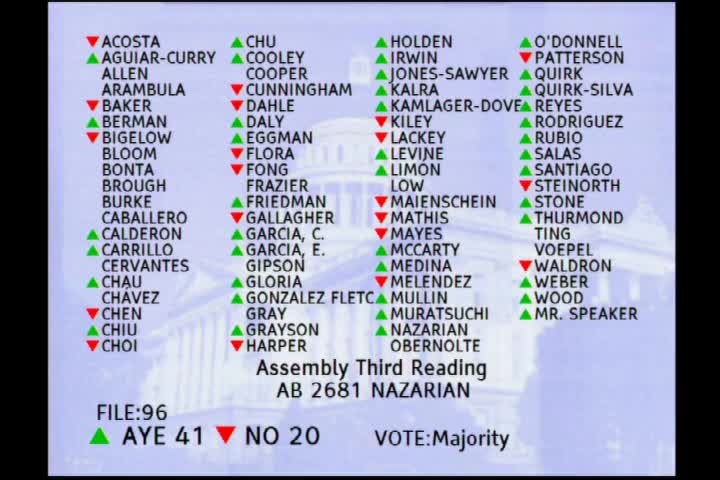 2MIN
Assembly Floor
Bill Author