AB 2155: Political Reform Act of 1974: campaign disclosures.
- Session Year: 2017-2018
- House: Assembly
- Latest Version Date: 2018-09-26
(1)Existing law, the Political Reform Act of 1974, provides for the comprehensive regulation of campaign financing and activities. Existing law under the act requires advertisements to include prescribed disclosure statements, and defines an advertisement for these purposes. Existing law excludes a number of communications from the definition of advertisement, including electronic media communications for which the inclusion of specified disclosures regarding the funding of the communication is impractical or incompatible with the technology used. Existing law also defines top contributors for these purposes to mean the persons from whom a committee paying for an advertisement has received its three highest cumulative contributions of $50,000 or more, and provides that if two or more contributors of identical amounts qualify as top contributors, the most recent contributor shall be listed in disclosures of top contributors for advertisements paid for by committees. Existing law specifies the formatting of disclosures for advertisements that are disseminated as a video, print advertisements, and electronic media advertisements.
This bill would exclude additional types of communications from the definition of advertisement, including certain electronic media communications requested by the recipient, communications solicited by the recipient, or communications for which inclusion of disclosures would be impracticable or severely interfere with the committees ability to convey the intended message, as determined by regulations of the Fair Political Practices Commission. The bill would delete the exemption from the definition of advertisement for electronic media communications for which the inclusion of disclosures would be impractical or incompatible with the technology used. The bill would require that a tie in the determination of top contributors be resolved by determining the contributor who made the most recent contribution. For committee advertisements that support or oppose a candidate, the bill would exclude certain nonprofit entities and persons who have prohibited the use of their contributions to support or oppose candidates from the determination of top contributors. The bill would make specified changes to the formatting requirements for disclosures included in advertisements that are disseminated as a video, print advertisements, and electronic media advertisements. The bill would exclude email messages from the disclosure and disclosure formatting requirements applicable to electronic media, except for requirements relating to the size, placement, and color of specified disclosures.
(2)Existing law defines an expenditure for purposes of the act to include any monetary or non-monetary payment made by specified persons that is used for communications that expressly advocate the nomination, election, or defeat of a candidate or candidates, or the qualification, passage, or defeat of a clearly identified ballot measure. Existing law prohibits a candidate, candidate controlled committee, established for an elective office for the controlling candidate, or political party committee from sending a mass mailing or a mass electronic mailing unless it discloses specified information, and defines mass electronic mailing to mean sending more than 200 substantially similar pieces of electronic mail within a calendar month. Existing law prohibits a candidate, candidate controlled committee, or slate mailer organization from expending campaign funds to pay for certain telephone calls that are similar in nature and aggregate 500 or more in number unless specified disclosures are made to the recipient of the call. Existing law prohibits a person from making a contribution to a committee or candidate that is earmarked for a contribution to any other particular committee, ballot measure, or candidate unless the contribution is fully disclosed, as specified.
This bill would prohibit the Commission from interpreting or construing these provisions, and the provisions described above relating to advertisement disclosures, as allowing the Commission to establish any threshold in quantity or amount that are not specified in those provisions.
(3)Existing law under the act requires certain advertisements paid for by committees to disclose that it is paid for by the committee, by including in the advertisement the words Paid for by, followed by the name of the committee, as specified.
This bill would require those advertisements to instead use the words Ad paid for by, but would continue to allow an advertisement that is a printed letter, Internet Web site, or email message to use the words Paid for by.
Because a violation of the act is punishable as a misdemeanor, this bill would impose a state-mandated local program.
This bill would incorporate additional changes to Section 84504.2 of the Government Code proposed by SB 1239 to be operative only if this bill and SB 1239 are enacted and this bill is enacted last.
This bill would incorporate additional changes to Section 84504.3 of the Government Code proposed by AB 2188 to be operative only if this bill and AB 2188 are enacted and this bill is enacted last.
The California Constitution requires the state to reimburse local agencies and school districts for certain costs mandated by the state. Statutory provisions establish procedures for making that reimbursement.
This bill would provide that no reimbursement is required by this act for a specified reason.
The Political Reform Act of 1974, an initiative measure, provides that the Legislature may amend the act to further the acts purposes upon a 2/3 vote of each house of the Legislature and compliance with specified procedural requirements.
This bill would declare that it furthers the purposes of the act.
(1)Existing law, the Political Reform Act of 1974, provides for the comprehensive regulation of campaign financing and activities. Existing law under the act requires advertisements to include prescribed disclosure statements, and defines an advertisement for these purposes. Existing law excludes a number of communications from the definition of advertisement, such as a communication from an organization, other than a political party, to its members. including electronic media communications for which the inclusion of specified disclosures regarding the funding of the communication is impractical or incompatible with the technology used. Existing law also defines top contributors for these purposes to mean the persons from whom a committee paying for an advertisement has received its three highest cumulative contributions of $50,000 or more, and provides that if two or more contributors of identical amounts qualify as top contributors, the most recent contributor shall be listed in disclosures of top contributors for advertisements paid for by committees. Existing law specifies the formatting of these disclosures for advertisements that are disseminated as a video, print advertisements, and electronic media advertisements.
This bill would exclude additional types of communications from the definition of advertisement, including certain electronic media communications requested by the recipient, communications solicited by the recipient, or communications for which inclusion of disclosures would be impracticable or severely interfere with the committees ability to convey the intended message, as determined by regulations of the Fair Political Practices Commission. The bill would delete the exemption from the definition of advertisement for electronic media communications for which the inclusion of disclosures would be impractical or incompatible with the technology used. The bill would require that a tie in the determination of top contributors be resolved by determining the contributor who made the most recent contribution. For committee advertisements that support or oppose a candidate, the bill would exclude certain nonprofit entities and persons who have prohibited the use of their contributions to support or oppose candidates from the determination of top contributors. The bill would make specified changes to the formatting requirements for disclosures included in advertisements that are disseminated as a video, print advertisements, and electronic media advertisements. The bill would exclude email messages from the disclosure and disclosure formatting requirements applicable to electronic media, except for requirements relating to the size, placement, and color of specified disclosures.
(2)Existing law defines an expenditure for purposes of the act to include any monetary or non-monetary payment made by specified persons that is used for communications that expressly advocate the nomination, election, or defeat of a candidate or candidates, or the qualification, passage, or defeat of a clearly identified ballot measure. Existing law prohibits a candidate, candidate controlled committee, established for an elective office for the controlling candidate, or political party committee from sending a mass mailing or a mass electronic mailing unless it discloses specified information, and defines mass electronic mailing to mean sending more than 200 substantially similar pieces of electronic mail within a calendar month. Existing law prohibits a candidate, candidate controlled committee, or slate mailer organization from expending campaign funds to pay for certain telephone calls that are similar in nature and aggregate 500 or more in number unless specified disclosures are made to the recipient of the call. Existing law prohibits a person from making a contribution to a committee or candidate that is earmarked for a contribution to any other particular committee, ballot measure or candidate unless the contribution is fully disclosed, as specified.
This bill would prohibit the Commission from interpreting or construing these provisions, and the provisions described above relating to advertisement disclosures, as allowing the Commission to establish any threshold in quantity or amount that are not specified in those provisions.
(3)Existing law under the act requires certain advertisements paid for by committees to disclose that it is paid for by the committee, by including in the advertisement the words Paid for by, followed the name of the committee, as specified.
This bill would require those advertisements to instead use the words Ad paid for by, but would continue to allow an advertisement that is a printed letter, Internet Web site, or email message to use the words Paid for by.
Because a violation of the act is punishable as a misdemeanor, this bill would impose a state-mandated local program.
This bill would incorporate additional changes to Section 84504.2 of the Government Code proposed by SB 1239 to be operative only if this bill and SB 1239 are enacted and this bill is enacted last.
This bill would incorporate additional changes to Section 84504.3 of the Government Code proposed by AB 2188 to be operative only if this bill and AB 2188 are enacted and this bill is enacted last.
The California Constitution requires the state to reimburse local agencies and school districts for certain costs mandated by the state. Statutory provisions establish procedures for making that reimbursement.
This bill would provide that no reimbursement is required by this act for a specified reason.
The Political Reform Act of 1974, an initiative measure, provides that the Legislature may amend the act to further the acts purposes upon a 2/3 vote of each house of the Legislature and compliance with specified procedural requirements.
This bill would declare that it furthers the purposes of the act.
(1)Existing law, the Political Reform Act of 1974, provides for the comprehensive regulation of campaign financing and activities. Existing law under the act requires advertisements to include prescribed disclosure statements, and defines an advertisement for these purposes. Existing law excludes a number of communications from the definition of advertisement, such as a communication from an organization, other than a political party, to its members. Existing law specifies the formatting of these disclosures for advertisements that are disseminated as a video, print advertisements, and electronic media advertisements.
This bill would exclude additional types of communications from the definition of advertisement, including certain electronic media communications requested by the recipient, communications solicited by the recipient, or communications for which inclusion of disclosures would be impracticable or severely interfere with the committees ability to convey the intended message, as determined by regulations of the Fair Political Practices Commission. The bill would make specified changes to the formatting requirements for disclosures included in advertisements that are disseminated as a video, print advertisements, and electronic media advertisements. The bill would exclude email messages from the disclosure and disclosure formatting requirements applicable to electronic media, except for requirements relating to the size, placement, and color of specified disclosures.
(2)Existing law defines an expenditure for purposes of the act to include any monetary or non-monetary payment made by specified persons that is used for communications that expressly advocate the nomination, election, or defeat of a candidate or candidates, or the qualification, passage, or defeat of a clearly identified ballot measure. Existing law prohibits a candidate, candidate controlled committee, established for an elective office for the controlling candidate, or political party committee from sending a mass mailing or a mass electronic mailing unless it discloses specified information, and defines mass electronic mailing to mean sending more than 200 substantially similar pieces of electronic mail within a calendar month. Existing law prohibits a candidate, candidate controlled committee, or slate mailer organization from expending campaign funds to pay for certain telephone calls that are similar in nature and aggregate 500 or more in number unless specified disclosures are made to the recipient of the call. Existing law prohibits a person from making a contribution to a committee or candidate that is earmarked for a contribution to any other particular committee, ballot measure or candidate unless the contribution is fully disclosed, as specified.
This bill would prohibit the Commission from interpreting or construing these provisions, and the provisions described above relating to advertisement disclosures, as allowing the Commission to establish any threshold in quantity or amount that are not specified in those provisions.
(2)(3)Existing law under the act requires certain advertisements paid for by committees to disclose that it is paid for by the committee, by including in the advertisement the words Paid for by, followed the name of the committee, as specified.
This bill would require those advertisements to instead use the words Ad paid for by, but would continue to allow an advertisement that is a printed letter, Internet Web site, or email message to use the words Paid for by.
Because a violation of the act is punishable as a misdemeanor, this bill would impose a state-mandated local program.
The California Constitution requires the state to reimburse local agencies and school districts for certain costs mandated by the state. Statutory provisions establish procedures for making that reimbursement.
This bill would provide that no reimbursement is required by this act for a specified reason.
The Political Reform Act of 1974, an initiative measure, provides that the Legislature may amend the act to further the acts purposes upon a 2/3 vote of each house of the Legislature and compliance with specified procedural requirements.
This bill would declare that it furthers the purposes of the act.
(1)Existing law, the Political Reform Act of 1974, provides for the comprehensive regulation of campaign financing and activities. Existing law under the act requires advertisements to include prescribed disclosure statements, and defines an advertisement for these purposes. Existing law excludes a number of communications from the definition of advertisement, such as a communication from an organization, other than a political party, to its members. Existing law specifies the formatting of these disclosures for advertisements that are disseminated as a video, print advertisements, and electronic media advertisements.
This bill would exclude additional types of communications from the definition of advertisement, including certain electronic media communications requested by the recipient, communications solicited by the recipient, personal communications that do not use campaign resources from a member of the organization to persons he or she personally knows, or communications for which inclusion of disclosures would be impracticable or severely interfere with the committees ability to convey the intended message, as determined by regulations of the Fair Political Practices Commission. The bill would make specified changes to the formatting requirements for disclosures included in advertisements that are disseminated as a video, print advertisements, and electronic media advertisements. The bill would exclude email messages from the disclosure and disclosure formatting requirements applicable to electronic media, except for requirements relating to the size, placement, and color of specified disclosures.
(3)(2)Existing law under the act requires certain advertisements paid for by committees to disclose that it is paid for by the committee, by including in the advertisement the words Paid for by, followed the name of the committee, as specified.
This bill would require those advertisements to instead use the words Ad paid for by, but would continue to allow an advertisement that is a printed letter, Internet Web site, or email message to use the words Paid for by.
Because a violation of the act is punishable as a misdemeanor, this bill would impose a state-mandated local program.
The California Constitution requires the state to reimburse local agencies and school districts for certain costs mandated by the state. Statutory provisions establish procedures for making that reimbursement.
This bill would provide that no reimbursement is required by this act for a specified reason.
The Political Reform Act of 1974, an initiative measure, provides that the Legislature may amend the act to further the acts purposes upon a 2/3 vote of each house of the Legislature and compliance with specified procedural requirements.
This bill would declare that it furthers the purposes of the act.
(1)Existing law, the Political Reform Act of 1974, provides for the comprehensive regulation of campaign financing and activities. The act prohibits a candidate, candidate controlled committee established for an elective office for the controlling candidate, or political party committee from sending a mass mailing or a mass electronic mailing unless the mass mailing or mass electronic mailing discloses specified information, such as words indicating that the mass electronic mailing is paid for by the committee sending the mailing. Existing law defines mass electronic mailing to mean sending more than 200 substantially similar pieces of electronic mail within a calendar month.
This bill would instead define mass electronic mailing to mean sending more than 50 substantially similar pieces of electronic mail within a calendar month. The bill would define mass mailing to mean sending more than 50 substantially similar pieces of mail within a calendar month.
(2)Existing law under the act requires advertisements to include prescribed disclosure statements, and defines an advertisement for these purposes. Existing law excludes a number of communications from the definition of advertisement, such as a communication from an organization, other than a political party, to its members. Existing law specifies the formatting of these disclosures for advertisements that are disseminated as a video, print advertisements, and electronic media advertisements.
This bill would exclude additional types of communications from the definition of advertisement, including certain electronic media communications requested by the recipient, communications solicited by the recipient, personal communications that do not use campaign resources from a member of the organization to persons he or she personally knows, or communications for which inclusion of disclosures would be impracticable or severely interfere with the committees ability to convey the intended message, as determined by regulations of the Fair Political Practices Commission. The bill would make specified changes to the formatting requirements for disclosures included in advertisements that are disseminated as a video, print advertisements, and electronic media advertisements. The bill would exclude email messages from the disclosure and disclosure formatting requirements applicable to electronic media, except for requirements relating to the size, placement, and color of specified disclosures.
(3)Existing law under the act requires certain advertisements paid for by committees to disclose that it is paid for by the committee, by including in the advertisement the words Paid for by, followed the name of the committee, as specified.
This bill would require those advertisements to instead use the words Ad paid for by, but would continue to allow an advertisement that is a printed letter, Internet Web site, or email message to use the words Paid for by.
Because a violation of the act is punishable as a misdemeanor, this bill would impose a state-mandated local program.
The California Constitution requires the state to reimburse local agencies and school districts for certain costs mandated by the state. Statutory provisions establish procedures for making that reimbursement.
This bill would provide that no reimbursement is required by this act for a specified reason.
The Political Reform Act of 1974, an initiative measure, provides that the Legislature may amend the act to further the acts purposes upon a 2/3 vote of each house of the Legislature and compliance with specified procedural requirements.
This bill would declare that it furthers the purposes of the act.
The Political Reform Act of 1974, provides for the comprehensive regulation of campaign financing and activities. The act requires the names of specified candidates and committees to be disclosed in a mass electronic mailing, as defined, that the entity sends. The act also requires advertisements, as defined, to disclose, among other things, the advertisements funding source, including independent expenditures, and the names of the top contributors to the committee paying for the advertisement. The act further requires that an advertisement supporting or opposing a candidate that is paid for by an independent expenditure include a statement that it was not authorized by a candidate or a committee controlled by a candidate.
This bill would apply those disclosure requirements to a mass electronic mailing sent by a committee, other than a candidate controlled committee established for an elective office for the controlling candidate or a political party committee. The disclosure requirements would apply to a mass electronic mailing paid for by an independent expenditure.
Because a violation of the act is punishable as a misdemeanor, this bill would impose a state-mandated local program.
The California Constitution requires the state to reimburse local agencies and school districts for certain costs mandated by the state. Statutory provisions establish procedures for making that reimbursement.
This bill would provide that no reimbursement is required by this act for a specified reason.
The Political Reform Act of 1974, an initiative measure, provides that the Legislature may amend the act to further the acts purposes upon a 2/3 vote of each house of the Legislature and compliance with specified procedural requirements.
This bill would declare that it furthers the purposes of the act.
Existing law, the Political Reform Act of 1974, provides for the comprehensive regulation of campaign financing and activities.The act defines expenditure as a payment, a forgiveness of a loan, a payment of a loan by a 3rd party, or an enforceable promise to make a payment, unless it is clear from the surrounding circumstances that it is not made for political purposes, and provides that an expenditure is made on the date payment is made or on the date the consideration, if any, is received, whichever is earlier.This bill would make technical, nonsubstantive changes to these provisions.Existing law, the Political Reform Act of 1974, provides for the comprehensive regulation of campaign financing and activities.The act defines expenditure as a payment, a forgiveness of a loan, a payment of a loan by a 3rd party, or an enforceable promise to make a payment, unless it is clear from the surrounding circumstances that it is not made for political purposes, and provides that an expenditure is made on the date payment is made or on the date the consideration, if any, is received, whichever is earlier.
This bill would make technical, nonsubstantive changes to these provisions.
For purposes of this article, the following definitions apply:
(a)(1)Advertisement means any general or public communication that is authorized and paid for by a committee for the purpose of supporting or opposing a candidate or candidates for elective office or a ballot measure or ballot measures.
(2)Advertisement does not include any of the following:
(A)A communication from an organization, other than a political party, to its members.
(B)An electronic media communication addressed to recipients, such as email messages or text messages, from an organization to persons who have opted in or asked to receive messages from the organization.
(C)Any communication that was solicited by the recipient, including, but not limited to, acknowledgments for contributions or information that the recipient communicated to the organization.
(D)A campaign button smaller than 10 inches in diameter; a bumper sticker smaller than 60 square inches; or a small tangible promotional item, such as a pen, pin, or key chain, upon which the disclosure required cannot be conveniently printed or displayed.
(E)Wearing apparel.
(F)Sky writing.
(G)Any other type of communication, as determined by regulations of the Commission, for which inclusion of the disclosures required by Sections 84502 to 84509, inclusive, is impracticable or would severely interfere with the committees ability to convey the intended message due to the nature of the technology used to make the communication.
(b)Cumulative contributions means the cumulative amount of contributions received by a committee beginning 12 months before the date of the expenditure and ending seven days before the time the advertisement is sent to the printer or broadcaster.
(c)(1)Top contributors means the persons from whom the committee paying for an advertisement has received its three highest cumulative contributions of fifty thousand dollars ($50,000) or more.
(2)A tie between two or more contributors qualifying as top contributors shall be resolved by determining the contributor who made the most recent contribution to the committee, in which case the most recent contributor shall be listed before any other contributor of the same amount.
(3)If a committee primarily formed to support or oppose a state candidate or ballot measure contributes funds to another committee primarily formed to support or oppose the same state candidate or ballot measure and the funds used for the contribution were earmarked to support or oppose that candidate or ballot measure, the committee receiving the earmarked contribution shall disclose the contributors who earmarked their funds as the top contributor or contributors on the advertisement if the definition of top contributor provided for in paragraph (1) is otherwise met. If the committee receiving the earmarked contribution contributes any portion of the contribution to another committee primarily formed to support or oppose the specifically identified ballot measure or candidate, that committee shall disclose the true source of the contribution to the new committee receiving the earmarked funds. The new committee shall disclose the contributor on the new committees advertisements if the definition of top contributor provided for in paragraph (1) is otherwise met.
(A)The primarily formed committee making the earmarked contribution shall provide the primarily formed committee receiving the earmarked contribution with the name and address of the contributor or contributors who earmarked their funds and the amount of the earmarked contribution from each contributor at the time the contribution is made. If the committee making the contribution received earmarked contributions that exceed the amount contributed or received contributions that were not earmarked, the committee making the contribution shall use a reasonable accounting method to determine which top contributors to identify pursuant to this subparagraph, but in no case shall the same contribution be disclosed more than one time to avoid disclosure of additional contributors who earmarked their funds.
(B)The committee receiving the earmarked contribution may rely on the information provided pursuant to subparagraph (A) for purposes of complying with the disclosure required by Section 84503 and shall be considered in compliance with Section 84503 if the information provided pursuant to subparagraph (A) is disclosed as otherwise required.
(C)For purposes of this paragraph, funds are considered earmarked if any of the circumstances described in subdivision (b) of Section 85704 apply.
(4)If an advertisement paid for by a committee supports or opposes a candidate, the determination of top contributors pursuant to paragraphs (1) and (2) shall not include any nonprofit organization exempt from federal income taxation pursuant to Section 501(c)(3) of the United States Internal Revenue Code or any person who has prohibited in writing the use of his or her contributions to support or oppose candidates if the committee does not use such contributions to support or oppose candidates.
SEC. 2.Section 84501.1 is added to the Government Code, to read:84501.1.The Commission shall not, by regulation, policy, opinion, or advice letter, construe or interpret any of Sections 82025, 84305, 84310, 84501 through 84511, inclusive, or Section 85704 as allowing the Commission to establish or maintain any thresholds in quantity or amount that are not specified in those sections. Unless otherwise specified in this title, those sections apply regardless of quantity or amount.
SEC. 3.Section 84502 of the Government Code is amended to read:84502.(a)(1)Any advertisement paid for by a committee pursuant to subdivision (a) of Section 82013, other than a political party committee or a candidate controlled committee established for an elective office of the controlling candidate, shall include the words Ad paid for by followed by the name of the committee as it appears on the most recent Statement of Organization filed pursuant to Section 84101.
(2)Any advertisement paid for by a committee pursuant to subdivision (a) of Section 82013 that is a political party committee or a candidate controlled committee established for an elective office of the controlling candidate shall include the words Ad paid for by followed by the name of the committee as it appears on the most recent Statement of Organization filed pursuant to Section 84101 if the advertisement is any of the following:
(A)Paid for by an independent expenditure.
(B)An advertisement supporting or opposing a ballot measure.
(C)A radio or television advertisement.
(b)Any advertisement paid for by a committee pursuant to subdivision (b) or (c) of Section 82013 shall include the words Ad paid for by followed by the name that the filer is required to use on campaign statements pursuant to subdivision (o) of Section 84211.
(c)Notwithstanding subdivisions (a) and (b), if an advertisement is a printed letter, Internet Web site, or email message, the text described in subdivisions (a) and (b) may include the words Paid for by instead of Ad paid for by.
SEC. 4.Section 84504.1 of the Government Code is amended to read:84504.1.(a)An advertisement paid for by a committee, other than a political party committee or a candidate controlled committee established for an elective office of the controlling candidate, that is disseminated as a video, including advertisements on television and videos disseminated over the Internet, shall include the disclosures required by Sections 84502 and 84503 at the beginning or end of the advertisement.
(b)The disclosure required by subdivision (a) shall be written and displayed for at least five seconds of a broadcast of 30 seconds or less or for at least 10 seconds of a broadcast that lasts longer than 30 seconds.
(1)The written disclosure required by subdivision (a) shall appear on a solid black background on the entire bottom one-third of the television or video display screen, or bottom one-fourth of the screen if the committee does not have or is otherwise not required to list top contributors, and shall be in a contrasting color in Arial equivalent type, and the type size for the smallest letters in the written disclosure shall be 4 percent of the height of the television or video display screen. The top contributors, if any, shall each be disclosed on a separate horizontal line separate from any other text, in descending order, beginning with the top contributor who made the largest cumulative contributions on the first line. All disclosure text shall be centered horizontally in the disclosure area. If there are any top contributors, the written disclosures shall be underlined in a manner clearly visible to the average viewer, except for the names of the top contributors, if any.
(2)The name of the top contributor shall not have its type condensed or have the spacing between characters reduced to be narrower than a normal non-condensed Arial equivalent type, unless doing so is necessary to keep the name of the top contributor from exceeding the width of the screen.
(c)An advertisement that is an independent expenditure supporting or opposing a candidate shall include the appropriate statement from Section 84506.5 in the solid black background described in paragraph (1) of subdivision (b) below all other text required to appear in that area in a contrasting color and in Arial equivalent type no less than 2.5 percent of the height of the television or video display screen. If including this statement causes the disclosures to exceed one-third of the television or video display screen, then it may instead be printed immediately above the background with sufficient contrast that is easily readable by the average viewer.
SEC. 5.Section 84504.2 of the Government Code is amended to read:84504.2.(a)A print advertisement paid for by a committee, other than a political party committee or a candidate controlled committee established for an elective office of the controlling candidate, shall include the disclosures required by Sections 84502, 84503, and 84506.5, displayed as follows:
(1)The disclosure area shall have a solid white background and shall be in a printed or drawn box on the bottom of at least one page that is set apart from any other printed matter. All text in the disclosure area shall be in contrasting color and centered horizontally in the disclosure area.
(2)The text shall be in an Arial equivalent type with a type size of at least 10-point for printed advertisements designed to be individually distributed, including, but not limited to, mailers, flyers, and door hangers.
(3)The top of the disclosure area shall include the disclosure required by Sections 84502 and 84503. The text of the disclosure shall be underlined if there are any top contributors.
(4)The top contributors, if any, shall each be disclosed on a separate horizontal line separate from any other text, in descending order, beginning with the top contributor who made the largest cumulative contributions on the first line. The name of each of the top contributors shall be centered horizontally in the disclosure area and shall not be underlined. The names of the top contributors shall not be printed in a type that is condensed to be narrower than a normal non-condensed Arial equivalent type.
(5)A committee subject to Section 84506.5 shall include the disclosure required by Section 84506.5, which shall be underlined and on a separate line below any of the top contributors.
(6)A committee subject to Section 84223 shall next include the text Funding Details At [insert Commission Internet Web site], which shall be underlined and printed on a line separate from any other text.
(b)Notwithstanding paragraphs (2) and (4) of subdivision (a), the disclosures required by Sections 84502, 84503, and 84506.5 on a printed advertisement that is larger than those designed to be individually distributed, including, but not limited to, yard signs or billboards, shall be in Arial equivalent type with a total height of at least 5 percent of the height of the advertisement, and printed on a solid background with sufficient contrast that is easily readable by the average viewer. The text may be adjusted so it does not appear on separate horizontal lines, with the top contributors separated by a comma.
(c)Notwithstanding the definition of top contributors in paragraph (1) of subdivision (c) of Section 84501, newspaper, magazine, or other public print advertisements that are 20 square inches or less shall be required to disclose only the single top contributor of fifty thousand dollars ($50,000) or more.
SEC. 5.5.Section 84504.2 of the Government Code is amended to read:84504.2.(a)A print advertisement paid for by a committee, other than a political party committee or a candidate controlled committee established for an elective office of the controlling candidate, shall include the disclosures required by Sections 84502, 84503, and 84506.5, displayed as follows:
(1)The disclosure area shall have a solid white background and shall be in a printed or drawn box on the bottom of at least one page that is set apart from any other printed matter. All text in the disclosure area shall be in contrasting color and centered horizontally in the disclosure area.
(2)The text shall be in an Arial equivalent type with a type size of at least 10-point for printed advertisements designed to be individually distributed, including, but not limited to, mailers, flyers, and door hangers.
(3)The top of the disclosure area shall include the disclosure required by Sections 84502 and 84503. The text of the disclosure shall be underlined if there are any top contributors.
(4)The top contributors, if any, shall each be disclosed on a separate horizontal line separate from any other text, in descending order, beginning with the top contributor who made the largest cumulative contributions on the first line. The name of each of the top contributors shall be centered horizontally in the disclosure area and shall not be underlined. The names of the top contributors shall not be printed in a type that is condensed to be narrower than a normal non-condensed Arial equivalent type.
(5)A committee subject to Section 84506.5 shall include the disclosure required by Section 84506.5, which shall be underlined and on a separate line below any of the top contributors.
(6)A committee subject to Section 84223 shall next include the text Funding Details At [insert link to Secretary of State Internet Web site page with top 10 contributor lists], which shall be underlined and printed on a line separate from any other text.
(b)Notwithstanding paragraphs (2) and (4) of subdivision (a), the disclosures required by Sections 84502, 84503, and 84506.5 on a printed advertisement that is larger than those designed to be individually distributed, including, but not limited to, yard signs or billboards, shall be in an Arial equivalent type with a total height of at least 5 percent of the height of the advertisement, and printed on a solid background with sufficient contrast that is easily readable by the average viewer. The text may be adjusted so it does not appear on separate horizontal lines, with the top contributors separated by a comma.
(c)Notwithstanding the definition of top contributors in paragraph (1) of subdivision (c) of Section 84501, newspaper, magazine, or other public print advertisements that are 20 square inches or less shall be required to disclose only the single top contributor of fifty thousand dollars ($50,000) or more.
SEC. 6.Section 84504.3 of the Government Code is amended to read:84504.3.(a)An electronic media advertisement, other than an email message or Internet Web site, paid for by a committee, other than a political party committee or a candidate controlled committee established for an elective office of the controlling candidate, shall comply with both of the following:
(1)Include the text Who funded this ad? in a contrasting color and a font size that is easily readable by the average viewer.
(2)Such text shall be a hyperlink to an Internet Web site containing the disclosures required by Sections 84502, 84503, and 84506.5 in a contrasting color and in no less than 8-point font.
(b)Notwithstanding subdivision (a), the text required by paragraph (1) of subdivision (a) is not required if including the language would be impracticable. In such circumstances the advertisement need only include a hyperlink to an Internet Web site containing the disclosures required by Sections 84502, 84503, and 84506.5.
(c)Notwithstanding subdivisions (a) and (b), an email message or Internet Web site paid for by a committee, other than a political party committee or a candidate controlled committee established for an elective office of the controlling candidate, shall include the disclosures required by Sections 84502, 84503, and 84506.5, printed clearly and legibly in a contrasting color and in no less than 8-point font at the top or bottom of the email message and every publicly accessible page of the Internet Web site.
(d)An Internet Web site that is hyperlinked as provided for in paragraph (2) of subdivision (a) shall remain online and available to the public until 30 days after the date of the election in which the candidate or ballot measure supported or opposed by the advertisement was voted upon.
(e)An advertisement made via a form of electronic media that is audio only and therefore cannot include either of the disclaimers in subdivision (a) shall comply with the disclaimer requirements for radio advertisements in Section 84504.
(f)An advertisement made via a form of electronic media that allows users to engage in discourse and post content, or any other type of social media, shall only be required to include the disclosures required by Sections 84502, 84503, and 84506.5 in a contrasting color and in no less than 8-point font on the committees profile, landing page, or similar location and shall not be required to include the disclaimer required by subdivision (a) on each individual post, comment, or other similar communication.
(g)The disclaimer required by this section does not apply to advertisements made via social media for which the only expense or cost of the communication is compensated staff time unless the social media account where the content is posted was created only for the purpose of advertisements governed by this title.
SEC. 6.5.Section 84504.3 of the Government Code is amended to read:84504.3.(a)An electronic media advertisement that is a graphic, image, animated graphic, or animated image that the online platform hosting the advertisement allows to link to an Internet Web site, paid for by a committee, other than a political party committee or a candidate controlled committee established for an elective office of the controlling candidate, shall comply with both of the following:
(1)Include the text Who funded this ad?, Paid for by, or Ad Paid for by in a contrasting color and a font size that is easily readable by the average viewer for the duration of the advertisement.
(2)The text shall be included or displayed as a hyperlink, icon, button, or tab to an Internet Web site containing the disclosures required by Sections 84502, 84503, and 84506.5 in a contrasting color and in no less than 8-point font.
(b)Notwithstanding subdivision (a), the text required by paragraph (1) of subdivision (a) is not required if including the language would take up more than one-third of the graphic or image. In those circumstances, the advertisement need only include a hyperlink to an Internet Web site containing the disclosures required by Sections 84502, 84503, and 84506.5.
(c)Notwithstanding subdivisions (a) and (b), an email message, or Internet Web site, paid for by a committee, other than a political party committee or a candidate controlled committee established for an elective office of the controlling candidate, shall include the disclosures required by Sections 84502, 84503, and 84506.5 printed clearly and legibly in a contrasting color and in no less than 8-point font at the top or bottom of the email message, or at the top or bottom of every publicly accessible page of the Internet Web site, as applicable.
(d)An Internet Web site that is linked as provided for in paragraph (2) of subdivision (a) shall remain online and available to the public until 30 days after the date of the election in which the candidate or ballot measure supported or opposed by the advertisement was voted upon.
(e)An advertisement made via a form of electronic media that is audio only and therefore cannot include either of the disclosures in subdivision (a) shall comply with the disclosure requirements for radio advertisements in Section 84504.
(f)An electronic media advertisement that is disseminated as a video shall comply with the disclosure requirements of Sections 84504.1, 84504.4, and 84504.5, depending on the type of committee that paid for it. If the video is longer than 30 seconds, the disclosures required by Sections 84504.1, 84504.4, and 84504.5 shall be made at the beginning of the advertisement.
(g)(1)An advertisement made via a form of electronic media that allows users to engage in discourse and post content, or any other type of social media, shall only be required to include the disclosures required by Sections 84502, 84503, and 84506.5 in a contrasting color that is easily readable by the average viewer and in no less than 10-point font on the cover or header photo of the committees profile, landing page, or similar location and shall not be required to include the disclosure required by subdivision (a) on each individual post, comment, or other similar communication. The disclosures specified in this subdivision shall be fully visible on the cover or header photo when the profile, landing page, or similar location is viewed from any electronic device that is commonly used to view this form of electronic media.
(2)Notwithstanding paragraph (1), if making the disclosures specified in paragraph (1) fully visible on a commonly used electronic device would be impracticable, the cover or header photo of the profile, landing page, or similar location need only include a hyperlink, icon, button, or tab to an Internet Web site containing the disclosures specified in paragraph (1).
(h)The disclosures required by this section do not apply to advertisements made via social media for which the only expense or cost of the communication is compensated staff time unless the social media account where the content is posted was created only for the purpose of advertisements governed by this title.
SEC. 7.Section 84504.5 of the Government Code is amended to read:84504.5.An advertisement that is an independent expenditure and paid for by a political party or a candidate controlled committee established for an elective office of the controlling candidate shall include the disclosures required by Sections 84502 and 84506.5. An advertisement that supports or opposes a ballot measure and is paid for by a political party or a candidate controlled committee established for an elective office of the controlling candidate shall include the disclosure required by Section 84502. A disclosure that is included in an advertisement pursuant to this section is subject to the following requirements:
(a)A radio or telephone advertisement shall include the required disclosures at the beginning or end of the advertisement and be read in a clearly spoken manner and in a pitch and tone substantially similar to the rest of the advertisement, and shall last no less than three seconds.
(b)A video advertisement, including television and videos disseminated over the Internet, shall include the required disclosures in writing at the beginning or end of the advertisement in a text that is of sufficient size to be readily legible to an average viewer and in a color that has a reasonable degree of contrast with the background of the advertisement for at least four seconds. The required disclosure must also be spoken during the advertisement if the written disclosure appears for less than five seconds of a broadcast of 30 seconds or less or for at least 10 seconds of a broadcast that lasts longer than 30 seconds.
(c)(1)A print advertisement shall include the required disclosures in no less than 10-point font and in a color that has a reasonable degree of contrast with the background of the advertisement.
(2)Notwithstanding paragraph (1), the required disclosures on a print advertisement that is larger than those designed to be individually distributed, such as a yard sign or billboard, shall in total constitute no less than 5 percent of the total height of the advertisement and shall appear in a color that has a reasonable degree of contrast with the background of the advertisement.
(d)An electronic media advertisement shall include the disclosures required by Section 84504.3.
SEC. 8.Section 5.5 of this bill incorporates amendments to Section 84504.2 of the Government Code proposed by both this bill and Senate Bill 1239. That section shall only become operative if (1) both bills are enacted and become effective on or before January 1, 2019, but this bill becomes operative first, (2) each bill amends Section 84504.2 of the Government Code, and (3) this bill is enacted after Senate Bill 1239, in which case Section 84504.2 of the Government Code, as amended by Section 5 of this bill, shall remain operative only until the operative date of Senate Bill 1239, at which time Section 5.5 of this bill shall become operative.
SEC. 9.Section 6.5 of this bill incorporates amendments to Section 84504.3 of the Government Code proposed by both this bill and Assembly Bill 2188. That section shall only become operative if (1) both bills are enacted and become effective on or before January 1, 2019, but this bill becomes operative first, (2) each bill amends Section 84504.3 of the Government Code, and (3) this bill is enacted after Assembly Bill 2188, in which case Section 84504.3 of the Government Code, as amended by Section 6 of this bill, shall remain operative only until the operative date of Assembly Bill 2188, at which time Section 6.5 of this bill shall become operative.
SEC. 10.No reimbursement is required by this act pursuant to Section 6 of Article XIIIB of the California Constitution because the only costs that may be incurred by a local agency or school district will be incurred because this act creates a new crime or infraction, eliminates a crime or infraction, or changes the penalty for a crime or infraction, within the meaning of Section 17556 of the Government Code, or changes the definition of a crime within the meaning of Section 6 of Article XIIIB of the California Constitution.
SEC. 11.The Legislature finds and declares that this bill furthers the purposes of the Political Reform Act of 1974 within the meaning of subdivision (a) of Section 81012 of the Government Code.
For purposes of this article, the following definitions apply:
(a)(1)Advertisement means any general or public communication that is authorized and paid for by a committee for the purpose of supporting or opposing a candidate or candidates for elective office or a ballot measure or ballot measures.
(2)Advertisement does not include any of the following:
(A)A communication from an organization, other than a political party, to its members.
(B)An electronic media communication addressed to recipients, such as email messages or text messages, from an organization to persons who have opted in or asked to receive messages from the organization.
(C)Any communication that was solicited by the recipient, including, but not limited to, acknowledgments for contributions or information that the recipient communicated to the organization.
(D)A campaign button smaller than 10 inches in diameter; a bumper sticker smaller than 60 square inches; or a small tangible promotional item, such as a pen, pin, or key chain, upon which the disclosure required cannot be conveniently printed or displayed.
(E)Wearing apparel.
(F)Sky writing.
(G)An electronic media communication for which inclusion of the disclosures required by Section 84502, 84503, or 84506.5, is impracticable or would severely interfere with the committees ability to convey the intended message because of the nature of the technology used to make the communication.(H)(G)Any other type of communication, as determined by regulations of the Commission, for which inclusion of the disclosures required by Section 84502, 84503, or 84506.5 Sections 84502 to 84509, inclusive, is impracticable or would severely interfere with the committees ability to convey the intended message due to the nature of the technology used to make the communication.
(b)Cumulative contributions means the cumulative amount of contributions received by a committee beginning 12 months before the date of the expenditure and ending seven days before the time the advertisement is sent to the printer or broadcaster.
(c)(1)Top contributors means the persons from whom the committee paying for an advertisement has received its three highest cumulative contributions of fifty thousand dollars ($50,000) or more.
(2)If two or more contributors of identical amounts qualify as top contributors, the most recent contributor of that amount shall be listed as the top contributor in any disclosure required by Section 84503. A tie between two or more contributors qualifying as top contributors shall be resolved by determining the contributor who made the most recent contribution to the committee, in which case the most recent contributor shall be listed before any other contributor of the same amount.
(3)If a committee primarily formed to support or oppose a state candidate or ballot measure contributes funds to another committee primarily formed to support or oppose the same state candidate or ballot measure and the funds used for the contribution were earmarked to support or oppose that candidate or ballot measure, the committee receiving the earmarked contribution shall disclose the contributors who earmarked their funds as the top contributor or contributors on the advertisement if the definition of top contributor provided for in paragraph (1) is otherwise met. If the committee receiving the earmarked contribution contributes any portion of the contribution to another committee primarily formed to support or oppose the specifically identified ballot measure or candidate, that committee shall disclose the true source of the contribution to the new committee receiving the earmarked funds. The new committee shall disclose the contributor on the new committees advertisements if the definition of top contributor provided for in paragraph (1) is otherwise met.
(A)The primarily formed committee making the earmarked contribution shall provide the primarily formed committee receiving the earmarked contribution with the name and address of the contributor or contributors who earmarked their funds and the amount of the earmarked contribution from each contributor at the time the contribution is made. If the committee making the contribution received earmarked contributions that exceed the amount contributed or received contributions that were not earmarked, the committee making the contribution shall use a reasonable accounting method to determine which top contributors to identify pursuant to this subparagraph, but in no case shall the same contribution be disclosed more than one time to avoid disclosure of additional contributors who earmarked their funds.
(B)The committee receiving the earmarked contribution may rely on the information provided pursuant to subparagraph (A) for purposes of complying with the disclosure required by Section 84503 and shall be considered in compliance with Section 84503 if the information provided pursuant to subparagraph (A) is disclosed as otherwise required.
(C)For purposes of this paragraph, funds are considered earmarked if any of the circumstances described in subdivision (b) of Section 85704 apply.
(4)If an advertisement paid for by a committee supports or opposes a candidate, the determination of top contributors pursuant to paragraphs (1) and (2) shall not include any nonprofit organization exempt from federal income taxation pursuant to Section 501(c)(3) of the United States Internal Revenue Code or any person who has prohibited in writing the use of his or her contributions to support or oppose candidates if the committee does not use such contributions to support or oppose candidates.
SEC. 2.Section 84501.1 is added to the Government Code, to read:84501.1.The Commission shall not, by regulation, policy, opinion, or advice letter, construe or interpret any of Sections 82025, 84305, 84310, 84501 through 84511, inclusive, or Section 85704 as allowing the Commission to establish or maintain any thresholds in quantity or amount that are not specified in those sections. Unless otherwise specified in this title, those sections apply regardless of quantity or amount.
SEC. 3.Section 84502 of the Government Code is amended to read:84502.(a)(1)Any advertisement paid for by a committee pursuant to subdivision (a) of Section 82013, other than a political party committee or a candidate controlled committee established for an elective office of the controlling candidate, shall include the words Ad paid for by followed by the name of the committee as it appears on the most recent Statement of Organization filed pursuant to Section 84101.
(2)Any advertisement paid for by a committee pursuant to subdivision (a) of Section 82013 that is a political party committee or a candidate controlled committee established for an elective office of the controlling candidate shall include the words Ad paid for by followed by the name of the committee as it appears on the most recent Statement of Organization filed pursuant to Section 84101 if the advertisement is any of the following:
(A)Paid for by an independent expenditure.
(B)An advertisement supporting or opposing a ballot measure.
(C)A radio or television advertisement.
(b)Any advertisement paid for by a committee pursuant to subdivision (b) or (c) of Section 82013 shall include the words Ad paid for by followed by the name that the filer is required to use on campaign statements pursuant to subdivision (o) of Section 84211.
(c)Notwithstanding subdivisions (a) and (b), if an advertisement is a printed letter, Internet Web site, or email message, the text described in subdivisions (a) and (b) may include the words Paid for by instead of Ad paid for by.
SEC. 4.Section 84504.1 of the Government Code is amended to read:84504.1.(a)An advertisement paid for by a committee, other than a political party committee or a candidate controlled committee established for an elective office of the controlling candidate, that is disseminated as a video, including advertisements on television and videos disseminated over the Internet, shall include the disclosures required by Sections 84502 and 84503 at the beginning or end of the advertisement.
(b)The disclosure required by subdivision (a) shall be written and displayed for at least five seconds of a broadcast of 30 seconds or less or for at least 10 seconds of a broadcast that lasts longer than 30 seconds.
(1)The written disclosure required by subdivision (a) shall appear on a solid black background on the entire bottom one-third of the television or video display screen, or bottom one-fourth of the screen if the committee does not have or is otherwise not required to list top contributors, and shall be in a contrasting color in Arial equivalent type, and the type size for the smallest letters in the written disclosure shall be 4 percent of the height of the television or video display screen. The top contributors, if any, shall each be disclosed on a separate horizontal line separate from any other text, in descending order, beginning with the top contributor who made the largest cumulative contributions on the first line. All disclosure text shall be centered horizontally in the disclosure area. If there are any top contributors, the written disclosures shall be underlined in a manner clearly visible to the average viewer, except for the names of the top contributors, if any.
(2)The name of the top contributor shall not have its type condensed or have the spacing between characters reduced to be narrower than a normal non-condensed Arial equivalent type, unless doing so is necessary to keep the name of the top contributor from exceeding the width of the screen.
(c)An advertisement that is an independent expenditure supporting or opposing a candidate shall include the appropriate statement from Section 84506.5 in the solid black background described in paragraph (1) of subdivision (b) below all other text required to appear in that area in a contrasting color and in Arial equivalent type no less than 2.5 percent of the height of the television or video display screen. If including this statement causes the disclosures to exceed one-third of the television or video display screen, then it may instead be printed immediately above the background with sufficient contrast that is easily readable by the average viewer.
SEC. 5.Section 84504.2 of the Government Code is amended to read:84504.2.(a)A print advertisement paid for by a committee, other than a political party committee or a candidate controlled committee established for an elective office of the controlling candidate, shall include the disclosures required by Sections 84502, 84503, and 84506.5, displayed as follows:
(1)The disclosure area shall have a solid white background and shall be in a printed or drawn box on the bottom of at least one page that is set apart from any other printed matter. All text in the disclosure area shall be in contrasting color and centered horizontally in the disclosure area.
(2)The text shall be in an Arial equivalent type with a type size of at least 10-point for printed advertisements designed to be individually distributed, including, but not limited to, mailers, flyers, and door hangers.
(3)The top of the disclosure area shall include the disclosure required by Sections 84502 and 84503. The text of the disclosure shall be underlined if there are any top contributors.
(4)The top contributors, if any, shall each be disclosed on a separate horizontal line separate from any other text, in descending order, beginning with the top contributor who made the largest cumulative contributions on the first line. The name of each of the top contributors shall be centered horizontally in the disclosure area and shall not be underlined. The names of the top contributors shall not be printed in a type that is condensed to be narrower than a normal non-condensed Arial equivalent type.
(5)A committee subject to Section 84506.5 shall include the disclosure required by Section 84506.5, which shall be underlined and on a separate line below any of the top contributors.
(6)A committee subject to Section 84223 shall next include the text Funding Details At [insert Commission Internet Web site], which shall be underlined and printed on a line separate from any other text.
(b)Notwithstanding paragraphs (2) and (4) of subdivision (a), the disclosures required by Sections 84502, 84503, and 84506.5 on a printed advertisement that is larger than those designed to be individually distributed, including, but not limited to, yard signs or billboards, shall be in Arial equivalent type with a total height of at least 5 percent of the height of the advertisement, and printed on a solid background with sufficient contrast that is easily readable by the average viewer. The text may be adjusted so it does not appear on separate horizontal lines, with the top contributors separated by a comma.
(c)Notwithstanding the definition of top contributors in paragraph (1) of subdivision (c) of Section 84501, newspaper, magazine, or other public print advertisements that are 20 square inches or less shall be required to disclose only the single top contributor of fifty thousand dollars ($50,000) or more.
SEC. 5.5.Section 84504.2 of the Government Code is amended to read:84504.2.(a)A print advertisement paid for by a committee, other than a political party committee or a candidate controlled committee established for an elective office of the controlling candidate, shall include the disclosures required by Sections 84502, 84503, and 84506.5, displayed as follows:
(1)The disclosure area shall have a solid white background and shall be in a printed or drawn box on the bottom of at least one page that is set apart from any other printed matter. All text in the disclosure area shall be in contrasting color. color and centered horizontally in the disclosure area.
(2)The text shall be in an Arial equivalent type with a type size of at least 10-point for printed advertisements designed to be individually distributed, including, but not limited to, mailers, flyers, and door hangers.
(3)The top of the disclosure area shall include the disclosure required by Sections 84502 and 84503. The text of the disclosure shall be underlined if there are any top contributors.
(3)(4)The top contributors, if any, shall each be disclosed on a separate horizontal line, line separate from any other text, in descending order, beginning with the top contributor who made the largest cumulative contributions on the first line. The name of each of the top contributors shall be centered horizontally in the disclosure area. area and shall not be underlined. The names of the top contributors shall not be printed in a type that is condensed to be narrower than a normal non-condensed Arial equivalent type.
(4)(5)A committee subject to Section 84506.5 shall include the disclosure required by Section 84506.5, which shall be underlined and on a separate line below any of the top contributors.
(6)Immediately below the text described in paragraph (3), committees A committee subject to Section 84223 shall next include the text Funding Details At [insert Commission Internet Web site]. The text shall be in an Arial equivalent type with a type size of at least 10-point for printed advertisements designed to be individually distributed, including, but not limited to, mailers, flyers, and door hangers. link to Secretary of State Internet Web site page with top 10 contributor lists], which shall be underlined and printed on a line separate from any other text.
(b)Notwithstanding paragraphs (2) and (4) of subdivision (a), the disclosures required by Sections 84502, 84503, and 84506.5 on a printed advertisement that is larger than those designed to be individually distributed, including, but not limited to, yard signs or billboards, shall be in an Arial equivalent type with a total height of at least five 5 percent of the height of the advertisement, and printed on a solid background with sufficient contrast that is easily readable by the average viewer. The text may be adjusted so it does not appear on separate horizontal lines, with the top contributors separated by a comma.
(c)Notwithstanding the definition of top contributors in paragraph (1) of subdivision (c) of Section 84501, newspaper, magazine, or other public print advertisements that are 20 square inches or less shall be required to disclose only the single top contributor of fifty thousand dollars ($50,000) or more.
SEC. 6.Section 84504.3 of the Government Code is amended to read:84504.3.(a)An electronic media advertisement, other than an email message or Internet Web site, paid for by a committee, other than a political party committee or a candidate controlled committee established for an elective office of the controlling candidate, shall comply with both of the following:
(1)Include the text Who funded this ad? in a contrasting color and a font size that is easily readable by the average viewer.
(2)Such text shall be a hyperlink to an Internet Web site containing the disclosures required by Sections 84502, 84503, and 84506.5 in a contrasting color and in no less than 8-point font.
(b)Notwithstanding subdivision (a), the text required by paragraph (1) of subdivision (a) is not required if including the language would be impracticable. In such circumstances the advertisement need only include a hyperlink to an Internet Web site containing the disclosures required by Sections 84502, 84503, and 84506.5.
(c)Notwithstanding subdivisions (a) and (b), an email message or Internet Web site paid for by a committee, other than a political party committee or a candidate controlled committee established for an elective office of the controlling candidate, shall include the disclosures required by Sections 84502, 84503, and 84506.5, printed clearly and legibly in a contrasting color and in no less than 8-point font at the top or bottom of the email message and every publicly accessible page of the Internet Web site.
(d)An Internet Web site that is hyperlinked as provided for in paragraph (2) of subdivision (a) shall remain online and available to the public until 30 days after the date of the election in which the candidate or ballot measure supported or opposed by the advertisement was voted upon.
(e)An advertisement made via a form of electronic media that is audio only and therefore cannot include either of the disclaimers in subdivision (a) shall comply with the disclaimer requirements for radio advertisements in Section 84504.
(f)An advertisement made via a form of electronic media that allows users to engage in discourse and post content, or any other type of social media, shall only be required to include the disclosures required by Sections 84502, 84503, and 84506.5 in a contrasting color and in no less than 8-point font on the committees profile, landing page, or similar location and shall not be required to include the disclaimer required by subdivision (a) on each individual post, comment, or other similar communication.
(g)The disclaimer required by this section does not apply to advertisements made via social media for which the only expense or cost of the communication is compensated staff time unless the social media account where the content is posted was created only for the purpose of advertisements governed by this title.
SEC. 6.5.Section 84504.3 of the Government Code is amended to read:84504.3.(a)An electronic media advertisement, other than an Internet Web site, advertisement that is a graphic, image, animated graphic, or animated image that the online platform hosting the advertisement allows to link to an Internet Web site, paid for by a committee, other than a political party committee or a candidate controlled committee established for an elective office of the controlling candidate, shall comply with both of the following:
(1)Include the text Who funded this ad? ad?, Paid for by, or Ad Paid for by in a contrasting color and a font size that is easily readable by the average viewer. viewer for the duration of the advertisement.
(2)Such The text shall be a hyperlink included or displayed as a hyperlink, icon, button, or tab to an Internet Web site containing the disclosures required by Sections 84502, 84503, and 84506.5 in a contrasting color and in no less than 8 point 8-point font.
(b)Notwithstanding subdivision (a), the text required by paragraph (1) of subdivision (a) is not required if including the language would be impracticable. take up more than one-third of the graphic or image. In such circumstances those circumstances, the advertisement need only include a hyperlink to an Internet Web site containing the disclosures required by Sections 84502, 84503, and 84506.5.
(c)Notwithstanding subdivisions (a) and (b), an Internet Web site email message, or Internet Web site, paid for by a committee, other than a political party committee or a candidate controlled committee established for an elective office of the controlling candidate, shall include the disclosures required by Sections 84502, 84503, and 84506.5 printed clearly and legibly in a contrasting color and in no less than 8 point font. 8-point font at the top or bottom of the email message, or at the top or bottom of every publicly accessible page of the Internet Web site, as applicable.
(d)An Internet Web site that is hyperlinked linked as provided for in paragraph (2) of subdivision (a) shall remain online and available to the public until 30 days after the date of the election in which the candidate or ballot measure supported or opposed by the advertisement was voted upon.
(e)An advertisement made via a form of electronic media that is audio only and therefore cannot include either of the disclaimers disclosures in subdivision (a) shall comply with the disclaimer disclosure requirements for radio advertisements in Section 84504.
(f)An electronic media advertisement that is disseminated as a video shall comply with the disclosure requirements of Sections 84504.1, 84504.4, and 84504.5, depending on the type of committee that paid for it. If the video is longer than 30 seconds, the disclosures required by Sections 84504.1, 84504.4, and 84504.5 shall be made at the beginning of the advertisement.
(f)(g)(1)An advertisement made via a form of electronic media that allows users to engage in discourse and post content, or any other type of social media, shall only be required to include the disclosures required by Sections 84502, 84503, and 84506.5 in a contrasting color and in no less than 8 point font on that is easily readable by the average viewer and in no less than 10-point font on the cover or header photo of the committees profile, landing page, or similar location and shall not be required to include the disclaimer disclosure required by subdivision (a) on each individual post, comment, or other similar communication. The disclosures specified in this subdivision shall be fully visible on the cover or header photo when the profile, landing page, or similar location is viewed from any electronic device that is commonly used to view this form of electronic media.
(2)Notwithstanding paragraph (1), if making the disclosures specified in paragraph (1) fully visible on a commonly used electronic device would be impracticable, the cover or header photo of the profile, landing page, or similar location need only include a hyperlink, icon, button, or tab to an Internet Web site containing the disclosures specified in paragraph (1).
(g)(h)The disclaimer disclosures required by this section does do not apply to advertisements made via social media for which the only expense or cost of the communication is compensated staff time unless the social media account where the content is posted was created only for the purpose of advertisements governed by this title.
SEC. 7.Section 84504.5 of the Government Code is amended to read:84504.5.An advertisement that is an independent expenditure and paid for by a political party or a candidate controlled committee established for an elective office of the controlling candidate shall include the disclosures required by Sections 84502 and 84506.5. An advertisement that supports or opposes a ballot measure and is paid for by a political party or a candidate controlled committee established for an elective office of the controlling candidate shall include the disclosure required by Section 84502. A disclosure that is included in an advertisement pursuant to this section is subject to the following requirements:
(a)A radio or telephone advertisement shall include the required disclosures at the beginning or end of the advertisement and be read in a clearly spoken manner and in a pitch and tone substantially similar to the rest of the advertisement, and shall last no less than three seconds.
(b)A video advertisement, including television and videos disseminated over the Internet, shall include the required disclosures in writing at the beginning or end of the advertisement in a text that is of sufficient size to be readily legible to an average viewer and in a color that has a reasonable degree of contrast with the background of the advertisement for at least four seconds. The required disclosure must also be spoken during the advertisement if the written disclosure appears for less than five seconds of a broadcast of thirty 30 seconds or less or for less than ten seconds of a broadcast of sixty seconds or more. at least 10 seconds of a broadcast that lasts longer than 30 seconds.
(c)(1)A print advertisement shall include the required disclosures in no less than 10 point 10-point font and in a color that has a reasonable degree of contrast with the background of the advertisement.
(2)Notwithstanding paragraph (1), the required disclosures on a print advertisement that is larger than those designed to be individually distributed, such as a yard sign or billboard, shall in total constitute no less than five 5 percent of the total height of the advertisement and shall appear in a color that has a reasonable degree of contrast with the background of the advertisement.
(d)An electronic media advertisement shall include the disclosures required by Section 84504.3.
SEC. 8.Section 5.5 of this bill incorporates amendments to Section 84504.2 of the Government Code proposed by both this bill and Senate Bill 1239. That section shall only become operative if (1) both bills are enacted and become effective on or before January 1, 2019, but this bill becomes operative first, (2) each bill amends Section 84504.2 of the Government Code, and (3) this bill is enacted after Senate Bill 1239, in which case Section 84504.2 of the Government Code, as amended by Section 5 of this bill, shall remain operative only until the operative date of Senate Bill 1239, at which time Section 5.5 of this bill shall become operative.
SEC. 9.Section 6.5 of this bill incorporates amendments to Section 84504.3 of the Government Code proposed by both this bill and Assembly Bill 2188. That section shall only become operative if (1) both bills are enacted and become effective on or before January 1, 2019, but this bill becomes operative first, (2) each bill amends Section 84504.3 of the Government Code, and (3) this bill is enacted after Assembly Bill 2188, in which case Section 84504.3 of the Government Code, as amended by Section 6 of this bill, shall remain operative only until the operative date of Assembly Bill 2188, at which time Section 6.5 of this bill shall become operative.
SEC. 7.SEC. 10.No reimbursement is required by this act pursuant to Section 6 of Article XIIIB of the California Constitution because the only costs that may be incurred by a local agency or school district will be incurred because this act creates a new crime or infraction, eliminates a crime or infraction, or changes the penalty for a crime or infraction, within the meaning of Section 17556 of the Government Code, or changes the definition of a crime within the meaning of Section 6 of Article XIIIB of the California Constitution.
SEC. 8.SEC. 11.The Legislature finds and declares that this bill furthers the purposes of the Political Reform Act of 1974 within the meaning of subdivision (a) of Section 81012 of the Government Code.
For purposes of this article, the following definitions apply:
(a)(1)Advertisement means any general or public communication that is authorized and paid for by a committee for the purpose of supporting or opposing a candidate or candidates for elective office or a ballot measure or ballot measures.
(2)Advertisement does not include any of the following:
(A)A communication from an organization, other than a political party, to its members.
(B)An electronic media communication addressed to recipients, such as email messages or text messages, from an organization to persons who have opted in or asked to receive messages from the organization.
(C)Any communication that was solicited by the recipient, including, but not limited to, acknowledgments for contributions or information that the recipient communicated to the organization.
(D)A campaign button smaller than 10 inches in diameter; a bumper sticker smaller than 60 square inches; or a small tangible promotional item, such as a pen, pin, or key chain, upon which the disclosure required cannot be conveniently printed or displayed.
(E)Wearing apparel.
(F)Sky writing.
(G)An electronic media communication for which inclusion of the disclosures required by Section 84502, 84503, or 84506.5, is impracticable or would severely interfere with the committees ability to convey the intended message because of the nature of the technology used to make the communication.
(H)Any other type of communication, as determined by regulations of the Commission, for which inclusion of the disclosures required by Section 84502, 84503, or 84506.5 is impracticable or would severely interfere with the committees ability to convey the intended message due to the nature of the technology used to make the communication. The Commission shall not change or insert any quantity thresholds set forth in this chapter.
(b)Cumulative contributions means the cumulative amount of contributions received by a committee beginning 12 months before the date of the expenditure and ending seven days before the time the advertisement is sent to the printer or broadcaster.
(c)(1)Top contributors means the persons from whom the committee paying for an advertisement has received its three highest cumulative contributions of fifty thousand dollars ($50,000) or more.
(2)If two or more contributors of identical amounts qualify as top contributors, the most recent contributor of that amount shall be listed as the top contributor in any disclosure required by Section 84503.
(3)If a committee primarily formed to support or oppose a state candidate or ballot measure contributes funds to another committee primarily formed to support or oppose the same state candidate or ballot measure and the funds used for the contribution were earmarked to support or oppose that candidate or ballot measure, the committee receiving the earmarked contribution shall disclose the contributors who earmarked their funds as the top contributor or contributors on the advertisement if the definition of top contributor provided for in paragraph (1) is otherwise met. If the committee receiving the earmarked contribution contributes any portion of the contribution to another committee primarily formed to support or oppose the specifically identified ballot measure or candidate, that committee shall disclose the true source of the contribution to the new committee receiving the earmarked funds. The new committee shall disclose the contributor on the new committees advertisements if the definition of top contributor provided for in paragraph (1) is otherwise met.
(A)The primarily formed committee making the earmarked contribution shall provide the primarily formed committee receiving the earmarked contribution with the name and address of the contributor or contributors who earmarked their funds and the amount of the earmarked contribution from each contributor at the time the contribution is made. If the committee making the contribution received earmarked contributions that exceed the amount contributed or received contributions that were not earmarked, the committee making the contribution shall use a reasonable accounting method to determine which top contributors to identify pursuant to this subparagraph, but in no case shall the same contribution be disclosed more than one time to avoid disclosure of additional contributors who earmarked their funds.
(B)The committee receiving the earmarked contribution may rely on the information provided pursuant to subparagraph (A) for purposes of complying with the disclosure required by Section 84503 and shall be considered in compliance with Section 84503 if the information provided pursuant to subparagraph (A) is disclosed as otherwise required.
(C)For purposes of this paragraph, funds are considered earmarked if any of the circumstances described in subdivision (b) of Section 85704 apply.
SEC. 2.Section 84501.1 is added to the Government Code, to read:84501.1.The Commission shall not, by regulation, policy, opinion, or advice letter, construe or interpret any of Sections 82025, 84305, 84310, 84501 through 84511, inclusive, or 85704 as allowing the Commission to establish or maintain any thresholds in quantity or amount that are not specified in those sections. Unless otherwise specified in this title, those sections apply regardless of quantity or amount.
SEC. 2.SEC. 3.Section 84502 of the Government Code is amended to read:84502.(a)(1)Any advertisement paid for by a committee pursuant to subdivision (a) of Section 82013, other than a political party committee or a candidate controlled committee established for an elective office of the controlling candidate, shall include the words Ad paid for by followed by the name of the committee as it appears on the most recent Statement of Organization filed pursuant to Section 84101.
(2)Any advertisement paid for by a committee pursuant to subdivision (a) of Section 82013 that is a political party committee or a candidate controlled committee established for an elective office of the controlling candidate shall include the words Ad paid for by followed by the name of the committee as it appears on the most recent Statement of Organization filed pursuant to Section 84101 if the advertisement is any of the following:
(A)Paid for by an independent expenditure.
(B)An advertisement supporting or opposing a ballot measure.
(C)A radio or television advertisement.
(b)Any advertisement paid for by a committee pursuant to subdivision (b) or (c) of Section 82013 shall include the words Ad paid for by followed by the name that the filer is required to use on campaign statements pursuant to subdivision (o) of Section 84211.
(c)Notwithstanding subdivisions (a) and (b), if an advertisement is a printed letter, Internet Web site, or email message, the text described in subdivisions (a) and (b) may include the words Paid for by instead of Ad paid for by.
SEC. 3.SEC. 4.Section 84504.1 of the Government Code is amended to read:84504.1.(a)An advertisement paid for by a committee, other than a political party committee or a candidate controlled committee established for an elective office of the controlling candidate, that is disseminated as a video, including advertisements on television and videos disseminated over the Internet, shall include the disclosures required by Sections 84502 and 84503 at the beginning or end of the advertisement.
(b)The disclosure required by subdivision (a) shall be written and displayed for at least five seconds of a broadcast of 30 seconds or less or for at least 10 seconds of a broadcast that lasts longer than 30 seconds.
(1)The written disclosure required by subdivision (a) shall appear on a solid black background on the entire bottom one-third of the television or video display screen, or bottom one-fourth of the screen if the committee does not have or is otherwise not required to list top contributors, and shall be in a contrasting color in Arial equivalent type, and the type size for the smallest letters in the written disclosure shall be 4 percent of the height of the television or video display screen. The top contributors, if any, shall each be disclosed on a separate horizontal line separate from any other text, in descending order, beginning with the top contributor who made the largest cumulative contributions on the first line. All disclosure text shall be centered horizontally in the disclosure area. If there are any top contributors, the written disclosures shall be underlined in a manner clearly visible to the average viewer, except for the names of the top contributors, if any.
(2)If using a type size of 4 percent of the height of the television or video display screen causes the name of any of the top contributors to exceed the width of the screen or causes the disclosures to exceed one-third of the television or video display screen, the type size of the name of the top contributor shall be reduced until the top contributors name fits on the width of the screen or the entire disclosure fits within one-third of the television or video display screen, but in no case shall the type size be smaller than 2.5 percent of the height of the screen.(2)The name of the top contributor shall not have its type condensed or have the spacing between characters reduced to be narrower than a normal non-condensed Arial equivalent type, unless doing so is necessary to keep the name of the top contributor from exceeding the width of the screen.
(c)An advertisement that is an independent expenditure supporting or opposing a candidate shall include the appropriate statement from Section 84506.5 in the solid black background described in paragraph (1) of subdivision (b) below all other text required to appear in that area in a contrasting color and in Arial equivalent type no less than 2.5 percent of the height of the television or video display screen. If including this statement causes the disclosures to exceed one-third of the television or video display screen, then it may instead be printed immediately above the background with sufficient contrast that is easily readable by the average viewer.
SEC. 4.SEC. 5.Section 84504.2 of the Government Code is amended to read:84504.2.(a)A print advertisement paid for by a committee, other than a political party committee or a candidate controlled committee established for an elective office of the controlling candidate, shall include the disclosures required by Sections 84502, 84503, and 84506.5, displayed as follows:
(1)The disclosure area shall have a solid white background and shall be in a printed or drawn box on the bottom of at least one page that is set apart from any other printed matter. All text in the disclosure area shall be in contrasting color and centered horizontally in the disclosure area.
(2)The text shall be in an Arial equivalent type with a type size of at least 10-point for printed advertisements designed to be individually distributed, including, but not limited to, mailers, flyers, and door hangers.
(3)The top of the disclosure area shall include the disclosure required by Sections 84502 and 84503. The text of the disclosure shall be underlined if there are any top contributors.
(4)The top contributors, if any, shall each be disclosed on a separate horizontal line separate from any other text, in descending order, beginning with the top contributor who made the largest cumulative contributions on the first line. The name of each of the top contributors shall be centered horizontally in the disclosure area and shall not be underlined. The names of the top contributors shall not be printed in a type that is condensed to be narrower than a normal non-condensed Arial equivalent type.
(5)A committee subject to Section 84506.5 shall include the disclosure required by Section 84506.5, which shall be underlined and on a separate line below any of the top contributors.
(6)A committee subject to Section 84223 shall next include the text Funding Details At [insert Commission Internet Web site], which shall be underlined and printed on a line separate from any other text.
(b)Notwithstanding paragraphs (2) and (4) of subdivision (a), the disclosures required by Sections 84502, 84503, and 84506.5 on a printed advertisement that is larger than those designed to be individually distributed, including, but not limited to, yard signs or billboards, shall be in Arial equivalent type with a total height of at least 5 percent of the height of the advertisement, and printed on a solid background with sufficient contrast that is easily readable by the average viewer. The text may be adjusted so it does not appear on separate horizontal lines, with the top contributors separated by a comma.
(c)Notwithstanding the definition of top contributors in paragraph (1) of subdivision (c) of Section 84501, newspaper, magazine, or other public print advertisements that are 20 square inches or less shall be required to disclose only the single top contributor of fifty thousand dollars ($50,000) or more.
SEC. 5.SEC. 6.Section 84504.3 of the Government Code is amended to read:84504.3.(a)An electronic media advertisement, other than an email message or Internet Web site, paid for by a committee, other than a political party committee or a candidate controlled committee established for an elective office of the controlling candidate, shall comply with both of the following:
(1)Include the text Who funded this ad? in a contrasting color and a font size that is easily readable by the average viewer.
(2)Such text shall be a hyperlink to an Internet Web site containing the disclosures required by Sections 84502, 84503, and 84506.5 in a contrasting color and in no less than 8-point font.
(b)Notwithstanding subdivision (a), the text required by paragraph (1) of subdivision (a) is not required if including the language would be impracticable. In such circumstances the advertisement need only include a hyperlink to an Internet Web site containing the disclosures required by Sections 84502, 84503, and 84506.5.
(c)Notwithstanding subdivisions (a) and (b), an email message or Internet Web site paid for by a committee, other than a political party committee or a candidate controlled committee established for an elective office of the controlling candidate, shall include the disclosures required by Sections 84502, 84503, and 84506.5, printed clearly and legibly in a contrasting color and in no less than 8-point font at the top or bottom of the email message and every publicly accessible page of the Internet Web site.
(d)An Internet Web site that is hyperlinked as provided for in paragraph (2) of subdivision (a) shall remain online and available to the public until 30 days after the date of the election in which the candidate or ballot measure supported or opposed by the advertisement was voted upon.
(e)An advertisement made via a form of electronic media that is audio only and therefore cannot include either of the disclaimers in subdivision (a) shall comply with the disclaimer requirements for radio advertisements in Section 84504.
(f)An advertisement made via a form of electronic media that allows users to engage in discourse and post content, or any other type of social media, shall only be required to include the disclosures required by Sections 84502, 84503, and 84506.5 in a contrasting color and in no less than 8-point font on the committees profile, landing page, or similar location and shall not be required to include the disclaimer required by subdivision (a) on each individual post, comment, or other similar communication.
(g)The disclaimer required by this section does not apply to advertisements made via social media for which the only expense or cost of the communication is compensated staff time unless the social media account where the content is posted was created only for the purpose of advertisements governed by this title.
SEC. 6.SEC. 7.No reimbursement is required by this act pursuant to Section 6 of Article XIIIB of the California Constitution because the only costs that may be incurred by a local agency or school district will be incurred because this act creates a new crime or infraction, eliminates a crime or infraction, or changes the penalty for a crime or infraction, within the meaning of Section 17556 of the Government Code, or changes the definition of a crime within the meaning of Section 6 of Article XIIIB of the California Constitution.
SEC. 7.SEC. 8.The Legislature finds and declares that this bill furthers the purposes of the Political Reform Act of 1974 within the meaning of subdivision (a) of Section 81012 of the Government Code.
For purposes of this article, the following definitions apply:
(a)(1)Advertisement means any general or public communication that is authorized and paid for by a committee for the purpose of supporting or opposing a candidate or candidates for elective office or a ballot measure or ballot measures.
(2)Advertisement does not include any of the following:
(A)A communication from an organization, other than a political party, to its members.
(B)An electronic media communication addressed to recipients, such as email messages or text messages, from an organization, other than a political party, to its supporters organization to persons who have opted in or asked to receive messages from the organization.
(C)Any communication that was solicited by the recipient, including, but not limited to, acknowledgments for contributions or information that the recipient communicated to the organization.
(D)Any communication from a member of the organization to up to 50 other persons that the member personally knows, if the member does not use the campaigns resources for the communication. (E)(D)A campaign button smaller than 10 inches in diameter; a bumper sticker smaller than 60 square inches; or a small tangible promotional item, such as a pen, pin, or key chain, upon which the disclosure required cannot be conveniently printed or displayed.
(F)(E)Wearing apparel.
(G)(F)Sky writing.
(H)(G)An electronic media communication for which inclusion of the disclosures required by Section 84502, 84503, or 84506.5, is impracticable or would severely interfere with the committees ability to convey the intended message because of the nature of the technology used to make the communication.
(I)(H)Any other type of communication, as determined by regulations of the Commission, for which inclusion of the disclosures required by Section 84502, 84503, or 84506.5 is impracticable or would severely interfere with the committees ability to convey the intended message due to the nature of the technology used to make the communication. The Commission shall not change or insert any quantity thresholds set forth in this chapter.
(b)Cumulative contributions means the cumulative amount of contributions received by a committee beginning 12 months before the date of the expenditure and ending seven days before the time the advertisement is sent to the printer or broadcaster.
(c)(1)Top contributors means the persons from whom the committee paying for an advertisement has received its three highest cumulative contributions of fifty thousand dollars ($50,000) or more.
(2)If two or more contributors of identical amounts qualify as top contributors, the most recent contributor of that amount shall be listed as the top contributor in any disclosure required by Section 84503.
(3)If a committee primarily formed to support or oppose a state candidate or ballot measure contributes funds to another committee primarily formed to support or oppose the same state candidate or ballot measure and the funds used for the contribution were earmarked to support or oppose that candidate or ballot measure, the committee receiving the earmarked contribution shall disclose the contributors who earmarked their funds as the top contributor or contributors on the advertisement if the definition of top contributor provided for in paragraph (1) is otherwise met. If the committee receiving the earmarked contribution contributes any portion of the contribution to another committee primarily formed to support or oppose the specifically identified ballot measure or candidate, that committee shall disclose the true source of the contribution to the new committee receiving the earmarked funds. The new committee shall disclose the contributor on the new committees advertisements if the definition of top contributor provided for in paragraph (1) is otherwise met.
(A)The primarily formed committee making the earmarked contribution shall provide the primarily formed committee receiving the earmarked contribution with the name and address of the contributor or contributors who earmarked their funds and the amount of the earmarked contribution from each contributor at the time the contribution is made. If the committee making the contribution received earmarked contributions that exceed the amount contributed or received contributions that were not earmarked, the committee making the contribution shall use a reasonable accounting method to determine which top contributors to identify pursuant to this subparagraph, but in no case shall the same contribution be disclosed more than one time to avoid disclosure of additional contributors who earmarked their funds.
(B)The committee receiving the earmarked contribution may rely on the information provided pursuant to subparagraph (A) for purposes of complying with the disclosure required by Section 84503 and shall be considered in compliance with Section 84503 if the information provided pursuant to subparagraph (A) is disclosed as otherwise required.
(C)For purposes of this paragraph, funds are considered earmarked if any of the circumstances described in subdivision (b) of Section 85704 apply.
SEC. 3.SEC. 2.Section 84502 of the Government Code is amended to read:84502.(a)(1)Any advertisement paid for by a committee pursuant to subdivision (a) of Section 82013, other than a political party committee or a candidate controlled committee established for an elective office of the controlling candidate, shall include the words Ad paid for by followed by the name of the committee as it appears on the most recent Statement of Organization filed pursuant to Section 84101.
(2)Any advertisement paid for by a committee pursuant to subdivision (a) of Section 82013 that is a political party committee or a candidate controlled committee established for an elective office of the controlling candidate shall include the words Ad paid for by followed by the name of the committee as it appears on the most recent Statement of Organization filed pursuant to Section 84101 if the advertisement is any of the following:
(A)Paid for by an independent expenditure.
(B)An advertisement supporting or opposing a ballot measure.
(C)A radio or television advertisement.
(b)Any advertisement paid for by a committee pursuant to subdivision (b) or (c) of Section 82013 shall include the words Ad paid for by followed by the name that the filer is required to use on campaign statements pursuant to subdivision (o) of Section 84211.
(c)Notwithstanding subdivisions (a) and (b), if an advertisement is a printed letter, Internet Web site, or email message, the text described in subdivisions (a) and (b) may include the words Paid for by instead of Ad paid for by.
SEC. 4.SEC. 3.Section 84504.1 of the Government Code is amended to read:84504.1.(a)An advertisement paid for by a committee, other than a political party committee or a candidate controlled committee established for an elective office of the controlling candidate, that is disseminated as a video, including advertisements on television and videos disseminated over the Internet, shall include the disclosures required by Sections 84502 and 84503 at the beginning or end of the advertisement.
(b)The disclosure required by subdivision (a) shall be written and displayed for at least five seconds of a broadcast of 30 seconds or less or for at least 10 seconds of a broadcast that lasts longer than 30 seconds.
(1)The written disclosure required by subdivision (a) shall appear on a solid black background on the entire bottom one-third of the television or video display screen, or bottom one-fourth of the screen if the committee does not have or is otherwise not required to list top contributors, and shall be in a contrasting color in Arial equivalent type, and the type size for the smallest letters in the written disclosure shall be 4 percent of the height of the television or video display screen. The top contributors, if any, shall each be disclosed on a separate horizontal line separate from any other text, in descending order, beginning with the top contributor who made the largest cumulative contributions on the first line. All disclosure text shall be centered horizontally in the disclosure area. If there are any top contributors, the written disclosures shall be underlined, except for the names of the top contributors, if any.
(2)If using a type size of 4 percent of the height of the television or video display screen causes the name of any of the top contributors to exceed the width of the screen or causes the disclosures to exceed one-third of the television or video display screen, the type size of the name of the top contributor shall be reduced until the top contributors name fits on the width of the screen or the entire disclosure fits within one-third of the television or video display screen, but in no case shall the type size be smaller than 2.5 percent of the height of the screen.
(c)An advertisement that is an independent expenditure supporting or opposing a candidate shall include the appropriate statement from Section 84506.5 in the solid black background described in paragraph (1) of subdivision (b) below all other text required to appear in that area in a contrasting color and in Arial equivalent type no less than 2.5 percent of the height of the television or video display screen.
SEC. 5.SEC. 4.Section 84504.2 of the Government Code is amended to read:84504.2.(a)A print advertisement paid for by a committee, other than a political party committee or a candidate controlled committee established for an elective office of the controlling candidate, shall include the disclosures required by Sections 84502, 84503, and 84506.5, displayed as follows:
(1)The disclosure area shall have a solid white background and shall be in a printed or drawn box on the bottom of at least one page that is set apart from any other printed matter. All text in the disclosure area shall be in contrasting color and centered horizontally in the disclosure area.
(2)The text shall be in an Arial equivalent type with a type size of at least 10-point for printed advertisements designed to be individually distributed, including, but not limited to, mailers, flyers, and door hangers.
(3)The top of the disclosure area shall include the disclosure required by Section 84502 and Section 84503. Sections 84502 and 84503. The text of the disclosure shall be underlined if there are any top contributors.
(4)The top contributors, if any, shall each be disclosed on a separate horizontal line separate from any other text, in descending order, beginning with the top contributor who made the largest cumulative contributions on the first line. The name of each of the top contributors shall be centered horizontally in the disclosure area and shall not be underlined.
(5)A committee subject to Section 84506.5 shall include the disclosure required by Section 84506.5, which shall be underlined and on a separate line below any of the top contributors.
(6)A committee subject to Section 84223 shall next include the text Funding Details At [insert Commission Internet Web site], which shall be underlined and printed on a line separate from any other text.
(b)Notwithstanding paragraphs (2) and (4) of subdivision (a), the disclosures required by Sections 84502, 84503, and 84506.5 on a printed advertisement that is larger than those designed to be individually distributed, including, but not limited to, yard signs or billboards, shall be in Arial equivalent type with a total height of at least five 5 percent of the height of the advertisement, and printed on a solid background with sufficient contrast that is easily readable by the average viewer. The text may be adjusted so it does not appear on separate horizontal lines, with the top contributors separated by a comma.
(c)Notwithstanding the definition of top contributors in paragraph (1) of subdivision (c) of Section 84501, newspaper, magazine, or other public print advertisements that are 20 square inches or less shall be required to disclose only the single top contributor of fifty thousand dollars ($50,000) or more.
SEC. 6.SEC. 5.Section 84504.3 of the Government Code is amended to read:84504.3.(a)An electronic media advertisement, other than an email message or Internet Web site, paid for by a committee, other than a political party committee or a candidate controlled committee established for an elective office of the controlling candidate, shall comply with both of the following:
(1)Include the text Who funded this ad? in a contrasting color and a font size that is easily readable by the average viewer.
(2)Such text shall be a hyperlink to an Internet Web site containing the disclosures required by Sections 84502, 84503, and 84506.5 in a contrasting color and in no less than 8 point 8-point font.
(b)Notwithstanding subdivision (a), the text required by paragraph (1) of subdivision (a) is not required if including the language would be impracticable. In such circumstances the advertisement need only include a hyperlink to an Internet Web site containing the disclosures required by Sections 84502, 84503, and 84506.5.
(c)Notwithstanding subdivisions (a) and (b), an email message or Internet Web site paid for by a committee, other than a political party committee or a candidate controlled committee established for an elective office of the controlling candidate, shall include the disclosures required by Sections 84502, 84503, and 84506.5, printed clearly and legibly in a contrasting color and in no less than 8 point 8-point font at the top or bottom of the email message and every publicly accessible page of the Internet Web site.
(d)An Internet Web site that is hyperlinked as provided for in paragraph (2) of subdivision (a) shall remain online and available to the public until 30 days after the date of the election in which the candidate or ballot measure supported or opposed by the advertisement was voted upon.
(e)An advertisement made via a form of electronic media that is audio only and therefore cannot include either of the disclaimers in subdivision (a) shall comply with the disclaimer requirements for radio advertisements in Section 84504.
(f)An advertisement made via a form of electronic media that allows users to engage in discourse and post content, or any other type of social media, shall only be required to include the disclosures required by Sections 84502, 84503, and 84506.5 in a contrasting color and in no less than 8 point 8-point font on the committees profile, landing page, or similar location and shall not be required to include the disclaimer required by subdivision (a) on each individual post, comment, or other similar communication.
(g)The disclaimer required by this section does not apply to advertisements made via social media for which the only expense or cost of the communication is compensated staff time unless the social media account where the content is posted was created only for the purpose of advertisements governed by this title.
SEC. 7.SEC. 6.No reimbursement is required by this act pursuant to Section 6 of Article XIIIB of the California Constitution because the only costs that may be incurred by a local agency or school district will be incurred because this act creates a new crime or infraction, eliminates a crime or infraction, or changes the penalty for a crime or infraction, within the meaning of Section 17556 of the Government Code, or changes the definition of a crime within the meaning of Section 6 of Article XIIIB of the California Constitution.
SEC. 8.SEC. 7.The Legislature finds and declares that this bill furthers the purposes of the Political Reform Act of 1974 within the meaning of subdivision (a) of Section 81012 of the Government Code.
(a)(1)Except as provided in subdivision (b), a candidate, candidate controlled committee established for an elective office for the controlling candidate, or political party committee shall not send a mass mailing unless the name, street address, and city of the candidate or committee are shown on the outside of each piece of mail in the mass mailing and on at least one of the inserts included within each piece of mail of the mailing in no less than 6-point type that is in a color or print that contrasts with the background so as to be easily legible. A post office box may be stated in lieu of a street address if the candidates, candidate controlled committee established for an elective office for the controlling candidates, or political party committees address is a matter of public record with the Secretary of State.
(2)Except as provided in subdivision (b), a committee, other than a candidate controlled committee established for an elective office for the controlling candidate or a political party committee, shall not send a mass mailing that is not required to include a disclosure pursuant to Section 84502 unless the name, street address, and city of the committee is shown on the outside of each piece of mail in the mass mailing and on at least one of the inserts included within each piece of mail of the mailing in no less than 6-point type that is in a color or print that contrasts with the background so as to be easily legible. A post office box may be stated in lieu of a street address if the committees address is a matter of public record with the Secretary of State.
(b)If the sender of the mass mailing is a single candidate or committee, the name, street address, and city of the candidate or committee need only be shown on the outside of each piece of mail.
(c)(1)A candidate, candidate controlled committee established for an elective office for the controlling candidate, or political party committee shall not send a mass electronic mailing unless the name of the candidate or committee is shown in the electronic mailing preceded by the words Paid for by in at least the same size font as a majority of the text in the electronic mailing.
(2)A committee, other than a candidate controlled committee established for an elective office for the controlling candidate or a political party committee, shall not send a mass electronic mailing unless it includes the disclosures required by Sections 84502, 84503, and 84506.5, as applicable. that is not required to include a disclosure pursuant to Section 85402 or 85404.3 unless the name of the committee is shown in the electronic mailing preceded by the words Paid for by in at least the same size font as a majority of the text in the electronic mailing.
(d)If the sender of a mass mailing is a controlled committee, the name of the person controlling the committee shall be included in addition to the information required by subdivision (a).
(e)For purposes of this section, the following terms have the following meaning:
(1)Mass mailing means sending more than fifty substantially similar pieces of mail within a calendar month.
(1)(2)Mass electronic mailing means sending more than two hundred fifty substantially similar pieces of electronic mail within a calendar month.
(2)(3)Sender means the candidate, candidate controlled committee established for an elective office for the controlling candidate, or political party committee who pays for the largest portion of expenditures attributable to the designing, printing, and posting of the mailing which are reportable pursuant to Sections 84200 to 84217, inclusive.
(3)(4)To pay for a share of the cost of a mass mailing means to make, to promise to make, or to incur an obligation to make, any payment: (A) to any person for the design, printing, postage, materials, or other costs of the mailing, including salaries, fees, or commissions, or (B) as a fee or other consideration for an endorsement or, in the case of a ballot measure, support or opposition, in the mailing.
(f)This section does not apply to a mass mailing or mass electronic mailing that is paid for by an independent expenditure.
SEC. 2.Section 84501 of the Government Code is amended to read:84501.For purposes of this article, the following definitions apply:
(a)(1)Advertisement means any general or public communication that is authorized and paid for by a committee for the purpose of supporting or opposing a candidate or candidates for elective office or a ballot measure or ballot measures.
(2)Advertisement does not include any of the following:
(A)A communication from an organization, other than a political party, to its members.
(B)An electronic media communication addressed to recipients, such as email messages or text messages, from an organization, other than a political party, to its supporters who have opted in or asked to receive messages from the organization.
(C)Any communication that was solicited by the recipient, including, but not limited to, acknowledgments for contributions or information that the recipient communicated to the organization.
(D)Any communication from a member of the organization to up to 50 other persons that the member personally knows, if the member does not use the campaigns resources for the communication.
(B)(E)A campaign button smaller than 10 inches in diameter; a bumper sticker smaller than 60 square inches; or a small tangible promotional item, such as a pen, pin, or key chain, upon which the disclosure required cannot be conveniently printed or displayed.
(C)(F)Wearing apparel.
(D)(G)Sky writing.
(E)(H)An electronic media communication for which inclusion of the disclosures required by Section 84502, 84503, or 84506.5, is impracticable or would severely interfere with the committees ability to convey the intended message because of the nature of the technology used to make the communication.
(F)(I)Any other communication type of communication, as determined by regulations of the Commission. Commission, for which inclusion of the disclosures required by Section 84502, 84503, or 84506.5 is impracticable or would severely interfere with the committees ability to convey the intended message due to the nature of the technology used to make the communication. The Commission shall not change or insert any quantity thresholds set forth in this chapter.
(b)Cumulative contributions means the cumulative amount of contributions received by a committee beginning 12 months before the date of the expenditure and ending seven days before the time the advertisement is sent to the printer or broadcaster.
(c)(1)Top contributors means the persons from whom the committee paying for an advertisement has received its three highest cumulative contributions of fifty thousand dollars ($50,000) or more.
(2)If two or more contributors of identical amounts qualify as top contributors, the most recent contributor of that amount shall be listed as the top contributor in any disclosure required by Section 84503.
(3)If a committee primarily formed to support or oppose a state candidate or ballot measure contributes funds to another committee primarily formed to support or oppose the same state candidate or ballot measure and the funds used for the contribution were earmarked to support or oppose that candidate or ballot measure, the committee receiving the earmarked contribution shall disclose the contributors who earmarked their funds as the top contributor or contributors on the advertisement if the definition of top contributor provided for in paragraph (1) is otherwise met. If the committee receiving the earmarked contribution contributes any portion of the contribution to another committee primarily formed to support or oppose the specifically identified ballot measure or candidate, that committee shall disclose the true source of the contribution to the new committee receiving the earmarked funds. The new committee shall disclose the contributor on the new committees advertisements if the definition of top contributor provided for in paragraph (1) is otherwise met.
(A)The primarily formed committee making the earmarked contribution shall provide the primarily formed committee receiving the earmarked contribution with the name and address of the contributor or contributors who earmarked their funds and the amount of the earmarked contribution from each contributor at the time the contribution is made. If the committee making the contribution received earmarked contributions that exceed the amount contributed or received contributions that were not earmarked, the committee making the contribution shall use a reasonable accounting method to determine which top contributors to identify pursuant to this subparagraph, but in no case shall the same contribution be disclosed more than one time to avoid disclosure of additional contributors who earmarked their funds.
(B)The committee receiving the earmarked contribution may rely on the information provided pursuant to subparagraph (A) for purposes of complying with the disclosure required by Section 84503 and shall be considered in compliance with Section 84503 if the information provided pursuant to subparagraph (A) is disclosed as otherwise required.
(C)For purposes of this paragraph, funds are considered earmarked if any of the circumstances described in subdivision (b) of Section 85704 apply.
SEC. 3.Section 84502 of the Government Code is amended to read:84502.(a)(1)Any advertisement paid for by a committee pursuant to subdivision (a) of Section 82013, other than a political party committee or a candidate controlled committee established for an elective office of the controlling candidate, shall include the words Paid Ad paid for by followed by the name of the committee as it appears on the most recent Statement of Organization filed pursuant to Section 84101.
(2)Any advertisement paid for by a committee pursuant to subdivision (a) of Section 82013 that is a political party committee or a candidate controlled committee established for an elective office of the controlling candidate shall include the words Paid Ad paid for by followed by the name of the committee as it appears on the most recent Statement of Organization filed pursuant to Section 84101 if the advertisement is any of the following:
(A)Paid for by an independent expenditure.
(B)An advertisement supporting or opposing a ballot measure.
(C)A radio or television advertisement.
(b)Any advertisement paid for by a committee pursuant to subdivision (b) or (c) of Section 82013 shall include the words Paid Ad paid for by followed by the name that the filer is required to use on campaign statements pursuant to subdivision (o) of Section 84211.
(c)Notwithstanding subdivisions (a) and (b), if an advertisement is a printed letter, Internet Web site, or email message, the text described in subdivisions (a) and (b) may include the words Paid for by instead of Ad paid for by.
SEC. 4.Section 84504.1 of the Government Code is amended to read:84504.1.(a)An advertisement paid for by a committee, other than a political party committee or a candidate controlled committee established for an elective office of the controlling candidate, that is disseminated as a video, including advertisements on television and videos disseminated over the Internet, shall include the disclosures required by Sections 84502 and 84503 at the beginning or end of the advertisement.
(b)The disclosure required by subdivision (a) shall be written and displayed for at least five seconds of a broadcast of 30 seconds or less or for at least 10 seconds of a broadcast that lasts longer than 30 seconds.
(1)The written disclosure required by subdivision (a) shall appear on a solid black background on the entire bottom one-third of the television or video display screen, or bottom one-fourth of the screen if the committee does not have or is otherwise not required to list top contributors, and shall be in a contrasting color in Arial equivalent type, and the type size for the smallest letters in the written disclosure shall be 4 percent of the height of the television or video display screen. The top contributors, if any, shall each be disclosed on a separate horizontal line, line separate from any other text, in descending order, beginning with the top contributor who made the largest cumulative contributions on the first line. The name of each of the top contributors All disclosure text shall be centered horizontally. The horizontally in the disclosure area. If there are any top contributors, the written disclosures shall be underlined, except for the names of the top contributors, if any.
(2)If using a type size of 4 percent of the height of the television or video display screen causes the name of any of the top contributors to exceed the width of the screen or causes the disclosures to exceed one-third of the television or video display screen, the type size of the name of the top contributor shall be reduced until the top contributors name fits on the width of the screen or the entire disclosure fits within one-third of the television or video display screen, but in no case shall the type size be smaller than 2.5 percent of the height of the screen.
(c)An advertisement that is an independent expenditure supporting or opposing a candidate shall include the appropriate statement from Section 84506.5 in the solid black background described in paragraph (1) of subdivision (b) below all other text required to appear in that area in a contrasting color and in Arial equivalent type no less than 2.5 percent of the height of the television or video display screen.
SEC. 5.Section 84504.2 of the Government Code is amended to read:84504.2.(a)A print advertisement paid for by a committee, other than a political party committee or a candidate controlled committee established for an elective office of the controlling candidate, shall include the disclosures required by Sections 84502, 84503, and 84506.5, displayed as follows:
(1)The disclosure area shall have a solid white background and shall be in a printed or drawn box on the bottom of at least one page that is set apart from any other printed matter. All text in the disclosure area shall be in contrasting color. and centered horizontally in the disclosure area.
(2)The text shall be in an Arial equivalent type with a type size of at least 10-point for printed advertisements designed to be individually distributed, including, but not limited to, mailers, flyers, and door hangers.
(3)The top of the disclosure area shall include the disclosure required by Section 84502 and Section 84503. The text of the disclosure shall be underlined if there are any top contributors.
(3)(4)The top contributors, if any, shall each be disclosed on a separate horizontal line, line separate from any other text, in descending order, beginning with the top contributor who made the largest cumulative contributions on the first line. The name of each of the top contributors shall be centered horizontally in the disclosure area. area and shall not be underlined.
(5)A committee subject to Section 84506.5 shall include the disclosure required by Section 84506.5, which shall be underlined and on a separate line below any of the top contributors.
(4)(6)Immediately below the text described in paragraph (3), committees A committee subject to Section 84223 shall next include the text Funding Details At [insert Commission Internet Web site]. The text shall be in an Arial equivalent type with a type size of at least 10-point for printed advertisements designed to be individually distributed, including, but not limited to, mailers, flyers, and door hangers. site], which shall be underlined and printed on a line separate from any other text.
(b)Notwithstanding paragraphs (2) and (4) of subdivision (a), the disclosures required by Sections 84502, 84503, and 84506.5 on a printed advertisement that is larger than those designed to be individually distributed, including, but not limited to, yard signs or billboards, shall be in Arial equivalent type with a total height of at least five percent of the height of the advertisement, and printed on a solid background with sufficient contrast that is easily readable by the average viewer. The text may be adjusted so it does not appear on separate horizontal lines, with the top contributors separated by a comma.
(c)Notwithstanding the definition of top contributors in paragraph (1) of subdivision (c) of Section 84501, newspaper, magazine, or other public print advertisements that are 20 square inches or less shall be required to disclose only the single top contributor of fifty thousand dollars ($50,000) or more.
SEC. 6.Section 84504.3 of the Government Code is amended to read:84504.3.(a)An electronic media advertisement, other than an email message or Internet Web site, paid for by a committee, other than a political party committee or a candidate controlled committee established for an elective office of the controlling candidate, shall comply with both of the following:
(1)Include the text Who funded this ad? in a contrasting color and a font size that is easily readable by the average viewer.
(2)Such text shall be a hyperlink to an Internet Web site containing the disclosures required by Sections 84502, 84503, and 84506.5 in a contrasting color and in no less than 8 point font.
(b)Notwithstanding subdivision (a), the text required by paragraph (1) of subdivision (a) is not required if including the language would be impracticable. In such circumstances the advertisement need only include a hyperlink to an Internet Web site containing the disclosures required by Sections 84502, 84503, and 84506.5.
(c)Notwithstanding subdivisions (a) and (b), an email message or Internet Web site paid for by a committee, other than a political party committee or a candidate controlled committee established for an elective office of the controlling candidate, shall include the disclosures required by Sections 84502, 84503, and 84506.5 84506.5, printed clearly and legibly in a contrasting color and in no less than 8 point font. font at the top or bottom of the email message and every publicly accessible page of the Internet Web site.
(d)An Internet Web site that is hyperlinked as provided for in paragraph (2) of subdivision (a) shall remain online and available to the public until 30 days after the date of the election in which the candidate or ballot measure supported or opposed by the advertisement was voted upon.
(e)An advertisement made via a form of electronic media that is audio only and therefore cannot include either of the disclaimers in subdivision (a) shall comply with the disclaimer requirements for radio advertisements in Section 84504.
(f)An advertisement made via a form of electronic media that allows users to engage in discourse and post content, or any other type of social media, shall only be required to include the disclosures required by Sections 84502, 84503, and 84506.5 in a contrasting color and in no less than 8 point font on the committees profile, landing page, or similar location and shall not be required to include the disclaimer required by subdivision (a) on each individual post, comment, or other similar communication.
(g)The disclaimer required by this section does not apply to advertisements made via social media for which the only expense or cost of the communication is compensated staff time unless the social media account where the content is posted was created only for the purpose of advertisements governed by this title.
SEC. 2.SEC. 7.No reimbursement is required by this act pursuant to Section 6 of Article XIIIB of the California Constitution because the only costs that may be incurred by a local agency or school district will be incurred because this act creates a new crime or infraction, eliminates a crime or infraction, or changes the penalty for a crime or infraction, within the meaning of Section 17556 of the Government Code, or changes the definition of a crime within the meaning of Section 6 of Article XIIIB of the California Constitution.
SEC. 3.SEC. 8.The Legislature finds and declares that this bill furthers the purposes of the Political Reform Act of 1974 within the meaning of subdivision (a) of Section 81012 of the Government Code.
(a)(1)Except as provided in subdivision (b), a candidate, candidate controlled committee established for an elective office for the controlling candidate, or political party committee shall not send a mass mailing unless the name, street address, and city of the candidate or committee are shown on the outside of each piece of mail in the mass mailing and on at least one of the inserts included within each piece of mail of the mailing in no less than 6-point type that is in a color or print that contrasts with the background so as to be easily legible. A post office box may be stated in lieu of a street address if the candidates, candidate controlled committee established for an elective office for the controlling candidates, or political party committees address is a matter of public record with the Secretary of State.
(2)Except as provided in subdivision (b), a committee, other than a candidate controlled committee established for an elective office for the controlling candidate or a political party committee, shall not send a mass mailing that is not required to include a disclosure pursuant to Section 84502 unless the name, street address, and city of the committee is shown on the outside of each piece of mail in the mass mailing and on at least one of the inserts included within each piece of mail of the mailing in no less than 6-point type that is in a color or print that contrasts with the background so as to be easily legible. A post office box may be stated in lieu of a street address if the committees address is a matter of public record with the Secretary of State.
(b)If the sender of the mass mailing is a single candidate or committee, the name, street address, and city of the candidate or committee need only be shown on the outside of each piece of mail.
(c)(1)A candidate, candidate controlled committee established for an elective office for the controlling candidate, or political party committee shall not send a mass electronic mailing unless the name of the candidate or committee is shown in the electronic mailing preceded by the words Paid for by in at least the same size font as a majority of the text in the electronic mailing.
(2)A committee, other than a candidate controlled committee established for an elective office for the controlling candidate or a political party committee, shall not send a mass electronic mailing that is not required to include a disclosure pursuant to Section 84502 or 84504.3 unless the name of the committee is shown in the electronic mailing preceded by the words Paid for by in at least the same size font as a majority of the text in the electronic mailing. unless it includes the disclosures required by Sections 84502, 84503, and 84506.5, as applicable.
(d)If the sender of a mass mailing is a controlled committee, the name of the person controlling the committee shall be included in addition to the information required by subdivision (a).
(e)For purposes of this section, the following terms have the following meaning:
(1)Mass electronic mailing means sending more than two hundred substantially similar pieces of electronic mail within a calendar month.
(2)Sender means the candidate, candidate controlled committee established for an elective office for the controlling candidate, or political party committee who pays for the largest portion of expenditures attributable to the designing, printing, and posting of the mailing which are reportable pursuant to Sections 84200 to 84217, inclusive.
(3)To pay for a share of the cost of a mass mailing means to make, to promise to make, or to incur an obligation to make, any payment: (A) to any person for the design, printing, postage, materials, or other costs of the mailing, including salaries, fees, or commissions, or (B) as a fee or other consideration for an endorsement or, in the case of a ballot measure, support or opposition, in the mailing.
(f)This section does not apply to a mass mailing or mass electronic mailing that is paid for by an independent expenditure.
SEC. 2.No reimbursement is required by this act pursuant to Section 6 of Article XIIIB of the California Constitution because the only costs that may be incurred by a local agency or school district will be incurred because this act creates a new crime or infraction, eliminates a crime or infraction, or changes the penalty for a crime or infraction, within the meaning of Section 17556 of the Government Code, or changes the definition of a crime within the meaning of Section 6 of Article XIIIB of the California Constitution.
SEC. 3.The Legislature finds and declares that this bill furthers the purposes of the Political Reform Act of 1974 within the meaning of subdivision (a) of Section 81012 of the Government Code.
SECTION 1.Section 82025 of the Government Code is amended to read:82025.(a)Expenditure means a payment, a forgiveness of a loan, a payment of a loan by a third party, or an enforceable promise to make a payment, unless it is clear from the surrounding circumstances that it is not made for political purposes. Expenditure does not include a candidates use of his or her own money to pay for either a filing fee for a declaration of candidacy or a candidate statement prepared pursuant to Section 13307 of the Elections Code. An expenditure is made on the earlier of the date the payment is made or on the date consideration, if any, is received.(b)A payment is made for political purposes if it is any of the following:(1)For purposes of influencing or attempting to influence the action of the voters for or against the nomination or election of a candidate or candidates, or the qualification or passage of any measure.(2)Made by any of the following:(A)A candidate, unless it is clear from surrounding circumstances that the payment was made for personal purposes unrelated to his or her candidacy or status as an officeholder.(B)A controlled committee.(C)An official committee of a political party, including a state central committee, county central committee, assembly district committee, or any subcommittee of such committee.(D)An organization formed or existing primarily for political purposes, as described in paragraph (1), including, but not limited to, a political action committee established by any membership organization, labor union, or corporation.(c)Expenditure includes any monetary or nonmonetary payment made by any person, other than the persons or organizations described in subdivision (b), that is used for communications that expressly advocate the nomination, election, or defeat of a clearly identified candidate or candidates, or the qualification, passage, or defeat of a clearly identified ballot measure.(1)Clearly identified is defined as follows:(A)A candidate is clearly identified if the communication states his or her name, makes unambiguous reference to his or her office or status as a candidate, or unambiguously describes him or her in any manner.(B)A group of candidates is clearly identified if the communication makes unambiguous reference to some well-defined characteristic of the group, even if the communication does not name each candidate. A communication that clearly identifies a group of candidates and expressly advocates their election or defeat is reportable as an expenditure, but the expenditure need not be allocated among all members of the class or group on the campaign statement reporting the expenditure.(C)A measure that has qualified to be placed on the ballot is clearly identified if the communication states a proposition number, official title, or popular name associated with the measure. In addition, the measure is clearly identified if the communication refers to the subject matter of the measure and either states that the measure is before the people for a vote or, taken as a whole and in context, unambiguously refers to the measure.(D)A measure that has not qualified to be placed on the ballot is clearly identified if the communication refers to the subject matter of the measure and the qualification drive.(2)A communication expressly advocates the nomination, election, or defeat of a candidate or the qualification, passage, or defeat of a measure if it contains express words of advocacy such as vote for, elect, support, cast your ballot, vote against, defeat, reject, sign petitions for, or, within 60 days before an election in which the candidate or measure appears on the ballot, the communication otherwise refers to a clearly identified candidate or measure so that the communication, taken as a whole, unambiguously urges a particular result in an election.(A)Except for those communications paid for with public moneys by a state or local government agency, a communication, taken as a whole, unambiguously urges a particular result in an election if it is not susceptible of any reasonable interpretation other than as an appeal to vote for or against a specific candidate or measure. A communication is not susceptible of any reasonable interpretation other than as an appeal to vote for or against a specific candidate or measure when, taken as a whole, it could only be interpreted by a reasonable person as containing an appeal to vote for or against a specific candidate or measure because of both of the following:(i)The electoral portion of the communication is unmistakable, unambiguous, and suggestive of only one meaning.(ii)Reasonable minds could not differ as to whether it encourages a vote for or against a clearly identified candidate or measure, or encourages some other kind of action on a legislative, executive, or judicial matter or issue.(B)The following nonexhaustive examples, referring to candidates or measures on the ballot in an upcoming election, illustrate statements that in most contexts would not be susceptible of any reasonable interpretation other than as an appeal to vote for or against a specific candidate or measure: Smiths the One; No Measure A; Rally round OMalley; Create jobs with Measure X; Only Nancy Brown can clean out City Hall; Proposition 123 - your last chance to save California; Joe Green will earn your trust; Bob Boone is unqualified for office and a special-interest puppet; Shirley Hall - bad for California, bad for you.(C)The following nonexhaustive examples, referring to candidates or measures on the ballot in an upcoming election, illustrate statements that would be susceptible of a reasonable interpretation other than as an appeal to vote for or against a specific candidate or measure: Assembly Member Nancy Brown needs to be tough on criminals. Call her and tell her to stand firm on AB 100; Poor children need a home too. Support the Mayors stance against more budget cuts; Thank you, Supervisor Smith, for continuing to support our farmers.(D)Safe Harbor. A communication does not expressly advocate the nomination, election, or defeat of a candidate, or the qualification, passage, or defeat of a measure, within the meaning of this section, if both of the following apply:(i)The communication does not mention an election, candidacy, political party unless required by law, opposing candidate, or voting by the general public, and it does not take a position on the character, qualifications, or fitness for office of a candidate or officeholder, or the merits of a ballot measure.(ii)The communication focuses on a legislative, executive, or judicial matter or issue, either urging a candidate to take a particular position or action with respect to the matter or issue, or urging the public to adopt a particular position and to contact the candidate with respect to the matter or issue.(E)Rules of Interpretation. If a communication does not qualify for the safe harbor described in subparagraph (D), the commission shall consider if the communication has an interpretation other than as an appeal to vote for or against a clearly identified candidate or measure, in order to determine if, on balance, the communication is not susceptible of any reasonable interpretation other than as an appeal to vote for or against a clearly identified candidate or measure.(3)Reporting Expenditures.(A)The amount of an expenditure reportable pursuant to this subdivision shall include all costs directly attributable to the communication, including, but not limited to, salaries, production, postage, space or time purchased, agency fees, printing, and any additional administrative or overhead costs attributable to the communication. The expenditure does not include any of the regular ongoing business overhead that will be incurred in similar amounts regardless of the communication.(B)When a printed or broadcast communication circulates outside the state, the expenditure may be calculated on the basis of the fraction of the total cost attributable to circulation within the state.(C)Costs directly traceable to the communication are reportable when the communication is made, or when payments are made in connection with the development, production, or dissemination of the communication, whichever occurs first.(D)The costs of printing and distributing petitions, recruiting, training, and paying expenses of petition circulators, and other costs incurred in connection with the qualification of a measure are reportable expenditures.(4)Notwithstanding this subdivision, expenditure does not include costs incurred for communications that expressly advocate the nomination, election, or defeat of a clearly identified candidate or candidates, or the qualification, passage, or defeat of a clearly identified measure or measures by either of the following:(A)A broadcasting station, including a cable or satellite television operation, programmer, or producer, Internet Web site, or a regularly published newspaper, magazine, or other periodical of general circulation, including an Internet or electronic publication, that routinely carries news and commentary of general interest, for the cost of covering or carrying a news story, commentary, or editorial.(B)A regularly published newsletter or regularly published periodical, other than those specified in subparagraph (A), whose circulation is limited to an organizations members, employees, shareholders, other affiliated individuals, and those who request or purchase the publication. This subparagraph applies only to the costs regularly incurred in publishing the newsletter or periodical. If additional costs are incurred because the newsletter or periodical is issued on other than its regular schedule, expanded in circulation, or substantially altered in style, size, or format, the additional costs are expenditures.(5)The term expenditure also does not include uncompensated Internet activity by an individual supporting or opposing a candidate or measure as stated in Section 18215.2 of Title 2 of the California Code of Regulations.(d)A payment used to make contributions, as defined in Section 82015, is an expenditure.(a)Expenditure means a payment, a forgiveness of a loan, a payment of a loan by a third party, or an enforceable promise to make a payment, unless it is clear from the surrounding circumstances that it is not made for political purposes. Expenditure does not include a candidates use of his or her own money to pay for either a filing fee for a declaration of candidacy or a candidate statement prepared pursuant to Section 13307 of the Elections Code. An expenditure is made on the earlier of the date the payment is made or on the date consideration, if any, is received, whichever is earlier. received.
(b)A payment is made for political purposes if it is any of the following:
(1)For purposes of influencing or attempting to influence the action of the voters for or against the nomination or election of a candidate or candidates, or the qualification or passage of any measure.
(2)Made by any of the following:
(A)A candidate, unless it is clear from surrounding circumstances that the payment was made for personal purposes unrelated to his or her candidacy or status as an officeholder.
(B)A controlled committee.
(C)An official committee of a political party, including a state central committee, county central committee, assembly district committee, or any subcommittee of such committee.
(D)An organization formed or existing primarily for political purposes, as described in paragraph (1), including, but not limited to, a political action committee established by any membership organization, labor union, or corporation.
(c)Expenditure includes any monetary or nonmonetary payment made by any person, other than the persons or organizations described in subdivision (b), that is used for communications that expressly advocate the nomination, election, or defeat of a clearly identified candidate or candidates, or the qualification, passage, or defeat of a clearly identified ballot measure.
(1)Clearly identified is defined as follows:
(A)A candidate is clearly identified if the communication states his or her name, makes unambiguous reference to his or her office or status as a candidate, or unambiguously describes him or her in any manner.
(B)A group of candidates is clearly identified if the communication makes unambiguous reference to some well-defined characteristic of the group, even if the communication does not name each candidate. A communication that clearly identifies a group of candidates and expressly advocates their election or defeat is reportable as an expenditure, but the expenditure need not be allocated among all members of the class or group on the campaign statement reporting the expenditure.
(C)A measure that has qualified to be placed on the ballot is clearly identified if the communication states a proposition number, official title, or popular name associated with the measure. In addition, the measure is clearly identified if the communication refers to the subject matter of the measure and either states that the measure is before the people for a vote or, taken as a whole and in context, unambiguously refers to the measure.
(D)A measure that has not qualified to be placed on the ballot is clearly identified if the communication refers to the subject matter of the measure and the qualification drive.
(2)A communication expressly advocates the nomination, election, or defeat of a candidate or the qualification, passage, or defeat of a measure if it contains express words of advocacy such as vote for, elect, support, cast your ballot, vote against, defeat, reject, sign petitions for, or, within 60 days before an election in which the candidate or measure appears on the ballot, the communication otherwise refers to a clearly identified candidate or measure so that the communication, taken as a whole, unambiguously urges a particular result in an election.
(A)Except for those communications paid for with public moneys by a state or local government agency, a communication, taken as a whole, unambiguously urges a particular result in an election if it is not susceptible of any reasonable interpretation other than as an appeal to vote for or against a specific candidate or measure. A communication is not susceptible of any reasonable interpretation other than as an appeal to vote for or against a specific candidate or measure when, taken as a whole, it could only be interpreted by a reasonable person as containing an appeal to vote for or against a specific candidate or measure because of both of the following:
(i)The electoral portion of the communication is unmistakable, unambiguous, and suggestive of only one meaning.
(ii)Reasonable minds could not differ as to whether it encourages a vote for or against a clearly identified candidate or measure, or encourages some other kind of action on a legislative, executive, or judicial matter or issue.
(B)The following nonexhaustive examples, referring to candidates or measures on the ballot in an upcoming election, illustrate statements that in most contexts would not be susceptible of any reasonable interpretation other than as an appeal to vote for or against a specific candidate or measure: Smiths the One; No Measure A; Rally round OMalley; Create jobs with Measure X; Only Nancy Brown can clean out City Hall; Proposition 123 - your last chance to save California; Joe Green will earn your trust; Bob Boone is unqualified for office and a special-interest puppet; Shirley Hall - bad for California, bad for you.
(C)The following nonexhaustive examples, referring to candidates or measures on the ballot in an upcoming election, illustrate statements that would be susceptible of a reasonable interpretation other than as an appeal to vote for or against a specific candidate or measure: Assembly Member Nancy Brown needs to be tough on criminals. Call her and tell her to stand firm on AB 100; Poor children need a home too. Support the Mayors stance against more budget cuts; Thank you, Supervisor Smith, for continuing to support our farmers.
(D)Safe Harbor. A communication does not expressly advocate the nomination, election, or defeat of a candidate, or the qualification, passage, or defeat of a measure, within the meaning of this section, if both of the following apply:
(i)The communication does not mention an election, candidacy, political party unless required by law, opposing candidate, or voting by the general public, and it does not take a position on the character, qualifications, or fitness for office of a candidate or officeholder, or the merits of a ballot measure.
(ii)The communication focuses on a legislative, executive, or judicial matter or issue, either urging a candidate to take a particular position or action with respect to the matter or issue, or urging the public to adopt a particular position and to contact the candidate with respect to the matter or issue.
(E)Rules of Interpretation. If a communication does not qualify for the safe harbor described in subparagraph (D), the commission shall consider if the communication has an interpretation other than as an appeal to vote for or against a clearly identified candidate or measure, in order to determine if, on balance, the communication is not susceptible of any reasonable interpretation other than as an appeal to vote for or against a clearly identified candidate or measure.
(3)Reporting Expenditures.
(A)The amount of an expenditure reportable pursuant to this subdivision shall include all costs directly attributable to the communication, including, but not limited to, salaries, production, postage, space or time purchased, agency fees, printing, and any additional administrative or overhead costs attributable to the communication. The expenditure does not include any of the regular ongoing business overhead that will be incurred in similar amounts regardless of the communication.
(B)When a printed or broadcast communication circulates outside the state, the expenditure may be calculated on the basis of the fraction of the total cost attributable to circulation within the state.
(C)Costs directly traceable to the communication are reportable when the communication is made, or when payments are made in connection with the development, production, or dissemination of the communication, whichever occurs first.
(D)The costs of printing and distributing petitions, recruiting, training, and paying expenses of petition circulators, and other costs incurred in connection with the qualification of a measure are reportable expenditures.
(4)Notwithstanding this subdivision, expenditure does not include costs incurred for communications that expressly advocate the nomination, election, or defeat of a clearly identified candidate or candidates, or the qualification, passage, or defeat of a clearly identified measure or measures by either of the following:
(A)A broadcasting station, including a cable or satellite television operation, programmer, or producer, Internet Web site, or a regularly published newspaper, magazine, or other periodical of general circulation, including an Internet or electronic publication, that routinely carries news and commentary of general interest, for the cost of covering or carrying a news story, commentary, or editorial.
(B)A regularly published newsletter or regularly published periodical, other than those specified in subparagraph (A), whose circulation is limited to an organizations members, employees, shareholders, other affiliated individuals, and those who request or purchase the publication. This subparagraph applies only to the costs regularly incurred in publishing the newsletter or periodical. If additional costs are incurred because the newsletter or periodical is issued on other than its regular schedule, expanded in circulation, or substantially altered in style, size, or format, the additional costs are expenditures.
(5)The term expenditure also does not include uncompensated Internet activity by an individual supporting or opposing a candidate or measure as stated in Section 18215.2 of Title 2 of the California Code of Regulations.
(d)A payment used to make contributions, as defined in Section 82015, is an expenditure.
|
Date
|
Status
|
|---|---|
| Sep 26, 2018 | Chaptered by Secretary of State - Chapter 777, Statutes of 2018. |
| Sep 26, 2018 | Approved by the Governor. |
| Sep 12, 2018 | Enrolled and presented to the Governor at 12 p.m. |
| Aug 31, 2018 | Senate amendments concurred in. To Engrossing and Enrolling. |
| Aug 29, 2018 | Assembly Rule 77 suspended. |
| Aug 28, 2018 | In Assembly. Concurrence in Senate amendments pending. May be considered on or after August 30 pursuant to Assembly Rule 77. |
| Aug 28, 2018 | Read third time. Passed. Ordered to the Assembly. |
| Aug 16, 2018 | Read second time. Ordered to third reading. |
| Aug 15, 2018 | Read third time and amended. Ordered to second reading. |
| Aug 7, 2018 | Read second time. Ordered to third reading. |
| Aug 6, 2018 | From committee: Be ordered to second reading pursuant to Senate Rule 28.8. |
| Jun 26, 2018 | In committee: Set, first hearing. Hearing canceled at the request of author. |
| Jun 20, 2018 | From committee: Do pass and re-refer to Com. on APPR. (Ayes 4. Noes 1.) (June 19). Re-referred to Com. on APPR. |
| Jun 13, 2018 | From committee chair, with author's amendments: Amend, and re-refer to committee. Read second time, amended, and re-referred to Com. on E. & C.A. |
| Jun 7, 2018 | Referred to Com. on E. & C.A. |
| May 30, 2018 | In Senate. Read first time. To Com. on RLS. for assignment. |
| May 29, 2018 | Read third time. Passed. Ordered to the Senate. |
| May 24, 2018 | Read second time. Ordered to Consent Calendar. |
| May 23, 2018 | From committee: Do pass. To Consent Calendar. (Ayes 16. Noes 0.) (May 23). |
| May 1, 2018 | Re-referred to Com. on APPR. |
| Apr 30, 2018 | Read second time and amended. |
| Apr 26, 2018 | From committee: Amend, and do pass as amended and re-refer to Com. on APPR. (Ayes 7. Noes 0.) (April 25). |
| Apr 11, 2018 | In committee: Set, first hearing. Hearing canceled at the request of author. |
| Apr 9, 2018 | Re-referred to Com. on E. & R. |
| Apr 5, 2018 | From committee chair, with author's amendments: Amend, and re-refer to Com. on E. & R. Read second time and amended. |
| Mar 21, 2018 | Re-referred to Com. on E. & R. |
| Mar 20, 2018 | From committee chair, with author's amendments: Amend, and re-refer to Com. on E. & R. Read second time and amended. |
| Mar 19, 2018 | Referred to Com. on E. & R. |
| Feb 13, 2018 | From printer. May be heard in committee March 15. |
| Feb 12, 2018 | Read first time. To print. |
|
Date
|
Description
|
Location
|
Votes
|
|
|---|---|---|---|---|
| Aug 31, 2018 | AB 2155 MULLIN Concurrence in Senate Amendments | Assembly Floor |
Passed |
|
| Aug 28, 2018 | Assembly 3rd Reading AB2155 Mullin By Hill | Senate Floor |
Passed |
|
| Jun 19, 2018 | Do pass, but first be re-referred to the Committee on [Appropriations] | Senate Standing Committee on Elections and Constitutional Amendments |
Passed |
|
| May 29, 2018 | AB 2155 MULLIN Consent Calendar Second Day Regular Session | Assembly Floor |
Passed |
|
| May 23, 2018 | Do pass. To Consent Calendar. | Assembly Standing Committee on Appropriations |
Passed |
|
| Apr 25, 2018 | Do pass as amended and be re-referred to the Committee on [Appropriations] | Assembly Standing Committee on Elections and Redistricting |
Passed |
This list shows positions taken on this bill by organizations on the date displayed, which is linked to the original source.
Positions by individuals are not included.
|
Organization
|
Position
|
Date
|
|---|---|---|
| California Clean Money Campaign | ** Support | Aug 18, 2018 |
| Fair Political Practices Commission | ** Support | Aug 18, 2018 |
| League Of Women Voters Of California | ** Support | Aug 18, 2018 |
CONCURRENCE IN SENATE AMENDMENTS
CSA1 Bill Id:AB 2155
Author:(Mullin)
As Amended Ver:August 15, 2018
2/3 vote
ASSEMBLY: | 78-0 | (May 29, 2018) | SENATE: | 28-5 | (August 28, 2018) |
Original Committee Reference: E. & R.
SUMMARY: Makes various changes to state law governing the content and format of disclosure statements that are required to appear on communications sent by candidates and committees. Specifically, this bill:
- Provides that the following types of communications are not considered an "advertisement," for the purposes of the Political Reform Act (PRA):
- An electronic communication addressed to recipients, such as email messages or text messages, from an organization to persons who have opted-in to such communications.
- Any communication that was solicited by the recipient, including acknowledgments for contributions or information that the recipient communicated to the organization.
- Limits the discretion of the Fair Political Practices Commission (FPPC) to determine that certain communications are not advertisements under the PRA, and instead allows the FPPC to determine that certain types of communications are not advertisements under the PRA if the inclusion of the disclosures would be impracticable or would severely interfere with the committee's ability to convey the intended message due to the nature of the communication technology.
- Changes the language required to be used in advertisements that must include a disclosure of the entity paying for the advertisement from "Paid for by" to "Ad paid for by," except that printed letters, Internet websites, and email messages may use "Paid for by."
- Makes the following changes to the formatting requirements for disclosures that are required to appear on video or print advertisements:
- Clarifies that in advertisements that must include a listing of the three top contributors to the committee paying for the ad, the first listed contributor must be on its own line.
- Requires all text in a disclosure to be centered horizontally in the disclosure area.
- Requires that the text of the written disclosures be underlined, other than the list of the top contributors, if the advertisement is required to list top contributors, as specified.
- Makes the following changes to the formatting requirements for disclosures that are required to appear on print advertisements:
- Requires a disclosure that must appear on specified advertisements that are paid for by independent expenditures (IEs) to appear on its own line.
- Requires a disclosure of an Internet website that contains additional funding details that must appear on specified advertisements to appear on its own line, as specified.
- Makes disclosure statements that are required to appear in email advertisements generally subject to the same display requirements as apply to Internet websites. Requires disclosures on email advertisements and Internet websites to be printed clearly and legibly, and to appear at the top or bottom of the email or every publicly accessible website page.
- Makes technical changes.
The Senate amendments:
- Delete a provision of the bill that would have prohibited the FPPC from setting quantity thresholds not included in the PRA when determining that a type of communication is not an advertisement, and instead prohibit the FPPC from establishing quantity thresholds for the applicability of certain specified provisions of the PRA.
- Prohibit the name of a top contributor in a disclosure statement on an advertisement from being condensed unless doing so is necessary to keep the name of the contributor from exceeding the width of the screen on a video advertisement, as specified.
- Allow a disclosure statement that an advertisement is paid for by an IE to appear above the box on a video advertisement that is reserved for disclosure statements if including that statement in the box would cause the disclosures to exceed one-third of the height of the video display screen.
- Provide that a contributor to a committee is not required to be listed as a top contributor on an advertisement paid for by that committee to support or oppose a candidate if the contributor is a nonprofit organization pursuant to Internal Revenue Code Section 501(c)(3) or if the contributor otherwise prohibits his or her contributions from being used to support or oppose candidates, as specified.
- Add double-jointing language to avoid chaptering problems with SB 1239 (Hertzberg) and AB 2188 (Mullin), both of the current legislative session.
- Make minor, technical, and clarifying changes.
FISCAL EFFECT: According to the Senate Appropriations Committee, pursuant to Senate Rule 28.8, negligible state costs.
COMMENTS: According to the author, "AB 249 [(Mullin), Chapter 546] enacted in 2017, provided for much greater transparency by requiring the disclosure of the actual funders of such campaign advertising. During implementation hearings of AB 249, at the [FPPC], a small number of issues were raised that needed further clarification by the Legislature. AB 2155 seeks to provide that clarification."
Last year, the Legislature approved and the Governor signed AB 249, which significantly changed the content and format of disclosure statements required on specified campaign advertisements in a manner that generally required such disclosures to be more prominent. AB 249 also established new requirements for determining when contributions are considered to be earmarked, and imposed new disclosure requirements for earmarked contributions for determining which contributors must be listed on campaign advertisements. AB 249 is commonly known as the "Disclose Act." The passage of AB 249 marked the culmination of seven years of debate and negotiation over similar legislation.
This bill proposes a number of changes to AB 249, which generally are minor, clarifying, or technical in nature, or otherwise are consistent with disclosure examples that were provided by supporters when AB 249 was being considered by the Legislature. The Senate amendments make further minor and clarifying changes that are generally consistent with AB 249 and with prior Assembly actions on this bill.
California voters passed an initiative, Proposition 9, in 1974 that created the FPPC and codified significant restrictions and prohibitions on candidates, officeholders, and lobbyists. That initiative is commonly known as the PRA. Amendments to the PRA that are not submitted to the voters, such as those contained in this bill, must further the purposes of the initiative and require a two-thirds vote of both houses of the Legislature.
Please see the policy committee analysis for a full discussion of this bill.
Analysis Prepared by: Ethan Jones / E. & R. / (916) 319-2094 FN: 0004171
Office of Senate Floor Analyses (916) 651-1520 Fax: (916) 327-4478 | AB |
THIRD READING
Bill No: AB 2155
:
SENATE ELECTIONS & C.A. COMMITTEE: 4-1, 6/19/18
AYES: Stern, Allen, Hertzberg, Leyva
NOES: Anderson
SENATE APPROPRIATIONS COMMITTEE: Senate Rule 28.8
ASSEMBLY FLOOR: 78-0, 5/29/18 (Consent) - See last page for vote
DIGEST:
This bill makes various changes to state law governing the content and format of disclosure statements that are required to appear on communications sent by candidates and committees.
Senate Floor Amendments of 8/15/18 address a chaptering issue with two other bills and make further clarifications regarding the wording, location, font, etc., of the disclosure statements, among other changes, as specified.
Existing law:
- Requires specified mass mailings and mass electronic mailings to include identifying information about the candidate or committee sending the mailing or electronic mailing, as specified.
- Requires an advertisement, as defined, that supports or opposes a candidate or ballot measure, to include the words "Paid for by" followed by the name of the committee that is paying for the advertisement if either of the following is true:
- The advertisement is paid for by a committee that is neither a political party committee nor a candidate's own campaign committee; or,
- If the advertisement is paid for by a political party committee or a candidate's own campaign committee, the advertisement is one of the following:
- Paid for by an independent expenditure (IE);
- An advertisement supporting or opposing a ballot measure; or,
- A radio or television advertisement.
- Paid for by an independent expenditure (IE);
- Requires an advertisement to include the words "committee major funding from" followed by the names of the three top contributors to the committee paying for the advertisement, as specified, if the advertisement is paid for by a committee that is both of the following:
- Neither a political party committee nor a candidate's own campaign committee; and,
- A committee that has received contributions of $2,000 or more in a calendar year (commonly known as a "recipient committee").
- Neither a political party committee nor a candidate's own campaign committee; and,
- Requires disclosure statements that are required to appear in advertisements pursuant to the Political Reform Act (PRA) to comply with certain formatting, display, legibility, and audibility requirements.
- Defines "advertisement," for these purposes, as any general or public communication that is authorized and paid for by a committee for the purpose of supporting or opposing a candidate or candidates for elective office or a ballot measure or ballot measures. Provides that the term "advertisement" does not include any of the following:
- A communication from an organization, other than a political party, to its members;
- A campaign button smaller than 10 inches in diameter;
- A bumper sticker smaller than 60 square inches; or a small tangible promotional item, such as a pen, pin, or key chain, upon which the disclosure required cannot be conveniently printed or displayed;
- Wearing apparel or sky writing;
- An electronic media communication for which inclusion of the required disclosures are impracticable or would severely interfere with the committee’s ability to convey the intended message because of the nature of the technology used to make the communication; or
- Any communication as determined by regulations of the Fair Political Practices Commission (FPPC).
- Defines an “expenditure” for purposes of the PRA to include any monetary or non-monetary payment made by specified persons that is used for communications that expressly advocate the nomination, election, or defeat of a candidate or candidates, or the qualification, passage, or defeat of a clearly identified ballot measure.
- Prohibits a candidate, candidate controlled committee, established for an elective office for the controlling candidate, or political party committee from sending a mass mailing or a mass electronic mailing unless it discloses specified information, and defines “mass electronic mailing” to mean sending more than 200 substantially similar pieces of electronic mail within a calendar month.
- Prohibits a candidate, candidate controlled committee, or slate mailer organization from expending campaign funds to pay for certain telephone calls that are similar in nature and aggregate 500 or more in number unless specified disclosures are made to the recipient of the call.
- Prohibits a person from making a contribution to a committee or candidate that is earmarked for a contribution to any other particular committee, ballot measure or candidate unless the contribution is fully disclosed, as specified.
This bill:
- Provides any communication solicited by the recipient, including, but not limited to, acknowledgments for contributions or information the recipient communicated to the organization are also not considered an "advertisement," for purposes of the PRA.
- Limits the discretion of the FPPC to determine certain communications are not advertisements under the PRA, and instead allows the FPPC to determine certain types of communications are not advertisements under the PRA in circumstances where the inclusion of the required disclosures would be impracticable or would severely interfere with the committee's ability to convey the intended message due to the nature of the technology used to make the communication.
- Changes the language from "Paid for by" to "Ad paid for by," required to be used in advertisements that must include a disclosure of the entity paying for the advertisement except that printed letters, Internet Web sites, and email messages may use "Paid for by."
- Makes the following changes to the formatting requirements for disclosures required to appear on video or print advertisements:
- Clarifies for advertisements required to include a listing of the three top contributors to the committee paying for the advertisement, the first listed top contributor must be on its own line and cannot be listed on the same line as the "Ad paid for by" disclosure.
- Requires all text in the disclosure to be centered horizontally in the disclosure area, instead of requiring only the names of the top contributors to be centered.
- Requires the text of the written disclosures to be underlined, other than the list of the top contributors, if the advertisement is required to list top contributors, as specified.
- Provides that the names of the top contributors shall not have their type condensed or have the spacing between characters reduced to be narrower than a normal non-condensed Arial equivalent type, unless doing so is necessary to keep the name of the top contributor from exceeding the width of the screen.
- Clarifies for advertisements required to include a listing of the three top contributors to the committee paying for the advertisement, the first listed top contributor must be on its own line and cannot be listed on the same line as the "Ad paid for by" disclosure.
- Makes the following changes to the formatting requirements for disclosures that are required to appear on print advertisements:
- Requires a disclosure that must appear on specified advertisements that are paid for by IEs to appear on a separate line below any listing of top contributors required to appear in the advertisement.
- Requires a disclosure of an Internet Web site that contains additional funding details that must appear on advertisements paid for by specified committees to appear on a separate line below the IE disclosure detailed above.
- Requires a disclosure that must appear on specified advertisements that are paid for by IEs to appear on a separate line below any listing of top contributors required to appear in the advertisement.
- Makes disclosure statements required to appear in email advertisements generally subject to the same formatting and display requirements as apply to disclosures on advertisements that are Internet Web sites.
- Requires disclosures on email advertisements and Internet Web sites to be printed clearly and legibly, and to appear at top or bottom of the email or of every publicly accessible page of the Web site.
- Prohibits the FPPC by regulation, policy, opinion, or advice letter from construing or interpreting or construing existing law relating to the definition of “expenditure,” requirements for mass mailing disclosures, required telephone call disclosures, or required disclosures for earmarked contributions, as allowing the FPPC to establish or maintain any thresholds in quantity or amount that are not specified in existing law.
It might be important to mention that 84504.3(a)(4) prohibits narrowing of the font types of top contributors on print ads as well.
- Provides that in the case of a tie between two or more contributors, the top contributor will be determined according to which one made the most recent contribution.
- Provides that if an advertisement paid for by a committee supports or opposes a candidate, the determination of the top contributors shall not include specified nonprofit organizations or any person who has prohibited in writing the use of his or her contributions to support or opposes candidates if the committee does not use such contributions to support or oppose candidates.
- Makes various conforming changes in order to address conflicts with other pending legislation, as specified.
Background
The Disclose Act. Last year, the Legislature approved and the Governor signed AB 249 (Mullin, Chapter 546, Statutes of 2017), commonly known as the "Disclose Act," which significantly changed the content and format of disclosure statements required on specified campaign advertisements in a manner that generally required such disclosures to be more prominent. AB 249 also established new requirements for determining when contributions are considered to be earmarked, and imposed new disclosure requirements for earmarked contributions to ensure that committees are able to determine which contributors must be listed on campaign advertisements. The passage of AB 249 marked the culmination of seven years of debate and negotiation over similar legislation.
This bill makes various changes to the Disclose Act regarding the content and format of disclosure statements that are required to appear on communications sent by candidates and committees.
Comments
- According to the author, although it is essential for individuals and organizations to be able to communicate effectively with voters, it is equally important that voters not be deceived about who pays for the ads. However, weak disclosure requirements have allowed campaigns to obfuscate their top funders.
AB 249 enacted in 2017, provided for much greater transparency by requiring the disclosure of the actual funders of such campaign advertising.
During implementation hearings of AB 249, at the Fair Political Practices Commission (FPPC), a number of small issues were raised that needed further clarification by the Legislature. AB 2155 seeks to provide that clarification.
Related/Prior Legislation
AB 2188 (Mullin of 2018), which is pending in the Senate Appropriations Committee, also amends the Disclose Act by requiring online platforms that sell political ads to make specified information about those political ads available to the public.
AB 249 (Mullin, Chapter 546, Statutes of 2017), enacted what is commonly known as the "Disclose Act" which significantly changed the content and format of disclosure statements required on specified campaign advertisements in a manner that generally required such disclosures to be more prominent. AB 249 also established new requirements for determining when contributions are considered to be earmarked, and imposed new disclosure requirements for earmarked contributions to ensure that committees are able to determine which contributors must be listed on campaign advertisements.
FISCAL EFFECT: Appropriation: Fiscal Com.: Local:
California Clean Money Campaign
Fair Political Practices Commission
League of Women Voters of California
None received
ASSEMBLY FLOOR: 78-0, 5/29/18
AYES: Acosta, Aguiar-Curry, Travis Allen, Arambula, Baker, Berman, Bigelow, Bloom, Bonta, Brough, Burke, Caballero, Calderon, Carrillo, Cervantes, Chau, Chávez, Chen, Chiu, Choi, Chu, Cooley, Cooper, Cunningham, Dahle, Daly, Eggman, Flora, Fong, Frazier, Friedman, Gallagher, Cristina Garcia, Eduardo Garcia, Gipson, Gloria, Gonzalez Fletcher, Gray, Grayson, Harper, Holden, Irwin, Jones-Sawyer, Kalra, Kamlager-Dove, Kiley, Lackey, Levine, Limón, Low, Maienschein, Mathis, Mayes, McCarty, Medina, Melendez, Mullin, Muratsuchi, Nazarian, Obernolte, O'Donnell, Patterson, Quirk, Quirk-Silva,
Reyes, Rodriguez, Rubio, Salas, Santiago, Steinorth, Mark Stone, Thurmond, Ting, Voepel, Waldron, Weber, Wood, Rendon
8/18/18 17:06:36
**** END ****
Office of Senate Floor Analyses (916) 651-1520 Fax: (916) 327-4478 | AB |
THIRD READING
Bill No: AB 2155
:
SENATE ELECTIONS & C.A. COMMITTEE: 4-1, 6/19/18
AYES: Stern, Allen, Hertzberg, Leyva
NOES: Anderson
SENATE APPROPRIATIONS COMMITTEE: Senate Rule 28.8
ASSEMBLY FLOOR: 78-0, 5/29/18 (Consent) - See last page for vote
DIGEST:
This bill makes various changes to state law governing the content and format of disclosure statements that are required to appear on communications sent by candidates and committees.
Existing law:
- Requires specified mass mailings and mass electronic mailings to include identifying information about the candidate or committee sending the mailing or electronic mailing, as specified.
- Requires an advertisement, as defined, that supports or opposes a candidate or ballot measure, to include the words "Paid for by" followed by the name of the committee that is paying for the advertisement if either of the following is true:
- The advertisement is paid for by a committee that is neither a political party committee nor a candidate's own campaign committee; or,
- If the advertisement is paid for by a political party committee or a candidate's own campaign committee, the advertisement is one of the following:
- Paid for by an independent expenditure (IE);
- An advertisement supporting or opposing a ballot measure; or,
- A radio or television advertisement.
- Paid for by an independent expenditure (IE);
- Requires an advertisement to include the words "committee major funding from" followed by the names of the three top contributors to the committee paying for the advertisement, as specified, if the advertisement is paid for by a committee that is both of the following:
- Neither a political party committee nor a candidate's own campaign committee; and,
- A committee that has received contributions of $2,000 or more in a calendar year (commonly known as a "recipient committee").
- Neither a political party committee nor a candidate's own campaign committee; and,
- Requires disclosure statements that are required to appear in advertisements pursuant to the Political Reform Act (PRA) to comply with certain formatting, display, legibility, and audibility requirements.
- Defines "advertisement," for these purposes, as any general or public communication that is authorized and paid for by a committee for the purpose of supporting or opposing a candidate or candidates for elective office or a ballot measure or ballot measures. Provides that the term "advertisement" does not include any of the following:
- A communication from an organization, other than a political party, to its members;
- A campaign button smaller than 10 inches in diameter;
- A bumper sticker smaller than 60 square inches; or a small tangible promotional item, such as a pen, pin, or key chain, upon which the disclosure required cannot be conveniently printed or displayed;
- Wearing apparel or sky writing;
- An electronic media communication for which inclusion of the required disclosures are impracticable or would severely interfere with the committee’s ability to convey the intended message because of the nature of the technology used to make the communication; or
- Any communication as determined by regulations of the Fair Political Practices Commission (FPPC).
- Defines an “expenditure” for purposes of the PRA to include any monetary or non-monetary payment made by specified persons that is used for communications that expressly advocate the nomination, election, or defeat of a candidate or candidates, or the qualification, passage, or defeat of a clearly identified ballot measure.
- Prohibits a candidate, candidate controlled committee, established for an elective office for the controlling candidate, or political party committee from sending a mass mailing or a mass electronic mailing unless it discloses specified information, and defines “mass electronic mailing” to mean sending more than 200 substantially similar pieces of electronic mail within a calendar month.
- Prohibits a candidate, candidate controlled committee, or slate mailer organization from expending campaign funds to pay for certain telephone calls that are similar in nature and aggregate 500 or more in number unless specified disclosures are made to the recipient of the call.
- Prohibits a person from making a contribution to a committee or candidate that is earmarked for a contribution to any other particular committee, ballot measure or candidate unless the contribution is fully disclosed, as specified.
This bill:
- Provides the following types of communications are also not considered an "advertisement," for purposes of the PRA:
- An electronic media communication addressed to recipients, such as email messages or text messages, from an organization, other than a political party, to its supporters who have opted in or asked to receive messages from the organization.
- Any communication solicited by the recipient, including, but not limited to, acknowledgments for contributions or information the recipient communicated to the organization.
- An electronic media communication addressed to recipients, such as email messages or text messages, from an organization, other than a political party, to its supporters who have opted in or asked to receive messages from the organization.
- Limits the discretion of the FPPC to determine certain communications are not advertisements under the PRA, and instead allows the FPPC to determine certain types of communications are not advertisements under the PRA in circumstances where the inclusion of the required disclosures would be impracticable or would severely interfere with the committee's ability to convey the intended message due to the nature of the technology used to make the communication.
- Changes the language from "Paid for by" to "Ad paid for by," required to be used in advertisements that must include a disclosure of the entity paying for the advertisement except that printed letters, Internet Web sites, and email messages may use "Paid for by."
- Makes the following changes to the formatting requirements for disclosures required to appear on video or print advertisements:
- Clarifies for advertisements required to include a listing of the three top contributors to the committee paying for the advertisement, the first listed top contributor must be on its own line and cannot be listed on the same line as the "Ad paid for by" disclosure.
- Requires all text in the disclosure to be centered horizontally in the disclosure area, instead of requiring only the names of the top contributors to be centered.
- Requires the text of the written disclosures to be underlined, other than the list of the top contributors, if the advertisement is required to list top contributors, as specified.
- Provides that the names of the top contributors shall not have their type condensed or have the spacing between characters reduced to be narrower than a normal non-condensed Arial equivalent type, unless doing so is necessary to keep the name of the top contributor from exceeding the width of the screen.
- Clarifies for advertisements required to include a listing of the three top contributors to the committee paying for the advertisement, the first listed top contributor must be on its own line and cannot be listed on the same line as the "Ad paid for by" disclosure.
- Makes the following changes to the formatting requirements for disclosures that are required to appear on print advertisements:
- Requires a disclosure that must appear on specified advertisements that are paid for by IEs to appear on a separate line below any listing of top contributors required to appear in the advertisement.
- Requires a disclosure of an Internet Web site that contains additional funding details that must appear on advertisements paid for by specified committees to appear on a separate line below the IE disclosure detailed above.
- Requires a disclosure that must appear on specified advertisements that are paid for by IEs to appear on a separate line below any listing of top contributors required to appear in the advertisement.
- Makes disclosure statements required to appear in email advertisements generally subject to the same formatting and display requirements as apply to disclosures on advertisements that are Internet Web sites.
- Requires disclosures on email advertisements and Internet Web sites to be printed clearly and legibly, and to appear at top or bottom of the email or of every publicly accessible page of the Web site.
- Prohibits the FPPC by regulation, policy, opinion, or advice letter from construing or interpreting or construing existing law relating to the definition of “expenditure,” requirements for mass mailing disclosures, required telephone call disclosures, or required disclosures for earmarked contributions, as allowing the FPPC to establish or maintain any thresholds in quantity or amount that are not specified in existing law.
It might be important to mention that 84504.3(a)(4) prohibits narrowing of the font types of top contributors on print ads as well.
Background
The Disclose Act. Last year, the Legislature approved and the Governor signed AB 249 (Mullin, Chapter 546, Statutes of 2017), commonly known as the "Disclose Act," which significantly changed the content and format of disclosure statements required on specified campaign advertisements in a manner that generally required such disclosures to be more prominent. AB 249 also established new requirements for determining when contributions are considered to be earmarked, and imposed new disclosure requirements for earmarked contributions to ensure that committees are able to determine which contributors must be listed on campaign advertisements. The passage of AB 249 marked the culmination of seven years of debate and negotiation over similar legislation.
This bill makes various changes to the Disclose Act regarding the content and format of disclosure statements that are required to appear on communications sent by candidates and committees.
Comments
- According to the author, although it is essential for individuals and organizations to be able to communicate effectively with voters, it is equally important that voters not be deceived about who pays for the ads. However, weak disclosure requirements have allowed campaigns to obfuscate their top funders.
AB 249 enacted in 2017, provided for much greater transparency by requiring the disclosure of the actual funders of such campaign advertising.
During implementation hearings of AB 249, at the Fair Political Practices Commission (FPPC), a number of small issues were raised that needed further clarification by the Legislature. AB 2155 seeks to provide that clarification.
Related/Prior Legislation
AB 2188 (Mullin of 2018), which is pending in the Senate Appropriations Committee, also amends the Disclose Act by requiring online platforms that sell political ads to make specified information about those political ads available to the public.
AB 249 (Mullin, Chapter 546, Statutes of 2017), enacted what is commonly known as the "Disclose Act" which significantly changed the content and format of disclosure statements required on specified campaign advertisements in a manner that generally required such disclosures to be more prominent. AB 249 also established new requirements for determining when contributions are considered to be earmarked, and imposed new disclosure requirements for earmarked contributions to ensure that committees are able to determine which contributors must be listed on campaign advertisements.
FISCAL EFFECT: Appropriation: Fiscal Com.: Local:
California Clean Money Campaign
Fair Political Practices Commission
League of Women Voters of California
None received
ASSEMBLY FLOOR: 78-0, 5/29/18
AYES: Acosta, Aguiar-Curry, Travis Allen, Arambula, Baker, Berman, Bigelow, Bloom, Bonta, Brough, Burke, Caballero, Calderon, Carrillo, Cervantes, Chau, Chávez, Chen, Chiu, Choi, Chu, Cooley, Cooper, Cunningham, Dahle, Daly, Eggman, Flora, Fong, Frazier, Friedman, Gallagher, Cristina Garcia, Eduardo Garcia, Gipson, Gloria, Gonzalez Fletcher, Gray, Grayson, Harper, Holden, Irwin, Jones-Sawyer, Kalra, Kamlager-Dove, Kiley, Lackey, Levine, Limón, Low, Maienschein, Mathis, Mayes, McCarty, Medina, Melendez, Mullin, Muratsuchi, Nazarian, Obernolte, O'Donnell, Patterson, Quirk, Quirk-Silva, Reyes, Rodriguez, Rubio, Salas, Santiago, Steinorth, Mark Stone, Thurmond, Ting, Voepel, Waldron, Weber, Wood, Rendon
8/8/18 10:12:22
**** END ****
SENATE COMMITTEE ON
ELECTIONS AND CONSTITUTIONAL AMENDMENTS
Senator Henry Stern, Chair
2017 - 2018 Regular
Bill No: 2155 Hearing Date: 6/19/18
Author: | Mullin | ||
Version: |
| ||
Urgency: | Fiscal: | ||
Consultant: | |||
Subject:
DIGEST
This bill makes various changes to state law governing the content and format of disclosure statements that are required to appear on communications sent by candidates and committees.
ANALYSIS
Existing law:
- Requires specified mass mailings and mass electronic mailings to include identifying information about the candidate or committee sending the mailing or electronic mailing, as specified.
- Requires an advertisement, as defined, that supports or opposes a candidate or ballot measure, to include the words "Paid for by" followed by the name of the committee that is paying for the advertisement if either of the following is true:
- The advertisement is paid for by a committee that is neither a political party committee nor a candidate's own campaign committee; or,
- If the advertisement is paid for by a political party committee or a candidate's own campaign committee, the advertisement is one of the following:
- Paid for by an independent expenditure (IE);
- An advertisement supporting or opposing a ballot measure; or,
- A radio or television advertisement.
- Paid for by an independent expenditure (IE);
- Requires an advertisement to include the words "committee major funding from" followed by the names of the three top contributors to the committee paying for the advertisement, as specified, if the advertisement is paid for by a committee that is both of the following:
- Neither a political party committee nor a candidate's own campaign committee; and,
- A committee that has received contributions of $2,000 or more in a calendar year (commonly known as a "recipient committee").
- Neither a political party committee nor a candidate's own campaign committee; and,
- Requires disclosure statements that are required to appear in advertisements pursuant to the Political Reform Act (PRA) to comply with certain formatting, display, legibility, and audibility requirements.
- Defines "advertisement," for these purposes, as any general or public communication that is authorized and paid for by a committee for the purpose of supporting or opposing a candidate or candidates for elective office or a ballot measure or ballot measures. Provides that the term "advertisement" does not include any of the following:
- A communication from an organization, other than a political party, to its members;
- A campaign button smaller than 10 inches in diameter;
- A bumper sticker smaller than 60 square inches; or a small tangible promotional item, such as a pen, pin, or key chain, upon which the disclosure required cannot be conveniently printed or displayed;
- Wearing apparel or sky writing;
- An electronic media communication for which inclusion of the required disclosures are impracticable or would severely interfere with the committee’s ability to convey the intended message because of the nature of the technology used to make the communication; or
- Any communication as determined by regulations of the Fair Political Practices Commission (FPPC).
- Defines an “expenditure” for purposes of the PRA to include any monetary or non-monetary payment made by specified persons that is used for communications that expressly advocate the nomination, election, or defeat of a candidate or candidates, or the qualification, passage, or defeat of a clearly identified ballot measure.
- Prohibits a candidate, candidate controlled committee, established for an elective office for the controlling candidate, or political party committee from sending a mass mailing or a mass electronic mailing unless it discloses specified information, and defines “mass electronic mailing” to mean sending more than 200 substantially similar pieces of electronic mail within a calendar month.
- Prohibits a candidate, candidate controlled committee, or slate mailer organization from expending campaign funds to pay for certain telephone calls that are similar in nature and aggregate 500 or more in number unless specified disclosures are made to the recipient of the call.
- Prohibits a person from making a contribution to a committee or candidate that is earmarked for a contribution to any other particular committee, ballot measure or candidate unless the contribution is fully disclosed, as specified.
This bill:
- Provides the following types of communications are also not considered an "advertisement," for purposes of the PRA:
- An electronic media communication addressed to recipients, such as email messages or text messages, from an organization, other than a political party, to its supporters who have opted in or asked to receive messages from the organization.
- Any communication solicited by the recipient, including, but not limited to, acknowledgments for contributions or information the recipient communicated to the organization.
- An electronic media communication addressed to recipients, such as email messages or text messages, from an organization, other than a political party, to its supporters who have opted in or asked to receive messages from the organization.
- Limits the discretion of the FPPC to determine certain communications are not advertisements under the PRA, and instead allows the FPPC to determine certain types of communications are not advertisements under the PRA in circumstances where the inclusion of the required disclosures would be impracticable or would severely interfere with the committee's ability to convey the intended message due to the nature of the technology used to make the communication.
- Changes the language from "Paid for by" to "Ad paid for by," required to be used in advertisements that must include a disclosure of the entity paying for the advertisement except that printed letters, Internet websites, and email messages may use "Paid for by."
- Makes the following changes to the formatting requirements for disclosures required to appear on video or print advertisements:
- Clarifies for advertisements required to include a listing of the three top contributors to the committee paying for the advertisement, the first listed top contributor must be on its own line and cannot be listed on the same line as the "Ad paid for by" disclosure.
- Requires all text in the disclosure to be centered horizontally in the disclosure area, instead of requiring only the names of the top contributors to be centered.
- Requires the text of the written disclosures to be underlined, other than the list of the top contributors, if the advertisement is required to list top contributors, as specified.
- Provides that the names of the top contributors shall not have their type condensed or have the spacing between characters reduced to be narrower than a normal non-condensed Arial equivalent type, unless doing so is necessary to keep the name of the top contributor from exceeding the width of the screen.
- Clarifies for advertisements required to include a listing of the three top contributors to the committee paying for the advertisement, the first listed top contributor must be on its own line and cannot be listed on the same line as the "Ad paid for by" disclosure.
- Makes the following changes to the formatting requirements for disclosures that are required to appear on print advertisements:
- Requires a disclosure that must appear on specified advertisements that are paid for by IEs to appear on a separate line below any listing of top contributors required to appear in the advertisement.
- Requires a disclosure of an internet website that contains additional funding details that must appear on advertisements paid for by specified committees to appear on a separate line below the IE disclosure detailed above.
- Requires a disclosure that must appear on specified advertisements that are paid for by IEs to appear on a separate line below any listing of top contributors required to appear in the advertisement.
- Makes disclosure statements required to appear in email advertisements generally subject to the same formatting and display requirements as apply to disclosures on advertisements that are internet websites.
- Requires disclosures on email advertisements and internet websites to be printed clearly and legibly, and to appear at top or bottom of the email or of every publicly accessible page of the website.
- Prohibits the FPPC by regulation, policy, opinion, or advice letter from construing or interpreting or construing existing law relating to the definition of “expenditure,” requirements for mass mailing disclosures, required telephone call disclosures, or required disclosures for earmarked contributions, as allowing the FPPC to establish or maintain any thresholds in quantity or amount that are not specified in existing law.
It might be important to mention that 84504.3(a)(4) prohibits narrowing of the font types of top contributors on print ads as well.
BACKGROUND
The Disclose Act. Last year, the Legislature approved and the Governor signed AB 249 (Mullin), Chapter 546, Statutes of 2017, commonly known as the "Disclose Act," which significantly changed the content and format of disclosure statements required on specified campaign advertisements in a manner that generally required such disclosures to be more prominent. AB 249 also established new requirements for determining when contributions are considered to be earmarked, and imposed new disclosure requirements for earmarked contributions to ensure that committees are able to determine which contributors must be listed on campaign advertisements. The passage of AB 249 marked the culmination of seven years of debate and negotiation over similar legislation.
This bill makes various changes to the Disclose Act regarding the content and format of disclosure statements that are required to appear on communications sent by candidates and committees.
COMMENTS
- According to the author: Although it is essential for individuals and organizations to be able to communicate effectively with voters, it is equally important that voters not be deceived about who pays for the ads. However, weak disclosure requirements have allowed campaigns to obfuscate their top funders.
AB 249 enacted in 2017, provided for much greater transparency by requiring the disclosure of the actual funders of such campaign advertising.
During implementation hearings of AB 249, at the Fair Political Practices Commission (FPPC), a number of small issues were raised that needed further clarification by the Legislature. AB 2155 seeks to provide that clarification.
RELATED/PRIOR LEGISLATION
AB 249 (Mullin), Chapter 546, Statutes of 2017, enacted what is commonly known as the "Disclose Act" which significantly changed the content and format of disclosure statements required on specified campaign advertisements in a manner that generally required such disclosures to be more prominent. AB 249 also established new requirements for determining when contributions are considered to be earmarked, and imposed new disclosure requirements for earmarked contributions to ensure that committees are able to determine which contributors must be listed on campaign advertisements.
AB 2188 (Mullin) of 2018, which is also pending before this committee, also amends the Disclose Act by requiring online platforms that sell political ads to make specified information about those political ads available to the public.
PRIOR ACTION
Assembly Floor: | 78 - 0 |
Assembly Appropriations Committee: | 16 - 0 |
Assembly Committee: | 7 - 0 |
POSITIONS
Sponsor: Author
Support: California Clean Money Campaign
League of Women Voters of California
Oppose: None received
-- END --
Date of Hearing: May 23, 2018
ASSEMBLY COMMITTEE ON APPROPRIATIONS
Lorena Gonzalez Fletcher, Chair
ABPCA Bill Id:AB 2155
Author:(Mullin) – As Amended Ver:April 30, 2018
Policy Committee: | Elections and Redistricting | Vote: | 7 - 0 |
|
| ||
|
|
Urgency: No State Mandated Local Program: Yes Reimbursable: No
SUMMARY:
This bill makes various changes to state law governing the content and format of disclosure statements that are required to appear on communications sent by candidates and committees. Specifically, this bill:
- Provides the following types of communications are not considered an "advertisement," for purposes of the Political Reform Act (PRA):
- An electronic media communication addressed to recipients, such as email messages or text messages, from an organization, other than a political party, to its supporters who have opted in or asked to receive messages from the organization.
- Any communication solicited by the recipient, including, but not limited to, acknowledgments for contributions or information the recipient communicated to the organization.
- Limits the discretion of the Fair Political Practices Commission (FPPC) to determine certain communications are not advertisements under the PRA, and instead allows the FPPC to determine certain types of communications are not advertisements under the PRA in circumstances where the inclusion of the required disclosures would be impracticable or would severely interfere with the committee's ability to convey the intended message due to the nature of the technology used to make the communication. Prohibits the FPPC from setting quantity thresholds not included in the PRA when determining a type of communication is not an advertisement for the purposes of the PRA. Changes the language from "Paid for by" to "Ad paid for by," required to be used in advertisements that must include a disclosure of the entity paying for the advertisement except that printed letters, Internet websites, and email messages may use "Paid for by."
- Makes the following changes to the formatting requirements for disclosures required to appear on video or print advertisements:
- Clarifies for advertisements required to include a listing of the three top contributors to the committee paying for the advertisement, the first listed top contributor must be on its own line and cannot be listed on the same line as the "Ad paid for by" disclosure.
- Requires all text in the disclosure to be centered horizontally in the disclosure area, instead of requiring only the names of the top contributors to be centered.
- Requires the text of the written disclosures to be underlined, other than the list of the top contributors, if the advertisement is required to list top contributors, as specified.
- Makes the following changes to the formatting requirements for disclosures that are required to appear on print advertisements:
- Requires a disclosure that must appear on specified advertisements that are paid for by independent expenditures (IEs) to appear on a separate line below any listing of top contributors required to appear in the advertisement.
- Requires a disclosure of an internet website that contains additional funding details that must appear on advertisements paid for by specified committees to appear on a separate line below the IE disclosure detailed above.
- Makes disclosure statements required to appear in email advertisements generally subject to the same formatting and display requirements as apply to disclosures on advertisements that are internet websites.
- Requires disclosures on email advertisements and internet websites to be printed clearly and legibly, and to appear at top or bottom of the email or of every publicly accessible page of the website.
FISCAL EFFECT:
FPPC costs are absorbable within existing resources.
COMMENTS:
- Background. AB 249 (Mullin), Chapter 546, Statutes of 2017, significantly changed the content and format of disclosure statements required on specified campaign advertisements in a manner that generally requires such disclosures to be more prominent. AB 249 also establishes new requirements for determining when contributions are considered to be earmarked, and imposes new disclosure requirements for earmarked contributions to ensure that committees are able to determine which contributors must be listed on campaign advertisements. AB 249 is commonly known as the "Disclose Act." The passage of AB 249 marked the culmination of seven years of debate and negotiation over similar legislation.
- Purpose. According to the author:
Although it is essential for individuals and organizations to be able to communicate effectively with voters, it is equally important that voters not be deceived about who pays for the ads. However, weak disclosure requirements have allowed campaigns to obfuscate their top funders.
AB 249 enacted in 2017, provided for much greater transparency by requiring the disclosure of the actual funders of such campaign advertising.
During implementation hearings of AB 249, at the [FPPC], a small number of issues were raised that needed further clarification by the Legislature. AB 2155 seeks to provide that clarification.
- Political Reform Act of 1974: California voters passed an initiative, Proposition 9, in 1974 that created the FPPC and codified significant restrictions and prohibitions on candidates, officeholders, and lobbyists. That initiative is commonly known as the PRA. Amendments to the PRA that are not submitted to the voters, such as those contained in this bill, must further the purposes of the initiative and require a two-thirds vote of both houses of the Legislature.
Analysis Prepared by: Jennifer Galehouse / APPR. / (916) 319-2081
Date of Hearing: April 25, 2018
ASSEMBLY COMMITTEE ON ELECTIONS AND REDISTRICTING
Marc Berman, Chair
ABPCA Bill Id:AB 2155 (
Author:Mullin) – As Amended Ver:April 5, 2018
SUBJECT: Political Reform Act of 1974: campaign disclosures.
SUMMARY: Makes various changes to state law governing the content and format of disclosure statements that are required to appear on communications sent by candidates and committees. Specifically, this bill:
- Reduces the number of substantially similar communications that a candidate, political party, or committee may send in a calendar month by mail or email, from 200 to 50, before the communication meets the definition of a "mass mailing" or a "mass electronic mailing" that is subject to existing requirements that it include a specified disclosure statement identifying the entity that is sending or paying for the mailing or electronic mailing, as specified.
- Provides that the following types of communications are not considered an "advertisement," for the purposes of the Political Reform Act (PRA):
- An electronic media communication addressed to recipients, such as email messages or text messages, from an organization, other than a political party, to its supporters who have opted in or asked to receive messages from the organization.
- Any communication that was solicited by the recipient, including, but not limited to, acknowledgments for contributions or information that the recipient communicated to the organization.
- Any communication from a member of an organization to up to 50 other persons that the member personally knows, if the member does not use the campaign's resources for the communication.
- Limits the discretion of the Fair Political Practices Commission (FPPC) to determine that certain communications are not advertisements under the PRA, and instead allows the FPPC to determine that certain types of communications are not advertisements under the PRA in circumstances where the inclusion of the required disclosures would be impracticable or would severely interfere with the committee's ability to convey the intended message due to the nature of the technology used to make the communication. Prohibits the FPPC from setting quantity thresholds not included in the PRA when determining that a type of communication is not an advertisement for the purposes of the PRA.
- Changes the language required to be used in advertisements that must include a disclosure of the entity paying for the advertisement from "Paid for by" to "Ad paid for by," except that printed letters, Internet websites, and email messages may use "Paid for by."
- Makes the following changes to the formatting requirements for disclosures that are required to appear on video or print advertisements:
- Clarifies that for advertisements that are required to include a listing of the three top contributors to the committee paying for the advertisement, the first listed top contributor must be on its own line, and cannot be listed on the same line as the "Ad paid for by" disclosure.
- Requires all text in the disclosure to be centered horizontally in the disclosure area, instead of requiring only the names of the top contributors to be centered.
- Requires that the text of the written disclosures be underlined, other than the list of the top contributors, if the advertisement is required to list top contributors, as specified.
- Makes the following changes to the formatting requirements for disclosures that are required to appear on print advertisements:
- Requires a disclosure that must appear on specified advertisements that are paid for by independent expenditures (IEs) to appear on a separate line below any listing of top contributors that is required to appear in the advertisement.
- Requires a disclosure of an Internet website that contains additional funding details that must appear on advertisements paid for by specified committees to appear on a separate line below the IE disclosure detailed above.
- Makes disclosure statements that are required to appear in email advertisements generally subject to the same formatting and display requirements as apply to disclosures on advertisements that are Internet websites.
- Requires disclosures on email advertisements and Internet websites to be printed clearly and legibly, and to appear at top or bottom of the email or of every publicly accessible page of the website.
- Makes technical changes.
EXISTING LAW:
- Creates the FPPC, and makes it responsible for the impartial, effective administration and implementation of the PRA.
- Defines "mass mailing," for the purposes of the PRA, as over two hundred substantially similar pieces of mail, not including a form letter or other mail which is sent in response to an unsolicited request, letter, or other inquiry. Defines "mass electronic mailing," for the purposes of the certain identification requirements found in the PRA, as sending more than two hundred substantially similar pieces of electronic mail within a calendar month.
- Requires specified mass mailings and mass electronic mailings to include identifying information about the candidate or committee sending the mailing or electronic mailing, as specified.
- Defines "advertisement," for the purposes of the PRA, as any general or public communication that is authorized and paid for by a committee for the purpose of supporting or opposing a candidate or candidates for elective office or a ballot measure or ballot measures, except as specified. Provides that the term "advertisement" does not include any communication as determined by regulations of the FPPC.
- Requires an advertisement, as defined, that supports or opposes a candidate or ballot measure, to include the words "paid for by" followed by the name of the committee that is paying for the advertisement if either of the following is true:
- The advertisement is paid for by a committee that is neither a political party committee nor a candidate's own campaign committee; or,
- If the advertisement is paid for by a political party committee or a candidate's own campaign committee, the advertisement is one of the following:
- Paid for by an IE;
- An advertisement supporting or opposing a ballot measure; or,
- A radio or television advertisement.
- Requires an advertisement to include the words "committee major funding from" followed by the names of the three top contributors to the committee paying for the advertisement, as specified, if the advertisement is paid for by a committee that is both of the following:
- Neither a political party committee nor a candidate's own campaign committee; and,
- A committee that has received contributions of $2,000 or more in a calendar year (commonly known as a "recipient committee").
- Requires disclosure statements that are required to appear in advertisements pursuant to the PRA to comply with certain formatting, display, legibility, and audibility requirements.
FISCAL EFFECT: Unknown. State-mandated local program; contains a crimes and infractions disclaimer.
COMMENTS:
- Purpose of the Bill: According to the author:
Although it is essential for individuals and organizations to be able to communicate effectively with voters, it is equally important that voters not be deceived about who pays for the ads. However, weak disclosure requirements have allowed campaigns to obfuscate their top funders.
AB 249 enacted in 2017, provided for much greater transparency by requiring the disclosure of the actual funders of such campaign advertising.
During implementation hearings of AB 249, at the [FPPC], a small number of issues were raised that needed further clarification by the Legislature. AB 2155 seeks to provide that clarification.
- Disclose Act and Suggested Amendments: Last year, the Legislature approved and the Governor signed AB 249 (Mullin), Chapter 546, Statutes of 2017, which significantly changed the content and format of disclosure statements required on specified campaign advertisements in a manner that generally required such disclosures to be more prominent. AB 249 also established new requirements for determining when contributions are considered to be earmarked, and imposed new disclosure requirements for earmarked contributions to ensure that committees are able to determine which contributors must be listed on campaign advertisements. AB 249 is commonly known as the "Disclose Act." The passage of AB 249 marked the culmination of seven years of debate and negotiation over similar legislation.
This bill proposes a number of changes to AB 249. While many of the changes proposed by this bill are minor, clarifying, or technical in nature, other proposed changes represent significant and substantive revisions to the Disclose Act that are inconsistent with negotiated compromises regarding the scope and reach of AB 249.
Most notably, AB 249 was carefully written to maintain the existing disclosure requirements that applied to communications made by political parties and by candidates' own campaign committees, including mass mailings and mass electronic mailings sent by those committees. This bill, however, proposes to change the definition of the terms "mass mailing" and "mass electronic mailing" to capture communications that reach a significantly smaller audience compared to how those terms currently are defined. The net effect of this change would be to require new disclosures on communications made by political parties and candidate's own campaign committees.
In light of the long legislative process that was required to pass the Disclose Act, including the extensive negotiations between stakeholders over many of the details in that bill, the author and the committee may wish to consider whether it is prudent to begin revisiting significant policy decisions that were reached as part of negotiations over the Disclose Act before a single statewide election is conducted with its provisions in effect. To avoid making substantive changes to the Disclose Act that are inconsistent with negotiated compromises, the author and the committee may wish to consider an amendment to delete Section 1 from the bill.
This bill also proposes a number of other changes to the Disclose Act, most of which are less-substantive than the proposed changes to the definition of "mass mailing" and "mass electronic mailing." Those changes generally fall into one of the following three categories:- "Paid For By" Disclosures: AB 249 required most types of advertisements to include the words "Paid for by" followed by the name of the committee paying for the advertisement, as specified. This bill changes the language to be used for most disclosures to "Ad paid for by" instead of "Paid for by." According to the author, this change is to address concerns that having disclosures on ballot measures reading "Paid for by" could imply that the ballot measure was paid for by that entity, rather than the ad being paid for by that entity. Under this bill, printed letters, Internet Web sites, and email messages would still be permitted to use the words "Paid for by" instead of using "Ad paid for by."
- Communications Excluded from the Definition of Advertisement: This bill expressly excludes certain communications from the definition of the term "advertisement," thereby excluding those communications from the requirements to include disclosure statements that may otherwise be required under the Disclose Act. First, this bill provides that electronic media communications sent to individuals who have opted to receive those communications are not "advertisements" under the PRA. Similarly, this bill excludes communications that are solicited by the recipient, including acknowledgments for contributions or information that the recipient communicated to the committee, from the types of communications that are considered to be "advertisements." These two exceptions generally are consistent with policies found elsewhere in the PRA.
The third type of communication that this bill seeks to exclude from the definition of the term "advertisement" are communications from a member of an organization to up to 50 other persons that the member personally knows, if the member does not use the campaign's resources for the communication. In situations where a person is not using a committee's resources for making a communication, however, that communication already would not be considered an "advertisement" under the PRA. As such, the purpose and effect of this exclusion is unclear. In the absence of additional information about the need for or desirability of this exclusion, the author and the committee may wish to consider an amendment to remove it from the bill. Such an amendment would entail deleting lines 39 and 40 from page 5 and lines 1 and 2 from page 6 of the bill.
Finally, existing law gives the FPPC broad discretion to decide, by regulation, that any other communication is not an "advertisement" for the purposes of the PRA. This bill significantly restricts that discretion, allowing the FPPC to determine only that certain types of communications are not advertisements, and only in circumstances where the inclusion of disclosures is impracticable or would severely interfere with a committee's ability to convey its message due to the nature of the technology used to make the communication. This bill further prohibits the FPPC from changing or inserting quantity thresholds for determining what constitutes an "advertisement" under the PRA unless those thresholds are expressly set forth in the PRA. In the past, regulations that the FPPC has adopted to specify that certain communications are not "advertisements" under the PRA generally have focused on communications where the inclusion of disclosures would be impracticable. When the FPPC recently was considering adopting regulations to implement the Disclose Act, however, it considered proposals to exclude certain communications from the requirements of the Disclose Act if those communications were sent to fewer than 200 recipients. While that threshold is consistent with the current definition of the term "mass mailing" under the PRA, the sponsor and the author of the Disclose Act felt that it was inconsistent with the language and intent of the Disclose Act. - Disclosure Formatting Requirements: This bill makes a number of relatively minor changes to the formatting requirements for disclosures that are required to appear on advertisements pursuant to AB 249. Generally, the formatting changes that this bill proposes are consistent with the manner in which disclosures appeared in examples that were prepared for illustrative purposes during the consideration of AB 249.
- Technical Amendments: Committee staff recommends the following technical amendments to this bill:
On page 4, line 28, strike out "85402 or 85404.3" and insert "84502 or 84504.3". (Note that this amendment is unnecessary if Section 1 is deleted from the bill, as suggested above in comment #2 of this analysis.)
On page 5, line 34, strike out "other than a political party".
On page 5, line 34, strike out "its supporters" and insert "persons".
On page 10, line 4, after "contrasting" insert: "color". - Political Reform Act of 1974: California voters passed an initiative, Proposition 9, in 1974 that created the FPPC and codified significant restrictions and prohibitions on candidates, officeholders, and lobbyists. That initiative is commonly known as the PRA. Amendments to the PRA that are not submitted to the voters, such as those contained in this bill, must further the purposes of the initiative and require a two-thirds vote of both houses of the Legislature.
REGISTERED SUPPORT / OPPOSITION:
Support
California Clean Money Campaign
League of Women Voters of California
Opposition
None on file.
Analysis Prepared by: Ethan Jones / E. & R. / (916) 319-2094
Discussed in Hearing
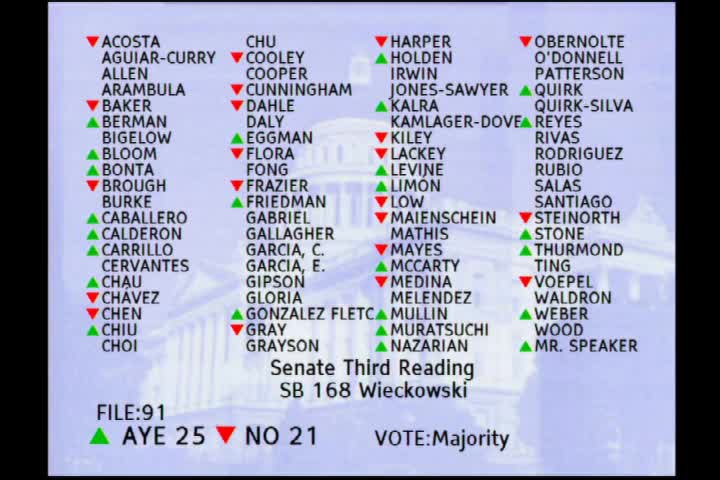 1MIN
Assembly Floor
 2MIN
Senate Floor
 4MIN
Senate Standing Committee on Elections and Constitutional Amendments
Bill Author

Bill Co-Author(s):