AB 22: Secretary of State: storing and recording electronic media.
- Session Year: 2017-2018
- House: Assembly
- Latest Version Date: 2017-10-15
Existing law requires the Secretary of State to approve and adopt uniform statewide standards for the purpose of storing and recording permanent and nonpermanent documents in electronic media, as specified, and requires those standards to include a requirement that a trusted system, as defined, be utilized.
This bill would specify that a trusted system, for these purposes, includes cloud computing, as defined, that meets specified requirements.
Existing law provides that the Department of Technology is responsible for establishing and enforcing information technology plans, policies, and standards and in furtherance thereof, publishing the Statewide Information Management Manual, and for information technology provisions of the State Administrative Manual.
This bill would provide that the standards in these manuals apply to a trusted system.
Existing law requires the Secretary of State to adopt appropriate standards established by the American National Standards Institute or the Association for Information and Image Management.
This bill would delete this reference to the Association for Information and Image Management.
Existing law requires the Secretary of State to approve and adopt uniform statewide standards for the purpose of storing and recording permanent and nonpermanent documents in electronic media, as specified, and requires those standards to include a requirement that a trusted system, as defined, be utilized.
This bill would specify that a trusted system, for these purposes, includes cloud computing, as defined, that meets specified requirements.
Existing law provides that the Department of Technology is responsible for establishing and enforcing information technology plans, policies, and standards and in furtherance thereof, publishing the Statewide Information Management Manual, and for information technology provisions of the State Administrative Manual.
This bill would provide that the standards in these manuals apply to a trusted system.
Existing law requires the Secretary of State to adopt appropriate standards established by the American National Standards Institute or the Association for Information and Image Management.
This bill would delete this reference to the Association for Information and Image Management.
Existing law requires the Secretary of State to approve and adopt uniform statewide standards for the purpose of storing and recording permanent and nonpermanent documents in electronic media, as specified, and requires those standards to include a requirement that a trusted system, as defined, be utilized.
This bill would provide that a cloud computing storage service that provides administrative users with tools or controls to prevent stored records from being overwritten, deleted, or altered until the required retention period for the record has expired shall be considered a trusted system and would require a cloud computing storage service to comply with standards published by the International Organization for Standardization, or other applicable industry recognized standard relating to security techniques and information security management systems.This bill would specify that a trusted system, for these purposes, includes cloud computing, as defined, that meets specified requirements.
Existing law provides that the Department of Technology is responsible for establishing and enforcing information technology plans, policies, and standards, and in furtherance thereof, publishes the Statewide Information Management Manual and is responsible for information technology provisions of the State Administrative Manual.
This bill would provide that the standards in these manuals apply to a trusted system.
Existing law requires the Secretary of State to adopt appropriate standards established by the American National Standards Institute or the Association for Information and Image Management.
This bill would delete this reference to the Association for Information and Image Management.
Existing law requires the Secretary of State to approve and adopt uniform statewide standards for the purpose of storing and recording permanent and nonpermanent documents in electronic media, as specified, and requires those standards to include a requirement that a trusted system, as defined, be utilized.
This bill would provide that a cloud computing storage service that provides administrative users with tools or controls to prevent stored records from being overwritten, deleted, or altered until the required retention period for the record has expired shall be considered a trusted system and would require a cloud computing storage service to comply with standards published by the International Organization for Standardization, or other applicable industry recognized successor standard relating to security techniques and information security management systems.
Existing law requires the Secretary of State to approve and adopt uniform statewide standards for the purpose of storing and recording permanent and nonpermanent documents in electronic media, as specified, and requires those standards to include a requirement that a trusted system, as defined, be utilized.
This bill would provide that a commercial cloud-based archival storage service that provides integrated controls that prevent stored archive records from being overwritten, deleted, or altered until the required retention period for the record has expired is considered a trusted system and would require a commercial cloud-based archival storage service to be certified by the Federal Risk and Authorization Management Program and to meet federal cloud security requirements related to the records being stored, as specified. cloud computing storage service that provides administrative users with tools or controls to prevent stored records from being overwritten, deleted, or altered until the required retention period for the record has expired shall be considered a trusted system and would require a cloud computing storage service to comply with standards published by the International Organization for Standardization, or other applicable industry recognized successor standard relating to security techniques and information security management systems.
Existing law requires the Secretary of State to approve and adopt uniform statewide standards for the purpose of storing and recording permanent and nonpermanent documents in electronic media, as specified, and requires those standards to include a requirement that a trusted system, as defined, be utilized.
This bill would provide that a commercial cloud-based archival storage service that provides integrated controls that prevent stored archive records from being overwritten, deleted, or altered until the required retention period for the record has expired is considered a trusted system and would require a commercial cloud-based archival storage service to be certified by the Federal Risk and Authorization Management Program and to meet federal cloud security requirements related to the records being stored, as specified.
Existing law provides that a public employee may be dismissed from employment if he or she advocates or is knowingly a member of the Communist Party or of an organization which, during the time of his or her membership, the employee knows advocates the overthrow of the Government of the United States or of any state by force or violence.This bill would delete the reference to the Communist Party in the provision described above.Existing law requires a public employee, if subpoenaed or ordered, to appear before the governing body of the agency that he or she is employed by, before a committee or subcommittee of Congress, or before a committee or subcommittee of the Legislature, and to answer, under oath, specified questions, including questions related to knowing membership in the Communist Party. This bill would delete references to the Communist Party in this requirement. The bill would also repeal related findings and declarations of the Legislature regarding communism and the Communist Party.Existing law provides that a public employee may be dismissed from employment if he or she advocates or is knowingly a member of the Communist Party or of an organization which, during the time of his or her membership, the employee knows advocates the overthrow of the Government of the United States or of any state by force or violence.
This bill would delete the reference to the Communist Party in the provision described above.
Existing law requires a public employee, if subpoenaed or ordered, to appear before the governing body of the agency that he or she is employed by, before a committee or subcommittee of Congress, or before a committee or subcommittee of the Legislature, and to answer, under oath, specified questions, including questions related to knowing membership in the Communist Party.
This bill would delete references to the Communist Party in this requirement. The bill would also repeal related findings and declarations of the Legislature regarding communism and the Communist Party.
Existing law provides that a provision of a memorandum of understanding reached between the state employer and a recognized employee organization representing state civil service employees that requires the expenditure of funds does not become effective unless approved by the Legislature in the annual Budget Act.This bill would approve provisions of a memorandum of understanding entered into between the state employer and an unspecified bargaining unit that require the expenditure of funds, and would provide that these provisions will become effective even if these provisions are approved by the Legislature in legislation other than the annual Budget Act.The bill would provide that provisions of the memorandum of understanding approved by this bill that require the expenditure of funds will not take effect unless funds for those provisions are specifically appropriated by the Legislature, and would require the state employer and the affected employee organization to meet and confer to renegotiate the affected provisions if funds for those provisions are not specifically appropriated by the Legislature.Existing law provides that a provision of a memorandum of understanding reached between the state employer and a recognized employee organization representing state civil service employees that requires the expenditure of funds does not become effective unless approved by the Legislature in the annual Budget Act.
This bill would approve provisions of a memorandum of understanding entered into between the state employer and an unspecified bargaining unit that require the expenditure of funds, and would provide that these provisions will become effective even if these provisions are approved by the Legislature in legislation other than the annual Budget Act.
The bill would provide that provisions of the memorandum of understanding approved by this bill that require the expenditure of funds will not take effect unless funds for those provisions are specifically appropriated by the Legislature, and would require the state employer and the affected employee organization to meet and confer to renegotiate the affected provisions if funds for those provisions are not specifically appropriated by the Legislature.
(a)The California Legislature hereby recognizes the need to adopt uniform statewide standards for the purpose of storing and recording permanent documents in electronic media.
(b)In order to ensure that uniform statewide standards remain current and relevant, the Secretary of State shall approve and adopt appropriate standards established by the American National Standards Institute.
(c)The standards specified in subdivision (b) shall include a requirement that a trusted system be utilized. For this purpose and for purposes of Sections 25105, 26205, 26205.1, 26205.5, 26907, 27001, 27322.2, 34090.5, and 60203, Section 102235 of the Health and Safety Code, and Section 10851 of the Welfare and Institutions Code, trusted system means a combination of technologies, policies, and procedures for which there is no plausible scenario in which a document retrieved from or reproduced by the system could differ substantially from the document that is originally stored.
(d)A cloud computing storage service that complies with International Organization for Standardization ISO/IEC 27001:2013, or other applicable industry-recognized standard relating to security techniques and information security management, and provides administrative users with controls to prevent stored records from being overwritten, deleted, or altered shall be considered a trusted system.
(e)A trusted system shall comply with applicable standards articulated in the State Administrative Manual and the Statewide Information Management Manual. This requirement applies to state agencies and does not apply to local government entities.
(f)For purposes of this section cloud computing is defined by the National Institute of Standards and Technology Special Publication 800-145 or a successor publication, and includes the service and deployment models referenced therein.
(g)State officials shall ensure that microfilming, electronic data imaging, and photographic reproduction are done in compliance with the minimum standards or guidelines, or both, as recommended by the American National Standards Institute for recording of permanent records.
(h)Nothing in this section shall prohibit a local government entity from adopting applicable standards articulated in the State Administrative Manual and the Statewide Information Management Manual for purposes of utilizing a trusted system as defined in subdivision (c).
(a)The California Legislature hereby recognizes the need to adopt uniform statewide standards for the purpose of storing and recording permanent documents in electronic media.
(b)In order to ensure that uniform statewide standards remain current and relevant, the Secretary of State shall approve and adopt appropriate standards established by the American National Standards Institute.
(c)The standards specified in subdivision (b) shall include a requirement that a trusted system be utilized. For this purpose and for purposes of Sections 25105, 26205, 26205.1, 26205.5, 26907, 27001, 27322.2, 34090.5, and 60203, Section 102235 of the Health and Safety Code, and Section 10851 of the Welfare and Institutions Code, trusted system means a combination of technologies, policies, and procedures for which there is no plausible scenario in which a document retrieved from or reproduced by the system could differ substantially from the document that is originally stored.
(d)A cloud computing storage service that complies with International Organization for Standardization ISO/IEC 27001:2013, or other applicable industry-recognized standard relating to security techniques and information security management, and provides administrative users with controls to prevent stored records from being overwritten, deleted, or altered shall be considered a trusted system.
(e)A trusted system shall comply with applicable standards articulated in the State Administrative Manual and the Statewide Information Management Manual. This requirement applies to state agencies and does not apply to local government entities.
(f)For purposes of this section cloud computing is defined by the National Institute of Standards and Technology Special Publication 800-145 or a successor publication, and includes the service and deployment models referenced therein.
(g)State officials shall ensure that microfilming, electronic data imaging, and photographic reproduction are done in compliance with the minimum standards or guidelines, or both, as recommended by the American National Standards Institute for recording of permanent records.
(h)Nothing in this section shall prohibit a local government entity from adopting applicable standards articulated in the State Administrative Manual and the Statewide Information Management Manual for purposes of utilizing a trusted system as defined in subdivision (c).
(a)The California Legislature hereby recognizes the need to adopt uniform statewide standards for the purpose of storing and recording permanent and nonpermanent documents in electronic media.
(b)In order to ensure that uniform statewide standards remain current and relevant, the Secretary of State shall approve and adopt appropriate standards established by the American National Standards Institute or the Association for Information and Image Management. Institute.
(c)The standards specified in subdivision (b) shall include a requirement that a trusted system be utilized. For this purpose and for purposes of Sections 25105, 26205, 26205.1, 26205.5, 26907, 27001, 27322.2, 34090.5, and 60203, Section 102235 of the Health and Safety Code, and Section 10851 of the Welfare and Institutions Code, trusted system means a combination of technologies, policies, and procedures for which there is no plausible scenario in which a document retrieved from or reproduced by the system could differ substantially from the document that is originally stored.
(d)A cloud computing storage service that complies with International Organization for Standardization ISO/IEC 27001:2013, or other applicable industry-recognized standard relating to security techniques and information security management, and provides administrative users with tools or controls to prevent stored records from being overwritten, deleted, or altered until the required retention period for the record has expired shall be considered a trusted system. A cloud computing storage service shall comply with the International Organization for Standardization ISO/IEC 27001:2013, or other applicable industry recognized standard relating to security techniques and information security management systems.
(e)A trusted system shall comply with applicable standards articulated in the State Administrative Manual and the Statewide Information Management Manual. This requirement applies to state agencies and does not apply to local government entities.
(e)(f)For purposes of this section cloud computing is defined by the National Institute of Standards and Technology Special Publication 800-145 or a successor publication, and includes the service and deployment models referenced therein.
(f)In order to develop statewide standards as expeditiously as possible, and until the time that statewide standards are adopted pursuant to subdivision (b), state(g)State officials shall ensure that microfilming, electronic data imaging, and photographic reproduction are done in compliance with the minimum standards or guidelines, or both, as recommended by the American National Standards Institute or the Association for Information and Image Management for recording of permanent records or nonpermanent records.
(h)Nothing in this section shall prohibit a local government entity from adopting applicable standards articulated in the State Administrative Manual and the Statewide Information Management Manual for purposes of utilizing a trusted system as defined in subdivision (c).
(a)The California Legislature hereby recognizes the need to adopt uniform statewide standards for the purpose of storing and recording permanent and nonpermanent documents in electronic media.
(b)In order to ensure that uniform statewide standards remain current and relevant, the Secretary of State shall approve and adopt appropriate standards established by the American National Standards Institute or the Association for Information and Image Management.
(c)The standards specified in subdivision (b) shall include a requirement that a trusted system be utilized. For this purpose and for purposes of Sections 25105, 26205, 26205.1, 26205.5, 26907, 27001, 27322.2, 34090.5, and 60203, Section 102235 of the Health and Safety Code, and Section 10851 of the Welfare and Institutions Code, trusted system means a combination of technologies, policies, and procedures for which there is no plausible scenario in which a document retrieved from or reproduced by the system could differ substantially from the document that is originally stored.
(d)A cloud computing storage service that provides administrative users with tools or controls to prevent stored records from being overwritten, deleted, or altered until the required retention period for the record has expired shall be considered a trusted system. A cloud computing storage service shall comply with the International Organization for Standardization ISO/IEC 27001:2013, or other applicable industry recognized successor standard relating to security techniques and information security management systems.
(e)For purposes of this section cloud computing is defined by the National Institute of Standards and Technology Special Publication 800-145 or a successor publication, and includes the service and deployment models referenced therein.
(f)In order to develop statewide standards as expeditiously as possible, and until the time that statewide standards are adopted pursuant to subdivision (b), state officials shall ensure that microfilming, electronic data imaging, and photographic reproduction are done in compliance with the minimum standards or guidelines, or both, as recommended by the American National Standards Institute or the Association for Information and Image Management for recording of permanent records or nonpermanent records.
(a)The California Legislature hereby recognizes the need to adopt uniform statewide standards for the purpose of storing and recording permanent and nonpermanent documents in electronic media.
(b)In order to ensure that uniform statewide standards remain current and relevant, the Secretary of State shall approve and adopt appropriate standards established by the American National Standards Institute or the Association for Information and Image Management.
(c)The standards specified in subdivision (b) shall include a requirement that a trusted system be utilized. For this purpose and for purposes of Sections 25105, 26205, 26205.1, 26205.5, 26907, 27001, 27322.2, 34090.5, and 60203, Section 102235 of the Health and Safety Code, and Section 10851 of the Welfare and Institutions Code, trusted system means a combination of techniques, technologies, policies, and procedures for which there is no plausible scenario in which a document retrieved from or reproduced by the system could differ substantially from the document that is originally stored.
(d)A commercial cloud-based archival storage service that provides integrated controls that prevent stored archive records from being overwritten, deleted, or altered until the required retention period for the record has expired shall be considered a trusted system. A commercial cloud-based archival storage service shall be certified by the Federal Risk and Authorization Management Program and shall meet existing federal cloud security requirements related to the records, video recordings, or other media being stored, including, but not limited to, the Federal Bureau of Investigations Federal Criminal Justice Information Services standards and federal Health Insurance Portability and Accountability Act (Public Law 104-191) standards, as necessary.(d)A cloud computing storage service that provides administrative users with tools or controls to prevent stored records from being overwritten, deleted, or altered until the required retention period for the record has expired shall be considered a trusted system. A cloud computing storage service shall comply with the International Organization for Standardization ISO/IEC 27001:2013, or other applicable industry recognized successor standard relating to security techniques and information security management systems.
(e)For purposes of this section cloud computing is defined by the National Institute of Standards and Technology Special Publication 800-145 or a successor publication, and includes the service and deployment models referenced therein.
(e)(f)In order to develop statewide standards as expeditiously as possible, and until the time that statewide standards are adopted pursuant to subdivision (b), state officials shall ensure that microfilming, electronic data imaging, and photographic reproduction are done in compliance with the minimum standards or guidelines, or both, as recommended by the American National Standards Institute or the Association for Information and Image Management for recording of permanent records or nonpermanent records.
(a)The California Legislature hereby recognizes the need to adopt uniform statewide standards for the purpose of storing and recording permanent and nonpermanent documents in electronic media.
(b)In order to ensure that uniform statewide standards remain current and relevant, the Secretary of State shall approve and adopt appropriate standards established by the American National Standards Institute or the Association for Information and Image Management.
(c)The standards specified in subdivision (b) shall include a requirement that a trusted system be utilized. For this purpose and for purposes of Sections 25105, 26205, 26205.1, 26205.5, 26907, 27001, 27322.2, 34090.5, and 60203, Section 102235 of the Health and Safety Code, and Section 10851 of the Welfare and Institutions Code, trusted system means a combination of techniques, policies, and procedures for which there is no plausible scenario in which a document retrieved from or reproduced by the system could differ substantially from the document that is originally stored.
(d)A commercial cloud-based archival storage service that provides integrated controls that prevent stored archive records from being overwritten, deleted, or altered until the required retention period for the record has expired shall be considered a trusted system. A commercial cloud-based archival storage service shall be certified by the Federal Risk and Authorization Management Program and shall meet existing federal cloud security requirements related to the records, video recordings, or other media being stored, including, but not limited to, the Federal Bureau of Investigations Federal Criminal Justice Information Services standards and federal Health Insurance Portability and Accountability Act (Public Law 104-191) standards, as necessary.
(d)(e)In order to develop statewide standards as expeditiously as possible, and until the time that statewide standards are adopted pursuant to subdivision (b), state officials shall ensure that microfilming, electronic data imaging, and photographic reproduction are done in compliance with the minimum standards or guidelines, or both, as recommended by the American National Standards Institute or the Association for Information and Image Management for recording of permanent records or nonpermanent records.
SECTION 1.Section 1027.5 of the Government Code is repealed.SEC. 2.Section 1028 of the Government Code is amended to read:1028.It shall be sufficient cause for the dismissal of any public employee if that public employee advocates or is knowingly a member of an organization that, during the time of his or her membership in that organization, he or she knew that the organization advocated the overthrow of the Government of the United States or of any state by force or violence.SEC. 3.Section 1028.1 of the Government Code is amended to read:1028.1.(a)A public employee who is subpoenaed or ordered by the governing body of the state or local agency that the employee is employed at to appear before that governing body, or a committee or subcommittee thereof, or by a duly authorized committee of the Congress of the United States or of the Legislature of this state, or any subcommittee of any such committee, to appear before that committee or subcommittee, shall appear before that governing body, committee, or subcommittee, and shall answer under oath any question propounded by that governing body, committee, or subcommittee, or a member or counsel thereof, that relates to any of the following:(1)Present personal advocacy by the employee of the forceful or violent overthrow of the Government of the United States or of any state.(2)Present knowing membership in any organization now advocating the forceful or violent overthrow of the Government of the United States or of any state.(3)Past knowing membership in any organization which, to the knowledge of that employee, during the time of the employees membership in that organization, advocated the forceful or violent overthrow of the Government of the United States or of any state.(4)Questions as to present knowing membership of the employee in any organization that, during the time of his or her membership in that organization, he or she knew that the organization advocated the forceful or violent overthrow of the Government of the United States or of any state.(5)Present personal advocacy by the employee of the support of a foreign government against the United States in the event of hostilities between said foreign government and the United States.(b)Any employee who fails or refuses to appear or to answer under oath on any ground whatsoever any question described in subdivision (a) shall be guilty of insubordination and guilty of violating this section and shall be suspended and dismissed from his or her employment in the manner provided by law.SEC. 4.Section 1028.2 of the Government Code is amended to read:1028.2.Sections 1028 and 1028.1, added by Chapter 1418 of the Statutes of 1947, are not applicable to school district employees. It is the intent of the Legislature that the Education Code shall apply to such employees.It shall be sufficient cause for the dismissal of any public employee when such if that public employee advocates or is knowingly a member of the Communist Party or of an organization which that, during the time of his or her membership in that organization, he knows advocates or she knew that the organization advocated the overthrow of the Government of the United States or of any state by force or violence.
SEC. 3.Section 1028.1 of the Government Code is amended to read:1028.1.It shall be the duty of any (a)A public employee who may be subpenaed is subpoenaed or ordered by the governing body of the state or local agency by which such that the employee is employed, employed at to appear before such that governing body, or a committee or subcommittee thereof, or by a duly authorized committee of the Congress of the United States or of the Legislature of this State, state, or any subcommittee of any such committee, to appear before such that committee or subcommittee, and to shall appear before that governing body, committee, or subcommittee, and shall answer under oath a question or questions any question propounded by such that governing body, committee committee, or subcommittee, or a member or counsel thereof, relating to: that relates to any of the following:
(a)(1)Present personal advocacy by the employee of the forceful or violent overthrow of the Government of the United States or of any state.
(b)(2)Present knowing membership in any organization now advocating the forceful or violent overthrow of the Government of the United States or of any state.
(c)(3)Past knowing membership at any time since October 3, 1945, in any organization which, to the knowledge of such that employee, during the time of the employees membership membership in that organization, advocated the forceful or violent overthrow of the Government of the United States or of any state.
(d)(4)Questions as to present knowing membership of such the employee in the Communist Party or as to past knowing membership in the Communist Party at any time since October 3, 1945. in any organization that, during the time of his or her membership in that organization, he or she knew that the organization advocated the forceful or violent overthrow of the Government of the United States or of any state.
(e)(5)Present personal advocacy by the employee of the support of a foreign government against the United States in the event of hostilities between said foreign government and the United States.
Any(b)Any employee who fails or refuses to appear or to answer under oath on any ground whatsoever any such questions so propounded question described in subdivision (a) shall be guilty of insubordination and guilty of violating this section and shall be suspended and dismissed from his or her employment in the manner provided by law.
SEC. 4.Section 1028.2 of the Government Code is amended to read:1028.2.Sections 1027.5, 1028.1, and 1028, 1028 and 1028.1, added by Chapter 1418 of the Statutes of 1947, are not applicable to school district employees. It is the intent of the Legislature that the Education Code shall apply to such employees.
SECTION 1.The Legislature finds and declares that the purpose of this act is to approve an agreement entered into by the state employer and State Bargaining Unit ____ pursuant to Section 3517.5 of the Government Code.SEC. 2.The provisions of the memorandum of understanding prepared pursuant to Section 3517.5 of the Government Code and entered into by the state employer and State Bargaining Unit ____, dated ____, and that require the expenditure of funds, are hereby approved for the purposes of subdivision (b) of Section 3517.6 of the Government Code.SEC. 3.The provisions of the memorandum of understanding approved by Section 2 of this act that require the expenditure of funds shall not take effect unless funds for these provisions are specifically appropriated by the Legislature. If funds for these provisions are not specifically appropriated by the Legislature, the state employer and the affected employee organization shall meet and confer to renegotiate the affected provisions.SEC. 4.Notwithstanding Section 3517.6 of the Government Code, the provisions of the memorandum of understanding included in Section 2 of this act that require the expenditure of funds shall become effective even if the provisions of the memorandum of understanding are approved by the Legislature in legislation other than the annual Budget Act. CORRECTIONS: DigestPages 1 and 2.The Legislature finds and declares that the purpose of this act is to approve an agreement entered into by the state employer and State Bargaining Unit ____ pursuant to Section 3517.5 of the Government Code.
SEC. 2.The provisions of the memorandum of understanding prepared pursuant to Section 3517.5 of the Government Code and entered into by the state employer and State Bargaining Unit ____, dated ____, and that require the expenditure of funds, are hereby approved for the purposes of subdivision (b) of Section 3517.6 of the Government Code.
SEC. 3.The provisions of the memorandum of understanding approved by Section 2 of this act that require the expenditure of funds shall not take effect unless funds for these provisions are specifically appropriated by the Legislature. If funds for these provisions are not specifically appropriated by the Legislature, the state employer and the affected employee organization shall meet and confer to renegotiate the affected provisions.
SEC. 4.Notwithstanding Section 3517.6 of the Government Code, the provisions of the memorandum of understanding included in Section 2 of this act that require the expenditure of funds shall become effective even if the provisions of the memorandum of understanding are approved by the Legislature in legislation other than the annual Budget Act.
|
Date
|
Status
|
|---|---|
| Oct 15, 2017 | Chaptered by Secretary of State - Chapter 834, Statutes of 2017. |
| Oct 15, 2017 | Approved by the Governor. |
| Sep 26, 2017 | Enrolled and presented to the Governor at 3 p.m. |
| Sep 15, 2017 | Senate amendments concurred in. To Engrossing and Enrolling. |
| Sep 15, 2017 | Senate amendments concurred in. To Engrossing and Enrolling. (Ayes 78. Noes 0. Page 3500.). |
| Sep 14, 2017 | From committee: That the Senate amendments be concurred in. (Ayes 9. Noes 0.) (September 14). |
| Sep 13, 2017 | Assembly Rule 77(a) suspended. |
| Sep 13, 2017 | In Assembly. Concurrence in Senate amendments pending. May be considered on or after September 15 pursuant to Assembly Rule 77. |
| Sep 12, 2017 | Read third time. Passed. Ordered to the Assembly. |
| Sep 11, 2017 | Read second time. Ordered to third reading. |
| Sep 8, 2017 | Read third time and amended. Ordered to second reading. |
| Jul 17, 2017 | Read second time and amended. Ordered to third reading. |
| Jul 13, 2017 | From committee: Amend, and do pass as amended. (Ayes 12. Noes 0.) (July 11). |
| Jul 3, 2017 | From committee chair, with author's amendments: Amend, and re-refer to committee. Read second time, amended, and re-referred to Com. on G.O. |
| Jun 14, 2017 | Re-referred to Com. on G.O. |
| Jun 6, 2017 | Withdrawn from committee. |
| Jun 5, 2017 | From committee chair, with author's amendments: Amend, and re-refer to committee. Read second time, amended, and re-referred to Com. on P.E. & R. |
| May 18, 2017 | Referred to Com. on P.E. & R. |
| May 8, 2017 | In Senate. Read first time. To Com. on RLS. for assignment. |
| May 8, 2017 | Read third time. Passed. Ordered to the Senate. (Ayes 41. Noes 30. Page 1429.) |
| May 4, 2017 | Read second time. Ordered to third reading. |
| May 3, 2017 | From committee: Do pass. (Ayes 11. Noes 4.) (May 3). |
| Apr 20, 2017 | From committee: Do pass and re-refer to Com. on APPR. (Ayes 4. Noes 1.) (April 19). Re-referred to Com. on APPR. |
| Apr 18, 2017 | Re-referred to Com. on P.E., R., & S.S. |
| Apr 17, 2017 | From committee chair, with author's amendments: Amend, and re-refer to Com. on P.E., R., & S.S. Read second time and amended. |
| Jan 19, 2017 | Referred to Com. on P.E., R., & S.S. |
| Dec 6, 2016 | From printer. May be heard in committee January 5. |
| Dec 5, 2016 | Read first time. To print. |
|
Date
|
Description
|
Location
|
Votes
|
|
|---|---|---|---|---|
| Sep 15, 2017 | AB 22 BONTA Concurrence in Senate Amendments | Assembly Floor |
Passed |
|
| Sep 14, 2017 | With recommendation: That Senate amendments be concurred in. | Assembly Standing Committee on Privacy and Consumer Protection |
Passed |
|
| Sep 12, 2017 | Assembly 3rd Reading AB22 Bonta By Glazer | Senate Floor |
Passed |
|
| Jul 11, 2017 | Do pass as amended | Senate Standing Committee on Governmental Organization |
Passed |
|
| May 8, 2017 | AB 22 BONTA Assembly Third Reading | Assembly Floor |
Passed |
|
| May 3, 2017 | Do pass. | Assembly Standing Committee on Appropriations |
Passed |
|
| Apr 19, 2017 | Do pass and be re-referred to the Committee on [Appropriations] | Assembly Standing Committee on Public Employees, Retirement, and Social Security |
Passed |
This list shows positions taken on this bill by organizations on the date displayed, which is linked to the original source.
Positions by individuals are not included.
|
Organization
|
Position
|
Date
|
|---|---|---|
| California Police Chiefs Association | ** Support | Sep 13, 2017 |
| California Police Chiefs Association | ** Support | Sep 13, 2017 |
| California Special Districts Association | ** Support | Sep 13, 2017 |
| California Special Districts Association | ** Support | Sep 13, 2017 |
| City of Torrance | ** Support | Sep 13, 2017 |
| City of Torrance | ** Support | Sep 13, 2017 |
| CompTIA | ** Support | Sep 13, 2017 |
| CompTIA | ** Support | Sep 13, 2017 |
| Internet Association | ** Support | Sep 13, 2017 |
| Internet Association | ** Support | Sep 13, 2017 |
| IT Alliance for Public Sector | ** Support | Sep 13, 2017 |
| IT Alliance for Public Sector | ** Support | Sep 13, 2017 |
| League Of California Cities | * Support | Sep 14, 2017 |
| Technet | ** Support | Sep 13, 2017 |
| Technet | ** Support | Sep 13, 2017 |
CONCURRENCE IN SENATE AMENDMENTS
CSA2 Bill Id:AB 22
Author:(Bonta)
As Amended Ver:September 8, 2017
Majority vote
ASSEMBLY: |
| (May 8, 2017) | SENATE: | 39-0 | (September 12, 2017) |
(vote not relevant)
COMMITTEE VOTE: | 9-0 | (September 14, 2017) | RECOMMENDATION: | concur |
(P. & C.P.)
Original Committee Reference: P.E., R., & S.S.
SUMMARY: Authorizes state agencies and local governments to retain public records specifically through the use of a cloud computing storage service Authorizes state agencies and local governments to retain public records through use of a cloud computing storage service.
The Senate amendments delete the Assembly version of this bill, and instead:
- Expand the definition of a "trusted system" of recording and storage of electronic records to include a cloud computing storage service that complies with International Organization for Standardization ISO/IEC 27001: 2013, or other applicable industry-recognized standard relating to security techniques and information security management, and provide administrative users with controls to prevent stored records from being overwritten, deleted, or altered.
- Require any "trusted system" of recording and storage of electronic records used by state agencies, but not local government entities, to comply with applicable standards articulated in the State Administrative Manual (SAM) and the Statewide Information Management Manual (SIMM).
- State that, for purposes of this bill, "cloud computing" is defined by the National Institute of Standards and Technology Special Publication 800-145 or a successor publication, and includes the service and deployment models referenced therein. Clarify that nothing in these provisions shall prohibit a local government entity from adopting applicable standards articulated in the SAM and the SIMM for purposes of utilizing a trusted system.
- Make other technical, non-substantive or conforming changes.
FISCAL EFFECT: None. This bill is keyed non-fiscal by the Legislative Counsel.
COMMENTS:
This bill is intended to modify existing laws regulating document storage to make it easier for state and local governments to preserve and store public records in a more cost effective and efficient manner by utilizing cloud-based electronic storage services and is sponsored by the League of California Cities (the League).
According to the author, "Preservation techniques currently used by local and state governments are arcane, burdensome to use, difficult to access, and expensive to maintain. For example, if an interested party makes a Public Records Act request from a government agency, the administrator often must travel to an offsite storage facility to locate the microfilm, which drastically slows down response time and limits the administrator’s ability to perform other, more essential duties. The costs associated with maintaining, storing, and retrieving the microfilm create financial burdens on state and local governments at a time when fiscal pressures increasingly demand an immediate path for budget savings."
The National Institute of Standards and Technology defines cloud computing as a model for enabling ubiquitous, convenient, on-demand network access to a shared pool of configurable computing resources (e.g., networks, servers, storage, applications, and services) that can be rapidly provisioned and released with minimal management effort or service provider interaction. Put into plain English, cloud computing is simply the practice of using a network of remote servers to store, manage and process data instead of a personal computer or a local server in a way that makes it easier to centralize and manage computing resources.
This bill authorizes state and local governments to use a cloud computing storage service to store public records, and requires that service to comply with ISO or other applicable industry-recognized standards. ISO is an independent, non-governmental organization with a membership of 162 national standards bodies, and the ISO/IEC 27000 family of standards is the best-known standard for an information security management system.
Such standards are gaining wide acceptance in the public sector. According to a May 2017 Forbes article, "In recent years, agencies across the federal government have embraced cloud computing architectures and solutions to provide services to constituents and reduce the need for large-scale, traditional information technology (IT) infrastructure investments."
The federal government also issued an Executive Order in May of 2017 that stated in part that Executive agency heads are required to "show preference in their procurement for shared IT services," such as email, cloud and cybersecurity services. "Effective immediately, it is the policy of the executive branch to build and maintain a modern, secure, and more resilient executive branch IT architecture," the order states.
A "trusted system" is currently defined to mean a combination of techniques, policies, and procedures for which there is no plausible scenario in which a document retrieved from or reproduced by the system could differ substantially from the document that is originally stored. To that end, public records of any state agency are authorized to be microfilmed, electronically data imaged, or otherwise photographically reproduced and certified.
Furthermore, the use of the cloud should promote greater transparency by increasing access to public records and reducing response times. Cloud-based storage may also improve response and recovery by protecting permanent and nonpermanent records from local disasters such as fires or floods.
Analysis Prepared by: Jessica Langtry / P. & C.P. / (916) 319-2200 FN: 0002357
Date of Hearing: September 14, 2017
ASSEMBLY COMMITTEE ON PRIVACY AND CONSUMER PROTECTION
Ed Chau, Chair
ABPCA Bill Id:AB 22 (
Author:Bonta) – As Amended Ver:September 8, 2017
SUBJECT: Secretary of State: storing and recording electronic media
SUMMARY: Authorizes state agencies and local governments to retain public records specifically through the use of a cloud computing storage service. Specifically, this bill:
- Expands the definition of a “trusted system” of recording and storage of electronic records to include a cloud computing storage service that complies with a specified International Organization for Standardization (ISO) standard, or other applicable industry-recognized standard relating to security techniques and information security management, and provides administrative users with controls to prevent stored records from being overwritten, deleted, or altered.
- Requires any "trusted system" of recording and storage of electronic records used by state agencies, but not local government entities, to comply with applicable standards articulated in the State Administrative Manual (SAM) and the Statewide Information Management Manual (SIMM).
- States that, for purposes of this bill, “cloud computing” is defined by the National Institute of Standards and Technology Special Publication 800-145 or a successor publication, and includes the service and deployment models referenced therein.
- Clarifies that nothing in these provisions shall prohibit a local government entity from adopting applicable standards articulated in the SAM and the SIMM for purposes of utilizing a trusted system.
- Makes other technical, non-substantive or conforming changes.
EXISTING LAW:
- Requires, in order to ensure that uniform statewide standards for storing and recording permanent and nonpermanent documents in electronic media remain current and relevant, the Secretary of State to approve and adopt appropriate standards established by the American National Standards Institute or the Association for Information and Image Management. Further requires that a "trusted system" be utilized. (Government Code Section (GC) 12168.7 (b))
- Defines “trusted system” to mean a combination of techniques, policies, and procedures for which there is no plausible scenario in which a document retrieved from or reproduced by the system could differ substantially from the document that is originally stored. (GC 12168.7 (c))
- Requires state officials, in order to develop statewide standards as expeditiously as possible, and until the time that statewide standards are adopted pursuant to 2) above, to ensure that microfilming, electronic data imaging, and photographic reproduction are done in compliance with the minimum standards or guidelines, or both, as recommended by the American National Standards Institute or the Association for Information and Image Management for recording of permanent records or nonpermanent records. (GC 12168.7 (c))
- Establishes the California Public Records Act (CPRA) which grants access to public information maintained by local and state government agencies. (GC 6250 et seq.)
- Establishes the State Records Management Act which directs California's Secretary of State to establish and administer a records management program that applies efficient and economical management methods to the creation, utilization, maintenance, retention, preservation, and disposal of state records. (GC 12270-12279)
FISCAL EFFECT: None. This bill has been keyed non-fiscal by the Legislative Counsel.
COMMENTS:
- Purpose of this bill: This bill is intended to modify existing laws regulating document storage to make it easier for state and local governments to preserve and store public records in a more cost effective and efficient manner by utilizing cloud-based electronic storage services. This bill is sponsored by the League of California Cities (the League).
- Author’s statement: According to the author, “Preservation techniques currently used by local and state governments are arcane, burdensome to use, difficult to access, and expensive to maintain. For example, if an interested party makes a Public Records Act request from a government agency, the administrator often must travel to an offsite storage facility to locate the microfilm, which drastically slows down response time and limits the administrator’s ability to perform other, more essential duties. The costs associated with maintaining, storing, and retrieving the microfilm create financial burdens on state and local governments at a time when fiscal pressures increasingly demand an immediate path for budget savings.”
"Additionally, files are increasingly stored in digital format. Current preservation methods only allow for an inefficient process where digitized files are printed and transferred to microfilm or microfiche. A cloud-based solution is better suited to manage digital documents and can easily streamline this procedure.”
- Cloud computing and federal adoption: The National Institute of Standards and Technology defines cloud computing as a model for enabling ubiquitous, convenient, on-demand network access to a shared pool of configurable computing resources (e.g., networks, servers, storage, applications, and services) that can be rapidly provisioned and released with minimal management effort or service provider interaction. Put into plain English, cloud computing is simply the practice of using a network of remote servers to store, manage and process data instead of a personal computer or a local server in a way that makes it easier to centralize and manage computing resources.
This bill authorizes state and local governments to use a cloud computing storage service to store public records, and requires that service to comply with ISO or other applicable industry-recognized standards. ISO is an independent, non-governmental organization with a membership of 162 national standards bodies, and the ISO/IEC 27000 family of standards is the best-known standard for an information security management system. The standard cited by this bill (ISO/IEC 27001:2013) contains requirements for establishing, implementing, maintaining and continually improving an information security management system within any organization, and includes requirements for the assessment and treatment of information security risks. The requirement that any cloud storage solution meet that (or similar) standard helps ensure that documents are kept reasonably secure.
Such standards are gaining wide acceptance in the public sector. According to a May 2017 Forbes article, “In recent years, agencies across the federal government have embraced cloud computing architectures and solutions to provide services to constituents and reduce the need for large-scale, traditional IT infrastructure investments.”
The federal government also issued an Executive Order in May of 2017 that stated in part that Executive agency heads are required to “show preference in their procurement for shared IT services,” such as email, cloud and cybersecurity services. “Effective immediately, it is the policy of the executive branch to build and maintain a modern, secure, and more resilient executive branch IT architecture,” the order states.
According to the author, the United States Navy, Department of Defense, and all 17 federal intelligence agencies utilize cloud-based systems to protect critical infrastructure and states that by ensuring that commercial, cloud-based systems are in compliance with federal cloud security requirements, data stored on the cloud will be protected, safe from tampering, and stored securely in perpetuity.
- Current preservation and storage methods: The California Secretary of State is charged with approving and adopting appropriate statewide standards for the purpose of storing and recording public documents. In order for these uniform statewide standards to remain current and relevant, state agencies and local governments are statutorily required to use a "trusted system" to meet that goal.
A “trusted system” is currently defined to mean a combination of techniques, policies, and procedures for which there is no plausible scenario in which a document retrieved from or reproduced by the system could differ substantially from the document that is originally stored. To that end, public records of any state agency are authorized to be microfilmed, electronically data imaged, or otherwise photographically reproduced and certified.
By expanding the definition of a trusted system to include cloud-computing storage as a method for storing records, state agencies and local governments will have an additional tool at their disposal to store and retrieve public documents with greater efficiency and lower costs. For example, by using a commercial cloud-based archival storage service, government data can be accessed from any location quickly and maintenance costs of traditional storage systems will no longer be required.
Furthermore, the use of the cloud should promote greater transparency by increasing access to public records and reducing response times. Cloud-based storage may also improve response and recovery by protecting permanent and nonpermanent records from local disasters such as fires or floods.
- Arguments in support: This bill’s sponsor, the League of California Cities, writes in support that agencies across the state are dealing with a significant spike in CPRA requests and due to such requests, many agencies have already had to hire additional staff solely dedicated to reviewing documents in association with CPRA request. The League states that current CPRA requests require an administrator to often travel to an offsite storage facility to locate the microfilm, which drastically slows down response time.
A coalition of technology organizations states that they are supportive of the goals of this bill, which they assert provides local governments the option to replace an archaic microfilm means of storing records with a secure digital solution.
The California Police Chiefs Association also writes in support stating that cloud-based computing has become a mainstay of electronic backups and document storage, as a cloud-based server can provide more storage space and is more secure than a smaller, private storage server.
- Prior legislation: SB 2067 (Bowen), Chapter 569, Statues of 2000, required the Secretary of State, in consultation with the Department of General Services, to approve and adopt appropriate standards established by the American National Standards Institute or the Association for Information and Image Management to provide uniform statewide standards for storing permanent and nonpermanent documents in electronic media.
REGISTERED SUPPORT / OPPOSITION:
Support
League of California Cities (sponsor)
California Police Chiefs Association
California Special Districts Association
City of Torrance
CompTIA
Internet Association
IT Alliance for Public Sector
TechNet
Opposition
None on file.
Analysis Prepared by: Jessica Langtry / P. & C.P. / (916) 319-2200
CONCURRENCE IN SENATE AMENDMENTS
CSA1 Bill Id:AB 22
Author:(Bonta)
As Amended Ver:September 8, 2017
Majority vote
ASSEMBLY: | 41-30 | (May 8, 2017) | SENATE: | 39-0 | (September 12, 2017) |
Original Committee Reference: P. & C.P.
SUMMARY: Authorizes state agencies and local governments to retain public records through use of a cloud computing storage service.
The Senate amendments delete the Assembly version of this bill, and instead:
- Expand the definition of a "trusted system" of recording and storage of electronic records to include a cloud computing storage service that complies with International Organization for Standardization ISO/IEC 27001:2013, or other applicable industry-recognized standard relating to security techniques and information security management, and provide administrative users with controls to prevent stored records from being overwritten, deleted, or altered.
- Require any "trusted system" of recording and storage of electronic records used by state agencies, but not local government entities, to comply with applicable standards articulated in the State Administrative Manual (SAM) and the Statewide Information Management Manual (SIMM).
- State that, for purposes of this bill, "cloud computing" is defined by the National Institute of Standards and Technology Special Publication 800-145 or a successor publication, and includes the service and deployment models referenced therein.
- Clarify that nothing in these provisions shall prohibit a local government entity from adopting applicable standards articulated in the SAM and the SIMM for purposes of utilizing a trusted system.
- Make other technical, non-substantive or conforming changes.
EXISTING LAW:
- Requires, in order to ensure that uniform statewide standards for storing and recording permanent and nonpermanent documents in electronic media remain current and relevant, the Secretary of State to approve and adopt appropriate standards established by the American National Standards Institute or the Association for Information and Image Management. Further requires that a "trusted system" be utilized. (Government Code Section (GC) 12168.7(b))
- Defines "trusted system" to mean a combination of techniques, policies, and procedures for which there is no plausible scenario in which a document retrieved from or reproduced by the system could differ substantially from the document that is originally stored. (GC 12168.7(c))
- Requires state officials, in order to develop statewide standards as expeditiously as possible, and until the time that statewide standards are adopted pursuant to 1), above, to ensure that microfilming, electronic data imaging, and photographic reproduction are done in compliance with the minimum standards or guidelines, or both, as recommended by the American National Standards Institute or the Association for Information and Image Management for recording of permanent records or nonpermanent records. (GC 12168.7(c))
- Establishes the California Public Records Act (CPRA) which grants access to public information maintained by local and state government agencies. (GC 6250 et seq.)
FISCAL EFFECT: None. This bill has been keyed non-fiscal by the Legislative Counsel.
COMMENTS:
This bill is intended to modify existing laws regulating document storage to make it easier for state and local governments to preserve and store public records in a more cost effective and efficient manner by utilizing cloud-based electronic storage services. This bill is sponsored by the League of California Cities (the League).
According to the author, "Preservation techniques currently used by local and state governments are arcane, burdensome to use, difficult to access, and expensive to maintain. For example, if an interested party makes a Public Records Act request from a government agency, the administrator often must travel to an offsite storage facility to locate the microfilm, which drastically slows down response time and limits the administrator's ability to perform other, more essential duties. The costs associated with maintaining, storing, and retrieving the microfilm create financial burdens on state and local governments at a time when fiscal pressures increasingly demand an immediate path for budget savings."
The League writes that agencies across the state are dealing with a significant spike in CPRA requests and that due to such requests, many agencies have already had to hire additional staff solely dedicated to reviewing documents in association with CPRA requests.
The National Institute of Standards and Technology, a measurement standards laboratory, and a non-regulatory agency of the United States Department of Commerce, defines cloud computing as a model for enabling ubiquitous, convenient, on-demand network access to a shared pool of configurable computing resources (e.g., networks, servers, storage, applications, and services) that can be rapidly provisioned and released with minimal management effort or service provider interaction.
This bill authorizes state and local governments to use a cloud computing storage service to store public records and requires that service to comply with ISO or other applicable industry-recognized standards. The ISO is an independent, non-governmental organization with a membership of 162 national standards bodies and the ISO/IEC 27000 family of standards is the best-known standard for an information security management system.
Analysis Prepared by: Jessica Langtry / P. & C.P. / (916) 319-2200 FN: 0002338
Office of Senate Floor Analyses (916) 651-1520 Fax: (916) 327-4478 | AB |
THIRD READING
Bill No: AB 22
:
SENATE GOVERNMENTAL ORG. COMMITTEE: 12-0, 7/11/17
AYES: Dodd, Berryhill, Bradford, Cannella, Gaines, Galgiani, Glazer, Hill, Hueso, Lara, Portantino, Vidak
NO VOTE RECORDED: Mendoza
ASSEMBLY FLOOR: 41-30, 5/8/17 - See last page for vote
SOURCE: League of California Cities
DIGEST: This bill authorizes state and local governments to store permanent records using a cloud computing storage service, as specified.
Senate Floor Amendments of 9/8/17 require a trusted system to comply with applicable standards in the State Administrative Manual (SAM) and the Statewide Information Management Manual (SIMM), and specify that this requirement applies to state agencies and not to local government entities. The amendments also clarify that nothing in this bill shall prohibit local governments from adopting applicable standards articulated in the SAM and the SIMM.
ANALYSIS:
Existing law:
- Requires the Secretary of State (SOS) to approve and adopt uniform statewide standards for purposes of storing and recording permanent and nonpermanent documents in electronic media, as specified.
- Requires those standards to include a requirement that a trusted system be utilized and defines a “trusted system” to mean a combination of techniques, policies, and procedures for which there is no plausible scenario in which a document retrieved from or reproduced by the system could differ substantially from the document that is originally stored.
- Provides that in order to develop statewide standards as expeditiously as possible, and until the time that statewide standards are adopted, state officials shall ensure that microfilming, electronic data imaging, and photographic reproduction are done in compliance with the minimum standards or guidelines, or both, as recommended by the American National Standards Institute or the Association for Information and Image Management for recording of permanent records or nonpermanent records.
- Provides that the Department of Technology is responsible for establishing and enforcing information technology plans, policies, and standards, publishes the SAM, and is responsible for information technology provisions of the SAM.
- Requires the Secretary of State to adopt appropriate standards established by the American National Standards Institute or the Association for Information and Image Management.
This bill:
- Authorizes state and local governments to store permanent records using cloud computing storage service, as specified.
- Provides that a cloud computing storage service that provides administrative users with controls to prevent stored records from being overwritten, deleted, or altered shall be considered a trusted system.
- Requires a trusted system to comply with applicable standards articulated in the SAM and the SIMM. This requirement applies to state agencies and does not apply to local government entities.
- Requires the cloud computing storage service to comply with the International Organization for Standardization ISO/IEC 27001:2013, or other applicable industry recognized standard relating to security techniques and information security management systems.
- Defines “cloud computing” as that provided by the National Institute of Standards and Technology Special Publication 800-145 or a successor publication, and includes the service and deployment models referenced therein.
- Clarifies that nothing in the bill shall prohibit a local government entity from adopting applicable standards articulated in the SAM and the SIMM for purposes of utilizing a trusted system.
Background
Purpose of the bill. According to the author’s office, “current preservation methods only allow for an inefficient process where digitized files are printed and transferred to microfilm or microfiche. A cloud-based solution is better suited to manage digital documents and can easily streamline this procedure.”
In addition, the author’s office argues that this bill results in immediate and budgetary relief to local and state governments and improve responsiveness.
International Organization for Standardization (IOS). The IOS is an independent, non-governmental international organization with a membership of 163 national standards bodies. Through its members, it brings together experts to share knowledge and develop voluntary, consensus-based, market relevant international standards that support innovation and provide solutions to global challenges.
The ISO/IEC 27001:2003 specifies the requirements for establishing, implementing, maintaining and continually improving an information security management system within the context of the organization. It also includes requirements for the assessment and treatment of information security risks tailored to the needs of the organization. The requirements set out in ISO/IEC 27001:2013 are generic and are intended to be applicable to all organizations, regardless of type, size or nature.
National Institute of Standards and Technology (NIST). The NIST was founded in 1901 and is now part of the U.S. Department of Commerce. NIST is one of the nation's oldest physical science laboratories. Congress established the agency to remove a major challenge to U.S. industrial competitiveness at the time—a second-rate measurement infrastructure that lagged behind the capabilities of the United Kingdom, Germany, and other economic rivals.
The NIST Special Publication 800-145 defines “cloud computing” as a model for enabling ubiquitous, convenient, on-demand network access to a shared pool of configurable computing resources (e.g., networks, servers, storage, applications, and services) that can be rapidly provisioned and released with minimal management effort or service provider interaction. This cloud model is composed of five essential characteristics (On-demand self-service; Broad network access; Resource pooling; Rapid elasticity; and Measured service), three service models (Software as a Service; Platform as a Service; Infrastructure as a Service), and four deployment model (Private cloud; Community cloud; Public cloud; Hybrid cloud), all of which are defined separately.
Related/Prior Legislation
SB 479 (Block, 2013) would have transferred responsibility for management of the state’s records from the Department of General Services to the SOS. (Held in the Senate Appropriations Committee suspense file)
FISCAL EFFECT: Appropriation: Fiscal Com.: Local:
League of California Cities (source)
California Police Chiefs Association
California Special Districts Association
City of Torrance
CompTIA
Internet Association
IT Alliance for Public Sector
TechNet
None received
ARGUMENTS IN SUPPORT: According to the League of California Cities, “preservation techniques in use by local governments are arcane, burdensome to use, difficult to access, and expensive to maintain. For example, if an interested party makes a Public Records Act request from a government agency, the local agency administrator often must travel to an offsite storage facility to locate the microfilm, which drastically slows down response times and limits the administrator’s ability to perform other essential duties. The costs associated with maintaining, storing, and retrieving the microfilm create financial burdens on state and local governments at a time when fiscal pressure increasingly demand an immediate path for budget savings.”
ASSEMBLY FLOOR: 41-30, 5/8/17
AYES: Aguiar-Curry, Berman, Bloom, Bocanegra, Bonta, Burke, Calderon, Chau, Chiu, Cooley, Cooper, Dababneh, Eggman, Friedman, Cristina Garcia, Eduardo Garcia, Gipson, Gloria, Gonzalez Fletcher, Gray, Holden, Jones-Sawyer, Levine, Limón, Low, McCarty, Mullin, Nazarian, O'Donnell, Quirk, Reyes, Ridley-Thomas, Rodriguez, Rubio, Salas, Mark Stone, Thurmond, Ting, Weber, Wood, Rendon
NOES: Acosta, Travis Allen, Arambula, Baker, Bigelow, Brough, Caballero, Cervantes, Chávez, Chen, Choi, Cunningham, Dahle, Daly, Flora, Fong, Gallagher, Harper, Kiley, Lackey, Maienschein, Mathis, Mayes, Melendez, Muratsuchi, Obernolte, Quirk-Silva, Steinorth, Voepel, Waldron
NO VOTE RECORDED: Chu, Frazier, Gomez, Grayson, Irwin, Kalra, Medina, Patterson, Santiago
9/11/17 20:07:32
**** END ****
Office of Senate Floor Analyses (916) 651-1520 Fax: (916) 327-4478 | AB |
THIRD READING
Bill No: AB 22
:
SENATE GOVERNMENTAL ORG. COMMITTEE: 12-0, 7/11/17
AYES: Dodd, Berryhill, Bradford, Cannella, Gaines, Galgiani, Glazer, Hill, Hueso, Lara, Portantino, Vidak
NO VOTE RECORDED: Mendoza
ASSEMBLY FLOOR: 41-30, 5/8/17 - See last page for vote
SOURCE: League of California Cities
DIGEST: This bill authorizes local and state governments to store permanent and nonpermanent records using a cloud computing storage service, as specified.
ANALYSIS:
Existing law:
- Requires the Secretary of State (SOS) to approve and adopt uniform statewide standards for purposes of storing and recording permanent and nonpermanent documents in electronic media, as specified.
- Requires those standards to include a requirement that a trusted system be utilized and defines a “trusted system” to mean a combination of techniques, policies, and procedures for which there is no plausible scenario in which a document retrieved from or reproduced by the system could differ substantially from the document that is originally stored.
- Provides that in order to develop statewide standards as expeditiously as possible, and until the time that statewide standards are adopted, state officials shall ensure that microfilming, electronic data imaging, and photographic reproduction are done in compliance with the minimum standards or guidelines, or both, as recommended by the American National Standards Institute or the Association for Information and Image Management for recording of permanent records or nonpermanent records.
This bill:
- Authorizes local and state governments to store permanent and nonpermanent records using cloud computing storage service.
- Provides that a cloud computing storage service that provides administrative users with tools or controls to prevent stored records from being overwritten, deleted, or altered until the required retention period for the record has expired shall be considered a trusted system.
- Requires the cloud computing storage service to comply with the International Organization for Standardization ISO/IEC 27001:2013, or other applicable industry recognized standard relating to security techniques and information security management systems.
- Defines “cloud computing” as that provided by the National Institute of Standards and Technology Special Publication 800-145 or a successor publication, and includes the service and deployment models referenced therein.
Background
Purpose of the bill. According to the author’s office, “current preservation methods only allow for an inefficient process where digitized files are printed and transferred to microfilm or microfiche. A cloud-based solution is better suited to manage digital documents and can easily streamline this procedure.”
In addition, the author’s office argues that this bill results in immediate and budgetary relief to local and state governments and improve responsiveness.
International Organization for Standardization (IOS). The IOS is an independent, non-governmental international organization with a membership of 163 national standards bodies. Through its members, it brings together experts to share knowledge and develop voluntary, consensus-based, market relevant international standards that support innovation and provide solutions to global challenges.
The ISO/IEC 27001:2003 specifies the requirements for establishing, implementing, maintaining and continually improving an information security management system within the context of the organization. It also includes requirements for the assessment and treatment of information security risks tailored to the needs of the organization. The requirements set out in ISO/IEC 27001:2013 are generic and are intended to be applicable to all organizations, regardless of type, size or nature.
National Institute of Standards and Technology (NIST). The NIST was founded in 1901 and is now part of the U.S. Department of Commerce. NIST is one of the nation's oldest physical science laboratories. Congress established the agency to remove a major challenge to U.S. industrial competitiveness at the time—a second-rate measurement infrastructure that lagged behind the capabilities of the United Kingdom, Germany, and other economic rivals.
The NIST Special Publication 800-145 defines “cloud computing” as a model for enabling ubiquitous, convenient, on-demand network access to a shared pool of configurable computing resources (e.g., networks, servers, storage, applications, and services) that can be rapidly provisioned and released with minimal management effort or service provider interaction. This cloud model is composed of five essential characteristics (On-demand self-service; Broad network access; Resource pooling; Rapid elasticity; and Measured service), three service models (Software as a Service; Platform as a Service; Infrastructure as a Service), and four deployment model (Private cloud; Community cloud; Public cloud; Hybrid cloud), all of which are defined separately.
Related/Prior Legislation
SB 479 (Block, 2013) would have transferred responsibility for management of the state’s records from the Department of General Services to the SOS. (Held in the Senate Appropriations Committee suspense file)
FISCAL EFFECT: Appropriation: Fiscal Com.: Local:
League of California Cities (source)
California Police Chiefs Association
California Special Districts Association
City of Torrance
CompTIA
Internet Association
IT Alliance for Public Sector
TechNet
None received
ARGUMENTS IN SUPPORT: According to the League of California Cities, “preservation techniques in use by local governments are arcane, burdensome to use, difficult to access, and expensive to maintain. For example, if an interested party makes a Public Records Act request from a government agency, the local agency administrator often must travel to an offsite storage facility to locate the microfilm, which drastically slows down response times and limits the administrator’s ability to perform other essential duties. The costs associated with maintaining, storing, and retrieving the microfilm create financial burdens on state and local governments at a time when fiscal pressure increasingly demand an immediate path for budget savings.”
ASSEMBLY FLOOR: 41-30, 5/8/17
AYES: Aguiar-Curry, Berman, Bloom, Bocanegra, Bonta, Burke, Calderon, Chau, Chiu, Cooley, Cooper, Dababneh, Eggman, Friedman, Cristina Garcia, Eduardo Garcia, Gipson, Gloria, Gonzalez Fletcher, Gray, Holden, Jones-Sawyer, Levine, Limón, Low, McCarty, Mullin, Nazarian, O'Donnell, Quirk, Reyes, Ridley-Thomas, Rodriguez, Rubio, Salas, Mark Stone, Thurmond, Ting, Weber, Wood, Rendon
NOES: Acosta, Travis Allen, Arambula, Baker, Bigelow, Brough, Caballero, Cervantes, Chávez, Chen, Choi, Cunningham, Dahle, Daly, Flora, Fong, Gallagher, Harper, Kiley, Lackey, Maienschein, Mathis, Mayes, Melendez, Muratsuchi, Obernolte, Quirk-Silva, Steinorth, Voepel, Waldron
NO VOTE RECORDED: Chu, Frazier, Gomez, Grayson, Irwin, Kalra, Medina, Patterson, Santiago
9/5/17 14:00:43
**** END ****
SENATE COMMITTEE ON GOVERNMENTAL ORGANIZATION
Senator Bill Dodd
Chair
2017 - 2018 Regular
Bill No: 22 Hearing Date: 7/11/2017
Author: | |||
Version: | 7/3/2017 Amended | ||
Urgency: | No | Fiscal: | No |
Consultant: | Felipe Lopez | ||
SUBJECT: Secretary of State: storing and recording electronic media
DIGEST: This bill authorizes local and state governments to store permanent and nonpermanent records using a cloud computing storage service, as specified.
ANALYSIS:
Existing law:
- Requires the Secretary of State (SOS) to approve and adopt uniform statewide standards for purposes of storing and recording permanent and nonpermanent documents in electronic media, as specified.
- Requires those standards to include a requirement that a trusted system be utilized and defines a “trusted system” to mean a combination of techniques, policies, and procedures for which there is no plausible scenario in which a document retrieved from or reproduced by the system could differ substantially from the document that is originally stored.
- Provides that in order to develop statewide standards as expeditiously as possible, and until the time that statewide standards are adopted, state officials shall ensure that microfilming, electronic data imaging, and photographic reproduction are done in compliance with the minimum standards or guidelines, or both, as recommended by the American National Standards Institute or the Association for Information and Image Management for recording of permanent records or nonpermanent records.
This bill:
- Authorizes local and state governments to store permanent and nonpermanent records using cloud computing storage service.
- Provides that a cloud computing storage service that provides administrative users with tools or controls to prevent stored records from being overwritten, deleted, or altered until the required retention period for the record has expired shall be considered a trusted system.
- Requires the cloud computing storage service to comply with the International Organization for Standardization ISO/IEC 27001:2013, or other applicable industry recognized successor standard relating to security techniques and information security management systems.
- Defines “cloud computing” as that provided by the National Institute of Standards and Technology Special Publication 800-145 or a successor publication, and includes the service and deployment models referenced therein.
Background
Purpose of the bill. According to the author’s office, “current preservation methods only allow for an inefficient process where digitized files are printed and transferred to microfilm or microfiche. A cloud-based solution is better suited to manage digital documents and can easily streamline this procedure.”
In addition, the author’s office argues that this bill would result in immediate and budgetary relief to local and state governments and improve responsiveness.
International Organization for Standardization (IOS). The IOS is an independent, non-governmental international organization with a membership of 163 national standards bodies. Through its members, it brings together experts to share knowledge and develop voluntary, consensus-based, market relevant international standards that support innovation and provide solutions to global challenges.
The ISO/IEC 27001:2003 specifies the requirements for establishing, implementing, maintaining and continually improving an information security management system within the context of the organization. It also includes requirements for the assessment and treatment of information security risks tailored to the needs of the organization. The requirements set out in ISO/IEC 27001:2013 are generic and are intended to be applicable to all organizations, regardless of type, size or nature.
National Institute of Standards and Technology (NIST). The NIST was founded in 1901 and is now part of the U.S. Department of Commerce. NIST is one of the nation's oldest physical science laboratories. Congress established the agency to remove a major challenge to U.S. industrial competitiveness at the time—a second-rate measurement infrastructure that lagged behind the capabilities of the United Kingdom, Germany, and other economic rivals.
The NIST Special Publication 800-145 defines "cloud computing" as a model for enabling ubiquitous, convenient, on-demand network access to a shared pool of configurable computing resources (e.g., networks, servers, storage, applications, and services) that can be rapidly provisioned and released with minimal management effort or service provider interaction. This cloud model is composed of five essential characteristics (On-demand self-service; Broad network access; Resource pooling; Rapid elasticity; and Measured service), three service models (Software as a Service; Platform as a Service; Infrastructure as a Service), and four deployment model (Private cloud; Community cloud; Public cloud; Hybrid cloud), all of which are defined separately.
California State Archives. California's first Legislature, meeting in 1849–50, charged the SOS to receive all public records, registered maps, books, papers, rolls, documents and other writings which appertain to or are in any way connected with the political history and past administration of the government of California.
The California State Archives collects, catalogs, preserves, and provides access to the historic records of state government and some records of local governments. The State Archives collection is primarily composed of records from California state agencies, the Governor’s office, the state Legislature, and the Supreme Court and Courts of Appeal. The collections also include some private papers that have been donated to the State Archives. The State Archives is part of the SOS Office complex and occupies six floors of environmentally controlled stacks, including a number of specialized vaults.
Until 1963, the SOS also had responsibility for records management. The Central Records Depository was moved from the Office of the Secretary of State when DGS was created in 1963.
The state records program within DGS is comprised of two program elements, the California Records and Information Management (CalRIM) program, and the State Records Center (SRC). Among other things, CalRIM establishes guidelines for state agencies in records management and retention, including the management of electronic records. CalRIM also provides training and other technical services to help customer agencies establish and maintain effective records programs.
CalRIM and the State Archives review and approve records retention schedules prepared by state agencies. The State Archives staff determines whether records identified on an agency retention schedule have archival value and should, therefore, be transferred to the State Archives at the end of the record lifecycle.
The SRC stores vital records and semi-active and inactive records prior to their destruction or archiving. The Document Destruction Center destroys confidential records, including plastic items. The SRC also maintains a vault for storage of vital records on microfilm and other media.
Suggested amendment. As currently written the bill might inadvertently restrict the use of many other industry recognized security standards due simply to the fact that they are technically not considered “successors” of ISO 27701. Therefore, the author may wish to strike “successor” on page 3 line 12 of the bill. By striking “successor” the bill would ensure that other industry recognized standards can be used, including successors of ISO 27001, and that the statute allows for robust competition.
Prior/Related Legislation
SB 479 (Block, 2013) would have transferred responsibility for management of the state’s records from DGS to the SOS. (Held in the Senate Appropriations Committee suspense file)
SB 938 (2012, Governmental Organization Committee) would have transferred duties of DGS related to records management and destruction to the California Technology Agency. (Held in the Senate Appropriations Committee suspense file)
FISCAL EFFECT: Appropriation: Fiscal Com.: Local:
SUPPORT:
League of California Cities (Source)
California Special Districts Association
OPPOSITION:
None received
ARGUMENTS IN SUPPORT: According to the League of California Cities, “preservation techniques in use by local governments are arcane, burdensome to use, difficult to access, and expensive to maintain. For example, if an interested party makes a Public Records Act request from a government agency, the local agency administrator often must travel to an offsite storage facility to locate the microfilm, which drastically slows down response times and limits the administrator’s ability to perform other essential duties. The costs associated with maintaining, storing, and retrieving the microfilm create financial burdens on state and local governments at a time when fiscal pressure increasingly demand an immediate path for budget savings.”
Additionally, the California Special Districts Association states that this bill “would provide local governments the option to archive documents in a more cost effective and efficient manner.”
ASSEMBLY THIRD READING
ATR Bill Id:AB 22
Author:(Bonta)
As Amended Ver:April 17, 2017
Majority vote
Committee | Votes | Ayes | Noes |
Public Employees | 4-1 | Rodriguez, Cooley, Cooper, O'Donnell | Travis Allen |
Appropriations | 11-4 | Gonzalez Fletcher, Bloom, Bocanegra, Bonta, Calderon, Chau, Eggman, Friedman, Eduardo Garcia, Muratsuchi, Reyes | Bigelow, Brough, Fong, Obernolte |
SUMMARY: Makes changes to existing law regarding any public employee who advocates or is knowingly a member of a subversive organization that advocates the overthrow of the federal, or any state government by force or violence. Specifically, this bill:
- Removes legislative findings in existing law related to ideological perceptions associated with communism, the communist movement, and the Communist Party.
- Removes provisions in existing law related to public employees who are, or were members of the Communist Party, and instead makes the provisions applicable to any organization that advocates the forceful or violent overthrow of the federal or any state government.
The modification of provisions regarding dismissal of any public employee for such activity related to the Communist Party also are made applicable to any organization engaged in subversive activities.
- Clarifies that provisions added by SB 97 (Tenney), Chapter 1418 of the Statutes of 1947 are not applicable to school district employees, and specifies legislative intent that the Education Code applies to those employees.
EXISTING LAW:
- Provides for the dismissal of any public employee who advocates, or is knowingly a member of the Communist Party, at which time of the employee's membership, the employee knows advocates the overthrow of the federal or any state government by force or violence.
- Requires a public employee who is subpoenaed or ordered by the government body of the state or local agency in which he or she is employed, including its subcommittees, a committee of the Unites States Congress, State Legislature, including its committees or subcommittees, to answer questions under oath regarding his or her personal activity, knowledge or membership in the Communist Party at any time since October 3, 1945, including advocacy of the support of a foreign government against the United States in the event of hostilities between those governments.
- Provides for suspension and dismissal from employment if there is a finding of guilt of insubordination and violation of existing law, if the employee fails or refuses to appear and answer as to these matters under oath.
FISCAL EFFECT: According to the Appropriations Committee, this bill has "no direct state costs."
COMMENTS: According to the author, "This bill makes changes to existing law that speak to a different era of our society in California, and the United States. The provisions in existing law speak to subversive activities by public employees who were, or are members of the Communist Party, and either advocated, or knew of the Communist Party's efforts to forcefully overthrow the federal or any state government. When we were younger, we all read in history or social studies texts about the Communist Party during the 1940s and early 1950s, and accusations that caused fear that it was infiltrating our society and attempting to overthrow our government and way of life. We now live in a different era, and the law should reflect the changes in our society, and the challenges that we face today. This bill makes a simple change to reflect our society today by removing references to the Communist Party, and making the provisions more general to any organization engaged in subversive activity."
Analysis Prepared by: Michael Bolden / P.E.,R., & S.S. / (916) 319-3957 FN: 0000261
Date of Hearing: May 3, 2017
ASSEMBLY COMMITTEE ON APPROPRIATIONS
Lorena Gonzalez Fletcher, Chair
ABPCA Bill Id:AB 22
Author:(Bonta) – As Amended Ver:April 17, 2017
Policy Committee: | Public Employees, Retirement/Soc Sec | Vote: | 4 - 1 |
|
| ||
|
|
Urgency: No State Mandated Local Program: No Reimbursable: No
SUMMARY:
This bill removes legislative findings regarding to communism, the communist movement, and the Communist Party in law related disqualifications for office and employment of public servants. The bill also clarifies that a public employee may be fired if that employee is a member of any organization that advocates the overthrow of the federal, or any state government by force or violence.
FISCAL EFFECT:
No direct state costs.
COMMENTS:
Background and Purpose. According to this author, AB 22 will update existing law that, as currently written, speaks to a different era of society. Certain provisions in the Government Code make direct reference to the subversive activities by public employees who were, or who are, members of the Communist Party or the communist movement. For example, Government Code Section 1027.5, which was added to state law in1953, includes the following:
“There is a clear and present danger, which the Legislature of the State of California finds is great and imminent, that in order to advance the program, policies and objectives of the world communism movement, communist organizations in the State of California and their members will engage in concerted effort to hamper, restrict, interfere with, impede, or nullify the efforts of the State and the public agencies of the State to comply with and enforce the laws of the State of California and their members will infiltrate and seek employment by the State and its public agencies.”
The author notes that such provisions in current law should either be updated or made more general to apply to any organization engaged in subversive activity.
Analysis Prepared by: Luke Reidenbach / APPR. / (916) 319-2081
Discussed in Hearing
 1MIN
Assembly Floor
 11MIN
Assembly Standing Committee on Privacy and Consumer Protection
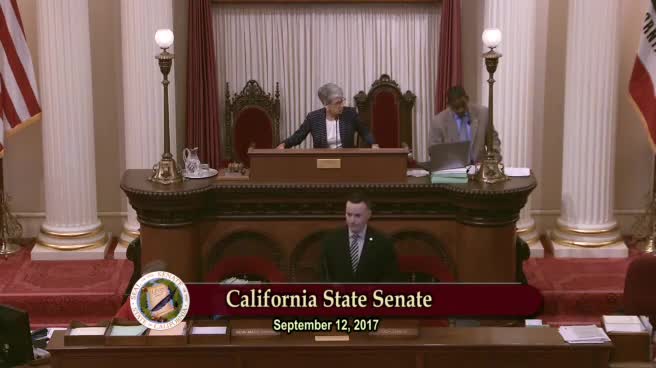 1MIN
Senate Floor
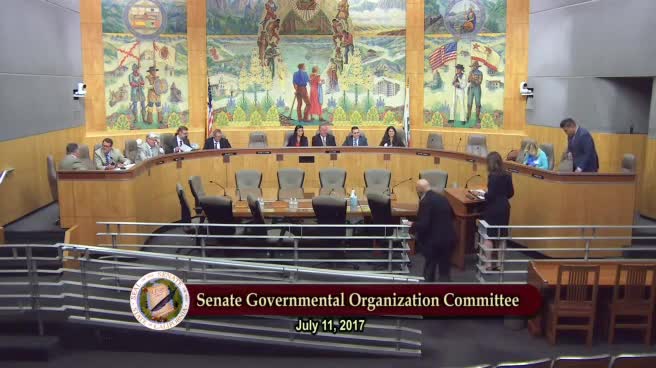 2MIN
Senate Standing Committee on Governmental Organization
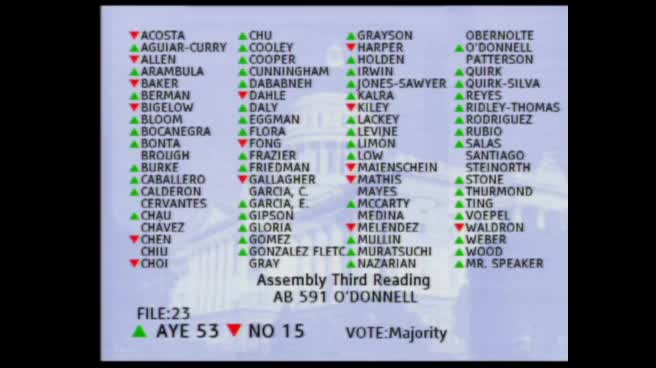 7MIN
Assembly Floor
 5MIN
Assembly Standing Committee on Appropriations
 2MIN
Assembly Standing Committee on Public Employees, Retirement, and Social Security
Bill Author

Bill Co-Author(s):