AB 2210: Public postsecondary education: community colleges: refugees and holders of certain special immigrant visas: exemption from paying nonresident tuition.
- Session Year: 2017-2018
- House: Assembly
- Latest Version Date: 2018-09-20
Existing law establishes the California Community Colleges, under the administration of the Board of Governors of the California Community Colleges, as one of the 3 segments of public postsecondary education in this state. Existing law exempts students who have been granted special immigrant visas pursuant to specified federal statutes, or are refugees admitted to the United States under a specified federal statute, and who, upon entering the United States, settled in California, from paying nonresident tuition at the California Community Colleges, as specified.
This bill would require each community college to post a notice on its Internet Web site that sets forth which persons are exempt from paying nonresident tuition pursuant to the provision described above. Because the bill would create new duties for community colleges, it would constitute a state-mandated local program.
The California Constitution requires the state to reimburse local agencies and school districts for certain costs mandated by the state. Statutory provisions establish procedures for making that reimbursement.
This bill would provide that, if the Commission on State Mandates determines that the bill contains costs mandated by the state, reimbursement for those costs shall be made pursuant to the statutory provisions noted above.
Existing law establishes the California Community Colleges, under the administration of the Board of Governors of the California Community Colleges, as one of the 3 segments of public postsecondary education in this state. Existing law provides for the appointment, by the board of governors, of the Chancellor of the California Community Colleges to serve as the chief executive officer of the segment. Existing law exempts students who have been granted special immigrant visas pursuant to specified federal statutes, or are refugees admitted to the United States under a specified federal statute, and who, upon entering the United States, settled in California, from paying nonresident tuition at the California Community Colleges, as specified.
This bill would require the Chancellors Office of the California Community Colleges to notify qualifying individuals that they are exempt from paying nonresident tuition under the statute described above if they enroll at a campus of the California Community Colleges. The bill would authorize the chancellors office, in implementing the bill, to consult with the Refugee Programs Bureau of the State Department of Social Services and with private sector resettlement agencies, and, where appropriate, to utilize mass media and electronic modes of communication to reach as many qualified individuals as is feasible. each community college to post a notice on its Internet Web site that sets forth which persons are exempt from paying nonresident tuition pursuant to the provision described above. Because the bill would create new duties for community colleges, it would constitute a state-mandated local program.
The California Constitution requires the state to reimburse local agencies and school districts for certain costs mandated by the state. Statutory provisions establish procedures for making that reimbursement.
This bill would provide that, if the Commission on State Mandates determines that the bill contains costs mandated by the state, reimbursement for those costs shall be made pursuant to the statutory provisions noted above.
Existing law establishes the California State University, the California Community Colleges, and the University of California as under the administration of the Board of Governors of the California Community Colleges, as one of the 3 segments of public postsecondary education in this state. Existing law provides for the appointment, by the board of governors, of the Chancellor of the California Community Colleges to serve as the chief executive officer of the segment. Existing law exempts students who have been granted special immigrant visas pursuant to a specified federal statute, statutes, or are refugees admitted to the United States under a specified federal statute, and who, upon entering the United States, settled in California, from paying nonresident tuition at the California Community Colleges. Existing law authorizes a community college district to report a student, who is exempt from nonresident tuition under this provision and who is enrolled as a student of that district, as a full-time equivalent student for apportionment purposes. Colleges, as specified.
This bill would exempt students granted special immigrant visas pursuant to an additional federal statute from paying nonresident tuition at the California Community Colleges. To the extent that this bill would place additional requirements on community college districts to exempt those students from nonresident tuition, the bill would impose a state-mandated local program. require the Chancellors Office of the California Community Colleges to notify qualifying individuals that they are exempt from paying nonresident tuition under the statute described above if they enroll at a campus of the California Community Colleges. The bill would authorize the chancellors office, in implementing the bill, to consult with the Refugee Programs Bureau of the State Department of Social Services and with private sector resettlement agencies, and, where appropriate, to utilize mass media and electronic modes of communication to reach as many qualified individuals as is feasible.
The California Constitution requires the state to reimburse local agencies and school districts for certain costs mandated by the state. Statutory provisions establish procedures for making that reimbursement.This bill would provide that, if the Commission on State Mandates determines that the bill contains costs mandated by the state, reimbursement for those costs shall be made pursuant to the statutory provisions noted above.Existing law establishes the California State University, the California Community Colleges, and the University of California as the 3 segments of public postsecondary education in this state. Existing law exempts students who have been granted special immigrant visas pursuant to a specified federal statute, or are refugees admitted to the United States under a specified federal statute, and who, upon entering the United States, settled in California, from paying nonresident tuition at the California Community Colleges. Existing law authorizes a community college district to report a student, who is exempt from nonresident tuition under this provision and who is enrolled as a student of that district, as a full-time equivalent student for apportionment purposes.
This bill would exempt students granted special immigrant visas pursuant to an additional federal statute from paying nonresident tuition at the California Community Colleges. To the extent that this bill would place additional requirements on community college districts to exempt those students from nonresident tuition, the bill would impose a state-mandated local program.
The California Constitution requires the state to reimburse local agencies and school districts for certain costs mandated by the state. Statutory provisions establish procedures for making that reimbursement.
This bill would provide that, if the Commission on State Mandates determines that the bill contains costs mandated by the state, reimbursement for those costs shall be made pursuant to the statutory provisions noted above.
Existing law requires the Superintendent of Public Instruction, with funds appropriated for these purposes, to administer general child care and development programs, as provided.This bill would make nonsubstantive changes to this law.Existing law requires the Superintendent of Public Instruction, with funds appropriated for these purposes, to administer general child care and development programs, as provided.
This bill would make nonsubstantive changes to this law.
Each community college shall post on its Internet Web site a notice that sets forth which persons are exempt from paying nonresident tuition pursuant to Section 68075.6.
SEC. 2.If the Commission on State Mandates determines that this act contains costs mandated by the state, reimbursement to local agencies and school districts for those costs shall be made pursuant to Part 7 (commencing with Section 17500) of Division 4 of Title 2 of the Government Code.
SECTION 1.Section 68075.65 is added to the Education Code, immediately following Section 68075.6, to read:68075.65.(a)The Chancellors Office of the California Community Colleges shall notify individuals with special immigrant visas who have been granted a status under Section 1244 of Public Law 110-181, under Public Law 109-163, or under Section 602(b) of Title VI of Division F of Public Law 111-8, or is a refugee admitted to the United States under Section 1157 of Title 8 of the United States Code, and who, upon entering the United States, have settled in California, that, pursuant to Section 68075.6, they are exempt from paying nonresident tuition if they enroll at a campus of the California Community Colleges.(b)In implementing this section, the Chancellors Office of the California Community Colleges is authorized to consult with the Refugee Programs Bureau of the State Department of Social Services and with private sector resettlement agencies and, where appropriate, to utilize mass media and electronic modes of communication to reach as many qualified individuals as is feasible.(a)The Chancellors Office of the California Community Colleges shall notify individuals with special immigrant visas who have been granted a status under Section 1244 of Public Law 110-181, under Public Law 109-163, or under Section 602(b) of Title VI of Division F of Public Law 111-8, or is a refugee admitted to the United States under Section 1157 of Title 8 of the United States Code, and who, upon entering the United States, have settled in California, that, pursuant to Section 68075.6, they are exempt from paying nonresident tuition if they enroll at a campus of the California Community Colleges.
(b)In implementing this section, the Chancellors Office of the California Community Colleges is authorized to consult with the Refugee Programs Bureau of the State Department of Social Services and with private sector resettlement agencies and, where appropriate, to utilize mass media and electronic modes of communication to reach as many qualified individuals as is feasible.
SECTION 1.Section 68075.6 of the Education Code is amended to read:68075.6.(a)The Legislature finds and declares all of the following:(1)The wars in Afghanistan, Iraq, Syria, and other countries have displaced many families, causing many of them to flee their homes in search of a better life. Between 2011 and March 2017, more than 36,000 refugees entered California, with nearly 8,000 of them entering in 2016.(2)Under the National Defense Authorization Act for Fiscal Year 2006, certain Afghan and Iraqi nationals were provided special immigrant status in the United States. Through the end of 2015, more than 37,000 individuals were granted special immigrant visa (SIV) status under this program. Between 2011 and March 2017, 9,200 SIV holders resettled in California.(3)Under the federal Afghan Allies Protection Act of 2009, certain Afghan nationals were provided special immigrant status in the United States.(4)Many of these families have escaped war and persecution in order to improve the lives of their families, but encounter numerous barriers, such as the cost of higher education, when assimilating into the United States. Access to institutions of higher education will ensure that students from these families are able to pursue their educational goals and rebuild and improve their lives and the lives of their families.(b)Notwithstanding any other law:(1)A student of the California Community Colleges who has a special immigrant visa that has been granted a status under Section 1244 of Public Law 110-181, under Public Law 109-163, or under Section 602(b) of Title VI of Division F of Public Law 111-8, or is a refugee admitted to the United States under Section 1157 of Title 8 of the United States Code, and who, upon entering the United States, settled in California, shall be exempt from paying the nonresident tuition fee required by Section 76140 for the length of time he or she lives in this state up to the minimum time necessary to become a resident.(2)A community college district may report a student, who is exempt from nonresident tuition pursuant to this section and who is enrolled as a student in that district, as a full-time equivalent student for apportionment purposes.SEC. 2.If the Commission on State Mandates determines that this act contains costs mandated by the state, reimbursement to local agencies and school districts for those costs shall be made pursuant to Part 7 (commencing with Section 17500) of Division 4 of Title 2 of the Government Code.(a)The Legislature finds and declares all of the following:
(1)The wars in Afghanistan, Iraq, Syria, and other countries have displaced many families, causing many of them to flee their homes in search of a better life. Between 2011 and March 2017, more than 36,000 refugees entered California, with nearly 8,000 of them entering in 2016.
(2)Under the National Defense Authorization Act for Fiscal Year 2006, certain Afghan and Iraqi nationals were provided special immigrant status in the United States. Through the end of 2015, more than 37,000 individuals were granted special immigrant visa (SIV) status under this program. Between 2011 and March 2017, 9,200 SIV holders resettled in California.
(3)Under the federal Afghan Allies Protection Act of 2009, certain Afghan nationals were provided special immigrant status in the United States.
(3)(4)Many of these families have escaped war and persecution in order to improve the lives of their families, but encounter numerous barriers, such as the cost of higher education, when assimilating into the United States. Access to institutions of higher education will ensure that students from these families are able to pursue their educational goals and rebuild and improve their lives and the lives of their families.
(b)Notwithstanding any other law:
(1)A student of the California Community Colleges who has a special immigrant visa that has been granted a status under Section 1244 of Public Law 110-181 or 110-181, under Public Law 109-163, or under Section 602(b) of Title VI of Division F of Public Law 111-8, or is a refugee admitted to the United States under Section 1157 of Title 8 of the United States Code, and who, upon entering the United States, settled in California, shall be exempt from paying the nonresident tuition fee required by Section 76140 for the length of time he or she lives in this state up to the minimum time necessary to become a resident.
(2)A community college district may report a student, who is exempt from nonresident tuition pursuant to this section and who is enrolled as a student in that district, as a full-time equivalent student for apportionment purposes.
SEC. 2.If the Commission on State Mandates determines that this act contains costs mandated by the state, reimbursement to local agencies and school districts for those costs shall be made pursuant to Part 7 (commencing with Section 17500) of Division 4 of Title 2 of the Government Code.
SECTION 1.Section 8240 of the Education Code is amended to read:8240.(a)The Superintendent, with funds appropriated for this purpose, shall administer general child care and development programs.(b)General child care and development programs shall include all of the following:(1)Age and developmentally appropriate activities for children.(2)Supervision.(3)Parenting education and parent involvement.(4)Social services that include, but are not limited to, identification of child and family needs and referral to appropriate agencies.(5)Health services.(6)Nutrition.(7)Training and career ladder opportunities, documentation of which shall be provided to the department.The Superintendent of Public Instruction, (a)The Superintendent, with funds appropriated for this purpose, shall administer general child care and development programs.
General(b)General child care and development programs shall include: include all of the following:
(a)(1)Age and developmentally appropriate activities for children.
(b)(2)Supervision.
(c)(3)Parenting education and parent involvement.
(d)(4)Social services that include, but are not limited to, identification of child and family needs and referral to appropriate agencies.
(e)(5)Health services.
(f)(6)Nutrition.
(g)(7)Training and career ladder opportunities, documentation of which shall be provided to the Department of Education. department.
|
Date
|
Status
|
|---|---|
| Sep 20, 2018 | Chaptered by Secretary of State - Chapter 582, Statutes of 2018. |
| Sep 20, 2018 | Approved by the Governor. |
| Sep 6, 2018 | Enrolled and presented to the Governor at 3 p.m. |
| Aug 29, 2018 | Senate amendments concurred in. To Engrossing and Enrolling. |
| Aug 14, 2018 | In Assembly. Concurrence in Senate amendments pending. May be considered on or after August 16 pursuant to Assembly Rule 77. |
| Aug 13, 2018 | Read third time. Passed. Ordered to the Assembly. |
| Aug 7, 2018 | Read second time. Ordered to Consent Calendar. |
| Aug 6, 2018 | From committee: Be ordered to second reading file pursuant to Senate Rule 28.8 and ordered to Consent Calendar. |
| Jul 5, 2018 | Read second time and amended. Re-referred to Com. on APPR. |
| Jul 3, 2018 | From committee: Amend, and do pass as amended and re-refer to Com. on APPR. with recommendation: To Consent Calendar. (Ayes 7. Noes 0.) (June 27). |
| Jun 13, 2018 | From committee chair, with author's amendments: Amend, and re-refer to committee. Read second time, amended, and re-referred to Com. on ED. |
| Jun 6, 2018 | In committee: Hearing postponed by committee. |
| May 29, 2018 | In committee: Set, first hearing. Hearing canceled at the request of author. |
| May 3, 2018 | Referred to Com. on ED. |
| Apr 23, 2018 | In Senate. Read first time. To Com. on RLS. for assignment. |
| Apr 23, 2018 | Read third time. Passed. Ordered to the Senate. |
| Apr 19, 2018 | Read second time. Ordered to third reading. |
| Apr 18, 2018 | From committee: Do pass. (Ayes 13. Noes 1.) (April 18). |
| Apr 4, 2018 | From committee: Do pass and re-refer to Com. on APPR. (Ayes 13. Noes 0.) (April 3). Re-referred to Com. on APPR. |
| Mar 19, 2018 | Re-referred to Com. on HIGHER ED. |
| Mar 15, 2018 | Referred to Com. on HIGHER ED. |
| Feb 13, 2018 | From printer. May be heard in committee March 15. |
| Feb 12, 2018 | Read first time. To print. |
|
Date
|
Description
|
Location
|
Votes
|
|
|---|---|---|---|---|
| Aug 29, 2018 | AB 2210 MCCARTY Concurrence in Senate Amendments | Assembly Floor |
Passed |
|
| Aug 13, 2018 | Consent Calendar AB2210 | Senate Floor |
Passed |
|
| Jun 27, 2018 | Do pass as amended, but first amend, and re-refer to the Committee on [Appropriations] with the recommendation: To Consent Calendar | Senate Standing Committee on Education |
Passed |
|
| Apr 23, 2018 | AB 2210 MCCARTY Assembly Third Reading | Assembly Floor |
Passed |
|
| Apr 18, 2018 | Do pass. | Assembly Standing Committee on Appropriations |
Passed |
|
| Apr 3, 2018 | Do pass and be re-referred to the Committee on [Appropriations] | Assembly Standing Committee on Higher Education |
Passed |
This list shows positions taken on this bill by organizations on the date displayed, which is linked to the original source.
Positions by individuals are not included.
|
Organization
|
Position
|
Date
|
|---|---|---|
| American Academy Of Pediatrics, California | ** Support | Apr 2, 2018 |
| California Teacher's Association | ** Support | Aug 8, 2018 |
CONCURRENCE IN SENATE AMENDMENTS
CSA1 Bill Id:AB 2210
Author:(McCarty)
As Amended Ver:July 5, 2018
Majority vote
ASSEMBLY: | 68-4 | (April 23, 2018) | SENATE: | 37-0 | (August 13, 2018) |
Original Committee Reference: HIGHER ED.
SUMMARY: Requires each California Community College (CCC) to post on its Internet Web site a notice that specifies which refugee or holders of special immigrant visas (SIVs), as defined, are exempt from paying nonresident fees.
The Senate amendments delete the Assembly version of this bill and instead require each community college post on its Internet Web site a notice that indicates which persons are exempt from paying nonresident tuition pursuant to Education Code (EC) Section 68075.6.
To note, the Senate amendments appear to be aligned to the policy contained in the version of the bill as it passed out of the Assembly.
EXISTING LAW:
Federal law.
- Provides eligibility for special immigrant visas to certain Iraqi and Afghan nationals who worked directly with the United States Armed Forces, as interpreters, translators, or otherwise. Upon admission to the United States, holders of SIVs are granted lawful permanent resident status under the Immigration and Nationality Act (Public Law 110-181, Section 1244 and Public Law 109-163).
- Authorizes, under the Immigration and Nationality Act, as amended by the Refugee Act of 1980, the admission and resettlement of refugees, which comprise a category of humanitarian admissions and are persons unwilling or unable to return to their home countries "because of persecution or a well-founded fear of persecution on account of race, religion, nationality, membership in a particular social group, or political opinion." After one year of refugee status in the United States, refugees are required to apply to adjust to lawful permanent resident status (8 United States Code Section 1157).
State law.
- Requires each student to be classified as a resident or nonresident for purposes of determining enrollment fees and requires a student classified as a nonresident to pay nonresident tuition in addition to other tuition and fees required by the institution (EC Sections 68050 and 68040.)
- Exempts a CCC student who has an SIV that has been granted a status under Public Law 110-181, Section 1244 or under Public Law 109-163, or is a refugee admitted to the United States under the Title 8 of the United States Code, Section 1157, and who, upon entering the United States, settled in California, from paying the nonresident tuition fee for the length of time he or she lives in this state up to the minimum time necessary to become a resident (typically one year) (EC Section 68075.6.).
FISCAL EFFECT: According to the Senate Appropriations Committee, pursuant to Senate Rule 28.8, negligible state costs.
COMMENTS: Background. Last year, AB 343 (McCarty), Chapter 491, Statutes of 2017 provided the nonresident tuition exemption described above for refuges and SIV holders from Iraq and Afghanistan. In carrying that legislation, the author argued these individuals and families "have escaped war and persecution in order to improve the lives of their family, but encounter numerous barriers when assimilating into the United States such as the cost of higher education."
Purpose. This measure is a clean-up measure; fulfilling the intent of AB 343.
Analysis Prepared by: Jeanice Warden / HIGHER ED. / (916) 319-3960 FN: 0003870
Office of Senate Floor Analyses (916) 651-1520 Fax: (916) 327-4478 | AB |
CONSENT
Bill No: AB 2210
:
SENATE EDUCATION COMMITTEE: 7-0, 6/27/18
AYES: Allen, Wilk, Galgiani, Leyva, McGuire, Pan, Vidak
SENATE APPROPRIATIONS COMMITTEE: Senate Rule 28.8
ASSEMBLY FLOOR: 68-4, 4/23/18 - See last page for vote
DIGEST:
This bill requires each California community college (CCC) to post a notice on its Internet Web site informing individuals of an existing law that exempts persons who have special immigrant visas or refugee status from paying nonresident tuition at a CCC.
Existing federal law:
- Provides eligibility for special immigrant visas to certain Iraqi and Afghan nationals who worked directly with the U.S. Armed Forces, as interpreters, translators, or otherwise. Upon admission to the U.S., holders of SIVs are granted lawful permanent resident status under the Immigration and Nationality Act. (§1244 of Public Law 110-181 and Public Law 109-163)
- Authorizes, under the Immigration and Nationality Act, as amended by the Refugee Act of 1980, the admission and resettlement of refugees, which comprise a category of humanitarian admissions and are persons unwilling or unable to return to their home countries "because of persecution or a well-founded fear of persecution on account of race, religion, nationality, membership in a particular social group, or political opinion." After one year of refugee status in the U.S., refugees are required to apply to adjust to lawful permanent resident status. (8 U.S. Code § 1157).
Existing state law:
- Requires each student to be classified as a resident or nonresident for purposes of determining enrollment fees and requires a student classified as a nonresident to pay nonresident tuition in addition to other tuition and fees required by the institution. (Education Code § 68050 and 68040.)
- Provides exempts certain individuals from paying nonresident tuition at the CCCs including students with Special Immigrant Visas and refugees admitted to the United States under a specified federal statute. (EC § 68075.5(a), 68130.5 and 68122.)
This bill requires each CCC to post a notice on its Internet Web site informing individuals of an existing law that exempts persons who have special immigrant visas or refugee status from paying nonresident tuition at a CCC.
Comments
- Need for the bill. Existing law authorizes CCCs to charge a higher tuition rate for non-California residents. Existing law also provides that students with special immigrant visas or refugee status are exempt from being charged the nonresident rate. According to the author, although the current law exempts them from nonresident fees, it falls short of a mechanism for engaging and notifying this population.
- Target group. Individuals who meet the criteria for the existing exemption relative to the bill include:
- Special Immigrant Visas. A report by the Congressional Research Service report on, “Iraqi and Afghan SIV Programs,” notes, Congress enacted a series of legislative provisions since 2006 to enable certain Iraqi and Afghan nationals to become U.S. lawful permanent residents. These provisions make certain Iraqis and Afghans who have worked as translators or interpreters, or who were employed by, or on behalf of, the U.S. government in Iraq or Afghanistan, eligible for special immigrant visas. There are three SIV programs, two of the three are temporary and cap the total number of visas issued for the life of the program. The remaining program is permanent with a cap of 50 visas per year. Through the end of 2015, more than 37,000 individuals were granted special immigrant status under those programs. Approximately 2,009 of those individuals settled in California in 2015.
- Refugees. Unlike special immigrants, refugees comprise a category of humanitarian admissions under the Immigration and Nationality Act. As defined in the Immigration and Nationality Act, a refugee is a person who is unwilling or unable to return to his or her country, “because of persecution or a well-founded fear of persecution on account of race, religion, nationality, membership in a particular social group, or political opinion.” After one year in refugee status they are required to apply to adjust to legal permit resident status. Some individuals may be eligible to apply for both refugee status and for classification under the Iraqi or Afghan SIV programs. In 2016, according to the California Department of Social Services-Refugee Programs Bureau, 7,908 refugees arrived in California.
This bill seeks to ensure these groups of students are aware of their eligibility for the lower resident tuition rate.
FISCAL EFFECT: Appropriation: Fiscal Com.: Local:
California Teacher’s Association
None received
ASSEMBLY FLOOR: 68-4, 4/23/18
AYES: Acosta, Aguiar-Curry, Arambula, Baker, Berman, Bigelow, Bloom, Bonta, Burke, Caballero, Calderon, Carrillo, Cervantes, Chau, Chávez, Chen, Chiu, Choi, Chu, Cooley, Cooper, Cunningham, Dahle, Daly, Eggman, Flora, Fong, Frazier, Friedman, Gipson, Gloria, Gonzalez Fletcher, Gray, Grayson, Holden, Irwin, Jones-Sawyer, Kalra, Kamlager-Dove, Kiley, Lackey, Levine, Limón, Low, Maienschein, Mathis, Mayes, McCarty, Medina, Mullin, Muratsuchi, Nazarian, Obernolte, O'Donnell, Quirk-Silva, Reyes, Rodriguez, Rubio, Salas, Santiago, Steinorth, Mark Stone, Thurmond, Ting, Voepel, Weber, Wood, Rendon
NOES: Brough, Harper, Melendez, Waldron
NO VOTE RECORDED: Travis Allen, Gallagher, Cristina Garcia, Eduardo Garcia, Patterson, Quirk
8/8/18 10:12:21
**** END ****
SENATE COMMITTEE ON EDUCATION
Senator Benjamin Allen, Chair
2017 - 2018 Regular
Bill No: AB 2210 Hearing Date: June 27, 2018
Author: | McCarty | ||
Version: | June 13, 2018 | ||
Urgency: | No | Fiscal: | Yes |
Consultant: | Olgalilia Ramirez | ||
Subject: Public postsecondary education: community colleges: refugees and holders of certain special immigrant visas: exemption from nonresident tuition.
SUMMARY
This bill requires the Chancellor’s Office of the California Community Colleges (CCCs) to notify individuals who have been granted special immigrant visas and refugees, enrolling at a community college that they are exempt from paying nonresident tuition as specified under current law.
BACKGROUND
Existing Law:
- Under federal law, provides eligibility for special immigrant visas to certain Iraqi and Afghan nationals who worked directly with the U.S. Armed Forces, as interpreters, translators, or otherwise. Upon admission to the U.S., holders of SIVs are granted lawful permanent resident status under the Immigration and Nationality Act. (§1244 of Public Law 110-181 and Public Law 109-163)
- Under federal law, the Immigration and Nationality Act, as amended by the Refugee Act of 1980, also authorizes the admission and resettlement of refugees, which comprise a category of humanitarian admissions and are persons unwilling or unable to return to their home countries "because of persecution or a well-founded fear of persecution on account of race, religion, nationality, membership in a particular social group, or political opinion." After one year of refugee status in the U.S., refugees are required to apply to adjust to lawful permanent resident status. (8 U.S. Code § 1157).
- Under state law, requires each student to be classified as a resident or nonresident for purposes of determining enrollment fees and requires a student classified as a nonresident to pay nonresident tuition in addition to other tuition and fees required by the institution. (Education Code § 68050 and 68040.)
- Provides exempts certain individuals from paying nonresident tuition at the CCCs including students with Special Immigrant Visas and refugees admitted to the United States under a specified federal statute. (EC § 68075.5(a), 68130.5 and 68122.)
ANALYSIS
This bill:
- Requires the Chancellor’s Office of the California Community Colleges (CCCs) to notify individuals who have been granted special immigrant visas and refugees, enrolling at a community college that they are exempt from paying nonresident tuition as specified under current law.
- Authorizes the Chancellor’s Office of the CCCs to consult with the Refugee Programs Bureau of the State Department of Social Services and with private sector resettlement agencies and, where appropriate, utilize mass media and electronic modes of communication to reach as many qualified individuals as is feasible.
STAFF COMMENTS
- Need for the bill. According to the author, “Over the last 15 years, approximately 112,000 refugees have resettled in over 440 California cities and communities (U.S. State Department), and 36,000 refugees have resettled in California in just the past six years. San Diego, Los Angeles and Sacramento have experienced the largest influx of refugees. Since 2002, San Diego welcomed over 31,000 refugees; Los Angeles had 30,000; and Sacramento 20,000. Through the end of 2015, more than 37,000 individuals were granted Special Immigrant Visa (SIV) status under this program. Afghan and Iraqi SIVs meet the definition of Special Immigrants as defined in Section 1244(g) of Div. A. of Public Law 110-181. Sacramento County is home to the largest population of Afghan Special Immigrant Visa (SIV) holders in the country.
The wars in Afghanistan and Iraq have displaced thousands of families, causing many to flee their homes in search of a better life. During these wars, many Afghani and Iraqi nationals assisted or were employed by the U.S. government as translators or advisors. Under the National Defense Authorization Act of 2006 and the Afghan Allies Protection Act of 2009, certain Afghani and Iraqi nationals were provided special immigrant status in the U.S…
Prior to passage of AB 343 in 2017, SIVs attending a California Community College paid international tuition averaging $234 per unit, compared to $46 per unit for in-state resident tuition (Ed Code Section 68075.6). Although the current law exempts them from nonresident fees, it falls short of a mechanism for engaging and notifying this hard-to-reach population. Unfortunately, many refugees in California have limited access and knowledge of the resources, services, and benefits that are available to them. Once acclaimed professionals in the fields of medicine, law, technology, accounting and financial services, they find themselves unable to easily navigate the many educational, credentialing and certification obstacles on their own. Therefore, the State has a special obligation to take the lead in coordinating with the State’s Refugee Programs Bureau, and nonprofit resettlement agencies, to outreach to individuals who would benefit under the new law and, consequently, would choose to enroll at a California Community College.”
- Target group. Individuals who meet the criteria for the existing exemption:
a) Special Immigrant Visas. A report by the Congressional Research Service report on, “Iraqi and Afghan SIV Programs,” notes, Congress enacted a series of legislative provisions since 2006 to enable certain Iraqi and Afghan nationals to become U.S. lawful permanent residents. These provisions make certain Iraqis and Afghans who have worked as translators or interpreters, or who were employed by, or on behalf of, the U.S. government in Iraq or Afghanistan, eligible for special immigrant visas. There are three SIV programs, two of the three are temporary and cap the total number of visas issued for the life of the program. The remaining program is permanent with a cap of 50 visas per year. Through the end of 2015, more than 37,000 individuals were granted special immigrant status under those programs. Approximately 2,009 of those individuals settled in California in 2015.
b) Refugees. Unlike special immigrants, refugees comprise a category of humanitarian admissions under the Immigration and Nationality Act. As defined in the Immigration and Nationality Act, a refugee is a person who is unwilling or unable to return to his or her country, “because of persecution or a well-founded fear of persecution on account of race, religion, nationality, membership in a particular social group, or political opinion.” After one year in refugee status they are required to apply to adjust to legal permit resident status. Some individuals may be eligible to apply for both refugee status and for classification under the Iraqi or Afghan SIV programs. In 2016, according to the California Department of Social Services-Refugee Programs Bureau, 7,908 refugees arrived in California.
This bill seeks to ensure this subgroup is aware that they are eligible to pay the lower resident tuition rate.
- Individual notification has some challenges. This bill requires the Community College Chancellor’s Office (CCCO) to inform the specified students of their eligibility for the exemption from paying nonresident tuition. Implementation could be challenging as the CCCO has limited capacity for identifying individuals enrolling at a campus. This bill also authorizes the CCCO to consult with the state’s Refugee Programs Bureau to reach qualified individuals. The Refugee Programs Bureau is a state entity responsible for managing and coordinating the delivery of benefits and services to the refugee and entrant populations of California in partnership with counties and local refugee service providers. Given that Refugee Program’s Bureau coordinates resources for the state’s refugee population; the author may wish to consider whether identification and notification of qualified individuals for the community college benefit is a responsibility best suited for the Bureau.
Staff recommends that the bill be amended to rather than require the Chancellor’s Office to notify individuals, require that the notification for the exemption from nonresident tuition pursuant to 68075.6 be posted on the Internet Web site of each California Community College and delete remaining provisions of the bill.
SUPPORT
California Teachers Association
OPPOSITION
None received
-- END --
ASSEMBLY THIRD READING
ATR Bill Id:AB 2210
Author:(McCarty)
As Amended Ver:March 15, 2018
Majority vote
Committee | Votes | Ayes | Noes |
Higher Education | 13-0 | Medina, Baker, Arambula, Bloom, Chávez, Irwin, Kiley, Mark Stone, Low, Patterson, Quirk-Silva, Santiago, Weber | |
Appropriations | 13-1 | Gonzalez Fletcher, Bigelow, Bloom, Bonta, Calderon, Carrillo, Chau, McCarty, Fong, Friedman, Nazarian, Obernolte, Reyes | Brough |
SUMMARY: This technical clean-up bill adds a reference to a specific federal law to legislation enacted last year that exempts a student who is a refugee or a special immigrant visa (SIV) holder from Iraq and Afghanistan, as defined, and who upon entering the United States settled in California, from paying nonresident fees at a California Community College (CCC) up to the minimum time necessary to become a resident.
EXISTING LAW: Exempts a CCC student who has an SIV that has been granted a status under Public Law 110-18, Section 1244 or under Public Law 109-163, or is a refugee admitted to the United States under the Title 8 of the United States Code, Section 1157, and who, upon entering the United States, settled in California, from paying the nonresident tuition fee for the length of time he or she lives in this state up to the minimum time necessary to become a resident (typically one year). (Education Code Section 68075.6.)
FISCAL EFFECT: According to the Assembly Appropriations Committee, no additional cost.
COMMENTS: Background. Last year, AB 343 (McCarty), Chapter 491, Statutes of 2017 provided the nonresident tuition exemption described above for refuges and SIV holders from Iraq and Afghanistan. In carrying that legislation, the author argued these individuals and families "have escaped war and persecution in order to improve the lives of their family, but encounter numerous barriers when assimilating into the United States such as the cost of higher education."
Purpose. This clean-up measure simply adds to the above statute a reference to Public Law 111-8, Division F, Title VI, Section 602(b), which is known as the Afghan Allies Protection Act of 2009. AB 343 included the federal code citation for Iraqi SIVs but mistakenly omitted this federal code section for Afghani SIVs. This bill thus fulfills the intent of AB 343.
Analysis Prepared by: Chuck Nicol / HIGHER ED. / (916) 319-3960 FN: 0002705
Date of Hearing: April 18, 2018
ASSEMBLY COMMITTEE ON APPROPRIATIONS
Lorena Gonzalez Fletcher, Chair
ABPCA Bill Id:AB 2210
Author:(McCarty) – As Amended Ver:March 15, 2018
Policy Committee: | Higher Education | Vote: | 13 - 0 |
|
| ||
|
|
Urgency: No State Mandated Local Program: Yes Reimbursable: No
SUMMARY: This clean-up bill adds reference to a specific federal law to statute enacted last year that exempts a student who is a refugee or a special immigrant visa (SIV) holder from Iraq and Afghanistan from paying nonresident tuition at a California community college.
FISCAL EFFECT:
No additional cost.
COMMENTS:
Background. Chapter 491, Statutes of 2017 (AB 343, McCarty), provides tuition exemption for refugees and SIV holders from Iraq and Afghanistan. Although the bill explicitly named refugees and SIV holders from both counties as the beneficiaries of the bill’s nonresident tuition exemption, it only referenced the federal code citation for those from Iraq. Soon after the bill was enacted, the California Community College Chancellor’s Office sent out a legal advisory to colleges that included a reference to nonresident tuition exemption for refugees and SIV holders from Iraq, but did not mention Afghanistan. A local refugee resettlement agency contacted the Chancellor’s Office to notify them of the legal advisory’s omission. The Chancellor’s Office acknowledged the omission and identified the missing federal code reference needed to apply the exemption to individuals meeting requirements from Afghanistan (the Afghan Allies Protection Act of 2009 [Section 602 (b) of Public Law 111-8]).
To clarify that Chapter 491, Statutes of 2017, also applied to refugees and SIV holders from Afghanistan, the author introduced this bill, which includes the missing federal code reference.
Analysis Prepared by: Natasha Collins / APPR. / (916) 319-2081
Date of Hearing: April 3, 2018
ASSEMBLY COMMITTEE ON HIGHER EDUCATION
Jose Medina, Chair
ABPCA Bill Id:AB 2210 (
Author:McCarty) – As Amended Ver:March 15, 2018
SUBJECT: Public postsecondary education: holders of certain special immigrant visas
SUMMARY: This technical clean-up bill adds a reference to a specific federal law to legislation enacted last year that exempts a student who is a refugee or a special immigrant visa (SIV) holder from Iraq and Afghanistan, as defined, and who upon entering the United States settled in California, from paying nonresident fees at a California Community College (CCC) up to the minimum time necessary to become a resident.
EXISTING LAW: Exempts a CCC student who has an SIV that has been granted a status under Section 1244 of Public Law 110-181 or under Public Law 109-163, or is a refugee admitted to the United States under Section 1157 of Title 8 of the United States Code, and who, upon entering the United States, settled in California, from paying the nonresident tuition fee for the length of time he or she lives in this state up to the minimum time necessary to become a resident (typically one year). (Education Code Section 68075.6.)
FISCAL EFFECT: Unknown
COMMENTS: Background. Last year, Chapter 491, Statutes of 2017 (AB 343, McCarty) provided the nonresident tuition exemption described above for refuges and SIV holders from Iraq and Afghanistan. In carrying that legislation, the author argued these individuals and families "have escaped war and persecution in order to improve the lives of their family, but encounter numerous barriers when assimilating into the United States such as the cost of higher education.”
Purpose. This clean-up measure simply adds to the above statute a reference to Section 602(b) of Title VI of Division F of Public Law 111-8, which is known as the Afghan Allies Protection Act of 2009. AB 343 included the federal code citation for Iraqi SIVs but mistakenly omitted this federal code section for Afghani SIVs. AB 2210 thus fulfills the intent of AB 343.
REGISTERED SUPPORT / OPPOSITION:
Support
American Academy of Pediatrics, California
Opposition
None on file.
Analysis Prepared by: Chuck Nicol / HIGHER ED. / (916) 319-3960
Discussed in Hearing
View Older Hearings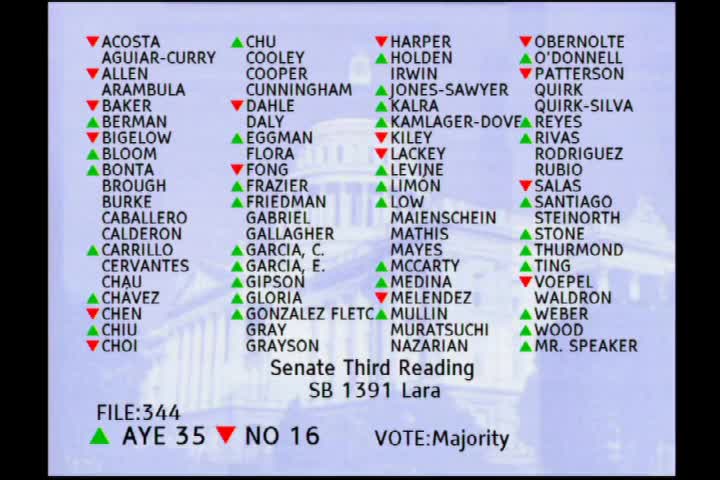
Bill Author

Bill Co-Author(s):