AB 2227: Motorcycles: hang tags.
- Session Year: 2017-2018
- House: Assembly
- Latest Version Date: 2018-08-24
Existing law imposes specified requirements on manufacturers and dealers of motor vehicles and motorcycles sold or leased in this state. Existing law prohibits a dealer from selling, offering for sale, or displaying, any new, assembled motorcycle on its premises, unless there is securely attached to the handlebars of the motorcycle a label, approved by the Department of Motor Vehicles, furnished by the manufacturer of the motorcycle. Under existing law, that label is required to clearly indicate specified information, including the recommended retail price of the motorcycle and the recommended price for each accessory or item of optional equipment physically attached to the motorcycle at the time of its delivery to the dealer. A violation of these provisions is a crime.
This bill would require that label to be in the form of a hang tag, and to include the manufacturers suggested retail price, as defined, for that motorcycle, and the vehicle identification number of that motorcycle. The bill would prohibit a dealer from affixing a supplemental price label containing a price that represents the dealers asking price that exceeds the manufacturers suggested retail price unless the label complies with specified requirements and disclosures. The bill would make additional conforming changes. Because a violation of these requirements would be a crime, the bill would impose a state-mandated local program.
The California Constitution requires the state to reimburse local agencies and school districts for certain costs mandated by the state. Statutory provisions establish procedures for making that reimbursement.
This bill would provide that no reimbursement is required by this act for a specified reason.
It is a violation of this code for the holder of a dealers license issued under this article to do any of the following:
(a)Advertise a specific vehicle for sale without identifying the vehicle by its model, model-year, and either its license number or that portion of the vehicle identification number that distinguishes the vehicle from all other vehicles of the same make, model, and model-year. Model-year is not required to be advertised for current model-year vehicles. Year models are no longer current when ensuing year models are available for purchase at retail in California. An advertisement that offers for sale a class of new vehicles in a dealers inventory, consisting of five or more vehicles, that are all of the same make, model, and model-year is not required to include in the advertisement the vehicle identification numbers or license numbers of those vehicles.
(b)Advertise the total price of a vehicle without including all costs to the purchaser at time of sale, except taxes, vehicle registration fees, the California tire fee, as defined in Section 42885 of the Public Resources Code, emission testing charges not exceeding fifty dollars ($50), actual fees charged for certificates pursuant to Section 44060 of the Health and Safety Code, finance charges, and any dealer document processing charge or charge to electronically register or transfer the vehicle.
(c)(1)Exclude from an advertisement of a vehicle for sale that there will be added to the advertised total price at the time of sale, charges for sales tax, vehicle registration fees, the California tire fee, the fee charged by the state for the issuance of a certificate of compliance or noncompliance pursuant to a statute, finance charges, a charge to electronically register or transfer the vehicle, and a dealer document processing charge.
(2)The obligations imposed by paragraph (1) are satisfied by adding to the advertisement a statement containing no abbreviations and that is worded in substantially the following form: Plus government fees and taxes, any finance charges, any dealer document processing charge, any electronic filing charge, and any emission testing charge.
(3)For purposes of paragraph (1), advertisement means an advertisement in a newspaper, magazine, or direct mail publication that is two or more columns in width or one column in width and more than seven inches in length, or on a Web page of a dealers Internet Web site that displays the price of a vehicle offered for sale on the Internet, as that term is defined in paragraph (6) of subdivision (f) of Section 17538 of the Business and Professions Code.
(d)Represent the dealer document processing charge, electronic registration or transfer charge, or emission testing charge, as a governmental fee.
(e)Fail to sell a vehicle to a person at the advertised total price, exclusive of taxes, vehicle registration fees, the California tire fee, the fee charged by the state for the issuance of a certificate of compliance or noncompliance pursuant to a statute, finance charges, mobilehome escrow fees, the amount of a city, county, or city and county imposed fee or tax for a mobilehome, a dealer document processing charge, an electronic registration or transfer charge, and a charge for emission testing not to exceed fifty dollars ($50) plus the actual fees charged for certificates pursuant to Section 44060 of the Health and Safety Code, while the vehicle remains unsold, unless the advertisement states the advertised total price is good only for a specified time and the time has elapsed. Advertised vehicles shall be sold at or below the advertised total price, with statutorily permitted exclusions, regardless of whether the purchaser has knowledge of the advertised total price.
(f)(1)Advertise for sale, sell, or purchase for resale a new vehicle of a line-make for which the dealer does not hold a franchise.
(2)This subdivision does not apply to a transaction involving the following:
(A)A mobilehome.
(B)A commercial coach, as defined in Section 18001.8 of the Health and Safety Code.
(C)An off-highway motor vehicle subject to identification as defined in Section 38012.
(D)A manufactured home.
(E)A new vehicle that will be substantially altered or modified by a converter prior to resale.
(F)A commercial vehicle with a gross vehicle weight rating of more than 10,000 pounds.
(G)A vehicle purchased for export and exported outside the territorial limits of the United States without being registered with the department.
(H)A vehicle acquired in the ordinary course of business as a new vehicle by a dealer franchised to sell that vehicle, if all of the following apply:
(i)The manufacturer or distributor of the vehicle files a bankruptcy petition.
(ii)The franchise agreement of the dealer is terminated, canceled, or rejected by the manufacturer or distributor as part of the bankruptcy proceedings and the termination, cancellation, or rejection is not a result of the revocation by the department of the dealers license or the dealers conviction of a crime.
(iii)The vehicle is held in the inventory of the dealer on the date the bankruptcy petition is filed.
(iv)The vehicle is sold by the dealer within six months of the date the bankruptcy petition is filed.
(3)Subparagraph (H) of paragraph (2) does not entitle a dealer whose franchise agreement has been terminated, canceled, or rejected to continue to perform warranty service repairs or continue to be eligible to offer or receive consumer or dealer incentives offered by the manufacturer or distributor.
(g)Sell a park trailer, as specified in Section 18009.3 of the Health and Safety Code, without disclosing in writing to the purchaser that a park trailer is required to be moved by a transporter or a licensed manufacturer or dealer under a permit issued by the Department of Transportation or a local authority with respect to highways under their respective jurisdictions.
(h)Advertise free merchandise, gifts, or services provided by a dealer contingent on the purchase of a vehicle. Free includes merchandise or services offered for sale at a price less than the sellers cost of the merchandise or services.
(i)(1)Advertise vehicles, and related goods or services, at a specified dealer price, with the intent not to supply reasonably expectable demand, unless the advertisement discloses the number of vehicles in stock at the advertised price. In addition, whether or not there are sufficient vehicles in stock to supply a reasonably expectable demand, when phrases such as starting at, from, beginning as low as, or words of similar import are used in reference to an advertised price, the advertisement shall disclose the number of vehicles available at that advertised price.
(2)For purposes of this subdivision, in a newspaper advertisement for a vehicle that is two model-years old or newer, the actual phrase that states the number of vehicles in stock at the advertised price shall be printed in a type size that is at least equal to one-quarter of the type size, and in the same style and color of type, used for the advertised price. However, in no case shall the phrase be printed in less than 8-point type size, and the phrase shall be disclosed immediately above, below, or beside the advertised price without intervening words, pictures, marks, or symbols.
(3)The disclosure required by this subdivision is in addition to any other disclosure required by this code or any regulation regarding identifying vehicles advertised for sale.
(j)Use rebate or similar words, including, but not limited to, cash back, in advertising the sale of a vehicle unless the rebate is expressed in a specific dollar amount and is in fact a rebate offered by the vehicle manufacturer or distributor, a finance company affiliated with a vehicle manufacturer or distributor, a regulated utility, or a governmental entity directly to the retail purchaser of the vehicle or to the assignee of the retail purchaser.
(k)Require a person to pay a higher price for a vehicle and related goods or services for receiving advertised credit terms than the cash price the same person would have to pay to purchase the same vehicle and related goods or services. For the purpose of this subdivision, cash price has the same meaning as defined in subdivision (e) of Section 2981 of the Civil Code.
(l)Advertise a guaranteed trade-in allowance.
(m)Misrepresent the authority of a salesperson, representative, or agent to negotiate the final terms of a transaction.
(n)(1)Use invoice, dealers invoice, wholesale price, or similar terms that refer to a dealers cost for a vehicle in an advertisement for the sale of a vehicle or advertise that the selling price of a vehicle is above, below, or at either of the following:
(A)The manufacturers or distributors invoice price to a dealer.
(B)A dealers cost.
(2)This subdivision does not apply to either of the following:
(A)A communication occurring during face-to-face negotiations for the purchase of a specific vehicle if the prospective purchaser initiates a discussion of the vehicles invoice price or the dealers cost for that vehicle.
(B)A communication between a dealer and a prospective commercial purchaser that is not disseminated to the general public. For purposes of this subparagraph, a commercial purchaser means a dealer, lessor, lessor-retailer, manufacturer, remanufacturer, distributor, financial institution, governmental entity, or person who purchases 10 or more vehicles during a year.
(o)Violate a law prohibiting bait and switch advertising, including, but not limited to, the guides against bait advertising set forth in Part 238 (commencing with Section 238) of Title 16 of the Code of Federal Regulations, as those regulations read on January 1, 1988.
(p)Make an untrue or misleading statement indicating that a vehicle is equipped with all the factory-installed optional equipment the manufacturer offers, including, but not limited to, a false statement that a vehicle is fully factory equipped.
(q)Except as provided in Section 24014, affix on a new vehicle a supplemental price sticker containing a price that represents the dealers asking price that exceeds the manufacturers suggested retail price unless all of the following occur:
(1)The supplemental sticker clearly and conspicuously discloses in the largest print appearing on the sticker, other than the print size used for the dealers name, that the supplemental sticker price is the dealers asking price, or words of similar import, and that it is not the manufacturers suggested retail price.
(2)The supplemental sticker clearly and conspicuously discloses the manufacturers suggested retail price.
(3)The supplemental sticker lists each item that is not included in the manufacturers suggested retail price, and discloses the additional price of each item. If the supplemental sticker price is greater than the sum of the manufacturers suggested retail price and the price of the items added by the dealer, the supplemental sticker price shall set forth that difference and describe it as added mark-up.
(r)Advertise an underselling claim, including, but not limited to, we have the lowest prices or we will beat any dealers price, unless the dealer has conducted a recent survey showing that the dealer sells its vehicles at lower prices than another licensee in its trade area and maintains records to adequately substantiate the claims. The substantiating records shall be made available to the department upon request.
(s)(1)Advertise an incentive offered by the manufacturer or distributor if the dealer is required to contribute to the cost of the incentive as a condition of participating in the incentive program, unless the dealer discloses in a clear and conspicuous manner that dealer participation may affect consumer cost.
(2)For purposes of this subdivision, incentive means anything of value offered to induce people to purchase a vehicle, including, but not limited to, discounts, savings claims, rebates, below-market finance rates, and free merchandise or services.
(t)Display or offer for sale a used vehicle unless there is affixed to the vehicle the Federal Trade Commissions Buyers Guide as required by Part 455 of Title 16 of the Code of Federal Regulations.
(u)Fail to disclose in writing to the franchisor of a new motor vehicle dealer the name of the purchaser, date of sale, and the vehicle identification number of each new motor vehicle sold of the line-make of that franchisor, or intentionally submit to that franchisor a false name for the purchaser or false date for the date of sale.
(v)Enter into a contract for the retail sale of a motor vehicle unless the contract clearly and conspicuously discloses whether the vehicle is being sold as a new vehicle or a used vehicle, as defined in this code.
(w)Use a simulated check, as defined in subdivision (a) of Section 22433 of the Business and Professions Code, in an advertisement for the sale or lease of a vehicle.
(x)Fail to disclose, in a clear and conspicuous manner in at least 10-point boldface type on the face of a contract for the retail sale of a new motor vehicle that this transaction is, or is not, subject to a fee received by an autobroker from the selling new motor vehicle dealer, and the name of the autobroker, if applicable.
(y)Sell or lease a new motor vehicle after October 1, 2012, unless the dealer has a contractual agreement with the department to be a private industry partner pursuant to Section 1685. This subdivision does not apply to the sale or lease of a motorcycle or off-highway motor vehicle subject to identification under Section 38010 or a recreational vehicle as defined in Section 18010 of the Health and Safety Code.
(z)As used in this section, make and model have the same meaning as is provided in Section 565.12 of Title 49 of the Code of Federal Regulations.
SEC. 2.Section 24014 of the Vehicle Code is amended to read:24014.(a)A dealer shall not sell, offer for sale, or display, any new, assembled motorcycle on its premises, unless there is securely attached to its handlebar a label, in the form of a hang tag, approved by the Department of Motor Vehicles, furnished by the manufacturer, on which the manufacturer shall clearly indicate the following for that specific motorcycle:
(1)The recommended retail price of the motorcycle.
(2)The recommended price for each accessory or item of optional equipment physically attached to the motorcycle at the time of its delivery to the dealer.
(3)The manufacturers suggested retail price for the motorcycle, which is the sum of the prices in paragraphs (1) and (2).
(4)The vehicle identification number.
(b)A dealer shall not affix to a new motorcycle a supplemental price label containing a price that represents the dealers asking price that exceeds the manufacturers suggested retail price unless the label is in compliance with all of the following:
(1)The supplemental price label, in lieu of the supplemental sticker provided for in subdivision (q) of Section 11713.1, is securely attached to the handlebar of the motorcycle in a way that does not prevent access to the manufacturers hang tag and clearly and conspicuously discloses in the largest print appearing on the label, other than the print size used for the dealers name, that the supplemental label price is the dealers asking price, or words of similar import, and that it is not the manufacturers suggested retail price.
(2)The supplemental label clearly and conspicuously discloses the manufacturers suggested retail price.
(3)The supplemental label lists each item for which the dealer imposes a charge that is not included in the manufacturers suggested retail price, and discloses the additional price of each item, including, but not limited to, the amount charged by the dealer for assembly, preparation, or both, and the amount charged by the dealer for transportation to the dealership. Charges disclosed shall be net of reimbursement received by the dealer from the manufacturer.
(4)If the supplemental label price is greater than the sum of the manufacturers suggested retail price and the price of the items disclosed pursuant to paragraph (3), the supplemental label shall set forth that difference and describe it as added mark-up.
SEC. 3.No reimbursement is required by this act pursuant to Section 6 of Article XIIIB of the California Constitution because the only costs that may be incurred by a local agency or school district will be incurred because this act creates a new crime or infraction, eliminates a crime or infraction, or changes the penalty for a crime or infraction, within the meaning of Section 17556 of the Government Code, or changes the definition of a crime within the meaning of Section 6 of Article XIIIB of the California Constitution.
It is a violation of this code for the holder of a dealers license issued under this article to do any of the following:
(a)Advertise a specific vehicle for sale without identifying the vehicle by its model, model-year, and either its license number or that portion of the vehicle identification number that distinguishes the vehicle from all other vehicles of the same make, model, and model-year. Model-year is not required to be advertised for current model-year vehicles. Year models are no longer current when ensuing year models are available for purchase at retail in California. An advertisement that offers for sale a class of new vehicles in a dealers inventory, consisting of five or more vehicles, that are all of the same make, model, and model-year is not required to include in the advertisement the vehicle identification numbers or license numbers of those vehicles.
(b)Advertise the total price of a vehicle without including all costs to the purchaser at time of sale, except taxes, vehicle registration fees, the California tire fee, as defined in Section 42885 of the Public Resources Code, emission testing charges not exceeding fifty dollars ($50), actual fees charged for certificates pursuant to Section 44060 of the Health and Safety Code, finance charges, and any dealer document processing charge or charge to electronically register or transfer the vehicle.
(c)(1)Exclude from an advertisement of a vehicle for sale that there will be added to the advertised total price at the time of sale, charges for sales tax, vehicle registration fees, the California tire fee, the fee charged by the state for the issuance of a certificate of compliance or noncompliance pursuant to a statute, finance charges, a charge to electronically register or transfer the vehicle, and a dealer document processing charge.
(2)The obligations imposed by paragraph (1) are satisfied by adding to the advertisement a statement containing no abbreviations and that is worded in substantially the following form: Plus government fees and taxes, any finance charges, any dealer document processing charge, any electronic filing charge, and any emission testing charge.
(3)For purposes of paragraph (1), advertisement means an advertisement in a newspaper, magazine, or direct mail publication that is two or more columns in width or one column in width and more than seven inches in length, or on a Web page of a dealers Internet Web site that displays the price of a vehicle offered for sale on the Internet, as that term is defined in paragraph (6) of subdivision (f) of Section 17538 of the Business and Professions Code.
(d)Represent the dealer document processing charge, electronic registration or transfer charge, or emission testing charge, as a governmental fee.
(e)Fail to sell a vehicle to a person at the advertised total price, exclusive of taxes, vehicle registration fees, the California tire fee, the fee charged by the state for the issuance of a certificate of compliance or noncompliance pursuant to a statute, finance charges, mobilehome escrow fees, the amount of a city, county, or city and county imposed fee or tax for a mobilehome, a dealer document processing charge, an electronic registration or transfer charge, and a charge for emission testing not to exceed fifty dollars ($50) plus the actual fees charged for certificates pursuant to Section 44060 of the Health and Safety Code, while the vehicle remains unsold, unless the advertisement states the advertised total price is good only for a specified time and the time has elapsed. Advertised vehicles shall be sold at or below the advertised total price, with statutorily permitted exclusions, regardless of whether the purchaser has knowledge of the advertised total price.
(f)(1)Advertise for sale, sell, or purchase for resale a new vehicle of a line-make for which the dealer does not hold a franchise.
(2)This subdivision does not apply to a transaction involving the following:
(A)A mobilehome.
(B)A commercial coach, as defined in Section 18001.8 of the Health and Safety Code.
(C)An off-highway motor vehicle subject to identification as defined in Section 38012.
(D)A manufactured home.
(E)A new vehicle that will be substantially altered or modified by a converter prior to resale.
(F)A commercial vehicle with a gross vehicle weight rating of more than 10,000 pounds.
(G)A vehicle purchased for export and exported outside the territorial limits of the United States without being registered with the department.
(H)A vehicle acquired in the ordinary course of business as a new vehicle by a dealer franchised to sell that vehicle, if all of the following apply:
(i)The manufacturer or distributor of the vehicle files a bankruptcy petition.
(ii)The franchise agreement of the dealer is terminated, canceled, or rejected by the manufacturer or distributor as part of the bankruptcy proceedings and the termination, cancellation, or rejection is not a result of the revocation by the department of the dealers license or the dealers conviction of a crime.
(iii)The vehicle is held in the inventory of the dealer on the date the bankruptcy petition is filed.
(iv)The vehicle is sold by the dealer within six months of the date the bankruptcy petition is filed.
(3)Subparagraph (H) of paragraph (2) does not entitle a dealer whose franchise agreement has been terminated, canceled, or rejected to continue to perform warranty service repairs or continue to be eligible to offer or receive consumer or dealer incentives offered by the manufacturer or distributor.
(g)Sell a park trailer, as specified in Section 18009.3 of the Health and Safety Code, without disclosing in writing to the purchaser that a park trailer is required to be moved by a transporter or a licensed manufacturer or dealer under a permit issued by the Department of Transportation or a local authority with respect to highways under their respective jurisdictions.
(h)Advertise free merchandise, gifts, or services provided by a dealer contingent on the purchase of a vehicle. Free includes merchandise or services offered for sale at a price less than the sellers cost of the merchandise or services.
(i)(1)Advertise vehicles, and related goods or services, at a specified dealer price, with the intent not to supply reasonably expectable demand, unless the advertisement discloses the number of vehicles in stock at the advertised price. In addition, whether or not there are sufficient vehicles in stock to supply a reasonably expectable demand, when phrases such as starting at, from, beginning as low as, or words of similar import are used in reference to an advertised price, the advertisement shall disclose the number of vehicles available at that advertised price.
(2)For purposes of this subdivision, in a newspaper advertisement for a vehicle that is two model-years old or newer, the actual phrase that states the number of vehicles in stock at the advertised price shall be printed in a type size that is at least equal to one-quarter of the type size, and in the same style and color of type, used for the advertised price. However, in no case shall the phrase be printed in less than 8-point type size, and the phrase shall be disclosed immediately above, below, or beside the advertised price without intervening words, pictures, marks, or symbols.
(3)The disclosure required by this subdivision is in addition to any other disclosure required by this code or any regulation regarding identifying vehicles advertised for sale.
(j)Use rebate or similar words, including, but not limited to, cash back, in advertising the sale of a vehicle unless the rebate is expressed in a specific dollar amount and is in fact a rebate offered by the vehicle manufacturer or distributor, a finance company affiliated with a vehicle manufacturer or distributor, a regulated utility, or a governmental entity directly to the retail purchaser of the vehicle or to the assignee of the retail purchaser.
(k)Require a person to pay a higher price for a vehicle and related goods or services for receiving advertised credit terms than the cash price the same person would have to pay to purchase the same vehicle and related goods or services. For the purpose of this subdivision, cash price has the same meaning as defined in subdivision (e) of Section 2981 of the Civil Code.
(l)Advertise a guaranteed trade-in allowance.
(m)Misrepresent the authority of a salesperson, representative, or agent to negotiate the final terms of a transaction.
(n)(1)Use invoice, dealers invoice, wholesale price, or similar terms that refer to a dealers cost for a vehicle in an advertisement for the sale of a vehicle or advertise that the selling price of a vehicle is above, below, or at either of the following:
(A)The manufacturers or distributors invoice price to a dealer.
(B)A dealers cost.
(2)This subdivision does not apply to either of the following:
(A)A communication occurring during face-to-face negotiations for the purchase of a specific vehicle if the prospective purchaser initiates a discussion of the vehicles invoice price or the dealers cost for that vehicle.
(B)A communication between a dealer and a prospective commercial purchaser that is not disseminated to the general public. For purposes of this subparagraph, a commercial purchaser means a dealer, lessor, lessor-retailer, manufacturer, remanufacturer, distributor, financial institution, governmental entity, or person who purchases 10 or more vehicles during a year.
(o)Violate a law prohibiting bait and switch advertising, including, but not limited to, the guides against bait advertising set forth in Part 238 (commencing with Section 238) of Title 16 of the Code of Federal Regulations, as those regulations read on January 1, 1988.
(p)Make an untrue or misleading statement indicating that a vehicle is equipped with all the factory-installed optional equipment the manufacturer offers, including, but not limited to, a false statement that a vehicle is fully factory equipped.
(q)Affix Except as provided in Section 24014, affix on a new vehicle a supplemental price sticker containing a price that represents the dealers asking price that exceeds the manufacturers suggested retail price unless all of the following occur:
(1)The supplemental sticker clearly and conspicuously discloses in the largest print appearing on the sticker, other than the print size used for the dealers name, that the supplemental sticker price is the dealers asking price, or words of similar import, and that it is not the manufacturers suggested retail price.
(2)The supplemental sticker clearly and conspicuously discloses the manufacturers suggested retail price.
(3)The supplemental sticker lists each item that is not included in the manufacturers suggested retail price, and discloses the additional price of each item. If the supplemental sticker price is greater than the sum of the manufacturers suggested retail price and the price of the items added by the dealer, the supplemental sticker price shall set forth that difference and describe it as added mark-up.
(r)Advertise an underselling claim, including, but not limited to, we have the lowest prices or we will beat any dealers price, unless the dealer has conducted a recent survey showing that the dealer sells its vehicles at lower prices than another licensee in its trade area and maintains records to adequately substantiate the claims. The substantiating records shall be made available to the department upon request.
(s)(1)Advertise an incentive offered by the manufacturer or distributor if the dealer is required to contribute to the cost of the incentive as a condition of participating in the incentive program, unless the dealer discloses in a clear and conspicuous manner that dealer participation may affect consumer cost.
(2)For purposes of this subdivision, incentive means anything of value offered to induce people to purchase a vehicle, including, but not limited to, discounts, savings claims, rebates, below-market finance rates, and free merchandise or services.
(t)Display or offer for sale a used vehicle unless there is affixed to the vehicle the Federal Trade Commissions Buyers Guide as required by Part 455 of Title 16 of the Code of Federal Regulations.
(u)Fail to disclose in writing to the franchisor of a new motor vehicle dealer the name of the purchaser, date of sale, and the vehicle identification number of each new motor vehicle sold of the line-make of that franchisor, or intentionally submit to that franchisor a false name for the purchaser or false date for the date of sale.
(v)Enter into a contract for the retail sale of a motor vehicle unless the contract clearly and conspicuously discloses whether the vehicle is being sold as a new vehicle or a used vehicle, as defined in this code.
(w)Use a simulated check, as defined in subdivision (a) of Section 22433 of the Business and Professions Code, in an advertisement for the sale or lease of a vehicle.
(x)Fail to disclose, in a clear and conspicuous manner in at least 10-point boldface type on the face of a contract for the retail sale of a new motor vehicle that this transaction is, or is not, subject to a fee received by an autobroker from the selling new motor vehicle dealer, and the name of the autobroker, if applicable.
(y)Sell or lease a new motor vehicle after October 1, 2012, unless the dealer has a contractual agreement with the department to be a private industry partner pursuant to Section 1685. This subdivision does not apply to the sale or lease of a motorcycle or off-highway motor vehicle subject to identification under Section 38010 or a recreational vehicle as defined in Section 18010 of the Health and Safety Code.
(z)As used in this section, make and model have the same meaning as is provided in Section 565.12 of Title 49 of the Code of Federal Regulations.
SEC. 2.Section 24014 of the Vehicle Code is amended to read:24014.(a)No A dealer shall not sell, offer for sale, or display, any new, assembled motorcycle on its premises, unless there is securely attached to its handlebar a label, in the form of a hang tag, approved by the Department of Motor Vehicles, furnished by the manufacturer, on which the manufacturer shall clearly indicate the following: following for that specific motorcycle:
(1)The recommended retail price of the motorcycle.
(2)The recommended price for each accessory or item of optional equipment physically attached to the motorcycle at the time of its delivery to the dealer.
(b)The dealer shall clearly indicate on the label, furnished by the manufacturer, the following:(1)The amount charged, if any, over and above the suggested retail price for transportation to the dealership.(2)The amount charged, if any, for the assembly, preparation, or both, of the motorcycle.(3)The amount charged, if any, for each dealer added accessory or item of optional equipment.(4)The total recommended retail price of the vehicle which shall be the aggregate value of paragraphs (1) and (2) of subdivision (a) and paragraphs (1), (2) and (3) of subdivision (b).(3)The manufacturers suggested retail price for the motorcycle, which is the sum of the prices in paragraphs (1) and (2).
(4)The vehicle identification number.
(b)A dealer shall not affix to a new motorcycle a supplemental price label containing a price that represents the dealers asking price that exceeds the manufacturers suggested retail price unless the label is in compliance with all of the following:
(1)The supplemental price label, in lieu of the supplemental sticker provided for in subdivision (q) of Section 11713.1, is securely attached to the handlebar of the motorcycle in a way that does not prevent access to the manufacturers hang tag and clearly and conspicuously discloses in the largest print appearing on the label, other than the print size used for the dealers name, that the supplemental label price is the dealers asking price, or words of similar import, and that it is not the manufacturers suggested retail price.
(2)The supplemental label clearly and conspicuously discloses the manufacturers suggested retail price.
(3)The supplemental label lists each item for which the dealer imposes a charge that is not included in the manufacturers suggested retail price, and discloses the additional price of each item, including, but not limited to, the amount charged by the dealer for assembly, preparation, or both, and the amount charged by the dealer for transportation to the dealership. Charges disclosed shall be net of reimbursement received by the dealer from the manufacturer.
(4)If the supplemental label price is greater than the sum of the manufacturers suggested retail price and the price of the items disclosed pursuant to paragraph (3), the supplemental label shall set forth that difference and describe it as added mark-up.
SEC. 3.No reimbursement is required by this act pursuant to Section 6 of Article XIIIB of the California Constitution because the only costs that may be incurred by a local agency or school district will be incurred because this act creates a new crime or infraction, eliminates a crime or infraction, or changes the penalty for a crime or infraction, within the meaning of Section 17556 of the Government Code, or changes the definition of a crime within the meaning of Section 6 of Article XIIIB of the California Constitution.
|
Date
|
Status
|
|---|---|
| Aug 24, 2018 | Chaptered by Secretary of State - Chapter 187, Statutes of 2018. |
| Aug 24, 2018 | Approved by the Governor. |
| Aug 14, 2018 | Enrolled and presented to the Governor at 4 p.m. |
| Aug 9, 2018 | In Assembly. Ordered to Engrossing and Enrolling. |
| Aug 9, 2018 | Read third time. Passed. Ordered to the Assembly. |
| Jul 3, 2018 | Read second time. Ordered to third reading. |
| Jul 2, 2018 | From committee: Be ordered to second reading pursuant to Senate Rule 28.8. |
| Jun 13, 2018 | From committee: Do pass and re-refer to Com. on APPR. (Ayes 7. Noes 0.) (June 12). Re-referred to Com. on APPR. |
| May 3, 2018 | Referred to Com. on JUD. |
| Apr 23, 2018 | In Senate. Read first time. To Com. on RLS. for assignment. |
| Apr 23, 2018 | Read third time. Passed. Ordered to the Senate. |
| Apr 19, 2018 | Read second time. Ordered to third reading. |
| Apr 18, 2018 | From committee: Do pass. (Ayes 12. Noes 0.) (April 18). |
| Apr 4, 2018 | From committee: Do pass and re-refer to Com. on APPR. (Ayes 7. Noes 2.) (April 3). Re-referred to Com. on APPR. |
| Mar 1, 2018 | Referred to Com. on P. & C.P. |
| Feb 14, 2018 | From printer. May be heard in committee March 16. |
| Feb 13, 2018 | Read first time. To print. |
|
Date
|
Description
|
Location
|
Votes
|
|
|---|---|---|---|---|
| Aug 9, 2018 | Assembly 3rd Reading AB2227 Friedman By Moorlach | Senate Floor |
Passed |
|
| Jun 12, 2018 | Do pass, but first be re-referred to the Committee on [Appropriations] | Senate Standing Committee on Judiciary |
Passed |
|
| Apr 23, 2018 | AB 2227 FRIEDMAN Assembly Third Reading | Assembly Floor |
Passed |
|
| Apr 18, 2018 | Do pass. | Assembly Standing Committee on Appropriations |
Passed |
|
| Apr 3, 2018 | Do pass and be re-referred to the Committee on [Appropriations] | Assembly Standing Committee on Privacy and Consumer Protection |
Passed |
This list shows positions taken on this bill by organizations on the date displayed, which is linked to the original source.
Positions by individuals are not included.
|
Organization
|
Position
|
Date
|
|---|---|---|
| A&S Motorcycles | ** Support | Jul 3, 2018 |
| Bert'S Mega Mall | ** Support | Jul 3, 2018 |
| California Harley-Davidson | ** Support | Jul 3, 2018 |
| California Motorcycle Dealers Association | ** Support | Jul 3, 2018 |
| California Motorcycle Industry Council | * Against | Jun 12, 2018 |
| Contra Costa Powersports | ** Support | Jul 3, 2018 |
| Harley-Davidson Of Glendale | ** Support | Jul 3, 2018 |
| Hb Scooters | ** Support | Jul 3, 2018 |
| Honda Of Glendale | ** Support | Jul 3, 2018 |
| Motorcycle Industry Council | ** Against | Jul 3, 2018 |
| Motorcycle Industry Council. | ** Against | Mar 29, 2018 |
| Motorcycle Industry Council; Pestotnik Llp | ** Against | Jun 11, 2018 |
| Pcp Motorsports | ** Support | Jul 3, 2018 |
| Pestotnik Llp | ** Against | Jul 3, 2018 |
| Recreational Off-Highway Vehicles | * Against | Jun 12, 2018 |
| Specialty Vehicle Instrument Institute | * Against | Jun 12, 2018 |
| Temecula Motorsports | ** Support | Jul 3, 2018 |
| Tracy Motorsports | ** Support | Jul 3, 2018 |
Office of Senate Floor Analyses (916) 651-1520 Fax: (916) 327-4478 | AB |
THIRD READING
Bill No: AB 2227
:
SENATE JUDICIARY COMMITTEE: 7-0, 6/12/18
AYES: Jackson, Moorlach, Anderson, Hertzberg, Monning, Stern, Wieckowski
SENATE APPROPRIATIONS COMMITTEE: Senate Rule 28.8
ASSEMBLY FLOOR: 54-13, 4/23/18 - See last page for vote
SOURCE: California Motorcycle Dealers Association
DIGEST:
This bill updates the requirements for the pricing label that is required to be placed on any new, assembled motorcycle. Manufacturers are required to place the manufacturer’s suggested retail price (MSRP) and the vehicle identification number (VIN) of the motorcycle. The dealer is required to place a supplemental price label meeting certain requirements and including specified information on each motorcycle if the dealer’s price exceeds the MSRP.
Existing law:
- Provides that no person shall act as a dealer, remanufacturer, manufacturer, or transporter, or as a manufacturer branch, remanufacturer branch, distributor, or distributor branch, without having first been issued a license as required. (Veh. Code Sec. 11700.)
- Prohibits a dealer from selling, offering for sale, or displaying, any new, assembled motorcycle on its premises, unless there is securely attached to its handlebar a label, approved by the Department of Motor Vehicles (DMV), furnished by the manufacturer, on which the manufacturer shall clearly indicate the recommended retail price of the motorcycle; and the recommended price for each accessory or item of optional equipment physically attached to the motorcycle at the time of its delivery to the dealer. (Veh. Code Sec. 24014(a).)
- Provides that the dealer shall clearly indicate on the label, furnished by the manufacturer, the following:
- The amount charged, if any, over and above the suggested retail price for transportation to the dealership;
- The amount charged, if any, for the assembly, preparation, or both, of the motorcycle;
- The amount charged, if any, for each dealer added accessory or item of optional equipment; and
- The total recommended retail price of the vehicle which shall be the aggregate value of all five of the above elements. (Veh. Code Sec. 24014(b).)
- Provides that it is unlawful and a violation of the Vehicle Code for a licensed dealer issued a license, as specified, to sell, offer for sale, or display a new motorcycle unless there is securely attached thereto a statement as required by Section 24014. (Veh. Code Sec. 11712.5.)
- Prohibits a series of acts for holders of a dealer’s license, including making untrue or misleading statements about the features of a vehicle or advertising a vehicle for sale without properly identifying it. In addition, it is a violation of the Vehicle Code for the holder of a dealer’s license to affix on a new vehicle a supplemental price sticker containing a price that represents the dealer’s asking price that exceeds the MSRP unless all of the following occur:
- The supplemental sticker clearly and conspicuously discloses in the largest print appearing on the sticker, other than the print size used for the dealer’s name, that the supplemental sticker price is the dealer’s asking price, or words of similar import, and that it is not the MSRP;
- The supplemental sticker clearly and conspicuously discloses the MSRP; and
- The supplemental sticker lists each item that is not included in the MSRP, and discloses the additional price of each item. If the supplemental sticker price is greater than the sum of the MSRP and the price of the items added by the dealer, the supplemental sticker price shall set forth that difference and describe it as “added mark-up.” (Veh. Code Sec. 11713.1.)
- Requires every manufacturer of new automobiles to securely affix to the windshield, or side window of such automobile a label on which such manufacturer shall disclose specified information concerning such automobile. (15 U.S.C. Sec. 1232.)
This bill:
- Provides that a dealer shall not sell, offer for sale, or display, any new, assembled motorcycle on its premises, unless there is securely attached to its handlebar a label, in the form of a hang tag, approved by the DMV and furnished by the manufacturer, on which the manufacturer shall clearly indicate, in addition to the information currently required, the MSRP for the motorcycle, which is the sum of the recommended retail price of the motorcycle and the recommended price for any optional equipment; and the VIN.
- Prohibits a dealer from affixing to a new motorcycle a supplemental price label containing a price that represents the dealer’s asking price that exceeds the MSRP unless the label is in compliance with all of the following:
- The supplemental price label, in lieu of the supplemental sticker provided for in subdivision (q) of Section 11713.1, is securely attached to the handlebar of the motorcycle in a way that does not prevent access to the manufacturer’s hang tag and clearly and conspicuously discloses in the largest print appearing on the label, other than the print size used for the dealer’s name, that the supplemental label price is the dealer’s asking price, or words of similar import, and that it is not the MSRP;
- The supplemental label clearly and conspicuously discloses the MSRP;
- The supplemental label lists each item for which the dealer imposes a charge that is not included in the MSRP, and discloses the additional price of each item, including, but not limited to, the amount charged by the dealer for assembly, preparation, or both, and the amount charged by the dealer for transportation to the dealership. Charges disclosed shall be net of reimbursement received by the dealer from the manufacturer; and
- If the supplemental label price is greater than the sum of the MSRP and the price of the items disclosed above, the supplemental label shall set forth that difference and describe it as “added mark-up.”
Background
In 1958, the United States Congress passed the Disclosure of Automobile Information Act (Act). (15 U.S.C. Sec. 1231 et seq.) The purpose was to address deceptive practices in the misbranding, pricing, and sale of automobiles. The Act required new cars to be labeled with details about the standard and optional features of the vehicle; the suggested price of those features and the suggested retail price of the automobile, and the combination of the two, which comprises the MSRP, well-known as the MSRP; and other information relevant to consumers. Before that point, consumers had access to little information about what was included in the cost of an automobile. The Act serves to increase transparency in automobile sales, protect consumers from deceptive advertising and sales practices, and to foster an open market that allows for the free flow of information. The sticker, required to be placed on all new cars, is referred to as the Monroney sticker.
In 1974, California enacted an analogous version of the Monroney sticker for motorcycles. The law, created by AB 3645 (Thurman, Chapter 1089, Statutes of 1974) and later modified by SB 2169 (Dills, Chapter 623, Statutes of 1978), prohibits dealers from selling a new motorcycle unless it has attached a label provided by the manufacturer and approved by the DMV. The manufacturer is required to indicate the recommended retail price of the motorcycle and the recommended price for each optional feature attached to the motorcycle. The dealer is then required to clearly indicate, on that same label, information regarding any amount charged over the MSRP, including details on the prices charged for any additional items or services.
However, many dealers have expressed confusion with how to indicate certain costs on these labels and comply with the law. This bill modifies the requirements of the label, now referred to as a “hang tag” in this bill. The manufacturer shall explicitly indicate the MSRP and the VIN. The dealer shall include a host of information if it charges a price over the MSRP.
Comments
The author states, “AB 2227 updates a process, similar to the federal process for new car sales, by which motorcycle manufacturers and dealers provide more robust information on the motorcycle hangtag price. The bill ensures that the price tag on motorcycles is clear to the consumer by including the manufacturer’s suggested price, VIN number, and the supplemental add-ons a dealer may include.”
Updating Price Disclosures to Enhance Consumer Protections
The Legislature has long considered consumer protection to be a matter of high importance. State law is replete with statutes aimed at protecting California consumers from unfair, dishonest, or harmful market practices. For example, the Consumers Legal Remedies Act was enacted “to protect the statute’s beneficiaries from deceptive and unfair business practices,” and to provide aggrieved consumers with “strong remedial provisions for violations of the statute.” (Am. Online, Inc. v. Superior Court (2001) 90 Cal.App.4th 1, 11.) Similarly, for over 70 years, California’s Unfair Practices Act (Bus. & Prof. Code Sec. 17000 et seq.) has protected California consumers from “unlawful, unfair or fraudulent business act[s] or practice[s].” (Bus. & Prof. Code Sec. 17200.)
Consumer protection in the field of vehicle sales and advertising is no less a matter of fundamental public policy. The Legislature has enacted a series of laws designed to protect consumers from unfair and misleading vehicle transactions, including the Song-Beverly Consumer Warranty Act (Civ. Code Sec. 1790 et seq.); California’s Lemon Law (Civ. Code Secs. 1793.2, 1793.22) and Lemon-Law Buyback Law (Civ. Code Sec. 1793.23); the Anti-Lemon Laundering Law (Civ. Code Sec. 1793.24); the Rees-Levering Motor Vehicle Sales and Finance Act (Civ. Code Sec. 2981 et seq.); and the Vehicle Leasing Act (Civ. Code Sec. 2985.7 et seq.). Existing provisions in the Vehicle Code regulating how licensed vehicle dealers, manufacturers, and distributors can advertise motorcycles, automobiles, and other vehicles also help ensure that California’s consumers are fully informed of the terms of transactions.
This bill updates the provisions of the Vehicle Code governing price disclosures in connection with the sale of new motorcycles. Existing law requires pricing labels to be supplied by the manufacturer with specified information. (Veh. Code Sec. 24014.) The dealer is then required to clearly indicate additional information.
This bill amends Vehicle Code Section 24014 to require the manufacturer to provide pricing labels, or “hang tags,” that clearly indicate information for the specific motorcycle it is associated with. It adds the MSRP for the motorcycle and the VIN as information required to be included on the hang tag by the manufacturer.
This bill also prohibits a dealer from affixing to a new motorcycle a supplemental price label containing a price that represents the dealer’s asking price that exceeds the MSRP unless the label is in compliance with all of the following:
- The supplemental price label, in lieu of the supplemental sticker provided for in subdivision (q) of Section 11713.1, is securely attached to the handlebar of the motorcycle in a way that does not prevent access to the manufacturer’s hang tag and clearly and conspicuously discloses in the largest print appearing on the label, other than the print size used for the dealer’s name, that the supplemental label price is the dealer’s asking price, or words of similar import, and that it is not the MSRP;
- The supplemental label clearly and conspicuously discloses the MSRP;
- The supplemental label lists each item for which the dealer imposes a charge that is not included in the MSRP, and discloses the additional price of each item, including, but not limited to, the amount charged by the dealer for assembly, preparation, or both, and the amount charged by the dealer for transportation to the dealership. Charges disclosed shall be net of reimbursement received by the dealer from the manufacturer; and,
- If the supplemental label price is greater than the sum of the MSRP and the price of the items disclosed above, the supplemental label shall set forth that difference and describe it as “added mark-up.”
This new hang tag provides more detailed information for consumers looking to make sense of the listed price for a new motorcycle.
FISCAL EFFECT: Appropriation: Fiscal Com.: Local:
California Motorcycle Dealers Association (source)
A&S Motorcycles
Bert’s Mega Mall
California Harley-Davidson
Contra Costa Powersports
Harley-Davidson of Glendale
HB Scooters
Honda of Glendale
PCP Motorsports
Temecula Motorsports
Tracy Motorsports
Motorcycle Industry Council
Pestotnik LLP
ARGUMENTS IN SUPPORT: The California Motorcycle Dealers Association, the sponsor of this bill, writes that “uniformity of hang tag practices among the motorcycle manufacturers has continued to prove elusive,” and it indicates that it has “recently seen conflicting interpretations of the manner in which hang tag laws are expected to coexist with other important consumer protection laws.” It states that this bill will “finally mandate more clarity for this significant consumer protection issue that is also of extreme importance to this state’s motorcycle dealers.”
ARGUMENTS IN OPPOSITION: The Motorcycle Industry Council (MIC), which represents manufacturers and distributors of motorcycles, writes in opposition to this bill. Specifically, MIC is opposed to the inclusion of the VIN on a motorcycle’s hang tag. It argues this requirement: “(1) will not improve price transparency; (2) is unduly burdensome on a number of [manufacturers and distributors] who would be required to change current efficient hang tag distribution systems; and (3) a motorcycle’s VIN is already easily accessible to consumers.” It should be noted that an automobile’s VIN is required on the Monroney sticker. Including this number could help ensure the information on a hang tag is properly connected to the motorcycle it corresponds to.
ASSEMBLY FLOOR: 54-13, 4/23/18
AYES: Aguiar-Curry, Arambula, Berman, Bigelow, Bloom, Bonta, Burke, Caballero, Calderon, Carrillo, Chau, Chiu, Chu, Cooley, Daly, Eggman, Flora, Fong, Frazier, Friedman, Gipson, Gloria, Gonzalez Fletcher, Grayson, Holden, Irwin, Jones-Sawyer, Kalra, Kamlager-Dove, Lackey, Levine, Limón, Low, Maienschein, McCarty, Medina, Mullin, Muratsuchi, Nazarian, Obernolte, O'Donnell, Quirk-Silva, Reyes, Rodriguez, Rubio, Salas, Santiago, Steinorth, Mark Stone, Thurmond, Ting, Weber, Wood, Rendon
NOES: Acosta, Travis Allen, Baker, Brough, Chávez, Choi, Cunningham, Harper, Kiley, Mayes, Melendez, Voepel, Waldron
NO VOTE RECORDED: Cervantes, Chen, Cooper, Dahle, Gallagher, Cristina Garcia, Eduardo Garcia, Gray, Mathis, Patterson, Quirk
7/3/18 15:23:10
**** END ****
Senator Hannah-Beth Jackson, Chair
2017-2018 Regular Session
Bill No: AB 2227 (Author:Friedman)
Version: February 13, 2018
Hearing Date: June 12, 2018
Fiscal: Yes
Urgency: No
Consultant: CK
SUBJECT
Motorcycles: hang tags
DESCRIPTION
This bill would update the requirements for the pricing label that is required to be placed on any new, assembled motorcycle. Manufacturers would be required to place the manufacturer’s suggested retail price (MSRP) and the vehicle identification number of the motorcycle. The dealer would be required to place a supplemental price label meeting certain requirements and including specified information on each motorcycle if the dealer’s price exceeds the MSRP.
BACKGROUND
In 1958, the United States Congress passed the Disclosure of Automobile Information Act (the Act). (15 U.S.C. Sec. 1231 et seq.) The purpose was to address deceptive practices in the misbranding, pricing, and sale of automobiles. The Act required new cars to be labeled with details about the standard and optional features of the vehicle; the suggested price of those features and the suggested retail price of the automobile, and the combination of the two, which comprises the manufacturer’s suggested retail price, well-known as the MSRP; and other information relevant to consumers. Before that point, consumers had access to little information about what was included in the cost of an automobile. The Act serves to increase transparency in automobile sales, protect consumers from deceptive advertising and sales practices, and to foster an open market that allows for the free flow of information. The sticker, required to be placed on all new cars, is referred to as the Monroney sticker.
In 1974, California enacted an analogous version of the Monroney sticker for motorcycles. The law, created by AB 3645 (Thurman, Ch. 1089, Stats. 1974) and later modified by SB 2169 (Dills, Ch. 623, Stats. 1978), prohibits dealers from selling a new motorcycle unless it has attached a label provided by the manufacturer and approved by the Department of Motor Vehicles. The manufacturer is required to indicate the recommended retail price of the motorcycle and the recommended price for each optional feature attached to the motorcycle. The dealer is then required to clearly indicate, on that same label, information regarding any amount charged over the MSRP, including details on the prices charged for any additional items or services.
However, many dealers have expressed their confusion with how to indicate certain costs on these labels and remain in compliance with the law. This bill would modify the requirements of the label, now referred to as a “hang tag” in the bill. The manufacturer would have to explicitly indicate the MSRP and the vehicle identification number. The dealer would have to include a host of information if it charges a price over the MSRP.
CHANGES TO EXISTING LAW
Existing law provides that no person shall act as a dealer, remanufacturer, manufacturer, or transporter, or as a manufacturer branch, remanufacturer branch, distributor, or distributor branch, without having first been issued a license as required. (Veh. Code Sec. 11700.)
Existing law prohibits a dealer from selling, offering for sale, or displaying, any new, assembled motorcycle on its premises, unless there is securely attached to its handlebar a label, approved by the Department of Motor Vehicles, furnished by the manufacturer, on which the manufacturer shall clearly indicate the following:
- the recommended retail price of the motorcycle; and
- the recommended price for each accessory or item of optional equipment physically attached to the motorcycle at the time of its delivery to the dealer. (Veh. Code Sec. 24014(a).)
Existing law provides that the dealer shall clearly indicate on the label, furnished by the manufacturer, the following:
- the amount charged, if any, over and above the suggested retail price for transportation to the dealership;
- the amount charged, if any, for the assembly, preparation, or both, of the motorcycle;
- the amount charged, if any, for each dealer added accessory or item of optional equipment; and
- the total recommended retail price of the vehicle which shall be the aggregate value of all five of the above elements. (Veh. Code Sec. 24014(b).)
Existing law provides that it is unlawful and a violation of the Vehicle Code for a licensed dealer issued a license, as specified, to sell, offer for sale, or display a new motorcycle unless there is securely attached thereto a statement as required by Section 24014. (Veh. Code Sec. 11712.5.)
Existing law prohibits a series of acts for holders of a dealer’s license, including making untrue or misleading statements about the features of a vehicle or advertising a vehicle for sale without properly identifying it. In addition, it is a violation of the Vehicle code for the holder of a dealer’s license to affix on a new vehicle a supplemental price sticker containing a price that represents the dealer’s asking price that exceeds the manufacturer’s suggested retail price unless all of the following occur:
- the supplemental sticker clearly and conspicuously discloses in the largest print appearing on the sticker, other than the print size used for the dealer’s name, that the supplemental sticker price is the dealer’s asking price, or words of similar import, and that it is not the manufacturer’s suggested retail price;
- the supplemental sticker clearly and conspicuously discloses the manufacturer’s suggested retail price (MSRP); and
- the supplemental sticker lists each item that is not included in the manufacturer’s suggested retail price, and discloses the additional price of each item. If the supplemental sticker price is greater than the sum of the MSRP and the price of the items added by the dealer, the supplemental sticker price shall set forth that difference and describe it as “added mark-up.” (Veh. Code Sec. 11713.1.)
Existing law requires every manufacturer of new automobiles to securely affix to the windshield, or side window of such automobile a label on which such manufacturer shall disclose specified information concerning such automobile, including:
- the make, model, and serial or identification number;
- the manufacturer’s suggested retail price (MSRP);
- the retail delivered price suggested by the manufacturer for each accessory or item of optional equipment, physically attached to such automobile at the time of its delivery to such dealer, which is not included within the price of such automobile; and
- the amount charged, if any, to such dealer for the transportation of such automobile to the location at which it is delivered to such dealer. (15 U.S.C. Sec. 1232.)
This bill would provide that a dealer shall not sell, offer for sale, or display, any new, assembled motorcycle on its premises, unless there is securely attached to its handlebar a label, in the form of a hang tag, approved by the Department of Motor Vehicles and furnished by the manufacturer, on which the manufacturer shall clearly indicate, in addition to the information currently required, the following for that specific motorcycle:
- the MSRP for the motorcycle, which is the sum of the recommended retail price of the motorcycle and the recommended price for any optional equipment; and
- the vehicle identification number.
This bill would also prohibit a dealer from affixing to a new motorcycle a supplemental price label containing a price that represents the dealer’s asking price that exceeds the MSRP unless the label is in compliance with all of the following:
- the supplemental price label, in lieu of the supplemental sticker provided for in subdivision (q) of Section 11713.1, is securely attached to the handlebar of the motorcycle in a way that does not prevent access to the manufacturer’s hang tag and clearly and conspicuously discloses in the largest print appearing on the label, other than the print size used for the dealer’s name, that the supplemental label price is the dealer’s asking price, or words of similar import, and that it is not the MSRP;
- the supplemental label clearly and conspicuously discloses the MSRP;
- the supplemental label lists each item for which the dealer imposes a charge that is not included in the MSRP, and discloses the additional price of each item, including, but not limited to, the amount charged by the dealer for assembly, preparation, or both, and the amount charged by the dealer for transportation to the dealership. Charges disclosed shall be net of reimbursement received by the dealer from the manufacturer; and
- if the supplemental label price is greater than the sum of the manufacturer’s suggested retail price and the price of the items disclosed above, the supplemental label shall set forth that difference and describe it as “added mark-up.”
COMMENT
1. Stated need for the bill
According to the author:
AB 2227 updates a process, similar to the federal process for new car sales, by which motorcycle manufacturers and dealers provide more robust information on the motorcycle hangtag price. The bill ensures that the price tag on motorcycles is clear to the consumer by including the manufacturer’s suggested price, VIN number, and the supplemental add-ons a dealer may include.
2. Updating price disclosures to enhance consumer protections
The Legislature has long considered consumer protection to be a matter of high importance. State law is replete with statutes aimed at protecting California consumers from unfair, dishonest, or harmful market practices. For example, the Consumers Legal Remedies Act was enacted “to protect the statute’s beneficiaries from deceptive and unfair business practices,” and to provide aggrieved consumers with “strong remedial provisions for violations of the statute.” (Am. Online, Inc. v. Superior Court (2001) 90 Cal.App.4th 1, 11.) Similarly, for over 70 years, California’s Unfair Practices Act (Bus. & Prof. Code Sec. 17000 et seq.) has protected California consumers from “unlawful, unfair or fraudulent business act[s] or practice[s].” (Bus. & Prof. Code Sec. 17200.)
Consumer protection in the field of vehicle sales and advertising is no less a matter of fundamental public policy. The Legislature has enacted a series of laws designed to protect consumers from unfair and misleading vehicle transactions, including the Song-Beverly Consumer Warranty Act (Civ. Code Sec. 1790 et seq.); California’s Lemon Law (Civ. Code Secs. 1793.2, 1793.22) and Lemon-Law Buyback Law (Civ. Code Sec. 1793.23); the Anti-Lemon Laundering Law (Civ. Code Sec. 1793.24); the Rees-Levering Motor Vehicle Sales and Finance Act (Civ. Code Sec. 2981 et seq.); and the Vehicle Leasing Act (Civ. Code Sec. 2985.7 et seq.). Existing provisions in the Vehicle Code regulating how licensed vehicle dealers, manufacturers, and distributors can advertise motorcycles, automobiles, and other vehicles also help ensure that California’s consumers are fully informed of the terms of transactions.
This bill would update the provisions of the Vehicle Code that govern price disclosures in connection with the sale of new motorcycles. Existing law requires pricing labels to be supplied by the manufacturer with specified information. (Veh. Code Sec. 24014.) The dealer is then required to clearly indicate specified additional information.
This bill would amend Section 24014 to require the manufacturer to provide pricing labels, or “hang tags,” that clearly indicate information for the specific motorcycle it is associated with. It would add the manufacturer’s suggested retail price (MSRP) for the motorcycle and the vehicle identification number (VIN) as information required to be included on the hang tag by the manufacturer.
This bill would also prohibit a dealer from affixing to a new motorcycle a supplemental price label containing a price that represents the dealer’s asking price that exceeds the MSRP unless the label is in compliance with all of the following:
- the supplemental price label, in lieu of the supplemental sticker provided for in subdivision (q) of Section 11713.1, is securely attached to the handlebar of the motorcycle in a way that does not prevent access to the manufacturer’s hang tag and clearly and conspicuously discloses in the largest print appearing on the label, other than the print size used for the dealer’s name, that the supplemental label price is the dealer’s asking price, or words of similar import, and that it is not the manufacturer’s suggested retail price;
- the supplemental label clearly and conspicuously discloses the manufacturer’s suggested retail price;
- the supplemental label lists each item for which the dealer imposes a charge that is not included in the manufacturer’s suggested retail price, and discloses the additional price of each item, including, but not limited to, the amount charged by the dealer for assembly, preparation, or both, and the amount charged by the dealer for transportation to the dealership. Charges disclosed shall be net of reimbursement received by the dealer from the manufacturer; and,
- if the supplemental label price is greater than the sum of the manufacturer’s suggested retail price and the price of the items disclosed above, the supplemental label shall set forth that difference and describe it as “added mark-up.”
This new hang tag would provide more detailed information for consumers looking to make sense of the listed price for a new motorcycle. It would also give clear guidance to motorcycle dealers as to what is required of them.
3. Support and Opposition
The California Motorcycle Dealers Association, the sponsor of this bill, writes that “uniformity of hang tag practices among the motorcycle manufacturers has continued to prove elusive,” and it indicates that it has “recently seen conflicting interpretations of the manner in which hang tag laws are expected to coexist with other important consumer protection laws.” It states that this bill will “finally mandate more clarity for this significant consumer protection issue that is also of extreme importance to this state’s motorcycle dealers.”
California Harley-Davidson states it supports the bill “because it provides a standard, by the use of a supplement price label, for [their] dealership to appropriately display the legitimate costs [they] incur for delivery and preparation, while being fully consumer transparent in doing so.”
A number of motorcycle dealers have also written in support citing the “very confusing” hang tag requirement in existing law. They express a belief that this bill will assist them in staying compliant with the law.
The Motorcycle Industry Council (MIC), which represents manufacturers and distributors of motorcycles, writes in opposition to the bill. Specifically, MIC is opposed to the inclusion of the VIN on a motorcycle’s hang tag. It argues this requirement: “(1) will not improve price transparency; (2) is unduly burdensome on a number of [manufacturers and distributors] who would be required to change current efficient hang tag distribution systems; and (3) a motorcycle’s VIN is already easily accessible to consumers.” It should be noted that an automobile’s VIN is required on the Monroney sticker. Including this number could help ensure the information on a hang tag is properly connected to the motorcycle it corresponds to.
Pestotnik LLP, a San Diego law firm, writes in opposition, specifically with concerns about the provision allowing dealers to indicate charges “net of reimbursement.” The firm contends that this will allow dealers to improperly hide price hikes into charges for services such as assembly or preparation for which the dealers are already fully compensated by the manufacturer. The author does indicate that the modifications in the dealer portion of the hang tag is intended to allow a dealer to charge their costs for freight, setup and preparation above the amount received from the manufacturer or distributor. However, the sponsors respond:
An argument against the bill concerns adding the following sentence: “Charges disclosed shall be net of reimbursement received by the dealer from the manufacturer.” While acknowledging the obvious – that this language limits, rather than expands, what dealers may charge – the claim is that this language would open a “loophole,” but a loophole into what law it fails to clearly state. It tries to leave the impression that new vehicle dealers are prohibited from identifying any charges for vehicle preparation and delivery, but this is simply untrue.
Support: A&S Motorcycles; Bert’s Mega Mall; California Harley-Davidson; Contra Costa Powersports; Harley-Davidson of Glendale; HB Scooters; Honda of Glendale; PCP Motorsports; Temecula Motorsports; Tracy Motorsports
Opposition: Motorcycle Industry Council; Pestotnik LLP
HISTORY
Source: California Motorcycle Dealers Association
Related Pending Legislation: None Known
Prior Legislation:
SB 2169 (Dills, Ch. 623, Stats. 1978) See Background.
AB 3645 (Thurman, Ch. 1089, Stats. 1974) See Background.
Prior Vote:
Assembly Floor (Ayes 54, Noes 13)
Assembly Appropriations Committee (Ayes 12, Noes 0)
Assembly Privacy and Consumer Protection Committee (Ayes 7, Noes 2)
**************
ASSEMBLY THIRD READING
ATR Bill Id:AB 2227
Author:(Friedman)
As Introduced Ver:
Majority vote
Committee | Votes | Ayes | Noes |
Privacy | 7-2 | Chau, Berman, Calderon, Irwin, Mullin, Reyes, Ting | Baker, Obernolte |
Appropriations | 12-0 | Gonzalez Fletcher, Bigelow, Bloom, Bonta, Calderon, Carrillo, Chau, McCarty, Friedman, Nazarian, Obernolte, Reyes |
SUMMARY: Requires motorcycle manufacturers to provide Department of Motor Vehicle (DMV) approved "hang tags" to motorcycle dealers, containing specified information, for display on any new motorcycles offered for sale, and also requires any additional markups by the dealer to adhere to certain requirements. Specifically, this bill:
- Requires a motorcycle manufacturer to provide dealers with a DMV-approved hang tag containing: (1) the vehicle identification number (VIN) of the motorcycle; (2) the recommended retail price of the motorcycle; (3) the recommended price for each accessory or item of optional equipment physically attached to the motorcycle at the time of its delivery to the dealer; and (4) the manufacturer's suggested retail price (MSRP) of the vehicle, which is the sum of the recommended retail price and the recommended price for any accessories.
- Prohibits a motorcycle dealer from affixing a supplemental price label containing a price that exceeds the MSRP unless the label complies with all of the following:
- The supplemental price label is securely attached to the motorcycle handlebar without preventing access to the manufacturer's hang tag and clearly and conspicuously discloses, as specified, that the supplemental label price is the dealer's asking price and that it is not the MSRP;
- The supplemental label clearly and conspicuously discloses MSRP;
- The supplemental label lists each item for which the dealer imposes a charge that is not in the MSRP, and discloses the additional price of each item, including, but not limited to, the amount charged by the dealer for assembly, preparation, or both, and the amount charged by the dealer for transportation to the dealership, as specified; and
- If the supplemental label price is greater than the sum of the MSRP and the price of the items disclosed under the paragraph directly above, the supplemental label shall set forth that difference and describe it as "added mark-up."
EXISTING LAW:
- Requires under the federal Automobile Information Disclosure Act, that a label be affixed to the side window or windshield of every new car sold in the United States, and requires that the label contain specified information, including: (1) the MSRP; (2) engine and transmission specifications; (3) standard equipment and warranty details; (4) optional equipment and pricing; (5) city and highway fuel economy ratings; and (6) crash test ratings. (Title 15 United States Code Section 1231 et seq.)
- Prohibits, as matter of state law, a dealer from selling, offering to sale, or displaying, any new, assembled motorcycle unless there is a label attached to its handlebar, approved by the DMV, furnished by the manufacturer, on which the manufacturer clearly indicates: (1) the recommended retail price of the motorcycle; and (2) the recommended price for each accessory or item of optional equipment, as specified. (Vehicle Code Section (VEH) 24104(a), California Code of Regulations Section (CCR) 11712.5.)
- Requires, on the same label referenced above, that the dealer indicate the following amounts charged, if any, above the suggested retail price: (1) amount charged for transportation to the dealership; (2) amount charged for assembly and/or preparation of the motorcycle; the amount charged for each dealer-added accessory or item of optional equipment; and (3) the total recommended retail price of the motorcycle, which shall be the aggregate of these two provisions. (VEH 24104(b), CCR 11712.5.)
FISCAL EFFECT: According to the Assembly Appropriations Committee, this bill would create minor costs to DMV to update publications and distribute information.
COMMENTS: Current law requires motorcycle dealers to display a hang tag, provided by the manufacturer and approved by the DMV, on each motorcycle for sale. These hang tags must include the recommended retail price, the recommended price for each accessory attached to the motorcycle, any amount over the retail price attributable to transportation to the dealership, any amount for assembly, and the total recommended price of the motorcycle.
This bill will require motorcycle hang tags to include more robust information, similar to what is currently required for the sale of automobiles, to provide more uniform and transparent pricing to consumers. According to the author:
This bill ensures that tags are more transparent and less dealer ambiguous. As a result, hang tags are uniform in appearance and language. This bill establishes procedures to ensure that manufacturers seek and receive departmental approval for their hang tags, and that such hang tags are keyed to a unit's VIN. Modifications in the dealer portion of the hang tag that would allow a dealer to: charge the cost to dealer above the amount received from an [manufacturers] for freight, charge the cost to dealer above the amount received from [a manufacturer] for setup and/or preparation, and include a line for dealer 'Added Mark-up', if appropriate.
In opposition, the Motorcycle Industry Council, a national trade association of manufacturers and distributor of motorcycles, scooters, and parts and accessories writes, "[r]equiring the VIN on the motorcycle hang tag would present a logistical burden on dealers. It would be incumbent upon the dealer to match each motorcycle to the appropriate VIN-specific hang tag, given that hang tags are not shipped with the motorcycle in the crate. Lost hang tags would have to be reordered from the OEM [Original Equipment Manufacturer] and vehicles removed from the sales floor during this time. Potentially, the OEM would charge for the hang tags and/or the wholesale cost of California motorcycles would increase. This would result in a higher cost to the ultimate consumer."
Previous legislation: SB 2169 (Dills) Chapter 623, Statutes of 1978, required that a label with price and safety information be placed on the windshield of every new car being sold in California.
AB 3645 (Thurman) Chapter 1089, Statutes of 1974, required that information related to suggested retail prices be affixed to new motorcycles being sold in California.
Analysis Prepared by: Nichole Rapier / P. & C.P. / (916) 319-2200 FN: 0002719
Date of Hearing: April 18, 2018
ASSEMBLY COMMITTEE ON APPROPRIATIONS
Lorena Gonzalez Fletcher, Chair
ABPCA Bill Id:AB 2227
Author:(Friedman) – As Introduced Ver:February 13, 2018
Policy Committee: | Privacy and Consumer Protection | Vote: | 7 - 2 |
Urgency: No State Mandated Local Program: Yes Reimbursable: No
SUMMARY:
This bill updates the requirements for motorcycle manufacturers to provide “hang tags”—price sheets with specific information about the motorcycle—approved by the Department of Motor Vehicles (DMV). Specifically, this bill:
- Expands the information required on each motorcycle hang tag to include the vehicle identification number (VIN) of the motorcycle.
- Prohibits a motorcycle dealer from affixing a supplemental price label containing a price that exceeds the MSRP unless the label complies with specified requirements.
FISCAL EFFECT:
Minor costs to DMV to update publications and distribute information.
COMMENTS:
- Background. Current law requires motorcycle dealers to display a hang tag, provided by the manufacturer and approved by the DMV, on each motorcycle for sale. These hang tags must include the recommended retail price, the recommended price for each accessory attached to the motorcycle, any amount over the retail price attributable to transportation to the dealership, any amount for assembly, and the total recommended price of the motorcycle.
- Purpose. This bill will require motorcycle hang tags to include more robust information, similar to what is currently required for the sale of automobiles, to provide more uniform and transparent pricing to consumers. According to the author:
This bill ensures that tags are more transparent and less dealer ambiguous. As a result, hang tags are uniform in appearance and language. This bill establishes procedures to ensure that manufacturers seek and receive departmental approval for their hang tags, and that such hang tags are keyed to a unit’s VIN. Modifications in the dealer portion of the hang tag that would allow a dealer to: charge the cost to dealer above the amount received from an [manufacturers] for freight, charge the cost to dealer above the amount
received from [a manufacturer] for setup and/or preparation, and include a line for dealer ‘Added Mark-up’, if appropriate.
Analysis Prepared by: Jessica Peters / APPR. / (916) 319-2081
Date of Hearing: April 3, 2018
ASSEMBLY COMMITTEE ON PRIVACY AND CONSUMER PROTECTION
Ed Chau, Chair
ABPCA Bill Id:AB 2227 (
Author:Friedman) – As Introduced Ver:February 13, 2018
SUBJECT: Motorcycles: hang tags
SUMMARY: This bill would require motorcycle manufacturers to provide Department of Motor Vehicle (DMV)-approved “hang tags” to motorcycle dealers, containing specified information, for display on any new motorcycle offered for sale, and would also require any additional markups by the dealer to adhere to certain requirements. Specifically, this bill would:
- Require a motorcycle manufacturer to provide dealers with a DMV-approved hang tag containing: (1) the vehicle identification number (VIN) of the motorcycle; (2) the recommended retail price of the motorcycle; (3) the recommended price for each accessory or item of optional equipment physically attached to the motorcycle at the time of its delivery to the dealer; and (4) the manufacturer’s suggested retail price (MSRP) of the vehicle, which is the sum of the recommended retail price and the recommended price for any accessories.
- Prohibit a motorcycle dealer from affixing a supplemental price label containing a price that exceeds the MSRP unless the label complies with all of the following:
- the supplemental price label is securely attached to the motorcycle handlebar without preventing access to the manufacturer’s hang tag and clearly and conspicuously discloses, as specified, that the supplemental label price is the dealer’s asking price and that it is not the MSRP;
- the supplemental label clearly and conspicuously discloses MSRP;
- the supplemental label lists each item for which the dealer imposes a charge that is not in the MSRP, and discloses the additional price of each item, including, but not limited to, the amount charged by the dealer for assembly, preparation, or both, and the amount charged by the dealer for transportation to the dealership, as specified; and
- if the supplemental label price is greater than the sum of the MSRP and the price of the items disclosed under the paragraph directly above, the supplemental label shall set forth that difference and describe it as “added mark-up.”
EXISTING LAW:
- Requires under the federal Automobile Information Disclosure Act, that a label be affixed to the side window or windshield of every new car sold in the United States, and requires that the label contain specified information, including: (1) the MSRP; (2) engine and transmission specifications; (3) standard equipment and warranty details; (4) optional equipment and pricing; (5) city and highway fuel economy ratings; and (6) crash test ratings. (15 U.S.C. Sec. 1231 et seq.)
- Prohibits, as matter of state law, a dealer from selling, offering to sale, or displaying, any new, assembled motorcycle unless there is a label attached to its handlebar, approved by the DMV, furnished by the manufacturer, on which the manufacturer clearly indicates: (1) the recommended retail price of the motorcycle; and (2) the recommended price for each accessory or item of optional equipment, as specified. (Veh. Code Sec. 24104(a), Cal. Code Reg. Sec 11712.5.)
- Requires, on the same label referenced above, that the dealer indicate the following amounts charged, if any, above the suggested retail price: (1) amount charged for transportation to the dealership; (2) amount charged for assembly and/or preparation of the motorcycle; the amount charged for each dealer-added accessory or item of optional equipment; and (4) the total recommended retail price of the motorcycle, which shall be the aggregate of these two provisions. (Veh. Code Sec. 24104(b), Cal. Code Reg. Sec 11712.5.)
FISCAL EFFECT: Unknown
COMMENTS:
1) Purpose of this bill: This bill seeks to establish a process, similar to the federal process for new car sales, by which motorcycle manufacturers and dealers shall provide uniform and transparent pricing information to consumers. This bill is sponsored by the California Motorcycle Dealers Association.
- Author’s statement: According to the author, “this bill ensures that tags are more transparent and less dealer ambiguous. As a result, hang tags are uniform in appearance and language. This bill establishes procedures to ensure that manufacturers seek and receive departmental approval for their hang tags, and that such hang tags are keyed to a unit’s VIN. Modifications in the dealer portion of the hang tag that would allow a dealer to: Charge the cost to dealer above the amount received from an [manufacturers] for freight, Charge the cost to dealer above the amount received from [a manufacturer] for setup and/or Preparation, and Include a line for dealer ‘Added Mark-up’, if appropriate.”
- Motorcycle hang tags: In 1974 the Legislature passed AB 3645 (Thurman, Ch. 1089, Stats. 1974) requiring that information related to suggested retail prices be affixed to new motorcycles being sold in California. AB 3645 was modeled on the federally mandated “Monroney sticker” law, which requires that a label with price and safety information be placed on the windshield of every new car. The Motorcycle Dealers Association supported that bill and in 1978 co-sponsored SB 2169 (Dills, Ch. 623, Stats. 1978) which required that the labels be approved by the DMV and provided to motorcycle dealers by manufacturers.
The sponsor argues that despite this prior legislation, uniformity of hang tag practices among motorcycle manufacturers has continued to prove elusive, and that there is evidence of conflicting interpretations of how hang tag laws interact with other consumer protection laws. Specifically, the sponsor alleges that the DMV has not approved any of the hang tags supplied by motorcycle manufacturers, and that until recently many manufacturers did not supply the required hang tags to dealerships at all. Of those supplied, the sponsor claims that many of the hang tags are not keyed by VIN to the motorcycles shipped.
Regarding the VIN, the Motorcycle Industry Council, representing manufacturers and distributors, argues that requiring manufacturers to include the VIN on hang tags would be burdensome on manufacturers, yet serve no purpose. Specifically, MIC argues:
Motorcycles come crated from the factory while the hang tag is delivered separately. The hang tag is only required in California. Additionally, hang tags are often provided electronically by the OEM to the dealer as templates that are only model and model year specific. By requiring the OEM to also include each motorcycle VIN, as proposed under Section 24014(a)(4), the cost and time incurred by the OEM to create hang tags that are specific to each motorcycle would be burdensome and significant.
Requiring the VIN on the motorcycle hang tag would present a logistical burden on dealers. It would be incumbent upon the dealer to match each motorcycle to the appropriate VIN-specific hang tag, given that hang tags are not shipped with the motorcycle in the crate. Lost hang tags would have to be reordered from the OEM and vehicles removed from the sales floor during this time. Potentially, the OEM would charge for the hang tags and/or the wholesale cost of California motorcycles would increase. This would result in a higher cost to the ultimate consumer.
Every motorcycle already has its VIN on its certification label which is required to be attached to the motorcycle in an easily readable location should a customer want to see the VIN for any reason. The certification label is required under National Highway Traffic Safety Administration regulations (49 CFR Part 567) to signify that the motorcycle is compliant with all applicable Federal Motor Vehicle Safety Standards.
We can’t understand any benefit or justification for this requirement. It only serves to add costs, which are ultimately passed on to the consumer, and logistical difficulties for no purpose. However, we do know that requiring the OEM to include the VIN on a motorcycle’s hang tag will not provide any pricing transparency benefit to the consumer.
In response, the author writes, “Including the VIN on a motorcycle hang tag is consistent with motor vehicle standards, such as the Monroney Sticker for automotive vehicles, and is a common practice mandated by the DMV at the state and federal level. The hangtag has been required by the manufacturer since 1978. Without including the VIN on motorcycle hang tags, motorcycles can be shipped incorrectly to dealers, and add undue burden on the dealers to determine the VIN based on vehicle configuration and model. The most efficient way for the dealer to verify a motorcycle configuration and model is via a motorcycle’s VIN. Motorcycle Manufacturers (OEMs) are already mandated to supply hangtags for highway and off-road motorcycles. The additional step of including the VIN on a hangtag does not present a significant burden, considering the benefit to the dealer and the consumer to ensure the make and model of the motorcycle is consistent with the manufacturers’ price. Inclusion of the VIN on the motorcycle hangtag ensures that the price and value of a motorcycle are consistently reflected to the consumer.”
With respect to the sponsor’s assertion that the DMV has not approved manufacturers’ hang tags, guidelines published by the DMV suggest that the department does in fact approve manufacturers’ hang tags and requires them to be affixed to new motorcycles offered for sale. By way of example, on October 19, 2017, the DMV published a memo providing the following:
A motorcycle manufacturer hangtag must meet the requirements pursuant to CVC [secs.] 11712.5 and 24014, and be submitted to the DMV Occupational Licensing Compliance Unit for review and approval prior to initial licensing. […]
If a motorcycle manufacturer is currently licensed, they shall submit the current version of the hangtag with their renewal application. DMV will review the hangtag for compliance with statutory and regulatory requirements. Once approved by DMV, a manufacturer is not required to submit a hangtag during subsequent renewal cycles. However, if a motorcycle manufacturer wants to change or modify a DMV-approved hangtag, the proposed version must be submitted to DMV for approval prior to use and distribution.
Each motorcycle dealer and manufacturer licensed under California Vehicle Code, Division 5, Chapter 4, Article 1, shall specifically list all required information pursuant to CVC [secs.] 11712.5, 11713.1 and 24014, and California Code of Regulations (CCR) [sec.] 262.03 on the DMV-approved label that is affixed to the handlebars of the motorcycles which they offer for sale.
Any motorcycle dealer or manufacturer found to be noncompliant with regulatory requirements or statute may be subject to disciplinary action(s) pursuant to CVC §11705. (See Occupational Licensing Industry News, OLIN 2017-03 Motorcycle Label Requirements, found at https://www.dmv.ca.gov/portal/wcm/connect/c62bebd2-1cbc-49e2-b96d-245e5c5e84ae/17olin03.pdf?MOD=AJPERES <as of March 21, 2018>[emphasis in original].)
Insomuch that this bill would require a new piece of information on hang tags, the VIN, the DMV will have to approve hang tags for all manufacturers not currently providing this information in an expedient manner, lest dealers and manufacturers alike be out of compliance with the law and subject to disciplinary action. Given the practical implications of this volume of applications, manufacturers should consider submitting applications for new hang tags to the DMV prior to the enactment of this bill, to ensure that dealers will be able to sell new motorcycles in 2019 without dealers or manufacturers being subject to disciplinary action for lack of a proper hang tag.
- Supplemental price label: If a dealer wishes to charge an amount for a new motorcycle that is in excess of the MSRP, existing law requires that the dealer indicate on the manufacturer-provided label, the following amounts charged, if any, above the suggested retail price: (1) amount charged for transportation to the dealership; (2) amount charged for assembly and/or preparation of the motorcycle; the amount charged for each dealer-added accessory or item of optional equipment; and (4) the total recommended retail price of the motorcycle, which shall be the aggregate of these provisions. This bill would instead prohibit a dealer from posting an asking price above a manufacturer’s MSRP unless the dealer attaches a supplemental price label that meets certain requirements. The sponsors argue that this provision is necessary because “the portion of the hang tag that is supposed to be filled out by dealers is confusing because dealers are unsure if they can include costs incurred by them for additional transportation and assembly/preparation. Additionally, often dealers want to charge a higher retail margin for certain, higher desirable models, and there is no statutorily-provided line for that to be disclosed. To further confuse the issue, some dealers, voluntarily, have taken to using ”supplemental stickers” to disclose these costs, but supplemental stickers were designed to work with the federally mandated Monroney Sticker for autos, not new motorcycle sales.”
Accordingly, when a dealer wishes to charge an amount in excess of the MSRP for a new motorcycle, this bill would take the information required on the supplemental sticker designed for the sale of automobiles, and instead require that same information be provided on a motorcycle hang tag. The bill would require that this supplemental price label be displayed in a manner that does not prevent access to the manufacturer’s hang tag. To the extent that this bill will create a uniform process for displaying information about the advertised price of new motorcycles, it should increase transparency in pricing and arguably benefit consumers in making informed decisions.
- Prior legislation: SB 2169 (Dills, Ch. 623, Stats. 1978) see Comment 4.
AB 3645 (Thurman, Ch. 1089, Stats. 1974) see Comment 4.
REGISTERED SUPPORT / OPPOSITION:
Support
California Motorcycle Dealers Association (sponsor)
A&S Motorcycles
Bert’s Mega Mall
California Harley-Davidson
Contra Costa Powersports
Harley-Davidson of Glendale
HB Scooters
Honda of Glendale
PCP Motorsports
Tracy Motorsports
Opposition
Motorcycle Industry Council.
Analysis Prepared by: Nichole Rapier / P. & C.P. / (916) 319-2200
Discussed in Hearing
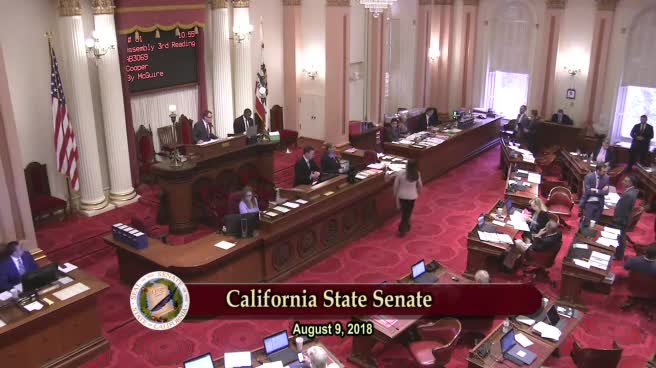 3MIN
Senate Floor
 6MIN
Senate Standing Committee on Judiciary
 2MIN
Assembly Floor
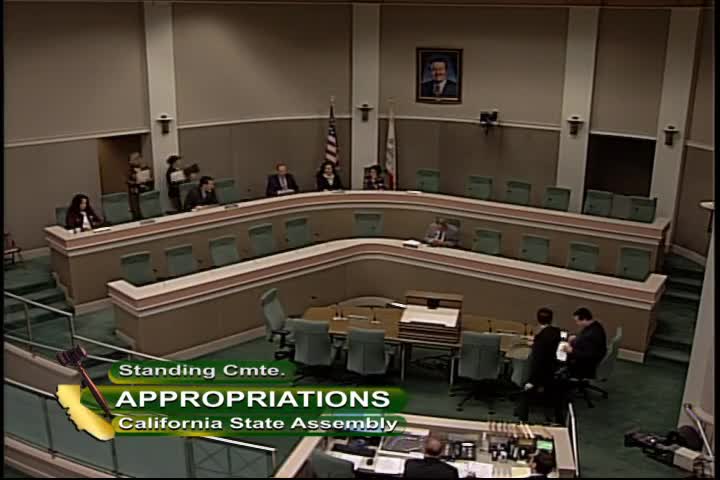 2MIN
Assembly Standing Committee on Appropriations
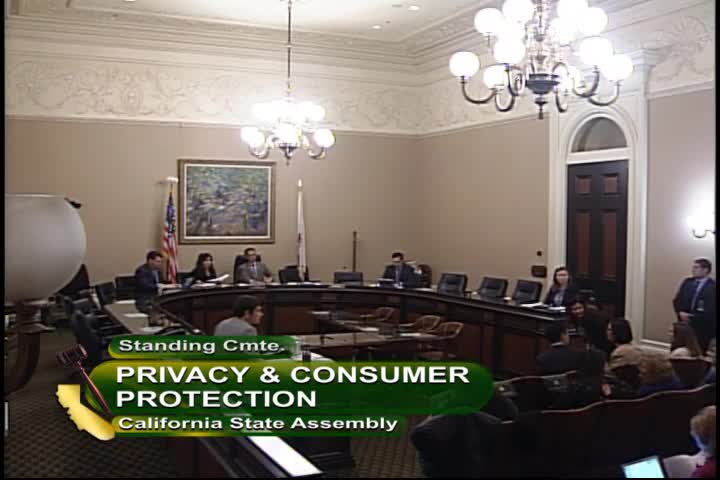 6MIN
Assembly Standing Committee on Privacy and Consumer Protection
Bill Author

Bill Co-Author(s):