AB 2235: County community schools: funding.
- Session Year: 2017-2018
- House: Assembly
- Latest Version Date: 2018-07-16
Existing law provides that a county board of education may establish and maintain one or more community schools. Existing law authorizes the county board of education to enroll pupils in a community school who meet specified criteria. Existing law establishes a public school financing system that requires state funding for county superintendents of schools, school districts, and charter schools to be calculated pursuant to a local control funding formula, as specified. Existing law provides, in a specified situation, any attendance generated by a pupil enrolled in a school operated by the county superintendent of schools to be credited to the school district of residence.
This bill would require the Superintendent of Public Instruction, commencing with the 201920 fiscal year, to transfer to the county, wherein a pupil is enrolled, the amount calculated for the school district of residence, as provided, for each unit of average daily attendance credited to the school district of residence. The bill would authorize the Superintendent to transfer an alternative amount for each unit of average daily attendance credited to the school district of residence if the school district of residence and the county superintendent of schools agree to the alternative amount and report it to the Superintendent under procedures and timeframes established by the Superintendent.
A county board of education may establish and maintain one or more community schools. Existing law authorizes the county board of education to enroll pupils in a community school who meet specified criteria. Existing law establishes a public school financing system that requires state funding for county superintendents of schools, school districts, and charter schools to be calculated pursuant to a local control funding formula, as specified. Existing law provides, in a specified situation, any attendance generated by a pupil enrolled in a school operated by the county superintendent of schools to be credited to the school district of residence.
This bill would require the school district of residence or the school district of attendance of a pupil enrolled in a county community school to pay to the county wherein the pupil is enrolled, for purposes of the county community school, the amount of the local control funding formula base grant and, if applicable, supplemental grant for each average daily attendance credited to the school district of residence or attendance for that pupil.This bill would require the Superintendent of Public Instruction, commencing with the 201920 fiscal year, to transfer to the county, wherein a pupil is enrolled, the amount calculated for the school district of residence, as provided, for each unit of average daily attendance credited to the school district of residence. The bill would authorize the Superintendent to transfer an alternative amount for each unit of average daily attendance credited to the school district of residence if the school district of residence and the county superintendent of schools agree to the alternative amount and report it to the Superintendent under procedures and timeframes established by the Superintendent.
A county board of education may establish and maintain one or more community schools. Existing law authorizes the county board of education to enroll pupils in a community school who meet specified criteria. Existing law establishes a public school financing system that requires state funding for county superintendents of schools, school districts, and charter schools to be calculated pursuant to a local control funding formula, as specified.
This bill would require the school district of residence or the school district of attendance of a pupil enrolled in a county community school to pay to the county wherein the pupil is enrolled, for purposes of the county community school, the amount of the local control funding formula base grant and, if applicable, supplemental grant for each average daily attendance credited to the school district of residence or attendance for that pupil.
(a)If a county superintendent of schools enrolls in a school operated by the county superintendent of schools a pupil not funded pursuant to clause (i), (ii), or (iii) of subparagraph (A) of paragraph (4) of subdivision (c) of Section 2574, or Article 2.5 (commencing with Section 48645) of Chapter 4 of Part 27 of Division 4 of Title 2, any attendance generated by that pupil shall be credited to the school district of residence. Enrollment of these pupils shall be transferred to the school district of residence for purposes of calculating the percentage of unduplicated pupils pursuant to Section 42238.02.
(b)For purposes of this section, the school district of residence for a homeless child or youth, as defined in Section 11434a(2) of the federal McKinney-Vento Homeless Assistance Act (42 U.S.C. Sec. 11301 et seq.), enrolled in a school operated by a county superintendent of schools shall be deemed to be the school district that last provided educational services to the homeless child or youth or, if it is not possible to determine that school district, the nonbasic aid school district with the largest average daily attendance in the county that serves the grade level in which the homeless child or youth would be enrolled.
(c)If a county superintendent of schools grants permission to a pupil to attend school in an adjoining state pursuant to Section 2000, attendance generated by that pupil shall be credited to the school district of residence.
(d)Commencing with the 201920 fiscal year, the Superintendent shall transfer to the county, wherein a pupil is enrolled, the amount calculated for the school district of residence pursuant to subdivisions (d) to (f), inclusive, of Section 42238.02 for each unit of average daily attendance credited to the school district of residence pursuant to this section. The Superintendent may transfer an alternative amount for each unit of average daily attendance credited to the school district of residence pursuant to this section, if the school district of residence and the county superintendent of schools agree to the alternative amount and report it to the Superintendent under procedures and timeframes established by the Superintendent.
SECTION 1.Section 1981 of the Education Code is amended to read:1981.The county board of education may enroll pupils in a county community school who are any of the following:(a)Expelled from a school district for any reason other than those specified in subdivision (a) or (c) of Section 48915.(b)(1)Referred to a county community school by a school district as a result of the recommendation by a school attendance review board. A pupil shall not be referred to a county community school by a school district pursuant to this subdivision unless the school district and the county office of education determine all of the following:(A)The county community school has space available to enroll the pupil.(B)The county community school meets the educational needs of the pupil.(C)(i)The parent, guardian, or responsible adult of the pupil has not expressly objected to the referral based on one or more of the following reasons:(I)Reasonable concerns related to the pupils safety.(II)Geographic accessibility.(III)Inability to transport.(IV)The school does not meet the pupils educational needs.(ii)The school district may require the objection to be in writing if it has advised the parent, guardian, or responsible adult that they may object, in writing, for one of these reasons.(2)If the county community school recommended pursuant to paragraph (1) is not geographically accessible to the pupil, the school attendance review board shall also include in its recommendation a school option for the pupil that is geographically accessible to the pupil and meets the criteria specified in paragraph (1).(3)If the parent, guardian, or responsible adult of the pupil objects for any of the reasons described in subclauses (I) to (IV), inclusive, of clause (i) of subparagraph (C) of paragraph (1), the school district may either address the express objection or find an alternative placement in another comprehensive or continuation school within the school district. If the school district has offered the pupil all other options, the school district may refer the pupil to the county community school.(4)The pupil has the right to return to his or her prior school or another appropriate school within his or her school district at the end of the semester following the semester when the acts leading to referral occurred. The right to return shall continue until the end of the pupils 18th year of age, except that a pupil with exceptional needs, consistent with Section 56041 of this code and Section 1412(a)(1)(A) of Title 20 of the United States Code, shall have the right to return until he or she turns 22 years of age.(c)(1)(A)On probation, with or without the supervision of a probation officer and consistent with an order of a juvenile court, who are considered to be wards of the court under Sections 601 and 602 of the Welfare and Institutions Code and ordered placed pursuant to Sections 725, 729.2, and 791 of, and paragraph (2) of subdivision (a) of Section 727 of, the Welfare and Institutions Code.(B)Under the supervision of a probation officer, with the consent of the minor and the minors parent or guardian, pursuant to Section 654 of the Welfare and Institutions Code.(C)Under the supervision of a probation officer pursuant to Section 726 and paragraph (3) of subdivision (a) of Section 727 of the Welfare and Institutions Code with the consent of the pupils parent, guardian, or responsible adult appointed by the juvenile court to make educational decisions for the pupil. The enrollment of a minor covered by this paragraph in a county community school shall be consistent with paragraph (2) of subdivision (c) of Section 726 of the Welfare and Institutions Code, which provides that all educational and school placement decisions shall seek to ensure that the youth is in the least restrictive educational program, has access to the academic resources, services, and extracurricular and enrichment activities that are available to all pupils, and are based on the best interests of the child.(D)Unless specifically ordered by a juvenile court, nothing in this subdivision shall be construed to conflict with the existing rights of a parent, guardian, or responsible adult appointed by the juvenile court pursuant to Section 726 of the Welfare and Institutions Code to make educational placement decisions for the minor.(E)With respect to a pupils enrollment in a county community school pursuant to subparagraph (B) or (C), and consistent with paragraph (2) of subdivision (c) of Section 726 of the Welfare and Institutions Code and California Rule of Court 5.651, all of the following shall apply:(i)The attorney for, or the person holding the educational rights of, a pupil who is under the jurisdiction of the delinquency court may use the procedures set forth in California Rule of Court 5.651 to address any change of placement that results in the enrollment of the pupil in a county community school that is not his or her school of origin.(ii)The attorney or the person holding the educational rights appointed by the court for a pupil who is under the jurisdiction of the delinquency court may, during a regularly scheduled hearing, raise any concerns with respect to whether the enrollment of the pupil in a county community school is meeting the educational needs of the pupil.(iii)Nothing in this subparagraph is intended to limit in any way the rights or responsibilities of any person as set forth in paragraph (2) of subdivision (c) of Section 726 of the Welfare and Institutions Code and California Rule of Court 5.651.(2)On probation or parole and not in attendance at any school, where enrollment is with the consent of the parent, guardian, or responsible adult, or the pupil, if he or she is 18 years of age or older. Nothing in this subdivision shall impact the provision of services or funding for youth up to 25 years of age pursuant to subdivision (b) of Section 1982, as that section read on September 25, 2013.(3)Expelled for any of the reasons specified in subdivision (a) or (c) of Section 48915.(4)Enrollment in a county community school pursuant to this subdivision shall be consistent with subdivision (b) of Section 48645.5.(d)Pupils whose school districts of attendance, or, for pupils who do not have school districts of attendance, school districts of residence, have, at the request of the pupils parent, guardian, or responsible adult, approved the pupils enrollment in a county community school, subject to the following:(1)A pupil shall not be enrolled in a county community school pursuant to this subdivision unless the school district determines that the placement will promote the educational interests of the pupil and the county community school has space available to enroll the pupil.(2)A parent, guardian, or responsible adult of a pupil enrolled in a county community school pursuant to this subdivision may rescind the request for the placement, and the pupil shall be immediately reenrolled in the school that the pupil attended at the time of the referral, or, with the consent of the parent, guardian, or responsible adult, another appropriate school.(e)The school district of residence or the school district of attendance of a pupil enrolled in a county community school pursuant to this section shall pay to the county wherein the pupil is enrolled, for purposes of the county community school, the amount of the local control funding formula base grant and, if applicable, supplemental grant, calculated pursuant to Section 42238.02, for each average daily attendance credited to the school district of residence or the school district of attendance for that pupil.(f)The procedures outlined in subdivisions (b) to (e), inclusive, of Section 51225.2 govern the transfer of credits, records, including special education records, and grades required pursuant to subdivision (a) of Section 48645.5 and Section 49068 when the pupil transfers to and from the county community school.(g)For purposes of this section, geographically accessible means that the pupil can reasonably travel to and from the school and is able to pay for any transportation costs that are above and beyond the costs to attend his or her school of residence or prior school, whichever is farther away.The county board of education may enroll pupils in a county community school who are any of the following:
(a)Expelled from a school district for any reason other than those specified in subdivision (a) or (c) of Section 48915.
(b)(1)Referred to a county community school by a school district as a result of the recommendation by a school attendance review board. A pupil shall not be referred to a county community school by a school district pursuant to this subdivision unless the school district and the county office of education determine all of the following:
(A)The county community school has space available to enroll the pupil.
(B)The county community school meets the educational needs of the pupil.
(C)(i)The parent, guardian, or responsible adult of the pupil has not expressly objected to the referral based on one or more of the following reasons:
(I)Reasonable concerns related to the pupils safety.
(II)Geographic accessibility.
(III)Inability to transport.
(IV)The school does not meet the pupils educational needs.
(ii)The school district may require the objection to be in writing if it has advised the parent, guardian, or responsible adult that they may object, in writing, for one of these reasons.
(2)If the county community school recommended pursuant to paragraph (1) is not geographically accessible to the pupil, the school attendance review board shall also include in its recommendation a school option for the pupil that is geographically accessible to the pupil and meets the criteria specified in paragraph (1).
(3)If the parent, guardian, or responsible adult of the pupil objects for any of the reasons described in subclauses (I) to (IV), inclusive, of clause (i) of subparagraph (C) of paragraph (1), the school district may either address the express objection or find an alternative placement in another comprehensive or continuation school within the school district. If the school district has offered the pupil all other options, the school district may refer the pupil to the county community school.
(4)The pupil has the right to return to his or her prior school or another appropriate school within his or her school district at the end of the semester following the semester when the acts leading to referral occurred. The right to return shall continue until the end of the pupils 18th year of age, except that a pupil with exceptional needs, consistent with Section 56041 of this code and Section 1412(a)(1)(A) of Title 20 of the United States Code, shall have the right to return until he or she turns 22 years of age.
(c)(1)(A)On probation, with or without the supervision of a probation officer and consistent with an order of a juvenile court, who are considered to be wards of the court under Sections 601 and 602 of the Welfare and Institutions Code and ordered placed pursuant to Sections 725, 729.2, and 791 of, and paragraph (2) of subdivision (a) of Section 727 of, the Welfare and Institutions Code.
(B)Under the supervision of a probation officer, with the consent of the minor and the minors parent or guardian, pursuant to Section 654 of the Welfare and Institutions Code.
(C)Under the supervision of a probation officer pursuant to Section 726 and paragraph (3) of subdivision (a) of Section 727 of the Welfare and Institutions Code with the consent of the pupils parent, guardian, or responsible adult appointed by the juvenile court to make educational decisions for the pupil. The enrollment of a minor covered by this paragraph in a county community school shall be consistent with paragraph (2) of subdivision (c) of Section 726 of the Welfare and Institutions Code, which provides that all educational and school placement decisions shall seek to ensure that the youth is in the least restrictive educational program, has access to the academic resources, services, and extracurricular and enrichment activities that are available to all pupils, and are based on the best interests of the child.
(D)Unless specifically ordered by a juvenile court, nothing in this subdivision shall be construed to conflict with the existing rights of a parent, guardian, or responsible adult appointed by the juvenile court pursuant to Section 726 of the Welfare and Institutions Code to make educational placement decisions for the minor.
(E)With respect to a pupils enrollment in a county community school pursuant to subparagraph (B) or (C), and consistent with paragraph (2) of subdivision (c) of Section 726 of the Welfare and Institutions Code and California Rule of Court 5.651, all of the following shall apply:
(i)The attorney for, or the person holding the educational rights of, a pupil who is under the jurisdiction of the delinquency court may use the procedures set forth in California Rule of Court 5.651 to address any change of placement that results in the enrollment of the pupil in a county community school that is not his or her school of origin.
(ii)The attorney or the person holding the educational rights appointed by the court for a pupil who is under the jurisdiction of the delinquency court may, during a regularly scheduled hearing, raise any concerns with respect to whether the enrollment of the pupil in a county community school is meeting the educational needs of the pupil.
(iii)Nothing in this subparagraph is intended to limit in any way the rights or responsibilities of any person as set forth in paragraph (2) of subdivision (c) of Section 726 of the Welfare and Institutions Code and California Rule of Court 5.651.
(2)On probation or parole and not in attendance at any school, where enrollment is with the consent of the parent, guardian, or responsible adult, or the pupil, if he or she is 18 years of age or older. Nothing in this subdivision shall impact the provision of services or funding for youth up to 25 years of age pursuant to subdivision (b) of Section 1982, as that section read on September 25, 2013.
(3)Expelled for any of the reasons specified in subdivision (a) or (c) of Section 48915.
(4)Enrollment in a county community school pursuant to this subdivision shall be consistent with subdivision (b) of Section 48645.5.
(d)Pupils whose school districts of attendance, or, for pupils who do not have school districts of attendance, school districts of residence, have, at the request of the pupils parent, guardian, or responsible adult, approved the pupils enrollment in a county community school, subject to the following:
(1)A pupil shall not be enrolled in a county community school pursuant to this subdivision unless the school district determines that the placement will promote the educational interests of the pupil and the county community school has space available to enroll the pupil.
(2)A parent, guardian, or responsible adult of a pupil enrolled in a county community school pursuant to this subdivision may rescind the request for the placement, and the pupil shall be immediately reenrolled in the school that the pupil attended at the time of the referral, or, with the consent of the parent, guardian, or responsible adult, another appropriate school.
(e)The school district of residence or the school district of attendance of a pupil enrolled in a county community school pursuant to this section shall pay to the county wherein the pupil is enrolled, for purposes of the county community school, the amount of the local control funding formula base grant and, if applicable, supplemental grant, calculated pursuant to Section 42238.02, for each average daily attendance credited to the school district of residence or the school district of attendance for that pupil.
(e)(f)The procedures outlined in subdivisions (b) to (e), inclusive, of Section 51225.2 govern the transfer of credits, records, including special education records, and grades required pursuant to subdivision (a) of Section 48645.5 and Section 49068 when the pupil transfers to and from the county community school.
(f)(g)For purposes of this section, geographically accessible means that the pupil can reasonably travel to and from the school and is able to pay for any transportation costs that are above and beyond the costs to attend his or her school of residence or prior school, whichever is farther away.
|
Date
|
Status
|
|---|---|
| Jul 16, 2018 | Chaptered by Secretary of State - Chapter 99, Statutes of 2018. |
| Jul 16, 2018 | Approved by the Governor. |
| Jul 10, 2018 | Enrolled and presented to the Governor at 3 p.m. |
| Jul 3, 2018 | In Assembly. Ordered to Engrossing and Enrolling. |
| Jul 2, 2018 | Read third time. Passed. Ordered to the Assembly. |
| Jun 26, 2018 | Read second time. Ordered to Consent Calendar. |
| Jun 25, 2018 | From committee: Be ordered to second reading file pursuant to Senate Rule 28.8 and ordered to Consent Calendar. |
| Jun 13, 2018 | From committee: Do pass and re-refer to Com. on APPR. with recommendation: To Consent Calendar. (Ayes 7. Noes 0.) (June 13). Re-referred to Com. on APPR. |
| Jun 7, 2018 | Referred to Com. on ED. |
| May 31, 2018 | In Senate. Read first time. To Com. on RLS. for assignment. |
| May 30, 2018 | Read third time. Passed. Ordered to the Senate. |
| May 25, 2018 | From committee: Do pass. (Ayes 16. Noes 0.) (May 25). |
| May 25, 2018 | Joint Rule 62(a), file notice suspended. |
| May 23, 2018 | In committee: Set, first hearing. Referred to APPR. suspense file. |
| May 17, 2018 | Read second time. Ordered to Consent Calendar. |
| May 16, 2018 | Read second time and amended. Ordered returned to second reading. |
| May 15, 2018 | From committee: Amend, and do pass as amended. To Consent Calendar. (Ayes 6. Noes 0.) (May 9). |
| Mar 1, 2018 | Referred to Com. on ED. |
| Feb 14, 2018 | From printer. May be heard in committee March 16. |
| Feb 13, 2018 | Read first time. To print. |
|
Date
|
Description
|
Location
|
Votes
|
|
|---|---|---|---|---|
| Jul 2, 2018 | Consent Calendar AB2235 | Senate Floor |
Passed |
|
| Jun 13, 2018 | Do pass, but first be re-referred to the Committee on [Appropriations] with the recommendation: To Consent Calendar | Senate Standing Committee on Education |
Passed |
|
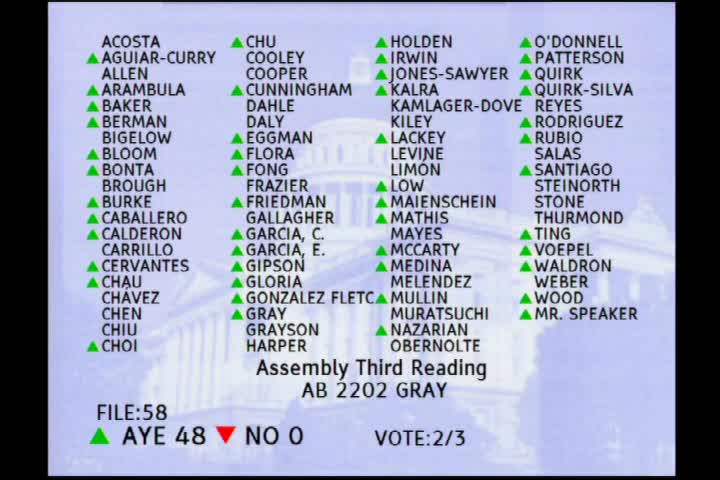
| May 30, 2018 | AB 2235 QUIRK-SILVA Assembly Third Reading | Assembly Floor |
Passed |
|
| May 25, 2018 | Do pass. | Assembly Standing Committee on Appropriations |
Passed |
|
| May 9, 2018 | Do pass as amended. To Consent Calendar. | Assembly Standing Committee on Education |
Passed |
This list shows positions taken on this bill by organizations on the date displayed, which is linked to the original source.
Positions by individuals are not included.
|
Organization
|
Position
|
Date
|
|---|---|---|
| California Association Of School Business Officials | ** Support | Jun 26, 2018 |
| Los Angeles County Office Of Education | ** Support | Jun 26, 2018 |
| Orange County Department Of Education | ** Support | May 7, 2018 |
| Orange County Office of Education | ** Support | Jun 26, 2018 |
Office of Senate Floor Analyses (916) 651-1520 Fax: (916) 327-4478 | AB |
CONSENT
Bill No: AB 2235
:
SENATE EDUCATION COMMITTEE: 7-0, 6/13/18
AYES: Allen, Wilk, Galgiani, Leyva, McGuire, Pan, Vidak
SENATE APPROPRIATIONS COMMITTEE: Senate Rule 28.8
ASSEMBLY FLOOR: 76-1, 5/30/18 - See last page for vote
SOURCE: Orange County Office of Education
DIGEST:
This bill requires the Superintendent of Public Instruction (SPI) to transfer the Local Control Funding Formula (LCFF) apportionment amount for county community school students from the school district of residence to the county office of education (COE). Further, this bill authorizes the SPI to transfer an alternative amount from the school district of residence to the COE upon a mutual agreement.
Existing law:
- Establishes county community schools, which are public schools that are run by COEs. These schools educate students in kindergarten through grade 12, including students who are expelled from school or who are referred because of attendance or behavior problems, are homeless, on probation or parole, and who are not attending any school. Parents or guardians also may request that their child attend a county community school.
- Establishes the LCFF for COEs, which includes funding for county community school students who are enrolled due to being on probation or parole or expelled from a district school.
- Provides that the attendance of students at a county community school that are not on probation or parole or expelled shall be credited to the school district of residence.
This bill requires the SPI to transfer the LCFF apportionment amount for county community school students from the school district of residence to the COE. Further, the bill authorizes the SPI to transfer an alternative amount from the school district of residence to the COE upon a mutual agreement.
Comments
- Need for the bill. According to the author’s office, the purpose of this bill is to restore the requirement that funding be transferred to the COEs that operate the schools of attendance. Because some counties have already negotiated alternative local transfer amounts, this bill authorizes school districts and COEs to continue to do so.
- What role do county community schools play? County community schools are public schools that are run by COEs. The purpose of county community schools is to provide an education to students who are expelled from their regular schools, referred by a School Attendance Review Board or by probation, on probation or parole and not attending any school, homeless, or enrolled at the request of the student’s parent or guardian.
County community schools’ educational programs are characteristically student-centered and adapted to meet individual needs. A minimum day’s program is 240 minutes. Students are provided with learning opportunities in academic skills, independent life skills, positive self-concepts, and effective relationships with others. Although students may graduate from county community schools, the programs are designed to help students transition to appropriate educational, training, or employment settings after their attendance in the county community school. The COE, community, and receiving school districts are frequently involved in program planning and transition services.
- More funding certainty for county community schools. While state law designates COEs as the providers of education for students who are on probation, referred by a probation department, or mandatorily expelled from their school—COEs receive direct state funding to serve these students—the state also allows COEs to enroll other at‑risk students in their county community schools. For these other students, COEs must develop local agreements under which the students’ home districts reimburse them for associated education costs.
Prior to the LCFF, the SPI directly credited a COE for any student it served. To provide clearer delineations of which students would be served by COEs versus districts for funding and accountability purposes, the LCFF provides definitions of which students will be credited to COEs versus school districts.
This bill requires the SPI to credit COEs for students they serve who are under school district jurisdiction, rather than school districts, unless an alternative agreement meeting certain requirements is established.
FISCAL EFFECT: Appropriation: Fiscal Com.: Local:
Orange County Office of Education (source)
California Association of School Business Officials
Los Angeles County Office of Education
OPPOSITION: (Verified 6/27/18)
None received
ASSEMBLY FLOOR: 76-1, 5/30/18
AYES: Acosta, Aguiar-Curry, Travis Allen, Arambula, Baker, Berman, Bigelow, Bloom, Bonta, Brough, Burke, Caballero, Calderon, Carrillo, Cervantes, Chau, Chávez, Chen, Chiu, Choi, Chu, Cooley, Cooper, Cunningham, Dahle, Daly, Eggman, Flora, Fong, Friedman, Gallagher, Cristina Garcia, Eduardo Garcia, Gipson, Gloria, Gonzalez Fletcher, Gray, Grayson, Harper, Holden, Irwin, Jones-Sawyer, Kalra, Kamlager-Dove, Kiley, Lackey, Levine, Limón, Low, Maienschein, Mathis, Mayes, McCarty, Medina, Melendez, Mullin, Nazarian, Obernolte, O'Donnell, Patterson, Quirk, Quirk-Silva, Reyes, Rodriguez, Rubio, Salas, Santiago, Steinorth, Mark Stone, Thurmond, Ting, Voepel, Waldron, Weber, Wood, Rendon
NOES: Muratsuchi
NO VOTE RECORDED: Frazier
6/26/18 13:24:46
SENATE COMMITTEE ON EDUCATION
Senator Benjamin Allen, Chair
2017 - 2018 Regular
Bill No: AB 2235 Hearing Date: June 13, 2018
Author: | |||
Version: | May 16, 2018 | ||
Urgency: | No | Fiscal: | Yes |
Consultant: | Ian Johnson | ||
Subject: County community schools: funding.
SUMMARY
This bill requires the Superintendent of Public Instruction (SPI) to transfer the Local Control Funding Formula (LCFF) apportionment amount for county community school students from the school district of residence to the county office of education (COE). Further, the bill authorizes the SPI to transfer an alternative amount from the school district of residence to the COE upon a mutual agreement.
BACKGROUND
Existing law:
- Establishes county community schools, which are public schools that are run by COEs. These schools educate students in kindergarten through grade twelve, including students who are expelled from school or who are referred because of attendance or behavior problems, are homeless, on probation or parole, and who are not attending any school. Parents or guardians also may request that their child attend a county community school.
- Establishes the LCFF for COEs, which includes funding for county community school students who are enrolled due to being on probation or parole or expelled from a district school.
- Provides that the attendance of students at a county community school that are not on probation or parole or expelled shall be credited to the school district of residence.
ANALYSIS
This bill requires the SPI to transfer the LCFF apportionment amount for county community school students from the school district of residence to the COE. Further, the bill authorizes the SPI to transfer an alternative amount from the school district of residence to the COE upon a mutual agreement.
STAFF COMMENTS
- Need for the bill. According to the author’s office, the purpose of this bill is to restore the requirement that funding be transferred to the COEs that operate the schools of attendance. Because some counties have already negotiated alternative local transfer amounts, the bill authorizes school districts and county offices of education (COEs) to continue to do so.
- What role do county community schools play? County community schools are public schools that are run by COEs. The purpose of county community schools is to provide an education to students who are expelled from their regular schools, referred by a School Attendance Review Board or by probation, on probation or parole and not attending any school, homeless, or enrolled at the request of the student’s parent or guardian.
County community schools’ educational programs are characteristically student-centered and adapted to meet individual needs. A minimum day’s program is 240 minutes. Students are provided with learning opportunities in academic skills, independent life skills, positive self-concepts, and effective relationships with others. Although students may graduate from county community schools, the programs are designed to help students transition to appropriate educational, training, or employment settings after their attendance in the county community school. The COE, community, and receiving school districts are frequently involved in program planning and transition services.
- More funding certainty for county community schools. While state law designates COEs as the providers of education for students who are on probation, referred by a probation department, or mandatorily expelled from their school—COEs receive direct state funding to serve these students—the state also allows COEs to enroll other at‑risk students in their county community schools. For these other students, COEs must develop local agreements under which the students’ home districts reimburse them for associated education costs.
Prior to the Local Control Funding Formula (LCFF), the Superintendent of Public Instruction (SPI) directly credited a COE for any student it served. To provide clearer delineations of which students would be served by COEs versus districts for funding and accountability purposes, the LCFF provides definitions of which students will be credited to COEs versus school districts.
This bill requires the SPI to credit COEs for students they serve who are under school district jurisdiction, rather than school districts, unless an alternative agreement meeting certain requirements is established.
SUPPORT
Orange County Office of Education (sponsor)
California Association of School Business Officials
Los Angeles County Office of Education
OPPOSITION
None received
-- END --
ASSEMBLY THIRD READING
ATR Bill Id:AB 2235
Author:(Quirk-Silva)
As Amended Ver:May 16, 2018
Majority vote
Committee | Votes | Ayes | Noes |
Education | 6-0 | O'Donnell, Kiley, Kalra, Steinorth, Thurmond, Weber | |
Appropriations | 16-0 | Gonzalez Fletcher, Bigelow, Bloom, Bonta, Calderon, Carrillo, Chau, Eggman, Fong, Friedman, Gallagher, Eduardo Garcia, Nazarian, Obernolte, Quirk, Reyes |
|
SUMMARY: Requires, beginning in the 2019-20 school year, the state Superintendent of Public Instruction (SPI) to credit full Local Control Funding Formula (LCFF) per-student amounts directly to a county office of education (COE) funding for any student attending a county community school whose attendance is credited to the school district of residence. Also authorizes the SPI to transfer an alternative amount for each student to the COE if the school district and the COE agree to the alternative amount and report it to the SPI under procedures and timeframes established by the SPI.
EXISTING LAW:
- Establishes county community schools, which are public schools that are run by county offices of education (COEs). They educate students in kindergarten through grade twelve, including students who are expelled from school or who are referred because of attendance or behavior problems, are homeless, on probation or parole, and who are not attending any school. Parents or guardians also may request that their child attend a county community school.
- Establishes a Local Control Funding Formula (LCFF) for COEs, which includes funding for county community school students who are enrolled due to being on probation or parole or expelled from a district school.
- Provides that the attendance of students at a county community school that are not on probation or parole or expelled shall be credited to the district of residence.
FISCAL EFFECT: According to the Assembly Appropriations Committee: unknown one-time and ongoing GF costs to the SPI to modify apportionment systems to provide funding directly to COEs for certain students, specify procedures and timelines, and provide ongoing monitoring of agreements between school districts and COEs.
COMMENTS: County community schools are public schools operated and administered by COEs to serve students in grades kindergarten through twelve. They provide an educational placement for students who are expelled from their regular schools, referred by a School Attendance Review Board, referred by probation, on probation or parole, or are not in attendance in any school, or homeless. Students may also attend a county community school at the request of the student's parent or guardian. COEs receive LCFF funding for students at county community schools who are on probation or parole and expelled from a district school, but the attendance of other county community school students is credited to the district of residence for apportionment purposes.
Prior to the enactment of the LCFF, county community school attendance was credited to districts of residence for revenue limit apportionments, but the districts of residence were required to transfer the revenue limit funds to the county in which the student attends a community school. This required local transfer of funds was not retained when the state replaced revenue limit funding with the LCFF. According to the California Department of Education, six counties have negotiated agreements with their districts to voluntarily make a local transfer of funds.
The purpose of this bill is to restore the requirement that funding be transferred to the COEs that operate the schools of attendance. Because some counties have already negotiated alternative local transfer amounts, the bill authorizes school districts and COEs to continue to do so.
Analysis Prepared by: Rick Pratt / ED. / (916) 319-2087 FN: 0003160
Date of Hearing: May 23, 2018
ASSEMBLY COMMITTEE ON APPROPRIATIONS
Lorena Gonzalez Fletcher, Chair
ABPCA Bill Id:AB 2235
Author:(Quirk-Silva) – As Amended Ver:May 16, 2018
Policy Committee: | Education | Vote: | 6 - 0 |
|
| ||
|
|
Urgency: No State Mandated Local Program: No Reimbursable: No
SUMMARY: This bill requires, beginning in the 2019-20 school year, the state Superintendent of Public Instruction (SPI) to credit full Local Control Funding Formula (LCFF) per-student amounts directly to a county office of education (COE) funding for any student attending a county community school, including students who are under the jurisdiction of a school district. It authorizes the SPI to transfer an alternative amount for each student to the school district if the school district and the COE agree to the alternative amount and report it to the SPI under procedures and timeframes established by the SPI.
FISCAL EFFECT:
Unknown one-time and ongoing GF costs to the SPI to modify apportionment systems to provide funding directly to COEs for certain students, specify procedures and timelines, and provide ongoing monitoring of agreements between school districts and COEs.
COMMENTS:
Background. County community schools are public schools operated and administered by COEs to serve students in grades kindergarten through twelve. They provide an educational placement for students who are expelled from their traditional schools, referred by a School Attendance Review Board, referred by a probation officer, or on probation or parole. COEs operate the schools and are credited directly to serve these students. COEs generate more per-student LCFF funding to serve students than districts do. In addition to enrolling students COEs are directly credited for, some COEs sometimes enroll other students in their county community schools. In these cases, the student’s home school district negotiates how much funding it will pass through to the COE to serve the student, because the student is still considered a district student for funding and accountability purposes.
Prior to the LCFF’s adoption in 2013-14, the SPI directly credited a COE for any student it served. To provide clearer delineations of which students would be served by COEs versus districts for funding and accountability purposes, the LCFF provides definitions of which students will be credited to COEs versus school districts.
This bill requires the SPI to credit COEs for students they serve who are under school district jurisdiction, rather than school districts, unless an alternative agreement meeting certain requirements is established.
Analysis Prepared by: Natasha Collins / APPR. / (916) 319-2081
Date of Hearing: May 9, 2018
ASSEMBLY COMMITTEE ON EDUCATION
Patrick O'Donnell, Chair
ABPCA Bill Id:AB 2235 (
Author:Quirk-Silva) – As Introduced Ver:February 13, 2018
SUBJECT: County community schools: funding
SUMMARY: Requires a district of residence or a school district of attendance of a pupil enrolled in a county community school to pay to the county wherein the pupil is enrolled, for purposes of the county community school, the amount of the local control funding formula base grant and, if applicable, supplemental grant, for each average daily attendance credited to the school district of residence or the school district of attendance for that pupil.
EXISTING LAW:
- Establishes county community schools, which are public schools that are run by county offices of education (COEs). They educate students in kindergarten through grade twelve, including students who are expelled from school or who are referred because of attendance or behavior problems, are homeless, on probation or parole, and who are not attending any school. Parents or guardians also may request that their child attend a county community school.
- Establishes a Local Control Funding Formula (LCFF) for COEs, which includes funding for county community school students who are enrolled due to being on probation or parole or expelled from a district school.
- Provides that the attendance of students at a county community school that are not on probation or parole or expelled shall be credited to the district of residence.
FISCAL EFFECT: This bill is keyed nonfiscal
COMMENTS: County community schools are public schools operated and administered by COEs to serve students in grades kindergarten through twelve. They provide an educational placement for students who are expelled from their regular schools, referred by a School Attendance Review Board, referred by probation, on probation or parole, or are not in attendance in any school, or homeless. Students may also attend a county community school at the request of the student’s parent or guardian. COEs receive LCFF funding for students at county community schools who are on probation or parole and expelled from a district school, but the attendance of other county community school students is credited to the district of residence for apportionment purposes.
Prior to the enactment of the LCFF, county community school attendance was credited to districts of residence for revenue limit apportionments, but the districts of residence were required to transfer the revenue limit funds to the county in which the student attends a community school. This required local transfer of funds was not retained when the state replaced revenue limit funding with the LCFF. According to the California Department of Education, six counties have negotiated agreements with their districts to voluntarily make a local transfer of funds.
The purpose of this bill is to restore the requirement that school districts transfer to county offices of education the LCFF funding that they receive on behalf of students in attendance at a county community school. Because some counties have already negotiated local transfer agreements (that may be more or less than the transfer required by this bill) staff recommends that the bill be amended to continue to permit such agreements.
In addition, staff recommends that the bill be amended to move its provisions to the section of the Education Code that requires the crediting of county community school attendance to the district of residence and to require the Superintendent of Public Instruction to apportion the LCFF funds or alternatively agreed-to funds directly to the COEs in order to eliminate the need to transfer them locally.
REGISTERED SUPPORT / OPPOSITION:
Support
California Association of School Business Officials
Orange County Department of Education
Opposition
None received
Analysis Prepared by: Rick Pratt / ED. / (916) 319-2087
Bill Author

Bill Co-Author(s):