AB 2271: School food authorities: federal equipment assistance grants: matching state grants.
- Session Year: 2017-2018
- House: Assembly
- Latest Version Date: 2018-09-23
Existing law requires a school district or county superintendent of schools maintaining kindergarten or any of grades 1 to 12, inclusive, to provide a needy pupil, as defined, one nutritionally adequate free or reduced-price meal during each schoolday, and authorizes the school district or county superintendent of schools to use funds available from any federal program, including the federal National School Lunch Program, or state program to comply with that requirement, as provided.
Existing federal regulations define school food authority as the governing body that is responsible for the administration of one or more schools and that has the legal authority or approval to operate the federal National School Lunch Program at that school or schools.
This bill would require, upon appropriation by the Legislature, and contingent upon allocations provided by the federal Consolidated Appropriations Act, the State Department of Education to provide a state matching grant of up to $100,000 to a school food authority participating in the federal National School Lunch Program that applies for and is awarded a federal Equipment Assistance Grant for School Food Authorities from the department in its administration of the National School Lunch Program, as prescribed. The bill would authorize a school food authority to use the federal and state grants for up to 5 individual schoolsites or to combine the federal and state grants for one purpose. The bill would require that the state matching grant be competitively awarded and align with the federal equipment assistance grant requirements, as specified.
Existing law requires a school district or county superintendent of schools maintaining kindergarten or any of grades 1 to 12, inclusive, to provide a needy pupil, as defined, one nutritionally adequate free or reduced-price meal during each schoolday, and authorizes the school district or county superintendent of schools to use funds available from any federal program, including the federal National School Lunch Program, or state program to comply with that requirement, as provided.
Existing federal regulations define school food authority as the governing body that is responsible for the administration of one or more schools and that has the legal authority or approval to operate the federal National School Lunch Program at that school or schools.
This bill would require, upon appropriation by the Legislature, and contingent upon allocations provided by the federal Consolidated Appropriations Act, the State Department of Education to provide a matching state grant of up to $100,000 to a school food authority participating in the federal National School Lunch Program that receives applies for and is awarded a federal equipment assistance grant Equipment Assistance Grant for School Food Authorities from the department. department in its administration of the National School Lunch Program, as prescribed. The bill would authorize a school food authority to use the federal and state grants for up to 5 individual schoolsites or to combine the federal and state grants for one purpose. The bill would require that the state matching assistance grant be competitively awarded and align with the federal equipment assistance grant requirements, as specified.
Existing law requires a school district or county superintendent of schools maintaining kindergarten or any of grades 1 to 12, inclusive, to provide a needy pupil, as defined, one nutritionally adequate free or reduced-price meal during each schoolday, and authorizes the school district or county superintendent of schools to use funds available from any federal program, including the federal National School Lunch Program, or state program to comply with that requirement, as provided.
Existing federal regulations define school food authority as the governing body that is responsible for the administration of one or more schools and that has the legal authority or approval to operate the federal National School Lunch Program at that school or schools.
This bill would require, upon appropriation by the Legislature, the State Department of Education to provide a matching state grant of up to $100,000 to a school food authority participating in the federal National School Lunch Program that receives a federal equipment assistance grant from the department. The bill would authorize a school food authority to use the federal and state grants for up to 5 individual schoolsites or to combine the federal and state grants for one purpose.
(a)The Legislature finds and declares that the state strives to serve National School Lunch Program meals of the highest quality and greatest nutritional value possible.
(b)Upon appropriation by the Legislature, and contingent upon allocations provided by the federal Consolidated Appropriations Act, the department shall provide a matching state grant of up to one hundred thousand dollars ($100,000) to a school food authority participating in the federal National School Lunch Program that applies for and is awarded a federal Equipment Assistance Grant for School Food Authorities from the department in its administration of the National School Lunch Program. The state appropriation shall be for a minimum of two years and shall align with the United States Department of Agriculture National School Lunch Program Equipment Grant for School Food Authorities terms and conditions, period of performance, criteria, timelines, and procurement and funding expenditure requirements.
(c)A school food authority may use the federal and state grants for up to five individual schoolsites or may combine the federal and state grants for one purpose, such as creating a centralized industrial kitchen. The state matching assistance grant shall be competitively awarded and shall align with the federal equipment assistance grant requirements pursuant to subdivision (b). Unspent matching state grant funds shall be retained by the department for one or more additional equipment grants, subject to the same requirements.
(a)Upon The Legislature finds and declares that the state strives to serve National School Lunch Program meals of the highest quality and greatest nutritional value possible.
(b)Upon appropriation by the Legislature, and contingent upon allocations provided by the federal Consolidated Appropriations Act, the department shall provide a matching state grant of up to one hundred thousand dollars ($100,000) to a school food authority participating in the federal National School Lunch Program that applies for and is awarded receives a federal equipment assistance grant Equipment Assistance Grant for School Food Authorities from the department. department in its administration of the National School Lunch Program. The state appropriation shall be for a minimum of two years and shall align with the United States Department of Agriculture National School Lunch Program Equipment Grant for School Food Authorities terms and conditions, period of performance, criteria, timelines, and procurement and funding expenditure requirements.
(b)(c)A school food authority may use the federal and state grants for up to five individual schoolsites or may combine the federal and state grants for one purpose, such as creating a centralized industrial kitchen. The state matching assistance grant shall be competitively awarded and shall align with the federal equipment assistance grant requirements pursuant to subdivision (b). Unspent matching state grant funds shall be retained by the department for one or more additional equipment grants, subject to the same requirements.
(a)Upon appropriation by the Legislature, the department shall provide a matching state grant of up to one hundred thousand dollars ($100,000) to a school food authority participating in the federal National School Lunch Program that receives a federal equipment assistance grant from the department.
(b)A school food authority may use the federal and state grants for up to five individual schoolsites or may combine the federal and state grants for one purpose, such as creating a centralized industrial kitchen.
|
Date
|
Status
|
|---|---|
| Sep 23, 2018 | Chaptered by Secretary of State - Chapter 711, Statutes of 2018. |
| Sep 23, 2018 | Approved by the Governor. |
| Aug 30, 2018 | Enrolled and presented to the Governor at 4:30 p.m. |
| Aug 24, 2018 | In Assembly. Ordered to Engrossing and Enrolling. |
| Aug 24, 2018 | Read third time. Passed. Ordered to the Assembly. |
| Aug 17, 2018 | From committee: Do pass. (Ayes 5. Noes 2.) (August 16). |
| Jul 2, 2018 | In committee: Referred to APPR. suspense file. |
| Jun 13, 2018 | From committee: Do pass and re-refer to Com. on APPR. (Ayes 7. Noes 0.) (June 13). Re-referred to Com. on APPR. |
| Jun 7, 2018 | Referred to Com. on ED. |
| May 31, 2018 | In Senate. Read first time. To Com. on RLS. for assignment. |
| May 30, 2018 | Read third time. Passed. Ordered to the Senate. |
| May 25, 2018 | From committee: Do pass. (Ayes 13. Noes 3.) (May 25). |
| Apr 4, 2018 | In committee: Set, first hearing. Referred to suspense file. |
| Mar 22, 2018 | From committee: Do pass and re-refer to Com. on APPR. (Ayes 6. Noes 1.) (March 21). Re-referred to Com. on APPR. |
| Mar 15, 2018 | Re-referred to Com. on ED. |
| Mar 14, 2018 | From committee chair, with author's amendments: Amend, and re-refer to Com. on ED. Read second time and amended. |
| Mar 1, 2018 | Referred to Com. on ED. |
| Feb 14, 2018 | From printer. May be heard in committee March 16. |
| Feb 13, 2018 | Read first time. To print. |
|
Date
|
Description
|
Location
|
Votes
|
|
|---|---|---|---|---|
| Aug 24, 2018 | Assembly 3rd Reading AB2271 Quirk-Silva By Delgado | Senate Floor |
Passed |
|
| Aug 16, 2018 | Do pass | Senate Standing Committee on Appropriations |
Passed |
|
| Jul 2, 2018 | Placed on suspense file | Senate Standing Committee on Appropriations |
Passed |
|
| Jun 13, 2018 | Do pass, but first be re-referred to the Committee on [Appropriations] | Senate Standing Committee on Education |
Passed |
|
| May 30, 2018 | AB 2271 QUIRK-SILVA Assembly Third Reading | Assembly Floor |
Passed |
|
| May 25, 2018 | Do pass. | Assembly Standing Committee on Appropriations |
Passed |
|
| Mar 21, 2018 | Do pass and be re-referred to the Committee on [Appropriations] | Assembly Standing Committee on Education |
Passed |
This list shows positions taken on this bill by organizations on the date displayed, which is linked to the original source.
Positions by individuals are not included.
|
Organization
|
Position
|
Date
|
|---|---|---|
| American Academy of Pediatrics | ** Support | Aug 18, 2018 |
| California Federation Of Teachers | * Support | Jun 13, 2018 |
| Health Officers Association Of California | ** Support | Aug 18, 2018 |
Office of Senate Floor Analyses (916) 651-1520 Fax: (916) 327-4478 | AB |
THIRD READING
Bill No: AB 2271
:
SENATE EDUCATION COMMITTEE: 7-0, 6/13/18
AYES: Allen, Wilk, Galgiani, Leyva, McGuire, Pan, Vidak
SENATE APPROPRIATIONS COMMITTEE: 5-2, 8/16/18
AYES: Portantino, Beall, Bradford, Hill, Wiener
NOES: Bates, Nielsen
ASSEMBLY FLOOR: 63-11, 5/30/18 - See last page for vote
DIGEST:
This bill requires the California Department of Education (CDE), upon appropriation by the Legislature and contingent upon federal funding, to provide a matching state grant of up to 100,000 to school food authorities participating in the federal National School Lunch Program (NSLP) that apply for and are awarded a federal Equipment Assistance Grant for School Food Authorities (SFAs).
Existing federal law:
1) Authorizes the U.S. Department of Agriculture (USDA) to provide $25 million to state agencies ($3 million for California) to competitively award eligible school food authorities equipment assistance funding. (Public Law § 115-31)
2) Specifies that state agencies must award these grants via a competitive grant process to SFAs, giving priority to high need schools where 50 percent or more of the enrolled students are eligible for free or reduced price meals. (Public Law § 115-31)
Existing state law:
1) Requires school districts or county offices of education with students in kindergarten or grades K-12 to provide one nutritionally-adequate meal to each free or reduced-price eligible student during each school day. (Education Code § 49550)
2) Defines “nutritionally adequate meal” as breakfast or lunch that qualifies for reimbursement under federal child nutrition program regulations. (EC § 49553)
This bill requires the CDE, upon appropriation by the Legislature and contingent upon federal funding, to provide a matching state grant of up to $100,000 to school food authorities participating in the federal NSLP that apply for and are awarded a federal SFAs. Specifically, this bill:
- States legislative findings and declarations that the state strives to serve NSLP meals of the highest quality and greatest nutritional value possible.
- Requires the CDE, upon appropriation by the Legislature, and contingent upon allocations provided by the federal Consolidated Appropriations Act, to provide a matching state grant of up to one hundred thousand dollars ($100,000) to a school food authority participating in the federal NSLP that applies for and is awarded a federal SFAs from the CDE in its administration of the NSLP.
- Requires the state appropriation to be for a minimum of two years and to align with the USDA NSLP SFAs terms and conditions, period of performance, criteria, timelines, and procurement and funding expenditure requirements.
- Authorizes a school food authority to use the federal and state grants for up to five individual schoolsites or may combine the federal and state grants for one purpose, such as creating a centralized industrial kitchen.
- Requires the state matching assistance grant to be competitively awarded and to align with the federal equipment assistance grant requirements.
- Requires unspent matching state grant funds to be retained by the CDE for one or more additional equipment grants, subject to the same requirements.
Comments
1) Need for the bill. According to the author, “More than 3.2 million children in California participate in the National School Lunch Program each school day. Unfortunately, many school districts have not invested in the equipment and infrastructure necessary to maintain school kitchen/cafeterias, leaving them challenged in their efforts to serve healthy meals and meet children’s dietary needs without relying on prepackaged and “heat and serve” meals from outside vendors.
“As a result, schools are having a particularly hard time adding more, and a greater variety of, fruits and vegetables to their daily menus. This is often because they lack large-capacity food processors, commercial grade stoves, and sufficient cold storage space. According to the USDA Farm to School Team’s 2010 Summary Report, insufficient processing and storage capacity in schools often prevent them from purchasing local produce, which must be stored and prepared under specific conditions. Further, a recent study discovered that each day in the Los Angeles Unified School District, students throw away at least $100,000 worth of food that they are served for lunch; approximately 600 tons of organic waste daily.
“In June 2017, the Agriculture Appropriations Act authorized the USDA to grant California approximately $3 million to competitively award eligible SFAs equipment assistance funding. Public school districts that participate in the program may apply for up to $100,000 in grant funding for up to five school sites. The grant is designed to help schools serve healthier meals with a focus on serving more fruits and vegetables, and improving food safety and energy efficiency. However, the funds are not matched by the State of California nor do school districts have the ability to combine grants within an SFA to equip a centralized preparation site that could serve multiple schools within a district.”
2) NSLP Assistance Grants. According to the USDA, state agencies must award these grants via a competitive grant process to SFAs, giving priority to high need schools (i.e., schools in underserved areas, schools with limited access to other resources, and age of food service equipment) where 50 percent or more of the enrolled students are eligible for free or reduced-price meals. In addition, SFAs must give priority to schools that did not receive a previous NSLP Equipment Assistance Grant. When developing the award selection criteria for grant recipients, State agencies should consider factors including, but not limited to, the following:
a) Opportunities to realize meaningful impacts on nutrition and quality of meals (such as serving more local foods or replacing fryers with combination steamer-ovens).
b) Strategies for adopting lunchroom changes that provide more convenience and appeal to the student population (e.g., highlighting healthier choices, redesigning menus that target healthier entrees/options).
c) The availability of existing State and local funding for equipment purchases.
d) Age of food service equipment.
3) Funding Goals. According to the USDA, in order to make the most effective use of the NSLP Equipment Assistance Grant funds, state agencies must include, as a focus area, equipment that improves the quality of school meals. Additional focus areas may include:
a) Equipment that improves the safety of food served in the school meal programs.
b) Equipment that improves the overall energy efficiency of the school food service operations.
c) Equipment used to improve or expand participation in the NSLP and/or School Breakfast Program.
According to the USDA, equipment requests may include new equipment, renovation of equipment, or replacement of equipment, but equipment competitively procured using these grant funds must be necessary, reasonable, and allocable. For example, while using these grant funds to purchase a walk-in freezer for school food service, or a salad bar, may be an allowable cost, building an extension to a cafeteria would be a capital expense that should be borne by the school district.
Related/Prior Legislation
AB 3043 (Berman, 2018) authorizes a school district to use cafeteria funds to also supplement the cost of providing universal breakfast and, with approval from the CDE, to purchase a mobile food facility; updates references to ensure that the CDE develops and maintains proper nutritional guidelines aligned to federal law; and requires the CDE to monitor schools participating in federal meal programs to ensure that meals served to students qualify for federal reimbursement. AB 3043 is pending on the Senate Floor.
FISCAL EFFECT: Appropriation: Fiscal Com.: Local:
According to the Senate Appropriations Committee, by “requiring matching grants of up to $100,000 to SFAs, this bill could cost $3 million Proposition 98 General Fund each year. The state received $3 million in federal Equipment Assistance Grant funds in 2017-18 and provided grants that ranged from about $5,400 up to $100,000 to 57 school districts and county offices of education. The CDE estimates ongoing General Fund costs of $127,000 and one position to administer the program.”
American Academy of Pediatrics
Health Officers Association of California
OPPOSITION: (Verified 8/16/18)
None received
ASSEMBLY FLOOR: 63-11, 5/30/18
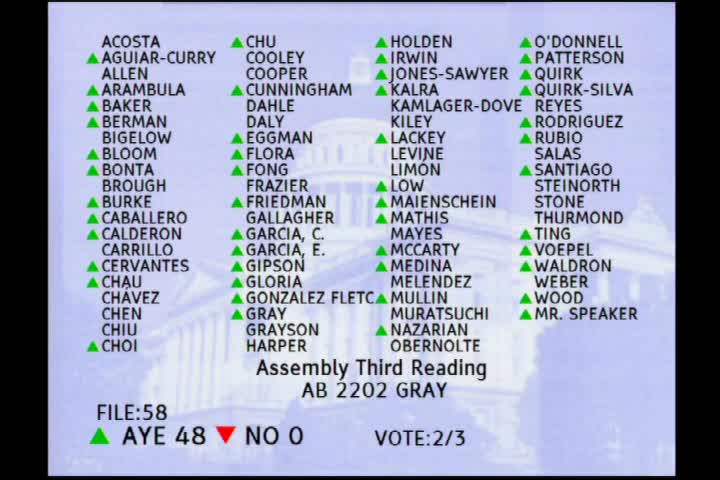
AYES: Acosta, Aguiar-Curry, Arambula, Baker, Berman, Bloom, Bonta, Burke, Caballero, Calderon, Carrillo, Cervantes, Chau, Chen, Chiu, Chu, Cooley, Cooper, Cunningham, Daly, Eggman, Frazier, Friedman, Cristina Garcia, Eduardo Garcia, Gipson, Gloria, Gonzalez Fletcher, Gray, Grayson, Holden, Irwin, Jones-Sawyer, Kalra, Kamlager-Dove, Lackey, Levine, Limón, Low, Maienschein, McCarty, Medina, Mullin, Muratsuchi, Nazarian, Obernolte, O'Donnell, Quirk, Quirk-Silva, Reyes, Rodriguez, Rubio, Salas, Santiago, Steinorth, Mark Stone, Thurmond, Ting, Voepel, Waldron, Weber, Wood, Rendon
NOES: Travis Allen, Bigelow, Brough, Chávez, Dahle, Fong, Gallagher, Harper, Kiley, Mathis, Melendez
NO VOTE RECORDED: Choi, Flora, Mayes, Patterson
8/18/18 13:52:21
**** END ****
SENATE COMMITTEE ON
Senator Anthony Portantino, Chair
2017 - 2018 Regular Session
AB 2271 (Quirk-Silva) - School food authorities: federal equipment assistance grants: matching state grants
Version: | Policy Vote: |
Urgency: | Mandate: |
Hearing Date: | Consultant: |
This bill meets the criteria for referral to the Suspense File.
Bill Summary:
This bill requires the California Department of Education (CDE), contingent upon an appropriation, to provide a matching state grant of up to $100,000 to school food authorities participating in the federal National School Lunch Program that are awarded a federal Equipment Assistance Grant for School Food Authorities (SFAs).
Fiscal Impact:
- By requiring matching grants of up to $100,000 to SFAs, this bill could cost $3 million Proposition 98 General Fund each year. The state received $3 million in federal Equipment Assistance Grant funds in 2017-18 and provided grants that ranged from about $5,400 up to $100,000 to 57 school districts and county offices of education
- The CDE estimates ongoing General Fund costs of $127,000 and one position to administer the program.
Background:
The U.S. Department of Agriculture (USDA) provides approximately $25 million each year to state agencies to competitively award eligible school food authorities equipment assistance funding. Federal law specifies that state agencies must award these grants via a competitive grant process to SFA's, giving priority to high need schools where 50 percent or more of the enrolled students are eligible for free or reduced price meals.
Existing state law requires school districts or county offices of education with students in kindergarten or grades K-12 to provide one nutritionally-adequate meal to each free or reduced-price eligible student during each school day. The law defines “nutritionally adequate meal” as breakfast or lunch that qualifies for reimbursement under federal child nutrition program regulations.
Proposed Law:
This bill requires CDE, upon appropriation by the Legislature and contingent upon the availability of funds provided by the federal Consolidated Appropriations Act, to provide a matching state grant of up to one hundred thousand dollars ($100,000) to a school food authority participating in the federal National School Lunch Program that applies for and is awarded a federal Equipment Assistance Grant for School Food Authorities from the CDE in its administration of the National School Lunch Program.
This bill requires the state appropriation to be for a minimum of two years and to align with the United States Department of Agriculture National School Lunch Program Equipment Grant for School Food Authorities terms and conditions, period of performance, criteria, timelines, and procurement and funding expenditure requirements.
This bill authorizes a school food authority to use the federal and state grants for up to five individual schoolsites or may combine the federal and state grants for one purpose, such as creating a centralized industrial kitchen.
This bill requires the state matching assistance grant to be competitively awarded and to align with the federal equipment assistance grant requirements, and also provides that unspent matching state grant funds be retained by the CDE for one or more additional equipment grants, subject to the same requirements.
Related Legislation:
AB 3043 (Berman, 2018) would double the grant size for the school breakfast and summer meals programs and authorize a school district to use cafeteria funds to supplement the cost of providing universal breakfast and to purchase a mobile food facility. This bill is currently pending on the Suspense File in this Committee.
Staff Comments:
The U.S. Department of Agriculture provides the CDE approximately $3 million annually to competitively award grants to SFAs to purchase equipment. Common equipment purchases include food carts, ovens, and dishwashers. CDE awards grants of up to $100,000 for each SFA, with priority given to first-time applicants and those with greater proportions of low-income students. In 2017 the program was oversubscribed with CDE receiving 126 grant applications and awarding 57 grants averaging $52,000 each; the remaining 69 applications were not funded. In 2016, there were 90 applications unfunded while in 2015, 76 applications went unfunded.
-- END --
SENATE COMMITTEE ON EDUCATION
Senator Benjamin Allen, Chair
2017 - 2018 Regular
Bill No: AB 2271 Hearing Date: June 13, 2018
Author: | |||
Version: | March 14, 2018 | ||
Urgency: | No | Fiscal: | Yes |
Consultant: | Brandon Darnell | ||
Subject: School food authorities: federal equipment assistance grants: matching state grants.
SUMMARY
This bill requires the California Department of Education (CDE), upon appropriation by the Legislature and contingent upon federal funding, to provide a matching state grant of up to 100,000 to school food authorities participating in the federal National School Lunch Program that apply for and are awarded a federal Equipment Assistance Grant for School Food Authorities (SFAs).
BACKGROUND
Existing federal law:
1) Authorizes the U.S. Department of Agriculture (USDA) to provide $25 million to state agencies ($3 million for California) to competitively award eligible school food authorities equipment assistance funding. (Public Law § 115-31)
2) Specifies that state agencies must award these grants via a competitive grant process to SFA's, giving priority to high need schools where 50 percent or more of the enrolled students are eligible for free or reduced price meals. (PL § 115-31)
Existing state law:
1) Requires school districts or county offices of education with students in kindergarten or grades K-12 to provide one nutritionally-adequate meal to each free or reduced-price eligible student during each school day. (Education Code § 49550)
2) Defines “nutritionally adequate meal” as breakfast or lunch that qualifies for reimbursement under federal child nutrition program regulations. (EC § 49553)
ANALYSIS
This bill requires the CDE, upon appropriation by the Legislature and contingent upon federal funding, to provide a matching state grant of up to $100,000 to school food authorities participating in the federal National School Lunch Program that apply for and are awarded a federal Equipment Assistance Grant for School Food Authorities. Specifically, this bill:
a) States Legislature findings and declarations that the state strives to serve National School Lunch Program meals of the highest quality and greatest nutritional value possible.
b) Requires the California Department of Education (CDE), upon appropriation by the Legislature, and contingent upon allocations provided by the federal Consolidated Appropriations Act, to provide a matching state grant of up to one hundred thousand dollars ($100,000) to a school food authority participating in the federal National School Lunch Program that applies for and is awarded a federal Equipment Assistance Grant for School Food Authorities from the CDE in its administration of the National School Lunch Program.
c) Requires the state appropriation to be for a minimum of two years and to align with the United States Department of Agriculture National School Lunch Program Equipment Grant for School Food Authorities terms and conditions, period of performance, criteria, timelines, and procurement and funding expenditure requirements.
d) Authorizes a school food authority to use the federal and state grants for up to five individual schoolsites or may combine the federal and state grants for one purpose, such as creating a centralized industrial kitchen.
e) Requires the state matching assistance grant to be competitively awarded and to align with the federal equipment assistance grant requirements.
f) Requires unspent matching state grant funds to be retained by the CDE for one or more additional equipment grants, subject to the same requirements.
STAFF COMMENTS
- Need for the bill. According to the author, “More than 3.2 million children in California participate in the National School Lunch Program each school day. Unfortunately, many school districts have not invested in the equipment and infrastructure necessary to maintain school kitchen/cafeterias, leaving them challenged in their efforts to serve healthy meals and meet children’s dietary needs without relying on prepackaged and “heat and serve” meals from outside vendors.
As a result, schools are having a particularly hard time adding more, and a greater variety of, fruits and vegetables to their daily menus. This is often because they lack large-capacity food processors, commercial grade stoves, and sufficient cold storage space. According to the USDA Farm to School Team’s 2010 Summary Report, insufficient processing and storage capacity in schools often prevent them from purchasing local produce, which must be stored and prepared under specific conditions. Further, a recent study discovered that each day in the Los Angeles Unified School District, students throw away at least $100,000 worth of food that they are served for lunch; approximately 600 tons of organic waste daily.
In June 2017, the Agriculture Appropriations Act authorized the U.S. Department of Agriculture (USDA) to grant California approximately $3 million to competitively award eligible SFAs equipment assistance funding. Public school districts that participate in the program may apply for up to $100,000 in grant funding for up to five school sites. The grant is designed to help schools serve healthier meals with a focus on serving more fruits and vegetables, and improving food safety and energy efficiency. However, the funds are not matched by the State of California nor do school districts have the ability to combine grants within an SFA to equip a centralized preparation site that could serve multiple schools within a district.”
2) National School Lunch Program Equipment (NSLP) Assistance Grants. According to the USDA, state agencies must award these grants via a competitive grant process to school food authorities (SFAs), giving priority to high need schools (i.e., schools in underserved areas, schools with limited access to other resources, and age of food service equipment) where 50 percent or more of the enrolled students are eligible for free or reduced-price meals. In addition, SFA's must give priority to schools that did not receive a previous NSLP Equipment Assistance Grant. When developing the award selection criteria for grant recipients, State agencies should consider factors including, but not limited to, the following:
a) Opportunities to realize meaningful impacts on nutrition and quality of meals (such as serving more local foods or replacing fryers with combination steamer-ovens).
b) Strategies for adopting lunchroom changes that provide more convenience and appeal to the student population (e.g., highlighting healthier choices, redesigning menus that target healthier entrees/options).
c) The availability of existing State and local funding for equipment purchases.
d) Age of food service equipment.
3) Funding Goals. According to the USDA, in order to make the most effective use of the NSLP Equipment Assistance Grant funds, state agencies must include, as a focus area, equipment that improves the quality of school meals. Additional focus areas may include:
a) Equipment that improves the safety of food served in the school meal programs.
b) Equipment that improves the overall energy efficiency of the school food service operations.
c) Equipment used to improve or expand participation in the NSLP and/or School Breakfast Program.
According to the U.S. Department of Agriculture (USDA), equipment requests may include new equipment, renovation of equipment, or replacement of equipment, but equipment competitively procured using these grant funds must be necessary, reasonable, and allocable. For example, while using these grant funds to purchase a walk-in freezer for school food service, or a salad bar, may be an allowable cost, building an extension to a cafeteria would be a capital expense that should be borne by the school district.
3) Fiscal impact. According to the Assembly Appropriations Committee, “The U.S. Department of Agriculture provides the CDE approximately $3 million annually to competitively award grants to school food authorities to purchase equipment. Common equipment purchases include food carts, ovens, and dishwashers. CDE awards grants up to $100,000 per school food authority, with priority given to first-time applicants and those with greater proportions of low-income students. In 2017, the program was oversubscribed, with CDE receiving 126 grant applications and awarding 57 grants averaging $52,000 each.”
This means that in 2017, 59 applications were not funded. Additionally, in 2016, 90 applications went unfunded and in 2015, there 76 unfunded applications. The committee may wish to consider if the $3 million in matching state funds might be better allocated to funding additional applications rather than doubling the size of applications that are funded.
4) Related legislation. AB 3043 (Berman, 2018) would authorize a school district to use cafeteria funds to also supplement the cost of providing universal breakfast and, with approval from the California Department of Education (CDE), to purchase a mobile food facility; (2) updates references to ensure that the CDE develops and maintains proper nutritional guidelines aligned to federal law; (3) doubles competitive grant awards to $30,000 per schoolsite for nonrecurring expenses for initiating or expanding a school breakfast or federal summer meals program; and (4) requires the CDE to monitor schools participating in federal meal programs to ensure that meals served to students qualify for federal reimbursement.
SUPPORT
None received
OPPOSITION
None received
-- END --
ASSEMBLY THIRD READING
ATR Bill Id:
Author:(Quirk-Silva)
As Amended Ver:March 14, 2018
Majority vote
Committee | Votes | Ayes | Noes |
Education | 6-1 | O'Donnell, Lackey, Kalra, McCarty, Thurmond, Weber | Kiley |
Appropriations | 13-3 | Gonzalez Fletcher, Bloom, Bonta, Calderon, Carrillo, Chau, Eggman, Friedman, Eduardo Garcia, Nazarian, Obernolte, Quirk, Reyes | Bigelow, Fong, Gallagher |
SUMMARY: Requires, upon appropriation by the Legislature, the California Department of Education (CDE) to provide a matching state grant of up to one hundred thousand dollars ($100,000) to a school food authority (SFA) participating in the federal National School Lunch Program that is awarded a federal equipment assistance grant. Specifically, this bill:
- Specifies a SFA may use the federal and state grants for up to five individual schoolsites or may combine the federal and state grants for one purpose, such as creating a centralized industrial kitchen.
- Specifies the state appropriation shall be for a minimum of two years and shall align with the United States Department of Agriculture National School Lunch Program Equipment Grant for School Food Authorities terms and conditions, period of performance, criteria, timelines, and procurement and funding expenditure requirements.
- Requires the state matching assistance grant to be competitively awarded and to align with the federal equipment assistance grant requirements.
- Requires unspent matching state grant funds to be retained by CDE for one or more additional equipment grants, subject to the same requirements.
EXISTING FEDERAL LAW authorizes the U.S. Department of Agriculture (USDA) to provide $25 million to state agencies ($3 million to California) to competitively award eligible school food authorities equipment assistance funding. Specifies that state agencies must award these grants via a competitive grant process to SFA's, giving priority to high need schools (i.e., schools in underserved areas, schools with limited access to other resources, and age of food service equipment) where 50 % or more of the enrolled students are eligible for free or reduced price meals.
FISCAL EFFECT: According to the Assembly Appropriations Committee, approximately $3 million ongoing in Proposition 98 General Fund. $127,000 ongoing General Fund for one position to administer the program at the California Department of Education (CDE).
COMMENTS: This bill awards a state matching grant, up to $100,000, to local education agencies that are awarded a federal equipment assistance grant. This doubles the grant amount for these awardees, allowing them to apply for larger projects at a single school site, or across five school sites.
According to the author, "More than 3.2 million children in California participate in the National School Lunch Program each school day. Unfortunately, many school districts have-not invested in the equipment and infrastructure necessary to maintain school kitchen/cafeterias, leaving them challenged in their efforts to serve healthy meals and meet children's dietary needs without relying on prepackaged and "heat and serve" meals from outside vendors."
"As a result, schools are having a particularly hard time adding more, and a greater variety of, fruits and vegetables to their daily menus. This is often because they lack large-capacity food processors, commercial grade stoves, and sufficient cold storage space. According to the USDA Farm to School Team's 2010 Summary Report, insufficient processing and storage capacity in schools often prevent them from purchasing local produce, which must be stored and prepared under specific conditions. Further, a recent study discovered that each day in the Los Angeles Unified School District, students throw away at least $100,000 worth of food that they are served for lunch; approximately 600 tons of organic waste daily. My goal for AB 2271 is to expand the existing Federal School Lunch Equipment Assistance Grant Program in such a way that School Food Authorities have the flexibility to purchase commercial grade kitchen equipment so food can be stored and prepared on site. The bill would also allow SFAs to use the grant to create a centralized space to prepare fresh meals for multiple school sites."
National School Lunch Program Equipment Assistance Grants: In June 2017, the Agriculture Appropriations Act authorized USDA to grant California approximately $3 million to competitively award eligible SFAs equipment assistance funding. This grant is designed to help schools serve healthier meals with a focus on serving more fruits and vegetables, improving food safety and energy efficiency, and expanding access.
The table below shows the number of National School Lunch Program (NSLP) Equipment Assistance Grant (EAG) applications submitted and awarded in California, and the number of dollars requested and awarded over the last three years.
National School Lunch Program Equipment Assistance Grant History | |||
2015 | 2016 | 2017 | |
Amount Requested | $8.52 million | $9.86 million | $8.18 million |
Amount Awarded | $3.09 million | $3.67 million | $2.97 million |
Applications Received | 136 | 165 | 126 |
Applications Awarded | 60 | 75 | 57 |
Analysis Prepared by: Chelsea Kelley / ED. / (916) 319-2087 FN: 0003131
Date of Hearing: April 4, 2018
ASSEMBLY COMMITTEE ON APPROPRIATIONS
Lorena Gonzalez Fletcher, Chair
ABPCA Bill Id:AB 2271
Author:(Quirk-Silva) – As Amended Ver:March 14, 2018
Policy Committee: | Education | Vote: | 6 - 1 |
|
| ||
|
|
Urgency: No State Mandated Local Program: No Reimbursable: No
SUMMARY:
This bill provides a state match of up to $100,000 for a minimum of two years for each school food authority receiving funding from Federal School Lunch Equipment Assistance Grant program, upon appropriation by the Legislature.
FISCAL EFFECT:
- Approximately $3 million ongoing in Proposition 98 General Fund.
- $127,000 ongoing General Fund for one position to administer the program at the California Department of Education (CDE).
COMMENTS:
- Purpose. The author indicates that some schools are unable to prepare or store food on site because they do not have commercial-grade kitchen equipment. Instead, they may rely on prepackaged food and “heat and serve” meals. This author-sponsored bill would provide additional funding to help schools purchase these more expensive items so food could be prepared and stored on site.
- Background. The U.S. Department of Agriculture provides the CDE approximately $3 million annually to competitively award grants to school food authorities to purchase equipment. Common equipment purchases include food carts, ovens, and dishwashers. CDE awards grants up to $100,000 per school food authority, with priority given to first-time applicants and those with greater proportions of low-income students. In 2017, the program was oversubscribed, with CDE receiving 126 grant applications and awarding 57 grants averaging $52,000 each.
Analysis Prepared by: Natasha Collins / APPR. / (916) 319-2081
Date of Hearing: March 21, 2018
ASSEMBLY COMMITTEE ON EDUCATION
Patrick O'Donnell, Chair
ABPCA Bill Id:AB 2271 (
Author:Quirk-Silva) – As Amended Ver:March 14, 2018
SUBJECT: School food authorities: federal equipment assistance grants: matching state grants
SUMMARY: Requires, upon appropriation by the Legislature, the California Department of Education (CDE) to provide a matching state grant of up to one hundred thousand dollars ($100,000) to a school food authority (SFA) participating in the federal National School Lunch Program that is awarded a federal equipment assistance grant. Specifically, this bill:
- Specifies a SFA may use the federal and state grants for up to five individual schoolsites or may combine the federal and state grants for one purpose, such as creating a centralized industrial kitchen.
- Specifies the state appropriation shall be for a minimum of two years and shall align with the United States Department of Agriculture National School Lunch Program Equipment Grant for School Food Authorities terms and conditions, period of performance, criteria, timelines, and procurement and funding expenditure requirements.
- Requires the state matching assistance grant to be competitively awarded and to align with the federal equipment assistance grant requirements.
- Requires unspent matching state grant funds to be retained by CDE for one or more additional equipment grants, subject to the same requirements.
EXISTING FEDERAL LAW authorizes the U.S. Department of Agriculture (USDA) to provide $25 million to state agencies ($3 million to California) to competitively award eligible school food authorities equipment assistance funding. Specifies that state agencies must award these grants via a competitive grant process to SFA's, giving priority to high need schools (i.e., schools in underserved areas, schools with limited access to other resources, and age of food service equipment) where 50 percent or more of the enrolled students are eligible for free or reduced price meals.
FISCAL EFFECT: Unknown
COMMENTS: This bill awards a state matching grant, up to $100,000, to local education agencies that are awarded a federal equipment assistance grant. This doubles the grant amount for these awardees, allowing them to apply for larger projects at a single school site, or across five school sites.
According to the author, "More than 3.2 million children in California participate in the National School Lunch Program each school day. Unfortunately, many school districts have- not invested in the equipment and infrastructure necessary to maintain school kitchen/cafeterias, leaving them challenged in their efforts to serve healthy meals and meet children’s dietary needs without relying on prepackaged and “heat and serve” meals from outside vendors."
"As a result, schools are having a particularly hard time adding more, and a greater variety of, fruits and vegetables to their daily menus. This is often because they lack large-capacity food processors, commercial grade stoves, and sufficient cold storage space. According to the USDA Farm to School Team’s 2010 Summary Report, insufficient processing and storage capacity in schools often prevent them from purchasing local produce, which must be stored and prepared under specific conditions. Further, a recent study discovered that each day in the Los Angeles Unified School District, students throw away at least $100,000 worth of food that they are served for lunch; approximately 600 tons of organic waste daily. My goal for AB 2271 is to expand the existing Federal School Lunch Equipment Assistance Grant Program in such a way that School Food Authorities have the flexibility to purchase commercial grade kitchen equipment so food can be stored and prepared on site. The bill would also allow SFAs to use the grant to create a centralized space to prepare fresh meals for multiple school sites."
National School Lunch Program Equipment Assistance Grants: In June 2017, the Agriculture Appropriations Act authorized the U.S. Department of Agriculture (USDA) to grant California approximately $3 million to competitively award eligible SFAs equipment assistance funding. This grant is designed to help schools serve healthier meals with a focus on serving more fruits and vegetables, improving food safety and energy efficiency, and expanding access.
The table below shows the number of National School Lunch Program (NSLP) Equipment Assistance Grant (EAG) applications submitted and awarded in California, and the number of dollars requested and awarded over the last three years.
National School Lunch Program Equipment Assistance Grant History | |||
2015 | 2016 | 2017 | |
Amount Requested | $8.52 million | $9.86 million | $8.18 million |
Amount Awarded | $3.09 million | $3.67 million | $2.97 million |
Applications Received | 136 | 165 | 126 |
Applications Awarded | 60 | 75 | 57 |
The committee should note that the equipment assistance grant program received requests for over $8 million in 2017, but the state was only awarded $2.97 million by the federal government. These means only 57 grantees out of 126 applications were selected. This bill doubles the grant amount for those 57 grantees. The committee should consider whether it would be the best use of state resources to double the grant amounts for those local education agencies that receive a federal grant, or whether to expand the pool of grantees by awarding these state grants to local education agencies that do not receive a federal grant. The author contends that the goal is to double the grant amount so that districts can purchase larger and more expensive kitchen equipment.
Below are some of the more common equipment purchases under the existing federal grant program:
Food Cart | Blast Chiller | Digital Metered Water Filler |
Serving Lines (hot and cold) | Delivery Van | Cashier's Stand |
Outdoor Walk in Freezer | Mobile Food Trailer/Trucks | Combination Ovens |
Portable Steam Table | Range/Oven | Conveyor Pizza Oven |
Horizontal Wrapper/Packaging Machine | Refrigerated Truck | Mobile Food Services Golf Cart |
Salad Bar | Merchandising Kiosk | 2-3 Door Fridge/Freezers |
Grab 'n' Go Refrigerator | Stand Mixer | Vending Machines |
Ice Maker | Mobile Hot/Cold Cabinets | Dishwasher |
Milk Coolers | Kettles | Range Hood |
REGISTERED SUPPORT / OPPOSITION:
Support
None on file
Opposition
None on file
Analysis Prepared by: Chelsea Kelley / ED. / (916) 319-2087

Bill Author

Bill Co-Author(s):