AB 2415: Public Employees’ Retirement System: officers and directors: appointment and compensation.
- Session Year: 2017-2018
- House: Assembly
- Latest Version Date: 2018-09-29
The Public Employees Retirement Law (PERL) vests the management and control of the Public Employees Retirement System in the Board of Administration. PERL requires the board to appoint and fix the compensation of an executive officer, a general counsel, a chief actuary, a chief investment officer, a chief financial officer and other investment officers and portfolio managers, as specified. PERL requires that specified principles guide the board when fixing compensation, consistent with its fiduciary responsibility to recruit and retain highly qualified and effective employees for these positions.
This bill would additionally require the board to appoint and fix the compensation of a chief operating officer and a chief health director. The bill would prohibit the annual percentage increase in salary paid to a person who served as chief health director or as chief operating officer on January 1, 2018, and who does not separate from service in the position prior to the date on which the increase is applied, from exceeding 10% for the 201819 fiscal year or 5% for any subsequent fiscal year.
The Public Employees Retirement Law (PERL) vests the management and control of the Public Employees Retirement System in the Board of Administration. PERL requires the board to appoint and fix the compensation of an executive officer, a general counsel, a chief actuary, a chief investment officer, a chief financial officer and other investment officers and portfolio managers, as specified. PERL requires that specified principles guide the board when fixing compensation, consistent with its fiduciary responsibility to recruit and retain highly qualified and effective employees for these positions.
This bill would additionally require the board to appoint and fix the compensation of a chief operating officer and a chief health director.
(a)The board shall appoint and, notwithstanding Sections 19825, 19826, 19829, and 19832, shall fix the compensation of an executive officer, a general counsel, a chief actuary, a chief investment officer, a chief financial officer, a chief operating officer, a chief health director, and other investment officers and portfolio managers whose positions are designated managerial pursuant to Section 18801.1.
(b)The executive officer, deputy executive officers, and the assistant executive officers may administer oaths.
(c)When fixing the compensation for the positions specified in subdivision (a), the board shall be guided by the principles contained in Sections 19826 and 19829, consistent with its fiduciary responsibility to its members to recruit and retain highly qualified and effective employees for these positions.
(d)The annual percentage increase in salary that may be paid pursuant to this section to a person who served as chief health director or as chief operating officer on January 1, 2018, and who does not separate from service in the position prior to the date on which the increase is applied, shall not exceed either of the following:
(1)Ten percent for the 201819 fiscal year.
(2)Five percent for any fiscal year subsequent to the 201819 fiscal year.
(e)When a position specified in subdivision (a) is filled through a general civil service appointment, it shall be filled from an eligible list based on an examination that was held on an open basis, and tenure in the position shall be subject to Article 2 (commencing with Section 19590) of Chapter 7 of Part 2. In addition to the causes for action specified in that article, the board may take action under the article for causes related to its fiduciary responsibility to its members, including the employees failure to meet specified performance objectives.
(f)An individual who held a position designated in subdivision (a), or was a member of the board, a deputy executive officer, or an assistant executive officer, shall not, for a period of two years after leaving that position, for compensation, act as agent or attorney for, or otherwise represent, any other person, except the state, by making any formal or informal appearance before, or any oral or written communication to, the Public Employees Retirement System, or any officer or employee thereof, if the appearance or communication is made for the purpose of influencing administrative or legislative action or any action or proceeding involving the issuance, amendment, awarding, or revocation of a permit, license, grant, contract, or sale or purchase of goods or property.
(a)The board shall appoint and, notwithstanding Sections 19816, 19825, 19826, 19829, and 19832 19832, shall fix the compensation of an executive officer, a general counsel, a chief actuary, a chief investment officer, a chief financial officer, a chief operating officer, a chief health director, and other investment officers and portfolio managers whose positions are designated managerial pursuant to Section 18801.1.
(b)The executive officer, deputy executive officers, and the assistant executive officers may administer oaths.
(c)When fixing the compensation for the positions specified in subdivision (a), the board shall be guided by the principles contained in Sections 19826 and 19829, consistent with its fiduciary responsibility to its members to recruit and retain highly qualified and effective employees for these positions.
(d)The annual percentage increase in salary that may be paid pursuant to this section to a person who served as chief health director or as chief operating officer on January 1, 2018, and who does not separate from service in the position prior to the date on which the increase is applied, shall not exceed either of the following:
(1)Ten percent for the 201819 fiscal year.
(2)Five percent for any fiscal year subsequent to the 201819 fiscal year.
(d)(e)When a position specified in subdivision (a) is filled through a general civil service appointment, it shall be filled from an eligible list based on an examination that was held on an open basis, and tenure in the position shall be subject to the provisions of Article 2 (commencing with Section 19590) of Chapter 7 of Part 2 of Division 5 of Title 2. In addition to the causes for action specified in that article, the board may take action under the article for causes related to its fiduciary responsibility to its members, including the employees failure to meet specified performance objectives.
(e)(f)An individual who held a position designated in subdivision (a), or was a member of the board, a deputy executive officer, or an assistant executive officer, shall not, for a period of two years after leaving that position, for compensation, act as agent or attorney for, or otherwise represent, any other person, except the state, by making any formal or informal appearance before, or any oral or written communication to, the Public Employees Retirement System, or any officer or employee thereof, if the appearance or communication is made for the purpose of influencing administrative or legislative action or any action or proceeding involving the issuance, amendment, awarding, or revocation of a permit, license, grant, contract, or sale or purchase of goods or property.
(a)The board shall appoint and, notwithstanding Sections 19816, 19825, 19826, 19829, and 19832 shall fix the compensation of an executive officer, a general counsel, a chief actuary, a chief investment officer, a chief financial officer, a chief operating officer, a chief health director, and other investment officers and portfolio managers whose positions are designated managerial pursuant to Section 18801.1.
(b)The executive officer, deputy executive officers, and the assistant executive officers may administer oaths.
(c)When fixing the compensation for the positions specified in subdivision (a), the board shall be guided by the principles contained in Sections 19826 and 19829, consistent with its fiduciary responsibility to its members to recruit and retain highly qualified and effective employees for these positions.
(d)When a position specified in subdivision (a) is filled through a general civil service appointment, it shall be filled from an eligible list based on an examination that was held on an open basis, and tenure in the position shall be subject to the provisions of Article 2 (commencing with Section 19590) of Chapter 7 of Part 2 of Division 5 of Title 2. In addition to the causes for action specified in that article, the board may take action under the article for causes related to its fiduciary responsibility to its members, including the employees failure to meet specified performance objectives.
(e)An individual who held a position designated in subdivision (a), or was a member of the board, a deputy executive officer, or an assistant executive officer, shall not, for a period of two years after leaving that position, for compensation, act as agent or attorney for, or otherwise represent, any other person, except the state, by making any formal or informal appearance before, or any oral or written communication to, the Public Employees Retirement System, or any officer or employee thereof, if the appearance or communication is made for the purpose of influencing administrative or legislative action or any action or proceeding involving the issuance, amendment, awarding, or revocation of a permit, license, grant, contract, or sale or purchase of goods or property.
|
Date
|
Status
|
|---|---|
| Sep 29, 2018 | Chaptered by Secretary of State - Chapter 916, Statutes of 2018. |
| Sep 29, 2018 | Approved by the Governor. |
| Sep 6, 2018 | Enrolled and presented to the Governor at 3 p.m. |
| Aug 29, 2018 | Senate amendments concurred in. To Engrossing and Enrolling. |
| Aug 27, 2018 | In Assembly. Concurrence in Senate amendments pending. May be considered on or after August 29 pursuant to Assembly Rule 77. |
| Aug 27, 2018 | Read third time. Passed. Ordered to the Assembly. |
| Aug 20, 2018 | Read second time. Ordered to third reading. |
| Aug 17, 2018 | From committee: Amend, and do pass as amended. (Ayes 6. Noes 1.) (August 16). |
| Aug 6, 2018 | In committee: Referred to APPR. suspense file. |
| Jun 26, 2018 | From committee: Do pass and re-refer to Com. on APPR. (Ayes 4. Noes 1.) (June 25). Re-referred to Com. on APPR. |
| Jun 7, 2018 | Referred to Com. on P.E. & R. |
| May 30, 2018 | In Senate. Read first time. To Com. on RLS. for assignment. |
| May 29, 2018 | Read third time. Passed. Ordered to the Senate. |
| May 25, 2018 | From committee: Do pass. (Ayes 16. Noes 0.) (May 25). |
| Apr 18, 2018 | In committee: Set, first hearing. Referred to APPR. suspense file. |
| Apr 4, 2018 | From committee: Do pass and re-refer to Com. on APPR. (Ayes 4. Noes 0.) (April 4). Re-referred to Com. on APPR. |
| Mar 5, 2018 | Referred to Com. on P.E., R., & S.S. |
| Feb 15, 2018 | From printer. May be heard in committee March 17. |
| Feb 14, 2018 | Read first time. To print. |
|
Date
|
Description
|
Location
|
Votes
|
|
|---|---|---|---|---|
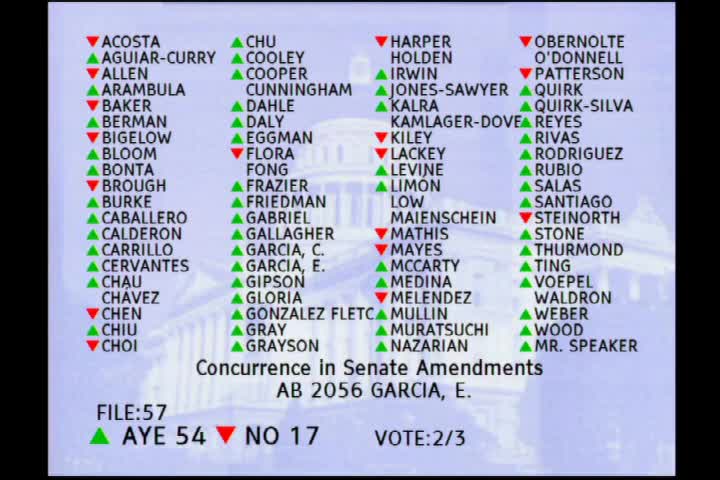
| Aug 29, 2018 | AB 2415 CALDERON Concurrence in Senate Amendments | Assembly Floor |
Passed |
|
| Aug 27, 2018 | Assembly 3rd Reading AB2415 Calderon By Moorlach | Senate Floor |
Passed |
|
| Aug 16, 2018 | Do pass as amended | Senate Standing Committee on Appropriations |
Passed |
|
| Aug 6, 2018 | Placed on suspense file | Senate Standing Committee on Appropriations |
Passed |
|
| Jun 25, 2018 | Do pass, but first be re-referred to the Committee on [Appropriations] | Senate Standing Committee on Public Employment and Retirement |
Passed |
|
| May 29, 2018 | AB 2415 CALDERON Assembly Third Reading | Assembly Floor |
Passed |
|
| May 25, 2018 | Do pass. | Assembly Standing Committee on Appropriations |
Passed |
|
| Apr 4, 2018 | Do pass and be re-referred to the Committee on [Appropriations] | Assembly Standing Committee on Public Employees, Retirement, and Social Security |
Passed |
This list shows positions taken on this bill by organizations on the date displayed, which is linked to the original source.
Positions by individuals are not included.
|
Organization
|
Position
|
Date
|
|---|---|---|
| California Public Employees' Retirement System | ** Support | Aug 20, 2018 |
| California Special Districts Association | ** Support | Aug 20, 2018 |
| California State Association Of Counties | ** Support | Aug 20, 2018 |
| CalPERS | * Support | Apr 4, 2018 |
| League Of California Cities | ** Support | Aug 20, 2018 |
CONCURRENCE IN SENATE AMENDMENTS
CSA1 Bill Id:AB 2415
Author:(Calderon)
As Amended Ver:August 17, 2018
Majority vote
ASSEMBLY: | 76-0 | (May 29, 2018) | SENATE: | 31-7 | (August 27, 2018) |
Original Committee Reference: P.E.,R., & S.S.
SUMMARY: Adds the positions of a chief operating officer (COO) and a chief health director (CHD) to the list of existing positions for which the California Public Employees' Retirement System (CalPERS) Board of Administration has compensation-setting authority, and limits the amount of increased salary an incumbent in either of these positions could receive.
The Senate amendments:
1) Prohibit the annual percentage increase in salary from exceeding 10% for the 2018-19 fiscal year or 5% for any subsequent year paid to the individual who served as the CHD or COO on January 1, 2019, and who does not separate from service in the position prior to the date when the increase is applied.
2) Make other minor, technical and nonsubstantive changes.
EXISTING LAW:
- Requires the California Department of Human Resources (CalHR) to establish and adjust salary ranges for each class of position in the state civil service subject to any merit limits contained in California Constitution Article VII.
- Provides that the salary range shall be based on the principle that like salaries be paid for comparable duties and responsibilities. In establishing or changing these ranges, existing law requires CalHR to give consideration to the prevailing rates for comparable service in other public employment and in private business.
- Prohibits CalHR from making adjustments that require expenditures in excess of existing appropriations that may be used for salary increase purposes.
- Authorizes the CalPERS board to appoint and fix the compensation of an executive officer, general counsel, chief actuary, chief investment officer, chief financial officer, and other investment officers and portfolio managers.
- Requires the board to be guided by the same principles governing CalHR's authority to set salaries and compensation, consistent with its fiduciary responsibility to its members to recruit and retain highly qualified and effective employees for these positions.
- Requires the board, when filling certain executive positions through a general civil service appointment, to fill the position from an eligible list based on an examination that was held on an open basis. Tenure in the position is subject to provisions of existing law related to adverse action for managerial employees. The board may also take certain action for causes related to its fiduciary responsibility, including the employee's failure to meet performance objectives.
FISCAL EFFECT: According to the Senate Appropriations Committee, this bill would result in "increased compensation costs to CalPERS to the extent that [the] board exercised the authority in the bill to hire individuals into the two affected positions at salaries that exceed their current salary ranges. The precise increase cannot be determined in advance, but could potentially reach the low hundreds of thousands of dollars annually. CalPERS administrative costs related to the bill, including updating duty statements and organization charts, would be minor and absorbable."
COMMENTS: According to the author, "CalPERS lacks the authority to set the compensation for [positions covered by this bill], which has directly undermined the agency's ability to recruit and retain talented employees. A near constant hiring process has undermined CalPERS' ability to plan for the succession of its leadership team and meet its fiduciary duties.
"Assembly Bill 2415 will give the CalPERS Board the authority to appoint and fix the compensation of [these positions]. This simple change will allow the board to more effectively recruit and retain talent, plan for the succession of its executive leadership team, and meet its fiduciary duties."
Analysis Prepared by: Michael Bolden / P.E.,R., & S.S. / (916) 319-3957 FN: 0004482
Office of Senate Floor Analyses (916) 651-1520 Fax: (916) 327-4478 | AB |
THIRD READING
Bill No: AB 2415
:
SENATE PUBLIC EMP. & RET. COMMITTEE: 4-1, 6/25/18
AYES: Pan, Leyva, Moorlach, Portantino
NOES: Morrell
SENATE APPROPRIATIONS COMMITTEE: 6-1, 8/16/18
AYES: Portantino, Bates, Beall, Bradford, Hill, Wiener
NOES: Nielsen
ASSEMBLY FLOOR: 76-0, 5/29/18 - See last page for vote
SUBJECT: Public Employees’ Retirement System: officers and directors: appointment and compensation
SOURCE: California Public Employees’ Retirement System
DIGEST:
This bill adds the positions of a chief operating officer (COO) and a chief health director (CHD) to the list of existing positions for which the California Public Employees' Retirement System (CalPERS) Board of Administration has compensation-setting authority. This bill also limits the amount of increased salary an incumbent in either of these positions could receive, as specified.
ANALYSIS:
Existing law:
- Requires the California Department of Human Resources (CalHR) to establish and adjust salary ranges for each class of position in the state civil service subject to any merit limits contained in Article VII of the California Constitution.
- Provides that the salary range shall be based on the principle that like salaries shall be paid for comparable duties and responsibilities. In establishing or changing these ranges, existing law requires CalHR to give consideration to the prevailing rates for comparable service in other public employment and in private business.
- Prohibits CalHR from making adjustments that require expenditures in excess of existing appropriations that may be used for salary increase purposes.
- Authorizes the CalPERS board to appoint and fix the compensation of an executive officer, general counsel, chief actuary, chief investment officer, chief financial officer, and other investment officers and portfolio managers.
- Requires the board to be guided by the same principles governing CalHR’s authority to set salaries and compensation, consistent with its fiduciary responsibility to its members to recruit and retain highly qualified and effective employees for these positions.
- Requires the board, when filling a specified executive position through a general civil service appointment, to fill the position from an eligible list based on an examination that was held on an open basis. Tenure in the position is subject to provisions of existing law related to adverse action for managerial employees. The board may also take action, as specified, for causes related to its fiduciary responsibility, including the employee’s failure to meet specified performance objectives.
- Authorizes the California Health Benefits Exchange board to hire an executive officer, a chief fiscal officer, a chief operations officer, a director for the SHOP Exchange, a director of health plan contracting, a chief technology and information officer, a general counsel, and other key executive positions, as determined by the board, who are exempt from civil service.
- Authorizes the California Health Benefits Exchange board to set the salaries for the specified exempt positions in amounts that are reasonably necessary to attract and retain individuals of superior qualifications. To determine the compensation for these positions, the board shall cause to be conducted, through the use of independent outside advisors, salary surveys, as specified.
This bill:
- Authorizes CalPERS to fix the compensation of a COO and CHD in addition to its existing authority to fix the compensation for an executive officer, a general counsel, a chief actuary, a chief investment officer, a chief financial officer, and other investment officers and portfolio managers whose positions are designated managerial pursuant to existing law.
- Limits the annual increase in salary that may be paid to a person who served in the COO or CHD position on January 1, 2018, and who does not separate from service in the position prior to the date in which the increase is applied to 10 percent for 2018-19 and five percent for any subsequent fiscal year.
Comments
According to the author:
CalPERS is the largest public employer purchaser of health benefits in California and the second largest in the nation after the federal government. In 2016, it spent $8.6 billion dollars to provide health benefits for 1.4 million current and former employees and dependents of over 1,200 government agencies. The Chief Health Director (CHD) is responsible for the administration and management of CalPERS’ health benefits program.
The CalPERS Deputy Executive Officer (DEO) for Operations and Technology is responsible for several enterprise functions including the administration and overall management of human resources, business and strategic planning, retirement policy, operation and facilities, and information technology. These duties are common to Chief Operating Officer (COO) positions in health and financial services organization of similar size and complexity.
This bill provides CalPERS authority to set compensation for both positions.
Related/Prior Legislation
AB 736 (Cooley, Chapter 553, Statutes of 2016) expanded the list of positions for which the Teachers' Retirement Board (TRB) has authority to set the compensation and terms and conditions of employment to include one COO and the CFO. The bill also limited the annual percentage increase in salary authorized for the two positions to 10 percent for the 2017–18 fiscal year and five percent for any fiscal year thereafter for a person who served as COO or CFO on January 1, 2016, and who did not separate from service in that position prior to the date on which the increase is applied.
AB 1735 (Wieckowski, 2012), died in the Senate Committee on Appropriations, would have expanded the list of positions for which TRB has the authority to set the compensation and terms and conditions of employment to include the COO and the CFO and would have prohibited the salary for the COO and CFO from exceeding 150 percent of the Governor's salary.
AB 1042 (Allen, Chapter 688, Statutes of 2011) authorized the CalPERS board to appoint and set the compensation of a chief financial officer.
AB 1317 (Mullin, Chapter 333, Statutes of 2007) expanded the list of key positions for which the CalPERS board and TRB could set compensation and terms of employment to include the general counsel.
SB 269 (Soto, Chapter 856, Statutes of 2003) authorized the CalPERS board and TRB to set compensation and terms and conditions of employment of certain key positions.
FISCAL EFFECT: Appropriation: Fiscal Com.: Local:
According to Senate Appropriations Committee, this bill would result in increased compensation costs to CalPERS to the extent that its Board exercised the authority in this bill to hire individuals into the two affected positions at salaries that exceed their current salary ranges. The precise increase cannot be determined in advance, but could potentially reach the low hundreds of thousands of dollars annually. CalPERS administrative costs related to the bill, including updating duty statements and organization charts, would be minor and absorbable.
California Public Employees’ Retirement System (source)
California Special Districts Association
California State Association of Counties
League of California Cities
OPPOSITION: (Verified 8/17/18)
None received
ARGUMENTS IN SUPPORT: According to the California Public Employees’ Retirement System, “Placing salary setting authority with the Board ensures the compensation of certain executive and investment management positions aligns with other industries where CalPERS competes with talent. Currently, the state job classifications that apply to the proposed CHD and COO positions have salary ranges that are below equivalent positions at other state and local government agencies and industries.”
ASSEMBLY FLOOR: 76-0, 5/29/18
AYES: Acosta, Aguiar-Curry, Travis Allen, Arambula, Baker, Berman, Bigelow, Bloom, Bonta, Brough, Burke, Caballero, Calderon, Carrillo, Chau, Chávez, Chen, Chiu, Chu, Cooley, Cooper, Cunningham, Dahle, Daly, Eggman, Flora, Fong, Frazier, Friedman, Gallagher, Cristina Garcia, Eduardo Garcia, Gipson, Gloria, Gonzalez Fletcher, Gray, Grayson, Harper, Holden, Irwin, Jones-Sawyer, Kalra, Kamlager-Dove, Kiley, Lackey, Levine, Limón, Low, Maienschein, Mathis, Mayes, McCarty, Medina, Melendez, Mullin, Muratsuchi, Nazarian, Obernolte, O'Donnell, Patterson, Quirk, Quirk-Silva, Reyes, Rodriguez, Rubio, Salas, Santiago, Steinorth, Mark Stone, Thurmond, Ting, Voepel, Waldron, Weber, Wood, Rendon
NO VOTE RECORDED: Cervantes, Choi
8/20/18 9:50:23
**** END ****
SENATE COMMITTEE ON
Senator Anthony Portantino, Chair
2017 - 2018 Regular Session
AB 2415 (Calderon) - Public Employees’ Retirement System: officers and directors: appointment and compensation
Version: | Policy Vote: |
Urgency: | Mandate: |
Hearing Date: | Consultant: |
Bill Summary:
AB 2415 would add two positions, Chief Operating Officer (COO) and Chief Health Director (CHD), to the list of existing positions for which the California Public Employees' Retirement System (CalPERS) Board of Administration has compensation-setting authority.
*********** ANALYSIS ADDENDUM – SUSPENSE FILE ***********
The following information is revised to reflect amendments
adopted by the committee on August 16, 2018
Fiscal Impact:
This bill would result in increased compensation costs to CalPERS to the extent that its Board exercised the authority in the bill to hire individuals into the two affected positions at salaries that exceed their current salary ranges. The precise increase cannot be determined in advance, but could potentially reach the low hundreds of thousands of dollars annually. CalPERS administrative costs related to the bill, including updating duty statements and organization charts, would be minor and absorbable.
Author Amendments:
Reduce the magnitude of salary increases in specified instances.
-- END --
SENATE COMMITTEE ON APPROPRIATIONS
Senator Anthony Portantino, Chair
2017 - 2018 Regular Session
AB 2415 (Calderon) - Public Employees’ Retirement System: officers and directors: appointment and compensation
Version: February 14, 2018 | Policy Vote: P.E. & R. 4 - 1 |
Urgency: No | Mandate: No |
Hearing Date: August 6, 2018 | Consultant: Robert Ingenito |
This bill meets the criteria for referral to the Suspense File.
Bill Summary:
AB 2415 would add two positions, Chief Operating Officer (COO) and Chief Health Director (CHD), to the list of existing positions for which the California Public Employees' Retirement System (CalPERS) Board of Administration has compensation-setting authority.
Fiscal Impact:
This bill would result in increased compensation costs to CalPERS to the extent that its Board exercised the authority in the bill to hire individuals into the two affected positions at salaries that exceed their current salary ranges. The precise increase cannot be determined in advance, but could potentially reach the low hundreds of thousands of dollars annually (See Staff Comments). CalPERS administrative costs related to the bill, including updating duty statements and organization charts, would be minor and absorbable.
Background:
Under current law, the Department of Human Resources (CalHR) sets salary ranges for Career Executive Assignment (CEA) positions. However, the current ranges are set at lower levels than what qualified COO and CHD candidates can obtain from other, similar financial institutions. Thus, CalPERS is currently constrained in its ability to recruit, hire and retain the most qualified individuals for those two positions.
In response to this compensation/competition for talent issue, the Legislature has provided both CalPERS and the State Teachers Retirement System (STRS) authority over several key positions, including the Chief Executive Officer (CEO), System Actuary, Chief Investment Officer (CIO), General Counsel and designated managerial investment officers and portfolio managers. More recently, the Legislature has (1) expanded CalPERS’ authority over its CFO position, and (2) granted similar authority to the State Compensation Insurance Fund (SCIF) and the California Health Benefit Exchange with respect to several of their executives, including their COO- and CFO-level positions.
Proposed Law:
This bill would add the positions of COO and CHD to the existing list of positions for which the CalPERS Board of Administration has compensation-setting authority.
Related Legislation:
- AB 736 (Cooley, Chapter 553, Statutes of 2016), expanded the list of positions for which the Teachers' Retirement Board (TRB) has authority to set the compensation and terms and conditions of employment to include one COO and the chief financial officer. The bill also limited the annual percentage increase in salary authorized, as specified.
- AB 1735 (Wieckowski, 2012) would have expanded the list of positions for which TRB has the authority to set the compensation and terms and conditions of employment to include the COO and the CFO and would have prohibited the salary for the COO and CFO from exceeding 150 percent of the Governor's salary. The bill was held under submission on the Suspense File of this Committee.
Staff Comments:
As noted above, this bill would have a fiscal impact to the extent that the CalPERS Board of Administration approves a compensation increase for the CHD and COO positions beyond their current CEA salary ranges. Specifically, the salary ranges for these two positions would be set after an extended review process in coordination with CalHR; consequently, an exact cost estimate cannot be provided. However, comparing the COO and CHD salaries to those of similar positions at similar institutions (such as Covered California and the California State Teachers’ Retirement System (CalSTRS)) can serve as a proxy. The salary range midpoint for the CalSTRS COO is $250,000, compared to $152,000 for CalPERS, and the salary range midpoint for the Chief Deputy Executive Director of Programs for Covered California is $251,800, compared to $137,000 for the CHD position at CalPERS. Thus, if the salaries for the CalPERS CHD and COO positions were set at the midpoints of their peer agencies, the bill’s increased salary costs would be about $213,000 annually. To the extent that the higher salaries induce job retention with respect to the two positions, CalPERS could experience longer term cost savings from having to recruit for these positions less frequently.
-- END --
SENATE COMMITTEE ON
PUBLIC EMPLOYMENT AND RETIREMENT
Dr. Richard Pan, Chair
2017 - 2018 Regular
Bill No: AB 2415 Hearing Date: 6/25/18
Author: | Calderon | ||
Version: | 2/14/18 As introduced | ||
Urgency: | No | Fiscal: | Yes |
Consultant: | Glenn Miles | ||
Subject: Public Employees’ Retirement System: officers and directors: appointment and compensation.
SOURCE: California Public Employees’ Retirement System
ASSEMBLY VOTES:
Assembly Floor: | 76 - 0 |
Assembly Appropriations Committee: | 16 - 0 |
Assembly Public Employees, Retirement, and Social Security Committee: | 4 - 0 |
DIGEST: This bill adds the positions of a chief operating officer (COO) and a chief health director (CHD) to the list of existing positions for which the California Public Employees' Retirement System (CalPERS) Board of Administration has compensation-setting authority.
ANALYSIS:
Existing law:
- Requires the California Department of Human Resources (CalHR) to establish and adjust salary ranges for each class of position in the state civil service subject to any merit limits contained in Article VII of the California Constitution.
- Provides that the salary range shall be based on the principle that like salaries shall be paid for comparable duties and responsibilities. In establishing or changing these ranges, existing law requires CalHR to give consideration to the prevailing rates for comparable service in other public employment and in private business.
- Prohibits CalHR from making adjustments that require expenditures in excess of existing appropriations that may be used for salary increase purposes.
- Authorizes the CalPERS board to appoint and fix the compensation of an executive officer, general counsel, chief actuary, chief investment officer, chief financial officer, and other investment officers and portfolio managers.
- Requires the board to be guided by the same principles governing CalHR’s authority to set salaries and compensation, consistent with its fiduciary responsibility to its members to recruit and retain highly qualified and effective employees for these positions.
- Requires the board, when filling a specified executive position through a general civil service appointment, to fill the position from an eligible list based on an examination that was held on an open basis. Tenure in the position is subject to provisions of existing law related to adverse action for managerial employees. The board may also take action, as specified, for causes related to its fiduciary responsibility, including the employee’s failure to meet specified performance objectives.
- Authorizes the California Health Benefits Exchange board to hire an executive officer, a chief fiscal officer, a chief operations officer, a director for the SHOP Exchange, a director of health plan contracting, a chief technology and information officer, a general counsel, and other key executive positions, as determined by the board, who are exempt from civil service.
- Authorizes the California Health Benefits Exchange board to set the salaries for the specified exempt positions in amounts that are reasonably necessary to attract and retain individuals of superior qualifications. To determine the compensation for these positions, the board shall cause to be conducted, through the use of independent outside advisors, salary surveys, as specified.
This bill:
Authorizes CalPERS to fix the compensation of a chief operating officer and a chief health director in addition to its existing authority to fix the compensation for an executive officer, a general counsel, a chief actuary, a chief investment officer, a chief financial officer, and other investment officers and portfolio managers whose positions are designated managerial pursuant to existing law.
Background
According to the author,
CalPERS is the largest public employer purchaser of health benefits in California and the second largest in the nation after the federal government. In 2016, it spent $8.6 billion dollars to provide health benefits for 1.4 million current and former employees and dependents of over 1,200 government agencies. The Chief Health Director (CHD) is responsible for the administration and management of CalPERS’ health benefits program.
The CalPERS Deputy Executive Officer (DEO) for Operations and Technology is responsible for several enterprise functions including the administration and overall management of human resources, business and strategic planning, retirement policy, operation and facilities, and information technology. These duties are common to Chief Operating Officer (COO) positions in health and financial services organization of similar size and complexity.
This bill would provide CalPERS authority to set compensation for both positions.
Related/Prior Legislation
AB 736 (Cooley, Chapter 553, Statutes of 2016), expanded the list of positions for which the Teachers' Retirement Board (TRB) has authority to set the compensation and terms and conditions of employment to include one COO and the CFO. The bill also limited the annual percentage increase in salary authorized for the two positions to ten percent for the 2017–18 fiscal year and five percent for any fiscal year thereafter for a person who served as COO or CFO on January 1, 2016, and who did not separate from service in that position prior to the date on which the increase is applied.
AB 1735 (Wieckowski, 2012), died in Senate Appropriations Committee, would have expanded the list of positions for which TRB has the authority to set the compensation and terms and conditions of employment to include the COO and the CFO and would have prohibited the salary for the COO and CFO from exceeding 150 percent of the Governor's salary.
AB 1042 (Allen, Chapter 688, Statutes of 2011), authorized the CalPERS board to appoint and set the compensation of a chief financial officer.
AB 1317 (Mullin, Chapter 333, Statutes of 2007), expanded the list of key positions for which the CalPERS board and TRB could set compensation and terms of employment to include the general counsel.
SB 269 (Soto, Chapter 856, Statutes of 2003), authorized the CalPERS board and TRB to set compensation and terms and conditions of employment of certain key positions.
FISCAL EFFECT: Appropriation: No Fiscal Com.: Yes Local: No
According to Assembly Appropriations Committee, potential costs in excess of $150,000……
Under AB 2415, actual salary ranges for these two positions would be set by the Board of Administration after an extended review process in coordination with the California Department of Human Resources (CalHR), so an exact cost estimate cannot be provided. However, comparing the COO and CHD salaries to those of similar positions at Covered California and the California State Teachers’ Retirement System (CalSTRS) is instructive estimating competitive salaries for each of these two positions. The salary range midpoint for the CalSTRS COO is $250,000, compared to $152,000 for California Public Employees’ Retirement System (CalPERS), and the salary range midpoint for the Chief Deputy Executive Director of Programs for Covered California is $251,800, compared to $137,000 for the CHD position at CalPERS.
SUPPORT:
California Public Employees’ Retirement System (source)
OPPOSITION:
None received.
ARGUMENTS IN SUPPORT: According to CalPERS,
Placing salary setting authority with the Board ensures the compensation of certain executive and investment management positions aligns with other industries where CalPERS competes with talent. Currently, the state job classifications that apply to the proposed CHD and COO positions have salary ranges that are below equivalent positions at other state and local government agencies and industries.
ASSEMBLY THIRD READING
ATR Bill Id:AB 2415
Author:(Calderon)
As Introduced Ver:February 14, 2018
Majority vote
Committee | Votes | Ayes | Noes |
Public Employees | 4-0 | Rodriguez, Cooley, Cooper, O'Donnell | |
Appropriations | 16-0 | Gonzalez Fletcher, Bigelow, Bloom, Bonta, Calderon, Carrillo, Chau, Eggman, Fong, Friedman, Gallagher, Eduardo Garcia, Nazarian, Obernolte, Quirk, Reyes |
|
SUMMARY: Adds the positions of Chief Operating Officer (COO) and Chief Health Director (CHD) to the list of existing positions for which the California Public Employees' Retirement System (CalPERS) Board of Administration has compensation-setting authority.
EXISTING LAW:
- Authorizes the CalPERS Board of Administration to appoint and fix the compensation of an executive officer, general counsel, chief actuary, chief investment officer, chief financial officer, and other investment officers and portfolio managers.
- Establishes that the executive officer, deputy executive officers, and the assistant executive officer may administer oaths.
- Provides that when fixing the compensation for the positions, CalPERS must be guided by certain principles in existing law, consistent with its fiduciary responsibility to its members to recruit and retain highly qualified and effective employees for these positions.
- Provides that when a position is filled through a general civil service appointment, it must be filled from an eligible list based on the exam that was held on an open basis, and that tenure is subject to existing law. The board also may take action for causes related to fiduciary responsibility to its members, including the employee's failure to meet specified performance objectives.
- Prohibits, for a period of two years after leaving the position, board members and certain employees from acting for compensation as an agent, attorney, or representing any other person, except the state, if the appearance or communication is made for the purpose of influencing certain specified actions of the board.
FISCAL EFFECT: According to the Assembly Appropriations Committee, this bill would result in "[p]otential costs in excess of $150,000."
COMMENTS: According to the author, "CalPERS lacks the authority to set the compensation for [positions covered by this bill], which has directly undermined the agency's ability to recruit and retain talented employees. A near constant hiring process has undermined CalPERS' ability to plan for the succession of its leadership team and meet its fiduciary duties.
'Assembly Bill 2415 will give the CalPERS Board the authority to appoint and fix the compensation of [these positions]. This simple change will allow the board to more effectively recruit and retain talent, plan for the succession of its executive leadership team, and meet its fiduciary duties."
Analysis Prepared by: Michael Bolden / P.E.,R., & S.S. / (916) 319-3957 FN: 0003129
Date of Hearing: April 18, 2018
ASSEMBLY COMMITTEE ON APPROPRIATIONS
Lorena Gonzalez Fletcher, Chair
ABPCA Bill Id:AB 2415
Author:(Calderon) – As Introduced Ver:February 14, 2018
Policy Committee: | Public Employees, Retirement, and Social Security | Vote: | 4 - 0 |
|
| ||
|
|
Urgency: No State Mandated Local Program: No Reimbursable: No
SUMMARY:
This bill adds the positions of the Chief Operating Officer (COO) and the Chief Health Director (CHD) to the existing list of positions for which the California Public Employees’ Retirement System (CalPERS) Board of Administration has compensation-setting authority.
FISCAL EFFECT:
Potential costs in excess of $150,000 (See Comment #4).
COMMENTS:
- Background. In recent years, the Legislature has granted CalPERS additional flexibility in setting the compensation levels for high-level employees. This has been done to help recruit and retain employees who can often earn higher salaries outside the public sector. As a result of AB 269 (Soto), Statutes of 2003, AB 1317 (Mullin), Statutes of 2007, and AB 1032 (Allen), Statutes of 2011, CalPERS may set the compensation levels for the following positions: Chief Executive Officer (CEO), General Counsel, Chief Actuary, Chief Investment Officer (CIO), Chief Financial Officer (CFO), as well as other investment officers and portfolio managers.
- Purpose. According to CalPERS, AB 2415 will strengthen the ability of the fund to compete for talent. Current salary ranges for the COO and CHD positions are below equivalent positions at other similar public and private sector employers.
- The COO and CHD. According to CalPERS, the COO, or otherwise titled the Deputy Executive Officer for Operations and Technology, is responsible for human resources management, business and strategic planning, retirement policy, business intelligence, operations and facilities, and information technology. The CHD is responsible for the administration and management of CalPERS’ health benefits program.
- New salaries. Under AB 2415, actual salary ranges for these two positions would be set by the Board of Administration after an extended review process in coordination with the California Department of Human Resources (CalHR), so an exact cost estimate cannot be provided. However, comparing the COO and CHD salaries to those of similar positions at Covered California and the California State Teachers’ Retirement System (CalSTRS) is instructive estimating competitive salaries for each of these two positions. The salary range midpoint for the CalSTRS COO is $250,000, compared to $152,000 for CalPERS, and the salary range midpoint for the Chief Deputy Executive Director of Programs for Covered California is $251,800, compared to $137,000 for the CHD position at CalPERS.
Analysis Prepared by: Luke Reidenbach / APPR. / (916) 319-2081
Date of Hearing: April 4, 2018
ASSEMBLY COMMITTEE ON PUBLIC EMPLOYEES, RETIREMENT, AND SOCIAL SECURITY
Freddie Rodriguez, Chair
ABPCA Bill Id:AB 2415 (
Author:Calderon) – As Introduced Ver:February 14, 2018
SUBJECT: Public Employees’ Retirement System: officers and directors: appointment and compensation
SUMMARY: Adds the positions of Chief Operating Officer (COO) and Chief Health Director (CHD) to the list of existing positions for which the California Public Employees’ Retirement System (CalPERS) Board of Administration has compensation setting authority. Specifically, this bill:
EXISTING LAW:
1) Authorizes the CalPERS Board of Administration to appoint and fix the compensation of an executive officer, general counsel, chief actuary, chief investment officer, chief financial officer, and other investment officers and portfolio managers, as specified.
2) Establishes that the executive officer, deputy executive officers, and the assistant executive officer may administer oaths.
3) Provides that when fixing the compensation for the positions, as specified, CalPERS must be guided by certain principles in existing law, consistent with its fiduciary responsibility to its members to recruit and retain highly qualified and effective employees for these positions.
4) Provides that when a position, as specified, is filled through a general civil service appointment, it must be filled from an eligible list based on the exam that was held on an open basis, and that tenure is subject to existing law. The board also may take action for causes related to fiduciary responsibility to its members, including the employee’s failure to meet specified performance objectives.
5) Prohibits, for a period of two years after leaving the position, specified employees and board members from acting for compensation as an agent, attorney, or representing any other person, except the state, if the appearance or communication is made for the purpose of influencing certain specified actions of the board.
FISCAL EFFECT: This bill has been flagged as fiscal by Legislative Counsel.
COMMENTS: According to the author, “CalPERS lacks the authority to set the compensation for [positions covered by this bill], which has directly undermined the agency’s ability to recruit and retain talented employees. A near constant hiring process has undermined CalPERS’ ability to plan for the succession of its leadership team and meet its fiduciary duties.
‘Assembly Bill 2415 will give the CalPERS Board the authority to appoint and fix the compensation of [these positions]. This simple change will allow the board to more effectively recruit and retain talent, plan for the succession of its executive leadership team, and meet its fiduciary duties.”
1) Comments by Supporters
According to CalPERS, “[p]lacing salary setting authority with the board ensures the compensation of certain executive and investment management positions aligns with other industries where CalPERS competes for talent. Currently, the state job classifications that apply to the proposed CHD and COO positions have salary ranges that are below equivalent positions at other state and local government agencies and industries. The board voted to seek this statutory change to strengthen its ability to effectively recruit and retain talent, facilitate succession planning for the executive leadership team, and meet its fiduciary responsibilities.”
2) Prior/Related Legislation
Chapter 533, Statutes of 2016 (AB 736, Cooley) expanded the list of positions for which the California State Teachers' Retirement System (CalSTRS) Board of Administration has the authority to set the compensation and terms and conditions of employment to include a chief operating officer and a chief financial officer, as specified.
Chapter 688, Statutes of 2011 (AB 1042, Allen) requires CalPERS to appoint and fix the compensation of a chief financial officer.
Chapter 333, Statutes of 2007 (AB 1317, Mullin) expanded the list of positions under which CalPERS and CalSTRS boards have authority to set compensation and terms and conditions of employment to include the general counsel.
Chapter 856, Statutes of 2003 (AB 269, Soto) allows CalPERS and CalSTRS to determine the compensation of certain investment positions and provides that these determinations must be guided by the principles contained in the statutes governing the creation of salary ranges for each class or position.
REGISTERED SUPPORT / OPPOSITION:
Support
California Public Employees’ Retirement System (Sponsor)
Opposition
None on file.
Analysis Prepared by: Michael Bolden / P.E.,R., & S.S. / (916) 319-3957



Bill Author

Bill Co-Author(s):