AB 2507: County jails: infant and toddler breast milk feeding policy.
- Session Year: 2017-2018
- House: Assembly
- Latest Version Date: 2018-09-30
Existing law places a county jail under the jurisdiction of the sheriff of the county. Existing law requires the Board of State and Community Corrections to establish minimum standards for local correctional facilities governing, among other things, prenatal and postpartum information and health care, and information pertaining to childbirth and infant care, for pregnant inmates in those facilities.
This bill would require, on or before January 1, 2020, a county sheriff or the administrator of a county jail to develop and implement an infant and toddler breast milk feeding policy for lactating inmates detained in or sentenced to a county jail that is based on currently accepted best practices. The bill would require the policy to include provisions for, among other things, procedures for providing medically appropriate support and care related to the cessation of lactation or weaning and for conditioning an inmates participation in the program upon the inmate undergoing drug screening. The bill would require the policy to be posted in the jail, as specified, and to be communicated to all staff persons who interact with or oversee pregnant or lactating inmates.
By imposing a higher level of service on county employees, this bill would impose a state-mandated local program.
The California Constitution requires the state to reimburse local agencies and school districts for certain costs mandated by the state. Statutory provisions establish procedures for making that reimbursement.
This bill would provide that, if the Commission on State Mandates determines that the bill contains costs mandated by the state, reimbursement for those costs shall be made pursuant to the statutory provisions noted above.
Existing law places a county jail under the jurisdiction of the sheriff of the county. Existing law requires the Board of State and Community Corrections to establish minimum standards for local correctional facilities governing, among other things, prenatal and postpartum information and health care, and information pertaining to childbirth and infant care, for pregnant inmates in those facilities.
This bill would require, on or before July 1, 2019, January 1, 2020, a county sheriff or the administrator of a county jail to develop and implement an infant and toddler breast milk feeding policy for lactating inmates detained in or sentenced to a county jail that is based on currently accepted best practices. The bill would require the policy to include provisions for, among other things, procedures for providing medically appropriate support and care related to the cessation of lactation or weaning and for conditioning an inmates participation in the program upon the inmate undergoing drug screening. The bill would require the policy to be posted in the jail, as specified, and to be communicated to all staff persons who interact with or oversee pregnant or lactating inmates.
By imposing a higher level of service on county employees, this bill would impose a state-mandated local program.
The California Constitution requires the state to reimburse local agencies and school districts for certain costs mandated by the state. Statutory provisions establish procedures for making that reimbursement.
This bill would provide that, if the Commission on State Mandates determines that the bill contains costs mandated by the state, reimbursement for those costs shall be made pursuant to the statutory provisions noted above.
Existing law places a county jail under the jurisdiction of the sheriff of the county. Existing law requires the Board of State and Community Corrections to establish minimum standards for local correctional facilities governing, among other things, prenatal and postpartum information and health care, and information pertaining to childbirth and infant care, for pregnant inmates in those facilities.
This bill would require, on or before July 1, 2019, each a county sheriff or the administrator of a county jail to develop and implement an infant and toddler breast milk feeding policy for lactating inmates detained in or sentenced to a county jail that is based on currently accepted best practices. The bill would require the policy to include provisions for, among other things, procedures for providing medically appropriate support and care related to the cessation of lactation or weaning and for conditioning an inmates participation in the program upon the inmate undergoing drug screening. The bill would require the policy to be posted in the jail, as specified, and to be communicated to all staff persons who interact with or oversee pregnant or lactating inmates.
By imposing a higher level of service on county employees, this bill would impose a state-mandated local program.
The California Constitution requires the state to reimburse local agencies and school districts for certain costs mandated by the state. Statutory provisions establish procedures for making that reimbursement.
This bill would provide that, if the Commission on State Mandates determines that the bill contains costs mandated by the state, reimbursement for those costs shall be made pursuant to the statutory provisions noted above.
Existing law provides that the Department of Corrections and Rehabilitation has jurisdiction over the state prison. Existing law places a county jail under the jurisdiction of the sheriff of the county. Existing law authorizes the board of supervisors of a county to establish an industrial farm or industrial road camp and requires the board to employ a superintendent of that farm or camp to administer the facility. Existing law requires the Department of Corrections and Rehabilitation to establish for state facilities, and the Board of State and Community Corrections to establish for local correctional facilities, excluding portions of the facilities devoted only to the confinement of minors, minimum standards Existing law requires the Board of State and Community Corrections to establish minimum standards for local correctional facilities governing, among other things, prenatal and postpartum information and health care, and information pertaining to childbirth and infant care, for pregnant inmates in those facilities.
Existing law authorizes the board of supervisors of a county, by ordinance, to establish juvenile ranches, camps, or forestry camps, within or without the county, to which wards of the juvenile court, as specified, may be committed. Existing law requires the Board of State and Community Corrections to adopt and prescribe, among other things, the minimum standards of operation for juvenile ranches, camps, and forestry camps.This bill would require, on or before July 1, 2019, the Secretary of the Department Corrections and Rehabilitation, each county sheriff, each superintendent of an industrial farm or industrial road camp, and, with respect to a juvenile ranch, camp, or forestry camp, the Board of State and Community Corrections, each county sheriff to develop and implement an infant and toddler breast milk feeding policy for lactating inmates or wards, as applicable, inmates detained in or sentenced to a county jail that is based on currently accepted best practices. The bill would require the policy to include provisions for, among other things, procedures for providing medically appropriate support and care related to the cessation of lactation or weaning and for conditioning an inmates or wards participation in the program upon the inmate or ward undergoing drug screening. The bill would require the policy to be posted in the facility, jail, as specified, and to be communicated to all staff persons who interact with or oversee pregnant or lactating inmates or wards. inmates.
By imposing a higher level of service on county employees, this bill would impose a state-mandated local program.
The California Constitution requires the state to reimburse local agencies and school districts for certain costs mandated by the state. Statutory provisions establish procedures for making that reimbursement.
This bill would provide that, if the Commission on State Mandates determines that the bill contains costs mandated by the state, reimbursement for those costs shall be made pursuant to the statutory provisions noted above.
Existing law provides that the Department of Corrections and Rehabilitation has jurisdiction over the state prison. Existing law places a county jail under the jurisdiction of the sheriff of the county. Existing law authorizes the board of supervisors of a county to establish an industrial farm or industrial road camp and requires the board to employ a superintendent of that farm or camp to administer the facility. Existing law requires the Department of Corrections and Rehabilitation to establish for state facilities, and the Board of State and Community Corrections to establish for local correctional facilities, excluding portions of the facilities devoted only to the confinement of minors, minimum standards governing, among other things, prenatal and postpartum information and health care, and information pertaining to childbirth and infant care, for pregnant inmates in those facilities.
Existing law authorizes the board of supervisors of a county, by ordinance, to establish juvenile ranches, camps, or forestry camps, within or without the county, to which wards of the juvenile court, as specified, may be committed. Existing law requires the Board of State and Community Corrections to adopt and prescribe, among other things, the minimum standards of operation for juvenile ranches, camps, and forestry camps.
This bill would require, on or before July 1, 2019, the Secretary of the Department Corrections and Rehabilitation, each county sheriff, each superintendent of an industrial farm or industrial road camp, and, with respect to a juvenile ranch, camp, or forestry camp, the Board of State and Community Corrections, to develop and implement an infant and toddler breast milk feeding policy for lactating inmates or wards, as applicable, that is based on currently accepted best practices. The bill would require the policy to include provisions for, among other things, procedures for providing medically appropriate support and care related to the cessation of lactation or weaning and for conditioning an inmates or wards participation in the program upon the inmate or ward undergoing drug screening. The bill would require the policy to be posted in the facility, as specified, and to be communicated to all staff persons who interact with or oversee pregnant or lactating inmates or wards.
By imposing a higher level of service on county employees, this bill would impose a state-mandated local program.
The California Constitution requires the state to reimburse local agencies and school districts for certain costs mandated by the state. Statutory provisions establish procedures for making that reimbursement.
This bill would provide that, if the Commission on State Mandates determines that the bill contains costs mandated by the state, reimbursement for those costs shall be made pursuant to the statutory provisions noted above.
(a)On or before January 1, 2020, the sheriff of each county or the administrator of each county jail shall develop and implement an infant and toddler breast milk feeding policy for lactating inmates detained in or sentenced to a county jail. The policy shall be based on currently accepted best practices. The policy shall include all of the following provisions:
(1)Procedures for providing medically appropriate support and care related to the cessation of lactation or weaning.
(2)Procedures providing for human milk expression, disposal, and same-day storage for later retrieval and delivery to an infant or toddler by an approved person, at the option of the lactating inmate and with the approval of the facility administrator.
(3)Procedures for conditioning an inmates participation in the program upon the inmate undergoing drug screening.
(b)The infant and toddler breast milk feeding policy for lactating inmates shall be posted in all locations in the jail where medical care is provided and the provisions of the policy shall be communicated to all staff persons who interact with or oversee pregnant or lactating inmates.
(c)This section applies without regard to whether the jail is operated pursuant to a contract with a private contractor and without regard to whether the inmate has been charged with or convicted of a crime.
SEC. 2.If the Commission on State Mandates determines that this act contains costs mandated by the state, reimbursement to local agencies and school districts for those costs shall be made pursuant to Part 7 (commencing with Section 17500) of Division 4 of Title 2 of the Government Code.
(a)On or before July 1, 2019, January 1, 2020, the sheriff of each county or the administrator of each county jail shall develop and implement an infant and toddler breast milk feeding policy for lactating inmates detained in or sentenced to a county jail. The policy shall be based on currently accepted best practices. The policy shall include all of the following provisions:
(1)Procedures for providing medically appropriate support and care related to the cessation of lactation or weaning.
(2)Procedures providing for human milk expression, disposal, and same-day storage for later retrieval and delivery to an infant or toddler by an approved person, at the option of the lactating inmate and with the approval of the facility administrator.
(3)Procedures for conditioning an inmates participation in the program upon the inmate undergoing drug screening.
(b)The infant and toddler breast milk feeding policy for lactating inmates shall be posted in all locations in the jail where medical care is provided and the provisions of the policy shall be communicated to all staff persons who interact with or oversee pregnant or lactating inmates.
(c)This section applies without regard to whether the jail is operated pursuant to a contract with a private contractor and without regard to whether the inmate has been charged with or convicted of a crime.
SEC. 2.If the Commission on State Mandates determines that this act contains costs mandated by the state, reimbursement to local agencies and school districts for those costs shall be made pursuant to Part 7 (commencing with Section 17500) of Division 4 of Title 2 of the Government Code.
(a)On or before July 1, 2019, the sheriff of each county or the administrator of each county jail shall develop and implement an infant and toddler breast milk feeding policy for lactating inmates detained in or sentenced to a county jail. The policy shall be based on currently accepted best practices. The policy shall include all of the following provisions:
(1)Procedures for providing medically appropriate support and care related to the cessation of lactation or weaning.
(2)Procedures providing for human milk expression, disposal, and same-day storage for later retrieval and delivery to an infant or toddler by an approved person, at the option of the lactating inmate and with the approval of the facility administrator.
(3)Procedures for conditioning an inmates participation in the program upon the inmate undergoing drug screening.
(b)The infant and toddler breast milk feeding policy for lactating inmates shall be posted in all locations in the jail where medical care is provided and the provisions of the policy shall be communicated to all staff persons who interact with or oversee pregnant or lactating inmates.
(c)This section applies without regard to whether the jail is operated pursuant to a contract with a private contractor and without regard to whether the inmate has been charged with or convicted of a crime.
SEC. 2.If the Commission on State Mandates determines that this act contains costs mandated by the state, reimbursement to local agencies and school districts for those costs shall be made pursuant to Part 7 (commencing with Section 17500) of Division 4 of Title 2 of the Government Code.
(a)On or before July 1, 2019, the sheriff of each county shall develop and implement an infant and toddler breast milk feeding policy for lactating inmates detained in or sentenced to a county jail. The policy shall be based on currently accepted best practices. The policy shall include all of the following provisions:
(1)Procedures for providing medically appropriate support and care related to the cessation of lactation or weaning.
(2)Procedures providing for human milk expression, disposal, and same-day storage for later retrieval and delivery to an infant or toddler by an approved person, at the option of the lactating inmate and with the approval of the facility administrator.
(3)Procedures for conditioning an inmates participation in the program upon the inmate undergoing drug screening.
(b)The infant and toddler breast milk feeding policy for lactating inmates shall be posted in all locations in the jail where medical care is provided and the provisions of the policy shall be communicated to all staff persons who interact with or oversee pregnant or lactating inmates.
(c)This section applies without regard to whether the jail is operated pursuant to a contract with a private contractor and without regard to whether the inmate has been charged with or convicted of a crime.
SEC. 3.Section 4110.5 is added to the Penal Code, to read:4110.5.(a)On or before July 1, 2019, the superintendent of an industrial farm or industrial road camp shall develop and implement an infant and toddler breast milk feeding policy for lactating inmates who are detained in or sentenced to the industrial farm or industrial road camp. The policy shall be based on currently accepted best practices. The policy shall include all of the following provisions:(1)Procedures for providing medically appropriate support and care related to the cessation of lactation or weaning.(2)Procedures providing for human milk expression, disposal, and same-day storage for later retrieval and delivery to an infant or toddler by an approved person, at the option of the lactating inmate and with the approval of the superintendent.(3)Procedures for conditioning an inmates participation in the program upon the inmate undergoing drug screening.(b)The infant and toddler breast milk feeding policy for lactating inmates shall be posted in all locations in the facility where medical care is regularly provided and the provisions of the policy shall be communicated to all staff persons who interact with or oversee pregnant or lactating inmates.(c)This section applies without regard to whether the facility is operated pursuant to a contract with a private contractor and without regard to whether the inmate has been charged with or convicted of a crime.SEC. 4.Section 885.5 is added to the Welfare and Institutions Code, to read:885.5.(a)On or before July 1, 2019, the Board of State and Community Corrections shall develop and implement an infant and toddler breast milk feeding policy for lactating wards who are detained in a juvenile ranch, camp, or forestry camp established pursuant to Section 881. The policy shall be based on currently accepted best practices. The policy shall include all of the following provisions:(1)Procedures for providing medically appropriate support and care related to the cessation of lactation or weaning.(2)Procedures providing for human milk expression, disposal, and same-day storage for later retrieval and delivery to an infant or toddler by an approved person, at the option of the lactating ward and with the approval of the facility administrator.(3)Procedures for conditioning a wards participation in the program upon the ward undergoing drug screening.(b)The infant and toddler breast milk feeding policy for lactating wards shall be posted in all locations in the facility where medical care is regularly provided and the provisions of the policy shall be communicated to all staff persons who interact with or oversee pregnant or lactating wards.(c)This section applies without regard to whether the facility is operated pursuant to a contract with a private contractor.SEC. 5.SEC. 2.If the Commission on State Mandates determines that this act contains costs mandated by the state, reimbursement to local agencies and school districts for those costs shall be made pursuant to Part 7 (commencing with Section 17500) of Division 4 of Title 2 of the Government Code.
(a)On or before July 1, 2019, the Secretary of the Department of Corrections and Rehabilitation shall develop and implement an infant and toddler breast milk feeding policy for lactating inmates. The policy shall be based on currently accepted best practices. The policy shall include all of the following provisions:
(1)Procedures for providing medically appropriate support and care related to the cessation of lactation or weaning.
(2)Procedures providing for human milk expression, disposal, and same-day storage for later retrieval and delivery to an infant or toddler by an approved person, at the option of the lactating inmate and with the approval of the facility administrator.
(3)Procedures for conditioning an inmates participation in the program upon the inmate undergoing drug screening.
(b)The infant and toddler breast milk feeding policy for lactating inmates shall be posted in all locations in the facility where medical care is regularly provided and the provisions of the policy shall be communicated to all staff persons who interact with or oversee pregnant or lactating inmates.
(c)(1)This section applies without regard to whether the facility is operated pursuant to a contract with a private contractor and without regard to whether the inmate has been charged with or convicted of a crime.
(2)This section applies in all facilities under the jurisdiction of the director, including juvenile facilities.
SEC. 2.Section 4002.5 is added to the Penal Code, to read:4002.5.(a)On or before July 1, 2019, the sheriff of each county shall develop and implement an infant and toddler breast milk feeding policy for lactating inmates detained in or sentenced to a county jail. The policy shall be based on currently accepted best practices. The policy shall include all of the following provisions:
(1)Procedures for providing medically appropriate support and care related to the cessation of lactation or weaning.
(2)Procedures providing for human milk expression, disposal, and same-day storage for later retrieval and delivery to an infant or toddler by an approved person, at the option of the lactating inmate and with the approval of the facility administrator.
(3)Procedures for conditioning an inmates participation in the program upon the inmate undergoing drug screening.
(b)The infant and toddler breast milk feeding policy for lactating inmates shall be posted in all locations in the jail where medical care is provided and the provisions of the policy shall be communicated to all staff persons who interact with or oversee pregnant or lactating inmates.
(c)This section applies without regard to whether the jail is operated pursuant to a contract with a private contractor and without regard to whether the inmate has been charged with or convicted of a crime.
SEC. 3.Section 4110.5 is added to the Penal Code, to read:4110.5.(a)On or before July 1, 2019, the superintendent of an industrial farm or industrial road camp shall develop and implement an infant and toddler breast milk feeding policy for lactating inmates who are detained in or sentenced to the industrial farm or industrial road camp. The policy shall be based on currently accepted best practices. The policy shall include all of the following provisions:
(1)Procedures for providing medically appropriate support and care related to the cessation of lactation or weaning.
(2)Procedures providing for human milk expression, disposal, and same-day storage for later retrieval and delivery to an infant or toddler by an approved person, at the option of the lactating inmate and with the approval of the superintendent.
(3)Procedures for conditioning an inmates participation in the program upon the inmate undergoing drug screening.
(b)The infant and toddler breast milk feeding policy for lactating inmates shall be posted in all locations in the facility where medical care is regularly provided and the provisions of the policy shall be communicated to all staff persons who interact with or oversee pregnant or lactating inmates.
(c)This section applies without regard to whether the facility is operated pursuant to a contract with a private contractor and without regard to whether the inmate has been charged with or convicted of a crime.
SEC. 4.Section 885.5 is added to the Welfare and Institutions Code, to read:885.5.(a)On or before July 1, 2019, the Board of State and Community Corrections shall develop and implement an infant and toddler breast milk feeding policy for lactating wards who are detained in a juvenile ranch, camp, or forestry camp established pursuant to Section 881. The policy shall be based on currently accepted best practices. The policy shall include all of the following provisions:
(1)Procedures for providing medically appropriate support and care related to the cessation of lactation or weaning.
(2)Procedures providing for human milk expression, disposal, and same-day storage for later retrieval and delivery to an infant or toddler by an approved person, at the option of the lactating ward and with the approval of the facility administrator.
(3)Procedures for conditioning a wards participation in the program upon the ward undergoing drug screening.
(b)The infant and toddler breast milk feeding policy for lactating wards shall be posted in all locations in the facility where medical care is regularly provided and the provisions of the policy shall be communicated to all staff persons who interact with or oversee pregnant or lactating wards.
(c)This section applies without regard to whether the facility is operated pursuant to a contract with a private contractor.
SEC. 5.If the Commission on State Mandates determines that this act contains costs mandated by the state, reimbursement to local agencies and school districts for those costs shall be made pursuant to Part 7 (commencing with Section 17500) of Division 4 of Title 2 of the Government Code.
|
Date
|
Status
|
|---|---|
| Sep 30, 2018 | Chaptered by Secretary of State - Chapter 944, Statutes of 2018. |
| Sep 30, 2018 | Approved by the Governor. |
| Sep 5, 2018 | Enrolled and presented to the Governor at 3 p.m. |
| Aug 27, 2018 | Senate amendments concurred in. To Engrossing and Enrolling. |
| Aug 22, 2018 | In Assembly. Concurrence in Senate amendments pending. May be considered on or after August 24 pursuant to Assembly Rule 77. |
| Aug 22, 2018 | Read third time. Passed. Ordered to the Assembly. |
| Aug 20, 2018 | Read second time. Ordered to third reading. |
| Aug 17, 2018 | From committee: Amend, and do pass as amended. (Ayes 7. Noes 0.) (August 16). |
| Aug 6, 2018 | In committee: Referred to APPR. suspense file. |
| Jun 26, 2018 | From committee: Do pass and re-refer to Com. on APPR. with recommendation: To Consent Calendar. (Ayes 7. Noes 0.) (June 26). Re-referred to Com. on APPR. |
| Jun 7, 2018 | Referred to Com. on PUB. S. |
| May 31, 2018 | In Senate. Read first time. To Com. on RLS. for assignment. |
| May 30, 2018 | Read third time. Passed. Ordered to the Senate. |
| May 29, 2018 | Read second time. Ordered to third reading. |
| May 25, 2018 | From committee: Amend, and do pass as amended. (Ayes 16. Noes 0.) (May 25). |
| Apr 4, 2018 | In committee: Set, first hearing. Referred to suspense file. |
| Mar 21, 2018 | From committee: Do pass and re-refer to Com. on APPR. with recommendation: To Consent Calendar. (Ayes 7. Noes 0.) (March 20). Re-referred to Com. on APPR. |
| Mar 15, 2018 | Re-referred to Com. on PUB. S. |
| Mar 14, 2018 | From committee chair, with author's amendments: Amend, and re-refer to Com. on PUB. S. Read second time and amended. |
| Mar 5, 2018 | Referred to Com. on PUB. S. |
| Feb 15, 2018 | From printer. May be heard in committee March 17. |
| Feb 14, 2018 | Read first time. To print. |
|
Date
|
Description
|
Location
|
Votes
|
|
|---|---|---|---|---|
| Aug 27, 2018 | AB 2507 JONES-SAWYER Concurrence in Senate Amendments | Assembly Floor |
Passed |
|
| Aug 22, 2018 | Assembly 3rd Reading AB2507 Jones-Sawyer By Jackson | Senate Floor |
Passed |
|
| Aug 16, 2018 | Do pass as amended | Senate Standing Committee on Appropriations |
Passed |
|
| Aug 6, 2018 | Placed on suspense file | Senate Standing Committee on Appropriations |
Passed |
|
| Jun 26, 2018 | Do pass, but first be re-referred to the Committee on [Appropriations] with the recommendation: To Consent Calendar | Senate Standing Committee on Public Safety |
Passed |
|
| May 30, 2018 | AB 2507 JONES-SAWYER Assembly Third Reading | Assembly Floor |
Passed |
|
| May 25, 2018 | Do pass as amended. | Assembly Standing Committee on Appropriations |
Passed |
|
| Mar 20, 2018 | Do pass and be re-referred to the Committee on [Appropriations] with recommendation: To Consent Calendar | Assembly Standing Committee on Public Safety |
Passed |
This list shows positions taken on this bill by organizations on the date displayed, which is linked to the original source.
Positions by individuals are not included.
|
Organization
|
Position
|
Date
|
|---|---|---|
| ACLU of California | ** Support | Aug 19, 2018 |
| American Nurses Association of California | ** Support | Aug 19, 2018 |
| Black Women Birthing Justice | ** Support | Aug 19, 2018 |
| BreastfeedLA | ** Support | Aug 19, 2018 |
| California Black Women's Health Project | ** Support | Aug 19, 2018 |
| California Breastfeeding Coalition | ** Support | Aug 19, 2018 |
| California Immigrant Policy Center | ** Support | Aug 19, 2018 |
| California Latinas for Reproductive Justice | ** Support | Aug 19, 2018 |
| California Medical Association | ** Support | Aug 19, 2018 |
| California Public Defenders Association | ** Support | Aug 19, 2018 |
| National Association Of Social Workers, California Chapter | ** Support | Aug 19, 2018 |
| National Council of Jewish Women, California | ** Support | Aug 19, 2018 |
| National Network For Women In Prison | ** Support | Aug 19, 2018 |
| New Way of Life Reentry Project | ** Support | Aug 19, 2018 |
| Several individuals | ** Support | Aug 19, 2018 |
CONCURRENCE IN SENATE AMENDMENTS
CSA1 Bill Id:AB 2507
Author:(Jones-Sawyer)
As Amended Ver:August 17, 2018
Majority vote
ASSEMBLY: | 75-0 | (May 30, 2018) | SENATE: | 39-0 | (August 22, 2018) |
Original Committee Reference: PUB. S.
SUMMARY: Requires the sheriff or administrator of a county jail to develop and implement an infant and toddler breast milk feeding policy for lactating inmates detained in the jail.
The Senate amendments delay implementation until January 1, 2020.
EXISTING LAW:
- Requires the Board of State Community Corrections (BSCC) to establish minimum standards for state and local correctional facilities. BSCC shall review those standards biennially and make any appropriate revisions. The standards shall include, but not be limited to, the following: health and sanitary conditions, fire and life safety, security, rehabilitation programs, recreation, treatment of persons confined in state and local correctional facilities, and personnel training. The standards include specific ones for pregnant inmates at the California Department of Corrections and Rehabilitation (CDCR) and in local adult and juvenile facilities.
- Requires every woman being committed to a CDCR institution to be examined mentally and physically and be given the care, training, and treatment adapted to her particular condition.
- Requires that any woman inmate, upon her request, be allowed to continue to use materials necessary for a) personal hygiene with regard to her menstrual cycle and reproductive system and b) birth control measures as prescribed by her physician.
- Requires the CDCR to offer and make available contraceptive and family planning services to every female inmate capable of becoming pregnant at least 60 days prior to a scheduled release date.
- Requires the CDCR to establish a community treatment program under which women inmates sentenced to state prison who have one or more children under age six to participate. The program shall provide for the release of the mother and child or children to a public or private facility in the community and which will provide the best possible care for the mother and child.
- Provides that every female inmate who is pregnant and who is not eligible for participation in the community treatment program shall have access to complete prenatal care.
- Requires the CDCR to establish minimum standards for pregnant inmates not placed in the community treatment program, including:
- A balanced, nutritious diet approved by a doctor;
- Prenatal and postpartum information and health care;
- Information pertaining to childbirth education and infant care; and,
- A dental cleaning.
- Requires the Department of Public Health to include in its public service campaign the promotion of mothers breastfeeding their infants.
AS PASSED BY THE ASSEMBLY, this bill:
- Requires, on or before July 1, 2019, the sheriff or administrator of each county jail to develop and implement breast milk feeding policies for lactating inmates.
- Requires the policy to be based on currently-accepted best practices and to include all of the following components:
- Procedures for providing medically appropriate support and care related to the cessation of lactation or weaning;
- Procedures providing for human milk expression, disposal, and same-day storage for later retrieval and delivery to an infant or toddler by an approved person, at the option of the lactating inmate and with the approval of the facility administrator; and,
- Procedures for conditioning an inmate's participation in the program upon the inmate undergoing drug screening.
- Requires the policy to be posted in all locations in the facility where medical care is regularly provided.
- Requires the policy to be communicated to all staff which interact with, or oversee, pregnant or lactating inmates.
- States that these provisions apply without regard to whether the detention facility is operated by a private contractor and without regard to whether the inmate has been charged with, or convicted of, a crime.
FISCAL EFFECT: According to the Senate Appropriations Committee, unknown costs, ranging from negligible to potentially-significant to counties to develop the policy, implement the policy (which could entail significant costs), and communicate the policy to staff who interact with or oversee pregnant or lactating inmates. Actual costs to each agency would vary, depending on if it has implemented a breast milk feeding policy already and if that policy contains the procedures that would be required by this bill.
Some county jails already have a breast milk feeding policy in place, meaning there would be no initial start-up costs to those jurisdictions. The state, however, would be required to reimburse them for costs related to the policy going forward and for costs associated with developing and implementing a policy for counties that currently do not have one or do not include all of the components required by this bill. The extent of how much would be reimbursable by the state would be determined by the Commission on State Mandates. (General Fund, local funds)
COMMENTS: According to the author, ''Considering the proven health and social benefits of breastfeeding to both the mother and her child, an imprisoned mother's actions should not condemn her children to lose their rights to the benefits of breastmilk. When a child cannot access the immunity-building and nutritional benefits of breastmilk (as well as the bonding that breastfeeding promotes) because his/her mother is in a correctional facility, that child too, is sentenced to the ramifications of the imprisonment.
''Allowing incarcerated mothers the opportunity to provide their child with breastmilk not only promotes the well-being of both the inmate and the child, but preserves the mother to child bond. When an incarcerated mother remains connected to her child she is less likely to experience postpartum depression, postpartum anxiety disorder, or post-traumatic stress syndrome, and in turn is less likely to return to prison.
''Children born to incarcerated mothers are already at a disadvantage from birth and will face many challenges. It is important that we promote a family bond so that when the mother is released she has a higher chance of leading a productive and crime-free life.''
Analysis Prepared by: Sandy Uribe / PUB. S. / (916) 319-3744 FN: 0004431
Office of Senate Floor Analyses (916) 651-1520 Fax: (916) 327-4478 | AB |
THIRD READING
Bill No: AB 2507
Amended: 8/17/18 in Senate
SENATE PUBLIC SAFETY COMMITTEE: 7-0, 6/26/18
AYES: Skinner, Anderson, Bradford, Jackson, Mitchell, Stone, Wiener
SENATE APPROPRIATIONS COMMITTEE: 7-0, 8/16/18
AYES: Portantino, Bates, Beall, Bradford, Hill, Nielsen, Wiener
ASSEMBLY FLOOR: 75-0, 5/30/18 - See last page for vote
DIGEST:
This bill requires each county sheriff to develop and implement an infant and toddler breast milk feeding policy for lactating inmates detained in county jails.
Existing law:
- Requires the Board of State Community Corrections (BSCC) to establish minimum standards for state and local correctional facilities. Requires the BSCC to review those standards biennially and make any appropriate revisions. Requires the standards to include, but not be limited to, the following: health and sanitary conditions, fire and life safety, security, rehabilitation programs, recreation, treatment of persons confined in state and local correctional facilities, and personnel training. The standards include specific ones for pregnant inmates at the California Department of Corrections and Rehabilitation (CDCR) and in local adult and juvenile facilities. (Pen. Code, § 6030, subd. (a) & (b).)
- Requires the BSCC’s standards for state and local correctional facilities to require that inmates who are received by the facility while they are pregnant be notified, orally or in writing, of and provided all of the following:
- A balanced, nutritious diet approved by a doctor.
- Prenatal and postpartum information and health care, including, but not limited to, access to necessary vitamins as recommended by a doctor.
- Information pertaining to childbirth education and infant care.
- A dental cleaning while in a state facility. (Pen. Code, § 6030, subd. (e).)
- Requires every woman being committed to a CDCR institution to be examined mentally and physically and be given the care, training, and treatment adapted to her particular condition. (Pen. Code, § 3403.)
- Requires that any state prison inmate who menstruates have access to, upon request, and be allowed to use, materials necessary for personal hygiene with regard to their menstrual cycle and reproductive system. Requires that any state prison inmate who is capable of becoming pregnant have access to, upon request, and be allowed to obtain, contraceptive counseling and their choice of birth control methods. (Pen. Code, § 3409, subd. (a).)
- Requires CDCR to offer and make available contraceptive and family planning services to every female inmate capable of becoming pregnant at least 60 days prior to a scheduled release date. (Pen. Code, § 3409, subd. (e).)
- Requires CDCR to establish a community treatment program under which women inmates sentenced to state prison who have one or more children under age six to participate. Requires the program to provide for the release of the mother and child or children to a public or private facility in the community and which will provide the best possible care for the mother and child. (Pen. Code, § 3411.)
- Requires that every female inmate who is pregnant and who is not eligible for participation in the community treatment program have access to complete prenatal care. Requires CDCR to establish minimum standards for pregnant inmates not placed in the community treatment program, including:
- A balanced, nutritious diet approved by a doctor.
- Prenatal and postpartum information and health care, including, but not limited to, access to necessary vitamins as recommended by a doctor.
- Information pertaining to childbirth education and infant care.
- A dental cleaning while in a state facility. (Pen. Code, § 3424.)
- Requires the Department of Public Health to include in its public service campaign the promotion of mothers breastfeeding their infants. (Health & Saf. Code, § 12336, subd. (a).)
This bill:
- Requires that, on or before January 1, 2020, a county sheriff or the administrator of a county jail to develop and implement an infant and toddler breast milk feeding policy for lactating inmates detained in or sentenced to a county jail that is based on currently accepted best practices.
- Requires that the breastfeeding policy be based on currently accepted best practices.
- Requires the breastfeeding policy include all of the following provisions:
- Procedures for providing medically appropriate support and care related to the cessation of lactation or weaning.
- Procedures providing for human milk expression, disposal, and same-day storage for later retrieval and delivery to an infant or toddler by an approved person, at the option of the lactating inmate and with the approval of the facility administrator.
- Procedures for conditioning an inmate’s participation in the program upon the inmate undergoing drug screening.
- Requires that the breastfeeding policy be posted in all locations in the jail where medical care is provided and requires that the provisions of the policy be communicated to all staff persons who interact with or oversee pregnant or lactating inmates.
- Provides that the above provisions on the breastfeeding policy for county jail inmates applies without regard to whether the jail is operated pursuant to a contract with a private contractor and without regard to whether the inmate has been charged with or convicted of a crime.
Background
Benefits of Breastfeeding
The positive health effects of breastfeeding are well recognized as breast milk is uniquely suited to the human infant’s nutritional needs with properties that protect against a host of illnesses and diseases for both mothers and children. Breastfeeding has been recommended by numerous prominent organizations of health professionals because it provides many important health, psychosocial, economic, and environmental benefits. Organizations such as the American Academy of Pediatrics recommend that infants be breastfed for at least 12 months and be exclusively breastfed for the first 6 months. (http://pediatrics. aappublications.org/content/129/3/e827)
Recent Efforts Regarding Lactation Policies for Inmates
During the 2017 legislative session, New Mexico state legislators approved two bills pertaining to breast-feeding and female inmates. One of the bills, SB 277, would have allowed for the early release of lactating mothers. The other bill, SB 293, would have required prisons to adopt breastfeeding policies. Governor Martinez did not sign either of the bills. However, a state court judge subsequently ruled that the New Mexico Department of Corrections was required to let a woman incarcerated in one of the state’s prisons to breastfeed her infant daughter during regular visiting hours. (<http://www.freeabq.com/2017/06/30/breast-feeding-rulng/ [as of Jun. 18, 2018].)
According to a recent article discussing the New Mexico legislation, “There are several precedents for this type of accommodation, including the California Department of Corrections & Rehabilitation, the Ohio Prison System, Coffee Creek Correctional Facility in Oregon, Travis County Jail in Texas, and the Washington County Jail in New York. All of these provide lactation support programs for the inmates. (<http://nmpolitics.net/index/2017/03/breastfeeding-bills-aim-to-help-children-of-incarcerated-mothers/ as of Jun. 18, 2018].)
The aforementioned article on the New Mexico legislation notes, “Across the country, correctional facilities have provided four types of breastfeeding support (expressed milk can be frozen and distributed to caregiver on a biweekly basis):
- Pump in cell and daily breastfeeding visit: The benefits to this are less staff time for surveillance, better milk output, and better bonding between mother and child. At the same time, concerns about safety are increased because the mother is given unsupervised access to a pump, which could be repurposed.
- Pump not in cell and daily breastfeeding visit: This provides more security but results in a more labor-intensive administration of the program and is likely to result in fewer pumping sessions.
- Pump in cell: This does not allow for actual breastfeeding time between mother and child but does allow a mother who is separated from her child to maintain her milk supply while they are separated.
- Pump not in cell: This approach provides the highest level of security.” (Id.)
This bill is modeled after the New Mexico legislation which would have required prisons to adopt breast feeding policies, but applies to local correctional facilities. (https://nmlegis.gov/Sessions/17%20Regular/final/SB0293.pdf) Some counties have already adopted policies for lactating inmates housed in their jails. For example, the San Francisco County Jail has a policy that permits female inmates to pump breast milk for their children. (https://www.kqed.org /news/11579240/pregnant-in-jail-female-inmates-and-motherhood)
Drug Testing Provision
The ACLU of California has raised a concern about the provision in the bill that requires a jail breastfeeding policy to require an inmate to undergo drug screening before the inmate is permitted to participate in the breastfeeding program. In its letter supporting this bill, the ACLU wrote: “While AB 2507 is an important step forward in ensuring that incarcerated people can exercise their lactation rights…, the bill should be amended so that the program design reflects currently accepted best practices regarding substance abuse treatment and screening.” Notably, the ACLU of California has informed this committee that the drug screening requirement in this bill is absent from existing lactation policies for the San Francisco, Santa Clara, Sonoma, and Stanislaus County jails. The author may wish to consider amending the bill to address this specific concern.
FISCAL EFFECT: Appropriation: Fiscal Com.: Local:
According to the Senate Appropriations Committee, unknown costs, ranging from negligible to potentially-significant to counties to develop the policy, implement the policy (which could entail significant costs), and communicate the policy to staff who interact with or oversee pregnant or lactating inmates. Actual costs to each agency would vary, depending on if it has implemented a breast milk feeding policy already and if that policy contains the procedures that would be required by this bill.
Some county jails already have a breast milk feeding policy in place, meaning there would be no initial start-up costs to those jurisdictions. The state, however, would be required to reimburse them for costs related to the policy going forward and for costs associated with developing and implementing a policy for counties that currently do not have one or do not include all of the components required by this bill. The extent of how much would be reimbursable by the state would be determined by the Commission on State Mandates. (General Fund, local funds)
ACLU of California
American Nurses Association of California
Black Women Birthing Justice
BreastfeedLA
California Black Women’s Health Project
California Breastfeeding Coalition
California Immigrant Policy Center
California Latinas for Reproductive Justice
California Medical Association
California Public Defenders Association
National Council of Jewish Women, California
National Association of Social Workers, California Chapter
National Network for Women in Prison
New Way of Life Reentry Project
Several individuals
OPPOSITION: (Verified 8/16/18)
None received
ASSEMBLY FLOOR: 75-0, 5/30/18
AYES: Acosta, Travis Allen, Arambula, Baker, Berman, Bigelow, Bloom, Bonta, Brough, Burke, Caballero, Calderon, Carrillo, Cervantes, Chau, Chávez, Chen, Chiu, Choi, Chu, Cooley, Cooper, Cunningham, Dahle, Daly, Eggman, Flora, Fong, Frazier, Friedman, Gallagher, Cristina Garcia, Eduardo Garcia, Gipson, Gloria, Gonzalez Fletcher, Gray, Grayson, Harper, Holden, Irwin, Jones-Sawyer, Kalra, Kamlager-Dove, Kiley, Lackey, Levine, Limón, Low, Maienschein, Mathis, Mayes, Medina, Mullin, Muratsuchi, Nazarian, Obernolte, O'Donnell, Patterson, Quirk, Quirk-Silva, Reyes, Rodriguez, Rubio, Salas, Santiago, Steinorth, Mark Stone, Thurmond, Ting, Voepel, Waldron, Weber, Wood, Rendon
NO VOTE RECORDED: Aguiar-Curry, McCarty, Melendez
8/19/18 13:43:22
**** END ****
SENATE COMMITTEE ON APPROPRIATIONS
Senator Anthony Portantino, Chair
2017 - 2018 Regular Session
AB 2507 (Jones-Sawyer) - County jails: infant and toddler breast milk feeding policy
Version: May 25, 2018 | Policy Vote: PUB. S. 7 - 0 |
Urgency: No | Mandate: Yes |
Hearing Date: August 16, 2018 | Consultant: Shaun Naidu |
Bill Summary:
AB 2507 would require all county sheriffs and jail administrators to develop and implement an infant and toddler breast milk feeding policy by July 1, 2019.
*********** ANALYSIS ADDENDUM – SUSPENSE FILE ***********
The following information is revised to reflect amendments
adopted by the committee on August 16, 2018
Fiscal Impact:
Unknown costs, ranging from negligible to potentially-significant to counties to develop the policy, implement the policy (which could entail significant costs), and communicate the policy to staff who interact with or oversee pregnant or lactating inmates. Actual costs to each agency would vary, depending on if it has implemented a breast milk feeding policy already and if that policy contains the procedures that would be required by this bill.
Some county jails already have a breast milk feeding policy in place, meaning there would be no initial start-up costs to those jurisdictions. The state, however, would be required to reimburse them for costs related to the policy going forward and for costs associated with developing and implementing a policy for counties that currently do not have one or do not include all of the components required by this bill. The extent of how much would be reimbursable by the state would be determined by the Commission on State Mandates. (General Fund, local funds)
Committee Amendments:
Delay operability of the measure until January 1, 2020.
-- END --
SENATE COMMITTEE ON
Senator Anthony Portantino, Chair
2017 - 2018 Regular Session
AB 2507 (Jones-Sawyer) - County jails: infant and toddler breast milk feeding policy
Version: | Policy Vote: |
Urgency: | Mandate: |
Hearing Date: | Consultant: |
This bill meets the criteria for referral to the Suspense File.
Bill Summary:
AB 2507 would require all county sheriffs and jail administrators to develop and implement an infant and toddler breast milk feeding policy by July 1, 2019.
Fiscal Impact:
Unknown costs, ranging from negligible to potentially-significant to counties to develop the policy, implement the policy (which could entail significant costs), and communicate the policy to staff who interact with or oversee pregnant or lactating inmates. Actual costs to each agency would vary, depending on if it has implemented a breast milk feeding policy already and if that policy contains the procedures that would be required by this bill.
Some county jails already have a breast milk feeding policy in place, meaning there would be no initial start-up costs to those jurisdictions. The state, however, would be required to reimburse them for costs related to the policy going forward and for costs associated with developing and implementing a policy for counties that currently do not have one or do not include all of the components required by this bill. The extent of how much would be reimbursable by the state would be determined by the Commission on State Mandates. (General Fund, local funds)
Background:
The Board of State Community Corrections (BSCC) is required to establish minimum standards for state and local correctional facilities that the board must review and revise biennially. The standards must include, at a minimum, the following: health and sanitary conditions, fire and life safety, security, rehabilitation programs, recreation, treatment of persons confined in state and local correctional facilities, and personnel training. The standards include specific ones for pregnant inmates in the custody of the Department of Corrections and Rehabilitation (CDCR) and in local adult and juvenile facilities. Among these standards is the requirement for state and local correctional facilities to require that pregnant inmates who are received be notified, orally or in writing, of and provided a balanced, nutritious diet approved by a doctor; prenatal and post-partum information and health care, including access to necessary vitamins as recommended by a doctor; information pertaining to childbirth education and infant care; and a dental cleaning while in a state facility.
Every woman committed to a CDCR institution must be examined mentally and physically and be given the care, training, and treatment adapted to her particular condition. Also, any state prison inmate who menstruates must be given access to, upon request, and be allowed to use, materials necessary for personal hygiene with regard to her menstrual cycle and reproductive system. Any state prison inmate who is capable of becoming pregnant must be given access to, upon request, and be allowed to obtain, contraceptive counseling and her choice of birth control methods and be offered contraceptive and family planning services at least sixty days prior to a scheduled release date. Additionally, CDCR is required to establish a community treatment program under which women inmates who have one or more children under age six to participate. The program must provide for the release of the mother and child or children to a public or private facility in the community that will provide the best possible care for the mother and child. Every female inmate who is pregnant but not eligible for participation in the community treatment program must be given access to complete prenatal care as described above (e.g., a balanced and nutritious diet).
Proposed Law:
This bill would require a county sheriff or administrator of a county jail to develop and implement an infant and toddler breast milk feeding policy for lactating inmates detained in or sentenced to a county jail, regardless of if the jail is operated by a private contractor. The policy must be based on currently-accepted best practices and implemented by July 1, 2019. The policy must include all of the following:
- Procedures for providing medically-appropriate support and care related to the cessation of lactation or weaning.
- Procedures providing for human milk expression, disposal, and same-day storage for later retrieval and delivery to an infant or toddler by an approved person, at the option of the lactating inmate and with the approval of the facility administrator.
- Procedures for conditioning an inmate’s participation in the program upon the inmate undergoing drug screening.
Additionally, AB 2507 would require that the infant and toddler breast milk feeding policy for lactating inmates be posted in all locations in the jail where medical care is provided and the provisions of the policy to be communicated to all staff persons who interact with or oversee pregnant or lactating inmates.
Prior Legislation:
SB 1422 (Mitchell, Ch. 311, Stats. 2016) required that a person incarcerated in state prison who menstruates have improved access to personal hygiene materials, and contraceptive services, as specified.
AB 2530 (Atkins, Ch. 726, Stats. 2012) prohibited the shackling of inmates and wards who are incarcerated at the state level, and who are known to be pregnant or in recovery after delivery, with leg irons, waist chains, or handcuffs behind the body.
AB 568 (Skinner, 2011) would have prohibited inmates and wards who are incarcerated at the state and local levels, and who are known to be pregnant, from being shackled by the wrists, ankles, around the abdomen, or to another person, unless deemed necessary for safety, and if necessary for safety, be restrained in the least restrictive way possible. AB 568 was vetoed by the governor, who stated that the “restrictive criteria set forth in this bill go beyond what is necessary to protect the health and dignity of pregnant inmates and will only serve to sow confusion and invite lawsuits.”
Staff Comments:
Under this bill, a jail would be required to both develop and implement a breast milk feeding policy by July 1, 2019, six months after the bill would be enacted into law. The implementation deadline likely would not be an issue for facilities/counties that currently have a policy in place. The author, however, may wish to consider if that timeframe allows sufficient time for those jails that would be required to make significant changes to its current practices or structures to incorporate the policy.
Additionally, this measure would require, in small part, that the breast milk feeding policy be posted in all locations in the jail where medical care is provided. There are certain jails that house only male inmates. The author may wish to consider the utility of requiring the posting of the policy in all locations where medical care is provided, even in locations where medical care is provided only to inmates to whom the policy would be inapplicable.
-- END --
SENATE COMMITTEE ON PUBLIC SAFETY
Senator Nancy Skinner, Chair
2017 - 2018 Regular
Bill No: AB 2507 Hearing Date: June 26, 2018
Author: | Jones-Sawyer | ||
Version: | May 25, 2018 | ||
Urgency: | No | Fiscal: | Yes |
Consultant: | SJ | ||
Subject: County Jails: Infant and Toddler Breast Milk Feeding Policy
HISTORY
Source: Author
Prior Legislation: SB 1422 (Mitchell), Ch. 311, Statutes of 2016
AB 2530 (Atkins), Ch. 726, Statutes of 2012
AB 568 (Skinner), vetoed in 2011
Support: ACLU of California (if amended); American Nurses Association of California; Black Women Birthing Justice; BreastfeedLA; California Black Women’s Health Project; California Breastfeeding Coalition; California Immigrant Policy Center; California Latinas for Reproductive Justice; California Medical Association; California Public Defenders Association; National Council of Jewish Women, California; National Association of Social Workers, California Chapter; National Network for Women in Prison; New Way of Life Reentry Project; several individuals
Opposition: None known
Assembly Floor Vote: 75 - 0
PURPOSE
The purpose is this bill is to require each county sheriff to develop and implement an infant and toddler breast milk feeding policy for lactating inmates detained in county jails.
Existing law requires the Board of State Community Corrections (BSCC) to establish minimum standards for state and local correctional facilities. Requires the BSCC to review those standards biennially and make any appropriate revisions. Requires the standards to include, but not be limited to, the following: health and sanitary conditions, fire and life safety, security, rehabilitation programs, recreation, treatment of persons confined in state and local correctional facilities, and personnel training. The standards include specific ones for pregnant inmates at the California Department of Corrections and Rehabilitation (CDCR) and in local adult and juvenile facilities. (Pen. Code, § 6030, subd. (a) & (b).)
Existing law requires the BSCC’s standards for state and local correctional facilities to require that inmates who are received by the facility while they are pregnant be notified, orally or in writing, of and provided all of the following:
- A balanced, nutritious diet approved by a doctor.
- Prenatal and post partum information and health care, including, but not limited to, access to necessary vitamins as recommended by a doctor.
- Information pertaining to childbirth education and infant care.
- A dental cleaning while in a state facility. (Pen. Code, § 6030, subd. (e).)
Existing law requires every woman being committed to a CDCR institution to be examined mentally and physically and be given the care, training, and treatment adapted to her particular condition. (Pen. Code, § 3403.)
Existing law requires that any state prison inmate who menstruates have access to, upon request, and be allowed to use, materials necessary for personal hygiene with regard to their menstrual cycle and reproductive system. Requires that any state prison inmate who is capable of becoming pregnant have access to, upon request, and be allowed to obtain, contraceptive counseling and their choice of birth control methods. (Pen. Code, § 3409, subd. (a).)
Existing law requires CDCR to offer and make available contraceptive and family planning services to every female inmate capable of becoming pregnant at least 60 days prior to a scheduled release date. (Pen. Code, § 3409, subd. (e).)
Existing law requires CDCR to establish a community treatment program under which women inmates sentenced to state prison who have one or more children under age six to participate. Requires the program to provide for the release of the mother and child or children to a public or private facility in the community and which will provide the best possible care for the mother and child. (Pen. Code, § 3411.)
Existing law requires that every female inmate who is pregnant and who is not eligible for participation in the community treatment program have access to complete prenatal care. Requires CDCR to establish minimum standards for pregnant inmates not placed in the community treatment program, including:
- A balanced, nutritious diet approved by a doctor.
- Prenatal and postpartum information and health care, including, but not limited to, access to necessary vitamins as recommended by a doctor.
- Information pertaining to childbirth education and infant care.
- A dental cleaning while in a state facility. (Pen. Code, § 3424.)
Existing law requires the Department of Public Health to include in its public service campaign the promotion of mothers breastfeeding their infants. (Health & Saf. Code, § 12336, subd. (a).)
This bill requires that, on or before July 1, 2019, a county sheriff or the administrator of a county jail to develop and implement an infant and toddler breast milk feeding policy for lactating inmates detained in or sentenced to a county jail that is based on currently accepted best practices.
This bill requires that the breastfeeding policy be based on currently accepted best practices.
This bill requires the breastfeeding policy include all of the following provisions:
- Procedures for providing medically appropriate support and care related to the cessation of lactation or weaning.
- Procedures providing for human milk expression, disposal, and same-day storage for later retrieval and delivery to an infant or toddler by an approved person, at the option of the lactating inmate and with the approval of the facility administrator.
- Procedures for conditioning an inmate’s participation in the program upon the inmate undergoing drug screening.
This bill requires that the breastfeeding policy be posted in all locations in the jail where medical care is provided and requires that the provisions of the policy be communicated to all staff persons who interact with or oversee pregnant or lactating inmates.
This bill provides that the above provisions on the breastfeeding policy for county jail inmates applies without regard to whether the jail is operated pursuant to a contract with a private contractor and without regard to whether the inmate has been charged with or convicted of a crime.
COMMENTS
- Need for This Bill
According to the author:
Considering the proven health and social benefits of breastfeeding to both the mother and her child, an imprisoned mother’s actions should not condemn her children to lose their rights to the benefits of breastmilk. When a child cannot access the immunity-building and nutritional benefits of breastmilk (as well as the bonding that breastfeeding promotes) because his/her mother is in a correctional facility, that child too, is sentenced to the ramifications of the imprisonment.
Allowing incarcerated mothers the opportunity to provide their child with breastmilk not only promotes the well-being of both the inmate and the child, but preserves the mother to child bond. When an incarcerated mother remains connected to her child she is less likely to experience postpartum depression, postpartum anxiety disorder, or post-traumatic stress syndrome, and in turn is less likely to return to prison.
Children born to incarcerated mothers are already at a disadvantage from birth and will face many challenges. It is important that we promote a family bond so that when the mother is released she has a higher chance of leading a productive and crime-free life.
- Benefits of Breastfeeding
The positive health effects of breastfeeding are well recognized as breast milk is uniquely suited to the human infant’s nutritional needs with properties that protect against a host of illnesses and diseases for both mothers and children. Breastfeeding has been recommended by numerous prominent organizations of health professionals because it provides many important health, psychosocial, economic, and environmental benefits. Organizations such as the American Academy of Pediatrics recommend that infants be breastfed for at least 12 months and be exclusively breastfed for the first 6 months. (http://pediatrics.aappublications.org/content/129/3/e827)
- Recent Efforts Regarding Lactation Policies for Inmates
During the 2017 legislative session, New Mexico state legislators approved two bills pertaining to breast-feeding and female inmates. One of the bills, SB 277, would have allowed for the early release of lactating mothers. The other bill, SB 293, would have required prisons to adopt breastfeeding policies. Governor Martinez did not sign either of the bills. However, a state court judge subsequently ruled that the New Mexico Department of Corrections was required to let a woman incarcerated in one of the state’s prisons to breastfeed her infant daughter during regular visiting hours. (<http://www.freeabq.com/2017/06/30/breast-feeding-rulng/> [as of Jun. 18, 2018].)
According to a recent article discussing the New Mexico legislation, “There are several precedents for this type of accommodation, including the California Department of Corrections & Rehabilitation, the Ohio Prison System, Coffee Creek Correctional Facility in Oregon, Travis County Jail in Texas, and the Washington County Jail in New York. All of these provide lactation support programs for the inmates. (<http://nmpolitics.net/index/2017/03/breastfeeding-bills-aim-to-help-children-of-incarcerated-mothers/> as of Jun. 18, 2018].)
The aforementioned article on the New Mexico legislation notes, “Across the country, correctional facilities have provided four types of breastfeeding support (expressed milk can be frozen and distributed to caregiver on a biweekly basis):
- Pump in cell and daily breastfeeding visit: The benefits to this are less staff time for surveillance, better milk output, and better bonding between mother and child. At the same time, concerns about safety are increased because the mother is given unsupervised access to a pump, which could be repurposed.
- Pump not in cell and daily breastfeeding visit: This provides more security but results in a more labor-intensive administration of the program and is likely to result in fewer pumping sessions.
- Pump in cell: This does not allow for actual breastfeeding time between mother and child but does allow a mother who is separated from her child to maintain her milk supply while they are separated.
- Pump not in cell: This approach provides the highest level of security.” (Id.)
This bill is modeled after the New Mexico legislation which would have required prisons to adopt breast feeding policies, but applies to local correctional facilities. (https://nmlegis.gov/Sessions/17%20Regular/final/SB0293.pdf) Some counties have already adopted policies for lactating inmates housed in their jails. For example, the San Francisco County Jail has a policy that permits female inmates to pump breast milk for their children. (https://www.kqed.org/news/11579240/pregnant-in-jail-female-inmates-and-motherhood)
- Drug Testing Provision
The ACLU of California has raised a concern about the provision in the bill that requires a jail breastfeeding policy to require an inmate to undergo drug screening before the inmate is permitted to participate in the breastfeeding program. In its letter supporting this bill, the ACLU wrote: “While AB 2507 is an important step forward in ensuring that incarcerated people can exercise their lactation rights…, the bill should be amended so that the program design reflects currently accepted best practices regarding substance abuse treatment and screening.” Notably, the ACLU of California has informed this committee that the drug screening requirement in this bill is absent from existing lactation policies for the San Francisco, Santa Clara, Sonoma, and Stanislaus County jails. The author may wish to consider amending the bill to address this specific concern.
-- END --
ASSEMBLY THIRD READING
ATR Bill Id:
Author:(Jones-Sawyer)
As Amended Ver:May 25, 2018
Majority vote
Committee | Votes | Ayes | Noes |
Public Safety | 7-0 | Jones-Sawyer, Lackey, Carrillo, Gonzalez Fletcher, Kiley, Quirk, Santiago | |
Appropriations | 16-0 | Gonzalez Fletcher, Bigelow, Bloom, Bonta, Calderon, Carrillo, Chau, Eggman, Fong, Friedman, Gallagher, Eduardo Garcia, Nazarian, Obernolte, Quirk, Reyes |
|
SUMMARY: Requires the sheriff or administrator of a county jail to develop and implement an infant and toddler breast milk feeding policy for lactating inmates detained in the jail. Specifically, this bill:
- Requires, on or before July 1, 2019, the sheriff or administrator of each county jail to develop and implement breast milk feeding policies for lactating inmates.
- Requires the policy to be based on currently-accepted best practices and to include all of the following components:
- Procedures for providing medically appropriate support and care related to the cessation of lactation or weaning;
- Procedures providing for human milk expression, disposal, and same-day storage for later retrieval and delivery to an infant or toddler by an approved person, at the option of the lactating inmate and with the approval of the facility administrator; and,
- Procedures for conditioning an inmate’s participation in the program upon the inmate undergoing drug screening.
- Requires the policy to be posted in all locations in the facility where medical care is regularly provided.
- Requires the policy to be communicated to all staff which interact with, or oversee, pregnant or lactating inmates.
- States that these provisions apply without regard to whether the detention facility is operated by a private contractor and without regard to whether the inmate has been charged with, or convicted of, a crime.
EXISTING LAW:
- Requires the Board of State Community Corrections (BSCC) to establish minimum standards for state and local correctional facilities. BSCC shall review those standards biennially and make any appropriate revisions. The standards shall include, but not be limited to, the following: health and sanitary conditions, fire and life safety, security, rehabilitation programs, recreation, treatment of persons confined in state and local correctional facilities, and personnel training. The standards include specific ones for pregnant inmates at the California Department of Corrections and Rehabilitation (CDCR) and in local adult and juvenile facilities.
- Requires every woman being committed to a CDCR institution to be examined mentally and physically and be given the care, training, and treatment adapted to her particular condition.
- Requires that any woman inmate, upon her request, be allowed to continue to use materials necessary for (1) personal hygiene with regard to her menstrual cycle and reproductive system and (2) birth control measures as prescribed by her physician.
- Requires the CDCR to offer and make available contraceptive and family planning services to every female inmate capable of becoming pregnant at least 60 days prior to a scheduled release date.
- Requires the CDCR to establish a community treatment program under which women inmates sentenced to state prison who have one or more children under age six to participate. The program shall provide for the release of the mother and child or children to a public or private facility in the community and which will provide the best possible care for the mother and child.
- Provides that every female inmate who is pregnant and who is not eligible for participation in the community treatment program shall have access to complete prenatal care.
- Requires the CDCR to establish minimum standards for pregnant inmates not placed in the community treatment program, including:
- A balanced, nutritious diet approved by a doctor;
- Prenatal and postpartum information and health care;
- Information pertaining to childbirth education and infant care; and,
- A dental cleaning.
- Requires the Department of Public Health to include in its public service campaign the promotion of mothers breastfeeding their infants.
FISCAL EFFECT: According to the Assembly Appropriations Committee, unknown, but potentially significant General Fund (GF) costs for a reimbursable state mandate for sheriffs to develop the required policy, purchase equipment necessary to support lactating inmates (such as breast milk pumps and refrigerators), transport breast milk to the infant or toddler, and meet any other requirements considered a best practice.
COMMENTS: According to the author, ''Considering the proven health and social benefits of breastfeeding to both the mother and her child, an imprisoned mother’s actions should not condemn her children to lose their rights to the benefits of breastmilk. When a child cannot access the immunity-building and nutritional benefits of breastmilk (as well as the bonding that breastfeeding promotes) because his/her mother is in a correctional facility, that child too, is sentenced to the ramifications of the imprisonment.
''Allowing incarcerated mothers the opportunity to provide their child with breastmilk not only promotes the well-being of both the inmate and the child, but preserves the mother to child bond. When an incarcerated mother remains connected to her child she is less likely to experience postpartum depression, postpartum anxiety disorder, or post-traumatic stress syndrome, and in turn is less likely to return to prison.
''Children born to incarcerated mothers are already at a disadvantage from birth and will face many challenges. It is important that we promote a family bond so that when the mother is released she has a higher chance of leading a productive and crime-free life.''
Please see the policy committee analysis for a full discussion of this bill.
Analysis Prepared by: Sandy Uribe / PUB. S. / (916) 319-3744 FN: 0003241
Date of Hearing: April 4, 2018
ASSEMBLY COMMITTEE ON APPROPRIATIONS
Lorena Gonzalez Fletcher, Chair
ABPCA Bill Id:AB 2507
Author:(Jones-Sawyer) – As Amended Ver:March 14, 2018
Policy Committee: | Public Safety | Vote: | 7 - 0 |
|
| ||
|
|
Urgency: No State Mandated Local Program: Yes Reimbursable: Yes
SUMMARY:
This bill requires, on or before July 1, 2019, the sheriff of each county to develop and implement breast milk feeding policies for lactating inmates detained in in county jails that are based on currently-accepted best practices. In addition, this bill specifies certain components the policies must include.
FISCAL EFFECT:
Unknown, but potentially significant GF costs for a reimbursable state mandate for sheriffs to develop the required policy, purchase equipment necessary to support lactating inmates (such as breast milk pumps and refrigerators), transport breast milk to the infant or toddler, and meet any other requirements considered a best practice.
COMMENTS:
Background and purpose. According to the author:
Considering the proven health and social benefits of breastfeeding to both the mother and her child, an imprisoned mother’s actions should not condemn her children to lose their rights to the benefits of breastmilk. When a child cannot access the immunity-building and nutritional benefits of breastmilk (as well as the bonding that breastfeeding promotes) because his/her mother is in a correctional facility, that child too, is sentenced to the ramifications of the imprisonment.
Allowing incarcerated mothers the opportunity to provide their child with breastmilk not only promotes the well-being of both the inmate and the child, but preserves the mother to child bond. When an incarcerated mother remains connected to her child she is less likely to experience postpartum depression, postpartum anxiety disorder, or post-traumatic stress syndrome, and in turn is less likely to return to prison.
Children born to incarcerated mothers are already at a disadvantage from birth and will face many challenges. It is important that we promote a family bond so that when the mother is released she has a higher chance of leading a productive and crime-free life.
Analysis Prepared by: Jessica Peters / APPR. / (916) 319-2081
Date of Hearing: March 20, 2018
Counsel: Sandra Uribe
ASSEMBLY COMMITTEE ON
Reginald Byron Jones-Sawyer, Sr., Chair
ABPCA Bill Id:
Author:() – As Ver:
SUMMARY:
Requires each county sheriff to develop and implement an infant and toddler breast milk feeding policy for lactating inmates detained in county jails. Specifically, this bill:
- Requires, on or before July 1, 2019, the sheriff of each county to develop and implement breast milk feeding policies for lactating inmates detained in in county jails that is based on currently-accepted best practices.
- Requires the lactation policy to include all of the following components:
- Procedures for providing medically appropriate support and care related to the cessation of lactation or weaning;
- Procedures providing for human milk expression, disposal, and same-day storage for later retrieval and delivery to an infant or toddler by an approved person, at the option of the lactating inmate and with the approval of the facility administrator; and,
- Procedures for conditioning an inmate’s participation in the program upon the inmate undergoing drug screening.
- Procedures for providing medically appropriate support and care related to the cessation of lactation or weaning;
- Requires the policy to be posted in all locations in the facility where medical care is regularly provided.
- Requires the policy to be communicated to all staff which interact with, or oversee, pregnant or lactating inmates.
- States that these provisions apply without regard to whether the detention facility is operated by a private contractor and without regard to whether the inmate has been charged with, or convicted of, a crime.
EXISTING LAW:
- Requires the Board of State Community Corrections (BSCC) to establish minimum standards for state and local correctional facilities. BSCC shall review those standards biennially and make any appropriate revisions. The standards shall include, but not be limited to, the following: health and sanitary conditions, fire and life safety, security, rehabilitation programs, recreation, treatment of persons confined in state and local correctional facilities, and personnel training. The standards include specific ones for pregnant inmates at the California Department of Corrections and Rehabilitation (CDCR) and in local adult and juvenile facilities. (Penal Code § 6030.)
- Requires every woman being committed to a CDCR institution to be examined mentally and physically and be given the care, training, and treatment adapted to her particular condition. (Pen. Code, sec. 3403.)
- Requires that any woman inmate, upon her request, be allowed to continue to use materials necessary for (1) personal hygiene with regard to her menstrual cycle and reproductive system and (2) birth control measures as prescribed by her physician. (Pen. Code, § 3409, subd. (a).)
- Requires the CDCR to offer and make available contraceptive and family planning services to every female inmate capable of becoming pregnant at least 60 days prior to a scheduled release date. (Pen. Code, § 3409 subd. (e).)
- Requires the CDCR to establish a community treatment program under which women inmates sentenced to state prison who have one or more children under age six to participate. The program shall provide for the release of the mother and child or children to a public or private facility in the community and which will provide the best possible care for the mother and child. (Pen. Code, § 3411.)
- Provides that every female inmate who is pregnant and who is not eligible for participation in the community treatment program shall have access to complete prenatal care. (Pen. Code, § 3424.)
- Requires the CDCR to establish minimum standards for pregnant inmates not placed in the community treatment program, including:
- A balanced, nutritious diet approved by a doctor;
- Prenatal and postpartum information and health care;
- Information pertaining to childbirth education and infant care; and,
- A dental cleaning. (Pen. Code, § 3242.)
- A balanced, nutritious diet approved by a doctor;
- Requires the Department of Public Health to include in its public service campaign the promotion of mothers breastfeeding their infants. (Cal. Health and Safety Code § 123360 et seq.)
FISCAL EFFECT:
Unknown
COMMENTS:
- Author's Statement: According to the author, “Considering the proven health and social benefits of breastfeeding to both the mother and her child, an imprisoned mother’s actions should not condemn her children to lose their rights to the benefits of breastmilk. When a child cannot access the immunity-building and nutritional benefits of breastmilk (as well as the bonding that breastfeeding promotes) because his/her mother is in a correctional facility, that child too, is sentenced to the ramifications of the imprisonment.
“Allowing incarcerated mothers the opportunity to provide their child with breastmilk not only promotes the well-being of both the inmate and the child, but preserves the mother to child bond. When an incarcerated mother remains connected to her child she is less likely to experience postpartum depression, postpartum anxiety disorder, or post-traumatic stress syndrome, and in turn is less likely to return to prison.
“Children born to incarcerated mothers are already at a disadvantage from birth and will face many challenges. It is important that we promote a family bond so that when the mother is released she has a higher chance of leading a productive and crime-free life.” - Benefits of Breastfeeding: The positive health effects of breastfeeding are well recognized as breast milk is uniquely suited to the human infant’s nutritional needs with properties that protect against a host of illnesses and diseases for both mothers and children. Breastfeeding has been recommended by numerous prominent organizations of health professionals because breastfeeding provides many important health, psychosocial, economic, and environmental benefits. Organizations such as the American Academy of Pediatrics recommend that infants be breastfed for at least 12 months and be exclusively breastfed for the first 6 months. (http://pediatrics.aappublications.org/content/129/3/e827)
- Recent Efforts Regarding Lactation Policies for Inmates: During the 2017 legislative session, New Mexico “state lawmakers approved two bills in regards to breast-feeding and female inmates. One, SB 277, would have allowed for early releases of lactating mothers. The other, SB 293 and its mirror bill HB 277, would have required prisons to adopt breastfeeding policies.” The Governor, did not sign either of the bills. However, subsequently, a state court judge ruled that the New Mexico Department of Corrections was required to let an woman incarcerated in the state prison to breastfeed her infant daughter during regular visiting hours. (http://www.freeabq.com/2017/06/30/breast-feeding-rulng/.)
According to a recent article discussing the New Mexico legislation, “There are several precedents for this type of accommodation, including the California Department of Corrections & Rehabilitation, the Ohio Prison System, Coffee Creek Correctional Facility in Oregon, Travis County Jail in Texas, and the Washington County Jail in New York. All of these provide lactation support programs for the inmates. (Breastfeeding bills aim to help children of incarcerated mothers, Lissa Knudsen, March 1, 2017, http://nmpolitics.net/index/2017/03/breastfeeding-bills-aim-to-help-children-of-incarcerated-mothers/) The San Francisco County Jail also currently permits female inmates to pump breast milk for their children. (https://www.kqed.org/news/11579240/pregnant-in-jail-female-inmates-and-motherhood)
The aforementioned article on the New Mexico legislation notes, “Across the country, correctional facilities have provided four types of breastfeeding support (expressed milk can be frozen and distributed to caregiver on a biweekly basis):
- Pump in cell and daily breastfeeding visit: The benefits to this are less staff time for surveillance, better milk output, and better bonding between mother and child. At the same time, concerns about safety are increased because the mother is given unsupervised access to a pump, which could be repurposed.
- Pump not in cell and daily breastfeeding visit: This provides more security but results in a more labor-intensive administration of the program and is likely to result in fewer pumping sessions.
- Pump in cell: This does not allow for actual breastfeeding time between mother and child but does allow a mother who is separated from her child to maintain her milk supply while they are separated.
- Pump not in cell: This approach provides the highest level of security.” (http://nmpolitics.net/index/2017/03/breastfeeding-bills-aim-to-help-children-of-incarcerated-mothers/)
This bill is modeled after the New Mexico legislation which would have required prisons to adopt breast feeding policies. (https://nmlegis.gov/Sessions/17%20Regular/final/SB0293.pdf) However, it applies to local correctional facilities.
- Argument in Support: According to the American Nurses Association of California, “Under current law, women have strong legal protections supporting their choice to breastfeed their children. For example, women can breastfeed in any public or private location and are provided reasonable accommodations in the workplace. However, mothers in jail do not currently have those same protections or accommodations.
“Breastfeeding is strongly supported by every major health organization as recognizably beneficial, not only does it strengthen the bond between the mother and child, but it also provides various health advantages to general health, growth, and development while significantly decreasing the risks of a large number of diseases.
“The American Nurses Association has long supported the importance of breastfeeding for all newborns as evidenced by a 2011 policy brief and call to action titled, ‘The Imperative of Breastfeeding’ that emphasizes the benefits of breastfeeding and urges clinicians, employers, communities, researchers, and government officials to enable mothers to breastfeed. As a professional national organization, the ANA partners with other advocacy groups such as the American Academy of Nursing’s expert panel and the US Breastfeeding Committee on this issue. ANA encourages private and public institutions to create an environment that supports breastfeeding.
“Allowing mothers to breastfeed their children impacts us all; mothers in jail deserve the same right with full knowledge of their legal rights and protections. Passing AB 2507 will ensure that all mother and children stay healthy, improving our quality of life, and reducing health care costs.” - Prior Legislation:
- SB 1422 (Mitchell), Chapter 311, Statutes of 2016, provides that any incarcerated person in the state prison who menstruates shall, upon request, have improved access to personal hygiene materials, and contraceptive services, as specified.
- AB 2530 (Atkins), Chapter 726, Statutes of 2012, prohibits the shackling of inmates and wards incarcerated by the CDCR who are known to be pregnant or in recovery after delivery, with leg irons, waist chains, or handcuffs behind the body.
- AB 568 (Skinner), of the 2011-2012 Legislative Session, would have prohibited inmates and wards in the custody of the CDCR, CDCR's Division of Juvenile Facilities, and local correctional and juvenile facilities, who are known to be pregnant, from being shackled by the wrists, ankles, around the abdomen, or to another person, unless deemed necessary for safety, and if necessary for safety, be restrained in the least restrictive way possible. AB 568 was vetoed.
- SB 1422 (Mitchell), Chapter 311, Statutes of 2016, provides that any incarcerated person in the state prison who menstruates shall, upon request, have improved access to personal hygiene materials, and contraceptive services, as specified.
REGISTERED SUPPORT / OPPOSITION:
Support
American Civil Liberties Union of California
American Nurses Association of California
Black Women Birthing Justice
California Black Women’s Health Project
National Council of Jewish Women
National Network for Women in Prison
New Way of Life Reentry Project
Opposition
None
Analysis Prepared by:
Discussed in Hearing
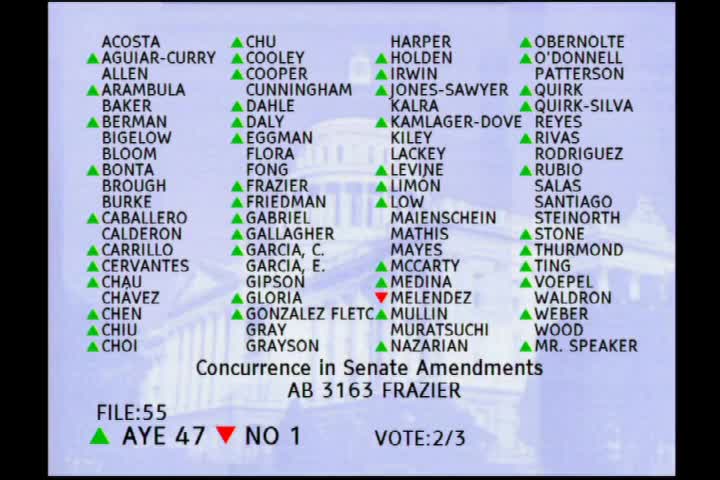 59SEC
Assembly Floor
 2MIN
Senate Floor
 1H
Senate Standing Committee on Appropriations
 1MIN
Assembly Floor
Bill Author

Bill Co-Author(s):