AB 2524: California Retail Food Code.
- Session Year: 2017-2018
- House: Assembly
- Latest Version Date: 2018-09-18
Existing law, the California Retail Food Code, establishes uniform health and sanitation standards for retail food facilities for regulation by the State Department of Public Health, and requires local enforcement agencies to enforce those provisions. Existing law defines food facility as an operation that stores, prepares, packages, serves, vends, or otherwise provides food for human consumption at the retail level, as specified. Existing law defines limited food preparation for the purposes of the code. A violation of the California Retail Food Code is generally a misdemeanor.
This bill would include a catering operation and a host facility within the definition of a food facility. The bill would define catering operation as a food service that is conducted by a permanent food facility approved for food preparation where food is served, or limited food preparation is conducted, at a location other than its permitted location, whether as part of a contracted offsite food service event or when operating in conjunction with a host facility with direct food sales. The bill would define host facility as a facility located in a brewery, winery, or commercial building, or another location as approved by the local enforcement agency, that meets applicable requirements to support a catering operation, as specified, and that has a permit pursuant to specified provisions.
The bill would impose various requirements on a catering operation relating to food safety, storage, transportation, and other circumstances, and would require the catering operation to submit to the enforcement agency written standard operating procedures and, upon request, records for its offsite food services activities, with specified information. The bill would impose various requirements on a host facility relating to, among other things, the plan review process, which includes a list of catering operations that will be supported by the host facility, among other information. The bill would authorize the enforcement agency to establish additional structural or operational requirements, as specified, to ensure the sanitary operation of a host facility.
The bill would also include a catering operation as an authorized food facility for purposes of certain provisions relating to an open-air barbecue and an outdoor wood-burning oven.
The bill would include the holding, portioning, or dispensing of foods by a catering operation for a host facility within, and exclude the handling, manufacturing, freezing, processing, or packaging of specified milk, milk products, or products resembling milk products from, the definition of limited food preparation.
Existing law requires every food facility to maintain on the premises the label for any food or food additive that is, or includes, any fat, oil, or shortening, as specified, and prohibits any food containing artificial trans fat from being stored, distributed, or served by, or used in the preparation of any food within, a food facility.
This bill would repeal those provisions and make technical, conforming changes.
By imposing new duties on local officials and expanding the scope of a crime, this bill would impose a state-mandated local program.
This bill would incorporate additional changes to Section 113789 of the Health and Safety Code proposed by AB 626 and AB 2178 to be operative only if this bill and AB 626, this bill and AB 2178, or all 3 bills are enacted and this bill is enacted last.
The California Constitution requires the state to reimburse local agencies and school districts for certain costs mandated by the state. Statutory provisions establish procedures for making that reimbursement.
This bill would provide that with regard to certain mandates no reimbursement is required by this act for a specified reason.
With regard to any other mandates, this bill would provide that, if the Commission on State Mandates determines that the bill contains costs so mandated by the state, reimbursement for those costs shall be made pursuant to the statutory provisions noted above.
Existing law, the California Retail Food Code, establishes uniform health and sanitation standards for retail food facilities for regulation by the State Department of Public Health, and requires local enforcement agencies to enforce those provisions. Existing law defines food facility as an operation that stores, prepares, packages, serves, vends, or otherwise provides food for human consumption at the retail level, as specified. Existing law defines limited food preparation for the purposes of the code. A violation of the California Retail Food Code is generally a misdemeanor.
This bill would include a catering operation and a host facility within the definition of a food facility. The bill would define catering operation as a food service that is conducted by a permanent food facility approved for food preparation where food is served, or limited food preparation is conducted, at a location other than its permitted location, whether as part of a contracted offsite food service event or when operating in conjunction with a host facility with direct food sales. The bill would define host facility as a facility located in a brewery, winery, or commercial building, or another location as approved by the local enforcement agency, that meets applicable requirements to support a catering operation, as specified, and that has a permit pursuant to specified provisions.
The bill would impose various requirements on a catering operation relating to food safety, storage, transportation, and other circumstances, and would require the catering operation to submit to the enforcement agency written standard operating procedures and, upon request, records for its offsite food services activities, with specified information. The bill would impose various requirements on a host facility relating to, among other things, the plan review process, which includes a list of catering operations that will be supported by the host facility, among other information. The bill would authorize the enforcement agency to establish additional structural or operational requirements, as specified, to ensure the sanitary operation of a host facility.
The bill would also include a catering operating operation as an authorized food facility for purposes of certain provisions relating to an open-air barbecue and an outdoor wood-burning oven.
The bill would include the holding, portioning, or dispensing of foods by a catering operation for a host facility within, and exclude the handling, manufacturing, freezing, processing, or packaging of specified milk, milk products, or products resembling milk products from, the definition of limited food preparation.
Existing law requires every food facility to maintain on the premises the label for any food or food additive that is, or includes, any fat, oil, or shortening, as specified, and prohibits any food containing artificial trans fat from being stored, distributed, or served by, or used in the preparation of any food within, a food facility.
This bill would repeal those provisions and make technical, conforming changes.
By imposing new duties on local officials and expanding the scope of a crime, this bill would impose a state-mandated local program.
This bill would incorporate additional changes to Section 113789 of the Health and Safety Code proposed by AB 626 and AB 2178 to be operative only if this bill and AB 626, this bill and AB 2178, or all 3 bills are enacted and this bill is enacted last.
The California Constitution requires the state to reimburse local agencies and school districts for certain costs mandated by the state. Statutory provisions establish procedures for making that reimbursement.
This bill would provide that with regard to certain mandates no reimbursement is required by this act for a specified reason.
With regard to any other mandates, this bill would provide that, if the Commission on State Mandates determines that the bill contains costs so mandated by the state, reimbursement for those costs shall be made pursuant to the statutory provisions noted above.
Existing law, the California Retail Food Code, establishes uniform health and sanitation standards for retail food facilities for regulation by the State Department of Public Health, and requires local enforcement agencies to enforce those provisions. Existing law defines food facility as an operation that stores, prepares, packages, serves, vends, or otherwise provides food for human consumption at the retail level, as specified. Existing law defines limited food preparation for the purposes of the code. A violation of the California Retail Food Code is generally a misdemeanor.
This bill would include a catering operation and a host facility within the definition of a food facility. The bill would define catering operation as a food service that is conducted by a permanent food facility approved for food preparation where food is served, or limited food preparation is conducted, at a location other than its permitted location, whether as part of a contracted offsite food service event or when operating in conjunction with a host facility with direct food sales. The bill would define host facility as a facility located in a brewery, winery, or commercial building, or another location as approved by the local enforcement agency, that meets applicable requirements to support a catering operation, as specified, and that has a permit pursuant to specified provisions.
The bill would impose various requirements on a catering operation relating to food safety, storage, transportation, and other circumstances, and would require the catering operation to submit to the enforcement agency written standard operating procedures and, upon request, records for its offsite food services activities, with specified information. The bill would impose various requirements on a host facility relating to, among other things, the plan review process, which includes a list of catering operations that will be supported by the host facility, among other information. The bill would authorize the enforcement agency to establish additional structural or operational requirements, as specified, to ensure the sanitary operation of a host facility.
The bill would also include a catering operating as an authorized food facility for purposes of certain provisions relating to an open-air barbecue and an outdoor wood-burning oven.
The bill would include the holding, portioning, or dispensing of foods by a catering operation for a host facility within within, and exclude the handling, manufacturing, freezing, processing, or packaging of specified milk, milk products, or products resembling milk products from, the definition of limited food preparation.
Existing law requires every food facility to maintain on the premises the label for any food or food additive that is, or includes, any fat, oil, or shortening, as specified, and prohibits any food containing artificial trans fat from being stored, distributed, or served by, or used in the preparation of any food within, a food facility.
This bill would repeal those provisions and make technical, conforming changes.
By imposing new duties on local officials and expanding the scope of a crime, this bill would impose a state-mandated local program.
The California Constitution requires the state to reimburse local agencies and school districts for certain costs mandated by the state. Statutory provisions establish procedures for making that reimbursement.
This bill would provide that with regard to certain mandates no reimbursement is required by this act for a specified reason.
With regard to any other mandates, this bill would provide that, if the Commission on State Mandates determines that the bill contains costs so mandated by the state, reimbursement for those costs shall be made pursuant to the statutory provisions noted above.
Existing law, the California Retail Food Code, establishes uniform health and sanitation standards for retail food facilities for regulation by the State Department of Public Health, and requires local enforcement agencies to enforce those provisions. Existing law defines food facility as an operation that stores, prepares, packages, serves, vends, or otherwise provides food for human consumption at the retail level, as specified. Existing law defines limited food preparation for the purposes of the code. A violation of the California Retail Food Code is generally a misdemeanor.
This bill would include a catering operation and a host facility within the definition of a food facility. The bill would define catering operation as a food service that is conducted by a permanent food facility approved for food preparation where food is served, or limited food preparation is conducted, at a location other than its permitted location, whether as part of a contracted offsite food service event or when operating in conjunction with a host facility with direct food sales. The bill would define host facility as a permitted facility located in a brewery, winery, or commercial office building, or another location as approved by the local enforcement agency, that meets applicable requirements and is approved by the local enforcement agency to support a catering operation, as specified. specified, and that has a permit pursuant to specified provisions.
The bill would impose various requirements on a catering operation relating to food safety, storage, transportation, and other circumstances, and would require the catering operation to submit to the enforcement agency written standard operating procedures and, upon request, records for its offsite food services activities, with specified information. The bill would impose various requirements on a host facility relating to, among other things, the plan review process, which includes a list of catering operations that will be supported by the host facility, among other information. The bill would authorize the enforcement agency to establish additional structural or operational requirements, as specified, for catering operations or host facilities. to ensure the sanitary operation of a host facility.
The bill would also include a catering operating as an authorized food facility for purposes of certain provisions relating to an open-air barbecue and an outdoor wood-burning oven.
The bill would include the holding, portioning, or dispensing of foods by a catering operation for a host facility within the definition of limited food preparation.
By imposing new duties on local officials and expanding the scope of a crime, this bill would impose a state-mandated local program.
The California Constitution requires the state to reimburse local agencies and school districts for certain costs mandated by the state. Statutory provisions establish procedures for making that reimbursement.
This bill would provide that with regard to certain mandates no reimbursement is required by this act for a specified reason.
With regard to any other mandates, this bill would provide that, if the Commission on State Mandates determines that the bill contains costs so mandated by the state, reimbursement for those costs shall be made pursuant to the statutory provisions noted above.
Existing law, the California Retail Food Code, establishes uniform health and sanitation standards for retail food facilities for regulation by the State Department of Public Health, and requires local enforcement agencies to enforce those provisions. Existing law defines food facility as an operation that stores, prepares, packages, serves, vends, or otherwise provides food for human consumption at the retail level, as specified. Existing law defines limited food preparation for the purposes of the code. A violation of the California Retail Food Code is generally a misdemeanor.
This bill would include a catering operation and a host facility within the definition of a food facility. The bill would define catering operation as a food service that is conducted by a permanent food facility approved for food preparation where food is served, or limited food preparation is conducted, at a location other than its permitted location, whether as part of a contracted offsite food service event or when operating in conjunction with a host facility with direct food sales. The bill would define host facility as a permitted facility located in a brewery, winery, or commercial office building, that meets applicable requirements and is approved by the local enforcement agency to support a catering operation, as specified.
The bill would impose various requirements on a catering operation relating to food safety, storage, transportation, and other circumstances, and would require the catering operation to submit to the enforcement agency written standard operating procedures and, upon request, records for its offsite food services activities, with specified information. The bill would impose various requirements on a host facility relating to, among other things, the plan review process, which includes a list of catering operations that will be supported by the host facility, among other information. The bill would authorize the enforcement agency to establish additional structural or operational requirements, as specified, for catering operations or host facilities.
The bill would also include a catering operating as an authorized food facility for purposes of certain provisions relating to an open-air barbecue and an outdoor wood-burning oven.
The bill would include the holding, portioning, or dispensing of foods by a catering operation for a host facility within the definition of limited food preparation.
By imposing new duties on local officials and expanding the scope of a crime, this bill would impose a state-mandated local program.
The California Constitution requires the state to reimburse local agencies and school districts for certain costs mandated by the state. Statutory provisions establish procedures for making that reimbursement.
This bill would provide that with regard to certain mandates no reimbursement is required by this act for a specified reason.
With regard to any other mandates, this bill would provide that, if the Commission on State Mandates determines that the bill contains costs so mandated by the state, reimbursement for those costs shall be made pursuant to the statutory provisions noted above.
Existing law, the California Retail Food Code, establishes uniform health and sanitation standards for retail food facilities for regulation by the State Department of Public Health, and requires local enforcement agencies to enforce those provisions. Existing law defines food facility as an operation that stores, prepares, packages, serves, vends, or otherwise provides food for human consumption at the retail level, as specified. A violation of the California Retail Food Code is generally a misdemeanor.
This bill would include a catering operation and a host facility within the definition of a food facility. The bill would define catering operation as a food service that is conducted by a permanent food facility approved for food preparation where food is served, or limited food preparation is conducted, at a location other than its permitted location, whether as part of a contracted offsite food service event or when operating in conjunction with a host facility with direct food sales. The bill would define host facility as a permitted facility located in a brewery, winery, or commercial office building, that meets applicable requirements and is approved by the local enforcement agency to support a catering operation, as specified.
The bill would impose various requirements on a catering operation relating to food safety, storage, transportation, and other circumstances, and would require the catering operation to submit to the enforcement agency written standard operating procedures and, upon request, records for its offsite food services activities, with specified information. The bill would impose various requirements on a host facility relating to, among other things, the plan review process, which includes a list of catering operations that will be supported by the host facility, among other information. The bill would authorize the enforcement agency to establish additional structural or operational requirements, as specified, for catering operations or host facilities.
The bill would also include a catering operating as an authorized food facility for purposes of certain provisions relating to an open-air barbecue and an outdoor wood-burning oven.
By imposing new duties on local officials and expanding the scope of a crime, this bill would impose a state-mandated local program.
The California Constitution requires the state to reimburse local agencies and school districts for certain costs mandated by the state. Statutory provisions establish procedures for making that reimbursement.
This bill would provide that with regard to certain mandates no reimbursement is required by this act for a specified reason.
With regard to any other mandates, this bill would provide that, if the Commission on State Mandates determines that the bill contains costs so mandated by the state, reimbursement for those costs shall be made pursuant to the statutory provisions noted above.
(a)Catering operation means a food service that is conducted by a permanent food facility approved for food preparation where food is served, or limited food preparation is conducted, at a location other than its permitted location, in either of the following circumstances:
(1)As part of a contracted offsite food service event.
(2)When operating in conjunction with a host facility with direct food sales.
(b)Catering operation shall not include either of the following:
(1)Food ordered as takeout or delivery from a food facility, where the food is provided to the consumer for self-service.
(2)A food facility that is participating as part of a community event.
SEC. 2.Section 113789 of the Health and Safety Code is amended to read:113789.(a)Food facility means an operation that stores, prepares, packages, serves, vends, or otherwise provides food for human consumption at the retail level, including, but not limited to, the following:
(1)An operation where food is consumed on or off the premises, regardless of whether there is a charge for the food.
(2)A place used in conjunction with the operations described in this subdivision, including, but not limited to, storage facilities for food-related utensils, equipment, and materials.
(b)Food facility includes permanent and nonpermanent food facilities, including, but not limited to, the following:
(1)Public and private school cafeterias.
(2)Restricted food service facilities.
(3) Licensed health care facilities, except as provided in paragraph (12) of subdivision (c).
(4)Commissaries.
(5)Mobile food facilities.
(6)Mobile support units.
(7)Temporary food facilities.
(8)Vending machines.
(9)Certified farmers markets, for purposes of permitting and enforcement pursuant to Section 114370.
(10)Farm stands, for purposes of permitting and enforcement pursuant to Section 114375.
(11)Fishermens markets.
(12)Catering operation.
(13)Host facility.
(c)Food facility does not include any of the following:
(1)A cooperative arrangement wherein no permanent facilities are used for storing or handling food.
(2)A private home, including a cottage food operation that is registered or has a permit pursuant to Section 114365.
(3)A church, private club, or other nonprofit association that gives or sells food to its members and guests, and not to the general public, at an event that occurs not more than three days in any 90-day period.
(4)A for-profit entity that gives or sells food at an event that occurs not more than three days in a 90-day period for the benefit of a nonprofit association, if the for-profit entity receives no monetary benefit, other than that resulting from recognition from participating in an event.
(5)Premises set aside for wine tasting, as that term is used in Section 23356.1 of the Business and Professions Code, or premises set aside by a beer manufacturer, as defined in Section 25000.2 of the Business and Professions Code, and in the regulations adopted pursuant to those sections, that comply with Section 118375, regardless of whether there is a charge for the wine or beer tasting, if no other beverage, except for bottles of wine or beer and prepackaged nonpotentially hazardous beverages, is offered for sale or for onsite consumption and no food, except for crackers, pretzels, or prepackaged food that is not potentially hazardous food is offered for sale or for onsite consumption.
(6)An outlet or location, including, but not limited to, premises, operated by a producer, selling or offering for sale only whole produce grown by the producer or shell eggs, or both, provided the sales are conducted at an outlet or location controlled by the producer.
(7)A commercial food processing establishment, as defined in Section 111955.
(8)A child day care facility, as defined in Section 1596.750.
(9)A community care facility, as defined in Section 1502.
(10)A residential care facility for the elderly, as defined in Section 1569.2.
(11)A residential care facility for the chronically ill, which has the same meaning as a residential care facility, as defined in Section 1568.01.
(12)(A)An intermediate care facility for the developmentally disabled, as defined in subdivisions (e), (h), and (m) of Section 1250, with a capacity of six beds or fewer.
(B)A facility described in subparagraph (A) shall report any foodborne illness or outbreak to the local health department and to the State Department of Public Health within 24 hours of the illness or outbreak.
(13)A community food producer, as defined in Section 113752.
SEC. 2.1.Section 113789 of the Health and Safety Code is amended to read:113789.(a)Food facility means an operation that stores, prepares, packages, serves, vends, or otherwise provides food for human consumption at the retail level, including, but not limited to, the following:
(1)An operation where food is consumed on or off the premises, regardless of whether there is a charge for the food.
(2)A place used in conjunction with the operations described in this subdivision, including, but not limited to, storage facilities for food-related utensils, equipment, and materials.
(b)Food facility includes permanent and nonpermanent food facilities, including, but not limited to, the following:
(1)Public and private school cafeterias.
(2)Restricted food service facilities.
(3) Licensed health care facilities, except as provided in paragraph (12) of subdivision (c).
(4)Commissaries.
(5)Mobile food facilities.
(6)Mobile support units.
(7)Temporary food facilities.
(8)Vending machines.
(9)Certified farmers markets, for purposes of permitting and enforcement pursuant to Section 114370.
(10)Farm stands, for purposes of permitting and enforcement pursuant to Section 114375.
(11)Fishermens markets.
(12)Microenterprise home kitchen operations.
(13)Catering operation.
(14)Host facility.
(c)Food facility does not include any of the following:
(1)A cooperative arrangement wherein no permanent facilities are used for storing or handling food.
(2)A private home when used for private, noncommercial purposes or when used as a cottage food operation that is registered or has a permit pursuant to Section 114365.
(3)A church, private club, or other nonprofit association that gives or sells food to its members and guests, and not to the general public, at an event that occurs not more than three days in any 90-day period.
(4)A for-profit entity that gives or sells food at an event that occurs not more than three days in a 90-day period for the benefit of a nonprofit association, if the for-profit entity receives no monetary benefit, other than that resulting from recognition from participating in an event.
(5)Premises set aside for wine tasting, as that term is used in Section 23356.1 of the Business and Professions Code, or premises set aside by a beer manufacturer, as defined in Section 25000.2 of the Business and Professions Code, and in the regulations adopted pursuant to those sections, that comply with Section 118375, regardless of whether there is a charge for the wine or beer tasting, if no other beverage, except for bottles of wine or beer and prepackaged nonpotentially hazardous beverages, is offered for sale or for onsite consumption and no food, except for crackers, pretzels, or prepackaged food that is not potentially hazardous food is offered for sale or for onsite consumption.
(6)An outlet or location, including, but not limited to, premises, operated by a producer, selling or offering for sale only whole produce grown by the producer or shell eggs, or both, provided the sales are conducted at an outlet or location controlled by the producer.
(7)A commercial food processing establishment, as defined in Section 111955.
(8)A child day care facility, as defined in Section 1596.750.
(9)A community care facility, as defined in Section 1502.
(10)A residential care facility for the elderly, as defined in Section 1569.2.
(11)A residential care facility for the chronically ill, which has the same meaning as a residential care facility, as defined in Section 1568.01.
(12)(A)An intermediate care facility for the developmentally disabled, as defined in subdivisions (e), (h), and (m) of Section 1250, with a capacity of six beds or fewer.
(B)A facility described in subparagraph (A) shall report any foodborne illness or outbreak to the local health department and to the State Department of Public Health within 24 hours of the illness or outbreak.
(13)A community food producer, as defined in Section 113752.
SEC. 2.2.Section 113789 of the Health and Safety Code is amended to read:113789.(a)Food facility means an operation that stores, prepares, packages, serves, vends, or otherwise provides food for human consumption at the retail level, including, but not limited to, the following:
(1)An operation where food is consumed on or off the premises, regardless of whether there is a charge for the food.
(2)A place used in conjunction with the operations described in this subdivision, including, but not limited to, storage facilities for food-related utensils, equipment, and materials.
(b)Food facility includes permanent and nonpermanent food facilities, including, but not limited to, the following:
(1)Public and private school cafeterias.
(2)Restricted food service facilities.
(3) Licensed health care facilities, except as provided in paragraph (12) of subdivision (c).
(4)Commissaries.
(5)Mobile food facilities.
(6)Mobile support units.
(7)Temporary food facilities.
(8)Vending machines.
(9)Certified farmers markets, for purposes of permitting and enforcement pursuant to Section 114370.
(10)Farm stands, for purposes of permitting and enforcement pursuant to Section 114375.
(11)Fishermens markets.
(12)Catering operation.
(13)Host facility.
(c)Food facility does not include any of the following:
(1)A cooperative arrangement wherein no permanent facilities are used for storing or handling food.
(2)A private home, including a cottage food operation that is registered or has a permit pursuant to Section 114365.
(3)A church, private club, or other nonprofit association that gives or sells food to its members and guests, and not to the general public, at an event that occurs not more than three days in any 90-day period.
(4)A for-profit entity that gives or sells food at an event that occurs not more than three days in a 90-day period for the benefit of a nonprofit association, if the for-profit entity receives no monetary benefit, other than that resulting from recognition from participating in an event.
(5)Premises set aside for wine tasting, as that term is used in Section 23356.1 of the Business and Professions Code, or premises set aside by a beer manufacturer, as defined in Section 25000.2 of the Business and Professions Code, and in the regulations adopted pursuant to those sections, that comply with Section 118375, regardless of whether there is a charge for the wine or beer tasting, if no other beverage, except for bottles of wine or beer and prepackaged nonpotentially hazardous beverages, is offered for sale or for onsite consumption and no food, except for crackers, pretzels, or prepackaged food that is not potentially hazardous food is offered for sale or for onsite consumption.
(6)An outlet or location, including, but not limited to, premises, operated by a producer, selling or offering for sale only whole produce grown by the producer or shell eggs, or both, provided the sales are conducted at an outlet or location controlled by the producer.
(7)A commercial food processing establishment, as defined in Section 111955.
(8)A child day care facility, as defined in Section 1596.750.
(9)A community care facility, as defined in Section 1502.
(10)A residential care facility for the elderly, as defined in Section 1569.2.
(11)A residential care facility for the chronically ill, which has the same meaning as a residential care facility, as defined in Section 1568.01.
(12)(A)An intermediate care facility for the developmentally disabled, as defined in subdivisions (e), (h), and (m) of Section 1250, with a capacity of six beds or fewer.
(B)A facility described in subparagraph (A) shall report any foodborne illness or outbreak to the local health department and to the State Department of Public Health within 24 hours of the illness or outbreak.
(13)A community food producer, as defined in Section 113752.
(14)A limited service charitable feeding operation, as defined in Section 113819.
SEC. 2.3.Section 113789 of the Health and Safety Code is amended to read:113789.(a)Food facility means an operation that stores, prepares, packages, serves, vends, or otherwise provides food for human consumption at the retail level, including, but not limited to, the following:
(1)An operation where food is consumed on or off the premises, regardless of whether there is a charge for the food.
(2)A place used in conjunction with the operations described in this subdivision, including, but not limited to, storage facilities for food-related utensils, equipment, and materials.
(b)Food facility includes permanent and nonpermanent food facilities, including, but not limited to, the following:
(1)Public and private school cafeterias.
(2)Restricted food service facilities.
(3) Licensed health care facilities, except as provided in paragraph (12) of subdivision (c).
(4)Commissaries.
(5)Mobile food facilities.
(6)Mobile support units.
(7)Temporary food facilities.
(8)Vending machines.
(9)Certified farmers markets, for purposes of permitting and enforcement pursuant to Section 114370.
(10)Farm stands, for purposes of permitting and enforcement pursuant to Section 114375.
(11)Fishermens markets.
(12)Microenterprise home kitchen operations.
(13)Catering operation.
(14)Host facility.
(c)Food facility does not include any of the following:
(1)A cooperative arrangement wherein no permanent facilities are used for storing or handling food.
(2)A private home when used for private, noncommercial purposes or when used as a cottage food operation that is registered or has a permit pursuant to Section 114365.
(3)A church, private club, or other nonprofit association that gives or sells food to its members and guests, and not to the general public, at an event that occurs not more than three days in any 90-day period.
(4)A for-profit entity that gives or sells food at an event that occurs not more than three days in a 90-day period for the benefit of a nonprofit association, if the for-profit entity receives no monetary benefit, other than that resulting from recognition from participating in an event.
(5)Premises set aside for wine tasting, as that term is used in Section 23356.1 of the Business and Professions Code, or premises set aside by a beer manufacturer, as defined in Section 25000.2 of the Business and Professions Code, and in the regulations adopted pursuant to those sections, that comply with Section 118375, regardless of whether there is a charge for the wine or beer tasting, if no other beverage, except for bottles of wine or beer and prepackaged nonpotentially hazardous beverages, is offered for sale or for onsite consumption and no food, except for crackers, pretzels, or prepackaged food that is not potentially hazardous food is offered for sale or for onsite consumption.
(6)An outlet or location, including, but not limited to, premises, operated by a producer, selling or offering for sale only whole produce grown by the producer or shell eggs, or both, provided the sales are conducted at an outlet or location controlled by the producer.
(7)A commercial food processing establishment, as defined in Section 111955.
(8)A child day care facility, as defined in Section 1596.750.
(9)A community care facility, as defined in Section 1502.
(10)A residential care facility for the elderly, as defined in Section 1569.2.
(11)A residential care facility for the chronically ill, which has the same meaning as a residential care facility, as defined in Section 1568.01.
(12)(A)An intermediate care facility for the developmentally disabled, as defined in subdivisions (e), (h), and (m) of Section 1250, with a capacity of six beds or fewer.
(B)A facility described in subparagraph (A) shall report any foodborne illness or outbreak to the local health department and to the State Department of Public Health within 24 hours of the illness or outbreak.
(13)A community food producer, as defined in Section 113752.
(14)A limited service charitable feeding operation, as defined in Section 113819.
SEC. 3.Section 113806.1 is added to the Health and Safety Code, to read:113806.1.Host facility means a facility located in a brewery, winery, commercial building, or another location as approved by the local enforcement agency, that meets applicable requirements to support a catering operation that provides food directly to individual consumers for a limited period of time, up to four hours, in any one 12-hour period and that has a permit pursuant to Section 114328.1. Host facility does not include the premises described in paragraph (5) of subdivision (c) of Section 113789.
SEC. 4.Section 113818 of the Health and Safety Code is amended to read:113818.(a)Limited food preparation means food preparation that is restricted to one or more of the following:
(1)Heating, frying, baking, roasting, popping, shaving of ice, blending, steaming or boiling of hot dogs, or assembly of nonprepackaged food.
(2)Dispensing and portioning of nonpotentially hazardous food.
(3)Holding, portioning, and dispensing of any foods that are prepared for satellite food service by the onsite permanent food facility or prepackaged by another approved source.
(4)Holding, portioning, and dispensing of any foods that are prepared by a catering operation for a host facility.
(5)Slicing and chopping of food on a heated cooking surface during the cooking process.
(6)Cooking and seasoning to order.
(7)Juicing or preparing beverages that are for immediate service, in response to an individual consumer order, that do not contain frozen milk products.
(b)Limited food preparation does not include any of the following:
(1)Slicing and chopping unless it is on the heated cooking surface.
(2)Thawing.
(3)Cooling of cooked, potentially hazardous food.
(4)Grinding raw ingredients or potentially hazardous food.
(5)Reheating of potentially hazardous foods for hot holding, except for steamed or boiled hot dogs and tamales in the original, inedible wrapper.
(6)Except as authorized in paragraph (3) of subdivision (a), hot holding of nonprepackaged, potentially hazardous food, except for roasting corn on the cob, steamed or boiled hot dogs, and tamales in the original, inedible wrapper.
(7)Washing of foods.
(8)Cooking of potentially hazardous foods for later use.
(9)Handling, manufacturing, freezing, processing, or packaging of milk, milk products, or products resembling milk products subject to licensing under Division 15 (commencing with Section 32501) of the Food and Agricultural Code.
SEC. 5.Section 113843 of the Health and Safety Code is amended to read:113843.Open-air barbecue means a piece of equipment designed for barbecuing food, where the food is prepared out of doors by cooking directly over hot coals, heated lava, hot stones, gas flame, or other method approved by the department, on equipment suitably designed and maintained for use out of doors, that is operated by a temporary food facility, a catering operation, or a mobile food facility that remains fixed during hours of operations at a community event or a permanent food facility.
SEC. 6.Section 113846 of the Health and Safety Code is amended to read:113846.Outdoor wood-burning oven means an oven located out of doors, that utilizes wood as the primary fuel for cooking and is operated on the same premises as, and in conjunction with, a permanent food facility or a catering operation.
SEC. 7.Section 114143 of the Health and Safety Code is amended to read:114143.Notwithstanding any of the provisions of this part, neither the department nor any city, county, city and county air pollution control district, or air quality management district shall require the enclosure of an open-air barbecue or outdoor wood-burning oven if the enforcement officer determines that the barbecue or wood-burning oven meets all of the following requirements:
(a)The open-air barbecue or outdoor wood-burning oven is operated on the same premises as, in reasonable proximity to, and in conjunction with, a permanent food facility that is approved for food preparation, a temporary food facility or a mobile food facility that is operating at a community event, or a catering operation. The permitholder of the permanent food facility, temporary food facility, mobile food facility, or catering operation shall be deemed to be the permitholder of the open-air barbecue or outdoor wood-burning oven, and shall be responsible for ensuring that it is operated in full compliance with this part.
(b)The open-air barbecue or outdoor wood-burning oven is not operated in, or out of, any motor vehicle, or in any area or location that may constitute a fire hazard, as determined by the enforcement officer.
(c)The open-air barbecue or outdoor wood-burning oven is separated from public access to prevent food contamination or injury to the public by using ropes or other approved methods.
(d)If the open-air barbecue or outdoor wood-burning oven is a permanent structure, it shall be equipped with an impervious and easily cleanable floor surface that extends a minimum of five feet from the open-air barbecue or outdoor wood-burning oven facility on all open sides.
(e)Sanitary facilities, including, but not limited to, toilet facilities and handwashing facilities shall be available for use within 200 feet in travel distance of the open-air barbecue or outdoor wood-burning oven and shall comply with all provisions of this part.
SEC. 8.Section 114294 of the Health and Safety Code is amended to read:114294.(a)All mobile food facilities and mobile support units shall meet the applicable requirements in Chapter 1 (commencing with Section 113700) to Chapter 8 (commencing with Section 114250), inclusive, and Chapter 13 (commencing with Section 114380), unless specifically exempted from any of these provisions, as provided in this chapter.
(b)The enforcement agency shall initially approve all mobile food facilities and mobile support units as complying with the provisions of this chapter and may require reapproval if deemed necessary.
(c)Each mobile food facility that is either a special purpose commercial modular and coach, as defined by Section 18012.5, or a commercial modular coach, as defined by Section 18001.8, shall be certified by the Department of Housing and Community Development, consistent with Chapter 4 (commencing with Section 18025) of Part 2 of Division 13 and regulations promulgated pursuant to that chapter. The enforcement agency shall approve all equipment installation prior to operation.
SEC. 9.Chapter 10.1 (commencing with Section 114328) is added to Part 7 of Division 104 of the Health and Safety Code, to read:10.1.Catering Operations and Host Facilities114328.(a)A catering operation shall meet the applicable requirements in Chapters 1 (commencing with Section 113700) to 8 (commencing with Section 114250), inclusive, and Chapter 13 (commencing with Section 114380), unless specifically exempted from any of those provisions. For purposes of this chapter, a catering operation refers to a permanent food facility approved for offsite food service activities.
(b)A catering operation shall operate from a permitted food facility that is capable of supporting the proposed food service activity to be conducted, and the type of food that is to be prepared offsite or served.
(c)Prior to conducting catering operations, the catering operation shall submit to the enforcement agency written standard operating procedures that include all of the following information:
(1)The manner in which food will be transported to and from the permanent food facility and the offsite food service location or host facility and procedures to prevent contamination of the food.
(2)The type of food that is to be prepared or served, and the extent of limited food preparation, as defined in Section 113818, that is to be conducted at an offsite food service event.
(3)The manner in which potentially hazardous food will be maintained in accordance with Section 113996.
(4)Procedures, methods, and schedules for cleaning utensils, equipment, and structures, and for the disposal of refuse.
(5)The manner in which hands will be washed to ensure compliance with Section 113953.
(d)Food shall be transported in a vehicle that meets the requirements of Section 113982.
(e)A catering operation may conduct limited food preparation, as defined in Section 113818, at an offsite location when approved by the enforcement agency.
(f)All food, prior to offsite food service, shall be stored and prepared at the permanent food facility.
(g)While operating offsite, the catering operation shall provide the name of the facility, city, state, ZIP Code, and the name of the operator to any consumer or enforcement agency upon request.
(h)A catering operation shall maintain records for all offsite food service activities for 90 days after each event. The catering operation shall provide those records to the enforcement agency upon request and shall include all of the following information:
(1)Location, date, and time of offsite food service activity.
(2)Customer name and contact information, including address, email address, and phone number.
(3)Whether food was delivered to a customer or served to a guest at a catered function or host facility.
(4)Departure and arrival food temperature logs for transportation, and corrective action taken if the food arrived out of temperature.
(5)Complete menu of food provided.
(i)A catering operation shall ensure that it has access to potable water at any offsite function, or shall bring an adequate supply of potable water with it to that function.
(j)For offsite food service where a catering operation is serving the food, the person in charge on behalf of the catering operation shall ensure that basic food safety is maintained at all times, including, but not limited to, all of the following:
(1)Protecting the food from contamination during service.
(2)Providing overhead protection over all food handling areas.
(3)Providing utensils for individual use and eliminating the use of community dipping containers where consumers could dip a utensil or a food item they have already placed in their mouth.
(4)Preventing consumers used plates or utensils from returning to the self-service display.
(5)Replacing utensils that become contaminated with clean and sanitized utensils.
(6)Ensuring open or potentially hazardous foods not consumed or sold by the catering operation are discarded, unless the food was held at required temperatures and protected from contamination at all times.
(7)Discarding any food that has become contaminated or is suspected of becoming contaminated, or that is presumed unsafe because temperatures were not maintained as required by Section 113996.
(k)Utensils used to serve food shall meet all of the following conditions:
(1)Meet the requirements of Chapter 6 (commencing with Section 114130).
(2)Be stored in the food with the handle extended out of the food, on a clean surface, or in a clean container.
(3)Be replaced every four hours or sooner if observed to be mishandled by the guest, dropped, or otherwise contaminated during the serving process.
(l)Notwithstanding Section 113953, adequate handwashing facilities shall be provided at the offsite food service event.
(m)Approved toilet and handwashing facilities shall be available within 200 feet of the offsite food service operation or as approved by the enforcement agency.
(n)All garbage and refuse generated during offsite food service activities and cleanup operations shall be disposed of in a manner approved by the enforcement agency.
(o)All liquid waste shall be disposed of through the approved plumbing system in a manner approved by the enforcement agency.
(p)A catering operation shall not store any food, beverages, equipment, utensils, or food items in a private home when not conducting offsite catering activities.
(q)The enforcement agency may establish additional structural or operational requirements, or both, based on the proposed facility method of operation and as necessary to ensure compliance with the requirements of this chapter.
114328.1.(a)A host facility shall meet the applicable requirements in Chapter 1 (commencing with Section 113700), Chapter 2 (commencing with Section 113728), all general food safety requirements described in Chapter 4 (commencing with Section 113980), Chapter 6 (commencing with Section 114130), and Sections 114049, 114250, 114266, 114381, 114387, 114390, 114393, 114395, 114397, 114399, 114405, 114407, 114409, 114411, and 114413.
(b)In addition to any permit required of a permanent food facility or a catering operation, a permit shall be obtained by the person responsible for operating the host facility.
(c)A permit application shall be submitted to the enforcement agency pursuant to Article 1 (commencing with Section 114380) of Chapter 13. The plan review process shall include all of the following:
(1)Submission of a site plan that indicates the location of the food service operation, handwashing sinks and restrooms, refuse containers, and waste water disposal facilities.
(2)Specifications of equipment that will be provided by the host facility to support the catering operation.
(3)Standard operating procedures that include all of the following information:
(A)Procedures, methods, and schedules for cleaning equipment and structures, and for the disposal of refuse.
(B)How potentially hazardous food will be maintained in accordance with Section 113996.
(4)A list of catering operations that will be supported by the host facility with proposed menus.
(5)The enforcement agency may establish additional structural or operational requirements, or both, based on the proposed facility method of operation to ensure the sanitary operation of a host facility.
(d)A host facility may support a catering operation for up to four hours in any one 12-hour period, unless otherwise approved by the enforcement agency.
(e)All food, soiled utensils, equipment, tableware, and linen shall be returned to the catering operation for cleaning, sanitizing, and storage.
(f)Approved toilet and handwashing facilities shall be available within 200 feet in travel distance of the food service operation.
(g)All garbage and refuse shall be stored and disposed of in a manner approved by the enforcement agency.
SEC. 10.Section 114335 of the Health and Safety Code is amended to read:114335.(a)Temporary food facilities that operate at a swap meet are limited to only prepackaged nonpotentially hazardous food and whole uncut produce, and shall meet the applicable requirements in Chapter 1 (commencing with Section 113700) to Chapter 8 (commencing with Section 114250), inclusive, and Chapter 13 (commencing with Section 114380), unless specifically exempted from any of these provisions.
(b)Temporary food facilities that operate at a community event shall meet the applicable requirements in Chapter 1 (commencing with Section 113700) to Chapter 8 (commencing with Section 114250), inclusive, and Chapter 13 (commencing with Section 114380), unless specifically exempted from any of these provisions.
(c)Food facility requirements shall be determined by the enforcement agency based on the food service activity to be conducted, the type of food that is to be prepared or served, the length of the event, and the extent of food preparation that is to be conducted at a community event within a temporary food facility.
(d)Notwithstanding subdivision (a), the enforcement agency may allow temporary food facilities at a swap meet, depending on the food service activity to be conducted, the type of food that is to be prepared or served, the duration of the swap meet, and the extent of food preparation that is to be conducted at the swap meet.
SEC. 11.Chapter 12.6 (commencing with Section 114377) of Part 7 of Division 104 of the Health and Safety Code is repealed.SEC. 12.(a)Section 2.1 of this bill incorporates amendments to Section 113789 of the Health and Safety Code proposed by both this bill and Assembly Bill 626. That section of this bill shall only become operative if (1) both bills are enacted and become effective on or before January 1, 2019, (2) each bill amends Section 113789 of the Health and Safety Code, (3) Assembly Bill 2178 is not enacted or as enacted does not amend that section, and (4) this bill is enacted after Assembly Bill 626, in which case Sections 2, 2.2, and 2.3 of this bill shall not become operative.
(b)Section 2.2 of this bill incorporates amendments to Section 113789 of the Health and Safety Code proposed by both this bill and Assembly Bill 2178. That section of this bill shall only become operative if (1) both bills are enacted and become effective on or before January 1, 2019, (2) each bill amends Section 113789 of the Health and Safety Code, (3) Assembly Bill 626 is not enacted or as enacted does not amend that section, and (4) this bill is enacted after Assembly Bill 2178, in which case Sections 2, 2.1, and 2.3 of this bill shall not become operative.
(c)Section 2.3 of this bill incorporates amendments to Section 113789 of the Health and Safety Code proposed by this bill, Assembly Bill 626, and Assembly Bill 2178. That section of this bill shall only become operative if (1) all three bills are enacted and become effective on or before January 1, 2019, (2) all three bills amend Section 113789 of the Health and Safety Code, and (3) this bill is enacted after Assembly Bill 626 and Assembly Bill 2178, in which case Sections 2, 2.1, and 2.2 of this bill shall not become operative.
SEC. 13.No reimbursement is required by this act pursuant to Section 6 of Article XIIIB of the California Constitution for certain costs that may be incurred by a local agency or school district because, in that regard, this act creates a new crime or infraction, eliminates a crime or infraction, or changes the penalty for a crime or infraction, within the meaning of Section 17556 of the Government Code, or changes the definition of a crime within the meaning of Section 6 of Article XIIIB of the California Constitution.
However, if the Commission on State Mandates determines that this act contains other costs mandated by the state, reimbursement to local agencies and school districts for those costs shall be made pursuant to Part 7 (commencing with Section 17500) of Division 4 of Title 2 of the Government Code.
(a)Catering operation means a food service that is conducted by a permanent food facility approved for food preparation where food is served, or limited food preparation is conducted, at a location other than its permitted location, in either of the following circumstances:
(1)As part of a contracted offsite food service event.
(2)When operating in conjunction with a host facility with direct food sales.
(b)Catering operation shall not include either of the following:
(1)Food ordered as takeout or delivery from a food facility, where the food is provided to the consumer for self-service.
(2)A food facility that is participating as part of a community event.
SEC. 2.Section 113789 of the Health and Safety Code is amended to read:113789.(a)Food facility means an operation that stores, prepares, packages, serves, vends, or otherwise provides food for human consumption at the retail level, including, but not limited to, the following:
(1)An operation where food is consumed on or off the premises, regardless of whether there is a charge for the food.
(2)A place used in conjunction with the operations described in this subdivision, including, but not limited to, storage facilities for food-related utensils, equipment, and materials.
(b)Food facility includes permanent and nonpermanent food facilities, including, but not limited to, the following:
(1)Public and private school cafeterias.
(2)Restricted food service facilities.
(3) Licensed health care facilities, except as provided in paragraph (12) of subdivision (c).
(4)Commissaries.
(5)Mobile food facilities.
(6)Mobile support units.
(7)Temporary food facilities.
(8)Vending machines.
(9)Certified farmers markets, for purposes of permitting and enforcement pursuant to Section 114370.
(10)Farm stands, for purposes of permitting and enforcement pursuant to Section 114375.
(11)Fishermens markets.
(12)Catering operation.
(13)Host facility.
(c)Food facility does not include any of the following:
(1)A cooperative arrangement wherein no permanent facilities are used for storing or handling food.
(2)A private home, including a cottage food operation that is registered or has a permit pursuant to Section 114365.
(3)A church, private club, or other nonprofit association that gives or sells food to its members and guests, and not to the general public, at an event that occurs not more than three days in any 90-day period.
(4)A for-profit entity that gives or sells food at an event that occurs not more than three days in a 90-day period for the benefit of a nonprofit association, if the for-profit entity receives no monetary benefit, other than that resulting from recognition from participating in an event.
(5)Premises set aside for wine tasting, as that term is used in Section 23356.1 of the Business and Professions Code, or premises set aside by a beer manufacturer, as defined in Section 25000.2 of the Business and Professions Code, and in the regulations adopted pursuant to those sections, that comply with Section 118375, regardless of whether there is a charge for the wine or beer tasting, if no other beverage, except for bottles of wine or beer and prepackaged nonpotentially hazardous beverages, is offered for sale or for onsite consumption and no food, except for crackers, pretzels, or prepackaged food that is not potentially hazardous food is offered for sale or for onsite consumption.
(6)An outlet or location, including, but not limited to, premises, operated by a producer, selling or offering for sale only whole produce grown by the producer or shell eggs, or both, provided the sales are conducted at an outlet or location controlled by the producer.
(7)A commercial food processing establishment, as defined in Section 111955.
(8)A child day care facility, as defined in Section 1596.750.
(9)A community care facility, as defined in Section 1502.
(10)A residential care facility for the elderly, as defined in Section 1569.2.
(11)A residential care facility for the chronically ill, which has the same meaning as a residential care facility, as defined in Section 1568.01.
(12)(A)An intermediate care facility for the developmentally disabled, as defined in subdivisions (e), (h), and (m) of Section 1250, with a capacity of six beds or fewer.
(B)A facility described in subparagraph (A) shall report any foodborne illness or outbreak to the local health department and to the State Department of Public Health within 24 hours of the illness or outbreak.
(13)A community food producer, as defined in Section 113752.
SEC. 2.1.Section 113789 of the Health and Safety Code is amended to read:113789.(a)Food facility means an operation that stores, prepares, packages, serves, vends, or otherwise provides food for human consumption at the retail level, including, but not limited to, the following:
(1)An operation where food is consumed on or off the premises, regardless of whether there is a charge for the food.
(2)A place used in conjunction with the operations described in this subdivision, including, but not limited to, storage facilities for food-related utensils, equipment, and materials.
(b)Food facility includes permanent and nonpermanent food facilities, including, but not limited to, the following:
(1)Public and private school cafeterias.
(2)Restricted food service facilities.
(3) Licensed health care facilities, except as provided in paragraph (12) of subdivision (c).
(4)Commissaries.
(5)Mobile food facilities.
(6)Mobile support units.
(7)Temporary food facilities.
(8)Vending machines.
(9)Certified farmers markets, for purposes of permitting and enforcement pursuant to Section 114370.
(10)Farm stands, for purposes of permitting and enforcement pursuant to Section 114375.
(11)Fishermens markets.
(12)Microenterprise home kitchen operations.
(13)Catering operation.
(14)Host facility.
(c)Food facility does not include any of the following:
(1)A cooperative arrangement wherein no permanent facilities are used for storing or handling food.
(2)A private home, including home when used for private, noncommercial purposes or when used as a cottage food operation that is registered or has a permit pursuant to Section 114365.
(3)A church, private club, or other nonprofit association that gives or sells food to its members and guests, and not to the general public, at an event that occurs not more than three days in any 90-day period.
(4)A for-profit entity that gives or sells food at an event that occurs not more than three days in a 90-day period for the benefit of a nonprofit association, if the for-profit entity receives no monetary benefit, other than that resulting from recognition from participating in an event.
(5)Premises set aside for wine tasting, as that term is used in Section 23356.1 of the Business and Professions Code, or premises set aside by a beer manufacturer, as defined in Section 25000.2 of the Business and Professions Code, and in the regulations adopted pursuant to those sections, that comply with Section 118375, regardless of whether there is a charge for the wine or beer tasting, if no other beverage, except for bottles of wine or beer and prepackaged nonpotentially hazardous beverages, is offered for sale or for onsite consumption and no food, except for crackers, pretzels, or prepackaged food that is not potentially hazardous food is offered for sale or for onsite consumption.
(6)An outlet or location, including, but not limited to, premises, operated by a producer, selling or offering for sale only whole produce grown by the producer or shell eggs, or both, provided the sales are conducted at an outlet or location controlled by the producer.
(7)A commercial food processing establishment, as defined in Section 111955.
(8)A child day care facility, as defined in Section 1596.750.
(9)A community care facility, as defined in Section 1502.
(10)A residential care facility for the elderly, as defined in Section 1569.2.
(11)A residential care facility for the chronically ill, which has the same meaning as a residential care facility, as defined in Section 1568.01.
(12)(A)An intermediate care facility for the developmentally disabled, as defined in subdivisions (e), (h), and (m) of Section 1250, with a capacity of six beds or fewer.
(B)A facility described in subparagraph (A) shall report any foodborne illness or outbreak to the local health department and to the State Department of Public Health within 24 hours of the illness or outbreak.
(13)A community food producer, as defined in Section 113752.
SEC. 2.2.Section 113789 of the Health and Safety Code is amended to read:113789.(a)Food facility means an operation that stores, prepares, packages, serves, vends, or otherwise provides food for human consumption at the retail level, including, but not limited to, the following:
(1)An operation where food is consumed on or off the premises, regardless of whether there is a charge for the food.
(2)A place used in conjunction with the operations described in this subdivision, including, but not limited to, storage facilities for food-related utensils, equipment, and materials.
(b)Food facility includes permanent and nonpermanent food facilities, including, but not limited to, the following:
(1)Public and private school cafeterias.
(2)Restricted food service facilities.
(3) Licensed health care facilities, except as provided in paragraph (12) of subdivision (c).
(4)Commissaries.
(5)Mobile food facilities.
(6)Mobile support units.
(7)Temporary food facilities.
(8)Vending machines.
(9)Certified farmers markets, for purposes of permitting and enforcement pursuant to Section 114370.
(10)Farm stands, for purposes of permitting and enforcement pursuant to Section 114375.
(11)Fishermens markets.
(12)Catering operation.
(13)Host facility.
(c)Food facility does not include any of the following:
(1)A cooperative arrangement wherein no permanent facilities are used for storing or handling food.
(2)A private home, including a cottage food operation that is registered or has a permit pursuant to Section 114365.
(3)A church, private club, or other nonprofit association that gives or sells food to its members and guests, and not to the general public, at an event that occurs not more than three days in any 90-day period.
(4)A for-profit entity that gives or sells food at an event that occurs not more than three days in a 90-day period for the benefit of a nonprofit association, if the for-profit entity receives no monetary benefit, other than that resulting from recognition from participating in an event.
(5)Premises set aside for wine tasting, as that term is used in Section 23356.1 of the Business and Professions Code, or premises set aside by a beer manufacturer, as defined in Section 25000.2 of the Business and Professions Code, and in the regulations adopted pursuant to those sections, that comply with Section 118375, regardless of whether there is a charge for the wine or beer tasting, if no other beverage, except for bottles of wine or beer and prepackaged nonpotentially hazardous beverages, is offered for sale or for onsite consumption and no food, except for crackers, pretzels, or prepackaged food that is not potentially hazardous food is offered for sale or for onsite consumption.
(6)An outlet or location, including, but not limited to, premises, operated by a producer, selling or offering for sale only whole produce grown by the producer or shell eggs, or both, provided the sales are conducted at an outlet or location controlled by the producer.
(7)A commercial food processing establishment, as defined in Section 111955.
(8)A child day care facility, as defined in Section 1596.750.
(9)A community care facility, as defined in Section 1502.
(10)A residential care facility for the elderly, as defined in Section 1569.2.
(11)A residential care facility for the chronically ill, which has the same meaning as a residential care facility, as defined in Section 1568.01.
(12)(A)An intermediate care facility for the developmentally disabled, as defined in subdivisions (e), (h), and (m) of Section 1250, with a capacity of six beds or fewer.
(B)A facility described in subparagraph (A) shall report any foodborne illness or outbreak to the local health department and to the State Department of Public Health within 24 hours of the illness or outbreak.
(13)A community food producer, as defined in Section 113752.
(14)A limited service charitable feeding operation, as defined in Section 113819.
SEC. 2.3.Section 113789 of the Health and Safety Code is amended to read:113789.(a)Food facility means an operation that stores, prepares, packages, serves, vends, or otherwise provides food for human consumption at the retail level, including, but not limited to, the following:
(1)An operation where food is consumed on or off the premises, regardless of whether there is a charge for the food.
(2)A place used in conjunction with the operations described in this subdivision, including, but not limited to, storage facilities for food-related utensils, equipment, and materials.
(b)Food facility includes permanent and nonpermanent food facilities, including, but not limited to, the following:
(1)Public and private school cafeterias.
(2)Restricted food service facilities.
(3) Licensed health care facilities, except as provided in paragraph (12) of subdivision (c).
(4)Commissaries.
(5)Mobile food facilities.
(6)Mobile support units.
(7)Temporary food facilities.
(8)Vending machines.
(9)Certified farmers markets, for purposes of permitting and enforcement pursuant to Section 114370.
(10)Farm stands, for purposes of permitting and enforcement pursuant to Section 114375.
(11)Fishermens markets.
(12)Microenterprise home kitchen operations.
(13)Catering operation.
(14)Host facility.
(c)Food facility does not include any of the following:
(1)A cooperative arrangement wherein no permanent facilities are used for storing or handling food.
(2)A private home, including home when used for private, noncommercial purposes or when used as a cottage food operation that is registered or has a permit pursuant to Section 114365.
(3)A church, private club, or other nonprofit association that gives or sells food to its members and guests, and not to the general public, at an event that occurs not more than three days in any 90-day period.
(4)A for-profit entity that gives or sells food at an event that occurs not more than three days in a 90-day period for the benefit of a nonprofit association, if the for-profit entity receives no monetary benefit, other than that resulting from recognition from participating in an event.
(5)Premises set aside for wine tasting, as that term is used in Section 23356.1 of the Business and Professions Code, or premises set aside by a beer manufacturer, as defined in Section 25000.2 of the Business and Professions Code, and in the regulations adopted pursuant to those sections, that comply with Section 118375, regardless of whether there is a charge for the wine or beer tasting, if no other beverage, except for bottles of wine or beer and prepackaged nonpotentially hazardous beverages, is offered for sale or for onsite consumption and no food, except for crackers, pretzels, or prepackaged food that is not potentially hazardous food is offered for sale or for onsite consumption.
(6)An outlet or location, including, but not limited to, premises, operated by a producer, selling or offering for sale only whole produce grown by the producer or shell eggs, or both, provided the sales are conducted at an outlet or location controlled by the producer.
(7)A commercial food processing establishment, as defined in Section 111955.
(8)A child day care facility, as defined in Section 1596.750.
(9)A community care facility, as defined in Section 1502.
(10)A residential care facility for the elderly, as defined in Section 1569.2.
(11)A residential care facility for the chronically ill, which has the same meaning as a residential care facility, as defined in Section 1568.01.
(12)(A)An intermediate care facility for the developmentally disabled, as defined in subdivisions (e), (h), and (m) of Section 1250, with a capacity of six beds or fewer.
(B)A facility described in subparagraph (A) shall report any foodborne illness or outbreak to the local health department and to the State Department of Public Health within 24 hours of the illness or outbreak.
(13)A community food producer, as defined in Section 113752.
(14)A limited service charitable feeding operation, as defined in Section 113819.
SEC. 3.Section 113806.1 is added to the Health and Safety Code, to read:113806.1.Host facility means a facility located in a brewery, winery, commercial building, or another location as approved by the local enforcement agency, that meets applicable requirements to support a catering operation that provides food directly to individual consumers for a limited period of time, up to four hours, in any one 12-hour period and that has a permit pursuant to Section 114328.1. Host facility does not include the premises described in paragraph (5) of subdivision (c) of Section 113789.
SEC. 4.Section 113818 of the Health and Safety Code is amended to read:113818.(a)Limited food preparation means food preparation that is restricted to one or more of the following:
(1)Heating, frying, baking, roasting, popping, shaving of ice, blending, steaming or boiling of hot dogs, or assembly of nonprepackaged food.
(2)Dispensing and portioning of nonpotentially hazardous food.
(3)Holding, portioning, and dispensing of any foods that are prepared for satellite food service by the onsite permanent food facility or prepackaged by another approved source.
(4)Holding, portioning, and dispensing of any foods that are prepared by a catering operation for a host facility.
(5)Slicing and chopping of food on a heated cooking surface during the cooking process.
(6)Cooking and seasoning to order.
(7)Juicing or preparing beverages that are for immediate service, in response to an individual consumer order, that do not contain frozen milk products.
(b)Limited food preparation does not include any of the following:
(1)Slicing and chopping unless it is on the heated cooking surface.
(2)Thawing.
(3)Cooling of cooked, potentially hazardous food.
(4)Grinding raw ingredients or potentially hazardous food.
(5)Reheating of potentially hazardous foods for hot holding, except for steamed or boiled hot dogs and tamales in the original, inedible wrapper.
(6)Except as authorized in paragraph (3) of subdivision (a), hot holding of nonprepackaged, potentially hazardous food, except for roasting corn on the cob, steamed or boiled hot dogs, and tamales in the original, inedible wrapper.
(7)Washing of foods.
(8)Cooking of potentially hazardous foods for later use.
(9)Handling, manufacturing, freezing, processing, or packaging of milk, milk products, or products resembling milk products subject to licensing under Division 15 (commencing with Section 32501) of the Food and Agricultural Code.
SEC. 5.Section 113843 of the Health and Safety Code is amended to read:113843.Open-air barbecue means a piece of equipment designed for barbecuing food, where the food is prepared out of doors by cooking directly over hot coals, heated lava, hot stones, gas flame, or other method approved by the department, on equipment suitably designed and maintained for use out of doors, that is operated by a temporary food facility, a catering operation, or a mobile food facility that remains fixed during hours of operations at a community event or a permanent food facility.
SEC. 6.Section 113846 of the Health and Safety Code is amended to read:113846.Outdoor wood-burning oven means an oven located out of doors, that utilizes wood as the primary fuel for cooking and is operated on the same premises as, and in conjunction with, a permanent food facility or a catering operation.
SEC. 7.Section 114143 of the Health and Safety Code is amended to read:114143.Notwithstanding any of the provisions of this part, neither the department nor any city, county, city and county air pollution control district, or air quality management district shall require the enclosure of an open-air barbecue or outdoor wood-burning oven if the enforcement officer determines that the barbecue or wood-burning oven meets all of the following requirements:
(a)The open-air barbecue or outdoor wood-burning oven is operated on the same premises as, in reasonable proximity to, and in conjunction with, a permanent food facility that is approved for food preparation, a temporary food facility or a mobile food facility that is operating at a community event, or a catering operation. The permitholder of the permanent food facility, temporary food facility, mobile food facility, or catering operation shall be deemed to be the permitholder of the open-air barbecue or outdoor wood-burning oven, and shall be responsible for ensuring that it is operated in full compliance with this part.
(b)The open-air barbecue or outdoor wood-burning oven is not operated in, or out of, any motor vehicle, or in any area or location that may constitute a fire hazard, as determined by the enforcement officer.
(c)The open-air barbecue or outdoor wood-burning oven is separated from public access to prevent food contamination or injury to the public by using ropes or other approved methods.
(d)If the open-air barbecue or outdoor wood-burning oven is a permanent structure, it shall be equipped with an impervious and easily cleanable floor surface that extends a minimum of five feet from the open-air barbecue or outdoor wood-burning oven facility on all open sides.
(e)Sanitary facilities, including, but not limited to, toilet facilities and handwashing facilities shall be available for use within 200 feet in travel distance of the open-air barbecue or outdoor wood-burning oven and shall comply with all provisions of this part.
SEC. 8.Section 114294 of the Health and Safety Code is amended to read:114294.(a)All mobile food facilities and mobile support units shall meet the applicable requirements in Chapter 1 (commencing with Section 113700) to Chapter 8 (commencing with Section 114250), inclusive, and Chapter 13 (commencing with Section 114380), unless specifically exempted from any of these provisions, as provided in this chapter.
(b)The enforcement agency shall initially approve all mobile food facilities and mobile support units as complying with the provisions of this chapter and may require reapproval if deemed necessary.
(c)Each mobile food facility that is either a special purpose commercial modular and coach, as defined by Section 18012.5, or a commercial modular coach, as defined by Section 18001.8, shall be certified by the Department of Housing and Community Development, consistent with Chapter 4 (commencing with Section 18025) of Part 2 of Division 13 and regulations promulgated pursuant to that chapter. The enforcement agency shall approve all equipment installation prior to operation.
SEC. 9.Chapter 10.1 (commencing with Section 114328) is added to Part 7 of Division 104 of the Health and Safety Code, to read:10.1.Catering Operations and Host Facilities114328.(a)A catering operation shall meet the applicable requirements in Chapters 1 (commencing with Section 113700) to 8 (commencing with Section 114250), inclusive, and Chapter 13 (commencing with Section 114380), unless specifically exempted from any of those provisions. For purposes of this chapter, a catering operation refers to a permanent food facility approved for offsite food service activities.
(b)A catering operation shall operate from a permitted food facility that is capable of supporting the proposed food service activity to be conducted, and the type of food that is to be prepared offsite or served.
(c)Prior to conducting catering operations, the catering operation shall submit to the enforcement agency written standard operating procedures that include all of the following information:
(1)The manner in which food will be transported to and from the permanent food facility and the offsite food service location or host facility and procedures to prevent contamination of the food.
(2)The type of food that is to be prepared or served, and the extent of limited food preparation, as defined in Section 113818, that is to be conducted at an offsite food service event.
(3)The manner in which potentially hazardous food will be maintained in accordance with Section 113996.
(4)Procedures, methods, and schedules for cleaning utensils, equipment, and structures, and for the disposal of refuse.
(5)The manner in which hands will be washed to ensure compliance with Section 113953.
(d)Food shall be transported in a vehicle that meets the requirements of Section 113982.
(e)A catering operation may conduct limited food preparation, as defined in Section 113818, at an offsite location when approved by the enforcement agency.
(f)All food, prior to offsite food service, shall be stored and prepared at the permanent food facility.
(g)While operating offsite, the catering operation shall provide the name of the facility, city, state, ZIP Code, and the name of the operator to any consumer or enforcement agency upon request.
(h)A catering operation shall maintain records for all offsite food service activities for 90 days after each event. The catering operation shall provide those records to the enforcement agency upon request and shall include all of the following information:
(1)Location, date, and time of offsite food service activity.
(2)Customer name and contact information, including address, email address, and phone number.
(3)Whether food was delivered to a customer or served to a guest at a catered function or host facility.
(4)Departure and arrival food temperature logs for transportation, and corrective action taken if the food arrived out of temperature.
(5)Complete menu of food provided.
(i)A catering operation shall ensure that it has access to potable water at any offsite function, or shall bring an adequate supply of potable water with it to that function.
(j)For offsite food service where a catering operation is serving the food, the person in charge on behalf of the catering operation shall ensure that basic food safety is maintained at all times, including, but not limited to, all of the following:
(1)Protecting the food from contamination during service.
(2)Providing overhead protection over all food handling areas.
(3)Providing utensils for individual use and eliminating the use of community dipping containers where consumers could dip a utensil or a food item they have already placed in their mouth.
(4)Preventing consumers used plates or utensils from returning to the self-service display.
(5)Replacing utensils that become contaminated with clean and sanitized utensils.
(6)Ensuring open or potentially hazardous foods not consumed or sold by the catering operation are discarded, unless the food was held at required temperatures and protected from contamination at all times.
(7)Discarding any food that has become contaminated or is suspected of becoming contaminated, or that is presumed unsafe because temperatures were not maintained as required by Section 113996.
(k)Utensils used to serve food shall meet all of the following conditions:
(1)Meet the requirements of Chapter 6 (commencing with Section 114130).
(2)Be stored in the food with the handle extended out of the food, on a clean surface, or in a clean container.
(3)Be replaced every four hours or sooner if observed to be mishandled by the guest, dropped, or otherwise contaminated during the serving process.
(l)Notwithstanding Section 113953, adequate handwashing facilities shall be provided at the offsite food service event.
(m)Approved toilet and handwashing facilities shall be available within 200 feet of the offsite food service operation or as approved by the enforcement agency.
(n)All garbage and refuse generated during offsite food service activities and cleanup operations shall be disposed of in a manner approved by the enforcement agency.
(o)All liquid waste shall be disposed of through the approved plumbing system in a manner approved by the enforcement agency.
(p)A catering operation shall not store any food, beverages, equipment, utensils, or food items in a private home when not conducting offsite catering activities.
(q)The enforcement agency may establish additional structural or operational requirements, or both, based on the proposed facility method of operation and as necessary to ensure compliance with the requirements of this chapter.
114328.1.(a)A host facility shall meet the applicable requirements in Chapter 1 (commencing with Section 113700), Chapter 2 (commencing with Section 113728), all general food safety requirements described in Chapter 4 (commencing with Section 113980), Chapter 6 (commencing with Section 114130), and Sections 114049, 114250, 114266, 114381, 114387, 114390, 114393, 114395, 114397, 114399, 114405, 114407, 114409, 114411, and 114413.
(b)In addition to any permit required of a permanent food facility or a catering operation, a permit shall be obtained by the person responsible for operating the host facility.
(c)A permit application shall be submitted to the enforcement agency pursuant to Article 1 (commencing with Section 114380) of Chapter 13. The plan review process shall include all of the following:
(1)Submission of a site plan that indicates the location of the food service operation, handwashing sinks and restrooms, refuse containers, and waste water disposal facilities.
(2)Specifications of equipment that will be provided by the host facility to support the catering operation.
(3)Standard operating procedures that include all of the following information:
(A)Procedures, methods, and schedules for cleaning equipment and structures, and for the disposal of refuse.
(B)How potentially hazardous food will be maintained in accordance with Section 113996.
(4)A list of catering operations that will be supported by the host facility with proposed menus.
(5)The enforcement agency may establish additional structural or operational requirements, or both, based on the proposed facility method of operation to ensure the sanitary operation of a host facility.
(d)A host facility may support a catering operation for up to four hours in any one 12-hour period, unless otherwise approved by the enforcement agency.
(e)All food, soiled utensils, equipment, tableware, and linen shall be returned to the catering operation for cleaning, sanitizing, and storage.
(f)Approved toilet and handwashing facilities shall be available within 200 feet in travel distance of the food service operation.
(g)All garbage and refuse shall be stored and disposed of in a manner approved by the enforcement agency.
SEC. 10.Section 114335 of the Health and Safety Code is amended to read:114335.(a)Temporary food facilities that operate at a swap meet are limited to only prepackaged nonpotentially hazardous food and whole uncut produce, and shall meet the applicable requirements in Chapter 1 (commencing with Section 113700) to Chapter 8 (commencing with Section 114250), inclusive, and Chapter 13 (commencing with Section 114380), unless specifically exempted from any of these provisions.
(b)Temporary food facilities that operate at a community event shall meet the applicable requirements in Chapter 1 (commencing with Section 113700) to Chapter 8 (commencing with Section 114250), inclusive, and Chapter 13 (commencing with Section 114380), unless specifically exempted from any of these provisions.
(c)Food facility requirements shall be determined by the enforcement agency based on the food service activity to be conducted, the type of food that is to be prepared or served, the length of the event, and the extent of food preparation that is to be conducted at a community event within a temporary food facility.
(d)Notwithstanding subdivision (a), the enforcement agency may allow temporary food facilities at a swap meet, depending on the food service activity to be conducted, the type of food that is to be prepared or served, the duration of the swap meet, and the extent of food preparation that is to be conducted at the swap meet.
SEC. 11.Chapter 12.6 (commencing with Section 114377) of Part 7 of Division 104 of the Health and Safety Code is repealed.SEC. 12.(a)Section 2.1 of this bill incorporates amendments to Section 113789 of the Health and Safety Code proposed by both this bill and Assembly Bill 626. That section of this bill shall only become operative if (1) both bills are enacted and become effective on or before January 1, 2019, (2) each bill amends Section 113789 of the Health and Safety Code, (3) Assembly Bill 2178 is not enacted or as enacted does not amend that section, and (4) this bill is enacted after Assembly Bill 626, in which case Sections 2, 2.2, and 2.3 of this bill shall not become operative.
(b)Section 2.2 of this bill incorporates amendments to Section 113789 of the Health and Safety Code proposed by both this bill and Assembly Bill 2178. That section of this bill shall only become operative if (1) both bills are enacted and become effective on or before January 1, 2019, (2) each bill amends Section 113789 of the Health and Safety Code, (3) Assembly Bill 626 is not enacted or as enacted does not amend that section, and (4) this bill is enacted after Assembly Bill 2178, in which case Sections 2, 2.1, and 2.3 of this bill shall not become operative.
(c)Section 2.3 of this bill incorporates amendments to Section 113789 of the Health and Safety Code proposed by this bill, Assembly Bill 626, and Assembly Bill 2178. That section of this bill shall only become operative if (1) all three bills are enacted and become effective on or before January 1, 2019, (2) all three bills amend Section 113789 of the Health and Safety Code, and (3) this bill is enacted after Assembly Bill 626 and Assembly Bill 2178, in which case Sections 2, 2.1, and 2.2 of this bill shall not become operative.
SEC. 12.SEC. 13.No reimbursement is required by this act pursuant to Section 6 of Article XIIIB of the California Constitution for certain costs that may be incurred by a local agency or school district because, in that regard, this act creates a new crime or infraction, eliminates a crime or infraction, or changes the penalty for a crime or infraction, within the meaning of Section 17556 of the Government Code, or changes the definition of a crime within the meaning of Section 6 of Article XIIIB of the California Constitution.
However, if the Commission on State Mandates determines that this act contains other costs mandated by the state, reimbursement to local agencies and school districts for those costs shall be made pursuant to Part 7 (commencing with Section 17500) of Division 4 of Title 2 of the Government Code.
(a)Catering operation means a food service that is conducted by a permanent food facility approved for food preparation where food is served, or limited food preparation is conducted, at a location other than its permitted location, in either of the following circumstances:
(1)As part of a contracted offsite food service event.
(2)When operating in conjunction with a host facility with direct food sales.
(b)Catering operation shall not include either of the following:
(1)Food ordered as takeout or delivery from a food facility, where the food is provided to the consumer for self-service.
(2)A food facility that is participating as part of a community event.
SEC. 2.Section 113789 of the Health and Safety Code is amended to read:113789.(a)Food facility means an operation that stores, prepares, packages, serves, vends, or otherwise provides food for human consumption at the retail level, including, but not limited to, the following:
(1)An operation where food is consumed on or off the premises, regardless of whether there is a charge for the food.
(2)A place used in conjunction with the operations described in this subdivision, including, but not limited to, storage facilities for food-related utensils, equipment, and materials.
(b)Food facility includes permanent and nonpermanent food facilities, including, but not limited to, the following:
(1)Public and private school cafeterias.
(2)Restricted food service facilities.
(3) Licensed health care facilities, except as provided in paragraph (12) of subdivision (c).
(4)Commissaries.
(5)Mobile food facilities.
(6)Mobile support units.
(7)Temporary food facilities.
(8)Vending machines.
(9)Certified farmers markets, for purposes of permitting and enforcement pursuant to Section 114370.
(10)Farm stands, for purposes of permitting and enforcement pursuant to Section 114375.
(11)Fishermens markets.
(12)Catering operation.
(13)Host facility.
(c)Food facility does not include any of the following:
(1)A cooperative arrangement wherein no permanent facilities are used for storing or handling food.
(2)A private home, including a cottage food operation that is registered or has a permit pursuant to Section 114365.
(3)A church, private club, or other nonprofit association that gives or sells food to its members and guests, and not to the general public, at an event that occurs not more than three days in any 90-day period.
(4)A for-profit entity that gives or sells food at an event that occurs not more than three days in a 90-day period for the benefit of a nonprofit association, if the for-profit entity receives no monetary benefit, other than that resulting from recognition from participating in an event.
(5)Premises set aside for wine tasting, as that term is used in Section 23356.1 of the Business and Professions Code, or premises set aside by a beer manufacturer, as defined in Section 25000.2 of the Business and Professions Code, and in the regulations adopted pursuant to those sections, that comply with Section 118375, regardless of whether there is a charge for the wine or beer tasting, if no other beverage, except for bottles of wine or beer and prepackaged nonpotentially hazardous beverages, is offered for sale or for onsite consumption and no food, except for crackers, pretzels, or prepackaged food that is not potentially hazardous food is offered for sale or for onsite consumption.
(6)An outlet or location, including, but not limited to, premises, operated by a producer, selling or offering for sale only whole produce grown by the producer or shell eggs, or both, provided the sales are conducted at an outlet or location controlled by the producer.
(7)A commercial food processing establishment, as defined in Section 111955.
(8)A child day care facility, as defined in Section 1596.750.
(9)A community care facility, as defined in Section 1502.
(10)A residential care facility for the elderly, as defined in Section 1569.2.
(11)A residential care facility for the chronically ill, which has the same meaning as a residential care facility, as defined in Section 1568.01.
(12)(A)An intermediate care facility for the developmentally disabled, as defined in subdivisions (e), (h), and (m) of Section 1250, with a capacity of six beds or fewer.
(B)A facility described in subparagraph (A) shall report any foodborne illness or outbreak to the local health department and to the State Department of Public Health within 24 hours of the illness or outbreak.
(13)A community food producer, as defined in Section 113752.
SEC. 3.Section 113806.1 is added to the Health and Safety Code, to read:113806.1.Host facility means a facility located in a brewery, winery, commercial building, or another location as approved by the local enforcement agency, that meets applicable requirements to support a catering operation that provides food directly to individual consumers for a limited period of time, up to four hours, in any one 12-hour period and that has a permit pursuant to Section 114328.1. Host facility does not include the premises described in paragraph (5) of subdivision (c) of Section 113789.
SEC. 4.Section 113818 of the Health and Safety Code is amended to read:113818.(a)Limited food preparation means food preparation that is restricted to one or more of the following:
(1)Heating, frying, baking, roasting, popping, shaving of ice, blending, steaming or boiling of hot dogs, or assembly of nonprepackaged food.
(2)Dispensing and portioning of nonpotentially hazardous food.
(3)Holding, portioning, and dispensing of any foods that are prepared for satellite food service by the onsite permanent food facility or prepackaged by another approved source.
(4)Holding, portioning, and dispensing of any foods that are prepared by a catering operation for a host facility.
(5)Slicing and chopping of food on a heated cooking surface during the cooking process.
(6)Cooking and seasoning to order.
(7)Juicing or preparing beverages that are for immediate service, in response to an individual consumer order, that do not contain frozen milk products.
(b)Limited food preparation does not include any of the following:
(1)Slicing and chopping unless it is on the heated cooking surface.
(2)Thawing.
(3)Cooling of cooked, potentially hazardous food.
(4)Grinding raw ingredients or potentially hazardous food.
(5)Reheating of potentially hazardous foods for hot holding, except for steamed or boiled hot dogs and tamales in the original, inedible wrapper.
(6)Except as authorized in paragraph (3) of subdivision (a), hot holding of nonprepackaged, potentially hazardous food, except for roasting corn on the cob, steamed or boiled hot dogs, and tamales in the original, inedible wrapper.
(7)Washing of foods.
(8)Cooking of potentially hazardous foods for later use.
(9)Handling, manufacturing, freezing, processing, or packaging of milk, milk products, or products resembling milk products subject to licensing under Division 15 (commencing with Section 32501) of the Food and Agricultural Code.
SEC. 5.Section 113843 of the Health and Safety Code is amended to read:113843.Open-air barbecue means a piece of equipment designed for barbecuing food, where the food is prepared out of doors by cooking directly over hot coals, heated lava, hot stones, gas flame, or other method approved by the department, on equipment suitably designed and maintained for use out of doors, that is operated by a temporary food facility, a catering operation, or a mobile food facility that remains fixed during hours of operations at a community event or a permanent food facility.
SEC. 6.Section 113846 of the Health and Safety Code is amended to read:113846.Outdoor wood-burning oven means an oven located out of doors, that utilizes wood as the primary fuel for cooking and is operated on the same premises as, and in conjunction with, a permanent food facility or a catering operation.
SEC. 7.Section 114143 of the Health and Safety Code is amended to read:114143.Notwithstanding any of the provisions of this part, neither the department nor any city, county, city and county air pollution control district, or air quality management district shall require the enclosure of an open-air barbecue or outdoor wood-burning oven if the enforcement officer determines that the barbecue or wood-burning oven meets all of the following requirements:
(a)The open-air barbecue or outdoor wood-burning oven is operated on the same premises as, in reasonable proximity to, and in conjunction with, a permanent food facility that is approved for food preparation, a temporary food facility or a mobile food facility that is operating at a community event, or a catering operation. The permitholder of the permanent food facility, temporary food facility, mobile food facility, or catering operation shall be deemed to be the permitholder of the open-air barbecue or outdoor wood-burning oven, and shall be responsible for ensuring that it is operated in full compliance with this part.
(b)The open-air barbecue or outdoor wood-burning oven is not operated in, or out of, any motor vehicle, or in any area or location that may constitute a fire hazard, as determined by the enforcement officer.
(c)The open-air barbecue or outdoor wood-burning oven is separated from public access to prevent food contamination or injury to the public by using ropes or other approved methods.
(d)If the open-air barbecue or outdoor wood-burning oven is a permanent structure, it shall be equipped with an impervious and easily cleanable floor surface that extends a minimum of five feet from the open-air barbecue or outdoor wood-burning oven facility on all open sides.
(e)Sanitary facilities, including, but not limited to, toilet facilities and handwashing facilities shall be available for use within 200 feet in travel distance of the open-air barbecue or outdoor wood-burning oven and shall comply with all provisions of this part.
SEC. 8.Section 114294 of the Health and Safety Code is amended to read:114294.(a)All mobile food facilities and mobile support units shall meet the applicable requirements in Chapter 1 (commencing with Section 113700) to Chapter 8 (commencing with Section 114250), inclusive, Chapter 12.6 (commencing with Section 114377), and Chapter 13 (commencing with Section 114380), unless specifically exempted from any of these provisions provisions, as provided in this chapter.
(b)The enforcement agency shall initially approve all mobile food facilities and mobile support units as complying with the provisions of this chapter and may require reapproval if deemed necessary.
(c)Each mobile food facility that is either a special purpose commercial modular and coach coach, as defined by Section 18012.5 18012.5, or a commercial modular coach coach, as defined by Section 18001.8 18001.8, shall be certified by the Department of Housing and Community Development, consistent with Chapter 4 (commencing with Section 18025) of Part 2 of Division 13, 13 and regulations promulgated pursuant to that chapter. In addition, the The enforcement agency shall approve all equipment installation prior to operation.
SEC. 8.SEC. 9.Chapter 10.1 (commencing with Section 114328) is added to Part 7 of Division 104 of the Health and Safety Code, to read:10.1.Catering Operations and Host Facilities114328.(a)A catering operation shall meet the applicable requirements in Chapters 1 (commencing with Section 113700) to 8 (commencing with Section 114250), inclusive, and Chapter 13 (commencing with Section 114380), unless specifically exempted from any of those provisions. For purposes of this chapter, a catering operation refers to a permanent food facility approved for offsite food service activities.
(b)A catering operation shall operate from a permitted food facility that is capable of supporting the proposed food service activity to be conducted, and the type of food that is to be prepared offsite or served.
(c)Prior to conducting catering operations, the catering operation shall submit to the enforcement agency written standard operating procedures that include all of the following information:
(1)The manner in which food will be transported to and from the permanent food facility and the offsite food service location or host facility and procedures to prevent contamination of the food.
(2)The type of food that is to be prepared or served, and the extent of limited food preparation, as defined in Section 113818, that is to be conducted at an offsite food service event.
(3)The manner in which potentially hazardous food will be maintained in accordance with Section 113996.
(4)Procedures, methods, and schedules for cleaning utensils, equipment, and structures, and for the disposal of refuse.
(5)The manner in which hands will be washed to ensure compliance with Section 113953.
(d)Food shall be transported in a vehicle that meets the requirements of Section 113982.
(e)A catering operation may conduct limited food preparation, as defined in Section 113818, at an offsite location when approved by the enforcement agency.
(f)All food, prior to offsite food service, shall be stored and prepared at the permanent food facility.
(g)While operating offsite, the catering operation shall provide the name of the facility, city, state, ZIP Code, and the name of the operator to any consumer or enforcement agency upon request.
(h)A catering operation shall maintain records for all offsite food service activities for 90 days after each event. The catering operation shall provide those records to the enforcement agency upon request and shall include all of the following information:
(1)Location, date, and time of offsite food service activity.
(2)Customer name and contact information, including address, email address, and phone number.
(3)Whether food was delivered to a customer or served to a guest at a catered function or host facility.
(4)Departure and arrival food temperature logs for transportation, and corrective action taken if the food arrived out of temperature.
(5)Complete menu of food provided.
(i)A catering operation shall ensure that it has access to potable water at any offsite function, or shall bring an adequate supply of potable water with it to that function.
(j)For offsite food service where a catering operation is serving the food, the person in charge on behalf of the catering operation shall ensure that basic food safety is maintained at all times, including, but not limited to, all of the following:
(1)Protecting the food from contamination during service.
(2)Providing overhead protection over all food handling areas.
(3)Providing utensils for individual use and eliminating the use of community dipping containers where consumers could dip a utensil or a food item they have already placed in their mouth.
(4)Preventing consumers used plates or utensils from returning to the self-service display.
(5)Replacing utensils that become contaminated with clean and sanitized utensils.
(6)Ensuring open or potentially hazardous foods not consumed or sold by the catering operation are discarded, unless the food was held at required temperatures and protected from contamination at all times.
(7)Discarding any food that has become contaminated or is suspected of becoming contaminated, or that is presumed unsafe because temperatures were not maintained as required by Section 113996.
(k)Utensils used to serve food shall meet all of the following conditions:
(1)Meet the requirements of Chapter 6 (commencing with Section 114130).
(2)Be stored in the food with the handle extended out of the food, on a clean surface, or in a clean container.
(3)Be replaced every four hours or sooner if observed to be mishandled by the guest, dropped, or otherwise contaminated during the serving process.
(l)Notwithstanding Section 113953, adequate handwashing facilities shall be provided at the offsite food service event.
(m)Approved toilet and handwashing facilities shall be available within 200 feet of the offsite food service operation or as approved by the enforcement agency.
(n)All garbage and refuse generated during offsite food service activities and cleanup operations shall be disposed of in a manner approved by the enforcement agency.
(o)All liquid waste shall be disposed of through the approved plumbing system in a manner approved by the enforcement agency.
(p)A catering operation shall not store any food, beverages, equipment, utensils, or food items in a private home when not conducting offsite catering activities.
(q)The enforcement agency may establish additional structural or operational requirements, or both, based on the proposed facility method of operation and as necessary to ensure compliance with the requirements of this chapter.
114328.1.(a)A host facility shall meet the applicable requirements in Chapter 1 (commencing with Section 113700), Chapter 2 (commencing with Section 113728), all general food safety requirements described in Chapter 4 (commencing with Section 113980), Chapter 6 (commencing with Section 114130), and Sections 114049, 114250, 114266, 114381, 114387, 114390, 114393, 114395, 114397, 114399, 114405, 114407, 114409, 114411, and 114413.
(b)In addition to any permit required of a permanent food facility or a catering operation, a permit shall be obtained by the person responsible for operating the host facility.
(c)A permit application shall be submitted to the enforcement agency pursuant to Article 1 (commencing with Section 114380) of Chapter 13. The plan review process shall include all of the following:
(1)Submission of a site plan that indicates the location of the food service operation, handwashing sinks and restrooms, refuse containers, and waste water disposal facilities.
(2)Specifications of equipment that will be provided by the host facility to support the catering operation.
(3)Standard operating procedures that include all of the following information:
(A)Procedures, methods, and schedules for cleaning equipment and structures, and for the disposal of refuse.
(B)How potentially hazardous food will be maintained in accordance with Section 113996.
(4)A list of catering operations that will be supported by the host facility with proposed menus.
(5)The enforcement agency may establish additional structural or operational requirements, or both, based on the proposed facility method of operation to ensure the sanitary operation of a host facility.
(d)A host facility may support a catering operation for up to four hours in any one 12-hour period, unless otherwise approved by the enforcement agency.
(e)All food, soiled utensils, equipment, tableware, and linen shall be returned to the catering operation for cleaning, sanitizing, and storage.
(f)Approved toilet and handwashing facilities shall be available within 200 feet in travel distance of the food service operation.
(g)All garbage and refuse shall be stored and disposed of in a manner approved by the enforcement agency.
SEC. 10.Section 114335 of the Health and Safety Code is amended to read:114335.(a)Temporary food facilities that operate at a swap meet are limited to only prepackaged nonpotentially hazardous food and whole uncut produce, and shall meet the applicable requirements in Chapter 1 (commencing with Section 113700) to Chapter 8 (commencing with Section 114250), inclusive, Chapter 12.6 (commencing with Section 114377), and Chapter 13 (commencing with Section 114380), unless specifically exempted from any of these provisions.
(b)Temporary food facilities that operate at a community event shall meet the applicable requirements in Chapter 1 (commencing with Section 113700) to Chapter 8 (commencing with Section 114250), inclusive, Chapter 12.6 (commencing with Section 114377), and Chapter 13 (commencing with Section 114380), unless specifically exempted from any of these provisions.
(c)Food facility requirements shall be determined by the enforcement agency based on the food service activity to be conducted, the type of food that is to be prepared or served, the length of the event, and the extent of food preparation that is to be conducted at a community event within a temporary food facility.
(d)Notwithstanding subdivision (a), the enforcement agency may allow temporary food facilities at a swap meet, depending on the food service activity to be conducted, the type of food that is to be prepared or served, the duration of the swap meet, and the extent of food preparation that is to be conducted at the swap meet.
SEC. 11.Chapter 12.6 (commencing with Section 114377) of Part 7 of Division 104 of the Health and Safety Code is repealed.SEC. 9.SEC. 12.No reimbursement is required by this act pursuant to Section 6 of Article XIIIB of the California Constitution for certain costs that may be incurred by a local agency or school district because, in that regard, this act creates a new crime or infraction, eliminates a crime or infraction, or changes the penalty for a crime or infraction, within the meaning of Section 17556 of the Government Code, or changes the definition of a crime within the meaning of Section 6 of Article XIIIB of the California Constitution.
However, if the Commission on State Mandates determines that this act contains other costs mandated by the state, reimbursement to local agencies and school districts for those costs shall be made pursuant to Part 7 (commencing with Section 17500) of Division 4 of Title 2 of the Government Code.
(a)Catering Operation operation means a food service that is conducted by a permanent food facility approved for food preparation where food is served, or limited food preparation is conducted, at a location other than its permitted location, in either of the following circumstances:
(1)As part of a contracted offsite food service event.
(2)When operating in conjunction with a host facility with direct food sales.
(b)Catering operation shall not include either of the following:
(1)Food ordered as takeout or delivery from a food facility, where the food is provided to the consumer for self-service.
(2)A food facility that is participating as part of a community event.
SEC. 2.Section 113789 of the Health and Safety Code is amended to read:113789.(a)Food facility means an operation that stores, prepares, packages, serves, vends, or otherwise provides food for human consumption at the retail level, including, but not limited to, the following:
(1)An operation where food is consumed on or off the premises, regardless of whether there is a charge for the food.
(2)A place used in conjunction with the operations described in this subdivision, including, but not limited to, storage facilities for food-related utensils, equipment, and materials.
(b)Food facility includes permanent and nonpermanent food facilities, including, but not limited to, the following:
(1)Public and private school cafeterias.
(2)Restricted food service facilities.
(3) Licensed health care facilities, except as provided in paragraph (12) of subdivision (c).
(4)Commissaries.
(5)Mobile food facilities.
(6)Mobile support units.
(7)Temporary food facilities.
(8)Vending machines.
(9)Certified farmers markets, for purposes of permitting and enforcement pursuant to Section 114370.
(10)Farm stands, for purposes of permitting and enforcement pursuant to Section 114375.
(11)Fishermens markets.
(12)Catering operation.
(13)Host facility.
(c)Food facility does not include any of the following:
(1)A cooperative arrangement wherein no permanent facilities are used for storing or handling food.
(2)A private home, including a cottage food operation that is registered or has a permit pursuant to Section 114365.
(3)A church, private club, or other nonprofit association that gives or sells food to its members and guests, and not to the general public, at an event that occurs not more than three days in any 90-day period.
(4)A for-profit entity that gives or sells food at an event that occurs not more than three days in a 90-day period for the benefit of a nonprofit association, if the for-profit entity receives no monetary benefit, other than that resulting from recognition from participating in an event.
(5)Premises set aside for wine tasting, as that term is used in Section 23356.1 of the Business and Professions Code, or premises set aside by a beer manufacturer, as defined in Section 25000.2 of the Business and Professions Code, and in the regulations adopted pursuant to those sections, that comply with Section 118375, regardless of whether there is a charge for the wine or beer tasting, if no other beverage, except for bottles of wine or beer and prepackaged nonpotentially hazardous beverages, is offered for sale or for onsite consumption and no food, except for crackers, pretzels, or prepackaged food that is not potentially hazardous food is offered for sale or for onsite consumption.
(6)An outlet or location, including, but not limited to, premises, operated by a producer, selling or offering for sale only whole produce grown by the producer or shell eggs, or both, provided the sales are conducted at an outlet or location controlled by the producer.
(7)A commercial food processing establishment, as defined in Section 111955.
(8)A child day care facility, as defined in Section 1596.750.
(9)A community care facility, as defined in Section 1502.
(10)A residential care facility for the elderly, as defined in Section 1569.2.
(11)A residential care facility for the chronically ill, which has the same meaning as a residential care facility, as defined in Section 1568.01.
(12)(A)An intermediate care facility for the developmentally disabled, as defined in subdivisions (e), (h), and (m) of Section 1250, with a capacity of six beds or fewer.
(B)A facility described in subparagraph (A) shall report any foodborne illness or outbreak to the local health department and to the State Department of Public Health within 24 hours of the illness or outbreak.
(13)A community food producer, as defined in Section 113752.
SEC. 3.Section 113806.1 is added to the Health and Safety Code, to read:113806.1.Host facility means a permitted facility located in a brewery, winery, or commercial office building, or another location as approved by the local enforcement agency, that meets applicable requirements and is approved by the local enforcement agency to support a catering operation that provides food directly to individual consumers for a limited period of time, up to four hours, in any one 24-hour period. 12-hour period and that has a permit pursuant to Section 114328.1. Host facility does not include the premises described in paragraph (5) of subdivision (c) of Section 113789.
SEC. 4.Section 113818 of the Health and Safety Code is amended to read:113818.(a)Limited food preparation means food preparation that is restricted to one or more of the following:
(1)Heating, frying, baking, roasting, popping, shaving of ice, blending, steaming or boiling of hot dogs, or assembly of nonprepackaged food.
(2)Dispensing and portioning of nonpotentially hazardous food.
(3)Holding, portioning, and dispensing of any foods that are prepared for satellite food service by the onsite permanent food facility or prepackaged by another approved source.
(4)Holding, portioning, and dispensing of any foods that are prepared by a catering operation for a host facility.
(5)Slicing and chopping of food on a heated cooking surface during the cooking process.
(6)Cooking and seasoning to order.
(7)Juicing or preparing beverages that are for immediate service, in response to an individual consumer order, that do not contain frozen milk products.
(b)Limited food preparation does not include any of the following:
(1)Slicing and chopping unless it is on the heated cooking surface.
(2)Thawing.
(3)Cooling of cooked, potentially hazardous food.
(4)Grinding raw ingredients or potentially hazardous food.
(5)Reheating of potentially hazardous foods for hot holding, except for steamed or boiled hot dogs and tamales in the original, inedible wrapper.
(6)Except as authorized in paragraph (3) of subdivision (a), hot holding of nonprepackaged, potentially hazardous food, except for roasting corn on the cob, steamed or boiled hot dogs, and tamales in the original, inedible wrapper.
(7)Washing of foods.
(8)Cooking of potentially hazardous foods for later use.
SEC. 5.Section 113843 of the Health and Safety Code is amended to read:113843.Open-air barbecue means a piece of equipment designed for barbecuing food, where the food is prepared out of doors by cooking directly over hot coals, heated lava, hot stones, gas flame, or other method approved by the department, on equipment suitably designed and maintained for use out of doors, that is operated by a temporary food facility, a catering operation, or a mobile food facility that remains fixed during hours of operations at a community event or a permanent food facility.
SEC. 6.Section 113846 of the Health and Safety Code is amended to read:113846.Outdoor wood-burning oven means an oven located out of doors, that utilizes wood as the primary fuel for cooking and is operated on the same premises as, and in conjunction with, a permanent food facility or a catering operation.
SEC. 7.Section 114143 of the Health and Safety Code is amended to read:114143.Notwithstanding any of the provisions of this part, neither the department nor any city, county, city and county air pollution control district, or air quality management district shall require the enclosure of an open-air barbecue or outdoor wood-burning oven if the enforcement officer determines that the barbecue or wood-burning oven meets all of the following requirements:
(a)The open-air barbecue or outdoor wood-burning oven is operated on the same premises as, in reasonable proximity to, and in conjunction with, a permanent food facility that is approved for food preparation, a temporary food facility or a mobile food facility that is operating at a community event, or a catering operation. The permitholder of the permanent food facility, temporary food facility, mobile food facility, or catering operation shall be deemed to be the permitholder of the open-air barbecue or outdoor wood-burning oven, and shall be responsible for ensuring that it is operated in full compliance with this part.
(b)The open-air barbecue or outdoor wood-burning oven is not operated in, or out of, any motor vehicle, or in any area or location that may constitute a fire hazard, as determined by the enforcement officer.
(c)The open-air barbecue or outdoor wood-burning oven is separated from public access to prevent food contamination or injury to the public by using ropes or other approved methods.
(d)If the open-air barbecue or outdoor wood-burning oven is a permanent structure, it shall be equipped with an impervious and easily cleanable floor surface that extends a minimum of five feet from the open-air barbecue or outdoor wood-burning oven facility on all open sides.
(e)Sanitary facilities, including, but not limited to, toilet facilities and handwashing facilities shall be available for use within 200 feet in travel distance of the open-air barbecue or outdoor wood-burning oven and shall comply with all provisions of this part.
SEC. 8.Chapter 10.1 (commencing with Section 114328) is added to Part 7 of Division 104 of the Health and Safety Code, to read:10.1.Catering Operations and Host Facilities114328.(a)A catering operation shall meet the applicable requirements in Chapters 1 (commencing with Section 113700) to 8 (commencing with Section 114250), inclusive, and Chapter 13 (commencing with Section 114380), unless specifically exempted from any of those provisions. For purposes of this chapter, a catering operation refers to a permanent food facility approved for offsite food service activities.
(b)A catering operation shall operate from a permitted food facility that is capable of supporting the proposed food service activity to be conducted, and the type of food that is to be prepared offsite or served.
(c)Prior to conducting catering operations, the catering operation shall submit to the enforcement agency written standard operating procedures that include all of the following information:
(1)The manner in which food will be transported to and from the permanent food facility and the offsite food service location or host facility and procedures to prevent contamination of the food.
(2)The type of food that is to be prepared or served, and the extent of limited food preparation preparation, as defined in Section 113818, that is to be conducted at an offsite food service event.
(3)The manner in which potentially hazardous food will be maintained in accordance with Section 113996.
(4)Procedures, methods, and schedules for cleaning utensils, equipment, and structures, and for the disposal of refuse.
(5)The manner in which hands will be washed to ensure compliance with Section 113953.
(d)Food shall be transported in a vehicle that meets the requirements of Section 113982.
(e)A catering operation may conduct limited food preparation preparation, as defined in Section 113818, at an offsite location when approved by the enforcement agency.
(f)All food, prior to offsite food service, shall be stored and prepared at the permanent food facility.
(g)While operating offsite, the catering operation shall provide the name of the facility, city, state, ZIP Code, and the name of the operator to any consumer or enforcement agency upon request.
(h)A catering operation shall maintain records for all offsite food service activities for 90 days after each event. The catering operation shall provide those records to the enforcement agency upon request and shall include all of the following information:
(1)Location, date, and time of offsite food service activity.
(2)Customer name and contact information, including address, email address, and phone number.
(3)Whether food was delivered to a customer or served to a guest at a catered function or host facility.
(4)Departure and arrival food temperature logs for transportation, and corrective action taken if the food arrived out of temperature.
(5)Complete menu of food provided.
(i)A catering operation shall ensure that it has access to potable water at any offsite function, or shall bring an adequate supply of potable water with it to that function.
(j)For offsite food service where a catering operation is serving the food, the person in charge on behalf of the catering operation shall ensure that basic food safety is maintained at all times, including, but not limited to, all of the following:
(1)Protecting the food from contamination during service.
(2)Providing overhead protection over all food handling areas.
(3)Providing utensils for individual use and eliminating the use of community dipping containers where consumers could dip a utensil or a food item they have already placed in their mouth.
(4)Preventing consumers used plates or utensils from returning to the self-service display.
(5)Replacing utensils that become contaminated with clean and sanitized utensils.
(6)Ensuring open or potentially hazardous foods not consumed or sold by the catering operation are discarded, unless the food was held at required temperatures and protected from contamination at all times.
(7)Discarding any food that has become contaminated or is suspected of becoming contaminated, or that is presumed unsafe because temperatures were not maintained as required by Section 113996.
(k)Utensils used to serve food shall meet all of the following conditions:
(1)Meet the requirements of Chapter 6 (commencing with Section 114130).
(2)Be stored in the food with the handle extended out of the food, on a clean surface, or in a clean container.
(3)Be replaced every four hours or sooner if observed to be mishandled by the guest, dropped, or otherwise contaminated during the serving process.
(l)Notwithstanding Section 113953, adequate handwashing facilities shall be provided at the offsite food service event.
(m)Approved toilet and handwashing facilities shall be available within 200 feet of the offsite food service operation or as approved by the enforcement agency.
(n)All garbage and refuse generated during offsite food service activities and cleanup operations shall be disposed of in a manner approved by the enforcement agency.
(o)All liquid waste shall be disposed of through the approved plumbing system in a manner approved by the enforcement agency.
(p)A catering operation shall not store any food, beverages, equipment, utensils, or food items in a private home when not conducting offsite catering activities.
(q)The enforcement agency may establish additional structural or operational requirements, or both, based on the proposed facility method of operation and as necessary to assure ensure compliance with the requirements of this chapter.
114328.1.(a)A host facility shall meet the applicable requirements in Chapter 1 (commencing with Section 113700), Chapter 2 (commencing with Section 113728), all general food safety requirements described in Chapter 4 (commencing with Section 113980), Chapter 6 (commencing with Section 114130), and Sections 114049, 114250, 114266, 114381, 114387, 114390, 114393, 114395, 114397, 114399, 114405, 114407, 114409, 114411, and 114413.
(b)In addition to the any permit issued to required of a permanent food facility or a catering operation, a permit shall be obtained by the person responsible for compliance with this section. operating the host facility.
(c)A permit application shall be submitted to the enforcement agency pursuant to Article 1 (commencing with Section 114380) of Chapter 13. The plan review process shall include all of the following:
(1)Submission of a site plan that indicates the location of the food service operation, handwashing sinks and restrooms, refuse containers, and waste water disposal facilities.
(2)Specifications of equipment that will be provided by the host facility to support the catering operation.
(3)Standard operating procedures that include all of the following information:
(A)Procedures, methods methods, and schedules for cleaning equipment and structures, and for the disposal of refuse.
(B)How potentially hazardous food will be maintained in accordance with Section 113996.
(4)A list of catering operations that will be supported by the host facility with proposed menus.
(5)The enforcement agency may establish additional structural or operational requirements, or both, based on the proposed facility method of operation and as necessary to assure compliance with the requirements of this chapter. to ensure the sanitary operation of a host facility.
(d)A host facility may support a catering operation for up to four hours in any one 24-hour 12-hour period, unless otherwise approved by the enforcement agency.
(e)All food, soiled utensils, equipment, tableware, and linen shall be returned to the catering operation for cleaning, sanitizing, and storage.
(f)Approved toilet and handwashing facilities shall be available within 200 feet in travel distance of the food service operation.
(g)All garbage and refuse shall be stored and disposed of in a manner approved by the enforcement agency.
SEC. 9.No reimbursement is required by this act pursuant to Section 6 of Article XIIIB of the California Constitution for certain costs that may be incurred by a local agency or school district because, in that regard, this act creates a new crime or infraction, eliminates a crime or infraction, or changes the penalty for a crime or infraction, within the meaning of Section 17556 of the Government Code, or changes the definition of a crime within the meaning of Section 6 of Article XIIIB of the California Constitution.
However, if the Commission on State Mandates determines that this act contains other costs mandated by the state, reimbursement to local agencies and school districts for those costs shall be made pursuant to Part 7 (commencing with Section 17500) of Division 4 of Title 2 of the Government Code.
(a)Catering Operation means a food service that is conducted by a permanent food facility approved for food preparation where food is served, or limited food preparation is conducted, at a location other than its permitted location, in either of the following circumstances:
(1)As part of a contracted offsite food service event.
(2)When operating in conjunction with a host facility with direct food sales.
(b)Catering operation shall not include either of the following:
(1)Food ordered as takeout or delivery from a food facility, where the food is provided to the consumer for self-service.
(2)A food facility that is participating as part of a community event.
SEC. 2.Section 113789 of the Health and Safety Code is amended to read:113789.(a)Food facility means an operation that stores, prepares, packages, serves, vends, or otherwise provides food for human consumption at the retail level, including, but not limited to, the following:
(1)An operation where food is consumed on or off the premises, regardless of whether there is a charge for the food.
(2)A place used in conjunction with the operations described in this subdivision, including, but not limited to, storage facilities for food-related utensils, equipment, and materials.
(b)Food facility includes permanent and nonpermanent food facilities, including, but not limited to, the following:
(1)Public and private school cafeterias.
(2)Restricted food service facilities.
(3) Licensed health care facilities, except as provided in paragraph (12) of subdivision (c).
(4)Commissaries.
(5)Mobile food facilities.
(6)Mobile support units.
(7)Temporary food facilities.
(8)Vending machines.
(9)Certified farmers markets, for purposes of permitting and enforcement pursuant to Section 114370.
(10)Farm stands, for purposes of permitting and enforcement pursuant to Section 114375.
(11)Fishermens markets.
(12)Catering operation.
(13)Host facility.
(c)Food facility does not include any of the following:
(1)A cooperative arrangement wherein no permanent facilities are used for storing or handling food.
(2)A private home, including a cottage food operation that is registered or has a permit pursuant to Section 114365.
(3)A church, private club, or other nonprofit association that gives or sells food to its members and guests, and not to the general public, at an event that occurs not more than three days in any 90-day period.
(4)A for-profit entity that gives or sells food at an event that occurs not more than three days in a 90-day period for the benefit of a nonprofit association, if the for-profit entity receives no monetary benefit, other than that resulting from recognition from participating in an event.
(5)Premises set aside for wine tasting, as that term is used in Section 23356.1 of the Business and Professions Code, or premises set aside by a beer manufacturer, as defined in Section 25000.2 of the Business and Professions Code, and in the regulations adopted pursuant to those sections, that comply with Section 118375, regardless of whether there is a charge for the wine or beer tasting, if no other beverage, except for bottles of wine or beer and prepackaged nonpotentially hazardous beverages, is offered for sale or for onsite consumption and no food, except for crackers, pretzels, or prepackaged food that is not potentially hazardous food is offered for sale or for onsite consumption.
(6)An outlet or location, including, but not limited to, premises, operated by a producer, selling or offering for sale only whole produce grown by the producer or shell eggs, or both, provided the sales are conducted at an outlet or location controlled by the producer.
(7)A commercial food processing establishment, as defined in Section 111955.
(8)A child day care facility, as defined in Section 1596.750.
(9)A community care facility, as defined in Section 1502.
(10)A residential care facility for the elderly, as defined in Section 1569.2.
(11)A residential care facility for the chronically ill, which has the same meaning as a residential care facility, as defined in Section 1568.01.
(12)(A)An intermediate care facility for the developmentally disabled, as defined in subdivisions (e), (h), and (m) of Section 1250, with a capacity of six beds or fewer.
(B)A facility described in subparagraph (A) shall report any foodborne illness or outbreak to the local health department and to the State Department of Public Health within 24 hours of the illness or outbreak.
(13)A community food producer, as defined in Section 113752.
SEC. 3.Section 113806.1 is added to the Health and Safety Code, to read:113806.1.Host facility means a permitted facility located in a brewery, winery, or commercial office building, that meets applicable requirements and is approved by the local enforcement agency to support a catering operation that provides food directly to individual consumers for a limited period of time, up to four hours, in any one 24-hour period.
SEC. 4.Section 113818 of the Health and Safety Code is amended to read:113818.(a)Limited food preparation means food preparation that is restricted to one or more of the following:
(1)Heating, frying, baking, roasting, popping, shaving of ice, blending, steaming or boiling of hot dogs, or assembly of nonprepackaged food.
(2)Dispensing and portioning of nonpotentially hazardous food.
(3)Holding, portioning, and dispensing of any foods that are prepared for satellite food service by the onsite permanent food facility or prepackaged by another approved source.
(4)Holding, portioning, and dispensing of any foods that are prepared by a catering operation for a host facility.
(4)(5)Slicing and chopping of food on a heated cooking surface during the cooking process.
(5)(6)Cooking and seasoning to order.
(6)(7)Juicing or preparing beverages that are for immediate service, in response to an individual consumer order, that do not contain frozen milk products.
(b)Limited food preparation does not include any of the following:
(1)Slicing and chopping unless it is on the heated cooking surface.
(2)Thawing.
(3)Cooling of cooked, potentially hazardous food.
(4)Grinding raw ingredients or potentially hazardous food.
(5)Reheating of potentially hazardous foods for hot holding, except for steamed or boiled hot dogs and tamales in the original, inedible wrapper.
(6)Except as authorized in paragraph (3) of subdivision (a), hot holding of nonprepackaged, potentially hazardous food, except for roasting corn on the cob, steamed or boiled hot dogs, and tamales in the original, inedible wrapper.
(7)Washing of foods.
(8)Cooking of potentially hazardous foods for later use.
SEC. 4.SEC. 5.Section 113843 of the Health and Safety Code is amended to read:113843.Open-air barbecue means a piece of equipment designed for barbecuing food, where the food is prepared out of doors by cooking directly over hot coals, heated lava, hot stones, gas flame, or other method approved by the department, on equipment suitably designed and maintained for use out of doors, that is operated by a temporary food facility, a catering operation, or a mobile food facility that remains fixed during hours of operations at a community event or a permanent food facility.
SEC. 5.SEC. 6.Section 113846 of the Health and Safety Code is amended to read:113846.Outdoor wood-burning oven means an oven located out of doors, that utilizes wood as the primary fuel for cooking and is operated on the same premises as, and in conjunction with, a permanent food facility or a catering operation.
SEC. 6.SEC. 7.Section 114143 of the Health and Safety Code is amended to read:114143.Notwithstanding any of the provisions of this part, neither the department nor any city, county, city and county air pollution control district, or air quality management district shall require the enclosure of an open-air barbecue or outdoor wood-burning oven if the enforcement officer determines that the barbecue or wood-burning oven meets all of the following requirements:
(a)The open-air barbecue or outdoor wood-burning oven is operated on the same premises as, in reasonable proximity to, and in conjunction with, a permanent food facility that is approved for food preparation, a temporary food facility or a mobile food facility that is operating at a community event, or a catering operation. The permitholder of the permanent food facility, temporary food facility, mobile food facility, or catering operation shall be deemed to be the permitholder of the open-air barbecue or outdoor wood-burning oven, and shall be responsible for ensuring that it is operated in full compliance with this part.
(b)The open-air barbecue or outdoor wood-burning oven is not operated in, or out of, any motor vehicle, or in any area or location that may constitute a fire hazard, as determined by the enforcement officer.
(c)The open-air barbecue or outdoor wood-burning oven is separated from public access to prevent food contamination or injury to the public by using ropes or other approved methods.
(d)If the open-air barbecue or outdoor wood-burning oven is a permanent structure, it shall be equipped with an impervious and easily cleanable floor surface that extends a minimum of five feet from the open-air barbecue or outdoor wood-burning oven facility on all open sides.
(e)Sanitary facilities, including, but not limited to, toilet facilities and handwashing facilities shall be available for use within 200 feet in travel distance of the open-air barbecue or outdoor wood-burning oven and shall comply with all provisions of this part.
SEC. 7.SEC. 8.Chapter 10.1 (commencing with Section 114328) is added to Part 7 of Division 104 of the Health and Safety Code, to read:10.1.Catering Operations and Host Facilities114328.(a)A catering operation shall meet the applicable requirements in Chapters 1 (commencing with Section 113700) to 8 (commencing with Section 114250), inclusive, and Chapter 13 (commencing with Section 114380), unless specifically exempted from any of those provisions. For purposes of this chapter, a catering operation refers to a permanent food facility approved for offsite food service activities.
(b)A catering operation shall operate from a permitted food facility that is capable of supporting the proposed food service activity to be conducted, and the type of food that is to be prepared offsite or served.
(c)Prior to conducting catering operations, the catering operation shall submit to the enforcement agency written standard operating procedures that include all of the following information:
(1)The manner in which food will be transported to and from the permanent food facility and the offsite food service location or host facility and procedures to prevent contamination of the food.
(2)The type of food that is to be prepared or served, and the extent of limited food preparation that is to be conducted at an offsite food service event.
(3)The manner in which potentially hazardous food will be maintained in accordance with Section 113996.
(4)Procedures, methods, and schedules for cleaning utensils, equipment, and structures, and for the disposal of refuse.
(5)The manner in which hands will be washed to ensure compliance with Section 113953.
(d)Food shall be transported in a vehicle that meets the requirements of Section 113982.
(e)A catering operation may conduct limited food preparation at an offsite location when approved by the enforcement agency.
(f)All food, prior to offsite food service, shall be stored and prepared at the permanent food facility.
(g)While operating offsite, the catering operation shall provide the name of the facility, city, state, ZIP Code, and the name of the operator to any consumer or enforcement agency upon request.
(h)A catering operation shall maintain records for all offsite food service activities for 90 days after each event. The catering operation shall provide those records to the enforcement agency upon request and shall include all of the following information:
(1)Location, date, and time of offsite food service activity.
(2)Customer name and contact information, including address, email address, and phone number.
(3)Whether food was delivered to a customer or served to a guest at a catered function or host facility.
(4)Departure and arrival food temperature logs for transportation, and corrective action taken if the food arrived out of temperature.
(5)Complete menu of food provided.
(i)A catering operation shall ensure that it has access to potable water at any offsite function, or shall bring an adequate supply of potable water with it to that function.
(j)For offsite food service where a catering operation is serving the food, the person in charge on behalf of the catering operation shall ensure that basic food safety is maintained at all times, including, but not limited to, all of the following:
(1)Protecting the food from contamination during service.
(2)Providing overhead protection over all food handling areas.
(3)Providing utensils for individual use and eliminating the use of community dipping containers where consumers could dip a utensil or a food item they have already placed in their mouth.
(4)Preventing consumers used plates or utensils from returning to the self-service display.
(5)Replacing utensils that become contaminated with clean and sanitized utensils.
(6)Ensuring open or potentially hazardous foods not consumed or sold by the catering operation are discarded, unless the food was held at required temperatures and protected from contamination at all times.
(7)Discarding any food that has become contaminated or is suspected of becoming contaminated, or that is presumed unsafe because temperatures were not maintained as required by Section 113996.
(k)Utensils used to serve food shall meet all of the following conditions:
(1)Meet the requirements of Chapter 6 (commencing with Section 114130).
(2)Be stored in the food with the handle extended out of the food, on a clean surface, or in a clean container.
(3)Be replaced every four hours or sooner if observed to be mishandled by the guest, dropped, or otherwise contaminated during the serving process.
(l)Notwithstanding Section 113953, adequate handwashing facilities shall be provided at the offsite food service event.
(m)Approved toilet and handwashing facilities shall be available within 200 feet of the offsite food service operation or as approved by the enforcement agency.
(n)All garbage and refuse generated during offsite food service activities and cleanup operations shall be disposed of in a manner approved by the enforcement agency.
(o)All liquid waste shall be disposed of through the approved plumbing system in a manner approved by the enforcement agency.
(p)A catering operation shall not store any food, beverages, equipment, utensils, or food items in a private home when not conducting offsite catering activities.
(q)The enforcement agency may establish additional structural or operational requirements, or both, based on the proposed facility method of operation and as necessary to assure compliance with the requirements of this chapter.
114328.1.(a)A host facility shall meet the applicable requirements in Chapter 1 (commencing with Section 113700), Chapter 2 (commencing with Section 113728), all general food safety requirements described in Chapter 4 (commencing with Section 113980), Chapter 6 (commencing with Section 114130), and Sections 114049, 114250, 114266, 114381, 114387, 114390, 114393, 114395, 114397, 114399, 114405, 114407, 114409, 114411, and 114413.
(b)In addition to the permit issued to a permanent food facility or a catering operation, a permit shall be obtained by the person responsible for compliance with this section.
(c)A permit application shall be submitted to the enforcement agency pursuant to Article 1 (commencing with Section 114380) of Chapter 13. The plan review process shall include all of the following:
(1)Submission of a site plan that indicates the location of the food service operation, handwashing sinks and restrooms, refuse containers, and waste water disposal facilities.
(2)Specifications of equipment that will be provided by the host facility to support the catering operation.
(3)Standard operating procedures that include all of the following information:
(A)Procedures, methods and schedules for cleaning equipment and structures, and for the disposal of refuse.
(B)How potentially hazardous food will be maintained in accordance with Section 113996.
(4)A list of catering operations that will be supported by the host facility with proposed menus.
(5)The enforcement agency may establish additional structural or operational requirements, or both, based on the proposed facility method of operation and as necessary to assure compliance with the requirements of this chapter.
(d)A host facility may support a catering operation for up to four hours in any one 24-hour period, unless otherwise approved by the enforcement agency.
(e)All food, soiled utensils, equipment, tableware, and linen shall be returned to the catering operation for cleaning, sanitizing, and storage.
(f)Approved toilet and handwashing facilities shall be available within 200 feet in travel distance of the food service operation.
(g)All garbage and refuse shall be stored and disposed of in a manner approved by the enforcement agency.
SEC. 8.SEC. 9.No reimbursement is required by this act pursuant to Section 6 of Article XIIIB of the California Constitution for certain costs that may be incurred by a local agency or school district because, in that regard, this act creates a new crime or infraction, eliminates a crime or infraction, or changes the penalty for a crime or infraction, within the meaning of Section 17556 of the Government Code, or changes the definition of a crime within the meaning of Section 6 of Article XIIIB of the California Constitution.
However, if the Commission on State Mandates determines that this act contains other costs mandated by the state, reimbursement to local agencies and school districts for those costs shall be made pursuant to Part 7 (commencing with Section 17500) of Division 4 of Title 2 of the Government Code.
(a)Catering Operation means a food service that is conducted by a permanent food facility approved for food preparation where food is served, or limited food preparation is conducted, at a location other than its permitted location, in either of the following circumstances:
(1)As part of a contracted offsite food service event.
(2)When operating in conjunction with a host facility with direct food sales.
(b)Catering operation shall not include either of the following:
(1)Food ordered as takeout or delivery from a food facility, where the food is provided to the consumer for self-service.
(2)A food facility that is participating as part of a community event.
SEC. 2.Section 113789 of the Health and Safety Code is amended to read:113789.(a)Food facility means an operation that stores, prepares, packages, serves, vends, or otherwise provides food for human consumption at the retail level, including, but not limited to, the following:
(1)An operation where food is consumed on or off the premises, regardless of whether there is a charge for the food.
(2)A place used in conjunction with the operations described in this subdivision, including, but not limited to, storage facilities for food-related utensils, equipment, and materials.
(b)Food facility includes permanent and nonpermanent food facilities, including, but not limited to, the following:
(1)Public and private school cafeterias.
(2)Restricted food service facilities.
(3) Licensed health care facilities, except as provided in paragraph (12) of subdivision (c).
(4)Commissaries.
(5)Mobile food facilities.
(6)Mobile support units.
(7)Temporary food facilities.
(8)Vending machines.
(9)Certified farmers markets, for purposes of permitting and enforcement pursuant to Section 114370.
(10)Farm stands, for purposes of permitting and enforcement pursuant to Section 114375.
(11)Fishermens markets.
(12)Catering operation.
(13)Host facility.
(c)Food facility does not include any of the following:
(1)A cooperative arrangement wherein no permanent facilities are used for storing or handling food.
(2)A private home, including a cottage food operation that is registered or has a permit pursuant to Section 114365.
(3)A church, private club, or other nonprofit association that gives or sells food to its members and guests, and not to the general public, at an event that occurs not more than three days in any 90-day period.
(4)A for-profit entity that gives or sells food at an event that occurs not more than three days in a 90-day period for the benefit of a nonprofit association, if the for-profit entity receives no monetary benefit, other than that resulting from recognition from participating in an event.
(5)Premises set aside for wine tasting, as that term is used in Section 23356.1 of the Business and Professions Code, or premises set aside by a beer manufacturer, as defined in Section 25000.2 of the Business and Professions Code, and in the regulations adopted pursuant to those sections, that comply with Section 118375, regardless of whether there is a charge for the wine or beer tasting, if no other beverage, except for bottles of wine or beer and prepackaged nonpotentially hazardous beverages, is offered for sale or for onsite consumption and no food, except for crackers, pretzels, or prepackaged food that is not potentially hazardous food is offered for sale or for onsite consumption.
(6)An outlet or location, including, but not limited to, premises, operated by a producer, selling or offering for sale only whole produce grown by the producer or shell eggs, or both, provided the sales are conducted at an outlet or location controlled by the producer.
(7)A commercial food processing establishment, as defined in Section 111955.
(8)A child day care facility, as defined in Section 1596.750.
(9)A community care facility, as defined in Section 1502.
(10)A residential care facility for the elderly, as defined in Section 1569.2.
(11)A residential care facility for the chronically ill, which has the same meaning as a residential care facility, as defined in Section 1568.01.
(12)(A)An intermediate care facility for the developmentally disabled, as defined in subdivisions (e), (h), and (m) of Section 1250, with a capacity of six beds or fewer.
(B)A facility described in subparagraph (A) shall report any foodborne illness or outbreak to the local health department and to the State Department of Public Health within 24 hours of the illness or outbreak.
(13)A community food producer, as defined in Section 113752.
SEC. 3.Section 113806.1 is added to the Health and Safety Code, to read:113806.1.Host facility means a permitted facility located in a brewery, winery, or commercial office building, that meets applicable requirements and is approved by the local enforcement agency to support a catering operation that provides food directly to individual consumers for a limited period of time, up to four hours, in any one 24-hour period.
SEC. 4.Section 113843 of the Health and Safety Code is amended to read:113843.Open-air barbecue means a piece of equipment designed for barbecuing food, where the food is prepared out of doors by cooking directly over hot coals, heated lava, hot stones, gas flame, or other method approved by the department, on equipment suitably designed and maintained for use out of doors, that is operated by a temporary food facility, a catering operation, or a mobile food facility that remains fixed during hours of operations at a community event or a permanent food facility.
SEC. 5.Section 113846 of the Health and Safety Code is amended to read:113846.Outdoor wood-burning oven means an oven located out of doors, that utilizes wood as the primary fuel for cooking and is operated on the same premises as, and in conjunction with, a permanent food facility. facility or a catering operation.
SEC. 6.Section 114143 of the Health and Safety Code is amended to read:114143.Notwithstanding any of the provisions of this part, neither the department nor any city, county, city and county air pollution control district, or air quality management district shall require the enclosure of an open-air barbecue or outdoor wood-burning oven if the enforcement officer determines that the barbecue or wood-burning oven meets all of the following requirements:
(a)The open-air barbecue or outdoor wood-burning oven is operated on the same premises as, in reasonable proximity to, and in conjunction with, a permanent food facility that is approved for food preparation, or a temporary food facility or a mobile food facility that is operating at a community event. event, or a catering operation. The permitholder of the permanent food facility, temporary food facility or facility, mobile food facility facility, or catering operation shall be deemed to be the permitholder of the open-air barbecue or outdoor wood-burning oven, and shall be responsible for ensuring that it is operated in full compliance with this part.
(b)The open-air barbecue or outdoor wood-burning oven is not operated in, or out of, any motor vehicle, or in any area or location that may constitute a fire hazard, as determined by the enforcement officer.
(c)The open-air barbecue or outdoor wood-burning oven is separated from public access to prevent food contamination or injury to the public by using ropes or other approved methods.
(d)If the open-air barbecue or outdoor wood-burning oven is a permanent structure, it shall be equipped with an impervious and easily cleanable floor surface that extends a minimum of five feet from the open-air barbecue or outdoor wood-burning oven facility on all open sides.
(e)Sanitary facilities, including, but not limited to, toilet facilities and handwashing facilities shall be available for use within 200 feet in travel distance of the open-air barbecue or outdoor wood-burning oven and shall comply with all provisions of this part.
SEC. 7.Chapter 10.1 (commencing with Section 114328) is added to Part 7 of Division 104 of the Health and Safety Code, to read:10.1.Catering Operations and Host Facilities114328.(a)A catering operation shall meet the applicable requirements in Chapters 1 (commencing with Section 113700) to 8 (commencing with Section 114250), inclusive, and Chapter 13 (commencing with Section 114380), unless specifically exempted from any of those provisions. For purposes of this Chapter, a catering operation refers to a permanent food facility approved for offsite food service activities.
(b)A catering operation shall operate from a permitted food facility that is capable of supporting the proposed food service activity to be conducted, and the type of food that is to be prepared offsite or served.
(c)Prior to conducting catering operations, the catering operation shall submit to the enforcement agency written standard operating procedures that include all of the following information:
(1)The manner in which food will be transported to and from the permanent food facility and the offsite food service location or host facility and procedures to prevent contamination of the food.
(2)The type of food that is to be prepared or served, and the extent of limited food preparation that is to be conducted at an offsite food service event.
(3)The manner in which potentially hazardous food will be maintained in accordance with Section 113996.
(4)Procedures, methods, and schedules for cleaning utensils, equipment, and structures, and for the disposal of refuse.
(5)The manner in which hands will be washed to ensure compliance with Section 113953.
(d)Food shall be transported in a vehicle that meets the requirements of Section 113982.
(e)A catering operation may conduct limited food preparation at an offsite location when approved by the enforcement agency.
(f)All food, prior to offsite food service, shall be stored and prepared at the permanent food facility.
(g)While operating offsite, the catering operation shall provide the name of the facility, city, state, ZIP Code, and the name of the operator to any consumer or enforcement agency upon request.
(h)A catering operation shall maintain records for all offsite food service activities for 90 days after each event. The catering operation shall provide those records to the enforcement agency upon request and shall include all of the following information:
(1)Location, date, and time of offsite food service activity.
(2)Customer name and contact information, including address, email address, and phone number.
(3)Whether food was delivered to a customer or served to guest at a catered function or host facility.
(4)Departure and arrival food temperature logs for transportation, and corrective action taken if the food arrived out of temperature.
(5)Complete menu of food provided.
(i)A catering operation shall ensure that it has access to potable water at any offsite function, or shall bring an adequate supply of potable water with it to that function.
(j)For offsite food service where a catering operation is serving the food, the person in charge on behalf of the catering operation shall ensure that basic food safety is maintained at all times, including, but not limited to, all of the following:
(1)Protecting the food from contamination during service.
(2)Providing overhead protection over all food handling areas.
(3)Providing utensils for individual use and eliminating the use of community dipping containers where consumers could dip a utensil or a food item they have already placed in their mouth.
(4)Preventing consumers used plates or utensils from returning to the self-service display.
(5)Replacing utensils that become contaminated with clean and sanitized utensils.
(6)Ensuring open or potentially hazardous foods not consumed or sold by the catering operation are discarded, unless the food was held at required temperatures and protected from contamination at all times.
(7)Discarding any food that has become contaminated or is suspected of becoming contaminated, or that is presumed unsafe because temperatures were not maintained as required by Section 113996.
(k)Utensils used to serve food shall meet all of the following conditions:
(1)Meet the requirements of Chapter 6 (commencing with Section 114130).
(2)Be stored in the food with the handle extended out of the food, on a clean surface, or in a clean container.
(3)Be replaced every four hours or sooner if observed to be mishandled by the guest, dropped, or otherwise contaminated during the serving process.
(l)Notwithstanding Section 113953, adequate handwashing facilities shall be provided at the offsite food service event.
(m)Approved toilet and handwashing facilities shall be available within 200 feet of the offsite food service operation or as approved by the enforcement agency.
(n)All garbage and refuse generated during offsite food service activities and cleanup operations shall be disposed of in a manner approved by the enforcement agency.
(o)All liquid waste shall be disposed of through the approved plumbing system in a manner approved by the enforcement agency.
(p)A catering operation shall not store any food, beverages, equipment, utensils, or food items in a private home when not conducting offsite catering activities.
(q)The enforcement agency may establish additional structural or operational requirements, or both, based on the proposed facility method of operation and as necessary to assure compliance with the requirements of this chapter.
114328.1.(a)A host facility shall meet the applicable requirements in Chapter 1 (commencing with Section 113700), Chapter 2 (commencing with Section 113728), all general food safety requirements described in Chapter 4 (commencing with Section 113980), Chapter 6 (commencing with Section 114130), and Sections 114049, 114250, 114266, 114381, 114387, 114390, 114393, 114395, 114397, 114399, 114405, 114407, 114409, 114411, and 114413.
(b)In addition to the permit issued to a permanent food facility or a catering operation, a permit shall be obtained by the person responsible for compliance with this section.
(c)A permit application shall be submitted to the enforcement agency pursuant to Article 1 (commencing with Section 114380) of Chapter 13. The plan review process shall include all of the following:
(1)Submission of a site plan that indicates the location of the food service operation, handwashing sinks and restrooms, refuse containers, and waste water disposal facilities.
(2)Specifications of equipment that will be provided by the host facility to support the catering operation.
(3)Standard operating procedures that include all of the following information:
(A)Procedures, methods and schedules for cleaning equipment and structures, and for the disposal of refuse.
(B)How potentially hazardous food will be maintained in accordance with Section 113996.
(4)A list of catering operations that will be supported by the host facility with proposed menus.
(5)The enforcement agency may establish additional structural or operational requirements, or both, based on the proposed facility method of operation and as necessary to assure compliance with the requirements of this chapter.
(d)A host facility may support a catering operation for up to four hours in any one 24-hour period, unless otherwise approved by the enforcement agency.
(e)All food, soiled utensils, equipment, tableware, and linen shall be returned to the catering operation for cleaning, sanitizing, and storage.
(f)Approved toilet and handwashing facilities shall be available within 200 feet in travel distance of the food service operation.
(g)All garbage and refuse shall be stored and disposed of in a manner approved by the enforcement agency.
SEC. 8.No reimbursement is required by this act pursuant to Section 6 of Article XIIIB of the California Constitution for certain costs that may be incurred by a local agency or school district because, in that regard, this act creates a new crime or infraction, eliminates a crime or infraction, or changes the penalty for a crime or infraction, within the meaning of Section 17556 of the Government Code, or changes the definition of a crime within the meaning of Section 6 of Article XIIIB of the California Constitution.
However, if the Commission on State Mandates determines that this act contains other costs mandated by the state, reimbursement to local agencies and school districts for those costs shall be made pursuant to Part 7 (commencing with Section 17500) of Division 4 of Title 2 of the Government Code.
|
Date
|
Status
|
|---|---|
| Sep 18, 2018 | Chaptered by Secretary of State - Chapter 493, Statutes of 2018. |
| Sep 18, 2018 | Approved by the Governor. |
| Sep 10, 2018 | Enrolled and presented to the Governor at 3:30 p.m. |
| Aug 30, 2018 | Senate amendments concurred in. To Engrossing and Enrolling. |
| Aug 29, 2018 | In Assembly. Concurrence in Senate amendments pending. |
| Aug 29, 2018 | Read third time. Passed. Ordered to the Assembly. |
| Aug 27, 2018 | Read second time. Ordered to third reading. |
| Aug 24, 2018 | Read third time and amended. Ordered to second reading. |
| Aug 15, 2018 | Read second time. Ordered to third reading. |
| Aug 14, 2018 | Read third time and amended. Ordered to second reading. |
| Aug 9, 2018 | From Consent Calendar. |
| Aug 7, 2018 | Read second time. Ordered to Consent Calendar. |
| Aug 6, 2018 | From committee: Be ordered to second reading file pursuant to Senate Rule 28.8 and ordered to Consent Calendar. |
| Jun 25, 2018 | Read second time and amended. Re-referred to Com. on APPR. |
| Jun 21, 2018 | From committee: Amend, and do pass as amended and re-refer to Com. on APPR. with recommendation: To Consent Calendar. (Ayes 8. Noes 0.) (June 20). |
| Jun 7, 2018 | Referred to Com. on HEALTH. |
| May 30, 2018 | In Senate. Read first time. To Com. on RLS. for assignment. |
| May 29, 2018 | Read third time. Passed. Ordered to the Senate. |
| May 24, 2018 | Read second time. Ordered to Consent Calendar. |
| May 23, 2018 | From committee: Do pass. To Consent Calendar. (Ayes 16. Noes 0.) (May 23). |
| Apr 25, 2018 | Re-referred to Com. on APPR. |
| Apr 24, 2018 | Read second time and amended. |
| Apr 23, 2018 | From committee: Amend, and do pass as amended and re-refer to Com. on APPR. with recommendation: To Consent Calendar. (Ayes 15. Noes 0.) (April 17). |
| Mar 5, 2018 | Referred to Com. on HEALTH. |
| Feb 15, 2018 | From printer. May be heard in committee March 17. |
| Feb 14, 2018 | Read first time. To print. |
|
Date
|
Description
|
Location
|
Votes
|
|
|---|---|---|---|---|
| Aug 30, 2018 | AB 2524 WOOD Concurrence in Senate Amendments | Assembly Floor |
Passed |
|
| Aug 29, 2018 | Assembly 3rd Reading AB2524 Wood By Cannella | Senate Floor |
Passed |
|
| Jun 20, 2018 | Do pass as amended, but first amend, and re-refer to the Committee on [Appropriations] with the recommendation: To Consent Calendar | Senate Standing Committee on Health |
Passed |
|
| May 29, 2018 | AB 2524 WOOD Consent Calendar Second Day Regular Session | Assembly Floor |
Passed |
|
| May 23, 2018 | Do pass. To Consent Calendar. | Assembly Standing Committee on Appropriations |
Passed |
|
| Apr 17, 2018 | Do pass as amended, and be re-referred to the Committee on [Appropriations] with recommendation: To Consent Calendar | Assembly Standing Committee on Health |
Passed |
This list shows positions taken on this bill by organizations on the date displayed, which is linked to the original source.
Positions by individuals are not included.
|
Organization
|
Position
|
Date
|
|---|---|---|
| California Association of Environmental Health Administrators | ** Support | Aug 27, 2018 |
| Fooda | ** Support | Aug 27, 2018 |
| Fooda, Inc. | ** Support | Apr 13, 2018 |
CONCURRENCE IN SENATE AMENDMENTS
CSA1 Bill Id:AB 2524
Author:(Wood)
As Amended Ver:August 24, 2018
Majority vote
ASSEMBLY: | 78-0 | (May 29, 2018) | SENATE: | 39-0 | (August 29, 2018) |
Original Committee Reference: HEALTH
SUMMARY: Expands the definition of a food facility to include a catering operation and a host facility, and allows a catering operation to serve food at specified host facilities, breweries, wineries, or other locations approved by the local enforcement agency.
The Senate amendments add clarifying amendments specifying limited food preparation and repeals provisions relating to trans-fat regulations.
FISCAL EFFECT: According to the Senate Appropriations Committee, pursuant to Senate Rule 28.8, negligible state costs.
According to the author, in the past few years there has been an increased demand for food service options at wineries, breweries, and other commercial establishments. The author states this bill would add food service options that can meet the public demand while maintaining compliance with food safety practices that have proven to be protective of public health.
The California Retail Food Code (CRFC) is patterned after the United States Food and Drug Administration's Food Code, which is a model for local, state, and federal jurisdictions that are responsible for ensuring food safety. The CRFC address the safety and protection of retail food and is enforced by 62 local environmental health agencies. Catering operations are not currently defined in CRFC. However, many local health administrators regulate and require catering operations to obtain the necessary permits. In the past few years catering operations have expanded outside of the traditional private event setting and have ventured into breweries, wineries, and commercial office buildings. This bill defines the necessary food safety requirements for both the catering operation and host facility according to the CRFC, such as handwashing facilities and food transportation. Additionally, this bill would allow catering operations and host facilities to obtain the necessary permits from their respective local enforcement agencies.
In California the craft beer industry has tripled over the last five years, up from 300 breweries in 2012 to just over 900 breweries in operation today. According to the Wine Institute, California is the nation's leader in wine production with over 4,000 wineries. Commercial office buildings are the newest sector for catering operations. Companies such as Fooda or Zerocater, partner with restaurants, caterers, or chefs to bring meals to workplaces for one-time events or on a regular schedule. The exact number of food service operations in commercial office buildings in California is not known at this time. According to Fooda, because this type of limited food service does not exist in the CRFC, this allows the local enforcement agency to decide whether or not to allow companies like Fooda to operate in certain counties, resulting in inconsistent regulations among local health jurisdictions.
In 2016, the San Diego Department of Environmental Health (DEH) conducted a pilot project to study catered food service for public events at local breweries and wineries. The San Diego DEH found numerous food safety violations. The most common violation observed food not being properly maintained at the necessary cold temperatures. Over 75% of the catering operations observed during this study did not follow the recommended cold holding requirements. Additionally many of the catering operations also did not have access to a warewashing sink or a handwashing sink. The San Diego DEH developed two new permits for food service, a host facility permit and a direct sales caterer permit. This bill is modeled after the San Diego ordinances that were put in place January of 2017.
The California Association of Environmental Health Administrators (CAEHA) writes in support, this bill provides additional food service options for catering operations while protecting food safety and adds catering operations and host facilities to the definition of a food facility. CAEHA notes this bill sets defined food safety standards, requires catering operations and host facilities to follow specific standards and standard operating permits, and allows catering operations to conduct direct sales to the public when working in conjunction with a host facility with the necessary infrastructure to support the food service. According to CAEHA, this bill will help to legitimize safe food service operations that currently fall into a regulatory gray zone.
There is no known opposition.
Analysis Prepared by: Monica Montano / HEALTH / (916) 319-2097 FN: 0005146
Office of Senate Floor Analyses (916) 651-1520 Fax: (916) 327-4478 | AB |
THIRD READING
Bill No: AB 2524
Amended: 8/24/18 in Senate
SENATE HEALTH COMMITTEE: 8-0, 6/20/18
AYES: Pan, Nguyen, Beall, Hernandez, Leyva, Mitchell, Monning, Roth
NO VOTE RECORDED: Nielsen
SENATE APPROPRIATIONS COMMITTEE: Senate Rule 28.8
ASSEMBLY FLOOR: 78-0, 5/29/18 (Consent) - See last page for vote
SUBJECT: California Retail Food Code
SOURCE: California Association of Environmental Health Administrators
DIGEST: This bill (1) e
nacts a regulatory structure, within the provisions of law governing retail food facilities, for a catering operation, as well as for a host facility that supports a catering operation; (2) defines a catering operation as a food service conducted by a permanent food facility at a location other than its permitted location as part of a contracted offsite food service event, or when operating in conjunction with a host facility with direct food sales; and (3) defines a host facility as a facility located in a brewery, winery, or commercial building that is approved by the local enforcement agency to support a catering operation.
Senate Floor Amendments of 8/24/18 add chaptering out amendments to avoid chaptering conflicts with AB 2178 (Limón) and AB 626 (Garcia).
Senate Floor Amendments of 8/14/18 exclude from the definition of “limited food preparation,” the handling or processing of milk, and repeal an obsolete section of law that prohibited food facilities from using trans fats except for specified uses.
Existing law:
- Establishes the California Retail Food Code (CalCode) to provide for the regulation of retail food facilities. Health and sanitation standards are established at the state level through the CalCode, while enforcement is charged to local agencies. [HSC §113700, et seq.]
- Defines a “food facility” as an operation that stores, prepares, packages, serves, vends, or otherwise provides food for human consumption at the retail level. Excludes various entities from the definition of a “food facility,” including a cottage food operation, and a church, private club, or other nonprofit association that gives or sells food to its members and guests, and not to the general public, at an event that occurs no more than three days in any 90 day period. [HSC §113789]
- Defines a “potentially hazardous food,” in part, as a food that requires time or temperature control to limit pathogenic micro-organism growth or toxin formation. [HSC §113781]
- Defines “limited food preparation,” for purposes of the CalCode, as food preparation that is restricted to: heating, frying, baking, roasting, popping, shaving of ice, blending, steaming or boiling hot dogs, or assembly of nonprepackaged food; dispensing and portioning of nonpotentially hazardous food; and, holding, portioning, and dispensing of any foods that are prepared for satellite food service by the onsite permanent food facility or prepackaged by another approved source. [HSC §113818]
- Defines “temporary food facility” as a food facility approved by the enforcement agency that operates at a fixed location for the duration of an approved community event or at a swap meet. [HSC §113930]
- Defines “community event” as an event conducted for not more than 25 consecutive or nonconsecutive days in a 90-day period and that is of civic, political, public, or educational nature, including state and county fairs, city festivals, circuses, and other public gathering events approved by the local enforcement agency. [HSC §113755]
This bill:
Requirements specific to catering operations
- Adds “catering operation” to the definition of what is a considered a retail food facility within the CalCode.
- Defines “catering operation” as a food service that is conducted by a permanent food facility approved for food preparation where food is served, or limited food preparation is conducted, at a location other than its permitted location, in either of the following circumstances: as part of a contracted offsite food service event; or, when operating in conjunction with a host facility with direct food sales.
- Excludes from the definition of catering operation both of the following: food ordered as takeout or delivery from a food facility, where the food is provided to the consumer for self-service; and, a food facility that is participating as part of a community event.
- Revises the definition of “limited food preparation,” for purposes of the CalCode, by including the holding, portioning, and dispensing of any foods that are prepared by a catering operation for a host facility.
- Revises the definition of “open-air barbecue,” for purposes of the CalCode, by including a catering operation, in addition to temporary food facilities and mobile food facilities, as food facilities that are permitted to operate an open-air barbecue.
- Requires a catering operation to meet the applicable requirements of the CalCode, as specified, unless exempted from any of those provisions.
- Requires a catering operation to be operated from a permitted food facility that is capable of supporting the proposed food service activity to be conducted, and the type of food that is to be prepared offsite or served.
- Requires the catering operation, prior to conducting catering operations, to submit to the enforcement agency written standard operating procedures that include all of the following information:
- The manner in which food will be transported to and from the permanent food facility and the offsite food service location or host facility and procedures to prevent contamination of the food;
- The type of food that is to be prepared or served, and the extent of limited food preparation that is to be conducted at an offsite food service event;
- The manner in which potentially hazardous food will be maintained in accordance with time and temperature requirements;
- Procedures, methods, and schedules for cleaning utensils, equipment, and structures, and for the disposal of refuse; and,
- The manner in which hands will be washed to ensure compliance with specified handwashing requirements.
- Requires a catering operation to transport food in a vehicle that meets specified requirements, including the ability to maintain potentially hazardous foods at the required holding temperatures.
- Permits a catering operation to conduct limited food preparation at an offsite location when approved by the enforcement agency.
- Requires all food, prior to offsite food service by the catering operation, to be stored and prepared at the permanent food facility.
- Requires the catering operation, while operating offsite, to provide the name of the facility and where it is located, and the name of the operator, to any consumer or enforcement agency upon request.
- Requires a catering operation to maintain records for all offsite food service activities for 90 days after each event, and to provide those records to the enforcement agency upon request, with specified information.
- Requires a catering operation to ensure that it has access to potable water at any offsite function, or to bring an adequate supply of potable water with it to that function. Requires approved toilet and handwashing facilities to be available within 200 feet of the offsite food service operation or as approved by the enforcement agency.
- Requires the person in charge on behalf of the catering operation, for offsite food service where a catering operation is serving food, to ensure that basic food safety is maintained at all times, including all of the following:
- Protecting the food from contamination during service;
- Providing overhead protection over all food handling areas;
- Providing utensils for individual use and eliminating the use of community dipping containers where consumers could dip a utensil or a food item they have already placed in their mouth;
- Preventing consumers’ used plates or utensils from returning to the self-service display;
- Replacing utensils that become contaminated with clean utensils; and,
- Ensuring open or potentially hazardous foods not consumed or sold by the catering operation are discarded, unless the food was held at required temperatures and protected from contamination, and discarding any food that is suspected of becoming contaminated or is presumed unsafe because required temperatures were not maintained.
- Requires utensils used by a catering operation to serve food to meet specified requirements and to be stored in the food with the handle extended out of the food, on a clean surface, or in a clean container, and to be replaced every four hours or sooner if observed to be contaminated during the serving process.
- Requires all garbage and refuse generated by the catering operation during offsite food service activities and cleanup operations to be disposed of in a manner approved by the enforcement agency. Requires all liquid waste to be disposed of in a manner approved by the enforcement agency.
- Prohibits a catering operation from storing any food, beverages, equipment, utensils, or food items in a private home when not conducting offsite catering activities.
- Permits the enforcement agency to establish additional structural or operational requirements on a catering operation, based on the proposed facility’s method of operation and as necessary to assure compliance with the CalCode.
Requirements specific to a host facility
- Adds “host facility” to the definition of what is a considered a retail food facility within the CalCode.
- Defines “host facility” as a facility located in a brewery, winery, commercial building, or another location as approved by the local enforcement agency, that meets applicable requirements to support a catering operation that provides food directly to individual consumers for a limited period of time, up to four hours, in any one 12-hour period and that has a permit.
- Requires a host facility to meet certain requirements of the CalCode governing general food safety, as specified.
- Requires, in addition to the permit issued to a permanent food facility or a catering operation, a permit to be obtained by the person responsible for compliance with the host facility requirements.
- Requires a host facility permit application to be submitted to the enforcement agency, and specifies what the plan review process is required to include.
- Permits a host facility to support a catering operation for up to four hours in any one 12-hour period, unless otherwise approved by the enforcement agency.
- Requires all food, soiled utensils, equipment, tableware, and linen to be returned to the catering operation for cleaning, sanitizing, and storage.
- Requires approved toilet and handwashing facilities to be available within 200 feet of the food service operation.
Background
A private event that is catered, such as a wedding, is not subject to oversight by the local enforcement agency, but if there is food being served to the public, a permit of some kind is required. Under current law, breweries and wineries are permitted to offer crackers, pretzels, or prepackaged food that is nonpotentially hazardous. To offer something more substantial that could be sold directly to the public, these and other commercial spaces have basically two options under the CalCode (other than getting a permanent food facility permit): bringing in food trucks, which are permitted mobile food facilities; or, get a temporary food facility permit (which is limited to community events, and can only occur 25 days in a 90-day period). According to the author, commercial office buildings are the newest sector for catering operations. Companies such as Fooda or Zerocater partner with restaurants, caterers, or chefs to bring meals to workplaces for one-time events or on a regular schedule. According to Fooda, because this type of limited food service does not exist in the CalCode, this allows the local enforcement agency to decide whether or not to allow companies like Fooda to operate in certain counties, resulting in inconsistent regulations among local health jurisdictions.
This bill does two things. First, it creates a more fully realized regulatory structure for catering operations, ensuring that when they serve food at an offsite facility, they have appropriate procedures and equipment to ensure the food stays safe at the offsite location. Secondly, it gives wineries, breweries and other commercial spaces a third option for offering their customers food to purchase. By creating a “host facility” permit, ensuring basic food safety when supporting a catering operation, the winery, brewery or other commercial space can bring in food from a catering company, and sell this food to customers.
San Diego pilot project. In 2016, the San Diego Department of Environmental Health (DEH) conducted a pilot project to study catered food service for public events at local breweries and wineries. The San Diego DEH found numerous food safety violations. The most common violation observed was food not being properly maintained at the necessary cold temperatures. Over 75% of the catering operations observed during this study did not follow the recommended cold holding requirements. Additionally many of the catering operations also did not have access to a warewashing sink or a handwashing sink. The San Diego DEH developed two new permits for food service, a host facility permit and a direct sales caterer permit. This bill is modeled after the San Diego ordinances that were put in place January of 2017.
Comments
- Author’s statement. According to the author, in the past few years there has been an increased demand for food service options at wineries, breweries, and other commercial establishments. This bill adds food service options that can meet the public demand while maintaining compliance with food safety practices that have proven to be protective of public health.
FISCAL EFFECT: Appropriation: Fiscal Com.: Local:
California Association of Environmental Health Administrators (source)
Fooda
OPPOSITION: (Verified 8/24/18)
None received
ARGUMENTS IN SUPPORT: This bill is sponsored by the California Association of Environmental Health Administrators (CAEHA), representing all 62 local environmental health departments responsible for administering the CalCode. CAEHA states this bill provides additional food service options for catering operations while protecting food safety. According to CAEHA, by adding catering operations and host facilities to the definition of food facility, and setting specific operating requirements, this bill would add food service options that can meet the public demand while maintaining compliance with food safety practices that have proven to be protective of public health. CAEHA states that this bill will help to legitimize safe food service operations that currently fall into a regulatory gray zone. This bill is supported by Fooda, which states it gives enforcement agencies additional flexibility when working with already permitted food facilities wanting to serve customers outside of their establishment.
ASSEMBLY FLOOR: 78-0, 5/29/18
AYES: Acosta, Aguiar-Curry, Travis Allen, Arambula, Baker, Berman, Bigelow, Bloom, Bonta, Brough, Burke, Caballero, Calderon, Carrillo, Cervantes, Chau, Chávez, Chen, Chiu, Choi, Chu, Cooley, Cooper, Cunningham, Dahle, Daly, Eggman, Flora, Fong, Frazier, Friedman, Gallagher, Cristina Garcia, Eduardo Garcia, Gipson, Gloria, Gonzalez Fletcher, Gray, Grayson, Harper, Holden, Irwin, Jones-Sawyer, Kalra, Kamlager-Dove, Kiley, Lackey, Levine, Limón, Low, Maienschein, Mathis, Mayes, McCarty, Medina, Melendez, Mullin, Muratsuchi, Nazarian, Obernolte, O'Donnell, Patterson, Quirk, Quirk-Silva, Reyes, Rodriguez, Rubio, Salas, Santiago, Steinorth, Mark Stone, Thurmond, Ting, Voepel, Waldron, Weber, Wood, Rendon
8/27/18 19:47:22
Office of Senate Floor Analyses (916) 651-1520 Fax: (916) 327-4478 | AB |
THIRD READING
Bill No: AB 2524
Amended: 8/14/18 in Senate
SENATE HEALTH COMMITTEE: 8-0, 6/20/18
AYES: Pan, Nguyen, Beall, Hernandez, Leyva, Mitchell, Monning, Roth
NO VOTE RECORDED: Nielsen
SENATE APPROPRIATIONS COMMITTEE: Senate Rule 28.8
ASSEMBLY FLOOR: 78-0, 5/29/18 (Consent) - See last page for vote
SUBJECT: California Retail Food Code
SOURCE: California Association of Environmental Health Administrators
DIGEST: This bill (1) e
nacts a regulatory structure, within the provisions of law governing retail food facilities, for a catering operation, as well as for a host facility that supports a catering operation; (2) defines a catering operation as a food service conducted by a permanent food facility at a location other than its permitted location as part of a contracted offsite food service event, or when operating in conjunction with a host facility with direct food sales; and (3) defines a host facility as a facility located in a brewery, winery, or commercial building that is approved by the local enforcement agency to support a catering operation.
Senate Floor Amendments of 8/14/18 exclude from the definition of “limited food preparation,” the handling or processing of milk, and repeal an obsolete section of law that prohibited food facilities from using trans fats except for specified uses.
Existing law:
- Establishes the California Retail Food Code (CalCode) to provide for the regulation of retail food facilities. Health and sanitation standards are established at the state level through the CalCode, while enforcement is charged to local agencies. [HSC §113700, et seq.]
- Defines a “food facility” as an operation that stores, prepares, packages, serves, vends, or otherwise provides food for human consumption at the retail level. Excludes various entities from the definition of a “food facility,” including a cottage food operation, and a church, private club, or other nonprofit association that gives or sells food to its members and guests, and not to the general public, at an event that occurs no more than three days in any 90 day period. [HSC §113789]
- Defines a “potentially hazardous food,” in part, as a food that requires time or temperature control to limit pathogenic micro-organism growth or toxin formation. [HSC §113781]
- Defines “limited food preparation,” for purposes of the CalCode, as food preparation that is restricted to: heating, frying, baking, roasting, popping, shaving of ice, blending, steaming or boiling hot dogs, or assembly of nonprepackaged food; dispensing and portioning of nonpotentially hazardous food; and, holding, portioning, and dispensing of any foods that are prepared for satellite food service by the onsite permanent food facility or prepackaged by another approved source. [HSC §113818]
- Defines “temporary food facility” as a food facility approved by the enforcement agency that operates at a fixed location for the duration of an approved community event or at a swap meet. [HSC §113930]
- Defines “community event” as an event conducted for not more than 25 consecutive or nonconsecutive days in a 90-day period and that is of civic, political, public, or educational nature, including state and county fairs, city festivals, circuses, and other public gathering events approved by the local enforcement agency. [HSC §113755]
This bill:
Requirements specific to catering operations
- Adds “catering operation” to the definition of what is a considered a retail food facility within the CalCode.
- Defines “catering operation” as a food service that is conducted by a permanent food facility approved for food preparation where food is served, or limited food preparation is conducted, at a location other than its permitted location, in either of the following circumstances: as part of a contracted offsite food service event; or, when operating in conjunction with a host facility with direct food sales.
- Excludes from the definition of catering operation both of the following: food ordered as takeout or delivery from a food facility, where the food is provided to the consumer for self-service; and, a food facility that is participating as part of a community event.
- Revises the definition of “limited food preparation,” for purposes of the CalCode, by including the holding, portioning, and dispensing of any foods that are prepared by a catering operation for a host facility.
- Revises the definition of “open-air barbecue,” for purposes of the CalCode, by including a catering operation, in addition to temporary food facilities and mobile food facilities, as food facilities that are permitted to operate an open-air barbecue.
- Requires a catering operation to meet the applicable requirements of the CalCode, as specified, unless exempted from any of those provisions.
- Requires a catering operation to be operated from a permitted food facility that is capable of supporting the proposed food service activity to be conducted, and the type of food that is to be prepared offsite or served.
- Requires the catering operation, prior to conducting catering operations, to submit to the enforcement agency written standard operating procedures that include all of the following information:
- The manner in which food will be transported to and from the permanent food facility and the offsite food service location or host facility and procedures to prevent contamination of the food;
- The type of food that is to be prepared or served, and the extent of limited food preparation that is to be conducted at an offsite food service event;
- The manner in which potentially hazardous food will be maintained in accordance with time and temperature requirements;
- Procedures, methods, and schedules for cleaning utensils, equipment, and structures, and for the disposal of refuse; and,
- The manner in which hands will be washed to ensure compliance with specified handwashing requirements.
- Requires a catering operation to transport food in a vehicle that meets specified requirements, including the ability to maintain potentially hazardous foods at the required holding temperatures.
- Permits a catering operation to conduct limited food preparation at an offsite location when approved by the enforcement agency.
- Requires all food, prior to offsite food service by the catering operation, to be stored and prepared at the permanent food facility.
- Requires the catering operation, while operating offsite, to provide the name of the facility and where it is located, and the name of the operator, to any consumer or enforcement agency upon request.
- Requires a catering operation to maintain records for all offsite food service activities for 90 days after each event, and to provide those records to the enforcement agency upon request, with specified information.
- Requires a catering operation to ensure that it has access to potable water at any offsite function, or to bring an adequate supply of potable water with it to that function. Requires approved toilet and handwashing facilities to be available within 200 feet of the offsite food service operation or as approved by the enforcement agency.
- Requires the person in charge on behalf of the catering operation, for offsite food service where a catering operation is serving food, to ensure that basic food safety is maintained at all times, including all of the following:
- Protecting the food from contamination during service;
- Providing overhead protection over all food handling areas;
- Providing utensils for individual use and eliminating the use of community dipping containers where consumers could dip a utensil or a food item they have already placed in their mouth;
- Preventing consumers’ used plates or utensils from returning to the self-service display;
- Replacing utensils that become contaminated with clean utensils; and,
- Ensuring open or potentially hazardous foods not consumed or sold by the catering operation are discarded, unless the food was held at required temperatures and protected from contamination, and discarding any food that is suspected of becoming contaminated or is presumed unsafe because required temperatures were not maintained.
- Requires utensils used by a catering operation to serve food to meet specified requirements and to be stored in the food with the handle extended out of the food, on a clean surface, or in a clean container, and to be replaced every four hours or sooner if observed to be contaminated during the serving process.
- Requires all garbage and refuse generated by the catering operation during offsite food service activities and cleanup operations to be disposed of in a manner approved by the enforcement agency. Requires all liquid waste to be disposed of in a manner approved by the enforcement agency.
- Prohibits a catering operation from storing any food, beverages, equipment, utensils, or food items in a private home when not conducting offsite catering activities.
- Permits the enforcement agency to establish additional structural or operational requirements on a catering operation, based on the proposed facility’s method of operation and as necessary to assure compliance with the CalCode.
Requirements specific to a host facility
- Adds “host facility” to the definition of what is a considered a retail food facility within the CalCode.
- Defines “host facility” as a facility located in a brewery, winery, commercial building, or another location as approved by the local enforcement agency, that meets applicable requirements to support a catering operation that provides food directly to individual consumers for a limited period of time, up to four hours, in any one 12-hour period and that has a permit.
- Requires a host facility to meet certain requirements of the CalCode governing general food safety, as specified.
- Requires, in addition to the permit issued to a permanent food facility or a catering operation, a permit to be obtained by the person responsible for compliance with the host facility requirements.
- Requires a host facility permit application to be submitted to the enforcement agency, and specifies what the plan review process is required to include.
- Permits a host facility to support a catering operation for up to four hours in any one 12-hour period, unless otherwise approved by the enforcement agency.
- Requires all food, soiled utensils, equipment, tableware, and linen to be returned to the catering operation for cleaning, sanitizing, and storage.
- Requires approved toilet and handwashing facilities to be available within 200 feet of the food service operation.
Background
A private event that is catered, such as a wedding, is not subject to oversight by the local enforcement agency, but if there is food being served to the public, a permit of some kind is required. Under current law, breweries and wineries are permitted to offer crackers, pretzels, or prepackaged food that is nonpotentially hazardous. To offer something more substantial that could be sold directly to the public, these and other commercial spaces have basically two options under the CalCode (other than getting a permanent food facility permit): bringing in food trucks, which are permitted mobile food facilities; or, get a temporary food facility permit (which is limited to community events, and can only occur 25 days in a 90-day period). According to the author, commercial office buildings are the newest sector for catering operations. Companies such as Fooda or Zerocater partner with restaurants, caterers, or chefs to bring meals to workplaces for one-time events or on a regular schedule. According to Fooda, because this type of limited food service does not exist in the CalCode, this allows the local enforcement agency to decide whether or not to allow companies like Fooda to operate in certain counties, resulting in inconsistent regulations among local health jurisdictions.
This bill does two things. First, it creates a more fully realized regulatory structure for catering operations, ensuring that when they serve food at an offsite facility, they have appropriate procedures and equipment to ensure the food stays safe at the offsite location. Secondly, it gives wineries, breweries and other commercial spaces a third option for offering their customers food to purchase. By creating a “host facility” permit, ensuring basic food safety when supporting a catering operation, the winery, brewery or other commercial space can bring in food from a catering company, and sell this food to customers.
San Diego pilot project. In 2016, the San Diego Department of Environmental Health (DEH) conducted a pilot project to study catered food service for public events at local breweries and wineries. The San Diego DEH found numerous food safety violations. The most common violation observed was food not being properly maintained at the necessary cold temperatures. Over 75% of the catering operations observed during this study did not follow the recommended cold holding requirements. Additionally many of the catering operations also did not have access to a warewashing sink or a handwashing sink. The San Diego DEH developed two new permits for food service, a host facility permit and a direct sales caterer permit. This bill is modeled after the San Diego ordinances that were put in place January of 2017.
Comments
- Author’s statement. According to the author, in the past few years there has been an increased demand for food service options at wineries, breweries, and other commercial establishments. This bill adds food service options that can meet the public demand while maintaining compliance with food safety practices that have proven to be protective of public health.
FISCAL EFFECT: Appropriation: Fiscal Com.: Local:
California Association of Environmental Health Administrators (source)
Fooda
OPPOSITION: (Verified 8/15/18)
None received
ARGUMENTS IN SUPPORT: This bill is sponsored by the California Association of Environmental Health Administrators (CAEHA), representing all 62 local environmental health departments responsible for administering the CalCode. CAEHA states this bill provides additional food service options for catering operations while protecting food safety. According to CAEHA, by adding catering operations and host facilities to the definition of food facility, and setting specific operating requirements, this bill would add food service options that can meet the public demand while maintaining compliance with food safety practices that have proven to be protective of public health. CAEHA states that this bill will help to legitimize safe food service operations that currently fall into a regulatory gray zone. This bill is supported by Fooda, which states it gives enforcement agencies additional flexibility when working with already permitted food facilities wanting to serve customers outside of their establishment.
ASSEMBLY FLOOR: 78-0, 5/29/18
AYES: Acosta, Aguiar-Curry, Travis Allen, Arambula, Baker, Berman, Bigelow, Bloom, Bonta, Brough, Burke, Caballero, Calderon, Carrillo, Cervantes, Chau, Chávez, Chen, Chiu, Choi, Chu, Cooley, Cooper, Cunningham, Dahle, Daly, Eggman, Flora, Fong, Frazier, Friedman, Gallagher, Cristina Garcia, Eduardo Garcia, Gipson, Gloria, Gonzalez Fletcher, Gray, Grayson, Harper, Holden, Irwin, Jones-Sawyer, Kalra, Kamlager-Dove, Kiley, Lackey, Levine, Limón, Low, Maienschein, Mathis, Mayes, McCarty, Medina, Melendez, Mullin, Muratsuchi, Nazarian, Obernolte, O'Donnell, Patterson, Quirk, Quirk-Silva, Reyes, Rodriguez, Rubio, Salas, Santiago, Steinorth, Mark Stone, Thurmond, Ting, Voepel, Waldron, Weber, Wood, Rendon
8/15/18 14:17:31
Office of Senate Floor Analyses (916) 651-1520 Fax: (916) 327-4478 | AB |
THIRD READING
Bill No: AB 2524
:
SENATE HEALTH COMMITTEE: 8-0, 6/20/18
AYES: Pan, Nguyen, Beall, Hernandez, Leyva, Mitchell, Monning, Roth
NO VOTE RECORDED: Nielsen
SENATE APPROPRIATIONS COMMITTEE: Senate Rule 28.8
ASSEMBLY FLOOR: 78-0, 5/29/18 (Consent) - See last page for vote
SOURCE: California Association of Environmental Health Administrators
DIGEST: This bill (1) e
nacts a regulatory structure, within the provisions of law governing retail food facilities, for a catering operation, as well as for a host facility that supports a catering operation; (2) defines a catering operation as a food service conducted by a permanent food facility at a location other than its permitted location as part of a contracted offsite food service event, or when operating in conjunction with a host facility with direct food sales; and (3) defines a host facility as a facility located in a brewery, winery, or commercial building that is approved by the local enforcement agency to support a catering operation.
Existing law:
- Establishes the California Retail Food Code (CalCode) to provide for the regulation of retail food facilities. Health and sanitation standards are established at the state level through the CalCode, while enforcement is charged to local agencies. [HSC §113700, et seq.]
- Defines a “food facility” as an operation that stores, prepares, packages, serves, vends, or otherwise provides food for human consumption at the retail level. Excludes various entities from the definition of a “food facility,” including a cottage food operation, and a church, private club, or other nonprofit association that gives or sells food to its members and guests, and not to the general public, at an event that occurs no more than three days in any 90 day period. [HSC §113789]
- Defines a “potentially hazardous food,” in part, as a food that requires time or temperature control to limit pathogenic micro-organism growth or toxin formation. [HSC §113781]
- Defines “limited food preparation,” for purposes of the CalCode, as food preparation that is restricted to: heating, frying, baking, roasting, popping, shaving of ice, blending, steaming or boiling hot dogs, or assembly of nonprepackaged food; dispensing and portioning of nonpotentially hazardous food; and, holding, portioning, and dispensing of any foods that are prepared for satellite food service by the onsite permanent food facility or prepackaged by another approved source. [HSC §113818]
- Defines “temporary food facility” as a food facility approved by the enforcement agency that operates at a fixed location for the duration of an approved community event or at a swap meet. [HSC §113930]
- Defines “community event” as an event conducted for not more than 25 consecutive or nonconsecutive days in a 90-day period and that is of civic, political, public, or educational nature, including state and county fairs, city festivals, circuses, and other public gathering events approved by the local enforcement agency. [HSC §113755]
This bill:
Requirements specific to catering operations
- Adds “catering operation” to the definition of what is a considered a retail food facility within the CalCode.
- Defines “catering operation” as a food service that is conducted by a permanent food facility approved for food preparation where food is served, or limited food preparation is conducted, at a location other than its permitted location, in either of the following circumstances: as part of a contracted offsite food service event; or, when operating in conjunction with a host facility with direct food sales.
- Excludes from the definition of catering operation both of the following: food ordered as takeout or delivery from a food facility, where the food is provided to the consumer for self-service; and, a food facility that is participating as part of a community event.
- Revises the definition of “limited food preparation,” for purposes of the CalCode, by including the holding, portioning, and dispensing of any foods that are prepared by a catering operation for a host facility.
- Revises the definition of “open-air barbecue,” for purposes of the CalCode, by including a catering operation, in addition to temporary food facilities and mobile food facilities, as food facilities that are permitted to operate an open-air barbecue.
- Requires a catering operation to meet the applicable requirements of the CalCode, as specified, unless exempted from any of those provisions.
- Requires a catering operation to be operated from a permitted food facility that is capable of supporting the proposed food service activity to be conducted, and the type of food that is to be prepared offsite or served.
- Requires the catering operation, prior to conducting catering operations, to submit to the enforcement agency written standard operating procedures that include all of the following information:
- The manner in which food will be transported to and from the permanent food facility and the offsite food service location or host facility and procedures to prevent contamination of the food;
- The type of food that is to be prepared or served, and the extent of limited food preparation that is to be conducted at an offsite food service event;
- The manner in which potentially hazardous food will be maintained in accordance with time and temperature requirements;
- Procedures, methods, and schedules for cleaning utensils, equipment, and structures, and for the disposal of refuse; and,
- The manner in which hands will be washed to ensure compliance with specified handwashing requirements.
- Requires a catering operation to transport food in a vehicle that meets specified requirements, including the ability to maintain potentially hazardous foods at the required holding temperatures.
- Permits a catering operation to conduct limited food preparation at an offsite location when approved by the enforcement agency.
- Requires all food, prior to offsite food service by the catering operation, to be stored and prepared at the permanent food facility.
- Requires the catering operation, while operating offsite, to provide the name of the facility and where it is located, and the name of the operator, to any consumer or enforcement agency upon request.
- Requires a catering operation to maintain records for all offsite food service activities for 90 days after each event, and to provide those records to the enforcement agency upon request, including all of the following information:
- Location, date, and time of offsite food service activity;
- Customer name and contact information, including address, email address, and phone number;
- Whether food was delivered to a customer or served to a guest at a catered function or host facility;
- Departure and arrival food temperature logs for transportation, and corrective action taken if the food arrived out of temperature; and,
- Complete menu of food provided.
- Requires a catering operation to ensure that it has access to potable water at any offsite function, or to bring an adequate supply of potable water with it to that function. Requires approved toilet and handwashing facilities to be available within 200 feet of the offsite food service operation or as approved by the enforcement agency.
- Requires the person in charge on behalf of the catering operation, for offsite food service where a catering operation is serving food, to ensure that basic food safety is maintained at all times, including all of the following:
- Protecting the food from contamination during service;
- Providing overhead protection over all food handling areas;
- Providing utensils for individual use and eliminating the use of community dipping containers where consumers could dip a utensil or a food item they have already placed in their mouth;
- Preventing consumers’ used plates or utensils from returning to the self-service display;
- Replacing utensils that become contaminated with clean utensils; and,
- Ensuring open or potentially hazardous foods not consumed or sold by the catering operation are discarded, unless the food was held at required temperatures and protected from contamination, and discarding any food that is suspected of becoming contaminated or is presumed unsafe because required temperatures were not maintained.
- Requires utensils used by a catering operation to serve food to meet specified requirements and to be stored in the food with the handle extended out of the food, on a clean surface, or in a clean container, and to be replaced every four hours or sooner if observed to be contaminated during the serving process.
- Requires all garbage and refuse generated by the catering operation during offsite food service activities and cleanup operations to be disposed of in a manner approved by the enforcement agency. Requires all liquid waste to be disposed of in a manner approved by the enforcement agency.
- Prohibits a catering operation from storing any food, beverages, equipment, utensils, or food items in a private home when not conducting offsite catering activities.
- Permits the enforcement agency to establish additional structural or operational requirements on a catering operation, based on the proposed facility’s method of operation and as necessary to assure compliance with the CalCode.
Requirements specific to a host facility
- Adds “host facility” to the definition of what is a considered a retail food facility within the CalCode.
- Defines “host facility” as a facility located in a brewery, winery, commercial building, or another location as approved by the local enforcement agency, that meets applicable requirements to support a catering operation that provides food directly to individual consumers for a limited period of time, up to four hours, in any one 12-hour period and that has a permit.
- Requires a host facility to meet certain requirements of the CalCode governing general food safety, as specified.
- Requires, in addition to the permit issued to a permanent food facility or a catering operation, a permit to be obtained by the person responsible for compliance with the host facility requirements.
- Requires a host facility permit application to be submitted to the enforcement agency, and requires the plan review process to include all of the following:
- Submission of a site plan that indicates the location of the food service operation, handwashing sinks and restrooms, refuse containers, and waste water disposal facilities;
- Specifications of equipment that will be provided by the host facility to support the catering operation;
- Standard operating procedures that include procedures, methods and schedules for cleaning equipment and structures, for the disposal of refuse, and how potentially hazardous food will be maintained in accordance with time and temperature requirements;
- A list of catering operations that will be supported by the host facility with proposed menus; and,
- Additional structural or operational requirements that the enforcement agency may establish based on the proposed facility method of operation to ensure the sanitary operation of the host facility.
- Permits a host facility to support a catering operation for up to four hours in any one 12-hour period, unless otherwise approved by the enforcement agency.
- Requires all food, soiled utensils, equipment, tableware, and linen to be returned to the catering operation for cleaning, sanitizing, and storage.
- Requires approved toilet and handwashing facilities to be available within 200 feet of the food service operation.
Background
A private event that is catered, such as a wedding, is not subject to oversight by the local enforcement agency, but if there is food being served to the public, a permit of some kind is required. Under current law, breweries and wineries are permitted to offer crackers, pretzels, or prepackaged food that is nonpotentially hazardous. To offer something more substantial that could be sold directly to the public, these and other commercial spaces have basically two options under the CalCode (other than getting a permanent food facility permit): bringing in food trucks, which are permitted mobile food facilities; or, get a temporary food facility permit (which is limited to community events, and can only occur 25 days in a 90-day period). According to the author, commercial office buildings are the newest sector for catering operations. Companies such as Fooda or Zerocater partner with restaurants, caterers, or chefs to bring meals to workplaces for one-time events or on a regular schedule. According to Fooda, because this type of limited food service does not exist in the CalCode, this allows the local enforcement agency to decide whether or not to allow companies like Fooda to operate in certain counties, resulting in inconsistent regulations among local health jurisdictions.
This bill does two things. First, it creates a more fully realized regulatory structure for catering operations, ensuring that when they serve food at an offsite facility, they have appropriate procedures and equipment to ensure the food stays safe at the offsite location. Secondly, it gives wineries, breweries and other commercial spaces a third option for offering their customers food to purchase. By creating a “host facility” permit, ensuring basic food safety when supporting a catering operation, the winery, brewery or other commercial space can bring in food from a catering company, and sell this food to customers.
San Diego pilot project. In 2016, the San Diego Department of Environmental Health (DEH) conducted a pilot project to study catered food service for public events at local breweries and wineries. The San Diego DEH found numerous food safety violations. The most common violation observed was food not being properly maintained at the necessary cold temperatures. Over 75% of the catering operations observed during this study did not follow the recommended cold holding requirements. Additionally many of the catering operations also did not have access to a warewashing sink or a handwashing sink. The San Diego DEH developed two new permits for food service, a host facility permit and a direct sales caterer permit. This bill is modeled after the San Diego ordinances that were put in place January of 2017.
Comments
- Author’s statement. According to the author, in the past few years there has been an increased demand for food service options at wineries, breweries, and other commercial establishments. This bill adds food service options that can meet the public demand while maintaining compliance with food safety practices that have proven to be protective of public health.
FISCAL EFFECT: Appropriation: Fiscal Com.: Local:
California Association of Environmental Health Administrators (source)
Fooda
None received
ARGUMENTS IN SUPPORT: This bill is sponsored by the California Association of Environmental Health Administrators (CAEHA), representing all 62 local environmental health departments responsible for administering the CalCode. CAEHA states this bill provides additional food service options for catering operations while protecting food safety. According to CAEHA, by adding catering operations and host facilities to the definition of food facility, and setting specific operating requirements, this bill would add food service options that can meet the public demand while maintaining compliance with food safety practices that have proven to be protective of public health. CAEHA states that this bill will help to legitimize safe food service operations that currently fall into a regulatory gray zone. This bill is supported by Fooda, which states it gives enforcement agencies additional flexibility when working with already permitted food facilities wanting to serve customers outside of their establishment.
ASSEMBLY FLOOR: 78-0, 5/29/18
AYES: Acosta, Aguiar-Curry, Travis Allen, Arambula, Baker, Berman, Bigelow, Bloom, Bonta, Brough, Burke, Caballero, Calderon, Carrillo, Cervantes, Chau, Chávez, Chen, Chiu, Choi, Chu, Cooley, Cooper, Cunningham, Dahle, Daly, Eggman, Flora, Fong, Frazier, Friedman, Gallagher, Cristina Garcia, Eduardo Garcia, Gipson, Gloria, Gonzalez Fletcher, Gray, Grayson, Harper, Holden, Irwin, Jones-Sawyer, Kalra, Kamlager-Dove, Kiley, Lackey, Levine, Limón, Low, Maienschein, Mathis, Mayes, McCarty, Medina, Melendez, Mullin, Muratsuchi, Nazarian, Obernolte, O'Donnell, Patterson, Quirk, Quirk-Silva, Reyes, Rodriguez, Rubio, Salas, Santiago, Steinorth, Mark Stone, Thurmond, Ting, Voepel, Waldron, Weber, Wood, Rendon
8/10/18 14:28:08
SENATE COMMITTEE ON HEALTH
Senator Richard Pan, Dr., Chair
BILL NO: AB 2524
AUTHOR: | Wood | ||
VERSION: | April 24, 2018 | ||
HEARING DATE: | June 20, 2018 | ||
CONSULTANT: | Vincent D. Marchand | ||
SUBJECT: Catering operation: host facility
SUMMARY:
Enacts a regulatory structure, within the provisions of law governing retail food facilities, for a catering operation, as well as for a host facility that supports a catering operation. Defines a catering operation as a food service conducted by a permanent food facility at a location other than its permitted location as part of a contracted offsite food service event, or when operating in conjunction with a host facility with direct food sales. Defines a host facility as a facility located in a brewery, winery, or commercial office building that is approved by the local enforcement agency to support a catering operation.
Existing law:
- Establishes the California Retail Food Code (CalCode) to provide for the regulation of retail food facilities. Health and sanitation standards are established at the state level through the CalCode, while enforcement is charged to local agencies, carried out by the 58 county environmental health programs, and four city environmental health programs (Berkeley, Long Beach, Pasadena, and Vernon). [HSC §113700, et seq.]
- Defines a “food facility” as an operation that stores, prepares, packages, serves, vends, or otherwise provides food for human consumption at the retail level. Excludes various entities from the definition of a “food facility,” including a cottage food operation, and a church, private club, or other nonprofit association that gives or sells food to its members and guests, and not to the general public, at an event that occurs no more than three days in any 90 day period. [HSC §113789]
- Defines a “potentially hazardous food,” in part, as a food that requires time or temperature control to limit pathogenic micro-organism growth or toxin formation. [HSC §113781]
- Defines a “cottage food operation” as an enterprise that prepares or packages nonpotentially hazardous foods, and that has no more than $50,000 in gross annual sales, and includes both “Class A” cottage food operations, which is restricted to direct sales of food products, and “Class B” cottage food operations, which may engage in both direct sales and indirect sales through third-party retail food facilities. [HSC §113758]
- Defines “limited food preparation,” for purposes of the CalCode, as food preparation that is restricted to: heating, frying, baking, roasting, popping, shaving of ice, blending, steaming or boiling hot dogs, or assembly of nonprepackaged food; dispensing and portioning of nonpotentially hazardous food; and, holding, portioning, and dispensing of any foods that are prepared for satellite food service by the onsite permanent food facility or prepackaged by another approved source. [HSC §113818]
- Defines “temporary food facility” as a food facility approved by the enforcement agency that operates at a fixed location for the duration of an approved community event or at a swap meet. [HSC §113930]
- Defines “community event” as an event conducted for not more than 25 consecutive or nonconsecutive days in a 90-day period and that is of civic, political, public, or educational nature, including state and county fairs, city festivals, circuses, and other public gathering events approved by the local enforcement agency. [HSC §113755]
This bill:
Requirements specific to catering operations:
- Adds “catering operation” to the definition of what is a considered a retail food facility within the CalCode.
- Defines “catering operation” as a food service that is conducted by a permanent food facility approved for food preparation where food is served, or limited food preparation is conducted, at a location other than its permitted location, in either of the following circumstances: as part of a contracted offsite food service event; or, when operating in conjunction with a host facility with direct food sales.
- Excludes from the definition of catering operation both of the following: food ordered as takeout or delivery from a food facility, where the food is provided to the consumer for self-service; and, a food facility that is participating as part of a community event.
- Revises the definition of “limited food preparation,” for purposes of the CalCode, by including the holding, portioning, and dispensing of any foods that are prepared by a catering operation for a host facility.
- Revises the definition of “open-air barbecue,” for purposes of the CalCode, by including a catering operation, in addition to temporary food facilities and mobile food facilities, as food facilities that are permitted to operate an open-air barbecue.
- Requires a catering operation to meet the applicable requirements of the CalCode, as specified, unless specifically exempted from any of those provisions.
- Requires a catering operation to be operated from a permitted food facility that is capable of supporting the proposed food service activity to be conducted, and the type of food that is to be prepared offsite or served.
- Requires the catering operation, prior to conducting catering operations, to submit to the enforcement agency written standard operating procedures that include all of the following information:
- The manner in which food will be transported to and from the permanent food facility and the offsite food service location or host facility and procedures to prevent contamination of the food;
- The type of food that is to be prepared or served, and the extent of limited food preparation that is to be conducted at an offsite food service event;
- The manner in which potentially hazardous food will be maintained in accordance with time and temperature requirements;
- Procedures, methods, and schedules for cleaning utensils, equipment, and structures, and for the disposal of refuse; and,
- The manner in which hands will be washed to ensure compliance with specified handwashing requirements.
- Requires a catering operation to transport food in a vehicle that meets specified requirements, including the ability to maintain potentially hazardous foods at the required holding temperatures.
- Permits a catering operation to conduct limited food preparation at an offsite location when approved by the enforcement agency.
- Requires all food, prior to offsite food service by the catering operation, to be stored and prepared at the permanent food facility.
- Requires the catering operation, while operating offsite, to provide the name of the facility and where it is located, and the name of the operator, to any consumer or enforcement agency upon request.
- Requires a catering operation to maintain records for all offsite food service activities for 90 days after each event, and to provide those records to the enforcement agency upon request and to include all of the following information:
- Location, date, and time of offsite food service activity;
- Customer name and contact information, including address, email address, and phone number;
- Whether food was delivered to a customer or served to a guest at a catered function or host facility;
- Departure and arrival food temperature logs for transportation, and corrective action taken if the food arrived out of temperature; and,
- Complete menu of food provided.
- Requires a catering operation to ensure that it has access to potable water at any offsite function, or to bring an adequate supply of potable water with it to that function. Requires approved toilet and handwashing facilities to be available within 200 feet of the offsite food service operation or as approved by the enforcement agency.
- Requires the person in charge on behalf of the catering operation, for offsite food service where a catering operation is serving food, to ensure that basic food safety is maintained at all times, including all of the following:
- Protecting the food from contamination during service;
- Providing overhead protection over all food handling areas;
- Providing utensils for individual use and eliminating the use of community dipping containers where consumers could dip a utensil or a food item they have already placed in their mouth;
- Preventing consumers’ used plates or utensils from returning to the self-service display;
- Replacing utensils that become contaminated with clean and sanitized utensils; and,
- Ensuring open or potentially hazardous foods not consumed or sold by the catering operation are discarded, unless the food was held at required temperatures and protected from contamination at all times, and discarding any food that is suspected of becoming contaminated or is presumed unsafe because required temperatures were not maintained.
- Requires utensils used by a catering operation to serve food to meet specified requirements and to be stored in the food with the handle extended out of the food, on a clean surface, or in a clean container, and to be replaced every four hours or sooner if observed to be mishandled by the guest or otherwise contaminated during the serving process.
- Requires all garbage and refuse generated by the catering operation during offsite food service activities and cleanup operations to be disposed of in a manner approved by the enforcement agency. Requires all liquid waste to be disposed of through the approved plumbing system in a manner approved by the enforcement agency.
- Prohibits a catering operation from storing any food, beverages, equipment, utensils, or food items in a private home when not conducting offsite catering activities.
- Permits the enforcement agency to establish additional structural or operational requirements on a catering operation, based on the proposed facility’s method of operation and as necessary to assure compliance with the CalCode.
Requirements specific to a host facility:
- Adds “host facility” to the definition of what is a considered a retail food facility within the CalCode.
- Defines “host facility” as a permitted facility located in a brewery, winery, or commercial office building that meets applicable requirements and is approved by the local enforcement agency to support a catering operation that provides food directly to individual consumers for a limited period of time, up to four hours, in any one 24-hour period.
- Requires a host facility to meet certain requirements of the CalCode governing general food safety, as specified.
- Requires, in addition to the permit issued to a permanent food facility or a catering operation, a permit to be obtained by the person responsible for compliance with the host facility requirements.
- Requires a host facility permit application to be submitted to the enforcement agency, and requires the plan review process to include all of the following:
- Submission of a site plan that indicates the location of the food service operation, handwashing sinks and restrooms, refuse containers, and waste water disposal facilities;
- Specifications of equipment that will be provided by the host facility to support the catering operation;
- Standard operating procedures that include procedures, methods and schedules for cleaning equipment and structures, for the disposal of refuse, and how potentially hazardous food will be maintained in accordance with time and temperature requirements;
- A list of catering operations that will be supported by the host facility with proposed menus; and,
- Additional structural or operational requirements that the enforcement agency may establish based on the proposed facility method of operation and as necessary to assure compliance with the requirements of this bill.
- Permits a host facility to support a catering operation for up to four hours in any one 24-hour period, unless otherwise approved by the enforcement agency.
- Requires all food, soiled utensils, equipment, tableware, and linen to be returned to the catering operation for cleaning, sanitizing, and storage.
- Requires approved toilet and handwashing facilities to be available within 200 feet of the food service operation.
- Requires all garbage and refuse to be stored and disposed of in a manner approved by the enforcement agency.
FISCAL EFFECT:
According to Assembly Appropriations Committee, negligible state costs. This program will be enforced by county environmental health programs and can be funded by local permit fees.
PRIOR VOTES:
Assembly Floor: | 78 - 0 |
Assembly Appropriations Committee: | 16 - 0 |
Assembly Health Committee: | 15 - 0 |
COMMENTS:
- Author’s statement. According to the author, in the past few years there has been an increased demand for food service options at wineries, breweries, and other commercial establishments. This bill would add food service options that can meet the public demand while maintaining compliance with food safety practices that have proven to be protective of public health.
- Background. A private event that is catered, such as a wedding, is not subject to oversight by the local enforcement agency, but if there is food being served to the public, a permit of some kind is required. Under current law, breweries and wineries are permitted to offer crackers, pretzels, or prepackaged food that is nonpotentially hazardous. To offer something more substantial that could be sold directly to the public, a place such as a winery, brewery, or other commercial space, has basically two options under the CalCode (other than getting a permanent food facility permit): bringing in food trucks, which are permitted mobile food facilities; or, get a temporary food facility permit (which is limited to community events, and can only occur 25 days in a 90 day period). According to information provided by the author, commercial office buildings are the newest sector for catering operations. Companies such as Fooda or Zerocater partner with restaurants, caterers, or chefs to bring meals to workplaces for one-time events or on a regular schedule. According to Fooda, because this type of limited food service does not exist in the CalCode, this allows the local enforcement agency to decide whether or not to allow companies like Fooda to operate in certain counties, resulting in inconsistent regulations among local health jurisdictions.
This bill does two things. First, it creates a more fully realized regulatory structure for catering operations, ensuring that when they serve food at an offsite facility, they have appropriate procedures and equipment to ensure the food stays safe when traveling to, and being served at, the offsite location. Secondly, it gives wineries, breweries and other commercial spaces a third option for offering their customers food to purchase. By creating a “host facility” permit, ensuring basic food safety conditions when supporting a catering operation, the winery, brewery or other commercial space can bring in food supplied by a catering company, and sell this food directly to customers. - San Diego pilot project. In 2016, the San Diego Department of Environmental Health (DEH) conducted a pilot project to study catered food service for public events at local breweries and wineries. The San Diego DEH found numerous food safety violations. The most common violation observed was food not being properly maintained at the necessary cold temperatures. Over 75% of the catering operations observed during this study did not follow the recommended cold holding requirements. Additionally many of the catering operations also did not have access to a warewashing sink or a handwashing sink. The San Diego DEH developed two new permits for food service, a host facility permit and a direct sales caterer permit. This bill is modeled after the San Diego ordinances that were put in place January of 2017.
- Related legislation. AB 626 (Eduardo Garcia) establishes “microenterprise home kitchens (MHKs)” as a new category of retail food facility, that cities or counties would have discretion to authorize and permit, to be operated by a resident in a private home, subject to specified requirements. Subjects MHKs to the requirements of a restricted food service facility, with numerous exemptions from these requirements primarily to accommodate the differences between a home kitchen and a commercial kitchen. Limits MHKs to selling food directly to consumers, but specifies that the sale of food through an Internet food service intermediary is considered a direct sale to consumers, and establishes requirements on these intermediaries. AB 626 is set for hearing on June 20, 2018 in this Committee.
AB 2178 (Limón) Expands the definition of a food facility to include a limited service charitable feeding operation whose purpose is to feed food-insecure individuals and requires limited service charitable feeding operations to register with the local enforcement agency. AB 2178 is set for hearing on June 27, 2018 in this Committee. - Prior legislation. AB 143 (Wood, Chapter 164, Statutes of 2015) exempted wine tasting premises from the definition of a food facility if they only offer crackers, pretzels or prepackaged nonpotentially hazardous food.
SB 1235 (Knight, Chapter 927, Statutes of 2014) exempted beer tasting premises that from the definition of a food facility if they only offer crackers, pretzels and prepackaged nonpotentially hazardous foods.
AB 1616 (Gatto, Chapter 415, Statutes of 2012) enacted the California Homemade Food Act, also known as the cottage food bill, provided a regulatory structure to allow the production and sale of nonpotentially hazardous food in a home kitchen.
SB 144 (Runner, Chapter 23, Statutes of 2006) established the CalCode in order to create uniformity between California's retail food safety laws and those of other states, as well as to enhance food safety laws based on the best available science.
- Support. This bill is sponsored by the California Association of Environmental Health Administrators (CAEHA), representing all 62 local environmental health departments responsible for administering the CalCode. CAEHA states this bill provides additional food service options for catering operations while protecting food safety. According to CAEHA, by adding catering operations and host facilities to the definition of food facility, and setting specific operating requirements, this bill would add food service options that can meet the public demand while maintaining compliance with food safety practices that have proven to be protective of public health. CAEHA states that this bill will help to legitimize safe food service operations that currently fall into a regulatory gray zone.
This bill is supported by Fooda, a technology based start-up company, stating that it would give local enforcement agencies additional flexibility when working with already permitted food facilities wanting to serve customers outside of their establishment. - Author’s amendments. In addition to some minor technical and clarifying amendments, in response to issues raised by the California Craft Brewers Association, the author is proposing to amend the bill to do the following:
- Revise the definition of “host facility” to include, in addition to a brewery, winery, or commercial building, other locations as approved by the local enforcement agency, and to permit a host facility to support a catering operation for up to four hours in any 12-hour period, rather than any 24-hour period;
- Clarify that the person operating the host facility is required to obtain a host facility permit, not a catering or permanent food facility permit; and,
- Revise the ability of an enforcement agency to establish additional requirements so this ability is limited to ensuring the sanitary operation of a host facility.
SUPPORT AND OPPOSITION:
Support: California Association of Environmental Health Administrators (sponsor)
Fooda
Oppose: None received
-- END --
Date of Hearing: May 23, 2018
ASSEMBLY COMMITTEE ON APPROPRIATIONS
Lorena Gonzalez Fletcher, Chair
ABPCA Bill Id:AB 2524
Author:(Wood) – As Amended Ver:April 24, 2018
Policy Committee: | Health | Vote: | 15 - 0 |
Urgency: No State Mandated Local Program: Yes Reimbursable: No
SUMMARY:
This bill expands the definition of a food facility to include a catering operation and a host facility, and allows a catering operation to serve food at specified host facilities, breweries, wineries, or commercial office buildings.
FISCAL EFFECT:
Negligible state costs. This program will be enforced by county environmental health programs and can be funded by local permit fees.
COMMENTS:
- Purpose. According to the author, catering operations are defined inconsistently by local agencies. This bill establishes standard requirements for catering operations and host facilities. The author indicates this bill provides additional food service options that can meet public demand and maintain food safety practices. This bill is sponsored by the California Association of Environmental Health Administrators and has no opposition.
- Background. The California Retail Food Code, under the jurisdiction of the California Department of Public Health, governs food safety in the state. Retail food facilities, including restaurants, are regulated locally by county environmental health departments. This bill would explicitly define catering operations and host facilities and allow each to obtain the necessary permits from their respective local enforcement agencies. It allows wineries, breweries, and commercial office buildings to be host facilities.
Analysis Prepared by: Lisa Murawski / APPR. / (916) 319-2081
Date of Hearing: April 17, 2018
ASSEMBLY COMMITTEE ON HEALTH
Jim Wood, Chair
ABPCA Bill Id:AB 2524
Author:(Wood) – As Introduced Ver:February 14, 2018
SUBJECT: Catering operation: host facility.
SUMMARY: Expands the definition of a food facility to include a catering operation and a host facility, and allows a catering operation to serve food at specified host facilities, breweries, wineries, or commercial office buildings. Specifically, this bill:
- Defines catering operation as a food service that is conducted by a permanent food facility approved for food preparation where food is served or limited food preparation is conducted, at a location other than its permitted location, in either of the following circumstances:
- As part of a contracted offsite food service event; or,
- When operating in conjunction with a host facility with direct food sales.
- Exempts from the definition of catering operation, food ordered as takeout or delivery from a food facility, where the food is provided to the consumer for self-service, or a food facility that is participating as part of a community event.
- Defines a host facility as a permitted facility located in a brewery, winery, or commercial office building, which meets applicable requirements and is approved by the local enforcement agency to support a catering operation that provides food directly to individual consumers for up to four hours, in any 24-hour period.
- Expands existing law to authorize a catering operation to operate an open-air barbecue and an outdoor wood-burning oven, as specified.
- Requires a catering operation to be approved by the enforcement agency when conducting limited food preparation at an offsite location.
- Requires a catering operation to maintain records for all offsite food service activities for 90 days after each event and to provide these records upon request by the enforcement agency.
EXISTING LAW:
- Establishes the California Retail Food Code (CRFC), which governs all aspects of retail food safety and sanitation in California. Establishes primary responsibility for enforcement of the CRFC with local enforcement agencies.
- Defines a food facility as an operation that stores, prepares, packages, serves, vend, or otherwise provides food for human consumption at the retail level, including, but not limited to the following:
- An operation where food is consumed on or off the premises regardless of whether there is a charge for the food; and,
- A place used in conjunction with the operations of a food facility, including, but not limited to, storage facilities for food related utensils, equipment, and materials.
- Exempts from the definition of a food facility, premises set aside by wine tasting or a beer manufacturer, as defined, for purposes of beer or wine tasting, regardless of whether there is a charge for the wine or beer tasting, if no other beverage, except for bottles of wine or beer and prepackaged nonpotentially hazardous beverages, is offered for sale or for onsite consumption, and no food, except for crackers, pretzels, or prepackaged food that is not potentially hazardous is offered for sale or for onsite consumption.
- Defines “potentially hazardous food” as food that requires time or temperature control to limit pathogenic micro-organism growth or toxin formation. Requires potentially hazardous food to be maintained at or above 135 degrees Fahrenheit, or at or below 41 degrees Fahrenheit.
- Defines open-air barbecue as a piece of equipment designed for barbecuing food where the food is prepared outdoors as specified, and is operated by a temporary food facility or a mobile food facility.
- Defines outdoor wood-burning oven as an oven located outdoors, as specified, and is operates on the same premises as, and in conjunction with, a permanent food facility.
FISCAL EFFECT: This bill has not yet been analyzed by a fiscal committee.
COMMENTS:
- PURPOSE OF THIS BILL. According to the author, in the past few years there has been an increased demand for food service options at wineries, breweries, and other commercial establishments. The author states this bill would add food service options that can meet the public demand while maintaining compliance with food safety practices that have proven to be protective of public health.
- BACKGROUND.
- CRFC. The CRFC is patterned after the federal Food and Drug Administration’s Food Code, which is a model for local, state, and federal jurisdictions that are responsible for ensuring food safety. The CRFC address the safety and protection of retail food and is enforced by 62 local environmental health agencies. Catering operations are not currently defined in CRFC. However, many local health administrators regulate and require catering operations to obtain the necessary permits. In the past few years catering operations have expanded outside of the traditional private event setting and have ventured into breweries, wineries, and commercial office buildings. This bill defines the necessary food safety requirements for both the catering operation and host facility according to the CRFC, such as handwashing facilities and food transportation. Additionally, this bill would allow catering operations and host facilities to obtain the necessary permits from their respective local enforcement agencies.
- Host facilities. In California the craft beer industry has tripled over the last five years, up from 300 breweries in 2012 to just over 900 breweries in operation today. According to the Wine Institute, California is the nation’s leader in wine production with over 4,000 wineries. Commercial office buildings are the newest sector for catering operations. Companies such as Fooda or Zerocater partner with restaurants, caterers, or chefs to bring meals to workplaces for one-time events or on a regular schedule. The exact number of food service operations in commercial office buildings in California is not known at this time. According to Fooda, because this type of limited food service does not exist in the CRFC, this allows the local enforcement agency to decide whether or not to allow companies like Fooda to operate in certain counties, resulting in inconsistent regulations among local health jurisdictions.
- Pilot Project. In 2016, the San Diego Department of Environmental Health (DEH) conducted a pilot project to study catered food service for public events at local breweries and wineries. The San Diego DEH found numerous food safety violations. The most common violation observed food not being properly maintained at the necessary cold temperatures. Over 75% of the catering operations observed during this study did not follow the recommended cold holding requirements. Additionally many of the catering operations also did not have access to a warewashing sink or a handwashing sink. The San Diego DEH developed two new permits for food service, a host facility permit and a direct sales caterer permit. This bill is modeled after the San Diego ordinances that were put in place January of 2017.
- SUPPORT. The California Association of Environmental Health Administrators (CAEHA) states this bill provides additional food service options for catering operations while protecting food safety and adds catering operations and host facilities to the definition of a food facility. CAEHA notes this bill sets defined food safety standards, requires catering operations and host facilities to follow specific standards and standard operating permits, and allows catering operations to conduct direct sales to the public when working in conjunction with a host facility with the necessary infrastructure to support the food service. According to CAEHA, by adding catering operations and host facilities to the definition of food facility and setting specific operating requirements, the bill would add food service options that can meet the public demand while maintaining compliance with food safety practices that have proven to be protective of public health. CAEHA believes this bill will help to legitimize safe food service operations that currently fall into a regulatory gray zone.
- RELATED LEGISLATION.
- AB 626 (Eduardo Garcia) expands the definition of food facility to include a microenterprise home kitchen operation. AB 626 is currently pending in the Senate Health Committee.
- AB 2178 (Limon) expands the definition of a food facility to include a limited service charitable feeding operation whose purpose is to feed food-insecure individuals and requires limited service charitable feeding operations to register with the local enforcement agency. AB 2178 passed the Assembly Health Committee with a vote of 15-0 on April 10, 2108, and is currently pending in the Assembly Appropriations Committee.
- AB 2212 (Ting) expands the definition of retail and the definition of food facility to include subscription-based meal delivery services. AB 2212 is pending in the Assembly Health Committee.
- PREVIOUS LEGISLATION.
- AB 143 (Wood), Chapter 164, Statutes, 2015, exempts wine tasting that offers pretzels or prepackaged nonpotentially hazardous food for sale from the definition of food facility.
- SB 1235 (Knight), Chapter 927, Statutes of 2014, exempts beer tasting premises that serve pretzels and prepackaged nonpotentially hazardous foods, from the definition of food facility.
- TECHNICAL AMENDMENTS.
- Catering operations are defined in this bill, but in order to ensure that limited food preparation may only be done at a host facility by a catering operation, a technical amendment is necessary to clarify this in another section of the CRFC; as follows
Section 113818.(a)(3) Holding, portioning, and dispensing of any foods that are prepared by a catering operation for a host facility, for satellite food service by the onsite permanent food facility or prepackaged by another approved source.
- The Committee also suggests the following technical amendment to fix a grammatical error in this bill:
Section 114328.(h)(3) Whether food was delivered to a customer or served to a guest at a catered function or host facility.
REGISTERED SUPPORT / OPPOSITION:
Support
California Association of Environmental Health Administrators (sponsor)
Fooda, Inc.
Opposition
None on file.
Analysis Prepared by: Monica Montano / HEALTH / (916) 319-2097
Discussed in Hearing
View Older Hearings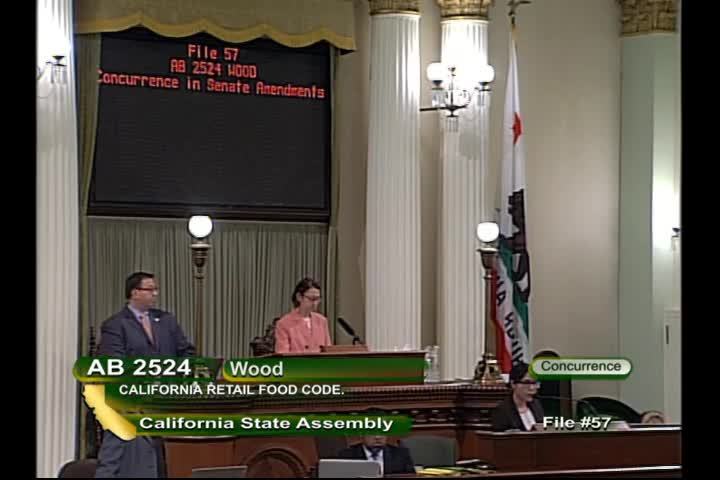
Bill Author

Bill Co-Author(s):