AB 2526: Temporary emergency gun violence restraining orders.
- Session Year: 2017-2018
- House: Assembly
- Latest Version Date: 2018-09-28
Existing law allows a court to issue an order restraining an individual from possessing a firearm while the order is in effect. Existing law allows the court to issue a temporary emergency gun violence restraining order on an ex parte basis if the possession of a firearm by the subject of the petition poses an immediate and present danger. Existing law requires a law enforcement officer who requests a temporary emergency gun violence restraining order to memorialize the order of the court on the form approved by the Judicial Council if the order is obtained orally. Existing law requires the petition for the temporary order to be obtained by submitting a written petition to the court, unless time and circumstances do not permit the submission of a written report, in which case existing law allows the order to be issued in accordance with procedures for obtaining an oral search warrant.
This bill would instead require an officer who requests a temporary emergency gun violence restraining order to sign a declaration under penalty of perjury reciting the oral statements provided to the judicial officer and to memorialize the order of the court on the form approved by the Judicial Council if the request is made orally. The bill would allow a judicial officer to issue a temporary order orally based on the statements of the law enforcement officer and would allow a temporary order to be obtained in writing if time and circumstances permit. Because the declaration would be required to be signed under penalty of perjury, the bill would impose a state-mandated local program by expanding the definition of a crime.
The California Constitution requires the state to reimburse local agencies and school districts for certain costs mandated by the state. Statutory provisions establish procedures for making that reimbursement.
This bill would provide that no reimbursement is required by this act for a specified reason.
A law enforcement officer who requests a temporary emergency gun violence restraining order shall do all of the following:
(a)If the request is made orally, sign a declaration under penalty of perjury reciting the oral statements provided to the judicial officer and memorialize the order of the court on the form approved by the Judicial Council.
(b)Serve the order on the restrained person, if the restrained person can reasonably be located.
(c)File a copy of the order with the court as soon as practicable after issuance.
(d)Have the order entered into the computer database system for protective and restraining orders maintained by the Department of Justice.
SEC. 2.Section 18145 of the Penal Code is amended to read:18145.(a)(1)A judicial officer may issue a temporary emergency gun violence restraining order orally based on the statements of a law enforcement officer made in accordance with subdivision (a) of Section 18140.
(2)If time and circumstances permit, a temporary emergency gun violence restraining order may be obtained in writing and based on a declaration signed under penalty of perjury.
(b)The presiding judge of the superior court of each county shall designate at least one judge, commissioner, or referee who shall be reasonably available to issue temporary emergency gun violence restraining orders when the court is not in session.
SEC. 3.No reimbursement is required by this act pursuant to Section 6 of Article XIIIB of the California Constitution because the only costs that may be incurred by a local agency or school district will be incurred because this act creates a new crime or infraction, eliminates a crime or infraction, or changes the penalty for a crime or infraction, within the meaning of Section 17556 of the Government Code, or changes the definition of a crime within the meaning of Section 6 of Article XIIIB of the California Constitution.
A law enforcement officer who requests a temporary emergency gun violence restraining order shall do all of the following:
(a)If the order is obtained orally, request is made orally, sign a declaration under penalty of perjury reciting the oral statements provided to the judicial officer and memorialize the order of the court on the form approved by the Judicial Council.
(b)Serve the order on the restrained person, if the restrained person can reasonably be located.
(c)File a copy of the order with the court as soon as practicable after issuance.
(d)Have the order entered into the computer database system for protective and restraining orders maintained by the Department of Justice.
SEC. 2.Section 18145 of the Penal Code is amended to read:18145.(a)(1)Except as provided in paragraph (2), the petition for A judicial officer may issue a temporary emergency gun violence restraining order shall be obtained by submitting a written petition to the court. orally based on the statements of a law enforcement officer made in accordance with subdivision (a) of Section 18140.
(2)If time and circumstances do not permit the submission of a written petition, permit, a temporary emergency gun violence restraining order may be issued in accordance with the procedures for obtaining an oral search warrant described in Section 1526. obtained in writing and based on a declaration signed under penalty of perjury.
(b)The presiding judge of the superior court of each county shall designate at least one judge, commissioner, or referee who shall be reasonably available to issue temporary emergency gun violence restraining orders when the court is not in session.
SEC. 3.No reimbursement is required by this act pursuant to Section 6 of Article XIIIB of the California Constitution because the only costs that may be incurred by a local agency or school district will be incurred because this act creates a new crime or infraction, eliminates a crime or infraction, or changes the penalty for a crime or infraction, within the meaning of Section 17556 of the Government Code, or changes the definition of a crime within the meaning of Section 6 of Article XIIIB of the California Constitution.
|
Date
|
Status
|
|---|---|
| Sep 28, 2018 | Chaptered by Secretary of State - Chapter 873, Statutes of 2018. |
| Sep 28, 2018 | Approved by the Governor. |
| Aug 20, 2018 | Enrolled and presented to the Governor at 3 p.m. |
| Aug 16, 2018 | In Assembly. Ordered to Engrossing and Enrolling. |
| Aug 16, 2018 | Read third time. Passed. Ordered to the Assembly. |
| Jul 3, 2018 | Read second time. Ordered to third reading. |
| Jul 2, 2018 | From committee: Be ordered to second reading pursuant to Senate Rule 28.8. |
| Jun 13, 2018 | From committee: Do pass and re-refer to Com. on APPR. (Ayes 7. Noes 0.) (June 12). Re-referred to Com. on APPR. |
| May 17, 2018 | Referred to Com. on PUB. S. |
| May 3, 2018 | In Senate. Read first time. To Com. on RLS. for assignment. |
| May 3, 2018 | Read third time. Passed. Ordered to the Senate. |
| Apr 26, 2018 | Read second time. Ordered to Consent Calendar. |
| Apr 25, 2018 | From committee: Do pass. To Consent Calendar. (Ayes 17. Noes 0.) (April 25). |
| Apr 4, 2018 | From committee: Do pass and re-refer to Com. on APPR. with recommendation: To Consent Calendar. (Ayes 7. Noes 0.) (April 3). Re-referred to Com. on APPR. |
| Mar 5, 2018 | Referred to Com. on PUB. S. |
| Feb 15, 2018 | From printer. May be heard in committee March 17. |
| Feb 14, 2018 | Read first time. To print. |
|
Date
|
Description
|
Location
|
Votes
|
|
|---|---|---|---|---|
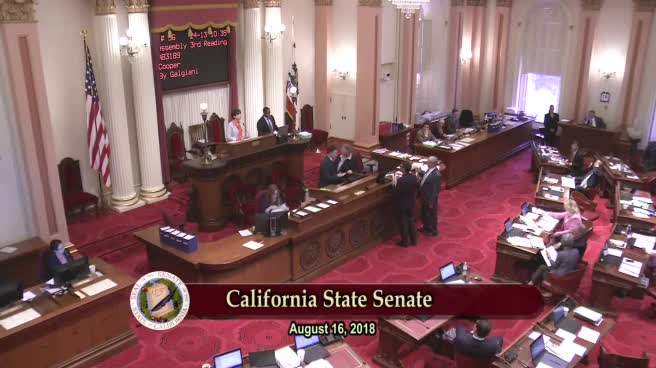
| Aug 16, 2018 | Assembly 3rd Reading AB2526 Rubio By McGuire | Senate Floor |
Passed |
|
| Jun 12, 2018 | Do pass, but first be re-referred to the Committee on [Appropriations] | Senate Standing Committee on Public Safety |
Passed |
|
| May 3, 2018 | AB 2526 RUBIO Consent Calendar Second Day Regular Session | Assembly Floor |
Passed |
|
| Apr 25, 2018 | Do pass. To Consent Calendar. | Assembly Standing Committee on Appropriations |
Passed |
|
| Apr 3, 2018 | Do pass and be re-referred to the Committee on [Appropriations] with recommendation: To Consent Calendar | Assembly Standing Committee on Public Safety |
Passed |
This list shows positions taken on this bill by organizations on the date displayed, which is linked to the original source.
Positions by individuals are not included.
|
Organization
|
Position
|
Date
|
|---|---|---|
| According To The Author Of This Bill: | ** Against | Jun 11, 2018 |
| Assembly Floor Vote: 71 - 0 | ** Against | Jun 11, 2018 |
| Bay Area Student Activists | ** Support | Jul 3, 2018 |
| California Academy Of Family Physicians | ** Support | Jul 3, 2018 |
| California Chapters of the Brady Campaign | ** Support | Jul 3, 2018 |
| California Judges Association | ** Support | Jul 3, 2018 |
| California Police Chiefs Association | ** Support | Jul 3, 2018 |
| California State Sheriffs' Association | ** Support | Jul 3, 2018 |
| California'S Gvro Law | ** Against | Jun 11, 2018 |
| Crime Victims United Of California | ** Support | Jul 3, 2018 |
| Firearms Policy Coalition | ** Against | Jul 3, 2018 |
| Giffords Law Center To Prevent Gun Violence | ** Support | Apr 2, 2018 |
| Judicial Council of California | ** Support | Jul 3, 2018 |
| Need For This Bill | ** Against | Jun 11, 2018 |
| Peace Officers Research Association Of California | ** Support | Jul 3, 2018 |
| PURPOSE | ** Against | Jun 11, 2018 |
Office of Senate Floor Analyses (916) 651-1520 Fax: (916) 327-4478 | AB |
THIRD READING
Bill No: AB 2526
:
SENATE PUBLIC SAFETY COMMITTEE: 7-0, 6/12/18
AYES: Skinner, Anderson, Bradford, Jackson, Mitchell, Stone, Wiener
SENATE APPROPRIATIONS COMMITTEE: Senate Rule 28.8
ASSEMBLY FLOOR: 71-0, 5/3/18 (Consent) - See last page for vote
SOURCE: Judicial Council of California
DIGEST:
This bill makes oral requests for a temporary emergency gun violence restraining order (GVRO) the statutory default and authorizes written requests if time and circumstances permit.
Existing law:
- Defines a "GVRO" as "an order, in writing, signed by the court, prohibiting and enjoining a named person from having in his or her custody or control, owning, purchasing, possessing, or receiving any firearms or ammunition." (Pen. Code § 18100.)
- Requires the court to notify the Department of Justice (DOJ) when a GVRO is issued, renewed, dissolved, or terminated. (Pen. Code § 18115.)
- Prohibits a person that is subject to a GVRO from having in his or her custody any firearms or ammunition while the order is in effect. (Pen. Code § 18120, subd. (a).)
- Requires the court to order the restrained person to surrender all firearms and ammunition in his or her control. (Pen. Code § 18120, subd. (b)(1).)
- States that the officer serving the GVRO shall request the surrender of all firearms or ammunition immediately, or in the alternative, the surrender shall occur within 24 hours of being served with the GVRO by surrendering all firearms and ammunition in a safe manner to the control of the local law enforcement agency, selling all firearms and ammunition to a licensed firearms dealer, or transferring all firearms and ammunition to a licensed firearms dealer. (Pen. Code § 18120, subd. (b)(2).)
- Allows law enforcement to seek a temporary GVRO if the officer asserts, and the court finds, that there is reasonable cause to believe the following:
- The subject of the petition poses an immediate and present danger of causing injury to himself or another by possessing a firearm; and,
- The emergency GVRO is necessary to prevent personal injury to the subject of the order or another because less restrictive alternatives have been tried and been ineffective or have been determined to be inadequate under the circumstances. (Pen. Code § 18125, subd. (a).)
- States that a temporary GVRO shall expire 21 days from the date the order is issued. (Pen. Code § 18125, subd. (b).)
- Requires a law enforcement officer seeking a temporary GVRO to do all of the following:
- Memorialize the order of the court on the form approved by the Judicial Council, if the order is obtained orally;
- Serve the order on the restrained person, if the restrained person can reasonably be located;
- File a copy of the order with the court as soon as practicable after issuance; and,
- Have the order entered into the computer database system for protective and restraining orders maintained by the DOJ. (Pen. Code § 18140.)
- States that a petition for a temporary emergency GVRO shall be obtained by submitting a written petition to the court, except that if time and circumstances do not permit the submission of a written petition, a temporary emergency gun violence restraining order may be issued in accordance with the procedures for obtaining an oral search warrant. (Pen. Code § 18145 subd. (a).)
This bill:
- Allows a judicial officer to issue a temporary emergency GVRO orally based on the statements of the law enforcement officer and allows a temporary GVRO to be obtained in writing and based on a declaration signed under penalty of perjury if time and circumstances permit.
- Requires the officer to sign a declaration under penalty of perjury reciting the oral statements provided to the judicial officer.
FISCAL EFFECT: Appropriation: Fiscal Com.: Local:
Judicial Council of California (source)
Bay Area Student Activists
California Academy of Family Physicians
California Chapters of the Brady Campaign
California Judges Association
California Police Chiefs Association
California State Sheriffs’ Association
Crime Victims United of California
Peace Officers Research Association of California
Firearms Policy Coalition
ASSEMBLY FLOOR: 71-0, 5/3/18
AYES: Acosta, Aguiar-Curry, Arambula, Baker, Berman, Bigelow, Bloom, Bonta, Brough, Burke, Calderon, Carrillo, Cervantes, Chau, Chávez, Chen, Chiu, Chu, Cooley, Cooper, Cunningham, Dahle, Daly, Eggman, Flora, Fong, Frazier, Friedman, Gallagher, Eduardo Garcia, Gipson, Gloria, Gonzalez Fletcher, Gray, Harper, Holden, Irwin, Jones-Sawyer, Kalra, Kamlager-Dove, Kiley, Lackey, Levine, Limón, Low, Maienschein, Mathis, Mayes, McCarty, Medina, Melendez, Mullin, Muratsuchi, Nazarian, Obernolte, O'Donnell, Patterson, Quirk, Reyes, Rodriguez, Rubio, Salas, Santiago, Steinorth, Mark Stone, Thurmond, Ting, Waldron, Weber, Wood, Rendon
NO VOTE RECORDED: Travis Allen, Caballero, Choi, Cristina Garcia, Grayson, Quirk-Silva, Voepel
7/3/18 15:35:58
**** END ****
SENATE COMMITTEE ON PUBLIC SAFETY
Senator Nancy Skinner, Chair
2017 - 2018 Regular
Bill No: AB 2526 Hearing Date: June 12, 2018
Author: | Rubio | ||
Version: | February 14, 2018 | ||
Urgency: | No | Fiscal: | Yes |
Consultant: | SC | ||
Subject: Temporary Emergency Gun Violence Restraining Orders
HISTORY
Source: Judicial Council of California
Prior Legislation: AB 1443 (Levine), Ch. 172, Stats. 2017
AB 2607 (Ting), 2016, vetoed
AB 950 (Melendez), Ch. 205, Stats. 2015
AB 225 (Melendez), 2015, failed Assembly Public Safety
SB 505 (Jackson), Ch. 918, Stats. 2014
AB 1014 (Skinner), Ch. 872, Stats. 2014
Support: Bay Area Student Activists; California Academy of Family Physicians; California Police Chiefs Association; California State Sheriffs’ Association; Crime Victims United of California
Opposition: Firearms Policy Coalition
Assembly Floor Vote: 71 - 0
PURPOSE
The purpose of this bill is to make oral requests for a temporary emergency gun violence restraining order (GVRO) the statutory default and authorize written requests if time and circumstances permit.
Existing law defines a "GVRO" as "an order, in writing, signed by the court, prohibiting and enjoining a named person from having in his or her custody or control, owning, purchasing, possessing, or receiving any firearms or ammunition." (Pen. Code, § 18100.)
Existing law requires the court to notify the Department of Justice (DOJ) when a GVRO is issued, renewed, dissolved, or terminated. (Pen. Code, § 18115.)
Existing law prohibits a person that is subject to a GVRO from having in his or her custody any firearms or ammunition while the order is in effect. (Pen. Code, § 18120, subd. (a).)
Existing law requires the court to order the restrained person to surrender all firearms and ammunition in his or her control. (Pen. Code, § 18120, subd. (b)(1).)
Existing law states that the officer serving the GVRO shall request the surrender of all firearms or ammunition immediately, or in the alternative, the surrender shall occur within 24 hours of being served with the GVRO by surrendering all firearms and ammunition in a safe manner to the control of the local law enforcement agency, selling all firearms and ammunition to a licensed firearms dealer, or transferring all firearms and ammunition to a licensed firearms dealer. (Pen. Code, § 18120, subd. (b)(2).)
Existing law allows law enforcement to seek a temporary GVRO if the officer asserts, and the court finds, that there is reasonable cause to believe the following:
- The subject of the petition poses an immediate and present danger of causing injury to himself or another by possessing a firearm; and,
- The emergency GVRO is necessary to prevent personal injury to the subject of the order or another because less restrictive alternatives have been tried and been ineffective or have been determined to be inadequate under the circumstances. (Pen. Code, § 18125, subd. (a).)
Existing law states that a temporary GVRO shall expire 21 days from the date the order is issued. (Pen. Code, § 18125, subd. (b).)
Existing law requires the presiding judge of the superior court of each county to designate at least one judge, commissioner, or referee who shall be reasonably available to issue temporary emergency GVROs when the court is not in session. (Pen. Code, § 18145, subd. (b).)
Existing law requires a law enforcement officer seeking a temporary GVRO to do all of the following:
- Memorialize the order of the court on the form approved by the Judicial Council, if the order is obtained orally;
- Serve the order on the restrained person, if the restrained person can reasonably be located;
- File a copy of the order with the court as soon as practicable after issuance; and,
- Have the order entered into the computer database system for protective and restraining orders maintained by the DOJ. (Pen. Code, § 18140.)
This bill requires the officer to additionally sign a declaration under penalty of perjury reciting the oral statements provided to the judicial officer.
Existing law states that a petition for a temporary emergency GVRO shall be obtained by submitting a written petition to the court, except that if time and circumstances do not permit the submission of a written petition, a temporary emergency gun violence restraining order may be issued in accordance with the procedures for obtaining an oral search warrant. (Pen. Code, § 18145 subd. (a).)
This bill instead allows a judicial officer to issue a temporary emergency GVRO orally based on the statements of the law enforcement officer and would allow a temporary GVRO to be obtained in writing and based on a declaration signed under penalty of perjury if time and circumstances permit.
COMMENTS
- Need for this Bill
According to the author of this bill:
Temporary emergency gun violence restraining orders (EPOs, or temporary emergency GVROs) are generally obtained over the phone by a law enforcement officer in the field who is dealing with the immediate and present danger that is the subject of the order.
However, the default procedure in statute (Pen. Code §18145) dictates that temporary emergency GVRO’s shall be obtained via written petition, unless time and circumstances do not permit writing and filing the petition. Where oral issuance is permitted, the statute directs law enforcement to follow the procedures used for obtaining an oral search warrant (Pen. Code §1526).
The organization of the statute has led to confusion about whether a written petition is required for issuance. The Judicial Council form filed with the court does not serve as a written petition. Moreover, oral search warrant procedure, which differs greatly from the domestic violence restraining order procedure that California’s GVRO laws were modeled after, can be too burdensome for temporary GVROs. These factors create inefficiencies in the processing of already time-sensitive requests.
This bill would make oral requests the default procedure in statute, allowing for a written process if time and circumstances permit. The bill would also specify that when the request is made orally, the officer shall follow procedures more consistent with obtaining a domestic violence EPO, including: signing a declaration under penalty of perjury, reciting statements to the judicial officer under oath, memorializing the order on the approved Judicial Council form, and filing a copy with the court as soon as practicable. These changes retain the essential elements of the original statute as well as oral search warrant procedures, and align statutory language with the reality of how firearms EPOs are issued.
- California’s GVRO law
California's GVRO laws, modeled after domestic violence restraining order laws, went into effect on January 1, 2016. A GVRO will prohibit the restrained person from purchasing or possessing firearms or ammunition and authorizes law enforcement to remove any firearms or ammunition already in the individual's possession.
The statutory scheme establishes three types of GVRO's: a temporary emergency GVRO, an ex parte GVRO, and a GVRO issued after notice and hearing. A document prepared by Judicial Council describes the different types of GVRO in further detail:
There are three major differences between the “temporary” and “ex parte” orders. First, the temporary order may only be requested by a law enforcement officer, while the ex parte order may be requested by a law enforcement officer or an immediate family member (as defined). Second, the temporary order expires in 21 days with no procedure for extending it or making it “permanent;” the ex parte order also expires in 21 days, but provides for a hearing to be held within 21 days to issue a GV order with a duration of one year. With the temporary order, before the 21 days are up, the law enforcement officer can petition for an order after hearing.
The third difference is in the showing required to get the order. The temporary order requires a showing of immediate and present danger, while the ex parte order requires a showing of a significant danger in the near future.
The temporary order may also be obtained by using the procedures to obtain an oral search warrant if time and circumstances do not permit the filing of a petition. Hence, the temporary order is a tool to be used by law enforcement in an emergency situation, when there is a perceived need to remove guns from someone acting erratically and aggressively and to prohibit him or her from possessing a firearm. If the restraining order is issued and the restrained party has not relinquished the firearm, then under the amendments to Penal Code section 1524(a)(14), a search warrant for the firearm can be issued.
In summary, law enforcement can seek a temporary order in an emergency or an ex parte order for danger in the near future. A family member can only seek an ex parte order. Either may seek an order after hearing.
(http://www.courts.ca.gov/documents/SPR15-13.pdf [as of May 30, 2018], pg. 3.)
Although current law contemplates the oral issuance of a GVRO, the default procedure in statute is to submit a written petition. Oral issuance is only allowed if time and circumstances do not permit the filing of a written petition. This bill aims to eliminate the existing law’s preference for the written petition, given the fact that the situation in which a temporary emergency GVRO already requires an “immediate and present danger.”
Additionally, this bill would streamline the oral procedure for obtaining a GVRO. Rather than having to comply with the somewhat more rigorous demands that are necessary to obtain a search warrant, an officer can simply recite the reasons needed for the GVRO to the judicial officer over the phone, so long as those reasons are later memorialized in a declaration signed under the penalty of perjury. This process appears to balance the immediacy of the potential threat with the requirements of due process.
- Argument in Support
Judicial Council of California, the sponsor of this bill, writes in support:
Making the oral procedures the primary procedure in the statute reflects the reality of how these orders are issued: the request is generally made over the phone by a law enforcement officer who is in the field dealing with a situation in which someone poses an immediate and present danger of causing harm to himself or herself, or others. Thus, it is difficult to see how time and circumstances would allow the officer to present a written form to a judicial officer at the courthouse as required by the current default procedure.
In addition, AB 2526 aligns the temporary GVRO procedures with those for obtaining domestic violence emergency protective orders by adopting requirements similar to those specified by the Legislature for emergency protection orders that law enforcement obtain orally in domestic violence cases (Fam. Code § 6241.) Finally, the bill retains the essential requirements of the original statutes. Specifically, the oral statements that the law enforcement officer seeking the order makes to the judicial officer must be declared under penalty of perjury on the order form eventually filed with the court – a parallel to the requirement of statements under oath for oral issue of search warrants (Pen. Code § 1526(b) (law enforcement officer statement made by telephone and recorded or sent in to court in writing via fax or email).)
- Argument in Opposition
According to the Firearms Policy Coalition:
AB 2526 would amend Section 18140 of the Penal Code to allow a law enforcement officer to request a [GVRO] verbally. This is a stunning infringement on liberty, wherein peace officers could have a law-abiding gun owners’ firearms taken away merely at their say-so.
The bill’s language is careful to note that petitioners would be required to sign a declaration under penalty of perjury. However, time and experience has shown us that people are willing to perjure themselves in front of a court of law in order to achieve their goals.
-- END –
Date of Hearing: April 25, 2018
ASSEMBLY COMMITTEE ON APPROPRIATIONS
Lorena Gonzalez Fletcher, Chair
ABPCA Bill Id:AB 2526
Author:(Rubio) – As Introduced Ver:February 14, 2018
Policy Committee: | Public Safety | Vote: | 7 - 0 |
|
| ||
|
|
Urgency: No State Mandated Local Program: Yes Reimbursable: No
SUMMARY:
This bill allows law enforcement officers to orally obtain temporary emergency gun violence restraining orders provided they sign a declaration under oath attesting to the facts supporting the request. Specifically, this bill:
- Allows a judicial officer to issue a temporary emergency gun violence restraining order based upon a law enforcement officer’s oral request provided the officer signs a declaration under penalty of perjury reciting the oral statements provided to the judicial officer and memorializes the order on the form approved by the Judicial Council.
- Eliminates the requirement that a temporary emergency gun violence restraining order be obtained in writing unless time and circumstances permit.
- Eliminates the requirement that an orally obtained temporary emergency gun violence restraining order be obtained in the same method as an oral application for a search warrant.
FISCAL EFFECT:
Negligible fiscal impact.
COMMENTS:
- Background. State law allows for the issuance of a temporary emergency gun violence restraining order (GVRO) where a person exhibits an immediate and present danger of causing harm to himself or herself, or others. Once the order has been issued and properly served on the subject, the subject is prohibited from possessing or purchasing a firearm in the ensuing 21 days. Although current law contemplates the oral issuance of a GVRO, the default procedure is to submit a written petition. Oral issuance is allowed only if time and circumstances do not permit the filing of a written petition.
- Purpose. This bill aims to eliminate the existing preference for a written petition, given that an emergency GVRO requires a situation that poses an immediate and present danger. Additionally, this bill would streamline the oral procedure for obtaining a GVRO. Rather than having to comply with the somewhat more rigorous demands that are necessary to obtain a search warrant, an officer can simply recite the reasons needed for the GVRO to the judicial officer over the phone, so long as he later memorializes them in a declaration signed under the penalty of perjury. According to the author:
In practice, officers in the in the field dealing with the immediate and present danger that is the basis for a temporary GVRO generally obtain the order orally because time and circumstances rarely allow the officer to present a written petition to a judicial officer at the courthouse. However, the default procedure under existing law provides that officers must obtain such orders via written petition, unless time and circumstances do not permit preparing and filing the petition. This has caused confusion about whether a written petition is required for the orders, which could result in unnecessary delays. AB 2526 instead aligns the procedures for an officer to obtain the order with the procedures for Domestic Violence Restraining Orders by making oral requests for such orders the default procedure.
- Related legislation. AB 2888 (Ting), of the current legislative session, allows persons other than immediate family members and law enforcement, including employers and co-workers, to file a petition for a GVRO in a non-emergency situation. AB 2888 is pending hearing in the Assembly Committee on Public Safety.
Analysis Prepared by: Jessica Peters / APPR. / (916) 319-2081
Date of Hearing: April 3, 2018
Counsel: Matthew Fleming
ASSEMBLY COMMITTEE ON
Reginald Byron Jones-Sawyer, Sr., Chair
ABPCA Bill Id:
Author:() – As Ver:
SUMMARY:
Allows law enforcement officers to orally obtain temporary emergency gun violence restraining orders provided they sign a declaration under oath attesting to the facts supporting the request. Specifically, this bill:
- Allows a judicial officer to issue a temporary emergency gun violence restraining order based upon a law enforcement officer’s oral request provided the officer signs a declaration under the penalty of perjury reciting the oral statements provided to the judicial officer and memorializes the order on the form approved by the Judicial Council.
- Eliminates the requirement that a temporary emergency gun violence restraining order be obtained in writing unless time and circumstances permit.
- Eliminates the requirement that an orally obtained temporary emergency gun violence restraining order be obtained in the same method as an oral application for a search warrant.
EXISTING LAW:
- Requires a law enforcement officer seeking a temporary gun violence restraining order to do all of the following:
- Memorialize the order of the court on the form approved by the Judicial Council, if the order is obtained orally;
- Serve the order on the restrained person, if the restrained person can reasonably be located;
- File a copy of the order with the court as soon as practicable after issuance; and
- Have the order entered into the computer database system for protective and restraining orders maintained by the Department of Justice. (Pen. Code, § 18140.)
- Memorialize the order of the court on the form approved by the Judicial Council, if the order is obtained orally;
- States that a petition for a temporary emergency gun violence restraining order shall be obtained by submitting a written petition to the court, except that if time and circumstances do not permit the submission of a written petition, a temporary emergency gun violence restraining order may be issued in accordance with the procedures for obtaining an oral search warrant. (Pen. Code, § 18145 subd. (a).)
- Establishes that the presiding judge of the superior court of each county shall designate at least one judge, commissioner, or referee who shall be reasonably available to issue temporary emergency gun violence restraining orders when the court is not in session. (Pen. Code, § 18145 subd. (b).)
- States that a temporary emergency gun violence restraining order may be issued on an ex parte basis only if a law enforcement officer asserts, and a judicial officer finds, that there is reasonable cause to believe both of the following:
- The subject of the petition poses an immediate and present danger of causing personal injury to himself, herself, or another by having in his or her custody or control, owning, purchasing, possessing, or receiving a firearm; and
- A temporary emergency gun violence restraining order is necessary to prevent personal injury to the subject of the petition or another because less restrictive alternatives either have been tried and found to be ineffective, or have been determined to be inadequate or inappropriate for the circumstances of the subject of the petition. (Pen. Code, § 18125 subd. (a).)
- The subject of the petition poses an immediate and present danger of causing personal injury to himself, herself, or another by having in his or her custody or control, owning, purchasing, possessing, or receiving a firearm; and
- State that a temporary emergency gun violence restraining order shall prohibit the subject of the petition from having in his or her custody or control, owning, purchasing, possessing, or receiving, or attempting to purchase or receive, a firearm or ammunition, and shall expire 21 days from the date the order is issued. (Pen. Code, § 18125 subd. (b).)
- States that a temporary emergency gun violence restraining order is valid only if it is issued by a judicial officer after making the findings required by law and pursuant to a specific request by a law enforcement officer. (Pen. Code, § 18130.)
- Requires that a temporary emergency gun violence restraining order include all of the following:
- A statement of the grounds supporting the issuance of the order;
- The date and time the order expires;
- The address of the superior court for the county in which the restrained party resides; and,
- The following statement:
- A statement of the grounds supporting the issuance of the order;
“To the restrained person: This order will last until the date and time noted above. You are required to surrender all firearms and ammunition that you own or possess in accordance with Section 18120 of the Penal Code and you may not have in your custody or control, own, purchase, possess, or receive, or attempt to purchase or receive a firearm or ammunition, while this order is in effect. However, a more permanent gun violence restraining order may be obtained from the court. You may seek the advice of an attorney as to any matter connected with the order. The attorney should be consulted promptly so that the attorney may assist you in any matter connected with the order.” (Pen. Code, § 18135.)
FISCAL EFFECT:
Unknown
COMMENTS:
- Author's Statement: According to the author, “In light of the tragic string of school shootings – most recently in Florida – it is essential that the procedures for obtaining temporary GVRO’s are clear. AB 2526 will help prevent gun violence against school children, families, and the public by clarifying that law enforcement may seek those orders orally, saving time when there is an immediate and present danger of gun violence.
“In practice, officers in the in the field dealing with the immediate and present danger that is the basis for a temporary GVRO generally obtain the order orally because time and circumstances rarely allow the officer to present a written petition to a judicial officer at the courthouse. However, the default procedure under existing law provides that officers must obtain such orders via written petition, unless time and circumstances do not permit preparing and filing the petition. This has caused confusion about whether a written petition is required for the orders, which could result in unnecessary delays. AB 2526 instead aligns the procedures for an officer to obtain the order with the procedures for Domestic Violence Restraining Orders by making oral requests for such orders the default procedure.” - The Temporary Emergency Gun Violence Restraining Order: State law allows for the issuance of a temporary emergency gun violence restraining order (GVRO) where a person exhibits an immediate and present danger of causing harm to him or herself, or others. Once the order has been issued and properly served on the subject, that person is prohibited from possessing or purchasing a firearm in the ensuing 21 days. The process for how an emergency GVRO is obtained is the subject of this bill.
Although current law contemplates the oral issuance of a GVRO, the default procedure is to submit a written petition. Oral issuance is only allowed if time and circumstances do not permit the filing of a written petition. This bill aims to eliminate the existing law’s preference for the written petition, given the fact that the situation in which an emergency GVRO already requires a “immediate and present danger.”
Additionally, this bill would streamline the oral procedure for obtaining a GVRO. Rather than having to comply with the somewhat more rigorous demands that are necessary to obtain a search warrant, an officer can simply recite the reasons needed for the GVRO to the judicial officer over the phone, so long as he later memorializes them in a declaration signed under the penalty of perjury. This process appears to balance the immediacy of the potential threat with the requirements of due process. - Argument in Support: According to the sponsor of the bill, the Judicial Council:“AB 2526 clarifies the process for issuance of temporary emergency gun violence restraining orders and furthers the court’s ability to efficiently process and issue emergency orders by making oral requests for temporary GVROs requested by law enforcement the default procedure rather than written petitions for those GVROs.
“Making the oral procedures the primary procedure in the statute reflects the reality of how these orders are issued: the request is generally made over the phone by a law enforcement officer who is in the field dealing with a situation in which someone poses an immediate and present danger of causing harm to himself or herself, or others. Thus, it is difficult to see how time and circumstances would allow the officer to present a written form to a judicial officer at the courthouse as required by the current default procedure.
“In addition, AB 2526 aligns the temporary GVRO procedures with those for obtaining domestic violence emergency protective orders by adopting requirements similar to those specified by the Legislature for emergency protection orders that law enforcement obtain orally in domestic violence cases (Fam. Code § 6241.) Finally, the bill retains the essential requirements of the original statutes. Specifically, the oral statements that the law enforcement officer seeking the order makes to the judicial officer must be declared under penalty of perjury on the order form eventually filed with the court – a parallel to the requirement of statements under oath for oral issue of search warrants (Pen. Code § 1526(b) (law enforcement officer statement made by telephone and recorded or sent in to court in writing via fax or email).) - Related Legislation:
- SB 1200 (Skinner), of the 2017-2018 Legislative Session, would clarify that GVRO require the surrender of firearm parts, firearm components, and magazines, and would also require an officer to verbally ask the person being restrained whether he or she has a firearm, firearm part or component, or magazine in possession. SB 1200 is pending referral by the Senate Rules Committee.
- AB 2888 (Ting), of the 2017-2018 Legislative Session, would allow persons other than immediate family members and law enforcement, including employers and co-workers to file a petition for a GVRO in a non-emergency situation. AB 2888 is pending in the Assembly Committee on Public Safety.
- SB 1200 (Skinner), of the 2017-2018 Legislative Session, would clarify that GVRO require the surrender of firearm parts, firearm components, and magazines, and would also require an officer to verbally ask the person being restrained whether he or she has a firearm, firearm part or component, or magazine in possession. SB 1200 is pending referral by the Senate Rules Committee.
- Prior Legislation:
- AB 1014 (Skinner), Chapter 872, Statutes of 2014, establishes GVROs.
- AB 225 (Melendez) of the 2015-2016 Legislative Session, would have made it a felony to file for a GVRO based on false information. AB 225 failed passage in the Assembly Committee on Public Safety.
- AB 1014 (Skinner), Chapter 872, Statutes of 2014, establishes GVROs.
REGISTERED SUPPORT / OPPOSITION:
Support
Judicial Council (Sponsor)
California State Sheriffs’ Association
Giffords Law Center to Prevent Gun Violence
Opposition
None
Analysis Prepared by:
Bill Author

Bill Co-Author(s):