AB 2531: Access to judicial and nonjudicial proceedings: individuals who are deaf or hard of hearing: operators of computer-aided transcription systems.
- Session Year: 2017-2018
- House: Assembly
- Latest Version Date: 2018-08-31
Existing law requires that a participant in any civil or criminal proceeding, court-ordered or court-provided alternative dispute resolution, or administrative hearing of a public agency, who is hearing impaired be provided with a functioning assistive listening system or a computer-aided transcription system, upon his or her request. Existing law requires, if a computer-aided transcription system is requested, sufficient display terminals be provided to allow the hearing impaired individual to read the real-time transcript of the proceeding without difficulty. Existing law requires the Judicial Council to perform various tasks related to assistive listening systems and computer-aided transcription systems, including the development and maintenance of a system to record utilization by the courts of these systems.
This bill would require an individual requiring the services of an operator of a computer-aided transcription system to give advance notice of this need, as specified, and would require the operator to provide the speech-to-text equipment to be used, unless otherwise provided by the court. The bill would require a sign to be posted in a prominent place indicating the availability, and how to request, the services of an operator. The bill would also require the Judicial Council to develop and approve official forms for notice of the availability of the services of an operator and to develop and maintain a system to record utilization by the courts of the services of certified operators of computer-aided transcription systems, the services of sign language interpreters, and the services of otherwise uncertified operators, interpreters, or captioners. The bill would also change references to hearing impaired to deaf or hard of hearing.
Existing law authorizes a court reporter to be present in the jury deliberating room during jury deliberation if the services of the court reporter for the purpose of operating a computer-aided transcription system are required for a juror who is hearing impaired.
This bill would instead authorize an operator of a computer-aided transcription system to be present for that purpose.
Existing law requires the Court Reporters Board of California to license and regulate the practice of shorthand reporting, defined to generally mean, among other things, the making of a verbatim record of any oral court proceeding.
This bill, on or before January 1, 2020, would authorize the board to identify a certification process for operators of computer-aided transcription systems that is conducted by a state or national association. The bill, on or before January 1, 2022, upon appropriation by the Legislature, would require the board to adopt standards for certifying operators of computer-aided transcription systems and would authorize the board to satisfy this requirement by approving a state or national association to certify operators of computer-aided transcription systems. The bill, on or before January 1, 2026, would also require the board to report to the Legislature the number of operators of computer-aided transcription systems that, between January 1, 2022, and July 1, 2025, have successfully been certified pursuant to the standards adopted by the board.
Existing law requires that a participant in any civil or criminal proceeding, court-ordered or court-provided alternative dispute resolution, or administrative hearing of a public agency, who is hearing impaired be provided with a functioning assistive listening system or a computer-aided transcription system, upon his or her request. Existing law requires, if a computer-aided transcription system is requested, sufficient display terminals be provided to allow the hearing impaired individual to read the real-time transcript of the proceeding without difficulty. Existing law requires the Judicial Council to perform various tasks related to assistive listening systems and computer-aided transcription systems, including the development and maintenance of a system to record utilization by the courts of these systems.
This bill would require an individual requiring the services of an operator of a computer-aided transcription system to give advance notice of this need, as specified, and would require the operator to provide the speech-to-text equipment to be used, unless otherwise provided by the court. The bill would require a sign to be posted in a prominent place indicating the availability, and how to request, the services of an operator. The bill would also require the Judicial Council to develop and approve official forms for notice of the availability of the services of an operator and to develop and maintain a system to record utilization by the courts of the services of certified operators of computer-aided transcription systems, the services of sign language interpreters, and the services of otherwise uncertified operators, interpreters, or captioners. The bill would also change references to hearing impaired to deaf or hard of hearing.
Existing law authorizes a court reporter to be present in the jury deliberating room during jury deliberation if the services of the court reporter for the purpose of operating a computer-aided transcription system are required for a juror who is hearing impaired.
This bill would instead authorize an operator of a computer-aided transcription system to be present for that purpose.
Existing law requires the Court Reporters Board of California to license and regulate the practice of shorthand reporting, defined to generally mean, among other things, the making of a verbatim record of any oral court proceeding.
This bill would require, bill, on or before January 1, 2020, would authorize the board to identify a certification process for operators of computer-aided transcription systems that is conducted by a state or national association. The bill, on or before January 1, 2022, upon appropriation by the Legislature, would require the board to adopt standards for certifying operators of computer-aided transcription systems. The bill systems and would authorize the board to satisfy this requirement by approving a state or national association to certify operators of computer-aided transcription systems. The bill bill, on or before January 1, 2026, would also require, on or before January 1, 2024, require the board to report to the Legislature the number of operators of computer-aided transcription systems that, between January 1, 2020, 2022, and January 1, 2024, July 1, 2025, have successfully been certified pursuant to the standards developed adopted by the board.
Existing law requires that a participant in any civil or criminal proceeding, court-ordered or court-provided alternative dispute resolution, or administrative hearing of a public agency, who is hearing impaired be provided with a functioning assistive listening system or a computer-aided transcription system, upon his or her request. Existing law requires, if a computer-aided transcription system is requested, sufficient display terminals be provided to allow the hearing impaired individual to read the real-time transcript of the proceeding without difficulty. Existing law requires the Court Reporters Board of California to license and regulate the practice of shorthand reporting, defined to generally mean, among other things, the making of a verbatim record of any oral court proceeding. Existing law requires the Judicial Council to perform various tasks related to assistive listening systems and computer-aided transcription systems, including the development and maintenance of a system to record utilization by the courts of these systems.
This bill would require an individual requiring the services of an operator of a computer-aided transcription system to give advance notice of this need, as specified, and would require the operator to provide the speech-to-text equipment to be used, unless otherwise provided by the court. The bill would require a sign to be posted in a prominent place indicating the availability, and how to request, the services of an operator. The bill would also require the Judicial Council to develop and approve official forms for notice of the availability of the services of an operator and to develop and maintain a system to record utilization by the courts of the services of certified operators of computer-aided transcription systems, the services of sign language interpreters, and the services of otherwise uncertified operators, interpreters, or captioners. The bill would change references to hearing impaired to deaf or hard of hearing.
Existing law authorizes a court reporter to be present in the jury deliberating room during jury deliberation if the services of the court reporter for the purpose of operating a computer-aided transcription system are required for a juror who is hearing impaired.
This bill would instead authorize an operator of a computer-aided transcription system to be present for that purpose.
Existing law requires the Court Reporters Board of California to license and regulate the practice of shorthand reporting, defined to generally mean, among other things, the making of a verbatim record of any oral court proceeding.
This bill would require, on or before January 1, 2020, the Court Reporters Board of California board to adopt standards and develop a method for certifying operators of computer-aided transcription systems. The bill would authorize the board to satisfy this requirement by approving a state or national association to certify operators of computer-aided transcription systems. The bill would also require, on or before January 1, 2023, this 2024, the board to report to the Legislature the number of operators of computer-aided transcription systems that that, between January 1, 2020, and January 1, 2024, have successfully been certified pursuant to the standards developed by the board between January 1, 2020, and January 1, 2023. board.
Existing law requires that a participant in any civil or criminal proceeding, court-ordered or court-provided alternative dispute resolution, or administrative hearing of a public agency, who is hearing impaired be provided with a functioning assistive listening system or a computer-aided transcription system, upon his or her request. Existing law requires, if a computer-aided transcription system is requested, sufficient display terminals be provided to allow the hearing impaired individual to read the real-time transcript of the proceeding without difficulty. Existing law requires the Court Reporters Board of California to license and regulate the practice of shorthand reporting, defined to generally mean, among other things, the making of a verbatim record of any oral court proceeding. Existing law requires the Judicial Council to perform various tasks related to assistive listening systems and computer-aided transcription systems. systems, including the development and maintenance of a system to record utilization by the courts of these systems.
This bill would require an operator of a computer-aided transcription system to be certified by a state or national association approved by the Court Reporters Board of California. individual requiring the services of an operator of a computer-aided transcription system to give advance notice of this need, as specified, and would require the operator to provide the speech-to-text equipment to be used, unless otherwise provided by the court. The bill would require a sign to be posted in a prominent place indicating the availability, and how to request, the services of an operator. The bill would also require the Judicial Council to develop and approve official forms for notice of the availability of the services of an operator and to develop and maintain a system to record utilization by the courts of the services of certified operators of computer-aided transcription systems, the services of sign language interpreters and communication access real time translation interpreters, and the services of otherwise uncertified operators, interpreters, or captioners.
Existing law authorizes a court reporter to be present in the jury deliberating room during jury deliberation if the services of the court reporter for the purpose of operating a computer-aided transcription system are required for a juror who is hearing impaired.
This bill would instead authorize an operator of a computer-aided transcription system to be present for that purpose.
This bill would require, on or before January 1, 2020, the Court Reporters Board of California to adopt standards and develop a method for certifying operators of computer-aided transcription systems. The bill would also require, on or before January 1, 2023, this board to report to the Legislature the number of operators of computer-aided transcription systems that have successfully been certified by the board between January 1, 2020, and January 1, 2023.
Existing law requires that a participant in any civil or criminal proceeding, court-ordered or court-provided alternative dispute resolution, or administrative hearing of a public agency, who is hearing impaired be provided with a functioning assistive listening system or a computer-aided transcription system, upon his or her request. Existing law requires, if a computer-aided transcription system is requested, sufficient display terminals be provided to allow the hearing impaired individual to read the real-time transcript of the proceeding without difficulty. Existing law requires the Court Reporters Board of California to license and regulate the practice of shorthand reporting, defined to generally mean, among other things, the making of a verbatim record of any oral court proceeding. Existing law requires the Judicial Council to perform various tasks related to assistive listening systems and computer-aided transcription systems.
This bill would require an operator of a computer-aided transcription system to be certified by a state or national association approved by the Court Reporters Board of California. The bill would also require the Judicial Council to develop and maintain a system to record utilization by the courts of sign language interpreters and communication access real time translation captioners.
Existing law requires that a participant in any civil or criminal proceeding, court-ordered or court-provided alternative dispute resolution, or administrative hearing of a public agency, who is hearing impaired be provided with a functioning assistive listening system or a computer-aided transcription system, upon his or her request. Existing law requires, if a computer-aided transcription system is requested, sufficient display terminals be provided to allow the hearing impaired individual to read the real-time transcript of the proceeding without difficulty. Existing law requires the Court Reporters Board of California to license and regulate the practice of shorthand reporting, defined to generally mean, among other things, the making of a verbatim record of any oral court proceeding.
This bill would require an operator of a computer-aided transcription system to be certified by a state or national association approved by the Court Reporters Board of California.
(a)(1)On or before January 1, 2020, the board may identify a certification process for operators of computer-aided transcription systems, as described in Section 54.8 of the Civil Code, that is conducted by a state or national association.
(2)The identification of a certification process by the board pursuant to this subdivision shall be exempt from Chapter 3.5 (commencing with Section 11340) of Part 1 of Division 3 of Title 2 of the Government Code.
(b)On or before January 1, 2022, upon appropriation by the Legislature, the board, subject to Section 8005.1, shall adopt standards for certifying operators of computer-aided transcription systems under Section 54.8 of the Civil Code. The board may satisfy this requirement by approving a state or national association to certify operators of computer-aided transcription systems under Section 54.8 of the Civil Code.
8061.(a)On or before January 1, 2026, the board shall report to the Legislature the number of operators of computer-aided transcription systems that, between January 1, 2022, and July 1, 2025, have successfully been certified pursuant to the standards adopted pursuant to subdivision (b) of Section 8060.
(b)The report required by this section shall be submitted pursuant to Section 9795 of the Government Code.
8062.(a)The boards general enforcement powers and duties under this chapter shall not apply to this article.
(b)Notwithstanding Section 8030, the Court Reporters Fund is not appropriated to carry out the purposes of this article.
SEC. 2.Section 54.8 of the Civil Code is amended to read:54.8.(a)(1)In any civil or criminal proceeding, including, but not limited to, traffic, small claims court, family court proceedings and services, and juvenile court proceedings, in any court-ordered or court-provided alternative dispute resolution, including mediation and arbitration, or in any administrative hearing of a public agency, where a party, witness, attorney, judicial employee, judge, juror, or other participant who is deaf or hard of hearing, the individual who is deaf or hard of hearing, upon his or her request, shall be provided with a functioning assistive listening system or a computer-aided transcription system. Any individual requiring this equipment or the services of an operator of a computer-aided transcription system shall give advance notice of his or her need to the appropriate court or agency at the time the hearing is set or not later than five days before the hearing.
(2)The operator of a computer-aided transcription system shall provide the speech-to-text equipment to be used, unless otherwise provided by the court.
(b)Assistive listening systems include, but are not limited to, special devices that transmit amplified speech by means of audio-induction loops, radio frequency systems (AM or FM), or infrared transmission. Personal receivers, headphones, and neck loops shall be available upon request by individuals who are deaf or hard of hearing.
(c)If a computer-aided transcription system is requested, sufficient display terminals shall be provided to allow the individual who is deaf or hard of hearing to read the real-time transcript of the proceeding without difficulty.
(d)A sign shall be posted in a prominent place indicating the availability of, and how to request, an assistive listening system and the services of an operator of a computer-aided transcription system. Notice of the availability of the systems shall be posted with notice of trials.
(e)Each superior court shall have at least one portable assistive listening system for use in any court facility within the county. When not in use, the system shall be stored in a location determined by the court.
(f)The Judicial Council shall develop and approve official forms for notice of the availability of assistive listening systems and the services of an operator of computer-aided transcription systems for individuals who are deaf or hard of hearing. The Judicial Council shall also develop and maintain a system to record utilization by the courts of these assistive listening systems, the utilization of computer-aided transcription systems, the utilization of the services of certified operators of computer-aided transcription systems who are certified pursuant to Section 8060 of the Business and Professions Code, the utilization of the services of sign language interpreters, and the utilization of the services of otherwise uncertified operators, interpreters, or captioners.
(g)If the individual who is deaf or hard of hearing is a juror, the jury deliberation room shall be equipped with an assistive listening system or a computer-aided transcription system upon the request of the juror.
(h)An operator of a computer-aided transcription system may be present in the jury deliberating room during a jury deliberation if the services of the operator for the purpose of operating a computer-aided transcription system are required for a juror who is deaf or hard of hearing.
(i)In any of the proceedings referred to in paragraph (1) of subdivision (a), or in any administrative hearing of a public agency, in which the individual who is deaf or hard of hearing is a party, witness, attorney, judicial employee, judge, juror, or other participant, and has requested use of an assistive listening system or the services of an operator of a computer-aided transcription system, the proceedings shall not commence until the system is in place and functioning.
(j)As used in this section, individual who is deaf or hard of hearing means an individual with a hearing loss, who, with sufficient amplification or with the services of a computer-aided transcription system, is able to fully participate in the proceeding.
(k)In no case shall this section be construed to prescribe a lesser standard of accessibility or usability than that provided by Title II of the Americans with Disabilities Act of 1990 (Public Law 101-336) and federal regulations adopted pursuant to that act.
(a)(1)On or before January 1, 2020, the board shall may identify a certification process for operators of computer-aided transcription systems, as described in Section 54.8 of the Civil Code, that is conducted by a state or national association.
(2)The identification of a certification process by the board pursuant to this subdivision shall be exempt from Chapter 3.5 (commencing with Section 11340) of Part 1 of Division 3 of Title 2 of the Government Code.
(b)On or before January 1, 2022, upon appropriation by the Legislature, the board, subject to Section 8005.1, shall adopt standards for certifying operators of computer-aided transcription systems under Section 54.8 of the Civil Code. The board may satisfy this requirement by approving a state or national association to certify operators of computer-aided transcription systems under Section 54.8 of the Civil Code.
8051.8061.(a)On or before January 1, 2024, 2026, the board shall report to the Legislature the number of operators of computer-aided transcription systems that, between January 1, 2020, 2022, and January 1, 2024, July 1, 2025, have successfully been certified pursuant to the standards developed adopted pursuant to subdivision (b) of Section 8050. 8060.
(b)The report required by this section shall be submitted pursuant to Section 9795 of the Government Code.
8052.8062.(a)The boards general enforcement powers and duties under this chapter shall not apply to this article.
(b)Notwithstanding Section 8030, the Court Reporters Fund is not appropriated to carry out the purposes of this article.
SEC. 2.Section 54.8 of the Civil Code is amended to read:54.8.(a)(1)In any civil or criminal proceeding, including, but not limited to, traffic, small claims court, family court proceedings and services, and juvenile court proceedings, in any court-ordered or court-provided alternative dispute resolution, including mediation and arbitration, or in any administrative hearing of a public agency, where a party, witness, attorney, judicial employee, judge, juror, or other participant who is deaf or hard of hearing, the individual who is deaf or hard of hearing, upon his or her request, shall be provided with a functioning assistive listening system or a computer-aided transcription system. Any individual requiring this equipment or the services of an operator of a computer-aided transcription system shall give advance notice of his or her need to the appropriate court or agency at the time the hearing is set or not later than five days before the hearing.
(2)The operator of a computer-aided transcription system shall provide the speech-to-text equipment to be used, unless otherwise provided by the court.
(b)Assistive listening systems include, but are not limited to, special devices that transmit amplified speech by means of audio-induction loops, radio frequency systems (AM or FM), or infrared transmission. Personal receivers, headphones, and neck loops shall be available upon request by individuals who are deaf or hard of hearing.
(c)If a computer-aided transcription system is requested, sufficient display terminals shall be provided to allow the individual who is deaf or hard of hearing to read the real-time transcript of the proceeding without difficulty.
(d)A sign shall be posted in a prominent place indicating the availability of, and how to request, an assistive listening system and the services of an operator of a computer-aided transcription system. Notice of the availability of the systems shall be posted with notice of trials.
(e)Each superior court shall have at least one portable assistive listening system for use in any court facility within the county. When not in use, the system shall be stored in a location determined by the court.
(f)The Judicial Council shall develop and approve official forms for notice of the availability of assistive listening systems and the services of an operator of computer-aided transcription systems for individuals who are deaf or hard of hearing. The Judicial Council shall also develop and maintain a system to record utilization by the courts of these assistive listening systems, the utilization of computer-aided transcription systems, the utilization of the services of certified operators of computer-aided transcription systems, systems who are certified pursuant to Section 8060 of the Business and Professions Code, the utilization of the services of sign language interpreters, and the utilization of the services of otherwise uncertified operators, interpreters, or captioners.
(g)If the individual who is deaf or hard of hearing is a juror, the jury deliberation room shall be equipped with an assistive listening system or a computer-aided transcription system upon the request of the juror.
(h)An operator of a computer-aided transcription system may be present in the jury deliberating room during a jury deliberation if the services of the operator for the purpose of operating a computer-aided transcription system are required for a juror who is deaf or hard of hearing.
(i)In any of the proceedings referred to in paragraph (1) of subdivision (a), or in any administrative hearing of a public agency, in which the individual who is deaf or hard of hearing is a party, witness, attorney, judicial employee, judge, juror, or other participant, and has requested use of an assistive listening system or the services of an operator of a computer-aided transcription system, the proceedings shall not commence until the system is in place and functioning.
(j)As used in this section, individual who is deaf or hard of hearing means an individual with a hearing loss, who, with sufficient amplification or with the services of a computer-aided transcription system, is able to fully participate in the proceeding.
(k)In no case shall this section be construed to prescribe a lesser standard of accessibility or usability than that provided by Title II of the Americans with Disabilities Act of 1990 (Public Law 101-336) and federal regulations adopted pursuant to that act.
On or before January 1, 2020, the board shall adopt standards for certifying operators of computer-aided transcription systems under Section 54.8 of the Civil Code. The board may satisfy this requirement by approving a state or national association to certify operators of computer-aided transcription systems under Section 54.8 of the Civil Code.
8051.(a)On or before January 1, 2024, the board shall report to the Legislature the number of operators of computer-aided transcription systems that, between January 1, 2020, and January 1, 2024, have successfully been certified pursuant to the standards developed pursuant to Section 8050.
(b)The report required by this section shall be submitted pursuant to Section 9795 of the Government Code.
8052.(a)The boards general enforcement powers and duties under this chapter shall not apply to this article.
(b)Notwithstanding Section 8030, the Court Reporters Fund is not appropriated to carry out the purposes of this article.
SECTION 1.SEC. 2.Section 54.8 of the Civil Code is amended to read:54.8.(a)(1)In any civil or criminal proceeding, including, but not limited to, traffic, small claims court, family court proceedings and services, and juvenile court proceedings, in any court-ordered or court-provided alternative dispute resolution, including mediation and arbitration, or in any administrative hearing of a public agency, where a party, witness, attorney, judicial employee, judge, juror, or other participant who is hearing impaired, deaf or hard of hearing, the individual who is hearing impaired, deaf or hard of hearing, upon his or her request, shall be provided with a functioning assistive listening system or a computer-aided transcription system. Any individual requiring this equipment or the services of an operator of a computer-aided transcription system shall give advance notice of his or her need to the appropriate court or agency at the time the hearing is set or not later than five days before the hearing.
(2)The operator of a computer-aided transcription system shall provide the speech-to-text equipment to be used, unless otherwise provided by the court.
(b)Assistive listening systems include, but are not limited to, special devices that transmit amplified speech by means of audio-induction loops, radio frequency systems (AM or FM), or infrared transmission. Personal receivers, headphones, and neck loops shall be available upon request by individuals who are hearing impaired. deaf or hard of hearing.
(c)(1)On or before January 1, 2020, the Court Reporters Board of California shall adopt standards and develop a method for certifying operators of computer-aided transcription systems. The standards may include certification by a state or national association approved by the Court Reporters Board of California.(2)On or before January 1, 2023, the Court Reporters Board of California shall report to the Legislature the number of operators of computer-aided transcription systems that have successfully been certified by the Court Reporters Board of California between January 1, 2020, and January 1, 2023. The report shall be submitted pursuant to Section 9795 of the Government Code.(d)(c)If a computer-aided transcription system is requested, sufficient display terminals shall be provided to allow the individual who is hearing impaired deaf or hard of hearing to read the real-time transcript of the proceeding without difficulty.
(e)(d)A sign shall be posted in a prominent place indicating the availability of, and how to request, an assistive listening system and the services of an operator of a computer-aided transcription system. Notice of the availability of the systems shall be posted with notice of trials.
(f)(e)Each superior court shall have at least one portable assistive listening system for use in any court facility within the county. When not in use, the system shall be stored in a location determined by the court.
(g)(f)The Judicial Council shall develop and approve official forms for notice of the availability of assistive listening systems and the services of an operator of computer-aided transcription systems for individuals who are hearing impaired. deaf or hard of hearing. The Judicial Council shall also develop and maintain a system to record utilization by the courts of these assistive listening systems, the utilization of computer-aided transcription systems, the utilization of the services of certified operators of computer-aided transcription systems, the utilization of the services of sign language interpreters, and the utilization of the services of otherwise uncertified operators, interpreters, or captioners.
(h)(g)If the individual who is hearing impaired deaf or hard of hearing is a juror, the jury deliberation room shall be equipped with an assistive listening system or a computer-aided transcription system upon the request of the juror.
(i)(h)An operator of a computer-aided transcription system may be present in the jury deliberating room during a jury deliberation if the services of the operator for the purpose of operating a computer-aided transcription system are required for a juror who is hearing impaired. deaf or hard of hearing.
(j)(i)In any of the proceedings referred to in paragraph (1) of subdivision (a), or in any administrative hearing of a public agency, in which the individual who is hearing impaired deaf or hard of hearing is a party, witness, attorney, judicial employee, judge, juror, or other participant, and has requested use of an assistive listening system or the services of an operator of a computer-aided transcription system, the proceedings shall not commence until the system is in place and functioning.
(k)(j)As used in this section, individual who is hearing impaired deaf or hard of hearing means an individual with a hearing loss, who, with sufficient amplification or with the services of a computer-aided transcription system, is able to fully participate in the proceeding.
(l)(k)In no case shall this section be construed to prescribe a lesser standard of accessibility or usability than that provided by Title II of the Americans with Disabilities Act of 1990 (Public Law 101-336) and federal regulations adopted pursuant to that act.
(a)(1)In any civil or criminal proceeding, including, but not limited to, traffic, small claims court, family court proceedings and services, and juvenile court proceedings, in any court-ordered or court-provided alternative dispute resolution, including mediation and arbitration, or in any administrative hearing of a public agency, where a party, witness, attorney, judicial employee, judge, juror, or other participant who is hearing impaired, the individual who is hearing impaired, upon his or her request, shall be provided with a functioning assistive listening system or a computer-aided transcription system. Any individual requiring this equipment or the services of an operator of a computer-aided transcription system shall give advance notice of his or her need to the appropriate court or agency at the time the hearing is set or not later than five days before the hearing.
(2)The operator of a computer-aided transcription system shall provide the speech-to-text equipment to be used, unless otherwise provided by the court.
(b)Assistive listening systems include, but are not limited to, special devices that transmit amplified speech by means of audio-induction loops, radio frequency systems (AM or FM), or infrared transmission. Personal receivers, headphones, and neck loops shall be available upon request by individuals who are hearing impaired.
(c)(1)On or before January 1, 2020, the Court Reporters Board of California shall adopt standards and develop a method for certifying operators of computer-aided transcription systems. The standards may include certification by a state or national association approved by the Court Reporters Board of California.
(2)On or before January 1, 2023, the Court Reporters Board of California shall report to the Legislature the number of operators of computer-aided transcription systems that have successfully been certified by the Court Reporters Board of California between January 1, 2020, and January 1, 2023. The report shall be submitted pursuant to Section 9795 of the Government Code.
(c)(d)If a computer-aided transcription system is requested, sufficient display terminals shall be provided to allow the individual who is hearing impaired to read the real-time transcript of the proceeding without difficulty. An operator of a computer-aided transcription system shall be certified by a state or national association approved by the Court Reporters Board of California.
(d)(e)A sign shall be posted in a prominent place indicating the availability of, and how to request, an assistive listening system and the services of an operator of a computer-aided transcription system. Notice of the availability of the systems shall be posted with notice of trials.
(e)(f)Each superior court shall have at least one portable assistive listening system for use in any court facility within the county. When not in use, the system shall be stored in a location determined by the court.
(f)(g)The Judicial Council shall develop and approve official forms for notice of the availability of assistive listening systems and the services of an operator of computer-aided transcription systems for individuals who are hearing impaired. The Judicial Council shall also develop and maintain a system to record utilization by the courts of these assistive listening systems, the utilization of computer-aided transcription systems, the utilization of the services of certified operators of computer-aided transcription systems, the utilization of the services of sign language interpreters, and communication access real time translation the utilization of the services of otherwise uncertified operators, interpreters, or captioners.
(g)(h)If the individual who is hearing impaired is a juror, the jury deliberation room shall be equipped with an assistive listening system or a computer-aided transcription system upon the request of the juror.
(h)A court reporter(i)An operator of a computer-aided transcription system may be present in the jury deliberating room during a jury deliberation if the services of a court reporter the operator for the purpose of operating a computer-aided transcription system are required for a juror who is hearing impaired.
(i)(j)In any of the proceedings referred to in paragraph (1) of subdivision (a), or in any administrative hearing of a public agency, in which the individual who is hearing impaired is a party, witness, attorney, judicial employee, judge, juror, or other participant, and has requested use of an assistive listening system or the services of an operator of a computer-aided transcription system, the proceedings shall not commence until the system is in place and functioning.
(j)(k)As used in this section, individual who is hearing impaired means an individual with a hearing loss, who, with sufficient amplification or with the services of a computer-aided transcription system, is able to fully participate in the proceeding.
(k)(l)In no case shall this section be construed to prescribe a lesser standard of accessibility or usability than that provided by Title II of the Americans with Disabilities Act of 1990 (Public Law 101-336) and federal regulations adopted pursuant to that act.
(a)In any civil or criminal proceeding, including, but not limited to, traffic, small claims court, family court proceedings and services, and juvenile court proceedings, in any court-ordered or court-provided alternative dispute resolution, including mediation and arbitration, or in any administrative hearing of a public agency, where a party, witness, attorney, judicial employee, judge, juror, or other participant who is hearing impaired, the individual who is hearing impaired, upon his or her request, shall be provided with a functioning assistive listening system or a computer-aided transcription system. Any individual requiring this equipment shall give advance notice of his or her need to the appropriate court or agency at the time the hearing is set or not later than five days before the hearing.
(b)Assistive listening systems include, but are not limited to, special devices that transmit amplified speech by means of audio-induction loops, radio frequency systems (AM or FM), or infrared transmission. Personal receivers, headphones, and neck loops shall be available upon request by individuals who are hearing impaired.
(c)If a computer-aided transcription system is requested, sufficient display terminals shall be provided to allow the individual who is hearing impaired to read the real-time transcript of the proceeding without difficulty. An operator of a computer-aided transcription system shall be certified by a state or national association approved by the Court Reporters Board of California.
(d)A sign shall be posted in a prominent place indicating the availability of, and how to request, an assistive listening system and a computer-aided transcription system. Notice of the availability of the systems shall be posted with notice of trials.
(e)Each superior court shall have at least one portable assistive listening system for use in any court facility within the county. When not in use, the system shall be stored in a location determined by the court.
(f)The Judicial Council shall develop and approve official forms for notice of the availability of assistive listening systems and computer-aided transcription systems for individuals who are hearing impaired. The Judicial Council shall also develop and maintain a system to record utilization by the courts of these assistive listening systems and systems, computer-aided transcription systems. systems, sign language interpreters, and communication access real time translation captioners.
(g)If the individual who is hearing impaired is a juror, the jury deliberation room shall be equipped with an assistive listening system or a computer-aided transcription system upon the request of the juror.
(h)A court reporter may be present in the jury deliberating room during a jury deliberation if the services of a court reporter for the purpose of operating a computer-aided transcription system are required for a juror who is hearing impaired.
(i)In any of the proceedings referred to in subdivision (a), or in any administrative hearing of a public agency, in which the individual who is hearing impaired is a party, witness, attorney, judicial employee, judge, juror, or other participant, and has requested use of an assistive listening system or computer-aided transcription system, the proceedings shall not commence until the system is in place and functioning.
(j)As used in this section, individual who is hearing impaired means an individual with a hearing loss, who, with sufficient amplification or a computer-aided transcription system, is able to fully participate in the proceeding.
(k)In no case shall this section be construed to prescribe a lesser standard of accessibility or usability than that provided by Title II of the Americans with Disabilities Act of 1990 (Public Law 101-336) and federal regulations adopted pursuant to that act.
(a)In any civil or criminal proceeding, including, but not limited to, traffic, small claims court, family court proceedings and services, and juvenile court proceedings, in any court-ordered or court-provided alternative dispute resolution, including mediation and arbitration, or in any administrative hearing of a public agency, where a party, witness, attorney, judicial employee, judge, juror, or other participant who is hearing impaired, the individual who is hearing impaired, upon his or her request, shall be provided with a functioning assistive listening system or a computer-aided transcription system. Any individual requiring this equipment shall give advance notice of his or her need to the appropriate court or agency at the time the hearing is set or not later than five days before the hearing.
(b)Assistive listening systems include, but are not limited to, special devices which that transmit amplified speech by means of audio-induction loops, radio frequency systems (AM or FM), or infrared transmission. Personal receivers, headphones, and neck loops shall be available upon request by individuals who are hearing impaired.
(c)If a computer-aided transcription system is requested, sufficient display terminals shall be provided to allow the individual who is hearing impaired to read the real-time transcript of the proceeding without difficulty. An operator of a computer-aided transcription system shall be certified by a state or national association approved by the Court Reporters Board of California.
(d)A sign shall be posted in a prominent place indicating the availability of, and how to request, an assistive listening system and a computer-aided transcription system. Notice of the availability of the systems shall be posted with notice of trials.
(e)Each superior court shall have at least one portable assistive listening system for use in any court facility within the county. When not in use, the system shall be stored in a location determined by the court.
(f)The Judicial Council shall develop and approve official forms for notice of the availability of assistive listening systems and computer-aided transcription systems for individuals who are hearing impaired. The Judicial Council shall also develop and maintain a system to record utilization by the courts of these assistive listening systems and computer-aided transcription systems.
(g)If the individual who is hearing impaired is a juror, the jury deliberation room shall be equipped with an assistive listening system or a computer-aided transcription system upon the request of the juror.
(h)A court reporter may be present in the jury deliberating room during a jury deliberation if the services of a court reporter for the purpose of operating a computer-aided transcription system are required for a juror who is hearing impaired.
(i)In any of the proceedings referred to in subdivision (a), or in any administrative hearing of a public agency, in which the individual who is hearing impaired is a party, witness, attorney, judicial employee, judge, juror, or other participant, and has requested use of an assistive listening system or computer-aided transcription system, the proceedings shall not commence until the system is in place and functioning.
(j)As used in this section, individual who is hearing impaired means an individual with a hearing loss, who, with sufficient amplification or a computer-aided transcription system, is able to fully participate in the proceeding.
(k)In no case shall this section be construed to prescribe a lesser standard of accessibility or usability than that provided by Title II of the Americans with Disabilities Act of 1990 (Public Law 101-336) and federal regulations adopted pursuant to that act.
|
Date
|
Status
|
|---|---|
| Sep 29, 2018 | Vetoed by Governor. |
| Sep 7, 2018 | Enrolled and presented to the Governor at 2:30 p.m. |
| Aug 29, 2018 | Assembly Rule 77 suspended. |
| Aug 28, 2018 | In Assembly. Concurrence in Senate amendments pending. May be considered on or after August 30 pursuant to Assembly Rule 77. |
| Aug 28, 2018 | Read third time. Passed. Ordered to the Assembly. |
| Aug 24, 2018 | Read second time. Ordered to third reading. |
| Aug 23, 2018 | Read third time and amended. Ordered to second reading. |
| Aug 17, 2018 | From committee: Do pass. (Ayes 7. Noes 0.) (August 16). |
| Jun 25, 2018 | In committee: Referred to APPR. suspense file. |
| Jun 13, 2018 | From committee: Do pass and re-refer to Com. on APPR. with recommendation: To Consent Calendar. (Ayes 7. Noes 0.) (June 12). Re-referred to Com. on APPR. |
| Jun 4, 2018 | From committee chair, with author's amendments: Amend, and re-refer to committee. Read second time, amended, and re-referred to Com. on JUD. |
| May 17, 2018 | Referred to Com. on JUD. |
| May 3, 2018 | In Senate. Read first time. To Com. on RLS. for assignment. |
| May 3, 2018 | Read third time. Passed. Ordered to the Senate. |
| Apr 26, 2018 | Read second time. Ordered to Consent Calendar. |
| Apr 25, 2018 | From committee: Do pass. To Consent Calendar. (Ayes 17. Noes 0.) (April 25). |
| Apr 16, 2018 | Re-referred to Com. on APPR. |
| Apr 12, 2018 | Read second time and amended. |
| Apr 11, 2018 | From committee: Amend, and do pass as amended and re-refer to Com. on APPR. with recommendation: To Consent Calendar. (Ayes 10. Noes 0.) (April 10). |
| Apr 5, 2018 | Re-referred to Com. on JUD. |
| Apr 4, 2018 | From committee chair, with author's amendments: Amend, and re-refer to Com. on JUD. Read second time and amended. |
| Apr 2, 2018 | In committee: Set, first hearing. Hearing canceled at the request of author. |
| Mar 5, 2018 | Referred to Com. on JUD. |
| Feb 15, 2018 | From printer. May be heard in committee March 17. |
| Feb 14, 2018 | Read first time. To print. |
|
Date
|
Description
|
Location
|
Votes
|
|
|---|---|---|---|---|
| Aug 29, 2018 | AB 2531 GALLAGHER Concurrence in Senate Amendments | Assembly Floor |
Passed |
|
| Aug 28, 2018 | Assembly 3rd Reading AB2531 Gallagher By Moorlach | Senate Floor |
Passed |
|
| Aug 16, 2018 | Do pass | Senate Standing Committee on Appropriations |
Passed |
|
| Jun 25, 2018 | Placed on suspense file | Senate Standing Committee on Appropriations |
Passed |
|
| Jun 12, 2018 | Do pass, but first be re-referred to the Committee on [Appropriations] with the recommendation: To Consent Calendar | Senate Standing Committee on Judiciary |
Passed |
|
| May 3, 2018 | AB 2531 GALLAGHER Consent Calendar Second Day Regular Session | Assembly Floor |
Passed |
|
| Apr 25, 2018 | Do pass. To Consent Calendar. | Assembly Standing Committee on Appropriations |
Passed |
|
| Apr 10, 2018 | Do pass as amended, and be re-referred to the Committee on [Appropriations] with recommendation: To Consent Calendar | Assembly Standing Committee on Judiciary |
Passed |
This list shows positions taken on this bill by organizations on the date displayed, which is linked to the original source.
Positions by individuals are not included.
|
Organization
|
Position
|
Date
|
|---|---|---|
| California Court Reporters Association | ** Support | Aug 24, 2018 |
| United Public Employees | ** Support | Aug 24, 2018 |
GOVERNOR'S VETO
GV Bill Id:AB 2531
Author:(Gallagher)
As Enrolled Ver:September 7, 2018
2/3 vote
ASSEMBLY: | 71-0 | (May 3, 2018) | SENATE: | 39-0 | (August 28, 2018) |
ASSEMBLY: | 79-0 | (August 29, 2018) |
|
|
|
Original Committee Reference: JUD.
SUMMARY: Seeks to permit the Court Reporters Board of California to identify a method for certifying operators of computer-aided transcription systems that provide transcripts to deaf or hard of hearing Californians interacting with the court system. Specifically, this bill:
- Permits the Court Reporters Board of California, within the Department of Consumer Affairs, to identify a method for certifying operators of computer-aided transcription systems on or before January 1, 2022. Such a method may be a process conducted by a state or national association.
- Provides that the method identified pursuant to 1), above, shall not be subject to the provisions of the Administrative Procedure Act.
- Requires the Court Reporters Board of California to report to the Legislature, on or before January 1, 2026, the number of operators of computer-aided transcription systems that have successfully been certified by the Court Reports Board between January 1, 2022, and July 1, 2025.
- Requires the Judicial Council of California to maintain a system for recording the utilization of certified operators of computer-aided transcription systems, sign language interpreters, and otherwise uncertified interpreters, operators, and captioners.
- Makes technical and conforming changes related to the addition of certification for the operators of computer aided transcription systems.
The Senate amendments:
- Make technical and clarifying changes to relocate the identification of the method for certifying operators of computer-aided transcription systems by the Court Reporters Board of California from the Civil Code to the Business and Professions Code.
- Modify the requirement that the Court Reporters Board of California adopt standards for operators of computer-aided transcription systems to instead permit the Board to identify a method for certifying operators of computer-aided transcription systems including methods utilized by state or national associations.
- Modify the date the report to the Legislature is due from July 1, 2013, to January 1, 2026.
- Provide an exemption to the Administrative Procedure Act for any regulations adopted as a result of the bill.
- Remove all references to "hearing impaired" and replace them with the preferred term of "deaf or hard of hearing."
EXISTING LAW:
- Pursuant to federal law, under the Americans with Disabilities Act (ADA), provides that no individual shall be discriminated against on the basis of disability in the full and equal enjoyment of the goods, services, facilities, privileges, advantages, or accommodations of any place of public accommodation by any person who owns, leases, or leases to, or operates a place of public accommodation. (42 United States Code Section 12182.)
- Provides that individuals with disabilities or medical conditions have the same right as the general public to the full and free use of the streets, highways, sidewalks, walkways, public buildings, medical facilities, including hospitals, clinics, and physicians' offices, public facilities, and other public places. (Civil Code Section 54. Unless otherwise provided, all further statutory references are to the Civil Code.)
- Provides that in any civil, criminal, or administrative proceeding, as provided, where there is a party, witness, attorney, judicial employee, judge, juror, or other participant who is hearing impaired, the individual who is hearing impaired, upon his or her request, shall be provided with a functioning assistive listening system or a computer-aided transcription system. Any individual requiring this equipment shall give advance notice of his or her need to the appropriate court or agency at the time the hearing is set or not later than five days before the hearing. (Section 54.8(a).)
- Defines assistive listening systems to include, but not be limited to, special devices which transmit amplified speech by means of audio-induction loops, radio frequency systems (AM or FM), or infrared transmission and requires that personal receivers, headphones, and neck loops shall be available upon request by individuals who are hearing impaired. (Section 54.8(b).)
- Provides that if a computer-aided transcription system is requested, sufficient display terminals shall be provided to allow the individual who is hearing impaired to read the real time transcript of the proceeding without difficulty. (Section 54.8(c).)
- Requires that a sign shall be posted in a prominent place indicating the availability of, and how to request, an assistive listening system and a computer-aided transcription system and that notice of the availability of the systems is posted with notice of trials. (Section 54.8(d).)
- Requires the Judicial Council to develop and approve official forms providing notice of the availability of assistive listening systems and computer-aided transcription systems for individuals who are hearing impaired, and to develop and maintain a system to record utilization by the courts of these assistive listening systems and computer-aided transcription systems. (Section 54.8(f).)
- Provides that in those proceedings where the individual as provided has requested use of an assistive listening system or computer-aided transcription system, the proceedings shall not commence until the system is in place and functioning. (Section 54.8(i).)
- Provides that in no case shall the body of law described above be a lesser standard of accessibility or usability than that provided by Title II of the Americans with Disabilities Act of 1990 (Public Law 101-336) and federal regulations adopted pursuant to that act. (Section 54.8(k).)
- Provides that in any civil, criminal, or administrative proceeding, as provided, where a party or witness is an individual who is deaf or hard of hearing and that individual is present and participating, the proceeding shall be interpreted in a language that the individual who is deaf or hard of hearing understands by a qualified interpreter appointed by the court or other appointing authority, or as agreed upon. (Evidence Code Section 754.)
FISCAL EFFECT: According to the Senate Appropriations Committee, this bill imposes one-time IT costs on the Court Reporters Board of California of $45,000, in addition to $60,000 one-time and $50,000 ongoing costs to the Court Reporters Board of California for the staff needed to research and identify standards in order to develop the regulations required to certify computer-aided transcription system operators and for other tasks.
COMMENTS: Existing law provides that persons who are deaf or hard of hearing are to be provided with accommodations when dealing with the court system. The existing law requires the person to be provided with a qualified interpreter, typically an American Sign Language (ASL) interpreter. However, in the event a person does not know ASL fluently, existing law permits the person to request the court to provide functional assistive listening devices or computer-aided transcription systems. The computer-aided transcription systems, that are the focus of this measure, use speech-to-text programs, under the operation of a trained specialist, to provide real-time transcription of the court proceedings.
Pursuant to existing law court reporters are required to be licensed by the Court Reporters Board of California, but there is no equivalent certification for the operators of computer-aided transcription services, despite the similarities in the two positions. Additionally, the Judicial Council of California does not currently track the usage of many types of assistive listening devices or translators for persons who are deaf or hard of hearing, and does not currently track how frequently such services are requested and cannot be provided.
If a certified operator of the computer-aided transcription system is not available, some courts are instead providing a real-time read out of the court reporter's transcript. To do this, the official court reporter would connect the stenographic machine to a display terminal, which would allow the deaf or hard of hearing individual to read the proceedings as the official court reporter typed a transcription of those proceedings. While this may seem like a reasonable and cost-effective alternative, it places persons who are deaf or hard of hearing at a significant disadvantage, and arguably fails to provide equal access to the justice process.
While the official court reporter and a certified operator of computer-aided transcription systems use the same stenographic equipment and have some common training and experience, the roles and the skills between the two providers of records of court proceedings are quite different. A certified operator of computer-aided transcription systems is trained to accurately translate the proceeding for the individual in court, while the official court reporter is required to provide a verbatim record of the proceeding. Furthermore, a certified operator of a computer-aided transcription system – unlike the court reporter – will indicate environmental sounds (e.g., cellphone ringing, ambulance howling, courtroom jail yelling) and translate uncommon terms into more common phrases or terms. Importantly, the transcript generated by the computer- aided transcription system is intended to be read and understood immediately as it is happening, while a court-reporter's transcript is understood to miss punctuation and grammar in places that are cleaned-up later. Additionally, the computer-aided transcription system's software enables the deaf or hard of hearing person to scroll to previous transcriptions, while an official reporter's software is limited to only the most current dialogue. Ultimately, the goal of the certified operator of a computer-aided transcription system is to ensure that the deaf or hard of hearing individual has full and equal access to the court, while the goal (and duty) of the court reporter is to provide a verbatim record. Given the stark differences in these two functions, it seems unreasonable to expect a real-time feed of a court reporter's transcript to be sufficient to meet the needs of a person who is deaf or hard of hearing.
Additionally, when the court appoints an operator, there are instances when the operator is not certified to operate the computer-aided transcription system. Although several national organizations provide certification for operators, existing law provides no standards for what is required of an operator. The Judicial Council acknowledges that there will be instances when the court will appoint a court reporter who is not trained in the use of the computer-aided transcription system. While the court always strives to appoint a trained operator, the Judicial Council notes that this is not always possible because of a lack of availability of trained operators.
The Judicial Council is currently unable to provide comprehensive data on the use of assistive listening systems, translation, or transcription services. Although the Judicial Council is currently required to track the utilization of assistive listening systems and computer-aided transcription devices, there is no similar requirement to monitor the deployment of the personnel who provide transcription and translation services. As a result of these data gaps, there were significant fears about the cost associated with the more prescriptive provisions in earlier versions of this proposal. As a result, it has been difficult for the Legislature to ascertain if these services are being properly provided or if additional funding for these services would be warranted to ensure compliance with the law and equitable access to the justice system.
To that end this bill would require the Judicial Council to track, in addition to the deployment of assistive listening devices and transcription equipment, the deployment of the services of translators, operators of transcription systems, and use of uncertified captioners. Improving the tracking of this data will better enable the Legislature to track the utilization of certified personnel versus uncertified personnel, determine the overall need for these services, and accordingly make additional adjustments to the law, as necessary. Those adjustments may include the addition of more prescriptive statutory language or supplements to the court's budget, should it become apparent that proper access is still not being provided.
This bill would require the Court Reporters Board of California to identify a certification process and adopt standards for operators of computer-aided transcription systems.
I understand the importance of ensuring the deaf and hard of hearing have equal access to our judicial system. The burdens imposed on the Board by this bill, without authority for proper enforcement or funding, would make it difficult to achieve the author's stated goal. Also, I don't believe there has been sufficient evidence provided to warrant a new certification process for these operators.
Analysis Prepared by: Nicholas Liedtke / JUD. / (916) 319-2334 FN: 0005334
CONCURRENCE IN SENATE AMENDMENTS
CSA1 Bill Id:AB 2531
Author:(Gallagher)
As Amended Ver:August 23, 2018
Majority vote
ASSEMBLY: | 71-0 | (May 3, 2018) | SENATE: | 39-0 | (August 28, 2018) |
Original Committee Reference: JUD.
SUMMARY: Seeks to permit the Court Reporters Board of California to identify a method for certifying operators of computer-aided transcription systems that provide transcripts to deaf or hard of hearing Californians interacting with the court system. Specifically, this bill:
- Permits the Court Reporters Board of California, within the Department of Consumer Affairs, to identify a method for certifying operators of computer-aided transcription systems on or before January 1, 2022. Such a method may be a process conducted by a state or national association.
- Provides that the method identified pursuant to 1), above, shall not be subject to the provisions of the Administrative Procedure Act.
- Requires the Court Reporters Board of California to report to the Legislature, on or before January 1, 2026, the number of operators of computer-aided transcription systems that have successfully been certified by the Court Reports Board between January 1, 2022, and July 1, 2025.
- Requires the Judicial Council of California to maintain a system for recording the utilization of certified operators of computer-aided transcription systems, sign language interpreters, and otherwise uncertified interpreters, operators, and captioners.
- Makes technical and conforming changes related to the addition of certification for the operators of computer aided transcription systems.
The Senate amendments:
- Make technical and clarifying changes to relocate the identification of the method for certifying operators of computer-aided transcription systems by the Court Reporters Board of California from the Civil Code to the Business and Professions Code.
- Modify the requirement that the Court Reporters Board of California adopt standards for operators of computer-aided transcription systems to instead permit the Board to identify a method for certifying operators of computer-aided transcription systems including methods utilized by state or national associations.
- Modify the date the report to the Legislature is due from July 1, 2013, to January 1, 2026.
- Provide an exemption to the Administrative Procedure Act for any regulations adopted as a result of the bill.
- Remove all references to "hearing impaired" and replace them with the preferred term of "deaf or hard of hearing."
EXISTING LAW:
- Pursuant to federal law, under the Americans with Disabilities Act (ADA), provides that no individual shall be discriminated against on the basis of disability in the full and equal enjoyment of the goods, services, facilities, privileges, advantages, or accommodations of any place of public accommodation by any person who owns, leases, or leases to, or operates a place of public accommodation. (42 United States Code Section 12182.)
- Provides that individuals with disabilities or medical conditions have the same right as the general public to the full and free use of the streets, highways, sidewalks, walkways, public buildings, medical facilities, including hospitals, clinics, and physicians' offices, public facilities, and other public places. (Civil Code Section 54. Unless otherwise provided, all further statutory references are to the Civil Code.)
- Provides that in any civil, criminal, or administrative proceeding, as provided, where there is a party, witness, attorney, judicial employee, judge, juror, or other participant who is hearing impaired, the individual who is hearing impaired, upon his or her request, shall be provided with a functioning assistive listening system or a computer-aided transcription system. Any individual requiring this equipment shall give advance notice of his or her need to the appropriate court or agency at the time the hearing is set or not later than five days before the hearing. (Section 54.8(a).)
- Defines assistive listening systems to include, but not be limited to, special devices which transmit amplified speech by means of audio-induction loops, radio frequency systems (AM or FM), or infrared transmission and requires that personal receivers, headphones, and neck loops shall be available upon request by individuals who are hearing impaired. (Section 54.8(b).)
- Provides that if a computer-aided transcription system is requested, sufficient display terminals shall be provided to allow the individual who is hearing impaired to read the real time transcript of the proceeding without difficulty. (Section 54.8(c).)
- Requires that a sign shall be posted in a prominent place indicating the availability of, and how to request, an assistive listening system and a computer-aided transcription system and that notice of the availability of the systems is posted with notice of trials. (Section 54.8(d).)
- Requires the Judicial Council to develop and approve official forms providing notice of the availability of assistive listening systems and computer-aided transcription systems for individuals who are hearing impaired, and to develop and maintain a system to record utilization by the courts of these assistive listening systems and computer-aided transcription systems. (Section 54.8(f).)
- Provides that in those proceedings where the individual as provided has requested use of an assistive listening system or computer-aided transcription system, the proceedings shall not commence until the system is in place and functioning. (Section 54.8(i).)
- Provides that in no case shall the body of law described above be a lesser standard of accessibility or usability than that provided by Title II of the Americans with Disabilities Act of 1990 (Public Law 101-336) and federal regulations adopted pursuant to that act. (Section 54.8(k).)
- Provides that in any civil, criminal, or administrative proceeding, as provided, where a party or witness is an individual who is deaf or hard of hearing and that individual is present and participating, the proceeding shall be interpreted in a language that the individual who is deaf or hard of hearing understands by a qualified interpreter appointed by the court or other appointing authority, or as agreed upon. (Evidence Code Section 754.)
FISCAL EFFECT: According to the Senate Appropriations Committee, this bill imposes one-time IT costs on the Court Reporters Board of California of $45,000, in addition to $60,000 one-time and $50,000 ongoing costs to the Court Reporters Board of California for the staff needed to research and identify standards in order to develop the regulations required to certify computer-aided transcription system operators and for other tasks.
COMMENTS: Existing law provides that persons who are deaf or hard of hearing are to be provided with accommodations when dealing with the court system. The existing law requires the person to be provided with a qualified interpreter, typically an American Sign Language (ASL) interpreter. However, in the event a person does not know ASL fluently, existing law permits the person to request the court to provide functional assistive listening devices or computer-aided transcription systems. The computer-aided transcription systems, that are the focus of this measure, use speech-to-text programs, under the operation of a trained specialist, to provide real-time transcription of the court proceedings.
Pursuant to existing law court reporters are required to be licensed by the Court Reporters Board of California, but there is no equivalent certification for the operators of computer-aided transcription services, despite the similarities in the two positions. Additionally, the Judicial Council of California does not currently track the usage of many types of assistive listening devices or translators for persons who are deaf or hard of hearing, and does not currently track how frequently such services are requested and cannot be provided.
If a certified operator of the computer-aided transcription system is not available, some courts are instead providing a real-time read out of the court reporter's transcript. To do this, the official court reporter would connect the stenographic machine to a display terminal, which would allow the deaf or hard of hearing individual to read the proceedings as the official court reporter typed a transcription of those proceedings. While this may seem like a reasonable and cost-effective alternative, it places persons who are deaf or hard of hearing at a significant disadvantage, and arguably fails to provide equal access to the justice process.
While the official court reporter and a certified operator of computer-aided transcription systems use the same stenographic equipment and have some common training and experience, the roles and the skills between the two providers of records of court proceedings are quite different. A certified operator of computer-aided transcription systems is trained to accurately translate the proceeding for the individual in court, while the official court reporter is required to provide a verbatim record of the proceeding. Furthermore, a certified operator of a computer-aided transcription system – unlike the court reporter – will indicate environmental sounds (e.g., cellphone ringing, ambulance howling, courtroom jail yelling) and translate uncommon terms into more common phrases or terms. Importantly, the transcript generated by the computer- aided transcription system is intended to be read and understood immediately as it is happening, while a court-reporter's transcript is understood to miss punctuation and grammar in places that are cleaned-up later. Additionally, the computer-aided transcription system's software enables the deaf or hard of hearing person to scroll to previous transcriptions, while an official reporter's software is limited to only the most current dialogue. Ultimately, the goal of the certified operator of a computer-aided transcription system is to ensure that the deaf or hard of hearing individual has full and equal access to the court, while the goal (and duty) of the court reporter is to provide a verbatim record. Given the stark differences in these two functions, it seems unreasonable to expect a real-time feed of a court reporter's transcript to be sufficient to meet the needs of a person who is deaf or hard of hearing.
Additionally, when the court appoints an operator, there are instances when the operator is not certified to operate the computer-aided transcription system. Although several national organizations provide certification for operators, existing law provides no standards for what is required of an operator. The Judicial Council acknowledges that there will be instances when the court will appoint a court reporter who is not trained in the use of the computer-aided transcription system. While the court always strives to appoint a trained operator, the Judicial Council notes that this is not always possible because of a lack of availability of trained operators.
The Judicial Council is currently unable to provide comprehensive data on the use of assistive listening systems, translation, or transcription services. Although the Judicial Council is currently required to track the utilization of assistive listening systems and computer-aided transcription devices, there is no similar requirement to monitor the deployment of the personnel who provide transcription and translation services. As a result of these data gaps, there were significant fears about the cost associated with the more prescriptive provisions in earlier versions of this proposal. As a result, it has been difficult for the Legislature to ascertain if these services are being properly provided or if additional funding for these services would be warranted to ensure compliance with the law and equitable access to the justice system.
To that end this bill would require the Judicial Council to track, in addition to the deployment of assistive listening devices and transcription equipment, the deployment of the services of translators, operators of transcription systems, and use of uncertified captioners. Improving the tracking of this data will better enable the Legislature to track the utilization of certified personnel versus uncertified personnel, determine the overall need for these services, and accordingly make additional adjustments to the law, as necessary. Those adjustments may include the addition of more prescriptive statutory language or supplements to the court's budget, should it become apparent that proper access is still not being provided.
Analysis Prepared by: Nicholas Liedtke / JUD. / (916) 319-2334 FN: 0004867
Office of Senate Floor Analyses (916) 651-1520 Fax: (916) 327-4478 | AB |
THIRD READING
Bill No: AB 2531
:
SENATE JUDICIARY COMMITTEE: 7-0, 6/12/18
AYES: Jackson, Moorlach, Anderson, Hertzberg, Monning, Stern, Wieckowski
SENATE APPROPRIATIONS COMMITTEE: 7-0, 8/16/18
AYES: Portantino, Bates, Beall, Bradford, Hill, Nielsen, Wiener
ASSEMBLY FLOOR: 71-0, 5/3/18 (Consent) - See last page for vote
SUBJECT: Access to judicial and nonjudicial proceedings: individuals who are deaf or hard of hearing: operators of computer-aided transcription systems
SOURCE: California Court Reporters Association
DIGEST:
This bill authorizes the Court Reporters Board of California (board), by January 1, 2020, to identify a certification process for operators of computer-aided transcription systems that is conducted by a state or national association. This bill, on or before January 1, 2022, upon appropriation by the Legislature, requires the board to adopt standards for certifying operators of computer-aided transcription systems, and would authorize the board to satisfy this requirement by approving a state or national association to certify operators of computer-aided transcription systems. This bill, by January 1, 2026, requires the board to report to the Legislature on the number of operators that have successfully achieved certification between January 1, 2022 and July 1, 2025. Additionally, this bill requires the Judicial Council to maintain data on the utilization rates connected with operators of computer-aided transcription systems.
Senate Floor Amendments of 8/23/18 make it optional for the board to identify a certification process and provide that the identification of that process is not subject to the APA; provide that the board has the duty to adopt standards for certifying operators if the Legislature makes an appropriation for that purpose; and delay certain implementation dates.
Existing law:
- Provides, under the federal Americans with Disabilities Act (ADA), that no individual may be discriminated against on the basis of disability in the full and equal enjoyment of the goods, services, facilities, privileges, advantages, or accommodations of any place of public accommodation by any person who owns, leases, or leases to, or operates a place of public accommodation. (42 U.S.C. 12182.)
- Establishes within the Department of Consumer Affairs the Court Reporters Board of California that is responsible for the licensure, regulation, and discipline of shorthand court reporters. (Bus. & Prof. Code Secs. 8000 & 8005.1.)
- Provides that the regulation of shorthand court reporters is designed to establish and maintain a standard of competency for those engaged in the practice of shorthand reporting, for the protection of the public, in general, and for the protection of all litigants whose rights to personal freedom and property are affected by the competency of shorthand reporters, in particular. (Bus. & Prof. Code Sec. 8015.)
- Prohibits a person from engaging in the practice of shorthand reporting, including pro tempore official reporters, unless that person is the holder of a certificate in full force and effect issued by the board. (Bus. & Prof. Code Sec. 8016.)
- Defines the practice of shorthand reporting as the making, by means of written symbols or abbreviations in shorthand or machine shorthand writing, of a verbatim record of any oral court proceeding, deposition, court ordered hearing or arbitration, or proceeding before any grand jury, referee or court commissioner and the accurate transcription thereof. (Bus. & Prof. Code Sec. 8017.)
- Provides that any natural person holding a valid certificate as a shorthand reporter is a “certified shorthand reporter,” and that no other person, firm, or corporation may assume or use that title unless so certified. (Bus. & Prof. Code Sec. 8018.)
- Provides that a violation of the provisions governing the regulation of shorthand reporters, or any support provided in the commission of such a violation, is guilty of a misdemeanor. (Bus. & Prof. Code Secs. 8018 & 8019.)
- Provides that individuals with disabilities or medical conditions have the same right as the general public to the full and free use of the streets, highways, sidewalks, walkways, public buildings, medical facilities, including hospitals, clinics, and physicians’ offices, public facilities, and other public places. (Civ. Code Sec. 54.)
- Provides that in any civil or criminal proceeding, as specified, or in any administrative hearing of a public agency, a participant who is hearing impaired may request and must be provided with a functioning assistive listening system or a computer-aided transcription system, as specified. (Civ. Code Sec. 54.8.)
- Defines assistive listening systems to include, but not be limited to, special devices which transmit amplified speech by means of audio-induction loops, radio frequency systems (AM or FM), or infrared transmission and requires that personal receivers, headphones, and neck loops shall be available upon request by individuals who are hearing impaired. (Civ. Code Sec. 54.8(b).)
- Provides that if a computer-aided transcription system is requested, sufficient display terminals shall be provided to allow the individual who is hearing impaired to read the real time transcript of the proceeding without difficulty. (Civ. Code Sec. 54.8(c).)
- Requires that a sign be posted in a prominent place indicating the availability of, and how to request, an assistive listening system and a computer-aided transcription system and that notice of the availability of the systems is posted with notice of trials. (Civ. Code Sec. 54.8(d).)
- Requires the Judicial Council to develop and approve official forms providing notice of the availability of assistive listening systems and computer-aided transcription systems for individuals who are hearing impaired, and to develop and maintain a system to record utilization by the courts of these assistive listening systems and computer-aided transcription systems. (Civ. Code Sec. 54.8(f).)
- Provides that in those proceedings where the individual as provided has requested use of an assistive listening system or computer-aided transcription system, the proceedings shall not commence until the system is in place and functioning. (Civ. Code Sec. 54.8(i).)
- Provides that in no case may the body of law described above be a lesser standard of accessibility or usability than that provided by Title II of the Americans with Disabilities Act of 1990 (Public Law 101-336) and federal regulations adopted pursuant to that act. (Civ. Code Sec. 54.8(k).)
- Provides that in any civil, criminal, or administrative proceeding, as provided, where a party or witness is an individual who is deaf or hard of hearing and that individual is present and participating, the proceeding must be interpreted in a language that the individual who is deaf or hard of hearing understands by a qualified interpreter appointed by the court or other appointing authority, or as agreed upon. (Evid. Code Sec. 754.)
This bill:
- Enables an individual who requires an assistive listening system or a computer-aided transcription system to use the services of an operator of a computer-aided transcription system.
- Authorizes the Court Reporters Board of California, on or before January 1, 2020, to identify a certification process for operators of computer-aided transcription systems that is conducted by a state or national association. Exempts the identification of this process from the Administrative Procedure Act.
- Requires, on or before January 1, 2022, upon appropriation by the Legislature, the board to adopt standards for certifying operators of computer aided transcription systems, and authorizes the board to satisfy this requirement by approving a state or national association to certify operators of computer-aided transcription systems. T
- Requires, by January 1, 2026, the board to report to the Legislature on the number of operators that have successfully achieved certification between January 1, 2022 and July 1, 2025.
- Provides that the board’s general enforcement powers and duties do not apply to the provisions in (1) through (4).
- Provides that the Court Reporter’s Fund is not appropriated for purposes of carrying out (1) through (4).
- Requires the Judicial Council to maintain data on the utilization rates connected with operators of computer-aided transcription systems.
- Requires the operator of a computer-aided transcription system to provide the speech-to-text equipment to be used, unless otherwise provided by the court.
- Requires that the above-described sign required to be posted under existing law indicating the availability of, and the means of requesting, an assistive listening system of a computer-aided transcription system also indicate that the services of an operator for such a system are available.
- Requires the Judicial Council to develop and approve official forms for notice of the availability of assistive listening systems and the services of an operator of computer-aided transcription systems for individuals who are deaf or hard of hearing.
- Requires the Judicial Council to develop and maintain a system to record utilization in courts of: assistive listening systems; computer-aided transcription systems; the services of certified operators of computer-aided transcription systems; the services of sign language interpreters; and the utilization of the services of otherwise uncertified operators, interpreters or captioners.
- Provides that, instead of a court reporter, an operator of a computer-aided transcription system may be present in the jury deliberating room during a jury deliberation if the services of the operator for the purpose of operating a computer-aided transcription system are required for a juror who is hearing deaf or hard of hearing.
Background
Both federal and state law prohibit any person, on the basis of race, national origin, ethnic group identification, religion, age, sex, sexual orientation (state law only), color, genetic information (state law only) or disability, from being unlawfully excluded from participation in, being denied the benefits of, or being subjected to discrimination under any program or activity that is funded by the state or receives federal financial assistance. (42 U.S.C. Sec. 2000d et seq.; Gov. Code Sec. 11135.)
Roughly 1 in 10 people suffer from hearing loss. (Hearing Loss Association of America, Hearing Loss Information and Resources <http://www.hearinglossca.
org/hearing-loss-information-and-resources [as of May 17, 2018].) An individual’s hearing loss, if it effectively prevents meaningful participation in judicial proceedings, may impede the individual’s access to justice. Thus, existing law requires that persons who are deaf or hard of hearing who are participating in the court system must be provided with accommodations—typically an American Sign Language interpreter. However, an individual who is deaf or hard of hearing may also request the provision of a functioning assistive listening system or a computer-aided transcription system that provides real-time captioning displayed on a terminal that allows the individual to read a real-time transcript of the proceeding without difficulty.
Comments
This bill does not expand the regulatory authority of the board. Instead, it is a prelude to the possible future legislative expansion of that authority to cover operators of computer-aided transcription systems. This bill merely gives the authority to identify an appropriate certification process. The board would be required to adopt standards for certifying those operators, but only if the Legislature makes an appropriation for that purpose. Regardless, the bill does not authorize the board to affirmatively certify the operators; in fact, it expressly states that the board’s general enforcement powers and duties do not apply to the bill’s provisions. (See Elder v. Pacific Bell Telephone Co. (2012) 205 Cal.App.4th 841, 855 [“An administrative agency cannot alter or enlarge the legislation”].)
FISCAL EFFECT: Appropriation: No Fiscal Com.: Yes Local: No
According the Senate Committee on Appropriations, the fiscal impacts of the bill are as follows:
- One-time costs of approximately $60,000 and ongoing costs of around $50,000 to CRB for an additional 0.5 Associate Governmental Program Analyst to research and identify standards in order to develop the regulations required to certify computer-aided transcription system operators and for other tasks. (General Fund)
- One-time IT costs of $45,000 to CRB to establish a new license type for “Computer-Aided Transcription Systems Operators.” The board indicates these costs are absorbable through the redirection of existing maintenance resources. (General Fund)
- Minor and absorbable costs to the court related to posting signs, updating forms, and tracking specified services. (General Fund*)
California Court Reporters Association (source)
United Public Employees
OPPOSITION: (Verified 8/16/18)
None received
ARGUMENTS IN SUPPORT: The author writes:
AB 2531 would provide significant protection to litigants by requiring courts to prioritize the use of providers of computer-aided transcription services that are certified by the state or nationally, or hold an equivalent certificate of competency, when providing translation services in courtrooms. The bill would also require the Judicial Council to develop and maintain a system to record utilization by the courts of sign language interpreters and communication access real time translation operators.
In support, United Public Employees writes:
Under existing law court reporters are required to be licensed by the Court Reporters Board of California, but there is no equivalent certification for the operators of computer-aided transcription services, despite the similarities in the two positions. Additionally, the Judicial Council of California does not currently track the usage of many types of assistive listening devices or translators for persons who are deaf or hard of hearing and does not currently track how frequently such services are requested and cannot be provided.
ASSEMBLY FLOOR: 71-0, 5/3/18
AYES: Acosta, Aguiar-Curry, Arambula, Baker, Berman, Bigelow, Bloom, Bonta, Brough, Burke, Calderon, Carrillo, Cervantes, Chau, Chávez, Chen, Chiu, Chu, Cooley, Cooper, Cunningham, Dahle, Daly, Eggman, Flora, Fong, Frazier, Friedman, Gallagher, Eduardo Garcia, Gipson, Gloria, Gonzalez Fletcher, Gray, Harper, Holden, Irwin, Jones-Sawyer, Kalra, Kamlager-Dove, Kiley, Lackey, Levine, Limón, Low, Maienschein, Mathis, Mayes, McCarty, Medina, Melendez, Mullin, Muratsuchi, Nazarian, Obernolte, O'Donnell, Patterson, Quirk, Reyes, Rodriguez, Rubio, Salas, Santiago, Steinorth, Mark Stone, Thurmond, Ting, Waldron, Weber, Wood, Rendon
NO VOTE RECORDED: Travis Allen, Caballero, Choi, Cristina Garcia, Grayson, Quirk-Silva, Voepel
8/24/18 14:57:16
**** END ****
Office of Senate Floor Analyses (916) 651-1520 Fax: (916) 327-4478 | AB 2531 |
THIRD READING
Bill No: AB 2531
Amended: 6/4/18 in Senate
SENATE JUDICIARY COMMITTEE: 7-0, 6/12/18
AYES: Jackson, Moorlach, Anderson, Hertzberg, Monning, Stern, Wieckowski
SENATE APPROPRIATIONS COMMITTEE: 7-0, 8/16/18
AYES: Portantino, Bates, Beall, Bradford, Hill, Nielsen, Wiener
ASSEMBLY FLOOR: 71-0, 5/3/18 (Consent) - See last page for vote
SUBJECT: Access to judicial and nonjudicial proceedings: individuals who are deaf or hard of hearing: operators of computer-aided transcription systems
SOURCE: California Court Reporters Association
DIGEST:
This bill requires the Court Reporters Board of California to adopt standards and develop a method for certifying operators of computer-aided transcription systems by 2020, and to provide a report to the Legislature on the number of operators that have successfully achieved certification by 2023. Additionally, this bill requires the Judicial Council to maintain data on the utilization rates connected with operators of computer-aided transcription systems.
ANALYSIS: Existing federal law, under the federal Americans with Disabilities Act (ADA), provides that no individual may be discriminated against on the basis of disability in the full and equal enjoyment of the goods, services, facilities, privileges, advantages, or accommodations of any place of public accommodation by any person who owns, leases, or leases to, or operates a place of public accommodation. (42 U.S.C. 12182.)
Existing state law:
- Establishes within the Department of Consumer Affairs the Court Reporters Board of California that is responsible for the licensure, regulation, and discipline of shorthand court reporters. (Bus. & Prof. Code Secs. 8000 & 8005.1.)
- Provides that the regulation of shorthand court reporters is designed to establish and maintain a standard of competency for those engaged in the practice of shorthand reporting, for the protection of the public, in general, and for the protection of all litigants whose rights to personal freedom and property are affected by the competency of shorthand reporters, in particular. (Bus. & Prof. Code Sec. 8015.)
- Prohibits a person from engaging in the practice of shorthand reporting, including pro tempore official reporters, unless that person is the holder of a certificate in full force and effect issued by the board. (Bus. & Prof. Code Sec. 8016.)
- Defines the practice of shorthand reporting as the making, by means of written symbols or abbreviations in shorthand or machine shorthand writing, of a verbatim record of any oral court proceeding, deposition, court ordered hearing or arbitration, or proceeding before any grand jury, referee or court commissioner and the accurate transcription thereof. (Bus. & Prof. Code Sec. 8017.)
- Provides that any natural person holding a valid certificate as a shorthand reporter is a “certified shorthand reporter,” and that no other person, firm, or corporation may assume or use that title unless so certified. (Bus. & Prof. Code Sec. 8018.)
- Provides that a violation of the provisions governing the regulation of shorthand reporters, or any support provided in the commission of such a violation, is guilty of a misdemeanor. (Bus. & Prof. Code Secs. 8018 & 8019.)
- Provides that individuals with disabilities or medical conditions have the same right as the general public to the full and free use of the streets, highways, sidewalks, walkways, public buildings, medical facilities, including hospitals, clinics, and physicians’ offices, public facilities, and other public places. (Civ. Code Sec. 54.)
- Provides that in any civil or criminal proceeding, as specified, or in any administrative hearing of a public agency, a participant who is hearing impaired may request and must be provided with a functioning assistive listening system or a computer-aided transcription system, as specified. (Civ. Code Sec. 54.8.)
- Defines assistive listening systems to include, but not be limited to, special devices which transmit amplified speech by means of audio-induction loops, radio frequency systems (AM or FM), or infrared transmission and requires that personal receivers, headphones, and neck loops shall be available upon request by individuals who are hearing impaired. (Civ. Code Sec. 54.8(b).)
- Provides that if a computer-aided transcription system is requested, sufficient display terminals shall be provided to allow the individual who is hearing impaired to read the real time transcript of the proceeding without difficulty. (Civ. Code Sec. 54.8(c).)
- Requires that a sign be posted in a prominent place indicating the availability of, and how to request, an assistive listening system and a computer-aided transcription system and that notice of the availability of the systems is posted with notice of trials. (Civ. Code Sec. 54.8(d).)
- Requires the Judicial Council to develop and approve official forms providing notice of the availability of assistive listening systems and computer-aided transcription systems for individuals who are hearing impaired, and to develop and maintain a system to record utilization by the courts of these assistive listening systems and computer-aided transcription systems. (Civ. Code Sec. 54.8(f).)
- Provides that in those proceedings where the individual as provided has requested use of an assistive listening system or computer-aided transcription system, the proceedings shall not commence until the system is in place and functioning. (Civ. Code Sec. 54.8(i).)
- Provides that in no case may the body of law described above be a lesser standard of accessibility or usability than that provided by Title II of the Americans with Disabilities Act of 1990 (Public Law 101-336) and federal regulations adopted pursuant to that act. (Civ. Code Sec. 54.8(k).)
- Provides that in any civil, criminal, or administrative proceeding, as provided, where a party or witness is an individual who is deaf or hard of hearing and that individual is present and participating, the proceeding must be interpreted in a language that the individual who is deaf or hard of hearing understands by a qualified interpreter appointed by the court or other appointing authority, or as agreed upon. (Evid. Code Sec. 754.)
This bill:
- Enables an individual who requires an assistive listening system or a computer-aided transcription system to use the services of an operator of a computer-aided transcription system.
- Requires the Court Reporters Board of California, on or before January 1, 2020, to adopt standards and develop a method for certifying operators of computer-aided transcription systems. This bill provides that such standards may include certification by a state or national association approved by the Court Reporters Board of California.
- Requires the Court Reporters Board of California, on or before January 1, 2023, to report to the Legislature the number of operators of computer-aided transcription systems that have successfully been certified by the Court Reporters Board of California between January 1, 2020, and January 2, 2023.
- Requires that the above-described sign required to be posted under existing law indicating the availability of, and the means of requesting, an assistive listening system of a computer-aided transcription system also indicate that the services of an operator for such a system are available.
- Requires the Judicial Council to develop and approve official forms for notice of the availability of assistive listening systems and the services of an operator of computer-aided transcription systems for individuals who are deaf or hard of hearing.
- Requires the Judicial Council to develop and maintain a system to record utilization in courts of: assistive listening systems; computer-aided transcription systems; the services of certified operators of computer-aided transcription systems; the services of sign language interpreters; and the utilization of the services of otherwise uncertified operators, interpreters or captioners.
- Provides that, instead of a court reporter, an operator of a computer-aided transcription system may be present in the jury deliberating room during a jury deliberation if the services of the operator for the purpose of operating a computer-aided transcription system are required for a juror who is hearing deaf or hard of hearing.
Background
Both federal and state law prohibit any person, on the basis of race, national origin, ethnic group identification, religion, age, sex, sexual orientation (state law only), color, genetic information (state law only) or disability, from being unlawfully excluded from participation in, being denied the benefits of, or being subjected to discrimination under any program or activity that is funded by the state or receives federal financial assistance. (42 U.S.C. Sec. 2000d et seq.; Gov. Code Sec. 11135.)
Roughly 1 in 10 people suffer from hearing loss. (Hearing Loss Association of America, Hearing Loss Information and Resources <http://www.hearinglossca.
org/hearing-loss-information-and-resources [as of May 17, 2018].) An individual’s hearing loss, if it effectively prevents meaningful participation in judicial proceedings, may impede the individual’s access to justice. Thus, existing law requires that persons who are deaf or hard of hearing who are participating in the court system must be provided with accommodations—typically an American Sign Language interpreter. However, an individual who is deaf or hard of hearing may also request the provision of a functioning assistive listening system or a computer-aided transcription system that provides real-time captioning displayed on a terminal that allows the individual to read a real-time transcript of the proceeding without difficulty.
This bill requires the Court Reporters Board of California to adopt standards and develop a method for certifying operators of computer-aided transcription systems by 2020, and provide a report to the Legislature on the number of operators that have successfully achieved certification by 2023. Additionally, the bill requires the Judicial Council to develop and maintain a system to record utilization in courts of: assistive listening systems; computer-aided transcription systems; the services of certified operators of computer-aided transcription systems; the services of sign language interpreters; and the utilization of the services of otherwise uncertified operators, interpreters or captioners.
FISCAL EFFECT: Appropriation: No Fiscal Com.: Yes Local: No
According the Senate Committee on Appropriations:
- One-time costs of approximately $60,000 and ongoing costs of around $50,000 to CRB for an additional 0.5 Associate Governmental Program Analyst to research and identify standards in order to develop the regulations required to certify computer-aided transcription system operators and for other tasks. (General Fund)
- One-time IT costs of $45,000 to CRB to establish a new license type for “Computer-Aided Transcription Systems Operators.” The board indicates these costs are absorbable through the redirection of existing maintenance resources. (General Fund)
- Minor and absorbable costs to the court related to posting signs, updating forms, and tracking specified services. (General Fund*)
California Court Reporters Association (source)
United Public Employees
OPPOSITION: (Verified 8/16/18)
None received
ARGUMENTS IN SUPPORT: The author writes:
AB 2531 would provide significant protection to litigants by requiring courts to prioritize the use of providers of computer-aided transcription services that are certified by the state or nationally, or hold an equivalent certificate of competency, when providing translation services in courtrooms. The bill would also require the Judicial Council to develop and maintain a system to record utilization by the courts of sign language interpreters and communication access real time translation operators.
In support, United Public Employees writes:
Under existing law court reporters are required to be licensed by the Court Reporters Board of California, but there is no equivalent certification for the operators of computer-aided transcription services, despite the similarities in the two positions. Additionally, the Judicial Council of California does not currently track the usage of many types of assistive listening devices or translators for persons who are deaf or hard of hearing and does not currently track how frequently such services are requested and cannot be provided.
ASSEMBLY FLOOR: 71-0, 5/3/18
AYES: Acosta, Aguiar-Curry, Arambula, Baker, Berman, Bigelow, Bloom, Bonta, Brough, Burke, Calderon, Carrillo, Cervantes, Chau, Chávez, Chen, Chiu, Chu, Cooley, Cooper, Cunningham, Dahle, Daly, Eggman, Flora, Fong, Frazier, Friedman, Gallagher, Eduardo Garcia, Gipson, Gloria, Gonzalez Fletcher, Gray, Harper, Holden, Irwin, Jones-Sawyer, Kalra, Kamlager-Dove, Kiley, Lackey, Levine, Limón, Low, Maienschein, Mathis, Mayes, McCarty, Medina, Melendez, Mullin, Muratsuchi, Nazarian, Obernolte, O'Donnell, Patterson, Quirk, Reyes, Rodriguez, Rubio, Salas, Santiago, Steinorth, Mark Stone, Thurmond, Ting, Waldron, Weber, Wood, Rendon
NO VOTE RECORDED: Travis Allen, Caballero, Choi, Cristina Garcia, Grayson, Quirk-Silva, Voepel
Prepared by: Josh Tosney / JUD. / (916) 651-4113
8/18/18 14:44:43
**** END ****
SENATE COMMITTEE ON
Senator Anthony Portantino, Chair
2017 - 2018 Regular Session
AB 2531 (Gallagher) - Access to judicial and nonjudicial proceedings: individuals who are deaf or hard of hearing: operators of computer-aided transcription systems
Version: | Policy Vote: |
Urgency: | Mandate: |
Hearing Date: | Consultant: |
This bill meets the criteria for referral to the Suspense File.
Bill Summary:
AB 2531 would require the Court Reporters Board of California (CRB) to adopt standards and develop a method for certifying operators of computer-aided transcription systems by 2020, and provide a report to the Legislature on the number of operators that have successfully achieved certification by 2023.
Fiscal Impact:
- One-time costs of approximately $60,000 and ongoing costs of around $50,000 to CRB for an additional 0.5 Associate Governmental Program Analyst to research and identify standards in order to develop the regulations required to certify computer-aided transcription system operators and for other tasks. (General Fund)
- One-time IT costs of $45,000 to CRB to establish a new license type for “Computer-Aided Transcription Systems Operators.” The board indicates these costs are absorbable through the redirection of existing maintenance resources. (General Fund)
- Minor and absorbable costs to the court related to posting signs, updating forms, and tracking specified services. (General Fund*)
*Trial Court Trust Fund
Background:
Both federal and state law prohibit any person, on the basis of race, national origin, ethnic group identification, religion, age, sex, sexual orientation (state law only), color, genetic information (state law only) or disability, from being unlawfully excluded from participation in, being denied the benefits of, or being subjected to discrimination under any program or activity that is funded by the state or receives federal financial assistance. Additionally, state law provides that in any civil, criminal, or administrative proceeding where there is a party, witness, attorney, judicial employee, judge, juror, or other participant who is hearing impaired, the individual who is hearing impaired, upon request, must be provided with a functioning assistive listening system or a computer-aided transcription system. Court reporters must be licensed by the Court Reporters Board; however, there are no standards in place for operators of computer-aided transcription systems.
Proposed Law:
This bill would:
- Require an individual requiring the services of an operator of a computer-aided transcription system to give advance notice of this need, as specified, and would require the operator to provide the speech-to-text equipment to be used, unless otherwise provided by the court.
- Require a sign to be posted in a prominent place indicating the availability, and how to request, the services of an operator.
- Require Judicial Council to develop and approve official forms for notice of the availability of the services of an operator and to develop and maintain a system to record use by the court of the services of certified operators of computer-aided transcription systems, the services of sign language interpreters, and the services of otherwise uncertified operators, interpreters, or captioners.
- Change references to “hearing impaired” to “deaf or hard of hearing.”
- Require, on or before January 1, 2020, CRB to adopt standards for certifying operators of computer-aided transcription systems.
- Allow CRB to satisfy this requirement by approving a state or national association to certify operators of computer-aided transcription systems.
- Require, on or before January 1, 2024, CRB to report to the Legislature the number of operators of computer-aided transcription systems that, between January 1, 2020, and January 1, 2024, have successfully been certified pursuant to the standards developed by the board.
- Specify that the Court Reporter’s Fund cannot be appropriated to carry out the purpose of this bill with respect to the adoption of standards and the reporting to the Legislature.
Related Legislation:
AB 3250 (Judiciary Committee) would, among other things, change references to “hearing impaired” persons to “deaf or hard of hearing” in Civil Code section 54.8. AB 3250 is pending in the Senate Committee on Judiciary.
AB 701 (Gallagher, 2017) would have required the Court Reporters Board of California to adopt rules and identify standards to certify operators of computer-aided transcription systems. That bill died in Assembly Appropriations.
AB 1709 (Gallagher, Chap. 94, Stats. 2016) changed references to “hearing impaired” persons to “deaf or hard of hearing” to better reflect the preferred term to describe persons with hearing-related disabilities.
Staff Comments:
The Court Reporters Board indicates that it will require an additional 0.5 Associate Governmental Program Analyst to research and identify standards in order to develop the regulations required to certify computer-aided transcription systems operators. Additionally, after the regulations are adopted and implemented, the analyst would assist with the increased licensing and enforcement workload created by the new certificate type. Moreover, CRB would to create a new license type for computer-aided transcription systems operators along with corresponding cashiering codes.
Traditionally, costs to carry out duties and responsibilities required of CRB would sourced from the Court Reporter’s Fund. This measure, however, explicitly provides that the Court Reporter’s Fund is not to be used for the adoption of the standards or the reporting to the Legislature. Consequently, without a different funding source specified, it is presumed that these costs would be borne by the General Fund.
-- END --
Senator Hannah-Beth Jackson, Chair
2017-2018 Regular Session
Bill No: AB 2531 (Author:Gallagher)
Version: June 4, 2018
Hearing Date: June 12, 2018
Fiscal: Yes
Urgency: No
Consultant: JDT
SUBJECT
Access to judicial and nonjudicial proceedings: hearing impaired
DESCRIPTION
This bill would require the Court Reporters Board of California to adopt standards and develop a method for certifying operators of computer-aided transcription systems by 2020, and provide a report to the Legislature on the number of operators that have successfully achieved certification by 2023. Additionally, the bill would require the Judicial Council to maintain data on the utilization rates connected with operators of computer-aided transcription systems.
BACKGROUND
Both federal and state law prohibit any person, on the basis of race, national origin, ethnic group identification, religion, age, sex, sexual orientation (state law only), color, genetic information (state law only) or disability, from being unlawfully excluded from participation in, being denied the benefits of, or being subjected to discrimination under any program or activity that is funded by the state or receives federal financial assistance. (42 U.S.C. Sec. 2000d et seq.; Gov. Code Sec. 11135.)
Roughly 1 in 10 people suffer from hearing loss. (Hearing Loss Association of America, Hearing Loss Information and Resources <http://www.hearinglossca.org/hearing-loss-information-and-resources> [as of May 17, 2018].) An individual’s hearing loss, if it effectively prevents meaningful participation in judicial proceedings, may impede the individual’s access to justice. Thus, existing law requires that persons who are deaf or hard of hearing who are participating in the court system must be provided with accommodations—typically an American Sign Language interpreter. However, an individual who is deaf or hard of hearing may also request the provision of a functioning assistive listening system or a computer-aided transcription system that provides real-time captioning displayed on a terminal that allows the individual to read a real-time transcript of the proceeding without difficulty.
This bill would require the Court Reporters Board of California to adopt standards and develop a method for certifying operators of computer-aided transcription systems by 2020, and provide a report to the Legislature on the number of operators that have successfully achieved certification by 2023. Additionally, the bill would require the Judicial Council to develop and maintain a system to record utilization in courts of: assistive listening systems; computer-aided transcription systems; the services of certified operators of computer-aided transcription systems; the services of sign language interpreters; and the utilization of the services of otherwise uncertified operators, interpreters or captioners.
CHANGES TO EXISTING LAW
Existing law, the federal Americans with Disabilities Act (ADA), provides that no individual may be discriminated against on the basis of disability in the full and equal enjoyment of the goods, services, facilities, privileges, advantages, or accommodations of any place of public accommodation by any person who owns, leases, or leases to, or operates a place of public accommodation. (42 U.S.C. 12182.)
Existing law establishes within the Department of Consumer Affairs the Court Reporters Board of California that is responsible for the licensure, regulation, and discipline of shorthand court reporters. (Bus. & Prof. Code Secs. 8000 & 8005.1.)
Existing law provides that the regulation of shorthand court reporters is designed to establish and maintain a standard of competency for those engaged in the practice of shorthand reporting, for the protection of the public, in general, and for the protection of all litigants whose rights to personal freedom and property are affected by the competency of shorthand reporters, in particular. (Bus. & Prof. Code Sec. 8015.)
Existing law prohibits a person from engaging in the practice of shorthand reporting, including pro tempore official reporters, unless that person is the holder of a certificate in full force and effect issued by the board. (Bus. & Prof. Code Sec. 8016.)
Existing law defines the practice of shorthand reporting as the making, by means of written symbols or abbreviations in shorthand or machine shorthand writing, of a verbatim record of any oral court proceeding, deposition, court ordered hearing or arbitration, or proceeding before any grand jury, referee or court commissioner and the accurate transcription thereof. (Bus. & Prof. Code Sec. 8017.)
Existing law provides that any natural person holding a valid certificate as a shorthand reporter is a “certified shorthand reporter,” and that no other person, firm, or corporation may assume or use that title unless so certified. (Bus. & Prof. Code Sec. 8018.)
Existing law provides that a violation of the provisions governing the regulation of shorthand reporters, or any support provided in the commission of such a violation, is guilty of a misdemeanor. (Bus. & Prof. Code Secs. 8018 & 8019.)
Existing law provides that individuals with disabilities or medical conditions have the same right as the general public to the full and free use of the streets, highways, sidewalks, walkways, public buildings, medical facilities, including hospitals, clinics, and physicians’ offices, public facilities, and other public places. (Civ. Code Sec. 54.)
Existing law provides that in any civil or criminal proceeding, as specified, or in any administrative hearing of a public agency, a participant who is hearing impaired may request and must be provided with a functioning assistive listening system or a computer-aided transcription system, as specified. (Civ. Code Sec. 54.8.)
Existing law defines assistive listening systems to include, but not be limited to, special devices which transmit amplified speech by means of audio-induction loops, radio frequency systems (AM or FM), or infrared transmission and requires that personal receivers, headphones, and neck loops shall be available upon request by individuals who are hearing impaired. (Civ. Code Sec. 54.8(b).)
Existing law provides that if a computer-aided transcription system is requested, sufficient display terminals shall be provided to allow the individual who is hearing impaired to read the real time transcript of the proceeding without difficulty. (Civ. Code Sec. 54.8(c).)
Existing law requires that a sign be posted in a prominent place indicating the availability of, and how to request, an assistive listening system and a computer-aided transcription system and that notice of the availability of the systems is posted with notice of trials. (Civ. Code Sec. 54.8(d).)
Existing law requires the Judicial Council to develop and approve official forms providing notice of the availability of assistive listening systems and computer-aided transcription systems for individuals who are hearing impaired, and to develop and maintain a system to record utilization by the courts of these assistive listening systems and computer-aided transcription systems. (Civ. Code Sec. 54.8(f).)
Existing law provides that in those proceedings where the individual as provided has requested use of an assistive listening system or computer-aided transcription system, the proceedings shall not commence until the system is in place and functioning. (Civ. Code Sec. 54.8(i).)
Existing law provides that in no case may the body of law described above be a lesser standard of accessibility or usability than that provided by Title II of the Americans with Disabilities Act of 1990 (Public Law 101-336) and federal regulations adopted pursuant to that act. (Civ. Code Sec. 54.8(k).)
Existing law provides that in any civil, criminal, or administrative proceeding, as provided, where a party or witness is an individual who is deaf or hard of hearing and that individual is present and participating, the proceeding must be interpreted in a language that the individual who is deaf or hard of hearing understands by a qualified interpreter appointed by the court or other appointing authority, or as agreed upon. (Evid. Code Sec. 754.)
This bill would enable an individual who requires an assistive listening system or a computer-aided transcription system to use the services of an operator of a computer-aided transcription system.
This bill would require the Court Reporters Board of California, on or before January 1, 2020, to adopt standards and develop a method for certifying operators of computer-aided transcription systems. This bill would provide that such standards may include certification by a state or national association approved by the Court Reporters Board of California.
This bill would require the Court Reporters Board of California, on or before January 1, 2023, to report to the Legislature the number of operators of computer-aided transcription systems that have successfully been certified by the Court Reporters Board of California between January 1, 2020, and January 2, 2023.
This bill would require that the above-described sign required to be posted under existing law indicating the availability of, and the means of requesting, an assistive listening system of a computer-aided transcription system also indicate that the services of an operator for such a system are available.
This bill would require the Judicial Council to develop and approve official forms for notice of the availability of assistive listening systems and the services of an operator of computer-aided transcription systems for individuals who are deaf or hard of hearing.
This bill would also require the Judicial Council to develop and maintain a system to record utilization in courts of: assistive listening systems; computer-aided transcription systems; the services of certified operators of computer-aided transcription systems; the services of sign language interpreters; and the utilization of the services of otherwise uncertified operators, interpreters or captioners.
This bill would provide that, instead of a court reporter, an operator of a computer-aided transcription system may be present in the jury deliberating room during a jury deliberation if the services of the operator for the purpose of operating a computer-aided transcription system are required for a juror who is hearing deaf or hard of hearing.
COMMENT
1. Stated need for the bill
The author writes:
AB 2531 would provide significant protection to litigants by requiring courts to prioritize the use of providers of computer-aided transcription services that are certified by the state or nationally, or hold an equivalent certificate of competency, when providing translation services in courtrooms. The bill would also require the Judicial Council to develop and maintain a system to record utilization by the courts of sign language interpreters and communication access real time translation operators.
In support, United Public Employees writes:
Under existing law court reporters are required to be licensed by the Court Reporters Board of California, but there is no equivalent certification for the operators of computer-aided transcription services, despite the similarities in the two positions. Additionally, the Judicial Council of California does not currently track the usage of many types of assistive listening devices or translators for persons who are deaf or hard of hearing and does not currently track how frequently such services are requested and cannot be provided.
2. Computer-aided transcription systems
As a general matter, existing law requires that persons who are deaf or hard of hearing who are participating in the court system must be provided with accommodations—typically an American Sign Language interpreter. However, an individual who is deaf or hard of hearing may also request the provision of a functioning assistive listening system or a computer-aided transcription system that provides real-time captioning displayed on a terminal that allows the individual to read a real-time transcript of the proceeding without difficulty.
While certified court reporters are often enlisted to provide this service, the skillset and product differs from court reporting. Court reporters typically use shorthand stenographic techniques to record the events in a proceeding and later transcribe and correct their notes. The provision of real-time captioning, by contrast, involves the instant translation of spoken word into a readable format, typically using speech-to-text programs. According to the sponsor, a certified operator of computer-aided transcription systems is trained to accurately translate the proceeding for the individual in court, while the official court reporter is required to provide a verbatim record of the proceeding. Furthermore, a certified operator of a computer-aided transcription system, unlike the court reporter, will indicate environmental sounds, such as cellphone ringing, ambulance siren, or yelling, and translate uncommon terms into more common phrases or terms. Importantly, the transcript generated by the computer- aided transcription system is intended to be read and understood immediately as it is happening, while a court reporter’s transcript typically omits certain details and punctuation before it is later corrected. Additionally, the computer-aided transcription system’s software enables the deaf or hard of hearing person to scroll to previous transcriptions, while an official reporter’s software is limited to only the most current dialogue. Ultimately, the goal of the certified operator of a computer-aided transcription system is to ensure that the deaf or hard of hearing individual has full and equal access to the court, while the goal (and duty) of the court reporter is to provide a verbatim record.
While court reporters are licensed and regulated by the Court Reporters Board, there is no equivalent state-sanctioned certification process for the operators of computer-aided transcription systems. This bill would extend the regulatory jurisdiction of the Court Reporters Board to encompass operators of computer-aided transcription services with the intent of ensuring that only qualified operators provide these services.
3. Gathering data on utilization of personnel who provide transcription services
The author notes that the Judicial Council of California does not currently track the usage of many types of assistive listening devices or translators for persons who are deaf or hard of hearing, and does not currently track how frequently such services are requested and denied for lack of resources. This bill would require the Judicial Council to develop and maintain a system to record utilization in courts of: assistive listening systems; computer-aided transcription systems; the services of certified operators of computer-aided transcription systems; the services of sign language interpreters; and the utilization of the services of otherwise uncertified operators, interpreters or captioners. This information may be helpful in determining any future regulatory efforts with regard to operators of computer-aided transcription systems.
Support: United Public Employees
Opposition: None known
HISTORY
Source: California Court Reporters Association
Related Pending Legislation: AB 3250 (Assembly Judiciary Committeee) would, among other things, change references to “hearing impaired” persons to “deaf or hard of hearing” in Civil Code Section 54.8.
Prior Legislation: AB 701 (Gallagher, 2017) would have required the Court Reporters Board of California to adopt rules and identify standards to certify operators of computer-aided transcription systems. That bill died in Assembly Appropriations.
AB 1709 (Gallagher, Chap. 94, Stats. 2016) changed references to “hearing impaired” persons to “deaf or hard of hearing” to better reflect the preferred term to describe persons with hearing-related disabilities.
Prior Vote:
Assembly Floor (Ayes 71, Noes 0)
Assembly Appropriations Committee (Ayes 17, Noes 0)
Assembly Judiciary Committee (Ayes 10, Noes 0)
**************
Date of Hearing: April 25, 2018
ASSEMBLY COMMITTEE ON APPROPRIATIONS
Lorena Gonzalez Fletcher, Chair
ABPCA Bill Id:AB 2531
Author:(Gallagher) – As Amended Ver:April 12, 2018
Policy Committee: | Judiciary | Vote: | 10 - 0 |
|
| ||
|
|
Urgency: No State Mandated Local Program: No Reimbursable: No
SUMMARY:
This bill seeks to improve the quality of operators of computer-aided transcription systems available to persons who are hearing impaired who have business before or in the court. Specifically, this bill:
- Requires the Court Reporters Board, on or before January 1, 2020, to adopt standards and develop a method for certifying operators of computer-aided transcription systems and, on or before January 1, 2023, report to the Legislature the number of certified operators of computer-aided transcription systems.
- Directs Judicial Council to expand types information it records regarding utilization of services for the deaf and hearing impaired.
FISCAL EFFECT:
- Costs of about $40,000 annually from the Court Reporters Fund for a half-time position at the Court Reporters Board to adopt standards for and develop a method for certifying operators of computer-aided transcription systems.
- Minor, absorbable costs to the Court Reporters Board to prepare a report to the Legislature.
- Minor, absorbable costs to Judicial Council to expand the types of information it records.
COMMENTS:
- Background. Existing law provides that in any civil, criminal, or administrative proceeding where there is a party, witness, attorney, judicial employee, judge, juror, or other participant who is hearing impaired, the individual who is hearing impaired, upon request, must be provided with a functioning assistive listening system or a computer-aided transcription system. Existing law requires court reporters be licensed by the Court Reporters Board; however, it does not specify standards for operators of computer-aided transcription systems.
- Purpose. According to the author, this bill will “provide significant protection to litigants” by prioritizing use of operators of computer-aided transcription services certified by a state or national body and require Judicial Council to record critical information regarding use of sign language interpreters and translation operators.
Analysis Prepared by: Jay Dickenson / APPR. / (916) 319-2081
Date of Hearing: April 10, 2018
ASSEMBLY COMMITTEE ON JUDICIARY
Mark Stone, Chair
ABPCA Bill Id:AB 2531
Author:(Gallagher) – As Amended Ver:April 4, 2018
PROPOSED CONSENT (As Proposed to be Amended)
SUBJECT: Access to judicial and nonjudicial proceedings: hearing impaired
KEY ISSUES:
- SHOULD OPERATORS OF COMPUTER-AIDED TRANSCRIPTION SERVICES, USED TO PROVIDE REAL-TIME TRANSCRIPTS OF COURT PROCEEDINGS FOR DEAF OR HARD OF HEARING PERSONS, BE REQUIRED TO BE CERTIFIED BY THE COURT REPORTERS BOARD OF CALIFORNIA?
- SHOULD THE JUDICIAL COUNCIL OF CALIFORNIA BE REQUIRED TO KEEP RECORDS ON THE USE OF ASSISTED LISTENING DEVICES, COMPUTER-AIDED TRANSCRIPTION SYSTEMS, AND THE SERVICES OF CERTIFIED AND UNCERTIFIED SIGN LANGUAGE INTERPRETERS AND OPERATORS OF COMPUTER-AIDED TRANSCRIPTION SYSTEMS IN ORDER TO PROVIDE THE LEGISLATURE AND STAKEHOLDERS WITH MORE INFORMATION ABOUT THE DEMAND FOR SUCH SERVICES?
SYNOPSIS
This non-controversial bill is the latest in a series of bills by this author seeking to improve access to the court system for persons who are deaf or hard of hearing. Last year, this author carried AB 701, which also sought to ensure that operators of computer-aided transcription systems were certified in accordance with standards promulgated by the Court Reporters Board of California. That bill also required the use of certified operators, among other provisions that added cost to the measure. Due to the cost pressures, and data gaps that obscured the true scope of the issue, that measure was held in the Assembly Appropriations Committee. While last year’s measure was certainly more expansive and provided greater certainty to deaf or hard of hearing persons, the author and this Committee recognize the cost pressures facing California courts that make a more narrow proposal more appealing.
To that end, as proposed to be amended, this bill seeks to mitigate the cost pressures on California’s courts, while seeking to ensure certification of operators of computer-aided transcription systems. This bill would require the Court Reporters Board of California to develop certification criteria for the operators of computer-aided transcription systems by 2020, and provide a report to the Legislature on the number of operators that have successfully achieved certification by 2023. Additionally, to close the gaps in the Judicial Council’s recordkeeping related to the provision of accessibility services to deaf or hard of hearing persons interacting with California’s court system, as proposed to be amended, this bill requires the Judicial Council to maintain data on the use of certified and uncertified operators and translation personnel, in addition to compliance with the existing record keeping requirements on the use of the technological devices used by these professionals to provide translation or transcription services to deaf or hard of hearing persons.
SUMMARY: Seeks to require the Court Reporters Board of California to adopt standards and certifications for the operators of computer-aided transcription systems that provide transcripts to deaf or hard of hearing Californians interacting with the court system. Specifically, this bill:
- Requires the Court Reporters Board of California, within the Department of Consumer Affairs, to adopt standards and develop a method for certifying operators of computer-aided transcription systems on or before January 1, 2020.
- Requires the Court Reporters Board of California to report to the Legislature, on or before July 1, 2023, the number of operators of computer-aided transcription systems that have successfully been certified by the Court Reports Board between January 1, 2020 and January 1, 2023.
- Requires the Judicial Council of California to maintain a system for recording the utilization of certified operators of computer-aided transcription systems, sign language interpreters, and otherwise uncertified interpreters, operators, and captioners.
- Makes technical and conforming changes related to the addition of certification for the operators of computer aided transcription systems.
EXISTING LAW:
- Pursuant to federal law, under the Americans with Disabilities Act (ADA), provides that no individual shall be discriminated against on the basis of disability in the full and equal enjoyment of the goods, services, facilities, privileges, advantages, or accommodations of any place of public accommodation by any person who owns, leases, or leases to, or operates a place of public accommodation. (42 U.S.C. 12182.)
- Provides that individuals with disabilities or medical conditions have the same right as the general public to the full and free use of the streets, highways, sidewalks, walkways, public buildings, medical facilities, including hospitals, clinics, and physicians’ offices, public facilities, and other public places. (Civil Code Section 54. Unless otherwise provided, all further statutory references are to the Civil Code.)
- Provides that in any civil, criminal, or administrative proceeding, as provided, where there is a party, witness, attorney, judicial employee, judge, juror, or other participant who is hearing impaired, the individual who is hearing impaired, upon his or her request, shall be provided with a functioning assistive listening system or a computer-aided transcription system. Any individual requiring this equipment shall give advance notice of his or her need to the appropriate court or agency at the time the hearing is set or not later than five days before the hearing. (Section 54.8 (a).)
- Defines assistive listening systems to include, but not be limited to, special devices which transmit amplified speech by means of audio-induction loops, radio frequency systems (AM or FM), or infrared transmission and requires that personal receivers, headphones, and neck loops shall be available upon request by individuals who are hearing impaired. (Section 54.8 (b).)
- Provides that if a computer-aided transcription system is requested, sufficient display terminals shall be provided to allow the individual who is hearing impaired to read the real time transcript of the proceeding without difficulty. (Section 54.8 (c).)
- Requires that a sign shall be posted in a prominent place indicating the availability of, and how to request, an assistive listening system and a computer-aided transcription system and that notice of the availability of the systems is posted with notice of trials. (Section 54.8 (d).)
- Requires the Judicial Council to develop and approve official forms providing notice of the availability of assistive listening systems and computer-aided transcription systems for individuals who are hearing impaired, and to develop and maintain a system to record utilization by the courts of these assistive listening systems and computer-aided transcription systems. (Section 54.8 (f).)
- Provides that in those proceedings where the individual as provided has requested use of an assistive listening system or computer-aided transcription system, the proceedings shall not commence until the system is in place and functioning. (Section 54.8 (i).)
- Provides that in no case shall the body of law described above be a lesser standard of accessibility or usability than that provided by Title II of the Americans with Disabilities Act of 1990 (Public Law 101-336) and federal regulations adopted pursuant to that act. (Section 54.8 (k).)
- Provides that in any civil, criminal, or administrative proceeding, as provided, where a party or witness is an individual who is deaf or hard of hearing and that individual is present and participating, the proceeding shall be interpreted in a language that the individual who is deaf or hard of hearing understands by a qualified interpreter appointed by the court or other appointing authority, or as agreed upon. (Evidence Code Section 754.)
FISCAL EFFECT: As currently in print this bill is keyed fiscal.
COMMENTS: Existing law provides that persons who are deaf or hard of hearing are to be provided with accommodations when dealing with the court system. The existing law requires the person to be provided with a qualified interpreter, typically an American Sign Language (ASL) interpreter. However, in the event a person does not know ASL fluently, existing law permits the person to request the court to provide functional assistive listening devices or computer-aided transcription systems. The computer-aided transcription systems, that are the focus of this measure, use speech-to-text programs, under the operation of a trained specialist, to provide real-time transcription of the court proceedings.
Author’s Statement. The author notes, that under existing law court reporters are required to be licensed by the Court Reporters Board of California, but there is no equivalent certification for the operators of computer-aided transcription services, despite the similarities in the two positions. Additionally, the author notes that the Judicial Council of California does not currently track the usage of many types of assistive listening devices or translators for persons who are deaf or hard of hearing, and does not currently track how frequently such services are requested and cannot be provided. In support of this bill the author states:
AB 2531 would provide significant protection to litigants by requiring courts to prioritize the use of providers of computer-aided transcription services that are certified by the state or nationally, or hold an equivalent certificate of competency, when providing translation services in courtrooms. The bill would also require the Judicial Council to develop and maintain a system to record utilization by the courts of sign language interpreters and communication access real time translation operators.
Existing alternatives are not providing adequate accommodations. The author notes, if a certified operator of the computer-aided transcription system is not available, some courts are instead providing a real-time read out of the court reporter’s transcript. To do this, the official court reporter would connect the stenographic machine to a display terminal, which would allow the deaf or hard of hearing individual to read the proceedings as the official court reporter typed a transcription of those proceedings. While this may seem like a reasonable and cost-effective alternative, it places persons who are deaf or hard of hearing at a significant disadvantage, and arguably fails to provide equal access to the justice process.
While the official court reporter and a certified operator of computer-aided transcription systems use the same stenographic equipment and have some common training and experience, the roles and the skills between the two providers of records of court proceedings are quite different. According to the sponsor, a certified operator of computer-aided transcription systems is trained to accurately translate the proceeding for the individual in court, while the official court reporter is required to provide a verbatim record of the proceeding. Furthermore, a certified operator of a computer-aided transcription system —unlike the court reporter—will indicate environmental sounds (e.g., cellphone ringing, ambulance howling, courtroom jail yelling) and translate uncommon terms into more common phrases or terms. Importantly, the transcript generated by the computer- aided transcription system is intended to be read and understood immediately as it is happening, while a court-reporter’s transcript is understood to miss punctuation and grammar in places that are cleaned-up later. Additionally, the computer-aided transcription system’s software enables the deaf or hard of hearing person to scroll to previous transcriptions, while an official reporter’s software is limited to only the most current dialogue. Ultimately, the goal of the certified operator of a computer-aided transcription system is to ensure that the deaf or hard of hearing individual has full and equal access to the court, while the goal (and duty) of the court reporter is to provide a verbatim record. Given the stark differences in these two functions, it seems unreasonable to expect a real-time feed of a court reporter’s transcript to be sufficient to meet the needs of a person who is deaf or hard of hearing.
Promoting and tracking the certification of operators of computer-aided transcription services. The author and sponsor suggest that when the court appoints an operator, there are instances when the operator is not certified to operate the computer-aided transcription system. Although several national organizations provide certification for operators, existing law provides no standards for what is required of an operator. The Judicial Council acknowledges that there will be instances when the court will appoint a court reporter who is not trained in the use of the computer-aided transcription system. While the court always strives to appoint a trained operator, the Judicial Council notes that this is not always possible because of a lack of availability of trained operators.
As proposed to be amended, this bill would require the Court Reporters Board of California to adopt standards and develop a method for certifying operators of computer-aided transcription systems on or before January 1, 2020. To lessen the burden and costs on the Court Reporters Board of California, the bill provides that the Board may include certification by a state or national association as part of the standard to lessen the Board’s workload. Furthermore, as the author has noted, tracking the actual use of trained versus untrained operators has been difficult in prior years. Therefore, this bill requires the Court Reporters Board of California to report to the Legislature on the number of operators trained and certified in the use of computer-aided transition systems in the first three years of the certification program.
The proposed amendments would add a new subdivision (c) to Civil Code 54.8 to read as follows:
(c) (1) On or before January 1, 2020, the Court Reporters Board of California shall adopt standards and develop a method for certifying operators of computer-aided transcription systems. The standards may include certification by a state or national association approved by the Court Reporters Board.
(2) On or before July 1, 2023, the Court Reporters Board of California shall report to the Legislature the number of operators of computer-aided transcription systems that have successfully been certified by the Court Reports Board between January 1, 2020 and January 1, 2023.
Addressing additional data gaps in the accessibility of court services to deaf or hard of hearing persons. The author noted that while advancing prior iterations of this measure, the Judicial Council was unable to provide comprehensive data on the use of assistive listening systems, translation, or transcription services. Although the Judicial Council is currently required to track the utilization of assistive listening systems and computer-aided transcription devices, there is no similar requirement to monitor the deployment of the personnel who provide transcription and translation services. As a result of these data gaps, there were significant fears about the cost associated with the more prescriptive provisions in earlier versions of this proposal. As a result, it has been difficult for the Legislature to ascertain if these services are being properly provided or if additional funding for these services would be warranted to ensure compliance with the law and equitable access to the justice system.
To that end, as proposed to be amended, this bill would require the Judicial Council to track, in addition to the deployment of assistive listening devices and transcription equipment, the deployment of the services of translators, operators of transcription systems, and use of uncertified captioners. Improving the tracking of this data will better enable the Legislature to track the utilization of certified personnel versus uncertified personnel, determine the overall need for these services, and accordingly make additional adjustments to the law, as necessary. Those adjustments may include the addition of more prescriptive statutory language or supplements to the court’s budget, should it become apparent that proper access is still not being provided.
To remedy the data gaps, the proposed amendments revise subdivision (g) of the bill, formerly subdivision (f) on page three of the bill in print, to read as follows:
(g)(f) The Judicial Council shall develop and approve official forms for notice of the availability of assistive listening systems and the services of operators of computer-aided transcription systems for individuals who are hearing impaired. The Judicial Council shall also develop and maintain a system to record utilization by the courts of these assistive listening systems, the utilization of computer-aided transcription system, the services of certified operators of computer-aided transcription systems, the services of sign language interpreters, and the services of otherwise uncertified operators, interpreters or communication access real time captioners.
Additional technical amendments. In addition to the amendments discussed above, the proposed amendments make several technical and conforming changes to add the references to operators of computer-aided transcription throughout the bill when necessary to ensure conformance with the proposed certification and reporting requirements.
ARGUMENTS IN SUPPORT: In support of the bill, the California Court Reporters Association notes:
Often individuals in need of computer-aided transcription assistance for a court proceeding are not the beneficiary of the most effective protocols. Currently, California law requires the Judicial Council to collect the number of instances in which computer-aided transcription assistance is requested. However, the reporting requirement does not include information about how the computer-aided transcription services are actually delivered. It has come to our attention that frequently a court simply requires the court reporter assigned to that department to provide dual services by taking down the official record and assisting the deaf or hard of hearing individual. This practice is not the best process.
At minimum, the court must assure that the individual providing the services is CART trained. AB 2531 takes a first yet important step towards improving the practices in California courts.
REGISTERED SUPPORT / OPPOSITION:
Support
California Court Reporters Association (sponsor)
Opposition
None on file
Analysis Prepared by: Nicholas Liedtke / JUD. / (916) 319-2334
Discussed in Hearing
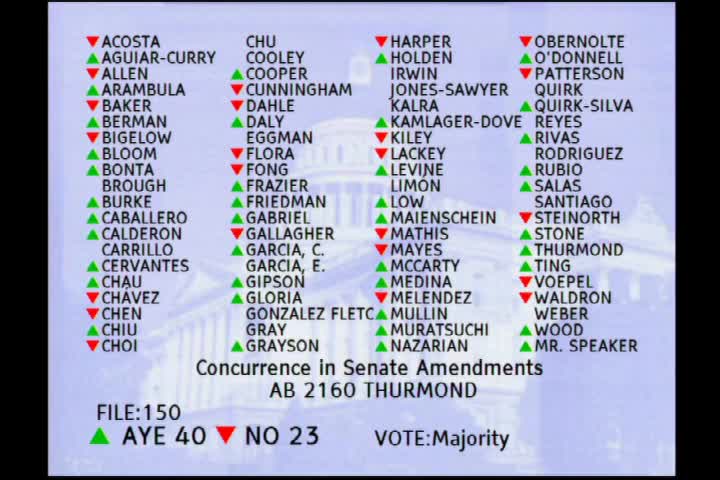 1MIN
Assembly Floor
 2MIN
Senate Floor
 1H
Senate Standing Committee on Appropriations
Bill Author

Bill Co-Author(s):