AB 2568: County jails: veterans.
- Session Year: 2017-2018
- House: Assembly
- Latest Version Date: 2018-09-06
Existing law authorizes county jails to be used for specified purposes, including the detention of persons charged with crimes and committed for trial. Existing law authorizes a court to place defendants who are current or former members of the United States military and suffering from specified conditions in a pretrial diversion program.
This bill would require county jails to, upon detention of a person, ask if the person has served in the United States military and document the persons response. The bill would additionally require that the county jail make this information available to the person, his or her counsel, and the district attorney. By increasing the duties of county jails, this bill would impose a state-mandated local program.
The California Constitution requires the state to reimburse local agencies and school districts for certain costs mandated by the state. Statutory provisions establish procedures for making that reimbursement.
This bill would provide that, if the Commission on State Mandates determines that the bill contains costs mandated by the state, reimbursement for those costs shall be made pursuant to the statutory provisions noted above.
Existing law authorizes county jails to be used for specified purposes, including the detention of persons charged with crimes and committed for trial. Existing law authorizes a court to place defendants who are current or former members of the United States military and suffering from specified conditions in a pretrial diversion program.
This bill would require county jails to, upon detention of a person, perform a case summary that includes, but is not limited to, checking ask if the person has served in the United States military. military and document the persons response. The bill would additionally require that the county jail make this case summary information available to the person, his or her counsel, and the district attorney. By increasing the duties of county jails, this bill would impose a state-mandated local program.
The California Constitution requires the state to reimburse local agencies and school districts for certain costs mandated by the state. Statutory provisions establish procedures for making that reimbursement.
This bill would provide that, if the Commission on State Mandates determines that the bill contains costs mandated by the state, reimbursement for those costs shall be made pursuant to the statutory provisions noted above.
Existing law authorizes county jails to be used for specified purposes, including the detention of persons charged with crimes and committed for trial. Existing law authorizes a court to place defendants who are current or former members of the United States military and suffering from specified conditions in a pretrial diversion program.
This bill would require county jails to, upon detention of a person, perform a case summary that includes, but is not limited to, checking if the person has served in the United States military. The bill would additionally require that the county jail make this case summary available to the person, his or her counsel, and the district attorney. By increasing the duties of county jails, this bill would impose a state-mandated local program.
The California Constitution requires the state to reimburse local agencies and school districts for certain costs mandated by the state. Statutory provisions establish procedures for making that reimbursement.
This bill would provide that, if the Commission on State Mandates determines that the bill contains costs mandated by the state, reimbursement for those costs shall be made pursuant to the statutory provisions noted above.
Existing law requires a person who is arrested and released without being charged to be issued a certificate describing the action as a detention and requires any reference to the action as an arrest to be deleted from the arrest records of the arresting agency and the Department of Justice. Existing law requires the Attorney General to prescribe the form and content of the certificate.This bill would make a technical, nonsubstantive change to these provisions.Existing law requires a person who is arrested and released without being charged to be issued a certificate describing the action as a detention and requires any reference to the action as an arrest to be deleted from the arrest records of the arresting agency and the Department of Justice. Existing law requires the Attorney General to prescribe the form and content of the certificate.
This bill would make a technical, nonsubstantive change to these provisions.
(a)Each county jail shall, upon detention of a person, ask if the person has served in the United States military and document the persons response.
(b)The county jail shall make this information available to the person, his or her counsel, and the district attorney.
(c)This section shall become operative on January 1, 2020.
SEC. 2.If the Commission on State Mandates determines that this act contains costs mandated by the state, reimbursement to local agencies and school districts for those costs shall be made pursuant to Part 7 (commencing with Section 17500) of Division 4 of Title 2 of the Government Code.
(a)Each county jail shall, upon detention of a person, perform a case summary that includes, but is not limited to, checking ask if the person has served in the United States military. military and document the persons response.
(b)The county jail shall make this case summary information available to the person, his or her counsel, and the district attorney.
(c)This section shall become operative on January 1, 2020.
SEC. 2.If the Commission on State Mandates determines that this act contains costs mandated by the state, reimbursement to local agencies and school districts for those costs shall be made pursuant to Part 7 (commencing with Section 17500) of Division 4 of Title 2 of the Government Code.
(a)Each county jail shall, upon detention of a person, perform a case summary that includes, but is not limited to, checking if the person has served in the United States military.
(b)The county jail shall make this case summary available to the person, his or her counsel, and the district attorney.
(c)This section shall become operative on January 1, 2020.
SEC. 2.If the Commission on State Mandates determines that this act contains costs mandated by the state, reimbursement to local agencies and school districts for those costs shall be made pursuant to Part 7 (commencing with Section 17500) of Division 4 of Title 2 of the Government Code.
SECTION 1.Section 851.6 of the Penal Code is amended to read:851.6.(a)In any case in which a person is arrested and released pursuant to paragraph (1), (3), or (5) of subdivision (b) of Section 849, the person shall be issued a certificate, signed by the releasing officer or his superior officer, describing the action as a detention.(b)In any case in which a person is arrested and released and an accusatory pleading is not filed charging him or her with an offense, the person shall be issued a certificate by the law enforcement agency that arrested him or her describing the action as a detention.(c)The Attorney General shall prescribe the form and content of the certificate.(d)Any reference to the action as an arrest shall be deleted from the arrest records of the arresting agency and of the Department of Justice. Thereafter, any record of the action shall refer to it as a detention.(a)In any case in which a person is arrested and released pursuant to paragraph (1), (3), or (5) of subdivision (b) of Section 849, the person shall be issued a certificate, signed by the releasing officer or his superior officer, describing the action as a detention.
(b)In any case in which a person is arrested and released and an accusatory pleading is not filed charging him or her with an offense, the person shall be issued a certificate by the law enforcement agency which that arrested him or her describing the action as a detention.
(c)The Attorney General shall prescribe the form and content of the certificate.
(d)Any reference to the action as an arrest shall be deleted from the arrest records of the arresting agency and of the Department of Justice. Thereafter, any record of the action shall refer to it as a detention.
|
Date
|
Status
|
|---|---|
| Sep 6, 2018 | Chaptered by Secretary of State - Chapter 281, Statutes of 2018. |
| Sep 6, 2018 | Approved by the Governor. |
| Aug 24, 2018 | Enrolled and presented to the Governor at 4:30 p.m. |
| Aug 20, 2018 | In Assembly. Ordered to Engrossing and Enrolling. |
| Aug 20, 2018 | Read third time. Passed. Ordered to the Assembly. |
| Aug 17, 2018 | From committee: Do pass. (Ayes 7. Noes 0.) (August 16). |
| Aug 6, 2018 | In committee: Referred to APPR. suspense file. |
| Jun 20, 2018 | From committee: Do pass and re-refer to Com. on APPR. with recommendation: To Consent Calendar. (Ayes 7. Noes 0.) (June 19). Re-referred to Com. on APPR. |
| Jun 7, 2018 | Referred to Com. on PUB. S. |
| May 31, 2018 | In Senate. Read first time. To Com. on RLS. for assignment. |
| May 30, 2018 | Read third time. Passed. Ordered to the Senate. |
| May 29, 2018 | Read second time. Ordered to third reading. |
| May 25, 2018 | From committee: Amend, and do pass as amended. (Ayes 16. Noes 0.) (May 25). |
| May 2, 2018 | In committee: Set, first hearing. Referred to APPR. suspense file. |
| Apr 17, 2018 | From committee: Do pass and re-refer to Com. on APPR. with recommendation: To Consent Calendar. (Ayes 7. Noes 0.) (April 17). Re-referred to Com. on APPR. |
| Apr 2, 2018 | Re-referred to Com. on PUB. S. |
| Mar 22, 2018 | Referred to Com. on PUB. S. |
| Feb 16, 2018 | From printer. May be heard in committee March 18. |
| Feb 15, 2018 | Read first time. To print. |
|
Date
|
Description
|
Location
|
Votes
|
|
|---|---|---|---|---|
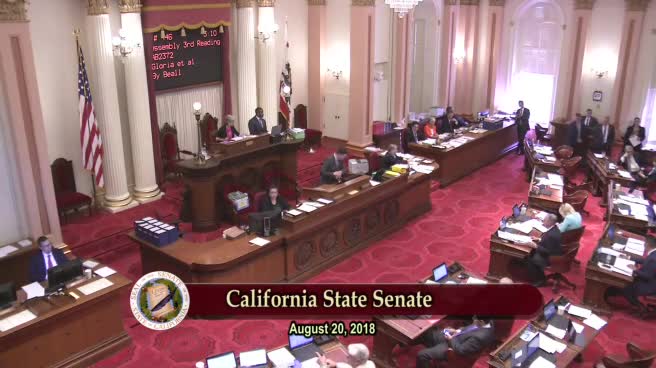
| Aug 20, 2018 | Assembly 3rd Reading AB2568 Reyes et al. By Roth | Senate Floor |
Passed |
|
| Aug 16, 2018 | Do pass | Senate Standing Committee on Appropriations |
Passed |
|
| Aug 6, 2018 | Placed on suspense file | Senate Standing Committee on Appropriations |
Passed |
|
| Jun 19, 2018 | Do pass, but first be re-referred to the Committee on [Appropriations] with the recommendation: To Consent Calendar | Senate Standing Committee on Public Safety |
Passed |
|
| May 30, 2018 | AB 2568 REYES Assembly Third Reading | Assembly Floor |
Passed |
|
| May 25, 2018 | Do pass as amended. | Assembly Standing Committee on Appropriations |
Passed |
|
| Apr 17, 2018 | Do pass and be re-referred to the Committee on [Appropriations] with recommendation: To Consent Calendar | Assembly Standing Committee on Public Safety |
Passed |
This list shows positions taken on this bill by organizations on the date displayed, which is linked to the original source.
Positions by individuals are not included.
|
Organization
|
Position
|
Date
|
|---|---|---|
| American GI Forum of California | ** Support | Apr 16, 2018 |
| American Legion-Department of California | ** Support | Apr 16, 2018 |
| AMVETS-Department of California | ** Support | Aug 18, 2018 |
| California Association Of County Veterans Service Officers | ** Support | Apr 16, 2018 |
| California State Commanders Veterans Council | ** Support | Apr 16, 2018 |
| Military Officers Association of America-California Council of Chapters | ** Support | Apr 16, 2018 |
Office of Senate Floor Analyses (916) 651-1520 Fax: (916) 327-4478 | AB |
THIRD READING
Bill No: AB 2568
:
SENATE PUBLIC SAFETY COMMITTEE: 7-0, 6/19/18
AYES: Skinner, Anderson, Bradford, Jackson, Mitchell, Stone, Wiener
SENATE APPROPRIATIONS COMMITTEE: 7-0, 8/16/18
AYES: Portantino, Bates, Beall, Bradford, Hill, Nielsen, Wiener
ASSEMBLY FLOOR: 76-0, 5/30/18 - See last page for vote
SOURCE: AMVETS-Department of California
DIGEST:
This bill requires county jails, upon detention of a person, to ask if the person has served in the U.S. military, document the person’s response, and make this information available to the individual, their counsel, and the district attorney.
Existing law:
- Defines “veteran” as a person who served in the active military, naval, or air service of the United States for a period of at least 90 consecutive days or had a service-connected disability discharge, received an honorable discharge or was released from active duty under honorable conditions, and served during specified periods. (Mil. & Vet. Code, § 980.)
- Authorizes a court to place a defendant accused of a misdemeanor offense in a pretrial diversion program if the defendant was or is a member of the U.S. military and the defendant is possibly suffering from some mental health problem as a result of their service. (Pen. Code, § 1001.80, subds. (a) & (b).)
- Requires the court to consider a defendant’s status as a veteran suffering from mental health problems when making specified sentencing determinations. (Pen. Code, § 1170.9, subd. (a).)
- States that the Department of Veterans Affairs, in cooperation with the Department of Corrections and Rehabilitation (CDCR), must provide one trained and accredited employee per five state prisons to assist incarcerated veterans in applying for applicable veterans’ benefits. (Mil. & Vet. Code, § 715.)
- States that the CDCR must develop guidance polices with the goal of assisting incarcerated veterans in pursuing claims for veterans’ benefits or any compensation provided because of honorable service in the military. (Pen. Code, § 2695.)
- Authorizes a veterans service organization to volunteer as a veterans service advocate in any CDCR facility. (Pen. Code, § 2695.1.)
- States that a veterans’ service advocate is authorized to develop a veterans economic recidivism prevention plan during the 180-day period preceding an inmates release. The plan’s contents shall include, but are not limited to, the following:
- Facilitating the inmate’s access to county veteran service officers and other specified Veterans Affairs officers, so that the inmate may pursue potential claims for veterans’ benefits; and
- Developing a plan detailing how an inmate can access any veterans’ benefits they may be eligible for. (Pen. Code, § 2695.2, subds. (a) & (b)
- Requires the veterans service advocate to coordinate with the United States Department of Veterans Affairs when assisting a veteran apply for earned veterans’ benefits. (Pen. Code, § 2695.3.)
- States that the veterans service advocate shall coordinate with the California Department of Veterans Affairs and the applicable county veterans service officer for advice, assistance, training, and evaluating the efficacy of the veterans economic recidivism prevention plan. (Pen. Code, § 2695.)
- Requires the Judicial Council to, upon receiving funds, conduct a statewide study of veterans and veterans treatment courts and to evaluate the impact of veterans treatment courts on participant outcomes such as recidivism, mental health, homelessness, employment, substance abuse, and other specified results. (Gov. Code, § 68530.)
This bill:
- Requires county jails, upon detention of a person, to ask if the person has served in the U.S. military and document the person’s response.
- Provides that this information be available to the person, their counsel, and the district attorney.
- Becomes operative on January 1, 2020.
Comments
There is a wealth of academic literature about the emotional fallout of veterans when they return to civilian life. The aftermath of service may include increased rates of post-traumatic stress disorder (PTSD), depression, traumatic brain injury, and substance abuse. An estimated 35% or 700,000 Iraq and Afghanistan veterans currently suffer from PTSD and major depression. This furthers their need for comprehensive care and support for these individuals and their families.
According to the Institute for Veteran Policy:
Often learned military skills and tactics such as hyper-vigilance and rapid response to threatening encounters that enhance survival in combat may translate to aggressiveness, impulsivity, arrest, and potential for incarceration in the civilian community.
The heightened rate of mental health disorders also increases veterans’ interactions with law enforcement. From 2011 to 2012, an estimated 181,500 were serving time in correctional facilitates. With the exception of military-operated facilities, these individuals accounted for 8% of all inmates in state and federal prison and local jail. An estimated 43% of veterans in prison had four or more prior arrests.
As there has been a greater awareness of the ties between mental health disorders and incarceration, California statute has codified resources for veterans in the criminal justice system. California courts acknowledge an offender’s particular circumstances in determining punishment and created alternative standards or sentencing applicable for at-risk groups. (Gov. Code, § 68530.) CDCR have developed policies to assist veterans in prison or jail to pursue claims for federal benefits, care, and compensation. (Pen. Code, § 2695.) State statute also authorizes veterans service organizations to volunteer as a veterans service advocate in any CDCR facility on their behalf. (Pen. Code, § 2695.1.) Advocates attribute the decline of incarcerated veterans to the increase of programs that assist veterans.
It is essential that counsel and district attorneys understand offenders’ background to appropriately advocate or charge them. This bill assists veterans in county jails in obtaining these services by checking if a newly received inmate had served in the military and forwarding that information to the inmate, their counsel, and the district attorney.
FISCAL EFFECT: Appropriation: Fiscal Com.: Local:
According to the Senate Appropriations Committee, unknown, potentially-significant costs in the aggregate of over $50,000 for counties to incorporate the question during the intake process, document the response, and make it available to attorneys. If costs to each county to comply with this mandate were $1,000 annually, the total costs associated with this bill would be $58,000. While some counties already comply with the provisions of this bill, the state, nonetheless, would be required to reimburse those counties for compliance costs going forward if AB 2568 were enacted. The actual amount of reimbursement would be determined by the Commission on State Mandates. (General Fund)
AMVETS-Department of California (source)
OPPOSITION: (Verified 8/16/18)
None received
ASSEMBLY FLOOR: 76-0, 5/30/18
AYES: Acosta, Travis Allen, Arambula, Baker, Berman, Bigelow, Bloom, Bonta, Brough, Burke, Caballero, Calderon, Carrillo, Cervantes, Chau, Chávez, Chen, Chiu, Choi, Chu, Cooley, Cooper, Cunningham, Dahle, Daly, Eggman, Flora, Fong, Frazier, Friedman, Gallagher, Cristina Garcia, Eduardo Garcia, Gipson, Gloria, Gonzalez Fletcher, Gray, Grayson, Harper, Holden, Irwin, Jones-Sawyer, Kalra, Kamlager-Dove, Kiley, Lackey, Levine, Limón, Low, Maienschein, Mathis, Mayes, Medina, Melendez, Mullin, Muratsuchi, Nazarian, Obernolte, O'Donnell, Patterson, Quirk, Quirk-Silva, Reyes, Rodriguez, Rubio, Salas, Santiago, Steinorth, Mark Stone, Thurmond, Ting, Voepel, Waldron, Weber, Wood, Rendon
NO VOTE RECORDED: Aguiar-Curry, McCarty
8/18/18 13:14:49
**** END ****
SENATE COMMITTEE ON
Senator Anthony Portantino, Chair
2017 - 2018 Regular Session
AB 2568 (Reyes) - County jails: veterans
Version: | Policy Vote: |
Urgency: | Mandate: |
Hearing Date: | Consultant: |
This bill meets the criteria for referral to the Suspense File.
Bill Summary:
AB 2568 would require county jails to ask people, upon detention, if they have served in the U.S. military and document the response.
Fiscal Impact:
Unknown, potentially-significant costs in the aggregate of over $50,000 for counties to incorporate the question during the intake process, document the response, and make it available to attorneys. If costs to each county to comply with this mandate were $1,000 annually, the total costs associated with this bill would be $58,000. While some counties already comply with the provisions of this bill, the state, nonetheless, would be required to reimburse those counties for compliance costs going forward if AB 2568 were enacted. The actual amount of reimbursement would be determined by the Commission on State Mandates. (General Fund)
Background:
The Legislature has enacted many resources for veterans in the criminal justice system. For example, California law allows specified veterans to participate in pretrial diversion programs that provide veterans with mental health counseling and treatment programs as an alternative to incarceration.
During the intake process, a county jail makes a number of inquiries related to a new detainee to determine, among other things, medical conditions and the appropriate level and type of security necessary to detain and place the person. Some county jails currently ask new inmates if they are a veteran. Nonetheless, if a local agency, at its option, has been incurring costs which are subsequently mandated by the state, the state is required to reimburse the agency for those costs incurred after the operative date of the mandate.
Proposed Law:
This bill would require county jails to ask a person, upon detention, if the person has served in the U.S. military and document the response. Additionally, the jail would be required to make the response available to the person, the person’s attorney, and the district attorney. Lastly, this bill would delay the operative date to January 1, 2020.
-- END --
SENATE COMMITTEE ON PUBLIC SAFETY
Senator Nancy Skinner, Chair
2017 - 2018 Regular
Bill No: AB 2568 Hearing Date: June 19, 2018
Author: | Reyes | ||
Version: | May 25, 2018 | ||
Urgency: | No | Fiscal: | Yes |
Consultant: | EC | ||
Subject: County Jails: Veterans
HISTORY
Source: Author
Prior Legislation: SB 776 (Newman), Chapter 599, Statutes of 2017
AB 2263 (Bradford), Chapter 652, Statues of 2014
AB 2098 (Levine), Chapter 163, Statutes of 2014
SB 1227 (Hancock), Chapter 658, Statutes of 2013
AB 2490 (Butler), Chapter 407, Statues of 2013
AB 2371 (Butler), Chapter 403, Statutes of 2012
AB 2671 (Salas), 2007, vetoed by the Governor
Support: Unknown
Opposition: None known
Assembly Floor Vote: 76 - 0
PURPOSE
The purpose of this bill is to require county jails, upon detention of a person, to ask if the person has served in the U.S. military, document the person’s response, and make this information available to the individual, their counsel, and the district attorney.
Existing law defines “veteran” as a person who served in the active military, naval, or air service of the United States for a period of at least 90 consecutive days or had a service-connected disability discharge, received an honorable discharge or was released from active duty under honorable conditions, and served during specified periods. (Mil. & Vet. Code, § 980.)
Existing law authorizes a court to place a defendant accused of a misdemeanor offense in a pretrial diversion program if the defendant was or is a member of the U.S. military and the defendant is possibly suffering from some mental health problem as a result of their service. (Pen. Code, § 1001.80, subds. (a) & (b).)
Existing law requires the court to consider a defendant’s status as a veteran suffering from mental health problems when making specified sentencing determinations. (Pen. Code, § 1170.9, subd. (a).)
Existing law states that the Department of Veterans Affairs, in cooperation with the Department of Corrections and Rehabilitation (CDCR), must provide one trained and accredited employee per five state prisons to assist incarcerated veterans in applying for applicable veterans’ benefits. (Mil. & Vet. Code, § 715.)
Existing law states that the CDCR must develop guidance polices with the goal of assisting incarcerated veterans in pursuing claims for veterans’ benefits or any compensation provided because of honorable service in the military. (Pen. Code, § 2695.)
Existing law authorizes a veterans service organization to volunteer as a veterans service advocate in any CDCR facility. (Pen. Code, § 2695.1.)
Existing law states that a veterans’ service advocate is authorized to develop a veterans economic recidivism prevention plan during the 180-day period preceding an inmates release. The plan’s contents shall include, but are not limited to, the following:
- Facilitating the inmate’s access to county veteran service officers and other specified Veterans Affairs officers, so that the inmate may pursue potential claims for veterans’ benefits; and
- Developing a plan detailing how an inmate can access any veterans’ benefits they may be eligible for. (Pen. Code, § 2695.2, subds. (a) & (b).)
Existing law requires the veterans service advocate to coordinate with the United States Department of Veterans Affairs when assisting a veteran apply for earned veterans’ benefits. (Pen. Code, § 2695.3.)
Existing law states that the veterans service advocate shall coordinate with the California Department of Veterans Affairs and the applicable county veterans service officer for advice, assistance, training, and evaluating the efficacy of the veterans economic recidivism prevention plan. (Pen. Code, § 2695.)
Existing law requires the Judicial Council to, upon receiving funds, conduct a statewide study of veterans and veterans treatment courts and to evaluate the impact of veterans treatment courts on participant outcomes such as recidivism, mental health, homelessness, employment, substance abuse, and other specified results. (Gov. Code, § 68530.)
This bill requires county jails, upon detention of a person, to ask if the person has served in the U.S. military and document the person’s response.
This bill shall make this information available to the person, their counsel, and the district attorney.
This bill becomes operative on January 1, 2020.
COMMENTS
1. Need for This Bill
The author states:
By inquiring about veteran status upon booking, this information along with other currently collected information goes to the DA’s office as well as representing council. Having this information sooner will enable council to make an earlier determination about the possibility of Veteran Treatment Courts and will enable veterans who need them to be able to be seen in front of judges that have training and can better understand the issues that veterans may be dealing with.
2. Veterans in Criminal Justice System
There is a wealth of academic literature about the emotional fallout of veterans when they return to civilian life. The aftermath of service may include increased rates of post-traumatic stress disorder (PTSD), depression, traumatic brain injury, and substance abuse. An estimated 35% or 700,000 Iraq and Afghanistan veterans currently suffer from PTSD and major depression.[1] This furthers their need for comprehensive care and support for these individuals and their families.
According to the Institute for Veteran Policy:
Often learned military skills and tactics such as hyper-vigilance and rapid response to threatening encounters that enhance survival in combat may translate to aggressiveness, impulsivity, arrest, and potential for incarceration in the civilian community.[2]
The heightened rate of mental health disorders also increases veterans’ interactions with law enforcement. From 2011 to 2012, an estimated 181,500 were serving time in correctional facilitates. With the exception of military-operated facilities, these individuals accounted for 8% of all inmates in state and federal prison and local jail. An estimated 43% of veterans in prison had four or more prior arrests.[3]
3. Veteran Resources
As there has been a greater awareness of the ties between mental health disorders and incarceration, California statute has codified resources for veterans in the criminal justice system. California courts acknowledge an offender’s particular circumstances in determining punishment and created alternative standards or sentencing applicable for at-risk groups. (Gov. Code, § 68530.) CDCR have developed policies to assist veterans in prison or jail to pursue claims for federal benefits, care, and compensation. (Pen. Code, § 2695.) State statute also authorizes veterans service organizations to volunteer as a veterans service advocate in any CDCR facility on their behalf. (Pen. Code, § 2695.1.) Advocates attribute the decline of incarcerated veterans to the increase of programs that assist veterans.[4]
It is essential that counsel and district attorneys understand offenders’ background to appropriately advocate or charge them. This bill assists veterans in county jails in obtaining these services by checking if a newly received inmate had served in the military and forwarding that information to the inmate, their counsel, and the district attorney.
-- END –
“Veterans and Criminal Justice,” n.d., 11. https://www.swords-to-plowshares.org/wp-content/uploads/Veterans-and-Criminal-Justice-A-Review-Literature-2012.pdf ↑
“Veterans and Criminal Justice.” https://www.swords-to-plowshares.org/wp-content/uploads/Veterans-and-Criminal-Justice-A-Review-Literature-2012.pdf ↑
Jennifer Bronson, “Veterans in Prison and Jail, 2011-12,” 2015, 22. ↑
“Incarcerated Veterans,” accessed June 11, 2018, https://www.calvet.ca.gov/VetServices/Pages/Incarcerated-Veterans.aspx. ↑
ASSEMBLY THIRD READING
ATR Bill Id:AB 2568
Author:(Reyes)
As Amended Ver:May 25, 2018
Majority vote
Committee | Votes | Ayes | Noes |
Public Safety | 7-0 | Jones-Sawyer, Lackey, Carrillo, Gonzalez Fletcher, Kiley, Quirk, Santiago | |
Appropriations | 16-0 | Gonzalez Fletcher, Bigelow, Bloom, Bonta, Calderon, Carrillo, Chau, Eggman, Fong, Friedman, Gallagher, Eduardo Garcia, Nazarian, Obernolte, Quirk, Reyes |
|
SUMMARY: Requires a county jail, upon detention of a person, to ask if the person has served in the United States military and document the response and make the information available to the person, his or her counsel, and the district attorney.
EXISTING LAW:
- Defines ''veteran'' as a person who served in the active military, naval, or air service of the United States for a period of at least 90 consecutive days or had a service-connected disability discharge, received an honorable discharge or was released from active duty under honorable conditions, and served during specified periods.
- Creates the Department of Veterans Affairs and outlines the financial, educational, and other specified benefits available to veterans including disability compensation, disability pension, burial benefits, and waivers of indebtedness.
- Authorizes a court to place a defendant accused of a misdemeanor offense in a pretrial diversion program if the defendant was/is a member of the United States military and the defendant is possibly suffering from some mental health problem as a result of his or her service.
- Requires the court to consider a defendant's status as a veteran suffering from mental health problems when making specified sentencing determinations.
- States that the Department of Veterans Affairs, in cooperation with the Department of Corrections and Rehabilitation (CDCR), must provide one trained and accredited employee per five state prisons to assist incarcerated veterans in applying for applicable veterans' benefits.
- States that the CDCR must develop guidance polices with the goal of assisting incarcerated veterans in pursuing claims for veterans' benefits or any compensation provided because of honorable service in the military.
- Authorizes a veterans service organization to volunteer as a veterans service advocate in any CDCR facility.
- States that a veterans service advocate is authorized to develop a veterans economic recidivism prevention plan during the 180-day period preceding an inmates release. The plan's contents shall include, but are not limited to, the following:
- Facilitating the inmate's access to county veteran service officers and other specified Veterans Affairs officers, so that the inmate may pursue potential claims for veterans' benefits; and
- Developing a plan detailing how an inmate can access any veterans' benefits he or she may be eligible for.
- Requires the veterans service advocate to coordinate with the United States Department of Veterans Affairs when assisting a veteran apply for earned veterans' benefits.
- States that the veterans service advocate shall coordinate with the California Department of Veterans Affairs and the applicable county veterans service officer for advice, assistance, training, and evaluating the efficacy of the veterans economic recidivism prevention plan.
- Defines ''veteran'' for the purposes of veterans in state prisons as a person who has been discharged from the United States Army, Navy, Air Force, Marine Corps, Coast Guard, National Guard, or Merchant Marine.
- Mandates the CDCR to assist an inmate's access to a veterans service advocate, provide the advocate with access to existing resources such as computers and the internet, and to allow a veterans service advocate inside a facility – subject to CDCR screening and clearance guidelines.
- Requires the Judicial Council to, upon receiving funds, conduct a statewide study of veterans and veterans treatment courts and to evaluate the impact of veterans treatment courts on participant outcomes such as recidivism, mental health, homelessness, employment, substance abuse, and other specified results.
FISCAL EFFECT: According to the Assembly Appropriations Committee, unknown state-mandated local costs, likely in the tens of thousands to hundreds of thousands of dollars. For example, if each of the 58 counties submits a mandate claim for $2,000, total state costs will be $116,000.
COMMENTS:
- Author's Statement: According to the author, ''By inquiring about veteran status upon booking, this information along with other currently collected information goes to the DA's office as well as representing council. Having this information sooner will enable council to make an earlier determination about the possibility of Veteran Treatment Courts and will enable veterans who need them to be able to be seen in front of judges that have training and can better understand the issues that veterans may be dealing with.''
- Argument in Support: According to the bill's sponsor, AMVETS-Department of California, ''AB 2568, would require law enforcement to inquire about veteran status when a veteran has been arrested in order to connect veterans with Veteran Treatment Courts earlier in the criminal justice process.''
Please see the policy committee analysis for a full discussion of this bill.
Analysis Prepared by: Mureed Rasool, Liah Burnley / PUB. S. / (916) 319-3744 FN: 0003240
Date of Hearing: May 2, 2018
ASSEMBLY COMMITTEE ON APPROPRIATIONS
Lorena Gonzalez Fletcher, Chair
ABPCA Bill Id:AB 2568
Author:(Reyes) – As Amended Ver:March 22, 2018
Policy Committee: | Public Safety | Vote: | 7 - 0 |
|
| ||
|
|
Urgency: No State Mandated Local Program: Yes Reimbursable: Yes
SUMMARY:
This bill requires a county jail, upon detention of a person, to perform a case summary that must include, among other things, checking if the detainee has served in the United States military. This bill will become operative on January 1, 2020.
FISCAL EFFECT:
Unknown, potentially significant state mandated local costs, likely in the hundreds of thousands to low millions of dollars, depending on the level of detail included in the case summaries and the amount of effort required to produce the required case summaries. For example, if each of the 58 counties submits a mandate claim for $5,000, assuming relatively minimal costs to adjust existing processes to meet this requirement, total state costs will be $290,000. However, assuming each county must hire one additional staff person to handle case summary workload, total state costs will be $7.25 million assuming a cost of $125,000 per staff person.
COMMENTS:
- Background and purpose. California law allows specified veterans to participate in pretrial diversion programs that provide veterans with mental health counseling and treatment programs rather than being incarcerated. According to the author:
By inquiring about veteran status upon booking, this information along with other currently collected information goes to the DA’s office as well as representing council. Having this information sooner will enable council to make an earlier determination about the possibility of Veteran Treatment Courts and will enable veterans who need them to be able to be seen in front of judges that have training and can better understand the issues that veterans may be dealing with.
- Staff comments. The purpose of this bill is to ensure that each veteran who is admitted to jail is identified as a veteran in order to ensure that all services and programs offered to veterans are made available. However, this bill creates a much broader mandate on county jails to perform a case summary of every person admitted to jail. Given the author’s intent of identifying veterans, as opposed to collecting other information about each person being admitted to jail, the author may wish to amend this bill to narrow the scope of the mandated activity to only determining whether the person being admitted to jail is a veteran.
Analysis Prepared by: Jessica Peters / APPR. / (916) 319-2081
Date of Hearing:
Consultant: Mureed Rasool
ASSEMBLY COMMITTEE ON PUBLIC SAFETY
Reginald Byron Jones-Sawyer, Sr., Chair
ABPCA Bill Id:AB 2568
Author:(Reyes) – As Amended Ver:
SUMMARY:
Requires a county jail, upon detention of a person, to perform a case summary which shall include, among other things, checking if the detainee has served in the United States military. Specifically, this bill:
- Requires a county jail, upon detention of a person, to perform a case summary which shall include, among other things, checking if the detainee has previously served in the United States military.
- Provides that the county jail must make the detainee’s case summary available to the detainee, the detainee’s counsel, and the district attorney.
- States that the requirement will become operative on January 1, 2020.
EXISTING LAW:
- Defines “veteran” as a person who served in the active military, naval, or air service of the United States for a period of at least 90 consecutive days or had a service-connected disability discharge, received an honorable discharge or was released from active duty under honorable conditions, and served during specified periods. (Mil. & Vet. Code, § 980.)
- Creates the Department of Veterans Affairs and outlines the financial, educational, and other specified benefits available to veterans including disability compensation, disability pension, burial benefits, and waivers of indebtedness. (Mil. & Vet. Code, §§ 690 – 1008.5.)
- Authorizes a court to place a defendant accused of a misdemeanor offense in a pretrial diversion program if the defendant was/is a member of the United States military and the defendant is possibly suffering from some mental health problem as a result of his or her service. (Pen. Code, § 1001.80.)
- Requires the court to consider a defendant’s status as a veteran suffering from mental health problems when making specified sentencing determinations. (Pen. Code, § 1170.9.)
- States that the Department of Veterans Affairs, in cooperation with the Department of Corrections and Rehabilitation (CDCR), must provide one trained and accredited employee per five state prisons to assist incarcerated veterans in applying for applicable veterans’ benefits. (Mil. & Vet. Code, § 715.)
- States that the CDCR must develop guidance polices with the goal of assisting incarcerated veterans in pursuing claims for veterans’ benefits or any compensation provided because of honorable service in the military. (Pen. Code, § 2695.)
- Authorizes a veterans service organization to volunteer as a veterans service advocate in any CDCR facility. (Pen. Code, § 2695.1.)
- States that a veterans service advocate is authorized to develop a veterans economic recidivism prevention plan during the 180-day period preceding an inmates release. The plan’s contents shall include, but are not limited to, the following:
- Facilitating the inmate’s access to county veteran service officers and other specified Veterans Affairs officers, so that the inmate may pursue potential claims for veterans’ benefits; and
- Developing a plan detailing how an inmate can access any veterans’ benefits he or she may be eligible for. (Pen. Code, § 2695.2, subds. (a) & (b).)
- Facilitating the inmate’s access to county veteran service officers and other specified Veterans Affairs officers, so that the inmate may pursue potential claims for veterans’ benefits; and
- Requires the veterans service advocate to coordinate with the United States Department of Veterans Affairs when assisting a veteran apply for earned veterans’ benefits. (Pen. Code, § 2695.3.)
- States that the veterans service advocate shall coordinate with the California Department of Veterans Affairs and the applicable county veterans service officer for advice, assistance, training, and evaluating the efficacy of the veterans economic recidivism prevention plan. (Pen. Code, § 2695.4.)
- Defines “veteran” for the purposes of veterans in state prisons as a person who has been discharged from the United States Army, Navy, Air Force, Marine Corps, Coast Guard, National Guard, or Merchant Marine. (Pen. Code, § 2695.5, subd. (b).)
- Mandates the CDCR to assist an inmate’s access to a veterans service advocate, provide the advocate with access to existing resources such as computers and the internet, and to allow a veterans service advocate inside a facility—subject to CDCR screening and clearance guidelines. (Pen. Code, § 2695.2, subd. (c).)
- Requires the Judicial Council to, upon receiving funds, conduct a statewide study of veterans and veterans treatment courts and to evaluate the impact of veterans treatment courts on participant outcomes such as recidivism, mental health, homelessness, employment, substance abuse, and other specified results. (Gov. Code, § 68530.)
FISCAL EFFECT:
Unknown
COMMENTS:
- Author's Statement: According to the author, “By inquiring about veteran status upon booking, this information along with other currently collected information goes to the DA’s office as well as representing council. Having this information sooner will enable council to make an earlier determination about the possibility of Veteran Treatment Courts and will enable veterans who need them to be able to be seen in front of judges that have training and can better understand the issues that veterans may be dealing with.”
- Background: Using data from the National Inmate Survey, the Bureau of Justice Statistics (BJS) latest report on incarcerated veterans shows that there were approximately 181,500 veterans incarcerated in a correctional facility in 2011-12, with about 131,500 veterans incarcerated in a prison and 50,000 veterans located in jail. (BJS. (2015). Veterans in Prison and Jail, 2011-12. <https://www.bjs.gov/content/pub/pdf/vpj1112.pdf> [Apr. 12, 2018].)
The BJS study indicated that the total number of incarcerated veterans had decreased between 1980 and 2008, and the proportion of incarcerated veterans had declined from an estimated 24%, down to 8% of the total incarcerated population. In terms of mental health, those veterans reported greater rates of mental health problems than nonveterans. In particular, the proportion of incarcerated veterans who reported having a history of post-traumatic stress disorder was double that of civilian inmates. (Id.)
Veterans’ advocates attribute the decline of incarcerated veterans to the increase of programs that assist veterans. In California, incarcerated veterans may still be entitled to Veterans Affairs benefits, and programs that assist veterans in receiving such benefits include the Health Care for Re-entry Veterans Program, County Veterans Service Officers, and the Health Care for Homeless Veterans Program. (California Department of Veterans Affairs. Incarcerated Veterans. <https://www.calvet.ca.gov/VetServices/Pages/Incarcerated-Veterans.aspx> [Apr. 12, 2018].)
Also, California law allows specified veterans to participate in pretrial diversion programs that can lead to veterans with mental health issues to be placed in counseling and treatment programs rather than being incarcerated. (Pen. Code, § 1001.80.) The California Department of Veterans Affairs reports that these veteran treatment courts have resulted in reducing recidivism and lowering crime, with 70 percent of defendants finishing the programs and 75 percent not rearrested for at least two years after. (CA Department of Veterans Affairs. Veterans Treatment Court. <https://www.calvet.ca.gov/VetServices/Pages/Veterans-Treatment-Court.aspx> [Apr. 12, 2018].)
This bill would assist veterans in county jails obtaining these services by checking if a newly received inmate had served in the military and forwarding that information to the inmate, inmate’s counsel, and the district attorney. - Argument in Support: According to the bill’s sponsor, AMVETS-Department of California, “AB 2568, would require law enforcement to inquire about veteran status when a veteran has been arrested in order to connect veterans with Veteran Treatment Courts earlier in the criminal justice process.”
- Related Legislation: AB 865 (Levine), would authorize the court, under specified conditions, to resentence any person who was sentenced for a felony conviction prior to January 1, 2016, and who is, or was, a member of the United States military and who may be suffering from specified mental health problems as a result of his or her military service. AB 865 is currently in the Senate Committee on Rules for assignment.
- Prior Legislation:
- SB 776 (Newman), Chapter 599, Statutes of 2017, requires the California Department of Veterans Affairs to collaborate with the Department of Corrections and Rehabilitations to provide one accredited employee for every five state prisons in order to assist veterans apply for any veterans’ benefits for which the veterans or their families may be eligible.
- AB 2263 (Bradford), Chapter 652, Statutes of 2014, authorized a veterans service organization to volunteer to serve as a veterans service advocate at each facility that is under the jurisdiction of CDCR.
- AB 2098 Chapter 163, Statutes of 2014, requires a court to consider a veterans’ possible mental health problem as a mitigating factor when deciding determinate sentences.
- SB 1227 (Hancock), Chapter 658, Statutes of 2013, creates a military diversion program. A court may divert an eligible defendant to an appropriate treatment program. Upon successful completion, the arrest shall be deemed to have never occurred.
- AB 2490 (Butler), Chapter 407, Statues of 2012, requires the CDCR to develop guidance polices to assist inmate veterans in pursuing claims for veterans’ benefits as established under federal or state law.
- AB 2371 (Butler), Chapter 403, Statutes of 2012, specifies that a court must conclude an individual committed a specified offense as a result of a mental health problem stemming from service in the United States military before the court orders the defendant into a treatment program.
- AB 2671 (Salas), of the 2007-08 Legislative Session, would have required CDCR to create a pre-release application process for honorably-discharged incarcerated veterans who are eligible for federal and state benefits. AB 2671 was vetoed
- SB 776 (Newman), Chapter 599, Statutes of 2017, requires the California Department of Veterans Affairs to collaborate with the Department of Corrections and Rehabilitations to provide one accredited employee for every five state prisons in order to assist veterans apply for any veterans’ benefits for which the veterans or their families may be eligible.
REGISTERED SUPPORT / OPPOSITION:
Support
AMVETS-Department of California (Sponsor)
American GI Forum of California
American Legion-Department of California
California Association of County Veterans Service Officers
California State Commanders Veterans Council
Military Officers Association of America-California Council of Chapters
Opposition
None
Analysis Prepared by:
Mureed Rasool / PUB. S. / (916) 319-3744
Discussed in Hearing
 1MIN
Senate Floor
 1H
Senate Standing Committee on Appropriations
 1MIN
Assembly Floor
Bill Author

Bill Co-Author(s):
