AB 26: Child care and development: child care resource and referral programs: assistance to license-exempt child care providers.
- Session Year: 2017-2018
- House: Assembly
- Latest Version Date: 2017-09-15
Existing law, the Child Care and Development Services Act, administered by the State Department of Education, requires the Superintendent of Public Instruction to administer child care and development programs. Existing law authorizes funds appropriated for purposes of the act to be used for child care resource and referral programs, which may be operated by public or private nonprofit entities and are required to provide certain information and services to parents and child care providers relating to child care services in a defined geographic area.
This bill would, until July 1, 2022, require the department to establish and administer a pilot program to provide outreach, training, and technical assistance to license-exempt child care providers through county child care resource and referral programs. The bill would require a county resource and referral program, in counties that opt to participate in the pilot program, to develop a community-based program model to provide training, outreach, and technical assistance to license-exempt child care providers, as provided. The bill would require each county that participates in the pilot program to provide a report containing specified information to the department and the Legislature on or before January 1, 2020, and January 1, 2022.
Existing law, the Child Care and Development Services Act, administered by the State Department of Education, requires the Superintendent of Public Instruction to administer child care and development programs. Existing law authorizes funds appropriated for purposes of the act to be used for child care resource and referral programs, which may be operated by public or private nonprofit entities and are required to provide certain information and services to parents and child care providers relating to child care services in a defined geographic area.
This bill would, until July 1, 2022, require the department to establish and administer a pilot program to provide outreach, training, and technical assistance to license-exempt child care providers through county child care resource and referral programs. The bill would require a county resource and referral program, in counties that opt to participate in the pilot program, to develop a community-based program model to provide training, outreach, and technical assistance to license-exempt child care providers, as provided. The bill would require each county that participates in the pilot program, to provide a report containing specified information to the department and the Legislature on or before January 1, 2020, and January 1, 2022.
Existing law, the Child Care and Development Services Act, administered by the State Department of Education, requires the Superintendent of Public Instruction to administer child care and development programs. Existing law authorizes funds appropriated for purposes of the act to be used for child care resource and referral programs, which may be operated by public or private nonprofit entities and are required to provide certain information and services to parents and child care providers relating to child care services in a defined geographic area.
This bill would, until July 1, 2022, require the department to establish and administer a pilot program in the Counties of Monterey, San Benito, Santa Clara, and Santa Cruz to provide outreach, training, and technical assistance to license-exempt child care providers through the local county child care resource and referral program. programs. The bill would require a county resource and referral program program, in the above counties counties that opt to participate in the pilot program, to develop a community-based program model to provide training, outreach, and technical assistance to license-exempt child care providers, as provided. The bill would require each county that participates in the pilot program, to provide a report containing specified information to the department and the Legislature on or before January 1, 2020, and January 1, 2022.
This bill would make legislative findings and declarations as to the necessity of a special statute for the Counties of Monterey, San Benito, Santa Clara, and Santa Cruz.Existing law, the Child Care and Development Services Act, administered by the State Department of Education, requires the Superintendent of Public Instruction to administer child care and development programs. Existing law authorizes funds appropriated for purposes of the act to be used for child care resource and referral programs, which may be operated by public or private nonprofit entities and are required to provide certain information and services to parents and child care providers relating to child care services in a defined geographic area.
This bill would, until July 1, 2022, require the department to establish and administer a pilot program in the Counties of Monterey, San Benito, Santa Clara, and Santa Cruz to provide outreach, training, and technical assistance to license-exempt child care providers through the local child care resource and referral program. The bill would require a county resource and referral program in the above counties to develop a community-based program model to provide training, outreach, and technical assistance to license-exempt child care providers, as provided. The bill would require each county to provide a report containing specified information to the department and the Legislature on or before January 1, 2020, and January 1, 2022.
This bill would make legislative findings and declarations as to the necessity of a special statute for the Counties of Monterey, San Benito, Santa Clara, and Santa Cruz.
Existing law, the Child Care and Development Services Act, administered by the State Department of Education, requires the Superintendent of Public Instruction to administer child care and development programs. Existing law authorizes funds appropriated for purposes of the act to be used for child care resource and referral programs, which may be operated by public or private nonprofit entities and are required to provide certain information and services to parents and child care providers relating to child care services in a defined geographic area.
This bill would would, until July 1, 2022, require the department to establish and administer a pilot program in the County Counties of Monterey Monterey, San Benito, Santa Clara, and Santa Cruz to provide outreach, training, and technical assistance to license-exempt child care providers through the local child care resource and referral program. The bill would require a county resource and referral program in the above counties to develop a community-based program model to provide training, outreach, and technical assistance to license-exempt child care providers, as provided.
This bill would make legislative findings and declarations as to the necessity of a special statute for the Counties of Monterey, San Benito, Santa Clara, and Santa Cruz.
Existing law, the Child Care and Development Services Act, administered by the State Department of Education, requires the Superintendent of Public Instruction to administer child care and development programs. Existing law authorizes funds appropriated for purposes of the act to be used for child care resource and referral programs, which may be operated by public or private nonprofit entities and are required to provide certain information and services to parents and child care providers relating to child care services in a defined geographic area.
This bill would require the department to establish a pilot program in the County of Monterey to provide outreach, training, and technical assistance to license-exempt child care providers through the local child care resource and referral program.
Existing law requires the Superintendent of Public Instruction to contract with entities organized under law to operate family child care home education networks as provided. Existing law provides that it does not impose any new requirements on a family child care home education network.This bill would make nonsubstantive changes to this latter provision.Existing law requires the Superintendent of Public Instruction to contract with entities organized under law to operate family child care home education networks as provided. Existing law provides that it does not impose any new requirements on a family child care home education network.
This bill would make nonsubstantive changes to this latter provision.
The Legislature finds and declares all of the following:
(a)License-exempt child care, also known as family, friend, and neighbor (FFN) care, is the most common form of nonparental child care in the United States.
(b)Nationally, nearly a quarter of families receiving subsidies use FFN care.
(c)In California, roughly 13 percent of young children ages birth to two, and 10 percent of children ages birth to five, are cared for by FFN state-subsidized child care license-exempt providers.
(d)Families may choose FFN care for many reasons, including, but not limited to, convenient and flexible hours, low child-to-adult ratios, shared values and cultural background, and strong attachment relationships with caregivers.
(e)Across California, the vast majority of FFN caregivers are Latinas, many of whom experience low levels of income.
(f)Studies reveal that families with low incomes are more likely to rely on FFN care due to low cost and limited availability of licensed care within their community.
(g)In rural communities where child care options are limited, FFN care fills a critical need for families.
(h)Further research examining FFN care providers is needed to know more about the best practices to support them and in order to help improve the quality of child care in California.
(i)In order to close the achievement gap and address the needs of all children, regardless of setting, it is critical to provide support and training to FFN care providers.
SEC. 2.Section 8217 is added to the Education Code, to read:8217.(a)The department shall establish and administer a pilot program to provide outreach, training, and technical assistance to license-exempt child care providers through county child care resource and referral programs.
(b)For purposes of this section, license-exempt child care providers means providers who are exempt from licensure pursuant to Section 1596.792 of the Health and Safety Code.
(c)(1)In a county that opts to participate in this pilot program, a county resource and referral program shall, in collaboration with other local entities, including, but not limited to, the First 5 County Commission, the county child care planning council, and other entities supporting early childhood care and education, develop a community-based program model to provide training, outreach, and technical assistance to license-exempt child care providers.
(2)The program shall prioritize assisting license-exempt child care providers serving children ages 0 to 5, inclusive.
(3)For purposes of the training component, topics shall include, but not be limited to, early childhood development, health and safety, family literacy, and professional development pathways.
(4)The resource and referral program shall take into account county needs and implementation lessons identified from programs currently in place, and other proven successful initiatives that support license-exempt child care providers.
(5)To the extent possible, the resource and referral program may seek grants or partnerships with private foundations or other philanthropic entities for the purpose of expanding the training opportunities for license-exempt child care providers.
(6)(A)On or before January 1, 2020, and on or before January 1, 2022, each county that opts to participate in this pilot program shall provide a report to the department and to the Legislature that contains the following information for each calendar year during which the county operated a pilot program pursuant to this section:
(i)The number of license-exempt child care providers served.
(ii)A description of the trainings offered, the number of trainings provided, and the number of license-exempt child care providers attending each training.
(iii)A description of outreach activities and technical assistance offered.
(iv)Any donations received from, or partnerships formed with, private foundations or other philanthropic entities.
(v)Steps taken to identify and address specific county and child care provider needs.
(B)A report submitted to the Legislature pursuant to this paragraph shall be submitted in compliance with Section 9795 of the Government Code.
(d)This section does not require a county to participate in the pilot program established by this section.
(e)This section shall remain in effect only until July 1, 2022, and as of January 1, 2023, is repealed, unless a later enacted statute that is enacted before January 1, 2023, deletes or extends that date.
The Legislature finds and declares all of the following:
(a)License-exempt child care, also known as family, friend, and neighbor (FFN) care, is the most common form of nonparental child care in the United States.
(b)Nationally, nearly a quarter of families receiving subsidies use FFN care.
(c)In California, roughly 80 13 percent of young children ages birth to two, and 40 10 percent of children ages birth to five, are cared for by FFN care state-subsidized child care license-exempt providers.
(d)Families may choose FFN care for many reasons, including, but not limited to, convenient and flexible hours, low child-to-adult ratios, shared values and cultural background, and strong attachment relationships with caregivers.
(e)Across California, the vast majority of FFN caregivers are Latinas, many of whom experience low levels of income.
(f)Studies reveal that families with low incomes are more likely to rely on FFN care due to low cost and limited availability of licensed care within their community.
(g)In rural communities where child care options are limited, FFN care fills a critical need for families.
(h)Further research examining FFN care providers is needed to know more about the best practices to support them and in order to help improve the quality of child care in California.
(i)In order to close the achievement gap and address the needs of all children, regardless of setting, it is critical to provide support and training to FFN care providers.
SEC. 2.Section 8217 is added to the Education Code, to read:8217.(a)The department shall establish and administer a pilot program to provide outreach, training, and technical assistance to license-exempt child care providers through county child care resource and referral programs.
(b)For purposes of this section, license-exempt child care providers means providers who are exempt from licensure pursuant to Section 1596.792 of the Health and Safety Code.
(c)(1)In a county that opts to participate in this pilot program, a county resource and referral program shall, in collaboration with other local entities, including, but not limited to, the First 5 County Commission, the county child care planning council, and other entities supporting early childhood care and education, develop a community-based program model to provide training, outreach, and technical assistance to license-exempt child care providers.
(2)The program shall prioritize assisting license-exempt child care providers serving children ages 0 to 5, inclusive.
(3)For purposes of the training component, topics shall include, but not be limited to, early childhood development, health and safety, family literacy, and professional development pathways.
(4)The resource and referral program shall take into account county needs and implementation lessons identified from the Informal Care Training Project, also recognized as the Growing, Learning, and Caring Project, other local programs currently in place, and other proven successful initiatives that support license-exempt child care providers.
(5)To the extent possible, the resource and referral program may seek donations grants or partnerships with private foundations or other philanthropic entities for the purpose of expanding the training opportunities for license-exempt child care providers.
(6)(A)On or before January 1, 2020, and on or before January 1, 2022, each county that opts to participate in this pilot program shall provide a report to the department and to the Legislature that contains the following information for each calendar year during which the county operated a pilot program pursuant to this section:
(i)The number of license-exempt child care providers served.
(ii)A description of the trainings offered, the number of trainings provided, and the number of license-exempt child care providers attending each training.
(iii)A description of outreach activities and technical assistance offered.
(iv)Any donations received from, or partnerships formed with, private foundations or other philanthropic entities.
(v)Steps taken to identify and address specific county and child care provider needs.
(B)A report submitted to the Legislature pursuant to this paragraph shall be submitted in compliance with Section 9795 of the Government Code.
(d)This section does not require a county to participate in the pilot program established by this section.
(e)This section shall remain in effect only until July 1, 2022, and as of January 1, 2023, is repealed, unless a later enacted statute that is enacted before January 1, 2023, deletes or extends that date.
The Legislature finds and declares all of the following:
(a)License-exempt child care, also known as family, friend, and neighbor (FFN) care, is the most common form of nonparental child care in the United States.
(b)Nationally, nearly a quarter of families receiving subsidies use FFN care.
(c)In California, roughly 80 percent of young children ages birth to two, and 40 percent of children ages birth to five, are cared for by FFN care providers.
(d)Families may choose FFN care for many reasons, including, but not limited to, convenient and flexible hours, low child-to-adult ratios, shared values and cultural background, and strong attachment relationships with caregivers.
(e)Across California, the vast majority of FFN caregivers are Latinas, many of whom experience low levels of income.
(f)Studies reveal that families with low incomes are more likely to rely on FFN care due to low cost and limited availability of licensed care within their community.
(g)In rural communities where child care options are limited, FFN care fills a critical need for families.
(h)Further research examining FFN care providers is needed to know more about the best practices to support them and in order to help improve the quality of child care in California.
(i)In order to close the achievement gap and address the needs of all children, regardless of setting, it is critical to provide support and training to FFN care providers.
SEC. 2.Section 8217 is added to the Education Code, to read:8217.(a)The department shall establish and administer a pilot program in the Counties of Monterey, San Benito, Santa Clara, and Santa Cruz to provide outreach, training, and technical assistance to license-exempt child care providers through the counties respective local county child care resource and referral programs.
(b)For purposes of this section, the following terms shall apply:
(1)County means the Counties of Monterey, San Benito, Santa Clara, and Santa Cruz.(2)License-exempt license-exempt child care providers means providers who are exempt from licensure pursuant to Section 1596.792 of the Health and Safety Code.
(c)(1)The In a county that opts to participate in this pilot program, a county resource and referral program shall, in collaboration with other local entities, including, but not limited to, the First 5 County Commission, the county child care planning council, and other entities supporting early childhood care and education, develop a community-based program model to provide training, outreach, and technical assistance to license-exempt child care providers.
(2)The program shall prioritize assisting license-exempt child care providers serving children ages 0 to 5, inclusive.
(3)For purposes of the training component, topics shall include, but not be limited to, early childhood development, health and safety, family literacy, and professional development pathways.
(4)The resource and referral program shall take into account county needs and implementation lessons identified from the Informal Care Training Project, also recognized as the Growing, Learning, and Caring Project, other local programs currently in place, and other proven successful initiatives that support license-exempt child care providers.
(5)To the extent possible, the resource and referral program may seek donations or partnerships with private foundations or other philanthropic entities for the purpose of expanding the training opportunities for license-exempt child care providers.
(6)(A)On or before January 1, 2020, and on or before January 1, 2022, each county that opts to participate in this pilot program shall provide a report to the department and to the Legislature that contains the following information for each calendar year during which the county operated a pilot program pursuant to this section:
(i)The number of license-exempt child care providers served.
(ii)A description of the trainings offered, the number of trainings provided, and the number of license-exempt child care providers attending each training.
(iii)A description of outreach activities and technical assistance offered.
(iv)Any donations received from, or partnerships formed with, private foundations or other philanthropic entities.
(v)Steps taken to identify and address specific county and child care provider needs.
(B)A report submitted to the Legislature pursuant to this paragraph shall be submitted in compliance with Section 9795 of the Government Code.
(d)This section does not require a county to participate in the pilot program established by this section.
(d)(e)This section shall remain in effect only until July 1, 2022, and as of January 1, 2023, is repealed, unless a later enacted statute that is enacted before January 1, 2023, deletes or extends that date.
SEC. 3.The Legislature finds and declares that a special statute is necessary and that a general statute cannot be made applicable within the meaning of Section 16 of Article IV of the California Constitution because of the following reasons:(a)The rising cost of housing and child care in the Counties of Monterey, San Benito, Santa Clara, and Santa Cruz contributes to a familys decision to rely on license-exempt child care.(b)The California Housing Finance Agency ranks the Counties of Monterey, San Benito, Santa Clara, and Santa Cruz among its high-cost areas.(c)According to the California Budget and Policy Center, in 2015 the cost of child care for an infant and schoolage child in a licensed center was equal to 99 percent of the annual income for a single mother and two children living at the federal poverty line.(d)The Counties of Monterey, San Benito, Santa Clara, and Santa Cruz experience high levels of poverty, which can influence a familys reliance on license-exempt child care. According to the Public Policy Institute of California, the Counties of Monterey and San Benito had a 22.9 percent poverty rate, while the County of Santa Clara had a 16.9 percent rate, and the County of Santa Cruz had a 23.5 percent poverty rate.The Legislature finds and declares all of the following:
(a)License-exempt child care, also known as family, friend, and neighbor (FFN) care, is the most common form of nonparental child care in the United States.
(b)Nationally, nearly a quarter of families receiving subsidies use FFN care.
(c)In California, roughly 80 percent of young children ages birth to two, and 40 percent of children ages birth to five, are cared for by FFN care providers.
(d)Families may choose FFN care for many reasons, including, but not limited to, convenient and flexible hours, low child-to-adult ratios, shared values and cultural background, and strong attachment relationships with caregivers.
(e)Across California, the vast majority of FFN caregivers are Latinas, many of whom experience low levels of income.
(f)Studies reveal that families with low incomes are more likely to rely on FFN care due to low cost and limited availability of licensed care within their community.
(g)In rural communities where child care options are limited, FFN care fills a critical need for families.
(h)Further research examining FFN care providers is needed to know more about the best practices to support them and in order to help improve the quality of child care in California.
(i)In order to close the achievement gap and address the needs of all children, regardless of setting, it is critical to provide support and training to FFN care providers.
SEC. 2.Section 8217 is added to the Education Code, to read:8217.(a)The department shall establish and administer a pilot program in the Counties of Monterey, San Benito, Santa Clara, and Santa Cruz to provide outreach, training, and technical assistance to license-exempt child care providers through the counties respective local child care resource and referral programs.
(b)For purposes of this section, the following terms shall apply:
(1)County means the Counties of Monterey, San Benito, Santa Clara, and Santa Cruz.
(2)License-exempt child care providers means providers who are exempt from licensure pursuant to Section 1596.792 of the Health and Safety Code.
(c)(1)The county resource and referral program shall, in collaboration with other local entities, including, but not limited to, the First 5 County Commission, the county child care planning council, and other entities supporting early childhood care and education, develop a community-based program model to provide training, outreach, and technical assistance to license-exempt child care providers.
(2)The program shall prioritize assisting license-exempt child care providers serving children ages 0 to 5, inclusive.
(3)For purposes of the training component, topics shall include, but not be limited to, early childhood development, health and safety, family literacy, and professional development pathways.
(4)The resource and referral program shall take into account county needs and implementation lessons identified from the Informal Care Training Project, also recognized as the Growing, Learning, and Caring Project, other local programs currently in place, and other proven successful initiatives that support license-exempt child care providers.
(5)To the extent possible, the resource and referral program may seek donations or partnerships with private foundations or other philanthropic entities for the purpose of expanding the training opportunities for license-exempt child care providers.
(6)(A)On or before January 1, 2020, and on or before January 1, 2022, each county shall provide a report to the department and the Legislature that contains the following information for each calendar year during which the county operated a pilot program pursuant to this section:
(i)The number of license-exempt child care providers served.
(ii)A description of the trainings offered, the number of trainings provided, and the number of license-exempt child care providers attending each training.
(iii)A description of outreach activities and technical assistance offered.
(iv)Any donations received from, or partnerships formed with, private foundations or other philanthropic entities.
(v)Steps taken to identify and address specific county and child care provider needs.
(B)A report submitted to the Legislature pursuant to this paragraph shall be submitted in compliance with Section 9795 of the Government Code.
(d)This section shall remain in effect only until July 1, 2022, and as of January 1, 2023, is repealed, unless a later enacted statute that is enacted before January 1, 2023, deletes or extends that date.
SEC. 3.The Legislature finds and declares that a special statute is necessary and that a general statute cannot be made applicable within the meaning of Section 16 of Article IV of the California Constitution because of the following reasons:
(a)The rising cost of housing and child care in the Counties of Monterey, San Benito, Santa Clara, and Santa Cruz contributes to a familys decision to rely on license-exempt child care.
(b)The California Housing Finance Agency ranks the Counties of Monterey, San Benito, Santa Clara, and Santa Cruz among its high-cost areas.
(c)According to the California Budget and Policy Center, in 2015 the cost of child care for an infant and schoolage child in a licensed center was equal to 99 percent of the annual income for a single mother and two children living at the federal poverty line.
(d)The Counties of Monterey, San Benito, Santa Clara, and Santa Cruz experience high levels of poverty, which can influence a familys reliance on license-exempt child care. According to the Public Policy Institute of California, the Counties of Monterey and San Benito had a 22.9 percent poverty rate, while the County of Santa Clara had a 16.9 percent rate, and the County of Santa Cruz had a 23.5 percent poverty rate.
The Legislature finds and declares all of the following:
(a)License-exempt child care, also known as family, friend, and neighbor (FFN) care, is the most common form of nonparental child care in the United States.
(b)Nationally, nearly a quarter of families receiving subsidies use FFN care.
(c)In California, roughly 80 percent of young children ages birth to two, and 40 percent of children ages birth to five, are cared for by FFN care providers.
(d)Families may choose FFN care for many reasons, including, but not limited to, convenient and flexible hours, low child-to-adult ratios, shared values and cultural background, and strong attachment relationships with caregivers.
(e)Across California, the vast majority of FFN caregivers are Latinas, many of whom experience low levels of income.
(f)Studies reveal that families with low incomes are more likely to rely on FFN care due to low cost and limited availability of licensed care within their community.
(g)In rural communities where child care options are limited, FFN care fills a critical need for families.
(h)Further research examining FFN care providers is needed to know more about the best practices to support them and in order to help improve the quality of child care in California.
(i)In order to close the achievement gap and address the needs of all children, regardless of setting, it is critical to provide support and training to FFN care providers.
SECTION 1.SEC. 2.Section 8217 is added to the Education Code, to read:8217.(a)The department shall establish and administer a pilot program in the County Counties of Monterey, San Benito, Santa Clara, and Santa Cruz to provide outreach, training, and technical assistance to license-exempt child care providers through the counties respective local child care resource and referral program. referral programs.
(b)For purposes of this section, the following terms shall apply:
(1)County means the Counties of Monterey, San Benito, Santa Clara, and Santa Cruz.
(2)License-exempt child care providers means providers who are exempt from licensure pursuant to Section 1596.792 of the Health and Safety Code.
(c)(1)The county resource and referral program shall, in collaboration with other local entities, including, but not limited to, the First 5 County Commission, the county child care planning council, and other entities supporting early childhood care and education, develop a community-based program model to provide training, outreach, and technical assistance to license-exempt child care providers.
(2)The program shall prioritize assisting license-exempt child care providers serving children ages 0 to 5, inclusive.
(3)For purposes of the training component, topics shall include, but not be limited to, early childhood development, health and safety, family literacy, and professional development pathways.
(4)The resource and referral program shall take into account county needs and implementation lessons identified from the Informal Care Training Project, also recognized as the Growing, Learning, and Caring Project, other local programs currently in place, and other proven successful initiatives that support license-exempt child care providers.
(5)To the extent possible, the resource and referral program may seek donations or partnerships with private foundations or other philanthropic entities for the purpose of expanding the training opportunities for license-exempt child care providers.
(d)This section shall remain in effect only until July 1, 2022, and as of January 1, 2023, is repealed, unless a later enacted statute that is enacted before January 1, 2023, deletes or extends that date.
SEC. 3.The Legislature finds and declares that a special statute is necessary and that a general statute cannot be made applicable within the meaning of Section 16 of Article IV of the California Constitution because of the following reasons:
(a)The rising cost of housing and child care in the Counties of Monterey, San Benito, Santa Clara, and Santa Cruz contributes to a familys decision to rely on license-exempt child care.
(b)The California Housing Finance Agency ranks the Counties of Monterey, San Benito, Santa Clara, and Santa Cruz among its high-cost areas.
(c)According to the California Budget and Policy Center, in 2015 the cost of child care for an infant and schoolage child in a licensed center was equal to 99 percent of the annual income for a single mother and two children living at the federal poverty line.
(d)The Counties of Monterey, San Benito, Santa Clara, and Santa Cruz experience high levels of poverty, which can influence a familys reliance on license-exempt child care. According to the Public Policy Institute of California, the Counties of Monterey and San Benito had a 22.9 percent poverty rate, while the County of Santa Clara had a 16.9 percent rate, and the County of Santa Cruz had a 23.5 percent poverty rate.
The department shall establish a pilot program in the County of Monterey to provide outreach, training, and technical assistance to license-exempt child care providers through the local child care resource and referral program.
SECTION 1.Section 8247 of the Education Code is amended to read:8247.This article does not impose any new requirement on a family child care home education network, nor does this article require an increase in reimbursement rates. This article does not require the department to modify its contracting procedure that was in effect for a family child care home education network before January 1, 2005.This article does not impose any new requirement on a family child care home education network, nor does this article require any an increase in reimbursement rates. This article does not require the department to modify its contracting procedure that was in effect for a family child care home education network prior to before January 1, 2005.
|
Date
|
Status
|
|---|---|
| Jan 12, 2018 | Stricken from file. |
| Jan 3, 2018 | Consideration of Governor's veto pending. |
| Oct 12, 2017 | Vetoed by Governor. |
| Sep 25, 2017 | Enrolled and presented to the Governor at 12 p.m. |
| Sep 14, 2017 | Senate amendments concurred in. To Engrossing and Enrolling. |
| Sep 13, 2017 | Read third time. Passed. Ordered to the Assembly. |
| Sep 11, 2017 | Read second time. Ordered to third reading. |
| Sep 8, 2017 | Read third time and amended. Ordered to second reading. |
| Sep 5, 2017 | Read second time. Ordered to third reading. |
| Sep 1, 2017 | From committee: Do pass. (Ayes 7. Noes 0.) (September 1). |
| Aug 21, 2017 | In committee: Referred to APPR. suspense file. |
| Jul 12, 2017 | From committee: Do pass and re-refer to Com. on APPR. (Ayes 7. Noes 0.) (July 11). Re-referred to Com. on APPR. |
| Jul 5, 2017 | Read second time and amended. Re-referred to Com. on HUMAN S. |
| Jul 3, 2017 | From committee: Amend, and do pass as amended and re-refer to Com. on HUMAN S. (Ayes 7. Noes 0.) (June 28). |
| Jun 14, 2017 | Referred to Coms. on ED. and HUMAN S. |
| Jun 1, 2017 | In Senate. Read first time. To Com. on RLS. for assignment. |
| May 31, 2017 | Read third time. Passed. Ordered to the Senate. (Ayes 77. Noes 0. Page 1890.) |
| May 26, 2017 | From committee: Do pass. (Ayes 16. Noes 0.) (May 26). |
| May 17, 2017 | In committee: Set, first hearing. Referred to APPR. suspense file. |
| May 3, 2017 | Re-referred to Com. on APPR. |
| May 2, 2017 | Read second time and amended. |
| May 1, 2017 | From committee: Amend, and do pass as amended and re-refer to Com. on APPR. (Ayes 7. Noes 0.) (April 25). |
| Apr 18, 2017 | Re-referred to Com. on HUM. S. |
| Apr 17, 2017 | From committee chair, with author's amendments: Amend, and re-refer to Com. on HUM. S. Read second time and amended. |
| Mar 27, 2017 | Re-referred to Com. on HUM. S. |
| Mar 23, 2017 | From committee chair, with author's amendments: Amend, and re-refer to Com. on HUM. S. Read second time and amended. |
| Mar 23, 2017 | Referred to Com. on HUM. S. |
| Dec 6, 2016 | From printer. May be heard in committee January 5. |
| Dec 5, 2016 | Read first time. To print. |
|
Date
|
Description
|
Location
|
Votes
|
|
|---|---|---|---|---|
| Sep 14, 2017 | AB 26 Caballero Concurrence in Senate Amendments | Assembly Floor |
Passed |
|
| Sep 13, 2017 | Assembly 3rd Reading AB26 Caballero By Mitchell | Senate Floor |
Passed |
|
| Sep 1, 2017 | Do pass | Senate Standing Committee on Appropriations |
Passed |
|
| Aug 21, 2017 | Placed on suspense file | Senate Standing Committee on Appropriations |
Passed |
|
| Jul 11, 2017 | Do pass, but first be re-referred to the Committee on [Appropriations] | Senate Standing Committee on Human Services |
Passed |
|
| Jun 28, 2017 | Do pass as amended, but first amend, and re-refer to the Committee on [Human Services] | Senate Standing Committee on Education |
Passed |
|
| May 31, 2017 | AB 26 CABALLERO Assembly Third Reading | Assembly Floor |
Passed |
|
| May 26, 2017 | Do pass. | Assembly Standing Committee on Appropriations |
Passed |
|
| Apr 25, 2017 | Do pass as amended and be re-referred to the Committee on [Appropriations] | Assembly Standing Committee on Human Services |
Passed |
This list shows positions taken on this bill by organizations on the date displayed, which is linked to the original source.
Positions by individuals are not included.
|
Organization
|
Position
|
Date
|
|---|---|---|
| California Right to Life Committee, Inc. | ** Against | Sep 11, 2017 |
| Monterey County Board of Supervisors | ** Support | Sep 11, 2017 |
GOVERNOR'S VETO
GV Bill Id:AB 26
Author:(Caballero)
As Enrolled Ver:September 15, 2017
2/3 vote
ASSEMBLY: | 77-0 | (May 31, 2017) | SENATE: | 40-0 | (September 13, 2017) |
ASSEMBLY: | 79-0 | (September 14, 2017) |
Original Committee Reference: HUM. S.
SUMMARY: Requires the California Department of Education (CDE) to establish and administer a pilot program to support license-exempt child care providers.
Specifically, this bill:
- Makes Legislative findings and declarations related to the prevalence and importance of, and the need to provide support and training to, license-exempt child care providers.
- Requires CDE to develop and administer a pilot program to provide, through county child care resource and referral programs, outreach, training, and technical assistance to license-exempt child care providers.
- Requires a county resource and referral program to, if the county opts to participate in the pilot program and in collaboration with other local entities supporting early childhood care and education, as specified, develop a community-based program model to provide training, outreach, and technical assistance to license-exempt child care providers.
- Requires each resource and referral program model to:
- Prioritize providing services to license-exempt child care providers serving children between the ages of zero and five;
- Include, but not be limited to, the following topics in the training component: early childhood development, health and safety, family literacy, and professional development pathways; and
- Take into account county needs and implementation lessons identified from programs and initiatives that support license-exempt child care providers, as specified.
- Authorizes a resource and referral program to, to the extent possible, seek grants or partnerships with private foundations or other philanthropic entities in order to expand the training opportunities for license-exempt child care providers.
- Requires, by January 1, 2020, and by January 1, 2022, each county that opts to participate in the pilot program to provide a report to CDE and the Legislature on certain demographic and descriptive data related to the pilots for each calendar year during which the county operated a pilot program pursuant to this bill, as specified.
- Stipulates that the provisions of this bill do not require a county to participate in the pilot program established pursuant to this bill.
- Sunsets the provisions of this bill on July 1, 2022.
The Senate amendments:
- Revise Legislative findings and declarations related to statistics on family, friend, and neighbor care.
- Remove language stipulating that the proposed pilot program be established in, and limited to, Monterey, San Benito, Santa Clara, and Santa Cruz Counties and instead, add language stipulating that any county may opt to participate in the pilot program.
- Delete reference to the Informal Care Training Project, also known as the Growing, Learning, and Caring Project, in the requirement that each participating resource and referral program model take into account county needs and implementation lessons identified from programs and initiatives that support license-exempt child care providers, as specified.
- Delete authorization for participating resource and referral programs to seek donations and, instead, permit them to seek grants.
- Delete language that makes Legislative findings and declarations that a special law is necessary and that a general law cannot be made applicable because of the unique circumstances in Monterey, San Benito, Santa Clara, and Santa Cruz Counties, as specified.
- Add language stipulating that the provisions of this bill do not require a county to participate in the pilot program established pursuant to this bill.
EXISTING LAW:
- Establishes the Child Care and Development Services Act to provide child care and development services as part of a coordinated, comprehensive, and cost-effective system serving children from birth to 13 years old and their parents, and including a full range of supervision, health, and support services through full- and part-time programs. (Education Code (EDC) 8200 et seq.)
- Defines "child care and development services" to mean services designed to meet a wide variety of children's and families' needs while parents and guardians are working, in training, seeking employment, incapacitated, or in need of respite. (EDC 8208)
- States the intent of the Legislature that all families have access to child care and development services, through resource and referral where appropriate, and regardless of demographic background or special needs, and that families are provided the opportunity to attain financial stability through employment, while maximizing growth and development of their children, and enhancing their parenting skills through participation in child care and development programs. (EDC 8202)
- Requires the Superintendent of Public Instruction to administer general child care and development programs to include, among other things as specified, age- and developmentally-appropriate activities, supervision, parenting education and involvement, and nutrition. Further allows such programs to be designed to meet child-related needs identified by parents or guardians, as specified. (EDC 8240 and 8241)
- Requires the Superintendent of Public Instruction to adopt rules and regulations regarding eligibility, enrollment, and priority of services. (EDC 8263)
- To allow for maximum parental choice, authorizes the operation of Alternative Payment Programs (APPs) and provision of alternative payments and support services to parents and child care providers by local government agencies or non-profit organizations that contract with CDE. (EDC 8220)
- Establishes rules and requirements for APPs and providers, as contracted agencies with CDE, to observe, including but not limited to accounting and auditing requirements, attendance monitoring requirements, referral requirements where applicable, and reimbursement and payment procedures. (EDC 8220 et seq.)
- Establishes the California Child Day Care Facilities Act, creating a separate licensing category for child day care centers and family day care homes within DSS’s existing licensing structure. (Health and Safety Code (HSC) 1596.70 et seq.)
- Defines "day care center" to include infant centers, preschools, extended day care facilities, and school-age child care centers. (HSC 1596.76)
- Defines "family day care home" to mean a home that provides regular care, protection, and supervision for up to14 children, in the provider's own home, for periods of less than 24 hours per day, as specified. (HSC 1596.78 (a))
- Requires any person or entity operating, as specified, a child day care facility in California to have a current valid license. (HSC 1596.80)
- Exempts specified child care providers from licensure requirements, as specified. (HSC 1596.792)
FISCAL EFFECT: According the Senate Appropriations Committee on August 21, 2017, this bill may result in the following costs:
- Unknown, but likely significant costs for participating county resource and referral programs to develop community-based program models to provide training, outreach, and technical assistance to license-exempt child care providers. However, the bill provides that a resource and referral program may seek private donations or partnerships to expand the training opportunities for license-exempt child care providers. To the extent that private funds are secured, any local costs to the selected counties may be offset. There could also be minor costs for the participating counties to compile and provide the required reports.
- CDE estimates one-time costs of approximately $65,000 General Fund to establish the program and about $40,000 General Fund annually through the 2021-22 fiscal year to administer the pilot program.
COMMENTS:
Subsidized child care: California's subsidized child care system is designed to provide assistance to parents and guardians who are working, in training, seeking employment, incapacitated, or in need of respite. This child care is available through a number of programs; additionally, California offers State Preschool Programs to eligible three-and four-year-olds.
Parents participating in CalWORKs, as well as families transitioning off of and no longer receiving CalWORKs aid, can be eligible for child care, which is offered in three "stages." The Department of Social Services (DSS) administers Stage 1, and CDE administers Stages 2 and 3. CDE also administers non-CalWORKs child care. The largest programs are: General Child Care, which includes contracted centers and family child care homes; the California State Preschool Program, which provides developmentally, culturally, and linguistically appropriate curriculum to eligible three- and four-year olds; and APPs, which provide vouchers that can be used to obtain child care in a center, family child care home, or from a license-exempt provider. Waitlists for non-CalWORKs child care are common.
License-exempt child care providers: The California Child Day Care Facilities Act governs the licensure and operation of child day care centers and family day care homes. This law and the attendant regulations found in Title 22 of the California Code of Regulations establish general health and safety requirements, staff-to-child ratios, and provider training requirements. The Community Care Licensing Division (CCLD) of DSS is responsible for licensing and monitoring the state's 10,424 day care centers, which, as of June 30, 2016, provided 590,810 child care slots, and 29,348 family day care homes which provided 302,970 slots.
There are also a large number of license-exempt child care providers who are typically relatives, friends or neighbors who provide care for one family at a time in their or the recipients' home. In order to provide care through the subsidized child care system, these providers are required to undergo a background check by registering with TrustLine, a registry used by CCLD to verify an individual's history using a number of systems, including the California Criminal History System and California's Child Abuse Central Index. According to CDE, as of October 2016, 13,909 children received subsidized child care from a license-exempt provider; this included: 96 children receiving care in their own homes from a relative, 30 receiving care in their own home from a nonrelative, 9,927 receiving care outside of their home from a relative, 3,451 receiving care outside of their home from a non-relative, and 405 receiving licensed-exempt center-based care.
License-exempt child care is obtained by parents through the use of vouchers. Families who are participating in welfare-to-work activities under the CalWORKs program or who are low-income but do not qualify for CalWORKs may receive a child care voucher from an APP and will then typically be referred to a local child care resource and referral (R&R) network. The R&R network, also funded through state and federal dollars, will assist a family by helping identify and access the appropriate and desired child development program for the child or children. (In addition to being used to obtain license-exempt child care, vouchers can also be used to access child care at a licensed center or family child care home.) However, due to a lack of state resources and budget cuts, access to programs able to accept vouchers is limited. Should a family be unable to find appropriate care, they will be placed on a waiting list, if one is available.
The R&R Network has a history of working to build and improve the supply and proficiency of licensed child care through the California Child Care Initiative Project, which is a public-private partnership aimed at recruiting, training, and retaining licensed family child care providers. Between 2005 and 2010, a parallel effort – the Informal Care Training Project (also known as Growing, Learning, and Caring) – expanded outreach, training, and support to license-exempt providers. The Informal Care Training Project was funded with federal block grant, CDE, and locally-raised funds. Through this project, local R&R agencies offered four training modules tailored to licensed-exempt child care providers that covered: the role of the care provider; safety, health, and nutrition; discipline, guidance, and family support; and family literacy. According to CDE, the project was funded with one-time money, and ended when the funding ended.
Need for this bill: License-exempt child care providers can help fill an important gap in the availability of child care services. Families with lower incomes may have a greater need for home-based child care, and often license-exempt care, compared to higher-earning families. This can be due, in part, to the types of care that are available during the nontraditional work hours encountered more often in some lower-paying jobs. For example, national data from a 2015 United States Department of Labor, Bureau of Labor Statistics report indicate that, in 2013, 40% of individuals classified as "working poor" – i.e., individuals spending at least 27 weeks in the labor force yet still earning incomes below the federal poverty level – worked in service occupations. Jobs in the service sector can often involve nontraditional and less predictable work schedules and, therefore, parents employed in these jobs may rely more heavily on license-exempt child care. This bill seeks to better support the license-exempt providers that often care for the children of these working parents.
According to the author:
License-exempt child care, also known as family, friend, and neighbor (FFN) care is the most common type of non-parental child care in the United States. Families rely on FFN care for various reasons, including but not limited to: convenient and flexible hours, low cost and low group size. In rural and low-income communities where childcare options are limited, FFN care fills an important need for many families. It is important and necessary to support FFN childcare providers because this type of care will continue to be an important part of childcare in the state. A recent study by the David and Lucile Packard Foundation shows that in California, 80% of young children ages 0-2 and 40% of children ages 0-5 are cared for by informal or license-exempt caregivers. The same study revealed that across California, the majority of FFN care providers are women, many of which are Spanish speakers. These women face obstacles that prevent them from accessing training and resources to improve the quality of child care provided.
RELATED AND PRIOR LEGISLATION:
AB 676 (Limón) of 2017, would have required specified child care providers to attend a mandatory occupational safety and health training and would have required DSS to compile and share lists of contact information for training attendees and prospective attendees with the entity selected to provide the training. This bill was held in the Senate Appropriations Committee.
SB 548 (DeLeón) of 2015, would have enacted the Raising Child Care Quality Act to require CDE to offer orientation training including health and safety training, either directly or through contracts, to specified providers in state-funded child care programs, and it would have required CDE to compile and DSS to provide provider contact information to certain provider organizations upon request. It was vetoed by the Governor.
The California Department of Education currently offers several programs that provide assistance to license-exempt child care providers. Additionally, resource and referral agencies already provide low-cost or free training in health, safety, child development and sound business practices.
A new pilot program, undifferentiated from existing programs, seems unnecessary to establish at this time.
Analysis Prepared by: Daphne Hunt / HUM. S. / (916) 319-2089 FN: 0002476
CONCURRENCE IN SENATE AMENDMENTS
CSA1 Bill Id:AB 26
Author:(Caballero)
As Amended Ver:September 8, 2017
Majority vote
ASSEMBLY: | 77-0 | (May 31, 2017) | SENATE: | 40-0 | (September 13, 2017) |
Original Committee Reference: HUM. S.
SUMMARY: Requires the California Department of Education (CDE) to establish and administer a pilot program to support license-exempt child care providers.
Specifically, this bill:
- Makes Legislative findings and declarations related to the prevalence and importance of, and the need to provide support and training to, license-exempt child care providers.
- Requires CDE to develop and administer a pilot program to provide, through county child care resource and referral programs, outreach, training, and technical assistance to license-exempt child care providers.
- Requires a county resource and referral program to, if the county opts to participate in the pilot program and in collaboration with other local entities supporting early childhood care and education, as specified, develop a community-based program model to provide training, outreach, and technical assistance to license-exempt child care providers.
- Requires each resource and referral program model to:
- Prioritize providing services to license-exempt child care providers serving children between the ages of zero and five;
- Include, but not be limited to, the following topics in the training component: early childhood development, health and safety, family literacy, and professional development pathways; and
- Take into account county needs and implementation lessons identified from programs and initiatives that support license-exempt child care providers, as specified.
- Authorizes a resource and referral program to, to the extent possible, seek grants or partnerships with private foundations or other philanthropic entities in order to expand the training opportunities for license-exempt child care providers.
- Requires, by January 1, 2020, and by January 1, 2022, each county that opts to participate in the pilot program to provide a report to CDE and the Legislature on certain demographic and descriptive data related to the pilots for each calendar year during which the county operated a pilot program pursuant to this bill, as specified.
- Stipulates that the provisions of this bill do not require a county to participate in the pilot program established pursuant to this bill.
- Sunsets the provisions of this bill on July 1, 2022.
The Senate amendments:
- Revise Legislative findings and declarations related to statistics on family, friend, and neighbor care.
- Remove language stipulating that the proposed pilot program be established in, and limited to, Monterey, San Benito, Santa Clara, and Santa Cruz Counties and instead, add language stipulating that any county may opt to participate in the pilot program.
- Delete reference to the Informal Care Training Project, also known as the Growing, Learning, and Caring Project, in the requirement that each participating resource and referral program model take into account county needs and implementation lessons identified from programs and initiatives that support license-exempt child care providers, as specified.
- Delete authorization for participating resource and referral programs to seek donations and, instead, permit them to seek grants.
- Delete language that makes Legislative findings and declarations that a special law is necessary and that a general law cannot be made applicable because of the unique circumstances in Monterey, San Benito, Santa Clara, and Santa Cruz Counties, as specified.
- Add language stipulating that the provisions of this bill do not require a county to participate in the pilot program established pursuant to this bill.
EXISTING LAW:
- Establishes the Child Care and Development Services Act to provide child care and development services as part of a coordinated, comprehensive, and cost-effective system serving children from birth to 13 years old and their parents, and including a full range of supervision, health, and support services through full- and part-time programs. (Education Code (EDC) 8200 et seq.)
- Defines "child care and development services" to mean services designed to meet a wide variety of children's and families' needs while parents and guardians are working, in training, seeking employment, incapacitated, or in need of respite. (EDC 8208)
- States the intent of the Legislature that all families have access to child care and development services, through resource and referral where appropriate, and regardless of demographic background or special needs, and that families are provided the opportunity to attain financial stability through employment, while maximizing growth and development of their children, and enhancing their parenting skills through participation in child care and development programs. (EDC 8202)
- Requires the Superintendent of Public Instruction to administer general child care and development programs to include, among other things as specified, age- and developmentally-appropriate activities, supervision, parenting education and involvement, and nutrition. Further allows such programs to be designed to meet child-related needs identified by parents or guardians, as specified. (EDC 8240 and 8241)
- Requires the Superintendent of Public Instruction to adopt rules and regulations regarding eligibility, enrollment, and priority of services. (EDC 8263)
- To allow for maximum parental choice, authorizes the operation of Alternative Payment Programs (APPs) and provision of alternative payments and support services to parents and child care providers by local government agencies or non-profit organizations that contract with CDE. (EDC 8220)
- Establishes rules and requirements for APPs and providers, as contracted agencies with CDE, to observe, including but not limited to accounting and auditing requirements, attendance monitoring requirements, referral requirements where applicable, and reimbursement and payment procedures. (EDC 8220 et seq.)
- Establishes the California Child Day Care Facilities Act, creating a separate licensing category for child day care centers and family day care homes within DSS’s existing licensing structure. (Health and Safety Code (HSC) 1596.70 et seq.)
- Defines "day care center" to include infant centers, preschools, extended day care facilities, and school-age child care centers. (HSC 1596.76)
- Defines "family day care home" to mean a home that provides regular care, protection, and supervision for up to14 children, in the provider's own home, for periods of less than 24 hours per day, as specified. (HSC 1596.78 (a))
- Requires any person or entity operating, as specified, a child day care facility in California to have a current valid license. (HSC 1596.80)
- Exempts specified child care providers from licensure requirements, as specified. (HSC 1596.792)
FISCAL EFFECT: According the Senate Appropriations Committee on August 21, 2017, this bill may result in the following costs:
- Unknown, but likely significant costs for participating county resource and referral programs to develop community-based program models to provide training, outreach, and technical assistance to license-exempt child care providers. However, the bill provides that a resource and referral program may seek private donations or partnerships to expand the training opportunities for license-exempt child care providers. To the extent that private funds are secured, any local costs to the selected counties may be offset. There could also be minor costs for the participating counties to compile and provide the required reports.
- CDE estimates one-time costs of approximately $65,000 General Fund to establish the program and about $40,000 General Fund annually through the 2021-22 fiscal year to administer the pilot program.
COMMENTS:
Subsidized child care: California's subsidized child care system is designed to provide assistance to parents and guardians who are working, in training, seeking employment, incapacitated, or in need of respite. This child care is available through a number of programs; additionally, California offers State Preschool Programs to eligible three-and four-year-olds.
Parents participating in CalWORKs, as well as families transitioning off of and no longer receiving CalWORKs aid, can be eligible for child care, which is offered in three "stages." The Department of Social Services (DSS) administers Stage 1, and CDE administers Stages 2 and 3. CDE also administers non-CalWORKs child care. The largest programs are: General Child Care, which includes contracted centers and family child care homes; the California State Preschool Program, which provides developmentally, culturally, and linguistically appropriate curriculum to eligible three- and four-year olds; and APPs, which provide vouchers that can be used to obtain child care in a center, family child care home, or from a license-exempt provider. Waitlists for non-CalWORKs child care are common.
License-exempt child care providers: The California Child Day Care Facilities Act governs the licensure and operation of child day care centers and family day care homes. This law and the attendant regulations found in Title 22 of the California Code of Regulations establish general health and safety requirements, staff-to-child ratios, and provider training requirements. The Community Care Licensing Division (CCLD) of DSS is responsible for licensing and monitoring the state's 10,424 day care centers, which, as of June 30, 2016, provided 590,810 child care slots, and 29,348 family day care homes which provided 302,970 slots.
There are also a large number of license-exempt child care providers who are typically relatives, friends or neighbors who provide care for one family at a time in their or the recipients' home. In order to provide care through the subsidized child care system, these providers are required to undergo a background check by registering with TrustLine, a registry used by CCLD to verify an individual's history using a number of systems, including the California Criminal History System and California's Child Abuse Central Index. According to CDE, as of October 2016, 13,909 children received subsidized child care from a license-exempt provider; this included: 96 children receiving care in their own homes from a relative, 30 receiving care in their own home from a nonrelative, 9,927 receiving care outside of their home from a relative, 3,451 receiving care outside of their home from a non-relative, and 405 receiving licensed-exempt center-based care.
License-exempt child care is obtained by parents through the use of vouchers. Families who are participating in welfare-to-work activities under the CalWORKs program or who are low-income but do not qualify for CalWORKs may receive a child care voucher from an APP and will then typically be referred to a local child care resource and referral (R&R) network. The R&R network, also funded through state and federal dollars, will assist a family by helping identify and access the appropriate and desired child development program for the child or children. (In addition to being used to obtain license-exempt child care, vouchers can also be used to access child care at a licensed center or family child care home.) However, due to a lack of state resources and budget cuts, access to programs able to accept vouchers is limited. Should a family be unable to find appropriate care, they will be placed on a waiting list, if one is available.
The R&R Network has a history of working to build and improve the supply and proficiency of licensed child care through the California Child Care Initiative Project, which is a public-private partnership aimed at recruiting, training, and retaining licensed family child care providers. Between 2005 and 2010, a parallel effort – the Informal Care Training Project (also known as Growing, Learning, and Caring) – expanded outreach, training, and support to license-exempt providers. The Informal Care Training Project was funded with federal block grant, CDE, and locally-raised funds. Through this project, local R&R agencies offered four training modules tailored to licensed-exempt child care providers that covered: the role of the care provider; safety, health, and nutrition; discipline, guidance, and family support; and family literacy. According to CDE, the project was funded with one-time money, and ended when the funding ended.
Need for this bill: License-exempt child care providers can help fill an important gap in the availability of child care services. Families with lower incomes may have a greater need for home-based child care, and often license-exempt care, compared to higher-earning families. This can be due, in part, to the types of care that are available during the nontraditional work hours encountered more often in some lower-paying jobs. For example, national data from a 2015 United States Department of Labor, Bureau of Labor Statistics report indicate that, in 2013, 40% of individuals classified as "working poor" – i.e., individuals spending at least 27 weeks in the labor force yet still earning incomes below the federal poverty level – worked in service occupations. Jobs in the service sector can often involve nontraditional and less predictable work schedules and, therefore, parents employed in these jobs may rely more heavily on license-exempt child care. This bill seeks to better support the license-exempt providers that often care for the children of these working parents.
According to the author:
License-exempt child care, also known as family, friend, and neighbor (FFN) care is the most common type of non-parental child care in the United States. Families rely on FFN care for various reasons, including but not limited to: convenient and flexible hours, low cost and low group size. In rural and low-income communities where childcare options are limited, FFN care fills an important need for many families. It is important and necessary to support FFN childcare providers because this type of care will continue to be an important part of childcare in the state. A recent study by the David and Lucile Packard Foundation shows that in California, 80% of young children ages 0-2 and 40% of children ages 0-5 are cared for by informal or license-exempt caregivers. The same study revealed that across California, the majority of FFN care providers are women, many of which are Spanish speakers. These women face obstacles that prevent them from accessing training and resources to improve the quality of child care provided.
RELATED AND PRIOR LEGISLATION:
AB 676 (Limón) of the current legislative session, requires specified child care providers to attend a mandatory occupational safety and health training and requires DSS to compile and share lists of contact information for training attendees and prospective attendees with the entity selected to provide the training. This bill was held in the Senate Appropriations Committee.
SB 548 (DeLeón) of 2015, would have enacted the Raising Child Care Quality Act to require CDE to offer orientation training including health and safety training, either directly or through contracts, to specified providers in state-funded child care programs, and it would have required CDE to compile and DSS to provide provider contact information to certain provider organizations upon request. It was vetoed by the Governor.
Analysis Prepared by: FN: 0002325
Office of Senate Floor Analyses (916) 651-1520 Fax: (916) 327-4478 | AB |
THIRD READING
Bill No: AB 26
Amended: 9/8/17 in Senate
SENATE EDUCATION COMMITTEE: 7-0, 6/28/17
AYES: Allen, Wilk, Galgiani, Leyva, Mendoza, Pan, Vidak
SENATE HUMAN SERVICES COMMITTEE: 7-0, 7/11/17
AYES: Wiener, Berryhill, Glazer, Leyva, McGuire, Nguyen, Portantino
SENATE APPROPRIATIONS COMMITTEE: 7-0, 9/1/17
AYES: Lara, Bates, Beall, Bradford, Hill, Nielsen, Wiener
ASSEMBLY FLOOR: 77-0, 5/31/17 - See last page for vote
DIGEST:
This bill requires the California Department of Education (CDE) to establish and administer a pilot program to provide outreach, training, and technical assistance to license-exempt child care providers through county child care resource and referral programs.
Senate Floor Amendments of 9/8/17 revise legislative findings and declarations regarding the percentage of young children ages birth to two and children ages birth to five that are cared for by family, friend, and neighbor care from 80% to 13% and 40% to 10%, respectively. The amendments also delete a reference to the Informal Care Training Project and change the term “donations” to “grants” for purposes of what the resource and referral program may seek from private foundations or other philanthropic entities to expand the training opportunities for license exempt child care providers.
Existing law:
- Establishes the Child Care and Development Services Act to provide child care and development services as part of a coordinated, comprehensive, and cost-effective system serving children from birth to 13 years old and their parents, and including a full range of supervision, health, and support services through full- and part-time programs. (Education Code (EC) § 8200 et seq.)
- Defines "child care and development services" to mean services designed to meet a wide variety of children's and families' needs while parents and guardians are working, in training, seeking employment, incapacitated, or in need of respite. (EC § 8208)
- States the intent of the Legislature that all families have access to child care and development services, through resource and referral where appropriate, and regardless of demographic background or special needs, and that families are provided the opportunity to attain financial stability through employment, while maximizing growth and development of their children, and enhancing their parenting skills through participation in child care and development programs. (EC § 8202)
- Requires the Superintendent of Public Instruction (SPI) to administer general child care and development programs to include, among other things as specified, age-and developmentally-appropriate activities, supervision, parenting education and involvement, and nutrition. Further allows such programs to be designed to meet child-related needs identified by parents or guardians, as specified. (EC § 8240 and 8241)
- Requires the SPI to adopt rules and regulations regarding eligibility, enrollment, and priority of services. (EC § 8263)
- Authorizes, to allow for maximum parental choice, the operation of Alternative Payment Programs (APPs) and provision of alternative payments and support services to parents and child care providers by local government agencies or non-profit organizations that contract with CDE. (EC § 8220)
- Establishes rules and requirements for APPs and providers, as contracted agencies with CDE, to observe, including but not limited to accounting and auditing requirements, attendance monitoring requirements, referral requirements where applicable, and reimbursement and payment procedures. (EC § 8220 et seq.)
- Establishes the California Child Day Care Facilities Act, creating a separate licensing category for child day care centers and family day care homes within Department of Social Services (DSS) existing licensing structure. (Health and Safety Code (HSC) § 1596.70 et seq.)
- Defines "day care center" to include infant centers, preschools, extended day care facilities, and school-age child care centers. (HSC § 1596.76)
- Defines "family day care home" to mean a home that provides regular care, protection, and supervision for up to14 children, in the provider's own home, for periods of less than 24 hours per day, as specified. (HSC 1596.78 (a))
- Requires any person or entity operating, as specified, a child day care facility in California to have a currently valid license. (HSC § 1596.80)
- Exempts specified child care providers from licensure requirements, as specified. (HSC 1596.792)
This bill:
- Requires the CDE to establish and administer a pilot program to provide outreach, training, and technical assistance to license-exempt child care providers through county local child care resource and referral programs.
- Requires the county resource and referral program to do all of the following:
- Develop a community-based program model to provide training, outreach and technical assistance to license-exempt child care providers, as specified.
- Prioritize assisting license-exempt child care providers serving children ages 0 to 5, inclusive.
- For purposes of the training component, to include early childhood development, health and safety, family literacy and professional development pathways.
- Take into account county needs and implementation lessons identified from the Informal Care Training Project, among other things.
- Authorizes the resource and referral program to seek grants or partnerships with private foundations or other philanthropic entities for the purposes of expanding the training opportunities for license-exempt child care providers.
- Requires each participating county, on or before January 1, 2020, and on or before January 1, 2022, to provide a report to the CDE and the Legislature on certain demographic and descriptive data related to the pilots for each calendar year which the county operated a pilot program pursuant to this bill, as specified.
- Defines various terms for the purpose of this bill.
- Sunsets the provision of this bill on July 1, 2022.
- Makes legislative findings and declarations related to the prevalence and importance of, and the need to provide support and training to, license-exempt child care providers.
Comments
- Need for the bill. As reported by the Legislative Analyst’s Office, California relies more on license-exempt, care than other states. According to the author, license-exempt child care providers lack training and support that can help them provide quality child care. Various studies have revealed that license-exempt providers face unique challenges in accessing resources, information, and early childhood education training.
This bill seeks to create a program that provides access to quality training and support services for license-exempt child care providers.
- State-subsidized child care. Families may be eligible for state and federally subsidized child care through participation in California Work Opportunity and Responsibility to kids (CalWORKs), or based on income and need for child care services including state preschool. Income eligibility for families that are not current recipients of CalWORKs is established at 70 percent of state median income as calculated in 2007-2008 ($42,216 for a family of three) or if they are recipients of child protective services and if they can show a need for child care services.
The state’s subsidized child care and development services are delivered to eligible families through two categories of providers, providers with a direct service contract with the CDE (licensed Title 5 programs) and Title 22 ( APP/vouchers) licensed and licensed-exempt general child care providers. Title 5 child care providers must meet education and training standards that exceed those of Title 22 child care providers (licensed and license-exempt), as well as provide an educational component. The provisions in this bill apply to license-exempt providers.
- License-exempt providers. License-exempt/home-based child care providers are informal caregivers such as family members. Individuals who care for members of only one other family are also exempt from licensure. This type of care is commonly referred to as family, friend, and neighbor care.
- Resource and referral programs. Eligible families may receive vouchers from an APP and then generally be referred to a local child care resource and referral network. Resource and referral programs help families find child care that best meets their needs, recruit and train child care providers, and collect data from parents and child care providers. Every county in California is served by at least one resource and referral program. The CDE administers the resource and referral state contracts. The roles, responsibilities, and requirements that resource and referral programs are required to meet, are contained in the Education Code, Health and Safety Code, regulations and in the funding terms and conditions developed by the CDE.
- Informal Care Training Project. The Informal Care Training Project, also known as Growing, Learning, Caring, was operational from 2005-2010. Funding and services for the project were provided through the resource and referral network. The Informal Care Training Project sought to ensure that informal caregivers throughout California have access to quality training and support services that are meaningful and culturally relevant. Priority was given to those caregivers who care for children whose parents receive financial assistance for child care.
Local projects adapted to the changing needs of the community by offering support in multiple languages and providing free educational activities tailored to the diverse needs of the areas served. The projects can also help informal caregivers connect with local community services. Technical assistance services include educational home visits and the sharing of games, resources, information, and toys for children in care. The proposed pilot program seeks to model itself based on the best practices learned from the Informal Care Training Project.
FISCAL EFFECT: Appropriation: Fiscal Com.: Local:
According to the Senate Appropriations Committee:
- Unknown, but likely significant costs for participating county resource and referral programs to develop community-based program models to provide training, outreach, and technical assistance to license-exempt child care providers. However, this bill provides that a resource and referral program may seek private donations or partnerships to expand the training opportunities for license-exempt child care providers. To the extent that private funds are secured, any local costs to the selected counties may be offset. There could also be minor costs for the participating counties to compile and provide the required reports.
- The CDE estimates one-time costs of approximately $65,000 General Fund to establish the program and about $40,000 General Fund annually through the 2021-22 fiscal year to administer the pilot program.
Monterey County Board of Supervisors
California Right to Life Committee, Inc.
ASSEMBLY FLOOR: 77-0, 5/31/17
AYES: Acosta, Aguiar-Curry, Travis Allen, Arambula, Baker, Berman, Bigelow, Bloom, Bocanegra, Bonta, Brough, Burke, Caballero, Calderon, Cervantes, Chau, Chávez, Chen, Chiu, Chu, Cooley, Cooper, Cunningham, Dababneh, Dahle, Daly, Flora, Fong, Frazier, Friedman, Gallagher, Cristina Garcia, Eduardo Garcia, Gipson, Gloria, Gomez, Gonzalez Fletcher, Gray, Grayson, Harper, Holden, Irwin, Jones-Sawyer, Kalra, Kiley, Lackey, Levine, Limón, Low, Maienschein, Mathis, Mayes, McCarty, Medina, Mullin, Muratsuchi, Nazarian, Obernolte, O'Donnell, Patterson, Quirk, Quirk-Silva, Reyes, Ridley-Thomas, Rodriguez, Rubio, Salas, Santiago, Steinorth, Mark Stone, Thurmond, Ting, Voepel, Waldron, Weber, Wood, Rendon
NO VOTE RECORDED: Choi, Eggman, Melendez
9/11/17 12:35:07
**** END ****
Office of Senate Floor Analyses (916) 651-1520 Fax: (916) 327-4478 | AB |
THIRD READING
Bill No: AB 26
:
SENATE EDUCATION COMMITTEE: 7-0, 6/28/17
AYES: Allen, Wilk, Galgiani, Leyva, Mendoza, Pan, Vidak
SENATE HUMAN SERVICES COMMITTEE: 7-0, 7/11/17
AYES: Wiener, Berryhill, Glazer, Leyva, McGuire, Nguyen, Portantino
SENATE APPROPRIATIONS COMMITTEE: 7-0, 9/1/17
AYES: Lara, Bates, Beall, Bradford, Hill, Nielsen, Wiener
ASSEMBLY FLOOR: 77-0, 5/31/17 - See last page for vote
DIGEST:
This bill requires the California Department of Education (CDE) to establish and administer a pilot program to provide outreach, training, and technical assistance to license-exempt child care providers through county child care resource and referral programs.
Existing law:
- Establishes the Child Care and Development Services Act to provide child care and development services as part of a coordinated, comprehensive, and cost-effective system serving children from birth to 13 years old and their parents, and including a full range of supervision, health, and support services through full- and part-time programs. (Education Code (EC) § 8200 et seq.)
- Defines "child care and development services" to mean services designed to meet a wide variety of children's and families' needs while parents and guardians are working, in training, seeking employment, incapacitated, or in need of respite. (EC § 8208)
- States the intent of the Legislature that all families have access to child care and development services, through resource and referral where appropriate, and regardless of demographic background or special needs, and that families are provided the opportunity to attain financial stability through employment, while maximizing growth and development of their children, and enhancing their parenting skills through participation in child care and development programs. (EC § 8202)
- Requires the Superintendent of Public Instruction (SPI) to administer general child care and development programs to include, among other things as specified, age-and developmentally-appropriate activities, supervision, parenting education and involvement, and nutrition. Further allows such programs to be designed to meet child-related needs identified by parents or guardians, as specified. (EC § 8240 and 8241)
- Requires the SPI to adopt rules and regulations regarding eligibility, enrollment, and priority of services. (EC § 8263)
- Authorizes, to allow for maximum parental choice, the operation of Alternative Payment Programs (APPs) and provision of alternative payments and support services to parents and child care providers by local government agencies or non-profit organizations that contract with CDE. (EC § 8220)
- Establishes rules and requirements for APPs and providers, as contracted agencies with CDE, to observe, including but not limited to accounting and auditing requirements, attendance monitoring requirements, referral requirements where applicable, and reimbursement and payment procedures. (EC § 8220 et seq.)
- Establishes the California Child Day Care Facilities Act, creating a separate licensing category for child day care centers and family day care homes within Department of Social Services (DSS) existing licensing structure. (Health and Safety Code (HSC) § 1596.70 et seq.)
- Defines "day care center" to include infant centers, preschools, extended day care facilities, and school-age child care centers. (HSC § 1596.76)
- Defines "family day care home" to mean a home that provides regular care, protection, and supervision for up to14 children, in the provider's own home, for periods of less than 24 hours per day, as specified. (HSC 1596.78 (a))
- Requires any person or entity operating, as specified, a child day care facility in California to have a currently valid license. (HSC § 1596.80)
- Exempts specified child care providers from licensure requirements, as specified. (HSC 1596.792)
This bill:
- Requires the CDE to establish and administer a pilot program to provide outreach, training, and technical assistance to license-exempt child care providers through county local child care resource and referral programs.
- Requires the county resource and referral program to do all of the following:
- Develop a community-based program model to provide training, outreach and technical assistance to license-exempt child care providers, as specified.
- Prioritize assisting license-exempt child care providers serving children ages 0 to 5, inclusive.
- For purposes of the training component, to include early childhood development, health and safety, family literacy and professional development pathways.
- Take into account county needs and implementation lessons identified from the Informal Care Training Project, among other things.
- Authorizes the resource and referral program to seek donations or partnerships with private foundations or other philanthropic entities for the purposes of expanding the training opportunities for license-exempt child care providers.
- Requires each participating county, on or before January 1, 2020, and on or before January 1, 2022, to provide a report to the CDE and the Legislature on certain demographic and descriptive data related to the pilots for each calendar year which the county operated a pilot program pursuant to this bill, as specified.
- Defines various terms for the purpose of this bill.
- Sunsets the provision of this bill on July 1, 2022.
- Makes legislative findings and declarations related to the prevalence and importance of, and the need to provide support and training to, license-exempt child care providers.
Comments
- Need for the bill. As reported by the Legislative Analyst’s Office, California relies more on license-exempt, care than other states. According to the author, license-exempt child care providers lack training and support that can help them provide quality child care. Various studies have revealed that license-exempt providers face unique challenges in accessing resources, information, and early childhood education training.
This bill seeks to create a program that provides access to quality training and support services for license-exempt child care providers.
- State-subsidized child care. Families may be eligible for state and federally subsidized child care through participation in California Work Opportunity and Responsibility to kids (CalWORKs), or based on income and need for child care services including state preschool. Income eligibility for families that are not current recipients of CalWORKs is established at 70 percent of state median income as calculated in 2007-2008 ($42,216 for a family of three) or if they are recipients of child protective services and if they can show a need for child care services.
The state’s subsidized child care and development services are delivered to eligible families through two categories of providers, providers with a direct service contract with the CDE (licensed Title 5 programs) and Title 22 ( APP/vouchers) licensed and licensed-exempt general child care providers. Title 5 child care providers must meet education and training standards that exceed those of Title 22 child care providers (licensed and license-exempt), as well as provide an educational component. The provisions in this bill apply to license-exempt providers.
- License-exempt providers. License-exempt/home-based child care providers are informal caregivers such as family members. Individuals who care for members of only one other family are also exempt from licensure. This type of care is commonly referred to as family, friend, and neighbor care.
- Resource and referral programs. Eligible families may receive vouchers from an APP and then generally be referred to a local child care resource and referral network. Resource and referral programs help families find child care that best meets their needs, recruit and train child care providers, and collect data from parents and child care providers. Every county in California is served by at least one resource and referral program. The CDE administers the resource and referral state contracts. The roles, responsibilities, and requirements that resource and referral programs are required to meet, are contained in the Education Code, Health and Safety Code, regulations and in the funding terms and conditions developed by the CDE.
- Informal Care Training Project. The Informal Care Training Project, also known as Growing, Learning, Caring, was operational from 2005-2010. Funding and services for the project were provided through the resource and referral network. The Informal Care Training Project sought to ensure that informal caregivers throughout California have access to quality training and support services that are meaningful and culturally relevant. Priority was given to those caregivers who care for children whose parents receive financial assistance for child care.
Local projects adapted to the changing needs of the community by offering support in multiple languages and providing free educational activities tailored to the diverse needs of the areas served. The projects can also help informal caregivers connect with local community services. Technical assistance services include educational home visits and the sharing of games, resources, information, and toys for children in care. The proposed pilot program seeks to model itself based on the best practices learned from the Informal Care Training Project.
FISCAL EFFECT: Appropriation: Fiscal Com.: Local:
According to the Senate Appropriations Committee:
- Unknown, but likely significant costs for participating county resource and referral programs to develop community-based program models to provide training, outreach, and technical assistance to license-exempt child care providers. However, this bill provides that a resource and referral program may seek private donations or partnerships to expand the training opportunities for license-exempt child care providers. To the extent that private funds are secured, any local costs to the selected counties may be offset. There could also be minor costs for the participating counties to compile and provide the required reports.
- The CDE estimates one-time costs of approximately $65,000 General Fund to establish the program and about $40,000 General Fund annually through the 2021-22 fiscal year to administer the pilot program.
Monterey County Board of Supervisors
OPPOSITION: (Verified 8/31/17)
California Right to Life Committee, Inc.
ASSEMBLY FLOOR: 77-0, 5/31/17
AYES: Acosta, Aguiar-Curry, Travis Allen, Arambula, Baker, Berman, Bigelow, Bloom, Bocanegra, Bonta, Brough, Burke, Caballero, Calderon, Cervantes, Chau, Chávez, Chen, Chiu, Chu, Cooley, Cooper, Cunningham, Dababneh, Dahle, Daly, Flora, Fong, Frazier, Friedman, Gallagher, Cristina Garcia, Eduardo Garcia, Gipson, Gloria, Gomez, Gonzalez Fletcher, Gray, Grayson, Harper, Holden, Irwin, Jones-Sawyer, Kalra, Kiley, Lackey, Levine, Limón, Low, Maienschein, Mathis, Mayes, McCarty, Medina, Mullin, Muratsuchi, Nazarian, Obernolte, O'Donnell, Patterson, Quirk, Quirk-Silva, Reyes, Ridley-Thomas, Rodriguez, Rubio, Salas, Santiago, Steinorth, Mark Stone, Thurmond, Ting, Voepel, Waldron, Weber, Wood, Rendon
NO VOTE RECORDED: Choi, Eggman, Melendez
9/4/17 13:02:49
**** END ****
SENATE COMMITTEE ON APPROPRIATIONS
Senator Ricardo Lara, Chair
2017 - 2018 Regular Session
AB 26 (Caballero) - Child care and development: child care resource and referral programs: assistance to license-exempt child care providers
Version: July 5, 2017 | Policy Vote: ED. 7 - 0, HUMAN S. 7 - 0 |
Urgency: No | Mandate: No |
Hearing Date: August 21, 2017 | Consultant: Lenin Del Castillo |
This bill meets the criteria for referral to the Suspense File.
Bill Summary:
This bill requires the California Department of Education (CDE) to establish and administer a pilot program to provide outreach, training, and technical assistance to license-exempt child care providers through county child care resource and referral programs.
Fiscal Impact:
- Unknown, but likely significant costs for participating county resource and referral programs to develop community-based program models to provide training, outreach, and technical assistance to license-exempt child care providers. However, the bill provides that a resource and referral program may seek private donations or partnerships to expand the training opportunities for license-exempt child care providers. To the extent that private funds are secured, any local costs to the selected counties may be offset. There could also be minor costs for the participating counties to compile and provide the required reports.
- The CDE estimates one-time costs of approximately $65,000 General Fund to establish the program and about $40,000 General Fund annually through the 2021-22 fiscal year to administer the pilot program.
Background:
Existing law establishes the Child Care and Development Services Act to provide child care and development services as part of a coordinated, comprehensive, and cost-effective system serving children from birth to 13 years old and their parents, and including a full range of supervision, health, and support services through full- and part-time programs. Existing law defines "child care and development services" to mean services designed to meet a wide variety of children's and families' needs while parents and guardians are working, in training, seeking employment, incapacitated, or in need of respite.
Further, existing law states the intent of the Legislature that all families have access to child care and development services, through resource and referral where appropriate, and regardless of demographic background or special needs, and that families are provided the opportunity to attain financial stability through employment, while maximizing growth and development of their children, and enhancing their parenting skills through participation in child care and development programs.
Existing law requires the Superintendent of Public Instruction (SPI) to administer general child care and development programs to include, among other things as specified, age-and developmentally-appropriate activities, supervision, parenting education and involvement, and nutrition. Further allows such programs to be designed to meet child-related needs identified by parents or guardians, as specified. It also requires the SPI to adopt rules and regulations regarding eligibility, enrollment, and priority of services.
Existing law establishes the Child Day Care Facilities Act, creating a separate licensing category for child day care centers and family day care homes within the existing licensing structure of the Department of Social Services.
The California Child Day Care Facilities Act governs the licensure and operation of child day care centers and family day care homes. However, not all child care providers are required to be licensed. Examples of some license-exempt child care providers are:
- Relatives of a child being cared for (i.e., parents, adult siblings, aunts, uncles, first cousins, step-relatives and grandparents)
- Any arrangement providing care for children of only one family in addition to the operator’s own children
- Before- and after-school programs and extended day care programs operated by public or private schools
Proposed Law:
This bill requires the CDE to establish and administer a pilot program to provide outreach, training, and technical assistance to license-exempt child care providers through the counties’ respective local child care resource and referral programs.
This bill requires the county resource and referral program to do all of the following:
- Develop a community-based program model to provide training, outreach and technical assistance to license-exempt child care providers, as specified.
- Prioritize assisting license-exempt child care providers serving children ages 0 to 5, inclusive.
- For purposes of the training component, include early childhood development, health and safety, family literacy and professional development pathways.
- Take into account county needs and implementation lessons identified from the Informal Care Training Project, among other things, as specified.
This bill authorizes the resource and referral program to seek donations or partnerships with private foundations or other philanthropic entities for the purpose of expanding the training opportunities for license-exempt child care providers.
Further, this bill requires each participating county, on or before January 1, 2020, and on or before January 1, 2022, to provide a report to the CDE and the Legislature that contains certain demographic and descriptive information related to the pilots for each calendar year which the county operated a pilot program, as specified.
This bill provides a sunset date of July 1, 2022 for the pilot program.
This bill also makes legislative findings and declarations related to the importance of and the need to provide support and training to license-exempt child care providers.
Related Legislation:
AB 300 (Caballero, 2017) would establish individualized county child care subsidy plan pilot projects for the counties of Monterey, San Benito, and Santa Cruz, and would also make changes Santa Clara’s existing subsidized child care pilot program. AB 300 is also scheduled to be heard by the Senate Appropriations Committee on August 21, 2017.
AB 676 (Limón, 2017) requires specified child care providers to attend a mandatory occupational safety and health training and requires DSS to compile and share lists of contact information for training attendees and prospective attendees with the entity selected to provide the training. AB 676 is also scheduled to be heard by the Senate Appropriations Committee on August 21, 2017.
SB 548 (DeLeón, 2015) would have enacted the Raising Child Care Quality Act to require CDE to offer orientation training including health and safety training, either directly or through contracts, to specified providers in state-funded child care programs, and it would have required CDE to compile and DSS to provide provider contact information to certain provider organizations upon request. This measure was vetoed by the Governor.
-- END --
SENATE COMMITTEE ON HUMAN SERVICES
Senator Wiener, Chair
2017 - 2018 Regular
Bill No: AB 26
Author: | Caballero | ||
Version: | July 5, 2017 | Hearing Date: | July 11, 2017 |
Urgency: | No | Fiscal: | Yes |
Consultant: | Taryn Smith | ||
Subject: Child care and development: child care resource and referral programs: assistance to license-exempt child care providers
SUMMARY
This bill requires the California Department of Education (CDE) to establish and administer a pilot program to provide outreach, training, and technical assistance to license-exempt child care providers through child care resource and referral (R&R) programs that choose to participate in the pilot program, as specified.
ABSTRACT
Existing law:
- Establishes the Child Care and Development Services Act to provide child care and development services as part of a coordinated, comprehensive, and cost-effective system serving children from birth to 13 years old and their parents, and including a full range of supervision, health, and support services through full- and part-time programs. (EDC 8200 et seq.)
- Defines "child care and development services" to mean services designed to meet a wide variety of children's and families' needs while parents and guardians are working, in training, seeking employment, incapacitated, or in need of respite. (EDC 8208)
- States the intent of the Legislature that all families have access to child care and development services, through resource and referral where appropriate, and regardless of demographic background or special needs, and that families are provided the opportunity to attain financial stability through employment, while maximizing growth and development of their children, and enhancing their parenting skills through participation in child care and development programs. (EDC 8202)
- Requires the Superintendent of Public Instruction to administer general child care and development programs to include, among other things as specified, age-and developmentally-appropriate activities, supervision, parenting education and involvement, and nutrition. Further allows such programs to be designed to meet child-related needs identified by parents or guardians, as specified. (EDC 8240 and 8241)
- Requires the Superintendent to adopt rules and regulations regarding eligibility, enrollment, and priority of services. (EDC 8263)
- Establishes rules and requirements for Alternative Payment Programs (APPs) and providers, as contracted agencies with California Department of Education (CDE), including but not limited to accounting and auditing requirements, attendance monitoring requirements, referral requirements where applicable, and reimbursement and payment procedures. (EDC 8220 et seq.)
- Establishes the California Child Day Care Facilities Act, creating a separate licensing category for child day care centers and family day care homes within the existing licensing structure of the Department of Social Services (CDSS). (HSC 1596.70 et seq.)
- Defines "day care center" to include infant centers, preschools, extended day care facilities, and school-age child care centers. (HSC 1596.76)
- Defines "family day care home" to mean a home that provides regular care, protection, and supervision for up to14 children, in the provider's own home, for periods of less than 24 hours per day, as specified. (HSC 1596.78 (a))
- Requires any person or entity operating a child day care facility in California to have a currently valid license. (HSC 1596.80)
- Exempts certain child care providers from licensure requirements, as specified. (HSC 1596.792)
This bill:
- Makes legislative findings and declarations related to the prevalence and importance of, and the need to provide support and training to, license-exempt child care providers.
- Requires CDE to establish and administer a pilot program to provide outreach, training, and technical assistance to license-exempt child care providers through county child care resource and referral programs.
- Defines “license-exempt child care providers” to mean providers who are exempt from licensure, as specified.
- Requires a R&R program in a county that opts to participate in the pilot program to collaborate with other local entities, including, but not limited to, the First 5 County Commission, the county child care planning council, and other entities supporting early childhood care and education, to develop a community-based program model to provide training, outreach, and technical assistance to license-exempt child care providers.
- Requires the program to prioritize assisting license-exempt child care providers serving children ages birth to five, inclusive.
- Requires training topics to include, but not be limited to, early childhood development, health and safety, family literacy, and professional development pathways.
- Requires the R&R program to take into account county needs and implementation lessons identified from the Informal Care Training Project, also recognized as the Growing, Learning, and Caring Project, other local programs currently in place, and other proven successful initiatives that support license-exempt child care providers.
- Permits the R&R program, to the extent possible, to seek donations or partnerships with private foundations or other philanthropic entities for the purpose of expanding the training opportunities for license-exempt child care providers.
- Requires each county that opts to participate in this pilot program to provide a report to the CDE and to the Legislature, on or before January 1, 2020 and January 1, 2022, that contains the following information for each calendar year during which the county operated a pilot program:
- The number of license-exempt child care providers served.
- A description of the trainings offered, the number of trainings provided, and the number of license-exempt child care providers attending each training.
- A description of outreach activities and technical assistance offered.
- Any donations received from, or partnerships formed with, private foundations or other philanthropic entities.
- Steps taken to identify and address specific county and child care provider needs.
- States that a county is not required to participate in the pilot program established by this bill.
FISCAL IMPACT
This bill has not been analyzed in its current form. Prior versions of the bill focused the pilot on four counties. According the Assembly Appropriations Committee, that version of this bill may have resulted in the following costs:
- Unknown, but likely significant costs to the four county resource and referral programs (Child Care Development Fund/General Fund) to develop community-based program models to provide training, outreach, and technical assistance to license-exempt child care providers. Costs could be offset to the extent a resource and referral program secures private donations or partnerships authorized under the bill;
- Estimated costs to CDE of approximately $65,000 (General Fund) in Fiscal Year 2017-18 to establish the program, and approximately $40,000 annually through Fiscal Year 2021-22 to administer the program; and
- Minor, non-reimbursable costs to the four counties to compile and provide the required reports.
BACKGROUND AND DISCUSSION
Purpose of the bill:
License-exempt child care, also known as family, friend, and neighbor (FFN) care is the most common type of non-parental child care in the United States. In rural and low-income communities where affordable licensed child care is limited, FFN care fills a need for many families.
Various studies have revealed that license-exempt providers face unique challenges in accessing resources, information, and early childhood education training. Among these challenges are cost, time, language, transportation, and a lack of peer connections, per the author.
According to the author, license-exempt child care providers lack training and support that can help them provide quality child care. “It is important and necessary to support FFN child care providers because children who are most at risk of negative educational outcomes rely on this type of care,” the author states.
According to the author, this bill seeks to support license-exempt child care providers by providing training in early childhood development and education, health and safety, and professional development and will consequently improve the quality of child care.
License-exempt child care
The California Child Day Care Facilities Act governs the licensure and operation of child day care centers and family day care homes. However, not all child care providers are required to be licensed. Examples of some license-exempt child care providers are:
- Relatives of a child being cared for (i.e., parents, adult siblings, aunts, uncles, first cousins, step-relatives and grandparents)
- Any arrangement providing care for children of only one family in addition to the operator’s own children
- Before- and after-school programs and extended day care programs operated by public or private schools
A study of license-exempt child care by the Packard Foundation shows that in California, 80 percent of young children ages birth to two years old and 40 percent of children ages birth to five years old are cared for by informal caregivers. The same study revealed that across California, the majority of license-exempt child care providers are women. Studies show that license-exempt child care is more prevalent among minority groups.
Families may chose license-exempt care for many reasons including but not limited to: low group size, convenient and flexible hours, low cost, shared values and cultural background, and strong attachment relationships.
State-subsidized child care
California’s subsidized child care programs are intended to serve two primary purposes: To enable low-income families to work, and to improve low-income children’s cognitive and educational development. According to the California Budget and Policy Center, child care subsidies provide job stability and have been shown to increase parents’ earnings. Subsidies also allow families to afford higher-quality child care where their children can learn and grow.
Families may be eligible for state and federally subsidized child care through participation in the California Work Opportunity and Responsibility to Kids (CalWORKs) program, or based on income and need for child care services. Income eligibility for families that are not current recipients of CalWORKs is established at 70 percent of state median income as calculated in 2007-2008 ($42,216 for a family of three) or if they are recipients of child protective services and if they can show a need for child care services.
The state’s subsidized child care and development services are delivered to eligible families through three categories of providers:
- License exempt providers, which are not regulated but are subject to criminal background clearances if they receive subsidized child care funds.
- Title 22 providers that contract with APPs and must meet specified requirements depending on the child care setting for staff qualifications, staffing ratios and other areas.
- Title 5 program providers in child care centers that have a direct service contract with CDE, and must meet some of the same requirements as Title 5 providers in addition to higher standards for staff qualification, staffing ratios and in other areas.
The provisions in this bill apply to license-exempt providers.
According to CDE, as of October 2016, about 14,000 children received subsidized child care from license-exempt providers, including 96 children receiving care in their own homes from a relative, 30 receiving care in their own home from a nonrelative, 9,927 receiving care outside of their home from a relative, 3,451 receiving care outside of their home from a non-relative, and 405 receiving licensed-exempt center-based care.
Alternative Payment Agencies / Alternative Payment Programs
Alternative Payment Programs (referred to in some places in statute as alternative payment agencies) help eligible families pay for and arrange child care through several programs that assist low-income families, including CalWORKs Stage 2, CalWORKs Stage 3, and the California Alternative Payment Program.
Parents obtaining child care services through APPs may choose from a variety of licensed and license-exempt child care options, including family child care, and center-based care. Using state and federal funds, APPs make “voucher-style” payments directly to the child care provider that is selected by the family. As part of their voucher-related administrative duties, APPs collect fees from certain families, ensure families and providers are complying with state rules and regulations and create and maintain detailed records about each family and provider.
Once families get their vouchers, they are typically referred to a local child care R&R network. R&R networks, which also are funded by state and federal dollars, will assist a family by helping to identify and access an appropriate and desired child development program. However, due to a lack of state resources and budget cuts, access to voucher programs is limited. Should a family be unable to find appropriate care, the child will be placed on a waiting list, if one is available. According to the Legislative Analyst’s Office, the total 2015-16 caseload for APPs was 116,825.
As of 2015-16, 76 APPs contracted with CDE: 50 were community-based organizations, 14 were county offices of education, and 12 others were local government entities (such as county welfare departments or school districts). In 2016-17, AP agencies received a total of $999 million to operate these programs — $824 million to pay child care providers on behalf of parents and $175 million for their operational costs.
Informal Care Training Project
The Informal Care Training Project, also known as Growing, Learning, Caring, was operational from 2005-2010. Funding and services for the project were provided through the R&R network. The Informal Care Training Project sought to ensure that informal caregivers throughout California have access to quality training and support services that are meaningful and culturally relevant. Priority was given to caregivers who care for children whose parents receive financial assistance for child care.
Local projects offered support in multiple languages and provided free educational activities tailored to the diverse needs of the areas served. The projects also helped informal caregivers connect with local community services. Technical assistance services included educational home visits and the sharing of games, resources, information, and toys for children in care.
Through this project, local R&R agencies offered four training modules tailored to licensed-exempt child care providers that covered the role of the care provider; safety, health, and nutrition; discipline, guidance, and family support; and family literacy. According to CDE, the project was funded with one-time money, and ended when the funding ended.
The pilot program proposed in this bill is modeled on the best practices learned from the Informal Care Training Project.
Related legislation:
AB 676 (Limón, 2017) requires early educators to attend training relating to occupational health and safety risks that includes a discussion of the risks of chemical and biological hazards, infectious diseases, and physical hazards and stress, and how to identify and minimize those risks, as specified.
SB 548 (DeLeón, 2015) would have enacted the Raising Child Care Quality Act to require CDE to offer orientation training including health and safety training, either directly or through contracts, to specified providers in state-funded child care programs, and it would have required CDE to compile and DSS to provide provider contact information to certain provider organizations upon request. It was vetoed by the Governor.
PRIOR VOTES
Senate Education Committee | 7 - 0 |
Assembly Floor: | 77 - 0 |
Assembly Appropriations Committee: | 16 - 0 |
Assembly Human Services Committee: | 7 - 0 |
POSITIONS
Support:
None received.
Oppose:
None received.
-- END --
SENATE COMMITTEE ON EDUCATION
Senator Benjamin Allen, Chair
2017 - 2018 Regular
Bill No: AB 26 Hearing Date: June 28, 2017
Author: | |||
Version: | May 2, 2017 | ||
Urgency: | No | Fiscal: | Yes |
Consultant: | Olgalilia Ramirez | ||
Subject: Child care and development: child care resource and referral programs: assistance to license-exempt child care providers
NOTE: This bill has been referred to the Committees on Education and Human Services. A "do pass" motion should include referral to the Committee on Human Services.
SUMMARY
This bill requires the California Department of Education to establish and administer a pilot program to support license-exempt providers in the Counties of Monterey, San Benito, Santa Clara, and Santa Cruz.
BACKGROUND
Existing law:
- Establishes the Child Care and Development Services Act to provide child care and development services as part of a coordinated, comprehensive, and cost-effective system serving children from birth to 13 years old and their parents, and including a full range of supervision, health, and support services through full- and part-time programs. (Education Code (EC) § 8200 et seq.)
- Defines "child care and development services" to mean services designed to meet a wide variety of children's and families' needs while parents and guardians are working, in training, seeking employment, incapacitated, or in need of respite. (EC § 8208)
- States the intent of the Legislature that all families have access to child care and development services, through resource and referral where appropriate, and regardless of demographic background or special needs, and that families are provided the opportunity to attain financial stability through employment, while maximizing growth and development of their children, and enhancing their parenting skills through participation in child care and development programs. (EC § 8202)
- Requires the Superintendent of Public Instruction to administer general child care and development programs to include, among other things as specified, age-and developmentally-appropriate activities, supervision, parenting education and involvement, and nutrition. Further allows such programs to be designed to meet child-related needs identified by parents or guardians, as specified. (EC § 8240 and 8241)
- Requires the Superintendent of Public Instruction to adopt rules and regulations regarding eligibility, enrollment, and priority of services. (EC § 8263)
- To allow for maximum parental choice authorizes the operation of Alternative Payment Programs (APPs) and provision of alternative payments and support services to parents and child care providers by local government agencies or non-profit organizations that contract with California Department of Education (CDE). (EC § 8220)
- Establishes rules and requirements for APPs and providers, as contracted agencies with CDE, to observe, including but not limited to accounting and auditing requirements, attendance monitoring requirements, referral requirements where applicable, and reimbursement and payment procedures. (EC § 8220 et seq.)
- Establishes the California Child Day Care Facilities Act, creating a separate licensing category for child day care centers and family day care homes within Department of Social Services (DSS’s) existing licensing structure. (Health and Safety Code (HSC) § 1596.70 et seq.)
- Defines "day care center" to include infant centers, preschools, extended day care facilities, and school-age child care centers. (HSC § 1596.76)
- Defines "family day care home" to mean a home that provides regular care, protection, and supervision for up to14 children, in the provider's own home, for periods of less than 24 hours per day, as specified. (HSC 1596.78 (a))
- Requires any person or entity operating, as specified, a child day care facility in California to have a currently valid license. (HSC § 1596.80)
- Exempts specified child care providers from licensure requirements, as specified. (HSC 1596.792)
ANALYSIS
This bill:
- Requires the CDE to establish and administer a pilot program in the Counties of Monterey, San Benito, Santa Clara, and Santa Cruz to provide outreach, training, and technical assistance to license-exempt child care providers through the counties’ respective local child care resource and referral programs.
- Requires the county resource and referral program to do all of the following:
- Develop a community-based program model to provide training, outreach
and technical assistance to license-exempt child care providers, as specified.
- Prioritize assisting license-exempt child care providers serving children
ages 0 to 5, inclusive.
- For purposes of the training component, to include early childhood
development, health and safety, family literacy and professional development pathways.
- Take into account county needs and implementation lessons identified
from the Informal Care Training Project, among other things.
- Authorizes the resource and referral program to seek donations or partnerships with private foundations or other philanthropic entities for the purposes of expanding the training opportunities for license-exempt child care providers.
- Requires each county, on or before January 1, 2020, and on or before January 1, 2022, to provide a report to the California Department of Education and the Legislature on certain demographic and descriptive data related to the pilots for each calendar year which the county operated a pilot program pursuant to this bill, as specified.
- Defines various terms for the purpose of this bill.
- Sunsets the provision of this bill on July 1, 2022.
- Makes legislative findings and declarations related to the prevalence and importance of, and the need to provide support and training to, license-exempt child care providers.
- Makes Legislative findings and declarations that a special law is necessary and that a general law cannot be made applicable because of the unique circumstances in Monterey, Santa Benito, Santa Clara, and Santa Cruz Counties, as specified.
STAFF COMMENTS
- Need for the bill. As reported by the Legislative Analyst’s Office, California relies more on license-exempt, care than other states. According to the author License-exempt child care providers lack training and support that can help them provide quality child care. Various studies have revealed that license-exempt providers face unique challenges in accessing resources, information, and early childhood education training.
This bill seeks to create a program that provides access to quality training and support services for license-exempt child care providers in the counties of Monterey, San Benito, Santa Clara, and Santa Cruz.
- State-subsidized child care. Families may be eligible for state and federally subsidized child care through participation in California Work Opportunity and Responsibility to kids (CalWORKs), or based on income and need for child care services including state preschool. Income eligibility for families that are not current recipients of CalWORKs is established at 70 percent of state median income as calculated in 2007-2008 ($42,216 for a family of three) or if they are recipients of child protective services and if they can show a need for child care services.
The state’s subsidized child care and development services are delivered to eligible families through two categories of providers, providers with a direct service contract with the California Department of Education (CDE) (licensed Title 5 programs) and Title 22 (Alternative Payment Programs (APP)/vouchers) licensed and licensed-exempt general child care providers. Title 5 child care providers must meet education and training standards that exceed those of Title 22 child care providers (licensed and license-exempt), as well as provide an educational component. The provisions in this bill apply to license-exempt providers.
- License-exempt providers. License-exempt/home-based child care providers are informal caregivers such as family members. Individuals who care for members of only one other family are also exempt from licensure. This type of care is commonly referred to as family, friend, and neighbor care.
- Resource and Referral Programs. Eligible families may receive vouchers from an APP and then generally be referred to a local child care resource and referral network. Resource and referral programs help families find child care that best meets their needs, recruit and train child care providers, and collect data from parents and child care providers. Every county in California is served by at least one resource and referral program. The CDE administers the resource and referral state contracts. The roles, responsibilities, and requirements that resource and referral programs are required to meet, are contained in the Education Code, Health & Safety Code, regulations and in the funding terms and conditions developed by the Department of Education.
- Informal Care Training Project. The Informal Care Training Project, also known as Growing, Learning, Caring, was operational from 2005-2010. Funding and services for the project were provided through the resource and referral network. The Informal Care Training Project sought to ensure that informal caregivers throughout California have access to quality training and support services that are meaningful and culturally relevant. Priority was given to those caregivers who care for children whose parents receive financial assistance for child care.
Local projects adapted to the changing needs of the community by offering support in multiple languages and providing free educational activities tailored to the diverse needs of the areas served. The projects can also help informal caregivers connect with local community services. Technical assistance services include educational home visits and the sharing of games, resources, information, and toys for children in care.
The proposed pilot program seeks to model itself based on the best practices learned from the Informal Care Training Project.
- Why only certain counties? The pilot program outlined in this bill solely applies to the specified four counties.
Given that a similar program operated statewide from 2005-2010 (The Informal Care Project) and therefore already piloted, the committee wish to consider whether the bill should be amended to make its provisions applicable statewide?
- Related and prior legislation.
AB 300 (Caballero, 2017) the same counties that would benefit from the provisions in AB 26 are requesting authorization for an additional pilot program related to child care. AB 300 would establish the Monterey County, San Benito County, and Santa Cruz County individualized county child care subsidy plan pilot projects, to sunset 2025, and would make changes to Santa Clara County’s subsidized child care pilot program. AB 300 is pending re-referral to the Senate Human Services Committee.
AB 676 (Limón, 2017) requires specified child care providers to attend a mandatory occupational safety and health training and requires DSS to compile and share lists of contact information for training attendees and prospective attendees with the entity selected to provide the training. AB 676 is currently awaiting hearing in the Senate Education Committee.
SB 548 (DeLeón 2015) would have enacted the Raising Child Care Quality Act to require CDE to offer orientation training including health and safety training, either directly or through contracts, to specified providers in state-funded child care programs, and it would have required CDE to compile and DSS to provide provider contact information to certain provider organizations upon request. It was vetoed by the Governor.
SUPPORT
Monterey County Board of Supervisors
OPPOSITION
California Right to Life Committee, Inc.
-- END --
ASSEMBLY THIRD READING
ATR Bill Id:AB 26
Author:(Caballero)
As Amended Ver:
Majority vote
Committee | Votes | Ayes | Noes |
Human Services | 7-0 | Rubio, Choi, Arambula, Maienschein, Reyes, Mark Stone, Gonzalez Fletcher | |
Appropriations | 16-0 | Gonzalez Fletcher, Bigelow, Bloom, Bocanegra, Bonta, Brough, Calderon, McCarty, Quirk, Fong, Friedman, Eduardo Garcia, Gray, Muratsuchi, Obernolte, Reyes |
|
SUMMARY: Requires the California Department of Education (CDE) to establish and administer a pilot program to support license-exempt child care providers in Monterey, San Benito, Santa Clara, and Santa Cruz Counties.
Specifically, this bill:
- Makes Legislative findings and declarations related to the prevalence and importance of, and the need to provide support and training to, license-exempt child care providers.
- Requires CDE to develop and administer a pilot program in Monterey, San Benito, Santa Clara, and Santa Cruz Counties to provide, through each county's local child care resource and referral programs, outreach, training, and technical assistance to license-exempt child care providers.
- Requires a county resource and referral program to, in collaboration with other local entities supporting early childhood care and education, as specified, develop a community-based program model to provide training, outreach, and technical assistance to license-exempt child care providers.
- Requires each resource and referral program model to:
- Prioritize providing services to license-exempt child care providers serving children between the ages of zero and five;
- Include, but not be limited to, the following topics in the training component: early childhood development, health and safety, family literacy, and professional development pathways; and
- Take into account county needs and implementation lessons identified from training projects and initiatives that support license-exempt child care providers, as specified.
- Authorizes a resource and referral program to, to the extent possible, seek donations or partnerships with private foundations or other philanthropic entities in order to expand the training opportunities for license-exempt child care providers.
- Requires, by January 1, 2020, and by January 1, 2022, each county to provide a report to CDE and the Legislature on certain demographic and descriptive data related to the pilots for each calendar year during which the county operated a pilot program pursuant to this bill, as specified.
- Sunsets the provisions of this bill on July 1, 2022.
- Makes Legislative findings and declarations that a special law is necessary and that a general law cannot be made applicable because of the unique circumstances in Monterey, San Benito, Santa Clara, and Santa Cruz Counties, as specified.
EXISTING LAW:
- Establishes the Child Care and Development Services Act to provide child care and development services as part of a coordinated, comprehensive, and cost-effective system serving children from birth to 13 years old and their parents, and including a full range of supervision, health, and support services through full- and part-time programs. (Education Code (EDC) 8200 et seq.)
- Defines "child care and development services" to mean services designed to meet a wide variety of children's and families' needs while parents and guardians are working, in training, seeking employment, incapacitated, or in need of respite. (EDC 8208)
- States the intent of the Legislature that all families have access to child care and development services, through resource and referral where appropriate, and regardless of demographic background or special needs, and that families are provided the opportunity to attain financial stability through employment, while maximizing growth and development of their children, and enhancing their parenting skills through participation in child care and development programs. (EDC 8202)
- Requires the Superintendent of Public Instruction to administer general child care and development programs to include, among other things as specified, age- and developmentally-appropriate activities, supervision, parenting education and involvement, and nutrition. Further allows such programs to be designed to meet child-related needs identified by parents or guardians, as specified. (EDC 8240 and 8241)
- Requires the Superintendent of Public Instruction to adopt rules and regulations regarding eligibility, enrollment, and priority of services. (EDC 8263)
- To allow for maximum parental choice, authorizes the operation of Alternative Payment Programs (APPs) and provision of alternative payments and support services to parents and child care providers by local government agencies or non-profit organizations that contract with CDE. (EDC 8220)
- Establishes rules and requirements for APPs and providers, as contracted agencies with CDE, to observe, including but not limited to accounting and auditing requirements, attendance monitoring requirements, referral requirements where applicable, and reimbursement and payment procedures. (EDC 8220 et seq.)
- Establishes the California Child Day Care Facilities Act, creating a separate licensing category for child day care centers and family day care homes within DSS’s existing licensing structure. (Health and Safety Code (HSC) 1596.70 et seq.)
- Defines "day care center" to include infant centers, preschools, extended day care facilities, and school-age child care centers. (HSC 1596.76)
- Defines "family day care home" to mean a home that provides regular care, protection, and supervision for up to14 children, in the provider's own home, for periods of less than 24 hours per day, as specified. (HSC 1596.78 (a))
- Requires any person or entity operating, as specified, a child day care facility in California to have a current valid license. (HSC 1596.80)
- Exempts specified child care providers from licensure requirements, as specified. (HSC 1596.792)
FISCAL EFFECT: According the Assembly Appropriations Committee, this bill may result in the following costs:
- Unknown, but likely significant costs to the four county resource and referral programs (Child Care Development Fund/General Fund) to develop community-based program models to provide training, outreach, and technical assistance to license-exempt child care providers. Costs could be offset to the extent a resource and referral program secures private donations or partnerships authorized under the bill;
- Estimated costs to CDE of approximately $65,000 (General Fund) in Fiscal Year 2017-18 to establish the program, and approximately $40,000 annually through Fiscal Year 2021-22 to administer the program; and
- Minor, non-reimbursable costs to the four counties to compile and provide the required reports.
COMMENTS:
Subsidized child care: California's subsidized child care system is designed to provide assistance to parents and guardians who are working, in training, seeking employment, incapacitated, or in need of respite. This child care is available through a number of programs; additionally, California offers State Preschool Programs to eligible three-and four-year-olds.
Parents participating in CalWORKs, as well as families transitioning off of and no longer receiving CalWORKs aid, can be eligible for child care, which is offered in three "stages." The Department of Social Services (DSS) administers Stage 1, and CDE administers Stages 2 and 3. CDE also administers non-CalWORKs child care. The largest programs are: General Child Care, which includes contracted centers and family child care homes; the California State Preschool Program, which provides developmentally, culturally, and linguistically appropriate curriculum to eligible three- and four-year olds; and APPs, which provide vouchers that can be used to obtain child care in a center, family child care home, or from a license-exempt provider. Waitlists for non-CalWORKs child care are common.
License-exempt child care providers: The California Child Day Care Facilities Act governs the licensure and operation of child day care centers and family day care homes. This law and the attendant regulations found in Title 22 of the California Code of Regulations establish general health and safety requirements, staff-to-child ratios, and provider training requirements. The Community Care Licensing Division (CCLD) of DSS is responsible for licensing and monitoring the state's 10,424 day care centers, which, as of June 30, 2016, provided 590,810 child care slots, and 29,348 family day care homes which provided 302,970 slots.
There are also a large number of license-exempt child care providers who are typically relatives, friends or neighbors who provide care for one family at a time in their or the recipients' home. In order to provide care through the subsidized child care system, these providers are required to undergo a background check by registering with TrustLine, a registry used by CCLD to verify an individual's history using a number of systems, including the California Criminal History System and California's Child Abuse Central Index. According to CDE, as of October 2016, 13,909 children received subsidized child care from a license-exempt provider; this included: 96 children receiving care in their own homes from a relative, 30 receiving care in their own home from a nonrelative, 9,927 receiving care outside of their home from a relative, 3,451 receiving care outside of their home from a non-relative, and 405 receiving licensed-exempt center-based care.
License-exempt child care is obtained by parents through the use of vouchers. Families who are participating in welfare-to-work activities under the CalWORKs program or who are low-income but do not qualify for CalWORKs may receive a child care voucher from an APP and will then typically be referred to a local child care resource and referral (R&R) network. The R&R network, also funded through state and federal dollars, will assist a family by helping identify and access the appropriate and desired child development program for the child or children. (In addition to being used to obtain license-exempt child care, vouchers can also be used to access child care at a licensed center or family child care home.) However, due to a lack of state resources and budget cuts, access to programs able to accept vouchers is limited. Should a family be unable to find appropriate care, they will be placed on a waiting list, if one is available.
The R&R Network has a history of working to build and improve the supply and proficiency of licensed child care through the California Child Care Initiative Project, which is a public-private partnership aimed at recruiting, training, and retaining licensed family child care providers. Between 2005 and 2010, a parallel effort – the Informal Care Training Project (also known as Growing, Learning, and Caring) – expanded outreach, training, and support to license-exempt providers. The Informal Care Training Project was funded with federal block grant, CDE, and locally-raised funds. Through this project, local R&R agencies offered four training modules tailored to licensed-exempt child care providers that covered: the role of the care provider; safety, health, and nutrition; discipline, guidance, and family support; and family literacy. According to CDE, the project was funded with one-time money, and ended when the funding ended.
Need for this bill: License-exempt child care providers can help fill an important gap in the availability of child care services. Families with lower incomes may have a greater need for home-based child care, and often license-exempt care, compared to higher-earning families. This can be due, in part, to the types of care that are available during the nontraditional work hours encountered more often in some lower-paying jobs. For example, national data from a 2015 United States Department of Labor, Bureau of Labor Statistics report indicate that, in 2013, 40% of individuals classified as "working poor" – i.e., individuals spending at least 27 weeks in the labor force yet still earning incomes below the federal poverty level – worked in service occupations. Jobs in the service sector can often involve nontraditional and less predictable work schedules and, therefore, parents employed in these jobs may rely more heavily on license-exempt child care. This bill seeks to better support the license-exempt providers that often care for the children of these working parents.
According to the author:
License-exempt child care, also known as family, friend, and neighbor (FFN) care is the most common type of non-parental child care in the United States. Families rely on FFN care for various reasons, including but not limited to: convenient and flexible hours, low cost and low group size. In rural and low-income communities where childcare options are limited, FFN care fills an important need for many families. It is important and necessary to support FFN childcare providers because this type of care will continue to be an important part of childcare in the state. A recent study by the David and Lucile Packard Foundation shows that in California, 80% of young children ages 0-2 and 40% of children ages 0-5 are cared for by informal or license-exempt caregivers. The same study revealed that across California, the majority of FFN care providers are women, many of which are Spanish speakers. These women face obstacles that prevent them from accessing training and resources to improve the quality of child care provided. This bill would provide the much needed support, training, and resources to license-exempt child care providers and consequently help improve the quality of childcare in the counties of Monterey, San Benito, Santa Cruz and Santa Clara.
RELATED AND PRIOR LEGISLATION:
AB 676 (Limón) of the current legislative session, requires specified child care providers to attend a mandatory occupational safety and health training and requires DSS to compile and share lists of contact information for training attendees and prospective attendees with the entity selected to provide the training. This bill is currently on the Assembly Floor.
SB 548 (DeLeón) of 2015, would have enacted the Raising Child Care Quality Act to require CDE to offer orientation training including health and safety training, either directly or through contracts, to specified providers in state-funded child care programs, and it would have required CDE to compile and DSS to provide provider contact information to certain provider organizations upon request. It was vetoed by the Governor.
Analysis Prepared by: Daphne Hunt / HUM. S. / (916) 319-2089 FN: 0000635
Date of Hearing: May 17, 2017
ASSEMBLY COMMITTEE ON APPROPRIATIONS
Lorena Gonzalez Fletcher, Chair
ABPCA Bill Id:AB 26
Author:(Caballero) – As Amended Ver:May 2, 2017
Policy Committee: | Human Services | Vote: | 7 - 0 |
|
| ||
|
|
Urgency: No State Mandated Local Program: No Reimbursable: No
SUMMARY:
This bill requires the California Department of Education (CDE) to establish and administer a pilot program to support license-exempt child care providers in Monterey, San Benito, Santa Clara, and Santa Cruz Counties. Specifically, this bill:
- Requires CDE to develop and administer a pilot program in Monterey, San Benito, Santa Clara, and Santa Cruz Counties to provide, through each county’s local child care resource and referral programs, outreach, training, and technical assistance to license-exempt child care providers.
- Requires a county resource and referral program to, in collaboration with other local entities, as specified, develop a community-based program model to provide training, outreach, and technical assistance to license-exempt child care providers, as specified.
- Authorizes a resource and referral program to seek donations or partnerships with private foundations or other philanthropic entities to expand the training opportunities for license-exempt child care providers.
- Requires each county, by January 1, 2020, and by January 1, 2022, to provide a report to CDE and the Legislature containing specified information about the providers served, the number and types of training, outreach and technical assistance offered, donations, and steps taken to identify and address specific needs.
- Contains a sunset date of July 1, 2022.
FISCAL EFFECT:
- Unknown, but likely significant costs to the four county resource and referral programs (Child Care Development Fund/GF) to develop community-based program models to provide training, outreach, and technical assistance to license-exempt child care providers. Costs could be offset to the extent a resource and referral program secures private donations or partnerships authorized under the bill.
- Estimated costs to CDE of approximately $65,000 (GF) in FY 2017-18 to establish the program, and approximately $40,000 annually through FY 2021-22 to administer the program.
- Minor, non-reimbursable costs to the four counties to compile and provide the required reports.
COMMENTS:
- Purpose. According to the author:
“License-exempt child care, also known as family, friend, and neighbor (FFN) care is the most common type of non-parental child care in the United States. Families rely on FFN care for various reasons, including convenient and flexible hours, low cost and low group size. In rural and low-income communities where childcare options are limited, FFN care fills an important need for many families. It is important and necessary to support FFN childcare providers because this type of care will continue to be an important part of childcare in the state. A recent study by the David and Lucile Packard Foundation shows that in California, 80% of young children ages 0-2 and 40% of children ages 0-5 are cared for by informal or license-exempt caregivers. The same study revealed that across California, the majority of FFN care providers are women, many of which are Spanish speakers. These women face obstacles that prevent them from accessing training and resources to improve the quality of child care provided. This bill would provide the much needed support, training, and resources to license-exempt child care providers and consequently help improve the quality of childcare in the counties of Monterey, San Benito, Santa Cruz and Santa Clara.”
- Background. California’s subsidized child care system is available through a number of programs which provide more than 190,000 slots. State Preschool contains over 163,000 additional slots. Families are typically eligible for subsidized child care if their income is less than 70% of the 2007-08 State Median Income (about $42,000 per year for a family of 3), if the parents have a need related to work, training, or education, and if the children are up to 12 years old (or 21 years old for youth with exceptional needs).
- License-exempt child care providers. In addition to the state’s 10,424 day care centers and 29,348 family day care homes, there are a large number of license-exempt child care providers who are typically relatives, friends or neighbors who provide care for one family at a time in their or the recipients’ home. In order to provide care through the subsidized child care system, these providers must undergo a background check by registering with TrustLine, a registry used by the Community Care Licensing Division (CCLD) in DSS to verify an individual’s history.
According to CDE, as of October 2016, 13,909 children received subsidized child care from a license-exempt provider; this included: 96 children receiving care in their own homes from a relative, 30 receiving care in their own home from a nonrelative, 9,927 receiving care outside of their home from a relative, 3,451 receiving care outside of their home from a non-relative, and 405 receiving licensed-exempt center-based care.
Parents obtain license-exempt child care through the use of vouchers. Families who are participating in welfare-to-work activities under CalWORKs, or other qualified low-income families, may receive a child care voucher from an Alternative Payment Program (APP) and will then be referred to a local child care resource and referral (R&R) network. The R&R network, will assist a family to identify and access the appropriate and desired program for the child or children. Vouchers can also be used to access child care at a licensed center or family child care home. If a family is unable to find appropriate care, they will be placed on a waiting list, if one is available.
- Related Legislation. AB 676 (Limón) requires specified child care providers to attend a mandatory occupational safety and health training and requires DSS to compile and share lists of contact information for training attendees and prospective attendees with the entity selected to provide the training. This bill is also before this Committee today.
- Prior Legislation. SB 548 (DeLeón), of the 2015-16 Legislative Session, would have enacted the Raising Child Care Quality Act to require CDE to offer orientation training including health and safety training, either directly or through contracts, to specified providers in state-funded child care programs, and it would have required CDE to compile and DSS to provide provider contact information to certain provider organizations upon request. That bill was vetoed by the Governor.
Analysis Prepared by: Jennifer Swenson / APPR. / (916) 319-2081
Date of Hearing: April 25, 2017
ASSEMBLY COMMITTEE ON HUMAN SERVICES
Blanca Rubio, Chair
ABPCA Bill Id:AB 26 (
Author:Caballero) – As Amended Ver:April 17, 2017
SUBJECT: Child care and development: child care resource and referral programs: assistance to license-exempt child care providers
SUMMARY: Requires the California Department of Education (CDE) to establish and administer a pilot program to support license-exempt child care providers in Monterey, San Benito, Santa Clara, and Santa Cruz Counties.
Specifically, this bill:
- Makes Legislative findings and declarations related to the prevalence and importance of, and the need to provide support and training to, license-exempt child care providers.
- Requires CDE to develop and administer a pilot program in Monterey, San Benito, Santa Clara, and Santa Cruz Counties to provide, through each county’s local child care resource and referral programs, outreach, training, and technical assistance to license-exempt child care providers.
- Requires a county resource and referral program to, in collaboration with other local entities supporting early childhood care and education, as specified, develop a community-based program model to provide training, outreach, and technical assistance to license-exempt child care providers.
- Requires each resource and referral program model to:
- Prioritize providing services to license-exempt child care providers serving children between the ages of 0 and 5;
- Include, but not be limited to, the following topics in the training component: early childhood development, health and safety, family literacy, and professional development pathways; and
- Take into account county needs and implementation lessons identified from training projects and initiatives that support license-exempt child care providers, as specified.
- Authorizes a resource and referral program to, to the extent possible, seek donations or partnerships with private foundations or other philanthropic entities in order to expand the training opportunities for license-exempt child care providers.
- Sunsets the provisions of this bill on July 1, 2022.
- Makes Legislative findings and declarations that a special law is necessary and that a general law cannot be made applicable because of the unique circumstances in Monterey, San Benito, Santa Clara, and Santa Cruz Counties, as specified.
EXISTING LAW:
- Establishes the Child Care and Development Services Act to provide child care and development services as part of a coordinated, comprehensive, and cost-effective system serving children from birth to 13 years old and their parents, and including a full range of supervision, health, and support services through full- and part-time programs. (EDC 8200 et seq.)
- Defines “child care and development services” to mean services designed to meet a wide variety of children’s and families’ needs while parents and guardians are working, in training, seeking employment, incapacitated, or in need of respite. (EDC 8208)
- States the intent of the Legislature that all families have access to child care and development services, through resource and referral where appropriate, and regardless of demographic background or special needs, and that families are provided the opportunity to attain financial stability through employment, while maximizing growth and development of their children, and enhancing their parenting skills through participation in child care and development programs. (EDC 8202)
- Requires the Superintendent of Public Instruction to administer general child care and development programs to include, among other things as specified, age- and developmentally-appropriate activities, supervision, parenting education and involvement, and nutrition. Further allows such programs to be designed to meet child-related needs identified by parents or guardians, as specified. (EDC 8240 and 8241)
- Requires the Superintendent of Public Instruction to adopt rules and regulations regarding eligibility, enrollment, and priority of services. (EDC 8263)
- To allow for maximum parental choice, authorizes the operation of Alternative Payment Programs (APPs) and provision of alternative payments and support services to parents and child care providers by local government agencies or non-profit organizations that contract with CDE. (EDC 8220)
- Establishes rules and requirements for APPs and providers, as contracted agencies with CDE, to observe, including but not limited to accounting and auditing requirements, attendance monitoring requirements, referral requirements where applicable, and reimbursement and payment procedures. (EDC 8220 et seq.)
- Establishes the California Child Day Care Facilities Act, creating a separate licensing category for child day care centers and family day care homes within DSS’s existing licensing structure. (HSC 1596.70 et seq.)
- Defines “day care center” to include infant centers, preschools, extended day care facilities, and school-age child care centers. (HSC 1596.76)
- Defines “family day care home” to mean a home that provides regular care, protection, and supervision for up to14 children, in the provider’s own home, for periods of less than 24 hours per day, as specified. (HSC 1596.78 (a))
- Requires any person or entity operating, as specified, a child day care facility in California to have a current valid license. (HSC 1596.80)
- Exempts specified child care providers from licensure requirements, as specified. (HSC 1596.792)
FISCAL EFFECT: Unknown.
COMMENTS:
Subsidized child care: California’s subsidized child care system is designed to provide assistance to parents and guardians who are working, in training, seeking employment, incapacitated, or in need of respite. This child care is available through a number of programs; additionally, California offers State Preschool Programs to eligible three-and four-year-olds.
Parents participating in CalWORKs, as well as families transitioning off of and no longer receiving CalWORKs aid, can be eligible for child care, which is offered in three “stages.” The Department of Social Services (DSS) administers Stage 1, and CDE administers Stages 2 and 3. CDE also administers non-CalWORKs child care. The largest programs are: General Child Care, which includes contracted centers and family child care homes; the California State Preschool Program, which provides developmentally, culturally, and linguistically appropriate curriculum to eligible three- and four-year olds; and APPs, which provide vouchers that can be used to obtain child care in a center, family child care home, or from a license-exempt provider. Waitlists for non-CalWORKs child care are common.
License-exempt child care providers: The California Child Day Care Facilities Act governs the licensure and operation of child day care centers and family day care homes. This law and the attendant regulations found in Title 22 of the California Code of Regulations establish general health and safety requirements, staff-to-child ratios, and provider training requirements. The Community Care Licensing Division (CCLD) of DSS is responsible for licensing and monitoring the state’s 10,424 day care centers, which, as of June 30, 2016, provided 590,810 child care slots, and 29,348 family day care homes which provided 302,970 slots.
There are also a large number of license-exempt child care providers who are typically relatives, friends or neighbors who provide care for one family at a time in their or the recipients’ home. In order to provide care through the subsidized child care system, these providers are required to undergo a background check by registering with TrustLine, a registry used by CCLD to verify an individual’s history using a number of systems, including the California Criminal History System and California’s Child Abuse Central Index. According to CDE, as of October 2016, 13,909 children received subsidized child care from a license-exempt provider; this included: 96 children receiving care in their own homes from a relative, 30 receiving care in their own home from a nonrelative, 9,927 receiving care outside of their home from a relative, 3,451 receiving care outside of their home from a non-relative, and 405 receiving licensed-exempt center-based care.
License-exempt child care is obtained by parents through the use of vouchers. Families who are participating in welfare-to-work activities under the CalWORKs program or who are low-income but do not qualify for CalWORKs may receive a child care voucher from an APP and will then typically be referred to a local child care resource and referral (R&R) network. The R&R network, also funded through state and federal dollars, will assist a family by helping identify and access the appropriate and desired child development program for the child or children. (In addition to being used to obtain license-exempt child care, vouchers can also be used to access child care at a licensed center or family child care home.) However, due to a lack of state resources and budget cuts, access to programs able to accept vouchers is limited. Should a family be unable to find appropriate care, they will be placed on a waiting list, if one is available.
The R&R Network has a history of working to build and improve the supply and proficiency of licensed child care through the California Child Care Initiative Project, which is a public-private partnership aimed at recruiting, training, and retaining licensed family child care providers. Between 2005 and 2010, a parallel effort – the Informal Care Training Project (also known as Growing, Learning, and Caring) – expanded outreach, training, and support to license-exempt providers. The Informal Care Training Project was funded with federal block grant, CDE, and locally-raised funds. Through this project, local R&R agencies offered four training modules tailored to licensed-exempt child care providers that covered: the role of the care provider; safety, health, and nutrition; discipline, guidance, and family support; and family literacy. According to CDE, the project was funded with one-time money, and ended when the funding ended.
Need for this bill: License-exempt child care providers can help fill an important gap in the availability of child care services. Families with lower incomes may have a greater need for home-based child care, and often license-exempt care, compared to higher-earning families. This can be due, in part, to the types of care that are available during the nontraditional work hours encountered more often in some lower-paying jobs. For example, national data from a 2015 United States Department of Labor, Bureau of Labor Statistics report indicate that, in 2013, 40% of individuals classified as “working poor” – i.e., individuals spending at least 27 weeks in the labor force yet still earning incomes below the federal poverty level – worked in service occupations. Jobs in the service sector can often involve nontraditional and less predictable work schedules and, therefore, parents employed in these jobs may rely more heavily on license-exempt child care. This bill seeks to better support the license-exempt providers that often care for the children of these working parents.
According to the author:
“License-exempt child care, also known as family, friend, and neighbor (FFN) care is the most common type of non-parental child care in the United States. Families rely on FFN care for various reasons, including but not limited to: convenient and flexible hours, low cost and low group size. In rural and low-income communities where childcare options are limited, FFN care fills an important need for many families. It is important and necessary to support FFN childcare providers because this type of care will continue to be an important part of childcare in the state. A recent study by the David and Lucile Packard Foundation shows that in California, 80% of young children ages 0-2 and 40% of children ages 0-5 are cared for by informal or license-exempt caregivers. The same study revealed that across California, the majority of FFN care providers are women, many of which are Spanish speakers. These women face obstacles that prevent them from accessing training and resources to improve the quality of child care provided. This bill would provide the much needed support, training, and resources to license-exempt child care providers and consequently help improve the quality of childcare in the counties of Monterey, San Benito, Santa Cruz and Santa Clara.”
Staff comments: This bill proposes a pilot project but does not require it to function as a true pilot – i.e., that it be studied and analyzed in order to discern best practices that may be “scaled up” to a statewide program. In fact, it instead directs an R&R program operating under the CDE-developed pilot to use lessons from a previous model (the Informal Care Training Project/Growing, Learning, and Caring Project) and other initiatives versus functioning to provide those lessons itself. As such, should this bill move forward, the author may wish to structure the proposed pilot project in such a way so as to better inform statewide efforts and/or so as to more closely adhere to best practices identified in previous efforts.
Recommended amendments: In order for the Legislature to be informed on, and maintain oversight of, the activities and effectiveness of, and potential lessons learned by, the pilot program proposed by this bill, committee staff recommends the following amendments, to be added after line 34 of page 3 of the bill:
(6) By January 1, 2020, and by January 1, 2022, each county shall provide a report to the department and the Legislature that contains the following information for each calendar year during which the county operated a pilot pursuant to this section:
(A) The number of license-exempt providers served;
(B) A description of the trainings offered, the number of trainings provided, and the number of providers attending each training;
(C) A description of outreach activities and technical assistance offered;
(D) Any donations received from, and/or partnerships formed with, private foundations or other philanthropic entities; and
(E) Steps taken to identify and address specific county and provider needs.
RELATED AND PRIOR LEGISLATION:
AB 676 (Limón), 2017, requires specified child care providers to attend a mandatory occupational safety and health training and requires DSS to compile and share lists of contact information for training attendees and prospective attendees with the entity selected to provide the training. This bill is currently awaiting hearing in the Assembly Appropriations Committee.
SB 548 (DeLeón), 2015, would have enacted the Raising Child Care Quality Act to require CDE to offer orientation training including health and safety training, either directly or through contracts, to specified providers in state-funded child care programs, and it would have required CDE to compile and DSS to provide provider contact information to certain provider organizations upon request. It was vetoed by the Governor.
REGISTERED SUPPORT / OPPOSITION:
Support
None on file.
Opposition
None on file.
Analysis Prepared by: Daphne Hunt / HUM. S. / (916) 319-2089
Discussed in Hearing
 1MIN
Assembly Floor
 1MIN
Senate Floor
 1H
Senate Standing Committee on Appropriations
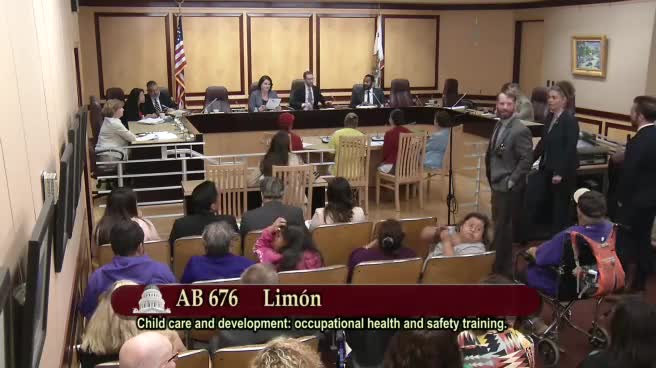 3MIN
Senate Standing Committee on Human Services
 4MIN
Senate Standing Committee on Education
 2MIN
Assembly Floor
 1H
Assembly Standing Committee on Appropriations
Bill Author

Bill Co-Author(s):