AB 2626: Child care services.
- Session Year: 2017-2018
- House: Assembly
- Latest Version Date: 2018-09-30
(1)The Child Care and Development Services Act has a purpose of providing a comprehensive, coordinated, and cost-effective system of child care and development services, for children from infancy to 13 years of age and their parents, including a full range of supervision, health, and support service through full- and part-time programs. The act requires the Superintendent of Public Instruction to adopt rules and regulations on eligibility, enrollment, and priority of services needed to implement the act. The act provides that a family, upon establishing initial eligibility or ongoing eligibility for services, shall receive those services for not less than 12 months. The act provides, as an exception to the above provision relating to receiving services for 12 months, that a family that establishes initial eligibility or ongoing eligibility on the basis of seeking employment shall receive services for not less than 6 months. The act, for purposes of establishing income eligibility for services, defines income eligible to mean a family has an adjusted monthly income at or below 70% the state median income, as provided.
This bill would delete the 6-month exception for families establishing initial eligibility or ongoing eligibility on the basis of seeking employment. The bill would instead define income eligible to mean that a family has an adjusted monthly income at or below 85% the state median income.
(2)The act requires the Superintendent to administer all California state preschool programs, which include part-day age and developmentally appropriate programs designed to facilitate the transition to kindergarten for 3- and 4-year-old children. The act defines 3-year-old children and 4-year-old children as children who will have their 3rd or 4th birthday, respectively, on or before September 1 of the fiscal year in which they are enrolled in a state preschool program.
This bill would instead define 3- and 4-year-old children as those who will have their 3rd or 4th birthday, respectively, on or before December 1 of the fiscal year in which they are enrolled in a state preschool program. The bill would authorize children who have their 3rd birthday on or after December 2 of the fiscal year, to be enrolled in a state preschool program on or after their 3rd birthday.
(3)The act requires at least 1/2 of the children enrolled at a preschool site to be 4-year-old children, as provided.
This bill would delete this requirement.
(4)The act requires the Superintendent to implement a plan that establishes reasonable standards and assigned reimbursement rates, which vary with the length of the program year and the hours of service.
This bill would authorize a center-based child care agency contracting with the State Department of Education to provide center-based child care services to schedule up to 2 days of staff training, per contract period, using state reimbursement funding on specified topics.
(5)The act requires the department to promote full utilization of child care and development funds and match available unused funds with identified service needs. The act requires the department to arrange interagency adjustments between different contractors with the same type of contract when both agencies mutually agree to a temporary transfer of funds for the balance of the fiscal year.
This bill would also require the department to arrange intraagency adjustments between the state preschool program contracts and general child care contracts for the same agency and funding allocation. The bill would require the department to establish timelines for intraagency contract fund transfers. The bill would authorize the department to implement and administer these provisions through the issuance of guidance or other written directives, as provided.
(6)This bills provisions would become operative on July 1, 2019.
(1)The Child Care and Development Services Act has a purpose of providing a comprehensive, coordinated, and cost-effective system of child care and development services, for children from infancy to 13 years of age and their parents, including a full range of supervision, health, and support service through full- and part-time programs. The act requires the Superintendent of Public Instruction to adopt rules and regulations on eligibility, enrollment, and priority of services needed to implement the act. The act provides that a family, upon establishing initial eligibility or ongoing eligibility for services, shall receive those services for not less than 12 months. The act provides, as an exception to the above provision relating to receiving services for 12 months, that a family that establishes initial eligibility or ongoing eligibility on the basis of seeking employment shall receive services for not less than 6 months. The act, for purposes of establishing income eligibility for services, defines income eligible to mean a family has an adjusted monthly income at or below 70% the state median income, as provided.
This bill would delete the 6-month exception for families establishing initial eligibility or ongoing eligibility on the basis of seeking employment. The bill would instead define income eligible to mean that a family has an adjusted monthly income at or below 85% the state median income.
The(2)The act requires the Superintendent to administer all California state preschool programs, which include part-day age and developmentally appropriate programs designed to facilitate the transition to kindergarten for 3- and 4-year-old children. The act defines 3-year-old children and 4-year-old children as children who will have their 3rd or 4th birthday, respectively, on or before September 1 of the fiscal year in which they are enrolled in a state preschool program.
This bill would instead define 3- and 4-year-old children as those who will have their 3rd or 4th birthday, respectively, on or before December 1 of the fiscal year in which they are enrolled in a state preschool program. The bill would authorize children who have their 3rd birthday on or after December 2 of the fiscal year, to be enrolled in a state preschool program on or after their 3rd birthday.
The(3)The act requires at least 1/2 of the children enrolled at a preschool site to be 4-year-old children, as provided.
This bill would delete this requirement.
The(4)The act requires the Superintendent to implement a plan that establishes reasonable standards and assigned reimbursement rates, which vary with the length of the program year and the hours of service.
This bill would authorize a center-based child care agency contracting with the State Department of Education to provide center-based child care services to schedule up to 2 days of staff training, per contract period, using state reimbursement funding on specified topics.
The(5)The act requires the department to promote full utilization of child care and development funds and match available unused funds with identified service needs. The act requires the department to arrange interagency adjustments between different contractors with the same type of contract when both agencies mutually agree to a temporary transfer of funds for the balance of the fiscal year.
This bill would also require the department to arrange intraagency adjustments between the state preschool program contracts and general child care contracts for the same agency and funding allocation. The bill would require the department to establish timelines for intraagency contract fund transfers. The bill would authorize the department to implement and administer these provisions through the issuance of guidance or other written directives, as provided.
(6)This bills provisions would become operative on July 1, 2019.
The Child Care and Development Services Act has a purpose of providing a comprehensive, coordinated, and cost-effective system of child care and development services, for children from infancy to 13 years of age and their parents, including a full range of supervision, health, and support service through full- and part-time programs. The act requires the Superintendent of Public Instruction to adopt rules and regulations on eligibility, enrollment, and priority of services needed to implement the act. The act provides that a family, upon establishing initial eligibility or ongoing eligibility for services, shall receive those services for not less than 12 months. The act provides provides, as an exception to the above provision relating to receiving services for 12 months, that a family that establishes initial eligibility or ongoing eligibility on the basis of seeking employment shall receive services for not less than 6 months. The act, for purposes of establishing income eligibility for services, defines income eligible to mean a family has an adjusted monthly income at or below 70% the state median income, as provided.
This bill would instead provide that a family seeking employment or experiencing homelessness as a basis for initial eligibility or ongoing eligibility shall receive services for not more than 5 days per week at 6.5 hours per day for not less than 12 months. delete the 6-month exception for families establishing initial eligibility or ongoing eligibility on the basis of seeking employment. The bill would instead define income eligible to mean that a family has an adjusted monthly income at or below 85% the state median income.
The act requires the Superintendent to administer all California state preschool programs, which include part-day age and developmentally appropriate programs designed to facilitate the transition to kindergarten for 3- and 4-year-old children. The act defines 3-year-old children and 4-year-old children as children who will have their 3rd or 4th birthday, respectively, on or before September 1 of the fiscal year in which they are enrolled in a state preschool program.
This bill would instead define 3- and 4-year-old children as those who will have their 3rd or 4th birthday, respectively, on or before December 1 of the fiscal year in which they are enrolled in a state preschool program. The bill would authorize children who have their 3rd birthday on or after December 2 of the fiscal year, to be enrolled in a state preschool program on or after their 3rd birthday.
The act requires at least 1/2 of the children enrolled at a preschool site to be 4-year-old children, as provided.
This bill would delete this requirement.
The act requires the Superintendent to implement a plan that establishes reasonable standards and assigned reimbursement rates, which vary with the length of the program year and the hours of service.
This bill would authorize a center-based child care agency contracting with the State Department of Education to provide center-based child care services to schedule up to 2 days of staff training, per contract period, using state reimbursement funding on specified topics.
The act requires the department to promote full utilization of child care and development funds and match available unused funds with identified service needs. The act requires the department to arrange interagency adjustments between different contractors with the same type of contract when both agencies mutually agree to a temporary transfer of funds for the balance of the fiscal year.
This bill would also require the department to arrange intraagency adjustments between the state preschool program contracts and general child care contracts for the same agency and funding allocation. The bill would require the department to establish timelines for intraagency contract fund transfers. The bill would authorize the department to implement and administer these provisions through the issuance of guidance or other written directives, as provided.
The Child Care and Development Services Act has a purpose of providing a comprehensive, coordinated, and cost-effective system of child care and development services, for children from infancy to 13 years of age and their parents, including a full range of supervision, health, and support service through full- and part-time programs. The act requires the Superintendent of Public Instruction to adopt rules and regulations on eligibility, enrollment, and priority of services needed to implement the act. The act provides that a family that establishes initial eligibility or ongoing eligibility on the basis of seeking employment shall receive services for not less than 6 months. The act, for purposes of establishing income eligibility for services, defines income eligible to mean a family has an adjusted monthly income at or below 70% the state median income, as provided.
This bill would instead provide that a family seeking employment, employment or experiencing homelessness or incapacitation, as a basis for initial eligibility or ongoing eligibility shall receive services for not less than 12 months. The bill would provide that a family receiving these services shall receive those services no more than 5 days per week at 6.5 hours per day. day for not less than 12 months. The bill would instead define income eligible to mean that a family has an adjusted monthly income at or below 80% 85% the state median income.
The act requires the Superintendent to administer all California state preschool programs, which include part-day age and developmentally appropriate programs designed to facilitate the transition to kindergarten for 3- and 4-year-old children. The act defines 3-year-old children and 4-year-old children as children who will have their 3rd or 4th birthday, respectively, on or before September 1 of the fiscal year in which they are enrolled in a state preschool program.
This bill would instead define 3- and 4-year-old children as those who will have their 3rd or 4th birthday, respectively, on or before December 1 of the fiscal year in which they are enrolled in a state preschool program. The bill would authorize children who have their 3rd birthday on or after December 2 of the fiscal year, to be enrolled in a state preschool program on or after their 3rd birthday.
The act requires at least 1/2 of the children enrolled at a preschool site to be 4-year-old children, as provided.
This bill would delete this requirement.
The act requires the Superintendent to implement a plan that establishes reasonable standards and assigned reimbursement rates, which vary with the length of the program year and the hours of service.
This bill would authorize a center-based child care agency contracting with the State Department of Education to provide center-based child care services to schedule up to 2 days of staff training, per contract period, using state reimbursement funding on specified topics.
The act requires the department to promote full utilization of child care and development funds and match available unused funds with identified service needs. The act requires the department to arrange interagency adjustments between different contractors with the same type of contract when both agencies mutually agree to a temporary transfer of funds for the balance of the fiscal year.
This bill would also require the department to arrange intraagency adjustments between the state preschool program contracts and general child care contracts for the same agency and funding allocation. The bill would require the department to establish timelines for intraagency contract fund transfers. The bill would authorize the department to implement and administer these provisions through the issuance of guidance or other written directives, as provided.
The Child Care and Development Services Act has a purpose of providing a comprehensive, coordinated, and cost-effective system of child care and development services, for children from infancy to 13 years of age and their parents, including a full range of supervision, health, and support service through full- and part-time programs. The act requires the Superintendent of Public Instruction to adopt rules and regulations on eligibility, enrollment, and priority of services needed to implement the act. The act provides that a family that establishes initial eligibility or ongoing eligibility on the basis of seeking employment shall receive services for not less than 6 months. The act, for purposes of establishing income eligibility for services, defines income eligible to mean a family has an adjusted monthly income at or below 70% the state median income, as provided.
This bill would instead provide that a family seeking employment, or experiencing homelessness or incapacitation, as a basis for initial eligibility or ongoing eligibility shall receive services for not less than 12 months. The bill would provide that a family receiving these services shall occur on receive those services no more than 5 days per week at 6.5 hours per day. The bill would instead define income eligible to mean that a family has an adjusted monthly income at or below 80% the state median income.
The act requires the Superintendent to administer all California state preschool programs, which include part-day age and developmentally appropriate programs designed to facilitate the transition to kindergarten for 3- and 4-year-old children. The act defines 3-year-old children and 4-year-old children as children who will have their 3rd or 4th birthday, respectively, on or before September 1 of the fiscal year in which they are enrolled in a state preschool program.
This bill would instead define 3- and 4-year-old children as those who will have their 3rd or 4th birthday, respectively, on or before December 1 of the fiscal year in which they are enrolled in a state preschool program. The bill would authorize children who have their 3rd birthday on or after December 2 of the fiscal year, to be enrolled in a state preschool program on or after their 3rd birthday.
The act requires at least 1/2 of the children enrolled at a preschool site to be 4-year-old children, as provided.
This bill would delete this requirement.
The act requires the Superintendent to implement a plan that establishes reasonable standards and assigned reimbursement rates, which vary with the length of the program year and the hours of service.
This bill would authorize a center-based child care agency contracting with the State Department of Education to provide center-based child care services to schedule up to 2 days of staff training, per contract period, using state reimbursement funding on specified topics.
The act requires the department to promote full utilization of child care and development funds and match available unused funds with identified service needs. The act requires the department to arrange interagency adjustments between different contractors with the same type of contract when both agencies mutually agree to a temporary transfer of funds for the balance of the fiscal year.
This bill would also require the department to arrange intraagency adjustments between the state preschool program contracts and general child care contracts for the same agency and funding allocation. The bill would require the department to establish timeless timelines for intraagency contract fund transfers. The bill would authorize the department to implement and administer these provisions through the issuance of guidance or other written directives, as provided.
The Child Care and Development Services Act has a purpose of providing a comprehensive, coordinated, and cost-effective system of child care and development services, for children from infancy to 13 years of age and their parents, including a full range of supervision, health, and support service through full- and part-time programs. The act requires the Superintendent of Public Instruction to adopt rules and regulations on eligibility, enrollment, and priority of services needed to implement the act. The act provides that a family that establishes initial eligibility or ongoing eligibility on the basis of seeking employment shall receive services for not less than 6 months. The act, for purposes of establishing income eligibility for services, defines income eligible to mean a family has an adjusted monthly income at or below 70% the state median income, as provided.
This bill would instead provide that a family seeking employment, or experiencing homelessness or incapacitation, as a basis for initial eligibility or ongoing eligibility shall receive services for not less than 12 months. The bill would provide that a family receiving these services shall occur on no more than 5 days per week at 6.5 hours per day. The bill would instead define income eligible to mean that a family has an adjusted monthly income at or below 80% the state median income.
The act requires the Superintendent to administer all California state preschool programs, which include part-day age and developmentally appropriate programs designed to facilitate the transition to kindergarten for 3- and 4-year-old children. The act defines 3-year-old children and 4-year-old children as children who will have their 3rd or 4th birthday, respectively, on or before September 1 of the fiscal year in which they are enrolled in a state preschool program.
This bill would instead define 3- and 4-year-old children as those who will have their 3rd or 4th birthday, respectively, on or before December 1 of the fiscal year in which they are enrolled in a state preschool program. The bill would authorize children who have their 3rd birthday on or after December 2 of the fiscal year, to be enrolled in a state preschool program on or after their 3rd birthday.
The act requires at least 1/2 of the children enrolled at a preschool site to be 4-year-old children, as provided.
This bill would delete this requirement.
The act requires the Superintendent to implement a plan that establishes reasonable standards and assigned reimbursement rates, which vary with the length of the program year and the hours of service.
This bill would authorize a center-based child care agency contracting with the State Department of Education to provide center-based child care services to schedule up to 2 days of staff training, per contract period, using state reimbursement funding on specified topics.
The act requires the department to promote full utilization of child care and development funds and match available unused funds with identified service needs. The act requires the department to arrange interagency adjustments between different contractors with the same type of contract when both agencies mutually agree to a temporary transfer of funds for the balance of the fiscal year.
This bill would also require the department to arrange intraagency adjustments between the state preschool program contracts and general child care contracts for the same agency and funding allocation. The bill would require the department to establish timeless for intraagency contract fund transfers. The bill would authorize the department to implement and administer these provisions through the issuance of guidance or other written directives, as provided.
As used in this chapter:
(a)Alternative payments includes payments that are made by one child care agency to another agency or child care provider for the provision of child care and development services, and payments that are made by an agency to a parent for the parents purchase of child care and development services.
(b)Alternative payment program means a local government agency or nonprofit organization that has contracted with the department pursuant to Section 8220.1 to provide alternative payments and to provide support services to parents and providers.
(c)Applicant or contracting agency means a school district, community college district, college or university, county superintendent of schools, county, city, public agency, private nontax-exempt agency, private tax-exempt agency, or other entity that is authorized to establish, maintain, or operate services pursuant to this chapter. Private agencies and parent cooperatives, duly licensed by law, shall receive the same consideration as any other authorized entity with no loss of parental decisionmaking prerogatives as consistent with the provisions of this chapter.
(d)Assigned reimbursement rate is that rate established by the contract with the agency and is derived by dividing the total dollar amount of the contract by the minimum child day of average daily enrollment level of service required.
(e)Attendance means the number of children present at a child care and development facility. Attendance, for purposes of reimbursement, includes excused absences by children because of illness, quarantine, illness or quarantine of their parent, family emergency, or to spend time with a parent or other relative as required by a court of law or that is clearly in the best interest of the child.
(f)Capital outlay means the amount paid for the renovation and repair of child care and development facilities to comply with state and local health and safety standards, and the amount paid for the state purchase of relocatable child care and development facilities for lease to qualifying contracting agencies.
(g)Caregiver means a person who provides direct care, supervision, and guidance to children in a child care and development facility.
(h)Child care and development facility means a residence or building or part thereof in which child care and development services are provided.
(i)Child care and development programs means those programs that offer a full range of services for children from infancy to 13 years of age, for any part of a day, by a public or private agency, in centers and family child care homes. These programs include, but are not limited to, all of the following:
(1)General child care and development.
(2)Migrant child care and development.
(3)Child care provided by the California School Age Families Education Program (Article 7.1 (commencing with Section 54740) of Chapter 9 of Part 29 of Division 4 of Title 2).
(4)California state preschool program.
(5)Resource and referral.
(6)Child care and development services for children with exceptional needs.
(7)Family child care home education network.
(8)Alternative payment.
(9)Schoolage community child care.
(j)Child care and development services means those services designed to meet a wide variety of needs of children and their families, while their parents or guardians are working, in training, seeking employment, incapacitated, or in need of respite. These services may include direct care and supervision, instructional activities, resource and referral programs, and alternative payment arrangements.
(k)Children at risk of abuse, neglect, or exploitation means children who are so identified in a written referral from a legal, medical, or social service agency, or emergency shelter.
(l)Children with exceptional needs means either of the following:
(1)Infants and toddlers under three years of age who have been determined to be eligible for early intervention services pursuant to the California Early Intervention Services Act (Title 14 (commencing with Section 95000) of the Government Code) and its implementing regulations. These children include an infant or toddler with a developmental delay or established risk condition, or who is at high risk of having a substantial developmental disability, as defined in subdivision (a) of Section 95014 of the Government Code. These children shall have active individualized family service plans, shall be receiving early intervention services, and shall be children who require the special attention of adults in a child care setting.
(2)Children 3 to 21 years of age, inclusive, who have been determined to be eligible for special education and related services by an individualized education program team according to the special education requirements contained in Part 30 (commencing with Section 56000) of Division 4 of Title 2, and who meet eligibility criteria described in Section 56026 and, Article 2.5 (commencing with Section 56333) of Chapter 4 of Part 30 of Division 4 of Title 2, and Sections 3030 and 3031 of Title 5 of the California Code of Regulations. These children shall have an active individualized education program, shall be receiving early intervention services or appropriate special education and related services, and shall be children who require the special attention of adults in a child care setting. These children include children with intellectual disabilities, hearing impairments (including deafness), speech or language impairments, visual impairments (including blindness), serious emotional disturbance (also referred to as emotional disturbance), orthopedic impairments, autism, traumatic brain injury, other health impairments, or specific learning disabilities, who need special education and related services consistent with Section 1401(3)(A) of Title 20 of the United States Code.
(m)Closedown costs means reimbursements for all approved activities associated with the closing of operations at the end of each growing season for migrant child development programs only.
(n)Cost includes, but is not limited to, expenditures that are related to the operation of child care and development programs. Cost may include a reasonable amount for state and local contributions to employee benefits, including approved retirement programs, agency administration, and any other reasonable program operational costs. Cost may also include amounts for licensable facilities in the community served by the program, including lease payments or depreciation, downpayments, and payments of principal and interest on loans incurred to acquire, rehabilitate, or construct licensable facilities, but these costs shall not exceed fair market rents existing in the community in which the facility is located. Reasonable and necessary costs are costs that, in nature and amount, do not exceed what an ordinary prudent person would incur in the conduct of a competitive business.
(o)Elementary school, as contained in former Section 425 of Title 20 of the United States Code (the National Defense Education Act of 1958, Public Law 85-864, as amended), includes early childhood education programs and all child development programs, for the purpose of the cancellation provisions of loans to students in institutions of higher learning.
(p)Family child care home education network means an entity organized under law that contracts with the department pursuant to Section 8245 to make payments to licensed family child care home providers and to provide educational and support services to those providers and to children and families eligible for state-subsidized child care and development services. A family child care home education network may also be referred to as a family child care home system.
(q)Health services include, but are not limited to, all of the following:
(1)Referral, whenever possible, to appropriate health care providers able to provide continuity of medical care.
(2)Health screening and health treatment, including a full range of immunization recorded on the appropriate state immunization form to the extent provided by the Medi-Cal Act (Chapter 7 (commencing with Section 14000) of Part 3 of Division 9 of the Welfare and Institutions Code) and the Child Health and Disability Prevention Program (Article 6 (commencing with Section 124025) of Chapter 3 of Part 2 of Division 106 of the Health and Safety Code), but only to the extent that ongoing care cannot be obtained utilizing community resources.
(3)Health education and training for children, parents, staff, and providers.
(4)Followup treatment through referral to appropriate health care agencies or individual health care professionals.
(r)Higher educational institutions means the Regents of the University of California, the Trustees of the California State University, the Board of Governors of the California Community Colleges, and the governing bodies of any accredited private nonprofit institution of postsecondary education.
(s)Intergenerational staff means persons of various generations.
(t)Limited-English-speaking-proficient and non-English-speaking-proficient children means children who are unable to benefit fully from an English-only child care and development program as a result of either of the following:
(1)Having used a language other than English when they first began to speak.
(2)Having a language other than English predominantly or exclusively spoken at home.
(u)Parent means a biological parent, stepparent, adoptive parent, foster parent, caretaker relative, or any other adult living with a child who has responsibility for the care and welfare of the child.
(v)Program director means a person who, pursuant to Sections 8244 and 8360.1, is qualified to serve as a program director.
(w)Proprietary child care agency means an organization or facility providing child care, which is operated for profit.
(x)Resource and referral programs means programs that provide information to parents, including referrals and coordination of community resources for parents and public or private providers of care. Services frequently include, but are not limited to: technical assistance for providers, toy-lending libraries, equipment-lending libraries, toy- and equipment-lending libraries, staff development programs, health and nutrition education, and referrals to social services.
(y)Severely disabled children are children with exceptional needs from birth to 21 years of age, inclusive, who require intensive instruction and training in programs serving pupils with the following profound disabilities: autism, blindness, deafness, severe orthopedic impairments, serious emotional disturbances, or severe intellectual disabilities. Severely disabled children also include those individuals who would have been eligible for enrollment in a developmental center for handicapped pupils under Chapter 6 (commencing with Section 56800) of Part 30 of Division 4 of Title 2 as it read on January 1, 1980.
(z)Short-term respite child care means child care service to assist families whose children have been identified through written referral from a legal, medical, or social service agency, or emergency shelter as being neglected, abused, exploited, or homeless, or at risk of being neglected, abused, exploited, or homeless. Child care is provided for less than 24 hours per day in child care centers, treatment centers for abusive parents, family child care homes, or in the childs own home.
(aa)(1)Site supervisor means a person who, regardless of his or her title, has operational program responsibility for a child care and development program at a single site. A site supervisor shall hold a permit issued by the Commission on Teacher Credentialing that authorizes supervision of a child care and development program operating in a single site. The Superintendent may waive the requirements of this subdivision if the Superintendent determines that the existence of compelling need is appropriately documented.
(2)For California state preschool programs, a site supervisor may qualify under any of the provisions in this subdivision, or may qualify by holding an administrative credential or an administrative services credential. A person who meets the qualifications of a program director under both Sections 8244 and 8360.1 is also qualified under this subdivision.
(ab)Standard reimbursement rate means that rate established by the Superintendent pursuant to Section 8265.
(ac)Startup costs means those expenses an agency incurs in the process of opening a new or additional facility before the full enrollment of children.
(ad)California state preschool program means part-day and full-day educational programs for low-income or otherwise disadvantaged three- and four-year-old children.
(ae)Support services means those services that, when combined with child care and development services, help promote the healthy physical, mental, social, and emotional growth of children. Support services include, but are not limited to: protective services, parent training, provider and staff training, transportation, parent and child counseling, child development resource and referral services, and child placement counseling.
(af)Teacher means a person with the appropriate permit issued by the Commission on Teacher Credentialing who provides program supervision and instruction that includes supervision of a number of aides, volunteers, and groups of children.
(ag)Underserved area means a county or subcounty area, including, but not limited to, school districts, census tracts, or ZIP Code areas, where the ratio of publicly subsidized child care and development program services to the need for these services is low, as determined by the Superintendent.
(ah)Workday means the time that the parent requires temporary care for a child for any of the following reasons:
(1)To undertake training in preparation for a job.
(2)To undertake or retain a job.
(3)To undertake other activities that are essential to maintaining or improving the social and economic function of the family, are beneficial to the community, or are required because of health problems in the family.
(ai)Three-year-old children means children who will have their third birthday on or before the date specified of the fiscal year in which they are enrolled in a California state preschool program, as follows:
(1)November 1 of the 201213 fiscal year.
(2)October 1 of the 201314 fiscal year.
(3)September 1 of the 201415 fiscal year and each fiscal year thereafter.
(aj)Four-year-old children means children who will have their fourth birthday on or before the date specified of the fiscal year in which they are enrolled in a California state preschool program, as follows:
(1)November 1 of the 201213 fiscal year.
(2)October 1 of the 201314 fiscal year.
(3)September 1 of the 201415 fiscal year and each fiscal year thereafter.
(ak)Homeless children and youth has the same meaning as defined in Section 11434a(2) of the federal McKinney-Vento Homeless Assistance Act (42 U.S.C. Sec. 11301 et seq.).
(al)Local educational agency means a school district, a county office of education, a community college district, or a school district acting on behalf of one or more schools within the school district.
This section shall become inoperative on July 1, 2019, and, as of January 1, 2020, is repealed.
SEC. 2.Section 8208 is added to the Education Code, to read:8208.As used in this chapter:
(a)Alternative payments includes payments that are made by one child care agency to another agency or child care provider for the provision of child care and development services, and payments that are made by an agency to a parent for the parents purchase of child care and development services.
(b)Alternative payment program means a local government agency or nonprofit organization that has contracted with the department pursuant to Section 8220.1 to provide alternative payments and to provide support services to parents and providers.
(c)Applicant or contracting agency means a school district, community college district, college or university, county superintendent of schools, county, city, public agency, private nontax-exempt agency, private tax-exempt agency, or other entity that is authorized to establish, maintain, or operate services pursuant to this chapter. Private agencies and parent cooperatives, duly licensed by law, shall receive the same consideration as any other authorized entity with no loss of parental decisionmaking prerogatives as consistent with the provisions of this chapter.
(d)Assigned reimbursement rate is that rate established by the contract with the agency and is derived by dividing the total dollar amount of the contract by the minimum child day of average daily enrollment level of service required.
(e)Attendance means the number of children present at a child care and development facility. Attendance, for purposes of reimbursement, includes excused absences by children because of illness, quarantine, illness or quarantine of their parent, family emergency, or to spend time with a parent or other relative as required by a court of law or that is clearly in the best interest of the child.
(f)Capital outlay means the amount paid for the renovation and repair of child care and development facilities to comply with state and local health and safety standards, and the amount paid for the state purchase of relocatable child care and development facilities for lease to qualifying contracting agencies.
(g)Caregiver means a person who provides direct care, supervision, and guidance to children in a child care and development facility.
(h)Child care and development facility means a residence or building or part thereof in which child care and development services are provided.
(i)Child care and development programs means those programs that offer a full range of services for children from infancy to 13 years of age, for any part of a day, by a public or private agency, in centers and family child care homes. These programs include, but are not limited to, all of the following:
(1)General child care and development.
(2)Migrant child care and development.
(3)Child care provided by the California School Age Families Education Program (Article 7.1 (commencing with Section 54740) of Chapter 9 of Part 29 of Division 4 of Title 2).
(4)California state preschool program.
(5)Resource and referral.
(6)Child care and development services for children with exceptional needs.
(7)Family child care home education network.
(8)Alternative payment.
(9)Schoolage community child care.
(j)Child care and development services means those services designed to meet a wide variety of needs of children and their families, while their parents or guardians are working, in training, seeking employment, incapacitated, or in need of respite. These services may include direct care and supervision, instructional activities, resource and referral programs, and alternative payment arrangements.
(k)Children at risk of abuse, neglect, or exploitation means children who are so identified in a written referral from a legal, medical, or social service agency, or emergency shelter.
(l)Children with exceptional needs means either of the following:
(1)Infants and toddlers under three years of age who have been determined to be eligible for early intervention services pursuant to the California Early Intervention Services Act (Title 14 (commencing with Section 95000) of the Government Code) and its implementing regulations. These children include an infant or toddler with a developmental delay or established risk condition, or who is at high risk of having a substantial developmental disability, as defined in subdivision (a) of Section 95014 of the Government Code. These children shall have active individualized family service plans, shall be receiving early intervention services, and shall be children who require the special attention of adults in a child care setting.
(2)Children 3 to 21 years of age, inclusive, who have been determined to be eligible for special education and related services by an individualized education program team according to the special education requirements contained in Part 30 (commencing with Section 56000) of Division 4 of Title 2, and who meet eligibility criteria described in Section 56026 and, Article 2.5 (commencing with Section 56333) of Chapter 4 of Part 30 of Division 4 of Title 2, and Sections 3030 and 3031 of Title 5 of the California Code of Regulations. These children shall have an active individualized education program, shall be receiving early intervention services or appropriate special education and related services, and shall be children who require the special attention of adults in a child care setting. These children include children with intellectual disabilities, hearing impairments (including deafness), speech or language impairments, visual impairments (including blindness), serious emotional disturbance (also referred to as emotional disturbance), orthopedic impairments, autism, traumatic brain injury, other health impairments, or specific learning disabilities, who need special education and related services consistent with Section 1401(3)(A) of Title 20 of the United States Code.
(m)Closedown costs means reimbursements for all approved activities associated with the closing of operations at the end of each growing season for migrant child development programs only.
(n)Cost includes, but is not limited to, expenditures that are related to the operation of child care and development programs. Cost may include a reasonable amount for state and local contributions to employee benefits, including approved retirement programs, agency administration, and any other reasonable program operational costs. Cost may also include amounts for licensable facilities in the community served by the program, including lease payments or depreciation, downpayments, and payments of principal and interest on loans incurred to acquire, rehabilitate, or construct licensable facilities, but these costs shall not exceed fair market rents existing in the community in which the facility is located. Reasonable and necessary costs are costs that, in nature and amount, do not exceed what an ordinary prudent person would incur in the conduct of a competitive business.
(o)Elementary school, as contained in former Section 425 of Title 20 of the United States Code (the National Defense Education Act of 1958, Public Law 85-864, as amended), includes early childhood education programs and all child development programs, for the purpose of the cancellation provisions of loans to students in institutions of higher learning.
(p)Family child care home education network means an entity organized under law that contracts with the department pursuant to Section 8245 to make payments to licensed family child care home providers and to provide educational and support services to those providers and to children and families eligible for state-subsidized child care and development services. A family child care home education network may also be referred to as a family child care home system.
(q)Health services include, but are not limited to, all of the following:
(1)Referral, whenever possible, to appropriate health care providers able to provide continuity of medical care.
(2)Health screening and health treatment, including a full range of immunization recorded on the appropriate state immunization form to the extent provided by the Medi-Cal Act (Chapter 7 (commencing with Section 14000) of Part 3 of Division 9 of the Welfare and Institutions Code) and the Child Health and Disability Prevention Program (Article 6 (commencing with Section 124025) of Chapter 3 of Part 2 of Division 106 of the Health and Safety Code), but only to the extent that ongoing care cannot be obtained utilizing community resources.
(3)Health education and training for children, parents, staff, and providers.
(4)Followup treatment through referral to appropriate health care agencies or individual health care professionals.
(r)Higher educational institutions means the Regents of the University of California, the Trustees of the California State University, the Board of Governors of the California Community Colleges, and the governing bodies of any accredited private nonprofit institution of postsecondary education.
(s)Intergenerational staff means persons of various generations.
(t)Limited-English-speaking-proficient and non-English-speaking-proficient children means children who are unable to benefit fully from an English-only child care and development program as a result of either of the following:
(1)Having used a language other than English when they first began to speak.
(2)Having a language other than English predominantly or exclusively spoken at home.
(u)Parent means a biological parent, stepparent, adoptive parent, foster parent, caretaker relative, or any other adult living with a child who has responsibility for the care and welfare of the child.
(v)Program director means a person who, pursuant to Sections 8244 and 8360.1, is qualified to serve as a program director.
(w)Proprietary child care agency means an organization or facility providing child care, which is operated for profit.
(x)Resource and referral programs means programs that provide information to parents, including referrals and coordination of community resources for parents and public or private providers of care. Services frequently include, but are not limited to: technical assistance for providers, toy-lending libraries, equipment-lending libraries, toy- and equipment-lending libraries, staff development programs, health and nutrition education, and referrals to social services.
(y)Severely disabled children are children with exceptional needs from birth to 21 years of age, inclusive, who require intensive instruction and training in programs serving pupils with the following profound disabilities: autism, blindness, deafness, severe orthopedic impairments, serious emotional disturbances, or severe intellectual disabilities. Severely disabled children also include those individuals who would have been eligible for enrollment in a developmental center for handicapped pupils under Chapter 6 (commencing with Section 56800) of Part 30 of Division 4 of Title 2 as it read on January 1, 1980.
(z)Short-term respite child care means child care service to assist families whose children have been identified through written referral from a legal, medical, or social service agency, or emergency shelter as being neglected, abused, exploited, or homeless, or at risk of being neglected, abused, exploited, or homeless. Child care is provided for less than 24 hours per day in child care centers, treatment centers for abusive parents, family child care homes, or in the childs own home.
(aa)(1)Site supervisor means a person who, regardless of his or her title, has operational program responsibility for a child care and development program at a single site. A site supervisor shall hold a permit issued by the Commission on Teacher Credentialing that authorizes supervision of a child care and development program operating in a single site. The Superintendent may waive the requirements of this subdivision if the Superintendent determines that the existence of compelling need is appropriately documented.
(2)For California state preschool programs, a site supervisor may qualify under any of the provisions in this subdivision, or may qualify by holding an administrative credential or an administrative services credential. A person who meets the qualifications of a program director under both Sections 8244 and 8360.1 is also qualified under this subdivision.
(ab)Standard reimbursement rate means that rate established by the Superintendent pursuant to Section 8265.
(ac)Startup costs means those expenses an agency incurs in the process of opening a new or additional facility before the full enrollment of children.
(ad)California state preschool program means part-day and full-day educational programs for low-income or otherwise disadvantaged three- and four-year-old children.
(ae)Support services means those services that, when combined with child care and development services, help promote the healthy physical, mental, social, and emotional growth of children. Support services include, but are not limited to: protective services, parent training, provider and staff training, transportation, parent and child counseling, child development resource and referral services, and child placement counseling.
(af)Teacher means a person with the appropriate permit issued by the Commission on Teacher Credentialing who provides program supervision and instruction that includes supervision of a number of aides, volunteers, and groups of children.
(ag)Underserved area means a county or subcounty area, including, but not limited to, school districts, census tracts, or ZIP Code areas, where the ratio of publicly subsidized child care and development program services to the need for these services is low, as determined by the Superintendent.
(ah)Workday means the time that the parent requires temporary care for a child for any of the following reasons:
(1)To undertake training in preparation for a job.
(2)To undertake or retain a job.
(3)To undertake other activities that are essential to maintaining or improving the social and economic function of the family, are beneficial to the community, or are required because of health problems in the family.
(ai)Three-year-old children means children who will have their third birthday on or before December 1 of the fiscal year in which they are enrolled in a California state preschool program. Children who have their third birthday on or after December 2 of the fiscal year, may be enrolled in a California state preschool program on or after their third birthday. Any child under four years of age shall be served in a California state preschool program facility, licensed in accordance with Title 22 of the California Code of Regulations.
(aj)Four-year-old children means children who will have their fourth birthday on or before December 1 of the fiscal year in which they are enrolled in a California state preschool program.
(ak)Homeless children and youth has the same meaning as defined in Section 11434a(2) of the federal McKinney-Vento Homeless Assistance Act (42 U.S.C. Sec. 11301 et seq.).
(al)Local educational agency means a school district, a county office of education, a community college district, or a school district acting on behalf of one or more schools within the school district.
This section shall become operative on July 1, 2019.
SEC. 3.Section 8236 of the Education Code is amended to read:8236.(a)(1)Each applicant or contracting agency funded pursuant to Section 8235 shall give first priority to three- or four-year-old neglected or abused children who are recipients of child protective services, or who are at risk of being neglected, abused, or exploited upon written referral from a legal, medical, or social service agency. If an agency is unable to enroll a child in this first priority category, the agency shall refer the childs parent or guardian to local resources and referral services so that services for the child can be located.
(2)Notwithstanding Section 8263, after children in the first priority category set forth in paragraph (1) are enrolled, each agency funded pursuant to Section 8235 shall give priority to eligible four-year-old children who are not enrolled in a state-funded transitional kindergarten program before enrolling eligible three-year-old children. Each agency shall certify to the Superintendent that enrollment priority is being given to eligible four-year-old children.
(b)For California state preschool programs operating with funding that was initially allocated in a prior fiscal year, at least one-half of the children enrolled at a preschool site shall be four-year-old children. Any exception to this requirement shall be approved by the Superintendent. The Superintendent shall inform the Department of Finance of any exceptions that have been granted and the reasons for granting the exceptions.
(c)(1)(A)Commencing June 15, 2015, and notwithstanding any other law, in awarding new funding for the expansion of a California state preschool program that is appropriated by the Legislature for that purpose in any fiscal year, the Superintendent, after taking into account the geographic criteria established pursuant to Section 8279.3 and the data described in subparagraph (B), shall give priority to applicant agencies that, in expending the expansion funds, will provide the greatest progress toward achieving access to full-day, full-year services for all income-eligible four-year-old children.
(B)In awarding funding pursuant to subparagraph (A) and in order to promote access for all income-eligible four-year-old children to at least a part-day California state preschool program, the department shall take into account the needs assessments submitted to the department pursuant to Section 8499.5 and any other high-quality data resources available to the department.
(2)Expansion funding awarded pursuant to paragraph (1) shall be apportioned at the rate described in Section 8265 and as determined in the annual Budget Act.
(3)A family child care home education network shall be eligible to apply for expansion funding awarded pursuant to paragraph (1).
(d)This section does not preclude a local educational agency from subcontracting with an appropriate public or private agency to operate a California state preschool program and to apply for funds made available for purposes of this section. If a school district chooses not to operate or subcontract for a California state preschool program, the Superintendent shall work with the county office of education and other eligible agencies to explore possible opportunities in contracting or alternative subcontracting to provide a California state preschool program.
(e)This section does not prevent eligible children who are receiving services from continuing to receive those services in future years pursuant to this chapter.
(f)This section shall become inoperative on July 1, 2019, and, as of January 1, 2020, is repealed.
SEC. 4.Section 8236 is added to the Education Code, to read:8236.(a)(1)Each applicant or contracting agency funded pursuant to Section 8235 shall give first priority to three- or four-year-old neglected or abused children who are recipients of child protective services, or who are at risk of being neglected, abused, or exploited upon written referral from a legal, medical, or social service agency. If an agency is unable to enroll a child in this first priority category, the agency shall refer the childs parent or guardian to local resources and referral services so that services for the child can be located.
(2)Notwithstanding Section 8263, after children in the first priority category set forth in paragraph (1) are enrolled, each agency funded pursuant to Section 8235 shall give priority to eligible four-year-old children who are not enrolled in a state-funded transitional kindergarten program before enrolling eligible three-year-old children. Each agency shall certify to the Superintendent that enrollment priority is being given to eligible four-year-old children.
(b)(1)(A)Commencing June 15, 2015, and notwithstanding any other law, in awarding new funding for the expansion of a California state preschool program that is appropriated by the Legislature for that purpose in any fiscal year, the Superintendent, after taking into account the geographic criteria established pursuant to Section 8279.3 and the data described in subparagraph (B), shall give priority to applicant agencies that, in expending the expansion funds, will provide the greatest progress toward achieving access to full-day, full-year services for all income-eligible four-year-old children.
(B)In awarding funding pursuant to subparagraph (A) and in order to promote access for all income-eligible four-year-old children to at least a part-day California state preschool program, the department shall take into account the needs assessments submitted to the department pursuant to Section 8499.5 and any other high-quality data resources available to the department.
(2)Expansion funding awarded pursuant to paragraph (1) shall be apportioned at the rate described in Section 8265 and as determined in the annual Budget Act.
(3)A family child care home education network shall be eligible to apply for expansion funding awarded pursuant to paragraph (1).
(c)This section does not preclude a local educational agency from subcontracting with an appropriate public or private agency to operate a California state preschool program and to apply for funds made available for purposes of this section. If a school district chooses not to operate or subcontract for a California state preschool program, the Superintendent shall work with the county office of education and other eligible agencies to explore possible opportunities in contracting or alternative subcontracting to provide a California state preschool program.
(d)This section does not prevent eligible children who are receiving services from continuing to receive those services in future years pursuant to this chapter.
(e)This section shall become operative on July 1, 2019.
SEC. 5.Section 8236.2 is added to the Education Code, to read:8236.2.(a)The department shall promote full utilization of child care and development funds and match available unused funds with identified service needs. The department shall arrange intraagency adjustments between California state preschool contracts and general child care contracts for the same agency and funding allocation. The department shall establish timelines for intraagency contract fund transfers.
(b)Notwithstanding the rulemaking provision of the Administrative Procedure Act (Chapter 3.5 (commencing with Section 11340) of Part 1 of Division 3 of Title 2 of the Government Code), the department may implement and administer this section through the issuance of guidance or other written directives, which may include, but is not limited to, establishing timelines for submittal of requests to transfer funds.
(c)This section shall become operative on July 1, 2019.
SEC. 6.Section 8263 of the Education Code is amended to read:8263.(a)(1)The Superintendent shall adopt rules and regulations on eligibility, enrollment, and priority of services needed to implement this chapter. In order to be eligible for federal and state subsidized child development services, families shall meet at least one requirement in each of the following areas:
(A)A family is (i) a current aid recipient, (ii) income eligible, (iii) homeless, or (iv) one whose children are recipients of protective services, or whose children have been identified as being abused, neglected, or exploited, or at risk of being abused, neglected, or exploited.
(B)A family needs the child care services (i) because the child is identified by a legal, medical, or social services agency, a local educational agency liaison for homeless children and youths designated pursuant to Section 11432(g)(1)(J)(ii) of Title 42 of the United States Code, a Head Start program, or an emergency or transitional shelter as (I) a recipient of protective services, (II) being neglected, abused, or exploited, or at risk of neglect, abuse, or exploitation, or (III) being homeless or (ii) because the parents are (I) engaged in vocational training leading directly to a recognized trade, paraprofession, or profession, (II) engaged in an educational program for English language learners or to attain a high school diploma or general educational development certificate, (III) employed or seeking employment, (IV) seeking permanent housing for family stability, or (V) incapacitated.
(2)If only one parent has signed an application for enrollment in child care services, as required by this chapter or regulations adopted to implement this chapter, and the information provided on the application indicates that there is a second parent who has not signed the application, the parent who has signed the application shall self-certify the presence or absence of the second parent under penalty of perjury. The parent who has signed the application shall not be required to submit additional information documenting the presence or absence of the second parent.
(b)Except as provided in Article 15.5 (commencing with Section 8350), priority for federal and state subsidized child development services is as follows:
(1)First priority shall be given to neglected or abused children who are recipients of child protective services, or children who are at risk of being neglected or abused, upon written referral from a legal, medical, or social services agency. If an agency is unable to enroll a child in the first priority category, the agency shall refer the family to local resource and referral services to locate services for the child.
(2)Second priority shall be given equally to eligible families, regardless of the number of parents in the home, who are income eligible. Within this priority, families with the lowest gross monthly income in relation to family size, as determined by a schedule adopted by the Superintendent, shall be admitted first. If two or more families are in the same priority in relation to income, the family that has a child with exceptional needs shall be admitted first. If there is no family of the same priority with a child with exceptional needs, the same priority family that has been on the waiting list for the longest time shall be admitted first. For purposes of determining order of admission, the grants of public assistance recipients shall be counted as income.
(3)The Superintendent shall set criteria for, and may grant specific waivers of, the priorities established in this subdivision for agencies that wish to serve specific populations, including children with exceptional needs or children of prisoners. These new waivers shall not include proposals to avoid appropriate fee schedules or admit ineligible families, but may include proposals to accept members of special populations in other than strict income order, as long as appropriate fees are paid.
(c)Notwithstanding any other law, in order to promote continuity of services, a family enrolled in a state or federally funded child care and development program whose services would otherwise be terminated because the family no longer meets the program income, eligibility, or need criteria may continue to receive child development services in another state or federally funded child care and development program if the contractor is able to transfer the familys enrollment to another program for which the family is eligible before the date of termination of services or to exchange the familys existing enrollment with the enrollment of a family in another program, provided that both families satisfy the eligibility requirements for the program in which they are being enrolled. The transfer of enrollment may be to another program within the same administrative agency or to another agency that administers state or federally funded child care and development programs.
(d)A physical examination and evaluation, including age-appropriate immunization, shall be required before, or within six weeks of, enrollment. A standard, rule, or regulation shall not require medical examination or immunization for admission to a child care and development program of a child whose parent or guardian files a letter with the governing board of the child care and development program stating that the medical examination or immunization is contrary to his or her religious beliefs, or provide for the exclusion of a child from the program because of a parent or guardian having filed the letter. However, if there is good cause to believe that a child is suffering from a recognized contagious or infectious disease, the child shall be temporarily excluded from the program until the governing board of the child care and development program is satisfied that the child is not suffering from that contagious or infectious disease.
(e)Regulations formulated and promulgated pursuant to this section shall include the recommendations of the State Department of Health Care Services relative to health care screening and the provision of health care services. The Superintendent shall seek the advice and assistance of these health authorities in situations where service under this chapter includes or requires care of children who are ill or children with exceptional needs.
(f)The Superintendent shall establish guidelines for the collection of employer-sponsored child care benefit payments from a parent whose child receives subsidized child care and development services. These guidelines shall provide for the collection of the full amount of the benefit payment, but not to exceed the actual cost of child care and development services provided, notwithstanding the applicable fee based on the fee schedule.
(g)The Superintendent shall establish guidelines according to which the director or a duly authorized representative of the child care and development program will certify children as eligible for state reimbursement pursuant to this section.
(h)(1)Except as provided in paragraphs (2) to (4), inclusive, upon establishing initial eligibility or ongoing eligibility for services under this chapter, a family shall be considered to meet all eligibility and need requirements for those services for not less than 12 months, shall receive those services for not less than 12 months before having their eligibility or need recertified, and shall not be required to report changes to income or other changes for at least 12 months.
(2)A family that establishes initial eligibility or ongoing eligibility on the basis of income shall report increases in income that exceed the threshold for ongoing income eligibility as described in subdivision (b) of Section 8263.1, and the familys ongoing eligibility for services shall at that time be recertified.
(3)A family that establishes initial eligibility or ongoing eligibility on the basis of seeking employment shall receive services under this chapter as follows:
(A)If seeking employment is the basis for initial eligibility, the family shall receive services under this chapter for not less than six months.
(B)If, at the time of recertification, the only basis established for ongoing eligibility is a parents need to seek employment, the family shall receive services for no less than six months.
(4)A family may at any time voluntarily report income or other changes. This information shall be used, as applicable, to reduce the familys fees, increase the familys services, or extend the period of the familys eligibility before recertification.
(i)(1)Because a family that meets eligibility requirements at its most recent eligibility certification or recertification is considered eligible until the next recertification, as provided in subdivision (h), a payment made by a child development program for a child during this period shall not be considered an error or an improper payment due to a change in the familys circumstances during that same period.
(2)Notwithstanding paragraph (1), the Superintendent or his or her designated agent may seek to recover payments that are the result of fraud.
(j)(1)Notwithstanding the rulemaking provisions of the Administrative Procedure Act (Chapter 3.5 (commencing with Section 11340) of Part 1 of Division 3 of Title 2 of the Government Code) and Section 33308.5 of this code, until regulations are filed with the Secretary of State to implement subdivision (h), the department shall implement subdivision (h) through management bulletins or similar letters of instruction on or before October 1, 2017.
(2)The department shall initiate a rulemaking action to implement subdivision (h) on or before December 31, 2018. The department shall convene a workgroup of parents, advocates, department staff, child development program representatives, and other stakeholders to develop recommendations regarding implementing subdivision (h).
(k)Public funds shall not be paid directly or indirectly to an agency that does not pay at least the minimum wage to each of its employees.
(l)This section shall become inoperative on July 1, 2019, and, as of January 1, 2020, is repealed.
SEC. 7.Section 8263 is added to the Education Code, to read:8263.(a)(1)The Superintendent shall adopt rules and regulations on eligibility, enrollment, and priority of services needed to implement this chapter. In order to be eligible for federal and state subsidized child development services, families shall meet at least one requirement in each of the following areas:
(A)A family is (i) a current aid recipient, (ii) income eligible, (iii) homeless, or (iv) one whose children are recipients of protective services, or whose children have been identified as being abused, neglected, or exploited, or at risk of being abused, neglected, or exploited.
(B)A family needs the child care services (i) because the child is identified by a legal, medical, or social services agency, a local educational agency liaison for homeless children and youths designated pursuant to Section 11432(g)(1)(J)(ii) of Title 42 of the United States Code, a Head Start program, or an emergency or transitional shelter as (I) a recipient of protective services, (II) being neglected, abused, or exploited, or at risk of neglect, abuse, or exploitation, or (III) being homeless or (ii) because the parents are (I) engaged in vocational training leading directly to a recognized trade, paraprofession, or profession, (II) engaged in an educational program for English language learners or to attain a high school diploma or general educational development certificate, (III) employed or seeking employment, (IV) seeking permanent housing for family stability, or (V) incapacitated.
(2)If only one parent has signed an application for enrollment in child care services, as required by this chapter or regulations adopted to implement this chapter, and the information provided on the application indicates that there is a second parent who has not signed the application, the parent who has signed the application shall self-certify the presence or absence of the second parent under penalty of perjury. The parent who has signed the application shall not be required to submit additional information documenting the presence or absence of the second parent.
(b)Except as provided in Article 15.5 (commencing with Section 8350), priority for federal and state subsidized child development services is as follows:
(1)First priority shall be given to neglected or abused children who are recipients of child protective services, or children who are at risk of being neglected or abused, upon written referral from a legal, medical, or social services agency. If an agency is unable to enroll a child in the first priority category, the agency shall refer the family to local resource and referral services to locate services for the child.
(2)Second priority shall be given equally to eligible families, regardless of the number of parents in the home, who are income eligible. Within this priority, families with the lowest gross monthly income in relation to family size, as determined by a schedule adopted by the Superintendent, shall be admitted first. If two or more families are in the same priority in relation to income, the family that has a child with exceptional needs shall be admitted first. If there is no family of the same priority with a child with exceptional needs, the same priority family that has been on the waiting list for the longest time shall be admitted first. For purposes of determining order of admission, the grants of public assistance recipients shall be counted as income.
(3)The Superintendent shall set criteria for, and may grant specific waivers of, the priorities established in this subdivision for agencies that wish to serve specific populations, including children with exceptional needs or children of prisoners. These new waivers shall not include proposals to avoid appropriate fee schedules or admit ineligible families, but may include proposals to accept members of special populations in other than strict income order, as long as appropriate fees are paid.
(c)Notwithstanding any other law, in order to promote continuity of services, a family enrolled in a state or federally funded child care and development program whose services would otherwise be terminated because the family no longer meets the program income, eligibility, or need criteria may continue to receive child development services in another state or federally funded child care and development program if the contractor is able to transfer the familys enrollment to another program for which the family is eligible before the date of termination of services or to exchange the familys existing enrollment with the enrollment of a family in another program, provided that both families satisfy the eligibility requirements for the program in which they are being enrolled. The transfer of enrollment may be to another program within the same administrative agency or to another agency that administers state or federally funded child care and development programs.
(d)A physical examination and evaluation, including age-appropriate immunization, shall be required before, or within six weeks of, enrollment. A standard, rule, or regulation shall not require medical examination or immunization for admission to a child care and development program of a child whose parent or guardian files a letter with the governing board of the child care and development program stating that the medical examination or immunization is contrary to his or her religious beliefs, or provide for the exclusion of a child from the program because of a parent or guardian having filed the letter. However, if there is good cause to believe that a child is suffering from a recognized contagious or infectious disease, the child shall be temporarily excluded from the program until the governing board of the child care and development program is satisfied that the child is not suffering from that contagious or infectious disease.
(e)Regulations formulated and promulgated pursuant to this section shall include the recommendations of the State Department of Health Care Services relative to health care screening and the provision of health care services. The Superintendent shall seek the advice and assistance of these health authorities in situations where service under this chapter includes or requires care of children who are ill or children with exceptional needs.
(f)The Superintendent shall establish guidelines for the collection of employer-sponsored child care benefit payments from a parent whose child receives subsidized child care and development services. These guidelines shall provide for the collection of the full amount of the benefit payment, but not to exceed the actual cost of child care and development services provided, notwithstanding the applicable fee based on the fee schedule.
(g)The Superintendent shall establish guidelines according to which the director or a duly authorized representative of the child care and development program will certify children as eligible for state reimbursement pursuant to this section.
(h)(1)Except as provided in paragraphs (2) and (3), upon establishing initial eligibility or ongoing eligibility for services under this chapter, a family shall be considered to meet all eligibility and need requirements for those services for not less than 12 months, shall receive those services for not less than 12 months before having their eligibility or need recertified, and shall not be required to report changes to income or other changes for at least 12 months.
(2)A family that establishes initial eligibility or ongoing eligibility on the basis of income shall report increases in income that exceed the threshold for ongoing income eligibility as described in subdivision (b) of Section 8263.1, and the familys ongoing eligibility for services shall at that time be recertified.
(3)A family may at any time voluntarily report income or other changes. This information shall be used, as applicable, to reduce the familys fees, increase the familys services, or extend the period of the familys eligibility before recertification.
(i)(1)Because a family that meets eligibility requirements at its most recent eligibility certification or recertification is considered eligible until the next recertification, as provided in subdivision (h), a payment made by a child development program for a child during this period shall not be considered an error or an improper payment due to a change in the familys circumstances during that same period.
(2)Notwithstanding paragraph (1), the Superintendent or his or her designated agent may seek to recover payments that are the result of fraud.
(j)(1)Notwithstanding the rulemaking provisions of the Administrative Procedure Act (Chapter 3.5 (commencing with Section 11340) of Part 1 of Division 3 of Title 2 of the Government Code) and Section 33308.5 of this code, until regulations are filed with the Secretary of State to implement subdivision (h), the department shall implement subdivision (h) through management bulletins or similar letters of instruction on or before October 1, 2017.
(2)The department shall initiate a rulemaking action to implement subdivision (h) on or before December 31, 2018. The department shall convene a workgroup of parents, advocates, department staff, child development program representatives, and other stakeholders to develop recommendations regarding implementing subdivision (h).
(k)Public funds shall not be paid directly or indirectly to an agency that does not pay at least the minimum wage to each of its employees.
(l)This section shall become operative on July 1, 2019.
SEC. 8.Section 8263.1 of the Education Code is amended to read:8263.1.(a)For purposes of establishing initial income eligibility for services under this chapter, income eligible means that a familys adjusted monthly income is at or below 70 percent of the state median income, adjusted for family size, as specified in subdivision (c).
(b)For purposes of establishing ongoing income eligibility under this chapter, ongoing income eligible means that a familys adjusted monthly income is at or below 85 percent of the state median income, adjusted for family size, as specified in subdivision (c).
(c)The Department of Finance shall calculate the state median income for family sizes of one to four, inclusive, by using the most recent census data available on state median family income in the past 12 months by family size. The Department of Finance shall calculate the state median income for family sizes of five and above by using the most recent census data for a family of four and multiplying this number by the ratios for the appropriate family size used in the federal Low-Income Home Energy Assistance Program (42 U.S.C. Sec. 8621 et seq.) and specified in federal regulations at paragraphs (5), (6), and (7) of subdivision (b) of Section 96.85 of Title 45 of the Code of Federal Regulations. The Department of Finance shall update its calculations of the state median income for families according to the methodology provided in this subdivision and provide the updated data to the department no later than March 1 of each fiscal year.
(d)The income of a recipient of federal supplemental security income benefits pursuant to Title XVI of the federal Social Security Act (42 U.S.C. Sec. 1381 et seq.) and state supplemental program benefits pursuant to Title XVI of the federal Social Security Act and Chapter 3 (commencing with Section 12000) of Part 3 of Division 9 of the Welfare and Institutions Code shall not be included as income for purposes of determining eligibility for child care under this chapter.
(e)This section shall become inoperative on July 1, 2019, and, as of January 1, 2020, is repealed.
SEC. 9.Section 8263.1 is added to the Education Code, to read:8263.1.(a)For purposes of establishing initial income eligibility for services under this chapter, income eligible means that a familys adjusted monthly income is at or below 85 percent of the state median income, adjusted for family size, as specified in subdivision (c).
(b)For purposes of establishing ongoing income eligibility under this chapter, ongoing income eligible means that a familys adjusted monthly income is at or below 85 percent of the state median income, adjusted for family size, as specified in subdivision (c).
(c)The Department of Finance shall calculate the state median income for family sizes of one to four, inclusive, by using the most recent census data available on state median family income in the past 12 months by family size. The Department of Finance shall calculate the state median income for family sizes of five and above by using the most recent census data for a family of four and multiplying this number by the ratios for the appropriate family size used in the federal Low-Income Home Energy Assistance Program (42 U.S.C. Sec. 8621 et seq.) and specified in federal regulations at paragraphs (5), (6), and (7) of subdivision (b) of Section 96.85 of Title 45 of the Code of Federal Regulations. The Department of Finance shall update its calculations of the state median income for families according to the methodology provided in this subdivision and provide the updated data to the department no later than March 1 of each fiscal year.
(d)The income of a recipient of federal supplemental security income benefits pursuant to Title XVI of the federal Social Security Act (42 U.S.C. Sec. 1381 et seq.) and state supplemental program benefits pursuant to Title XVI of the federal Social Security Act and Chapter 3 (commencing with Section 12000) of Part 3 of Division 9 of the Welfare and Institutions Code shall not be included as income for purposes of determining eligibility for child care under this chapter.
(e)This section shall become operative on July 1, 2019.
SEC. 10.Section 8272.1 is added to the Education Code, immediately following Section 8272, to read:8272.1.(a)A center-based child care agency contracting with the department to provide center-based child care services may schedule up to two days of staff training, per contract period, using state reimbursement funding on the topics including procedures for emergencies in child development programs, licensing regulations relating to child development programs, recognition and reporting of suspected abuse of children in child development programs, managing challenging behaviors and preventing expulsion of children, and addressing items on the programs Quality Rating and Improvement System (QRIS) Quality plan.
(b)This section shall become operative on July 1, 2019.
SEC. 11.Section 8275.5 of the Education Code is amended to read:8275.5.(a)The department shall promote full utilization of child care and development funds and match available unused funds with identified service needs. Notwithstanding the requirements of Part 2 (commencing with Section 10100) of Division 2 of the Public Contract Code, the department shall arrange interagency adjustments between different contractors with the same type of contract when both agencies mutually agree to a temporary transfer of funds for the balance of the fiscal year.
(b)This section shall become inoperative on July 1, 2019, and, as of January 1, 2020, is repealed.
SEC. 12.Section 8275.5 is added to the Education Code, to read:8275.5.(a)The department shall promote full utilization of child care and development funds and match available unused funds with identified service needs. Notwithstanding the requirements of Part 2 (commencing with Section 10100) of Division 2 of the Public Contract Code, the department shall arrange interagency adjustments between different contractors with the same type of contract when both agencies mutually agree to a temporary transfer of funds for the balance of the fiscal year. The department shall establish timelines for interagency contract fund transfers.
(b)Notwithstanding the rulemaking provisions of the Administrative Procedure Act (Chapter 3.5 (commencing with Section 11340) of Part 1 of Division 3 of Title 2 of the Government Code), the department may implement and administer this section through the issuance of guidance or other written directives, which may include, but is not limited to, establishing timelines for submittal of requests to transfer funds.
(c)This section shall become operative on July 1, 2019.
As used in this chapter:
(a)Alternative payments includes payments that are made by one child care agency to another agency or child care provider for the provision of child care and development services, and payments that are made by an agency to a parent for the parents purchase of child care and development services.
(b)Alternative payment program means a local government agency or nonprofit organization that has contracted with the department pursuant to Section 8220.1 to provide alternative payments and to provide support services to parents and providers.
(c)Applicant or contracting agency means a school district, community college district, college or university, county superintendent of schools, county, city, public agency, private nontax-exempt agency, private tax-exempt agency, or other entity that is authorized to establish, maintain, or operate services pursuant to this chapter. Private agencies and parent cooperatives, duly licensed by law, shall receive the same consideration as any other authorized entity with no loss of parental decisionmaking prerogatives as consistent with the provisions of this chapter.
(d)Assigned reimbursement rate is that rate established by the contract with the agency and is derived by dividing the total dollar amount of the contract by the minimum child day of average daily enrollment level of service required.
(e)Attendance means the number of children present at a child care and development facility. Attendance, for purposes of reimbursement, includes excused absences by children because of illness, quarantine, illness or quarantine of their parent, family emergency, or to spend time with a parent or other relative as required by a court of law or that is clearly in the best interest of the child.
(f)Capital outlay means the amount paid for the renovation and repair of child care and development facilities to comply with state and local health and safety standards, and the amount paid for the state purchase of relocatable child care and development facilities for lease to qualifying contracting agencies.
(g)Caregiver means a person who provides direct care, supervision, and guidance to children in a child care and development facility.
(h)Child care and development facility means a residence or building or part thereof in which child care and development services are provided.
(i)Child care and development programs means those programs that offer a full range of services for children from infancy to 13 years of age, for any part of a day, by a public or private agency, in centers and family child care homes. These programs include, but are not limited to, all of the following:
(1)General child care and development.
(2)Migrant child care and development.
(3)Child care provided by the California School Age Families Education Program (Article 7.1 (commencing with Section 54740) of Chapter 9 of Part 29 of Division 4 of Title 2).
(4)California state preschool program.
(5)Resource and referral.
(6)Child care and development services for children with exceptional needs.
(7)Family child care home education network.
(8)Alternative payment.
(9)Schoolage community child care.
(j)Child care and development services means those services designed to meet a wide variety of needs of children and their families, while their parents or guardians are working, in training, seeking employment, incapacitated, or in need of respite. These services may include direct care and supervision, instructional activities, resource and referral programs, and alternative payment arrangements.
(k)Children at risk of abuse, neglect, or exploitation means children who are so identified in a written referral from a legal, medical, or social service agency, or emergency shelter.
(l)Children with exceptional needs means either of the following:
(1)Infants and toddlers under three years of age who have been determined to be eligible for early intervention services pursuant to the California Early Intervention Services Act (Title 14 (commencing with Section 95000) of the Government Code) and its implementing regulations. These children include an infant or toddler with a developmental delay or established risk condition, or who is at high risk of having a substantial developmental disability, as defined in subdivision (a) of Section 95014 of the Government Code. These children shall have active individualized family service plans, shall be receiving early intervention services, and shall be children who require the special attention of adults in a child care setting.
(2)Children 3 to 21 years of age, inclusive, who have been determined to be eligible for special education and related services by an individualized education program team according to the special education requirements contained in Part 30 (commencing with Section 56000) of Division 4 of Title 2, and who meet eligibility criteria described in Section 56026 and, Article 2.5 (commencing with Section 56333) of Chapter 4 of Part 30 of Division 4 of Title 2, and Sections 3030 and 3031 of Title 5 of the California Code of Regulations. These children shall have an active individualized education program, shall be receiving early intervention services or appropriate special education and related services, and shall be children who require the special attention of adults in a child care setting. These children include children with intellectual disabilities, hearing impairments (including deafness), speech or language impairments, visual impairments (including blindness), serious emotional disturbance (also referred to as emotional disturbance), orthopedic impairments, autism, traumatic brain injury, other health impairments, or specific learning disabilities, who need special education and related services consistent with Section 1401(3)(A) of Title 20 of the United States Code.
(m)Closedown costs means reimbursements for all approved activities associated with the closing of operations at the end of each growing season for migrant child development programs only.
(n)Cost includes, but is not limited to, expenditures that are related to the operation of child care and development programs. Cost may include a reasonable amount for state and local contributions to employee benefits, including approved retirement programs, agency administration, and any other reasonable program operational costs. Cost may also include amounts for licensable facilities in the community served by the program, including lease payments or depreciation, downpayments, and payments of principal and interest on loans incurred to acquire, rehabilitate, or construct licensable facilities, but these costs shall not exceed fair market rents existing in the community in which the facility is located. Reasonable and necessary costs are costs that, in nature and amount, do not exceed what an ordinary prudent person would incur in the conduct of a competitive business.
(o)Elementary school, as contained in former Section 425 of Title 20 of the United States Code (the National Defense Education Act of 1958, Public Law 85-864, as amended), includes early childhood education programs and all child development programs, for the purpose of the cancellation provisions of loans to students in institutions of higher learning.
(p)Family child care home education network means an entity organized under law that contracts with the department pursuant to Section 8245 to make payments to licensed family child care home providers and to provide educational and support services to those providers and to children and families eligible for state-subsidized child care and development services. A family child care home education network may also be referred to as a family child care home system.
(q)Health services include, but are not limited to, all of the following:
(1)Referral, whenever possible, to appropriate health care providers able to provide continuity of medical care.
(2)Health screening and health treatment, including a full range of immunization recorded on the appropriate state immunization form to the extent provided by the Medi-Cal Act (Chapter 7 (commencing with Section 14000) of Part 3 of Division 9 of the Welfare and Institutions Code) and the Child Health and Disability Prevention Program (Article 6 (commencing with Section 124025) of Chapter 3 of Part 2 of Division 106 of the Health and Safety Code), but only to the extent that ongoing care cannot be obtained utilizing community resources.
(3)Health education and training for children, parents, staff, and providers.
(4)Followup treatment through referral to appropriate health care agencies or individual health care professionals.
(r)Higher educational institutions means the Regents of the University of California, the Trustees of the California State University, the Board of Governors of the California Community Colleges, and the governing bodies of any accredited private nonprofit institution of postsecondary education.
(s)Intergenerational staff means persons of various generations.
(t)Limited-English-speaking-proficient and non-English-speaking-proficient children means children who are unable to benefit fully from an English-only child care and development program as a result of either of the following:
(1)Having used a language other than English when they first began to speak.
(2)Having a language other than English predominantly or exclusively spoken at home.
(u)Parent means a biological parent, stepparent, adoptive parent, foster parent, caretaker relative, or any other adult living with a child who has responsibility for the care and welfare of the child.
(v)Program director means a person who, pursuant to Sections 8244 and 8360.1, is qualified to serve as a program director.
(w)Proprietary child care agency means an organization or facility providing child care, which is operated for profit.
(x)Resource and referral programs means programs that provide information to parents, including referrals and coordination of community resources for parents and public or private providers of care. Services frequently include, but are not limited to: technical assistance for providers, toy-lending libraries, equipment-lending libraries, toy- and equipment-lending libraries, staff development programs, health and nutrition education, and referrals to social services.
(y)Severely disabled children are children with exceptional needs from birth to 21 years of age, inclusive, who require intensive instruction and training in programs serving pupils with the following profound disabilities: autism, blindness, deafness, severe orthopedic impairments, serious emotional disturbances, or severe intellectual disabilities. Severely disabled children also include those individuals who would have been eligible for enrollment in a developmental center for handicapped pupils under Chapter 6 (commencing with Section 56800) of Part 30 of Division 4 of Title 2 as it read on January 1, 1980.
(z)Short-term respite child care means child care service to assist families whose children have been identified through written referral from a legal, medical, or social service agency, or emergency shelter as being neglected, abused, exploited, or homeless, or at risk of being neglected, abused, exploited, or homeless. Child care is provided for less than 24 hours per day in child care centers, treatment centers for abusive parents, family child care homes, or in the childs own home.
(aa)(1)Site supervisor means a person who, regardless of his or her title, has operational program responsibility for a child care and development program at a single site. A site supervisor shall hold a permit issued by the Commission on Teacher Credentialing that authorizes supervision of a child care and development program operating in a single site. The Superintendent may waive the requirements of this subdivision if the Superintendent determines that the existence of compelling need is appropriately documented.
(2)For California state preschool programs, a site supervisor may qualify under any of the provisions in this subdivision, or may qualify by holding an administrative credential or an administrative services credential. A person who meets the qualifications of a program director under both Sections 8244 and 8360.1 is also qualified under this subdivision.
(ab)Standard reimbursement rate means that rate established by the Superintendent pursuant to Section 8265.
(ac)Startup costs means those expenses an agency incurs in the process of opening a new or additional facility before the full enrollment of children.
(ad)California state preschool program means part-day and full-day educational programs for low-income or otherwise disadvantaged three- and four-year-old children.
(ae)Support services means those services that, when combined with child care and development services, help promote the healthy physical, mental, social, and emotional growth of children. Support services include, but are not limited to: protective services, parent training, provider and staff training, transportation, parent and child counseling, child development resource and referral services, and child placement counseling.
(af)Teacher means a person with the appropriate permit issued by the Commission on Teacher Credentialing who provides program supervision and instruction that includes supervision of a number of aides, volunteers, and groups of children.
(ag)Underserved area means a county or subcounty area, including, but not limited to, school districts, census tracts, or ZIP Code areas, where the ratio of publicly subsidized child care and development program services to the need for these services is low, as determined by the Superintendent.
(ah)Workday means the time that the parent requires temporary care for a child for any of the following reasons:
(1)To undertake training in preparation for a job.
(2)To undertake or retain a job.
(3)To undertake other activities that are essential to maintaining or improving the social and economic function of the family, are beneficial to the community, or are required because of health problems in the family.
(ai)Three-year-old children means children who will have their third birthday on or before the date specified of the fiscal year in which they are enrolled in a California state preschool program, as follows:
(1)November 1 of the 201213 fiscal year.
(2)October 1 of the 201314 fiscal year.
(3)September 1 of the 201415 fiscal year and each fiscal year thereafter.
(aj)Four-year-old children means children who will have their fourth birthday on or before the date specified of the fiscal year in which they are enrolled in a California state preschool program, as follows:
(1)November 1 of the 201213 fiscal year.
(2)October 1 of the 201314 fiscal year.
(3)September 1 of the 201415 fiscal year and each fiscal year thereafter.
(ak)Homeless children and youth has the same meaning as defined in Section 11434a(2) of the federal McKinney-Vento Homeless Assistance Act (42 U.S.C. Sec. 11301 et seq.).
(al)(al)Local educational agency means a school district, a county office of education, a community college district, or a school district acting on behalf of one or more schools within the school district.
This section shall become inoperative on July 1, 2019, and, as of January 1, 2020, is repealed.
SEC. 2.Section 8208 is added to the Education Code, to read:8208.As used in this chapter:
(a)Alternative payments includes payments that are made by one child care agency to another agency or child care provider for the provision of child care and development services, and payments that are made by an agency to a parent for the parents purchase of child care and development services.
(b)Alternative payment program means a local government agency or nonprofit organization that has contracted with the department pursuant to Section 8220.1 to provide alternative payments and to provide support services to parents and providers.
(c)Applicant or contracting agency means a school district, community college district, college or university, county superintendent of schools, county, city, public agency, private nontax-exempt agency, private tax-exempt agency, or other entity that is authorized to establish, maintain, or operate services pursuant to this chapter. Private agencies and parent cooperatives, duly licensed by law, shall receive the same consideration as any other authorized entity with no loss of parental decisionmaking prerogatives as consistent with the provisions of this chapter.
(d)Assigned reimbursement rate is that rate established by the contract with the agency and is derived by dividing the total dollar amount of the contract by the minimum child day of average daily enrollment level of service required.
(e)Attendance means the number of children present at a child care and development facility. Attendance, for purposes of reimbursement, includes excused absences by children because of illness, quarantine, illness or quarantine of their parent, family emergency, or to spend time with a parent or other relative as required by a court of law or that is clearly in the best interest of the child.
(f)Capital outlay means the amount paid for the renovation and repair of child care and development facilities to comply with state and local health and safety standards, and the amount paid for the state purchase of relocatable child care and development facilities for lease to qualifying contracting agencies.
(g)Caregiver means a person who provides direct care, supervision, and guidance to children in a child care and development facility.
(h)Child care and development facility means a residence or building or part thereof in which child care and development services are provided.
(i)Child care and development programs means those programs that offer a full range of services for children from infancy to 13 years of age, for any part of a day, by a public or private agency, in centers and family child care homes. These programs include, but are not limited to, all of the following:
(1)General child care and development.
(2)Migrant child care and development.
(3)Child care provided by the California School Age Families Education Program (Article 7.1 (commencing with Section 54740) of Chapter 9 of Part 29 of Division 4 of Title 2).
(4)California state preschool program.
(5)Resource and referral.
(6)Child care and development services for children with exceptional needs.
(7)Family child care home education network.
(8)Alternative payment.
(9)Schoolage community child care.
(j)Child care and development services means those services designed to meet a wide variety of needs of children and their families, while their parents or guardians are working, in training, seeking employment, incapacitated, or in need of respite. These services may include direct care and supervision, instructional activities, resource and referral programs, and alternative payment arrangements.
(k)Children at risk of abuse, neglect, or exploitation means children who are so identified in a written referral from a legal, medical, or social service agency, or emergency shelter.
(l)Children with exceptional needs means either of the following:
(1)Infants and toddlers under three years of age who have been determined to be eligible for early intervention services pursuant to the California Early Intervention Services Act (Title 14 (commencing with Section 95000) of the Government Code) and its implementing regulations. These children include an infant or toddler with a developmental delay or established risk condition, or who is at high risk of having a substantial developmental disability, as defined in subdivision (a) of Section 95014 of the Government Code. These children shall have active individualized family service plans, shall be receiving early intervention services, and shall be children who require the special attention of adults in a child care setting.
(2)Children 3 to 21 years of age, inclusive, who have been determined to be eligible for special education and related services by an individualized education program team according to the special education requirements contained in Part 30 (commencing with Section 56000) of Division 4 of Title 2, and who meet eligibility criteria described in Section 56026 and, Article 2.5 (commencing with Section 56333) of Chapter 4 of Part 30 of Division 4 of Title 2, and Sections 3030 and 3031 of Title 5 of the California Code of Regulations. These children shall have an active individualized education program, shall be receiving early intervention services or appropriate special education and related services, and shall be children who require the special attention of adults in a child care setting. These children include children with intellectual disabilities, hearing impairments (including deafness), speech or language impairments, visual impairments (including blindness), serious emotional disturbance (also referred to as emotional disturbance), orthopedic impairments, autism, traumatic brain injury, other health impairments, or specific learning disabilities, who need special education and related services consistent with Section 1401(3)(A) of Title 20 of the United States Code.
(m)Closedown costs means reimbursements for all approved activities associated with the closing of operations at the end of each growing season for migrant child development programs only.
(n)Cost includes, but is not limited to, expenditures that are related to the operation of child care and development programs. Cost may include a reasonable amount for state and local contributions to employee benefits, including approved retirement programs, agency administration, and any other reasonable program operational costs. Cost may also include amounts for licensable facilities in the community served by the program, including lease payments or depreciation, downpayments, and payments of principal and interest on loans incurred to acquire, rehabilitate, or construct licensable facilities, but these costs shall not exceed fair market rents existing in the community in which the facility is located. Reasonable and necessary costs are costs that, in nature and amount, do not exceed what an ordinary prudent person would incur in the conduct of a competitive business.
(o)Elementary school, as contained in former Section 425 of Title 20 of the United States Code (the National Defense Education Act of 1958, Public Law 85-864, as amended), includes early childhood education programs and all child development programs, for the purpose of the cancellation provisions of loans to students in institutions of higher learning.
(p)Family child care home education network means an entity organized under law that contracts with the department pursuant to Section 8245 to make payments to licensed family child care home providers and to provide educational and support services to those providers and to children and families eligible for state-subsidized child care and development services. A family child care home education network may also be referred to as a family child care home system.
(q)Health services include, but are not limited to, all of the following:
(1)Referral, whenever possible, to appropriate health care providers able to provide continuity of medical care.
(2)Health screening and health treatment, including a full range of immunization recorded on the appropriate state immunization form to the extent provided by the Medi-Cal Act (Chapter 7 (commencing with Section 14000) of Part 3 of Division 9 of the Welfare and Institutions Code) and the Child Health and Disability Prevention Program (Article 6 (commencing with Section 124025) of Chapter 3 of Part 2 of Division 106 of the Health and Safety Code), but only to the extent that ongoing care cannot be obtained utilizing community resources.
(3)Health education and training for children, parents, staff, and providers.
(4)Followup treatment through referral to appropriate health care agencies or individual health care professionals.
(r)Higher educational institutions means the Regents of the University of California, the Trustees of the California State University, the Board of Governors of the California Community Colleges, and the governing bodies of any accredited private nonprofit institution of postsecondary education.
(s)Intergenerational staff means persons of various generations.
(t)Limited-English-speaking-proficient and non-English-speaking-proficient children means children who are unable to benefit fully from an English-only child care and development program as a result of either of the following:
(1)Having used a language other than English when they first began to speak.
(2)Having a language other than English predominantly or exclusively spoken at home.
(u)Parent means a biological parent, stepparent, adoptive parent, foster parent, caretaker relative, or any other adult living with a child who has responsibility for the care and welfare of the child.
(v)Program director means a person who, pursuant to Sections 8244 and 8360.1, is qualified to serve as a program director.
(w)Proprietary child care agency means an organization or facility providing child care, which is operated for profit.
(x)Resource and referral programs means programs that provide information to parents, including referrals and coordination of community resources for parents and public or private providers of care. Services frequently include, but are not limited to: technical assistance for providers, toy-lending libraries, equipment-lending libraries, toy- and equipment-lending libraries, staff development programs, health and nutrition education, and referrals to social services.
(y)Severely disabled children are children with exceptional needs from birth to 21 years of age, inclusive, who require intensive instruction and training in programs serving pupils with the following profound disabilities: autism, blindness, deafness, severe orthopedic impairments, serious emotional disturbances, or severe intellectual disabilities. Severely disabled children also include those individuals who would have been eligible for enrollment in a developmental center for handicapped pupils under Chapter 6 (commencing with Section 56800) of Part 30 of Division 4 of Title 2 as it read on January 1, 1980.
(z)Short-term respite child care means child care service to assist families whose children have been identified through written referral from a legal, medical, or social service agency, or emergency shelter as being neglected, abused, exploited, or homeless, or at risk of being neglected, abused, exploited, or homeless. Child care is provided for less than 24 hours per day in child care centers, treatment centers for abusive parents, family child care homes, or in the childs own home.
(aa)(1)Site supervisor means a person who, regardless of his or her title, has operational program responsibility for a child care and development program at a single site. A site supervisor shall hold a permit issued by the Commission on Teacher Credentialing that authorizes supervision of a child care and development program operating in a single site. The Superintendent may waive the requirements of this subdivision if the Superintendent determines that the existence of compelling need is appropriately documented.
(2)For California state preschool programs, a site supervisor may qualify under any of the provisions in this subdivision, or may qualify by holding an administrative credential or an administrative services credential. A person who meets the qualifications of a program director under both Sections 8244 and 8360.1 is also qualified under this subdivision.
(ab)Standard reimbursement rate means that rate established by the Superintendent pursuant to Section 8265.
(ac)Startup costs means those expenses an agency incurs in the process of opening a new or additional facility before the full enrollment of children.
(ad)California state preschool program means part-day and full-day educational programs for low-income or otherwise disadvantaged three- and four-year-old children.
(ae)Support services means those services that, when combined with child care and development services, help promote the healthy physical, mental, social, and emotional growth of children. Support services include, but are not limited to: protective services, parent training, provider and staff training, transportation, parent and child counseling, child development resource and referral services, and child placement counseling.
(af)Teacher means a person with the appropriate permit issued by the Commission on Teacher Credentialing who provides program supervision and instruction that includes supervision of a number of aides, volunteers, and groups of children.
(ag)Underserved area means a county or subcounty area, including, but not limited to, school districts, census tracts, or ZIP Code areas, where the ratio of publicly subsidized child care and development program services to the need for these services is low, as determined by the Superintendent.
(ah)Workday means the time that the parent requires temporary care for a child for any of the following reasons:
(1)To undertake training in preparation for a job.
(2)To undertake or retain a job.
(3)To undertake other activities that are essential to maintaining or improving the social and economic function of the family, are beneficial to the community, or are required because of health problems in the family.
(ai)Three-year-old children means children who will have their third birthday on or before December 1 of the fiscal year in which they are enrolled in a California state preschool program. Children who have their third birthday on or after December 2 of the fiscal year, may be enrolled in a California state preschool program on or after their third birthday. Any child under four years of age shall be served in a California state preschool program facility, licensed in accordance with Title 22 of the California Code of Regulations.
(aj)Four-year-old children means children who will have their fourth birthday on or before December 1 of the fiscal year in which they are enrolled in a California state preschool program.
(ak)Homeless children and youth has the same meaning as defined in Section 11434a(2) of the federal McKinney-Vento Homeless Assistance Act (42 U.S.C. Sec. 11301 et seq.).
(al)Local educational agency means a school district, a county office of education, a community college district, or a school district acting on behalf of one or more schools within the school district.
This section shall become operative on July 1, 2019.
SEC. 3.Section 8236 of the Education Code is amended to read:8236.(a)(1)Each applicant or contracting agency funded pursuant to Section 8235 shall give first priority to three- or four-year-old neglected or abused children who are recipients of child protective services, or who are at risk of being neglected, abused, or exploited upon written referral from a legal, medical, or social service agency. If an agency is unable to enroll a child in this first priority category, the agency shall refer the childs parent or guardian to local resources and referral services so that services for the child can be located.
(2)Notwithstanding Section 8263, after children in the first priority category set forth in paragraph (1) are enrolled, each agency funded pursuant to Section 8235 shall give priority to eligible four-year-old children who are not enrolled in a state-funded transitional kindergarten program before enrolling eligible three-year-old children. Each agency shall certify to the Superintendent that enrollment priority is being given to eligible four-year-old children.
(b)For California state preschool programs operating with funding that was initially allocated in a prior fiscal year, at least one-half of the children enrolled at a preschool site shall be four-year-old children. Any exception to this requirement shall be approved by the Superintendent. The Superintendent shall inform the Department of Finance of any exceptions that have been granted and the reasons for granting the exceptions.
(c)(1)(A)Commencing June 15, 2015, and notwithstanding any other law, in awarding new funding for the expansion of a California state preschool program that is appropriated by the Legislature for that purpose in any fiscal year, the Superintendent, after taking into account the geographic criteria established pursuant to Section 8279.3 and the data described in subparagraph (B), shall give priority to applicant agencies that, in expending the expansion funds, will provide the greatest progress toward achieving access to full-day, full-year services for all income-eligible four-year-old children.
(B)In awarding funding pursuant to subparagraph (A) and in order to promote access for all income-eligible four-year-old children to at least a part-day California state preschool program, the department shall take into account the needs assessments submitted to the department pursuant to Section 8499.5 and any other high-quality data resources available to the department.
(2)Expansion funding awarded pursuant to paragraph (1) shall be apportioned at the rate described in Section 8265 and as determined in the annual Budget Act.
(3)A family child care home education network shall be eligible to apply for expansion funding awarded pursuant to paragraph (1).
(d)This section does not preclude a local educational agency from subcontracting with an appropriate public or private agency to operate a California state preschool program and to apply for funds made available for purposes of this section. If a school district chooses not to operate or subcontract for a California state preschool program, the Superintendent shall work with the county office of education and other eligible agencies to explore possible opportunities in contracting or alternative subcontracting to provide a California state preschool program.
(e)This section does not prevent eligible children who are receiving services from continuing to receive those services in future years pursuant to this chapter.
(f)This section shall become inoperative on July 1, 2019, and, as of January 1, 2020, is repealed.
SEC. 4.Section 8236 is added to the Education Code, to read:8236.(a)(1)Each applicant or contracting agency funded pursuant to Section 8235 shall give first priority to three- or four-year-old neglected or abused children who are recipients of child protective services, or who are at risk of being neglected, abused, or exploited upon written referral from a legal, medical, or social service agency. If an agency is unable to enroll a child in this first priority category, the agency shall refer the childs parent or guardian to local resources and referral services so that services for the child can be located.
(2)Notwithstanding Section 8263, after children in the first priority category set forth in paragraph (1) are enrolled, each agency funded pursuant to Section 8235 shall give priority to eligible four-year-old children who are not enrolled in a state-funded transitional kindergarten program before enrolling eligible three-year-old children. Each agency shall certify to the Superintendent that enrollment priority is being given to eligible four-year-old children.
(b)(1)(A)Commencing June 15, 2015, and notwithstanding any other law, in awarding new funding for the expansion of a California state preschool program that is appropriated by the Legislature for that purpose in any fiscal year, the Superintendent, after taking into account the geographic criteria established pursuant to Section 8279.3 and the data described in subparagraph (B), shall give priority to applicant agencies that, in expending the expansion funds, will provide the greatest progress toward achieving access to full-day, full-year services for all income-eligible four-year-old children.
(B)In awarding funding pursuant to subparagraph (A) and in order to promote access for all income-eligible four-year-old children to at least a part-day California state preschool program, the department shall take into account the needs assessments submitted to the department pursuant to Section 8499.5 and any other high-quality data resources available to the department.
(2)Expansion funding awarded pursuant to paragraph (1) shall be apportioned at the rate described in Section 8265 and as determined in the annual Budget Act.
(3)A family child care home education network shall be eligible to apply for expansion funding awarded pursuant to paragraph (1).
(c)This section does not preclude a local educational agency from subcontracting with an appropriate public or private agency to operate a California state preschool program and to apply for funds made available for purposes of this section. If a school district chooses not to operate or subcontract for a California state preschool program, the Superintendent shall work with the county office of education and other eligible agencies to explore possible opportunities in contracting or alternative subcontracting to provide a California state preschool program.
(d)This section does not prevent eligible children who are receiving services from continuing to receive those services in future years pursuant to this chapter.
(e)This section shall become operative on July 1, 2019.
SECTION 1.Section 8208 of the Education Code is amended to read:8208.As used in this chapter:(a)Alternative payments includes payments that are made by one child care agency to another agency or child care provider for the provision of child care and development services, and payments that are made by an agency to a parent for the parents purchase of child care and development services.(b)Alternative payment program means a local government agency or nonprofit organization that has contracted with the department pursuant to Section 8220.1 to provide alternative payments and to provide support services to parents and providers.(c)Applicant or contracting agency means a school district, community college district, college or university, county superintendent of schools, county, city, public agency, private nontax-exempt agency, private tax-exempt agency, or other entity that is authorized to establish, maintain, or operate services pursuant to this chapter. Private agencies and parent cooperatives, duly licensed by law, shall receive the same consideration as any other authorized entity with no loss of parental decisionmaking prerogatives as consistent with the provisions of this chapter.(d)Assigned reimbursement rate is that rate established by the contract with the agency and is derived by dividing the total dollar amount of the contract by the minimum child day of average daily enrollment level of service required.(e)Attendance means the number of children present at a child care and development facility. Attendance, for purposes of reimbursement, includes excused absences by children because of illness, quarantine, illness or quarantine of their parent, family emergency, or to spend time with a parent or other relative as required by a court of law or that is clearly in the best interest of the child.(f)Capital outlay means the amount paid for the renovation and repair of child care and development facilities to comply with state and local health and safety standards, and the amount paid for the state purchase of relocatable child care and development facilities for lease to qualifying contracting agencies.(g)Caregiver means a person who provides direct care, supervision, and guidance to children in a child care and development facility.(h)Child care and development facility means a residence or building or part thereof in which child care and development services are provided.(i)Child care and development programs means those programs that offer a full range of services for children from infancy to 13 years of age, for any part of a day, by a public or private agency, in centers and family child care homes. These programs include, but are not limited to, all of the following:(1)General child care and development.(2)Migrant child care and development.(3)Child care provided by the California School Age Families Education Program (Article 7.1 (commencing with Section 54740) of Chapter 9 of Part 29 of Division 4 of Title 2).(4)California state preschool program.(5)Resource and referral.(6)Child care and development services for children with exceptional needs.(7)Family child care home education network.(8)Alternative payment.(9)Schoolage community child care.(j)Child care and development services means those services designed to meet a wide variety of needs of children and their families, while their parents or guardians are working, in training, seeking employment, incapacitated, or in need of respite. These services may include direct care and supervision, instructional activities, resource and referral programs, and alternative payment arrangements.(k)Children at risk of abuse, neglect, or exploitation means children who are so identified in a written referral from a legal, medical, or social service agency, or emergency shelter.(l)Children with exceptional needs means either of the following:(1)Infants and toddlers under three years of age who have been determined to be eligible for early intervention services pursuant to the California Early Intervention Services Act (Title 14 (commencing with Section 95000) of the Government Code) and its implementing regulations. These children include an infant or toddler with a developmental delay or established risk condition, or who is at high risk of having a substantial developmental disability, as defined in subdivision (a) of Section 95014 of the Government Code. These children shall have active individualized family service plans, shall be receiving early intervention services, and shall be children who require the special attention of adults in a child care setting.(2)Children 3 to 21 years of age, inclusive, who have been determined to be eligible for special education and related services by an individualized education program team according to the special education requirements contained in Part 30 (commencing with Section 56000) of Division 4 of Title 2, and who meet eligibility criteria described in Section 56026 and, Article 2.5 (commencing with Section 56333) of Chapter 4 of Part 30 of Division 4 of Title 2, and Sections 3030 and 3031 of Title 5 of the California Code of Regulations. These children shall have an active individualized education program, shall be receiving early intervention services or appropriate special education and related services, and shall be children who require the special attention of adults in a child care setting. These children include children with intellectual disabilities, hearing impairments (including deafness), speech or language impairments, visual impairments (including blindness), serious emotional disturbance (also referred to as emotional disturbance), orthopedic impairments, autism, traumatic brain injury, other health impairments, or specific learning disabilities, who need special education and related services consistent with Section 1401(3)(A) of Title 20 of the United States Code.(m)Closedown costs means reimbursements for all approved activities associated with the closing of operations at the end of each growing season for migrant child development programs only.(n)Cost includes, but is not limited to, expenditures that are related to the operation of child care and development programs. Cost may include a reasonable amount for state and local contributions to employee benefits, including approved retirement programs, agency administration, and any other reasonable program operational costs. Cost may also include amounts for licensable facilities in the community served by the program, including lease payments or depreciation, downpayments, and payments of principal and interest on loans incurred to acquire, rehabilitate, or construct licensable facilities, but these costs shall not exceed fair market rents existing in the community in which the facility is located. Reasonable and necessary costs are costs that, in nature and amount, do not exceed what an ordinary prudent person would incur in the conduct of a competitive business.(o)Elementary school, as contained in former Section 425 of Title 20 of the United States Code (the National Defense Education Act of 1958, Public Law 85-864, as amended), includes early childhood education programs and all child development programs, for the purpose of the cancellation provisions of loans to students in institutions of higher learning.(p)Family child care home education network means an entity organized under law that contracts with the department pursuant to Section 8245 to make payments to licensed family child care home providers and to provide educational and support services to those providers and to children and families eligible for state-subsidized child care and development services. A family child care home education network may also be referred to as a family child care home system.(q)Health services include, but are not limited to, all of the following:(1)Referral, whenever possible, to appropriate health care providers able to provide continuity of medical care.(2)Health screening and health treatment, including a full range of immunization recorded on the appropriate state immunization form to the extent provided by the Medi-Cal Act (Chapter 7 (commencing with Section 14000) of Part 3 of Division 9 of the Welfare and Institutions Code) and the Child Health and Disability Prevention Program (Article 6 (commencing with Section 124025) of Chapter 3 of Part 2 of Division 106 of the Health and Safety Code), but only to the extent that ongoing care cannot be obtained utilizing community resources.(3)Health education and training for children, parents, staff, and providers.(4)Followup treatment through referral to appropriate health care agencies or individual health care professionals.(r)Higher educational institutions means the Regents of the University of California, the Trustees of the California State University, the Board of Governors of the California Community Colleges, and the governing bodies of any accredited private nonprofit institution of postsecondary education.(s)Intergenerational staff means persons of various generations.(t)Limited-English-speaking-proficient and non-English-speaking-proficient children means children who are unable to benefit fully from an English-only child care and development program as a result of either of the following:(1)Having used a language other than English when they first began to speak.(2)Having a language other than English predominantly or exclusively spoken at home.(u)Parent means a biological parent, stepparent, adoptive parent, foster parent, caretaker relative, or any other adult living with a child who has responsibility for the care and welfare of the child.(v)Program director means a person who, pursuant to Sections 8244 and 8360.1, is qualified to serve as a program director.(w)Proprietary child care agency means an organization or facility providing child care, which is operated for profit.(x)Resource and referral programs means programs that provide information to parents, including referrals and coordination of community resources for parents and public or private providers of care. Services frequently include, but are not limited to: technical assistance for providers, toy-lending libraries, equipment-lending libraries, toy- and equipment-lending libraries, staff development programs, health and nutrition education, and referrals to social services.(y)Severely disabled children are children with exceptional needs from birth to 21 years of age, inclusive, who require intensive instruction and training in programs serving pupils with the following profound disabilities: autism, blindness, deafness, severe orthopedic impairments, serious emotional disturbances, or severe intellectual disabilities. Severely disabled children also include those individuals who would have been eligible for enrollment in a developmental center for handicapped pupils under Chapter 6 (commencing with Section 56800) of Part 30 of Division 4 of Title 2 as it read on January 1, 1980.(z)Short-term respite child care means child care service to assist families whose children have been identified through written referral from a legal, medical, or social service agency, or emergency shelter as being neglected, abused, exploited, or homeless, or at risk of being neglected, abused, exploited, or homeless. Child care is provided for less than 24 hours per day in child care centers, treatment centers for abusive parents, family child care homes, or in the childs own home.(aa)(1)Site supervisor means a person who, regardless of his or her title, has operational program responsibility for a child care and development program at a single site. A site supervisor shall hold a permit issued by the Commission on Teacher Credentialing that authorizes supervision of a child care and development program operating in a single site. The Superintendent may waive the requirements of this subdivision if the Superintendent determines that the existence of compelling need is appropriately documented.(2)For California state preschool programs, a site supervisor may qualify under any of the provisions in this subdivision, or may qualify by holding an administrative credential or an administrative services credential. A person who meets the qualifications of a program director under both Sections 8244 and 8360.1 is also qualified under this subdivision.(ab)Standard reimbursement rate means that rate established by the Superintendent pursuant to Section 8265.(ac)Startup costs means those expenses an agency incurs in the process of opening a new or additional facility before the full enrollment of children.(ad)California state preschool program means part-day and full-day educational programs for low-income or otherwise disadvantaged three- and four-year-old children.(ae)Support services means those services that, when combined with child care and development services, help promote the healthy physical, mental, social, and emotional growth of children. Support services include, but are not limited to: protective services, parent training, provider and staff training, transportation, parent and child counseling, child development resource and referral services, and child placement counseling.(af)Teacher means a person with the appropriate permit issued by the Commission on Teacher Credentialing who provides program supervision and instruction that includes supervision of a number of aides, volunteers, and groups of children.(ag)Underserved area means a county or subcounty area, including, but not limited to, school districts, census tracts, or ZIP Code areas, where the ratio of publicly subsidized child care and development program services to the need for these services is low, as determined by the Superintendent.(ah)Workday means the time that the parent requires temporary care for a child for any of the following reasons:(1)To undertake training in preparation for a job.(2)To undertake or retain a job.(3)To undertake other activities that are essential to maintaining or improving the social and economic function of the family, are beneficial to the community, or are required because of health problems in the family.(ai)Three-year-old children means children who will have their third birthday on or before December 1 of the fiscal year in which they are enrolled in a California state preschool program. Children who have their third birthday on or after December 2 of the fiscal year, may be enrolled in a California state preschool program on or after their third birthday. Any child under four years of age shall be served in a California state preschool program facility, licensed in accordance with Title 22 of the California Code of Regulations.(aj)Four-year-old children means children who will have their fourth birthday on or before December 1 of the fiscal year in which they are enrolled in a California state preschool program.(ak)Homeless children and youth has the same meaning as defined in Section 11434a(2) of the federal McKinney-Vento Homeless Assistance Act (42 U.S.C. Sec. 11301 et seq.).(al)Local educational agency means a school district, a county office of education, a community college district, or a school district acting on behalf of one or more schools within the school district.SEC. 2.Section 8236 of the Education Code is amended to read:8236.(a)(1)Each applicant or contracting agency funded pursuant to Section 8235 shall give first priority to three- or four-year-old neglected or abused children who are recipients of child protective services, or who are at risk of being neglected, abused, or exploited upon written referral from a legal, medical, or social service agency. If an agency is unable to enroll a child in this first priority category, the agency shall refer the childs parent or guardian to local resources and referral services so that services for the child can be located.(2)Notwithstanding Section 8263, after children in the first priority category set forth in paragraph (1) are enrolled, each agency funded pursuant to Section 8235 shall give priority to eligible four-year-old children who are not enrolled in a state-funded transitional kindergarten program before enrolling eligible three-year-old children. Each agency shall certify to the Superintendent that enrollment priority is being given to eligible four-year-old children.(b)(1)(A)Commencing June 15, 2015, and notwithstanding any other law, in awarding new funding for the expansion of a California state preschool program that is appropriated by the Legislature for that purpose in any fiscal year, the Superintendent, after taking into account the geographic criteria established pursuant to Section 8279.3 and the data described in subparagraph (B), shall give priority to applicant agencies that, in expending the expansion funds, will provide the greatest progress toward achieving access to full-day, full-year services for all income-eligible four-year-old children.(B)In awarding funding pursuant to subparagraph (A) and in order to promote access for all income-eligible four-year-old children to at least a part-day California state preschool program, the department shall take into account the needs assessments submitted to the department pursuant to Section 8499.5 and any other high-quality data resources available to the department.(2)Expansion funding awarded pursuant to paragraph (1) shall be apportioned at the rate described in Section 8265 and as determined in the annual Budget Act.(3)A family child care home education network shall be eligible to apply for expansion funding awarded pursuant to paragraph (1).(c)This section does not preclude a local educational agency from subcontracting with an appropriate public or private agency to operate a California state preschool program and to apply for funds made available for purposes of this section. If a school district chooses not to operate or subcontract for a California state preschool program, the Superintendent shall work with the county office of education and other eligible agencies to explore possible opportunities in contracting or alternative subcontracting to provide a California state preschool program.(d) This section does not prevent eligible children who are receiving services from continuing to receive those services in future years pursuant to this chapter.SEC. 3.SEC. 5.Section 8236.2 is added to the Education Code, to read:8236.2.(a)The department shall promote full utilization of child care and development funds and match available unused funds with identified service needs. The department shall arrange intraagency adjustments between California state preschool contracts and general child care contracts for the same agency and funding allocation. The department shall establish timelines for intraagency contract fund transfers.
(b)Notwithstanding the rulemaking provision of the Administrative Procedure Act (Chapter 3.5 (commencing with Section 11340) of Part 1 of Division 3 of Title 2 of the Government Code), the department may implement and administer this section through the issuance of guidance or other written directives, which may include, but is not limited to, establishing timelines for submittal of requests to transfer funds.
(c)This section shall become operative on July 1, 2019.
SEC. 4.Section 8263 of the Education Code is amended to read:8263.(a)(1)The Superintendent shall adopt rules and regulations on eligibility, enrollment, and priority of services needed to implement this chapter. In order to be eligible for federal and state subsidized child development services, families shall meet at least one requirement in each of the following areas:(A)A family is (i) a current aid recipient, (ii) income eligible, (iii) homeless, or (iv) one whose children are recipients of protective services, or whose children have been identified as being abused, neglected, or exploited, or at risk of being abused, neglected, or exploited.(B)A family needs the child care services (i) because the child is identified by a legal, medical, or social services agency, a local educational agency liaison for homeless children and youths designated pursuant to Section 11432(g)(1)(J)(ii) of Title 42 of the United States Code, a Head Start program, or an emergency or transitional shelter as (I) a recipient of protective services, (II) being neglected, abused, or exploited, or at risk of neglect, abuse, or exploitation, or (III) being homeless or (ii) because the parents are (I) engaged in vocational training leading directly to a recognized trade, paraprofession, or profession, (II) engaged in an educational program for English language learners or to attain a high school diploma or general educational development certificate, (III) employed or seeking employment, (IV) seeking permanent housing for family stability, or (V) incapacitated.(2)If only one parent has signed an application for enrollment in child care services, as required by this chapter or regulations adopted to implement this chapter, and the information provided on the application indicates that there is a second parent who has not signed the application, the parent who has signed the application shall self-certify the presence or absence of the second parent under penalty of perjury. The parent who has signed the application shall not be required to submit additional information documenting the presence or absence of the second parent.(b)Except as provided in Article 15.5 (commencing with Section 8350), priority for federal and state subsidized child development services is as follows:(1)First priority shall be given to neglected or abused children who are recipients of child protective services, or children who are at risk of being neglected or abused, upon written referral from a legal, medical, or social services agency. If an agency is unable to enroll a child in the first priority category, the agency shall refer the family to local resource and referral services to locate services for the child.(2)Second priority shall be given equally to eligible families, regardless of the number of parents in the home, who are income eligible. Within this priority, families with the lowest gross monthly income in relation to family size, as determined by a schedule adopted by the Superintendent, shall be admitted first. If two or more families are in the same priority in relation to income, the family that has a child with exceptional needs shall be admitted first. If there is no family of the same priority with a child with exceptional needs, the same priority family that has been on the waiting list for the longest time shall be admitted first. For purposes of determining order of admission, the grants of public assistance recipients shall be counted as income.(3)The Superintendent shall set criteria for, and may grant specific waivers of, the priorities established in this subdivision for agencies that wish to serve specific populations, including children with exceptional needs or children of prisoners. These new waivers shall not include proposals to avoid appropriate fee schedules or admit ineligible families, but may include proposals to accept members of special populations in other than strict income order, as long as appropriate fees are paid.(c)Notwithstanding any other law, in order to promote continuity of services, a family enrolled in a state or federally funded child care and development program whose services would otherwise be terminated because the family no longer meets the program income, eligibility, or need criteria may continue to receive child development services in another state or federally funded child care and development program if the contractor is able to transfer the familys enrollment to another program for which the family is eligible before the date of termination of services or to exchange the familys existing enrollment with the enrollment of a family in another program, provided that both families satisfy the eligibility requirements for the program in which they are being enrolled. The transfer of enrollment may be to another program within the same administrative agency or to another agency that administers state or federally funded child care and development programs.(d)A physical examination and evaluation, including age-appropriate immunization, shall be required before, or within six weeks of, enrollment. A standard, rule, or regulation shall not require medical examination or immunization for admission to a child care and development program of a child whose parent or guardian files a letter with the governing board of the child care and development program stating that the medical examination or immunization is contrary to his or her religious beliefs, or provide for the exclusion of a child from the program because of a parent or guardian having filed the letter. However, if there is good cause to believe that a child is suffering from a recognized contagious or infectious disease, the child shall be temporarily excluded from the program until the governing board of the child care and development program is satisfied that the child is not suffering from that contagious or infectious disease.(e)Regulations formulated and promulgated pursuant to this section shall include the recommendations of the State Department of Health Care Services relative to health care screening and the provision of health care services. The Superintendent shall seek the advice and assistance of these health authorities in situations where service under this chapter includes or requires care of children who are ill or children with exceptional needs.(f)The Superintendent shall establish guidelines for the collection of employer-sponsored child care benefit payments from a parent whose child receives subsidized child care and development services. These guidelines shall provide for the collection of the full amount of the benefit payment, but not to exceed the actual cost of child care and development services provided, notwithstanding the applicable fee based on the fee schedule.(g)The Superintendent shall establish guidelines according to which the director or a duly authorized representative of the child care and development program will certify children as eligible for state reimbursement pursuant to this section.(h)(1)Except as provided in paragraphs (2) and (3), upon establishing initial eligibility or ongoing eligibility for services under this chapter, a family shall be considered to meet all eligibility and need requirements for those services for not less than 12 months, shall receive those services for not less than 12 months before having their eligibility or need recertified, and shall not be required to report changes to income or other changes for at least 12 months.(2)A family that establishes initial eligibility or ongoing eligibility on the basis of income shall report increases in income that exceed the threshold for ongoing income eligibility as described in subdivision (b) of Section 8263.1, and the familys ongoing eligibility for services shall at that time be recertified.(3)A family may at any time voluntarily report income or other changes. This information shall be used, as applicable, to reduce the familys fees, increase the familys services, or extend the period of the familys eligibility before recertification.(i)(1)Because a family that meets eligibility requirements at its most recent eligibility certification or recertification is considered eligible until the next recertification, as provided in subdivision (h), a payment made by a child development program for a child during this period shall not be considered an error or an improper payment due to a change in the familys circumstances during that same period.(2)Notwithstanding paragraph (1), the Superintendent or his or her designated agent may seek to recover payments that are the result of fraud.(j)(1)Notwithstanding the rulemaking provisions of the Administrative Procedure Act (Chapter 3.5 (commencing with Section 11340) of Part 1 of Division 3 of Title 2 of the Government Code) and Section 33308.5 of this code, until regulations are filed with the Secretary of State to implement subdivision (h), the department shall implement subdivision (h) through management bulletins or similar letters of instruction on or before October 1, 2017.(2)The department shall initiate a rulemaking action to implement subdivision (h) on or before December 31, 2018. The department shall convene a workgroup of parents, advocates, department staff, child development program representatives, and other stakeholders to develop recommendations regarding implementing subdivision (h).(k)Public funds shall not be paid directly or indirectly to an agency that does not pay at least the minimum wage to each of its employees.SEC. 5.Section 8263.1 of the Education Code is amended to read:8263.1.(a)For purposes of establishing initial income eligibility for services under this chapter, income eligible means that a familys adjusted monthly income is at or below 85 percent of the state median income, adjusted for family size, as specified in subdivision (c).(b)For purposes of establishing ongoing income eligibility under this chapter, ongoing income eligible means that a familys adjusted monthly income is at or below 85 percent of the state median income, adjusted for family size, as specified in subdivision (c).(c)The Department of Finance shall calculate the state median income for family sizes of one to four, inclusive, by using the most recent census data available on state median family income in the past 12 months by family size. The Department of Finance shall calculate the state median income for family sizes of five and above by using the most recent census data for a family of four and multiplying this number by the ratios for the appropriate family size used in the federal Low-Income Home Energy Assistance Program (42 U.S.C. Sec. 8621 et seq.) and specified in federal regulations at paragraphs (5), (6), and (7) of subdivision (b) of Section 96.85 of Title 45 of the Code of Federal Regulations. The Department of Finance shall update its calculations of the state median income for families according to the methodology provided in this subdivision and provide the updated data to the department no later than March 1 of each fiscal year.(d)The income of a recipient of federal supplemental security income benefits pursuant to Title XVI of the federal Social Security Act (42 U.S.C. Sec. 1381 et seq.) and state supplemental program benefits pursuant to Title XVI of the federal Social Security Act and Chapter 3 (commencing with Section 12000) of Part 3 of Division 9 of the Welfare and Institutions Code shall not be included as income for purposes of determining eligibility for child care under this chapter.SEC. 6.Section 8263 of the Education Code is amended to read:8263.(a)(1)The Superintendent shall adopt rules and regulations on eligibility, enrollment, and priority of services needed to implement this chapter. In order to be eligible for federal and state subsidized child development services, families shall meet at least one requirement in each of the following areas:
(A)A family is (i) a current aid recipient, (ii) income eligible, (iii) homeless, or (iv) one whose children are recipients of protective services, or whose children have been identified as being abused, neglected, or exploited, or at risk of being abused, neglected, or exploited.
(B)A family needs the child care services (i) because the child is identified by a legal, medical, or social services agency, a local educational agency liaison for homeless children and youths designated pursuant to Section 11432(g)(1)(J)(ii) of Title 42 of the United States Code, a Head Start program, or an emergency or transitional shelter as (I) a recipient of protective services, (II) being neglected, abused, or exploited, or at risk of neglect, abuse, or exploitation, or (III) being homeless or (ii) because the parents are (I) engaged in vocational training leading directly to a recognized trade, paraprofession, or profession, (II) engaged in an educational program for English language learners or to attain a high school diploma or general educational development certificate, (III) employed or seeking employment, (IV) seeking permanent housing for family stability, or (V) incapacitated.
(2)If only one parent has signed an application for enrollment in child care services, as required by this chapter or regulations adopted to implement this chapter, and the information provided on the application indicates that there is a second parent who has not signed the application, the parent who has signed the application shall self-certify the presence or absence of the second parent under penalty of perjury. The parent who has signed the application shall not be required to submit additional information documenting the presence or absence of the second parent.
(b)Except as provided in Article 15.5 (commencing with Section 8350), priority for federal and state subsidized child development services is as follows:
(1)First priority shall be given to neglected or abused children who are recipients of child protective services, or children who are at risk of being neglected or abused, upon written referral from a legal, medical, or social services agency. If an agency is unable to enroll a child in the first priority category, the agency shall refer the family to local resource and referral services to locate services for the child.
(2)Second priority shall be given equally to eligible families, regardless of the number of parents in the home, who are income eligible. Within this priority, families with the lowest gross monthly income in relation to family size, as determined by a schedule adopted by the Superintendent, shall be admitted first. If two or more families are in the same priority in relation to income, the family that has a child with exceptional needs shall be admitted first. If there is no family of the same priority with a child with exceptional needs, the same priority family that has been on the waiting list for the longest time shall be admitted first. For purposes of determining order of admission, the grants of public assistance recipients shall be counted as income.
(3)The Superintendent shall set criteria for, and may grant specific waivers of, the priorities established in this subdivision for agencies that wish to serve specific populations, including children with exceptional needs or children of prisoners. These new waivers shall not include proposals to avoid appropriate fee schedules or admit ineligible families, but may include proposals to accept members of special populations in other than strict income order, as long as appropriate fees are paid.
(c)Notwithstanding any other law, in order to promote continuity of services, a family enrolled in a state or federally funded child care and development program whose services would otherwise be terminated because the family no longer meets the program income, eligibility, or need criteria may continue to receive child development services in another state or federally funded child care and development program if the contractor is able to transfer the familys enrollment to another program for which the family is eligible before the date of termination of services or to exchange the familys existing enrollment with the enrollment of a family in another program, provided that both families satisfy the eligibility requirements for the program in which they are being enrolled. The transfer of enrollment may be to another program within the same administrative agency or to another agency that administers state or federally funded child care and development programs.
(d)A physical examination and evaluation, including age-appropriate immunization, shall be required before, or within six weeks of, enrollment. A standard, rule, or regulation shall not require medical examination or immunization for admission to a child care and development program of a child whose parent or guardian files a letter with the governing board of the child care and development program stating that the medical examination or immunization is contrary to his or her religious beliefs, or provide for the exclusion of a child from the program because of a parent or guardian having filed the letter. However, if there is good cause to believe that a child is suffering from a recognized contagious or infectious disease, the child shall be temporarily excluded from the program until the governing board of the child care and development program is satisfied that the child is not suffering from that contagious or infectious disease.
(e)Regulations formulated and promulgated pursuant to this section shall include the recommendations of the State Department of Health Care Services relative to health care screening and the provision of health care services. The Superintendent shall seek the advice and assistance of these health authorities in situations where service under this chapter includes or requires care of children who are ill or children with exceptional needs.
(f)The Superintendent shall establish guidelines for the collection of employer-sponsored child care benefit payments from a parent whose child receives subsidized child care and development services. These guidelines shall provide for the collection of the full amount of the benefit payment, but not to exceed the actual cost of child care and development services provided, notwithstanding the applicable fee based on the fee schedule.
(g)The Superintendent shall establish guidelines according to which the director or a duly authorized representative of the child care and development program will certify children as eligible for state reimbursement pursuant to this section.
(h)(1)Except as provided in paragraphs (2) to (4), inclusive, upon establishing initial eligibility or ongoing eligibility for services under this chapter, a family shall be considered to meet all eligibility and need requirements for those services for not less than 12 months, shall receive those services for not less than 12 months before having their eligibility or need recertified, and shall not be required to report changes to income or other changes for at least 12 months.
(2)A family that establishes initial eligibility or ongoing eligibility on the basis of income shall report increases in income that exceed the threshold for ongoing income eligibility as described in subdivision (b) of Section 8263.1, and the familys ongoing eligibility for services shall at that time be recertified.
(3)A family that establishes initial eligibility or ongoing eligibility on the basis of seeking employment shall receive services under this chapter as follows:
(A)If seeking employment is the basis for initial eligibility, the family shall receive services under this chapter for not less than six months.
(B)If, at the time of recertification, the only basis established for ongoing eligibility is a parents need to seek employment, the family shall receive services for no less than six months.
(4)A family may at any time voluntarily report income or other changes. This information shall be used, as applicable, to reduce the familys fees, increase the familys services, or extend the period of the familys eligibility before recertification.
(i)(1)Because a family that meets eligibility requirements at its most recent eligibility certification or recertification is considered eligible until the next recertification, as provided in subdivision (h), a payment made by a child development program for a child during this period shall not be considered an error or an improper payment due to a change in the familys circumstances during that same period.
(2)Notwithstanding paragraph (1), the Superintendent or his or her designated agent may seek to recover payments that are the result of fraud.
(j)(1)Notwithstanding the rulemaking provisions of the Administrative Procedure Act (Chapter 3.5 (commencing with Section 11340) of Part 1 of Division 3 of Title 2 of the Government Code) and Section 33308.5 of this code, until regulations are filed with the Secretary of State to implement subdivision (h), the department shall implement subdivision (h) through management bulletins or similar letters of instruction on or before October 1, 2017.
(2)The department shall initiate a rulemaking action to implement subdivision (h) on or before December 31, 2018. The department shall convene a workgroup of parents, advocates, department staff, child development program representatives, and other stakeholders to develop recommendations regarding implementing subdivision (h).
(k)Public funds shall not be paid directly or indirectly to an agency that does not pay at least the minimum wage to each of its employees.
(l)This section shall become inoperative on July 1, 2019, and, as of January 1, 2020, is repealed.
SEC. 7.Section 8263 is added to the Education Code, to read:8263.(a)(1)The Superintendent shall adopt rules and regulations on eligibility, enrollment, and priority of services needed to implement this chapter. In order to be eligible for federal and state subsidized child development services, families shall meet at least one requirement in each of the following areas:
(A)A family is (i) a current aid recipient, (ii) income eligible, (iii) homeless, or (iv) one whose children are recipients of protective services, or whose children have been identified as being abused, neglected, or exploited, or at risk of being abused, neglected, or exploited.
(B)A family needs the child care services (i) because the child is identified by a legal, medical, or social services agency, a local educational agency liaison for homeless children and youths designated pursuant to Section 11432(g)(1)(J)(ii) of Title 42 of the United States Code, a Head Start program, or an emergency or transitional shelter as (I) a recipient of protective services, (II) being neglected, abused, or exploited, or at risk of neglect, abuse, or exploitation, or (III) being homeless or (ii) because the parents are (I) engaged in vocational training leading directly to a recognized trade, paraprofession, or profession, (II) engaged in an educational program for English language learners or to attain a high school diploma or general educational development certificate, (III) employed or seeking employment, (IV) seeking permanent housing for family stability, or (V) incapacitated.
(2)If only one parent has signed an application for enrollment in child care services, as required by this chapter or regulations adopted to implement this chapter, and the information provided on the application indicates that there is a second parent who has not signed the application, the parent who has signed the application shall self-certify the presence or absence of the second parent under penalty of perjury. The parent who has signed the application shall not be required to submit additional information documenting the presence or absence of the second parent.
(b)Except as provided in Article 15.5 (commencing with Section 8350), priority for federal and state subsidized child development services is as follows:
(1)First priority shall be given to neglected or abused children who are recipients of child protective services, or children who are at risk of being neglected or abused, upon written referral from a legal, medical, or social services agency. If an agency is unable to enroll a child in the first priority category, the agency shall refer the family to local resource and referral services to locate services for the child.
(2)Second priority shall be given equally to eligible families, regardless of the number of parents in the home, who are income eligible. Within this priority, families with the lowest gross monthly income in relation to family size, as determined by a schedule adopted by the Superintendent, shall be admitted first. If two or more families are in the same priority in relation to income, the family that has a child with exceptional needs shall be admitted first. If there is no family of the same priority with a child with exceptional needs, the same priority family that has been on the waiting list for the longest time shall be admitted first. For purposes of determining order of admission, the grants of public assistance recipients shall be counted as income.
(3)The Superintendent shall set criteria for, and may grant specific waivers of, the priorities established in this subdivision for agencies that wish to serve specific populations, including children with exceptional needs or children of prisoners. These new waivers shall not include proposals to avoid appropriate fee schedules or admit ineligible families, but may include proposals to accept members of special populations in other than strict income order, as long as appropriate fees are paid.
(c)Notwithstanding any other law, in order to promote continuity of services, a family enrolled in a state or federally funded child care and development program whose services would otherwise be terminated because the family no longer meets the program income, eligibility, or need criteria may continue to receive child development services in another state or federally funded child care and development program if the contractor is able to transfer the familys enrollment to another program for which the family is eligible before the date of termination of services or to exchange the familys existing enrollment with the enrollment of a family in another program, provided that both families satisfy the eligibility requirements for the program in which they are being enrolled. The transfer of enrollment may be to another program within the same administrative agency or to another agency that administers state or federally funded child care and development programs.
(d)A physical examination and evaluation, including age-appropriate immunization, shall be required before, or within six weeks of, enrollment. A standard, rule, or regulation shall not require medical examination or immunization for admission to a child care and development program of a child whose parent or guardian files a letter with the governing board of the child care and development program stating that the medical examination or immunization is contrary to his or her religious beliefs, or provide for the exclusion of a child from the program because of a parent or guardian having filed the letter. However, if there is good cause to believe that a child is suffering from a recognized contagious or infectious disease, the child shall be temporarily excluded from the program until the governing board of the child care and development program is satisfied that the child is not suffering from that contagious or infectious disease.
(e)Regulations formulated and promulgated pursuant to this section shall include the recommendations of the State Department of Health Care Services relative to health care screening and the provision of health care services. The Superintendent shall seek the advice and assistance of these health authorities in situations where service under this chapter includes or requires care of children who are ill or children with exceptional needs.
(f)The Superintendent shall establish guidelines for the collection of employer-sponsored child care benefit payments from a parent whose child receives subsidized child care and development services. These guidelines shall provide for the collection of the full amount of the benefit payment, but not to exceed the actual cost of child care and development services provided, notwithstanding the applicable fee based on the fee schedule.
(g)The Superintendent shall establish guidelines according to which the director or a duly authorized representative of the child care and development program will certify children as eligible for state reimbursement pursuant to this section.
(h)(1)Except as provided in paragraphs (2) and (3), upon establishing initial eligibility or ongoing eligibility for services under this chapter, a family shall be considered to meet all eligibility and need requirements for those services for not less than 12 months, shall receive those services for not less than 12 months before having their eligibility or need recertified, and shall not be required to report changes to income or other changes for at least 12 months.
(2)A family that establishes initial eligibility or ongoing eligibility on the basis of income shall report increases in income that exceed the threshold for ongoing income eligibility as described in subdivision (b) of Section 8263.1, and the familys ongoing eligibility for services shall at that time be recertified.
(3)A family may at any time voluntarily report income or other changes. This information shall be used, as applicable, to reduce the familys fees, increase the familys services, or extend the period of the familys eligibility before recertification.
(i)(1)Because a family that meets eligibility requirements at its most recent eligibility certification or recertification is considered eligible until the next recertification, as provided in subdivision (h), a payment made by a child development program for a child during this period shall not be considered an error or an improper payment due to a change in the familys circumstances during that same period.
(2)Notwithstanding paragraph (1), the Superintendent or his or her designated agent may seek to recover payments that are the result of fraud.
(j)(1)Notwithstanding the rulemaking provisions of the Administrative Procedure Act (Chapter 3.5 (commencing with Section 11340) of Part 1 of Division 3 of Title 2 of the Government Code) and Section 33308.5 of this code, until regulations are filed with the Secretary of State to implement subdivision (h), the department shall implement subdivision (h) through management bulletins or similar letters of instruction on or before October 1, 2017.
(2)The department shall initiate a rulemaking action to implement subdivision (h) on or before December 31, 2018. The department shall convene a workgroup of parents, advocates, department staff, child development program representatives, and other stakeholders to develop recommendations regarding implementing subdivision (h).
(k)Public funds shall not be paid directly or indirectly to an agency that does not pay at least the minimum wage to each of its employees.
(l)This section shall become operative on July 1, 2019.
SEC. 8.Section 8263.1 of the Education Code is amended to read:8263.1.(a)For purposes of establishing initial income eligibility for services under this chapter, income eligible means that a familys adjusted monthly income is at or below 70 percent of the state median income, adjusted for family size, as specified in subdivision (c).
(b)For purposes of establishing ongoing income eligibility under this chapter, ongoing income eligible means that a familys adjusted monthly income is at or below 85 percent of the state median income, adjusted for family size, as specified in subdivision (c).
(c)The Department of Finance shall calculate the state median income for family sizes of one to four, inclusive, by using the most recent census data available on state median family income in the past 12 months by family size. The Department of Finance shall calculate the state median income for family sizes of five and above by using the most recent census data for a family of four and multiplying this number by the ratios for the appropriate family size used in the federal Low-Income Home Energy Assistance Program (42 U.S.C. Sec. 8621 et seq.) and specified in federal regulations at paragraphs (5), (6), and (7) of subdivision (b) of Section 96.85 of Title 45 of the Code of Federal Regulations. The Department of Finance shall update its calculations of the state median income for families according to the methodology provided in this subdivision and provide the updated data to the department no later than March 1 of each fiscal year.
(d)The income of a recipient of federal supplemental security income benefits pursuant to Title XVI of the federal Social Security Act (42 U.S.C. Sec. 1381 et seq.) and state supplemental program benefits pursuant to Title XVI of the federal Social Security Act and Chapter 3 (commencing with Section 12000) of Part 3 of Division 9 of the Welfare and Institutions Code shall not be included as income for purposes of determining eligibility for child care under this chapter.
(e)This section shall become inoperative on July 1, 2019, and, as of January 1, 2020, is repealed.
SEC. 9.Section 8263.1 is added to the Education Code, to read:8263.1.(a)For purposes of establishing initial income eligibility for services under this chapter, income eligible means that a familys adjusted monthly income is at or below 85 percent of the state median income, adjusted for family size, as specified in subdivision (c).
(b)For purposes of establishing ongoing income eligibility under this chapter, ongoing income eligible means that a familys adjusted monthly income is at or below 85 percent of the state median income, adjusted for family size, as specified in subdivision (c).
(c)The Department of Finance shall calculate the state median income for family sizes of one to four, inclusive, by using the most recent census data available on state median family income in the past 12 months by family size. The Department of Finance shall calculate the state median income for family sizes of five and above by using the most recent census data for a family of four and multiplying this number by the ratios for the appropriate family size used in the federal Low-Income Home Energy Assistance Program (42 U.S.C. Sec. 8621 et seq.) and specified in federal regulations at paragraphs (5), (6), and (7) of subdivision (b) of Section 96.85 of Title 45 of the Code of Federal Regulations. The Department of Finance shall update its calculations of the state median income for families according to the methodology provided in this subdivision and provide the updated data to the department no later than March 1 of each fiscal year.
(d)The income of a recipient of federal supplemental security income benefits pursuant to Title XVI of the federal Social Security Act (42 U.S.C. Sec. 1381 et seq.) and state supplemental program benefits pursuant to Title XVI of the federal Social Security Act and Chapter 3 (commencing with Section 12000) of Part 3 of Division 9 of the Welfare and Institutions Code shall not be included as income for purposes of determining eligibility for child care under this chapter.
(e)This section shall become operative on July 1, 2019.
SEC. 6.SEC. 10.Section 8272.1 is added to the Education Code, immediately following Section 8272, to read:8272.1.A (a)A center-based child care agency contracting with the department to provide center-based child care services may schedule up to two days of staff training, per contract period, using state reimbursement funding on the topics including procedures for emergencies in child development programs, licensing regulations relating to child development programs, recognition and reporting of suspected abuse of children in child development programs, managing challenging behaviors and preventing expulsion of children, and addressing items on the programs Quality Rating and Improvement System (QRIS) Quality plan.
(b)This section shall become operative on July 1, 2019.
SEC. 7.Section 8275.5 of the Education Code is amended to read:8275.5.(a)The department shall promote full utilization of child care and development funds and match available unused funds with identified service needs. Notwithstanding the requirements of Part 2 (commencing with Section 10100) of Division 2 of the Public Contract Code, the department shall arrange interagency adjustments between different contractors with the same type of contract when both agencies mutually agree to a temporary transfer of funds for the balance of the fiscal year. The department shall establish timelines for interagency contract fund transfers.(b)Notwithstanding the rulemaking provisions of the Administrative Procedure Act (Chapter 3.5 (commencing with Section 11340) of Part 1 of Division 3 of Title 2 of the Government Code), the department may implement and administer this section through the issuance of guidance or other written directives, which may include, but is not limited to, establishing timelines for submittal of requests to transfer funds.SEC. 11.Section 8275.5 of the Education Code is amended to read:8275.5.The State Department of Education (a)The department shall promote full utilization of child care and development funds and match available unused funds with identified service needs. Notwithstanding the requirements of Part 2 (commencing with Section 10100) of Division 2 of the Public Contract Code, the department shall arrange interagency adjustments between different contractors with the same type of contract when both agencies mutually agree to a temporary transfer of funds for the balance of the fiscal year.
(b)This section shall become inoperative on July 1, 2019, and, as of January 1, 2020, is repealed.
SEC. 12.Section 8275.5 is added to the Education Code, to read:8275.5.(a)The department shall promote full utilization of child care and development funds and match available unused funds with identified service needs. Notwithstanding the requirements of Part 2 (commencing with Section 10100) of Division 2 of the Public Contract Code, the department shall arrange interagency adjustments between different contractors with the same type of contract when both agencies mutually agree to a temporary transfer of funds for the balance of the fiscal year. The department shall establish timelines for interagency contract fund transfers.
(b)Notwithstanding the rulemaking provisions of the Administrative Procedure Act (Chapter 3.5 (commencing with Section 11340) of Part 1 of Division 3 of Title 2 of the Government Code), the department may implement and administer this section through the issuance of guidance or other written directives, which may include, but is not limited to, establishing timelines for submittal of requests to transfer funds.
(c)This section shall become operative on July 1, 2019.
As used in this chapter:
(a)Alternative payments includes payments that are made by one child care agency to another agency or child care provider for the provision of child care and development services, and payments that are made by an agency to a parent for the parents purchase of child care and development services.
(b)Alternative payment program means a local government agency or nonprofit organization that has contracted with the department pursuant to Section 8220.1 to provide alternative payments and to provide support services to parents and providers.
(c)Applicant or contracting agency means a school district, community college district, college or university, county superintendent of schools, county, city, public agency, private nontax-exempt agency, private tax-exempt agency, or other entity that is authorized to establish, maintain, or operate services pursuant to this chapter. Private agencies and parent cooperatives, duly licensed by law, shall receive the same consideration as any other authorized entity with no loss of parental decisionmaking prerogatives as consistent with the provisions of this chapter.
(d)Assigned reimbursement rate is that rate established by the contract with the agency and is derived by dividing the total dollar amount of the contract by the minimum child day of average daily enrollment level of service required.
(e)Attendance means the number of children present at a child care and development facility. Attendance, for purposes of reimbursement, includes excused absences by children because of illness, quarantine, illness or quarantine of their parent, family emergency, or to spend time with a parent or other relative as required by a court of law or that is clearly in the best interest of the child.
(f)Capital outlay means the amount paid for the renovation and repair of child care and development facilities to comply with state and local health and safety standards, and the amount paid for the state purchase of relocatable child care and development facilities for lease to qualifying contracting agencies.
(g)Caregiver means a person who provides direct care, supervision, and guidance to children in a child care and development facility.
(h)Child care and development facility means a residence or building or part thereof in which child care and development services are provided.
(i)Child care and development programs means those programs that offer a full range of services for children from infancy to 13 years of age, for any part of a day, by a public or private agency, in centers and family child care homes. These programs include, but are not limited to, all of the following:
(1)General child care and development.
(2)Migrant child care and development.
(3)Child care provided by the California School Age Families Education Program (Article 7.1 (commencing with Section 54740) of Chapter 9 of Part 29 of Division 4 of Title 2).
(4)California state preschool program.
(5)Resource and referral.
(6)Child care and development services for children with exceptional needs.
(7)Family child care home education network.
(8)Alternative payment.
(9)Schoolage community child care.
(j)Child care and development services means those services designed to meet a wide variety of needs of children and their families, while their parents or guardians are working, in training, seeking employment, incapacitated, or in need of respite. These services may include direct care and supervision, instructional activities, resource and referral programs, and alternative payment arrangements.
(k)Children at risk of abuse, neglect, or exploitation means children who are so identified in a written referral from a legal, medical, or social service agency, or emergency shelter.
(l)Children with exceptional needs means either of the following:
(1)Infants and toddlers under three years of age who have been determined to be eligible for early intervention services pursuant to the California Early Intervention Services Act (Title 14 (commencing with Section 95000) of the Government Code) and its implementing regulations. These children include an infant or toddler with a developmental delay or established risk condition, or who is at high risk of having a substantial developmental disability, as defined in subdivision (a) of Section 95014 of the Government Code. These children shall have active individualized family service plans, shall be receiving early intervention services, and shall be children who require the special attention of adults in a child care setting.
(2)Children 3 to 21 years of age, inclusive, who have been determined to be eligible for special education and related services by an individualized education program team according to the special education requirements contained in Part 30 (commencing with Section 56000) of Division 4 of Title 2, and who meet eligibility criteria described in Section 56026 and, Article 2.5 (commencing with Section 56333) of Chapter 4 of Part 30 of Division 4 of Title 2, and Sections 3030 and 3031 of Title 5 of the California Code of Regulations. These children shall have an active individualized education program, shall be receiving early intervention services or appropriate special education and related services, and shall be children who require the special attention of adults in a child care setting. These children include children with intellectual disabilities, hearing impairments (including deafness), speech or language impairments, visual impairments (including blindness), serious emotional disturbance (also referred to as emotional disturbance), orthopedic impairments, autism, traumatic brain injury, other health impairments, or specific learning disabilities, who need special education and related services consistent with Section 1401(3)(A) of Title 20 of the United States Code.
(m)Closedown costs means reimbursements for all approved activities associated with the closing of operations at the end of each growing season for migrant child development programs only.
(n)Cost includes, but is not limited to, expenditures that are related to the operation of child care and development programs. Cost may include a reasonable amount for state and local contributions to employee benefits, including approved retirement programs, agency administration, and any other reasonable program operational costs. Cost may also include amounts for licensable facilities in the community served by the program, including lease payments or depreciation, downpayments, and payments of principal and interest on loans incurred to acquire, rehabilitate, or construct licensable facilities, but these costs shall not exceed fair market rents existing in the community in which the facility is located. Reasonable and necessary costs are costs that, in nature and amount, do not exceed what an ordinary prudent person would incur in the conduct of a competitive business.
(o)Elementary school, as contained in former Section 425 of Title 20 of the United States Code (the National Defense Education Act of 1958, Public Law 85-864, as amended), includes early childhood education programs and all child development programs, for the purpose of the cancellation provisions of loans to students in institutions of higher learning.
(p)Family child care home education network means an entity organized under law that contracts with the department pursuant to Section 8245 to make payments to licensed family child care home providers and to provide educational and support services to those providers and to children and families eligible for state-subsidized child care and development services. A family child care home education network may also be referred to as a family child care home system.
(q)Health services include, but are not limited to, all of the following:
(1)Referral, whenever possible, to appropriate health care providers able to provide continuity of medical care.
(2)Health screening and health treatment, including a full range of immunization recorded on the appropriate state immunization form to the extent provided by the Medi-Cal Act (Chapter 7 (commencing with Section 14000) of Part 3 of Division 9 of the Welfare and Institutions Code) and the Child Health and Disability Prevention Program (Article 6 (commencing with Section 124025) of Chapter 3 of Part 2 of Division 106 of the Health and Safety Code), but only to the extent that ongoing care cannot be obtained utilizing community resources.
(3)Health education and training for children, parents, staff, and providers.
(4)Followup treatment through referral to appropriate health care agencies or individual health care professionals.
(r)Higher educational institutions means the Regents of the University of California, the Trustees of the California State University, the Board of Governors of the California Community Colleges, and the governing bodies of any accredited private nonprofit institution of postsecondary education.
(s)Intergenerational staff means persons of various generations.
(t)Limited-English-speaking-proficient and non-English-speaking-proficient children means children who are unable to benefit fully from an English-only child care and development program as a result of either of the following:
(1)Having used a language other than English when they first began to speak.
(2)Having a language other than English predominantly or exclusively spoken at home.
(u)Parent means a biological parent, stepparent, adoptive parent, foster parent, caretaker relative, or any other adult living with a child who has responsibility for the care and welfare of the child.
(v)Program director means a person who, pursuant to Sections 8244 and 8360.1, is qualified to serve as a program director.
(w)Proprietary child care agency means an organization or facility providing child care, which is operated for profit.
(x)Resource and referral programs means programs that provide information to parents, including referrals and coordination of community resources for parents and public or private providers of care. Services frequently include, but are not limited to: technical assistance for providers, toy-lending libraries, equipment-lending libraries, toy- and equipment-lending libraries, staff development programs, health and nutrition education, and referrals to social services.
(y)Severely disabled children are children with exceptional needs from birth to 21 years of age, inclusive, who require intensive instruction and training in programs serving pupils with the following profound disabilities: autism, blindness, deafness, severe orthopedic impairments, serious emotional disturbances, or severe intellectual disabilities. Severely disabled children also include those individuals who would have been eligible for enrollment in a developmental center for handicapped pupils under Chapter 6 (commencing with Section 56800) of Part 30 of Division 4 of Title 2 as it read on January 1, 1980.
(z)Short-term respite child care means child care service to assist families whose children have been identified through written referral from a legal, medical, or social service agency, or emergency shelter as being neglected, abused, exploited, or homeless, or at risk of being neglected, abused, exploited, or homeless. Child care is provided for less than 24 hours per day in child care centers, treatment centers for abusive parents, family child care homes, or in the childs own home.
(aa)(1)Site supervisor means a person who, regardless of his or her title, has operational program responsibility for a child care and development program at a single site. A site supervisor shall hold a permit issued by the Commission on Teacher Credentialing that authorizes supervision of a child care and development program operating in a single site. The Superintendent may waive the requirements of this subdivision if the Superintendent determines that the existence of compelling need is appropriately documented.
(2)For California state preschool programs, a site supervisor may qualify under any of the provisions in this subdivision, or may qualify by holding an administrative credential or an administrative services credential. A person who meets the qualifications of a program director under both Sections 8244 and 8360.1 is also qualified under this subdivision.
(ab)Standard reimbursement rate means that rate established by the Superintendent pursuant to Section 8265.
(ac)Startup costs means those expenses an agency incurs in the process of opening a new or additional facility before the full enrollment of children.
(ad)California state preschool program means part-day and full-day educational programs for low-income or otherwise disadvantaged three- and four-year-old children.
(ae)Support services means those services that, when combined with child care and development services, help promote the healthy physical, mental, social, and emotional growth of children. Support services include, but are not limited to: protective services, parent training, provider and staff training, transportation, parent and child counseling, child development resource and referral services, and child placement counseling.
(af)Teacher means a person with the appropriate permit issued by the Commission on Teacher Credentialing who provides program supervision and instruction that includes supervision of a number of aides, volunteers, and groups of children.
(ag)Underserved area means a county or subcounty area, including, but not limited to, school districts, census tracts, or ZIP Code areas, where the ratio of publicly subsidized child care and development program services to the need for these services is low, as determined by the Superintendent.
(ah)Workday means the time that the parent requires temporary care for a child for any of the following reasons:
(1)To undertake training in preparation for a job.
(2)To undertake or retain a job.
(3)To undertake other activities that are essential to maintaining or improving the social and economic function of the family, are beneficial to the community, or are required because of health problems in the family.
(ai)Three-year-old children means children who will have their third birthday on or before December 1 of the fiscal year in which they are enrolled in a California state preschool program. Children who have their third birthday on or after December 2 of the fiscal year, may be enrolled in a California state preschool program on or after their third birthday. Any child under four years of age shall be served in a California state preschool program facility, licensed in accordance with Title 22 of the California Code of Regulations.
(aj)Four-year-old children means children who will have their fourth birthday on or before December 1 of the fiscal year in which they are enrolled in a California state preschool program.
(ak)Homeless children and youth has the same meaning as defined in Section 11434a(2) of the federal McKinney-Vento Homeless Assistance Act (42 U.S.C. Sec. 11301 et seq.).
(al)Local educational agency means a school district, a county office of education, a community college district, or a school district acting on behalf of one or more schools within the school district.
SEC. 2.Section 8236 of the Education Code is amended to read:8236.(a)(1)Each applicant or contracting agency funded pursuant to Section 8235 shall give first priority to three- or four-year-old neglected or abused children who are recipients of child protective services, or who are at risk of being neglected, abused, or exploited upon written referral from a legal, medical, or social service agency. If an agency is unable to enroll a child in this first priority category, the agency shall refer the childs parent or guardian to local resources and referral services so that services for the child can be located.
(2)Notwithstanding Section 8263, after children in the first priority category set forth in paragraph (1) are enrolled, each agency funded pursuant to Section 8235 shall give priority to eligible four-year-old children who are not enrolled in a state-funded transitional kindergarten program before enrolling eligible three-year-old children. Each agency shall certify to the Superintendent that enrollment priority is being given to eligible four-year-old children.
(b)(1)(A)Commencing June 15, 2015, and notwithstanding any other law, in awarding new funding for the expansion of a California state preschool program that is appropriated by the Legislature for that purpose in any fiscal year, the Superintendent, after taking into account the geographic criteria established pursuant to Section 8279.3 and the data described in subparagraph (B), shall give priority to applicant agencies that, in expending the expansion funds, will provide the greatest progress toward achieving access to full-day, full-year services for all income-eligible four-year-old children.
(B)In awarding funding pursuant to subparagraph (A) and in order to promote access for all income-eligible four-year-old children to at least a part-day California state preschool program, the department shall take into account the needs assessments submitted to the department pursuant to Section 8499.5 and any other high-quality data resources available to the department.
(2)Expansion funding awarded pursuant to paragraph (1) shall be apportioned at the rate described in Section 8265 and as determined in the annual Budget Act.
(3)A family child care home education network shall be eligible to apply for expansion funding awarded pursuant to paragraph (1).
(c)This section does not preclude a local educational agency from subcontracting with an appropriate public or private agency to operate a California state preschool program and to apply for funds made available for purposes of this section. If a school district chooses not to operate or subcontract for a California state preschool program, the Superintendent shall work with the county office of education and other eligible agencies to explore possible opportunities in contracting or alternative subcontracting to provide a California state preschool program.
(d) This section does not prevent eligible children who are receiving services from continuing to receive those services in future years pursuant to this chapter.
SEC. 3.Section 8236.2 is added to the Education Code, to read:8236.2.(a)The department shall promote full utilization of child care and development funds and match available unused funds with identified service needs. The department shall arrange intraagency adjustments between California state preschool contracts and general child care contracts for the same agency and funding allocation. The department shall establish timelines for intraagency contract fund transfers.
(b)Notwithstanding the rulemaking provision of the Administrative Procedure Act (Chapter 3.5 (commencing with Section 11340) of Part 1 of Division 3 of Title 2 of the Government Code), the department may implement and administer this section through the issuance of guidance or other written directives, which may include, but is not limited to, establishing timelines for submittal of requests to transfer funds.
SEC. 4.Section 8263 of the Education Code is amended to read:8263.(a)(1)The Superintendent shall adopt rules and regulations on eligibility, enrollment, and priority of services needed to implement this chapter. In order to be eligible for federal and state subsidized child development services, families shall meet at least one requirement in each of the following areas:
(A)A family is (i) a current aid recipient, (ii) income eligible, (iii) homeless, or (iv) one whose children are recipients of protective services, or whose children have been identified as being abused, neglected, or exploited, or at risk of being abused, neglected, or exploited.
(B)A family needs the child care services (i) because the child is identified by a legal, medical, or social services agency, a local educational agency liaison for homeless children and youths designated pursuant to Section 11432(g)(1)(J)(ii) of Title 42 of the United States Code, a Head Start program, or an emergency or transitional shelter as (I) a recipient of protective services, (II) being neglected, abused, or exploited, or at risk of neglect, abuse, or exploitation, or (III) being homeless or (ii) because the parents are (I) engaged in vocational training leading directly to a recognized trade, paraprofession, or profession, (II) engaged in an educational program for English language learners or to attain a high school diploma or general educational development certificate, (III) employed or seeking employment, (IV) seeking permanent housing for family stability, or (V) incapacitated.
(2)If only one parent has signed an application for enrollment in child care services, as required by this chapter or regulations adopted to implement this chapter, and the information provided on the application indicates that there is a second parent who has not signed the application, the parent who has signed the application shall self-certify the presence or absence of the second parent under penalty of perjury. The parent who has signed the application shall not be required to submit additional information documenting the presence or absence of the second parent.
(b)Except as provided in Article 15.5 (commencing with Section 8350), priority for federal and state subsidized child development services is as follows:
(1)First priority shall be given to neglected or abused children who are recipients of child protective services, or children who are at risk of being neglected or abused, upon written referral from a legal, medical, or social services agency. If an agency is unable to enroll a child in the first priority category, the agency shall refer the family to local resource and referral services to locate services for the child.
(2)Second priority shall be given equally to eligible families, regardless of the number of parents in the home, who are income eligible. Within this priority, families with the lowest gross monthly income in relation to family size, as determined by a schedule adopted by the Superintendent, shall be admitted first. If two or more families are in the same priority in relation to income, the family that has a child with exceptional needs shall be admitted first. If there is no family of the same priority with a child with exceptional needs, the same priority family that has been on the waiting list for the longest time shall be admitted first. For purposes of determining order of admission, the grants of public assistance recipients shall be counted as income.
(3)The Superintendent shall set criteria for, and may grant specific waivers of, the priorities established in this subdivision for agencies that wish to serve specific populations, including children with exceptional needs or children of prisoners. These new waivers shall not include proposals to avoid appropriate fee schedules or admit ineligible families, but may include proposals to accept members of special populations in other than strict income order, as long as appropriate fees are paid.
(c)Notwithstanding any other law, in order to promote continuity of services, a family enrolled in a state or federally funded child care and development program whose services would otherwise be terminated because the family no longer meets the program income, eligibility, or need criteria may continue to receive child development services in another state or federally funded child care and development program if the contractor is able to transfer the familys enrollment to another program for which the family is eligible before the date of termination of services or to exchange the familys existing enrollment with the enrollment of a family in another program, provided that both families satisfy the eligibility requirements for the program in which they are being enrolled. The transfer of enrollment may be to another program within the same administrative agency or to another agency that administers state or federally funded child care and development programs.
(d)A physical examination and evaluation, including age-appropriate immunization, shall be required before, or within six weeks of, enrollment. A standard, rule, or regulation shall not require medical examination or immunization for admission to a child care and development program of a child whose parent or guardian files a letter with the governing board of the child care and development program stating that the medical examination or immunization is contrary to his or her religious beliefs, or provide for the exclusion of a child from the program because of a parent or guardian having filed the letter. However, if there is good cause to believe that a child is suffering from a recognized contagious or infectious disease, the child shall be temporarily excluded from the program until the governing board of the child care and development program is satisfied that the child is not suffering from that contagious or infectious disease.
(e)Regulations formulated and promulgated pursuant to this section shall include the recommendations of the State Department of Health Care Services relative to health care screening and the provision of health care services. The Superintendent shall seek the advice and assistance of these health authorities in situations where service under this chapter includes or requires care of children who are ill or children with exceptional needs.
(f)The Superintendent shall establish guidelines for the collection of employer-sponsored child care benefit payments from a parent whose child receives subsidized child care and development services. These guidelines shall provide for the collection of the full amount of the benefit payment, but not to exceed the actual cost of child care and development services provided, notwithstanding the applicable fee based on the fee schedule.
(g)The Superintendent shall establish guidelines according to which the director or a duly authorized representative of the child care and development program will certify children as eligible for state reimbursement pursuant to this section.
(h)(1)Except as provided in paragraphs (2) to (4), inclusive, and (3), upon establishing initial eligibility or ongoing eligibility for services under this chapter, a family shall be considered to meet all eligibility and need requirements for those services for not less than 12 months, shall receive those services for not less than 12 months before having their eligibility or need recertified, and shall not be required to report changes to income or other changes for at least 12 months.
(2)A family that establishes initial eligibility or ongoing eligibility on the basis of income shall report increases in income that exceed the threshold for ongoing income eligibility as described in subdivision (b) of Section 8263.1, and the familys ongoing eligibility for services shall at that time be recertified.
(3)A family that establishes initial eligibility or ongoing eligibility on the basis of seeking employment or experiencing homelessness, as the case may be, shall receive services under this chapter no more than five days per week at six and one-half hours per for no less than 12 months.(4)(3)A family may at any time voluntarily report income or other changes. This information shall be used, as applicable, to reduce the familys fees, increase the familys services, or extend the period of the familys eligibility before recertification.
(i)(1)Because a family that meets eligibility requirements at its most recent eligibility certification or recertification is considered eligible until the next recertification, as provided in subdivision (h), a payment made by a child development program for a child during this period shall not be considered an error or an improper payment due to a change in the familys circumstances during that same period.
(2)Notwithstanding paragraph (1), the Superintendent or his or her designated agent may seek to recover payments that are the result of fraud.
(j)(1)Notwithstanding the rulemaking provisions of the Administrative Procedure Act (Chapter 3.5 (commencing with Section 11340) of Part 1 of Division 3 of Title 2 of the Government Code) and Section 33308.5 of this code, until regulations are filed with the Secretary of State to implement subdivision (h), the department shall implement subdivision (h) through management bulletins or similar letters of instruction on or before October 1, 2017.
(2)The department shall initiate a rulemaking action to implement subdivision (h) on or before December 31, 2018. The department shall convene a workgroup of parents, advocates, department staff, child development program representatives, and other stakeholders to develop recommendations regarding implementing subdivision (h).
(k)Public funds shall not be paid directly or indirectly to an agency that does not pay at least the minimum wage to each of its employees.
SEC. 5.Section 8263.1 of the Education Code is amended to read:8263.1.(a)For purposes of establishing initial income eligibility for services under this chapter, income eligible means that a familys adjusted monthly income is at or below 85 percent of the state median income, adjusted for family size, as specified in subdivision (c).
(b)For purposes of establishing ongoing income eligibility under this chapter, ongoing income eligible means that a familys adjusted monthly income is at or below 85 percent of the state median income, adjusted for family size, as specified in subdivision (c).
(c)The Department of Finance shall calculate the state median income for family sizes of one to four, inclusive, by using the most recent census data available on state median family income in the past 12 months by family size. The Department of Finance shall calculate the state median income for family sizes of five and above by using the most recent census data for a family of four and multiplying this number by the ratios for the appropriate family size used in the federal Low-Income Home Energy Assistance Program (42 U.S.C. Sec. 8621 et seq.) and specified in federal regulations at paragraphs (5), (6), and (7) of subdivision (b) of Section 96.85 of Title 45 of the Code of Federal Regulations. The Department of Finance shall update its calculations of the state median income for families according to the methodology provided in this subdivision and provide the updated data to the department no later than March 1 of each fiscal year.
(d)The income of a recipient of federal supplemental security income benefits pursuant to Title XVI of the federal Social Security Act (42 U.S.C. Sec. 1381 et seq.) and state supplemental program benefits pursuant to Title XVI of the federal Social Security Act and Chapter 3 (commencing with Section 12000) of Part 3 of Division 9 of the Welfare and Institutions Code shall not be included as income for purposes of determining eligibility for child care under this chapter.
SEC. 6.Section 8272.1 is added to the Education Code, immediately following Section 8272, to read:8272.1.A center-based child care agency contracting with the department to provide center-based child care services may schedule up to two days of staff training, per contract period, using state reimbursement funding on the topics including procedures for emergencies in child development programs, licensing regulations relating to child development programs, recognition and reporting of suspected abuse of children in child development programs, managing challenging behaviors and preventing expulsion of children, and addressing items on the programs Quality Rating and Improvement System (QRIS) Quality plan.
SEC. 7.Section 8275.5 of the Education Code is amended to read:8275.5.(a)The department shall promote full utilization of child care and development funds and match available unused funds with identified service needs. Notwithstanding the requirements of Part 2 (commencing with Section 10100) of Division 2 of the Public Contract Code, the department shall arrange interagency adjustments between different contractors with the same type of contract when both agencies mutually agree to a temporary transfer of funds for the balance of the fiscal year. The department shall establish timelines for interagency contract fund transfers.
(b)Notwithstanding the rulemaking provisions of the Administrative Procedure Act (Chapter 3.5 (commencing with Section 11340) of Part 1 of Division 3 of Title 2 of the Government Code), the department may implement and administer this section through the issuance of guidance or other written directives, which may include, but is not limited to, establishing timelines for submittal of requests to transfer funds.
REVISIONS: HeadingLine 2.As used in this chapter:
(a)Alternative payments includes payments that are made by one child care agency to another agency or child care provider for the provision of child care and development services, and payments that are made by an agency to a parent for the parents purchase of child care and development services.
(b)Alternative payment program means a local government agency or nonprofit organization that has contracted with the department pursuant to Section 8220.1 to provide alternative payments and to provide support services to parents and providers.
(c)Applicant or contracting agency means a school district, community college district, college or university, county superintendent of schools, county, city, public agency, private nontax-exempt agency, private tax-exempt agency, or other entity that is authorized to establish, maintain, or operate services pursuant to this chapter. Private agencies and parent cooperatives, duly licensed by law, shall receive the same consideration as any other authorized entity with no loss of parental decisionmaking prerogatives as consistent with the provisions of this chapter.
(d)Assigned reimbursement rate is that rate established by the contract with the agency and is derived by dividing the total dollar amount of the contract by the minimum child day of average daily enrollment level of service required.
(e)Attendance means the number of children present at a child care and development facility. Attendance, for purposes of reimbursement, includes excused absences by children because of illness, quarantine, illness or quarantine of their parent, family emergency, or to spend time with a parent or other relative as required by a court of law or that is clearly in the best interest of the child.
(f)Capital outlay means the amount paid for the renovation and repair of child care and development facilities to comply with state and local health and safety standards, and the amount paid for the state purchase of relocatable child care and development facilities for lease to qualifying contracting agencies.
(g)Caregiver means a person who provides direct care, supervision, and guidance to children in a child care and development facility.
(h)Child care and development facility means a residence or building or part thereof in which child care and development services are provided.
(i)Child care and development programs means those programs that offer a full range of services for children from infancy to 13 years of age, for any part of a day, by a public or private agency, in centers and family child care homes. These programs include, but are not limited to, all of the following:
(1)General child care and development.
(2)Migrant child care and development.
(3)Child care provided by the California School Age Families Education Program (Article 7.1 (commencing with Section 54740) of Chapter 9 of Part 29 of Division 4 of Title 2).
(4)California state preschool program.
(5)Resource and referral.
(6)Child care and development services for children with exceptional needs.
(7)Family child care home education network.
(8)Alternative payment.
(9)Schoolage community child care.
(j)Child care and development services means those services designed to meet a wide variety of needs of children and their families, while their parents or guardians are working, in training, seeking employment, incapacitated, or in need of respite. These services may include direct care and supervision, instructional activities, resource and referral programs, and alternative payment arrangements.
(k)Children at risk of abuse, neglect, or exploitation means children who are so identified in a written referral from a legal, medical, or social service agency, or emergency shelter.
(l)Children with exceptional needs means either of the following:
(1)Infants and toddlers under three years of age who have been determined to be eligible for early intervention services pursuant to the California Early Intervention Services Act (Title 14 (commencing with Section 95000) of the Government Code) and its implementing regulations. These children include an infant or toddler with a developmental delay or established risk condition, or who is at high risk of having a substantial developmental disability, as defined in subdivision (a) of Section 95014 of the Government Code. These children shall have active individualized family service plans, shall be receiving early intervention services, and shall be children who require the special attention of adults in a child care setting.
(2)Children 3 to 21 years of age, inclusive, who have been determined to be eligible for special education and related services by an individualized education program team according to the special education requirements contained in Part 30 (commencing with Section 56000) of Division 4 of Title 2, and who meet eligibility criteria described in Section 56026 and, Article 2.5 (commencing with Section 56333) of Chapter 4 of Part 30 of Division 4 of Title 2, and Sections 3030 and 3031 of Title 5 of the California Code of Regulations. These children shall have an active individualized education program, shall be receiving early intervention services or appropriate special education and related services, and shall be children who require the special attention of adults in a child care setting. These children include children with intellectual disabilities, hearing impairments (including deafness), speech or language impairments, visual impairments (including blindness), serious emotional disturbance (also referred to as emotional disturbance), orthopedic impairments, autism, traumatic brain injury, other health impairments, or specific learning disabilities, who need special education and related services consistent with Section 1401(3)(A) of Title 20 of the United States Code.
(m)Closedown costs means reimbursements for all approved activities associated with the closing of operations at the end of each growing season for migrant child development programs only.
(n)Cost includes, but is not limited to, expenditures that are related to the operation of child care and development programs. Cost may include a reasonable amount for state and local contributions to employee benefits, including approved retirement programs, agency administration, and any other reasonable program operational costs. Cost may also include amounts for licensable facilities in the community served by the program, including lease payments or depreciation, downpayments, and payments of principal and interest on loans incurred to acquire, rehabilitate, or construct licensable facilities, but these costs shall not exceed fair market rents existing in the community in which the facility is located. Reasonable and necessary costs are costs that, in nature and amount, do not exceed what an ordinary prudent person would incur in the conduct of a competitive business.
(o)Elementary school, as contained in former Section 425 of Title 20 of the United States Code (the National Defense Education Act of 1958, Public Law 85-864, as amended), includes early childhood education programs and all child development programs, for the purpose of the cancellation provisions of loans to students in institutions of higher learning.
(p)Family child care home education network means an entity organized under law that contracts with the department pursuant to Section 8245 to make payments to licensed family child care home providers and to provide educational and support services to those providers and to children and families eligible for state-subsidized child care and development services. A family child care home education network may also be referred to as a family child care home system.
(q)Health services include, but are not limited to, all of the following:
(1)Referral, whenever possible, to appropriate health care providers able to provide continuity of medical care.
(2)Health screening and health treatment, including a full range of immunization recorded on the appropriate state immunization form to the extent provided by the Medi-Cal Act (Chapter 7 (commencing with Section 14000) of Part 3 of Division 9 of the Welfare and Institutions Code) and the Child Health and Disability Prevention Program (Article 6 (commencing with Section 124025) of Chapter 3 of Part 2 of Division 106 of the Health and Safety Code), but only to the extent that ongoing care cannot be obtained utilizing community resources.
(3)Health education and training for children, parents, staff, and providers.
(4)Followup treatment through referral to appropriate health care agencies or individual health care professionals.
(r)Higher educational institutions means the Regents of the University of California, the Trustees of the California State University, the Board of Governors of the California Community Colleges, and the governing bodies of any accredited private nonprofit institution of postsecondary education.
(s)Intergenerational staff means persons of various generations.
(t)Limited-English-speaking-proficient and non-English-speaking-proficient children means children who are unable to benefit fully from an English-only child care and development program as a result of either of the following:
(1)Having used a language other than English when they first began to speak.
(2)Having a language other than English predominantly or exclusively spoken at home.
(u)Parent means a biological parent, stepparent, adoptive parent, foster parent, caretaker relative, or any other adult living with a child who has responsibility for the care and welfare of the child.
(v)Program director means a person who, pursuant to Sections 8244 and 8360.1, is qualified to serve as a program director.
(w)Proprietary child care agency means an organization or facility providing child care, which is operated for profit.
(x)Resource and referral programs means programs that provide information to parents, including referrals and coordination of community resources for parents and public or private providers of care. Services frequently include, but are not limited to: technical assistance for providers, toy-lending libraries, equipment-lending libraries, toy- and equipment-lending libraries, staff development programs, health and nutrition education, and referrals to social services.
(y)Severely disabled children are children with exceptional needs from birth to 21 years of age, inclusive, who require intensive instruction and training in programs serving pupils with the following profound disabilities: autism, blindness, deafness, severe orthopedic impairments, serious emotional disturbances, or severe intellectual disabilities. Severely disabled children also include those individuals who would have been eligible for enrollment in a developmental center for handicapped pupils under Chapter 6 (commencing with Section 56800) of Part 30 of Division 4 of Title 2 as it read on January 1, 1980.
(z)Short-term respite child care means child care service to assist families whose children have been identified through written referral from a legal, medical, or social service agency, or emergency shelter as being neglected, abused, exploited, or homeless, or at risk of being neglected, abused, exploited, or homeless. Child care is provided for less than 24 hours per day in child care centers, treatment centers for abusive parents, family child care homes, or in the childs own home.
(aa)(1)Site supervisor means a person who, regardless of his or her title, has operational program responsibility for a child care and development program at a single site. A site supervisor shall hold a permit issued by the Commission on Teacher Credentialing that authorizes supervision of a child care and development program operating in a single site. The Superintendent may waive the requirements of this subdivision if the Superintendent determines that the existence of compelling need is appropriately documented.
(2)For California state preschool programs, a site supervisor may qualify under any of the provisions in this subdivision, or may qualify by holding an administrative credential or an administrative services credential. A person who meets the qualifications of a program director under both Sections 8244 and 8360.1 is also qualified under this subdivision.
(ab)Standard reimbursement rate means that rate established by the Superintendent pursuant to Section 8265.
(ac)Startup costs means those expenses an agency incurs in the process of opening a new or additional facility before the full enrollment of children.
(ad)California state preschool program means part-day and full-day educational programs for low-income or otherwise disadvantaged three- and four-year-old children.
(ae)Support services means those services that, when combined with child care and development services, help promote the healthy physical, mental, social, and emotional growth of children. Support services include, but are not limited to: protective services, parent training, provider and staff training, transportation, parent and child counseling, child development resource and referral services, and child placement counseling.
(af)Teacher means a person with the appropriate permit issued by the Commission on Teacher Credentialing who provides program supervision and instruction that includes supervision of a number of aides, volunteers, and groups of children.
(ag)Underserved area means a county or subcounty area, including, but not limited to, school districts, census tracts, or ZIP Code areas, where the ratio of publicly subsidized child care and development program services to the need for these services is low, as determined by the Superintendent.
(ah)Workday means the time that the parent requires temporary care for a child for any of the following reasons:
(1)To undertake training in preparation for a job.
(2)To undertake or retain a job.
(3)To undertake other activities that are essential to maintaining or improving the social and economic function of the family, are beneficial to the community, or are required because of health problems in the family.
(ai)Three-year-old children means children who will have their third birthday on or before December 1 of the fiscal year in which they are enrolled in a California state preschool program. Children who have their third birthday on or after December 2 of the fiscal year, may be enrolled in a California state preschool program on or after their third birthday. Any child under four years of age shall be served in a California state preschool program facility, licensed in accordance with Title 22 of the California Code of Regulations.
(aj)Four-year-old children means children who will have their fourth birthday on or before December 1 of the fiscal year in which they are enrolled in a California state preschool program.
(ak)Homeless children and youth has the same meaning as defined in Section 11434a(2) of the federal McKinney-Vento Homeless Assistance Act (42 U.S.C. Sec. 11301 et seq.).
(al)Local educational agency means a school district, a county office of education, a community college district, or a school district acting on behalf of one or more schools within the school district.
SEC. 2.Section 8236 of the Education Code is amended to read:8236.(a)(1)Each applicant or contracting agency funded pursuant to Section 8235 shall give first priority to three- or four-year-old neglected or abused children who are recipients of child protective services, or who are at risk of being neglected, abused, or exploited upon written referral from a legal, medical, or social service agency. If an agency is unable to enroll a child in this first priority category, the agency shall refer the childs parent or guardian to local resources and referral services so that services for the child can be located.
(2)Notwithstanding Section 8263, after children in the first priority category set forth in paragraph (1) are enrolled, each agency funded pursuant to Section 8235 shall give priority to eligible four-year-old children who are not enrolled in a state-funded transitional kindergarten program before enrolling eligible three-year-old children. Each agency shall certify to the Superintendent that enrollment priority is being given to eligible four-year-old children.
(b)(1)(A)Commencing June 15, 2015, and notwithstanding any other law, in awarding new funding for the expansion of a California state preschool program that is appropriated by the Legislature for that purpose in any fiscal year, the Superintendent, after taking into account the geographic criteria established pursuant to Section 8279.3 and the data described in subparagraph (B), shall give priority to applicant agencies that, in expending the expansion funds, will provide the greatest progress toward achieving access to full-day, full-year services for all income-eligible four-year-old children.
(B)In awarding funding pursuant to subparagraph (A) and in order to promote access for all income-eligible four-year-old children to at least a part-day California state preschool program, the department shall take into account the needs assessments submitted to the department pursuant to Section 8499.5 and any other high-quality data resources available to the department.
(2)Expansion funding awarded pursuant to paragraph (1) shall be apportioned at the rate described in Section 8265 and as determined in the annual Budget Act.
(3)A family child care home education network shall be eligible to apply for expansion funding awarded pursuant to paragraph (1).
(c)This section does not preclude a local educational agency from subcontracting with an appropriate public or private agency to operate a California state preschool program and to apply for funds made available for purposes of this section. If a school district chooses not to operate or subcontract for a California state preschool program, the Superintendent shall work with the county office of education and other eligible agencies to explore possible opportunities in contracting or alternative subcontracting to provide a California state preschool program.
(d) This section does not prevent eligible children who are receiving services from continuing to receive those services in future years pursuant to this chapter.
SEC. 3.Section 8236.2 is added to the Education Code, to read:8236.2.(a)The department shall promote full utilization of child care and development funds and match available unused funds with identified service needs. The department shall arrange intraagency adjustments between California state preschool contracts and general child care contracts for the same agency and funding allocation. The department shall establish timelines for intraagency contract fund transfers.
(b)Notwithstanding the rulemaking provision of the Administrative Procedure Act (Chapter 3.5 (commencing with Section 11340) of Part 1 of Division 3 of Title 2 of the Government Code), the department may implement and administer this section through the issuance of guidance or other written directives, which may include, but is not limited to, establishing timelines for submittal of requests to transfer funds.
SEC. 4.Section 8263 of the Education Code is amended to read:8263.(a)(1)The Superintendent shall adopt rules and regulations on eligibility, enrollment, and priority of services needed to implement this chapter. In order to be eligible for federal and state subsidized child development services, families shall meet at least one requirement in each of the following areas:
(A)A family is (i) a current aid recipient, (ii) income eligible, (iii) homeless, or (iv) one whose children are recipients of protective services, or whose children have been identified as being abused, neglected, or exploited, or at risk of being abused, neglected, or exploited.
(B)A family needs the child care services (i) because the child is identified by a legal, medical, or social services agency, a local educational agency liaison for homeless children and youths designated pursuant to Section 11432(g)(1)(J)(ii) of Title 42 of the United States Code, a Head Start program, or an emergency or transitional shelter as (I) a recipient of protective services, (II) being neglected, abused, or exploited, or at risk of neglect, abuse, or exploitation, or (III) being homeless or (ii) because the parents are (I) engaged in vocational training leading directly to a recognized trade, paraprofession, or profession, (II) engaged in an educational program for English language learners or to attain a high school diploma or general educational development certificate, (III) employed or seeking employment, (IV) seeking permanent housing for family stability, or (V) incapacitated.
(2)If only one parent has signed an application for enrollment in child care services, as required by this chapter or regulations adopted to implement this chapter, and the information provided on the application indicates that there is a second parent who has not signed the application, the parent who has signed the application shall self-certify the presence or absence of the second parent under penalty of perjury. The parent who has signed the application shall not be required to submit additional information documenting the presence or absence of the second parent.
(b)Except as provided in Article 15.5 (commencing with Section 8350), priority for federal and state subsidized child development services is as follows:
(1)First priority shall be given to neglected or abused children who are recipients of child protective services, or children who are at risk of being neglected or abused, upon written referral from a legal, medical, or social services agency. If an agency is unable to enroll a child in the first priority category, the agency shall refer the family to local resource and referral services to locate services for the child.
(2)Second priority shall be given equally to eligible families, regardless of the number of parents in the home, who are income eligible. Within this priority, families with the lowest gross monthly income in relation to family size, as determined by a schedule adopted by the Superintendent, shall be admitted first. If two or more families are in the same priority in relation to income, the family that has a child with exceptional needs shall be admitted first. If there is no family of the same priority with a child with exceptional needs, the same priority family that has been on the waiting list for the longest time shall be admitted first. For purposes of determining order of admission, the grants of public assistance recipients shall be counted as income.
(3)The Superintendent shall set criteria for, and may grant specific waivers of, the priorities established in this subdivision for agencies that wish to serve specific populations, including children with exceptional needs or children of prisoners. These new waivers shall not include proposals to avoid appropriate fee schedules or admit ineligible families, but may include proposals to accept members of special populations in other than strict income order, as long as appropriate fees are paid.
(c)Notwithstanding any other law, in order to promote continuity of services, a family enrolled in a state or federally funded child care and development program whose services would otherwise be terminated because the family no longer meets the program income, eligibility, or need criteria may continue to receive child development services in another state or federally funded child care and development program if the contractor is able to transfer the familys enrollment to another program for which the family is eligible before the date of termination of services or to exchange the familys existing enrollment with the enrollment of a family in another program, provided that both families satisfy the eligibility requirements for the program in which they are being enrolled. The transfer of enrollment may be to another program within the same administrative agency or to another agency that administers state or federally funded child care and development programs.
(d)A physical examination and evaluation, including age-appropriate immunization, shall be required before, or within six weeks of, enrollment. A standard, rule, or regulation shall not require medical examination or immunization for admission to a child care and development program of a child whose parent or guardian files a letter with the governing board of the child care and development program stating that the medical examination or immunization is contrary to his or her religious beliefs, or provide for the exclusion of a child from the program because of a parent or guardian having filed the letter. However, if there is good cause to believe that a child is suffering from a recognized contagious or infectious disease, the child shall be temporarily excluded from the program until the governing board of the child care and development program is satisfied that the child is not suffering from that contagious or infectious disease.
(e)Regulations formulated and promulgated pursuant to this section shall include the recommendations of the State Department of Health Care Services relative to health care screening and the provision of health care services. The Superintendent shall seek the advice and assistance of these health authorities in situations where service under this chapter includes or requires care of children who are ill or children with exceptional needs.
(f)The Superintendent shall establish guidelines for the collection of employer-sponsored child care benefit payments from a parent whose child receives subsidized child care and development services. These guidelines shall provide for the collection of the full amount of the benefit payment, but not to exceed the actual cost of child care and development services provided, notwithstanding the applicable fee based on the fee schedule.
(g)The Superintendent shall establish guidelines according to which the director or a duly authorized representative of the child care and development program will certify children as eligible for state reimbursement pursuant to this section.
(h)(1)Except as provided in paragraphs (2) to (4), inclusive, upon establishing initial eligibility or ongoing eligibility for services under this chapter, a family shall be considered to meet all eligibility and need requirements for those services for not less than 12 months, shall receive those services for not less than 12 months before having their eligibility or need recertified, and shall not be required to report changes to income or other changes for at least 12 months.
(2)A family that establishes initial eligibility or ongoing eligibility on the basis of income shall report increases in income that exceed the threshold for ongoing income eligibility as described in subdivision (b) of Section 8263.1, and the familys ongoing eligibility for services shall at that time be recertified.
(3)(A)A family that establishes initial eligibility or ongoing eligibility on the basis of seeking employment, employment or experiencing homelessness or incapacitation, homelessness, as the case may be, shall receive services under this chapter as follows:
(i)If seeking employment, or experiencing homelessness or incapacitation, is the basis for initial eligibility, the family shall receive services under this chapter for not less than 12 months.(ii)If, at the time of recertification, the basis established for ongoing eligibility is a parents need to seek employment, or a family experiencing homelessness or incapacitation, the family shall receive services for no less than 12 months.(B)A family receiving services pursuant to this paragraph shall receive those services no more than five days per week at six and one-half hours per day. for no less than 12 months.
(4)A family may at any time voluntarily report income or other changes. This information shall be used, as applicable, to reduce the familys fees, increase the familys services, or extend the period of the familys eligibility before recertification.
(i)(1)Because a family that meets eligibility requirements at its most recent eligibility certification or recertification is considered eligible until the next recertification, as provided in subdivision (h), a payment made by a child development program for a child during this period shall not be considered an error or an improper payment due to a change in the familys circumstances during that same period.
(2)Notwithstanding paragraph (1), the Superintendent or his or her designated agent may seek to recover payments that are the result of fraud.
(j)(1)Notwithstanding the rulemaking provisions of the Administrative Procedure Act (Chapter 3.5 (commencing with Section 11340) of Part 1 of Division 3 of Title 2 of the Government Code) and Section 33308.5 of this code, until regulations are filed with the Secretary of State to implement subdivision (h), the department shall implement subdivision (h) through management bulletins or similar letters of instruction on or before October 1, 2017.
(2)The department shall initiate a rulemaking action to implement subdivision (h) on or before December 31, 2018. The department shall convene a workgroup of parents, advocates, department staff, child development program representatives, and other stakeholders to develop recommendations regarding implementing subdivision (h).
(k)Public funds shall not be paid directly or indirectly to an agency that does not pay at least the minimum wage to each of its employees.
SEC. 5.Section 8263.1 of the Education Code is amended to read:8263.1.(a)For purposes of establishing initial income eligibility for services under this chapter, income eligible means that a familys adjusted monthly income is at or below 80 85 percent of the state median income, adjusted for family size, as specified in subdivision (c).
(b)For purposes of establishing ongoing income eligibility under this chapter, ongoing income eligible means that a familys adjusted monthly income is at or below 85 percent of the state median income, adjusted for family size, as specified in subdivision (c).
(c)The Department of Finance shall calculate the state median income for family sizes of one to four, inclusive, by using the most recent census data available on state median family income in the past 12 months by family size. The Department of Finance shall calculate the state median income for family sizes of five and above by using the most recent census data for a family of four and multiplying this number by the ratios for the appropriate family size used in the federal Low-Income Home Energy Assistance Program (42 U.S.C. Sec. 8621 et seq.) and specified in federal regulations at paragraphs (5), (6), and (7) of subdivision (b) of Section 96.85 of Title 45 of the Code of Federal Regulations. The Department of Finance shall update its calculations of the state median income for families according to the methodology provided in this subdivision and provide the updated data to the department no later than March 1 of each fiscal year.
(d)The income of a recipient of federal supplemental security income benefits pursuant to Title XVI of the federal Social Security Act (42 U.S.C. Sec. 1381 et seq.) and state supplemental program benefits pursuant to Title XVI of the federal Social Security Act and Chapter 3 (commencing with Section 12000) of Part 3 of Division 9 of the Welfare and Institutions Code shall not be included as income for purposes of determining eligibility for child care under this chapter.
SEC. 6.Section 8272.1 is added to the Education Code, immediately following Section 8272, to read:8272.1.A center-based child care agency contracting with the department to provide center-based child care services may schedule up to two days of staff training, per contract period, using state reimbursement funding on the topics including procedures for emergencies in child development programs, licensing regulations relating to child development programs, recognition and reporting of suspected abuse of children in child development programs, managing challenging behaviors and preventing expulsion of children, and addressing items on the programs Quality Rating and Improvement System (QRIS) Quality plan.
SEC. 7.Section 8275.5 of the Education Code is amended to read:8275.5.(a)The department shall promote full utilization of child care and development funds and match available unused funds with identified service needs. Notwithstanding the requirements of Part 2 (commencing with Section 10100) of Division 2 of the Public Contract Code, the department shall arrange interagency adjustments between different contractors with the same type of contract when both agencies mutually agree to a temporary transfer of funds for the balance of the fiscal year. The department shall establish timelines for interagency contract fund transfers.
(b)Notwithstanding the rulemaking provisions of the Administrative Procedure Act (Chapter 3.5 (commencing with Section 11340) of Part 1 of Division 3 of Title 2 of the Government Code), the department may implement and administer this section through the issuance of guidance or other written directives, which may include, but is not limited to, establishing timelines for submittal of requests to transfer funds.
As used in this chapter:
(a)Alternative payments includes payments that are made by one child care agency to another agency or child care provider for the provision of child care and development services, and payments that are made by an agency to a parent for the parents purchase of child care and development services.
(b)Alternative payment program means a local government agency or nonprofit organization that has contracted with the department pursuant to Section 8220.1 to provide alternative payments and to provide support services to parents and providers.
(c)Applicant or contracting agency means a school district, community college district, college or university, county superintendent of schools, county, city, public agency, private nontax-exempt agency, private tax-exempt agency, or other entity that is authorized to establish, maintain, or operate services pursuant to this chapter. Private agencies and parent cooperatives, duly licensed by law, shall receive the same consideration as any other authorized entity with no loss of parental decisionmaking prerogatives as consistent with the provisions of this chapter.
(d)Assigned reimbursement rate is that rate established by the contract with the agency and is derived by dividing the total dollar amount of the contract by the minimum child day of average daily enrollment level of service required.
(e)Attendance means the number of children present at a child care and development facility. Attendance, for purposes of reimbursement, includes excused absences by children because of illness, quarantine, illness or quarantine of their parent, family emergency, or to spend time with a parent or other relative as required by a court of law or that is clearly in the best interest of the child.
(f)Capital outlay means the amount paid for the renovation and repair of child care and development facilities to comply with state and local health and safety standards, and the amount paid for the state purchase of relocatable child care and development facilities for lease to qualifying contracting agencies.
(g)Caregiver means a person who provides direct care, supervision, and guidance to children in a child care and development facility.
(h)Child care and development facility means a residence or building or part thereof in which child care and development services are provided.
(i)Child care and development programs means those programs that offer a full range of services for children from infancy to 13 years of age, for any part of a day, by a public or private agency, in centers and family child care homes. These programs include, but are not limited to, all of the following:
(1)General child care and development.
(2)Migrant child care and development.
(3)Child care provided by the California School Age Families Education Program (Article 7.1 (commencing with Section 54740) of Chapter 9 of Part 29 of Division 4 of Title 2).
(4)California state preschool program.
(5)Resource and referral.
(6)Child care and development services for children with exceptional needs.
(7)Family child care home education network.
(8)Alternative payment.
(9)Schoolage community child care.
(j)Child care and development services means those services designed to meet a wide variety of needs of children and their families, while their parents or guardians are working, in training, seeking employment, incapacitated, or in need of respite. These services may include direct care and supervision, instructional activities, resource and referral programs, and alternative payment arrangements.
(k)Children at risk of abuse, neglect, or exploitation means children who are so identified in a written referral from a legal, medical, or social service agency, or emergency shelter.
(l)Children with exceptional needs means either of the following:
(1)Infants and toddlers under three years of age who have been determined to be eligible for early intervention services pursuant to the California Early Intervention Services Act (Title 14 (commencing with Section 95000) of the Government Code) and its implementing regulations. These children include an infant or toddler with a developmental delay or established risk condition, or who is at high risk of having a substantial developmental disability, as defined in subdivision (a) of Section 95014 of the Government Code. These children shall have active individualized family service plans, shall be receiving early intervention services, and shall be children who require the special attention of adults in a child care setting.
(2)Children 3 to 21 years of age, inclusive, who have been determined to be eligible for special education and related services by an individualized education program team according to the special education requirements contained in Part 30 (commencing with Section 56000) of Division 4 of Title 2, and who meet eligibility criteria described in Section 56026 and, Article 2.5 (commencing with Section 56333) of Chapter 4 of Part 30 of Division 4 of Title 2, and Sections 3030 and 3031 of Title 5 of the California Code of Regulations. These children shall have an active individualized education program, shall be receiving early intervention services or appropriate special education and related services, and shall be children who require the special attention of adults in a child care setting. These children include children with intellectual disabilities, hearing impairments (including deafness), speech or language impairments, visual impairments (including blindness), serious emotional disturbance (also referred to as emotional disturbance), orthopedic impairments, autism, traumatic brain injury, other health impairments, or specific learning disabilities, who need special education and related services consistent with Section 1401(3)(A) of Title 20 of the United States Code.
(m)Closedown costs means reimbursements for all approved activities associated with the closing of operations at the end of each growing season for migrant child development programs only.
(n)Cost includes, but is not limited to, expenditures that are related to the operation of child care and development programs. Cost may include a reasonable amount for state and local contributions to employee benefits, including approved retirement programs, agency administration, and any other reasonable program operational costs. Cost may also include amounts for licensable facilities in the community served by the program, including lease payments or depreciation, downpayments, and payments of principal and interest on loans incurred to acquire, rehabilitate, or construct licensable facilities, but these costs shall not exceed fair market rents existing in the community in which the facility is located. Reasonable and necessary costs are costs that, in nature and amount, do not exceed what an ordinary prudent person would incur in the conduct of a competitive business.
(o)Elementary school, as contained in former Section 425 of Title 20 of the United States Code (the National Defense Education Act of 1958, Public Law 85-864, as amended), includes early childhood education programs and all child development programs, for the purpose of the cancellation provisions of loans to students in institutions of higher learning.
(p)Family child care home education network means an entity organized under law that contracts with the department pursuant to Section 8245 to make payments to licensed family child care home providers and to provide educational and support services to those providers and to children and families eligible for state-subsidized child care and development services. A family child care home education network may also be referred to as a family child care home system.
(q)Health services include, but are not limited to, all of the following:
(1)Referral, whenever possible, to appropriate health care providers able to provide continuity of medical care.
(2)Health screening and health treatment, including a full range of immunization recorded on the appropriate state immunization form to the extent provided by the Medi-Cal Act (Chapter 7 (commencing with Section 14000) of Part 3 of Division 9 of the Welfare and Institutions Code) and the Child Health and Disability Prevention Program (Article 6 (commencing with Section 124025) of Chapter 3 of Part 2 of Division 106 of the Health and Safety Code), but only to the extent that ongoing care cannot be obtained utilizing community resources.
(3)Health education and training for children, parents, staff, and providers.
(4)Followup treatment through referral to appropriate health care agencies or individual health care professionals.
(r)Higher educational institutions means the Regents of the University of California, the Trustees of the California State University, the Board of Governors of the California Community Colleges, and the governing bodies of any accredited private nonprofit institution of postsecondary education.
(s)Intergenerational staff means persons of various generations.
(t)Limited-English-speaking-proficient and non-English-speaking-proficient children means children who are unable to benefit fully from an English-only child care and development program as a result of either of the following:
(1)Having used a language other than English when they first began to speak.
(2)Having a language other than English predominantly or exclusively spoken at home.
(u)Parent means a biological parent, stepparent, adoptive parent, foster parent, caretaker relative, or any other adult living with a child who has responsibility for the care and welfare of the child.
(v)Program director means a person who, pursuant to Sections 8244 and 8360.1, is qualified to serve as a program director.
(w)Proprietary child care agency means an organization or facility providing child care, which is operated for profit.
(x)Resource and referral programs means programs that provide information to parents, including referrals and coordination of community resources for parents and public or private providers of care. Services frequently include, but are not limited to: technical assistance for providers, toy-lending libraries, equipment-lending libraries, toy- and equipment-lending libraries, staff development programs, health and nutrition education, and referrals to social services.
(y)Severely disabled children are children with exceptional needs from birth to 21 years of age, inclusive, who require intensive instruction and training in programs serving pupils with the following profound disabilities: autism, blindness, deafness, severe orthopedic impairments, serious emotional disturbances, or severe intellectual disabilities. Severely disabled children also include those individuals who would have been eligible for enrollment in a developmental center for handicapped pupils under Chapter 6 (commencing with Section 56800) of Part 30 of Division 4 of Title 2 as it read on January 1, 1980.
(z)Short-term respite child care means child care service to assist families whose children have been identified through written referral from a legal, medical, or social service agency, or emergency shelter as being neglected, abused, exploited, or homeless, or at risk of being neglected, abused, exploited, or homeless. Child care is provided for less than 24 hours per day in child care centers, treatment centers for abusive parents, family child care homes, or in the childs own home.
(aa)(1)Site supervisor means a person who, regardless of his or her title, has operational program responsibility for a child care and development program at a single site. A site supervisor shall hold a permit issued by the Commission on Teacher Credentialing that authorizes supervision of a child care and development program operating in a single site. The Superintendent may waive the requirements of this subdivision if the Superintendent determines that the existence of compelling need is appropriately documented.
(2)For California state preschool programs, a site supervisor may qualify under any of the provisions in this subdivision, or may qualify by holding an administrative credential or an administrative services credential. A person who meets the qualifications of a program director under both Sections 8244 and 8360.1 is also qualified under this subdivision.
(ab)Standard reimbursement rate means that rate established by the Superintendent pursuant to Section 8265.
(ac)Startup costs means those expenses an agency incurs in the process of opening a new or additional facility before the full enrollment of children.
(ad)California state preschool program means part-day and full-day educational programs for low-income or otherwise disadvantaged three- and four-year-old children.
(ae)Support services means those services that, when combined with child care and development services, help promote the healthy physical, mental, social, and emotional growth of children. Support services include, but are not limited to: protective services, parent training, provider and staff training, transportation, parent and child counseling, child development resource and referral services, and child placement counseling.
(af)Teacher means a person with the appropriate permit issued by the Commission on Teacher Credentialing who provides program supervision and instruction that includes supervision of a number of aides, volunteers, and groups of children.
(ag)Underserved area means a county or subcounty area, including, but not limited to, school districts, census tracts, or ZIP Code areas, where the ratio of publicly subsidized child care and development program services to the need for these services is low, as determined by the Superintendent.
(ah)Workday means the time that the parent requires temporary care for a child for any of the following reasons:
(1)To undertake training in preparation for a job.
(2)To undertake or retain a job.
(3)To undertake other activities that are essential to maintaining or improving the social and economic function of the family, are beneficial to the community, or are required because of health problems in the family.
(ai)Three-year-old children means children who will have their third birthday on or before December 1 of the fiscal year in which they are enrolled in a California state preschool program. Children who have their third birthday on or after December 2 of the fiscal year, may be enrolled in a California state preschool program on or after their third birthday. Any child under four years of age shall be served in a California state preschool program facility, licensed in accordance with Title 22 of the California Code of Regulations.
(aj)Four-year-old children means children who will have their fourth birthday on or before December 1 of the fiscal year in which they are enrolled in a California state preschool program.
(ak)Homeless children and youth has the same meaning as defined in Section 11434a(2) of the federal McKinney-Vento Homeless Assistance Act (42 U.S.C. Sec. 11301 et seq.).
(al)Local educational agency means a school district, a county office of education, a community college district, or a school district acting on behalf of one or more schools within the school district.
SEC. 2.Section 8236 of the Education Code is amended to read:8236.(a)(1)Each applicant or contracting agency funded pursuant to Section 8235 shall give first priority to three- or four-year-old neglected or abused children who are recipients of child protective services, or who are at risk of being neglected, abused, or exploited upon written referral from a legal, medical, or social service agency. If an agency is unable to enroll a child in this first priority category, the agency shall refer the childs parent or guardian to local resources and referral services so that services for the child can be located.
(2)Notwithstanding Section 8263, after children in the first priority category set forth in paragraph (1) are enrolled, each agency funded pursuant to Section 8235 shall give priority to eligible four-year-old children who are not enrolled in a state-funded transitional kindergarten program before enrolling eligible three-year-old children. Each agency shall certify to the Superintendent that enrollment priority is being given to eligible four-year-old children.
(b)(1)(A)Commencing June 15, 2015, and notwithstanding any other law, in awarding new funding for the expansion of a California state preschool program that is appropriated by the Legislature for that purpose in any fiscal year, the Superintendent, after taking into account the geographic criteria established pursuant to Section 8279.3 and the data described in subparagraph (B), shall give priority to applicant agencies that, in expending the expansion funds, will provide the greatest progress toward achieving access to full-day, full-year services for all income-eligible four-year-old children.
(B)In awarding funding pursuant to subparagraph (A) and in order to promote access for all income-eligible four-year-old children to at least a part-day California state preschool program, the department shall take into account the needs assessments submitted to the department pursuant to Section 8499.5 and any other high-quality data resources available to the department.
(2)Expansion funding awarded pursuant to paragraph (1) shall be apportioned at the rate described in Section 8265 and as determined in the annual Budget Act.
(3)A family child care home education network shall be eligible to apply for expansion funding awarded pursuant to paragraph (1).
(c)This section does not preclude a local educational agency from subcontracting with an appropriate public or private agency to operate a California state preschool program and to apply for funds made available for purposes of this section. If a school district chooses not to operate or subcontract for a California state preschool program, the Superintendent shall work with the county office of education and other eligible agencies to explore possible opportunities in contracting or alternative subcontracting to provide a California state preschool program.
(d) This section does not prevent eligible children who are receiving services from continuing to receive those services in future years pursuant to this chapter.
SEC. 3.Section 8236.2 is added to the Education Code, to read:8236.2.(a)The department shall promote full utilization of child care and development funds and match available unused funds with identified service needs. The department shall arrange intraagency adjustments between California state preschool contracts and general child care contracts for the same agency and funding allocation. The department shall establish timelines for intraagency contract fund transfers.
(b)Notwithstanding the rulemaking provision of the Administrative Procedure Act (Chapter 3.5 (commending (commencing with Section 11340) of Part 1 of Division 3 of Title 2 of the Government Code), the department may implement and administer this section through the issuance of guidance or other written directives, which may include, but is not limited to, establishing timelines for submittal of requests to transfer funds.
SEC. 4.Section 8263 of the Education Code is amended to read:8263.(a)(1)The Superintendent shall adopt rules and regulations on eligibility, enrollment, and priority of services needed to implement this chapter. In order to be eligible for federal and state subsidized child development services, families shall meet at least one requirement in each of the following areas:
(A)A family is (i) a current aid recipient, (ii) income eligible, (iii) homeless, or (iv) one whose children are recipients of protective services, or whose children have been identified as being abused, neglected, or exploited, or at risk of being abused, neglected, or exploited.
(B)A family needs the child care services (i) because the child is identified by a legal, medical, or social services agency, a local educational agency liaison for homeless children and youths designated pursuant to Section 11432(g)(1)(J)(ii) of Title 42 of the United States Code, a Head Start program, or an emergency or transitional shelter as (I) a recipient of protective services, (II) being neglected, abused, or exploited, or at risk of neglect, abuse, or exploitation, or (III) being homeless or (ii) because the parents are (I) engaged in vocational training leading directly to a recognized trade, paraprofession, or profession, (II) engaged in an educational program for English language learners or to attain a high school diploma or general educational development certificate, (III) employed or seeking employment, (IV) seeking permanent housing for family stability, or (V) incapacitated.
(2)If only one parent has signed an application for enrollment in child care services, as required by this chapter or regulations adopted to implement this chapter, and the information provided on the application indicates that there is a second parent who has not signed the application, the parent who has signed the application shall self-certify the presence or absence of the second parent under penalty of perjury. The parent who has signed the application shall not be required to submit additional information documenting the presence or absence of the second parent.
(b)Except as provided in Article 15.5 (commencing with Section 8350), priority for federal and state subsidized child development services is as follows:
(1)First priority shall be given to neglected or abused children who are recipients of child protective services, or children who are at risk of being neglected or abused, upon written referral from a legal, medical, or social services agency. If an agency is unable to enroll a child in the first priority category, the agency shall refer the family to local resource and referral services to locate services for the child.
(2)Second priority shall be given equally to eligible families, regardless of the number of parents in the home, who are income eligible. Within this priority, families with the lowest gross monthly income in relation to family size, as determined by a schedule adopted by the Superintendent, shall be admitted first. If two or more families are in the same priority in relation to income, the family that has a child with exceptional needs shall be admitted first. If there is no family of the same priority with a child with exceptional needs, the same priority family that has been on the waiting list for the longest time shall be admitted first. For purposes of determining order of admission, the grants of public assistance recipients shall be counted as income.
(3)The Superintendent shall set criteria for, and may grant specific waivers of, the priorities established in this subdivision for agencies that wish to serve specific populations, including children with exceptional needs or children of prisoners. These new waivers shall not include proposals to avoid appropriate fee schedules or admit ineligible families, but may include proposals to accept members of special populations in other than strict income order, as long as appropriate fees are paid.
(c)Notwithstanding any other law, in order to promote continuity of services, a family enrolled in a state or federally funded child care and development program whose services would otherwise be terminated because the family no longer meets the program income, eligibility, or need criteria may continue to receive child development services in another state or federally funded child care and development program if the contractor is able to transfer the familys enrollment to another program for which the family is eligible before the date of termination of services or to exchange the familys existing enrollment with the enrollment of a family in another program, provided that both families satisfy the eligibility requirements for the program in which they are being enrolled. The transfer of enrollment may be to another program within the same administrative agency or to another agency that administers state or federally funded child care and development programs.
(d)A physical examination and evaluation, including age-appropriate immunization, shall be required before, or within six weeks of, enrollment. A standard, rule, or regulation shall not require medical examination or immunization for admission to a child care and development program of a child whose parent or guardian files a letter with the governing board of the child care and development program stating that the medical examination or immunization is contrary to his or her religious beliefs, or provide for the exclusion of a child from the program because of a parent or guardian having filed the letter. However, if there is good cause to believe that a child is suffering from a recognized contagious or infectious disease, the child shall be temporarily excluded from the program until the governing board of the child care and development program is satisfied that the child is not suffering from that contagious or infectious disease.
(e)Regulations formulated and promulgated pursuant to this section shall include the recommendations of the State Department of Health Care Services relative to health care screening and the provision of health care services. The Superintendent shall seek the advice and assistance of these health authorities in situations where service under this chapter includes or requires care of children who are ill or children with exceptional needs.
(f)The Superintendent shall establish guidelines for the collection of employer-sponsored child care benefit payments from a parent whose child receives subsidized child care and development services. These guidelines shall provide for the collection of the full amount of the benefit payment, but not to exceed the actual cost of child care and development services provided, notwithstanding the applicable fee based on the fee schedule.
(g)The Superintendent shall establish guidelines according to which the director or a duly authorized representative of the child care and development program will certify children as eligible for state reimbursement pursuant to this section.
(h)(1)Except as provided in paragraphs (2) to (4), inclusive, upon establishing initial eligibility or ongoing eligibility for services under this chapter, a family shall be considered to meet all eligibility and need requirements for those services for not less than 12 months, shall receive those services for not less than 12 months before having their eligibility or need recertified, and shall not be required to report changes to income or other changes for at least 12 months.
(2)A family that establishes initial eligibility or ongoing eligibility on the basis of income shall report increases in income that exceed the threshold for ongoing income eligibility as described in subdivision (b) of Section 8263.1, and the familys ongoing eligibility for services shall at that time be recertified.
(3)(A)A family that establishes initial eligibility or ongoing eligibility on the basis of seeking employment, or experiencing homelessness or incapacitation, as the case may be, shall receive services under this chapter as follows:
(i)If seeking employment, or experiencing homelessness or incapacitation incapacitation, is the basis for initial eligibility, the family shall receive services under this chapter for not less than 12 months.
(ii)If, at the time of recertification, the only basis established for ongoing eligibility is a parents need to seek employment, or a family experiencing homelessness or incapacitation, the family shall receive services for no less than six 12 months.
(B)A family receiving services pursuant to this paragraph shall occur on receive those services no more than five days per week at six and one-half hours per day.
(4)A family may at any time voluntarily report income or other changes. This information shall be used, as applicable, to reduce the familys fees, increase the familys services, or extend the period of the familys eligibility before recertification.
(i)(1)Because a family that meets eligibility requirements at its most recent eligibility certification or recertification is considered eligible until the next recertification, as provided in subdivision (h), a payment made by a child development program for a child during this period shall not be considered an error or an improper payment due to a change in the familys circumstances during that same period.
(2)Notwithstanding paragraph (1), the Superintendent or his or her designated agent may seek to recover payments that are the result of fraud.
(j)(1)Notwithstanding the rulemaking provisions of the Administrative Procedure Act (Chapter 3.5 (commencing with Section 11340) of Part 1 of Division 3 of Title 2 of the Government Code) and Section 33308.5 of this code, until regulations are filed with the Secretary of State to implement subdivision (h), the department shall implement subdivision (h) through management bulletins or similar letters of instruction on or before October 1, 2017.
(2)The department shall initiate a rulemaking action to implement subdivision (h) on or before December 31, 2018. The department shall convene a workgroup of parents, advocates, department staff, child development program representatives, and other stakeholders to develop recommendations regarding implementing subdivision (h).
(k)Public funds shall not be paid directly or indirectly to an agency that does not pay at least the minimum wage to each of its employees.
SEC. 5.Section 8263.1 of the Education Code is amended to read:8263.1.(a)For purposes of establishing initial income eligibility for services under this chapter, income eligible means that a familys adjusted monthly income is at or below 80 percent of the state median income, adjusted for family size, as specified in subdivision (c).
(b)For purposes of establishing ongoing income eligibility under this chapter, ongoing income eligible means that a familys adjusted monthly income is at or below 85 percent of the state median income, adjusted for family size, as specified in subdivision (c).
(c)The Department of Finance shall calculate the state median income for family sizes of one to four, inclusive, by using the most recent census data available on state median family income in the past 12 months by family size. The Department of Finance shall calculate the state median income for family sizes of five and above by using the most recent census data for a family of four and multiplying this number by the ratios for the appropriate family size used in the federal Low-Income Home Energy Assistance Program (42 U.S.C. Sec. 8621 et seq.) and specified in federal regulations at paragraphs (5), (6), and (7) of subdivision (b) of Section 96.85 of Title 45 of the Code of Federal Regulations. The Department of Finance shall update its calculations of the state median income for families according to the methodology provided in this subdivision and provide the updated data to the department no later than March 1 of each fiscal year.
(d)The income of a recipient of federal supplemental security income benefits pursuant to Title XVI of the federal Social Security Act (42 U.S.C. Sec. 1381 et seq.) and state supplemental program benefits pursuant to Title XVI of the federal Social Security Act and Chapter 3 (commencing with Section 12000) of Part 3 of Division 9 of the Welfare and Institutions Code shall not be included as income for purposes of determining eligibility for child care under this chapter.
SEC. 6.Section 8272.1 is added to the Education Code, immediately following Section 8272, to read:8272.1.A center-based child care agency contracting with the department to provide center-based child care services may schedule up to two days of staff training, per contract period, using state reimbursement funding on the topics including procedures for emergencies in child development programs, licensing regulations relating to child development programs, recognition and reporting of suspected abuse of children in child development programs, managing challenging behaviors and preventing expulsion of children, and addressing items on the programs Quality Rating and Improvement System (QRIS) Quality plan.
SEC. 7.Section 8275.5 of the Education Code is amended to read:8275.5.(a)The department shall promote full utilization of child care and development funds and match available unused funds with identified service needs. Notwithstanding the requirements of Part 2 (commencing with Section 10100) of Division 2 of the Public Contract Code, the department shall arrange interagency adjustments between different contractors with the same type of contract when both agencies mutually agree to a temporary transfer of funds for the balance of the fiscal year. The department shall establish timelines for interagency contract fund transfers.
(b)Notwithstanding the rulemaking provisions of the Administrative Procedure Act (Chapter 3.5 (commending (commencing with Section 11340) of Part 1 of Division 3 of Title 2 of the Government Code), the department may implement and administer this section through the issuance of guidance or other written directives, which may include, but is not limited to, establishing timelines for submittal of requests to transfer funds.
As used in this chapter:
(a)Alternative payments includes payments that are made by one child care agency to another agency or child care provider for the provision of child care and development services, and payments that are made by an agency to a parent for the parents purchase of child care and development services.
(b)Alternative payment program means a local government agency or nonprofit organization that has contracted with the department pursuant to Section 8220.1 to provide alternative payments and to provide support services to parents and providers.
(c)Applicant or contracting agency means a school district, community college district, college or university, county superintendent of schools, county, city, public agency, private nontax-exempt agency, private tax-exempt agency, or other entity that is authorized to establish, maintain, or operate services pursuant to this chapter. Private agencies and parent cooperatives, duly licensed by law, shall receive the same consideration as any other authorized entity with no loss of parental decisionmaking prerogatives as consistent with the provisions of this chapter.
(d)Assigned reimbursement rate is that rate established by the contract with the agency and is derived by dividing the total dollar amount of the contract by the minimum child day of average daily enrollment level of service required.
(e)Attendance means the number of children present at a child care and development facility. Attendance, for purposes of reimbursement, includes excused absences by children because of illness, quarantine, illness or quarantine of their parent, family emergency, or to spend time with a parent or other relative as required by a court of law or that is clearly in the best interest of the child.
(f)Capital outlay means the amount paid for the renovation and repair of child care and development facilities to comply with state and local health and safety standards, and the amount paid for the state purchase of relocatable child care and development facilities for lease to qualifying contracting agencies.
(g)Caregiver means a person who provides direct care, supervision, and guidance to children in a child care and development facility.
(h)Child care and development facility means a residence or building or part thereof in which child care and development services are provided.
(i)Child care and development programs means those programs that offer a full range of services for children from infancy to 13 years of age, for any part of a day, by a public or private agency, in centers and family child care homes. These programs include, but are not limited to, all of the following:
(1)General child care and development.
(2)Migrant child care and development.
(3)Child care provided by the California School Age Families Education Program (Article 7.1 (commencing with Section 54740) of Chapter 9 of Part 29 of Division 4 of Title 2).
(4)California state preschool program.
(5)Resource and referral.
(6)Child care and development services for children with exceptional needs.
(7)Family child care home education network.
(8)Alternative payment.
(9)Schoolage community child care.
(j)Child care and development services means those services designed to meet a wide variety of needs of children and their families, while their parents or guardians are working, in training, seeking employment, incapacitated, or in need of respite. These services may include direct care and supervision, instructional activities, resource and referral programs, and alternative payment arrangements.
(k)Children at risk of abuse, neglect, or exploitation means children who are so identified in a written referral from a legal, medical, or social service agency, or emergency shelter.
(l)Children with exceptional needs means either of the following:
(1)Infants and toddlers under three years of age who have been determined to be eligible for early intervention services pursuant to the California Early Intervention Services Act (Title 14 (commencing with Section 95000) of the Government Code) and its implementing regulations. These children include an infant or toddler with a developmental delay or established risk condition, or who is at high risk of having a substantial developmental disability, as defined in subdivision (a) of Section 95014 of the Government Code. These children shall have active individualized family service plans, shall be receiving early intervention services, and shall be children who require the special attention of adults in a child care setting.
(2)Children 3 to 21 years of age, inclusive, who have been determined to be eligible for special education and related services by an individualized education program team according to the special education requirements contained in Part 30 (commencing with Section 56000) of Division 4 of Title 2, and who meet eligibility criteria described in Section 56026 and, Article 2.5 (commencing with Section 56333) of Chapter 4 of Part 30 of Division 4 of Title 2, and Sections 3030 and 3031 of Title 5 of the California Code of Regulations. These children shall have an active individualized education program, shall be receiving early intervention services or appropriate special education and related services, and shall be children who require the special attention of adults in a child care setting. These children include children with intellectual disabilities, hearing impairments (including deafness), speech or language impairments, visual impairments (including blindness), serious emotional disturbance (also referred to as emotional disturbance), orthopedic impairments, autism, traumatic brain injury, other health impairments, or specific learning disabilities, who need special education and related services consistent with Section 1401(3)(A) of Title 20 of the United States Code.
(m)Closedown costs means reimbursements for all approved activities associated with the closing of operations at the end of each growing season for migrant child development programs only.
(n)Cost includes, but is not limited to, expenditures that are related to the operation of child care and development programs. Cost may include a reasonable amount for state and local contributions to employee benefits, including approved retirement programs, agency administration, and any other reasonable program operational costs. Cost may also include amounts for licensable facilities in the community served by the program, including lease payments or depreciation, downpayments, and payments of principal and interest on loans incurred to acquire, rehabilitate, or construct licensable facilities, but these costs shall not exceed fair market rents existing in the community in which the facility is located. Reasonable and necessary costs are costs that, in nature and amount, do not exceed what an ordinary prudent person would incur in the conduct of a competitive business.
(o)Elementary school, as contained in former Section 425 of Title 20 of the United States Code (the National Defense Education Act of 1958, Public Law 85-864, as amended), includes early childhood education programs and all child development programs, for the purpose of the cancellation provisions of loans to students in institutions of higher learning.
(p)Family child care home education network means an entity organized under law that contracts with the department pursuant to Section 8245 to make payments to licensed family child care home providers and to provide educational and support services to those providers and to children and families eligible for state-subsidized child care and development services. A family child care home education network may also be referred to as a family child care home system.
(q)Health services include, but are not limited to, all of the following:
(1)Referral, whenever possible, to appropriate health care providers able to provide continuity of medical care.
(2)Health screening and health treatment, including a full range of immunization recorded on the appropriate state immunization form to the extent provided by the Medi-Cal Act (Chapter 7 (commencing with Section 14000) of Part 3 of Division 9 of the Welfare and Institutions Code) and the Child Health and Disability Prevention Program (Article 6 (commencing with Section 124025) of Chapter 3 of Part 2 of Division 106 of the Health and Safety Code), but only to the extent that ongoing care cannot be obtained utilizing community resources.
(3)Health education and training for children, parents, staff, and providers.
(4)Followup treatment through referral to appropriate health care agencies or individual health care professionals.
(r)Higher educational institutions means the Regents of the University of California, the Trustees of the California State University, the Board of Governors of the California Community Colleges, and the governing bodies of any accredited private nonprofit institution of postsecondary education.
(s)Intergenerational staff means persons of various generations.
(t)Limited-English-speaking-proficient and non-English-speaking-proficient children means children who are unable to benefit fully from an English-only child care and development program as a result of either of the following:
(1)Having used a language other than English when they first began to speak.
(2)Having a language other than English predominantly or exclusively spoken at home.
(u)Parent means a biological parent, stepparent, adoptive parent, foster parent, caretaker relative, or any other adult living with a child who has responsibility for the care and welfare of the child.
(v)Program director means a person who, pursuant to Sections 8244 and 8360.1, is qualified to serve as a program director.
(w)Proprietary child care agency means an organization or facility providing child care, which is operated for profit.
(x)Resource and referral programs means programs that provide information to parents, including referrals and coordination of community resources for parents and public or private providers of care. Services frequently include, but are not limited to: technical assistance for providers, toy-lending libraries, equipment-lending libraries, toy- and equipment-lending libraries, staff development programs, health and nutrition education, and referrals to social services.
(y)Severely disabled children are children with exceptional needs from birth to 21 years of age, inclusive, who require intensive instruction and training in programs serving pupils with the following profound disabilities: autism, blindness, deafness, severe orthopedic impairments, serious emotional disturbances, or severe intellectual disabilities. Severely disabled children also include those individuals who would have been eligible for enrollment in a developmental center for handicapped pupils under Chapter 6 (commencing with Section 56800) of Part 30 of Division 4 of Title 2 as it read on January 1, 1980.
(z)Short-term respite child care means child care service to assist families whose children have been identified through written referral from a legal, medical, or social service agency, or emergency shelter as being neglected, abused, exploited, or homeless, or at risk of being neglected, abused, exploited, or homeless. Child care is provided for less than 24 hours per day in child care centers, treatment centers for abusive parents, family child care homes, or in the childs own home.
(aa)(1)Site supervisor means a person who, regardless of his or her title, has operational program responsibility for a child care and development program at a single site. A site supervisor shall hold a permit issued by the Commission on Teacher Credentialing that authorizes supervision of a child care and development program operating in a single site. The Superintendent may waive the requirements of this subdivision if the Superintendent determines that the existence of compelling need is appropriately documented.
(2)For California state preschool programs, a site supervisor may qualify under any of the provisions in this subdivision, or may qualify by holding an administrative credential or an administrative services credential. A person who meets the qualifications of a program director under both Sections 8244 and 8360.1 is also qualified under this subdivision.
(ab)Standard reimbursement rate means that rate established by the Superintendent pursuant to Section 8265.
(ac)Startup costs means those expenses an agency incurs in the process of opening a new or additional facility before the full enrollment of children.
(ad)California state preschool program means part-day and full-day educational programs for low-income or otherwise disadvantaged three- and four-year-old children.
(ae)Support services means those services that, when combined with child care and development services, help promote the healthy physical, mental, social, and emotional growth of children. Support services include, but are not limited to: protective services, parent training, provider and staff training, transportation, parent and child counseling, child development resource and referral services, and child placement counseling.
(af)Teacher means a person with the appropriate permit issued by the Commission on Teacher Credentialing who provides program supervision and instruction that includes supervision of a number of aides, volunteers, and groups of children.
(ag)Underserved area means a county or subcounty area, including, but not limited to, school districts, census tracts, or ZIP Code areas, where the ratio of publicly subsidized child care and development program services to the need for these services is low, as determined by the Superintendent.
(ah)Workday means the time that the parent requires temporary care for a child for any of the following reasons:
(1)To undertake training in preparation for a job.
(2)To undertake or retain a job.
(3)To undertake other activities that are essential to maintaining or improving the social and economic function of the family, are beneficial to the community, or are required because of health problems in the family.
(ai)Three-year-old children means children who will have their third birthday on or before the date specified December 1 of the fiscal year in which they are enrolled in a California state preschool program, as follows: program. Children who have their third birthday on or after December 2 of the fiscal year, may be enrolled in a California state preschool program on or after their third birthday. Any child under four years of age shall be served in a California state preschool program facility, licensed in accordance with Title 22 of the California Code of Regulations.
(1)November 1 of the 201213 fiscal year.(2)October 1 of the 201314 fiscal year.(3)September 1 of the 201415 fiscal year and each fiscal year thereafter.(aj)Four-year-old children means children who will have their fourth birthday on or before the date specified of the fiscal year in which they are enrolled in a California state preschool program, as follows: December 1 of the fiscal year in which they are enrolled in a California state preschool program.
(1)November 1 of the 201213 fiscal year.(2)October 1 of the 201314 fiscal year.(3)September 1 of the 201415 fiscal year and each fiscal year thereafter.(ak)Homeless children and youth has the same meaning as defined in Section 11434a(2) of the federal McKinney-Vento Homeless Assistance Act (42 U.S.C. Sec. 11301 et seq.).
(al)Local educational agency means a school district, a county office of education, a community college district, or a school district acting on behalf of one or more schools within the school district.
SEC. 2.Section 8236 of the Education Code is amended to read:8236.(a)(1)Each applicant or contracting agency funded pursuant to Section 8235 shall give first priority to three- or four-year-old neglected or abused children who are recipients of child protective services, or who are at risk of being neglected, abused, or exploited upon written referral from a legal, medical, or social service agency. If an agency is unable to enroll a child in this first priority category, the agency shall refer the childs parent or guardian to local resources and referral services so that services for the child can be located.
(2)Notwithstanding Section 8263, after children in the first priority category set forth in paragraph (1) are enrolled, each agency funded pursuant to Section 8235 shall give priority to eligible four-year-old children who are not enrolled in a state-funded transitional kindergarten program before enrolling eligible three-year-old children. Each agency shall certify to the Superintendent that enrollment priority is being given to eligible four-year-old children.
(b)For California state preschool programs operating with funding that was initially allocated in a prior fiscal year, at least one-half of the children enrolled at a preschool site shall be four-year-old children. Any exception to this requirement shall be approved by the Superintendent. The Superintendent shall inform the Department of Finance of any exceptions that have been granted and the reasons for granting the exceptions.(c)(b)(1)(A)Commencing June 15, 2015, and notwithstanding any other law, in awarding new funding for the expansion of a California state preschool program that is appropriated by the Legislature for that purpose in any fiscal year, the Superintendent, after taking into account the geographic criteria established pursuant to Section 8279.3 and the data described in subparagraph (B), shall give priority to applicant agencies that, in expending the expansion funds, will provide the greatest progress toward achieving access to full-day, full-year services for all income-eligible four-year-old children.
(B)In awarding funding pursuant to subparagraph (A) and in order to promote access for all income-eligible four-year-old children to at least a part-day California state preschool program, the department shall take into account the needs assessments submitted to the department pursuant to Section 8499.5 and any other high-quality data resources available to the department.
(2)Expansion funding awarded pursuant to paragraph (1) shall be apportioned at the rate described in Section 8265 and as determined in the annual Budget Act.
(3)A family child care home education network shall be eligible to apply for expansion funding awarded pursuant to paragraph (1).
(d)(c)This section does not preclude a local educational agency from subcontracting with an appropriate public or private agency to operate a California state preschool program and to apply for funds made available for purposes of this section. If a school district chooses not to operate or subcontract for a California state preschool program, the Superintendent shall work with the county office of education and other eligible agencies to explore possible opportunities in contracting or alternative subcontracting to provide a California state preschool program.
(e)(d) This section does not prevent eligible children who are receiving services from continuing to receive those services in future years pursuant to this chapter.
SEC. 3.Section 8236.2 is added to the Education Code, to read:8236.2.(a)The department shall promote full utilization of child care and development funds and match available unused funds with identified service needs. The department shall arrange intraagency adjustments between California state preschool contracts and general child care contracts for the same agency and funding allocation. The department shall establish timelines for intraagency contract fund transfers.
(b)Notwithstanding the rulemaking provision of the Administrative Procedure Act (Chapter 3.5 (commending with Section 11340) of Part 1 of Division 3 of Title 2 of the Government Code), the department may implement and administer this section through the issuance of guidance or other written directives, which may include, but is not limited to, establishing timelines for submittal of requests to transfer funds.
SEC. 4.Section 8263 of the Education Code is amended to read:8263.(a)(1)The Superintendent shall adopt rules and regulations on eligibility, enrollment, and priority of services needed to implement this chapter. In order to be eligible for federal and state subsidized child development services, families shall meet at least one requirement in each of the following areas:
(A)A family is (i) a current aid recipient, (ii) income eligible, (iii) homeless, or (iv) one whose children are recipients of protective services, or whose children have been identified as being abused, neglected, or exploited, or at risk of being abused, neglected, or exploited.
(B)A family needs the child care services (i) because the child is identified by a legal, medical, or social services agency, a local educational agency liaison for homeless children and youths designated pursuant to Section 11432(g)(1)(J)(ii) of Title 42 of the United States Code, a Head Start program, or an emergency or transitional shelter as (I) a recipient of protective services, (II) being neglected, abused, or exploited, or at risk of neglect, abuse, or exploitation, or (III) being homeless or (ii) because the parents are (I) engaged in vocational training leading directly to a recognized trade, paraprofession, or profession, (II) engaged in an educational program for English language learners or to attain a high school diploma or general educational development certificate, (III) employed or seeking employment, (IV) seeking permanent housing for family stability, or (V) incapacitated.
(2)If only one parent has signed an application for enrollment in child care services, as required by this chapter or regulations adopted to implement this chapter, and the information provided on the application indicates that there is a second parent who has not signed the application, the parent who has signed the application shall self-certify the presence or absence of the second parent under penalty of perjury. The parent who has signed the application shall not be required to submit additional information documenting the presence or absence of the second parent.
(b)Except as provided in Article 15.5 (commencing with Section 8350), priority for federal and state subsidized child development services is as follows:
(1)First priority shall be given to neglected or abused children who are recipients of child protective services, or children who are at risk of being neglected or abused, upon written referral from a legal, medical, or social services agency. If an agency is unable to enroll a child in the first priority category, the agency shall refer the family to local resource and referral services to locate services for the child.
(2)Second priority shall be given equally to eligible families, regardless of the number of parents in the home, who are income eligible. Within this priority, families with the lowest gross monthly income in relation to family size, as determined by a schedule adopted by the Superintendent, shall be admitted first. If two or more families are in the same priority in relation to income, the family that has a child with exceptional needs shall be admitted first. If there is no family of the same priority with a child with exceptional needs, the same priority family that has been on the waiting list for the longest time shall be admitted first. For purposes of determining order of admission, the grants of public assistance recipients shall be counted as income.
(3)The Superintendent shall set criteria for, and may grant specific waivers of, the priorities established in this subdivision for agencies that wish to serve specific populations, including children with exceptional needs or children of prisoners. These new waivers shall not include proposals to avoid appropriate fee schedules or admit ineligible families, but may include proposals to accept members of special populations in other than strict income order, as long as appropriate fees are paid.
(c)Notwithstanding any other law, in order to promote continuity of services, a family enrolled in a state or federally funded child care and development program whose services would otherwise be terminated because the family no longer meets the program income, eligibility, or need criteria may continue to receive child development services in another state or federally funded child care and development program if the contractor is able to transfer the familys enrollment to another program for which the family is eligible before the date of termination of services or to exchange the familys existing enrollment with the enrollment of a family in another program, provided that both families satisfy the eligibility requirements for the program in which they are being enrolled. The transfer of enrollment may be to another program within the same administrative agency or to another agency that administers state or federally funded child care and development programs.
(d)A physical examination and evaluation, including age-appropriate immunization, shall be required before, or within six weeks of, enrollment. A standard, rule, or regulation shall not require medical examination or immunization for admission to a child care and development program of a child whose parent or guardian files a letter with the governing board of the child care and development program stating that the medical examination or immunization is contrary to his or her religious beliefs, or provide for the exclusion of a child from the program because of a parent or guardian having filed the letter. However, if there is good cause to believe that a child is suffering from a recognized contagious or infectious disease, the child shall be temporarily excluded from the program until the governing board of the child care and development program is satisfied that the child is not suffering from that contagious or infectious disease.
(e)Regulations formulated and promulgated pursuant to this section shall include the recommendations of the State Department of Health Care Services relative to health care screening and the provision of health care services. The Superintendent shall seek the advice and assistance of these health authorities in situations where service under this chapter includes or requires care of children who are ill or children with exceptional needs.
(f)The Superintendent shall establish guidelines for the collection of employer-sponsored child care benefit payments from a parent whose child receives subsidized child care and development services. These guidelines shall provide for the collection of the full amount of the benefit payment, but not to exceed the actual cost of child care and development services provided, notwithstanding the applicable fee based on the fee schedule.
(g)The Superintendent shall establish guidelines according to which the director or a duly authorized representative of the child care and development program will certify children as eligible for state reimbursement pursuant to this section.
(h)(1)Except as provided in paragraphs (2) to (4), inclusive, upon establishing initial eligibility or ongoing eligibility for services under this chapter, a family shall be considered to meet all eligibility and need requirements for those services for not less than 12 months, shall receive those services for not less than 12 months before having their eligibility or need recertified, and shall not be required to report changes to income or other changes for at least 12 months.
(2)A family that establishes initial eligibility or ongoing eligibility on the basis of income shall report increases in income that exceed the threshold for ongoing income eligibility as described in subdivision (b) of Section 8263.1, and the familys ongoing eligibility for services shall at that time be recertified.
(3)(A)A family that establishes initial eligibility or ongoing eligibility on the basis of seeking employment employment, or experiencing homelessness or incapacitation, as the case may be, shall receive services under this chapter as follows:
(A)(i)If seeking employment employment, or experiencing homelessness or incapacitation is the basis for initial eligibility, the family shall receive services under this chapter for not less than six months. 12 months.
(B)(ii)If, at the time of recertification, the only basis established for ongoing eligibility is a parents need to seek employment, the family shall receive services for no less than six months.
(B)A family receiving services pursuant to this paragraph shall occur on no more than five days per week at six and one-half hours per day.
(4)A family may at any time voluntarily report income or other changes. This information shall be used, as applicable, to reduce the familys fees, increase the familys services, or extend the period of the familys eligibility before recertification.
(i)(1)Because a family that meets eligibility requirements at its most recent eligibility certification or recertification is considered eligible until the next recertification, as provided in subdivision (h), a payment made by a child development program for a child during this period shall not be considered an error or an improper payment due to a change in the familys circumstances during that same period.
(2)Notwithstanding paragraph (1), the Superintendent or his or her designated agent may seek to recover payments that are the result of fraud.
(j)(1)Notwithstanding the rulemaking provisions of the Administrative Procedure Act (Chapter 3.5 (commencing with Section 11340) of Part 1 of Division 3 of Title 2 of the Government Code) and Section 33308.5 of this code, until regulations are filed with the Secretary of State to implement subdivision (h), the department shall implement subdivision (h) through management bulletins or similar letters of instruction on or before October 1, 2017.
(2)The department shall initiate a rulemaking action to implement subdivision (h) on or before December 31, 2018. The department shall convene a workgroup of parents, advocates, department staff, child development program representatives, and other stakeholders to develop recommendations regarding implementing subdivision (h).
(k)Public funds shall not be paid directly or indirectly to an agency that does not pay at least the minimum wage to each of its employees.
SEC. 5.Section 8263.1 of the Education Code is amended to read:8263.1.(a)For purposes of establishing initial income eligibility for services under this chapter, income eligible means that a familys adjusted monthly income is at or below 70 80 percent of the state median income, adjusted for family size, as specified in subdivision (c).
(b)For purposes of establishing ongoing income eligibility under this chapter, ongoing income eligible means that a familys adjusted monthly income is at or below 85 percent of the state median income, adjusted for family size, as specified in subdivision (c).
(c)The Department of Finance shall calculate the state median income for family sizes of one to four, inclusive, by using the most recent census data available on state median family income in the past 12 months by family size. The Department of Finance shall calculate the state median income for family sizes of five and above by using the most recent census data for a family of four and multiplying this number by the ratios for the appropriate family size used in the federal Low-Income Home Energy Assistance Program (42 U.S.C. Sec. 8621 et seq.) and specified in federal regulations at paragraphs (5), (6), and (7) of subdivision (b) of Section 96.85 of Title 45 of the Code of Federal Regulations. The Department of Finance shall update its calculations of the state median income for families according to the methodology provided in this subdivision and provide the updated data to the department no later than March 1 of each fiscal year.
(d)The income of a recipient of federal supplemental security income benefits pursuant to Title XVI of the federal Social Security Act (42 U.S.C. Sec. 1381 et seq.) and state supplemental program benefits pursuant to Title XVI of the federal Social Security Act and Chapter 3 (commencing with Section 12000) of Part 3 of Division 9 of the Welfare and Institutions Code shall not be included as income for purposes of determining eligibility for child care under this chapter.
SEC. 6.Section 8272.1 is added to the Education Code, immediately following Section 8272, to read:8272.1.A center-based child care agency contracting with the department to provide center-based child care services may schedule up to two days of staff training, per contract period, using state reimbursement funding on the topics including procedures for emergencies in child development programs, licensing regulations relating to child development programs, recognition and reporting of suspected abuse of children in child development programs, managing challenging behaviors and preventing expulsion of children, and addressing items on the programs Quality Rating and Improvement System (QRIS) Quality plan.
SEC. 7.Section 8275.5 of the Education Code is amended to read:8275.5.(a)The State Department of Education department shall promote full utilization of child care and development funds and match available unused funds with identified service needs. Notwithstanding the requirements of Part 2 (commencing with Section 10100) of Division 2 of the Public Contract Code, the department shall arrange interagency adjustments between different contractors with the same type of contract when both agencies mutually agree to a temporary transfer of funds for the balance of the fiscal year. The department shall establish timelines for interagency contract fund transfers.
(b)Notwithstanding the rulemaking provisions of the Administrative Procedure Act (Chapter 3.5 (commending with Section 11340) of Part 1 of Division 3 of Title 2 of the Government Code), the department may implement and administer this section through the issuance of guidance or other written directives, which may include, but is not limited to, establishing timelines for submittal of requests to transfer funds.
|
Date
|
Status
|
|---|---|
| Sep 30, 2018 | Chaptered by Secretary of State - Chapter 945, Statutes of 2018. |
| Sep 30, 2018 | Approved by the Governor. |
| Sep 7, 2018 | Enrolled and presented to the Governor at 2:30 p.m. |
| Aug 29, 2018 | Senate amendments concurred in. To Engrossing and Enrolling. |
| Aug 24, 2018 | In Assembly. Concurrence in Senate amendments pending. May be considered on or after August 26 pursuant to Assembly Rule 77. |
| Aug 24, 2018 | Read third time. Passed. Ordered to the Assembly. |
| Aug 21, 2018 | Ordered to special consent calendar. |
| Aug 17, 2018 | Read second time. Ordered to third reading. |
| Aug 6, 2018 | In committee: Referred to APPR. suspense file. |
| Jun 27, 2018 | From committee: Do pass and re-refer to Com. on APPR. with recommendation: To Consent Calendar. (Ayes 6. Noes 0.) (June 26). Re-referred to Com. on APPR. |
| Jun 21, 2018 | From committee chair, with author's amendments: Amend, and re-refer to committee. Read second time, amended, and re-referred to Com. on HUMAN S. |
| Jun 20, 2018 | From committee: Do pass and re-refer to Com. on HUMAN S. with recommendation: To Consent Calendar. (Ayes 7. Noes 0.) (June 20). Re-referred to Com. on HUMAN S. |
| Jun 13, 2018 | Referred to Coms. on ED. and HUMAN S. |
| Jun 4, 2018 | In Senate. Read first time. To Com. on RLS. for assignment. |
| May 31, 2018 | Read third time. Passed. Ordered to the Senate. |
| May 25, 2018 | Coauthors revised. |
| May 25, 2018 | Joint Rule 62(a), file notice suspended. |
| May 23, 2018 | In committee: Set, first hearing. Referred to APPR. suspense file. |
| May 2, 2018 | Re-referred to Com. on APPR. |
| May 1, 2018 | Read second time and amended. |
| Apr 30, 2018 | From committee: Amend, and do pass as amended and re-refer to Com. on APPR. (Ayes 7. Noes 0.) (April 25). |
| Apr 18, 2018 | Re-referred to Com. on ED. |
| Apr 17, 2018 | From committee chair, with author's amendments: Amend, and re-refer to Com. on ED. Read second time and amended. |
| Apr 16, 2018 | Re-referred to Com. on ED. |
| Apr 12, 2018 | Read second time and amended. |
| Apr 11, 2018 | From committee: Amend, and do pass as amended and re-refer to Com. on ED. with recommendation: To Consent Calendar. (Ayes 7. Noes 0.) (April 10). |
| Mar 8, 2018 | Referred to Coms. on HUM. S. and ED. |
| Feb 16, 2018 | From printer. May be heard in committee March 18. |
| Feb 15, 2018 | Read first time. To print. |
|
Date
|
Description
|
Location
|
Votes
|
|
|---|---|---|---|---|
| Aug 29, 2018 | AB 2626 MULLIN Concurrence in Senate Amendments | Assembly Floor |
Passed |
|
| Aug 24, 2018 | Special Consent AB2626 | Senate Floor |
Passed |
|
| Aug 16, 2018 | Do pass | Senate Standing Committee on Appropriations |
Passed |
|
| Aug 6, 2018 | Placed on suspense file | Senate Standing Committee on Appropriations |
Passed |
|
| Jun 26, 2018 | Do pass, but first be re-referred to the Committee on [Appropriations] with the recommendation: To Consent Calendar | Senate Standing Committee on Human Services |
Passed |
|
| Jun 20, 2018 | Do pass, but first be re-referred to the Committee on [Human Services] with the recommendation: To Consent Calendar | Senate Standing Committee on Education |
Passed |
|
| May 31, 2018 | AB 2626 MULLIN Assembly Third Reading | Assembly Floor |
Passed |
|
| May 25, 2018 | Do pass. | Assembly Standing Committee on Appropriations |
Passed |
|
| Apr 25, 2018 | Do pass as amended and be re-referred to the Committee on [Appropriations] | Assembly Standing Committee on Education |
Passed |
|
| Apr 10, 2018 | Do pass as amended, and be re-referred to the Committee on [Education] with recommendation: To Consent Calendar | Assembly Standing Committee on Human Services |
Passed |
This list shows positions taken on this bill by organizations on the date displayed, which is linked to the original source.
Positions by individuals are not included.
|
Organization
|
Position
|
Date
|
|---|---|---|
| Advancement Project California | ** Support | Apr 23, 2018 |
| American Academy Of Pediatrics, Ca | ** Support | Apr 6, 2018 |
| California Alternative Payment Program Association | ** Support | Aug 18, 2018 |
| California Child Care Coordinators Association | ** Support | Aug 18, 2018 |
| California Child Development Administrators Association | ** Support | Apr 6, 2018 |
| Child Care Alliance Los Angeles | ** Support | Aug 18, 2018 |
| Child Care Alliance of Los Angeles | ** Support | Jun 22, 2018 |
| Child Care Law Center | ** Support | Aug 18, 2018 |
| Children Now | * Support | Apr 25, 2018 |
| Community Child Care Council of Sonoma County | ** Support | Aug 18, 2018 |
| Early Edge California | ** Support | Aug 18, 2018 |
| First 5 Fresno County | ** Support | Apr 6, 2018 |
| First 5 La | ** Support | Apr 23, 2018 |
| First 5 La Fresno County Superintendent Of Schools | ** Support | Aug 18, 2018 |
| First Five Association of California | * Support | Apr 25, 2018 |
| First Five California | * Support | Apr 25, 2018 |
| Fresno County Office Of Education | * Support | Apr 25, 2018 |
| Local Early Education Planning Council | ** Support | Aug 18, 2018 |
| National Association of Social Workers-California Chapter | ** Support | Apr 23, 2018 |
| San Diego County Office of Education | ** Support | Aug 18, 2018 |
| San Diego Unified School District | ** Support | Aug 18, 2018 |
| San Mateo Child Care Partnership Council | ** Support | Aug 18, 2018 |
| Santa Clara County Office Of Education | ** Support | Aug 18, 2018 |
| Santa Cruz County Childhood Advisory Council | ** Support | Apr 23, 2018 |
| State Superintendent of Public Instruction, Tom Torlakson | ** Support | Aug 18, 2018 |
| The San Mateo County Child Care Partnership Council | ** Support | Jun 22, 2018 |
CONCURRENCE IN SENATE AMENDMENTS
CSA1 Bill Id:AB 2626
Author:(Mullin)
As Amended Ver:June 21, 2018
Majority vote
ASSEMBLY: | 78-0 | (May 31, 2018) | SENATE: | 39-0 | (August 24, 2018) |
Original Committee Reference: HUM. S.
SUMMARY: Makes, as of July 1, 2019, a number of changes regarding subsidized child care and California State Preschool Programs (CSPPs), including, among others: raising the income eligibility threshold for families initially applying for subsidized child care services; removing certain age restrictions for CSPP; providing for staff training for providers of contracted center-based care; and increasing flexibility in funding adjustments for contractors.
Specifically, this bill:
- Changes, for purposes of determining CSPP eligibility, the date by which a child must have his or her third or fourth birthday from September 1 to December 1 of the fiscal year of enrollment. Further, stipulates that children who have their third birthday on or after December 2 may be enrolled in a CSPP after their third birthday.
- Requires any child under four years of age to be served in a CSPP facility, licensed in accordance with state community care licensing regulations, as specified.
- Deletes the requirement that CSPPs operating with funding initially allocated in a prior fiscal year must have at least one-half of enrollment be made up of four-year-olds, as specified.
- Requires, with regards to CSPP, the California Department of Education (CDE) to promote full utilization of child care and development funds and to match available unused funds with identified service needs.
- Requires CDE to arrange intra-agency adjustments between CSPP contracts and general child care contracts for the same agency and funding allocation and to establish timelines for intra-agency contract transfers. Further, permits CDE to implement and administer these adjustments through the issuance of guidance or other written directives, as specified.
- Deletes the requirement that a family establishing initial or ongoing eligibility on the basis of seeking employment receive services for no less than six months, as specified, thereby requiring these families to be treated like other eligible families and to receive services for no less than 12 months, as specified.
- Changes the definition of "income eligible," for purposes of establishing initial income eligibility for subsidized child care services, to mean that a family's adjusted monthly income is at or below 85% of the state median income, versus 70% as in current law, as specified.
- Authorizes a center-based child care agency that contracts with CDE to schedule up to two days of staff training on specified topics per contract period using state reimbursement funding.
- Requires CDE to establish timelines for interagency contract fund transfers between different contractors with the same type of contract who have agreed to interagency adjustments, as authorized in current law, and permits CDE to implement and administer these adjustments through the issuance of guidance or other written directives, as specified.
- Makes technical changes.
- Makes the provisions of this bill operative as of July 1, 2019.
The Senate amendments:
- Make the provisions of this bill operative as of July 1, 2019.
EXISTING LAW:
- Establishes the Child Care and Development Services Act to provide child care and development services as part of a coordinated, comprehensive, and cost-effective system serving children from birth to 13 years old and their parents including a full range of supervision, health, and support services through full- and part-time programs. (Education Code Section (EDC) 8200 et seq.)
- Defines "child care and development services" to mean services designed to meet a wide variety of children's and families' needs while parents and guardians are working, in training, seeking employment, incapacitated, or in need of respite. (EDC 8208 (j))
- States the intent of the Legislature that all families have access to child care and development services, through resource and referral where appropriate, and regardless of demographic background or special needs, and that families are provided the opportunity to attain financial stability through employment, while maximizing growth and development of their children, and enhancing their parenting skills through participation in child care and development programs. (EDC 8202)
- Requires the Superintendent of Public Instruction to administer general child care and development programs to include, among other things as specified, age- and developmentally-appropriate activities, supervision, parenting education and involvement, and nutrition. Further allows such programs to be designed to meet child-related needs identified by parents or guardians, as specified. (EDC 8240 and 8241)
- Requires families to meet certain criteria in order to be eligible for federal and state subsidized child development services, including that a family must be either a current aid recipient, income eligible, homeless, or one whose children are recipients of protective services or have been identified as being abused, or neglected, as specified. (EDC 8263)
- Defines "income eligible," for purposes of establishing initial income eligibility for subsidized child care services to mean that a family's adjusted monthly income is at or below 70% of the state median income (SMI), adjusted for family size, as specified. (EDC 8263.1 (a))
- Defines "ongoing income eligible" to mean that a family's adjusted monthly income is at or below 85% of the SMI, adjusted for family size, as specified. (EDC 8263.1 (b))
- Stipulates that, with certain exceptions, once a family has established initial or ongoing eligibility, they shall be considered to meet all eligibility and need requirements, receive services, and not be required to report income or other changes for at least 12 months, as specified. (EDC 8263(h)(1))
- Requires a family that establishes initial or ongoing eligibility on the basis of seeking employment to be eligible to receive services for no less than six months, as specified. (EDC (8263(h)(3))
- Requires CDE to promote full utilization of child care and development funds and match available unused funds with identified service needs and, further, requires CDE to arrange interagency adjustments between different contractors with the same type of contract when both agencies mutually agree to a temporary transfer of funds for the balance of the fiscal year. (EDC 8275.5)
- Defines "California State Preschool Program" (CSPP) to mean part-day and full-day educational programs for low-income or otherwise disadvantaged three- and four-year olds, and includes the CSPP under the definition of "child care and development programs" which offer a full range of services for children from 0 to 13 years of age, as specified. (EDC 8208(i) and (ad))
- Requires the Superintendent of Public Instruction to administer all CSPPs, which include, but are not limited to, part-day age- and developmentally appropriate programs designed to facilitate the transition to kindergarten for three- and four-year-old children in educational development, health services, social services, nutritional services, parent education and parent participation, evaluation, and staff development. (EDC 8235(a))
- Defines "three-year-old children" and "four-year-old children" to mean children who will have their third birthday or fourth birthday, respectively, on or before September 1 of the fiscal year in which they are enrolled in a CSPP. (EDC 8208 (ai) and (aj))
- Requires, for CSPPs operating with funding that was initially allocated in a prior fiscal year, at least half of the children enrolled at a preschool site to be four years old, with certain exceptions, as specified. (EDC 8236(b))
- Authorizes a part-day CSPP to provide services to children in families with incomes up to 15% above the income eligibility threshold, as specified, provided all other eligible three- and four-year-olds have been enrolled. Further specifies that no more than 10% of the children enrolled under a provider's entire contract can be children in families above the income eligibility threshold. (EDC 8235(c))
- Authorizes a part-day CSPP to, after all otherwise eligible children have been enrolled, provide services to three- and four-year old children whose families earn incomes above the eligibility threshold if the children have been identified as "children with exceptional needs" pursuant to current law, as specified. (EDC 8235(d))
- Requires the Superintendent of Public Instruction to implement a plan that establishes reasonable standards and assigned reimbursement rates for child care and development services, to vary by length of program year and hours of service, and establishes amounts for, and provides for an annual cost-of-living adjustment to, the standard reimbursement rate. (EDC 8265)
- Authorizes individualized child care subsidy plans in each of 11 counties – Alameda, Contra Costa, Fresno, Marin, Monterey, San Benito, San Diego, Santa Clara, Santa Cruz, Solano, and Sonoma – as pilot projects to allow for greater flexibility in subsidized child care programs to ensure that subsidies received by these counties are used to address local needs, conditions, and priorities of working families in their respective communities. (EDC 8332-8332.8)
- Authorizes an individualized county child care subsidy plan for each of the City and County of San Francisco and San Mateo County to allow for greater flexibility in subsidized child care programs to ensure that subsidies received by these counties are used to address local needs, conditions, and priorities of working families in their respective communities. (EDC 8335-8335.6, 8347-8347.5)
FISCAL EFFECT: According to the Senate Appropriations Committee on August 6, 2018, this bill may result in the following costs:
- There could be a potential loss of savings in the tens of millions of dollars, potentially higher, to the extent that the individualized child care subsidy plans for the remaining counties allow more of their funding allocations to be expended and for providers to fully earn their contracts, rather than the funds reverting to the General Fund. These reversions have typically been reappropriated for other child care purposes in subsequent years; and
- The California Department of Education estimates General Fund costs of $132,000 for database changes, technical assistance, policy implementation, and the updating of resource documents.
COMMENTS:
Subsidized child care and development: Many low- to middle-income working families spend a significant portion of their income on child care. The statewide average cost of child care in a family child care home for an infant in 2014 was $8,462 ($705 per month); for child care centers, this annual cost was even higher at $13,327 ($1,111 per month). And, it would follow, the amount paid for child care is even more in higher-cost areas of the state: in San Francisco, the 2014 cost of family child care for an infant was $12,118 ($1,010 per month) and for center care, it was $17,534 ($1,461 per month).
California's subsidized child care system is designed to assist families with parents or guardians who are working, in training, seeking employment, incapacitated, or in need of respite. Families are typically eligible for subsidized child care if they meet specified requirements and income qualifications, including: parents have a need related to work, training, or education; children are under 13 years old (or under 22 years old if they have exceptional needs), and parents earn incomes less than 70% of the most recent state median income (SMI) when first applying – up to $52,076 per year for a family of 3 – and less than 85% of the most recent SMI – up to $63,235 per year for a family of 3 – when renewing eligibility.
Depending on the program, subsidized child care can be obtained through three main types of providers: licensed child care centers, licensed family child care homes, and license-exempt providers (for example, family members, neighbors, or friends). This child care is available through a number of programs; the three main subsidized child care programs are:
- California Work Opportunity and Responsibility to Kids (CalWORKs), for parents who receive or have received CalWORKs. CalWORKs child care is paid for using vouchers and can be provided in either centers, family child care homes, or license-exempt settings;
- Alternative Payment Programs (APPs), a voucher-based system of care, which allows families to choose their own child care in either centers, family child care homes, or license-exempt settings; and
- General Child Care, which is provided through contracted centers and family child care home networks that are administered through private or public agencies and offer child care and education/development services.
Additionally, California offers CSPPs eligible three-and four-year-olds. Funding for state preschool, Prekindergarten and Family Literacy, and General Child Care serving eligible three- and four-year-olds into the California State Preschool Program (CSPP) a decade ago with the adoption of AB 2759 (Jones), Chapter 308, Statutes of 2008. CSPP is available on either a part-day or full-day basis, and provides services to eligible three- and four-year-olds that include developmentally appropriate curriculum, parent education, meals and snacks, and referral to social and health services for families. CSPP can be offered in a number of different settings, including child care centers, family child care network homes, school districts, or county offices of education. CSPP teachers are required to have a Child Development Teacher Permit, including 24 units in early childhood education and/or child development and 16 general education units.
The eligibility standards for CSPP parallel those for other programs within the subsidized child care system in California. However, some differences do exist between CSPP and other subsidized child care. CSPP currently prioritizes four-year-olds for enrollment, and then serves three-year-olds if slots remain after enrolling all eligible four-year-olds. Also, while other subsidized child care programs require parents to be working (or meeting related criteria) in order for their children to be eligible, this is not required for CSPP. CSPP also may allow up to 10% of children served to be from families whose incomes exceed the eligibility cut-off by up to 15%. Additionally, language adopted in the 2017 school finance education omnibus trailer bill (AB 99 (Budget Committee), Chapter 15, Statutes of 2017) authorizes CSPP providers to enroll children with exceptional needs who do not meet income qualifications if space is available after all qualifying low-income children are served.
In Fiscal Year 2017-18, there are approximately 187,000 subsidized child care slots offered across the various programs, as well as over 165,000 CSPP (101,000 part-day and 65,000 full-day) and 83,000 Transitional Kindergarten slots.
Individualized county child care subsidy plans: Income eligibility thresholds for subsidized child care services and the standard reimbursement rate (SRR) for providers, as established, apply statewide and do not account for any regional variance in cost of living. Over the years, this lack of programmatic sensitivity to the differing economic contexts that face working families and child care providers across California, along with an overall need for greater supply of and access to subsidized child care services, has led to a number of counties (now totaling 13) establishing their own individualized county child care subsidy plans.
In 2003, San Mateo was the first county to establish an individualized county child care subsidy plan pilot project (AB 1326 (Simitian), Chapter 691, Statutes of 2003), followed by San Francisco in 2005 (SB 701 (Migden), Chapter 725, Statutes of 2005). Both of these pilots were developed, in large part, to address two significant issues facing subsidized child care in high-cost counties. The first issue was that, by earning just enough to be able to afford housing in a high-cost area, some relatively low-income families were deemed to have too high of an income to qualify for assistance with child care by statewide eligibility standards. The second issue was that the SRR paid to contracted child care centers and family child care homes was often not sufficient to cover program costs and overhead, particularly in high-cost areas. Both counties would see a portion of their child care subsidy funds go unused as low-income families failed to qualify for eligibility by uniform statewide criteria, and as provider reimbursement rates made offering subsidized care untenable for some providers.
San Mateo County's and San Francisco's individualized county child care subsidy plans are still in operation today, although both no longer operate as pilots. These plans offer the counties limited local flexibility to revise eligibility rules and adjust provider rates and family fees within the context of local evaluation and assessment and heightened state oversight. Thus, the counties are able to reinvest otherwise-unused funds through increased reimbursement rates.
In recent years, beginning with Alameda County in 2015 (AB 833 (Bonta), Chapter 563, Statutes of 2015), 11 other counties established their own individualized county child care subsidy plan pilots projects. Santa Clara County established its pilot project in 2016 (AB 2368 (Gordon), Chapter 574, Statutes of 2016), and the following counties did so in 2017: Fresno (AB 258 (Arambula), Chapter 697, Statutes of 2017); Monterey, San Benito, and Santa Cruz (AB 300 (Caballero), Chapter 699, Statutes of 2017); San Diego and Solano (AB 377 (Frazier), Chapter 701, Statutes of 2017); and Contra Costa, Marin, and Sonoma (AB 435 (Thurmond), Chapter 703, Statutes of 2017). AB 108 (Assembly Committee on Budget), Chapter 7, Statutes of 2018, was chaptered in March of this year and, among other things, consolidated the statute authorizing the 11 most recent individualized county subsidy child care plans, and adopted administrative and clarifying changes for all 13 plans.
Need for this bill: According to the author, "This statewide equity bill will apply current early learning and child care subsidized program exceptions, afforded in thirteen counties, to families and providers throughout the state. This bill supports increased access to subsidized early learning and care program for all families and maximizes efficient use of subsidized funding."
Daphne Hunt / HUM. S. / (916) 319-2089 FN: 0004461
Office of Senate Floor Analyses (916) 651-1520 Fax: (916) 327-4478 | AB |
THIRD READING
Bill No: AB 2626
:
SENATE EDUCATION COMMITTEE: 7-0, 6/20/18
AYES: Allen, Wilk, Galgiani, Leyva, McGuire, Pan, Vidak
SENATE HUMAN SERVICES COMMITTEE: 6-0, 6/26/18
AYES: Wiener, Glazer, Leyva, McGuire, Nguyen, Portantino
NO VOTE RECORDED: Berryhill
SENATE APPROPRIATIONS COMMITTEE: 7-0, 8/16/18
AYES: Portantino, Bates, Beall, Bradford, Hill, Nielsen, Wiener
ASSEMBLY FLOOR: 78-0, 5/31/18 - See last page for vote
DIGEST:
This bill makes a number of changes regarding subsidized child care and California State Preschool Programs (CSPPs), including, among others: raising the income eligibility threshold for families initially applying for subsidized child care services; removing certain age restrictions for CSPP; providing for staff training for providers of contracted center-based care; and increasing flexibility in funding adjustments for contractors. The provisions of this bill will become operative on July 1, 2019.
Existing law:
- Establishes the Child Care and Development Services Act to provide child care and development services as part of a coordinated, comprehensive, and cost-effective system serving children from birth to 13-years-old and their parents including a full range of supervision, health, and support services through full- and part-time programs. (Education Code § 8200 et seq.)
- Defines “child care and development services” to mean services designed to meet a wide variety of children’s and families’ needs while parents and guardians are working, in training, seeking employment, incapacitated, or in need of respite. (EC § 8208)
- Requires the Superintendent of Public Instruction (SPI) to administer general child care and development programs to include, among other things as specified, age- and developmentally-appropriate activities, supervision, parenting education and involvement, and nutrition. Further allows such programs to be designed to meet child-related needs identified by parents or guardians. (EC § 8240 and 8241)
- Requires families to meet certain criteria in order to be eligible for federal and state subsidized child development services, including that a family must be either a current aid recipient, income eligible, homeless, or one whose children are recipients of protective services or have been identified as being abused, or neglected. (EC §8263)
- Defines “income eligible,” for purposes of establishing initial income eligibility for subsidized child care services to mean that a family’s adjusted monthly income is at or below 70 percent of the state median income (SMI), adjusted for family size. (EC § 8263.1)
- Defines “ongoing income eligible” to mean that a family’s adjusted monthly income is at or below 85 percent of the SMI, adjusted for family size. (EC § 8263.1)
- States that, with certain exceptions, once a family has established initial or ongoing eligibility, they are considered to meet all eligibility and need requirements, receive services, and not be required to report income or other changes for at least 12 months. (EC § 8263)
- Requires a family that establishes initial or ongoing eligibility on the basis of seeking employment to be eligible to receive services for no less than six months. (EC § 8263)
- Requires the California Department of Education (CDE) to promote full utilization of child care and development funds and match available unused funds with identified service needs and, further, requires CDE to arrange interagency adjustments between different contractors with the same type of contract when both agencies mutually agree to a temporary transfer of funds for the balance of the fiscal year. (EC § 8275.5)
- Defines “California State Preschool Program” to mean part-day and full-day educational programs for low-income or otherwise disadvantaged three- and four-year-olds, and includes the CSPP under the definition of child care and development programs which offer a full range of services for children from 0 to 13 years of age. (EC § 8208)
- Requires the SPI to administer all CSPPs, which include, but are not limited to, part-day age- and developmentally appropriate programs designed to facilitate the transition to kindergarten for three- and four-year-old children in educational development, health services, social services, nutritional services, parent education and parent participation, evaluation, and staff development. (EC § 8235)
- Defines “three-year-old children” and “four-year-old children” to mean children who will have their third birthday or fourth birthday, respectively, on or before September 1 of the fiscal year in which they are enrolled in a CSPP. (EC § 8208)
- Requires, for CSPPs operating with funding that was initially allocated in a prior fiscal year, at least half of the children enrolled at a preschool site to be four years old, with certain exceptions. (EC § 8236)
- Authorizes a part-day CSPP to provide services to children in families with incomes up to 15 percent above the income eligibility threshold, as specified, provided all other eligible three- and four-year-olds have been enrolled. Further specifies that no more than 10 percent of the children enrolled under a provider’s entire contract can be children in families above the income eligibility threshold. (EC § 8235)
- Authorizes a part-day CSPP to, after all otherwise eligible children have been enrolled, provide services to three- and four-year-old children whose families earn incomes above the eligibility threshold if the children have been identified as “children with exceptional needs” and specifies that these children not be counted toward the cap in (14) above. (EC § 8235)
- Requires the SPI to implement a plan that establishes reasonable standards and assigned reimbursement rates for child care and development services, to vary by length of program year and hours of service, and establishes amounts for, and provides for an annual cost-of-living adjustment to, the standard reimbursement rate. (EC § 8265)
- Authorizes individualized child care subsidy plans in each of 11 counties – Alameda, Contra Costa, Fresno, Marin, Monterey, San Benito, San Diego, Santa Clara, Santa Cruz, Solano, and Sonoma – as pilot projects to allow for greater flexibility in subsidized child care programs to ensure that subsidies received by these counties are used to address local needs, conditions, and priorities of working families in their respective communities. (EC § 8332-8332.8)
- Authorizes an individualized county child care subsidy plan for each of the City and County of San Francisco and San Mateo County to allow for greater flexibility in subsidized child care programs to ensure that subsidies received by these counties are used to address local needs, conditions, and priorities of working families in their respective communities. (EC § 8335-8335.6, 8347-8347.5)
This bill:
- Changes, for the purposes of determining CSPP eligibility, the date by which a child must have their third or fourth birthday from September 1st to December 1st of the fiscal year of enrollment. Further stipulates that children who have their third birthday on or after December 2nd may be enrolled in a CSPP after their third birthday.
- Provides that any child under four years of age shall be served in a CSPP facility, licensed in accordance with state community care licensing regulations, as specified.
- Deletes the requirement that CSPPs operating with funding initially allocated in a prior fiscal year must have at least one-half of enrollment be made up of four year olds, as specified.
- Requires, with regards to CSPP, the CDE to promote full utilization of child care and development funds and to match available unused funds with identified service needs.
- Requires CDE to arrange intra-agency adjustments between CSPP contracts and general child care contracts for the same agency and funding allocation and to establish timelines for intra-agency contract transfers. Further permits CDE to implement and administer these adjustments through the issuance of guidance or other written directives, as specified.
- Changes the definition of “income eligible,” for purposes of establishing initial monthly income eligibility for subsidized child care services, to mean that a family’s adjusted monthly income is at or below 85 percent of the state median income, versus 70 percent as in current law, as specified.
- Authorizes a center-based child care agency that contracts with CDE to schedule up to two days of staff training on specified topics per contract period using state reimbursement funding.
- Requires CDE to establish timelines for interagency contract fund transfers between different contractors with the same type of contract who have agreed to interagency adjustments, as is authorized in current law, and permits CDE to implement and administer these adjustments through the issuance of guidance or other written directives, as specified.
- Provides that the provisions of this bill will take effect on July 1, 2019.
Comments
- Unused funds. According to information provided by the Santa Clara County Office of Education, in Fiscal Year 2015-16, all 58 counties collectively returned over $200 million in under-earned child care contract dollars. Child care providers are finding it increasingly difficult to earn contract funds due to: low eligibility thresholds, age restrictions of children they can enroll, program quality requirements and low reimbursement rates. At the same time, less than 14 percent of eligible infants and toddlers have access to subsidized care in our
great state.
- State-subsidized child care. Families may be eligible for state-subsidized child care through participation in CalWORKs, or based on income and if they can show need for child care services. Income eligibility for families that are not current recipients of CalWORKs (general child care) is established, initially, at 70 percent of state median income. Families remain income eligible until their adjusted monthly income exceeds 85 percent of the most recent state median income, adjusted for family size. The state’s child care and development services are delivered to eligible families through two categories of providers, providers with a direct service contract with the CDE and voucher-based licensed and licensed-exempt . This mixed delivery system allows families to choose from center-based care, family child care homes and in-home care.
This bill increases the initial income eligibility threshold from 70 percent to 85 percent of the most recent state median income.
- California State Preschool Program. CSPP provides both part-day and full-day services to eligible three- and four-year-olds with four-year-olds having priority. One-half of enrollments must be made up of four-year-olds. CSPP can be offered in various settings, including child care centers, family child care network homes, school districts, or county offices of education. Approximately two-thirds of children in CSPP are served by local education agencies, and the remaining one-third are served by community-based organizations. CSPPs must have a 1:8 adult-to-child ratio, and a 1:24 teacher-to-child ratio, teachers must have a Child Development Teacher Permit, which includes 24 units in early childhood education and/or child development and 16 general education units.
This bill changes the date for determining three and four-year-old eligibility for CSPP thereby expanding the group of children (i.e. older two-year-olds) who may be enrolled in the program. This bill also removes the requirement that 50 percent of enrollment be made up of four-year-olds. This change allows providers to increase enrollment of two or three-year-olds beyond the 50 percent limit. Four-year-olds will continue to have priority over other age groups.
- Local flexibility extended to 13 counties. Existing law allows 13 counties—11 pilot programs and two permanent, flexibility to change local policies different than what is permitted under state law concerning child care subsidy programs with regard to eligibility criteria, fees, reimbursement rates and methods of maximizing efficient use of subsidy funds. During the enactment of the 11 pilot programs concerns were raised that providing relief to individual counties may delay statewide fixes to the broader system. Allowing individual counties to preserve funds for child care purposes failed to address issues regarding single statewide income eligibility criteria, reimbursement and fund restrictions that are not necessarily unique to those counties but impact counties across the state.
Similar to the statutory authority granted for the 13 counties, by increasing income eligibility ceiling, modifying age eligibility requirements and authorizing interagency adjustments between State Preschool contracts and general child care contracts, this bill seeks to provide greater flexibility for child care contractors to better match funds with identified needs for subsidized child care services statewide.
FISCAL EFFECT: Appropriation: Fiscal Com.: Local:
According to the Senate Appropriations Committee:
- There could be a potential loss of savings in the tens of millions of dollars, potentially higher, to the extent that the individualized child care subsidy plans for the remaining counties allow more of their funding allocations to be expended and for providers to fully earn their contracts, rather than the funds reverting to the General Fund. These reversions have typically been reappropriated for other child care purposes in subsequent years.
- The CDE estimates General Fund costs of $132,000 for database changes, technical assistance, policy implementation, and the updating of resource documents.
State Superintendent of Public Instruction, Tom Torlakson
California Alternative Payment Program Association
California Child Care Coordinators Association
Child Care Alliance Los Angeles
Child Care Law Center
Community Child Care Council of Sonoma County
Early Edge California
First 5 LA
Fresno County Superintendent of Schools
Local Early Education Planning Council
San Diego County Office of Education
San Diego Unified School District
San Mateo Child Care Partnership Council
Santa Clara County Office of Education
OPPOSITION: (Verified 8/15/18)
None received
ASSEMBLY FLOOR: 78-0, 5/31/18
AYES: Acosta, Aguiar-Curry, Travis Allen, Arambula, Baker, Berman, Bigelow, Bloom, Bonta, Brough, Burke, Caballero, Calderon, Carrillo, Cervantes, Chau, Chávez, Chen, Chiu, Choi, Chu, Cooley, Cooper, Cunningham, Dahle, Daly, Eggman, Flora, Fong, Frazier, Friedman, Gallagher, Cristina Garcia, Eduardo Garcia, Gipson, Gloria, Gonzalez Fletcher, Gray, Grayson, Harper, Holden, Irwin, Jones-Sawyer, Kalra, Kamlager-Dove, Kiley, Lackey, Levine, Limón, Low, Maienschein, Mathis, Mayes, McCarty, Medina, Melendez, Mullin, Muratsuchi, Nazarian, Obernolte, O'Donnell, Patterson, Quirk, Quirk-Silva, Reyes, Rodriguez, Rubio, Salas, Santiago, Steinorth, Mark Stone, Thurmond, Ting, Voepel, Waldron, Weber, Wood, Rendon
8/18/18 13:12:22
**** END ****
SENATE COMMITTEE ON APPROPRIATIONS
Senator Anthony Portantino, Chair
2017 - 2018 Regular Session
AB 2626 (Mullin) - Child care services
Version: June 21, 2018 | Policy Vote: ED. 7 - 0, HUMAN S. 6 - 0 |
Urgency: No | Mandate: No |
Hearing Date: August 6, 2018 | Consultant: Lenin Del Castillo |
This bill meets the criteria for referral to the Suspense File.
Bill Summary:
This bill makes a number of statewide changes to subsidized child care and development programs, including raising the income eligibility threshold for families; changing the age restrictions for California State Preschool Programs (CSPP); and increasing flexibility in the use of contracted funds. These provisions would become operative on July 1, 2019.
Fiscal Impact:
- There could be a potential loss of savings in the tens of millions of dollars, potentially higher, to the extent that the individualized child care subsidy plans for the remaining counties allow more of their funding allocations to be expended and for providers to fully earn their contracts, rather than the funds reverting to the General Fund. These reversions have typically been reappropriated for other child care purposes in subsequent years.
- The California Department of Education estimates General Fund costs of $132,000 for database changes, technical assistance, policy implementation, and the updating of resource documents.
Background:
Existing law establishes the Child Care and Development Services Act to provide child care and development services as part of a coordinated, comprehensive, and cost-effective system serving children from birth to 13 years old and their parents including a full range of supervision, health, and support services through full- and part-time programs. Child care and development services is defined as services designed to meet a wide variety of children’s and families’ needs while parents and guardians are working, in training, seeking employment, incapacitated, or in need of respite.
Existing law requires the Superintendent of Public Instruction to administer general child care and development programs to include, among other things as specified, age- and developmentally-appropriate activities, supervision, parenting education and involvement, and nutrition. Further allows such programs to be designed to meet child-related needs identified by parents or guardians.
Existing law requires families to meet certain criteria in order to be eligible for federal and state subsidized child development services, including that a family must be either a current aid recipient, income eligible, homeless, or one whose children are recipients of protective services or have been identified as being abused, or neglected.
Existing law defines “California State Preschool Program” to mean part-day and full-day educational programs for low-income or otherwise disadvantaged three- and four-year-olds, and includes the CSPP under the definition of child care and development programs which offer a full range of services for children from 0 to 13 years of age. The SPI administers all CSPPs, which include, but are not limited to, part-day age- and developmentally appropriate programs designed to facilitate the transition to kindergarten for three- and four-year-old children in educational development, health services, social services, nutritional services, parent education and parent participation, evaluation, and staff development. Existing law requires, for CSPPs operating with funding that was initially allocated in a prior fiscal year, at least half of the children enrolled at a preschool site to be four years old, with certain exceptions.
Existing law authorizes a part-day CSPP to provide services to children in families with incomes up to 15 percent above the income eligibility threshold, as specified, provided all other eligible three- and four-year-olds have been enrolled. It further specifies that no more than 10 percent of the children enrolled under a provider’s entire contract can be children in families above the income eligibility threshold.
Existing law authorizes individualized child care subsidy plans in each of 11 counties – Alameda, Contra Costa, Fresno, Marin, Monterey, San Benito, San Diego, Santa Clara, Santa Cruz, Solano, and Sonoma – as pilot projects to allow for greater flexibility in subsidized child care programs to ensure that subsidies received by these counties are used to address local needs, conditions, and priorities of working families in their respective communities. Existing law also authorizes an individualized county child care subsidy plan for each of the City and County of San Francisco and San Mateo County to allow for greater flexibility in subsidized child care programs to ensure that subsidies received by these counties are used to address local needs, conditions, and priorities of working families in their respective communities.
Proposed Law:
This bill modifies, for purposes of determining CSPP eligibility, the date by which a child must have his or her third or fourth birthday from September 1 to December 1 of the fiscal year of enrollment. This bill also provides that children who have their third birthday on or after December 2 may be enrolled in a CSPP after their third birthday.
This bill requires any child less than four-years of age to be served in a CSPP facility, licensed in accordance with state community care licensing regulations, and deletes the requirement that CSPPs operating with funding initially allocated in a prior fiscal year must have at least one-half of enrollment made up of four-year-olds.
This bill requires the California Department of Education (CDE) to do the following:
- Promote full utilization of child care and development funds and match available unused funds with identified service needs.
- Arrange interagency adjustments between California state preschool contracts and general child care contracts for the same agency and funding allocation.
- Establish timelines for interagency contract fund transfer and authorizes CDE to implement and administer these adjustments through the issuance of guidance or other written directives, as specified.
- Establish timelines for interagency contract fund transfers between different contractors with the same type of contract who have agreed to interagency adjustments, as authorized in current law, and authorizes CDE to implement and administer these adjustments through the issuance of guidance or other written directives, as specified.
This bill deletes the requirement that a family establishing initial or ongoing eligibility on the basis of seeking employment receive services for no less than six months, as specified, thereby requiring these families to be treated like other eligible families and to receive services for no less than 12 months, as specified.
This bill modifies the definition of “income eligible,” for purposes of establishing initial income eligibility for subsidized childcare to mean that a family’s adjusted monthly income is at or below 85 percent, rather than 70 percent, of the state median income, adjusted for family size, as specified.
This bill authorizes a center-based child care agency contracting with CDE to provide center-based child care services to schedule up to two days of staff training, per contract period, using state reimbursement funding for certain topics.
The bill’s provisions would become operative on July 1, 2019.
Related Legislation:
AB 2626 (Mullin) modifies the eligibility requirements for certain full-day California State Preschool Programs, as specified. This bill is also scheduled to be heard by this Committee on August 6, 2018.
-- END --
SENATE COMMITTEE ON HUMAN SERVICES
Senator Wiener, Chair
2017 - 2018 Regular
Bill No: AB 2626
Author: | Mullin | ||
Version: | June 21, 2018 | Hearing Date: | June 26, 2018 |
Urgency: | No | Fiscal: | Yes |
Consultant: | Marisa Shea | ||
Subject: Child care services
SUMMARY
This bill makes a number of changes regarding subsidized child care and California State Preschool Programs (CSPPs), including, among others: raising the income eligibility threshold for families initially applying for subsidized child care services; removing certain age restrictions for CSPP; providing for staff training for providers of contracted center-based care; and increasing flexibility in funding adjustments for contractors. The provisions of this bill will become operative on July 1, 2019.
ABSTRACT
Existing law:
- Established the Child Care and Development Services Act to provide child care and development services as part of a coordinated, comprehensive, and cost-effective system serving children from birth to 13 years old and their parents including a full range of supervision, health, and support services through full- and part-time programs. (EDC 8200 et seq.)
- States the intent of the Legislature that all families have access to child care and development services, through resource and referral where appropriate, and regardless of demographic background or special needs, that families are provided the opportunity to attain financial stability through employment, while maximizing growth and development of their children, and enhancing their parenting skills through participation in child care and development programs. (EDC 8202)
- Defines “child care and development services” to mean services designed to meet a wide variety of children’s and families’ needs while parents and guardians are working, in training, seeking employment, incapacitated, or in need of respite. (EDC 8208(j))
- Defines "California State Preschool Program" (CSPP) to mean part-day and full-day educational programs for low-income or otherwise disadvantaged three- and four-year olds, and includes the CSPP under the definition of "child care and development programs" which offer a full range of services for children from 0 to 13 years of age, as specified. (EDC 8208(i), 8208(ad))
- Defines "three-year-old children" and "four-year-old children" to mean children who will have their third birthday or fourth birthday, respectively, on or before September 1 of the fiscal year in which they are enrolled in a CSPP. (EDC 8208(ai), 8208(aj))
- Requires the Superintendent of Public Instruction to administer all CSPPs, which include, but are not limited to, part-day age and developmentally appropriate programs designed to facilitate the transition to kindergarten for three- and four-year-old children in educational development, health services, social services, nutritional services, parent education and parent participation, evaluation, and staff development. (EDC 8235(a))
- Authorizes a part-day CSPP to provide services to children in families with incomes up to 15 percent above the income eligibility threshold, as specified, provided all other eligible three- and four-year-olds have been enrolled. Further specifies that no more than 10 percent of the children enrolled under a provider's entire contract can be children in families above the income eligibility threshold. (EDC 8235(c))
- Authorizes a part-day CSPP to, after all otherwise eligible children have been enrolled, provide services to three- and four-year old children whose families earn incomes above the eligibility threshold if the children have been identified as "children with exceptional needs" pursuant to current law, as specified. (EDC 8235(d))
- Requires, for CSPPs operating with funding that was initially allocated in a prior fiscal year, at least half of the children enrolled at a preschool site to be four years old, with certain exceptions, as specified. (EDC 8236(b))
- Requires the Superintendent of Public Instruction to administer general child care and development programs to include, among other things as specified, age-appropriate and developmentally-appropriate activities, supervision, parenting education and involvement, and nutrition. Further allows such programs to be designed to meet child-related needs identified by parents or guardians, as specified. (EDC 8240, 8241)
- Requires families to meet certain criteria in order to be eligible for federal and state subsidized child development services, including that a family must be either a current aid recipient, income eligible, homeless, or one whose children are recipients of protective services or have been identified as being abused or neglected, as specified. (EDC 8263)
- Defines "income eligible," for purposes of establishing initial income eligibility for subsidized child care services to mean that a family's adjusted monthly income is at or below 70 percent of the state median income (SMI), adjusted for family size, as specified. (EDC 8263.1(a))
- Defines "ongoing income eligible" to mean that a family's adjusted monthly income is at or below 85 percent of the SMI, adjusted for family size, as specified. (EDC 8263.1(b))
- Stipulates that, with certain exceptions, once a family has established initial or ongoing eligibility, they shall be considered to meet all eligibility and need requirements, receive services, and not be required to report income or other changes for at least 12 months, as specified. (EDC 8263(h)(1))
- Requires a family that establishes initial or ongoing eligibility on the basis of seeking employment to be eligible to receive services for no less than six months, as specified. (EDC 8263(h)(3))
- Requires the Superintendent of Public Instruction to implement a plan that establishes reasonable standards and assigned reimbursement rates for child care and development services, to vary by length of program year and hours of service, and establishes amounts for, and provides for an annual cost-of-living adjustment to, the standard reimbursement rate. (EDC 8265)
- Requires the California Department of Education (CDE) to promote full utilization of child care and development funds and match available unused funds with identified service needs and, further, requires CDE to arrange interagency adjustments between different contractors with the same type of contract when both agencies mutually agree to a temporary transfer of funds for the balance of the fiscal year. (EDC 8275.5)
- Authorizes individualized child care subsidy plans in each of 11 counties – Alameda, Contra Costa, Fresno, Marin, Monterey, San Benito, San Diego, Santa Clara, Santa Cruz, Solano, and Sonoma – as pilot projects to allow for greater flexibility in subsidized child care programs to ensure that subsidies received by these counties are used to address local needs, conditions, and priorities of working families in their respective communities. (EDC 8332-8332.8)
- Authorizes an individualized county child care subsidy plan for each of the City and County of San Francisco and San Mateo County to allow for greater flexibility in subsidized child care programs to ensure that subsidies received by these counties are used to address local needs, conditions, and priorities of working families in their respective communities. (EDC 8335-8335.6, 8347-8347.5)
This bill:
- Changes, for the purposes of determining CSPP eligibility, the date by which a child must have their third or fourth birthday from September first to December first of the fiscal year of enrollment. Further stipulates that children who have their third birthday on or after December second may be enrolled in a CSPP after their third birthday.
- Provides that any child under four years of age shall be served in a CSPP facility, licensed in accordance with state community care licensing regulations, as specified.
- Deletes the requirement that CSPPs operating with funding initially allocated in a prior fiscal year must have at least one-half of enrollment be made up of four year olds, as specified.
- Requires, with regards to CSPP, the CDE to promote full utilization of child care and development funds and to match available unused funds with identified service needs.
- Requires CDE to arrange intra-agency adjustments between CSPP contracts and general child care contracts for the same agency and funding allocation and to establish timelines for intra-agency contract transfers. Further permits CDE to implement and administer these adjustments through the issuance of guidance or other written directives, as specified.
- Changes the definition of “income eligible,” for purposes of establishing initial monthly income eligibility for subsidized child care services, to mean that a family’s adjusted monthly income is at or below 85 percent of the state median income, versus 70 percent as in current law, as specified.
- Authorizes a center-based child care agency that contracts with CDE to schedule up to two days of staff training on specified topics per contract period using state reimbursement funding.
- Requires CDE to establish timelines for interagency contract fund transfers between different contractors with the same type of contract who have agreed to interagency adjustments, as is authorized in current law, and permits CDE to implement and administer these adjustments through the issuance of guidance or other written directives, as specified.
- Provides that the provisions of this bill will take effect on July 1, 2019.
FISCAL IMPACT
According to the Assembly Committee on Appropriations on May 23, 2018, this bill may result in the following costs:
- Potential loss of savings in the tens of millions of dollars to the extent that the individualized child care subsidy plans for the remaining counties allow more of their future funding allocations to be expended, rather than reverting to the General Fund. This funding is typically a combination of General Fund, Proposition 98 funding and federal funds. Historically, such reversions have been redistributed for child care purposes in subsequent budget years; and
- CDE estimates General Fund costs of $132,000 in Fiscal Year (FY) 2018-19 for various tasks such as database changes, technical assistance, policy implementation, and updating of resource documents.
BACKGROUND AND DISCUSSION
Purpose of the bill:
According to the author, “this statewide equity bill will apply current early learning and child care subsidized program exceptions, afforded in thirteen counties through a pilot project, to families and providers throughout the state. This bill supports increased access to subsidized early learning and care programs for all families and maximizes efficient use of subsidized funding.”
Subsidized Child Care and Development
California’s subsidized child care system is designed to support low income parents and guardians who are working, in training, seeking employment, incapacitated, or in need of respite. In 2016-17, the state allocated nearly $3.76 billion to provide 434,000 children with subsidized child care and preschool.
Care is available for children through age 12, or up to age 22 for youth with exceptional needs. The majority of children in care are age 3 and 4, with that age group making up 59 percent of the total number of children in subsidized child care. 29 percent of children in care are 5 years of age or older, while 12 percent are ages 2 or younger.[1] These numbers do not include children who are enrolled in federally funded Head Start or other federal programs.
Families are generally eligible for subsidized child care if their income is less than 70 percent of the State Median Income (SMI) when first applying for care, less than 85 percent of the most recent SMI when renewing eligibility, and if the parents need child care because they are working, in job training, or in school. 70 percent of the current SMI is $52,076 per a family of three, while $63,235 is 85 percent of the current SMI.
Subsidized child care can be obtaining through licensed child care centers, licensed family child care homes, and license-exempt providers (for example, family members, neighbors, or friends), depending on the program. Though subsidized child care is available through a number of programs, the three main programs are: California Work Opportunity and Responsibility to Kids (CalWORKs); Alternative Payment Programs (APPs); and, General Child Care.
In FY 2017-18, there are approximately 187,000 subsidized child care slots offered across various programs.
California State Preschool Program (CSPPs)
In addition to subsidized child care, California offers CSPPs for eligible three and four year olds. CSPP is available on either a part-day or full-day basis, and provides a variety of services including developmentally appropriate curriculum, parent education, meals and snacks, and referral to social and health services for families. CSPP can be offered in a number of different settings including child care centers, family child care network homes, school districts, or county offices of education. CSPP teachers are required to have a Child Development Teacher Permit, including 24 units in early childhood education and/or child development and 16 general education units.
The eligibility standards for CSPP parallel those for other programs within the subsidized child care system in California. However, some differences do exist. CSPP currently prioritizes four year olds for enrollment, and then serves three year olds if slots remain after all eligible four year olds are enrolled. Additionally, while other subsidized child care programs require parents to be working (or meeting related criteria) in order for their children to be eligible, this is not required for CSPP. CSPP also may allow up to 10 percent of children served to be from families whose incomes exceed the eligibility cut-off by up to 15 percent. Furthermore, language adopted in the 2017 school finance education omnibus trailer bill (AB 99 (Assembly Committee on Budget, Chapter 15, Statutes of 2017) authorizes CSPP providers to enroll children with exceptional needs who do not meet income qualifications if space is available after all qualifying low-income children are served. In FY 2017-18, there are approximately 165,000 CSPP slots, 101,000 part-day and 65,000 full-day.
This bill proposes to change how age three and age four is determined for the purposes of CSPP eligibility. This bill would categorize children who have their fourth birthday by December first as four years old for the purposes of determining CSPP eligibility. This bill also proposes that a child whose third birthday is on December 2, or any date after December first, may be enrolled on or after their third birthday. This bill would also provide that any California state preschool program facility serving a child under four years of age, must licensed in accordance with state community care licensing regulations, as specified.
Individualized County Child Care Subsidy Plans
Income eligibility thresholds for subsidized child care services and the standard reimbursement rate (SRR) for providers apply statewide and do not account for any regional variance in cost of living. Over the years, this lack of variance to meet local needs has led to the establishment of a variety of pilot projects. In 2003, San Mateo was the first county to establish an individualized county child care subsidy plan pilot project (AB 1326, Simitian, Chapter 691, Statutes of 2003), followed by San Francisco in 2005 (SB 701, Migden, Chapter 725, Statutes of 2005).
Both of these pilots sought to address two issues seen as impacting the workability of subsidized childcare in high cost counties, income eligibility and SRR. In establishing these pilots it was suggested that in high cost counties, low-income families failed to qualify for eligibility by uniform statewide criteria, and provider reimbursement rates were insufficient to cover overhead costs for some providers. Thus, these plans were established to offer the counties limited local flexibility to revise eligibility rules and adjust provider rates, subject to heightened state oversight, as provided.
Following these initial pilot projects, 11 other counties established their own individualized county childcare subsidy plan pilot projects. This began with Alameda County in 2015, (AB 833, Bonta, Chapter 563, Statutes of 2015), and then the following counties did so in 2017: Fresno (AB 258, Arambula, Chapter 697, Statutes of 2017); Monterey, San Benito, and Santa Cruz (AB 300, Caballero, Chapter 699, Statutes of 2017); San Diego and Solano (AB 377, Frazier, Chapter 701, Statutes of 2017); and Contra Costa, Marin, and Sonoma (AB 435, Thurmond, Chapter 703, Statutes of 2017). Additionally, AB 108 (Assembly Committee on Budget, Chapter 7, Statues of 2018) among other things, consolidated the statute authorizing the 11 most recent individualized county subsidy child care plans, and adopted administrative and clarifying changes for all 13 plans.
Related legislation:
SB 845 (Senate Committee on Budget and Fiscal Review, 2018) makes a variety of changes pertaining to early childhood education, including updates to the SRR and state preschool reimbursement rate, updates to the infant reimbursement rate adjustment factor, a $167.2 million allocation for funding the Inclusive Early Education Expansion program, among others.
AB 108 (Assembly Committee on Budget, Chapter 7, Statutes of 2018) among other things, consolidated statute authorizing child care pilot programs relating to the counties of Alameda, Contra Costa, Fresno, Marin, Monterey, San Benito, San Diego, Santa Clara, Santa Cruz, Solano, and Sonoma, and adopted administrative and clarifying changes for these 11 plans and those of San Mateo County and San Francisco City and County.
AB 99 (Assembly Committee on Budget, Chapter 15, Statutes of 2017) among a number of other things, established 12-month continuous eligibility for subsidized child care services, and required income thresholds for initial eligibility to be at or below 70 percent of the most recent SMI, adjusted for family size, and income thresholds for ongoing eligibility to be at or below 85 percent of the most recent SMI, adjusted for family size.
AB 258 (Arambula, Chapter 697, Statutes of 2017) authorized Fresno County to establish an individualized county child care subsidy plan pilot project, to sunset on January 1, 2023.
AB 300 (Caballero, Chapter 699, Statutes of 2017) among other things, authorized the counties of Monterey, San Benito, and Santa Cruz to each establish an individualized county child care subsidy plan pilot project, to sunset on January 1, 2023.
AB 377 (Frazier, Chapter 701, Statutes of 2017) authorized the counties of San Diego and Solano to each establish an individualized county child care subsidy plan pilot project, to sunset on January 1, 2023.
AB 435 (Thurmond, Chapter 703, Statutes of 2017) among other things, authorized the counties of Contra Costa, Marin, and Sonoma to each establish an individualized county child care subsidy plan pilot project, to sunset on January 1, 2023.
AB 2368 (Gordon, Chapter 574, Statutes of 2016) established the Santa Clara County individualized county child care subsidy plan pilot project, to sunset in 2022.
AB 104 (Budget Committee, Chapter 13, Statutes of 2015) eliminated the sunset on the San Francisco individualized county child care subsidy pilot program and removed language referring to the San Francisco plan as a pilot project.
AB 833 (Bonta, Chapter 563, Statutes of 2015) established the Alameda County individualized county child care subsidy plan pilot project, to sunset in 2021.
SB 103 (Budget and Fiscal Review Committee, Chapter 324, Statutes of 2015) eliminated the sunset of the San Mateo County child care subsidy plan and related reporting requirements and removed language referring to the San Mateo plan as a pilot project.
AB 86 (Budget Committee, Chapter 48, Statutes of 2013) extended the sunset date of the San Francisco individualized county child care subsidy plan to 2015.
AB 260 (Gordon, Chapter 731, Statutes of 2013) extended the sunset dates of the San Francisco and San Mateo County individualized county child care subsidy plans to 2016 and 2018, respectively.
SB 1016 (Budget and Fiscal Review Committee, Chapter 38, Statutes of 2012) extended the sunset date of the San Francisco individualized county child care subsidy plan to 2014.
AB 1610 (Budget Committee, Chapter 724, Statutes of 2010) extended the sunset date of the San Francisco individualized county child care subsidy plan to 2013.
SB 1225 (Yee, 2010) would have extended the sunset date of the San Francisco individualized county child care subsidy plan to 2016. This bill failed to pass the Senate Appropriations Committee.
AB 1304 (Simitian, Chapter 61, Statutes of 2008) extended the sunset data of the San Mateo County individualized county child care subsidy plan to 2014.
SB 701 (Migden, Chapter 725, Statutes of 2005) established the San Francisco individualized county child care subsidy plan pilot project, to sunset in 2011.
AB 1326 (Simitian, Chapter 691, Statutes of 2003) established the San Mateo County individualized county child care subsidy plan pilot project, to sunset in 2009.
PRIOR VOTES
Assembly Floor: | 78 - 0 |
Assembly Appropriations Committee: | 16 - 0 |
Assembly Human Services Committee: | 7 - 0 |
POSITIONS
Support:
Child Care Alliance of Los Angeles
The San Mateo County Child Care Partnership Council
Child Care Law Center
Oppose:
None received
-- END --
“Analysis of Child Care and Preschool Proposals,” Legislative Analyst’s Office, March 16, 2017. ↑
SENATE COMMITTEE ON EDUCATION
Senator Benjamin Allen, Chair
2017 - 2018 Regular
Bill No: AB 2626 Hearing Date: June 20, 2018
Author: | |||
Version: | May 1, 2018 | ||
Urgency: | No | Fiscal: | Yes |
Consultant: | Olgalilia Ramirez | ||
Subject: Child care services.
NOTE: This bill has been referred to the Committees on Education and Human Services. A "do pass" motion should include referral to the Committee on Human Services.
SUMMARY
This bill makes a number of statewide changes to subsidized child care and development programs, including raising the income eligibility threshold for families; changing the age restrictions for California State Preschool Programs (CSPP); providing opportunities for staff training; and increasing flexibility in the use of contracted funds.
BACKGROUND
Existing law:
- Establishes the Child Care and Development Services Act to provide child care and development services as part of a coordinated, comprehensive, and cost-effective system serving children from birth to 13 years old and their parents including a full range of supervision, health, and support services through full- and part-time programs. (Education Code § 8200 et seq.)
- Defines “child care and development services” to mean services designed to meet a wide variety of children’s and families’ needs while parents and guardians are working, in training, seeking employment, incapacitated, or in need of respite. (EC § 8208)
- States the intent of the Legislature that all families have access to child care and development services, through resource and referral where appropriate, and regardless of demographic background or special needs, and that families are provided the opportunity to attain financial stability through employment, while maximizing growth and development of their children, and enhancing their parenting skills through participation in child care and development programs. (EC § 8202)
- Requires the Superintendent of Public Instruction to administer general child care and development programs to include, among other things as specified, age- and developmentally-appropriate activities, supervision, parenting education and involvement, and nutrition. Further allows such programs to be designed to meet child-related needs identified by parents or guardians. (EC § 8240 and 8241)
- Requires families to meet certain criteria in order to be eligible for federal and state subsidized child development services, including that a family must be either a current aid recipient, income eligible, homeless, or one whose children are recipients of protective services or have been identified as being abused, or neglected. (EC §8263)
- Defines “income eligible,” for purposes of establishing initial income eligibility for subsidized child care services to mean that a family’s adjusted monthly income is at or below 70 percent of the state median income (SMI), adjusted for family size. (EC § 8263.1)
- Defines “ongoing income eligible” to mean that a family’s adjusted monthly income is at or below 85 percent of the SMI, adjusted for family size. (EC § 8263.1)
- States that, with certain exceptions, once a family has established initial or ongoing eligibility, they are considered to meet all eligibility and need requirements, receive services, and not be required to report income or other changes for at least 12 months. (EC § 8263)
- Requires a family that establishes initial or ongoing eligibility on the basis of seeking employment to be eligible to receive services for no less than six months. (EC § 8263)
- Requires the California Department of Education (CDE) to promote full utilization of child care and development funds and match available unused funds with identified service needs and, further, requires CDE to arrange interagency adjustments between different contractors with the same type of contract when both agencies mutually agree to a temporary transfer of funds for the balance of the fiscal year. (EC § 8275.5)
- Defines “California State Preschool Program” (CSPP) to mean part-day and full-day educational programs for low-income or otherwise disadvantaged three- and four-year-olds, and includes the CSPP under the definition of child care and development programs which offer a full range of services for children from 0 to 13 years of age. (EC § 8208)
- Requires the Superintendent of Public Instruction to administer all CSPPs, which include, but are not limited to, part-day age- and developmentally appropriate programs designed to facilitate the transition to kindergarten for three- and four-year-old children in educational development, health services, social services, nutritional services, parent education and parent participation, evaluation, and staff development. (EC § 8235)
- Defines “three-year-old children” and “four-year-old children” to mean children who will have their third birthday or fourth birthday, respectively, on or before September 1 of the fiscal year in which they are enrolled in a CSPP. (EC § 8208)
- Requires, for California State Preschool Programs (CSPPs) operating with funding that was initially allocated in a prior fiscal year, at least half of the children enrolled at a preschool site to be four years old, with certain exceptions. (EC § 8236)
- Authorizes a part-day CSPP to provide services to children in families with incomes up to 15 percent above the income eligibility threshold, as specified, provided all other eligible three- and four-year-olds have been enrolled. Further specifies that no more than 10 percent of the children enrolled under a provider’s entire contract can be children in families above the income eligibility threshold. (EC § 8235)
- Authorizes a part-day CSPP to, after all otherwise eligible children have been enrolled, provide services to three- and four-year-old children whose families earn incomes above the eligibility threshold if the children have been identified as “children with exceptional needs” and specifies that these children not be counted toward the cap in (15) above. (EC § 8235)
- Requires the Superintendent of Public Instruction to implement a plan that establishes reasonable standards and assigned reimbursement rates for child care and development services, to vary by length of program year and hours of service, and establishes amounts for, and provides for an annual cost-of-living adjustment to, the standard reimbursement rate. (EC § 8265)
- Authorizes individualized child care subsidy plans in each of 11 counties – Alameda, Contra Costa, Fresno, Marin, Monterey, San Benito, San Diego, Santa Clara, Santa Cruz, Solano, and Sonoma – as pilot projects to allow for greater flexibility in subsidized child care programs to ensure that subsidies received by these counties are used to address local needs, conditions, and priorities of working families in their respective communities. (EC § 8332-8332.8)
- Authorizes an individualized county child care subsidy plan for each of the City and County of San Francisco and San Mateo County to allow for greater flexibility in subsidized child care programs to ensure that subsidies received by these counties are used to address local needs, conditions, and priorities of working families in their respective communities. (EC § 8335-8335.6, 8347-8347.5)
ANALYSIS
This bill:
- Modifies, for purposes of determining CSPP eligibility, the date by which a child must have his or her third or fourth birthday from September 1 to December 1 of the fiscal year of enrollment. Further, stipulates that children who have their third birthday on or after December 2 may be enrolled in a CSPP after their third birthday.
- Requires any child less than four-years of age to be served in a CSPP facility, licensed in accordance with state community care licensing regulations.
- Deletes the requirement that CSPPs operating with funding initially allocated in a prior fiscal year must have at least one-half of enrollment made up of four-year-olds.
- Requires the California Department of Education (CDE) to:
- Promote full utilization of child care and development funds and match
available unused funds with identified service needs.
- Arrange interagency adjustments between California state preschool
contracts and general child care contracts for the same agency and funding allocation.
- Establish timelines for interagency contract fund transfer and authorizes
CDE to implement and administer these adjustments through the issuance of guidance or other written directives, as specified.
- Establish timelines for interagency contract fund transfers between
different contractors with the same type of contract who have agreed to interagency adjustments, as authorized in current law, and authorizes CDE to implement and administer these adjustments through the issuance of guidance or other written directives, as specified.
- Deletes the requirement that a family establishing initial or ongoing eligibility on the basis of seeking employment receive services for no less than six months, as specified, thereby requiring these families to be treated like other eligible families and to receive services for no less than 12 months, as specified.
- Modifies the definition of “income eligible,” for purposes of establishing initial income eligibility for subsidized childcare to mean that a family’s adjusted monthly income is at or below 85 percent, rather than 70 percent, of the state median income, adjusted for family size, as specified.
- Authorizes a center-based child care agency contracting with CDE to provide center-based child care services to schedule up to two days of staff training, per contract period, using state reimbursement funding for certain topics.
- Makes technical changes.
STAFF COMMENTS
- Need for the bill. According to the author, “Existing law does not reflect the fiscal reality of California’s diverse socio-economic landscape. Families living in rural California often face poverty and lack of access to services while those living in metropolitan areas struggle with high costs of living and housing shortages. These issues pose challenges to meeting the early care and education needs of working families.
Recent legislation has allowed 13 pilot counties to set exceptions to statewide requirements and flexibility for families living and receiving services in those counties. The unintended consequence of these proposals is inequity in services across the state. Families in neighboring counties have different or enhanced benefits for services, depending on which county they reside in or receive services from.
As a result, these policies are causing inequities for providers child care and early learning services, as reimbursement rates may differ from county to county. Additionally, providers serving in multiple counties may be receiving different reimbursements depending on the location of the facility.
Providers of services are finding it increasingly difficult to earn the contract funds due to: low eligibility thresholds, age restrictions of children they can enroll, program quality requirements and low reimbursement rates.”
- Unused funds. According to information provided by the Santa Clara County Office of Education, in Fiscal Year 2015-16, all 58 counties collectively returned over $200 million in under-earned child care contract dollars. Child care providers are finding it increasingly difficult to earn contract funds due to: low eligibility
thresholds, age restrictions of children they can enroll, program quality requirements and low reimbursement rates. At the same time, less than 14 percent of eligible infants and toddlers have access to subsidized care in our
great state.
- State-subsidized child care. Families may be eligible for state-subsidized child care through participation in CalWORKs, or based on income and if they can show need for child care services. Income eligibility for families that are not current recipients of CalWORKs (general child care) is established, initially, at 70 percent of state median income. Families remain income eligible until their adjusted monthly income exceeds 85 percent of the most recent state median income, adjusted for family size. The state’s child care and development services are delivered to eligible families through two categories of providers, providers with a direct service contract with the CDE and voucher-based licensed and licensed-exempt . This mixed delivery system allows families to choose from center-based care, family child care homes and in-home care.
This bill increases the initial income eligibility threshold from 70 percent to 85 percent of the most recent state median income.
- California State Preschool Program. State Preschool provides both part-day and full-day services to eligible three- and four-year-olds with four-year-olds having priority. One-half of enrollments must be made up of four-year-olds. State Preschool can be offered in various settings, including child care centers, family child care network homes, school districts, or county offices of education. Approximately two-thirds of children in State Preschool are served by local education agencies, and the remaining one-third are served by community-based organizations. State Preschool programs must have a 1:8 adult-to-child ratio, and a 1:24 teacher-to-child ratio, teachers must have a Child Development Teacher Permit, which includes 24 units in early childhood education and/or child development and 16 general education units.
This measure changes the date for determining three and four-year-old eligibility for State Preschool thereby expanding the group of children (i.e. older two-year-olds) who may be enrolled in the program. This bill also removes the requirement that 50 percent of enrollment be made up of four-year-olds. This change allows providers to increase enrollment of two or three-year-olds beyond the 50 percent limit. Four-year-olds will continue to have priority over the other age groups.
- Local flexibility extended to 13 counties. Existing law allows 13 counties—11 pilot programs and 2 permanent, flexibility to change local policies different than what is permitted under state law concerning child care subsidy programs with regard to eligibility criteria, fees, reimbursement rates and methods of maximizing efficient use of subsidy funds. During the enactment of the 11 pilot programs concerns were raised that providing relief to individual counties may delay statewide fixes to the broader system. Allowing individual counties to preserve funds for child care purposes failed to address issues regarding single statewide income eligibility criteria, reimbursement and fund restrictions that are not necessarily unique to those counties but impact counties across the state.
Similar to the statutory authority granted for the 13 counties, by increasing income eligibility ceiling, modifying age eligibility requirements and authorizing interagency adjustments between State Preschool contracts and general child care contracts, this bill seeks to provide greater flexibility for child care contractors to better match funds with identified needs for subsidized child care services statewide.
SUPPORT
California Alternative Payment Program Association
California Child Care Coordinators Association
Child Care Alliance Los Angeles
Child Care Law Center
Community Child Care Council of Sonoma County
Early Edge California
First 5 LA
Fresno County Superintendent of Schools
Local Early Education Planning Council
San Diego County Office of Education
San Diego Unified School District
San Mateo Child Care Partnership Council
Santa Clara County Office of Education
State Superintendent of Public Instruction, Tom Torlakson
OPPOSITION
None received
-- END --
ASSEMBLY THIRD READING
ATR Bill Id:AB 2626
Author:(Mullin)
As Amended Ver:
Majority vote
Committee | Votes | Ayes | Noes |
Human Services | 7-0 | Rubio, Choi, Arambula, Maienschein, Reyes, Mark Stone, Thurmond | |
Education | 7-0 | O'Donnell, Kiley, Kalra, McCarty, Steinorth, Thurmond, Weber | |
Appropriations | 16-0 | Gonzalez Fletcher, Bigelow, Bloom, Bonta, Calderon, Carrillo, Chau, Eggman, Fong, Friedman, Gallagher, Eduardo Garcia, Nazarian, Obernolte, Quirk, Reyes |
|
SUMMARY: Makes a number of changes regarding subsidized child care and California State Preschool Programs (CSPPs), including, among others: raising the income eligibility threshold for families initially applying for subsidized child care services; removing certain age restrictions for CSPP; providing for staff training for providers of contracted center-based care; and increasing flexibility in funding adjustments for contractors.
Specifically, this bill:
- Changes, for purposes of determining CSPP eligibility, the date by which a child must have his or her third or fourth birthday from September 1 to December 1 of the fiscal year of enrollment. Further, stipulates that children who have their third birthday on or after December 2 may be enrolled in a CSPP after their third birthday.
- Requires any child under four years of age to be served in a CSPP facility, licensed in accordance with state community care licensing regulations, as specified.
- Deletes the requirement that CSPPs operating with funding initially allocated in a prior fiscal year must have at least one-half of enrollment be made up of four-year-olds, as specified.
- Requires, with regards to CSPP, the California Department of Education (CDE) to promote full utilization of child care and development funds and to match available unused funds with identified service needs.
- Requires CDE to arrange intra-agency adjustments between CSPP contracts and general child care contracts for the same agency and funding allocation and to establish timelines for intra-agency contract transfers. Further, permits CDE to implement and administer these adjustments through the issuance of guidance or other written directives, as specified.
- Deletes the requirement that a family establishing initial or ongoing eligibility on the basis of seeking employment receive services for no less than six months, as specified, thereby requiring these families to be treated like other eligible families and to receive services for no less than 12 months, as specified.
- Changes the definition of "income eligible," for purposes of establishing initial income eligibility for subsidized child care services, to mean that a family's adjusted monthly income is at or below 85% of the state median income, versus 70% as in current law, as specified.
- Authorizes a center-based child care agency that contracts with CDE to schedule up to two days of staff training on specified topics per contract period using state reimbursement funding.
- Requires CDE to establish timelines for interagency contract fund transfers between different contractors with the same type of contract who have agreed to interagency adjustments, as authorized in current law, and permits CDE to implement and administer these adjustments through the issuance of guidance or other written directives, as specified.
- Makes technical changes.
EXISTING LAW:
- Establishes the Child Care and Development Services Act to provide child care and development services as part of a coordinated, comprehensive, and cost-effective system serving children from birth to 13 years old and their parents including a full range of supervision, health, and support services through full- and part-time programs. (Education Code Section (EDC) 8200 et seq.)
- Defines "child care and development services" to mean services designed to meet a wide variety of children's and families' needs while parents and guardians are working, in training, seeking employment, incapacitated, or in need of respite. (EDC 8208 (j))
- States the intent of the Legislature that all families have access to child care and development services, through resource and referral where appropriate, and regardless of demographic background or special needs, and that families are provided the opportunity to attain financial stability through employment, while maximizing growth and development of their children, and enhancing their parenting skills through participation in child care and development programs. (EDC 8202)
- Requires the Superintendent of Public Instruction to administer general child care and development programs to include, among other things as specified, age- and developmentally-appropriate activities, supervision, parenting education and involvement, and nutrition. Further allows such programs to be designed to meet child-related needs identified by parents or guardians, as specified. (EDC 8240 and 8241)
- Requires families to meet certain criteria in order to be eligible for federal and state subsidized child development services, including that a family must be either a current aid recipient, income eligible, homeless, or one whose children are recipients of protective services or have been identified as being abused, or neglected, as specified. (EDC 8263)
- Defines "income eligible," for purposes of establishing initial income eligibility for subsidized child care services to mean that a family's adjusted monthly income is at or below 70% of the state median income (SMI), adjusted for family size, as specified. (EDC 8263.1 (a))
- Defines "ongoing income eligible" to mean that a family's adjusted monthly income is at or below 85% of the SMI, adjusted for family size, as specified. (EDC 8263.1 (b))
- Stipulates that, with certain exceptions, once a family has established initial or ongoing eligibility, they shall be considered to meet all eligibility and need requirements, receive services, and not be required to report income or other changes for at least 12 months, as specified. (EDC 8263 (h)(1))
- Requires a family that establishes initial or ongoing eligibility on the basis of seeking employment to be eligible to receive services for no less than six months, as specified. (EDC (8263 (h)(3))
- Requires CDE to promote full utilization of child care and development funds and match available unused funds with identified service needs and, further, requires CDE to arrange interagency adjustments between different contractors with the same type of contract when both agencies mutually agree to a temporary transfer of funds for the balance of the fiscal year. (EDC 8275.5)
- Defines "California State Preschool Program" (CSPP) to mean part-day and full-day educational programs for low-income or otherwise disadvantaged three- and four-year olds, and includes the CSPP under the definition of "child care and development programs" which offer a full range of services for children from 0 to 13 years of age, as specified. (EDC 8208 (i) and (ad))
- Requires the Superintendent of Public Instruction to administer all CSPPs, which include, but are not limited to, part-day age- and developmentally appropriate programs designed to facilitate the transition to kindergarten for three- and four-year-old children in educational development, health services, social services, nutritional services, parent education and parent participation, evaluation, and staff development. (EDC 8235(a))
- Defines "three-year-old children" and "four-year-old children" to mean children who will have their third birthday or fourth birthday, respectively, on or before September 1 of the fiscal year in which they are enrolled in a CSPP. (EDC 8208 (ai) and (aj))
- Requires, for CSPPs operating with funding that was initially allocated in a prior fiscal year, at least half of the children enrolled at a preschool site to be four years old, with certain exceptions, as specified. (EDC 8236 (b))
- Authorizes a part-day CSPP to provide services to children in families with incomes up to 15% above the income eligibility threshold, as specified, provided all other eligible three- and four-year-olds have been enrolled. Further specifies that no more than 10% of the children enrolled under a provider's entire contract can be children in families above the income eligibility threshold. (EDC 8235(c))
- Authorizes a part-day CSPP to, after all otherwise eligible children have been enrolled, provide services to three- and four-year old children whose families earn incomes above the eligibility threshold if the children have been identified as "children with exceptional needs" pursuant to current law, as specified. (EDC 8235 (d))
- Requires the Superintendent of Public Instruction to implement a plan that establishes reasonable standards and assigned reimbursement rates for child care and development services, to vary by length of program year and hours of service, and establishes amounts for, and provides for an annual cost-of-living adjustment to, the standard reimbursement rate. (EDC 8265)
- Authorizes individualized child care subsidy plans in each of 11 counties – Alameda, Contra Costa, Fresno, Marin, Monterey, San Benito, San Diego, Santa Clara, Santa Cruz, Solano, and Sonoma – as pilot projects to allow for greater flexibility in subsidized child care programs to ensure that subsidies received by these counties are used to address local needs, conditions, and priorities of working families in their respective communities. (EDC 8332-8332.8)
- Authorizes an individualized county child care subsidy plan for each of the City and County of San Francisco and San Mateo County to allow for greater flexibility in subsidized child care programs to ensure that subsidies received by these counties are used to address local needs, conditions, and priorities of working families in their respective communities. (EDC 8335-8335.6, 8347-8347.5)
FISCAL EFFECT: According to the Assembly Appropriations Committee on May 23, 2018, this bill may result in the following costs:
- Potential loss of savings in the tens of millions of dollars to the extent that the individualized child care subsidy plans for the remaining counties allow more of their future funding allocations to be expended, rather than reverting to the General Fund. This funding is typically a combination of General Fund, Proposition 98 funding and federal funds. Historically, such reversions have been redistributed for child care purposes in subsequent budget years; and
- CDE estimates General Fund costs of $132,000 in FY 2018-19 for various tasks such as database changes, technical assistance, policy implementation, and updating of resource documents.
COMMENTS:
Subsidized child care and development: Many low- to middle-income working families spend a significant portion of their income on child care. The statewide average cost of child care in a family child care home for an infant in 2014 was $8,462 ($705 per month); for child care centers, this annual cost was even higher at $13,327 ($1,111 per month). And, it would follow, the amount paid for child care is even more in higher-cost areas of the state: in San Francisco, the 2014 cost of family child care for an infant was $12,118 ($1,010 per month) and for center care, it was $17,534 ($1,461 per month).
California's subsidized child care system is designed to assist families with parents or guardians who are working, in training, seeking employment, incapacitated, or in need of respite. Families are typically eligible for subsidized child care if they meet specified requirements and income qualifications, including: parents have a need related to work, training, or education; children are under 13 years old (or under 22 years old if they have exceptional needs), and parents earn incomes less than 70% of the most recent state median income (SMI) when first applying – up to $52,076 per year for a family of 3 – and less than 85% of the most recent SMI – up to $63,235 per year for a family of 3 – when renewing eligibility.
Depending on the program, subsidized child care can be obtained through three main types of providers: licensed child care centers, licensed family child care homes, and license-exempt providers (for example, family members, neighbors, or friends). This child care is available through a number of programs; the three main subsidized child care programs are:
- California Work Opportunity and Responsibility to Kids (CalWORKs), for parents who receive or have received CalWORKs. CalWORKs child care is paid for using vouchers and can be provided in either centers, family child care homes, or license-exempt settings;
- Alternative Payment Programs (APPs), a voucher-based system of care, which allows families to choose their own child care in either centers, family child care homes, or license-exempt settings; and
- General Child Care, which is provided through contracted centers and family child care home networks that are administered through private or public agencies and offer child care and education/development services.
Additionally, California offers CSPPs eligible three-and four-year-olds. Funding for state preschool, Prekindergarten and Family Literacy, and General Child Care serving eligible three- and four-year-olds into the California State Preschool Program (CSPP) a decade ago with the adoption of AB 2759 (Jones), Chapter 308, Statutes of 2008. CSPP is available on either a part-day or full-day basis, and provides services to eligible three- and four-year-olds that include developmentally appropriate curriculum, parent education, meals and snacks, and referral to social and health services for families. CSPP can be offered in a number of different settings, including child care centers, family child care network homes, school districts, or county offices of education. CSPP teachers are required to have a Child Development Teacher Permit, including 24 units in early childhood education and/or child development and 16 general education units.
The eligibility standards for CSPP parallel those for other programs within the subsidized child care system in California. However, some differences do exist between CSPP and other subsidized child care. CSPP currently prioritizes four-year-olds for enrollment, and then serves three-year-olds if slots remain after enrolling all eligible four-year-olds. Also, while other subsidized child care programs require parents to be working (or meeting related criteria) in order for their children to be eligible, this is not required for CSPP. CSPP also may allow up to 10% of children served to be from families whose incomes exceed the eligibility cut-off by up to 15%. Additionally, language adopted in the 2017 school finance education omnibus trailer bill (AB 99 (Assembly Committee on Budget), Chapter 15, Statutes of 2017) authorizes CSPP providers to enroll children with exceptional needs who do not meet income qualifications if space is available after all qualifying low-income children are served.
In Fiscal Year 2017-18, there are approximately 187,000 subsidized child care slots offered across the various programs, as well as over 165,000 CSPP (101,000 part-day and 65,000 full-day) and 83,000 Transitional Kindergarten slots.
Individualized county child care subsidy plans: Income eligibility thresholds for subsidized child care services and the standard reimbursement rate (SRR) for providers, as established, apply statewide and do not account for any regional variance in cost of living. Over the years, this lack of programmatic sensitivity to the differing economic contexts that face working families and child care providers across California, along with an overall need for greater supply of and access to subsidized child care services, has led to a number of counties (now totaling 13) establishing their own individualized county child care subsidy plans.
In 2003, San Mateo was the first county to establish an individualized county child care subsidy plan pilot project (AB 1326 (Simitian), Chapter 691, Statutes of 2003), followed by San Francisco in 2005 (SB 701 (Migden), Chapter 725, Statutes of 2005). Both of these pilots were developed, in large part, to address two significant issues facing subsidized child care in high-cost counties. The first issue was that, by earning just enough to be able to afford housing in a high-cost area, some relatively low-income families were deemed to have too high of an income to qualify for assistance with child care by statewide eligibility standards. The second issue was that the SRR paid to contracted child care centers and family child care homes was often not sufficient to cover program costs and overhead, particularly in high-cost areas. Both counties would see a portion of their child care subsidy funds go unused as low-income families failed to qualify for eligibility by uniform statewide criteria, and as provider reimbursement rates made offering subsidized care untenable for some providers.
San Mateo County's and San Francisco's individualized county child care subsidy plans are still in operation today, although both no longer operate as pilots. These plans offer the counties limited local flexibility to revise eligibility rules and adjust provider rates and family fees within the context of local evaluation and assessment and heightened state oversight. Thus, the counties are able to reinvest otherwise-unused funds through increased reimbursement rates.
In recent years, beginning with Alameda County in 2015 (AB 833 (Bonta), Chapter 563, Statutes of 2015), 11 other counties established their own individualized county child care subsidy plan pilots projects. Santa Clara County established its pilot project in 2016 (AB 2368 (Gordon), Chapter 574, Statutes of 2016), and the following counties did so in 2017: Fresno (AB 258 (Arambula), Chapter 697, Statutes of 2017); Monterey, San Benito, and Santa Cruz (AB 300 (Caballero), Chapter 699, Statutes of 2017); San Diego and Solano (AB 377 (Frazier), Chapter 701, Statutes of 2017); and Contra Costa, Marin, and Sonoma (AB 435 (Thurmond), Chapter 703, Statutes of 2017). AB 108 (Assembly Committee on Budget), Chapter 7, Statutes of 2018, was chaptered in March of this year and, among other things, consolidated the statute authorizing the 11 most recent individualized county subsidy child care plans, and adopted administrative and clarifying changes for all 13 plans.
Need for this bill: According to the author, "This statewide equity bill will apply current early learning and child care subsidized program exceptions, afforded in thirteen counties, to families and providers throughout the state. This bill supports increased access to subsidized early learning and care program for all families and maximizes efficient use of subsidized funding."
Analysis Prepared by: Daphne Hunt / HUM. S. / (916) 319-2089 FN: 0003223
Date of Hearing: May 23, 2018
ASSEMBLY COMMITTEE ON APPROPRIATIONS
Lorena Gonzalez Fletcher, Chair
ABPCA Bill Id:AB 2626
Author:(Mullin) – As Amended Ver:May 1, 2018
Policy Committee: | Human Services | Vote: | 7 - 0 |
Education | 7 - 0 | ||
|
|
Urgency: No State Mandated Local Program: No Reimbursable: No
SUMMARY:
This bill makes a number of statewide changes to subsidized child care and development programs, including raising the income eligibility threshold for families; changing the age restrictions for California State Preschool Programs (CSPP); providing opportunities for staff training; and increasing flexibility in the use of contracted funds.
FISCAL EFFECT:
- Potential loss of savings in the tens of millions of dollars to the extent that the individualized child care subsidy plans for the remaining counties allow more of their future funding allocations to be expended, rather than reverting to the General Fund. This funding is typically a combination of GF, Proposition 98 funding and federal funds. Historically, such reversions have been redistributed for child care purposes in subsequent budget years.
- CDE estimates General Fund costs of $132,000 in FY 2018-19 for various tasks such as database changes, technical assistance, policy implementation, and updating of resource documents.
COMMENTS:
- Purpose. This bill seeks to increase the effective utilization of available child care funds by offering counties greater flexibility in the use of their funds. According to the author:
This statewide equity bill will apply current early learning and child care subsidized program exceptions, afforded in thirteen counties, to families and providers throughout the state. This bill supports increased access to subsidized early learning and care program for all families and maximizes efficient use of subsidized funding.
- Individualized county child care subsidy plans. Income eligibility thresholds for subsidized child care services and the standard reimbursement rate (SRR) for providers, as established, apply statewide and do not account for any regional variance in cost of living. Over the years, this lack of programmatic sensitivity to differing economic contexts, along with an overall need for greater supply of and access to subsidized child care services, has led a number of counties (now totaling 13) to establish their own individualized county child care subsidy plans.
In 2003, San Mateo was the first county to establish an individualized county child care subsidy plan pilot project, followed by San Francisco. Both of these pilots were developed, in large part, to address two significant issues facing subsidized child care in high-cost counties.
The first issue was that some families who earned barely enough to afford housing in high cost areas nonetheless did not qualify for subsidized childcare, based on statewide eligibility standards. The second issue was that the reimbursement rates paid to contracted child care centers and family child care homes was often not sufficient to cover program costs and overhead, particularly in high-cost areas. Both counties saw a portion of their child care subsidy funds go unused as low-income families failed to qualify for eligibility by uniform statewide criteria, and as provider reimbursement rates made offering subsidized care untenable for some providers.
San Mateo’s and San Francisco's individualized county child care subsidy plans are no longer pilots and are still in operation today. These plans offer the counties limited local flexibility to revise eligibility rules and adjust provider rates and family fees within the context of local evaluation and assessment and heightened state oversight. This allows the counties to reinvest otherwise-unused funds through increased reimbursement rates.
In recent years, beginning with Alameda County in 2015, 11 other counties established their own individualized county child care subsidy plan pilot projects. Santa Clara County established its pilot project in 2016, and the following counties did so in 2017: Contra Costa, Fresno, Marin, Monterey, San Benito, and Santa Cruz, San Diego, Solano, and Sonoma. Action taken in the 2018 budget process in this session, among other things, consolidated the statute authorizing the 11 most-recent individualized county subsidy child care plans and adopted administrative and clarifying changes for all 13 plans.
This bill would provide a similar level of flexibility to child care contractors statewide as is available to contractors in the 13 counties with individualized county child care subsidy plans. The bill also increases eligibility for child care services among low-income families by increasing the initial income eligibility threshold to 85 percent of the most recent SMI, rather than 70 percent as is the case in current law. Finally, in line with recent changes regarding ongoing eligibility for child care services, this bill adds families seeking employment or experiencing homelessness to those eligible for service for 12 months, without having to seek recertification.
- Prior Legislation.
AB 108 (Assembly Committee on Budget) Chapter 7, Statutes of 2018¸ among other things, consolidated statute authorizing child care pilot programs relating to the counties of Alameda, Contra Costa, Fresno, Marin, Monterey, San Benito, San Diego, Santa Clara, Santa Cruz, Solano, and Sonoma, and adopted administrative and clarifying changes for these 11 plans and those of San Mateo County and San Francisco City and County.
AB 99 (Assembly Budget on Committee) Chapter 15, Statutes of 2017, among other things, established 12-month continuous eligibility for subsidized child care services, and required income thresholds for initial eligibility to be at or below 70% of the most recent SMI, adjusted for family size, and income thresholds for ongoing eligibility to be at or below 85% of the most recent SMI, adjusted for family size.
Analysis Prepared by: Jennifer Swenson / APPR. / (916) 319-2081
Date of Hearing: April 25, 2018
ASSEMBLY COMMITTEE ON EDUCATION
Patrick O'Donnell, Chair
ABPCA Bill Id:AB 2626 (
Author:Mullin) – As Amended Ver:April 17, 2018
[Note: This bill was doubled referred to the Assembly Human Services Committee and was heard by that Committee as it relates to issues under its jurisdiction.]
SUBJECT: Child care services
SUMMARY: Makes a number of statewide changes to subsidized child care and development programs, including raising the income eligibility threshold for families; changing the age restrictions for California State Preschool Programs (CSPP); providing opportunities for staff training; and increasing flexibility in the use of contracted funds. Specifically, this bill:
- Changes, for purposes of determining CSPP eligibility, the date by which a child must have his or her third or fourth birthday from September 1 to December 1 of the fiscal year of enrollment. Further, stipulates that children who have their third birthday on or after December 2 may be enrolled in a CSPP after their third birthday.
- Requires any child less than four years of age to be served in a CSPP facility, licensed in accordance with state community care licensing regulations.
- Deletes the requirement that CSPPs operating with funding initially allocated in a prior fiscal year must have at least one-half of enrollment made up of four-year-olds.
- Requires, with regards to CSPP, the California Department of Education (CDE) to promote full utilization of child care and development funds and to match available unused funds with identified service needs.
- Requires CDE to arrange intra-agency adjustments between CSPP contracts and general child care contracts for the same agency and funding allocation and to establish timelines for intra-agency contract transfers. Further, permits CDE to implement and administer these adjustments through the issuance of guidance or other written directives, as specified.
- States that a family that establishes initial or ongoing eligibility on the basis of seeking employment or experiencing homelessness and is receiving services on these bases shall receive those services no more than five days per week at six and one-half hours per day for no less than 12 months.
- Changes the definition of “income eligible,” for purposes of establishing initial income eligibility for subsidized child care services, to mean that a family’s adjusted monthly income is at or below 85% of the state median income, versus 70% as in current law.
- Authorizes a center-based child care agency that contracts with CDE to schedule up to two days of staff training per contract period using state reimbursement funding, on the following topics relating to child development programs:
- Procedures for emergencies.
- Licensing regulations.
- Recognition and reporting of suspected abuse of children.
- Managing challenging behaviors and preventing expulsion of children.
- Addressing items on the program’s Quality Rating and Improvement System quality plan.
- Makes technical changes.
EXISTING LAW:
- Establishes the Child Care and Development Services Act to provide child care and development services as part of a coordinated, comprehensive, and cost-effective system serving children from birth to 13 years old and their parents including a full range of supervision, health, and support services through full- and part-time programs (Education Code (EC) 8200 et seq.).
- Defines “child care and development services” to mean services designed to meet a wide variety of children’s and families’ needs while parents and guardians are working, in training, seeking employment, incapacitated, or in need of respite (EC 8208).
- States the intent of the Legislature that all families have access to child care and development services, through resource and referral where appropriate, and regardless of demographic background or special needs, and that families are provided the opportunity to attain financial stability through employment, while maximizing growth and development of their children, and enhancing their parenting skills through participation in child care and development programs (EC 8202).
- Requires the Superintendent of Public Instruction (SPI) to administer general child care and development programs to include, among other things as specified, age- and developmentally-appropriate activities, supervision, parenting education and involvement, and nutrition. Further allows such programs to be designed to meet child-related needs identified by parents or guardians (EC 8240 and 8241).
- Requires families to meet certain criteria in order to be eligible for federal and state subsidized child development services, including that a family must be either a current aid recipient, income eligible, homeless, or one whose children are recipients of protective services or have been identified as being abused, or neglected (EC 8263).
- Defines “income eligible,” for purposes of establishing initial income eligibility for subsidized child care services to mean that a family’s adjusted monthly income is at or below 70% of the state median income (SMI), adjusted for family size (EC 8263.1).
- Defines “ongoing income eligible” to mean that a family’s adjusted monthly income is at or below 85% of the SMI, adjusted for family size (EC 8263.1).
- States that, with certain exceptions, once a family has established initial or ongoing eligibility, they are considered to meet all eligibility and need requirements, receive services, and not be required to report income or other changes for at least 12 months (EC 8263).
- Requires a family that establishes initial or ongoing eligibility on the basis of seeking employment to be eligible to receive services for no less than six months (EC 8263).
- Requires CDE to promote full utilization of child care and development funds and match available unused funds with identified service needs and, further, requires CDE to arrange interagency adjustments between different contractors with the same type of contract when both agencies mutually agree to a temporary transfer of funds for the balance of the fiscal year (EC 8275.5).
- Defines “California State Preschool Program” (CSPP) to mean part-day and full-day educational programs for low-income or otherwise disadvantaged three- and four-year olds, and includes the CSPP under the definition of child care and development programs which offer a full range of services for children from 0 to 13 years of age (EC 8208).
- Requires the SPI to administer all CSPPs, which include, but are not limited to, part-day age- and developmentally appropriate programs designed to facilitate the transition to kindergarten for three- and four-year-old children in educational development, health services, social services, nutritional services, parent education and parent participation, evaluation, and staff development (EC 8235).
- Defines “three-year-old children” and “four-year-old children” to mean children who will have their third birthday or fourth birthday, respectively, on or before September 1 of the fiscal year in which they are enrolled in a CSPP (EC 8208).
- Requires, for CSPPs operating with funding that was initially allocated in a prior fiscal year, at least half of the children enrolled at a preschool site to be four years old, with certain exceptions (EC 8236).
- Authorizes a part-day CSPP to provide services to children in families with incomes up to 15% above the income eligibility threshold, as specified, provided all other eligible three- and four-year-olds have been enrolled. Further specifies that no more than 10% of the children enrolled under a provider’s entire contract can be children in families above the income eligibility threshold (EC 8235).
- Authorizes a part-day CSPP to, after all otherwise eligible children have been enrolled, provide services to three- and four-year old children whose families earn incomes above the eligibility threshold if the children have been identified as “children with exceptional needs” and specifies that these children not be counted toward the cap in (15) above (EC 8235).
- Requires the Superintendent of Public Instruction to implement a plan that establishes reasonable standards and assigned reimbursement rates for child care and development services, to vary by length of program year and hours of service, and establishes amounts for, and provides for an annual cost-of-living adjustment to, the standard reimbursement rate (EC 8265).
- Authorizes individualized child care subsidy plans in each of 11 counties – Alameda, Contra Costa, Fresno, Marin, Monterey, San Benito, San Diego, Santa Clara, Santa Cruz, Solano, and Sonoma – as pilot projects to allow for greater flexibility in subsidized child care programs to ensure that subsidies received by these counties are used to address local needs, conditions, and priorities of working families in their respective communities (EC 8332-8332.8).
- Authorizes an individualized county child care subsidy plan for each of the City and County of San Francisco and San Mateo County to allow for greater flexibility in subsidized child care programs to ensure that subsidies received by these counties are used to address local needs, conditions, and priorities of working families in their respective communities (EC 8335-8335.6, 8347-8347.5).
FISCAL EFFECT: Unknown
COMMENTS: Need for the bill. According to the author:
“Recent legislation has allowed 13 counties to set exceptions to statewide requirements for early care and education subsidized programs and added flexibility. The unintended consequence of these changes is an inequity in service across the state. Families in neighboring counties may have different or enhanced services or benefits. These policies are also causing inequities for providers as reimbursement rates may differ from county to county.
Providers are finding it increasingly difficult to earn their contract funds due to low income eligibility thresholds, age restrictions of children they can enroll, program quality requirements, and low reimbursement rates.
AB 2626 will apply current early care and education subsidized program exceptions afforded in 13 counties to families and providers throughout the state. This will support increased access to subsidized early care and education for all families and maximize the efficient use of subsidized funding.”
Background. The main state and/or federally funded early care and education programs serving children and families in California include, but are not limited to, the following:
- General Child Care and Development Programs include center-based or family child care home care, provide part or full-time care for children from 0-5 years and out of school care for school age children up to age 13 from income eligible families who have a need for care.
- Alternative Payment (AP) Programs provide voucher-based child care subsidies to low-income parents to access child care through a wide range of providers. Includes vouchers offered through California’s state welfare program, California Work Opportunity and Responsibility to Kids (CalWORKs), those for working families, as well as programs specifically for migrant children.
- California State Preschool Program (CSPP) provides center-based preschool for three and four year old children from income eligible families.
- Head Start and Early Head Start are federally funded preschool and child development programs serving children from families with incomes below the federal poverty level, and offer education, child care, extensive family engagement, and wraparound services.
- Transitional Kindergarten (TK) is a school-based program for children just below the age cut-off for kindergarten and is not based on income eligibility.
In Fiscal Year 2017-18, there are approximately 187,000 subsidized child care slots offered across the various programs, as well as over 165,000 CSPP (101,000 part-day and 65,000 full-day) and 83,000 Transitional Kindergarten slots.
California State Preschool Programs (CSPP) serve three and four-year old children. CSPP is available on either a part-day or full-day basis, and provides services to eligible three- and four-year-olds that include developmentally appropriate curriculum, parent education, meals and snacks, and referral to social and health services for families. CSPP can be offered in a number of different settings, including child care centers, family child care network homes, school districts, or county offices of education. CSPP teachers are required to have a Child Development Teacher Permit, including 24 units in early childhood education and/or child development and 16 general education units.
The eligibility standards for CSPP parallel those for other programs within the subsidized child care system in California. However, some differences do exist between CSPP and other subsidized child care. CSPP currently prioritizes four-year-olds for enrollment, and then serves three-year-olds if slots remain after enrolling all eligible four-year-olds. Also, while other subsidized child care programs require parents to be working (or meeting related criteria) in order for their children to be eligible, this is not required for CSPP. CSPP also may allow up to 10 percent of children served to be from families whose incomes exceed the eligibility cut-off by up to 15 percent. Additionally, language adopted in the 2017 school finance education omnibus trailer bill authorizes CSPP providers to enroll children with exceptional needs who do not meet income qualifications if space is available after all qualifying low-income children are served.
In recent years, the availability of transitional kindergarten (TK), among other factors has meant that there are fewer four-year olds eligible for CSPP. Providers have been, in some cases, unable to fill available spaces. This bill, through changing the age eligibility thresholds and removing the requirement that 50 percent of enrollment must be four-year olds, providers will have the opportunity to enroll more three-year old children and meet their program capacity.
Individualized county child care subsidy plans: Income eligibility thresholds for subsidized child care services and the standard reimbursement rate (SRR) for providers, as established, apply statewide and do not account for any regional variance in cost of living. Over the years, this lack of programmatic sensitivity to the differing economic contexts that face working families and child care providers across California, along with an overall need for greater supply of and access to subsidized child care services, has led to a number of counties (now totaling 13) establishing their own individualized county child care subsidy plans.
In 2003, San Mateo was the first county to establish an individualized county child care subsidy plan pilot project, followed by San Francisco. Both of these pilots were developed, in large part, to address two significant issues facing subsidized child care in high-cost counties. The first issue was that, by earning just enough to be able to afford housing in a high-cost area, some relatively low-income families were deemed to have too high of an income to qualify for assistance with child care by statewide eligibility standards. The second issue was that the SRR paid to contracted child care centers and family child care homes was often not sufficient to cover program costs and overhead, particularly in high-cost areas. Both counties would see a portion of their child care subsidy funds go unused as low-income families failed to qualify for eligibility by uniform statewide criteria, and as provider reimbursement rates made offering subsidized care untenable for some providers.
San Mateo County's and San Francisco's individualized county child care subsidy plans are still in operation today, although both no longer operate as pilots. These plans offer the counties limited local flexibility to revise eligibility rules and adjust provider rates and family fees within the context of local evaluation and assessment and heightened state oversight. Thus, the counties are able to reinvest otherwise-unused funds through increased reimbursement rates.
In recent years, beginning with Alameda County in 2015, 11 other counties established their own individualized county child care subsidy plan pilot projects. Santa Clara County established its pilot project in 2016, and the following counties did so in 2017: Fresno, Monterey, San Benito, and Santa Cruz, San Diego, Solano, Contra Costa, Marin, and Sonoma. Action taken in the 2018 Budget process in this session, among other things, consolidated the statute authorizing the 11 most recent individualized county subsidy child care plans, and adopted administrative and clarifying changes for all 13 plans.
This bill would provide a similar level of flexibility to child care contractors statewide as is available to contractors in the 13 counties with individualized county child care subsidy plans to increase the effective utilization of available child care funds.
The bill also increases eligibility for child care services among low income families by increasing the initial income eligibility threshold to 85 percent of the most recent SMI, rather than 70 percent as is the case in current law.
In line with recent changes regarding ongoing eligibility for child care services, this bill adds families seeking employment or experiencing homelessness to those eligible for service for twelve months, without having to seek recertification. Committee staff recommend the bill be amended to remove the provision that those establishing initial or ongoing eligibility on the basis of seeking employment or experiencing homelessness shall receive services for no less than 12 months. As all eligible families are granted services for no less than 12 months, there is no need to call out these two categories of eligibility.
The bill also authorizes child care centers to provide two days of staff training, using their contracted child care funds, to ensure staff is up-to-date on critical issues.
Similar legislation. AB 2292 (Aguiar-Curry) of this Session establishes a program to recruit, train and support new family child care providers; adjusts the reimbursement rate for infant and toddler care; and increases access to inclusive early care and education environments by providing grants for one-time infrastructure costs. This bill is pending before this committee.
Prior legislation. AB 47 (McCarty) of the 2015-16 Session would have established the Preschool for All Act of 2015 and required, on or before June 30, 2018, all eligible children who are not enrolled in transitional kindergarten to have access to the California State Preschool Program (CSPP) the year before they enter kindergarten, if their parents wish to enroll them and contingent upon the appropriation of sufficient funding in the annual Budget Act for this purpose. This bill was vetoed by the Governor.
AB 108 (Assembly Committee on Budget) Chapter 7, Statutes of 2018¸ among other things, consolidated statute authorizing child care pilot programs relating to the counties of Alameda, Contra Costa, Fresno, Marin, Monterey, San Benito, San Diego, Santa Clara, Santa Cruz, Solano, and Sonoma, and adopted administrative and clarifying changes for these 11 plans and those of San Mateo County and San Francisco City and County.
AB 99 (Assembly Budget on Committee) Chapter 15, Statutes of 2017, among a number of other things, established 12-month continuous eligibility for subsidized child care services, and required income thresholds for initial eligibility to be at or below 70% of the most recent SMI, adjusted for family size, and income thresholds for ongoing eligibility to be at or below 85% of the most recent SMI, adjusted for family size.
AB 258 (Arambula) Chapter 697, Statutes of 2017, authorized Fresno County to establish an individualized county child care subsidy plan pilot project, to sunset on January 1, 2023.
AB 300 (Caballero) Chapter 699, Statutes of 2017, among other things, authorized the counties of Monterey, San Benito, and Santa Cruz to each establish an individualized county child care subsidy plan pilot project, to sunset on January 1, 2023.
AB 377 (Frazier) Chapter 701, Statutes of 2017, authorized the counties of San Diego and Solano to each establish an individualized county child care subsidy plan pilot project, to sunset on January 1, 2023.
AB 435 (Thurmond) Chapter 703, Statutes of 2017, among other things, authorized the counties of Contra Costa, Marin, and Sonoma to each establish an individualized county child care subsidy plan pilot project, to sunset on January 1, 2023.
AB 2368 (Gordon) Chapter 574, Statutes of 2016, established the Santa Clara County individualized county child care subsidy plan pilot project, to sunset in 2022.
AB 104 (Budget Committee), Chapter 13, Statutes of 2015, eliminated the sunset on the San Francisco individualized county child care subsidy pilot program and removed language referring to the San Francisco plan as a pilot project.
AB 833 (Bonta), Chapter 563, Statutes of 2015, established the Alameda County individualized county child care subsidy plan pilot project, to sunset in 2021.
SB 103 (Budget and Fiscal Review Committee) Chapter 324, Statutes of 2015, eliminated the sunset of the San Mateo County child care subsidy plan and related reporting requirements and removed language referring to the San Mateo plan as a pilot project.
AB 86 (Budget Committee) Chapter 48, Statutes of 2013, extended the sunset date of the San Francisco individualized county child care subsidy plan to 2015.
AB 260 (Gordon) Chapter 731, Statutes of 2013, extended the sunset dates of the San Francisco and San Mateo County individualized county child care subsidy plans to 2016 and 2018, respectively.
SB 1016 (Budget and Fiscal Review Committee) Chapter 38, Statutes of 2012, extended the sunset date of the San Francisco individualized county child care subsidy plan to 2014.
AB 1610 (Budget Committee) Chapter 724, Statutes of 2010, extended the sunset date of the San Francisco individualized county child care subsidy plan to 2013.
SB 1225 (Yee) of 2010, would have extended the sunset date of the San Francisco individualized county child care subsidy plan to 2016. This bill was held in the Senate Appropriations Committee.
AB 1304 (Simitian) Chapter 61, Statutes of 2008, extended the sunset data of the San Mateo County individualized county child care subsidy plan to 2014.
SB 701 (Migden) Chapter 725, Statutes of 2005, established the San Francisco individualized county child care subsidy plan pilot project, to sunset in 2011.
AB 1326 (Simitian) Chapter 691, Statutes of 2003, established the San Mateo County individualized county child care subsidy plan pilot project, to sunset in 2009.
REGISTERED SUPPORT / OPPOSITION:
Support
Superintendent of Public Instruction Tom Torlakson (Sponsor)
Advancement Project California
California Alternative Payment Program Association
Child Care Alliance of Los Angeles
Child Care Law Center
Children NOW
Early Edge California
First 5 California
First 5 LA
National Association of Social Workers-California Chapter
Santa Cruz County Childhood Advisory Council
Opposition
None on file
Analysis Prepared by: Debbie Look / ED. / (916) 319-2087
Date of Hearing: April 10, 2018
ASSEMBLY COMMITTEE ON HUMAN SERVICES
Blanca Rubio, Chair
ABPCA Bill Id:AB 2626 (
Author:Mullin) – As Introduced Ver:February 15, 2018
SUBJECT: Child care services
SUMMARY: Makes a number of changes regarding subsidized child care and California State Preschool Programs (CSPPs), including, among others: raising the income eligibility threshold for families initially applying for subsidized child care services; removing certain age restrictions for CSPP; providing for staff training for providers of contracted center-based care; and increasing flexibility in funding adjustments for contractors.
Specifically, this bill:
- Changes, for purposes of determining CSPP eligibility, the date by which a child must have his or her third or fourth birthday from September 1 to December 1 of the fiscal year of enrollment. Further, stipulates that children who have their third birthday on or after December 2 may be enrolled in a CSPP after their third birthday.
- Requires any child under four years of age to be served in a CSPP facility, licensed in accordance with state community care licensing regulations, as specified.
- Deletes the requirement that CSPPs operating with funding initially allocated in a prior fiscal year must have at least one-half of enrollment be made up of four-year-olds, as specified.
- Requires, with regards to CSPP, the California Department of Education (CDE) to promote full utilization of child care and development funds and to match available unused funds with identified service needs.
- Requires CDE to arrange intra-agency adjustments between CSPP contracts and general child care contracts for the same agency and funding allocation and to establish timelines for intra-agency contract transfers. Further, permits CDE to implement and administer these adjustments through the issuance of guidance or other written directives, as specified.
- Includes “experiencing homelessness or incapacitation” alongside “seeking employment” as a reason for which a family may be establishing eligibility for subsidized child care, stipulates that families establishing initial eligibility on the basis of homelessness or incapacitation must receive services for not less than 12 months, and expands from 6 to 12 months the minimum amount of time for which a family establishing initial eligibility on the basis of seeking employment must receive services, as specified.
- States that a family receiving services on the basis of seeking employment or experiencing homelessness or incapacitation shall occur on no more than five days per week at six and one-half hours per day.
- Changes the definition of “income eligible,” for purposes of establishing initial income eligibility for subsidized child care services, to mean that a family’s adjusted monthly income is at or below 80% of the state median income, versus 70% as in current law, as specified.
- Authorizes a center-based child care agency that contracts with CDE to schedule up to two days of staff training on specified topics per contract period using state reimbursement funding.
- Requires CDE to establish timelines for interagency contract fund transfers between different contractors with the same type of contract who have agreed to interagency adjustments, as authorized in current law, and permits CDE to implement and administer these adjustments through the issuance of guidance or other written directives, as specified.
- Makes technical changes.
EXISTING LAW:
- Establishes the Child Care and Development Services Act to provide child care and development services as part of a coordinated, comprehensive, and cost-effective system serving children from birth to 13 years old and their parents including a full range of supervision, health, and support services through full- and part-time programs. (EDC 8200 et seq.)
- Defines “child care and development services” to mean services designed to meet a wide variety of children’s and families’ needs while parents and guardians are working, in training, seeking employment, incapacitated, or in need of respite. (EDC 8208 (j))
- States the intent of the Legislature that all families have access to child care and development services, through resource and referral where appropriate, and regardless of demographic background or special needs, and that families are provided the opportunity to attain financial stability through employment, while maximizing growth and development of their children, and enhancing their parenting skills through participation in child care and development programs. (EDC 8202)
- Requires the Superintendent of Public Instruction to administer general child care and development programs to include, among other things as specified, age- and developmentally-appropriate activities, supervision, parenting education and involvement, and nutrition. Further allows such programs to be designed to meet child-related needs identified by parents or guardians, as specified. (EDC 8240 and 8241)
- Requires families to meet certain criteria in order to be eligible for federal and state subsidized child development services, including that a family must be either a current aid recipient, income eligible, homeless, or one whose children are recipients of protective services or have been identified as being abused, or neglected, as specified. (EDC 8263)
- Defines “income eligible,” for purposes of establishing initial income eligibility for subsidized child care services to mean that a family’s adjusted monthly income is at or below 70% of the state median income (SMI), adjusted for family size, as specified. (EDC 8263.1 (a))
- Defines “ongoing income eligible” to mean that a family’s adjusted monthly income is at or below 85% of the SMI, adjusted for family size, as specified. (EDC 8263.1 (b))
- Stipulates that, with certain exceptions, once a family has established initial or ongoing eligibility, they shall be considered to meet all eligibility and need requirements, receive services, and not be required to report income or other changes for at least 12 months, as specified. (EDC 8263 (h)(1))
- Requires a family that establishes initial or ongoing eligibility on the basis of seeking employment to be eligible to receive services for no less than six months, as specified. (EDC (8263 (h)(3))
- Requires CDE to promote full utilization of child care and development funds and match available unused funds with identified service needs and, further, requires CDE to arrange interagency adjustments between different contractors with the same type of contract when both agencies mutually agree to a temporary transfer of funds for the balance of the fiscal year. (EDC 8275.5)
- Defines “California State Preschool Program” (CSPP) to mean part-day and full-day educational programs for low-income or otherwise disadvantaged three- and four-year olds, and includes the CSPP under the definition of “child care and development programs” which offer a full range of services for children from 0 to 13 years of age, as specified. (EDC 8208 (i) and (ad))
- Requires the Superintendent of Public Instruction to administer all CSPPs, which include, but are not limited to, part-day age- and developmentally appropriate programs designed to facilitate the transition to kindergarten for three- and four-year-old children in educational development, health services, social services, nutritional services, parent education and parent participation, evaluation, and staff development. (EDC 8235(a))
- Defines “three-year-old children” and “four-year-old children” to mean children who will have their third birthday or fourth birthday, respectively, on or before September 1 of the fiscal year in which they are enrolled in a CSPP. (EDC 8208 (ai) and (aj))
- Requires, for CSPPs operating with funding that was initially allocated in a prior fiscal year, at least half of the children enrolled at a preschool site to be four years old, with certain exceptions, as specified. (EDC 8236 (b))
- Authorizes a part-day CSPP to provide services to children in families with incomes up to 15% above the income eligibility threshold, as specified, provided all other eligible three- and four-year-olds have been enrolled. Further specifies that no more than 10% of the children enrolled under a provider’s entire contract can be children in families above the income eligibility threshold. (EDC 8235(c))
- Authorizes a part-day CSPP to, after all otherwise eligible children have been enrolled, provide services to three- and four-year old children whose families earn incomes above the eligibility threshold if the children have been identified as “children with exceptional needs” pursuant to current law, as specified. (EDC 8235 (d))
- Requires the Superintendent of Public Instruction to implement a plan that establishes reasonable standards and assigned reimbursement rates for child care and development services, to vary by length of program year and hours of service, and establishes amounts for, and provides for an annual cost-of-living adjustment to, the standard reimbursement rate. (EDC 8265)
- Authorizes individualized child care subsidy plans in each of 11 counties – Alameda, Contra Costa, Fresno, Marin, Monterey, San Benito, San Diego, Santa Clara, Santa Cruz, Solano, and Sonoma – as pilot projects to allow for greater flexibility in subsidized child care programs to ensure that subsidies received by these counties are used to address local needs, conditions, and priorities of working families in their respective communities. (EDC 8332-8332.8)
- Authorizes an individualized county child care subsidy plan for each of the City and County of San Francisco and San Mateo County to allow for greater flexibility in subsidized child care programs to ensure that subsidies received by these counties are used to address local needs, conditions, and priorities of working families in their respective communities. (EDC 8335-8335.6, 8347-8347.5)
FISCAL EFFECT: Unknown.
COMMENTS:
Subsidized child care and development: Many low- to middle-income working families spend a significant portion of their income on child care. The statewide average cost of child care in a family child care home for an infant in 2014 was $8,462 ($705 per month); for child care centers, this annual cost was even higher at $13,327 ($1,111 per month). And, it would follow, the amount paid for child care is even more in higher-cost areas of the state: in San Francisco, the 2014 cost of family child care for an infant was $12,118 ($1,010 per month) and for center care, it was $17,534 ($1,461 per month).
California’s subsidized child care system is designed to assist families with parents or guardians who are working, in training, seeking employment, incapacitated, or in need of respite. Families are typically eligible for subsidized child care if they meet specified requirements and income qualifications, including: parents have a need related to work, training, or education; children are under 13 years old (or under 22 years old if they have exceptional needs), and parents earn incomes less than 70% of the most recent state median income (SMI) when first applying – up to $52,076 per year for a family of 3 – and less than 85% of the most recent SMI – up to $63,235 per year for a family of 3 – when renewing eligibility.
Depending on the program, subsidized child care can be obtained through three main types of providers: licensed child care centers, licensed family child care homes, and license-exempt providers (for example, family members, neighbors, or friends). This child care is available through a number of programs; the three main subsidized child care programs are:
- California Work Opportunity and Responsibility to Kids (CalWORKs), for parents who receive or have received CalWORKs. CalWORKs child care is paid for using vouchers and can be provided in either centers, family child care homes, or license-exempt settings;
- Alternative Payment Programs (APPs), a voucher-based system of care, which allows families to choose their own child care in either centers, family child care homes, or license-exempt settings; and
- General Child Care, which is provided through contracted centers and family child care home networks that are administered through private or public agencies and offer child care and education/development services.
Additionally, California offers CSPPs eligible three-and four-year-olds. Funding for state preschool, Prekindergarten and Family Literacy, and General Child Care serving eligible three- and four-year-olds into the California State Preschool Program (CSPP) a decade ago with the adoption of AB 2759 (Jones), Chapter 308, Statutes of 2008. CSPP is available on either a part-day or full-day basis, and provides services to eligible three- and four-year-olds that include developmentally appropriate curriculum, parent education, meals and snacks, and referral to social and health services for families. CSPP can be offered in a number of different settings, including child care centers, family child care network homes, school districts, or county offices of education. CSPP teachers are required to have a Child Development Teacher Permit, including 24 units in early childhood education and/or child development and 16 general education units.
The eligibility standards for CSPP parallel those for other programs within the subsidized child care system in California. However, some differences do exist between CSPP and other subsidized child care. CSPP currently prioritizes four-year-olds for enrollment, and then serves three-year-olds if slots remain after enrolling all eligible four-year-olds. Also, while other subsidized child care programs require parents to be working (or meeting related criteria) in order for their children to be eligible, this is not required for CSPP. CSPP also may allow up to 10% of children served to be from families whose incomes exceed the eligibility cut-off by up to 15%. Additionally, language adopted in the 2017 school finance education omnibus trailer bill (AB 99 (Assembly Committee on Budget), Chapter 15, Statutes of 2017) authorizes CSPP providers to enroll children with exceptional needs who do not meet income qualifications if space is available after all qualifying low-income children are served.
In Fiscal Year 2017-18, there are approximately 187,000 subsidized child care slots offered across the various programs, as well as over 165,000 CSPP (101,000 part-day and 65,000 full-day) and 83,000 Transitional Kindergarten slots.
Individualized county child care subsidy plans: Income eligibility thresholds for subsidized child care services and the standard reimbursement rate (SRR) for providers, as established, apply statewide and do not account for any regional variance in cost of living. Over the years, this lack of programmatic sensitivity to the differing economic contexts that face working families and child care providers across California, along with an overall need for greater supply of and access to subsidized child care services, has led to a number of counties (now totaling 13) establishing their own individualized county child care subsidy plans.
In 2003, San Mateo was the first county to establish an individualized county child care subsidy plan pilot project (AB 1326 (Simitian), Chapter 691, Statutes of 2003), followed by San Francisco in 2005 (SB 701 (Migden), Chapter 725, Statutes of 2005). Both of these pilots were developed, in large part, to address two significant issues facing subsidized child care in high-cost counties. The first issue was that, by earning just enough to be able to afford housing in a high-cost area, some relatively low-income families were deemed to have too high of an income to qualify for assistance with child care by statewide eligibility standards. The second issue was that the SRR paid to contracted child care centers and family child care homes was often not sufficient to cover program costs and overhead, particularly in high-cost areas. Both counties would see a portion of their child care subsidy funds go unused as low-income families failed to qualify for eligibility by uniform statewide criteria, and as provider reimbursement rates made offering subsidized care untenable for some providers.
San Mateo County's and San Francisco's individualized county child care subsidy plans are still in operation today, although both no longer operate as pilots. These plans offer the counties limited local flexibility to revise eligibility rules and adjust provider rates and family fees within the context of local evaluation and assessment and heightened state oversight. Thus, the counties are able to reinvest otherwise-unused funds through increased reimbursement rates.
In recent years, beginning with Alameda County in 2015 (AB 833 (Bonta), Chapter 563, Statutes of 2015), 11 other counties established their own individualized county child care subsidy plan pilots projects. Santa Clara County established its pilot project in 2016 (AB 2368 (Gordon), Chapter 574, Statutes of 2016), and the following counties did so in 2017: Fresno (AB 258 (Arambula), Chapter 697, Statutes of 2017); Monterey, San Benito, and Santa Cruz (AB 300 (Caballero), Chapter 699, Statutes of 2017); San Diego and Solano (AB 377 (Frazier), Chapter 701, Statutes of 2017); and Contra Costa, Marin, and Sonoma (AB 435 (Thurmond), Chapter 703, Statutes of 2017). AB 108 (Assembly Committee on Budget), Chapter 7, Statutes of 2018, was chaptered in March of this year and, among other things, consolidated the statute authorizing the 11 most recent individualized county subsidy child care plans, and adopted administrative and clarifying changes for all 13 plans.
Need for this bill: According to the author, “This statewide equity bill will apply current early learning and child care subsidized program exceptions, afforded in thirteen counties, to families and providers throughout the state. This bill supports increased access to subsidized early learning and care program for all families and maximizes efficient use of subsidized funding.”
Recommended amendments: In order to make clear that families seeking employment or experiencing homelessness or incapacitation are also eligible for 12 months of services upon recertification (and not just when establishing initial eligibility), and in order to make a technical correction, committee staff recommends the following amendments beginning on line 22 of page 15 of the bill:
11
(3) (A) A family that establishes initial eligibility or ongoing
12
eligibility on the basis of seeking employment employment, or
13
experiencing homelessness or incapacitation, as the case may be,
14
shall receive services under this chapter as follows:
15
(A)
16
(i) If seeking employment employment, or experiencing
17
homelessness or incapacitation is the basis for initial eligibility,
18
the family shall receive services under this chapter for not less
19
than six months. 12 months.
20
(B)
21
(ii) If, at the time of recertification, the only basis established
22
for ongoing eligibility is a parent’s need to seek employment, or a family experiencing homelessness or incapacitation, the
23
family shall receive services for no less than six 12 months.
24
(B) A family receiving services pursuant to this paragraph shall
25
occur on receive those services no more than five days per week at six and one-half hours
26
per day.
PRIOR LEGISLATION:
AB 108 (Assembly Committee on Budget), Chapter 7, Statutes of 2018¸ among other things, consolidated statute authorizing child care pilot programs relating to the counties of Alameda, Contra Costa, Fresno, Marin, Monterey, San Benito, San Diego, Santa Clara, Santa Cruz, Solano, and Sonoma, and adopted administrative and clarifying changes for these 11 plans and those of San Mateo County and San Francisco City and County.
AB 99 (Assembly Budget on Committee), Chapter 15, Statutes of 2017, among a number of other things, established 12-month continuous eligibility for subsidized child care services, and required income thresholds for initial eligibility to be at or below 70% of the most recent SMI, adjusted for family size, and income thresholds for ongoing eligibility to be at or below 85% of the most recent SMI, adjusted for family size.
AB 258 (Arambula), Chapter 697, Statutes of 2017, authorized Fresno County to establish an individualized county child care subsidy plan pilot project, to sunset on January 1, 2023.
AB 300 (Caballero), Chapter 699, Statutes of 2017, among other things, authorized the counties of Monterey, San Benito, and Santa Cruz to each establish an individualized county child care subsidy plan pilot project, to sunset on January 1, 2023.
AB 377 (Frazier), Chapter 701, Statutes of 2017, authorized the counties of San Diego and Solano to each establish an individualized county child care subsidy plan pilot project, to sunset on January 1, 2023.
AB 435 (Thurmond), Chapter 703, Statutes of 2017, among other things, authorized the counties of Contra Costa, Marin, and Sonoma to each establish an individualized county child care subsidy plan pilot project, to sunset on January 1, 2023.
AB 2368 (Gordon), Chapter 574, Statutes of 2016, established the Santa Clara County individualized county child care subsidy plan pilot project, to sunset in 2022.
AB 104 (Budget Committee), Chapter 13, Statutes of 2015, eliminated the sunset on the San Francisco individualized county child care subsidy pilot program and removed language referring to the San Francisco plan as a pilot project.
AB 833 (Bonta), Chapter 563, Statutes of 2015, established the Alameda County individualized county child care subsidy plan pilot project, to sunset in 2021.
SB 103 (Budget and Fiscal Review Committee), Chapter 324, Statutes of 2015, eliminated the sunset of the San Mateo County child care subsidy plan and related reporting requirements and removed language referring to the San Mateo plan as a pilot project.
AB 86 (Budget Committee), Chapter 48, Statutes of 2013, extended the sunset date of the San Francisco individualized county child care subsidy plan to 2015.
AB 260 (Gordon), Chapter 731, Statutes of 2013, extended the sunset dates of the San Francisco and San Mateo County individualized county child care subsidy plans to 2016 and 2018, respectively.
SB 1016 (Budget and Fiscal Review Committee), Chapter 38, Statutes of 2012, extended the sunset date of the San Francisco individualized county child care subsidy plan to 2014.
AB 1610 (Budget Committee), Chapter 724, Statutes of 2010, extended the sunset date of the San Francisco individualized county child care subsidy plan to 2013.
SB 1225 (Yee) of 2010, would have extended the sunset date of the San Francisco individualized county child care subsidy plan to 2016. It died in the Senate Appropriations Committee.
AB 1304 (Simitian), Chapter 61, Statutes of 2008, extended the sunset data of the San Mateo County individualized county child care subsidy plan to 2014.
SB 701 (Migden), Chapter 725, Statutes of 2005, established the San Francisco individualized county child care subsidy plan pilot project, to sunset in 2011.
AB 1326 (Simitian), Chapter 691, Statutes of 2003, established the San Mateo County individualized county child care subsidy plan pilot project, to sunset in 2009.
DOUBLE REFERRAL. This bill has been double-referred. Should this bill pass out of this committee, it will be referred to the Assembly Education Committee.
REGISTERED SUPPORT / OPPOSITION:
Support
American Academy of Pediatrics, CA
California Child Development Administrators Association
First 5 Association of CA
First 5 Contra Costa County
First 5 LA
First 5 Fresno County
National Association of Social Workers, CA Chapter
State Superintendent of Public Instruction, the Honorable Tom Torlakson – sponsor
Opposition
None on file.
Analysis Prepared by: Daphne Hunt / HUM. S. / (916) 319-2089
Discussed in Hearing
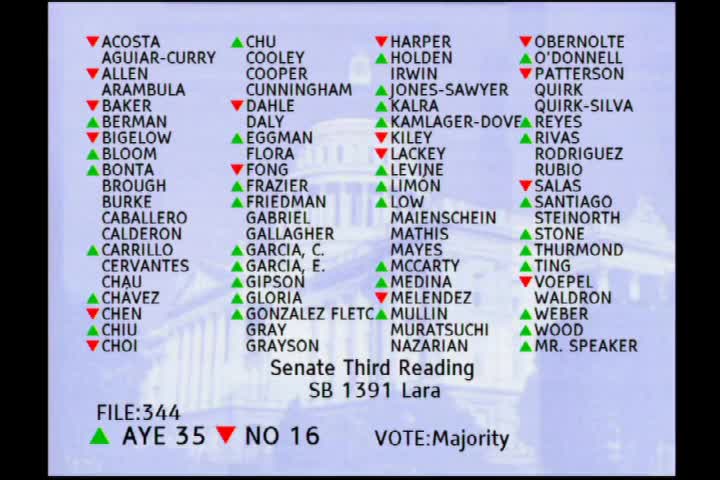 1MIN
Assembly Floor
 1H
Senate Standing Committee on Appropriations
 2MIN
Assembly Floor
 3MIN
Assembly Standing Committee on Education
Bill Author

Bill Co-Author(s):
