AB 2685: Driving privilege: minors.
- Session Year: 2017-2018
- House: Assembly
- Latest Version Date: 2018-09-23
Existing law authorizes the juvenile court to suspend or order a delay in the issuance of the driving privilege, for one year, of a minor who is an habitual truant, as defined, or who is adjudged to be a ward of the court, as prescribed. Existing law requires the juvenile court, when determining whether to suspend or delay a minors driving privilege, to consider whether a personal or family hardship exists that requires the minor to have a drivers license for his or her own, or a member of his or her familys, employment or for medically related purposes.
This bill would repeal those provisions, and would provide that any court order to suspend, restrict, or delay a minors driving privilege issued pursuant to those provisions prior to January 1, 2019, shall remain in full effect, as specified.
Existing law authorizes the juvenile court to suspend or order a delay in the issuance of the driving privilege, for one year, of a minor who is an habitual truant, as defined, or who is adjudged to be a ward of the court, as prescribed. Existing law requires the juvenile court, when determining whether to suspend or delay a minors driving privilege, to consider whether a personal or family hardship exists that requires the minor to have a drivers license for his or her own, or a member of his or her familys, employment or for medically related purposes.
This bill would repeal those provisions. provisions, and would provide that any court order to suspend, restrict, or delay a minors driving privilege issued pursuant to those provisions prior to January 1, 2019, shall remain in full effect, as specified.
Existing law authorizes the juvenile court to suspend or order a delay in the issuance of the driving privilege, for one year, of a minor who is an habitual truant, as defined, or who is adjudged to be a ward of the court, as prescribed. Existing law requires the juvenile court, when determining whether to suspend or delay a minors driving privilege, to consider whether a personal or family hardship exists that requires the minor to have a drivers license for his or her own, or a member of his or her familys, employment or for medically related purposes.
This bill would also require the juvenile court, when considering whether to suspend or delay a minors driving privilege to consider whether the minor has employment or education obligations that require the minor to have a drivers license. The bill would authorize the juvenile court, instead of suspending or delaying the minors driving privilege, to restrict the minors driving privilege, for not more than 6 months, to necessary travel to and from the minors place of employment or education. Under the bill, if the juvenile court finds that driving a motor vehicle is necessary for the minor to perform his or her employment duties, the court may allow the minor to drive in that scope of employment.This bill would repeal those provisions.
Existing law authorizes the juvenile court to suspend or order a delay in the issuance of the driving privilege, for one year, of a minor who is an habitual truant, as defined, or who is adjudged to be a ward of the court, as prescribed. Existing law requires the juvenile court, when determining whether to suspend or delay a minors driving privilege, to consider whether a personal or family hardship exists that requires the minor to have a drivers license for his or her own, or a member of his or her familys, employment or for medically related purposes.
This bill would also require the juvenile court, when considering whether to suspend or delay a minors driving privilege to consider whether the minor has employment or education obligations that require the minor to have a drivers license. The bill would authorize the juvenile court, instead of suspending or delaying the minors driving privilege, to restrict the minors driving privilege, for not more than 6 months, to necessary travel to and from the minors place of employment or education. Under the bill, if the juvenile court finds that driving a motor vehicle is necessary for the minor to perform his or her employment duties, the court may allow the minor to drive in that scope of employment.
Existing law requires specified application fees paid to the Department of Motor Vehicles to be returned to the applicant if the application is refused or rejected.This bill would make technical, nonsubstantive changes to that provision.Existing law requires specified application fees paid to the Department of Motor Vehicles to be returned to the applicant if the application is refused or rejected.
This bill would make technical, nonsubstantive changes to that provision.
Any court order to suspend, restrict, or delay a minors driving privilege issued pursuant to former Section 13202.7 of the Vehicle Code prior to January 1, 2019, shall remain in full effect in accordance with the terms of the order after the repeal of that section pursuant to this act.
Any court order to suspend, restrict, or delay a minors driving privilege issued pursuant to former Section 13202.7 of the Vehicle Code prior to January 1, 2019, shall remain in full effect in accordance with the terms of the order after the repeal of that section pursuant to this act.
Any court order to suspend, restrict, or delay a minors driving privilege issued pursuant to former Section 13202.7 of the Vehicle Code prior to January 1, 2019, shall remain in full effect in accordance with the terms of the order after the repeal of that section pursuant to this act.
(a)Any minor under the age of 18 years, but 13 years of age or older, who is an habitual truant within the meaning of Section 48262 of the Education Code, or who is adjudged by the juvenile court to be a ward of the court under subdivision (b) of Section 601 of the Welfare and Institutions Code, may have his or her driving privilege suspended for one year by the court. If the minor does not yet have the privilege to drive, the court may order the department to delay issuing the privilege to drive for one year subsequent to the time the person becomes legally eligible to drive. However, if there is no further truancy in the 12-month period, the court, upon petition of the person affected, may modify the order imposing the delay of the driving privilege. For each successive time the minor is found to be an habitual truant, the court may suspend the minors driving privilege for a minor possessing a drivers license, or delay the eligibility for the driving privilege for those not in possession of a drivers license, for one additional year.
(b)Whenever the juvenile court suspends a minors driving privilege pursuant to subdivision (a), the court may require all drivers licenses held by the minor to be surrendered to the court. The court shall, within 10 days following the surrender of the license, transmit a certified abstract of the findings, together with any drivers licenses surrendered, to the department.
(c)When the juvenile court is considering suspending or delaying a minors driving privilege pursuant to subdivision (a), the court shall consider whether a personal or family hardship exists that requires the minor to have a drivers license for his or her own, or a member of his or her familys, employment or for medically related purposes.
(d)When the juvenile court is considering suspending or delaying a minors driving privilege pursuant to subdivision (a), the court shall consider whether the minor has employment or education obligations that require the minor to have a drivers license.
(1)Instead of ordering the suspension or delay of a minors driving privilege, a court may restrict the minors driving privilege, for not more than 6 months, to necessary travel to and from the minors place of employment or education.
(2)If the juvenile court finds that driving a motor vehicle is necessary for the minor to perform his or her employment duties, the court may allow the minor to drive in that scope of employment.
(3)The juvenile court may also consider whether a family hardship exists that requires the minor to have a drivers license for his or her familys employment.
(d)(e)The suspension, restriction, or delay of a minors driving privilege pursuant to this section shall be in addition to any other penalty imposed by law on the minor.
SECTION 1.Section 42230 of the Vehicle Code is amended to read:42230.Whenever an application made under this code is accompanied by any fee, except an application for an occupational license accompanied by a fee as specified in Section 9262, 9262.5, 11309, or 11820, or an application for a duplicate drivers license, as required by law, and the application is refused or rejected, the fees shall be returned to the applicant. Whenever an application is made for the first set of special plates under subdivision (a) of Section 9262 and the application is refused or rejected, the fee for the special plates only shall be returned to the applicant or, when application is made for the first set of special plates under subdivision (1) of Section 9264 and the application is refused or rejected, the fee for the special plates shall be returned to the applicant.Whenever any an application made under this code is accompanied by any fee, except an application for an occupational license accompanied by a fee as specified in Section 9262, 9262.5, 11309, or 11820, or an application for a duplicate drivers license, as required by law, and the application is refused or rejected, the fees shall be returned to the applicant, except that, whenever any applicant. Whenever an application is made for the first set of special plates under subdivision (a) of Section 9262 and the application is refused or rejected, the fee for the special plates only shall be returned to the applicant or, when application is made for the first set of special plates under subdivision (1) of Section 9264 and the application is refused or rejected, the fee for the special plates shall be returned to the applicant.
|
Date
|
Status
|
|---|---|
| Sep 23, 2018 | Chaptered by Secretary of State - Chapter 717, Statutes of 2018. |
| Sep 23, 2018 | Approved by the Governor. |
| Sep 7, 2018 | Enrolled and presented to the Governor at 2:30 p.m. |
| Aug 29, 2018 | Assembly Rule 77 suspended. |
| Aug 28, 2018 | In Assembly. Concurrence in Senate amendments pending. May be considered on or after August 30 pursuant to Assembly Rule 77. |
| Aug 28, 2018 | Read third time. Passed. Ordered to the Assembly. |
| Aug 24, 2018 | Read second time. Ordered to third reading. |
| Aug 23, 2018 | Read third time and amended. Ordered to second reading. |
| Aug 6, 2018 | From Consent Calendar. |
| Jul 3, 2018 | Read second time. Ordered to Consent Calendar. |
| Jul 2, 2018 | From committee: Be ordered to second reading file pursuant to Senate Rule 28.8 and ordered to Consent Calendar. |
| Jun 20, 2018 | From committee: Do pass and re-refer to Com. on APPR. with recommendation: To Consent Calendar. (Ayes 7. Noes 0.) (June 19). Re-referred to Com. on APPR. |
| May 30, 2018 | Referred to Com. on PUB. S. |
| May 17, 2018 | In Senate. Read first time. To Com. on RLS. for assignment. |
| May 17, 2018 | Read third time. Passed. Ordered to the Senate. |
| May 10, 2018 | Read second time. Ordered to Consent Calendar. |
| May 9, 2018 | From committee: Do pass. To Consent Calendar. (Ayes 16. Noes 0.) (May 9). |
| Apr 24, 2018 | From committee: Do pass and re-refer to Com. on APPR. with recommendation: To Consent Calendar. (Ayes 14. Noes 0.) (April 23). Re-referred to Com. on APPR. |
| Apr 16, 2018 | Re-referred to Com. on TRANS. |
| Apr 12, 2018 | From committee chair, with author's amendments: Amend, and re-refer to Com. on TRANS. Read second time and amended. |
| Apr 10, 2018 | From committee: Do pass and re-refer to Com. on TRANS. with recommendation: To Consent Calendar. (Ayes 7. Noes 0.) (April 10). Re-referred to Com. on TRANS. |
| Mar 20, 2018 | Re-referred to Com. on PUB. S. |
| Mar 19, 2018 | From committee chair, with author's amendments: Amend, and re-refer to Com. on PUB. S. Read second time and amended. |
| Mar 19, 2018 | Referred to Coms. on PUB. S. and TRANS. |
| Feb 16, 2018 | From printer. May be heard in committee March 18. |
| Feb 15, 2018 | Read first time. To print. |
|
Date
|
Description
|
Location
|
Votes
|
|
|---|---|---|---|---|
| Aug 29, 2018 | AB 2685 LACKEY Concurrence in Senate Amendments | Assembly Floor |
Passed |
|
| Aug 28, 2018 | Assembly 3rd Reading AB2685 Lackey By Vidak | Senate Floor |
Passed |
|
| Jun 19, 2018 | Do pass, but first be re-referred to the Committee on [Appropriations] with the recommendation: To Consent Calendar | Senate Standing Committee on Public Safety |
Passed |
|
| May 17, 2018 | AB 2685 LACKEY Consent Calendar Second Day Regular Session | Assembly Floor |
Passed |
|
| May 9, 2018 | Do pass. To Consent Calendar. | Assembly Standing Committee on Appropriations |
Passed |
|
| Apr 23, 2018 | Do pass and be re-referred to the Committee on [Appropriations] with recommendation: To Consent Calendar | Assembly Standing Committee on Transportation |
Passed |
|
| Apr 10, 2018 | Do pass and be re-referred to the Committee on [Transportation] with recommendation: To Consent Calendar | Assembly Standing Committee on Public Safety |
Passed |
This list shows positions taken on this bill by organizations on the date displayed, which is linked to the original source.
Positions by individuals are not included.
|
Organization
|
Position
|
Date
|
|---|---|---|
| ACLU of California | ** Support | Aug 24, 2018 |
| Advancing Communities Together | ** Support | Aug 24, 2018 |
| Advancing Communities Together, Antelope Valley Youthbuild | ** Support | Apr 9, 2018 |
| Advancing Communities Together-Antelope Valley | ** Support | Apr 20, 2018 |
| California Public Defenders Association | ** Support | Aug 24, 2018 |
CONCURRENCE IN SENATE AMENDMENTS
CSA1 Bill Id:AB 2685
Author:(Lackey)
As Amended Ver:August 23, 2018
Majority vote
ASSEMBLY: | 73-0 | (May 17, 2018) | SENATE: | 39-0 | (August 28, 2018) |
Original Committee Reference: PUB. S.
SUMMARY: Repeals a provision of law allowing a juvenile court to suspend or delay the issuance of a driver's license of a habitual truant or ward of the state for up to one year.
The Senate amendments provide that any order to suspend, restrict, or delay the issuance of a driver's license of a habitual truant or ward of the state that was entered prior to this bill taking effect shall remain in full effect in accordance with its terms.
EXISTING LAW:
- Allows a juvenile court to suspend or delay the driver's license of a habitual truant or a ward of the state for up to one year and modify the suspension or delay by either reducing the one year period or by imposing an additional year of suspension or delay.
- Allows a juvenile court to order a minor to surrender his or her driver's license.
- Requires a juvenile court to consider personal or family hardship due to medical needs when deciding whether to suspend or delay the minor's driving privilege.
- Allows the juvenile court to suspend or delay the driving privilege of a minor who commits certain offenses including those involving a concealable firearm, alcohol or controlled substances, and vandalism.
AS PASSED BY THE ASSEMBLY, this bill repealed a provision of law allowing a juvenile court to suspend or delay the driver's license of a habitual truant or ward of the state for up to one year.
FISCAL EFFECT: According to the Senate Appropriations Committee, pursuant to Senate Rule 28.8, negligible state costs.
COMMENTS: According to the author, ''By allowing truants to maintain and use their licenses to travel to and from work while banning all recreational travel, AB 2685 acts to protect the hard working spirit of our youth while continuing to emphasize the importance of education. As truancy rates have been linked to lower income families, loss of access to the labor force disproportionately affects underprivileged families, and the students within them, who rely on the income provided. This bill would prevent low income families from losing much needed income without weakening the juvenile court's ability to affect a positive influence.''
Analysis Prepared by: Matthew Fleming / PUB. S. / (916) 319-3744 FN: 0004862
Office of Senate Floor Analyses (916) 651-1520 Fax: (916) 327-4478 | AB |
THIRD READING
Bill No: AB 2685
Amended: 8/23/18 in Senate
SENATE PUBLIC SAFETY COMMITTEE: 7-0, 6/19/18
AYES: Skinner, Anderson, Bradford, Jackson, Mitchell, Stone, Wiener
SENATE APPROPRIATIONS COMMITTEE: Senate Rule 28.8
ASSEMBLY FLOOR: 73-0, 5/17/18 (Consent) - See last page for vote
SOURCE: Advancing Communities Together
DIGEST:
This bill repeals a provision of law allowing a juvenile court to suspend or delay the driver’s license of a habitual truant for up to one year.
Senate Floor Amendments of 8/23/18 provide that any court order to suspend, restrict, or delay a minor’s driving privilege issued prior to January 1, 2019, will remain in full effect in accordance with the terms of the order after the repeal of Vehicle Code Section 13202.7.
Existing law:
- Provides that a student subject to compulsory full-time education or to compulsory continuation education who is absent from school without a valid excuse three full days in one school year or tardy or absent for more than a 30-minute period during the school day without a valid excuse on three occasions in one school year, or any combination thereof, shall be classified as a truant and shall be reported to the attendance supervisor or to the superintendent of the school district. (Ed. Code § 48260, subd. (a).)
- Defines “habitual truant” as a student who has been reported as a truant three or more times per school year, provided that no student shall be deemed a habitual truant unless an appropriate district officer or employee has made a conscientious effort to hold at least one conference with a parent or guardian of the student as well as the student, after the filing of either of the reports required by law. Defines “conscientious effort” as attempting to communicate with the parents of the student at least once using the most cost-effective method possible, which may include e-mail or a phone call. (Ed. Code § 48262.)
- Provides that if a minor has four or more truancies within one school year or a school attendance review board or probation officer determines that the available public and private services are insufficient or inappropriate to correct the habitual truancy of the minor, or to correct the minor’s persistent or habitual refusal to obey the reasonable and proper orders or directions of school authorities, or if the minor fails to respond to directives of a school attendance review board or probation officer or to services provided, the minor is then within the jurisdiction of the juvenile court which may adjudge the minor to be a ward of the court. (Welf. & Inst. Code § 601, subd. (b).)
- Allows a juvenile court to suspend the driver’s license of a habitual truant or a ward of the state for up to one year. For minor’s not yet eligible to drive, allows the court to order the California Department of Motor Vehicles to delay issuing a driver’s license for one year subsequent to the time the person becomes legally eligible to drive. Provides that if there is no further truancy in the 12-month period, the court, upon petition of the person affected, may modify the order imposing the delay of the driving privilege. (Veh. Code § 13202.7, subd. (a).)
- Allows the court to suspend the minor’s driving privilege for a minor possessing a driver’s license, or delay the eligibility for the driving privilege for those not in possession of a driver’s license, for one additional year, for each successive time the minor is found to be a habitual truant. (Veh. Code § 13202.7, subd. (a).)
- Allows a juvenile court to order a minor to surrender his or her driver’s license. (Veh. Code § 13202.7, subd. (b).)
- Provides that when the juvenile court is considering suspending or delaying a minor’s driving privilege, the court must consider whether a personal or family hardship exists that requires the minor to have a driver’s license for his or her own, or a member of his or her family’s, employment or for medically related purposes. (Veh. Code § 13202.7, subd. (c).)
- Allows the juvenile court to suspend or delay the driving privilege of a minor who commits certain offenses, including those involving a concealable firearm, alcohol or controlled substances, and vandalism. (Veh. Code §§ 13202.4-13202.6.)
This bill repeals the provisions of law that allow a juvenile court to suspend or delay the driver’s license of a habitual truant for up to one year.
Background
Vehicle Code Section 13202.7 authorizes a juvenile court to suspend or delay the driver’s license of a habitual truant or ward of the state for up to one year. This code section was last amended in 1994 by the enactment of SB 1728 (Hughes, Chapter 1023, Statutes of 1994). SB 1728 amended several other code sections pertaining to truancy, and the purpose of the bill was to “deter habitual truancy.” (Assem. Com. on Education, Analysis of Sen. Bill No. 1728 (1993-1994 Reg. Sess.) as amended Aug. 19, 1994.)
This bill repeals Vehicle Code Section 13202.7, eliminating the juvenile court’s authority to suspend or delay the driver’s license of a minor based on the minor’s status as a habitual truant.
FISCAL EFFECT: Appropriation: Fiscal Com.: Local:
Advancing Communities Together (source)
ACLU of California
California Public Defenders Association
OPPOSITION: (Verified 8/22/18)
None received
ASSEMBLY FLOOR: 73-0, 5/17/18
AYES: Acosta, Aguiar-Curry, Travis Allen, Arambula, Baker, Berman, Bigelow, Bloom, Bonta, Brough, Burke, Caballero, Calderon, Carrillo, Cervantes, Chau, Chávez, Chen, Chiu, Choi, Chu, Cooley, Cooper, Cunningham, Dahle, Daly, Eggman, Flora, Fong, Frazier, Friedman, Gallagher, Eduardo Garcia, Gipson, Gloria, Gonzalez Fletcher, Gray, Grayson, Harper, Holden, Irwin, Jones-Sawyer, Kalra, Kamlager-Dove, Kiley, Lackey, Levine, Limón, Low, Maienschein, Mathis, Mayes, McCarty, Medina, Mullin, Nazarian, Obernolte, O'Donnell, Patterson, Quirk, Quirk-Silva, Reyes, Rodriguez, Rubio, Salas, Mark Stone, Thurmond, Ting, Voepel, Waldron, Weber, Wood, Rendon
NO VOTE RECORDED: Cristina Garcia, Melendez, Muratsuchi, Santiago, Steinorth
8/24/18 14:45:16
**** END ****
Office of Senate Floor Analyses (916) 651-1520 Fax: (916) 327-4478 | AB |
THIRD READING
Bill No: AB 2685
:
SENATE PUBLIC SAFETY COMMITTEE: 7-0, 6/19/18
AYES: Skinner, Anderson, Bradford, Jackson, Mitchell, Stone, Wiener
SENATE APPROPRIATIONS COMMITTEE: Senate Rule 28.8
ASSEMBLY FLOOR: 73-0, 5/17/18 (Consent) - See last page for vote
SOURCE: Advancing Communities Together
DIGEST:
This bill repeals a provision of law allowing a juvenile court to suspend or delay the driver’s license of a habitual truant for up to one year.
Existing law:
- Provides that a student subject to compulsory full-time education or to compulsory continuation education who is absent from school without a valid excuse three full days in one school year or tardy or absent for more than a 30-minute period during the school day without a valid excuse on three occasions in one school year, or any combination thereof, shall be classified as a truant and shall be reported to the attendance supervisor or to the superintendent of the school district. (Ed. Code § 48260, subd. (a).)
- Defines “habitual truant” as a student who has been reported as a truant three or more times per school year, provided that no student shall be deemed a habitual truant unless an appropriate district officer or employee has made a conscientious effort to hold at least one conference with a parent or guardian of the student as well as the student, after the filing of either of the reports required by law. Defines “conscientious effort” as attempting to communicate with the parents of the student at least once using the most cost-effective method possible, which may include e-mail or a phone call. (Ed. Code § 48262.)
- Provides that if a minor has four or more truancies within one school year or a school attendance review board or probation officer determines that the available public and private services are insufficient or inappropriate to correct the habitual truancy of the minor, or to correct the minor’s persistent or habitual refusal to obey the reasonable and proper orders or directions of school authorities, or if the minor fails to respond to directives of a school attendance review board or probation officer or to services provided, the minor is then within the jurisdiction of the juvenile court which may adjudge the minor to be a ward of the court. (Welf. & Inst. Code § 601, subd. (b).)
- Allows a juvenile court to suspend the driver’s license of a habitual truant or a ward of the state for up to one year. For minor’s not yet eligible to drive, allows the court to order the California Department of Motor Vehicles to delay issuing a driver’s license for one year subsequent to the time the person becomes legally eligible to drive. Provides that if there is no further truancy in the 12-month period, the court, upon petition of the person affected, may modify the order imposing the delay of the driving privilege. (Veh. Code § 13202.7, subd. (a).)
- Allows the court to suspend the minor’s driving privilege for a minor possessing a driver’s license, or delay the eligibility for the driving privilege for those not in possession of a driver’s license, for one additional year, for each successive time the minor is found to be a habitual truant. (Veh. Code § 13202.7, subd. (a).)
- Allows a juvenile court to order a minor to surrender his or her driver’s license. (Veh. Code § 13202.7, subd. (b).)
- Provides that when the juvenile court is considering suspending or delaying a minor’s driving privilege, the court must consider whether a personal or family hardship exists that requires the minor to have a driver’s license for his or her own, or a member of his or her family’s, employment or for medically related purposes. (Veh. Code § 13202.7, subd. (c).)
- Allows the juvenile court to suspend or delay the driving privilege of a minor who commits certain offenses, including those involving a concealable firearm, alcohol or controlled substances, and vandalism. (Veh. Code §§ 13202.4-13202.6.)
This bill repeals the provisions of law that allow a juvenile court to suspend or delay the driver’s license of a habitual truant for up to one year.
Background
Vehicle Code Section 13202.7 authorizes a juvenile court to suspend or delay the driver’s license of a habitual truant or ward of the state for up to one year. This code section was last amended in 1994 by the enactment of SB 1728 (Hughes, Chapter 1023, Statutes of 1994). SB 1728 amended several other code sections pertaining to truancy, and the purpose of the bill was to “deter habitual truancy.” (Assem. Com. on Education, Analysis of Sen. Bill No. 1728 (1993-1994 Reg. Sess.) as amended Aug. 19, 1994.)
This bill repeals Vehicle Code Section 13202.7, eliminating the juvenile court’s authority to suspend or delay the driver’s license of a minor based on the minor’s status as a habitual truant.
FISCAL EFFECT: Appropriation: Fiscal Com.: Local:
Advancing Communities Together (source)
ACLU of California
California Public Defenders Association
None received
ASSEMBLY FLOOR: 73-0, 5/17/18
AYES: Acosta, Aguiar-Curry, Travis Allen, Arambula, Baker, Berman, Bigelow, Bloom, Bonta, Brough, Burke, Caballero, Calderon, Carrillo, Cervantes, Chau, Chávez, Chen, Chiu, Choi, Chu, Cooley, Cooper, Cunningham, Dahle, Daly, Eggman, Flora, Fong, Frazier, Friedman, Gallagher, Eduardo Garcia, Gipson, Gloria, Gonzalez Fletcher, Gray, Grayson, Harper, Holden, Irwin, Jones-Sawyer, Kalra, Kamlager-Dove, Kiley, Lackey, Levine, Limón, Low, Maienschein, Mathis, Mayes, McCarty, Medina, Mullin, Nazarian, Obernolte, O'Donnell, Patterson, Quirk, Quirk-Silva, Reyes, Rodriguez, Rubio, Salas, Mark Stone, Thurmond, Ting, Voepel, Waldron, Weber, Wood, Rendon
NO VOTE RECORDED: Cristina Garcia, Melendez, Muratsuchi, Santiago, Steinorth
8/8/18 9:51:26
**** END ****
SENATE COMMITTEE ON PUBLIC SAFETY
Senator Nancy Skinner, Chair
2017 - 2018 Regular
Bill No: AB 2685 Hearing Date: June 19, 2018
Author: | Lackey | ||
Version: | April 12, 2018 | ||
Urgency: | No | Fiscal: | Yes |
Consultant: | SJ | ||
Subject: Driving Privilege: Minors
HISTORY
Source: Advancing Communities Together
Prior Legislation: SB 1728 (Hughes), Ch. 1023, Stats. of 1994
Support: ACLU of California; California Public Defenders Association
Opposition: None known
Assembly Floor Vote: 73 - 0
PURPOSE
The purpose of this bill is to repeal a provision of law allowing a juvenile court to suspend or delay the driver’s license of a habitual truant for up to one year.
Existing law provides that a student subject to compulsory full-time education or to compulsory continuation education who is absent from school without a valid excuse three full days in one school year or tardy or absent for more than a 30-minute period during the schoolday without a valid excuse on three occasions in one school year, or any combination thereof, shall be classified as a truant and shall be reported to the attendance supervisor or to the superintendent of the school district. (Ed. Code, § 48260, subd. (a).)
Existing law defines “habitual truant” as a student who has been reported as a truant three or more times per school year, provided that no student shall be deemed a habitual truant unless an appropriate district officer or employee has made a conscientious effort to hold at least one conference with a parent or guardian of the student as well as the student, after the filing of either of the reports required by law. Defines “conscientious effort” as attempting to communicate with the parents of the student at least once using the most cost-effective method possible, which may include e-mail or a phone call. (Ed. Code, § 48262.)
Existing law provides that if a minor has four or more truancies within one school year or a school attendance review board or probation officer determines that the available public and private services are insufficient or inappropriate to correct the habitual truancy of the minor, or to correct the minor’s persistent or habitual refusal to obey the reasonable and proper orders or directions of school authorities, or if the minor fails to respond to directives of a school attendance review board or probation officer or to services provided, the minor is then within the jurisdiction of the juvenile court which may adjudge the minor to be a ward of the court. (Welf. & Inst. Code, § 601, subd. (b).)
Existing law allows a juvenile court to suspend the driver’s license of a habitual truant or a ward of the state for up to one year. For minor’s not yet eligible to drive, allows the court to order the California Department of Motor Vehicles (DMV) to delay issuing a driver’s license for one year subsequent to the time the person becomes legally eligible to drive. Provides that if there is no further truancy in the 12-month period, the court, upon petition of the person affected, may modify the order imposing the delay of the driving privilege. (Veh. Code, § 13202.7, subd. (a).)
Existing law allows the court to suspend the minor’s driving privilege for a minor possessing a driver’s license, or delay the eligibility for the driving privilege for those not in possession of a driver’s license, for one additional year, for each successive time the minor is found to be a habitual truant. (Veh. Code, § 13202.7, subd. (a).)
Existing law allows a juvenile court to order a minor to surrender his or her driver’s license. (Veh. Code, § 13202.7, subd. (b).)
Existing law provides that when the juvenile court is considering suspending or delaying a minor’s driving privilege, the court must consider whether a personal or family hardship exists that requires the minor to have a driver’s license for his or her own, or a member of his or her family’s, employment or for medically related purposes. (Veh. Code, § 13202.7, subd. (c).)
Existing law allows the juvenile court to suspend or delay the driving privilege of a minor who commits certain offenses, including those involving a concealable firearm, alcohol or controlled substances, and vandalism. (Veh. Code, §§ 13202.4-13202.6.)
This bill repeals the provisions of law that allow a juvenile court to suspend or delay the driver’s license of a habitual truant for up to one year.
COMMENTS
- Need for This Bill
According to the author:
AB 2685 acts to protect the hard working spirit of our youth while continuing to emphasize the importance of education. As truancy rates have been linked to lower income families, loss of access to the labor force disproportionately affects underprivileged families, and the students within them, who rely on the income provided. This bill would prevent low income families from losing much needed income without weakening the juvenile court’s ability to affect a positive influence.
- Background
Vehicle Code section 13202.7 authorizes a juvenile court to suspend or delay the driver’s license of a habitual truant or ward of the state for up to one year. This code section was last amended in 1994 by the enactment of SB 1728 (Hughes, Chapter 1023, Statutes of 1994). SB 1728 amended several other code sections pertaining to truancy, and the purpose of the bill was to “deter habitual truancy.” (Assem. Com. on Education, Analysis of Sen. Bill No. 1728 (1993-1994 Reg. Sess.) as amended Aug. 19, 1994.)
This bill would repeal Vehicle Code section 13202.7, eliminating the juvenile court’s authority to suspend or delay the driver’s license of a minor based on the minor’s status as a habitual truant.
- Argument in Support
The ACLU writes:
California law provides for the suspension of driving privileges as a consequence for habitual truancy. As truancy rates have been linked to lower income families, this punishment has a disproportionate impact on lower income families who rely on youth family members’ economic earnings to pay for household necessities.
This punishment also hinders educational advancements for youth who do not have access to reliable public transportation or school bus options if their driver’s license is suspended. Unlike many other states, California does not guarantee school bus transportation to students who live beyond walking distance from school. Current funding for school buses is insufficient, and many districts have significantly reduced or eliminated busing except for special education students. . . .
AB 2685 helps prevent low income families from being driven further into poverty and reduces barriers to getting to and from school and work.
-- END --
Date of Hearing: May 9, 2018
ASSEMBLY COMMITTEE ON APPROPRIATIONS
Lorena Gonzalez Fletcher, Chair
ABPCA Bill Id:AB 2685
Author:(Lackey) – As Amended Ver:April 12, 2018
Policy Committee: | Public Safety | Vote: | 7 - 0 |
Transportation | 14 - 0 | ||
|
|
Urgency: No State Mandated Local Program: No Reimbursable: No
SUMMARY:
This bill repeals a provision of law that allows a juvenile court to suspend or delay the driver’s license of a habitual truant or ward of the state for up to one year.
FISCAL EFFECT:
Minor costs to the Department of Motor Vehicles and the courts.
COMMENTS:
- Background. Last year, 380 students had their driver’s licenses suspended for being habitually truant. That is a small fraction of the hundreds of thousands of students that are truant every year. More than 744,000 students, or one in five, were truant in the 2013-14 school year. Suspending a student’s driver’s license is generally one of the last steps taken for a student who is habitually truant. The third time a truancy report is required, the student is classified as habitually truant and will have to participate in a truancy mediation program. The fourth time a truancy report is required, the student is placed within the jurisdiction of a juvenile court. A court can require the student to participate in at least 20 hours, but not more than 40 hours, of community service. The court may also assess a $100 fine to the student in which the parents are jointly liable, and could require the student to attend a court-approved truancy prevention program. The court can also suspend the student’s driver’s license.
- Purpose. According to the author:
By allowing truants to maintain and use their licenses to travel to and from work while banning all recreational travel, AB 2685 acts to protect the hard working spirit of our youth while continuing to emphasize the importance of education. As truancy rates have been linked to lower income families, loss of access to the labor force disproportionately affects underprivileged families, and the students within them, who rely on the income provided. This bill would prevent low income families from losing much needed income without weakening the juvenile court’s ability to affect a positive influence.
Analysis Prepared by: Jessica Peters / APPR. / (916) 319-2081
Date of Hearing: April 23, 2018
ASSEMBLY COMMITTEE ON TRANSPORTATION
Jim Frazier, Chair
ABPCA Bill Id:AB 2685 (
Author:Lackey) – As Amended Ver:April 12, 2018
SUBJECT: Driving privilege: minors
SUMMARY: Repeals a provision of law allowing a juvenile court to suspend or delay the driver’s license of a habitual truant or ward of the state for up to one year.
EXISTING LAW:
- Allows a juvenile court to suspend or delay the driver’s license of a habitual truant or a ward of the state for up to one year and modify the suspension or delay by either reducing the one year period or by imposing an additional year of suspension or delay.
- Allows a juvenile court to order a minor to surrender his or her driver’s license.
- Requires a juvenile court to consider personal or family hardship due to medical needs when deciding whether to suspend or delay the minor’s driving privilege.
- Allows the juvenile court to suspend or delay the driving privilege of a minor who commits certain offenses, including those involving a concealed firearm, alcohol or controlled substances, and vandalism.
FISCAL EFFECT: Unknown
COMMENTS: Last year, 380 students had their license suspended for being habitually truant. That is a small fraction of the hundreds of thousands of students that are truant every year. More than 744,000 students, or one in five, were truant in the 2013-14 school year.
Suspending a student’s driver’s license is generally one of the last steps taken for a student who is habitually truant. Prior to getting to that point, the student must have gotten warnings from law enforcement, and be required to take makeup classes on the weekend or after school. The third time a truancy report is required, the student is classified as habitually truant, and will have to partake in a truancy mediation program. The fourth time a truancy report is required and the student is placed within the jurisdiction of a juvenile court. A court can require the student to participate in at least 20 hours, but not more than 40 hours, of community service. The court may also assess a $100 fine to the student in which the parents are jointly liable, and could require the student to attend a court approved truancy prevention program. The court can also suspend the student’s driver’s license.
The American Civil Liberties Union of California, writing in support of the bill, notes that, “As truancy rates have been linked to lower income families, this punishment has a disproportionate impact on lower income families who rely on youth family members’ economic earnings to pay for household necessities. This punishment also hinders educational advancements for youth who do not have access to reliable public transportation or school bus options if their driver’s license is suspended. Unlike many other states, California does not guarantee school bus transportation to students who live beyond walking distance from school. Current funding for school buses is insufficient, and many districts have significantly reduced or eliminated busing except for special education students. A survey of Oakland youth, for example, found that 61% of students reported that they sometimes use their lunch money to ride the bus.”
In fact a report issued by the state Attorney General’s office found that around 90% of the students with severe attendance problems were from low income households.
Double Referral: This bill passed out of the Assembly Public Safety Committee on April 10, 2018, with a 7-0 vote.
Committee Comments: While the state grant’s courts the ability to suspend licenses for something completely unrelated to driving, last year it removed the authority for the judiciary to suspend driver’s licenses for failing to pay traffic tickets out of recognition of the harm it may cause for low income families. The legislature may want to consider whether it should continue to allow for the suspension of driver’s licenses for issues unrelated to public safety.
REGISTERED SUPPORT / OPPOSITION:
Support
Advancing Communities Together-Antelope Valley (Sponsor)
American Civil Liberties Union of California
Opposition
None on file
Analysis Prepared by: David Sforza / TRANS. / (916) 319-2093
Date of Hearing:
Counsel: Matthew Fleming
ASSEMBLY COMMITTEE ON PUBLIC SAFETY
Reginald Byron Jones-Sawyer, Sr., Chair
ABPCA Bill Id:AB 2685
Author:(Lackey) – As Amended Ver:March 19, 2018
SUMMARY:
Requires juvenile courts to consider special circumstances such as employment, education obligations, and employment hardship for family members prior to suspending or delaying the driver’s license of a habitual truant or ward of the state. Specifically, this bill:
- Requires the juvenile court to consider whether the minor has employment or education obligations that require a driver’s license prior to suspending or delaying the minor’s driving privilege.
- Allows the juvenile court to restrict the minor’s driving privilege, rather than suspending or delaying it, to travel which is necessary to go to from the minor’s place of employment and education for up to six months.
- Provides that if the juvenile court finds that driving a motor vehicle is necessary for the minor to perform his or her employment duties, the court may allow the minor to drive in that scope of employment.
- Allows the juvenile court to consider whether a family hardship exists that would require the juvenile to have a driver’s license for his or her family’s employment.
EXISTING LAW:
- Allows a juvenile court to suspend or delay the driver’s license of a habitual truant or a ward of the state for up to one year and modify the suspension or delay by either reducing the one year period or by imposing an additional year of suspension or delay. (Veh. Code, § 13202.7 subd. (a).)
- Allows a juvenile court to order a minor to surrender his or her driver’s license. (Veh. Code, § 13202.7 subd. (b).)
- Requires a juvenile court to consider personal or family hardship due to medical needs when deciding whether to suspend or delay the minor’s driving privilege. (Veh. Code, § 13202.7 subd. (c).)
- Allows the juvenile court to suspend or delay the driving privilege of a minor who commits certain offenses including those involving a concealable firearm, alcohol or controlled substances, and vandalism. (Veh. Code, §§ 13202.4 – 13202.6.)
FISCAL EFFECT:
Unknown
COMMENTS:
- Author's Statement: According to the author, “By allowing truants to maintain and use their licenses to travel to and from work while banning all recreational travel, AB 2685 acts to protect the hard working spirit of our youth while continuing to emphasize the importance of education. As truancy rates have been linked to lower income families, loss of access to the labor force disproportionately affects underprivileged families, and the students within them, who rely on the income provided. This bill would prevent low income families from losing much needed income without weakening the juvenile court’s ability to affect a positive influence.”
- This Bill Seeks to Provide an Additional Tool to the Juvenile Court: By allowing the juvenile court to merely restrict driving privileges rather than suspending or delaying them, this bill will aid the juvenile courts in finding the appropriate balance for truant students. While truancy may be malfeasance in many cases, it can also be a sign of a family who is struggling economically or socially. Removing the driving privilege entirely could exacerbate the truancy problem if the juvenile has no other means of transporting him or herself to school.
In addition, this bill would require juvenile courts to take certain factors into consideration prior to the suspension or delay of driving privileges. Requiring juvenile courts to take into account educational and employment consideration, in addition to medical hardship, is a minimal burden to the courts, and may provide youth with a more finely tailored adjudication that balances the reality of their home life with the need for sanctions as a result of missing school.
- Argument in Support: According to the American Civil Liberties Union: “California law provides for the suspension of driving privileges as a consequence for habitual truancy. As truancy rates have been linked to lower income families, this punishment has a disproportionate effect impact on lower income families who rely on youth family members’ economic earnings to pay for household necessities.
“This punishment also hinders educational advancements for youth who do not have access to reliable public transportation or school bus options if their driver’s license is suspended. Unlike many other states, California does not guarantee school bus transportation to students who live beyond walking distance from school. Current funding for school buses is insufficient, and many districts have significantly reduced or eliminated busing except for special education students. A survey of Oakland youth, for example, found that 61% of students reported that they sometimes use their lunch money to ride the bus.”
REGISTERED SUPPORT / OPPOSITION:
Support
Advancing Communities Together, Antelope Valley YouthBuild (Sponsor)
American Civil Liberties Union
Opposition
None
Analysis Prepared by:
Matthew Fleming / PUB. S. / (916) 319-3744
Discussed in Hearing
View Older Hearings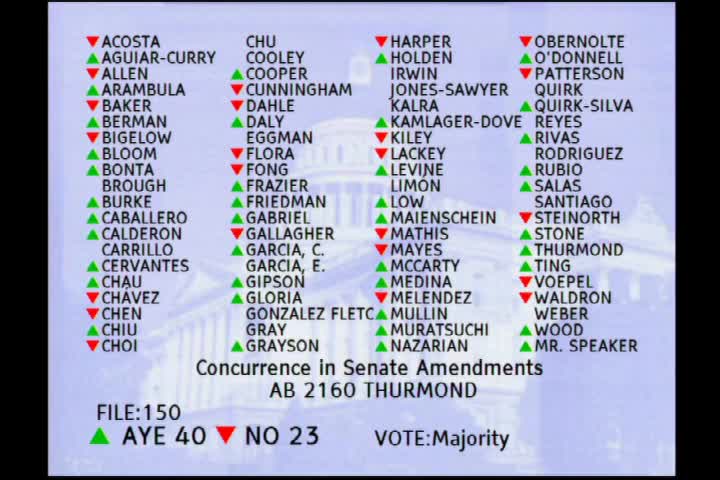
Bill Author

Bill Co-Author(s):