AB 2707: Voter information Internet Web site.
- Session Year: 2017-2018
- House: Assembly
- Latest Version Date: 2018-09-29
Existing law requires the Secretary of State to compile, publish, and distribute a roster of the State and local public officials of California, whenever an appropriation is made by the Legislature for that purpose.
This bill would require the Secretary of State to request proposals to establish an Internet Web site that displays the names and contact information, including the office phone number, email address, and office address, of each voters specified local, state, and federal elected officials, which would be displayed upon a voter submitting his or her address information on the Internet Web site. The bill would specify criteria for the Internet Web site, including limits on the cost to establish and update it. The bill would authorize the Secretary to elect not to establish the Internet Web site if he or she does not receive qualifying proposals that meet those criteria, but would require the Secretary to establish the Internet Web site if he or she determines that the Internet Web site can be established using existing personnel at a lower cost than any qualified proposal.
Existing law requires the Secretary of State to compile, publish, and distribute a roster of the State and local public officials of California, whenever an appropriation is made by the Legislature for that purpose.
This bill would require the Secretary of State to request proposals to establish an Internet Web site that displays the names and contact information, including the office phone number, email address, and office address, of each voters specified local, state, and federal elected officials, which would be displayed upon a voter submitting his or her address information on the Internet Web site. The bill would require that the Internet Web site be accessible in multiple languages, as specified. The bill would specify criteria for the Internet Web site, including limits on the cost to establish and update it. The bill would authorize the Secretary to elect not to establish the Internet Web site if he or she does not receive qualifying proposals that meet those criteria, but would require the Secretary to establish the Internet Web site if he or she determines that the Internet Web site can be established using existing personnel at a lower cost than any qualified proposal.
Existing law requires the Secretary of State to compile, publish, and distribute a roster of the State and local public officials of California, whenever an appropriation is made by the Legislature for that purpose.
This bill would require the Secretary of State to establish an Internet Web site that displays the names and contact information, including the office phone number, email address, and office address, of each voters specified local, state, and federal elected officials, which would be displayed upon a voter submitting his or her address information on the Internet Web site. The bill would require that the Internet Web site be accessible in multiple languages, as specified.
Existing law requires the Secretary of State to compile, publish, and distribute a roster of the State and local public officials of California, whenever an appropriation is made by the Legislature for that purpose.
This bill would require the Governor, through an executive department or agency of his or her choice, Secretary of State to establish an Internet Web site that displays the names and contact information, including the office phone number, email address, and office address, of each voters specified local, state, and federal elected officials, which would be displayed upon a voter submitting his or her address information on the Internet Web site. The bill would require that the Internet Web site to be accessible in multiple languages, as specified.
Existing law provides that the Secretary of State is the chief elections officer of the state and requires the Secretary of State to see that elections are efficiently conducted and that state election laws are enforced. The Secretary of State is required to post on his or her Internet Web site specified information describing, among other things, services that are available to the proponents of a proposed initiative measure and to post a certified statement of the vote from compiled election results. requires the Secretary of State to compile, publish, and distribute a roster of the State and local public officials of California, whenever an appropriation is made by the Legislature for that purpose.
This bill would require the Secretary of State, by January 1, 2020, and with the aid of the Department of Technology, Governor, through an executive department or agency of his or her choice, to establish an Internet Web site that displays the names and contact information, including the phone number, email address, and office address, of each voters specified local, state, and federal elected officials, which would be displayed upon a voter submitting his or her address information on the Internet Web site. The bill would require the Internet Web site to be accessible in multiple languages, as specified.
Existing law provides that the Secretary of State is the chief elections officer of the state and requires the Secretary of State to see that elections are efficiently conducted and that state election laws are enforced. The Secretary of State is required to post on his or her Internet Web site specified information describing, among other things, services that are available to the proponents of a proposed initiative measure and to post a certified statement of the vote from compiled election results.
This bill would require the Secretary of State, by January 1, 2020, and with the aid of the Department of Technology, to establish an Internet Web site that displays the names and contact information, including the phone number, email address, and office address, of each voters specified local, state, and federal elected officials, which would be displayed upon a voter submitting his or her address information on the Internet Web site. The bill would require the Internet Web site to be accessible in multiple languages, as specified.
(a)No later than July 1, 2019, the Secretary of State shall request proposals to establish a voter information Internet Web site for the purpose of providing a voter with information regarding the voters elected officials.
(b)The Secretarys request for proposals shall specify the following criteria for the Internet Web site:
(1)Upon a voter submitting his or her address information, the Internet Web site shall display the names and contact information, including the office telephone number, email address, and office address, of the following elected officials for the voter:
(A)United States Senators and Representative in Congress.
(B)State officers elected on a statewide basis.
(C)Member of the Senate and Member of the Assembly.
(D)Elective officers of a city, county, school district, and special district.
(2)The Internet Web site shall be accessible to voters in multiple languages, including, but not limited to, Spanish, Chinese, Korean, Vietnamese, Tagalog, and Japanese.
(3)The cost to establish the Internet Web site shall not exceed two hundred fifty thousand dollars ($250,000) and the cost to update the Internet Web site shall not exceed one hundred fifty thousand dollars ($150,000) per year.
(c)If the Secretary of State receives one or more qualifying proposals to his or her request pursuant to subdivision (a) that meet the criteria specified in subdivision (b), the Secretary shall, consistent with any method permitted by current law, including, but not limited to, the Public Contract Code, select a qualifying proposal and award a contract to establish the Internet Web site no later than July 1, 2020. If the Secretary of State does not receive qualifying proposals that meet the criteria specified in subdivision (b), the Secretary may decide to not establish the Internet Web site, in which case the Secretary shall publish the decision on the home page of the Secretarys Internet Web site no later than December 1, 2019.
(d)Notwithstanding subdivision (c), if the Secretary of State determines after receiving proposals that he or she can use existing personnel to internally develop and establish the Internet Web site at a cost lower than any qualified proposal that meets the criteria specified in subdivision (b), the Secretary shall establish the Internet Web site no later than July 1, 2020, and shall reject the proposals that he or she has received. If applicable, the Secretary shall publish the decision to internally develop the Internet Web site on the home page of the Secretarys Internet Web site no later than December 1, 2019.
(a)No later than January 1, 2020, July 1, 2019, the Secretary of State shall establish shall request proposals to establish a voter information Internet Web site for the purpose of providing a voter with information regarding the voters elected officials. Upon
(b)The Secretarys request for proposals shall specify the following criteria for the Internet Web site:
(1)Upon a voter submitting his or her address information, the Internet Web site shall display the names and contact information, including the office telephone number, email address, and office address, of the following elected officials for the voter:
(1)(A)United States Senators and Representative in Congress.
(2)(B)State officers elected on a statewide basis.
(3)(C)Member of the Senate and Member of the Assembly.
(4)(D)Elective officers of a city, county, school district, and special district.
(b)(2)The Internet Web site shall be accessible to voters in multiple languages, including, but not limited to, Spanish, Chinese, Korean, Vietnamese, Tagalog, and Japanese.
(3)The cost to establish the Internet Web site shall not exceed two hundred fifty thousand dollars ($250,000) and the cost to update the Internet Web site shall not exceed one hundred fifty thousand dollars ($150,000) per year.
(c)If the Secretary of State receives one or more qualifying proposals to his or her request pursuant to subdivision (a) that meet the criteria specified in subdivision (b), the Secretary shall, consistent with any method permitted by current law, including, but not limited to, the Public Contract Code, select a qualifying proposal and award a contract to establish the Internet Web site no later than July 1, 2020. If the Secretary of State does not receive qualifying proposals that meet the criteria specified in subdivision (b), the Secretary may decide to not establish the Internet Web site, in which case the Secretary shall publish the decision on the home page of the Secretarys Internet Web site no later than December 1, 2019.
(d)Notwithstanding subdivision (c), if the Secretary of State determines after receiving proposals that he or she can use existing personnel to internally develop and establish the Internet Web site at a cost lower than any qualified proposal that meets the criteria specified in subdivision (b), the Secretary shall establish the Internet Web site no later than July 1, 2020, and shall reject the proposals that he or she has received. If applicable, the Secretary shall publish the decision to internally develop the Internet Web site on the home page of the Secretarys Internet Web site no later than December 1, 2019.
(a)No later than January 1, 2020, the Secretary of State shall establish a voter information Internet Web site for the purpose of providing a voter with information regarding the voters elected officials. Upon a voter submitting his or her address information, the Internet Web site shall display the names and contact information, including the office telephone number, email address, and office address, of the following elected officials for the voter:
(1)United States Senators and Representative in Congress.
(2)State officers elected on a statewide basis.
(3)Member of the Senate and Member of the Assembly.
(4)Elective officers of a city, county, school district, and special district.
(5)Judge elected or reelected to a judicial office.(b)The Internet Web site shall be accessible to voters in multiple languages, including, but not limited to, Spanish, Chinese, Korean, Vietnamese, Tagalog, and Japanese.
(a)No later than January 1, 2020, the Governor shall, through an executive department or agency of his or her choice, Secretary of State shall establish a voter information Internet Web site for the purpose of providing a voter with information regarding the voters elected officials. Upon a voter submitting his or her address information, the Internet Web site shall display the names and contact information, including the office telephone number, email address, and office address, of the following elected officials for the voter:
(1)United States Senators and Representative in Congress.
(2)State officers elected on a statewide basis.
(3)Member of the Senate and Member of the Assembly.
(4)Elective officers of a city, county, school district, and special district.
(5)Judge elected or reelected to a judicial office.
(b)The Internet Web site shall be accessible to voters in multiple languages, including, but not limited to, Spanish, Chinese, Korean, Vietnamese, Tagalog, and Japanese.
(a)No later than January 1, 2020, the Governor shall, through an executive department or agency of his or her choice, establish a voter information Internet Web site for the purpose of providing a voter with information regarding the voters elected officials. Upon a voter submitting his or her address information, the Internet Web site shall display the names and contact information, including telephone number, email address, and office address, of the following elected officials for the voter:
(1)United States Senators and Representative in Congress.
(2)State officers elected on a statewide basis.
(3)Member of the Senate and Member of the Assembly.
(4)Elective officers of a city, county, school district, and special district.
(5)Judge elected or reelected to a judicial office.
(b)The Internet Web site shall be accessible to voters in multiple languages, including, but not limited to, Spanish, Chinese, Korean, Vietnamese, Tagalog, and Japanese.
SECTION 1.Section 12172.4 is added to the Government Code, to read:12172.4.(a)No later than January 1, 2020, the Secretary of State, with the aid and assistance of the Department of Technology, shall establish a voter information Internet Web site for the purpose of providing a voter with information regarding his or her elected officials. Upon a voter submitting his or her address information, the Internet Web site shall display the names and contact information, including telephone number, email address, and office address, of the following elected officials for the voter: (1)United States Senators and Representative in Congress.(2)State officers elected on a statewide basis.(3)Member of the Senate and Member of the Assembly.(4)Elective officers of a city, county, school district, and special district.(5)Judge elected or reelected to a judicial office.(b)The Internet Web site shall be accessible to voters in multiple languages, including, but not limited to, Spanish, Chinese, Korean, Vietnamese, Tagalog, and Japanese.(a)No later than January 1, 2020, the Secretary of State, with the aid and assistance of the Department of Technology, shall establish a voter information Internet Web site for the purpose of providing a voter with information regarding his or her elected officials. Upon a voter submitting his or her address information, the Internet Web site shall display the names and contact information, including telephone number, email address, and office address, of the following elected officials for the voter:
(1)United States Senators and Representative in Congress.
(2)State officers elected on a statewide basis.
(3)Member of the Senate and Member of the Assembly.
(4)Elective officers of a city, county, school district, and special district.
(5)Judge elected or reelected to a judicial office.
(b)The Internet Web site shall be accessible to voters in multiple languages, including, but not limited to, Spanish, Chinese, Korean, Vietnamese, Tagalog, and Japanese.
|
Date
|
Status
|
|---|---|
| Sep 29, 2018 | Chaptered by Secretary of State - Chapter 920, Statutes of 2018. |
| Sep 29, 2018 | Approved by the Governor. |
| Sep 12, 2018 | Enrolled and presented to the Governor at 12 p.m. |
| Aug 31, 2018 | Senate amendments concurred in. To Engrossing and Enrolling. |
| Aug 27, 2018 | In Assembly. Concurrence in Senate amendments pending. May be considered on or after August 29 pursuant to Assembly Rule 77. |
| Aug 27, 2018 | Read third time. Passed. Ordered to the Assembly. |
| Aug 20, 2018 | Read second time. Ordered to third reading. |
| Aug 17, 2018 | From committee: Amend, and do pass as amended. (Ayes 7. Noes 0.) (August 16). |
| Aug 6, 2018 | In committee: Referred to APPR. suspense file. |
| Jun 21, 2018 | Read second time and amended. Re-referred to Com. on APPR. |
| Jun 20, 2018 | From committee: Amend, and do pass as amended and re-refer to Com. on APPR. (Ayes 5. Noes 0.) (June 19). |
| Jun 12, 2018 | From committee chair, with author's amendments: Amend, and re-refer to committee. Read second time, amended, and re-referred to Com. on E. & C.A. |
| Jun 7, 2018 | Referred to Com. on E. & C.A. |
| May 31, 2018 | In Senate. Read first time. To Com. on RLS. for assignment. |
| May 30, 2018 | Read third time. Passed. Ordered to the Senate. |
| May 25, 2018 | From committee: Do pass. (Ayes 16. Noes 0.) (May 25). |
| May 9, 2018 | In committee: Set, first hearing. Referred to APPR. suspense file. |
| Apr 25, 2018 | From committee: Do pass and re-refer to Com. on APPR. with recommendation: To Consent Calendar. (Ayes 7. Noes 0.) (April 25). Re-referred to Com. on APPR. |
| Apr 11, 2018 | In committee: Set, first hearing. Hearing canceled at the request of author. |
| Apr 10, 2018 | Re-referred to Com. on E. & R. |
| Apr 9, 2018 | From committee chair, with author's amendments: Amend, and re-refer to Com. on E. & R. Read second time and amended. |
| Mar 15, 2018 | Referred to Coms. on E. & R. and P. & C.P. |
| Feb 16, 2018 | From printer. May be heard in committee March 18. |
| Feb 15, 2018 | Read first time. To print. |
|
Date
|
Description
|
Location
|
Votes
|
|
|---|---|---|---|---|
| Aug 31, 2018 | AB 2707 MULLIN Concurrence in Senate Amendments | Assembly Floor |
Passed |
|
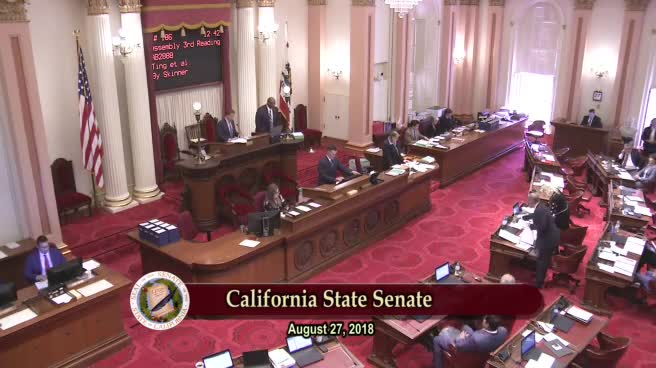
| Aug 27, 2018 | Assembly 3rd Reading AB2707 Mullin By Stern | Senate Floor |
Passed |
|
| Aug 16, 2018 | Do pass as amended | Senate Standing Committee on Appropriations |
Passed |
|
| Aug 6, 2018 | Placed on suspense file | Senate Standing Committee on Appropriations |
Passed |
|
| Jun 19, 2018 | Do pass as amended, but first amend, and re-refer to the Committee on [Appropriations] | Senate Standing Committee on Elections and Constitutional Amendments |
Passed |
|
| May 30, 2018 | AB 2707 MULLIN Assembly Third Reading | Assembly Floor |
Passed |
|
| May 25, 2018 | Do pass. | Assembly Standing Committee on Appropriations |
Passed |
|
| Apr 25, 2018 | Do pass and be re-referred to the Committee on [Appropriations] with recommendation: To Consent Calendar | Assembly Standing Committee on Elections and Redistricting |
Passed |
This list shows positions taken on this bill by organizations on the date displayed, which is linked to the original source.
Positions by individuals are not included.
|
Organization
|
Position
|
Date
|
|---|---|---|
| California Clean Money Campaign | ** Support | Aug 19, 2018 |
| California Common Cause | ** Support | Aug 19, 2018 |
| Californians for Disability Rights | * Support | Jun 19, 2018 |
| Inyo County Registrar Of Voters Kammi Foote | ** Support | Apr 23, 2018 |
| Inyo County Registrar Of Voters, Kammi Foote | ** Support | Aug 19, 2018 |
| Inyo County Registrar Of Voters, Kammi Foote, | ** Support | Jun 18, 2018 |
| Your Voter Guide | * Support | Jun 19, 2018 |
| Yourvoterguide, Inc. | ** Support | Aug 19, 2018 |
| YourVoterGuide.com | * Support | Aug 6, 2018 |
CONCURRENCE IN SENATE AMENDMENTS
CSA1 Bill Id:AB 2707
Author:(Mullin)
As Amended Ver:August 17, 2018
Majority vote
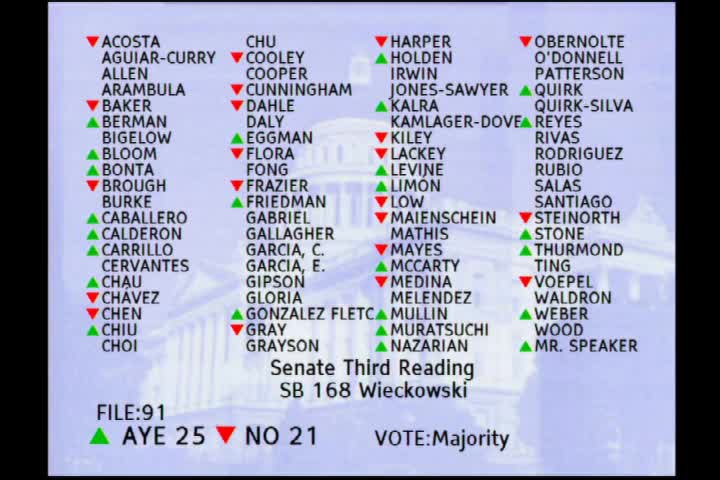
ASSEMBLY: | 78-0 | (May 30, 2018) | SENATE: | 39-0 | (August 27, 2018) |
Original Committee Reference: E. & R.
SUMMARY: Requires the Secretary of State (SOS) to request proposals to establish a voter information Internet Web site that provides voters information on their elected federal, state, and local officials, as specified. Specifically, this bill:
- Requires the SOS, no later than July 1, 2019, to request proposals to establish a voter information Internet Web site for the purpose of providing a voter with information regarding his or her elected officials.
- Requires the SOS's request for proposals to specify the following criteria for the Internet Web site:
- To display, upon the voter submitting his or her address information, the names and contact information, including telephone number, email address, and office address of the following elected officials for the voter:
- United States Senators and Representative in Congress;
- State officers elected on a statewide basis;
- Member of the Senate and Member of the Assembly; and,
- Elective officers of a city, county, school district, and special district.
- Requires the Internet Web site to be accessible to voters in multiple languages, including, but not limited to Spanish, Chinese, Korean, Vietnamese, Tagalog, and Japanese.
- Prohibits the cost to establish the Internet Web site to exceed $250,000 and prohibits the cost to update the Internet Web site to exceed $150,000 per year.
- To display, upon the voter submitting his or her address information, the names and contact information, including telephone number, email address, and office address of the following elected officials for the voter:
- Requires the SOS, if the SOS receives one or more qualifying proposals to his or her request pursuant to the provisions of this bill, to select a qualifying proposal and award a contract to establish the Internet Web site no later than July 1, 2020, as specified. Permits the SOS, if the SOS does not receive qualifying proposals that meet the criteria specified in the provisions of this bill, to decide to not establish the Internet Web site and, in this case, requires the SOS to publish the decision on the home page of the Secretary’s Internet Web site no later than December 1, 2019.
- Requires the SOS, if the SOS determines after receiving proposals that he or she can use existing personnel to internally develop and establish the Internet Web site at a cost lower than any qualified proposal that meets the criteria specified in this bill, to establish the Internet Web site no later than July 1, 2020, and requires the SOS to reject the proposals that he or she received. Requires the SOS, if applicable, to publish the decision to internally develop the Internet Web site on the home page of the Secretary’s Internet Web site no later than December 1, 2019.
The Senate amendments:
- Require the SOS to request proposals to establish a voter information Internet Web site that provides voters information on their elected federal, state, and local officials, as specified, instead of requiring the Governor to establish a voter information Internet Web site that provides voters information on their elected federal, state, and local officials, as specified.
- Place a limit on the cost to establish and the cost to update the Internet Web site, as specified.
- Require the SOS, if the SOS receives one or more qualifying proposals, to select a qualifying proposal and award a contract to establish the Internet Web site no later than July, 1 2020, as specified. Authorize the SOS to elect not to establish an Internet Web site if he or she does not receive qualifying proposals that meet the criteria outlined in this bill, as specified.
- Permit the SOS, if he or she determines that the Internet Web site can be established using existing personnel at a lower cost than any qualified proposal, to establish the Internet Web site no later than July 1, 2020, as specified.
- Delete provisions of the bill that would have required the contact information for a voter's state and local judge to be provided on the SOS's Internet Web site.
FISCAL EFFECT: According to the Senate Appropriations Committee, General Fund costs would be in the low hundreds of thousands of dollars annually.
COMMENTS: According to the author, "AB 2707 would establish a single online database where voters could locate all contact information for their federal, state, and local elected officials by searching via his or her address. Upon entering an address, a voter will have access to names, phone numbers, addresses, and email for each of his or her elected representatives. In a state that leads the rest of the nation on technological development and advancement, it seems essential that we provide voters with facilitated online access to such essential information…
While some counties provide such information to residents, each county is different resulting in unequal access to information across county lines. AB 2707 will create consistent access to elected official contact information."
Since 2014, the Inyo County Elections Internet Web site has provided a "Your Representative" lookup tool. The lookup tool allows a resident to enter his or her address and be provided with information about elected representatives that represent them. According to the county registrar, their website is one of the highest trafficked websites related to elections. Additionally, the lookup tool is also ADA-compliant, mobile friendly, and does not require the download of a separate application. Similarly, the state of Indiana offers its voters a "Who Are Your Elected Officials" portal that is sponsored by the Indiana Secretary of State and maintained by a private company.
AB 1004 (Calderon) of 2017, which was similar to this bill except that it would have required the SOS to develop the database of elected officials, regardless of the cost, was approved by the Assembly on a 77-0 vote. AB 1004 was vetoed by Governor Brown. In his veto message the Governor stated that the "Secretary of State currently does not have a centralized system in place to track these elected officials. Although well-intentioned, I do not believe this is the time to take on such a task given the other technology projects underway by the Secretary of State's office. Moreover, it is currently possible to learn the identity of office holders by making inquiries of federal, state and local officials."
The Senate amendments require the SOS to request proposals to establish a voter information Internet Web site that provides voters information on their elected federal, state, and local officials, as specified, instead of requiring the Governor to establish a voter information Internet Web site that provides voters information on their elected federal, state, and local officials, as specified. Additionally, the Senate amendments place a limit on the cost to establish and the cost to update the Internet Web site, as specified, require to the SOS to select a qualified proposal, as specified, authorize the SOS to elect to not select a proposal, as specified, and permit the SOS to establish the Internet Web site if he or she determines that the site can be established using existing personnel at a lower cost than any qualified proposal, as specified. Finally, the Senate amendments delete provisions of the bill that would have required the contact information for elected judges to be provided to voters. This bill, as amended in the Senate, is generally consistent with Assembly actions.
Please see the policy committee analysis for a full discussion of this bill.
Analysis Prepared by: Nichole Becker / E. & R. / (916) 319-2094 FN: 0004509
Office of Senate Floor Analyses (916) 651-1520 Fax: (916) 327-4478 | AB |
THIRD READING
Bill No: AB 2707
:
SENATE ELECTIONS & C.A. COMMITTEE: 5-0, 6/19/18
AYES: Stern, Anderson, Allen, Hertzberg, Leyva
SENATE APPROPRIATIONS COMMITTEE: 7-0, 8/16/18
AYES: Portantino, Bates, Beall, Bradford, Hill, Nielsen, Wiener
ASSEMBLY FLOOR: 78-0, 5/30/18 - See last page for vote
DIGEST:
This bill requires the Secretary of State (SOS) to request proposals to establish a voter information Web site that provides voters information on their elected federal, state, and local officials, as specified.
Existing law:
- Provides that the SOS is the chief elections officer of the state.
- Requires the SOS to publish and distribute a roster of the State and local public officials of California whenever an appropriation is made by the Legislature for that purpose.
This bill:
- Requires the SOS, no later than July 1, 2019, to request proposals to establish a voter information Web site for the purpose of providing a voter with information regarding a voter’s elected officials, as specified.
- Requires the Web site to include the names and contact information, including office address, email address, and office phone number, for the following elected officials:
- United States Senator
- United States Representative
- State officers elected on a statewide basis
- Member of the State Senate
- Member of the State Assembly
- Elective officers of a city, county, school districts, and special district
- Requires the Web site to be accessible to voters in multiple languages, including, but not limited to Spanish, Chinese, Korean, Vietnamese, Tagalog, and Japanese.
- Sets a limit for the cost to establish the Web site at $250,000 and limits the costs to update the Web site at $150,000 per year.
- Requires the SOS to be consistent with any method permitted by current law when selecting one or more qualifying proposals and award a contract to establish the Web site no later than July 1, 2020.
- Provides that if the SOS does not receive qualifying proposals that meet the criteria specified, then the SOS may decide to not establish the Web site and shall publish the decision on the home page of the Secretary’s Web site no later than December 1, 2019.
- Provides that if the SOS determines after receiving proposals that he or she can use existing personnel to internally develop and establish the Web site at a cost lower than any qualified proposal, then the SOS shall establish the Web site no later than July 1, 2020, as specified.
Background
Inyo County. Since 2014, Inyo County has provided a "Your Elected Officials" lookup tool on their Web site (http://www.inyo.elected.guide). The lookup tool allows a resident to enter his or her address and be provided with information about elected representatives. Additionally, the lookup tool is also ADA-compliant, mobile friendly, and does not require the download of a separate application.
Federal Language Requirements. The 15th Amendment to the United States Constitution provides, in part, "[t]he right of citizens of the United States to vote shall not be denied or abridged by the United States or by any state on account of race, color, or previous condition of servitude." Additionally, the 15th Amendment authorizes Congress to enact legislation to enforce its provisions.
Congress determined that the existing federal anti-discrimination laws were not sufficient to overcome the resistance by state officials to enforce the 15th Amendment. As a result, Congress passed and President Johnson signed the Voting Rights Act of 1965 (VRA). The VRA provides, among other provisions, that "[n]o voting qualification or prerequisite to voting, or standard, practice, or procedure shall be imposed or applied by any State or political subdivision to deny or abridge that right of any citizen of the United States to vote on account of race or color."
In 1975, Congress adopted the language minority provisions of Sections 4(f)(4) and 203 of the VRA. Congress extended these provisions in 1982, 1992, and 2006. Sections 4(f)(4) and 203 of the VRA require certain jurisdictions with significant populations of voting age citizens who belong to a language minority community to provide voting materials in a language other than English. These determinations are based on data from the most recent Census.
Specifically, Sections 203 and 4(f)(4) require that when a covered state or political subdivision "[p]rovides registration or voting notices, forms, instructions, assistance, or other materials of information relating to the electoral process, including ballots, it shall provide them in the language of the applicable minority group as well as in the English language."
Federal law requires California to provide voting materials in the following nine languages: Spanish, Chinese, Hindi, Japanese, Khmer, Korean, Tagalog, Thai, and Vietnamese.
Comments
- According to the author, AB 2707 establishes a single online database where voters could locate all contact information for their federal, state, and local elected officials by searching via his or her address. Upon entering an address, a voter will have access to names, phone numbers, addresses, and email for each of his or her elected representatives. In a state that leads the rest of the nation on technological development and advancement, it seems essential that we provide voters with facilitated online access to such essential information.
Currently, there is no single online database where voters can find out information for all of their representatives. Instead, they must search elections results and call local county officials to confirm, or scour county and city Web sites to piece together a complete list of representatives. Some voters may consult the California Roster, which is annually published by the Secretary of State, however, this pamphlet does not include special districts.
While some counties provide such information to residents, each county is different resulting in unequal access to information across county lines. AB 2707 will create consistent access to elected official contact information.
A single online database will facilitate engagement civic engagement for all Californians, especially as more have become accustomed to having easily accessible information online. AB 2707 will make civic engagement less arduous, giving Californians a tool to amplify their voices at every level of government.
- Significant Undertaking. This bill requires the contact information of elected officials of special districts to be publicly searchable based on a voter’s address. Currently there are approximately 3,300 special districts which are a part of California’s unique system of local government. Most are governed by boards comprised of five members who serve staggered, four-year terms. The SOS currently does not have a centralized system in place to track these elected officials. While the SOS currently publishes an annual listing of California's public officials, known as The California Roster, that listing does not include information about officials elected to special districts.
Related/Prior Legislation
AB 1004 (Calderon of 2017), would have required the SOS to develop the database of elected officials. Ultimately, AB 1004 was vetoed by Governor Brown. In his veto message the Governor stated that the "Secretary of State currently does not have a centralized system in place to track these elected officials. Although well-intentioned, I do not believe this is the time to take on such a task given the other technology projects underway by the Secretary of State's office. Moreover, it is currently possible to learn the identity of office holders by making inquiries of federal, state and local officials."
FISCAL EFFECT: Appropriation: Fiscal Com.: Local:
According to the Senate Appropriations Committee, General Fund costs would be in the low hundreds of thousands of dollars annually.
California Clean Money Campaign
California Common Cause
Inyo County Registrar of Voters, Kammi Foote
YourVoterGuide, Inc.
OPPOSITION: (Verified 8/13/18)
None received
ASSEMBLY FLOOR: 78-0, 5/30/18
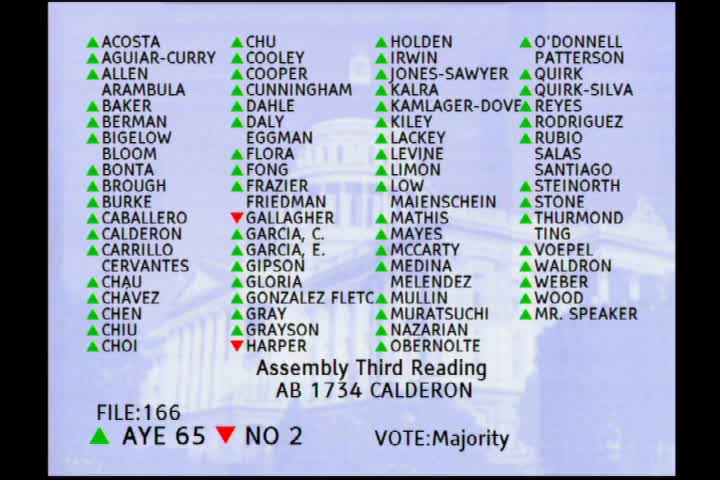
AYES: Acosta, Aguiar-Curry, Travis Allen, Arambula, Baker, Berman, Bigelow, Bloom, Bonta, Brough, Burke, Caballero, Calderon, Carrillo, Cervantes, Chau, Chávez, Chen, Chiu, Choi, Chu, Cooley, Cooper, Cunningham, Dahle, Daly, Eggman, Flora, Fong, Frazier, Friedman, Gallagher, Cristina Garcia, Eduardo Garcia, Gipson, Gloria, Gonzalez Fletcher, Gray, Grayson, Harper, Holden, Irwin, Jones-Sawyer, Kalra, Kamlager-Dove, Kiley, Lackey, Levine, Limón, Low, Maienschein, Mathis, Mayes, McCarty, Medina, Melendez, Mullin, Muratsuchi, Nazarian, Obernolte, O'Donnell, Patterson, Quirk, Quirk-Silva,
Reyes, Rodriguez, Rubio, Salas, Santiago, Steinorth, Mark Stone, Thurmond, Ting, Voepel, Waldron, Weber, Wood, Rendon
8/19/18 13:40:19
**** END ****
SENATE COMMITTEE ON
Senator Anthony Portantino, Chair
2017 - 2018 Regular Session
AB 2707 (Mullin) - Voter information Internet Web site
Version: | Policy Vote: |
Urgency: | Mandate: |
Hearing Date: | Consultant: |
Bill Summary:
AB 2707 would require the Secretary of State (SOS) to establish a voter information website that provides voters information on their elected federal, state, and local officials.
*********** ANALYSIS ADDENDUM – SUSPENSE FILE ***********
The following information is revised to reflect amendments
adopted by the committee on August 16, 2018
Fiscal Impact:
General Fund costs would be in the low hundreds of thousands of dollars annually.
Author Amendments:
Establish criteria for the website, including a limit on the cost to establish ($250,000) and update it ($150,000 annually). The amendments would authorize SOS to choose not to establish the website if qualifying proposals do not meet the established criteria.
-- END --
SENATE COMMITTEE ON APPROPRIATIONS
Senator Anthony Portantino, Chair
2017 - 2018 Regular Session
AB 2707 (Mullin) - Voter information Internet Web site
Version: June 21, 2018 | Policy Vote: E. & C.A. 5 - 0 |
Urgency: No | Mandate: No |
Hearing Date: August 6, 2018 | Consultant: Robert Ingenito |
This bill meets the criteria for referral to the Suspense File.
Bill Summary:
AB 2707 would require the Secretary of State (SOS) to establish a voter information website that provides voters information on their elected federal, state, and local officials.
Fiscal Impact:
SOS indicates that its costs to implement the bill would be $2.5 million in the first year, and $1.2 million annually thereafter (General Fund).
Background:
Existing law requires SOS to publish and distribute a roster of state and local public officials of California whenever an appropriation is made by the Legislature for that purpose. However, providing this information continuously through an online database is not required under current law.
Proposed Law:
This bill would require SOS to establish a voter information website for the purpose of providing a voter with information regarding a voter’s elected officials. The bill would require the website to include the names and contact information, including office address, email address, and office phone number, for the following elected officials: (1) United States Senator, (2) United States Representative, (3) State officers elected on a statewide basis, (4) Member of the State Senate, (5) Member of the State Assembly, and (6) Elective officers of a city, county, school districts, and special district. The bill would require that the website be accessible to voters in multiple languages, including, but not limited to Spanish, Chinese, Korean, Vietnamese, Tagalog, and Japanese.
Related Legislation:
AB 1004 (Calderon), similar to this bill, required SOS to develop a database of elected officials, and was vetoed by the Governor.
Staff Comments:
In addition to members of Congress, statewide officeholders, and the Legislature, this bill would require SOS to collect and maintain the contact information of elected officials of 58 counties, 482 cities, nearly 1,200 school districts, and roughly 3,300 special districts, to be publicly searchable based on a voter’s address. SOS currently does not have a centralized system in place to track these elected officials. Furthermore, while SOS currently publishes an annual listing of California's public officials, known as The California Roster, it does not include information about officials elected to special districts.
SOS would incur costs in the first year to develop the required database and collect the necessary data. Ongoing costs would result from maintaining and updating the database annually. Included in the first-year costing is a one-time expense of $1.2 million to integrate VoteCal (the State’s centralized voter registration database) with a mapping system. SOS indicates that it would require several new positions to monitor and maintain the mapping software and database, maintain servers, and gather and maintain information from the counties regarding current local elected officials and the boundaries of their districts. SOS indicates that the workload in the bill is heavily driven by the inclusion of all city county, school district and special district elected officials, because of (1) their large number, and (2) the need to keep their information up-to-date.
Currently, the SOS internet site has a page where voters can find their elected representatives via the websites of each of the institutions that hold this information, including the United States Senate, The House of Representatives, and the California State Senate, Assembly and the Board of Equalization http://www.sos.ca.gov/elections/who-are-my-representatives/
-- END --
SENATE COMMITTEE ON
ELECTIONS AND CONSTITUTIONAL AMENDMENTS
Senator Henry Stern, Chair
2017 - 2018 Regular
Bill No: 2707 Hearing Date: 6/19/18
Author: | Mullin | ||
Version: |
| ||
Urgency: | Fiscal: | ||
Consultant: | |||
Subject:
DIGEST
This bill requires the Secretary of State (SOS) to establish a voter information website that provides voters information on their elected federal, state, and local officials.
ANALYSIS
Existing law:
- Provides that the SOS is the chief elections officer of the state.
- Requires the SOS to publish and distribute a roster of the State and local public officials of California whenever an appropriation is made by the Legislature for that purpose.
This bill:
- Requires the SOS to establish a voter information website for the purpose of providing a voter with information regarding a voter’s elected officials.
- Requires the website to include the names and contact information, including office address, email address, and office phone number, for the following elected officials:
- United States Senator
- United States Representative
- State officers elected on a statewide basis
- Member of the State Senate
- Member of the State Assembly
- Elective officers of a city, county, school districts, and special district
- Judge elected or reelected to judicial office
- Requires the website to be accessible to voters in multiple languages, including, but not limited to Spanish, Chinese, Korean, Vietnamese, Tagalog, and Japanese.
BACKGROUND
Inyo County. Since 2014, Inyo County has provided a "Your Elected Officials" lookup tool on their website (http://www.inyo.elected.guide). The lookup tool allows a resident to enter his or her address and be provided with information about elected representatives. Additionally, the lookup tool is also ADA-compliant, mobile friendly, and does not require the download of a separate application.
Federal Language Requirements. The 15th Amendment to the United States Constitution provides, in part, "[t]he right of citizens of the United States to vote shall not be denied or abridged by the United States or by any state on account of race, color, or previous condition of servitude." Additionally, the 15th Amendment authorizes Congress to enact legislation to enforce its provisions.
Congress determined that the existing federal anti-discrimination laws were not sufficient to overcome the resistance by state officials to enforce the 15th Amendment. As a result, Congress passed and President Johnson signed the Voting Rights Act of 1965 (VRA). The VRA provides, among other provisions, that "[n]o voting qualification or prerequisite to voting, or standard, practice, or procedure shall be imposed or applied by any State or political subdivision to deny or abridge that right of any citizen of the United States to vote on account of race or color."
In 1975, Congress adopted the language minority provisions of Sections 4(f)(4) and 203 of the VRA. Congress extended these provisions in 1982, 1992, and 2006. Sections 4(f)(4) and 203 of the VRA require certain jurisdictions with significant populations of voting age citizens who belong to a language minority community to provide voting materials in a language other than English. These determinations are based on data from the most recent Census.
Specifically, Sections 203 and 4(f)(4) require that when a covered state or political subdivision "[p]rovides registration or voting notices, forms, instructions, assistance, or other materials of information relating to the electoral process, including ballots, it shall provide them in the language of the applicable minority group as well as in the English language."
Federal law requires California to provide voting materials in the following nine languages: Spanish, Chinese, Hindi, Japanese, Khmer, Korean, Tagalog, Thai, and Vietnamese.
COMMENTS
- According to the Author: AB 2707 would establish a single online database where voters could locate all contact information for their federal, state, and local elected officials by searching via his or her address. Upon entering an address, a voter will have access to names, phone numbers, addresses, and email for each of his or her elected representatives. In a state that leads the rest of the nation on technological development and advancement, it seems essential that we provide voters with facilitated online access to such essential information.
Currently, there is no single online database where voters can find out information for all of their representatives. Instead, they must search elections results and call local county officials to confirm, or scour county and city websites to piece together a complete list of representatives. Some voters may consult the California Roster, which is annually published by the Secretary of State, however, this pamphlet does not include special districts.
While some counties provide such information to residents, each county is different resulting in unequal access to information across county lines. AB 2707 will create consistent access to elected official contact information.
A single online database will facilitate engagement civic engagement for all Californians, especially as more have become accustomed to having easily accessible information online. AB 2707 will make civic engagement less arduous, giving Californians a tool to amplify their voices at every level of government.
- Argument in Support. In support of AB 2707, the California Clean Money Campaign stated in their letter from April 3, 2018:
There is currently no online statewide web portal of all elected California officials. California voters must instead find and then search for each individual officeholder by finding and searching individual district, city, county or state websites.
AB 2707 would require the State to create a voter information website where California voters could simply and easily input their addresses and be provided the names and contact information for all of their elected officials.
California, the world’s high technology leader, should lead the nation in using technology to improve access to government and democracy.
- Significant Undertaking. This bill requires the contact information of elected officials of special districts to be publicly searchable based on a voter’s address. Currently there are approximately 3300 special districts which are a part of California’s unique system of local government. Most are governed by boards comprised of five members who serve staggered, four-year terms. The SOS currently does not have a centralized system in place to track these elected officials. While the SOS currently publishes an annual listing of California's public officials, known as The California Roster, that listing does not include information about officials elected to special districts.
- Author’s Amendment. Judges currently use their email addresses and phone numbers for court-related business. Additionally, judges also do not have the same type of constituent pressures as other elected officials. By making a judge’s contact information publically available, it has the potential to encourage ex parte communication where one party contacts a judge during a proceeding inappropriately possibly resulting in a judge having to disclose that communication, be disqualified from hearing the case, or have some other result that could impact a particular case. As a result, the author has indicated that the provisions of AB 2707 pertaining to judges will be removed from the bill.
RELATED/PRIOR LEGISLATION
AB 1004 (Calderon) of 2017, which is similar to this bill also required the SOS to develop the database of elected officials. Ultimately, AB 1004 was vetoed by Governor Brown. In his veto message the Governor stated that the "Secretary of State currently does not have a centralized system in place to track these elected officials. Although well-intentioned, I do not believe this is the time to take on such a task given the other technology projects underway by the Secretary of State's office. Moreover, it is currently possible to learn the identity of office holders by making inquiries of federal, state and local officials."
PRIOR ACTION
Assembly Floor: | 78 - 0 |
Assembly Appropriations Committee: | 16 - 0 |
Assembly Committee: | 7 - 0 |
POSITIONS
Sponsor: Author
Support: California Clean Money Campaign
Inyo County Registrar of Voters, Kammi Foote, (prior version)
YourVoterGuide, Inc.
Oppose: None received.
-- END --
ASSEMBLY THIRD READING
ATR Bill Id:AB 2707
Author:(Mullin)
As Amended Ver:April 9, 2018
Majority vote
Committee | Votes | Ayes | Noes |
Elections | 7-0 | Berman, Harper, Calderon, Low, Mullin, Obernolte, Weber | |
Appropriations | 16-0 | Gonzalez Fletcher, Bigelow, Bloom, Bonta, Calderon, Carrillo, Chau, Eggman, Fong, Friedman, Gallagher, Eduardo Garcia, Nazarian, Obernolte, Quirk, Reyes |
|
SUMMARY: Requires the Governor to establish a voter information Internet Web site that provides voters information on their elected federal, state, and local officials. Specifically, this bill:
- Requires the Governor, no later than January 1, 2020, through an executive department or agency of his or her choice, to establish a voter information Internet Web site for the purpose of providing a voter with information regarding his or her elected officials.
- Requires the Internet Web site to display the names and contact information, including telephone number, email address, and office address of the following elected officials for the voter:
- United States Senators and Representative in Congress;
- State officers elected on a statewide basis;
- Member of the Senate and Member of the Assembly;
- Elective officers of a city, county, school district, and special district; and,
- Judge elected or reelected to a judicial office.
- Requires the Internet Web site to be accessible to voters in multiple languages, including, but not limited to Spanish, Chinese, Korean, Vietnamese, Tagalog, and Japanese.
FISCAL EFFECT: According to the Assembly Appropriations Committee:
1) One-time unknown General Fund costs, likely in the range of $1 million to develop the required online database and collect the required data.
2) Unknown ongoing annual costs to maintain and update the required database.
COMMENTS: According to the author, "AB 2707 would establish a single online database where voters could locate all contact information for their federal, state, and local elected officials by searching via his or her address. Upon entering an address, a voter will have access to names, phone numbers, addresses, and email for each of his or her elected representatives. In a state that leads the rest of the nation on technological development and advancement, it seems essential that we provide voters with facilitated online access to such essential information…
"While some counties provide such information to residents, each county is different resulting in unequal access to information across county lines. AB 2707 will create consistent access to elected official contact information."
Since 2014, the Inyo County Elections Internet Web site has provided a "Your Representative" lookup tool. The lookup tool allows a resident to enter his or her address and be provided with information about elected representatives that represent them. According to the county registrar, their website is one of the highest trafficked websites related to elections. Additionally, the lookup tool is also ADA-compliant, mobile friendly, and does not require the download of a separate application. Similarly, the state of Indiana offers its voters a "Who Are Your Elected Officials" portal that is sponsored by the Indiana Secretary of State and maintained by a private company.
AB 1004 (Calderon) of 2017, which was similar to this bill except that it would have required the SOS to develop the database of elected officials, was approved by the Assembly on a 77-0 vote. AB 1004 was vetoed by Governor Brown. In his veto message the Governor stated that the "Secretary of State currently does not have a centralized system in place to track these elected officials. Although well-intentioned, I do not believe this is the time to take on such a task given the other technology projects underway by the Secretary of State's office. Moreover, it is currently possible to learn the identity of office holders by making inquiries of federal, state and local officials."
Please see the policy committee analysis for a full discussion of this bill.
Analysis Prepared by: Nichole Becker / E. & R. / (916) 319-2094 FN: 0003066
Date of Hearing: May 9, 2018
ASSEMBLY COMMITTEE ON APPROPRIATIONS
Lorena Gonzalez Fletcher, Chair
ABPCA Bill Id:AB 2707
Author:(Mullin) – As Amended Ver:April 9, 2018
Policy Committee: | Elections and Redistricting | Vote: | 7 - 0 |
|
| ||
|
|
Urgency: No State Mandated Local Program: No Reimbursable: No
SUMMARY:
This bill requires the governor to establish a voter information internet website to provide voters with information on their elected federal, state, and local officials. Specifically, this bill:
- Requires the governor, no later than January 1, 2020, to establish a voter information internet website, through a chosen executive department or agency, for the purpose of voters with information on elected officials.
- Requires the internet website to display the names and contact information, including telephone number, email address, and office address of specified elected federal, state and local officials.
- Requires the internet website to be accessible to voters in multiple languages, including, but not limited to Spanish, Chinese, Korean, Vietnamese, Tagalog, and Japanese.
FISCAL EFFECT:
- One-time unknown GF costs, likely in the range of $1 million to develop the required online database and collect the required data.
- Unknown ongoing annual costs to maintain and update the required database.
COMMENTS:
- Purpose. The author notes that while some counties provide voters with online access to information about their elected officials, each county is different, creating unequal access throughout the state. The author further argues that a state that leads the nation in technological development and advancement should provide its voters online access to such information.
This bill establishes a single online database where voters can locate all contact information for their federal, state, and local elected officials by searching via their address.
- Background. Existing law requires the Secretary of State (SOS) to publish and distribute a roster of state and local public officials of California whenever an appropriation is made by the Legislature for that purpose. However, providing this information continuously through an online database is not required.
- Prior Legislation: AB 1004 (Calderon) of the 2016-17 legislative session, was similar to this bill except that it would have required the SOS to develop the database of elected officials. AB 1004 was vetoed by Governor Brown. In his veto message the governor stated,
Secretary of State currently does not have a centralized system in place to track these elected officials. Although well-intentioned, I do not believe this is the time to take on such a task given the other technology projects underway by the Secretary of State's office. Moreover, it is currently possible to learn the identity of office holders by making inquiries of federal, state and local officials.
Analysis Prepared by: Jennifer Galehouse / APPR. / (916) 319-2081
Date of Hearing: April 25, 2018
ASSEMBLY COMMITTEE ON ELECTIONS AND REDISTRICTING
Marc Berman, Chair
ABPCA Bill Id:AB 2707 (
Author:Mullin) – As Amended Ver:April 9, 2018
SUBJECT: Voter information Internet Web site.
SUMMARY: Requires the Governor to establish a voter information Internet Web site that provides voters information on their elected federal, state, and local officials. Specifically, this bill:
- Requires the Governor, no later than January 1, 2020, through an executive department or agency of his or her choice, to establish a voter information Internet Web site for the purpose of providing a voter with information regarding his or her elected officials.
- Requires the Internet Web site to display the names and contact information, including telephone number, email address, and office address of the following elected officials for the voter:
- United States Senators and Representative in Congress;
- State officers elected on a statewide basis;
- Member of the Senate and Member of the Assembly;
- Elective officers of a city, county, school district, and special district; and,
- Judge elected or reelected to a judicial office.
- Requires the Internet Web site to be accessible to voters in multiple languages, including, but not limited to Spanish, Chinese, Korean, Vietnamese, Tagalog, and Japanese.
EXISTING LAW:
- Provides that the supreme executive power of this state is vested in the Governor.
- Provides that the Secretary of State (SOS) is the chief elections officer of the state.
- Requires the SOS to publish and distribute a roster of the State and local public officials of California whenever an appropriation is made by the Legislature for that purpose.
FISCAL EFFECT: Unknown
COMMENTS:
- Purpose of the Bill: According to the author:
AB 2707 would establish a single online database where voters could locate all contact information for their federal, state, and local elected officials by searching via his or her address. Upon entering an address, a voter will have access to names, phone numbers, addresses, and email for each of his or her elected representatives. In a state that leads the rest of the nation on technological development and advancement, it seems essential that we provide voters with facilitated online access to such essential information.
Currently, there is no single online database where voters can find out information for all of their representatives. Instead, they must search elections results and call local county officials to confirm, or scour county and city websites to piece together a complete list of representatives. Some voters may consult the California Roster, which is annually published by the Secretary of State, however this pamphlet does not include special districts.
While some counties provide such information to residents, each county is different resulting in unequal access to information across county lines. AB 2707 will create consistent access to elected official contact information.
A single online database will facilitate…civic engagement for all Californians, especially as more have become accustomed to having easily accessible information online. AB 2707 will make civic engagement less arduous, giving Californians a tool to amplify their voices at every level of government.
- Civic Engagement in the Digital Age: In their 2013 report “Civic Engagement in the Digital Age” the Pew Research Center reported that people who are well-educated and from a high socioeconomic status are more likely than others to engage in political activities using online resources. The report is based on the findings of a survey on Americans' use of the Internet and found:
Those who live in higher income households and those with higher levels of education (specifically, those who have attended or graduated from college) are consistently more likely than those with lower income or education levels to take part in many of the online and offline civic behaviors we measured in this study.
On the other hand, when it comes to the 60% of American adults who use social networking sites such as Facebook or Twitter, political participation is more balanced between lower and higher income Americans.
Furthermore, the study found that only 34% of American adults have recently engaged with or contacted a government official about an issue that is important to them via online methods.
- Similar Systems Currently In-Use: Since 2014, the Inyo County Elections Internet Web site has provided a "Your Representative" lookup tool. The lookup tool allows a resident to enter his or her address and be provided with information about elected representatives that represent them. According to the county registrar, their website is one of the highest trafficked websites related to elections. Additionally, the lookup tool is also ADA-compliant, mobile friendly, and does not require the download of a separate application. Similarly, the state of Indiana offers its voters a “Who Are Your Elected Officials” portal that is sponsored by the Indiana Secretary of State and maintained by a private company.
- Federal Language Requirements: The 15th Amendment to the United States Constitution provides, in part, "[t]he right of citizens of the United States to vote shall not be denied or abridged by the United States or by any state on account of race, color, or previous condition of servitude." Additionally, the 15th Amendment authorizes Congress to enact legislation to enforce its provisions.
Congress determined that the existing federal anti-discrimination laws were not sufficient to overcome the resistance by state officials to enforce the 15th Amendment. As a result, Congress passed and President Johnson signed the Voting Rights Act of 1965 (VRA). The VRA provides, among other provisions, that "[n]o voting qualification or prerequisite to voting, or standard, practice, or procedure shall be imposed or applied by any State or political subdivision to deny or abridge that right of any citizen of the United States to vote on account of race or color."
In 1975, Congress adopted the language minority provisions of Sections 4(f)(4) and 203 of the VRA. Congress extended these provisions in 1982, 1992, and 2006. Sections 4(f)(4) and 203 of the VRA require certain jurisdictions with significant populations of voting age citizens who belong to a language minority community to provide voting materials in a language other than English. These determinations are based on data from the most recent Census.
Specifically, Sections 203 and 4(f)(4) require that when a covered state or political subdivision "[p]rovides registration or voting notices, forms, instructions, assistance, or other materials of information relating to the electoral process, including ballots, it shall provide them in the language of the applicable minority group as well as in the English language."
Federal law requires California to provide voting materials in the following nine languages: Spanish, Chinese, Hindi, Japanese, Khmer, Korean, Tagalog, Thai, and Vietnamese.
- Previous Legislation: AB 1004 (Calderon) of 2017, which was similar to this bill except that it would have required the SOS to develop the database of elected officials, passed out of this committee on a 7-0 vote. AB 1004 was vetoed by Governor Brown. In his veto message the Governor stated that the "Secretary of State currently does not have a centralized system in place to track these elected officials. Although well-intentioned, I do not believe this is the time to take on such a task given the other technology projects underway by the Secretary of State's office. Moreover, it is currently possible to learn the identity of office holders by making inquiries of federal, state and local officials."
- Double-Referral: At the time this bill was originally referred to policy committee, it was double-referred to the Assembly Privacy and Consumer Protection Committee. Subsequent to that referral, this bill was amended. Based on those amendments, the Assembly Rules Committee has indicated that the bill no longer needs to be heard by the Assembly Privacy and Consumer Protection Committee. Instead, this bill should be reported out to the Assembly Appropriations Committee if it is approved by this committee.
REGISTERED SUPPORT / OPPOSITION:
Support
California Clean Money Campaign
Inyo County Registrar of Voters Kammi Foote
YourVoterGuide, Inc.
Opposition
None on file.
Analysis Prepared by: Nichole Becker / E. & R. / (916) 319-2094
Discussed in Hearing
 49SEC
Assembly Floor
 1MIN
Senate Floor
 1H
Senate Standing Committee on Appropriations
 3MIN
Senate Standing Committee on Appropriations
 4MIN
Senate Standing Committee on Elections and Constitutional Amendments
 2MIN
Assembly Floor
Bill Author

Bill Co-Author(s):