AB 2764: State acquisition of information technology goods and services: exemptions.
- Session Year: 2017-2018
- House: Assembly
- Latest Version Date: 2018-08-27
Existing law provides that specified contracts entered into by any state agency for goods, services, or other specified activities, whether awarded through competitive bidding or not, are void unless and until approved by the Department of General Services, and requires denial of approval if a contract does not meet the required specifications of the bidding process. Under existing law, certain transactions, contracts, and persons are exempt from that law, including transactions pertaining to the acquisition of information technology goods and services, except as specified.
This bill would make additional provisions of the law pertaining to state acquisition of goods and services applicable to the acquisition of information technology goods and services, including, among others, the Darfur Contracting Act of 2008 and specified provisions related to discrimination in the provision of benefits by contractors. The bill also would make a nonsubstantive change.
Existing law states the objectives of the Legislature in enacting the Public Contract Code.This bill would make a nonsubstantive change to that provision.Existing law states the objectives of the Legislature in enacting the Public Contract Code.
This bill would make a nonsubstantive change to that provision.
This chapter does not apply to any of the following:
(a)The Regents of the University of California and the Trustees of the California State University, except that Article 9 (commencing with Section 10420) shall apply to the Trustees of the California State University.
(b)(1)Transactions covered under Chapter 3 (commencing with Section 12100), except that Sections 10295.3, 10295.35, 10295.4, 10296, 10365.5, 10410, 10411, and Article 13 (commencing with Section 10475) shall apply to all transactions under that chapter.
(2)Notwithstanding paragraph (1), Section 10365.5 shall not apply to incidental advice or suggestions made outside of the scope of a consulting services contract.
(3)(A)Notwithstanding paragraph (1), Section 10365.5 shall not apply to a contract that is part of a single competitive procurement conducted in more than one stage for information technology goods or services, when the Director of the Department of General Services and the Director of Technology determine that there is no conflict of interest under Section 10365.5 and that it is in the best interest of the state to utilize this procurement method. Nothing in this section shall preclude the applicability of Section 12112 to this procurement method.
(B)The Department of General Services shall annually submit a report on its Internet Web site describing each determination granted pursuant to subparagraph (A), listing the basis for the determination, and disclosing the total amount of money paid or to be paid to the contractor under the contract that was the subject of the determination. The department shall provide notice to the Joint Legislative Budget Committee within 30 days of the posting of the report.
(C)For purposes of this paragraph, information technology means information technology goods or services, or both, as appropriate.
(c)Except as otherwise provided in this chapter, any entity exempted from Section 10295. However, the Board of Governors of the California Community Colleges shall be governed by this chapter, except as provided in Sections 10295, 10335, and 10389. The Department of Water Resources shall be governed by this chapter, except as provided in Sections 10295.6, 10304.1, 10335, and 10340.
(d)Transactions covered under Chapter 10 (commencing with Section 4525) of Division 5 of Title 1 of the Government Code.
(e)Except as provided for in subdivision (c), members of boards or commissions who receive no payment other than payment for each meeting of the board or commission, payment for preparatory time, and payment for per diem.
(f)The emergency purchase of protective vests for correctional peace officers whose duties require routine contact with state prison inmates. This subdivision shall remain operative only until January 1, 1987.
(g)Spouses of state officers or employees and individuals and entities that employ spouses of state officers and employees, that are vendored to provide services to regional center clients pursuant to Section 4648 of the Welfare and Institutions Code if the vendor of services, in that capacity, does not receive any material financial benefit, distinguishable from the benefit to the public generally, from any governmental decision made by the state officer or employee.
(h)Subject to the approval of the Director of Developmental Services, or his or her designee, a state employee of the department who is qualified to provide necessary services for regional center consumers and has entered into a contract with a regional center for the purpose of developing regional center services. The state employee shall terminate employment with any state agency or department before providing services funded by the state, as specified in Section 10410, to one or more regional center consumers. A contract entered into by a regional center and a state employee, in his or her capacity as a private citizen, to develop regional center services does not constitute a state contract within the meaning of Section 1090 of the Government Code. Accordingly, the state employee has no financial interest in a state contract under these circumstances.
This chapter does not apply to any of the following:
(a)The Regents of the University of California and the Trustees of the California State University, except that Article 9 (commencing with Section 10420) shall apply to the Trustees of the California State University.
(b)(1)Transactions covered under Chapter 3 (commencing with Section 12100), except that Sections 10295.3, 10295.35, 10295.4, 10296, 10365.5, 10410, and 10411 10411, and Article 13 (commencing with Section 10475) shall apply to all transactions under that chapter.
(2)Notwithstanding paragraph (1), Section 10365.5 shall not apply to incidental advice or suggestions made outside of the scope of a consulting services contract.
(3)(A)Notwithstanding paragraph (1), Section 10365.5 shall not apply to a contract that is part of a single competitive procurement conducted in more than one stage for information technology goods or services, when the Director of the Department of General Services and the Chief Information Officer Director of Technology determine that there is no conflict of interest under Section 10365.5 and that it is in the best interest of the state to utilize this procurement method. Nothing in this section shall preclude the applicability of Section 12112 to this procurement method.
(B)The Department of General Services shall annually submit a report on its Internet Web site describing each determination granted pursuant to subparagraph (A), listing the basis for the determination, and disclosing the total amount of money paid or to be paid to the contractor under the contract that was the subject of the determination. The department shall provide notice to the Joint Legislative Budget Committee within 30 days of the posting of the report.
(C)For purposes of this paragraph, information technology means information technology goods or services, or both, as appropriate.
(c)Except as otherwise provided in this chapter, any entity exempted from Section 10295. However, the Board of Governors of the California Community Colleges shall be governed by this chapter, except as provided in Sections 10295, 10335, and 10389. The Department of Water Resources shall be governed by this chapter, except as provided in Sections 10295.6, 10304.1, 10335, and 10340.
(d)Transactions covered under Chapter 10 (commencing with Section 4525) of Division 5 of Title 1 of the Government Code.
(e)Except as provided for in subdivision (c), members of boards or commissions who receive no payment other than payment for each meeting of the board or commission, payment for preparatory time, and payment for per diem.
(f)The emergency purchase of protective vests for correctional peace officers whose duties require routine contact with state prison inmates. This subdivision shall remain operative only until January 1, 1987.
(g)Spouses of state officers or employees and individuals and entities that employ spouses of state officers and employees, that are vendored to provide services to regional center clients pursuant to Section 4648 of the Welfare and Institutions Code if the vendor of services, in that capacity, does not receive any material financial benefit, distinguishable from the benefit to the public generally, from any governmental decision made by the state officer or employee.
(h)Subject to the approval of the Director of Developmental Services, or his or her designee, a state employee of the department who is qualified to provide necessary services for regional center consumers and has entered into a contract with a regional center for the purpose of developing regional center services. The state employee shall terminate employment with any state agency or department before providing services funded by the state, as specified in Section 10410, to one or more regional center consumers. A contract entered into by a regional center and a state employee, in his or her capacity as a private citizen, to develop regional center services does not constitute a state contract within the meaning of Section 1090 of the Government Code. Accordingly, the state employee has no financial interest in a state contract under these circumstances.
SECTION 1.Section 100 of the Public Contract Code is amended to read:100.The Legislature finds and declares that placing all public contract law in one code will make that law clearer and easier to find. Further, it is the intent of the Legislature in enacting this code to achieve all of the following objectives:(a)To clarify the law with respect to competitive bidding requirements.(b)To ensure full compliance with competitive bidding statutes as a means of protecting the public from misuse of public funds.(c)To provide all qualified bidders with a fair opportunity to enter the bidding process, thereby stimulating competition in a manner conducive to sound fiscal practices.(d)To eliminate favoritism, fraud, and corruption in the awarding of public contracts.The Legislature finds and declares that placing all public contract law in one code will make that law clearer and easier to find. Further, it is the intent of the Legislature in enacting this code to achieve all of the following objectives:
(a)To clarify the law with respect to competitive bidding requirements.
(b)To ensure full compliance with competitive bidding statutes as a means of protecting the public from misuse of public funds.
(c)To provide all qualified bidders with a fair opportunity to enter the bidding process, thereby stimulating competition in a manner conducive to sound fiscal practices.
(d)To eliminate favoritism, fraud, and corruption in the awarding of public contracts.
|
Date
|
Status
|
|---|---|
| Aug 27, 2018 | Chaptered by Secretary of State - Chapter 220, Statutes of 2018. |
| Aug 27, 2018 | Approved by the Governor. |
| Aug 14, 2018 | Enrolled and presented to the Governor at 4 p.m. |
| Aug 9, 2018 | In Assembly. Ordered to Engrossing and Enrolling. |
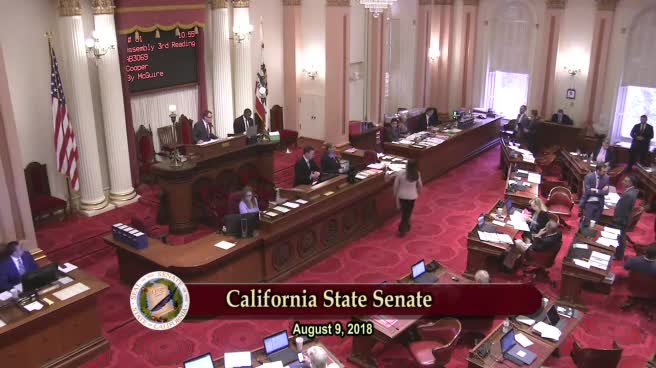
| Aug 9, 2018 | Read third time. Passed. Ordered to the Assembly. |
| Jul 3, 2018 | Read second time. Ordered to third reading. |
| Jul 2, 2018 | From committee: Be ordered to second reading pursuant to Senate Rule 28.8. |
| Jun 21, 2018 | In committee: Hearing postponed by committee. |
| Jun 12, 2018 | From committee: Do pass and re-refer to Com. on APPR. (Ayes 9. Noes 0.) (June 12). Re-referred to Com. on APPR. |
| May 10, 2018 | Referred to Com. on G.O. |
| Apr 30, 2018 | In Senate. Read first time. To Com. on RLS. for assignment. |
| Apr 30, 2018 | Read third time. Passed. Ordered to the Senate. |
| Apr 26, 2018 | Read second time. Ordered to third reading. |
| Apr 25, 2018 | From committee: Do pass. (Ayes 14. Noes 0.) (April 25). |
| Apr 11, 2018 | From committee: Do pass and re-refer to Com. on APPR. (Ayes 5. Noes 0.) (April 11). Re-referred to Com. on APPR. |
| Apr 2, 2018 | Re-referred to Com. on A. & A.R. |
| Mar 22, 2018 | Referred to Com. on A. & A.R. |
| Feb 17, 2018 | From printer. May be heard in committee March 19. |
| Feb 16, 2018 | Read first time. To print. |
|
Date
|
Description
|
Location
|
Votes
|
|
|---|---|---|---|---|
| Aug 9, 2018 | Assembly 3rd Reading AB2764 Chau By Wiener | Senate Floor |
Passed |
|
| Jun 12, 2018 | Do pass, but first be re-referred to the Committee on [Appropriations] | Senate Standing Committee on Governmental Organization |
Passed |
|
| Apr 30, 2018 | AB 2764 CHAU Assembly Third Reading | Assembly Floor |
Passed |
|
| Apr 25, 2018 | Do pass. | Assembly Standing Committee on Appropriations |
Passed |
|
| Apr 11, 2018 | Do pass and be re-referred to the Committee on [Appropriations] | Assembly Standing Committee on Accountability and Administrative Review |
Passed |
This list shows positions taken on this bill by organizations on the date displayed, which is linked to the original source.
Positions by individuals are not included.
Office of Senate Floor Analyses (916) 651-1520 Fax: (916) 327-4478 | AB |
THIRD READING
Bill No: AB 2764
:
SENATE GOVERNMENTAL ORG. COMMITTEE: 9-0, 6/12/18
AYES: Dodd, Wilk, Cannella, Galgiani, Glazer, Hill, Hueso, Portantino, Vidak
NO VOTE RECORDED: Bradford, Gaines, Lara
SENATE APPROPRIATIONS COMMITTEE: Senate Rule 28.8
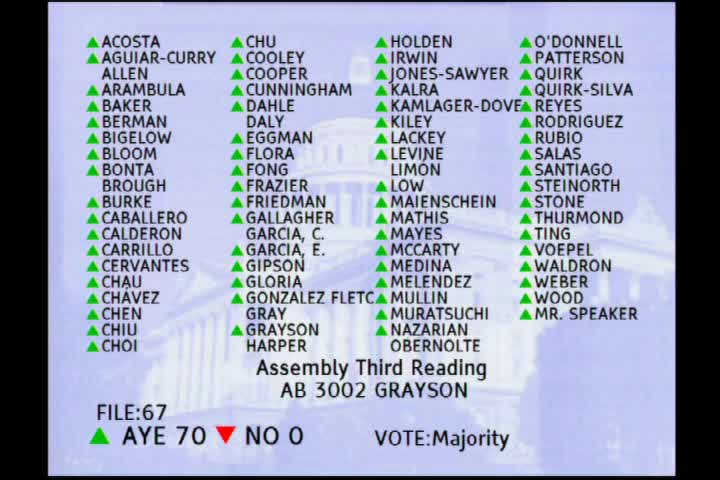
ASSEMBLY FLOOR: 70-0, 4/30/18 - See last page for vote
DIGEST:
This bill requires that contracts entered into by the California Department of Technology (CDT) are subject to the same anti-discrimination prohibitions, certifications, and restrictions that currently apply to contracts approved by the Department of General Services (DGS).
Existing law:
- Prohibits, under Article I, Section 31 of the Constitution of the State of California, the state from discriminating against, or granting preferential treatment to, any individual or group on the basis of race, sex, color, ethnicity, or national origin in the operation of public employment, public education, or public contracting.
- Authorizes state agencies to enter into contracts for the acquisition of goods or services upon approval by DGS, and establishes rules governing the awarding of contracts by state agencies, including general requirements for competitive bidding on contracts for the acquisition of goods or services.
- Delegates CDT with purchasing authority for the procurement of information technology (IT) goods and services, and exempts CDT contracts from various requirements.
This bill:
- Requires that contracts entered into by CDT for the procurement of IT goods and services be subject to the following requirements:
- Prohibits CDT from entering into any contract for the acquisition of goods or services in the amount of $100,000 or more with a contractor who discriminates between employees with domestic partners and employees with spouses, or discriminates between employees with same-sex partners and employees with different-sex partners in the provision of benefits.
- Prohibits CDT from entering into any contract for the acquisition of goods or services in the amount of $100,000 or more with a contractor that discriminates between employees on the basis of an employee’s or dependent’s actual or perceived gender identity in the provision of benefits.
- Prohibits CDT from entering into any contract with a contractor whose name appears on a list of the 500 largest tax delinquencies, as specified.
- Requires every contract entered into with CDT to contain a statement by the contractor, under the penalty of perjury, that the contractor has had no more than one finding of contempt of court relating to an order of the National Labor Relations Board.
- Prohibits CDT from entering into any contract with a company, as defined, that is involved in specified activities in Sudan.
- Makes technical changes.
Background
Purpose of the bill. According to the author, “AB 2764 would ensure public moneys are used in a consistent manner by amending the Public Contract Code to ensure the standards that apply to contracts for non-IT goods and services also apply to IT goods and services contracts, as well.”
State contracting. Current law generally requires DGS to approve all contracts entered into by any state agency for the procurement of goods or services. Additionally, current law prohibits state agencies from entering into contracts with contractors who discriminate against their employees, have large tax delinquencies, or are out of compliance with the National Labor Relations Board or the Darfur Contracting Act of 2008.
However, due to the unique aspects of IT projects, and their importance to state programs, CDT has been granted separate acquisition authority in order to enable the timely acquisition of IT goods and services to meet the state’s needs in the most value-effective manner. Contracts entered into by CDT are exempt from current law which otherwise prohibits state agencies from contracting with contractors who discriminate against their employees, have large tax delinquencies, or are out of compliance with the National Labor Relations Board or the Darfur Contracting Act of 2008.
Darfur Contracting Act of 2008. In response to “terrible suffering and horrible crimes in the Darfur region of Sudan,” the Darfur Contracting Act of 2008 prohibited any company involved in power production activities, mineral extraction activities, oil-related activities, or the production of military equipment in Sudan from bidding or submitting a proposal for a contract with a state agency for goods or services.
Related/Prior Legislation
SB 703 (Leno, Chapter 578, Statutes of 2015) prohibited any state agency from entering into contracts for the acquisition of goods or services of $100,000 or more with a contractor that discriminates between employees on the basis of gender identity in the provision of benefits.
SB 117 (Kehoe, Chapter 231, Statutes of 2011) prohibited any state agency from entering into a goods or services contract worth $100,000 or more, if in the provision of benefits, the contractor discriminates between employees with same or different sex spouses or partners, or discriminates between same or different sex spouses or partners of employees.
AB 498 (Hernandez, Chapter 272, Statutes of 2008) prohibited a “scrutinized company,” as defined, that is involved in specified activities in Sudan, from entering into a contract with a state agency for goods or services.
FISCAL EFFECT: Appropriation: Fiscal Com.: Local:
None received
None received
ASSEMBLY FLOOR: 70-0, 4/30/18
AYES: Acosta, Aguiar-Curry, Arambula, Baker, Berman, Bloom, Bonta, Brough, Burke, Caballero, Calderon, Carrillo, Cervantes, Chau, Chávez, Chen, Chiu, Chu, Cooley, Cooper, Cunningham, Dahle, Daly, Eggman, Flora, Frazier, Friedman, Gallagher, Eduardo Garcia, Gipson, Gloria, Gonzalez Fletcher, Gray, Grayson, Holden, Irwin, Jones-Sawyer, Kalra, Kamlager-Dove, Lackey, Levine, Limón, Low, Maienschein, Mathis, Mayes, McCarty, Medina, Melendez, Mullin, Muratsuchi, Nazarian, Obernolte, O'Donnell, Quirk, Quirk-Silva, Reyes, Rodriguez, Rubio, Salas, Santiago, Steinorth, Mark Stone, Thurmond, Ting, Voepel, Waldron, Weber, Wood, Rendon
NO VOTE RECORDED: Travis Allen, Bigelow, Choi, Fong, Cristina Garcia, Harper, Kiley, Patterson
7/3/18 15:49:38
**** END ****
SENATE COMMITTEE ON GOVERNMENTAL ORGANIZATION
Senator Bill Dodd
Chair
2017 - 2018 Regular
Bill No: 2764 Hearing Date: 6/12/2018
Author: | |||
Version: | 3/22/2018 Amended | ||
Urgency: | No | Fiscal: | Yes |
Consultant: | Brian Duke | ||
SUBJECT: State acquisition of information technology goods and services: exemptions
DIGEST: This bill requires that contracts entered into by the California Department of Technology (CDT) are subject to the same anti-discrimination prohibitions, certifications, and restrictions that currently apply to contracts approved by the Department of General Services (DGS).
ANALYSIS:
Existing law:
- Article I, Section 31 of the Constitution of the State of California prohibits the State from discriminating against, or granting preferential treatment to, any individual or group on the basis of race, sex, color, ethnicity, or national origin in the operation of public employment, public education, or public contracting.
- Authorizes state agencies to enter into contracts for the acquisition of goods or services upon approval by DGS, and establishes rules governing the awarding of contracts by state agencies, including general requirements for competitive bidding on contracts for the acquisition of goods or services.
- Requires that contracts approved by DGS comply with the following provisions:
- Prohibits state agencies from entering into contracts over $100,000 with any contractor that discriminates between spouses and domestic partners or between same-sex and different-sex partners in the provision of benefits.
- Prohibits state agencies from entering into contracts over $100,000 with any contractor that discriminates based on actual or perceived gender identity in the provision of benefits.
- Prohibits state agencies from entering into contracts with contractors whose name appears on a list of the 500 largest tax delinquencies.
- Requires every contractor to certify, under penalty of perjury, that the contractor has had no more than one finding of contempt of court relating to an order of the National Labor Relations Board.
- Prohibits any company, as defined, that is involved in specified activities in Sudan, from entering into a contract with a state agency for goods or services.
- Delegates CDT with purchasing authority for the procurement of information technology (IT) goods and services, and exempts CDT contracts from the provisions described above.
This bill:
- Requires that contracts entered into by CDT for the procurement of IT goods and services be subject to the following requirements:
- Prohibits CDT from entering into any contract for the acquisition of goods or services in the amount of $100,000 or more with a contractor who discriminates between employees with domestic partners and employees with spouses, or discriminates between employees with same-sex partners and employees with different-sex partners in the provision of benefits.
- Prohibits CDT from entering into any contract for the acquisition of goods or services in the amount of $100,000 or more with a contractor that discriminates between employees on the basis of an employee’s or dependent’s actual or perceived gender identity in the provision of benefits.
- Prohibits CDT from entering into any contract with a contractor whose name appears on a list of the 500 largest tax delinquencies, as specified.
- Requires every contract entered into with CDT to contain a statement by the contractor, under the penalty of perjury, that the contractor has had no more than one finding of contempt of court relating to an order of the National Labor Relations Board.
- Prohibits CDT from entering into any contract with a company, as defined, that is involved in specified activities in Sudan.
- Makes technical changes.
Background
Purpose of the bill. According to the author, “AB 2764 would ensure public moneys are used in a consistent manner by amending the Public Contract Code to ensure the standards that apply to contracts for non-IT goods and services also apply to IT goods and services contracts, as well.”
State contracting. Current law generally requires DGS to approve all contracts entered into by any state agency for the procurement of goods or services. Additionally, current law prohibits state agencies from entering into contracts with contractors who discriminate against their employees, have large tax delinquencies, or are out of compliance with the National Labor Relations Board or the Darfur Contracting Act of 2008.
However, due to the unique aspects of IT projects, and their importance to state programs, CDT has been granted separate acquisition authority in order to enable the timely acquisition of IT goods and services to meet the state’s needs in the most value-effective manner. Contracts entered into by CDT are exempt from current law which otherwise prohibits state agencies from contracting with contractors who discriminate against their employees, have large tax delinquencies, or are out of compliance with the National Labor Relations Board or the Darfur Contracting Act of 2008.
The author states that some, but not all, of the current requirements for contracting with state agencies are adhered to by CDT as a matter of practice. Specifically, the author points out that while CDT applies current contracting law relating to discrimination between employees with spouses and domestic partners and employees with partners of the same or different sex, and contractors out of compliance with the National Labor Relations Board or the Darfur Contracting Act of 2008, provisions relating to discrimination based on gender identity and tax delinquency are not. The author argues that this bill ensures that all contracting requirements, currently placed on other state agencies, will be applicable to contracts for IT goods and services entered into by CDT.
Darfur Contracting Act of 2008. In response to “terrible suffering and horrible crimes in the Darfur region of Sudan,” the Darfur Contracting Act of 2008 prohibited any company involved in power production activities, mineral extraction activities, oil-related activities, or the production of military equipment in Sudan from bidding or submitting a proposal for a contract with a state agency for goods or services.
Prior/Related Legislation
SB 703 (Leno, Chapter 578, Statutes of 2015) prohibited any state agency from entering into contracts for the acquisition of goods or services of $100,000 or more with a contractor that discriminates between employees on the basis of gender identity in the provision of benefits.
SB 71 (Committee on Budget and Fiscal Review, Chapter 28, Statutes of 2013) transferred responsibility for IT procurement from DGS to CDT.
SB 117 (Kehoe, Chapter 231, Statutes of 2011) prohibited any state agency from entering into a goods or services contract worth $100,000 or more, if in the provision of benefits, the contractor discriminates between employees with same or different sex spouses or partners, or discriminates between same or different sex spouses or partners of employees.
AB 498 (Hernandez, Chapter 272, Statutes of 2008) prohibited a “scrutinized company,” as defined, that is involved in specified activities in Sudan, from entering into a contract with a state agency for goods or services.
AB 17 (Kehoe, Chapter 752, Statutes of 2003) prohibited a state agency from entering into a contract for the acquisition of goods or services in the amount of $100,000 or more with a contractor who, in the provision of benefits, discriminates between employees with spouses and employees with domestic partners, or discriminates between the domestic partners and spouses of those employees.
FISCAL EFFECT: Appropriation: Fiscal Com.: Local:
SUPPORT:
None received
OPPOSITION:
None received
ASSEMBLY THIRD READING
ATR Bill Id:AB 2764
Author:(Chau)
As Amended Ver:March 22, 2018
Majority vote
Committee | Votes | Ayes | Noes |
Accountability | 5-0 | Eggman, Burke, Frazier, Medina, Quirk-Silva | |
Appropriations | 14-0 | Gonzalez Fletcher, Bloom, Bonta, Calderon, Carrillo, Chau, Eggman, Friedman, Gallagher, Eduardo Garcia, Nazarian, Obernolte, Quirk, Reyes |
SUMMARY: Makes California Department of Technology (CDT) contracts subject to the same contractor prohibitions, certifications, and restrictions in existing law that currently apply to Department of General Services (DGS) contracts.
EXISTING LAW:
- Makes DGS responsible for the procurement of non-information technology (IT) goods and services for state agencies.
- Requires procurement contracts by DGS to comply with the following provisions in the Public Contract Code (PCC):
- Prohibits state agencies from entering into contracts over $100,000 with any contractor that engages in specified spousal/domestic partner discrimination in the provision of benefits [PCC Section 10295.3]
- Prohibits state agencies from entering into contracts over $100,000 with any contractor that engages in specified gender identity discrimination in the provision of benefits [PCC Section 10295.35]
- Prohibits state agencies from entering into contracts with contractors whose name appears on a list of the 500 largest tax delinquencies [PCC Section 10295.4]
- Requires every contractor to certify under penalty of perjury that the contractor has had no more than one finding of contempt of court relating to an order of the National Labor Relations Board [PCC Section 10296]
- Establishes restrictions against contracting with vendors doing certain types of business in Sudan pursuant to the Darfur Contracting Act of 2008 [PCC Section 10475]
- Delegates CDT with purchasing authority for the procurement of IT goods and services and exempts CDT procurement contracts from the provisions described above.
FISCAL EFFECT: According to the Assembly Appropriations Committee:
- Minor and absorbable administrative costs to CDT.
- Minor and absorbable costs to DGS to update general provisions, contract language, bidder instructions, and "Volume 3 of the State Contract Manual" to reflect the new requirements.
- Unknown impacts on contracts for IT goods and services. In theory, the new requirements could decrease the vendor pool, but DGS is unaware of any vendors unwilling or unable to meet the new requirements.
COMMENTS: DGS is the lead agency responsible for purchasing non-IT goods and services for state agencies while CDT has its own statutory authority to acquire IT goods and services for the state.
This bill would make CDT contracts comply with various existing contractor prohibitions, certifications, and restrictions that already apply to DGS contracts. Specifically, it would prohibit CDT from entering into contracts with vendors who discriminate against their employees, have large tax delinquencies, or are out of compliance with the National Labor Relations Board or the Darfur Contracting Act of 2008.
According to the author, while DGS and CDT generally utilize the same contracting forms, there are discrepancies between the various terms and conditions. The author states that subjecting CDT contracts to the same contractor provisions that already exist in DGS contracts will provide consistency in both IT and non-IT contracting with the state.
Analysis Prepared by: Cassie Royce / A. & A.R. / (916) 319-3600 FN: 0002738
Date of Hearing: April 25, 2018
ASSEMBLY COMMITTEE ON APPROPRIATIONS
Lorena Gonzalez Fletcher, Chair
ABPCA Bill Id:AB 2764
Author:(Chau) – As Amended Ver:March 22, 2018
Policy Committee: | Accountability and Administrative Review | Vote: | 5 - 0 |
|
| ||
|
|
Urgency: No State Mandated Local Program: No Reimbursable: No
SUMMARY:
This bill makes California Department of Technology (CDT) contracts subject to the same contractor prohibitions, certifications, and restrictions in existing law that currently apply to Department of General Services (DGS) contracts.
FISCAL EFFECT:
- Minor and absorbable costs administrative costs to CDT.
- Minor and absorbable costs to DGS to update general provisions, contract language, bidder instructions, and “Volume 3 of the State Contract Manual” to reflect the new requirements.
- Unknown impacts on contracts for IT goods and services. In theory, the new requirements could decrease the vendor pool, but DGS is unaware of any vendors unwilling or unable to meet the new requirements.
COMMENTS:
- Purpose. According to the author, while DGS and CDT generally utilize the same contracting forms, there are discrepancies between the various terms and conditions. The author states that subjecting CDT contracts to the same contractor provisions that already exist in DGS contracts will provide consistency in both IT and non-IT contracting with the state.
- Background. DGS is responsible for purchasing non-information-technology (IT) goods and services for state agencies. Existing law requires contracts entered into by any state agency for goods, services, or certain other activities, whether awarded through competitive bidding or not, to be approved by DGS. Existing law further requires DGS to deny approval of a contract that does not meet requirements of the bidding process. CDT is responsible for acquiring IT goods and services for the state. CDT procurement contracts are exempt from the above DGS requirements.
This bill makes certain DGS contract requirements apply to IT contracts by prohibiting CDT from entering into contracts with vendors who discriminate against their employees regarding domestic partnerships or gender identity, have large tax delinquencies, or are out of compliance with the National Labor Relations Board or the Darfur Contracting Act of 2008 (which precludes state agencies from contracting with companies doing business in Sudan).
Analysis Prepared by: Jennifer Swenson / APPR. / (916) 319-2081
Date of Hearing: April 11, 2018
ASSEMBLY COMMITTEE ON ACCOUNTABILITY AND ADMINISTRATIVE REVIEW
Susan Talamantes Eggman, Chair
ABPCA Bill Id:AB 2764 (
Author:Chau) – As Amended Ver:March 22, 2018
SUBJECT: State acquisition of information technology goods and services: exemptions
SUMMARY: Makes California Department of Technology (CDT) contracts subject to the same contractor prohibitions, certifications, and restrictions in existing law that currently apply to Department of General Services (DGS) contracts.
EXISTING LAW:
- Makes DGS responsible for the procurement of non-information technology (IT) goods and services for state agencies.
- Requires procurement contracts by DGS to comply with the following provisions in the Public Contract Code (PCC):
- Prohibits state agencies from entering into contracts over $100,000 with any contractor that engages in specified spousal/domestic partner discrimination in the provision of benefits [PCC Section 10295.3]
- Prohibits state agencies from entering into contracts over $100,000 with any contractor that engages in specified gender identity discrimination in the provision of benefits [PCC Section 10295.35]
- Prohibits state agencies from entering into contracts with contractors whose name appears on a list of the 500 largest tax delinquencies [PCC Section 10295.4]
- Requires every contractor to certify under penalty of perjury that the contractor has had no more than one finding of contempt of court relating to an order of the National Labor Relations Board [PCC Section 10296]
- Establishes restrictions against contracting with vendors doing certain types of business in Sudan pursuant to the Darfur Contracting Act of 2008 [PCC Section 10475]
- Delegates CDT with purchasing authority for the procurement of IT goods and services and exempts CDT procurement contracts from the provisions described above.
FISCAL EFFECT: Unknown
COMMENTS: DGS is the lead agency responsible for purchasing non-IT goods and services for state agencies while CDT has its own statutory authority to acquire IT goods and services for the state.
This bill would make CDT contracts comply with various existing contractor prohibitions, certifications, and restrictions that already apply to DGS contracts. Specifically, it would prohibit CDT from entering into contracts with vendors who discriminate against their employees, have large tax delinquencies, or are out of compliance with the National Labor Relations Board or the Darfur Contracting Act of 2008.
According to the author, while DGS and CDT generally utilize the same contracting forms, there are discrepancies between the various terms and conditions. The author states that subjecting CDT contracts to the same contractor provisions that already exist in DGS contracts will provide consistency in both IT and non-IT contracting with the state.
REGISTERED SUPPORT / OPPOSITION:
Support
None on file.
Opposition
None on file.
Analysis Prepared by: Cassie Royce / A. & A.R. / (916) 319-3600
Discussed in Hearing
 2MIN
Senate Floor
 1MIN
Senate Standing Committee on Governmental Organization
 1MIN
Assembly Floor
 1MIN
Assembly Standing Committee on Appropriations
 2MIN
Assembly Standing Committee on Accountability and Administrative Review
Bill Author

Bill Co-Author(s):