AB 2844: Insurance: agents and brokers.
- Session Year: 2017-2018
- House: Assembly
- Latest Version Date: 2018-09-28
Existing law generally regulates the conduct of business between insurers and broker-agents. Under existing law, when a broker-agents contract is terminated, the rights, duties, and obligations set forth in the terminated contract continue solely with respect to policies then in force or renewed, until those policies are canceled, placed by the broker-agent with another insurer, or have expired, as provided. Existing law requires that if the terminated broker-agent is unable to place existing policies with another insurer, the insurer shall, at the broker-agents request, renew any insurance contract written by the broker-agent for one policy term or a period of one year, whichever is shorter. Existing law requires an insurer issuing an automobile insurance policy by or through an insurance agent, if a commission is paid to that agent, when issuing a policy in the minimum financial responsibility coverage amount, to pay a commission on the same terms and on the same percentage basis to that agent as for any higher amount of policy coverage sold by that agent.
This bill would require that any commission payable to a broker-agent be at the rate and in accordance with the terms agreed to in writing between the insurer and the broker-agent. The bill would establish a rebuttable presumption, as specified, that a commission is lawful if it is paid in accordance with the above-described laws relating to the termination of a broker-agents contract and minimum commission amounts. The bill would require the written contract to be consistent with specified laws governing contracts. The bill would apply to a written agreement entered into or modified on or after January 1, 2019.
Existing law generally regulates the conduct of business between insurers and broker-agents. Under existing law, when a broker-agents contract is terminated, the rights, duties, and obligations set forth in the terminated contract continue solely with respect to policies then in force or renewed, until those policies are canceled, placed by the broker-agent with another insurer, or have expired, as provided. Existing law requires that if the terminated broker-agent is unable to place existing policies with another insurer, the insurer shall, at the broker-agents request, renew any insurance contract written by the broker-agent for one policy term or a period of one year, whichever is shorter. Existing law requires an insurer issuing an automobile insurance policy by or through an insurance agent, if a commission is paid to that agent, when issuing a policy in the minimum financial responsibility coverage amount, to pay a commission on the same terms and on the same percentage basis to that agent as for any higher amount of policy coverage sold by that agent.
This bill would require that any commission payable to a broker-agent be at the rate and in accordance with the terms agreed to in writing between the insurer and the broker-agent. The bill would establish a rebuttable presumption, as specified, that a commission is lawful if it is paid in accordance with the above-described laws relating to the termination of a broker-agents contract and minimum commission amounts. The bill would require the written contract to be consistent with specified laws governing contracts. The bill would apply to a written agreement entered into or modified on or after January 1, 2019.
Existing law generally regulates the conduct of business between insurers and broker-agents. Under existing law, when a broker-agents contract is terminated, the rights, duties, and obligations set forth in the terminated contract continue solely with respect to policies then in force or renewed, until those policies are canceled, placed by the broker-agent with another insurer, or have expired, as provided. Existing law requires that if the terminated broker-agent is unable to place existing policies with another insurer, the insurer shall, at the broker-agents request, renew any insurance contract written by the broker-agent for one policy term or a period of one year, whichever is shorter. Existing law requires an insurer issuing an automobile insurance policy by or through an insurance agent, if a commission is paid to that agent, when issuing a policy in the minimum financial responsibility coverage amount, to pay a commission on the same terms and on the same percentage basis to that agent as for any higher amount of policy coverage sold by that agent.
This bill would require that any commission payable to a broker-agent be at the rate and in accordance with the terms agreed to in writing between the insurer and the broker-agent. The bill would establish a rebuttable presumption presumption, as specified, that a commission is lawful if it is paid in accordance with the above-described laws relating to the termination of an insurance a broker-agents contract and minimum commission amounts. The bill would require the written contract to comply be consistent with specified laws governing contracts. The bill would apply to a written agreement entered into or modified on or after January 1, 2019.
Existing law generally regulates the conduct of business between insurers and broker-agents. Under existing law, when a broker-agents contract is terminated, the rights, duties, and obligations set forth in the terminated contract continue solely with respect to policies then in force or renewed, until those policies are canceled, placed by the broker-agent with another insurer, or have expired, as provided. Existing law requires that if the terminated broker-agent is unable to place existing policies with another insurer, the insurer shall, at the broker-agents request, renew any insurance contract written by the broker-agent for one policy term or a period of one year, whichever is shorter. Existing law requires an insurer issuing an automobile insurance policy by or through an insurance agent, if a commission is paid to that agent, when issuing a policy in the minimum financial responsibility coverage amount, to pay a commission on the same terms and on the same percentage basis to that agent as for any higher amount of policy coverage sold by that agent.
This bill would require that any commission payable to a broker-agent be at the rate and in accordance with the terms agreed to in writing between the insurer and the broker-agent. The bill would establish a rebuttable presumption that a commission is lawful if it is paid in accordance with the above-described laws relating to the termination of an insurance contract and minimum commission amounts. The bill would require the written contract to comply with specified laws governing contracts. The bill would apply to a written agreement entered into or modified on or after January 1, 2019.
Existing law generally regulates the conduct of business between insurers and broker-agents. Under existing law, when a broker-agents contract is terminated, the rights, duties, and obligations set forth in the terminated contract continue solely with respect to policies then in force or renewed, until those policies are canceled, placed by the broker-agent with another insurer, or have expired, as provided. Existing law requires that if the terminated broker-agent is unable to place existing policies with another insurer, the insurer shall, at the broker-agents request, renew any insurance contract written by the broker-agent for one policy term or a period of one year, whichever is shorter. Existing law requires an insurer issuing an automobile insurance policy by or through an insurance agent, if a commission is paid to that agent, when issuing a policy in the minimum financial responsibility coverage amount, to pay a commission on the same terms and on the same percentage basis to that agent as for any higher amount of policy coverage sold by that agent.
This bill would require that any commission payable to a broker-agent be at the rate and in accordance with the terms agreed to in writing between the insurer and the broker-agent. The bill would declare establish a rebuttable presumption that a commission that is lawful if it is paid in accordance with the above-described laws, laws relating to the termination of an insurance contract and minimum commission amounts, is conclusively presumed to be lawful. amounts.
Existing law generally regulates the conduct of business between insurers and broker-agents. Under existing law, when a broker-agents contract is terminated, the rights, duties, and obligations set forth in the terminated contract continue solely with respect to policies then in force or renewed, until those policies are canceled, placed by the broker-agent with another insurer, or have expired, as provided. Existing law requires that if the terminated broker-agent is unable to place existing policies with another insurer, the insurer shall, at the broker-agents request, renew any insurance contract written by the broker-agent for one policy term or a period of one year, whichever is shorter. Existing law requires an insurer issuing an automobile insurance policy by or through an insurance agent, if a commission is paid to that agent, when issuing a policy in the minimum financial responsibility coverage amount, to pay a commission on the same terms and on the same percentage basis to that agent as for any higher amount of policy coverage sold by that agent.
This bill would require that any commission payable to a broker-agent be at the rate and in accordance with the terms agreed to in writing between the insurer and the broker-agent. The bill would declare that a commission that is paid in accordance with the above-described laws, relating to the termination of an insurance contract and minimum commission amounts, is conclusively presumed to be lawful.
Existing law creates the Department of Insurance, headed by the Insurance Commissioner, and prescribes the departments powers and duties. Existing law requires the Insurance Commissioner to require an insurer to maintain additional reserves for outstanding liability or compensation losses and loss expenses when the insurers reserves seem inadequate to the commissioner.This bill would make technical, nonsubstantive changes to that provision.Existing law creates the Department of Insurance, headed by the Insurance Commissioner, and prescribes the departments powers and duties. Existing law requires the Insurance Commissioner to require an insurer to maintain additional reserves for outstanding liability or compensation losses and loss expenses when the insurers reserves seem inadequate to the commissioner.
This bill would make technical, nonsubstantive changes to that provision.
A commission payable to a broker-agent shall be at the rate and in accordance with the terms agreed to in writing between the insurer and the broker-agent. There is a rebuttable presumption that a commission is lawful if it complies with the requirements of subdivisions (c) and (d) of Section 769 and subdivision (a) of Section 1861.16 and if it is paid in accordance with the written agreement. The written agreement shall be consistent with Part 2 (commencing with Section 1549) of Division 3 of the Civil Code. The presumption established by this section is a presumption affecting the burden of producing evidence. This section applies to a written agreement entered into or modified on or after January 1, 2019.
A commission payable to a broker-agent shall be at the rate and in accordance with the terms agreed to in writing between the insurer and the broker-agent. There is a rebuttable presumption that a commission is lawful if it complies with the requirements of subdivisions (c) and (d) of Section 769 and subdivision (a) of Section 1861.16 and if it is paid in accordance with the written agreement. The written agreement shall be consistent with Part 2 (commencing with Section 1549) of Division 3 of the Civil Code. The presumption established by this section is a presumption affecting the burden of producing evidence. This section applies to a written agreement entered into or modified on or after January 1, 2019.
A commission payable to a broker-agent shall be at the rate and in accordance with the terms agreed to in writing between the insurer and the broker-agent. There is a rebuttable presumption that a commission is lawful if it complies with the requirements of subdivisions (c) and (d) of Section 769 and subdivision (a) of Section 1861.16 and if it is paid in accordance with the written agreement. The written agreement shall comply be consistent with Part 2 (commencing with Section 1549) of Division 3 of the Civil Code. The presumption established by this section is a presumption affecting the burden of producing evidence. This section applies to a written agreement entered into or modified on or after January 1, 2019.
A commission payable to a broker-agent shall be at the rate and in accordance with the terms agreed to in writing between the insurer and the broker-agent. There is a rebuttable presumption that a commission is lawful if it complies with the requirements of subdivisions (c) and (d) of Section 769 and subdivision (a) of Section 1861.16 and if it is paid in accordance with the written agreement. The written agreement shall comply with Part 2 (commencing with Section 1549) of Division 3 of the Civil Code. This section applies to a written agreement entered into or modified on or after January 1, 2019.
A commission payable to a broker-agent shall be at the rate and in accordance with the terms agreed to in writing between the insurer and the broker-agent. A There is a rebuttable presumption that a commission that is lawful if it complies with the requirements of subdivisions (c) and (d) of Section 769 and subdivision (a) of Section 1861.16 and that if it is paid in accordance with the written agreement is conclusively presumed to be lawful. agreement.
A commission payable to a broker-agent shall be at the rate and in accordance with the terms agreed to in writing between the insurer and the broker-agent. A commission that complies with the requirements of subdivisions (c) and (d) of Section 769 and subdivision (a) of Section 1861.16 and that is paid in accordance with the written agreement is conclusively presumed to be lawful.
SECTION 1.Section 11557 of the Insurance Code is amended to read:11557.Whenever the reserves for outstanding liability or compensation losses and loss expenses of an insurer, computed pursuant to this article, seem inadequate to the commissioner, he or she shall require the insurer to maintain additional reserves.Whenever the reserves for outstanding liability or compensation losses and loss expenses of any an insurer, computed pursuant to this article, seem inadequate to the commissioner, he or she shall require such the insurer to maintain additional reserves.
|
Date
|
Status
|
|---|---|
| Sep 28, 2018 | Chaptered by Secretary of State - Chapter 879, Statutes of 2018. |
| Sep 28, 2018 | Approved by the Governor. |
| Sep 11, 2018 | Enrolled and presented to the Governor at 4:30 p.m. |
| Aug 30, 2018 | Senate amendments concurred in. To Engrossing and Enrolling. |
| Aug 29, 2018 | In Assembly. Concurrence in Senate amendments pending. |
| Aug 29, 2018 | Read third time. Passed. Ordered to the Assembly. |
| Aug 27, 2018 | Read second time. Ordered to third reading. |
| Aug 24, 2018 | Read third time and amended. Ordered to second reading. |
| Jul 3, 2018 | Read second time. Ordered to third reading. |
| Jul 2, 2018 | From committee: Do pass. (Ayes 11. Noes 0.) (June 27). |
| Jun 18, 2018 | From committee chair, with author's amendments: Amend, and re-refer to committee. Read second time, amended, and re-referred to Com. on INS. |
| Jun 6, 2018 | In committee: Set, first hearing. Hearing canceled at the request of author. |
| May 24, 2018 | Referred to Com. on INS. |
| May 15, 2018 | In Senate. Read first time. To Com. on RLS. for assignment. |
| May 14, 2018 | Read third time. Passed. Ordered to the Senate. |
| May 9, 2018 | Read second time. Ordered to third reading. |
| May 8, 2018 | Read second time and amended. Ordered returned to second reading. |
| May 7, 2018 | From committee: Amend, and do pass as amended. (Ayes 13. Noes 0.) (May 2). |
| Apr 2, 2018 | Re-referred to Com. on INS. |
| Mar 22, 2018 | From committee chair, with author's amendments: Amend, and re-refer to Com. on INS. Read second time and amended. |
| Feb 17, 2018 | From printer. May be heard in committee March 19. |
| Feb 16, 2018 | Read first time. To print. |
|
Date
|
Description
|
Location
|
Votes
|
|
|---|---|---|---|---|
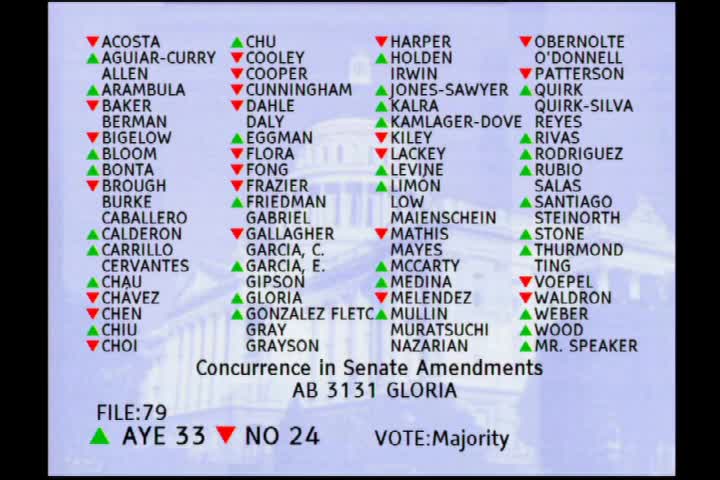
| Aug 30, 2018 | AB 2844 COOLEY Concurrence in Senate Amendments | Assembly Floor |
Passed |
|
| Aug 29, 2018 | Assembly 3rd Reading AB2844 Cooley By Roth | Senate Floor |
Passed |
|
| Jun 27, 2018 | Do pass | Senate Standing Committee on Insurance |
Passed |
|
| May 14, 2018 | AB 2844 COOLEY Assembly Third Reading | Assembly Floor |
Passed |
|
| May 2, 2018 | Do pass as amended. | Assembly Standing Committee on Insurance |
Passed |
This list shows positions taken on this bill by organizations on the date displayed, which is linked to the original source.
Positions by individuals are not included.
|
Organization
|
Position
|
Date
|
|---|---|---|
| California Department of Insurance | ** Against | Aug 27, 2018 |
| Consumer Watchdog | ** Against | Aug 27, 2018 |
| Mercury Insurance Group | ** Support | Aug 27, 2018 |
| Mercury Insurance Group, | ** Support | Apr 30, 2018 |
| Personal Insurance Federation Of California | ** Support | Aug 27, 2018 |
| POSITIONS | ** Support | Jun 26, 2018 |
CONCURRENCE IN SENATE AMENDMENTS
CSA1 Bill Id:AB 2844
Author:(Cooley)
As Amended Ver:August 24, 2018
Majority vote
ASSEMBLY: | 73-2 | (May 14, 2018) | SENATE: | 39-0 | (August 29, 2018) |
Original Committee Reference: INS.
SUMMARY: Provides that a commission payable to an insurance broker-agent shall be conclusively presumed to be based on the written contract between the insurer and broker-agent if the insurer has complied with two specified provisions of law. Specifically, this bill:
- Provides that a commission payable to a broker agent shall be at the rate and in accordance with the terms specified in the written contract between the broker-agent.
- Provides that there is a rebuttable presumption that a commission is lawful if it complies with the following provisions of law:
- Laws protecting the broker-agent's property interest in the business in the event the insurer is terminating an agency appointment, including the right to commissions and the broker-agent's right to place policyholders with a different insurer.
- A provision of law that guarantees the right of the broker-agent to commissions on the policy for one renewal period in the event the broker-agent is unable to place the policy with a different insurer.
- A provision of law adopted to implement Proposition 103's "take all comers" rule that bars insurers from discriminating on commission levels for the placement of automobile insurance policies with limits at the minimum Financial Responsibility Law requirements.
The Senate amendments:
- Provide that the rebuttable presumption created by the bill is a presumption affecting the burden of producing evidence.
- Provide that the written agreement that is subject to the terms of the bill must conform with specified provisions of the Civil Code that delineate the requirements for lawful contracts.
EXISTING LAW:
- Establishes a licensing program for property and casualty brokers and agents whereby both brokers and agents receive a single broker-agent license.
- Defines "broker" generally as an insurance salesperson who represents the policyholder or applicant for insurance.
- Defines "agent" generally as an insurance salesperson who is appointed by and represents the insurer.
- Requires insurers, when they appoint an agent to act on their behalf, to file appointment papers with the Insurance Commissioner (commissioner).
- Recognizes that insurance agent-brokers have a property interest in the business they place with an insurer, including the right to control that business (the policyholder's choice of insurer) with respect to information, commissions, and control of placement with the insurer.
- Provides statutory protections for a broker-agent in the event the insurer is either terminating the appointment of an agent, or cancelling the contract it may have with a broker.
- Grants a "good driver" as defined by initiative statute the right to purchase a policy from the insurer of his or her choice.
- Establishes a non-discrimination rule with respect to commissions paid for minimum limits policies to policyholders who qualify as a "good driver" pursuant to Proposition 103.
FISCAL EFFECT: Unknown
COMMENTS:
- Purpose. According to proponents, the bill is needed to ensure that unwarranted litigation is not filed challenging contractual arrangements between insurers and agents or brokers. The goal of the bill is to ensure that contractual agreements voluntarily entered into between broker-agents and insurers control in the event of disputes, including disputes with the Department of Insurance.
- Effect of presumption. Proponents have argued that the bill is, essentially, a preventative measure designed to guarantee that contractual arrangements voluntarily entered into are not frivolously challenged. To address this concern, the bill was amended to provide for a rebuttable presumption, in lieu of the conclusive presumption previously proposed. In addition, the bill has been clarified so that the party challenging a contract has, at a minimum, a duty to proffer evidence that there is a valid basis to believe the contract is unlawful.
Analysis Prepared by: Mark Rakich / INS. / (916) 319-2086 FN: 0005177
Office of Senate Floor Analyses (916) 651-1520 Fax: (916) 327-4478 | AB |
THIRD READING
Bill No: AB 2844
:
SENATE INSURANCE COMMITTEE: 11-0, 6/27/18
AYES: Glazer, Gaines, Galgiani, Hernandez, Hertzberg, Hueso, Lara, Moorlach, Morrell, Portantino, Roth
NO VOTE RECORDED: Berryhill, Mitchell
ASSEMBLY FLOOR: 73-2, 5/14/18 - See last page for vote
SOURCE: Mercury Insurance Group
DIGEST:
This bill establishes a rebuttable presumption that a commission payable to an insurance broker-agent is lawful if the commission complies with three Insurance Code provisions.
Senate Floor Amendments of 8/24/18 clarify that the presumption established by this bill is a presumption affecting the burden of production. Amendments also clarify that the written agreement providing for the commission must be consistent with, rather than must comply with, Part 2 of Division 3 of the Civil Code.
Existing law:
- Establishes a licensing program administered by the California Department of Insurance (CDI) for property and casualty brokers and agents where both brokers and agents receive a single “broker-agent license.” However, existing law treats the same licensee differently depending on the role the licensee plays in the transaction:
- Defines “broker” as a person transacting insurance on behalf of the policyholder or applicant, but not the insurer (brokers work for the consumer and are paid brokerage fees by the consumer).
- Defines “agent” as a person transacting insurance on behalf of the insurer (agents are paid by the insurer, usually by commission) and requires insurers to notify CDI when they appoint agents.
- Provides that every rebuttable presumption is either a presumption affecting the burden of producing evidence (PABPE) or a presumption affecting the burden of proof. (Evid. Code § 601.)
- Provides that the effect of a PABPE is to require the factfinder (the judge in a bench trial, jury in a jury trial, or hearing officer in an administrative proceeding) to assume the presumed fact until evidence is introduced that would support a contrary finding. (Evid. Code § 604.)
- Provides that once sufficient evidence has been introduced to rebut the PABPE, the factfinder shall determine the fact in question from the evidence and without regard to the presumption. (Evid. Code § 604.)
This bill:
- Provides that a commission payable to a broker-agent shall be at the rate and in accordance with the terms specified in the written contract.
- Establishes a PABPE that a commission is lawful if it complies with the following provisions of law:
- Laws protecting the broker-agent’s property interest in the business when the insurer terminates an agent’s appointment, including the right to commissions and the right to place policyholders with a different insurer. (Ins. Code § 769(c).)
- A provision of law that guarantees the right of the agent to commissions on the policy for one renewal period in the event the agent is unable to place the policy with a different insurer. (Ins. Code § 769(d).)
- A provision of law adopted to implement Proposition 103’s “take all comers” rule that bars insurers from discriminating on commission levels for the placement of automobile insurance policies with the minimum limits. (Ins. Code § 1861.16(a).)
- Limits application of the PABPE to written agreements that are consistent with Part 2 of Division 3 of the Civil Code (governing the validity and enforceability of contracts).
- Limits the PABPE to written agreements entered into or modified on or after January 1, 2019.
Background
Insurance agents and brokers both transact insurance. Agents represent the insurer and are paid a commission by the insurer. Brokers work for the consumer by searching among several insurers for an appropriate policy and are paid a brokerage fee by the consumer. The dividing line between a broker and agent isn’t always clear and roles may overlap; a broker might be viewed as an agent under certain circumstances. Frequently, the Insurance Code refers to them collectively as “broker-agents” (they may also be referred to colloquially as “producers”).
This bill addresses commission agreements between broker-agents and insurers. The author explains that these commission arrangements are a fundamental building block of the system used to distribute insurance products to consumers. This bill is intended to preserve those arrangements absent specific evidence that they are unlawful. This bill establishes a rebuttable presumption that a commission is “lawful” if it complies with specified provisions of law governing the contractual relationship between an insurer and broker-agent.
In a legal action, a rebuttable presumption establishes a fact which may be overcome by contrary evidence. California law establishes two types of rebuttable presumptions: (1) a PABPE or (2) a presumption affecting the burden of proof.
A PABPE is a default assumption that can be rebutted with credible evidence sufficient to “support a finding.” For example, a letter correctly addressed and properly mailed is presumed to have been received in the ordinary course of mail. (Evid. Code § 641.) Although the evidence must be strong enough to possibly persuade a judge or jury (collectively referred to as the “factfinder”), the evidence does not have to be persuasive. Once that evidence is introduced at trial, the presumption “bursts” and no longer has any effect. In the mailed letter example, the testimony of the intended recipient that they did not receive the letter would be sufficient to “burst” the presumption. The factfinder will have to decide who’s story is more probable (the sender claiming the recipient received the letter or the intended recipient claiming they did not) based on the evidence alone and without regard to the presumption.
By contrast, a presumption affecting the burden of proof permanently assigns the obligation to persuade the factfinder to one party. The contrary evidence must be persuasive to overcome the burden. For example, in a criminal trial the defendant is presumed innocent and the prosecution bears the burden to prove that the defendant committed the crime throughout the trial, even if the defense offers no contrary evidence.
In the context of this bill, the PABPE operates if the party asserting the presumption establishes that the commission satisfies three Insurance Code provisions. Once the PABPE is established, a factfinder will treat the commission paid on a written agreement as lawful unless and until reliable contrary evidence is offered. As amended, this bill requires a party attacking the lawfulness of the commission to offer reliable, but not necessarily persuasive, evidence that the commission is unlawful.
During the committee hearing, concerns were raised that this bill would impair the prosecution of consumer protection laws. By designating the presumption in this bill as a PABPE, recent amendments clarified that the duties of parties prosecuting violations of law. Existing law places the burden of proof on a party claiming any violation of law which requires them to offer persuasive evidence. (Evid. Code §§ 520 and 606.) The PABPE only requires evidence that would support a finding, a lesser burden. In fulfilling the greater obligation of proving their case, the party claiming that the commission is unlawful should automatically meet the burden to rebut the PABPE established by this bill.
Recent amendments also clarified that the written agreement providing for the commission must be “consistent with,” rather than “comply with,” Part 2 of Division 3 of the Civil Code. This provision is intended to confirm that the written agreements on which the commissions are based remain subject to a general contract law analysis and traditional contract defenses (such as fraud, duress, etc.). The change was made to avoid an implication that a party must show compliance with numerous Civil Code provisions, some of which might not be relevant to the case, before receiving the benefit of the presumption.
FISCAL EFFECT: Appropriation: Fiscal Com.: Local:
Mercury Insurance Group (source)
Personal Insurance Federation of California
OPPOSITION: (Verified 8/24/18)
California Department of Insurance
Consumer Watchdog
ARGUMENTS IN SUPPORT: The Personal Insurance Federation of California raises concerns that third-parties may challenge existing or future commission agreements even after the relevant parties have entered into a contract and that this bill will ensure that unwarranted litigation is not filed to challenge the written commission agreements currently in place.
ARGUMENTS IN OPPOSITION: CDI argues that this bill makes it more difficult for CDI, other regulators, and the Attorney General to enforce other laws the commission structure may violate.
ASSEMBLY FLOOR: 73-2, 5/14/18
AYES: Acosta, Aguiar-Curry, Travis Allen, Arambula, Baker, Berman, Bigelow, Bloom, Bonta, Brough, Burke, Caballero, Carrillo, Cervantes, Chau, Chávez, Chen, Chiu, Choi, Chu, Cooley, Cooper, Cunningham, Dahle, Daly, Eggman, Flora, Fong, Frazier, Gallagher, Eduardo Garcia, Gipson, Gloria, Gonzalez Fletcher, Gray, Grayson, Harper, Holden, Irwin, Jones-Sawyer, Kalra, Kiley, Lackey, Levine, Limón, Low, Maienschein, Mathis, Mayes, McCarty, Medina, Melendez, Mullin, Muratsuchi, Nazarian, Obernolte, O'Donnell, Patterson, Quirk, Quirk-Silva, Reyes, Rodriguez, Rubio, Salas, Santiago, Steinorth, Thurmond, Ting, Voepel, Waldron, Weber, Wood, Rendon
NOES: Friedman, Mark Stone
NO VOTE RECORDED: Calderon, Cristina Garcia, Kamlager-Dove
8/27/18 19:26:55
**** END ****
Office of Senate Floor Analyses (916) 651-1520 Fax: (916) 327-4478 | AB |
THIRD READING
Bill No: AB 2844
:
SENATE INSURANCE COMMITTEE: 11-0, 6/27/18
AYES: Glazer, Gaines, Galgiani, Hernandez, Hertzberg, Hueso, Lara, Moorlach, Morrell, Portantino, Roth
NO VOTE RECORDED: Berryhill, Mitchell
ASSEMBLY FLOOR: 73-2, 5/14/18 - See last page for vote
SOURCE: Mercury Insurance Group
DIGEST:
This bill establishes a rebuttable presumption that a commission payable to an insurance producer is lawful if it is based on a written contract between the insurer and producer and the insurer has complied with three specified provisions of law.
Existing law:
- Establishes a licensing program for property and casualty brokers and agents whereby both brokers and agents receive a single license. (Collectively, agents and brokers are referred to as “producers.”)
- Defines “broker” as an insurance salesperson who represents the policyholder or applicant for insurance and “agent” as an insurance salesperson who represents the insurer and requires insurers to notify the California Department of Insurance (CDI) when they appoint agents.
This bill:
- Provides that a commission payable to a producer shall be at the rate and in accordance with the terms specified in the written contract.
- Establishes a rebuttable presumption that a commission is lawful if it complies with the following provisions of law:
- Laws protecting the producer’s property interest in the business when the insurer terminates an agent’s appointment, including the right to commissions and the right to place policyholders with a different insurer. (Ins. Code § 769(c).)
- A provision of law that guarantees the right of the agent to commissions on the policy for one renewal period in the event the agent is unable to place the policy with a different insurer. (Ins. Code § 769(d).)
- A provision of law adopted to implement Proposition 103’s “take all comers” rule that bars insurers from discriminating on commission levels for the placement of automobile insurance policies with the minimum limits. (Ins. Code § 1861.16(a).)
- Limits the presumption to written agreements that comply with Part 2 of Division 3 of the Civil Code (governing the validity and enforceability of contracts).
- Limits the presumption to written agreements entered into or modified on or after January 1, 2019.
Background
Insurance agents and brokers both transact insurance. Agents represent the insurer and are paid a commission by the insurer. Brokers work for the consumer by searching among several insurers for an appropriate policy and are paid a brokerage fee by the consumer. This bill addresses commission agreements between producers and insurers. (The dividing line between a broker and agent isn’t always clear and roles may overlap; a broker fee might be viewed as a commission under certain circumstances.) The author suggests that these commission arrangements are a fundamental building block of the system used to distribute insurance products to consumers.
This bill establishes a rebuttable presumption that a commission is “lawful” if it complies with specified provisions of law governing the contractual relationship between an insurer and producer. However, the bill is not limited to disputes between producers and insurers, but rather deems a commission to be “lawful” regardless of the type of dispute or parties involved.
In a legal action, a rebuttable presumption establishes a fact which may be overcome by contrary evidence. Under this bill, if the party asserting the presumption establishes that the commission satisfies three Insurance Code provisions, a court or hearing officer will treat the commission paid on a written agreement as lawful unless the party challenging the commission offers persuasive evidence that the commission is unlawful. (A person accused of wrongful conduct already has a presumption of innocence.)
Because this bill establishes a presumption of lawfulness, rather than of validity or enforceability, the bill applies to controversies beyond those between two parties attempting to enforce or avoid a contractual obligation. For example, it could be asserted by an insurer against a third party seeking to enforce a consumer protection laws. (See the Senate Insurance Committee analysis for the June 27, 2018 hearing for a more detailed discussion.) During the Senate Committee on Insurance’s hearing, the author explained that the bill merely establishes a rebuttable presumption and could not preclude any party, particularly CDI, from enforcing consumer protection laws. Rather, the author asserts that the bill would require any party alleging that the commissions are unlawful to specifically articulate their claims.
Recent amendments require that the underlying agreement comply with part of the Civil Code governing the validity and enforceability of contracts, including a declaration that a contract is “not lawful” if it is contrary to an express provision of law. In order to invoke the presumption, the asserting party must first show the contract is lawful. This bill creates a “circularity” problem by requiring the contract to be lawful in order to qualify for a presumption that the commission is lawful. (What comes first, a lawful contract or lawful commission?)
Before seeking a Senate Floor vote, the author has agreed to work with the Senate Committee on Insurance on amendments that would clarify what a party must show or do to overcome the rebuttable presumption and to address the procedural “circularity” problem.
FISCAL EFFECT: Appropriation: Fiscal Com.: Local:
Mercury Insurance Group (source)
Personal Insurance Federation of California
California Department of Insurance
Consumer Watchdog
ARGUMENTS IN SUPPORT: The Personal Insurance Federation of California (PIFC) raises concerns that third-parties may challenge existing or future commission agreements even after the relevant parties have entered into a contract and that this bill will ensure that unwarranted litigation is not filed to challenge the written commission agreements currently in place.
ARGUMENTS IN OPPOSITION: CDI argues that the bill deems certain broker-agent commissions legal if they comply with only two Insurance Code sections, even if the commission or its structure violates any other law. Consequently, the bill would make it more difficult for CDI, other regulators, and the Attorney General to enforce other laws the commission structure may violate.
ASSEMBLY FLOOR: 73-2, 5/14/18
AYES: Acosta, Aguiar-Curry, Travis Allen, Arambula, Baker, Berman, Bigelow, Bloom, Bonta, Brough, Burke, Caballero, Carrillo, Cervantes, Chau, Chávez, Chen, Chiu, Choi, Chu, Cooley, Cooper, Cunningham, Dahle, Daly, Eggman, Flora, Fong, Frazier, Gallagher, Eduardo Garcia, Gipson, Gloria, Gonzalez Fletcher, Gray, Grayson, Harper, Holden, Irwin, Jones-Sawyer, Kalra, Kiley, Lackey, Levine, Limón, Low, Maienschein, Mathis, Mayes, McCarty, Medina, Melendez, Mullin, Muratsuchi, Nazarian, Obernolte, O'Donnell, Patterson, Quirk, Quirk-Silva, Reyes, Rodriguez, Rubio, Salas, Santiago, Steinorth, Thurmond, Ting, Voepel, Waldron, Weber, Wood, Rendon
NOES: Friedman, Mark Stone
NO VOTE RECORDED: Calderon, Cristina Garcia, Kamlager-Dove
7/3/18 17:26:48
**** END ****
SENATE COMMITTEE ON INSURANCE
Senator Steven Glazer, Chair
2017 - 2018 Regular
Bill No: AB 2844 Hearing Date: June 27, 2018
Author: | Cooley | ||
Version: | June 18, 2018 Amended | ||
Urgency: | No | Fiscal: | No |
Consultant: | Hugh Slayden | ||
Subject: Insurance: agents and brokers
SUMMARY
Establishes a rebuttable presumption that a commission payable to an insurance producer is lawful if it is based on a written contract between the insurer and producer, and the insurer has complied with three specified provisions of law.
DIGEST
Existing law
- Establishes a licensing program for property and casualty brokers and agents whereby both brokers and agents receive a single license. (Agents and brokers are collectively referred to as “producers.”)
- Defines “broker” generally as an insurance salesperson who represents the policyholder or applicant for insurance.
- Defines “agent” generally as an insurance salesperson who is appointed by and represents the insurer and requires insurers, when they appoint agents, to notify the California Department of Insurance (CDI).
- Grants producers an interest and control in the business they place with an insurer, including the ability to place the policyholder with a new insurer.
- Provides statutory protections for producers regarding commission in the event the insurer terminates an agent’s appointment or cancels a contract with a broker.
- Grants a “good driver,” as defined by initiative statute, the right to purchase a policy from the insurer of choice, and prohibits an insurer from discriminating based on commissions paid for minimum limit policies issued to good driver policyholders.
This bill
- Provides that a commission payable to a producer shall be at the rate and in accordance with the terms specified in the written contract.
- Establishes a rebuttable presumption that a commission is lawful if it complies with the following provisions of law:
- Laws protecting the producer’s property interest in the business when the insurer terminates an agent’s appointment, including the right to commissions and the right to place policyholders with a different insurer.
- A provision of law that guarantees the right of the producer to commissions on the policy for one renewal period in the event the producer is unable to place the policy with a different insurer.
- A provision of law adopted to implement Proposition 103’s “take all comers” rule that bars insurers from discriminating on commission levels for the placement of automobile insurance policies with the minimum limits.
- Limits the presumption to written agreements that comply with Part 2 of Division 3 of the Civil Code (governing the validity and enforceability of contracts).
- Limits the presumption to written agreements entered into or modified on or after January 1, 2019.
COMMENTS
- Purpose of the bill According to the sponsor, this bill would specify that the terms of a written agreement between an insurer and a broker-agent shall be presumed to be lawful. The bill is needed to ensure that unwarranted litigation is not filed that would challenge the written commission agreements currently in place between insurers and producers. These commission agreements that have been entered into by both parties should be binding upon both parties. The language has been agreed to by insurers and producers.
- Background Insurance agents and brokers both transact insurance; together they are referred to as broker-agents or “producers.” Agents represent the insurer and are paid a commission by the insurer. Brokers work for the consumer and are paid a brokerage fee by the consumer; they search for a policy among several insurers to find the right fit and price for the consumer.
This bill would establish a rebuttable presumption that a commission is “lawful” if it complies with specified provisions of law established to govern that contractual relationship. However, the bill is not limited to disputes between producers and insurers, but rather deems a commission to be “lawful” regardless of the type of dispute or parties involved.
Presumption. A presumption is an assumption of fact that the law requires to be made from another fact or group of facts found or otherwise established in the action. While a conclusive presumption is final and not open to dispute, a rebuttable presumption establishes a fact which may be overcome by contrary evidence. (Sometimes the law will even specify the type of contrary evidence required to rebut the presumption.) The most famous presumption is one of innocence; a person accused of wrongdoing is presumed to be innocent until proven otherwise.
The sponsor, Mercury Insurance Company (“Mercury”), claims that this bill is intended to prevent frivolous litigation, but has not provided any examples of the types of litigation it is designed to prevent. In disputes between two contracting parties, a contract or contract provision is valid or enforceable, but this bill uses the term “unlawful” which would not be appropriate for that type of dispute. An unlawful or illegal contract is void as if it never existed because it violates a law. Rather than setting up a presumption designed to preclude challenges to the enforceability of the contract, this bill might impede a challenge against unlawful conduct. For this reason, opposition to the bill argues that the presumption may interfere with the ability of third parties, including CDI, the Attorney General, and others, when they enforce California consumer protection laws. The Personal Insurance Federation of California (PIFC) supports the bill because of “concerns raised as to whether third-parties may challenge existing or future commission agreements.”
However, after concerns were raised that the bill might interfere with legitimate contract defenses, such as fraud or duress, the bill was amended so that it only applies to written agreements that comply with part of the Civil Code (governing the validity and enforceability of contracts). These provisions include a declaration that a contract is “not lawful” if it is contrary to an express provision of law. Consequently, in order to invoke the presumption, the asserting party must first show the contract is lawful. Although this does, in a way, put the cart before the horse, it might preserve challenges to the commissions based on illegality.
Litigation. Mercury Insurance has been involved in two cases that may have inspired this bill. Prior to 1989, Mercury sold auto insurance through appointed agents that only sold Mercury policies. When the voters approved Proposition 103 and implemented rate regulation, Mercury converted its agents into brokers that could sell policies from other insurers and would charge consumers brokerage fees that were paid separately from the premium. The brokers, however, sold Mercury policies 75-80% of the time.
In the 2004 case, Krumme v. Mercury Insurance, the court upheld a decision finding that Mercury violated Business and Professions Code Section 17200 and 17500 (Unfair Trade Practices) and determined that brokers selling Mercury policies under this special arrangement were “de facto agents.” The court could not order restitution, but issued an injunction against the use of de facto agents.
Shortly after Krumme, CDI initiated a disciplinary action against Mercury alleging that the fees were actually part of the premium and subject to the ratemaking provisions of Proposition 103. That case is still ongoing and was delayed as the parties litigated whether ex parte communications among CDI staff, under Insurance Commissioner Steve Poizner, constituted a due process violation when it revised its regulations for the specific purpose of affecting the case while it was still pending (the courts determined that CDI violated the separation of functions but did not irreparably violate due process). In 2015, Insurance Commissioner Dave Jones adopted a decision finding that the broker fees should have been reported during the ratemaking process and imposed a $27.6 million penalty. Mercury challenged that decision and in the 2016 case, Mercury v. Dave Jones, the superior court found that the broker fees at issue did not constitute part of the premium. CDI appealed and the case is ongoing.
Because the bill applies to future agreements, Mercury v. Jones and other ongoing cases should not be impacted, but both illustrate the types of cases that Mercury might raise the presumption as a defense. AB 2844 may have any number of potential consequences, including the following: (1) duplicate the presumption of innocence with no practical effect; (2) force the party invoking the presumption to prove that the underlying contract is lawful in order to qualify for a presumption that the commission is lawful; (3) provide a defense against allegations of unlawful conduct by parties to the contract; (4) provide a defense against allegations of unlawful conduct by third-parties, including CDI; and (5) cause more litigation over the meaning of the provision. Ultimately, the impact of this bill may depend on the court and the litigants.
- Support PIFC notes concerns raised as to whether third-parties may challenge existing or future commission agreements even after the relevant parties have entered into contract and that this bill will ensure that unwarranted litigation is not filed to challenge the written commission agreements currently in place.
- Opposition Consumer Watchdog argues that this bill would immunize insurers from unfair and unlawful conduct, including collecting higher premiums than allowed by law by requiring its brokers to return part of their fees to the company.
- Prior and Related Legislation AB 2639, Chapter 1074, Statutes of 2000, also sponsored by Mercury Insurance, clarified when a licensee is acting as an insurance broker's status as a broker, instead of an insurance agent, when transacting insurance. Early versions of the bill would have created a conclusive presumption that a producer was acting as a broker if the application for insurance shows that the person is acting as a broker. The Krumme decision cites this bill.
POSITIONS
Support
Mercury Insurance Group (sponsor)
Personal Insurance Federation of California
Oppose
California Department of Insurance
Consumer Watchdog
-- END --
ASSEMBLY THIRD READING
ATR Bill Id:AB 2844
Author:(Cooley)
As Amended Ver:May 8, 2018
Majority vote
Committee | Votes | Ayes | Noes |
Insurance | 13-0 | Daly, Mayes, Bigelow, Caballero, Calderon, Chen, Chu, Cooley, Cooper, Frazier, Gipson, Grayson, Harper |
SUMMARY: Provides that a commission payable to an insurance broker-agent shall be conclusively presumed to be based on the written contract between the insurer and broker-agent if the insurer has complied with two specified provisions of law. Specifically, this bill:
- Provides that a commission payable to a broker agent shall be at the rate and in accordance with the terms specified in the written contract between the broker-agent.
- Provides that there is a rebuttable presumption that a commission is lawful if it complies with the following provisions of law:
- Laws protecting the broker-agent's property interest in the business in the event the insurer is terminating an agency appointment, including the right to commissions and the broker-agent's right to place policyholders with a different insurer.
- A provision of law that guarantees the right of the broker-agent to commissions on the policy for one renewal period in the event the broker-agent is unable to place the policy with a different insurer.
- A provision of law adopted to implement Proposition 103's "take all comers" rule that bars insurers from discriminating on commission levels for the placement of automobile insurance policies with limits at the minimum Financial Responsibility Law requirements.
EXISTING LAW:
- Establishes a licensing program for property and casualty brokers and agents whereby both brokers and agents receive a single broker-agent license.
- Defines "broker" generally as an insurance salesperson who represents the policyholder or applicant for insurance.
- Defines "agent" generally as an insurance salesperson who is appointed by and represents the insurer.
- Requires insurers, when they appoint an agent to act on their behalf, to file appointment papers with the Insurance Commissioner (commissioner).
- Recognizes that insurance agent-brokers have a property interest in the business they place with an insurer, including the right to control that business (the policyholder's choice of insurer) with respect to information, commissions, and control of placement with the insurer.
- Provides statutory protections for a broker-agent in the event the insurer is either terminating the appointment of an agent, or cancelling the contract it may have with a broker.
- Grants a "good driver" as defined by initiative statute the right to purchase a policy from the insurer of his or her choice.
- Establishes a non-discrimination rule with respect to commissions paid for minimum limits policies to policyholders who qualify as a "good driver" pursuant to Proposition 103.
FISCAL EFFECT: Unknown. This bill is keyed non-fiscal by the Legislative Counsel.
COMMENTS:
- Purpose. According to proponents, the bill is needed to ensure that unwarranted litigation is not filed challenging contractual arrangements between insurers and agents or brokers. The goal of the bill is to ensure that contractual agreements voluntarily entered into between broker-agents and insurers control in the event of disputes.
- Extent of problem. Proponents have argued that the bill is, essentially, a preventative measure designed to guarantee that contractual arrangements voluntarily entered into are not frivolously challenged in court. However, in terms of tangible "wrongs" in the marketplace, the justification for the adoption of a "conclusive" presumption appears to be based on inchoate fears of future frivolous lawsuits. Generally, the use of a conclusive presumption is reserved to address specific problem where it is concretely established that a wrong requires a strong procedural remedy. To address this concern, the bill was amended to provide for a rebuttable presumption, in lieu of the conclusive presumption previously proposed.
Analysis Prepared by: Mark Rakich / INS. / (916) 319-2086 FN: 0002923
Date of Hearing: May 2, 2018
ASSEMBLY COMMITTEE ON INSURANCE
Tom Daly, Chair
ABPCA Bill Id:AB 2844 (
Author:Cooley) – As Amended Ver:March 22, 2018
SUBJECT: Insurance: agents and brokers
SUMMARY: Provides that a commission payable to an insurance broker-agent shall be conclusively presumed to be based on the written contract between the insurer and broker-agent if the insurer has complied with two specified provisions of law. Specifically, this bill:
- Provides that a commission payable to a broker agent shall be at the rate and in accordance with the terms specified in the written contract between the broker-agent.
- Provides that the commission is conclusively presumed to be lawful if it complies with the following provisions of law:
- Laws protecting the broker-agent’s property interest in the business in the event the insurer is terminating an agency appointment, including the right to commissions and the broker-agent’s right to place policyholders with a different insurer.
- A provision of law that guarantees the right of the broker-agent to commissions on the policy for one renewal period in the event the broker-agent is unable to place the policy with a different insurer.
- A provision of law adopted to implement Proposition 103’s “take all comers” rule that bars insurers from discriminating on commission levels for the placement of automobile insurance policies with limits at the minimum Financial Responsibility Law requirements.
EXISTING LAW:
- Establishes a licensing program for property and casualty brokers and agents whereby both brokers and agents receive a single broker-agent license.
- Defines “broker” generally as an insurance salesperson who represents the policyholder or applicant for insurance.
- Defines “agent” generally as an insurance salesperson who is appointed by and represents the insurer.
- Requires insurers, when they appoint an agent to act on their behalf, to file appointment papers with the Insurance Commissioner (commissioner).
- Recognizes that insurance agent-brokers have a property interest in the business they place with an insurer, including the right to control that business (the policyholder’s choice of insurer) with respect to information, commissions, and control of placement with the insurer.
- Provides statutory protections for a broker-agent in the event the insurer is either terminating the appointment of an agent, or cancelling the contract it may have with a broker.
- Grants a “good driver” as defined by initiative statute the right to purchase a policy from the insurer of his or her choice.
- Establishes a non-discrimination rule with respect to commissions paid for minimum limits policies to policyholders who qualify as a “good driver” pursuant to Proposition 103.
FISCAL EFFECT: Undetermined
COMMENTS:
- Purpose. According to proponents, the bill is needed to ensure that unwarranted litigation is not filed challenging contractual arrangements between insurers and agents or brokers. The goal of the bill is to ensure that contractual agreements voluntarily entered into between broker-agents and insurers control in the event of disputes.
- Extent of problem. Proponents have argued that the bill is, essentially, a preventative measure designed to guarantee that contractual arrangements voluntarily entered into are not frivolously challenged in court. However, in terms of tangible “wrongs” in the marketplace, the justification for the adoption of a “conclusive” presumption appears to be based on inchoate fears of future frivolous lawsuits. Generally, the use of a conclusive presumption is reserved to address specific problem where it is concretely established that a wrong requires a strong procedural remedy.
- Conclusive presumptions. The law uses the concept of presumptions to govern legal rights or the resolution of disputes in a myriad of circumstances. However, presumptions are typically “rebuttable” and therefore the presumption operates merely as a means to control the burden of proof. With a rebuttable presumption, the party that benefits does not need to prove its side of the case – its case is “presumed” to be established. But the other party is allowed, by whatever relevant evidence may be at hand, to overcome the presumption and prevail in the dispute. A conclusive presumption bars the other party from presenting evidence to overcome the effect of the presumption. In the context of the bill, the conclusive presumption adopts a new rule that statutes other than the Code Sections cited in the bill are not relevant to a dispute over agent-broker commissions, regardless of how a party might point to some other statute’s relevance.
- Rebuttable presumption? The bill’s conclusive presumption provides that, as long as the insurer has complied with the cited statutes, it is conclusively presumed that any dispute is to be resolved solely on the basis of the written contract between the broker-agent and the insurer. In general, there are sound reasons to honor the terms of contracts entered into voluntarily by two parties. However, it is also true that it is impossible to predict the factual basis of future disputes, or the basis in law that those disputes might implicate. If the bill is enacted in its current form, legal arguments to overcome the terms of a contract rooted in statutes other than those cited in the bill would be barred. In essence, the bill provides that the only statutes relevant to that hypothetical future dispute are those cited in the bill. Other duly enacted statutes would not be relevant.
Would the purposes of the bill, as well as the policies underlying other duly enacted statutes, be better served if the presumption were rebuttable rather than conclusive?
REGISTERED SUPPORT / OPPOSITION:
Support
Mercury Insurance Group, (sponsor)
Opposition
None received.
Analysis Prepared by: Mark Rakich / INS. / (916) 319-2086
Bill Author

Bill Co-Author(s):