AB 2847: Commercial real property: tenancy: abandonment.
- Session Year: 2017-2018
- House: Assembly
- Latest Version Date: 2018-07-16
Existing law provides that if a lessee of real property remains in possession after the expiration of the hiring and the lessor accepts rent from the lessee, the parties are presumed to have renewed the hiring on the same terms and for the same amount of time.
This bill would make a nonsubstantive change to that provision.
Existing law provides that real property shall be deemed abandoned by a lessee and the lease shall terminate if the lessor gives notice of belief of abandonment, and authorizes a notice of belief of abandonment to be given only where rent on the property has been due and unpaid for at least 14 consecutive days and the lessor reasonably believes that the lessee has abandoned the property. Existing law authorizes a notice of belief of abandonment to be served personally or mailed.
This bill would, for commercial real property, authorize notice of belief of abandonment to be given where rent on the property has been due and unpaid for at least the number of days required for the lessee to declare a rent default under the terms of the lease, but in no case less than three days. The bill would authorize the notice of belief of abandonment of commercial real property to be sent by an overnight courier service. The bill would make conforming changes.
Existing law provides that if a lessee of real property remains in possession after the expiration of the hiring and the lessor accepts rent from the lessee, the parties are presumed to have renewed the hiring on the same terms and for the same amount of time.
This bill would provide that if a lessee of commercial real property remains in possession after the expiration of the hiring, the lessors acceptance of rent from the lessee does not renew the hiring, but instead only mitigates any damage that the lessor may incur by reason of the lessees failure to leave on time. make a nonsubstantive change to that provision.
Existing law provides that real property shall be deemed abandoned by a lessee and the lease shall terminate if the lessor gives notice of belief of abandonment, and authorizes a notice of belief of abandonment to be given only where rent on the property has been due and unpaid for at least 14 consecutive days and the lessor reasonably believes that the lessee has abandoned the property. Existing law authorizes a notice of belief of abandonment to be served personally or mailed.
This bill would, for commercial real property, authorize notice of belief of abandonment to be given where rent on the property has been due and unpaid for at least the number of days required for the lessee to declare a rent default under the terms of the lease, but in no case less than three days. The bill would authorize the notice of belief of abandonment of commercial real property to be sent by an overnight courier service. The bill would make conforming changes.
Existing law provides that if a lessee of real property remains in possession after the expiration of the hiring and the lessor accepts rent from the lessee, the parties are presumed to have renewed the hiring on the same terms and for the same amount of time.
This bill would provide that if a lessee of commercial real property remains in possession after the expiration of the hiring, the lessors acceptance of rent from the lessee does not renew the hiring, but instead only mitigates any damage that the lessor may incur by reason of the lessees failure to leave on time.
Existing law provides that real property shall be deemed abandoned by a lessee and the lease shall terminate if the lessor gives notice of belief of abandonment, and authorizes a notice of belief of abandonment to be given only where rent on the property has been due and unpaid for at least 14 consecutive days and the lessor reasonably believes that the lessee has abandoned the property. Existing law authorizes a notice of belief of abandonment to be served personally or mailed.
This bill would, for commercial real property, authorize notice of belief of abandonment to be given where rent on the property has been due and unpaid for at least the number of days required for the lessee to declare a rent default under the terms of the lease. lease, but in no case less than three days. The bill would authorize the notice of belief of abandonment of commercial real property to be sent by an overnight courier service. The bill would make conforming changes.
Existing law provides that if a lessee of real property remains in possession after the expiration of the hiring and the lessor accepts rent from the lessee, the parties are presumed to have renewed the hiring on the same terms and for the same amount of time.
This bill would provide that if a lessee of commercial real property remains in possession after the expiration of the hiring, the lessors acceptance of rent from the lessee does not renew the hiring, but instead only mitigates any damage that the lessor may incur by reason of the lessees failure to leave on time.
Existing law provides that real property shall be deemed abandoned by a lessee and the lease shall terminate if the lessor gives notice of belief of abandonment, and authorizes a notice of belief of abandonment to be given only where rent on the property has been due and unpaid for at least 14 consecutive days and the lessor reasonably believes that the lessee has abandoned the property. Existing law authorizes a notice of belief of abandonment to be served personally or mailed.
This bill would, for commercial real property, authorize notice of belief of abandonment to be given where rent on the property has been due and unpaid for at least the number of days required for the lessee to declare a rent default under the terms of the lease. The bill would authorize the notice of belief of abandonment of commercial real property to be sent by an overnight courier service. The bill would make conforming changes.
Existing law requires a legal owner to maintain vacant residential property purchased by that owner at a foreclosure sale or acquired by that owner through foreclosure under a mortgage or deed of trust and authorizes a governmental entity to impose a civil fine of up to $1,000 per day for a violation of this provision. Existing law prohibits a governmental entity from imposing fines on a legal owner under both this provision and a local ordinance.This bill would make nonsubstantive changes to these provisions.Existing law requires a legal owner to maintain vacant residential property purchased by that owner at a foreclosure sale or acquired by that owner through foreclosure under a mortgage or deed of trust and authorizes a governmental entity to impose a civil fine of up to $1,000 per day for a violation of this provision. Existing law prohibits a governmental entity from imposing fines on a legal owner under both this provision and a local ordinance.
This bill would make nonsubstantive changes to these provisions.
A hiring of real property, for a term not specified by the parties, is deemed to be renewed as stated in Section 1945, at the end of the term implied by law unless one of the parties gives written notice to the other of that partys intention to terminate the same, at least as long before the expiration thereof as the term of the hiring itself, not exceeding 30 days; provided, however, that as to tenancies from month to month either of the parties may terminate the same by giving at least 30 days written notice thereof at any time and the rent shall be due and payable to and including the date of termination. It shall be competent for the parties to provide by an agreement at the time the tenancy is created that a notice of the intention to terminate the same may be given at any time not less than seven days before the expiration of the term thereof. The notice herein required shall be given in the manner prescribed in Section 1162 of the Code of Civil Procedure or by sending a copy by certified or registered mail addressed to the other party. In addition, the lessee may give the notice by sending a copy by certified or registered mail addressed to the agent of the lessor to whom the lessee has paid the rent for the month prior to the date of the notice or by delivering a copy to the agent personally. The notice given by the lessor shall also contain, in substantially the same form, the following:
State law permits former tenants to reclaim abandoned personal property left at the former address of the tenant, subject to certain conditions. You may or may not be able to reclaim property without incurring additional costs, depending on the cost of storing the property and the length of time before it is reclaimed. In general, these costs will be lower the sooner you contact your former landlord after being notified that property belonging to you was left behind after you moved out.
SEC. 2.Section 1951.3 of the Civil Code is amended to read:1951.3.
(a)This section applies to real property other than commercial real property, as defined in subdivision (d) of Section 1954.26.
(b)Real property shall be deemed abandoned by the lessee, within the meaning of Section 1951.2, and the lease shall terminate if the lessor gives written notice of belief of abandonment as provided in this section and the lessee fails to give the lessor written notice, prior to the date of termination specified in the lessors notice, stating that the lessee does not intend to abandon the real property and stating an address at which the lessee may be served by certified mail in any action for unlawful detainer of the real property.
(c)The lessor may give a notice of belief of abandonment to the lessee pursuant to this section only where the rent on the property has been due and unpaid for at least 14 consecutive days and the lessor reasonably believes that the lessee has abandoned the property. The date of termination of the lease shall be specified in the lessors notice and shall be not less than 15 days after the notice is served personally or, if mailed, not less than 18 days after the notice is deposited in the mail.
(d)The lessors notice of belief of abandonment shall be personally delivered to the lessee or sent by first-class mail, postage prepaid, to the lessee at the lessees last known address and, if there is reason to believe that the notice sent to that address will not be received by the lessee, also to any other address known to the lessor where the lessee may reasonably be expected to receive the notice.
(e)The notice of belief of abandonment shall be in substantially the following form:
Notice of Belief of Abandonment | |
To:(Name of lessee/tenant) (Address of lessee/tenant) | |
This notice is given pursuant to Section 1951.3 of the Civil Code concerning the real property leased by you at ________ (state location of the property by address or other sufficient description). The rent on this property has been due and unpaid for 14 consecutive days and the lessor/landlord believes that you have abandoned the property. The real property will be deemed abandoned within the meaning of Section 1951.2 of the Civil Code and your lease will terminate on ________ (here insert a date not less than 15 days after this notice is served personally or, if mailed, not less than 18 days after this notice is deposited in the mail) unless before that date the lessor/landlord receives at the address indicated below a written notice from you stating both of the following: (1)Your intent not to abandon the real property. (2)An address at which you may be served by certified mail in any action for unlawful detainer of the real property. You are required to pay the rent due and unpaid on this real property as required by the lease, and your failure to do so can lead to a court proceeding against you. | |
Dated: _______(Signature of lessor/landlord) (Type or print name of lessor/landlord) (Address to which lessee/tenant is to send notice) |
(f)The real property shall not be deemed to be abandoned pursuant to this section if the lessee proves any of the following:
(1)At the time the notice of belief of abandonment was given, the rent was not due and unpaid for 14 consecutive days.
(2)At the time the notice of belief of abandonment was given, it was not reasonable for the lessor to believe that the lessee had abandoned the real property. The fact that the lessor knew that the lessee left personal property on the real property does not, of itself, justify a finding that the lessor did not reasonably believe that the lessee had abandoned the real property.
(3)Before the date specified in the lessors notice, the lessee gave written notice to the lessor stating the lessees intent not to abandon the real property and stating an address at which the lessee may be served by certified mail in any action for unlawful detainer of the real property.
(4)During the period beginning 14 days before the time the notice of belief of abandonment was given and ending on the date the lease would have terminated pursuant to the notice, the lessee paid to the lessor all or a portion of the rent due and unpaid on the real property.
(g)Nothing in this section precludes the lessor or the lessee from otherwise proving that the real property has been abandoned by the lessee within the meaning of Section 1951.2.
(h)Nothing in this section precludes the lessor from serving a notice requiring the lessee to pay rent or quit as provided in Sections 1161 and 1162 of the Code of Civil Procedure at any time permitted by those sections, or affects the time and manner of giving any other notice required or permitted by law. The giving of the notice provided by this section does not satisfy the requirements of Sections 1161 and 1162 of the Code of Civil Procedure.
SEC. 3.Section 1951.35 is added to the Civil Code, immediately following Section 1951.3, to read:1951.35.(a)This section applies only to commercial real property, as defined in subdivision (d) of Section 1954.26.
(b)Commercial real property shall be deemed abandoned by the lessee within the meaning of Section 1951.2 and the lease shall terminate if the lessor gives written notice of belief of abandonment pursuant to subdivision (c) and, prior to the date of termination specified in the lessors notice of belief of abandonment, the lessee fails to give the lessor written notice stating that the lessee does not intend to abandon the commercial real property and provides an address at which the lessee may be served by certified mail in an action for unlawful detainer of real property.
(c)The lessor may give notice of belief of abandonment pursuant to this section only if the rent on the property has been due and unpaid for at least the number of days required for the lessor to declare a rent default under the terms of the lease, but in no case less than three days, and the lessor reasonably believes that the lessee has abandoned the property. The date of termination of the lease shall be specified in the notice and shall be not less than 15 days after the notice is served personally, sent to the lessee by an overnight courier service, or deposited in the mail.
(d)The lessors notice of belief of abandonment shall be personally delivered to the lessee, sent by a recognized overnight carrier, or sent by first-class mail, postage prepaid, to the lessee at the lessees last known address, and, if there is reason to believe that the notice sent to that address will not be received by the lessee, also to any other address known to the lessor where the lessee may reasonably be expected to receive the notice.
(e)The notice of belief of abandonment shall be in substantially the following form:
Notice of Belief of Abandonment | |
To:(Name of lessee/tenant) (Address of lessee/tenant) | |
This notice is given pursuant to Section 1951.35 of the Civil Code concerning the real property leased by you at ________ (state location of the property by address or other sufficient description). The rent on this property has been due and unpaid for the number of days necessary to declare a rent default under your lease and the lessor/landlord believes that you have abandoned the property. The real property will be deemed abandoned within the meaning of Section 1951.2 of the Civil Code and your lease will terminate on ________ (here insert a date not less than 15 days after this notice is served personally, sent by overnight courier service, or deposited in the mail) unless before that date the lessor/landlord receives at the address below a written notice from you stating both of the following: (1)Your intent not to abandon the real property. (2)An address at which you may be served by certified mail in any action for unlawful detainer of the real property. You are required to pay the rent due and unpaid on this real property as required by the lease, and your failure to do so can lead to a court proceeding against you. | |
Dated: _______(Signature of lessor/landlord) (Type or print name of lessor/landlord) (Address to which lessee/tenant is to send notice) |
(f)The real property shall not be deemed to be abandoned pursuant to this section if the lessee provides any of the following:
(1)At the time the notice of belief of abandonment was given, the rent was not due and unpaid for the time period necessary to declare a rent default under the lessees lease.
(2)At the time the notice of belief of abandonment was given, it was not reasonable for the lessor to believe that the lessee had abandoned the real property. The fact that the lessor knew that the lessee left personal property on the real property does not, by itself, justify a finding that the lessor did not believe that the lessee had abandoned the real property.
(3)Before the date specified in the lessors notice, the lessee gave written notice to the lessor stating the lessees intent not to abandon the real property and provided an address at which the lessee may be served by certified mail in an action for unlawful detainer of real property.
(4)During the period beginning at the start of the applicable rent default period and ending on the date the lease would have terminated pursuant to the notice, the lessee paid to the lessor all or a portion of the rent due and unpaid on the real property.
(g)Nothing in this section precludes the lessor or the lessee from otherwise proving that the real property has been abandoned by the lessee within the meaning of Section 1951.2.
(h)Nothing in this section precludes the lessor from serving a notice requiring the lessee to pay rent or quit as provided in Section 1161 or 1162 of the Code of Civil Procedure at any time permitted by those sections, or affects the time and manner of giving any other notice required or permitted by law. Giving notice pursuant to this section does not satisfy the requirements of Section 1161 or 1162 of the Code of Civil Procedure.
(a)A hiring of real property, for a term not specified by the parties, is deemed to be renewed as stated in subdivision (a) of Section 1945, at the end of the term implied by law unless one of the parties gives written notice to the other of his or her that partys intention to terminate the same, at least as long before the expiration thereof as the term of the hiring itself, not exceeding 30 days; provided, however, that as to tenancies from month to month either of the parties may terminate the same by giving at least 30 days written notice thereof at any time and the rent shall be due and payable to and including the date of termination. It shall be competent for the parties to provide by an agreement at the time the tenancy is created that a notice of the intention to terminate the same may be given at any time not less than seven days before the expiration of the term thereof. The notice herein required shall be given in the manner prescribed in Section 1162 of the Code of Civil Procedure or by sending a copy by certified or registered mail addressed to the other party. In addition, the lessee may give the notice by sending a copy by certified or registered mail addressed to the agent of the lessor to whom the lessee has paid the rent for the month prior to the date of the notice or by delivering a copy to the agent personally. The notice given by the lessor shall also contain, in substantially the same form, the following:
State law permits former tenants to reclaim abandoned personal property left at the former address of the tenant, subject to certain conditions. You may or may not be able to reclaim property without incurring additional costs, depending on the cost of storing the property and the length of time before it is reclaimed. In general, these costs will be lower the sooner you contact your former landlord after being notified that property belonging to you was left behind after you moved out.
(b)This section does not apply to commercial real property, as defined in subdivision (d) of Section 1954.26.SEC. 3.SEC. 2.Section 1951.3 of the Civil Code is amended to read:1951.3.
(a)This section applies to real property other than commercial real property, as defined in subdivision (d) of Section 1954.26.
(b)Real property shall be deemed abandoned by the lessee, within the meaning of Section 1951.2, and the lease shall terminate if the lessor gives written notice of belief of abandonment as provided in this section and the lessee fails to give the lessor written notice, prior to the date of termination specified in the lessors notice, stating that the lessee does not intend to abandon the real property and stating an address at which the lessee may be served by certified mail in any action for unlawful detainer of the real property.
(c)The lessor may give a notice of belief of abandonment to the lessee pursuant to this section only where the rent on the property has been due and unpaid for at least 14 consecutive days and the lessor reasonably believes that the lessee has abandoned the property. The date of termination of the lease shall be specified in the lessors notice and shall be not less than 15 days after the notice is served personally or, if mailed, not less than 18 days after the notice is deposited in the mail.
(d)The lessors notice of belief of abandonment shall be personally delivered to the lessee or sent by first-class mail, postage prepaid, to the lessee at his the lessees last known address and, if there is reason to believe that the notice sent to that address will not be received by the lessee, also to any other address known to the lessor where the lessee may reasonably be expected to receive the notice.
(e)The notice of belief of abandonment shall be in substantially the following form:
Notice of Belief of Abandonment | |
To:(Name of lessee/tenant) (Address of lessee/tenant) | |
This notice is given pursuant to Section 1951.3 of the Civil Code concerning the real property leased by you at ________ (state location of the property by address or other sufficient description). The rent on this property has been due and unpaid for 14 consecutive days and the lessor/landlord believes that you have abandoned the property. The real property will be deemed abandoned within the meaning of Section 1951.2 of the Civil Code and your lease will terminate on ________ (here insert a date not less than 15 days after this notice is served personally or, if mailed, not less than 18 days after this notice is deposited in the mail) unless before that date the lessor/landlord receives at the address indicated below a written notice from you stating both of the following: (1)Your intent not to abandon the real property. (2)An address at which you may be served by certified mail in any action for unlawful detainer of the real property. You are required to pay the rent due and unpaid on this real property as required by the lease, and your failure to do so can lead to a court proceeding against you. | |
Dated: _______(Signature of lessor/landlord) (Type or print name of lessor/landlord) (Address to which lessee/tenant is to send notice) |
(f)The real property shall not be deemed to be abandoned pursuant to this section if the lessee proves any of the following:
(1)At the time the notice of belief of abandonment was given, the rent was not due and unpaid for 14 consecutive days.
(2)At the time the notice of belief of abandonment was given, it was not reasonable for the lessor to believe that the lessee had abandoned the real property. The fact that the lessor knew that the lessee left personal property on the real property does not, of itself, justify a finding that the lessor did not reasonably believe that the lessee had abandoned the real property.
(3)Before the date specified in the lessors notice, the lessee gave written notice to the lessor stating his or her the lessees intent not to abandon the real property and stating an address at which he or she the lessee may be served by certified mail in any action for unlawful detainer of the real property.
(4)During the period beginning 14 days before the time the notice of belief of abandonment was given and ending on the date the lease would have terminated pursuant to the notice, the lessee paid to the lessor all or a portion of the rent due and unpaid on the real property.
(g)Nothing in this section precludes the lessor or the lessee from otherwise proving that the real property has been abandoned by the lessee within the meaning of Section 1951.2.
(h)Nothing in this section precludes the lessor from serving a notice requiring the lessee to pay rent or quit as provided in Sections 1161 and 1162 of the Code of Civil Procedure at any time permitted by those sections, or affects the time and manner of giving any other notice required or permitted by law. The giving of the notice provided by this section does not satisfy the requirements of Sections 1161 and 1162 of the Code of Civil Procedure.
SEC. 4.SEC. 3.Section 1951.35 is added to the Civil Code, immediately following Section 1951.3, to read:1951.35.(a)This section applies only to commercial real property, as defined in subdivision (d) of Section 1954.26.
(b)Commercial real property shall be deemed abandoned by the lessee within the meaning of Section 1951.2 and the lease shall terminate if the lessor gives written notice of belief of abandonment pursuant to subdivision (c) and, prior to the date of termination specified in the lessors notice of belief of abandonment, the lessee fails to give the lessor written notice stating that the lessee does not intend to abandon the commercial real property and provides an address at which the lessee may be served by certified mail in an action for unlawful detainer of real property.
(c)The lessor may give notice of belief of abandonment pursuant to this section only if the rent on the property has been due and unpaid for at least the number of days required for the lessor to declare a rent default under the terms of the lease, but in no case less than three days, and the lessor reasonably believes that the lessee has abandoned the property. The date of termination of the lease shall be specified in the notice and shall be not less than 15 days after the notice is served personally, sent to the lessee by an overnight courier service, or deposited in the mail.
(d)The lessors notice of belief of abandonment shall be personally delivered to the lessee, sent by a recognized overnight carrier, or sent by first-class mail, postage prepaid, to the lessee at the lessees last known address, and, if there is reason to believe that the notice sent to that address will not be received by the lessee, also to any other address known to the lessor where the lessee may reasonably be expected to receive the notice.
(e)The notice of belief of abandonment shall be in substantially the following form:
Notice of Belief of Abandonment | |
To:(Name of lessee/tenant) (Address of lessee/tenant) | |
This notice is given pursuant to Section 1951.35 of the Civil Code concerning the real property leased by you at ________ (state location of the property by address or other sufficient description). The rent on this property has been due and unpaid for the number of days necessary to declare a rent default under your lease and the lessor/landlord believes that you have abandoned the property. The real property will be deemed abandoned within the meaning of Section 1951.2 of the Civil Code and your lease will terminate on ________ (here insert a date not less than 15 days after this notice is served personally, sent by overnight courier service, or deposited in the mail) unless before that date the lessor/landlord receives at the address below a written notice from you stating both of the following: (1)Your intent not to abandon the real property. (2)An address at which you may be served by certified mail in any action for unlawful detainer of the real property. You are required to pay the rent due and unpaid on this real property as required by the lease, and your failure to do so can lead to a court proceeding against you. | |
Dated: _______(Signature of lessor/landlord) (Type or print name of lessor/landlord) (Address to which lessee/tenant is to send notice) |
(f)The real property shall not be deemed to be abandoned pursuant to this section if the lessee provides any of the following:
(1)At the time the notice of belief of abandonment was given, the rent was not due and unpaid for the time period necessary to declare a rent default under the lessees lease.
(2)At the time the notice of belief of abandonment was given, it was not reasonable for the lessor to believe that the lessee had abandoned the real property. The fact that the lessor knew that the lessee left personal property on the real property does not, by itself, justify a finding that the lessor did not believe that the lessee had abandoned the real property.
(3)Before the date specified in the lessors notice, the lessee gave written notice to the lessor stating the lessees intent not to abandon the real property and provided an address at which the lessee may be served by certified mail in an action for unlawful detainer of real property.
(4)During the period beginning at the start of the applicable rent default period and ending on the date the lease would have terminated pursuant to the notice, the lessee paid to the lessor all or a portion of the rent due and unpaid on the real property.
(g)Nothing in this section precludes the lessor or the lessee from otherwise proving that the real property has been abandoned by the lessee within the meaning of Section 1951.2.
(h)Nothing in this section precludes the lessor from serving a notice requiring the lessee to pay rent or quit as provided in Section 1161 or 1162 of the Code of Civil Procedure at any time permitted by those sections, or affects the time and manner of giving any other notice required or permitted by law. Giving notice pursuant to this section does not satisfy the requirements of Section 1161 or 1162 of the Code of Civil Procedure.
If a lessee of commercial real property remains in possession thereof after the expiration of the hiring, the lessors acceptance of rent from the lessee does not renew the hiring but instead only mitigates any damage that the lessor may incur by reason of the lessees failure to leave on time. For purposes of this section, commercial real property has the same meaning as that term is defined in subdivision (d) of Section 1954.26.
SEC. 2.Section 1946 of the Civil Code is amended to read:1946.(a)A hiring of real property, for a term not specified by the parties, is deemed to be renewed as stated in subdivision (a) of Section 1945, at the end of the term implied by law unless one of the parties gives written notice to the other of his or her intention to terminate the same, at least as long before the expiration thereof as the term of the hiring itself, not exceeding 30 days; provided, however, that as to tenancies from month to month either of the parties may terminate the same by giving at least 30 days written notice thereof at any time and the rent shall be due and payable to and including the date of termination. It shall be competent for the parties to provide by an agreement at the time the tenancy is created that a notice of the intention to terminate the same may be given at any time not less than seven days before the expiration of the term thereof. The notice herein required shall be given in the manner prescribed in Section 1162 of the Code of Civil Procedure or by sending a copy by certified or registered mail addressed to the other party. In addition, the lessee may give the notice by sending a copy by certified or registered mail addressed to the agent of the lessor to whom the lessee has paid the rent for the month prior to the date of the notice or by delivering a copy to the agent personally. The notice given by the lessor shall also contain, in substantially the same form, the following:
State law permits former tenants to reclaim abandoned personal property left at the former address of the tenant, subject to certain conditions. You may or may not be able to reclaim property without incurring additional costs, depending on the cost of storing the property and the length of time before it is reclaimed. In general, these costs will be lower the sooner you contact your former landlord after being notified that property belonging to you was left behind after you moved out.
(b)This section does not apply to commercial real property. property, as defined in subdivision (d) of Section 1954.26.
SEC. 3.Section 1951.3 of the Civil Code is amended to read:1951.3.(a)This section applies to real property other than commercial real property, as defined in subdivision (d) of Section 1954.26.
(b)Real property shall be deemed abandoned by the lessee, within the meaning of Section 1951.2, and the lease shall terminate if the lessor gives written notice of belief of abandonment as provided in this section and the lessee fails to give the lessor written notice, prior to the date of termination specified in the lessors notice, stating that the lessee does not intend to abandon the real property and stating an address at which the lessee may be served by certified mail in any action for unlawful detainer of the real property.
(c)The lessor may give a notice of belief of abandonment to the lessee pursuant to this section only where the rent on the property has been due and unpaid for at least 14 consecutive days and the lessor reasonably believes that the lessee has abandoned the property. The date of termination of the lease shall be specified in the lessors notice and shall be not less than 15 days after the notice is served personally or, if mailed, not less than 18 days after the notice is deposited in the mail.
(d)The lessors notice of belief of abandonment shall be personally delivered to the lessee or sent by first-class mail, postage prepaid, to the lessee at his last known address and, if there is reason to believe that the notice sent to that address will not be received by the lessee, also to any other address known to the lessor where the lessee may reasonably be expected to receive the notice.
(e)The notice of belief of abandonment shall be in substantially the following form:
Notice of Belief of Abandonment | |
To:(Name of lessee/tenant) (Address of lessee/tenant) | |
This notice is given pursuant to Section 1951.3 of the Civil Code concerning the real property leased by you at ________ (state location of the property by address or other sufficient description). The rent on this property has been due and unpaid for 14 consecutive days and the lessor/landlord believes that you have abandoned the property. The real property will be deemed abandoned within the meaning of Section 1951.2 of the Civil Code and your lease will terminate on ________ (here insert a date not less than 15 days after this notice is served personally or, if mailed, not less than 18 days after this notice is deposited in the mail) unless before that date the lessor/landlord receives at the address indicated below a written notice from you stating both of the following: (1)Your intent not to abandon the real property. (2)An address at which you may be served by certified mail in any action for unlawful detainer of the real property. You are required to pay the rent due and unpaid on this real property as required by the lease, and your failure to do so can lead to a court proceeding against you. | |
Dated: _______(Signature of lessor/landlord) (Type or print name of lessor/landlord) (Address to which lessee/tenant is to send notice) |
(f)The real property shall not be deemed to be abandoned pursuant to this section if the lessee proves any of the following:
(1)At the time the notice of belief of abandonment was given, the rent was not due and unpaid for 14 consecutive days.
(2)At the time the notice of belief of abandonment was given, it was not reasonable for the lessor to believe that the lessee had abandoned the real property. The fact that the lessor knew that the lessee left personal property on the real property does not, of itself, justify a finding that the lessor did not reasonably believe that the lessee had abandoned the real property.
(3)Before the date specified in the lessors notice, the lessee gave written notice to the lessor stating his or her intent not to abandon the real property and stating an address at which he or she may be served by certified mail in any action for unlawful detainer of the real property.
(4)During the period beginning 14 days before the time the notice of belief of abandonment was given and ending on the date the lease would have terminated pursuant to the notice, the lessee paid to the lessor all or a portion of the rent due and unpaid on the real property.
(g)Nothing in this section precludes the lessor or the lessee from otherwise proving that the real property has been abandoned by the lessee within the meaning of Section 1951.2.
(h)Nothing in this section precludes the lessor from serving a notice requiring the lessee to pay rent or quit as provided in Sections 1161 and 1162 of the Code of Civil Procedure at any time permitted by those sections, or affects the time and manner of giving any other notice required or permitted by law. The giving of the notice provided by this section does not satisfy the requirements of Sections 1161 and 1162 of the Code of Civil Procedure.
SEC. 4.Section 1951.35 is added to the Civil Code, immediately following Section 1951.3, to read:1951.35.(a)This section applies only to commercial real property, as defined in subdivision (d) of Section 1954.26.
(b)Commercial real property shall be deemed abandoned by the lessee within the meaning of Section 1951.2 and the lease shall terminate if the lessor gives written notice of belief of abandonment pursuant to subdivision (c) and, prior to the date of termination specified in the lessors notice of belief of abandonment, the lessee fails to give the lessor written notice stating that the lessee does not intend to abandon the commercial real property and provides an address at which the lessee may be served by certified mail in an action for unlawful detainer of real property.
(c)The lessor may give notice of belief of abandonment pursuant to this section only if the rent on the property has been due and unpaid for at least the number of days required for the lessor to declare a rent default under the terms of the lease lease, but in no case less than three days, and the lessor reasonably believes that the lessee has abandoned the property. The date of termination of the lease shall be specified in the notice and shall be not less than 15 days after the notice is served personally, sent to the lessee by an overnight courier service, or deposited in the mail.
(d)The lessors notice of belief of abandonment shall be personally delivered to the lessee, sent by a recognized overnight carrier, or sent by first-class mail, postage prepaid, to the lessee at the lessees last known address, and, if there is reason to believe that the notice sent to that address will not be received by the lessee, also to any other address known to the lessor where the lessee may reasonably be expected to receive the notice.
(e)The notice of belief of abandonment shall be in substantially the following form:
Notice of Belief of Abandonment | |
To:(Name of lessee/tenant) (Address of lessee/tenant) | |
This notice is given pursuant to Section 1951.35 of the Civil Code concerning the real property leased by you at ________ (state location of the property by address or other sufficient description). The rent on this property has been due and unpaid for the number of days necessary to declare a rent default under your lease and the lessor/landlord believes that you have abandoned the property. The real property will be deemed abandoned within the meaning of Section 1951.2 of the Civil Code and your lease will terminate on ________ (here insert a date not less than 15 days after this notice is served personally, sent by overnight courier service, or deposited in the mail) unless before that date the lessor/landlord receives at the address below a written notice from you stating both of the following: (1)Your intent not to abandon the real property. (2)An address at which you may be served by certified mail in any action for unlawful detainer of the real property. You are required to pay the rent due and unpaid on this real property as required by the lease, and your failure to do so can lead to a court proceeding against you. | |
Dated: _______(Signature of lessor/landlord) (Type or print name of lessor/landlord) (Address to which lessee/tenant is to send notice) |
(f)The real property shall not be deemed to be abandoned pursuant to this section if the lessee provides any of the following:
(1)At the time the notice of belief of abandonment was given, the rent was not due and unpaid for the time period necessary to declare a rent default under the lessees lease.
(2)At the time the notice of belief of abandonment was given, it was not reasonable for the lessor to believe that the lessee had abandoned the real property. The fact that the lessor knew that the lessee left personal property on the real property does not, by itself, justify a finding that the lessor did not believe that the lessee had abandoned the real property.
(3)Before the date specified in the lessors notice, the lessee gave written notice to the lessor stating the lessees intent not to abandon the real property and provided an address at which the lessee may be served by certified mail in an action for unlawful detainer of real property.
(4)During the period beginning at the start of the applicable rent default period and ending on the date the lease would have terminated pursuant to the notice, the lessee paid to the lessor all or a portion of the rent due and unpaid on the real property.
(g)Nothing in this section precludes the lessor or the lessee from otherwise proving that the real property has been abandoned by the lessee within the meaning of Section 1951.2.
(h)Nothing in this section precludes the lessor from serving a notice requiring the lessee to pay rent or quit as provided in Section 1161 or 1162 of the Code of Civil Procedure at any time permitted by those sections, or affects the time and manner of giving any other notice required or permitted by law. Giving notice pursuant to this section does not satisfy the requirements of Section 1161 or 1162 of the Code of Civil Procedure.
If (a)Except as specified in subdivision (b), if a lessee of real property remains in possession thereof after the expiration of the hiring, and the lessor accepts rent from him, the lessee, the parties are presumed to have renewed the hiring on the same terms and for the same time, not exceeding one month when the rent is payable monthly, nor in any case one year.
(b)If a lessee of commercial real property remains in possession thereof after the expiration of the hiring, the lessors acceptance of rent from the lessee does not renew the hiring but instead only mitigates any damage that the lessor may incur by reason of the lessees failure to leave on time. For purposes of this section, commercial real property has the same meaning as that term is defined in subdivision (d) of Section 1954.26.
SEC. 2.Section 1946 of the Civil Code is amended to read:1946.(a)A hiring of real property, for a term not specified by the parties, is deemed to be renewed as stated in subdivision (a) of Section 1945, at the end of the term implied by law unless one of the parties gives written notice to the other of his or her intention to terminate the same, at least as long before the expiration thereof as the term of the hiring itself, not exceeding 30 days; provided, however, that as to tenancies from month to month either of the parties may terminate the same by giving at least 30 days written notice thereof at any time and the rent shall be due and payable to and including the date of termination. It shall be competent for the parties to provide by an agreement at the time the tenancy is created that a notice of the intention to terminate the same may be given at any time not less than seven days before the expiration of the term thereof. The notice herein required shall be given in the manner prescribed in Section 1162 of the Code of Civil Procedure or by sending a copy by certified or registered mail addressed to the other party. In addition, the lessee may give the notice by sending a copy by certified or registered mail addressed to the agent of the lessor to whom the lessee has paid the rent for the month prior to the date of the notice or by delivering a copy to the agent personally. The notice given by the lessor shall also contain, in substantially the same form, the following:
State law permits former tenants to reclaim abandoned personal property left at the former address of the tenant, subject to certain conditions. You may or may not be able to reclaim property without incurring additional costs, depending on the cost of storing the property and the length of time before it is reclaimed. In general, these costs will be lower the sooner you contact your former landlord after being notified that property belonging to you was left behind after you moved out.
(b)This section does not apply to commercial real property.
SEC. 3.Section 1951.3 of the Civil Code is amended to read:1951.3.
(a)This section applies to real property other than commercial real property, as defined in subdivision (d) of Section 1954.26.
(a)(b)Real property shall be deemed abandoned by the lessee, within the meaning of Section 1951.2, and the lease shall terminate if the lessor gives written notice of his belief of abandonment as provided in this section and the lessee fails to give the lessor written notice, prior to the date of termination specified in the lessors notice, stating that he the lessee does not intend to abandon the real property and stating an address at which the lessee may be served by certified mail in any action for unlawful detainer of the real property.
(b)(c)The lessor may give a notice of belief of abandonment to the lessee pursuant to this section only where the rent on the property has been due and unpaid for at least 14 consecutive days and the lessor reasonably believes that the lessee has abandoned the property. The date of termination of the lease shall be specified in the lessors notice and shall be not less than 15 days after the notice is served personally or, if mailed, not less than 18 days after the notice is deposited in the mail.
(c)(d)The lessors notice of belief of abandonment shall be personally delivered to the lessee or sent by first-class mail, postage prepaid, to the lessee at his last known address and, if there is reason to believe that the notice sent to that address will not be received by the lessee, also to such other address, if any, any other address known to the lessor where the lessee may reasonably be expected to receive the notice.
(d)(e)The notice of belief of abandonment shall be in substantially the following form:
Notice of Belief of Abandonment | |
To:(Name of lessee/tenant) (Address of lessee/tenant) | |
This notice is given pursuant to Section 1951.3 of the Civil Code concerning the real property leased by you at ________ (state location of the property by address or other sufficient description). The rent on this property has been due and unpaid for 14 consecutive days and the lessor/landlord believes that you have abandoned the property. The real property will be deemed abandoned within the meaning of Section 1951.2 of the Civil Code and your lease will terminate on ________ (here insert a date not less than 15 days after this notice is served personally or, if mailed, not less than 18 days after this notice is deposited in the mail) unless before such that date the under signed lessor/landlord receives at the address indicated below a written notice from you stating both of the following: (1)Your intent not to abandon the real property. (2)An address at which you may be served by certified mail in any action for unlawful detainer of the real property. You are required to pay the rent due and unpaid on this real property as required by the lease, and your failure to do so can lead to a court proceeding against you. | |
Dated: _______(Signature of lessor/landlord) (Type or print name of lessor/landlord) (Address to which lessee/tenant is to send notice) |
(f)The real property shall not be deemed to be abandoned pursuant to this section if the lessee proves any of the following:
(1)At the time the notice of belief of abandonment was given, the rent was not due and unpaid for 14 consecutive days.
(2)At the time the notice of belief of abandonment was given, it was not reasonable for the lessor to believe that the lessee had abandoned the real property. The fact that the lessor knew that the lessee left personal property on the real property does not, of itself, justify a finding that the lessor did not reasonably believe that the lessee had abandoned the real property.
(3)Prior to Before the date specified in the lessors notice, the lessee gave written notice to the lessor stating his or her intent not to abandon the real property and stating an address at which he or she may be served by certified mail in any action for unlawful detainer of the real property.
(4)During the period commencing beginning 14 days before the time the notice of belief of abandonment was given and ending on the date the lease would have terminated pursuant to the notice, the lessee paid to the lessor all or a portion of the rent due and unpaid on the real property.
(f)(g)Nothing in this section precludes the lessor or the lessee from otherwise proving that the real property has been abandoned by the lessee within the meaning of Section 1951.2.
(g)(h)Nothing in this section precludes the lessor from serving a notice requiring the lessee to pay rent or quit as provided in Sections 1161 and 1162 of the Code of Civil Procedure at any time permitted by those sections, or affects the time and manner of giving any other notice required or permitted by law. The giving of the notice provided by this section does not satisfy the requirements of Sections 1161 and 1162 of the Code of Civil Procedure.
SEC. 4.Section 1951.35 is added to the Civil Code, immediately following Section 1951.3, to read:1951.35.(a)This section applies only to commercial real property, as defined in subdivision (d) of Section 1954.26.
(b)Commercial real property shall be deemed abandoned by the lessee within the meaning of Section 1951.2 and the lease shall terminate if the lessor gives written notice of belief of abandonment pursuant to subdivision (c) and, prior to the date of termination specified in the lessors notice of belief of abandonment, the lessee fails to give the lessor written notice stating that the lessee does not intend to abandon the commercial real property and provides an address at which the lessee may be served by certified mail in an action for unlawful detainer of real property.
(c)The lessor may give notice of belief of abandonment pursuant to this section only if the rent on the property has been due and unpaid for at least the number of days required for the lessor to declare a rent default under the terms of the lease and the lessor reasonably believes that the lessee has abandoned the property. The date of termination of the lease shall be specified in the notice and shall be not less than 15 days after the notice is served personally, sent to the lessee by an overnight courier service, or deposited in the mail.
(d)The lessors notice of belief of abandonment shall be personally delivered to the lessee, sent by a recognized overnight carrier, or sent by first-class mail, postage prepaid, to the lessee at the lessees last known address, and, if there is reason to believe that the notice sent to that address will not be received by the lessee, also to any other address known to the lessor where the lessee may reasonably be expected to receive the notice.
(e)The notice of belief of abandonment shall be in substantially the following form:
Notice of Belief of Abandonment | |
To:(Name of lessee/tenant) (Address of lessee/tenant) | |
This notice is given pursuant to Section 1951.35 of the Civil Code concerning the real property leased by you at ________ (state location of the property by address or other sufficient description). The rent on this property has been due and unpaid for the number of days necessary to declare a rent default under your lease and the lessor/landlord believes that you have abandoned the property. The real property will be deemed abandoned within the meaning of Section 1951.2 of the Civil Code and your lease will terminate on ________ (here insert a date not less than 15 days after this notice is served personally, sent by overnight courier service, or deposited in the mail) unless before that date the lessor/landlord receives at the address below a written notice from you stating both of the following: (1)Your intent not to abandon the real property. (2)An address at which you may be served by certified mail in any action for unlawful detainer of the real property. You are required to pay the rent due and unpaid on this real property as required by the lease, and your failure to do so can lead to a court proceeding against you. | |
Dated: _______(Signature of lessor/landlord) (Type or print name of lessor/landlord) (Address to which lessee/tenant is to send notice) |
(f)The real property shall not be deemed to be abandoned pursuant to this section if the lessee provides any of the following:
(1)At the time the notice of belief of abandonment was given, the rent was not due and unpaid for the time period necessary to declare a rent default under the lessees lease.
(2)At the time the notice of belief of abandonment was given, it was not reasonable for the lessor to believe that the lessee had abandoned the real property. The fact that the lessor knew that the lessee left personal property on the real property does not, by itself, justify a finding that the lessor did not believe that the lessee had abandoned the real property.
(3)Before the date specified in the lessors notice, the lessee gave written notice to the lessor stating the lessees intent not to abandon the real property and provided an address at which the lessee may be served by certified mail in an action for unlawful detainer of real property.
(4)During the period beginning at the start of the applicable rent default period and ending on the date the lease would have terminated pursuant to the notice, the lessee paid to the lessor all or a portion of the rent due and unpaid on the real property.
(g)Nothing in this section precludes the lessor or the lessee from otherwise proving that the real property has been abandoned by the lessee within the meaning of Section 1951.2.
(h)Nothing in this section precludes the lessor from serving a notice requiring the lessee to pay rent or quit as provided in Section 1161 or 1162 of the Code of Civil Procedure at any time permitted by those sections, or affects the time and manner of giving any other notice required or permitted by law. Giving notice pursuant to this section does not satisfy the requirements of Section 1161 or 1162 of the Code of Civil Procedure.
SECTION 1.Section 2929.3 of the Civil Code is amended to read:2929.3.(a)(1)A legal owner shall maintain vacant residential property purchased by that owner at a foreclosure sale or acquired by that owner through foreclosure under a mortgage or deed of trust. A governmental entity may impose a civil fine of up to one thousand dollars ($1,000) per day for a violation. If the governmental entity chooses to impose a fine pursuant to this section, it shall give notice of the alleged violation, including a description of the conditions that gave rise to the allegation, and notice of the entitys intent to assess a civil fine if action to correct the violation is not commenced within a period of not less than 14 days and completed within a period of not less than 30 days. The notice shall be mailed to the address provided in the deed or other instrument as specified in subdivision (a) of Section 27321.5 of the Government Code, or, if none, to the return address provided on the deed or other instrument.(2)The governmental entity shall provide a period of not less than 30 days for the legal owner to remedy the violation prior to imposing a civil fine and shall allow for a hearing and opportunity to contest any fine imposed. In determining the amount of the fine, the governmental entity shall take into consideration any timely and good faith efforts by the legal owner to remedy the violation. The maximum civil fine authorized by this section is one thousand dollars ($1,000) for each day that the owner fails to maintain the property, commencing on the day following the expiration of the period to remedy the violation established by the governmental entity.(3)Subject to the provisions of this section, a governmental entity may establish different compliance periods for different conditions on the same property in the notice of alleged violation mailed to the legal owner.(b)For purposes of this section, failure to maintain means failure to care for the exterior of the property, including, but not limited to, permitting excessive foliage growth that diminishes the value of surrounding properties, failing to take action to prevent trespassers or squatters from remaining on the property, or failing to take action to prevent mosquito larvae from growing in standing water or other conditions that create a public nuisance.(c)Notwithstanding subdivisions (a) and (b), a governmental entity may provide less than 30 days notice to remedy a condition before imposing a civil fine if the entity determines that a specific condition of the property threatens public health or safety and provided that notice of that determination and time for compliance is given.(d)Fines and penalties collected pursuant to this section shall be directed to local nuisance abatement programs, including, but not limited to, legal abatement proceedings.(e)A governmental entity shall not impose fines on a legal owner under both this section and a local ordinance.(f)These provisions shall not preempt any local ordinance.(g)This section shall only apply to residential real property.(h)The rights and remedies provided in this section are cumulative and in addition to any other rights and remedies provided by law.(a)(1)A legal owner shall maintain vacant residential property purchased by that owner at a foreclosure sale, sale or acquired by that owner through foreclosure under a mortgage or deed of trust. A governmental entity may impose a civil fine of up to one thousand dollars ($1,000) per day for a violation. If the governmental entity chooses to impose a fine pursuant to this section, it shall give notice of the alleged violation, including a description of the conditions that gave rise to the allegation, and notice of the entitys intent to assess a civil fine if action to correct the violation is not commenced within a period of not less than 14 days and completed within a period of not less than 30 days. The notice shall be mailed to the address provided in the deed or other instrument as specified in subdivision (a) of Section 27321.5 of the Government Code, or, if none, to the return address provided on the deed or other instrument.
(2)The governmental entity shall provide a period of not less than 30 days for the legal owner to remedy the violation prior to imposing a civil fine and shall allow for a hearing and opportunity to contest any fine imposed. In determining the amount of the fine, the governmental entity shall take into consideration any timely and good faith efforts by the legal owner to remedy the violation. The maximum civil fine authorized by this section is one thousand dollars ($1,000) for each day that the owner fails to maintain the property, commencing on the day following the expiration of the period to remedy the violation established by the governmental entity.
(3)Subject to the provisions of this section, a governmental entity may establish different compliance periods for different conditions on the same property in the notice of alleged violation mailed to the legal owner.
(b)For purposes of this section, failure to maintain means failure to care for the exterior of the property, including, but not limited to, permitting excessive foliage growth that diminishes the value of surrounding properties, failing to take action to prevent trespassers or squatters from remaining on the property, or failing to take action to prevent mosquito larvae from growing in standing water or other conditions that create a public nuisance.
(c)Notwithstanding subdivisions (a) and (b), a governmental entity may provide less than 30 days notice to remedy a condition before imposing a civil fine if the entity determines that a specific condition of the property threatens public health or safety and provided that notice of that determination and time for compliance is given.
(d)Fines and penalties collected pursuant to this section shall be directed to local nuisance abatement programs, including, but not limited to, legal abatement proceedings.
(e)A governmental entity may shall not impose fines on a legal owner under both this section and a local ordinance.
(f)These provisions shall not preempt any local ordinance.
(g)This section shall only apply to residential real property.
(h)The rights and remedies provided in this section are cumulative and in addition to any other rights and remedies provided by law.
|
Date
|
Status
|
|---|---|
| Jul 16, 2018 | Chaptered by Secretary of State - Chapter 104, Statutes of 2018. |
| Jul 16, 2018 | Approved by the Governor. |
| Jul 6, 2018 | Enrolled and presented to the Governor at 10:15 a.m. |
| Jul 2, 2018 | Senate amendments concurred in. To Engrossing and Enrolling. |
| Jun 25, 2018 | In Assembly. Concurrence in Senate amendments pending. May be considered on or after June 27 pursuant to Assembly Rule 77. |
| Jun 25, 2018 | Read third time. Passed. Ordered to the Assembly. |
| Jun 19, 2018 | Read second time and amended. Ordered to consent calendar. |
| Jun 18, 2018 | From committee: Amend, and do pass as amended. To Consent Calendar. (Ayes 7. Noes 0.) (June 12). |
| May 24, 2018 | Referred to Com. on JUD. |
| May 15, 2018 | In Senate. Read first time. To Com. on RLS. for assignment. |
| May 14, 2018 | Read third time. Passed. Ordered to the Senate. |
| May 10, 2018 | From Consent Calendar by request of Assembly Member Rubio. To Third Reading. |
| May 8, 2018 | Read second time. Ordered to Consent Calendar. |
| May 7, 2018 | Read second time and amended. Ordered returned to second reading. |
| May 3, 2018 | From committee: Amend, and do pass as amended. To Consent Calendar. (Ayes 10. Noes 0.) (May 1). |
| Apr 2, 2018 | Re-referred to Com. on JUD. |
| Mar 22, 2018 | Referred to Com. on JUD. |
| Feb 17, 2018 | From printer. May be heard in committee March 19. |
| Feb 16, 2018 | Read first time. To print. |
|
Date
|
Description
|
Location
|
Votes
|
|
|---|---|---|---|---|
| Jul 2, 2018 | AB 2847 RUBIO Concurrence in Senate Amendments | Assembly Floor |
Passed |
|
| Jun 25, 2018 | Consent Calendar AB2847 | Senate Floor |
Passed |
|
| Jun 12, 2018 | Do pass as amended, and be ordered to the Consent Calendar | Senate Standing Committee on Judiciary |
Passed |
|
| May 14, 2018 | AB 2847 RUBIO Assembly Third Reading | Assembly Floor |
Passed |
|
| May 1, 2018 | Do pass as amended. To Consent Calendar. | Assembly Standing Committee on Judiciary |
Passed |
This list shows positions taken on this bill by organizations on the date displayed, which is linked to the original source.
Positions by individuals are not included.
|
Organization
|
Position
|
Date
|
|---|---|---|
| California Business Properties Association | ** Support | Jun 20, 2018 |
CONCURRENCE IN SENATE AMENDMENTS
CSA1 Bill Id:AB 2847
Author:(Rubio)
As Amended Ver:June 19, 2018
Majority vote
ASSEMBLY: | 77-0 | (May 14, 2018) | SENATE: | 36-0 | (June 25, 2018) |
Original Committee Reference: JUD.
SUMMARY: Revises and recasts existing law on abandonment of the rental premises to be tailored specifically to commercial tenancy. Specifically, this bill:
- Allows a landlord of commercial property to give notice of belief of abandonment if the rent has been due and unpaid for at least the number of days required for the lessor to declare a rent default under the terms of the lease, but in no case less than three days.
- Reorganizes the above provision into a separately numbered section of the Civil Code.
The Senate amendments delete provisions that establish that, with respect to a commercial lease, the acceptance of a payment beyond the termination of a lease does not create a new lease term, but instead only mitigates any damage that the lessor may incur by reason of the lessee's failure to leave on time. Other amendments are purely technical.
FISCAL EFFECT: None
COMMENTS: Existing Civil Code provisions relating to leases are drafted in such a way that they potentially can be interpreted to extend to both residential and commercial real property, except in some sections that specifically distinguish them. In recent years, the Legislature has passed laws recognizing that commercial real estate and residential real estate are different, and that the laws that govern relationships between commercial landlords and their tenants should be different than those between residential landlords and their tenants. Beginning with AB 2025 (Silva), Chapter 161, Statutes of 2008, the Legislature has taken steps to separate the provisions of the Civil Code which extend to both residential and commercial transactions in order to take into account the different considerations that apply in residential and commercial contexts.
According to the author and sponsor of this bill, current law creates a number of issues for commercial property owners with respect to the abandonment of leased property. This bill enacts a separate new section of the Civil Code for commercial property only, pertaining to the time when a landlord may declare the property to be abandoned and serve notice of abandonment on the lessee. Amendments taken in the Senate delete provisions relating to the renewal of commercial lease terms.
This bill reduces the time necessary for a landlord to wait before sending a notice of abandonment from 14 days to three days. Under current law, a landlord may not give notice of abandonment until a payment of rent is 14 days past due. The notice must include the date when the lease terminates, which may not be less than 15 days from serving the notice personally, or 18 days from serving the notice by mail. These requirements are meant to be protective of the residential tenant and to conform with the public policy goal of ensuring that parties in a lesser bargaining position are guaranteed certain safeguards, especially when a basic necessity of life, such as housing, is involved.
According to the sponsor, commercial tenants are differently situated than residential tenants and should therefore have different timeframes for allowing landlords to re-let their spaces in the case of abandonment. For example, they contend that because a residential tenant rents their property for use as their home, they are less likely to walk away in the middle of the lease term. Additionally, in the instance that a residential tenant abandons their property in the middle of the lease, the property can be re-let in a much shorter time frame than a commercial space due to the flexibility and demand for residential accommodations in California.
Commercial leases are frequently negotiated by sophisticated parties, often with the involvement of attorneys. Due to the unique nature of commercial property, tenants also have more bargaining power in determining the terms of their leases, as the particular aspects of a commercial property are not suited to as many potential tenants as residential property would be. For all these reasons, it appears that commercial tenants have more power in the negotiation process than their residential tenant counterparts.
The California Business Properties Association provides the following example of how existing law on abandonment does not work well in the commercial context, stating:
Assume the commercial tenant paid the rent for the entire month, but disappears in the middle of the month. They are obviously gone, no workers, lights out, furniture abandoned, phones and computers removed, trash and papers strewn about from packing. Under the current statute, the property owner/manager must wait until the fifteenth of the following month to start the Notice of Abandonment and since we never know where the tenant went, it must be served by mail. We also post it at the property. Now we must wait eighteen days before we can go back in, so now we are two months' rent behind with the notice expiring no earlier than the second or third of the following month, (e.g. paid rent on June 1, abandoned mid-June, notice on July 15, notice expires on August 2).
Typical leases say that the tenant is in rent default after a failure to pay continues for three days, five days, five business days or at most, ten days. Using five days as most usual, this streamlined process would allow us to recover the property after fifteen days instead of thirty-two. We would still be in the first month after the abandonment and could begin our leasing process that much sooner, (e.g. paid rent on June 1, abandoned mid-June, notice on July 6, notice expires July 16), minimizing damage to the property owner/manager, and to tenant's advantage as well, since the tenant is liable for the remaining months of the lease anyway, less what property owner/manager mitigates and if we get a new tenant faster, the previous tenant benefits.
This bill allows a landlord of commercial property to give notice of belief of abandonment if the rent has been due and unpaid for at least the number of days required for the lessor to declare a rent default under the terms of the lease. Under the bill, a lessee can defeat a claim of abandonment by proving, at the time the notice of abandonment is served, that the rent was not due and unpaid for the time period necessary to declare a rent default under the lessee's lease. Finally, the bill clarifies that the critical "time period to declare a rent default under the lease" shall in no case be fewer than three days, as a safeguard to ensure that there is a minimum time in place to protect commercial tenants.
Analysis Prepared by: Anthony Lew / JUD. / (916) 319-2334 FN: 0003573 FN:
Office of Senate Floor Analyses (916) 651-1520 Fax: (916) 327-4478 | AB |
CONSENT
Bill No: AB 2847
: Senate
SENATE JUDICIARY COMMITTEE: 7-0, 6/12/18
AYES: Jackson, Moorlach, Anderson, Hertzberg, Monning, Stern, Wieckowski
ASSEMBLY FLOOR: 77-0, 5/14/18 - See last page for vote
SOURCE: California Business Properties Association
DIGEST:
This bill shortens the amount of time that commercial landlords must wait before posting a notice of belief of abandonment when the tenant has stopped paying rent and can no longer be found at the property.
Existing law:
- Provides that real property shall be deemed abandoned by the lessee, and the lease shall terminate if the lessor gives written notice of his belief of abandonment and the lessee fails to give the lessor written notice, prior to the date of termination specified in the lessor’s notice, stating that he does not intend to abandon the real property and stating an address at which the lessee may be served by certified mail in any action for unlawful detainer of the real property. (Civ. Code Sec. 1951.3 (a).)
- Provides that the lessor may give a notice of belief of abandonment to the lessee pursuant to this section only where the rent on the property has been due and unpaid for at least 14 consecutive days and the lessor reasonably believes that the lessee has abandoned the property. It also requires that the lessor include the date of termination in the notice of abandonment and that that date of termination shall be at least 15 days after the notice is served personally or, if mailed, at least 18 days after the notice is deposited in the mail. (Civ. Code Sec. 1951.3(b).)
- Provides that the property shall not be deemed to be abandoned if the lessee proves any of the following: (a) the rent was not due and unpaid for 14 consecutive days at the time notice was given; (b) it was not reasonable for the lessor to believe that the lessee had abandoned the real property; (c) before the date specified in the notice, the lessee gave written notice to the lessor stating his intent not to abandon the real property and stating an address at which he may be served with an unlawful detainer lawsuit by certified mail; or (d) the lessee paid to the lessor all or a portion of the rent due and unpaid on the real property prior to the date the lease would have terminated. (Civ. Code Sec. 1951.3 (e).)
This bill:
- Reorganizes and consolidates provisions pertaining to commercial property into separately numbered sections of the Civil Code.
- Allows a landlord of commercial property to give notice of belief of abandonment if the rent has been due and unpaid for at least the number of days required for the lessor to declare a rent default under the terms of the lease, but in no case less than three days.
- Requires a commercial landlord to include the date of termination in the notice of abandonment and still requires that date of termination to be at least 15 days after the notice is served personally or, if mailed, at least 18 days after the notice is deposited in the mail.
In many cases, the current law and procedures governing residential and commercial tenancies remain one and the same. As the California courts have recognized, however, commercial tenancies and residential tenancies are quite different. (Green v. Superior Court of San Francisco (1974) 10 Cal.3d 616, 625.) The most obvious difference is that residential tenancies usually involve the tenant’s primary place of shelter, whereas commercial tenancies do not. Losing a commercial tenancy may be extremely costly, but it does not generally render anyone homeless, at least not directly. There is also often a greater disparity in sophistication between residential landlords and their tenants, when compared with commercial landlords and tenants. The latter two, after all, are both business entities. Many times both commercial landlords and tenants are represented by legal counsel. In the residential context, landlords frequently have attorneys while tenants almost never do.
Given all of these differences, the substantive and procedural legal protections for residential tenants are generally stronger than those for commercial tenants. Increasingly, the landlord-tenant statutes reflect those differences in the form of distinct provisions, one governing commercial tenancies while the other covers residential. This bill makes just such a split in relation to one aspect of existing landlord-tenant law: the procedure for terminating a tenancy in situations in which it appears that a tenant may have abandoned the property for good. It also alters the resulting commercial provisions to be more favorable to commercial landlords, while leaving the residential provisions as they are.
Under current law, when a tenant has not paid the rent and the landlord reasonably believes that the tenant has abandoned the property, both commercial and residential tenants must wait 14 days before delivering a notice of belief of abandonment. (Civ. Code Sec. 1951.3(b).) The notice of belief of abandonment must provide the tenant with further time to respond: 15 days, if the notice is personally served, or 18 days, if it is sent by mail. (Ibid.) If the tenant does not respond, then the landlord may deem the property abandoned and retake possession.
This bill maintains these same procedures for residential tenancies, but it enacts a new set of procedures applicable to commercial tenancies only. Under the changes proposed by the bill, if the commercial tenant’s rent is unpaid and the commercial landlord believes the commercial tenant has abandoned the property, the commercial landlord would only have to wait until the end of any grace period or three days, whichever is longer, before delivering the notice of belief of abandonment. The commercial tenant would then still have 15 days to respond before the commercial landlord could deem the property abandoned.
Comments
What is commercial property to which this bill’s proposed changes would apply?
Civil Code Section 1954.26 defines commercial property for the purposes of landlord-tenant law. In simplified terms, “commercial real property” is any unit that is not: (1) used as a home, residence, or sleeping place; (2) a hotel where 20 percent or more of the occupants live permanently; or (3) any space or dwelling in a mobilehome park.
Policy rationale for shortening the notice of belief of abandonment process in the commercial context
According to the author and sponsor of this bill, the current process for confirming abandoned tenancies, while appropriate for the residential context, is unnecessarily lengthy for the commercial context. To explain the problem, the sponsor offers the following hypothetical scenario:
Assume the commercial tenant paid the rent for the entire month, but disappears in the middle of the month. They are obviously gone, no workers, lights out, furniture abandoned, but phones and computers removed, trash and papers strewn about from packing. Under the current statute, the property owner/manager must wait until the fifteenth of the following month to start the Notice of Abandonment and since we never know where the tenant went, it must be served by mail. We also post it at the property. Now we must wait eighteen days before we can go back in, so now we are two months’ rent behind with the notice expiring no earlier than the second or third of the following month, (e.g. paid rent on June 1, abandoned mid-June, notice on July 15, notice expires on August 2).
Under the approach proposed by this bill, the process would become a little bit shorter. (Committee staff notes that, as the notice of belief of abandonment still has to last 15 days under this bill, the following passage appears to provide the wrong date for the expiration of the notice. It should be July 21, rather than July 16.)
Typical leases say that the tenant is in rent default after a failure to pay continues for three days, five days, five business days or at most, ten days. Using five days as most usual, this streamlined process would allow us to recover the property after fifteen days instead of thirty-two. We would still be in the first month after the abandonment and could begin our leasing process that much sooner, (e.g. paid rent on June 1, abandoned mid-June, notice on July 6, notice expires July 16), minimizing damage to the property owner/manager, and to tenant’s advantage as well, since the tenant is liable for the remaining months of the lease anyway, less what property owner/manager mitigates and if we get a new tenant faster, the previous tenant benefits.
In the commercial context, the danger that a landlord might mistakenly believe the premises to be abandoned seems lower. Unlike a residential tenant who might go away on vacation or get hospitalized for a couple of weeks, commercial businesses are less likely to completely disappear from a property. Moreover, the stakes are lower: in the event that a shortened process caused a landlord to conclude erroneously that a commercial tenancy was abandoned, the tenant’s business might be disrupted. It does not diminish that problem to say that losing a primary source of shelter, possibly for an entire family, represents a greater risk.
Related/Prior Legislation
AB 2173 (Santiago, 2018) seeks to set a higher threshold for landlords to dispose of abandoned property in commercial properties, separating it from the current residential threshold. The bill is on the Senate Floor.
AB 2831 (McAlister, Chapter 332, Statutes of 1974) enacted the current notice and waiting period procedure by which a landlord may lawfully retake possession of rental property upon the tenant’s abandonment of tenancy.
FISCAL EFFECT: Appropriation: Fiscal Com.: Local:
California Business Properties Association (source)
OPPOSITION: (Verified 6/18/18)
None received
ARGUMENTS IN SUPPORT:
According to the author:
Some sections of the Civil Code lump commercial and residential real estate together even though the underlying intent of the law is focused on individual residential tenants and not the companies in the business-to-business nature of commercial real estate.
Over time, and where it makes sense, an effort is being made to clarify and/or separate areas of law where it doesn’t make sense to treat commercial and residential transactions/leasing in the same manner. Assembly Bill 2847 is a technical measure which would continue that trend of clarification.
As sponsor of the bill, the California Business Properties Association writes:
AB 2847 (Rubio)… continues the effort to separate commercial and residential sections in the Civil Code where it does not make sense to have them together… […]
AB 2847 clarifies that the current section 1951.3 pertains to residential real estate and create a new section mirroring the original to deal with commercial. The current statute provides certain protections written for residential tenants without a parallel in commercial context. The section requires that when property is deemed “abandoned” the property owner/manager must wait until the fifteenth of the following month to start the Notice of Abandonment. This waiting period does not make sense on the commercial side as there are strict contractual obligations guiding a property owner/manager’s actions.
The bill also extracts commercial contracts from Civil Code Sections 1945 and 1946 and puts them into their own sections. The current sections clearly only apply to residential property because of their location in a Chapter that says it is for residential property only. These sections don’t specifically say “residential,” and almost all the other sections in this area do, so they have been cautiously interpreted by commercial property as applying to both to avoid a violation.
ASSEMBLY FLOOR: 77-0, 5/14/18
AYES: Acosta, Aguiar-Curry, Travis Allen, Arambula, Baker, Berman, Bigelow, Bloom, Bonta, Brough, Burke, Caballero, Calderon, Carrillo, Cervantes, Chau, Chávez, Chen, Chiu, Choi, Chu, Cooley, Cooper, Cunningham, Dahle, Daly, Eggman, Flora, Fong, Frazier, Friedman, Gallagher, Eduardo Garcia, Gipson, Gloria, Gonzalez Fletcher, Gray, Grayson, Harper, Holden, Irwin, Jones-Sawyer, Kalra, Kamlager-Dove, Kiley, Lackey, Levine, Limón, Low, Maienschein, Mathis, Mayes, McCarty, Medina, Melendez, Mullin, Muratsuchi, Nazarian, Obernolte, O'Donnell, Patterson, Quirk, Quirk-Silva, Reyes, Rodriguez, Rubio, Salas, Santiago, Steinorth, Mark Stone, Thurmond, Ting, Voepel, Waldron, Weber, Wood, Rendon
NO VOTE RECORDED: Cristina Garcia
6/20/18 15:07:43
**** END ****
Senator Hannah-Beth Jackson, Chair
2017-2018 Regular Session
Bill No: AB 2847 (Author:Rubio)
Version: May 7, 2018
Hearing Date: June 12, 2018
Fiscal: No
Urgency: No
Consultant: TSG
SUBJECT
Commercial real property: tenancy: abandonment
DESCRIPTION
This bill would make changes to two aspects of the law governing commercial tenancies. First, the bill would shorten the amount of time that commercial landlords must wait before posting a notice of belief of abandonment when the tenant has stopped paying rent and can no longer be found at the property. Second, the bill would make it so that, with respect to commercial tenancies, rent payments accepted after expiration of the lease would not renew the lease term, but could be used in mitigation of the landlord’s damages. Neither change would impact existing law as it relates to residential tenancies.
BACKGROUND
In many cases, the current law and procedures governing residential and commercial tenancies remain one and the same. As the California courts have recognized, however, commercial tenancies and residential tenancies are quite different. (Green v. Superior Court of San Francisco (1974) 10 Cal.3d 616, 625.) The most obvious difference is that residential tenancies usually involve the tenant’s primary place of shelter, whereas commercial tenancies do not. Losing a commercial tenancy may be extremely costly, but it does not generally render anyone homeless, at least not directly. There is also often a greater disparity in sophistication between residential landlords and their tenants, when compared with commercial landlords and tenants. The latter two, after all, are both business entities. Many times both commercial landlords and tenants are represented by legal counsel. In the residential context, landlords frequently have attorneys while tenants almost never do.
Given all of these differences, the substantive and procedural legal protections for residential tenants are generally stronger than those for commercial tenants. Increasingly, the landlord-tenant statutes reflect those differences in the form of distinct provisions, one governing commercial tenancies while the other covers residential. This bill would make just such a split in relation to two aspects of existing landlord-tenant law. It would also alter the resulting commercial provisions to be more favorable to commercial landlords, while leaving the residential provisions as they are.
The first proposed change relates to situations in which it appears that a tenant may have left the property for good. Under current law, when a tenant has not paid the rent and the landlord reasonably believes that the tenant has abandoned the property, both commercial and residential tenants must wait 14 days before delivering a notice of belief of abandonment. (Civ. Code Sec. 1951.3(b).) The notice of belief of abandonment must provide the tenant with further time to respond: 15 days, if the notice is personally served, or 18 days, if it is sent by mail. (Ibid.) If the tenant does not respond, then the landlord may deem the property abandoned and retake possession.
This bill would maintain these same procedures for residential tenancies, but it would enact a new set of procedures applicable to commercial tenancies only. Under the changes proposed by the bill, if the commercial tenant’s rent is unpaid and the commercial landlord believes the commercial tenant has abandoned the property, the commercial landlord would only have to wait until the end of any grace period or three days, whichever is longer, before delivering the notice of belief of abandonment. The commercial tenant would then still have 15 days to respond before the commercial landlord could deem the property abandoned.
The second change proposed by the bill relates to what happens when a lease has expired but the tenant is still in possession of the property, and the landlord accepts further rent payments. Under existing law, such a situation results in a renewal of the lease, usually on a month-to-month basis, in both the residential and commercial contexts.
This bill would maintain this same rule for residential tenancies, but it would enact a new provision addressing these same circumstances in the commercial context. Under the changes proposed by this bill, where a commercial tenant overstays the lease, the commercial landlord would be able to accept additional rental payment without that act resulting in a renewal of the lease. Instead, the commercial landlord would be able to apply the payments toward mitigating damages for the tenant’s holdover.
CHANGES TO EXISTING LAW
Existing law provides that if a lessee of real property remains in possession thereof after the expiration of the hiring, and the lessor accepts rent from him, the parties are presumed to have renewed the hiring on the same terms and for the same time, not exceeding one month when the rent is payable monthly, nor in any case one year. (Civ. Code Sec. 1945.)
Existing law provides that hiring of real property, for a term not specified by the parties, is deemed to be renewed as stated in Section 1945, at the end of the term implied by law unless one of the parties gives written notice to the other of his or her intention to terminate the same, at least as long before the expiration thereof as the term of the hiring itself, not exceeding 30 days. (Civ. Code Sec. 1946.)
Existing law provides that for month-to-month tenancies, either party may terminate the tenancy by giving at least 30 days’ written notice at any time. (Civ. Code Sec. 1946.)
Existing law permits the parties to agree at the time the tenancy is created that a notice intent to terminate the tenancy may be given at any time not less than seven days before the expiration of the term thereof. (Civ. Code Sec. 1946.)
Existing law provides that real property shall be deemed abandoned by the lessee, and the lease shall terminate if the lessor gives written notice of his belief of abandonment and the lessee fails to give the lessor written notice, prior to the date of termination specified in the lessor’s notice, stating that he does not intend to abandon the real property and stating an address at which the lessee may be served by certified mail in any action for unlawful detainer of the real property. (Civ. Code Sec. 1951.3 (a).)
Existing law provides that the lessor may give a notice of belief of abandonment to the lessee pursuant to this section only where the rent on the property has been due and unpaid for at least 14 consecutive days and the lessor reasonably believes that the lessee has abandoned the property. It also requires that the lessor include the date of termination in the notice of abandonment and that that date of termination shall be at least 15 days after the notice is served personally or, if mailed, at least 18 days after the notice is deposited in the mail. (Civ. Code Sec. 1951.3(b).)
Existing law provides that the property shall not be deemed to be abandoned if the lessee proves any of the following: (a) the rent was not due and unpaid for 14 consecutive days at the time notice was given; (b) it was not reasonable for the lessor to believe that the lessee had abandoned the real property; (c) before the date specified in the notice, the lessee gave written notice to the lessor stating his intent not to abandon the real property and stating an address at which he may be served with an unlawful detainer lawsuit by certified mail; or (d) the lessee paid to the lessor all or a portion of the rent due and unpaid on the real property prior to the date the lease would have terminated. (Civ. Code Sec. 1951.3 (e).)
This bill would reorganize and consolidate provisions pertaining to commercial property into separately numbered sections of the Civil Code.
This bill would establish that under a commercial lease, the acceptance of a payment beyond the termination of a lease does not create a new lease term, but instead only mitigates any damage that the lessor may incur by reason of the lessee’s failure to leave on time.
This bill would allow a landlord of commercial property to give notice of belief of abandonment if the rent has been due and unpaid for at least the number of days required for the lessor to declare a rent default under the terms of the lease, but in no case less than three days.
COMMENT
1. Stated need for the bill
According to the author:
Some sections of the Civil Code lump commercial and residential real estate together even though the underlying intent of the law is focused on individual residential tenants and not the companies in the business-to-business nature of commercial real estate.
Over time, and where it makes sense, an effort is being made to clarify and/or separate areas of law where it doesn’t make sense to treat commercial and residential transactions/leasing in the same manner. Assembly Bill 2847 is a technical measure which would continue that trend of clarification.
As sponsor of the bill, the California Business Properties Association writes:
AB 2847 (Rubio)… continues the effort to separate commercial and residential sections in the Civil Code where it does not make sense to have them together… […]
AB 2847 clarifies that the current section 1951.3 pertains to residential real estate and create a new section mirroring the original to deal with commercial. The current statute provides certain protections written for residential tenants without a parallel in commercial context. The section requires that when property is deemed “abandoned” the property owner/manager must wait until the fifteenth of the following month to start the Notice of Abandonment. This waiting period does not make sense on the commercial side as there are strict contractual obligations guiding a property owner/manager’s actions.
The bill also extracts commercial contracts from Civil Code Sections 1945 and 1946 and puts them into their own sections. The current sections clearly only apply to residential property because of their location in a Chapter that says it is for residential property only. These sections don’t specifically say “residential,” and almost all the other sections in this area do, so they have been cautiously interpreted by commercial property as applying to both to avoid a violation.
2. What is commercial property to which this bill’s proposed changes would apply?
Civil Code Section 1954.26 defines commercial property for the purposes of landlord-tenant law. In simplified terms, “commercial real property” is any unit that is not: (1) used as a home, residence, or sleeping place; (2) a hotel where 20 percent or more of the occupants live permanently; or (3) any space or dwelling in a mobilehome park.
3. Policy rationale for shortening the notice of belief of abandonment process in the commercial context
According to the author and sponsor of this bill, the current process for confirming abandoned tenancies, while appropriate for the residential context, is unnecessarily lengthy for the commercial context. To explain the problem, the sponsor offers the following hypothetical scenario:
Assume the commercial tenant paid the rent for the entire month, but disappears in the middle of the month. They are obviously gone, no workers, lights out, furniture abandoned, but phones and computers removed, trash and papers strewn about from packing. Under the current statute, the property owner/manager must wait until the fifteenth of the following month to start the Notice of Abandonment and since we never know where the tenant went, it must be served by mail. We also post it at the property. Now we must wait eighteen days before we can go back in, so now we are two months’ rent behind with the notice expiring no earlier than the second or third of the following month, (e.g. paid rent on June 1, abandoned mid-June, notice on July 15, notice expires on August 2).
Under the approach proposed by this bill, the process would become a little bit shorter. (Committee staff notes that, as the notice of belief of abandonment still has to last 15 days under this bill, the following passage appears to provide the wrong date for the expiration of the notice. It should be July 21, rather than July 16.)
Typical leases say that the tenant is in rent default after a failure to pay continues for three days, five days, five business days or at most, ten days. Using five days as most usual, this streamlined process would allow us to recover the property after fifteen days instead of thirty-two. We would still be in the first month after the abandonment and could begin our leasing process that much sooner, (e.g. paid rent on June 1, abandoned mid-June, notice on July 6, notice expires July 16), minimizing damage to the property owner/manager, and to tenant’s advantage as well, since the tenant is liable for the remaining months of the lease anyway, less what property owner/manager mitigates and if we get a new tenant faster, the previous tenant benefits.
In the commercial context, the danger that a landlord might mistakenly believe the premises to be abandoned seems lower. Unlike a residential tenant who might go away on vacation or get hospitalized for a couple of weeks, commercial businesses are less likely to completely disappear from a property. Moreover, the stakes are lower: in the event that a shortened process caused a landlord to conclude erroneously that a commercial tenancy was abandoned, the tenant’s business might be disrupted. It does not diminish that problem to say that losing a primary source of shelter, possibly for an entire family, represents a greater risk.
4. Policy rationale for changing legal effect of accepting of rental payments after expiration of the lease in commercial contexts
Under existing law, if a lease expires but the tenant is still occupying the property, the landlord cannot accept rent from the tenant without renewing the lease as a result. (Civ. Code Sec. 1945.) The underlying concept behind the law appears to be something very similar to reliance or estoppel: a tenant can reasonably conclude from the landlord’s acceptance of the rent that the landlord consents to the continuing occupation of the premises on the existing terms.
Civil Code Section 1945 sits within a Chapter of the Civil Code that applies to residential property per Civil Code Section 1940. However, Civil Code Section 1940 also makes clear that a provision within the Chapter is not exclusively applicable to residential tenancies unless it is “so limited by its specific terms.” Since Civil Code Sections 1945 and 1946 do not expressly limit themselves to residential properties, they do appear to apply to commercial tenancies under existing law.
The author and sponsor claim that Civil Code Sections 1945 and 1946 are not relevant to the commercial rental context, though they do not explain why that is so. The sponsor writes:
These codes say how leases can be renewed simply by accepting additional rent from the tenant past the lease term. This is only something that would happen in residential leasing and is not something that would happen on commercial. Most commercial leases draft around this, but some do not know how to do so.
At the same time, the sponsor has suggested that a change is needed because sneaky commercial tenants utilize the existing renewal provision to stay past the lease term even when the commercial landlord wants them out on time. Arguably, existing law includes an easy way for landlords to avoid being taken advantage of this way: do not accept the rent payment. If the tenant is tendering the rent payment through a drop box or other automatic payment system, the landlord can still refuse to accept the rent by promptly returning the payment to the tenant.
As a general matter, in situations in which communications between the commercial landlord and tenant have not been clear, it seems unfair to the commercial tenant if the landlord can both accept a rental payment and say that the tenant must nonetheless get out. The more logical approach, it would seem, is to put the onus on the landlord to make it clear that the lease will not be renewed and not to confuse the issue by accepting rent. If the tenant nonetheless does remain past the lease term, the landlord remains entitled to recover damages for the holdover, once the tenant has been evicted. Since this is how the existing law works, it is not clear that an urgent change is needed.
With this in mind, the Committee may wish to consider whether it makes sense to press ahead with this component of the bill at this time.
5. Proposed Amendments
In order to address the issues set forth in the analysis, above, the author has offered to incorporate amendments into the bill that would:
- remove proposed changes to existing law regarding the legal effect of a landlord’s acceptance of rent after the expiration of a lease;
- remove proposed changes to existing law regarding automatic renewal of a lease at the end of a term implied by law and subsequent notice requirements for terminating the tenancy; and
- remove gender-based pronouns from the law.
The specific amendments are as follows:
Amendment 1
On page 2, strike out lines 16 to 23, inclusive
Amendment 2
On page 2, in line 24, strike out “SEC. 2” and insert:
SEC. 1
Amendment 3
On page 2, in line 25, strike out “(a)”
Amendment 4
On page 2, in line 26, strike out “subdivision (a)”
Amendment 5
On page 3, in line 1, strike out “of”
Amendment 6
On page 3, in line 2, strike out “his or her” and insert:
that party’s
Amendment 7
On page 3, strike out lines 31 and 32
Amendment 8
On page 3, in line 33, strike out “SEC. 3” and insert:
SEC. 2
Amendment 9
On page 4, in line 16, strike out “his” and insert:
the lessee’s
Amendment 10
On page 5, in line 28, strike out “his or her” and insert:
the lessee’s
Amendment 11
On page 5, in lines 29 and 30, strike out “he or she” and insert:
the lessee
Amendment 12
On page 6, in line 9, strike out “SEC. 4” and insert:
SEC. 3
Support: None known
Opposition: None known
HISTORY
Source: California Business Properties Association
Related Pending Legislation: AB 2173 (Santiago, 2018) seeks to set a higher threshold for landlords to dispose of abandoned property in commercial properties, separating it from the current residential threshold. AB 2173 is currently pending consideration before the Senate Committee on Judiciary and is scheduled to be heard on June 12, 2018.
Prior Legislation: AB 2831 (McAlister, Ch. 332, Stats. 1974) enacted the current notice and waiting period procedure by which a landlord may lawfully retake possession of rental property upon the tenant’s abandonment of tenancy.
Prior Vote:
Assembly Floor (Ayes 77, Noes 0)
Assembly Judiciary Committee (Ayes 10, Noes 0)
**************
ASSEMBLY THIRD READING
ATR Bill Id:AB 2847
Author:(Rubio)
As Amended Ver:May 7, 2018
Majority vote
Committee | Votes | Ayes | Noes |
Judiciary | 10-0 | Mark Stone, Cunningham, Chau, Chiu, Gonzalez Fletcher, Holden, Kalra, Kiley, Maienschein, Reyes |
SUMMARY: Revises and recasts existing law on renewal of lease and abandonment of the rental premises to be tailored specifically to commercial tenancy. Specifically, this bill:
- Establishes that under a commercial lease, the acceptance of a payment beyond the termination of a lease does not create a new lease term, but instead only mitigates any damage that the lessor may incur by reason of the lessee's failure to leave on time.
- Allows a landlord of commercial property to give notice of belief of abandonment if the rent has been due and unpaid for at least the number of days required for the lessor to declare a rent default under the terms of the lease, but in no case less than three days.
- Makes technical changes to reorganize and consolidate provisions pertaining to commercial property into separately numbered sections of the Civil Code.
FISCAL EFFECT: None
COMMENTS: Existing Civil Code provisions relating to leases are drafted in such a way that they potentially can be interpreted to extend to both residential and commercial real property, except in some sections that specifically distinguish them. In recent years, the Legislature has passed laws recognizing that commercial real estate and residential real estate are different, and that the laws that govern relationships between commercial landlords and their tenants should be different than those between residential landlords and their tenants. Beginning with AB 2025 (Silva), Chapter 161, Statutes of 2008, the Legislature has taken steps to separate the provisions of the Civil Code which extend to both residential and commercial transactions in order to take into account the different considerations that apply in residential and commercial contexts.
According to the author and sponsor of this bill, current law creates a number of issues as relates to the abandonment of leased property as applied to commercial leases. This bill makes two key changes to the Civil Code relating to real property leased for commercial purposes. The first pertains to the renewal of lease terms. The second relates to the time when a landlord may declare a property to be abandoned and serve notice of abandonment on the lessee.
This bill establishes that commercial leases do not automatically renew upon acceptance of rent. Under current law, a new monthly lease is automatically created where the landlord accepts payment for rent from a tenant beyond the date when the lease has ended. The author contends, however, that this rule makes little sense in the commercial real estate context, stating: "These codes say how leases can be renewed simply by accepting additional rent from the tenant past the lease term. This is only something that would happen in residential leasing and is not something that would happen on commercial. Most commercial leases draft around this, but some do not know how to do so."
Accordingly, under this bill the acceptance of a payment by the landlord is deemed to be a mitigation of the damages to the landlord for the inability to re-let the space, rather than an automatic renewal of the monthly lease. The California Business Properties Association (CBPA) asserts that this proposed change reflects industry practice, acknowledging that the renewal of terms by continued payment is something only practiced in residential leases. Finally, the bill revises and recasts these new provisions into an independent section of the Civil Code in order to avoid confusion with existing law on residential property transactions.
This bill reduces the time necessary for a landlord to wait before sending a notice of abandonment from 14 days to three days. Under current law, a landlord may not give notice of abandonment until a payment of rent is 14 days past due. The notice must include the date when the lease terminates, which may not be less than 15 days from serving the notice personally, or 18 days from serving the notice by mail. These requirements are meant to be protective of the residential tenant and to conform with the public policy goal of ensuring that parties in a lesser bargaining position are guaranteed certain safeguards, especially when a basic necessity of life, such as housing, is involved.
According to the sponsor, commercial tenants are differently situated than residential tenants and should therefore have different timeframes for allowing landlords to re-let their spaces in the case of abandonment. For example, they contend that because a residential tenant rents their property for use as their home, they are less likely to walk away in the middle of the lease term. Additionally, in the instance that a residential tenant abandons their property in the middle of the lease, the property can be re-let in a much shorter time frame than a commercial space due to the flexibility and demand for residential accommodations in California.
Commercial leases are frequently negotiated by sophisticated parties, often with the involvement of attorneys. Due to the unique nature of commercial property, tenants also have more bargaining power in determining the terms of their leases, as the particular aspects of a commercial property are not suited to as many potential tenants as residential property would be. For all these reasons, it appears that commercial tenants have more power in the negotiation process than their residential tenant counterparts.
CBPA provides the following example of how existing law on abandonment does not work well in the commercial context, stating:
Assume the commercial tenant paid the rent for the entire month, but disappears in the middle of the month. They are obviously gone, no workers, lights out, furniture abandoned, phones and computers removed, trash and papers strewn about from packing. Under the current statute, the property owner/manager must wait until the fifteenth of the following month to start the Notice of Abandonment and since we never know where the tenant went, it must be served by mail. We also post it at the property. Now we must wait eighteen days before we can go back in, so now we are two months' rent behind with the notice expiring no earlier than the second or third of the following month, (e.g. paid rent on June 1, abandoned mid-June, notice on July 15, notice expires on August 2).
Typical leases say that the tenant is in rent default after a failure to pay continues for three days, five days, five business days or at most, ten days. Using five days as most usual, this streamlined process would allow us to recover the property after fifteen days instead of thirty-two. We would still be in the first month after the abandonment and could begin our leasing process that much sooner, (e.g. paid rent on June 1, abandoned mid-June, notice on July 6, notice expires July 16), minimizing damage to the property owner/manager, and to tenant's advantage as well, since the tenant is liable for the remaining months of the lease anyway, less what property owner/manager mitigates and if we get a new tenant faster, the previous tenant benefits.
Finally, this bill allows a lessee to defeat a claim of abandonment by proving, at the time the notice of abandonment is served, that the rent was not due and unpaid for the time period necessary to declare a rent default under the lessee's lease. Recent amendments to the bill clarify that the critical "time period to declare a rent default under the lease" shall in no case be fewer than three days, as a safeguard to ensure that there is a minimum time in place to protect commercial tenants.
Analysis Prepared by: Anthony Lew / JUD. / (916) 319-2334 FN: 0002918
Date of Hearing:
ASSEMBLY COMMITTEE ON
, Chair
ABPCA Bill Id:
Author:() – As Ver:
PROPOSED CONSENT (As Proposed to be Amended)
SUBJECT:
KEY ISSUE: SHOULD CIVIL CODE PROVISIONS RELATING TO LEASE RENEWAL AND ABANDONMENT OF THE PREMISES, WHICH NOW APPLY TO BOTH RESIDENTIAL AND COMMERCIAL TENANTS, BE REVISED TO BETTER REFLECT CIRCUMSTANCES that DISTINGUISH the two types of TENANTS?
SYNOPSIS
Under existing law, if a lessee of real property remains in possession of the premises after the expiration of the lease, and the landlord accepts rent from him, the parties are presumed to have renewed the lease on the same terms and for the same time. Additionally, when real property is deemed abandoned by the lessee, the lease shall terminate if the landlord gives written notice of his or her belief of abandonment and the lessee fails to give the lessor written notice, prior to the date of termination specified in the lessor’s notice, stating that he does not intend to abandon the property. The landlord may not send the notice to the lessee until payment is 14 days past due, and may not set the date of termination sooner than 15 days from the date of personal service or 18 days from the date of mailing. According to the sponsor of the bill, the California Building Properties Association (CBPA), existing law on renewal of lease and abandonment does not work well in the commercial context.
To address these two issues, this bill amends existing law relating to lease renewals and timeframes for notice requirements for abandonment in commercial leases. First, this bill creates a new section under the Civil Code that separates commercial lease renewals from those for residential leases. Under the new section, acceptance of a payment beyond the termination of the lease serves to mitigate the damage to the landlord but does not create a new lease under the same terms as the old lease. Additionally, the bill shortens the time frame by which a commercial landlord may consider a property to be abandoned so that the landlord may send the notice of abandonment documents to the lessee and reduce the losses incurred from the abandonment. Proposed amendments to the bill clarify that the time frame at issue may not be less than three days, and make other technical and reorganizational changes to the statute in order to consolidate provisions dealing solely with commercial tenancy, rather than with residential tenancy. This bill has no known opposition.
SUMMARY: Revises and recasts existing law on renewal of lease and abandonment of the rental premises to be tailored specifically to commercial tenancy. Specifically, this bill:
- Establishes that under a commercial lease, the acceptance of a payment beyond the termination of a lease does not create a new lease term, but instead only mitigates any damage that the lessor may incur by reason of the lessee's failure to leave on time.
- Allows a landlord of commercial property to give notice of belief of abandonment if the rent has been due and unpaid for at least the number of days required for the lessor to declare a rent default under the terms of the lease, but in no case less than 3 days.
- Makes technical changes to reorganize and consolidate provisions pertaining to commercial property into separately numbered sections of the Civil Code.
EXISTING LAW:
- Provides that if a lessee of real property remains in possession thereof after the expiration of the hiring, and the lessor accepts rent from him, the parties are presumed to have renewed the hiring on the same terms and for the same time, not exceeding one month when the rent is payable monthly, nor in any case one year. (Civil Code Section 1945. All further references are to this code unless otherwise stated.)
- Provides that hiring of real property, for a term not specified by the parties, is deemed to be renewed as stated in Section 1945, at the end of the term implied by law unless one of the parties gives written notice to the other of his or her intention to terminate the same, at least as long before the expiration thereof as the term of the hiring itself, not exceeding 30 days. Further provides that for month-to-month tenancies, either party may terminate the tenancy by giving at least 30 days’ written notice at any time. (Section 1946.)
- Allows the parties to provide by an agreement at the time the tenancy is created that a notice of the intention to terminate the same may be given at any time not less than seven days before the expiration of the term thereof. (Section 1946.)
- Provides that real property shall be deemed abandoned by the lessee, and the lease shall terminate if the lessor gives written notice of his belief of abandonment and the lessee fails to give the lessor written notice, prior to the date of termination specified in the lessor’s notice, stating that he does not intend to abandon the real property and stating an address at which the lessee may be served by certified mail in any action for unlawful detainer of the real property. (Section 1951.3 (a).)
- Provides that the lessor may give a notice of belief of abandonment to the lessee pursuant to this section only where the rent on the property has been due and unpaid for at least 14 consecutive days and the lessor reasonably believes that the lessee has abandoned the property. Requires that the lessor include the date of termination in the notice of abandonment and that that date of termination shall be at least 15 days after the notice is served personally or, if mailed, at least 18 days after the notice is deposited in the mail. (Section 1951.3 (b).)
- Provides that the property shall not be deemed to be abandoned if the lessee proves any of the following: (a) the rent was not due and unpaid for 14 consecutive days at the time notice was given; (b) it was not reasonable for the lessor to believe that the lessee had abandoned the real property; (c) before the date specified in the notice, the lessee gave written notice to the lessor stating his intent not to abandon the real property and stating an address at which he may be served by certified mail; or (d) the lessee paid to the lessor all or a portion of the rent due and unpaid on the real property prior to the date the lease would have terminated. (Section 1951.3 (e).)
FISCAL EFFECT: As currently in print this bill is keyed non-fiscal.
COMMENTS: Existing Civil Code provisions relating to leases are drafted in such a way that they potentially can be interpreted to extend to both residential and commercial real property, except in some sections that specifically distinguish them. In recent years, the Legislature has passed laws recognizing that commercial real estate and residential real estate are different, and that the laws that govern relationships between commercial landlords and their tenants should be different than those between residential landlords and their tenants. Beginning in 1998 with AB 2025 (Silva), Chap. 161, Stats. 2008, the Legislature has taken steps to separate the provisions of the Civil Code which extend to both residential and commercial transactions in order to take into account the different considerations that apply in residential and commercial contexts.
According to the author and sponsor of the bill, current law creates a number of issues as relates to the abandonment of leased property as applied to commercial leases. This bill makes two key changes to the Civil Code relating to real property leased for commercial purposes. The first pertains to the renewal of lease terms. The second relates to the time when a landlord may declare a property to be abandoned and serve notice of abandonment on the lessee.
This bill establishes that commercial leases do not automatically renew upon acceptance of rent. Under current law, a new monthly lease is automatically created where the landlord accepts payment for rent from a tenant beyond the date when the lease has ended. (Section 1945.) The author contends, however, that this rule makes little sense in the commercial real estate context, stating:
These codes say how leases can be renewed simply by accepting additional rent from the tenant past the lease term. This is only something that would happen in residential leasing and is not something that would happen on commercial. Most commercial leases draft around this, but some do not know how to do so.
Accordingly, under this bill the acceptance of a payment by the landlord is deemed to be a mitigation of the damages to the landlord for the inability to re-let the space, rather than an automatic renewal of the monthly lease. The California Business Properties Association (CBPA) asserts that this proposed change reflects industry practice, acknowledging that the renewal of terms by continued payment is something only practiced in residential leases. Finally, proposed author's amendments to the bill revise and recast these new provisions into an independent section of the Civil Code in order to avoid confusion with existing law on residential property transactions.
This bill reduces the time necessary for a landlord to wait before sending a notice of abandonment from 14 days to three days. Under current law, a landlord may not give notice of abandonment until a payment of rent is 14 days past due. (Section 1951.3 (e).) The notice must include the date when the lease terminates, which may not be less than 15 days from serving the notice personally, or 18 days from serving the notice by mail. (Ibid.) These requirements are meant to be protective of the residential tenant and to conform with the public policy goal of ensuring that parties in a lesser bargaining position are guaranteed certain safeguards, especially when a basic necessity of life, such as housing, is involved.
According to the sponsor, commercial tenants are differently situated than residential tenants and should therefore have different timeframes for allowing landlords to re-let their spaces in the case of abandonment. For example, they contend that because a residential tenant rents their property for use as their home, they are less likely to walk away in the middle of the lease term. Additionally, in the instance that a residential tenant abandons their property in the middle of the lease, the property can be re-let in a much shorter time frame than a commercial space due to the flexibility and demand for residential accommodations in California.
Commercial leases are frequently negotiated by sophisticated parties, often with the involvement of attorneys. Due to the unique nature of commercial property, tenants also have more bargaining power in determining the terms of their leases, as the particular aspects of a commercial property are not suited to as many potential tenants as residential property would be. For all these reasons, it appears that commercial tenants have more power in the negotiation process than their residential tenant counterparts.
CBPA provides the following example of how existing law on abandonment does not work well in the commercial context, stating:
Assume the commercial tenant paid the rent for the entire month, but disappears in the middle of the month. They are obviously gone, no workers, lights out, furniture abandoned, but phones and computers removed, trash and papers strewn about from packing. Under the current statute, the property owner/manager must wait until the fifteenth of the following month to start the Notice of Abandonment and since we never know where the tenant went, it must be served by mail. We also post it at the property. Now we must wait eighteen days before we can go back in, so now we are two months’ rent behind with the notice expiring no earlier than the second or third of the following month, (e.g. paid rent on June 1, abandoned mid-June, notice on July 15, notice expires on August 2).
Typical leases say that the tenant is in rent default after a failure to pay continues for three days, five days, five business days or at most, ten days. Using five days as most usual, this streamlined process would allow us to recover the property after fifteen days instead of thirty-two. We would still be in the first month after the abandonment and could begin our leasing process that much sooner, (e.g. paid rent on June 1, abandoned mid-June, notice on July 6, notice expires July 16), minimizing damage to the property owner/manager, and to tenant’s advantage as well, since the tenant is liable for the remaining months of the lease anyway, less what property owner/manager mitigates and if we get a new tenant faster, the previous tenant benefits.
As currently in print, this bill allows a lessee to defeat a claim of abandonment by proving, at the time the notice of abandonment is served, that the rent was not due and unpaid for the time period necessary to declare a rent default under the lessee’s lease. Proposed author's amendments to the bill clarify that the critical "time period to declare a rent default under the lease” shall in no case be fewer than three days, as a safeguard to ensure that there is a minimum time in place to protect commercial tenants.
Recent Pending Legislation: AB 2173 (Santiago) seeks to set a higher threshold for landlords to dispose of abandoned property in commercial properties, separating it from the current residential threshold. This bill is awaiting hearing in the Senate Judiciary Committee.
REGISTERED SUPPORT / OPPOSITION:
Support
California Business Properties Association (sponsor)
Opposition
None on file
Analysis Prepared by: Allison Adey &
Discussed in Hearing
View Older Hearings
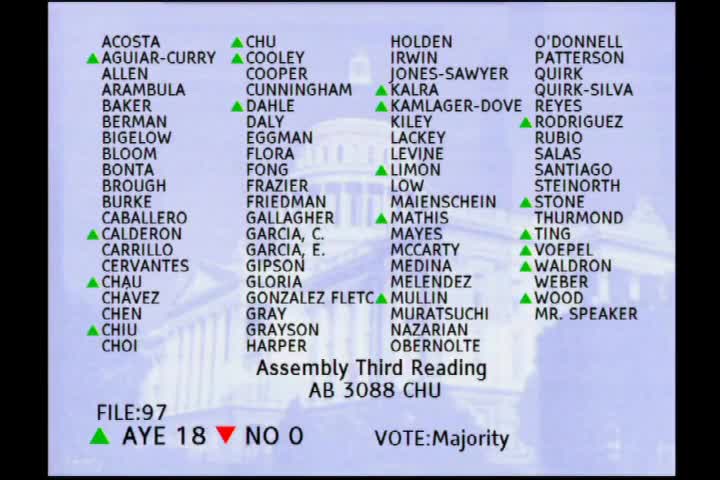
Bill Author

Bill Co-Author(s):