AB 2899: Cannabis: advertisements.
- Session Year: 2017-2018
- House: Assembly
- Latest Version Date: 2018-09-29
Existing law, the Control, Regulate and Tax Adult Use of Marijuana Act (AUMA), approved by the voters at the November 8, 2016, statewide general election, regulates the cultivation, distribution, transport, storage, manufacturing, testing, processing, sale, and use of marijuana for nonmedical purposes by people 21 years of age and older. The Medicinal and Adult-Use Cannabis Regulation and Safety Act (MAUCRSA), among other things, consolidates the licensure and regulation of commercial medicinal and adult-use cannabis activities. MAUCRSA authorizes a licensee to advertise and market cannabis and cannabis products subject to specified restrictions, including accurately and legibly identifying the licensee responsible for that content by adding, at a minimum, the licensees license number, and prohibits a licensee from, among other things, advertising or marketing in a manner that is false or untrue. Under MAUCRSA, each licensing authority is authorized to suspend or revoke a licensees license for failure to comply with these provisions, among other things.
This bill would prohibit a licensee from publishing or disseminating advertisements or marketing of cannabis and cannabis products while the licensees license is suspended.
AUMA authorizes the Legislature to amend by majority vote certain provisions of the act to implement specified substantive provisions, provided that the amendments are consistent with and further the purposes and intent of AUMA.
This bill would declare that its provisions implement specified substantive provisions of AUMA and are consistent with and further the purposes and intent of AUMA.
Existing law, the Control, Regulate and Tax Adult Use of Marijuana Act (AUMA), approved by the voters at the November 8, 2016, statewide general election, regulates the cultivation, distribution, transport, storage, manufacturing, testing, processing, sale, and use of marijuana for nonmedical purposes by people 21 years of age and older. The Medicinal and Adult-Use Cannabis Regulation and Safety Act (MAUCRSA), among other things, consolidates the licensure and regulation of commercial medicinal and adult-use cannabis activities. MAUCRSA requires all cannabis advertisements and marketing to authorizes a licensee to advertise and market cannabis and cannabis products subject to specified restrictions, including accurately and legibly identify identifying the licensee responsible for that content by adding, at a minimum, the licensees license number number, and prohibits a technology platform from displaying the advertisement on an Internet Web page unless the advertisement displays that licensees license number. licensee from, among other things, advertising or marketing in a manner that is false or untrue. Under MAUCRSA, each licensing authority is authorized to discipline suspend or revoke a licensee licensees license for failure to comply with these provisions, among other things.
This bill would require that the license number displayed on the advertisement be the licensees active license number, which the bill would define as the number of a license issued pursuant to MAUCRSA that is not suspended or revoked. prohibit a licensee from publishing or disseminating advertisments or marketing of cannabis and cannabis products while the licensees license is suspended.
AUMA authorizes the Legislature to amend by majority vote certain provisions of the act to implement specified substantive provisions, provided that the amendments are consistent with and further the purposes and intent of AUMA.
This bill would declare that its provisions implement specified substantive provisions of AUMA and are consistent with and further the purposes and intent of AUMA.
This bill would declare that it is to take effect immediately as an urgency statute.Existing law, the Control, Regulate and Tax Adult Use of Marijuana Act (AUMA), approved by the voters at the November 8, 2016, statewide general election, regulates the cultivation, distribution, transport, storage, manufacturing, testing, processing, sale, and use of marijuana for nonmedical purposes by people 21 years of age and older. The Medicinal and Adult-Use Cannabis Regulation and Safety Act (MAUCRSA), among other things, consolidates the licensure and regulation of commercial medicinal and adult-use cannabis activities. MAUCRSA requires all cannabis advertisements and marketing to accurately and legibly identify the licensee responsible for that content by adding, at a minimum, the licensees license number and prohibits a technology platform from displaying the advertisement on an Internet Web page unless the advertisement displays that licensees license number. Under MAUCRSA, each licensing authority is authorized to discipline a licensee for failure to comply with these provisions, among other things.
This bill would require that the license number displayed on the advertisement be the licensees active license number, which the bill would define as the number of a license issued pursuant to MAUCRSA that is not suspended or revoked.
AUMA authorizes the Legislature to amend by majority vote certain provisions of the act to implement specified substantive provisions, provided that the amendments are consistent with and further the purposes and intent of AUMA.
This bill would declare that its provisions implement specified substantive provisions of AUMA and are consistent with and further the purposes and intent of AUMA.
This bill would declare that it is to take effect immediately as an urgency statute.
Existing law, the Control, Regulate and Tax Adult Use of Marijuana Act (AUMA), approved by the voters at the November 8, 2016, statewide general election, regulates the cultivation, distribution, transport, storage, manufacturing, testing, processing, sale, and use of marijuana for nonmedical purposes by people 21 years of age and older. The Medicinal and Adult-Use Cannabis Regulation and Safety Act (MAUCRSA), among other things, consolidates the licensure and regulation of commercial medicinal and adult-use cannabis activities. MAUCRSA requires all cannabis advertisements and marketing to accurately and legibly identify the licensee responsible for that content by adding, at a minimum, the licensees license number and prohibits a technology platform from displaying the advertisement on an Internet Web page unless the advertisement displays that licensees license number. Under MAUCRSA, each licensing authority is authorized to discipline a licensee for failure to comply with these provisions, among other things.
This bill would require that the license number displayed on the advertisement be the licensees active license number, which the bill would define as the number of a license issued pursuant to MAUCRSA that is not suspended or revoked.
AUMA authorizes the Legislature to amend by majority vote certain provisions of the act to implement specified substantive provisions, provided that the amendments are consistent with and further the purposes and intent of AUMA.
This bill would declare that its provisions implement specified substantive provisions of AUMA and are consistent with and further the purposes and intent of AUMA.
This bill would declare that it is to take effect immediately as an urgency statute.Existing law, the Control, Regulate and Tax Adult Use of Marijuana Act (AUMA), approved by the voters at the November 8, 2016, statewide general election, regulates the cultivation, distribution, transport, storage, manufacturing, testing, processing, sale, and use of marijuana for nonmedical purposes by people 21 years of age and older. The Medicinal and Adult-Use Cannabis Regulation and Safety Act (MAUCRSA), among other things, consolidates the licensure and regulation of commercial medicinal and adult-use cannabis activities. MAUCRSA requires all cannabis advertisements and marketing to accurately and legibly identify the licensee responsible for that content by adding, at a minimum, the licensees license number and prohibits a technology platform from displaying the advertisement on an Internet Web page unless the advertisement displays that licensees license number. Under MAUCRSA, each licensing authority is authorized to discipline a licensee for failure to comply with these provisions, among other things.
This bill would require that the license number displayed on the advertisement be the licensees State of California Commercial Cannabis Activity active license number. number, which the bill would define as the number of a license issued pursuant to MAUCRSA that is not suspended or revoked.
The AUMA authorizes the Legislature to amend the act to further the purposes and intent of the act with a 2/3 vote of the membership of both houses of the Legislature, except as provided.This bill would declare that its provisions further specified purposes and intent of AUMA.AUMA authorizes the Legislature to amend by majority vote certain provisions of the act to implement specified substantive provisions, provided that the amendments are consistent with and further the purposes and intent of AUMA.
This bill would declare that its provisions implement specified substantive provisions of AUMA and are consistent with and further the purposes and intent of AUMA.
This bill would declare that it is to take effect immediately as an urgency statute.
Existing law, the Control, Regulate and Tax Adult Use of Marijuana Act (AUMA), approved by the voters at the November 8, 2016, statewide general election, regulates the cultivation, distribution, transport, storage, manufacturing, testing, processing, sale, and use of marijuana for nonmedical purposes by people 21 years of age and older. The Medicinal and Adult-Use Cannabis Regulation and Safety Act (MAUCRSA), among other things, consolidates the licensure and regulation of commercial medicinal and adult-use cannabis activities. MAUCRSA requires all cannabis advertisements and marketing to accurately and legibly identify the licensee responsible for that content by adding, at a minimum, the licensees license number and prohibits a technology platform from displaying the advertisement on an Internet Web page unless the advertisement displays that licensees license number.
This bill would require that the license number displayed on the advertisement be the licensees State of California Commercial Cannabis Activity license number.
The AUMA authorizes the Legislature to amend the act to further the purposes and intent of the act with a 2/3 vote of the membership of both houses of the Legislature, except as provided.
This bill would declare that its provisions further specified purposes and intent of AUMA.
A licensee shall not do any of the following:
(a)Advertise or market in a manner that is false or untrue in any material particular, or that, irrespective of falsity, directly, or by ambiguity, omission, or inference, or by the addition of irrelevant, scientific, or technical matter, tends to create a misleading impression.
(b)Publish or disseminate advertising or marketing containing any statement concerning a brand or product that is inconsistent with any statement on the labeling thereof.
(c)Publish or disseminate advertising or marketing containing any statement, design, device, or representation which tends to create the impression that the cannabis originated in a particular place or region, unless the label of the advertised product bears an appellation of origin, and such appellation of origin appears in the advertisement.
(d)Advertise or market on a billboard or similar advertising device located on an Interstate Highway or on a State Highway which crosses the California border.
(e)Advertise or market cannabis or cannabis products in a manner intended to encourage persons under 21 years of age to consume cannabis or cannabis products.
(f)Publish or disseminate advertising or marketing that is attractive to children.
(g)Advertise or market cannabis or cannabis products on an advertising sign within 1,000 feet of a day care center, school providing instruction in kindergarten or any grades 1 to 12, inclusive, playground, or youth center.
(h)Publish or disseminate advertising or marketing while the licensees license is suspended.
SEC. 2.The Legislature finds and declares that Section 1 of this act, amending Section 26152 of the Business and Professions Code, implements Section 6.1 of the Control, Regulate and Tax Adult Use of Marijuana Act of 2016 and is consistent with and furthers the purposes and intent of that act as stated in Section 3 of that act.
A licensee shall not do any of the following:
(a)Advertise or market in a manner that is false or untrue in any material particular, or that, irrespective of falsity, directly, or by ambiguity, omission, or inference, or by the addition of irrelevant, scientific, or technical matter, tends to create a misleading impression.
(b)Publish or disseminate advertising or marketing containing any statement concerning a brand or product that is inconsistent with any statement on the labeling thereof.
(c)Publish or disseminate advertising or marketing containing any statement, design, device, or representation which tends to create the impression that the cannabis originated in a particular place or region, unless the label of the advertised product bears an appellation of origin, and such appellation of origin appears in the advertisement.
(d)Advertise or market on a billboard or similar advertising device located on an Interstate Highway or on a State Highway which crosses the California border.
(e)Advertise or market cannabis or cannabis products in a manner intended to encourage persons under 21 years of age to consume cannabis or cannabis products.
(f)Publish or disseminate advertising or marketing that is attractive to children.
(g)Advertise or market cannabis or cannabis products on an advertising sign within 1,000 feet of a day care center, school providing instruction in kindergarten or any grades 1 through to 12, inclusive, playground, or youth center.
(h)Publish or disseminate advertising or marketing while the licensees license is suspended.
SEC. 3.SEC. 2.The Legislature finds and declares that Sections 1 and 2 Section 1 of this act, amending Sections 26150 and 26151 Section 26152 of the Business and Professions Code, implement implements Section 6.1 of the Control, Regulate and Tax Adult Use of Marijuana Act of 2016 and are is consistent with and further furthers the purposes and intent of that act as stated in Section 3 of that act.
SEC. 4.This act is an urgency statute necessary for the immediate preservation of the public peace, health, or safety within the meaning of Article IV of the California Constitution and shall go into immediate effect. The facts constituting the necessity are:In order to stop the illegal distribution and sale of cannabis, and to promote the regulated cannabis licensing scheme within the state, it is necessary for this act to go into immediate effect.For purposes of this chapter:
(a)Active license number means the number of an A-license or M-license, as defined in Section 26001, that is not suspended or revoked.
(b)Advertise means the publication or dissemination of an advertisement.
(c)Advertisement includes any written or verbal statement, illustration, or depiction which is calculated to induce sales of cannabis or cannabis products, including any written, printed, graphic, or other material, billboard, sign, or other outdoor display, public transit card, other periodical literature, publication, or in a radio or television broadcast, or in any other media; except that such term shall not include:
(1)Any label affixed to any cannabis or cannabis products, or any individual covering, carton, or other wrapper of that container that constitutes a part of the labeling under provisions of this division.
(2)Any editorial or other reading material, such as a news release, in any periodical or publication or newspaper for the publication of which no money or valuable consideration is paid or promised, directly or indirectly, by any licensee, and which is not written by or at the direction of the licensee.
(d)Advertising sign is any sign, poster, display, billboard, or any other stationary or permanently affixed advertisement promoting the sale of cannabis or cannabis products which are not cultivated, manufactured, distributed, or sold on the same lot.
(e)Health-related statement means any statement related to health, and includes statements of a curative or therapeutic nature that, expressly or by implication, suggest a relationship between the consumption of cannabis or cannabis products and health benefits, or effects on health.
(f)Market or Marketing means any act or process of promoting or selling cannabis or cannabis products, including, but not limited to, sponsorship of sporting events, point-of-sale advertising, and development of products specifically designed to appeal to certain demographics.
SEC. 2.Section 26151 of the Business and Professions Code is amended to read:26151.(a)(1)All advertisements and marketing shall accurately and legibly identify the licensee responsible for its content, by adding, at a minimum, the licensees active license number.
(2)A technology platform shall not display an advertisement by a licensee on an Internet Web page unless the advertisement displays the active license number of the licensee.
(3)An outdoor advertising company subject to the Outdoor Advertising Act (Chapter 2 (commencing with Section 5200) of Division 3) shall not display an advertisement by a licensee unless the advertisement displays the active license number of the licensee.
(b)Any advertising or marketing placed in broadcast, cable, radio, print, and digital communications shall only be displayed where at least 71.6 percent of the audience is reasonably expected to be 21 years of age or older, as determined by reliable, up-to-date audience composition data.
(c)Any advertising or marketing involving direct, individualized communication or dialogue controlled by the licensee shall utilize a method of age affirmation to verify that the recipient is 21 years of age or older before engaging in that communication or dialogue controlled by the licensee. For purposes of this section, that method of age affirmation may include user confirmation, birth date disclosure, or other similar registration method.
(d)All advertising shall be truthful and appropriately substantiated.
SEC. 3.The Legislature finds and declares that Sections 1 and 2 of this act, amending Sections 26150 and 26151 of the Business and Professions Code, implement Section 6.1 of the Control, Regulate and Tax Adult Use of Marijuana Act of 2016 and are consistent with and further the purposes and intent of that act as stated in Section 3 of that act.
SEC. 4.This act is an urgency statute necessary for the immediate preservation of the public peace, health, or safety within the meaning of Article IV of the California Constitution and shall go into immediate effect. The facts constituting the necessity are:
In order to stop the illegal distribution and sale of cannabis, and to promote the regulated cannabis licensing scheme within the state, it is necessary for this act to go into immediate effect.
For purposes of this chapter:
(a)Active license number means the number of an A-license or M-license, as defined in Section 26001, that is not suspended or revoked.
(b)Advertise means the publication or dissemination of an advertisement.
(c)Advertisement includes any written or verbal statement, illustration, or depiction which is calculated to induce sales of cannabis or cannabis products, including any written, printed, graphic, or other material, billboard, sign, or other outdoor display, public transit card, other periodical literature, publication, or in a radio or television broadcast, or in any other media; except that such term shall not include:
(1)Any label affixed to any cannabis or cannabis products, or any individual covering, carton, or other wrapper of that container that constitutes a part of the labeling under provisions of this division.
(2)Any editorial or other reading material, such as a news release, in any periodical or publication or newspaper for the publication of which no money or valuable consideration is paid or promised, directly or indirectly, by any licensee, and which is not written by or at the direction of the licensee.
(d)Advertising sign is any sign, poster, display, billboard, or any other stationary or permanently affixed advertisement promoting the sale of cannabis or cannabis products which are not cultivated, manufactured, distributed, or sold on the same lot.
(e)Health-related statement means any statement related to health, and includes statements of a curative or therapeutic nature that, expressly or by implication, suggest a relationship between the consumption of cannabis or cannabis products and health benefits, or effects on health.
(f)Market or Marketing means any act or process of promoting or selling cannabis or cannabis products, including, but not limited to, sponsorship of sporting events, point-of-sale advertising, and development of products specifically designed to appeal to certain demographics.
SEC. 2.Section 26151 of the Business and Professions Code is amended to read:26151.(a)(1)All advertisements and marketing shall accurately and legibly identify the licensee responsible for its content, by adding, at a minimum, the licensees active license number.
(2)A technology platform shall not display an advertisement by a licensee on an Internet Web page unless the advertisement displays the active license number of the licensee.
(3)An outdoor advertising company subject to the Outdoor Advertising Act (Chapter 2 (commencing with Section 5200) of Division 3) shall not display an advertisement by a licensee unless the advertisement displays the active license number of the licensee.
(b)Any advertising or marketing placed in broadcast, cable, radio, print, and digital communications shall only be displayed where at least 71.6 percent of the audience is reasonably expected to be 21 years of age or older, as determined by reliable, up-to-date audience composition data.
(c)Any advertising or marketing involving direct, individualized communication or dialogue controlled by the licensee shall utilize a method of age affirmation to verify that the recipient is 21 years of age or older before engaging in that communication or dialogue controlled by the licensee. For purposes of this section, that method of age affirmation may include user confirmation, birth date disclosure, or other similar registration method.
(d)All advertising shall be truthful and appropriately substantiated.
SEC. 3.The Legislature finds and declares that Sections 1 and 2 of this act, amending Sections 26150 and 26151 of the Business and Professions Code, implement Section 6.1 of the Control, Regulate and Tax Adult Use of Marijuana Act of 2016 and are consistent with and further the purposes and intent of that act as stated in Section 3 of that act.
SEC. 4.This act is an urgency statute necessary for the immediate preservation of the public peace, health, or safety within the meaning of Article IV of the California Constitution and shall go into immediate effect. The facts constituting the necessity are:In order to stop the illegal distribution and sale of cannabis, and to promote the regulated cannabis licensing scheme within the state, it is necessary for this act to go into immediate effect.For purposes of this chapter:
(a)Active license number means the number of an A-license or M-license, as defined in Section 26001, that is not suspended or revoked.
(a)(b)Advertise means the publication or dissemination of an advertisement.
(b)(c)Advertisement includes any written or verbal statement, illustration, or depiction which is calculated to induce sales of cannabis or cannabis products, including any written, printed, graphic, or other material, billboard, sign, or other outdoor display, public transit card, other periodical literature, publication, or in a radio or television broadcast, or in any other media; except that such term shall not include:
(1)Any label affixed to any cannabis or cannabis products, or any individual covering, carton, or other wrapper of that container that constitutes a part of the labeling under provisions of this division.
(2)Any editorial or other reading material, such as a news release, in any periodical or publication or newspaper for the publication of which no money or valuable consideration is paid or promised, directly or indirectly, by any licensee, and which is not written by or at the direction of the licensee.
(c)(d)Advertising sign is any sign, poster, display, billboard, or any other stationary or permanently affixed advertisement promoting the sale of cannabis or cannabis products which are not cultivated, manufactured, distributed, or sold on the same lot.
(d)(e)Health-related statement means any statement related to health, and includes statements of a curative or therapeutic nature that, expressly or by implication, suggest a relationship between the consumption of cannabis or cannabis products and health benefits, or effects on health.
(e)(f)Market or Marketing means any act or process of promoting or selling cannabis or cannabis products, including, but not limited to, sponsorship of sporting events, point-of-sale advertising, and development of products specifically designed to appeal to certain demographics.
SECTION 1.SEC. 2.Section 26151 of the Business and Professions Code is amended to read:26151.(a)(1)All advertisements and marketing shall accurately and legibly identify the licensee responsible for its content, by adding, at a minimum, the licensees active license number.
(2)A technology platform shall not display an advertisement by a licensee on an Internet Web page unless the advertisement displays the State of California Commercial Cannabis Activity active license number of the licensee.
(3)An outdoor advertising company subject to the Outdoor Advertising Act (Chapter 2 (commencing with Section 5200) of Division 3) shall not display an advertisement by a licensee unless the advertisement displays the active license number of the licensee.
(b)Any advertising or marketing placed in broadcast, cable, radio, print, and digital communications shall only be displayed where at least 71.6 percent of the audience is reasonably expected to be 21 years of age or older, as determined by reliable, up-to-date audience composition data.
(c)Any advertising or marketing involving direct, individualized communication or dialogue controlled by the licensee shall utilize a method of age affirmation to verify that the recipient is 21 years of age or older before engaging in that communication or dialogue controlled by the licensee. For purposes of this section, that method of age affirmation may include user confirmation, birth date disclosure, or other similar registration method.
(d)All advertising shall be truthful and appropriately substantiated.
SEC. 2.The Legislature finds and declares that Section l of this act amends the Control, Regulate and Tax Adult Use of Marijuana Act by prohibiting a technology platform from displaying an advertisement by a licensee under the act unless the advertisement displays the licensees specified license number, and that the section is consistent with and furthers the purposes and intent of the act.SEC. 3.The Legislature finds and declares that Sections 1 and 2 of this act, amending Sections 26150 and 26151 of the Business and Professions Code, implement Section 6.1 of the Control, Regulate and Tax Adult Use of Marijuana Act of 2016 and are consistent with and further the purposes and intent of that act as stated in Section 3 of that act.
SEC. 4.This act is an urgency statute necessary for the immediate preservation of the public peace, health, or safety within the meaning of Article IV of the California Constitution and shall go into immediate effect. The facts constituting the necessity are:
In order to stop the illegal distribution and sale of cannabis, and to promote the regulated cannabis licensing scheme within the state, it is necessary for this act to go into immediate effect.
(a)(1)All advertisements and marketing shall accurately and legibly identify the licensee responsible for its content, by adding, at a minimum, the licensees license number.
(2)A technology platform shall not display an advertisement by a licensee on an Internet Web page unless the advertisement displays the State of California Commercial Cannabis Activity license number of the licensee.
(3)An outdoor advertising company subject to the Outdoor Advertising Act (Chapter 2 (commencing with Section 5200) of Division 3) shall not display an advertisement by a licensee unless the advertisement displays the license number of the licensee.
(b)Any advertising or marketing placed in broadcast, cable, radio, print, and digital communications shall only be displayed where at least 71.6 percent of the audience is reasonably expected to be 21 years of age or older, as determined by reliable, up-to-date audience composition data.
(c)Any advertising or marketing involving direct, individualized communication or dialogue controlled by the licensee shall utilize a method of age affirmation to verify that the recipient is 21 years of age or older before engaging in that communication or dialogue controlled by the licensee. For purposes of this section, that method of age affirmation may include user confirmation, birth date disclosure, or other similar registration method.
(d)All advertising shall be truthful and appropriately substantiated.
SEC. 2.The Legislature finds and declares that Section l of this act amends the Control, Regulate and Tax Adult Use of Marijuana Act by prohibiting a technology platform from displaying an advertisement by a licensee under the act unless the advertisement displays the licensees specified license number, and that the section is consistent with and furthers the purposes and intent of the act.
|
Date
|
Status
|
|---|---|
| Sep 29, 2018 | Chaptered by Secretary of State - Chapter 923, Statutes of 2018. |
| Sep 29, 2018 | Approved by the Governor. |
| Sep 10, 2018 | Enrolled and presented to the Governor at 3:30 p.m. |
| Aug 29, 2018 | Senate amendments concurred in. To Engrossing and Enrolling. |
| Aug 28, 2018 | From committee: That the Senate amendments be concurred in. (Ayes 18. Noes 0.) (August 28). |
| Aug 23, 2018 | Re-referred to Com. on B. & P. pursuant to Assembly Rule 77.2. |
| Aug 20, 2018 | In Assembly. Concurrence in Senate amendments pending. May be considered on or after August 22 pursuant to Assembly Rule 77. |
| Aug 20, 2018 | Read third time. Passed. Ordered to the Assembly. |
| Aug 7, 2018 | Read second time. Ordered to third reading. |
| Aug 6, 2018 | From committee: Be ordered to second reading pursuant to Senate Rule 28.8. |
| Jun 26, 2018 | From committee: Do pass and re-refer to Com. on APPR. (Ayes 9. Noes 0.) (June 25). Re-referred to Com. on APPR. |
| Jun 20, 2018 | From committee chair, with author's amendments: Amend, and re-refer to committee. Read second time, amended, and re-referred to Com. on B., P. & E.D. |
| Jun 11, 2018 | In committee: Hearing postponed by committee. |
| May 30, 2018 | Referred to Com. on B., P. & E.D. |
| May 17, 2018 | In Senate. Read first time. To Com. on RLS. for assignment. |
| May 17, 2018 | Read third time. Urgency clause adopted. Passed. Ordered to the Senate. |
| May 10, 2018 | Read second time. Ordered to Consent Calendar. |
| May 9, 2018 | From committee: Do pass. To Consent Calendar. (Ayes 16. Noes 0.) (May 9). |
| Apr 25, 2018 | Re-referred to Com. on APPR. |
| Apr 24, 2018 | Read second time and amended. |
| Apr 23, 2018 | From committee: Amend, and do pass as amended and re-refer to Com. on APPR. (Ayes 16. Noes 0.) (April 17). |
| Apr 17, 2018 | Re-referred to Com. on B. & P. |
| Apr 16, 2018 | From committee chair, with author's amendments: Amend, and re-refer to Com. on B. & P. Read second time and amended. |
| Apr 11, 2018 | Re-referred to Com. on B. & P. |
| Apr 10, 2018 | From committee chair, with author's amendments: Amend, and re-refer to Com. on B. & P. Read second time and amended. |
| Mar 22, 2018 | Referred to Com. on B. & P. |
| Feb 17, 2018 | From printer. May be heard in committee March 19. |
| Feb 16, 2018 | Read first time. To print. |
|
Date
|
Description
|
Location
|
Votes
|
|
|---|---|---|---|---|
| Aug 29, 2018 | AB 2899 RUBIO Concurrence in Senate Amendments | Assembly Floor |
Passed |
|
| Aug 28, 2018 | With recommendation: That Senate amendments be concurred in. | Assembly Standing Committee on Business and Professions |
Passed |
|
| Aug 20, 2018 | Assembly 3rd Reading AB2899 Rubio et al. By Glazer | Senate Floor |
Passed |
|
| Jun 25, 2018 | Do pass, but first be re-referred to the Committee on [Appropriations] | Senate Standing Committee on Business, Professions and Economic Development |
Passed |
|
| May 17, 2018 | AB 2899 RUBIO Consent Calendar Second Day Regular Session | Assembly Floor |
Passed |
|
| May 9, 2018 | Do pass. To Consent Calendar. | Assembly Standing Committee on Appropriations |
Passed |
|
| Apr 17, 2018 | Do pass as amended and be re-referred to the Committee on [Appropriations] | Assembly Standing Committee on Business and Professions |
Passed |
This list shows positions taken on this bill by organizations on the date displayed, which is linked to the original source.
Positions by individuals are not included.
|
Organization
|
Position
|
Date
|
|---|---|---|
| ... | * Support | Apr 17, 2018 |
| Berkeley Patients Group | * Support | Apr 17, 2018 |
| California Cannabis Industry Association | * Support | Jun 25, 2018 |
| California Teamsters | * Support | Jun 25, 2018 |
| Cannabis Distribution Association | ** Support | Aug 8, 2018 |
| City Of Sacramento | * Support | Jun 25, 2018 |
| CMG Caliva | * Support | Apr 17, 2018 |
| Eaze Solutions Inc | * Support | Jun 25, 2018 |
| eSolutions | * Indeterminate | Apr 17, 2018 |
| River Distribution | * Support | Jun 25, 2018 |
| United Cannabis Business Alliance | * Support | Jun 25, 2018 |
| United Food and Commercial Workers | ** Support | Aug 8, 2018 |
CONCURRENCE IN SENATE AMENDMENTS
CSA2 Bill Id:AB 2899
Author:(Rubio and Cooper)
As Amended Ver:June 20, 2018
Majority vote
ASSEMBLY: | 73-0 | (May 17, 2018) | SENATE: | 39-0 | (August 20, 2018) |
COMMITTEE VOTE: | 18-0 | (August 28, 2018) | RECOMMENDATION: | concur |
Original Committee Reference: B. & P.
SUMMARY: Prohibits a cannabis licensee from publishing or disseminating advertising or marketing while the licensee's license is suspended.
The Senate amendments recast provisions previously clarifying the definition of "active license number" to instead add language to existing law itemizing restrictions on licensee advertising to include an express prohibition against advertising while a cannabis license is suspended.
EXISTING LAW:
- Enacts the Medicinal and Adult-Use Cannabis Regulation and Safety Act to provide for a comprehensive regulatory framework for the cultivation, distribution, transport, storage, manufacturing, processing, and sale of medicinal and adult-use cannabis. (Business and Professions Code Section (BPC) 26000 et al.)
- Defines an "A-license" as a state license issued for cannabis or cannabis products intended for adults 21 years of age and older and "M-license" as a state license for commercial cannabis activity involving medicinal cannabis. (BPC 26001)
- Provides for twenty total types of cannabis licenses including subtypes for cultivation, manufacturing, testing, retail, distribution, and microbusiness; requires each licensee except for testing laboratories to clearly designate whether their license is for adult-use or medicinal cannabis. (BPC 26050)
- Establishes the Bureau of Cannabis Control (BCC) within the Department of Consumer Affairs for purposes of regulating microbusinesses, transportation, storage, distribution, testing, and sale of cannabis and cannabis products within the state. (BPC 26010)
- Provides the Department of Food and Agriculture with responsibility for regulating cannabis cultivators. (BPC 26060)
- Provides the Department of Public Health with responsibility for regulating cannabis manufacturers. (BPC 26130)
- Establishes grounds for disciplinary action against cannabis licensees, including failures to comply with state licensing requirements as well as local laws and ordinances. (BPC 26030)
- Subjects cannabis businesses operating without a license to civil penalties of up to three times the amount of the license fee for each violation in addition to any criminal penalties. (BPC 26038)
- Requires that all advertisements and marketing accurately and legibly identify the licensee responsible for its content, by adding, at a minimum, the licensee's license number, and prohibits a technology platform from displaying an advertisement by a licensee on an Internet Web page unless the advertisement displays the license number. (BPC 26151)
- Prohibits cannabis licensees from engaging in advertising or marketing that is false or untrue, is inconsistent with product labeling, is targeted toward or attractive to minors, and other specified restrictions. (BPC 26152)
- Expresses that state cannabis laws shall not be interpreted to supersede or limit the authority of a local jurisdiction to adopt and enforce local ordinances to regulate cannabis businesses. (BPC 26200)
- Authorizes the Legislature to, by majority vote, enact laws to implement the state's regulatory scheme for cannabis if those laws are consistent with the purposes and intent of the Control, Regulate and Tax Adult Use of Marijuana Act (Proposition 64). (BPC 26000)
FISCAL EFFECT: According to the Senate Appropriations Committee, pursuant to Senate Rule 28.8, negligible state costs.
COMMENTS:
Purpose. This bill is sponsored by the author. According to the author:
It is important that we continue to pass legislation that is consistent with the voters' intent behind Proposition 64. This bill will help businesses who have properly gone through the licensing process by cracking down on entities with suspended licenses who attempt to advertise their product. By prohibiting a licensee from publishing or disseminating advertising or marketing while the licensee's license is suspended, California can further combat AB 2899 Page 4 the cannabis black market to ensure that only properly licensed businesses are participating in the market
Background. In addition to general provisions governing the advertising and marketing of cannabis businesses, statute specifies that "a technology platform shall not display an advertisement by a licensee on an Internet Web page unless the advertisement displays the license number of the licensee." In the wake of the development of California's legal cannabis market, a number of online advertisers have begun soliciting and accepting agreements to advertise cannabis businesses such as dispensaries and retail stores. Public awareness of websites that advertise cannabis-related businesses has grown alongside the state's regulatory scheme, as a series of startups have competed for market share dominance in the industry.
This bill would make it express in statute that a cannabis business whose license is suspended may not engage in advertising or marketing. This bill would apply to the licensee, not the platform through which the advertising occurs. Doing so is intended to help ensure that illegitimate or unscrupulous cannabis businesses cannot reach consumers without a valid license.
Analysis Prepared by: Robert Sumner / B. & P. / (916) 319-3301 FN: 0005084
Date of Hearing:
ASSEMBLY COMMITTEE ON BUSINESS AND PROFESSIONS
Evan Low, Chair
ABPCA Bill Id:AB 2899
Author:(Rubio) – As Amended Ver:June 20, 2018
Note: this bill was referred to this Committee pursuant to Assembly Rule 77.2. The Committee may recommend that the Assembly concur in the Senate amendments, recommend that the Assembly not concur in the Senate amendments, or hold the bill in the Committee.
SUBJECT: Cannabis: advertisements: license number.
SUMMARY: Prohibits a cannabis licensee from publishing or disseminating advertising or marketing while the licensee’s license is suspended.
THE SENATE AMENDMENTS: Recast provisions previously clarifying the definition of “active license number” to instead add language to existing law itemizing restrictions on licensee advertising to include an express prohibition against advertising while a cannabis license is suspended.
EXISTING LAW:
- Enacts the Medicinal and Adult-Use Cannabis Regulation and Safety Act to provide for a comprehensive regulatory framework for the cultivation, distribution, transport, storage, manufacturing, processing, and sale of medicinal and adult-use cannabis. (Business and Professions Code (BPC) §§ 26000 et al.)
- Defines an “A-license” as a state license issued for cannabis or cannabis products intended for adults 21 years of age and older and “M-license” as a state license for commercial cannabis activity involving medicinal cannabis. (BPC § 26001)
- Provides for twenty total types of cannabis licenses including subtypes for cultivation, manufacturing, testing, retail, distribution, and microbusiness; requires each licensee except for testing laboratories to clearly designate whether their license is for adult-use or medicinal cannabis. (BPC § 26050)
- Establishes the Bureau of Cannabis Control (BCC) within the Department of Consumer Affairs, previously named the Bureau of Marijuana Control, the Bureau of Medical Cannabis Regulation, and the Bureau of Medical Marijuana Regulation, for purposes of regulating microbusinesses, transportation, storage, distribution, testing, and sale of cannabis and cannabis products within the state. (BPC § 26010)
- Requires the BCC to convene an advisory committee to advise state licensing authorities on the development of standards and regulations for legal cannabis, including best practices and guidelines that protect public health and safety while ensuring a regulated environment for commercial cannabis activity that does not impose such barriers so as to perpetuate, rather than reduce and eliminate, the illicit market for cannabis. (BPC § 26014)
- Provides the Department of Food and Agriculture with responsibility for regulating cannabis cultivators. (BPC § 26060)
- Provides the Department of Public Health with responsibility for regulating cannabis manufacturers. (BPC § 26130)
- Establishes grounds for disciplinary action against cannabis licensees, including failures to comply with state licensing requirements as well as local laws and ordinances. (BPC § 26030)
- Subjects cannabis businesses operating without a license to civil penalties of up to three times the amount of the license fee for each violation in addition to any criminal penalties. (BPC § 26038)
- Requires that all advertisements and marketing accurately and legibly identify the licensee responsible for its content, by adding, at a minimum, the licensee’s license number, and prohibits a technology platform from displaying an advertisement by a licensee on an Internet Web page unless the advertisement displays the license number. (BPC § 26151)
- Expresses that state cannabis laws shall not be interpreted to supersede or limit the authority of a local jurisdiction to adopt and enforce local ordinances to regulate cannabis businesses. (BPC § 26200)
- Authorizes the Legislature to, by majority vote, enact laws to implement the state’s regulatory scheme for cannabis if those laws are consistent with the purposes and intent of the Control, Regulate and Tax Adult Use of Marijuana Act (Proposition 64). (BPC § 26000)
THIS BILL:
- Adds to the list of restrictions on advertising or marketing by cannabis licensees by expressly banning the publication or dissemination of advertising or marketing while a licensee’s license is suspended.
FISCAL EFFECT: Pursuant to Senate Rule 28.8, negligible state costs.
COMMENTS:
Purpose. This bill is sponsored by the author. According to the author:
It is important that we continue to pass legislation that is consistent with the voters’ intent behind Proposition 64. This bill will help businesses who have properly gone through the licensing process by cracking down on entities with suspended licenses who attempt to advertise their product. By prohibiting a licensee from publishing or disseminating advertising or marketing while the licensee’s license is suspended, California can further combat the cannabis black market to ensure that only properly licensed businesses are participating in the market.
Background. Early History of Cannabis Regulation in California. Consumption of cannabis was first made lawful in California when voters approved Proposition 215 in 1996, or the Compassionate Use Act. Prop 215 protected qualified patients and caregivers from prosecution related to the possession and cultivation of cannabis for medicinal purposes, if recommended by a physician. The initiative prohibited physicians from being punished or denied any right or privilege for making a medicinal cannabis recommendation to a patient. Prop 215 also included findings and declarations, including encouragement of the federal and state government to implement a plan to provide for the safe and affordable distribution of cannabis to patients with medical needs.
The regulatory scheme for medicinal cannabis was further refined by SB 420 (Vasconcellos) in 2003, which established the state’s Medical Marijuana Program (MMP.) Under the MMP, qualified patients were eligible to obtain a voluntary medical marijuana patient card, which could be used to verify that the patient or a caregiver had authorization to cultivate, possess, transport, or use medicinal cannabis. Under the MMP, a patient would obtain a recommendation for medicinal cannabis from a physician and submit proof to their county of residence to receive a card. The MPP’s identification cards were intended to help law enforcement officers identify and verify that cardholders were allowed to cultivate, possess, and/or transport limited amounts of cannabis without being subject to arrest. The MMP also created protections for qualified patients and primary caregivers from prosecution for the formation of collectives and cooperatives for medicinal cannabis cultivation.
Since the state did not adopt a formal framework to provide for appropriate licensure and regulation of medicinal cannabis until late 2015, a proliferation of informally regulated cannabis collectives and cooperatives were largely left to the enforcement of local governments. As a result, a patchwork of local regulations was created with little statewide involvement. More restrictive laws and ordinances by cities and counties were ultimately upheld by the California Supreme Court in City of Riverside v. Inland Empire Patients (2013) 56 Cal. 4th 729, which held that state law did not expressly or implicitly limit the inherent authority of a local jurisdiction, by its own ordinances, to regulate the use of its land, including the authority to provide that facilities for the distribution of medicinal cannabis be prohibited from operating within its borders.
Even after several years of legal cannabis cultivation and consumption under state law, a lack of a uniform regulatory framework led to persistent problems across the state. Cannabis’s continued illegality under the federal Controlled Substances Act, which classifies cannabis as a Schedule I drug ineligible for prescription, generated periodic enforcement activities by the United States Department of Justice. The constant threat of action by the federal government created apprehension among California’s cannabis community.
A document issued by the United States Attorney General in 2013 known as the “Cole memorandum” indicated that the existence of a strong and effective state regulatory system, and a cannabis operation’s compliance with such a system, could allay the threat of federal enforcement interests. Federal prosecutors were urged under the memo to review cannabis cases on a case-by-case basis and consider whether a cannabis operation was in compliance with a strong and effective state regulatory system prior to prosecution. The memo was followed by Congress’s passage of the Rohrabacher-Farr amendment, which prohibits the United States Department of Justice from interceding in state efforts to implement medicinal cannabis.
MCRSA. After several attempts to improve the state’s regulation of cannabis, the Legislature passed the Medical Cannabis Regulation and Safety Act (MCRSA) in 2015. MCRSA consisted of a package of legislation: AB 243 (Wood); AB 266 (Bonta, Cooley, Jones-Sawyer, Lackey, and Wood); and SB 643 (McGuire). MCRSA established, for the first time, a comprehensive statewide licensing and regulatory framework for the cultivation, manufacture, transportation, testing, distribution, and sale of medicinal cannabis to be administered by the newly established BCC within Department of Consumer Affairs, the Department of Public Health, and the Department of Food and Agriculture, with implementation relying on each agency’s area of expertise.
MCRSA vested authority for:
- The BCC to issue licenses and regulate dispensaries, distributors, and transporters, and to provide oversight for the state’s regulatory framework;
- The Department of Public Health to license and regulate testing laboratories and manufacturers; and
- The Department of Food and Agriculture to license and regulate cultivators.
While entrusting state agencies to promulgate extensive regulations governing the implementation of the state’s cannabis laws, MCRSA fully preserved local control. Under MCRSA, local governments may establish their own ordinances to regulate medicinal cannabis activity. Local jurisdictions may also choose to ban cannabis altogether.
AUMA. Not long after the Legislature enacted MCRSA, California voters passed Proposition 64, the Adult Use of Marijuana Act (AUMA). The passage of the AUMA legalized cannabis for non-medicinal adult use in a private home or licensed business, allowed adults 21 and over to possess and give away up to approximately one ounce of cannabis and up to eight grams of concentrate, and permitted the personal cultivation of up to six plants. The law sustained prohibitions against smoking in or operating a vehicle while under the effects of cannabis, possessing cannabis at a school or other child oriented facility while kids are present, growing in an unlocked or public place, and providing cannabis to minors.
The proponents of the AUMA sought to make use of much of the regulatory framework and authorities set out by MCRSA while making a few notable changes to the structure still being implemented. In addition, the AUMA approved by the voters adopted the January 1, 2018 deadline for state implementation of non-medicinal cannabis in addition to the regulations required in MCRSA that are scheduled to take effect on the same date. The same agencies given authority under MCRSA remain responsible for implementing regulations for adult use.
Under the AUMA, the BCC within the Department of Consumer Affairs continues to serve as the lead regulatory agency for all cannabis, both medicinal and non-medicinal. The AUMA includes 19 different license types compared to the 17 in MCRSA and authorizes Department of Consumer Affairs (and the BCC) the exclusive authority to create and regulate a license for transportation of cannabis. The AUMA also allows for vertical integration models which allow the holding of multiple license types previously prohibited under MCRSA. Additionally, while MCRSA requires both a state and local license to operate, the AUMA only stipulates a state license; however, the state is also directed not to issue a license to an applicant if it would “violate the provisions of any local ordinance or regulation.”
The language of the AUMA allows for legislative modifications that “implement” or “give practical effect” to the law by a majority vote. However, what constitutes “implementing” has been interpreted to be very limited. Consequently, proposed changes on the whole, require a two-thirds vote and of those, some may be deemed to require subsequent voter approval.
MAUCRSA. In the spring of 2017, SB 94 (Committee on Budget and Fiscal Review) was introduced to reconcile the distinct systems for the regulation, licensing, and enforcement of legal cannabis that had been established under the respective authorities of MCRSA and the AUMA. The single consolidated system established by the bill—known as the Medicinal and Adult-Use Cannabis Regulation and Safety Act (MAUCRSA)—created a unified series of cannabis laws and deleted redundant code sections no longer necessary due to the combination of the two systems. MAUCRSA also clarified a number of components, including but not limited to licensing, local control, taxation, testing, and edibles.
As of January 1, 2018, the state has begun issuing temporary licenses (adult-use and medicinal) to cannabis businesses as the state’s regulatory agencies worked toward the finalization of their regulations. While an electronic Track-and-Trace system was implemented pursuant to MAUCRSA, it is not currently being used for temporary licensees. The state’s emergency regulations require temporary licensees to document all sales and transfers of cannabis and cannabis products between temporary licensees—or between temporary licensees and annual licensees—by using paper sales invoices or shipping manifests. Other licensing requirements will not be enforced until the completion of a grace period later in the year. Collectives and cooperatives previously authorized to engage in unlicensed cannabis cultivation are allowed to continue operating until January 9, 2019.
Restrictions on Cannabis Advertising and Marketing. In addition to general provisions governing the advertising and marketing of cannabis businesses, statute specifies that “a technology platform shall not display an advertisement by a licensee on an Internet Web page unless the advertisement displays the license number of the licensee.” In the wake of the development of California’s legal cannabis market, a number of online advertisers have begun soliciting and accepting agreements to advertise cannabis businesses such as dispensaries and retail stores. Public awareness of websites that exclusively advertise cannabis-related businesses has grown alongside the state’s regulatory scheme, as a series of tech startups have competed for market share dominance in a burgeoning industry.
This bill would make it express in statute that a cannabis business whose license is suspended may not engage in advertising or marketing. The bill would apply to the licensee, not the platform through which the advertising occurs. Doing so is intended to help ensure that illegitimate or unscrupulous cannabis businesses cannot reach consumers without a valid, active license.
Current Related Legislation. AB 2866 (Cooper) would subject cannabis businesses to a $10,000 civil penalty for failure to include their license number in any advertising or marketing, which would fund grants for local cannabis control officers. This bill died in the Assembly Public Safety Committee.
AB 3261 (Low) would make various clarifying and technical changes to the state’s cannabis laws. This bill is pending on the Senate Floor.
Prior Related Legislation. SB 94 (Committee on Budget and Fiscal Review, Chapter 27, Statutes of 2017) combined AUMA and MCRSA into one system for the regulation of cannabis, resulting in MAUCRSA.
REGISTERED SUPPORT:
None on file.
REGISTERED OPPOSITION:
None on file.
Analysis Prepared by: Robert Sumner / B. & P. / (916) 319-3301
CONCURRENCE IN SENATE AMENDMENTS
CSA1 Bill Id:AB 2899
Author:(Rubio and Cooper)
As Amended Ver:June 20, 2018
Majority vote
ASSEMBLY: | 73-0 | (May 17, 2018) | SENATE: | 39-0 | (August 20, 2018) |
Original Committee Reference: B. & P.
SUMMARY: Prohibits a cannabis licensee from publishing or disseminating advertising or marketing while the licensee's license is suspended.
The Senate amendments recast provisions previously clarifying the definition of "active license number" to instead add language to existing law itemizing restrictions on licensee advertising to include an express prohibition against advertising while a cannabis license is suspended.
EXISTING LAW:
- Enacts the Medicinal and Adult-Use Cannabis Regulation and Safety Act to provide for a comprehensive regulatory framework for the cultivation, distribution, transport, storage, manufacturing, processing, and sale of medicinal and adult-use cannabis. (Business and Professions Code (BPC) Sections 26000 et al.)
- Defines an "A-license" as a state license issued for cannabis or cannabis products intended for adults 21 years of age and older and "M-license" as a state license for commercial cannabis activity involving medicinal cannabis. (BPC Section 26001)
- Provides for twenty total types of cannabis licenses including subtypes for cultivation, manufacturing, testing, retail, distribution, and microbusiness; requires each licensee except for testing laboratories to clearly designate whether their license is for adult-use or medicinal cannabis. (BPC Section 26050)
- Establishes the Bureau of Cannabis Control (BCC) within the Department of Consumer Affairs for purposes of regulating microbusinesses, transportation, storage, distribution, testing, and sale of cannabis and cannabis products within the state. (BPC Section 26010)
- Provides the Department of Food and Agriculture with responsibility for regulating cannabis cultivators. (BPC Section 26060)
- Provides the Department of Public Health with responsibility for regulating cannabis manufacturers. (BPC Section 26130)
- Establishes grounds for disciplinary action against cannabis licensees, including failures to comply with state licensing requirements as well as local laws and ordinances. (BPC Section 26030)
- Subjects cannabis businesses operating without a license to civil penalties of up to three times the amount of the license fee for each violation in addition to any criminal penalties. (BPC Section 26038)
- Requires that all advertisements and marketing accurately and legibly identify the licensee responsible for its content, by adding, at a minimum, the licensee's license number, and prohibits a technology platform from displaying an advertisement by a licensee on an Internet Web page unless the advertisement displays the license number. (BPC Section 26151)
- Prohibits cannabis licensees from engaging in advertising or marketing that is false or untrue, is inconsistent with product labeling, is targeted toward or attractive to minors, and other specified restrictions. (BPC Section 26152)
- Expresses that state cannabis laws shall not be interpreted to supersede or limit the authority of a local jurisdiction to adopt and enforce local ordinances to regulate cannabis businesses. (BPC Section 26200)
- Authorizes the Legislature to, by majority vote, enact laws to implement the state's regulatory scheme for cannabis if those laws are consistent with the purposes and intent of the Control, Regulate and Tax Adult Use of Marijuana Act (Proposition 64). (BPC Section 26000)
FISCAL EFFECT: According to the Senate Appropriations Committee, pursuant to Senate Rule 28.8, negligible state costs.
COMMENTS:
Purpose. This bill is sponsored by the author. According to the author:
It is important that we continue to pass legislation that is consistent with the voters' intent behind Proposition 64. This bill will help businesses who have properly gone through the licensing process by cracking down on entities with suspended licenses who attempt to advertise their product. By prohibiting a licensee from publishing or disseminating advertising or marketing while the licensee's license is suspended, California can further combat AB 2899 Page 4 the cannabis black market to ensure that only properly licensed businesses are participating in the market
Background. In addition to general provisions governing the advertising and marketing of cannabis businesses, statute specifies that "a technology platform shall not display an advertisement by a licensee on an Internet Web page unless the advertisement displays the license number of the licensee." In the wake of the development of California's legal cannabis market, a number of online advertisers have begun soliciting and accepting agreements to advertise cannabis businesses such as dispensaries and retail stores. Public awareness of websites that exclusively advertise cannabis-related businesses has grown alongside the state's regulatory scheme, as a series of tech startups have competed for market share dominance in a burgeoning industry.
This bill would make it express in statute that a cannabis business whose license is suspended may not engage in advertising or marketing. This bill would apply to the licensee, not the platform through which the advertising occurs. Doing so is intended to help ensure that illegitimate or unscrupulous cannabis businesses cannot reach consumers without a valid, active license.
Analysis Prepared by: Robert Sumner / B. & P. / (916) 319-3301 FN: 0003932
Office of Senate Floor Analyses (916) 651-1520 Fax: (916) 327-4478 | AB |
THIRD READING
Bill No: AB 2899
:
SENATE BUS., PROF. & ECON. DEV. COMMITTEE: 9-0, 6/25/18
AYES: Hill, Fuller, Allen, Dodd, Galgiani, Glazer, Hernandez, Pan, Wilk
SENATE APPROPRIATIONS COMMITTEE: Senate Rule 28.8
ASSEMBLY FLOOR: 73-0, 5/17/18 (Consent) - See last page for vote
DIGEST:
This bill prohibits a licensee of the Bureau of Cannabis Control (Bureau) from publishing or disseminating advertising or marketing while the licensee’s license is suspended.
Existing law:
- Establishes the Medicinal and Adult-Use Cannabis Regulation and Safety Act (Act) to regulate the cultivation, distribution, transport, storage, manufacturing, processing, and sale of both medicinal cannabis and adult-use cannabis. (Business and Professions Code (BPC) § 26000)
- Establishes the Bureau under the Department of Consumer Affairs to create, issue, deny, renew, discipline, suspend, or revoke licenses for microbusinesses, transportation, storage unrelated to manufacturing activities, distribution, testing, and sale of cannabis and cannabis products within the state. (BPC §§ 26010, 26012 (a)(1))
- Defines “license” in the general provisions of the BPC as “unless otherwise expressly provided, ‘license’ means license, certificate, registration, or other means to engage in a business or profession regulated by this code or referred to in specified sections of code”. (BPC § 23.7)
- Defines the following under the Act: (BPC § 26001)
- “License” means a state license issued under this division, and includes both an A-license and an M-license, as well as a testing license.
- “Licensee” means any person holding a license under the Act, regardless of whether the license held is an A-license or an M-license, and includes the holder of a testing laboratory license.
- States that a person engaging in commercial cannabis activity without a license required by the Act shall be subject to civil penalties of up to three times the amount of the license fee for each violation, and the court may order the destruction of cannabis associated with that violation. Each day of operation shall constitute a separate violation. (BPC § 26038)
- States that revocation of a state license issued pursuant to the Act shall terminate the ability of the licensee to operate pursuant to that license within California until a new license is obtained. (BPC § 26055 (b))
- Requires all advertisements and marketing to accurately and legibly identify the licensee responsible for its content, by adding, at a minimum, the licensee’s license number. (BPC § 26151(a)(1))
- Prohibits a technology platform from displaying an advertisement by a licensee on an Internet Web page unless the advertisement displays the license number of the licensee. (BPC § 26151 (a)(2))
- Requires all cannabis advertising to be truthful and appropriately substantiated. (BPC § 26151(d))
- Requires a licensee whose license has been revoked to conspicuously display a notice on the exterior of the licensee's premises indicating that the license has been revoked for at least 15 calendar days. (Title 16 Code of California Regulations (CCR) § 5812)
- Authorizes the Bureau to file an accusation to suspend or revoke a license where grounds for such suspension or revocation exist. (Title 16 California Code of Regulations, § 5802 (f))
This bill prohibits a licensee from publishing or disseminating advertising or marketing while the licensee’s license is suspended.
Background
Cannabis Regulatory Background. Cannabis was first legalized in California for medical consumption by Proposition 215, also known as the Compassionate Use Act, in 1996. Proposition 215 protected qualified patients and primary caregivers from prosecution related to the possession and cultivation of cannabis for medicinal purposes.
The Legislature passed the Medical Cannabis Regulation and Safety Act (MCRSA) in 2015. MCRSA established, for the first time, a comprehensive statewide licensing and regulatory framework for the cultivation, manufacture, transportation, testing, distribution, and sale of medicinal cannabis to be administered by the newly established Bureau within Department of Consumer Affairs, the Department of Public Health, and the Department of Food and Agriculture, with implementation relying on each agency’s area of expertise.
Shortly following the passage of MCRSA in November 2016, California voters passed Proposition 64, the "Control, Regulate and Tax Adult Use of Marijuana Act" (Prop 64), which legalized adult-use cannabis.
Less than a year later in June 2017, the California State Legislature passed a budget trailer bill, SB 94 (Committee on Budget and Fiscal Review, Chapter 27, Statutes of 2017), that integrated MCRSA with Prop 64 to create MAUCRSA.
Comments
According to the author’s office, “It is important that we continue to pass legislation that is consistent with the voters’ intent behind Proposition 64. This bill will help businesses who have properly gone through the licensing process by cracking down on entities with suspended licenses who attempt to advertise their product. By prohibiting a licensee from publishing or disseminating advertising or marketing while the licensee’s license is suspended, California can further combat the cannabis black market to ensure that only properly licensed businesses are participating in the market.”
Under current law, the Bureau may discipline a licensee, including suspending or revoking a license, for violations of MAUCRSA. This bill amends MAUCRSA by prohibiting a licensee from promoting the licensed business while a license is suspended.
FISCAL EFFECT: Appropriation: Fiscal Com.: Local:
Cannabis Distribution Association
United Food and Commercial Workers
None received
ARGUMENTS IN SUPPORT: The Cannabis Distribution Association writes in support of AB 2899 as an effort to help curb illegal advertisements of unlicensed businesses.
ASSEMBLY FLOOR: 73-0, 5/17/18
AYES: Acosta, Aguiar-Curry, Travis Allen, Arambula, Baker, Berman, Bigelow, Bloom, Bonta, Brough, Burke, Caballero, Calderon, Carrillo, Cervantes, Chau, Chávez, Chen, Chiu, Choi, Chu, Cooley, Cooper, Cunningham, Dahle, Daly, Eggman, Flora, Fong, Frazier, Friedman, Gallagher, Eduardo Garcia, Gipson, Gloria, Gonzalez Fletcher, Gray, Grayson, Harper, Holden, Irwin, Jones-Sawyer, Kalra, Kamlager-Dove, Kiley, Lackey, Levine, Limón, Low, Maienschein, Mathis, Mayes, McCarty, Medina, Mullin, Nazarian, Obernolte, O'Donnell, Patterson, Quirk, Quirk-Silva, Reyes, Rodriguez, Rubio, Salas, Mark Stone, Thurmond, Ting, Voepel, Waldron, Weber, Wood, Rendon
NO VOTE RECORDED: Cristina Garcia, Melendez, Muratsuchi, Santiago, Steinorth
8/8/18 15:38:04
**** END ****
SENATE COMMITTEE ON
BUSINESS, PROFESSIONS AND ECONOMIC DEVELOPMENT
Senator Jerry Hill, Chair
2017 - 2018 Regular
Bill No: AB 2899 Hearing Date: June 25, 2018
Author: | Rubio | ||
Version: |
| ||
Urgency: | No | Fiscal: | |
Consultant: | |||
Subject: Cannabis: advertisements
SUMMARY:
Prohibits a licensee from publishing or disseminating advertising or marketing while the licensee’s license is suspended.
Existing law:
- Establishes the Medicinal and Adult-Use Cannabis Regulation and Safety Act (Act) to regulate the cultivation, distribution, transport, storage, manufacturing, processing, and sale of both medicinal cannabis and adult-use cannabis. (Business and Professions Code (BPC) § 26000)
- Establishes the Bureau of Cannabis Control (Bureau) under the Department of Consumer Affairs to create, issue, deny, renew, discipline, suspend, or revoke licenses for microbusinesses, transportation, storage unrelated to manufacturing activities, distribution, testing, and sale of cannabis and cannabis products within the state. (BPC §§ 26010, 26012 (a)(1))
- Defines “license” in the general provisions of the BPC as “unless otherwise expressly provided, ‘license’ means license, certificate, registration, or other means to engage in a business or profession regulated by this code or referred to in specified sections of code”. (BPC § 23.7)
- Defines the following under the Act: (BPC § 26001)
- “License” means a state license issued under this division, and includes both an A-license and an M-license, as well as a testing license.
- “Licensee” means any person holding a license under the Act, regardless of whether the license held is an A-license or an M-license, and includes the holder of a testing laboratory license.
- States that a person engaging in commercial cannabis activity without a license required by the Act shall be subject to civil penalties of up to three times the amount of the license fee for each violation, and the court may order the destruction of cannabis associated with that violation. Each day of operation shall constitute a separate violation. (BPC § 26038)
- States that revocation of a state license issued pursuant to the Act shall terminate the ability of the licensee to operate pursuant to that license within California until a new license is obtained. (BPC § 26055 (b))
- Requires all advertisements and marketing to accurately and legibly identify the licensee responsible for its content, by adding, at a minimum, the licensee’s license number. (BPC § 26151(a)(1))
- Prohibits a technology platform from displaying an advertisement by a licensee on an Internet Web page unless the advertisement displays the license number of the licensee. (BPC § 26151 (a)(2))
- Requires all cannabis advertising to be truthful and appropriately substantiated. (BPC § 26151(d))
- Requires a licensee whose license has been revoked to conspicuously display a notice on the exterior of the licensee's premises indicating that the license has been revoked for at least 15 calendar days. (Title 16 Code of California Regulations (CCR) § 5812)
- Authorizes the Bureau to file an accusation to suspend or revoke a license where grounds for such suspension or revocation exist. (Title 16 California Code of Regulations, § 5802 (f))
This bill prohibits a licensee from publishing or disseminating advertising or marketing while the licensee’s license is suspended.
FISCAL EFFECT:
This bill is keyed fiscal by the Legislative Counsel. This bill has not been heard by the Assembly Appropriations Committee in this form.
COMMENTS:
- Purpose. This bill is Author sponsored. According to the Author’s office, “It is important that we continue to pass legislation that is consistent with the voters’ intent behind Proposition 64. This bill will help businesses who have properly gone through the licensing process by cracking down on entities with suspended licenses who attempt to advertise their product. By prohibiting a licensee from publishing or disseminating advertising or marketing while the licensee’s license is suspended, California can further combat the cannabis black market to ensure that only properly licensed businesses are participating in the market.”
- Cannabis Regulatory Background. Cannabis was first legalized in California for medical consumption by Proposition 215, also known as the Compassionate Use Act, in 1996. Proposition 215 protected qualified patients and primary caregivers from prosecution related to the possession and cultivation of cannabis for medicinal purposes.
The Legislature passed the Medical Cannabis Regulation and Safety Act (MCRSA) in 2015. MCRSA established, for the first time, a comprehensive statewide licensing and regulatory framework for the cultivation, manufacture, transportation, testing, distribution, and sale of medicinal cannabis to be administered by the newly established Bureau within Department of Consumer Affairs, the Department of Public Health, and the Department of Food and Agriculture, with implementation relying on each agency’s area of expertise.
Shortly following the passage of MCRSA in November 2016, California voters passed Proposition 64, the "Control, Regulate and Tax Adult Use of Marijuana Act" (Prop 64), which legalized adult-use cannabis.
Less than a year later in June 2017, the California State Legislature passed a budget trailer bill, SB 94 (Committee on Budget and Fiscal Review, Chapter 27, Statutes of 2017), that integrated MCRSA with Prop 64 to create MAUCRSA.
Under current law, the Bureau may discipline a licensee, including suspending or revoking a license, for violations of MAUCRSA. This bill amends MAUCRSA by prohibiting a licensee from promoting the licensed business while a license is suspended.
- Related Legislation. SB 1451 (Fuller) of 2018 establishes minimum penalties within the recommendations of the Disciplinary Guidelines for cannabis licensees who furnish cannabis or cannabis products to unauthorized individuals. (Status: This bill is currently pending in the Assembly Business and Professions Committee.)
- Arguments in Support. The Cannabis Distribution Association writes in support of AB 2899 as an effort to help curb illegal advertisements of unlicensed businesses.
SUPPORT AND OPPOSITION:
Support:
Cannabis Distribution Association
United Food and Commercial Workers
Opposition:
None on file as of June 20, 2018
-- END --
Date of Hearing: May 9, 2018
ASSEMBLY COMMITTEE ON APPROPRIATIONS
Lorena Gonzalez Fletcher, Chair
ABPCA Bill Id:AB 2899
Author:(Rubio) – As Amended Ver:April 24, 2018
Policy Committee: | Business and Professions | Vote: | 16 - 0 |
Urgency: Yes State Mandated Local Program: No Reimbursable: No
SUMMARY:
This urgency bill clarifies the licnese number that must be displayed for purposes of cannabis advertisement and marketing is an “active license number,” defined as the number of an A-license or M-license, as specified, that is not suspended or revoked.
FISCAL EFFECT:
Negligible.
COMMENTS:
Purpose and Background. Current law allows cannabis businesses to be licensed by the state and requires a cannabis licensee to display a license number on all advertising material. The author of this bill has expressed concern that advertising platforms believe they can advertise unlicensed businesses, and this bill is intended to address that issue. The issue is complicated, however, because websites that may list cannabis businesses may be federally protected from liability for content posted by third parties. For instance, the platform may not be liable for an advertisement or listing for a cannabis business that does not include a license number. Because of this federal protection, the authority of the state to intervene in this area is unclear. However, this bill simply clarifies that the license number displayed must be the number of an active, state-issued license.
Analysis Prepared by: Lisa Murawski / APPR. / (916) 319-2081
Date of Hearing:
ASSEMBLY COMMITTEE ON BUSINESS AND PROFESSIONS
Evan Low, Chair
ABPCA Bill Id:AB 2899
Author:(Rubio) – As Amended Ver:April 10, 2018
SUBJECT: Cannabis: advertisements: license number.
SUMMARY: Clarifies that the license number that must be provided in all advertisements and marketing for cannabis-related businesses is the “active” license number, defined as the number of a state-issued A-license or M-license that is not suspended or revoked.
EXISTING LAW:
- Enacts the Medicinal and Adult-Use Cannabis Regulation and Safety Act to provide for a comprehensive regulatory framework for the cultivation, distribution, transport, storage, manufacturing, processing, and sale of medicinal and adult-use cannabis. (Business and Professions Code (BPC) §§ 26000 et al.)
- Defines an “A-license” as a state license issued for cannabis or cannabis products intended for adults 21 years of age and older and “M-license” as a state license for commercial cannabis activity involving medicinal cannabis. (BPC § 26001)
- Provides for twenty total types of cannabis licenses including subtypes for cultivation, manufacturing, testing, retail, distribution, and microbusiness; requires each licensee except for testing laboratories to clearly designate whether their license is for adult-use or medicinal cannabis. (BPC § 26050)
- Establishes the Bureau of Cannabis Control (BCC) within the Department of Consumer Affairs, previously named the Bureau of Marijuana Control, the Bureau of Medical Cannabis Regulation, and the Bureau of Medical Marijuana Regulation, for purposes of regulating microbusinesses, transportation, storage, distribution, testing, and sale of cannabis and cannabis products within the state. (BPC § 26010)
- Requires the BCC to convene an advisory committee to advise state licensing authorities on the development of standards and regulations for legal cannabis, including best practices and guidelines that protect public health and safety while ensuring a regulated environment for commercial cannabis activity that does not impose such barriers so as to perpetuate, rather than reduce and eliminate, the illicit market for cannabis. (BPC § 26014)
- Provides the Department of Food and Agriculture with responsibility for regulating cannabis cultivators. (BPC § 26060)
- Provides the Department of Public Health with responsibility for regulating cannabis manufacturers. (BPC § 26130)
- Establishes grounds for disciplinary action against cannabis licensees, including failures to comply with state licensing requirements as well as local laws and ordinances. (BPC § 26030)
- Subjects cannabis businesses operating without a license to civil penalties of up to three times the amount of the license fee for each violation in addition to any criminal penalties. (BPC § 26038)
- Requires that all advertisements and marketing accurately and legibly identify the licensee responsible for its content, by adding, at a minimum, the licensee’s license number, and prohibits a technology platform from displaying an advertisement by a licensee on an Internet Web page unless the advertisement displays the license number. (BPC § 26151)
- Expresses that state cannabis laws shall not be interpreted to supersede or limit the authority of a local jurisdiction to adopt and enforce local ordinances to regulate cannabis businesses. (BPC § 26200)
- Authorizes the Legislature to, by majority vote, enact laws to implement the state’s regulatory scheme for cannabis if those laws are consistent with the purposes and intent of the Control, Regulate and Tax Adult Use of Marijuana Act (Proposition 64). (BPC § 26000)
THIS BILL:
- Defines “active license number” as the number of an A-license or M-license, as defined in the state’s cannabis laws, that is not suspended or revoked.
- Specifies that the license number that must be provided in all advertisements and marketing for cannabis-related businesses is an active license number.
- States that the bill is urgently needed for the immediate preservation of the public peace, health, or safety in order to stop the illegal distribution and sale of cannabis, and to promote the regulated cannabis licensing scheme within the state.
FISCAL EFFECT: Unknown; this bill is keyed fiscal by the Legislative Counsel.
COMMENTS:
Purpose. This bill is sponsored by the author. According to the author:
California must continue to move forward with the elimination of the black market and furthermore, clarify existing law. This bill will close a perceived loophole in current law which has created a scenario where advertising platforms believe they are able to advertise unlicensed businesses. By adding explicit language to this code section, advertising platforms will be sent an unambiguous message that they must no longer engage in these activities.
Background.
Early History of Cannabis Regulation in California. Consumption of cannabis was first made lawful in California when voters approved Proposition 215 in 1996, or the Compassionate Use Act. Prop 215 protected qualified patients and caregivers from prosecution related to the possession and cultivation of cannabis for medicinal purposes, if recommended by a physician. The initiative prohibited physicians from being punished or denied any right or privilege for making a medicinal cannabis recommendation to a patient. Prop 215 also included findings and declarations, including encouragement of the federal and state government to implement a plan to provide for the safe and affordable distribution of cannabis to patients with medical needs.
The regulatory scheme for medicinal cannabis was further refined by SB 420 (Vasconcellos) in 2003, which established the state’s Medical Marijuana Program (MMP.) Under the MMP, qualified patients were eligible to obtain a voluntary medical marijuana patient card, which could be used to verify that the patient or a caregiver had authorization to cultivate, possess, transport, or use medicinal cannabis. Under the MMP, a patient would obtain a recommendation for medicinal cannabis from a physician and submit proof to their county of residence to receive a card. The MPP’s identification cards were intended to help law enforcement officers identify and verify that cardholders were allowed to cultivate, possess, and/or transport limited amounts of cannabis without being subject to arrest. The MMP also created protections for qualified patients and primary caregivers from prosecution for the formation of collectives and cooperatives for medicinal cannabis cultivation.
Since the state did not adopt a formal framework to provide for appropriate licensure and regulation of medicinal cannabis until late 2015, a proliferation of informally regulated cannabis collectives and cooperatives were largely left to the enforcement of local governments. As a result, a patchwork of local regulations was created with little statewide involvement. More restrictive laws and ordinances by cities and counties were ultimately upheld by the California Supreme Court in City of Riverside v. Inland Empire Patients (2013) 56 Cal. 4th 729, which held that state law did not expressly or implicitly limit the inherent authority of a local jurisdiction, by its own ordinances, to regulate the use of its land, including the authority to provide that facilities for the distribution of medicinal cannabis be prohibited from operating within its borders.
Even after several years of legal cannabis cultivation and consumption under state law, a lack of a uniform regulatory framework led to persistent problems across the state. Cannabis’s continued illegality under the federal Controlled Substances Act, which classifies cannabis as a Schedule I drug ineligible for prescription, generated periodic enforcement activities by the United States Department of Justice. The constant threat of action by the federal government created apprehension among California’s cannabis community.
A document issued by the United States Attorney General in 2013 known as the “Cole memorandum” indicated that the existence of a strong and effective state regulatory system, and a cannabis operation’s compliance with such a system, could allay the threat of federal enforcement interests. Federal prosecutors were urged under the memo to review cannabis cases on a case-by-case basis and consider whether a cannabis operation was in compliance with a strong and effective state regulatory system prior to prosecution. The memo was followed by Congress’s passage of the Rohrabacher-Farr amendment, which prohibits the United States Department of Justice from interceding in state efforts to implement medicinal cannabis.
MCRSA. After several attempts to improve the state’s regulation of cannabis, the Legislature passed the Medical Cannabis Regulation and Safety Act (MCRSA) in 2015. MCRSA consisted of a package of legislation: AB 243 (Wood); AB 266 (Bonta, Cooley, Jones-Sawyer, Lackey, and Wood); and SB 643 (McGuire). MCRSA established, for the first time, a comprehensive statewide licensing and regulatory framework for the cultivation, manufacture, transportation, testing, distribution, and sale of medicinal cannabis to be administered by the newly established BCC within Department of Consumer Affairs, the Department of Public Health, and the Department of Food and Agriculture, with implementation relying on each agency’s area of expertise.
MCRSA vested authority for:
- The BCC to issue licenses and regulate dispensaries, distributors, and transporters, and to provide oversight for the state’s regulatory framework;
- The Department of Public Health to license and regulate testing laboratories and manufacturers; and
- The Department of Food and Agriculture to license and regulate cultivators.
While entrusting state agencies to promulgate extensive regulations governing the implementation of the state’s cannabis laws, MCRSA fully preserved local control. Under MCRSA, local governments may establish their own ordinances to regulate medicinal cannabis activity. Local jurisdictions may also choose to ban cannabis altogether.
AUMA. Not long after the Legislature enacted MCRSA, California voters passed Proposition 64, the Adult Use of Marijuana Act (AUMA). The passage of the AUMA legalized cannabis for non-medicinal adult use in a private home or licensed business, allowed adults 21 and over to possess and give away up to approximately one ounce of cannabis and up to eight grams of concentrate, and permitted the personal cultivation of up to six plants. The law sustained prohibitions against smoking in or operating a vehicle while under the effects of cannabis, possessing cannabis at a school or other child oriented facility while kids are present, growing in an unlocked or public place, and providing cannabis to minors.
The proponents of the AUMA sought to make use of much of the regulatory framework and authorities set out by MCRSA while making a few notable changes to the structure still being implemented. In addition, the AUMA approved by the voters adopted the January 1, 2018 deadline for state implementation of non-medicinal cannabis in addition to the regulations required in MCRSA that are scheduled to take effect on the same date. The same agencies given authority under MCRSA remain responsible for implementing regulations for adult use.
Under the AUMA, the BCC within the Department of Consumer Affairs continues to serve as the lead regulatory agency for all cannabis, both medicinal and non-medicinal. The AUMA includes 19 different license types compared to the 17 in MCRSA and authorizes Department of Consumer Affairs (and the BCC) the exclusive authority to create and regulate a license for transportation of cannabis. The AUMA also allows for vertical integration models which allow the holding of multiple license types previously prohibited under MCRSA. Additionally, while MCRSA requires both a state and local license to operate, the AUMA only stipulates a state license; however, the state is also directed not to issue a license to an applicant if it would “violate the provisions of any local ordinance or regulation.”
The language of the AUMA allows for legislative modifications that “implement” or “give practical effect” to the law by a majority vote. However, what constitutes “implementing” has been interpreted to be very limited. Consequently, proposed changes on the whole, require a two-thirds vote and of those, some may be deemed to require subsequent voter approval.
MAUCRSA. In the spring of 2017, SB 94 (Committee on Budget and Fiscal Review) was introduced to reconcile the distinct systems for the regulation, licensing, and enforcement of legal cannabis that had been established under the respective authorities of MCRSA and the AUMA. The single consolidated system established by the bill—known as the Medicinal and Adult-Use Cannabis Regulation and Safety Act (MAUCRSA)—created a unified series of cannabis laws and deleted redundant code sections no longer necessary due to the combination of the two systems. MAUCRSA also clarified a number of components, including but not limited to licensing, local control, taxation, testing, and edibles.
As of January 1, 2018, the state has begun issuing temporary licenses (adult-use and medicinal) to cannabis businesses as the state’s regulatory agencies worked toward the finalization of their regulations. While an electronic Track-and-Trace system was implemented pursuant to MAUCRSA, it is not currently being used for temporary licensees. The state’s emergency regulations require temporary licensees to document all sales and transfers of cannabis and cannabis products between temporary licensees—or between temporary licensees and annual licensees—by using paper sales invoices or shipping manifests. Other licensing requirements will not be enforced until the completion of a grace period later in the year. Collectives and cooperatives previously authorized to engage in unlicensed cannabis cultivation are allowed to continue operating until January 9, 2019.
Regulation of Advertisements and Marketing. Existing law generally requires that all advertisements and marketing of cannabis businesses display information regarding the licensee responsible for the content, which must include “the licensee’s license number.” This requirement applies to all cannabis-related advertising, which must also be “truthful and appropriately substantiated.” Advertising and marketing in broadcast, cable, radio, print, and digital communications is limited to venues where at least 71.6 percent of the audience is reasonably expected to be 21 years of age or older, and direct marketing must verify age.
The requirement that all advertisers verify and display a cannabis business’s state license has resulted in regulatory scrutiny, as many platforms and publishers have been accused of shirking the law. In February of 2018, the Assembly Committee on Business and Professions held an informational hearing entitled Cannabis Regulation: An Update on Statewide Implementation. During this hearing, legislators cited specific examples of cannabis advertising where license numbers did not appear to be displayed. In May of 2018, the City of Sacramento put a local weekly newspaper on notice for advertising cannabis businesses that did not appear to be licensed. The city issued a similar threat to a popular internet site aimed at marketing local cannabis retailers, which did not consistently display current license numbers on its pages.
Internet Advertising and Enforceability. In addition to general provisions governing the advertising and marketing of cannabis businesses, statute further specifies that “a technology platform shall not display an advertisement by a licensee on an Internet Web page unless the advertisement displays the license number of the licensee.” In the wake of the development of California’s legal cannabis market, a number of online advertisers have begun soliciting and accepting agreements to advertise cannabis businesses such as dispensaries and retail stores. Public awareness of websites that exclusively advertise cannabis-related businesses has grown alongside the state’s regulatory scheme, as a series of tech startups have competed for market share dominance in a burgeoning industry.
Meanwhile, regulators and policymakers have criticized higher-profile internet platforms engaged in cannabis business advertising for circumventing state laws and regulations, including the requirement that webpages feature the license number of any advertised cannabis licensee. Adding confusion to these criticisms was the lack of clarity about how technology platforms are expected to comply with the law when some dispensaries – including collectives and cooperatives currently operating under a legal grace period – operate lawfully but do not possess state license numbers. In order to provide clearer direction to websites following complaints that some advertisers substituted internal tracking numbers for state license numbers on cannabis business profiles, this bill specifies that the license number must be “legitimate.”
While a productive discussion has been sustained between internet platforms and state regulators in regards to how cannabis businesses’ license statuses should be verified and displayed for businesses that advertise online, these conversations have taken place within a shadow of doubt as to whether the state has authority to enforce its requirements against websites. A federal law commonly referred to as Section 230 of the Communications Decency Act (“CDA § 230”) has been traditionally interpreted by courts as providing broad immunity for internet service providers and internet websites against responsibility for content posted by third parties. Specifically, 47 U.S.C. § 230 states that “no provider or user of an interactive computer service shall be treated as the publisher or speaker of any information provided by another information content provider.”
CDA § 230 has been cited by a number of websites that allow third party users to directly upload and manage their own content. First Amendment advocates believe this legal shield is critical as the internet continues to serve as a bastion of free speech. Numerous mainstream sites frequently cite the federal law whenever criticisms of user-generated content are levied, with an insistence that good actors take voluntary steps to prevent illicit site activity but that internet companies are themselves incapable of being held legally responsible for that activity.
In October of 2016, California Attorney General Kamala D. Harris filed criminal charges against corporate officers for the website Backpage.com, formally bringing allegations that the site had long willfully enabled sex trafficking and prostitution by criminal enterprises. State prosecutors acknowledged the obstacles posed by CDA § 230 in their effort to hold Backpage accountable for its engagement in unlawful activity. Initial filings included accusations of deliberate participation in the illegalities executed through the site, offering evidence that Backpage derived the overwhelming majority of its revenue from the site’s “adult” section and created content for affiliated sites linked to sex trafficking. Nevertheless, it was ruled that Backpage was still immunized against responsibility for criminal content on the site due to CDA § 230.
Ultimately, Congress passed H.R. 1895, referred to as “FOSTA-SESTA,” which specifically exempted advertisements for prostitution from the protections offered under CDA § 230. Following the bill’s signature into federal law, the CEO of Backpage entered into a plea agreement for conspiracy and money laundering, and the website was finally shut down. However, the amendments made to CDA § 230 very specifically targeted sex trafficking advertisements like those under Backpage, and the federal law remains a substantial impediment to enforcement against advertisers of cannabis businesses.
It is worth noting that MAUCRSA’s advertisement and marketing requirements do not only apply to internet platforms dealing exclusively in cannabis business listings. Domains frequently included in the Alexa Top 50 websites visited in the United States that advertise mainstream businesses like restaurants, service professionals, and retail stores include local listings for cannabis businesses. Like with cannabis-specific platforms, these websites frequently do not list license numbers for dispensaries and cannabis retailers. If regulators were to broaden their enforcement efforts to include these kinds of major websites, it is likely that CDA § 230 would be cited in their defense as well.
Current Related Legislation. AB 2866 (Cooper) would subject cannabis businesses to a $10,000 civil penalty for failure to include their license number in any advertising or marketing, which would fund grants for local cannabis control officers.
AB 3261 (Committee on Business and Professions) would make various clarifying and technical changes to the state’s cannabis laws.
Prior Related Legislation. SB 94 (Committee on Budget and Fiscal Review, Chapter 27, Statutes of 2017) combined AUMA and MCRSA into one system for the regulation of cannabis, resulting in MAUCRSA.
ARGUMENTS IN SUPPORT:
The United Food and Commercial Workers (UFCW) Western States Council supports AB 2899. UFCW asserts that “some technology platform for cannabis businesses throughout California are accepting fees from unlicensed retail and retail delivery operators who are unlawfully selling and delivering adult use cannabis.” UFCW specifically notes that “delivery of cannabis is not permitted in the City of Los Angeles; yet, on some online platforms there are delivery services with advertisements posted that will do door delivery in less than an hour. In the City of Los Angeles, there are a limited number of retailers who have received a state retail license; however, there are hundreds of retail locations far beyond what have been licensed by the state.”
The United Cannabis Business Association (UCBA) supports AB 2899. UCBA argues that “online platforms are the root cause of the proliferation of unlawful, unregulated, untaxed retail and retail cannabis delivery services in California.” UCBA believes that AB 2899 will help “ensure that illegal cannabis operators are eliminated so that the federal government does not have a reason to enforce federal law” and that “illegal advertisements must stop to ensure that legal operators thrive in a very regulated framework.”
The Southern California Coalition, describing itself as “the Southland’s largest trade association for the cannabis industry,” also supports AB 2899. The coalition states that “AB 2899 clears up massive confusion at the local level as to which cannabis businesses are licensed. Consumers and patients usually learn about cannabis products and providers from print ads and internet platforms.” The coalition argues that “by statutorily requiring that the state issued license number be placed on the ad, you provide consumers and patients with the information they need to avoid black market providers, who may not be testing their products or are engaging in other activities like not paying taxes.”
ARGUMENTS IN OPPOSITION:
None on file.
POLICY ISSUE(S) FOR CONSIDERATION:
In light of the legal barriers to enforcing the state’s cannabis advertising laws against internet platforms, it is arguably advisable that any new laws or regulations do not seek exclusively to hold websites liable for their content. Instead, it may be more effective to target licensees and unlicensed businesses under the authority of the BCC and local law enforcement. Enhancing penalties for these entities may ultimately prove to be a more effective way to enable consumers to clearly identify lawfully operated cannabis businesses.
The author should consider amendments that would change current requirements for technology platforms to display a licensee’s license number to a requirement that licensees themselves ensure that an advertisement is not displayed or caused to be displayed unless it contains an active license number. This alternative option for ensuring that state-issued license numbers are displayed on all advertisements would avoid enforcement obstacles presented by CDA § 230. The author may also wish to extend these requirements to licensees who advertise through any current or future permissible form of outdoor advertising.
REGISTERED SUPPORT:
Caliva
Rural County Representatives of California
Southern California Coalition
United Cannabis Business Association
United Food and Commercial Workers Western States Council
REGISTERED OPPOSITION:
None on file.
Analysis Prepared by: Robert Sumner / B. & P. / (916) 319-3301
Discussed in Hearing
 1MIN
Assembly Floor
 1MIN
Assembly Standing Committee on Business and Professions
 52SEC
Senate Floor
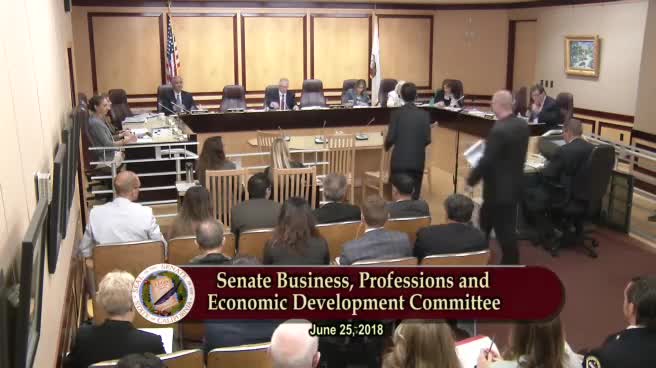 3MIN
Senate Standing Committee on Business, Professions and Economic Development
 8MIN
Assembly Standing Committee on Business and Professions


Bill Co-Author(s):
