AB 2902: Hazardous substances.
- Session Year: 2017-2018
- House: Assembly
- Latest Version Date: 2018-09-23
(1)The Aboveground Petroleum Storage Act generally regulates aboveground storage tanks that contain petroleum and that meet certain requirements. The act defines an aboveground storage tank as a tank that has the capacity to store 55 gallons or more of petroleum and that is substantially or totally above the surface of the ground or is a tank in an underground area, as defined, except for certain types of tanks and vessels. A tank containing hazardous waste or extremely hazardous waste is not regulated pursuant to the act if the Department of Toxic Substances Control has issued a hazardous waste facilities permit for the tank to the person owning or operating the tank. The act defines tank in an underground area to mean a storage tank that meets certain specifications and requirements, including that the storage tank is located in a structure that is at least 10% below the ground surface, as specified.
This bill would revise the definition of aboveground storage tank to include a container that meets those same specifications. The bill would revise the definition of tank in an underground area to mean a stationary storage tank that meets those same specifications and requirements, and would make other revisions to that definition.
The act provides that a tank facility is subject to the act if the tank facility meets one of 3 descriptions, including if it has a storage capacity of less than 1,320 gallons of petroleum and has one or more tanks in an underground area meeting specified conditions. The act requires the owner or operator of a storage tank at a tank facility subject to the act to prepare a spill prevention control and countermeasure plan and to implement the plan in compliance with a specified federal law.
This bill would authorize the owner or operator of a tank in an underground area that meets that description to use the format adopted by the Office of the State Fire Marshal to prepare the spill prevention control and countermeasure plan. The bill would provide that a tank in an underground area that would otherwise be subject to the act because it meets that description is not subject to the act if it holds hydraulic fluid for a closed loop mechanical system that uses compressed air or hydraulic fluid to operate lifts, elevators, or other similar devices, if it is a heating oil tank, or if the tank is a sump, separator, clarifier, catch basin, or storm drain.
(2)Existing law defines the term underground storage tank for purposes of the provisions regulating the storage of hazardous substances in underground storage tanks, and excludes certain tanks from that definition. Existing law exempts from the requirements imposed upon underground storage tanks a tank located in a below-grade structure that is connected to an emergency generator tank system and meets specified conditions. Existing law defines the term emergency generator tank system for purposes of these provisions to mean an underground storage tank system that provides power supply in the event of a commercial power failure, stores diesel fuel, and is used solely in connection with an emergency system, legally required standby system, or optional standby system.
This bill would expand the term emergency generator tank system to additionally include an underground storage tank system that provides power supply in the event of a commercial power failure, stores kerosene, and is used solely in connection with those specified systems.
Existing law authorizes a local agency, upon the discovery of a significant violation of any provision regulating the storage of hazardous substances in underground storage tanks that poses an imminent threat to human health or safety or the environment, to affix a red tag, in plain view, to the fill pipe of the noncompliant underground storage tank system to provide notice that delivery of petroleum into the system is prohibited. Existing law authorizes a local agency, upon the discovery of a significant violation of any provision regulating the storage of hazardous substances in underground storage tanks, to issue a notice of significant violation to the owner or operator.
This bill would additionally authorize the State Water Resources Control Board, in consultation with a local agency, to affix a red tag and to issue a notice of significant violation pursuant to these provisions. The bill would additionally authorize the board or a local agency to issue a written directive to a noncompliant underground storage tank owner or operator to empty the noncompliant underground storage tank, as specified. The bill would additionally prohibit a person from delivering hazardous substances into, or from inputting into or withdrawing from, an underground storage tank that has a red tag affixed to its fill pipe, except to empty the tank.
Existing law prohibits a local agency from issuing or renewing a permit to operate an underground storage tank if the local agency inspects the tank and determines that the tank does not comply with the provision regulating the storage of hazardous substances in underground storage tanks.
This bill would instead prohibit a local agency from issuing or renewing a permit to operate an underground storage tank to a person operating an underground storage tank to which a red tag is currently affixed or to a facility that is currently subject to an enforcement action, as specified, unless the underlying violations that are the subject of that enforcement action have been corrected or otherwise resolved, as specified. The bill would authorize a local agency to issue a permit or renew a permit for a facility while that facility is subject to an enforcement action, if the facility is appealing, petitioning, or otherwise seeking reconsideration of the enforcement action.
Existing law requires owners or operators of underground storage tanks to furnish, under penalty of perjury, specified information as the local agency, regional water quality control board, or the State Water Resources Control Board may require.
This bill would expand the scope of the information that any of those entities may require to be provided and would expand to all persons the obligation to furnish the required information under penalty of perjury. Because this provision would expand the scope of a crime, the bill would impose a state-mandated local program.
(3)Existing law requires the immediate report of any release or threatened release of a hazardous material, defined pursuant to the laws regulating the response to the release of hazardous materials, to the unified program agency and to the Office of Emergency Services.
This bill would additionally require the immediate report of an actual release of a hazardous substance, defined pursuant to the laws imposing criminal liability for certain deposits of hazardous substances, as specified. To the extent this provision would increase the duties of unified program agencies, the bill would impose a state-mandated local program.
(4)The California Constitution requires the state to reimburse local agencies and school districts for certain costs mandated by the state. Statutory provisions establish procedures for making that reimbursement.
This bill would provide that no reimbursement is required by this act for specified reasons.
(1)The Aboveground Petroleum Storage Act generally regulates aboveground storage tanks that contain petroleum and that meet certain requirements. The act defines an aboveground storage tank as a tank that has the capacity to store 55 gallons or more of petroleum and that is substantially or totally above the surface of the ground or is a tank in an underground area, as defined, except for certain types of tanks and vessels. A tank containing hazardous waste or extremely hazardous waste is not regulated pursuant to the act if the Department of Toxic Substances Control has issued a hazardous waste facilities permit for the tank to the person owning or operating the tank. The act defines tank in an underground area to mean a storage tank that meets certain specifications and requirements, including that the storage tank is located in a structure that is at least 10% below the ground surface, as specified.
This bill would revise the definition of aboveground storage tank to include a container that meets those same specifications. The bill would revise the definition of tank in an underground area to mean a stationary storage tank that meets those same specifications and requirements, and would make other revisions to that definition.
The act provides that a tank facility is subject to the act if the tank facility meets one of 3 descriptions, including if it has a storage capacity of less than 1,320 gallons of petroleum and has one or more tanks in an underground area meeting specified conditions. The act requires the owner or operator of a storage tank at a tank facility subject to the act to prepare a spill prevention control and countermeasure plan and to implement the plan in compliance with a specified federal law.
This bill would authorize the owner or operator of a tank in an underground area that meets that description to use the format adopted by the Office of the State Fire Marshal to prepare the spill prevention control and countermeasure plan. The bill would provide that a tank in an underground area that would otherwise be subject to the act because it meets that description is not subject to the act if it holds hydraulic fluid for a closed loop mechanical system that uses compressed air or hydraulic fluid to operate lifts, elevators, or other similar devices, or if it is a heating oil tank. tank, or if the tank is a sump, separator, clarifier, catch basin, or storm drain.
(2)Existing law defines the term underground storage tank for purposes of the provisions regulating the storage of hazardous substances in underground storage tanks, and excludes certain tanks from that definition. Existing law exempts from the requirements imposed upon underground storage tanks a tank located in a below-grade structure that is connected to an emergency generator tank system and meets specified conditions. Existing law defines the term emergency generator tank system for purposes of these provisions to mean an underground storage tank system that provides power supply in the event of a commercial power failure, stores diesel fuel, and is used solely in connection with an emergency system, legally required standby system, or optional standby system.
This bill would expand the term emergency generator tank system to additionally include an underground storage tank system that provides power supply in the event of a commercial power failure, stores kerosene, and is used solely in connection with those specified systems.
Existing law authorizes a local agency, upon the discovery of a significant violation of any provision regulating the storage of hazardous substances in underground storage tanks that poses an imminent threat to human health or safety or the environment, to affix a red tag, in plain view, to the fill pipe of the noncompliant underground storage tank system to provide notice that delivery of petroleum into the system is prohibited. Existing law authorizes a local agency, upon the discovery of a significant violation of any provision regulating the storage of hazardous substances in underground storage tanks, to issue a notice of significant violation to the owner or operator.
This bill would additionally authorize the State Water Resources Control Board, in consultation with a local agency, to affix a red tag and to issue a notice of significant violation pursuant to these provisions. The bill would additionally authorize the board or a local agency to issue a written directive to a noncompliant underground storage tank owner or operator to empty the noncompliant underground storage tank, as specified. The bill would additionally prohibit a person from delivering hazardous substances into, or from inputting into or withdrawing from, an underground storage tank that has a red tag affixed to its fill pipe, except to empty the tank.
Existing law prohibits a local agency from issuing or renewing a permit to operate an underground storage tank if the local agency inspects the tank and determines that the tank does not comply with the provision regulating the storage of hazardous substances in underground storage tanks.
This bill would instead prohibit a local agency from issuing or renewing a permit to operate an underground storage tank to a person operating an underground storage tank to which a red tag is currently affixed or to a facility that is currently subject to an enforcement action, as specified, unless the underlying violations that are the subject of that enforcement action have been corrected or otherwise resolved, as specified. The bill would authorize a local agency to issue a permit or renew a permit for a facility while that facility is subject to an enforcement action, if the facility is appealing, petitioning, or otherwise seeking reconsideration of the enforcement action.
Existing law requires owners or operators of underground storage tanks to furnish, under penalty of perjury, specified information as the local agency, regional water quality control board, or the State Water Resources Control Board may require.
This bill would expand the scope of the information that any of those entities may require to be provided and would expand to all persons the obligation to furnish the required information under penalty of perjury. Because this provision would expand the scope of a crime, the bill would impose a state-mandated local program.
(3)Existing law requires the immediate report of any release or threatened release of a hazardous material, defined pursuant to the laws regulating the response to the release of hazardous materials, to the unified program agency and to the Office of Emergency Services.
This bill would additionally require the immediate report of an actual release of a hazardous substance, defined pursuant to the laws imposing criminal liability for certain deposits of hazardous substances, as specified. To the extent this provision would increase the duties of unified program agencies, the bill would impose a state-mandated local program.
(4)The California Constitution requires the state to reimburse local agencies and school districts for certain costs mandated by the state. Statutory provisions establish procedures for making that reimbursement.
This bill would provide that no reimbursement is required by this act for specified reasons.
(1)The Aboveground Petroleum Storage Act generally regulates aboveground storage tanks that contain petroleum and that meet certain requirements. The act defines an aboveground storage tank as a tank that has the capacity to store 55 gallons or more of petroleum and that is substantially or totally above the surface of the ground or is a tank in an underground area, as defined, except for certain types of tanks and vessels. A tank containing hazardous waste or extremely hazardous waste is not regulated pursuant to the act if the Department of Toxic Substances Control has issued a hazardous waste facilities permit for the tank to the person owning or operating the tank. The act defines tank in an underground area to mean a storage tank that meets certain specifications and requirements, including that the storage tank is located in a structure that is at least 10% below the ground surface, as specified.
This bill would revise the definition of aboveground storage tank to include a container that meets those same specifications, and would additionally exempt from that definition a tank containing hazardous waste or extremely hazardous waste if the owner or operator of the storage tank has a permit by rule authorization for the tank from the unified program agency. specifications. The bill would revise the definition of tank in an underground area to mean a stationary storage tank that meets those same specifications and requirements, and would make other revisions to that definition.
The act provides that a tank facility is subject to the act if the tank facility meets one of 3 descriptions, including if it has a storage capacity of less than 1,320 gallons of petroleum and has one or more tanks in an underground area meeting specified conditions. The act requires the owner or operator of a storage tank at a tank facility subject to the act to prepare a spill prevention control and countermeasure plan and to implement the plan in compliance with a specified federal law.
This bill would authorize the owner or operator of a tank in an underground area that meets that description to use the format adopted by the Office of the State Fire Marshal to prepare the spill prevention control and countermeasure plan. The bill would provide that a tank in an underground area that would otherwise be subject to the act because it meets that description is not subject to the act if it holds hydraulic fluid for a closed loop mechanical system that uses compressed air or hydraulic fluid to operate lifts, elevators, or other similar devices, or if it is a heating oil tank.
(2)Existing law defines the term underground storage tank for purposes of the provisions regulating the storage of hazardous substances in underground storage tanks, and excludes certain tanks from that definition. Existing law exempts from the requirements imposed upon underground storage tanks a tank located in a below-grade structure that is connected to an emergency generator tank system and meets specified conditions. Existing law defines the term emergency generator tank system for purposes of these provisions to mean an underground storage tank system that provides power supply in the event of a commercial power failure, stores diesel fuel, and is used solely in connection with an emergency system, legally required standby system, or optional standby system.
This bill would expand the term emergency generator tank system to additionally include an underground storage tank system that provides power supply in the event of a commercial power failure, stores kerosene, and is used solely in connection with those specified systems.
Existing law authorizes a local agency, upon the discovery of a significant violation of any provision regulating the storage of hazardous substances in underground storage tanks that poses an imminent threat to human health or safety or the environment, to affix a red tag, in plain view, to the fill pipe of the noncompliant underground storage tank system to provide notice that delivery of petroleum into the system is prohibited. Existing law prohibits a local agency from issuing or renewing a permit to operate an underground storage tank if the local agency inspects the tank and determines that the tank does not comply with the laws regulating the storage of hazardous substances in underground storage tanks.This bill would revise the prohibition on issuing or renewing permits to instead prohibit a local agency from issuing a permit to operate an underground storage tank to, or renewing such a permit of, a person operating an underground storage tank to which a red tag is currently affixed.Existing law requires owners or operators of underground storage tanks to furnish, under penalty of perjury, specified information as the local agency, regional water quality control board, or the State Water Resources Control Board may require.
This bill would expand the scope of the information that any of those entities may require to be provided and would expand to all persons the obligation to furnish the required information under penalty of perjury. Because this provision would expand the scope of a crime, the bill would impose a state-mandated local program.
(3)Existing law requires the immediate report of any release or threatened release of a hazardous material, defined pursuant to the laws regulating the response to the release of hazardous materials, to the unified program agency and to the Office of Emergency Services.
This bill would additionally require the immediate report of an actual release of a hazardous substance, defined pursuant to the laws imposing criminal liability for certain deposits of hazardous substances, as specified. To the extent this provision would increase the duties of unified program agencies, the bill would impose a state-mandated local program.
(4)The California Constitution requires the state to reimburse local agencies and school districts for certain costs mandated by the state. Statutory provisions establish procedures for making that reimbursement.This bill would provide that no reimbursement is required by this act for a specified reason.(4)The California Constitution requires the state to reimburse local agencies and school districts for certain costs mandated by the state. Statutory provisions establish procedures for making that reimbursement.
This bill would provide that no reimbursement is required by this act for specified reasons.
(1)The Aboveground Petroleum Storage Act generally regulates aboveground storage tanks that contain petroleum and that meet certain requirements. The act defines an aboveground storage tank as a tank that has the capacity to store 55 gallons or more of petroleum and that is substantially or totally above the surface of the ground or is a tank in an underground area, as defined, except for certain types of tanks and vessels. A tank containing hazardous waste or extremely hazardous waste is not regulated pursuant to the act if the Department of Toxic Substances Control has issued a hazardous waste facilities permit for the tank to the person owning or operating the tank. The act defines tank in an underground area to mean a storage tank that meets certain specifications and requirements, including that the storage tank is located in a structure that is at least 10% below the ground surface, as specified.
This bill would revise the definition of aboveground storage tank to include a container that meets those same specifications, and would additionally exempt from that definition a tank containing hazardous waste or extremely hazardous waste if the owner or operator of the storage tank has a permit by rule authorization for the tank from the unified program agency. The bill would revise the definition of tank in an underground area to mean a stationary storage tank that meets those same specifications and requirements, and would make other revisions to that definition.
The act provides that a tank facility is subject to the act if the tank facility meets one of 3 descriptions, including if it has a storage capacity of less than 1,320 gallons of petroleum and has one or more tanks in an underground area meeting specified conditions. The act requires the owner or operator of a storage tank at a tank facility subject to the act to prepare a spill prevention control and countermeasure plan and to implement the plan in compliance with a specified federal law.
This bill would authorize the owner or operator of a tank in an underground area that meets that description to use the format adopted by the Office of the State Fire Marshal to prepare the spill prevention control and countermeasure plan. The bill would provide that a tank in an underground area that would otherwise be subject to the act because it meets that description is not subject to the act if it holds hydraulic fluid for a closed loop mechanical system that uses compressed air or hydraulic fluid to operate lifts, elevators, or other similar devices, or if it is a heating oil tank.
(2)Existing law defines the term underground storage tank for purposes of the provisions regulating the storage of hazardous substances in underground storage tanks, and excludes certain tanks from that definition. Existing law exempts from the requirements imposed upon underground storage tanks a tank located in a below-grade structure that is connected to an emergency generator tank system and meets specified conditions. Existing law defines the term emergency generator tank system for purposes of these provisions to mean an underground storage tank system that provides power supply in the event of a commercial power failure, stores diesel fuel, and is used solely in connection with an emergency system, legally required standby system, or optional standby system.
This bill would expand the term emergency generator tank system to additionally include an underground storage tank system that provides power supply in the event of a commercial power failure, stores kerosene, and is used solely in connection with those specified systems.
Existing law authorizes a local agency, upon the discovery of a significant violation of any provision regulating the storage of hazardous substances in underground storage tanks that poses an imminent threat to human health or safety or the environment, to affix a red tag, in plain view, to the fill pipe of the noncompliant underground storage tank system to provide notice that delivery of petroleum into the system is prohibited. Existing law prohibits a local agency from issuing or renewing a permit to operate an underground storage tank if the local agency inspects the tank and determines that the tank does not comply with the laws regulating the storage of hazardous substances in underground storage tanks.
This bill would revise the prohibition on issuing or renewing permits to instead prohibit a local agency from issuing or renewing a permit to operate an underground storage tank to to, or renewing such a permit of, a person operating an underground storage tank to which a red tag is currently affixed or to a facility that is currently subject to an enforcement action, as specified, unless the underlying violations that are the subject of that enforcement action have been corrected. affixed.
(3)Existing law requires the immediate report of any release or threatened release of a hazardous material, defined pursuant to the laws regulating the response to the release of hazardous materials, to the unified program agency and to the Office of Emergency Services.
This bill would additionally require the immediate report of an actual release of a hazardous substance, defined pursuant to the laws imposing criminal liability for certain deposits of hazardous substances, as specified. To the extent this provision would increase the duties of unified program agencies, the bill would impose a state-mandated local program.
(4)The California Constitution requires the state to reimburse local agencies and school districts for certain costs mandated by the state. Statutory provisions establish procedures for making that reimbursement.
This bill would provide that no reimbursement is required by this act for a specified reason.
(1)The Aboveground Petroleum Storage Act generally regulates aboveground storage tanks that contain petroleum and that meet certain requirements. The act defines an aboveground storage tank as a tank that has the capacity to store 55 gallons or more of petroleum and that is substantially or totally above the surface of the ground or is a tank in an underground area, as defined, except for certain types of tanks and vessels. A tank containing hazardous waste or extremely hazardous waste is not regulated pursuant to the act if the Department of Toxic Substances Control has issued a hazardous waste facilities permit for the tank to the person owning or operating the tank. The act defines tank in an underground area to mean a storage tank that meets certain specifications and requirements, including that the storage tank is located in a structure that is at least 10% below the ground surface, as specified.
This bill would revise the definition of aboveground storage tank to include a container that meets those same specifications, and would additionally exempt from that definition a tank containing hazardous waste or extremely hazardous waste if the owner or operator of the storage tank has a permit by rule authorization for the tank from the unified program agency. The bill would revise the definition of tank in an underground area to mean a stationary storage tank that meets those same specifications and requirements, and would make other revisions to that definition.
The act provides that a tank facility is subject to the act if the tank facility meets one of 3 descriptions, including if it has a storage capacity of less than 1,320 gallons of petroleum and has one or more tanks in an underground area meeting specified conditions. The act requires the owner or operator of a storage tank at a tank facility subject to the act to prepare a spill prevention control and countermeasure plan and to implement the plan in compliance with a specified federal law.
This bill would authorize the owner or operator of a tank in an underground area that meets that description to use the format adopted by the Office of the State Fire Marshal to prepare the spill prevention control and countermeasure plan. The bill would provide that a tank in an underground area that would otherwise be subject to the act because it meets that description is not subject to the act if it holds hydraulic fluid for a closed loop mechanical system that uses compressed air or hydraulic fluid to operate lifts, elevators, or other similar devices, or if it is a heating oil tank.
(2)Existing law defines the term underground storage tank for purposes of the provisions regulating the storage of hazardous substances in underground storage tanks, and excludes certain tanks from that definition. Existing law exempts from the requirements imposed upon underground storage tanks a tank located in a below-grade structure that is connected to an emergency generator tank system and meets specified conditions. Existing law defines the term emergency generator tank system for purposes of these provisions to mean an underground storage tank system that provides power supply in the event of a commercial power failure, stores diesel fuel, and is used solely in connection with an emergency system, legally required standby system, or optional standby system.
This bill would expand the term emergency generator tank system to additionally include an underground storage tank system that provides power supply in the event of a commercial power failure, stores kerosene, and is used solely in connection with those specified systems.
Existing law authorizes a local agency, upon the discovery of a significant violation of any provision regulating the storage of hazardous substances in underground storage tanks that poses an imminent threat to human health or safety or the environment, to affix a red tag, in plain view, to the fill pipe of the noncompliant underground storage tank system to provide notice that delivery of petroleum into the system is prohibited. Existing law prohibits a local agency from issuing or renewing a permit to operate an underground storage tank if the local agency inspects the tank and determines that the tank does not comply with the laws regulating the storage of hazardous substances in underground storage tanks.
This bill would revise the prohibition on issuing or renewing permits to instead prohibit a local agency from issuing or renewing a permit to operate an underground storage tank to a person operating an underground storage tank to which a red tag is currently affixed or to a facility that is currently subject to an enforcement action, as specified, unless the underlying violations that are the subject of that enforcement action have been corrected.
(3)Existing law requires the immediate report of any release or threatened release of a hazardous material, defined pursuant to the laws regulating the response to the release of hazardous materials, to the unified program agency and to the Office of Emergency Services.
This bill would additionally require the immediate report of an actual release of a hazardous substance, defined pursuant to the laws imposing criminal liability for certain deposits of hazardous substances, as specified. To the extent this provision would increase the duties of unified program agencies, the bill would impose a state-mandated local program.
(4)The California Constitution requires the state to reimburse local agencies and school districts for certain costs mandated by the state. Statutory provisions establish procedures for making that reimbursement.
This bill would provide that no reimbursement is required by this act for a specified reason.
For purposes of this chapter, the following definitions apply:
(a)Aboveground storage tank or storage tank means a tank or container that has the capacity to store 55 gallons or more of petroleum that is substantially or totally above the surface of the ground, except that, for purposes of this chapter, aboveground storage tank or storage tank includes a tank in an underground area. Aboveground storage tank does not include any of the following:
(1)A pressure vessel or boiler that is subject to Part 6 (commencing with Section 7620) of Division 5 of the Labor Code.
(2)A tank containing hazardous waste or extremely hazardous waste, as respectively defined in Sections 25117 and 25115, if the owner or operator of the storage tank has a hazardous waste facilities permit from the Department of Toxic Substances Control or a permit by rule authorization from the unified program agency for the storage tank.
(3)An aboveground oil production tank that is subject to Section 3106 of the Public Resources Code.
(4)Oil-filled electrical equipment, including, but not limited to, transformers, circuit breakers, or capacitors, if the oil-filled electrical equipment meets either of the following conditions:
(A)The equipment contains less than 10,000 gallons of dielectric fluid.
(B)The equipment contains 10,000 gallons or more of dielectric fluid with PCB levels less than 50 parts per million, appropriate containment or diversionary structures or equipment are employed to prevent discharged oil from reaching a navigable water course, and the electrical equipment is visually inspected in accordance with the usual routine maintenance procedures of the owner or operator.
(5)A tank regulated as an underground storage tank under Chapter 6.7 (commencing with Section 25280) of this division and Chapter 16 (commencing with Section 2610) of Division 3 of Title 23 of the California Code of Regulations and that does not meet the definition of a tank in an underground area.
(6)A transportation-related tank facility, subject to the authority and control of the United States Department of Transportation, as defined in the Memorandum of Understanding between the Secretary of Transportation and the Administrator of the United States Environmental Protection Agency, as set forth in Appendix A to Part 112 (commencing with Section 112.1) of Subchapter D of Chapter I of Title 40 of the Code of Federal Regulations.
(7)A tank or tank facility located on and operated by a farm that is exempt from the federal spill prevention, control, and countermeasure rule requirements pursuant to Part 112 (commencing with Section 112.1) of Subchapter D of Chapter I of Title 40 of the Code of Federal Regulations.
(8)A tank in an underground area that has the capacity to store less than 55 gallons of petroleum, has secondary containment, and is inspected monthly, if the owner or operator maintains a log of inspection records for review by the unified program agency upon request.
(b)Board means the State Water Resources Control Board.
(c)(1)Certified unified program agency or CUPA means the agency certified by the Secretary for Environmental Protection to implement the unified program specified in Chapter 6.11 (commencing with Section 25404) within a jurisdiction.
(2)Participating agency or PA means an agency that has a written agreement with the CUPA pursuant to subdivision (d) of Section 25404.3, and is approved by the secretary, to implement and enforce the unified program element specified in paragraph (2) of subdivision (c) of Section 25404, in accordance with Sections 25404.1 and 25404.2.
(3)(A)Unified program agency or UPA means the CUPA, or its participating agencies to the extent that each PA has been designated by the CUPA, pursuant to a written agreement, to implement and enforce the unified program element specified in paragraph (2) of subdivision (c) of Section 25404. The UPAs have the responsibility and authority, to the extent provided by this chapter and Sections 25404.1 to 25404.2, inclusive, to implement and enforce the requirements of this chapter.
(B)After a CUPA has been certified by the secretary, the unified program agency shall be the only agency authorized to enforce the requirements of this chapter.
(C)This paragraph does not limit the authority or responsibility granted to the office, the board, and the regional boards by this chapter.
(d)Office means the Office of the State Fire Marshal.
(e)Operator means the person responsible for the overall operation of a tank facility.
(f)Owner means the person who owns the tank facility or part of the tank facility.
(g)Person means an individual, trust, firm, joint stock company, corporation, including a government corporation, partnership, limited liability company, or association. Person also includes any city, county, district, the University of California, the California State University, the state, any department or agency thereof, and the United States, to the extent authorized by federal law.
(h)Petroleum means crude oil, or a fraction thereof, that is liquid at 60 degrees Fahrenheit temperature and 14.7 pounds per square inch absolute pressure.
(i)Regional board means a California regional water quality control board.
(j)Release means any spilling, leaking, pumping, pouring, emitting, emptying, discharging, escaping, leaching, or disposing into the environment.
(k)Secretary means the Secretary for Environmental Protection.
(l)Storage or store means the containment, handling, or treatment of petroleum, for a period of time, including on a temporary basis.
(m)Storage capacity means the aggregate capacity of all aboveground storage tanks at a tank facility.
(n)Tank facility means one or more aboveground storage tanks, including any piping that is integral to the tanks, that contain petroleum and that are used by an owner or operator at a single location or site. For purposes of this chapter, a pipe is integrally related to an aboveground storage tank if the pipe is connected to the tank and meets any of the following:
(1)The pipe is within the dike or containment area.
(2)The pipe is between the containment area and the first flange or valve outside the containment area.
(3)The pipe is connected to the first flange or valve on the exterior of the tank, if state or federal law does not require a containment area.
(4)The pipe is connected to a tank in an underground area.
(o)(1)Tank in an underground area means a stationary storage tank to which all of the following apply:
(A)The storage tank is located in a structure that is at least 10 percent below the ground surface, including, but not limited to, a basement, cellar, shaft, pit, or vault.
(B)The structure in which the storage tank is located, at a minimum, provides for secondary containment of the contents of the tank, piping, and ancillary equipment, until cleanup occurs. A shop-fabricated double-walled storage tank with a mechanical or electronic device used to detect leaks in the interstitial space meets the requirement for secondary containment of the contents of the tank.
(C)The storage tank meets one or more of the following conditions:
(i)The storage tank contains petroleum to be used or previously used as a lubricant or coolant in a motor engine or transmission, oil-filled operational equipment, or oil-filled manufacturing equipment, is situated on or above the surface of the floor, and the structure in which the tank is located provides enough space for direct viewing of the exterior of the tank except for the part of the tank in contact with the surface of the floor.
(ii)The storage tank only contains petroleum that is determined to be a hazardous waste, complies with the hazardous waste tank standards pursuant to Article 10 (commencing with Section 66265.190) of Chapter 15 of Division 4.5 of Title 22 of the California Code of Regulations as it may be amended, and the tank facility has been issued a unified program facility permit pursuant to Section 25404.2 for generation, treatment, accumulation, or storage of hazardous waste.
(iii)The storage tank contains petroleum and is used solely in connection with a fire pump or an emergency system, legally required standby system, or optional standby system as defined in the most recent version of the California Electrical Code (Section 700.2 of Article 700, Section 701.2 of Article 701, and Section 702.2 of Article 702, of Chapter 7 of Part 3 of Title 24 of the California Code of Regulations), is situated on or above the surface of the floor, and the structure in which the tank is located provides enough space for direct viewing of the exterior of the tank except for the part of the tank in contact with the surface of the floor.
(iv)The storage tank does not meet the conditions in clause (i), (ii), or (iii), but meets all of the following conditions:
(I)It contains petroleum.
(II)It is situated on or above the surface of the floor.
(III)The structure in which the storage tank is located provides enough space for direct viewing of the exterior of the tank, except for the part of the tank in contact with the surface of the floor.
(IV)Except for an emergency vent that is solely designed to relieve excessive internal pressure, all piping connected to the tank, including any portion of a vent line, vapor recovery line, or fill pipe that is beneath the surface of the ground, and all ancillary equipment that is designed and constructed to contain petroleum, can either be visually inspected by direct viewing or has both secondary containment and leak detection that meet the requirements of the regulations adopted by the office pursuant to Section 25270.4.1.
(2)Direct viewing of the exterior of the tank is not required under paragraph (1) if inspections of the interstitial space or containment structure are performed or if the storage tank has a mechanical or electronic device that will detect leaks in the interstitial space or containment structure and alert the tank operator.
(3)(A)A storage tank in an underground area is not subject to Chapter 6.7 (commencing with Section 25280) if the storage tank meets the definition of a tank in an underground area, as provided in paragraph (1) and, except as specified in subparagraph (B), the regulations that apply to all new and existing tanks in underground areas and buried piping connected to tanks in underground areas have been adopted by the office pursuant to Section 25270.4.1.
(B)A storage tank meeting the description of clause (i) of subparagraph (C) of paragraph (1) shall continue to be subject to this chapter, and excluded from the definition of an underground storage tank in Chapter 6.7 (commencing with Section 25280), before and after the date the regulations specific to tanks in underground areas have been adopted by the office.
(p)Viewing means visual inspection, and direct viewing means, in regard to a storage tank, direct visual inspection of the exterior of the tank, except for the part of the tank in contact with the surface of the floor, and, where applicable, the entire length of all piping and ancillary equipment, including all exterior surfaces, by a person or through the use of visual aids, including, but not limited to, mirrors, cameras, or video equipment.
SEC. 2.Section 25270.3 of the Health and Safety Code is amended to read:25270.3.A tank facility is subject to this chapter if any of the following apply:
(a)The tank facility is subject to the oil pollution prevention regulations specified in Part 112 (commencing with Section 112.1) of Subchapter D of Chapter I of Title 40 of the Code of Federal Regulations.
(b)The tank facility has a storage capacity of 1,320 gallons or more of petroleum.
(c)(1)Except as provided in paragraph (3), the tank facility has a storage capacity of less than 1,320 gallons of petroleum and has one or more tanks in an underground area meeting the conditions specified in paragraph (1) of subdivision (o) of Section 25270.2.
(2)If a tank facility is subject to this chapter only pursuant to this subdivision, only those tanks that meet the conditions specified in paragraph (1) of subdivision (o) of Section 25270.2 shall be included as storage tanks and subject to this chapter.
(3)A tank in an underground area that would otherwise be subject to this chapter only pursuant to this subdivision is not subject to this chapter if any of the following apply:
(A)The tank holds hydraulic fluid for a closed loop mechanical system that uses compressed air or hydraulic fluid to operate lifts, elevators, or other similar devices.
(B)The tank is a heating oil tank.
(C)The tank is a sump, separator, clarifier, catch basin, or storm drain.
SEC. 3.Section 25270.4 of the Health and Safety Code is amended to read:25270.4.This chapter shall be implemented by the unified program agency, in accordance with the regulations adopted by the office pursuant to Section 25270.4.1.
SEC. 4.Section 25270.4.5 of the Health and Safety Code is amended to read:25270.4.5.(a)Except as provided in subdivision (b), the owner or operator of a storage tank at a tank facility subject to this chapter shall prepare a spill prevention control and countermeasure plan applying good engineering practices to prevent petroleum releases using the same format required by Part 112 (commencing with Section 112.1) of Subchapter D of Chapter I of Title 40 of the Code of Federal Regulations, including owners and operators of tank facilities not subject to the general provisions in Section 112.1 of those regulations. An owner or operator specified in this subdivision shall conduct periodic inspections of the storage tank to ensure compliance with Part 112 (commencing with Section 112.1) of Subchapter D of Chapter I of Title 40 of the Code of Federal Regulations. In implementing the spill prevention control and countermeasure plan, an owner or operator specified in this subdivision shall fully comply with the latest version of the regulations contained in Part 112 (commencing with Section 112.1) of Subchapter D of Chapter I of Title 40 of the Code of Federal Regulations.
(b)A tank facility located on and operated by a farm, nursery, logging site, or construction site is not subject to subdivision (a) if no storage tank at the location exceeds 20,000 gallons and the cumulative storage capacity of the tank facility does not exceed 100,000 gallons. Unless excluded from the definition of an aboveground storage tank in Section 25270.2, the owner or operator of a tank facility exempt pursuant to this subdivision shall take the following actions:
(1)Conduct a daily visual inspection of any storage tank storing petroleum. For purposes of this section, daily means every day that contents are added to or withdrawn from the tank, but no less than five days per week. The number of days may be reduced by the number of state or federal holidays that occur during the week if there is no addition to, or withdrawal from, the tank on the holiday. The UPA may reduce the frequency of inspections to not less than once every three days at a tank facility that is exempt pursuant to this section if the tank facility is not staffed on a regular basis, provided that the inspection is performed every day the facility is staffed.
(2)Allow the UPA to conduct a periodic inspection of the tank facility.
(3)If the UPA determines installation of secondary containment is necessary for the protection of the waters of the state, install a secondary means of containment for each tank or group of tanks where the secondary containment will, at a minimum, contain the entire contents of the largest tank protected by the secondary containment plus precipitation.
(c)The owner or operator of a tank in an underground area that is subject to this chapter pursuant to subdivision (c) of Section 25270.3 may use the format adopted by the office to prepare a spill prevention control and countermeasure plan as specified in subdivision (a).
SEC. 5.Section 25281.5 of the Health and Safety Code is amended to read:25281.5.(a)Notwithstanding subdivision (m) of Section 25281, for purposes of this chapter, pipe means all parts of any pipeline or system of pipelines, used in connection with the storage of hazardous substances, including, but not limited to, valves and other appurtenances connected to the pipe, pumping units, fabricated assemblies associated with pumping units, and metering and delivery stations and fabricated assemblies therein, but does not include any of the following:
(1)An interstate pipeline subject to Part 195 (commencing with Section 195.0) of Subchapter D of Chapter I of Subtitle B of Title 49 of the Code of Federal Regulations.
(2)An intrastate pipeline subject to Chapter 5.5 (commencing with Section 51010) of Part 1 of Division 1 of Title 5 of the Government Code.
(3)Unburied delivery hoses, vapor recovery hoses, and nozzles that are subject to unobstructed visual inspection for leakage.
(4)Vent lines, vapor recovery lines, and fill pipes which are designed to prevent, and do not hold, standing fluid in the pipes or lines.
(b)In addition to the exclusions specified in subdivision (y) of Section 25281, underground storage tank does not include any of the following:
(1)Vent lines, vapor recovery lines, and fill pipes that are designed to prevent, and do not hold, standing fluid in the pipes or lines.
(2)Unburied fuel delivery piping at marinas if the owner or operator conducts daily visual inspections of the piping and maintains a log of inspection results for review by the local agency. The exclusion provided by this paragraph shall not be applicable if the board adopts regulations pursuant to Section 25299.3 that address the design, construction, upgrade, and monitoring of unburied fuel delivery piping at marinas.
(3)Unburied fuel piping connected to an emergency generator tank system, if the owner or operator conducts visual inspections of the piping each time the tank system is operated, but no less than monthly, and maintains a log of inspection results for review by the local agency. The exclusion provided by this paragraph does not apply if the board adopts regulations pursuant to Section 25299.3 that address the design, construction, upgrade, and monitoring of unburied fuel supply and return piping connected to emergency generator tank systems.
(c)For purposes of this chapter, emergency generator tank system means an underground storage tank system that provides power supply in the event of a commercial power failure, stores diesel fuel or kerosene, and is used solely in connection with an emergency system, legally required standby system, or optional standby system, as defined in Articles 700, 701, and 702 of the National Electrical Code of the National Fire Protection Association.
SEC. 6.Section 25285 of the Health and Safety Code is amended to read:25285.(a)Except as provided in Section 25285.1, a permit to operate issued by the local agency pursuant to Section 25284 shall be effective for five years. This subdivision does not apply to unified program facility permits.
(b)A local agency shall not issue or renew a permit to operate an underground storage tank to either of the following:
(1)A person operating an underground storage tank while a red tag is affixed pursuant to Section 25292.3.
(2)(A)Except as provided in subparagraph (B), a facility while that facility is subject to an enforcement action seeking to impose administrative liability, civil liability, or criminal liability, pursuant to this chapter or any regulation implementing this chapter, unless the underlying violation or violations that are the subject of that enforcement action have been corrected or otherwise resolved to the satisfaction of the local agency.
(B)A local agency may, but is not required to, issue a permit or renew a permit for a facility, after consultation with the board, while that facility is subject to an enforcement action, as described in subparagraph (A), if the facility is appealing, petitioning, or otherwise seeking reconsideration of the enforcement action.
(c)Except as provided in Section 25404.5, a local agency shall not issue or renew a permit to operate an underground storage tank to any person who has not paid the fee and surcharge required by Section 25287.
SEC. 7.Section 25292.3 of the Health and Safety Code is amended to read:25292.3.(a)Upon the discovery of a significant violation of any requirement in this chapter, or any regulation adopted pursuant to this chapter, that poses an imminent threat to human health or safety or the environment, the local agency or the board may take either of the following actions:
(1)Affix a red tag, in plain view, to the fill pipe of the noncompliant underground storage tank system, providing notice that the prohibitions specified in subdivision (c) apply.
(2)(A)Affix a red tag, as provided in paragraph (1), and issue a written directive to the noncompliant underground storage tank system owner or operator to empty the noncompliant underground storage tank system.
(B)An owner or operator issued a written directive pursuant to subparagraph (A) shall comply with the directive as soon as possible, but no later than 48 hours after receiving the directive.
(b) Upon the discovery of a significant violation of any requirement in this chapter or of any regulation adopted pursuant to this chapter, the local agency or the board may issue a notice of significant violation to the owner or operator. If the board issues a notice of significant violation, the board shall provide a copy of the notice to the local agency no later than two working days after the notice is issued to the owner or operator. The owner or operator who receives a notice of significant violation shall, within seven days from receipt of the notice, correct the violation to the satisfaction of the local agency or the board. If the owner or operator does not correct the violation within seven days, the local agency or the board may affix a red tag to the fill pipe of the noncompliant underground storage tank system and may additionally issue a written directive to empty the noncompliant underground storage tank, as described in paragraphs (1) and (2) of subdivision (a).
(c)(1)(A)A person shall not deliver a hazardous substance into an underground storage tank system that has a red tag affixed to its fill pipe.
(B)A person shall not deposit petroleum into an underground storage tank system that has a red tag affixed to its fill pipe.
(C)A person shall not input into or withdraw from an underground storage tank system that has a red tag affixed to its fill pipe, except to empty the underground storage tank pursuant to a directive issued in accordance with subparagraph (A) of paragraph (2) of subdivision (a).
(2)A person shall not remove, deface, alter, or otherwise tamper with a red tag so that the information contained on the tag is not legible.
(d)Any action taken by the board pursuant to subdivision (a) or (b) shall be taken in consultation with the local agency.
(e)Upon notification by the owner or operator that the significant violation has been corrected, the local agency or the board shall inspect the noncompliant underground storage tank system within five days to determine whether the underground storage tank system continues to be in significant violation. If the local agency or the board determines that the underground storage tank system is no longer in significant violation, the local agency or the board shall immediately remove the red tag and release the owner or operator from any directive requiring the underground storage tank to be kept empty.
(f)The board shall adopt regulations to define significant violations for purposes of this section.
SEC. 8.Section 25299.78 of the Health and Safety Code is amended to read:25299.78.(a)To carry out the purposes of this chapter, any authorized representative of the local agency, regional board, or board shall have the authority specified in Section 25185, with respect to any place where underground storage tanks are located, and in Section 25185.5, with respect to any real property which is within 2,000 feet of any place where underground storage tanks are located.
(b)A person shall furnish, under penalty of perjury, any information on fees imposed pursuant to Article 5 (commencing with Section 25299.40), financial responsibility, unauthorized releases, corrective actions, response actions, costs related to grants issued under this chapter, or requests for reimbursement pursuant to a claim or grant issued under this chapter as the local agency, regional board, or board may require.
(c)A person who fails or refuses to furnish information under subdivision (b) or furnishes false information to the fund is subject, in accordance with the requirements of subdivision (d), to civil liability of not more than ten thousand dollars ($10,000) for each violation of this subdivision.
(d)(1)Except as provided in subdivision (2), a claimant shall not be liable under subdivision (c) unless one of the following is established by the court, if the action is brought pursuant to subdivision (e), or the executive director, if the action is brought pursuant to subdivision (f):
(A)The alleged violation is knowing, willful, or intentional.
(B)The claimant received a material economic benefit from the action which caused the alleged violation.
(C)The alleged violation is chronic or that the claimant is a recalcitrant violator, as determined pursuant to subdivision (g) of Section 13399 of the Water Code.
(2)If a claimant is in violation of subdivision (c), but does not meet any of the conditions specified in paragraph (1), the claimant may be held liable only if the board or an authorized representative of the board issues a notice to comply pursuant to Chapter 5.8 (commencing with Section 13399) of Division 7 of the Water Code before an action is taken pursuant to subdivision (e) or (f).
(e)The Attorney General, upon request of the board, shall bring an action in superior court to impose the civil liability specified in subdivision (c).
(f)The executive director of the board may impose the civil liability specified in subdivision (c) administratively in the same manner as the executive director of the board is authorized to impose civil liability pursuant to Article 2.5 (commencing with Section 13323) of Chapter 5 of Division 7 of the Water Code.
(g)In determining the amount of any civil liability imposed under this section, the executive director of the board, or the court, as the case may be, shall take into account the nature, circumstances, extent, and gravity of the false statement or refusal or failure to furnish information, the persons ability to pay, any prior history by the person of misrepresentations to or noncooperation with the board or local agency, any economic benefits or savings that resulted or would have resulted from the false statement or refusal or failure to furnish information, and other matters as justice may require.
(h)Remedies under this section are in addition to, and do not supersede or limit, any other civil, administrative, or criminal remedies.
(i)All funds collected pursuant to this section shall be deposited into the fund.
SEC. 9.Section 25510 of the Health and Safety Code is amended to read:25510.(a)Except as provided in subdivision (b), the handler or an employee, authorized representative, agent, or designee of a handler, shall, upon discovery, immediately report any release or threatened release of a hazardous material, or an actual release of a hazardous substance, as defined in Section 374.8 of the Penal Code, to the UPA, and to the office, in accordance with the regulations adopted pursuant to this section. The handler or an employee, authorized representative, agent, or designee of the handler shall provide all state, city, or county fire or public health or safety personnel and emergency response personnel with access to the handlers facilities.
(b)Subdivision (a) does not apply to a person engaged in the transportation of a hazardous material on a highway that is subject to, and in compliance with, the requirements of Sections 2453 and 23112.5 of the Vehicle Code.
(c)On or before January 1, 2016, the office shall adopt regulations to implement this section. In developing these regulations, the office shall closely consult with representatives from regulated entities, appropriate trade associations, fire service organizations, federal, state, and local organizations, including unified program agencies, and other interested parties.
(d)The UPA shall maintain one or more nonemergency contact numbers for release reports that do not require immediate agency response. The UPA shall promptly communicate changes to this information to regulated facilities and to the office.
SEC. 10.No reimbursement is required by this act pursuant to Section 6 of Article XIIIB of the California Constitution because a local agency or school district has the authority to levy service charges, fees, or assessments sufficient to pay for the program or level of service mandated by this act or because costs that may be incurred by a local agency or school district will be incurred because this act creates a new crime or infraction, eliminates a crime or infraction, or changes the penalty for a crime or infraction, within the meaning of Section 17556 of the Government Code, or changes the definition of a crime within the meaning of Section 6 of Article XIIIB of the California Constitution.
For purposes of this chapter, the following definitions apply:
(a)Aboveground storage tank or storage tank means a tank or container that has the capacity to store 55 gallons or more of petroleum that is substantially or totally above the surface of the ground, except that, for purposes of this chapter, aboveground storage tank or storage tank includes a tank in an underground area that has a capacity to store any volume of petroleum. area. Aboveground storage tank does not include any of the following:
(1)A pressure vessel or boiler that is subject to Part 6 (commencing with Section 7620) of Division 5 of the Labor Code.
(2)A tank containing hazardous waste or extremely hazardous waste, as respectively defined in Sections 25117 and 25115, if the Department of Toxic Substances Control has issued the person owning or operating the tank owner or operator of the storage tank has a hazardous waste facilities permit from the Department of Toxic Substances Control or a permit by rule authorization from the unified program agency for the storage tank.
(3)An aboveground oil production tank that is subject to Section 3106 of the Public Resources Code.
(4)Oil-filled electrical equipment, including, but not limited to, transformers, circuit breakers, or capacitors, if the oil-filled electrical equipment meets either of the following conditions:
(A)The equipment contains less than 10,000 gallons of dielectric fluid.
(B)The equipment contains 10,000 gallons or more of dielectric fluid with PCB levels less than 50 parts per million, appropriate containment or diversionary structures or equipment are employed to prevent discharged oil from reaching a navigable water course, and the electrical equipment is visually inspected in accordance with the usual routine maintenance procedures of the owner or operator.
(5)A tank regulated as an underground storage tank under Chapter 6.7 (commencing with Section 25280) of this division and Chapter 16 (commencing with Section 2610) of Division 3 of Title 23 of the California Code of Regulations and that does not meet the definition of a tank in an underground area.
(6)A transportation-related tank facility, subject to the authority and control of the United States Department of Transportation, as defined in the Memorandum of Understanding between the Secretary of Transportation and the Administrator of the United States Environmental Protection Agency, as set forth in Appendix A to Part 112 (commencing with Section 112.1) of Subchapter D of Chapter I of Title 40 of the Code of Federal Regulations.
(7)A tank or tank facility located on and operated by a farm that is exempt from the federal spill prevention, control, and countermeasure rule requirements pursuant to Part 112 (commencing with Section 112.1) of Subchapter D of Chapter I of Title 40 of the Code of Federal Regulations.
(8)A tank in an underground area that has the capacity to store less than 55 gallons of petroleum, has secondary containment, and is inspected monthly, if the owner or operator maintains a log of inspection records for review by the unified program agency upon request.
(b)Board means the State Water Resources Control Board.
(c)(1)Certified unified program agency or CUPA means the agency certified by the Secretary for Environmental Protection to implement the unified program specified in Chapter 6.11 (commencing with Section 25404) within a jurisdiction.
(2)Participating agency or PA means an agency that has a written agreement with the CUPA pursuant to subdivision (d) of Section 25404.3, and is approved by the secretary, to implement and enforce the unified program element specified in paragraph (2) of subdivision (c) of Section 25404, in accordance with Sections 25404.1 and 25404.2.
(3)(A)Unified program agency or UPA means the CUPA, or its participating agencies to the extent that each PA has been designated by the CUPA, pursuant to a written agreement, to implement and enforce the unified program element specified in paragraph (2) of subdivision (c) of Section 25404. The UPAs have the responsibility and authority, to the extent provided by this chapter and Sections 25404.1 to 25404.2, inclusive, to implement and enforce the requirements of this chapter.
(B)After a CUPA has been certified by the secretary, the unified program agency shall be the only agency authorized to enforce the requirements of this chapter.
(C)This paragraph does not limit the authority or responsibility granted to the office, the board, and the regional boards by this chapter.
(d)Office means the Office of the State Fire Marshal.
(e)Operator means the person responsible for the overall operation of a tank facility.
(f)Owner means the person who owns the tank facility or part of the tank facility.
(g)Person means an individual, trust, firm, joint stock company, corporation, including a government corporation, partnership, limited liability company, or association. Person also includes any city, county, district, the University of California, the California State University, the state, any department or agency thereof, and the United States, to the extent authorized by federal law.
(h)Petroleum means crude oil, or a fraction thereof, that is liquid at 60 degrees Fahrenheit temperature and 14.7 pounds per square inch absolute pressure.
(i)Regional board means a California regional water quality control board.
(j)Release means any spilling, leaking, pumping, pouring, emitting, emptying, discharging, escaping, leaching, or disposing into the environment.
(k)Secretary means the Secretary for Environmental Protection.
(l)Storage or store means the containment, handling, or treatment of petroleum, for a period of time, including on a temporary basis.
(m)Storage capacity means the aggregate capacity of all aboveground storage tanks at a tank facility.
(n)Tank facility means one or more aboveground storage tanks, including any piping that is integral to the tanks, that contain petroleum and that are used by an owner or operator at a single location or site. For purposes of this chapter, a pipe is integrally related to an aboveground storage tank if the pipe is connected to the tank and meets any of the following:
(1)The pipe is within the dike or containment area.
(2)The pipe is between the containment area and the first flange or valve outside the containment area.
(3)The pipe is connected to the first flange or valve on the exterior of the tank, if state or federal law does not require a containment area.
(4)The pipe is connected to a tank in an underground area.
(o)(1)Tank in an underground area means a stationary storage tank to which all of the following apply:
(A)The storage tank is located in a structure that is at least 10 percent below the ground surface, including, but not limited to, a basement, cellar, shaft, pit, or vault.
(B)The structure in which the storage tank is located, at a minimum, provides for secondary containment of the contents of the tank, piping, and ancillary equipment, until cleanup occurs. A shop-fabricated double-walled storage tank with a mechanical or electronic device used to detect leaks in the interstitial space meets the requirement for secondary containment of the contents of the tank.
(C)The storage tank meets one or more of the following conditions:
(i)The storage tank contains petroleum to be used or previously used as a lubricant or coolant in a motor engine or transmission, oil-filled operational equipment, or oil-filled manufacturing equipment, is situated on or above the surface of the floor, and the structure in which the tank is located provides enough space for direct viewing of the exterior of the tank except for the part of the tank in contact with the surface of the floor.
(ii)The storage tank only contains petroleum that is determined to be a hazardous waste, complies with the hazardous waste tank standards pursuant to Article 10 (commencing with Section 66265.190) of Chapter 15 of Division 4.5 of Title 22 of the California Code of Regulations as it may be amended, and the tank facility has been issued a unified program facility permit pursuant to Section 25404.2 for generation, treatment, accumulation, or storage of hazardous waste.
(iii)The storage tank contains petroleum and is used solely in connection with a fire pump or an emergency system, legally required standby system, or optional standby system as defined in the most recent version of the California Electrical Code (Section 700.2 of Article 700, Section 701.2 of Article 701, and Section 702.2 of Article 702, of Chapter 7 of Part 3 of Title 24 of the California Code of Regulations), is situated on or above the surface of the floor, and the structure in which the tank is located provides enough space for direct viewing of the exterior of the tank except for the part of the tank in contact with the surface of the floor.
(iv)The storage tank does not meet the conditions in clause (i), (ii), or (iii), but meets all of the following conditions:
(I)It contains petroleum.
(II)It is situated on or above the surface of the floor.
(III)The structure in which the storage tank is located provides enough space for direct viewing of the exterior of the tank, except for the part of the tank in contact with the surface of the floor.
(IV)Except for an emergency vent that is solely designed to relieve excessive internal pressure, all piping connected to the tank, including any portion of a vent line, vapor recovery line, or fill pipe that is beneath the surface of the ground, and all ancillary equipment that is designed and constructed to contain petroleum, can either be visually inspected by direct viewing or has both secondary containment and leak detection that meet the requirements of the regulations adopted by the office pursuant to Section 25270.4.1.
(2)Direct viewing of the exterior of the tank is not required under paragraph (1) if inspections of the interstitial space or containment structure are performed or if the containment structure storage tank has a mechanical or electronic device that will detect leaks in the interstitial space or containment structure. structure and alert the tank operator.
(3)(A)A storage tank in an underground area is not subject to Chapter 6.7 (commencing with Section 25280) if the storage tank meets the definition of a tank in an underground area, as provided in paragraph (1) and, except as specified in subparagraph (B), the regulations that apply to all new and existing tanks in underground areas and buried piping connected to tanks in underground areas have been adopted by the office pursuant to Section 25270.4.1.
(B)A storage tank meeting the description of clause (i) of subparagraph (C) of paragraph (1) shall continue to be subject to this chapter, and excluded from the definition of an underground storage tank in Chapter 6.7 (commencing with Section 25280), before and after the date the regulations specific to tanks in underground areas have been adopted by the office.
(p)Viewing means visual inspection, and direct viewing means, in regard to a storage tank, direct visual inspection of the exterior of the tank, except for the part of the tank in contact with the surface of the floor, and, where applicable, the entire length of all piping and ancillary equipment, including all exterior surfaces, by a person or through the use of visual aids, including, but not limited to, mirrors, cameras, or video equipment.
SEC. 2.Section 25270.3 of the Health and Safety Code is amended to read:25270.3.A tank facility is subject to this chapter if any of the following apply:
(a)The tank facility is subject to the oil pollution prevention regulations specified in Part 112 (commencing with Section 112.1) of Subchapter D of Chapter I of Title 40 of the Code of Federal Regulations.
(b)The tank facility has a storage capacity of 1,320 gallons or more of petroleum.
(c)(1)Except as provided in paragraph (3), the tank facility has a storage capacity of less than 1,320 gallons of petroleum and has one or more tanks in an underground area meeting the conditions specified in paragraph (1) of subdivision (o) of Section 25270.2.
(2)If a tank facility is subject to this chapter only pursuant to this subdivision, only those tanks that meet the conditions specified in paragraph (1) of subdivision (o) of Section 25270.2 shall be included as storage tanks and subject to this chapter.
(3)A tank in an underground area that would otherwise be subject to this chapter only pursuant to this subdivision is not subject to this chapter if either any of the following applies: apply:
(A)The tank holds hydraulic fluid for a closed loop mechanical system that uses compressed air or hydraulic fluid to operate lifts, elevators, or other similar devices.
(B)The tank is a heating oil tank.
(C)The tank is a sump, separator, clarifier, catch basin, or storm drain.
SEC. 3.Section 25270.4 of the Health and Safety Code is amended to read:25270.4.This chapter shall be implemented by the unified program agency, in accordance with the regulations adopted by the office pursuant to Section 25270.4.1.
SEC. 4.Section 25270.4.5 of the Health and Safety Code is amended to read:25270.4.5.(a)Except as provided in subdivision (b), the owner or operator of a storage tank at a tank facility subject to this chapter shall prepare a spill prevention control and countermeasure plan applying good engineering practices to prevent petroleum releases using the same format required by Part 112 (commencing with Section 112.1) of Subchapter D of Chapter I of Title 40 of the Code of Federal Regulations, including owners and operators of tank facilities not subject to the general provisions in Section 112.1 of those regulations. An owner or operator specified in this subdivision shall conduct periodic inspections of the storage tank to ensure compliance with Part 112 (commencing with Section 112.1) of Subchapter D of Chapter I of Title 40 of the Code of Federal Regulations. In implementing the spill prevention control and countermeasure plan, an owner or operator specified in this subdivision shall fully comply with the latest version of the regulations contained in Part 112 (commencing with Section 112.1) of Subchapter D of Chapter I of Title 40 of the Code of Federal Regulations.
(b)A tank facility located on and operated by a farm, nursery, logging site, or construction site is not subject to subdivision (a) if no storage tank at the location exceeds 20,000 gallons and the cumulative storage capacity of the tank facility does not exceed 100,000 gallons. Unless excluded from the definition of an aboveground storage tank in Section 25270.2, the owner or operator of a tank facility exempt pursuant to this subdivision shall take the following actions:
(1)Conduct a daily visual inspection of any storage tank storing petroleum. For purposes of this section, daily means every day that contents are added to or withdrawn from the tank, but no less than five days per week. The number of days may be reduced by the number of state or federal holidays that occur during the week if there is no addition to, or withdrawal from, the tank on the holiday. The UPA may reduce the frequency of inspections to not less than once every three days at a tank facility that is exempt pursuant to this section if the tank facility is not staffed on a regular basis, provided that the inspection is performed every day the facility is staffed.
(2)Allow the UPA to conduct a periodic inspection of the tank facility.
(3)If the UPA determines installation of secondary containment is necessary for the protection of the waters of the state, install a secondary means of containment for each tank or group of tanks where the secondary containment will, at a minimum, contain the entire contents of the largest tank protected by the secondary containment plus precipitation.
(c)The owner or operator of a tank in an underground area that is subject to this chapter pursuant to subdivision (c) of Section 25270.3 may use the format adopted by the office to prepare a spill prevention control and countermeasure plan as specified in subdivision (a).
SEC. 5.Section 25281.5 of the Health and Safety Code is amended to read:25281.5.(a)Notwithstanding subdivision (m) of Section 25281, for purposes of this chapter, pipe means all parts of any pipeline or system of pipelines, used in connection with the storage of hazardous substances, including, but not limited to, valves and other appurtenances connected to the pipe, pumping units, fabricated assemblies associated with pumping units, and metering and delivery stations and fabricated assemblies therein, but does not include any of the following:
(1)An interstate pipeline subject to Part 195 (commencing with Section 195.0) of Subchapter D of Chapter I of Subtitle B of Title 49 of the Code of Federal Regulations.
(2)An intrastate pipeline subject to Chapter 5.5 (commencing with Section 51010) of Part 1 of Division 1 of Title 5 of the Government Code.
(3)Unburied delivery hoses, vapor recovery hoses, and nozzles that are subject to unobstructed visual inspection for leakage.
(4)Vent lines, vapor recovery lines, and fill pipes which are designed to prevent, and do not hold, standing fluid in the pipes or lines.
(b)In addition to the exclusions specified in subdivision (y) of Section 25281, underground storage tank does not include any of the following:
(1)Vent lines, vapor recovery lines, and fill pipes that are designed to prevent, and do not hold, standing fluid in the pipes or lines.
(2)Unburied fuel delivery piping at marinas if the owner or operator conducts daily visual inspections of the piping and maintains a log of inspection results for review by the local agency. The exclusion provided by this paragraph shall not be applicable if the board adopts regulations pursuant to Section 25299.3 that address the design, construction, upgrade, and monitoring of unburied fuel delivery piping at marinas.
(3)Unburied fuel piping connected to an emergency generator tank system, if the owner or operator conducts visual inspections of the piping each time the tank system is operated, but no less than monthly, and maintains a log of inspection results for review by the local agency. The exclusion provided by this paragraph does not apply if the board adopts regulations pursuant to Section 25299.3 that address the design, construction, upgrade, and monitoring of unburied fuel supply and return piping connected to emergency generator tank systems.
(c)For purposes of this chapter, emergency generator tank system means an underground storage tank system that provides power supply in the event of a commercial power failure, stores diesel fuel or kerosene, and is used solely in connection with an emergency system, legally required standby system, or optional standby system, as defined in Articles 700, 701, and 702 of the National Electrical Code of the National Fire Protection Association.
SEC. 6.Section 25285 of the Health and Safety Code is amended to read:25285.(a)Except as provided in Section 25285.1, a permit to operate issued by the local agency pursuant to Section 25284 shall be effective for five years. This subdivision does not apply to unified program facility permits.
(b)A local agency shall not issue or renew a permit to operate an underground storage tank if the local agency inspects the tank and determines that the tank does not comply with this chapter. to either of the following:
(1)A person operating an underground storage tank while a red tag is affixed pursuant to Section 25292.3.
(2)(A)Except as provided in subparagraph (B), a facility while that facility is subject to an enforcement action seeking to impose administrative liability, civil liability, or criminal liability, pursuant to this chapter or any regulation implementing this chapter, unless the underlying violation or violations that are the subject of that enforcement action have been corrected or otherwise resolved to the satisfaction of the local agency.
(B)A local agency may, but is not required to, issue a permit or renew a permit for a facility, after consultation with the board, while that facility is subject to an enforcement action, as described in subparagraph (A), if the facility is appealing, petitioning, or otherwise seeking reconsideration of the enforcement action.
(c)Except as provided in Section 25404.5, a local agency shall not issue or renew a permit to operate an underground storage tank to any person who has not paid the fee and surcharge required by Section 25287.
SEC. 7.Section 25292.3 of the Health and Safety Code is amended to read:25292.3.(a)Upon the discovery of a significant violation of any requirement in this chapter chapter, or any regulation adopted pursuant to this chapter, that poses an imminent threat to human health or safety or the environment or of any regulation adopted pursuant to this chapter, environment, the local agency or the board may affix take either of the following actions:
(1)Affix a red tag, in plain view, to the fill pipe of the noncompliant underground storage tank system in order to provide system, providing notice that delivery of petroleum into the system is prohibited. the prohibitions specified in subdivision (c) apply.
(2)(A)Affix a red tag, as provided in paragraph (1), and issue a written directive to the noncompliant underground storage tank system owner or operator to empty the noncompliant underground storage tank system.
(B)An owner or operator issued a written directive pursuant to subparagraph (A) shall comply with the directive as soon as possible, but no later than 48 hours after receiving the directive.
(b) Upon the discovery of a significant violation of any requirement in this chapter or of any regulation adopted pursuant to this chapter, the local agency or the board may issue a notice of significant violation to the owner or operator. If the board issues a notice of significant violation, the board shall provide a copy of the notice to the local agency no later than two working days after the notice is issued to the owner or operator. The owner or operator who receives a notice of significant violation shall, within seven days from receipt of the notice, correct the violation to the satisfaction of the local agency. agency or the board. If the owner or operator does not correct the violation within seven days, the local agency or the board may affix a red tag, in plain view, to the fill pipe of the noncompliant underground storage tank system to provide notice that delivery of petroleum into the system is prohibited. tag to the fill pipe of the noncompliant underground storage tank system and may additionally issue a written directive to empty the noncompliant underground storage tank, as described in paragraphs (1) and (2) of subdivision (a).
(c)No owner or operator of a facility may deposit or allow the deposit of petroleum into an underground storage tank system that has a red tag affixed to the systems fill pipe.(c)(1)(A)A person shall not deliver a hazardous substance into an underground storage tank system that has a red tag affixed to its fill pipe.
(d)No person may(B)A person shall not deposit petroleum into an underground storage tank system that has a red tag affixed to its fill pipe.
(C)A person shall not input into or withdraw from an underground storage tank system that has a red tag affixed to its fill pipe, except to empty the underground storage tank pursuant to a directive issued in accordance with subparagraph (A) of paragraph (2) of subdivision (a).
(e)No(2)A person shall not remove, deface, alter, or otherwise tamper with a red tag so that the information contained on the tag is not legible.
(d)Any action taken by the board pursuant to subdivision (a) or (b) shall be taken in consultation with the local agency.
(f)(e)Upon notification by the owner or operator that the significant violation has been corrected, the local agency or the board shall inspect the noncompliant underground storage tank system within five days to determine whether the underground storage tank system continues to be in significant violation. If the local agency or the board determines that the underground storage tank system is no longer in significant violation, the local agency or the board shall immediately remove the red tag. tag and release the owner or operator from any directive requiring the underground storage tank to be kept empty.
(g)(f)The board shall adopt regulations to define significant violations for purposes of this section.
SEC. 6.SEC. 8.Section 25299.78 of the Health and Safety Code is amended to read:25299.78.(a)To carry out the purposes of this chapter, any authorized representative of the local agency, regional board, or board shall have the authority specified in Section 25185, with respect to any place where underground storage tanks are located, and in Section 25185.5, with respect to any real property which is within 2,000 feet of any place where underground storage tanks are located.
(b)A person shall furnish, under penalty of perjury, any information on fees imposed pursuant to Article 5 (commencing with Section 25299.40), financial responsibility, unauthorized releases, corrective actions, response actions, costs related to grants issued under this chapter, or requests for reimbursement pursuant to a claim or grant issued under this chapter as the local agency, regional board, or board may require.
(c)A person who fails or refuses to furnish information under subdivision (b) or furnishes false information to the fund is subject, in accordance with the requirements of subdivision (d), to civil liability of not more than ten thousand dollars ($10,000) for each violation of this subdivision.
(d)(1)Except as provided in subdivision (2), a claimant shall not be liable under subdivision (c) unless one of the following is established by the court, if the action is brought pursuant to subdivision (e), or the executive director, if the action is brought pursuant to subdivision (f):
(A)The alleged violation is knowing, willful, or intentional.
(B)The claimant received a material economic benefit from the action which caused the alleged violation.
(C)The alleged violation is chronic or that the claimant is a recalcitrant violator, as determined pursuant to subdivision (g) of Section 13399 of the Water Code.
(2)If a claimant is in violation of subdivision (c), but does not meet any of the conditions specified in paragraph (1), the claimant may be held liable only if the board or an authorized representative of the board issues a notice to comply pursuant to Chapter 5.8 (commencing with Section 13399) of Division 7 of the Water Code before an action is taken pursuant to subdivision (e) or (f).
(e)The Attorney General, upon request of the board, shall bring an action in superior court to impose the civil liability specified in subdivision (c).
(f)The executive director of the board may impose the civil liability specified in subdivision (c) administratively in the same manner as the executive director of the board is authorized to impose civil liability pursuant to Article 2.5 (commencing with Section 13323) of Chapter 5 of Division 7 of the Water Code.
(g)In determining the amount of any civil liability imposed under this section, the executive director of the board, or the court, as the case may be, shall take into account the nature, circumstances, extent, and gravity of the false statement or refusal or failure to furnish information, the persons ability to pay, any prior history by the person of misrepresentations to or noncooperation with the board or local agency, any economic benefits or savings that resulted or would have resulted from the false statement or refusal or failure to furnish information, and other matters as justice may require.
(h)Remedies under this section are in addition to, and do not supersede or limit, any other civil, administrative, or criminal remedies.
(i)All funds collected pursuant to this section shall be deposited into the fund.
SEC. 7.SEC. 9.Section 25510 of the Health and Safety Code is amended to read:25510.(a)Except as provided in subdivision (b), the handler or an employee, authorized representative, agent, or designee of a handler, shall, upon discovery, immediately report any release or threatened release of a hazardous material, or an actual release of a hazardous substance, as defined in Section 374.8 of the Penal Code, to the UPA, and to the office, in accordance with the regulations adopted pursuant to this section. The handler or an employee, authorized representative, agent, or designee of the handler shall provide all state, city, or county fire or public health or safety personnel and emergency response personnel with access to the handlers facilities.
(b)Subdivision (a) does not apply to a person engaged in the transportation of a hazardous material on a highway that is subject to, and in compliance with, the requirements of Sections 2453 and 23112.5 of the Vehicle Code.
(c)On or before January 1, 2016, the office shall adopt regulations to implement this section. In developing these regulations, the office shall closely consult with representatives from regulated entities, appropriate trade associations, fire service organizations, federal, state, and local organizations, including unified program agencies, and other interested parties.
(d)The UPA shall maintain one or more nonemergency contact numbers for release reports that do not require immediate agency response. The UPA shall promptly communicate changes to this information to regulated facilities and to the office.
SEC. 8.SEC. 10.No reimbursement is required by this act pursuant to Section 6 of Article XIIIB of the California Constitution because a local agency or school district has the authority to levy service charges, fees, or assessments sufficient to pay for the program or level of service mandated by this act or because costs that may be incurred by a local agency or school district will be incurred because this act creates a new crime or infraction, eliminates a crime or infraction, or changes the penalty for a crime or infraction, within the meaning of Section 17556 of the Government Code, or changes the definition of a crime within the meaning of Section 6 of Article XIIIB of the California Constitution.
For purposes of this chapter, the following definitions apply:
(a)Aboveground storage tank or storage tank means a tank or container that has the capacity to store 55 gallons or more of petroleum that is substantially or totally above the surface of the ground, except that, for purposes of this chapter, aboveground storage tank or storage tank includes a tank in an underground area. area that has a capacity to store any volume of petroleum. Aboveground storage tank does not include any of the following:
(1)A pressure vessel or boiler that is subject to Part 6 (commencing with Section 7620) of Division 5 of the Labor Code.
(2)A tank containing hazardous waste or extremely hazardous waste, as respectively defined in Sections 25117 and 25115, if the owner or operator of the storage tank has Department of Toxic Substances Control has issued the person owning or operating the tank a hazardous waste facilities permit from the Department of Toxic Substances Control or a permit by rule authorization from the unified program agency for the storage tank.
(3)An aboveground oil production tank that is subject to Section 3106 of the Public Resources Code.
(4)Oil-filled electrical equipment, including, but not limited to, transformers, circuit breakers, or capacitors, if the oil-filled electrical equipment meets either of the following conditions:
(A)The equipment contains less than 10,000 gallons of dielectric fluid.
(B)The equipment contains 10,000 gallons or more of dielectric fluid with PCB levels less than 50 parts per million, appropriate containment or diversionary structures or equipment are employed to prevent discharged oil from reaching a navigable water course, and the electrical equipment is visually inspected in accordance with the usual routine maintenance procedures of the owner or operator.
(5)A tank regulated as an underground storage tank under Chapter 6.7 (commencing with Section 25280) of this division and Chapter 16 (commencing with Section 2610) of Division 3 of Title 23 of the California Code of Regulations and that does not meet the definition of a tank in an underground area.
(6)A transportation-related tank facility, subject to the authority and control of the United States Department of Transportation, as defined in the Memorandum of Understanding between the Secretary of Transportation and the Administrator of the United States Environmental Protection Agency, as set forth in Appendix A to Part 112 (commencing with Section 112.1) of Subchapter D of Chapter I of Title 40 of the Code of Federal Regulations.
(7)A tank or tank facility located on and operated by a farm that is exempt from the federal spill prevention, control, and countermeasure rule requirements pursuant to Part 112 (commencing with Section 112.1) of Subchapter D of Chapter I of Title 40 of the Code of Federal Regulations.
(b)Board means the State Water Resources Control Board.
(c)(1)Certified unified program agency or CUPA means the agency certified by the Secretary for Environmental Protection to implement the unified program specified in Chapter 6.11 (commencing with Section 25404) within a jurisdiction.
(2)Participating agency or PA means an agency that has a written agreement with the CUPA pursuant to subdivision (d) of Section 25404.3, and is approved by the secretary, to implement and enforce the unified program element specified in paragraph (2) of subdivision (c) of Section 25404, in accordance with Sections 25404.1 and 25404.2.
(3)(A)Unified program agency or UPA means the CUPA, or its participating agencies to the extent that each PA has been designated by the CUPA, pursuant to a written agreement, to implement and enforce the unified program element specified in paragraph (2) of subdivision (c) of Section 25404. The UPAs have the responsibility and authority, to the extent provided by this chapter and Sections 25404.1 to 25404.2, inclusive, to implement and enforce the requirements of this chapter.
(B)After a CUPA has been certified by the secretary, the unified program agency shall be the only agency authorized to enforce the requirements of this chapter.
(C)This paragraph does not limit the authority or responsibility granted to the office, the board, and the regional boards by this chapter.
(d)Office means the Office of the State Fire Marshal.
(e)Operator means the person responsible for the overall operation of a tank facility.
(f)Owner means the person who owns the tank facility or part of the tank facility.
(g)Person means an individual, trust, firm, joint stock company, corporation, including a government corporation, partnership, limited liability company, or association. Person also includes any city, county, district, the University of California, the California State University, the state, any department or agency thereof, and the United States, to the extent authorized by federal law.
(h)Petroleum means crude oil, or a fraction thereof, that is liquid at 60 degrees Fahrenheit temperature and 14.7 pounds per square inch absolute pressure.
(i)Regional board means a California regional water quality control board.
(j)Release means any spilling, leaking, pumping, pouring, emitting, emptying, discharging, escaping, leaching, or disposing into the environment.
(k)Secretary means the Secretary for Environmental Protection.
(l)Storage or store means the containment, handling, or treatment of petroleum, for a period of time, including on a temporary basis.
(m)Storage capacity means the aggregate capacity of all aboveground storage tanks at a tank facility.
(n)Tank facility means one or more aboveground storage tanks, including any piping that is integral to the tanks, that contain petroleum and that are used by an owner or operator at a single location or site. For purposes of this chapter, a pipe is integrally related to an aboveground storage tank if the pipe is connected to the tank and meets any of the following:
(1)The pipe is within the dike or containment area.
(2)The pipe is between the containment area and the first flange or valve outside the containment area.
(3)The pipe is connected to the first flange or valve on the exterior of the tank, if state or federal law does not require a containment area.
(4)The pipe is connected to a tank in an underground area.
(o)(1)Tank in an underground area means a stationary storage tank to which all of the following apply:
(A)The storage tank is located in a structure that is at least 10 percent below the ground surface, including, but not limited to, a basement, cellar, shaft, pit, or vault.
(B)The structure in which the storage tank is located, at a minimum, provides for secondary containment of the contents of the tank, piping, and ancillary equipment, until cleanup occurs. A shop-fabricated double-walled storage tank with a mechanical or electronic device used to detect leaks in the interstitial space meets the requirement for secondary containment of the contents of the tank.
(C)The storage tank meets one or more of the following conditions:
(i)The storage tank contains petroleum to be used or previously used as a lubricant or coolant in a motor engine or transmission, oil-filled operational equipment, or oil-filled manufacturing equipment, is situated on or above the surface of the floor, and the structure in which the tank is located provides enough space for direct viewing of the exterior of the tank except for the part of the tank in contact with the surface of the floor.
(ii)The storage tank only contains petroleum that is determined to be a hazardous waste, complies with the hazardous waste tank standards pursuant to Article 10 (commencing with Section 66265.190) of Chapter 15 of Division 4.5 of Title 22 of the California Code of Regulations as it may be amended, and the tank facility has been issued a unified program facility permit pursuant to Section 25404.2 for generation, treatment, accumulation, or storage of hazardous waste.
(iii)The storage tank contains petroleum and is used solely in connection with a fire pump or an emergency system, legally required standby system, or optional standby system as defined in the most recent version of the California Electrical Code (Section 700.2 of Article 700, Section 701.2 of Article 701, and Section 702.2 of Article 702, of Chapter 7 of Part 3 of Title 24 of the California Code of Regulations), is situated on or above the surface of the floor, and the structure in which the tank is located provides enough space for direct viewing of the exterior of the tank except for the part of the tank in contact with the surface of the floor.
(iv)The storage tank does not meet the conditions in clause (i), (ii), or (iii), but meets all of the following conditions:
(I)It contains petroleum.
(II)It is situated on or above the surface of the floor.
(III)The structure in which the storage tank is located provides enough space for direct viewing of the exterior of the tank, except for the part of the tank in contact with the surface of the floor. If the structure in which the tank is located does not provide enough space for direct viewing of the exterior of the tank, the containment structure shall be monitored to detect a release from the storage tank.
(IV)Except for an emergency vent that is solely designed to relieve excessive internal pressure, all piping connected to the tank, including any portion of a vent line, vapor recovery line, or fill pipe that is beneath the surface of the ground, and all ancillary equipment that is designed and constructed to contain petroleum, can either be visually inspected by direct viewing or has both secondary containment and leak detection that meet the requirements of the regulations adopted by the office pursuant to Section 25270.4.1.
(2)For a shop-fabricated double-walled storage tank, direct Direct viewing of the exterior of the tank is not required under paragraph (1) if inspections of the interstitial space containment structure are performed or if it the containment structure has a mechanical or electronic device that will detect leaks in the interstitial space. containment structure.
(3)(A)A storage tank in an underground area is not subject to Chapter 6.7 (commencing with Section 25280) if the storage tank meets the definition of a tank in an underground area, as provided in paragraph (1) and, except as specified in subparagraph (B), the regulations that apply to all new and existing tanks in underground areas and buried piping connected to tanks in underground areas have been adopted by the office pursuant to Section 25270.4.1.
(B)A storage tank meeting the description of clause (i) of subparagraph (C) of paragraph (1) shall continue to be subject to this chapter, and excluded from the definition of an underground storage tank in Chapter 6.7 (commencing with Section 25280), before and after the date the regulations specific to tanks in underground areas have been adopted by the office.
(p)Viewing means visual inspection, and direct viewing means, in regard to a storage tank, direct visual inspection of the exterior of the tank, except for the part of the tank in contact with the surface of the floor, and, where applicable, the entire length of all piping and ancillary equipment, including all exterior surfaces, by a person or through the use of visual aids, including, but not limited to, mirrors, cameras, or video equipment.
SEC. 2.Section 25270.3 of the Health and Safety Code is amended to read:25270.3.A tank facility is subject to this chapter if any of the following apply:
(a)The tank facility is subject to the oil pollution prevention regulations specified in Part 112 (commencing with Section 112.1) of Subchapter D of Chapter I of Title 40 of the Code of Federal Regulations.
(b)The tank facility has a storage capacity of 1,320 gallons or more of petroleum.
(c)(1)Except as provided in paragraph (3), the tank facility has a storage capacity of less than 1,320 gallons of petroleum and has one or more tanks in an underground area meeting the conditions specified in paragraph (1) of subdivision (o) of Section 25270.2.
(2)If a tank facility is subject to this chapter only pursuant to this subdivision, only those tanks that meet the conditions specified in paragraph (1) of subdivision (o) of Section 25270.2 shall be included as storage tanks and subject to this chapter.
(3)A tank in an underground area that would otherwise be subject to this chapter only pursuant to this subdivision is not subject to this chapter if either of the following applies:
(A)The tank holds hydraulic fluid for a closed loop mechanical system that uses compressed air or hydraulic fluid to operate lifts, elevators, or other similar devices.
(B)The tank is a heating oil tank.
SEC. 3.Section 25270.4 of the Health and Safety Code is amended to read:25270.4.This chapter shall be implemented by the unified program agency, in accordance with the regulations adopted by the office pursuant to Section 25270.4.1.
SEC. 4.Section 25270.4.5 of the Health and Safety Code is amended to read:25270.4.5.(a)Except as provided in subdivision (b), the owner or operator of a storage tank at a tank facility subject to this chapter shall prepare a spill prevention control and countermeasure plan applying good engineering practices to prevent petroleum releases using the same format required by Part 112 (commencing with Section 112.1) of Subchapter D of Chapter I of Title 40 of the Code of Federal Regulations, including owners and operators of tank facilities not subject to the general provisions in Section 112.1 of those regulations. An owner or operator specified in this subdivision shall conduct periodic inspections of the storage tank to ensure compliance with Part 112 (commencing with Section 112.1) of Subchapter D of Chapter I of Title 40 of the Code of Federal Regulations. In implementing the spill prevention control and countermeasure plan, an owner or operator specified in this subdivision shall fully comply with the latest version of the regulations contained in Part 112 (commencing with Section 112.1) of Subchapter D of Chapter I of Title 40 of the Code of Federal Regulations.
(b)A tank facility located on and operated by a farm, nursery, logging site, or construction site is not subject to subdivision (a) if no storage tank at the location exceeds 20,000 gallons and the cumulative storage capacity of the tank facility does not exceed 100,000 gallons. Unless excluded from the definition of an aboveground storage tank in Section 25270.2, the owner or operator of a tank facility exempt pursuant to this subdivision shall take the following actions:
(1)Conduct a daily visual inspection of any storage tank storing petroleum. For purposes of this section, daily means every day that contents are added to or withdrawn from the tank, but no less than five days per week. The number of days may be reduced by the number of state or federal holidays that occur during the week if there is no addition to, or withdrawal from, the tank on the holiday. The UPA may reduce the frequency of inspections to not less than once every three days at a tank facility that is exempt pursuant to this section if the tank facility is not staffed on a regular basis, provided that the inspection is performed every day the facility is staffed.
(2)Allow the UPA to conduct a periodic inspection of the tank facility.
(3)If the UPA determines installation of secondary containment is necessary for the protection of the waters of the state, install a secondary means of containment for each tank or group of tanks where the secondary containment will, at a minimum, contain the entire contents of the largest tank protected by the secondary containment plus precipitation.
(c)The owner or operator of a tank in an underground area that is subject to this chapter pursuant to subdivision (c) of Section 25270.3 may use the format adopted by the office to prepare a spill prevention control and countermeasure plan as specified in subdivision (a).
SEC. 5.Section 25281.5 of the Health and Safety Code is amended to read:25281.5.(a)Notwithstanding subdivision (m) of Section 25281, for purposes of this chapter, pipe means all parts of any pipeline or system of pipelines, used in connection with the storage of hazardous substances, including, but not limited to, valves and other appurtenances connected to the pipe, pumping units, fabricated assemblies associated with pumping units, and metering and delivery stations and fabricated assemblies therein, but does not include any of the following:
(1)An interstate pipeline subject to Part 195 (commencing with Section 195.0) of Subchapter D of Chapter I of Subtitle B of Title 49 of the Code of Federal Regulations.
(2)An intrastate pipeline subject to Chapter 5.5 (commencing with Section 51010) of Part 1 of Division 1 of Title 5 of the Government Code.
(3)Unburied delivery hoses, vapor recovery hoses, and nozzles that are subject to unobstructed visual inspection for leakage.
(4)Vent lines, vapor recovery lines, and fill pipes which are designed to prevent, and do not hold, standing fluid in the pipes or lines.
(b)In addition to the exclusions specified in subdivision (y) of Section 25281, underground storage tank does not include any of the following:
(1)Vent lines, vapor recovery lines, and fill pipes that are designed to prevent, and do not hold, standing fluid in the pipes or lines.
(2)Unburied fuel delivery piping at marinas if the owner or operator conducts daily visual inspections of the piping and maintains a log of inspection results for review by the local agency. The exclusion provided by this paragraph shall not be applicable if the board adopts regulations pursuant to Section 25299.3 that address the design, construction, upgrade, and monitoring of unburied fuel delivery piping at marinas.
(3)Unburied fuel piping connected to an emergency generator tank system, if the owner or operator conducts visual inspections of the piping each time the tank system is operated, but no less than monthly, and maintains a log of inspection results for review by the local agency. The exclusion provided by this paragraph does not apply if the board adopts regulations pursuant to Section 25299.3 that address the design, construction, upgrade, and monitoring of unburied fuel supply and return piping connected to emergency generator tank systems.
(c)For purposes of this chapter, emergency generator tank system means an underground storage tank system that provides power supply in the event of a commercial power failure, stores diesel fuel or kerosene, and is used solely in connection with an emergency system, legally required standby system, or optional standby system, as defined in Articles 700, 701, and 702 of the National Electrical Code of the National Fire Protection Association.
SEC. 6.Section 25285 of the Health and Safety Code is amended to read:25285.(a)Except as provided in Section 25285.1, a permit to operate issued by the local agency pursuant to Section 25284 shall be effective for five years. This subdivision does not apply to unified program facility permits.(b) A local agency shall not issue a permit to operate an underground storage tank to, or renew such a permit of, a person operating an underground storage tank while a red tag is affixed in accordance with Section 25292.3.(c) Except as provided in Section 25404.5, a local agency shall not issue or renew a permit to operate an underground storage tank to any person who has not paid the fee and surcharge required by Section 25287.SEC. 6.Section 25299.78 of the Health and Safety Code is amended to read:25299.78.(a)To carry out the purposes of this chapter, any authorized representative of the local agency, regional board, or board shall have the authority specified in Section 25185, with respect to any place where underground storage tanks are located, and in Section 25185.5, with respect to any real property which is within 2,000 feet of any place where underground storage tanks are located.
(b)An owner or operator A person shall furnish, under penalty of perjury, any information on fees imposed pursuant to Article 5 (commencing with Section 25299.40), financial responsibility, unauthorized releases, or corrective action actions, response actions, costs related to grants issued under this chapter, or requests for reimbursement pursuant to a claim or grant issued under this chapter as the local agency, regional board, or board may require.
(c)A person who fails or refuses to furnish information under subdivision (b) or furnishes false information to the fund is subject, in accordance with the requirements of subdivision (d), to civil liability of not more than ten thousand dollars ($10,000) for each violation of this subdivision.
(d)(1)Except as provided in subdivision (2), a claimant shall not be liable under subdivision (c) unless one of the following is established by the court, if the action is brought pursuant to subdivision (e), or the executive director, if the action is brought pursuant to subdivision (f):
(A)The alleged violation is knowing, willful, or intentional.
(B)The claimant received a material economic benefit from the action which caused the alleged violation.
(C)The alleged violation is chronic or that the claimant is a recalcitrant violator, as determined pursuant to subdivision (g) of Section 13399 of the Water Code.
(2)If a claimant is in violation of subdivision (c), but does not meet any of the conditions specified in paragraph (1), the claimant may be held liable only if the board or an authorized representative of the board issues a notice to comply pursuant to Chapter 5.8 (commencing with Section 13399) of Division 7 of the Water Code before an action is taken pursuant to subdivision (e) or (f).
(e)The Attorney General, upon request of the board, shall bring an action in superior court to impose the civil liability specified in subdivision (c).
(f)The executive director of the board may impose the civil liability specified in subdivision (c) administratively in the same manner as the executive director of the board is authorized to impose civil liability pursuant to Article 2.5 (commencing with Section 13323) of Chapter 5 of Division 7 of the Water Code.
(g)In determining the amount of any civil liability imposed under this section, the executive director of the board, or the court, as the case may be, shall take into account the nature, circumstances, extent, and gravity of the false statement or refusal or failure to furnish information, the persons ability to pay, any prior history by the person of misrepresentations to or noncooperation with the board or local agency, any economic benefits or savings that resulted or would have resulted from the false statement or refusal or failure to furnish information, and other matters as justice may require.
(h)Remedies under this section are in addition to, and do not supersede or limit, any other civil, administrative, or criminal remedies.
(i)All funds collected pursuant to this section shall be deposited into the fund.
SEC. 7.Section 25510 of the Health and Safety Code is amended to read:25510.(a)Except as provided in subdivision (b), the handler or an employee, authorized representative, agent, or designee of a handler, shall, upon discovery, immediately report any release or threatened release of a hazardous material, or an actual release of a hazardous substance, as defined in Section 374.8 of the Penal Code, to the UPA, and to the office, in accordance with the regulations adopted pursuant to this section. The handler or an employee, authorized representative, agent, or designee of the handler shall provide all state, city, or county fire or public health or safety personnel and emergency response personnel with access to the handlers facilities.
(b)Subdivision (a) does not apply to a person engaged in the transportation of a hazardous material on a highway that is subject to, and in compliance with, the requirements of Sections 2453 and 23112.5 of the Vehicle Code.
(c)On or before January 1, 2016, the office shall adopt regulations to implement this section. In developing these regulations, the office shall closely consult with representatives from regulated entities, appropriate trade associations, fire service organizations, federal, state, and local organizations, including unified program agencies, and other interested parties.
(d)The UPA shall maintain one or more nonemergency contact numbers for release reports that do not require immediate agency response. The UPA shall promptly communicate changes to this information to regulated facilities and to the office.
SEC. 8.No reimbursement is required by this act pursuant to Section 6 of Article XIIIB of the California Constitution because a local agency or school district has the authority to levy service charges, fees, or assessments sufficient to pay for the program or level of service mandated by this act, within the meaning of Section 17556 of the Government Code.SEC. 8.No reimbursement is required by this act pursuant to Section 6 of Article XIIIB of the California Constitution because a local agency or school district has the authority to levy service charges, fees, or assessments sufficient to pay for the program or level of service mandated by this act or because costs that may be incurred by a local agency or school district will be incurred because this act creates a new crime or infraction, eliminates a crime or infraction, or changes the penalty for a crime or infraction, within the meaning of Section 17556 of the Government Code, or changes the definition of a crime within the meaning of Section 6 of Article XIIIB of the California Constitution.
For purposes of this chapter, the following definitions apply:
(a)Aboveground storage tank or storage tank means a tank or container that has the capacity to store 55 gallons or more of petroleum that is substantially or totally above the surface of the ground, except that, for purposes of this chapter, aboveground storage tank or storage tank includes a tank in an underground area. Aboveground storage tank does not include any of the following:
(1)A pressure vessel or boiler that is subject to Part 6 (commencing with Section 7620) of Division 5 of the Labor Code.
(2)A tank containing hazardous waste or extremely hazardous waste, as respectively defined in Sections 25117 and 25115, if the owner or operator of the storage tank has a hazardous waste facilities permit from the Department of Toxic Substances Control or a permit by rule authorization from the unified program agency for the storage tank.
(3)An aboveground oil production tank that is subject to Section 3106 of the Public Resources Code.
(4)Oil-filled electrical equipment, including, but not limited to, transformers, circuit breakers, or capacitors, if the oil-filled electrical equipment meets either of the following conditions:
(A)The equipment contains less than 10,000 gallons of dielectric fluid.
(B)The equipment contains 10,000 gallons or more of dielectric fluid with PCB levels less than 50 parts per million, appropriate containment or diversionary structures or equipment are employed to prevent discharged oil from reaching a navigable water course, and the electrical equipment is visually inspected in accordance with the usual routine maintenance procedures of the owner or operator.
(5)A tank regulated as an underground storage tank under Chapter 6.7 (commencing with Section 25280) of this division and Chapter 16 (commencing with Section 2610) of Division 3 of Title 23 of the California Code of Regulations and that does not meet the definition of a tank in an underground area.
(6)A transportation-related tank facility, subject to the authority and control of the United States Department of Transportation, as defined in the Memorandum of Understanding between the Secretary of Transportation and the Administrator of the United States Environmental Protection Agency, as set forth in Appendix A to Part 112 (commencing with Section 112.1) of Subchapter D of Chapter I of Title 40 of the Code of Federal Regulations.
(7)A tank or tank facility located on and operated by a farm that is exempt from the federal spill prevention, control, and countermeasure rule requirements pursuant to Part 112 (commencing with Section 112.1) of Subchapter D of Chapter I of Title 40 of the Code of Federal Regulations.
(b)Board means the State Water Resources Control Board.
(c)(1)Certified unified program agency or CUPA means the agency certified by the Secretary for Environmental Protection to implement the unified program specified in Chapter 6.11 (commencing with Section 25404) within a jurisdiction.
(2)Participating agency or PA means an agency that has a written agreement with the CUPA pursuant to subdivision (d) of Section 25404.3, and is approved by the secretary, to implement and enforce the unified program element specified in paragraph (2) of subdivision (c) of Section 25404, in accordance with Sections 25404.1 and 25404.2.
(3)(A)Unified program agency or UPA means the CUPA, or its participating agencies to the extent that each PA has been designated by the CUPA, pursuant to a written agreement, to implement and enforce the unified program element specified in paragraph (2) of subdivision (c) of Section 25404. The UPAs have the responsibility and authority, to the extent provided by this chapter and Sections 25404.1 to 25404.2, inclusive, to implement and enforce the requirements of this chapter.
(B)After a CUPA has been certified by the secretary, the unified program agency shall be the only agency authorized to enforce the requirements of this chapter.
(C)This paragraph does not limit the authority or responsibility granted to the office, the board, and the regional boards by this chapter.
(d)Office means the Office of the State Fire Marshal.
(e)Operator means the person responsible for the overall operation of a tank facility.
(f)Owner means the person who owns the tank facility or part of the tank facility.
(g)Person means an individual, trust, firm, joint stock company, corporation, including a government corporation, partnership, limited liability company, or association. Person also includes any city, county, district, the University of California, the California State University, the state, any department or agency thereof, and the United States, to the extent authorized by federal law.
(h)Petroleum means crude oil, or a fraction thereof, that is liquid at 60 degrees Fahrenheit temperature and 14.7 pounds per square inch absolute pressure.
(i)Regional board means a California regional water quality control board.
(j)Release means any spilling, leaking, pumping, pouring, emitting, emptying, discharging, escaping, leaching, or disposing into the environment.
(k)Secretary means the Secretary for Environmental Protection.
(l)Storage or store means the containment, handling, or treatment of petroleum, for a period of time, including on a temporary basis.
(m)Storage capacity means the aggregate capacity of all aboveground storage tanks at a tank facility.
(n)Tank facility means one or more aboveground storage tanks, including any piping that is integral to the tanks, that contain petroleum and that are used by an owner or operator at a single location or site. For purposes of this chapter, a pipe is integrally related to an aboveground storage tank if the pipe is connected to the tank and meets any of the following:
(1)The pipe is within the dike or containment area.
(2)The pipe is between the containment area and the first flange or valve outside the containment area.
(3)The pipe is connected to the first flange or valve on the exterior of the tank, if state or federal law does not require a containment area.
(4)The pipe is connected to a tank in an underground area.
(o)(1)Tank in an underground area means a stationary storage tank to which all of the following apply:
(A)The storage tank is located in a structure that is at least 10 percent below the ground surface, including, but not limited to, a basement, cellar, shaft, pit, or vault.
(B)The structure in which the storage tank is located, at a minimum, provides for secondary containment of the contents of the tank, piping, and ancillary equipment, until cleanup occurs. A shop-fabricated double-walled storage tank with a mechanical or electronic device used to detect leaks in the interstitial space meets the requirement for secondary containment of the contents of the tank.
(C)The storage tank meets one or more of the following conditions:
(i)The storage tank contains petroleum to be used or previously used as a lubricant or coolant in a motor engine or transmission, oil-filled operational equipment, or oil-filled manufacturing equipment, is situated on or above the surface of the floor, and the structure in which the tank is located provides enough space for direct viewing of the exterior of the tank except for the part of the tank in contact with the surface of the floor.
(ii)The storage tank only contains petroleum that is determined to be a hazardous waste, complies with the hazardous waste tank standards pursuant to Article 10 (commencing with Section 66265.190) of Chapter 15 of Division 4.5 of Title 22 of the California Code of Regulations as it may be amended, and the tank facility has been issued a unified program facility permit pursuant to Section 25404.2 for generation, treatment, accumulation, or storage of hazardous waste.
(iii)The storage tank contains petroleum and is used solely in connection with a fire pump or an emergency system, legally required standby system, or optional standby system as defined in the most recent version of the California Electrical Code (Section 700.2 of Article 700, Section 701.2 of Article 701, and Section 702.2 of Article 702, of Chapter 7 of Part 3 of Title 24 of the California Code of Regulations), is situated on or above the surface of the floor, and the structure in which the tank is located provides enough space for direct viewing of the exterior of the tank except for the part of the tank in contact with the surface of the floor.
(iv)The storage tank does not meet the conditions in clause (i), (ii), or (iii), but meets all of the following conditions:
(I)It contains petroleum.
(II)It is situated on or above the surface of the floor.
(III)The structure in which the storage tank is located provides enough space for direct viewing of the exterior of the tank, except for the part of the tank in contact with the surface of the floor. If the structure in which the tank is located does not provide enough space for direct viewing of the exterior of the tank, the containment structure shall be monitored to detect a release from the storage tank.
(IV)Except for an emergency vent that is solely designed to relieve excessive internal pressure, all piping connected to the tank, including any portion of a vent line, vapor recovery line, or fill pipe that is beneath the surface of the ground, and all ancillary equipment that is designed and constructed to contain petroleum, can either be visually inspected by direct viewing or has both secondary containment and leak detection that meet the requirements of the regulations adopted by the office pursuant to Section 25270.4.1.
(2)For a shop-fabricated double-walled storage tank, direct viewing of the exterior of the tank is not required under paragraph (1) if inspections of the interstitial space are performed or if it has a mechanical or electronic device that will detect leaks in the interstitial space.
(3)(A)A storage tank in an underground area is not subject to Chapter 6.7 (commencing with Section 25280) if the storage tank meets the definition of a tank in an underground area, as provided in paragraph (1) and, except as specified in subparagraph (B), the regulations that apply to all new and existing tanks in underground areas and buried piping connected to tanks in underground areas have been adopted by the office pursuant to Section 25270.4.1.
(B)A storage tank meeting the description of clause (i) of subparagraph (C) of paragraph (1) shall continue to be subject to this chapter, and excluded from the definition of an underground storage tank in Chapter 6.7 (commencing with Section 25280), before and after the date the regulations specific to tanks in underground areas have been adopted by the office.
(p)Viewing means visual inspection, and direct viewing means, in regard to a storage tank, direct visual inspection of the exterior of the tank, except for the part of the tank in contact with the surface of the floor, and, where applicable, the entire length of all piping and ancillary equipment, including all exterior surfaces, by a person or through the use of visual aids, including, but not limited to, mirrors, cameras, or video equipment.
SEC. 2.Section 25270.3 of the Health and Safety Code is amended to read:25270.3.A tank facility is subject to this chapter if any of the following apply:
(a)The tank facility is subject to the oil pollution prevention regulations specified in Part 112 (commencing with Section 112.1) of Subchapter D of Chapter I of Title 40 of the Code of Federal Regulations.
(b)The tank facility has a storage capacity of 1,320 gallons or more of petroleum.
(c)(1)Except as provided in paragraph (2), (3), the tank facility has a storage capacity of less than 1,320 gallons of petroleum and has one or more tanks in an underground area meeting the conditions specified in paragraph (1) of subdivision (o) of Section 25270.2.
(1)(2)If a tank facility is subject to this chapter only pursuant to this subdivision, only those tanks that meet the conditions specified in paragraph (1) of subdivision (o) of Section 25270.2 shall be included as storage tanks and subject to this chapter.
(2)(3)A tank in an underground area that would otherwise be subject to this chapter only pursuant to this subdivision is not subject to this chapter if either of the following applies:
(A)The tank holds hydraulic fluid for a closed loop mechanical system that uses compressed air or hydraulic fluid to operate lifts, elevators, or other similar devices.
(B)The tank is a heating oil tank.
SEC. 3.Section 25270.4 of the Health and Safety Code is amended to read:25270.4.This chapter shall be implemented by the unified program agency, in accordance with the regulations adopted by the office pursuant to Section 25270.4.1.
SEC. 4.Section 25270.4.5 of the Health and Safety Code is amended to read:25270.4.5.(a)Except as provided in subdivision (b), the owner or operator of a storage tank at a tank facility subject to this chapter shall prepare a spill prevention control and countermeasure plan applying good engineering practices to prevent petroleum releases using the same format required by Part 112 (commencing with Section 112.1) of Subchapter D of Chapter I of Title 40 of the Code of Federal Regulations, including owners and operators of tank facilities not subject to the general provisions in Section 112.1 of those regulations. An owner or operator specified in this subdivision shall conduct periodic inspections of the storage tank to ensure compliance with Part 112 (commencing with Section 112.1) of Subchapter D of Chapter I of Title 40 of the Code of Federal Regulations. In implementing the spill prevention control and countermeasure plan, an owner or operator specified in this subdivision shall fully comply with the latest version of the regulations contained in Part 112 (commencing with Section 112.1) of Subchapter D of Chapter I of Title 40 of the Code of Federal Regulations.
(b)A tank facility located on and operated by a farm, nursery, logging site, or construction site is not subject to subdivision (a) if no storage tank at the location exceeds 20,000 gallons and the cumulative storage capacity of the tank facility does not exceed 100,000 gallons. Unless excluded from the definition of an aboveground storage tank in Section 25270.2, the owner or operator of a tank facility exempt pursuant to this subdivision shall take the following actions:
(1)Conduct a daily visual inspection of any storage tank storing petroleum. For purposes of this section, daily means every day that contents are added to or withdrawn from the tank, but no less than five days per week. The number of days may be reduced by the number of state or federal holidays that occur during the week if there is no addition to, or withdrawal from, the tank on the holiday. The UPA may reduce the frequency of inspections to not less than once every three days at a tank facility that is exempt pursuant to this section if the tank facility is not staffed on a regular basis, provided that the inspection is performed every day the facility is staffed.
(2)Allow the UPA to conduct a periodic inspection of the tank facility.
(3)If the UPA determines installation of secondary containment is necessary for the protection of the waters of the state, install a secondary means of containment for each tank or group of tanks where the secondary containment will, at a minimum, contain the entire contents of the largest tank protected by the secondary containment plus precipitation.
(c)The owner or operator of a tank in an underground area that is subject to this chapter pursuant to subdivision (c) of Section 25270.3 may use the format adopted by the office to prepare a spill prevention control and countermeasure plan as specified in subdivision (a).
SEC. 5.Section 25281.5 of the Health and Safety Code is amended to read:25281.5.(a) Notwithstanding subdivision (m) of Section 25281, for purposes of this chapter, pipe means all parts of any pipeline or system of pipelines, used in connection with the storage of hazardous substances, including, but not limited to, valves and other appurtenances connected to the pipe, pumping units, fabricated assemblies associated with pumping units, and metering and delivery stations and fabricated assemblies therein, but does not include any of the following:
(1) An interstate pipeline subject to Part 195 (commencing with Section 195.0) of Subchapter D of Chapter I of Subtitle B of Title 49 of the Code of Federal Regulations.
(2) An intrastate pipeline subject to Chapter 5.5 (commencing with Section 51010) of Part 1 of Division 1 of Title 5 of the Government Code.
(3) Unburied delivery hoses, vapor recovery hoses, and nozzles that are subject to unobstructed visual inspection for leakage.
(4) Vent lines, vapor recovery lines, and fill pipes which are designed to prevent, and do not hold, standing fluid in the pipes or lines.
(b) In addition to the exclusions specified in subdivision (y) of Section 25281, underground storage tank does not include any of the following:
(1) Vent lines, vapor recovery lines, and fill pipes that are designed to prevent, and do not hold, standing fluid in the pipes or lines.
(2) Unburied fuel delivery piping at marinas if the owner or operator conducts daily visual inspections of the piping and maintains a log of inspection results for review by the local agency. The exclusion provided by this paragraph shall not be applicable if the board adopts regulations pursuant to Section 25299.3 that address the design, construction, upgrade, and monitoring of unburied fuel delivery piping at marinas.
(3) Unburied fuel piping connected to an emergency generator tank system, if the owner or operator conducts visual inspections of the piping each time the tank system is operated, but no less than monthly, and maintains a log of inspection results for review by the local agency. The exclusion provided by this paragraph does not apply if the board adopts regulations pursuant to Section 25299.3 that address the design, construction, upgrade, and monitoring of unburied fuel supply and return piping connected to emergency generator tank systems.
(c) For purposes of this chapter, emergency generator tank system means an underground storage tank system that provides power supply in the event of a commercial power failure, stores diesel fuel or kerosene, and is used solely in connection with an emergency system, legally required standby system, or optional standby system, as defined in Articles 700, 701, and 702 of the National Electrical Code of the National Fire Protection Association.
SEC. 6.Section 25285 of the Health and Safety Code is amended to read:25285.(a)Except as provided in Section 25285.1, a permit to operate issued by the local agency pursuant to Section 25284 shall be effective for five years. This subdivision does not apply to unified program facility permits.
(b) A local agency shall not issue or renew a permit to operate an underground storage tank to either of the following:
(1)A to, or renew such a permit of, a person operating an underground storage tank while a red tag is affixed in accordance with Section 25292.3.
(2)A facility while that facility is subject to an enforcement action seeking to impose administrative civil liability, civil liability, or criminal liability pursuant to this chapter or any regulation implementing this chapter, unless the underlying violations that are the subject of that enforcement action have been corrected.(c) Except as provided in Section 25404.5, a local agency shall not issue or renew a permit to operate an underground storage tank to any person who has not paid the fee and surcharge required by Section 25287.
SEC. 7.Section 25510 of the Health and Safety Code is amended to read:25510.(a)Except as provided in subdivision (b), the handler or an employee, authorized representative, agent, or designee of a handler, shall, upon discovery, immediately report any release or threatened release of a hazardous material, or an actual release of a hazardous substance, as defined in Section 374.8 of the Penal Code, to the UPA, and to the office, in accordance with the regulations adopted pursuant to this section. The handler or an employee, authorized representative, agent, or designee of the handler shall provide all state, city, or county fire or public health or safety personnel and emergency response personnel with access to the handlers facilities.
(b)Subdivision (a) does not apply to a person engaged in the transportation of a hazardous material on a highway that is subject to, and in compliance with, the requirements of Sections 2453 and 23112.5 of the Vehicle Code.
(c)On or before January 1, 2016, the office shall adopt regulations to implement this section. In developing these regulations, the office shall closely consult with representatives from regulated entities, appropriate trade associations, fire service organizations, federal, state, and local organizations, including unified program agencies, and other interested parties.
(d)The UPA shall maintain one or more nonemergency contact numbers for release reports that do not require immediate agency response. The UPA shall promptly communicate changes to this information to regulated facilities and to the office.
SEC. 8.No reimbursement is required by this act pursuant to Section 6 of Article XIIIB of the California Constitution because a local agency or school district has the authority to levy service charges, fees, or assessments sufficient to pay for the program or level of service mandated by this act, within the meaning of Section 17556 of the Government Code.
For purposes of this chapter, the following definitions apply:
(a)Aboveground storage tank or storage tank means a tank or container that has the capacity to store 55 gallons or more of petroleum that is substantially or totally above the surface of the ground, except that, for purposes of this chapter, aboveground storage tank or storage tank includes a tank in an underground area. Aboveground storage tank does not include any of the following:
(1)A pressure vessel or boiler that is subject to Part 6 (commencing with Section 7620) of Division 5 of the Labor Code.
(2)A tank containing hazardous waste or extremely hazardous waste, as respectively defined in Sections 25117 and 25115, if the Department of Toxic Substances Control has issued the person owning or operating the tank owner or operator of the storage tank has a hazardous waste facilities permit from the Department of Toxic Substances Control or a permit by rule authorization from the unified program agency for the storage tank.
(3)An aboveground oil production tank that is subject to Section 3106 of the Public Resources Code.
(4)Oil-filled electrical equipment, including, but not limited to, transformers, circuit breakers, or capacitors, if the oil-filled electrical equipment meets either of the following conditions:
(A)The equipment contains less than 10,000 gallons of dielectric fluid.
(B)The equipment contains 10,000 gallons or more of dielectric fluid with PCB levels less than 50 parts per million, appropriate containment or diversionary structures or equipment are employed to prevent discharged oil from reaching a navigable water course, and the electrical equipment is visually inspected in accordance with the usual routine maintenance procedures of the owner or operator.
(5)A tank regulated as an underground storage tank under Chapter 6.7 (commencing with Section 25280) of this division and Chapter 16 (commencing with Section 2610) of Division 3 of Title 23 of the California Code of Regulations and that does not meet the definition of a tank in an underground area.
(6)A transportation-related tank facility, subject to the authority and control of the United States Department of Transportation, as defined in the Memorandum of Understanding between the Secretary of Transportation and the Administrator of the United States Environmental Protection Agency, as set forth in Appendix A to Part 112 (commencing with Section 112.1) of Subchapter D of Chapter I of Title 40 of the Code of Federal Regulations.
(7)A tank or tank facility located on and operated by a farm that is exempt from the federal spill prevention, control, and countermeasure rule requirements pursuant to Part 112 (commencing with Section 112.1) of Subchapter D of Chapter I of Title 40 of the Code of Federal Regulations.
(b)Board means the State Water Resources Control Board.
(c)(1)Certified Unified Program Agency unified program agency or CUPA means the agency certified by the Secretary for Environmental Protection to implement the unified program specified in Chapter 6.11 (commencing with Section 25404) within a jurisdiction.
(2)Participating Agency agency or PA means an agency that has a written agreement with the CUPA pursuant to subdivision (d) of Section 25404.3, and is approved by the secretary, to implement and enforce the unified program element specified in paragraph (2) of subdivision (c) of Section 25404, in accordance with Sections 25404.1 and 25404.2.
(3)(A)Unified Program Agency program agency or UPA means the CUPA, or its participating agencies to the extent that each PA has been designated by the CUPA, pursuant to a written agreement, to implement and enforce the unified program element specified in paragraph (2) of subdivision (c) of Section 25404. The UPAs have the responsibility and authority, to the extent provided by this chapter and Sections 25404.1 to 25404.2, inclusive, to implement and enforce the requirements of this chapter.
(B)After a CUPA has been certified by the secretary, the unified program agency shall be the only agency authorized to enforce the requirements of this chapter.
(C)This paragraph does not limit the authority or responsibility granted to the office, the board, and the regional boards by this chapter.
(d)Office means the Office of the State Fire Marshal.
(e)Operator means the person responsible for the overall operation of a tank facility.
(f)Owner means the person who owns the tank facility or part of the tank facility.
(g)Person means an individual, trust, firm, joint stock company, corporation, including a government corporation, partnership, limited liability company, or association. Person also includes any city, county, district, the University of California, the California State University, the state, any department or agency thereof, and the United States, to the extent authorized by federal law.
(h)Petroleum means crude oil, or a fraction thereof, that is liquid at 60 degrees Fahrenheit temperature and 14.7 pounds per square inch absolute pressure.
(i)Regional board means a California regional water quality control board.
(j)Release means any spilling, leaking, pumping, pouring, emitting, emptying, discharging, escaping, leaching, or disposing into the environment.
(k)Secretary means the Secretary for Environmental Protection.
(l)Storage or store means the containment, handling, or treatment of petroleum, for a period of time, including on a temporary basis.
(m)Storage capacity means the aggregate capacity of all aboveground storage tanks at a tank facility.
(n)Tank facility means one or more aboveground storage tanks, including any piping that is integral to the tanks, that contain petroleum and that are used by an owner or operator at a single location or site. For purposes of this chapter, a pipe is integrally related to an aboveground storage tank if the pipe is connected to the tank and meets any of the following:
(1)The pipe is within the dike or containment area.
(2)The pipe is between the containment area and the first flange or valve outside the containment area.
(3)The pipe is connected to the first flange or valve on the exterior of the tank, if state or federal law does not require a containment area.
(4)The pipe is connected to a tank in an underground area.
(o)(1)Tank in an underground area means a stationary storage tank to which all of the following apply:
(A)The storage tank is located in a structure that is at least 10 percent below the ground surface, including, but not limited to, a basement, cellar, shaft, pit, or vault.
(B)The structure in which the storage tank is located, at a minimum, provides for secondary containment of the contents of the tank, piping, and ancillary equipment, until cleanup occurs. A shop-fabricated double-walled storage tank with a mechanical or electronic device used to detect leaks in the interstitial space meets the requirement for secondary containment of the contents of the tank.
(C)The storage tank meets one or more of the following conditions:
(i)The storage tank contains petroleum to be used or previously used as a lubricant or coolant in a motor engine or transmission, oil-filled operational equipment, or oil-filled manufacturing equipment, is situated on or above the surface of the floor, and the structure in which the tank is located provides enough space for direct viewing of the exterior of the tank except for the part of the tank in contact with the surface of the floor.
(ii)The storage tank only contains petroleum that is determined to be a hazardous waste, complies with the hazardous waste tank standards pursuant to Article 10 (commencing with Section 66265.190) of Chapter 15 of Division 4.5 of Title 22 of the California Code of Regulations as it may be amended, and the tank facility has been issued a unified program facility permit pursuant to Section 25404.2 for generation, treatment, accumulation, or storage of hazardous waste.
(iii)The storage tank contains petroleum and is used solely in connection with a fire pump or an emergency system, legally required standby system, or optional standby system as defined in the most recent version of the California Electrical Code (Section 700.2 of Article 700, Section 701.2 of Article 701, and Section 702.2 of Article 702, of Chapter 7 of Part 3 of Title 24 of the California Code of Regulations), is situated on or above the surface of the floor, and the structure in which the tank is located provides enough space for direct viewing of the exterior of the tank except for the part of the tank in contact with the surface of the floor.
(iv)The storage tank does not meet the conditions in clauses clause (i), (ii), or (iii), but meets all of the following conditions:
(I)It contains petroleum.
(II)It is situated on or above the surface of the floor.
(III)The structure in which the storage tank is located provides enough space for direct viewing of the exterior of the tank, except for the part of the tank in contact with the surface of the floor, and floor. If the structure in which the tank is located does not provide enough space for direct viewing of the exterior of the tank, the containment structure shall be monitored to detect a release from the storage tank.
(IV)Except for an emergency vent that is solely designed to relieve excessive internal pressure, all piping connected to the tank, including any portion of a vent line, vapor recovery line, or fill pipe that is beneath the surface of the ground, and all ancillary equipment, equipment that is designed and constructed to contain petroleum, can either be visually inspected by direct viewing or has both secondary containment and leak detection that meet the requirements of the regulations adopted by the office pursuant to Section 25270.4.1.
(2)For a shop-fabricated double-walled storage tank, direct viewing of the exterior of the tank is not required under paragraph (1) if inspections of the interstitial space are performed or if it has a mechanical or electronic device that will detect leaks in the interstitial space.
(3)(A)A storage tank in an underground area is not subject to Chapter 6.7 (commencing with Section 25280) if the storage tank meets the definition of a tank in an underground area, as provided in paragraph (1) and, except as specified in subparagraph (B), the regulations that apply to all new and existing tanks in underground areas and buried piping connected to tanks in underground areas have been adopted by the office pursuant to Section 25270.4.1.
(B)A storage tank meeting the description of clause (i) of subparagraph (C) of paragraph (1) shall continue to be subject to this chapter, and excluded from the definition of an underground storage tank in Chapter 6.7 (commencing with Section 25280), before and after the date the regulations specific to tanks in underground areas have been adopted by the office.
(p)Viewing means visual inspection, and direct viewing means, in regard to a storage tank, direct visual inspection of the exterior of the tank, except for the part of the tank in contact with the surface of the floor, and, where applicable, the entire length of all piping and ancillary equipment, including all exterior surfaces, by a person or through the use of visual aids, including, but not limited to, mirrors, cameras, or video equipment.
SEC. 2.Section 25270.3 of the Health and Safety Code is amended to read:25270.3.A tank facility is subject to this chapter if any of the following apply:
(a)The tank facility is subject to the oil pollution prevention regulations specified in Part 112 (commencing with Section 112.1) of Subchapter D of Chapter I of Title 40 of the Code of Federal Regulations.(b)The tank facility has a storage capacity of 1,320 gallons or more of petroleum.(c)The Except as provided in paragraph (2), the tank facility has a storage capacity of less than 1,320 gallons of petroleum and has one or more tanks in an underground area meeting the conditions specified in paragraph (1) of subdivision (o) of Section 25270.2. If this subdivision is applicable, only tanks meeting(1)If a tank facility is subject to this chapter only pursuant to this subdivision, only those tanks that meet the conditions specified in paragraph (1) of subdivision (o) of Section 25270.2 shall be included as storage tanks and subject to this chapter.
(2)A tank in an underground area that would otherwise be subject to this chapter only pursuant to this subdivision is not subject to this chapter if either of the following applies:
(A)The tank holds hydraulic fluid for a closed loop mechanical system that uses compressed air or hydraulic fluid to operate lifts, elevators, or other similar devices.
(B)The tank is a heating oil tank.
SEC. 3.Section 25270.4 of the Health and Safety Code is amended to read:25270.4.This chapter shall be implemented by the Unified Program Agency, unified program agency, in accordance with the regulations adopted by the office pursuant to Section 25270.4.1.
SEC. 4.Section 25270.4.5 of the Health and Safety Code is amended to read:25270.4.5.(a)Except as provided in subdivision (b), each the owner or operator of a storage tank at a tank facility subject to this chapter shall prepare a spill prevention control and countermeasure plan applying good engineering practices to prevent petroleum releases using the same format required by Part 112 (commencing with Section 112.1) of Subchapter D of Chapter I of Title 40 of the Code of Federal Regulations, including owners and operators of tank facilities not subject to the general provisions in Section 112.1 of those regulations. Each An owner or operator specified in this subdivision shall conduct periodic inspections of the storage tank to ensure compliance with Part 112 (commencing with Section 112.1) of Subchapter D of Chapter I of Title 40 of the Code of Federal Regulations. In implementing the spill prevention control and countermeasure plan, each an owner or operator specified in this subdivision shall fully comply with the latest version of the regulations contained in Part 112 (commencing with Section 112.1) of Subchapter D of Chapter I of Title 40 of the Code of Federal Regulations.
(b)A tank facility located on and operated by a farm, nursery, logging site, or construction site is not subject to subdivision (a) if no storage tank at the location exceeds 20,000 gallons and the cumulative storage capacity of the tank facility does not exceed 100,000 gallons. Unless excluded from the definition of an aboveground storage tank in Section 25270.2, the owner or operator of a tank facility exempt pursuant to this subdivision shall take the following actions:
(1)Conduct a daily visual inspection of any storage tank storing petroleum. For purposes of this section, daily means every day that contents are added to or withdrawn from the tank, but no less than five days per week. The number of days may be reduced by the number of state or federal holidays that occur during the week if there is no addition to, or withdrawal from, the tank on the holiday. The unified program agency UPA may reduce the frequency of inspections to not less than once every three days at a tank facility that is exempt pursuant to this section if the tank facility is not staffed on a regular basis, provided that the inspection is performed every day the facility is staffed.
(2)Allow the UPA to conduct a periodic inspection of the tank facility.
(3)If the UPA determines installation of secondary containment is necessary for the protection of the waters of the state, install a secondary means of containment for each tank or group of tanks where the secondary containment will, at a minimum, contain the entire contents of the largest tank protected by the secondary containment plus precipitation.
(c)The owner or operator of a tank in an underground area that is subject to this chapter pursuant to subdivision (c) of Section 25270.3 may use the format adopted by the office to prepare a spill prevention control and countermeasure plan as specified in subdivision (a).
SEC. 5.Section 25281.5 of the Health and Safety Code is amended to read:25281.5.(a) Notwithstanding subdivision (m) of Section 25281, for purposes of this chapter chapter, pipe means all parts of any pipeline or system of pipelines, used in connection with the storage of hazardous substances, including, but not limited to, valves and other appurtenances connected to the pipe, pumping units, fabricated assemblies associated with pumping units, and metering and delivery stations and fabricated assemblies therein, but does not include any of the following:
(1) An interstate pipeline subject to Part 195 (commencing with Section 195.0) of Subchapter D of Chapter 1 I of Subtitle B of Title 49 of the Code of Federal Regulations.
(2) An intrastate pipeline subject to Chapter 5.5 (commencing with Section 51010) of Part 1 of Division 1 of Title 5 of the Government Code.
(3) Unburied delivery hoses, vapor recovery hoses, and nozzles that are subject to unobstructed visual inspection for leakage.
(4) Vent lines, vapor recovery lines, and fill pipes which are designed to prevent, and do not hold, standing fluid in the pipes or lines.
(b) In addition to the exclusions specified in subdivision (y) of Section 25281, underground storage tank does not include any of the following:
(1) Vent lines, vapor recovery lines, and fill pipes that are designed to prevent, and do not hold, standing fluid in the pipes or lines.
(2) Unburied fuel delivery piping at marinas if the owner or operator conducts daily visual inspections of the piping and maintains a log of inspection results for review by the local agency. The exclusion provided by this paragraph shall not be applicable if the board adopts regulations pursuant to Section 25299.3 that address the design, construction, upgrade, and monitoring of unburied fuel delivery piping at marinas.
(3) Unburied fuel piping connected to an emergency generator tank system, if the owner or operator conducts visual inspections of the piping each time the tank system is operated, but no less than monthly, and maintains a log of inspection results for review by the local agency. The exclusion provided by this paragraph does not apply if the board adopts regulations pursuant to Section 25299.3 that address the design, construction, upgrade, and monitoring of unburied fuel supply and return piping connected to emergency generator tank systems.
(c) For purposes of this chapter, emergency generator tank system means an underground storage tank system that provides power supply in the event of a commercial power failure, stores diesel fuel, fuel or kerosene, and is used solely in connection with an emergency system, legally required standby system, or optional standby system, as defined in Articles 700, 701, and 702 of the National Electrical Code of the National Fire Protection Association.
SEC. 6.Section 25285 of the Health and Safety Code is amended to read:25285.(a)Except as provided in Section 25285.1, a permit to operate issued by the local agency pursuant to Section 25284 shall be effective for five years. This subdivision does not apply to unified program facility permits.
(b) A local agency shall not issue or renew a permit to operate an underground storage tank if the local agency inspects the tank and determines that the tank does not comply with this chapter. to either of the following:
(1)A person operating an underground storage tank while a red tag is affixed in accordance with Section 25292.3.
(2)A facility while that facility is subject to an enforcement action seeking to impose administrative civil liability, civil liability, or criminal liability pursuant to this chapter or any regulation implementing this chapter, unless the underlying violations that are the subject of that enforcement action have been corrected.
(c) Except as provided in Section 25404.5, a local agency shall not issue or renew a permit to operate an underground storage tank to any person who has not paid the fee and surcharge required by Section 25287.
SEC. 7.Section 25510 of the Health and Safety Code is amended to read:25510.(a)Except as provided in subdivision (b), the handler or an employee, authorized representative, agent, or designee of a handler, shall, upon discovery, immediately report any release or threatened release of a hazardous material material, or an actual release of a hazardous substance, as defined in Section 374.8 of the Penal Code, to the unified program agency, UPA, and to the office, in accordance with the regulations adopted pursuant to this section. The handler or an employee, authorized representative, agent, or designee of the handler shall provide all state, city, or county fire or public health or safety personnel and emergency response personnel with access to the handlers facilities.
(b)Subdivision (a) does not apply to a person engaged in the transportation of a hazardous material on a highway that is subject to, and in compliance with, the requirements of Sections 2453 and 23112.5 of the Vehicle Code.
(c)On or before January 1, 2016, the office shall adopt regulations to implement this section. In developing these regulations, the office shall closely consult with representatives from regulated entities, appropriate trade associations, fire service organizations, federal, state, and local organizations, including unified program agencies, and other interested parties.
(d)The unified program agency UPA shall maintain one or more nonemergency contact numbers for release reports that do not require immediate agency response. The unified program agency UPA shall promptly communicate changes to this information to regulated facilities and to the office.
SEC. 8.No reimbursement is required by this act pursuant to Section 6 of Article XIIIB of the California Constitution because a local agency or school district has the authority to levy service charges, fees, or assessments sufficient to pay for the program or level of service mandated by this act, within the meaning of Section 17556 of the Government Code.
|
Date
|
Status
|
|---|---|
| Sep 23, 2018 | Chaptered by Secretary of State - Chapter 721, Statutes of 2018. |
| Sep 23, 2018 | Approved by the Governor. |
| Sep 7, 2018 | Enrolled and presented to the Governor at 2:30 p.m. |
| Aug 29, 2018 | Assembly Rule 77 suspended. |
| Aug 28, 2018 | In Assembly. Concurrence in Senate amendments pending. May be considered on or after August 30 pursuant to Assembly Rule 77. |
| Aug 28, 2018 | Read third time. Passed. Ordered to the Assembly. |
| Aug 24, 2018 | Read second time. Ordered to third reading. |
| Aug 23, 2018 | Read third time and amended. Ordered to second reading. |
| Aug 6, 2018 | From Consent Calendar. |
| Jul 3, 2018 | Read second time. Ordered to Consent Calendar. |
| Jul 2, 2018 | From committee: Be ordered to second reading file pursuant to Senate Rule 28.8 and ordered to Consent Calendar. |
| Jun 6, 2018 | From committee: Do pass and re-refer to Com. on APPR. with recommendation: To Consent Calendar. (Ayes 5. Noes 0.) (June 6). Re-referred to Com. on APPR. |
| May 25, 2018 | From committee chair, with author's amendments: Amend, and re-refer to committee. Read second time, amended, and re-referred to Com. on EQ. |
| May 2, 2018 | In committee: Set, first hearing. Hearing canceled at the request of author. |
| Apr 25, 2018 | Referred to Com. on EQ. |
| Apr 12, 2018 | In Senate. Read first time. To Com. on RLS. for assignment. |
| Apr 12, 2018 | Read third time. Passed. Ordered to the Senate. |
| Apr 5, 2018 | Read second time. Ordered to Consent Calendar. |
| Apr 4, 2018 | From committee: Do pass. To Consent Calendar. (Ayes 15. Noes 0.) (April 4). |
| Mar 22, 2018 | Re-referred to Com. on APPR. |
| Mar 21, 2018 | Read second time and amended. |
| Mar 20, 2018 | From committee: Amend, and do pass as amended and re-refer to Com. on APPR. with recommendation: To Consent Calendar. (Ayes 7. Noes 0.) (March 20). |
| Mar 8, 2018 | Referred to Com. on E.S. & T.M. |
| Feb 17, 2018 | From printer. May be heard in committee March 19. |
| Feb 16, 2018 | Read first time. To print. |
|
Date
|
Description
|
Location
|
Votes
|
|
|---|---|---|---|---|
| Aug 29, 2018 | AB 2902 E.S. & T.M. Concurrence in Senate Amendments By QUIRK | Assembly Floor |
Passed |
|
| Aug 28, 2018 | Assembly 3rd Reading AB2902 E.S. & T.M. (Quirk) By Gaines | Senate Floor |
Passed |
|
| Jun 6, 2018 | Do pass, but first be re-referred to the Committee on [Appropriations] with the recommendation: To Consent Calendar | Senate Standing Committee on Environmental Quality |
Passed |
|
| Apr 12, 2018 | AB 2902 E.S. & T.M. Consent Calendar Second Day Regular Session | Assembly Floor |
Passed |
|
| Apr 4, 2018 | Do pass. To Consent Calendar. | Assembly Standing Committee on Appropriations |
Passed |
|
| Mar 20, 2018 | Do pass as amended, and be re-referred to the Committee on [Appropriations] with recommendation: To Consent Calendar | Assembly Standing Committee on Environmental Safety and Toxic Materials |
Passed |
This list shows positions taken on this bill by organizations on the date displayed, which is linked to the original source.
Positions by individuals are not included.
|
Organization
|
Position
|
Date
|
|---|---|---|
| California Association of Environmental Health Administrators | ** Support | Aug 24, 2018 |
| California Association Of Environmental Health Associates | ** Support | Mar 16, 2018 |
| Department of the Navy | ** Support | Aug 24, 2018 |
CONCURRENCE IN SENATE AMENDMENTS
CSA1 Bill Id:AB 2902
Author:(Committee on Environmental Safety and Toxic Materials)
As Amended Ver:August 23, 2018
Majority vote
ASSEMBLY: | 68-0 | (April 12, 2018) | SENATE: | 39-0 | (August 28, 2018) |
Original Committee Reference: E.S. & T.M.
SUMMARY: Makes technical changes to the Aboveground Petroleum Storage Tank Act (APSA), the Underground Storage Tank Act (USTA), and the Hazardous Materials Business Plan (HMBP) Program.
The Senate amendments:
- Modify the definition of what is not an aboveground storage tank, by adding a tank in an underground area that has the capacity to store less than 55 gallons of petroleum, has secondary containment, and is inspected monthly, if the owner or operator maintains a log of inspection records for review by the unified program agency upon request.
- Authorize the owner or operator of a tank in an underground area, when complying with the requirements of the APSA, to use the format adopted by the Office of the State Fire Marshall in order to prepare a spill prevention control and countermeasure plan.
- Prohibit a local agency from issuing a permit for an underground storage tank (UST) if a red tag is affixed (meaning the tank is prohibited from operating), however permits the local agency to issue a permit for an underground tank while the owner or operator of the underground storage tank is appealing an enforcement action.
- Clarify that the State Water Resources Control Board (State Water Board) has the same enforcement authority over underground storage tanks as does local unified program agencies.
- Make various technical and conforming changes.
FISCAL EFFECT: According to the Senate Appropriations Committee, enactment of this bill will have minor, if any, state costs, as it met the criteria for referral to the Senate Floor per Senate Rule 28.8.
COMMENTS:
Need for the bill: Californians are protected from hazardous waste and hazardous materials by a Unified Program that ensures consistency throughout the state in regard to administrative requirements, permits, inspections, and enforcement. The California Environmental Protection Agency (CalEPA) oversees the statewide implementation of the Unified Program and its 81 certified local government agencies, known as Certified Unified Program Agencies (CUPAs), which locally apply regulatory standards established by five different state agencies. The CUPA's oversee the APSA, the USTA and the HMBP.
There has been some confusion about the existing statutory definition of "aboveground storage tank," which is problematic for implementing, complying, and enforcing the APSA. Additionally, some tanks that are currently regulated under the USTA will be regulated under APSA due to recently adopted regulations, which has also created some uncertainty and confusion for the administration of those tanks.
Regulation of Underground Storage Tanks (USTs): The State Water Board has established regulations governing the prevention of leaks from USTs. There are standards and requirements for installation, tank construction, tank testing, leak detection, spill containment, and overfill protection. California USTA and regulations give local agencies (counties, cities, or other local agencies, CUPA's) authority throughout the state to issue permits for tank operation and to enforce tank testing requirements within their jurisdiction. The purpose of the USTP is to protect public health and safety and the environment from releases of petroleum and other hazardous substances from tanks.
Regulation of aboveground storage tanks: The Office of the State Fire Marshall is responsible for the implementation of the APSA program. APSA regulates facilities with aggregate aboveground petroleum storage capacities of 1,320 gallons or greater, which include aboveground storage containers or tanks with petroleum storage capacities of 55 gallons or greater. These facilities typically include large petroleum tank facilities, aboveground fuel tank stations, and vehicle repair shops with aboveground petroleum storage tanks.
Hazardous Materials Business Plan (HMBP) program: The HMBP was established in 1986 to prevent or minimize the damage to public health and safety and the environment from a release or threatened release of hazardous materials. It also satisfies community right-to-know laws. This is accomplished by requiring businesses that handle hazardous materials in quantities equal to or greater than 55 gallons of a liquid, 500 pounds of a solid, or 200 cubic feet of compressed gas, or extremely hazardous substances above the threshold planning quantity to inventory their hazardous materials; develop a site map; develop an emergency plan; and, implement a training program for employees.
This bill makes technical and conforming changes to these three programs.
Analysis Prepared by: Josh Tooker / E.S. & T.M. / (916) 319-3965 FN: 0005090
Office of Senate Floor Analyses (916) 651-1520 Fax: (916) 327-4478 | AB |
THIRD READING
Bill No: AB 2902
Amended: 8/23/18 in Senate
SENATE ENVIRONMENTAL QUALITY COMMITTEE: 5-0, 6/6/18
AYES: Wieckowski, Stone, Gaines, Hill, Skinner
NO VOTE RECORDED: Lara, Stern
SENATE APPROPRIATIONS COMMITTEE: Senate Rule 28.8
ASSEMBLY FLOOR: 68-0, 4/12/18 (Consent) - See last page for vote
DIGEST:
This bill makes various technical changes to the Aboveground Petroleum Storage Tank Act and the Underground Storage Tank Act, and provides the State Water Resources Control Board (SWRCB) the “red tag” enforcement authority currently granted only to local agencies.
Senate Floor Amendments of 8/23/18 (1) specify that an aboveground storage tank does not include a tank with a permit by rule authorization from the unified program agency or a tank with the capacity to store less than 55 gallons of petroleum that has secondary containment and is inspected monthly when there is an inspection log that can be provided to the unified program agency upon request; (2) provide that direct viewing is not required for a tank in an underground area if there is a mechanical or electrical device that can detect a leak and alert the tank operator; (3) exempt a tank from aboveground storage of petroleum statute when the tank is sump, separator, clarifier, catch basin, or storm drain; (4) remove the requirement that a local agency inspect an underground storage tank before refusing to issue or renew a permit to operate and instead prohibit the local agency from issuing a permit to operate when a local agency or the state water board has affixed a red tag to it; (5) prohibit a local agency from issuing a permit to operate to a facility that is subject to specified enforcement actions; (6) allow a local agency to issue a permit to operate that is under specified enforcement actions under specified circumstances only after consulting with the SWRCB; (7) give SWRCB the authority to affix a red tag to a noncompliant underground storage tank, allow a local agency or SWRCB to affix a red tag and issue a written directive to the owner or operator of a noncompliant underground storage tank, and require the owner or operator of a noncompliant underground storage tank to comply with the written directive as soon as possible, but within 48 hours; (8) allow SWRCB to issue a notice of a significant violation and require SWRCB to provide a notice of significant violation to the relevant local agency within two working days of providing the notice to the owner or operator of the tank; (9) allow SWRCB to affix a red tag to a noncompliant underground storage tank if the violation is not corrected by the owner or operator within seven days of receiving a written notice and allow a local agency and SWRCB to issue a written directive to empty an underground storage tank that has not been brought into compliance, as specified; and (10) make other technical and clarifying changes.
Existing law:
- Defines, as a part of the Aboveground Petroleum Storage Act (APSA), “aboveground storage tank” or “storage tank” as a tank that has the capacity to store 55 gallons or more of petroleum that is substantially or totally above the surface of the ground, and that “aboveground storage tank” or “storage tank” includes a “tank in an underground area.” (Health and Safety Code (HSC) §25270.2)
- Defines “tank in an underground area” to be, among other things, a storage tank (a) that is located in a structure that is at least 10% below the ground surface, (b) for which secondary containment has been provided in the event of a spill, and (c) that is used to hold specified substances equipment containing specified substances. (HSC §25270.2)
- Specifies that a storage tank in an underground area that does not meet the previous definition is also a “tank in an underground area” if:
- It contains petroleum.
- It is situated on or above the surface of the floor.
- The structure in which the tank is located provides enough space for direct viewing of the exterior of the tank, except for the part of the tank in contact with the surface of the floor, and all piping connected to the tank, as specified, can either be visually inspected by direct viewing or has both secondary containment and leak detection, as specified. (HSC §25270.2)
- It contains petroleum.
- Subjects a tank facility to APSA if, among other things, the tank facility has a storage capacity of less than 1,320 gallons of petroleum and has one or more tanks that meet the definition of tank in an underground area, and specifies that only tanks that meet the definition of “tank in an underground area” are subject to the Act. (HSC §25270.3)
- Defines “underground storage tank” as any one or combination of tanks, including pipes connected thereto, that is used for the storage of hazardous substances and that is substantially or totally beneath the surface of the ground. (HSC §25281)
- Provides that an emergency generator tank system that provides power supply in the event of a commercial power failure, that stores diesel fuel, and is used solely in connection with an emergency system, is not an underground storage tank. (HSC §25281.5)
- Requires—as a part of cost recovery, enforcement, and administration of petroleum underground storage tank cleanup—an owner or operator of an underground storage tank to furnish, under penalty of perjury, any information on fees, as specified, as well as information on financial responsibility, unauthorized releases, or corrective actions required. (HSC §25299.78)
- Requires, upon discovery, the immediate reporting of any release or threatened release of a hazardous material to the Unified Program Agency, as specified. (HSC §25510)
This bill:
- Clarifies that an emergency vent that is solely designed to relieve internal pressure is not subject to the requirement that it can either be visually inspected by direct viewing or has both secondary containment and leak detection, as specified, in order for the storage tank to which it is attached to meet the definition of a tank in an underground area.
- Clarifies that only ancillary equipment attached to the storage tank that is designed and constructed to contain petroleum is subject to the requirement that it can either be visually inspected by direct viewing or has both secondary containment and leak detection, as specified, in order for the storage tank to which it is attached to meet the definition of a tank in an underground area.
- Excludes from APSA tanks in a tank facility with a storage capacity of less than 1,320 gallons of petroleum and that meet the definition of tank in an underground area if the tank either:
- Holds hydraulic fluid for a closed loop mechanical system that uses compressed air or hydraulic fluid to operate lifts, elevators, or other similar devices.
- Is a heating oil tank.
- Holds hydraulic fluid for a closed loop mechanical system that uses compressed air or hydraulic fluid to operate lifts, elevators, or other similar devices.
- Allows the owner or operator of a tank in an underground area that is subject to APSA to use the format adopted by the Office of the State Fire Marshal (State Fire Marshal) to prepare a spill prevention control and countermeasure plan as required under the Act.
- Adds kerosene to the fuel types that exclude an emergency generator tank system from meeting the definition of an underground storage tank.
- Adds to the list of information an owner or operator of an underground storage tank must furnish: response actions, costs related to grants issued, and reimbursement requests pursuant to a claim or grant as a part of petroleum underground storage tank cleanup.
- Requires, in addition to hazardous materials, upon discovery, the immediate reporting of an actual release of a hazardous substance to the Unified Program Agency, as specified.
- Gives SWRCB the authority to affix a red tag to a noncompliant underground storage tank, allows a local agency or SWRCB to affix a red tag and issue a written directive to the owner or operator of a noncompliant underground storage tank, and requires the owner or operator of a noncompliant underground storage tank to comply with the written directive as soon as possible, but within 48 hours.
- Allows SWRCB to issue a notice of a significant violation and requires SWRCB to provide a notice of significant violation to the relevant local agency within two working days of providing the notice to the owner or operator of the tank.
- Allows SWRCB to affix a red tag to a noncompliant underground storage tank if the violation is not corrected by the owner or operator within seven days of receiving a written notice and allows a local agency and SWRCB to issue a written directive to empty an underground storage tank that has not been brought into compliance, as specified.
- Makes various technical and clarifying changes to statute.
Background
- Certified Unified Program Agencies (CUPAs). The Secretary of the California Environmental Protection Agency (CalEPA) oversees the “unified hazardous waste and hazardous materials management” regulatory program (Unified Program). Currently, there are 81 CUPAs in California. The Unified Program consolidates, coordinates the following six existing programs:
- Hazardous Materials Release Response Plans and Inventories (Business Plans).
- California Accidental Release Prevention Program.
- Underground Storage Tank Program (USTP).
- Aboveground Petroleum Storage Act (APSA).
- Hazardous Waste Generator and Onsite Hazardous Waste Treatment Programs.
- California Uniform Fire Code: Hazardous Material Management Plans and Hazardous Material Inventory Statements.
- Hazardous Materials Release Response Plans and Inventories (Business Plans).
State agencies involved in the implementation of the Unified Program are responsible for setting program element standards, working with CalEPA to ensure program consistency, and providing technical assistance to the CUPAs. The following state agencies are involved with the Unified Program:
- CalEPA: the Secretary of CalEPA is directly responsible for coordinating and evaluating the administration of the Unified Program and certifying Unified Program Agencies. CUPAs are accountable for carrying out responsibilities previously handled by approximately 1,300 different state and local agencies.
- Governor’s Office of Emergency Services (Cal OES): Cal OES evaluates and provides technical assistance for the Hazardous Material Release Response Plan (Business Plan) and the Area Plan Programs.
- Office of the State Fire Marshal (State Fire Marshal): the State Fire Marshal evaluates and provides technical assistance for the APSA Program.
- State Water Resources Control Board (SWRCB): the SWRCB evaluates and provides technical assistance for the USTP under the USTA.
- CalEPA: the Secretary of CalEPA is directly responsible for coordinating and evaluating the administration of the Unified Program and certifying Unified Program Agencies. CUPAs are accountable for carrying out responsibilities previously handled by approximately 1,300 different state and local agencies.
- Regulation of Underground Storage Tanks (USTs). The SWRCB has established regulations governing the prevention of leaks from USTs. There are standards and requirements for installation, tank construction, tank testing, leak detection, spill containment, and overfill protection. California laws and regulations give local agencies (counties, cities, or other local agencies) authority throughout the state to issue permits for tank operation and to enforce tank testing requirements within their jurisdiction.
The purpose of the USTP is to protect public health and safety and the environment from releases of petroleum and other hazardous substances from tanks. Leaking underground storage tanks are a significant source of petroleum impacts to groundwater and may pose the following potential threats to health and safety: exposure from impacts to soil and/or groundwater, contamination of drinking water aquifers, contamination of public or private drinking water wells, and inhalation of vapors. - Regulation of aboveground storage tanks. The State Fire Marshal is responsible for the implementation of the APSA program. APSA regulates facilities with aggregate aboveground petroleum storage capacities of 1,320 gallons or greater, which include aboveground storage containers or tanks with petroleum storage capacities of 55 gallons or greater. These facilities typically include large petroleum tank facilities, aboveground fuel tank stations, and vehicle repair shops with aboveground petroleum storage tanks. The APSA does not regulate non-petroleum products. Facilities with total petroleum storage quantities at or in exceedance of 10,000 gallons are inspected at least once every three years and have reporting and fee requirements, while facilities with petroleum storage quantities equal to or greater than 1,320 gallons but less than 10,000 gallons have reporting and fee requirements only.
- Hazardous Materials Business Plan (HMBP) program. The HMBP was established in 1986. Its purpose is to prevent or minimize the damage to public health and safety and the environment from a release or threatened release of hazardous materials. It also satisfies community right-to-know laws. This is accomplished by requiring businesses that handle hazardous materials in quantities equal to or greater than 55 gallons of a liquid, 500 pounds of a solid, or 200 cubic feet of compressed gas, or extremely hazardous substances above the threshold planning quantity to: inventory their hazardous materials; develop a site map; develop an emergency plan; and, implement a training program for employees.
Comments
Purpose of Bill. According to the author, “Californians are protected from hazardous waste and hazardous materials by a Unified Program that ensures consistency throughout the state in regard to administrative requirements, permits, inspections, and enforcement. The California Environmental Protection Agency (CalEPA) oversees the statewide implementation of the Unified Program and its 81 certified local government agencies, known as Certified Unified Program Agencies (CUPAs), which apply regulatory standards established by five different state agencies. AB 2902 makes clarifying changes to three of the programs implemented by the CUPAs: the Underground Storage Tank Act (UST), the Aboveground Storage Tank Act (APSA) and the Hazardous Materials Business Plan program. There has been some confusion with the definition of “aboveground storage tank” and this is making implementing, complying and enforcing the APSA more complicated. Additionally, some tanks that are regulated under the UST program will be regulated under APSA and this has created some uncertainty and confusion for those tanks.”
FISCAL EFFECT: Appropriation: Fiscal Com.: Local:
California Association of Environmental Health Administrators
Department of the Navy
OPPOSITION: (Verified 8/23/18)
None received
ASSEMBLY FLOOR: 68-0, 4/12/18
AYES: Acosta, Aguiar-Curry, Travis Allen, Arambula, Baker, Berman, Bigelow, Bonta, Brough, Burke, Caballero, Calderon, Carrillo, Cervantes, Chau, Chávez, Chen, Chiu, Choi, Chu, Cooley, Cooper, Cunningham, Dahle, Daly, Eggman, Flora, Fong, Frazier, Friedman, Gallagher, Eduardo Garcia, Gipson, Gloria, Gonzalez Fletcher, Grayson, Harper, Holden, Irwin, Kalra, Kiley, Lackey, Levine, Maienschein, Mathis, Mayes, McCarty, Medina, Melendez, Muratsuchi, Nazarian, Obernolte, O'Donnell, Patterson, Quirk, Quirk-Silva, Reyes, Rodriguez, Rubio, Salas, Mark Stone, Thurmond, Ting, Voepel, Waldron, Weber, Wood, Rendon
NO VOTE RECORDED: Bloom, Cristina Garcia, Gray, Jones-Sawyer, Limón, Low, Mullin, Santiago, Steinorth
8/24/18 14:57:17
Office of Senate Floor Analyses (916) 651-1520 Fax: (916) 327-4478 | AB |
THIRD READING
Bill No: AB 2902
:
SENATE ENVIRONMENTAL QUALITY COMMITTEE: 5-0, 6/6/18
AYES: Wieckowski, Stone, Gaines, Hill, Skinner
NO VOTE RECORDED: Lara, Stern
SENATE APPROPRIATIONS COMMITTEE: Senate Rule 28.8
ASSEMBLY FLOOR: 68-0, 4/12/18 (Consent) - See last page for vote
DIGEST:
This bill makes various technical changes to the Aboveground Petroleum Storage Tank Act and the Underground Storage Tank Act.
Existing law:
- Defines, as a part of the Aboveground Petroleum Storage Act (APSA), “aboveground storage tank” or “storage tank” as a tank that has the capacity to store 55 gallons or more of petroleum that is substantially or totally above the surface of the ground, and that “aboveground storage tank” or “storage tank” includes a “tank in an underground area.” (Health and Safety Code (HSC) §25270.2)
- Defines “tank in an underground area” to be, among other things, a storage tank (a) that is located in a structure that is at least 10% below the ground surface, (b) for which secondary containment has been provided in the event of a spill, and (c) that is used to hold specified substances equipment containing specified substances. (HSC §25270.2)
- Specifies that a storage tank in an underground area that does not meet the previous definition is also a “tank in an underground area” if:
- It contains petroleum.
- It is situated on or above the surface of the floor.
- The structure in which the tank is located provides enough space for direct viewing of the exterior of the tank, except for the part of the tank in contact with the surface of the floor, and all piping connected to the tank, as specified, can either be visually inspected by direct viewing or has both secondary containment and leak detection, as specified. (HSC §25270.2)
- Subjects a tank facility to APSA if, among other things, the tank facility has a storage capacity of less than 1,320 gallons of petroleum and has one or more tanks that meet the definition of tank in an underground area, and specifies that only tanks that meet the definition of “tank in an underground area” are subject to the Act. (HSC §25270.3)
- Defines “underground storage tank” as anyone or combination of tanks, including pipes connected thereto, that is used for the storage of hazardous substances and that is substantially or totally beneath the surface of the ground. (HSC §25281)
- Provides that an emergency generator tank system that provides power supply in the event of a commercial power failure, that stores diesel fuel, and is used solely in connection with an emergency system, is not an underground storage tank. (HSC §25281.5)
- Requires—as a part of cost recovery, enforcement, and administration of petroleum underground storage tank cleanup—an owner or operator of an underground storage tank to furnish, under penalty of perjury, any information on fees, as specified, as well as information on financial responsibility, unauthorized releases, or corrective actions required. (HSC §25299.78)
- Requires, upon discovery, the immediate reporting of any release or threatened release of a hazardous material to the Unified Program Agency, as specified. (HSC §25510)
This bill:
- Clarifies that an aboveground storage tank may also be a “container,” and that an underground area in which the aboveground tank or container is located is any space large enough to hold any volume of petroleum.
- Clarifies that an emergency vent that is solely designed to relieve internal pressure is not subject to the requirement that it can either be visually inspected by direct viewing or has both secondary containment and leak detection, as specified, in order for the storage tank to which it is attached to meet the definition of a tank in an underground area.
- Clarifies that only ancillary equipment attached to the storage tank that is designed and constructed to contain petroleum is subject to the requirement that it can either be visually inspected by direct viewing or has both secondary containment and leak detection, as specified, in order for the storage tank to which it is attached to meet the definition of a tank in an underground area.
- Excludes from APSA tanks in a tank facility with a storage capacity of less than 1,320 gallons of petroleum and that meet the definition of tank in an underground area if the tank either:
- Holds hydraulic fluid for a closed loop mechanical system that uses compressed air or hydraulic fluid to operate lifts, elevators, or other similar devices.
- Is a heating oil tank.
- Allows the owner or operator of a tank in an underground area that is subject to APSA to use the format adopted by the Office of the State Fire Marshal (State Fire Marshal) to prepare a spill prevention control and countermeasure plan as required under the Act.
- Adds kerosene to the fuel types that exclude an emergency generator tank system from meeting the definition of an underground storage tank.
- Adds to the list of information an owner or operator of an underground storage tank must furnish: response actions, costs related to grants issued, and reimbursement requests pursuant to a claim or grant as a part of petroleum underground storage tank cleanup.
- Requires, in addition to hazardous materials, upon discovery, the immediate reporting of an actual release of a hazardous substance to the Unified Program Agency, as specified.
- Makes various technical and clarifying changes to statute.
Background
- Certified Unified Program Agencies (CUPAs). The Secretary of the California Environmental Protection Agency (CalEPA) oversees the “unified hazardous waste and hazardous materials management” regulatory program (Unified Program). Currently, there are 81 CUPAs in California. The Unified Program consolidates, coordinates the following six existing programs:
- Hazardous Materials Release Response Plans and Inventories (Business Plans).
- California Accidental Release Prevention Program.
- Underground Storage Tank Program (USTP).
- Aboveground Petroleum Storage Act (APSA).
- Hazardous Waste Generator and Onsite Hazardous Waste Treatment Programs.
- California Uniform Fire Code: Hazardous Material Management Plans and Hazardous Material Inventory Statements.
State agencies involved in the implementation of the Unified Program are responsible for setting program element standards, working with CalEPA to ensure program consistency, and providing technical assistance to the CUPAs. The following state agencies are involved with the Unified Program:
- CalEPA: the Secretary of CalEPA is directly responsible for coordinating and evaluating the administration of the Unified Program and certifying Unified Program Agencies. CUPAs are accountable for carrying out responsibilities previously handled by approximately 1,300 different state and local agencies.
- Governor’s Office of Emergency Services (Cal OES): Cal OES evaluates and provides technical assistance for the Hazardous Material Release Response Plan (Business Plan) and the Area Plan Programs.
- Office of the State Fire Marshal (State Fire Marshal): the State Fire Marshal evaluates and provides technical assistance for the APSA Program.
- State Water Resources Control Board (SWRCB): the SWRCB evaluates and provides technical assistance for the USTP under the USTA.
- Regulation of Underground Storage Tanks (USTs). The SWRCB has established regulations governing the prevention of leaks from USTs. There are standards and requirements for installation, tank construction, tank testing, leak detection, spill containment, and overfill protection. California laws and regulations give local agencies (counties, cities, or other local agencies) authority throughout the state to issue permits for tank operation and to enforce tank testing requirements within their jurisdiction.
The purpose of the USTP is to protect public health and safety and the environment from releases of petroleum and other hazardous substances from tanks. Leaking underground storage tanks are a significant source of petroleum impacts to groundwater and may pose the following potential threats to health and safety: exposure from impacts to soil and/or groundwater, contamination of drinking water aquifers, contamination of public or private drinking water wells, and inhalation of vapors. - Regulation of aboveground storage tanks. The State Fire Marshal is responsible for the implementation of the APSA program. APSA regulates facilities with aggregate aboveground petroleum storage capacities of 1,320 gallons or greater, which include aboveground storage containers or tanks with petroleum storage capacities of 55 gallons or greater. These facilities typically include large petroleum tank facilities, aboveground fuel tank stations, and vehicle repair shops with aboveground petroleum storage tanks. The APSA does not regulate non-petroleum products. Facilities with total petroleum storage quantities at or in exceedance of 10,000 gallons are inspected at least once every three years and have reporting and fee requirements, while facilities with petroleum storage quantities equal to or greater than 1,320 gallons but less than 10,000 gallons have reporting and fee requirements only.
- Hazardous Materials Business Plan (HMBP) program. The HMBP was established in 1986. Its purpose is to prevent or minimize the damage to public health and safety and the environment from a release or threatened release of hazardous materials. It also satisfies community right-to-know laws. This is accomplished by requiring businesses that handle hazardous materials in quantities equal to or greater than 55 gallons of a liquid, 500 pounds of a solid, or 200 cubic feet of compressed gas, or extremely hazardous substances above the threshold planning quantity to: inventory their hazardous materials; develop a site map; develop an emergency plan; and, implement a training program for employees.
Comments
Purpose of Bill. According to the author, “Californians are protected from hazardous waste and hazardous materials by a Unified Program that ensures consistency throughout the state in regard to administrative requirements, permits, inspections, and enforcement. The California Environmental Protection Agency (CalEPA) oversees the statewide implementation of the Unified Program and its 81 certified local government agencies, known as Certified Unified Program Agencies (CUPAs), which apply regulatory standards established by five different state agencies. AB 2902 makes clarifying changes to three of the programs implemented by the CUPAs: the Underground Storage Tank Act (UST), the Aboveground Storage Tank Act (APSA) and the Hazardous Materials Business Plan program. There has been some confusion with the definition of “aboveground storage tank” and this is making implementing, complying and enforcing the APSA more complicated. Additionally, some tanks that are regulated under the UST program will be regulated under APSA and this has created some uncertainty and confusion for those tanks.”
FISCAL EFFECT: Appropriation: Fiscal Com.: Local:
California Association of Environmental Health Administrators
Department of the Navy
None received
ASSEMBLY FLOOR: 68-0, 4/12/18
AYES: Acosta, Aguiar-Curry, Travis Allen, Arambula, Baker, Berman, Bigelow, Bonta, Brough, Burke, Caballero, Calderon, Carrillo, Cervantes, Chau, Chávez, Chen, Chiu, Choi, Chu, Cooley, Cooper, Cunningham, Dahle, Daly, Eggman, Flora, Fong, Frazier, Friedman, Gallagher, Eduardo Garcia, Gipson, Gloria, Gonzalez Fletcher, Grayson, Harper, Holden, Irwin, Kalra, Kiley, Lackey, Levine, Maienschein, Mathis, Mayes, McCarty, Medina, Melendez, Muratsuchi, Nazarian, Obernolte, O'Donnell, Patterson, Quirk, Quirk-Silva, Reyes, Rodriguez, Rubio, Salas, Mark Stone, Thurmond, Ting, Voepel, Waldron, Weber, Wood, Rendon
NO VOTE RECORDED: Bloom, Cristina Garcia, Gray, Jones-Sawyer, Limón, Low, Mullin, Santiago, Steinorth
8/8/18 9:53:49
**** END ****
SENATE COMMITTEE ON ENVIRONMENTAL QUALITY
Senator Wieckowski, Chair
2017 - 2018 Regular
Bill No: AB 2902
Author: | Committee on Environmental Safety and Toxic Materials | ||
Version: | 5/25/2018 | Hearing Date: | 6/6/2018 |
Urgency: | No | Fiscal: | Yes |
Consultant: | David Ernest García | ||
SUBJECT: Hazardous substances
ANALYSIS:
Existing law:
- Defines, as a part of the Aboveground Petroleum Storage Act (APSA), “aboveground storage tank” or “storage tank” as a tank that has the capacity to store 55 gallons or more of petroleum that is substantially or totally above the surface of the ground, and that “aboveground storage tank” or “storage tank” includes a “tank in an underground area.” (Health and Safety Code (HSC) §25270.2)
- Defines “tank in an underground area” to be, among other things, a storage tank (a) that is located in a structure that is at least 10% below the ground surface, (b) for which secondary containment has been provided in the event of a spill, and (c) that is used to hold specified substances equipment containing specified substances. (HSC §25270.2)
- Specifies that a storage tank in an underground area that does not meet the previous definition is also a “tank in an underground area” if:
- It contains petroleum.
- It is situated on or above the surface of the floor.
- The structure in which the tank is located provides enough space for direct viewing of the exterior of the tank, except for the part of the tank in contact with the surface of the floor, and all piping connected to the tank, as specified, can either be visually inspected by direct viewing or has both secondary containment and leak detection, as specified. (HSC §25270.2)
- Subjects a tank facility to APSA if, among other things, the tank facility has a storage capacity of less than 1,320 gallons of petroleum and has one or more tanks that meet the definition of tank in an underground area, and specifies that only tanks that meet the definition of “tank in an underground area” are subject to the Act. (HSC §25270.3)
- Defines “underground storage tank” as anyone or combination of tanks, including pipes connected thereto, that is used for the storage of hazardous substances and that is substantially or totally beneath the surface of the ground. (HSC §25281)
- Provides that an emergency generator tank system that provides power supply in the event of a commercial power failure, that stores diesel fuel, and is used solely in connection with an emergency system, is not an underground storage tank. (HSC §25281.5)
- Requires—as a part of cost recovery, enforcement, and administration of petroleum underground storage tank cleanup—an owner or operator of an underground storage tank to furnish, under penalty of perjury, any information on fees, as specified, as well as information on financial responsibility, unauthorized releases, or corrective actions required. (HSC §25299.78)
- Requires, upon discovery, the immediate reporting of any release or threatened release of a hazardous material to the Unified Program Agency, as specified. (HSC §25510)
This bill:
- Clarifies that an aboveground storage tank may also be a “container,” and that an underground area in which the aboveground tank or container is located is any space large enough to hold any volume of petroleum.
- Clarifies that an emergency vent that is solely designed to relieve internal pressure is not subject to the requirement that it can either be visually inspected by direct viewing or has both secondary containment and leak detection, as specified, in order for the storage tank to which it is attached to meet the definition of a tank in an underground area.
- Clarifies that only ancillary equipment attached to the storage tank that is designed and constructed to contain petroleum is subject to the requirement that it can either be visually inspected by direct viewing or has both secondary containment and leak detection, as specified, in order for the storage tank to which it is attached to meet the definition of a tank in an underground area.
- Excludes from APSA tanks in a tank facility with a storage capacity of less than 1,320 gallons of petroleum and that meet the definition of tank in an underground area if the tank either:
- Holds hydraulic fluid for a closed loop mechanical system that uses compressed air or hydraulic fluid to operate lifts, elevators, or other similar devices.
- Is a heating oil tank.
- Allows the owner or operator of a tank in an underground area that is subject to APSA to use the format adopted by the Office of the State Fire Marshal (State Fire Marshal) to prepare a spill prevention control and countermeasure plan as required under the Act.
- Adds kerosene to the fuel types that exclude an emergency generator tank system from meeting the definition of an underground storage tank.
- Adds to the list of information an owner or operator of an underground storage tank must furnish: response actions, costs related to grants issued, and reimbursement requests pursuant to a claim or grant as a part of petroleum underground storage tank cleanup.
- Requires, in addition to hazardous materials, upon discovery, the immediate reporting of an actual release of a hazardous substance to the Unified Program Agency, as specified.
- Makes various technical and clarifying changes to statute.
Background
- Certified Unified Program Agencies (CUPAs). The Secretary of the California Environmental Protection Agency (CalEPA) oversees the “unified hazardous waste and hazardous materials management” regulatory program (Unified Program). Currently, there are 81 CUPAs in California. The Unified Program consolidates, coordinates the following six existing programs:
- Hazardous Materials Release Response Plans and Inventories (Business Plans).
- California Accidental Release Prevention Program.
- Underground Storage Tank Program (USTP).
- Aboveground Petroleum Storage Act (APSA).
- Hazardous Waste Generator and Onsite Hazardous Waste Treatment Programs.
- California Uniform Fire Code: Hazardous Material Management Plans and Hazardous Material Inventory Statements.
State agencies involved in the implementation of the Unified Program are responsible for setting program element standards, working with CalEPA to ensure program consistency, and providing technical assistance to the CUPAs. The following state agencies are involved with the Unified Program:
- CalEPA: the Secretary of CalEPA is directly responsible for coordinating and evaluating the administration of the Unified Program and certifying Unified Program Agencies. CUPAs are accountable for carrying out responsibilities previously handled by approximately 1,300 different state and local agencies.
- Governor’s Office of Emergency Services (Cal OES): Cal OES evaluates and provides technical assistance for the Hazardous Material Release Response Plan (Business Plan) and the Area Plan Programs.
- Office of the State Fire Marshal (State Fire Marshal): the State Fire Marshal evaluates and provides technical assistance for the APSA Program.
- State Water Resources Control Board (SWRCB): the SWRCB evaluates and provides technical assistance for the USTP under the USTA.
- Regulation of Underground Storage Tanks (USTs). The SWRCB has established regulations governing the prevention of leaks from USTs. There are standards and requirements for installation, tank construction, tank testing, leak detection, spill containment, and overfill protection. California laws and regulations give local agencies (counties, cities, or other local agencies) authority throughout the state to issue permits for tank operation and to enforce tank testing requirements within their jurisdiction.
The purpose of the USTP is to protect public health and safety and the environment from releases of petroleum and other hazardous substances from tanks. Leaking underground storage tanks are a significant source of petroleum impacts to groundwater and may pose the following potential threats to health and safety: exposure from impacts to soil and/or groundwater, contamination of drinking water aquifers, contamination of public or private drinking water wells, and inhalation of vapors. - Regulation of aboveground storage tanks. The State Fire Marshal is responsible for the implementation of the APSA program. APSA regulates facilities with aggregate aboveground petroleum storage capacities of 1,320 gallons or greater, which include aboveground storage containers or tanks with petroleum storage capacities of 55 gallons or greater. These facilities typically include large petroleum tank facilities, aboveground fuel tank stations, and vehicle repair shops with aboveground petroleum storage tanks. The APSA does not regulate non-petroleum products. Facilities with total petroleum storage quantities at or in exceedance of 10,000 gallons are inspected at least once every three years and have reporting and fee requirements, while facilities with petroleum storage quantities equal to or greater than 1,320 gallons but less than 10,000 gallons have reporting and fee requirements only.
- Hazardous Materials Business Plan (HMBP) program. The HMBP was established in 1986. Its purpose is to prevent or minimize the damage to public health and safety and the environment from a release or threatened release of hazardous materials. It also satisfies community right-to-know laws. This is accomplished by requiring businesses that handle hazardous materials in quantities equal to or greater than 55 gallons of a liquid, 500 pounds of a solid, or 200 cubic feet of compressed gas, or extremely hazardous substances above the threshold planning quantity to: inventory their hazardous materials; develop a site map; develop an emergency plan; and, implement a training program for employees.
Comments
- Purpose of Bill. According to the author, “Californians are protected from hazardous waste and hazardous materials by a Unified Program that ensures consistency throughout the state in regard to administrative requirements, permits, inspections, and enforcement. The California Environmental Protection Agency (CalEPA) oversees the statewide implementation of the Unified Program and its 81 certified local government agencies, known as Certified Unified Program Agencies (CUPAs), which apply regulatory standards established by five different state agencies. AB 2902 makes clarifying changes to three of the programs implemented by the CUPAs: the Underground Storage Tank Act (UST), the Aboveground Storage Tank Act (APSA) and the Hazardous Materials Business Plan program. There has been some confusion with the definition of “aboveground storage tank” and this is making implementing, complying and enforcing the APSA more complicated. Additionally, some tanks that are regulated under the UST program will be regulated under APSA and this has created some uncertainty and confusion for those tanks.”
Related/Prior Legislation
AB 1689 (Committee on Environmental Safety and Toxic Materials, Chapter 159, Statutes of 2017) adds combustible metal or metal alloy to the list of materials a business must include in its hazardous materials business plan.
SB 612 (Jackson, Chapter 452, Statutes of 2015) modifies the statute related to Certified Unified Program Agencies (CUPA) administration to clarify the provisions of the Health and Safety Code related to CUPAs in order to provide consistent interpretation of the statute statewide.
SB 1261 (Jackson, Chapter 715, Statutes of 2014) revised the area and business plan requirements for CUPAs.
SB 483 (Jackson, Chapter 419, Statutes of 2013) made various changes to update, rearrange, and clarify provisions of the Health and Safety Code related to CUPAs.
SOURCE:
Committee on Environmental Safety and Toxic Materials
SUPPORT:
California Association of Environmental Health Administrators
Department of the Navy
OPPOSITION:
None received
-- END --
Date of Hearing: April 4, 2018
ASSEMBLY COMMITTEE ON APPROPRIATIONS
Lorena Gonzalez Fletcher, Chair
ABPCA Bill Id:AB 2902
Author:(Environmental Safety and Toxic Materials) – As Amended Ver:March 21, 2018
Policy Committee: | Environmental Safety and Toxic Materials | Vote: | 7 - 0 |
|
| ||
|
|
Urgency: No State Mandated Local Program: Yes Reimbursable: No
SUMMARY:
This omnibus committee bill makes various technical changes to the Aboveground Petroleum Storage Tank Act (APSA), the Underground Storage Tank Act (USTA), and the Hazardous Materials Business Plan (HMBP) Program. Specifically, this bill:
1) Requires, under ASPA, the containment structure to be monitored to detect a release from the storage tank if the structure in which the tank is located does not provide enough space for direct viewing of the exterior of the tank.
2) Exempts an emergency vent from APSA if it is solely designed to relieve excessive internal pressure.
3) Clarifies that a tank in an underground area is not subject to the provisions of APSA if the tank holds hydraulic fluid for a closed loop mechanical system that uses compressed air or hydraulic fluid to operate lifts, elevators, or other similar devices; or, if the tank is a heating oil tank.
4) Authorizes the owner or operator of a tank in an underground area that is subject to APSA to use the format adopted by the Office of the State Fire Marshal (OSFM) to prepare a spill prevention control and countermeasure plan as required under APSA.
5) Provides that an emergency generator tank system that: 1) provides power supply in the event of a commercial power failure; 2) stores kerosene; and 3) is used solely in connection with an emergency system, then it is not an underground storage tank under the USTA.
6) Requires a handler (a business that handles a hazardous material) to, upon discovery, immediately report any release or threatened release of a hazardous material or actual release of a hazardous substance to the Unified Program Agency (UPA).
7) Provides numerous technical changes.
FISCAL EFFECT:
Negligible state costs, if any.
COMMENTS:
Background and Purpose. The Secretary of the CalEPA oversees the "unified hazardous waste and hazardous materials management" regulatory program (Unified Program). Currently, there are 81 Certified Unified Program Agencies (CUPAs) in California. The Unified Program consolidates and coordinates the following six existing programs:
- Hazardous Materials Release Response Plans and Inventories (Business Plans);
- California Accidental Release Prevention (CalARP) Program;
- Underground Storage Tank Program;
- Aboveground Petroleum Storage Act;
- Hazardous Waste Generator and Onsite Hazardous Waste Treatment Programs; and,
- California Uniform Fire Code: Hazardous Material Management Plans and Hazardous Material Inventory Statements.
Cal EPA and the Governor's Office of Emergency Services (OES) are responsible for setting program element standards to ensure program consistency, and providing technical assistance to the CUPAs.
The Hazardous Materials Business Plan (HMBP) program requires businesses that handle various hazardous materials to: inventory their hazardous materials, develop a site map, develop an emergency plan, and implement a training program for employees.
Businesses must submit this information electronically to the statewide information management system, the California Environmental Reporting System (CERS). Once the submittal of the HMBP has been made to CERS, the CUPA will verify the information and provide it to agencies responsible for the protection of public health and safety and the environment. These agencies include fire departments, hazardous materials response teams, and local environmental regulatory groups.
Some confusion exists with regard to the definition of "aboveground storage tank," which is problematic for implementing, complying, and enforcing APSA. Additionally, some tanks that are currently regulated under USTP will be regulated under APSA due to recently adopted regulations. This has also created some uncertainty and confusion for those affected tank owners.
This bill, sponsored by the California Association of Environmental Health Associates, provides various definitional clarifications and modifications to assist small facilities and others in complying with the state’s hazardous waste and hazardous materials laws and regulations.
Analysis Prepared by: Jennifer Galehouse / APPR. / (916) 319-2081
Date of Hearing: March 20, 2018
ASSEMBLY COMMITTEE ON ENVIRONMENTAL SAFETY AND TOXIC MATERIALS
Bill Quirk, Chair
ABPCA Bill Id:AB 2902 (
Author:Committee on Environmental Safety and Toxic Materials) – As Introduced Ver:February 16, 2018
SUBJECT: Hazardous substances
SUMMARY: Makes various technical changes to the Aboveground Petroleum Storage Tank Act (APSA), the Underground Storage Tank Act (USTA), and the Hazardous Materials Business Plan (HMBP) Program. Specifically, this bill:
1) Requires, under the APSA, the containment structure to be monitored to detect a release from the storage tank if the structure in which the tank is located does not provide enough space for direct viewing of the exterior of the tank.
2) Exempts an emergency vent from APSA that is solely designed to relieve excessive internal pressure.
3) Clarifies that a tank in an underground area is not subject to the provisions of APSA if the tank holds hydraulic fluid for a closed loop mechanical system that uses compressed air or hydraulic fluid to operate lifts, elevators, or other similar devices; or, if the tank is a heating oil tank.
4) Authorizes the owner or operator of a tank in an underground area that is subject to APSA to use the format adopted by the Office of the State Fire Marshal (Office) to prepare a spill prevention control and countermeasure plan as required under APSA.
5) Provides that an emergency generator tank system that provides power supply in the event of a commercial power failure, that stores kerosene, and is used solely in connection with an emergency system, is not an underground storage tank under the UST.
6) Prohibits a local agency from issuing or renewing a permit to operate an underground storage tank if a person is operating an underground storage tank while a red tag is affixed to the tank or if a facility is subject to an enforcement action.
7) Requires a handler (a business that handles a hazardous material) to, upon discovery, immediately report any release or threatened release of a hazardous material or an actual release of a hazardous substance to the Unified Program Agency (UPA).
8) Makes numerous technical changes.
EXISTING LAW:
1) Defines "aboveground storage tank" as a tank that has the capacity to store 55 gallons or more of petroleum that is substantially or totally above the surface of the ground. (Health and Safety Code (HSC) § 25270.2 (a))
2) Authorizes the UPA to implement APSA in accordance with regulations adopted by the Office. (HSC § 25270.4)
3) Requires the Office to adopt regulations implementing APSA, provide interpretation of APSA to the UPAs, and oversee the implementation of APSA by the UPAs. (HSC § 25270.4.1)
4) Finds and declares that underground tanks used for the storage of hazardous substances and wastes are potential sources of contamination of the ground and underlying aquifers, and may pose other dangers to public health and the environment. Declares that it is in the public interest to establish a continuing program for the purpose of preventing contamination from, and improper storage of hazardous substances stored underground. (HSC § 25280 (a))
5) Defines "tank" to mean a stationary device designed to contain an accumulation of hazardous substances which is constructed primarily of non-earthen materials, including, but not limited to, wood, concrete, steel, or plastic that provides structural support. (HSC § 25281 (u))
6) Defines "underground storage tank" as any one or combination of tanks, including pipes connected thereto, that is used for the storage of hazardous substances and that is substantially or totally beneath the surface of the ground. (HSC § 25281 (y)(1))
7) Provides that an emergency generator tank system that provides power supply in the event of a commercial power failure, that stores diesel fuel, and is used solely in connection with an emergency system is not an underground storage tank under the UST. (HSC §25281.5(c))
8) Prohibits a local agency from issuing or renewing a permit to operate an underground storage tank if the local agency inspects the tank and determines that the tank does not comply with the requirements of the UST. (HSC § 25285 (b))
9) Defines "handler" as a business that handles a hazardous material. (HSC § 25501 (m))
10) Requires a business to establish and implement a business plan for emergency response to a release or threatened release of a hazardous material if the business meets specified criteria. (HSC § 25507 (a))
11) Requires a handler to, upon discovery, immediately report any release or threatened release of a hazardous material to the UPA. (HSC 25510 (a))
FISCAL EFFECT: Unknown.
COMMENTS:
Need for the bill: Californians are protected from hazardous waste and hazardous materials by a Unified Program that ensures consistency throughout the state in regard to administrative requirements, permits, inspections, and enforcement. The California Environmental Protection Agency (CalEPA) oversees the statewide implementation of the Unified Program and its 81 certified local government agencies, known as Certified Unified Program Agencies (CUPAs), which apply regulatory standards established by five different state agencies.
There has been some confusion with the definition of "aboveground storage tank," which is problematic for implementing, complying, and enforcing the APSA. Additionally, some tanks that are currently regulated under the UST program (USTP) will be regulated under APSA due to recently adopted regulations, which has also created some uncertainty and confusion for those tanks.
Certified Unified Program Agencies (CUPAs): The Secretary of the CalEPA oversees the "unified hazardous waste and hazardous materials management" regulatory program (Unified Program). Currently, there are 81 Certified Unified Program Agencies (CUPAs) in California. The Unified Program consolidates, coordinates the following six existing programs:
- Hazardous Materials Release Response Plans and Inventories (Business Plans);
- California Accidental Release Prevention (CalARP) Program;
- Underground Storage Tank Program;
- Aboveground Petroleum Storage Act;
- Hazardous Waste Generator and Onsite Hazardous Waste Treatment Programs; and,
- California Uniform Fire Code: Hazardous Material Management Plans and Hazardous Material Inventory Statements.
State agencies involved in the implementation of the Unified Program are responsible for setting program element standards, working with CalEPA to ensure program consistency, and providing technical assistance to the CUPAs. The following state agencies are involved with the Unified Program:
1) CalEPA: The Secretary of the CalEPA is directly responsible for coordinating and evaluating the administration of the Unified Program and certifying UPAs. CUPAs are accountable for carrying out responsibilities previously handled by approximately 1,300 different state and local agencies.
2) Governor’s Office of Emergency Services (Cal OES): The Cal OES evaluates and provides technical assistance for the Hazardous Material Release Response Plan (Business Plan) and the Area Plans for Hazardous Materials Emergencies.
3) Office of the State Fire Marshal (Office): The Office evaluates and provides technical assistance for the APSA Program.
4) State Water Resources Control Board (State Water Board): The State Water Board evaluates and provides technical assistance for the USTP under the USTA.
Regulation of Underground Storage Tanks (USTs): The State Water Board has established regulations governing the prevention of leaks from USTs. There are standards and requirements for installation, tank construction, tank testing, leak detection, spill containment, and overfill protection. California USTA and regulations give local agencies (counties, cities, or other local agencies) authority throughout the state to issue permits for tank operation and to enforce tank testing requirements within their jurisdiction.
The purpose of the USTP is to protect public health and safety and the environment from releases of petroleum and other hazardous substances from tanks. Leaking underground storage tanks are a significant source of petroleum impacts to groundwater and may pose the following potential threats to health and safety: exposure from impacts to soil and/or groundwater, contamination of drinking water aquifers, contamination of public or private drinking water wells, and inhalation of vapors.
Regulation of aboveground storage tanks: The Office is responsible for the implementation of the APSA program. APSA regulates facilities with aggregate aboveground petroleum storage capacities of 1,320 gallons or greater, which include aboveground storage containers or tanks with petroleum storage capacities of 55 gallons or greater. These facilities typically include large petroleum tank facilities, aboveground fuel tank stations, and vehicle repair shops with aboveground petroleum storage tanks. The APSA does not regulate non-petroleum products. Facilities with total petroleum storage quantities at or in exceedance of 10,000 gallons are inspected at least once every three years and have reporting and fee requirements, while facilities with petroleum storage quantities equal to or greater than 1,320 gallons but less than 10,000 gallons have reporting and fee requirements only.
Hazardous Materials Business Plan (HMBP) program: The HMBP was established in 1986. Its purpose is to prevent or minimize the damage to public health and safety and the environment from a release or threatened release of hazardous materials. It also satisfies community right-to-know laws. This is accomplished by requiring businesses that handle hazardous materials in quantities equal to or greater than 55 gallons of a liquid, 500 pounds of a solid, or 200 cubic feet of compressed gas, or extremely hazardous substances above the threshold planning quantity to: inventory their hazardous materials; develop a site map; develop an emergency plan; and, implement a training program for employees.
AB 2902 provides important technical changes to the APSA, UST, and HMBP. Specifically, AB 2902:
- Clears up confusion with the definition of "aboveground storage tank" in the (APSA);
- Resolves confusion related to Tanks in Underground Areas (TIUGAs);
- Modifies the definition of a TIUGA to provide clarification consistent with the Office piping regulations;
- Helps establish a clear path for compliance for aboveground petroleum tanks that qualify as TIUGAs as they transition from the UST program to APSA;
- Provides compliance assistance to small facilities with less than 1,320 gallons of petroleum that are now subject to APSA solely because they have a TIUGA; and,
- Makes clarifying changes to the UTSP by modifying the definition of "pipe" and updating the exclusions for Emergency Generator Tank System.
Technical clarification: The bill is proposing to clarify when a local agency is prohibited from issuing a permit to operate an underground storage tank; however, the current approach is a little confusing and therefore the committee may wish to consider striking this item and working to clarify the language. Specifically, on page 12, strike lines 26-30.
(2) A facility while that facility is subject to an enforcement action seeking to impose administrative civil liability, civil liability, or criminal liability pursuant to this chapter or any regulation implementing this chapter, unless the underlying violations that are the subject of that enforcement action have been corrected.
Related legislation:
1) AB 1689 (ESTM, Chapter 159, Statutes of 2017). Adds combustible metal or metal alloy to the list of materials a business must include in its hazardous materials business plan.
2) SB 612 (Jackson, Chapter 452, Statutes of 2015). Modifies the statute related to Certified Unified Program Agencies (CUPA) administration to clarify the provisions of the Health and Safety Code related to CUPAs in order to provide consistent interpretation of the statute statewide.
3) SB 1261 (Jackson, Chapter 715, Statutes of 2014). Revised and recasted the area and business plan requirements for CUPAs.
4) SB 483 (Jackson, Chapter 419, Statutes of 2013). Made various changes to update, rearrange, and clarify provisions of the Health and Safety Code related to CUPAs.
REGISTERED SUPPORT / OPPOSITION:
Support
California Association of Environmental Health Associates (Sponsor)
Opposition
None on file.
Analysis Prepared by: Josh Tooker / E.S. & T.M. /
Discussed in Hearing
View Older Hearings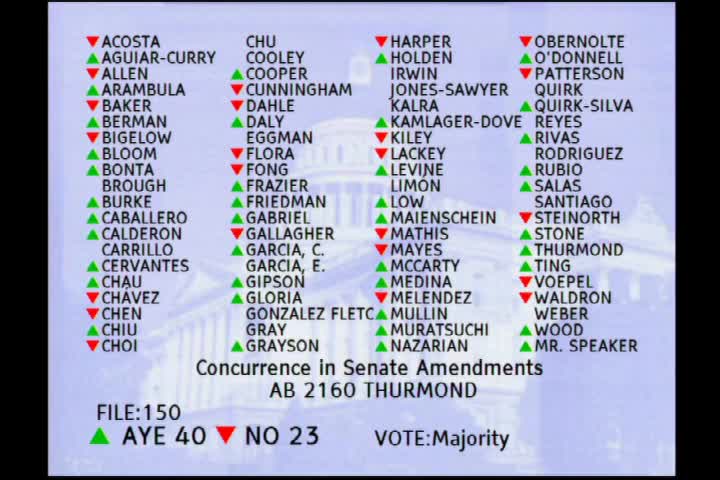
Bill Author
Bill Co-Author(s):